
You've got the DMV renewal notice in one hand and a failed Vehicle Inspection Report in the other, and the car drove fine on the way in. That disconnect is normal in California. A smooth idle doesn't mean the emissions systems have proven themselves to the car's computer, and on most newer vehicles that proof is what the test measures.
California checks three things. There's a visual inspection for missing or modified emissions equipment, a functional check that includes the OBD II scan on newer vehicles, and for older vehicles a tailpipe or dynamometer test that measures gases directly. In an August 2025 statewide sample, the overall initial test failure rate was 8.45%, based on 975,369 initial tests and 82,389 failures, according to California BAR smog check performance reporting. Most of those failures aren't mysteries. They trace back to eight fixable causes, and knowing which one you're dealing with tells you whether you need a gas cap, a drive cycle, or a real repair before you pay for a retest.
Table of Contents
- 1. Illuminated Check Engine Light (Malfunction Indicator Lamp)
- 2. Incomplete OBD II Readiness Monitors
- 3. Failing Catalytic Converter
- 4. Faulty Oxygen (O2) Sensors
- 5. EVAP System Leaks
- 6. Engine Misfires and Ignition System Faults
- 7. Vacuum Leaks
- 8. Malfunctioning EGR (Exhaust Gas Recirculation) Valve
- 8 Common Smog Check Failures Compared
- Fix It Fast and Pass Your Retest
1. Illuminated Check Engine Light (Malfunction Indicator Lamp)
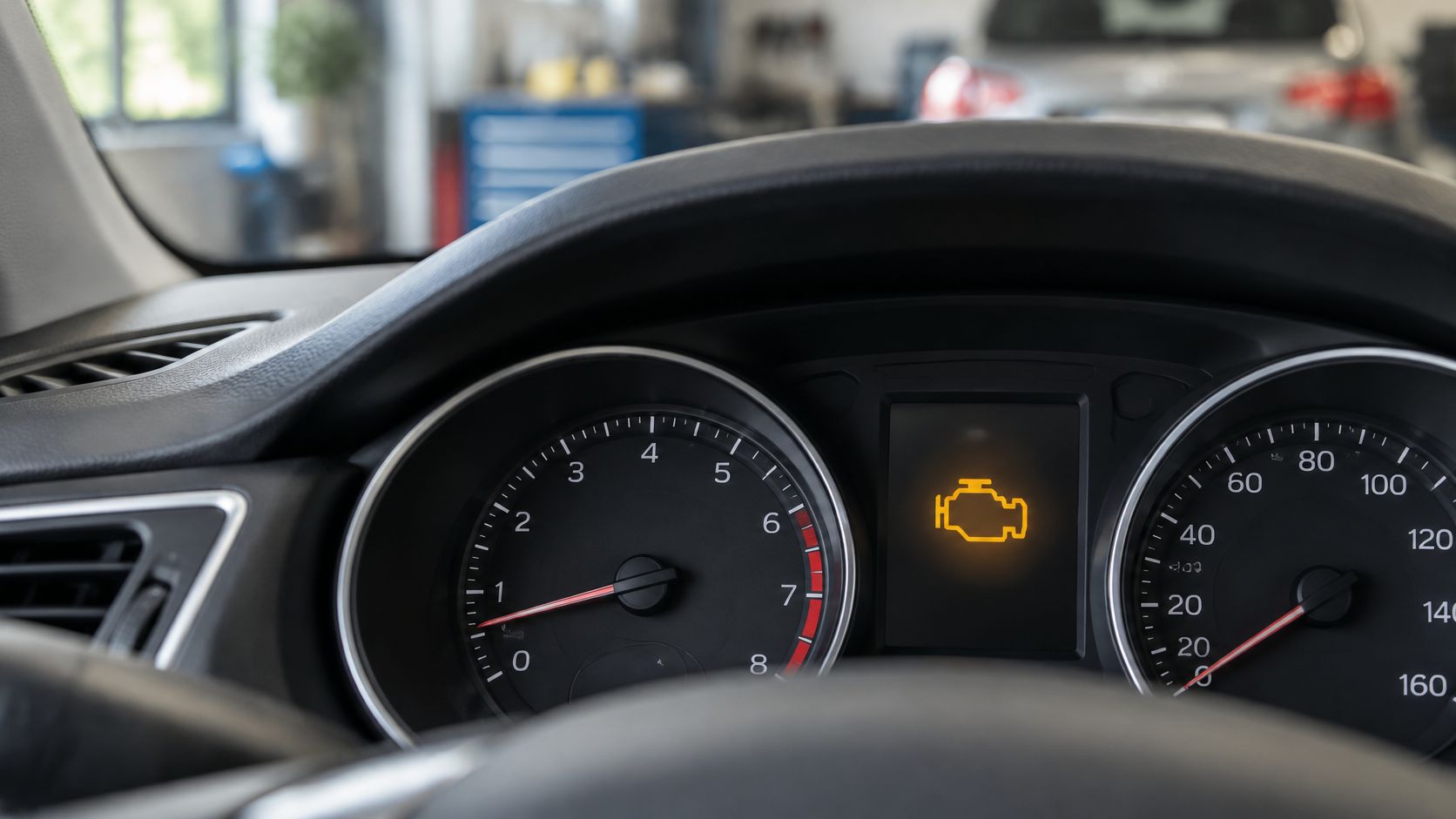
If the Malfunction Indicator Lamp, or MIL, is on with the engine running, you fail. There's no partial credit and no argument about how well the car drives. On 2000 and newer vehicles, the inspector plugs into the OBD II port and the car reports its own verdict. A commanded-on MIL or a stored emissions related diagnostic trouble code means the computer has already found a fault.
That's also why the bulb check matters. Turn the key to on without starting the engine and the light should illuminate briefly. If it doesn't, that fails too, because there's no way to prove the warning system works.
A quick diagnostic example
A driver comes in with the light on, gets the codes read first, and finds a faulty oxygen sensor code. The shop replaces the sensor, confirms the code doesn't return after driving, and the car passes on the next visit. The order matters. Reading the code before you test saves you a documented failure, and learning how to read OBD codes helps you tell a loose gas cap code from something that needs a shop.
- Scan before you test: Get the codes read so you know what repair you're facing.
- Don't clear and rush in: Erasing codes turns the light off but wipes readiness, which creates a different failure.
- Treat a flashing light as urgent: A flashing MIL usually signals a severe misfire that can overheat and destroy the catalytic converter.
Practical rule: The light is the test on a newer car. Fix the cause the code points to, then let the car prove the fix through normal driving.
2. Incomplete OBD II Readiness Monitors
A car can run normally and still fail because its emissions self-tests are incomplete. Readiness monitors check systems such as the catalytic converter, EVAP, oxygen sensors, and EGR. Disconnecting the battery or clearing diagnostic codes can reset monitors to “not ready.” After a repair, the vehicle also needs suitable driving conditions to run those tests again.
California's readiness requirements depend on the vehicle and the monitor. A smog technician can check the car's status against the applicable BAR rules; an incomplete monitor does not automatically mean every vehicle fails. The percentage reported in BAR's August 2025 smog check executive summary should not be read as a readiness-only failure rate without a clear definition of what the figure measures.
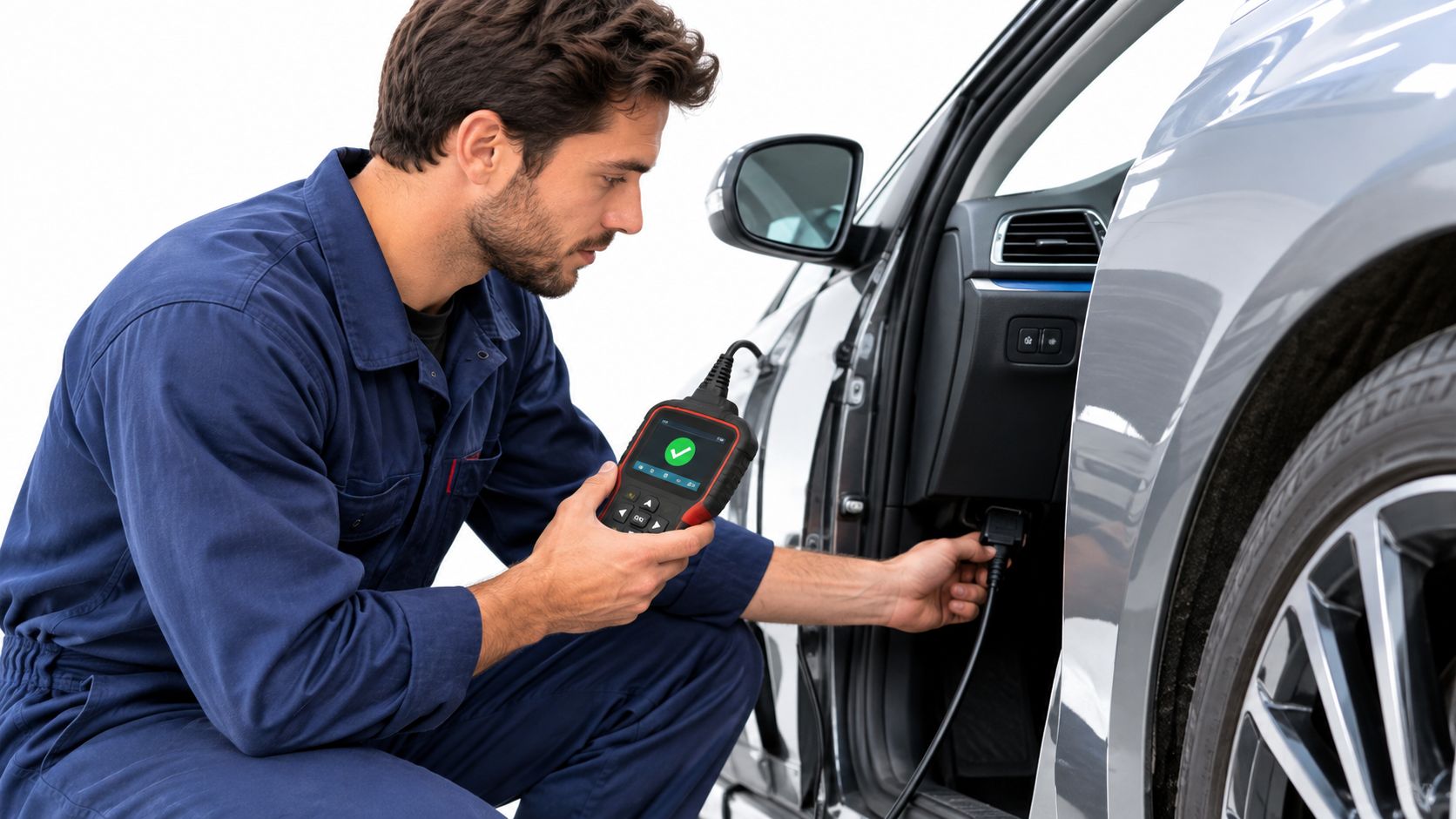
For example, an owner replaces a dead battery on Saturday and drives to the test station Monday. The engine runs well and the warning light is off, but one or more monitors may not have completed. A mix of city and freeway driving, with the engine cooling fully between trips, can help. There is no universal mileage target: fuel level, temperature, cold starts, and steady cruising affect monitor operation, and some vehicles require a manufacturer-specific drive cycle.
- Avoid resets before testing: Don't disconnect the battery or clear codes before an appointment. If a repair requires either, check readiness afterward.
- Vary your driving: Include stop-and-go trips, steady freeway cruising, and full cool-downs.
- Check before the test: Ask a technician to scan monitor status and identify any incomplete tests.
A basic scan tool can show whether monitors are ready before you pay for an inspection. If one remains incomplete, use the vehicle's specified drive cycle or have a technician diagnose why the test has not run.
3. Failing Catalytic Converter
The catalytic converter is where the expensive failures live. It uses platinum, palladium, and rhodium to convert hydrocarbons, carbon monoxide, and nitrogen oxides into less harmful gases. When it wears out, clogs, or gets contaminated by oil or unburned fuel, pollutants pass straight through. Newer cars get caught by a catalyst efficiency code, often P0420. Older cars get caught by the tailpipe numbers themselves.
Age works against you here. California data shows the failure rate rising from about 4% for eight year old vehicles to approximately 15% for 23 year old vehicles, a pattern tied to aging emissions equipment and converter wear in the Bureau of Automotive Repair performance report. Age alone doesn't doom a converter, but wear plus neglected upstream problems usually does.
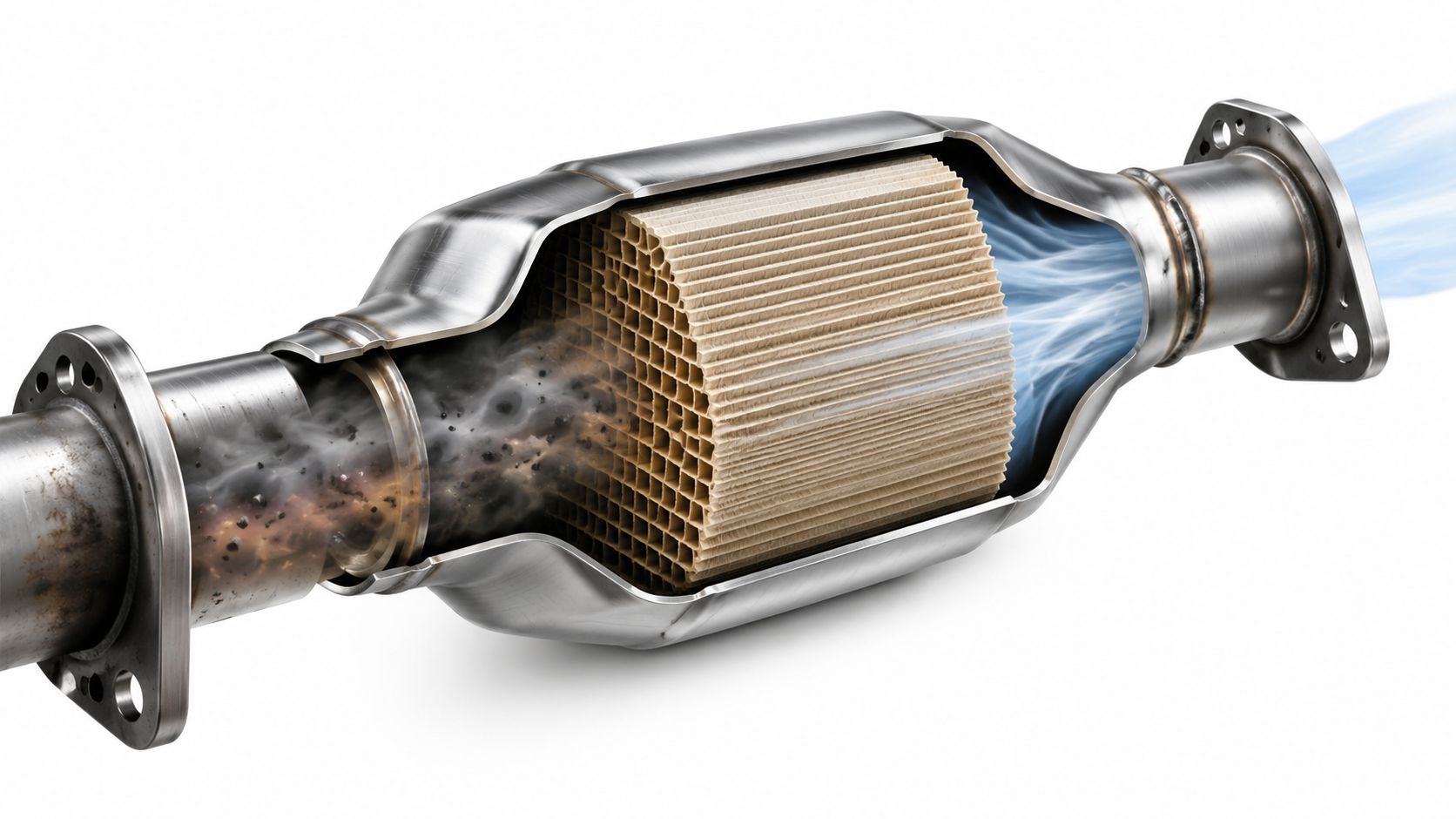
Take a 2005 sedan that fails with a catalyst efficiency code after months of ignored misfires. Replacing the converter alone would waste money, because raw fuel from the misfire is what killed it. The owner repairs the ignition fault first, then installs a California compliant converter, and passes. Understanding how a catalytic converter functions makes that sequence easier to follow when a shop explains the estimate.
Protecting a replacement converter
- Fix misfires and oil leaks first: Both poison or overheat a new converter quickly.
- Confirm CARB compliance: A cheap out of state converter that isn't approved for California can fail the visual inspection.
- Listen for rattles: A rattle at idle or a sudden loss of acceleration can mean the internal substrate has broken apart.
4. Faulty Oxygen (O2) Sensors
Oxygen sensors tell the computer how much unburned oxygen is left in the exhaust, and the computer trims fuel delivery based on that signal. Upstream sensors, mounted before the converter, control the air fuel mixture in real time. Downstream sensors sit after the converter and mostly watch whether it's doing its job. When a sensor gets lazy, responding slowly instead of switching crisply, the mixture drifts rich or lean and emissions climb before you feel anything wrong.
The tricky part is that a dying sensor and a dying converter can look similar. A downstream sensor that's lying can trigger a catalyst code on a healthy converter. A good technician watches live sensor data and compares upstream and downstream waveforms before condemning either part. That diagnostic step is the trade-off. Guessing is faster, but guessing wrong on a converter is an expensive lesson.
Here's a common scenario. A driver notices fuel economy slipping, then the check engine light appears. The scan shows a slow upstream sensor, and after replacement the fuel trims settle back to normal and the emissions reading drops. Reading up on how oxygen sensors affect your smog test helps you ask the right questions about which sensor failed and why.
- Match the position: Upstream and downstream sensors aren't interchangeable, so order by exact location and connector.
- Keep silicone away: Silicone based gasket makers near the exhaust can contaminate sensor elements.
- Respect service intervals: On high mileage vehicles, replacing worn sensors at the manufacturer's recommended interval protects the converter downstream.
A sensor is a wear item, not a lifetime part. Treating it that way prevents bigger bills.
5. EVAP System Leaks
Your gas tank constantly produces fuel vapor, and the EVAP system exists to keep that vapor out of the air. It stores vapor in a charcoal canister, then purges it into the engine to be burned when conditions are right. Any leak in the hoses, canister, purge valve, vent valve, or filler cap lets vapor escape, and the OBD II EVAP monitor is sensitive enough to catch very small leaks. Codes like P0442 for a small leak or P0455 for a large one are smog failures.
Start with the cheapest suspect. A vehicle fails with an EVAP code, the technician inspects the gas cap, and the rubber seal is cracked and flattened. A new cap, a few drive cycles, and the monitor passes. It doesn't always end that easily, but you'd be surprised how often it does.
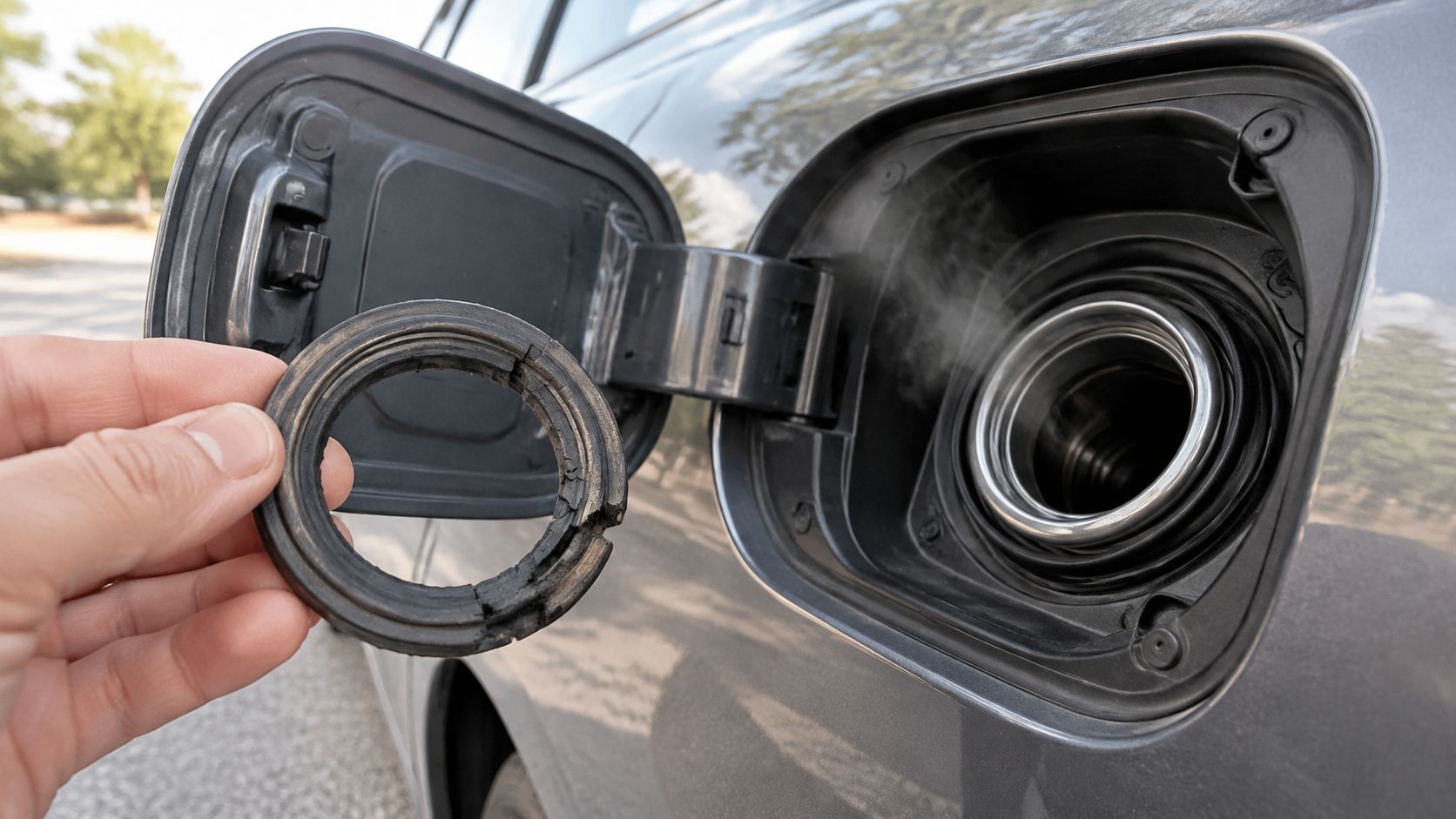
When the cap isn't the culprit, a smoke test is the honest way forward. The shop fills the system with visible smoke and watches where it escapes, which beats replacing valves one at a time on suspicion.
Simple checks before you book a repair
- Click the cap: Tighten it until it clicks and inspect the seal for cracks or a flattened edge.
- Stop at the first click at the pump: Overfilling pushes liquid fuel into the canister and can ruin it.
- Ask for a smoke test: If the leak isn't obvious, pinpointing it first is cheaper than swapping parts.
EVAP failures reward patience. Test, find the leak, fix that one thing, and confirm the monitor completes.
6. Engine Misfires and Ignition System Faults
A misfire means a cylinder didn't burn its fuel charge properly. Worn spark plugs, a failing ignition coil, damaged plug wires, or a fuel delivery problem are the usual causes. That unburned fuel travels into the exhaust, hydrocarbon emissions spike, and the extra fuel burning inside the catalytic converter can overheat it. Of everything on this list, an active misfire does collateral damage the fastest.
Codes help narrow it down. P0300 means random misfires across cylinders. P0303 points at cylinder three specifically, which tells the technician where to start swapping coils or inspecting plugs to see if the misfire follows the part.
Picture a car with a shaky idle that fails for a cylinder three misfire. The shop moves that cylinder's coil to another cylinder, the code follows the coil, and the diagnosis is confirmed. New coil, fresh plugs all around since they're the same age, and the car passes its retest with the converter still intact because the owner didn't keep driving on it.
- Replace plugs on schedule: Follow the interval in your owner's manual and use the exact plug type specified for your engine.
- Don't drive on a flashing light: A flashing MIL during a misfire is the car telling you the converter is at risk right now.
- Fix the whole pattern: If one plug is worn out, the rest aren't far behind, so replacing the set makes sense.
That last point is where people cut corners and end up back in the shop a month later with a different cylinder misfiring.
7. Vacuum Leaks
Engines measure incoming air carefully, and a vacuum leak sneaks in air the computer never counted. Cracked rubber hoses, a failed intake manifold gasket, or a leaking brake booster all create that unmetered air. The mixture goes lean, idle gets rough or hunts up and down, and the computer compensates by adding fuel until it runs out of adjustment range and sets lean or fuel trim codes like P0171. On tailpipe tested vehicles, that lean condition can push hydrocarbons and nitrogen oxides over the limit.
Your ears are a legitimate diagnostic tool here. A driver hears a faint hiss near the intake, follows it to a split PCV hose that's gone brittle with heat, and replaces a part that costs very little. Idle stabilizes, the lean code clears after driving, and the retest passes. Spanish speaking drivers and visual learners alike benefit from seeing the inspection process, and this walkthrough shows what a hose inspection looks like.
Not every leak announces itself. Small cracks that open only when the engine is hot, or leaks under the intake manifold, hide from a visual check. That's when a smoke machine earns its keep, pressurizing the intake so leaks reveal themselves as wisps of smoke.
- Inspect rubber closely: Squeeze hoses and look for brittleness, cracking, or loose clamps.
- Replace proactively on older cars: Aging hoses are cheap insurance on high mileage vehicles.
- Smoke test the stubborn ones: If inspection finds nothing, stop guessing and test.
8. Malfunctioning EGR (Exhaust Gas Recirculation) Valve
The EGR valve routes a measured amount of exhaust gas back into the intake. That dilutes the intake charge, lowers combustion temperatures, and cuts nitrogen oxides, or NOx, which form when combustion gets too hot. It's a simple idea with a dirty working environment, because exhaust deposits carbon everywhere it goes.
Failure cuts both ways. A valve stuck closed, or passages clogged with carbon, sends NOx climbing, which shows up clearly on dynamometer and tailpipe tests for older vehicles. A valve stuck open leaks exhaust into the intake at idle when it shouldn't, causing rough running, stalling, and lost power. Codes in the P0400 range point to flow problems, but the code alone doesn't tell you whether the valve, the passages, or the control solenoid is at fault.
A typical case involves a vehicle with a rough idle and a high NOx reading. The technician removes the EGR valve, finds the pintle and passages packed with carbon, cleans them, tests valve movement, and the next test comes in within limits. Cleaning works when the valve itself still functions. When the diaphragm is torn or the electronic actuator has failed, cleaning is wasted labor and replacement is the honest fix.
Before you authorize EGR work
- Confirm how you're tested: EGR's role in your inspection varies by model year and test type, so ask the technician.
- Clean first if it's sticking: Carbon removal is worthwhile when the valve tests functional.
- Watch the early signs: Rough idle, pinging under load, or a new check engine light often appear before a hard failure.
NOx failures on older vehicles point here more often than anywhere else.
8 Common Smog Check Failures Compared
| Item | 🔄 Complexity | ⚡ Typical resources or effort | 📊 Expected smog-check impact | 💡 Ideal next step | ⭐ Key advantage |
|---|---|---|---|---|---|
| Illuminated Check Engine Light (MIL) | Moderate; depends on the stored fault | OBD II scan and potentially targeted repairs | Lit MIL or emissions-related codes can cause automatic failure | Read and diagnose codes before testing; allow readiness monitors to complete after repairs | Provides an early warning and often points toward the affected system |
| Incomplete OBD II Readiness Monitors | Low; usually requires driving | Several days of varied driving; avoid clearing codes | Test may be rejected or fail if too many monitors are incomplete | Ask which monitors are incomplete and follow an appropriate drive cycle | Often resolves without repairs |
| Failing Catalytic Converter | High; diagnosis and replacement can be costly | Diagnostic testing and a California-compliant replacement if needed | Reduced conversion efficiency can raise emissions and cause failure | Fix misfires or fluid leaks first; verify replacement parts are CARB-compliant | A functioning converter substantially reduces tailpipe pollutants |
| Faulty Oxygen (O2) Sensors | Moderate; correct sensor and location must be identified | Code and sensor testing; replacement is often less costly than a converter | Incorrect fuel control or catalyst monitoring can lead to failure | Confirm the sensor fault before replacing parts | Repair may improve emissions, fuel economy, and drivability |
| EVAP System Leaks | Low to moderate; locating small leaks can take time | Gas cap inspection; smoke testing may be needed | Failed leak detection can cause an OBD II failure | Check the gas cap seal; request a smoke test if the leak is not obvious | Some causes are inexpensive and simple to fix |
| Engine Misfires and Ignition System Faults | Low to high; depends on the cause | Scan tool and ignition or fuel-system diagnosis | Unburned fuel raises emissions and may damage the converter | Address flashing Check Engine lights promptly and diagnose the misfire | Repair can restore smooth operation, fuel economy, and emissions |
| Vacuum Leaks | Low to moderate; locating hidden leaks may require tools | Hose inspection, fuel-trim checks, or smoke testing | Unmetered air can disrupt combustion and trigger failure-related codes | Inspect hoses and intake connections; use a smoke test if needed | Small hose repairs can improve idle and fuel economy |
| Malfunctioning EGR Valve | Moderate; deposits or related passages may need attention | Inspection, cleaning, or valve replacement | Excess NOx can cause failure, particularly on applicable tailpipe tests | Check whether EGR testing applies to the vehicle and inspect the valve and passages | Restoring EGR operation helps control NOx emissions |
Fix It Fast and Pass Your Retest
Knowing What Fails a Smog Check is only useful if it changes what you do before the test. Run through a short checklist a week out. Confirm the check engine light is off and has been off through several days of normal driving, not just since this morning. Make sure you haven't disconnected the battery or cleared codes recently, and if you have, drive a mix of city streets and freeway miles with full cool downs in between so the readiness monitors can complete. Click the gas cap tight, top up your maintenance, and arrive with the engine fully warmed up after a real drive rather than a two minute trip from home.
That preparation matters more than most drivers realize. California's newer readiness expectations mean a repaired car can still fail if its monitors haven't rerun, even with no active code present. The statewide failure rate for 2000 and newer vehicles was about 7% in calendar years 2024 to 2025, and the updated rule applies to gasoline vehicles model year 1996 and newer and diesel vehicles model year 1998 and newer, according to BAR's explanation of the new OBD readiness monitor regulations. In plain terms, repairing the fault and proving the repair are two separate steps, and the inspection checks both.
If you've already failed, don't guess. Read your Vehicle Inspection Report and identify the exact failure category, whether that's OBD codes, readiness, visual, functional, or tailpipe emissions. That category tells the repair shop where to start and keeps you from paying for parts the car doesn't need. After the repair, resist the urge to drive straight back. Complete the drive cycle, verify monitor status with a scanner if you can, and then retest. Drivers who skip that verification step are the ones who fail twice for two different reasons.
Shop advice: Bring your failed inspection report to the repair shop. It turns a vague conversation into a specific work order.
East Bay drivers who want the testing side handled efficiently can visit Speedy Smog in San Leandro, a STAR Certified station that tests 2000 and newer models, 1999 and older vehicles, diesels, and hybrids. Whether you're coming in for a first test or returning after a repair, going in with the light off, the monitors ready, and the gas cap clicked puts the odds firmly in your favor.
If your renewal deadline is coming up or you're returning after fixing a check engine light, incomplete monitor, or EVAP leak, bring your vehicle to Speedy Smog in San Leandro for STAR Certified testing for newer cars, older vehicles, diesels, and hybrids. The team will run your inspection efficiently, explain your Vehicle Inspection Report in plain English if anything doesn't pass, and help you understand what to fix before a retest. Stop by and get certified so you can finish your DMV registration without another wasted trip.
Most California vehicles need a Smog Check every 2 years, usually when registration is renewed, if the DMV notice says certification is required. Newer cars and certain sale situations can change that timing, so the date on your renewal notice matters more than a guess.
You open the DMV envelope, look at the renewal date, and wonder if this is the year you need to get the car tested. For a lot of East Bay drivers, that's the whole question in one moment, and the good news is the normal answer is simple once you know what to check.
Table of Contents
- How Often Most California Drivers Need a Smog Check
- How Biennial Renewal Testing Actually Works
- Newer Cars and the Model Year Countdown
- When Selling or Transferring Changes Your Smog Timing
- Exemptions and Special Vehicles Made Simple
- Why County and Air Quality Rules Can Affect Timing
- Staying on Schedule Without Stress
How Often Most California Drivers Need a Smog Check
A first-time car owner in San Leandro often assumes smog testing works like an annual tune-up. For most California vehicles subject to the program, it follows a different rhythm, once every two years, and it lines up with registration renewal rather than routine maintenance, according to the California Bureau of Automotive Repair's Smog Check guidance (BAR Smog Check overview).
The renewal notice is the signal that matters
If your DMV renewal notice says the vehicle needs certification, that notice controls your next step. BAR says the notice identifies whether a particular vehicle requires certification, and registration cannot be finalized when the required smog certificate is missing.
Paying the fee does not always finish the job. If the car still needs a passing certificate, the DMV side of renewal stays open until the smog requirement is satisfied.
Practical rule: treat the renewal notice like a green light or red light. If it asks for certification, get the test done before the deadline.
A simple way to think about the timing
For a normal vehicle in the program, smog testing works like a repeating checkpoint at renewal, not like a yearly oil change. One renewal cycle may need it, the next may not, and then it comes back again on the following cycle.
That pattern is why drivers get tripped up. They remember testing the car recently, then assume they are covered for another year, but the renewal schedule does not follow that logic. It follows the DMV record for that specific vehicle and whether the notice says certification is required.
The safest habit is straightforward. Open the renewal notice, look for the smog requirement, and plan the inspection before the registration deadline if it is listed. That keeps the process calm instead of last-minute.
How Biennial Renewal Testing Actually Works
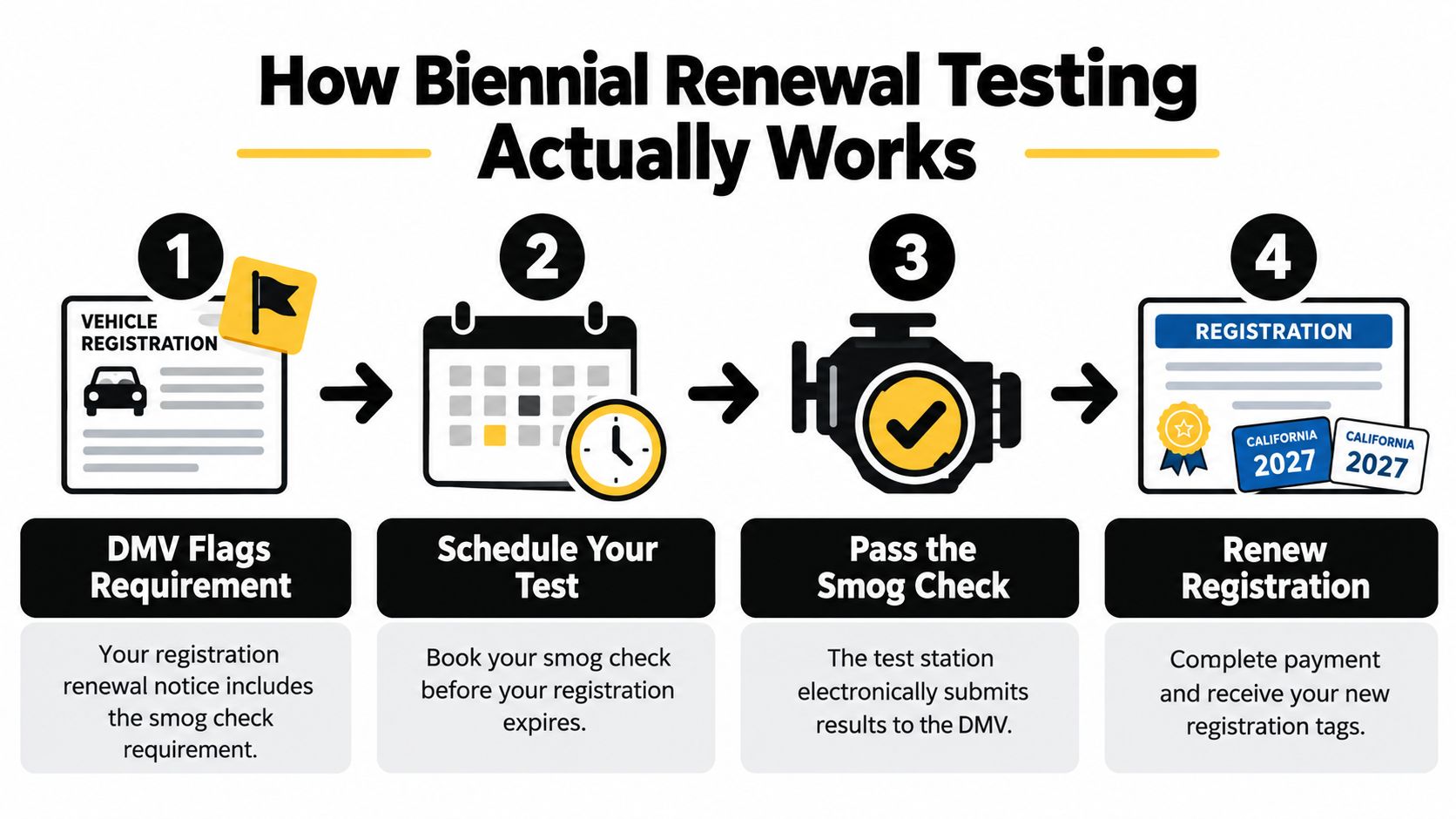
A biennial smog check works like a relay between the DMV, the inspection station, and your registration renewal. One office starts the process, the station reports the result, and the DMV closes the loop once the record shows a passing certificate, as outlined in the BAR brochure (BAR brochure).
Four steps that keep the process moving
- DMV flags the requirement. Your renewal notice shows whether certification is needed for that specific vehicle.
- You schedule the test. Book it before the registration expires, so you are not racing the deadline.
- The station submits the result. The test station electronically sends the outcome to the DMV.
- You renew registration. Once the certificate is on file, payment and tags can be completed.
The notice matters more than a general calendar rule. For a normal vehicle in the program, the test usually comes back at renewal time, then drops out on the next cycle, then returns again later. A simple way to keep that pattern straight is to follow the renewal paper in front of you, not memory or the last time you visited a station.
If the notice asks for smog certification, do not wait until the last week. A little lead time gives you room if the car needs attention before it passes.
What happens if the certificate is missing
If the required smog result is not on file, registration cannot be completed. That is the part that catches people off guard, because the renewal letter may look routine even though the DMV side is still waiting for a passing result.
If you want a plain-English refresher on how a result fits into the renewal window, this guide on smog test validity in California breaks down the timing in a simple way. A retest window is usually the part that saves the day. If the first inspection does not pass, the driver can use the extra time to fix the problem, return for another check, and then finish renewal after the certificate clears.
Newer Cars and the Model Year Countdown
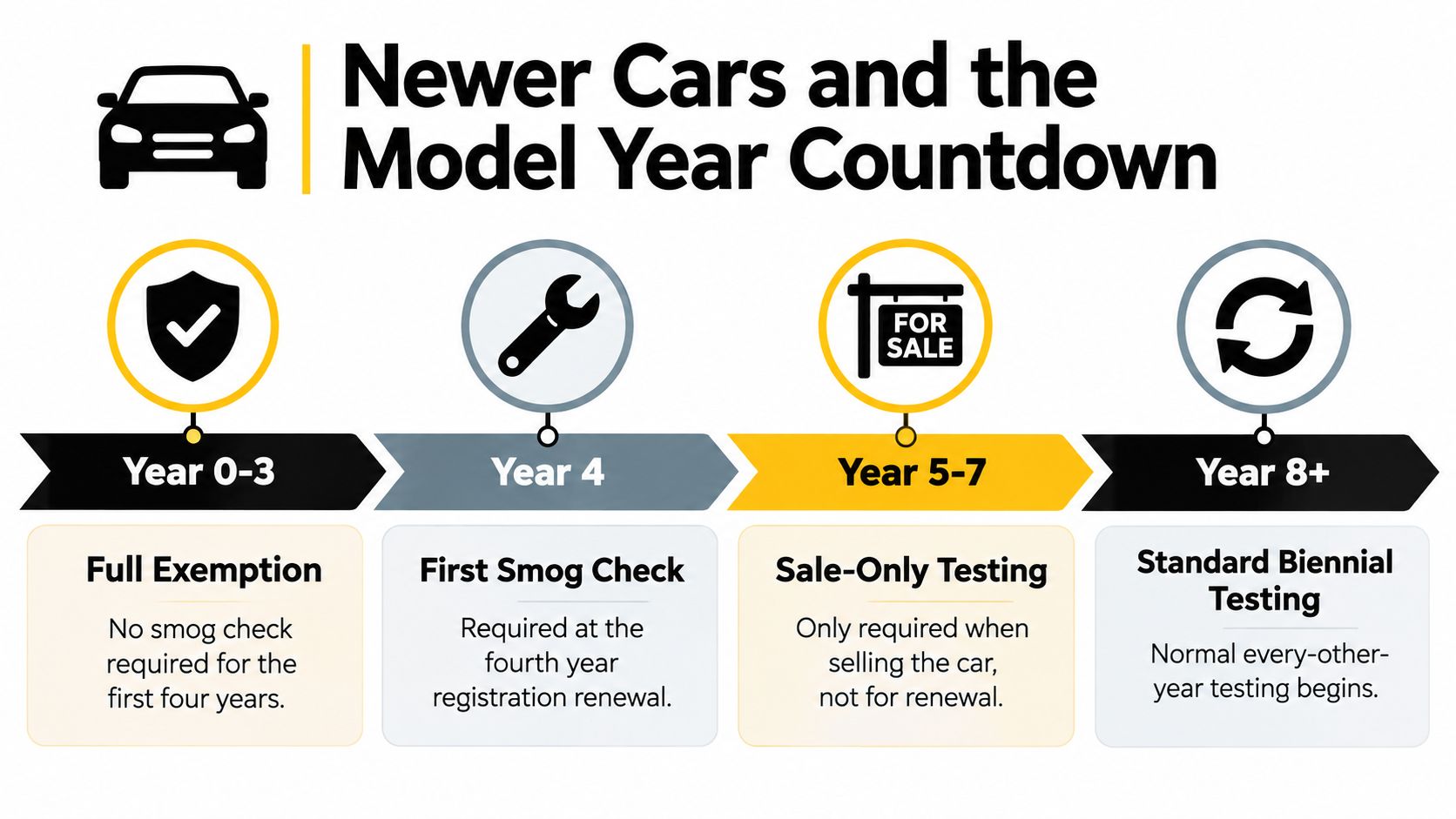
A car can still feel new and already be on a different Smog Check schedule. The key is model year, not how long you have owned it, and newer vehicles stay in a separate category for a while (BAR executive summary report).
The first years are exempt
Vehicles four model-years old or newer are exempt from both biennial and change-of-ownership Smog Checks. That means a recent purchase does not automatically need a test (BAR executive summary report).
BAR's example makes the timing easier to follow. A 2020 vehicle first becomes subject to change-of-ownership testing in 2024 and biennial testing in 2028. Model years work like birthdays: nothing is due at first, one milestone arrives at the sale window, and the every-other-year cycle starts later.
Why the sale window is different from the renewal window
Vehicles in their fifth through eighth model years generally need a Smog Check when ownership changes, but they are not yet in the normal biennial renewal cycle. That is the point that catches many owners, because the car can still be off the renewal schedule and still need a certificate for a sale (BAR executive summary report).
For San Leandro drivers comparing that timing with a real station option, the page on California smog check for newer cars is a useful reference.
The practical move is simple. Count the model year before you assume the car is due. If the vehicle is newer than you thought, you may avoid an unnecessary trip. If it is older than you thought, you do not want to miss the first required certificate.
When Selling or Transferring Changes Your Smog Timing
A sale can change the timing even when a registration renewal would not. That is where many first-time owners get caught, because the DMV cares about the transaction itself, not just the normal renewal cycle.
| Situation | Usual Timing | What To Check |
|---|---|---|
| Registration renewal | Every other year for most subject vehicles | Read the DMV renewal notice |
| Sale or transfer | Can be required even when renewal testing isn't due yet | Check the vehicle's model year and ownership-change status |
| Recent purchase | Depends on age and registration circumstances | Confirm whether the car is still in the exempt range |
For a seller, the right question is simple. What proof needs to be ready before the title changes hands? A buyer should ask the same thing from the other side: is the car clear for transfer, or will a passing certificate be needed before the paperwork moves ahead?
If you want a plain-language walkthrough of the renewal side, the guide on smog check registration renewal is a useful companion.
A car can also shift into the sale-testing window before it reaches the normal renewal schedule. That is why an owner who has never needed a renewal test can still be asked for a certificate during a transfer. The model-year cutoff is the part to verify first, then the title status, then the DMV paperwork.
The cleanest habit is to separate the two triggers. Renewal timing tells you whether the DMV wants a certificate for the current registration cycle. Sale timing tells you whether the ownership change itself needs one. Keep those apart, and the process is much easier to follow.
Exemptions and Special Vehicles Made Simple
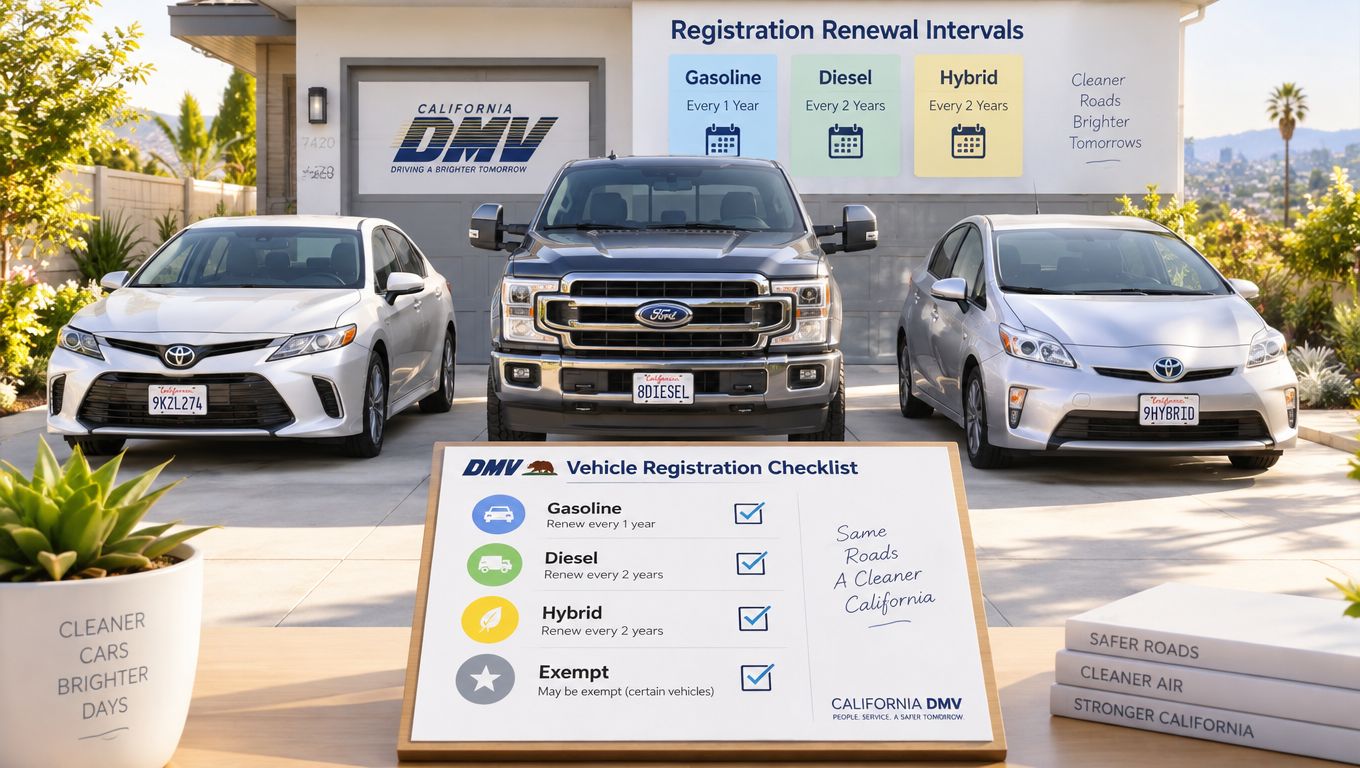
A car's smog schedule can change with its fuel type, model year, and registration situation, so two vehicles in the same driveway may not follow the same rule.
Who usually stays out of the normal cycle
Older and newer vehicles do not all sit in the same lane. Passenger cars in the newer age range can be outside the usual testing rhythm, while other vehicles may only come up for testing during a change of ownership.
Diesel owners should pause here and check the official vehicle category rather than guess from the body style. California does not use the same simple model-year rule for every diesel vehicle, and some older or heavier diesels fall under separate criteria.
Hybrids can also cause confusion. The safest move is to read the DMV notice and confirm the vehicle type on the paperwork, because the notice often tells you more than appearance ever will. A clean, quiet car can still have a testing step attached to it, while a vehicle that looks older may still be outside the current cycle.
Not every vehicle uses the same lane. Fuel type, model year, and the DMV notice all matter together.
How to sort yourself fast
Start with the renewal notice if you drive a standard passenger car. Start with the vehicle category if you own a diesel. For hybrids, check the notice and the registration record together so you do not assume the car follows the same path as a regular gas model.
That same habit helps with older cars and vehicles that have unusual registration histories. Appearance is a poor guide. The paperwork and the official vehicle class decide the timing, and that is usually the part drivers miss.
A simple rule keeps it clear. Age explains a lot, but it does not explain everything.
Why County and Air Quality Rules Can Affect Timing
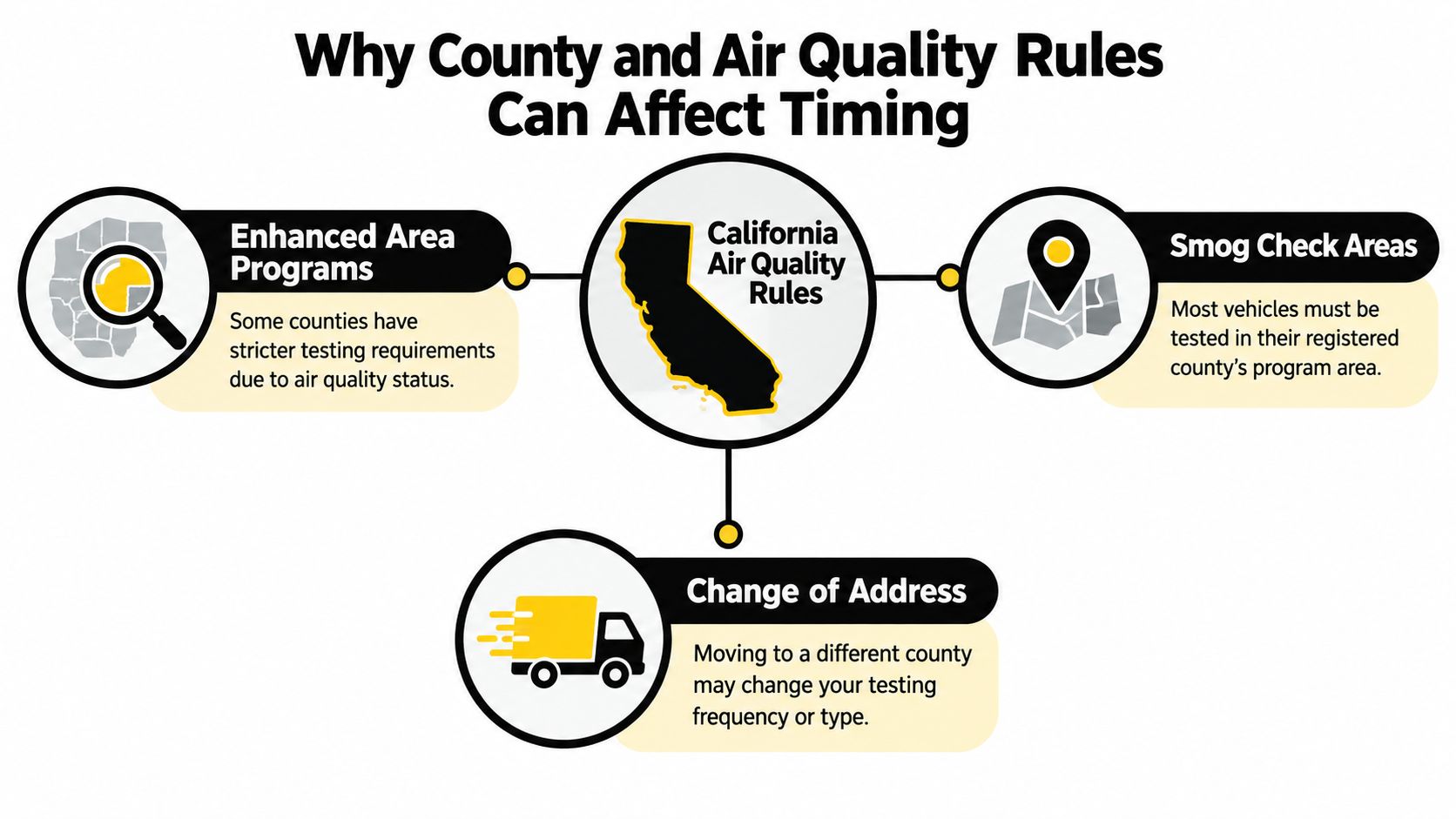
A smog check can feel like a statewide rule, then a county rule changes the timing. California uses a baseline schedule, but some air-quality programs create local exceptions for specific areas.
The San Joaquin Valley is the exception, not the template
The San Joaquin Valley is the clearest example. After the U.S. EPA found in October 2025 that the area failed to attain the 80-ppb ozone standard, California triggered a contingency measure that would reduce the new-vehicle renewal exemption there from eight model years to seven, with a possible reduction to six if another trigger occurs (San Joaquin Valley contingency measure).
That rule is described as applying only to the San Joaquin Valley, not statewide. A driver in Oakland or San Leandro should not assume the same timing applies just because the car is the same age.
Why this matters if you move
A move can change the answer. If you shift counties or enter a different program area, the local timing rules may be different from the ones on your old registration. A vehicle can look exempt in one place and fall back into the testing cycle in another.
The safest check is simple. Read the DMV renewal notice first, then confirm whether your current location has a special air-quality rule in force. A model-year rule works like a road map, but local rules can add a detour.
Practical reminder: do not guess from the county name alone. Use the renewal notice, then verify local guidance if the vehicle is tied to a special air-quality area.
That is why county-based timing deserves careful attention. Most California drivers still follow the standard biennial rhythm, but local air-quality action can move the first testing point for some vehicles in some places.
Staying on Schedule Without Stress
The least stressful way to handle smog timing is to make it a habit tied to the DMV envelope. Open the notice, look for the certification requirement, and set your test date early enough that you're not trying to finish registration on the last day.
A simple checklist for East Bay drivers
- Check the renewal notice first. It tells you whether the vehicle needs certification for that cycle.
- Count the model year if the car is newer. Newer vehicles may be exempt for a while, and that changes the answer.
- Separate renewal from sale timing. A car can be fine for renewal and still need a certificate for a transfer.
- Confirm special categories carefully. Diesel and other special vehicles can follow different criteria.
- Book early if the deadline is close. That leaves room if the vehicle needs attention before it passes.
If you want a nearby station that handles STAR-certified smog inspections in San Leandro, Speedy Smog is one option to check when your renewal notice says it's time. The shop focuses on inspections for many vehicle types, including newer vehicles, older vehicles, diesels, and hybrids.
The calmest rule is the one you can repeat. Read the notice, confirm the vehicle's age and category, then get the inspection done before renewal closes. That's how you stay compliant without turning registration season into a scramble.
If your renewal notice is coming up, bring it to Speedy Smog and get the timing sorted before the deadline. The shop handles smog inspections in San Leandro with a STAR Certified process, so you can check the requirement, complete the test, and move on with registration.
Your DMV renewal notice is on the kitchen counter, and one line has created an immediate question: “Smog Certification Required.” You may be wondering whether the car needs a test every year, whether a recent inspection still counts, or whether its hybrid, diesel, or electric powertrain changes the answer.
California's DMV smog check requirements depend on the event you're handling, not just the vehicle itself. Registration renewal, a change of ownership, and first-time registration in California can trigger different obligations. Model year, fuel type, vehicle weight, and the wording on your DMV notice all matter.
Table of Contents
- Decoding Your DMV Renewal Notice
- Navigating Exemptions by Transaction and Vehicle Age
- Understanding OBD and Tailpipe Testing Differences
- STAR Station Mandates and Readiness Monitor Prep
- Special Rules for Hybrids Diesels and Electric Vehicles
- Handling Test Failures and the BAR Referee Process
- Your Action Plan for a Smooth Smog Check Experience
Decoding Your DMV Renewal Notice
California doesn't generally require a smog inspection on a fixed annual calendar. The obligation is tied primarily to vehicle registration, and gasoline-powered, hybrid, and alternative-fuel vehicles from model year 1976 onward generally need testing every other year when the DMV renewal notice says certification is required, according to the California Bureau of Automotive Repair's Smog Check guidance.
Start with the notice itself. Look for language such as:
- “Smog Certification Required” means you can generally use an authorized Smog Check station.
- “Smog Certification Required at a STAR station” means the vehicle must be inspected at a STAR-certified location.
- No smog certification instruction usually means the renewal doesn't currently require a test, although you should still follow any other DMV directions.
The notice is more reliable than guessing from the car's age or from the date of its last inspection. California may require a test for a renewal, a sale, or a first California registration even when the vehicle passed an inspection for a different transaction.
Practical rule: Read the DMV notice before booking an appointment. It tells you whether a test is required and whether the station must have STAR certification.
A registration renewal test is normally required biennially, or every other year, rather than annually. The DMV can't finalize a renewal when required smog certification is missing, even if you've already paid the registration fees, as explained in the DMV registration renewal instructions.
If the notice requires testing, use a service such as Smog Check registration renewal assistance to understand the process, then choose a station that matches the notice. Bring the vehicle, the notice if available, and any relevant repair information. Handling the inspection before the renewal deadline gives you time to respond if the vehicle needs repairs or the DMV record needs attention.
Navigating Exemptions by Transaction and Vehicle Age
The phrase “new car exemption” causes many California drivers trouble because it can describe different rules for different DMV events. A vehicle that avoids a biennial renewal inspection may still face a different requirement during a sale or first California registration.
For renewal, gasoline, hybrid, and alternative-fuel vehicles that are eight model years old or newer generally don't need the biennial inspection. The owner instead pays a smog abatement fee, subject to DMV eligibility rules. California gives a separate transfer rule to vehicles four model years old or newer, which can generally avoid the change-of-ownership inspection through the applicable smog-related fee.
Those exemptions don't automatically apply to every transaction. An out-of-state vehicle being registered in California for the first time generally needs a California Smog Check if it falls within the covered model-year and fuel categories. A recent inspection completed for another state or another DMV event shouldn't be treated as a universal exemption.
California Smog Check Exemption Matrix
| DMV Transaction Type | Vehicle Age / Model Year | Smog Check Required? |
|---|---|---|
| Registration renewal | Gasoline, hybrid, or alternative-fuel vehicle eight model years old or newer | Generally no biennial inspection, but a smog abatement fee may apply |
| Registration renewal | Covered gasoline, hybrid, or alternative-fuel vehicle beyond the newer-vehicle renewal exemption | Generally yes when the DMV notice identifies certification as required |
| Change of ownership | Vehicle four model years old or newer | Generally no transfer inspection, with the applicable smog-related fee |
| Change of ownership | Covered vehicle older than the transfer exemption | Generally yes, unless another exemption applies |
| First California registration | Covered out-of-state vehicle | Generally yes |
| Any transaction | Fully electric vehicle | Exempt |
| Any transaction | Gasoline vehicle from model year 1975 or older | Exempt |
| Any transaction | Diesel vehicle from model year 1997 or older | Generally exempt |
| Any transaction | Diesel vehicle above 14,000 pounds GVWR | Exempt from the standard requirement described here |
The most useful question isn't “Is my car exempt?” Ask instead: What DMV event am I completing, what is the model year, what fuel does it use, and what does the notice say? That four-part check prevents owners from applying a renewal exemption to a transfer or assuming an older out-of-state inspection will satisfy California registration.
If your situation involves an unusual transfer or exemption, review the DMV smog exemption form information before making an appointment. Keep your registration documents available, because the correct answer can depend on the transaction being processed rather than on the vehicle alone.
Understanding OBD and Tailpipe Testing Differences
Two vehicles can visit the same station and receive very different inspections. California chooses the testing method based on the vehicle's configuration, including its model year, fuel type, weight, and whether it has OBD II, the onboard diagnostic system used to monitor emissions equipment.
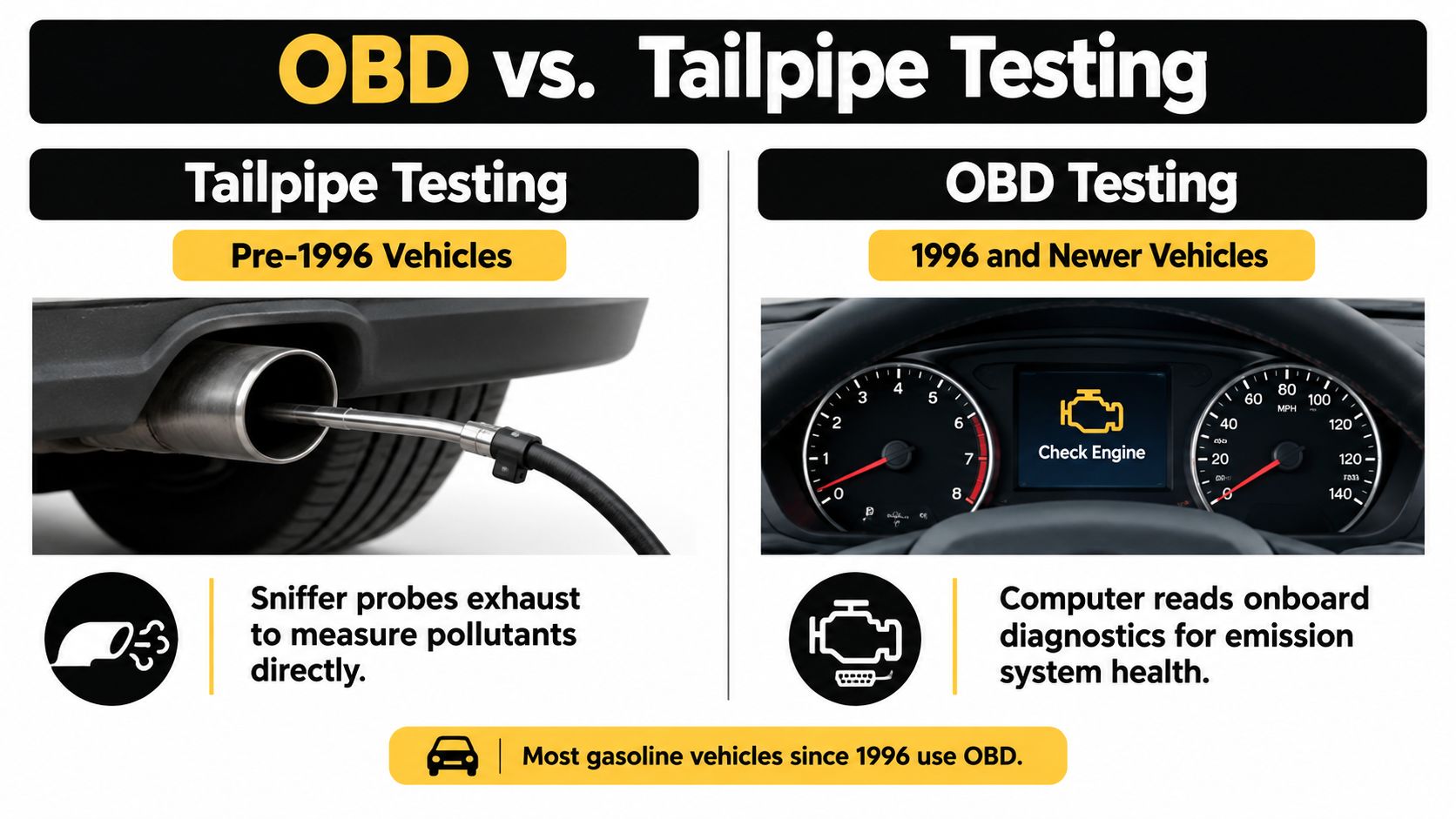
Most gasoline and hybrid vehicles from 2000 and newer, with a GVWR of 14,000 pounds or less and equipped with OBD II, are generally inspected through BAR-OIS. The technician connects approved equipment to the vehicle and electronically evaluates diagnostic information, emissions-related fault codes, readiness monitors, and required vehicle details. The process focuses on what the vehicle's computer reports about the health of its emissions systems.
Gasoline vehicles from 1976 through 1999, heavier gasoline vehicles, and qualifying vehicles without OBD II are generally tested with BAR-97. Instead of relying primarily on onboard computer data, this method measures pollutants directly from the exhaust through a tailpipe test. The BAR Smog Check executive summary describes the distinction between BAR-OIS electronic evaluation and BAR-97 tailpipe measurement.
The difference matters when you prepare:
- OBD-equipped vehicles: Diagnostic trouble codes and incomplete readiness monitors can affect the result, even when the dashboard warning light is currently off.
- Older vehicles: Emissions performance is assessed through measured exhaust, so engine condition, fuel delivery, ignition, and emissions components play a direct role.
- Both types: The inspector must use the procedure that matches the vehicle's configuration. You shouldn't assume a newer vehicle receives a tailpipe test because it has an exhaust system.
For a clearer explanation of how the terms relate, compare Smog Check and smog test terminology before arriving at the station.
STAR Station Mandates and Readiness Monitor Prep
A DMV notice that names a STAR station changes where you can test. STAR is California's standards-based program for vehicles assigned to higher-performing inspection locations. The DMV distinguishes between a notice that says certification is required at any authorized station and one that specifically directs the owner to a STAR-certified station.
Check the exact wording before you leave home. If the notice says “Smog Certification Required at a STAR station,” a regular licensed station isn't enough for that transaction. If it says only “Smog Certification Required,” you can generally choose an authorized Smog Check station.
Prepare the vehicle's diagnostic system
Readiness monitors are internal checks that help the vehicle confirm whether its emissions systems have completed their self-tests. A dead battery, battery replacement, or recent code clearing can erase this stored readiness information. The car may start normally and show no illuminated check-engine light, yet the inspection can still identify the monitors as incomplete.
Avoid disconnecting the battery or clearing codes immediately before testing. If a repair shop has recently erased diagnostic trouble codes, ask whether the vehicle has completed the required driving conditions for its monitors to run. The exact driving pattern varies by vehicle, so consult the owner's manual or a qualified repair professional rather than relying on a universal mileage claim.
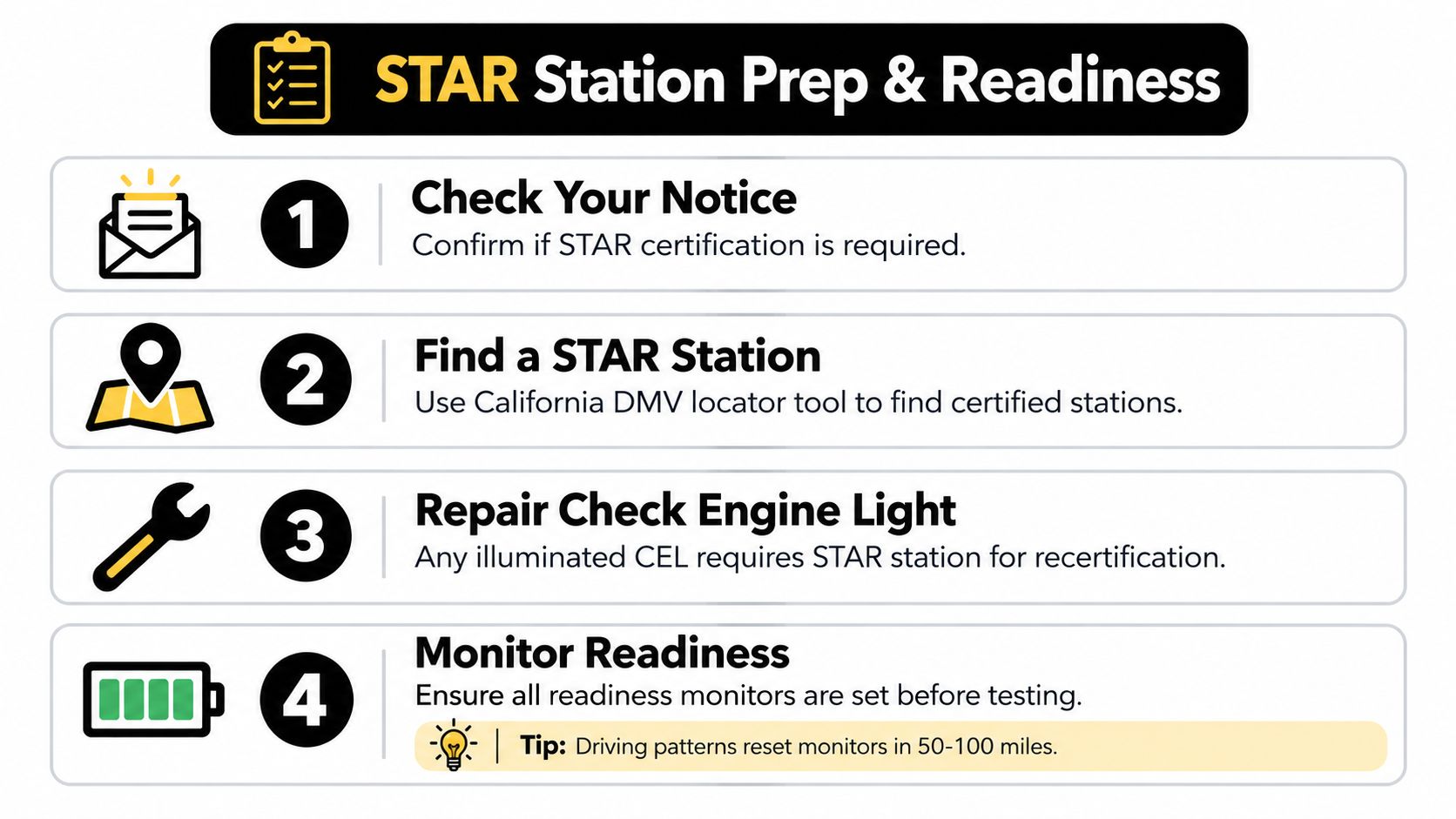
A practical preparation sequence looks like this:
- Read the notice. Confirm whether the DMV requires a STAR station.
- Check the warning light. An illuminated emissions warning lamp needs diagnosis before testing.
- Ask about readiness. If the battery was disconnected or codes were cleared, verify that the monitors have had time to complete.
- Bring the paperwork. Keep the DMV notice and any recent repair documents with you.
California also requires the engine to reach normal operating temperature, and the Smog Check procedure specifies at least three minutes of continuous low-idle operation immediately before the tailpipe test for applicable vehicles. Arriving prepared helps the technician perform a valid inspection instead of encountering a preventable readiness or temperature issue.
Special Rules for Hybrids Diesels and Electric Vehicles
A hybrid owner often asks whether the gasoline engine changes the answer. In California, hybrids generally follow the same broad Smog Check framework as covered gasoline vehicles. Their onboard diagnostic systems can be evaluated electronically when the vehicle meets the applicable BAR-OIS configuration, so the hybrid label alone doesn't create a blanket exemption.
Consider a hybrid during registration renewal. The owner should read the DMV notice, confirm the transaction, and determine whether the vehicle falls within the newer-vehicle renewal exemption. If the notice requires certification, the hybrid needs an inspection at the station type named by the DMV.
Diesel owners need a different decision path. Diesel vehicles from model year 1998 onward and with a GVWR of 14,000 pounds or less generally require testing. The BAR consumer FAQ identifies diesel rules as materially different from the newer-vehicle exemption available to many gasoline and hybrid vehicles.
Three powertrain examples
- Hybrid: Treat it as a covered vehicle unless the DMV notice and applicable exemption rules say otherwise. Its testing method depends on its configuration.
- Diesel: Check both model year and GVWR. A newer diesel may require testing even when a similarly aged gasoline vehicle could use a renewal exemption.
- Fully electric: A battery-electric vehicle is exempt from California's Smog Check requirement because it has no gasoline or diesel emissions system to inspect.
Fuel type is only part of the diesel decision. Weight matters because the standard rule described here applies to diesel vehicles at or below the relevant GVWR threshold, while heavier diesel vehicles are treated differently. If you're unsure, locate the GVWR on the vehicle label or manufacturer documentation and compare it with the DMV notice.
Don't use another owner's experience as your guide. Two vehicles registered in the same household can receive different instructions because one is a hybrid, one is diesel, or one is fully electric.
Handling Test Failures and the BAR Referee Process
A failed inspection gives you information, not an automatic dead end. First, ask for the Vehicle Inspection Report, or VIR, and read the specific reason for the result. The report helps separate an emissions failure from an incomplete-readiness issue, missing information, or another inspection condition.
Use this order of operations:
- Review the VIR. Identify the failed area and ask the technician to explain any unfamiliar code or monitor status.
- Confirm the transaction deadline. A renewal can remain incomplete while required certification is missing.
- Diagnose before replacing parts. A warning light or emissions code identifies a system that needs attention, but it doesn't automatically identify one specific failed component.
- Repair the cause. Use a qualified repair professional when the issue requires specialized diagnostic equipment or emissions-system knowledge.
- Return for the appropriate inspection. If the first result involved incomplete monitors, verify that the vehicle is ready before retesting.
A car that has recently lost battery power may produce a “not ready” result rather than a conventional pollutant failure. That distinction matters because clearing codes again can restart the readiness process and delay a valid inspection.
The DMV directs owners with Smog Check failures toward the Bureau of Automotive Repair Referee Program when additional help is needed. The Referee can be relevant for complex cases, disputed situations, or vehicles that need a state-level review of their emissions compliance. Ask the station or consult BAR guidance about whether your circumstances fit the program before scheduling.
A failed test should lead to a documented diagnosis. Replacing parts at random can add cost without resolving the condition that caused the result.
Keep the VIR, repair invoices, and any follow-up test documentation together. Those records give the repair shop and, when appropriate, the BAR Referee a clear timeline of what the vehicle reported and what work was performed.
Your Action Plan for a Smooth Smog Check Experience
You open your DMV notice and just want one clear answer. Start with the transaction on that notice, because a renewal, a transfer, and a first California registration can trigger different smog obligations even for similar vehicles. Then check the vehicle type. A hybrid often follows gasoline-based rules, a diesel follows its own year and weight rules, and a fully electric vehicle is exempt.
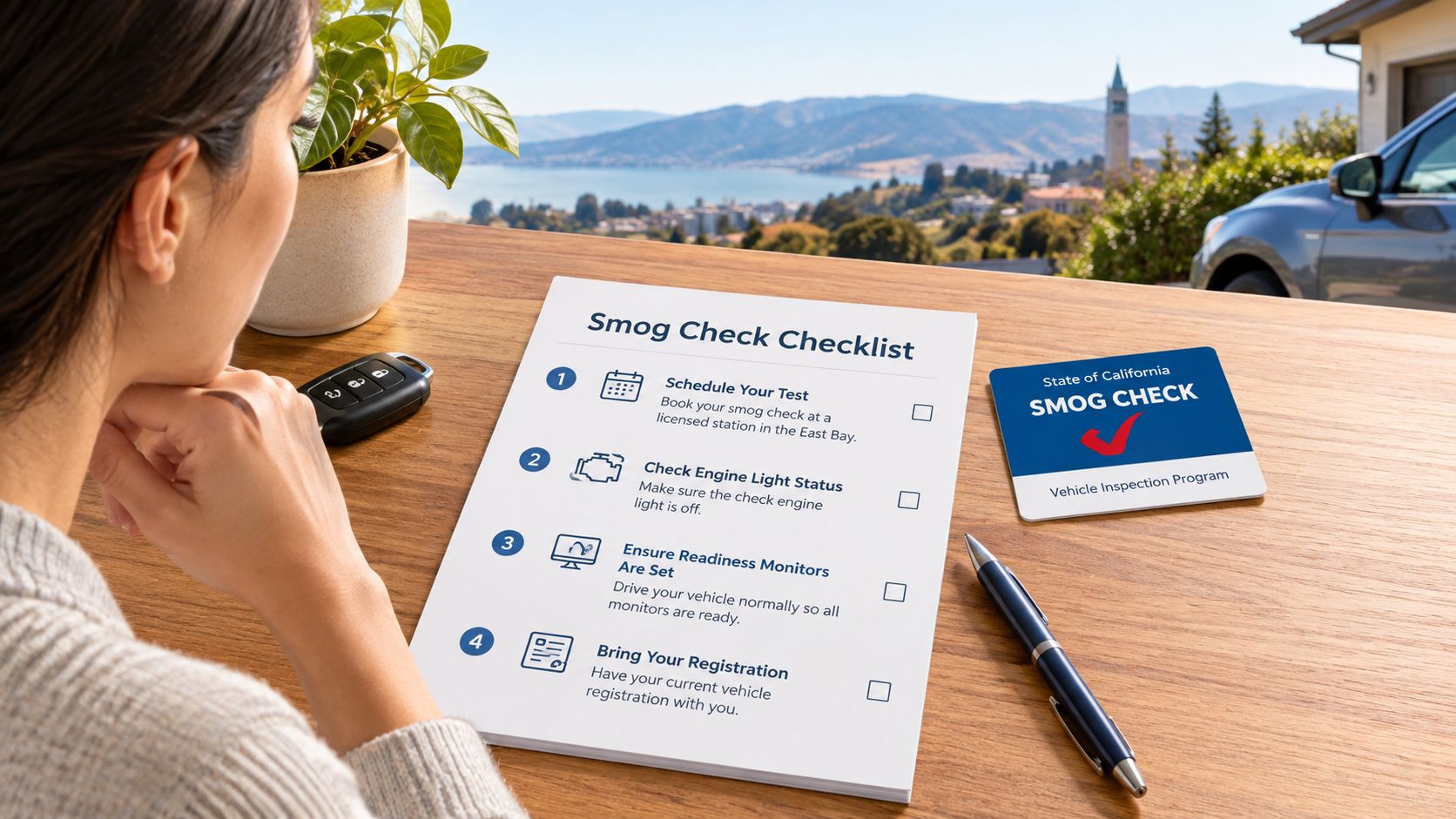
Use this quick check
- Renewal: Read the notice to confirm whether biennial certification is required.
- Ownership transfer: A recent renewal inspection may not satisfy the transfer requirement.
- New California registration: An out-of-state vehicle that is covered usually needs a California inspection unless a specific exemption applies.
- Hybrid: Apply the gasoline and vehicle-configuration rules, then follow the notice.
- Diesel: Check model year and GVWR separately. Diesel exemptions differ from gasoline exemptions.
- Electric: Fully electric vehicles are exempt from Smog Check.
- STAR instruction: Use a STAR-certified station if the notice requires one.
- OBD preparation: Do not clear codes or disconnect the battery right before testing.
- Failed result: Keep the VIR, get a targeted diagnosis, and contact BAR resources if the case may need Referee help.
That order matters. The notice tells you what DMV needs, and the powertrain tells you which smog rules apply to the vehicle in front of you. If you skip either step, you can end up at the wrong station or arrive before the car is ready to test.
For East Bay drivers, Speedy Smog in San Leandro is one local option. It is a STAR-certified station at 15275 Washington Ave, San Leandro, and it performs inspections for many gasoline, hybrid, older, and diesel vehicles, with results transmitted electronically for DMV registration processing. Its published service information also describes a comfortable indoor waiting area and typical testing for many newer vehicles in about 10 to 15 minutes.
Visit Speedy Smog with your DMV notice so the team can confirm whether your vehicle needs a standard or STAR inspection and help you address the correct registration requirement. The San Leandro station provides Smog Checks for newer vehicles, older cars, diesels, and hybrids, giving East Bay drivers a practical place to complete certification before renewal or transfer paperwork.
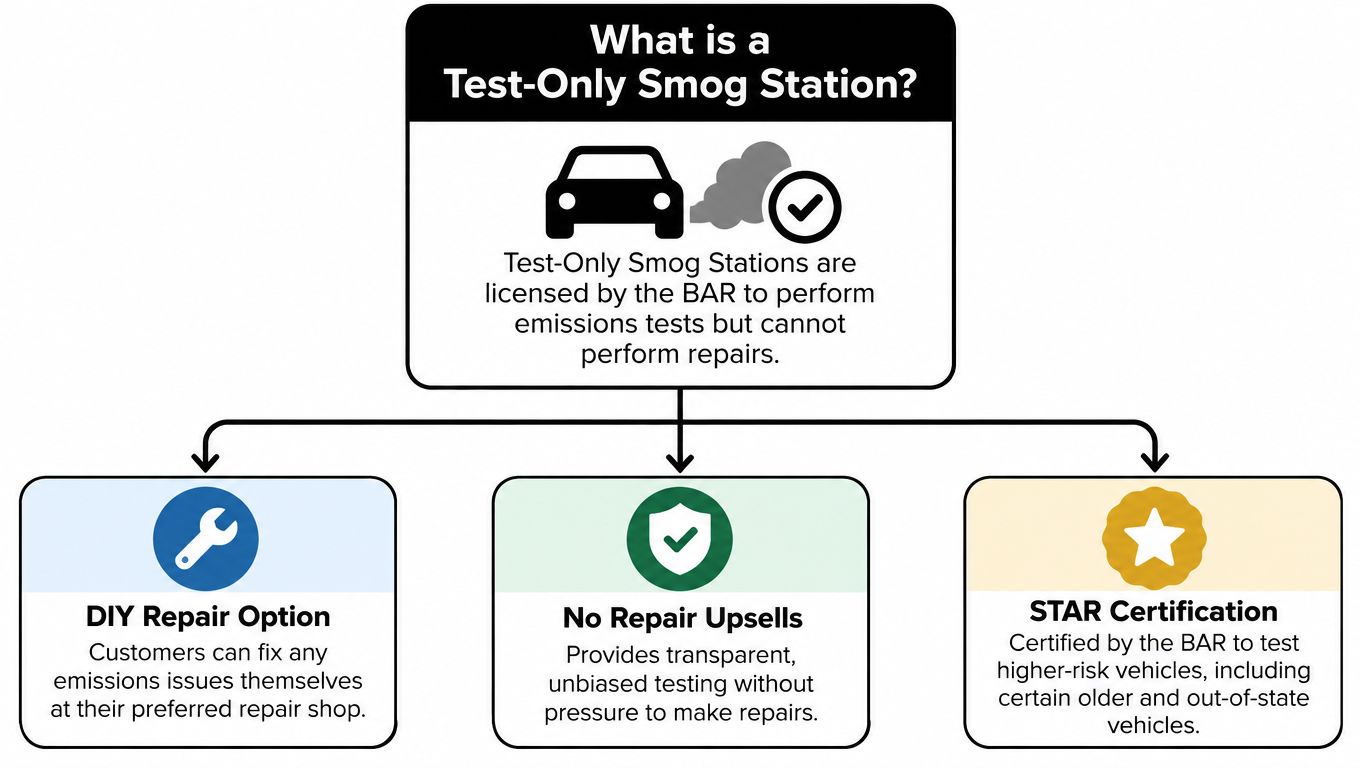
A test-only smog station is a California-licensed facility authorized to perform emissions inspections and issue compliance certificates, but not to repair your vehicle. In California's 2024 data, test-only stations handled 6,133,329 initial tests and issued 5,562,526 certificates, so this isn't a side option, it's a major part of the registration system.
Why build a station that can inspect but not fix? Because the state wants the people measuring the problem to be separate from the people who profit from the repair. That separation is the whole point, and it's what makes the test-only model easier to trust when you're nervous about a smog check.
Table of Contents
- Defining the Test Only Smog Station
- Test Only versus Test and Repair Stations
- The Role of Test Only Stations in California
- Understanding STAR Certification Requirements
- What to Expect at a Local Smog Station
- Making Your Smog Check Decision
Defining the Test Only Smog Station
A test-only smog station is exactly what it sounds like, a place that checks your car's emissions status but does not repair the car if it fails. California's Bureau of Automotive Repair licenses these facilities to perform Smog Check inspections and report the result for DMV purposes, while repair work has to happen somewhere else. That split keeps the inspection side independent from the money side.
Why the separation matters
If the same business both fails your car and sells you the fix, the setup can feel like a conflict of interest. California's test-only structure avoids that problem by making the inspection a stand-alone decision. The station collects the data, records the result, and sends it on for registration compliance.
Practical rule: if a shop is test-only, it can tell you whether your vehicle passed or failed, but it can't turn around and diagnose or repair the emissions issue on the same ticket.
That's why the category is useful for drivers who want a cleaner line between judgment and repair. It doesn't make the process harsher, it makes the result more neutral.
For a plain-language comparison of station types, see this STAR station versus test-only guide.
Test Only versus Test and Repair Stations
Why do California drivers see two different station types? The answer is simple. One type checks the car, the other can check and fix it.
A test-only station is limited to inspection work. It records the result and sends that result for DMV compliance, but it does not repair emissions problems on the same visit. A test-and-repair station can perform the inspection and then handle the fix if the vehicle fails.
What happens after a failed test
At a test-only station, a failed result ends the inspection. The station cannot turn the failure into a repair order, so you must take the car to a separate licensed repair shop for diagnosis and repairs, then return for retesting. That separation is the point of the model. The inspection side stays independent from the repair side, which helps prevent the shop from profiting from the outcome it just gave you.
| Station type | Can inspect | Can repair emissions problems | Best fit |
|---|---|---|---|
| Test-only | Yes | No | Drivers who want an independent inspection |
| Test-and-repair | Yes | Yes | Drivers who want testing and repair in one place |
The process is straightforward. Get tested first. If the car fails, repair it elsewhere, then come back for the next inspection step.
A failed result is a signal, not a repair plan. It tells you another technician needs to look under the hood.
For people who like to prepare ahead of time, reviewing this pre-smog checklist can help you avoid avoidable delays.
The Role of Test Only Stations in California
Test-only stations matter because they carry a large share of the state's compliance workload, not because they're a niche convenience. In 2024, they performed 6,133,329 initial tests and issued 5,562,526 certificates, while test-and-repair stations performed 2,941,524 initial tests and issued 2,654,288 certificates (California Legislative Information, HSC division 26 article 2). That means test-only stations handled about 67.6% of all initial tests in the figures provided for that year.
What that scale tells you
Those numbers show that test-only stations aren't an unusual workaround. They're built into the normal path millions of California drivers use to stay registered. When a system uses one station type for most of the initial testing volume, that station type is part of the core infrastructure, not an edge case.
The same state report also shows why the model stays relevant for different vehicle groups. Some cars are directed to STAR stations based on emissions history or other program factors, which means the state is not only checking vehicles, it's routing them through the type of facility it considers appropriate for compliance control.
In practical terms, that helps explain why a test-only station can feel more formal than a general repair shop. The whole setup is closer to an objective checkpoint than to a sales counter.
Understanding STAR Certification Requirements
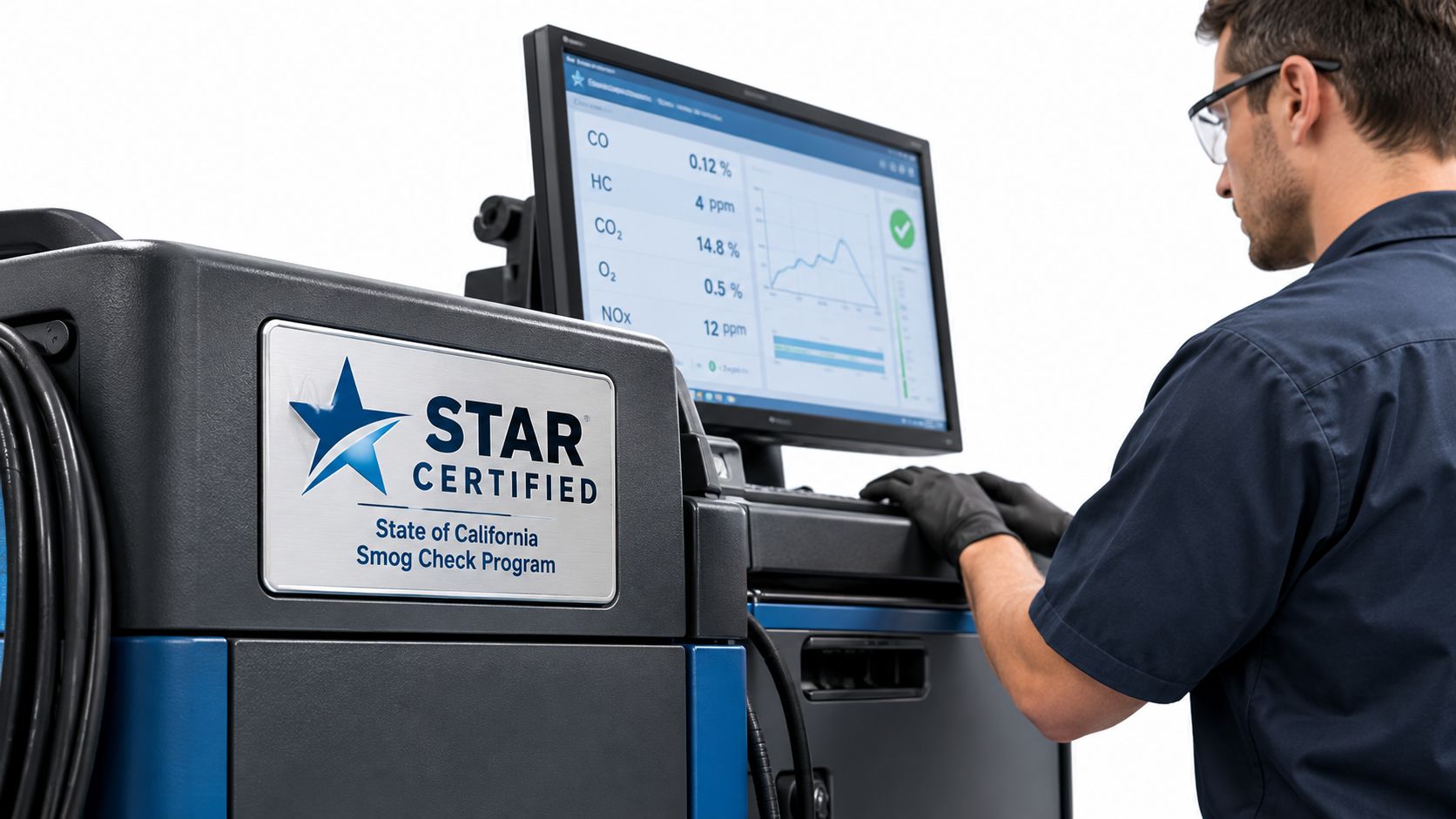
A STAR-certified test-only station is still a test-only station, but it also meets BAR performance controls that go beyond the basic license. Those controls include valid licensing, recordkeeping compliance, enough inspection volume for evaluation, and measured thresholds tied to inspection quality. If your DMV notice says STAR is required, that detail matters.
What BAR is checking
BAR looks at short-term performance indicators such as Similar Vehicle Failure Rate, incorrect gear selection during the Acceleration Simulation Mode test, and Excessive Test Deviation Rate. The published criteria include an incorrect-gear-selection rate no higher than 2% of certified vehicles and an Excessive Test Deviation Rate no greater than one (BAR STAR certification criteria). BAR also uses the Follow-up Pass Rate, with qualifying scores required to meet the stated threshold of 0.40.
These are quality controls, not labels for marketing. They're meant to reduce inaccurate certification and improve consistency when the state sends a driver to a STAR station. That's why STAR is more specific than “a good shop.”
If your renewal notice points you toward STAR, this station guide is worth reviewing before you book.
What to Expect at a Local Smog Station
What happens at a local smog station? Usually, it involves far less stress than drivers expect. A test-only station keeps inspection separate from repair, so the person checking your car is not the same person selling the fix. That separation is the point.
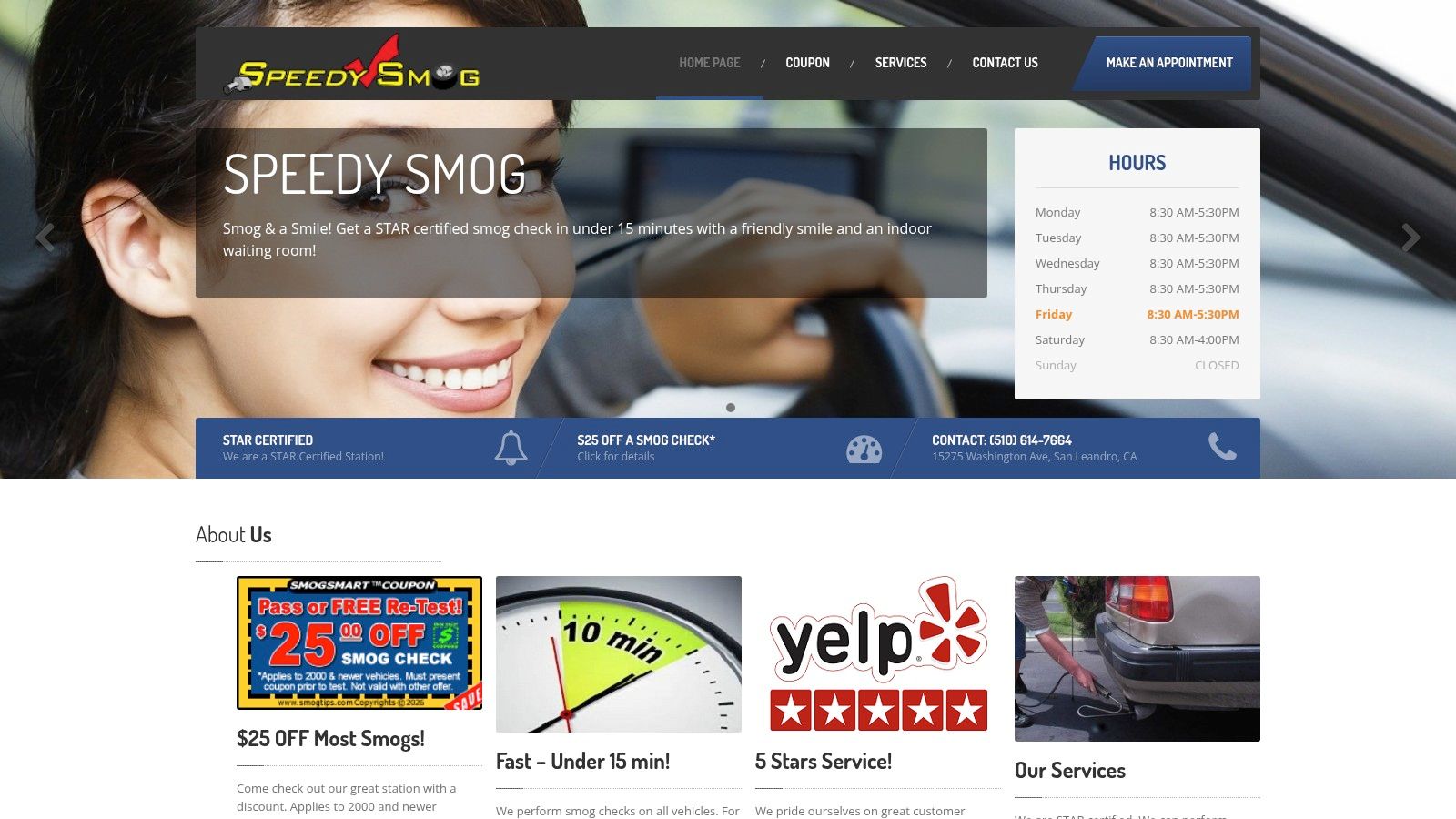
Speedy Smog in San Leandro is a STAR Certified smog check station at 15275 Washington Ave, 94579, and it handles inspections for most vehicles, including 2000 and newer models, 1999 and older vehicles, diesels, and hybrids. For 2000+ vehicles, typical tests take about 10 to 15 minutes.
How the visit usually feels
You pull in, hand over the vehicle information, and wait while the inspector runs the check. If the car passes, the station can send the result to DMV electronically. If it does not, you leave with the result and take the repair step somewhere else.
That split helps remove conflict of interest. The station has no reason to steer you into a repair estimate just to make the failure go away.
For drivers who like to prepare ahead of time, the shop's before-your-visit checklist on the site can help you avoid avoidable delays.
Making Your Smog Check Decision
The simplest way to choose is to look at your DMV notice first. If it requires STAR, you need a STAR-certified station, not just any smog shop. If it doesn't, a standard test-only station can still give you the same separation between inspection and repair that many drivers want.
A practical way to decide
- Read the renewal notice first: the notice tells you whether STAR is required.
- Choose test-only if you want independence: the shop can inspect your car, but it can't profit from fixing the result.
- Choose STAR when the state directs you there: that's the higher-control option for specific vehicles and compliance situations.
- Plan for a possible second stop: if the car fails, you'll need another licensed repair facility before retesting.
Good rule of thumb: the best station is the one that matches your notice and makes the process clear, not the one that promises the most.
A test-only station gives you a clean compliance check. A STAR-certified test-only station adds state performance standards on top of that. Together, they're designed to make the smog process more objective, not more confusing.
If you're in the East Bay and want a straightforward inspection from a STAR-certified test-only station, visit Speedy Smog to see what they offer and plan your visit. They provide emissions testing without repair pressure, which fits the test-only model explained above, and their San Leandro location is built for drivers who want a fast DMV-ready result.
You're staring at a DMV renewal notice, your registration deadline is getting closer, and Google has returned a crowded map full of shops calling themselves an “inspection” station. The nearest pin isn't automatically the right choice. Some locations only test, some also repair, some handle specific vehicle types, and some may not be approved for the test your DMV notice requires.
A good search for vehicle inspection near me ends with more than an address. You need the right inspection category, a station that can handle your vehicle, clear pricing, workable hours, and a result that moves your registration forward without a second unnecessary trip.
Table of Contents
- When Your Car Actually Needs a Smog Check
- How to Search for a Vehicle Inspection Near You
- Why STAR Certification Matters for Your Inspection
- Comparing Stations on Hours, Price, and Convenience
- What to Bring and How to Avoid a Failed Test
- A Local Example That Checks Every Box
- Getting Certified and Back on the Road
When Your Car Actually Needs a Smog Check
The usual trigger is simple. Your California DMV renewal notice arrives, and the renewal process requires a Smog Check before you can complete registration. California requires a Smog Check every other year to renew registration, according to the California DMV's Smog Inspections guidance.
There's an important exception for newer vehicles. Since January 1, 2019, vehicles less than 4 model years old may pay a smog abatement fee instead of undergoing inspection for the first 8 registration years. Check the notice rather than guessing from the vehicle's purchase date. California uses the vehicle's model year and registration history to determine whether the exemption applies.
Match the test to your vehicle
A California Smog Check examines emissions and emissions-control components. It isn't a general mechanical inspection, brake inspection, or pre-purchase evaluation. If you're trying to transfer ownership, resolve a registration issue, or meet a special DMV instruction, read the notice carefully because the required station type may differ.
Use this quick decision:
- Newer vehicle: Check whether the abatement-fee exemption applies before booking a test.
- 2000 and newer gasoline vehicle: Confirm that the station accepts the vehicle and can complete the applicable emissions test.
- Older vehicle, diesel, or hybrid: Ask directly before driving over. Vehicle coverage varies by station.
- DMV-directed inspection: Look for any instruction requiring a STAR station or a specific test pathway.
The demand for compliant local stations stays steady because California ties recurring emissions testing to registration renewal. At the same time, newer vehicles can avoid the full test during their early registration years, so not every driver searching today needs the same service.
Practical rule: Let the DMV notice determine the requirement, then let the vehicle's model year and fuel type determine which station you call.
How to Search for a Vehicle Inspection Near You
Typing “vehicle inspection near me” into Google Maps is a reasonable first move, but stopping at the first result is how drivers end up paying more or arriving at a shop that doesn't handle their car. Build a shortlist instead.
Start with specific searches that combine location and service:
- “Smog check near me” for a standard California emissions test.
- “STAR smog station near me” when the DMV requires STAR certification.
- “Test-only smog check” if you want a station focused on inspection rather than repair.
- “Smog check diesel” or “hybrid smog check” when your vehicle needs specialized coverage.
- Add your city or neighborhood, such as “San Leandro STAR smog check” or “Oakland emissions test.”
Inspection content often treats every inspection as the same errand, even though the requirement may be a safety inspection, emissions test, or specialized compliance review. Industry coverage of segmented inspection workflows reinforces the practical point: your vehicle type and compliance context should shape the search.
Build a realistic shortlist
Keep three or four stations that are convenient, not a dozen map pins scattered across the East Bay. Use the map's open now filter, but verify the posted hours on the station's own website or by phone. A location that closes before you finish work isn't convenient, even if it's close.
Read reviews for operational details, not just star ratings. Look for comments about:
- Wait times: Do customers describe quick walk-ins or long lines?
- Price surprises: Do drivers mention fees added after arrival?
- Vehicle coverage: Do reviews mention older cars, diesels, or hybrids?
- Retests: Does the station explain what happens if the vehicle fails?
- Staff communication: Do customers say the test requirements were explained clearly?
Then call your finalists. Ask whether they test your exact vehicle type, whether the quoted price includes all standard charges, whether they accept walk-ins, and whether a coupon is available. That short call often saves more time than another ten minutes of map browsing.
Why STAR Certification Matters for Your Inspection
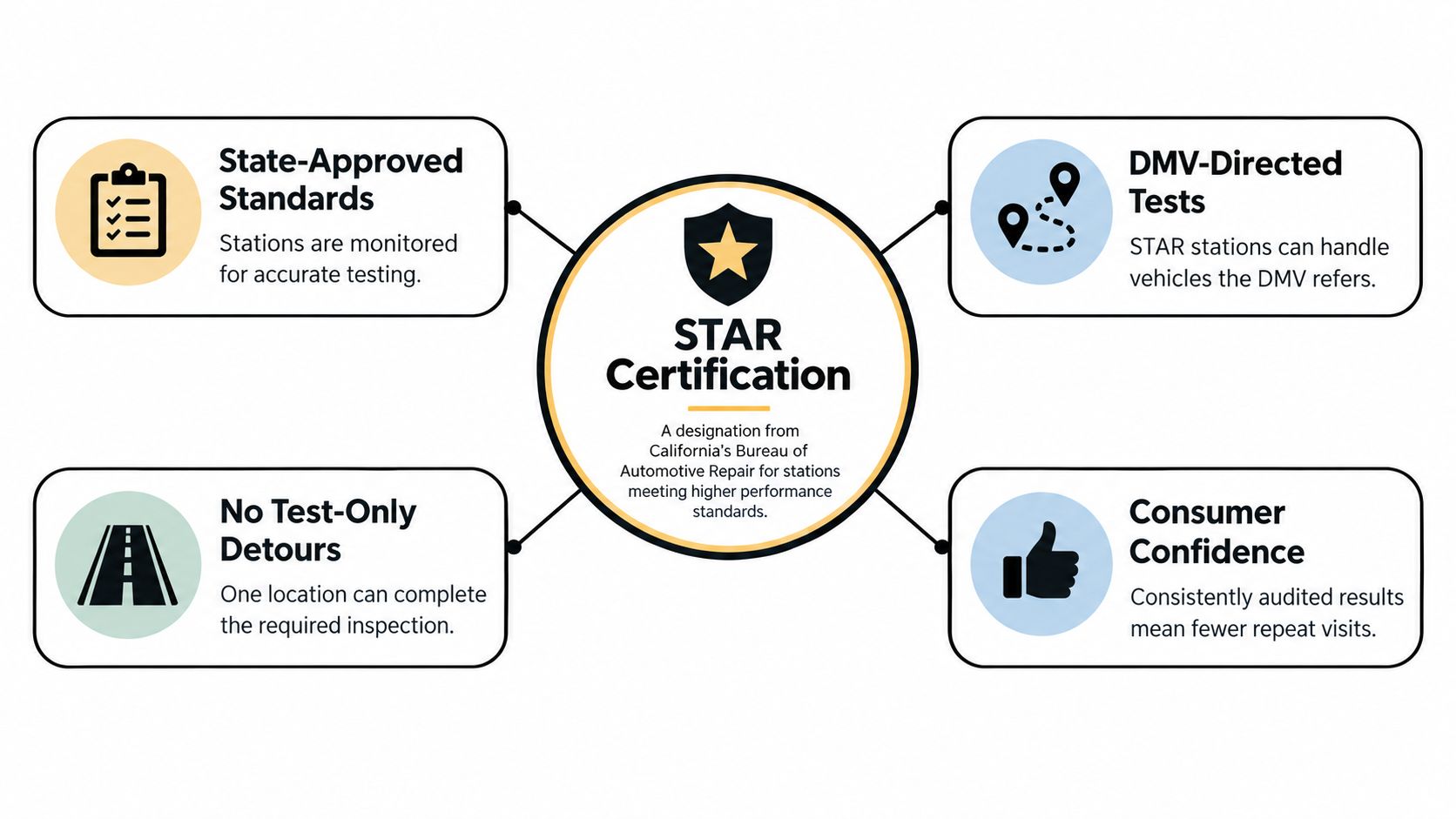
STAR certification is a California Bureau of Automotive Repair designation for stations that meet higher performance standards. It gives drivers a meaningful quality filter, especially when the DMV notice directs them to a STAR station.
STAR isn't a luxury add-on. It's a compliance requirement in situations where the DMV specifically sends you to a STAR location, and it can provide added confidence that the station is operating within California's required inspection standards. Ask the station directly, then verify its current status through California's official station information before booking.
When STAR is non-negotiable
Read the DMV notice before choosing between a STAR and non-STAR station. If the notice says the vehicle must visit a STAR station, a cheaper nearby alternative won't solve the problem. You'll only create another appointment and another drive.
STAR status also matters when you want a straightforward registration experience. A compliant electronic result should be recognized through the normal DMV process, while choosing the wrong station can leave you sorting out why the test didn't meet the stated requirement.
You can also ask whether the location is test-only or test-and-repair. Those labels describe the station's business model, not necessarily its STAR status. A test-only shop can be a sensible choice when you want the inspection separated from repair work. A test-and-repair shop may be useful when you already expect diagnostic work. Choose based on the requirement in your notice and the kind of service you want.
For a plain-language explanation of the designation, see this guide to what a STAR smog station is. Verify the station before you arrive. Don't rely on an old directory listing or a faded sign.
Comparing Stations on Hours, Price, and Convenience
Once you have a shortlist, compare the stations like a practical errand, not like a popularity contest. The best station is the one that meets the requirement, accepts your vehicle, gives you a clear price, and fits your schedule.
| Factor | What to Look For | Why It Matters |
|---|---|---|
| Hours | Morning, evening, and Saturday availability | A nearby station is useless if you can't reach it while open |
| Price | Posted price, coupon terms, and out-the-door total | A low advertised price may not apply to your vehicle |
| Turnaround | Typical test time and walk-in policy | The wait can matter more than the drive |
| Vehicle coverage | 2000+ cars, older vehicles, diesels, and hybrids | Not every station handles every configuration |
| Station type | Test-only or test-and-repair | The right choice depends on whether you want diagnosis or separation |
| Waiting area | Clean indoor seating and clear customer process | Useful when you're staying for the result |
Ask three questions before you leave home
First, “Do you test my exact vehicle?” Give the model year and fuel type. Don't assume a station that tests newer gasoline cars also handles an older vehicle, diesel, or hybrid.
Second, “What is the total price for this vehicle?” Ask whether the figure includes the standard inspection and whether any coupon has restrictions. A coupon that excludes your vehicle won't help you budget.
Third, “How long should I expect to be there?” A stated test time isn't the same as a guaranteed total visit time. Ask whether walk-ins wait behind appointments and whether the station transmits the result electronically after completion.
Test-only versus test-and-repair
Test-only stations can reduce the concern that repair recommendations will influence the inspection conversation. You receive the result and can decide where to take the vehicle if it fails. Test-and-repair stations can be more convenient if you want one location to diagnose a failure, but you should still ask for a clear explanation before authorizing work.
A transparent quote and an honest wait-time estimate are more valuable than a prominent map position.
What to Bring and How to Avoid a Failed Test
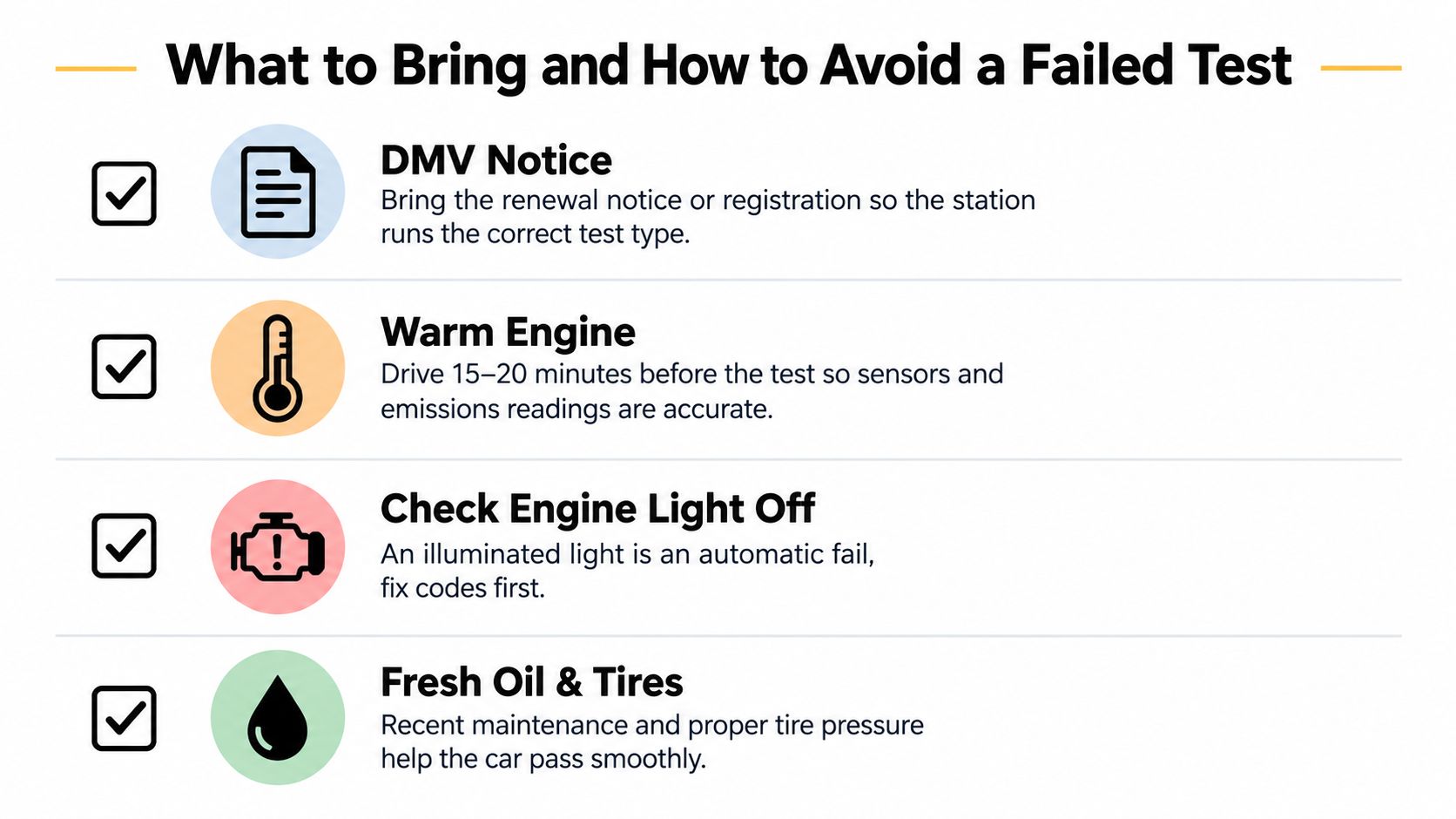
Bring your DMV renewal notice or registration information so the station can confirm the correct test path. Arrive with the engine warmed up, and don't treat the inspection as a diagnostic appointment for a warning light you've ignored for months.
Government guidance identifies three dominant emissions-test failure modes: Diagnostic Trouble Codes, incomplete readiness monitors, and failure to communicate with the vehicle computer. The same emissions-test guidance lists common mechanical culprits such as oxygen-sensor or EGR problems, dirty air filters, misfiring spark plugs, vacuum leaks, and a poor-fitting fuel cap.
What those failure modes mean
A Diagnostic Trouble Code, or DTC, means the vehicle computer has detected a fault. The code may relate to emissions equipment, sensors, ignition, or another system that affects emissions performance.
Readiness monitors are the vehicle computer's internal checks. If you recently disconnected the battery, cleared codes, or completed repairs, the monitors may not have finished their checks. In that condition, the vehicle can fail even when the check-engine light is off.
Non-communication means the testing equipment can't establish a reliable connection with the vehicle computer. A damaged connector, electrical issue, or computer problem can stop the test before emissions performance is even evaluated.
Before driving to the station, run through this checklist:
- Check the dashboard: Don't arrive with an active check-engine light or recently cleared codes.
- Consider recent battery work: A disconnected battery can leave readiness monitors incomplete.
- Inspect the fuel cap: Make sure it fits correctly and seals properly.
- Listen for rough running: Misfires, hesitation, or unstable idling deserve attention before testing.
- Look for leaks: Vacuum leaks can trigger emissions problems and drivability symptoms.
- Ask for diagnostics when needed: If the light is on, find out what the code means before paying for the inspection.
For additional preparation guidance, use this pre-smog-check checklist. The goal isn't to manipulate the result. It's to remove obvious problems so the test reflects a vehicle that's actually ready for inspection.
A Local Example That Checks Every Box
A useful local benchmark is the STAR Certified station at 15275 Washington Ave, San Leandro, California 94579. It handles 2000 and newer vehicles, 1999 and older vehicles, diesels, and hybrids, so drivers can ask about coverage without assuming that every vehicle follows the same path.
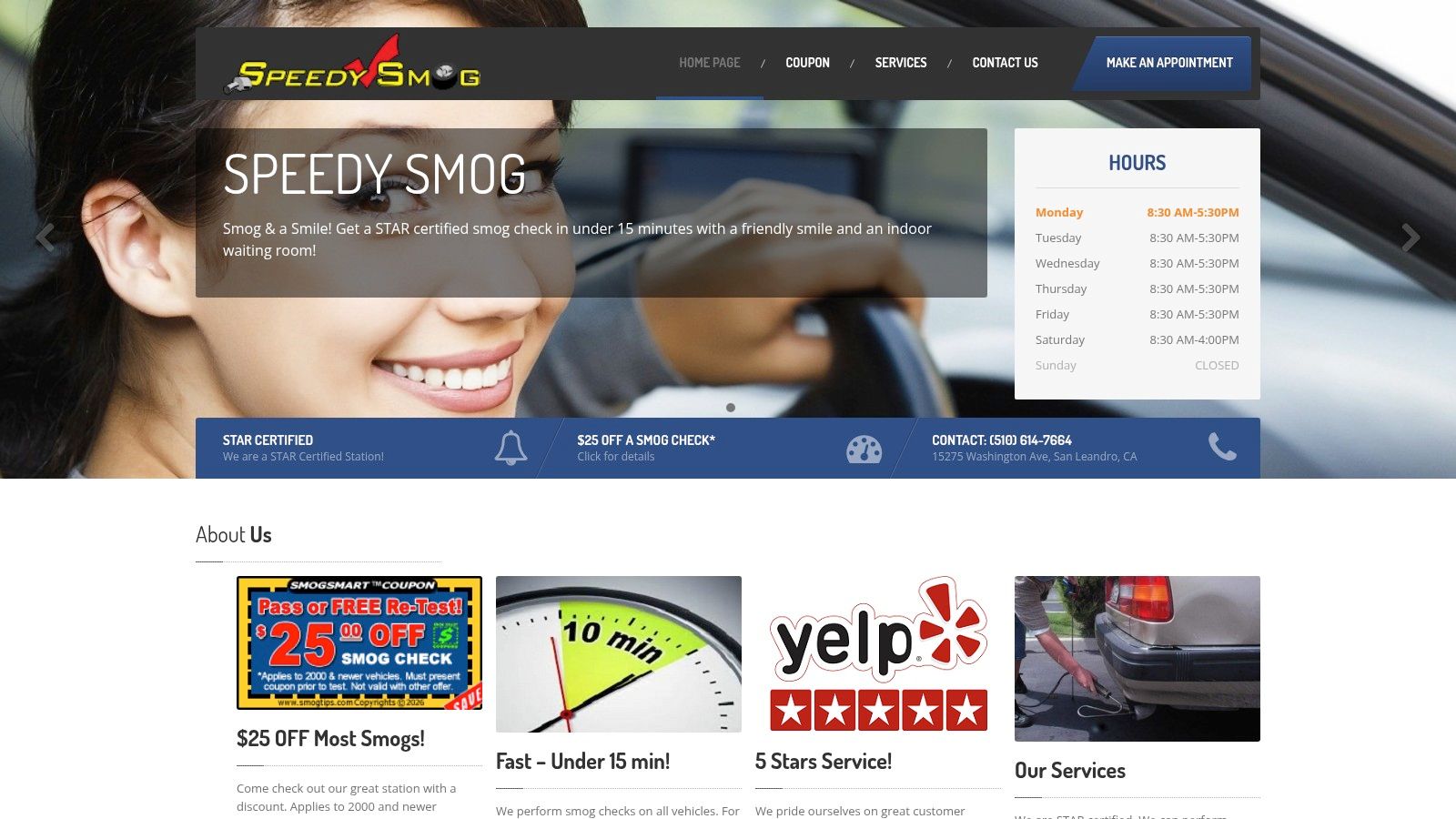
The station typically completes tests for 2000+ vehicles in about 10–15 minutes and is open Monday through Saturday. It also publishes transparent pricing, offers periodic $25-off coupons for most smogs on newer vehicles, and provides a clean indoor waiting room. Those details are exactly what you should compare at any station, coverage, schedule, price clarity, turnaround, and a reasonable place to wait.
The point isn't to choose a station because it appeared first in search. It's to see how a concrete option measures against the checklist. A station that can handle your vehicle, meet the STAR requirement, explain the price, and fit your schedule has earned a closer look.
Ask about the current price and coupon terms before arriving, since promotions and vehicle eligibility can change.
Getting Certified and Back on the Road
The cleanest process is straightforward: read the DMV notice, identify the required test, shortlist stations that handle your vehicle, verify STAR status when required, compare hours and price, then prepare the car before arriving.
If the vehicle passes, the station can transmit the result electronically to the DMV, allowing you to complete the registration renewal through the normal process. Keep the confirmation and renewal details until the registration is complete.
A failure isn't unusual, particularly as vehicles age. About 1.3 million of 19 million 2000+ model-year vehicles tested in the 2024–2025 cycle failed Smog Check, an approximate 7% fleet failure rate, while roadside inspections recorded a fleet-weighted average failure rate of about 14%, according to vehicle emissions-test information from CARFAX. A station result and a roadside condition aren't identical measurements, so treat a failure as a reason to diagnose the vehicle, not as a reason to guess at another station.
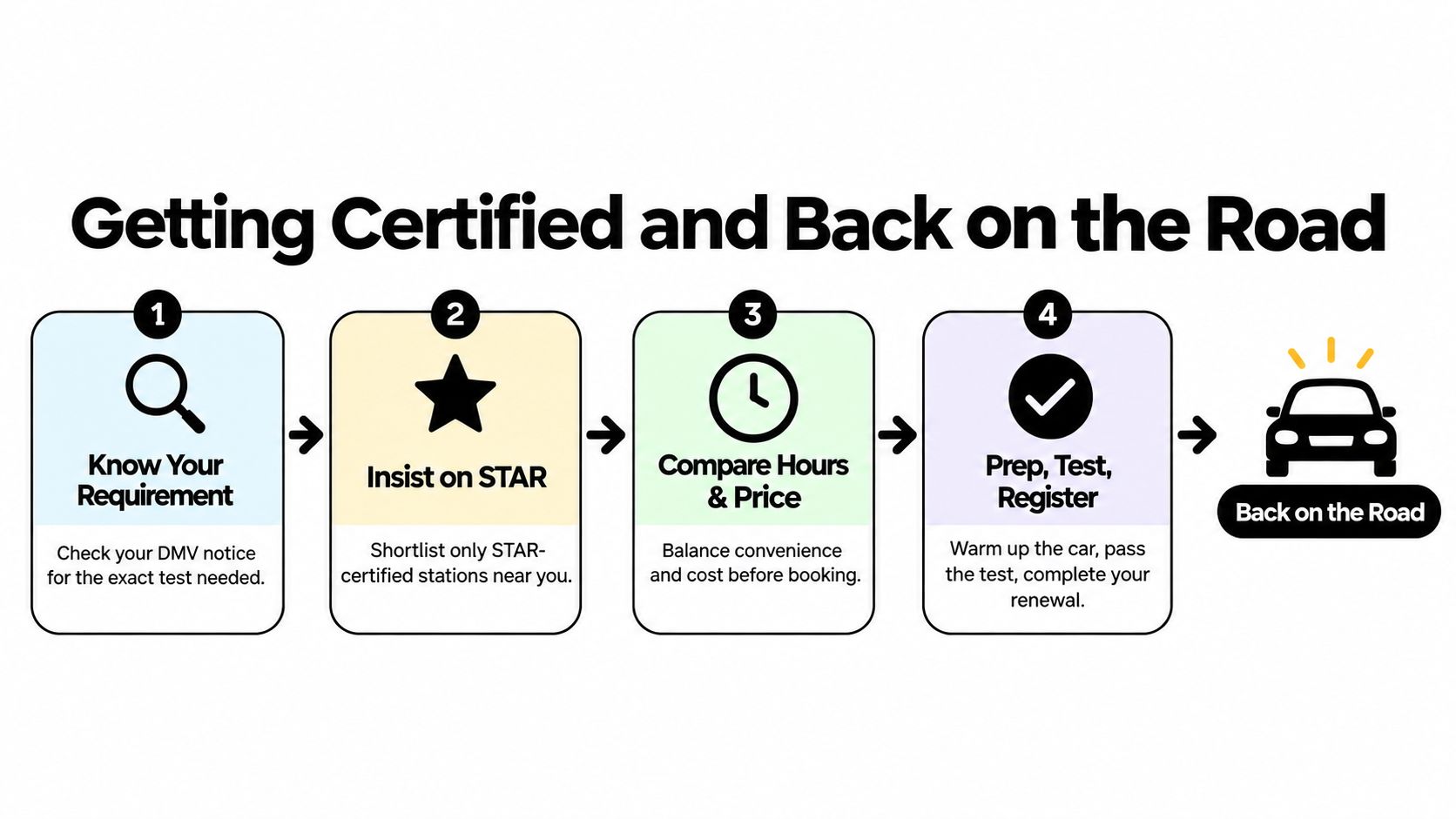
Put the next renewal date on your calendar, watch for relevant coupons, and deal with a check-engine light before renewal week. That small amount of planning keeps a routine inspection from becoming an expensive registration emergency.
If you need a STAR-certified inspection in San Leandro, Speedy Smog handles 2000 and newer vehicles, older vehicles, diesels, and hybrids, with typical 2000+ tests completed in about 10–15 minutes. Review the current details and visit Speedy Smog before you drive in.
Most California vehicles more than five model years old need a smog inspection every two years for registration renewal, while newer vehicles from the 2000 model year onward generally use an OBD test that takes about 10 to 15 minutes at a certified station such as Speedy Smog in San Leandro. The exact requirement depends on your vehicle, fuel type, model year, and the wording on your DMV renewal notice.
You may be looking at that notice right now, wondering whether you need a regular smog station or a STAR station, whether your hybrid is exempt, or what will happen when you arrive. A vehicle smog inspection sounds technical, but the basic idea is simple. California checks whether your vehicle's emissions-control system is working well enough for registration compliance.
The easiest way to understand the process is to follow the same path your vehicle takes, from the DMV notice to the inspection lane, test result, and possible repair.
Table of Contents
- What Is a Vehicle Smog Inspection in California
- Types of Smog Tests and What Applies to Your Vehicle
- Understanding STAR Certification and Why It Matters
- What to Expect at Your Smog Check Appointment
- Smog Failure Rates by Vehicle Age and What They Reveal
- Exemptions, Preparation Tips, and Steps After a Failure
What Is a Vehicle Smog Inspection in California
A San Leandro driver might receive a registration renewal notice, see “Smog Certification Required,” and assume every inspection works the same way. Another driver may see “Smog Certification Required at a STAR station” and wonder whether STAR is a special repair shop, a more expensive test, or just another name for a regular station.
It's none of those things. A smog inspection is an emissions compliance test, and the station checks your vehicle according to its model year and the requirements attached to your registration record. The result is sent through the state's inspection system so the DMV can confirm that the emissions requirement has been met.
California's Smog Check program has operated since 1984 and the state credits it with greatly reducing air pollution from millions of vehicles. Today, the system handles more than 10 million vehicle tests each year at thousands of independently owned stations statewide, as described in the California Bureau of Automotive Repair Smog Check FAQ.
Why California requires the inspection
The inspection connects vehicle ownership with air-quality rules. For most vehicles more than five model years old, a passing result supports biennial registration compliance, meaning the requirement commonly appears every two years during renewal. The state has updated the program as vehicles changed. Older inspections relied more heavily on measured exhaust, while newer vehicles can report emissions-system problems through onboard diagnostics.
That shift makes the test less mysterious. Your car isn't being judged by a mechanic's personal opinion. The technician follows a state procedure designed for the vehicle's model year and equipment.
Who usually needs a test
Most gasoline vehicles eventually enter the regular inspection cycle, but exemptions and special rules apply. Newer gasoline, hybrid, and alternative-fuel vehicles may be exempt from the biennial test for eight model years, while the DMV notice remains the most useful starting point for your specific renewal.
If you want a local overview before booking, this guide to smog checks in California explains the registration connection and common vehicle categories. Bring the renewal notice if you have it. Its wording can tell you not only whether certification is required, but also what type of station you must use.
Types of Smog Tests and What Applies to Your Vehicle
The model year usually determines the inspection pathway. Think of a newer vehicle as having a built-in health monitor, while an older vehicle must demonstrate its emissions performance more directly through the exhaust.
Vehicles from 2000 onward
For 2000-and-newer gasoline vehicles, the standard route is generally an onboard diagnostic, or OBD, test. A technician connects equipment to the vehicle's diagnostic port and checks whether the emissions-control computer has detected faults, whether warning indicators are behaving correctly, and whether the required system monitors are ready.
That's similar to plugging a scan tool into the car's brain. The technician isn't just asking whether the engine runs. The test checks whether the systems responsible for controlling emissions have completed their self-checks and whether the computer has stored a relevant fault.
The state's Smog Check testing overview explains that 2000-and-newer gasoline vehicles are generally inspected through OBD, while older vehicles use a different method.
Vehicles from 1999 and earlier
Vehicles from 1999 and earlier are generally routed to tailpipe-based testing. The station uses the BAR-97 emissions inspection system to measure exhaust emissions directly, rather than relying primarily on the vehicle's onboard computer.
The analogy is straightforward:
| Vehicle group | Main inspection approach | What the technician evaluates |
|---|---|---|
| 2000 and newer gasoline vehicles | OBD test | Emissions-system computer information |
| 1999 and older vehicles | Tailpipe testing with BAR-97 | Measured exhaust emissions |
A tailpipe test can feel more physical because equipment measures what comes out of the exhaust. That doesn't mean the process is automatically more difficult. It means the state uses a testing method suited to an older vehicle fleet.
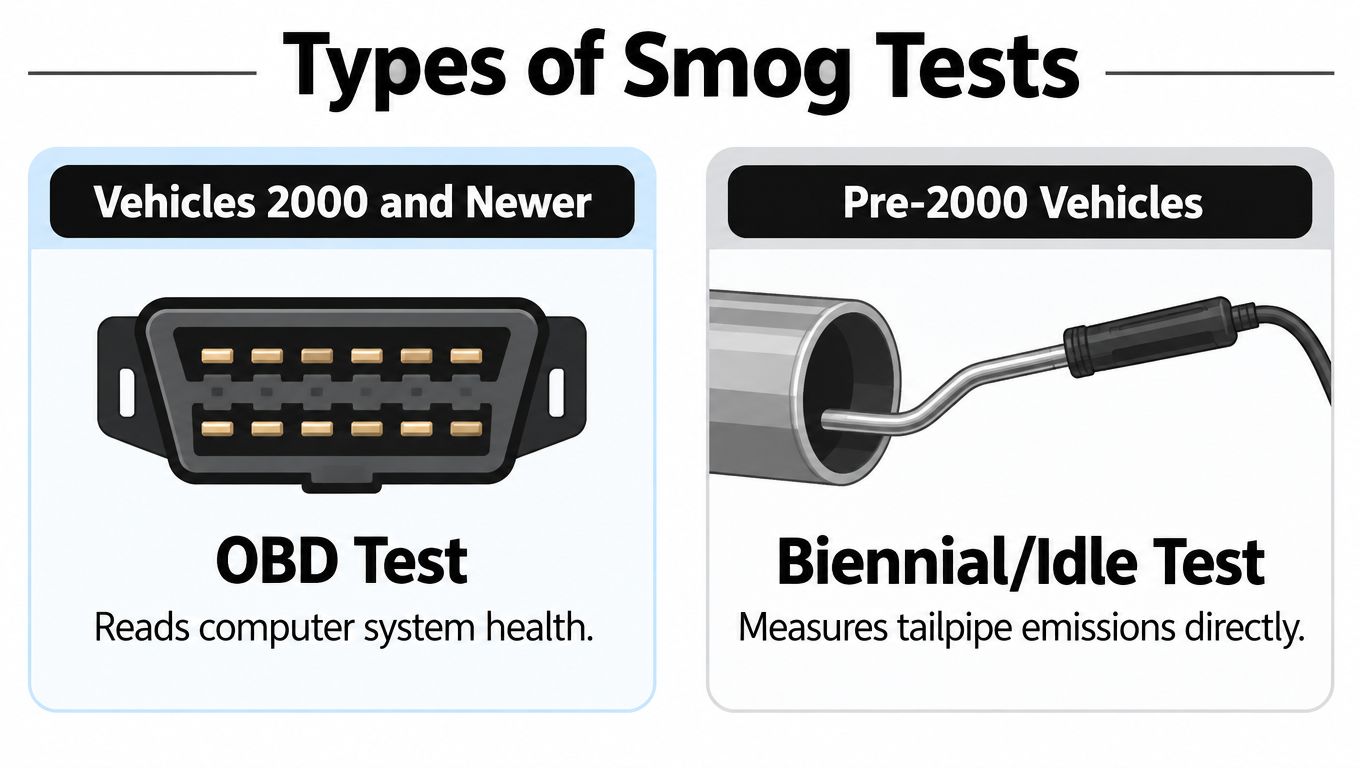
Hybrids, diesels, and alternative-fuel vehicles
A hybrid isn't automatically exempt just because it can drive on electric power. Its eligibility depends on the vehicle's model year and the applicable California rules. Newer hybrids may fall within the eight-model-year exemption, but an older hybrid can still require inspection.
Diesel vehicles also need to be classified correctly. The required procedure can differ from a gasoline vehicle, so the safest approach is to check the DMV notice and confirm the station handles your vehicle type before arriving. Fuel system, model year, and registration circumstances matter more than a simple label such as “car,” “truck,” or “hybrid.”
Practical rule: Use the renewal notice and the vehicle identification details to determine the inspection path. Don't guess based only on the dashboard, fuel door, or the fact that the vehicle is newer than another car.
Understanding STAR Certification and Why It Matters
The STAR question usually has a simple answer: follow the exact wording on your DMV renewal notice. If it says “Smog Certification Required,” you can generally choose an authorized station that performs the required inspection. If it says “Smog Certification Required at a STAR station,” the inspection must happen at a STAR station.
That distinction matters because a non-STAR station can't substitute for a required STAR inspection. A STAR station isn't merely a shop that chose a particular marketing label. It holds a designation controlled by the California Bureau of Automotive Repair.
What STAR means
BAR evaluates STAR stations using inspection-volume and quality measures. The requirements include a Similar Vehicle Failure Rate of at least 50 percent of the industry-wide failure rate for similar vehicles and a Follow-up Pass Rate threshold of 0.40, according to BAR's STAR certification requirements.
Those measures are intended to make station performance accountable. A station shouldn't fail vehicles indiscriminately, and it shouldn't pass vehicles that need emissions-related attention. BAR uses the metrics to evaluate whether a station consistently identifies vehicles that genuinely require repair.
A simple decision tree
Use this order:
- Read the DMV renewal notice. Look for the exact smog wording.
- Check whether STAR is specified. If it is, choose a STAR-certified station.
- Confirm the station handles your vehicle. Ask about model year, fuel type, and test method.
- Bring the vehicle and notice. The technician can verify the required inspection in the state system.
The difference between a regular authorized station and a STAR station isn't necessarily the test technology. Both follow state procedures, and the appropriate method still depends on the vehicle. The difference is whether the station meets the performance controls attached to STAR certification and whether your notice requires that designation.
For a more detailed explanation of the designation, see this guide to what a STAR smog station is. Choosing the correct station first prevents one of the most frustrating outcomes, completing an inspection that doesn't satisfy the DMV requirement.
What to Expect at Your Smog Check Appointment
A first appointment is usually less dramatic than drivers expect. You pull into the station, provide the vehicle information and renewal notice, and let the technician follow the correct procedure for your car.
Start with check-in
Have your DMV renewal notice, current registration information, and the vehicle available for inspection. The notice helps the technician confirm whether you need a standard inspection or a STAR inspection. If you recently moved, bought the vehicle, or are dealing with an out-of-state registration issue, mention that at check-in.
The technician will identify the vehicle and select the applicable inspection procedure. You don't need to know the technical test code yourself. Your job is to provide accurate information and explain any recent dashboard warning lights or emissions repairs.
The technician checks more than the exhaust
The inspection can include a visual review of emissions-related components, a check of warning indicators, and the prescribed electronic or tailpipe test. For a newer gasoline vehicle, the technician connects to the OBD port and reviews the computer's emissions information. For an older vehicle, the BAR-97 equipment measures exhaust output through the tailpipe.
A warning light deserves attention before the appointment. If the check-engine light is on, the vehicle may fail because the computer is reporting an emissions-related problem. Clearing the light immediately before testing isn't a reliable fix, because the system may need to complete its monitors before the vehicle can be evaluated properly.
Before you arrive: Tell the technician about recent battery replacement, computer resets, warning lights, or emissions repairs. Those details can affect the vehicle's readiness information.
For many 2000-and-newer vehicles, a typical OBD inspection at Speedy Smog in San Leandro takes about 10 to 15 minutes, although the actual time can vary with the vehicle and station workload. The shop describes a clean indoor waiting area and a process intended to keep the visit straightforward.
Once the inspection is complete, the station records the result. A pass supports the DMV registration process. A failure should come with information about the reason for failure, so you can decide whether to repair the issue at the station, visit a repair shop, or obtain a second diagnostic opinion.
Here's what the basic flow looks like in practice:
- Check in: Provide the renewal notice and vehicle details.
- Identify the procedure: The technician confirms STAR status and test type.
- Inspect the vehicle: The station checks the applicable emissions components and equipment.
- Run the test: The vehicle receives an OBD or tailpipe-based inspection.
- Receive the result: The station records a pass or provides failure information.
A comfortable waiting room can make the appointment easier, but the important part is procedural accuracy. The result needs to match the vehicle, the registration requirement, and the state's inspection rules.
Smog Failure Rates by Vehicle Age and What They Reveal
Drivers often treat a failed smog test as random bad luck. California's recent inspection data point to a more predictable pattern. Vehicle age has a strong relationship with failure outcomes, although maintenance history, emissions-system condition, and the specific fault still matter.
In the January 2026 executive summary, 2025 model-year vehicles had an overall failure rate of 0.23 percent, while 2024 model-year vehicles failed at 4.52 percent and 2023 model-year vehicles failed at 4.36 percent. The same report recorded a 22.18 percent failure rate for 1976 model-year vehicles, showing the much steeper challenge faced by older vehicles. These figures come from the California BAR Smog Check executive summary for 2025.
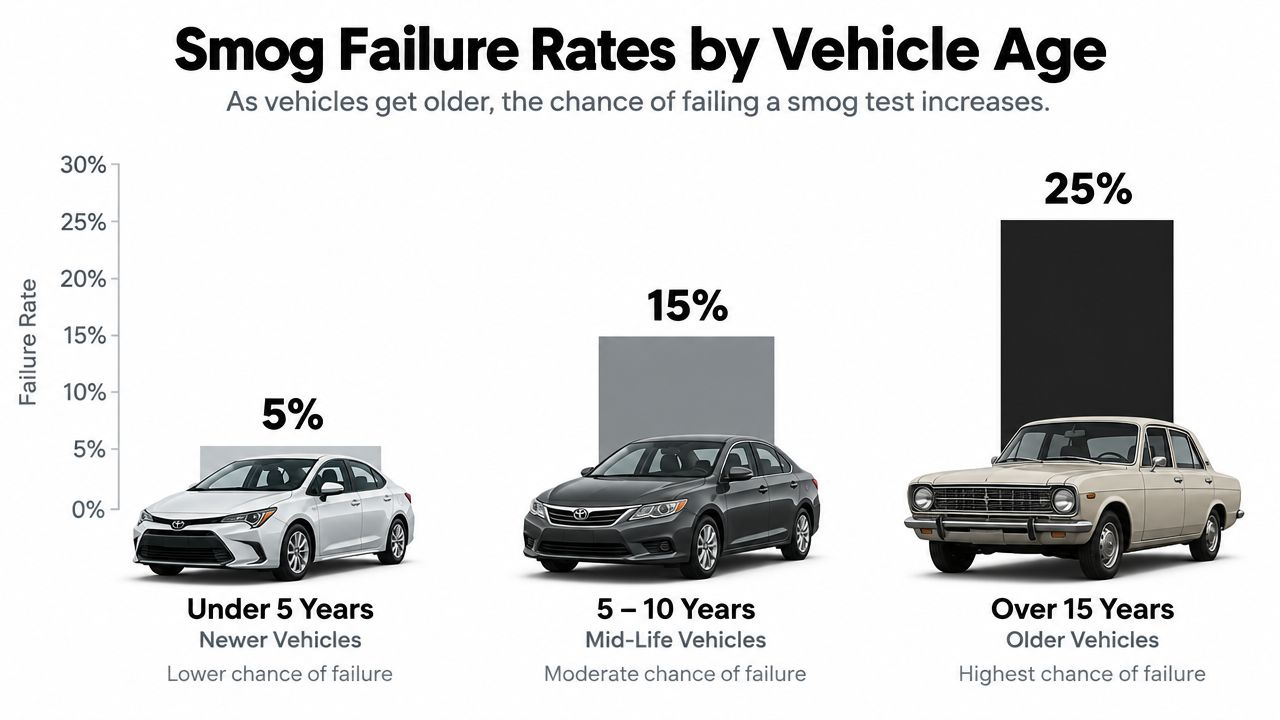
Why age changes the odds
Older vehicles have had more time for sensors, vacuum lines, catalytic converters, ignition parts, and other emissions components to wear out. They may also have accumulated years of incomplete maintenance or modifications that affect the original emissions system.
Newer vehicles aren't guaranteed to pass, but their failure rates in the reported data are much lower than those of older model years. That doesn't make preparation unnecessary. It means preparation should focus on known warning signs rather than assuming every inspection is a crisis.
The statewide picture
California recorded 11,275,981 initial tests in 2025, including 959,667 failures, for an 8.51 percent initial-test failure rate, according to the same BAR report. Those figures show that failures are a normal part of a large inspection system, not evidence that every failed vehicle has a catastrophic engine problem.
| Reported group | Initial failure rate |
|---|---|
| 2025 model year | 0.23% |
| 2024 model year | 4.52% |
| 2023 model year | 4.36% |
| 1976 model year | 22.18% |
| All initial tests in 2025 | 8.51% |
The useful lesson is practical. An older vehicle with an illuminated warning light, rough running, or a history of emissions repairs deserves diagnosis before the appointment. A newer vehicle with no warning signs may need little more than a correctly completed inspection.
Exemptions, Preparation Tips, and Steps After a Failure
The DMV notice should guide your decision, but a few rules explain why neighbors with similar-looking vehicles may receive different requirements. Newer gasoline, hybrid, and alternative-fuel vehicles may qualify for an eight-model-year exemption from the biennial test. Once that exemption ends, the vehicle can enter the regular renewal cycle.
The notice can also specify the station type. “Smog Certification Required” and “Smog Certification Required at a STAR station” aren't interchangeable instructions. Read the line carefully before booking.
Prepare without trying to trick the test
Good preparation means making sure the vehicle is in ordinary, documented operating condition:
- Resolve warning lights: Diagnose an illuminated check-engine light instead of clearing it without root cause analysis.
- Complete normal driving: If the battery was recently disconnected or the computer was reset, drive the vehicle normally so its emissions monitors can complete.
- Check basic condition: Address obvious rough running, misfires, exhaust leaks, or unusual smells before inspection.
- Bring records: Keep repair invoices and maintenance information available for the technician or repair shop.
- Confirm the station: Verify STAR status and vehicle coverage before you arrive.
A drive cycle isn't a shortcut around a problem. It gives the vehicle's onboard system time to perform its own checks after a reset. If the monitors remain incomplete, the technician may not be able to complete the inspection even if the car feels normal.
If the vehicle fails
A failure report identifies the area that prevented certification. The right response depends on the finding. A repair shop may need to diagnose a sensor, catalytic converter, evaporative-emissions leak, ignition issue, or another emissions-related fault. Don't replace expensive parts based only on a guess.
After repairs, the vehicle needs a retest. Keep the failure report and repair documentation because they help the next technician avoid repeating the same diagnostic work. Drivers who need guidance with the repair process can review smog check repair assistance before choosing their next step.
A failed test is a diagnosis starting point, not a final verdict. Ask what failed, why it failed, and which repair can confirm the cause before authorizing parts.
If the vehicle's age, fuel type, registration status, or station requirement is unclear, ask the inspection station or consult the DMV information tied to your renewal. A few minutes of verification can prevent the wrong test, an incomplete inspection, or a return visit.
Speedy Smog provides vehicle smog inspections and STAR smog checks in San Leandro for newer and older vehicles, including applicable diesel and hybrid inspections. Review your DMV notice, bring the vehicle and registration information, and visit Speedy Smog to arrange a compliant inspection.
In California, Smog Check is the official state program, and smog test is the common name for the inspection itself. For most drivers, they point to the same DMV-required event, but the actual inspection method changes by model year, with 2000 and newer vehicles generally checked through OBD II and 1999 and older vehicles tested with BAR-97 tailpipe equipment.
That's why the wording gets confusing. Your DMV renewal notice may say Smog Check, while a local shop sign says smog test, and both are talking about the same trip you need to make before registration can move forward.
Table of Contents
- Introduction Why Drivers See Two Terms for One Requirement
- What Smog Check and Smog Test Actually Mean in California
- How California Smog Inspections Work Today
- Which Test Your Vehicle Needs Based on Year and Type
- DMV Rules STAR Certification and What Counts for Renewal
- How to Prepare Your Vehicle and Pass the First Time
- Choosing the Right Smog Station in the East Bay
Introduction Why Drivers See Two Terms for One Requirement
A lot of East Bay drivers hit the same moment. You open your renewal notice, see that California wants a smog check, then search online and find shops advertising smog tests. It's easy to wonder whether those are two different services, two different prices, or two separate legal steps.
Usually, they aren't separate at all. The confusion comes from the fact that California uses one term for the regulated system and everyday drivers use another term for the inspection procedure.
A common real-world example
Say you drive a 2008 sedan in San Leandro. Your renewal reminder tells you to complete a smog requirement before DMV can process registration. Then you call a station and the person on the phone says, “Yes, we do smog tests.” That doesn't mean they're offering something different from what the DMV asked for. They're using the common shop-floor phrase for the inspection that satisfies the state program.
The same thing happens with older vehicles. Someone with a 1995 pickup may hear “smog test” and assume it's the same process their neighbor's 2016 hybrid gets. It isn't. Both fall under California's Smog Check system, but the way the vehicle is inspected can be very different.
Practical rule: If your paperwork says you need a Smog Check, you usually don't need to buy one thing from DMV and another thing from a shop. You need the inspection that fits your vehicle and counts for registration.
The fast way to think about it
Use this simple distinction:
| Term | What it usually means | Why it matters |
|---|---|---|
| Smog Check | California's official compliance program | It's tied to DMV registration, station licensing, and state rules |
| Smog test | The actual inspection performed on the vehicle | It's the procedure that generates the pass or fail result |
That difference sounds semantic until you're trying to book the right station. Once you understand the compliance mechanics, the next questions get easier. What kind of test does your car get? Do you need a STAR station? Will your result count automatically for DMV? Those are the questions that save time.
What Smog Check and Smog Test Actually Mean in California
A first-time driver usually hears both terms in the same week. The DMV notice says you need a Smog Check for registration. The shop says they perform smog tests. In California, those phrases point to the same requirement, but they do not do the same job.
Smog Check is the state program. Smog test is the inspection work done on your vehicle inside that program. The practical difference shows up after the car is inspected. A test result by itself does not satisfy registration. What counts is a result recorded through California's Smog Check system so BAR can issue the electronic record DMV recognizes, as described in the BAR Smog Check Reference Guide.
Why both terms stayed in use
The split in language makes sense once you look at who is using the words.
State agencies use Smog Check because they are talking about rules, station licensing, certificate records, and whether a vehicle has met a registration condition. Shops and drivers often say smog test because they are talking about the appointment in the service bay, the machine hookup, and the pass or fail result for that specific car.
That sounds small, but it answers a common point of confusion. If a shop advertises smog testing, that does not automatically tell you every result will work for your renewal. The result has to be produced under the state program, by a properly licensed station, and transmitted in the way DMV accepts.
What the distinction changes for you
The wording becomes practical instead of academic.
If you ask, “Do I need a smog test?” you are asking about the procedure performed on the vehicle. If you ask, “Do I need a Smog Check?” you are really asking a compliance question: Does my registration require an inspection, what kind of inspection applies to my vehicle, and does this station have authority to submit a result that counts?
A simple way to picture it is a school exam. The test is what the student takes at the desk. The program is the school system that decides who can give the exam, how the score is recorded, and whether the result satisfies the graduation rule. California works the same way. Your car can be inspected, but DMV only cares about the inspection result that enters the Smog Check system correctly.
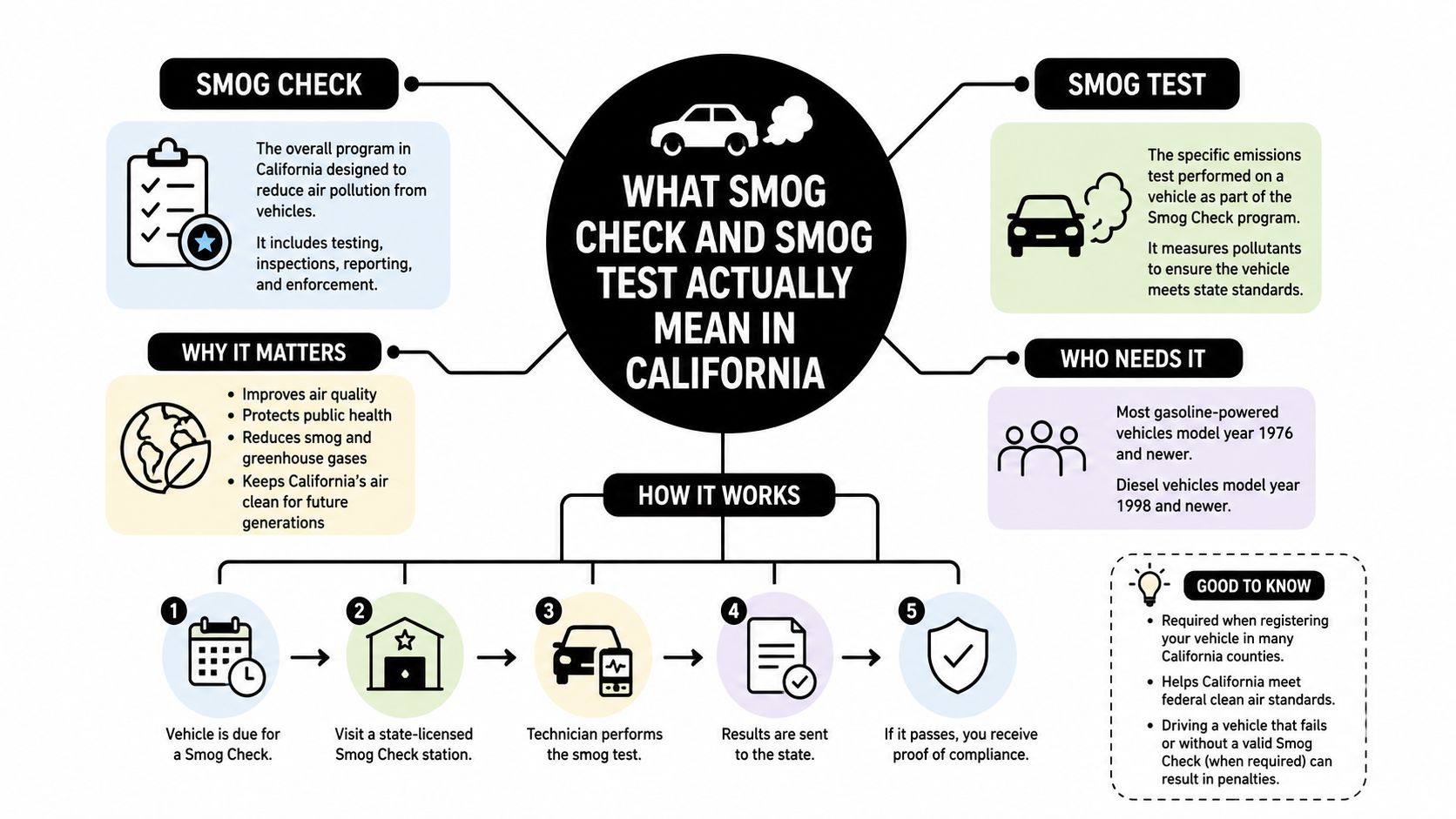
Plain-language takeaway
Use smog test for the procedure at the station. Use Smog Check for the legal program tied to DMV.
That distinction helps with three decisions drivers make all the time:
- Test type: your vehicle may get a different inspection method depending on year and configuration
- Station choice: some vehicles or notices require a station with specific authorization, such as STAR
- DMV outcome: registration depends on the official transmitted result, not just the fact that your car was looked at
So the question is not which phrase is more correct. The useful question is whether the inspection you book will produce the right record for California compliance.
How California Smog Inspections Work Today
A first-time driver often expects one standard smog appointment. At the station, the process changes once the technician enters the vehicle information. California does not run one single inspection routine for every car. The Smog Check program uses different inspection methods based on the vehicle's model year and emissions setup.
That is the practical difference between the system and the procedure. Smog Check is the state program that sets the rules. The smog test is the specific inspection your car receives under those rules.
According to BAR's current smog inspection overview, newer vehicles are usually inspected through the BAR On-Board Diagnostic Inspection System, while older vehicles may still go through the BAR-97 Emissions Inspection System with direct tailpipe measurement.
California Smog Inspection Methods Compared
| Inspection Type | Vehicles Covered | What Is Measured | Equipment Used |
|---|---|---|---|
| OBD inspection | 2000 and newer vehicles | Electronic diagnostic data related to emissions performance | BAR On-Board Diagnostic Inspection System |
| BAR-97 tailpipe test | 1999 and older vehicles | Direct exhaust emissions at the tailpipe | BAR-97 Emissions Inspection System |
| Visual and functional checks | Applies as part of the inspection process where required | Emissions-related components and system operation | Technician inspection tools and station equipment |
What the technician is actually doing
For a newer vehicle, the inspection usually works like a report-card check from the car's own computer. The technician connects to the onboard diagnostic system and verifies whether the emissions monitors, fault information, and related data meet program requirements. The car can drive normally and still fail if that electronic record shows an emissions problem.
For an older vehicle, the inspection is more like measuring what comes out of the tailpipe in real time. The station uses BAR-97 equipment to sample exhaust emissions directly, along with any required visual or functional checks. The workflow is different because the test is measuring output, not mainly reading stored diagnostic information.
That distinction matters at the counter and at DMV. Two drivers can both ask for a "smog test" and receive different procedures because the Smog Check program assigns the inspection path by vehicle category.
Why one appointment is faster than another
Drivers often compare appointment times and get confused. The reason is usually mechanical, not random.
An OBD-based inspection is often more direct because the system is reading emissions-related data already stored by the vehicle. A BAR-97 inspection takes more setup because the station must perform tailpipe measurement with different equipment and procedures.
So if one car is finished quickly and another takes longer, the station is not changing the rules on the fly. The program is applying a different test method to a different kind of vehicle.
What counts in the end
The key outcome is not that your car was inspected. The key outcome is that the correct inspection method was performed and the result was transmitted in a way California accepts for Smog Check compliance.
That is why the wording matters less than drivers think, and the mechanics matter more. The phrase "smog test" describes the procedure in the bay. "Smog Check" describes the larger compliance system that decides which procedure applies and whether DMV will accept the result.
Which Test Your Vehicle Needs Based on Year and Type
You get a renewal notice, book what sounds like a routine smog appointment, and then the station asks a question that changes everything: what year is the vehicle, and what fuel does it use?
That question matters because California does not sort inspections by the words drivers use. It sorts them by vehicle category. "Smog Check" is the compliance system. The "smog test" is the inspection procedure that system assigns to your car.
For many drivers, the first decision starts with model year and fuel type. A newer gasoline car usually follows one inspection path. An older gasoline car may follow another. Diesel vehicles can fall under different rules, and some registrations also require a STAR station, which affects where the result will count.
If you want a practical year-by-year reference before you book, this guide on what smog check you need helps match the vehicle to the likely inspection path.
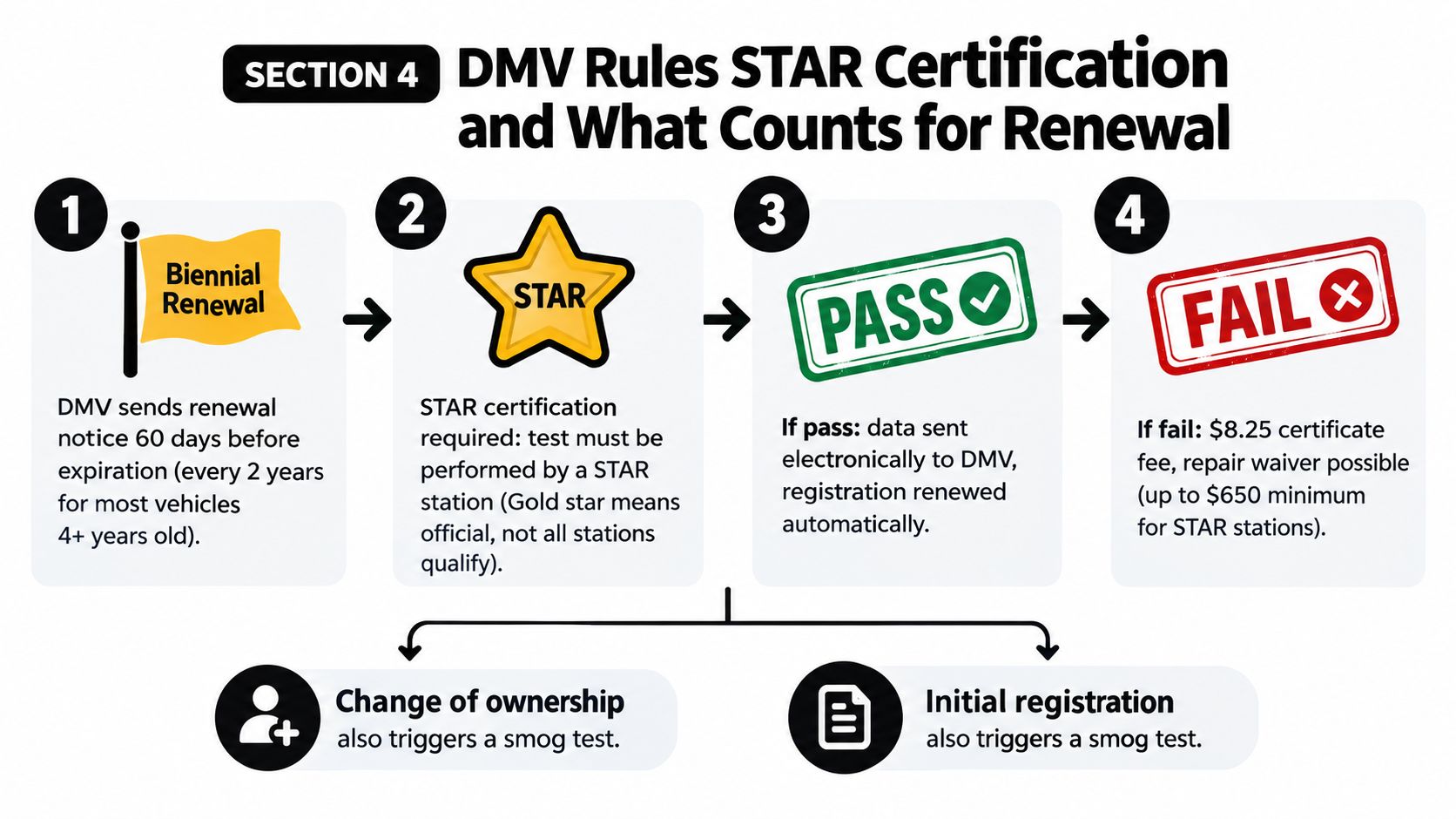
Start with the vehicle category
A simple way to sort it is like checking which line you belong in at the airport. Everyone is traveling, but not everyone goes through the same lane.
- 2000 and newer gasoline vehicles: these are usually inspected through an OBD-centered process.
- Pre-2000 gasoline vehicles: these often need a tailpipe-based procedure.
- Diesel vehicles: these can have different program rules, so the station must handle that vehicle type correctly.
- Vehicles marked for STAR: the inspection result must come from the right kind of station, not just any nearby shop.
The practical point is simple. Your vehicle category decides the test method, and sometimes it also decides the station.
Four common examples
A 2005 sedan usually goes down the newer-vehicle path. In plain terms, the inspection often focuses on what the vehicle's onboard system reports. If the check engine light is on or the monitors are not ready, that can affect the outcome even if the car feels fine to drive.
A 1995 truck is a different case. Older gasoline vehicles are more likely to need direct emissions measurement, so the appointment may involve different equipment and a different setup at the station.
A diesel pickup deserves a quick phone call before booking. Some drivers assume every smog location handles diesel the same way. They do not. The right question is whether the station performs the inspection your diesel vehicle needs.
A hybrid can confuse first-time drivers too. Hybrid does not automatically mean exempt or simplified. The category still depends on how California classifies that vehicle for the registration event in front of you.
Why two drivers can have different appointments
Friends often compare notes and wonder why one visit took fifteen minutes and another took much longer. The reason is usually built into the rules, not the shop.
Two people can ask for a "smog test" and receive different procedures because their vehicles fall into different Smog Check categories. One car may be routed through an OBD-based inspection. Another may need a tailpipe procedure. A third may need the same inspection result, but from a STAR-certified station for DMV to accept it.
Simple booking rule: check your model year, fuel type, and any STAR requirement on your DMV notice before choosing a station.
That is where the wording clears up. The debate is not really smog check versus smog test. The issue is which inspection path California assigns, and whether that result will satisfy your registration requirement.
DMV Rules STAR Certification and What Counts for Renewal
You finish the inspection, the technician hands you a passing result, and you assume the DMV part is done. Then the renewal notice still shows a smog requirement. For first-time drivers, that feels confusing, but the reason is usually simple. California does not just need a vehicle to be tested. California needs the inspection to be completed in the right compliance channel so DMV can accept it for registration.
California treats Smog Check as the full regulatory system tied to registration, station licensing, and eligibility. A smog test is the procedure performed on the vehicle inside that system. That difference matters at renewal time because DMV is checking more than whether your car passed. DMV is checking whether the result came from the right kind of inspection, at the right kind of station, for your vehicle's requirement.
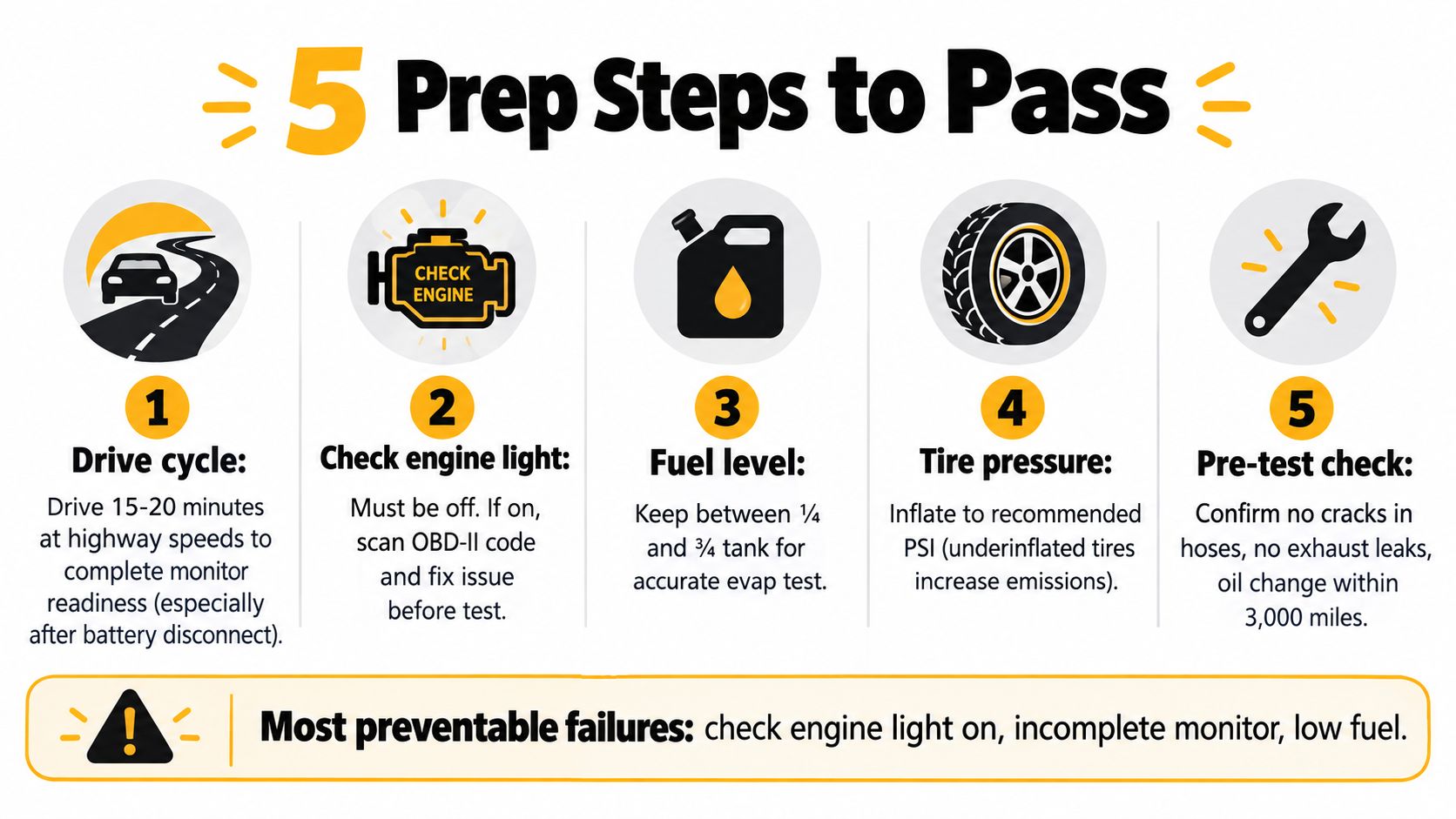
When the result affects your registration
For many California drivers, Smog Check works like a checkpoint built into the registration process. The state may require it for a renewal cycle and for some other registration-related events. In plain terms, the test result only helps you if it is attached to the registration requirement you have.
That is why wording alone does not decide anything. A driver can call it a smog test, an inspection, or a smog check. DMV still looks at the compliance record behind that visit.
Why STAR stations matter
STAR is part of that compliance record. If your DMV notice says a STAR inspection is required, the state is not making a suggestion about where to shop. It is telling you which station category can produce a result that counts for your renewal.
A simple way to picture it is this. Passing at the wrong station can be like bringing the right form to the wrong office. The paperwork may be real, but it does not satisfy the step DMV asked for.
Research discussing California's STAR program explains that STAR stations handle a large share of inspections and play a central role in the state system, especially for vehicles directed into that channel through program rules and DMV requirements, according to this University of Chicago analysis of California STAR station performance. If you want a plain-language explanation before you book, this guide on what a smog STAR station is explains what the designation means in practical terms.
A short explainer can also help if you want to see the process discussed visually.
Test-only versus test-and-repair
Station type can matter too. Some stations only perform inspections. Others can inspect and also repair a vehicle if it does not pass.
That distinction does not usually change whether DMV accepts a valid result. It changes what happens next if the car fails. A test-only station documents the outcome. A test-and-repair station may be able to diagnose and fix the problem before you return for another inspection.
How to Prepare Your Vehicle and Pass the First Time
Preparation depends on the inspection method your vehicle gets. A newer car and an older car can both be due for the same registration event, but the smartest pre-test routine isn't identical.
For newer vehicles with OBD-focused inspections
If your vehicle is in the newer category, think about computer readiness first. If the battery was recently disconnected or repairs were just completed, the onboard system may not yet be ready to report a complete picture.
Check the dashboard before you go. If the check engine light is on, that's a sign to pause and diagnose the issue rather than hoping the station visit will sort it out.
For older vehicles with tailpipe measurement
Older vehicles benefit from basic mechanical awareness before the appointment. If the engine is running rough, there's an exhaust leak, or visible emissions components appear tampered with or damaged, the inspection is more likely to uncover a problem.
A warm vehicle is usually better than a cold one. Drivers often get smoother results when the car has been driven normally beforehand rather than brought in after sitting for a long time.
Preparation is not one generic trick. For newer vehicles, focus on diagnostic readiness. For older vehicles, focus on engine condition, exhaust integrity, and obvious emissions-related issues.
A simple pre-appointment checklist
- Check warning lights: If the check engine light is on, treat that as a repair issue first.
- Drive the vehicle normally beforehand: A vehicle that has been sitting may not be in the best condition for inspection.
- Look for obvious problems: Loose caps, unusual exhaust smell, rough idle, or visible component damage are worth addressing.
- Don't book blindly after recent repairs: Give the vehicle enough normal operation to settle after emissions-related work.
- Match the station to the vehicle: Confirm the shop handles your model year and fuel type.
If you want a practical driver-focused checklist, this page on how to get a car to pass smog gives a straightforward prep rundown.
A failed inspection isn't always about major repairs. Sometimes the problem is simply showing up before the vehicle is ready for the kind of inspection it actually receives.
Choosing the Right Smog Station in the East Bay
The right station depends less on slogans and more on fit. Start with the vehicle, then match the station to the compliance requirement.
If you drive a 2000 or newer vehicle, convenience and workflow matter. These inspections are often straightforward, so many drivers care most about whether the station handles modern OBD-based testing efficiently and sends results properly for DMV use.
If you own a 1999 or older vehicle, experience with BAR-97 testing matters more. The process is more equipment-dependent, so you want a shop that regularly handles older vehicles and doesn't treat them like an exception.
What to look for before you book
A solid East Bay station should make a few things clear:
- Vehicle coverage: confirm they inspect your year and fuel type.
- STAR status: check whether the station can handle your requirement if DMV directs you to STAR.
- Process clarity: the staff should explain whether your vehicle is likely getting an OBD inspection or a tailpipe test.
- DMV compliance handling: ask how the result is processed for registration purposes.
- Waiting experience: this matters more than people think, especially for commuters booking around work.
A practical local example
In San Leandro, Speedy Smog is one example of a STAR-certified station that handles newer vehicles, older vehicles, diesels, and hybrids, which makes it relevant for drivers who need one location capable of matching different Smog Check paths. That matters most when a household has more than one vehicle type and the inspection process isn't the same across them.
The bigger lesson is simple. Don't choose a station just because it uses the phrase “smog test” or “smog check” on a sign. Choose it because it can perform the right inspection, under the right certification rules, for the vehicle and DMV situation you have.
If you need a California-compliant inspection in the East Bay, Speedy Smog provides STAR-certified smog testing for newer vehicles, older vehicles, diesels, and hybrids in San Leandro. If this article helped you sort out the difference between the Smog Check program and the test your car needs, visit Speedy Smog to find a station option that matches your vehicle and registration requirement.
Most California drivers pay roughly $70 to $85 total for a passing smog test. That total usually comes from a station inspection fee in the low $60s plus the fixed $8.25 state certificate fee, and the exact amount changes by station type and by vehicle.
If you're staring at a registration notice and trying to figure out why one shop advertises one price and another shop sounds completely different on the phone, you're not alone. This is one of the most confusing parts of California car ownership for first-time drivers. A smog check sounds like one purchase, but in real life it behaves more like a grocery receipt. You see the shelf price first, then the required add-on, and sometimes a separate cost shows up only if something goes wrong.
That's why the easiest way to understand Smog Test California cost is to split it into three buckets:
- The station fee for the inspection itself
- The state certificate fee of $8.25 when the car passes
- Possible retest or repair costs if the car doesn't pass the first time
A lot of frustration comes from mixing those buckets together. A driver sees an ad for a smog price, assumes that's the whole bill, then feels blindsided at the counter. In many cases, the station didn't invent a surprise charge. The customer just wasn't told clearly what part was the shop's price and what part was the state-required certificate.
That's also why out-the-door totals vary so much. A newer gasoline car might not even need a test yet. An older vehicle may need the full inspection. A STAR station quote can look different from a non-STAR station quote. If the vehicle fails, the test fee can become the smallest part of the whole problem.
If you want a simple reference before you start calling around, this California smog check price guide gives a useful local starting point. But first, let's make the pricing system easy enough that any quote you hear will make sense.
Table of Contents
- Introduction What You Will Actually Pay for a Smog Test
- How California Smog Test Pricing Really Works
- Regional Price Ranges and Why Station Type Matters
- Vehicle Age and Type and How They Change Your Cost
- Coupons Discounts and Smart Ways to Avoid Surprise Charges
- If You Fail Retest Fees and the Repair Cost Cap Explained
- Conclusion Your Quick Plan for an Affordable Compliant Smog Test
Introduction What You Will Actually Pay for a Smog Test
Your registration notice shows up, you head to a smog station, and you see an ad with a low price on the window. Then the total at the counter sounds different from what you expected. For first-time drivers, that is where the confusion starts.
The main reason is simple. A smog check bill is usually made up of three separate buckets, and ads or phone quotes do not always mention all three at once.
Why the price feels confusing
The first bucket is the station fee. That is the shop's charge to inspect the car.
The second bucket is the state certificate fee. That fee applies when the vehicle passes.
The third bucket is the one drivers hope to avoid. If the car does not pass, you may need to pay for a retest, repairs, or both.
That is why one shop may sound cheaper at first, but the out-the-door total can end up looking different. One quote may cover only the inspection. Another may include the passing total. Another shop may pause and ask about your car's year, fuel type, or whether it needs a STAR station, because those details affect which bucket matters most.
Practical rule: Ask for the out-the-door total for a passing smog check, and ask what happens if the vehicle needs a retest.
What catches first-time drivers off guard
Drivers new to California smog rules often assume the state sets the full price from top to bottom. It does not. The state requires part of the bill, while the station sets its own inspection fee. That is why two shops a few miles apart can quote different totals without either one doing anything unusual.
Vehicle age changes the picture too. Some cars are not due for a smog test yet, while older vehicles are more likely to need the full inspection and, in some cases, a station type that limits where you can go. So the question is not just, "What does a smog test cost?" It is, "Which kind of smog check does my car need, and what will all three buckets add up to?"
If you want a local reference point before calling around, this California smog check price guide for San Leandro drivers can help you compare quotes with the right questions in mind.
How California Smog Test Pricing Really Works
A smog quote works a lot like a restaurant menu. The posted number may be one part of the bill, while the final total depends on what applies to your car that day.
In California, the station chooses its own inspection price. The state also requires an $8.25 Smog Check certificate fee on a passing test, according to the California Bureau of Automotive Repair. That certificate is sent electronically to the DMV, so you usually do not need to carry in a paper copy after a pass.
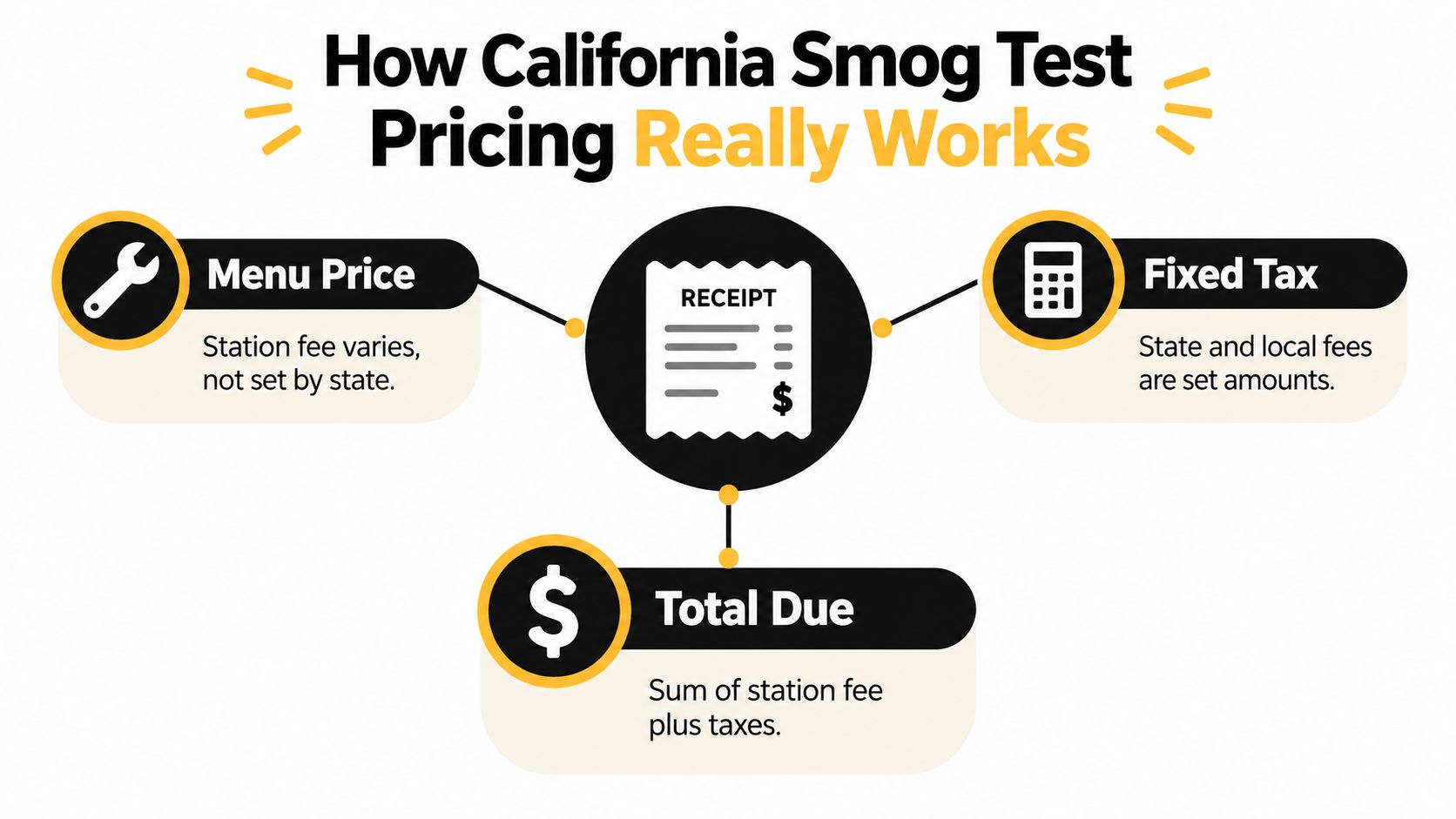
What changes the number you hear on the phone
The biggest moving part is the station fee. That is the shop's charge for the inspection itself. It covers the test equipment, the technician's time, and the cost of running the station.
The state does not set that part of the price, so two nearby shops can quote different inspection fees and both be normal.
A pass adds the fixed certificate fee. A fail usually does not. If the car does not pass, the station has no passing certificate to send, so the extra cost usually shows up later as a retest fee, repair bill, or both.
Why advertised prices can feel confusing
A low ad is often real, but it may only describe the inspection line. Another station may quote the likely passing total instead. Both shops can sound like they are giving the full price when they are really talking about different parts of the same receipt.
That is why one question clears up a lot: "Is that your inspection fee only, or my total if the car passes?"
If you want to be even more specific, ask two short follow-ups:
- "Does your quote include the $8.25 certificate fee?"
- "If my car fails, what do you charge for a retest?"
What first-time drivers should listen for
If the person at the counter asks for your car's year, fuel type, or whether your registration notice says STAR, they are usually trying to quote the right inspection category, not make the price sound slippery.
That matters because the inspection fee is the flexible part of the bill. The certificate fee is fixed. The wildcard is what happens if the car does not pass the first time.
So the useful way to compare shops is simple. Ask for the out-the-door total on a pass, then ask what the retest policy is on a fail. That gives you the price range, not just the headline number.
Regional Price Ranges and Why Station Type Matters
A first-time driver in Oakland might call two STAR stations and hear two different numbers that both sound right. One shop quotes the inspection fee. Another quotes the likely pass total. The only way to make sense of local pricing is to separate the bill into buckets, then compare the same bucket at each station.
The California Bureau of Automotive Repair explains the statewide baseline well. Inspection prices are not regulated, but the certificate fee on a passing test is fixed at $8.25. In the same report, BAR lists an average initial inspection fee of about $62.58 at STAR Test-and-Repair stations and $60.85 at STAR Test-Only stations, according to BAR's Smog Check Executive Summary Report for July 2025.
A quick comparison table
| Station Type | Average Inspection Fee | Certificate Fee | Typical Total on Pass |
|---|---|---|---|
| STAR Test-and-Repair | $62.58 | $8.25 | about $70.83 |
| STAR Test-Only | $60.85 | $8.25 | about $69.10 |
Those statewide figures are a baseline, not a promise. In the East Bay, a driver calling STAR stations in San Leandro or Oakland will often hear quoted pass totals a little above those averages once local overhead, appointment timing, and station pricing are factored in. That is why a local quote can be higher than the table without being unusual.
Station type also matters for a practical reason. A test-only shop is set up to inspect. A test-and-repair shop can inspect and fix problems under one roof. That difference can change labor costs, scheduling, and how a shop sets its inspection price.
BAR also notes that station categories post different average prices, and that non-STAR test-and-repair locations are consistently the highest-cost category in the available 2026 data, as noted in BAR's March 2026 executive summary.
What this means in the East Bay
For San Leandro, Oakland, and nearby cities, use the statewide averages like a measuring stick. Then compare local quotes by asking for the pass total, not just the ad price. If you want to start with nearby options, this list of East Bay smog check stations is a useful place to compare shops before you call.
A simple way to read the market is this: the station fee is the part that moves around, the certificate fee is fixed, and the third bucket only shows up if you need a retest or repairs. Once you sort quotes that way, the price differences stop feeling random.
The simplest way to compare quotes
Use this short checklist when you call:
- Ask for the total on a pass: Include the inspection fee and certificate fee.
- Ask what type of station it is: Test-only, test-and-repair, STAR, and non-STAR can price differently.
- Give your vehicle details: Year, fuel type, and any STAR requirement help the shop quote the right category.
That gives you a true side-by-side comparison instead of three different pieces of the bill.
Vehicle Age and Type and How They Change Your Cost
Two drivers can walk into smog stations on the same day and pay very different amounts, even before either shop sets its price. The reason is simple. Vehicle age and vehicle type decide whether you need the test at all, and that changes which cost bucket you are paying.
For some newer vehicles, the smog cost shows up at registration instead of at the station. California DMV explains that certain newer gasoline-powered vehicles pay a $20 smog abatement fee during registration for the first several model years, rather than getting a biennial smog inspection right away, on its smog inspections page.
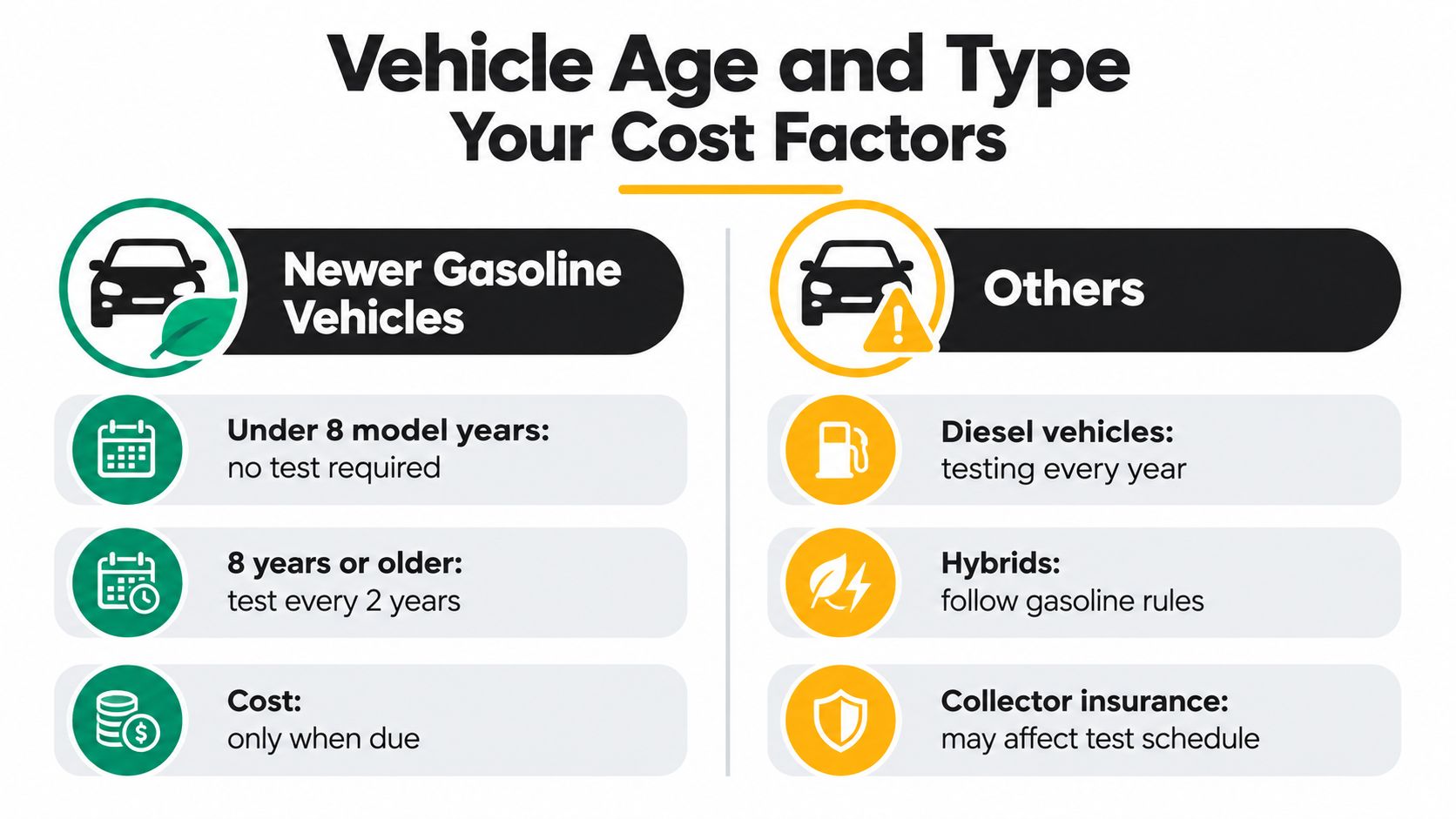
A quick real-world example makes this easier.
Say your neighbor has a newer gas sedan. That driver may handle the smog requirement through the registration abatement fee, so there is no station fee, no certificate fee, and no retest question that year.
Now look at an older gas SUV parked next to it. That owner is more likely paying the first two buckets discussed earlier, the station inspection fee plus the state certificate fee. If the vehicle has a problem, the third bucket can appear too, which means a retest or repairs.
That is why advertised prices can confuse first-time drivers. One car is buying a registration-related requirement. Another car is buying an actual inspection.
Vehicle type adds another layer. Gasoline, diesel, hybrid, and special registration situations do not always follow the same path. A title transfer can also change the timing, so a driver who did not need a test last renewal may need one for a sale or ownership change.
The easiest way to sort it out is to ask one question first: am I paying DMV this cycle, or am I paying a smog station?
Here is the simple version:
- Newer gasoline vehicle: You may be in the abatement phase, where the cost is tied to registration instead of a shop visit.
- Older gasoline vehicle: You are more likely paying for the inspection and certificate at a smog station.
- Diesel, hybrid, or transfer situation: Requirements can differ, so check your renewal notice carefully before comparing shop prices.
A good rule of thumb is this. Vehicle age decides whether you are even shopping for a smog test. Vehicle type helps decide what kind of test rules apply. Once you know those two pieces, the total cost stops feeling random and starts falling neatly into the right bucket.
Coupons Discounts and Smart Ways to Avoid Surprise Charges
Once you know whether your vehicle needs a test, the next step is trimming the station portion of the bill without creating new headaches.
Some shops run coupons on certain vehicles, especially newer ones. Speedy Smog, for example, lists smog test coupons on its site, including a $25-off offer for most newer-vehicle smogs. That kind of discount affects the station fee, not the fixed state certificate.
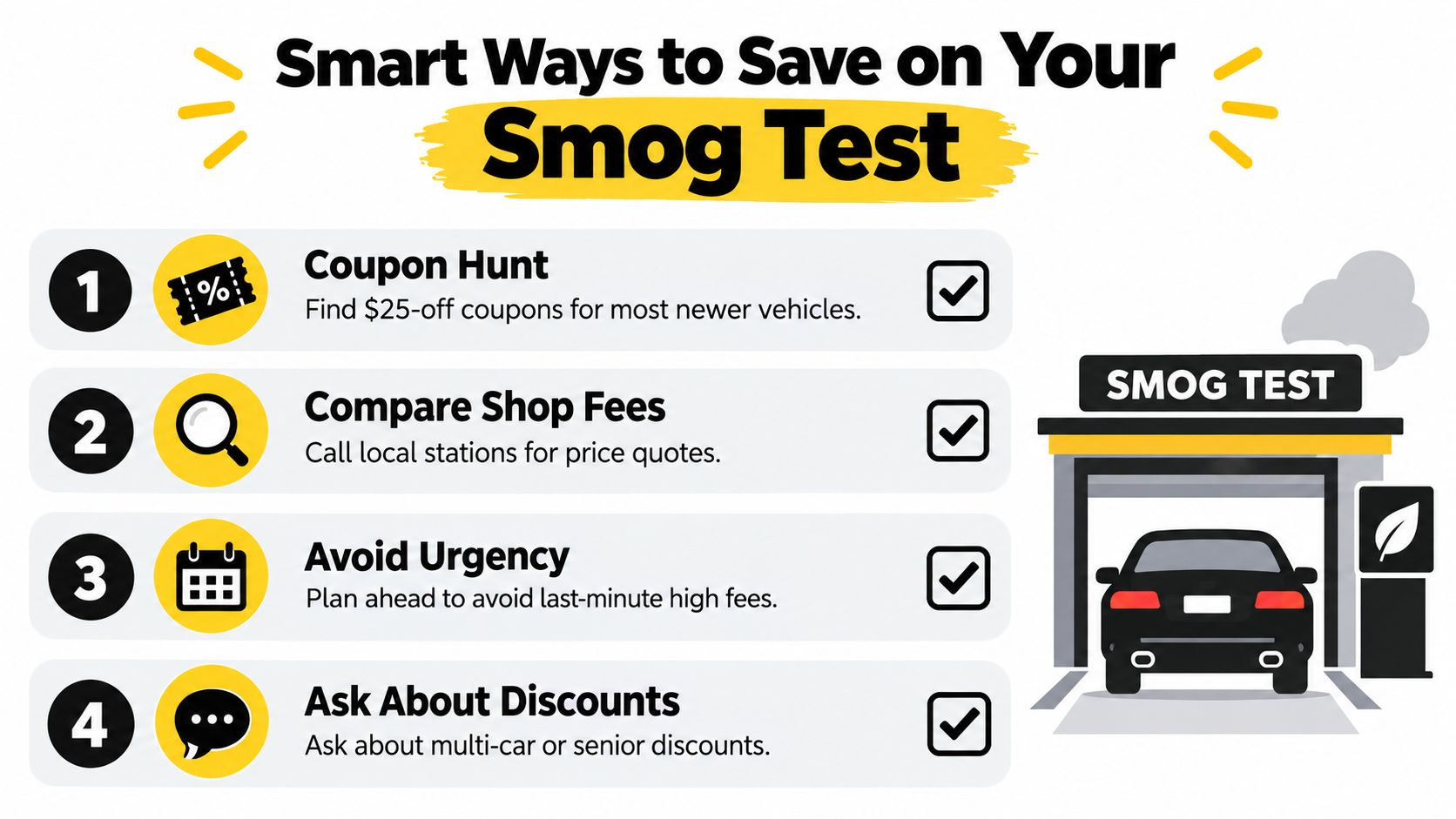
What to check before you use a coupon
A coupon can absolutely help, but don't look at the discount in isolation. Look at how it fits into the final total.
Here are the smart questions to ask:
- Does the coupon apply to my vehicle year? Some offers are limited to certain model years or common passenger vehicles.
- Is the certificate fee included in the quoted total? A coupon may reduce the inspection price while the state fee remains separate.
- What happens if the car doesn't pass? Ask about retest policy before the test starts.
- Do I need an appointment or printed coupon? Shops vary on how they process discounts.
Timing saves money too
The easiest way to overpay is to wait until the last minute. When drivers are up against a registration deadline, they often stop comparing quotes and just grab the first available appointment.
A little lead time gives you room to:
- Call more than one station
- Confirm the complete passing total
- Check whether a coupon lowers your real bill
- Handle minor maintenance first if the car has been acting up
Here's a short walkthrough that helps many first-time drivers:
Small details that prevent big annoyance
The station fee isn't the only thing worth comparing. Convenience matters too. If a shop handles common vehicles quickly, that can save time off work or shorten a weekend errand list.
For example, Speedy Smog states that typical tests for 2000 and newer vehicles are often completed in about 10 to 15 minutes, which matters when you're balancing school pickup, work, and DMV deadlines. Fast service doesn't replace transparent pricing, but it does make the whole errand less painful.
Ask for the total, ask about coupon eligibility, and ask about retest policy. Those three questions catch most surprise charges before they happen.
If You Fail Retest Fees and the Repair Cost Cap Explained
A failed smog test changes the math fast.
Before the failure, you are mostly looking at the first bucket, the station fee. After the failure, two other buckets can start to matter a lot more. You may face a retest fee, and you may need repairs before the car can pass. That is why the cheapest advertised test price does not always lead to the lowest total bill.
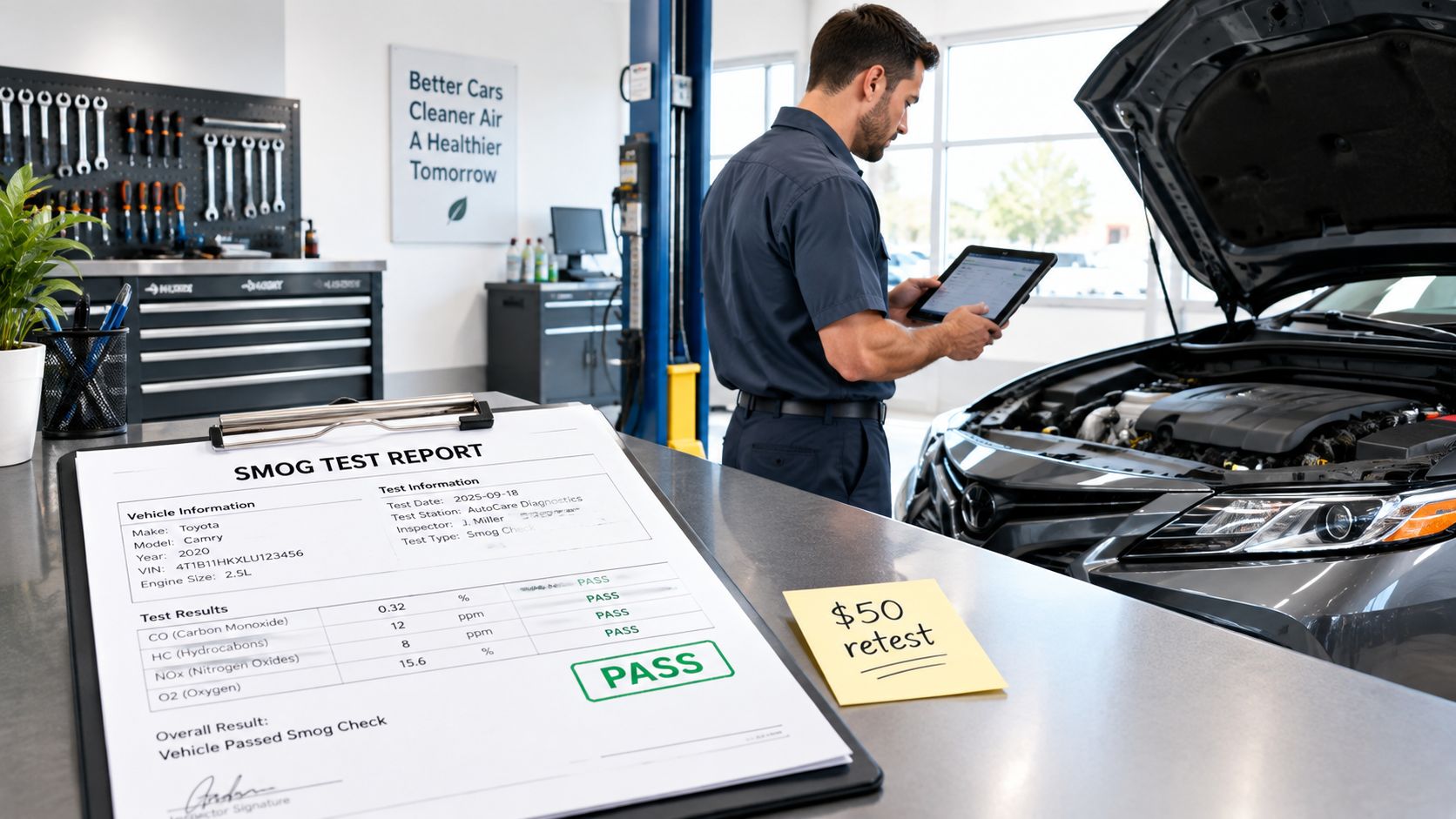
What usually happens after a fail
Here is the plain-English version. The first test tells you whether the car passed that day. If it fails, the next question is not just "How much was the test?" It becomes "What will it take to get this car ready for a passing retest?"
That second part can include a few separate charges:
- Retest fee: Some stations charge less for a return visit. Some do not.
- Diagnostic work: A fail result may point to a problem, but it does not always tell you the full repair answer by itself.
- Repair cost: The actual fix can be minor or more involved, depending on why the vehicle failed.
- Certificate fee later: The state certificate still gets added when the vehicle finally passes.
That is the cost split many first-time drivers miss. The first receipt is only one piece of the total.
What the repair cost cap means, in simple terms
California has a repair cost cap rule for certain biennial smog situations, as noted earlier in the article. Drivers often hear that and assume it puts a lid on everything connected to a failed test. It does not work that broadly.
A better way to read it is this: the rule can help in a specific smog-check context, but it is not a promise that every expense tied to a failure stops at that number. Extra diagnostics, additional testing, or work outside that covered situation can still add cost.
So if your car fails, use the cap as one part of the picture, not the whole picture.
Why some failures stay inexpensive and others do not
Two cars can fail on the same day and end up with very different bills.
One driver may need a small fix and a straightforward retest. Another may be dealing with an older vehicle, an intermittent warning light, or a problem that takes time to pin down. That is why failure costs are hard to quote over the phone. Until the shop knows why the car failed, any number is only a rough guess.
It helps to treat a failed smog like a doctor visit that leads to lab work. The first visit identifies a concern. The next step is figuring out exactly what is causing it.
How to reduce the chance of a bigger bill
If the car already has symptoms, budget beyond the test itself.
Common red flags include a check engine light, rough idle, poor fuel economy, or a car that has been sitting for a long time without regular driving. In those cases, the inspection fee may end up being the smallest part of what you pay.
A few simple habits can lower the odds of surprise costs:
- Do not test with the check engine light on: That is asking for trouble.
- Take care of obvious drivability issues first: If the car is running rough, smog day is probably not the right first stop.
- Ask about retest policy before you pay: Some stations are clearer and fairer about return charges than others.
- Keep your paperwork: If you need repairs and come back, having the first test result handy saves time.
The practical takeaway is simple. If your car is healthy, your smog cost usually stays in the first two buckets. If it fails, the third bucket, retest and repair costs, can become the one that matters most.
Conclusion Your Quick Plan for an Affordable Compliant Smog Test
You call one station and hear one price. Then you show up and the total is higher than you expected. That usually happens because the smog bill is not one number. It is a few separate charges stacked together.
A clear way to read Smog Test California cost is to sort it into three buckets. First is the station fee for the inspection. Second is the state certificate fee that gets added on a pass. Third is the bucket many drivers hope to avoid, a retest or repairs if the car does not pass. Once you separate the bill that way, the price difference between stations starts to make sense.
The best last step is simple. Do not ask, "How much is a smog?" Ask, "What would I pay out the door if my car passes today?" That one sentence cuts through a lot of confusion because it pushes the shop to give you the number that matters, not just the headline price.
A quick plan before you book
Use this 30-second phone script:
- "Hi, I have a [year, make, model]. What is the full out-the-door price if it passes today?"
- "Does that total include the certificate fee?"
- "Is my vehicle the kind that needs your station type, including STAR if required?"
- "If it does not pass, what is your retest policy?"
That short call does two useful things. It helps you compare stations on the same basis, and it tells you which shop explains fees clearly without dancing around the question.
The practical East Bay takeaway
A good smog visit should feel more like checking out at a grocery store than getting surprised at the register. You should know what is in the cart before the total shows up.
If you are in the East Bay, a STAR Certified station may be the right fit if your DMV notice calls for it. If you want a straightforward local option, Speedy Smog offers STAR Certified testing in San Leandro with transparent pricing, a waiting room, and quick service for many common vehicles.
Keep it simple. Confirm you need the test now, call for the full passing total, and choose the shop that answers plainly. That is the easiest way to keep your smog cost compliant, predictable, and easier on your wallet.
You've paid your California registration fees, received the confirmation email, and expect the renewal sticker to be ready. Then the DMV record still says smog certification required. For East Bay drivers, that frustrating situation usually doesn't mean the payment failed. It means the registration record hasn't received a passing emissions result connected to the vehicle identification number, or VIN.
California's DMV smog rules connect three separate steps: the state's emissions inspection, the electronic transmission of the result, and the DMV's decision to release the registration. A renewal payment alone doesn't complete the process when the notice still requires smog certification. The practical questions are simple, but the answers depend on the vehicle's year, fuel type, test path, renewal notice, and station requirements.
Table of Contents
- When the Renewal Stalls at the DMV Counter
- What a California Smog Check Actually Does
- OBD vs Tailpipe vs Diesel: Which Test Your Car Gets
- When California Requires a Smog Check
- Exemptions Most Drivers Get Wrong
- STAR Stations and When You Have to Use One
- The Renewal Bottleneck and How to Clear It
- A Simple Pre-Renewal Checklist for East Bay Drivers
When the Renewal Stalls at the DMV Counter
At a Concord DMV counter, a driver may arrive with a paid renewal receipt and a confirmation email, expecting only the sticker to remain. The clerk checks the registration record and sees that the vehicle still needs a smog result. The clerk isn't looking for proof that the fee was paid. The system is looking for a passing certificate attached to the correct VIN.
That's the part many drivers don't see. The DMV uses the smog result as a registration condition, while the licensed station performs the inspection and sends the outcome electronically. The California DMV's smog inspection guidance explains that paying registration fees doesn't finalize renewal when certification is still required.
Why the renewal barcode matters
Your renewal notice includes a barcode that helps the station identify the correct DMV transaction. When the technician scans or enters that information, the station can transmit the result to the appropriate registration record. The vehicle's VIN remains the central identity check, so a correct license plate alone isn't enough if the VIN was entered incorrectly.
Bring the complete renewal notice to the appointment, not just a phone photo of the payment confirmation. If the notice says STAR, choose a station authorized for that requirement before testing. A standard station may be able to inspect the vehicle, but it might not be authorized to complete a STAR-only transaction.
Practical rule: Payment starts the renewal. A passing, correctly transmitted smog result finishes the part that DMV still has on hold.
If you're already facing this problem, a smog check for registration renewal can help identify whether the issue is the test itself, the station designation, or the electronic record. Ask the technician to confirm the VIN, plate information, and transmission status before you leave.
The rest of the process follows the same sequence: identify whether the vehicle needs testing, determine which inspection applies, select the correct station, complete the test, and verify that DMV receives the result. Once you understand that chain, “smog required” becomes a solvable workflow problem instead of a surprise at the counter.
What a California Smog Check Actually Does
A California Smog Check is an emissions inspection performed by a licensed Smog Check station under the Bureau of Automotive Repair, or BAR. The DMV doesn't perform the mechanical inspection. It uses the result to decide whether the vehicle's registration can move forward.
Think of the inspection as a physical for the vehicle's emissions system. The technician identifies the vehicle, checks relevant emissions equipment, connects to the diagnostic system when applicable, and follows the test procedure assigned to that vehicle. The station then reports a pass or fail electronically.
What the technician is checking
For a newer gasoline vehicle, the technician may connect to the diagnostic port and review data stored by the car's onboard computer. That data can include diagnostic trouble codes, warning-light status, and readiness monitors that show whether the vehicle has completed its emissions self-tests.
Older gasoline vehicles may receive a tailpipe inspection instead. In that case, the equipment measures exhaust gases while the vehicle runs through the specified test conditions. The technician isn't just checking whether the exhaust looks clean. The machine evaluates emissions against the applicable standards.
The program also includes many diesel vehicles. BAR's Smog Check Reference Guide identifies separate requirements for gasoline, hybrid, alternative-fuel, and diesel vehicles, with the inspection path determined by model year, fuel type, and vehicle weight.
Which vehicles are generally involved
Most newer gasoline cars, flex-fuel vehicles, hybrids, and alternative-fuel vehicles fall within the program. Older gasoline vehicles may use the BAR-97 tailpipe system. Diesel vehicles within the applicable weight range follow a separate track, while some vehicles are outside the regular passenger-vehicle process.
The renewal notice is the most useful first check. If it includes a smog certification requirement, treat that notice as your instruction for the current registration event. If no smog line appears, the vehicle isn't being asked for certification in that cycle.
The certificate belongs to the vehicle's VIN, not to the driver who paid for the test. You can't transfer a passing result from one car to another, and a payment record doesn't replace certification for the specific vehicle being renewed.
OBD vs Tailpipe vs Diesel: Which Test Your Car Gets
At a DMV renewal counter, the test type can determine whether your paperwork moves ahead or stops. California uses different inspection paths because vehicles report emissions information in different ways. Newer gasoline vehicles generally use onboard computer data, older gasoline vehicles may require direct exhaust measurement, and diesel vehicles follow their own combination of checks.
The three practical paths
OBD inspection. Most 2000-and-newer gasoline, flex-fuel, hybrid, and alternative-fuel vehicles receive an OBD-based inspection. The technician connects to the diagnostic port and reviews emissions-related data stored by the vehicle. A failure can result from unresolved faults or from required readiness monitors that have not completed.
The Smog Check Manual explains that incomplete readiness monitors can cause a 2000-and-newer gasoline vehicle to fail, with the evaporative-system monitor handled under the stated exception. Clearing a check-engine code immediately before testing may not help. The computer can still show that its self-tests are incomplete.
BAR-97 tailpipe inspection. Most 1999-and-older gasoline vehicles use the BAR-97 system. A probe samples exhaust while the vehicle runs under the required conditions. The technician also completes the related visual and functional portions of the inspection.
Diesel inspection. 1998-and-newer diesel vehicles at or under 14,000 pounds GVWR require Smog Check when they fall within the applicable program scope. The procedure varies by vehicle and weight class and may combine OBD information with emissions or opacity testing. Diesel vehicles above that weight threshold follow a different regulatory path, rather than the regular passenger-vehicle Smog Check process.
A limited group of 2000-and-newer gasoline vehicles cannot use the standard OBD inspection and may be directed to BAR-97 tailpipe testing. The station determines that route from the vehicle information and BAR procedures.
| Vehicle Year | Fuel Type | Test Type |
|---|---|---|
| 2000 and newer | Gasoline, flex-fuel, most hybrids, alternative fuel | OBD-based inspection, unless BAR routes the vehicle to BAR-97 |
| 1999 and older | Gasoline | BAR-97 tailpipe inspection |
| 1998 and newer | Diesel at or under 14,000 pounds GVWR | Separate diesel inspection path |
| Above 14,000 pounds GVWR | Diesel | Different CARB emissions program, not a regular passenger-vehicle Smog Check |
Station choice can matter when the renewal deadline is close. An OBD vehicle needs a station equipped to read its computer data, while an older gasoline vehicle needs BAR-97 equipment and the correct procedure. STAR station requirements may also apply to a particular renewal, so confirm the notice before booking. If you are unsure, review this guide to identifying the right Smog Check before choosing a station.
When California Requires a Smog Check
A Smog Check usually isn't an annual appointment for every California driver. The requirement is tied to registration events, and the renewal notice tells you whether certification is due for the current cycle.
The most common trigger is registration renewal. Other triggers include transferring ownership, registering an out-of-state vehicle in California for the first time, and certain out-of-state title or registration transfers. BAR specifically reports that out-of-state 1976 model-year and newer vehicles registering in California for the first time require Smog Check, subject to the applicable rules and exemptions. That requirement is described in the EPA overview of vehicle inspection and maintenance programs, which places California's program within the broader U.S. emissions inspection framework.
Read the notice, not an old calendar
Drivers often try to calculate the requirement from memory. That can lead to a missed test or an unnecessary appointment. Look for the smog certification line on the current renewal notice. If it appears, complete the inspection before the DMV can finalize the renewal.
A newer vehicle may follow a renewal pattern in which some cycles don't request smog certification, followed by more frequent testing as the vehicle ages. The exact obligation can depend on the notice and the vehicle's registration details, so don't rely on a generic rule when the DMV has already issued a specific instruction.
| Event | Smog Required? | Who Pays |
|---|---|---|
| Registration renewal | If the renewal notice says certification is required | Usually the registered owner |
| Change of ownership | Commonly required under the transfer rules | Typically handled by the seller before transfer |
| First California registration for an out-of-state vehicle | Generally required for in-scope vehicles | Usually the person registering the vehicle |
| Certain out-of-state title transfers | Depends on the transaction and vehicle record | The parties should confirm responsibility with DMV |
For an ownership transfer, the seller commonly provides a passing smog certification before handing over the title. The buyer shouldn't assume that any recent repair invoice or informal promise replaces the required certificate.
Commercial vehicles, diesel vehicles, and vehicles with special registration classifications can follow different schedules or programs. When the notice and the vehicle category don't seem to match, ask the DMV or a BAR-licensed station to verify the record before paying for a test.
Exemptions Most Drivers Get Wrong
California's exemptions are narrower than many drivers expect. A vehicle's age, fuel type, registration classification, and construction can matter, but popular assumptions often don't remove the requirement.
Common exemption categories include:
- Current model year: A brand-new vehicle can be exempt during its initial registration period under the applicable rules.
- Older gasoline vehicles: Gasoline-engine vehicles from 1975 model year or older fall outside the regular requirement described in the program guidance.
- Electric-only vehicles: Battery-electric vehicles don't produce tailpipe emissions and are treated differently from gasoline hybrids.
- Motorcycles and most trailers: These generally don't receive the same passenger-vehicle Smog Check requirement.
- Special classifications: Specially constructed and historical vehicles may qualify under narrow conditions tied to their registration status.
What doesn't create an exemption
A hybrid isn't automatically exempt. Four-wheel drive doesn't remove the inspection requirement. Paying a higher registration amount doesn't substitute for certification, and a recent repair bill doesn't waive the test.
Diesel vehicles at or above 14,000 pounds GVWR aren't "free from emissions rules." They follow a different emissions track, so a driver needs to distinguish between exemption from the regular DMV Smog Check and compliance with other California emissions requirements.
A formal filing or approval may change the obligation in a specific case. Examples can include a properly filed non-operation status or an economic-hardship extension granted through the appropriate BAR process. Those outcomes depend on documentation and approval, not on a driver's personal belief that testing would be inconvenient or expensive.
The cleanest confirmation is the current renewal notice. If it has no smog certification line, the vehicle isn't being asked for a Smog Check in that cycle. If the line appears, assume the requirement remains until DMV or BAR records show otherwise.
STAR Stations and When You Have to Use One
A STAR station is a Smog Check station authorized by BAR to perform inspections under the STAR program. The key question isn't whether a shop can test cars generally. It's whether that specific station is authorized for the designation printed on your renewal notice.
A standard Smog Check station can handle many ordinary inspections. A vehicle previously flagged for additional scrutiny, referred for directed testing, or assigned a STAR-only requirement may need a station listed in the BAR STAR directory. The notice controls the choice.
Match the station to the notice
Look for wording such as STAR, STAR station, or STAR-only. If the notice gives the standard smog instruction without a STAR designation, a licensed station that performs the required test may be appropriate. If the notice requires STAR, verify the station's current status before making an appointment.
STAR testing can involve closer review of emissions components, tampering indicators, and the vehicle's computer information. A STAR station may be able to complete the required certification directly when the vehicle qualifies for that station's authority, instead of sending the driver elsewhere.
Station-choice rule: Don't choose a shop only because it's close. Choose one whose authorization matches the DMV instruction attached to your vehicle.
The explanation of what a Smog STAR station is can help you distinguish the program designation from ordinary marketing language. Ask the station whether it can complete a STAR-only test for your exact renewal notice before you arrive.
For East Bay drivers, station selection affects timing as much as location. If you test at the wrong type of shop, you may need another appointment, another inspection, or additional document review. Checking the notice first protects the renewal deadline and reduces the chance of leaving with a result DMV can't use for that transaction.
The Renewal Bottleneck and How to Clear It
The normal process is electronic. The technician uses the renewal notice and vehicle information, completes the inspection, and transmits the result to DMV. When the transmission matches the vehicle and transaction, the registration record can update without the driver carrying a paper certificate to a DMV office.
A stalled record usually has a practical cause. The result may still be processing, the technician may have entered a VIN incorrectly, or the station may have used information that didn't match the renewal notice. An old notice with a different barcode can also create confusion.
Use this order of checks
- Allow processing time. Give the electronic record time to appear before assuming the test failed.
- Check the registration record online. Use the DMV's available registration or tag-status tools to see whether the smog requirement remains.
- Call the station first. Ask the technician to verify the VIN, license plate, renewal barcode, and transmission confirmation.
- Contact DMV after the station review. If the station confirms correct transmission and the record still hasn't changed, DMV can investigate the registration file.
Don't schedule a second smog test before checking the first result. A repeat inspection won't correct a mismatched VIN or an unprocessed transaction, and it can make the record harder to interpret.
The process is designed to connect the inspection to the DMV file electronically, but drivers still need to provide the right notice and confirm the identifying information. That small preparation step is often what separates a completed renewal from another trip to the counter.
A short visual summary of the workflow appears below.
A Simple Pre-Renewal Checklist for East Bay Drivers
Use the current renewal notice as your starting document, then prepare the vehicle for the inspection path it requires.
- Drive enough mixed conditions: After battery service or emissions repairs, use normal city and highway driving to help the OBD system complete its self-checks. Your technician can tell you whether a specific drive cycle is needed.
- Check warning lights: The check-engine light should be off before testing. Don't erase codes immediately before the appointment, because clearing them can leave monitors incomplete.
- Inspect the gas cap: Make sure it seals correctly and isn't damaged.
- Review the notice: Confirm the vehicle information, renewal deadline, barcode, and any STAR instruction.
- Choose the right station: If the notice says STAR, verify that the station is currently authorized for STAR testing. Bring the full notice to the appointment.
- Allow processing time: Schedule the inspection early enough that an electronic transmission issue can be corrected before the registration deadline.
Don't wait until the last DMV business day if your renewal depends on certification. Early testing gives you time to address an incomplete monitor, a failed inspection, a station mismatch, or a delayed record.
Speedy Smog provides DMV smog checks in San Leandro for newer and older gasoline vehicles, hybrids, and applicable diesel vehicles, with electronic result transmission for registration workflows. Bring your renewal notice and vehicle, confirm whether STAR testing is required, and visit Speedy Smog to arrange the inspection before your DMV deadline.
You're looking at a California registration renewal notice, wondering whether your car needs an OBD scan, a tailpipe test, a STAR inspection, or no test at all. The answer isn't based on how many miles you've driven. It starts with fuel type and model year, then shifts to why the DMV is requesting certification, such as renewal, a transfer, or a sale.
I advise drivers to identify the vehicle's test category before booking an appointment. That simple check prevents the most common mistake I see at a busy smog station: arriving with the right paperwork but the wrong assumption about what the car needs.
Table of Contents
- Figure Out What Smog Check You Need Right Now
- How California Decides Your Smog Check by Year and Fuel Type
- OBD Inspection vs BAR-97 Tailpipe Test and What to Expect
- When Renewal Transfer or Sale Changes the Test You Need
- Get Ready to Pass and Avoid the Most Common Fail Reasons
- Book the Right Test Near You and Get Certified Quickly
Figure Out What Smog Check You Need Right Now
A driver in San Leandro may bring in a 2012 sedan for renewal, an Oakland owner may be selling a hybrid, and another customer may have received a DMV notice directing them to a STAR station. Those situations can involve different requirements even when the vehicles appear similar.
Start with the vehicle itself. Find the model year, confirm whether it runs on gasoline, diesel, hybrid, or another approved fuel, and check whether the DMV request is for registration renewal, ownership transfer, sale, or an out-of-state registration change. Mileage helps describe how much the vehicle has been used, but it doesn't determine the basic California inspection pathway.
Practical rule: Don't book a test based only on the renewal notice. Match the vehicle's year and fuel type first.
The second question is whether the vehicle is subject to testing at all. Newer vehicles generally fall under California's smog abatement period, while older gasoline and diesel vehicles can qualify for specific exemptions. If testing applies, the model year usually determines whether the station performs an OBD inspection or a BAR-97 tailpipe inspection.
A STAR requirement adds another layer. If the DMV specifically directs the vehicle to a STAR station, use a station with STAR certification rather than assuming any licensed station will satisfy the request. The technology used during the test still depends mainly on the vehicle's year and fuel type.
For East Bay drivers, Speedy Smog's California eligibility guide can help you check the basic requirement before you arrive. Bring the registration renewal notice if you have it, but let the vehicle details drive the decision.
How California Decides Your Smog Check by Year and Fuel Type
California uses a clear age and powertrain filter. The state's Smog Check Program guidance explains that gasoline, hybrid, and alternative-fuel vehicles generally enter the testing requirement after they are more than eight model years old. Vehicles within that newer period generally pay a smog abatement fee instead of receiving a smog inspection for registration renewal.
The model-year clock matters more than the date you bought the car. A 2020 model-year vehicle first needs a smog check for renewal in 2028, according to the California Bureau of Automotive Repair. You don't move the deadline by purchasing the car later, and driving fewer miles doesn't create a separate testing category.
Use this decision filter:
- Identify the fuel type. Gasoline, hybrid, and alternative-fuel vehicles generally follow the newer-vehicle abatement period before entering the regular testing cycle. Diesel vehicles require separate attention because California applies different age rules.
- Check the model year. If a covered gasoline, hybrid, or alternative-fuel vehicle is eight model years old or newer, it generally pays the abatement fee instead of taking the test. Once it is more than eight model years old, it generally needs certification for registration renewal.
- Look for an older-vehicle exemption. Gasoline-powered vehicles from model year 1975 or older are exempt, while diesel vehicles from model year 1997 or older are exempt under the state program guidance.
- Confirm the DMV reason. Renewal, ownership transfer, sale, and a directed STAR inspection can change what paperwork or station type applies after you determine whether the vehicle is subject to testing.
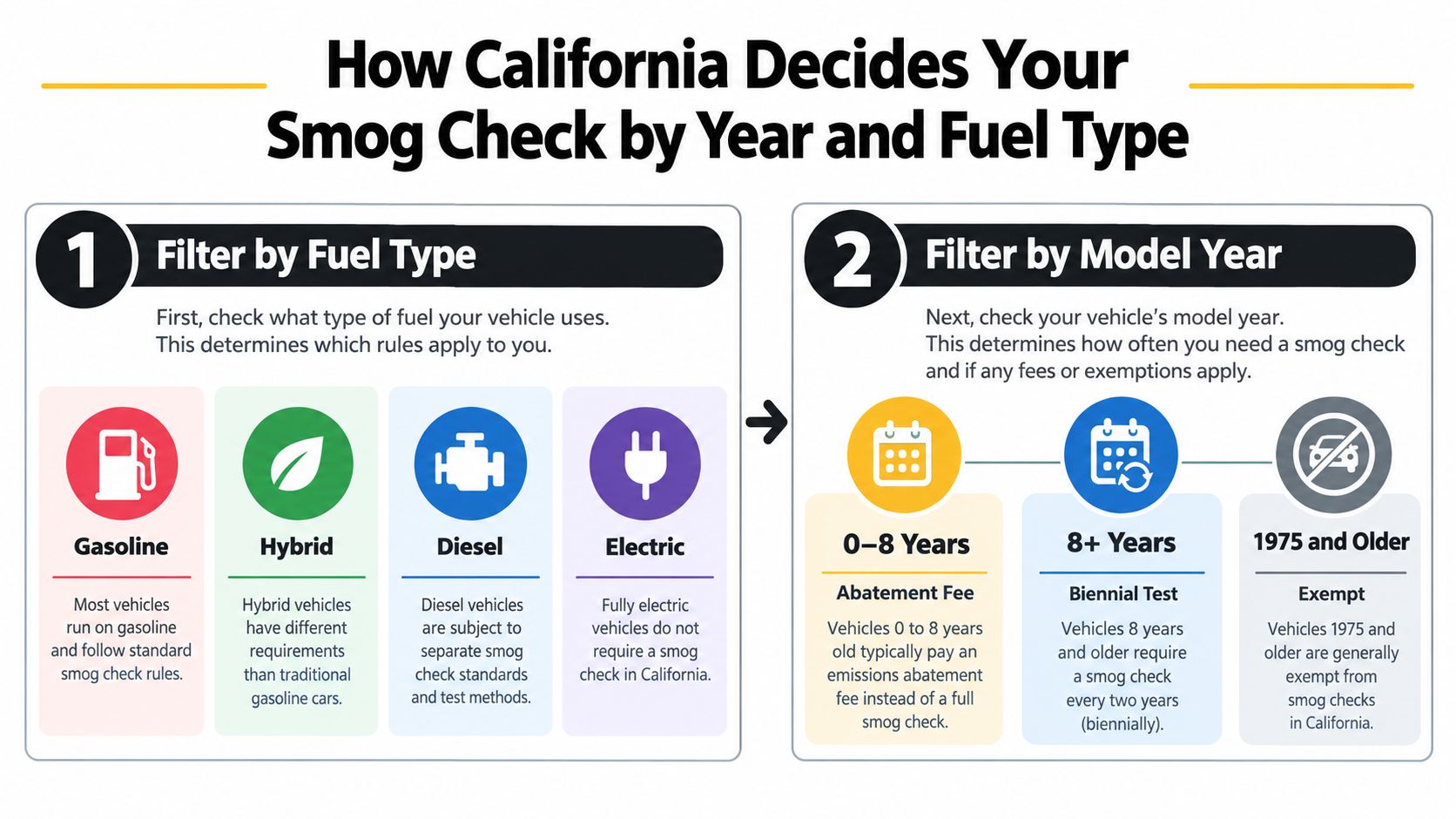
This is why the question “what smog check do I need” can't be answered from mileage alone. A newer hybrid may not need an inspection for renewal, while an older gasoline sedan may need one. An older diesel may fall outside the standard program entirely.
Write down the year and fuel type before you call a station. That two-item check usually tells you whether to ask about an abatement fee, an OBD test, a BAR-97 test, or an exemption review.
OBD Inspection vs BAR-97 Tailpipe Test and What to Expect
The main technical split is straightforward. Most 2000-and-newer vehicles receive an onboard diagnostic inspection, while 1999-and-older vehicles are generally routed to a BAR-97 tailpipe-based inspection, as described in the California Smog Check manual. California can also require visual and functional checks of emissions equipment in addition to the electronic or tailpipe portion.
| Vehicle Group | Test Type | What Is Checked | Typical Time at Station |
|---|---|---|---|
| 2000-and-newer eligible vehicles | OBD inspection | Diagnostic data, warning-lamp status, readiness information, and emissions equipment checks | Usually a short computer-based visit, depending on vehicle condition |
| 1999-and-older vehicles | BAR-97 tailpipe inspection | Tailpipe emissions, visible emissions equipment, and required functional checks | Depends on the vehicle and inspection process |
| Vehicles directed to STAR | Required test pathway at a STAR station | The applicable inspection method for the vehicle, plus required station and program checks | Depends on vehicle type and readiness |
What happens during an OBD inspection
The technician connects approved equipment to the vehicle's diagnostic system and reviews information stored by the car's computers. The inspection isn't a scan for one trouble code. The technician also looks at malfunction indicator lamp behavior, readiness monitors, and emissions-related equipment.
For late-model gasoline vehicles, California replaced the traditional loaded dynamometer tailpipe portion with an OBD-based check. The BAR Smog Check reference guide identifies 2000-and-newer vehicles at 14,000 pounds GVWR and under as using the OBD pathway.
What happens during a BAR-97 inspection
A qualifying older vehicle is evaluated through the BAR-97 tailpipe method rather than the standard late-model OBD route. The technician still checks required emissions components and their function. A vehicle can fail because of a visible emissions problem, not only because of the measured tailpipe result.
If your vehicle is 2000 or newer, read Speedy Smog's STAR Smog Check information before booking when the DMV notice mentions STAR. The station requirement and the vehicle's technical test method are related, but they aren't the same question.
When Renewal Transfer or Sale Changes the Test You Need
The vehicle's year and fuel type identify the likely inspection technology. The transaction reason determines why certification is being requested and whether a particular station designation matters.
For a routine registration renewal, the DMV may require a passing smog result once the vehicle is beyond California's newer-vehicle abatement period. A 2012 gasoline sedan in San Leandro will normally be evaluated through the late-model OBD pathway, provided it falls within the applicable vehicle category. The important point is that renewal is a registration trigger, not a different engine test.
A private sale creates a different situation. If someone in Oakland sells a 2015 hybrid, the buyer and seller shouldn't assume the vehicle's hybrid system makes it exempt forever. California's age-based rules generally bring covered hybrids into testing after the newer-vehicle period, and the sale paperwork can require current smog certification.
The same car can need a different administrative action depending on why the DMV is asking for certification.
Ownership transfers also deserve a careful look. If you're transferring a diesel truck, don't classify it from appearance or engine size alone. Confirm the fuel type, model year, and any applicable vehicle details before deciding whether a standard Smog Check applies.
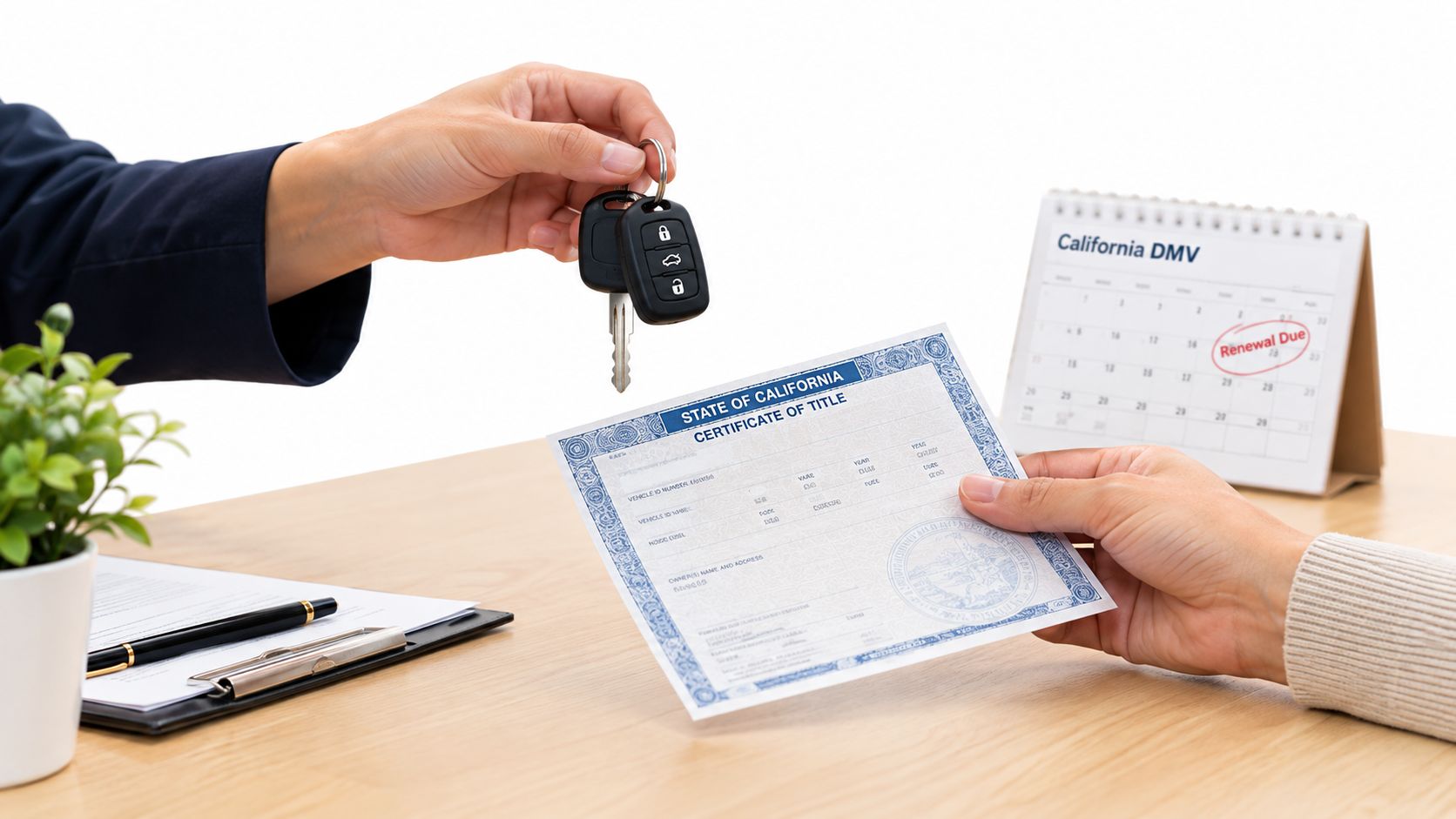
Out-of-state registration changes can also prompt a California inspection. In that case, the reason for testing is the registration change, but the technical pathway still follows the vehicle's California classification. For 2000-and-newer gasoline vehicles at 14,000 pounds GVWR and under, the BAR reference guide identifies the OBD route instead of a loaded dynamometer tailpipe test.
If the DMV directs you to a STAR station, follow that instruction exactly. A STAR-directed test should be performed at a STAR Certified location, even when the vehicle itself receives an OBD inspection rather than a separate “STAR technology” test.
Get Ready to Pass and Avoid the Most Common Fail Reasons
Most avoidable failures begin before the car enters the bay. A warning lamp, incomplete readiness monitor, recently cleared diagnostic memory, or missing emissions equipment can stop an otherwise well-maintained vehicle from passing.
California's BAR OBD guidance highlights MIL behavior and readiness criteria as central failure conditions. The state's rules also tightened on October 1, 2025, when all readiness monitors must be set for a vehicle to pass, with 2000-and-newer gasoline vehicles allowed only the evaporative monitor to remain unset. Check the current status before you pay for an inspection.
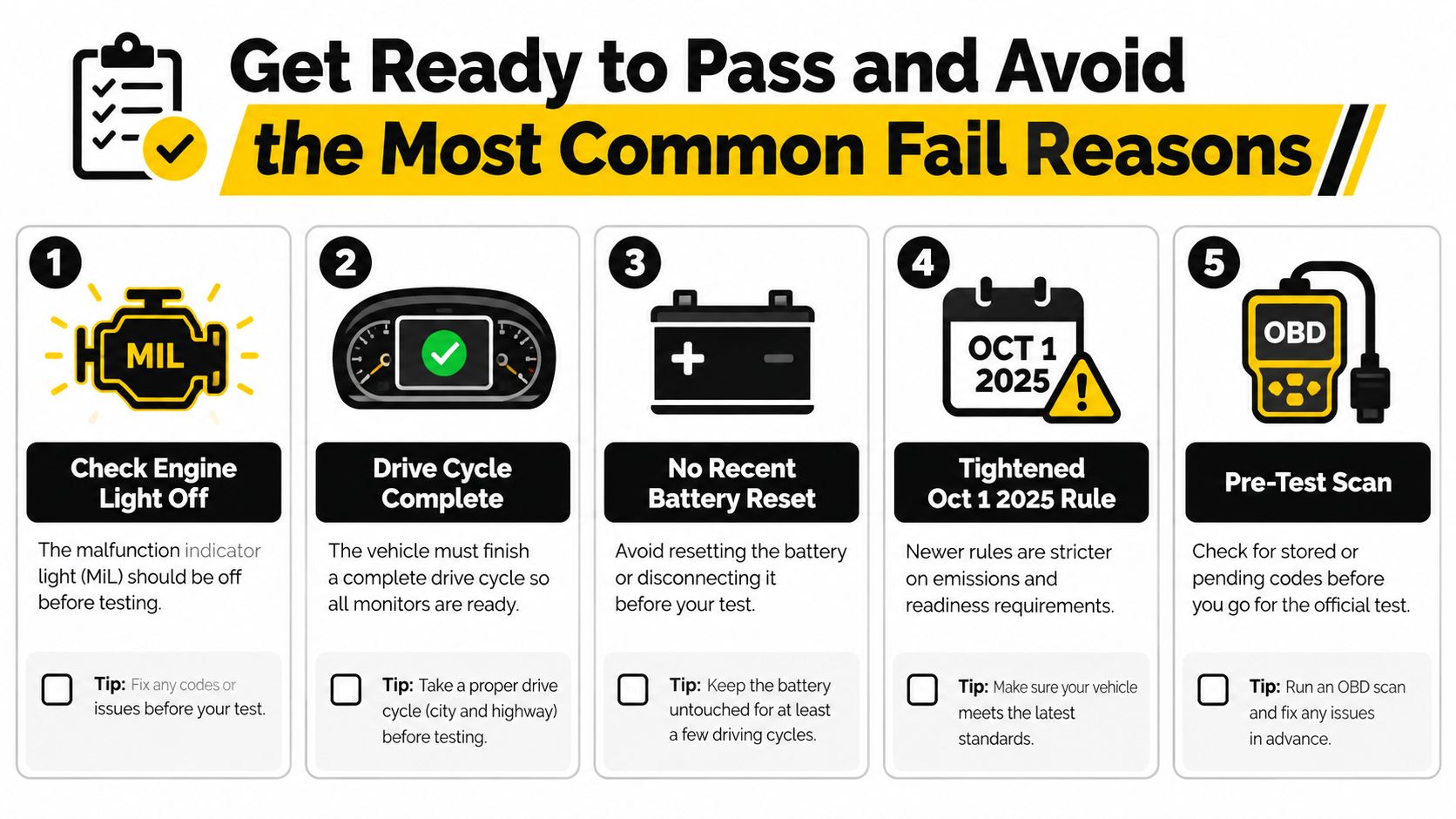
Use this pre-test checklist:
- Check the MIL: The check engine light should not be illuminated. If it came on recently, diagnose the cause instead of just clearing the code.
- Confirm readiness: Have the vehicle scanned for monitor status before the official test. “No codes” doesn't always mean “ready.”
- Avoid a recent battery reset: Disconnecting the battery or clearing codes can erase readiness information and create an automatic failure risk.
- Inspect visible equipment: Make sure the gas cap, catalytic converter, vacuum lines, and other emissions components are present and intact.
- Warm the vehicle normally: Arrive with the engine at normal operating temperature, but don't try to hide a warning light or unresolved fault.
The most common practical mistake is assuming the computer will be ready because the car drives normally. It may not. The BAR OBD test reference explains why warning-lamp behavior and monitor status deserve attention before testing.
For a focused breakdown of preventable problems, review common California smog check fail reasons.
Don't clear a code just before the appointment. That can make the dashboard look better while leaving the vehicle's readiness monitors incomplete. A proper scan gives you a clearer answer and saves a wasted trip.
Book the Right Test Near You and Get Certified Quickly
You can identify the correct starting point with four checks: model year, fuel type, DMV reason, and STAR direction. If the vehicle is covered and 2000 or newer, expect an OBD-based inspection in the applicable category. If it's 1999 or older, ask about the BAR-97 pathway. If the DMV names STAR, choose a STAR Certified station.
Bring your registration renewal notice if available, the vehicle, and any information about recent repairs or battery replacement. If the check engine light has been on, don't book first and diagnose later. Scan the vehicle, address the fault, and verify readiness before the official inspection.
Speedy Smog in San Leandro performs California smog inspections for newer vehicles, older vehicles, diesels, and hybrids, with a typical 10 to 15 minute OBD test for 2000-and-newer vehicles according to the station information provided for this article. The shop is located at 15275 Washington Ave, offers an indoor waiting room, transparent pricing, coupon options, and Monday-through-Saturday service.
Booking advice: Tell the station your model year, fuel type, and whether the DMV requires STAR before you arrive.
That information lets the advisor prepare for the correct inspection rather than making you repeat the visit. It also helps separate a true testing issue from a readiness problem that should be handled before certification.
Visit Speedy Smog with your model year, fuel type, and DMV notice ready, and the team can help match your vehicle to the correct California test. Check readiness before you arrive, then book the appropriate inspection in San Leandro for a faster path to certification.