
You walk into a smog station thinking this is just another registration errand. Ten or fifteen minutes later, someone hands you a printout with FAIL on it, and suddenly your whole day changes. Now you're thinking about repair bills, missed time, whether the car is safe to drive, and how many more steps this is going to take.
That reaction is normal. A failed smog check catches a lot of drivers at the worst possible time, usually when registration is already due and the budget is tight. The good news is that a failure report usually points you toward a solvable problem. The bad news is that people often waste money because they guess, replace parts too quickly, or go to the wrong shop first.
A calm approach works better. Read the report carefully. Figure out whether the failure was visual, functional, or emissions-related. Decide whether the issue is simple, diagnostic-heavy, or a sign that the car may not be worth fixing. If cost is a significant obstacle, California does have a repair assistance path for some drivers. Then, once the work is done, prepare properly for the retest so you don't pay twice for the same problem.
Table of Contents
- That Sinking Feeling When Your Car Fails Its Smog Check
- Understanding Your Failed Smog Check Report
- Common Smog Failures and Your Repair Options
- California's Smog Check Repair Assistance Programs
- Choosing a STAR Certified Smog Repair Shop
- Preparing for Your Smog Retest to Pass the First Time
- Smog Check Repair FAQs
That Sinking Feeling When Your Car Fails Its Smog Check
Most drivers don't fail a smog check because they ignored their car on purpose. Usually it's something more ordinary. The check engine light came on last week. The battery was disconnected during another repair. The car has been running a little rough, but still getting to work. Or the vehicle seems perfectly fine, then the test says otherwise.
I've seen the same look a lot. A driver stares at the report and asks the same first question almost every time: "What does this mean?" Right behind that comes the bigger question: "How much is this going to cost me?"
Those are fair questions. Smog failures feel bigger than they are because they hit three nerves at once:
- Money pressure: You weren't planning for an emissions repair.
- Time pressure: Registration doesn't wait.
- Information pressure: The report uses terms the average person doesn't deal with every day.
A failed smog check is a diagnosis starting point, not a final verdict on the car.
Some failures are simple. A loose gas cap, incomplete monitors, or a problem caught early can be straightforward. Others need proper testing because the code or emissions reading is only a clue. That's where people get into trouble. They replace the part named by a code reader, spend money, and still fail again.
The practical path is simpler than it feels in the moment. Start with the Vehicle Inspection Report. Match the type of failure to the likely system involved. Decide whether this is a basic fix, a diagnostic job, or a financial decision. If the repair bill looks tough, look into California assistance before authorizing major work. Then go back for the retest only when the car is ready.
Understanding Your Failed Smog Check Report
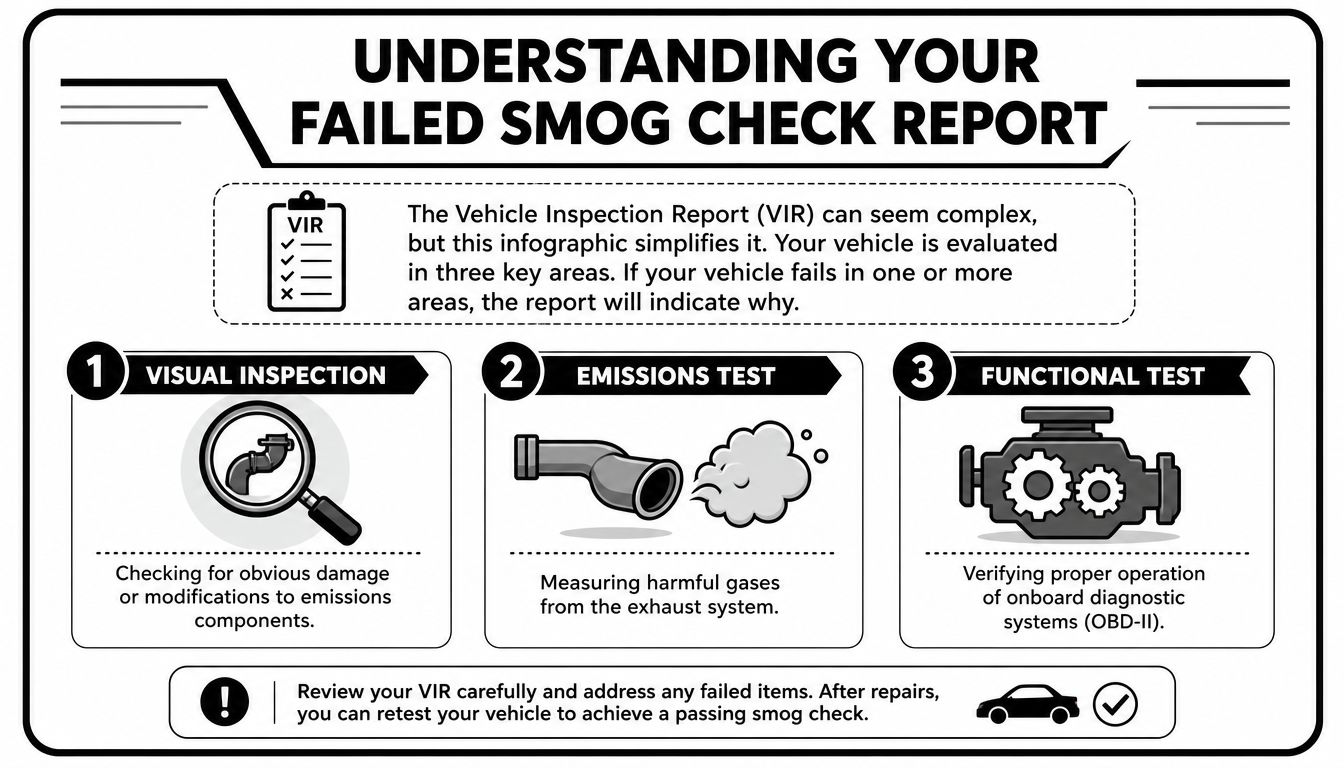
The Vehicle Inspection Report, often called the VIR, can look more complicated than it is. If you break it into sections, it starts making sense quickly. The report usually tells you whether the car failed because of something the technician saw, something the car's systems reported, or something that came out of the tailpipe.
For a more detailed example of how stations present outcomes, this guide to understanding smog test results helps drivers see what they're looking at.
Three places to look first
Visual inspection is exactly what it sounds like. The inspector checks whether required emissions parts are present, appear correct for the vehicle, and haven't been obviously tampered with. Missing hoses, disconnected components, or aftermarket parts that don't belong can trigger a failure even if the car seems to run fine.
Functional tests check whether key emissions-related systems behave properly. Depending on the vehicle and test type, this can include the gas cap, onboard diagnostics, and whether the check engine light is commanded on. If the computer says there's an active emissions problem, the vehicle won't pass just because it sounds okay in the parking lot.
Emissions readings show what the car is producing. Think of this as the results side of the test. The engine and emissions systems may be burning fuel cleanly, or they may be letting too much pollution through.
What the failure language usually means
When drivers see terms like HC, CO, NOx, or EVAP, they often assume they need a part with the same name. That's usually not how diagnosis works.
- Hydrocarbons (HC): Unburned fuel. High HC can point to incomplete combustion, misfires, ignition trouble, vacuum leaks, or engine condition issues.
- Carbon Monoxide (CO): Fuel that burned poorly because the mixture may be too rich. That can happen when the engine is getting too much fuel or not enough air.
- Nitrogen Oxides (NOx): Heat-related emissions. High NOx often points technicians toward combustion temperature control problems, exhaust gas recirculation issues on older systems, or a converter that isn't doing its job.
- EVAP system failure: This usually means the car can't properly contain fuel vapors. A gas cap can be involved, but so can hoses, valves, seals, or leaks elsewhere in the evaporative system.
Practical rule: A fault code or emissions category tells you where to investigate. It doesn't automatically tell you what part to replace.
If your report says the check engine light caused the failure, don't stop at the code description. The code names the condition the computer saw. The actual failed part might be upstream, downstream, electrical, mechanical, or a leak. That's why a clean diagnosis matters more than a quick guess.
Common Smog Failures and Your Repair Options
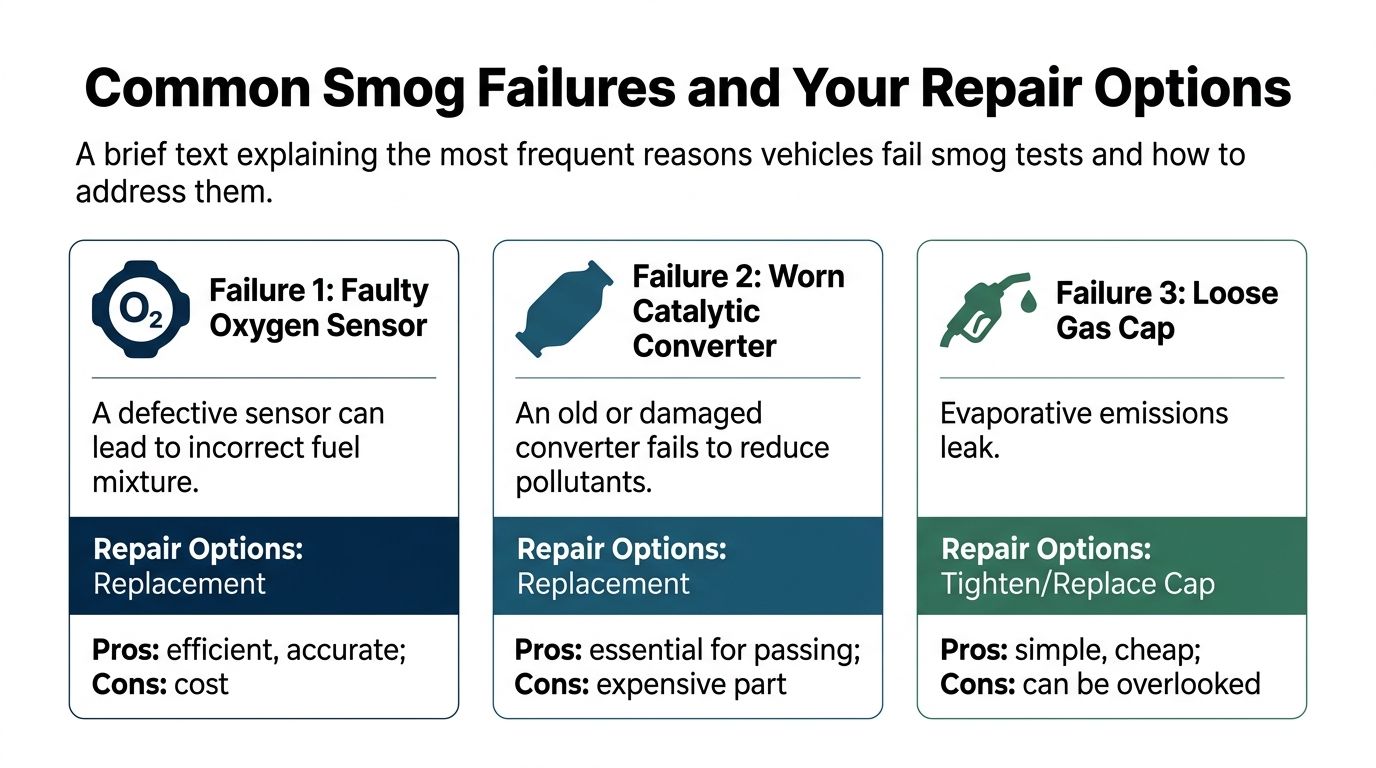
A lot of failed tests come back to the same handful of causes. In fact, the California Bureau of Automotive Repair says over 70% of smog check failures are attributed to a handful of issues, including malfunctioning oxygen sensors, catalytic converters, and evaporative emission control systems in its smog check FAQ.
If you want a plain-language breakdown of the patterns behind failed tests, this page on common smog check fail reasons is a useful companion.
The failures technicians see again and again
Oxygen sensor problems are common because these sensors constantly report exhaust conditions to the engine computer. When one gets lazy, contaminated, or electrically faulty, the air-fuel mixture can drift. Sometimes replacement is the right move. Sometimes the sensor is only reporting a different problem, such as a vacuum leak or exhaust leak.
Catalytic converter failure is one of the big ones. The converter cleans up pollutants after combustion. But converters often get blamed for upstream problems they didn't create. If the engine has been running rich, misfiring, or leaking oil into the exhaust, a new converter can fail again unless the root cause is fixed first.
EVAP system faults can range from simple to annoying. A loose, worn, or incorrect gas cap can trigger an EVAP problem. So can a cracked hose, a purge valve issue, or a leak that only shows up under smoke testing. This is one area where guessing tends to waste money.
Check engine light on isn't a part failure by itself. It's the car asking for diagnosis. The key is whether the technician reads data and verifies the fault, or just starts swapping the most common part tied to the code.
Readiness monitors not set catches a lot of people after battery replacement, recent repairs, or code clearing. Nothing may be broken anymore, but the car's computer hasn't completed its self-tests yet.
DIY or professional repair
Some jobs are reasonable for a careful do-it-yourselfer. Others aren't worth the gamble.
- Good DIY candidates: Tightening or replacing a gas cap, correcting an obvious disconnected hose, checking that the battery terminals are secure after recent work, and confirming you haven't recently cleared codes before a retest.
- Borderline DIY jobs: Replacing an accessible oxygen sensor on a vehicle you know well, if you already confirmed that the sensor itself failed and not the wiring or a related engine problem.
- Professional territory: Catalytic converter diagnosis, EVAP leaks, wiring faults, repeated check engine light returns, and any case where the report points to symptoms rather than a clear failed component.
A lot of wasted money comes from confusing a symptom with a cause. A lean code doesn't always mean oxygen sensor. A catalyst code doesn't always mean converter first. A failed EVAP test doesn't always mean gas cap.
If a repair starts with "let's try this part first," slow down and ask what testing confirmed it.
The best repair path is the one that gets verified before parts are installed. That's especially true when you're already paying for a retest and registration is waiting.
California's Smog Check Repair Assistance Programs
For some drivers, the problem isn't understanding the failure. It's paying for the repair. California's main smog check repair assistance path is the Consumer Assistance Program, often called CAP. This program can help eligible vehicle owners either repair the vehicle or retire it if fixing it doesn't make sense.
The repair side matters most when the car is otherwise useful and the owner just needs help getting over the emissions hurdle. The retirement side matters when the vehicle has multiple issues, poor overall condition, or a repair path that doesn't line up with the vehicle's value.
When repair assistance makes sense
If your vehicle failed an official smog inspection and the emissions-related repair cost is the obstacle, CAP is worth looking into before you approve major work. The state program can provide up to $1,200 toward qualifying emissions-related repairs for eligible motorists, as described in the background material provided for this article.
That doesn't mean every failed car qualifies, and it doesn't mean every repair at every shop qualifies. The usual practical steps are:
- Keep your failed test paperwork. Don't lose the report.
- Check eligibility through BAR's CAP process. Eligibility can depend on factors such as household income, vehicle status, and program rules.
- Wait for approval before major emissions repairs if you're trying to use assistance. Work done outside the program path may not count.
- Use an authorized repair facility if the program requires it. Ask the shop directly whether they handle CAP-related repairs.
One mistake I see is drivers fixing the car first, then trying to back into assistance after the fact. If you're counting on help, start there.
Repair help versus retiring the vehicle
Repair assistance is for the owner who wants to keep the car. Vehicle retirement is for the owner who looks at the overall condition and says, "I don't want to keep sinking money into this."
The retirement option can offer $1,500 to retire a vehicle, based on the program details provided in the prompt for this article. That can be the cleaner decision when the car has several unresolved problems, poor reliability, or obvious mechanical wear beyond the smog issue.
A practical way to decide is to ask three questions:
- Is the car solid apart from the smog failure?
- Would I want to keep this vehicle if it passed tomorrow?
- Am I fixing one emissions issue, or stepping into a longer list of repairs?
If you don't trust the car even after a potential pass, retirement may be the smarter path.
California Consumer Assistance Program (CAP) Options
| Feature | Repair Assistance | Vehicle Retirement |
|---|---|---|
| Purpose | Help eligible owners fix emissions-related problems after a failed smog check | Help eligible owners retire a vehicle that isn't worth repairing |
| Best fit | The car is otherwise worth keeping | The car has broader problems or poor long-term value |
| Financial help | Up to $1,200 for qualifying repairs | $1,500 to retire the vehicle |
| Timing concern | Approval should come before major repair decisions when possible | Best considered before spending heavily on diagnostics and parts |
| Shop involvement | Usually requires using the proper participating repair path | Usually involves following the state's retirement process |
Don't choose between repair and retirement based only on emotion. Choose based on the car's condition, your budget, and whether you'd still want the vehicle after it passes.
The smartest move is to treat CAP like a fork in the road, not a last-minute add-on. If your car is a keeper, pursue repair assistance cleanly. If it isn't, don't let sunk cost push you into a bad decision.
Choosing a STAR Certified Smog Repair Shop
The shop you choose after a failure matters almost as much as the actual repair. A weak diagnosis can turn one real problem into a stack of unnecessary parts. A good shop narrows the issue, explains why the car failed, and shows you what needs to happen before the retest.
If you're not clear on the certification side, this explainer on what a smog STAR station is helps sort out the terms.
What to verify before authorizing repairs
Start with the basics. Make sure the shop is properly licensed to perform the repair work you're approving. A testing station and a repair station are not the same thing. Some places inspect only. Others diagnose and repair. If you need state-program repair assistance, ask whether they handle that process specifically.
Then pay attention to how they talk about the problem.
- Good sign: They ask for the VIR, pull codes, inspect the related system, and explain what they still need to test.
- Bad sign: They jump straight to "it's probably the converter" or "these cars always need sensors."
- Good sign: They give a written estimate and separate diagnostic time from repair time.
- Bad sign: They stay vague until the bill is done.
A careful shop doesn't promise a pass before the root cause is confirmed. That's not evasive. That's honest.
What a good shop does differently
The difference usually comes down to process. Good smog repair work is boring in the best way. The technician verifies the complaint, checks the data, tests the system involved, confirms the failed component or condition, and only then recommends parts or repairs.
That's especially important with emissions work because one fault can trigger several symptoms. A vacuum leak can create lean codes. A misfire can damage a converter. A recent battery disconnect can leave monitors incomplete. If the shop doesn't sort cause from effect, you pay for their guessing.
This short video gives a useful visual sense of what drivers should expect from a professional smog station environment and process.
A trustworthy smog repair shop doesn't sell confidence. It sells verification.
Reviews also matter, but read them with a technician's eye. Look for comments about clear explanations, accurate diagnosis, written estimates, and whether the fix held up. Fast service is nice. Honest diagnosis is what saves you money.
Preparing for Your Smog Retest to Pass the First Time
The retest is where people either finish the job cleanly or get tripped up by a preventable detail. Once repairs are done, don't rush straight back unless you're sure the vehicle is ready. A lot of repeat failures happen because the original problem is fixed, but the car's systems haven't completed their checks yet.
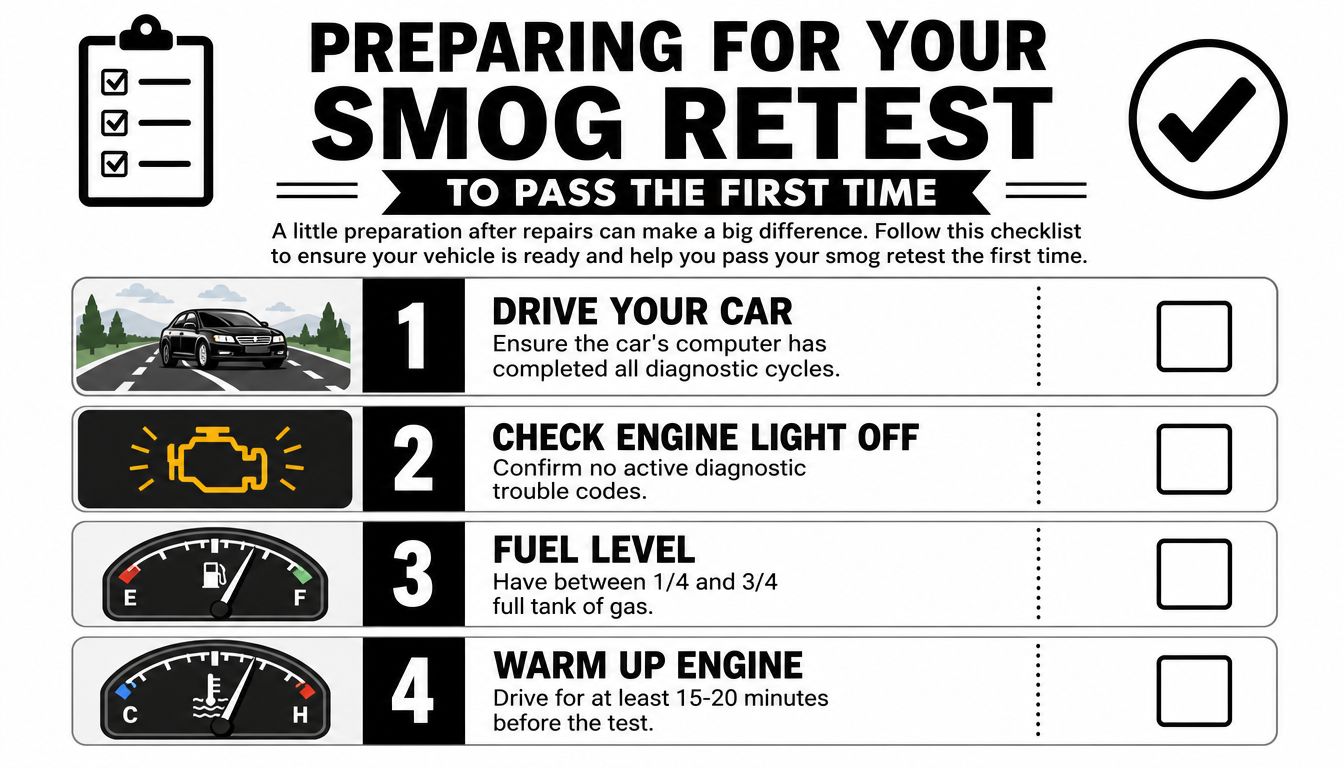
Your pre-retest checklist
Use this like cheap insurance before you head back to the station:
- Drive the car normally after repairs: Many vehicles need a proper drive cycle so the onboard monitors can reset. Short trips around the block often aren't enough.
- Confirm the check engine light stays off: It's not enough for the light to be off at startup if it comes back during driving.
- Keep the fuel level in a normal testing range: Avoid showing up nearly empty or completely full, because some systems are picky about when they run self-checks.
- Warm the vehicle up before the test: A car that has been driven is usually in a better testing state than one that rolled in cold from overnight parking.
- Bring the paperwork from the failed test and the repair invoice: This keeps the retest process smoother and helps if any question comes up.
If a shop cleared codes during repair, ask one direct question before leaving: "Are the monitors ready, or do I need to drive it first?" That's one of the most useful questions in the whole process.
You should also pay attention to the basics. If the battery is weak, if the car has been sitting, or if another warning light appears, don't assume the emissions issue is behind you. One new problem can interrupt readiness or trigger another failure.
The best time for a retest is when the car has been repaired, driven, warmed up, and checked. Not when you're simply hoping it's ready.
Patience here saves a lot of aggravation.
Smog Check Repair FAQs
Do I get a free retest if my car failed?
That depends on the station and the circumstances. Some shops offer retest policies, some don't, and the terms can vary. Ask before you authorize anything or return for another inspection.
What is a repair cost waiver?
It's a California process that may help in certain situations when a vehicle still doesn't pass after qualifying emissions-related repair efforts. Waiver rules are specific, so don't assume regular repair spending automatically qualifies you. Ask a licensed smog repair shop or BAR directly before counting on it.
What if the check engine light comes back after the repair?
Go back to the repair shop as soon as possible and bring your paperwork. Don't clear the code yourself just to get the light off. If the light returned, the root problem may still be present, or a different issue may have appeared during the drive cycle.
Can I sell a car in California if it failed smog?
That gets into transaction-specific rules, and the answer can depend on whether you're dealing with a private-party sale, transfer situation, or another exception. Don't rely on verbal advice from a buyer or seller. Check the current California rules before you sign anything.
Should I replace the part named in the code first?
Usually, no. A code points to a system or condition. It does not guarantee that the named sensor or component is the failed part. That's one of the fastest ways to waste money on smog-related repairs.
Is smog check repair assistance worth the trouble?
If repair cost is the only thing standing between you and registration, yes, it can be. The paperwork is worth it when the vehicle is otherwise worth keeping and you qualify. If the car is near the end of its useful life, retirement may be the cleaner decision.
If you need a fast, friendly place to handle your inspection or retest, Speedy Smog in San Leandro is a solid local option. They offer STAR-certified smog checks, straightforward service, and the kind of clear process stressed drivers appreciate when registration is on the line.