
If your registration renewal notice mentions emissions testing, you've probably come across the term "ADEQ" — and you may be wondering what it actually means for you and your car.
ADEQ stands for the Arizona Department of Environmental Quality. It's the state agency that oversees vehicle emissions testing programs in Arizona, specifically the program known as the Vehicle Emissions Testing Program (VETP). If you're searching "adeq vehicle emissions testing station" to figure out where to go, what to expect, or whether your car even qualifies, this article covers all of it.
What Is ADEQ Vehicle Emissions Testing?
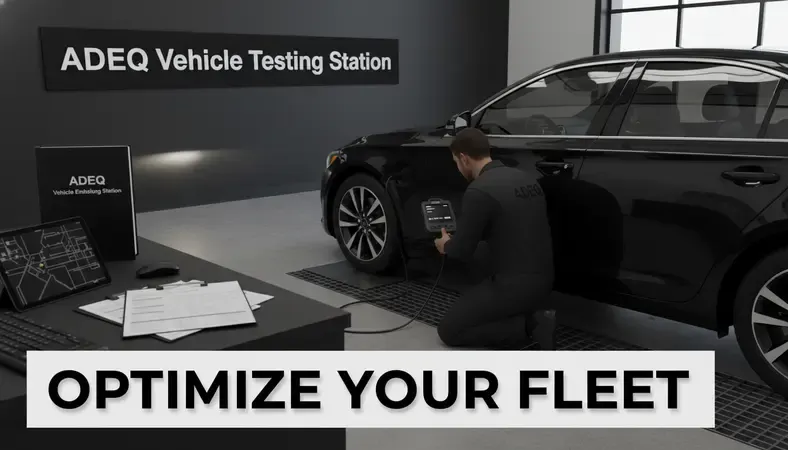
An ADEQ vehicle emissions testing station is a licensed facility authorized by the Arizona Department of Environmental Quality to test how much pollution your vehicle produces. The goal is simple: make sure cars on Arizona roads aren't pumping out excessive exhaust that contributes to smog and air quality problems.
Arizona's Vehicle Emissions Testing Program is one of the most established state-level programs in the country. The Arizona Department of Environmental Quality administers the program under authority granted by the Clean Air Act, which requires certain metropolitan areas with air quality challenges to maintain ongoing vehicle testing programs.
The Maricopa County area — which includes Phoenix and surrounding cities — is the primary zone where ADEQ emissions testing is required. Pima County (Tucson) also has its own emissions program. If you live in either of these areas, you've almost certainly dealt with an adeq vehicle emissions testing station at some point.
The test itself checks whether your vehicle's engine and exhaust system are functioning within legal pollution limits. Older vehicles typically get a tailpipe test where a probe measures exhaust gases directly. Newer vehicles (1996 and later) use an OBD-II scan — a computer diagnostic check that reads your car's onboard emissions data electronically.
Key Insight: Arizona's emissions program exists because the Phoenix metro area has historically struggled to meet federal air quality standards for ozone and particulate matter. Vehicle exhaust is one of the largest contributors, which is why the state requires regular testing.
What Vehicles Need ADEQ Emissions Testing?
Not every vehicle in Arizona needs to visit an adeq vehicle emissions testing station. The requirements depend on where you live, how old your car is, and what type of vehicle it is.
Vehicles that require testing
- Gasoline-powered cars and trucks registered in Maricopa or Pima County, model year 1967 or newer, are generally required to test.
- Diesel vehicles over 8,500 lbs GVWR may have different testing requirements.
- Vehicles registered in affected zip codes — even if you live near the county border, your specific zip code determines whether you're in the testing area.
Vehicles that are exempt
- Brand new vehicles — typically exempt for the first five model years.
- Electric vehicles — no tailpipe emissions means no test required.
- Motorcycles — currently exempt from Arizona's emissions testing program.
- Vehicles registered outside the testing area — if your address is in a rural county not covered by the program, no test is needed.
The easiest way to confirm whether your specific vehicle needs an adeq vehicle emissions testing station visit is to check your registration renewal notice. If testing is required, it will say so directly on the notice.
Where to Find ADEQ Emissions Testing Stations
Finding an adeq vehicle emissions testing station is straightforward. The ADEQ maintains a network of licensed testing stations throughout Maricopa and Pima counties, and you have a few options for locating one.
How to find a station near you
- Visit the official ADEQ website at azdeq.gov and use the station locator tool — it shows every licensed adeq vehicle emissions testing station by zip code.
- Search "emissions close to me" — most mapping apps will surface licensed stations in your area.
- Check your renewal notice — some notices include a list of nearby testing locations.
Types of testing locations
Most adeq vehicle emissions testing stations are privately operated businesses that have been licensed and certified by the state. Some are dedicated emissions-only stations. Others are full-service auto shops, oil change centers, or smog check facilities that are authorized to perform the test alongside other services.
You may have heard of places like Jiffy Lube emissions test locations — Jiffy Lube operates some certified emissions testing sites in Arizona, which is a good example of how the testing network extends beyond dedicated standalone stations. The key is that any location performing an adeq vehicle emissions test must be officially licensed by ADEQ, regardless of whether it's a specialty shop or a multi-service auto center.
Comparison of ADEQ testing station types
Types of ADEQ Emissions Testing Locations
| Station Type | What They Offer | Best For |
|---|---|---|
| Dedicated emissions station | Emissions testing only | Fast turnaround, focused service |
| Full-service auto shop | Testing + repairs if you fail | Convenient if you need repairs |
| Oil change/lube center | Testing + routine maintenance | Combining trips |
| State-run test-only station | Emissions testing only | Consistent, standardized process |
After the test, the station submits your results electronically to the DMV. If you pass, your registration renewal goes through automatically.
How Often Do You Need Emissions Testing?
Arizona requires emissions testing every year for most vehicles. When your vehicle registration is due for renewal, the DMV checks whether a current emissions test is on file. If not, you can't renew your registration until you pass.
The testing cycle is tied to your registration renewal date, so the frequency effectively works out to an annual requirement for most drivers. A few exceptions apply:
- New vehicles may be exempt for the first five model years, meaning you won't need to visit an adeq vehicle emissions testing station until the car is older.
- Vehicles that recently passed — if you sold a car and the new owner registers it, the existing test result may carry over depending on how recently it was done.
The bottom line: assume you need to test every year unless your renewal notice says otherwise.
What to Expect During an Emissions Test
Visiting an adeq vehicle emissions testing station for the first time can feel uncertain if you don't know what happens. The process is actually quick — most tests are done in 15 minutes or less.
Step-by-step: what happens at the station
- Check in: Hand over your vehicle registration and ID. The station logs your vehicle information into the system.
- Drive into the test bay: A technician takes your car into the testing area. You typically wait in a designated area.
- OBD-II scan (1996 and newer): The technician connects a diagnostic scanner to the OBD-II port under your dashboard. The system reads your car's emissions monitors — these are internal checks your car's computer runs automatically.
- Tailpipe test (older vehicles): For pre-1996 vehicles, a probe is inserted into the exhaust pipe to measure carbon monoxide, hydrocarbons, and oxides of nitrogen directly.
- Visual inspection: The technician checks that your gas cap is present and sealing properly, and that no visible modifications have been made to the emissions control system.
- Results: Pass or fail is determined on the spot. You receive a printed report showing the test results.
The whole process moves fast. If your car is in good mechanical shape, there's usually nothing to stress about.
What causes a failure?
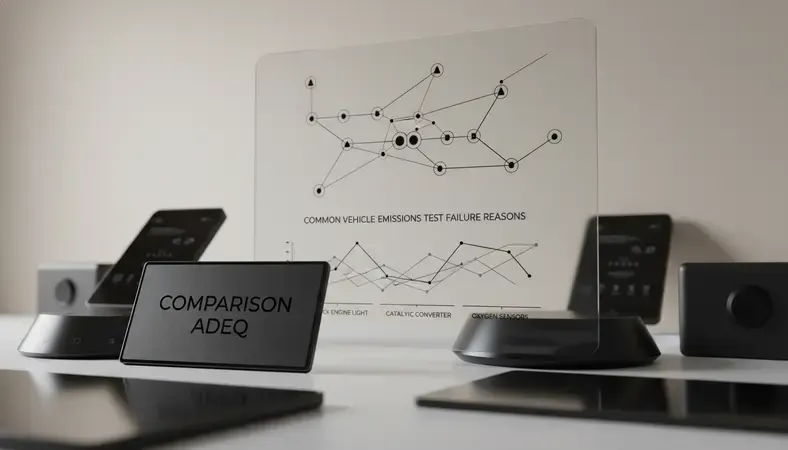
Common reasons a vehicle fails at an adeq vehicle emissions testing station include:
- Check engine light is on — this is an automatic failure for OBD-II tests. If your check engine light is illuminated, get it diagnosed before your test.
- Incomplete OBD-II monitors — if you recently disconnected your battery or had a repair done, your car's internal monitors may not have completed their self-checks yet. Drive the car normally for several days before testing.
- Worn catalytic converter — a failing catalytic converter is one of the most common causes of emissions failures.
- Faulty oxygen sensors — these directly affect how your engine manages fuel and emissions.
ADEQ Emissions Testing Requirements and Standards
Arizona's emissions standards are set by the ADEQ in coordination with federal Environmental Protection Agency requirements. The specific limits vary by vehicle model year and engine type, but the framework is consistent.
OBD-II standards (1996 and newer)
For modern vehicles, the test checks that:
- No diagnostic trouble codes (DTCs) are stored in the vehicle's computer
- The check engine light (malfunction indicator lamp) is off
- All required OBD-II monitors show "complete" status
The OBD-II system is sophisticated. Your car's computer continuously monitors its own emissions systems and flags problems automatically. The adeq vehicle emissions testing station essentially reads what your car already knows about itself.
Tailpipe standards (pre-1996 vehicles)
For older vehicles, the test measures exhaust gas concentrations. The limits are:
- Hydrocarbons (HC): measured in parts per million
- Carbon monoxide (CO): measured as a percentage of exhaust volume
- Oxides of nitrogen (NOx): measured in parts per million (for certain vehicle categories)
The exact cutoff values depend on the vehicle's model year, engine displacement, and whether it was originally equipped with certain emissions control systems.
Gas cap test
All vehicles at an adeq vehicle emissions testing station get a gas cap pressure test. A loose or faulty gas cap allows fuel vapors to evaporate into the atmosphere — this is a cheap fix that causes a surprising number of failures. A new gas cap costs under $20 at any auto parts store.
How Much Does ADEQ Emissions Testing Cost?
The cost of an adeq vehicle emissions testing station visit in Arizona is regulated by the state. As of the most recent ADEQ fee schedule, the maximum test fee is set at a fixed amount per vehicle — typically in the range of $17 to $28 depending on the station and vehicle type.
Stations cannot charge more than the state-approved maximum. Some stations may charge less to attract customers. The fee covers the test itself and the electronic submission of results to the DMV.
If your vehicle fails, you'll need to pay for repairs separately and then return for a retest. Retest fees may be lower than the initial test fee, depending on the station.
One important note: if your vehicle fails and you spend a certain amount on repairs (Arizona has a waiver threshold), you may qualify for a cost waiver that allows your registration to proceed even if the car can't pass. The current repair cost threshold for the waiver program is set by ADEQ — check the official ADEQ website for the current figure, as it's updated periodically.
Common Questions About ADEQ Emissions Testing
Can I choose any adeq vehicle emissions testing station, or do I have to use a specific one?
You can use any licensed adeq vehicle emissions testing station in the testing area. There's no requirement to use a specific station. Results are submitted electronically to the state, so it doesn't matter which licensed location you choose.
What if my check engine light comes on right before my test?
Don't go to the testing station until the light is off and the problem has been repaired. A check engine light is an automatic failure for OBD-II vehicles. Have the code diagnosed at a repair shop first, fix the underlying issue, then schedule your emissions test.
How long is an emissions test result valid?
In Arizona, a passing emissions test result is valid for the registration year it covers. It doesn't carry over to the next year. You'll need a new test each time you renew your registration.
Does vehicle emissions testing in Arizona cover the whole state?
No. The adeq vehicle emissions testing station requirement applies primarily to Maricopa County and Pima County. Vehicles registered in other Arizona counties are generally not required to test. Your registration renewal notice will specify whether testing applies to your vehicle.
What happens if I move into the testing area mid-year?
If you move into Maricopa or Pima County and your vehicle hasn't been tested, you'll need to get an emissions test before your next registration renewal. The requirement kicks in based on where your vehicle is registered, not where you originally bought it.
Is the Jiffy Lube emissions test the same as an ADEQ test?
Yes. When a Jiffy Lube location is licensed as an adeq vehicle emissions testing station, the test they perform follows the exact same ADEQ standards and procedures as any other certified station. The results are submitted to the same state system. The brand of the shop doesn't change the test — the ADEQ certification does.
Wrapping Up
An adeq vehicle emissions testing station visit is a routine part of owning a car in the Phoenix or Tucson area — and when your car is in good shape, it's usually done in under 15 minutes. If your registration renewal is coming up, check your notice for testing requirements and find a licensed station near you.
If you're in the San Leandro area and need a fast, reliable smog check, book your test at Speedy Smog — STAR certified, most vehicles done in under 15 minutes, open 6 days a week, with a $25 savings available when you call (510) 614-7664. Ready to get started? Visit Speedy Smog to learn more.
Your registration renewal notice arrives in the mail, and there it is — the requirement to get an emissions test before you can renew your plates. If you're not sure what that actually involves, you're not alone. Auto emissions testing confuses a lot of drivers, especially those who've never had to deal with a failed test or an unfamiliar process.
This guide covers exactly what auto emissions testing is, why it's required, what happens during the test, what a failure means for you, and where to get it done fast.
What Is Auto Emissions Testing?
Auto emissions testing is the process of measuring the pollutants your vehicle's engine releases into the air. A certified technician or automated machine checks whether your car produces exhaust gases at levels that fall within legal limits set by your state or local air quality authority.
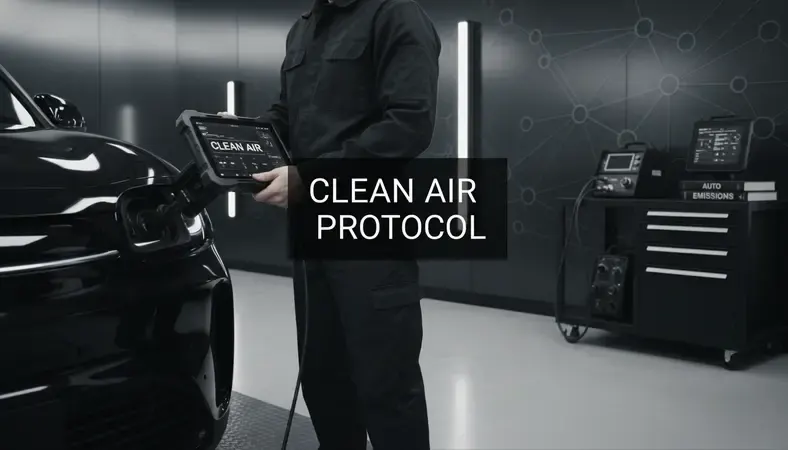
The test checks for gases like hydrocarbons (HC), carbon monoxide (CO), nitrogen oxides (NOx), and particulate matter — all of which contribute to smog and air pollution. Your vehicle passes if its emissions fall within the acceptable range. It fails if they don't.
Auto emissions testing goes by different names depending on where you live. In California, it's commonly called a smog check. In Colorado, the program is called Air Care Colorado. Arizona runs its program through the Arizona Department of Environmental Quality (ADEQ) vehicle emissions testing stations. The test itself is the same concept everywhere — measure what's coming out of your exhaust and compare it to the legal standard.
Why It Matters: The U.S. Environmental Protection Agency estimates that vehicle emissions are a leading source of the air pollutants that form ground-level ozone and smog. Auto emissions testing is one of the primary tools states use to keep those levels in check.
What Does an Emissions Test Actually Measure?
Modern auto emissions testing uses two main methods depending on your vehicle's age and type:
- OBD-II scan: For most vehicles made in 1996 or later, the technician plugs a scanner into your car's onboard diagnostic port (usually located under the dashboard). The system reads your vehicle's own computer data to check whether all emissions-related systems are functioning correctly.
- Tailpipe test: Older vehicles that predate OBD-II systems get a physical test where a probe is inserted into the exhaust pipe to measure the actual gases coming out.
Some states also perform a visual inspection of your vehicle's emissions equipment — checking that the catalytic converter is present and that the gas cap seals properly.
Why Is Emissions Testing Required?
Auto emissions testing is required because vehicle exhaust is one of the largest contributors to air pollution in urban areas. States with serious smog problems — California, Arizona, Colorado, and others — are required under the federal Clean Air Act to maintain programs that reduce vehicle-related pollution.
Without auto emissions testing, there's no reliable way to identify high-polluting vehicles on the road. A car that looks and drives fine can still be producing exhaust emissions five to ten times higher than a properly functioning vehicle. The test catches those vehicles before they keep polluting.
The requirement is also tied to federal funding. States that fail to meet EPA air quality standards risk losing federal highway funding, which creates a strong incentive to enforce auto emissions testing programs seriously.
Which States Require It?
Not every state requires auto emissions testing. Requirements vary significantly depending on local air quality conditions. States like California, Colorado, Arizona, Georgia, Illinois, Maryland, and New York have active programs. Many rural states don't require testing at all.
Even within states that require it, not every county is included. In California, for example, most counties require a smog check, but a few rural counties are exempt. Check your state's DMV or motor vehicle agency website to confirm whether your county requires auto emissions testing.
How Often Do You Need Emissions Testing?
Most states that require auto emissions testing put it on a two-year cycle, tied to your vehicle's registration renewal. Your registration renewal notice will tell you whether an emissions test is required that year.
Common Testing Schedules
| State | Testing Frequency | Vehicles Typically Exempt |
|---|---|---|
| California | Every 2 years | Vehicles 8 years old or newer (model year-based) |
| Colorado (Air Care Colorado) | Every 2 years | Vehicles 7 years old or newer |
| Arizona (ADEQ) | Every 1–2 years | Vehicles under 5 years old |
| Georgia | Annually | Vehicles 25+ years old |
| Illinois | Every 2 years | Vehicles 4 years old or newer |
New vehicles are typically exempt for the first few years. Older vehicles — often those 25 years or older — are sometimes exempt as well because they're considered collector cars and represent a small fraction of total miles driven.
If your registration renewal notice says an emissions test is required, you need to get it done before you can renew your plates. Skipping it means you can't legally register your vehicle.
What Happens During an Emissions Test?
The process is straightforward and usually takes 15 to 30 minutes from start to finish.
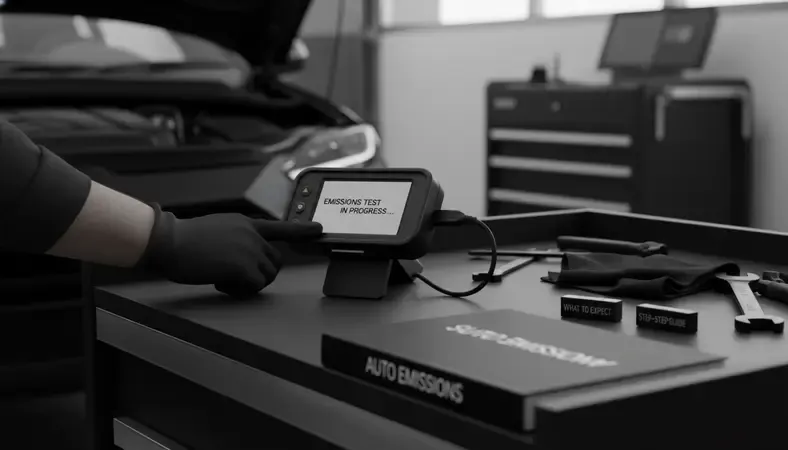
Here's what to expect when you bring your car in for auto emissions testing:
- Check-in: You pull up to the station and hand over your vehicle registration and ID. The technician enters your vehicle information into the system.
- Visual inspection: The technician does a quick visual check — confirming your catalytic converter is present, your gas cap is intact, and no obvious emissions equipment has been tampered with.
- OBD-II scan (most vehicles): The technician connects a scanner to your car's diagnostic port. This reads your vehicle's onboard computer and checks whether any emissions-related fault codes are present. The scanner also confirms that all required system monitors have completed their self-checks.
- Tailpipe test (older vehicles): If your car predates OBD-II systems, a probe is inserted into the exhaust pipe to measure actual gas output directly.
- Results: You get a printed report showing whether your vehicle passed or failed, along with a breakdown of the readings.
The whole process is non-invasive. Nothing is removed from your car, and no repairs are done during the test itself. You're in and out quickly.
What Can Cause a Failure?
A few common issues trigger a failed auto emissions test:
- Check engine light is on: This is the most common failure cause. An active fault code almost always results in a fail, even if the car runs fine.
- System monitors not ready: If your battery was recently disconnected or reset, your car's self-check monitors may not have completed their cycles. This counts as an incomplete test and often results in a fail or a void.
- Catalytic converter failure: A failing catalytic converter causes elevated hydrocarbons and carbon monoxide in the exhaust.
- Oxygen sensor issues: A faulty O2 sensor prevents the engine from managing fuel mixture correctly, leading to higher emissions.
- Evaporative system leaks: A loose or cracked gas cap can cause an EVAP system failure code.
How Much Does Emissions Testing Cost?
Auto emissions testing is deliberately kept affordable because it's a regulatory requirement, not a service people choose voluntarily. Costs vary by state and station type.
In California, the smog check fee is typically between $29 and $80 depending on the station and vehicle type. Some stations offer a lower "test-only" rate. Arizona ADEQ vehicle emissions testing station fees are generally in the $17 to $25 range. Colorado's Air Care Colorado program charges around $25 per test.
Some states offer financial assistance programs for low-income vehicle owners who fail their emissions test. California's Consumer Assistance Program (CAP), for example, provides repair assistance up to $500 or a vehicle retirement option for qualifying vehicles.
What If Your Vehicle Fails the Emissions Test?
A failed auto emissions test doesn't mean your car is totaled or that you're facing a massive repair bill. It means your vehicle has an issue that needs to be fixed before it can be registered.
Here's what happens next:
- Get a diagnosis: Take your car to a qualified mechanic or repair shop. The test report shows which systems failed, giving the mechanic a starting point.
- Complete the repairs: Fix the identified issue. Common repairs include replacing the catalytic converter, fixing oxygen sensors, or addressing a check engine light fault code.
- Re-test: Return to an emissions testing station for a retest. Many stations offer a free or reduced-cost retest if you return within a set timeframe.
- Waiver option: If you've spent a significant amount on repairs (California's threshold is $650 for most vehicles) and still can't pass, you may qualify for a cost waiver that allows you to register despite the failure.
Some national chains like Jiffy Lube offer emissions testing at select locations in states where they're certified. A Jiffy Lube emissions test follows the same state-mandated process as any other certified station — the results are identical regardless of where you go.
The key is not to ignore a failed test. Driving an unregistered vehicle carries fines, and the underlying problem causing the failure typically gets worse over time.
Where to Get Emissions Testing
When you're searching for emissions close to me, you have several options depending on your state:
- State-certified smog check stations: These are the most common option. Look for stations displaying a state certification seal. In California, STAR-certified stations can test and repair any vehicle, including those directed by the DMV.
- Test-only stations: Some states have stations that only perform the test — they don't do repairs. These are useful if you want an unbiased test result before choosing a repair shop.
- Repair stations: These can both test and repair your vehicle, which is convenient if you expect to fail or want to address issues in one visit.
- National chains: Some chains like Jiffy Lube operate certified emissions testing locations in select states.
When choosing a vehicle emissions testing station, look for state certification, honest pricing, and a quick turnaround. You don't need to go back to your car dealer or a specialty shop — any certified station produces the same official result.
Common Questions About Auto Emissions Testing
Does my new car need an emissions test?
Most states exempt new vehicles from auto emissions testing for the first few years. California exempts vehicles that are eight model years old or newer from the biennial smog check requirement. Colorado's Air Care Colorado program exempts vehicles seven model years old and newer. Check your registration renewal notice — it will tell you directly whether your specific vehicle requires testing that year.
Can I drive my car if it fails an emissions test?
Yes, you can still drive your car after a failed auto emissions test — the test itself doesn't immobilize your vehicle. The issue is that you can't renew your registration until you pass. Driving with an expired registration is a ticketable offense in every state, so you'll want to get the problem fixed and retest as soon as possible.
What's the difference between a smog check and an emissions test?
Nothing — they're the same thing. "Smog check" is the term used in California and a few other western states. "Emissions test" or "vehicle emissions testing" is the more generic term used in other states. The Emission Testing Station you visit in Georgia performs the same basic function as a smog check station in California. The name changes by region; the process doesn't.
How do I prepare my car for an emissions test?
A few things help your car perform its best during auto emissions testing. Make sure your check engine light isn't on before you go — if it is, get it diagnosed first. Drive your car for at least 15 to 20 minutes before the test so the engine reaches full operating temperature. If your battery was recently disconnected, drive the car for several days to allow all OBD-II system monitors to complete their cycles. Don't bother with fuel additives or quick-fix products — they rarely affect the outcome.
Is auto emissions testing the same as a vehicle inspection?
Not always. Some states combine emissions testing with a broader vehicle safety inspection that checks brakes, lights, tires, and other safety components. Others keep them separate. In California, the smog check is emissions-only — it doesn't evaluate your brakes or lights. In states like New York, the annual inspection covers both safety and emissions in a single visit. Check your state's requirements to know what's included.
Final Thoughts
Auto emissions testing is a straightforward process once you know what to expect. Pass or fail, it's manageable — and most failures come down to a fixable issue rather than a major mechanical problem.
Get your smog check done at Speedy Smog in San Leandro — STAR certified, most vehicles tested in under 15 minutes, open 6 days a week. Save $25 on your test by calling (510) 614-7664.
A car emissions test — sometimes called a smog check — measures how much pollution your vehicle releases into the air. If your state requires one, you can't renew your registration without passing it. Miss it, and you're driving with an expired registration.
Most car owners run into this requirement every one to two years and aren't sure what to expect. This guide covers exactly what happens during a car emissions test, what it costs, how to prepare, and what to do if your car doesn't pass.
What Is a Car Emissions Test?
A car emissions test is an inspection that measures the pollutants your vehicle's engine produces — primarily hydrocarbons, carbon monoxide, nitrogen oxides, and particulate matter. These gases contribute to air pollution and smog, which is why most states require vehicles to pass a test before registration renewal.
The test itself checks whether your car's emission control systems — the catalytic converter, oxygen sensors, exhaust gas recirculation valve, and onboard diagnostic system — are working correctly. A functioning emission control system keeps those pollutants at or below the legal limit for your vehicle's model year and class.
The term "smog check" is used interchangeably with car emissions test in most states, including California. They refer to the same inspection. If your registration renewal notice says you need a smog check, you need a car emissions test.
What the Test Actually Measures
Modern car emissions tests rely primarily on the OBD-II (On-Board Diagnostics) system built into every vehicle manufactured after 1996. The testing equipment plugs directly into your car's OBD-II port — usually located under the dashboard on the driver's side — and reads the data your car's computer has been logging.
Older vehicles (typically pre-1996) may require a tailpipe test instead, where a probe is inserted into the exhaust pipe to measure emissions directly. Some states use both methods depending on the vehicle's age and type.
Why Do I Need an Emissions Test?
Your state requires a car emissions test because vehicle exhaust is one of the largest contributors to urban air pollution. The Environmental Protection Agency estimates that cars and trucks account for nearly 29% of total U.S. greenhouse gas emissions.
States with serious air quality problems — California, Colorado, Arizona, and several others — enforce stricter emissions programs than states with cleaner air. In California, the Bureau of Automotive Repair oversees the Smog Check program. In Arizona, the ADEQ vehicle emissions testing station network covers the Phoenix and Tucson metro areas. Colorado runs the Air Care Colorado emissions program for the Denver metro and surrounding counties.
The practical reason you need the test: your registration renewal notice will require proof of a passing car emissions test before the DMV processes your renewal. Skip the test, and your registration lapses.
How Often Do I Need an Emissions Test?
The frequency depends on your state and your vehicle.
Typical Testing Schedules
| State | Frequency | Vehicles Required |
|---|---|---|
| California | Every 2 years | Most vehicles 1976 and newer |
| Colorado | Every 2 years | Vehicles in designated counties |
| Arizona | Every 1–2 years | Vehicles in Maricopa & Pima counties |
| Texas | Annually | Vehicles in major metro areas |
| New York | Annually | All registered vehicles |
| Virginia | Annually | All registered vehicles |
California exempts vehicles that are eight model years old or newer and vehicles 1975 and older. New vehicles are typically exempt for the first few years after purchase.
The easiest way to know when you're due: check your registration renewal notice. It will tell you directly whether a car emissions test is required before you can renew.
What Happens During an Emissions Test?
The car emissions test process is straightforward and usually takes under 15 minutes from start to finish. Here's what to expect:
-
Check-in: You pull into the emissions testing station and hand over your vehicle registration and ID. The technician enters your vehicle information into their system.
-
Visual inspection: The technician does a quick visual check — looking at your gas cap, checking that your check engine light isn't on, and confirming your vehicle matches the registration.
-
OBD-II scan: For 1996 and newer vehicles, the technician plugs a scanner into your OBD-II port. The scanner reads your car's diagnostic data in about 60 seconds, checking whether any emission-related fault codes are stored and whether all required system monitors have completed their self-tests.
-
Tailpipe test (older vehicles): Pre-1996 vehicles get a probe inserted into the exhaust pipe. The machine measures actual emissions output against state limits.
-
Results: You receive a printed report showing pass or fail. A passing report is your proof for the DMV. A failing report lists which systems or readings caused the failure.
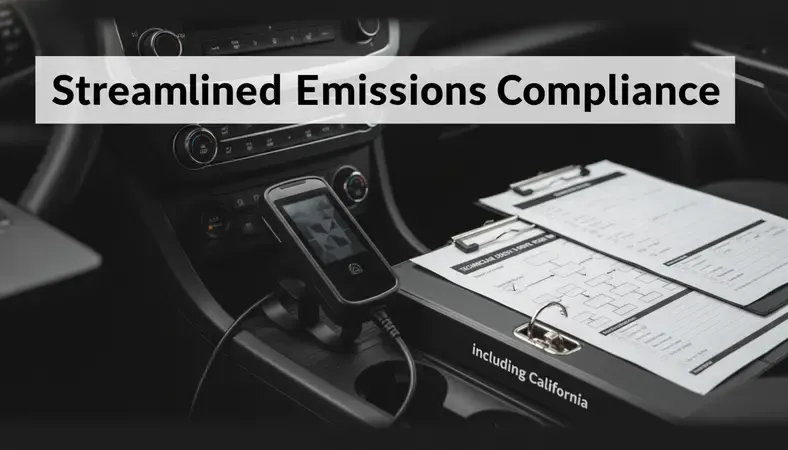
The technician doesn't drive your car or do anything invasive. The whole process is non-destructive — they're reading data your car already has.
What the Check Engine Light Means for Your Test
If your check engine light is on, your car will fail the car emissions test automatically — even if the underlying issue is minor. The check engine light signals that your car's computer has detected a fault code, and emission-related fault codes are an automatic failure in every state with an OBD-II-based program.
Get the light diagnosed and cleared before going in for your car emissions test.
How Much Does an Emissions Test Cost?
Emissions test pricing varies by state and by station type.
- California: Smog checks typically run $29–$60 depending on the station and vehicle type. STAR-certified stations may charge slightly more.
- Colorado (Air Care Colorado emissions): The test fee is set by the state and is typically around $25.
- Arizona (ADEQ vehicle emissions testing station): State-run stations charge around $17. Private stations vary.
- Texas: Typically $14–$25 for the emissions portion of the combined safety and emissions inspection.
- New York: Combined inspection fees are set by the state.
Some national chains like Jiffy Lube offer emissions testing at select locations. A Jiffy Lube emissions test costs roughly $30–$50 depending on location and vehicle type, though availability varies by state and region. Always call ahead to confirm the specific location performs emissions tests — not every Jiffy Lube location offers the service.
Key Insight: In California, if your vehicle fails its smog check, you may qualify for the Consumer Assistance Program (CAP), which provides up to $500 toward repairs or a retirement incentive if the repair cost exceeds what the car is worth.
What If My Car Fails the Emissions Test?
Failing a car emissions test doesn't mean your car is ruined — it means something in your emission control system isn't working correctly. Here's how to handle it:
Common Reasons for Failure
- Check engine light on: An active fault code causes an automatic failure.
- Incomplete OBD-II monitors: If your car's system monitors haven't run their self-tests (common after a battery disconnect or recent repair), the test will show "not ready."
- Catalytic converter failure: A failing cat is one of the most common reasons for a failed car emissions test.
- Oxygen sensor failure: Bad O2 sensors cause the engine to run rich or lean, pushing emissions out of range.
- EGR valve problems: A stuck or failing exhaust gas recirculation valve raises nitrogen oxide levels.
- Faulty gas cap: A loose or cracked gas cap causes evaporative emissions failures.
What to Do After Failing
-
Get a diagnostic scan: If you don't already know why you failed, take the failure report to a mechanic. The report lists the specific fault codes or monitors that caused the failure.
-
Make the required repairs: Address the specific issues listed. Don't guess — fix what the diagnostic scan identifies.
-
Drive the car before retesting: After repairs, drive your car for 100–200 miles on a mix of highway and city roads. This allows the OBD-II monitors to complete their self-tests.
-
Return for a retest: Most states allow one free retest within a set window (typically 30–60 days) after a failure.
How to Prepare Your Car for an Emissions Test
A little preparation makes a real difference. Here's what to do before your car emissions test appointment:
-
Check your check engine light: If it's on, get it diagnosed and repaired first. Don't waste money on a test you'll automatically fail.
-
Get an oil change if you're overdue: Dirty oil increases hydrocarbon emissions. Fresh oil helps your engine run cleaner.
-
Drive 15–20 minutes before the test: Cold engines run richer (more fuel, less complete combustion). Bring the engine up to full operating temperature before arriving. Highway driving is ideal.
-
Check your gas cap: Remove it, inspect the seal, and replace it if it's cracked or doesn't click into place. A bad gas cap costs $15–$30 and is one of the easiest fixes.
-
Don't fill your gas tank right before the test: A full tank can cause evaporative emissions system issues during testing. Keep the tank between one-quarter and three-quarters full.
-
Make sure your tires are properly inflated: Some states require the vehicle to be driven on a dynamometer (a rolling road machine). Correct tire pressure matters for accurate results.
If your car recently had a battery disconnected or a major repair done, drive it for at least a week of normal use before the car emissions test. The OBD-II monitors need time to complete their self-check cycles.
Common Questions About Car Emissions Tests
Can I find emissions testing close to me online?
Yes. Searching "emissions close to me" or "vehicle emissions testing" on Google Maps will show certified stations in your area. In California, the Bureau of Automotive Repair's website lets you search for STAR-certified smog stations by zip code. For Colorado's Air Care Colorado emissions program, the state's website lists all approved testing locations.
Does my new car need a car emissions test?
Most states exempt new vehicles for the first few years. In California, vehicles eight model years old and newer are exempt from the biennial smog check. Check your registration renewal notice — it will tell you explicitly whether your vehicle requires testing this cycle.
What's the difference between a smog check and a car emissions test?
Nothing — they're the same inspection. "Smog check" is the term used in California. "Emissions test" or "vehicle emissions testing" is used in most other states. Both measure your vehicle's exhaust output and OBD-II system status against state standards.
Does Jiffy Lube do emissions tests?
Some Jiffy Lube locations offer emissions testing, but not all. Availability depends on the state and specific location. Call the location directly before driving over. In states like Virginia and Texas, where emissions testing is combined with safety inspections, more shops offer the service. A Jiffy Lube emissions test is a convenient option if one is near you and your state's program allows private stations to certify.
What if I can't afford the repairs after failing a car emissions test?
California's Consumer Assistance Program offers up to $500 in repair assistance for income-eligible vehicle owners. Colorado and Arizona have similar assistance programs. Check your state's DMV or environmental agency website for current eligibility requirements. If repairs would cost more than the car is worth, some states offer a retirement program that pays you to take the vehicle off the road permanently.
How long does a car emissions test take?
Most car emissions tests take 10–20 minutes from the time you pull in to the time you have your results. STAR-certified stations in California and most modern testing facilities have streamlined the process significantly. Speedy Smog in San Leandro completes most vehicles in under 15 minutes.
Conclusion
A car emissions test is a straightforward inspection — get there with a warm engine, no check engine light, and a solid gas cap, and most vehicles pass without issue. If you're due for your smog check in San Leandro, book your test at Speedy Smog — STAR certified, most vehicles done in under 15 minutes, open 6 days a week, and $25 off your service.
Connecticut requires most vehicles to pass an emissions test before registration renewal — and if you've never done one before, the process can feel unclear. You might have seen "ctemission test" or "CT emission test" in your search bar and wondered what it actually involves, how often you need one, and what happens if your car doesn't pass.
This guide walks you through everything: what the CT emission test checks, which vehicles need it, how to prepare, and what your options are if you fail.
What Is a CT Emissions Test?
A CT emission test — sometimes typed as "ctemission test" in search engines — is a state-mandated inspection that measures the pollutants your vehicle releases into the air. Connecticut's Department of Motor Vehicles (DMV) requires it as part of the vehicle registration process to make sure cars on the road meet air quality standards set by the Environmental Protection Agency.
The test checks for harmful gases like hydrocarbons (HC), carbon monoxide (CO), and nitrogen oxides (NOx). These are the byproducts of combustion that contribute to smog and respiratory health problems. The CT emission test exists because Connecticut is part of the Northeast Ozone Transport Region, an area where air quality standards are stricter than federal minimums.
Here's the bottom line: if your car runs clean, the CT emission test takes about 15 minutes and you're done. If something is off with your engine or exhaust system, the test reveals it — and you'll need repairs before you can renew your registration.
Why It Matters: Connecticut's emission testing program has reduced vehicle-related air pollution by over 30% since its introduction, according to the state's Department of Energy and Environmental Protection (DEEP).
Why Do You Need a CT Emissions Test?
Connecticut law ties your vehicle registration renewal directly to emission test compliance. You can't renew your registration renewal notice if your car hasn't passed its required CT emission test within the testing cycle.
Beyond the legal requirement, the CT emission test serves a real environmental purpose. Vehicles are one of the largest sources of air pollution in Connecticut, and a single car running with a faulty catalytic converter or oxygen sensor can emit 10 to 20 times the pollutants of a properly functioning vehicle.
The test also protects you financially. A failing vehicle often has an underlying issue — a bad sensor, a vacuum leak, a worn-out catalytic converter — that will get worse and more expensive over time. The CT emission test catches those problems early.
How Often Is a CT Emissions Test Required?
Connecticut requires a CT emission test every two years. The testing cycle aligns with your vehicle's registration renewal, which also runs on a two-year schedule for most passenger vehicles.
Your registration renewal notice will tell you whether an emission test is required for your current renewal cycle. If you bought a new car, you're exempt for the first four years — new vehicles don't need their first CT emission test until they're at least four model years old.
CT Emission Test Schedule at a Glance
| Vehicle Age | CT Emission Test Required? | Notes |
|---|---|---|
| 0–3 years old | No | New vehicle exemption applies |
| 4+ years old | Yes, every 2 years | Tied to registration renewal |
| Diesel vehicles | Varies | Check CT DMV for current rules |
| Antique/Historic vehicles | No | Vehicles 20+ years with antique plates exempt |
| Electric vehicles | No | Zero-emission vehicles are exempt |
This schedule applies to most passenger cars and light trucks. Diesel vehicles and commercial vehicles may follow different rules — the Connecticut DMV website has the current specifics for those categories.
What Vehicles Need to Pass an Emissions Test?
Most gasoline-powered passenger vehicles registered in Connecticut need to pass the CT emission test. Here's a breakdown of what's required and what's exempt:
Vehicles that need the CT emission test:
* Gasoline-powered cars, trucks, and SUVs that are 4 model years old or older
* Vehicles registered in Connecticut and used on public roads
* Vehicles with a gross vehicle weight rating (GVWR) under 10,001 pounds
Vehicles that are exempt:
* New vehicles (within the first 3 model years)
* Electric vehicles and plug-in hybrids that run purely on electricity
* Vehicles registered with antique or historic plates (typically 20+ years old)
* Motorcycles (Connecticut does not require emission testing for motorcycles)
* Diesel-powered vehicles under certain weight thresholds (verify current rules with CT DMV)
If you're unsure whether your vehicle needs a CT emission test, your registration renewal notice will state it clearly. You can also check online through the Connecticut DMV portal.

How to Prepare Your Vehicle for a CT Emissions Test
Most cars pass the CT emission test without any preparation. But if your check engine light is on, or if your car has been sitting for a while, a little preparation can save you a failed test and a return trip.
Check for Warning Lights First
If your check engine light is on, your car will almost certainly fail the CT emission test. The light means the vehicle's onboard diagnostics (OBD-II system) has detected a fault. Emission test stations read this data directly — a lit check engine light is an automatic failure.
Get the code read first. Many auto parts stores will read OBD-II codes for free. Once you know what's wrong, you can decide whether it's a quick fix or something that needs a mechanic.
Drive the Car Before the Test
Connecticut's CT emission test reads your vehicle's OBD-II system, which needs to complete its internal readiness monitors to give accurate results. If you've recently had the battery disconnected, or if a mechanic recently cleared codes, those monitors may not be complete.
Drive your car for at least 100–200 miles of mixed city and highway driving before the test. This gives the system time to run its self-checks and set all readiness monitors to "ready."
Check These Items Before You Go
- Gas cap: A loose or cracked gas cap causes evaporative emission failures. Make sure it's tight and in good condition.
- Oil level: Low or dirty oil can affect combustion efficiency and emissions.
- Tire pressure: Properly inflated tires improve fuel efficiency and reduce emissions slightly.
- Recent maintenance: If your car is due for a tune-up (spark plugs, air filter), getting it done before the test can help.
What Happens During a CT Emissions Test?
The CT emission test process is straightforward. Here's exactly what to expect when you pull into a vehicle emissions testing station:
-
Check-in: You hand over your registration or provide your license plate number. The technician confirms your vehicle is due for a CT emission test.
-
OBD-II scan: For most modern vehicles (1996 and newer), the technician plugs a scanner into your car's OBD-II port — usually located under the dashboard on the driver's side. This reads your vehicle's onboard computer data, including readiness monitors and any stored fault codes.
-
Visual inspection: The technician checks for obvious issues — a missing gas cap, visible exhaust problems, or a check engine light that's illuminated.
-
Tailpipe test (older vehicles): Vehicles made before 1996 may undergo a tailpipe test where a probe measures exhaust gases directly. This method is less common now that most vehicles use OBD-II scanning.
-
Results: You receive a pass or fail result on the spot. A passing vehicle gets a certificate you'll use to complete your registration renewal. The whole process typically takes 15 minutes or less.
The CT emission test doesn't involve removing any parts, draining fluids, or any invasive procedures. It's a read-and-report process for modern vehicles.
What If Your Vehicle Fails the Emissions Test?
Failing the CT emission test isn't the end of the road. Connecticut has a structured process for vehicles that don't pass.
Find Out Why You Failed
Your test results will include the specific reason for failure. Common causes include:
- Check engine light on: An active diagnostic trouble code (DTC) caused a failure
- Readiness monitors not set: The OBD-II system hasn't completed its self-checks
- Catalytic converter failure: A worn or damaged catalytic converter causes high HC and CO readings
- Oxygen sensor failure: Bad O2 sensors affect fuel mixture and emissions
- EGR valve problems: A stuck or faulty exhaust gas recirculation valve increases NOx emissions
Get the Repairs Done
Take your vehicle to a licensed repair shop. Show them the failure report — it tells them exactly what the CT emission test flagged. Once repairs are complete, you'll return for a retest.
The Waiver Option
If you've spent at least $800 on qualifying repairs and your car still fails the CT emission test, you may qualify for a waiver. A waiver allows you to register your vehicle for one year even though it hasn't passed — giving you more time to complete repairs without losing your registration.
The waiver threshold and qualifying repair requirements are set by the Connecticut Department of Energy and Environmental Protection. Check their current guidelines, as the minimum repair cost threshold can change.
Emissions Close to Me
If you're searching for an emissions testing station, Connecticut maintains a network of state-run and private test-only stations. You can find emissions close to me by checking the CT DMV's station locator tool online. Some private shops also offer vehicle emissions testing as part of a broader vehicle inspection service.
Common Questions About the CT Emissions Test
Can I renew my registration without passing the CT emission test?
No. If your vehicle is required to pass the CT emission test, you can't complete your registration renewal until you have a valid passing certificate — or an approved waiver. Driving with an expired registration is a ticketable offense in Connecticut.
How much does the CT emission test cost?
The cost for a CT emission test at a state-operated station is set by the Connecticut DMV. Private testing stations may charge different rates. Check the current fee schedule on the CT DMV website, as fees are subject to change.
What if I just bought a used car and the CT emission test is due?
If you purchase a used vehicle and a CT emission test is required for registration, you'll need to pass the test before the registration can be transferred to your name — unless the vehicle qualifies for an exemption. If the previous owner recently passed the test, that certificate may transfer with the vehicle.
Does jiffy lube do emissions testing in Connecticut?
Some Jiffy Lube locations offer vehicle emissions testing depending on the state. In Connecticut, emission testing is primarily conducted at state-authorized stations. A Jiffy lube emissions test may be available at select locations, but you should call ahead to confirm whether a specific location is authorized to conduct the official CT emission test for registration purposes.
What's the difference between an emissions test and a smog check?
The terms are often used interchangeably. A smog check is the common name used in states like California — California smog check requirements differ from Connecticut's program in some specifics, but both measure vehicle emissions to meet air quality standards. Connecticut uses the term "emissions test" officially. The underlying goal — measuring and limiting vehicle air pollution — is the same.
What This Means for You
If your registration renewal is coming up and your vehicle is four or more years old, a CT emission test is part of the process. The test is fast, straightforward, and most vehicles pass without any preparation. Book your smog check at Speedy Smog — STAR certified, most vehicles done in under 15 minutes, open 6 days a week, and you'll save $25 on your visit.
If you've searched "ctemission test," you're almost certainly looking for information about Connecticut's vehicle emissions testing program — sometimes written as "CT emission test" or "CT emissions test." Connecticut requires most registered vehicles to pass a periodic emissions test to stay legally on the road. This article covers exactly what that test involves, who needs it, how to prepare, and what happens if your car doesn't pass.
What Is a CT Emissions Test?
A CT emissions test — short for Connecticut emissions test — is a state-mandated inspection that measures the pollutants your vehicle releases into the air. Connecticut's program is officially called the Connecticut Vehicle Emissions Program (CVEP), administered by the Connecticut Department of Motor Vehicles (CT DMV) in partnership with licensed testing stations.
The test checks whether your car's engine and emission control systems are working within the limits set by the Clean Air Act, the federal law that gives states authority to run their own air quality programs. Connecticut has been running emissions testing since the 1980s and has significantly reduced ground-level ozone and smog across the state as a result.
There are two main testing methods used in Connecticut, depending on your vehicle's age and type:
- OBD-II (On-Board Diagnostics) testing: Used for most vehicles from 1996 and newer. A technician plugs a scanner into your car's diagnostic port, and the system reads data directly from your car's onboard computer. This takes only a few minutes.
- Tailpipe emissions testing: Used for older vehicles (typically 1995 and older). A probe is inserted into the exhaust pipe to measure actual emissions output — things like hydrocarbons (HC), carbon monoxide (CO), and nitrogen oxides (NOx).
What the CT Emission Test Actually Measures
The CT emission test isn't just checking your exhaust pipe. For OBD-II vehicles, the test confirms that all of your car's emissions-related monitors — systems like the catalytic converter, oxygen sensors, and evaporative emissions system — have completed their self-checks and show no fault codes.
If your check engine light is on, you'll almost certainly fail. That light means your car's computer has stored a diagnostic trouble code (DTC), and those codes trigger an automatic failure in the CT emissions test.
Why Do You Need a CT Emissions Test?
Connecticut requires the CT emissions test for one primary reason: air quality. The state sits in the Northeast Corridor, where vehicle exhaust contributes heavily to ground-level ozone — the main ingredient in smog. Poor air quality has direct health consequences, particularly for people with asthma, heart conditions, or respiratory disease.
Beyond public health, there's a legal requirement. You can't renew your vehicle registration in Connecticut without a passing emissions test result on file. The CT DMV links your registration renewal to your test status automatically. If your registration renewal notice arrives and your emissions test is due, you'll need to pass before the DMV processes your renewal.
Why It Matters: Connecticut is classified as a "serious" ozone nonattainment area under federal standards. That classification means the state must actively reduce vehicle emissions — and your CT emissions test is a direct part of that compliance requirement.
How Often Is a CT Emissions Test Required?
Connecticut requires the CT emissions test every two years for most vehicles. Your registration renewal notice will tell you whether an emissions test is due in your current renewal cycle.
The two-year cycle is tied to your vehicle's registration, not a fixed calendar date. So if your registration renews in October, your CT emissions test will be due every other October renewal.
New vehicles are typically exempt for the first few years. Connecticut currently exempts new cars for their first four model years, meaning a 2023 model year vehicle wouldn't need its first CT emissions test until the 2027 cycle. This exemption exists because new vehicles are factory-certified to meet emissions standards and rarely develop issues that early.
CT Emission Test Frequency at a Glance
| Vehicle Type | Test Frequency | First Test Due |
|---|---|---|
| Gasoline vehicles (1996+) | Every 2 years | After 4-year new vehicle exemption |
| Gasoline vehicles (pre-1996) | Every 2 years | Based on registration cycle |
| Diesel vehicles | Every 2 years | Based on registration cycle |
| New vehicles (current + 3 prior model years) | Exempt | After exemption period ends |
| Electric vehicles | Exempt | N/A — no tailpipe emissions |
Electric vehicles are permanently exempt from the CT emissions test because they produce zero tailpipe emissions. Hybrids, however, are not exempt — they still have a combustion engine and must pass the OBD-II portion of the test.
What Vehicles Need to Pass an Emissions Test?
Most gasoline-powered vehicles registered in Connecticut need to pass the CT emissions test. Here's a cleaner breakdown:
Vehicles that require a CT emissions test:
* Passenger cars and light trucks registered in Connecticut
* Vehicles from 1968 and newer (pre-1968 vehicles are exempt as antiques)
* Diesel vehicles under 8,500 lbs GVWR
* Hybrids and plug-in hybrids with combustion engines
Vehicles exempt from the CT emissions test:
* Electric vehicles (fully battery-powered)
* Vehicles with current model year + three prior years (new vehicle exemption)
* Vehicles registered as antiques (1967 and older)
* Motorcycles
* Diesel vehicles over 8,500 lbs GVWR (these fall under different commercial inspection programs)
If you're unsure whether your specific vehicle needs a CT emissions test, your registration renewal notice will indicate clearly whether testing is required in your current cycle.
How to Prepare Your Vehicle for an Emissions Test
Most vehicles pass the CT emissions test without any preparation at all. But if you want to give your car the best chance — or if you've had a recent repair — there are a few things worth doing first.
Check for the Check Engine Light
This is the single most important thing to check before your CT emissions test. If your check engine light is on, don't bother going to the testing station yet. The light means your car's OBD system has flagged a problem, and that's an automatic failure.
Get the code read first — many auto parts stores like AutoZone or O'Reilly will read your codes for free. Once you know what's triggering the light, you can decide whether to repair it yourself or take it to a mechanic.
Complete a Drive Cycle After Any Recent Repairs
Here's something many people don't know: if you recently had your battery disconnected or had a major repair, your car's OBD monitors may have reset to "not ready." A CT emissions test will fail a vehicle with too many incomplete monitors — even if there's nothing actually wrong with the car.
The fix is simple: drive your car normally for 100–200 miles before the test. Highway driving, city driving, and some cold starts all help the monitors complete their self-checks. This is called a "drive cycle," and it's a genuine reason why some cars fail their first CT emissions test attempt after a repair.
Warm Up the Engine Before You Go
Don't drive straight to the testing station from a cold start. Drive for at least 15–20 minutes first. A warm engine runs more efficiently and produces fewer emissions — giving you a better result on the tailpipe portion of the test if your vehicle requires it.
Check Your Gas Cap
A loose or cracked gas cap triggers the evaporative emissions monitor on OBD-II vehicles. It's one of the most common reasons for a CT emissions test failure, and it's also the easiest fix. Tighten it, replace it if it's damaged, and drive a few days before your test to let the monitor reset.
What Happens During a CT Emissions Test?
The actual CT emissions test is fast. For most modern vehicles, the entire process takes under 15 minutes from the time you pull in.
Here's what to expect step by step:
- Check-in: You pull into the testing lane and hand over your vehicle registration. The technician confirms your vehicle's information in the system.
- Visual inspection: The technician does a quick visual check — looking at your gas cap, checking that your check engine light isn't on, and confirming your vehicle matches the registration.
- OBD-II connection: For 1996 and newer vehicles, the technician connects a scanner to the OBD-II port under your dashboard. The scanner communicates with your car's computer and downloads the status of all emissions monitors.
- Results: The system processes the data and generates a pass or fail result within minutes. You receive a printed report showing which monitors passed and any codes that triggered a failure.
For older vehicles requiring tailpipe testing, the process adds a step where a probe is inserted into the exhaust pipe and the car is run at specific RPMs while emissions are measured. This takes a few minutes longer.
Connecticut's testing stations are run by private licensed facilities — not state-owned DMV offices. You can find an emissions testing station near you through the CT DMV's official station locator. If you're looking for emissions testing closest to you, the CT DMV website lists all licensed stations by town.
What If Your Vehicle Fails the Emissions Test?
Failing the CT emissions test doesn't mean you're stuck. Connecticut has a structured process for what happens next.
Understand Why You Failed
Your test report will show exactly what caused the failure. Common reasons include:
- Check engine light on (stored diagnostic trouble code)
- One or more OBD monitors showing "not ready"
- Evaporative emissions system failure (often a bad gas cap)
- Catalytic converter failure
- Oxygen sensor failure
Get the Repairs Done
Take your test report to a mechanic and show them exactly what failed. The report gives them a starting point for diagnosis. Not every failure requires expensive repairs — a new gas cap costs under $20, and clearing a false code after a sensor replacement can be done in minutes.
Retest After Repairs
Connecticut allows you to retest after repairs. If you fail your first CT emissions test, you have a grace period to get repairs done and return for a retest. Your registration won't be immediately revoked — the state gives you time to address the problem.
The Waiver Program
If your vehicle fails and the cost of repairs exceeds a certain threshold (currently around $900 for most vehicles), you may qualify for a Connecticut emissions repair waiver. This waiver lets you register your vehicle for one additional cycle despite the failure, provided you've made a good-faith effort to repair it up to the cost limit.

The waiver isn't a free pass — you still need documentation showing you spent at least the threshold amount on qualified repairs at a licensed facility. But it prevents situations where a car owner faces an impossible financial burden just to maintain registration.
Common Questions About the CT Emissions Test
How much does the CT emissions test cost?
Connecticut sets a maximum fee that licensed testing stations can charge. The fee is currently capped at $20 for most passenger vehicles. Some stations charge less. You pay the fee whether you pass or fail — retests may or may not carry an additional fee depending on the station.
Can I get a CT emissions test at Jiffy Lube?
Some Jiffy Lube locations in Connecticut are licensed emissions testing stations, but not all of them. A Jiffy Lube emissions test is available at participating locations — check the CT DMV station locator or call your local Jiffy Lube to confirm before you drive over. The test itself is identical regardless of which licensed station you use.
What if I just moved to Connecticut from another state?
If you're registering a vehicle in Connecticut for the first time, you'll need a CT emissions test as part of the registration process — unless your vehicle qualifies for the new vehicle exemption. Out-of-state emission certificates are generally not accepted.
My car passed in another state. Do I still need a CT emissions test?
Yes. Connecticut doesn't accept emissions test results from other states. Each state runs its own program with its own standards. If your vehicle is registered in Connecticut, it needs to pass the CT emissions test, regardless of what other tests it has passed elsewhere.
Does Connecticut accept OBD results from states like Colorado?
No. Air Care Colorado emissions results, ADEQ vehicle emissions testing station results from Arizona, or any other state's program don't transfer to Connecticut. The CT emissions test must be completed at a Connecticut-licensed testing station.
What This Means for You
Your CT emissions test is a straightforward requirement — most vehicles pass on the first try, and the whole process takes less than 15 minutes. If your check engine light is off and your car runs normally, you're likely fine. Book your smog check at Speedy Smog — STAR certified, most vehicles done in under 15 minutes, open 6 days a week, with $25 in savings available when you call (510) 614-7664.

Jiffy Lube does offer emissions testing at select locations — and yes, you can sometimes find Jiffy Lube coupons for emissions work. But here's what most people searching for jiffy lube coupons emissions don't realize: Jiffy Lube doesn't perform smog checks at every location, coupon availability varies by region, and in states like California, your options may be more limited than you'd expect. This guide covers exactly where to find jiffy lube coupons emissions deals, what the test actually costs, and what to do if Jiffy Lube isn't the right fit for your situation.
Current Jiffy Lube Emissions Testing Coupons
Finding jiffy lube coupons emissions deals takes a bit of digging — they're not always prominently advertised. Here's where to look:
- Jiffy Lube's official website: Visit jiffylube.com and check the "Coupons & Offers" section. Jiffy Lube does run periodic promotions on vehicle services, though emissions-specific deals tend to appear less frequently than oil change coupons.
- RetailMeNot and Coupons.com: These aggregator sites collect current jiffy lube coupons emissions deals from around the web. Search "Jiffy Lube emissions" on either platform to see active offers.
- Local Jiffy Lube franchise sites: Many Jiffy Lube locations are independently franchised. Your local franchise may run its own jiffy lube coupons emissions promotions separate from the national site.
- Groupon: Groupon occasionally features emissions test deals from Jiffy Lube and competing providers. Worth checking if you're price-sensitive.
- Email signup: Signing up for Jiffy Lube's email list often unlocks a welcome coupon and puts you on the list for future jiffy lube coupons emissions offers.
One thing to keep in mind: Jiffy Lube emissions test availability depends heavily on your state. States like Colorado have specific Air Care Colorado emissions programs, and Jiffy Lube participates in some of those markets. In California, smog checks must be performed at licensed STAR-certified stations — which is a different certification than a standard Jiffy Lube service center.
How to Use Jiffy Lube Coupons for Emissions Tests
Using jiffy lube coupons emissions deals is straightforward once you have the coupon in hand. Here's the process:
- Verify the location accepts the coupon: Not all Jiffy Lube locations offer emissions testing. Call ahead or check online to confirm your nearest location performs a jiffy lube emissions test before driving over.
- Check the coupon terms: Jiffy Lube coupons emissions offers often have restrictions — specific vehicle types, model years, or states. Read the fine print before you go.
- Bring your registration renewal notice: Many states require you to show your registration renewal notice at the testing station. This confirms which type of test your vehicle needs.
- Present the coupon at check-in: Hand the coupon to the service advisor when you arrive, not after the test is complete. Some locations won't apply discounts retroactively.
- Keep your certificate: After passing, you'll receive an emissions certificate. You'll need this to complete your registration renewal — don't leave without it.
Key Insight: Jiffy Lube coupons for emissions tests are real, but they're most common in states with mandatory vehicle emissions testing programs like Colorado, Virginia, and Texas. In California, smog check pricing is partially regulated by the state, which limits how much discount providers can offer.
Emissions Testing Requirements and Costs
Vehicle emissions testing — also called a smog check — is a government-mandated inspection that measures how much pollution your car's engine produces. Most states that require it tie the test to your annual or biennial registration renewal.
What emissions testing typically costs
Costs vary by state and provider, but here's a general picture:
Emissions Test Cost Comparison by State
| State | Typical Test Cost | Test Frequency | Notes |
|---|---|---|---|
| California | $29.95–$69.95 | Every 2 years | STAR certification required for some vehicles |
| Colorado | $15–$25 | Every 2 years | Air Care Colorado program |
| Texas | $18.50–$39.50 | Annually | Combined safety + emissions in some counties |
| Virginia | $28–$35 | Annually | Safety and emissions separate |
| Arizona | $17–$25 | Every 2 years | ADEQ vehicle emissions testing station required |
In Arizona, the vehicle emissions testing program is administered by the Arizona Department of Environmental Quality (ADEQ). If you're in the Phoenix metro area, you'll need to visit a licensed ADEQ vehicle emissions testing station — not every service center qualifies.
Jiffy lube coupons emissions deals can meaningfully reduce what you pay in states where pricing isn't heavily regulated. In California, the savings are smaller because state rules cap what stations can charge.
What your registration renewal notice tells you
Your registration renewal notice will specify whether your vehicle needs an emissions test before you can renew. If your registration renewal says an emissions test is required, you must complete it before the DMV will process your renewal. The notice also tells you what type of test is needed — a basic OBD-II scan, a tailpipe test, or a visual inspection.
Where to Find Jiffy Lube Locations Near You
The Jiffy Lube store locator at jiffylube.com lets you search by zip code and filter by services offered. When searching for a location that performs emissions testing, use the service filter — not every Jiffy Lube does a jiffy lube emissions test.
For people searching "emissions close to me," here are the fastest ways to find a qualified station:
- Google Maps: Search "emissions test near me" or "smog check near me." The results show ratings, hours, and whether the station is currently open.
- State DMV website: Most state DMV sites maintain a searchable database of licensed emissions testing providers. This is the most reliable source because it only shows currently licensed stations.
- Jiffy Lube's website: Use the service filter in the store locator to find locations that specifically offer vehicle emissions testing.
If you're in the San Leandro area and need a smog check, Speedy Smog is a STAR-certified emission testing station with most vehicles tested in under 15 minutes. You can find them at speedysmogchecksanleandro.com.
What to Expect During an Emissions Test
A jiffy lube emissions test — or any emissions test at a licensed station — follows a consistent process. Knowing what happens helps you avoid surprises.
The OBD-II scan
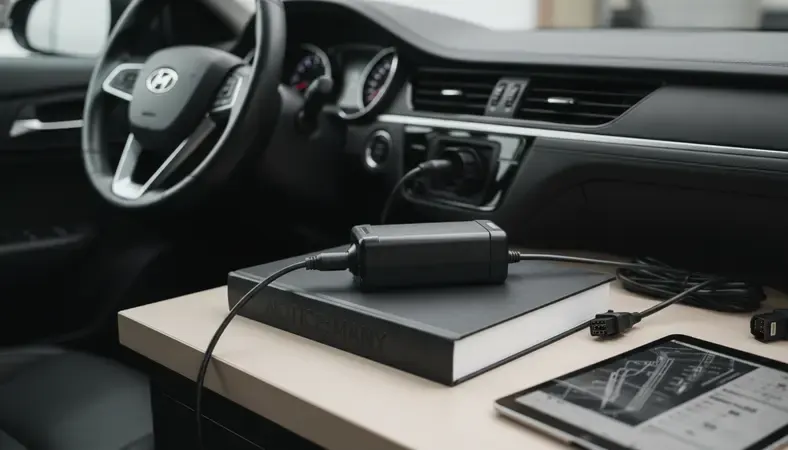
Most vehicles made after 1996 get tested using an OBD-II (On-Board Diagnostics) scanner. The technician plugs a device into the port under your dashboard — usually near the steering column. The scanner reads your vehicle's onboard computer for stored fault codes. If your check engine light is on, your car will almost certainly fail. Clear that light before you go.
The tailpipe test
Older vehicles (typically pre-1996) get a tailpipe test instead. A probe is inserted into the exhaust pipe to directly measure emissions output — carbon monoxide, hydrocarbons, and nitrogen oxides. The vehicle needs to be warmed up for this test to work accurately.
The visual inspection
Some states require a visual check of your vehicle's emissions control components — the catalytic converter, gas cap, and EGR valve. A missing or tampered catalytic converter is an automatic fail.
The whole process typically takes 15–30 minutes. You don't need an appointment at most locations, though calling ahead can save you wait time.
What happens if you fail
Failing an emissions test doesn't mean you're stuck. You'll receive a report showing exactly what failed. From there, you get the necessary repairs done and return for a retest. Many states offer a retest at reduced cost or free within a set window — check your state's rules.
Some states also offer repair assistance programs for low-income vehicle owners who fail emissions testing. California's Consumer Assistance Program, administered by the Bureau of Automotive Repair, provides up to $500 in repair assistance for qualifying vehicles.
Coupon Validity and Expiration Dates
Jiffy lube coupons emissions deals don't last forever. Here's what to watch for:
- Expiration dates: Most jiffy lube coupons emissions offers expire within 30–90 days of issue. Check the date before you drive to the station.
- One-per-vehicle rules: Many coupons are limited to one use per vehicle or per customer visit. You can't stack multiple jiffy lube coupons emissions discounts on a single test.
- Location restrictions: A coupon from a national promotion may not be honored at a franchised location that opted out of the promotion. Confirm by phone before you go.
- Service exclusions: Some jiffy lube coupons emissions deals exclude certain vehicle types — diesel vehicles, commercial vehicles, or vehicles over a certain weight class.
- Digital vs. printed: Most Jiffy Lube locations accept digital coupons shown on your phone. A few older franchise locations may require a printed copy — worth confirming when you call ahead.
The safest approach: screenshot or print the coupon, note the expiration date, and call the location before your visit to confirm they'll accept it.
Alternative Emissions Testing Providers
Jiffy Lube isn't your only option for vehicle emissions testing. If you can't find jiffy lube coupons emissions deals in your area — or if Jiffy Lube doesn't offer the test at nearby locations — here are the main alternatives:
- Dealerships: Most dealerships offer emissions testing, though they tend to charge more than independent stations. The upside is that if your car fails, they can handle repairs in the same visit.
- Independent smog check stations: These are often the fastest and most affordable option. Many specialize exclusively in emissions testing and can complete a test in under 20 minutes.
- STAR-certified stations (California): If your vehicle was flagged by the DMV for a STAR test, you must go to a STAR-certified station. Not every shop qualifies. In California, smog check requirements are enforced by the Bureau of Automotive Repair.
- ADEQ vehicle emissions testing station (Arizona): In the Phoenix and Tucson areas, the Arizona Department of Environmental Quality maintains a network of licensed testing stations. Only ADEQ-approved locations can issue a valid test certificate.
- Speedy Smog: For drivers in the San Leandro area, Speedy Smog offers STAR-certified smog checks with most vehicles done in under 15 minutes. Open 6 days a week — no long waits.
Common Questions About Jiffy Lube Emissions Tests
Does Jiffy Lube do emissions tests?
Jiffy Lube does perform emissions testing at select locations, but not at every service center. The availability of a jiffy lube emissions test depends on your state and the specific franchise location. Use the service filter on Jiffy Lube's store locator to find locations near you that offer vehicle emissions testing.
How do I find current Jiffy Lube coupons for emissions?
The best sources for jiffy lube coupons emissions deals are Jiffy Lube's official website, RetailMeNot, Groupon, and your local franchise's site. Signing up for Jiffy Lube's email list also puts you on the list for promotional offers. Coupon availability changes frequently, so check close to when you need the test.
Can I use Jiffy Lube for a California smog check?
California smog checks must be performed at a licensed smog check station. Some Jiffy Lube locations in California are licensed to perform smog checks, but not all. If your vehicle requires a STAR test (indicated on your registration renewal notice), you'll need a STAR-certified station specifically. Jiffy Lube coupons emissions deals in California are limited because state rules partially regulate smog check pricing.
What if my car fails the emissions test?
A failed test means your vehicle's emissions are above the legal limit. You'll get a diagnostic report showing what failed. Get the repairs done at a qualified shop, then return for a retest. Many states offer a free or discounted retest within 30 days. If repair costs are high, check whether your state has a repair assistance program before spending money on fixes.
How long does a Jiffy Lube emissions test take?
A jiffy lube emissions test typically takes 15–30 minutes for most vehicles. OBD-II tests on newer vehicles are faster — sometimes under 15 minutes. Tailpipe tests on older vehicles take a bit longer because the car needs to reach operating temperature first. Calling ahead to check wait times can save you from sitting in line.
Are Jiffy Lube emissions coupons worth it?
Jiffy lube coupons emissions deals are worth using if you find one that's valid for your location and vehicle. Savings typically range from $5–$15 off the standard test price. In states with regulated pricing like California, the discount may be smaller. In states like Colorado or Virginia where pricing is more open, jiffy lube coupons emissions offers can represent a more meaningful saving.
The Bottom Line
Jiffy lube coupons emissions deals exist — check Jiffy Lube's website, RetailMeNot, and Groupon for current offers before booking your test. If Jiffy Lube doesn't have a location near you that performs emissions testing, or if you need a STAR-certified smog check in the San Leandro area, book your smog check at Speedy Smog — STAR certified, most vehicles done in under 15 minutes, open 6 days a week, and save $25 on your visit.
Vehicle emissions testing is a mandatory inspection that measures the pollutants your car releases into the air — and in states like California, passing it is a legal requirement before you can renew your registration. If you've just received a renewal notice or you're buying a used car and aren't sure what to expect, you're in the right place. This guide covers exactly how vehicle emissions testing works, which vehicles need it, what happens if you fail, and how to prepare so you pass the first time.
What Is Vehicle Emissions Testing?
Vehicle emissions testing — sometimes called a smog check or emissions test — is an inspection that measures the exhaust gases your vehicle produces. The goal is to confirm your car isn't releasing pollutants above the legal threshold set by your state's environmental agency.
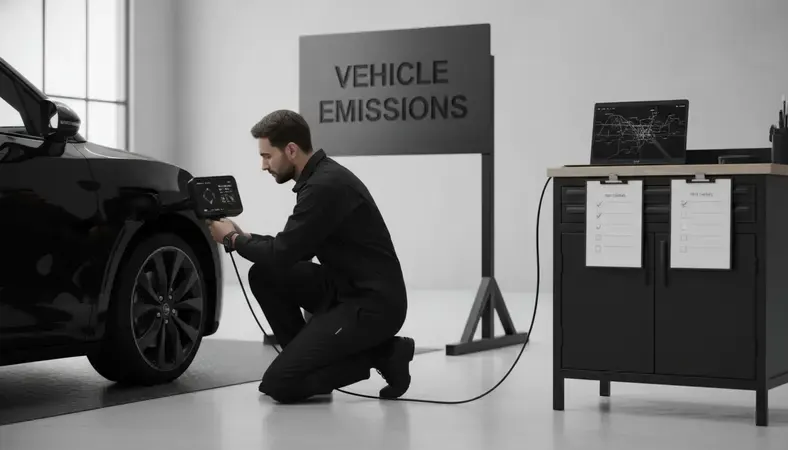
The test checks for harmful gases like hydrocarbons (HC), carbon monoxide (CO), nitrogen oxides (NOx), and particulate matter. These pollutants contribute to smog, ground-level ozone, and respiratory health problems. California's Air Resources Board (CARB) sets some of the strictest vehicle emissions standards in the country, which is why smog checks are such a consistent part of car ownership here.
Vehicle emissions testing isn't a mechanical inspection — it doesn't check your brakes or tires. It's specifically about what comes out of your tailpipe and what your onboard computer reports about your engine's performance. Think of it as a health check for your car's pollution output.
Key Insight: California has required vehicle emissions testing since 1984. The program has helped reduce smog-forming emissions from passenger vehicles by more than 80% compared to pre-program levels, according to the California Bureau of Automotive Repair.
Why Is Emissions Testing Required?
The short answer: air quality. Vehicle exhaust is one of the largest sources of air pollution in urban areas, and without regular vehicle emissions testing, there's no reliable way to identify high-polluting vehicles and get them fixed.
California's Central Valley and greater Los Angeles area regularly appear among the most polluted regions in the United States, according to the American Lung Association's State of the Air report. Vehicle emissions testing is one of the primary tools regulators use to reduce that pollution.
From a legal standpoint, California requires vehicle emissions testing under the Vehicle Code and Health and Safety Code. Failing to comply means you can't legally renew your registration — and driving with an expired registration is a ticketable offense.
Other states have similar programs. Colorado runs the Air Care Colorado emissions program in the Denver metro area. Arizona's ADEQ vehicle emissions testing station network covers Maricopa and Pima counties. The federal Clean Air Act gives states authority to require these programs in areas that don't meet federal air quality standards.
How Does Emissions Testing Work?
The actual vehicle emissions testing process is quick — most inspections take 15 minutes or less. Here's what happens step by step:
-
Check-in: You pull into the testing station and provide your vehicle registration. The technician confirms your vehicle is on the required testing list.
-
OBD-II scan: For most vehicles made after 1996, the technician connects a diagnostic scanner to your car's onboard computer (the OBD-II port, usually located under the dashboard). This reads your vehicle's emissions monitors — essentially the car's self-diagnostic system for pollution-related components.
-
Visual inspection: The technician checks that your catalytic converter is present and that there are no obvious tampering or missing emissions components.
-
Tailpipe test (older vehicles): Vehicles made before 1996 typically undergo a tailpipe test, where a probe is inserted into the exhaust pipe to directly measure pollutant concentrations.
-
Results: If your vehicle's monitors show no faults and emissions levels are within the legal limit, you pass. You receive a certificate, and your registration renewal goes through.
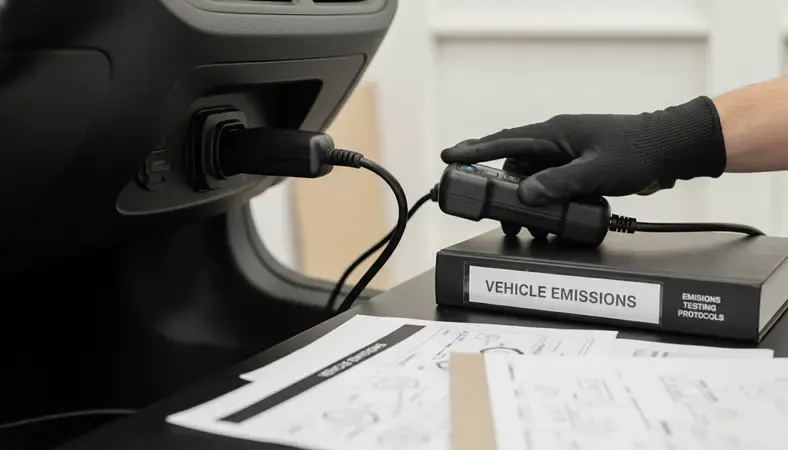
What the OBD-II system actually checks
Your car's onboard computer continuously monitors components like the oxygen sensors, catalytic converter, evaporative emissions system, and exhaust gas recirculation valve. If any of these systems have a fault, the check engine light comes on — and the monitor shows as "not ready" or "failed" during vehicle emissions testing.
A check engine light almost always means an automatic failure, even if the actual emissions output is fine. This is why addressing warning lights before your test matters so much.
How vehicle emissions testing differs by state
Not every state runs emissions testing the same way. Here's a quick comparison:
Emissions Testing Requirements by State
| State | Program Name | Frequency | Who's Exempt |
|---|---|---|---|
| California | Smog Check | Every 2 years | Vehicles 8 years old or newer (in most cases) |
| Colorado | Air Care Colorado | Every 2 years | Vehicles 7 years old or newer |
| Arizona | ADEQ Vehicle Emissions | Every 1–2 years | Vehicles 5 years old or newer |
| Texas | Texas Emissions Program | Annually | Electric vehicles; some rural counties |
| New York | NYS Inspection | Annually | Vehicles under 2 years old |
Requirements vary by county, vehicle age, and fuel type. Always check your state's DMV or environmental agency website for the rules that apply to your specific vehicle.
What Vehicles Need Emissions Testing?
Not every car on the road requires vehicle emissions testing. The rules depend on your state, your county, and your vehicle's age and type.
In California, gasoline-powered vehicles registered in most counties must get a smog check every two years. Vehicles 8 model years old or newer are typically exempt because they're covered under the manufacturer's warranty for emissions components. Diesel vehicles over 14,000 lbs GVWR and electric vehicles are also exempt from the standard smog check program.
Here's a general breakdown of who needs vehicle emissions testing in California:
- Gasoline vehicles more than 8 years old: Required every two years at registration renewal
- Vehicles changing ownership: A smog check is required before a private-party sale can be completed
- Out-of-state vehicles: Required when registering a vehicle from another state in California
- Gross polluters: Vehicles flagged by the state as high-emitters may be required to test more frequently
Electric vehicles, hydrogen fuel cell vehicles, and most motorcycles are exempt from California's smog check program. If your registration renewal notice says "Smog Required," that's your definitive answer — vehicle emissions testing is required for your car this cycle.
How Often Do You Need Emissions Testing?
Most states require vehicle emissions testing every one to two years, tied to your registration renewal cycle. California operates on a biennial (every two years) schedule for most vehicles.
Your registration renewal notice will tell you whether a smog check is required. If it says "Smog Required," you need to complete vehicle emissions testing before your registration can be renewed. If it says "Smog Exempt," your vehicle doesn't need a test this cycle.
A few situations trigger an out-of-cycle vehicle emissions testing requirement:
- Buying or selling a used vehicle: The seller is responsible for providing a valid smog certificate (no more than 90 days old) at the time of sale in California
- Registering an out-of-state vehicle: Required when bringing a car from another state into California
- Moving into a smog check county: If you move from a non-participating county to one that requires smog checks
If you use a service like Jiffy Lube emissions test locations, many chains offer smog check services in participating states — though availability varies by location. Searching "emissions close to me" is the fastest way to find a nearby STAR-certified station.
What Happens If Your Vehicle Fails Emissions Testing?
Failing vehicle emissions testing doesn't mean your car is permanently off the road. It means something needs to be fixed before you can register your vehicle.
When your car fails, the testing station gives you a Vehicle Inspection Report (VIR) that lists exactly what failed. Common failure reasons include:
- Check engine light on: Any active diagnostic trouble code (DTC) will cause a failure
- Failed OBD-II monitors: Monitors that haven't completed their self-test cycle (often after a battery disconnect or recent repair)
- Catalytic converter failure: One of the most common and expensive failure points
- Evaporative emissions leak: A faulty gas cap can cause this
- Oxygen sensor failure: Affects how the engine manages fuel and emissions
After a failure, you have a few options. You can get the necessary repairs done and return for a retest. In California, the retest fee is waived if you return to the same station within 30 days.
If repairs are too costly, California's Consumer Assistance Program (CAP) offers financial assistance for qualifying low-income vehicle owners. The program can provide up to $1,500 toward repairs or a vehicle retirement payment if your car can't be economically repaired to pass vehicle emissions testing.
Why It Matters: Don't drive your car to "reset" the check engine light before a smog check. Clearing codes without fixing the underlying problem causes the OBD-II monitors to show as "not ready," which is also a failure. The fix needs to actually happen.
How to Prepare Your Vehicle for Emissions Testing
A little preparation goes a long way toward passing vehicle emissions testing on the first try. Here's what to do before you go:
-
Fix the check engine light first. Any active fault code means an automatic failure. Get the code read at an auto parts store (usually free) and address the underlying issue before your test.
-
Drive your car before the test. Take a 15–20 minute highway drive the day before. This warms up the engine fully and allows OBD-II monitors to complete their self-test cycles. Cold starts and short trips leave monitors "not ready."
-
Check your gas cap. A loose or cracked gas cap causes evaporative emissions failures. Tighten it or replace it — a new gas cap costs under $20.
-
Get an oil change if you're overdue. Dirty oil can increase hydrocarbon emissions. Fresh oil helps your engine run cleaner.
-
Check tire pressure. Underinflated tires don't affect emissions directly, but a well-maintained car tends to run more efficiently and produce fewer emissions overall.
-
Don't disconnect your battery recently. A battery disconnect clears all OBD-II monitors, setting them back to "not ready." You'll need to drive the car through several complete drive cycles before the monitors reset — which can take days of normal driving.
If you're unsure whether your vehicle will pass, some stations offer a pre-inspection check. This isn't a formal vehicle emissions test, but it gives you a heads-up on potential issues before you pay for the official test.
Common Questions About Vehicle Emissions Testing
How long does vehicle emissions testing take?
Most vehicle emissions testing inspections take between 10 and 20 minutes. If your vehicle is straightforward and passes on the first scan, you're often in and out in under 15 minutes. STAR-certified stations like Speedy Smog are set up for efficiency — most vehicles are done in under 15 minutes.
Can I get a smog check anywhere, or does it have to be a specific station?
In California, vehicle emissions testing must be performed at a licensed smog check station. For vehicles directed to a STAR station (typically high-emitters or vehicles with a history of failures), you must use a STAR-certified location. You can search for an emission testing station using the Bureau of Automotive Repair's online locator or simply search "emissions close to me" to find nearby options.
What if I just bought a used car and it fails emissions testing?
In California, the seller is legally required to provide a valid smog certificate at the point of sale. If they didn't, the repair responsibility may fall on them depending on your purchase agreement. For private-party sales, always request a current smog certificate before completing the transaction.
Does vehicle emissions testing check anything other than exhaust?
The smog check includes a visual inspection of emissions components (like the catalytic converter and fuel cap) and an OBD-II diagnostic scan. It doesn't check brakes, tires, lights, or other mechanical systems — those are covered under a separate vehicle inspection service in states that require one.
What's the difference between a regular smog station and a STAR station?
STAR stations meet higher performance standards set by the Bureau of Automotive Repair. They're required for vehicles that have failed a smog check before, vehicles with a history of high emissions, and vehicles that the state specifically directs to a STAR station. If your renewal notice says "STAR Required," you can't use a regular smog station for your vehicle emissions testing.
Key Takeaways
Vehicle emissions testing is straightforward when you know what to expect. Fix any check engine lights before you go, drive the car to warm up the monitors, and choose a STAR-certified station for a fast, reliable result.
Pass your smog check fast at Speedy Smog in San Leandro — STAR certified, most vehicles done in under 15 minutes, open 6 days a week. Save $25 on your visit by calling (510) 614-7664. Ready to get started? Visit Speedy Smog to learn more.
Jiffy Lube does not perform emissions tests at most of its locations — and that surprises a lot of drivers who pull in expecting a one-stop shop. If your registration renewal notice says you need an emissions test, you'll need to find a dedicated emissions testing station, not an oil change chain.
That said, there's real confusion around this topic. Many people search "jiffy lube emissions test" hoping to knock out their smog check alongside an oil change. This article explains exactly what Jiffy Lube does and doesn't offer, what an emissions test actually involves, where to get one, and what to expect when you show up.
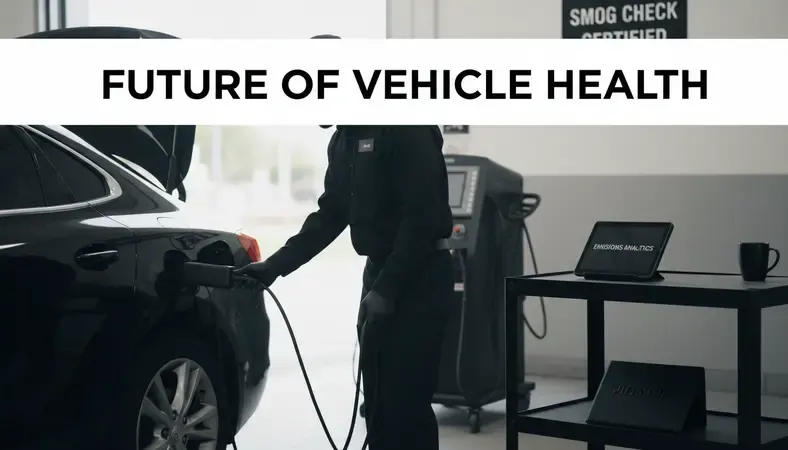
Does Jiffy Lube Perform Emissions Tests?
The short answer: rarely, and not in most states.
Jiffy Lube is a franchise chain, which means individual locations can offer different services depending on the state and local regulations. A small number of Jiffy Lube locations in certain states are licensed to perform emissions inspections — but this is the exception, not the rule. The vast majority of Jiffy Lube shops focus on oil changes, fluid services, tire rotations, and basic vehicle maintenance. They are not set up as vehicle emissions testing stations.
If you're searching for a jiffy lube emissions test because you need to renew your registration, call your local Jiffy Lube directly before driving over. Ask specifically whether they're licensed to perform emissions inspections in your state. Don't assume — the answer varies by location and state law.
Here's a practical reality check: even in states where Jiffy Lube technically offers emissions services, their locations may not be STAR-certified (a California-specific certification for stations authorized to test and repair vehicles flagged by the DMV). If your vehicle has failed a previous smog check or is directed to a STAR station, a standard Jiffy Lube almost certainly won't meet that requirement.
What Is an Emissions Test?
An emissions test — also called a smog check or smog inspection — measures the pollutants your vehicle's engine releases into the air. The test confirms your car meets the environmental standards set by your state.
Most modern vehicles are tested using an OBD-II (On-Board Diagnostics) scan. A technician plugs a scanner into a port under your dashboard, reads your car's computer, and checks whether any emission-related fault codes are present. Older vehicles may go through a tailpipe test, where a probe is inserted into the exhaust pipe to measure gases directly.
The vehicle emissions testing process checks for pollutants like:
- Hydrocarbons (HC): Unburned fuel that escapes into the air
- Carbon monoxide (CO): A colorless, toxic gas produced by incomplete combustion
- Nitrogen oxides (NOx): Compounds that contribute to smog and acid rain
- Carbon dioxide (CO₂): A greenhouse gas linked to climate change
States that require emissions testing use it as a gatekeeping mechanism for vehicle registration. If your car fails, you can't renew your tags until the underlying problem is fixed and the vehicle passes a retest.
Key Insight: According to the U.S. Environmental Protection Agency, vehicle emissions account for approximately 29% of total U.S. greenhouse gas emissions — making emissions testing one of the most direct tools states have for improving air quality.
How Much Does an Emissions Test Cost at Jiffy Lube?
Because the jiffy lube emissions test isn't a standard offering across all locations, pricing isn't uniform. On the rare occasion a Jiffy Lube location does offer emissions testing, costs typically fall in the same range as other testing stations: roughly $30 to $75, depending on the state and vehicle type.
Emissions Test Cost Comparison by Provider Type
| Provider Type | Typical Cost Range | STAR Certified | Wait Time |
|---|---|---|---|
| Dedicated smog station | $30–$60 | Often yes | 15–30 minutes |
| Jiffy Lube (select locations) | $30–$75 | Rarely | 20–45 minutes |
| Dealership service center | $50–$100 | Varies | 30–60 minutes |
| State-run testing lane | $10–$30 | N/A | 15–30 minutes |
Pricing also depends on your vehicle type. Diesel vehicles and larger trucks typically cost more to test than standard gasoline-powered passenger cars. Some states cap the fee by law — California, for example, sets a maximum allowable fee for smog inspections.
If you're in the San Leandro area and searching for an "emissions close to me" option, dedicated smog check stations like Speedy Smog will typically be faster and more affordable than a franchise location.
What to Expect During an Emissions Test
The jiffy lube emissions test process — or any emissions test — is straightforward. Most inspections take between 15 and 30 minutes from the time you pull in.
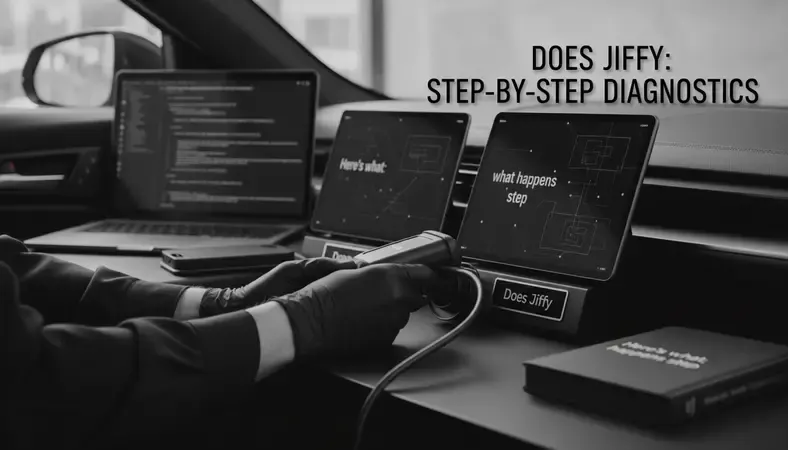
Here's what happens step by step:
- Check-in: You provide your vehicle registration and ID. The technician enters your vehicle's information into the testing system.
- Visual inspection: The technician checks for obvious issues — missing catalytic converter, visible exhaust leaks, tampered emissions equipment.
- OBD-II scan (most vehicles): The scanner connects to your car's diagnostic port and reads stored data from the engine control module. Any emission-related fault codes trigger a failure.
- Functional checks: The technician may check that your gas cap seals properly, since a faulty cap can cause evaporative emission failures.
- Results: You receive a printed report showing pass or fail. If you pass, the station submits the results electronically to your state's DMV. If you fail, the report details which systems didn't meet standards.
A few things to know before you go:
- Don't clear your check engine light right before the test. If your light was on and you reset it, the OBD system needs 50–100 miles of driving to reset its readiness monitors. Testing too soon after a reset almost always results in a "not ready" result, which counts as a failure in most states.
- Make sure your gas tank is between one-quarter and three-quarters full. Some evaporative system tests require this range.
- Fix known issues first. If your check engine light is on, address the underlying problem before booking a jiffy lube emissions test or any emissions inspection.
How to Schedule an Emissions Test at Jiffy Lube
If you've confirmed that a Jiffy Lube near you actually performs emissions testing, scheduling is simple.
- Call ahead. Confirm the location is licensed for emissions testing in your state. Ask if they're STAR-certified if your DMV notice requires it.
- Check their hours. Many emissions stations have specific testing windows — not all hours of operation include testing services.
- Gather your documents. Bring your current vehicle registration, your driver's license, and your DMV renewal notice if you have one.
- Arrive early. Walk-in wait times can stretch at busy locations. Arriving when they open cuts your wait significantly.
- Ask about retesting policy. If you fail, some locations offer a free retest within a set timeframe after repairs.
For most drivers, though, the jiffy lube emissions test isn't a realistic option — simply because the location near them isn't set up for it. In that case, finding a dedicated smog check station is the faster path.
Emissions Test Requirements by State
Not every state requires emissions testing. Requirements vary significantly based on where you live, how old your vehicle is, and sometimes even which county you're in.
Emissions Testing Requirements: State Overview
| State | Testing Required? | Notes |
|---|---|---|
| California | Yes | Required every 2 years for most vehicles; STAR program for flagged vehicles |
| Colorado | Yes (select counties) | Air Care Colorado emissions program covers Denver metro area |
| Arizona | Yes (Maricopa & Pima counties) | ADEQ vehicle emissions testing station network |
| Texas | Yes (select counties) | Combined safety and emissions inspection |
| New York | Yes | Annual inspection includes emissions |
| Florida | No | Emissions testing eliminated statewide |
| Michigan | No | No statewide requirement |
California has the strictest emissions standards in the country. The California Air Resources Board (CARB) oversees the Smog Check program, and vehicles registered in most counties must pass a smog check every two years. If your vehicle fails and is directed to a STAR-certified station, you'll need a facility specifically authorized for that — not a general Jiffy Lube location.
Colorado's Air Care Colorado emissions program covers vehicles registered in the Denver metro area and surrounding counties. Drivers there need to find an approved ADEQ vehicle emissions testing station equivalent — a licensed testing facility in their county.
Arizona requires testing through the ADEQ vehicle emissions testing station network in Maricopa and Pima counties. If you're searching for a jiffy lube emissions test in Phoenix or Tucson, you'll need to verify whether that specific location holds an ADEQ license.
If you're unsure whether your county requires testing, your state DMV website will have the definitive answer. Your registration renewal notice will also state whether an emissions test is required before you can renew.
Alternatives to Jiffy Lube for Emissions Testing
Since the jiffy lube emissions test isn't available everywhere, here are the most reliable alternatives:
- Dedicated smog check stations: These facilities exist solely to perform emissions inspections. They're typically faster than multi-service shops, often STAR-certified, and staffed by technicians who do this all day. This is the most efficient option for most drivers.
- Auto repair shops with emissions licenses: Many independent mechanics hold emissions testing licenses. If your car needs repairs to pass, getting tested and repaired at the same location saves a trip.
- Dealership service centers: Dealerships often perform emissions testing, especially for their brand's vehicles. Expect longer wait times and higher costs.
- State-run testing lanes: Some states operate their own testing facilities with lower fees. These are no-frills but reliable.
- Mobile emissions testing: A few providers offer mobile testing for fleet vehicles. Not typically available for individual consumers.
If you're in the San Leandro area, Speedy Smog is a STAR-certified smog check station that handles most vehicles in under 15 minutes. That's a faster and more direct option than hunting for a jiffy lube emissions test location that may or may not be set up for the service.
Common Questions About Emissions Testing
Does Jiffy Lube do smog checks in California?
Most Jiffy Lube locations in California do not perform smog checks. California's Smog Check program requires stations to be licensed by the Bureau of Automotive Repair (BAR), and many Jiffy Lube locations don't hold that license. A small number of locations may be licensed, but you should call ahead to confirm. If your DMV notice directs you to a STAR station, a standard Jiffy Lube almost certainly won't qualify.
What happens if my car fails an emissions test?
You'll receive a report specifying which systems failed. You then need to have those issues repaired by a licensed mechanic and return for a retest. Most states allow a retest at the same station within a set window. California offers a Consumer Assistance Program that provides repair assistance for income-qualifying owners whose vehicles fail smog checks — up to $500 in repair costs.
How often do I need an emissions test?
It depends on your state and vehicle age. California requires testing every two years for most vehicles. Texas and New York require annual inspections. Some states test vehicles only when they're first registered or transferred. Check your DMV renewal notice — it will tell you whether a test is required for your current renewal cycle.
Can I get an emissions test without a check engine light being on?
Yes. Many vehicles fail emissions tests even without a check engine light. The OBD-II system monitors dozens of sensors, and some failures don't trigger the light immediately. Conversely, a vehicle with a check engine light for a non-emissions issue (like a loose gas cap) may still pass the emissions portion of the test depending on your state's rules.
What is an ADEQ vehicle emissions testing station?
An ADEQ vehicle emissions testing station is a facility licensed by the Arizona Department of Environmental Quality to perform vehicle emissions inspections in Maricopa and Pima counties. These stations are part of Arizona's Vehicle Emissions Inspection Program (VEIP). Drivers in the Phoenix and Tucson metro areas must use an ADEQ-licensed facility — not just any mechanic or oil change shop — to get a valid emissions test result.
Wrapping Up
The jiffy lube emissions test is more myth than reality for most drivers — Jiffy Lube simply isn't set up for smog inspections at the majority of its locations. Your fastest path to a passed emissions test is a dedicated, licensed smog check station.
Book your smog check at Speedy Smog in San Leandro — STAR certified, most vehicles done in under 15 minutes, open 6 days a week. Save $25 on your visit by calling (510) 614-7664. Ready to get started? Visit Speedy Smog to learn more.
Every car on the road produces exhaust. But what exactly is in that exhaust, why does it matter, and what happens when your emissions car fails a smog check? These are questions most drivers never think about until a test is due — and then they need answers fast.
This guide covers everything you need to know about car emissions: what they are, what your vehicle produces, how testing works, and what you can do to keep your emissions car running clean.
What Are Car Emissions?
Car emissions are the gases and particles your vehicle releases into the air as a byproduct of burning fuel. Every internal combustion engine does this — it's a basic consequence of the chemical reaction that powers your car.
When gasoline or diesel burns inside your engine, it doesn't combust perfectly. Some fuel burns incompletely. Some nitrogen in the air reacts with heat. The result is a mix of gases that exit through your exhaust system and enter the atmosphere.
The term "emissions car" is often used loosely to describe any vehicle subject to emissions testing requirements — essentially any car that burns fuel and must prove its exhaust meets legal limits before it can be registered.
Key Insight: The Environmental Protection Agency estimates that transportation accounts for the largest share of greenhouse gas emissions in the United States — making emissions car testing one of the most direct ways states can improve air quality.
Understanding what your emissions car produces is the first step to understanding why testing exists and what inspectors actually measure.
Types of Emissions Cars Produce
Not all exhaust is the same. An emissions car produces several distinct pollutants, each with different effects on health and the environment.
The main pollutants
-
Hydrocarbons (HC): Unburned fuel particles that escape through the exhaust. High HC levels usually indicate incomplete combustion — often caused by a misfiring spark plug, a failing catalytic converter, or a rich fuel mixture. Hydrocarbons react with sunlight to form smog.
-
Carbon monoxide (CO): A colorless, odorless gas produced when fuel burns without enough oxygen. CO is toxic to humans at high concentrations and is one of the primary targets of any emissions test.
-
Nitrogen oxides (NOx): Formed when nitrogen and oxygen in the air react under the extreme heat of combustion. NOx contributes to smog formation and acid rain, and is a key indicator of engine efficiency.
-
Carbon dioxide (CO₂): The primary greenhouse gas from vehicle combustion. Unlike HC, CO, and NOx, CO₂ isn't directly regulated in most state-level emissions tests — but it's central to broader climate policy.
-
Particulate matter (PM): Tiny solid particles, more common in diesel vehicles. Particulates are linked to respiratory disease and are regulated under federal clean air standards.
Emissions comparison by vehicle type
How Emissions Vary by Vehicle Type
| Vehicle Type | Primary Pollutant Concern | Regulated by Smog Check? | Notes |
|---|---|---|---|
| Gasoline (pre-1975) | HC, CO | Often exempt (older models) | No catalytic converter |
| Gasoline (1975–present) | HC, CO, NOx | Yes | Catalytic converter required |
| Diesel | NOx, particulate matter | Separate diesel inspection | Different test protocol |
| Hybrid | Lower HC, CO, NOx | Yes (in most states) | Smaller engine, less output |
| Electric | None (tailpipe) | Exempt in most states | No combustion emissions |
The type of emissions car you drive determines which pollutants are most relevant and which testing protocol applies to you.
Why Car Emissions Testing Matters
An emissions test — sometimes called a smog check or vehicle emissions inspection — is the mechanism states use to verify that your car isn't polluting beyond legal limits.
California introduced the first statewide smog check program in 1984. Today, more than 30 states require some form of vehicle emissions testing, though the specifics vary significantly. States like Colorado run the Air Care Colorado program for the Denver metro area. Arizona has the ADEQ vehicle emissions testing station network covering Maricopa and Pima counties. Each program targets the same core problem: vehicles that exceed pollution thresholds.
Why does this matter to you as a driver? Three reasons:
-
Registration renewal — Most states tie emissions compliance to your annual registration. An emissions car that fails a smog check can't be legally registered until the problem is fixed and the vehicle passes a retest.
-
Air quality — A single high-emitting vehicle can produce as much pollution as dozens of properly functioning cars. Emissions testing removes the worst offenders from the road.
-
Early diagnosis — Failing an emissions test often means your car has a mechanical problem that's costing you fuel efficiency. Fixing it saves money at the pump.
How Emissions Affect the Environment
The connection between an individual emissions car and broader environmental harm is worth understanding clearly.
Hydrocarbons and nitrogen oxides react in sunlight to form ground-level ozone — the main component of smog. High ozone days trigger health advisories, particularly affecting children, the elderly, and people with asthma. The Los Angeles Basin and the San Joaquin Valley in California are among the worst ozone zones in the country, which is a direct reason California's emissions standards are stricter than federal minimums.
Carbon monoxide at street level is a localized health risk, especially in dense urban areas with heavy traffic. At high concentrations near roadways, CO exposure has been linked to cardiovascular problems.
Nitrogen oxides contribute to acid rain, which damages forests, lakes, and crops. They also react with ammonia and moisture to form fine particulate matter — a pollutant linked to lung disease and premature death.
The cumulative effect of millions of emissions cars on the road is measurable. The EPA's National Emissions Inventory tracks pollution levels across the country, and transportation consistently ranks as the largest single source of air pollution in the United States.
Emissions Standards and Regulations
The rules governing what an emissions car can legally produce come from two levels: federal and state.
Federal standards
The Clean Air Act gives the EPA authority to set national emissions standards for new vehicles. These standards tighten over time — a car manufactured today produces roughly 99% less pollution per mile than one built in 1970. The EPA's Tier 3 standards, phased in starting in 2017, require gasoline vehicles to meet a fleet average of 30 milligrams of combined NOx and non-methane organic gases per mile.
California's stricter rules
California operates under a separate waiver from the Clean Air Act, allowing the state to set stricter standards than the federal minimum. The California Air Resources Board (CARB) sets these rules, and 17 other states have adopted California's standards rather than the federal baseline.
State testing programs
State-level smog check programs enforce these standards at the vehicle level. The most common testing methods are:
-
OBD-II testing: For most vehicles 1996 and newer, inspectors plug into the car's on-board diagnostic port and read stored fault codes. If the check engine light is on, the car typically fails.
-
Tailpipe testing: An analyzer probe is inserted into the exhaust pipe to measure actual HC, CO, and NOx concentrations. Used for older vehicles that predate OBD-II.
-
Visual inspection: Inspectors check that emissions control equipment — catalytic converter, EGR valve, oxygen sensors — is present and hasn't been tampered with.
If you're looking for an emissions close to me, the testing method used depends on your vehicle's model year and your state's program requirements.
How to Reduce Your Car's Emissions
If your emissions car is producing more pollution than it should, there are specific steps that address the most common causes.
Keep up with basic maintenance
Neglected maintenance is the most common reason an emissions car fails a smog check. The fixes are usually straightforward:
-
Replace spark plugs on schedule. Worn plugs cause incomplete combustion, which raises HC levels directly. Most manufacturers recommend replacement every 30,000–100,000 miles depending on plug type.
-
Change the air filter. A clogged air filter restricts oxygen flow, causing a rich fuel mixture and elevated CO output.
-
Check the oxygen sensors. O2 sensors tell the engine's computer how to balance the fuel mixture. A failing sensor throws off this balance and raises emissions across the board.
-
Service the catalytic converter. The catalytic converter converts HC, CO, and NOx into less harmful compounds before they exit the tailpipe. A failing converter causes a car to fail emissions testing almost immediately.
-
Fix the check engine light before your test. Any active diagnostic trouble code will cause an OBD-II emissions test to fail. Address the underlying issue, not just the light.
Use the right fuel
Higher-octane fuel doesn't reduce emissions in most standard engines. What matters more is fuel quality. Top Tier certified gasoline — sold by major brands — contains detergents that reduce carbon deposits on intake valves and injectors, which helps maintain clean combustion over time.
Avoid short trips when possible
Cold starts produce significantly higher emissions than warm engine operation. A car that's driven only short distances never fully warms up its catalytic converter, which needs to reach about 400°F to function efficiently. If your emissions car is used mainly for short trips, consider a longer drive before your scheduled smog check to warm everything up properly.
What to Expect During Emissions Testing
The emissions test itself is usually faster than people expect. At a station like Speedy Smog, most vehicles are in and out in under 15 minutes.
Here's what actually happens during an emissions inspection:
-
Check-in and vehicle information. The inspector records your license plate, VIN, and odometer reading. This information gets submitted to the state database.
-
Visual inspection. The technician checks that your catalytic converter is present, your gas cap seals properly, and no emissions control equipment has been removed or modified.
-
OBD-II scan (1996 and newer vehicles). A scanner connects to the port under your dashboard and reads your car's diagnostic data. The system checks for active fault codes and confirms that all emissions monitors have completed their readiness cycles.
-
Tailpipe test (older vehicles). For pre-1996 vehicles, a probe is inserted into the exhaust pipe. The analyzer measures HC, CO, and CO₂ concentrations at idle and sometimes at higher RPMs.
-
Results and certificate. If your emissions car passes, you receive a certificate that goes to the DMV for registration renewal. If it fails, you get a report showing which readings were out of range — a starting point for your mechanic.
What causes a failure?
The most common reasons an emissions car fails testing:
- Active check engine light (any stored fault code)
- Incomplete OBD-II readiness monitors (common after a recent battery replacement or ECU reset)
- Failed catalytic converter
- Faulty oxygen sensor
- Vacuum leaks causing a lean or rich mixture
- Broken or missing emissions control components
If you're searching for vehicle emissions testing or need an emissions test station near you, finding a STAR-certified station matters — especially in California, where STAR certification indicates the station meets stricter quality standards set by the Bureau of Automotive Repair.
Common Questions About Car Emissions
How often does my car need an emissions test?
Most states require testing every one or two years, tied to registration renewal. California requires smog checks every two years for most vehicles, though the specific schedule depends on your vehicle's age and county. Newer vehicles (typically less than four years old) are often exempt from testing for the first few years.
Can I drive my car if it fails an emissions test?
Yes, in most states a failed emissions test doesn't prevent you from driving immediately. You have a window of time to make repairs and retest before your registration expires. Driving with an expired registration after that window closes is a separate legal issue.
Why does my car fail emissions after a battery replacement?
When your battery is disconnected, the car's OBD-II system loses its stored readiness data. The emissions monitors need to run through specific drive cycles to reset. If you bring your emissions car in for testing before those cycles complete, the system will show incomplete monitors — which counts as a failure in most states. Drive the car normally for 100–200 miles before testing after any battery work.
What's the difference between a smog check and an emissions test?
They're the same thing, just different names used in different states. California uses "smog check." Other states use "emissions test," "vehicle inspection," or similar terms. The Emissions Inspection process covers the same basic measurements regardless of what it's called locally.
Does a newer car still need an emissions test?
It depends on your state and the vehicle's age. Many states exempt vehicles under a certain age (often three to five years) on the logic that new cars are factory-certified to meet current standards. Check your state's DMV requirements — exemption ages vary.
Final Thoughts
Your emissions car isn't just a registration requirement — it's a direct measure of how cleanly your engine is running. A car that passes emissions testing is a car that's burning fuel efficiently and contributing less pollution to the air around you.
Book your smog check at Speedy Smog in San Leandro — STAR certified, most vehicles done in under 15 minutes, open 6 days a week. Save $25 on your next visit by calling (510) 614-7664. Ready to get started? Visit Speedy Smog to learn more.
When your registration renewal notice arrives, finding the closest emissions testing station quickly becomes your top priority. Most people search "closest emissions to me" hoping for a fast, nearby option — not a 45-minute drive to a facility across town.
You need to pass your smog check before the DMV will renew your registration. This guide shows you exactly how to find the closest emissions testing facility, what to bring, what happens during the test, and how to book your appointment.
Emissions Testing Centers Near Me
The closest emissions to me — meaning the nearest certified smog check station — depends on your state and county. California, for example, requires smog checks every two years for most vehicles, and the state maintains a network of thousands of licensed stations.
Here's what to look for when evaluating the closest emissions testing facility:
- STAR certification: In California, STAR-certified stations can test all vehicles, including those flagged by the DMV as high-emitters. A non-STAR station cannot test these vehicles. If your registration notice says "STAR station required," this matters immediately.
- Equipment type: Some stations use tailpipe-only testing; newer facilities use OBD-II (On-Board Diagnostics) readers that plug directly into your car's computer. Most post-2000 vehicles use OBD-II testing.
- Wait times: A station two miles away with a 90-minute wait is often worse than one four miles away with a 10-minute wait. Check Google reviews or call ahead.
- Pass/fail rates: California's Bureau of Automotive Repair (BAR) publishes station-level data. Stations with unusually high failure rates sometimes indicate aggressive testing practices.
What Makes a Station "Certified"?
Every smog check station in California must be licensed by the Bureau of Automotive Repair, the state agency that oversees vehicle emissions testing. Stations must use calibrated, state-approved equipment and employ licensed smog technicians. An uncertified shop cannot legally issue a smog certificate.
Speedy Smog in San Leandro is a STAR-certified station, meaning it can test any vehicle — including those specifically directed by the DMV to a STAR location.
How to Find the Closest Emissions Testing Location
Searching "closest emissions to me" on Google Maps is the fastest starting point, but here's a more reliable process:
- Use the BAR's official station locator: The California Bureau of Automotive Repair maintains a searchable database at bar.ca.gov. You can filter by STAR certification, station type, and distance from your zip code.
- Check your registration notice: If the DMV has flagged your vehicle, your renewal notice will specify whether you need a STAR station. Don't skip this step — going to the wrong station type wastes your time.
- Search Google Maps with filters: Type "smog check near me" and look at the star ratings, hours, and whether the station lists OBD or tailpipe testing. Call the top two options to ask about current wait times.
- Verify the station is currently active: Stations occasionally lose their licenses or close. A quick phone call confirms they're open and can test your vehicle type.
- Ask about same-day availability: Many stations accept walk-ins. Others book out by a day or two during peak registration periods (typically the last two weeks of the month).
Pro Tip: The end of the month is the busiest time for smog stations. If your registration deadline allows it, go mid-month to avoid waits of 45 minutes or more.

Closest Emissions Testing Station: What to Prioritize
Not every station is equal. Here's a quick comparison to help you choose:
Comparing Smog Station Types
| Station Type | Who It's For | Can Test DMV-Directed Vehicles | Typical Wait |
|---|---|---|---|
| STAR Certified | All vehicles, including high-emitters | Yes | 10–30 min |
| Regular Licensed | Standard vehicles not flagged by DMV | No | 10–20 min |
| Test-Only Station | Vehicles that failed at a test-and-repair shop | Yes (some) | 5–15 min |
| Test and Repair | Vehicles needing diagnosis and repair | Depends on STAR status | Varies |
A test-only station cannot perform repairs — it exists solely to run the emissions test. A test-and-repair station can diagnose and fix problems on the same visit, which is convenient if your vehicle is borderline or has a known issue.
What to Expect at Your Emissions Test
The actual smog check is straightforward. Most vehicles are in and out in under 15 minutes. Here's what happens:
- Check-in: You provide your vehicle registration and ID. The technician enters your vehicle's VIN into the state system.
- Visual inspection: The technician checks your gas cap, looks for visible smoke, and confirms emissions-related components are present and unmodified.
- OBD-II scan: For 2000 and newer vehicles, the technician plugs a reader into the OBD port (usually under the dashboard on the driver's side). The system reads your car's onboard diagnostic data and checks for active fault codes.
- Tailpipe test: Older vehicles (pre-2000, or those without OBD-II systems) go through a dynamometer test where the car runs at speed while sensors measure exhaust emissions directly.
- Results: You get a pass or fail result on the spot. If you pass, the station submits the certificate electronically to the DMV — you don't have to do anything else. If you fail, the technician explains which components triggered the failure.
California's vehicle smog check requirements are administered through the DMV and enforced by the Bureau of Automotive Repair. According to BAR data, approximately 85% of vehicles pass their smog check on the first attempt.
Common Reasons Vehicles Fail
- Check engine light is on: An active fault code is an automatic failure in California. Clear the code only after fixing the underlying problem — not before the test.
- Catalytic converter issues: A failing cat is one of the most common failure causes and one of the more expensive repairs.
- EVAP system leaks: Evaporative emission control system failures often come from a loose or cracked gas cap.
- Oxygen sensor failures: O2 sensors affect fuel mixture and emissions output directly.
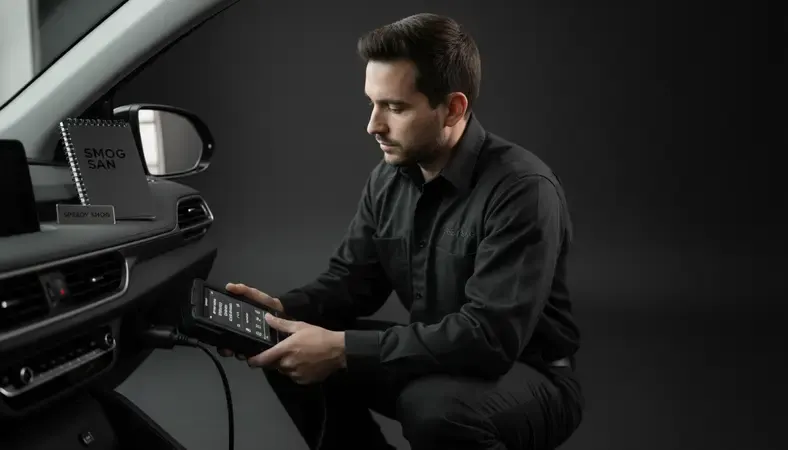
Hours and Appointment Availability
Most smog stations operate Monday through Saturday, typically from 8:00 AM to 5:00 PM. Some open earlier or close later. Sunday hours are less common but do exist at select locations.
Speedy Smog in San Leandro is open six days a week, making it one of the more accessible options for the closest emissions to me in the East Bay area.
When to go for the shortest wait:
- Mid-morning on weekdays (9:00–11:00 AM) tends to have the shortest lines
- Mid-month is less busy than the last week of the month
- Avoid Monday mornings — weekend backlog often creates a rush
Many stations now offer online scheduling. This lets you reserve a time slot, reducing or eliminating your wait. Walk-ins are typically accepted, but a reservation guarantees your spot during busy periods.
Required Documents and Vehicle Information
Bring these items to your closest emissions testing station:
- Current vehicle registration: The technician needs this to pull up your vehicle record and confirm the test is due.
- Valid photo ID: Required for identity verification.
- Payment: Most stations accept cash, credit, and debit. Confirm accepted payment methods when you call ahead.
- The vehicle itself: This sounds obvious, but make sure the car is warmed up. A cold engine can produce artificially high emissions readings in tailpipe tests. Drive for at least 10–15 minutes before arriving.
You do not need to bring your insurance card for a smog check — that's for a vehicle inspection service or registration renewal, not the emissions test itself.
Before You Go: A Quick Checklist
- Check engine light is off
- Gas cap is tight and crack-free
- Vehicle has been driven recently (not sitting for weeks)
- You know whether your registration notice requires a STAR station
- You have your registration and ID
Emissions Testing Costs and Fees
Smog check fees in California consist of two parts: the station's service fee and a state-mandated certificate fee.
The certificate fee is set by the state and goes directly to the Bureau of Automotive Repair. The station's service fee varies by location and vehicle type. Diesel vehicles and motorhomes typically cost more to test than standard gasoline passenger cars.
Some stations offer discounts for first-time customers or advertise promotional pricing. Speedy Smog currently offers $25 off — call (510) 614-7664 or visit speedysmogchecksanleandro.com for current pricing.
Cost factors that affect your total:
- Vehicle type (passenger car vs. truck vs. diesel)
- Whether it's a regular or STAR station
- Whether additional diagnostics are needed
- Station-specific service fees
If your vehicle fails, you'll need to pay for repairs separately. California's Consumer Assistance Program (CAP) offers repair assistance for income-qualifying vehicle owners whose cars fail the smog check.
How to Schedule Your Test Online
Booking the closest emissions to me online takes about two minutes. Here's how:
- Go to the station's website: Visit speedysmogchecksanleandro.com or the website of your preferred local station.
- Select your vehicle type: Most booking systems ask for your vehicle year, make, and model to confirm they can test it.
- Choose a date and time: Pick a slot that works for your schedule. Mid-morning weekday slots fill up last.
- Confirm your appointment: You'll typically get a confirmation email or text. Save it — some stations ask you to show it at check-in.
- Show up on time: Arrive a few minutes early. Stations often run tight schedules, and a late arrival can push you to the next available slot.
If online scheduling isn't available at your preferred station, a phone call works just as well. Ask about current wait times, whether walk-ins are accepted, and whether they can test your specific vehicle type.
Common Questions About Emissions Testing
How do I know if I need a smog check?
Your DMV registration renewal notice will tell you. California requires smog checks every two years for most gasoline-powered vehicles 1976 and newer. Vehicles four years old or newer are exempt. Diesel vehicles 1998 and newer with a GVWR of 14,000 lbs or less are also required to be tested. Electric vehicles are exempt entirely.
What happens if my vehicle fails the emissions test?
You'll receive a Vehicle Inspection Report explaining which components failed. You cannot renew your registration until the vehicle passes. If you're at a test-and-repair station, they can diagnose and fix the problem on the same visit. If you're at a test-only station, you'll need to take your Vehicle Inspection Report to a repair shop. After repairs, return for a retest — some stations offer free retests within a set period.
Can I drive my car if it fails a smog check?
Yes, a failed smog check doesn't make your vehicle illegal to drive immediately. Your current registration remains valid until it expires. The issue is that you cannot renew registration without a passing smog certificate. Drive it, get it repaired, and retest before your registration expires.
How long does a smog check take?
For most modern vehicles using OBD-II testing, the process takes 10–15 minutes from check-in to results. Older vehicles requiring a dynamometer tailpipe test may take 20–30 minutes. Speedy Smog completes most vehicles in under 15 minutes.
Is there a difference between an emissions test and a smog check?
The terms are used interchangeably in California. A smog check is the state's name for the vehicle emissions inspection. It tests the same thing — how much pollution your vehicle's engine produces. The California Smog Check program is the formal name for the state's entire emissions inspection system.
What if I just moved to California?
Newly registered vehicles in California must pass a smog check before the DMV will issue California plates, unless the vehicle is exempt by age or type. The Emissions Test Station you use must be California-licensed — out-of-state test results are not accepted.
Conclusion
Finding the closest emissions to me doesn't need to be complicated. Use the BAR's station locator, confirm STAR certification if your DMV notice requires it, and book a time slot to skip the walk-in wait.
Book your smog check at Speedy Smog in San Leandro — STAR certified, most vehicles done in under 15 minutes, open six days a week, with $25 off your test. Call (510) 614-7664 to reserve your spot. Ready to get started? Visit Speedy Smog to learn more.