
Emissions Test: What Every Driver Should Know
An emissions test — sometimes called a smog check — measures the pollutants your vehicle releases into the air. If your car, truck, or SUV produces too much, it won't pass. And in many states, that means no registration renewal until it does.
If you've just received a notice to get tested, or you're not sure whether your vehicle qualifies, you're in the right place. This guide covers exactly what the emissions test involves, how to prepare, what happens if you fail, and where to get it done.
What Is an Emissions Test?
An emissions test is an inspection that measures the exhaust output of your vehicle's engine. The goal is to confirm your car isn't releasing harmful pollutants — like hydrocarbons, carbon monoxide, and nitrogen oxides — above legally allowed limits.
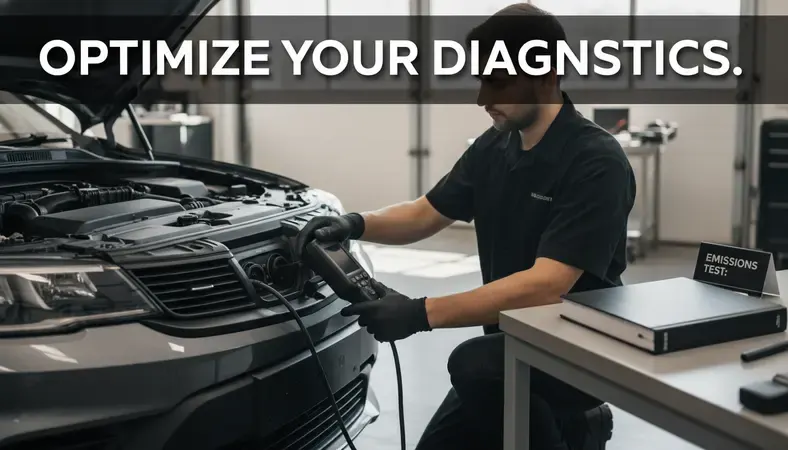
The test itself is straightforward. A certified technician either plugs a diagnostic scanner into your car's onboard computer (called the OBD-II port) or connects your exhaust pipe directly to an analyzer. The equipment reads what's coming out of your engine and compares it against the state's standards.
You'll also hear this called a smog check, smog test, or vehicle emissions test. They all refer to the same process, just with different names depending on where you live. California uses "smog check," Colorado uses "emissions test," and Arizona runs its program through the ADEQ vehicle emissions testing station network. Different names, same core inspection.
What the Test Actually Measures
| Pollutant | What It Is | Why It's Regulated |
|---|---|---|
| Hydrocarbons (HC) | Unburned fuel particles | Form smog and irritate lungs |
| Carbon Monoxide (CO) | Colorless, odorless gas | Toxic; replaces oxygen in blood |
| Nitrogen Oxides (NOx) | Reactive gases from combustion | Cause smog and acid rain |
| Carbon Dioxide (CO₂) | Greenhouse gas | Contributes to climate change |
| Particulate Matter | Tiny soot particles | Damage lungs and airways |
The acceptable limits for each pollutant vary by state and by your vehicle's model year and weight class. Newer vehicles are held to tighter standards.
Why Are Emissions Tests Required?
The short answer: air quality. Vehicle exhaust is one of the largest sources of air pollution in the United States, and without mandatory testing, there's no reliable way to catch vehicles that are polluting far above normal levels.
The Clean Air Act gives states authority to set their own vehicle inspection and maintenance programs. States in areas that fail to meet federal air quality standards — places like the Los Angeles Basin, the Denver metro area, and the Phoenix metro area — are required to run emissions testing programs. States that already meet air quality standards generally don't require it.
Here's a fact that puts the scale in perspective: a single malfunctioning vehicle can emit 10 to 100 times more pollution than a properly functioning one of the same model. Emissions testing exists to find those outliers and get them fixed.
Beyond air quality, there's a secondary benefit. A failing emissions test often points to an underlying engine problem — a faulty oxygen sensor, a clogged catalytic converter, or a misfiring cylinder. Catching these issues early usually saves money compared to letting them worsen.
How Often Do You Need an Emissions Test?
This depends entirely on your state and, in some cases, your county within that state.
Most states that require emissions testing follow one of these schedules:
- Every two years — the most common schedule, typically tied to vehicle registration renewal
- Annually — required in some states and certain high-pollution counties
- One-time inspection — some states only require testing when a vehicle is newly registered or changes ownership
Your vehicle's age also matters. In California, for example, vehicles manufactured before 1976 are exempt. Most states exempt vehicles under a certain age (often 2 to 4 years old) because new cars are assumed to be within compliance. Classic or antique vehicles often have separate exemptions as well.
The best way to know your schedule: check your registration renewal notice. Most states print the emissions test requirement directly on it, including whether your specific vehicle needs one and by what date.
Key Insight: If you recently moved to a new state, don't assume your old state's rules apply. Emissions requirements vary significantly — some counties within a state require testing while neighboring counties don't.
What Happens During an Emissions Test?
Most emissions tests take 15 minutes or less. Here's what the process looks like from start to finish.
Step 1: Check-In and Vehicle Identification
When you arrive, the technician records your vehicle's make, model, year, and VIN (Vehicle Identification Number). They'll also check that your vehicle is the one listed on your registration.
Step 2: Visual Inspection
The technician does a quick visual check. They're looking at whether your check engine light is on, whether the gas cap seals properly, and whether any visible emissions components — like the catalytic converter — appear to be present and intact.
Step 3: OBD-II Scan or Tailpipe Test
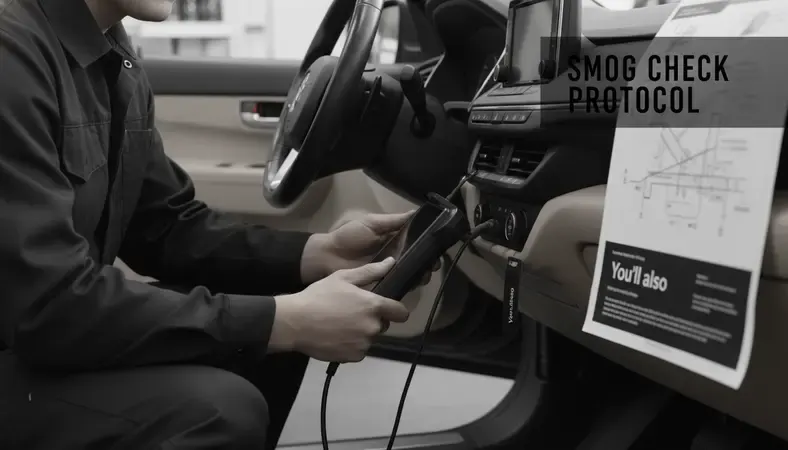
For most vehicles made after 1996, the test is an OBD-II scan. The technician plugs a reader into the diagnostic port (usually under the dashboard on the driver's side) and pulls the data your car's computer has been collecting. If your vehicle's monitors show "ready" and no fault codes are stored, you pass this portion.
Older vehicles — typically those made before 1996 — go through a tailpipe test instead. A probe is inserted into the exhaust pipe while the engine runs, and the analyzer directly measures what's coming out.
Step 4: Results
You receive a printed report showing your vehicle's readings versus the allowable limits. Pass means you're done. Fail means the report will identify which readings exceeded the standard, giving a starting point for repairs.
How to Prepare Your Vehicle for an Emissions Test
You don't need to do anything elaborate. But a few simple steps can improve your chances of passing — especially if your vehicle is older or hasn't been serviced recently.
Before your appointment:
- Fix any check engine light issues first. A check engine light is an automatic fail in most states. Get the fault code read (many auto parts stores do this free) and address the cause before your test.
- Drive at highway speeds for 15–20 minutes beforehand. This warms the engine fully and helps the catalytic converter reach operating temperature. Cold engines don't burn fuel as cleanly.
- Don't disconnect the battery. This resets your car's OBD-II monitors to "not ready" status, which causes an automatic fail. If your battery was recently disconnected, drive the car for several days through a mix of city and highway driving before testing.
- Check your gas cap. A loose or cracked gas cap causes evaporative emissions failures. Tighten it or replace it — a new gas cap costs under $20.
- Make sure your tires are properly inflated. Some dynamometer-style tests (where your car drives on rollers) require proper tire pressure for accurate readings.
If your vehicle is due for an oil change or tune-up, handle that before the test. Fresh oil and new spark plugs help the engine run cleaner.
What If Your Vehicle Fails the Emissions Test?
Failing doesn't mean you're stuck. It means something needs to be repaired. The test report will tell you which readings were out of range, which gives a mechanic a clear starting point.
Common reasons vehicles fail:
- Faulty oxygen sensor — affects the air-fuel mixture, causing excess hydrocarbons or CO
- Failed catalytic converter — the converter breaks down pollutants; when it fails, emissions spike
- Misfiring engine — unburned fuel exits through the exhaust, causing hydrocarbon failures
- EVAP system leak — a leak in the evaporative emissions system triggers OBD failures
- EGR valve issues — the exhaust gas recirculation valve controls NOx; when stuck, NOx levels rise
After repairs, you return for a retest. Most states offer a reduced-cost or free retest within a set window — often 30 to 60 days — after an initial failure.
Cost Assistance Programs
If your vehicle fails and the repair costs are high, many states have financial assistance programs. California's Consumer Assistance Program offers repair assistance up to $500 for income-qualifying owners, and a retirement assistance option if the vehicle is beyond economical repair. Arizona and Colorado have similar programs. Check your state's DMV or air quality agency website for details.
What If You Can't Afford the Repairs?
Most states have a "waiver" option. If you've spent a minimum amount on repairs (often $150 to $450 depending on the state) and the vehicle still doesn't pass, you can apply for a compliance waiver that allows registration renewal for one cycle. You'll need documentation of the repair costs.
Emissions Test Cost and Where to Get Tested
What Does an Emissions Test Cost?
Emissions test fees vary by state and station type. The fee is typically set or capped by the state, so you won't see dramatic price differences between stations. Expect to pay somewhere in the range set by your state's regulatory authority — check your DMV's website for the current fee schedule in your area.
Some stations — like Jiffy Lube emissions test locations in states where they're licensed — offer convenience-focused testing alongside other services. STAR-certified stations in California are authorized to test and repair vehicles that have been directed to a STAR station by the state.
Where to Find an Emissions Test Near You
- Your state's DMV website — most have a station locator tool
- Search "emissions close to me" or "smog check near me" in Google Maps — look for state-licensed stations
- Your registration renewal notice — often lists nearby authorized stations
- ADEQ vehicle emissions testing station locator (Arizona) — available at the Arizona DEQ website
When choosing a station, look for:
- State certification (STAR certification in California; equivalent in other states)
- Clear posted fees
- Estimated wait times — many stations post these online or by phone
If you're in the San Leandro area, Speedy Smog is a STAR-certified station with most vehicles completed in under 15 minutes.
Common Questions About Emissions Tests
Does my vehicle need an emissions test every year?
Not necessarily. Most states require testing every two years, tied to registration renewal. Some states or counties require annual testing. Vehicles under a certain age (typically 2–4 years) are usually exempt. Check your registration renewal notice — it will specify whether your vehicle needs a test and when.
Can I drive my car if it fails the emissions test?
Yes. A failed emissions test doesn't immediately prevent you from driving. It prevents you from renewing your registration until you pass or receive a waiver. You have a window — typically 30 to 60 days depending on your state — to make repairs and retest.
What does "OBD not ready" mean?
Your vehicle's onboard computer runs self-diagnostic tests called monitors. When you disconnect the battery or clear fault codes, these monitors reset to "not ready." Most states require all or nearly all monitors to show "ready" before the vehicle can pass. If yours shows "not ready," drive the car for several days through varied conditions before retesting.
Does a smog check test the same thing as a safety inspection?
No. These are separate inspections. A smog check (emissions test) measures air pollution output. A safety inspection checks mechanical condition — brakes, lights, tires, steering. Some states require both; others require only one or neither. Check your state's DMV requirements.
How long does an emissions test take?
Most emissions tests take 10 to 20 minutes for a straightforward pass. If additional checks are needed, it may take slightly longer. Arriving without a long wait at the station is the bigger time variable — some stations let you make an appointment to avoid waiting.
Is there a way to tell if my car will pass before going in?
You can get a rough sense by using an OBD-II scanner (available at auto parts stores or as a phone-connected device). If no fault codes are stored and your monitors show "ready," your car is likely to pass. A check engine light is the clearest sign it won't — address that first.
Conclusion
An emissions test is a routine part of vehicle ownership in most states — straightforward when your car is running well, and a useful diagnostic signal when it isn't. Warm up the engine, fix any check engine lights beforehand, and you'll be in and out quickly.
Pass your emissions test fast at Speedy Smog in San Leandro — STAR certified, most vehicles done in under 15 minutes, open 6 days a week. Call (510) 614-7664 to make an appointment and save $25 on your smog check.