
Out of State Car Registration California: How to Do It
A California resident must apply to register an out-of-state vehicle within 20 days after establishing residency or accepting California employment. The clock starts with that change in status, not with the day you bought the car.
You may still be unpacking in San Leandro, arranging insurance, and driving on valid plates from your previous state. Registration can feel like something to handle after the move settles down, but the important work starts before the DMV appointment: checking whether California will accept the vehicle and getting the right inspection.
A passing smog check isn't a guarantee of registration. Ownership documents, vehicle verification, and emissions certification each serve a different purpose. Getting them ready in the right order helps you avoid paying for a test or making a DMV trip that can't move your application forward.
Table of Contents
- Who Must Register and the 20-Day Deadline
- Vehicle Eligibility and Smog Check Rules
- Step-by-Step Registration Procedure and Documents
- Common Delays and How to Fix Them
- Book Your Visit Before the 20-Day Clock Runs Out
Who Must Register and the 20-Day Deadline
Start with the event that created your registration obligation. The California DMV vehicle registration requirements give new residents and people accepting California employment 20 days to register, and identify the special situations and deadlines below.
Registration requirements and deadlines by situation
| Situation | Registration required? | Deadline |
|---|---|---|
| New California resident bringing a vehicle from another state | Yes | 20 days after establishing residency |
| Person accepting California employment | Yes | 20 days after accepting the job |
| Nonresident with a California place of business who regularly uses the vehicle | Yes | Immediately upon entering California |
| California resident using a vehicle a nonresident owner provides for regular use | Yes | 20 days after the vehicle is first operated in California |
| Nonresident daily commuter from a contiguous state | Exempt only if every statutory condition is met | No registration under this narrow exemption for qualifying passenger vehicles or pickups under 8,001 pounds unladen, used principally for commuting |
Keeping an out-of-state title or insurance policy doesn't settle whether registration is required. Where you live, work, and regularly use the vehicle matters more than where you purchased it.
For a family moving to San Leandro, the useful planning date is the day residency begins, not the day the moving truck leaves or the existing registration expires. Book inspections early enough to leave room for a repair or a missing ownership document.
Practical rule: An appointment booking isn't the same as an application. If the packet won't be ready before your deadline, contact the DMV about submitting the application and paying fees while outstanding requirements are resolved.
Write down your residency or employment start date before arranging the remaining tasks. You can correct paperwork later, but you can't recover elapsed time.
Vehicle Eligibility and Smog Check Rules
Most vehicles coming from another state need a California Smog Check, and an out-of-state emissions result won't substitute for it. Before booking, identify the fuel type, model year, and weight rating so you arrange the appropriate inspection.
Emissions requirements by vehicle case
| Vehicle case | Smog check needed | What to watch |
|---|---|---|
| Gasoline vehicle, model year 1976 or newer | Yes, generally | Out-of-state emissions results aren't accepted |
| Diesel vehicle, model year 1998 or newer, under 14,001 pounds GVWR | Yes, generally | Confirm the gross vehicle weight rating on the manufacturer's label |
| Diesel vehicle over 14,001 pounds GVWR | Confirm the applicable inspection requirements with the DMV | Don't assume the light-duty diesel procedure applies |
| Nearly new, low-mileage vehicle that isn't California-certified | A test doesn't resolve eligibility | Only narrow certification exemptions may apply |
| Imported vehicle | Applicable smog inspection plus federal and emissions documentation | Customs clearance and federal safety paperwork are separate requirements |
The California DMV out-of-state vehicle guide warns that a non-California-certified vehicle with fewer than 7,500 miles may be ineligible for registration; it also flags vehicles less than two years old and under 7,500 miles unless they meet California standards or qualify for an exemption.
Certification comes before testing
A smog inspection evaluates the vehicle's emissions condition and equipment. California certification establishes whether that vehicle configuration is eligible for registration in the first place. A technician can't turn a federal-only certification into California certification by issuing a passing test result.
Read the under-hood emissions label before buying or transporting the vehicle. Look for the manufacturer's statement about California emissions compliance rather than relying on a seller's description of the car as emissions compliant.
Ask for the vehicle's origin and mileage history, especially with nearly new cars, diesels, and hybrids. A photograph of the label is more useful than an assurance that the car passed inspection in its previous state.
The exemptions are narrow. They include certain inheritance and divorce transfers, replacement of a stolen or irreparably damaged California vehicle, and qualifying military circumstances. Don't treat those examples as automatic approval; establish that your circumstances qualify before committing to the purchase.
A cheaper purchase isn't a saving if California won't register the vehicle. Resolve certification questions before paying transport costs.
For imports, gather customs clearance, federal safety documentation, and evidence of applicable federal and California emissions compliance before scheduling the registration visit. Our California smog check rules guide can help you prepare questions about the inspection your vehicle needs.
Step-by-Step Registration Procedure and Documents
Treat out-of-state car registration in California as a coordinated document-and-inspection process, not merely a counter transaction. The DMV guidance on out-of-state registration obligations identifies the signed REG 343 application, ownership evidence, registration, insurance, fees, and generally mandatory REG 31 vehicle verification; it also identifies the gasoline and diesel model-year and weight categories shown above.
Establish the date and identify the vehicle
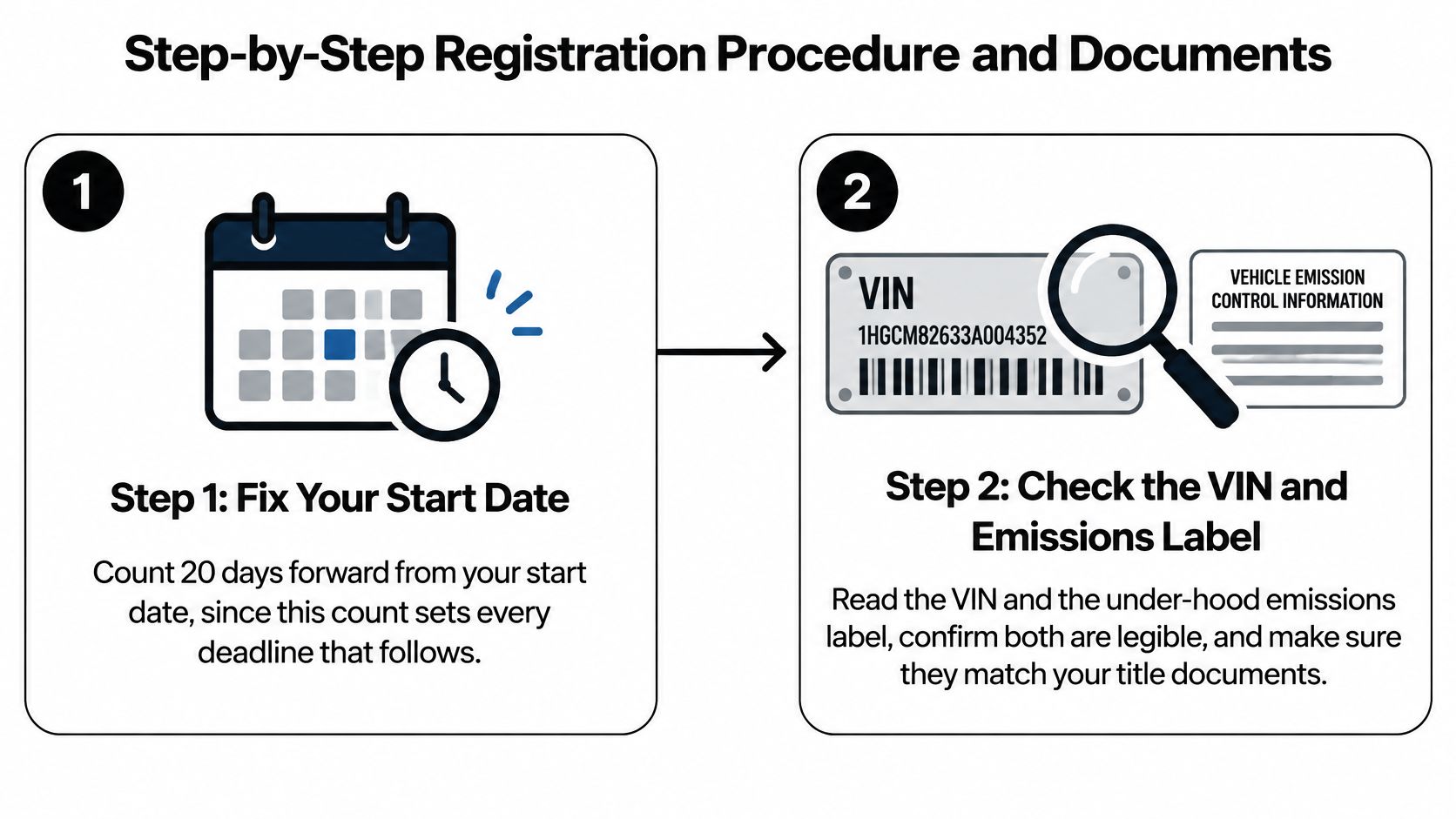
Fix your start date. Record the event that created your California registration obligation and put the application deadline on your calendar. Keep supporting move or employment records with your registration paperwork so you aren't trying to reconstruct the timeline at the counter.
Read the VIN and under-hood emissions label before making appointments. Compare the VIN with the title and registration, then photograph the identification plate and label so you can spot an unreadable character or inconsistent entry while there's still time to resolve it.
The VIN should match the ownership documents exactly. The emissions label provides different information, including the certified configuration, so don't expect its wording to duplicate the title.
Complete the physical checks
Obtain the applicable California Smog Check. Bring the vehicle and its existing registration information, and retain the inspection report or certificate after testing. At Speedy Smog, we electronically transmit smog check results directly to the DMV, but keeping your own record helps if an application needs follow-up.
Arrange the required vehicle verification and have the verification form completed by an authorized verifier. This physical check records vehicle-identification information, including the VIN, odometer reading, motive power, and applicable emissions-label details; it isn't a replacement for the emissions inspection.
Ask about verification arrangements when planning the DMV visit rather than assuming your smog appointment includes them. These are separate tasks, even when you can coordinate them closely.
A stock, clearly labeled vehicle with matching documents is straightforward to prepare. A missing label, engine change, or inconsistent VIN deserves attention before you commit to an appointment intended for final submission.
Build the application packet
- Assemble the ownership and application documents. Use the original out-of-state title or a qualifying ownership document, not an ordinary photocopy, and check the names and signatures before leaving home. If a lender holds the title, establish the required handling procedure in advance rather than arriving with only a loan statement.
Keep this checklist together in a folder:
- Signed application: Complete the Application for Title or Registration identified above, using consistent owner and vehicle information.
- Ownership evidence: Bring the original title or the qualifying ownership document the DMV accepts for your situation.
- Existing registration: Include the latest out-of-state registration, even if you also have the title.
- Insurance: Arrange California-compliant coverage and confirm your current address and vehicle details with your insurer.
- Lien information: Include the lienholder's name, address, and relevant loan information when a lien exists.
- Inspection records: Keep the smog paperwork and completed verification with the application.
- Payment preparation: Bring an accepted payment method for the charges applicable to your transaction.
Read every document side by side. A name variation, missing co-owner signature, or transposed VIN character is easier to fix at home than during a counter appointment.
Estimate payment and submit
Use the DMV fee calculator to estimate registration, title, use-tax, and applicable service charges. Enter the vehicle and transaction details carefully, and treat the result as a planning estimate rather than a promise of the final amount.
Submit the complete packet together when possible. Before the appointment, review our car registration inspection preparation guide and confirm that both the vehicle and original documents will be available. If a requirement is still outstanding, ask the DMV how to submit timely rather than waiting silently for every issue to disappear.
Check what the DMV issues before you leave. If registration is complete, confirm that the California registration documents and plates match your vehicle; if it isn't, get a clear explanation of the outstanding requirement and any operating authorization provided.
Don't assume submitting an application means every approval is finished. Keep receipts, inspection records, and any instructions together until the DMV completes the transaction.
Common Delays and How to Fix Them
| Problem | Likely cause | Fix |
|---|---|---|
| Smog check fails | Emissions-system fault or readiness problem | Diagnose the flagged area, repair as needed, and retest |
| VIN is hard to read or doesn't match the title | Obscured plate, worn stamping, or clerical mismatch | Photograph the VIN and resolve the discrepancy before submission |
| Emissions label is missing or nonconforming | Removed label or altered equipment | Establish the correct configuration and eligibility before inspection |
| Out-of-state smog result presented | The wrong state's inspection was obtained | Obtain the applicable California smog certificate |
| Lien shown on the title | Lienholder information or title-handling arrangements are incomplete | Bring lienholder details and establish how the title will be supplied |
| Application filed after the required window | Registration obligation wasn't addressed promptly | Apply as soon as possible and ask about applicable penalties |
Use the failed-test report to choose the next action
A failed smog inspection needs diagnosis, not repeated testing without a repair plan. At Speedy Smog, a customer whose vehicle fails receives a printout showing the area that needs work, and the vehicle must be repaired to pass the retest before registration can be completed.
A readiness problem and a defective emissions component aren't the same repair. Give the report to the repair technician and explain any recent battery disconnection, code clearing, or work on the vehicle. Don't clear diagnostic codes just to switch off a warning light; that doesn't establish that the underlying problem is fixed.
The Bureau of Automotive Repair's Smog Check guidance addresses the inspection process, while vehicle identification, ownership, and certification remain separate parts of registration. Resolve the actual blocker rather than booking another appointment that can't address it.
Prioritize issues that depend on someone else
Title and lien problems deserve early attention because you may need action from a lender, previous owner, or issuing agency. A phone call identifying who holds the original title can be more productive than preparing an otherwise complete packet.
For missing emissions labels or altered equipment, establish the vehicle's proper configuration before buying parts. A replacement component won't necessarily resolve a certification or identification discrepancy.
Before spending more: Ask whether the proposed fix addresses test performance, registration eligibility, or ownership evidence. Those are different problems with different decision-makers.
If the repair or document correction may run past your deadline, contact the DMV promptly about the application and fee requirements. A smog station can explain a test result, but it can't extend your registration deadline or decide a title dispute.
Book Your Visit Before the 20-Day Clock Runs Out
If your application deadline is close and you haven't arranged the inspections, book them now. Leave room between testing and submission so an unexpected repair doesn't consume all your remaining preparation time.
Use a calendar to coordinate the vehicle, the paperwork, and the people who need to sign.
Put the appointments in a workable order
- Confirm your application timing: Review the residency or employment event that triggered registration, then choose a submission date that leaves some flexibility.
- Arrange the physical checks: Schedule the applicable smog inspection and vehicle verification, making sure the vehicle can attend both.
- Reserve time for submission: Have the owners, original documents, insurance information, and payment ready together.
Don't book the final visit around an assumption that the seller will send the title soon. Confirm who has it and how it will reach you before choosing an appointment that depends on its arrival.
Likewise, tell the inspection station about a diesel engine, import status, missing label, or unresolved warning light when arranging the visit. That conversation helps establish whether testing is the right next action.
Ask practical questions before you arrive
At Speedy Smog, we serve drivers in San Leandro, Hayward, Alameda, and Oakland. Use our smog check appointment page to arrange your visit and ask what to bring for an out-of-state vehicle.
We electronically submit the test result, but that doesn't replace the ownership packet or authorize us to decide whether a certification exception applies. Keep questions about title acceptance, disputed VIN information, and eligibility decisions directed to the agency responsible for them.
When arranging any registration assistance, describe the transaction as an initial California registration of an out-of-state vehicle, not a routine renewal. We aren't a DMV branch, and our DMV registration authority covers a limited range of services, so confirm whether your particular transaction can be handled before planning around it.
Your best protection against a stalled registration is preparation before the appointment: readable vehicle identification, acceptable ownership evidence, and the correct inspection. Start early enough to act on a problem rather than merely discover it. A later repair can make the vehicle ready, but it can't give you back the days already used.
Speedy Smog offers California emissions testing and electronically sends results to the DMV, helping you prepare the inspection portion of your out-of-state registration. Visit Speedy Smog to arrange your smog check and confirm what to bring before your application deadline.