
The Smog Check certificate fee itself is only $8.25, but the actual cost is the repair work that follows. California Bureau of Automotive Repair data shows average repairs of about $665.59 at STAR test-and-repair stations and $703.74 at non-STAR test-and-repair stations.
You're probably holding a Vehicle Inspection Report, wondering whether your registration is now in trouble and whether a shop will sell you repairs you don't need. Take a breath. A failed smog check is a compliance problem, not an automatic loss of registration, and the smartest next move is to understand the failure before authorizing work.
California's 2025 BAR report recorded 959,667 failures among 11,275,981 initial tests, an overall failure rate of 8.51%. STAR Test-Only stations recorded 481,639 failures from 5,916,245 initial tests, an 8.14% rate. The report also recorded 83,034 BAR-97 emissions failures and 43,518 OBDII failures, so this is a recurring statewide issue, not an unusual event. Read the California BAR 2025 executive summary for the published breakdown.
Table of Contents
- You Just Failed a Smog Check in California
- Why Smog Checks Fail and What Your Report Tells You
- Quick Fixes You Can Try Before Paying a Mechanic
- Choosing the Right Station After a Failure
- Repair Costs, Assistance Programs, and Waivers
- Retesting and Clearing Your DMV Registration
- Your Post-Fail Action Checklist
You Just Failed a Smog Check in California
Your first job isn't finding the cheapest repair quote. It's preserving the evidence.
Start with the inspection report
The Vehicle Inspection Report, or VIR, tells you what failed. Read every line, not just the large “Fail” result. Separate monitors marked “not ready” from measured emissions that exceeded their limits. Those are different problems and require different decisions.
A not-ready monitor often means the vehicle's computer hasn't completed its required checks. An emissions exceedance points toward a running, fuel, ignition, exhaust, or catalytic-converter problem. Take clear photos of every page, including the station information and test date, then keep the original with your registration paperwork.
Ask the station whether the vehicle was identified as a gross polluter, directed vehicle, or high emitter. That label affects where you can go next. Don't book a generic retest until you know whether BAR has placed a testing restriction on the vehicle.
Check your registration timeline
A failed test doesn't instantly cancel your current registration. You still need to plan around the expiration date, and you shouldn't ignore DMV renewal notices while the repair is pending. Write down the expiration date and the retest deadline shown on your paperwork.
Practical rule: Never authorize a repair based only on the word “failed.” Authorize work after you know the exact code, monitor, visual defect, or measured pollutant involved.
If you want help interpreting the paperwork before visiting a repair shop, compare the terminology in this guide to common smog test results. Bring the VIR, any diagnostic printout, repair receipts, and registration documents to the next technician.
Why Smog Checks Fail and What Your Report Tells You
California failures generally fall into OBDII, emissions, visual, and functional categories. BAR's 2026 performance report recorded about 1.3 million failures among roughly 19 million 2000-and-newer vehicles tested during CY 2024–2025, an overall rate near 7%. It also reports a January 2026 all-model-year snapshot with 11,167 failures from 62,132 initial tests, or 17.97%. The categories overlap, so one defective part can trigger more than one result. See the BAR 2026 Smog Check Performance Report for the report details.
Match the failure to the likely system
OBDII failure usually means a fault code is active, a required monitor is incomplete, or the check-engine light is on. Common systems include the catalytic converter, EVAP controls, and oxygen sensors. Don't replace a catalytic converter just because the scanner mentions one. A technician needs to determine whether the converter failed or another issue caused the code.
Tailpipe emissions failure applies primarily to vehicles tested through measured exhaust emissions. High hydrocarbons can point to incomplete combustion, while carbon monoxide and nitrogen oxide readings can indicate fuel-control, combustion-temperature, or exhaust-treatment problems. The VIR's measured values matter more than a generic parts list.
Visual failures involve missing, modified, damaged, or tampered emissions equipment, including an emissions component that isn't properly installed. A warning lamp can also matter if the inspection requires it to operate correctly.
Functional failures involve systems such as air injection or other required emissions controls. These problems can look minor but still prevent certification.
| Failure Category | Typical Components | Avg. Repair Cost |
|---|---|---|
| OBDII | Catalytic converter, EVAP system, oxygen sensors, fault-code causes | Depends on diagnosis |
| Tailpipe emissions | Ignition, fuel control, exhaust treatment, catalytic converter | Depends on measured pollutant |
| Visual | Gas cap, catalytic converter, emissions plumbing, approved equipment | Depends on missing or damaged part |
| Functional | Air injection and related emissions controls | Depends on failed function |
For a component-by-component explanation, use this guide to smog check fail reasons. The report tells you the category. Proper testing tells you the repair.
Quick Fixes You Can Try Before Paying a Mechanic
Some checks cost nothing and take minutes. They won't solve every failure, but they can prevent you from paying diagnostic labor for an obvious issue.
Inspect the gas cap and warning light
Remove the gas cap and inspect the seal. If it's cracked, hardened, or doesn't tighten securely, replace it with the correct emissions-approved cap for your vehicle. A loose cap can create an EVAP leak, and an EVAP fault can illuminate the check-engine light.
Then turn the ignition on without starting the engine. Confirm that the check-engine light illuminates during the bulb check and goes out after the engine starts. If it stays on, don't schedule a retest yet. The underlying fault still needs attention.
Scan before clearing
A basic OBD-II scanner can show stored and pending codes. Scan first and save the code information. Clearing the code before you understand it destroys useful diagnostic context and may reset the readiness monitors.
If you've already repaired the problem and need to clear a confirmed code, check readiness afterward. Disconnecting the battery also resets monitors, so the vehicle needs a complete drive cycle before the inspection computer can evaluate it. The exact distance varies by vehicle and driving conditions, so use the manufacturer's procedure or let a technician verify readiness with a scan tool. This guide to reading OBD codes can help you understand the scan without confusing a code with a confirmed parts failure.
Look for basic engine issues
With the engine cool, inspect accessible vacuum hoses for splits or disconnected ends. Check whether the air filter is visibly restricted and whether the vehicle has overdue spark-plug service. These checks don't replace diagnosis, but they can reveal maintenance problems that affect combustion and emissions.
Don't erase codes repeatedly to chase a pass. A retest with monitors not ready can create another failure and delay the repair decision.
Choosing the Right Station After a Failure
A failed inspection does not automatically mean you need the cheapest retest. First read the VIR. If it identifies a testing restriction, the wrong station can cost you another inspection fee and delay repairs. The repair bill is usually the larger financial risk, so choose a location that can handle the failure and explain the next step clearly.
Match the station to the VIR
A regular smog station handles ordinary inspections and many standard retests. Call before driving over and ask whether it can retest your specific vehicle after reviewing the VIR.
A STAR Test-Only station performs inspections under BAR's STAR requirements. Use one when the paperwork requires enhanced testing or directs you to a STAR location. It will not perform repairs, so arrange diagnosis and repair separately.
A STAR Test-and-Repair station can diagnose and repair qualifying emissions problems, then complete the certification process when the vehicle is ready. This may reduce extra trips between a mechanic and testing station. Still, request the diagnosis, proposed repair, parts, labor, and retest costs in writing before approving work.
The BAR Referee handles disputes, unusual inspection situations, and certain vehicle-specific problems. The DMV directs drivers who fail to contact the BAR Referee Program through its smog inspection guidance. A referee is not a bargain retest. It is a state-run review for cases requiring independent handling.
| Station Type | Authorization | Typical Cost | Best For |
|---|---|---|---|
| Regular station | Standard inspections and eligible retests | Station's posted market price | Ordinary failures |
| STAR Test-Only | STAR testing and required enhanced retests | Test-only fee | Directed or enhanced testing |
| STAR Test-and-Repair | Diagnosis, repair, and qualifying certification | Repair plus testing | Drivers who want one repair location |
| BAR Referee | Independent state review and specialized cases | Ask BAR about applicable charges | Disputed or unusual failures |
Use BAR's station locator, confirm authorization, and ask what the VIR requires before booking. Speedy Smog, a STAR-certified station in San Leandro, publishes its current smog testing service details online so you can confirm pricing before visiting. Bring the VIR and ask whether the station can test, repair, or only perform the retest your vehicle needs.
Repair Costs, Assistance Programs, and Waivers
The inspection fee isn't the financial threat. BAR says the Smog Check certificate fee is $8.25, while its 2025 data puts average repair costs at about $665.59 for STAR test-and-repair cases and $703.74 for non-STAR test-and-repair cases. Those figures explain why you should treat the VIR as a diagnostic starting point, not a permission slip for unlimited parts replacement.
Get an estimate before approving work
Ask for three things in writing:
- The exact diagnostic finding and related trouble code.
- The repair that addresses that finding.
- The estimated parts, labor, and retest costs.
If the quote approaches the state's repair threshold, pause before authorizing the work and check whether you qualify for the California Consumer Assistance Program repair option. CAP may help eligible drivers with emissions-related repairs, but application timing and eligibility matter. Don't assume reimbursement will apply to work you already paid for.
Understand the waiver paths
BAR's repair-assistance rules use a $650 minimum repair-spend threshold, with eligibility depending on the vehicle, repair type, and program requirements. A cost waiver may be available when qualifying emissions repairs reach that threshold and the vehicle still fails. It isn't automatic, and the repair work must meet the program's documentation rules.
A parts waiver is different. It addresses situations where a required certified replacement part isn't available, often involving older vehicles. That isn't the same as failing to afford a repair or choosing not to replace a worn component.
Keep invoices, parts information, diagnostic results, and every retest report. If the vehicle remains noncompliant after documented qualifying work, ask BAR whether a waiver, CAP support, or referee review fits your case.
Retesting and Clearing Your DMV Registration
Once the actual fault is repaired, return to an authorized station with the original VIR and repair paperwork. The technician should check that the check-engine light is off, the required monitors are ready, and the vehicle is eligible for that station's testing authority before starting another inspection.
Don't waste the retest
A retest isn't a guess. Have the shop scan readiness first and verify that the repair addressed the failure category. If the battery was disconnected or codes were cleared, the vehicle may need its prescribed drive cycle before the computer can complete its checks.
BAR reports that roadside inspection samples in the relevant performance reports failed at a fleet-weighted average of about 14%, while routine testing outcomes differ. The point for a driver is simple: the vehicle's real emissions condition matters, and a temporary code reset won't create a durable pass. The BAR 2024 performance report provides the historical roadside comparison.
A STAR Test-Only location may charge the $8.25 certificate fee for the certificate portion of an eligible retest, while other stations set market prices that can include diagnosis, repair, and testing. Ask for the complete price before work begins.
Confirm DMV transmission
Passing results are transmitted electronically to the DMV, so you generally won't mail a paper certificate for an ordinary renewal. Keep the printed VIR anyway. It proves what happened, helps resolve transmission questions, and preserves your repair history.
If registration has already been suspended, contact the DMV and ask what it needs for reinstatement. Have your passing VIR, proof of insurance, registration-fee payment, and CAP documentation if applicable ready. Don't drive as though the registration is cleared until the DMV record confirms it.
Your Post-Fail Action Checklist
Use this sequence instead of calling several shops and repeating the same inspection.
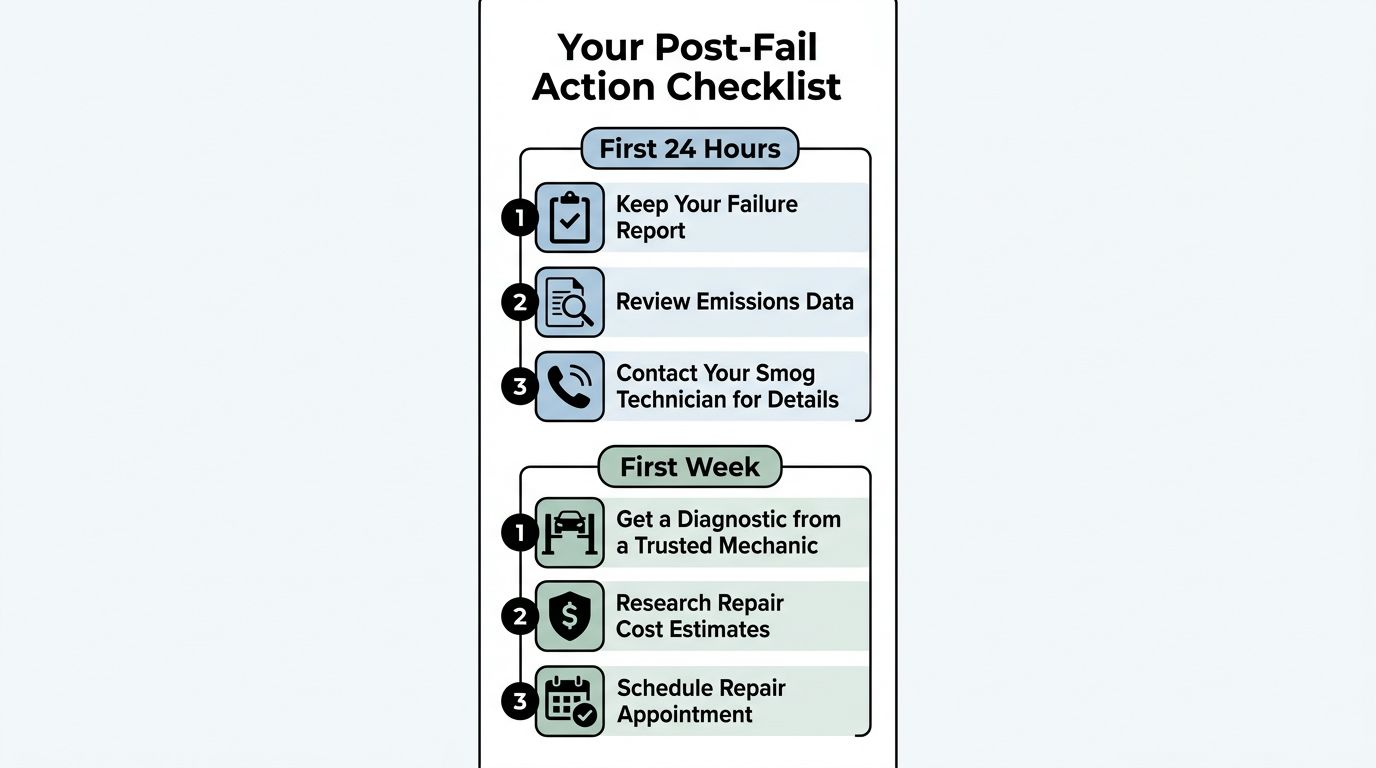
First 24 hours
- Keep the failure report. Photograph every page of the VIR and store the original with your registration documents.
- Review emissions data. Mark each failed category, every “not ready” monitor, and any gross-polluter or directed-vehicle designation.
- Check the calendar. Record your registration expiration date and the retest deadline shown on the paperwork.
- Pull diagnostic codes. Use an OBD-II scanner, save the results, and don't clear codes before a technician reviews them.
- Inspect simple items. Check the gas-cap seal, warning light, visible vacuum hoses, air filter, and obvious emissions-component damage.
First week
- Choose the correct station type. Call a regular station, STAR Test-Only station, STAR Test-and-Repair station, or BAR Referee based on the VIR designation.
- Get a real diagnosis. Ask the technician to verify the code, test the suspected system, and check readiness before recommending parts.
- Request a written estimate. Separate diagnostic labor, parts, installation, and retest charges.
- Check assistance before repairs. If the estimate reaches $650, review CAP and waiver eligibility before authorizing qualifying work.
- Schedule the repair. Keep the invoice, parts details, test results, and every document the shop provides.
Within the next 30 days
- Verify readiness after repair. Have the technician scan the monitors before sending the vehicle to retest.
- Retest at an authorized location. Bring the VIR and repair receipts, and confirm that the station can handle any directed or enhanced requirement.
- Confirm DMV receipt. Check that the passing result appears in the DMV record, especially if renewal is pending.
- Protect the paper trail. Keep the passing VIR, invoices, CAP approval, and waiver documents together.
- Escalate intelligently. If the vehicle still fails after repeated repair and testing, stop buying guesses and request BAR Referee guidance. If the repair remains unaffordable or the vehicle cannot meet requirements, ask BAR whether a waiver or assistance route applies.
The fastest path is usually the most documented one. A clear VIR, verified diagnosis, correct station, and complete receipts keep you from paying twice for the same uncertainty.
If your failed smog check is in the San Leandro or East Bay area, bring your VIR and registration paperwork to Speedy Smog for guidance on the appropriate retest path. The STAR-certified station can inspect eligible vehicles and help you understand what needs to happen before you spend money on repairs.
You pull into a smog station certain your car will pass. The check-engine light is off, the engine runs smoothly, and you recently replaced the battery. Then the technician plugs into the OBD-II port and tells you the vehicle is not ready. You haven't failed because the car necessarily has an active emissions fault. You may have erased the computer's self-test history and arrived before it finished checking itself again.
That readiness-monitor problem causes a surprising number of unnecessary repeat visits. A successful car emissions test depends on more than a dark dashboard warning light. In California, the vehicle must meet the inspection requirements that apply to its model year and technology, and the result can affect registration when the DMV requires a Smog Check.
Table of Contents
- Why Your Car Emissions Test Matters More Than You Think
- How California Smog Tests Work by Vehicle Type
- The Readiness Monitor Trap That Causes Unexpected Failures
- How to Prepare Your Vehicle Before the Smog Check
- STAR Certified Stations and DMV Requirements
- What Happens After You Pass or Fail
- Getting Your Smog Check Done at Speedy Smog in San Leandro
Why Your Car Emissions Test Matters More Than You Think
A smog check isn't a formality you can safely leave until the last day of registration renewal. The station is checking whether the vehicle's emissions-control systems have reported enough information to support a pass. If the computer shows incomplete self-tests, the technician may be unable to certify the car even when it appears to drive normally.
California's newer gasoline vehicles are evaluated primarily through OBD-II, which means the vehicle's own diagnostic system plays a central role in the inspection. The California Bureau of Automotive Repair's explanation of OBD readiness rules makes the practical issue clear. A car can have no active malfunction indicator light and still fail because required monitors haven't completed.
The appointment you didn't need to repeat
Consider a driver who had a repair performed, cleared the stored trouble code, or disconnected the battery while replacing it. The warning light goes out, so the driver books the test immediately. At the station, the scan shows that the emissions monitors are not ready. The driver now has to leave, complete the required driving conditions, and return for another inspection.
That failed trip can create a registration problem if the renewal deadline is close. It can also mean another appointment, more time away from work, and a second inspection charge depending on the station's policy. The avoidable mistake isn't always a bad catalytic converter or a serious engine problem. Often, it's testing before the vehicle has finished its post-repair drive cycle.
Practical rule: An off check-engine light doesn't prove that your vehicle is ready for inspection.
Treat preparation as part of the test
Read the DMV renewal notice before choosing a station. It tells you whether a smog certification is required and may identify station requirements that affect where you can go. If you've recently had battery work or emissions repairs, ask a technician to check monitor status before scheduling the official inspection.
The right approach is simple. Diagnose first, repair properly, allow the vehicle's monitors to complete, then test. You can't reliably shortcut the computer's self-checks by clearing the light again, and doing so can make the readiness problem worse.
How California Smog Tests Work by Vehicle Type
California doesn't use one identical procedure for every vehicle. The test depends on model year, fuel type, and the vehicle's emissions technology. The old assumption that every car sits on a dynamometer while a probe measures the tailpipe is wrong for many modern vehicles.
For gasoline vehicles from model-year 2000 and newer, the inspection is generally centered on the onboard diagnostic system. California's BAR states that tailpipe testing is no longer required for most of these vehicles. The technician connects a scan tool to the OBD-II port and checks the required emissions information, including warning-light status and readiness.
Gasoline vehicles from 1996 through 1999 receive both an OBD inspection and a tailpipe test under the verified California rules. That combination gives the station two different views of the vehicle, the computer's stored emissions information and the gases measured directly from the exhaust.
The main categories
| Vehicle Category | Test Method | Tailpipe Test Required |
|---|---|---|
| Gasoline, model-year 2000 and newer | Primarily OBD-II inspection | Generally no |
| Gasoline, model-years 1996 through 1999 | OBD inspection plus tailpipe testing | Yes |
| Diesel vehicles | Procedure depends on vehicle details and applicable California requirements | Varies |
| Hybrid vehicles | Vehicle-specific emissions inspection, with OBD-related checks where applicable | Varies |
| Older vehicles | Requirements depend on model year and California program rules | Varies |
Diesel and hybrid inspections deserve special attention because their systems don't fit the simple gasoline-tailpipe model. Diesel vehicles can involve different emissions controls and compliance rules, while hybrids may run their gasoline engine intermittently and use a high-voltage system that changes how the vehicle operates during testing.
Recent program changes reinforce that point. Colorado's 2025 vehicle emissions program update describes self-service kiosks for gasoline-powered and hybrid vehicles along with tighter diesel compliance rules. The European Union also proposed targeted inspection methods for ultrafine particles and NOx in 2025, as reported in the European Commission's vehicle inspection policy materials. These developments show why modern inspections increasingly focus on the vehicle's specific technology rather than applying one universal test.
If you're unsure which category applies, use the California guide to vehicles that need a smog check and confirm the requirement on your DMV notice. Bring the vehicle information and renewal paperwork to the station so the technician can verify the correct inspection path before starting.
The Readiness Monitor Trap That Causes Unexpected Failures
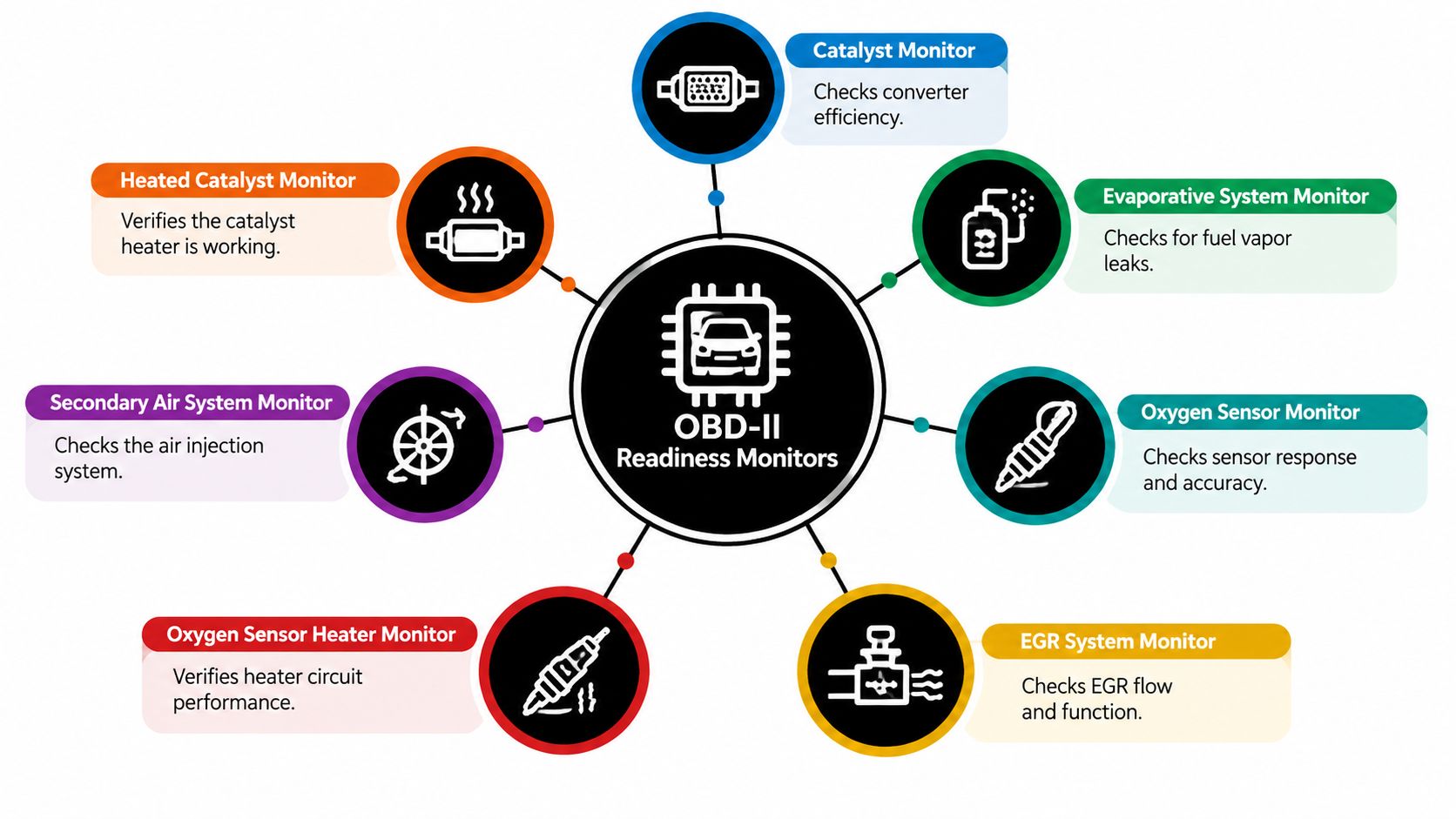
Readiness monitors are emissions-system self-tests stored in the vehicle's computer. Each monitor evaluates a particular operation, such as catalyst performance, oxygen-sensor operation, exhaust-gas recirculation, or evaporative-emissions control. The vehicle must experience the right operating conditions before those tests can run and report a completed result.
Disconnecting the battery or clearing diagnostic trouble codes can reset the monitors to not ready. The same thing can happen after certain repairs when the technician clears the code as part of the repair process. The dashboard may look clean, but the computer's inspection record has been wiped and must be rebuilt through normal driving.
Why a clean dashboard can still fail
Think of the monitors as homework completed by the car's computer. Clearing the codes is like erasing the answers. The warning light may disappear because the computer no longer has a confirmed fault to display, but the inspection still sees unfinished work.
California's BAR explains that some 2000-and-newer gasoline vehicles may have only the evaporative monitor unset under newer readiness rules. Other required monitors must be set. That distinction matters because the allowed status depends on the vehicle and the applicable rule, not on what a driver sees on the dashboard.
The California BAR readiness-monitor regulation guidance should be treated as the controlling reference for the current California requirement. Don't rely on a generic scanner message that says “ready” without understanding which monitors are complete and which remain unset.
Drive time is part of the repair process
The car needs suitable conditions to run its tests. Short trips, unusual driving patterns, or insufficient warm-up may leave a monitor incomplete. CARB's Clean Truck Check OBD testing background notes that some vehicles may require dozens of warm-up cycles, thousands of miles, and hundreds of engine hours before every monitor becomes ready. Those figures apply to the background discussed by CARB and shouldn't be treated as a universal drive-cycle prescription for every passenger vehicle.
If the vehicle refuses to set a monitor after normal driving, stop guessing. A persistent incomplete monitor can point to an underlying emissions-system problem that hasn't triggered a full warning yet. Have a qualified technician check the monitor status and diagnose the system instead of repeatedly clearing codes.
For a practical explanation of the warning-light relationship, review this guide to passing a smog test with a check-engine light issue. The key decision is whether the vehicle needs more drive time or actual diagnosis.
How to Prepare Your Vehicle Before the Smog Check
Preparation starts before the appointment, especially if the car recently had electrical or emissions work. Don't clear codes just to make the dashboard look better. That action can reset readiness and leave the station with no usable inspection result.
Use this checklist as a practical filter:
- Check monitor status: Have a shop or compatible OBD-II scanner verify that the required monitors are ready before the official test.
- Drive normally after repairs: Give the vehicle a mix of city and highway operation so the emissions systems can encounter different conditions. A generic 50 to 100 mile drive may help some vehicles, but it isn't a guaranteed manufacturer-specific cycle, so don't treat that range as a universal rule.
- Avoid a last-minute battery disconnect: Battery work can erase readiness information. Schedule the smog check only after the vehicle has completed the needed self-tests.
- Inspect the gas cap: A loose or damaged cap can allow an evaporative-emissions leak. Tighten it correctly and replace it if the seal is visibly damaged.
- Address warning lights: A lit check-engine light is a direct reason to stop and diagnose before testing. Don't assume an additive or quick reset fixes the underlying problem.
- Arrive with the engine warm: Normal operating temperature helps the inspection proceed smoothly, although warming the car won't repair a fault or complete every monitor by itself.
Be careful with quick fixes
Fuel additives aren't a substitute for diagnosis. Use one only when the product is appropriate for the vehicle and a technician has identified a reason to use it. Random parts replacement is just as wasteful. A dirty air filter, overdue oil service, poor tire pressure, or stale fuel may deserve maintenance, but none of those items should distract you from an incomplete monitor or an active emissions fault.
The best pre-test check is an honest scan. Ask for the exact monitor status, any pending codes, and an explanation of whether the vehicle is ready to test. If the technician tells you to keep driving, ask what condition the monitor needs, such as highway cruising, steady warm-up, or a cold start after the vehicle sits.
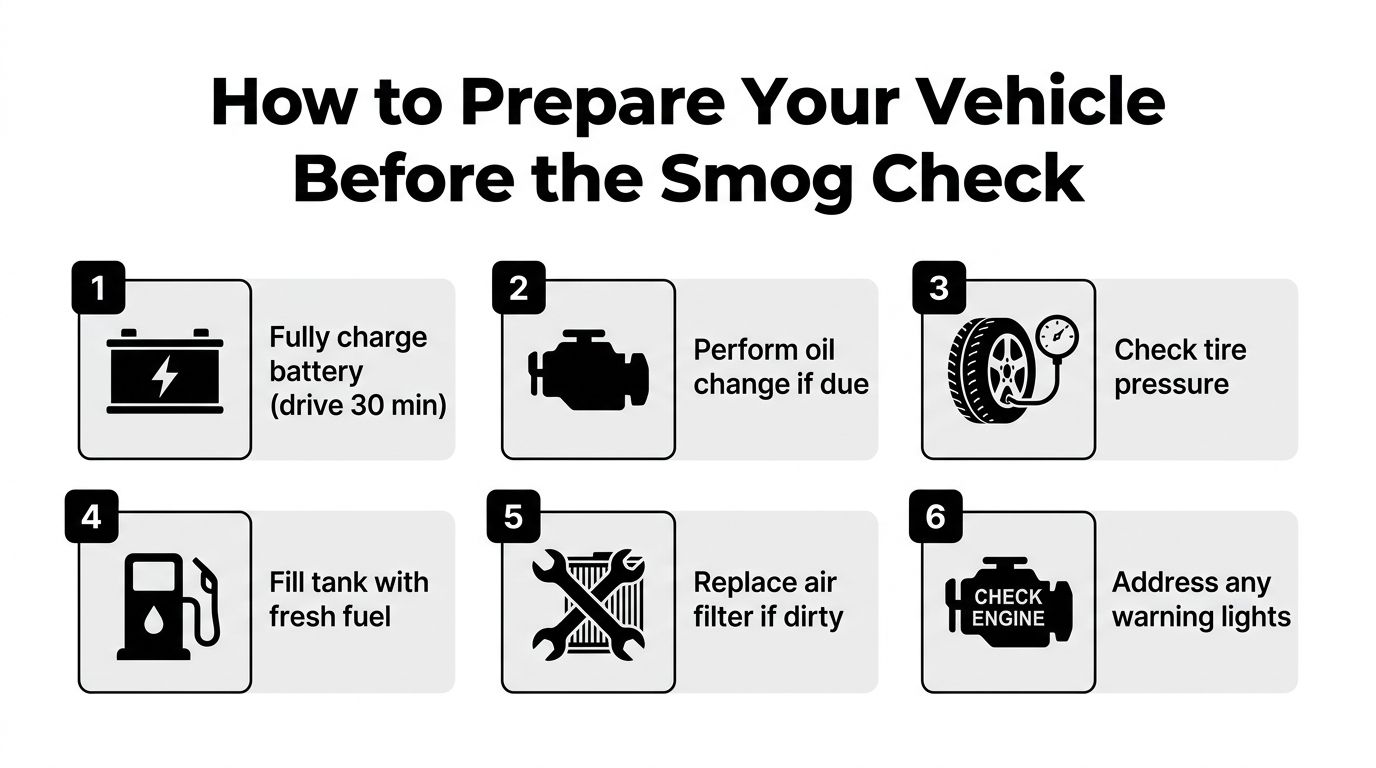
A visual checklist can help you avoid the most common oversights. Keep the appointment flexible enough to allow diagnosis and drive time rather than booking it immediately after a repair.
STAR Certified Stations and DMV Requirements
A STAR-certified station meets additional performance requirements established by California's Bureau of Automotive Repair. That designation matters when the DMV directs you to a STAR facility or when your notice specifies a STAR inspection. In that situation, a non-STAR station may not be able to complete the certification you need.
The station types can be confusing because they don't all provide the same service. A test-only station performs the inspection but doesn't repair the vehicle. A test-and-repair station can inspect and repair vehicles, subject to the program rules that apply to that station. A non-STAR station may perform ordinary inspections when the DMV notice doesn't require STAR certification.
Read the renewal notice before choosing
Don't select a shop solely because it appears first in an online search. Look for wording that identifies a directed vehicle, STAR requirement, or specific inspection condition. If the notice requires STAR, confirm the station's current certification before you arrive.
| Station Type | What It Generally Does | When It Fits |
|---|---|---|
| STAR test-only | Performs qualifying inspections without repair service | When the notice requires STAR and you already have a repair plan |
| STAR test-and-repair | Performs qualifying inspections and may handle repairs | When you want diagnosis and repair at the same facility |
| Non-STAR station | Performs inspections allowed under its certification | When your notice doesn't direct you to STAR |
A station's ability to test a vehicle doesn't automatically mean it can satisfy every DMV instruction. Bring the renewal notice, registration information, and any prior failure report. That paperwork prevents an avoidable mismatch between the required inspection and the service you request.
For East Bay drivers, Speedy Smog's STAR-certified station information explains the certification and location details. The useful question isn't whether STAR sounds better. It's whether your DMV notice requires it and whether the station can perform the exact test assigned to your vehicle.
What Happens After You Pass or Fail
After a pass, the station records the result electronically for the DMV. Keep your receipt or certificate paperwork, then check your registration status if the DMV system doesn't update as expected. If the result doesn't appear, contact the station first and ask them to verify the transmission details before repeating a test.
A failure report is more useful than the word “fail.” It should identify the reason, such as incomplete readiness, an emissions-related code, a warning-light problem, a tailpipe result, or a visible equipment issue. Read that report before authorizing repairs.
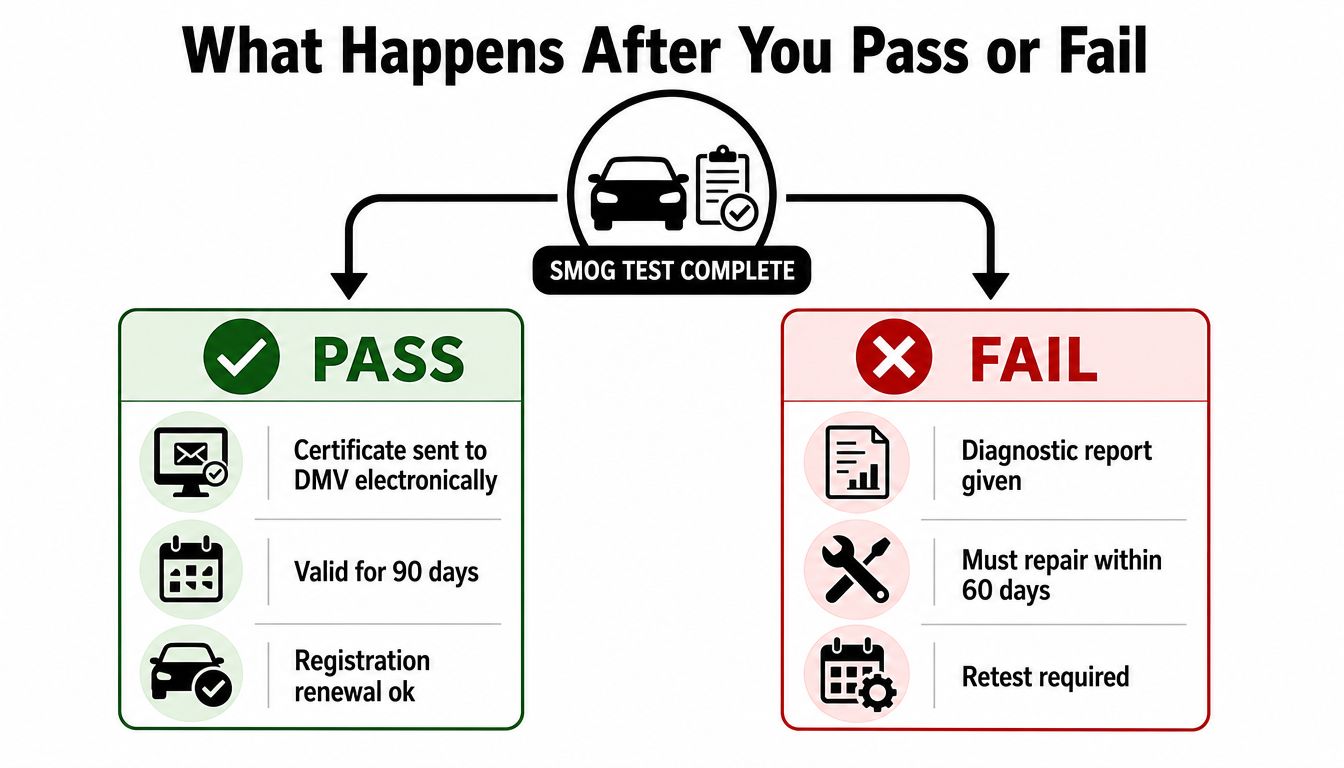
Separate readiness from a real fault
If the only issue is incomplete readiness, the next step may be continued normal driving followed by another readiness check. If the report lists a code or measured emissions problem, you need diagnosis and repair. Don't let anyone sell you a random oxygen sensor, catalytic converter, or fuel-system part without identifying the cause.
Ask the repair facility to answer three questions:
- What exactly caused the failure?
- Was the problem repaired, or was the code merely cleared?
- Are the required monitors ready for retest?
Clearing the code after a genuine repair may be appropriate, but it resets the clock on readiness. The vehicle must then complete its self-tests before returning to the inspection lane.
A failed inspection is a diagnostic starting point, not a parts-shopping list.
Once the repair is complete and the monitors are ready, schedule a retest according to the station's policy and the instructions on your failure paperwork. You may not need to use the original station, but the replacement station must be authorized to perform the required inspection. Ask about retest terms before approving the first test, and check California's Consumer Assistance Program rules if repair costs create a hardship. Eligibility and assistance conditions can change, so use the current official program information rather than relying on informal advice.
Getting Your Smog Check Done at Speedy Smog in San Leandro
East Bay drivers can choose a station based on the vehicle's actual requirements, not just convenience. Speedy Smog is a STAR Certified station at 15275 Washington Ave in San Leandro, and it handles inspections for newer gasoline vehicles, older models, diesels, and hybrids. The shop also transmits smog results electronically to the DMV.
For many 2000-and-newer vehicles, the typical inspection takes about 10 to 15 minutes, as stated in the publisher information. That timing assumes the vehicle is ready to test and no diagnostic issue interrupts the process. If you've recently cleared codes or disconnected the battery, check readiness before you arrive so a quick appointment doesn't turn into a return trip.
The shop offers a clean indoor waiting room and transparent pricing. Periodic $25-off coupons may apply to most smogs on newer vehicles, so check the current offer before scheduling. Its “Smog & a Smile” approach is straightforward, inspect the vehicle correctly, explain the result, and help you understand what to do next.
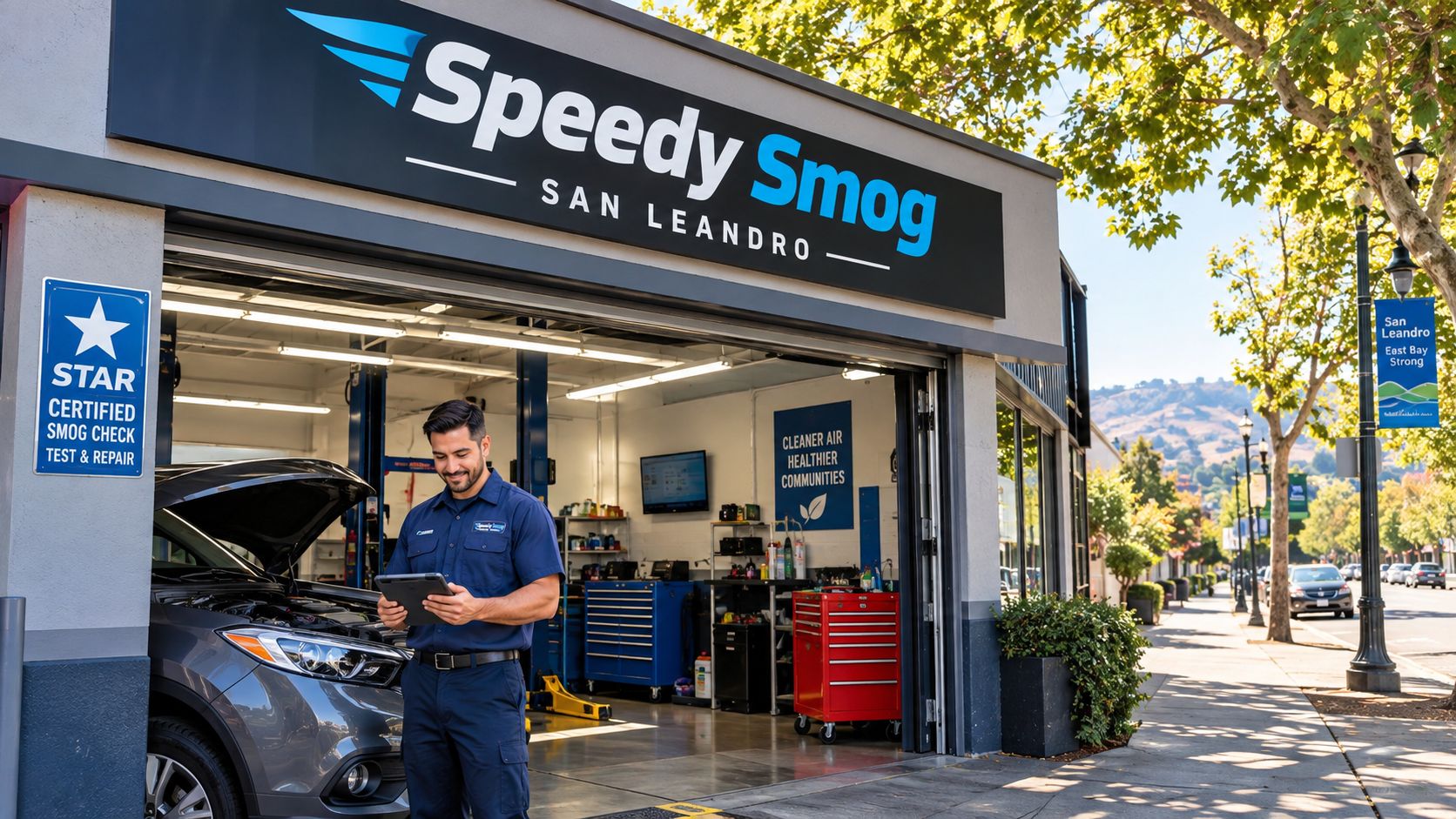
Speedy Smog is open Monday through Saturday at its Washington Avenue location, serving drivers from San Leandro and Oakland who need DMV smog certification or renewal. Bring your DMV notice and mention any recent battery replacement, code clear, or emissions repair before testing.
Speedy Smog provides STAR-certified smog checks for gasoline vehicles, older cars, diesels, and hybrids, with electronic DMV reporting and practical guidance about readiness monitors. Visit Speedy Smog at 15275 Washington Ave in San Leandro, Monday through Saturday, and call or schedule before your appointment if your vehicle recently had repairs or a battery disconnect.
You're already at the point where the smog appointment is on the calendar, the renewal deadline is creeping closer, and you're trying to figure out whether one more drive around the block will save the day. Most failures I see don't start at the station, they start in the driveway, with a cold engine, a hidden warning light, or a monitor that never finished setting. The good news is that passing an emissions test in California is usually about preparation, not luck.
California's rules are strict for a reason. The EPA says today's vehicles are up to 99% cleaner than those on the road in the early 1970s, which shows how far emissions control has come, but it also means modern inspections are built around whether the vehicle's systems are doing their job. For many drivers, the difference between a pass and a fail comes down to OBD-II readiness, a clean visual inspection, and showing up with the car in the right condition for the test.
Table of Contents
- Pre-Test Checklist Before You Arrive at the Station
- Completing the Drive Cycle and OBD Readiness Monitors
- Visual and Mechanical Items Inspectors Check
- What to Expect on Test Day at a STAR Station
- Common Failure Causes and Realistic Fixes
- What to Do If Your Vehicle Fails the Smog Check
Pre-Test Checklist Before You Arrive at the Station
The most common bad appointment I see is the one where the driver rolls in with the engine still cold, the check engine light glowing, and a look that says, “Maybe they won't notice.” They will notice. A lit check engine light is not a detail you can talk your way around, and if the engine computer hasn't finished its emissions checks, the vehicle may not be ready to pass even if it drives fine.
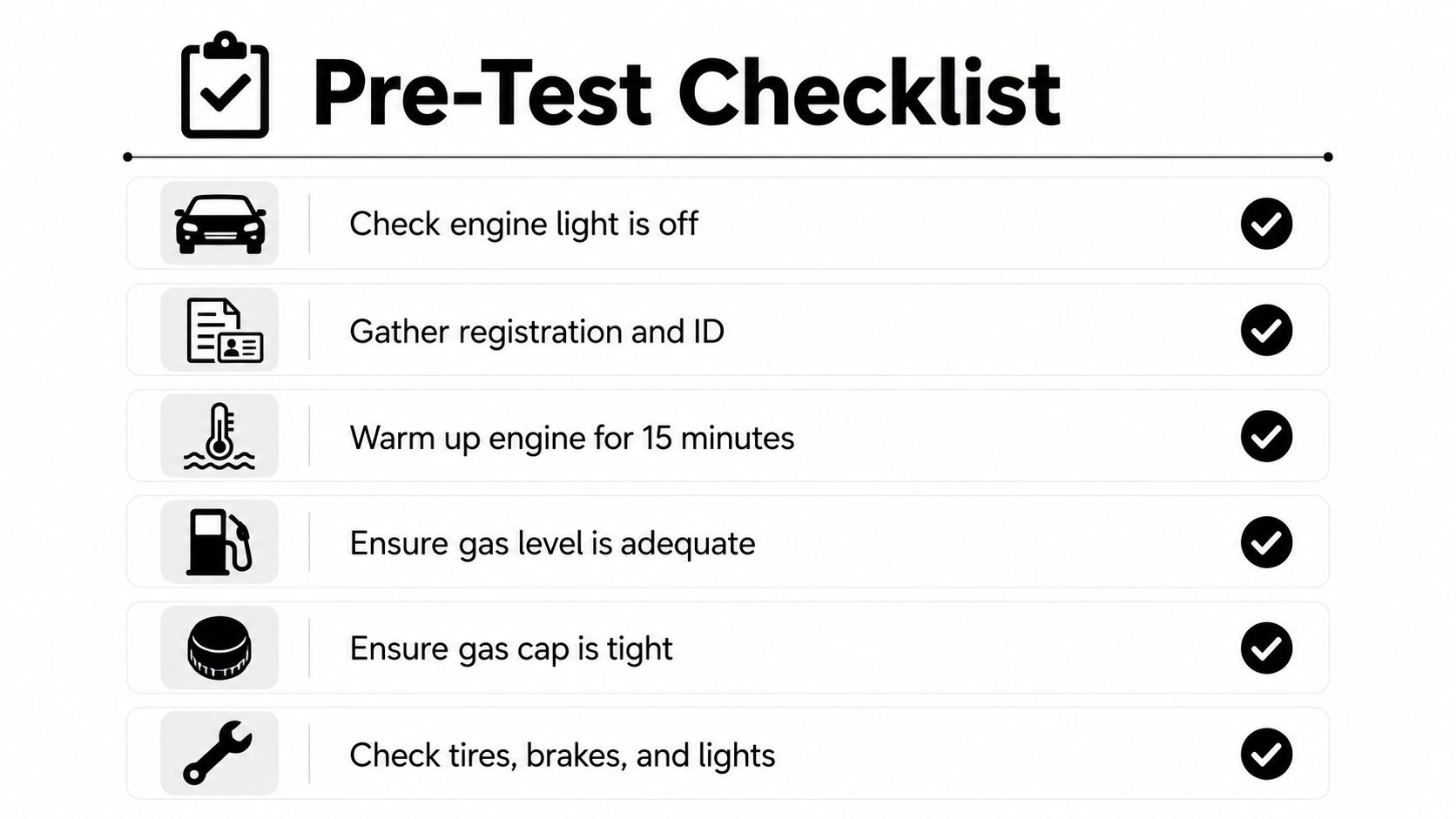
Start with the obvious things
Before you leave home, look at the dashboard with the key on and the engine running. If the check engine light is on, don't assume it'll magically disappear on the way to the station. In OBD-era vehicles, a car can still pass when the light is operating normally but off and all but one monitor is completed under most conditions, but that only helps if the rest of the system is in good shape too.
Practical rule: if the car is alerting you on the dash, treat that as a repair problem first, not a testing problem.
Then check the simple visual items that cause wasted trips. Open the hood and look for loose hoses, wet spots, obvious leaks, or anything that looks disconnected. On California inspections, a car can fail for visual issues even when it runs normally, especially under the state's more detailed Smog Check process, which looks beyond just tailpipe behavior and routine drivability, as the California Smog Check Manual makes clear.
Don't skip paperwork and basic condition checks
Bring what the station needs for DMV processing, and make sure the car is reasonably presentable. A loose gas cap, missing under-hood label, or obvious mechanical issue can slow the inspection or end it early. If the car recently had service, keep a mental note of what changed, because a fresh repair sometimes explains a pending code or a monitor that hasn't reset yet.
If you're the type who likes to prep everything in one shot, it helps to review an oil-change and service checklist before the smog visit, since neglected maintenance often shows up as emissions trouble later. One useful reference is this guide on oil change timing before a smog check.
The short version is simple. No warning lights, no obvious leaks, no missing parts, and a warm, healthy car gives you the best shot at a clean first visit. If any of those pieces are off, fix them before you burn time in the waiting room.
Completing the Drive Cycle and OBD Readiness Monitors
Modern California smog checks lean heavily on what your car's computer says about itself. That's the whole point of OBD-II readiness, the system's way of confirming that emissions monitors have run and passed. For many 2000-and-newer vehicles, the inspection is less about a dramatic tailpipe reading and more about whether the vehicle has completed the checks that prove the emissions system is functioning under real driving conditions.
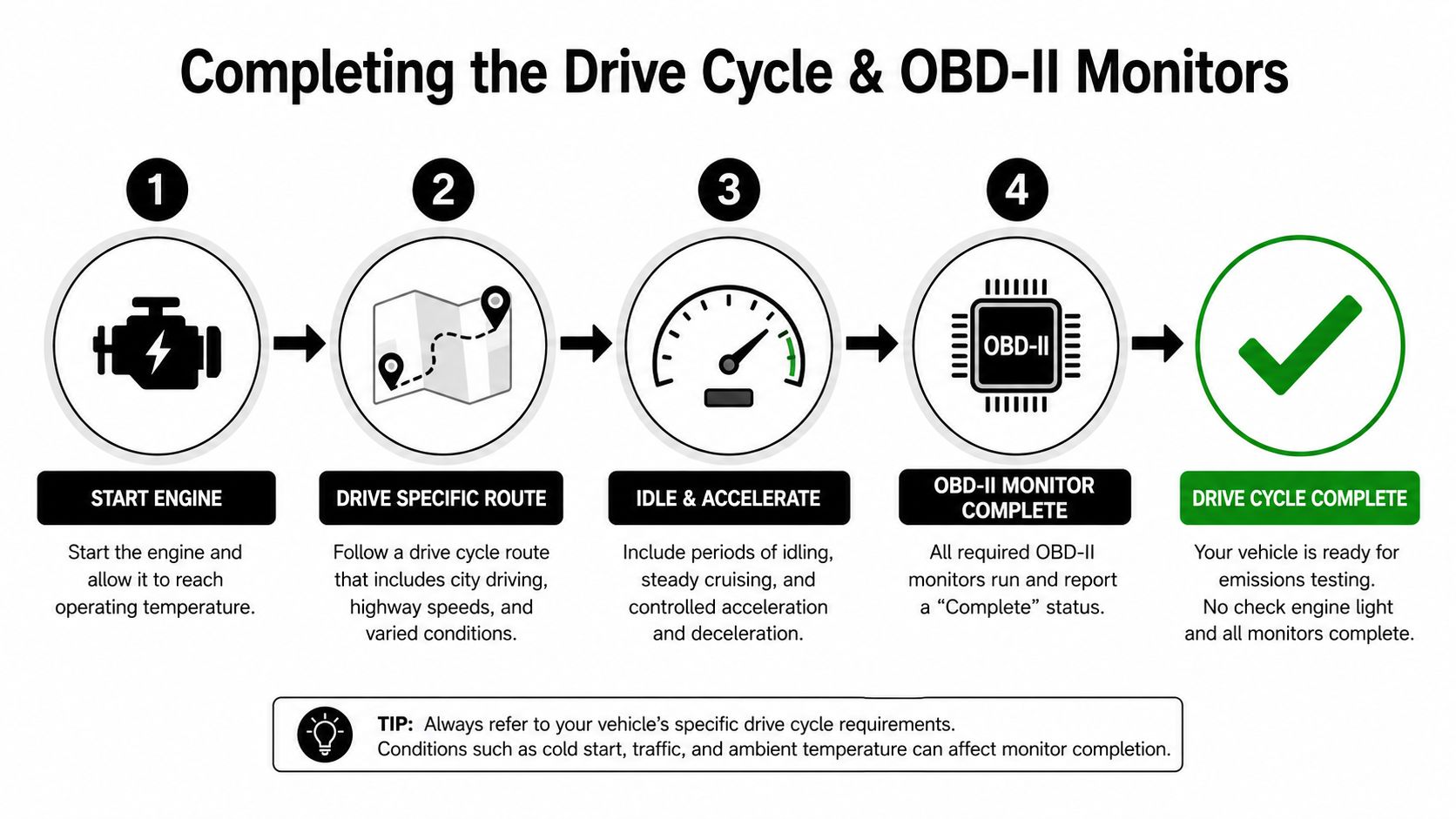
What the drive cycle is really doing
The typical advice is to complete a full drive cycle of about 30–60 miles (50–100 km) with mixed conditions, because the computer needs enough varied driving to run its emissions monitors. That means some city-style stops, some steady cruising, and enough time for the car to settle into normal operating behavior. Current guidance also points to warming the engine to about 70–105°C (160–220°F), since colder engines can produce more pollutants and may keep monitors from setting. See the practical drive-cycle guidance in the OBD readiness preparation guide.
That's why a short hop to the gas station doesn't count. A monitor that hasn't completed isn't the same thing as a broken car, but it can still stop you from passing.
Fuel level matters more than most drivers think
Keep the fuel tank roughly 25% to 75% full before the test. That range matters because evaporative-emissions checks are sensitive to fuel level, and showing up near empty or completely full can interfere with readiness. The car can be mechanically fine and still fail to set the right monitor if the tank level is off.
Drive it like a real trip, not like a test lap. The computer wants varied conditions, normal temperature, and enough time to finish its checks.
If you've had codes cleared recently, especially after a battery disconnect or repair, give the car time to relearn everything before the appointment. That reset wipes the readiness status, which is one of the fastest ways to turn a potentially easy pass into an automatic delay.
For drivers who want to understand the codes themselves before heading in, a solid starting point is a guide on reading OBD codes. The value there isn't in guessing a fix, it's in knowing whether you're dealing with a simple readiness issue or an actual fault that needs repair.
The practical move is to schedule your drive cycle a few days before the appointment, not the morning of. If the monitors don't finish, you'll know in time to correct course instead of discovering it at the counter.
Visual and Mechanical Items Inspectors Check
A clean dashboard doesn't guarantee a clean result. California inspectors also look at visual and mechanical condition, and that's where a lot of “but the car drives fine” stories fall apart. A vehicle can run smoothly and still fail if the inspector sees missing equipment, leaks, overheating signs, or a modified setup that doesn't match what the car is supposed to have.
The stuff that gets missed in the driveway
One of the first things an inspector pays attention to is whether the emissions hardware is all there. That includes the catalytic converter, related hoses, and any parts that look tampered with, missing, or out of place. If a previous repair shop used a shortcut, or an owner removed something during a modification, the station may flag it even if the car seems happy on the road.
California's inspection manual also makes it clear that inspectors look for obvious safety hazards and visual issues like leaks or overheating. That means a fresh oil film, coolant seepage, or a hose that's hanging by a thread can become a failure point even before anyone digs into the computer data.
Gas caps, exhaust, and aftermarket parts
The gas cap still matters because it affects the evaporative system. A bad seal, missing cap, or cap that doesn't tighten properly can trigger trouble during the inspection process. Exhaust leaks, loose clamps, and cracked hoses are just as annoying, because they can point to a deeper problem or make the emissions system behave unpredictably.
Aftermarket modifications are another trap. A part that looks cleaner or newer isn't automatically compliant. If the car has been altered in a way that changes the emissions equipment layout, the inspector may treat it as a missing-component issue rather than a cosmetic upgrade.
If you hear a rattle, smell fuel, or see a fluid trail, don't gamble on the test. Fix the mechanical issue first, then come back ready.
Older vehicles and modified cars deserve extra attention here because the visual portion matters more when the car has a longer history of repairs, swaps, or nonstandard parts. What fails people most often is not a dramatic breakdown. It's a small oversight, like a cracked hose, a loose clamp, or an evaporative component that never got reinstalled after service.
What to Expect on Test Day at a STAR Station
At a well-run station, test day should feel organized, not mysterious. You bring the documents, hand over the keys, and the technician starts with the required checks for your vehicle type. If your car is one of the vehicles required to use a STAR-certified location, that matters because STAR stations meet higher performance standards set by the Bureau of Automotive Repair.
What the station actually does
For a 2000-and-newer car, the process usually centers on the OBD system, readiness monitors, and visual confirmation that the emissions equipment is in order. Older models, diesels, and hybrids can follow different testing paths, which is why assuming every smog appointment is the same is a mistake. The vehicle may be inspected, plugged in, and checked for compliance items that don't show up on a generic “my car runs fine” readout.
A clean station should also tell you what it needs up front, so you aren't guessing about paperwork or waiting around with an unprepared car. If you're trying to understand why one station is required over another, the basics of what a STAR station is matter more than most drivers realize, especially if registration renewal is on the line.
Time, waiting, and choosing the right place
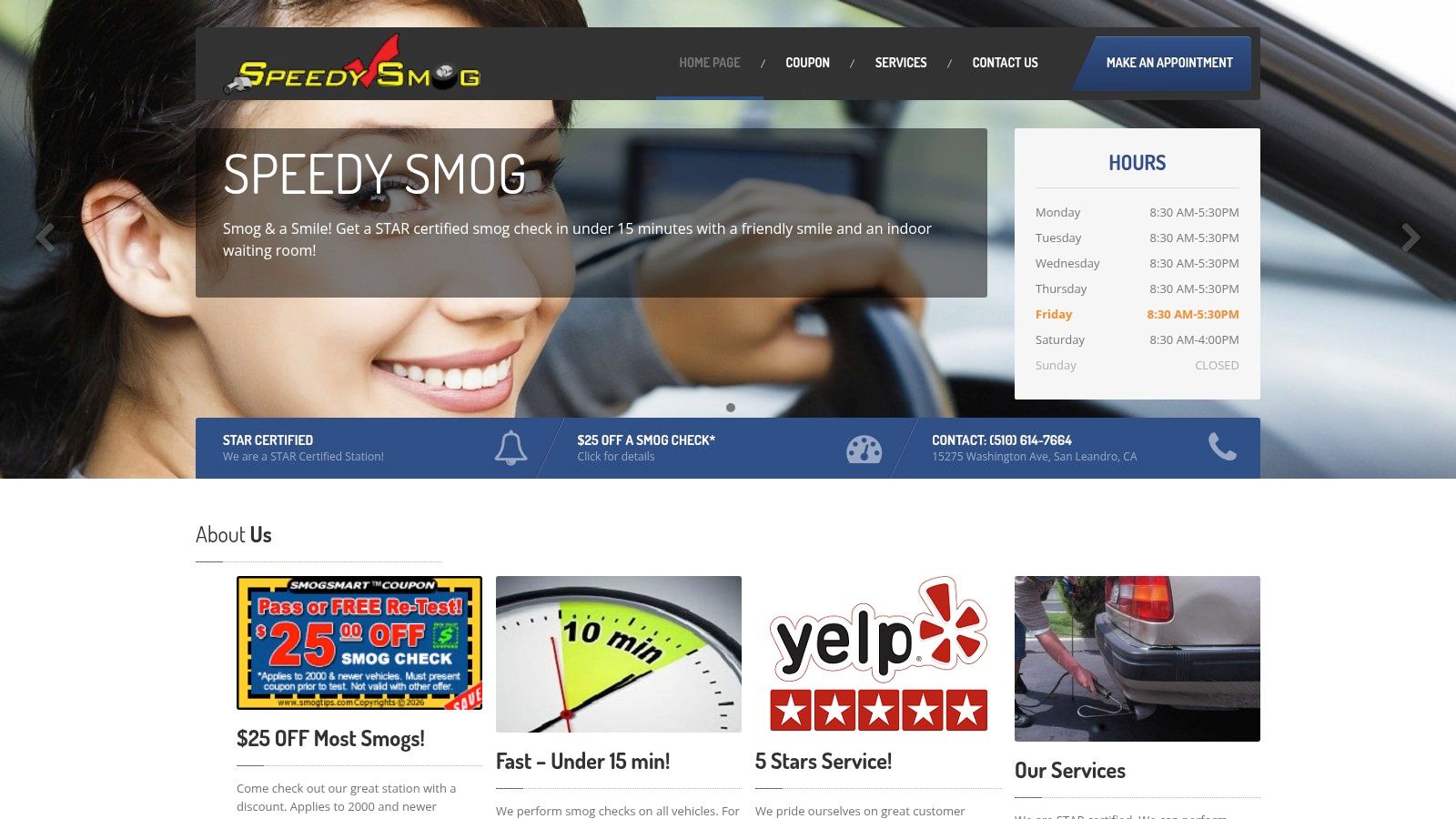
A good smog shop respects your time. Speedy Smog in San Leandro, for example, completes most tests for 2000-and-newer vehicles in about 10 to 15 minutes, and that kind of turnaround is exactly what you want when the goal is to get in, get certified, and get back on the road. The indoor waiting area also matters more than people admit, especially when you're dealing with a second visit or a busy weekday schedule.
One thing I tell drivers is to treat the station choice as part of the test preparation. A place that knows California compliance, handles different vehicle types correctly, and doesn't waste your time makes the whole process easier. You don't need a sales pitch, you need accurate testing and clean paperwork.
If your vehicle is one of the newer models, the practical advantage is speed. If it's older, diesel, or a hybrid, the advantage is finding a station that already knows how to handle those protocols without improvising.
Common Failure Causes and Realistic Fixes
Most failed smog checks come from a handful of repeat offenders. The frustrating part is that many of them look small from the driver's seat, but they're enough to stop the test cold. I see a lot of people hoping for a shortcut, then learning the hard way that emissions systems don't care about last-minute additives, battery tricks, or a dash of optimism.
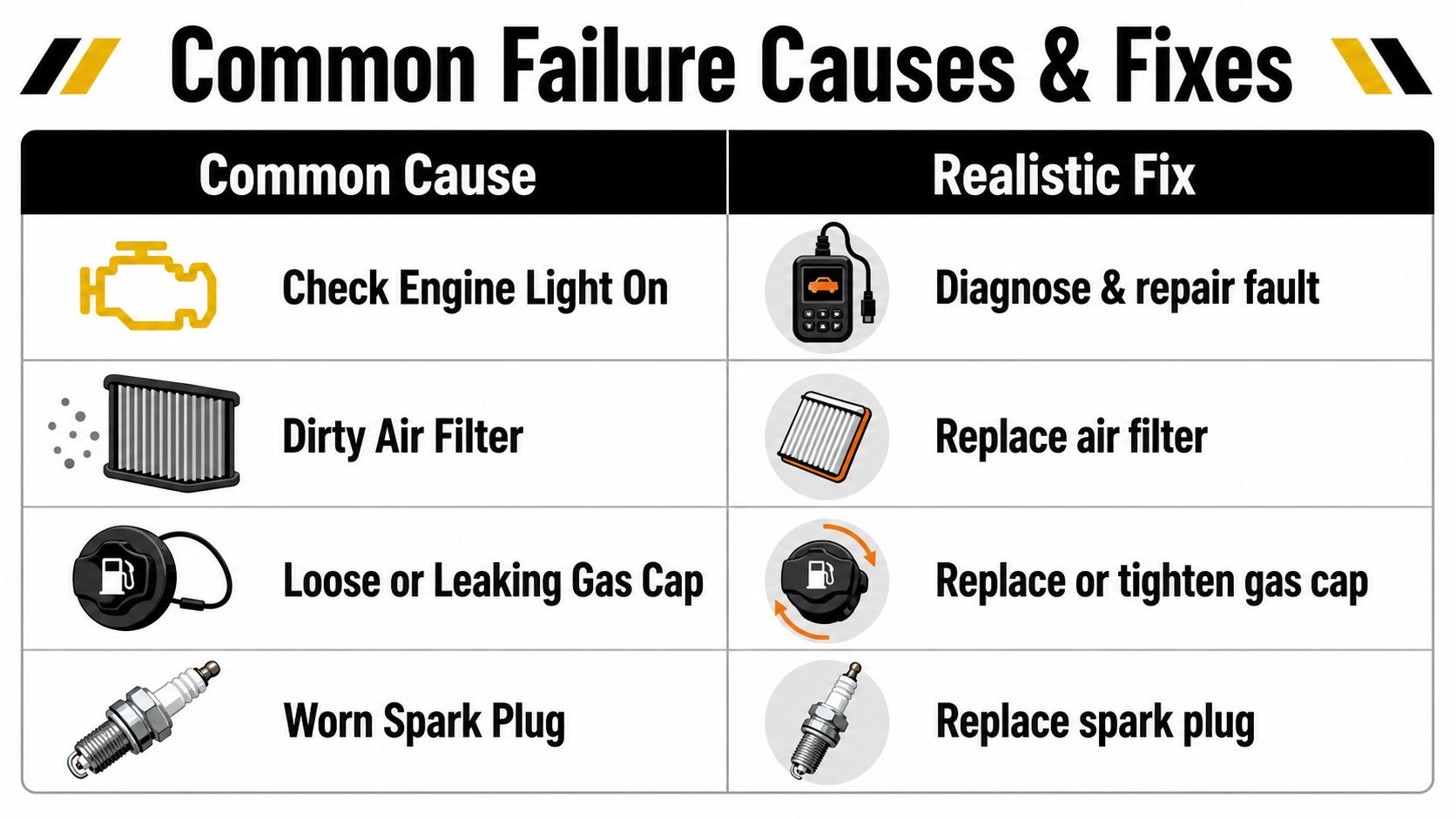
What usually breaks the pass
A loose or failing gas cap is an easy one to miss, and it's often one of the first things worth checking because it affects the evaporative system. Worn oxygen sensors and degrading catalytic converters are more serious, because they point to actual emissions-control problems that need diagnosis and repair rather than a quick reset. Vacuum leaks are another classic issue, especially on older vehicles or cars that have had recent work.
Pending diagnostic trouble codes are the sneaky ones. The check engine light might still be off, but the car has already logged a problem that can keep it from passing. That's why a scan tool matters more than a guess.
Disconnecting the battery is not a fix. It clears memory, resets readiness, and often sets you back instead of moving you forward.
What actually works
The honest answer is to repair the fault that triggered the code, then drive the car long enough for the monitors to reset. If the gas cap is bad, replace it. If a sensor is lazy, diagnose it properly instead of throwing parts at the problem. If the catalytic converter is degraded, don't expect a fuel additive to rescue it.
For some drivers, a trusted smog station that also understands the repair path can save a round trip. Speedy Smog is one option that offers smog checks and free retests, which can help when you're working through a repair and need to come back after the vehicle is ready.
The trade-off is time versus guessing. Guessing is cheap for about five minutes, then it becomes expensive.
What to Do If Your Vehicle Fails the Smog Check
A failed result isn't the end of the road, it's a repair roadmap. Start with the Vehicle Inspection Report, because that's the document that tells you whether the problem is readiness, a code, a visual issue, or something deeper. Fixing the wrong item first is how people waste money and miss registration deadlines.
Prioritize the failure, not the noise
If the report points to one clear fault, handle that first. A weak gas cap, a sensor issue, or a vacuum leak should be addressed before you think about anything else. If there are multiple items, a good mechanic will sort them in order of what blocks the pass fastest and what might be secondary damage from the main fault.
California also has a repair cost waiver program for some situations, and the state's rules are the place to look if repairs start to spiral. The key is not to assume a waiver applies automatically. You need to check eligibility against the official requirements and follow the process carefully.
Know your retest and timing options
Many stations offer a free retest policy, which matters if you've already fixed the underlying issue and just need the car checked again. That saves you from starting over at a random shop when the same station can verify the repair. It also helps to retest before the registration deadline gets tight, because waiting too long turns one fix into a paperwork problem.
Get the repair done, drive the car enough to restore readiness, and go back before you start cutting it close on registration.
Special protocols still apply for diesel vehicles, hybrids, and 1999-and-older models, so don't assume the same repair strategy fits every car. Some vehicles need a different inspection path, and some need more patience before they're ready to pass again.
If you want the cleanest route, schedule the repair, confirm the readiness status, and return with a car that's prepared, not just recently reset. That's how you turn a failure into a pass without chasing your tail.
If you want a station that understands California smog rules, handles different vehicle types, and keeps the process moving, visit Speedy Smog in San Leandro. They offer smog checks, free retests, and DMV submission after a passing result, which makes them a practical stop when you need the car certified and the paperwork handled the right way.
You're staring at the dash in the parking lot, the smog appointment is coming up, and that check engine light is sitting there like a warning you can't ignore. In that moment, a lot of drivers want the fastest fix possible, especially if the car still feels fine. The problem is that clearing the light is not the same thing as fixing the fault, and in California that difference can decide whether you leave with a clean result or get turned away.
Table of Contents
- What the Check Engine Light Actually Means
- Using an OBD2 Scanner to Read and Clear Codes
- Alternative Reset Methods and Their Trade-Offs
- Common Causes Behind the Light and When to Seek Repair
- California Smog Test Implications You Cannot Ignore
- Prevention Tips and Your Reset Decision Framework
What the Check Engine Light Actually Means
A driver rolls into the bay after tightening a gas cap, then asks why the light is still on. That's a normal scene, because the dashboard warning does not care whether the problem feels small. It is triggered by the vehicle's ECU or ECM, which watches emissions and engine behavior, stores trouble codes, and turns on the light when something falls outside expected limits.
The light is a diagnostic alert, not a bulb problem
The most important thing to understand is that the light itself is not the issue. The ECU controls the alert, so clearing it only removes the warning, it does not repair the underlying fault. That is why a reset can make the dash look better for a while and still leave the car failing emissions in the background.
Practical rule: if the car needed a code to turn the light on, it still needs a real diagnosis to make the light stay off.
A steady light usually points to a fault that needs attention, but a flashing light is a different situation. That warning usually means a more serious active problem, and it should not be treated like a simple clear-it-and-go job. If the light is flashing, the car needs attention before you keep driving it hard.
What a successful reset looks like
Real success is not a dark dashboard for ten minutes. It is a repaired system, cleared codes, and a vehicle that does not immediately object again after a few trips. In California, that matters even more because the vehicle has to convince the inspection equipment that the emissions systems are behaving normally, not just that someone erased memory.
OBD-II troubleshooting became universal in the 1990s, which is why reset steps are so standardized across brands and models. That universal structure is helpful, but it also creates a trap. It makes code clearing look easy, so people forget that the code existed for a reason.
For a plain-English breakdown of reading and clearing fault codes, see this OBD code guide for California drivers.
Using an OBD2 Scanner to Read and Clear Codes
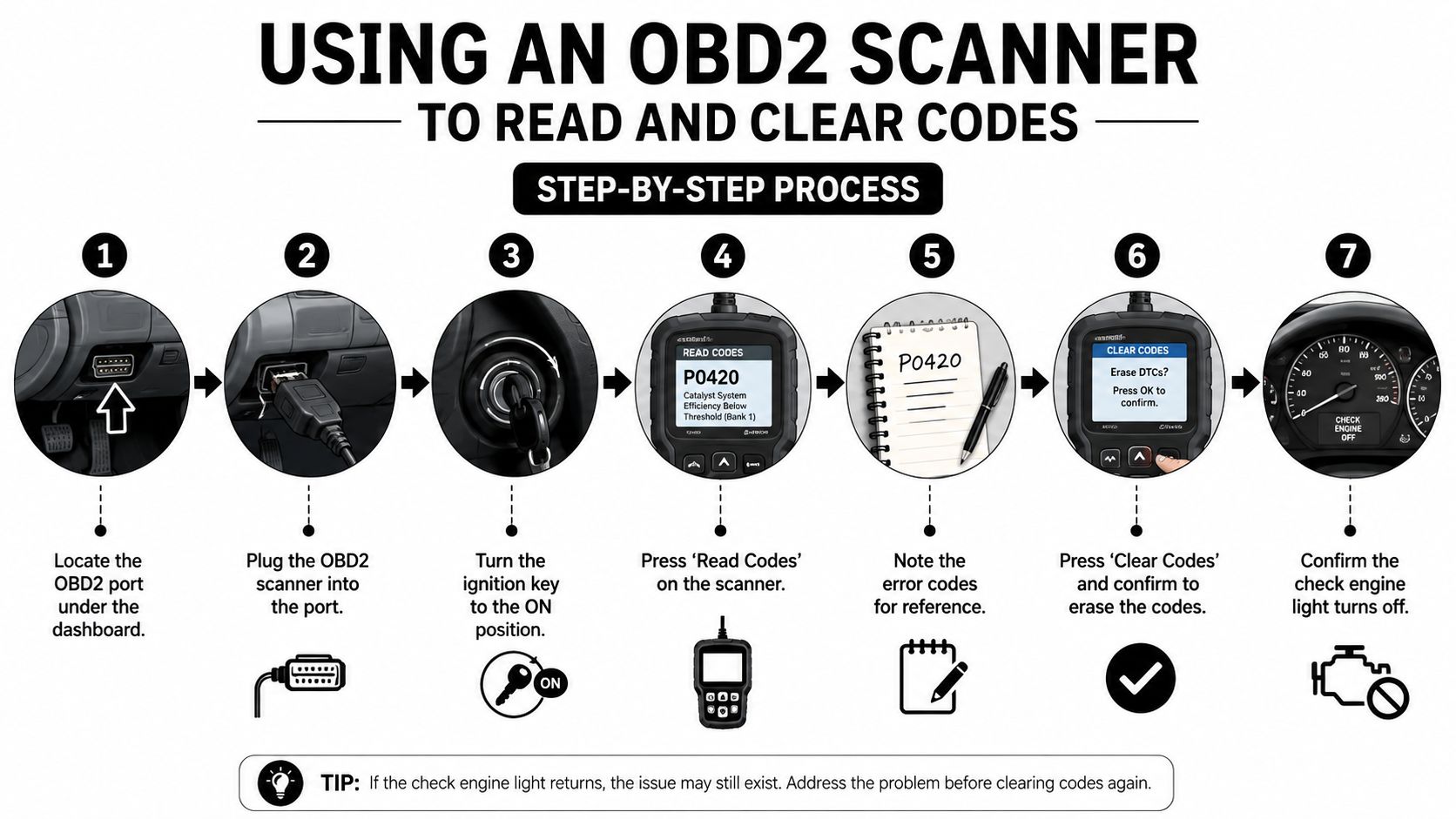
The scanner method works because it matches the way the car's computer stores faults. Plugging in the tool under the dashboard lets you read the codes before you clear them, and that order matters because erasing the memory also erases the clue trail. If you are trying to clear a check engine light before a California smog test, reading first helps you avoid guessing at a fix that may not hold up in inspection.
Read first, clear second
Plug the OBD2 scanner into the diagnostic port with the ignition turned to ON and the engine off. Then read both stored and pending codes, and save or write them down before you touch the erase function. If you skip that step, you lose the most useful information the car can give you.
A lot of drivers try to clear the light first and then see whether it returns. That approach leaves you blind if the fault comes back, and it does nothing to tell you whether the problem is an intermittent sensor issue, a wiring problem, or a repair that did not take. Keep the record even if you do not know what it means yet, because the code family and the freeze-frame context usually tell more than the warning lamp itself.
If you want help understanding the numbers before you clear anything, this OBD code guide for San Leandro drivers is a useful companion.
Clear codes only after the repair is confirmed
The better sequence is straightforward. Fix the fault, reconnect the scanner with the ignition on and the engine off, check the stored and pending codes again, confirm the repair, then use “Erase Codes” or “Clear DTCs” Automotoflux's clear-code guide. If the light goes out, that only means the computer memory was cleared.
Readiness is the part many guides leave out. The monitor status needs to return to “Ready” or “Complete” in Mode 01 PID 01 before the reset means much for smog purposes Automotoflux's clear-code guide. A dark dash and a ready vehicle are not the same thing, and California inspection equipment cares about the second one.
A cleared code is not the same as a fixed car. The scanner can turn off the warning, but it cannot prove the fault stayed gone.
A note on using a professional station
If you do not want to guess, a smog-focused shop can help you check the result after repairs. A station such as Speedy Smog in San Leandro fits that workflow because it performs emissions testing for California drivers who need a compliance result, not just a blank dashboard.
Alternative Reset Methods and Their Trade-Offs
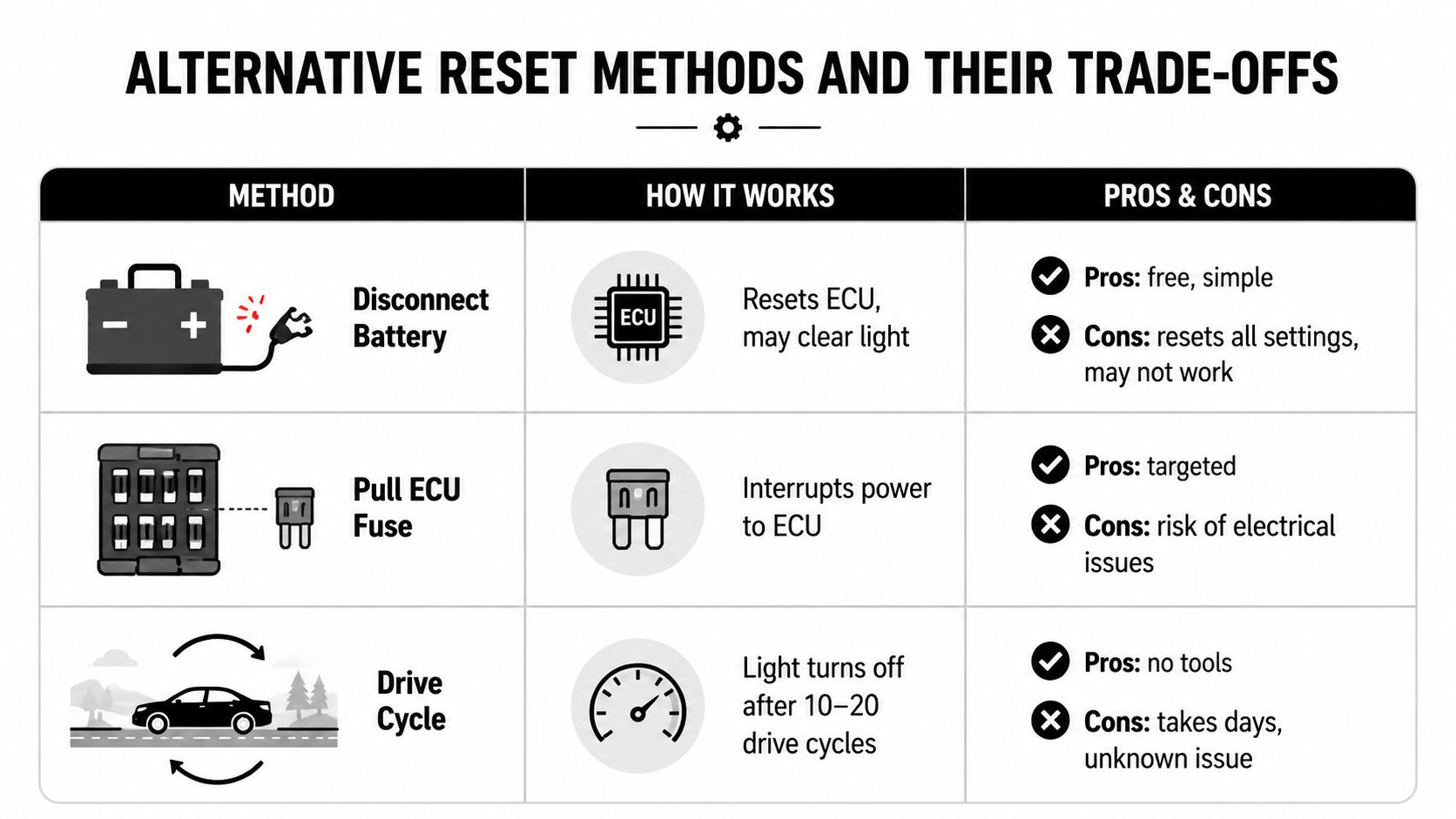
A lot of drivers reach for a power reset when they do not have a scanner handy. It can make the light disappear for a while, but it also skips the part that matters before a California smog test, confirming the fault is resolved AMP Auto's clear-light guide.
Battery disconnect and ECU fuse removal
Disconnecting the negative battery terminal is the common shortcut. Some guides say to wait about 10 to 15 minutes before reconnecting so the ECU reboots and the light turns off AMP Auto's clear-light guide. That can work, but it also wipes radio presets and learned settings, and the same issue can return as soon as the car sees the fault again.
Pulling the ECU fuse does something similar by cutting power to the computer. It is a little more targeted than removing the whole battery, but it still means you are changing the electrical system instead of finding the cause. For a driver trying to quiet the dash before an appointment, that is a risky trade.
Drive cycle resets take patience
The slowest route is letting the car clear itself after the original problem has corrected. One expert source says that after a self-corrected issue such as a tightened gas cap, the ECU may clear the code automatically after 3 to 5 drive cycles, with confirmation recommended over roughly 100 miles of mixed driving AMP Auto's clear-light guide. That approach makes sense only when the problem was temporary and the repair has already happened.
If the fault is still there, a battery disconnect only buys time. The code comes back because the ECU sees the same problem again.
The practical comparison is simple. Battery disconnect is fast but messy. Fuse removal is a little more precise but still a shortcut. Drive cycles are gentle on the vehicle and do not erase settings, but they only make sense when the problem corrected itself and you can afford to wait. For drivers trying to avoid a smog-day surprise, a clear-light trick is not the same as a compliant car. If you want a fuller look at what tends to trigger inspection trouble, this smog fail reasons guide for San Leandro drivers is a useful reference.
Common Causes Behind the Light and When to Seek Repair
A light on the dash doesn't tell the whole story, but the code family usually points in the right direction. A loose gas cap is one of the easiest fixes, while issues tied to sensors, misfires, or the catalytic converter often need more attention. The smart move is to match the symptom to the repair, not to clear the alert and hope the problem behaves.
What the usual suspects look like in practice
| Common Cause | Typical Code | DIY Fixable | Estimated Cost Range |
|---|---|---|---|
| Loose or damaged gas cap | EVAP-related codes | Yes, often | Usually low |
| Oxygen sensor problem | Sensor-related codes | Sometimes, if accessible | Moderate |
| Mass airflow sensor issue | Air metering codes | Sometimes | Moderate |
| Spark plug wear or misfire | Misfire codes such as P0300 | Sometimes, if the service is basic | Variable |
| Catalytic converter issue | Efficiency codes such as P0420 | No, usually not | High |
The exact code matters because different failures affect the car in different ways. A gas cap may be a quick driveway fix, while a catalytic converter concern is a different level of problem altogether. If you want a fuller breakdown of what tends to trip a smog inspection, this smog fail reasons guide for San Leandro drivers is a useful reference.
Which repairs are worth doing yourself
A gas cap replacement is the easiest DIY call when the cap is cracked, loose, or won't seal properly. Some spark plug work is also reasonable if you already know the vehicle and have the right tools. But once the issue involves emissions sensors, misfires that keep returning, or catalyst efficiency codes, the odds favor a proper diagnosis instead of repeated resets.
Real-world test: if the code returns after a reset and a short drive, the car is telling you the fault is still live.
The mistake many drivers make is treating every code like a nuisance. That approach can backfire fast because a small issue left alone can become a larger repair later. A reset is useful only when it follows the right repair, not when it replaces one.
California Smog Test Implications You Cannot Ignore
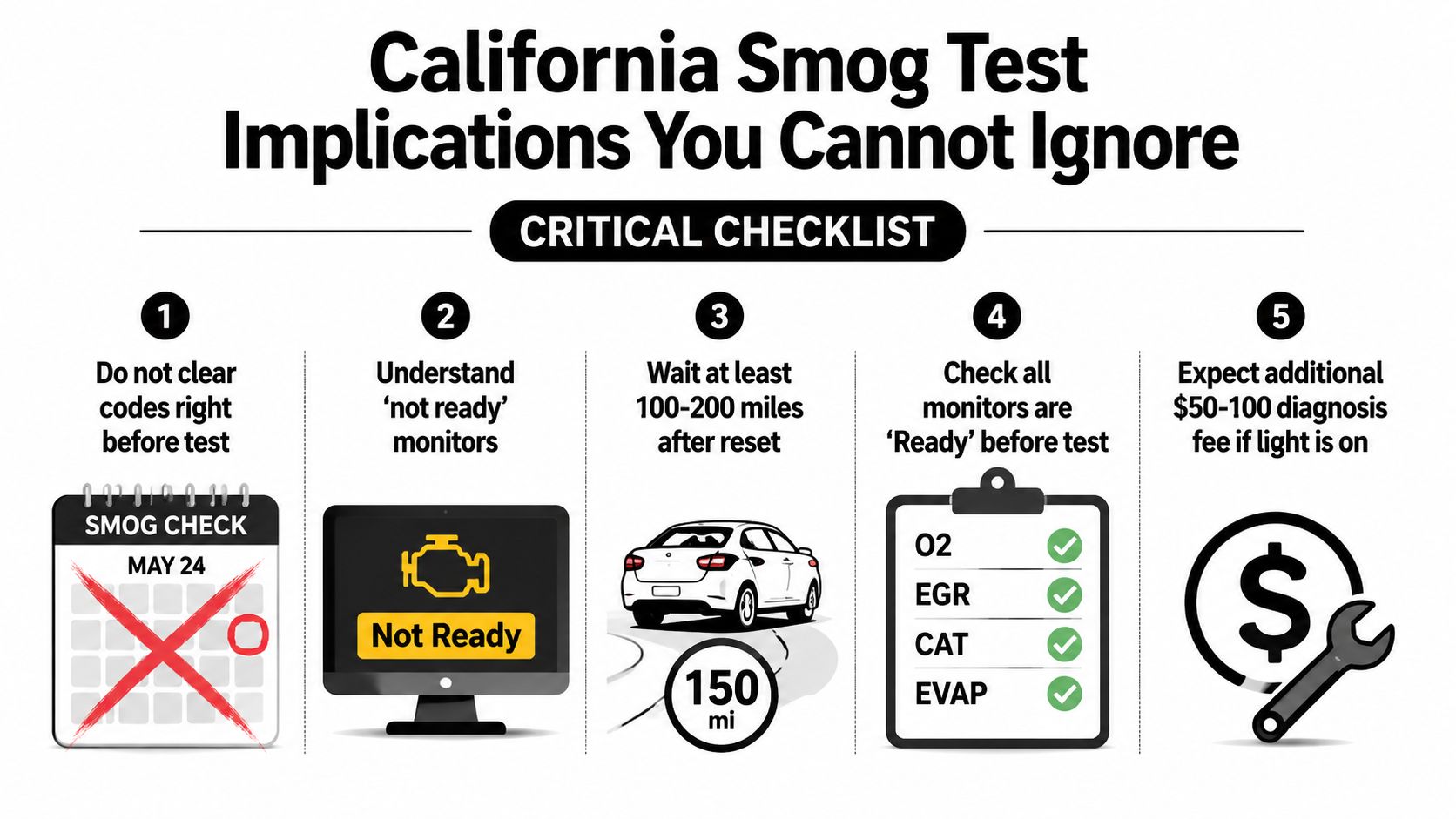
Many East Bay drivers get burned here. Clearing the light right before a smog appointment feels like a fast fix, but it also resets the readiness monitors that inspectors check before the emissions test. If those monitors show Not Ready, the car can be turned away even when the dashboard looks clear.
That is the hidden cost of a quick reset. You may erase the warning on the dash, but you do not erase the inspection problem.
Why timing matters more than most drivers think
After a reset, the vehicle needs time and the right driving conditions to rebuild readiness. Clearing codes the night before a test often leaves the computer without enough time to rerun its self-checks, so the station sees an incomplete snapshot instead of a verified one. A five-step checklist illustrating important tips for passing a California smog test for vehicles. spells out the same basic problem, a recent reset can leave the monitors unfinished when it matters most.
California drivers also need to treat the smog appointment as a compliance check, not a convenience check. If the system is not ready, the station does not give extra credit for a recent reset. It just has less to verify.
Repair first, then drive long enough for the monitors to complete before you book the test. A monitor that says Ready means the car has had a fair chance to run its checks after the repair and reset. That is the condition you want before you pull into a California inspection lane.
Smog stations and the compliance angle
For drivers who want an inspection that lines up with California requirements, a STAR Certified station is usually the safer lane because it follows the higher standard used for DMV-recognized testing. If the goal is a registration renewal that does not come back with another problem, a place like Speedy Smog's check engine light smog test page fits that need because it focuses on the testing process instead of a guess-and-hope reset.
A recent reset can make a car look cleaner than it really is. That matters because a smog lane is checking for readiness and compliance, not just a blank dash. As noted earlier, code clearing has its place, but using it as a last-minute smog strategy usually creates more trouble than it solves.
The practical move is simple. Clear the code after the repair, then give the car time to prove it is ready before the test.
Prevention Tips and Your Reset Decision Framework
The cheapest check engine light is the one that never shows up. Regular maintenance keeps the emissions system from drifting into the kind of fault that turns into a code, a failed test, or a hurried reset attempt. That means handling routine service before the car starts complaining.
Maintenance habits that prevent nuisance codes
- Change oil on schedule: Dirty oil can create avoidable stress on the engine and related systems.
- Tighten the gas cap properly: A sloppy seal is one of the simplest ways to invite an emissions warning.
- Replace air filters when they're due: Restricted airflow can make the engine work harder than it should.
- Keep spark plugs in good shape: Old plugs can contribute to rough running and misfire behavior.
- Take longer drives now and then: Short trips alone don't always let the system run its checks cleanly.
Use a simple decision tree
If the light is steady, read the codes first. If the code points to a clear mechanical issue, repair it before clearing anything. If the issue looks minor and the fault has already been corrected, a proper scanner reset makes sense, followed by a drive cycle and monitor check.
If the light is flashing, stop treating it like a maintenance task and get help. If the code comes back after a reset, the fault wasn't solved. If your smog deadline is close and the monitors haven't finished, don't gamble on a last-minute clear.
A final practical note for East Bay drivers. Speedy Smog handles smog checks for 2000 and newer vehicles, 1999 and older models, diesels, and hybrids, and typical tests for newer vehicles are completed in about 10 to 15 minutes at its San Leandro location Speedy Smog about page. That makes it a sensible stop when you want a compliant result instead of a rushed reset.
If your check engine light is on, bring the car in after the repair and let a proper smog station confirm where it stands. Visit Speedy Smog for a fast, California-compliant inspection in San Leandro, and avoid the mistake of clearing codes right before your test only to get sent back for unreadiness.
You just got the renewal notice, and now the clock's running. If your car needs a smog check, the wrong station can waste your afternoon, trigger a second trip, or leave you stuck wondering why a car that “runs fine” still won't clear DMV.
The fix is to treat dmv smog check stations like a decision system, not a random shop visit. The right station has the right certification, the right equipment, the right testing path for your vehicle, and the right process to get your result into the DMV workflow without drama.
Table of Contents
- Why DMV Smog Check Stations Matter to California Drivers
- What a DMV Smog Check Station Does
- STAR Certification and Why It Changes the Outcome
- How the Test Changes by Model Year and Fuel Type
- Step-by-Step From Booking to DMV Confirmation
- Preparing Your Car to Avoid a Surprising Failure
- How to Choose the Right Station Near You
- Speedy Smog in San Leandro and What to Expect
Why DMV Smog Check Stations Matter to California Drivers
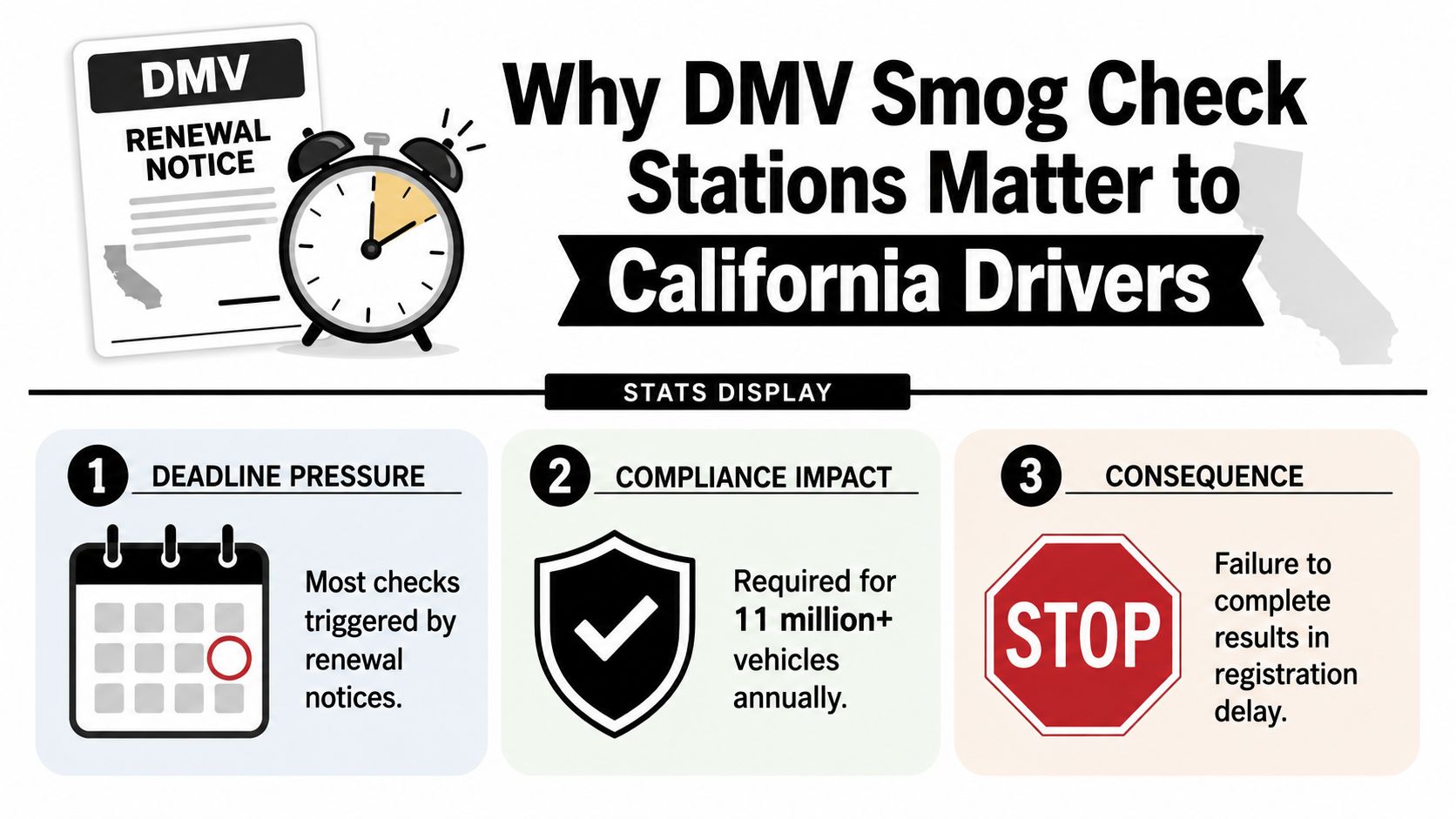
A driver pulls into the DMV with a renewal notice in hand and asks the same question I hear all the time, where do I go, and does it matter which shop I pick? It matters because the smog check is a compliance step tied directly to registration renewal and to the state's emissions program.
California runs a large, statewide Smog Check system that performs more than 10 million inspections each year at more than 5,000 independently owned stations, and state materials say it removes about 400 tons of smog-forming pollutants every day. That scale tells you exactly what these stations are, part of the state's enforcement and air-quality infrastructure, not just repair shops with a scanner on the counter. California Smog Check program overview
What that means at the counter
The station you choose affects both paperwork and time. If the result does not satisfy the DMV requirement for your vehicle, you are still not done, even if the car drove perfectly into the bay.
Practical rule: Do not ask only, “Can this shop test my car?” Ask, “Will this result actually clear my renewal?”
Drivers frequently get tripped up when they treat the smog check like a repair estimate. The test is a regulated pass-fail workflow, and the station has to feed the result into the state system correctly. That is why the right shop is not just about convenience. It is about whether your renewal moves forward cleanly or gets held up at the worst possible time.
What a DMV Smog Check Station Does
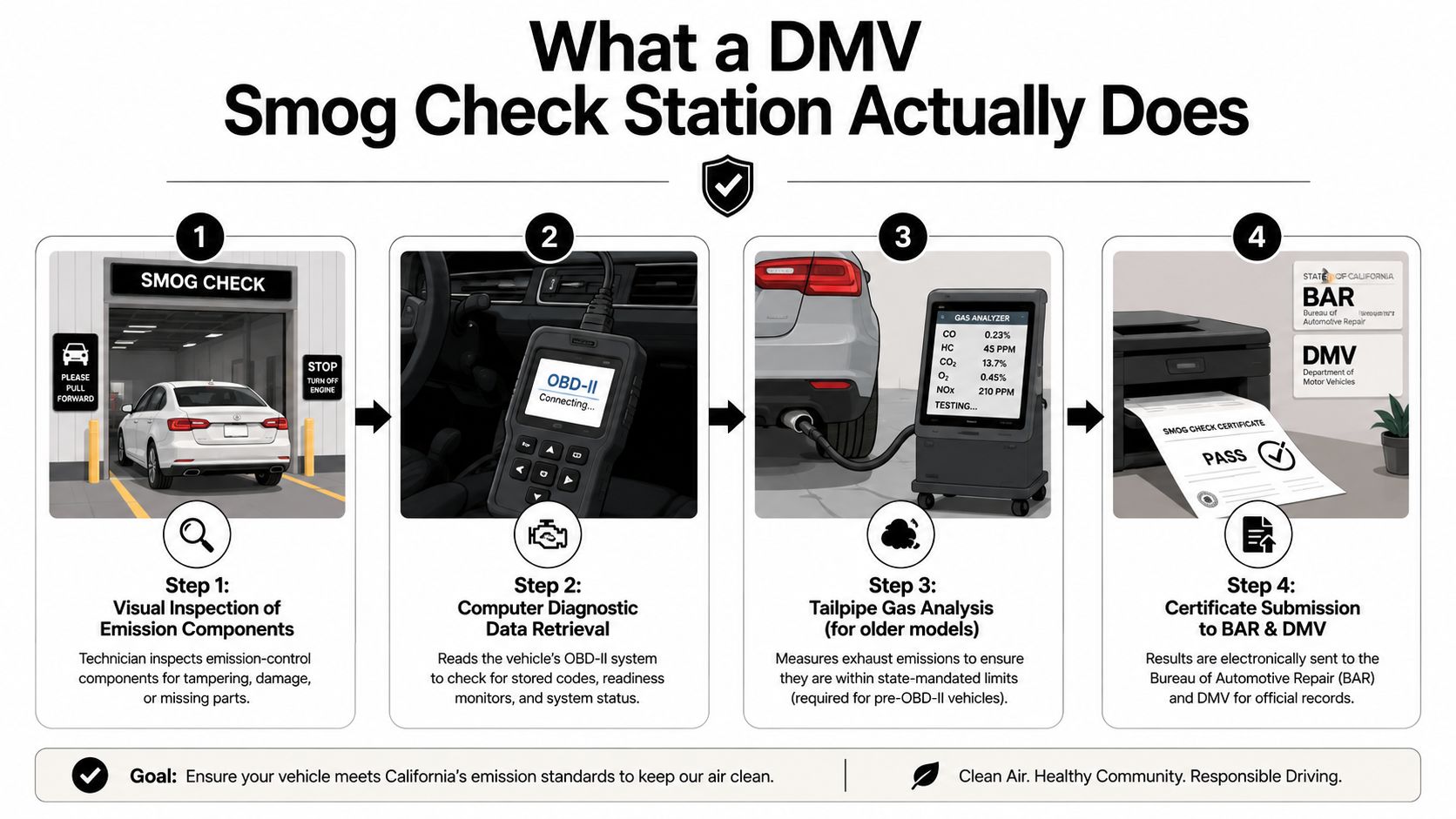
A licensed dmv smog check station keeps BAR-approved inspection equipment, a continuous internet connection, and a Windows-based system that BAR has tested and approved so results can go into the state workflow. BAR smog checklist requirements
What happens when your car pulls in
Your car rolls into the bay, and the tech follows the inspection path the state requires. The station then runs the test through the correct equipment and software for that vehicle class, so the result reflects regulated emissions data, not a quick guess from somebody leaning over the fender.
If you want a station that is set up to handle STAR-directed work too, a good place to start is this overview of a STAR certified smog station in San Leandro. That matters because the test method and the station's authorization both shape what happens next.
The station has to keep its equipment and software in compliance. If the hardware drifts, the internet connection fails, or the approved system is not working right, the record can turn into a headache even when the driver brought in a clean car.
Why this matters for drivers
A smog station earns its value by doing three things correctly, testing, documenting, and transmitting the result. A repair bay can have good mechanics and still miss the mark if it cannot complete the state process the right way.
That is the part drivers trip over. They show up with a renewal notice, assume any shop with a smog sign can finish the job, and then lose time when the result does not move through the system cleanly.
A clean pass only helps if the station gets it into the state system without friction.
STAR Certification and Why It Changes the Outcome
Pull into the wrong station and you burn time. Pull into the right one, and the DMV process moves the way it should. STAR certified stations sit in a higher performance tier, and that tier affects which vehicles they can inspect and how much confidence you should put in the result. If you want a practical local reference, start with this plain-English explanation of a STAR certified smog station in San Leandro.
California's Bureau of Automotive Repair reported 11,275,981 initial tests with an 8.51% initial failure rate in 2025, and said shifting all inspections to high-performing stations could reduce ROG and NOx emissions by 44 tons per day. BAR Smog Check Executive Summary Report 2025
Licensed station versus STAR station
A licensed station can handle standard testing. A STAR certified station has to meet stricter performance standards, and that difference matters the moment the DMV routes a vehicle to STAR. If your renewal notice calls for STAR, a regular shop will not clear that step.
Drivers need to read the notice first and pick the station second. If STAR is required, the wrong bay costs you a second trip. If STAR is not required, you still want a shop with disciplined procedures, because the station tier reflects how well it handles compliance work, paperwork, and transmission into the state system.
Why the data matters
The BAR's 2026 performance reporting also says vehicles certified by high performing stations failed at a lower rate at roadside than those certified by low performing stations. That is the point of the tiering. The state uses station performance as a practical measure of how well a shop's work holds up after the car leaves the bay.
The result is simple for a driver. STAR is the station class that can keep up with DMV-directed work, and it tells you the shop has to stay sharp on process, not just on repairs. If you want the station to be accepted without drama, the performance tier matters as much as the pass or fail itself.
A pass is only useful when the station handles the documentation and transmission correctly. If the DMV wants STAR, the station has to be STAR. If the DMV does not require it, STAR still gives you a cleaner bet that the result will hold inside the state's compliance system.
How the Test Changes by Model Year and Fuel Type
Don't assume every smog check looks the same. A 2015 gasoline sedan and a 1995 pickup do not go through the same workflow, and that difference shapes what you'll see in the bay.
OBD testing versus tailpipe testing
California's rules route 2000-and-newer gasoline vehicles and 1998-and-newer diesel vehicles into an OBD-focused inspection. Older vehicles can require loaded-mode or two-speed idle testing, and in enhanced areas loaded-mode testing uses ASM equipment with a chassis dynamometer. California Smog Check test methods
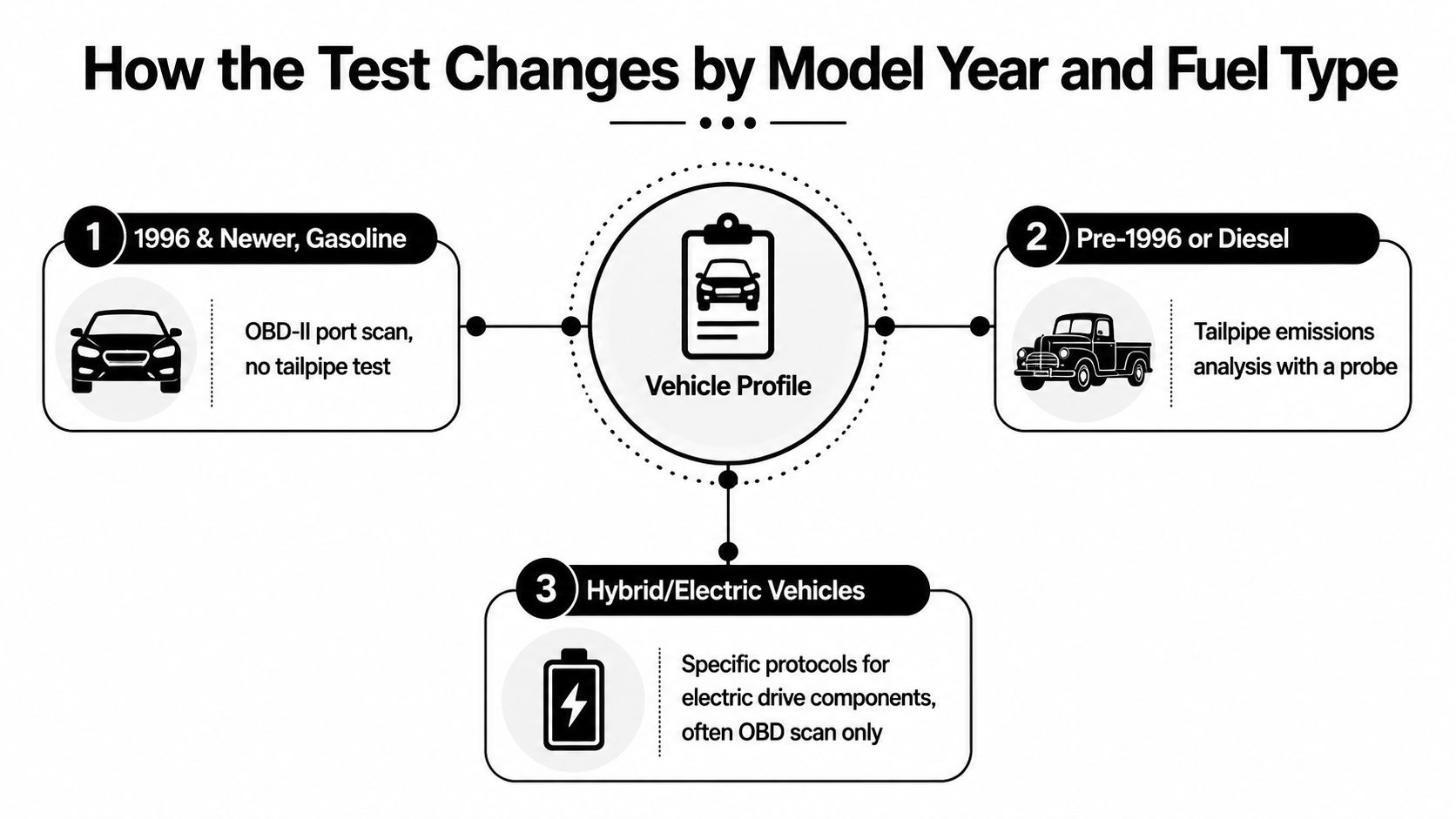
A newer gasoline car usually means a quick scan at the diagnostic port. Older cars can mean a probe in the tailpipe, rollers under the tires, and more time spent measuring emissions behavior under load. Diesel and hybrid paths follow their own compliance logic, so the station has to be ready for more than one kind of vehicle profile.
What you should expect physically
If your car is newer, the visit often feels simple, because the tech is mostly verifying electronic data. If your car is older, the inspection can look more old-school and mechanical, with more equipment involved around the exhaust and drivetrain.
That's why the best stations are built for range, not just speed. They need the equipment mix, the staffing, and the workflow discipline to handle very different vehicles without slowing the line.
If a shop only talks about “plugging in,” it's probably not thinking about the full vehicle range it's supposed to serve.
Step-by-Step From Booking to DMV Confirmation
A driver rolls in with a renewal notice in hand, the station checks the paperwork, and the first decision is already made. If the notice says STAR, choose a STAR station first. If it does not, make sure the shop can handle your exact vehicle type before you head over.
The actual sequence
- Check the DMV notice. Read the renewal paperwork for STAR language and any special instruction tied to your registration.
- Book the station. A scheduled visit cuts the wait and lets the shop set up the right bay. For local scheduling, use the Smog Check Appointment page.
- Bring the basics. Have your registration paperwork and a payment method ready.
- Watch the test run. The station performs the inspection in the bay and sends the result electronically.
- Wait for DMV confirmation. Once the result posts, the renewal process can continue without paper shuffling.
A standard emissions test usually takes 10 to 20 minutes once the car is in the bay, which is why station speed and bay setup matter as much as the inspection itself.
Where people lose time
The delay usually comes from the wrong station, a car that is not ready, or missing the STAR requirement already printed on the notice.
If the test passes, the station transmits the result and the DMV side moves. If it fails, you fix the cause before paying for another visit.
Preparing Your Car to Avoid a Surprising Failure
A lot of drivers fail smog because they assume “the car drives fine” means “the car is ready.” That's the wrong assumption.
Battery resets and readiness monitors
If your battery was recently disconnected or replaced, BAR advises driving the car for a week or two so the readiness monitors can reset. A car with a check-engine light on will not pass. BAR smog check guidance
That's the part people miss. The engine can feel normal, but the emissions system may still be incomplete in the state's eyes. Recent repairs can create the same problem if the readiness status hasn't settled yet.
Simple pre-test discipline
- Don't disconnect the battery right before the visit.
- Drive the car normally after recent battery work so monitors can reset.
- Fix the check-engine light first if it's on.
- Use a station that can explain the failure reason clearly if the car doesn't pass.
For a deeper look at failure causes, this local guide is useful: Smog Check Fail Reasons
The smart move is to treat the pre-test period like a readiness window, not a gamble. If the car just had work done, give it time. If the light is on, don't assume the scanner will be kind to you. It won't.
How to Choose the Right Station Near You
Stop choosing the nearest station automatically. That's how drivers waste time. Choose the station that matches the vehicle and the DMV requirement.
Your checklist should be short
- Confirm STAR status if the renewal notice requires it.
- Ask whether your vehicle type is covered, especially for older gasoline, diesel, or hybrid inspections.
- Check the posted turnaround time for your class of vehicle.
- Look for current pricing and any coupon offers before you leave home.
- Confirm hours and waiting setup so you're not stuck outside or missing a same-day window.
Practical rule: The cheapest station on the map isn't a deal if it can't accept your renewal paperwork.
If you're comparing shops, focus on three things, eligibility, turnaround, and result transmission. Everything else is secondary. A clean waiting room is nice, but a station that can't handle the DMV requirement is still the wrong stop.
Speedy Smog in San Leandro and What to Expect
Speedy Smog in San Leandro is a STAR Certified station at 15275 Washington Ave, with Monday through Saturday hours, an indoor waiting room, and service for drivers coming from San Leandro, Oakland, and nearby East Bay neighborhoods. It handles the vehicle mix you see around here, including newer cars, older vehicles, diesels, and hybrids.
For 2000-and-newer vehicles, the shop says inspections are usually completed in about 10 to 15 minutes, and it offers periodic $25-off coupons for most smog tests on newer vehicles. That lines up with what matters most in a real DMV visit, fast turnaround, clear pricing, and a station that can satisfy a STAR-required renewal when the notice calls for it.
If you want one example of how the whole system should feel in practice, this is it. The car goes in, the paperwork gets handled, and you leave with a result that's built for DMV acceptance, not just a quick look under the hood.
If you need a STAR certified smog check in the East Bay, visit Speedy Smog and book a visit that fits your renewal notice, your vehicle type, and your schedule. You'll get a station that understands DMV requirements, keeps the process moving, and helps you get back on the road without extra trips.
You've just finished your smog check. The technician hands over a printout, and now you're staring at codes, test lines, and a big question in your head. Did I pass, and what do I need to do next?
That's a normal reaction. Most drivers don't struggle with the driving part. They struggle with the paperwork part. A smog test result looks official because it is official, but it doesn't always explain itself in plain language.
Think of this like a walk-through at the counter. I'm going to translate the report into everyday terms, explain what matters for California registration, and show you what to do if your result says pass, fail, or incomplete. If you're in the East Bay, I'll also connect that to the practical question many drivers have right now. Where can I get tested or retested without turning this into an all-day project?
Table of Contents
- Your Smog Test Is Over Now What
- Decoding Your Vehicle Inspection Report
- Pass vs Fail What Your Results Mean for the DMV
- Troubleshooting Common Smog Test Failures
- Your Immediate Next Steps After the Test
- Get Fast STAR-Certified Testing in San Leandro
- Frequently Asked Questions About Smog Checks
Your Smog Test Is Over Now What
A lot of drivers expect a simple yes or no. Instead, they get a Vehicle Inspection Report, and it can feel like a medical chart for the car. There's identifying information, test details, and maybe a result that doesn't feel as straightforward as it should.
If your report says pass, you're probably wondering whether you're done. If it says fail, you're likely asking a different question. Is this a small issue, or am I about to spend a lot of time chasing a problem I don't understand?
Both reactions make sense. Smog test results affect more than your confidence in the car. In California, they connect directly to whether your registration can move forward. That's why the paper matters even if your car seems to run fine.
Practical rule: Don't toss the printout in the glove box without reading it. Even when the result is good, the details tell you what was tested and whether there's anything you should keep an eye on.
A simple way to approach it is this:
- Look for the final result first. Pass, fail, or incomplete.
- Confirm the vehicle information. Make sure the VIN or plate information matches your car.
- Check what type of test was performed. Newer and older vehicles are not evaluated the same way.
- Read any notes or flags carefully. Those often point you toward the next step faster than the raw numbers do.
Most confusion comes from trying to read everything at once. You don't need to do that. Start with the big outcome, then work down into the details.
Decoding Your Vehicle Inspection Report
You get the printout, glance at a few abbreviations, and suddenly it feels harder to read than the test itself. That reaction is normal. A Vehicle Inspection Report, or VIR, uses shop language and state inspection terms, but the paper is easier to read once you know what each section is trying to answer.
Your VIR is the official record of what the station checked and what your car showed during that inspection. It works like a checklist tied to California's smog program, not just a receipt you file away.
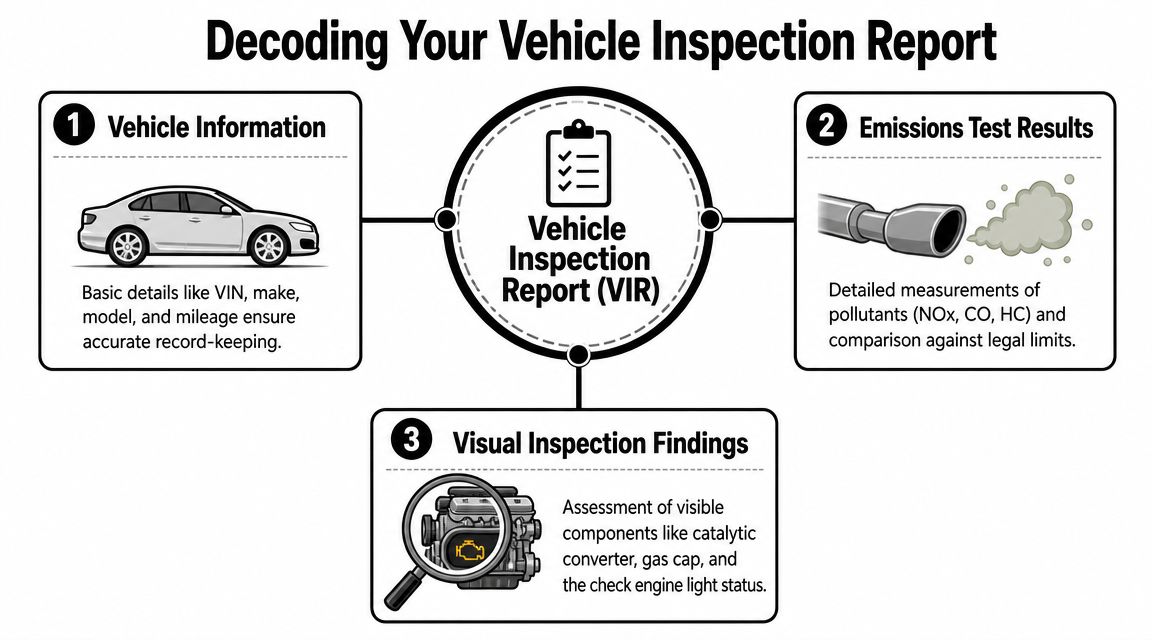
What the report is really for
The VIR answers three practical questions. Was the right vehicle tested? What kind of inspection applied to that vehicle? What did the inspection find?
The inspection method matters because California does not test every vehicle the same way. The Bureau of Automotive Repair explains that inspection procedures depend on factors such as model year, fuel type, and the equipment on the vehicle through the BAR Smog Check program. In plain English, a newer gasoline car is usually checked through its onboard diagnostic system, while an older vehicle may have tailpipe measurements and different visual checks.
That difference is where a lot of confusion starts. Drivers compare papers with a friend or family member and assume one report is missing something. Usually, the cars were tested under different rules.
The three parts most drivers should read first
Read the VIR from top to bottom in these three sections.
| Report Area | What you'll see | Why it matters |
|---|---|---|
| Vehicle identification | VIN, plate, make, model, year | Confirms the results belong to your vehicle |
| Test type | OBD-based inspection or tailpipe-based inspection | Explains how the car was evaluated |
| Findings | Pass/fail lines, monitor status, visual issues | Shows what cleared the car or held it back |
Start with the vehicle information. If the VIN, plate, or model year is wrong, the rest of the page becomes a problem worth fixing right away. You want the state record tied to the correct car, especially if you are handling registration in California.
Next, check the test type. A newer vehicle often relies heavily on the car's own computer to report whether emissions systems are ready and whether fault codes are present. An older vehicle may be judged more by what comes out of the tailpipe. Same smog program, different measuring tools.
Then read the findings section carefully. This is the part that tends to worry people because it includes technical labels, status notes, and sometimes a rejection item that sounds more dramatic than it is.
Here is the plain-English version of the terms drivers in San Leandro ask about most often:
- OBD result: The car's computer reported on emissions-related systems, including whether monitors were ready and whether any faults were stored.
- Tailpipe result: The machine measured what pollutants were coming out of the exhaust during the test.
- Visual rejection item: The inspector found a condition that blocks a pass under the inspection rules, such as visible smoke or missing required emissions equipment.
One line on the report rarely tells the whole story.
For example, a monitor status note does not always mean a part failed. Sometimes it means the vehicle computer was recently reset and has not finished its self-checks yet. A visual issue does not always point to an expensive repair either. It may indicate what needs to be corrected before a retest.
The easiest way to read the VIR is to match each finding to the type of test your car received. Once you do that, the page starts to make sense. If anything on your report still looks unclear, bring the VIR with you to a local station like Speedy Smog in San Leandro and ask a technician to walk through it line by line. That can save you time, guesswork, and an unnecessary repair bill.
Pass vs Fail What Your Results Mean for the DMV
You get your VIR, scan for the result line, and your eyes go straight to one word: pass or fail. That reaction is normal, especially if your registration clock is ticking and you need to know what to do in San Leandro today.
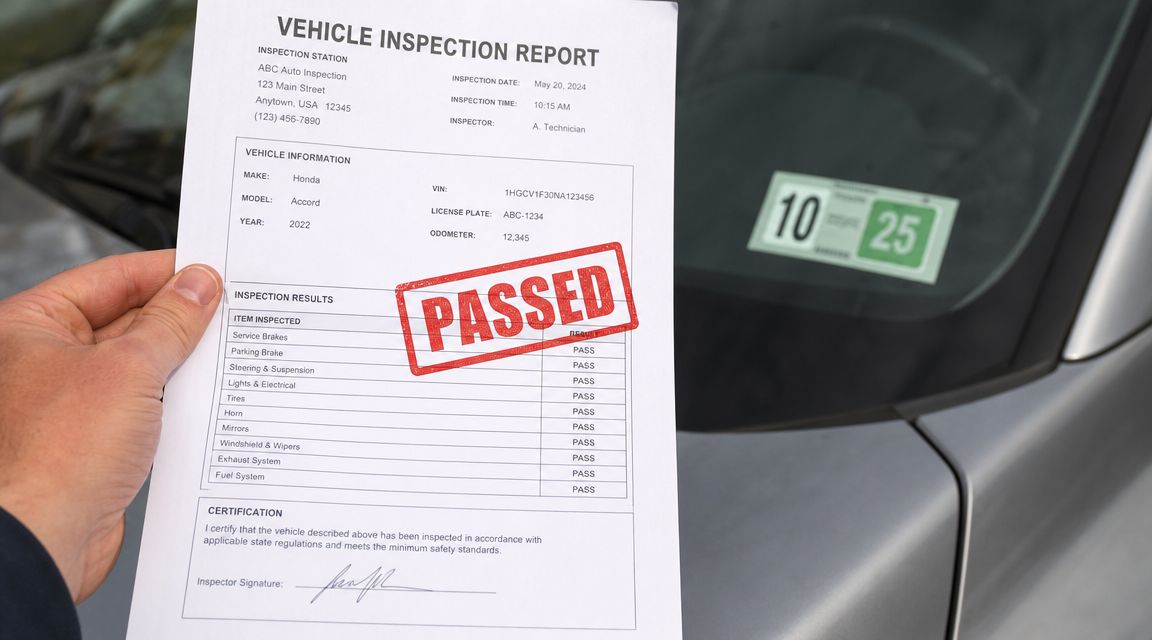
What a Pass Does
A pass means more than “you're good.” It means your smog station sent the passing result into California's official system for registration. According to the BAR inspection system, inspections are tracked by VIN or license plate, records update daily at midnight, and certificates are transmitted electronically to the DMV.
So the paper in your hand is mainly your record copy. The DMV process depends on the electronic record tied to your vehicle.
Timing still matters. BAR says a passing certificate sent to the DMV is valid for 90 days under the California smog check program. If you passed, try to finish your registration within that window so you do not have to deal with an expired certificate.
For San Leandro drivers, the practical takeaway is simple. Save the VIR, check your renewal status, and complete the DMV side soon.
What happens after a fail
A fail means the DMV requirement is not complete yet. It does not mean your car is beyond repair, and it does not always point to a large repair bill.
In California, failed inspections happen every day. The 2023 Smog Check performance report shows that some vehicles still do not pass official testing on the first visit. That is why a failed VIR should be read like a road map. It shows where the problem showed up, so you can decide what to fix before the retest.
The DMV will not process the smog requirement based on how the car feels on the road. It uses the inspection record on file.
This video gives a helpful visual overview of how that process works in practice.
If your car failed, treat the report like a starting point for diagnosis and repair, not a verdict on the vehicle.
That approach saves a lot of stress. If you are in San Leandro and are not sure whether your next step is a repair, a drive cycle, or a retest, bring the report to a local station like Speedy Smog and have a technician explain what the DMV needs before you spend money on the wrong fix.
Troubleshooting Common Smog Test Failures
You get a failed smog report, glance at a few abbreviations, and it can feel like the paper is speaking a different language. The good news is that most failures fall into a small group of familiar problems, and each one points to a specific next step.
Read the failed report the same way a technician does. Start with the reason the car was stopped from passing, then work backward to the system involved. That keeps you from paying for guesses.
Common clues on a failed report
A failed smog inspection usually leaves a trail. The clearest clues are often right on the VIR: a check engine light, incomplete readiness monitors, high emissions, a visual equipment problem, or visible smoke from the tailpipe.
Here is the easy way to sort them.
If the check engine light is on, your car's computer has already found a fault in an emissions-related system. If the report mentions visible smoke, the problem is more immediate. The car is showing a clear sign that something in combustion or oil control needs repair. If the issue is monitor status, the vehicle may not have finished its self-checks yet, which often happens after the battery was disconnected or codes were recently cleared.
That last one confuses a lot of California drivers. A monitor is like a completed homework assignment from your car's computer. Until enough driving conditions are met, the system cannot mark that test complete, and the smog station cannot treat it as ready.
Common Causes of a Failed Smog Test
| Symptom / Failure Reason | Common Cause | Potential Fix |
|---|---|---|
| Check engine light or emissions fault present | Sensor, EVAP, ignition, or control issue detected by the vehicle computer | Have a technician scan diagnostic trouble codes and repair the underlying fault |
| Visible smoke | Oil burning, fuel mixture issue, or other engine problem | Diagnose engine condition and repair the source of smoke before retesting |
| Tailpipe emissions too high | Worn emissions component, poor combustion, or exhaust treatment issue | Perform emissions diagnosis instead of replacing parts blindly |
| Readiness or monitor problem | Battery recently disconnected, codes recently cleared, drive cycle not completed | Drive the vehicle as directed and confirm monitor status before returning |
| Visual inspection issue | Missing, damaged, or noncompliant emissions-related component | Restore proper emissions equipment and verify compliance |
The table helps, but the repair decision gets easier when you translate each failure into a plain-English question.
A check engine light failure usually means, “What fault code is stored, and what caused it?”
A monitor failure means, “Was anything reset, and has the car completed the right drive cycle?”
A visual failure means, “Is any emissions equipment missing, modified, disconnected, or damaged?”
A high emissions failure means, “Which system is letting too much pollution through?”
That distinction matters in California because the DMV only cares whether the official test record shows a passing result. If you are in San Leandro, that is why it helps to bring the VIR to a local station such as Speedy Smog or to a repair shop that can read the exact failure line before any work begins. A five-minute explanation can save you from replacing parts that were never the problem.
A smart repair conversation sounds like this:
- Ask for the failure reason in plain language. Ask what system failed and why that stopped the test.
- Bring the VIR with you. It gives the technician a starting point instead of forcing them to guess.
- Ask what category the problem falls into. Mechanical, electrical, monitor-related, and visual failures are handled differently.
- Ask what must happen before a retest. That could be a repair, a drive cycle, or a monitor check.
- Confirm the car is ready before you return. This is especially important after repairs or code clearing.
One more point can save time and money. If your first thought is, “The car seems to drive fine, so maybe I should just try again,” pause there. Smog failures are often about what the emissions system reports, not how the engine feels during a short trip around town.
If the report still looks confusing, that is normal. A good technician should be able to point to one line on the printout, explain what it means in plain English, and tell you whether you need a repair, more driving to set monitors, or a simple retest.
Your Immediate Next Steps After the Test
You get back to your car, look at the paper, and the first question is simple. “Can I finish my registration today, or do I need to fix something first?” That is the right question to ask.
Your next move depends on whether the test produced a pass or a fail, but either way, the goal is the same. Turn the result into a clear plan so you do not lose time, money, or your place on the DMV calendar.
If your vehicle passed
A passing smog check usually means the hard part is done. California sends the result to the DMV electronically, so your job is to finish the registration while that passing record is still current.
Here is the practical checklist:
- Complete your registration soon. Do not let a passed test sit on the kitchen counter while the deadline creeps up.
- Keep your Vehicle Inspection Report. The DMV record is electronic, but your copy is still useful if there is a delay or mismatch.
- Match the test date to your renewal timeline. As noted earlier, a passing result has a limited validity window. If you wait too long, you may need another test.
A good way to picture it is a stamped receipt. The test result shows the car met California requirements on that date. The DMV still needs you to finish the registration step while that record can be used.
If your vehicle failed
A failed test is not a signal to start guessing. It is a signal to slow down and choose the right lane.
Start with the failure reason, then match it to the next action:
- Read the top-line result first. Confirm whether the problem is emissions, monitors not ready, or a visual issue.
- Set up the right kind of help. A repair shop handles mechanical faults. A smog station can confirm test status and explain what the report means in plain language.
- Ask whether the car needs repair or drive time. Some cars need parts or diagnosis. Others need a proper drive cycle after battery disconnects or code clearing.
- Retest only after the issue is addressed. Coming back too soon often leads to the same result and another fee.
This part confuses many California drivers, especially during registration season. A car can run smoothly on local streets and still fail because the emissions system is not reporting what the state requires. That is why the paper matters more than seat-of-the-pants impressions.
If you are in San Leandro and you are stuck between “What does this line mean?” and “Where do I go today?”, keep the plan local and practical. If the car passed, finish the DMV side promptly. If it failed, bring the VIR to a shop or station that can explain whether you need diagnosis, repair, or just more driving before a retest. Speedy Smog can handle the testing side if you need a retest after the car is ready.
Get Fast STAR-Certified Testing in San Leandro
You get your notice, glance at the calendar, and realize this smog check has to fit between work, school pickup, and a DMV deadline. In that situation, the right station is the one that matches what your car needs today.
When local convenience matters
If your registration paperwork calls for a STAR station, or you need a retest after repairs, one local option is Speedy Smog in San Leandro. Based on the publisher information provided, the station handles STAR-certified inspections for a wide range of vehicles, including many newer cars, older vehicles, diesels, and hybrids. The goal is simple. Get the inspection done correctly, get the result reported, and avoid adding more confusion to an already busy day.
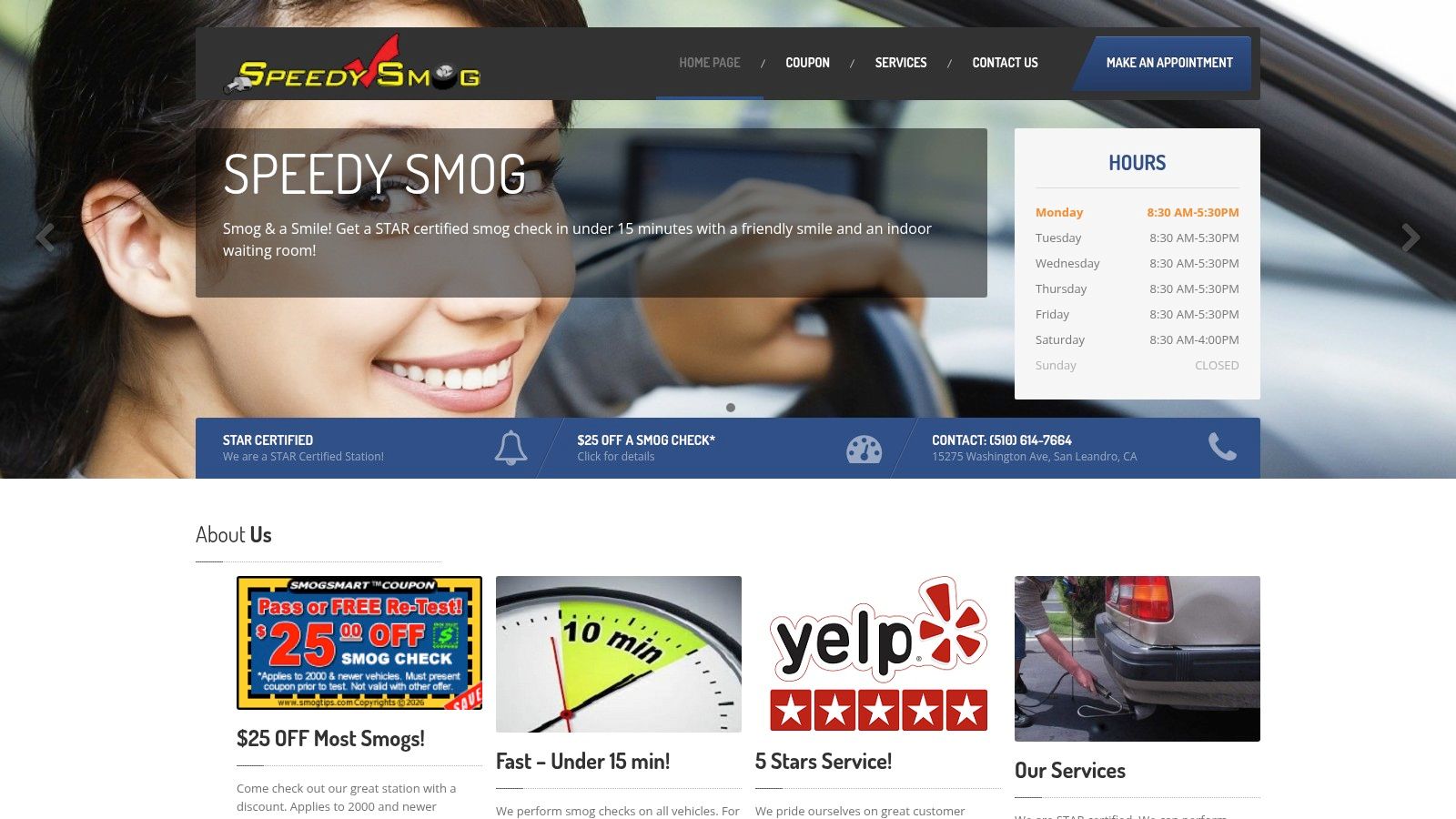
A smog station and a repair shop do different jobs, and that distinction helps many drivers. The smog station is the testing lane. It checks whether your vehicle meets California requirements at the time of inspection and sends the result into the DMV system. A repair shop is the diagnosis and fix lane. It finds the cause when the car is not ready or not passing.
That matters in San Leandro because DMV timing can turn a small delay into a stressful one. If your car is due now and only needs the inspection, a local STAR-certified station keeps the process straightforward. If your report already points to a repair issue, handle the repair first, then come back for the retest once the vehicle is ready.
Frequently Asked Questions About Smog Checks
Some of the most confusing smog test results aren't clear passes or fails. They fall into the gray area where the car may be fine, but the system isn't ready to say so yet.
Why would a car be incomplete instead of failed
An incomplete result is not the same as a failed result. It usually means the car's onboard computer hasn't finished the self-checks needed for inspection.
That often happens after the battery was disconnected or replaced. BAR guidance summarized by RepairSolutions notes that drivers may need one to two weeks of driving for readiness monitors to reset before inspection in cases like that, as explained in this guide to complete and incomplete smog test results.
If that's your situation, the right move usually isn't immediate repair. It's confirming whether the monitors have had enough normal driving time to complete.
Quick answers drivers often need
My check engine light turned off by itself. Can I still fail?
Yes. The light going off doesn't automatically mean the vehicle is ready or compliant. The underlying issue may still affect the inspection record or monitor status.
Does a passed smog mean my car has zero emissions issues?
Not necessarily. A passed result means the vehicle met the inspection requirements at the time of the test. It doesn't guarantee there's no developing issue.
Do I need to keep the paper copy if the result is electronic?
Yes. Keep it until registration is fully finished and you know everything posted correctly.
What if I just replaced the battery?
Ask whether the vehicle may still have incomplete readiness monitors. That's a common reason drivers show up too early.
Should I retest right away after a failure?
Only if you know the reason for failure has been resolved. Otherwise, you're just repeating the same problem.
If you need a smog check in the East Bay and want a straightforward inspection experience, Speedy Smog is a practical place to start. You can check location details, service info, and current offers before you head over, then get your vehicle tested and move on with registration.