You're sorting through mail in an Oakland kitchen. Between a utility bill and a grocery flyer is your DMV renewal notice, and one line stops you cold. A smog check is required before your registration can be completed, and the notice may even name a STAR station.
If that moment feels confusing, you're not alone. Most drivers don't think about smog certification in Oakland until that notice arrives, then they have to figure out which station to use, what kind of test their vehicle gets, and what happens if it doesn't pass. This guide walks through that full lifecycle in plain language, from why the test exists to how your certificate reaches the DMV.
Table of Contents
- Why Oakland Drivers Need Smog Certification
- How California Decides Which Test Your Vehicle Gets
- What STAR Certification Actually Means
- What Happens During a Typical Smog Inspection
- Choosing Between STAR, Test-Only, and Regular Stations
- After a Failed Test, Repairs, Waivers, and CAP
- Getting Your Certificate to the DMV and Staying Compliant
Why Oakland Drivers Need Smog Certification
That renewal notice in your hand isn't random paperwork. For many Oakland drivers, it's the first sign that their vehicle is due under California's biennial Smog Check program, which means a covered vehicle needs an inspection of its emissions, engine, and emissions control components every two years. You can't finish the registration renewal until that requirement is satisfied.
The reason sits in Bay Area history. By the late 1960s, the region had recorded 65 days exceeding the national one-hour ozone standard of 12 parts per hundred million, the highest number in its history at that time, with roughly 1.75 million motor vehicles in a region of slightly more than 3 million residents, as the Bay Area Air District history of regional air pollution documents. Ozone is the main ingredient in smog, and vehicles were a major part of the problem even then.
How Vehicles Became the Main Focus
As pollution from factories and other stationary sources declined, motor vehicles became the Bay Area's leading air pollution source. Today, cars, trucks, buses, and construction equipment are grouped as mobile sources, and they produce more than 60% of the Bay Area's smog-forming emissions, per the same Air District history cited above. That shift explains why California puts so much weight on testing individual vehicles.
A single vehicle with a broken or removed emissions control part can contribute far more pollution than a properly maintained one. The inspection is designed to catch exactly that, a malfunctioning system, a missing component, or a warning sign that the vehicle's own self tests aren't passing.
Your smog certificate does two jobs at once. It clears a DMV registration step for you, and it confirms your vehicle's emissions controls are doing the work they're supposed to do.
So when you schedule smog certification for an Oakland vehicle, you're not just buying a piece of paper. You're completing one cycle of a regional program built in response to severe, measurable ozone problems, and the rest of this guide shows you how to get through it with confidence.
How California Decides Which Test Your Vehicle Gets
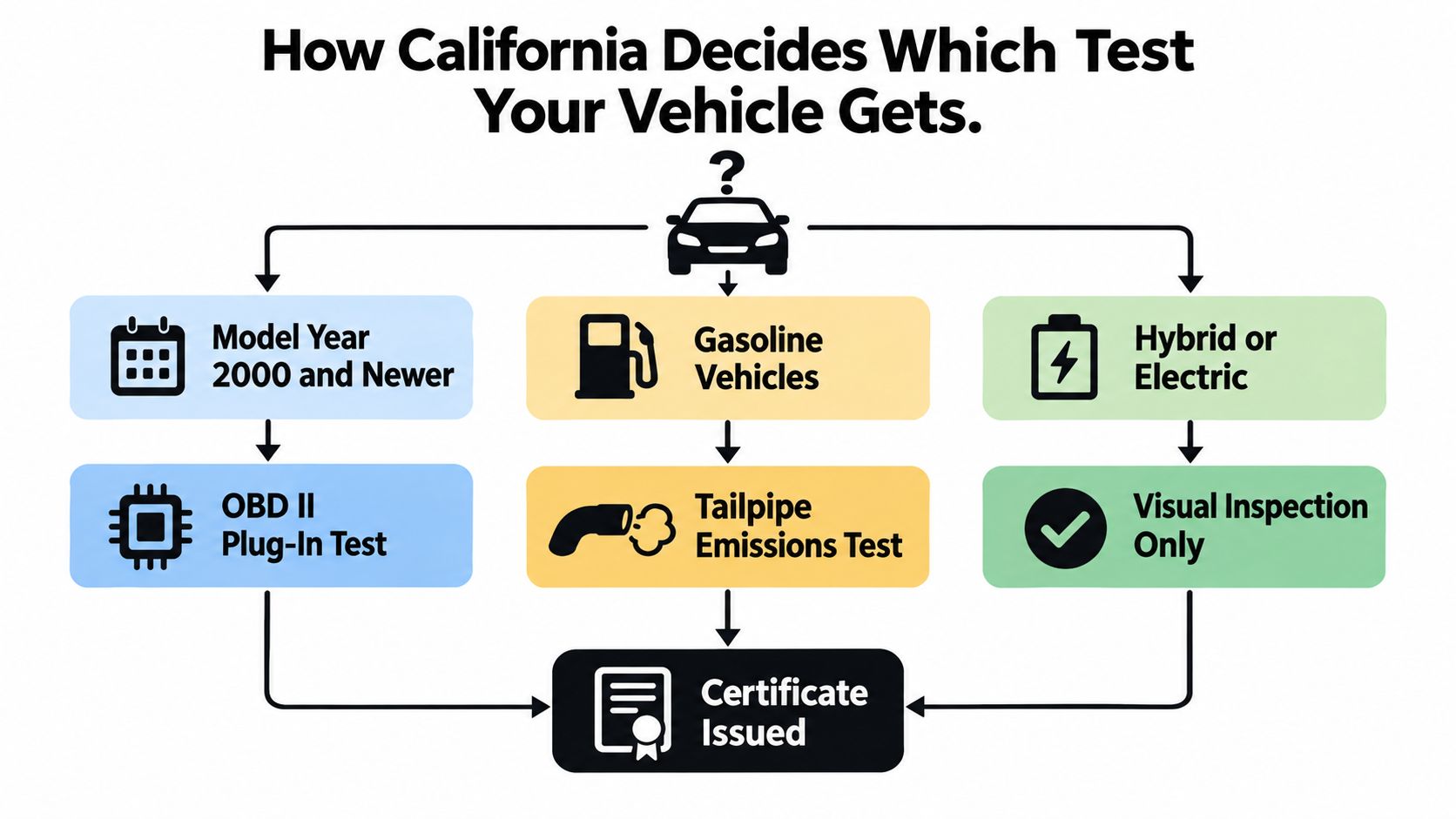
California doesn't give every vehicle the same test. The method is decided mainly by model year and fuel type, and knowing which path your vehicle falls on tells you how to prepare. Start by finding your model year on your registration, then match it to the categories below.
The flowchart below breaks the decision into its main branches so you can see where your vehicle lands.
The Three Main Test Paths
- Gasoline, model year 2000 and newer: Your vehicle is evaluated through the On-Board Diagnostic Inspection System, called OIS, which plugs into your vehicle's computer and reads its OBD-II data instead of relying mainly on a tailpipe test.
- Gasoline, model year 1999 and older: Your vehicle generally receives an Acceleration Simulation Mode test, or ASM, which runs the vehicle on a dynamometer, a set of rollers that simulates driving while emissions are measured.
- Diesel, model year 1998 and newer: Your vehicle also uses OIS, according to the Bureau of Automotive Repair guidance on inspection methods by model year and fuel type.
There's one exception worth knowing. Certain four-wheel-drive and all-wheel-drive vehicles that can't safely run on the dynamometer may be allowed a Two-Speed Idle test instead of ASM. The station determines whether that applies, it's not a choice you make at the counter.
Why Your Path Changes How You Prepare
If your gasoline vehicle is 2000 or newer, your preparation is mostly electronic. A lit check engine light, stored emissions related trouble codes, or readiness monitors that haven't completed their self tests can all cause problems. Getting warning lights diagnosed before your appointment is the smart move.
If your vehicle is 1999 or older, preparation leans mechanical, because the dynamometer test measures what comes out of the tailpipe under load. Either way, there's no shortcut around the full procedure. California prohibits fast pass testing, and inspections must be complete and performed by BAR-licensed personnel. If you want the broader rules in one place, the overview of California smog check rules and requirements is a helpful companion before you book.
What STAR Certification Actually Means
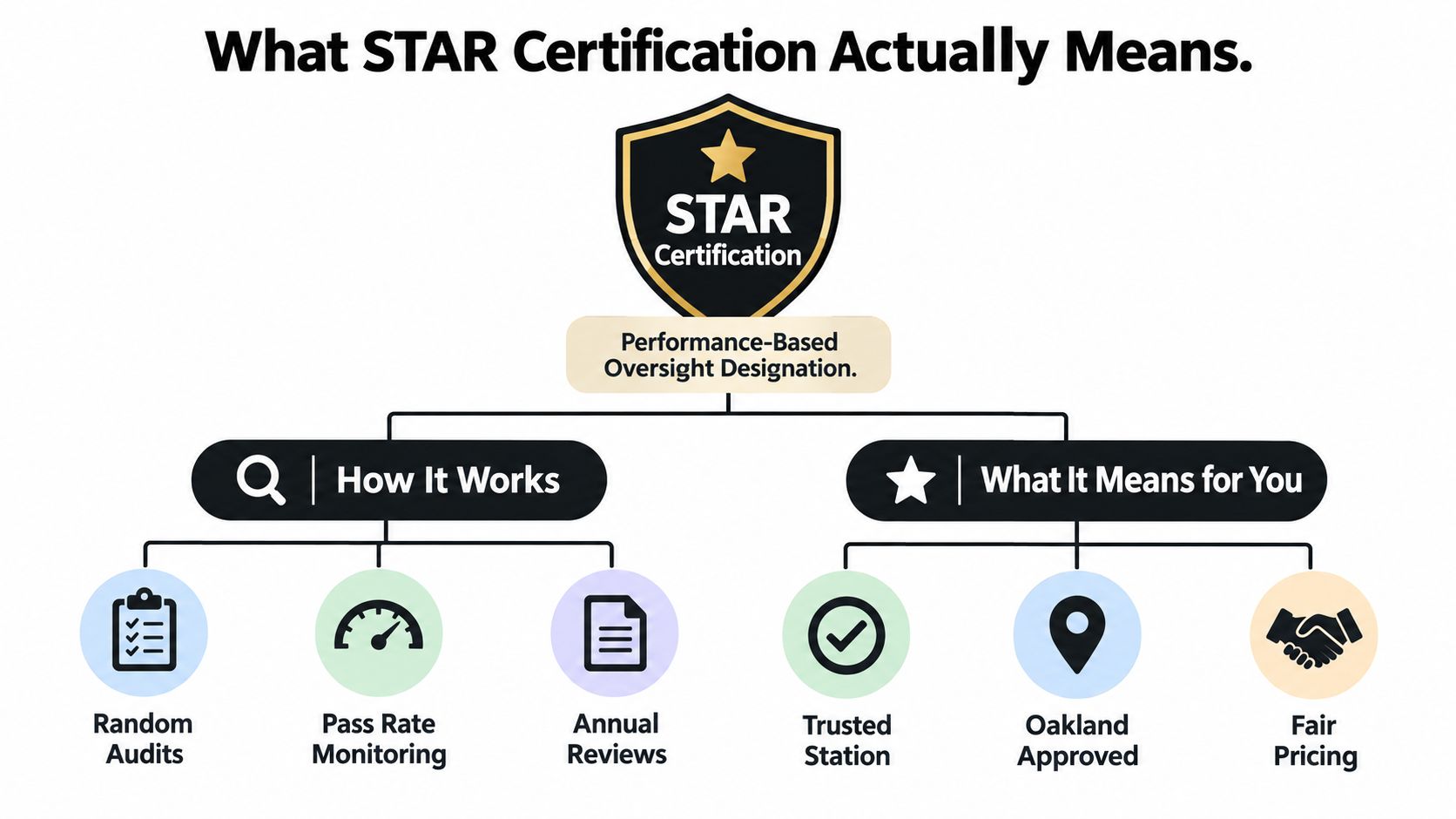
Many drivers searching for smog certification in Oakland see the word STAR on shop signs and assume it's a marketing badge or a quality award voted on by customers. It's neither. STAR is a performance based oversight designation from the Bureau of Automotive Repair, and stations have to earn it with measurable results.
The diagram below shows how the designation is structured and what it signals to you as a customer.
The Numbers a STAR Station Has to Meet
To qualify, a station must satisfy licensing, signage, record keeping, equipment, and publication access requirements, and perform enough inspections for BAR to calculate its performance. On top of that baseline, the BAR STAR certification criteria with published statistical thresholds require specific results, including these.
- Similar Vehicle Failure Rate: At least 50% of the industry-wide failure rate for comparable vehicles, which shows the station isn't passing cars that similar stations would fail.
- Incorrect Gear Selection rate: No higher than 2% of certified vehicles, a check on testing accuracy during dynamometer inspections.
- Excessive Test Deviation Rate: No greater than one, plus a Follow-up Pass Rate of at least 0.40 for the station or its inspectors under the applicable reporting rules.
STAR stations must also maintain equipment capable of testing all vehicles subject to the Smog Check Program. They may inspect directed vehicles, meaning vehicles the DMV has specifically sent to a STAR station, regardless of the station's program area location.
What STAR Does Not Promise
STAR comes in two forms, test-and-repair stations that can fix emissions problems and test-only stations that inspect but don't repair. Both are held to the same performance idea, accurate inspections that protect air quality.
Practical rule: STAR describes the station's track record, not your vehicle's outcome. It doesn't guarantee a pass, waive repairs, or override what your DMV notice requires.
Your vehicle still has to pass the emissions, visual, and functional requirements that apply to it. What STAR gives you is confidence that the station's inspection quality is being measured against published thresholds, not just its own advertising.
What Happens During a Typical Smog Inspection
Pulling into a station for the first time is less mysterious than most drivers expect. The technician verifies your vehicle information, performs the inspection that matches your model year and fuel type, and gives you a report explaining the result. Here's how that unfolds for a typical newer vehicle.
The photo below shows the kind of hands-on check a technician performs during a visit.
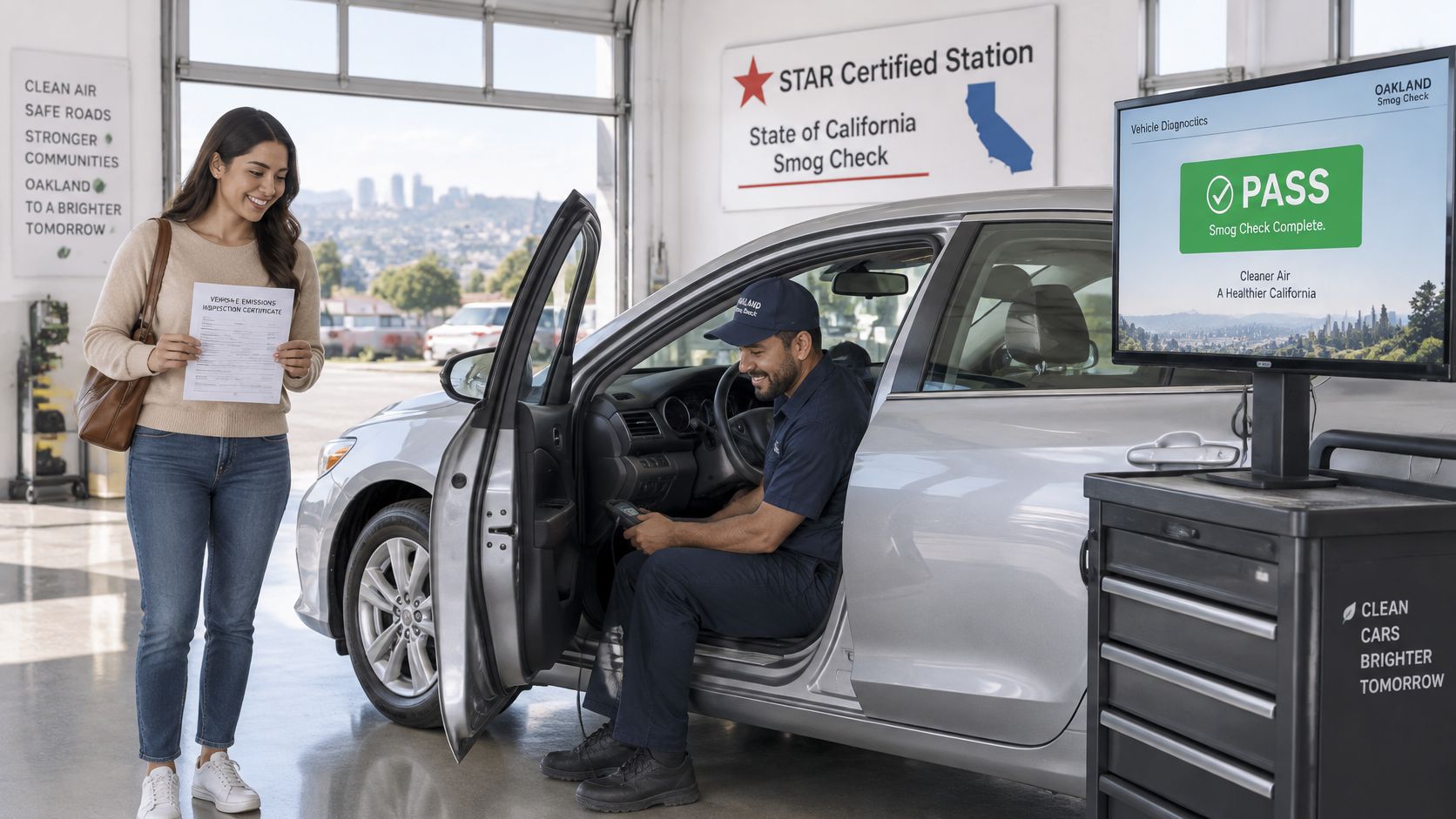
For a 2000-and-newer gasoline vehicle, the technician visually inspects emissions control components under the hood, then connects to the OBD-II system. That electronic check looks for emissions related diagnostic trouble codes, confirms whether the malfunction indicator lamp, your check engine light, works properly and isn't illuminated, and reviews readiness monitor status. Readiness monitors are self tests your vehicle runs on its own emissions systems as you drive, and they need to be complete for the inspection to finish properly.
Pass, Fail, and the Less Familiar Incomplete
Most vehicles either pass and receive certification, or fail with a report identifying what went wrong. There's a third outcome drivers find confusing. If readiness monitors haven't completed, often because a battery was recently disconnected or codes were cleared, the vehicle may not be ready to certify even though nothing is obviously broken. Driving normally for a period usually lets those self tests run, and the technician can advise you on that.
The short video below walks through what a technician is looking at during these checks.
Failures aren't rare, especially among older vehicles. In January 2025 alone, California stations performed 984,481 initial tests with an 8.72% initial-test failure rate, and including retests they performed 1,063,192 inspections and recorded 98,063 failures, or 9.22%, according to the BAR Smog Check performance report with statewide test data. That same data shows 1976 and 1977 model vehicles failing at around one in five initial tests, which is why older cars, diesels, and trucks often need more preparation time. Whatever the outcome, you leave with a Vehicle Inspection Report, and a passing result is transmitted electronically toward the DMV.
Choosing Between STAR, Test-Only, and Regular Stations
The right station for you depends on two things you already have in hand, your DMV renewal notice and your vehicle. Read the notice first. If it specifically requires a STAR station, that decision is made for you, because only a STAR station can certify a directed vehicle. If it doesn't, you have more flexibility.
Many Oakland drivers get tripped up here. They pick the closest shop, then discover their notice required STAR, or they choose a test-only station and then need repairs somewhere else. Matching the station type to your situation upfront saves a second trip.
Choosing the Right Station Type for Your Situation
| Station Type | Accepts Directed Notices | Performs Repairs | Best For |
|---|---|---|---|
| STAR test-and-repair | Yes | Yes | Directed notices, older vehicles, drivers who want testing and repairs in one place |
| STAR test-only | Yes | No | Directed notices where you want an inspection separate from any repair work |
| Regular test-and-repair | No | Yes | Standard notices on vehicles that may need work if they fail |
| Regular test-only | No | No | Standard notices on newer, well maintained vehicles with no warning lights |
Consider your vehicle's condition. If you have an unresolved check engine light or a history of emissions trouble, a test-and-repair station can diagnose and fix the problem without sending you across town. If your newer car runs cleanly and your notice is standard, a regular licensed station handles the job fine. For a deeper side-by-side, this breakdown of STAR station versus test-only station differences explains the trade-offs in more detail.
East Bay drivers often look just beyond Oakland for availability. Speedy Smog in San Leandro is one example of a STAR Certified station serving Oakland drivers, performing inspections for newer vehicles, 1999-and-older vehicles, diesels, and hybrids. Whichever station you choose, confirm it's BAR-licensed and matched to your notice before you drive over.
After a Failed Test, Repairs, Waivers, and CAP
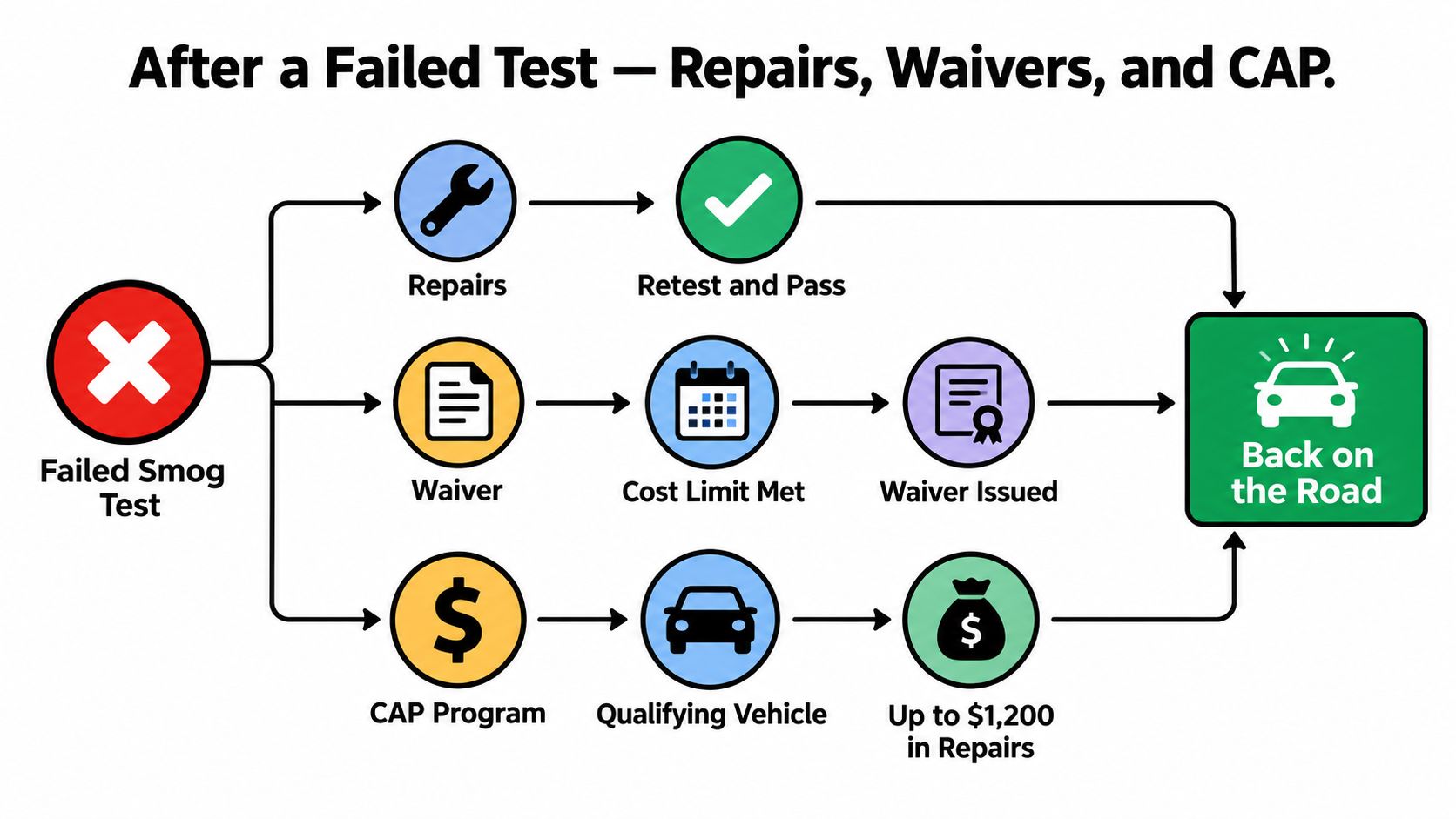
A failed test feels like a dead end, but it's really a decision point. Your Vehicle Inspection Report tells you why the vehicle failed, and that reason shapes your options. The first step is confirming whether the failure is emissions related, involving trouble codes, readiness monitors, or emissions control components, because assistance programs are built around that distinction.
The flowchart below maps the three main routes forward after a failure.
Repair Assistance Through CAP
Before you authorize expensive work, check the Consumer Assistance Program, known as CAP. Eligible owners of 1996-and-newer vehicles may receive up to $1,450 for emissions related repairs, while 1976 to 1995 vehicles may qualify for up to $1,100, under the BAR Consumer Assistance Program repair assistance rules. Eligibility matters and approval isn't automatic, so verify before spending. You can also review how smog check repair assistance options fit together before committing to a repair bill.
The Repair Cost Waiver and the Referee
If repairs get expensive, a repair cost waiver may be realistic, but it isn't a free pass. The vehicle generally must fail its biennial inspection, and you must spend at least $650 on qualifying repairs at a Smog Check station, per the CAP guidance cited above. The waiver postpones the certificate requirement for up to two years, and the vehicle must be fully repaired by the next biennial inspection or a title transfer.
A waiver buys you time, not permanent compliance, and paying the repair threshold by itself doesn't guarantee one will be granted.
If you dispute a failure or your repair history is complicated, the BAR Referee is the path for an independent review. Taken together, these options mean a failed test doesn't automatically mean replacing your vehicle. It means slowing down, confirming the failure type, checking assistance first, and choosing the route that matches your budget and timeline.
Getting Your Certificate to the DMV and Staying Compliant
When your vehicle passes, you usually don't carry a paper certificate to a DMV office. The station transmits the passing result electronically through the BAR system, and that record becomes available to the DMV for your registration. Your job is simpler, keep your paperwork and confirm the details match.
Hold onto your Vehicle Inspection Report until your renewal is fully complete. It shows the test date, station, vehicle information, and result, which is exactly what you'll need if the DMV record hasn't updated yet or a detail needs correcting. Electronic reporting and DMV processing are separate steps, so a short delay before an online renewal recognizes your certificate can be normal. Don't pay for a second test just because a screen hasn't refreshed.
A Simple Checklist for the Next Cycle
- Read your notice first: Check whether it requires a STAR station before choosing a shop.
- Know your test path: Match your model year and fuel type to OIS, ASM, or the diesel route, and prepare accordingly.
- Fix warning signs early: Diagnose a check engine light or incomplete readiness monitors before your appointment, not at the counter.
- Keep your records together: Save the inspection report, receipts, and any repair documentation until registration clears, and keep repair records for the next cycle.
One last distinction helps avoid frustration. A passing smog result satisfies the emissions part of renewal, but it doesn't pay your registration fees or clear unrelated DMV holds. Those are separate steps in the same transaction.
Handled this way, smog certification in Oakland becomes a rhythm you understand rather than a surprise every two years. You know why the test exists, which inspection your vehicle faces, how to pick a station, and what your options are if the first attempt doesn't pass.
If your renewal notice is already sitting on the counter, Speedy Smog in San Leandro offers STAR Certified inspections for Oakland and East Bay drivers, including newer vehicles, older vehicles, diesels, and hybrids, with passing results submitted electronically for DMV registration. Bring your renewal notice, get your vehicle tested, and leave with your inspection report in hand.
You're staring at the renewal notice on the kitchen counter, wondering whether you need a smog test, which station to use, and whether the whole thing will clear DMV before the tags expire. That's the core task here. DMV smog check registration isn't just a tailpipe test, it's a paperwork gate that decides whether your renewal moves or sits stuck.
In California, the smart move is to treat smog as part of the registration transaction from the start. Bring the notice, read the station instructions, and test at the right place the first time. Miss that, and you can end up with a passing inspection that still doesn't clear the hold.
Table of Contents
- What DMV Smog Check Registration Means in California
- Reading Your DMV Renewal Notice Before You Book
- Booking the Test and What to Bring on the Day
- STAR Stations Test Only Versus Test and Repair Explained
- Readiness Monitors and Pre-Test Preparation
- What to Do When the Test Fails
- Closing the DMV Registration Once the Certificate Posts
What DMV Smog Check Registration Means in California
A driver pulls up for a smog test and thinks the job is done once the tailpipe numbers look good. In California, the key job is getting the result attached to vehicle registration so DMV can clear the renewal. The state cares about the test, the station, and the record that gets transmitted.
What triggers the requirement
For most gasoline-powered, hybrid, and alternative-fuel vehicles, California requires a Smog Check for model year 1976 and newer. For diesels, the general cutoff starts with the 1998 model year. Vehicles eight model years old or newer generally pay a smog abatement fee instead of getting inspected for renewal since January 1, 2019. The DMV also excludes several categories, including electric vehicles, motorcycles, trailers, gasoline vehicles from 1975 and older, diesel vehicles from 1997 and older, and certain heavy natural-gas or diesel vehicles. The question is always the same, what vehicle is on the record, and what registration event is happening? California DMV smog inspection rules
Practical rule: if the registration event needs a smog certification, the DMV uses the exact vehicle record, not your memory of the car's last test.
Why the registration frame matters
In California, smog is tied to vehicle registration and renewal, so the DMV and the Bureau of Automotive Repair care about the result and the station that produced it.
Bring a vehicle into California for the first time, and the state usually wants a smog certification before registration goes through. The same holds on renewal when the notice calls for a test. The inspection is the checkpoint that clears the DMV hold and lets the renewal move.
For East Bay drivers, the cleanest way to handle it is simple. Read the renewal notice as the controlling document. If it calls for a test, a fee, or a specific station type, follow that instruction and get the transaction lined up correctly the first time.
Reading Your DMV Renewal Notice Before You Book
The renewal notice is the piece of paper many drivers skim and regret later. Don't skim it. Read it like a bill with instructions, because that's exactly what it is.
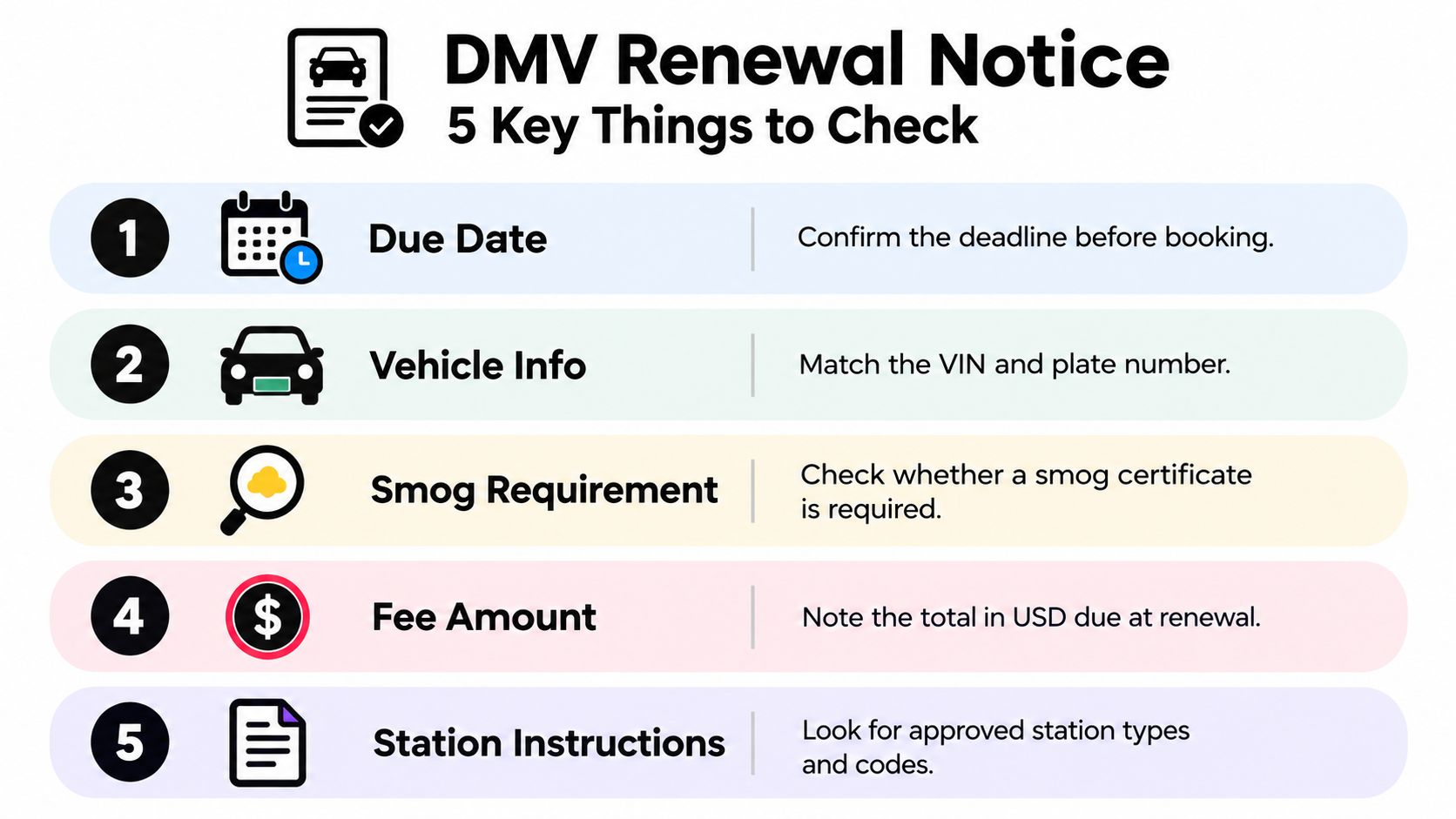
The lines that matter
Look for whether the notice says Smog Check Required or shows that the smog certificate is already submitted. Then check the station instruction line. Some notices point you to any authorized Smog Check station, while others require a STAR station or another specific category. If you ignore that line, you can get a perfectly good test at the wrong shop and still have a registration problem. California DMV renewal workflow
The barcode matters too. The station scans it and transmits the certification electronically to DMV, so bring the notice in person. If you leave it in the glovebox at home, the station may be able to test the car, but you've made the actual registration step harder than it needs to be.
Transaction type changes the answer
Change-of-ownership cases work differently from renewals. Out-of-state vehicles coming into California usually need inspection for first-time registration, while family transfers are usually exempt from the transfer smog check. Vehicles four model years old or newer generally use a smog-transfer fee, not a standard transfer test. That's why you don't want a generic answer, you want the answer that matches your exact transaction.
Keep the notice with your registration paperwork until the certificate posts. If the DMV record and the car record don't line up, you're the one who has to sort it out.
If you want a local walk-through of the renewal flow, use this guide on the registration renewal process as a companion while you check your notice.
Booking the Test and What to Bring on the Day
Book the test like a grown-up, not like someone gambling on luck. A quick call ahead saves a dead trip, especially if your notice calls for a station category you don't use every day. Most shops can tell you right away whether they can handle the job.
The bare minimum to bring is the renewal notice, your payment method, and the vehicle itself. I'd also bring the registration card if you have it, because matching the car to the record is what keeps the DMV side clean. If you're in a hurry, don't make the shop guess which vehicle is yours.
What the visit actually looks like
For modern cars, the process is usually straightforward. The technician plugs into the OBD-II port on 2000-and-newer vehicles, checks the vehicle's emissions readiness, and verifies the system status. Older vehicles may need a different inspection path, and diesels and hybrids can bring their own visual and functional checks depending on the vehicle. The point is the same either way, the station verifies that the car meets the state's requirement and sends that result forward.
Here's the part drivers care about most, the inspection should end with a Vehicle Inspection Report and an electronic certificate transmission to DMV if the vehicle passes. Keep the report. If anything looks off later, that paper trail helps.
The station doesn't have to be a mystery. If the process is set up right, you hand over the notice, the tech scans the barcode, the car gets checked, and the result moves into the DMV system. That's the job.
Later, when you're waiting for the car, this embedded walkthrough is useful:
What to expect from the paperwork side
Once the station submits the result, DMV can finalize the renewal after the certificate posts. Until then, the test alone isn't the finish line. You're not done when the exhaust probe comes out, you're done when the registration side is clear.
STAR Stations Test Only Versus Test and Repair Explained
Not every station can solve every registration problem. That's where people waste time. The station categories exist for a reason, and the renewal notice tells you which lane you're supposed to be in.
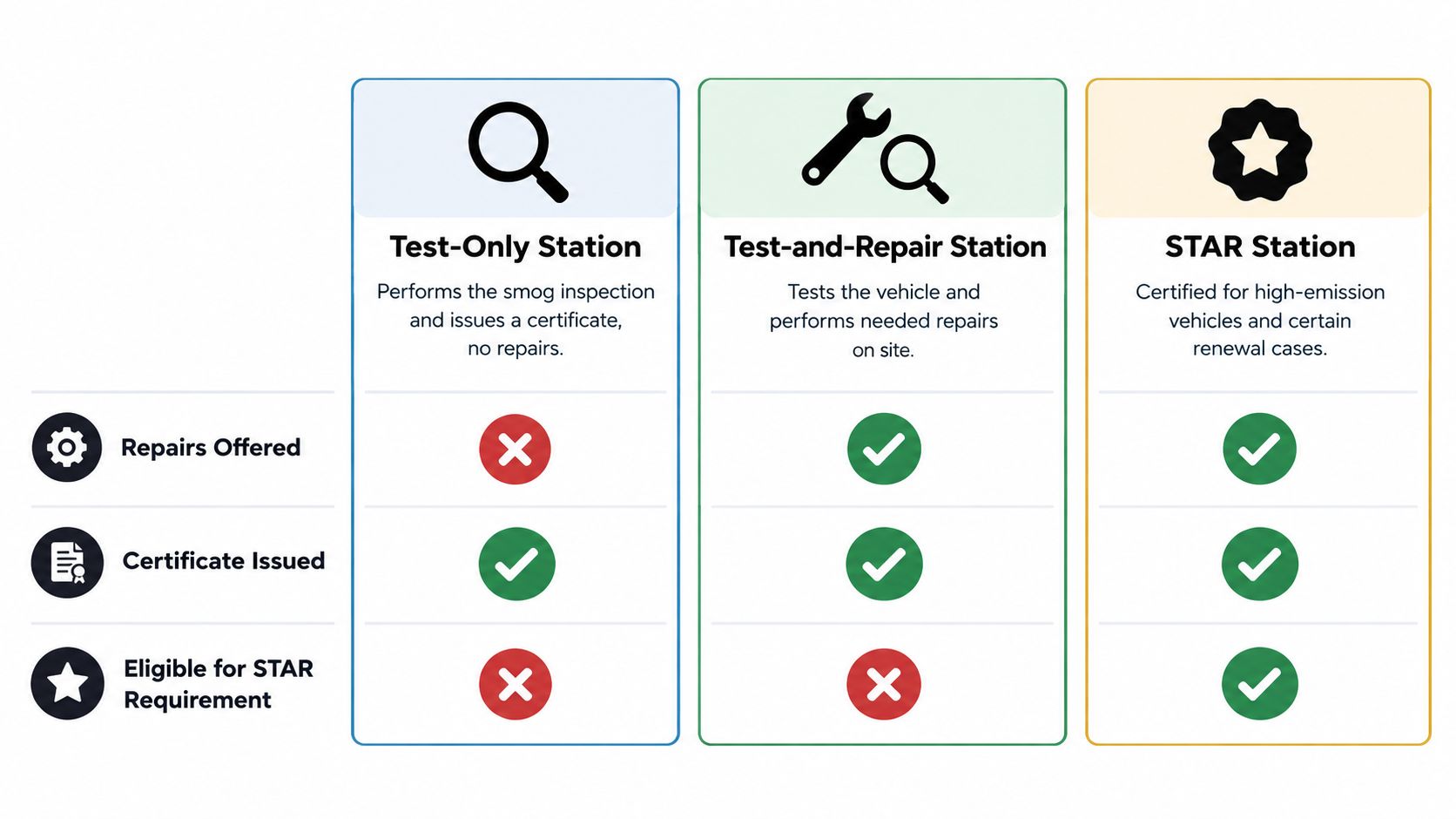
The three categories
A test-only station inspects the vehicle and issues the certificate if it passes. A test-and-repair station can inspect and fix the vehicle on site. A STAR station is a state-certified station used for certain renewal cases, especially where DMV wants a higher-compliance path. If your notice says STAR, you go to STAR. Don't freelance this part.
California's station system is broad enough that different drivers end up in different lanes. In the Bureau of Automotive Repair's April 2026 executive summary, 223,221 certificates came from test-and-repair stations and 488,032 certificates came from test-only stations in the reported categories. That's a good reminder that the DMV routes a lot of vehicles to specific station types, not just “any place with a smog sign.” BAR April 2026 executive summary
Why STAR status matters
STAR certification isn't just branding. It's part of California's compliance structure. If your renewal notice calls for STAR, a passing test somewhere else may not remove the hold. That's the mistake people make when they think any certificate is enough.
If you want a local explainer on why some vehicles get routed to STAR, this STAR station guide helps keep the categories straight. Use that when you're choosing where to go, not after you've already burned a trip.
Bottom line: the wrong station type can waste a day and still leave your registration incomplete.
Readiness Monitors and Pre-Test Preparation
A car can run fine and still get turned away because the computer is not ready. That is the trap. An off check-engine light does not mean the vehicle is ready for a smog test.
A common mistake is clearing codes right before the appointment, disconnecting the battery, or rushing in after emissions work. Any of those can reset the readiness monitors to incomplete, which can trigger a rejection or failure even if the car drives normally. BAR inspector performance data puts the statewide average for inspections involving the maximum permitted incomplete readiness monitors at roughly 2.1% to 2.2%, so this comes up often enough to matter. BAR readiness monitor benchmark
The night-before checklist
- Do not clear codes: Erasing a stored issue can create a bigger problem at the test lane.
- Confirm the light is off: A lit check-engine lamp means stop and fix it first.
- Drive normally: Give the car time to finish its monitors under ordinary driving.
- Check status with a scan tool: If you have one, look before you leave.
- Use a pre-scan if needed: A quick check beats a wasted trip.
If you want a full pre-test walkthrough, see this guide on what to do before a smog check.
I'd rather see a driver wait an extra day than roll in with incomplete monitors and start over. The DMV deadline does not change how the car's readiness logic works, and the station cannot override it.
If the monitors are still incomplete, follow the manufacturer drive cycle under safe conditions and return only after they are ready. That is the cleanest move, and it saves time at the counter.
What to Do When the Test Fails
Failure isn't the end of the process. It's a fork. You either repair it, dispute it, or use the state programs that exist for exactly this situation.
California recorded 1,019,416 initial tests and 85,135 initial failures in July 2025, an 8.35% initial failure rate. BAR July 2025 executive summary That's not a fringe event. Plenty of drivers run into this, which is why you need a plan before you leave the house.
Your four moves after a failure
- Get the repair conversation started. Ask the shop what failed and what they'd fix first. Don't assume the whole car needs to be torn apart.
- Use the BAR Referee if the result looks wrong. If the vehicle has unusual emissions equipment or the result doesn't make sense, a referee can help sort out the dispute.
- Check Consumer Assistance Program eligibility. BAR identifies this program for consumers who may qualify for repair or retirement help.
- Protect the registration deadline. If you're running out of time, DMV allows a 60-day Temporary Operating Permit when you submit the failed inspection report, proof of insurance, registration fees, and the $50 nonrefundable fee. Only one such permit may be issued in a two-year period.
A failure should push you into action, not panic. The wrong move is to keep paying fees and hoping the certificate magically shows up. Get the cause, pick the right path, and move.
If the car failed for something obvious, fix that first. If the result doesn't fit the vehicle, stop guessing and get a referee involved.
Closing the DMV Registration Once the Certificate Posts
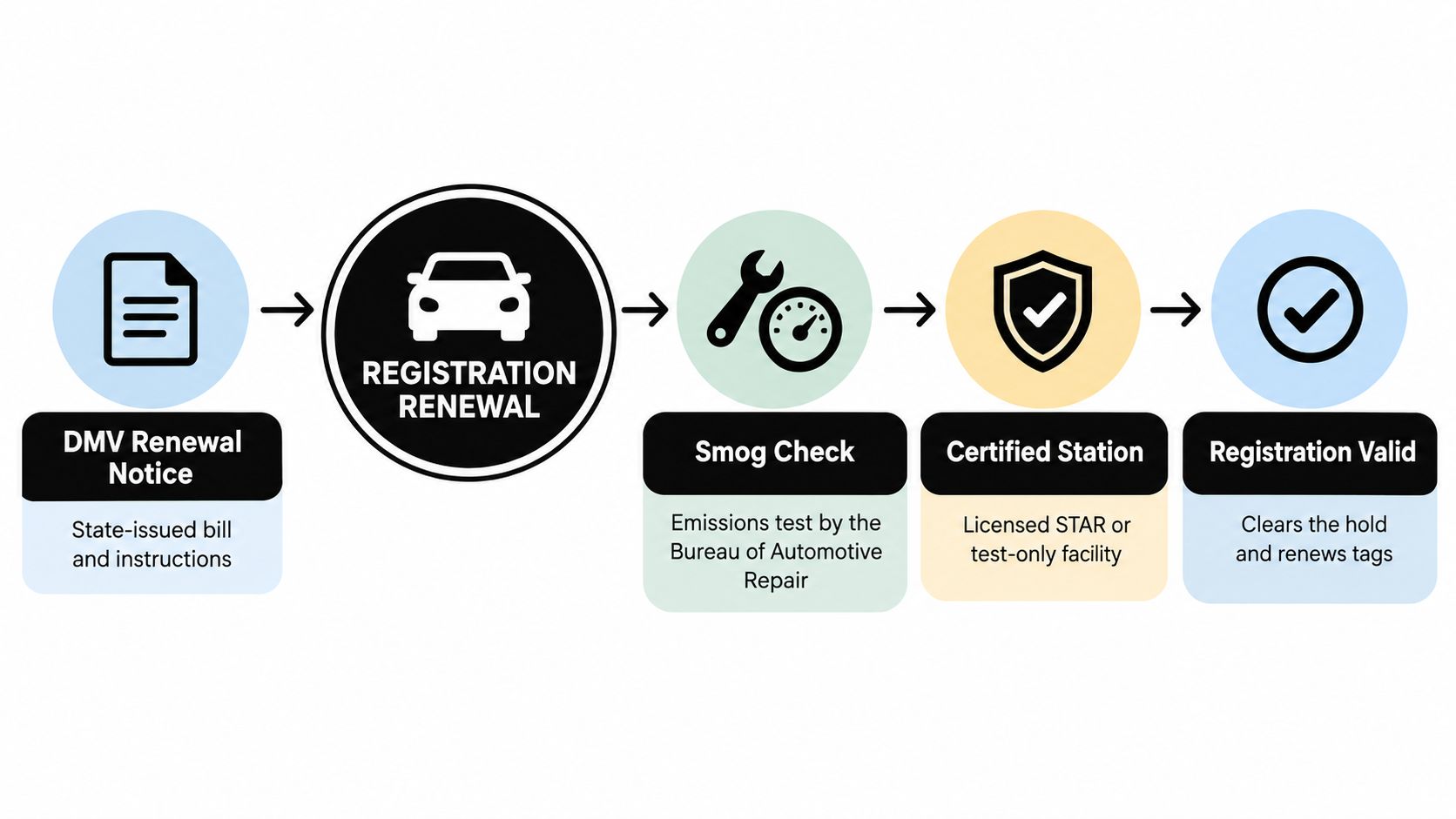
Once the smog certificate posts, the job is to close the DMV transaction cleanly. The station sends the result electronically, DMV picks it up, and you finish the renewal online if your record is clear. That is the part people miss when they assume a paid fee means everything is done.
The fee helps, but it does not finish registration if DMV still shows a missing smog record. Check your renewal status and wait for the certificate to appear before you call it closed. Read how the DMV finalizes renewal after the smog certificate posts.
Use this order:
- Notice in hand
- Correct station chosen
- Inspection completed
- Certificate posted electronically
- Fees paid
- Online renewal finished
- Sticker arrives in the mail
That is the dmv smog check registration workflow. It works when you read the notice, match the station to the job, and keep the paperwork straight.
If you want a local station that handles the registration side the way California expects, Speedy Smog can take your renewal notice, complete the inspection, and electronically send the result so your DMV transaction can move forward. Visit Speedy Smog to book your smog check in San Leandro and get the registration piece handled without extra back-and-forth.
Your DMV renewal notice is on the kitchen counter, the deadline is getting close, and the obvious plan seems simple: drive to a smog station, pass the test, and renew your registration. That plan can fail before the technician even checks the exhaust, especially if your car recently had a battery replaced, diagnostic codes cleared, or repairs completed.
California vehicle inspection rules depend on why you're dealing with the DMV, not just how old your vehicle is. Renewal, a private-party sale, a dealer purchase, and first registration after moving to California can trigger different requirements. Your fuel type, model year, weight rating, and onboard computer also determine what happens at the station.
Table of Contents
- Deciding If You Need a Smog Check
- Understanding the Testing Protocols
- The Readiness Monitor Trap
- Why STAR Certification Matters
- Recovering From a Failed Inspection
- What to Expect at the Station
- Your Pre-Inspection Compliance Checklist
Deciding If You Need a Smog Check
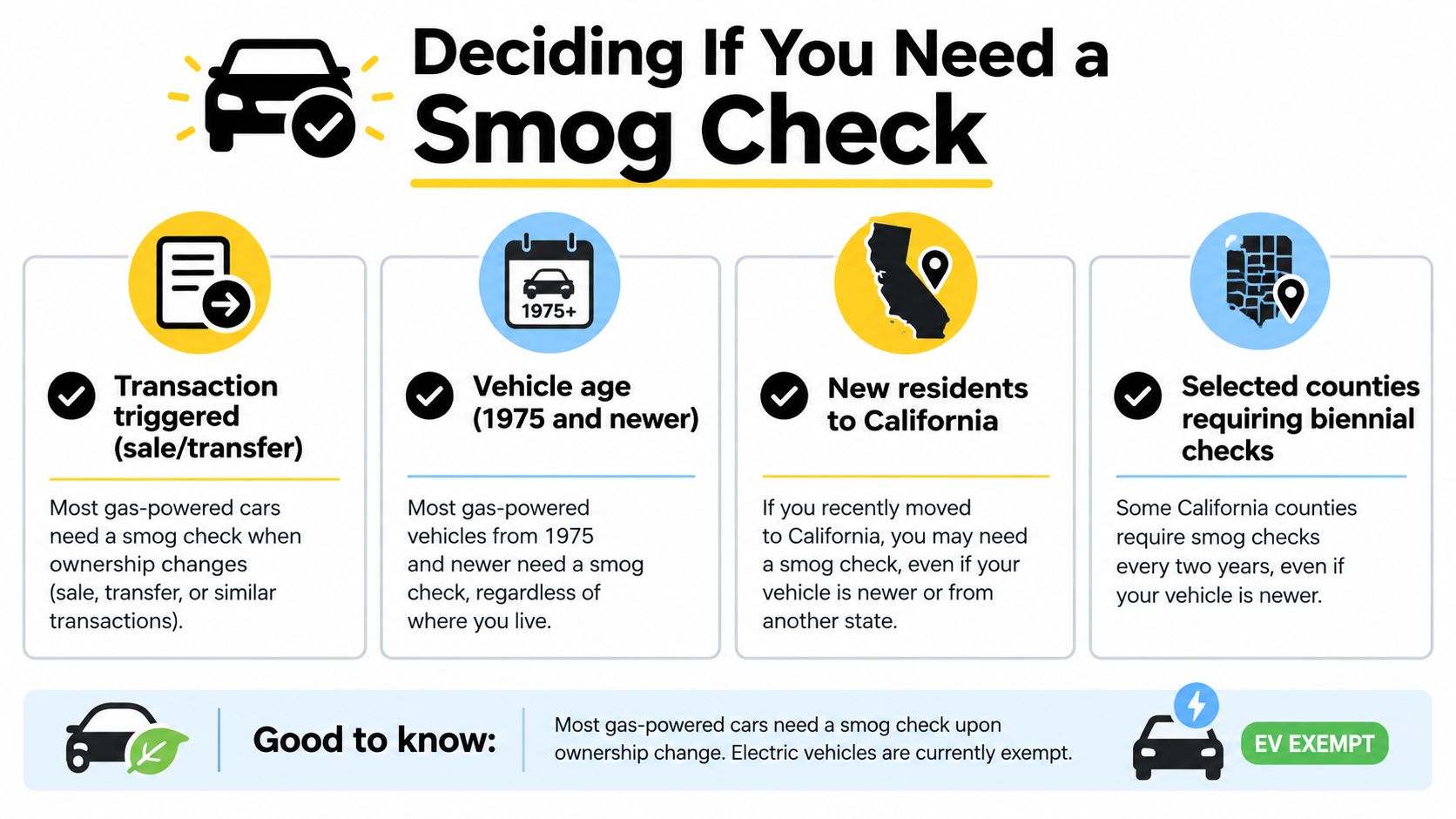
Start with the transaction. If you're renewing registration, California generally requires a smog inspection every two years, unless your vehicle qualifies for an exemption or the newer-vehicle abatement option. Owners of vehicles less than eight model-years old can generally pay a smog-abatement fee instead of obtaining an inspection, as explained by the California Bureau of Automotive Repair's smog check guidance.
Use the transaction first
For registration renewal: Read the DMV notice carefully. If it calls for certification, book the appropriate inspection. If your vehicle is within the newer-vehicle window, check whether paying the abatement fee is the available alternative.
For a private-party sale or transfer: Don't assume the buyer can handle everything later. Most gasoline-powered vehicles that are subject to California's program need current certification when ownership changes. The seller and buyer should confirm the DMV requirements for the specific transaction before signing over the title.
For a dealer purchase: Dealer transactions can follow different certification responsibilities depending on the vehicle's age and recent certification history. Ask the dealer who is responsible for the inspection and whether the certification is already recorded before you make a separate appointment.
For a first California registration: An out-of-state vehicle from model year 1976 or newer generally needs a California inspection when registered in the state for the first time. This catches many new residents off guard because an inspection from another state usually doesn't answer California's certification requirement.
Check the vehicle before booking
Electric vehicles are exempt from the standard smog check because they don't produce tailpipe emissions from an internal combustion engine. Other exemptions include gasoline vehicles from model year 1975 or earlier, diesel vehicles from model year 1997 or earlier, diesel vehicles above 14,000 pounds GVWR, and some natural-gas vehicles.
A gasoline car, hybrid, diesel, or imported vehicle may fall into a less obvious category. If you're unsure, use the vehicle identification information on your registration and confirm the requirement with the DMV or BAR before paying for a test.
Practical rule: Decide whether the transaction requires certification before you decide which station to visit. A renewal appointment and a first California registration aren't interchangeable situations.
Understanding the Testing Protocols
The inspection machine depends on the vehicle's technology. Most gasoline-powered vehicles from model year 2000 onward and hybrids with a GVWR of 14,000 pounds or less are tested through the BAR-OIS, which reads the vehicle's OBD-II system. Vehicles without a compatible OBD-II system, vehicles above 14,000 pounds GVWR, and certain vehicles identified by the Bureau of Automotive Repair require a BAR-97 inspection that can include tailpipe emissions measurement, according to the California Smog Check manual.
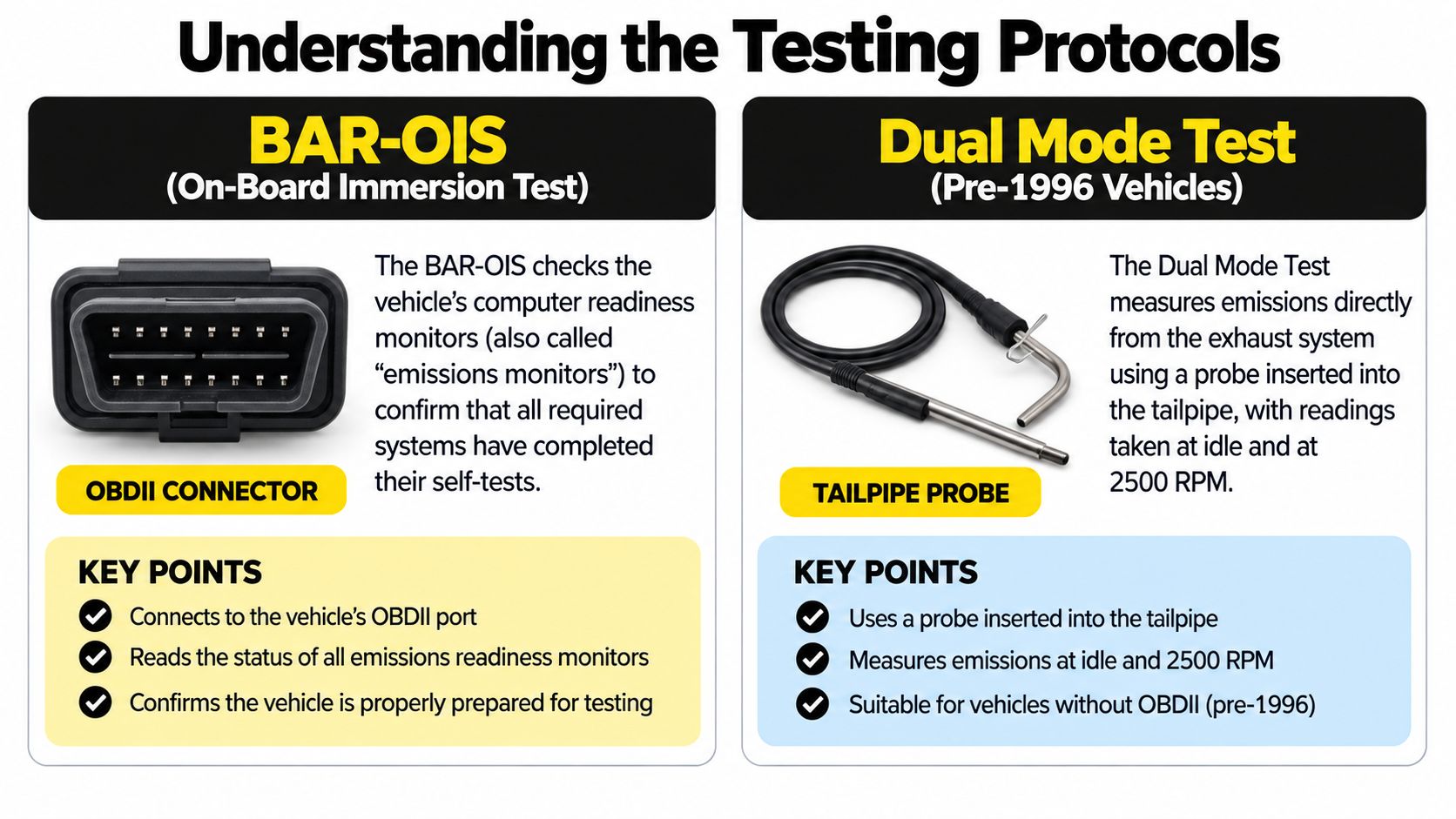
BAR-OIS reads the vehicle's computer
Think of BAR-OIS as an electronic health check. The technician connects to the diagnostic port and verifies that the malfunction-indicator lamp behaves correctly, then checks whether the computer reports emissions faults that disqualify the vehicle.
The inspection isn't just asking whether the check-engine light is currently illuminated. The computer also tracks whether its emissions self-tests have completed and whether stored fault information points to a problem. That's why a vehicle can look and drive normally yet still fail.
A newer vehicle isn't automatically an OBD-only case. The station must confirm the vehicle's certification configuration, model year, fuel type, and identifying information before selecting the protocol. A wrong entry or wrong test path can create unnecessary trouble, particularly with hybrids, imported vehicles, specialty configurations, and heavier trucks.
BAR-97 measures the exhaust
BAR-97 works more like taking a sample directly from the tailpipe. Depending on the vehicle, the equipment measures exhaust emissions while the engine operates under the required testing conditions.
This protocol matters to owners of older vehicles and vehicles without compatible OBD-II systems. It also matters to owners of heavy-duty vehicles because gross vehicle weight can change the inspection path even when the vehicle uses modern engine controls.
| Vehicle situation | Likely inspection approach |
|---|---|
| Gasoline vehicle from model year 2000 onward | BAR-OIS using OBD-II |
| Hybrid within the applicable weight limit | BAR-OIS using OBD-II |
| No compatible OBD-II system | BAR-97 |
| Above 14,000 pounds GVWR | BAR-97 |
| Certain vehicles designated by BAR | Confirm the required protocol with the station |
Bring accurate registration and vehicle information. If the car has an aftermarket exhaust, engine swap, or other modification, mention it before testing. The technician needs to know what vehicle configuration is being presented, not guess from appearance.
The Readiness Monitor Trap
A cleared check-engine light doesn't mean the vehicle is ready for inspection. In fact, clearing codes immediately before a test can create a predictable failure because the vehicle's emissions monitors reset to incomplete.
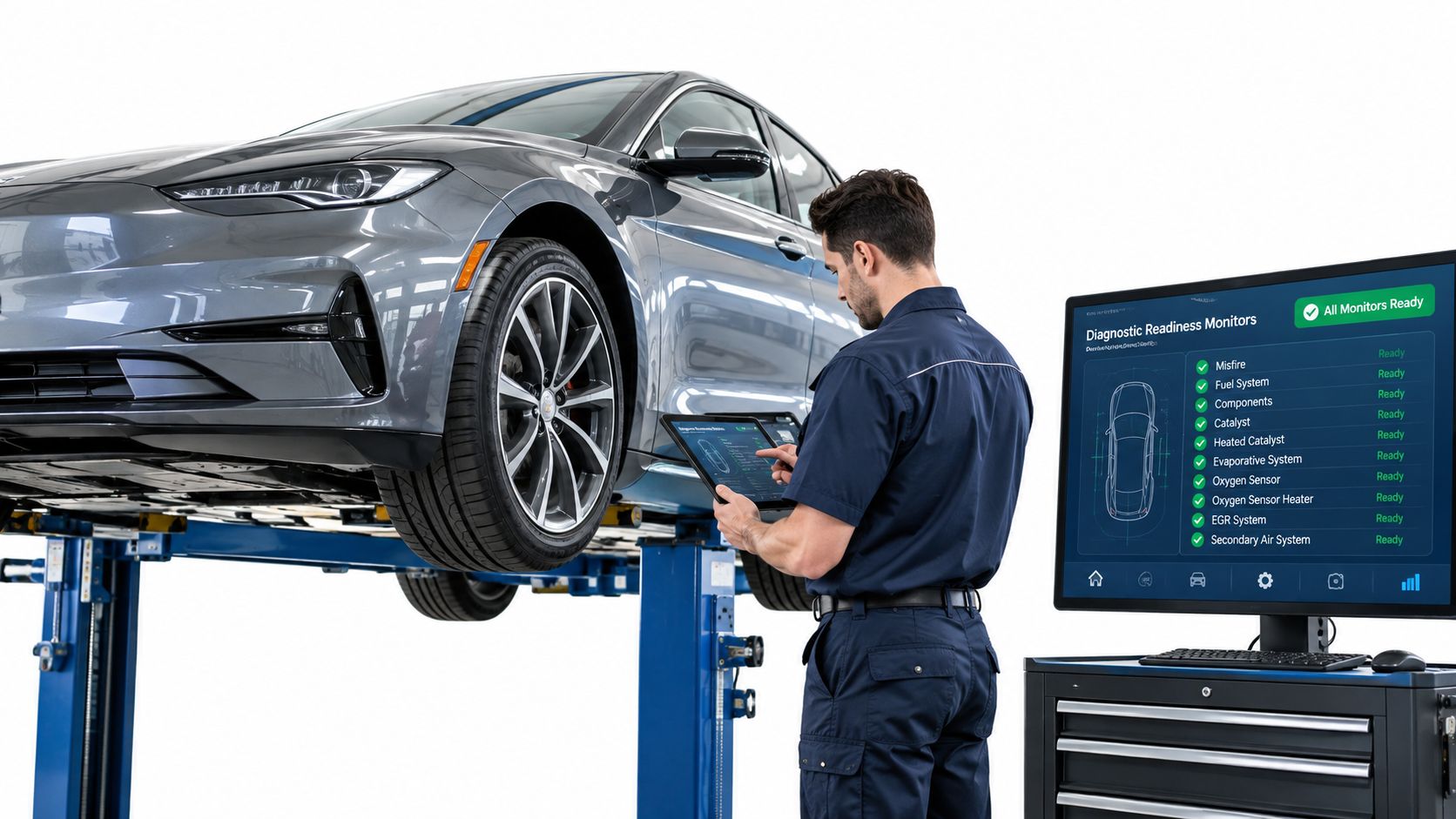
Readiness monitors are self-tests inside the OBD-II system. They evaluate systems such as the catalyst, oxygen sensors, evaporative emissions controls, and EGR-related components. The computer marks each monitor complete only after the car experiences the right operating conditions, which can include cold starts, steady cruising, acceleration, deceleration, and normal stop-and-go driving.
Disconnecting the battery or using a scan tool to erase diagnostic trouble codes wipes out that completion history. The dashboard may show no active warning light, but the inspection computer can still see that required tests haven't finished.
Why the timing matters
Beginning October 1, 2025, California rules require all applicable readiness monitors to be set for a vehicle to pass, according to BAR's explanation of the new OBD readiness monitor regulations. That makes a pre-test scan a smart move after battery work, code clearing, engine repairs, or emissions-system service.
Don't erase a code just to make the dashboard look clean. Diagnose the cause, repair it properly, and then drive the vehicle through an appropriate mixed-use cycle so the monitors can complete. Depending on the repair and the vehicle, allow roughly a week or two when necessary for the monitors to set.
Clearing the light is not a repair. It only removes information, and it can leave the vehicle unready for testing.
A better pre-test sequence
- Scan before the appointment. Check active codes, stored codes, and monitor status with a suitable diagnostic scanner.
- Repair the cause. A warning light connected to an EVAP leak, oxygen-sensor problem, catalyst fault, or another emissions issue needs diagnosis rather than cosmetic code clearing.
- Drive normally after repair. Use a mixed-use cycle that gives the vehicle's monitors the conditions they need.
- Scan again. Confirm the applicable monitors are ready before paying for the inspection.
- Test only when the vehicle is prepared. This avoids wasting an appointment on a car that was never eligible to pass.
For drivers who want help understanding what the test measures, an OBD-II car emissions test can provide useful context before the appointment.
Why STAR Certification Matters
A STAR requirement on your DMV notice isn't a suggestion to shop around casually. It means you need a station authorized to perform the required STAR inspection for that vehicle and transaction.
STAR stations operate under Bureau of Automotive Repair performance requirements that address equipment, testing procedures, and station performance. The practical benefit is straightforward: the station uses approved equipment and follows a monitored process when testing vehicles that need that level of certification.
Older vehicles deserve careful testing
California's statewide program records substantial inspection activity. The 2025 BAR executive summary recorded 11,275,981 initial tests and 12,200,718 total tests, including retests. Initial failures totaled 959,667, an 8.51% initial failure rate, while all-test failures totaled 1,102,337, a 9.04% overall failure rate.
Age changes the risk. In the cited reporting, model-year 1998 vehicles had a 20.42% failure rate, while model-year 2024 vehicles had a 4.39% failure rate, as reported in the BAR inspection summary. Older cars bring more accumulated wear, more repair history, and a greater chance of emissions-system faults. Accurate equipment and correct data entry matter more when the vehicle is already close to the line.
Choose the station based on the notice
A STAR station can be the right choice when:
- The DMV directs you to STAR: Follow the notice instead of booking a standard station.
- The vehicle has failed before: Accurate retesting helps separate a real repair issue from a process or data-entry problem.
- The vehicle is older or unusual: Confirm that the station handles older vehicles, hybrids, diesels, or the relevant inspection protocol.
- The transaction has special requirements: Ask whether the station can electronically transmit the result for the DMV purpose you need.
Read the notice first, then ask the station a direct question: “Is this vehicle and transaction eligible for the STAR test I need?” For a plain-language explanation of the program, review what a STAR smog station is.
Don't select a station only because it advertises a low price. The correct certification and protocol are more important than saving a small amount on a test that won't satisfy the DMV.
Recovering From a Failed Inspection
A failed inspection gives you information. It doesn't authorize random parts replacement, and it doesn't mean the vehicle is permanently barred from registration. Start by keeping every document from the appointment, including the failed inspection report and any diagnostic information the station provides.
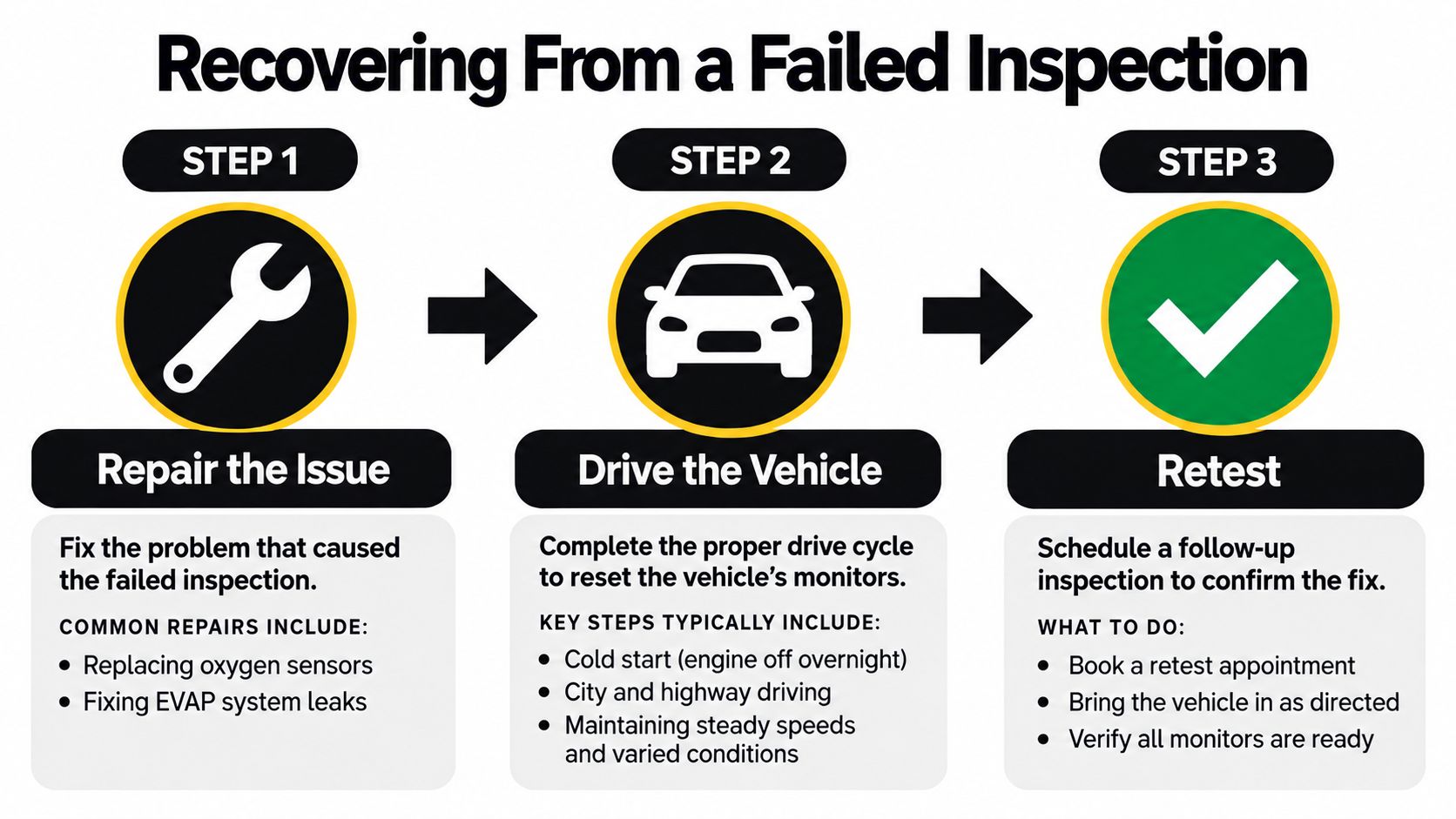
Follow the repair sequence
First, identify the failure category. The report should show whether the problem involved a malfunction indicator, emissions readings, readiness monitors, missing equipment, or another compliance issue. Don't approve repairs based only on a vague statement that the car “needs a tune-up.”
Second, diagnose before replacing parts. A check-engine code identifies a monitored fault, not automatically the failed component. A technician should test the wiring, vacuum system, fuel control, exhaust system, and related components before installing expensive parts.
Third, complete the drive cycle. If repairs or battery disconnection reset monitors, the vehicle may need mixed-use driving before retesting. Returning immediately can produce another failure even after the mechanical issue has been fixed.
Protect your legal driving options
California DMV guidance allows owners whose vehicles fail a biennial smog inspection to seek a Temporary Operating Permit, or TOP. The permit is valid for 60 days and requires registration renewal fees, the failed inspection report, proof of insurance, and a nonrefundable $50 fee, according to the California vehicle inspection information published by BAR.
The TOP matters because a failed inspection can block renewal while you still need to drive to a repair shop, retest location, or referee appointment. Confirm the permit's terms with the DMV and carry the required paperwork rather than assuming the failed report alone gives you unrestricted driving authority.
Keep the failed report, receipts, repair orders, scan results, and retest paperwork together. The paper trail makes the next conversation with a station, DMV office, or referee much easier.
Escalate when the result doesn't make sense
If you believe the inspection process was incorrect, or the vehicle has unusual equipment or modification issues, contact the Bureau of Automotive Repair Referee Program for direction. Don't pay for repeated tests without understanding the failure.
For a practical explanation of repair, permit, and retest steps, review this guide to a failed smog check in California. The right response is controlled diagnosis, not repeated guessing.
What to Expect at the Station
You pull into the bay, hand over the registration information, and answer a few basic questions about the vehicle. The technician confirms the identifying details, checks which inspection protocol applies, and connects the approved equipment if the vehicle uses OBD-II.
At a local East Bay station such as Speedy Smog, the experience is built around a short, focused inspection rather than a general mechanical service appointment. Speedy Smog is located at 15275 Washington Ave in San Leandro and handles newer vehicles, older vehicles, diesels, hybrids, and DMV-directed inspections. The shop also electronically transmits results to the DMV for registration purposes.
Bring the information that prevents delays
Have your DMV renewal notice available if you're renewing registration. Bring the vehicle, its current registration information, and any paperwork connected to a prior failure or special DMV direction.
Tell the technician about recent battery replacement, diagnostic-code clearing, emissions repairs, engine changes, or unusual fuel and weight classifications. Hiding recent work doesn't help. It can lead to a failed readiness check or an incorrect assumption about the test the vehicle needs.
The visit is an inspection, not a repair estimate
For most 2000 and newer vehicles, Speedy Smog states that typical testing is completed in about 10 to 15 minutes, though the actual time depends on the vehicle and inspection requirements. A station may need more time for an older vehicle, a diesel, a heavy vehicle, a DMV-directed test, or a problem with the vehicle's identification or computer connection.
Ask for the total price before the test begins. Transparent stations should explain whether the appointment is a standard inspection, STAR inspection, diesel inspection, or another required service. A clean waiting area and clear communication matter, but the central question remains whether the test is valid for your DMV transaction.
Don't confuse a smog inspection with a complete vehicle safety inspection. The smog test focuses on emissions compliance. If you also need brake, tire, suspension, or general reliability work, arrange that separately so you know exactly what you're paying for.
Your Pre-Inspection Compliance Checklist
The best time to prevent a failed test is before you arrive. Use this checklist based on the transaction, vehicle, and computer status.
Confirm the administrative requirement
- Read the DMV notice: Determine whether you need renewal certification, STAR certification, a transfer-related inspection, or first-registration certification.
- Confirm the vehicle category: Check model year, fuel type, hybrid status, and GVWR.
- Check exemptions and fee options: Electric vehicles and other qualifying vehicles may be exempt, while newer vehicles may qualify for the smog-abatement fee instead of testing.
- Bring supporting paperwork: Keep the renewal notice, registration information, prior failed report, repair records, and proof of insurance available when relevant.
Check the vehicle's readiness
- Look at the dashboard: A check-engine light that stays on needs diagnosis before testing.
- Avoid recent code clearing: Clearing codes can reset readiness monitors and leave the vehicle unable to pass.
- Scan monitor status: Confirm applicable monitors are complete after repairs or battery work.
- Complete normal mixed-use driving: Give the computer enough time and operating conditions to finish its self-tests.
- Check visible basics: Make sure the gas cap is secure and report obvious exhaust or emissions-system damage before the test.
Choose the correct station
- Follow STAR instructions: If the DMV requires STAR, use a station authorized for that requirement.
- Confirm capability: Ask whether the station handles your vehicle's age, fuel type, inspection protocol, and transaction.
- Explain recent work: Battery replacement, code clearing, emissions repairs, and modifications can change the advice you need.
- Plan for failure intelligently: If the vehicle fails, retain the report, diagnose the cause, complete repairs, reset monitors correctly, and retest.
California vehicle inspection is easier when you treat it as a compliance process instead of a quick lottery ticket. Identify the transaction first, verify the inspection path second, and check readiness before you spend money on the test.
Speedy Smog provides STAR Certified smog checks in San Leandro for newer and older vehicles, including hybrids and eligible diesel vehicles, with DMV electronic result transmission. If you're preparing for renewal, a transfer, or first California registration, visit Speedy Smog and confirm the correct inspection before you arrive.
Since January 1, 2013, California has required vehicles directed to STAR inspection or identified as gross polluters to use a STAR station; for ordinary renewals, either a STAR station or a regular Test-Only station can be acceptable. The important detail is that STAR is a certification tier, not a promise that the shop performs repairs.
You're standing in line at the DMV, checking your renewal notice, or searching “smog check near me” when two labels create unnecessary confusion: STAR station and Test-Only station. A driver may assume STAR means a full-service repair shop, or that Test-Only means an inferior facility. Neither assumption is reliable.
The practical question is simpler: Can this station legally certify your vehicle for the inspection your DMV notice requires? If your vehicle is directed to STAR, taking it to a regular Test-Only station is the wrong move, even if that station performs legitimate emissions inspections. If your renewal doesn't require STAR, a regular Test-Only station may be sufficient, provided it's authorized for your vehicle.
Table of Contents
- Understanding Your Smog Station Options
- The Regulatory Differences Between STAR and Test Only
- Vehicle Eligibility and Inspection Capabilities
- The High Cost of Choosing the Wrong Station
- How to Verify Your Smog Station Needs
- Why Speedy Smog is the Smart Choice for East Bay Drivers
Understanding Your Smog Station Options
An East Bay driver usually discovers the distinction at the worst possible time. The registration renewal is due, the DMV notice mentions a smog certification, and the driver wants the quickest appointment available. A search produces several nearby businesses, but the listings use different labels. One says STAR, another says Test-Only, and a third says Test-and-Repair.
The right choice depends on the vehicle's inspection status, not on which label sounds more complete.
California's STAR program began on January 1, 2013, replacing the former Gold Shield and Test Only system. The DMV says the program was created to improve Smog Check quality and support the state's emissions-reduction goals. California DMV's Smog Inspections guidance also explains that STAR stations are held to higher performance standards and are used for vehicles directed to STAR inspection.
The label that matters on your notice
Start with the DMV renewal notice. If it says your vehicle must receive a STAR certification, book a STAR station. Don't assume a non-STAR Test-Only facility can complete the requirement just because it performs emissions tests.
If the notice calls for an ordinary Smog Check and doesn't direct the vehicle to STAR, a regular Test-Only station may be appropriate. A STAR station can also handle many ordinary inspections, so choosing STAR is often the simpler way to avoid guessing, especially when you're unsure how the notice applies to your vehicle.
| Your situation | Station to choose | Why |
|---|---|---|
| DMV notice requires STAR | STAR station | The vehicle needs certification from a STAR-authorized facility |
| Vehicle is directed for inspection | STAR station | A regular Test-Only station may not certify it |
| Vehicle is a gross polluter | STAR station | STAR stations can inspect and certify this category |
| Ordinary Smog Check with no STAR direction | Regular Test-Only or STAR station | Both may be suitable, depending on the station's authorization |
| Vehicle fails and needs emissions repairs | Repair-capable shop, followed by the correct testing station | Testing authority and repair authority are separate |
STAR doesn't automatically mean repairs
This is the mistake I see most often. STAR doesn't necessarily mean Test-and-Repair. A STAR station may be licensed to perform tests only, or it may be licensed to perform both tests and repairs.
That means you need to ask two separate questions before booking:
- Is the station STAR-certified for my vehicle's required inspection?
- Can the station repair emissions problems if the vehicle fails?
If you only need a certification and the car passes, the first question is the critical one. If the vehicle has a history of emissions problems, the second question can save you a separate trip.
Practical rule: Match the station to the DMV requirement first. Treat repair capability as a separate convenience question.
The Regulatory Differences Between STAR and Test Only
The difference in STAR station vs Test Only isn't just a matter of reputation or shop quality. It comes from two different layers of California's regulatory framework.
A standard Test-Only station is licensed to perform Smog Check inspections. It can test the vehicle, record the results, and transmit the certification outcome when the vehicle passes. It can't repair the vehicle it tests under that license.
A STAR station must meet higher inspection-based performance standards established through the Bureau of Automotive Repair. STAR is therefore a compliance and quality tier attached to the station's testing operation. It doesn't, by itself, tell you whether the business has technicians and licensing for repairs.
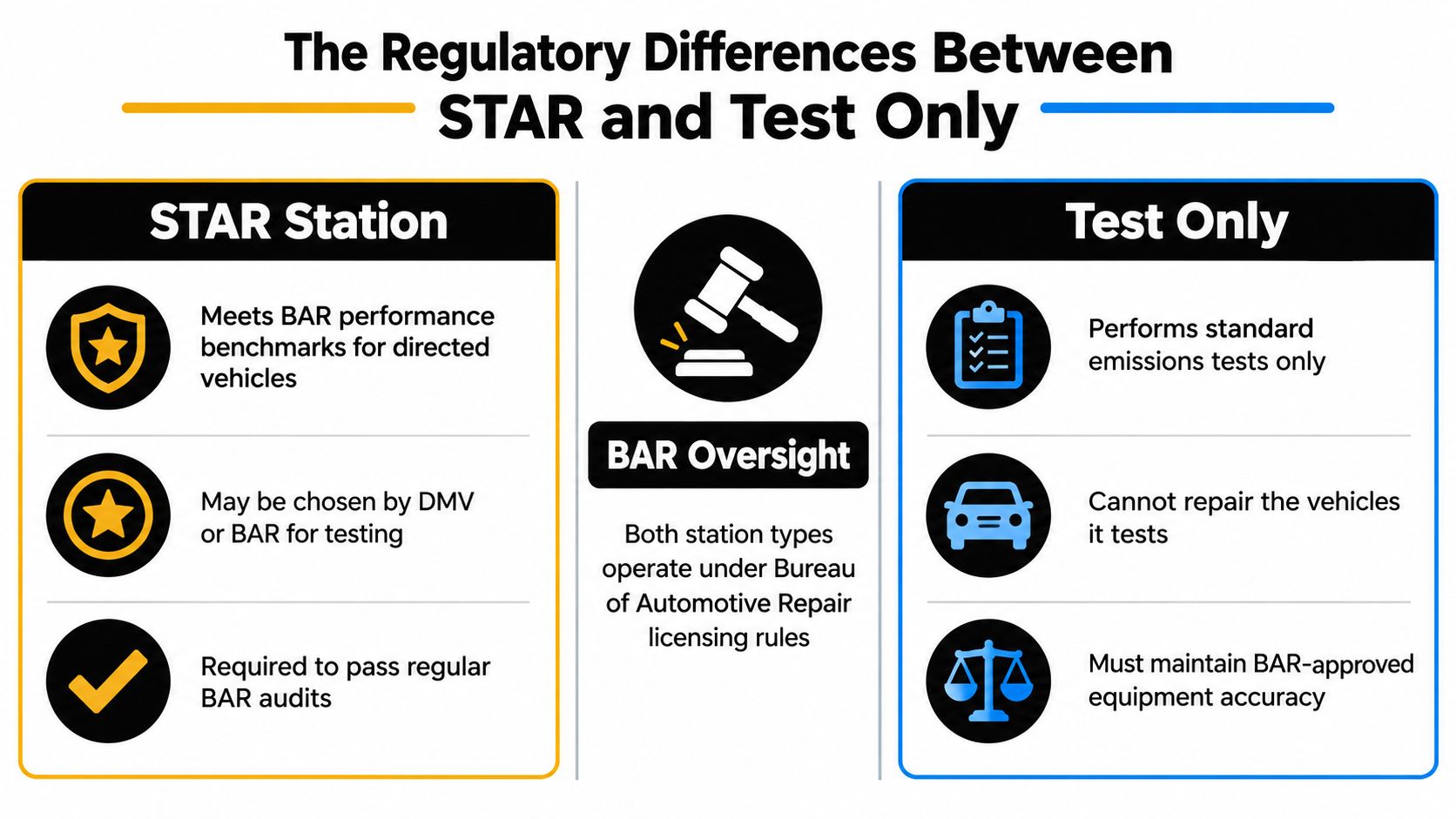
Licensing scope and performance standards
The Bureau of Automotive Repair's Smog Check explanation distinguishes between stations that test vehicles and stations that also perform repairs. BAR states that STAR stations can be either Test-Only or Test-and-Repair, while meeting the higher standards associated with STAR participation.
That creates an overlap that many quick online explainers miss:
- A regular Test-Only station can inspect vehicles but can't perform emissions repairs.
- A STAR Test-Only station can inspect vehicles under STAR standards but still can't perform repairs.
- A STAR Test-and-Repair station can inspect vehicles under STAR standards and repair emissions-related problems within its licensed scope.
- A regular Test-and-Repair station may perform repairs, but it isn't automatically authorized for every STAR-directed inspection.
The words “STAR” and “Test-Only” aren't opposites. One identifies a performance certification tier. The other identifies whether the station's license permits testing without repairs.
Why the distinction affects your appointment
BAR's STAR certification information explains that STAR stations must meet higher inspection-based performance standards and can inspect all vehicles subject to Smog Check, including gross polluters and directed vehicles. BAR also states that directed vehicles can receive certification only from STAR Test-Only or STAR Test-and-Repair stations.
That's why a STAR Test-Only station can be exactly the right choice. If your vehicle requires STAR and you only need a test, you don't need a repair shop. You need a station that holds the correct STAR authority.
For drivers who want a deeper explanation of the overlapping labels, this guide to what a Smog STAR station is breaks down the terminology without treating STAR and Test-Only as competing categories.
Vehicle Eligibility and Inspection Capabilities
The vehicle category determines how strict your station choice needs to be. A regular vehicle undergoing an ordinary renewal may be eligible for a standard Test-Only inspection. A directed vehicle or a gross polluter needs a STAR-capable station.
The word “directed” matters because it describes a vehicle that California requires to receive its inspection at a STAR station. The direction may appear on the DMV renewal notice or arise from the vehicle's inspection history and program requirements. Don't rely on a map listing or a low advertised price to determine eligibility.
The capability comparison
| Station Type | Standard Vehicles | Directed Vehicles | Gross Polluters |
|---|---|---|---|
| Regular Test-Only | Can inspect when the vehicle's requirements allow a standard test | Cannot provide the required STAR certification | Not the correct certification path |
| STAR Test-Only | Can inspect standard vehicles and vehicles subject to STAR requirements | Can inspect and certify directed vehicles | Can inspect and certify gross polluters |
| Regular Test-and-Repair | Can test and repair within its license scope | Not automatically authorized for STAR-directed certification | Not automatically the correct certification path |
| STAR Test-and-Repair | Can test and repair within its license scope | Can inspect, repair, and certify directed vehicles | Can inspect, repair, and certify gross polluters |
The table shows why “Test-Only” doesn't always mean the same thing. Regular Test-Only and STAR Test-Only both lack repair authority, but only the STAR version can handle directed vehicles and gross polluters under the applicable STAR requirements.
Three categories drivers need to recognize
Standard vehicles are the least complicated. If the DMV notice calls for a normal Smog Check and doesn't direct the vehicle to STAR, an authorized regular Test-Only station may be enough. A STAR station can also perform the inspection, but STAR may not be mandatory for that particular vehicle.
Directed vehicles must go to a STAR station. A regular Test-Only station can conduct an inspection within its authority, but it can't provide the STAR certification required for a directed vehicle. Booking the wrong station can turn a routine renewal into an avoidable second appointment.
Gross polluters require STAR capability as well. A vehicle in this category may need more attention after a failure, but the first step remains choosing a station authorized to perform the required inspection. Don't confuse the ability to test with the ability to repair.
A station can be legitimate, licensed, and perfectly capable of ordinary inspections while still being the wrong station for a directed vehicle.
The High Cost of Choosing the Wrong Station
Most drivers compare smog stations by the advertised test price. That's understandable, but it's incomplete. The financial risk appears when the station lacks the authority or repair capability your vehicle needs.
Suppose an East Bay driver takes a directed vehicle to a regular Test-Only station. The station may perform an inspection, but it can't provide the STAR certification required for that vehicle. The driver has paid for activity that doesn't complete the DMV requirement, then has to locate a STAR station and arrange another visit.
That's not just an inconvenience. It can mean another test charge, more fuel, time away from work, and a delayed registration renewal. The initial low price stops looking low once the driver adds the cost of correcting the decision.
A failure creates a separate decision
A regular Test-Only station can document a failed emissions inspection, but it can't repair the emissions problem. The vehicle may need to go to a separate repair shop for diagnosis and corrective work.
After repairs, the driver still needs the right station for the next certification attempt:
- If the vehicle is directed, the return inspection must be handled by a STAR Test-Only or STAR Test-and-Repair station.
- If the vehicle is a gross polluter, the driver needs a STAR-capable facility for the applicable certification.
- If the vehicle has no STAR requirement, the driver may have more flexibility, but the station still needs the proper authorization for the follow-up inspection.
- If the first station is also Test-and-Repair, the driver may be able to keep diagnosis and repair in one place, depending on the problem and the shop's licensed services.
The important point is that test authority and repair authority are different. A station that can test your car may not be able to fix it. A repair shop that can fix emissions components may not be authorized to complete the STAR certification your DMV notice requires.
The cheapest test can become the expensive route
Drivers often focus on the first transaction instead of the entire path to certification. That approach is risky when the vehicle has warning lights, a previous failure, or a STAR direction.
A better calculation includes:
- The first inspection.
- Diagnosis and emissions repairs if the vehicle fails.
- The follow-up inspection.
- Travel between separate businesses.
- Time spent scheduling and waiting.
- The risk of choosing another facility that also lacks the correct certification authority.
You can't know in advance whether a vehicle will pass, but you can avoid a preventable station mismatch. If STAR is mandatory, start with STAR. If repair work may be needed, ask whether the station is Test-Only or Test-and-Repair before you arrive.
The smart budget isn't the lowest first price. It's the lowest realistic cost from inspection to valid DMV certification.
How to Verify Your Smog Station Needs
You don't need to decode California's entire emissions program before making an appointment. You need to verify three things in the right order: the DMV instruction, the vehicle's status, and the station's current authorization.
Start with the DMV renewal notice
Read the notice carefully instead of searching by vehicle age or neighborhood alone. Look for language indicating that the vehicle must go to a STAR station, or that it has been directed for a specific type of inspection.
If the notice requires STAR, treat that instruction as decisive. Don't book a regular Test-Only station and hope the result will transfer. The station must be able to issue the certification your vehicle requires.
If the notice only requests a standard Smog Check, you may have a choice between a regular Test-Only station and a STAR station. When the notice is unclear, contact the station before driving over and describe the exact wording.
Ask the station direct questions
Use this short checklist when you call or book online:
- “Is your station currently STAR-certified?”
- “Are you STAR Test-Only or STAR Test-and-Repair?”
- “Can you certify a vehicle directed to STAR?”
- “Can you inspect gross polluters?”
- “If the vehicle fails, do you perform emissions repairs here?”
The first three questions establish whether the station can complete the required certification. The last two help you plan for a failure without assuming the shop offers repairs.
Confirm before you leave home
Station listings can be incomplete or outdated. Confirm the location, appointment availability, and station type directly. Keep the DMV notice with you, along with any prior inspection information that may explain a failure or direction.
For additional preparation, use this guide on how to check your smog status before booking. The goal is simple: arrive at a facility that can legally complete the inspection, not merely one that advertises smog checks.
Why Speedy Smog is the Smart Choice for East Bay Drivers
For an East Bay driver who wants to avoid station-label confusion, a STAR-certified Test-Only station offers a straightforward path when the vehicle requires STAR certification. It can handle the inspection without pretending that STAR automatically includes repairs. If the vehicle passes, the certification process stays focused. If it fails, the driver knows that repair work may need to happen elsewhere unless the chosen station also holds Test-and-Repair authority.
Speedy Smog in San Leandro is a STAR Certified station that provides STAR-certified Test-Only smog inspections and electronically transmits results for DMV registration needs. That makes it relevant for drivers whose vehicles need STAR testing, including directed vehicles and other vehicles that fall under STAR inspection requirements.
What to confirm before your appointment
A good appointment starts with accurate information. Bring the renewal notice and ask the station to confirm that its current license and STAR status fit your vehicle's requirement.
Speedy Smog's service is designed around emissions testing rather than assuming every customer needs repairs on-site. Drivers with older vehicles, diesels, hybrids, or cars with a previous failure should still explain the vehicle's situation before the inspection so the station can clarify the correct next step.
The broader lesson is more important than any individual shop: choose certification authority first, convenience second, and price third. A nearby regular Test-Only station may be perfectly suitable for an ordinary renewal. It's the wrong choice when the DMV requires STAR.
The practical recommendation
If your notice requires STAR, book a STAR station and verify whether it's Test-Only or Test-and-Repair. If your vehicle has already failed or you expect emissions repairs, ask about the repair pathway before the test.
For an ordinary renewal with no STAR direction, either an authorized regular Test-Only station or a STAR station may work. Drivers who want to reduce uncertainty can review this guide to the best smog check options and then call the station with the exact wording from the DMV notice.
Speedy Smog offers STAR-certified Test-Only inspections in San Leandro for East Bay drivers who need a compliant DMV smog certification. Visit Speedy Smog with your renewal notice, confirm your vehicle's requirement, and book the correct inspection before you make an unnecessary trip.
Most California vehicles more than five model years old need a smog inspection every two years for registration renewal, while newer vehicles from the 2000 model year onward generally use an OBD test that takes about 10 to 15 minutes at a certified station such as Speedy Smog in San Leandro. The exact requirement depends on your vehicle, fuel type, model year, and the wording on your DMV renewal notice.
You may be looking at that notice right now, wondering whether you need a regular smog station or a STAR station, whether your hybrid is exempt, or what will happen when you arrive. A vehicle smog inspection sounds technical, but the basic idea is simple. California checks whether your vehicle's emissions-control system is working well enough for registration compliance.
The easiest way to understand the process is to follow the same path your vehicle takes, from the DMV notice to the inspection lane, test result, and possible repair.
Table of Contents
- What Is a Vehicle Smog Inspection in California
- Types of Smog Tests and What Applies to Your Vehicle
- Understanding STAR Certification and Why It Matters
- What to Expect at Your Smog Check Appointment
- Smog Failure Rates by Vehicle Age and What They Reveal
- Exemptions, Preparation Tips, and Steps After a Failure
What Is a Vehicle Smog Inspection in California
A San Leandro driver might receive a registration renewal notice, see “Smog Certification Required,” and assume every inspection works the same way. Another driver may see “Smog Certification Required at a STAR station” and wonder whether STAR is a special repair shop, a more expensive test, or just another name for a regular station.
It's none of those things. A smog inspection is an emissions compliance test, and the station checks your vehicle according to its model year and the requirements attached to your registration record. The result is sent through the state's inspection system so the DMV can confirm that the emissions requirement has been met.
California's Smog Check program has operated since 1984 and the state credits it with greatly reducing air pollution from millions of vehicles. Today, the system handles more than 10 million vehicle tests each year at thousands of independently owned stations statewide, as described in the California Bureau of Automotive Repair Smog Check FAQ.
Why California requires the inspection
The inspection connects vehicle ownership with air-quality rules. For most vehicles more than five model years old, a passing result supports biennial registration compliance, meaning the requirement commonly appears every two years during renewal. The state has updated the program as vehicles changed. Older inspections relied more heavily on measured exhaust, while newer vehicles can report emissions-system problems through onboard diagnostics.
That shift makes the test less mysterious. Your car isn't being judged by a mechanic's personal opinion. The technician follows a state procedure designed for the vehicle's model year and equipment.
Who usually needs a test
Most gasoline vehicles eventually enter the regular inspection cycle, but exemptions and special rules apply. Newer gasoline, hybrid, and alternative-fuel vehicles may be exempt from the biennial test for eight model years, while the DMV notice remains the most useful starting point for your specific renewal.
If you want a local overview before booking, this guide to smog checks in California explains the registration connection and common vehicle categories. Bring the renewal notice if you have it. Its wording can tell you not only whether certification is required, but also what type of station you must use.
Types of Smog Tests and What Applies to Your Vehicle
The model year usually determines the inspection pathway. Think of a newer vehicle as having a built-in health monitor, while an older vehicle must demonstrate its emissions performance more directly through the exhaust.
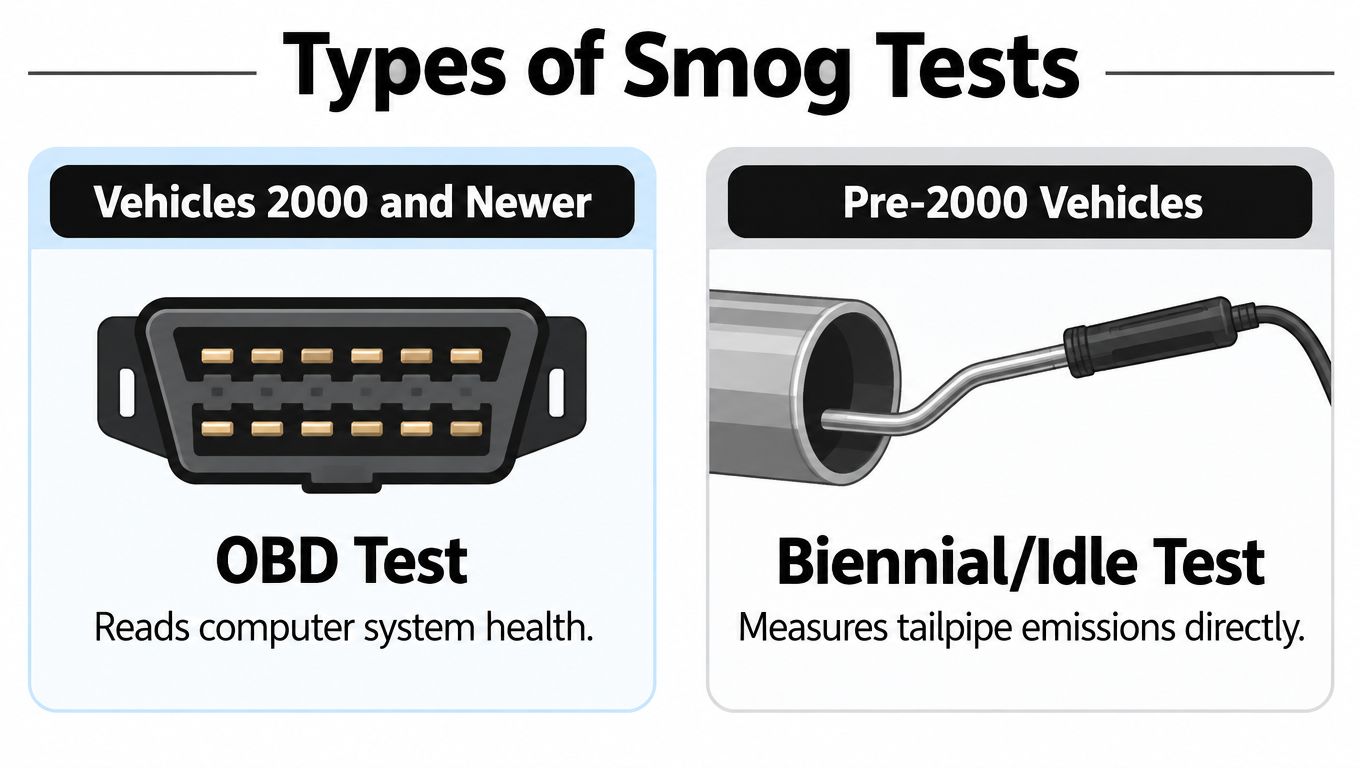
Vehicles from 2000 onward
For 2000-and-newer gasoline vehicles, the standard route is generally an onboard diagnostic, or OBD, test. A technician connects equipment to the vehicle's diagnostic port and checks whether the emissions-control computer has detected faults, whether warning indicators are behaving correctly, and whether the required system monitors are ready.
That's similar to plugging a scan tool into the car's brain. The technician isn't just asking whether the engine runs. The test checks whether the systems responsible for controlling emissions have completed their self-checks and whether the computer has stored a relevant fault.
The state's Smog Check testing overview explains that 2000-and-newer gasoline vehicles are generally inspected through OBD, while older vehicles use a different method.
Vehicles from 1999 and earlier
Vehicles from 1999 and earlier are generally routed to tailpipe-based testing. The station uses the BAR-97 emissions inspection system to measure exhaust emissions directly, rather than relying primarily on the vehicle's onboard computer.
The analogy is straightforward:
| Vehicle group | Main inspection approach | What the technician evaluates |
|---|---|---|
| 2000 and newer gasoline vehicles | OBD test | Emissions-system computer information |
| 1999 and older vehicles | Tailpipe testing with BAR-97 | Measured exhaust emissions |
A tailpipe test can feel more physical because equipment measures what comes out of the exhaust. That doesn't mean the process is automatically more difficult. It means the state uses a testing method suited to an older vehicle fleet.
Hybrids, diesels, and alternative-fuel vehicles
A hybrid isn't automatically exempt just because it can drive on electric power. Its eligibility depends on the vehicle's model year and the applicable California rules. Newer hybrids may fall within the eight-model-year exemption, but an older hybrid can still require inspection.
Diesel vehicles also need to be classified correctly. The required procedure can differ from a gasoline vehicle, so the safest approach is to check the DMV notice and confirm the station handles your vehicle type before arriving. Fuel system, model year, and registration circumstances matter more than a simple label such as “car,” “truck,” or “hybrid.”
Practical rule: Use the renewal notice and the vehicle identification details to determine the inspection path. Don't guess based only on the dashboard, fuel door, or the fact that the vehicle is newer than another car.
Understanding STAR Certification and Why It Matters
The STAR question usually has a simple answer: follow the exact wording on your DMV renewal notice. If it says “Smog Certification Required,” you can generally choose an authorized station that performs the required inspection. If it says “Smog Certification Required at a STAR station,” the inspection must happen at a STAR station.
That distinction matters because a non-STAR station can't substitute for a required STAR inspection. A STAR station isn't merely a shop that chose a particular marketing label. It holds a designation controlled by the California Bureau of Automotive Repair.
What STAR means
BAR evaluates STAR stations using inspection-volume and quality measures. The requirements include a Similar Vehicle Failure Rate of at least 50 percent of the industry-wide failure rate for similar vehicles and a Follow-up Pass Rate threshold of 0.40, according to BAR's STAR certification requirements.
Those measures are intended to make station performance accountable. A station shouldn't fail vehicles indiscriminately, and it shouldn't pass vehicles that need emissions-related attention. BAR uses the metrics to evaluate whether a station consistently identifies vehicles that genuinely require repair.
A simple decision tree
Use this order:
- Read the DMV renewal notice. Look for the exact smog wording.
- Check whether STAR is specified. If it is, choose a STAR-certified station.
- Confirm the station handles your vehicle. Ask about model year, fuel type, and test method.
- Bring the vehicle and notice. The technician can verify the required inspection in the state system.
The difference between a regular authorized station and a STAR station isn't necessarily the test technology. Both follow state procedures, and the appropriate method still depends on the vehicle. The difference is whether the station meets the performance controls attached to STAR certification and whether your notice requires that designation.
For a more detailed explanation of the designation, see this guide to what a STAR smog station is. Choosing the correct station first prevents one of the most frustrating outcomes, completing an inspection that doesn't satisfy the DMV requirement.
What to Expect at Your Smog Check Appointment
A first appointment is usually less dramatic than drivers expect. You pull into the station, provide the vehicle information and renewal notice, and let the technician follow the correct procedure for your car.
Start with check-in
Have your DMV renewal notice, current registration information, and the vehicle available for inspection. The notice helps the technician confirm whether you need a standard inspection or a STAR inspection. If you recently moved, bought the vehicle, or are dealing with an out-of-state registration issue, mention that at check-in.
The technician will identify the vehicle and select the applicable inspection procedure. You don't need to know the technical test code yourself. Your job is to provide accurate information and explain any recent dashboard warning lights or emissions repairs.
The technician checks more than the exhaust
The inspection can include a visual review of emissions-related components, a check of warning indicators, and the prescribed electronic or tailpipe test. For a newer gasoline vehicle, the technician connects to the OBD port and reviews the computer's emissions information. For an older vehicle, the BAR-97 equipment measures exhaust output through the tailpipe.
A warning light deserves attention before the appointment. If the check-engine light is on, the vehicle may fail because the computer is reporting an emissions-related problem. Clearing the light immediately before testing isn't a reliable fix, because the system may need to complete its monitors before the vehicle can be evaluated properly.
Before you arrive: Tell the technician about recent battery replacement, computer resets, warning lights, or emissions repairs. Those details can affect the vehicle's readiness information.
For many 2000-and-newer vehicles, a typical OBD inspection at Speedy Smog in San Leandro takes about 10 to 15 minutes, although the actual time can vary with the vehicle and station workload. The shop describes a clean indoor waiting area and a process intended to keep the visit straightforward.
Once the inspection is complete, the station records the result. A pass supports the DMV registration process. A failure should come with information about the reason for failure, so you can decide whether to repair the issue at the station, visit a repair shop, or obtain a second diagnostic opinion.
Here's what the basic flow looks like in practice:
- Check in: Provide the renewal notice and vehicle details.
- Identify the procedure: The technician confirms STAR status and test type.
- Inspect the vehicle: The station checks the applicable emissions components and equipment.
- Run the test: The vehicle receives an OBD or tailpipe-based inspection.
- Receive the result: The station records a pass or provides failure information.
A comfortable waiting room can make the appointment easier, but the important part is procedural accuracy. The result needs to match the vehicle, the registration requirement, and the state's inspection rules.
Smog Failure Rates by Vehicle Age and What They Reveal
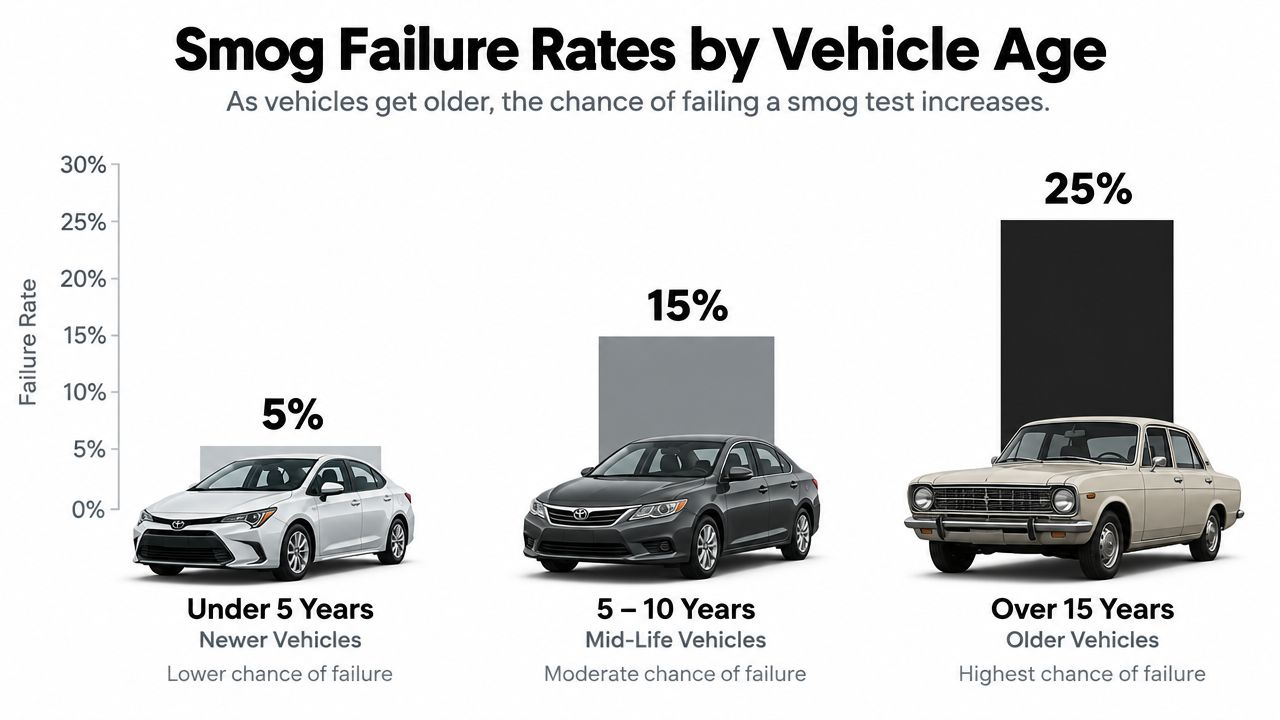
Drivers often treat a failed smog test as random bad luck. California's recent inspection data point to a more predictable pattern. Vehicle age has a strong relationship with failure outcomes, although maintenance history, emissions-system condition, and the specific fault still matter.
In the January 2026 executive summary, 2025 model-year vehicles had an overall failure rate of 0.23 percent, while 2024 model-year vehicles failed at 4.52 percent and 2023 model-year vehicles failed at 4.36 percent. The same report recorded a 22.18 percent failure rate for 1976 model-year vehicles, showing the much steeper challenge faced by older vehicles. These figures come from the California BAR Smog Check executive summary for 2025.
Why age changes the odds
Older vehicles have had more time for sensors, vacuum lines, catalytic converters, ignition parts, and other emissions components to wear out. They may also have accumulated years of incomplete maintenance or modifications that affect the original emissions system.
Newer vehicles aren't guaranteed to pass, but their failure rates in the reported data are much lower than those of older model years. That doesn't make preparation unnecessary. It means preparation should focus on known warning signs rather than assuming every inspection is a crisis.
The statewide picture
California recorded 11,275,981 initial tests in 2025, including 959,667 failures, for an 8.51 percent initial-test failure rate, according to the same BAR report. Those figures show that failures are a normal part of a large inspection system, not evidence that every failed vehicle has a catastrophic engine problem.
| Reported group | Initial failure rate |
|---|---|
| 2025 model year | 0.23% |
| 2024 model year | 4.52% |
| 2023 model year | 4.36% |
| 1976 model year | 22.18% |
| All initial tests in 2025 | 8.51% |
The useful lesson is practical. An older vehicle with an illuminated warning light, rough running, or a history of emissions repairs deserves diagnosis before the appointment. A newer vehicle with no warning signs may need little more than a correctly completed inspection.
Exemptions, Preparation Tips, and Steps After a Failure
The DMV notice should guide your decision, but a few rules explain why neighbors with similar-looking vehicles may receive different requirements. Newer gasoline, hybrid, and alternative-fuel vehicles may qualify for an eight-model-year exemption from the biennial test. Once that exemption ends, the vehicle can enter the regular renewal cycle.
The notice can also specify the station type. “Smog Certification Required” and “Smog Certification Required at a STAR station” aren't interchangeable instructions. Read the line carefully before booking.
Prepare without trying to trick the test
Good preparation means making sure the vehicle is in ordinary, documented operating condition:
- Resolve warning lights: Diagnose an illuminated check-engine light instead of clearing it without root cause analysis.
- Complete normal driving: If the battery was recently disconnected or the computer was reset, drive the vehicle normally so its emissions monitors can complete.
- Check basic condition: Address obvious rough running, misfires, exhaust leaks, or unusual smells before inspection.
- Bring records: Keep repair invoices and maintenance information available for the technician or repair shop.
- Confirm the station: Verify STAR status and vehicle coverage before you arrive.
A drive cycle isn't a shortcut around a problem. It gives the vehicle's onboard system time to perform its own checks after a reset. If the monitors remain incomplete, the technician may not be able to complete the inspection even if the car feels normal.
If the vehicle fails
A failure report identifies the area that prevented certification. The right response depends on the finding. A repair shop may need to diagnose a sensor, catalytic converter, evaporative-emissions leak, ignition issue, or another emissions-related fault. Don't replace expensive parts based only on a guess.
After repairs, the vehicle needs a retest. Keep the failure report and repair documentation because they help the next technician avoid repeating the same diagnostic work. Drivers who need guidance with the repair process can review smog check repair assistance before choosing their next step.
A failed test is a diagnosis starting point, not a final verdict. Ask what failed, why it failed, and which repair can confirm the cause before authorizing parts.
If the vehicle's age, fuel type, registration status, or station requirement is unclear, ask the inspection station or consult the DMV information tied to your renewal. A few minutes of verification can prevent the wrong test, an incomplete inspection, or a return visit.
Speedy Smog provides vehicle smog inspections and STAR smog checks in San Leandro for newer and older vehicles, including applicable diesel and hybrid inspections. Review your DMV notice, bring the vehicle and registration information, and visit Speedy Smog to arrange a compliant inspection.
You pull into a smog station, the technician plugs into the OBD-II port, and a string like P0420 or P0442 shows up on the screen. Most drivers have the same reaction: what does that code mean, and does it mean an automatic fail?
That's the gap that trips people up. A raw code list tells you what system complained. It usually doesn't tell you how California's smog inspection will treat that complaint. And in California, that distinction matters because the state's smog program doesn't just sniff the exhaust and make a judgment call. It uses standardized electronic checks, regulated inspection logic, and readiness rules that can fail a vehicle even after a repair if the car hasn't finished its self-tests.
If you understand how smog check codes fit into California BAR logic, you stop guessing. You can tell the difference between a code that points to a loose gas cap, a code that suggests catalyst trouble, and a car that has no active fault but still isn't ready for inspection.
Table of Contents
- What Smog Check Codes Are and Why They Matter
- How California Smog Inspections Actually Work
- Major OBD-II Code Categories Explained
- The Most Common Smog-Failing Codes and Their Causes
- Readiness Monitors and BAR Pass/Fail Logic
- Troubleshooting Codes Before Your Re-Test
- When You Need a STAR Certified Station
- Quick-Reference Checklist for Passing Smog Check
What Smog Check Codes Are and Why They Matter
Your registration is due, the car feels normal, and then the smog station scanner shows P0420 or P0442. At that moment, the question is not just “What does this code mean?” The question is “How will California treat it during the inspection?”
That distinction is the whole point of smog check codes.
In practice, drivers are usually talking about Diagnostic Trouble Codes, or DTCs. These are the fault codes your car stores when its emissions system sees something outside the expected range. The code is the computer's shorthand. It tells you which system raised its hand, but it does not tell you the full inspection outcome by itself.
A code works a lot like a symptom on a medical chart. “Fever” tells you something is wrong. It does not tell you whether the patient is cleared to leave, needs more testing, or failed a required screening. California smog inspections work the same way. The code matters, but the state also looks at whether the Check Engine Light, also called the MIL, behaves correctly and whether the car's self-tests are complete.
That is where many drivers get tripped up. They read a raw OBD-II code list and assume every code means the same thing for smog. California does not grade them that way. One vehicle may fail because an active emissions code is present. Another may have no current code at all and still fail because the readiness monitors are not set. That gap between the code list and the actual BAR pass or fail logic is what you need to understand before a test, especially with the October 2025 readiness rule affecting how incomplete monitors are treated.
The two code layers drivers often mix together
There are really two different buckets to keep straight:
- Vehicle DTCs: These are the OBD-II fault codes stored by the car, such as P0300, P0420, or P0455.
- Inspection results: These are the things the smog inspection checks and scores, including MIL operation, readiness status, and other inspection items.
The first bucket tells you what the car reported. The second bucket tells you whether California will pass the car.
That difference explains why two people can both say, “I failed for a code,” while the actual reasons are different. One may have an active catalyst-efficiency code. The other may have recently cleared codes, which turned off the light for the moment but reset the readiness monitors. To a driver, both feel like “smog code problems.” To the inspection system, they are different failure paths.
Why the MIL matters as much as the code itself
The MIL is not just a dashboard warning. For smog, it is part of the inspection decision.
BAR explains that modern smog inspections include an onboard diagnostic check for applicable vehicles, and the process uses information reported by the vehicle's own system through the California Smog Check program page. That means the technician is not guessing based on how the engine sounds or whether the car seems to drive well. The inspection is checking what the vehicle reports about its own emissions controls.
Here is the simple version. If the car says an emissions fault is active, that matters. If the Check Engine Light does not behave correctly during the bulb check, that matters too. If monitors have not completed after repairs or after battery power was disconnected, that matters as well.
So when you see a code, do not treat it as a random repair hint. Treat it as a clue that may affect three things at once: the stored fault history, the warning light, and the readiness status. That is why understanding smog check codes saves time. It helps you tell the difference between a repair issue, a testing-timing issue, and a direct fail condition.
How California Smog Inspections Actually Work
You pull into a smog station with no warning lights on, and the car seems to run fine. A few minutes later, the result is still a fail. That surprises a lot of drivers because California smog inspections are not just a quick sniff test anymore. For many vehicles, the inspection is really a conversation between the station's equipment and your car's onboard emissions system.
California's program has changed over time. Older test methods put more weight on tailpipe measurement equipment. Newer inspection paths rely heavily on onboard diagnostics, especially for modern gasoline vehicles. That shift is the gap many drivers miss. Reading a code list tells you what the car noticed. Understanding California BAR logic tells you whether that issue blocks a pass today.
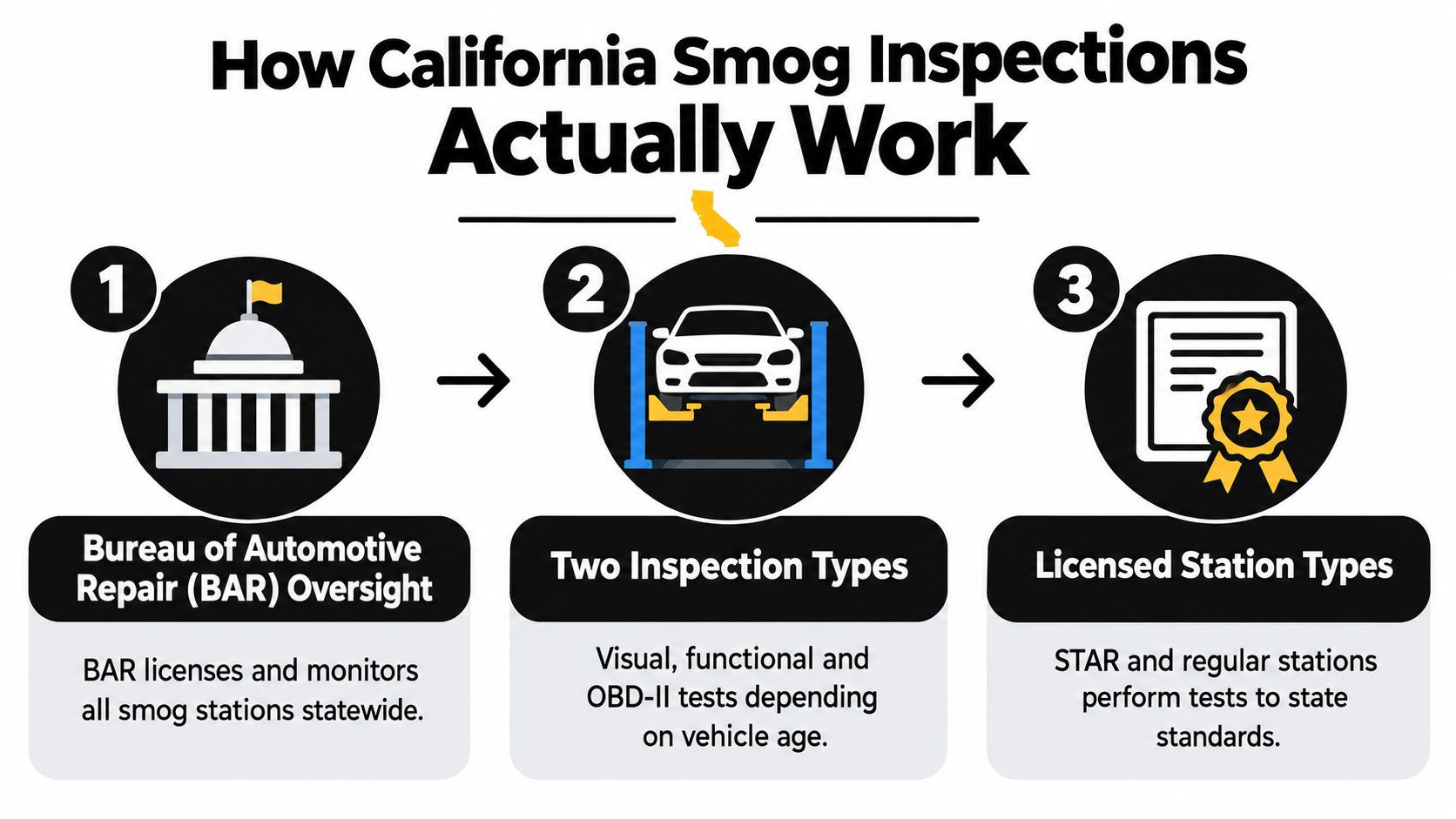
What BAR controls, and what the station checks
The Bureau of Automotive Repair sets the inspection rules, licenses stations, and defines the pass or fail process. The technician does not get to "use judgment" on an emissions fault the same way a general repair shop might. If the system reports a condition that fails under BAR rules, the station has to record that result.
That matters because drivers often expect a smog check to work like a road test. It does not. A smog inspection is closer to an audit. The station verifies what the car reports about its emissions systems, checks whether required equipment is present, and follows the inspection path assigned to that vehicle.
Why some cars get tested differently
California does not send every vehicle through the same hardware or procedure.
Older vehicles may still follow a BAR-97 style path that can include tailpipe testing procedures. Many newer gasoline vehicles go through an OIS-based inspection that focuses on OBD data. In plain terms, newer cars are usually graded by the health of the emissions control system as reported by the car itself.
For a 2000-and-newer gasoline vehicle, the technician will usually connect to the OBD system and look at three big things first. Is the Malfunction Indicator Lamp working as required. Are any emissions-related faults active or stored in a way that triggers failure. Have the readiness monitors completed.
That last point is where many failed retests happen. A car can have no active repair problem and still be rejected if the monitors are not ready. Starting in October 2025, California readiness rules become even more important to understand because monitor status can change whether the car is testable and whether it can pass under BAR logic.
After that overview, it helps to see the process in motion.
What happens at the station
A California smog inspection can include several parts, depending on the vehicle and its assigned test path:
- OBD system check for codes, MIL status, and readiness monitor completion.
- Visual inspection of required emissions components and signs of tampering.
- Functional checks for systems that must operate during inspection.
- Tailpipe testing for vehicles that still require it under their inspection method.
Here is the practical takeaway. Passing is not just about whether the exhaust seems clean at that moment. For many modern vehicles, the onboard system is the scorekeeper. If the car reports an emissions fault, if the MIL does not behave correctly, or if the monitors are incomplete, the inspection result can be decided before tailpipe numbers become the main issue.
That is why a raw code list only tells part of the story. The smog question is how that code, that warning light status, and that readiness state fit into California's pass or fail rules.
Major OBD-II Code Categories Explained
A code may look random, but it isn't. OBD-II codes follow a structure, and once you know that structure, you can read the category before you understand the exact fault.
The first letter tells you the system family:
- P means Powertrain
- B means Body
- C means Chassis
- U means Network or communication
For smog purposes, the codes that usually matter most are P-codes because they relate to engine, fuel, ignition, air metering, catalyst, and emissions control operation.
How to read the family before the exact number
A code like P0420 tells you something very different from a body or network code. It points you toward an emissions-related powertrain fault. That's why P-codes get most of the attention during smog prep.
If you want a basic walkthrough on scanner terminology and code formatting, this guide on how to read OBD codes is a useful companion before you start interpreting specific failures.
The code groups that usually affect smog results
Some code families show up again and again in smog-related diagnosis:
| Code Prefix | Category | Example Code | Smog Inspection Impact |
|---|---|---|---|
| P03xx | Misfire and combustion faults | P0300 | Can trigger the MIL and point to emissions problems caused by incomplete combustion |
| P04xx | Auxiliary emissions controls | P0411 | Often tied to systems like secondary air injection that affect cold-start emissions control |
| P042x to P043x | Catalyst efficiency | P0420 | Often suggests the catalytic converter isn't performing as expected |
| P044x to P045x | EVAP system faults | P0442 | Points to fuel vapor leak detection issues that can block a pass |
| P013x to P015x | Oxygen sensor circuit and response faults | P0136 | Affects fuel control feedback and catalyst monitoring |
| P0171 or P0172 family | Fuel trim lean or rich conditions | P0171 | Can indicate the engine is running outside the air-fuel balance the computer expects |
Why category matters more than memorizing every code
You don't need to memorize the entire code book. You need to recognize patterns.
A catalyst code, an EVAP leak code, and a misfire code can all fail the same inspection for different reasons. The code points to the system. The inspection decides whether that system status is acceptable.
That's the practical value of categories. A code isn't only a repair clue. It also hints at which smog checkpoint is likely to become a problem, whether that's MIL status, monitor completion, or the performance of an emissions control system.
The Most Common Smog-Failing Codes and Their Causes
Some codes show up so often that technicians can almost predict the symptom before they scan the car. The reason isn't mystery. Modern emissions systems watch a handful of problem-prone areas closely, and when one of those systems drifts out of range, the computer stores a fault.
Catalyst efficiency codes
P0420 and P0430 are the codes drivers fear because they often raise the question nobody wants to hear: is the catalytic converter worn out, or is something upstream making it look bad?
These codes usually mean the computer compared upstream and downstream oxygen sensor behavior and decided the converter isn't cleaning exhaust the way it expects. Sometimes the converter is the actual failure. Sometimes the root cause is a long-running rich condition, a misfire history, or sensor data that's no longer reliable.
Typical symptoms can include:
- Check Engine Light on: Often the only obvious warning
- Fuel economy changes: Sometimes subtle, sometimes noticeable
- Sulfur or exhaust odor: Not always present, but worth noting
Lean, rich, and fuel control faults
Codes like P0171 and P0174 point to lean conditions. Their rich-side counterparts indicate the opposite problem. On the ground, that often translates to vacuum leaks, air metering issues, intake leaks, contaminated mass airflow sensors, or fuel delivery problems.
A lean code doesn't tell you “replace this one part.” It tells you the engine control module had to correct fuel delivery beyond what it considers normal. That's why good diagnosis matters.
| Code | Category | Typical Symptoms | Common Causes |
|---|---|---|---|
| P0420 | Catalyst efficiency | Check Engine Light, reduced fuel economy, possible exhaust odor | Worn catalytic converter, aging sensor feedback, unresolved fuel control issues |
| P0430 | Catalyst efficiency | Similar symptoms to P0420 | Same pattern on the opposite bank of the engine |
| P0171 | Lean condition | Rough idle, hesitation, light pinging, Check Engine Light | Vacuum leaks, intake leaks, dirty MAF sensor, fuel delivery issues |
| P0174 | Lean condition | Similar to P0171 on multi-bank engines | Same fault pattern affecting the other bank |
| P0300 | Random misfire | Rough running, shaking at idle, flashing or steady Check Engine Light | Ignition faults, fuel issues, compression problems |
| P0301 to P0308 | Cylinder-specific misfire | Rough idle, stumble under load | Spark plugs, coils, injectors, wiring, engine mechanical faults |
| P0440 | EVAP system fault | Usually no drivability symptom, Check Engine Light | Gas cap sealing issue, purge or vent fault, leak in EVAP plumbing |
| P0442 | Small EVAP leak | Usually no obvious symptom | Loose gas cap, minor leak in hoses or EVAP components |
| P0455 | Large EVAP leak | Fuel vapor smell possible, Check Engine Light | Missing gas cap, disconnected hose, larger EVAP leak |
| P0136 | O2 sensor circuit fault | Check Engine Light, fuel trim irregularity | Sensor failure, wiring issue, connector problem |
| P0156 | O2 sensor response fault | Check Engine Light, possible drivability change | Sluggish or failed sensor, wiring or connector trouble |
Misfires and EVAP faults
Misfire codes from P0300 through P0308 usually get attention quickly because drivers often feel them. Rough idle, shaking, and stumble on acceleration are common. The cause may be ignition related, fuel related, or mechanical.
EVAP codes such as P0440, P0442, and P0455 are different. The car may drive almost normally, but the emissions system still sees a leak or control problem. That's why a driver can say, “It runs perfect,” and still fail inspection.
If the code is EVAP-related, don't assume the repair is always expensive. A sealing issue at the gas cap is much different from smoke-testing an intermittent vapor leak deep in the system.
Readiness Monitors and BAR Pass/Fail Logic
You repair the car, clear the code, drive straight to the smog station, and the car still fails. That result confuses a lot of drivers because the fault may be fixed, but the car has not finished proving it.
That proof happens through readiness monitors. Each monitor is a self-test for one emissions system. The computer waits for specific conditions before it marks that test complete, such as a cold start, steady cruising, deceleration, idle time, or a certain fuel level. Until that happens, the monitor stays incomplete.
Why a repaired car can still fail
A trouble code and a readiness monitor are connected, but they are not the same thing.
A code says the computer saw a fault. A monitor says the computer has finished checking that system. Clearing codes often resets one or more monitors to incomplete, so a car can leave the repair shop with no active warning light and still be unready for inspection.
California's OBD inspection looks at three things together: MIL status, diagnostic trouble codes, and monitor readiness, as explained in BAR's OBD Test Reference. That is the part many raw code lists miss. A code list tells you what failed. BAR logic decides whether the current combination of lamp status, codes, and monitor completion is enough to pass.
Common monitors include:
- Catalyst
- Evaporative system
- Oxygen sensor
- Oxygen sensor heater
- Secondary air
- EGR or variable valve timing related emissions monitoring
Some monitors run quickly after a normal drive. EVAP is a common holdout because it often needs a narrower set of conditions, including fuel level and soak time.
How BAR monitor allowances work in practice
Before October 1, 2025, California allows a limited number of incomplete monitors for some vehicles. The easiest way to read that rule is to ask one question: if every code were gone today, how many monitors could still say "not ready" and let the car pass?
| Vehicle Year | Fuel Type | Max Incomplete Monitors | Practical meaning |
|---|---|---|---|
| 1996 to 1999 | Gasoline | Any one | One incomplete monitor is allowed |
| 2000 and newer | Gasoline | EVAP only | Only the EVAP monitor may remain incomplete |
| 1998 to 2006 | Diesel | Zero | All supported monitors must be complete |
| 2007 and newer | Diesel | Particulate filter and NMHC monitors only | Only those specific monitors may remain incomplete |
That table is where BAR pass or fail logic becomes more useful than a generic scanner screen. For example, a 2003 gasoline car with catalyst ready and oxygen sensor ready, but EVAP still incomplete, may still pass. A 2012 gasoline car with the exact same monitor pattern may also pass, because EVAP is the one allowed exception under the current rule. If that same 2012 car has catalyst incomplete instead, it fails even with no Check Engine Light.
If you are sorting out how the warning light side of the test interacts with monitor status, this guide to Check Engine Light and smog test results helps connect those two pieces.
The October 2025 change
Effective October 1, 2025, California tightens that standard. All readiness monitors must be complete for a vehicle to pass Smog Check, according to BAR's readiness monitor regulation update.
That change matters because it closes the gap many drivers have relied on after clearing codes or disconnecting a battery. Under the current rule, one allowed incomplete monitor can sometimes still produce a pass. After that date, "close enough" stops working. The car has to finish every supported self-test.
The practical takeaway is simple. A successful repair is only half the job. The second half is completing the drive conditions that let the car verify that repair to its own computer.
Troubleshooting Codes Before Your Re-Test
After a failed smog, the smartest move is to slow down and separate fault diagnosis from inspection timing. Many repeat failures happen because the repair was incomplete, or because the repair was finished but the car wasn't ready yet.
Start with the code list, not a guess
Read and record every code before doing anything else. That includes stored codes and, if your scan tool shows them, pending codes. If you don't own a scanner, some drivers use an auto parts store code pull as a starting point.
Then sort the result into one of two buckets:
- Simple checks first: gas cap fit, visible cracked intake hoses, obvious loose connectors, weak battery terminals, or recent battery disconnect history
- Professional diagnosis likely needed: persistent misfires, catalyst efficiency faults, EVAP leak tracing, sensor circuit faults, or anything that returns quickly after being cleared
If you're trying to understand whether code clearing helped or hurt your test prep, this guide on how to clear a Check Engine Light is useful because the issue usually isn't the act of clearing. It's what happens to readiness afterward.
What you can check yourself
A few items are realistic for a careful driver:
- Confirm the gas cap seals and clicks properly.
- Look for split or disconnected vacuum hoses.
- Check battery connections if the car recently lost power.
- Scan again after any simple fix and drive the car before retesting.
What usually isn't a driveway diagnosis is an EVAP leak that needs a smoke machine, a converter decision on a modern car, or a misfire that stayed after basic ignition parts were addressed.
Drive cycle matters after repairs
Cars don't set monitors because you drove around the block once. They usually need a mix of operating conditions such as city driving, steady cruising, warm-up cycles, and deceleration events with the engine fully warmed.
A practical retest routine usually includes:
- Cold start and warm-up: Let the car reach normal operating temperature
- Mixed city driving: Stop-and-go operation helps some monitors run
- Steady highway cruise: Useful for catalyst and oxygen sensor checks on many vehicles
- Normal deceleration: Letting off the throttle without harsh braking can help certain self-tests complete
If the DMV notice directs you to a STAR station, or if the car has already failed and the situation is getting more complicated, a station such as Speedy Smog can perform the inspection side while you confirm the vehicle is ready rather than guessing from a recently cleared code.
When You Need a STAR Certified Station
Not every California driver needs the same station type. That part gets confusing because people use older shop labels and newer BAR terms interchangeably.
The practical question is simpler: what does your DMV notice require, and what stage of the process are you in?
Standard station versus STAR station
A regular licensed smog station can handle many routine inspections. A STAR Certified station is different because it meets BAR performance standards and can inspect vehicles that are specifically directed into the STAR program.
That matters in situations like DMV-directed testing, more scrutinized vehicles, or cases where the state requires a particular station type for registration purposes.
How to think about the tiers
| Station Type | Can Perform Repairs? | Required For | Waiver Authority |
|---|---|---|---|
| Test Only | Usually no repair role in the testing lane | Routine testing when DMV notice allows a non-STAR option | Not typically the path drivers look to for directed waiver handling |
| Repair-capable smog station | Sometimes, depending on station license and setup | Drivers handling diagnosis and repair before retest | Depends on station authorization and BAR process involvement |
| STAR Certified station | May be test-only or may operate with repair-related roles depending on its license | DMV notices that specify STAR, state-directed cases, and more sensitive inspection routing | Relevant when the case involves BAR-directed processes and station eligibility |
Check the renewal notice before booking
The easiest mistake is booking the closest shop without reading the DMV notice. If the notice says the vehicle must go to a STAR station, a standard booking doesn't solve the problem.
If a vehicle has already failed, or if you're dealing with a directed situation, choosing the right station type early saves time. The code itself may tell you what needs repair, but the registration notice tells you where the state will accept the inspection.
Quick-Reference Checklist for Passing Smog Check
Most smog failures aren't caused by one mysterious rule. They come from a short list of preventable mistakes. Drivers test with the MIL on, clear codes too late, skip the drive cycle, or show up at the wrong station type.
This checklist keeps the process practical.
Save this before test day
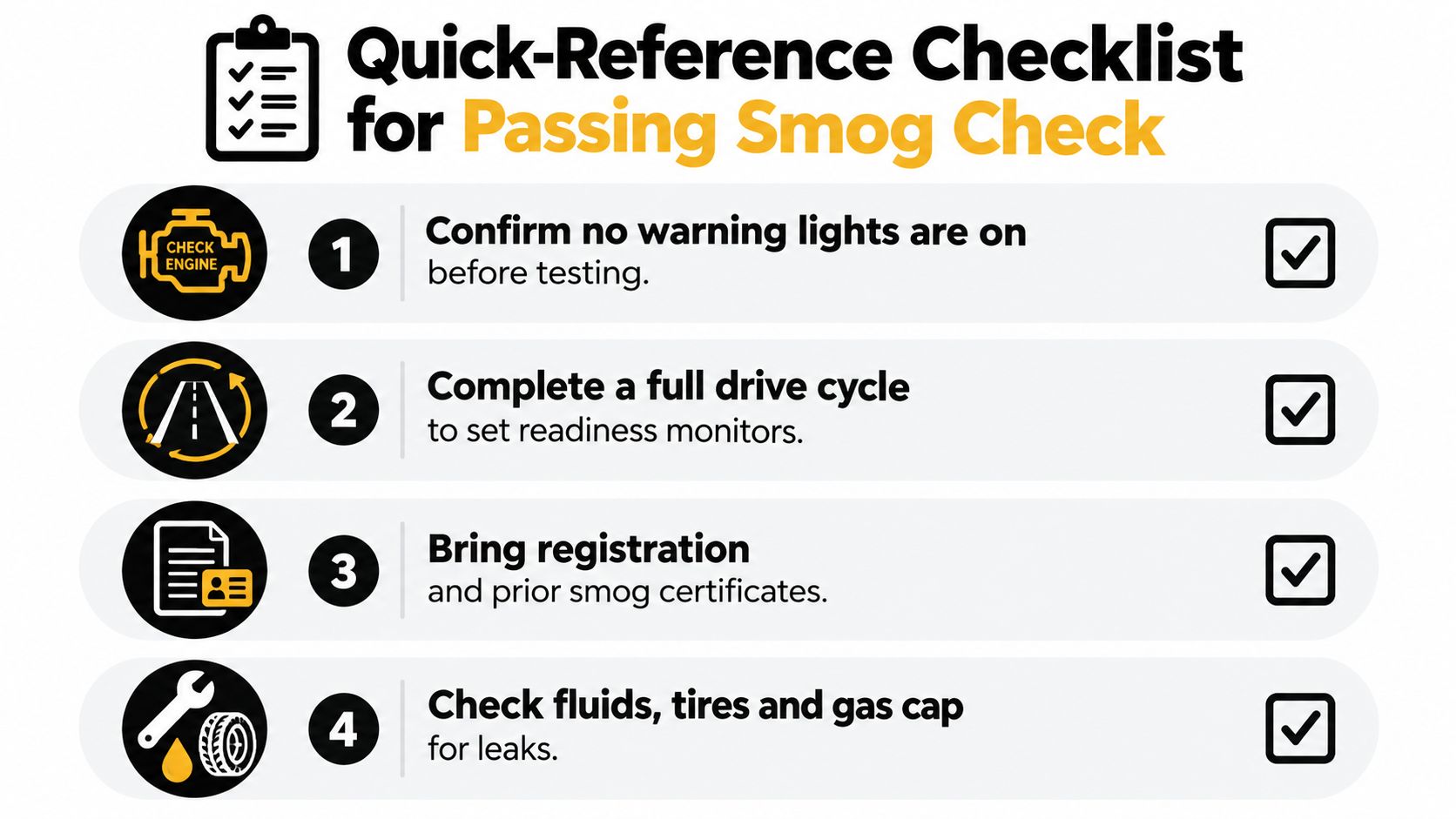
Pre-test order that makes sense
- Read the DMV notice first: Make sure you know whether a standard licensed station is fine or whether the state requires a STAR station.
- Check for warning lights early: Don't wait until the registration deadline week to notice the Check Engine Light.
- Repair the cause, not just the symptom: Clearing codes without fixing the fault usually creates a readiness problem on top of the original one.
- Complete a real drive cycle: Use mixed city and highway driving after repair so the car can set its monitors naturally.
- Warm the engine before the appointment: A fully warmed vehicle is in a better state for the inspection process than one driven a few blocks from cold start.
- Bring your paperwork: Registration-related documents and prior records are easier to manage if they're already in the car.
- If it fails, read the report carefully: The report usually points you toward code issues, readiness status, or another inspection item that needs attention.
The one thing to remember
A single code doesn't always mean disaster. It means the car found something specific enough to report. The key is understanding whether that issue is still active, whether the MIL is affected, and whether the readiness monitors are complete enough for the current California rules.
Don't treat the scanner like a verdict. Treat it like a map. The code tells you where to look, and the BAR rules tell you whether the car is ready to pass.
If you want a clean, compliant inspection without guessing at the rules, Speedy Smog provides STAR-certified smog checks for East Bay drivers and works with the California inspection process these code and readiness rules come from. If you already know your code status or need to confirm whether your vehicle is ready for certification, book your visit before your DMV deadline gets tight.
A passed smog check remains valid for 90 days, and the certificate is sent electronically to the DMV, so you generally don't carry paperwork to the registration counter. For 2000-and-newer vehicles, about 7% failed their initial check in California's 2024–2025 cycle, which makes preparation worthwhile rather than optional.
You're probably looking at a renewal notice, a recently purchased car, or a dashboard light that appeared at the worst possible time. The practical question is simple: how do you get a DMV smog certificate, and what should you do if the car doesn't pass?
California's system connects the inspection directly to registration. The licensed station records the result, the Bureau of Automotive Repair processes the inspection data, and the DMV uses the passing result to clear the registration requirement. That electronic path is convenient, but it also means a failed test can stop renewal until you resolve the underlying issue.
Table of Contents
- What a DMV Smog Certificate Actually Is
- Where to Get Your Smog Check Done
- How the Smog Test Works for Different Vehicles
- What Happens After You Pass
- What to Do If You Fail a Smog Check
- How to Improve Your Chances of Passing
What a DMV Smog Certificate Actually Is
Your renewal notice is on the counter, the deadline is close, and you are checking whether a paper certificate must go to the DMV. Usually, it does not. California requires a Smog Check for many registration renewals, and the licensed station submits the result electronically after testing. The California Bureau of Automotive Repair's Smog Check guidance explains the certificate and reporting process.
The electronic result becomes part of your DMV record. A passing inspection satisfies the emissions requirement attached to that registration transaction, while a failure leaves no passing result for the DMV to apply. You then have to address the diagnostic work, repairs, and retest before the renewal can clear.
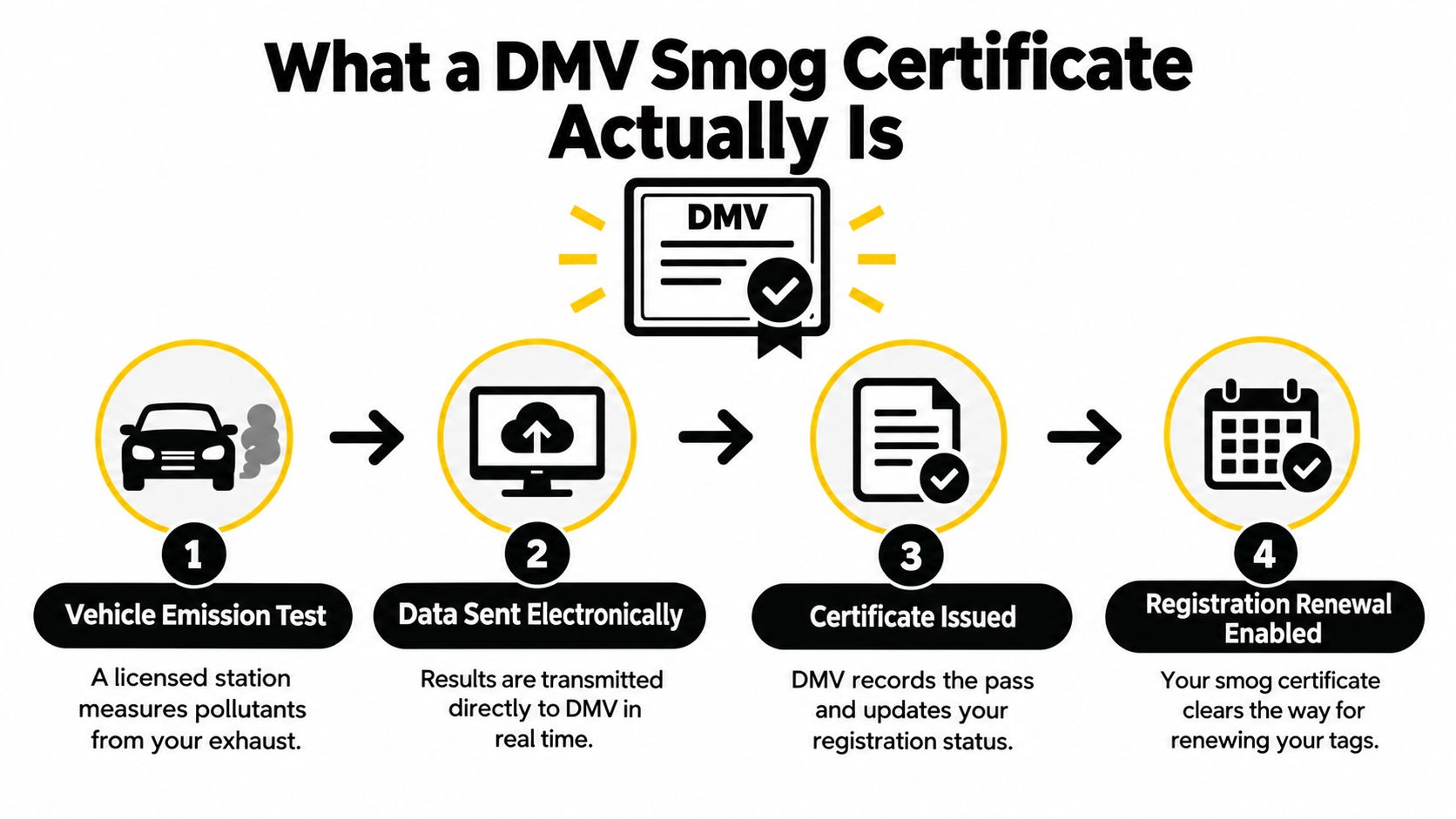
Why the certificate matters
The certificate is a state-recorded inspection outcome, not a form a driver can type up or replace with a repair invoice. The station must enter the vehicle and test information correctly, and the state system must accept the passing result before it can support the DMV transaction.
California's program has operated through a large network for decades. An OECD and International Transport Forum presentation on California Smog Check describes the program's history, vehicle coverage, inspections, stations, and inspection personnel. That scale is why electronic reporting matters: the DMV relies on a standardized record rather than documents handled individually at each renewal.
Practical rule: After the station confirms a pass, check that the result has been transmitted before leaving if your registration deadline is tight. Keep the invoice and test paperwork for your records, but do not assume either document can replace the electronic DMV record.
A failed result also creates a repair decision. Ask the shop to identify the failure component, separate required repairs from maintenance suggestions, and provide an estimate before authorizing work. If qualifying repairs become expensive, ask whether a state repair-cost waiver could apply. A waiver is not automatic, and it does not erase the failed test, but checking the option can prevent paying for repairs that do not make financial sense.
For a second explanation of how the result is checked, review this smog check verification information. The working sequence is simple: the station performs and records the inspection, the result moves through the state system, and the DMV uses the accepted passing record for the registration requirement.
Where to Get Your Smog Check Done
If your DMV notice names a STAR station, do not book at the nearest shop and hope it qualifies. Confirm the station's STAR certification on the California BAR website before making an appointment. A regular renewal may allow more station choices, while a STAR-directed notice can require that specific inspection category.
STAR stations participate in California's performance-based inspection network. The designation matters when the DMV requires a STAR inspection, and it can also indicate that the shop regularly handles electronically reported certification work. Certification alone does not guarantee a pass, so confirm that the station can test your vehicle before you arrive.
A simple booking checklist
Ask these questions while scheduling:
- Station type: Is the shop STAR certified, and does that status match the wording on your DMV notice?
- Vehicle details: Can it test your fuel type, model year, and configuration? Mention if the vehicle is a hybrid, diesel, modified, unusually old, or recently repaired.
- Registration purpose: Are you completing a routine renewal, transferring ownership, or responding to a directed notice? The answer can affect which station you need.
- Retest policy: If the vehicle fails, is a retest available, and what conditions apply after repairs?
- Price and timing: What is the total inspection price, and how long should the appointment take?
Use the BAR station listing to verify certification instead of relying only on a sign, search result, or verbal assurance. Ask the shop to confirm the station type when the notice is unclear.
Station experience and appointment availability vary by location. A properly certified shop may process a routine inspection efficiently, but older vehicles, diesels, modified cars, and vehicles with recent repairs often require more discussion before testing. This guide to finding a place to get your car emissions tested can help you organize those local questions.
Here's the video placement for drivers who want to see the basic process before booking:
Bring the vehicle in normal operating condition. Do not arrive immediately after clearing a warning light or disconnecting the battery, and tell the technician about recent work. If a repair has left the emissions monitors incomplete, the station may not be able to issue a passing certificate. Ask about the likely repair path and waiver eligibility before approving expensive work, since a costly repair does not automatically mean the waiver requirements are met.
How the Smog Test Works for Different Vehicles
A car that runs smoothly can still fail its smog inspection. The test method depends on the vehicle's age, fuel system, and emissions equipment. For many 2000-and-newer gasoline vehicles, the station performs an OBDII inspection. The technician connects a scan tool, confirms communication, checks readiness monitors, and looks for emissions-related trouble codes or an active malfunction indicator lamp.
Older vehicles follow a different process. A 1999-and-older vehicle may undergo BAR-97 testing, which measures tailpipe emissions and checks emissions-control equipment. A vehicle can drive normally while failing because its monitors are incomplete, its emissions exceed the limit, or required hardware is missing.
Newer vehicles and OBDII readiness
Battery replacement, clearing diagnostic codes, or recent emissions repairs can reset readiness monitors. The vehicle then needs normal driving under varied conditions before the monitors complete. Arriving too soon can prevent the station from issuing a passing certificate, even when the warning light stays off.
Communication problems can stop the inspection before emissions performance is evaluated. An active warning light, stored emissions codes, or a scan tool that cannot communicate with the vehicle all require attention.
The BAR's January 2026 performance report placed OBDII-related failures near 6.8% at OIS stations and about 9.3% at BAR-97 stations. Across approximately 19 million 2000-and-newer vehicles, the broader 2024–2025 initial failure rate was roughly 7%, according to the BAR Smog Check performance report.
| Station Type | Failure Rate Context |
|---|---|
| OIS stations | OBDII-related failures near 6.8% |
| BAR-97 stations | OBDII-related failures about 9.3% |
| 2000-and-newer vehicles statewide | Overall initial failure rate about 7% |
Older vehicles and tailpipe testing
Before testing an older vehicle, inspect visible emissions hardware, vacuum lines, hoses, the catalytic converter area, and related controls. A missing component, obvious leak, or altered system will not be fixed by extra highway driving.
Repair cost deserves a separate decision. If a failure points to expensive work, ask the station or repair shop which repairs are required and whether a repair-cost waiver could apply before authorizing the job. Paying for a repair that does not satisfy waiver rules can still leave the registration unresolved.
Hybrid owners should confirm the vehicle's requirements and choose a station familiar with the procedure. This hybrid smog check service information explains why hybrid testing may require different handling. The technician should understand the vehicle's limited engine runtime and identify unusual conditions before starting.
What Happens After You Pass
You leave the station with a passing result, but the registration task still needs to be completed. The station normally sends the result electronically to the DMV, so you generally do not have to mail or hand-deliver a paper certificate. Confirm that the renewal, transfer, or other registration action is finished while the result remains valid.
The 90-day validity period limits how long you can use the passing result for the applicable DMV transaction.
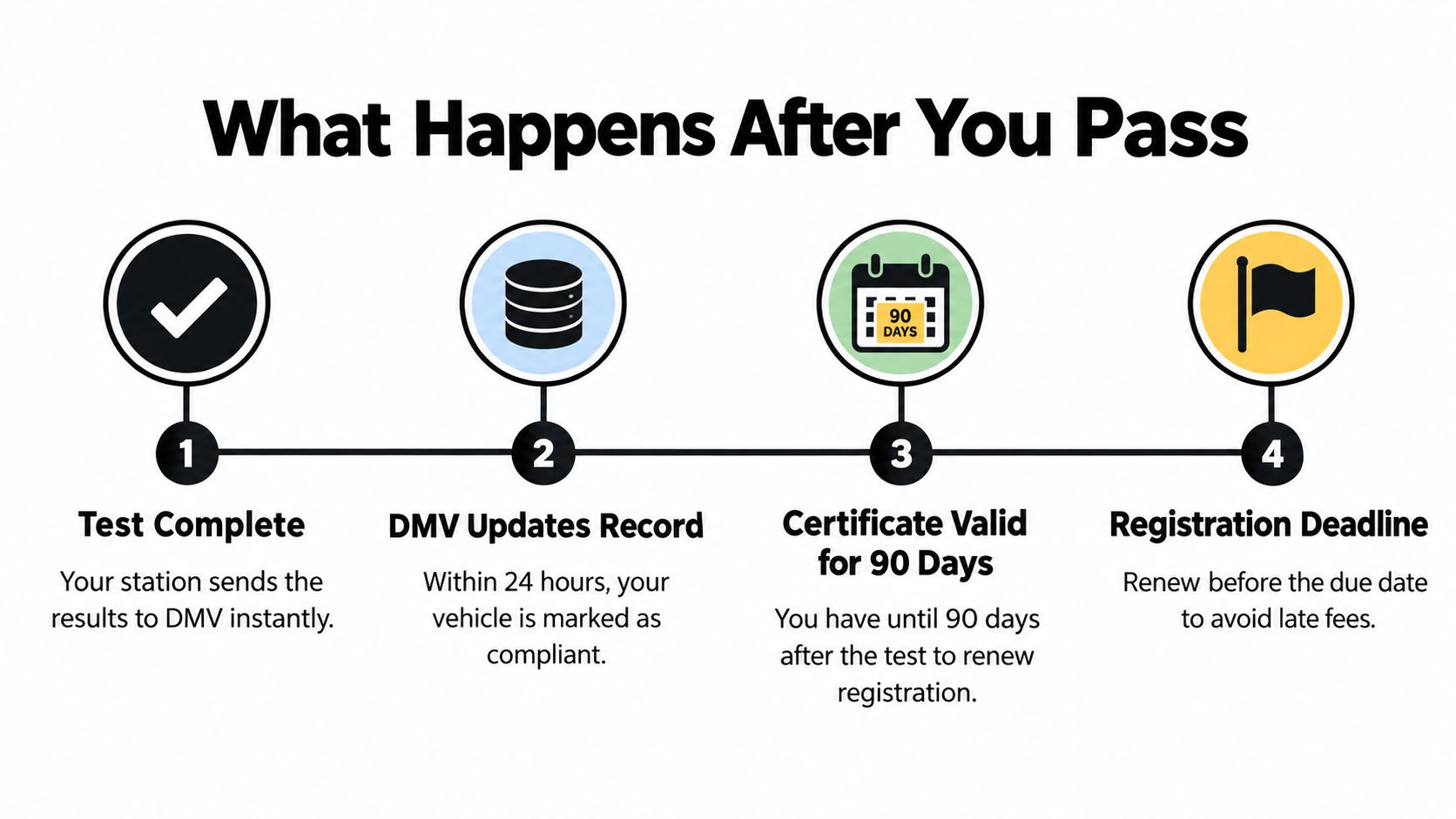
Confirm the electronic record
Use this sequence after the inspection:
- Confirm the pass: Ask the technician to verify that the result was recorded as passing.
- Check the DMV record: Allow time for the electronic submission, then review your online renewal or registration status. If the result does not appear, contact the station before assuming the test was rejected.
- Finish the transaction: Submit any remaining fees, forms, insurance information, title documents, or transfer details required for your situation.
- Keep your paperwork: Retain the inspection receipt and DMV confirmation. For a transfer or dealer purchase, keep the smog receipt with the purchase and title records until the transaction is complete.
The electronic record should connect the passing inspection to the vehicle and the relevant DMV transaction. A handwritten note or an altered paper document does not replace that accepted record. If the DMV system shows no passing result, ask the station to verify the vehicle identification and submission details.
Transfer transactions deserve extra attention. A valid pass does not resolve separate title, fee, insurance, or ownership requirements. Ask the seller or dealer what remains outstanding, and confirm which party is responsible for completing the DMV filing.
A repair shop or seller may tell you that a passing result settles everything. It does not. If the record is missing or the transaction is stalled, request a clear explanation before paying additional fees or allowing the validity window to close.
A passing test helps only after the DMV receives it and the registration task is completed.
Schedule the inspection with enough time to correct a data mismatch or handle another DMV requirement. Keep the receipt even when the submission is electronic, especially for ownership transfers where proof of the inspection date and result may be requested. For program rules and electronic certificate guidance, consult the official Smog Check program information.
What to Do If You Fail a Smog Check
A failed smog test does not authorize a repair bill. Start with the failure report and identify the specific reason for the denial. An emissions code, incomplete readiness monitor, communication error, visible equipment problem, and high tailpipe emissions each require a different fix. The failure result also helps you decide whether to repair, seek a waiver, or stop spending on the vehicle.
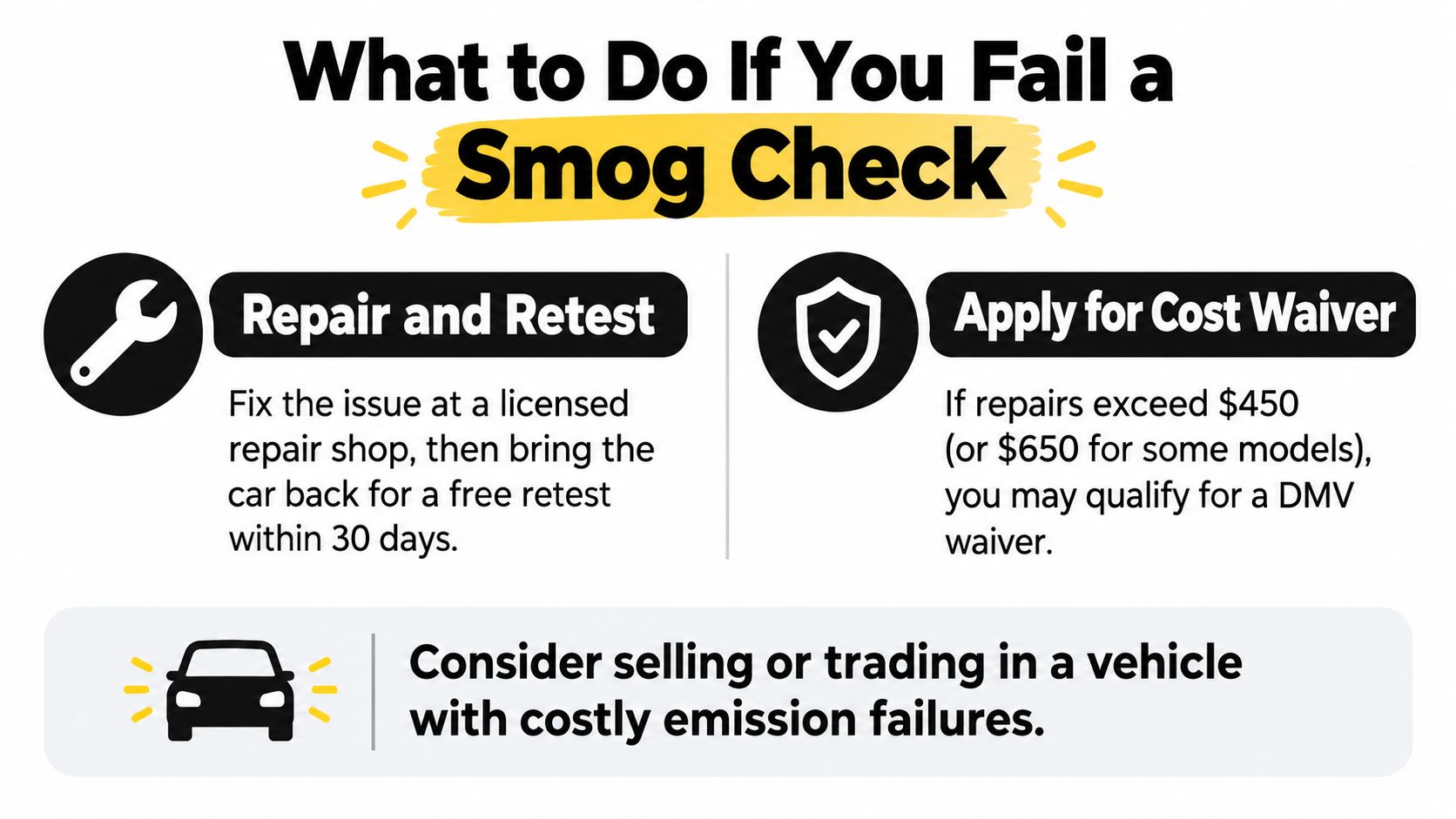
Diagnose before authorizing repairs
Ask the technician to explain the failure in plain language. If the recommended work is expensive, request the diagnostic basis in writing and get a second opinion from a shop that regularly handles emissions faults. Parts-swapping can add cost without correcting the recorded problem.
Use this order:
- Read the failure details: Separate an incomplete monitor from an emissions-output failure or equipment violation.
- Check recent work: A disconnected battery or cleared code may explain incomplete monitors.
- Verify the diagnosis: Confirm that the proposed repair addresses the exact failure recorded by the station.
- Assess the vehicle as a whole: A major emissions repair may be reasonable for a dependable car, but difficult to justify when the vehicle has several unrelated problems.
- Plan the retest: Confirm with the repair shop and testing station what must happen before paying for another inspection.
Failure rates vary by vehicle condition, maintenance history, emissions system, and inspection type. A failed result alone does not prove that every recommended repair is necessary. Ask what test evidence supports the estimate and whether another fault could produce the same symptom.
When a waiver may make sense
California's repair-cost waiver is a limited alternative when the required work no longer makes financial sense. The BAR Smog Check Reference Guide states that the waiver can postpone the DMV smog certificate requirement for up to two years. Eligibility requires at least $650 in repairs, and the process must be handled through a Referee facility.
The limits matter. A waiver does not cover a tampered emissions system, and repeated waivers under the same ownership can disqualify the vehicle. Reaching the repair threshold does not guarantee approval. Keep invoices, diagnostic records, and proof of qualifying work, then ask the Referee facility to determine eligibility.
Before approving a large repair: Ask whether the work addresses the recorded failure, whether the vehicle can be retested afterward, and whether a Referee waiver is realistic.
Selling or trading may be reasonable after comparing the estimate with the vehicle's condition and registration consequences. Disclose the failed result to any buyer. Do not approve costly work under pressure when the diagnosis is unclear or the waiver route has not been checked.
How to Improve Your Chances of Passing
The most effective preparation starts with the inspection type, not a generic “drive it hard” routine. Confirm whether the vehicle will receive an OBDII-based inspection or an older BAR-97-style evaluation, then prepare for the checks that control the result.
For a newer vehicle, scan for trouble codes and readiness status before the appointment. If the battery was disconnected or a repair recently cleared codes, allow the monitors to complete through normal driving. Don't clear the codes again just before testing. That can erase useful diagnostic information and leave the monitors incomplete.
For an older vehicle, look at the physical emissions system first. Check for disconnected vacuum hoses, damaged wiring, missing emissions components, exhaust leaks, and obvious modifications. A visual problem can fail the vehicle even when it appears to drive normally.
Use this short pre-test list:
- Warning lights: Resolve an active check-engine light before booking.
- Recent repairs: Tell the station what was repaired and whether the battery was disconnected.
- Maintenance records: Bring invoices or diagnostic notes if the vehicle has a recurring emissions issue.
- Vehicle eligibility: Verify the correct rules for hybrids, diesels, older cars, and modified vehicles.
- Station capability: Confirm that the location is certified for your vehicle and registration requirement.
- Timing: Leave enough room for diagnosis or a retest before the DMV deadline.
The statewide data supports a practical expectation. Most newer vehicles pass, but roughly 1.3 million of about 19 million tested 2000-and-newer vehicles failed during the 2024–2025 cycle, according to the BAR Smog Check data. Preparation won't guarantee a pass, but it helps you avoid preventable denials and makes a real failure easier to diagnose.
If you're in San Leandro or the East Bay, Speedy Smog offers STAR Certified inspections with electronic submission of passing results to the DMV. Contact the station before arriving to confirm it can handle your vehicle type, inspection requirement, and registration timing.
You open the mailbox and find your California DMV renewal notice. The registration deadline is approaching, and one line stands out: smog certification required. You may wonder whether you should visit a DMV office, a repair shop, or a special testing station, and whether the test result will reach the state automatically.
For most drivers, a smog check for DMV registration starts at a licensed private smog station, not at a DMV counter. The station examines the vehicle, records the result, and transmits the information electronically so the DMV can complete the registration transaction. Knowing which station to choose and what the technician checks can prevent a rejected test, an unnecessary repair bill, or a missed renewal deadline.
Table of Contents
- Why Your DMV Renewal Depends on a Smog Check
- Which Vehicles Need a Smog Check for DMV
- STAR Stations and Why the DMV Points You There
- What Actually Happens During the Smog Test
- How Results Get From the Station to the DMV
- What to Do When Your Smog Check Fails
- Common DMV Smog Myths That Cost Drivers Time
- Your Pre-DMV Smog Checklist and Final Takeaways
Why Your DMV Renewal Depends on a Smog Check
Your California renewal notice arrives, and one line says smog certification required. The DMV counter cannot perform that inspection. It needs a current passing result attached to your vehicle record before the renewal can be completed. The test happens at a licensed smog station, while the DMV handles the registration transaction.
California generally requires this inspection every other year for vehicles covered by the program. The state's DMV smog inspection requirements explain when certification is connected to renewal and other registration transactions. For a step-by-step explanation, see this guide to how a smog check ties to registration renewal.
The renewal notice is your starting point
Read the notice before choosing a station. It works like a routing slip, showing what the DMV expects on paper and helping the technician understand which transaction is underway.
- Renewal timing: The notice identifies the registration transaction and its deadline.
- Smog requirement: It indicates whether the DMV is waiting for a certification.
- Station instructions: It may point you toward a particular type of authorized station.
- Vehicle information: The technician uses the vehicle identity and registration details to select the proper test.
At the station, a certified technician inspects the vehicle and submits the result through the state testing network. A passing result becomes part of the DMV record and clears the smog-related obstacle. A failure leaves the renewal unfinished until the vehicle passes or the DMV accepts another authorized resolution.
The counter and test bay have different jobs. The DMV reviews the registration record. The station checks emissions-related equipment and reports the outcome. Keeping those roles separate helps explain why visiting a DMV office first usually does not solve a missing certification.
California's Smog Check program processes a large, recurring volume of inspections. The Bureau of Automotive Repair recorded 11,678,011 total tests and 1,084,215 failures in 2023, a 9.28% failure rate, in its 2023 Smog Check executive summary. That workload is why licensed stations conduct the inspections while the DMV manages registration records.
If the notice includes a special station direction, follow it. The station category can affect whether the result satisfies the DMV, and choosing the wrong one may delay renewal.
Which Vehicles Need a Smog Check for DMV
The first question isn't always “Where can I test?” It's “Does this transaction require a test?” California has several exemptions, and the answer can change depending on whether you're renewing registration, transferring ownership, or registering a vehicle brought from another state.
Gasoline and flex-fuel vehicles from 1975 and older are generally exempt from the state's Smog Check requirement. Electric vehicles are also exempt because they don't produce tailpipe emissions from an internal combustion engine. Diesel vehicles have separate rules, including exemptions for diesel vehicles from 1997 and older and certain vehicles above the applicable weight threshold. The state's California Smog Check overview explains the main exemptions and transaction rules.
Match the vehicle to the transaction
A newer vehicle may be exempt from the regular biennial inspection, but that doesn't mean every DMV transaction is automatically exempt. Change-of-ownership and out-of-state registration situations can create separate certification requirements. A vehicle's age, fuel type, origin, and transaction all matter.
The DMV also describes a smog abatement fee option for vehicles under four model years old, applying during the first eight registration years, rather than requiring an inspection in that specific situation. That option shouldn't be confused with a universal exemption for every transaction involving a newer vehicle.
| Vehicle Category | Smog Required for DMV? | Notes |
|---|---|---|
| Gasoline or flex-fuel vehicle, 1975 and older | Generally no | Older gasoline vehicles fall within a state exemption. |
| Electric vehicle | Generally no | Electric vehicles are exempt from the standard emissions inspection. |
| Diesel vehicle, 1997 and older | Generally no | Diesel exemptions follow separate age and weight rules. |
| Most newer gasoline vehicles | Sometimes | Regular renewal rules may allow an exemption, but transaction-specific requirements can differ. |
| Hybrid vehicle | Often yes | A hybrid still uses a gasoline engine and shouldn't be treated like a fully electric vehicle. |
| Out-of-state vehicle | Often yes | First California registration can require a current California-compliant inspection. |
| DMV-directed vehicle | Yes, at the required station type | Follow the direction printed on the renewal notice. |
Don't rely on a neighbor's answer based only on model year. Take the renewal notice, registration record, and transaction type together. If the notice says certification is required, ask a licensed station to verify the exact test path before paying for an inspection.
For a practical vehicle-by-vehicle breakdown, review this guide to which cars need a smog check in California.
STAR Stations and Why the DMV Points You There
A renewal notice can send two different messages: the DMV expects a smog certification, and the station must be authorized to complete the assigned test. California does not treat every smog station as interchangeable. Read the station instruction before choosing a shop, because the wrong location may not be able to submit the certification your vehicle needs.
A Test Only station performs inspections but does not repair vehicles. A STAR station meets additional program requirements and may be authorized to inspect vehicles that the DMV directs into the STAR network. Older Gold Shield references can be confusing. The current STAR structure replaced the former Gold Shield and Test Only arrangement beginning January 1, 2013. The state's STAR program information explains the program background.
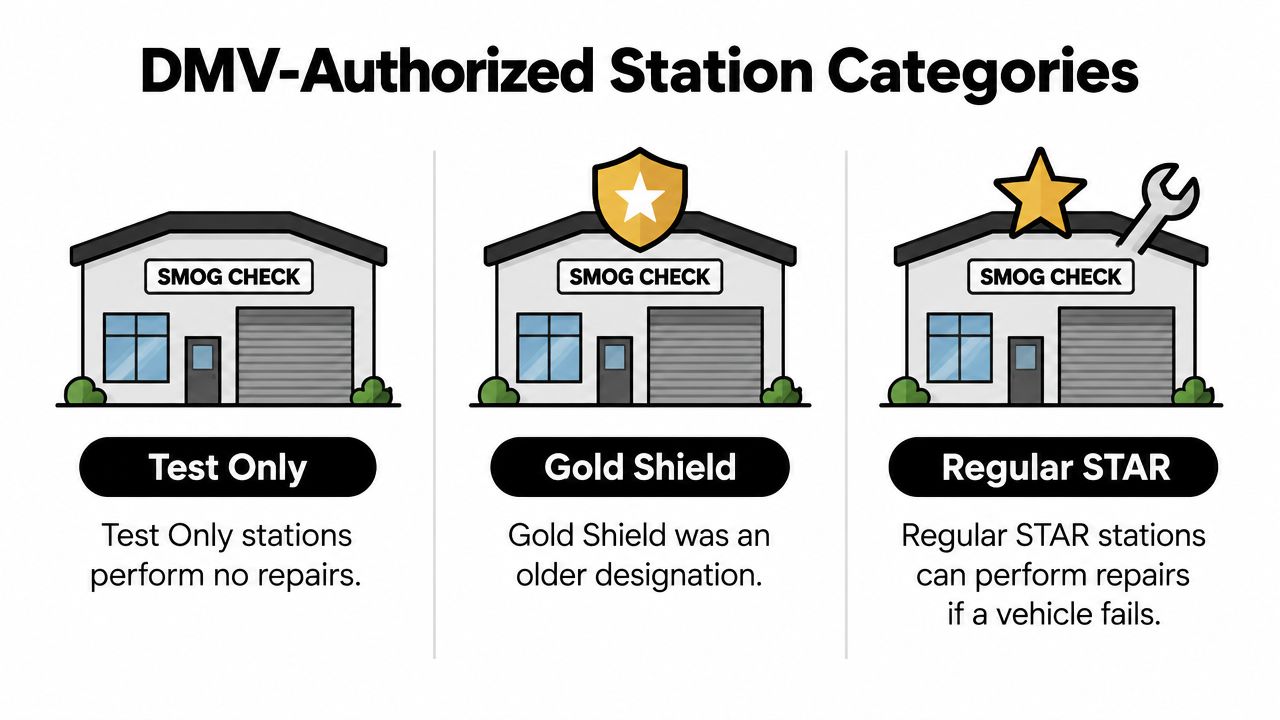
Read the direction before you choose a shop
A regular licensed station may be suitable when the notice requests only a standard smog inspection. A directed vehicle must follow the station instruction printed on the DMV notice. That instruction may identify a Test Only location or require a STAR-authorized station. The notice is the controlling detail, not a station's advertising or a neighbor's recommendation.
| Station type | Testing role | Repair role |
|---|---|---|
| Test Only | Performs the official inspection | Does not perform repairs as part of its testing role |
| STAR station | Handles qualifying inspections, including directed vehicles where authorized | May have repair capabilities, depending on the station |
| Regular licensed station | Tests vehicles that are not restricted to another category | May test and repair, subject to its authorization |
The difference becomes clearer after a failure. At a Test Only location, you may receive the failure information and then need a separate repair facility. A station that combines testing and repair may be able to explain the emissions issue and discuss repair options, while still following California's separation and certification rules.
A STAR designation is a program certification, not a marketing label. It identifies stations that meet performance requirements for certain testing assignments. For a plain-language explanation of how that designation affects station selection, see what a STAR smog station is. Before paying for a test, compare the station type on the notice with the station's authorization. That small check connects what the DMV expects on paper with what can happen in the test bay.
What Actually Happens During the Smog Test
You pull into the station expecting a machine to measure exhaust. The technician first checks whether the vehicle and the DMV-related test request match the record. That means confirming the VIN, registration information, and inspection type before the car enters the test sequence.
The test method depends on the vehicle's model year and technology. California generally sends gasoline and flex-fuel vehicles from 2000 and newer, with a gross vehicle weight rating of 14,000 pounds or less, through an OBD-based inspection. Certain vehicles still require the BAR-97 tailpipe and inspection system. The BAR 2025 executive summary describes these model-year and technology-dependent procedures.
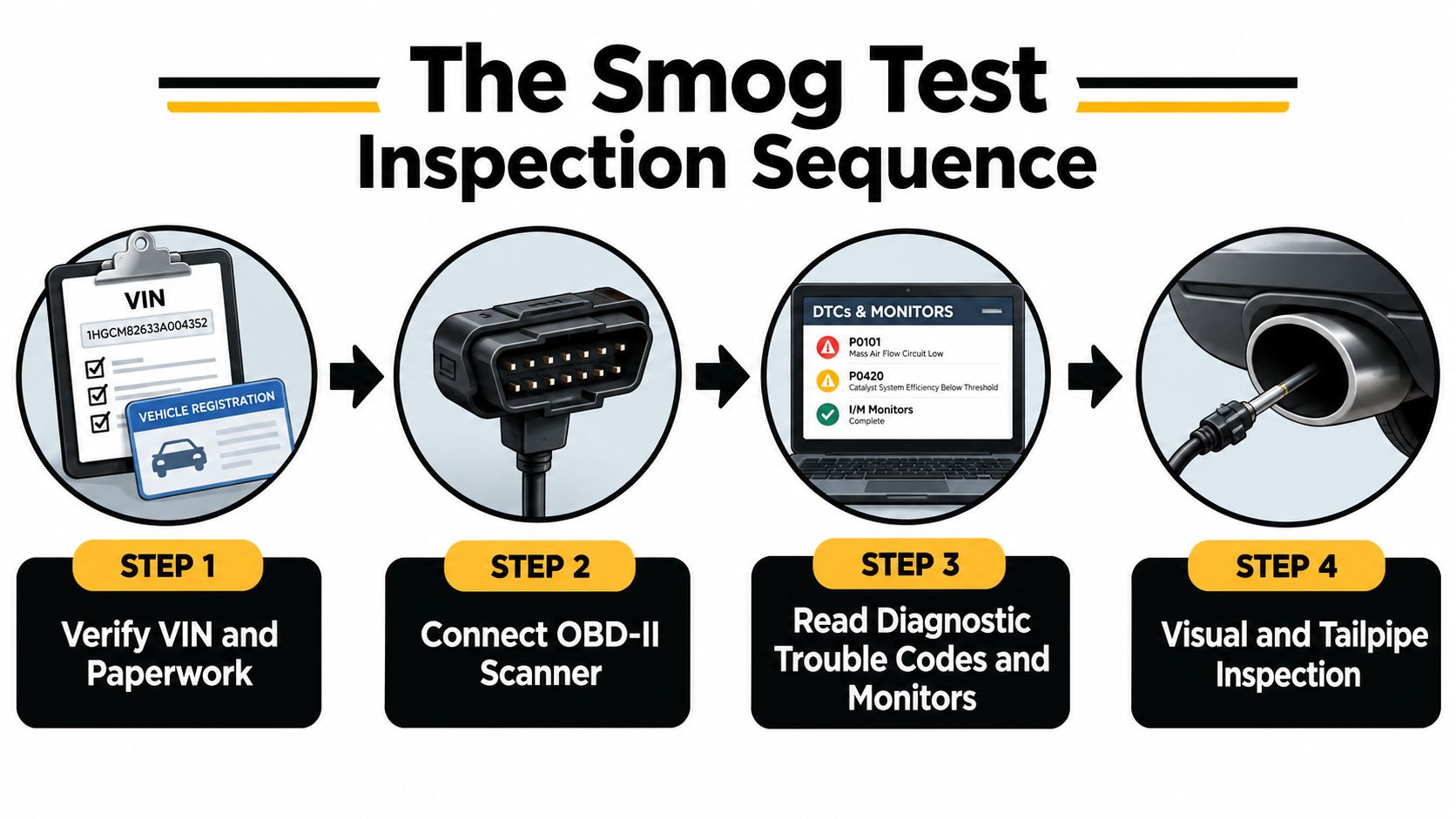
The main inspection points
The technician verifies the VIN and paperwork. The vehicle record must match the car in the bay. This is the station's first check against the information the DMV expects.
The technician connects the OBD-II scanner. The scanner communicates with the vehicle's onboard computer and retrieves emissions-related information.
The system checks trouble codes and readiness monitors. An illuminated check engine light or emissions-related diagnostic trouble code can cause a failure. Readiness monitors show whether the vehicle's emissions systems have completed their self-checks.
The technician performs the required visual and emissions inspection. This may include the emissions components, catalytic converter, gas cap, and other equipment. Older or qualifying vehicles may also receive a BAR-97 tailpipe test.
A monitor marked “incomplete” does not have the same effect for every vehicle. California allows 1996 to 2000 vehicles more incomplete monitors than vehicles from 2001 and newer. Disconnecting or resetting the battery shortly before the test can therefore create a failure risk, even when the check engine light is off.
Official test versus a pre-test
A pre-test can reveal obvious problems, but only the authorized official inspection becomes the result used for the DMV requirement. The technician records the actual outcome as pass, fail, or another result permitted by the process. Diagnostic repairs may require a repair shop, while the testing station must document and conduct the official inspection according to BAR rules.
How Results Get From the Station to the DMV
After the technician completes the official inspection, the station transmits the result through the certified testing network. The process is electronic, so drivers generally don't mail a paper certificate to Sacramento or carry a document to a DMV counter for routine renewal.
The electronic record identifies the vehicle and the inspection. It can include the station number, technician identification, test type, pass or fail status, and odometer information. When the vehicle passes, the DMV can match that certification to the registration record and clear the smog requirement.
What you should do after passing
Ask the station for a receipt or printed copy of the test result for your own records. The electronic submission is the official handoff, but your receipt can help if the DMV record doesn't update as expected or if you need to discuss the transaction with the station.
Don't assume that a passing test means a physical registration sticker arrives instantly. DMV processing can still involve its own timing, payment verification, address information, and mailing steps. If the online record doesn't reflect the pass after the station confirms submission, contact the station first to verify the vehicle information and transmission, then contact the DMV if necessary.
| Aspect | Old Paper System | Current Electronic System |
|---|---|---|
| Result delivery | Driver handled a physical certificate | Station transmits the result electronically |
| DMV matching | Staff processed mailed or presented paperwork | DMV matches the test to the vehicle record |
| Driver action | Mailing or delivering documents could be necessary | Driver usually keeps a receipt and completes renewal |
| Error protection | Paper could be lost or delayed | Electronic records reduce the need for paper handling |
| Proof for the driver | Paper certificate served as the main record | Station receipt remains useful for follow-up |
The important distinction is between station completion and DMV completion. The station certifies and submits the inspection. The DMV then uses that result as part of the registration renewal process.
What to Do When Your Smog Check Fails
A failed test doesn't automatically tell you which repair will solve the problem. It tells you that the vehicle didn't satisfy one or more required parts of the inspection, such as an emissions-related diagnostic code, incomplete testing conditions, a visual defect, or an emissions reading outside the applicable limit.
The BAR's reporting makes the risk concrete. Its 2026 performance report describes about 1.3 million failures among 19 million tested 2000-and-newer vehicles during calendar years 2024 to 2025, roughly 7%, while a separate BAR summary reports 1,102,337 failures out of 12,200,718 tests, or 9.04% overall. These figures come from different reporting scopes, so they shouldn't be treated as interchangeable, but both show that a failure is a normal possibility within the program rather than an unusual event. See the BAR Smog Check performance report for the reported figures.
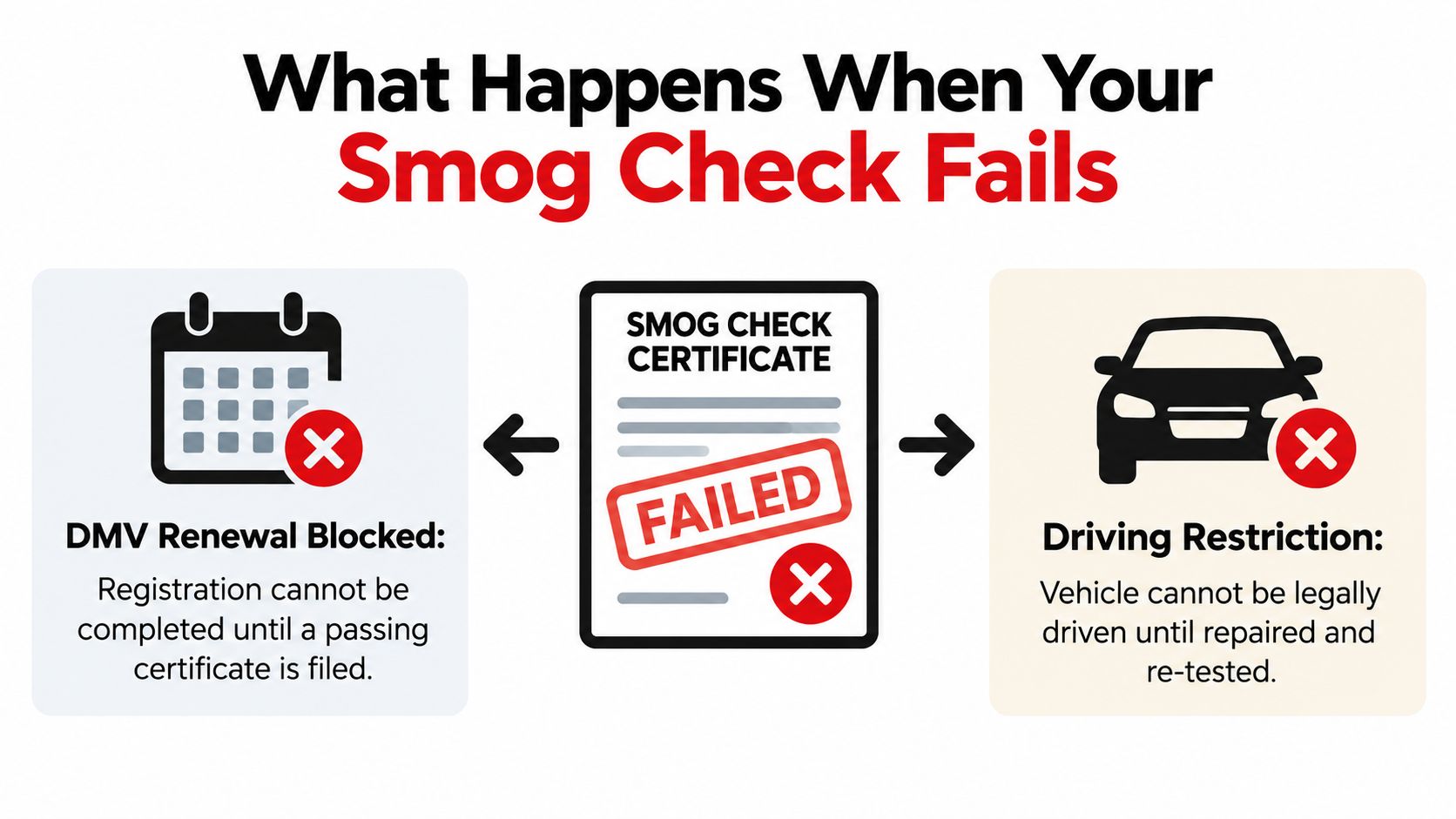
Separate the result from the repair decision
Ask the station for the failure information and the diagnostic reason before authorizing work. A technician may identify a check engine light, a failed monitor condition, an emissions component issue, or a visual inspection problem. Some stations can repair the vehicle, while a Test Only station may refer you elsewhere.
If the DMV directed your vehicle to a particular station category, follow that instruction for the retest. Repairing the vehicle at another shop doesn't necessarily change the station requirement for the official follow-up inspection.
A passing certificate is what clears the smog condition for the renewal. If the registration deadline is close, ask the station and the DMV what options apply to your circumstances, including any available extension, waiver, or consumer assistance program. Eligibility depends on the vehicle, household, repair history, and program rules, so don't assume assistance is automatic.
A failure report is a starting point for diagnosis. It isn't permission to replace parts at random.
California's repair and assistance programs have specific eligibility requirements and limits. Confirm the current rules directly with the BAR before committing to repairs, especially if cost or a deadline is making the decision urgent.
Common DMV Smog Myths That Cost Drivers Time
Myth: A newer vehicle never needs a smog check.
A vehicle can be exempt from the regular biennial inspection and still face a different requirement during a change of ownership, an out-of-state registration, or a DMV-directed transaction. The state's exemption rules depend on the vehicle and the transaction, not just the age shown on the dashboard paperwork.
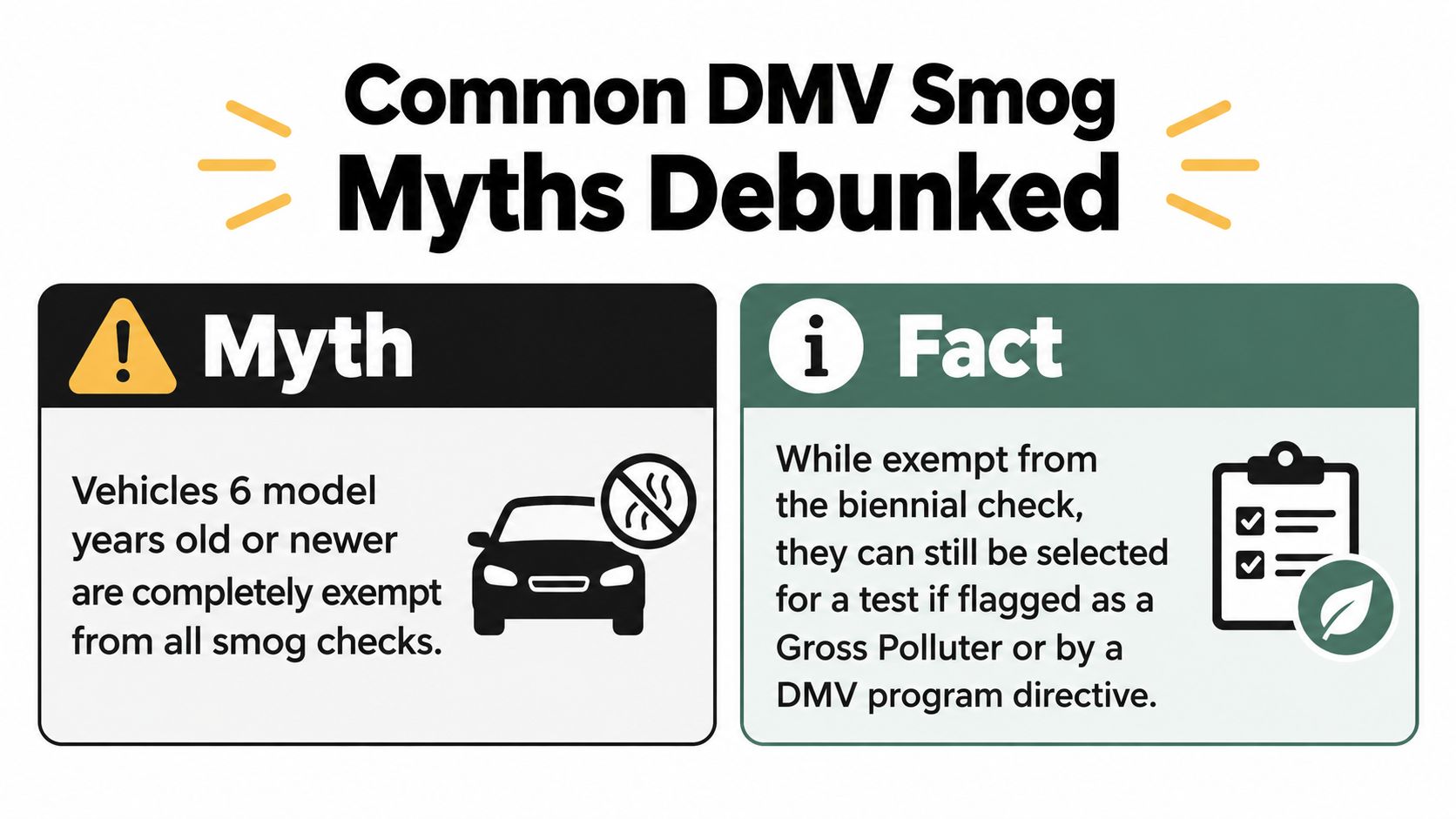
Myth: Any licensed smog station can test any vehicle.
A regular station may be appropriate for a standard inspection, but a DMV-directed vehicle may need a STAR or Test Only location. Read the notice before booking. The station category is part of the compliance path.
Myth: A failed certificate can be ignored or paid away.
A failed result doesn't satisfy the DMV's smog requirement. Registration remains unresolved until the record receives a passing certification or the DMV accepts an applicable alternative.
Myth: A passing test means the sticker arrives immediately.
The station's electronic submission removes the need for routine paper delivery, but DMV processing and mailing still take place separately. Keep the station receipt and verify the registration status if the update doesn't appear as expected.
Myth: Emissions tampering won't be noticed.
The technician performs visual checks, and OBD-based testing reads diagnostic trouble codes and readiness monitor status. Missing, modified, or disconnected emissions equipment can create a failure even when the vehicle seems to drive normally.
These myths all produce the same outcome, a preventable delay. A driver who checks the notice, confirms the exemption or station category, and understands the result process has a clearer path through the DMV renewal.
Your Pre-DMV Smog Checklist and Final Takeaways
A renewal notice arrives, and the deadline is close. Before driving to a smog station, read the notice carefully. It shows whether the DMV requires a smog certification and whether a specific station type, such as a STAR location, applies to your vehicle.
Use this checklist to connect the DMV's paperwork requirements with the station's test-bay process:
- Read the renewal notice: Confirm the smog requirement and any direction to a STAR, Test Only, or other station category.
- Confirm the transaction: Renewal, ownership transfer, and first California registration can follow different rules.
- Bring vehicle information: Take the notice, registration details, and any paperwork the station requests.
- Check warning lights: An illuminated check engine light can signal an emissions problem that needs attention before testing.
- Avoid resetting the battery: Clearing diagnostic information can leave readiness monitors incomplete.
- Inspect obvious items: Check the gas cap, visible emissions equipment, and the vehicle's general operating condition.
- Ask about the test path: The technician can explain whether the vehicle will receive OBD-based testing or another inspection method.
- Keep the receipt: The station submits the result electronically, while the receipt records what was tested and when.
The DMV side and the station side
The DMV reviews the registration record and looks for an accepted certification attached to it. At the station, the technician verifies the vehicle, follows the required inspection procedure, and transmits the result through the authorized system. The driver connects these steps by bringing the correct vehicle, following the notice, and selecting an authorized station.
STAR certification matters when the notice directs a vehicle to that category. A regular station may not satisfy that instruction, even if it performs smog checks. Read the notice before booking, because the station category becomes part of the DMV compliance path.
Preparation also helps during busy periods. California's program handles substantial inspection volume, so arriving with the right paperwork and station choice reduces avoidable questions at the counter and delays in the test bay.
Do not choose a station only by price or distance. Confirm that it can test your vehicle and accept the DMV direction printed on the notice. After a passing inspection, the electronic result supports the renewal, but you still need to complete the registration payment and check for DMV confirmation.
If you're in the East Bay, Speedy Smog provides standard and STAR smog checks in San Leandro and electronically transmits results to the DMV. Bring your vehicle and renewal notice, and contact the station before visiting if the notice specifies a certification category.
You've paid your California registration fees, received the confirmation email, and expect the renewal sticker to be ready. Then the DMV record still says smog certification required. For East Bay drivers, that frustrating situation usually doesn't mean the payment failed. It means the registration record hasn't received a passing emissions result connected to the vehicle identification number, or VIN.
California's DMV smog rules connect three separate steps: the state's emissions inspection, the electronic transmission of the result, and the DMV's decision to release the registration. A renewal payment alone doesn't complete the process when the notice still requires smog certification. The practical questions are simple, but the answers depend on the vehicle's year, fuel type, test path, renewal notice, and station requirements.
Table of Contents
- When the Renewal Stalls at the DMV Counter
- What a California Smog Check Actually Does
- OBD vs Tailpipe vs Diesel: Which Test Your Car Gets
- When California Requires a Smog Check
- Exemptions Most Drivers Get Wrong
- STAR Stations and When You Have to Use One
- The Renewal Bottleneck and How to Clear It
- A Simple Pre-Renewal Checklist for East Bay Drivers
When the Renewal Stalls at the DMV Counter
At a Concord DMV counter, a driver may arrive with a paid renewal receipt and a confirmation email, expecting only the sticker to remain. The clerk checks the registration record and sees that the vehicle still needs a smog result. The clerk isn't looking for proof that the fee was paid. The system is looking for a passing certificate attached to the correct VIN.
That's the part many drivers don't see. The DMV uses the smog result as a registration condition, while the licensed station performs the inspection and sends the outcome electronically. The California DMV's smog inspection guidance explains that paying registration fees doesn't finalize renewal when certification is still required.
Why the renewal barcode matters
Your renewal notice includes a barcode that helps the station identify the correct DMV transaction. When the technician scans or enters that information, the station can transmit the result to the appropriate registration record. The vehicle's VIN remains the central identity check, so a correct license plate alone isn't enough if the VIN was entered incorrectly.
Bring the complete renewal notice to the appointment, not just a phone photo of the payment confirmation. If the notice says STAR, choose a station authorized for that requirement before testing. A standard station may be able to inspect the vehicle, but it might not be authorized to complete a STAR-only transaction.
Practical rule: Payment starts the renewal. A passing, correctly transmitted smog result finishes the part that DMV still has on hold.
If you're already facing this problem, a smog check for registration renewal can help identify whether the issue is the test itself, the station designation, or the electronic record. Ask the technician to confirm the VIN, plate information, and transmission status before you leave.
The rest of the process follows the same sequence: identify whether the vehicle needs testing, determine which inspection applies, select the correct station, complete the test, and verify that DMV receives the result. Once you understand that chain, “smog required” becomes a solvable workflow problem instead of a surprise at the counter.
What a California Smog Check Actually Does
A California Smog Check is an emissions inspection performed by a licensed Smog Check station under the Bureau of Automotive Repair, or BAR. The DMV doesn't perform the mechanical inspection. It uses the result to decide whether the vehicle's registration can move forward.
Think of the inspection as a physical for the vehicle's emissions system. The technician identifies the vehicle, checks relevant emissions equipment, connects to the diagnostic system when applicable, and follows the test procedure assigned to that vehicle. The station then reports a pass or fail electronically.
What the technician is checking
For a newer gasoline vehicle, the technician may connect to the diagnostic port and review data stored by the car's onboard computer. That data can include diagnostic trouble codes, warning-light status, and readiness monitors that show whether the vehicle has completed its emissions self-tests.
Older gasoline vehicles may receive a tailpipe inspection instead. In that case, the equipment measures exhaust gases while the vehicle runs through the specified test conditions. The technician isn't just checking whether the exhaust looks clean. The machine evaluates emissions against the applicable standards.
The program also includes many diesel vehicles. BAR's Smog Check Reference Guide identifies separate requirements for gasoline, hybrid, alternative-fuel, and diesel vehicles, with the inspection path determined by model year, fuel type, and vehicle weight.
Which vehicles are generally involved
Most newer gasoline cars, flex-fuel vehicles, hybrids, and alternative-fuel vehicles fall within the program. Older gasoline vehicles may use the BAR-97 tailpipe system. Diesel vehicles within the applicable weight range follow a separate track, while some vehicles are outside the regular passenger-vehicle process.
The renewal notice is the most useful first check. If it includes a smog certification requirement, treat that notice as your instruction for the current registration event. If no smog line appears, the vehicle isn't being asked for certification in that cycle.
The certificate belongs to the vehicle's VIN, not to the driver who paid for the test. You can't transfer a passing result from one car to another, and a payment record doesn't replace certification for the specific vehicle being renewed.
OBD vs Tailpipe vs Diesel: Which Test Your Car Gets
At a DMV renewal counter, the test type can determine whether your paperwork moves ahead or stops. California uses different inspection paths because vehicles report emissions information in different ways. Newer gasoline vehicles generally use onboard computer data, older gasoline vehicles may require direct exhaust measurement, and diesel vehicles follow their own combination of checks.
The three practical paths
OBD inspection. Most 2000-and-newer gasoline, flex-fuel, hybrid, and alternative-fuel vehicles receive an OBD-based inspection. The technician connects to the diagnostic port and reviews emissions-related data stored by the vehicle. A failure can result from unresolved faults or from required readiness monitors that have not completed.
The Smog Check Manual explains that incomplete readiness monitors can cause a 2000-and-newer gasoline vehicle to fail, with the evaporative-system monitor handled under the stated exception. Clearing a check-engine code immediately before testing may not help. The computer can still show that its self-tests are incomplete.
BAR-97 tailpipe inspection. Most 1999-and-older gasoline vehicles use the BAR-97 system. A probe samples exhaust while the vehicle runs under the required conditions. The technician also completes the related visual and functional portions of the inspection.
Diesel inspection. 1998-and-newer diesel vehicles at or under 14,000 pounds GVWR require Smog Check when they fall within the applicable program scope. The procedure varies by vehicle and weight class and may combine OBD information with emissions or opacity testing. Diesel vehicles above that weight threshold follow a different regulatory path, rather than the regular passenger-vehicle Smog Check process.
A limited group of 2000-and-newer gasoline vehicles cannot use the standard OBD inspection and may be directed to BAR-97 tailpipe testing. The station determines that route from the vehicle information and BAR procedures.
| Vehicle Year | Fuel Type | Test Type |
|---|---|---|
| 2000 and newer | Gasoline, flex-fuel, most hybrids, alternative fuel | OBD-based inspection, unless BAR routes the vehicle to BAR-97 |
| 1999 and older | Gasoline | BAR-97 tailpipe inspection |
| 1998 and newer | Diesel at or under 14,000 pounds GVWR | Separate diesel inspection path |
| Above 14,000 pounds GVWR | Diesel | Different CARB emissions program, not a regular passenger-vehicle Smog Check |
Station choice can matter when the renewal deadline is close. An OBD vehicle needs a station equipped to read its computer data, while an older gasoline vehicle needs BAR-97 equipment and the correct procedure. STAR station requirements may also apply to a particular renewal, so confirm the notice before booking. If you are unsure, review this guide to identifying the right Smog Check before choosing a station.
When California Requires a Smog Check
A Smog Check usually isn't an annual appointment for every California driver. The requirement is tied to registration events, and the renewal notice tells you whether certification is due for the current cycle.
The most common trigger is registration renewal. Other triggers include transferring ownership, registering an out-of-state vehicle in California for the first time, and certain out-of-state title or registration transfers. BAR specifically reports that out-of-state 1976 model-year and newer vehicles registering in California for the first time require Smog Check, subject to the applicable rules and exemptions. That requirement is described in the EPA overview of vehicle inspection and maintenance programs, which places California's program within the broader U.S. emissions inspection framework.
Read the notice, not an old calendar
Drivers often try to calculate the requirement from memory. That can lead to a missed test or an unnecessary appointment. Look for the smog certification line on the current renewal notice. If it appears, complete the inspection before the DMV can finalize the renewal.
A newer vehicle may follow a renewal pattern in which some cycles don't request smog certification, followed by more frequent testing as the vehicle ages. The exact obligation can depend on the notice and the vehicle's registration details, so don't rely on a generic rule when the DMV has already issued a specific instruction.
| Event | Smog Required? | Who Pays |
|---|---|---|
| Registration renewal | If the renewal notice says certification is required | Usually the registered owner |
| Change of ownership | Commonly required under the transfer rules | Typically handled by the seller before transfer |
| First California registration for an out-of-state vehicle | Generally required for in-scope vehicles | Usually the person registering the vehicle |
| Certain out-of-state title transfers | Depends on the transaction and vehicle record | The parties should confirm responsibility with DMV |
For an ownership transfer, the seller commonly provides a passing smog certification before handing over the title. The buyer shouldn't assume that any recent repair invoice or informal promise replaces the required certificate.
Commercial vehicles, diesel vehicles, and vehicles with special registration classifications can follow different schedules or programs. When the notice and the vehicle category don't seem to match, ask the DMV or a BAR-licensed station to verify the record before paying for a test.
Exemptions Most Drivers Get Wrong
California's exemptions are narrower than many drivers expect. A vehicle's age, fuel type, registration classification, and construction can matter, but popular assumptions often don't remove the requirement.
Common exemption categories include:
- Current model year: A brand-new vehicle can be exempt during its initial registration period under the applicable rules.
- Older gasoline vehicles: Gasoline-engine vehicles from 1975 model year or older fall outside the regular requirement described in the program guidance.
- Electric-only vehicles: Battery-electric vehicles don't produce tailpipe emissions and are treated differently from gasoline hybrids.
- Motorcycles and most trailers: These generally don't receive the same passenger-vehicle Smog Check requirement.
- Special classifications: Specially constructed and historical vehicles may qualify under narrow conditions tied to their registration status.
What doesn't create an exemption
A hybrid isn't automatically exempt. Four-wheel drive doesn't remove the inspection requirement. Paying a higher registration amount doesn't substitute for certification, and a recent repair bill doesn't waive the test.
Diesel vehicles at or above 14,000 pounds GVWR aren't "free from emissions rules." They follow a different emissions track, so a driver needs to distinguish between exemption from the regular DMV Smog Check and compliance with other California emissions requirements.
A formal filing or approval may change the obligation in a specific case. Examples can include a properly filed non-operation status or an economic-hardship extension granted through the appropriate BAR process. Those outcomes depend on documentation and approval, not on a driver's personal belief that testing would be inconvenient or expensive.
The cleanest confirmation is the current renewal notice. If it has no smog certification line, the vehicle isn't being asked for a Smog Check in that cycle. If the line appears, assume the requirement remains until DMV or BAR records show otherwise.
STAR Stations and When You Have to Use One
A STAR station is a Smog Check station authorized by BAR to perform inspections under the STAR program. The key question isn't whether a shop can test cars generally. It's whether that specific station is authorized for the designation printed on your renewal notice.
A standard Smog Check station can handle many ordinary inspections. A vehicle previously flagged for additional scrutiny, referred for directed testing, or assigned a STAR-only requirement may need a station listed in the BAR STAR directory. The notice controls the choice.
Match the station to the notice
Look for wording such as STAR, STAR station, or STAR-only. If the notice gives the standard smog instruction without a STAR designation, a licensed station that performs the required test may be appropriate. If the notice requires STAR, verify the station's current status before making an appointment.
STAR testing can involve closer review of emissions components, tampering indicators, and the vehicle's computer information. A STAR station may be able to complete the required certification directly when the vehicle qualifies for that station's authority, instead of sending the driver elsewhere.
Station-choice rule: Don't choose a shop only because it's close. Choose one whose authorization matches the DMV instruction attached to your vehicle.
The explanation of what a Smog STAR station is can help you distinguish the program designation from ordinary marketing language. Ask the station whether it can complete a STAR-only test for your exact renewal notice before you arrive.
For East Bay drivers, station selection affects timing as much as location. If you test at the wrong type of shop, you may need another appointment, another inspection, or additional document review. Checking the notice first protects the renewal deadline and reduces the chance of leaving with a result DMV can't use for that transaction.
The Renewal Bottleneck and How to Clear It
The normal process is electronic. The technician uses the renewal notice and vehicle information, completes the inspection, and transmits the result to DMV. When the transmission matches the vehicle and transaction, the registration record can update without the driver carrying a paper certificate to a DMV office.
A stalled record usually has a practical cause. The result may still be processing, the technician may have entered a VIN incorrectly, or the station may have used information that didn't match the renewal notice. An old notice with a different barcode can also create confusion.
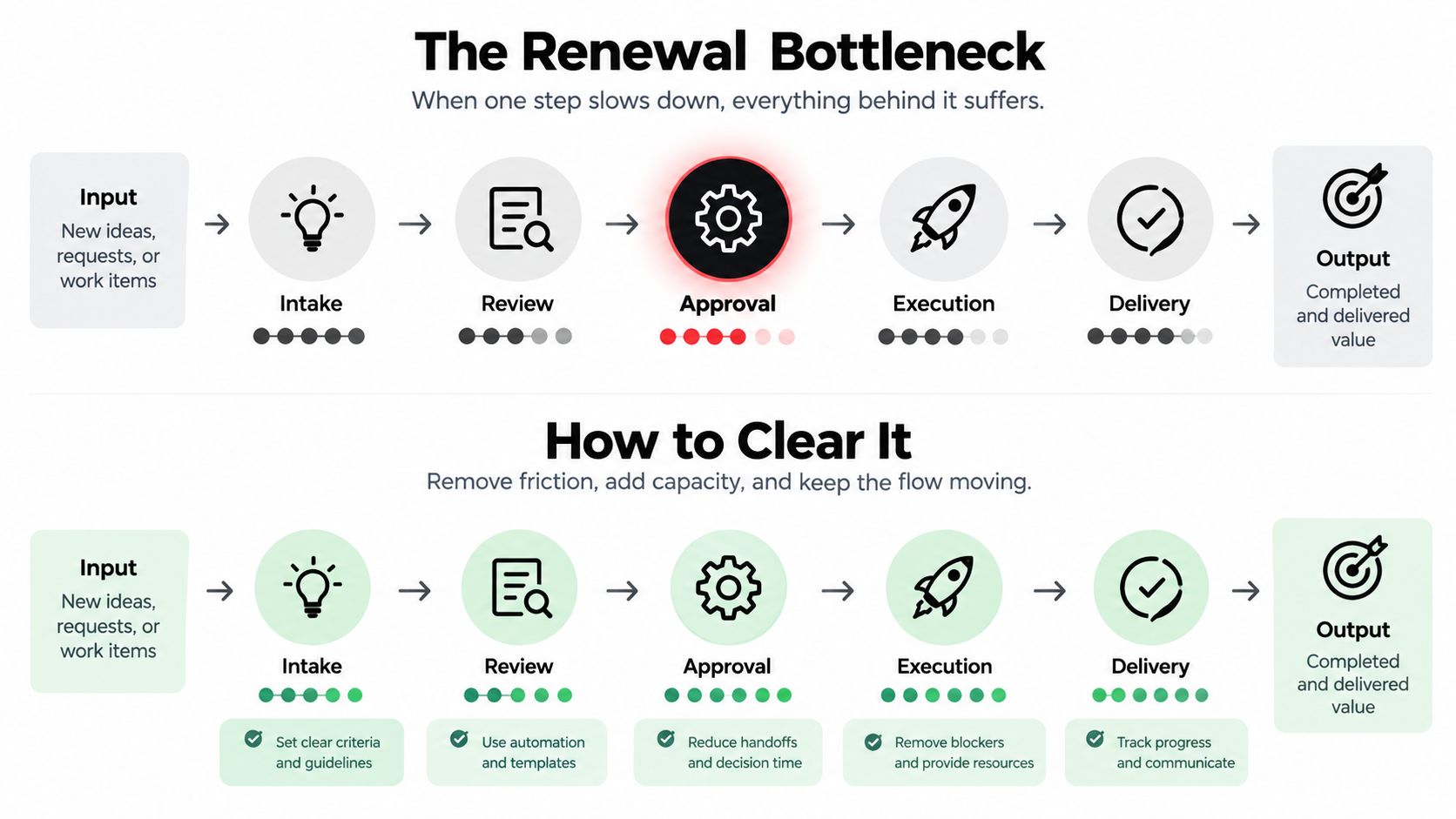
Use this order of checks
- Allow processing time. Give the electronic record time to appear before assuming the test failed.
- Check the registration record online. Use the DMV's available registration or tag-status tools to see whether the smog requirement remains.
- Call the station first. Ask the technician to verify the VIN, license plate, renewal barcode, and transmission confirmation.
- Contact DMV after the station review. If the station confirms correct transmission and the record still hasn't changed, DMV can investigate the registration file.
Don't schedule a second smog test before checking the first result. A repeat inspection won't correct a mismatched VIN or an unprocessed transaction, and it can make the record harder to interpret.
The process is designed to connect the inspection to the DMV file electronically, but drivers still need to provide the right notice and confirm the identifying information. That small preparation step is often what separates a completed renewal from another trip to the counter.
A short visual summary of the workflow appears below.
A Simple Pre-Renewal Checklist for East Bay Drivers
Use the current renewal notice as your starting document, then prepare the vehicle for the inspection path it requires.
- Drive enough mixed conditions: After battery service or emissions repairs, use normal city and highway driving to help the OBD system complete its self-checks. Your technician can tell you whether a specific drive cycle is needed.
- Check warning lights: The check-engine light should be off before testing. Don't erase codes immediately before the appointment, because clearing them can leave monitors incomplete.
- Inspect the gas cap: Make sure it seals correctly and isn't damaged.
- Review the notice: Confirm the vehicle information, renewal deadline, barcode, and any STAR instruction.
- Choose the right station: If the notice says STAR, verify that the station is currently authorized for STAR testing. Bring the full notice to the appointment.
- Allow processing time: Schedule the inspection early enough that an electronic transmission issue can be corrected before the registration deadline.
Don't wait until the last DMV business day if your renewal depends on certification. Early testing gives you time to address an incomplete monitor, a failed inspection, a station mismatch, or a delayed record.
Speedy Smog provides DMV smog checks in San Leandro for newer and older gasoline vehicles, hybrids, and applicable diesel vehicles, with electronic result transmission for registration workflows. Bring your renewal notice and vehicle, confirm whether STAR testing is required, and visit Speedy Smog to arrange the inspection before your DMV deadline.
Gasoline, hybrid, and alternative-fuel vehicles that are eight model years old or newer are exempt from California's biennial Smog Check, but owners pay a smog abatement fee instead until the first required test. A 2020 model-year vehicle, for example, would first need a renewal Smog Check in 2028.
You've just bought a new car, the DMV renewal notice mentions smog, and now you're wondering whether California expects you to find a test station immediately. I see this confusion constantly at the shop, especially from drivers who assume “new” means “no emissions paperwork.” California's rule is simpler than the notice makes it sound, but the clock is based on the vehicle's model year, not the day you bought it.
That distinction matters when a car changes owners, arrives from another state, or reaches the end of its exemption window. The right calendar date can save you an unnecessary appointment. The wrong assumption can send you to the DMV without the certificate you need.
Table of Contents
- Why New Car Owners Ask About California Smog Checks
- The 8 Model Year Exemption Explained
- First Time Registration Rules for New California Vehicles
- What Happens at a Smog Check for 2000 and Newer Cars
- When You Need a STAR Certified Station Instead
- Common Myths That Trip Up New Car Owners
- Your Quick Checklist Before Your Next Smog Test
Why New Car Owners Ask About California Smog Checks
A driver may buy a 2025 RAV4 Hybrid from a California dealership, enjoy it for months, and then receive a renewal notice that includes smog-related language. The notice doesn't necessarily mean the vehicle needs an immediate inspection. It may reflect the DMV's registration process and the applicable smog abatement fee during the new-car exemption period.
California's emissions program and the DMV registration system work together, but they aren't the same thing. The California Air Resources Board establishes emissions-control requirements, while the DMV uses Smog Check compliance information when processing certain registrations and renewals. The California DMV's Smog Inspections guidance confirms that newer gasoline, hybrid, and alternative-fuel vehicles generally follow an exemption pathway rather than disappearing from the program.
Four situations that create confusion
The question usually comes from one of these situations:
- A renewal notice arrives early: The driver sees “smog” on the notice and assumes a test is due, even though the vehicle may still be inside the exemption window.
- An out-of-state title comes to California: Initial California registration can involve requirements that don't apply to a California dealer sale.
- The paperwork has no obvious smog line: Owners may not know whether the dealer handled the matter or whether they must visit a station.
- A dealer inspection gets confused with a state inspection: A dealer may inspect a vehicle before sale, but that doesn't automatically answer every DMV registration requirement.
Three owner groups ask me about this most often. Recent buyers want to know whether the dealer completed everything. Owners approaching the eight-model-year boundary need a precise first-test year. Buyers of cars that sat on a dealer lot may see a current model year while the registration timeline has already begun.
The practical answer is to separate the questions. First, identify the model year and fuel type. Next, determine whether the registration is a California renewal or an initial California registration. Finally, check whether the DMV issued a directed requirement. That process tells you whether you need a test, a fee, a VIN verification, or just a normal renewal.
The 8 Model Year Exemption Explained
California's current rule gives gasoline, hybrid, and alternative-fuel vehicles eight model years or newer an exemption from the biennial Smog Check required for registration renewal. During that period, the owner pays a smog abatement fee with DMV renewal fees instead of bringing the vehicle to a test station, as described by the Bureau of Automotive Repair's vehicle inspection guidance.
The clock follows the model year printed on the vehicle records. It doesn't restart when you purchase the car, move to another county, or sell it to another California driver. A vehicle keeps the same model-year age throughout its life.
Use the model year, not the purchase date
Take a 2018 model-year vehicle. Under the eight-model-year calculation, it remains exempt through the 2025 renewal cycle and faces its first required test for the 2026 registration year. The owner may have bought it new, used, or from another state. Those purchase details don't change the model-year calculation.
The state extended the exemption from six model years to eight under AB 1274, effective January 1, 2019, and added a $25 annual smog abatement fee during the added exemption period, according to SEMA's explanation of California's new-car exemption change. The fee is the replacement for the inspection during the applicable exemption period. It isn't proof that the vehicle has passed a Smog Check.
Practical rule: If the renewal notice says a test is required, follow the notice. If you believe the notice conflicts with the model-year calculation, resolve it with the DMV before assuming the vehicle is exempt.
The exemption discussed here applies to regular biennial registration renewals. It doesn't erase every possible inspection obligation. A transfer-of-ownership transaction or a directed DMV notice can create a separate requirement. Electric vehicles and diesel vehicles also follow separate rules, so don't apply the gasoline and hybrid timeline blindly to every powertrain.
Find your first required test year
| Model Year | Exempt Through | First Required Test For |
|---|---|---|
| 2018 | 2025 renewal cycle | 2026 registration year |
| 2019 | 2026 renewal cycle | 2027 registration year |
| 2020 | 2027 renewal cycle | 2028 registration year |
| 2021 | 2028 renewal cycle | 2029 registration year |
| 2022 | 2029 renewal cycle | 2030 registration year |
For the broader rules and renewal details, keep the California smog check rules handy. The fastest approach is to write down the model year, add eight, and treat that year as the first renewal year to verify with the DMV. Don't wait until the registration deadline if the notice and your calculation disagree.
First Time Registration Rules for New California Vehicles
A new vehicle follows a different path depending on where the transaction occurred. A California dealer sale is usually the cleanest case. The dealer submits the initial registration paperwork, and the buyer typically doesn't need to arrange a separate Smog Check for that initial California registration because the vehicle is inside the new-car exemption.
An out-of-state purchase requires more attention. The DMV may need an out-of-state title or equivalent ownership document, a VIN verification, and a smog certificate before completing the California title and registration process for a qualifying gasoline vehicle. A manufacturer's certificate of origin is different from a California title, and neither should be treated as interchangeable with an out-of-state title.
Three paperwork paths
Consider a buyer who brings a recently purchased vehicle from Nevada into California. The buyer may need to complete the VIN verification, obtain the required emissions inspection, and then take the paperwork to the DMV. The inspection station electronically submits a bar-coded certificate that the DMV can use when processing the registration.
A lien release transfer can create its own documentation trail. The owner should follow the DMV's instructions for the title and transfer documents rather than assuming the vehicle's age eliminates every transaction requirement.
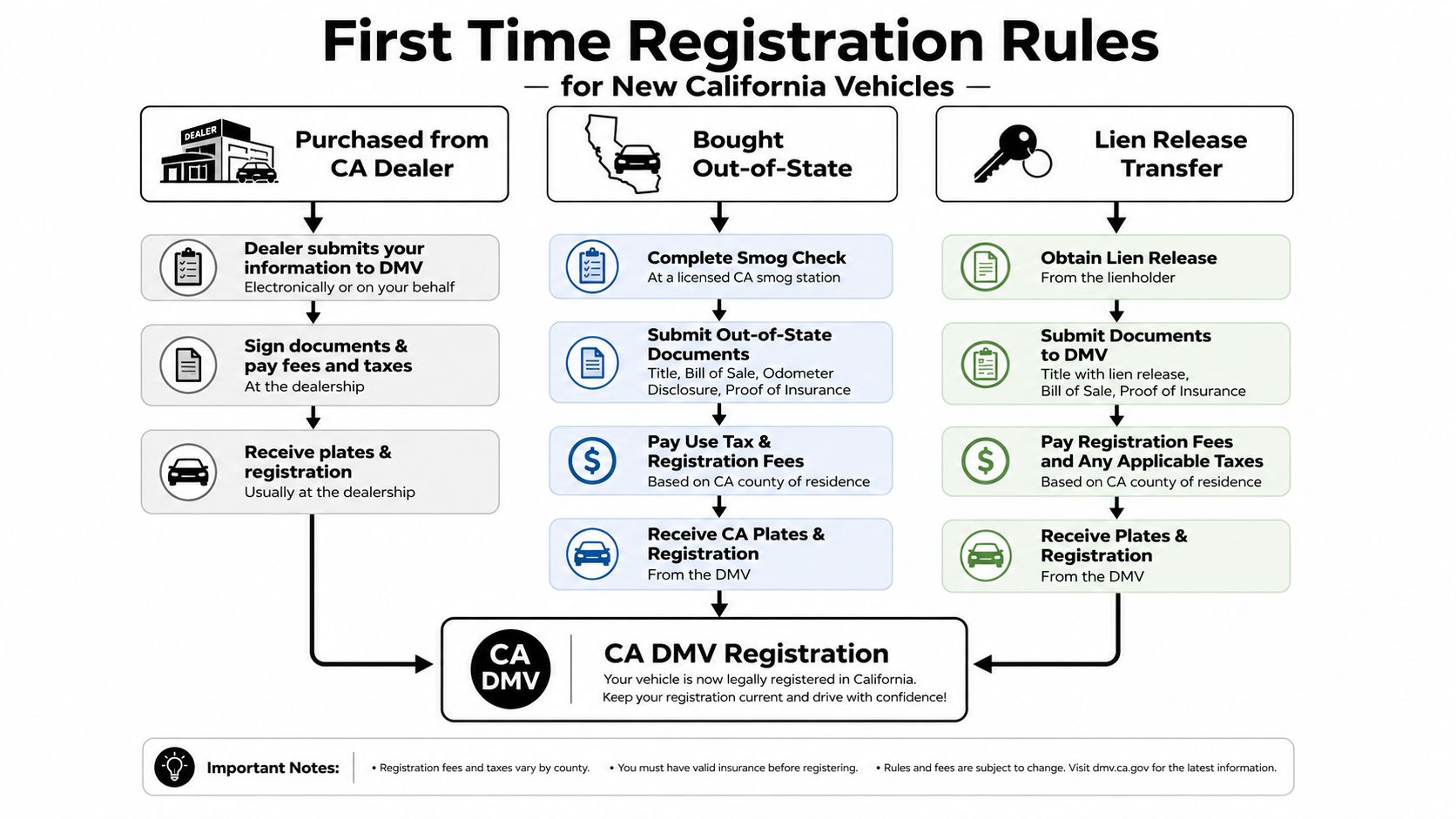
Put the inspection in the right order
The common mistake is visiting the DMV first, discovering that a smog certificate is missing, and then making a second trip to a station. For an out-of-state transfer, handle the VIN and emissions requirements before the DMV appointment whenever the DMV directs you to do so.
A California dealer may handle the initial registration, while a private buyer importing a car usually has to coordinate more of the process. The California registration renewal process can help you separate a renewal from an initial registration transaction. Bring the title documents, purchase paperwork, identification, and any DMV notice to the station or DMV so the technician or clerk can identify the exact transaction.
What Happens at a Smog Check for 2000 and Newer Cars
For a 2000-and-newer gasoline vehicle, the inspection is primarily an OBD-II diagnostic check, not the old-style tailpipe routine most drivers picture. The BAR On-Board Diagnostic Inspection System collects data from 2000-and-newer vehicles, according to the BAR Smog Check Manual.
The technician starts by checking the dashboard and the emissions-related warning light. Then the technician connects an approved scan tool to the vehicle's data link connector, generally located under the dashboard. The scan retrieves emissions information from the vehicle's computer rather than relying only on exhaust gas measured at the tailpipe.
The technician reads the emissions computer
The inspection reviews information such as stored diagnostic trouble codes, pending codes, readiness monitor status, and the malfunction indicator lamp status. The vehicle must show that its emissions system has completed the applicable self-checks and that the computer's commanded warning-light status matches what the driver sees.
That's why disconnecting the battery shortly before an appointment can create trouble. The vehicle may run normally while the readiness monitors remain incomplete. A recently repaired vehicle may also need normal driving before its computer can verify that the repair solved the emissions problem.
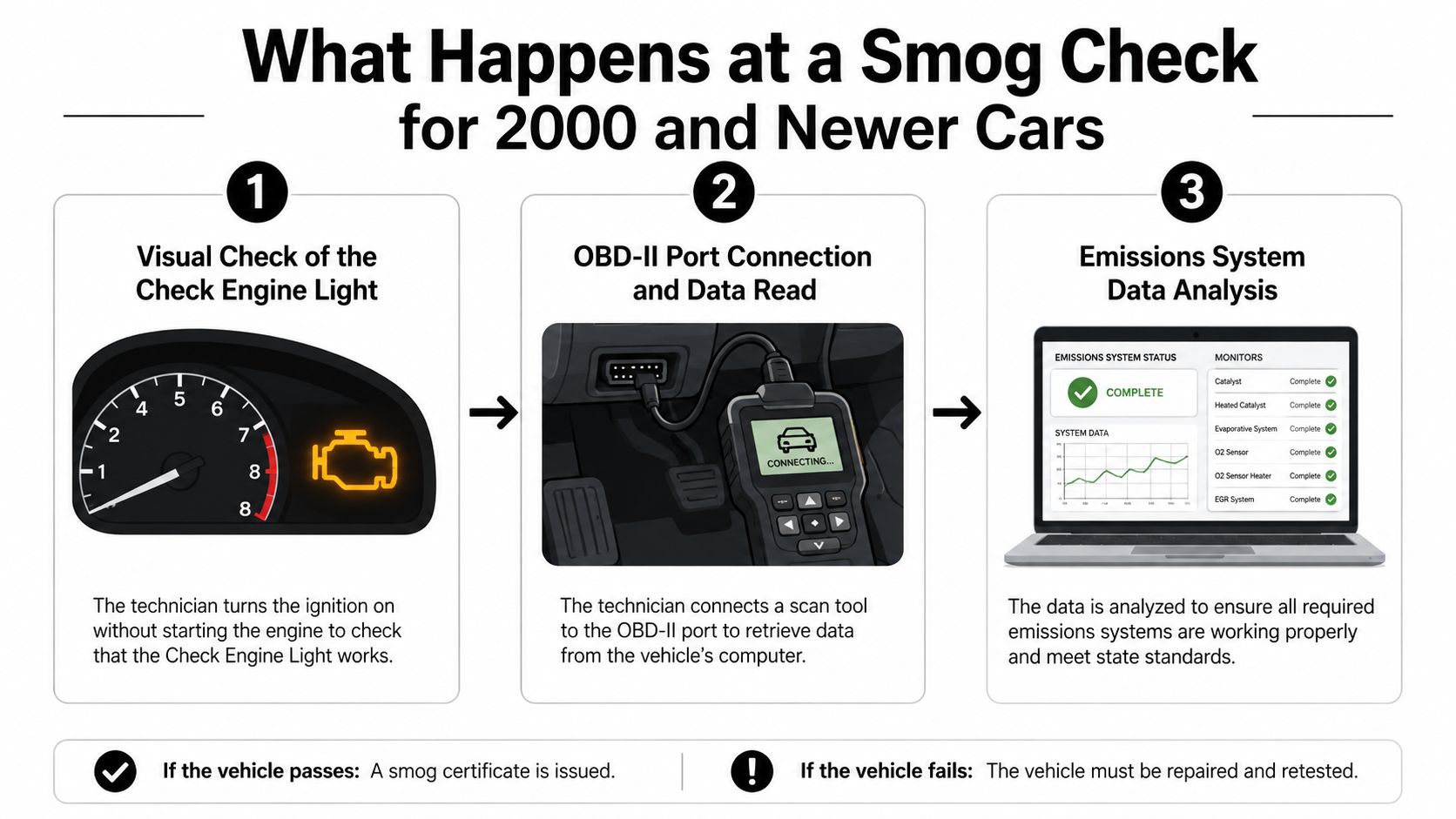
When a tailpipe test can still appear
The BAR manual identifies limited situations in which a 2000-and-newer gasoline vehicle may still receive a tailpipe test on the BAR-97 analyzer. Examples include a vehicle that lacks OBD-II, exceeds 14,000 pounds GVWR, or has an OBD-II system flagged as problematic. The manual, rather than the vehicle's age alone, determines how the station handles that inspection.
A lit check engine light generally means the vehicle won't pass the emissions inspection. The station gives the owner a failure report, and the owner can choose a qualified repair technician before returning for a retest. Eligible owners may also investigate California's income-based repair assistance, but eligibility depends on the program's requirements.
Watch the inspection flow before you arrive:
When You Need a STAR Certified Station Instead
A regular licensed station can perform authorized inspections within its license scope. A STAR-certified station operates under the Bureau of Automotive Repair's STAR program and handles vehicles that the DMV directs to STAR testing.
The registration notice is the deciding document. If it specifies STAR, book a STAR station. Don't choose a regular station first and hope the DMV will accept the result. A vehicle can also be directed after a previous failure or through the state's high-emitter screening process.
Compare the stations before booking
| Scenario | Regular Station | STAR Station |
|---|---|---|
| Routine renewal without a STAR direction | May perform the inspection if licensed for the vehicle | May also perform it if licensed |
| DMV renewal notice specifies STAR | Not the correct choice | Required destination |
| Vehicle has a directed testing requirement | May not satisfy the direction | Designed for directed inspections |
| New vehicle inside the exemption | No test is normally needed | No STAR test is normally needed |
STAR stations face additional state oversight and inspection requirements. That doesn't mean every new vehicle needs STAR testing. A new gasoline or hybrid vehicle still follows the model-year exemption unless the DMV issues a separate transaction-specific direction.
Read the notice before calling
Look for wording that directs you to a STAR station, especially after a failed renewal inspection or a high-emitter designation. If the notice doesn't direct you to STAR, a licensed station that handles your vehicle's fuel type and model year may be appropriate.
The STAR station explanation from Speedy Smog gives owners a practical overview of the distinction. My recommendation is simple: take a photo of the renewal notice before booking, then show it to the station. That prevents the most avoidable mistake, choosing a shop that can't complete the required transaction.
Common Myths That Trip Up New Car Owners
Myth one: New cars never need a Smog Check. The rule is narrower. Gasoline, hybrid, and alternative-fuel vehicles are exempt from biennial renewal testing only while they remain within the eight-model-year window. The model year controls the clock, not the date on your purchase contract.
Myth two: Hybrid vehicles skip emissions testing permanently. They don't. Hybrids receive the same new-vehicle exemption treatment described in the DMV guidance, then enter the applicable renewal testing schedule after the exemption ends.
Myth three: A new car needs no smog-related paperwork. New owners may not need a test, but they still pay the smog abatement fee during the exemption period. That fee is part of the registration transaction and replaces the inspection for that period.
Myth four: An out-of-state car avoids California testing. Bringing a vehicle into California for initial registration can require a VIN verification and a smog certificate, even when the vehicle is relatively new. The transaction type matters as much as the vehicle's age.
Myth five: Passing once ends the requirement. A pass satisfies that inspection transaction. After the first required test, qualifying vehicles generally return to the biennial renewal schedule, so keep the next registration deadline on your calendar.
The California DMV smog inspection rules are the controlling reference for the exemption and registration connection. If your notice conflicts with an assumption, trust the notice and verify the issue instead of relying on a dealership conversation or an online forum.
Your Quick Checklist Before Your Next Smog Test
Use this checklist the morning you plan the appointment:
- Pull out the DMV notice. Check whether it calls for a Smog Check, a STAR station, or another registration step.
- Write down the model year. Count the eight-model-year exemption from the model year, not your purchase date.
- Confirm the fuel type. Gasoline and hybrid vehicles follow the timeline covered here. Diesel and electric vehicles require separate rule checks.
- Check the warning light. A check engine light should not be illuminated when you arrive.
- Avoid a last-minute battery disconnect. The OBD system may need driving time to reset its readiness monitors after power loss or emissions repairs.
- Choose the correct station. Use the BAR station finder, and select STAR when the DMV directs you there.
- Bring the transaction documents. Out-of-state transfers may need title paperwork, VIN verification, and a certificate that the DMV can match to the vehicle.
- Allow appointment time. A licensed station can tell you its expected turnaround, but don't schedule the inspection so tightly that a failed test leaves no time for diagnosis.
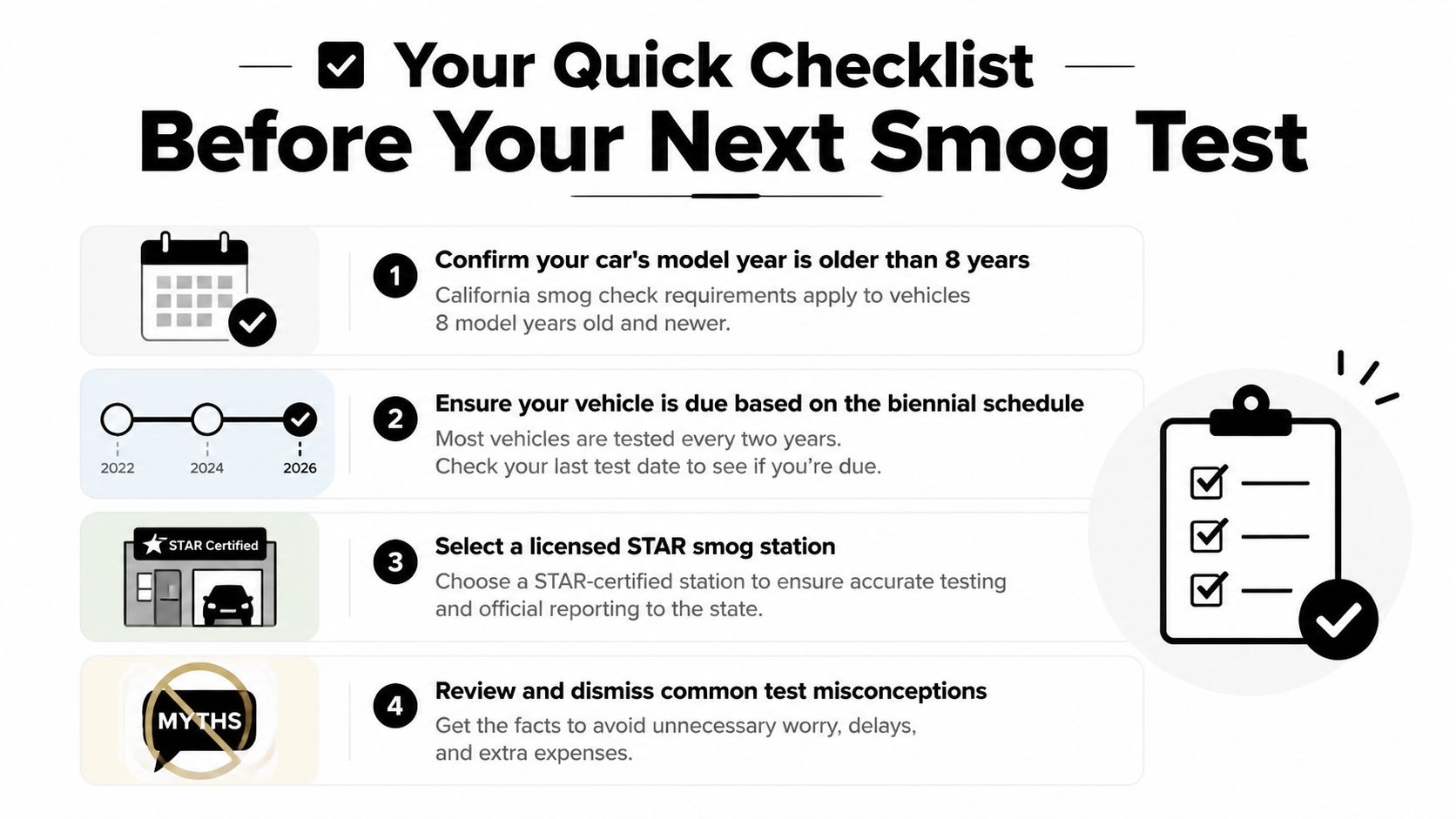
A passing inspection produces the compliance record needed for the applicable DMV transaction. A failure produces a report identifying the problem, not a reason to keep guessing. Have the vehicle diagnosed, complete the emissions repair, and ask the station about the retest process before authorizing unrelated work.
If you're unsure whether your newer vehicle has reached its first required test year, bring the DMV notice and vehicle information to Speedy Smog. The San Leandro shop handles inspections for newer vehicles, hybrids, and other qualifying vehicles, and can help you choose the correct testing path before you make a wasted DMV trip.