
Smog Check for Older Cars a California Guide
Your registration renewal shows up in the mail, you flip it over, and there it is: smog certification required. If your car is older, that one line can raise a bunch of questions fast. Does your model year still need testing? Is it the quick computer scan, or the longer tailpipe test? What happens if the check engine light came on last week, then went back off?
A lot of East Bay drivers run into this with cars from the 1990s, older diesels, or well-kept daily drivers that still run fine but don't fit the “new car” rules anymore. The confusing part is that California doesn't treat all older vehicles the same. A 1975 gasoline classic, a 1998 sedan, and a 2003 commuter car each fall into different testing logic.
The good news is that the rules make more sense once you group them by era and by fuel type. After that, passing the test becomes much less mysterious. You mostly need to know where your car fits, what the technician is checking, and how to avoid the common mistakes that trigger a fail.
Table of Contents
- Your DMV Smog Notice Arrived What Now
- The Three Eras of California Smog Checks
- Exemptions and Special Cases for Older Cars
- What Happens During the Smog Test
- Common Failure Points and How to Prepare Your Car
- Understanding Costs Timelines and Failure Options
- How to Find a STAR Station in the East Bay
Your DMV Smog Notice Arrived What Now
Many drivers don't start learning about a smog check for older cars because they're curious. They learn because the DMV gives them a deadline.
A common East Bay scenario goes like this. You've got an older Toyota, Honda, Ford, or Chevy that still gets you to work just fine. Then the renewal notice arrives, and suddenly you're wondering whether your car counts as “old enough to be exempt” or “old enough to be a problem.”
That confusion is normal. California's system isn't based on your car just being old. It's based on model year, fuel type, and testing method. Two cars parked next to each other can follow different rules even if they look about the same age.
Practical rule: Start with your model year, not with the car's condition, mileage, or collector status.
If your car is a gasoline model, the first cutoff people need to know is whether it falls before or after the mid-1970s exemption line. If it's newer than that, the next question is whether it belongs to the older tailpipe-testing group or the newer computer-testing group. Diesel owners have their own timeline, which trips up plenty of people because it doesn't match the gasoline rules.
Here's what usually helps drivers calm down and move forward:
- Check the notice carefully. If the DMV says smog certification is required, treat that as your starting point.
- Confirm the model year and fuel type. Those two details decide most of the process.
- Don't ignore warning signs. A rough idle, fuel smell, or check engine light can matter more than a recent oil change.
- Give yourself time before the deadline. Older cars sometimes need one repair, one recheck, or one extra drive cycle before they're ready.
The rest of the process gets much easier once you place your car into the right era.
The Three Eras of California Smog Checks
California's rules are easiest to understand when you stop thinking of them as one giant program and instead see three different eras of vehicles. That's the cleanest way to understand why an older sedan gets tested differently than a newer crossover.
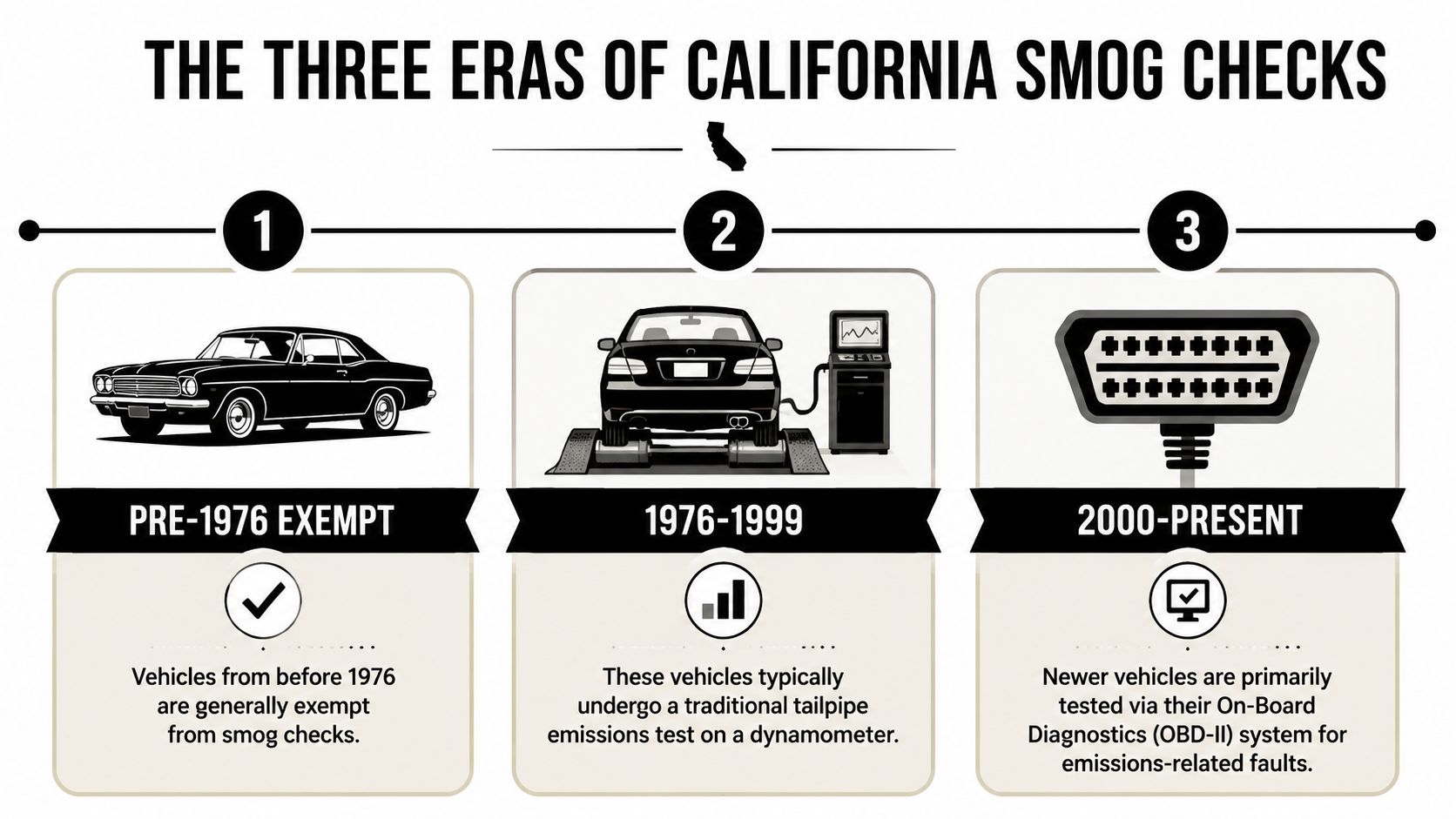
According to the California BAR Smog Check program, gasoline-powered vehicles model year 1976 and newer are subject to smog inspection, while 1975 and older are exempt; diesel vehicles are subject to inspection from 1998 and newer, with 1997 and older exempt.
Era one pre 1976 gasoline cars
This is the clean break a lot of classic car owners care about. If your gasoline vehicle is model year 1975 or older, it sits on the exempt side of the line.
That means no regular smog inspection requirement under the standard program. People often assume there's a rolling exemption based on age, but California doesn't work that way. A car doesn't become exempt just because it gets older.
For owners, the practical takeaway is simple. Don't ask, “My car is old, so is it exempt now?” Ask, “What model year is it?”
Era two 1976 through 1999
This is the group that catches many older daily drivers. These cars are old enough to have aging emissions components, but not old enough to be exempt.
Many vehicles in this range go through the more traditional style of emissions inspection associated with older testing systems. That's why a 1998 Honda or 1991 pickup may need more than a quick plug-in scan. The car may be evaluated through an older pathway that puts more weight on actual measured exhaust output and visible emissions equipment.
A lot of frustration comes from owners saying, “But the car runs fine.” Running fine and burning clean enough to pass are not always the same thing.
Era three 2000 and newer
This is the modern group. These vehicles are usually checked through their OBD-II system, which is the onboard computer that tracks emissions-related faults and readiness status.
If you've heard someone say, “They just plugged into my car and it was done,” they're usually talking about a vehicle in this era. That doesn't mean newer cars never fail. It means the test often depends more on what the computer sees than on the older style tailpipe procedure.
Here's the quick comparison drivers remember best:
| Vehicle era | Main idea for the owner |
|---|---|
| Pre-1976 gasoline | Generally exempt from routine smog checks |
| 1976-1999 gasoline | Older testing pathway is often more involved |
| 2000+ gasoline | Computer-based OBD-II testing is common |
If your older car needs a smog check, the model year usually tells you what kind of appointment you're walking into.
Exemptions and Special Cases for Older Cars
The basic timeline handles most vehicles, but some cars don't fit neatly into the usual conversation. That's where people get tripped up. They hear “classic car,” “diesel,” or “engine swap,” and assume those words create an automatic exemption. Often they don't.
The classic car cutoff that never moved
For gasoline vehicles, California uses a fixed historical cutoff. Vehicles manufactured before model year 1976 are entirely exempt from smog testing requirements, and that policy has remained unchanged since the early days of the program, according to this California smog exemption overview.
That fixed line matters because many owners expect a rolling rule. They think a car becomes exempt once it reaches a certain birthday. California did not set it up that way. The exemption is tied to a model-year boundary, not a moving age threshold.
The reason this causes confusion is easy to understand. A 1975 gasoline car is exempt, but a 1976 gasoline car is not, even though those vehicles may be close in age and design. One lands on the exempt side of the legal line, the other doesn't.
A few special-case reminders help:
- Collector status doesn't control the rule. A car can be loved, restored, and shown on weekends and still need testing if it falls on the required side of the model-year line.
- Condition doesn't create an exemption. A beautifully maintained older car still follows the same rule as a rough one from the same year.
- Low use doesn't automatically change the requirement. Owners often drive older cars sparingly, but that alone doesn't place them outside the standard rule.
Diesels swaps and out of state surprises
Diesel owners need to pause and check fuel type before they assume gasoline rules apply. Under the BAR framework already noted above, diesel vehicles from 1998 and newer are subject to inspection, while 1997 and older are exempt. That timeline is different from gasoline, and that difference catches people every year.
Engine-swapped or modified vehicles create a different kind of issue. The question usually isn't “Is it older?” The question is whether the emissions equipment and configuration still line up with what California expects. If a technician sees missing, altered, or noncompliant emissions parts, that can become a significant problem.
Cars coming in from another state can also surprise owners. A vehicle that was easy to register elsewhere may face a California emissions requirement before registration can move forward. That doesn't mean the car is bad. It means California wants the vehicle to fit California's compliance path.
A simple way to think about special cases is this:
| Vehicle situation | What to verify first |
|---|---|
| Older gasoline classic | Exact model year |
| Older diesel | Whether it falls before or after the diesel cutoff |
| Modified or swapped vehicle | Emissions equipment and legal configuration |
| Out-of-state vehicle | California registration and smog requirement status |
Bring the registration paperwork and know your fuel type before you show up. Half of smog-check confusion starts there.
If you're unsure, don't guess based on what a friend's car needed. Small details matter with older vehicles.
What Happens During the Smog Test
For many drivers, the test feels stressful because they can't see what the technician is evaluating. Once you know the basic flow, it becomes much less mysterious.
What the technician checks first
Before anybody talks about pass or fail, the inspection starts with the vehicle itself. The technician is looking for a car that is testable, presentable, and equipped as expected for its emissions system.
That usually means checking items such as the check engine light status, obvious emissions-related components, and signs of tampering or missing equipment. If something looks clearly altered or disconnected, that can matter before the deeper testing even starts.
For older cars, visual issues matter more than many owners expect. A missing hose, a loose gas cap, an unplugged sensor, or a noncompliant part can start the appointment off badly even if the engine sounds normal.
Tailpipe test versus computer test
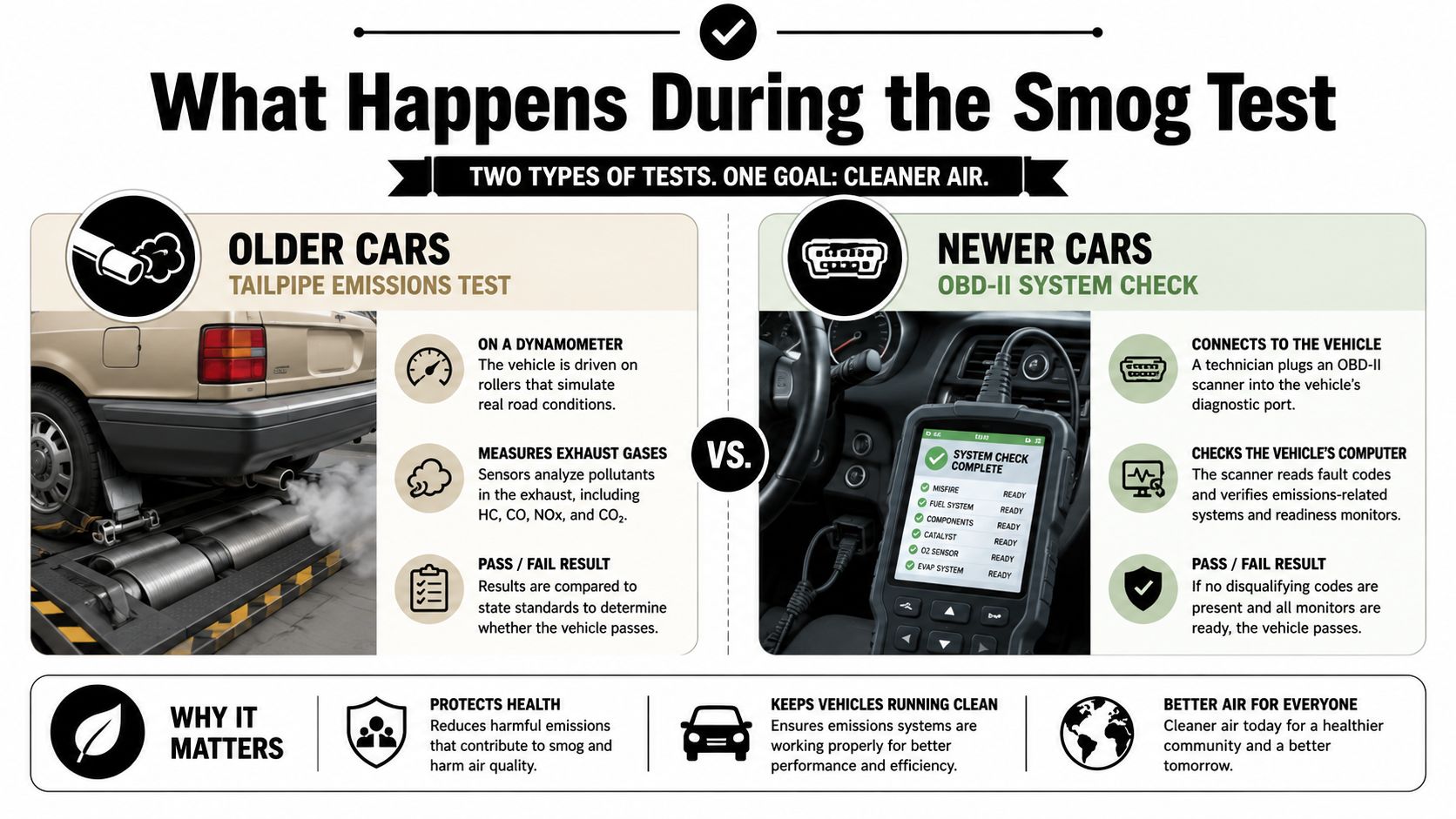
The main split is between the older tailpipe-style test and the newer OBD-II system check.
For many older gasoline vehicles, especially those in the 1976 through 1999 group, the station may use the traditional style of test associated with a dynamometer. The car is run under controlled conditions while emissions from the exhaust are measured. That gives the state a picture of what the vehicle is putting out.
For newer vehicles, the process is usually different. The technician plugs into the onboard diagnostics system and checks whether the car's emissions monitors are ready and whether any emissions-related fault codes are present.
Here's the practical comparison:
- Older vehicle pathway: More focused on measured tailpipe output and equipment condition.
- Newer vehicle pathway: More focused on the vehicle computer, fault codes, and monitor readiness.
- Both pathways: Still care about whether the emissions system appears intact and functioning.
A recent battery disconnect can matter on newer cars because the computer may not be ready yet, even if the car feels perfectly fine.
If you've got an older car, don't assume the test is only about what comes out of the exhaust. If you've got a newer one, don't assume a smooth-running engine means the computer is ready. Smog inspections look at compliance, not just drivability.
Common Failure Points and How to Prepare Your Car
Your registration notice shows up, the car seems to run fine, and it is easy to assume the test will be routine. Then an older hose, a tired sensor, or a converter that has slowly lost efficiency turns a normal visit into a failed inspection. That is the hard part with older vehicles. They often drift out of spec little by little, long before they leave you stranded.
That pattern shows up in statewide research too. California data highlighted in the Cleaner Cars, Cleaner Air report shows that 20-year-old gasoline vehicles fail the required Smog Check twice as often as 10-year-old vehicles, with failure rates for 15 to 20 year old cars reaching 18 to 22 percent.
For East Bay drivers, the useful question is not only what fails. It is why those parts fail, what warning signs show up first, and what you can check before you spend time and money on a test.
Why older cars get tripped up
An older emissions system works a lot like an old home heating system. It may still run every day, but if one sensor reads a little off, one hose leaks, or one key part loses efficiency, the whole system starts working dirtier than it should.
The usual trouble spots are familiar. Catalytic converters wear down over time. Oxygen sensors can get lazy and stop giving accurate feedback. Vacuum leaks let in air the engine computer is not expecting. Evaporative system faults can let fuel vapors escape even if the car still starts and drives normally.
Some problems are loud. A rough idle, stalling, hard starts, or an exhaust leak usually get your attention.
Others are quiet. Slightly worse fuel economy, a faint fuel smell, or a check engine light that comes and goes can still be enough to cause a failure.
The failure points that catch owners off guard
The check engine light is the biggest one. If that light is on, the car needs diagnosis before the test. Clearing the code without fixing the cause is a little like taking the battery out of a smoke alarm. The warning stops for the moment, but the underlying problem is still there, and the car may also show up as not ready for inspection.
Catalytic converter problems are another common issue on older cars. A converter can weaken slowly. The car may still feel normal on the road, but emissions rise because the converter is no longer cleaning up the exhaust the way it should.
Fuel control problems matter too. If the engine is running rich or lean because of a bad sensor, vacuum leak, injector issue, or air intake problem, tailpipe numbers can climb fast.
Then there are visible problems. Missing hoses, disconnected emissions equipment, patched wiring, and obvious exhaust leaks can all create trouble before the test result even gets to the numbers.
A pre-test routine that gives you a better shot
If a neighbor asked me how to get an older car ready, I would keep it simple:
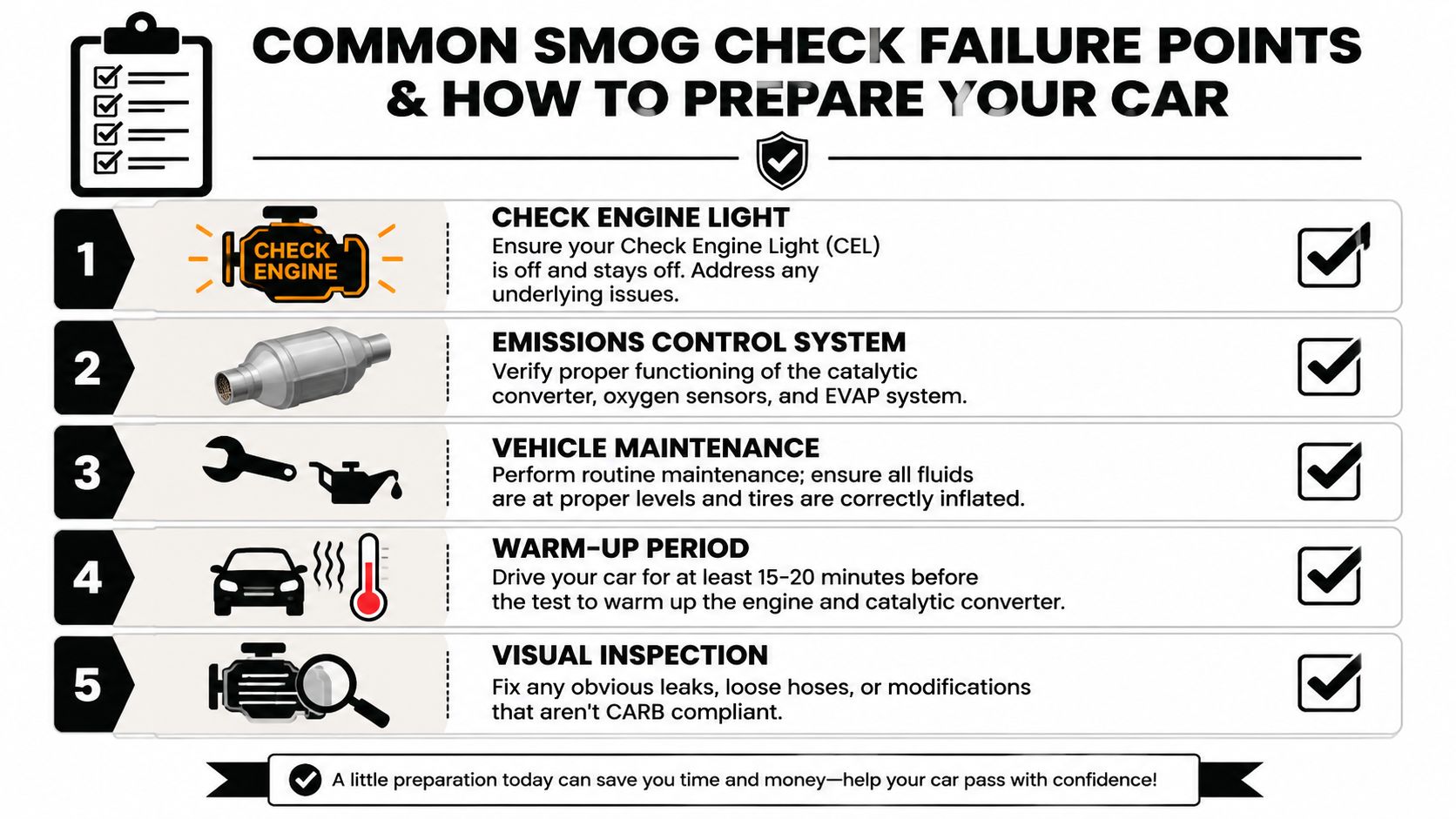
- Make sure the check engine light is off and has stayed off. If it was recently cleared, find out why.
- Drive the car long enough to get fully warm before the appointment. A warmed-up engine and catalytic converter usually perform better than a cold one.
- Do a quick under-hood look. Check for cracked vacuum lines, loose air intake parts, disconnected hoses, or anything that looks recently disturbed.
- Listen and smell. A loud exhaust, a ticking leak, or raw fuel smell can point to an emissions problem.
- Pay attention to how it has been driving lately. Rough idle, hesitation, stalling, or weaker fuel economy are clues, not quirks.
If any of those signs are present, a pre-test inspection from a repair shop can save you a wasted trip.
| Symptom | Why it matters |
|---|---|
| Check engine light | The vehicle may not pass the inspection |
| Poor idle or stalling | Fuel or sensor issues may affect emissions |
| Fuel smell | Evaporative or combustion problems may be present |
| Recent battery disconnect | Readiness issues may delay a valid test |
| Noticeable power loss | The engine may not be burning fuel cleanly |
One more practical point for older cars. Do not let the smog station be the first place you learn the car has a problem. Use the inspection as the confirmation step after the vehicle is running cleanly and consistently. That approach usually saves money, reduces repeat visits, and lowers the chance of registration delays or late-stage DMV stress.
Understanding Costs Timelines and Failure Options
Most drivers want three practical answers before they go in. How much time should they block out, what happens after the test, and what do they do if the car doesn't pass?
How long it usually takes
Testing time depends a lot on the vehicle type. According to the publisher information provided for this article, typical tests for 2000 and newer vehicles are completed in about 10 to 15 minutes at Speedy Smog. Older vehicles can take longer because the inspection path is often more involved.
That's why it helps to avoid arriving at the last possible minute before a registration deadline. Older cars sometimes need a little more shop time, and sometimes the next step is a repair visit rather than an instant certificate.
A good rule is to leave yourself enough cushion to handle one extra trip if needed.
If your car fails
A failed test isn't the end of the road. It means the vehicle did not meet the required standard on that inspection day.
When that happens, read the Vehicle Inspection Report carefully. It points you toward the system or condition that needs attention. Some failures come from a clear mechanical issue. Others come from readiness, warning lights, or visible equipment problems.
After repairs, the next move is usually a re-test. The important part is fixing the cause, not only clearing a light or swapping parts blindly. For older cars, guessing gets expensive fast.
If money is tight, ask about official repair-assistance pathways and whether you may qualify for help through state programs. Eligibility depends on your situation, so it's worth checking before you approve major work.
How to Find a STAR Station in the East Bay
Your renewal notice shows up, you book the nearest smog appointment, and then the technician says the test has to be done at a STAR station. That moment confuses a lot of East Bay drivers, especially owners of older cars who are already trying to keep an aging vehicle legal and reliable.
A STAR station is a shop approved to perform inspections for vehicles the DMV has flagged for that program. The rule is about oversight and test accuracy, not about making life harder for you. California uses STAR requirements to keep the testing system consistent, and that matters even more with older vehicles, where emissions equipment, past repairs, or missing parts can make the inspection less straightforward.
Why STAR matters for some vehicles
Older cars are a lot like older homes. Two houses may look similar from the street, but one has updated wiring and the other still has original components hidden behind the walls. Smog checks can work the same way. Two cars from the same era may follow different inspection paths depending on their engine family, emissions label, fuel type, or prior test history.
That is why experience matters.
A station that regularly checks older gasoline cars, diesels, hybrids, and DMV-directed STAR vehicles is usually better at spotting basic issues before the test starts, such as wrong paperwork, confusion about model-year rules, or equipment questions. The station cannot bend the rules, but it can make the process clearer and help you avoid wasting a trip.
If your car has failed before, has modified or hard-to-identify emissions parts, or has been in the family long enough that records are patchy, choosing the right station can save time and frustration.

What to check before you choose a station
Use a short, practical checklist before you pull in:
- Confirm the station is STAR-certified if your DMV notice requires it.
- Ask whether they test your exact vehicle type. Older gasoline cars, diesels, and hybrids can follow different procedures.
- Check whether they handle older vehicles during all business hours. Some shops limit certain test types to specific times.
- Bring your registration or DMV notice so the station can match the vehicle and inspection requirement correctly.
- Pick a location that is easy to return to if your car needs repairs and a re-test.
For East Bay drivers, local fit matters too. A station that regularly sees older commuter cars, small work trucks, and long-kept family vehicles will usually understand the kinds of questions older-car owners ask, and why they ask them.
If you need a STAR-certified inspection in the East Bay, Speedy Smog is one local option for gasoline vehicles, older cars, diesels, hybrids, and many DMV renewal smog checks.