
DMV Smog Exemption Form: A Complete How-To Guide
If your car is 1975 model year or older, battery-electric, or one of the specific out-of-state or fee-based cases, the DMV smog exemption form can help. If it isn't one of those buckets, paperwork won't save you, and you'll waste time filing the wrong thing.
You're probably staring at a renewal notice right now and wondering whether a form can replace a test. That's the right question, because California doesn't hand out blanket smog waivers. The DMV treats exemption requests as narrow, rule-based filings tied to age, fuel type, weight, and whether the vehicle is outside California. Get that part wrong and the rest of the paperwork is noise.
Table of Contents
- Who Actually Needs a DMV Smog Exemption Form
- Matching Your Vehicle to the Right Exemption Category
- How to Fill Out the REG 5103 Form Correctly
- Submission Options and the Documents You Need
- Common Mistakes That Get Exemption Requests Rejected
- Timing the Filing With Your Renewal Cycle
- When Skipping the Form and Getting Tested Is the Better Move
Who Actually Needs a DMV Smog Exemption Form
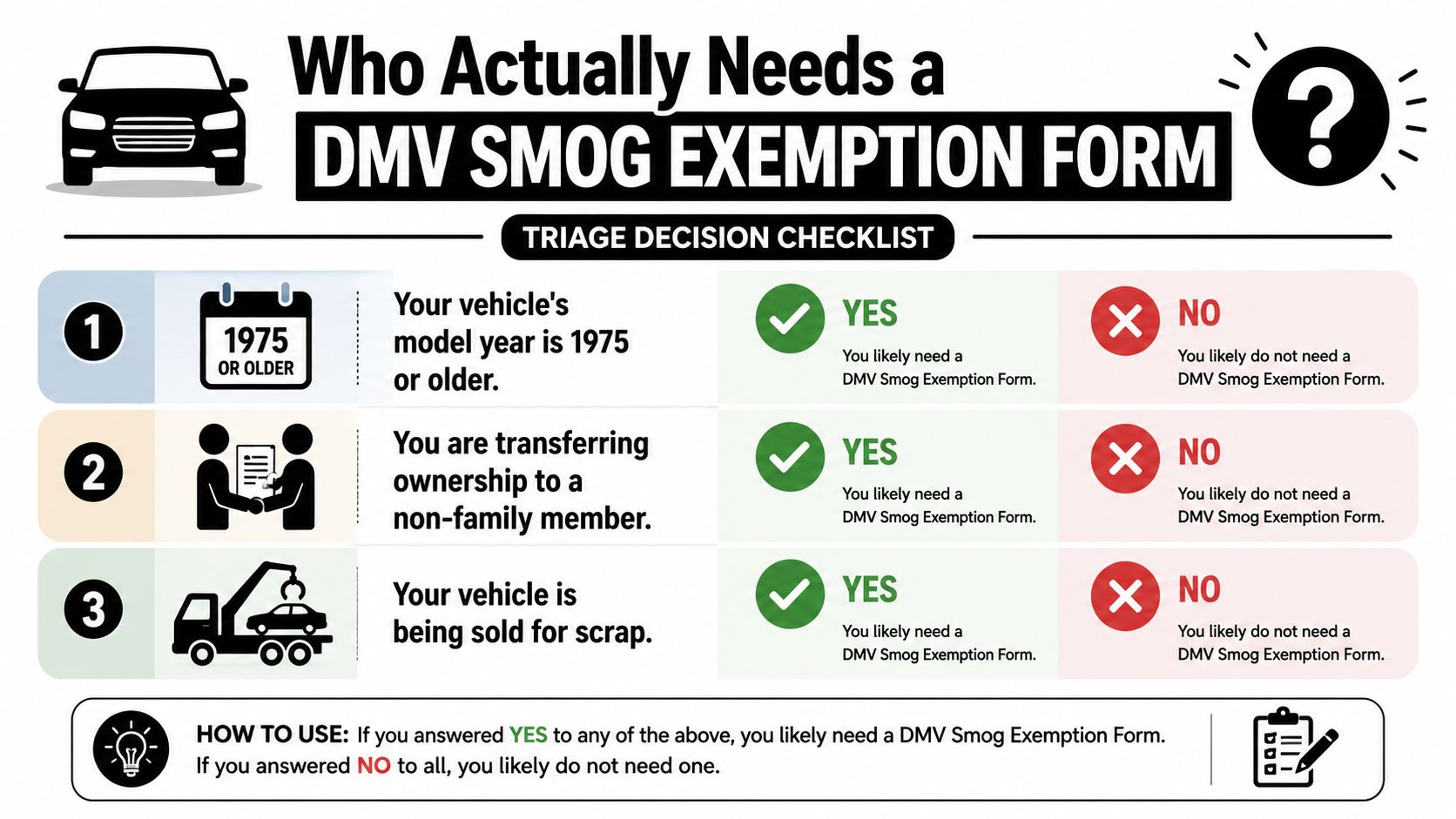
Drivers usually reach for the DMV smog exemption form because they want a shortcut around a smog issue. That approach causes trouble fast. The form only fits a narrow set of vehicles and situations, and California's DMV rules tie those exemptions to age, fuel type, weight, or temporary out-of-state status. California DMV smog inspection guidance
Start with the vehicle, not the paperwork
If you drive a gasoline vehicle that is 1975 model year or older, you do not need a smog inspection under DMV rules. The same guidance also exempts battery-electric vehicles, certain diesel vehicles based on age and weight, and natural gas vehicles over 14,000 pounds. Those are category rules, and filing the wrong form does nothing for a vehicle that does not fit one of them.
If your vehicle is newer, check the model-year rule before you reach for exemption paperwork. California says gasoline-powered vehicles less than eight model-years old do not need a smog inspection, so plenty of owners are chasing a waiver they never needed in the first place. A newer gas car usually belongs in the regular renewal path, not in the exemption stack. California DMV smog inspection guidance
Practical rule: If the car is in California and does not fall into one of the listed exemption types, you probably need a smog test, not a waiver.
Don't confuse exemption with a test workaround
The DMV smog exemption form applies only to a narrow set of vehicles and situations. The requests that go sideways at the counter usually start with someone trying to make the form fit a car that does not qualify. If your vehicle is due for inspection and still registered in the state, expect smog-test territory, not exemption territory.
That is why the counter conversation turns into a sorting exercise. One driver has a classic car, another has an electric vehicle, another has a car parked out of state, and another has a newer gas car that falls under the abatement-fee rule. Those are different cases with different paperwork, and the DMV expects you to know which one you are in before you submit anything. For a plain-language overview of waiver language, some drivers also start with this DMV waiver explainer, but the official exemption category still controls the decision.
Matching Your Vehicle to the Right Exemption Category
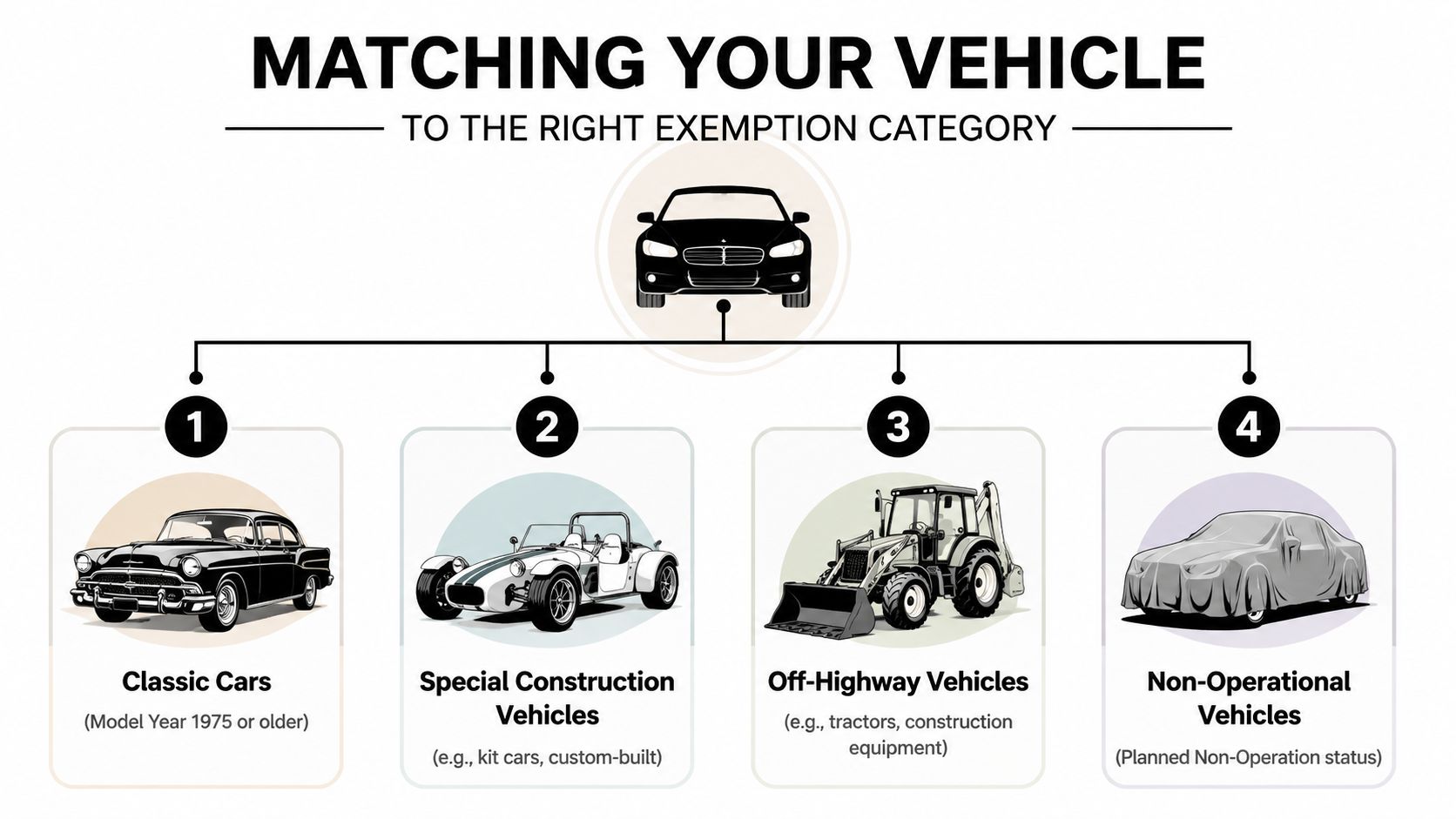
California's exemption framework is built around clear cutoffs. The Senate Transportation Committee factsheet says AB 1274 (O'Donnell), Chapter 633, Statutes of 2017 expanded the smog-check exemption to eight model years beginning January 1, 2019, and created the $25 smog abatement fee for those vehicles. Senate Transportation Committee factsheet
The rule bucket that fits your car
Start with the oldest cars. If your gasoline vehicle is 1975 or older, it is outside the smog-check lane under DMV rules. That is a clean yes, and there is no reason to force it into a newer-car process.
Diesel is its own bucket, and people miss the line all the time. Diesel vehicles are exempt if they are 1997 or older or if their Gross Vehicle Weight is more than 14,000 pounds. Age alone does not tell the whole story, weight matters too. California DMV smog inspection guidance
Fuel type creates another clean split. Battery-electric vehicles are exempt, and natural gas vehicles over 14,000 pounds are exempt as well. If your vehicle does not fit those definitions, do not try to squeeze it into them.
The newer cars people forget about
The last bucket catches drivers off guard at the counter. California also gives some gasoline-powered vehicles less than four model years old the option to pay the smog abatement fee instead of getting a smog inspection for the first 8 years the vehicle is registered, starting January 1, 2019. That means the DMV smog exemption form is not just for antiques or unusual equipment. It also comes up for newer vehicles that qualify for the fee path. Senate Transportation Committee factsheet
The counter mistake is usually simple. A driver shows up with the wrong bucket in mind, and the paperwork gets treated like a mismatch instead of a valid exemption request. California's exemption framework is built around clear cutoffs. If you cannot point to the bucket your vehicle fits, the request is going to stall.
Bottom line: match the car to the rule first. If you cannot name the exemption bucket, you probably do not qualify yet.
How to Fill Out the REG 5103 Form Correctly
For the temporary out-of-state case, REG 5103 is a document-first form. It does not reward guesswork. The DMV wants a clean paper trail that proves the vehicle is outside California and will not be available for a timely smog check. REG 5103 guidance
Fill the form like DMV verification will read it
Start with the basics, VIN, year, make, model, and license plate. Then add the exact out-of-state garaging address, the reason the vehicle is temporarily outside California, the expected return date, and the operator's contact information. Every one of those fields exists because DMV staff need enough detail to verify that the vehicle is really where you say it is.
The landmine is consistency. The garaging address, the “as of” date, and the return date have to tell the same story. If the car is supposedly in another state, but the dates or location details do not line up, the request looks shaky and usually gets delayed or rejected. If you need a quick check before you file, review your current registration status with a smog status lookup so you know whether you are dealing with a filing issue or a testing issue.
Counter rule: If the vehicle's location story does not make sense on paper, the DMV will not rescue it for you.
Know the substitute if REG 5103 is not the route you use
Some drivers will not file REG 5103 itself. In that case, a Statement of Facts (REG 256) Section G has to carry equivalent details, including the full out-of-state address and the return timing. That substitute is not less serious. It just uses a different form to prove the same thing, that the car is temporarily unavailable for a California smog check.
Use the form as a template, not a memory test. Write the vehicle details exactly as they appear on your paperwork, then make sure the out-of-state details are specific enough that someone at the DMV can check them without guessing. If the filing is meant to support renewal, do not treat it like a standalone letter. It belongs inside the registration process.
Submission Options and the Documents You Need
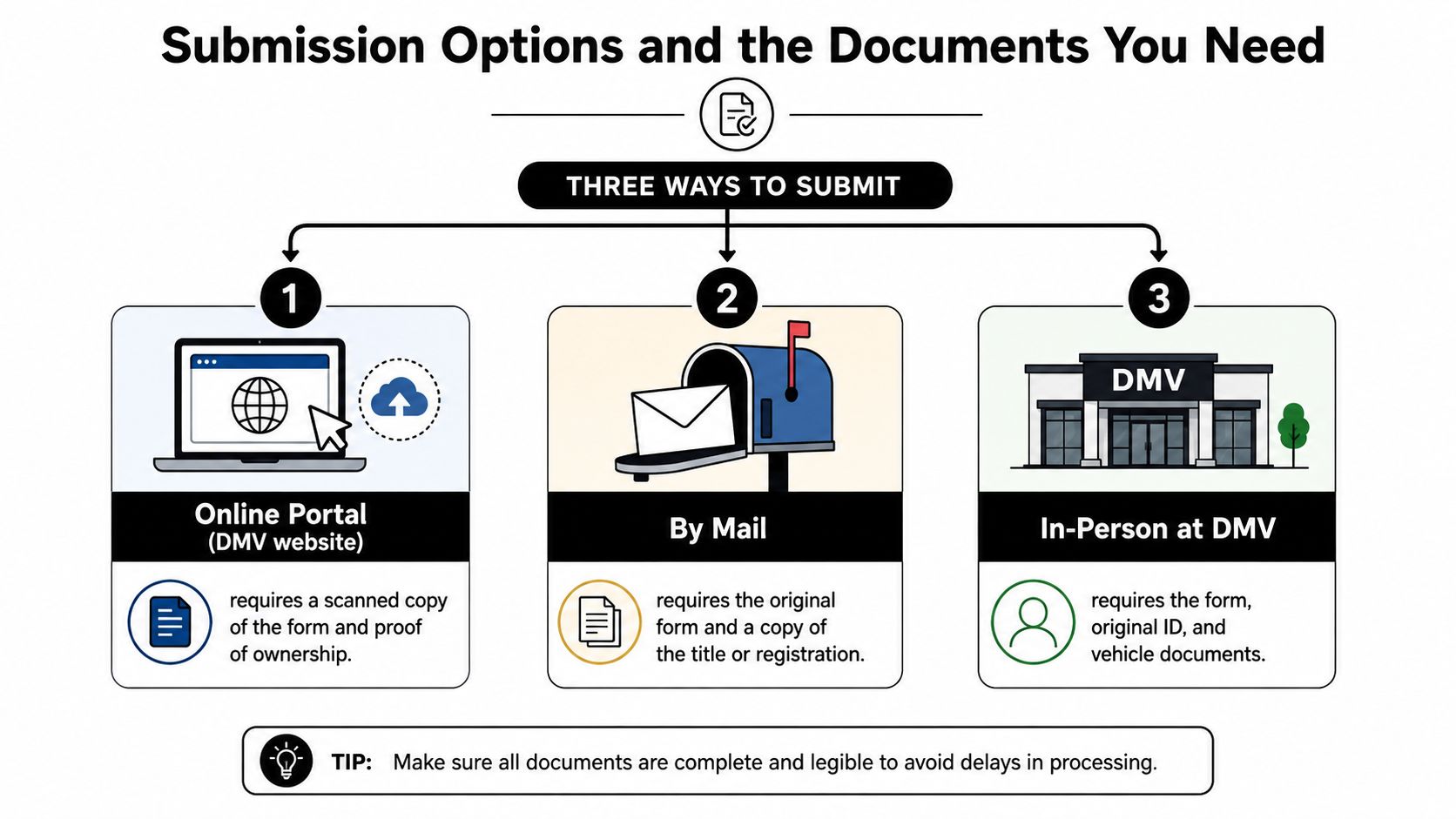
You can fill out the form correctly and still lose time at the counter if you send it the wrong way. California drivers usually have three routes, online for certain fee or eligibility situations, mail for the out-of-state packet, or an in-person DMV visit when the case is unusual or urgent. Each route creates a different paper trail, and a mismatch there is a common reason the request stalls.
Pick the route that matches the problem
If you are dealing with the smog abatement fee or another electronic DMV workflow, online handling can make sense. If you are filing the temporary out-of-state exemption, the packet usually belongs with the registration renewal mailing to Vehicle Registration Operations in Sacramento, not as a loose note sent on its own. Drivers miss that detail all the time, then wonder why the request disappears into the system.
In-person help works best when the file is messy, the paperwork is incomplete, or a clerk needs to review the packet before it moves forward. Bring the form and the vehicle documents that show the request fits the rule. If you are in the East Bay and the car is in California, some drivers need exemption paperwork while others need a STAR-certified smog test. That is the fork in the road.
Attach the right documents the first time
Do not send a half-finished packet. The DMV workflow expects the form to be signed, attached to the renewal packet when required, and mailed to the proper operations address. If you are using a substitute document, it still needs the same out-of-state details, or the filing can come back with a request for more information. REG 5103 guidance
If you are still trying to decide whether you need a test instead of a form, this smog status check guide is the faster place to start than guessing.
The BAR also says STAR-directed workflows may require a STAR station, which matters if your renewal notice sends you there. If that is your situation, paperwork will not fix it. The car needs the inspection path, not the exemption path. For a visual reminder of the three submission routes, use the embedded checklist below.
Common Mistakes That Get Exemption Requests Rejected
The DMV does not reject exemption requests at random. It rejects them when the file does not prove the reason the exemption was filed in the first place. That is a paperwork problem rooted in how the DMV processes filings.
The big mistakes are predictable
The first mistake is trying to use REG 5103 to cover an emissions problem. A vehicle with the check-engine light on is not a candidate for exemption, and the form only fits when the car cannot be tested for a valid reason. If the driver is trying to avoid repairs, the filing is going to miss the point, and the counter clerk will spot it fast. BAR smog check guidance
The second mistake is bad timing after a battery disconnect or replacement. BAR guidance says drivers should do about one to two weeks of normal driving so readiness monitors can reset before testing. If the car still needs a smog test, get the monitors ready first and file later if you still have a real exemption reason.
Paperwork errors that sink the filing
The most common clerical failures are easy to avoid:
- Missing renewal packet: The exemption is sent without the registration renewal documents, so the DMV has nowhere clean to attach it.
- Wrong garaging address: The out-of-state address does not match the DMV's picture of where the car is kept.
- Incomplete location story: The address, dates, and return timing do not line up.
- Wrong substitute form: REG 5103 is not used, and REG 256 Section G does not include equivalent details.
Those mistakes slow everything down because the DMV has to verify the file before it can move it forward.
The exemption postpones the smog obligation. It does not delete it.
If your renewal notice says STAR testing, assume the DMV wants the vehicle tested at a STAR station unless told otherwise. If the car is in California and the issue is getting the test done, stop forcing an exemption request through the wrong lane. Use the smog-status and renewal workflow described in this registration renewal guide to decide whether the car needs a form or a test.
Timing the Filing With Your Renewal Cycle
The exemption form only works when it's tied to the renewal cycle. That's the part that trips people up. If you wait until the deadline is breathing down your neck, you've already made the filing harder than it needs to be.
File early and tie it to the renewal
Start with the renewal notice, then decide whether you're paying the abatement fee, mailing the REG 5103 packet, or going in for a test. That order matters because the DMV's process is built around registration events, not open-ended approvals. The temporary exemption is a bridge, not a permanent status. For a more detailed renewal workflow, this registration renewal guide is a useful companion.
Snowbirds, students, military families, and out-of-state workers are the drivers most likely to misuse the form. They're not trying to break the rules, but they often assume the exemption lasts as long as they're gone. It doesn't. It lasts only for the temporary situation the filing describes, and the next smog obligation comes back when the car returns to California.
Plan the return before you file
The cleanest filing is the one that already includes the return plan. If the car is coming back soon, build the return date into the packet and be ready to schedule the smog check once the vehicle is back in state. That keeps the next renewal from turning into the same problem all over again.
The DMV's model-year rules and fee paths are updated on a statutory timeline, so the right move is to file according to the renewal cycle you're in now, not based on whatever worked for a friend last year. If the vehicle is out of state, use the exemption. If it isn't, handle the test now and keep the file clean.
When Skipping the Form and Getting Tested Is the Better Move
Sometimes the smartest move is to stop looking for a waiver and just get the car inspected. If the vehicle is in California, the renewal deadline is close, or the car is 2000 or newer with readiness issues, a smog station is usually the faster answer. If the renewal notice calls for STAR testing, the form route isn't the fix.
| Situation | Best Path | What You Need |
|---|---|---|
| Vehicle is out of state and temporarily unavailable | DMV exemption filing | REG 5103 or equivalent, renewal packet, accurate location details |
| Vehicle is in California and due for inspection | Smog test | Renewal notice, vehicle ready for inspection |
| Renewal notice requires STAR testing | STAR station test | STAR-directed inspection, readiness and emissions status |
| 2000 and newer vehicle after battery work | Test after readiness reset | Normal driving time, engine light off, monitors ready |
If you're in San Leandro or Oakland and the car needs a test instead of paperwork, Speedy Smog at 15275 Washington Ave (94579) handles STAR smog checks, including 2000 and newer vehicles, 1999 and older vehicles, diesels, and hybrids. For newer vehicles, the shop says the test is usually completed in about 10 to 15 minutes.
The decision rule is simple. If the car is outside California and fits the exemption bucket, file the form. If it's here, get it tested and move on.
If you've got a renewal notice in hand and you're still unsure whether you need paperwork or a test, bring the car to Speedy Smog and let a STAR Certified station sort out the inspection side fast. If your vehicle fits the exemption rules, you'll know that too before you waste a day filing the wrong form.