
Temporary Operating Permit California: How to Apply in 2026
You've paid the registration fees, but the plates or stickers still haven't arrived. You need to drive, and it's not clear whether the paper in your glove box is enough or whether you should ask the DMV for a temporary operating permit.
The key is to match the delay to the type of temporary authorization California allows. A Temporary Operating Permit (TOP) is a short bridge for specific registration problems, not a replacement for completing registration.
Table of Contents
- Which Temporary Operating Permit Fits Your Case
- Who Qualifies and What a TOP Does Not Cover
- Documents and Fees to Gather Before You Apply
- How to Apply at the DMV Step by Step
- Processing Delays and How to Fix Them
- What to Do the Day the Permit Is Issued
Which Temporary Operating Permit Fits Your Case
A delayed title step and plates still being processed are different paperwork gaps, so they may call for different permits. California's Temporary Operating Permit guidance lists one-time TOPs lasting 30, 60, or 90 days. The delay determines which type may fit.
| Permit | Duration | When it applies |
|---|---|---|
| 30-day imported vehicle TOP | 30 days | An imported vehicle's registration fees are paid, but remaining registration requirements are still open |
| 60-day one-time TOP | 60 days | A specified registration application is incomplete |
| 90-day one-time TOP | 90 days | An application for standard or personalized plates is being processed at DMV headquarters |
For an imported vehicle, the 30-day permit provides time to finish remaining registration requirements after the fees are paid. The DMV's imported-vehicle guidance describes this as a one-time permit for that situation. The broader steps for registering an out-of-state car in California can help clarify which requirements may still be pending.
A 60-day permit may fit an incomplete application in a situation specified by the DMV. A 90-day permit may fit an application for standard or personalized plates that is being processed at DMV headquarters. These durations match particular paperwork gaps; they are not interchangeable extensions chosen for convenience.
For example, if you brought an imported car into California, paid the registration fees, and still need to complete title or registration steps, the 30-day category may fit. The permit is a short bridge: you still need to finish those steps before it expires. It also does not remove other registration or emissions obligations.
Before visiting the DMV, identify the paperwork gap that matches your case and gather documents showing why registration is incomplete. Record the permit's expiration date as soon as it is issued.
Who Qualifies and What a TOP Does Not Cover
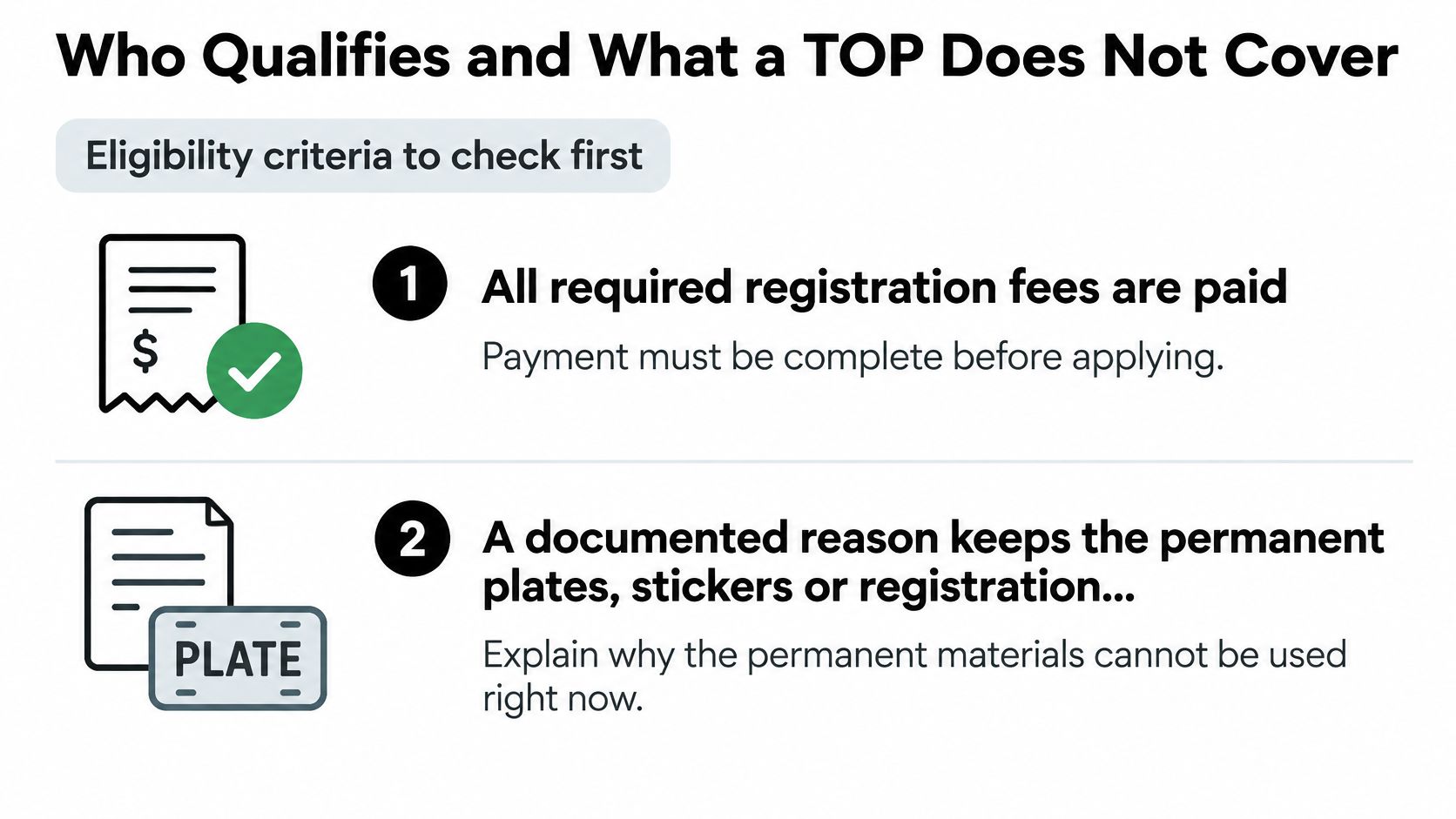
Before applying, check the essentials in order:
- All required registration fees are paid.
- There's a documented reason permanent plates, stickers, or registration materials aren't available or complete.
- Your situation matches a permit type the DMV issues.
- Any required smog step is addressed. A TOP doesn't replace an emissions requirement.
A temporary operating permit doesn't make an otherwise incomplete case eligible. Unpaid fees, a lapsed registration without a documented delay, or a missing required smog certification aren't problems the permit fixes. If a vehicle needs a smog certificate, confirm what's outstanding and complete the emissions requirement rather than treating the permit as a substitute.
Dealer temporary plates follow a different clock
A dealer's Report of Sale and temporary plates aren't a TOP. The California DMV's dealer Report of Sale guidance says the dealer must submit an electronic Report of Sale within 5 days of the sale, then submit the title and registration application with all fees within 20 days for a new vehicle or 30 days for a used vehicle.
Before delivery, the dealer must display the Report of Sale and attach temporary plates if the vehicle doesn't have California plates. Those documents generally authorize operation for 90 days from issuance, or until the permanent plates and registration card arrive, whichever comes first. A TOP can't extend that dealer operating period beyond 90 days.
A San Leandro buyer whose dealer temporary plates are still within their valid period should use those documents and track the dealer filing, rather than asking the DMV for a TOP to extend them.
Use this checklist before you apply:
- Fees paid: You can show that all required registration fees have been paid.
- Delay documented: You have paperwork identifying what remains incomplete.
- Permit type matched: Your situation fits a specific TOP category.
- Other requirements addressed: You know whether a smog certificate or another document is still needed.
If one item doesn't check out, fix it first. Then contact or visit the DMV about the remaining registration delay.
Documents and Fees to Gather Before You Apply
Start with the papers that explain both the vehicle and the delay: proof of registration fee payment, the vehicle title or import paperwork, any registration renewal notice you received, and a passing smog certificate if the vehicle requires one. The DMV's guide to registering an imported vehicle says an imported vehicle may receive a one-time 30-day TOP after all registration fees are paid, giving the owner time to complete remaining requirements.
| Situation | Core documents | Often missed |
|---|---|---|
| Imported vehicle | Proof all fees are paid, import paperwork, vehicle title | Import documents showing the vehicle entered California legally |
| Delayed plates or stickers | Fee payment receipt, registration application reference | Receipt matching the fees paid |
| Smog-related registration | Passing smog certificate, registration renewal notice | Proof the certificate is current and matches the vehicle |
The required payment is the registration fees the DMV says are due before it issues a permit. Exact fees depend on the registration circumstances, so check the current DMV fee information instead of relying on an old amount or someone else's receipt. A permit doesn't settle other outstanding registration requirements.
For example, a San Leandro owner who bought a used car out of state and has paid the fees but is waiting for plates should bring the title, payment receipt, and registration application details. Those records help the clerk connect the payment to the vehicle and understand what remains unfinished. Information on the California registration renewal process can also help you identify the paperwork involved in a renewal.
Bring original documents and make photocopies to keep your own record. Arrange them in a practical order: proof of payment, title or import documents, registration paperwork, then smog documentation if required. If you can't find the fee receipt, confirm what alternative proof the DMV will accept before making the trip. A receipt that doesn't match the vehicle or the fees can leave the central question unresolved.
How to Apply at the DMV Step by Step
Treat the application as a paperwork check, not a request for extra time. These steps help you arrive with the right case and leave knowing exactly what the permit authorizes.
Confirm the permit category. Match your delay to the permit table before leaving home. Applying for the wrong type can waste the visit because the permit length follows the case, not your preference.
Pay the required registration fees. Keep the receipt with your other vehicle papers. The DMV's imported-vehicle guidance, for example, makes payment of all registration fees a condition for the one-time 30-day TOP.
Gather the documents for your situation. Bring the title or import documents, registration application information, payment proof, and any required smog certificate. Copies can help with your records, but don't rely on copies alone if the original is available.
Check where your case is handled. Some applications may be processed at DMV headquarters, while others are handled through a field office. For San Leandro and Oakland residents, check the nearest DMV office's appointment availability online before travelling, especially if your paperwork points to a headquarters-processing case.
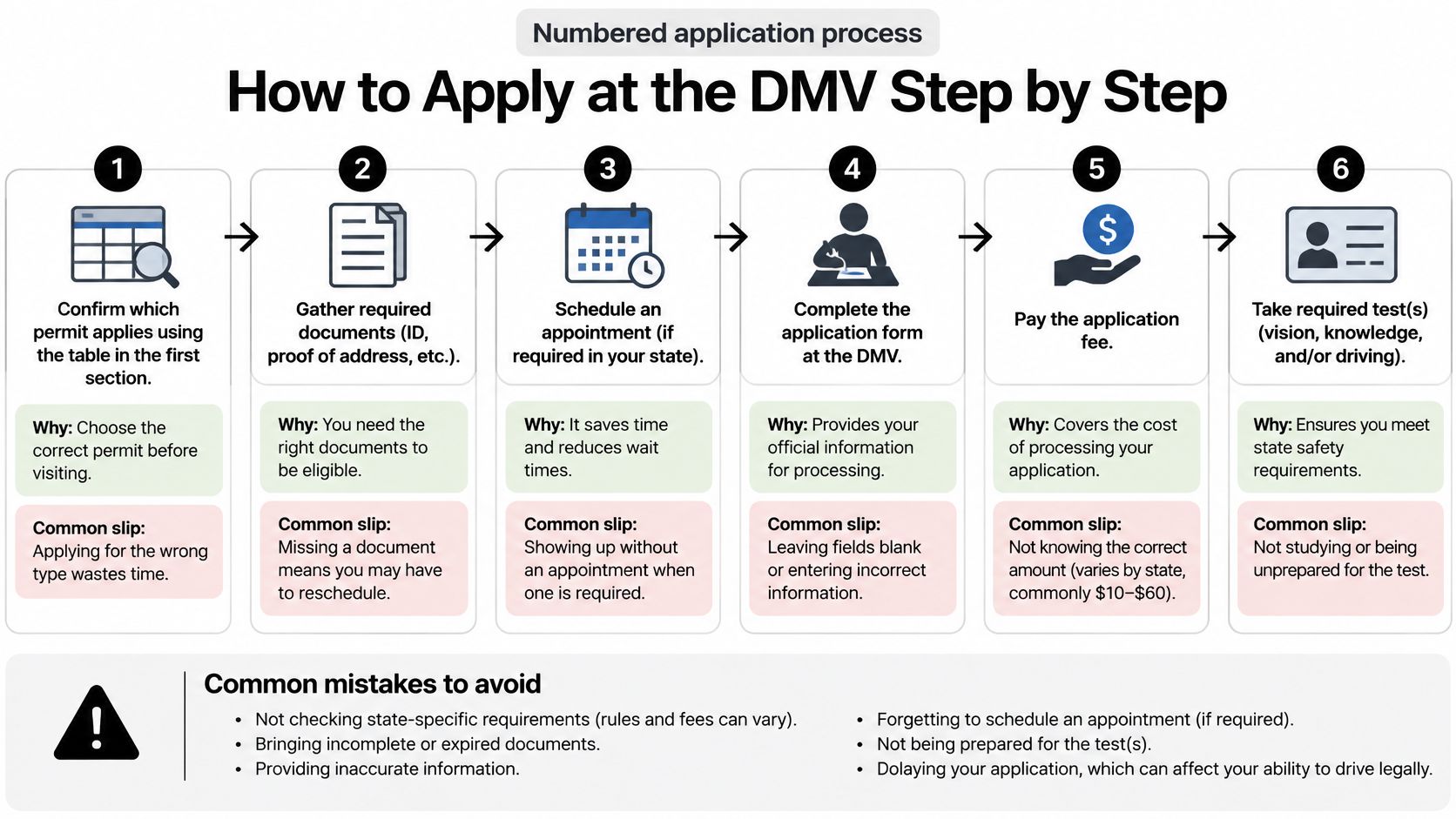
Submit your application and ask the clerk to confirm the permit. Make sure the permit type matches your situation and ask the clerk to point out the expiry date. Don't leave with uncertainty about which date controls your authorization.
Keep the permit with the vehicle's registration papers. Store it where you can produce it with the other vehicle documents. Keep your fee receipt too, since it helps link the permit to the registration transaction.
Track what remains. Follow up on plates or stickers and complete any missing registration step before the permit expires. A permit doesn't finish the application for you.
The application is complete when the clerk has issued the permit and its expiry date is visible. If you don't receive the permit, ask which eligibility or documentation item remains unresolved and what action will clear it.
Processing Delays and How to Fix Them
A permit can be close to expiring while plates are still being processed. Don't wait until the last day to find out whether the problem is a DMV processing delay, a missing document, or an unresolved smog requirement.
| Delay | Likely cause | Fix |
|---|---|---|
| Permit nears expiry, plates haven't arrived | Application is still processing at DMV headquarters | Check registration status and confirm the next step before the permit lapses |
| Smog certificate rejected | Smog check failed or isn't finished | Repair the listed problem, pass the retest, then submit the new certificate |
| Application returned | Fee receipt is missing or doesn't match the payment | Bring the matching receipt and resubmit the paperwork |
A smog failure needs a repair and a passing retest before registration can be completed. When a vehicle fails a Speedy Smog check, the customer receives a printout showing the area that needs work. Once the vehicle passes at a licensed station, the result can be transmitted electronically to the DMV, removing the need to carry a separate paper result for that transmission.
Practical rule: Separate a missing-paper problem from a processing delay. A receipt or mismatched document may be corrected by bringing the right paperwork; an application being processed at DMV headquarters calls for a status check and follow-up on the DMV's timeline.
If you're waiting on a plate or sticker, use the vehicle registration status check to see whether the application has moved. If the status doesn't clarify what to do next, contact the DMV or visit with your original fee receipt and permit so staff can review the record.
Check the permit expiry date weekly. That simple routine gives you time to act if the plates haven't arrived or a document still needs correction, instead of discovering the problem after the permit has expired.
What to Do the Day the Permit Is Issued
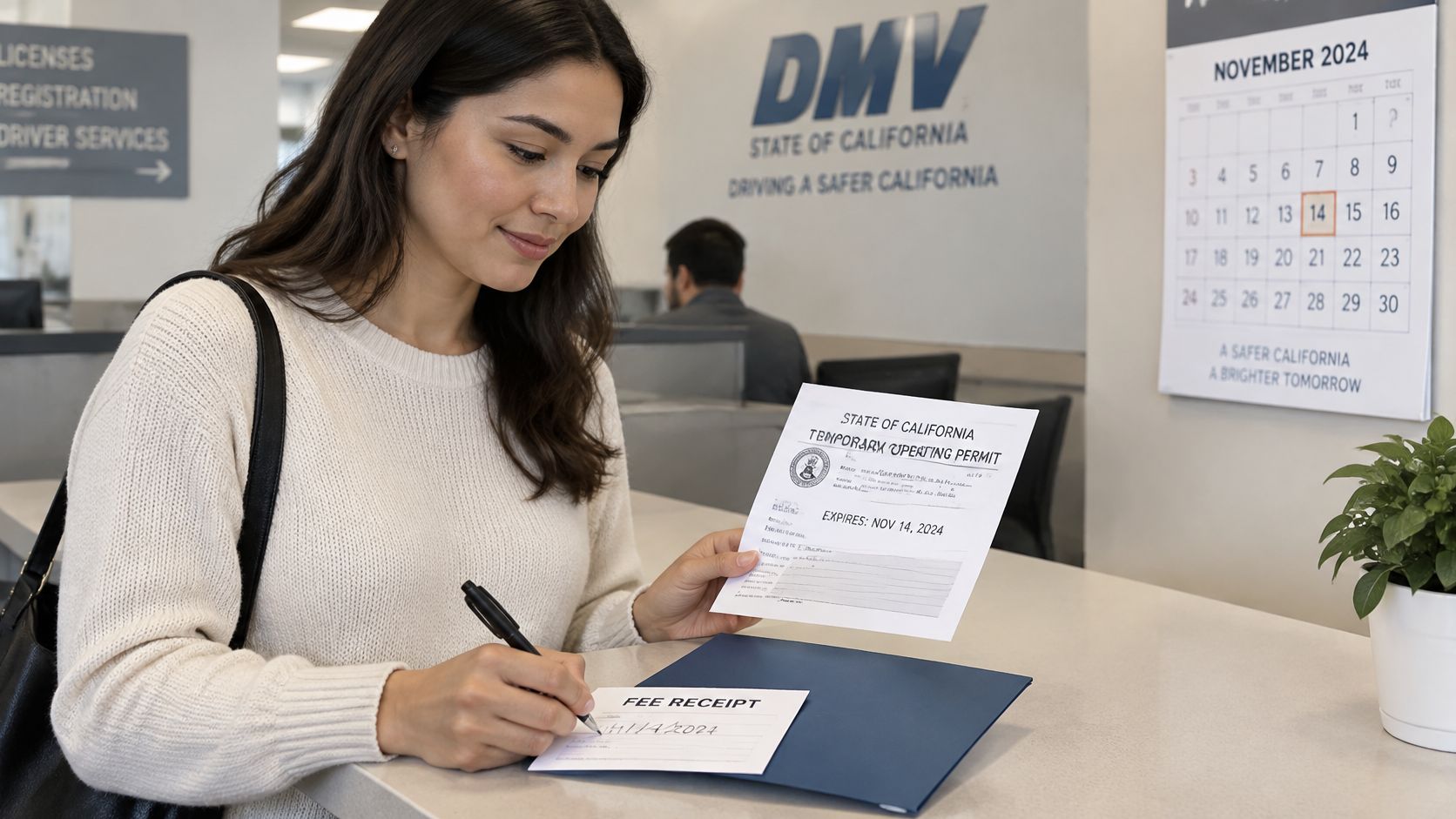
Read the expiry date before you leave the DMV and write it on your fee receipt. Keep the permit in the vehicle with the registration papers, so you can find the documents together if you need to refer to them.
If a smog certificate is still required, arrange the inspection before making a return visit to the DMV. Speedy Smog is a fully licensed, state-certified smog inspection station in San Leandro, and its smog results are transmitted electronically to the DMV. For San Leandro and Oakland drivers, call (510) 614-7664 to confirm the station can handle your vehicle and to ask for current registration-services hours. Speedy Smog isn't a DMV branch and is licensed for only a limited set of DMV registration services. Those services are available Monday through Friday, 9:00 AM to 5:30 PM.
Check your registration status weekly while the permit is active. If the plates or stickers still haven't moved, contact the DMV before the permit expires and bring the original fee receipt and permit if you return in person. A TOP doesn't create extra registration time, and a smog station can't extend a dealer Report of Sale.
If a smog requirement is holding up your California registration, Speedy Smog provides state-certified inspections and electronically sends results to the DMV. Visit Speedy Smog in San Leandro or call to confirm the right service for your vehicle.