
California Vehicle Retirement Program: Pay and Rules
California's Consumer Assistance Program offers up to $2,000 to retire an eligible vehicle when household income is at or below 225 percent of the federal poverty level, and $1,350 without that income qualification. The car generally needs to be drivable, so this isn't a guaranteed payment for a broken vehicle sitting in the driveway.
For an East Bay driver, the useful question isn't whether the car is old enough to scrap. It's whether its registration history, operating condition, and repair needs make retirement a better choice than keeping it. A recent smog pass doesn't automatically close the door to a local retirement program, either.
Table of Contents
- California Retirement Payments at a Glance
- How the Program Works and Its Scale
- Eligibility Rules That Surprise Owners
- Confirm Smog Status Before You Scrap
- Retire, Repair, or Keep the Car
- How to Apply and What to Bring
California Retirement Payments at a Glance
The Bureau of Automotive Repair's Consumer Assistance Program, usually called CAP, offers retirement incentives rather than dealer trade-in prices. Its vehicle retirement eligibility guidance lists up to $2,000 for income-qualified households at or below 225% of the federal poverty level, compared with $1,350 without that income qualification.
California vehicle retirement payments by pathway
| Pathway | Owner payment | Who it fits | Vehicle condition |
|---|---|---|---|
| Income-qualified CAP | Up to $2,000 | Household at or below 225% of the federal poverty level | Drivable passenger car, truck, SUV, or van within CAP's weight and Smog Check rules |
| Standard CAP | $1,350 | Registered owner without the income qualification | Same basic vehicle rules, with retirement-frequency restrictions |
| CAP repair assistance | Repair help, not a scrap payment | Owner who wants to keep and fix the car | Vehicle assessed for repair eligibility rather than permanent retirement |
| Local VAVR | Set by the participating air district | Owner eligible under a local program | A recent Smog Check pass or exemption may be acceptable |
| Dismantler payment, FY 2023–24 | $306 average paid by dismantlers | Not an additional owner incentive | Vehicle accepted for permanent retirement |
The dismantler average is a separate program-accounting figure, not a bonus to add to your CAP check. Likewise, repair assistance isn't cash offered in exchange for destroying the vehicle. Those distinctions matter when you're comparing what you could receive with what you'll need to spend on transportation afterward.
Match the pathway to your goal
CAP sits alongside the Enhanced Fleet Modernization Program, or EFMP, and local Voluntary Accelerated Vehicle Retirement, or VAVR, programs. Don't treat those names as interchangeable payment menus. A local air district sets its own participation and funding rules, so a payment advertised elsewhere in California may not apply to an East Bay address.
The owner-facing choice starts with a simpler distinction:
- Retire the vehicle: You surrender the car permanently and need another way to travel.
- Repair the vehicle: You seek help restoring emissions compliance while keeping transportation you already own.
- Investigate local retirement: You check whether your district has an open program suited to your vehicle and smog status.
Budget for transportation, not just the check
An incentive can make an expensive repair less attractive, but it doesn't buy a replacement automatically. Before choosing retirement, price the alternative you'll use, whether that's another vehicle, transit, or sharing a household car.
Say your older sedan still gets you from Hayward to work reliably, but you're worried about its next repair. A retirement payment may look appealing until you compare it with the cost of obtaining dependable replacement transportation. Conversely, a household that already has another usable car may find permanent retirement much easier to manage.
Circle the pathway that matches both your income situation and your goal: scrap or repair. Don't choose solely by the largest amount in the table.
How the Program Works and Its Scale
Vehicle retirement means an owner surrenders a qualifying car so a licensed dismantler can permanently remove it from service. It's closer to retiring a smoky old heater from an apartment building than trading an appliance at a store. The public benefit comes from ending its future use, not transferring it to another driver.
The basic process connects owner payment with permanent removal.
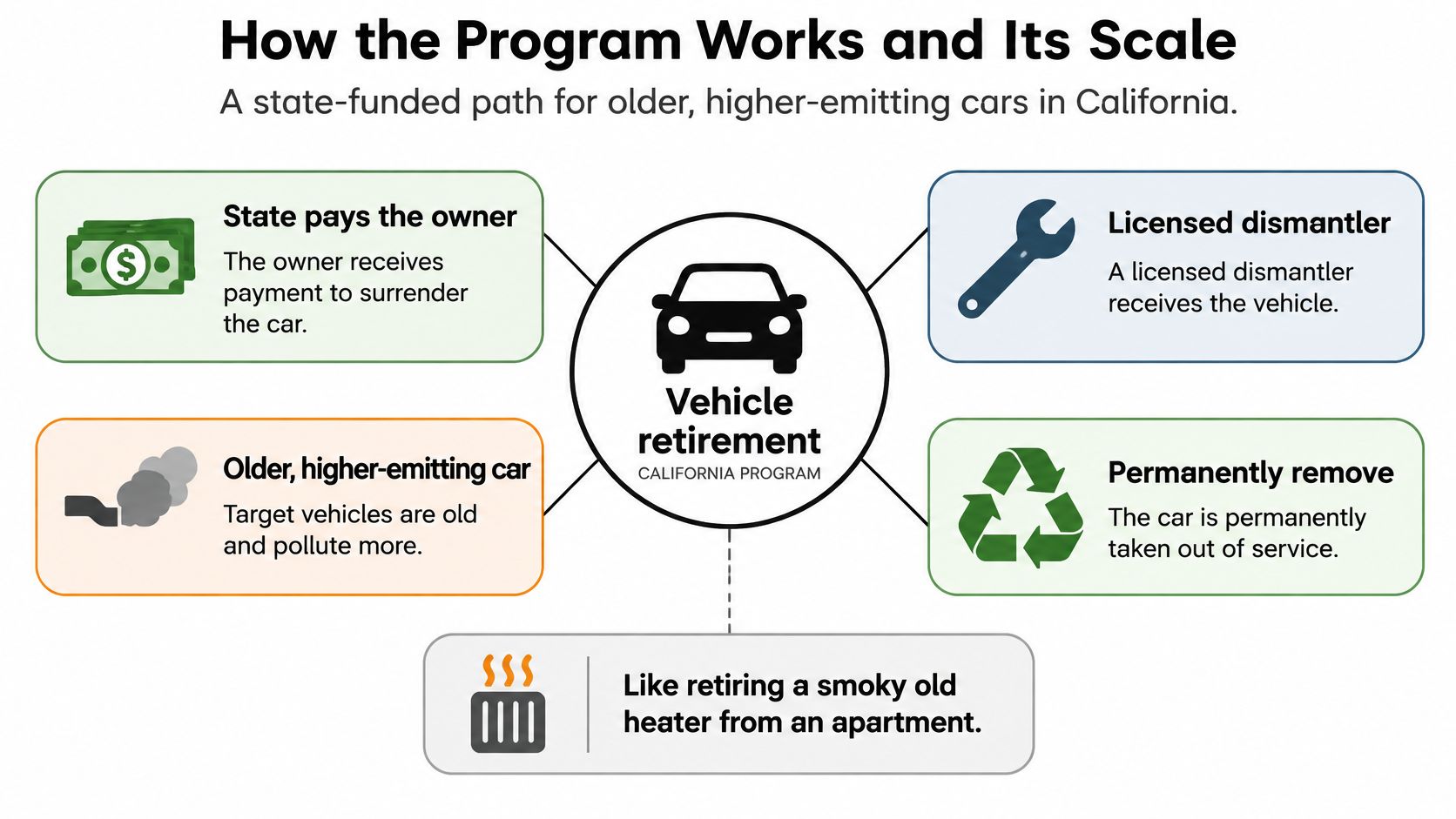
The Bureau of Automotive Repair administers CAP alongside the broader retirement effort involving EFMP. Authorized dismantlers provide the physical endpoint: the vehicle doesn't return to the used-car market after the owner receives an incentive.
A statewide air-quality intervention
The scale is substantial. According to the Bureau of Automotive Repair's program update, CAP and EFMP together retired 50,959 vehicles in fiscal year 2018–19, with an estimated 7,186 tons of emissions reductions.
More recent Bureau CAP program materials report 21,575 combined CAP and EFMP retirements in fiscal year 2023–24, when dismantlers paid an average of $306 per vehicle. The materials also report that CAP alone retired 23,606 vehicles and repaired 4,866 in fiscal year 2024–25, with an estimated 988.6 tons of emissions reductions during that fiscal year.
Those totals describe different program groupings, so they shouldn't be treated as a perfectly matched annual comparison. They do establish that retirement remains a substantial public program rather than an occasional exception offered to individual owners.
What an emissions estimate means
California estimates benefits using vehicle-specific emissions rates, expected travel, and an assumed project life. The reported reductions aren't direct measurements of every retired car's future exhaust. They represent the pollution the state estimates would otherwise occur if those vehicles continued operating.
That distinction helps explain why the program cares about operational condition. A vehicle that could keep traveling presents a different emissions-reduction opportunity from a car that has already stopped running.
Practical perspective: The state is paying to remove a vehicle from the active fleet, not simply paying to clear space in a driveway.
Participation has declined from earlier program volumes. That doesn't establish that owners no longer need help, or that a particular applicant will qualify. Funding, eligibility requirements, the remaining vehicle population, and household economics all affect participation.
For the owner's choice between emissions repair and retirement, our DMV smog assistance guide provides useful context. Keep the programs separate when asking questions, especially if you're considering a district-funded replacement option rather than CAP retirement.
This video provides another format for reviewing the topic.
Eligibility Rules That Surprise Owners
Only a car that failed smog can qualify is an unreliable starting assumption. The California Air Resources Board's VAVR guidance explains that a vehicle may qualify for a local voluntary retirement program after passing its most recent Smog Check, or when it isn't subject to Smog Check.
That doesn't mean every passing vehicle qualifies for CAP. It means you need to identify the program before interpreting the test result. A pass isn't a universal disqualification, and a fail isn't an approval.
Read registration before judging the car
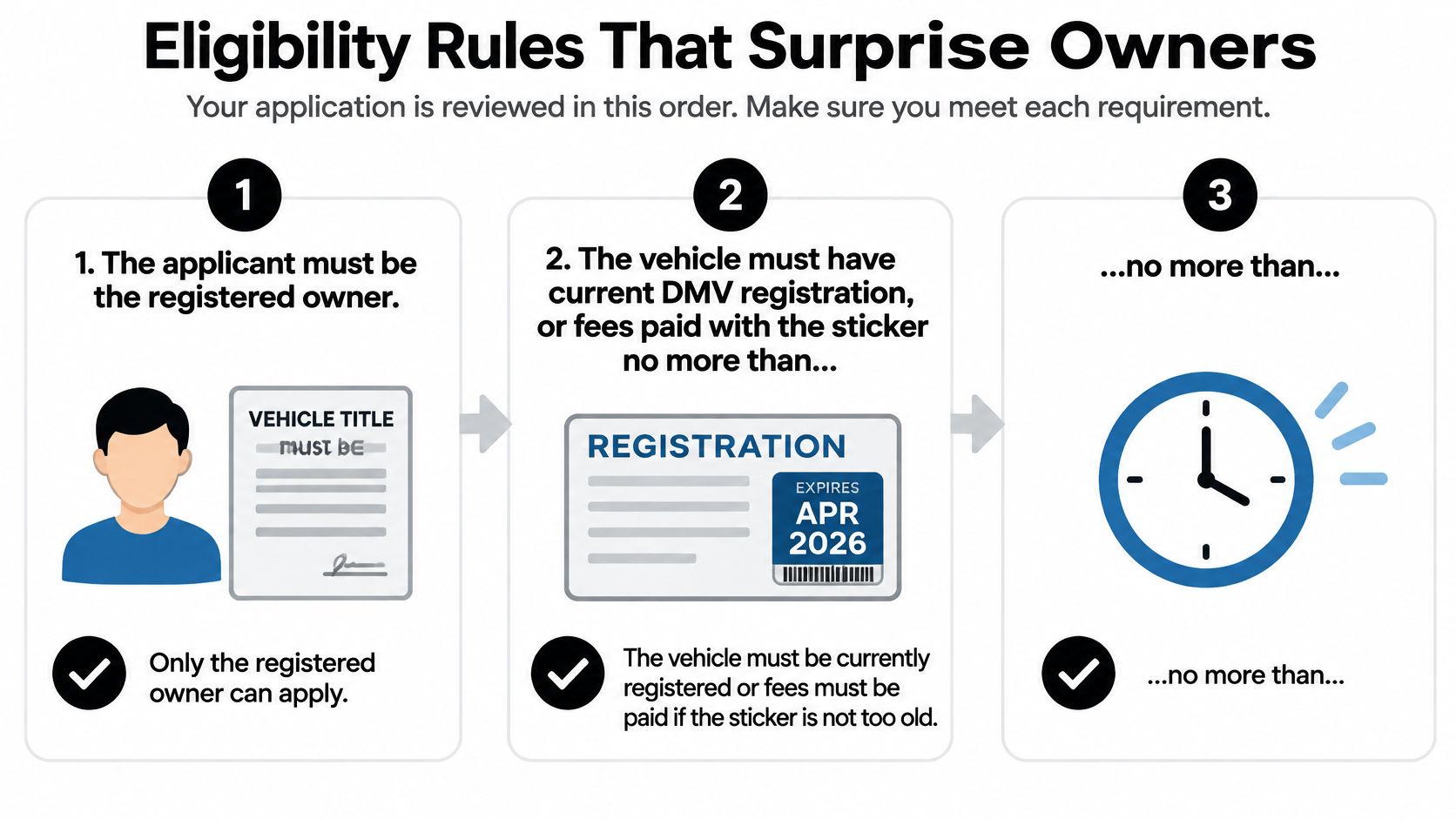
For CAP's standard retirement pathway, the applicant must be the registered owner. A family arrangement in which someone else drives, maintains, or insures the car doesn't replace the ownership requirement.
The standard registration screen is precise: registration must be current, or registration fees must be paid with the sticker no more than 120 days expired. The vehicle must also have been continuously registered in California without a lapse exceeding 120 days during the relevant two-year period.
Those are separate checks. Paying the current bill doesn't necessarily resolve a disqualifying gap in the earlier registration history. If the vehicle recently came from another state, or the ownership paperwork is unresolved, establish eligibility before assuming a repair or smog result will settle the application.
Use the checklist as a starting point, then read the full program requirements.
Drivable is different from repairable
CAP generally covers a passenger car, truck, SUV, or van with a gross vehicle weight rating of 10,000 pounds or less, subject to Smog Check. Gross vehicle weight rating is the manufacturer's rated maximum loaded weight, not what the empty vehicle weighs.
The vehicle must pass a visual and operational inspection at a Bureau-authorized dismantler. A car that looks complete but cannot operate isn't equivalent to a running car with an emissions fault.
- Running with a smog problem: Investigate the applicable retirement or repair pathway.
- Running with a recent pass: Check local VAVR eligibility rather than assuming the pass rules out retirement.
- Nonfunctional or totaled: Don't assume public retirement funding applies.
Clean Cars 4 All is a separate scrap-and-replace program requiring a functional vehicle. A totaled or nonfunctional car isn't eligible for that program's scrap-and-replace option.
A tow truck can move a car, but it can't make the car satisfy an operational requirement.
If the car drives and the paperwork supports eligibility, investigate retirement before committing to a major repair. If it can't move under its own power, confirm the exact program rules before paying for transport to a dismantler.
Confirm Smog Status Before You Scrap
If the car drives and you might keep it, establish its current smog status before making an irreversible decision. Review the renewal notice and any existing inspection report first. A new inspection can provide useful information when testing is due, but confirm your intended retirement program's requirements before ordering work solely for an application.
Our guide to checking your smog status can help you identify what needs attention. A passing result supports the keep-and-register option; a failure gives you a reason to obtain a diagnosis rather than guess at the repair bill.
Use the inspection report as a decision tool
At Speedy Smog, we're a licensed, state-certified inspection station in San Leandro, serving drivers from San Leandro, Hayward, Alameda, and Oakland. You can call (510) 614-7664 and bring your registration renewal notice if you have it.
If a vehicle fails our check, we provide a printout showing the area that needs work. The vehicle must be repaired and pass its retest before registration can be completed.
- After a failure: Obtain a repair diagnosis and written estimate. The printout identifies the inspection issue, not necessarily the complete repair needed.
- After a pass: We electronically transmit the result to DMV, and you receive a certificate so you can proceed with registration renewal.
- Before surrendering the car: Confirm any local retirement or replacement funding and the required approval sequence.
A small repair and a major emissions-system expense lead to different decisions. Don't authorize an expensive repair merely to chase an incentive without first confirming that the vehicle and application can qualify.
Retire, Repair, or Keep the Car
Say an older sedan still starts and drives, but a diagnosed catalytic-converter replacement would cost more than you consider the vehicle worth. Its registration paperwork is in order, and your household has another transportation option. That's a reasonable retirement candidate, subject to approval.
A newer commuter with a modest, diagnosed emissions repair presents a different choice. If that repair restores compliance and the car otherwise serves the household well, keeping it may avoid the larger expense and uncertainty of buying another vehicle.
A car that won't move from the driveway is different again. Before comparing incentives, its owner needs to determine whether any public pathway accepts its operating condition.
Compare what each choice actually changes
| Choice | Best when | What you give up | Scale or rule |
|---|---|---|---|
| Retire through CAP | An eligible drivable car needs repairs that don't make financial sense | The vehicle, permanently | Requires approval and dismantler verification |
| Repair through CAP | An eligible repair can restore compliance and you still need the car | No retirement payment; responsibility for an aging car remains | Repair eligibility is separate from retirement eligibility |
| Keep and pass smog | The car can certify and registration renewal is the goal | No retirement incentive | Smog Check is required every other year in most cases |
| Local VAVR | The district has funding and the car meets local rules | The vehicle under the district's retirement terms | Participation and availability are set locally |
Repair assistance serves a different purpose from retirement: preserving usable transportation. It can be the better fit when a specific repair solves the emissions problem and the rest of the vehicle remains dependable. Our smog-check repair assistance guide can help you distinguish that route from surrendering the car.
Compare future costs, not money already spent
Money spent on last year's repairs is gone either way. Your decision should focus on what keeping the car will require from this point forward.
Consider the diagnosed repair, other known mechanical needs, upcoming registration obligations, and the cost of replacement transportation. Keep an allowance for uncertainty, but don't treat every possible future breakdown as an expense that's certain to occur.
Decision rule: Retire when the car qualifies, continued ownership no longer makes financial sense, and replacement transportation is realistic. Repair when a defined fix preserves a car you still need.
Don't reduce this to whether a repair bill exceeds the incentive. The incentive is money received for giving up transportation, while the repair bill is money spent to retain it. The useful comparison is the household's total cost and practical position after either choice.
How to Apply and What to Bring
Prepare the application before arranging the vehicle's final trip. A likely match isn't an approval, and a payment estimate isn't permission to surrender the car.
Use the Bureau of Automotive Repair's current application instructions and eligibility notice as the controlling checklist. Local retirement and replacement programs may request different records or use a different sequence.
Follow the approval sequence
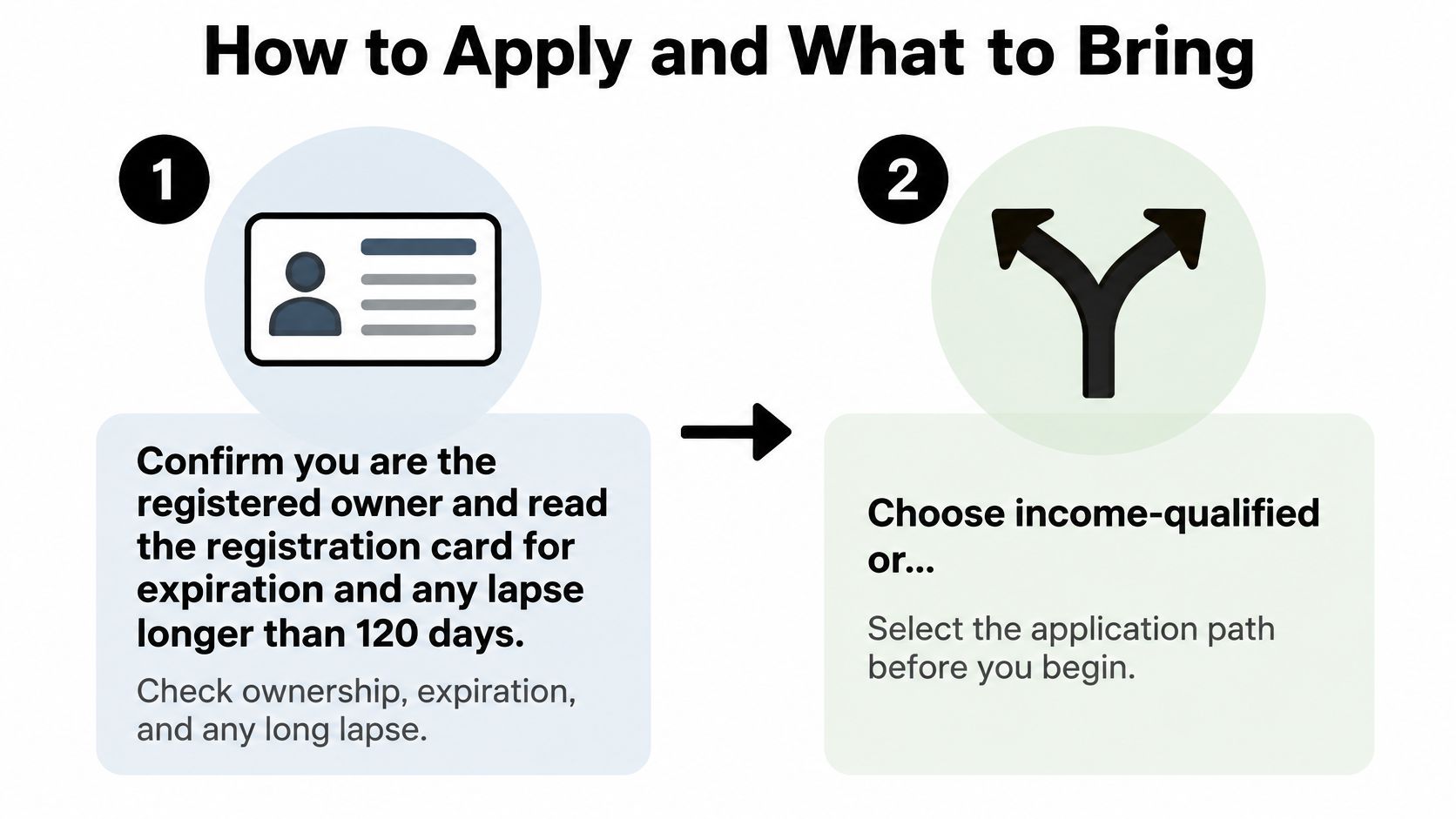
Verify ownership and registration history. Compare your identification with the registered-owner information on the registration card, and gather earlier records if there may have been a lapse. Resolve discrepancies before submitting an application so the bureau can evaluate the correct owner and vehicle.
Choose the income-qualified or standard pathway. Use the current household-size and income instructions, gathering the requested income records if you're claiming income-qualified assistance. Don't substitute an old income chart or assume that receiving another benefit automatically establishes CAP eligibility.
Check the vehicle's basic suitability. Review the vehicle information and manufacturer's weight-rating label, then assess whether the car starts and drives. If operation is uncertain, explain the problem to the program before spending money to transport it.
Apply through the Bureau's CAP retirement process. Submit the requested information and retain the application confirmation, supporting documents, and correspondence. Wait for an eligibility decision before making arrangements that assume the incentive is approved.
Follow the notice to an authorized dismantler. Use the facility and delivery instructions identified by the program, bringing the eligibility notice and requested vehicle documents. The dismantler's visual and operational inspection is a required verification, not a formality.
Complete the surrender paperwork as instructed. Have the title available, check how the authorized facility wants it completed, and remove personal belongings before handoff. Ask the facility how to handle license plates rather than removing them prematurely or assuming another state's practice applies.
Confirm acceptance and payment instructions. Keep copies of the surrender paperwork and follow the authorized dismantler's instructions for the incentive. Don't assume payment is owed if the vehicle fails the required inspection or isn't accepted for retirement.
This overview helps organize the first application checks.
Assemble a document folder
Keep these records together so you can respond to a request without searching through the glove compartment or old mail:
- Photo identification: Use it to verify your identity against the ownership information.
- Registration records: Include the current card and records needed to clarify the vehicle's California history.
- Vehicle title: Have the ownership document ready, but sign only as instructed.
- Income documents: Gather the records requested for the income-qualified pathway.
- Smog paperwork: Keep inspection reports and any history requested by the program or district.
- Approval correspondence: Retain the eligibility notice and dismantler instructions.
There isn't a guaranteed turnaround to build your commute around. Funding availability, application review, and facility appointments affect the process, so keep a workable transportation plan until acceptance is confirmed.
If the inspection prevents retirement, reassess the car's actual condition before choosing repair, lawful private sale, or another disposal option. Approval uncertainty is a reason to preserve your options, not a reason to dismantle the vehicle early.
We offer smog checks and STAR smog checks in San Leandro to help East Bay drivers establish their vehicle's emissions status before choosing repair or retirement. Visit Speedy Smog to plan your inspection, and bring your renewal notice and any previous failure report so you can make the next decision with clearer information.