
Selling a Car in California: Paperwork, Smog and DMV Steps
You've cleaned the car, taken the photos, and started getting messages asking whether it's still available. Then a serious buyer asks about the title and smog certificate, and you realize the handover involves more than a payment and a signature.
Selling a car in California means handling two separate jobs: transferring the vehicle and reporting that you've sold it. The easiest mistakes are assuming the buyer will handle everything and assuming recent registration means the car's smog paperwork is ready. Get those details settled before you agree on a pickup time.
Table of Contents
- What Changes for You
- Sale Documents and Deadlines to Know First
- Smog Certificate Rules by Model Year
- How to Complete the Sale in the Right Order
- Taxes, Fees and Who Pays Them
- Preparing the Car and Handing Over Safely
- Book Your Smog Check Before You List
What Changes for You
| Factor | Private Sale | Dealer Trade-In or Purchase |
|---|---|---|
| Sale price | Usually the highest of the two options | Usually lower, because the dealer prices in margin |
| Paperwork you handle | Title, bill of sale, odometer entry and release-of-liability notice | Dealer completes most DMV transfer paperwork |
| Smog responsibility | You provide the certificate when required | Dealer handles testing and certification for resale |
| Liability after handover | You need to report the transfer rather than rely on the buyer | Dealer handles its transfer obligations; keep your own sale records |
| Time to cash | Requires finding a buyer and arranging verified payment | Often completed during the purchase visit, subject to title and payment arrangements |
A private sale gives you more control over the asking price, but you're also the person answering messages, arranging test drives, checking payment, and assembling the documents. A dealer's offer includes room for reconditioning, resale costs, and profit. The lower offer buys convenience, not necessarily a bad deal.
Don't compare a dealer's written offer with the highest advertised price for a similar car. Compare it with a realistic private-sale price after preparation costs, any emissions repairs, and the time you can spend meeting buyers.
Choose the route you can finish properly
Say you own a paid-off hybrid and need the proceeds quickly. A dealer may be the better fit if you can't accommodate appointments or coordinate payment during banking hours. If your title is ready, your schedule is flexible, and you're comfortable screening buyers, a private sale may leave you with more money.
The risks aren't limited to low offers:
- Cash payments: Arrange counting and verification at a bank rather than in a parking lot.
- Remote buyers: Don't release the vehicle to a transporter based on an emailed payment confirmation.
- Split payments: A partial cash payment doesn't make the remaining personal check safe.
- Incomplete buyer details: Don't accept a buyer's request to leave the title assignment blank.
Practical rule: Choose a private sale only if you can complete the paperwork yourself. A buyer's promise to visit DMV isn't your filing confirmation.
Sale Documents and Deadlines to Know First
The California DMV title-transfer guide describes the seller's five-calendar-day reporting deadline, the buyer's 10-day transfer window, and the title, replacement-title, and mileage paperwork reflected below.
| Document | Who Handles It | When It Is Needed | Required |
|---|---|---|---|
| Certificate of title with signed assignment | Seller and buyer complete the applicable signatures | At handover, with any lien properly released | Yes |
| Bill of sale with price, date and mileage | Seller and buyer sign and retain copies | At handover | Strongly recommended |
| Odometer disclosure | Seller records mileage; parties complete applicable acknowledgment | At transfer when disclosure applies; DMV guidance identifies vehicles under 10 model years old | Yes when applicable; confirm current requirements for the vehicle |
| Smog certificate | Seller provides it to buyer | Before completing a sale that requires certification | Yes, when required |
| Notice of Transfer and Release of Liability, REG 138 | Seller files with DMV | Within 5 calendar days after the sale | Yes |
| Application for Replacement or Transfer of Title, REG 227 | Seller obtains and completes the applicable portions | Before advertising if the title is missing | Needed to address a missing title |
| Ownership transfer | Buyer submits documents and pays applicable fees | Within 10 days of the sale | Buyer's responsibility |
Check ownership before discussing pickup
Your name must match the seller information on the title and your identification. The buyer's name should match the buyer's identification, not yours. If you're selling for a relative, handling an estate vehicle, or working with a title bearing someone else's name, resolve your authority to transfer it before accepting money.
An outstanding loan needs an agreed payoff and lien-release process. Ask the lender what documentation it will issue and how the title will reach the buyer. A payoff receipt and a completed release aren't automatically interchangeable. Don't promise immediate delivery of a transferable title unless you can provide it.
A missing title deserves the same attention. An informal receipt doesn't substitute for the DMV replacement or transfer process, and discovering that problem during handover can derail an otherwise straightforward sale.
Make the supporting documents useful
Your bill of sale should identify the vehicle by VIN and include the actual price, sale date, mileage, both parties' names and addresses, and signatures. Record known defects separately or attach a signed disclosure. An as-is statement documents the agreement, but it doesn't replace required disclosures or emissions compliance.
For mileage, inspect the title before the appointment. Where a separate secure reassignment document is needed, REG 262 may be required. Don't treat an age shorthand as a universal exemption; confirm current disclosure requirements for the particular vehicle.
Check your inspection paperwork just as carefully. Our guide to California smog-test validity helps you distinguish usable certification from an old report in the glovebox.
Gather everything before advertising. Buyers can negotiate over condition. They can't negotiate an unresolved ownership problem into a clean transfer.
Smog Certificate Rules by Model Year
Start with the general rule, then verify the exception: a Smog Check is generally required when buying or selling a vehicle more than four model years old. Fuel type, model year, weight classification, and recent certification can change the answer.
The California DMV smog-inspection guidance describes both the more-than-four-model-years rule and language exempting gas vehicles eight or fewer model years old, while also allowing a qualifying biennial certification obtained within the previous 90 days. Don't assume those age references describe every transaction in the same way.
| Vehicle | Certificate Needed at Sale | Notes |
|---|---|---|
| Gas, more than 4 model years old | Generally required | Qualifying 90-day biennial exception may apply; confirm how DMV's newer-vehicle exemption applies |
| Gas, 4 or fewer model years old | Not required under BAR change-of-ownership guidance | A smog transfer fee applies instead; confirm the transaction classification |
| Gas, 1975 or earlier | Exempt | Age-based smog exemption |
| Diesel, 1998 or newer, GVWR 14,000 lb or less | Generally required | Qualifying recent-certification exception may apply |
| Diesel, 1997 or earlier | Exempt | Age-based smog exemption |
| Electric vehicle | Exempt | No tailpipe emissions inspection |
| Certain heavy-duty vehicles | Exempt when the applicable classification qualifies | Confirm the vehicle's weight class with DMV |
The Bureau of Automotive Repair's Smog Check guidance identifies the four-model-years-and-newer change-of-ownership exemption, the diesel threshold of 1998 or newer at 14,000 pounds GVWR or less, and the older-vehicle exemptions shown in the table.
Why the different cutoffs matter
A registration-renewal exemption isn't something you should automatically apply to a private-party ownership transfer. Nor should you assume the process for selling directly to a dealer matches the process for handing the car to a private buyer.
When the age language appears inconsistent, give DMV the vehicle's exact model year, fuel type, and transaction type. Ask whether certification or a smog transfer fee applies. For a practical vehicle-type overview, use our guide to which cars need a Smog Check in California.
A current registration card isn't proof that the emissions paperwork is ready for a sale.
Check the existing report before paying for another test
Suppose an older gasoline sedan already received a passing biennial inspection recently. The useful questions are whether that inspection qualifies for the sale exception and whether the transaction will occur while the certification remains usable. A repair invoice or an older passing report doesn't answer either question.
If a new inspection is needed, arrange it before listing. An emissions fault discovered after you've accepted an offer forces an awkward choice between repairing under pressure and reopening the negotiation.
A failed inspection calls for diagnosis, repair, and a passing retest when certification is required. Give the buyer the passing documentation and report, not merely an assurance that the warning light has gone out.
How to Complete the Sale in the Right Order
Treat the sale as a controlled handover, not a casual exchange of keys. Start the preparation before the appointment so you aren't trying to resolve lender or inspection problems while a buyer waits.
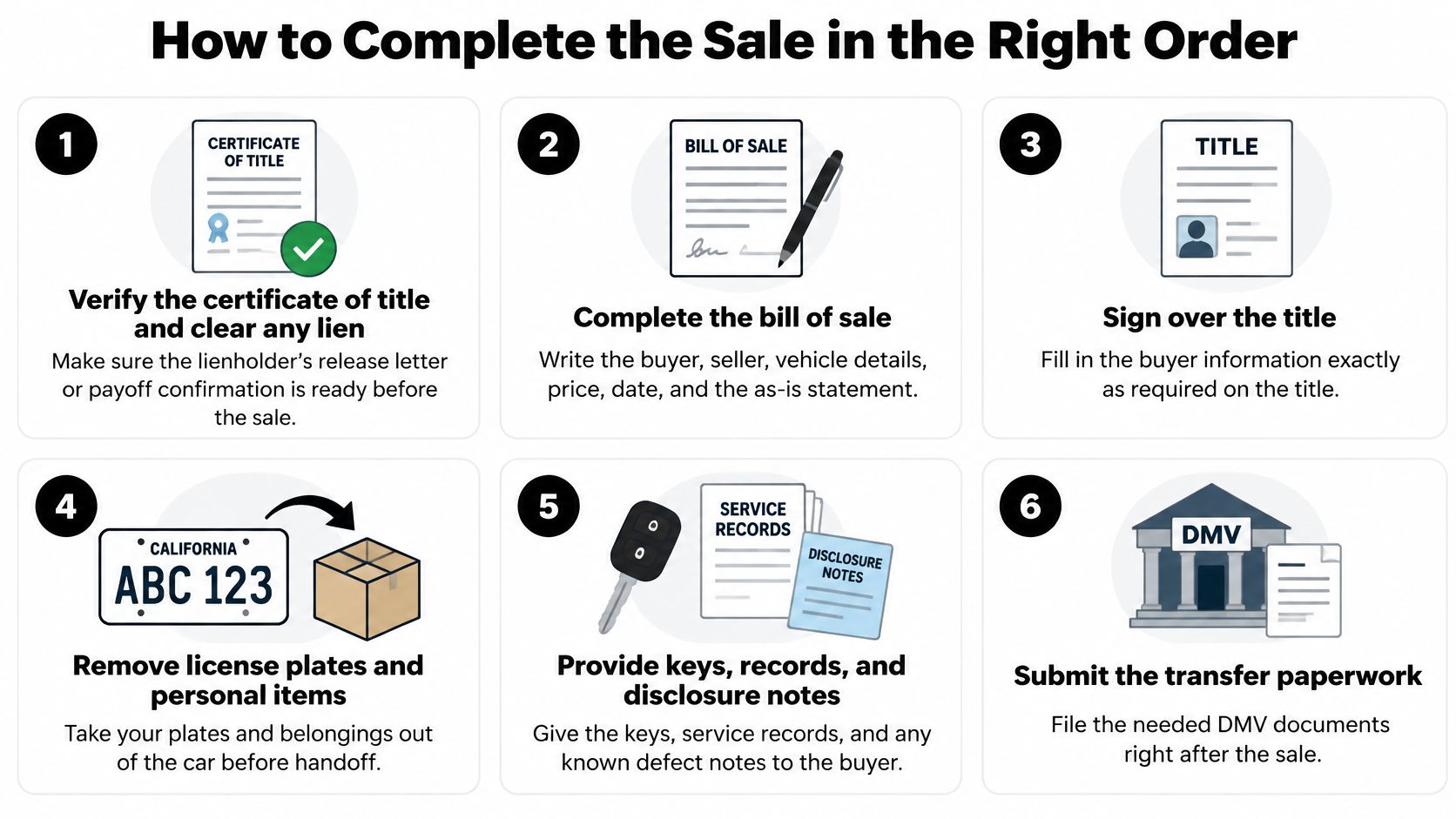
Verify the certificate of title and clear any lien. Confirm the registered owner, VIN, and lender information. Obtain the required lien-release documentation before representing the title as ready to transfer.
Resolve the smog requirement before listing. Establish whether an exemption or existing certification applies. If testing is needed, complete it early enough to diagnose faults and make a pricing decision without a buyer standing beside you.
Complete the title assignment with the buyer. Fill in the applicable buyer and seller fields accurately. Don't hand over a title signed in blank or agree to omit the actual purchaser.
Complete the odometer disclosure. Enter the actual reading and use the appropriate secure reassignment form if the title doesn't provide the necessary field. Don't guess at missing information or make casual alterations.
Provide the required smog documentation. Give the buyer the passing report and certification information. Electronic transmission doesn't eliminate the value of a readable copy in the buyer's transfer packet.
Keep the signed bill of sale and document copies. Confirm payment before releasing the keys or original ownership documents. Photograph the completed paperwork while both parties are still present.
File your release-of-liability notice promptly. Submit it yourself and save the confirmation. Don't delegate your protection to a buyer who says they'll take care of DMV.
The process graphic is a useful handover reminder, but its plate-removal instruction isn't universal. Standard California plates generally remain with the vehicle; confirm retention procedures for personalized or qualifying special plates.
Understand what your filing actually does
Under the California DMV ownership-change instructions, the seller must submit REG 138 within five calendar days after the sale. File on transaction day when possible, especially if the handover happens remotely or over a weekend.
The notice records the sale and helps protect the former owner from later parking violations, traffic violations, and certain civil or criminal actions involving the vehicle. It doesn't itself remove your name from DMV ownership records. The buyer still has to submit the transfer documents, pay applicable fees, and complete the ownership change.
Taxes, Fees and Who Pays Them
The buyer generally handles transfer-related DMV charges when registering a privately purchased vehicle. The California DMV private-party purchase guide explains the buyer's transfer responsibilities and applicable registration requirements.
Keep the negotiated vehicle price separate from the buyer's registration budget. Your agreement should make clear what the buyer pays you and which DMV charges the buyer will handle directly. Don't offer an all-in registration estimate unless you've checked the specific transaction.
Record the real purchase price
Write the amount really paid on the bill of sale and transfer documents. A buyer may ask for a lower figure to reduce tax, but you shouldn't sign inaccurate paperwork. If you agree to reduce the price after discovering a defect, update the documents so they reflect the final agreement.
For example, suppose you accept a lower offer after the buyer identifies a damaged air-conditioning compressor. Record the revised sale price, not the original asking price, and retain the written agreement explaining the change. That's different from pretending part of the payment never happened.
- Transfer charges: The buyer should confirm the current fees with DMV rather than budget from an old article.
- Smog transfer fee: For a qualifying newer gas vehicle, the buyer pays the applicable transfer fee instead of receiving a required inspection certificate.
- Existing balances: Review registration status, parking notices, and toll accounts before advertising. Establish what needs resolving rather than promising every balance automatically disappears at sale.
Keep the money trail consistent: Your receipt, bill of sale, title information, and payment record should describe the same transaction.
Don't confuse the cost of the inspection you arrange with the buyer's government charges. Agreeing who pays for preparation or repairs is part of negotiating the car's price; it doesn't change either party's DMV obligations.
Preparing the Car and Handing Over Safely
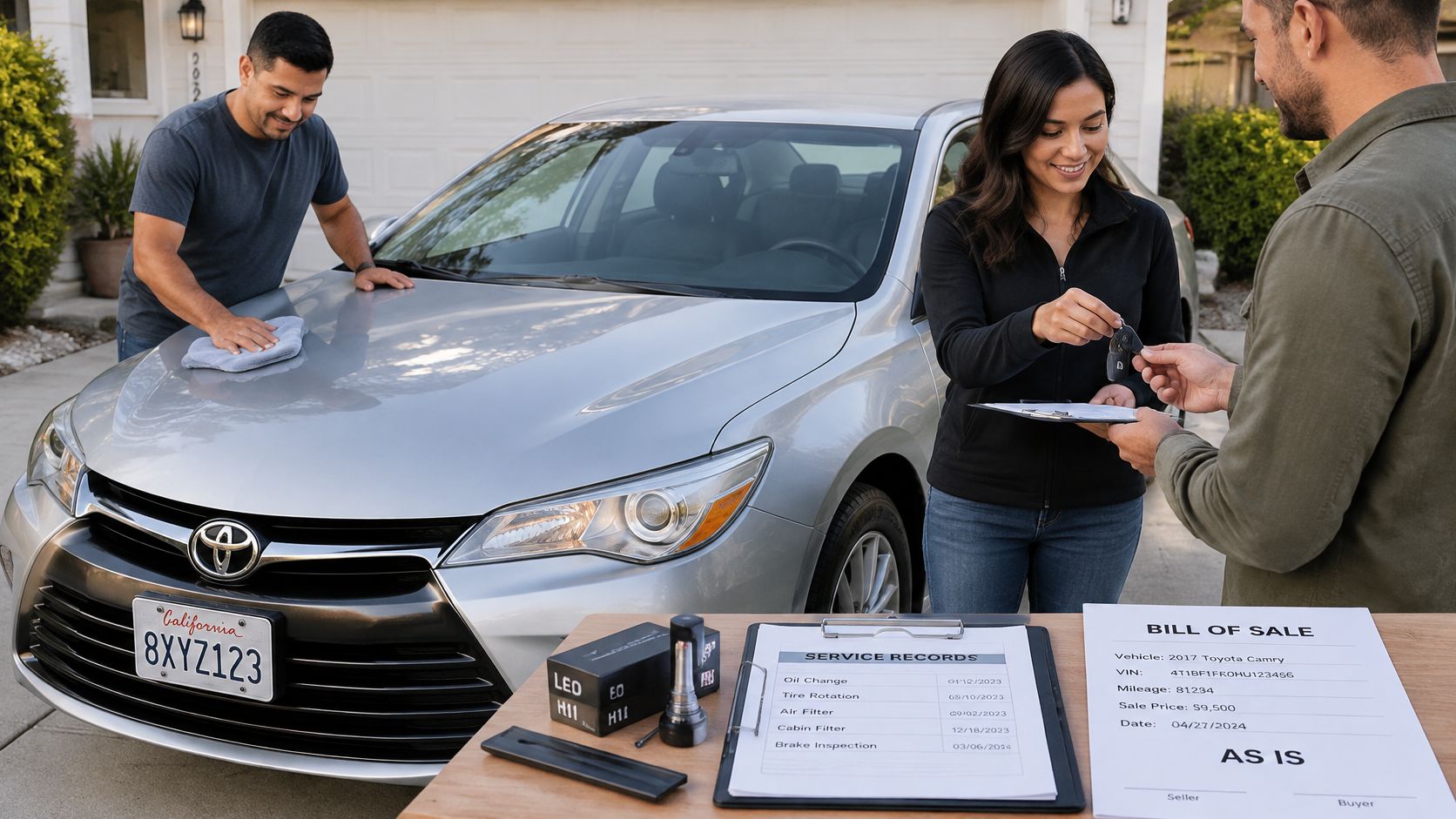
Clean the car well enough that a buyer can inspect it. Remove rubbish, vacuum the interior, wash the exterior, and organize service records by date. Fix inexpensive distractions such as a missing wiper blade, but don't spend heavily on cosmetic work without considering whether it improves the likely sale proceeds.
Write down known faults before taking calls. An intermittent starting problem, nonworking window, or persistent warning light belongs in your description and disclosure notes. As-is wording isn't a substitute for telling the truth about the vehicle.
Arrange the appointment around payment verification
Meet somewhere public where you can inspect identification and finish the paperwork without pressure. A bank can be useful when cash counting or payment verification is part of the transaction. Schedule the meeting while the relevant financial institution is available.
Check that the person buying the car matches the name entered on the documents. Don't confuse this with expecting the buyer's identification to match your existing title ownership. You're verifying two different people in different roles.
Use a handover checklist:
- Payment: Verify receipt through your own bank or financial institution, not a screenshot, email, or the buyer's banking app.
- Checks: Don't assume a cashier's check is genuine because it looks official, or that a deposited check has finally cleared because funds appear available.
- Possession: Keep the keys and original transfer documents until payment and signatures are complete.
- Records: Capture legible copies of signed documents and the odometer reading, and record the exact sale date and mileage.
Remove your information, not just your belongings
Take out garage remotes, toll transponders, parking permits, and personal paperwork. Delete saved home addresses, paired phones, contacts, and app connections from the infotainment system. Review connected-car access so the buyer doesn't inherit your account and you don't retain unintended access to theirs.
Handle plates according to their classification rather than following a generic out-of-state checklist. If you intend to retain personalized plates, settle that procedure before the appointment.
After reporting the sale, coordinate cancellation or transfer of insurance with your insurer based on the actual handover and coverage circumstances. Remove the vehicle from toll and parking accounts, and store the sale packet securely with the filing confirmation. Keep those records accessible in case a later notice needs a documented response.
Book Your Smog Check Before You List
If your car needs certification, testing before advertising gives you a firmer basis for the asking price. You can disclose the inspection status accurately, assess any necessary repairs, and avoid promising a pickup date before you know whether the vehicle will pass.
At Speedy Smog, we're a fully licensed, state-certified inspection station in San Leandro. Our technicians are licensed by the Bureau of Automotive Repair, and we electronically transmit inspection results to DMV. After a passing inspection, you receive the certification documentation for your records.
Bring the right information
Call (510) 614-7664 before visiting to discuss the vehicle's model year and the test that applies. Bring the vehicle and your registration renewal notice if you have it. We're located at 15275 Washington Ave, San Leandro, CA 94579.
If the vehicle fails, we provide a printout identifying the area needing work. Required repairs and a passing retest must be completed before registration can proceed when certification is necessary. Use that diagnosis to decide what repairs make sense; lowering the asking price doesn't replace a required passing certificate.
We can help you understand the inspection documentation, but DMV has the final say on transaction eligibility and exemptions where its age-based descriptions differ. Compare licensed stations and review our smog-check appointment information before arranging the visit.
Get the inspection question answered while you still control the schedule. It's easier to negotiate with complete paperwork than to explain an unresolved emissions problem after accepting payment.
Speedy Smog offers smog inspections and STAR smog checks to help East Bay sellers prepare required emissions documentation before listing their cars. Visit Speedy Smog to plan your inspection, and call with your vehicle's model year before bringing it to our San Leandro station.