
“Book a DMV appointment first” is bad advice for a routine California registration renewal. Before you reserve a slot, find out whether you need a field office, a smog station, or online renewal. Those are different stops, and booking the wrong one can waste your morning without getting your registration finished.
For East Bay drivers, the better approach is simple: identify the unfinished requirement, use the channel that can resolve it, and save a field-office visit for work that belongs there.
Table of Contents
- When a DMV Appointment Is Actually Required
- Failed Smog and Driving While You Fix It
- Documents to Bring by Transaction Type
- How to Book Online or by Phone
- Timing Habits That Shorten the Wait
- Cancel or Reschedule Before the Slot Is Gone
When a DMV Appointment Is Actually Required
| Task | Right channel | Book a field office? | What finishes the job |
|---|---|---|---|
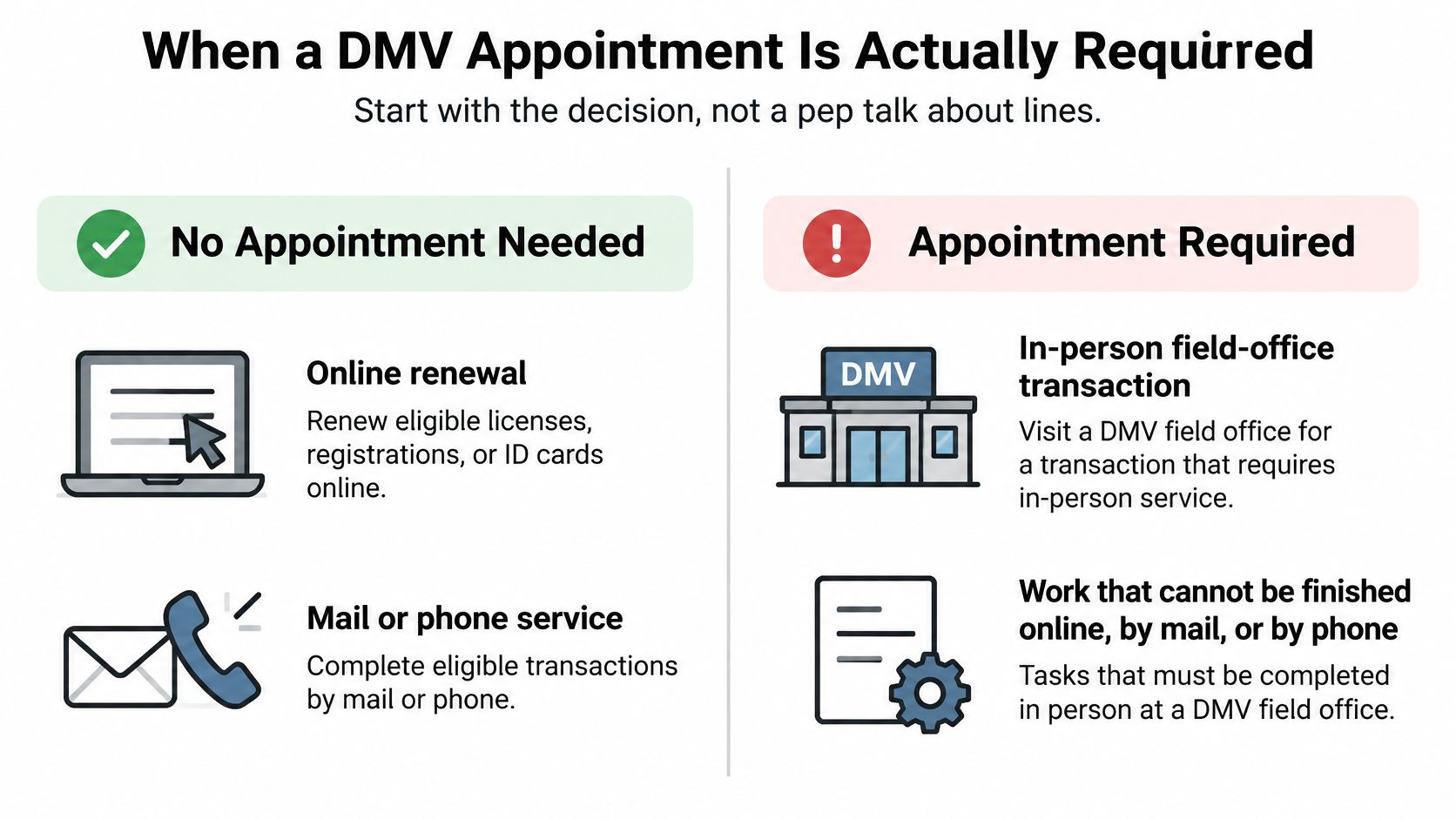
| Routine registration renewal | Online, mail, or phone | No | Complete the notice's requirements and payment |
| Renewal that requires a Smog Check | Licensed or STAR station, then online | Usually no | Electronic pass, plate number, required VIN digits, insurance, and payment |
| Driver license or REAL ID | Field-office appointment for work requiring an appearance | Yes, for the in-person transaction | Accepted identity and residency documents, plus any required testing |
| Title or ownership problem | Field office if it won't clear online | Yes, when DMV requires an appearance | Properly signed title and resolution of the specific record problem |
| Out-of-state vehicle | Required VIN verification and smog, then the office | Yes, for the in-person registration transaction | Out-of-state title, verification, and smog when required |
| Missing documents or a DMV letter | The channel named on the letter | Only if the letter says to appear | Exactly the items the notice requests |
A renewal notice isn't an instruction to book a counter visit. The California DMV appointment system says most registration matters can be handled online or by mail and identifies routine registration-renewal notices as mail-, online-, or telephone-only items for which customers shouldn't make field-office appointments.
That distinction matters when you search for a DMV appointment. You might need a test, a document correction, or a payment, but those needs don't automatically belong in the same booking category. Choose the transaction before choosing the office.
Separate the inspection from the government transaction
A smog inspection happens at a licensed testing station, not at the DMV counter. If your renewal requires that inspection, reserving a field-office slot doesn't arrange the test or satisfy the emissions requirement.
At Speedy Smog, no appointment is necessary for a smog check, and walk-ins are welcome. We electronically transmit results directly to DMV. We're not a DMV branch, although we're licensed to perform a limited number of DMV registration services.
For Oakland-area drivers choosing between a government office and an inspection stop, our Oakland DMV guidance helps distinguish those errands. Don't assume a private registration provider can resolve every hold or document problem that a government clerk can.
Counter rule: Book the service you need, not the service whose name looks closest on the calendar.
Finish an eligible renewal online
Read the renewal notice before heading anywhere. If it calls for a STAR inspection, choose a station with that certification, complete the inspection, and let the electronic passing result reach DMV.
The California DMV registration-renewal guide describes online renewal using the plate number, the last five VIN digits, applicable insurance requirements, and payment; the accompanying smog guidance states that a passed certificate remains valid for 90 days.
Keep the renewal notice beside you while entering the vehicle information. Match the plate and VIN carefully, then review the transaction outcome instead of treating a payment receipt as proof that every requirement cleared.
Do you need a DMV appointment after a smog test? Usually, no. For an otherwise eligible renewal, finish online after DMV has the certification. Reserve a field-office visit when DMV directs you to appear or when the unresolved transaction requires in-person handling.
Failed Smog and Driving While You Fix It
Paying registration fees and having permission to drive are different things. A failed smog inspection leaves you with a deadline to manage and a vehicle problem to resolve, not an automatic reason to book a routine DMV appointment.
Keep the failure report. It identifies the problem you need to discuss with the repair provider.
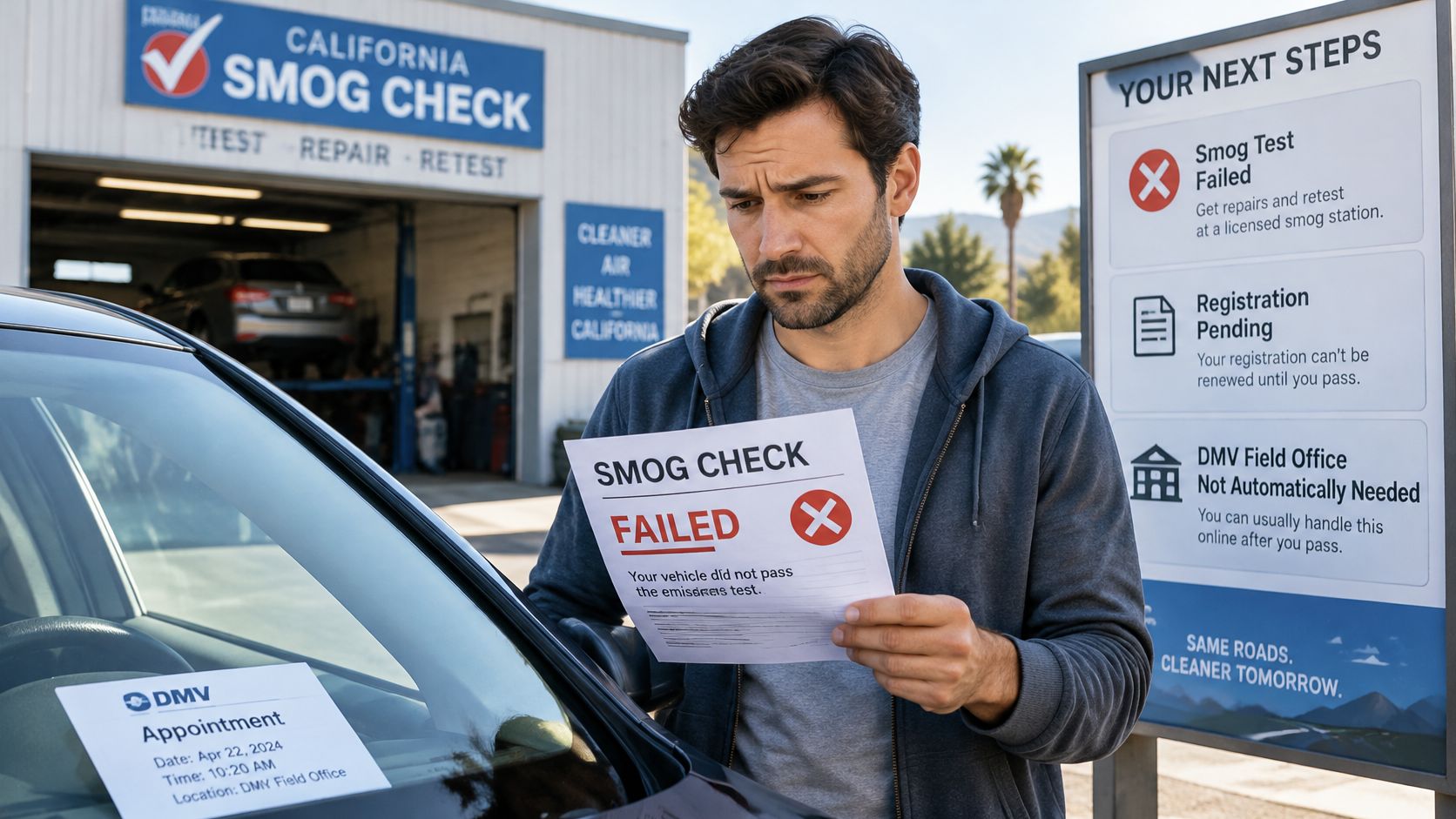
The DMV important vehicle information guide says renewal fees remain due even without the required smog certification; its failed-biennial-inspection Temporary Operating Permit route requires the failed report, insurance, paid registration fees, and a $50 nonrefundable fee, with validity for 60 days from registration expiration or the date the vehicle leaves planned nonoperation.
| Action | When | What it does and does not do |
|---|---|---|
| Pay registration fees by the due date | The smog certificate isn't ready | Avoids penalties; doesn't authorize driving |
| Repair and retest | The inspection failed | Addresses the failed inspection; renewal remains unfinished until the smog requirement is resolved |
| Confirm the electronic certificate | After a pass | Establishes that DMV has the result needed to continue processing |
| Request a Temporary Operating Permit | Lawful driving is essential during repairs | Requires the failed report, insurance, paid fees, and the permit charge; authorization follows the permit's dates and conditions |
Fix the failure, not the appointment category
If a vehicle fails at Speedy Smog, we provide a printout showing the area that needs work. The vehicle must be repaired and pass its retest before registration can be completed. After a pass, the customer receives a smog certificate and can proceed with renewal.
Don't replace diagnosis with repeated inspections. Give the repair provider the failure printout, explain any recent work, and ask what needs to be corrected before returning for the retest.
Paying is not the same as being legal to drive. A receipt isn't a temporary operating permit.
If you need the vehicle during repairs, review the California Temporary Operating Permit process and confirm the applicable authorization with DMV. Don't assume the permit period begins whenever you happen to request it.
This video provides additional context for the smog-related errand.
An ownership problem, an out-of-state registration issue, or a document request may still require a field-office visit. A routine inspection failure calls for repairs and retesting, not a different appointment label.
Documents to Bring by Transaction Type
| Transaction | Bring | Do this first |
|---|---|---|
| REAL ID or driver license | Accepted identity document, California residency proofs, Social Security evidence as required, and current card if any | Check the accepted-document list for your exact application |
| In-office registration, only if required | Renewal notice, insurance proof, payment method | Confirm the required smog result is on the DMV record |
| Smog Check before renewal | The vehicle and renewal notice if you have it | Match a STAR station when the notice requires STAR |
| Title transfer | Signed title, ID, smog certification when required, payment | Check signatures and transaction-specific requirements |
| Out-of-state registration | Out-of-state title, VIN verification, ID, smog if required | Arrange required verification before the field-office slot |
Read the STAR instruction before choosing a station
Say your East Bay renewal notice requires a STAR inspection. You find a convenient testing station, but you haven't checked its certification. That's the point to stop and verify, not after you've paid for an inspection that doesn't satisfy the notice.
A regular test-only or test-and-repair station doesn't necessarily meet a STAR requirement. The station type must match the instruction on your renewal notice. Bring the notice so the technician can check the vehicle information against the renewal requirement.
At Speedy Smog, bring your vehicle and the registration renewal notice if you have it. Our technicians are licensed by the Bureau of Automotive Repair.
The Bureau of Automotive Repair Smog Check guide says renewal inspections are generally required every other year, vehicles eight model years old or newer are generally inspection-exempt but subject to a smog-abatement fee, and the required $8.25 certificate fee is additional to the station's inspection charge.
Those are general rules, not a substitute for reading your own notice. Don't decide that your vehicle needs an inspection based only on what a neighbor paid or what happened at your last renewal.
Keep inspection charges separate from renewal charges
Ask what the inspection quote includes before testing begins. The station's charge, the certificate charge, and DMV registration fees aren't interchangeable. Paying one doesn't necessarily pay the others.
For a practical registration-renewal process, organize the paperwork by purpose rather than putting everything into an unsorted envelope:
- Inspection paperwork: Keep the renewal notice with the vehicle information the station needs.
- Government transaction paperwork: Keep DMV letters, ownership documents, and insurance evidence together.
- Completion records: Save the inspection report and renewal confirmation so you can identify what was completed.
For a STAR-required renewal, the useful sequence is notice verification, the correct inspection, electronic submission, and renewal processing. A clerk can't turn the wrong station type into the right certification merely because you've brought the receipt.
The same principle applies to title paperwork. An unsigned title isn't ready just because the appointment is confirmed. Check the document itself before leaving, and follow any transaction-specific instructions rather than relying on a general checklist alone.
How to Book Online or by Phone
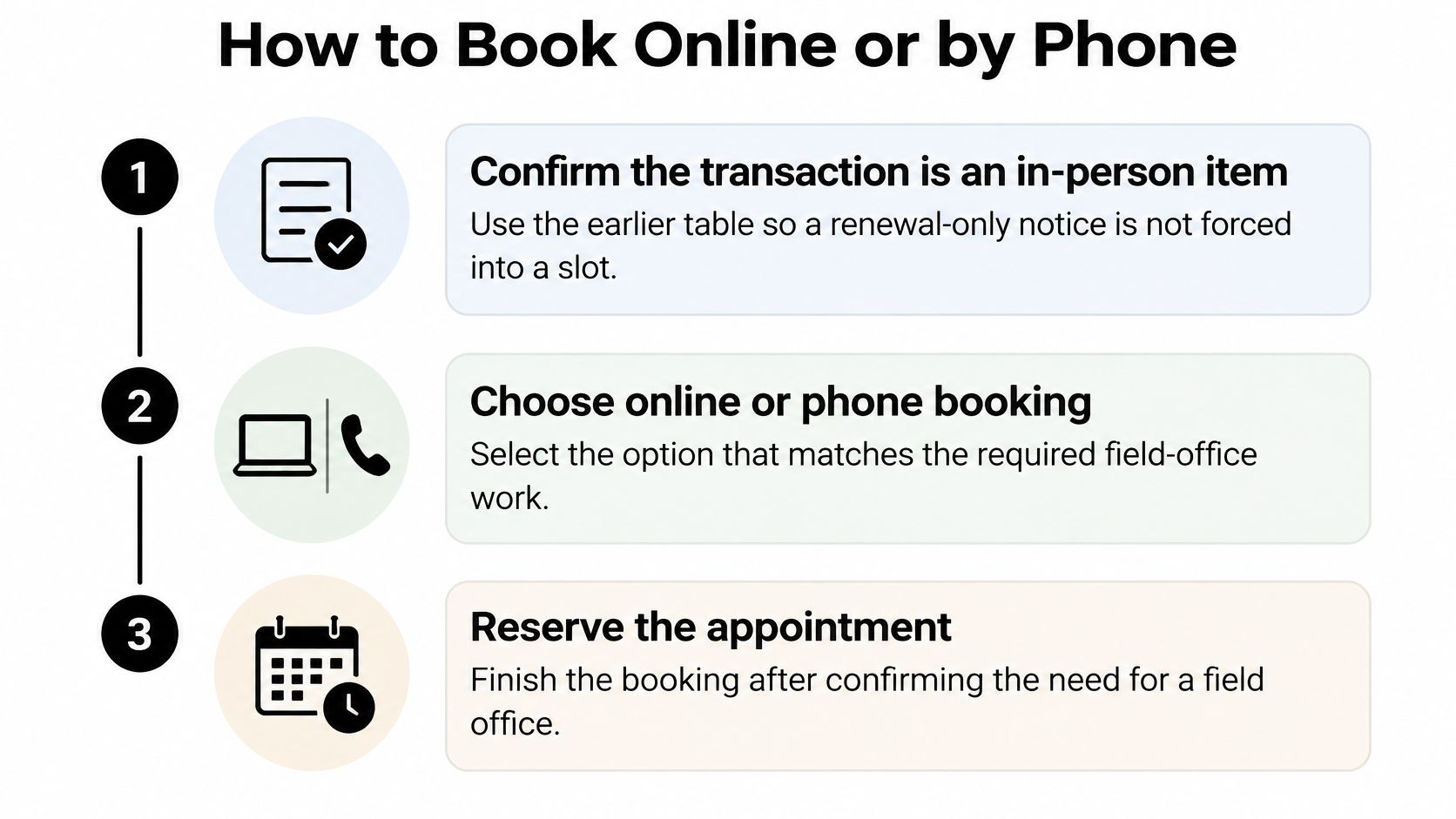
Once you've established that the work belongs at a field office, book deliberately. The goal isn't to grab any opening. It's to reserve an appointment that matches your transaction and that you can attend with the required preparation finished.
Use this outline to choose the booking channel.
Follow the booking path without changing the errand
Confirm that the transaction requires an appearance. Read the DMV instruction or letter that sent you to the office. If the matter is a routine renewal, don't select an unrelated category just to get a time. The common slip is confusing an unfinished renewal with an in-person requirement.
Gather the identifiers before opening the scheduler. Have the relevant plate or driver-license information, vehicle identification details, and a phone number or email address you can access. Use the information the system requests. The common slip is completing the booking with an inbox you no longer check.
Choose the office and the matching service. Start from the official California DMV website and enter its appointment system. Select the category that describes the actual work, such as an in-person license transaction or a registration exception. The common slip is choosing a familiar office before checking whether it handles the service.
Choose a date that fits your preparation. Leave enough time to obtain documents, complete required inspections, and resolve anything that must happen before the visit. An earlier appointment isn't useful if you arrive unable to proceed. The common slip is booking around your lunch break while ignoring an outstanding requirement.
Save the confirmation immediately. Record the confirmation number, office address, service, date, time, and arrival instructions. Add a calendar reminder with the document checklist attached. The common slip is saving the date but losing the information needed to retrieve the booking.
Check another suitable office if the calendar is full. Compare locations you can reasonably reach, and check availability again when your schedule permits. Cancellations can change what appears, but don't count on a particular release time. The common slip is treating an unavailable calendar as an instruction to walk in.
Use the phone when the website is the obstacle
If the scheduler won't work or you can't use it, use the official DMV phone contact shown on its website or your correspondence. Have the same identifiers ready and explain the transaction itself, not just that you want an appointment.
Ask the representative to confirm the service and office before finalizing the booking. Write down the confirmation before ending the call, and ask how to retrieve or cancel it if you haven't received an electronic message.
A useful confirmation answers where, when, for what service, and how to manage the booking. Check all of those details while there's still time to correct an error. Don't book another slot for the same task because you're unsure whether the first reservation worked; retrieve and verify it instead.
Timing Habits That Shorten the Wait
A DMV appointment is often the wrong first move for California registration. First identify the task: a field office handles some transactions, a smog station handles emissions tests, and eligible renewals may be completed online.
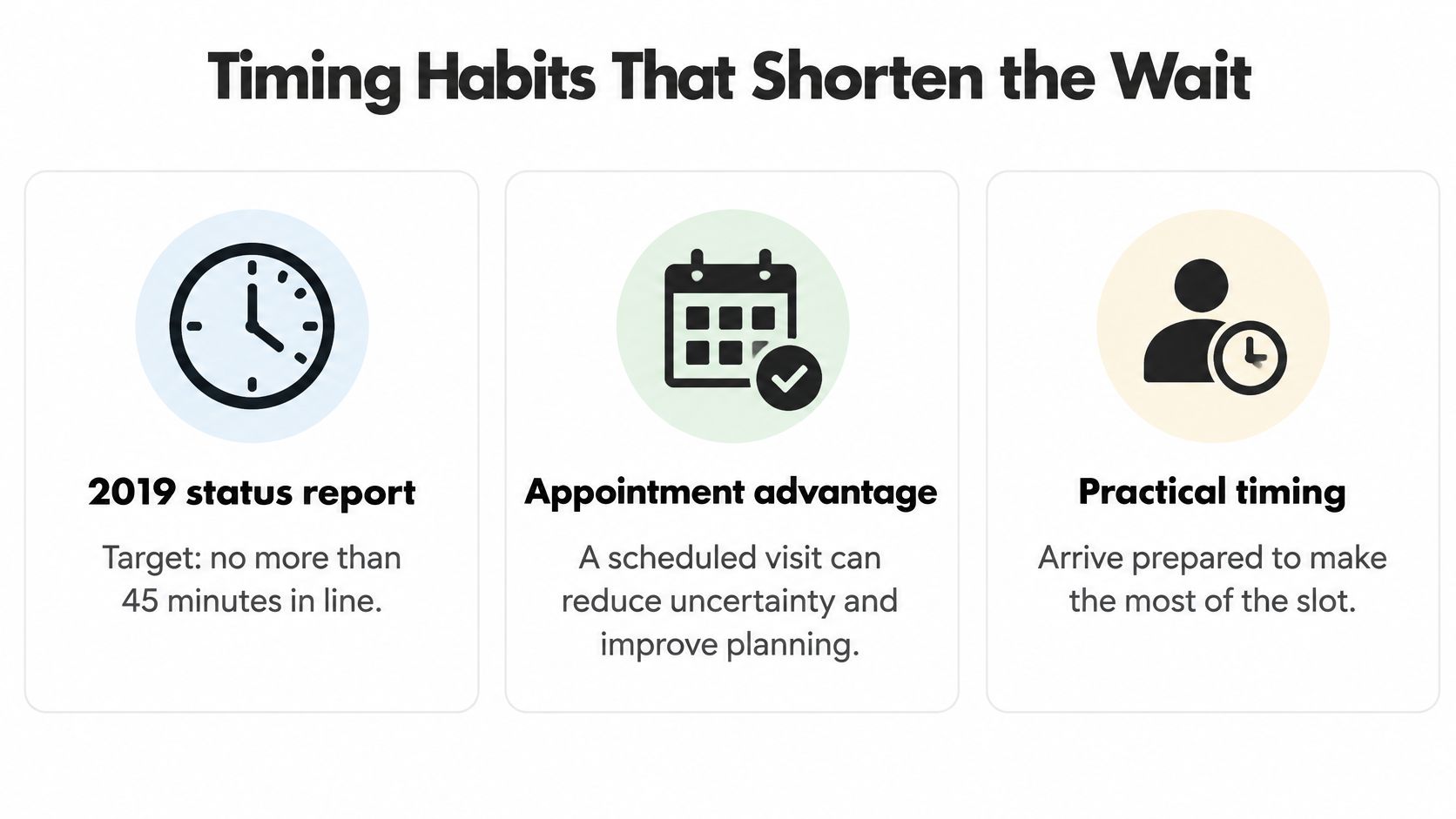
For field-office visits, use the arrival instructions on your confirmation and leave time for travel and parking. Historical DMV reporting set queue targets of no more than 15 minutes for appointment customers versus 45 minutes without appointments, with arrival-to-ticket targets of 3 and 15 minutes, respectively, according to the California DMV wait-time status report. These are targets, not guarantees. A queue ticket is not the same as reaching the counter, and neither tells you how long the transaction will take.
Wait-Time Targets
| Measure | Historical target |
|---|---|
| Queue time without appointment | 45 minutes |
| Queue time with appointment | 15 minutes |
| Arrival to ticket, walk-in | 15 minutes |
| Arrival to ticket, appointment | 3 minutes |
Control your arrival, paperwork, and office choice
- Follow the confirmation's arrival window. Arriving much earlier does not guarantee earlier service. Plan for travel and parking instead.
- Finish prerequisites before check-in. Bring the documents and completed forms your transaction requires. An appointment cannot make a missing inspection result, signature, or document unnecessary.
- Choose an office that handles your transaction. Check the service before booking, then consider appointment availability, travel, and parking. A large office is not automatically the right office.
An appointment helps you join the appointment queue. It does not guarantee a quick visit, especially when the office is busy or your transaction needs extra review.
Allow time after check-in for the clerk to examine your record and identify any issue. The scheduled time is when you are due to attend, not a promise that the transaction will be completed by a particular time. Keep the confirmation accessible and state the transaction clearly when staff ask why you are there.
Cancel or Reschedule Before the Slot Is Gone
Your confirmation number is the key to managing the booking. Store it somewhere you can retrieve without searching through unrelated messages, and keep any updated confirmation with the same calendar entry.
Don't leave an appointment active after the errand has been resolved through another channel. Release it when you know you won't need it.
Cancel when the visit has no purpose
Return to the appointment system you used to book and follow its view-or-cancel instructions. Enter the requested confirmation details, check that you've retrieved the correct transaction, and complete the cancellation.
Save the cancellation result. Closing a browser tab or deleting a calendar event doesn't cancel a DMV appointment.
Illness is a reason to cancel even when it happens on the day of the visit. Notify DMV through the available booking-management channel rather than staying home and leaving the reservation untouched.
Reschedule when you won't be ready
Change the visit when a required document won't arrive, an inspection prerequisite remains unresolved, or the confirmation names an office that doesn't handle the service. An appointment you can't use isn't worth preserving merely because it was hard to find.
Follow any change option the system provides. If changing the appointment requires a separate cancellation and booking, release the old reservation before creating the replacement rather than holding duplicate appointments.
If the website won't load, use the official phone contact on the confirmation or DMV correspondence. Ask the representative to verify the status of the old appointment and record the new confirmation before ending the call.
Keep a workable appointment
Don't cancel a usable slot solely because the drive is inconvenient. Compare the replacement options first without reserving another appointment, and weigh the travel against your deadline and document readiness.
Before closing the booking page, check:
- One active confirmation: No duplicate reservation for the same errand.
- Correct calendar entry: The date, office, service, and arrival instructions match the confirmation.
- No duplicate walk-in plan: You're not keeping a slot while planning to attempt the identical transaction elsewhere.
The practical rule is one errand, one active confirmation. Keep the record clear enough that you, DMV, and anyone helping with the vehicle know which visit is happening.
Speedy Smog provides smog inspections and electronically sends results to DMV, helping you complete the inspection step without mistaking it for a field-office appointment. Bring your vehicle and renewal notice to Speedy Smog, where smog-check walk-ins are welcome, and handle the requirement holding up your renewal.
You've got the renewal notice open on the kitchen table, the due date is getting closer, and one line stops you. It says Smog Certification Required. Maybe it also names a STAR station. Now you're wondering whether you need to stand in line at the Oakland DMV, whether paying the fees online finishes the job, and where the smog test happens.
Those are three different questions, and mixing them up is how renewals get stuck. The DMV processes your registration. A licensed station performs the smog inspection and sends the result electronically. Paying fees without that certification on file doesn't complete the renewal. Once you see that sequence clearly, most Oakland renewals become straightforward, and many don't need a DMV visit at all.
Table of Contents
- Oakland DMV Address and Services at a Glance
- Smog Terms on Your DMV Renewal Notice
- Which Vehicles Need a Smog Check
- How to Renew Registration After a Passing Smog Check
- What to Do When a Smog Check Fails
- Oakland DMV Appointments and Office Closures
- Visit Tips for the Oakland DMV
- Counter, Kiosk or Licensed Station
Oakland DMV Address and Services at a Glance
The Oakland field office is at 5300 Claremont Avenue, Oakland, California 94618, according to the California DMV Oakland field office page. Before you travel, confirm current hours and service information on that page, since hours can change and a wasted trip helps nobody.
This isn't just a testing site. The California DMV Oakland kiosk page describes a full-service location handling driver licensing, testing, title transfers, vehicle registration, plates, permits and placards, replacement documents, records requests, miscellaneous original documents, and self-service terminals. The office also has a self-service kiosk for selected transactions, so you don't always have to join the main service line.
Oakland DMV Services by Channel
| Transaction | Staffed service line | Self-service kiosk |
|---|---|---|
| Driver licensing and testing | Listed | Not listed |
| Driver license replacement | Listed | Listed |
| Title transfers | Listed | Not listed |
| Vehicle registration renewal with sticker printing | Listed | Listed |
| Plates, permits and placards | Listed | Not listed |
| Replacement of registration documents and stickers | Listed | Listed |
| Replacement of lost, stolen or damaged documents | Listed | Partly, license and registration |
| Proof-of-insurance submission | Not listed | Listed |
| Registration reinstatement | Not listed | Listed |
| Affidavit of non-use or planned nonoperation filing | Not listed | Listed |
| Records requests | Listed | Listed |
The logic behind the split is simple. Routine, document-based tasks like registration renewal with sticker printing, proof-of-insurance submission, planned nonoperation filings, and records requests suit a machine because they follow fixed steps. Tasks that need judgment, identity checks, or an exam, such as driver testing, title transfers, and plate orders, stay with staff.
Quick test: If your task appears on the kiosk list, start there. If it doesn't, plan for the counter and bring your documents with you.
One boundary matters for everything that follows. A smog inspection and a DMV transaction are distinct steps. The inspection creates the compliance record, and the DMV uses that record to process registration. The Oakland DMV office won't perform your smog test for you.
Smog Terms on Your DMV Renewal Notice
Your renewal notice uses a handful of phrases that decide where you go and what happens next. Read the exact wording before you book anything, because small differences change your options.
Smog Certification Required means your vehicle must pass a Smog Check and the result must reach the DMV before renewal can finish. The Bureau of Automotive Repair Smog Check guidance explains that a Smog Check is generally required every other year when the DMV renewal notice says "Smog Certification Required." The Bureau of Automotive Repair, or BAR, licenses the stations and sets inspection rules.
A STAR station is held to higher inspection-performance standards than ordinary stations and is authorized to inspect all vehicles, including high-polluting ones. If your notice says Smog Certification Required at a STAR station, an ordinary station won't satisfy it. The notice, not your vehicle's location, decides whether STAR is mandatory.
Two Notices, Two Choices
Say your notice reads only Smog Certification Required. You can choose any licensed station. Now say your neighbor's notice adds "at a STAR station." Your neighbor's choice narrows to STAR stations only, even if you both live on the same Oakland street. Same city, different instruction.
Electronic certification means the station transmits your result directly to the DMV's system. A paper printout in your glove box isn't the finish line. Online renewal can't complete until that electronic record is on file.
Two more terms appear when things go wrong. A Temporary Operating Permit, or TOP, can give limited legal operating time after a failed test. The BAR Referee Program is the escalation path for disputes about results or documentation. Both get a closer look in the failure guidance below.
Before booking, write down two things from your notice, the exact smog wording and the due date. Those two details drive every decision that follows.
Which Vehicles Need a Smog Check
Four facts decide your vehicle's status, and they work best in this order. Start with fuel type, then model year, then gross vehicle weight rating (GVWR), then whether you're renewing or registering in California for the first time.
Smog Check Requirements by Vehicle and Transaction
| Vehicle or case | Smog Check status | Basis |
|---|---|---|
| Gasoline vehicle renewing with a Smog Certification Required notice | Required, generally every other year | BAR renewal rule |
| Notice reads Smog Certification Required at a STAR station | Required at a STAR station | DMV renewal notice wording |
| Out-of-state vehicle, first California registration, 1976 model year or newer | Generally required unless exempt | BAR scope summary |
| Hybrid, 2000 model year or newer, GVWR 14,000 lb or less | Subject to BAR-OIS inspection | BAR reference data |
| Electric vehicle | Exempt | BAR exemption list |
| Motorcycle | Exempt | BAR exemption list |
| Trailer | Exempt | BAR exemption list |
| Diesel vehicle over 14,000 lb GVWR | Exempt | BAR exemption list |
| Diesel vehicle under the weight limit | Check notice by model year and class | BAR scope summary |
The BAR Smog Check executive summary report for 2025 identifies 2000-and-newer hybrid vehicles with a GVWR of 14,000 pounds or less as subject to the BAR-OIS inspection system, and it notes that a first-time California registration generally requires a Smog Check for out-of-state vehicles from the 1976 model year onward, unless an exemption applies. Exemptions include electric vehicles, motorcycles, trailers, and diesel vehicles weighing more than 14,000 pounds. Newer vehicles may also qualify for limited exemptions or a smog-abatement-fee process based on age and transaction type.
Here's a worked example. A 1995 gasoline car brought in from Oregon needs a Smog Check because it's an out-of-state vehicle from 1976 or later. An electric car renewing in California is exempt, though you should still read its notice to confirm no other requirement applies. Diesel rules shift by model year and vehicle class, so treat the notice as the final check.
One point trips up new California residents. Out-of-state vehicles being registered in California require a Smog Check regardless of model year. If your vehicle doesn't fit a row above, a BAR-licensed station can confirm the requirement before you pay any fee. Our technicians are licensed by the Bureau of Automotive Repair, and you can review the full rule set in our guide to California smog check rules and exemptions before you decide.
How to Renew Registration After a Passing Smog Check
The sequence matters more than speed. Follow these steps in order and your renewal won't stall halfway.
The flow below shows the core path from notice to finished renewal.
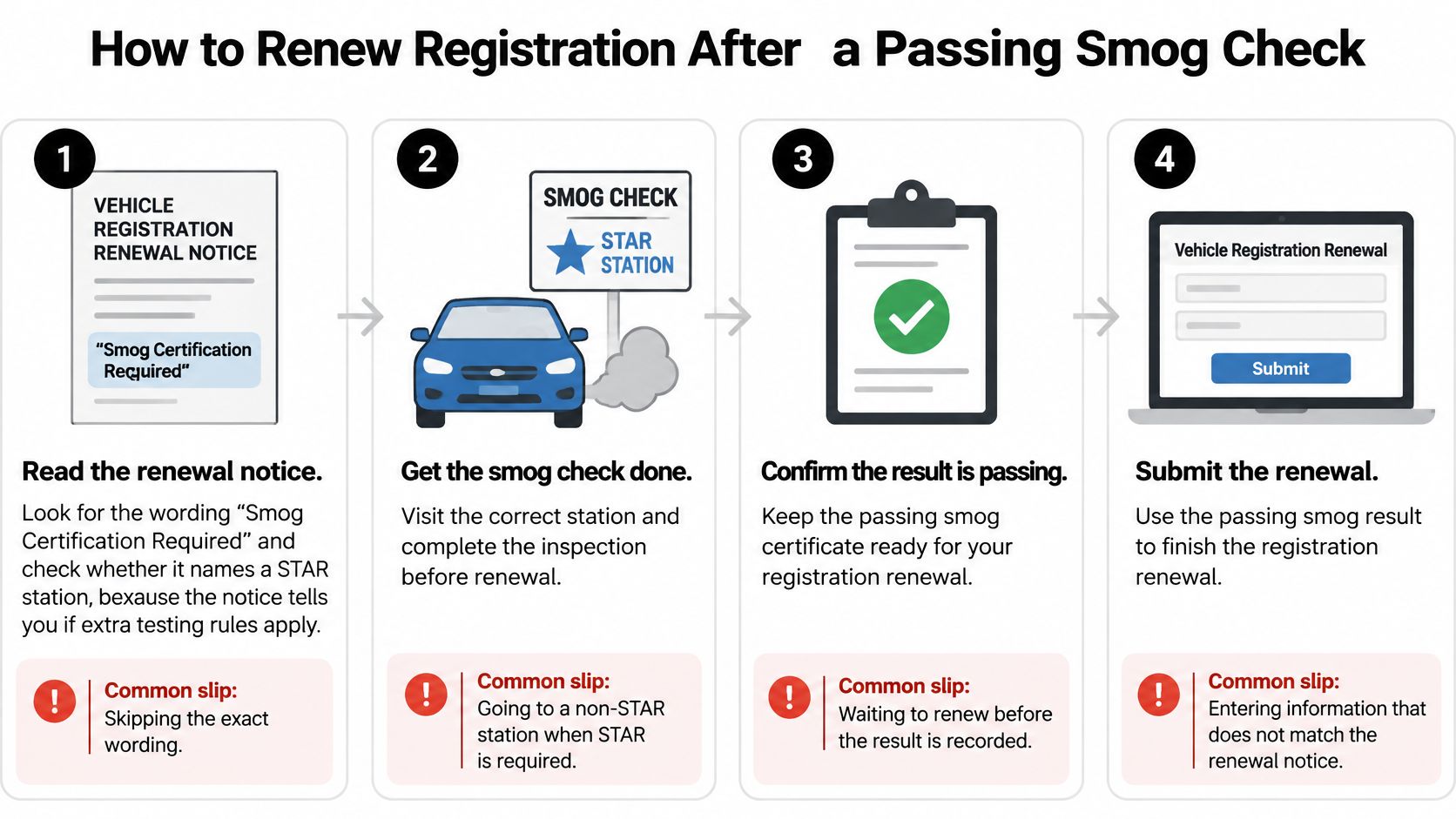
The Six Steps in Order
- Read the notice first: Look for "Smog Certification Required" and check whether it names a STAR station, because that wording decides where testing can happen. The common slip is booking the nearest station without reading that line.
- Pay fees by the due date: Pay even if the smog test is still outstanding. The California DMV vehicle registration renewal guidance says motorists should pay renewal fees by the due date even when they can't yet provide smog certification, then complete certification afterward to avoid penalties.
- Bring the vehicle and notice: Take the vehicle and your registration renewal notice, if you have it, to a licensed station. The notice shows which certification type you need, so the station isn't guessing.
- Confirm electronic transmission: Ask the station to confirm it sends results to the DMV. We electronically transmit smog check results directly to the DMV, because a passing printout alone doesn't update your record.
- Renew online once certification posts: Online renewal works only when electronic smog certification is already on file. Paying fees alone doesn't finalize renewal if certification is still missing, and that's the slip that leaves drivers thinking they're done when they aren't.
- Use the office or kiosk if needed: If the online route isn't available, finish at the Oakland DMV counter or its kiosk for tasks listed for those channels.
The short video below walks through the same renewal logic visually, which helps if the notice wording still feels fuzzy.
Paying early and testing late beats testing early and paying late. Fees paid on time protect you from penalties while certification catches up.
A completed renewal looks like this, a receipt plus your new registration sticker or tag. If you passed the test but the online system still blocks you, the electronic record may not have posted yet. Give it a little time, then try again before assuming something's broken.
What to Do When a Smog Check Fails
A failed test feels like a dead end. It isn't, but the options that follow carry strict limits, and guessing wrong can leave you driving on expired registration.
Start with the printout. When a vehicle fails with us, you receive a printout showing the area that needs work, and the vehicle must be repaired to pass the retest before registration can be completed. That printout is your repair starting point, not a verdict on the whole car.
Failed Smog Check and Next Steps
| Situation | What to do | Time or use limit |
|---|---|---|
| Failed smog, repair needed | Repair the area named on the printout and retest | Retest must pass before registration completes |
| Dispute over documentation or test results | Escalate to the BAR Referee Program | Use when the result or documents are disputed |
| Registration about to expire after a failed test | Apply for a Temporary Operating Permit with fees, failed report, proof of insurance and $50 | Valid 60 days |
| Second TOP request for the same vehicle within two years | Not available for the same vehicle | Only one biennial smog-certification TOP per two years |
The Temporary Operating Permit deserves close attention. The California DMV temporary operating permits page says a vehicle that fails its biennial smog inspection may qualify for a TOP costing $50, requiring registration fees, the failed inspection report, proof of insurance, and payment of the fee, and it's valid for 60 days. Only one such permit can be issued to the same vehicle during a two-year period.
Consider a concrete case. Say a 2009 gasoline car fails during the first week of a 30-day window before expiry. The sensible path is repair and retest within that window, no permit needed. If repairs run past expiry and no TOP was issued in the last two years, the permit covers up to 60 days of legal operation while you finish the work.
Disputes are different from repairs. If you believe the result or documentation is wrong, the BAR Referee Program is the escalation path rather than repeated paid retests. Our breakdown of what happens after a failed smog check in California covers that decision in more depth.
Before choosing, check two facts, your expiration date and whether a TOP was already used for this vehicle. Those answers pick the path for you.
Oakland DMV Appointments and Office Closures
Office status can change your plan overnight, so verify before you drive. Check the field office page for the Oakland DMV at 5300 Claremont Avenue for current hours, service information, and appointment options.
Closures are a real factor in Oakland. NBC Bay Area reporting on the Oakland Coliseum DMV closure said that office was expected to remain closed for about 90 days after 2025 copper-wire theft damaged its HVAC system and parking-lot lights. If the Coliseum office is your usual stop, confirm its status before heading there.
Four Checks Before Any Visit
- Check the field office page: Confirm hours and appointment options for your specific task.
- Match the task to the channel: Kiosk-listed tasks like renewal with sticker printing, proof-of-insurance submission, and records requests skip the main line.
- Book the counter when needed: Testing, title transfers, and plates or permits are staffed-counter work, so book an appointment if the page offers one.
- Recheck closures the day before: A closure notice posted after you planned the trip can send you across town.
Drivers near the Coliseum feel closures first, but the habit protects everyone. Five minutes of checking beats a locked door.
Visit Tips for the Oakland DMV
Oakland sits inside a very large vehicle base, which explains why DMV demand never really slows. The California DMV Oakland Coliseum kiosk page reports an estimated 1,301,745 fee-paid vehicle registrations in Alameda County for January 1 through December 31, 2025, including 1,052,313 automobiles, 172,013 trucks, 51,339 trailers, and 26,080 motorcycles. Automobiles accounted for about 80.8% of the total, trucks roughly 13.2%, trailers 3.9%, and motorcycles 2.0%.
Read those numbers correctly. They count fee-paid registrations, not unique residents or office visits, so they show the scale of recurring renewal and compliance work rather than wait times. Preparation, not timing tricks, is what shortens most visits.
Five Preparation Habits
- Work backward from the due date: Allow time for the smog test, electronic posting, and the registration step itself.
- Gather documents at home: Bring the renewal notice, registration, proof of insurance, and any failed inspection report.
- Check your vehicle category: Trucks, trailers, and motorcycles carry different exemptions and paperwork than passenger cars.
- Keep every receipt: Hold copies of certifications and payment receipts until the next renewal completes.
- Bring notice and registration to the counter: For any task the kiosk doesn't list, staff will ask for them.
With more than 1.3 million registered vehicles in the county, the driver who arrives with the right folder usually finishes first.
Counter, Kiosk or Licensed Station
Every Oakland DMV errand sorts into one of three lanes, and your notice tells you which lane you're in. Choosing the wrong lane is the main reason drivers make two trips instead of one.
If your notice says Smog Certification Required and the test is still outstanding, a licensed smog station is your first stop, because the DMV can't finish renewal without that electronic record. We're a fully licensed, state-certified smog inspection station in San Leandro, and we serve customers in San Leandro, Hayward, Alameda, and Oakland for smog checks and STAR smog checks. We're not a branch of the DMV, but we're licensed to perform a limited number of DMV registration services, and those services run Monday through Friday, 9:00 AM to 5:30 PM. Call (510) 614-7664 before arriving to confirm which DMV services we can handle for you.
The Four-Point Checklist
- Name the task: Is it a smog check, a registration renewal, or a title or plate task?
- Confirm the provider lists it: Don't assume a station or kiosk covers your exact transaction.
- Check for counter-only work: Driver testing and title transfers require the staffed DMV counter.
- Measure the drive: Pick a station within practical driving distance of where the vehicle is.
Say your only pending item is a smog test followed by renewal. A licensed station can test the car, transmit the result, and you may never join the Oakland DMV queue. Say instead you need a licensing test. No station or kiosk substitutes for the DMV counter, so book that visit directly.
Decision rule: Smog outstanding means station first. Testing or title work means DMV counter. Routine listed paperwork means kiosk.
If your notice names a STAR station, verify the station's STAR status before you book, since an ordinary test won't count. Our comparison of STAR stations versus test-only stations explains how the two differ and when each applies.
Your next action is specific. Match your path to the notice wording, confirm the provider offers that exact service, and set a date that leaves room before the due date, with the notice and registration in hand. That single habit prevents nearly every stalled Oakland renewal.
If your notice is asking for smog certification, we can test your vehicle, handle STAR-required inspections, and transmit the result to the DMV so your renewal can move forward without an extra trip to the Oakland DMV. Bring your vehicle and renewal notice, and visit Speedy Smog to plan your visit or call ahead with questions about your notice.