
Failed Smog Check California: What to Do Next
The Smog Check certificate fee itself is only $8.25, but the actual cost is the repair work that follows. California Bureau of Automotive Repair data shows average repairs of about $665.59 at STAR test-and-repair stations and $703.74 at non-STAR test-and-repair stations.
You're probably holding a Vehicle Inspection Report, wondering whether your registration is now in trouble and whether a shop will sell you repairs you don't need. Take a breath. A failed smog check is a compliance problem, not an automatic loss of registration, and the smartest next move is to understand the failure before authorizing work.
California's 2025 BAR report recorded 959,667 failures among 11,275,981 initial tests, an overall failure rate of 8.51%. STAR Test-Only stations recorded 481,639 failures from 5,916,245 initial tests, an 8.14% rate. The report also recorded 83,034 BAR-97 emissions failures and 43,518 OBDII failures, so this is a recurring statewide issue, not an unusual event. Read the California BAR 2025 executive summary for the published breakdown.
Table of Contents
- You Just Failed a Smog Check in California
- Why Smog Checks Fail and What Your Report Tells You
- Quick Fixes You Can Try Before Paying a Mechanic
- Choosing the Right Station After a Failure
- Repair Costs, Assistance Programs, and Waivers
- Retesting and Clearing Your DMV Registration
- Your Post-Fail Action Checklist
You Just Failed a Smog Check in California
Your first job isn't finding the cheapest repair quote. It's preserving the evidence.
Start with the inspection report
The Vehicle Inspection Report, or VIR, tells you what failed. Read every line, not just the large “Fail” result. Separate monitors marked “not ready” from measured emissions that exceeded their limits. Those are different problems and require different decisions.
A not-ready monitor often means the vehicle's computer hasn't completed its required checks. An emissions exceedance points toward a running, fuel, ignition, exhaust, or catalytic-converter problem. Take clear photos of every page, including the station information and test date, then keep the original with your registration paperwork.
Ask the station whether the vehicle was identified as a gross polluter, directed vehicle, or high emitter. That label affects where you can go next. Don't book a generic retest until you know whether BAR has placed a testing restriction on the vehicle.
Check your registration timeline
A failed test doesn't instantly cancel your current registration. You still need to plan around the expiration date, and you shouldn't ignore DMV renewal notices while the repair is pending. Write down the expiration date and the retest deadline shown on your paperwork.
Practical rule: Never authorize a repair based only on the word “failed.” Authorize work after you know the exact code, monitor, visual defect, or measured pollutant involved.
If you want help interpreting the paperwork before visiting a repair shop, compare the terminology in this guide to common smog test results. Bring the VIR, any diagnostic printout, repair receipts, and registration documents to the next technician.
Why Smog Checks Fail and What Your Report Tells You
California failures generally fall into OBDII, emissions, visual, and functional categories. BAR's 2026 performance report recorded about 1.3 million failures among roughly 19 million 2000-and-newer vehicles tested during CY 2024–2025, an overall rate near 7%. It also reports a January 2026 all-model-year snapshot with 11,167 failures from 62,132 initial tests, or 17.97%. The categories overlap, so one defective part can trigger more than one result. See the BAR 2026 Smog Check Performance Report for the report details.
Match the failure to the likely system
OBDII failure usually means a fault code is active, a required monitor is incomplete, or the check-engine light is on. Common systems include the catalytic converter, EVAP controls, and oxygen sensors. Don't replace a catalytic converter just because the scanner mentions one. A technician needs to determine whether the converter failed or another issue caused the code.
Tailpipe emissions failure applies primarily to vehicles tested through measured exhaust emissions. High hydrocarbons can point to incomplete combustion, while carbon monoxide and nitrogen oxide readings can indicate fuel-control, combustion-temperature, or exhaust-treatment problems. The VIR's measured values matter more than a generic parts list.
Visual failures involve missing, modified, damaged, or tampered emissions equipment, including an emissions component that isn't properly installed. A warning lamp can also matter if the inspection requires it to operate correctly.
Functional failures involve systems such as air injection or other required emissions controls. These problems can look minor but still prevent certification.
| Failure Category | Typical Components | Avg. Repair Cost |
|---|---|---|
| OBDII | Catalytic converter, EVAP system, oxygen sensors, fault-code causes | Depends on diagnosis |
| Tailpipe emissions | Ignition, fuel control, exhaust treatment, catalytic converter | Depends on measured pollutant |
| Visual | Gas cap, catalytic converter, emissions plumbing, approved equipment | Depends on missing or damaged part |
| Functional | Air injection and related emissions controls | Depends on failed function |
For a component-by-component explanation, use this guide to smog check fail reasons. The report tells you the category. Proper testing tells you the repair.
Quick Fixes You Can Try Before Paying a Mechanic
Some checks cost nothing and take minutes. They won't solve every failure, but they can prevent you from paying diagnostic labor for an obvious issue.
Inspect the gas cap and warning light
Remove the gas cap and inspect the seal. If it's cracked, hardened, or doesn't tighten securely, replace it with the correct emissions-approved cap for your vehicle. A loose cap can create an EVAP leak, and an EVAP fault can illuminate the check-engine light.
Then turn the ignition on without starting the engine. Confirm that the check-engine light illuminates during the bulb check and goes out after the engine starts. If it stays on, don't schedule a retest yet. The underlying fault still needs attention.
Scan before clearing
A basic OBD-II scanner can show stored and pending codes. Scan first and save the code information. Clearing the code before you understand it destroys useful diagnostic context and may reset the readiness monitors.
If you've already repaired the problem and need to clear a confirmed code, check readiness afterward. Disconnecting the battery also resets monitors, so the vehicle needs a complete drive cycle before the inspection computer can evaluate it. The exact distance varies by vehicle and driving conditions, so use the manufacturer's procedure or let a technician verify readiness with a scan tool. This guide to reading OBD codes can help you understand the scan without confusing a code with a confirmed parts failure.
Look for basic engine issues
With the engine cool, inspect accessible vacuum hoses for splits or disconnected ends. Check whether the air filter is visibly restricted and whether the vehicle has overdue spark-plug service. These checks don't replace diagnosis, but they can reveal maintenance problems that affect combustion and emissions.
Don't erase codes repeatedly to chase a pass. A retest with monitors not ready can create another failure and delay the repair decision.
Choosing the Right Station After a Failure
A failed inspection does not automatically mean you need the cheapest retest. First read the VIR. If it identifies a testing restriction, the wrong station can cost you another inspection fee and delay repairs. The repair bill is usually the larger financial risk, so choose a location that can handle the failure and explain the next step clearly.
Match the station to the VIR
A regular smog station handles ordinary inspections and many standard retests. Call before driving over and ask whether it can retest your specific vehicle after reviewing the VIR.
A STAR Test-Only station performs inspections under BAR's STAR requirements. Use one when the paperwork requires enhanced testing or directs you to a STAR location. It will not perform repairs, so arrange diagnosis and repair separately.
A STAR Test-and-Repair station can diagnose and repair qualifying emissions problems, then complete the certification process when the vehicle is ready. This may reduce extra trips between a mechanic and testing station. Still, request the diagnosis, proposed repair, parts, labor, and retest costs in writing before approving work.
The BAR Referee handles disputes, unusual inspection situations, and certain vehicle-specific problems. The DMV directs drivers who fail to contact the BAR Referee Program through its smog inspection guidance. A referee is not a bargain retest. It is a state-run review for cases requiring independent handling.
| Station Type | Authorization | Typical Cost | Best For |
|---|---|---|---|
| Regular station | Standard inspections and eligible retests | Station's posted market price | Ordinary failures |
| STAR Test-Only | STAR testing and required enhanced retests | Test-only fee | Directed or enhanced testing |
| STAR Test-and-Repair | Diagnosis, repair, and qualifying certification | Repair plus testing | Drivers who want one repair location |
| BAR Referee | Independent state review and specialized cases | Ask BAR about applicable charges | Disputed or unusual failures |
Use BAR's station locator, confirm authorization, and ask what the VIR requires before booking. Speedy Smog, a STAR-certified station in San Leandro, publishes its current smog testing service details online so you can confirm pricing before visiting. Bring the VIR and ask whether the station can test, repair, or only perform the retest your vehicle needs.
Repair Costs, Assistance Programs, and Waivers
The inspection fee isn't the financial threat. BAR says the Smog Check certificate fee is $8.25, while its 2025 data puts average repair costs at about $665.59 for STAR test-and-repair cases and $703.74 for non-STAR test-and-repair cases. Those figures explain why you should treat the VIR as a diagnostic starting point, not a permission slip for unlimited parts replacement.
Get an estimate before approving work
Ask for three things in writing:
- The exact diagnostic finding and related trouble code.
- The repair that addresses that finding.
- The estimated parts, labor, and retest costs.
If the quote approaches the state's repair threshold, pause before authorizing the work and check whether you qualify for the California Consumer Assistance Program repair option. CAP may help eligible drivers with emissions-related repairs, but application timing and eligibility matter. Don't assume reimbursement will apply to work you already paid for.
Understand the waiver paths
BAR's repair-assistance rules use a $650 minimum repair-spend threshold, with eligibility depending on the vehicle, repair type, and program requirements. A cost waiver may be available when qualifying emissions repairs reach that threshold and the vehicle still fails. It isn't automatic, and the repair work must meet the program's documentation rules.
A parts waiver is different. It addresses situations where a required certified replacement part isn't available, often involving older vehicles. That isn't the same as failing to afford a repair or choosing not to replace a worn component.
Keep invoices, parts information, diagnostic results, and every retest report. If the vehicle remains noncompliant after documented qualifying work, ask BAR whether a waiver, CAP support, or referee review fits your case.
Retesting and Clearing Your DMV Registration
Once the actual fault is repaired, return to an authorized station with the original VIR and repair paperwork. The technician should check that the check-engine light is off, the required monitors are ready, and the vehicle is eligible for that station's testing authority before starting another inspection.
Don't waste the retest
A retest isn't a guess. Have the shop scan readiness first and verify that the repair addressed the failure category. If the battery was disconnected or codes were cleared, the vehicle may need its prescribed drive cycle before the computer can complete its checks.
BAR reports that roadside inspection samples in the relevant performance reports failed at a fleet-weighted average of about 14%, while routine testing outcomes differ. The point for a driver is simple: the vehicle's real emissions condition matters, and a temporary code reset won't create a durable pass. The BAR 2024 performance report provides the historical roadside comparison.
A STAR Test-Only location may charge the $8.25 certificate fee for the certificate portion of an eligible retest, while other stations set market prices that can include diagnosis, repair, and testing. Ask for the complete price before work begins.
Confirm DMV transmission
Passing results are transmitted electronically to the DMV, so you generally won't mail a paper certificate for an ordinary renewal. Keep the printed VIR anyway. It proves what happened, helps resolve transmission questions, and preserves your repair history.
If registration has already been suspended, contact the DMV and ask what it needs for reinstatement. Have your passing VIR, proof of insurance, registration-fee payment, and CAP documentation if applicable ready. Don't drive as though the registration is cleared until the DMV record confirms it.
Your Post-Fail Action Checklist
Use this sequence instead of calling several shops and repeating the same inspection.
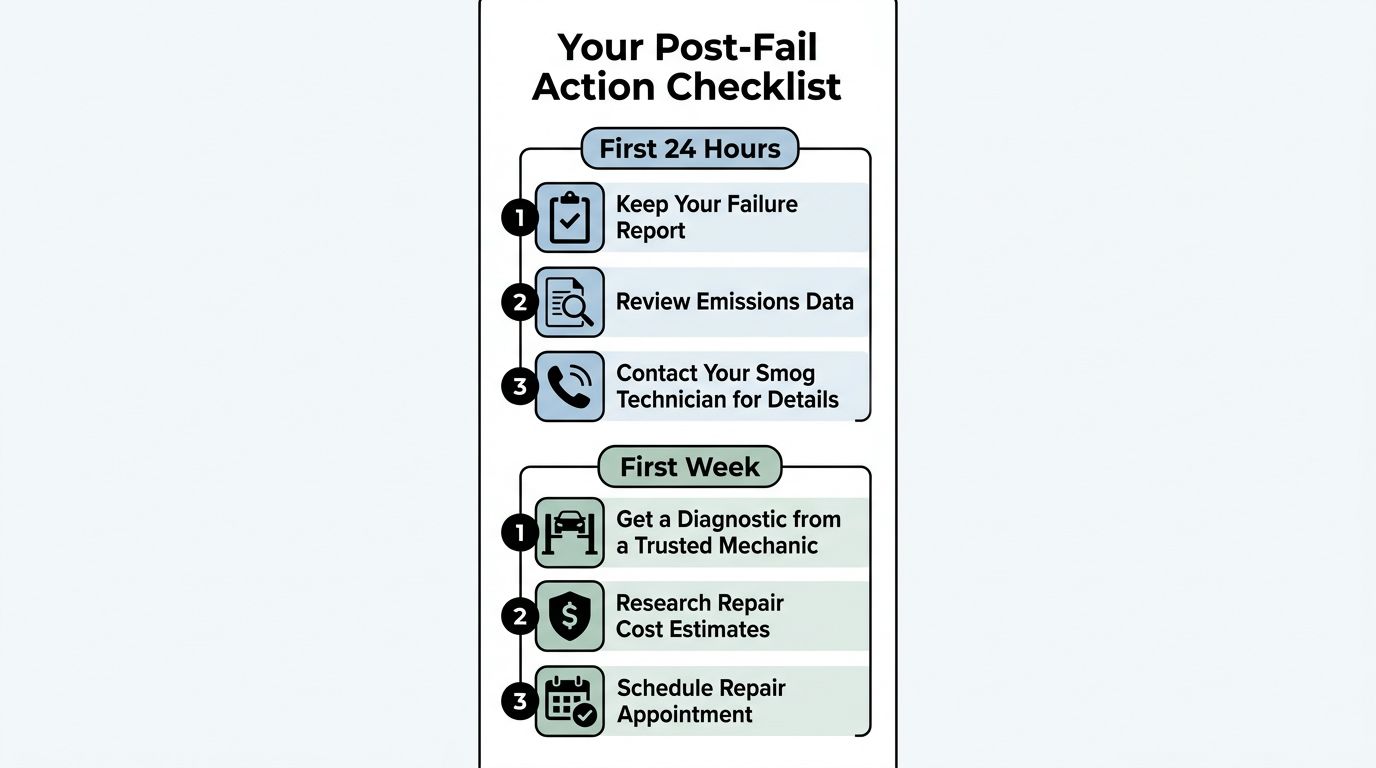
First 24 hours
- Keep the failure report. Photograph every page of the VIR and store the original with your registration documents.
- Review emissions data. Mark each failed category, every “not ready” monitor, and any gross-polluter or directed-vehicle designation.
- Check the calendar. Record your registration expiration date and the retest deadline shown on the paperwork.
- Pull diagnostic codes. Use an OBD-II scanner, save the results, and don't clear codes before a technician reviews them.
- Inspect simple items. Check the gas-cap seal, warning light, visible vacuum hoses, air filter, and obvious emissions-component damage.
First week
- Choose the correct station type. Call a regular station, STAR Test-Only station, STAR Test-and-Repair station, or BAR Referee based on the VIR designation.
- Get a real diagnosis. Ask the technician to verify the code, test the suspected system, and check readiness before recommending parts.
- Request a written estimate. Separate diagnostic labor, parts, installation, and retest charges.
- Check assistance before repairs. If the estimate reaches $650, review CAP and waiver eligibility before authorizing qualifying work.
- Schedule the repair. Keep the invoice, parts details, test results, and every document the shop provides.
Within the next 30 days
- Verify readiness after repair. Have the technician scan the monitors before sending the vehicle to retest.
- Retest at an authorized location. Bring the VIR and repair receipts, and confirm that the station can handle any directed or enhanced requirement.
- Confirm DMV receipt. Check that the passing result appears in the DMV record, especially if renewal is pending.
- Protect the paper trail. Keep the passing VIR, invoices, CAP approval, and waiver documents together.
- Escalate intelligently. If the vehicle still fails after repeated repair and testing, stop buying guesses and request BAR Referee guidance. If the repair remains unaffordable or the vehicle cannot meet requirements, ask BAR whether a waiver or assistance route applies.
The fastest path is usually the most documented one. A clear VIR, verified diagnosis, correct station, and complete receipts keep you from paying twice for the same uncertainty.
If your failed smog check is in the San Leandro or East Bay area, bring your VIR and registration paperwork to Speedy Smog for guidance on the appropriate retest path. The STAR-certified station can inspect eligible vehicles and help you understand what needs to happen before you spend money on repairs.