Your registration renewal is approaching, and you're trying to fit a smog inspection around work, errands, and the drive across Oakland. Before you choose a station, it helps to answer a more important question: what does your particular vehicle need to complete the inspection without an avoidable return trip?
Table of Contents
- Plan Your Oakland Smog Check Visit
- Understand California's Smog Certification System
- Determine Which Vehicles Require Testing
- Prepare Your Vehicle Before the Test
- Choose a STAR Certified Station Nearby
- Compare Prices Without Hidden Assumptions
- Prepare for a Possible Failed Inspection
- Explore Repair Assistance and Retirement Options
Plan Your Oakland Smog Check Visit
A search for a smog check in Oakland, California, can turn into a comparison of nearby addresses and advertised prices. But the closest station isn't necessarily the right starting point. Start with your renewal notice and your vehicle's information, then decide where to go.
Think of an Oakland driver whose car seems to run normally but recently had a battery disconnected. Another driver has a hybrid and isn't sure whether it needs testing at all. Neither should assume that a convenient appointment settles the underlying inspection questions.
Smog certification is a compliance requirement, not a routine tune-up. A maintenance visit addresses the car's service needs. A certification inspection determines whether it satisfies the applicable emissions inspection requirements.
Make the decisions in a useful order
Before committing to a visit, work through this sequence:
- Confirm the requirement. Read your renewal notice and verify your vehicle's current eligibility through state guidance.
- Identify the inspection. Have the model year, fuel type, and any special testing instructions available.
- Check preparation. Tell the station about recent emissions repairs or electrical work.
- Compare suitable stations. Confirm certification status, vehicle acceptance, and the complete price.
- Leave room for a problem. Understand what you'll do if the vehicle doesn't receive certification.
This approach doesn't replace DMV instructions or state eligibility tools. It helps you ask better questions before spending time and money.
Practical rule: Choose the inspection your vehicle requires before choosing the appointment that fits your calendar.
You don't need to become an emissions technician. You need enough information to distinguish a paperwork question, a readiness issue, and a repair decision.
Understand California's Smog Certification System
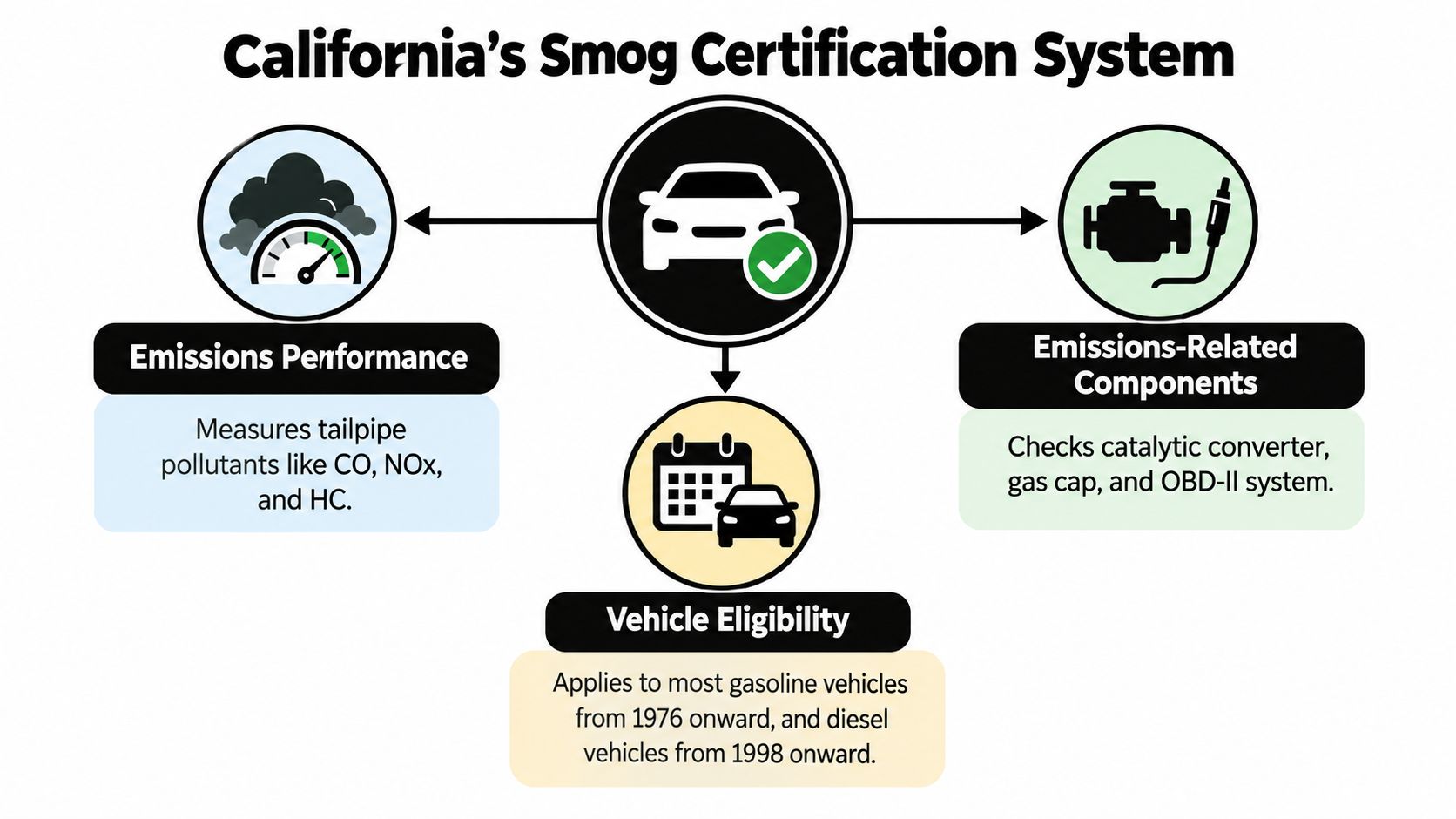
California's Smog Check program evaluates emissions performance and the condition of emissions-related components, requiring many vehicles to undergo inspection every other year. The state established the STAR program in January 2013 to identify stations meeting higher performance standards and authorize eligible locations to inspect vehicles with additional testing requirements, as explained in the Bureau of Automotive Repair's Smog Check performance report.
That structure explains why a smog appointment deserves different preparation from an oil change. The technician isn't deciding whether the engine sounds healthy or whether the exhaust looks clean. The vehicle must satisfy the inspection procedures that apply to it.
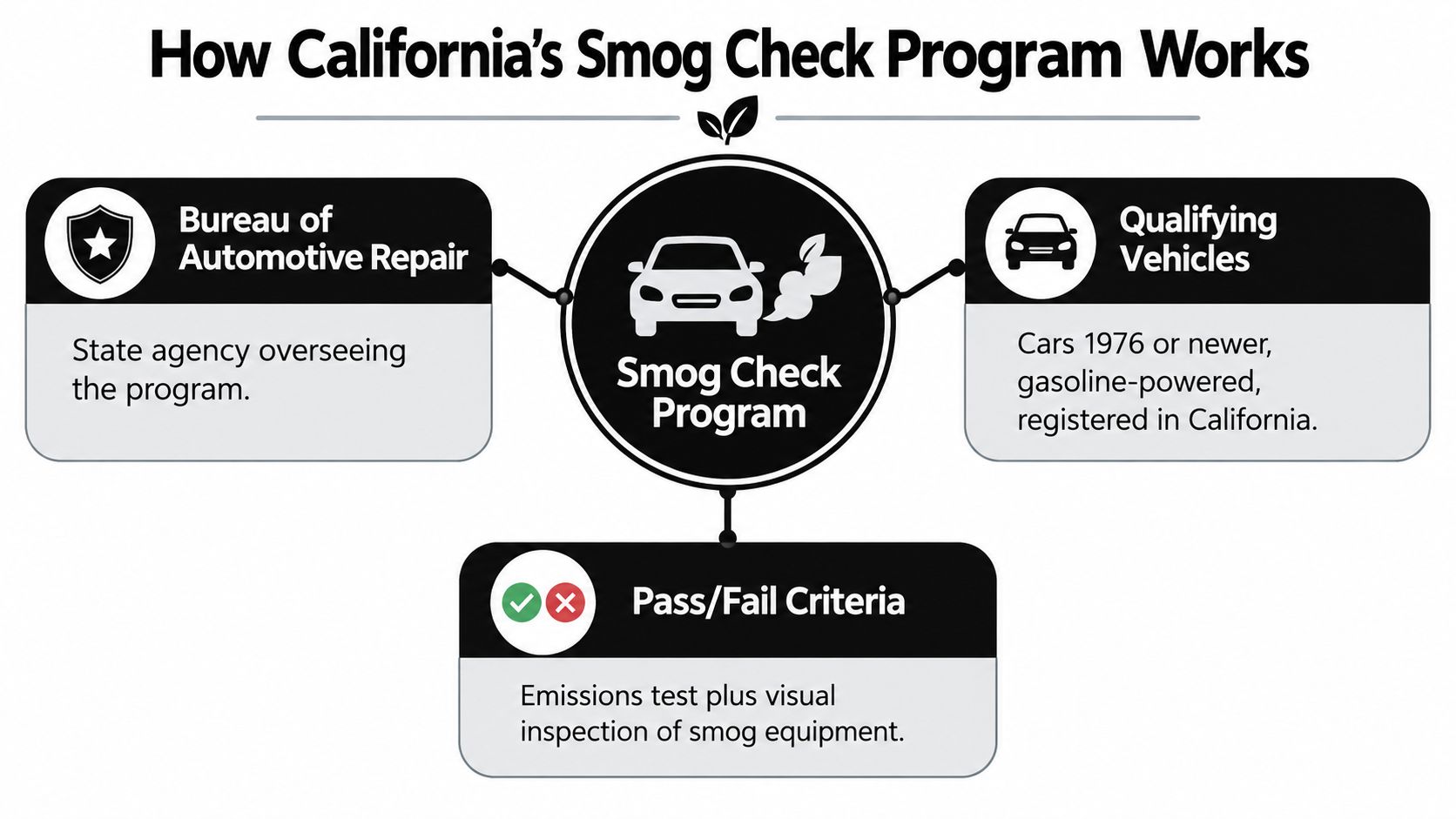
The diagram separates the main parts of the certification system.
Separate certification from registration
The Bureau of Automotive Repair, usually called BAR, oversees the inspection program described above. Your DMV registration transaction is the surrounding administrative task. Treating those as separate responsibilities helps prevent a common misunderstanding: completing an inspection isn't a substitute for checking the rest of your renewal instructions.
Ask the station what documentation you'll receive and how you can confirm the certification outcome. Separately, review what DMV still requires from you. Don't assume that a successful station visit answers every registration question.
| Question | Where to focus |
|---|---|
| Does my vehicle need an inspection for this transaction? | Current state eligibility guidance and DMV instructions |
| What inspection applies to my vehicle? | Vehicle details and the station's authorized testing capabilities |
| Did the vehicle receive certification? | The inspection result and station explanation |
| Is my registration transaction complete? | DMV renewal requirements |
A standardized inspection also means the technician needs to follow the applicable procedure rather than substitute an informal opinion. A car that feels dependable on the freeway may still need attention to an emissions-related condition.
The useful mindset is verification rather than reassurance. Ask what the inspection established, what remains unresolved, and which organization can answer the next question. That keeps a technical result from turning into confusion about your registration.
Determine Which Vehicles Require Testing
Model year and fuel type belong together. Knowing only that a vehicle is a sedan, pickup, or hybrid doesn't establish its inspection category.
According to BAR's vehicle coverage and inspection guidance, the program covers gasoline and hybrid vehicles from model year 1976 onward and diesel vehicles from 1998 onward; most gasoline, hybrid, and alternative-fuel vehicles from 2000 onward receive an OBD-II inspection, and BAR identifies hybrids in that newer group as subject to BAR-OIS testing. These broad categories are a starting point, not a substitute for checking the requirement for your exact vehicle and transaction.
Smog Inspection Categories at a Glance
| Vehicle group | Coverage stated in the brief | Inspection focus |
|---|---|---|
| Gasoline vehicles | Model-year coverage summarized above | Confirm the applicable method rather than assuming every gasoline vehicle receives the same test |
| Hybrids | Included in the program's stated coverage | Electric propulsion doesn't remove the need to verify inspection obligations |
| Alternative-fuel vehicles | Most vehicles in the newer diagnostic group described above | Confirm whether the OBD-II inspection applies |
| Diesel vehicles | Covered from the threshold identified above | Verify the vehicle's eligibility and the station's ability to inspect it |
Understand what OBD-II evaluates
On-board diagnostics, abbreviated OBD-II, concerns the vehicle's electronic monitoring of emissions-related operation. BAR's guidance describes an inspection that evaluates the malfunction-indicator lamp, stored diagnostic trouble codes, readiness monitors, and emissions-control functionality.
Those terms answer different questions:
- Warning-lamp status: Is the vehicle indicating an emissions-related malfunction?
- Diagnostic trouble codes: Has the computer recorded information about a detected problem?
- Readiness monitors: Has the vehicle completed the relevant self-checks?
- System functionality: Are emissions controls operating within the vehicle's certified design limits?
A dashboard without an illuminated warning lamp doesn't, by itself, answer all those questions. That distinction matters when a car has recently been repaired or had its diagnostic memory reset.
For a hybrid owner, the practical example is straightforward. Quiet electric operation on part of a trip doesn't establish that the combustion engine's emissions systems are outside the inspection program. Describe the vehicle accurately when calling, including that it's a hybrid.
For an older-vehicle owner, avoid requesting a particular testing method based on what a newer family car received. Give the station the actual vehicle details and ask which procedure applies. Vehicle classification comes before assumptions about testing equipment.
Prepare Your Vehicle Before the Test
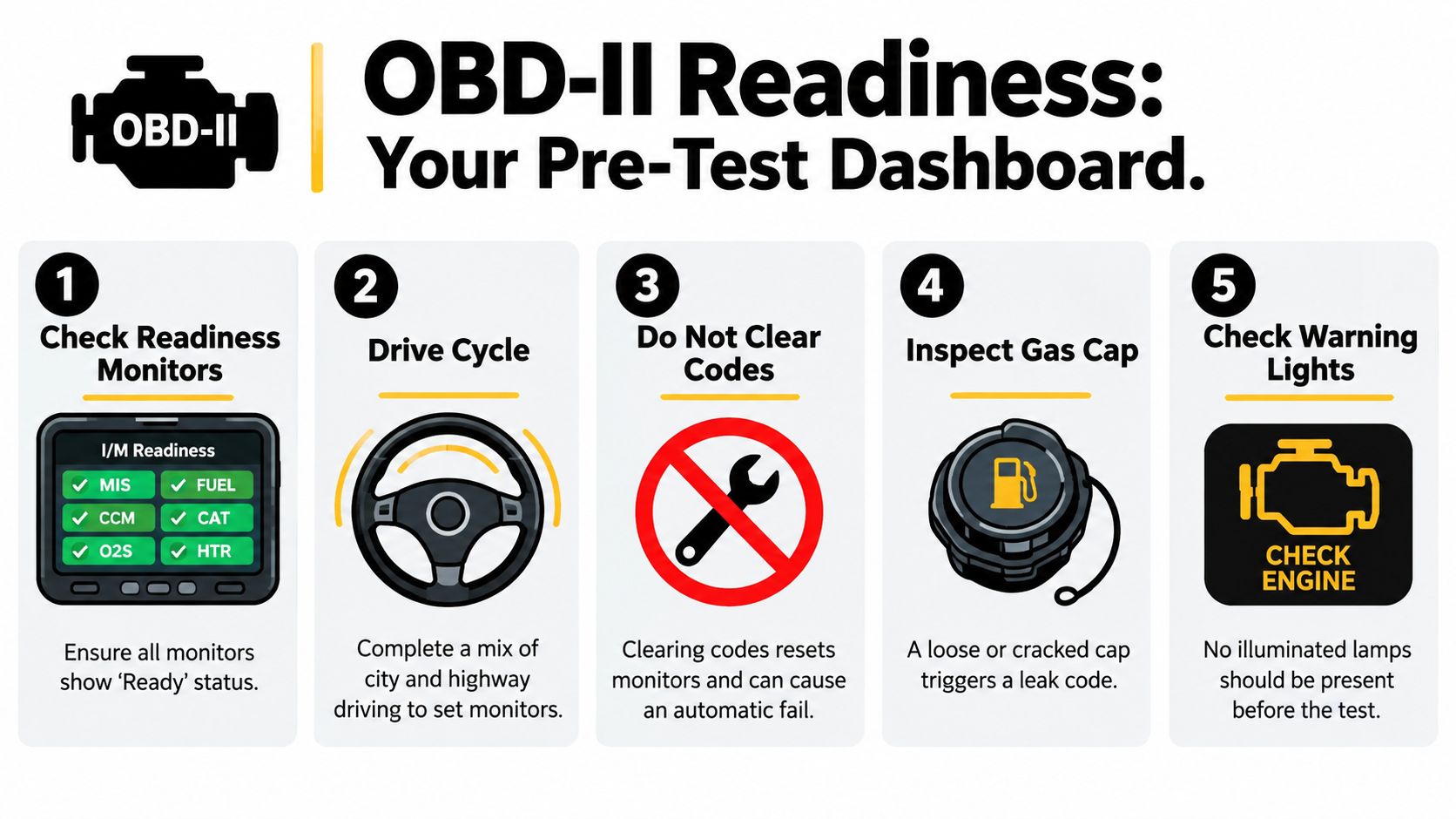
A recently repaired car can be mechanically improved without yet being ready to demonstrate that improvement during an inspection. Readiness is evidence that the vehicle has completed its required self-checks, not an absence of dashboard warnings.
Under the BAR guidance cited above, clearing diagnostic codes or disconnecting the battery can leave readiness monitors incomplete. That can create a readiness-related failure even when the warning lamp is off. Trying to erase a problem immediately before testing can therefore create another obstacle instead of solving the original one.
Use a readiness-focused checklist
- Discuss recent work. Tell your technician about repairs, code clearing, or a battery disconnection before booking the inspection.
- Address an active warning lamp. Ask for diagnosis of the underlying condition rather than a temporary reset.
- Follow the manufacturer's drive cycle. After repairs, use the prescribed procedure so the vehicle can complete its checks.
- Verify readiness. Ask whether monitor status has been checked, rather than assuming that ordinary driving has completed everything.
- Keep repair records. Bring enough information to explain what was repaired and whether the computer was reset.
The visual checklist is a useful reminder, but the manufacturer's procedure and the applicable inspection rules should guide your vehicle-specific preparation.
Don't substitute a driving guess for verification
A drive cycle isn't a universal instruction to take a quick freeway trip. Follow the procedure prescribed for your vehicle rather than relying on someone else's experience with a different model.
An extinguished warning lamp and completed readiness checks answer different questions. Ask about both.
No preparation checklist guarantees certification. The purpose is to avoid arriving with a known warning condition or unresolved readiness question that could have been discussed beforehand.
If you're uncertain, explain the situation when you call. “The repair is complete, but I don't know whether readiness was verified” gives the station a more useful starting point than “The car seems fine.”
Choose a STAR Certified Station Nearby
A suitable station should match the requirement on your paperwork and the vehicle you're bringing. If your renewal notice calls for a STAR inspection, make current STAR status a selection requirement rather than assuming that every smog business qualifies.
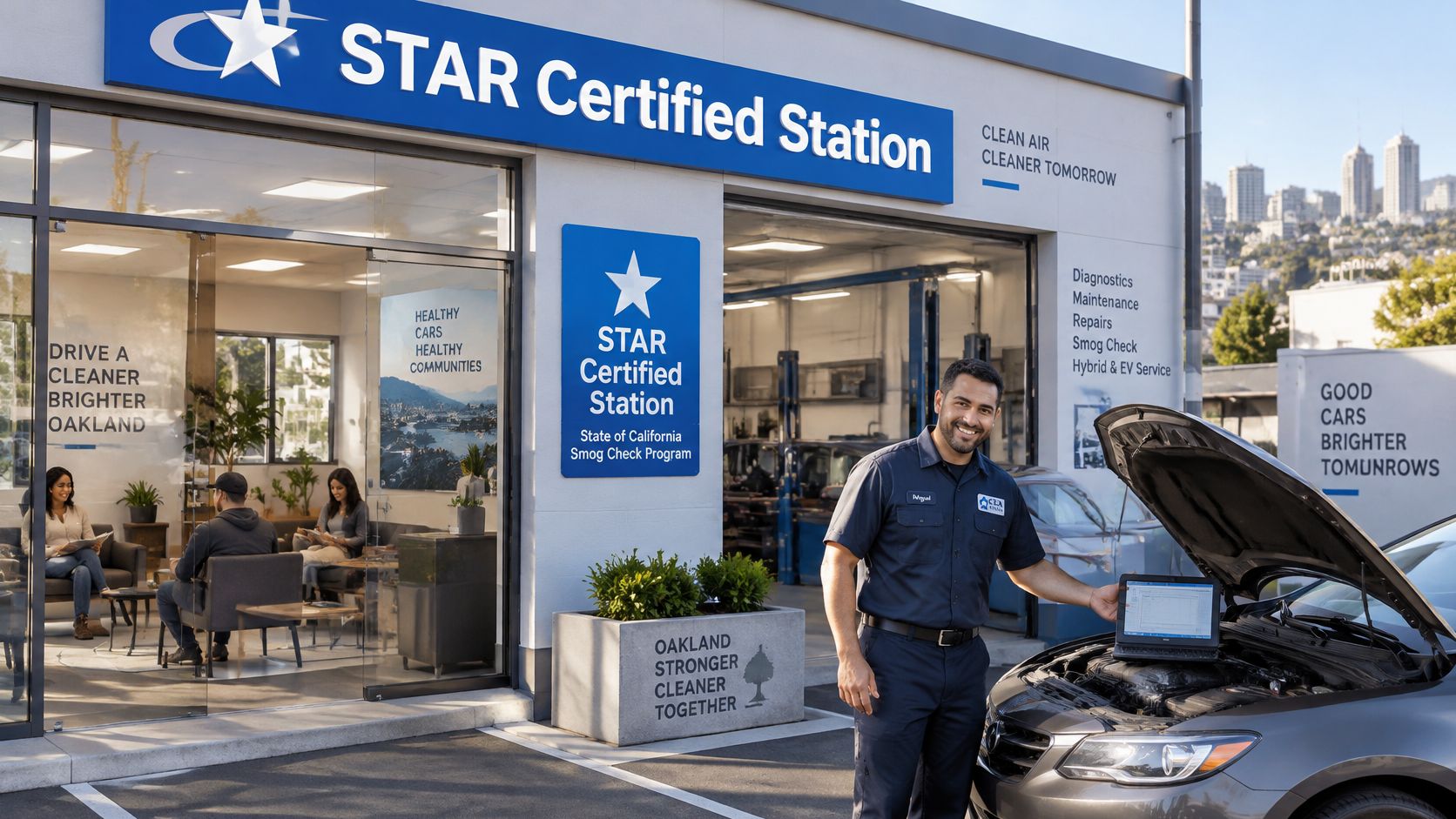
A technician's inspection involves more than a quick look under the hood.
Compare the service you actually need
Test-only and test-and-repair describe different service arrangements. Ask whether you're booking inspection alone or whether the facility can also provide diagnosis and repairs if needed. Don't infer that a particular location offers every service because it displays a smog sign.
| Selection question | Why it belongs in your comparison |
|---|---|
| Is the station currently STAR certified? | Your notice may specify that station category |
| Can it inspect this vehicle? | Fuel type and model year affect the appointment |
| Is the visit testing only? | You should know whether repair capability is available |
| What requires separate authorization? | Diagnosis and repairs shouldn't be confused with the inspection |
| What happens after the result? | You need a clear explanation of certification and documentation |
For a nearby business example, Speedy Smog identifies its San Leandro facility as a STAR-certified smog station serving East Bay drivers. Treat it as an option to compare with other suitable facilities, and confirm acceptance of your vehicle and the services you need before traveling.
This video provides another point of reference while you prepare questions for a station.
Ask about the complete visit
- Scheduling: Request an estimated completion time and ask whether waiting time is separate.
- Certification handling: Ask the station to explain its electronic certification process and the records you'll receive.
- Repair boundaries: Establish whether any additional work requires your approval.
- Result explanation: Confirm that someone can walk you through the report if certification isn't issued.
An Oakland address isn't the only practical option, and a nearby San Leandro location may fit your route. Still, convenience should follow suitability. A short drive to the wrong inspection appointment isn't a time saving.
Compare Prices Without Hidden Assumptions
An advertised inspection price doesn't answer every cost question. Before comparing offers, ask each station to describe the same service for the same vehicle, including any separately listed charges and the conditions attached to a discount.
No verified local fee schedule is established here, so assigning an Oakland-wide price range would be misleading. Use the local emissions-testing pricing information as a starting point for a direct quote, not as a substitute for confirming today's total.
Smog Price Questions to Confirm Before Testing
| Cost item | What the supplied information establishes | What the driver should confirm |
|---|---|---|
| Inspection price | No universal Oakland total is established | The complete quote for the exact vehicle |
| Certification-related charges | No amount is established here | Whether the quoted total includes applicable charges |
| Coupon | Availability must be checked directly | Current terms, vehicle restrictions, and exclusions |
| Diagnostic work | It shouldn't be assumed to be part of testing | Whether diagnosis is available and separately charged |
| Repairs | No repair estimate can be established before the problem is assessed | The proposed work and authorization process |
| Another inspection | No station-specific policy is established | Any conditions or charges for returning |
Use a precise pre-arrival request
Try this wording when you call:
Please quote the complete inspection cost for my vehicle, explain any separate charges, and tell me whether a current coupon applies. If it doesn't pass, what would I be paying for next?
Then provide the model year, fuel type, and any STAR instruction on your notice. If you've already received a quote elsewhere, compare inclusions rather than comparing headline amounts alone.
Time and price are separate questions. A station's estimate for performing the test doesn't necessarily describe your total visit, and a discount doesn't establish the final bill. Confirm payment timing and keep the quoted scope clear before testing begins.
Prepare for a Possible Failed Inspection
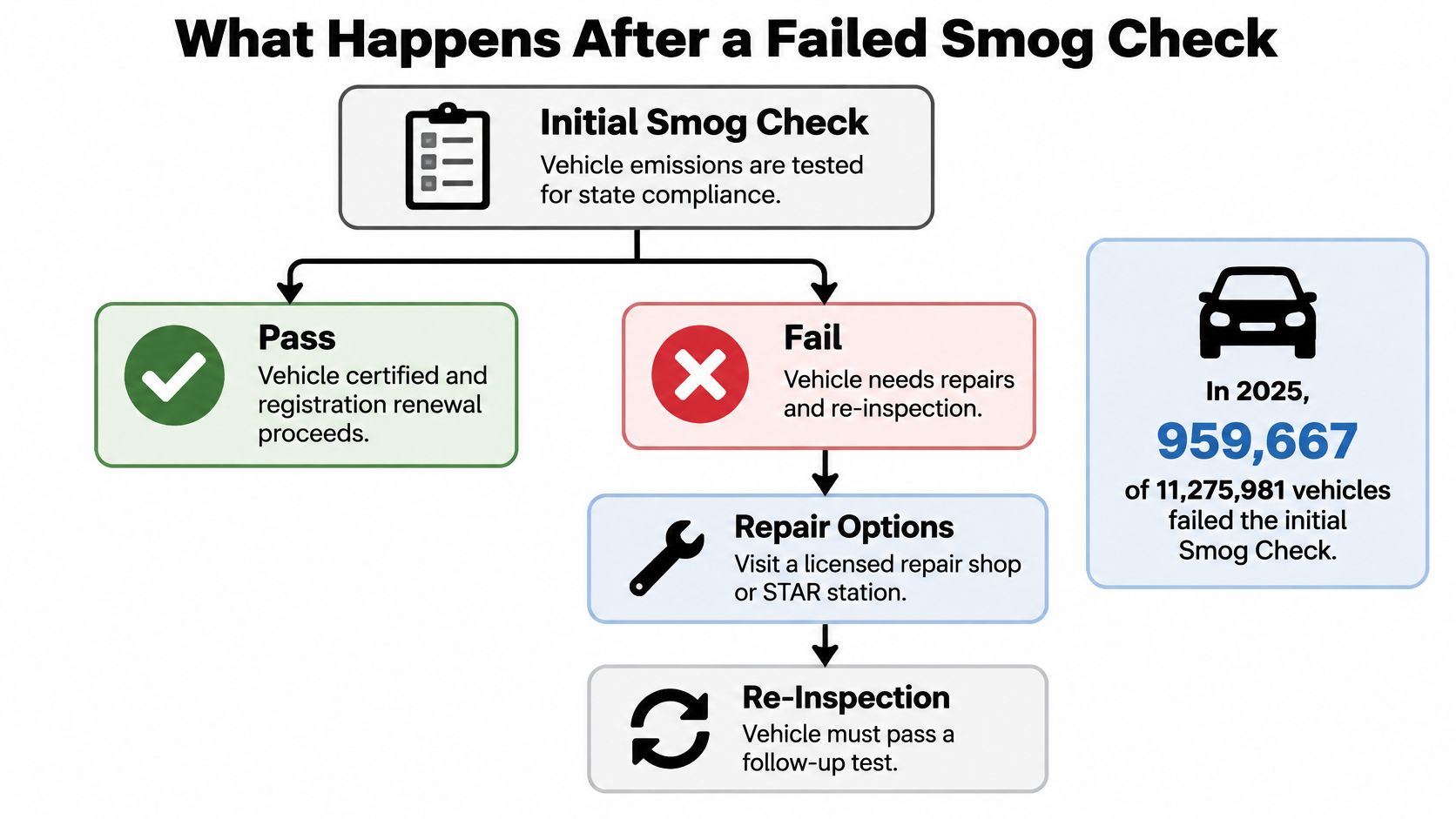
A failed inspection is a result to interpret, not an instruction to authorize unspecified repairs. In the 2025 reporting period, BAR recorded 959,667 failures among 11,275,981 initial tests, an 8.51% initial failure rate; including repeat and other testing activity, the overall failure rate was 9.04%, according to the statewide Smog Check executive summary.
Those statewide figures aren't a prediction for your particular car. They establish that failure is a real possibility worth planning for, while most initial tests didn't fail. The report also shows that vehicle age affected outcomes, which gives owners of aging vehicles a reason to budget time for diagnosis rather than assume immediate certification.
Read the result before buying a repair
Start by asking the station to identify the reported reason certification wasn't issued. A readiness issue calls for a different conversation from a diagnosed malfunction or an emissions-component concern.
- Keep the report. Preserve the inspection result alongside existing repair records.
- Ask for a plain-language explanation. Understand what the inspection found and what still needs diagnosis.
- Request a written estimate. Separate proposed diagnostic work from a repair recommendation.
- Check the next inspection step. Ask what must be resolved before returning.
The flowchart shows the conventional repair-and-reinspection route.
Pause when the financial decision changes
For an owner facing substantial repair costs, the next question isn't always “Which repair should I approve?” It may be “Should I check assistance eligibility before committing more money?”
Don't assume that a failure automatically qualifies you for help, either. Preserve the documentation and compare your options before treating any program as a guaranteed payment.
If the inspection result appears inconsistent or you don't understand the explanation, ask for clarification first. For an unresolved dispute, contact BAR or ask whether a Referee review is appropriate rather than paying for repeated tests without understanding the issue.
A clear explanation is part of making an informed decision. You should understand the reason for failure, the proposed next step, and the financial commitment before authorizing work.
Explore Repair Assistance and Retirement Options
For a financially constrained household, keeping an older vehicle on the road can involve a difficult trade-off. A repair may be worthwhile, but it shouldn't be treated as the only possible response to an expensive emissions problem.
California offers vehicle-retirement incentives of $1,500 or $2,000 in qualifying cases, while income-qualified applicants for broader Consumer Assistance Program options generally must be at or below 225% of the federal poverty level; published annual examples include $35,910 for a single-person household, $48,690 for a household of two, and $74,250 for a household of four, according to BAR's vehicle-retirement eligibility information. That guidance distinguishes pathways requiring a failed inspection from another requiring a completed inspection within 180 days before application, so the relevant route must be verified before you rely on it.
Compare eligibility before committing funds
Income is only part of the decision. BAR also distinguishes programs by vehicle operational status and inspection history. Don't read an income threshold as an approval, and don't assume that every assistance option follows the same application rules.
Use this compact decision sequence:
- Preserve documentation first. Keep the test report, repair estimate, and records that explain the vehicle's condition.
- Identify the relevant program. Ask whether your circumstances fit repair assistance, retirement, or neither.
- Verify current requirements. Confirm application timing and vehicle conditions directly with BAR.
- Compare your alternatives. Consider the repair quote alongside your transportation needs and any verified program eligibility.
- Resolve disputed questions. Ask BAR which office or Referee resource is appropriate for the issue.
Local smog-check repair-assistance guidance can help you organize questions, but BAR should confirm program requirements and eligibility.
Make the decision fit your household
Retirement assistance isn't automatically the better financial choice. You still need to consider how you'll travel after giving up the vehicle. Conversely, repeated repair spending isn't automatically sensible just because you've already invested money in the car.
Your most useful next step is the one supported by documentation: a verified inspection requirement, an appropriate station, an understood price, or a clearly assessed assistance application. You don't have to solve every uncertainty at the counter.
Speedy Smog offers STAR-certified emissions testing in San Leandro for Oakland and other East Bay drivers. Visit Speedy Smog to confirm your vehicle's inspection needs, ask for the complete price, and plan your visit before your registration deadline.
The DMV envelope usually arrives when you're focused on something else. You open it at the kitchen counter, see that your Oakland-registered car needs a smog certificate, and start wondering whether you can stop at a nearby shop on Broadway or need to drive elsewhere. Before booking, check what the notice requires, what kind of inspection fits your vehicle, and whether a recent battery change could make the test premature.
California's Smog Check program is more than a registration formality. More than 10 million vehicles are tested each year at over 5,000 independently owned stations, and the California Air Resources Board estimates the program removes roughly 400 tons of smog-forming pollutants from the air each day (California Smog Check performance report). Knowing the basic rules can save you an unnecessary trip and help you choose a station that can issue the certificate your DMV notice calls for.
Table of Contents
- When the Renewal Notice Lands on Your Counter
- How California Decides Which Test Your Car Gets
- What STAR Certification Really Means
- The Hidden Reason a Healthy Car Can Still Fail
- What to Bring and How to Time Your Visit
- If Your Car Fails, the Math Changes
- Where Broadway Drivers Usually End Up Going
- Your Two Next Steps Before You Book
When the Renewal Notice Lands on Your Counter
Start with the notice itself, not a map search. It tells you whether your renewal requires a Smog Check and may specify that the inspection must take place at a STAR station. That instruction matters: a vehicle directed to STAR testing can't be tested at any authorized shop, even if another location is closer to home or work.
Most California vehicles are required to pass an emissions inspection every two years, with additional inspections applying in certain registration and ownership situations. For example, an out-of-state vehicle from model year 1976 or newer generally needs a Smog Check when it's registered in California for the first time, subject to the DMV's rules for the specific registration circumstance. A valid certificate helps satisfy registration requirements, while the inspection checks whether the emissions system is functioning within applicable limits.
For a Broadway-area driver, choosing a station is about more than convenience. A test has to match the vehicle and the DMV's instructions. A shop without the necessary authorization or equipment may not be able to complete the inspection your vehicle needs.
Make three decisions before you book
First, identify the vehicle and likely inspection path: model year, fuel type, and whether it's a hybrid or diesel all matter. Second, check whether the notice specifically says STAR. Third, ask the station whether it can test your vehicle and when it can see you.
Practical rule: Treat the DMV notice as the instruction sheet. Confirm its requirements before choosing a station based on distance or advertised speed.
These checks turn a vague errand into a simple plan. Once you know the required station type and the vehicle's test path, you can call with useful details and avoid booking an appointment that can't satisfy the notice.
How California Decides Which Test Your Car Gets
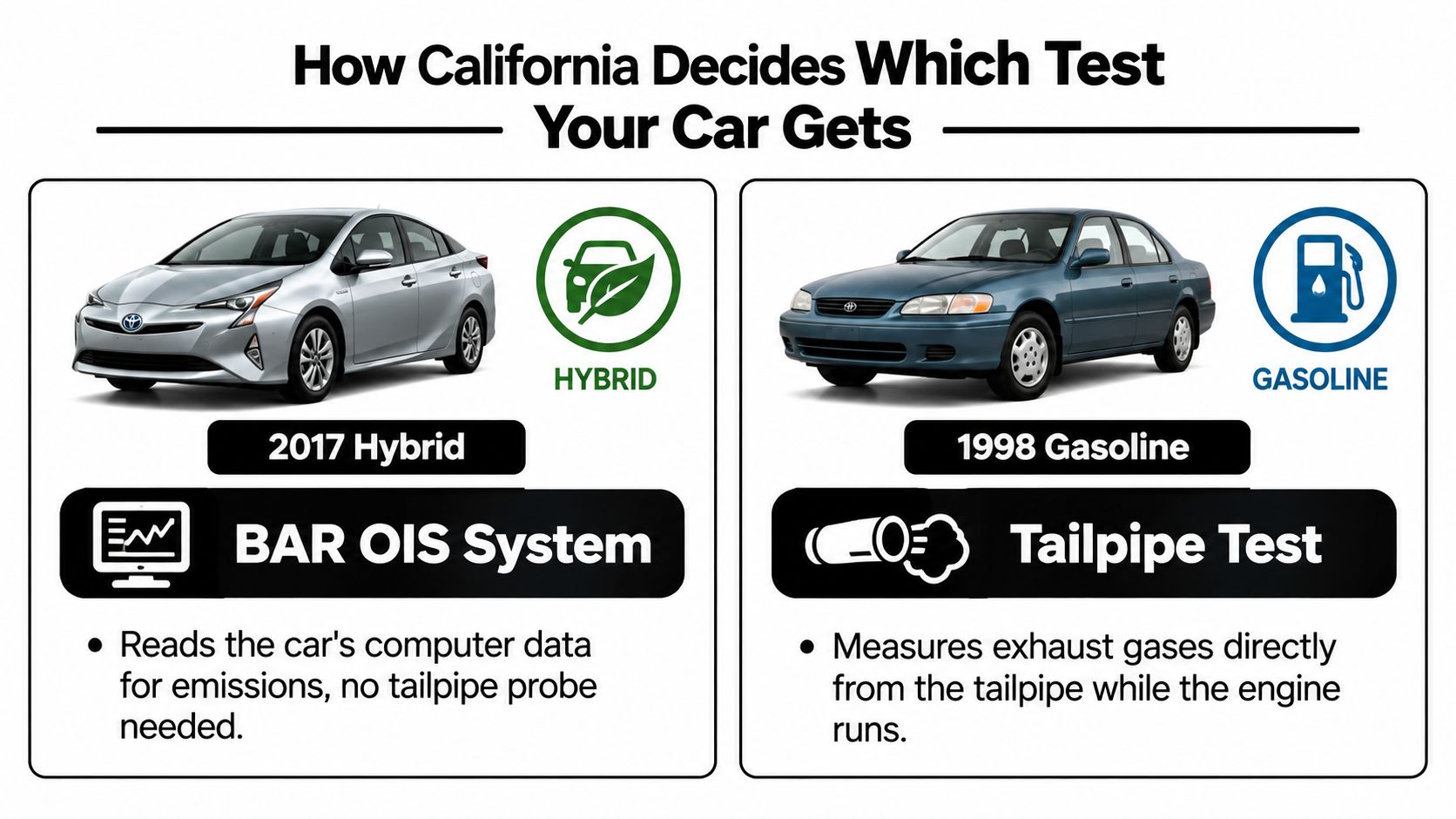
The inspection method depends mostly on the car, not whether you bring it to Broadway, San Leandro, or another East Bay neighborhood. For most 2000-and-newer vehicles, California's Bureau of Automotive Repair generally uses the BAR On-Board Diagnostic Inspection System, or OIS. It checks information from the vehicle's onboard computer and emissions-related systems.
A 1998 gasoline sedan, by contrast, generally falls under the BAR-97 system for 1999-and-older vehicles. That system measures exhaust directly at the tailpipe. A 2017 hybrid generally follows the newer OIS path, but hybrids and diesels can have vehicle-specific requirements, so it's wise to confirm the test type with the station before arriving. The California Smog Check rules and inspection overview can help you understand what to ask.
The tailpipe reading isn't the whole test
Both inspection paths can involve visual and functional checks of required emissions equipment. A car may have acceptable measured exhaust and still fail if the catalytic converter, evaporative-emissions system, or fuel cap doesn't pass the required checks. These components help control emissions, so the inspection isn't only asking whether the engine seems to run smoothly.
That distinction explains why a vehicle's neighborhood doesn't determine the procedure. The test equipment and station authorization must suit the car and the DMV's instructions. If a notice directs a vehicle to STAR, the station must also be authorized for that requirement.
Before booking, have the model year, fuel type, and DMV notice available. If the car is a hybrid or diesel, say so when you call rather than assuming that every shop handles every configuration. That small confirmation can prevent a trip to a station that can't complete the right inspection.
What STAR Certification Really Means
A STAR badge isn't just another way of saying a shop offers smog testing. California introduced the STAR program in January 2013, and the Bureau of Automotive Repair evaluates participating stations and inspectors against performance standards. The program also directs certain higher-risk vehicles, including some with prior excessive emissions or a higher predicted likelihood of failing, to qualifying STAR stations.
The share of stations and the share of inspections tell an important part of the story. In 2023, 48% of licensed Smog Check stations were STAR certified, while STAR stations performed 83% of all tests. California reported 3,550 STAR stations as of March 31, 2025 (California STAR program background and station data). These figures show that STAR stations handled a large portion of the inspection workload, even though they made up less than half of licensed stations.
How the oversight works
BAR reviews performance measures that look for inaccurate or improperly conducted tests. One measure, the Similar Vehicle Failure Rate, compares a station's results with outcomes for comparable vehicles. Another, the Follow-up Pass Rate, tracks whether vehicles that passed later show patterns suggesting that an inspection may not have been accurate.
The program also considers test deviations and procedures such as gear selection during dynamometer testing. That's why a STAR designation is best understood as participation in a performance-based oversight system, not a promise that a test will be faster or that every vehicle will pass.
Use the notice as your screening rule
If the DMV notice says STAR inspection is required, choose a STAR station. If it doesn't, STAR status may still be a useful factor when comparing stations, but the notice determines whether it's mandatory.
Before you set out, verify the station's STAR status and confirm that it can inspect your vehicle's model year and fuel type. That quick check is more useful than relying on a short advertised turnaround time alone.
The Hidden Reason a Healthy Car Can Still Fail
A car can feel normal on the road and still be unready for a Smog Check. The check-engine light is an obvious warning: BAR says a vehicle won't pass with the light illuminated. Less obvious is what happens after a battery is disconnected or replaced. The vehicle's emissions readiness monitors may need time to run their self-checks again.
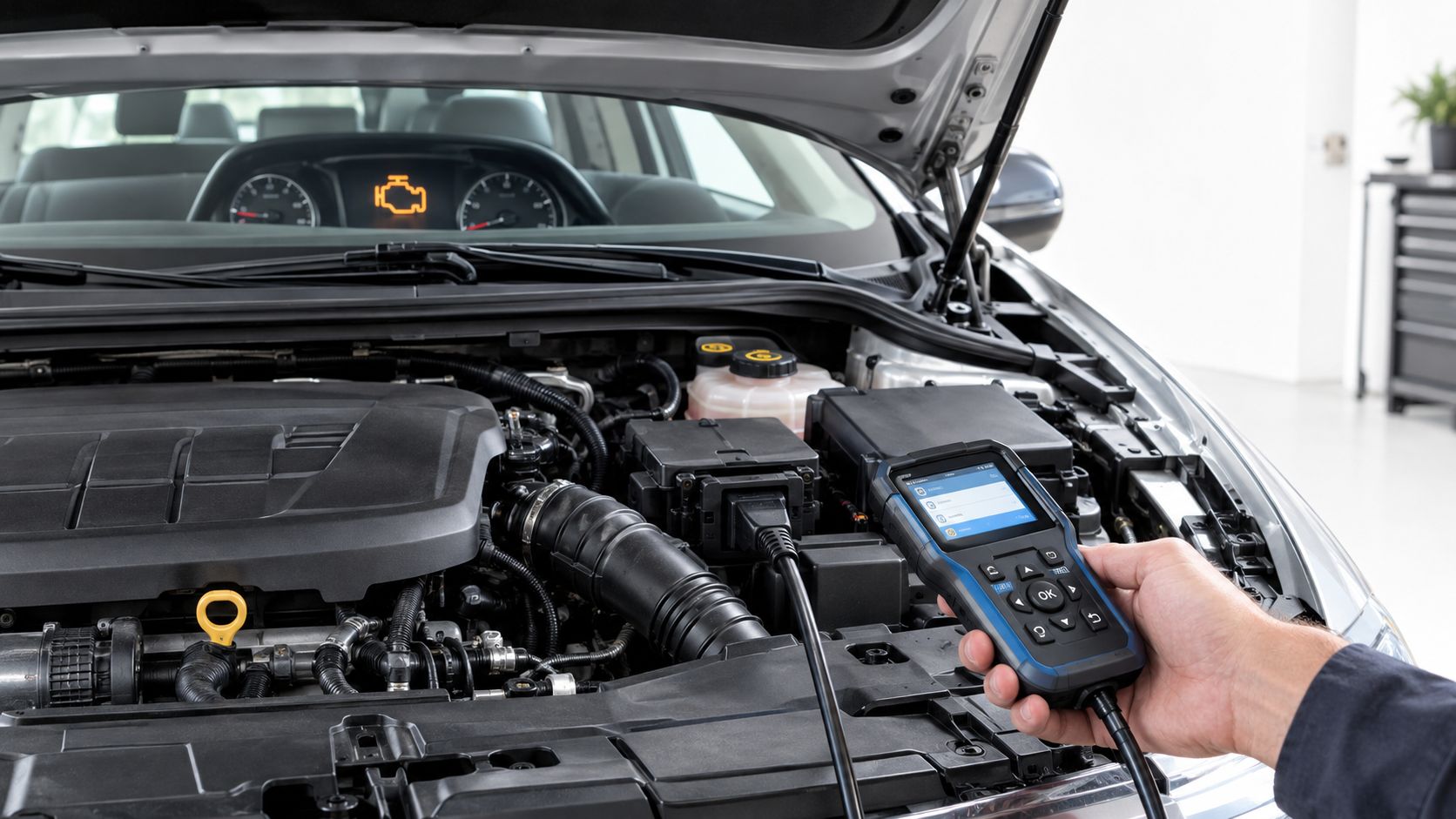
For instance, someone may buy a used car outside California or get a leased car back after service, only to discover that the battery was recently changed. The engine starts, the car drives normally, and there may be no warning light. But if the readiness monitors haven't completed their checks, the inspection may return an incomplete result rather than the pass the owner expected.
BAR advises drivers who recently disconnected or replaced a battery to drive normally for a week or two before testing so those monitors have time to reset (BAR guidance on Smog Check preparation). Clearing trouble codes just before an appointment can create the same problem: the warning might disappear temporarily, but the underlying issue may remain, and the monitors may still be incomplete.
Know the difference between incomplete and failed
An incomplete readiness result doesn't necessarily mean the car has failed because a component is defective. It means the system hasn't finished the checks needed for the inspection to determine readiness. A true failure can result from an emissions-system problem, including one indicated by the check-engine light.
If you're unsure, ask a repair professional to scan the vehicle before paying for a test. BAR's guidance on common reasons a vehicle can fail a Smog Check can also help you prepare questions. Don't assume turning off a warning light or clearing codes has fixed the issue.
A useful sequence is straightforward: check for warning lights, consider whether battery work or repairs happened recently, then book when the car is ready for testing. That's more reliable than using the appointment itself as a diagnostic step.
The following video offers another look at diagnostic checks and vehicle readiness.
What to Bring and How to Time Your Visit
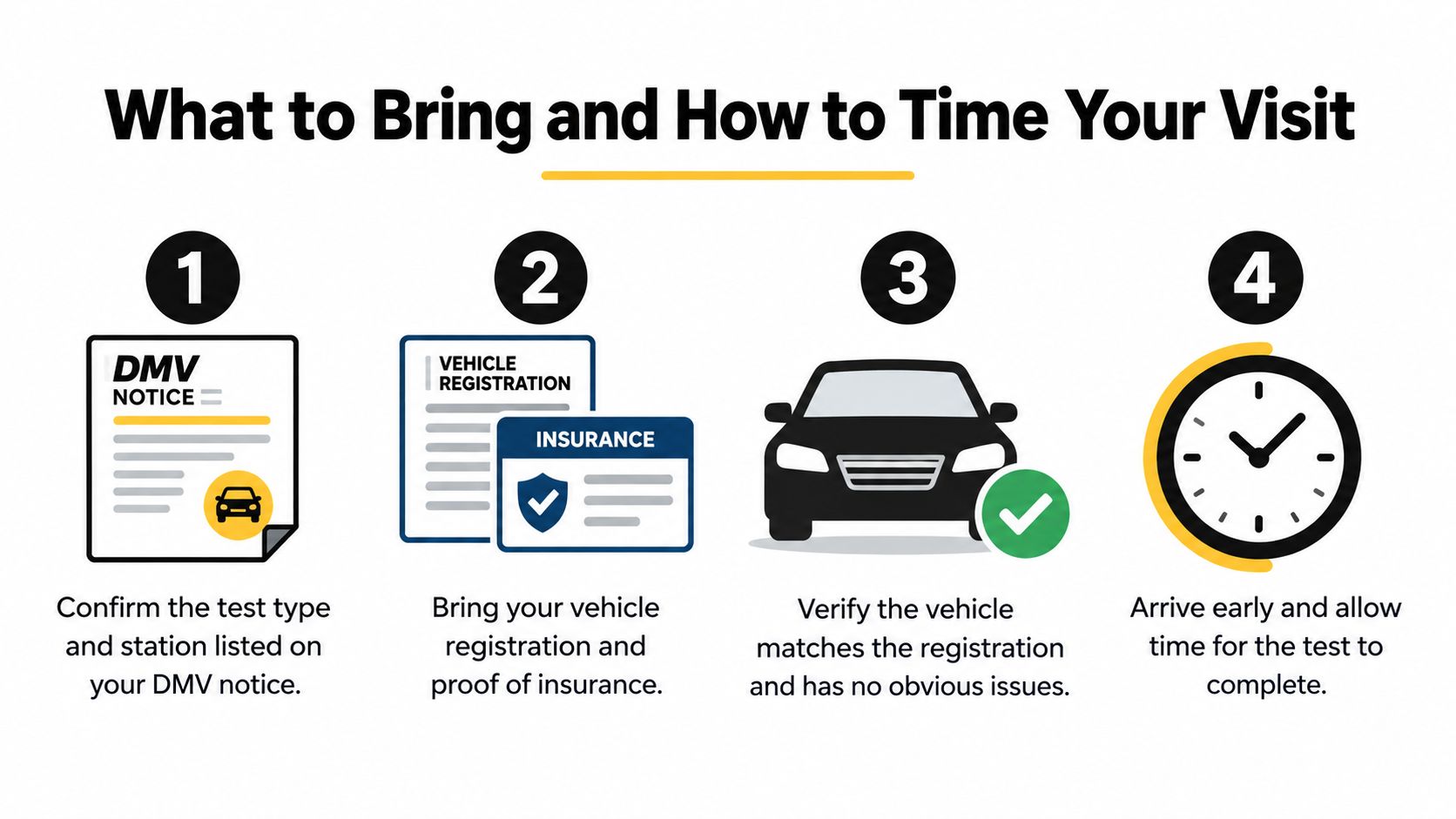
Make the DMV notice your first stop when preparing for the appointment. Confirm whether the vehicle needs STAR testing and check that the notice's vehicle details match the car you'll bring. If someone else is taking the vehicle, make sure they know what the notice requires.
Bring the vehicle's registration and proof of insurance, and be ready to confirm its model year, fuel type, and configuration. Accurate vehicle information matters because the inspection system uses vehicle details to select the correct test parameters. If the recorded information is wrong, the station may need to correct it before the inspection can be completed properly.
Choose a time that fits your day
If you're coming from Oakland Broadway, call ahead and ask about the likely wait for your particular test type. An early visit may suit a driver trying to avoid a busy period, but don't assume every station follows the same traffic pattern. Ask whether you need an appointment, whether the shop handles your vehicle, and how long you should allow.
Consider a 2017 hybrid whose owner sees a renewal notice requiring STAR testing. The owner should confirm STAR status, tell the station the vehicle is a hybrid, and avoid booking immediately after battery work. Those details matter more than choosing the shop that advertises the shortest visit.
The Smog Check preparation guide provides additional pre-visit guidance. If you're comparing costs, check whether a station currently offers a coupon for your vehicle type. Speedy Smog periodically advertises a $25-off coupon for most smogs on newer vehicles, so confirm the current terms before relying on it.
Before you leave, check:
- DMV instructions: Confirm whether the notice requires STAR.
- Vehicle details: Check that the car, fuel type, and model year are clear.
- Documents: Bring registration and proof of insurance.
- Readiness: Don't test immediately after battery work if monitors may need time to reset.
- Station fit: Confirm the shop can inspect your vehicle and the required test type.
If Your Car Fails, the Math Changes
If a vehicle fails, don't immediately pay for another test without understanding the result. First, keep the Vehicle Inspection Report. It records the inspection outcome and gives you and a repair shop a starting point for deciding what needs attention. Ask the station to explain whether the result was a failure or an incomplete test, and what the report says about the next step.
Your options may include a test-only station, which performs inspections but doesn't carry out repairs, or a test-and-repair station, which can diagnose and repair emissions-related issues as well as test the vehicle. The right choice depends on what the report shows, whether you have a mechanic you trust, and whether the vehicle may qualify for repair assistance.
Check assistance rules before paying for repairs
California's Consumer Assistance Program may provide qualified owners with up to $1,450 for emissions-related repairs on vehicles from model year 1996 onward, or up to $1,100 for vehicles from model years 1976 through 1995 (BAR Consumer Assistance Program repair assistance). The amounts are maximums, not automatic payments. Eligibility depends on program requirements, including a qualifying biennial inspection failure, and the vehicle can't have a tampered emissions system. A required STAR test-and-repair copayment also applies.
Some results, including aborted or manual-mode tests, don't qualify for assistance. That's another reason to preserve the report and check the program rules before authorizing work. The cheapest first test isn't always the least expensive route overall if you then need to arrange a separate diagnosis, repair, and retest.
Match the next step to the vehicle
For a newer gasoline car, use the inspection report to guide diagnosis, then ask whether assistance rules apply before approving emissions repairs. For a 1999-and-older vehicle, make sure the repair shop understands the tailpipe-testing path and the model-year requirements.
A diesel or hybrid owner should confirm that a prospective station and repair shop handle that vehicle type. If the DMV notice directs the vehicle to STAR, that requirement still governs where it can be tested. In each case, the sensible first move after a failure is the same: keep the report, clarify the result, and check eligibility before choosing between separate testing and repair services.
Where Broadway Drivers Usually End Up Going
A driver near Oakland Broadway usually has two workable paths: stay close to the corridor, or go a little farther for a station that matches the car. The better choice is the one that can legally run the exact inspection on the DMV notice. A shop can be five minutes away and still be the wrong stop if it lacks STAR authorization, cannot test a diesel, or uses the wrong method for an older gasoline vehicle.
Speedy Smog is a STAR Certified station at 15275 Washington Avenue in San Leandro. It tests newer and older vehicles, diesels, and hybrids, and typical tests for 2000-and-newer vehicles take about 10 to 15 minutes. The shop is open Monday through Saturday. Those details make it a practical option for drivers comparing a Broadway-area stop with a short trip to San Leandro, provided the station matches the vehicle and the DMV notice.
Compare the whole visit, not just the map
Distance is only the first filter. The question is whether the visit produces a result the DMV will accept. Ask three things before you go: Does the notice require STAR? Can the station inspect your model year, fuel type, and test method? If the car fails, will you need a separate repair shop anyway?
A fast advertised turnaround helps only when it applies to your vehicle and the lane is clear. A test-and-repair shop can save a second trip after a marginal result, while a test-only visit can keep the inspection independent if you already trust a mechanic. The cheapest coupon can also stop looking cheap if a failed result leads to a new diagnosis, a repair visit, and a retest at different addresses.
For an Oakland driver, the practical choice is the station that can legally inspect the vehicle and fits the day's needs. Verify authorization and vehicle fit first, then compare drive time and price.
Your Two Next Steps Before You Book
Start with the renewal deadline and count backward. If the date is still a few weeks out, a recently replaced or disconnected battery is a small problem: normal driving for a week or two lets the readiness monitors reset, as BAR advises. If the deadline is less than three weeks away and the battery was recently replaced, call the station today, describe the situation, and schedule the test for after the monitors reset.
When you call, give one complete sentence: model year, fuel type, and anything unusual such as a cleared check engine light. Then leave a buffer. A pass takes minutes, but a marginal result needs room for the Vehicle Inspection Report, a repair-assistance check, and a retest before the tags expire.
Speedy Smog offers STAR-certified smog testing in San Leandro for newer and older vehicles, diesels, and hybrids, with typical tests for 2000-and-newer vehicles completed in about 10 to 15 minutes. If you're comparing options for a Smog Check near Oakland Broadway, check your DMV requirements and vehicle details, then visit Speedy Smog.
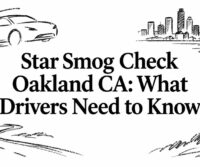
If your DMV renewal notice says “Smog Certification Required at a STAR station,” only an inspection at a STAR-certified location will satisfy the requirement. An ordinary licensed smog shop won't count.
You're probably holding that notice, checking your calendar, and wondering whether the shop around the corner can handle it. Before you drive over, check something just as important as STAR certification: does the station only test vehicles, or can it also diagnose and repair them? That distinction won't matter much if your car passes, but it matters a lot if it doesn't.
Table of Contents
- What a STAR Smog Check Actually Means for Oakland Drivers
- Why STAR Stations Exist and How Big the Program Is
- Which Vehicles and Renewals Get Routed to STAR
- Inside STAR Certification, Equipment and Performance Controls
- STAR Test-Only Versus STAR Test-and-Repair in Oakland
- How to Prepare Your Vehicle Before the Inspection
- Choosing a STAR Station and Planning Your Next Move
What a STAR Smog Check Actually Means for Oakland Drivers
STAR is a station certification, not just another name for a smog check. It tells you that the business participates in California's higher-performance inspection framework. For your renewal, the important question is whether the station has the authorization your notice requires.
California's Bureau of Automotive Repair, or BAR, established the voluntary, performance-based STAR program in 2013, replacing the former Gold Shield and Test Only structure, as described in the DMV's smog inspection guidance. Don't confuse that historical program change with today's station categories. A STAR-certified business can still operate as a test-only station.
Translate the wording before choosing a shop
A directed vehicle is a vehicle the state routes to a STAR station, typically after risk-based screening identifies a need for additional oversight. Treat that direction as a requirement about where the inspection happens, not as a diagnosis of what's wrong with your car.
My recommendation is straightforward: start with the renewal notice, not a coupon or a search result. When you're comparing results for STAR smog check Oakland CA, confirm the station's certification before asking about price or availability.
- Read the inspection wording. Find the smog requirement on your renewal notice rather than relying on what you remember from your last renewal.
- Confirm the location's status. Ask whether the specific location you'll visit is currently STAR-certified.
- Explain what you need. Tell the shop you have a STAR-directed renewal and identify your vehicle before heading over.
The notice is the starting point for the decision.
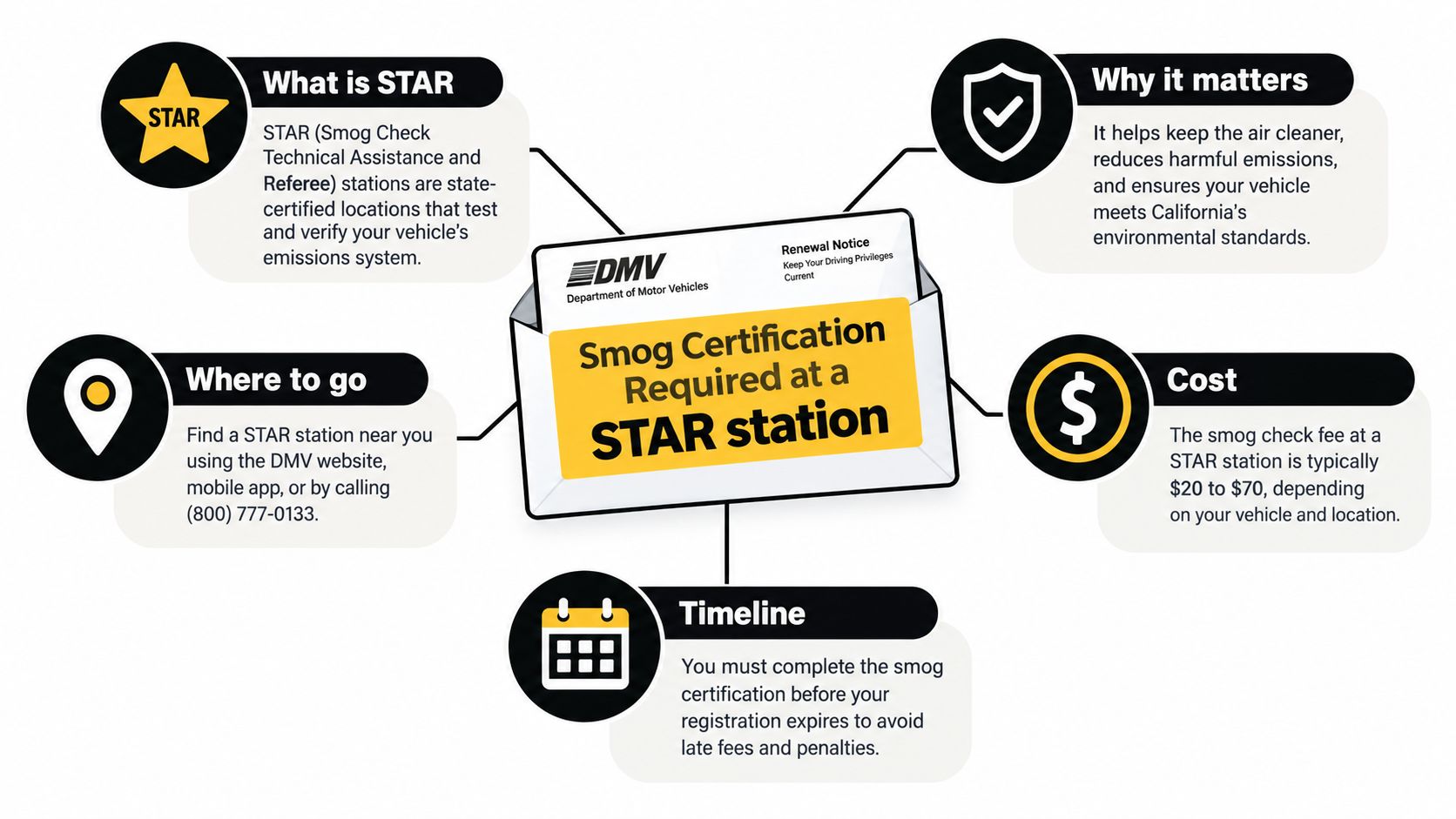
Don't read STAR as a promise that your car will pass. It describes the station's qualifications and authorization, not your vehicle's condition. A proper inspection gives you a result you can act on, even when that result isn't the one you wanted.
Why STAR Stations Exist and How Big the Program Is
STAR isn't a boutique designation used by a small corner of California's inspection industry. The program has handled a substantial share of statewide testing, which helps explain why the name appears so often in East Bay smog searches.
By December 2019, California had 7,902 licensed Smog Check stations, including 3,882 STAR-certified stations, or 49%; those STAR stations performed about 8.4 million of roughly 10.3 million initial inspections, approximately 82% of the statewide total, according to BAR's Smog Check performance report.
What that historical snapshot tells you
Fewer than half of the licensed stations handled more than four-fifths of the initial inspections in that reporting year. My reading is that STAR was already a central part of California's inspection infrastructure, not an unusual service drivers rarely needed.
That doesn't establish why every customer chose a particular station. The figures don't separate drivers following a DMV direction from drivers choosing STAR voluntarily. They also don't tell you how busy an Oakland shop is today or how long you'll wait.
Practical perspective: Use statewide figures to understand the program's importance, not to predict the queue at your neighborhood station.
The graphic provides a visual overview of the program. Use the dated BAR figures above, rather than illustrative totals in the graphic, for numerical comparisons.
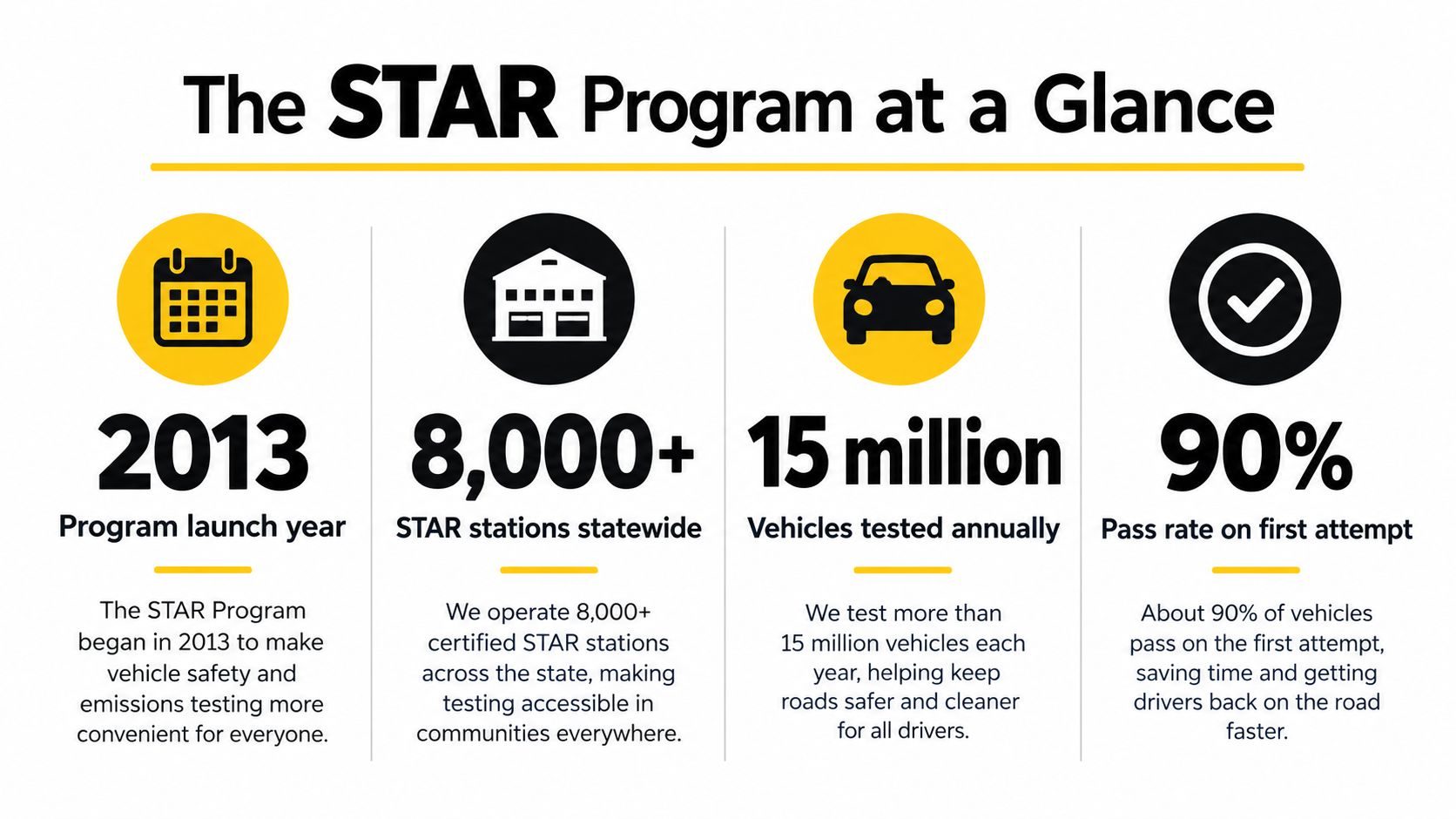
For an Oakland driver, the useful distinction is ordinary licensing versus additional performance monitoring. BAR uses STAR to identify stations within that monitored framework and authorize them to inspect directed vehicles.
Don't turn inspection volume into a claim that every STAR business offers the same experience. Certification doesn't answer whether a shop performs repairs, publishes a clear price, or has an appointment available when you need it. Those are separate questions, and you should ask them directly.
Which Vehicles and Renewals Get Routed to STAR
Your neighbor's renewal isn't a reliable guide to yours. Neither is the fact that your vehicle is older, newer, diesel-powered, or a hybrid. Read your own notice before deciding what inspection to book.
The state's directed-vehicle screening explains why some renewals carry a STAR instruction, but you shouldn't try to reconstruct that decision from your car's age alone. A direction to STAR tells you where to go. It doesn't tell you which component will fail or whether a repair is necessary.
Check the notice, then identify the vehicle
Use this pre-booking checklist to keep the conversation with the shop specific:
- Find the smog requirement. Read the actual renewal wording, including the area around the barcode. Don't substitute a generic reminder email for the notice.
- Separate STAR from other wording. If your paperwork doesn't specify STAR, don't assume the extra requirement applies. If the instructions are missing or unclear, confirm them with DMV before buying an inspection.
- Describe the vehicle accurately. Give the station the model year, make, and fuel type so it can confirm that it handles the appropriate inspection.
- Flag uncertainty early. Tell the shop if you're unsure which notice belongs to the vehicle or whether you're handling a renewal rather than another registration situation.
For broader context, review these California smog check rules, then use your vehicle-specific paperwork to make the booking decision.
Bring the notice and keep the report
During the inspection workflow, the inspector scans the renewal-notice barcode so the correct vehicle identification and inspection data are transmitted to DMV. You receive a Vehicle Inspection Report, commonly called a VIR, for your records.
Keep that report where you can find it. It's useful documentation whether you're finishing the renewal process or discussing an unsuccessful inspection with another provider.
Don't leave with only a verbal explanation. Keep the written inspection result.
For owners of older cars, the sensible approach is to discuss existing problems before testing. For diesel and hybrid owners, confirm the station handles the vehicle rather than assuming every shop has the same capabilities. Newer-vehicle owners should still follow their own paperwork, not a blanket statement that newer cars never need inspection.
Inside STAR Certification, Equipment and Performance Controls
A STAR badge reflects technical requirements, not just a business's decision to advertise emissions testing. BAR evaluates equipment readiness and inspection-performance measures, which is why the designation deserves more attention than a storefront sticker.
Under BAR's STAR certification requirements, a certified station must maintain at least one operational BAR-certified BAR-97 emissions inspection system and BAR On-Board Diagnostic Inspection System, or BAR-OIS, and equipment requiring calibration must pass calibration at least once every 10 calendar days. The performance thresholds in the table are part of those same requirements.
STAR Certification Performance Thresholds
| Metric | Required Threshold | What It Means |
|---|---|---|
| Similar Vehicle Failure Rate | At least 50% of the industry-wide failure rate for comparable vehicles | BAR compares the station's failure results with a comparable-vehicle baseline. |
| Gear-shift incidents | No more than 2% | The station must stay within the permitted incident limit. |
| Excessive Test Deviation Rate | No greater than one | BAR limits excessive deviations in testing performance. |
| Follow-up Pass Rate | At least 0.40 for the station or each applicable inspector | Follow-up inspection performance contributes to STAR eligibility. |
Don't mistake the Similar Vehicle Failure Rate for a quota requiring an inspector to fail your car. It's a comparative station-performance measure, not a prediction about an individual vehicle. Likewise, the Follow-up Pass Rate isn't your personal probability of passing.
What the controls mean for a customer
The equipment requirement matters because a station needs the appropriate operational systems, not an inspector willing to take the job. Calibration matters because applicable equipment must remain within BAR's required checks. Performance monitoring adds another layer beyond the fact that a business holds an ordinary license.
My advice is to judge STAR as evidence of regulated inspection controls, not as a guarantee of flawless customer service. You still need clear communication about the inspection price, the vehicle types accepted, and what the station will do if the result is unsuccessful.
- Ask about your vehicle. Confirm the station can inspect its model year and fuel type.
- Ask about its service category. Equipment and certification don't establish whether repairs are offered.
- Expect a documented result. The inspection should leave you with something concrete to review, not just reassurance.
You don't need to audit a shop's performance calculations yourself. You do need to understand that STAR is technical, and that choosing the right station involves more than spotting the word on a sign.
STAR Test-Only Versus STAR Test-and-Repair in Oakland
A STAR station is not automatically a repair facility. This is the distinction I'd settle before making an appointment, especially if the vehicle already has a warning light, a previous unsuccessful inspection, or an unresolved concern.
BAR distinguishes STAR test-only stations from STAR test-and-repair stations. Both categories can inspect directed vehicles, but test-only stations don't perform repairs, while test-and-repair stations combine inspection with repair services, as explained in BAR's Smog Check program guidance.
The practical difference is what happens after the result.
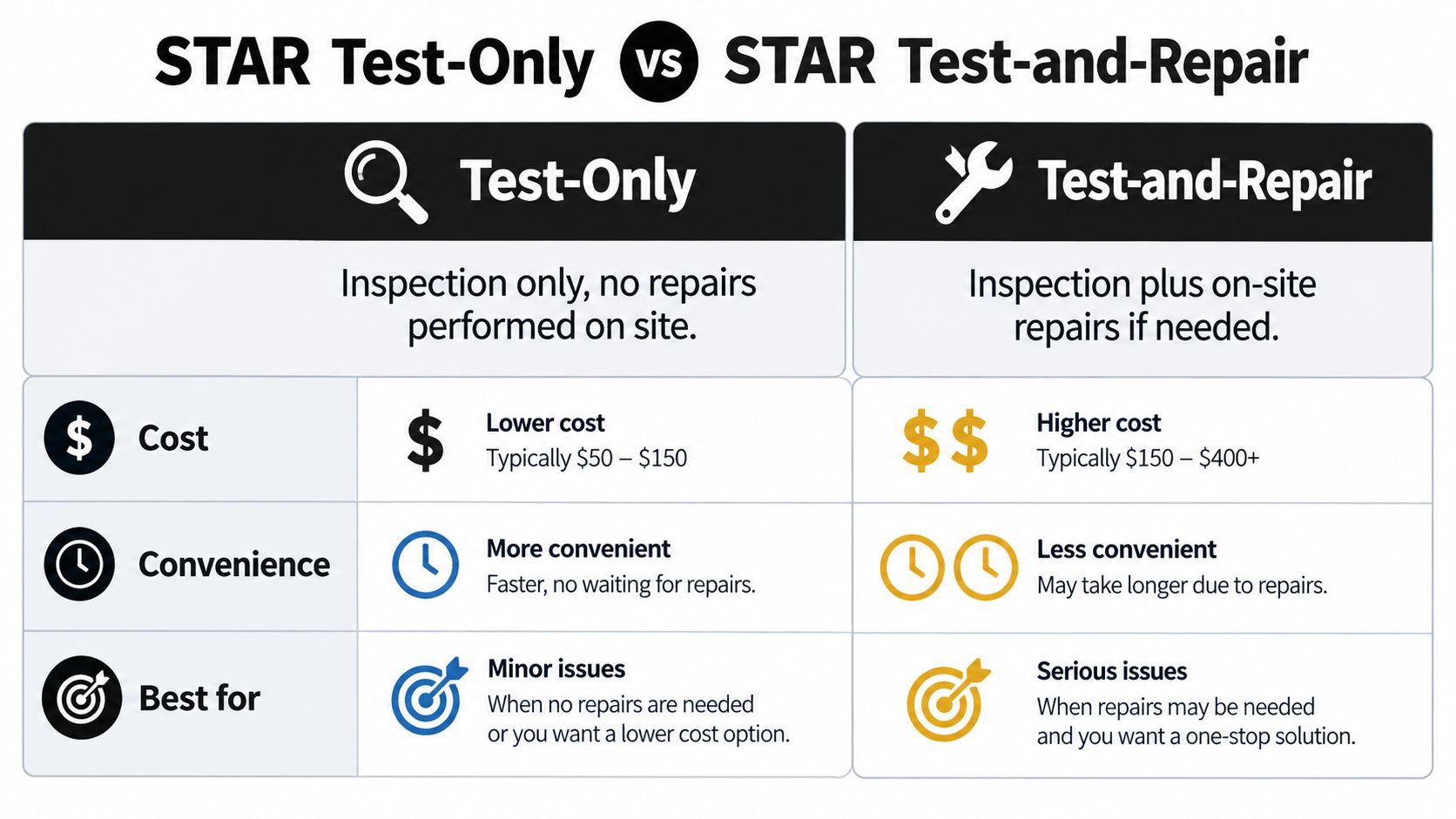
Choose based on the service you want
A test-only station makes sense when you want the inspection as a separate service and already have a repair provider you trust. If the vehicle fails, you'll need a separate repair plan. Don't expect the inspector to turn the visit into an on-site repair appointment.
A test-and-repair station makes sense when you want the possibility of diagnosis and repair at the same business. That can simplify coordination, but it doesn't mean you should authorize work without an explanation. Ask what diagnostic work is proposed, what it costs, and what the estimate includes.
| Your priority | Category to consider | Question to ask |
|---|---|---|
| Keep inspection separate from repairs | STAR test-only | What happens if the vehicle doesn't pass? |
| Seek inspection and repair at the same business | STAR test-and-repair | Can you diagnose this vehicle, and when is repair service available? |
| Avoid an unclear bill | Either category | What's included, and what would be charged separately? |
For a more focused comparison, use this explanation of STAR stations versus test-only stations. Don't choose by category alone, then forget to confirm the actual services available.
An unsuccessful test needs a plan
The equipment controls already discussed aren't optional. BAR warns that using the wrong inspection equipment can trigger a citation and order of abatement. A station shouldn't improvise a process just to accommodate the vehicle.
An unsuccessful result also doesn't mean the station can waive it or automatically repair the cause. Ask for an explanation tied to the written report before approving work.
Before authorizing repairs: Separate the inspection finding, the proposed diagnosis, and the repair estimate. They aren't interchangeable.
DMV identifies the BAR Referee Program as a next-step resource for failed-test customers and notes that eligible owners may receive repair help through the Consumer Assistance Program. Investigate those options when appropriate rather than assuming every unsuccessful inspection requires an immediate, open-ended repair authorization.
How to Prepare Your Vehicle Before the Inspection
Preparation starts with knowing whether you're bringing a vehicle for an inspection or bringing an unresolved problem that needs diagnosis first. Don't expect a quick visit to answer every maintenance question.
California recorded more than 11.2 million initial tests in 2025, with 959,667 initial failures, an 8.51% failure rate; STAR test-only stations performed 5,916,245 initial tests, with 481,639 failures, an 8.14% rate, according to BAR's statewide executive summary. Those figures establish that unsuccessful inspections occur, not that any particular preparation trick guarantees a pass.
A basic vehicle check is a sensible starting point.
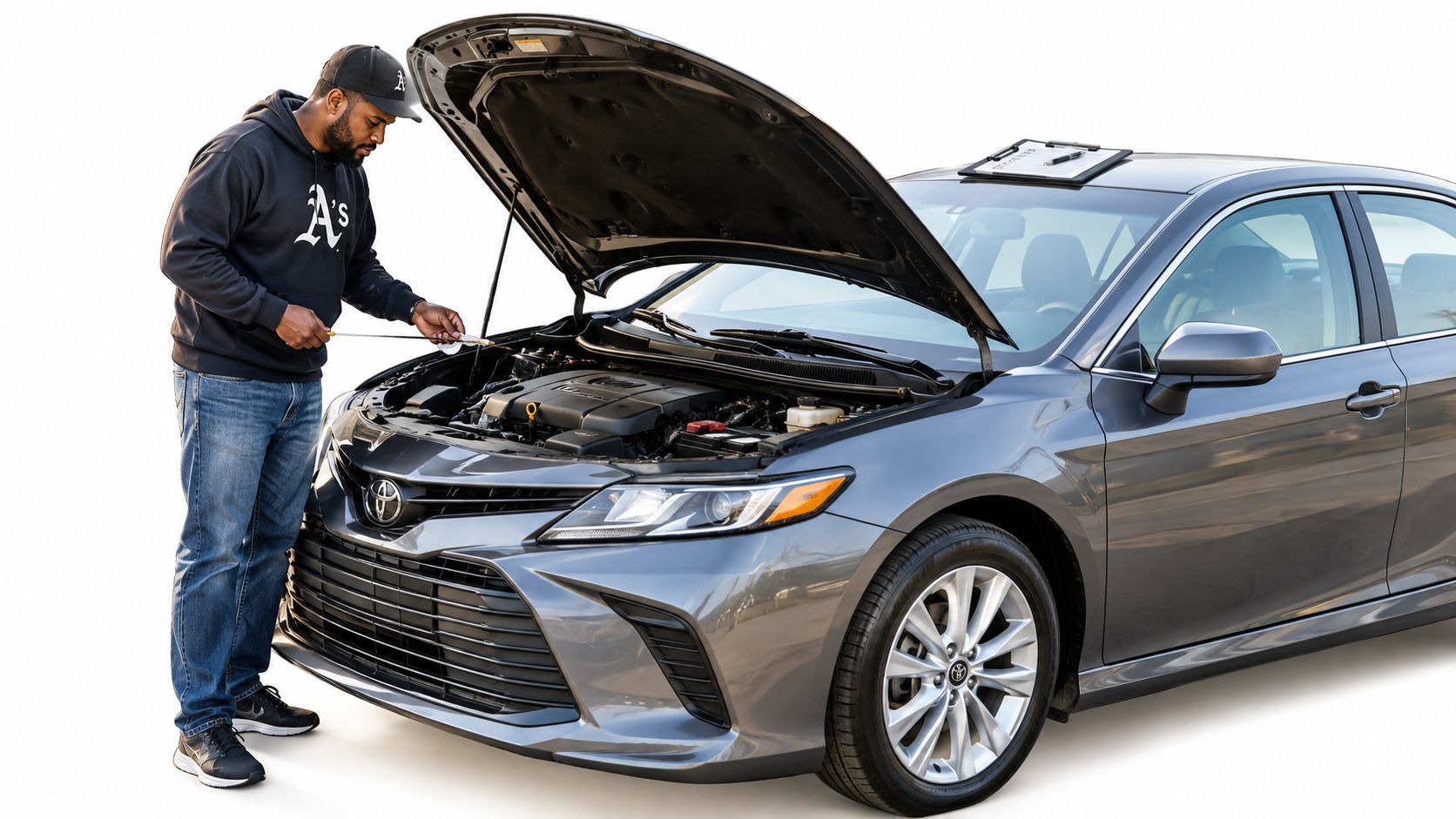
The day before your visit
- Discuss warning lights. If a dashboard warning is illuminated, tell the shop before booking. Ask whether diagnosis should come first rather than trying to hide the symptom.
- Review obvious maintenance concerns. Check for visible tire problems and, where applicable, a missing or damaged gas cap. Treat these as maintenance observations, not guaranteed explanations for a smog failure.
- Ask about arrival preparation. Get vehicle-specific advice on whether a normal drive before arrival is appropriate. Don't follow a universal warm-up routine copied from another vehicle.
- Gather your paperwork. Put the renewal notice somewhere you won't forget it, and bring relevant previous inspection or repair records.
For additional preparation guidance, consult this STAR smog test preparation guide before the appointment.
Use the video below as supplementary viewing, not a substitute for instructions specific to your car.
On the morning of the visit, ask about the current queue and total time you should allow. Inspection time and time at the shop aren't the same thing. Leave room in your schedule to hear the result and ask questions without rushing.
Choosing a STAR Station and Planning Your Next Move
Choose the station around the whole visit, not just the advertised inspection price. You need the correct authorization, the service category you want, and a clear explanation of what happens afterward.
An Oakland location may be convenient, while a nearby San Leandro station may fit your route better. Compare actual availability and services rather than assuming the closest search result is the right match.
Settle the practical details before driving over
- Get the complete price. Ask what's included, what's separate, and whether any advertised offer applies to your vehicle.
- Check the schedule. Confirm current weekday or Saturday availability and whether you need an appointment.
- Ask about waiting arrangements. If an indoor waiting area matters to you, verify it rather than relying on an old photograph.
- Establish the repair boundary. Know whether the business provides inspection only or can offer diagnosis and repairs.
After a passing result, keep your paperwork and confirm the remaining renewal steps. After an unsuccessful result, review the report and choose the next action deliberately: diagnosis, repair, or an appropriate state assistance resource.
A convenient inspection is useful. A clear plan for either result is better.
Don't leave this until the last moment if you can avoid it. Give yourself room to address a problem without making rushed decisions about repairs. The goal is a compliant renewal and a result you understand, not merely the shortest stop on your errands.
For Oakland drivers considering nearby San Leandro, Speedy Smog offers STAR-certified emissions testing with an indoor waiting area and service for older and newer vehicles, diesels, and hybrids. Visit its website to check current pricing and availability, then confirm your vehicle's inspection needs and the station's service scope before heading over with your DMV renewal notice.
The DMV envelope arrives, and the whole week suddenly has one extra errand attached to it. If you live in Oakland, that usually means figuring out whether your car needs a Smog Check, where to take it, and whether the notice is pointing you to a regular station or a STAR station. The easiest way to handle it is to treat the test like a small DMV project, not a mystery chore.
Table of Contents
- What Oakland Drivers Should Know Before Booking a Smog Check
- How California's Smog Check Program Works
- DMV Compliance and What Your Renewal Notice Means
- Vehicle Eligibility and How Model Year Changes the Test
- Preparing Your Vehicle the Week Before the Test
- What the Appointment Itself Looks Like
- Turnaround, Results, and What Happens If You Fail
- Putting It All Together for Oakland Drivers
What Oakland Drivers Should Know Before Booking a Smog Check
A smog check Oakland CA search usually starts the same way, with a renewal notice in hand and a deadline in front of you. That notice matters more than the shop sign outside, because it tells you what kind of inspection your vehicle needs and whether the state wants a higher-oversight station.
The fastest way to avoid a wasted trip is to answer five questions before you book. First, is the vehicle due for a Smog Check under California rules. Second, does the renewal notice call for a STAR station. Third, is your vehicle older, newer, diesel, or a hybrid, because that changes the test. Fourth, have you done the basic prep work in the days before the appointment. Fifth, do you know what the visit itself will look like.
Practical rule: the renewal notice is the real starting point, not the first shop result you find online.
That framing saves time because the state treats this as a registration step, not an optional maintenance add-on. For Oakland and East Bay drivers, the whole process is tied to DMV renewal, so the cleanest path is usually to read the notice, match the station type, and then book the right kind of inspection the first time.
How California's Smog Check Program Works
A smog check in California is part of the state's registration system, not a separate errand you handle on its own. The Bureau of Automotive Repair sets the rules for qualifying vehicles, and the inspection usually happens as part of renewal, so the DMV and the test move together. California Smog Check performance report
Why STAR exists
STAR certification creates a higher-oversight network for vehicles that need closer review. STAR stations are part of the state's testing framework, not just a marketing label, and California reported that by December 2019 there were 7,902 licensed Smog Check stations statewide, including 3,882 STAR stations, or 49% of the total. During calendar year 2019, roughly 10.3 million initial Smog Check tests were performed statewide, and about 8.4 million, or 82%, were completed by STAR stations, as reported in the same BAR performance report.
For an Oakland driver, the key point is simple. The rules do not change by neighborhood. Whether the car is tested in Oakland, San Leandro, or somewhere else in California, the result feeds into the same state reporting system and is sent to the DMV electronically. If the renewal notice calls for STAR service, the station must be authorized for that category or it cannot finish the certification.
DMV Compliance and What Your Renewal Notice Means
The renewal notice is where the DMV turns a general rule into a specific instruction. If it flags the vehicle for a Smog Check, the notice is telling you that registration renewal depends on a passing certificate, and if it identifies the car as directed or otherwise STAR-required, the wrong station can't complete the certification.
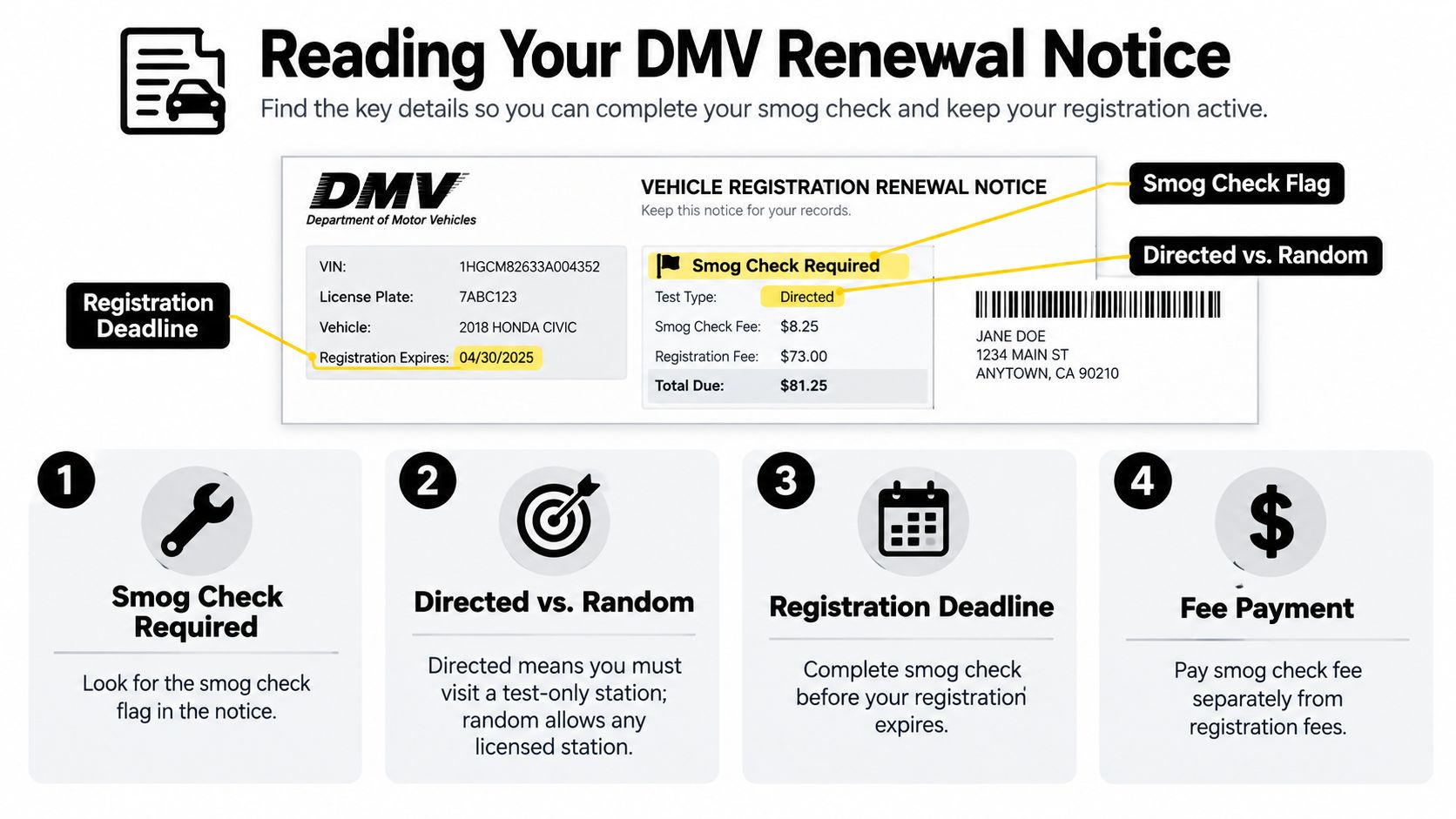
Regular station or STAR station
A STAR station is the one the state authorizes for vehicles that need enhanced oversight, much as a referral sends a patient to a specialist. A regular licensed station can handle many inspections, but STAR programs require these facilities to maintain compliant licenses, required inspection equipment, adequate inspection volume for statistical review, and specific performance measures, including a Similar Vehicle Failure Rate of at least 50% of the industry-wide failure rate for comparable vehicles and a gear-shift incident rate no higher than 2% of certified vehicles. STAR certification requirements
If your notice requires STAR service and you go to a station that isn't STAR-certified, you can lose time without moving the registration forward. That's why the notice deserves a close read before you book. If the wording is confusing, compare it with your registration status and, if needed, ask the station to confirm that the vehicle type on the notice matches its current authorization.
For Oakland-area drivers who want a plain-English walkthrough of renewal timing and station selection, this guide to registration renewal and smog check steps is a useful companion.
Practical rule: the renewal notice decides the station category first, and the appointment time second.
Payment usually follows the test result through DMV's electronic system, so the important thing is not to collect paperwork for its own sake. The important thing is to get the right certificate into the state system so registration can move ahead.
Vehicle Eligibility and How Model Year Changes the Test
Vehicle age changes the inspection path more than most drivers expect. California BAR says most 2000-and-newer gasoline and alternative-fuel vehicles get an OBD-based inspection, while pre-2000 vehicles generally receive a tailpipe emissions test instead. That's why two cars with the same renewal notice can end up going through very different checks.
What the model year tells the inspector
The state's 2025 executive summary shows why age matters. A 2024 vehicle recorded 100,305 initial tests and 4,538 failures, for an 4.52% overall failure rate. A 2010 vehicle recorded 314,125 initial tests and 28,718 failures, for 9.14%. A 2008 vehicle recorded 367,600 initial tests and 34,834 failures, for 9.48%. A 1998 vehicle had 100,885 initial tests and 19,185 failures, for 19.02%. 2025 Smog Check executive summary
| Model Year | Initial Tests | Overall Failures | Overall Failure Rate |
|---|---|---|---|
| 2024 | 100,305 | 4,538 | 4.52% |
| 2010 | 314,125 | 28,718 | 9.14% |
| 2008 | 367,600 | 34,834 | 9.48% |
| 1998 | 100,885 | 19,185 | 19.02% |
That table doesn't mean every older car will fail. It does show the pattern: as vehicles age, inspection risk rises. For drivers who want a practical breakdown of which cars fall into which testing path, this California smog check vehicle guide is a useful reference.
Why OBD readiness matters
For 2000-and-newer vehicles, the test isn't just a quick visual look. The inspector checks diagnostic trouble codes, emissions-system operation, and readiness monitors. BAR advises delaying the test after a battery disconnect or replacement because the monitors may still be incomplete, and it recommends driving the vehicle for roughly one to two weeks under varied conditions before retesting. California Smog Check guidance
A newer car can look fine and still be too early for the test if the monitors haven't set yet.
Preparing Your Vehicle the Week Before the Test
A passing result is often decided before the appointment day arrives. If the check-engine light is on, that's not a paperwork problem, it's a vehicle problem, and clearing the code right before the test doesn't fix the underlying fault. The car may still show incomplete monitors, which can still lead to failure.
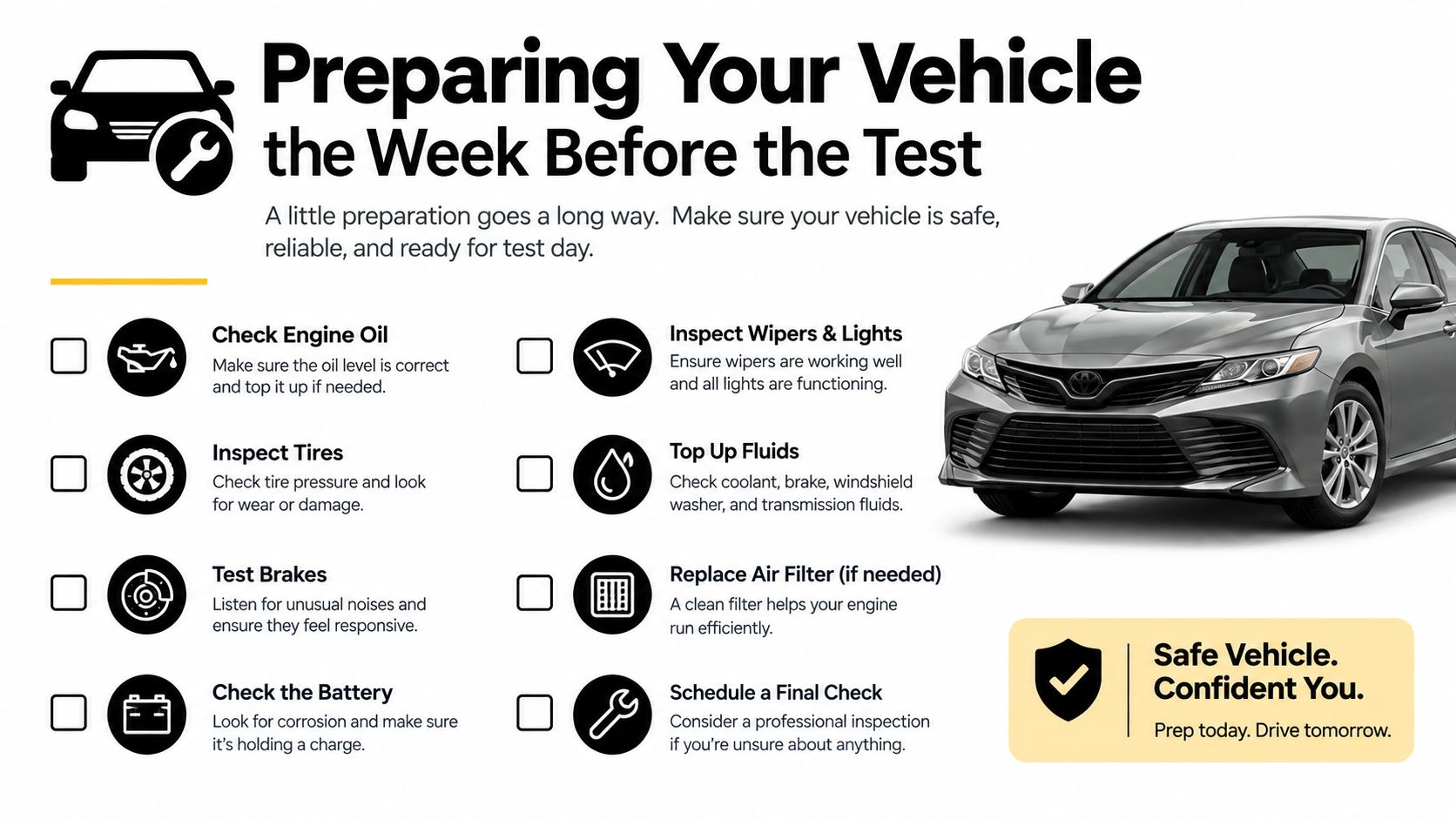
A simple prep routine
Think of readiness monitors like homework the car has to finish. You can't cram them into place five minutes before the test, and a battery disconnect is like erasing the assignment halfway through. The best preparation is boring in the right way.
- Watch the warning lights: If the check-engine light comes on during normal driving, fix the cause before you book the test.
- Drive normally: Mix city streets and steady-speed driving so the monitors can complete.
- Avoid last-minute battery work: A recent disconnect or replacement can leave the monitors incomplete.
- Warm the vehicle up: Arrive with the car at normal operating temperature, not just started a minute before.
- Bring the notice: Have the renewal notice and a payment method ready so nothing slows the check-in.
One more detail matters for Oakland drivers with older cars and diesels. If you've just had repairs, give the car enough time to settle into normal operation before the appointment. A clean run on paper doesn't help if the vehicle's diagnostic system hasn't had time to confirm that everything is working again.
Practical rule: repair first, drive second, test third.
What the Appointment Itself Looks Like
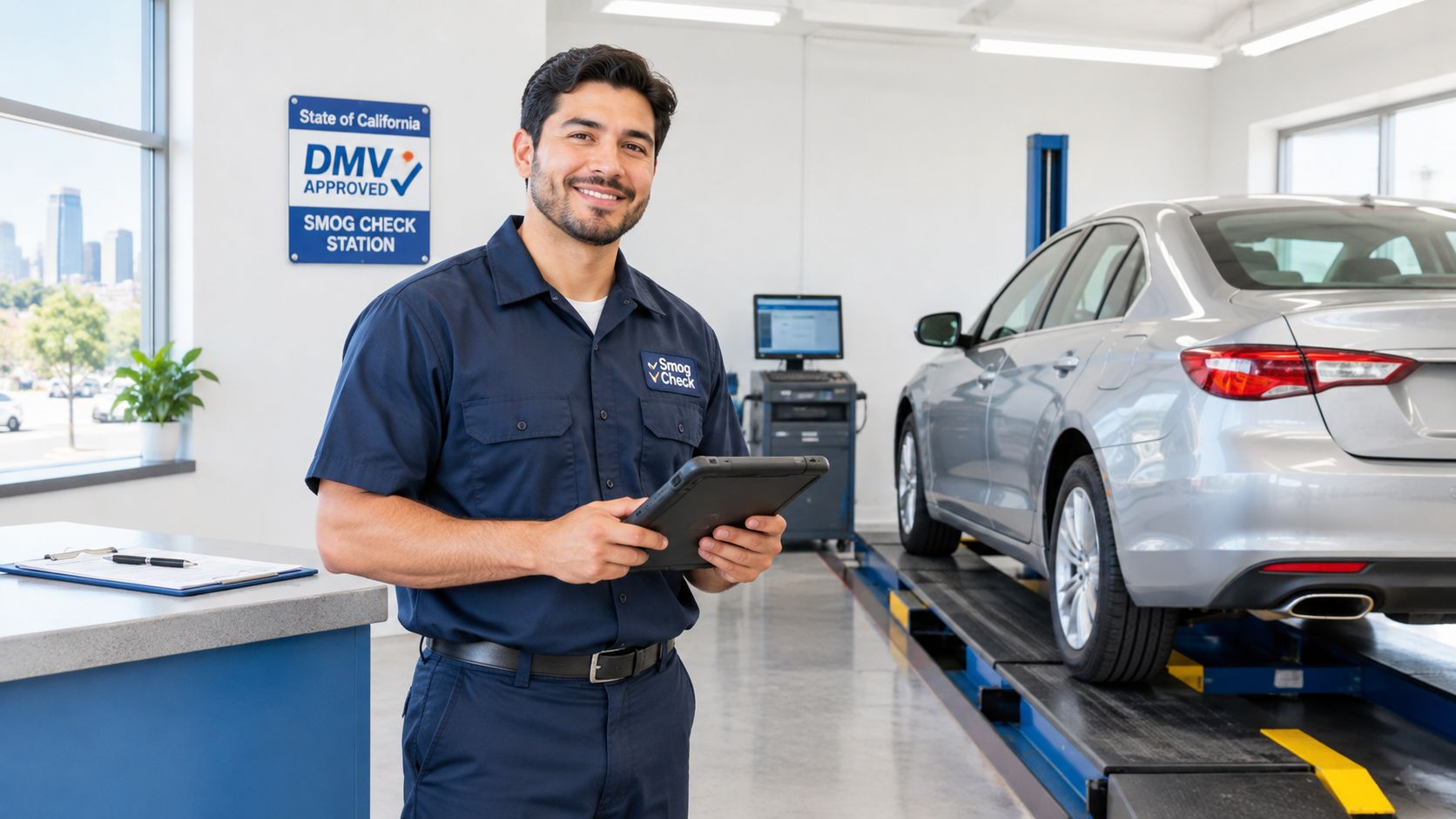
A typical visit feels more like a quick medical intake than a long repair appointment. You arrive, the station confirms the vehicle and paperwork, the inspector takes the car through the required test, and the result gets sent electronically to DMV. For 2000-and-newer vehicles, the test portion is commonly completed in about 10 to 15 minutes, which is why these visits often move faster than drivers expect.
What changes from one vehicle to another
The basic flow is the same, but the inspection time can stretch if the vehicle is older, if the test uses a tailpipe procedure, or if the station is busy. STAR status usually matters to the driver mainly in paperwork and eligibility, not in some dramatic visible difference at the counter. A STAR-certified shop such as Speedy Smog in San Leandro can handle the higher-oversight categories the state requires, including vehicles that need STAR authorization, while still testing many routine Oakland-area vehicles as part of the same DMV process.
The key point is that the station is not handing you a paper certificate to carry around. It's sending the result electronically, which is why the visit can feel short even though the compliance step is important. If the vehicle passes, you're done with the inspection piece. If it doesn't, the station should tell you what blocked approval so you can decide on repairs.
Turnaround, Results, and What Happens If You Fail
A passing result is useful because it clears the DMV hurdle right away. The station transmits the certificate electronically, and that certificate, not a paper receipt, is what helps unblock registration renewal. The old-style handoff of paperwork has mostly been replaced by instant digital reporting.
If the car fails
A failure doesn't end the registration process, it just means the car needs work before it can be certified. The inspection report is the starting point for diagnosis, and the next step is usually repair, then a retest once the vehicle is ready.
If you're trying to keep costs predictable after a repair visit, some stations offer discounts or coupons toward a return visit. One concrete example is the periodic $25-off coupons for newer vehicles mentioned by East Bay shops, which can soften the cost of a second trip after the underlying issue has been fixed. For a closer look at how stations present results and follow-up steps, see this smog test results guide.
The important thing is not to confuse a receipt with a certificate. The receipt shows you paid for the visit. The certificate is what the DMV cares about.
Putting It All Together for Oakland Drivers
The smartest move is to treat the renewal as three small jobs. First, read the DMV notice closely and confirm whether STAR service is required. Second, get the car ready by handling any warning lights, driving enough for monitors to set, and avoiding last-minute battery interruptions. Third, book a station that can legally handle your vehicle type and finish the certificate correctly.
That approach takes the uncertainty out of the process. The state rules decide the test type, the vehicle decides the inspection path, and the renewal notice decides the station category.
If you want a San Leandro station that handles Oakland-area renewals for routine inspections, STAR-required vehicles, diesels, hybrids, and older cars, Speedy Smog is set up for that workflow. Bring the notice, bring the car ready to test, and turn the smog check into one clean DMV task instead of a week of guesswork.
If you need a straightforward East Bay smog check with clear station guidance, Speedy Smog handles the inspection and electronic certificate process in one visit. Their team works with Oakland drivers, STAR-required renewals, and a range of vehicle types, so you can get the DMV step finished without extra back-and-forth.
A typical smog inspection runs about 20 to 30 minutes under California BAR guidance, and the emissions portion on a ready 2000 or newer vehicle can often be finished in about 10 to 15 minutes at an efficient station. If you're staring at a renewal deadline, the key question isn't just how long the bay visit takes, it's whether your car is ready to pass.
Table of Contents
- What Smog Check Time Means for Drivers
- How an Inspection Works in the Bay
- The Biggest Factors That Speed Up or Slow Down Your Visit
- Why a Faster Station Does Not Always Mean Faster Certification
- Pre-Appointment Checklist for the Shortest Possible Wait
- What a STAR Certified Station Brings to the Timeline
- Setting Realistic Expectations for Your Visit
What Smog Check Time Means for Drivers
You pull into the station expecting a quick stop, and that is fair. The mistake is treating every smog check like the same job, because smog check time depends on what the inspector has to do, not just how fast the lane looks.
California's Bureau of Automotive Repair puts a typical inspection at about 30 minutes because the inspector is not only measuring emissions, they are also selecting the correct procedure, checking components visually, running the required functional tests, and recording the result. BAR's STAR guidance also says a full inspection often takes 20 minutes or more, with faster outcomes possible when the inspector knows the vehicle well and the car is straightforward to test. BAR smog check guidance
The honest split between regulation and shop speed
The 20 to 30 minute range is the safe planning number. It covers the whole inspection, not just the machine reading.
The 10 to 15 minute number is the shop workflow goal for a ready newer vehicle, especially when the car shows up with no warning lights, no weird configuration issues, and no extra diagnostic work. That is a real-world speed target, not a promise that every vehicle gets the same treatment. BAR also ties inspection time to vehicle age, fuel type, inspection type, and the condition of emissions-control parts.
Practical rule: plan for the regulatory range, then be pleasantly surprised if your newer vehicle moves through faster.
If you want the cleanest way to think about it, separate the bay visit from the readiness problem. The bay visit is the part you can control on the day, but the readiness monitors can keep a car from being testable for two weeks or more after repairs or battery loss. Most drivers budget for the bay visit and forget that the car may need time before it is even ready to certify.
How an Inspection Works in the Bay
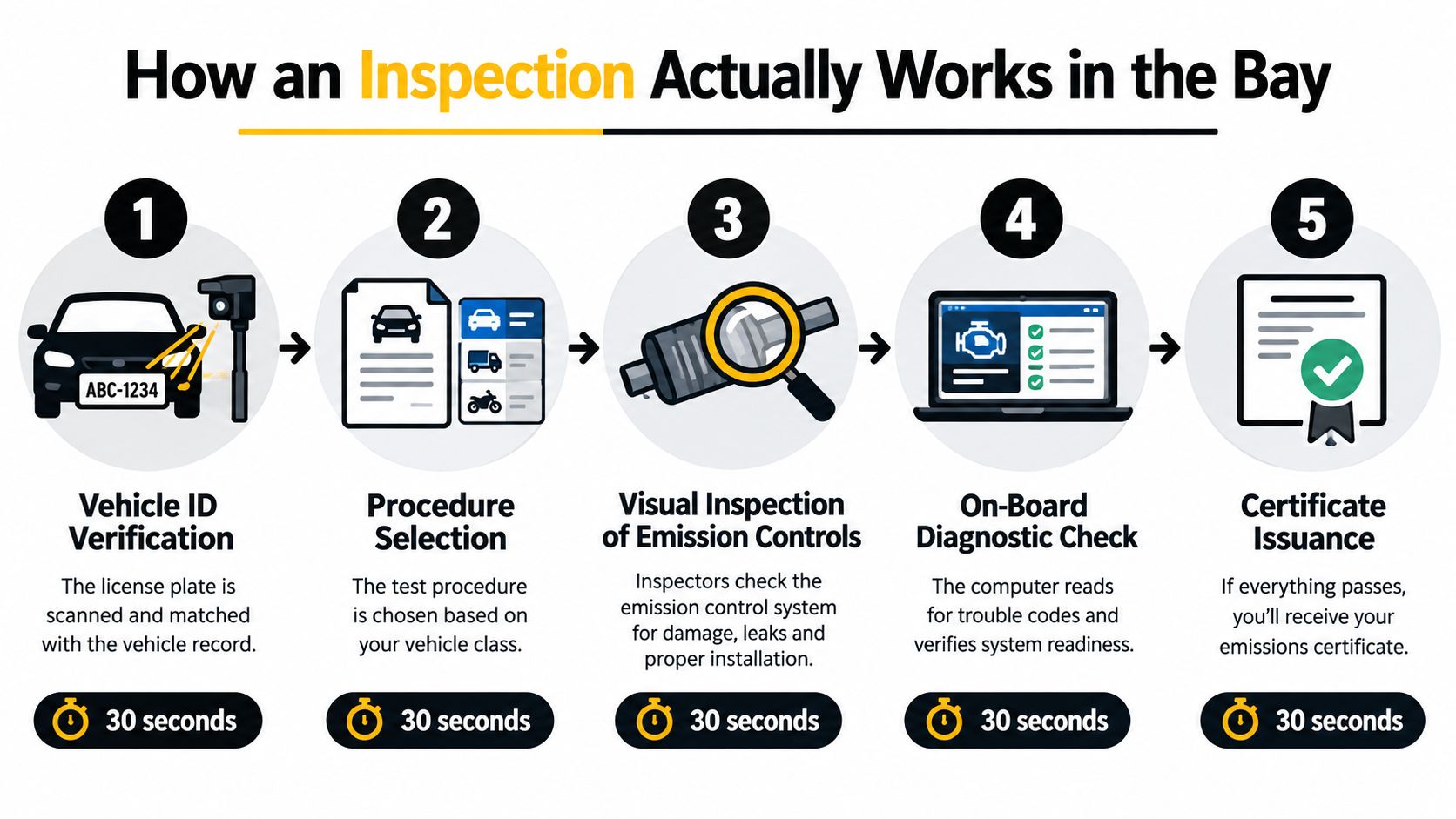
From the waiting room, the bay move looks like one machine reading. In practice, the inspector works through a fixed sequence that cannot be shortened.
What happens before the certificate
First comes vehicle identification and procedure selection. The inspector has to confirm what the car is, because the test changes by model year, fuel type, and equipment.
Then comes the visual inspection. That means checking for required emissions-control parts, confirming they are present, and spotting modifications that change the approved procedure. After that, the inspector runs the functional checks and pulls the required data from the vehicle.
For 2000 and newer gasoline vehicles, the process usually depends heavily on OBD data, including diagnostic trouble codes, malfunction-light status, and readiness monitors. Older vehicles may need direct exhaust measurement and more hands-on verification. The BAR smog check manual also explains that a pre-2000 gasoline vehicle may need a warmed-up tailpipe procedure before the actual test begins. BAR smog check manual
That is why station time varies so much. A newer sedan with everything in order can move quickly through the bay. An older pickup, a diesel, or a vehicle with unusual equipment gives the inspector more to check, more to document, and more chances for delay.
The Biggest Factors That Speed Up or Slow Down Your Visit
Vehicle age drives a lot of the timing. So does fuel type. So does whether the car is stock, modified, or configured in a way that needs a different approved procedure.
BAR's statewide data show why inspectors stay methodical. In the 2025 summary, 11,275,981 initial tests produced 959,667 failures, an initial failure rate of 8.51%. The report also shows that older vehicles fail more often, including 19.45% for 1980 model-year vehicles in the cited initial-test category. BAR STAR FAQ
Typical smog check duration by vehicle type
| Vehicle category | Typical duration | Main reason |
|---|---|---|
| 2000 and newer gasoline | About 10 to 15 minutes | OBD-driven inspection, usually quicker when ready |
| Older gasoline vehicles | Longer than newer cars | More visual and functional checks, sometimes tailpipe work |
| Diesels | Often longer or more variable | Different approved procedure and configuration checks |
| Hybrids or nonstandard setups | Variable | Extra procedure selection and verification |
An illuminated check-engine light is a hard stop, not a small delay. BAR says it means the vehicle will not pass, and modified or non-approved software can also cause failure. That's why a station can't just “run it fast” and hope for the best. The inspector still has to verify the car the right way, or the result won't hold up. BAR smog check manual
For a practical Bay Area example, a station with a quick lane still has to slow down when the car itself demands it. If you want to compare operating style and access, this local smog check hours page is a useful reference point for how shops structure their day.
Why a Faster Station Does Not Always Mean Faster Certification
A clean bay does not fix an unready car. That's the part drivers miss, and it's the part that wastes the most time.
Readiness is the real gatekeeper
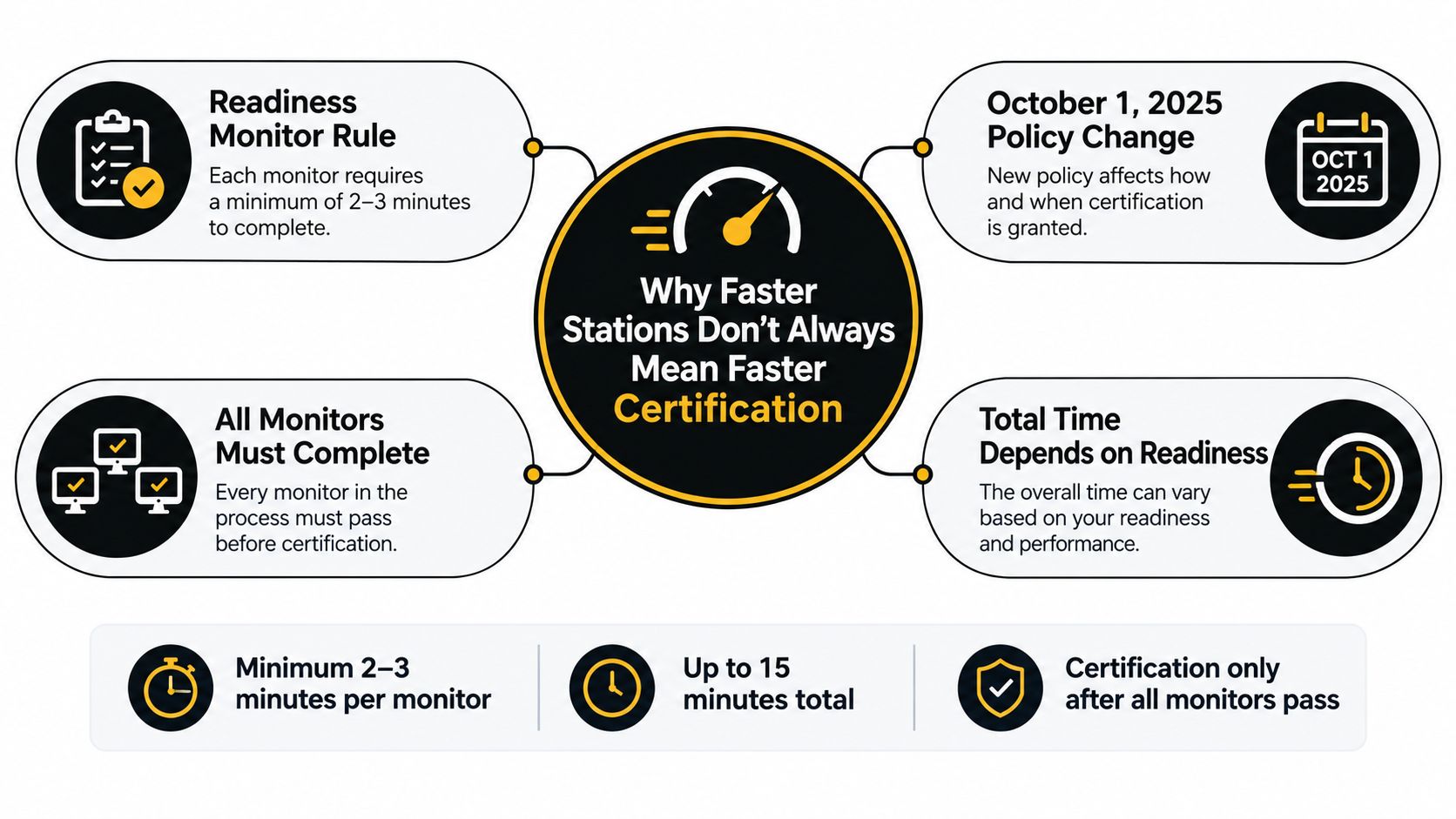
Readiness monitors are the car's own emissions self-tests. They rerun after things like battery disconnection, repair work, or clearing codes, and they need to show as complete before the vehicle can pass. BAR says that beginning October 1, 2025, all monitors that can feasibly be completed must be set before a vehicle can pass inspection. BAR readiness monitor regulations
That change matters because it kills the old shortcut mentality. Clearing the code right before the appointment doesn't make the car ready. It just resets the clock.
BAR says most properly functioning vehicles can set the required monitors within about two weeks, but that depends on the car, the driving pattern, and the monitor involved. So the bottleneck isn't the inspection lane. It's the drive cycle. If the monitors aren't ready, a quick station can't rescue the visit.
A fast station can shorten the bay time. It can't cheat the readiness process.
That's the distinction worth remembering if you need a same-day outcome. The appointment might be short, but certification only happens after the car has done its own part first.
Pre-Appointment Checklist for the Shortest Possible Wait
The night before your appointment is where you win or lose the day. If you show up ready, the visit stays short. If you show up half-prepared, you'll probably pay for it with a repeat trip.
What to do before you leave home
- Confirm renewal needs: Check whether the vehicle requires smog certification for registration or renewal before you head out.
- Watch the dash: If the check-engine light is on, don't expect a pass.
- Leave the battery alone: Don't disconnect it right before testing, because that can reset readiness monitors.
- Drive the car normally: Give it a mix of trips so the monitors can complete on their own.
- Tell the shop the setup: Diesel, hybrid, all-wheel-drive, or other nonstandard configurations should be disclosed up front.
- Warm the engine on older vehicles: Arrive with the car already at normal operating temperature if your vehicle uses a procedure that needs it.
If you're dealing with a recent repair, think in terms of repair, drive cycle, retest. Don't treat the appointment as a one-and-done errand, because the car may need time after the fix before it can certify.
For drivers who want a local shop workflow that handles this cleanly, Speedy Smog is one option in San Leandro that focuses on quick inspections and straightforward service. The value isn't magic, it's knowing the car shows up in the right state and the station doesn't waste time figuring out what it is.
What a STAR Certified Station Brings to the Timeline
Station choice matters because some places are built for speed, and some are built for guesswork. You want the first kind.
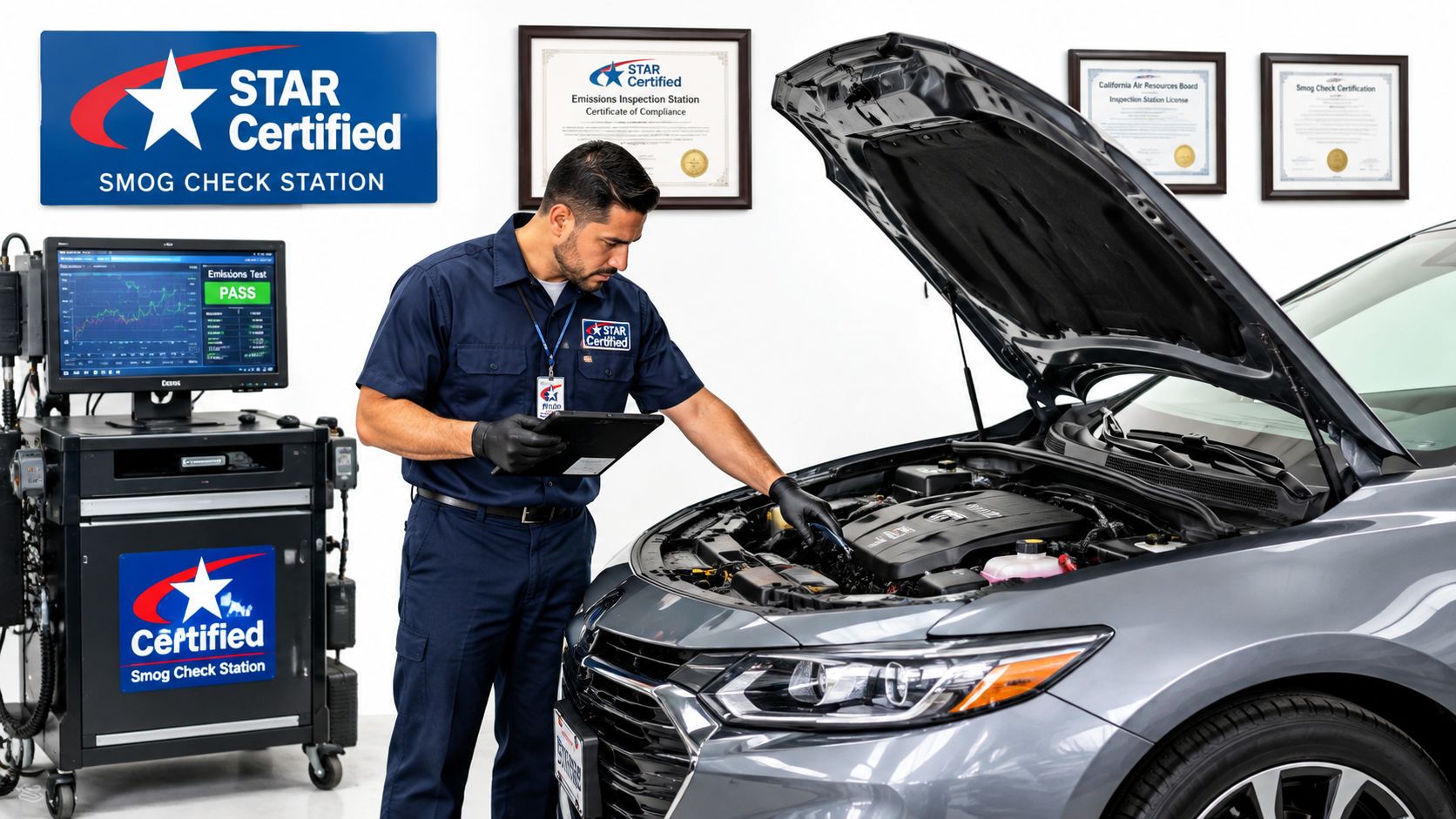
STAR Certified stations meet higher performance standards set by the Bureau of Automotive Repair, and they're allowed to inspect higher-risk vehicles. That usually means better procedure discipline, better equipment, and fewer delays caused by confusion over what test to run. What is a smog STAR station
A good STAR station also keeps the process moving after the test, with electronic result transmission and a workflow designed around compliant inspections rather than improvisation. That matters because slow paperwork can stretch a visit even after the car has passed.
The right station won't just be fast on paper. It'll be fast because it knows what to do with older vehicles, hybrids, diesels, and cars that need a little more attention. That's what cuts repeat visits, and repeat visits are what wreck your day.
Setting Realistic Expectations for Your Visit
A fast visit starts long before you pull into the bay. The timeline is readiness, then inspection, then any retest work, then DMV processing after the result goes out. If the car is not ready, the wait grows before the test even begins.
For a fuller breakdown of station-side timing, see our guide on how long a smog check takes.
That is the part drivers miss. They fixate on the minutes in the stall, then get burned by readiness issues, missing repairs, or a result that sends them back for another round. A station can be quick and still leave you with a longer certification path if the car is not prepared.
If you want the shortest possible visit, show up with the obvious problems handled, the car warmed up, and your paperwork squared away. That is how you get same-day results without turning a simple inspection into a half-day errand.
You're staring at a DMV renewal notice, your registration deadline is getting closer, and Google has returned a crowded map full of shops calling themselves an “inspection” station. The nearest pin isn't automatically the right choice. Some locations only test, some also repair, some handle specific vehicle types, and some may not be approved for the test your DMV notice requires.
A good search for vehicle inspection near me ends with more than an address. You need the right inspection category, a station that can handle your vehicle, clear pricing, workable hours, and a result that moves your registration forward without a second unnecessary trip.
Table of Contents
- When Your Car Actually Needs a Smog Check
- How to Search for a Vehicle Inspection Near You
- Why STAR Certification Matters for Your Inspection
- Comparing Stations on Hours, Price, and Convenience
- What to Bring and How to Avoid a Failed Test
- A Local Example That Checks Every Box
- Getting Certified and Back on the Road
When Your Car Actually Needs a Smog Check
The usual trigger is simple. Your California DMV renewal notice arrives, and the renewal process requires a Smog Check before you can complete registration. California requires a Smog Check every other year to renew registration, according to the California DMV's Smog Inspections guidance.
There's an important exception for newer vehicles. Since January 1, 2019, vehicles less than 4 model years old may pay a smog abatement fee instead of undergoing inspection for the first 8 registration years. Check the notice rather than guessing from the vehicle's purchase date. California uses the vehicle's model year and registration history to determine whether the exemption applies.
Match the test to your vehicle
A California Smog Check examines emissions and emissions-control components. It isn't a general mechanical inspection, brake inspection, or pre-purchase evaluation. If you're trying to transfer ownership, resolve a registration issue, or meet a special DMV instruction, read the notice carefully because the required station type may differ.
Use this quick decision:
- Newer vehicle: Check whether the abatement-fee exemption applies before booking a test.
- 2000 and newer gasoline vehicle: Confirm that the station accepts the vehicle and can complete the applicable emissions test.
- Older vehicle, diesel, or hybrid: Ask directly before driving over. Vehicle coverage varies by station.
- DMV-directed inspection: Look for any instruction requiring a STAR station or a specific test pathway.
The demand for compliant local stations stays steady because California ties recurring emissions testing to registration renewal. At the same time, newer vehicles can avoid the full test during their early registration years, so not every driver searching today needs the same service.
Practical rule: Let the DMV notice determine the requirement, then let the vehicle's model year and fuel type determine which station you call.
How to Search for a Vehicle Inspection Near You
Typing “vehicle inspection near me” into Google Maps is a reasonable first move, but stopping at the first result is how drivers end up paying more or arriving at a shop that doesn't handle their car. Build a shortlist instead.
Start with specific searches that combine location and service:
- “Smog check near me” for a standard California emissions test.
- “STAR smog station near me” when the DMV requires STAR certification.
- “Test-only smog check” if you want a station focused on inspection rather than repair.
- “Smog check diesel” or “hybrid smog check” when your vehicle needs specialized coverage.
- Add your city or neighborhood, such as “San Leandro STAR smog check” or “Oakland emissions test.”
Inspection content often treats every inspection as the same errand, even though the requirement may be a safety inspection, emissions test, or specialized compliance review. Industry coverage of segmented inspection workflows reinforces the practical point: your vehicle type and compliance context should shape the search.
Build a realistic shortlist
Keep three or four stations that are convenient, not a dozen map pins scattered across the East Bay. Use the map's open now filter, but verify the posted hours on the station's own website or by phone. A location that closes before you finish work isn't convenient, even if it's close.
Read reviews for operational details, not just star ratings. Look for comments about:
- Wait times: Do customers describe quick walk-ins or long lines?
- Price surprises: Do drivers mention fees added after arrival?
- Vehicle coverage: Do reviews mention older cars, diesels, or hybrids?
- Retests: Does the station explain what happens if the vehicle fails?
- Staff communication: Do customers say the test requirements were explained clearly?
Then call your finalists. Ask whether they test your exact vehicle type, whether the quoted price includes all standard charges, whether they accept walk-ins, and whether a coupon is available. That short call often saves more time than another ten minutes of map browsing.
Why STAR Certification Matters for Your Inspection
STAR certification is a California Bureau of Automotive Repair designation for stations that meet higher performance standards. It gives drivers a meaningful quality filter, especially when the DMV notice directs them to a STAR station.
STAR isn't a luxury add-on. It's a compliance requirement in situations where the DMV specifically sends you to a STAR location, and it can provide added confidence that the station is operating within California's required inspection standards. Ask the station directly, then verify its current status through California's official station information before booking.
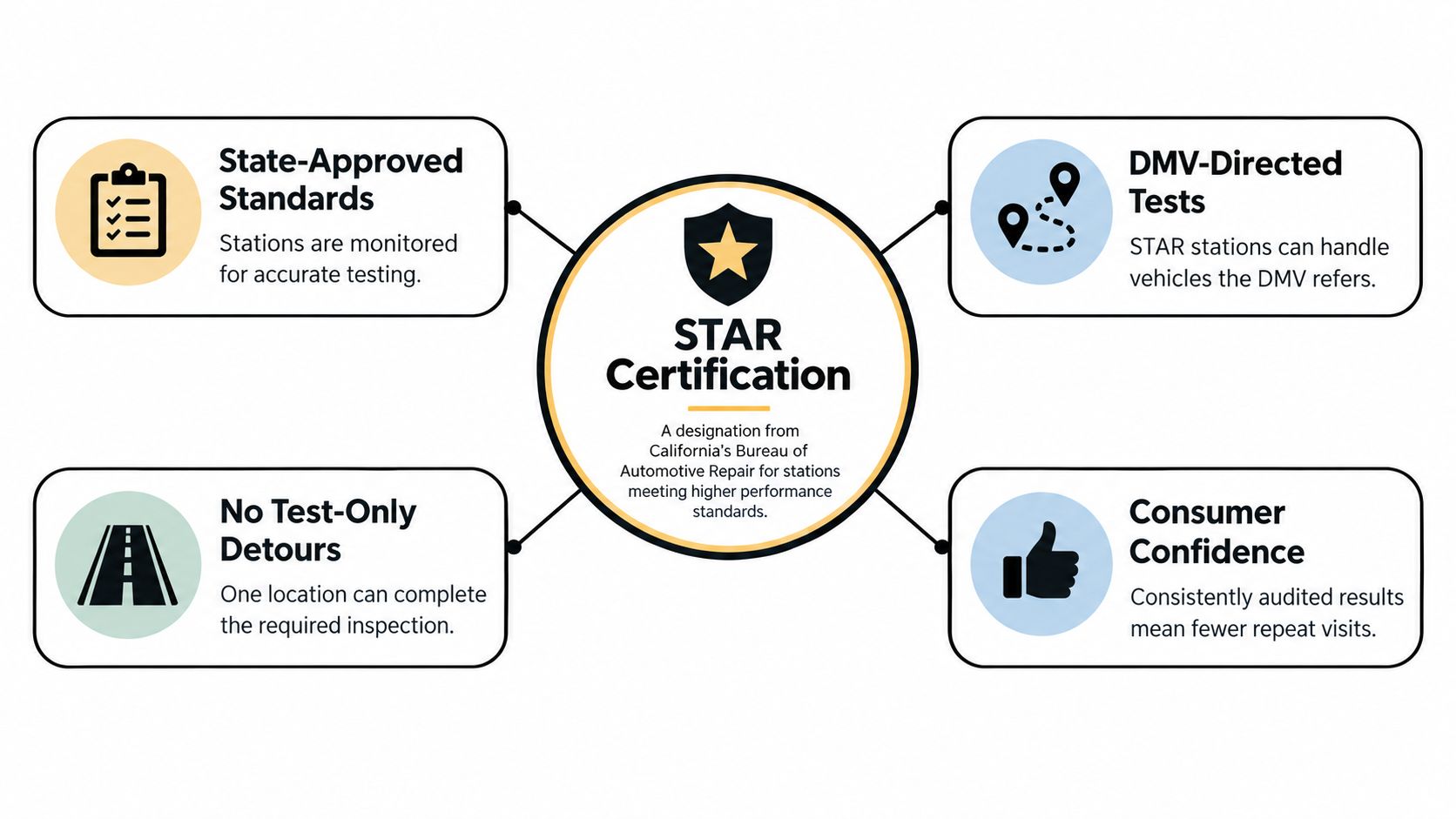
When STAR is non-negotiable
Read the DMV notice before choosing between a STAR and non-STAR station. If the notice says the vehicle must visit a STAR station, a cheaper nearby alternative won't solve the problem. You'll only create another appointment and another drive.
STAR status also matters when you want a straightforward registration experience. A compliant electronic result should be recognized through the normal DMV process, while choosing the wrong station can leave you sorting out why the test didn't meet the stated requirement.
You can also ask whether the location is test-only or test-and-repair. Those labels describe the station's business model, not necessarily its STAR status. A test-only shop can be a sensible choice when you want the inspection separated from repair work. A test-and-repair shop may be useful when you already expect diagnostic work. Choose based on the requirement in your notice and the kind of service you want.
For a plain-language explanation of the designation, see this guide to what a STAR smog station is. Verify the station before you arrive. Don't rely on an old directory listing or a faded sign.
Comparing Stations on Hours, Price, and Convenience
Once you have a shortlist, compare the stations like a practical errand, not like a popularity contest. The best station is the one that meets the requirement, accepts your vehicle, gives you a clear price, and fits your schedule.
| Factor | What to Look For | Why It Matters |
|---|---|---|
| Hours | Morning, evening, and Saturday availability | A nearby station is useless if you can't reach it while open |
| Price | Posted price, coupon terms, and out-the-door total | A low advertised price may not apply to your vehicle |
| Turnaround | Typical test time and walk-in policy | The wait can matter more than the drive |
| Vehicle coverage | 2000+ cars, older vehicles, diesels, and hybrids | Not every station handles every configuration |
| Station type | Test-only or test-and-repair | The right choice depends on whether you want diagnosis or separation |
| Waiting area | Clean indoor seating and clear customer process | Useful when you're staying for the result |
Ask three questions before you leave home
First, “Do you test my exact vehicle?” Give the model year and fuel type. Don't assume a station that tests newer gasoline cars also handles an older vehicle, diesel, or hybrid.
Second, “What is the total price for this vehicle?” Ask whether the figure includes the standard inspection and whether any coupon has restrictions. A coupon that excludes your vehicle won't help you budget.
Third, “How long should I expect to be there?” A stated test time isn't the same as a guaranteed total visit time. Ask whether walk-ins wait behind appointments and whether the station transmits the result electronically after completion.
Test-only versus test-and-repair
Test-only stations can reduce the concern that repair recommendations will influence the inspection conversation. You receive the result and can decide where to take the vehicle if it fails. Test-and-repair stations can be more convenient if you want one location to diagnose a failure, but you should still ask for a clear explanation before authorizing work.
A transparent quote and an honest wait-time estimate are more valuable than a prominent map position.
What to Bring and How to Avoid a Failed Test
Bring your DMV renewal notice or registration information so the station can confirm the correct test path. Arrive with the engine warmed up, and don't treat the inspection as a diagnostic appointment for a warning light you've ignored for months.
Government guidance identifies three dominant emissions-test failure modes: Diagnostic Trouble Codes, incomplete readiness monitors, and failure to communicate with the vehicle computer. The same emissions-test guidance lists common mechanical culprits such as oxygen-sensor or EGR problems, dirty air filters, misfiring spark plugs, vacuum leaks, and a poor-fitting fuel cap.
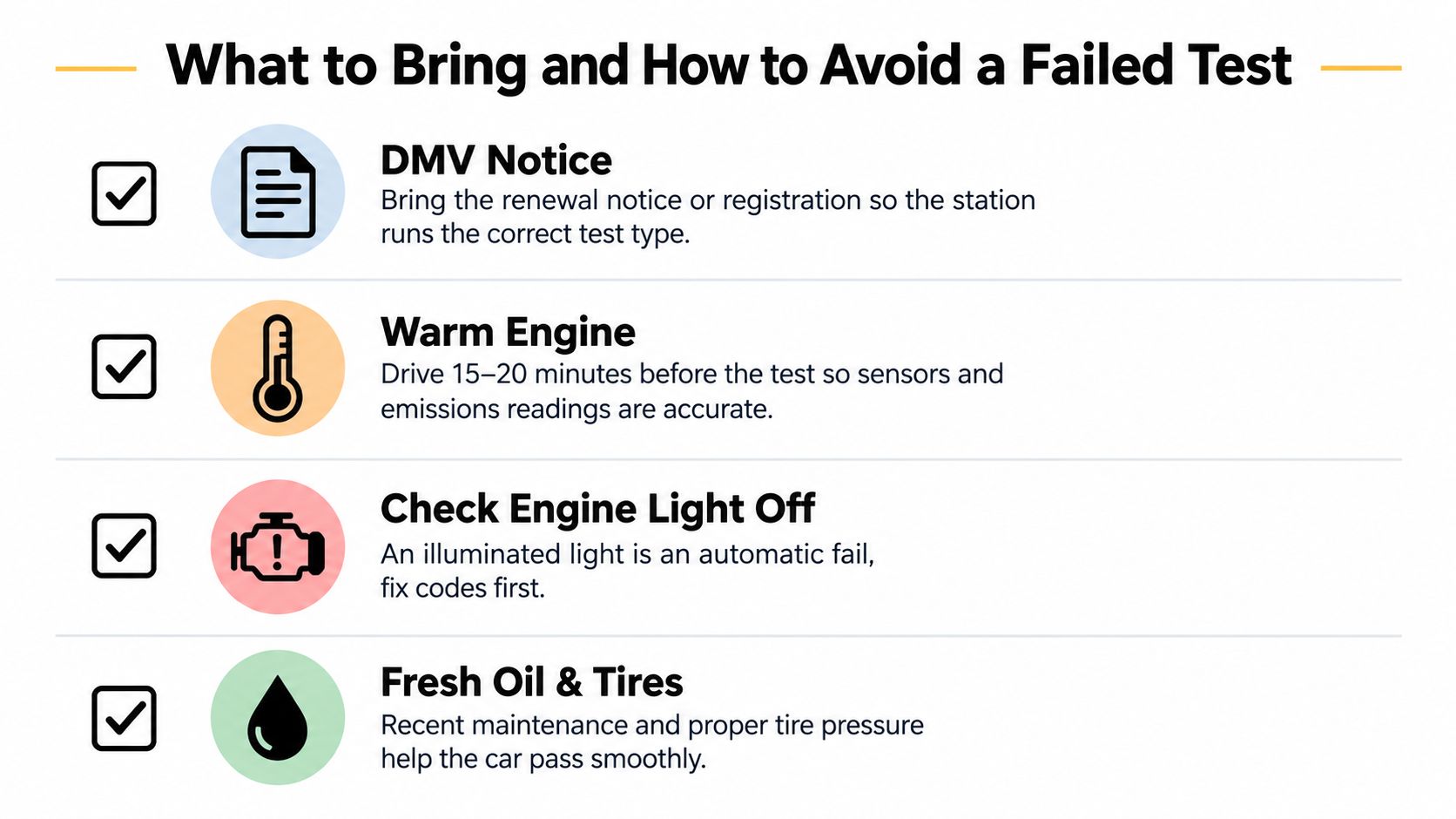
What those failure modes mean
A Diagnostic Trouble Code, or DTC, means the vehicle computer has detected a fault. The code may relate to emissions equipment, sensors, ignition, or another system that affects emissions performance.
Readiness monitors are the vehicle computer's internal checks. If you recently disconnected the battery, cleared codes, or completed repairs, the monitors may not have finished their checks. In that condition, the vehicle can fail even when the check-engine light is off.
Non-communication means the testing equipment can't establish a reliable connection with the vehicle computer. A damaged connector, electrical issue, or computer problem can stop the test before emissions performance is even evaluated.
Before driving to the station, run through this checklist:
- Check the dashboard: Don't arrive with an active check-engine light or recently cleared codes.
- Consider recent battery work: A disconnected battery can leave readiness monitors incomplete.
- Inspect the fuel cap: Make sure it fits correctly and seals properly.
- Listen for rough running: Misfires, hesitation, or unstable idling deserve attention before testing.
- Look for leaks: Vacuum leaks can trigger emissions problems and drivability symptoms.
- Ask for diagnostics when needed: If the light is on, find out what the code means before paying for the inspection.
For additional preparation guidance, use this pre-smog-check checklist. The goal isn't to manipulate the result. It's to remove obvious problems so the test reflects a vehicle that's actually ready for inspection.
A Local Example That Checks Every Box
A useful local benchmark is the STAR Certified station at 15275 Washington Ave, San Leandro, California 94579. It handles 2000 and newer vehicles, 1999 and older vehicles, diesels, and hybrids, so drivers can ask about coverage without assuming that every vehicle follows the same path.
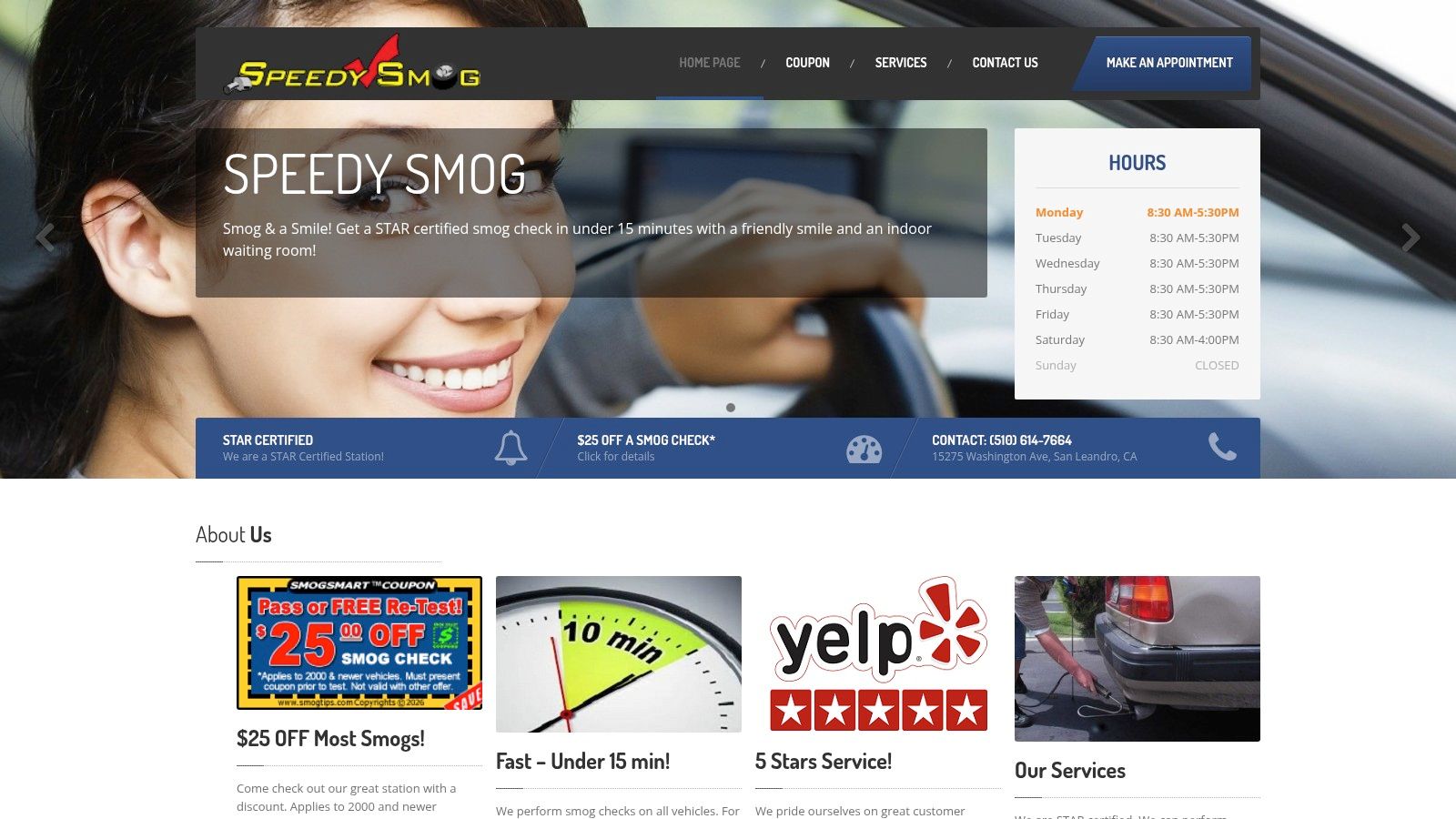
The station typically completes tests for 2000+ vehicles in about 10–15 minutes and is open Monday through Saturday. It also publishes transparent pricing, offers periodic $25-off coupons for most smogs on newer vehicles, and provides a clean indoor waiting room. Those details are exactly what you should compare at any station, coverage, schedule, price clarity, turnaround, and a reasonable place to wait.
The point isn't to choose a station because it appeared first in search. It's to see how a concrete option measures against the checklist. A station that can handle your vehicle, meet the STAR requirement, explain the price, and fit your schedule has earned a closer look.
Ask about the current price and coupon terms before arriving, since promotions and vehicle eligibility can change.
Getting Certified and Back on the Road
The cleanest process is straightforward: read the DMV notice, identify the required test, shortlist stations that handle your vehicle, verify STAR status when required, compare hours and price, then prepare the car before arriving.
If the vehicle passes, the station can transmit the result electronically to the DMV, allowing you to complete the registration renewal through the normal process. Keep the confirmation and renewal details until the registration is complete.
A failure isn't unusual, particularly as vehicles age. About 1.3 million of 19 million 2000+ model-year vehicles tested in the 2024–2025 cycle failed Smog Check, an approximate 7% fleet failure rate, while roadside inspections recorded a fleet-weighted average failure rate of about 14%, according to vehicle emissions-test information from CARFAX. A station result and a roadside condition aren't identical measurements, so treat a failure as a reason to diagnose the vehicle, not as a reason to guess at another station.
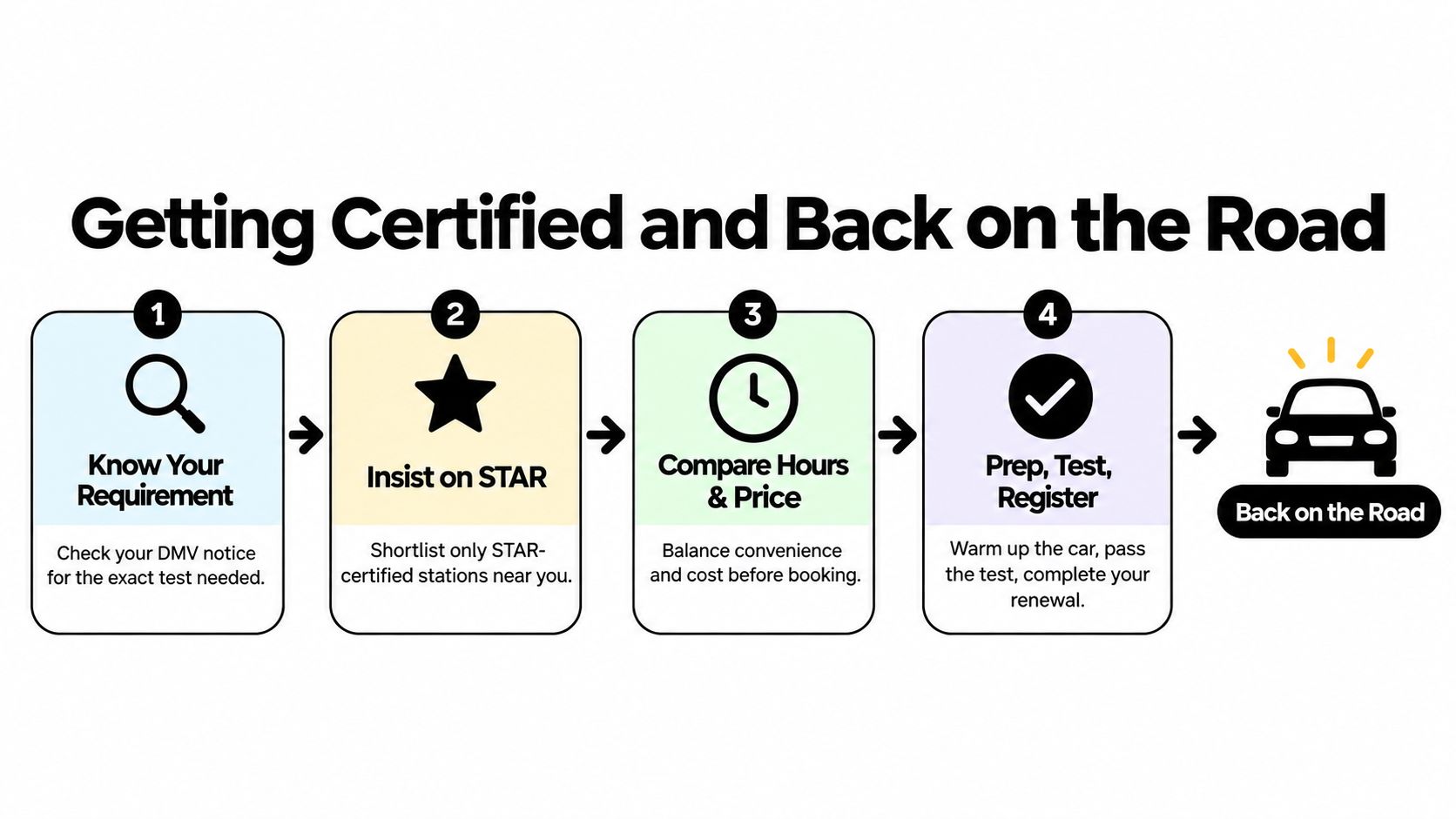
Put the next renewal date on your calendar, watch for relevant coupons, and deal with a check-engine light before renewal week. That small amount of planning keeps a routine inspection from becoming an expensive registration emergency.
If you need a STAR-certified inspection in San Leandro, Speedy Smog handles 2000 and newer vehicles, older vehicles, diesels, and hybrids, with typical 2000+ tests completed in about 10–15 minutes. Review the current details and visit Speedy Smog before you drive in.
A San Leandro driver usually reaches for the renewal envelope at the worst possible time, somewhere between dinner, work, and the moment the registration deadline starts feeling real. Inside that envelope is the line that decides the rest of the errand, and if you read it wrong, you can end up at the wrong kind of station, lose time, and still need a second visit.
That's why san leandro smog test only isn't just a search phrase. For most drivers, it's a choice between a normal test-only station and a STAR-certified station, and the DMV notice tells you which one applies. If you understand the notice, your model year, and your vehicle's readiness status before you pull in, the whole visit gets simpler.
Table of Contents
- The DMV Envelope Moment for San Leandro Drivers
- What a Test-Only Station Is (and Isn't)
- Who in San Leandro Needs a Smog Test
- What to Bring and How to Prepare Your Car
- STAR Certified vs Regular Smog Stations
- What a San Leandro Smog Test Visit Looks Like
- Smog Test Pricing and What Affects the Final Cost
- Speedy Smog in San Leandro and Your Next Steps
The DMV Envelope Moment for San Leandro Drivers
A lot of first-time visitors open the renewal notice, skim one line, and assume any smog shop will do. That's where the trouble starts, because the DMV uses specific wording, and that wording controls where you're allowed to go. The California DMV says the notice will explicitly read either “Smog Certification Required” or “Smog Certification Required at a STAR station”. DMV smog inspection notices
If your notice says only Smog Certification Required, you can go to a licensed smog station. If it says at a STAR station, you need a STAR-certified facility, not just any test-only shop. In other words, the paper in your hand matters more than the assumptions you make about the car. The station type is driven by the notice, then matched to the vehicle.
A San Leandro driver often learns this the hard way. They call the closest shop, hear “we do smogs,” and show up with a notice that demands STAR. That's avoidable if you read the exact line before leaving home.
Practical rule: look at the renewal notice first, then choose the station. Don't reverse that order.
The other reason this matters is that California's inspection system now funnels a lot of tests through STAR stations. By CY-2025, 49% of licensed stations were STAR certified, and 83% of all smog tests were performed by STAR-certified stations. BAR STAR FAQ That doesn't mean every driver needs STAR, it means the system depends on it heavily.
What a Test-Only Station Is (and Isn't)
A test-only station performs the inspection and reports the result. It can run the emissions test, submit the outcome, and issue the certificate when the vehicle passes. It does not repair that vehicle after a failure. The inspection and repair roles stay separate, like a referee making the call without coaching either team.
That boundary protects the purpose of the test. If a shop could fail a car and immediately sell the repair, the result could become part of a sales conversation. At a test-only station, you receive a pass or fail decision and, if repairs are needed, take the vehicle to a different shop.
Test only also defines what your visit covers. You pay for the inspection, state submission, and certificate process. Diagnostic labor and repairs are outside that service. A failed vehicle therefore needs a separate repair appointment before it can be retested.
A test-only station can explain the result in plain language, but it cannot repair the same vehicle it inspected.
For a first visit, arrive with the car ready for inspection and allow time for the test and paperwork. Do not expect the inspection bay to become a repair bay. The DVM smog check test only service page offers a station-specific overview, while your DMV notice determines whether this station type fits your requirement.
Who in San Leandro Needs a Smog Test
A DMV renewal notice can answer the first question before you book a station. Read its exact wording, then compare it with your vehicle's model year, fuel type, and reason for testing. California's exemption rules vary between registration renewal and change-of-ownership testing. Gasoline, hybrid, and alternative-fuel vehicles eight model years old and newer are exempt from renewal Smog Checks, while vehicles four model years old and newer are exempt from change-of-ownership testing. California Smog Check program
The vehicles that usually need testing
After a vehicle moves beyond the applicable exemption window, a test is more likely. California also exempts gasoline vehicles 1975 and older, diesel vehicles 1997 and older, and diesel vehicles with a gross vehicle weight over 14,000 pounds. That leaves many newer gasoline cars, hybrids that have aged into the testing window, and diesel vehicles still covered by the inspection rules.
Short version: the renewal notice is the driver. If it requests a Smog Check, treat that instruction as the starting point, then confirm that your vehicle details match.
Age alone does not settle every case. A vehicle may qualify for an exemption during registration renewal but still require an inspection during an ownership transfer. The notice provides the immediate instruction, while the vehicle's age, fuel type, and transaction explain why that instruction applies.
| Vehicle Type | Model Year / Age | Smog Check Required? |
|---|---|---|
| Gasoline | 8 model years old and newer | No for renewal |
| Gasoline | Older than 8 model years | Usually yes for renewal |
| Hybrid or alternative-fuel | 8 model years old and newer | No for renewal |
| Hybrid or alternative-fuel | Older than 8 model years | Usually yes for renewal |
| Gasoline | 4 model years old and newer, transfer of ownership | No |
| Diesel | 1997 and older | No |
| Diesel | 1998 and newer, under 14,000 lbs | Usually yes |
If the notice names a STAR station or another specific station type, follow that wording rather than choosing based only on the vehicle's age. That distinction prevents a common mistake: treating STAR certification and test-only service as interchangeable when the DMV instruction may require one and not the other.
What to Bring and How to Prepare Your Car
Bring the DMV renewal notice, a valid photo ID, and a payment method before you leave home. The notice is the most important item because it tells the technician whether you're headed to a regular station or a STAR station, and it often contains the barcode or vehicle information needed to match the test to your record. If you're about to throw the envelope away, photograph both sides first.
Before the test, make sure the check-engine light is off. The inspection for most modern vehicles is data-driven, and a lit warning light can send you home without a certificate. If you recently disconnected the battery, replaced it, or cleared codes, give the car time to complete its drive cycle before you arrive.
The fuel level matters too. Keep the tank somewhere between quarter-full and three-quarters full so the evaporative system can be tested under normal conditions. A tank that's nearly empty or completely topped off can create avoidable complications.
Warm the car up with normal driving before you pull in. A cold engine rarely gives the cleanest inspection conditions.
For many drivers, the other key issue is readiness status. California's updated guidance says that effective October 1, 2025, all readiness monitors must be set for a vehicle to pass. BAR readiness monitor guidance That's why a car can feel fine on the road and still fail the scan.
If you want a simple prep checklist, use the what to do before a smog check guidance before you head out. The goal is to arrive scan-ready, not to discover a readiness issue at the window.
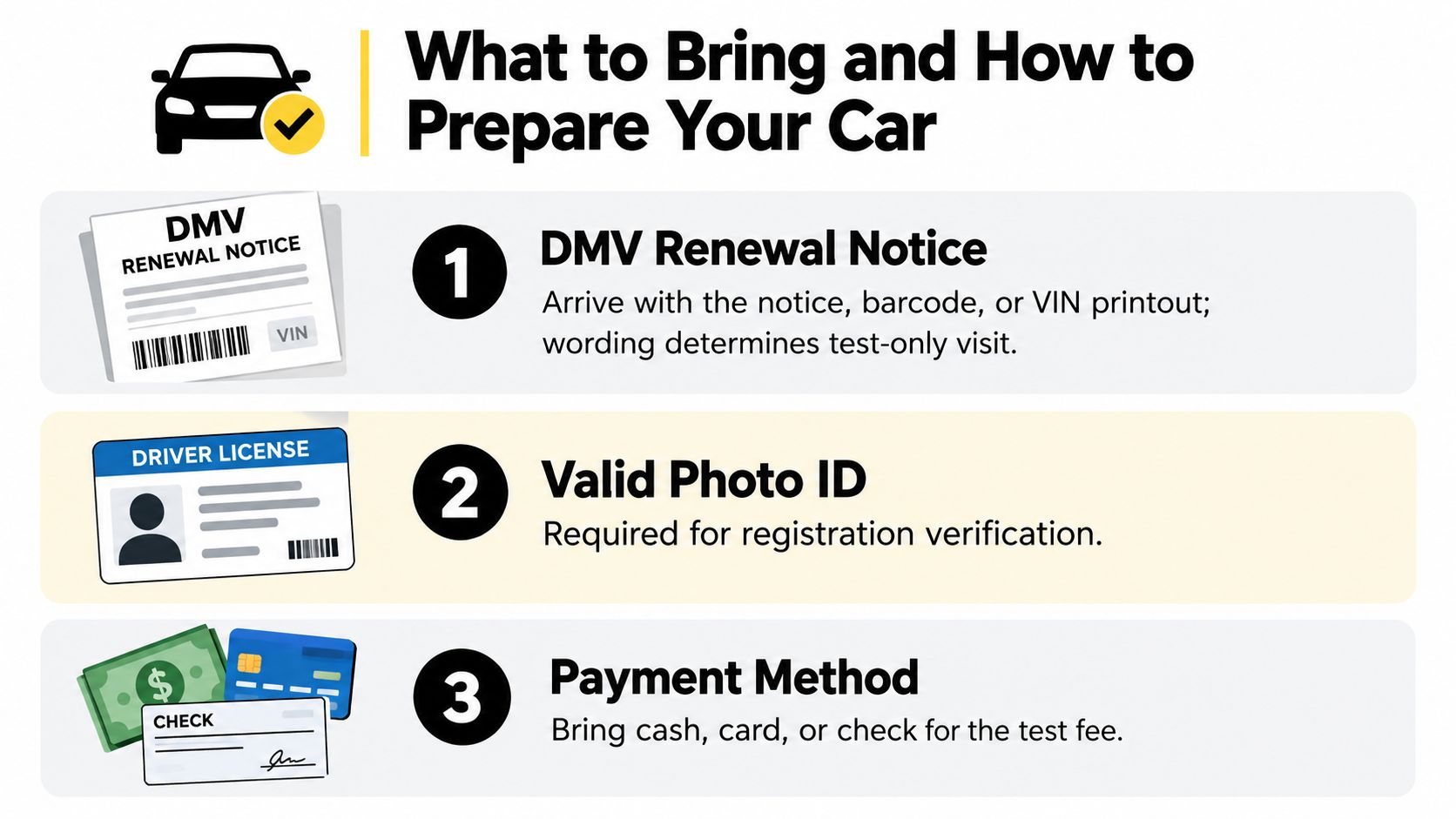
STAR Certified vs Regular Smog Stations
The wording on your DMV renewal notice determines whether you need a STAR station. STAR certification is a state performance tier for smog inspection stations, while test-only describes the service the station provides. A station may carry both labels, so read the notice before choosing where to go.
How to choose the right one
If the notice says STAR station, choose a STAR-certified location. The station assignment is part of the renewal instruction, much like being sent to the correct counter for a specific permit. If the notice does not require STAR, a regular licensed test-only station can generally perform the inspection. The BAR STAR FAQ explains the program and its station requirements.
For a newer gasoline vehicle with no special direction on the notice, a regular test-only station is often the straightforward choice. It inspects the vehicle without repairing the same vehicle, which keeps the service focused on the smog check. San Leandro drivers seeking a STAR location can review this San Leandro STAR-certified smog station information before arriving.
| Feature | STAR Certified | Regular Test-Only |
|---|---|---|
| Can inspect vehicles | Yes | Yes |
| Can repair the same vehicle it tests | No | No |
| May be required by DMV notice | Yes | No, unless directed |
| Meets the STAR performance tier | Yes | No |
| Suitable for directed cases | Yes | Only when the notice permits it |
The practical rule is simple: test-only tells you that the station performs inspections rather than repairs, while STAR identifies its state performance category. Check the DMV notice first, then match its wording to the station type. That step prevents an avoidable visit to a station that cannot complete your renewal inspection.
What a San Leandro Smog Test Visit Looks Like
The inspection path depends on the vehicle's model year and fuel type, not its appearance. The technician first reads the DMV renewal notice and confirms that the station can complete the required inspection. That check connects the notice's wording with the correct test procedure, helping prevent a return visit.
For 2000 and newer gasoline vehicles
The technician connects a scan tool to the OBD-II port beneath the dashboard. The system checks diagnostic trouble codes, readiness monitors, and the warning-light status. California generally uses an OBD Inspection System for 2000 and newer gasoline vehicles, 1998 and newer diesel vehicles, and all hybrid vehicles. The BAR reference guide outlines these inspection categories.
The OBD test works like a dashboard conversation with the car's emissions computer. It asks whether the required self-checks have finished and whether the system has recorded an emissions-related fault. A vehicle may drive normally and still fail if a monitor is incomplete or an active code remains.
Readiness can also be affected by a recently disconnected or replaced battery, because clearing power may erase the computer's completed checks. Ask the technician before testing if the battery was disconnected or the vehicle recently underwent emissions-related work.
For older gasoline vehicles and many diesels
Vehicles outside the OBD path use a different approved procedure. Depending on model year and fuel type, the station may use a BAR-97 setup or another state-approved method. California separates 1976 to 1999 vehicles from newer OBD-based vehicles, so an older car should be matched to the procedure listed for its year and fuel type.
The technician records the result electronically for DMV. You leave with a pass confirmation or a failure result identifying the next repair question. A clear notice, the right station type, and a car ready for its applicable test procedure can keep the San Leandro visit to one trip.
Smog Test Pricing and What Affects the Final Cost
California keeps smog pricing inside a narrow range, so the final bill shouldn't feel random. The Bureau of Automotive Repair sets caps that stations must stay within, and the main driver of cost is the vehicle type being tested. For a standard 1996-and-newer OBD-II test, the cap is $61.25. For pre-1996 vehicles, it's $61.25 plus $10, and for diesels, it's $68.75 plus $10.
Coupons do exist, but they work inside those caps, not outside them. A shop can discount within the legal range, yet it can't turn the inspection into an unregulated price. That's why a posted menu matters, and why the price you see at the counter should line up with the state cap for your vehicle type.
What the invoice usually separates
The smog certificate fee covers the inspection and electronic submission to DMV. If the vehicle passes, that's usually the only smog charge you see for that visit. If it fails, any repair bill comes from a different shop, because a test-only station doesn't do the repair work it just inspected.
If your renewal notice requires STAR, expect that directed vehicles can carry an additional $7.50 STAR fee. That only applies when the notice sends you to that station type. The fee structure makes more sense once you realize the inspection, the certificate, and any repair work are three separate things.
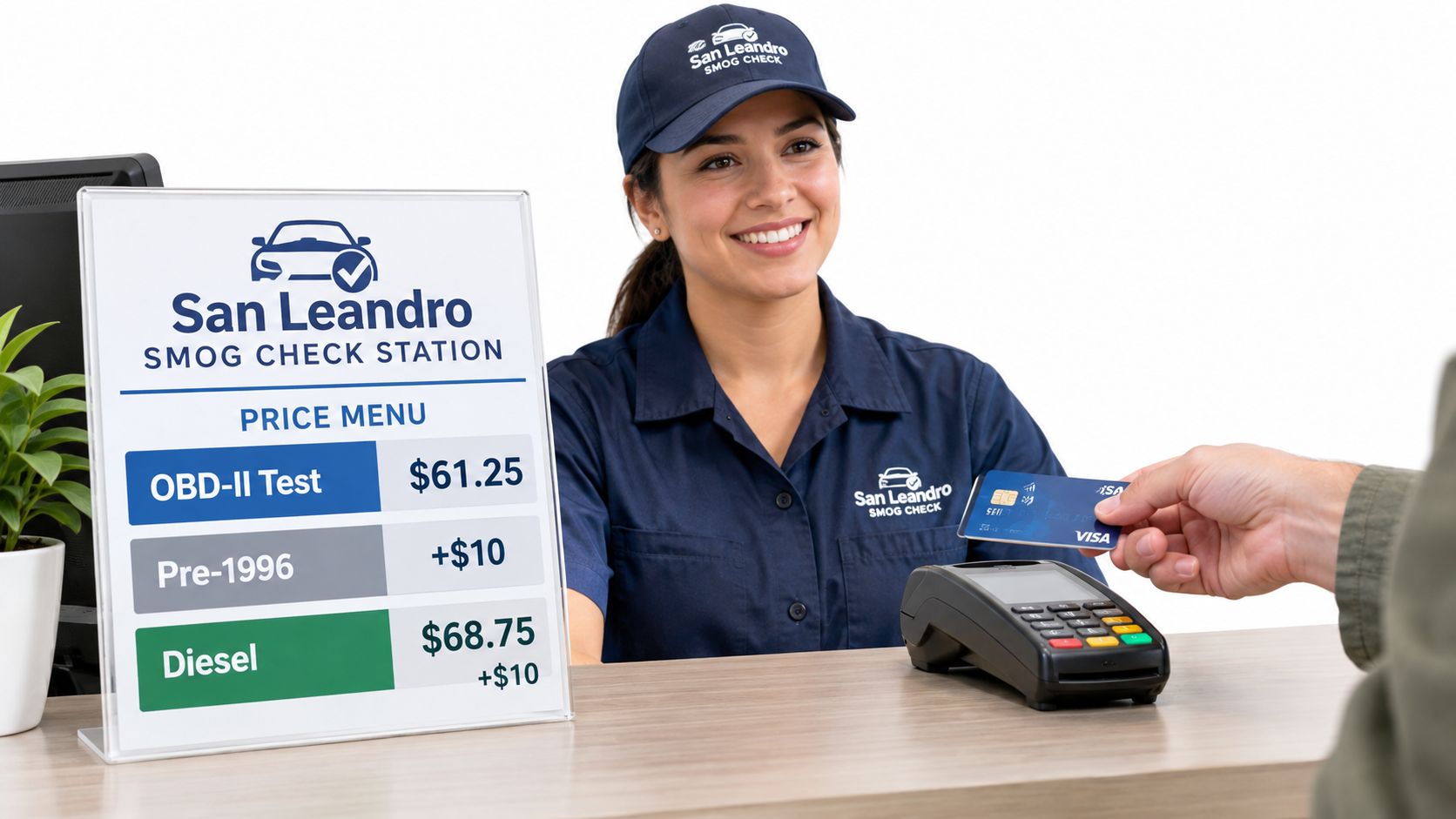
Speedy Smog in San Leandro and Your Next Steps
If your notice says you need a regular inspection or a STAR visit, the last step is simple, show up prepared and let the station match the paperwork to the vehicle. Speedy Smog serves San Leandro at 1416 E 14th Street, near downtown, with parking and a waiting area for drivers who don't want to circle the block before a test. Their phone line and current hours are listed on the shop site, which is the fastest way to confirm same-day availability before you head over.
A quick pre-arrival checklist
- Renewal notice in hand: Make sure you can read the exact smog wording before you leave.
- Engine warmed up: Drive a bit before arrival so the car is ready for inspection.
- No warning lights: A check-engine light can stop the visit before it starts.
- Ready to pay: Bring the payment method you plan to use at the counter.
For a typical OBD-II vehicle, the visit is usually the shortest part of the day. You hand over the keys, the technician confirms the station type, and the result is sent to DMV electronically after the test is complete. If the car fails, keep the printout, take it to a repair shop, and return only after the issue is fixed and the readiness status makes sense again.
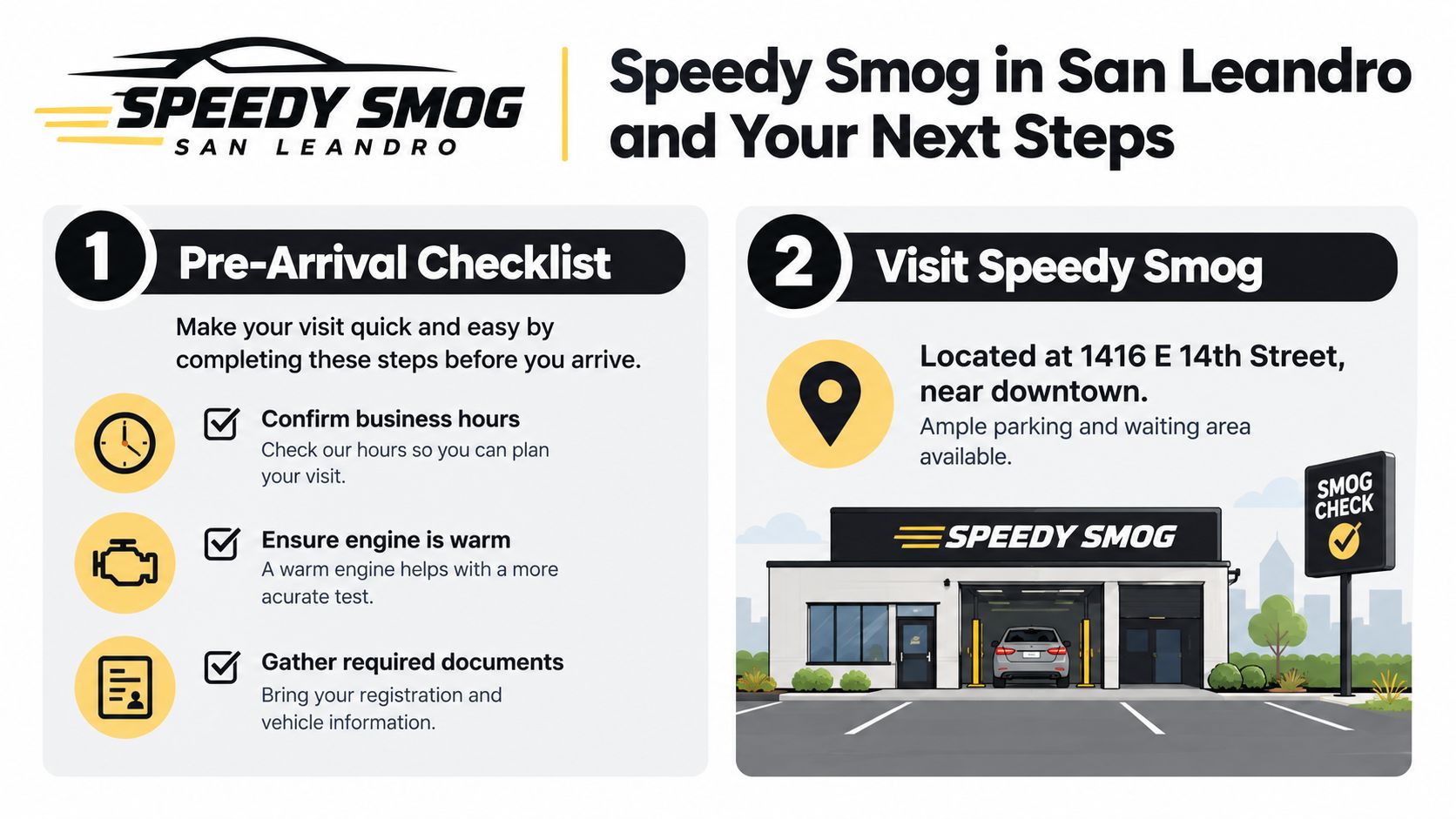
If you need a San Leandro smog test, bring your renewal notice, read the wording carefully, and choose the right station type the first time. Speedy Smog handles inspection-only and STAR-directed smog visits for East Bay drivers, so you can get the paperwork done, understand the result, and move on with your renewal without extra back-and-forth.
Your registration deadline is close, but you're not sure whether your notice requires a STAR station. Maybe your last test failed, and you need a shop that can explain the repair path instead of sending you away. Searching vehicle emissions test near me brings up plenty of East Bay choices, but they aren't interchangeable.
This guide compares seven stations by the details that matter at checkout: STAR certification, vehicle eligibility, expected turnaround, hours, pricing or coupons, contact and location information, waiting comfort, and access to DMV services or repairs. Speedy test-only locations can be ideal for a routine renewal, while a repair shop may be the smarter choice after a failed inspection. Call before leaving to confirm current hours, prices, STAR eligibility, appointment availability, vehicle coverage, and coupon terms.
Table of Contents
- 1. Speedy Smog
- 2. KS Smog in San Leandro
- 3. EZ Star Smog Oakland
- 4. High St Smog and Repair
- 5. Official Smog Check Test Only
- 6. Xpress Star Smog
- 7. Smog Car Care and Lube
- 7 Nearby Smog Check Comparison
- Choose by Your Actual Smog Check Need
1. Speedy Smog
Speedy Smog is the strongest all-around choice for San Leandro drivers who want a STAR Certified smog check with a quick, comfortable visit. The station is at 15275 Washington Ave, San Leandro, California 94579, and you can reach it at (510) 614-7664. It focuses on efficient service for routine DMV compliance, with typical tests for 2000-and-newer vehicles taking about 10 to 15 minutes, according to the business's service information.
The shop accepts most vehicle categories, including hybrids, diesels, 2000-and-newer vehicles, and 1999-and-older vehicles. Its STAR status matters if your DMV renewal notice specifically directs you to a STAR station. California's STAR program uses higher performance standards administered through the Bureau of Automotive Repair, so drivers who need a recognized STAR inspection should confirm that requirement before booking elsewhere.
Best fit: Choose Speedy Smog when you want STAR certification, broad vehicle coverage, a short visit, and an indoor waiting room in San Leandro.
Speedy Smog lists transparent on-site pricing and frequently offers a $25-off coupon for most smog checks on 2000-and-newer vehicles. The coupon has eligibility limits, and the website doesn't publish one universal base price for every vehicle, so review the offer and call for a quote when your car falls outside the common newer-vehicle category. You can also review the station's San Leandro smog check information before visiting.
Hours and convenience
Posted hours are Monday through Friday, 8:30 AM to 5:30 PM, and Saturday, 8:30 AM to 4:00 PM. The website also contains an inconsistent reference to seven-day availability, while the posted schedule shows Sunday closure. Call (510) 614-7664 to confirm the current schedule and whether an appointment is available.
The clean indoor waiting room and friendly service make this a better choice than a bare-bones location if you're bringing a child, waiting for a driver, or don't want to stand outside. Results can be electronically transmitted for DMV processing, helping keep a routine renewal moving.
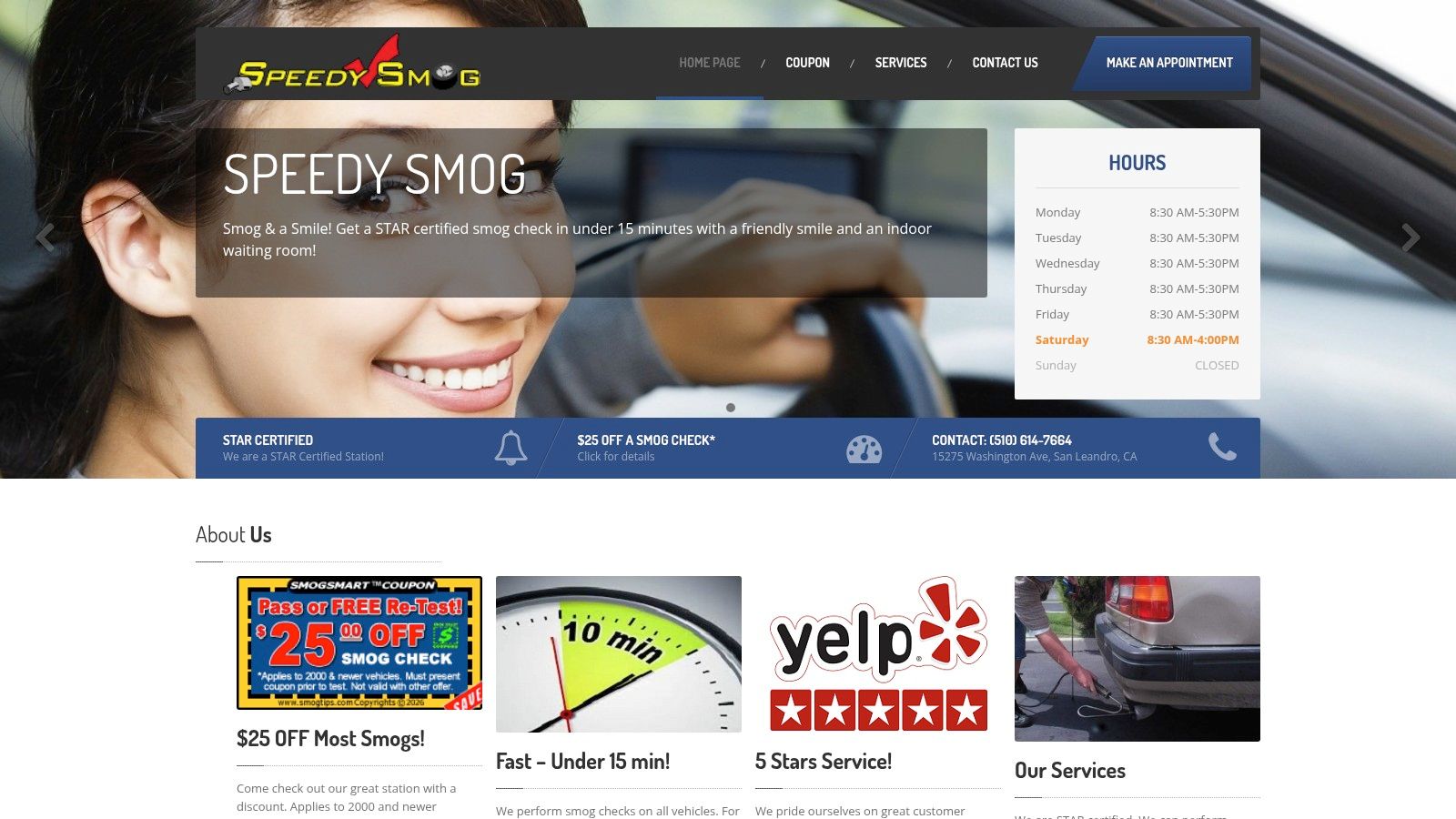
Visit Speedy Smog's official website to check the current coupon, vehicle eligibility, and posted hours.
2. KS Smog in San Leandro
KS Smog is a practical option for drivers who want a test-only station serving San Leandro and Castro Valley. It handles common DMV-related inspections, including renewals, change-of-ownership testing, out-of-state inspections, and hybrid vehicles. Because the business concentrates on testing rather than repairs, it can suit customers who already know their vehicle is ready to pass.
The station advertises a starting price of $36.75 on its website. Since the final amount can depend on vehicle type and applicable terms, confirm the out-the-door price before authorizing the inspection. A published starting price gives budget-focused drivers a useful point of comparison, but it shouldn't replace a direct quote.
What to confirm first
KS Smog accepts walk-ins during its posted hours, which helps if your registration deadline is approaching and you don't want to wait for an online booking slot. It doesn't provide an online appointment tool, so calling is the best way to check current availability and expected wait time.
The main drawback is certification clarity. The website doesn't clearly state whether the station is STAR certified. If your DMV notice requires STAR testing, ask specifically about that requirement before driving over. This is especially important for owners who search by proximity first and check eligibility later.
A low advertised starting price helps only when the station can test your vehicle and satisfy the DMV requirement.
KS Smog is best for a straightforward inspection, a test-only environment, and drivers near the San Leandro or Castro Valley area. It's less suitable if you expect a failure and want diagnostics or repairs at the same location. Review the station's official KS Smog website for the current address, hours, vehicle policies, and price details.
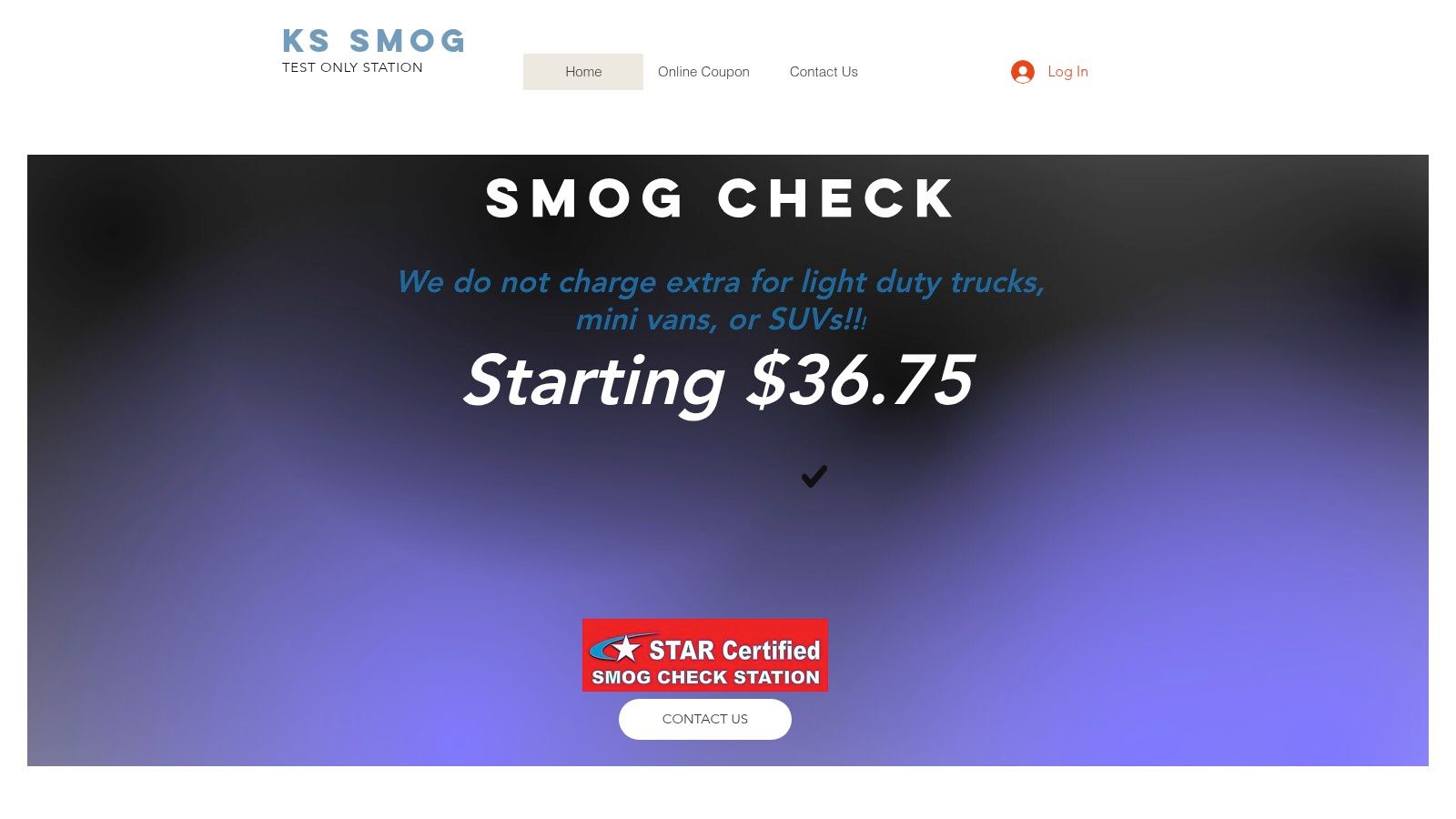
3. EZ Star Smog Oakland
EZ Star Smog Oakland is a strong pick when you want STAR testing and DMV registration services in one stop. Located near the Oakland and Emeryville border, it serves drivers seeking a routine inspection for most 2000-and-newer vehicles, with a high-volume operating model and walk-in service. The station also provides on-site DMV tag and registration services, which can save a separate trip after a passing result.
The website publishes coupon pricing, terms, and exclusions instead of presenting a vague discount with no conditions. That transparency is useful, but read the exclusions closely. The coupon doesn't apply to some diesels, certain SUVs and trucks, and some luxury brands. A retest isn't included under the coupon terms either.
Best for DMV convenience
Choose EZ Star Smog when the main problem isn't just testing, but finishing the registration task. Having DMV-related services available on-site can be valuable if you need a tag or registration transaction after the inspection. The station also publishes its address and ARD information, giving customers more detail to verify before arrival.
This location doesn't require an appointment, which supports last-minute visits. The trade-off is that high-volume, walk-in service can create variable waits, particularly when many drivers arrive around registration deadlines. Call before leaving if timing matters more than convenience.
For drivers comparing nearby options, this guide to STAR smog checks in Oakland explains why certification and vehicle eligibility should be confirmed together. Then review the EZ Star Smog Oakland website for current coupon terms, hours, and DMV service details.
4. High St Smog and Repair
High St Smog and Repair is the right choice when a smog test might expose a mechanical or emissions problem. This Oakland shop combines STAR-certified inspections with diagnostics, smog-related repairs, general automotive service, and Clean Truck Program support. It performs both regular smog inspections and test-only services, so it can accommodate drivers who need testing as well as those who may need follow-up work.
That combination changes the decision. A test-only station may finish a passing inspection efficiently, but it won't repair a check-engine issue or emissions component. High St Smog and Repair can keep the diagnostic conversation in one place, which is useful when you're already concerned that the car may fail.
A better fit for repair risk
The shop supports a broad range of vehicles, including diesel and heavy-duty needs. It also advertises a website special of at least $10 off for 2000-and-newer vehicles when you mention the site. Confirm the current offer and exclusions before authorizing service, since promotional terms can change.
Choose repair capability first: If your vehicle has a warning light, recent failed test, or known emissions issue, a test-and-repair shop may be more practical than the lowest advertised test price.
The trade-off is convenience during busy periods. Repair facilities can have more variable workflow than dedicated test-only stations, and the location has short Saturday hours and is closed Sunday. Call ahead to discuss the vehicle, likely service, and expected wait.
You can confirm the shop's current specials, hours, and service coverage through the High St Smog and Repair website.
5. Official Smog Check Test Only
Official Smog Check Test Only is built for drivers who want a STAR-certified inspection near the Coliseum, Oakland Airport, and Coliseum DMV area. Its location is especially useful when you want to combine a passing smog result with DMV registration or tag services. The facility offers on-site registration and tag issuance, so you may be able to handle related paperwork without traveling to another location.
The station handles diesel smog checks and out-of-state inspections, making it more flexible than a location focused only on standard gasoline passenger vehicles. It also publishes a price range, offers an online coupon, and promotes price matching. Confirm the current quote for your exact vehicle before arrival because a displayed range isn't the same as a guaranteed final price.
The retest policy matters
Official Smog Check advertises a free retest under certain conditions if the vehicle fails and you return after repairs. Read the site's terms carefully. The policy can reduce the cost of a second inspection, but it doesn't eliminate the need to pay for diagnosis or repairs at another facility.
That limitation comes from the test-only format. If the vehicle fails, you'll need a separate repair shop, then return for the retest. Drivers who already expect a failure may prefer High St Smog and Repair, while drivers who want a fast compliance stop and nearby DMV access may prefer Official Smog Check.
Before you go: Ask about Saturday availability. The website suggests calling to confirm the Saturday schedule.
For certification, services, location details, and current offers, use the official Official Smog Check test-only center information and then check the Official Smog Check website.
6. Xpress Star Smog
Xpress Star Smog stands out for Sunday access and mobile truck service. The STAR-certified test-only station is on Fruitvale and International Boulevard in Oakland, and its seven-day schedule makes it a useful choice for drivers who can't visit during a conventional weekday or Saturday window. It also accepts walk-ins and offers discount coupons.
The mobile Clean Truck Check service is the differentiator. If you operate a truck or heavy-duty vehicle and need on-site compliance support, a mobile option can save the trouble of moving the vehicle to a standard station. Confirm service area, vehicle eligibility, scheduling, and current pricing directly with the business before relying on mobile availability.
When weekend access beats proximity
A Sunday opening can matter more than a slightly shorter drive. Registration deadlines, work schedules, and family obligations often leave the weekend as the only practical opportunity. Xpress Star Smog is the clearest choice in this list for drivers who specifically need Sunday testing.
The trade-off is repair support. This is a test-only station, so a failed vehicle must go elsewhere for diagnosis or repair. The street-front location can also become busy on weekends, and walk-in customers may face a wait without an appointment.
If you're comparing stations by schedule rather than distance, check the Xpress Star Smog website for current Sunday hours, coupon requirements, mobile Clean Truck Check details, and walk-in policies.
7. Smog Car Care and Lube
Smog Car Care and Lube is a convenient option for East Oakland and San Leandro drivers who want freeway access and a quick walk-in visit. The STAR-certified station operates at a Valero location on High Street near I-580, making it easy to combine a smog check with a route you're already driving.
The business advertises quick service for routine inspections and promotes a low coupon rate. It also electronically submits results to the DMV, which supports a straightforward renewal process after a passing test. Weekday and Saturday hours provide useful access for drivers who don't need Sunday service.
Check the final price
The website is relatively minimal, so confirm the final out-the-door price for your vehicle's year and type before the inspection begins. Coupon pricing may not apply equally to every vehicle, and the amount can change based on eligibility or required service.
The Valero setting also means the waiting experience is more functional than comfortable. If you're prioritizing a fast stop, freeway access, and walk-in convenience, that may be a fair trade. If you want a dedicated indoor waiting room, Speedy Smog offers a more comfortable environment.
For current coupons, hours, and station information, visit the Smog Car Care and Lube website.
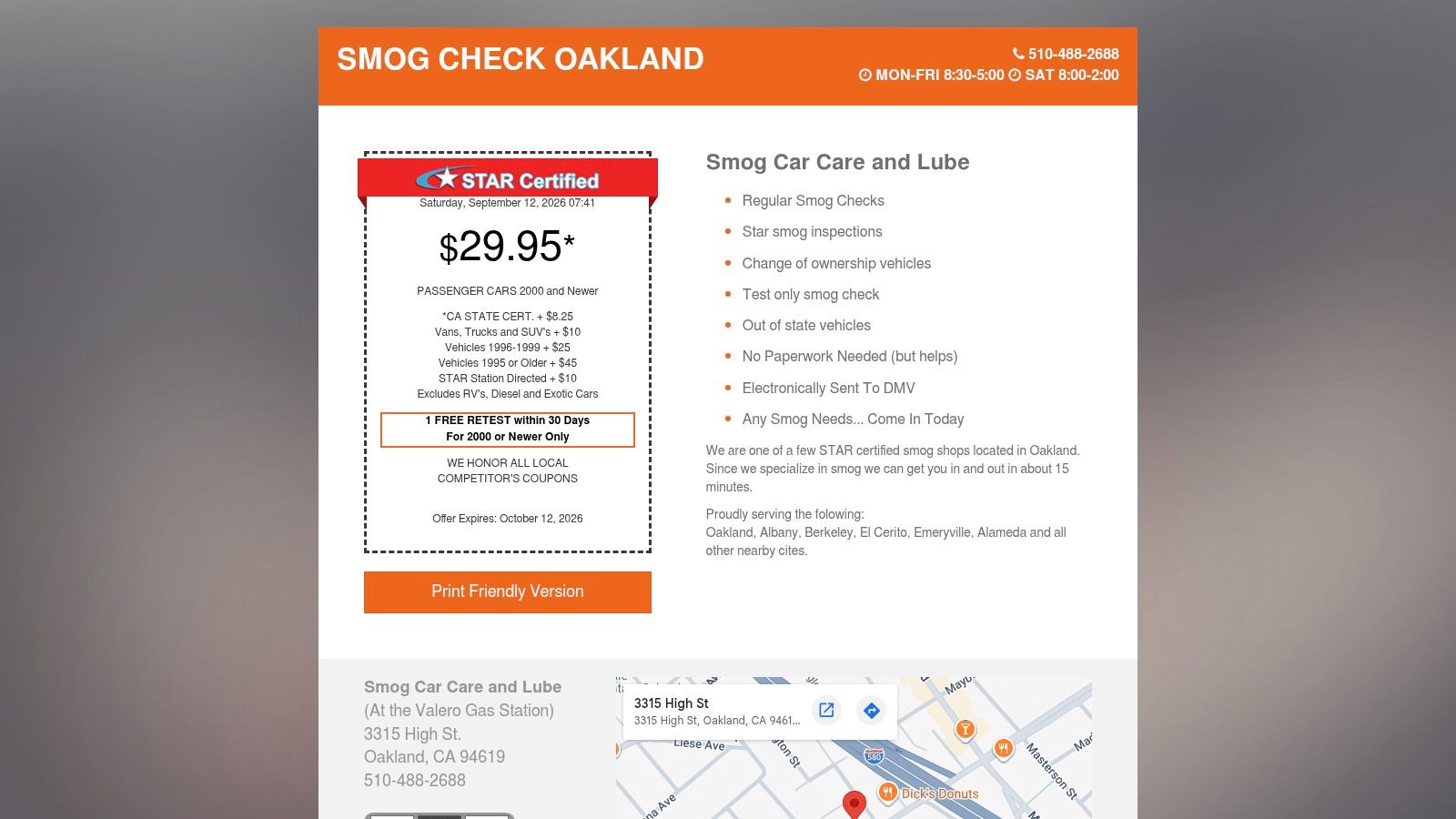
7 Nearby Smog Check Comparison
| Station | 🔄 Process Complexity | ⚡ Speed & Resource Requirements | ⭐ Expected Outcomes | 📊 Ideal Use Cases | 💡 Key Advantages / Tips |
|---|---|---|---|---|---|
| Speedy Smog (San Leandro) | Low, STAR check, quick workflow; call to confirm hours | Very fast: ~10–15 min for 2000+; clean waiting room; handles hybrids/diesel | High, STAR-certified, DMV-accepted inspections | Fast renewals for 2000+ vehicles; comfortable visit | $25 off coupon for many 2000+ vehicles; transparent on-site pricing; call ahead |
| KS Smog (San Leandro) | Low, test-only, walk-ins; no online booking | Budget-friendly; advertises starting price $36.75 | Standard, reliable test-only results (STAR status unclear) | Cost-conscious renewals, change-of-ownership, out-of-state inspections | Confirm STAR eligibility if required; no online appointments |
| EZ Star Smog Oakland | Low, STAR-certified, high-volume; no appointment needed | High throughput; publishes coupon pricing; on-site DMV services | High, clear pricing, DMV submission available | Quick STAR inspections with immediate DMV tag processing | Check coupon exclusions (diesel/SUVs/luxury); closed Sundays |
| High St Smog & Repair (Oakland) | Moderate, offers diagnostics and repairs in addition to smog | Repair facilities and Clean Truck Program support; may take longer | High, inspection + repair capability improves pass likelihood | Vehicles needing diagnostics/repairs after smog; diesel/HD fleets | Visible site discount; call for availability due to repair volume |
| Official Smog Check Test Only (Coliseum area) | Low, STAR test-only, large facility near DMV | Fast access to Coliseum DMV; price matching and online coupon | High, STAR-certified with free-retest policy (per terms) | Drivers wanting same-day tag pickup after passing smog | Test-only: repairs must be off-site; confirm Saturday hours |
| Xpress Star Smog (Fruitvale) | Low, STAR test-only; offers mobile truck checks | Seven-day hours including Sunday; mobile Clean Truck Check | High, STAR inspections with weekend availability | Weekend smogs, HD truck compliance, Sunday service | Mobile truck service and coupons; expect weekend waits |
| Smog Car Care & Lube (High St.) | Low, STAR-certified at a gas-station location; walk-ins | Quick ~15 min checks; low coupon rate; easy freeway access | Good, fast DMV submission for routine renewals | Fast DMV renewals for East Oakland / San Leandro drivers | Low coupon pricing; limited amenities, confirm final price on arrival |
Choose by Your Actual Smog Check Need
There isn't one best station for every East Bay driver. The right choice depends on whether your priority is STAR certification, low advertised pricing, Sunday access, DMV paperwork, repair support, or a short and comfortable visit.
For San Leandro drivers who want the strongest overall combination, choose Speedy Smog. It offers STAR certification, broad coverage for newer and older vehicles as well as diesels and hybrids, a typical 10-to-15-minute test for many 2000-and-newer vehicles, and a clean indoor waiting room. Its friendly service and periodic $25-off coupon for most newer-vehicle smogs make it especially attractive for a routine inspection, but call to confirm current coupon terms and Sunday availability.
Choose KS Smog when an advertised starting price and a test-only format matter most. Confirm STAR eligibility first if your DMV notice requires it. Choose EZ Star Smog Oakland or Official Smog Check when DMV tag, registration, or submission services could save you a second trip. Official Smog Check is also worth considering if its conditional free-retest policy fits your situation.
If you're worried the vehicle may fail, choose High St Smog and Repair because diagnostics and repairs are available at the same shop. Choose Xpress Star Smog when Sunday access is essential or you need mobile Clean Truck Check support for a truck. Choose Smog Car Care and Lube when you want a quick walk-in stop near I-580 and don't need a substantial waiting area.
Before leaving home, confirm five details:
- Vehicle type: Ask whether the station handles your hybrid, diesel, older vehicle, truck, or out-of-state inspection.
- STAR requirement: Check your DMV notice and verify the station's certification directly.
- Current price: Confirm the base quote, coupon eligibility, exclusions, and retest terms.
- Timing: Ask about current hours, appointment availability, and likely wait.
- Follow-up service: Find out whether the shop provides repairs, diagnostics, DMV services, or only testing.
That quick call can prevent a wasted trip, an unexpected charge, or a failed inspection with no clear next step.
Speedy Smog provides STAR Certified emissions testing in San Leandro for most vehicles, including newer cars, older vehicles, diesels, and hybrids, with many 2000-and-newer tests completed in about 10 to 15 minutes. Visit Speedy Smog to check current hours, coupons, vehicle eligibility, and plan a convenient smog check.
The Smog Check certificate fee itself is only $8.25, but the actual cost is the repair work that follows. California Bureau of Automotive Repair data shows average repairs of about $665.59 at STAR test-and-repair stations and $703.74 at non-STAR test-and-repair stations.
You're probably holding a Vehicle Inspection Report, wondering whether your registration is now in trouble and whether a shop will sell you repairs you don't need. Take a breath. A failed smog check is a compliance problem, not an automatic loss of registration, and the smartest next move is to understand the failure before authorizing work.
California's 2025 BAR report recorded 959,667 failures among 11,275,981 initial tests, an overall failure rate of 8.51%. STAR Test-Only stations recorded 481,639 failures from 5,916,245 initial tests, an 8.14% rate. The report also recorded 83,034 BAR-97 emissions failures and 43,518 OBDII failures, so this is a recurring statewide issue, not an unusual event. Read the California BAR 2025 executive summary for the published breakdown.
Table of Contents
- You Just Failed a Smog Check in California
- Why Smog Checks Fail and What Your Report Tells You
- Quick Fixes You Can Try Before Paying a Mechanic
- Choosing the Right Station After a Failure
- Repair Costs, Assistance Programs, and Waivers
- Retesting and Clearing Your DMV Registration
- Your Post-Fail Action Checklist
You Just Failed a Smog Check in California
Your first job isn't finding the cheapest repair quote. It's preserving the evidence.
Start with the inspection report
The Vehicle Inspection Report, or VIR, tells you what failed. Read every line, not just the large “Fail” result. Separate monitors marked “not ready” from measured emissions that exceeded their limits. Those are different problems and require different decisions.
A not-ready monitor often means the vehicle's computer hasn't completed its required checks. An emissions exceedance points toward a running, fuel, ignition, exhaust, or catalytic-converter problem. Take clear photos of every page, including the station information and test date, then keep the original with your registration paperwork.
Ask the station whether the vehicle was identified as a gross polluter, directed vehicle, or high emitter. That label affects where you can go next. Don't book a generic retest until you know whether BAR has placed a testing restriction on the vehicle.
Check your registration timeline
A failed test doesn't instantly cancel your current registration. You still need to plan around the expiration date, and you shouldn't ignore DMV renewal notices while the repair is pending. Write down the expiration date and the retest deadline shown on your paperwork.
Practical rule: Never authorize a repair based only on the word “failed.” Authorize work after you know the exact code, monitor, visual defect, or measured pollutant involved.
If you want help interpreting the paperwork before visiting a repair shop, compare the terminology in this guide to common smog test results. Bring the VIR, any diagnostic printout, repair receipts, and registration documents to the next technician.
Why Smog Checks Fail and What Your Report Tells You
California failures generally fall into OBDII, emissions, visual, and functional categories. BAR's 2026 performance report recorded about 1.3 million failures among roughly 19 million 2000-and-newer vehicles tested during CY 2024–2025, an overall rate near 7%. It also reports a January 2026 all-model-year snapshot with 11,167 failures from 62,132 initial tests, or 17.97%. The categories overlap, so one defective part can trigger more than one result. See the BAR 2026 Smog Check Performance Report for the report details.
Match the failure to the likely system
OBDII failure usually means a fault code is active, a required monitor is incomplete, or the check-engine light is on. Common systems include the catalytic converter, EVAP controls, and oxygen sensors. Don't replace a catalytic converter just because the scanner mentions one. A technician needs to determine whether the converter failed or another issue caused the code.
Tailpipe emissions failure applies primarily to vehicles tested through measured exhaust emissions. High hydrocarbons can point to incomplete combustion, while carbon monoxide and nitrogen oxide readings can indicate fuel-control, combustion-temperature, or exhaust-treatment problems. The VIR's measured values matter more than a generic parts list.
Visual failures involve missing, modified, damaged, or tampered emissions equipment, including an emissions component that isn't properly installed. A warning lamp can also matter if the inspection requires it to operate correctly.
Functional failures involve systems such as air injection or other required emissions controls. These problems can look minor but still prevent certification.
| Failure Category | Typical Components | Avg. Repair Cost |
|---|---|---|
| OBDII | Catalytic converter, EVAP system, oxygen sensors, fault-code causes | Depends on diagnosis |
| Tailpipe emissions | Ignition, fuel control, exhaust treatment, catalytic converter | Depends on measured pollutant |
| Visual | Gas cap, catalytic converter, emissions plumbing, approved equipment | Depends on missing or damaged part |
| Functional | Air injection and related emissions controls | Depends on failed function |
For a component-by-component explanation, use this guide to smog check fail reasons. The report tells you the category. Proper testing tells you the repair.
Quick Fixes You Can Try Before Paying a Mechanic
Some checks cost nothing and take minutes. They won't solve every failure, but they can prevent you from paying diagnostic labor for an obvious issue.
Inspect the gas cap and warning light
Remove the gas cap and inspect the seal. If it's cracked, hardened, or doesn't tighten securely, replace it with the correct emissions-approved cap for your vehicle. A loose cap can create an EVAP leak, and an EVAP fault can illuminate the check-engine light.
Then turn the ignition on without starting the engine. Confirm that the check-engine light illuminates during the bulb check and goes out after the engine starts. If it stays on, don't schedule a retest yet. The underlying fault still needs attention.
Scan before clearing
A basic OBD-II scanner can show stored and pending codes. Scan first and save the code information. Clearing the code before you understand it destroys useful diagnostic context and may reset the readiness monitors.
If you've already repaired the problem and need to clear a confirmed code, check readiness afterward. Disconnecting the battery also resets monitors, so the vehicle needs a complete drive cycle before the inspection computer can evaluate it. The exact distance varies by vehicle and driving conditions, so use the manufacturer's procedure or let a technician verify readiness with a scan tool. This guide to reading OBD codes can help you understand the scan without confusing a code with a confirmed parts failure.
Look for basic engine issues
With the engine cool, inspect accessible vacuum hoses for splits or disconnected ends. Check whether the air filter is visibly restricted and whether the vehicle has overdue spark-plug service. These checks don't replace diagnosis, but they can reveal maintenance problems that affect combustion and emissions.
Don't erase codes repeatedly to chase a pass. A retest with monitors not ready can create another failure and delay the repair decision.
Choosing the Right Station After a Failure
A failed inspection does not automatically mean you need the cheapest retest. First read the VIR. If it identifies a testing restriction, the wrong station can cost you another inspection fee and delay repairs. The repair bill is usually the larger financial risk, so choose a location that can handle the failure and explain the next step clearly.
Match the station to the VIR
A regular smog station handles ordinary inspections and many standard retests. Call before driving over and ask whether it can retest your specific vehicle after reviewing the VIR.
A STAR Test-Only station performs inspections under BAR's STAR requirements. Use one when the paperwork requires enhanced testing or directs you to a STAR location. It will not perform repairs, so arrange diagnosis and repair separately.
A STAR Test-and-Repair station can diagnose and repair qualifying emissions problems, then complete the certification process when the vehicle is ready. This may reduce extra trips between a mechanic and testing station. Still, request the diagnosis, proposed repair, parts, labor, and retest costs in writing before approving work.
The BAR Referee handles disputes, unusual inspection situations, and certain vehicle-specific problems. The DMV directs drivers who fail to contact the BAR Referee Program through its smog inspection guidance. A referee is not a bargain retest. It is a state-run review for cases requiring independent handling.
| Station Type | Authorization | Typical Cost | Best For |
|---|---|---|---|
| Regular station | Standard inspections and eligible retests | Station's posted market price | Ordinary failures |
| STAR Test-Only | STAR testing and required enhanced retests | Test-only fee | Directed or enhanced testing |
| STAR Test-and-Repair | Diagnosis, repair, and qualifying certification | Repair plus testing | Drivers who want one repair location |
| BAR Referee | Independent state review and specialized cases | Ask BAR about applicable charges | Disputed or unusual failures |
Use BAR's station locator, confirm authorization, and ask what the VIR requires before booking. Speedy Smog, a STAR-certified station in San Leandro, publishes its current smog testing service details online so you can confirm pricing before visiting. Bring the VIR and ask whether the station can test, repair, or only perform the retest your vehicle needs.
Repair Costs, Assistance Programs, and Waivers
The inspection fee isn't the financial threat. BAR says the Smog Check certificate fee is $8.25, while its 2025 data puts average repair costs at about $665.59 for STAR test-and-repair cases and $703.74 for non-STAR test-and-repair cases. Those figures explain why you should treat the VIR as a diagnostic starting point, not a permission slip for unlimited parts replacement.
Get an estimate before approving work
Ask for three things in writing:
- The exact diagnostic finding and related trouble code.
- The repair that addresses that finding.
- The estimated parts, labor, and retest costs.
If the quote approaches the state's repair threshold, pause before authorizing the work and check whether you qualify for the California Consumer Assistance Program repair option. CAP may help eligible drivers with emissions-related repairs, but application timing and eligibility matter. Don't assume reimbursement will apply to work you already paid for.
Understand the waiver paths
BAR's repair-assistance rules use a $650 minimum repair-spend threshold, with eligibility depending on the vehicle, repair type, and program requirements. A cost waiver may be available when qualifying emissions repairs reach that threshold and the vehicle still fails. It isn't automatic, and the repair work must meet the program's documentation rules.
A parts waiver is different. It addresses situations where a required certified replacement part isn't available, often involving older vehicles. That isn't the same as failing to afford a repair or choosing not to replace a worn component.
Keep invoices, parts information, diagnostic results, and every retest report. If the vehicle remains noncompliant after documented qualifying work, ask BAR whether a waiver, CAP support, or referee review fits your case.
Retesting and Clearing Your DMV Registration
Once the actual fault is repaired, return to an authorized station with the original VIR and repair paperwork. The technician should check that the check-engine light is off, the required monitors are ready, and the vehicle is eligible for that station's testing authority before starting another inspection.
Don't waste the retest
A retest isn't a guess. Have the shop scan readiness first and verify that the repair addressed the failure category. If the battery was disconnected or codes were cleared, the vehicle may need its prescribed drive cycle before the computer can complete its checks.
BAR reports that roadside inspection samples in the relevant performance reports failed at a fleet-weighted average of about 14%, while routine testing outcomes differ. The point for a driver is simple: the vehicle's real emissions condition matters, and a temporary code reset won't create a durable pass. The BAR 2024 performance report provides the historical roadside comparison.
A STAR Test-Only location may charge the $8.25 certificate fee for the certificate portion of an eligible retest, while other stations set market prices that can include diagnosis, repair, and testing. Ask for the complete price before work begins.
Confirm DMV transmission
Passing results are transmitted electronically to the DMV, so you generally won't mail a paper certificate for an ordinary renewal. Keep the printed VIR anyway. It proves what happened, helps resolve transmission questions, and preserves your repair history.
If registration has already been suspended, contact the DMV and ask what it needs for reinstatement. Have your passing VIR, proof of insurance, registration-fee payment, and CAP documentation if applicable ready. Don't drive as though the registration is cleared until the DMV record confirms it.
Your Post-Fail Action Checklist
Use this sequence instead of calling several shops and repeating the same inspection.
First 24 hours
- Keep the failure report. Photograph every page of the VIR and store the original with your registration documents.
- Review emissions data. Mark each failed category, every “not ready” monitor, and any gross-polluter or directed-vehicle designation.
- Check the calendar. Record your registration expiration date and the retest deadline shown on the paperwork.
- Pull diagnostic codes. Use an OBD-II scanner, save the results, and don't clear codes before a technician reviews them.
- Inspect simple items. Check the gas-cap seal, warning light, visible vacuum hoses, air filter, and obvious emissions-component damage.
First week
- Choose the correct station type. Call a regular station, STAR Test-Only station, STAR Test-and-Repair station, or BAR Referee based on the VIR designation.
- Get a real diagnosis. Ask the technician to verify the code, test the suspected system, and check readiness before recommending parts.
- Request a written estimate. Separate diagnostic labor, parts, installation, and retest charges.
- Check assistance before repairs. If the estimate reaches $650, review CAP and waiver eligibility before authorizing qualifying work.
- Schedule the repair. Keep the invoice, parts details, test results, and every document the shop provides.
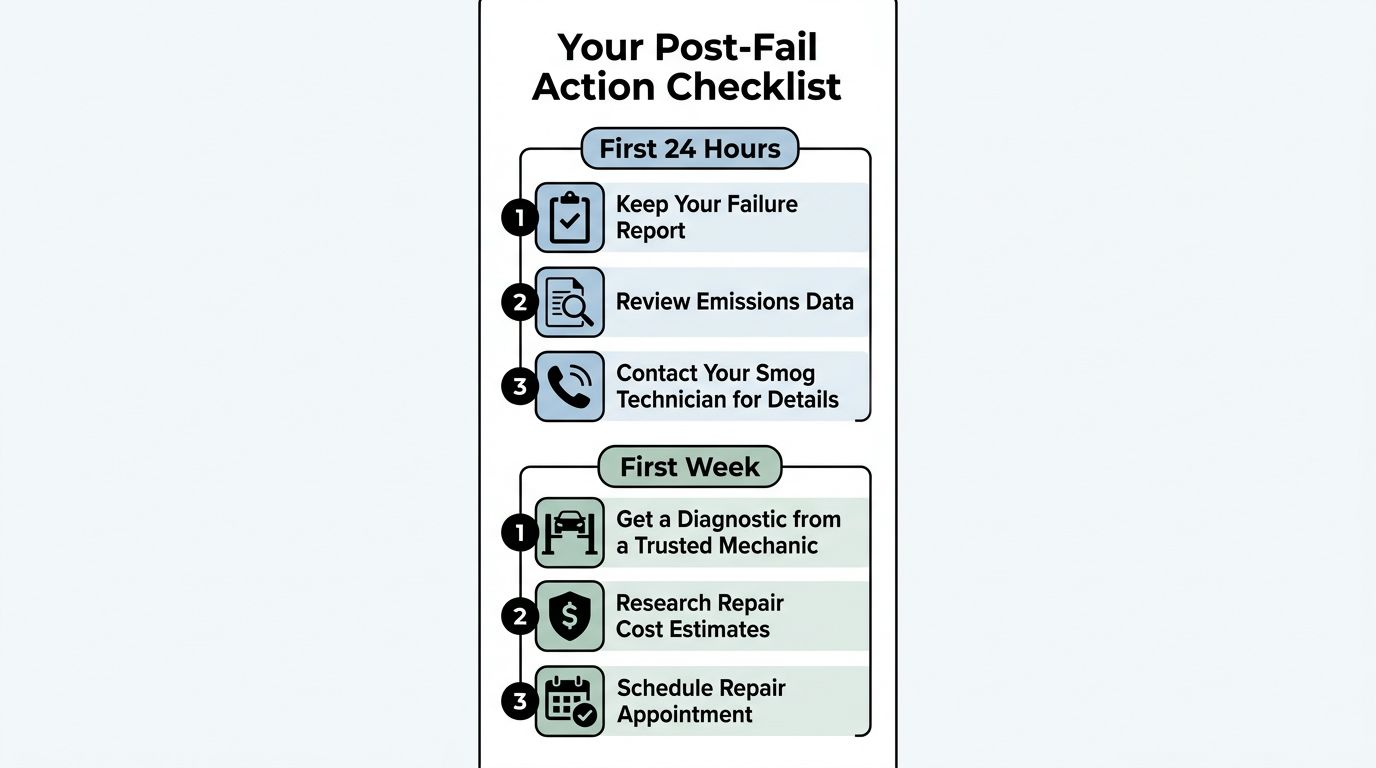
Within the next 30 days
- Verify readiness after repair. Have the technician scan the monitors before sending the vehicle to retest.
- Retest at an authorized location. Bring the VIR and repair receipts, and confirm that the station can handle any directed or enhanced requirement.
- Confirm DMV receipt. Check that the passing result appears in the DMV record, especially if renewal is pending.
- Protect the paper trail. Keep the passing VIR, invoices, CAP approval, and waiver documents together.
- Escalate intelligently. If the vehicle still fails after repeated repair and testing, stop buying guesses and request BAR Referee guidance. If the repair remains unaffordable or the vehicle cannot meet requirements, ask BAR whether a waiver or assistance route applies.
The fastest path is usually the most documented one. A clear VIR, verified diagnosis, correct station, and complete receipts keep you from paying twice for the same uncertainty.
If your failed smog check is in the San Leandro or East Bay area, bring your VIR and registration paperwork to Speedy Smog for guidance on the appropriate retest path. The STAR-certified station can inspect eligible vehicles and help you understand what needs to happen before you spend money on repairs.
The renewal notice is on the kitchen counter, your coffee is getting cold, and one line keeps pulling your attention back: smog certification required. If the check-engine light is off, the car drives normally, and nothing looks wrong, it's easy to wonder why the DMV needs another inspection.
A California car smog test is less mysterious once you separate the paperwork, the emissions equipment, and the onboard computer checks. The most important detail for many drivers now isn't visible smoke or even the dashboard light. It's whether the vehicle's readiness monitors have finished their self-tests.
Table of Contents
- Why Your Renewal Notice Just Mentioned a Smog Test
- What a Car Smog Test Actually Is
- The Two Test Types California Drivers Face
- How to Prepare So You Pass the First Time
- What Happens at a Smog Station
- Exemptions, Penalties, and Why Rules Differ by Region
- Common Reasons Cars Fail and How to Fix Them
- Picking the Right Station and Passing with Confidence
Why Your Renewal Notice Just Mentioned a Smog Test
California's Smog Check Program has been tied to vehicle registration for decades. The state became the 20th U.S. state to adopt a vehicle inspection and maintenance program in 1982, and the Bureau of Automotive Repair began administering the statewide program in 1984 under SB 33. The original program combined biennial testing, change-of-ownership testing, and inspection of emission-control components. California's Smog Check history and registration connection
That means a renewal notice mentioning a smog certificate usually isn't a sign that the DMV has discovered a new problem. It's often a routine part of the vehicle's registration cycle. Most qualifying vehicles need a Smog Check every other year, and the state transmits passing certificates to the DMV for registration purposes. A change of ownership or first registration in California can create another testing requirement.
Read the notice as a checklist
Start by checking the vehicle identification number, license plate, renewal deadline, and any instruction about where to complete the inspection. If the notice asks for a smog certification, the next step is to schedule or visit an authorized station, not to order a general mechanical inspection.
A smog requirement also doesn't mean California is checking every part of the car. The appointment focuses on emissions-related equipment and data. Brakes, tire tread, suspension, lights, and other safety items may deserve attention, but they aren't the purpose of a Smog Check appointment.
Practical rule: Treat the renewal notice as an action item, not a diagnosis. Confirm eligibility, prepare the emissions system, complete the test, and allow the result to reach the DMV.
Clean-air goals sit behind the program, but drivers experience the rule through a practical registration process. If the vehicle passes, the certificate is sent electronically for registration purposes. If you skip the test or receive a failing result, renewal can't move forward until the requirement is resolved.
What a Car Smog Test Actually Is
A car smog test is a standardized emissions inspection. Depending on the vehicle, the technician checks either the onboard diagnostic system, the exhaust coming from the tailpipe, or both. The inspection looks for evidence that the engine and emissions controls are operating within California's requirements.
California's program developed in stages. The state adopted its vehicle inspection and maintenance program in 1982, then implemented the first statewide Smog Check program in March 1984 under SB 33. California Smog Check program background
The result is connected directly to registration. A passing certificate is transmitted to the DMV, so you generally don't need to carry a paper certificate to a DMV office to prove the test occurred. The station records the inspection result, and the state uses that information during the registration process.
It isn't a safety inspection
A smog appointment isn't a full evaluation of whether the car is safe to drive. The technician isn't performing a brake inspection, measuring tire condition, or certifying the suspension. You can pass the emissions test and still need repairs that have nothing to do with emissions.
The reverse can happen too. A car that feels smooth and looks clean can fail because its diagnostic system reports an emissions fault or hasn't completed the required self-tests. That's why a visual impression isn't enough.
Which vehicles usually fall under the program
California generally requires testing for gasoline-powered vehicles from model year 1976 and newer and diesel vehicles from model year 1998 and newer, with additional rules based on fuel type, vehicle category, age, first registration, and ownership transfer. Some newer vehicles receive an initial exemption period, and hybrid requirements differ by category. California BAR Smog Check requirements
The technician chooses the inspection path based on the vehicle's model year and equipment. Newer qualifying vehicles usually communicate through an OBD II diagnostic connector. Older vehicles may need a loaded-mode test on a chassis dynamometer, where the station measures pollutants directly from the exhaust.
The Two Test Types California Drivers Face
California uses two main inspection approaches. OBD II testing reads information from the vehicle's computer, while the dynamometer test measures emissions from the exhaust while the vehicle runs under load.
For qualifying 1996-and-newer spark-ignition passenger vehicles and trucks under 14,001 GVWR, the OBD II inspection evaluates three technical gates:
- MIL status, meaning whether the malfunction indicator light, commonly called the check-engine light, is operating as required.
- Readiness monitors, which show whether the vehicle's emissions self-tests have completed.
- Fault-code retrieval, which checks for stored emissions-related trouble information.
The state's regulatory framework describes these elements and the readiness requirements for the OBD II portion. California OBD II inspection requirements
California Smog Test Types at a Glance
| Feature | OBD II Test | Dynamometer (Tailpipe) Test |
|---|---|---|
| Main evidence | Vehicle computer data | Direct exhaust measurement |
| Vehicle operation | Usually stationary while connected to the diagnostic port | Vehicle runs on chassis rollers |
| What gets checked | MIL, readiness monitors, and fault codes | Hydrocarbons, carbon monoxide, carbon dioxide, and oxides of nitrogen |
| Smoke inspection | May apply as part of the broader inspection | Visible tailpipe smoke check follows the emissions phase |
| Typical application | Newer vehicles equipped with OBD II | Older vehicles or vehicles directed to a loaded-mode procedure |
In a loaded-mode inspection, the vehicle runs at a stabilized cruise condition on a chassis dynamometer. The station samples hydrocarbons, carbon monoxide, carbon dioxide, and oxides of nitrogen, then performs a visible tailpipe-smoke check at idle with an unobstructed observation period of at least 10 seconds. California loaded-mode and visible-smoke testing requirements
Vehicles equipped with OBD II are evaluated through that computer-based pathway rather than treated like older tailpipe-only vehicles. The key preparation issue for these drivers is monitor status, especially after electrical work or emissions repairs.
How to Prepare So You Pass the First Time
You arrive for renewal with the check-engine light off, expecting an easy pass. The overlooked problem may be hidden in the vehicle's readiness data. Effective October 1, 2025, California's new readiness rule requires all readiness monitors to be set for a vehicle to pass a Smog Check, subject to limited exceptions for unique design issues. BAR's explanation of the October 2025 OBD readiness-monitor regulations
Readiness monitors are internal self-tests. They examine systems such as fuel control, oxygen sensors, catalytic-converter performance, and evaporative emissions equipment. A monitor marked ready has completed its check. Incomplete means the check has not finished. Not supported means the vehicle does not use that monitor, so it is different from an incomplete result.
Check readiness before booking
A basic OBD scanner can show monitor status. Some vehicles also display inspection information through a dashboard test mode, though the procedure varies by manufacturer. Check before visiting a station if you recently disconnected the battery, cleared trouble codes, replaced a battery, or completed emissions repairs.
Clearing codes only to turn off the warning light can reset the monitors. The vehicle may then need normal driving under specific conditions before the diagnostic system completes its checks. Follow this order: diagnose the problem, make the repair, drive normally as needed, verify that the monitors are ready, and schedule the test.
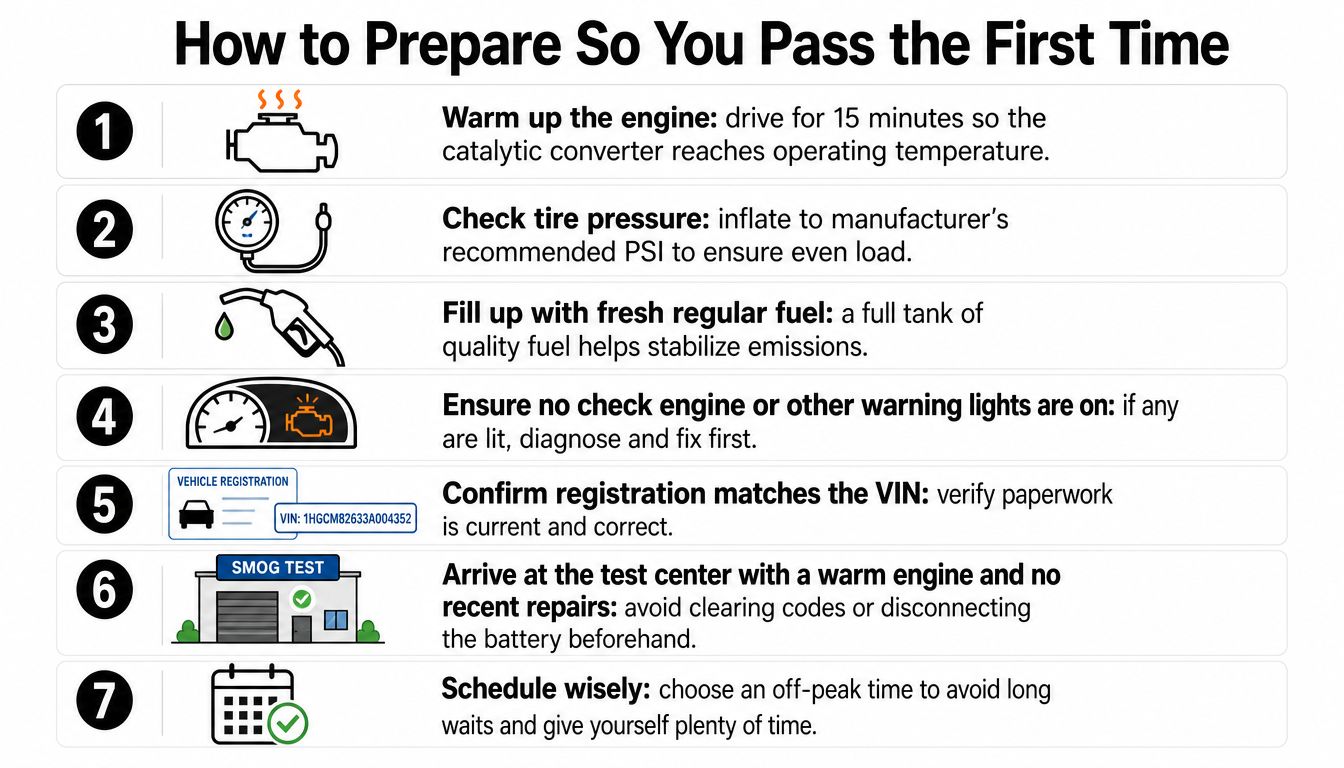
Use a sensible pre-test routine
A short routine can prevent avoidable complications:
- Warm the engine: Drive long enough for the engine and emissions equipment to reach normal operating temperature.
- Check tire pressure: Use the manufacturer's recommended pressure, particularly if the vehicle will run on a dynamometer.
- Use normal fuel: Fresh, appropriate fuel supports normal engine operation.
- Inspect the dashboard: Do not arrive with an illuminated emissions warning light.
- Verify the paperwork: Confirm that the registration information matches the vehicle identification number.
- Avoid last-minute resets: Do not disconnect the battery or erase codes immediately before testing.
For a practical walkthrough, review this guide to passing a California emissions test.
A vehicle that fails after a legitimate repair attempt may qualify for California's repair-cost waiver option. Eligibility depends on the program's conditions, so ask the station or BAR before assuming every failure requires unlimited repairs.
What Happens at a Smog Station
You pull into a station, provide the registration information, and tell the technician whether the test is for renewal, a transfer, or another DMV requirement. A STAR-certified station, such as Speedy Smog in San Leandro, can inspect vehicles that need the STAR pathway, although the correct station depends on the vehicle's DMV direction and local program requirements.
The technician begins by confirming the vehicle information and checking the equipment relevant to the inspection. The appointment may include a visual inspection of emissions components, a connection to the OBD II port, or a dynamometer procedure for a vehicle that requires loaded-mode testing.
The inspection itself
For an OBD II vehicle, the technician connects a test device and retrieves the MIL status, readiness information, and trouble-code data. For an older vehicle subject to loaded-mode testing, the technician places it on a chassis dynamometer and measures exhaust pollutants while the car runs through the required operating condition.
A visible-smoke inspection can also be part of the procedure. California's regulation requires the observation immediately after the emissions phase, with the engine at idle and an unobstructed view for at least 10 seconds. California emissions and smoke inspection procedure
The visit can feel routine, but ask questions if the result isn't what you expected. A useful technician should be able to tell you whether the vehicle passed, which monitor or code caused a failure, and whether the result was transmitted electronically for DMV registration purposes.
A test result is more useful when you leave knowing what the vehicle reported, not just whether the paper says pass or fail.
The final certificate is not a general guarantee of mechanical health. It confirms the outcome of the required emissions inspection. Keep any repair documentation and ask about the retest process before you leave if the result is unsuccessful.
Exemptions, Penalties, and Why Rules Differ by Region
California's Smog Check rules aren't perfectly uniform across every vehicle and air basin. Eligibility depends on model year, fuel type, vehicle category, registration events, and the region where the vehicle is registered.
The state's current requirements cover gasoline vehicles from model year 1976 and newer and diesel vehicles from model year 1998 and newer, while some newer vehicles receive an initial exemption period and hybrid rules differ by category. California BAR eligibility guidance
Why the San Joaquin Valley deserves attention
The San Joaquin Valley illustrates why older online guides can become misleading. BAR's 2026 update says a contingency measure could move the new-vehicle exemption in that area from eight model years to seven, which would bring more vehicles into the inspection cycle if the measure takes effect under the stated conditions. BAR's San Joaquin Valley contingency update
That change matters even if a statewide summary still lists the older exemption language. Local air-quality requirements can affect eligibility differently, so owners should rely on the current DMV notice and BAR guidance for the vehicle's registration location.
Don't assume an exemption from memory
Owners often remember an exemption that applied to an older vehicle, a different fuel type, or another county. First registration in California and a change of ownership can also trigger testing, even when the vehicle's usual renewal pattern looks different.
| Region | STAR Required? | Typical Fee Range | Key Exemptions |
|---|---|---|---|
| East Bay and other Bay Area locations | Depends on DMV direction and vehicle status | Varies by station and inspection type | Vehicle age, fuel type, and qualifying categories |
| San Joaquin Valley | May change under regional contingency requirements | Varies by station and inspection type | Local exemption rules can be affected by air-quality measures |
| Other California areas | Depends on county, vehicle, and DMV instruction | Varies by station and inspection type | Some newer vehicles and specific vehicle categories |
The table is a decision aid, not a substitute for the notice attached to your vehicle record. If the DMV directs you to a specific type of station, follow that instruction rather than relying on a general internet checklist.
Common Reasons Cars Fail and How to Fix Them
A failure usually points to a specific emissions issue or incomplete diagnostic process. The most avoidable problem is testing before the vehicle's readiness monitors have finished after a battery disconnect or code clear.
Use this repair checklist as a starting point, not a substitute for diagnosis:
- Readiness monitors are incomplete: Drive the vehicle normally through varied conditions after repairs or electrical work, then verify monitor status with an OBD scanner before testing. Don't assume a short trip has completed every self-test.
- The gas cap doesn't seal: Tighten it until it seats correctly. If the seal is worn or the cap is damaged, replace it with a suitable replacement, preferably an OEM part, because an evaporative leak can trigger a fault.
- The oxygen sensor is faulty: Have the diagnostic code and sensor data checked before replacing parts. A sensor that reports incorrectly can disturb fuel control and increase emissions.
- The catalytic converter isn't working properly: A converter that's damaged, clogged, or no longer converting pollutants may require replacement after the underlying cause is identified.
- The engine is producing excess emissions: Misfires, fuel-mixture problems, vacuum leaks, a failing mass-airflow sensor, or an emissions-control fault can all require attention before the test.
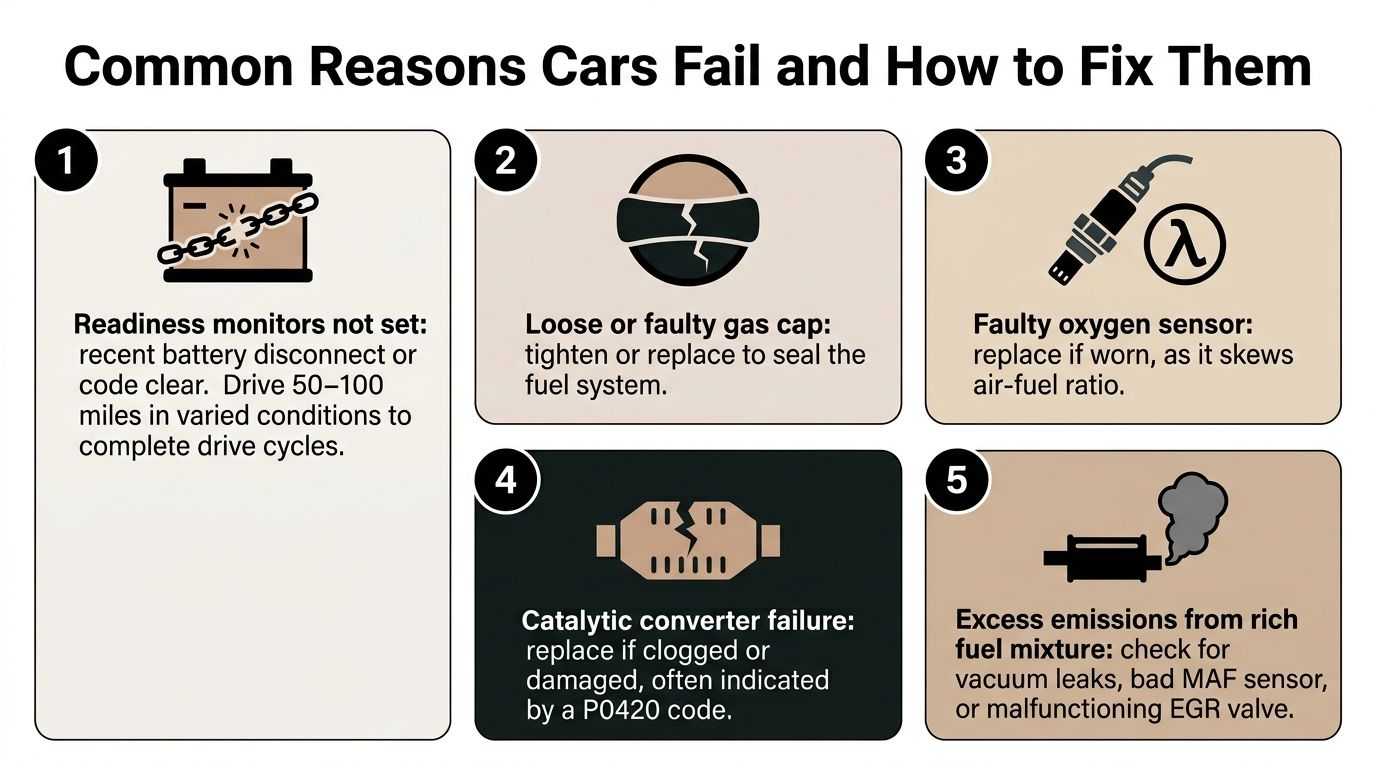
Start with the evidence
A glowing check-engine light is a strong warning that the vehicle's OBD II inspection may fail. Stored fault codes matter too, even when the car feels normal. Ask a repair shop to scan the system and explain the code before authorizing a catalytic converter, oxygen sensor, or other expensive replacement.
Older vehicles may fail because of measured tailpipe emissions, visible smoke, altered emissions equipment, or engine problems that affect the loaded-mode result. California's dynamometer procedure measures hydrocarbons, carbon monoxide, carbon dioxide, and oxides of nitrogen, so clean-looking exhaust doesn't prove the readings will be acceptable. California loaded-mode testing rules
For a more detailed repair-oriented checklist, review these common Smog Check failure reasons. Repair the cause, let the vehicle complete its self-tests where applicable, and retest only after the system is ready.
Picking the Right Station and Passing with Confidence
The right station can prevent confusion, but it can't make an unready vehicle pass. Choose a facility that can explain the vehicle's inspection path, confirm readiness-monitor status, and tell you what the result means before you leave.
A Test Only station performs inspections without selling repairs. A STAR station meets additional program requirements and handles vehicles that BAR or the DMV directs through the STAR pathway. If your notice names STAR or Test Only, follow the notice rather than choosing a station based only on distance.
What to ask before the test
Call or check the station's posted information and ask:
- Which station type applies: Can the facility test your vehicle under the DMV's instruction?
- What the price includes: Does the quoted amount cover the inspection, certificate transmission, and any required retest terms?
- Whether readiness can be checked first: Will the technician show you which monitors are ready, incomplete, or unsupported?
- What happens after a failure: Will you receive the trouble code or failure reason in writing?
- Whether the result is transmitted electronically: Confirm how the passing certificate reaches the DMV.
For a plain-language explanation of station categories, read what a STAR Smog station is.
The most dependable habit is simple: book with a station that explains the result before you leave. That matters more under the readiness-monitor rule because a vehicle can have no visible smoke and no obvious driving complaint, yet still fail when its diagnostic self-tests remain incomplete.
Speedy Smog in San Leandro offers STAR-certified smog inspections, accepts walk-ins, and transmits passing results electronically to the DMV. If you're an East Bay driver preparing for renewal, visit Speedy Smog to confirm the appropriate test and have the vehicle's readiness status reviewed before inspection.