
The DMV envelope arrives, and the whole week suddenly has one extra errand attached to it. If you live in Oakland, that usually means figuring out whether your car needs a Smog Check, where to take it, and whether the notice is pointing you to a regular station or a STAR station. The easiest way to handle it is to treat the test like a small DMV project, not a mystery chore.
Table of Contents
- What Oakland Drivers Should Know Before Booking a Smog Check
- How California's Smog Check Program Works
- DMV Compliance and What Your Renewal Notice Means
- Vehicle Eligibility and How Model Year Changes the Test
- Preparing Your Vehicle the Week Before the Test
- What the Appointment Itself Looks Like
- Turnaround, Results, and What Happens If You Fail
- Putting It All Together for Oakland Drivers
What Oakland Drivers Should Know Before Booking a Smog Check
A smog check Oakland CA search usually starts the same way, with a renewal notice in hand and a deadline in front of you. That notice matters more than the shop sign outside, because it tells you what kind of inspection your vehicle needs and whether the state wants a higher-oversight station.
The fastest way to avoid a wasted trip is to answer five questions before you book. First, is the vehicle due for a Smog Check under California rules. Second, does the renewal notice call for a STAR station. Third, is your vehicle older, newer, diesel, or a hybrid, because that changes the test. Fourth, have you done the basic prep work in the days before the appointment. Fifth, do you know what the visit itself will look like.
Practical rule: the renewal notice is the real starting point, not the first shop result you find online.
That framing saves time because the state treats this as a registration step, not an optional maintenance add-on. For Oakland and East Bay drivers, the whole process is tied to DMV renewal, so the cleanest path is usually to read the notice, match the station type, and then book the right kind of inspection the first time.
How California's Smog Check Program Works
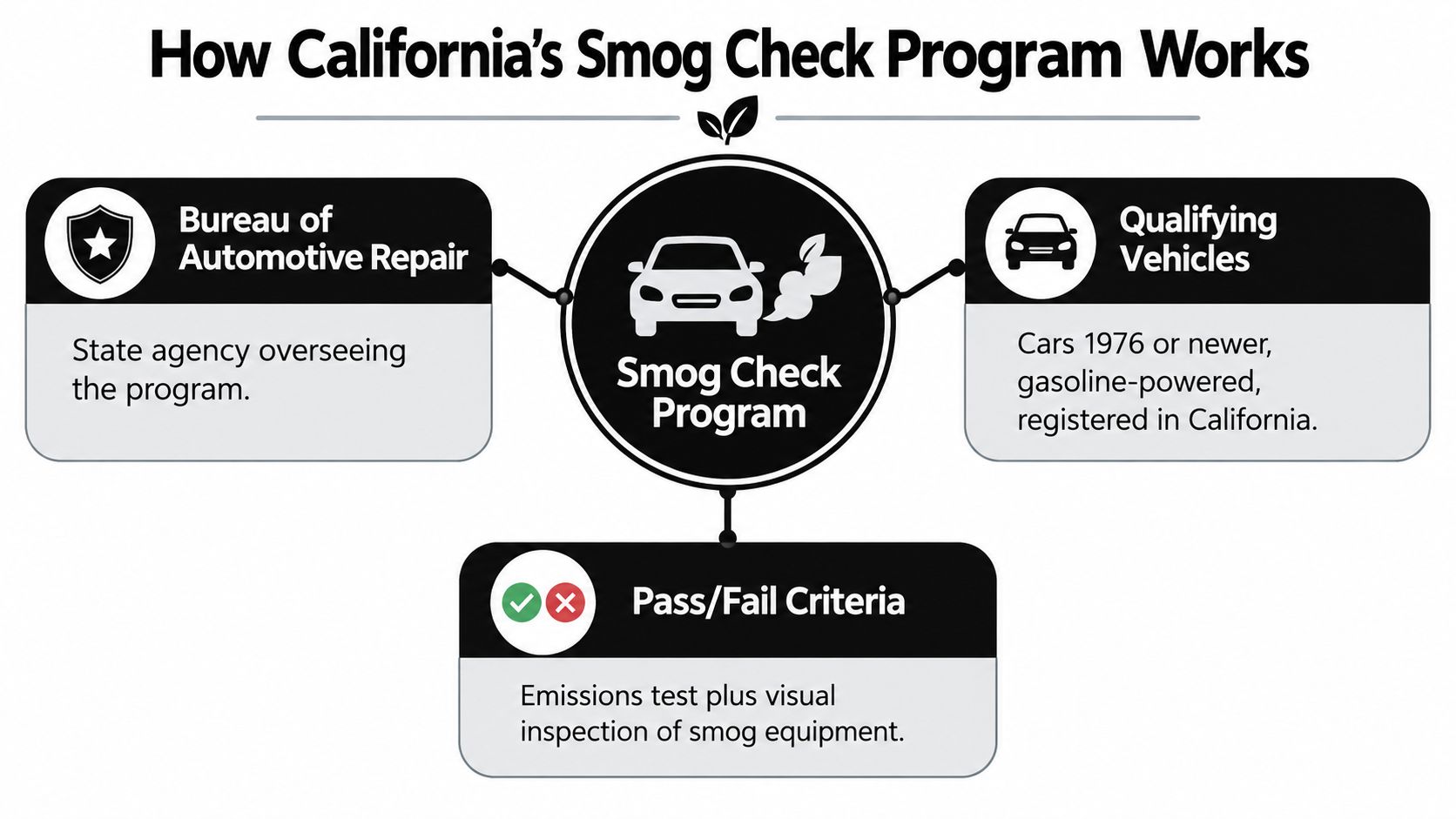
A smog check in California is part of the state's registration system, not a separate errand you handle on its own. The Bureau of Automotive Repair sets the rules for qualifying vehicles, and the inspection usually happens as part of renewal, so the DMV and the test move together. California Smog Check performance report
Why STAR exists
STAR certification creates a higher-oversight network for vehicles that need closer review. STAR stations are part of the state's testing framework, not just a marketing label, and California reported that by December 2019 there were 7,902 licensed Smog Check stations statewide, including 3,882 STAR stations, or 49% of the total. During calendar year 2019, roughly 10.3 million initial Smog Check tests were performed statewide, and about 8.4 million, or 82%, were completed by STAR stations, as reported in the same BAR performance report.
For an Oakland driver, the key point is simple. The rules do not change by neighborhood. Whether the car is tested in Oakland, San Leandro, or somewhere else in California, the result feeds into the same state reporting system and is sent to the DMV electronically. If the renewal notice calls for STAR service, the station must be authorized for that category or it cannot finish the certification.
DMV Compliance and What Your Renewal Notice Means
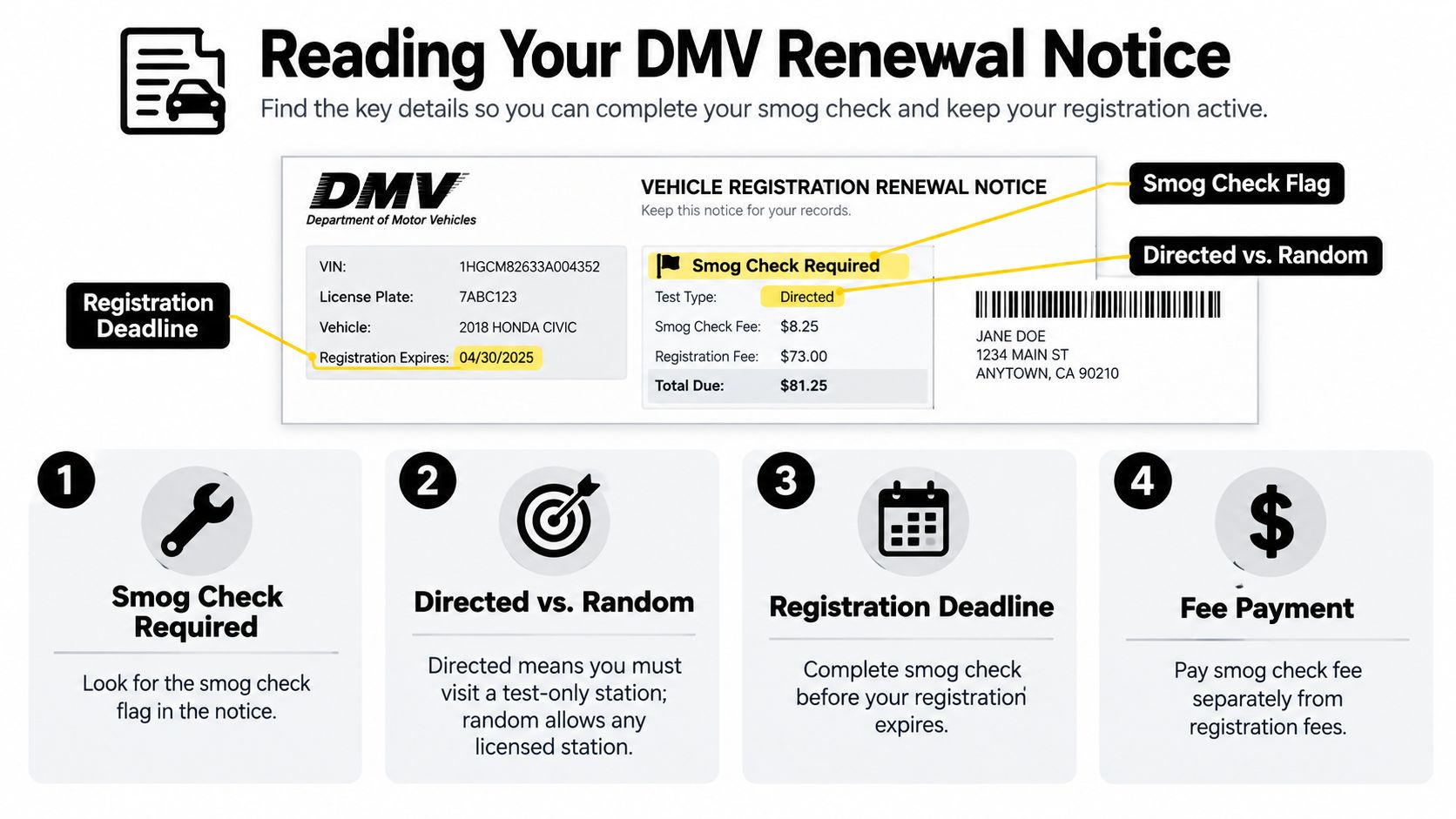
The renewal notice is where the DMV turns a general rule into a specific instruction. If it flags the vehicle for a Smog Check, the notice is telling you that registration renewal depends on a passing certificate, and if it identifies the car as directed or otherwise STAR-required, the wrong station can't complete the certification.
Regular station or STAR station
A STAR station is the one the state authorizes for vehicles that need enhanced oversight, much as a referral sends a patient to a specialist. A regular licensed station can handle many inspections, but STAR programs require these facilities to maintain compliant licenses, required inspection equipment, adequate inspection volume for statistical review, and specific performance measures, including a Similar Vehicle Failure Rate of at least 50% of the industry-wide failure rate for comparable vehicles and a gear-shift incident rate no higher than 2% of certified vehicles. STAR certification requirements
If your notice requires STAR service and you go to a station that isn't STAR-certified, you can lose time without moving the registration forward. That's why the notice deserves a close read before you book. If the wording is confusing, compare it with your registration status and, if needed, ask the station to confirm that the vehicle type on the notice matches its current authorization.
For Oakland-area drivers who want a plain-English walkthrough of renewal timing and station selection, this guide to registration renewal and smog check steps is a useful companion.
Practical rule: the renewal notice decides the station category first, and the appointment time second.
Payment usually follows the test result through DMV's electronic system, so the important thing is not to collect paperwork for its own sake. The important thing is to get the right certificate into the state system so registration can move ahead.
Vehicle Eligibility and How Model Year Changes the Test
Vehicle age changes the inspection path more than most drivers expect. California BAR says most 2000-and-newer gasoline and alternative-fuel vehicles get an OBD-based inspection, while pre-2000 vehicles generally receive a tailpipe emissions test instead. That's why two cars with the same renewal notice can end up going through very different checks.
What the model year tells the inspector
The state's 2025 executive summary shows why age matters. A 2024 vehicle recorded 100,305 initial tests and 4,538 failures, for an 4.52% overall failure rate. A 2010 vehicle recorded 314,125 initial tests and 28,718 failures, for 9.14%. A 2008 vehicle recorded 367,600 initial tests and 34,834 failures, for 9.48%. A 1998 vehicle had 100,885 initial tests and 19,185 failures, for 19.02%. 2025 Smog Check executive summary
| Model Year | Initial Tests | Overall Failures | Overall Failure Rate |
|---|---|---|---|
| 2024 | 100,305 | 4,538 | 4.52% |
| 2010 | 314,125 | 28,718 | 9.14% |
| 2008 | 367,600 | 34,834 | 9.48% |
| 1998 | 100,885 | 19,185 | 19.02% |
That table doesn't mean every older car will fail. It does show the pattern: as vehicles age, inspection risk rises. For drivers who want a practical breakdown of which cars fall into which testing path, this California smog check vehicle guide is a useful reference.
Why OBD readiness matters
For 2000-and-newer vehicles, the test isn't just a quick visual look. The inspector checks diagnostic trouble codes, emissions-system operation, and readiness monitors. BAR advises delaying the test after a battery disconnect or replacement because the monitors may still be incomplete, and it recommends driving the vehicle for roughly one to two weeks under varied conditions before retesting. California Smog Check guidance
A newer car can look fine and still be too early for the test if the monitors haven't set yet.
Preparing Your Vehicle the Week Before the Test
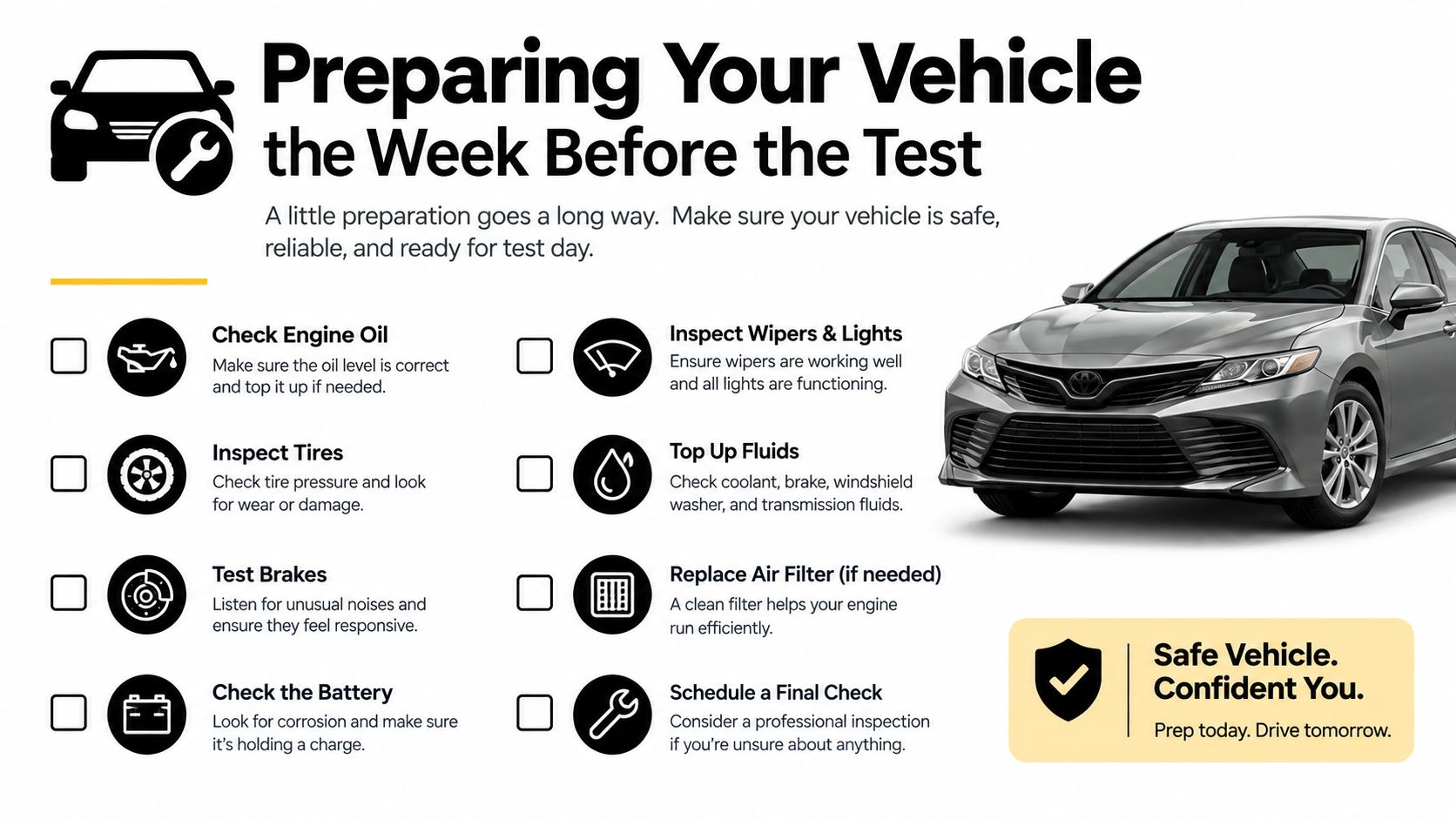
A passing result is often decided before the appointment day arrives. If the check-engine light is on, that's not a paperwork problem, it's a vehicle problem, and clearing the code right before the test doesn't fix the underlying fault. The car may still show incomplete monitors, which can still lead to failure.
A simple prep routine
Think of readiness monitors like homework the car has to finish. You can't cram them into place five minutes before the test, and a battery disconnect is like erasing the assignment halfway through. The best preparation is boring in the right way.
- Watch the warning lights: If the check-engine light comes on during normal driving, fix the cause before you book the test.
- Drive normally: Mix city streets and steady-speed driving so the monitors can complete.
- Avoid last-minute battery work: A recent disconnect or replacement can leave the monitors incomplete.
- Warm the vehicle up: Arrive with the car at normal operating temperature, not just started a minute before.
- Bring the notice: Have the renewal notice and a payment method ready so nothing slows the check-in.
One more detail matters for Oakland drivers with older cars and diesels. If you've just had repairs, give the car enough time to settle into normal operation before the appointment. A clean run on paper doesn't help if the vehicle's diagnostic system hasn't had time to confirm that everything is working again.
Practical rule: repair first, drive second, test third.
What the Appointment Itself Looks Like
A typical visit feels more like a quick medical intake than a long repair appointment. You arrive, the station confirms the vehicle and paperwork, the inspector takes the car through the required test, and the result gets sent electronically to DMV. For 2000-and-newer vehicles, the test portion is commonly completed in about 10 to 15 minutes, which is why these visits often move faster than drivers expect.
What changes from one vehicle to another
The basic flow is the same, but the inspection time can stretch if the vehicle is older, if the test uses a tailpipe procedure, or if the station is busy. STAR status usually matters to the driver mainly in paperwork and eligibility, not in some dramatic visible difference at the counter. A STAR-certified shop such as Speedy Smog in San Leandro can handle the higher-oversight categories the state requires, including vehicles that need STAR authorization, while still testing many routine Oakland-area vehicles as part of the same DMV process.
The key point is that the station is not handing you a paper certificate to carry around. It's sending the result electronically, which is why the visit can feel short even though the compliance step is important. If the vehicle passes, you're done with the inspection piece. If it doesn't, the station should tell you what blocked approval so you can decide on repairs.
Turnaround, Results, and What Happens If You Fail
A passing result is useful because it clears the DMV hurdle right away. The station transmits the certificate electronically, and that certificate, not a paper receipt, is what helps unblock registration renewal. The old-style handoff of paperwork has mostly been replaced by instant digital reporting.
If the car fails
A failure doesn't end the registration process, it just means the car needs work before it can be certified. The inspection report is the starting point for diagnosis, and the next step is usually repair, then a retest once the vehicle is ready.
If you're trying to keep costs predictable after a repair visit, some stations offer discounts or coupons toward a return visit. One concrete example is the periodic $25-off coupons for newer vehicles mentioned by East Bay shops, which can soften the cost of a second trip after the underlying issue has been fixed. For a closer look at how stations present results and follow-up steps, see this smog test results guide.
The important thing is not to confuse a receipt with a certificate. The receipt shows you paid for the visit. The certificate is what the DMV cares about.
Putting It All Together for Oakland Drivers
The smartest move is to treat the renewal as three small jobs. First, read the DMV notice closely and confirm whether STAR service is required. Second, get the car ready by handling any warning lights, driving enough for monitors to set, and avoiding last-minute battery interruptions. Third, book a station that can legally handle your vehicle type and finish the certificate correctly.
That approach takes the uncertainty out of the process. The state rules decide the test type, the vehicle decides the inspection path, and the renewal notice decides the station category.
If you want a San Leandro station that handles Oakland-area renewals for routine inspections, STAR-required vehicles, diesels, hybrids, and older cars, Speedy Smog is set up for that workflow. Bring the notice, bring the car ready to test, and turn the smog check into one clean DMV task instead of a week of guesswork.
If you need a straightforward East Bay smog check with clear station guidance, Speedy Smog handles the inspection and electronic certificate process in one visit. Their team works with Oakland drivers, STAR-required renewals, and a range of vehicle types, so you can get the DMV step finished without extra back-and-forth.
You're in San Leandro or Oakland, your registration deadline is close, and the search results are full of smog coupons that look cheaper than they may be at checkout. The advertised inspection price may not include California's mandatory $8.25 Smog Check certificate fee, and the final amount can also depend on your vehicle, station type, coupon restrictions, and any electronic-payment fee. California's Bureau of Automotive Repair reports statewide average initial-test prices in 2025 of about $60.85 at STAR test-only stations and $69.22 at STAR test-and-repair stations, before you compare every local promotion.
This roundup ranks seven East Bay stations by the way they reduce total hassle or cost. The comparison focuses on price signals, STAR status, vehicle coverage, likely turnaround, hours, promotion limits, and the verification step that can prevent an unpleasant surprise. Details change, so call before driving over.
Speedy Smog is the strongest overall choice for a fast San Leandro visit, broad vehicle coverage, and a local indoor waiting room. The ranking also includes the best headline coupon, the clearest online base pricing, Sunday access, diesel service, Alameda convenience, and a low starting price. Read the list, use the savings guidance, then match the station to your vehicle and deadline.
Table of Contents
- 1. Speedy Smog
- 2. EZ Star Smog Oakland
- 3. Smog Check Oakland at Smog Car Care and Lube
- 4. 4 Less Smog Check Oakland
- 5. Xpress Star Smog
- 6. Alameda Smog
- 7. KS Smog
- 7 Cheap Smog Stations Compared
- Choose the Station That Matches Your Vehicle and Deadline
1. Speedy Smog
Speedy Smog earns the top spot for drivers who want fast service without narrowing their vehicle options. The STAR Certified station is at 15275 Washington Ave, San Leandro, and its core advantage is a practical combination of quick testing, recognized certification, and a comfortable place to wait. The shop says many tests for vehicles from 2000 and newer take about 10 to 15 minutes, but confirm the expected wait when you call.
STAR status matters if your DMV notice requires a STAR station. California's BAR reported that STAR stations represented 49% of licensed smog check stations in 2025 but performed 83% of all smog checks, which shows how important this station category is to actual testing volume. Review the BAR performance report before assuming the lowest coupon price is suitable for your vehicle or registration requirement.
Best fit for broad vehicle coverage
Speedy Smog handles 2000 and newer vehicles, 1999 and older vehicles, diesels, and hybrids. That range makes it a strong first call for owners who don't want to discover at arrival that a station's promotion excludes their vehicle. The shop also advertises periodic $25-off promotions for most smogs on 2000 and newer vehicles, but the exact offer, expiration, and eligibility should be confirmed before you leave home.
The clean indoor waiting room and customer-focused service add value when you're comparing stations on more than the sticker price. A quick test is useful, but a clear process and a comfortable wait can matter just as much when you're dealing with registration paperwork.
Money-saving rule: Ask for the complete amount, including the certificate fee, before accepting a coupon price.
Speedy Smog lists Monday through Friday hours of 8:30 a.m. to 5:30 p.m. and Saturday hours of 8:30 a.m. to 4 p.m. Its website also contains inconsistent wording about Sunday availability, so verify the schedule directly. Check the current Speedy Smog hours and call (510) 614-7664 with your vehicle year, fuel type, and inspection purpose.
Pros
- Fast local testing: Many newer-vehicle inspections are advertised at about 10 to 15 minutes.
- STAR Certified service: Suitable for drivers who need a STAR-capable provider.
- Broad coverage: The shop lists newer cars, older vehicles, diesels, and hybrids.
- Practical promotion: A periodic $25-off offer may reduce the visit cost for eligible newer vehicles.
- Comfortable stop: The indoor waiting room is more convenient than a bare-bones testing area.
Cons
- Exact standard prices: The website doesn't publish a complete standard rate list.
- Promotion limits: Coupon eligibility and current terms require confirmation.
- Hours: Verify Sunday availability because the site wording and listed hours don't fully match.
2. EZ Star Smog Oakland
Drivers near the Oakland and Emeryville border can reduce travel time at EZ Star Smog Oakland, where STAR-certified walk-in testing and online coupon redemption are available. The location suits motorists who want a qualifying inspection without crossing the East Bay for a discount. The promotion can be shown on a phone or by QR code and is scheduled to run through December 31, 2026, though you should confirm that it remains active before visiting.
The station advertises fast service and does not require an appointment. Walk-in access helps when a registration deadline is close, but it does not guarantee an immediate bay. Call ahead with your vehicle year, make, fuel type, and inspection purpose. Ask for the complete price and confirm that the coupon applies to that vehicle and test.
Read the exclusions before you drive
The promotion has clear limits. Published restrictions exclude some brands and body types, including Land Rover and Porsche, and the offer does not include a retest. Those terms can eliminate the advertised savings if your vehicle is excluded or needs another inspection after repairs.
EZ Star Smog Oakland also provides DMV registration services, which may remove a separate trip after a successful test. Confirm the required paperwork and any service fees before relying on that convenience.
Review this STAR Certified smog station guide to understand why certification matters for drivers whose vehicles require a STAR inspection. Then check the EZ Star Smog Oakland website for the current coupon, accepted vehicle types, retest policy, hours, and expected wait. Online terms can change.
Best money-saving step: Show the QR code before testing starts. Ask whether the quoted total includes the state certificate fee and any vehicle-specific charge. Treat the online discount as an advertised reduction, not the final out-the-door price, until the station confirms the full amount.
3. Smog Check Oakland at Smog Car Care and Lube
Drivers comparing total hassle and cost should place Smog Check Oakland at Smog Car Care & Lube at Valero on High Street near the top for a low advertised price and short stated turnaround. Its $29.95 coupon price is a promotional base figure, not the guaranteed amount for every vehicle. California's $8.25 certificate fee applies to a passing test, so ask the station to include it in the quote and explain any vehicle-specific charge before approving the inspection.
The station is STAR Certified and test-only, making it suitable for vehicles that require a STAR inspection and for owners who want testing rather than repairs. It also performs change-of-ownership and out-of-state inspections, then sends results electronically to the DMV. That process can reduce paperwork and eliminate a separate submission step.
Best fit for speed and test-only service
The station states that testing takes roughly 15 minutes, which helps drivers balancing a deadline with a tight budget. The offer requires phone or phone-coupon redemption, so mention the promotion before arriving and keep proof available. Because the site operates at a Valero location, expect a practical test-focused setup rather than extensive waiting-room amenities.
Published hours are Monday through Friday from 8:30 a.m. to 5 p.m., and Saturday from 8 a.m. to 2 p.m. Confirm the schedule before leaving, particularly when planning a Saturday visit. Check the Smog Check Oakland station website for current terms, then call with your vehicle year, body type, fuel type, and inspection purpose.
Ask specifically whether the Valero location handles your vehicle under its test-only process, whether STAR eligibility applies, and whether the quoted total includes the certificate fee. The BAR confirms the certificate fee, but the station must confirm the complete amount for your inspection.
4. 4 Less Smog Check Oakland
4 Less Smog Check Oakland is the clearest pick for drivers who prioritize online base-price transparency. The Broadway Auto Row shop posts smog test rates on its website instead of relying only on a rotating coupon headline. That makes it easier to build a realistic comparison before calling, although the posted rate still needs confirmation because the final cost can depend on the vehicle and mandatory state fee.
The station is test-only and sends results directly to the DMV. It serves drivers who want a focused inspection rather than a repair appointment, and its central Broadway location can work well for Oakland motorists already traveling along the Auto Row corridor. Monday through Saturday availability adds flexibility, but confirm the current daily schedule before visiting.
Watch the older-vehicle surcharge
The site identifies an additional fee for vehicles from 1999 and older. That detail is exactly the kind of condition that separates a useful price page from a misleading bargain search. If you own an older car, state the model year during the first phone call and ask for the full amount, including the certificate fee and any applicable surcharge.
The station also allows customers to request promotional pricing through its website. Don't assume a request form creates an automatic discount. Ask whether the offer is available for your inspection type and whether you must receive confirmation before arrival.
Use the 4 Less Smog Check Oakland website to review the posted rates, then compare the offer against other smog check deals. That two-step approach gives you a visible base price and a chance to find a current promotion without confusing either figure with the final total.
Best verification question: “What will I pay out the door for my exact year and vehicle type, including the certificate fee and the older-vehicle charge if applicable?”
5. Xpress Star Smog
Xpress Star Smog is the strongest fit for drivers whose schedule matters more than a single posted price. The STAR Certified station advertises seven-day hours, including Sundays, which makes it useful for a last-minute registration deadline or a driver who can't visit during a conventional workweek. Confirm the current Sunday schedule and expected wait before setting out, because extended hours don't guarantee immediate service.
Its online offer advertises $20 off Smog Check, but the site doesn't present one universal flat rate. The final amount depends on the vehicle and service, so treat the coupon as a discount against a quote rather than as the quote itself. Ask whether the promotion applies to your inspection and whether it can be combined with any other offer.
The best vehicle-fit option for specialized testing
Xpress Star Smog lists services for diesel vehicles, out-of-state inspections, renewal inspections, and gross-polluter testing. That broad service menu makes it a better first call than a generic discount station when your vehicle has a less routine inspection need. California guidance distinguishes diesel rules from gasoline and hybrid rules, and the BAR reference guide explains that newer lighter diesel vehicles can still require testing while older or heavier diesels may fall outside the standard program.
The mobile-friendly website makes the coupon easy to present from a phone. Still, call with the vehicle year, fuel type, and service category before assuming the $20 discount applies.
Visit the Xpress Star Smog website and confirm the full price, Sunday hours, coupon requirements, and whether gross-polluter or diesel testing carries a different charge.
6. Alameda Smog
Alameda Smog ranks highest for reducing travel and waiting hassle. It suits drivers near High Street and Fernside who want a quick neighborhood drop-in rather than a trip to Oakland or San Leandro. The STAR-certified station advertises no-appointment service and inspections in about 10 to 15 minutes. Because the entrance faces Fernside, confirm that approach before leaving, especially if you are unfamiliar with the surrounding streets.
The station also advertises a “Website Special,” but it does not post a fixed discount amount. That makes the offer harder to compare than a stated coupon, yet it may lower the quoted base price when the promotion covers your vehicle and service. Open the Alameda Smog services page, save the offer on your phone, and check its current terms before visiting.
Convenience depends on the final quote
A drop-in option helps when your schedule is tight, but the advertised turnaround is not a guaranteed wait time. Call before driving over during busy periods, and provide the vehicle year, model type, and inspection purpose. Hybrid owners and drivers with less common vehicles should confirm that Alameda Smog handles the test and that the promotion applies.
Use the Website Special as a quote-checking tool, not a final price. Ask the station to apply the offer to your vehicle, then compare the discounted total with the amount quoted without it. Confirm whether the promotion has an expiration date, requires the webpage, or excludes a service category. This verification shows whether the special lowers your bill.
Alameda Smog is the strongest fit when location and fast drop-in service outweigh fully posted pricing. Choose another station if you need a final online price before making a call, because this offer and the completed total require confirmation.
7. KS Smog
KS Smog is the best budget lead for drivers who want a clearly advertised starting price and favorable treatment for common light-duty vehicles. The San Leandro test-only STAR station lists pricing starting at $36.75, while stating that many light-duty trucks, minivans, and SUVs don't incur an added charge. The word “starting” matters. Your final amount can change with the model year, vehicle type, inspection purpose, certificate fee, and current promotion.
That pricing structure may work especially well for owners of larger everyday vehicles who often expect a body-type surcharge elsewhere. Ask the station to confirm that your exact truck, minivan, or SUV qualifies for the no-extra-charge policy before you rely on the advertised figure.
Useful coverage for several DMV situations
KS Smog lists STAR and test-only services for renewals, change-of-ownership inspections, out-of-state vehicles, salvage vehicles, and hybrids. Saturday hours add a weekend option for drivers along the East 14th Street and Foothill corridor, but confirm the current Saturday schedule and arrival cutoff.
Use the KS Smog website to review the current offer, then call with your year, make, vehicle type, and service need. Ask whether the $36.75 starting price is available for your vehicle and whether the certificate fee is included or added separately.
Best verification step: Have the station repeat the complete total for your vehicle, not just confirm that it “starts at” the advertised price.
KS Smog ranks seventh because the entry price is compelling but not universal. For the right light-duty truck, minivan, or SUV, its pricing policy may beat a larger headline discount. For another vehicle, the final total may be closer to the local market range, so the phone quote decides the value.
7 Cheap Smog Stations Compared
| Station | Speed & Efficiency ⚡ | Certification / Quality ⭐ | Process & Complexity 🔄 | Expected Outcome / Impact 📊 | Ideal Use Case & Tip 💡 |
|---|---|---|---|---|---|
| Speedy Smog | Very fast (most 10–15 min); comfortable indoor waiting | STAR‑certified; DMV‑recognized | Walk‑in & appointments; call to confirm hours/pricing | Quick, accurate smog results accepted for registration | Great for fast turnaround and comfort, call ahead to confirm coupon eligibility |
| EZ Star Smog Oakland | Fast, walk‑in testing; online coupon redemption | STAR‑certified; consistently strong reviews | No appointment needed; QR/coupon workflow; on‑site DMV services | Efficient testing plus on‑site registration | Ideal for walk‑ins using online promos, check coupon exclusions |
| Smog Check Oakland (Valero) | Quick ~15 min test‑only turnaround | STAR‑certified; electronic DMV submission | Test‑only at gas station; phone/phone‑coupon accepted | Low headline coupon price; fast electronic filing | Budget option with fast service, limited waiting amenities, confirm final fees |
| 4 Less Smog Check Oakland | Standard quick testing (Mon–Sat) | Test‑only; direct DMV submission | Published base pricing; request promos via web form | Transparent base rates; potential promotional savings | Good for price‑conscious customers, watch for extra fees on older vehicles |
| Xpress Star Smog | Fast service; open 7 days (includes Sunday) | STAR‑certified; handles diesel & gross‑polluter tests | Mobile coupons; coupon‑based pricing (final varies by vehicle) | Broad service coverage and weekend availability | Best for last‑minute or weekend needs, verify final out‑the‑door price |
| Alameda Smog | Advertised 10–15 min inspections; no appointment | STAR‑certified; website special promoted | Drop‑in focus; clear local access notes | Quick neighborhood smogs for local commuters | Convenient for Alameda/bridge drivers, confirm discount amount and fees |
| KS Smog | Quick service with Saturday hours | STAR test‑only; "Starting $36.75" pricing listed | Starting price varies by model/year; no extra for many light trucks/SUVs | Low entry cost for many light‑duty vehicles | Good for budget drivers with light‑duty trucks/minivans/SUVs, confirm final total |
Choose the Station That Matches Your Vehicle and Deadline
The cheapest smog check isn't always the ad with the lowest starting number. California's program is high volume and tightly regulated. A federal and OECD presentation described the mature program as covering about 22 million vehicles in the mid-2010s, with roughly 11 million initial inspections each year, an overall 12.06% failure rate in 2015, and an average inspection cost of $48 at that time. Review the program presentation for the historical context. Today, the useful comparison is the complete cost and the likelihood that you choose the correct station the first time.
Choose Speedy Smog for a fast San Leandro visit, broad coverage across newer and older vehicles, diesels, and hybrids, plus the possibility of a $25-off promotion for eligible newer-vehicle smogs. Choose Smog Check Oakland when the $29.95 headline coupon and roughly 15-minute testing are your main priorities, but confirm the certificate fee and vehicle-specific total. Choose 4 Less Smog Check Oakland when you want online base-price visibility before calling.
Xpress Star Smog is the strongest fit for Sunday access and specialized diesel or gross-polluter services. Alameda Smog makes sense for a quick neighborhood drop-in near High Street and Fernside. KS Smog deserves attention if your vehicle fits its $36.75 starting-price offer and no-added-charge policy for qualifying light-duty trucks, minivans, or SUVs. EZ Star Smog Oakland is the better choice when online coupon and QR redemption or on-site DMV registration services reduce your errands.
Before you visit any of these cheap smog check stations, make one call and provide:
- Vehicle details: Give the year, make, fuel type, and whether it's a car, truck, minivan, SUV, diesel, or hybrid.
- Service purpose: Say whether you need a renewal, change-of-ownership, out-of-state, salvage, or another inspection.
- Complete total: Ask for the inspection price plus the mandatory $8.25 certificate fee, and ask about any electronic-payment charge.
- STAR requirement: Confirm that the station and inspection type satisfy your DMV notice.
- Promotion restrictions: Check expiration, brand or body-type exclusions, QR requirements, and whether a retest is included.
- Timing and hours: Ask about the current wait, appointment or walk-in rules, weekend availability, and arrival cutoff.
The station that gives you a clear total and matches your vehicle is usually the true low-cost option. California's 2026 BAR executive summary reports a statewide average of about $71.35 overall, reinforcing why the certificate fee, station category, and vehicle fit deserve attention before you compare coupons.
Speedy Smog offers STAR Certified testing, broad vehicle coverage, a clean indoor waiting room, and fast service for many 2000 and newer vehicles, with periodic $25-off promotions for eligible smogs. Visit Speedy Smog to check the current offer and contact the San Leandro shop before your registration deadline.
With the right coupon, a smog check in the SF Bay Area can cost $40 to $70 instead of the usual $60 to $90 base price. For most newer vehicles, that discounted total usually already includes the mandatory $8.25 state certificate fee.
That matters when the DMV notice lands and you need to get the test done without overpaying, sitting in line forever, or showing up with the wrong coupon for your car. Most drivers don't lose money because smog checks are mysterious. They lose money because they grab the first deal they see, miss the fine print, or arrive unprepared and turn a simple inspection into a retest.
A good Smog Check Coupon San Francisco strategy is simple. Match the coupon to the vehicle, know whether you need a STAR station, and make sure the car is ready before the technician plugs in. That's how locals keep the process cheap, fast, and uneventful.
Table of Contents
- Decoding Smog Check Costs in the Bay Area
- Where to Find Legitimate Smog Check Coupons
- Not All Coupons Are Equal and Why STAR Certification Matters
- Prepare Your Car to Pass on the First Try
- Your Smart Choice in the East Bay Speedy Smog
- Smog Check FAQ for Special Cases
Decoding Smog Check Costs in the Bay Area
That DMV renewal reminder usually triggers the same question first. How much is this going to cost me?
In the Bay Area, a standard smog check usually runs $60 to $90 before discounts, but online coupons and local vouchers often bring the final total down to about $50 to $70, including the certificate fee for most 2000-and-newer vehicles, according to Bay Area Groupon smog listings. In practice, that means full-price shopping is usually the expensive mistake.
What you're actually paying for
A lot of confusion comes from shops advertising one number and then presenting another at the counter. For a standard test, think in two layers:
- Base test price: This is the shop's own charge and it varies.
- Certificate fee: This is the state pass-through fee that gets added when the car passes.
That's why coupon hunting matters. You're not trying to shave off a token amount. You're trying to avoid paying the undiscouted retail rate in one of the most expensive operating markets in the state.
Practical rule: If a shop's advertised deal doesn't make clear whether the total includes the certificate fee, ask before they start.
What works and what doesn't
The cheapest path is usually not “find any coupon.” It's “find the right coupon for the exact vehicle.”
Here's the pattern that works for most drivers:
| Situation | Smart move |
|---|---|
| Newer gasoline car | Check direct shop offers first, then compare with coupon platforms |
| Older vehicle or diesel | Confirm STAR requirement before chasing the lowest ad |
| Busy workday | Pick a high-volume station with a clear online offer |
| Tight budget | Focus on total out-the-door price, not headline discount |
The Bay Area has plenty of deals. The trick isn't finding a coupon. The trick is using one that the shop will honor for your vehicle class.
Where to Find Legitimate Smog Check Coupons
The best coupons usually come from three places. Shop websites, major deal platforms, and old-school local mailers. Each one has its own traps.
Start with the shop itself
A station's own website is often the cleanest place to start because the offer usually matches that location's actual workflow. You can see model-year limits, payment restrictions, and whether the deal applies before or after the certificate fee. For an example of how local stations present online deals, check the current smog check deals page from Speedy Smog.
Here's what that looks like in the wild:
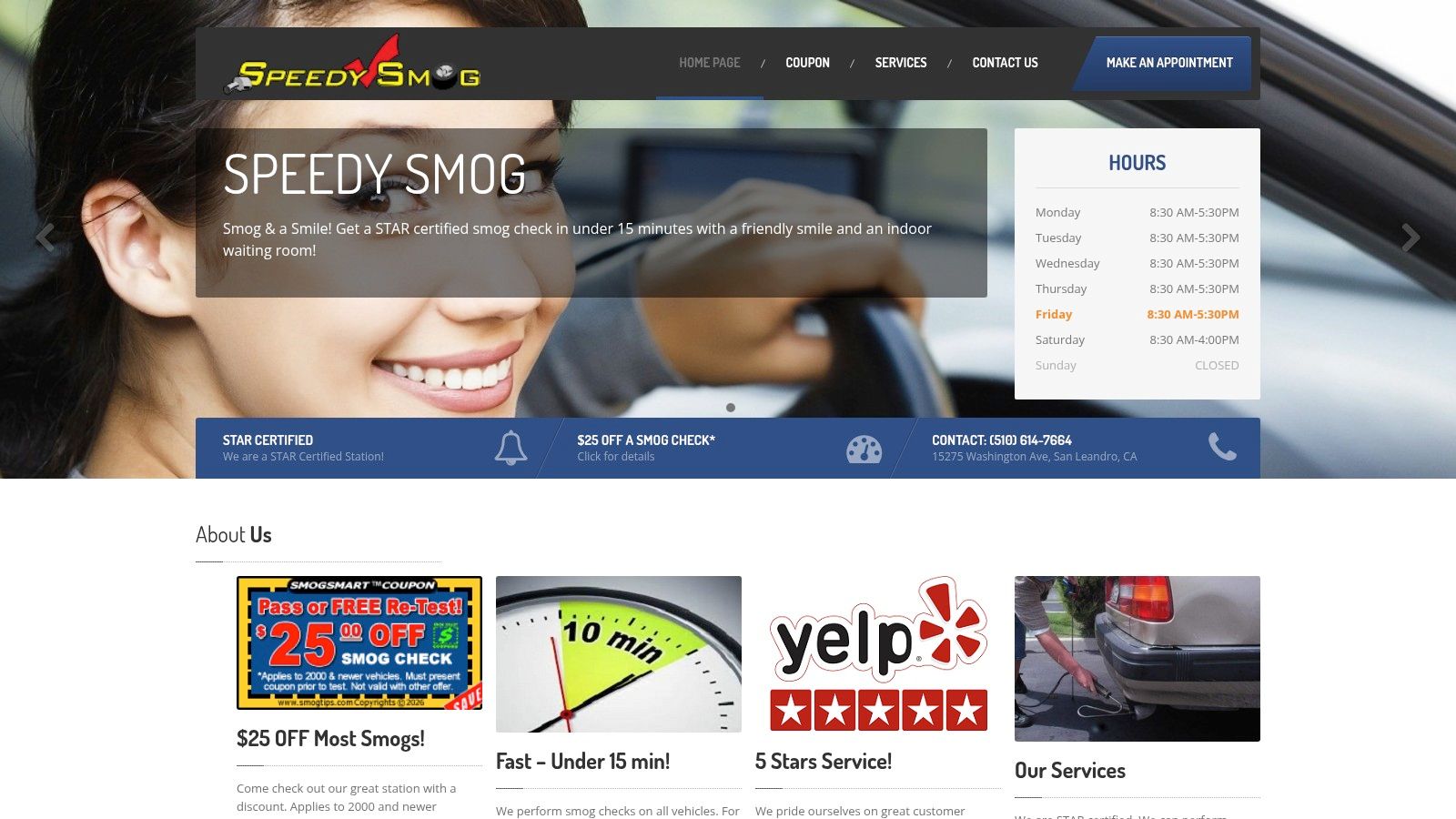
Direct-from-shop coupons tend to be easier to redeem because the shop wrote the terms. That reduces the chance of a front-desk argument over exclusions that were buried on a third-party page.
Use aggregators carefully
Groupon and similar platforms can absolutely save money. They're one reason Bay Area drivers often end up paying less than the posted shop price. But they also reward careful reading.
Look for these details before you buy:
- Vehicle year limits: Many deals apply only to 2000-and-newer vehicles.
- Vehicle type exclusions: Some coupons exclude SUVs, vans, diesels, or larger trucks.
- Appointment rules: A deal may be valid only at certain times or require advance booking.
- Cash-only terms: Some stations offer a lower total if you pay cash and show the coupon first.
Buy the deal only after you've matched it to the car. A cheap coupon for the wrong vehicle is worth nothing at the counter.
Don't ignore mailers and local flyers
Mailers still matter in the Bay Area because some neighborhood stations use them to fill slower hours. They're less flashy than digital deals, but they can be straightforward. The good ones usually spell out the model years covered and whether the certificate fee is extra.
The unwritten rule is simple. If a coupon looks vague, call before driving over. If a shop won't quote a clear out-the-door price tied to the coupon terms, keep looking.
Not All Coupons Are Equal and Why STAR Certification Matters
Most coupon mistakes happen before the car even reaches the bay. The driver assumes all smog coupons are interchangeable. They aren't.
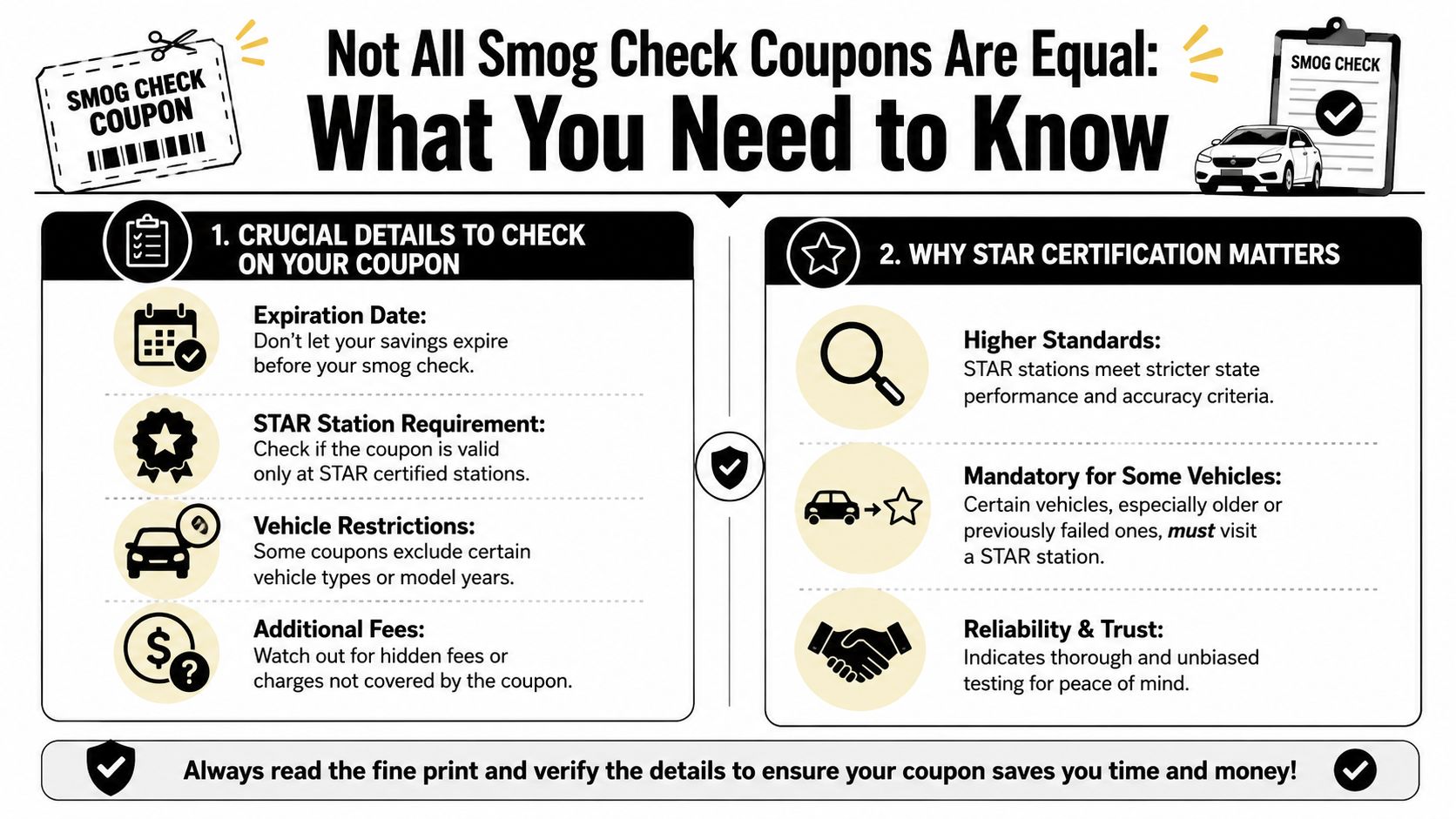
The first question is STAR or regular
If you remember only one screening step, make it this one: Does your car need a STAR station?
STAR-certified coupons are less common than standard coupons in San Francisco, especially for 1999-and-older vehicles, diesels, and high-emitters, as noted by SmogTips' San Francisco station listings. That scarcity is why older-car owners often feel like the cheap deals are always for somebody else.
If you're not sure what a STAR station is, this breakdown of how a smog STAR station works is useful background before you book.
The practical takeaway is that a regular coupon may be a great deal on paper and still be useless for your car. Owners of newer gasoline cars usually have more options. Owners of diesels, older vehicles, or cars flagged for stricter oversight need to screen coupons more carefully.
The fine print that actually changes your bill
A coupon can fail for reasons that have nothing to do with expiration date. The small print often decides whether the deal is real for you.
Watch for these issues:
- Model-year language: “2000 and newer only” is common.
- Vehicle class exclusions: Many low headline-price coupons don't cover SUVs, vans, or larger trucks.
- Fuel type limitations: Diesel and some hybrid-related cases often sit outside the cheapest promos.
- Payment conditions: Some discounts depend on cash payment.
- Pre-test presentation: Some stations won't apply the discount after the inspection has started.
Here's a simple decision filter you can use before you leave home:
| Question | If yes | If no |
|---|---|---|
| Does the DMV notice require STAR? | Shop only for STAR station offers | Standard station offers may work |
| Is the vehicle older or diesel? | Expect fewer coupon options and read exclusions closely | Broader discount pool |
| Does the coupon mention your model year? | Save or print it and bring it in | Keep searching |
| Are the payment terms clear? | Bring the right payment method | Confirm before arrival |
A low advertised price is only a real price if your vehicle qualifies and the shop accepts the coupon under the exact terms shown.
Prepare Your Car to Pass on the First Try
Saving money on the coupon is only half the job. Failing the inspection turns a cheap visit into an expensive one fast.
A modern California smog check for 2000+ vehicles follows a 3-step process: a visual inspection of emissions components, an OBD-II scan for malfunction indicators, and an Idle Test, according to the California Smog Check Program summary.
A quick visual checklist helps before you head out:
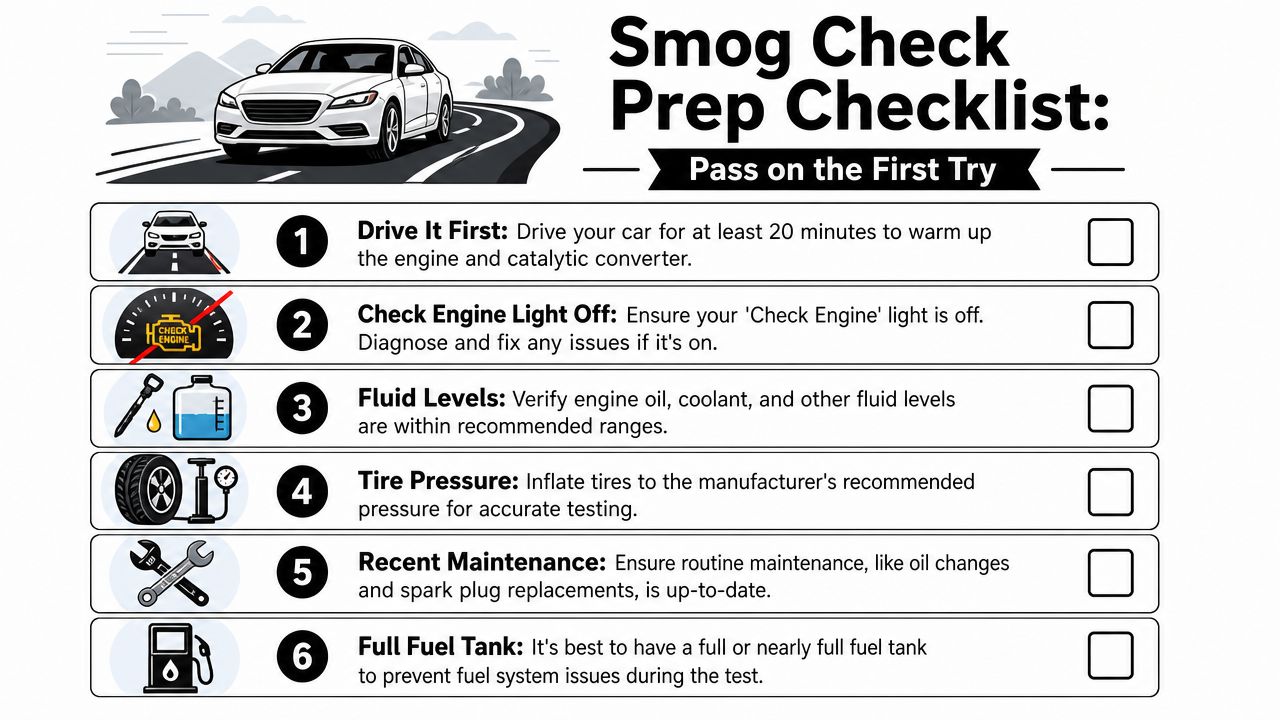
Know what the shop is checking
That three-part process tells you where people usually get tripped up. If the dashboard has a warning light on, if the computer system isn't ready, or if something obvious looks wrong under the hood, the test gets harder than it needs to be.
The easiest way to think about prep is this: arrive with a car that has been driven normally, is fully warmed up, and has no active warning signs. If you've recently had issues, reviewing common smog check fail reasons before your appointment can help you spot a problem early.
A practical pre-test routine
Use a short routine on test day:
- Drive the car first: A normal drive before the visit helps the vehicle reach stable operating condition.
- Make sure the Check Engine light is off: If it's on, don't gamble on the inspection.
- Avoid last-minute battery disconnects: That can reset systems and create readiness problems.
- Bring the coupon before the test starts: Presenting it late often kills the discount.
- Choose a calmer time if possible: Less rush at the station usually means fewer mix-ups and a smoother visit.
The video below gives a helpful visual walkthrough of the process and prep mindset.
Bring your registration notice, your coupon, and the right payment method. The smoothest smog checks usually feel boring, and that's exactly what you want.
Your Smart Choice in the East Bay Speedy Smog
For East Bay drivers, a good station should do three things well. Quote clean prices, handle the vehicle type you own, and move cars through without confusion.
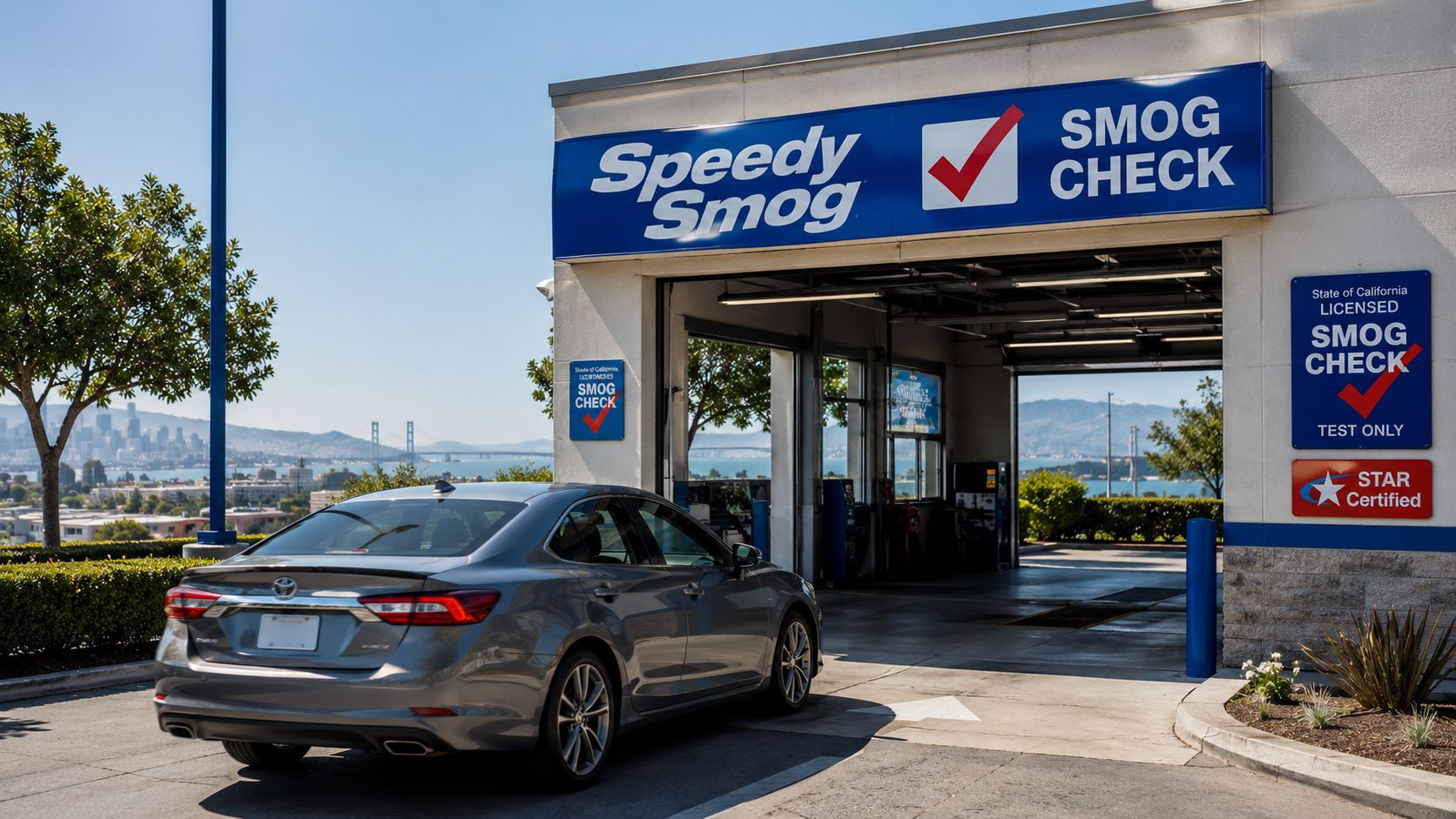
What transparent pricing looks like
A legitimate smog bill has only two real charges: the base test fee and the mandatory $8.25 state certificate fee. Shops can't mark up that certificate charge, which is why STAR Smog Center's FAQ on pricing is a useful benchmark for what transparent billing should look like.
That's the standard worth holding every shop against. If the numbers feel fuzzy, or the offer changes once the car is already in the bay, walk away next time and use a different station.
Why East Bay drivers make the trip
Speedy Smog in San Leandro fits the practical checklist that experienced drivers care about. It's a STAR Certified station, it handles a wide range of vehicles, and it's built around quick inspections rather than drawn-out waiting.
For drivers around San Leandro, Oakland, and nearby East Bay neighborhoods, that combination matters more than flashy advertising. You want a shop that can test the car you have, honor clear pricing, and get you back on the road without making the process harder than it needs to be.
Smog Check FAQ for Special Cases
Some situations need a different playbook.
What if my car is very old
If you own a 1998 or older vehicle and the car is becoming a money pit, there's another option besides chasing repairs and coupons. Starting July 1, 2024, the Bay Area Air Quality Management District launched a program offering $1,500 to Bay Area residents who scrap eligible 1998-and-older vehicles, according to the BAAQMD vehicle replacement announcement.
That won't fit every situation. But if the vehicle's compliance costs are starting to outweigh its usefulness, the scrap incentive is worth looking at before paying for another round of testing and repair.
What if the car fails
First, don't panic. A failure usually means you need to identify the issue, repair it properly, and return for a retest. The expensive mistake is rushing into another test before the underlying problem is fixed.
Ask the station how they handle retests before the first inspection begins. Some shops are more helpful than others about return visits, timing, and what paperwork you should keep.
When does the coupon need to be shown
Before the inspection begins. Not at payment time. Not after the technician has already started.
That single mistake ruins more discounts than people expect. Keep the coupon open on your phone or printed in hand when you pull in, and mention it before anyone touches the car.
If you want a straightforward East Bay option, Speedy Smog in San Leandro is a STAR Certified station that focuses on fast, transparent smog checks with friendly service. It's a strong fit for drivers who want clear pricing, broad vehicle coverage, and a smoother DMV renewal visit without the usual hassle.
You open your DMV renewal notice, glance down, and there it is. Smog certification required. If you drive a hybrid, that line can stop you cold because a lot of owners still assume hybrids are treated like fully electric cars.
They aren't.
That mix-up causes more registration delays than it should. The good news is that a smog check for hybrid vehicles is usually simpler than people expect, faster than a gas-car test, and much less intimidating once you know what the station is checking.
Table of Contents
- Do Hybrids Even Need a Smog Check in California?
- California's Hybrid Smog Check Rules Explained
- The Hybrid Smog Test Process What to Expect
- Common Hybrid Smog Check Failures and How to Pass
- Understanding STAR Certification and Finding a Local Smog Station
- Hybrid Smog Check FAQs
Do Hybrids Even Need a Smog Check in California?
Yes. Most hybrids do need a smog check in California.
The biggest point of confusion is that people lump hybrids in with EVs. That's the mistake. A fully electric vehicle has no gasoline engine to test. A hybrid still has an internal combustion engine, so California treats it as an emissions-regulated vehicle even though the testing method is different.
According to Diamond Certified's California smog check FAQ guide, many owners wrongly believe hybrids are exempt like EVs, but hybrids are required to undergo biennial inspections unless they are 8 model-years or newer. That misunderstanding is exactly why some drivers get surprised by a DMV notice.
Practical rule: If your hybrid burns gasoline, assume you may need a smog check unless your registration paperwork says you're still in an exempt window.
The easiest first step is to trust the DMV notice in your hand. If it says a smog certification is due, treat that as your answer and get it handled before registration turns into a deadline problem.
If you want the broader framework behind that notice, California's rules are easier to follow when they're laid out plainly. A quick read through these California smog check rules helps clear up who's exempt, who isn't, and why hybrids sit in their own category.
A lot of guides stop at “yes” or “no.” That's where owners get stuck. The answer is yes, hybrids are in the program, but the test is more efficient than a conventional gasoline vehicle inspection. That difference matters because many hybrid owners walk in expecting a long, old-school tailpipe test when that's not what happens.
California's Hybrid Smog Check Rules Explained
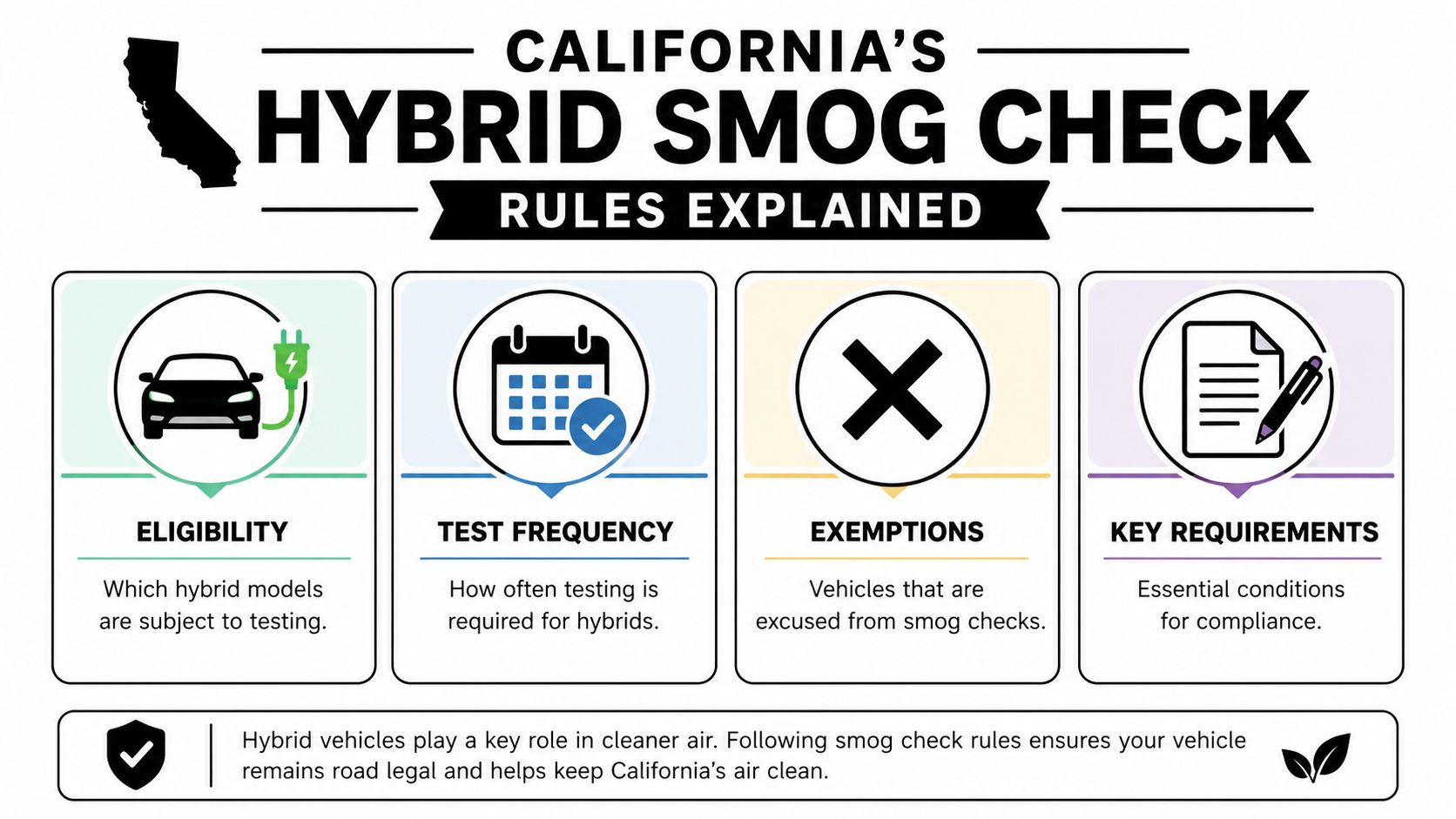
California didn't always test hybrids this way. According to the California Smog Check Program overview, hybrid vehicles officially became subject to smog check requirements in April 2015. That was the point where hybrids were folded into emissions compliance in a formal way.
Which hybrids need testing
Here's the plain-English version:
| Hybrid situation | What usually applies |
|---|---|
| Biennial registration | Hybrids 8 model-years or newer are exempt from the biennial smog check. |
| Newer vehicle registration | Hybrids that are six model-years and newer remain exempt from the biennial requirement and pay a smog abatement fee instead. |
| Change of ownership | Hybrids four model-years or newer are exempt from the smog check at title transfer. Older vehicles need testing for transfer. |
Owners often get tripped up. They hear one exemption and assume it applies to every situation. It doesn't. Registration renewal and vehicle transfer are separate triggers, and the age cutoffs aren't identical in every summary you'll see online.
What matters most for owners
When I explain this at the counter, I keep it simple:
- Renewal notice in hand: Follow what the DMV is asking for.
- Selling or buying a hybrid: Check whether the vehicle is old enough that a transfer smog is required.
- Newer hybrid: Don't assume “new enough” means exempt forever. It just means the exemption window is still open.
If you're unsure which rule applies, look at the reason for the smog requirement first. Is it registration renewal, title transfer, or another DMV action? That usually clears up the confusion fast.
Why the rules feel confusing
Hybrids sit between two worlds. They aren't gas-only cars, and they aren't EVs. California's rules reflect that. The state recognizes the hybrid's design, but it still expects emissions compliance because the gasoline side of the powertrain is still part of the vehicle.
That's why the right question isn't “Are hybrids exempt?” The right question is, “Is my hybrid currently in an exempt category for this specific DMV transaction?”
Once you frame it that way, the rules start making sense.
The Hybrid Smog Test Process What to Expect
You pull into the station expecting a long test, a tailpipe probe, and a lot of waiting. For most hybrids, that is not how it goes.
California's hybrid inspection is usually a short, diagnostics-based visit. As noted earlier from AAA, the process is generally quicker than an older-style gasoline smog test because the inspection centers on the vehicle's onboard systems and emissions equipment rather than a traditional tailpipe procedure.
What happens during the appointment
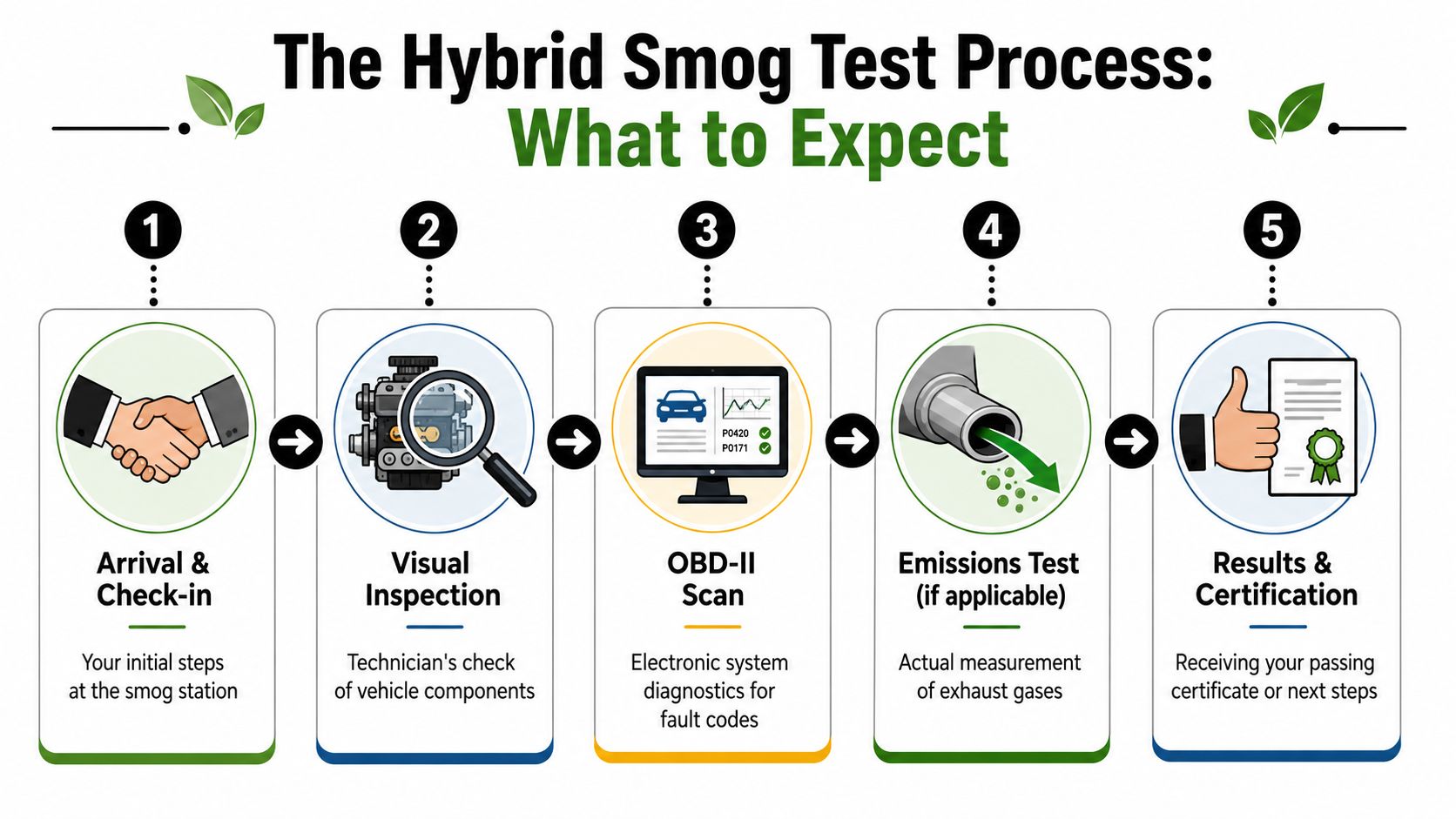
At the shop, the process is straightforward:
Check-in and vehicle verification
The technician confirms the VIN, plate, and basic vehicle information, then starts the inspection in the state system.Visual inspection of emissions equipment
The car is checked for required emissions-related components and obvious tampering. This is one place hybrid owners get surprised, especially if the vehicle has aftermarket parts that were installed without much thought about California compliance.OBD scan and readiness check
The technician connects to the vehicle's onboard diagnostics system to look for stored trouble codes, command status, and readiness monitors. On hybrids, this is the core of the test.Result submission
If the vehicle passes, the certificate is transmitted electronically to the DMV. If it does not, the technician should tell you what stopped the certification so you are not left guessing.
That last part matters. A good station does not just hand over a fail sheet. It explains whether the issue is a warning light, incomplete monitors, or an emissions-related part problem. If you want a clearer picture of the problems that commonly stop certification, review these common smog check fail reasons before your visit.
How the hybrid test differs in practice
Hybrid owners often ask me the same question at the counter: “Are you going to run it like a regular gas car?” In most cases, the answer is no.
The inspection usually focuses on two things. First, whether the required emissions components are present and properly installed. Second, whether the car's computer shows any emissions faults or incomplete self-checks. That is why the appointment often feels simpler than people expect.
The confusion usually comes from hearing mixed advice online. Some drivers assume hybrids are treated like full EVs. Others assume every hybrid gets the same old tailpipe routine as a gas-only car. Neither assumption helps much at the station. What matters is whether the emissions equipment checks out and whether the OBD system is ready to report cleanly.
What to bring and how to avoid a wasted trip
Bring your registration paperwork if you have it, and show up with the car in normal driving condition.
A few practical tips make a difference. Do not disconnect the battery right before the test. Do not clear codes to shut off a warning light and then drive straight to the station. That often leaves the monitors incomplete, which can stop the inspection even if the car seems to be driving fine.
If your hybrid has recent modifications, mention them up front. That saves time, and it can keep you from paying for a test when an emissions-related part is obviously going to be a problem. This is one area where a local smog technician can save you a lot of frustration, because we see the same preventable issues over and over and can usually spot them before they turn into a failed visit.
Common Hybrid Smog Check Failures and How to Pass
A driver comes in with a hybrid that runs fine, no strange noises, no obvious drivability problem, and still fails the smog check. In my experience, the cause is usually simple. The car either has an active fault, the monitors are not ready, or an aftermarket part creates a compliance problem.
The biggest point of confusion is modifications. A hybrid does not fail just because it has aftermarket parts. It fails when an emissions-related part is missing, installed incorrectly, triggers a fault, or lacks the right California approval. That distinction saves people a lot of wasted trips.
What usually causes trouble
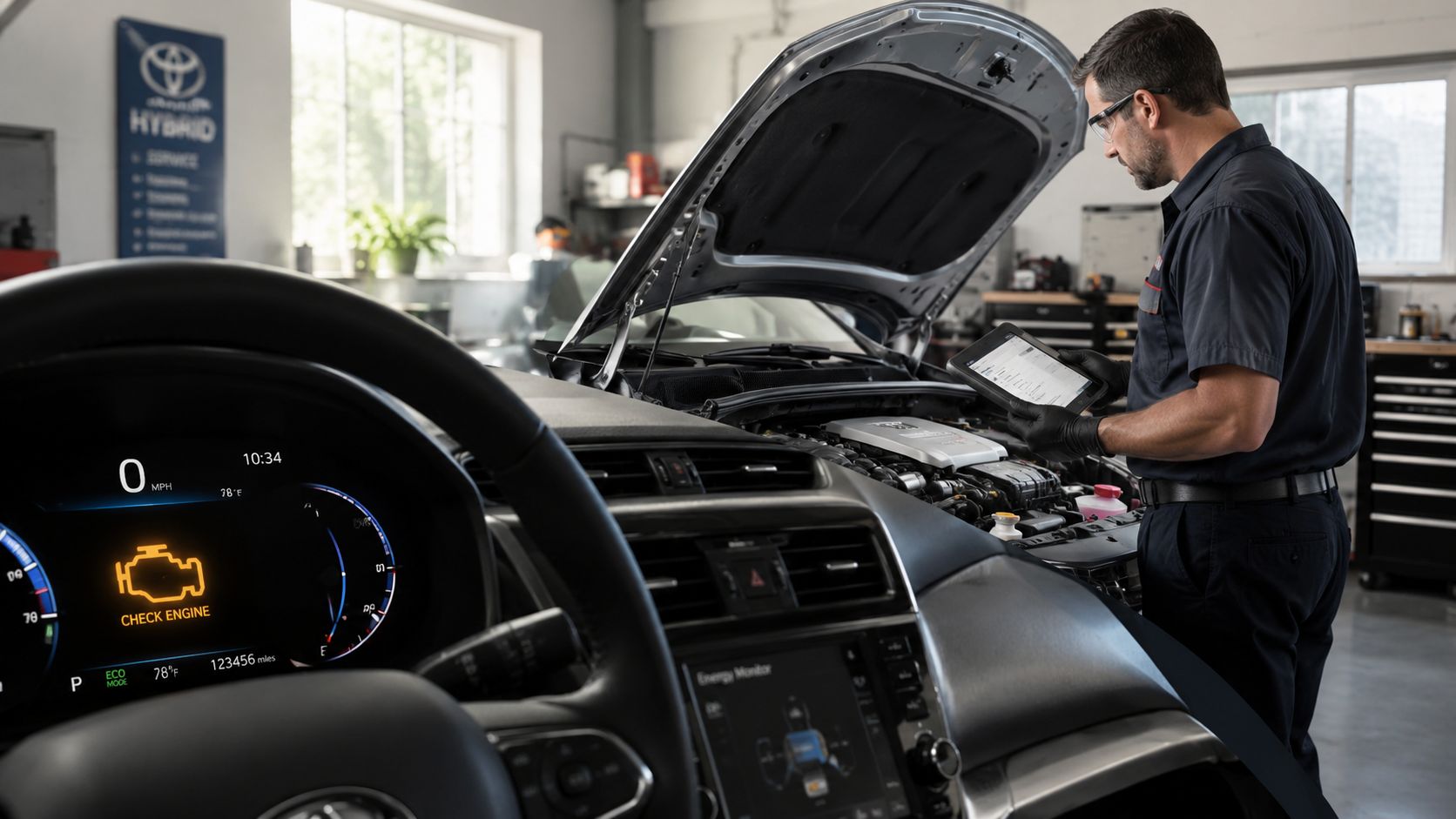
The Check Engine light is still the first thing I look at. If that light is on, the inspection usually stops there because the OBD system is reporting an emissions problem.
Readiness monitors cause a lot of repeat visits. If the 12-volt battery was disconnected, codes were cleared, or recent repair work reset the system, the car may show incomplete monitors. The hybrid can feel perfectly normal and still not be ready for testing.
Aftermarket parts are another common problem, especially intakes, catalytic converters, engine software changes, and other emissions-related components. Some hybrid owners also assume any battery upgrade or plug-in conversion automatically means failure. The issue is whether the change affects emissions compliance or creates a fault in the system. If the part needs CARB approval, it needs to be approved and properly documented.
I also see failures after do-it-yourself repairs. A loose connector, an unplugged sensor, or a cover left off after service can create a problem that the owner never notices until test day.
For a broader look at the issues that stop vehicles from passing, this guide to common smog check fail reasons covers the patterns we see at the station every week.
Hybrid smog failures are usually straightforward. The car is telling you something is wrong, or the emissions setup no longer matches what California requires.
A simple pre-test checklist
Before you schedule a smog check for a hybrid, check these items first:
- Check the dash: Handle any Check Engine light before testing.
- Give the monitors time to reset: If power was disconnected or codes were cleared, drive the vehicle through normal use before coming in.
- Review any modifications: Confirm that emissions-related aftermarket parts are legal for California and installed correctly.
- Look over recent repair work: Make sure hoses, connectors, and covers are back in place.
- Ask before you test: If you are unsure about a modified part, call a local smog station and ask. A quick answer can save you the cost and hassle of a failed visit.
A quick visual check at home helps more than people expect. You are not trying to diagnose the whole car. You are looking for obvious signs that something was recently changed, removed, or left unfinished.
Here's a helpful visual walkthrough of the kind of inspection mindset that matters before test day:
What works and what doesn't
What works is simple. Fix the warning light problem, drive the car enough to complete its self-checks, and verify that any emissions-related parts are California-compliant before you book the test.
What does not work is clearing codes right before the appointment and hoping the system stays quiet long enough to pass. Hybrids are checked through their onboard reporting, so incomplete or inconsistent data gets flagged fast.
If you are unsure whether your hybrid needs a repair, more drive time, or a closer look at an aftermarket part, a local technician who sees California smog failures every day can usually sort that out quickly. That clarity is what a lot of online guides miss. The failure is rarely mysterious. The cause is usually right in front of you.
Understanding STAR Certification and Finding a Local Smog Station
Not every station operates under the same expectations. If your DMV paperwork says you need a STAR station, you need to pay attention to that wording and not just show up anywhere.
When STAR matters
A STAR Certified station meets higher performance standards set by the Bureau of Automotive Repair. For drivers, that mostly means confidence that the inspection process is being handled in a way the state recognizes for the situations where STAR is required.
That doesn't make non-STAR stations “bad.” It just means STAR designation matters when the DMV specifically calls for it, or when you want the extra reassurance that the station is operating at that higher benchmark.
For a straightforward explanation of what that designation means, this guide on what a Smog STAR station is lays it out in simple terms.
What to look for in a station
If you drive a hybrid, I'd focus less on flashy marketing and more on whether the shop feels organized and comfortable handling OBD-based testing cleanly. A good station should be able to answer simple questions without making the process sound mysterious.
A few signs you're in the right place:
- Clear communication: They can explain the hybrid test in plain language.
- Efficient workflow: Check-in, inspection, and certification move without confusion.
- Comfort and convenience: A decent waiting area matters more than people admit.
- No drama about hybrids: The staff should treat your vehicle type as routine, not unusual.
A reliable smog station doesn't just run the test. It helps you understand what the result means and what to do next if there's a problem.
For East Bay drivers, that local factor matters. You want a shop that knows how California compliance works, handles DMV-facing inspections every day, and respects your time.
Hybrid Smog Check FAQs
Do I need to warm up a hybrid before the test
Usually, no. Hybrid smog checks are generally based on the vehicle's onboard diagnostics, so there is no special warm-up routine like people remember from older tailpipe tests.
What matters more is that the car has been driven normally and hasn't had the battery disconnected or codes cleared right before the inspection. If the system monitors are set and no warning lights are on, you're in good shape.
Will a battery upgrade or plug-in charger kit fail smog
A hybrid does not fail just because it has been modified. The question is whether the part affects emissions compliance, triggers a fault, or lacks approval where approval is required.
Owners frequently face challenges. Factory-style replacement parts are usually straightforward. Aftermarket electronics, charger kits, intake parts, and other add-ons can create problems if they interfere with the car's emissions systems or set diagnostic trouble codes. I see more failures tied to the side effects of modifications than to the idea of a hybrid itself.
What happens if my hybrid fails
Start with the reason for the failure. That sounds obvious, but many drivers leave with a printout and still are not sure whether the problem is a check engine fault, incomplete readiness monitors, or an issue related to a recent repair.
Do not clear codes and hope for the best. That often resets the monitors and creates a second problem. A better move is to have the fault diagnosed, complete the repair, and then return for a retest under the station's policy.
How long does the result stay valid
If your hybrid passes, the electronic smog certificate is valid for 90 days. That is usually enough time to finish your DMV registration or title transfer without rushing.
Are hybrids easier to test than gas cars
In many cases, yes. The process is often quicker because the inspection usually centers on the onboard system instead of an older-style tailpipe procedure.
Still, “easier” does not mean automatic. Hybrids fail for real reasons, and the common ones are usually preventable. Check engine lights, unset monitors, and emissions-related aftermarket parts cause far more trouble than the hybrid powertrain itself.
If you need a hybrid smog check in the East Bay, Speedy Smog in San Leandro is a STAR Certified station that makes the process easy. Drivers choose it for fast inspections, a comfortable waiting room, clear pricing, and friendly service that keeps the visit simple from check-in to DMV certification.
Your DMV renewal notice is sitting on the counter. You know a smog check is next. Then someone tells you, “Get an oil change first.” Someone else says that's old advice and doesn't matter anymore.
Both can be right.
The answer depends on what kind of smog test your vehicle gets. For some older cars, an oil change before a smog check can help. For many 2000 and newer vehicles in California, it usually won't change the outcome much at all. What matters more is whether the car's computer is ready, whether the Check Engine Light is off, and whether you drove it properly before the test.
If you want a quick refresher on how California testing works, this simple guide to how a smog check works lays out the basics in plain English. For East Bay drivers, that distinction matters because wasting money on the wrong prep is common, especially when registration deadlines are close.
Table of Contents
- Do I Really Need an Oil Change Before My Smog Check
- When an Oil Change Is Your Secret Weapon
- The Modern Car Myth Why Oil Changes Rarely Matter Now
- Your Complete Pre-Smog Checklist to Pass the First Time
- Expert Tips for Passing at Speedy Smog in San Leandro
- Frequently Asked Smog Check Questions
Do I Really Need an Oil Change Before My Smog Check
You pull into the station with a 2012 Camry, fresh oil sticker on the windshield, and the check engine light turned off last week. Then the car fails because the monitors are not ready. We see that all the time in the East Bay.
The short answer is no, not for every car.
A lot of the old advice came from an earlier smog world, where tailpipe numbers played a bigger role and a worn engine could sometimes benefit from clean oil right before the test. On many 2000 and newer vehicles, the test is far more about what the car's computer reports. If the OBD-II system shows a stored fault, a recent battery disconnect, or incomplete readiness monitors, fresh oil will not fix that. If you want a quick overview of how that process works, our guide to how a California smog check works for modern vehicles lays it out clearly.
That is why drivers get mixed advice. One customer with an older, high-mileage car may see lower emissions after basic maintenance. Another with a newer Honda or Toyota spends money on an oil change and still fails for an EVAP monitor, catalyst issue, or hidden code.
Bottom line: An oil change can help in specific cases, but it is not the reason most modern cars pass.
California smog rules cover a wide range of vehicles, and the test method is not the same across all of them. The California Bureau of Automotive Repair Smog Check Program explains the program scope and inspection framework. For local drivers, the practical takeaway is simple. If the oil is overdue on an older vehicle, changing it is reasonable maintenance and may help at the margins. If your car is 2000 or newer, put your attention on check engine lights, readiness monitors, recent repairs, and whether the car has been driven enough since the battery was disconnected.
When an Oil Change Is Your Secret Weapon
For the right car, this advice still holds up.
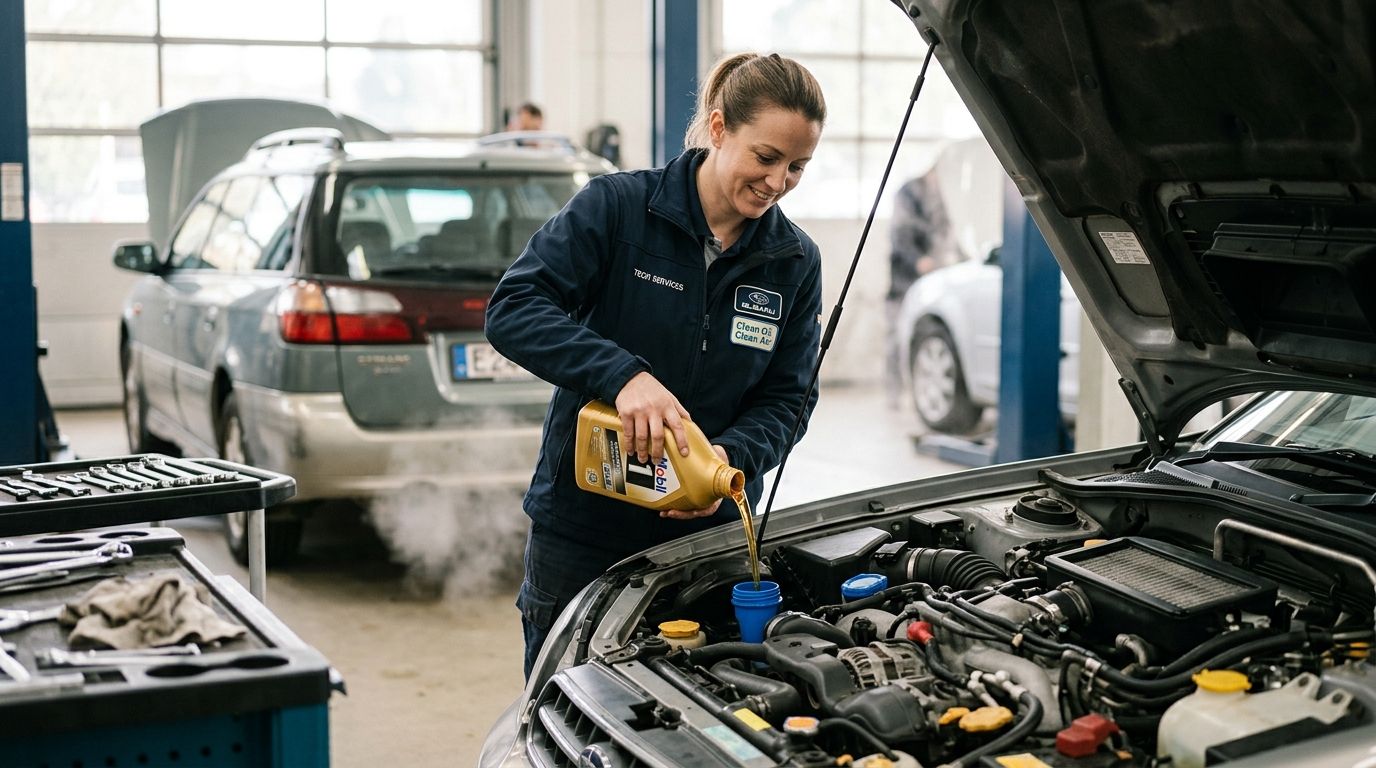
Older vehicles, especially ones that are a little worn and still get a tailpipe-oriented emissions evaluation, can benefit from an oil change before a smog check. Old oil doesn't just lubricate less effectively. It also collects combustion byproducts and unburned fuel. It's akin to a sponge that's already soaked up everything it can hold. Once it's saturated, it stops helping and starts contributing to the mess.
Why dirty oil can raise emissions
The key pollutant here is hydrocarbons, or HC. According to a discussion cited by Car Talk, fresh oil can create a better seal between piston rings and cylinder walls and may lower HC output by about 10 to 15% in marginal engines, with results varying from 5% to 30% depending on engine age and contamination in this oil change and HC explanation.
That fits what technicians see in the bay. Dirty oil can feed extra fumes into the PCV system, and those fumes get burned in the engine. If the oil is badly contaminated, that can push HC emissions higher than you want right before a test.
Road Runner Auto Repair also notes that if oil hasn't been changed for the last 5,000 miles, poor oil quality can contribute to smog trouble for California vehicles, especially when that old oil is loaded with pollutants and unburned fuel in this article on passing a California smog check with a 2000 or newer car.
Who should actually do it
In this situation, the advice needs to be selective, not automatic.
- Older vehicle owners: If you drive a pre-2000 car, or a vehicle with higher mileage that tends to run dirtier, an oil change before a smog check can be a smart move.
- Overdue maintenance cases: If the oil is clearly overdue, don't overthink it. Fresh oil helps the engine operate cleaner.
- Borderline emitters: If the car has failed before on hydrocarbon numbers, this is one of the lower-cost maintenance steps worth doing.
If you're trying to narrow down the likely cause of a failed inspection, this page on common smog check fail reasons is useful because it puts oil in context with the other usual culprits.
Fresh oil can help an older car that's close to the line. It won't fix a bad sensor, a missing catalyst, or a fault code.
The Modern Car Myth Why Oil Changes Rarely Matter Now
For most East Bay drivers in newer cars, this is the part that saves time and money.
A lot of people still treat smog prep like it's 1998. They hear “dirty oil raises emissions” and assume that means every car needs an oil change before test day. That's not how most modern California smog checks work.

What the computer is checking
For 2000 and newer vehicles, the important issue is usually the car's onboard diagnostics. A widely shared technician discussion makes the core point clearly: the belief that an oil change is a guaranteed pass fix is a misconception because modern OBD smog checks for 2000+ vehicles focus on system readiness, not tailpipe hydrocarbons, as described in this post about the difference between OBD checks and older testing.
That means the machine is looking for things like:
| What matters on a modern test | Why it matters |
|---|---|
| Check Engine Light status | If the system sees an emissions fault, that's a problem immediately |
| Readiness monitors | The car has to show it completed its self-checks |
| Stored or recent fault history | Clearing codes right before the test often backfires |
It does not mean fresh oil is useless maintenance. It means fresh oil usually isn't the deciding factor on pass or fail for a modern car whose smog result depends on computer status.
Where people waste money
The expensive mistake is doing maintenance that doesn't address the underlying issue.
If your 2012 Camry, 2016 Accord, or 2021 RAV4 has a Check Engine Light on, an oil change won't solve the reason the computer is unhappy. If you disconnected the battery, recently cleared codes, or had work done and then drove straight to the station, the car may not be ready even though it runs fine.
The modern smog check is mostly a conversation with your car's computer. If that computer says “not ready,” clean oil won't change the answer.
This is also why blanket advice from older drivers can steer newer-car owners wrong. The old logic was based on reducing tailpipe pollutants directly. The newer logic is based on proving that the vehicle's emissions systems have run their tests and passed them internally.
For a modern car, spend your attention on readiness, fault codes, and proper warm-up. Treat the oil change as maintenance, not magic.
Your Complete Pre-Smog Checklist to Pass the First Time
You pull in for a smog, the car seems fine, and then it fails for something that started days earlier. That is the pattern I see more than anything in the East Bay. The miss usually is not dirty oil. It is poor timing, incomplete monitors, or a simple issue nobody checked before the appointment.

Start with the fastest pass or fail item
If the Check Engine Light is on, stop there and sort that out first. Clearing codes right before the test can make things worse because the car may show up with incomplete readiness monitors.
A practical prep guide from Jiffy Lube notes that California BAR requires driving 100 to 200 miles after battery replacement or major maintenance to reset readiness monitors, and it also says 30% of smog failures for 2002+ vehicles are due to incomplete monitor readiness in this piece on passing emissions tests.
That catches a lot of drivers. They handle a repair, swap a battery, or disconnect power in the driveway, then head straight to the station. On older tailpipe-test advice, that might sound fine. On a modern OBD-II test, it can set you up for a fail even if the car feels normal.
Shop rule: If the battery was disconnected or codes were cleared recently, give the car time to complete its drive cycle before testing.
If you want a quick last-minute review, this California smog checklist covers the common items to check before you head out.
Drive it long enough to be fully warmed up
Show up with the engine at full operating temperature. A cold start and a five-minute errand run are not ideal prep.
For many cars, a solid mixed drive does more good than any last-minute maintenance. Highway time helps the engine and emissions system settle into normal operation, and it gives monitors a better chance to complete if they are close. That matters far more on most 2000+ vehicles than changing oil the night before.
A quick video can also help if you want a visual refresher before heading out:
Simple checks people skip
These are basic, but they save trips back to the station.
- Check the gas cap. Make sure it is tight and not cracked or obviously worn.
- Look under the hood. Loose hoses, unplugged sensors, and obvious vacuum line issues are worth catching before the test.
- Check fluid and maintenance basics. If the oil is badly overdue, change it. If it was changed recently, do not expect that alone to fix a smog problem.
- Inspect the air filter if drivability has felt off. A badly clogged filter can contribute to poor running.
- Do not wait until the registration deadline. If the car needs more driving or diagnosis, a little margin saves a lot of stress.
The practical trade-off is simple. Spend money on maintenance the car needs. Do not spend it on rituals that do not address why a modern smog test fails.
Expert Tips for Passing at Speedy Smog in San Leandro
You pull in on a lunch break, registration notice in hand, and the first question is simple. Will this test go through cleanly, or are you about to lose an hour over something avoidable?
Around San Leandro, the smoothest smog visit usually comes down to two things. Go to the right kind of station for your vehicle, and tell the technician anything that could affect readiness or the inspection result.
Why a STAR station matters
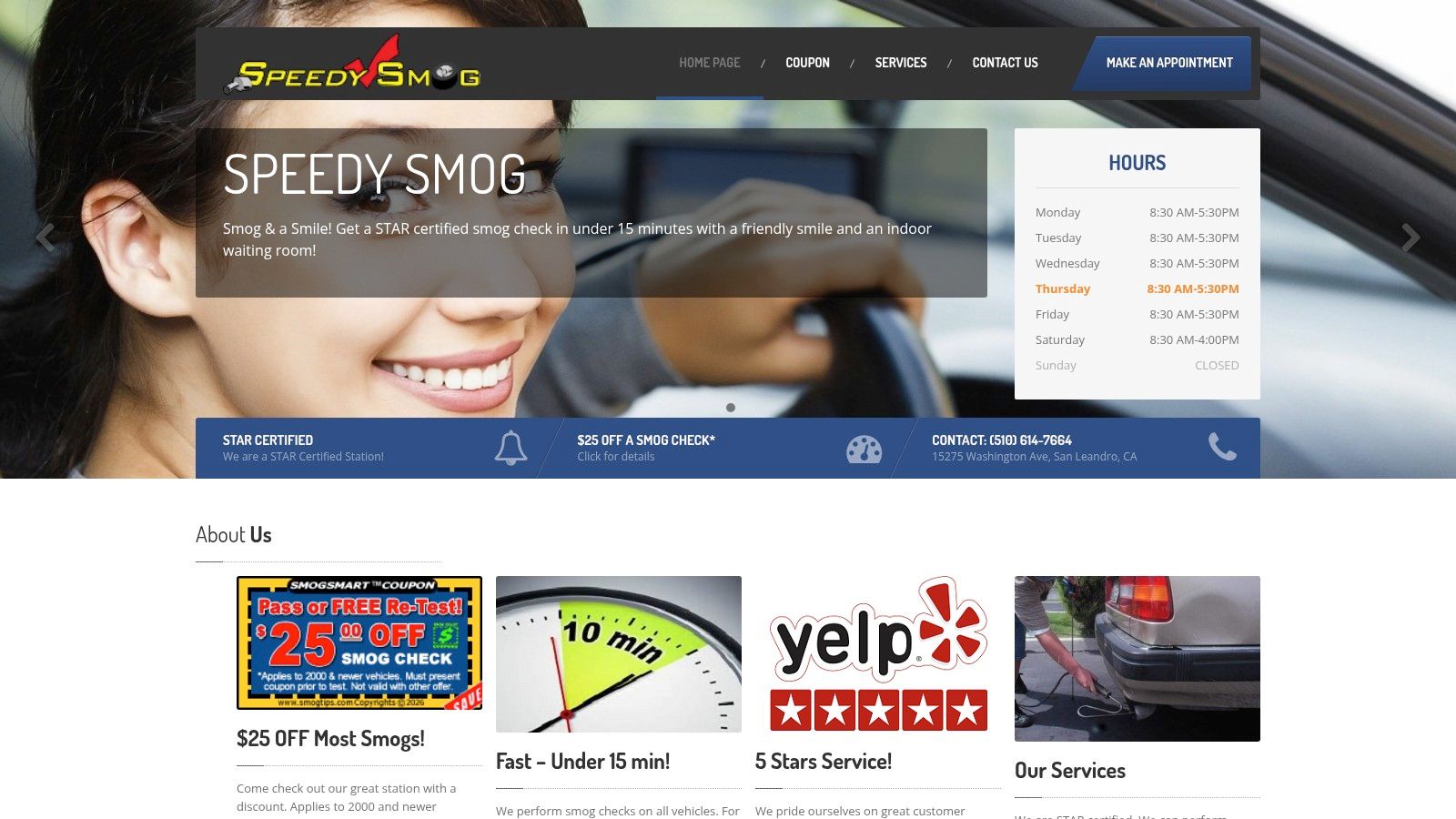
Some vehicles must be tested at a STAR Certified station. If your registration notice says STAR, follow it. Otherwise, you can end up paying for time and still need to redo the inspection at the proper station.
That catches East Bay drivers all the time. They focus on the car, which makes sense, but the station requirement matters too. Getting that part right is one of the easiest ways to avoid a repeat trip.
What to tell the technician when you arrive
A good check-in saves headaches. Before the test starts, mention anything that changes how ready the car is for inspection.
- Say if the battery was disconnected recently. That often means monitors may not be set yet.
- Mention recent repairs or maintenance. Catalyst work, EVAP repairs, sensor replacement, and battery service can all matter.
- Bring up a recent failed test. The last report gives useful clues fast.
- Be honest about warning lights. Even if the light turned off, the history can still matter.
For many 2000 and newer vehicles, the process is pretty quick when the car is ready. That is the main advantage for modern OBD-II smog checks. If the computer status is right and there are no emissions-related faults, the visit is usually straightforward. If the monitors are incomplete or a code is lurking, an oil change coupon will not save the test.
If you are not sure whether your car is ready, say so before the test starts. A good technician would rather hear that upfront than after a preventable fail.
Frequently Asked Smog Check Questions
Does this apply to hybrids and diesels
Yes, but the test procedure depends on the vehicle.
California smog rules cover gasoline cars and hybrids model year 1976 and newer, plus diesel vehicles model year 1998 and newer. The advice in this article fits hybrids pretty well because many of them still go through the same modern computer-based readiness check. Diesels are different enough that it helps to confirm the station handles diesel inspections before you make the trip.
That matters in the East Bay. A hybrid owner with a 2008 Prius usually does not need to treat an oil change like a last-minute smog strategy. A diesel owner may be dealing with a different inspection process altogether.
What if I fail
Start with the failure report. It usually points you in the right direction fast.
A readiness failure often means the car is not done with its drive cycle yet. A fault-code failure means something in the emissions system still needs diagnosis and repair. On older vehicles that still struggle with tailpipe numbers, routine maintenance, including an oil change, can help if it lines up with the reason the car is running dirty.
Guessing gets expensive. One repair aimed at the wrong problem can cost more than the smog check itself.
Should I get a pre-test mindset before I show up
Yes. That saves a lot of repeat visits.
Ask yourself three questions:
- Is the Check Engine Light off?
- Has the car been driven enough after any recent battery disconnect or repair?
- Am I arriving with the engine fully warmed up?
For 2000 and newer vehicles, that short checklist matters more than fresh oil in most cases. Modern smog inspections usually come down to what the car's computer sees: stored faults, pending problems, and whether the monitors are set. If you drive an older car that is overdue for service, an oil change may still be worth doing. If you drive a newer car with an unset monitor or an emissions code, oil is usually not the issue.
Can fresh oil help me pass
Sometimes.
I have seen it help on older, poorly maintained cars that were close to the line on emissions output. Dirty oil can contribute to higher hydrocarbons if the engine is already worn or burning oil. On a newer OBD-II car, though, the computer check is the bigger gatekeeper. If the monitors are incomplete or the Check Engine Light is on, an oil change will not fix the reason for the failure.
Should I clear codes right before the test
No. That usually creates a different problem.
Clearing codes often resets the readiness monitors to "not ready." Then the vehicle shows up for smog before it has completed the required drive cycle, and it fails for that reason instead. Fix the cause first, then drive the car enough for the monitors to reset properly.
For most 2000 and newer vehicles in the East Bay, smog check prices usually land between $40 and $90 out the door once the test, certificate, and small transmission fees are included. If you find a coupon deal, you might see the base test around $29.95, but your final total commonly ends up around $40 to $42 after the required add-ons.
Drivers looking for emissions testing prices near them often do so with a DMV renewal notice sitting on the counter and a deadline they don't want to mess with. I get it. Most drivers aren't confused about whether they need the test. They're confused because one shop advertises a cheap base price, another says STAR, another says certificate extra, and suddenly a simple smog check feels like a pricing game.
It doesn't have to be complicated. The easiest way to avoid overpaying is to understand what you're being charged for, which vehicles cost more, and which questions to ask before you pull into the bay.
Table of Contents
- How Much Is a Smog Check in the East Bay Really
- Decoding Your Smog Check Bill Component by Component
- Why Smog Check Prices Vary So Much
- What STAR Certification Means For You
- Finding the Best Value in the East Bay A Speedy Smog Spotlight
- FAQ Your Next Steps for DMV Compliance
How Much Is a Smog Check in the East Bay Really
That registration notice shows up, and the first question is always the same. What am I going to pay today?
For a standard California smog check on a 2000 and newer vehicle, expect the total in the East Bay to fall somewhere between $40 and $90. That's the practical number most drivers care about. Not the teaser ad. Not the base fee by itself. It's the total after the state-required pieces get added in.
A big reason people get annoyed is simple. Shops often advertise the base test, but your DMV paperwork doesn't care about the base test. You need the complete certification submitted properly, and that means your final bill matters more than the headline price.
Practical rule: Always ask for the out-the-door price, not the advertised smog price.
If you want to compare offers quickly, start with current smog check deals in San Leandro and then confirm whether the posted special already includes the certificate and transmission charge. If it doesn't, the bargain may not be much of a bargain.
A fair price isn't just about the lowest number. It's about clear pricing, correct testing, and getting in and out without wasting half your day. That's the part a lot of generic emissions testing prices near me pages miss. They give you a range, but they don't tell you why your final total changes from one vehicle to the next.
Decoding Your Smog Check Bill Component by Component
You pull into a smog shop because the ad says $29.95. Ten minutes later, the bill is higher than you expected. That usually happens because the sign out front shows only one part of the charge.
A smog bill is usually made up of three pieces, and if you know those pieces ahead of time, you can spot a real deal fast.
Base fee
The base fee is the shop's charge to run the test. For 2000 and newer vehicles in California, private test stations commonly fall in the $30 to $90 range, according to California smog cost data compiled by CostHelper.
This is the part shops use to compete on price. It is also where a cheap-looking ad can fool you.
State certificate and transmission charges
The state certificate fee is fixed. The electronic transmission charge is usually small. You do not have much control over either one, but they still affect your final total.
That is why the only number that matters is the out-the-door price. If a shop gives you only the base fee, you still do not know what you are really paying.
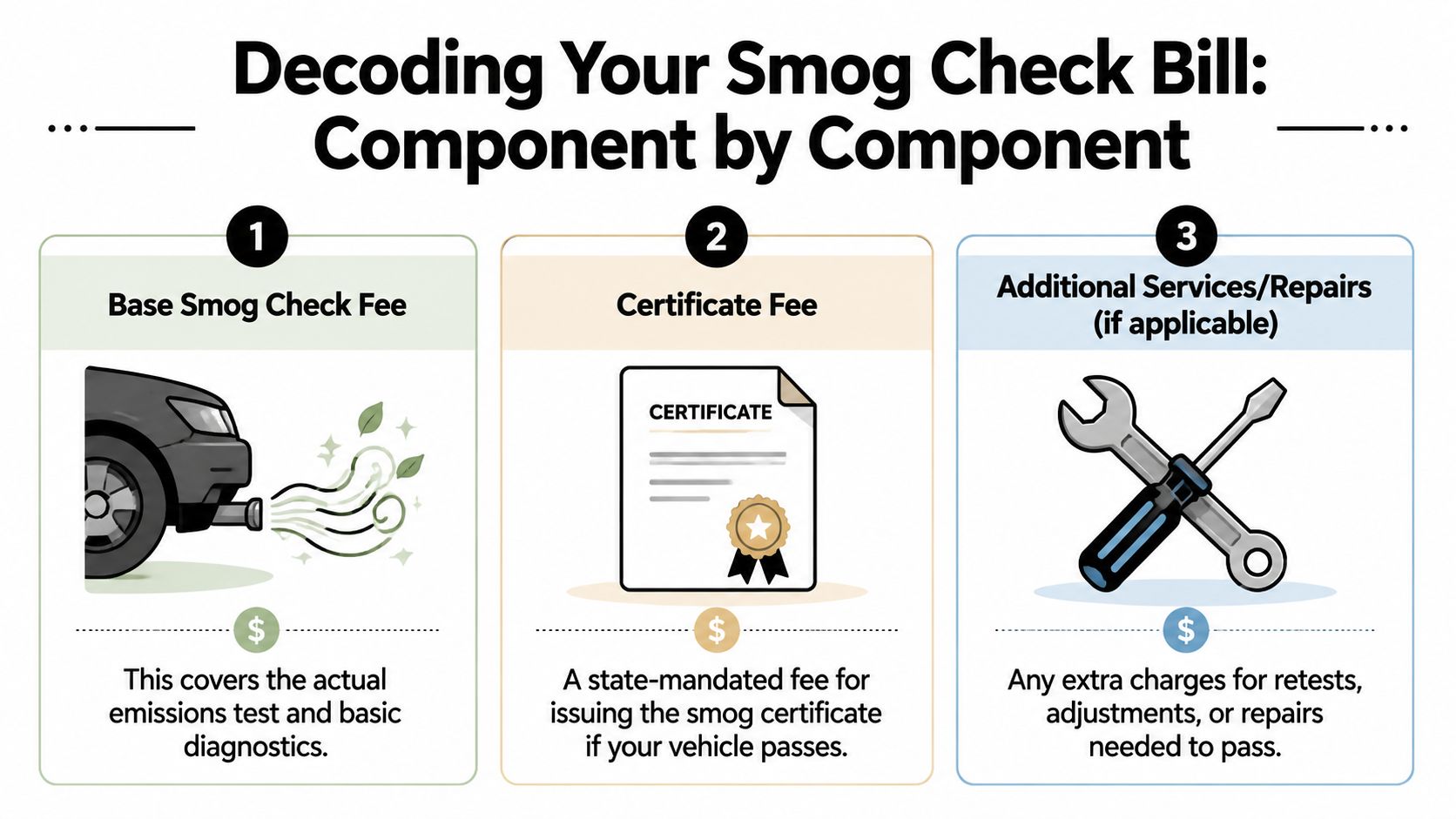
Repairs or retest-related costs
If your car passes, your cost stays simple. If it fails, the bill can jump quickly because now you are paying for diagnosis, repair work, and sometimes a retest.
As noted earlier from the same source, repair costs after a failed smog check can range widely, and even coupon tests often end up higher out the door once the standard add-ons are included. That is exactly why East Bay drivers should ask one direct question before handing over the keys: What is my total if the car passes today?
That question saves time. It also helps you avoid the shops that lead with a teaser price and explain the rest later.
Here is the plain-English breakdown:
- Base fee: The main shop charge, and the only part that usually varies a lot.
- Certificate fee: Set by the state.
- Transmission charge: Small, but still part of the bill.
- Failure-related costs: The expensive part if your vehicle has a problem.
My advice is simple. Compare shops by the full pass price, not the ad price. In the East Bay, a good STAR station should be able to tell you the total clearly, explain any extra charge before the test starts, and get you through the process without surprises.
Why Smog Check Prices Vary So Much
You call one shop and hear a bargain price. Then you call another shop five miles away and the number is much higher. In the East Bay, that usually comes down to your vehicle, the test method, and how honest the shop is about the full bill.
The biggest price drivers
Older vehicles usually cost more to test because the inspection takes more time and can involve a more involved procedure. As noted earlier, pre-2000 vehicles often land near the top of the normal price range for that reason alone.
Vehicle type matters too. Trucks and SUVs often cost more than a basic sedan. Diesel vehicles and oversized vehicles are their own category, and the price jump is real because the testing process is different.
Shop type also changes the quote. Some stations price aggressively to get the phone call, then add the certificate fee and other standard charges later. Others give you the pass price up front. That is the number you should care about.
Estimated Smog Check Costs in the East Bay 2026
| Vehicle Type | Test Requirement | Estimated Total Price |
|---|---|---|
| 2000+ gasoline vehicle | Standard smog test with certificate and typical transmission fee | $40 to $90 |
| 1999 and older vehicle | More complex test process | Often near $100 |
| Truck or SUV | Standard test, often with added vehicle-type charge | Usually above a comparable passenger car |
| Diesel vehicle | Diesel-specific emissions protocol | Higher than a standard gasoline car |
| RV or large vehicle | Large-vehicle testing | Much higher than a standard passenger vehicle |
A cheap quote is not always a cheap smog check.
Another reason prices for emissions testing can feel inconsistent is that many ads lead with the base test fee, not the out-the-door total. If the shop does not clearly tell you whether the certificate and other standard charges are included, you are not comparing real prices.
If your DMV notice requires STAR, that narrows your options and can affect cost. If you are not sure what that requirement means, read this plain-English guide to a STAR smog station in California. It will help you compare the right shops instead of wasting time calling stations that cannot legally complete your test.
My recommendation is simple. Ask three questions before you book. What kind of test does my vehicle need? Is this quote the full pass price? Are there any added charges for my vehicle type? A good East Bay smog shop will answer all three fast and clearly.
What STAR Certification Means For You
If your DMV notice says STAR, don't panic. It doesn't mean your car is being singled out for punishment. It means the inspection has to be done at a station that meets higher performance standards.
Why some STAR stations charge more
California pricing references show that STAR Certified stations often charge slightly higher base fees, with one example listing $59.75 at a STAR station versus $45 at a non-STAR station, while both still provide legally valid certification for DMV registration. That comparison appears in this California emissions testing overview.
That extra cost isn't magic. It's tied to the station meeting tougher operating standards. In plain English, you're paying for better consistency, better equipment performance, and a shop that stays in line with BAR requirements.
When STAR is the smart choice even if DMV doesn't require it
Even if your renewal notice doesn't require STAR, a STAR station can still be the better move. If a shop keeps its equipment sharp and follows tighter standards, you're less likely to deal with sloppy testing or confusion at the DMV.
If you want a plain-English explanation of how that works, this guide on what a California STAR smog station is lays it out clearly.
My opinion is simple. If the price difference is reasonable, I'd rather test at a shop that takes accuracy seriously. A smog check is cheap compared with chasing a bad result, redoing paperwork, or paying for repairs you may not have needed.
Finding the Best Value in the East Bay A Speedy Smog Spotlight
You pull into a shop because the ad price looks great. Ten minutes later, the total is higher than expected, the certificate fee was extra, and now you're stuck because registration is due. That's the mistake I want you to avoid.
In the East Bay, the best value is the shop that gives you the total up front, gets you in and out fast, and submits everything correctly the first time. Cheap on paper is meaningless if the final bill climbs at checkout.
How to shop smarter before you go
Ask one question before you leave home or book online. What is the out-the-door price for my exact vehicle?
That one question saves time and cuts out the usual nonsense. It tells you right away whether the quoted price includes the certificate, any electronic transmission charge, and whether your car, truck, SUV, or diesel changes the total. A lot of confusion when searching for local emissions testing prices comes from missing those details.
You should also confirm the rules for your vehicle before you show up. If you need a quick refresher on California smog check requirements by vehicle and registration situation, check that first so you book the right station and avoid a wasted trip.
Use this checklist before you head out:
- Confirm your vehicle type: Gas, diesel, hybrid, truck, SUV, or older model.
- Ask for the final total: Get the full price, not the teaser number.
- Check coupon terms: Make sure the discount applies to your vehicle and includes the standard fees.
- Verify your DMV notice: If it says STAR, go to a STAR station.
What a transparent local shop looks like
A good East Bay smog shop is easy to read before you ever arrive. The website shows clear pricing. The coupon terms are straightforward. The person answering the phone gives you a direct answer instead of dancing around the total.
That matters.
Here's an example of the kind of local shop experience drivers look for:
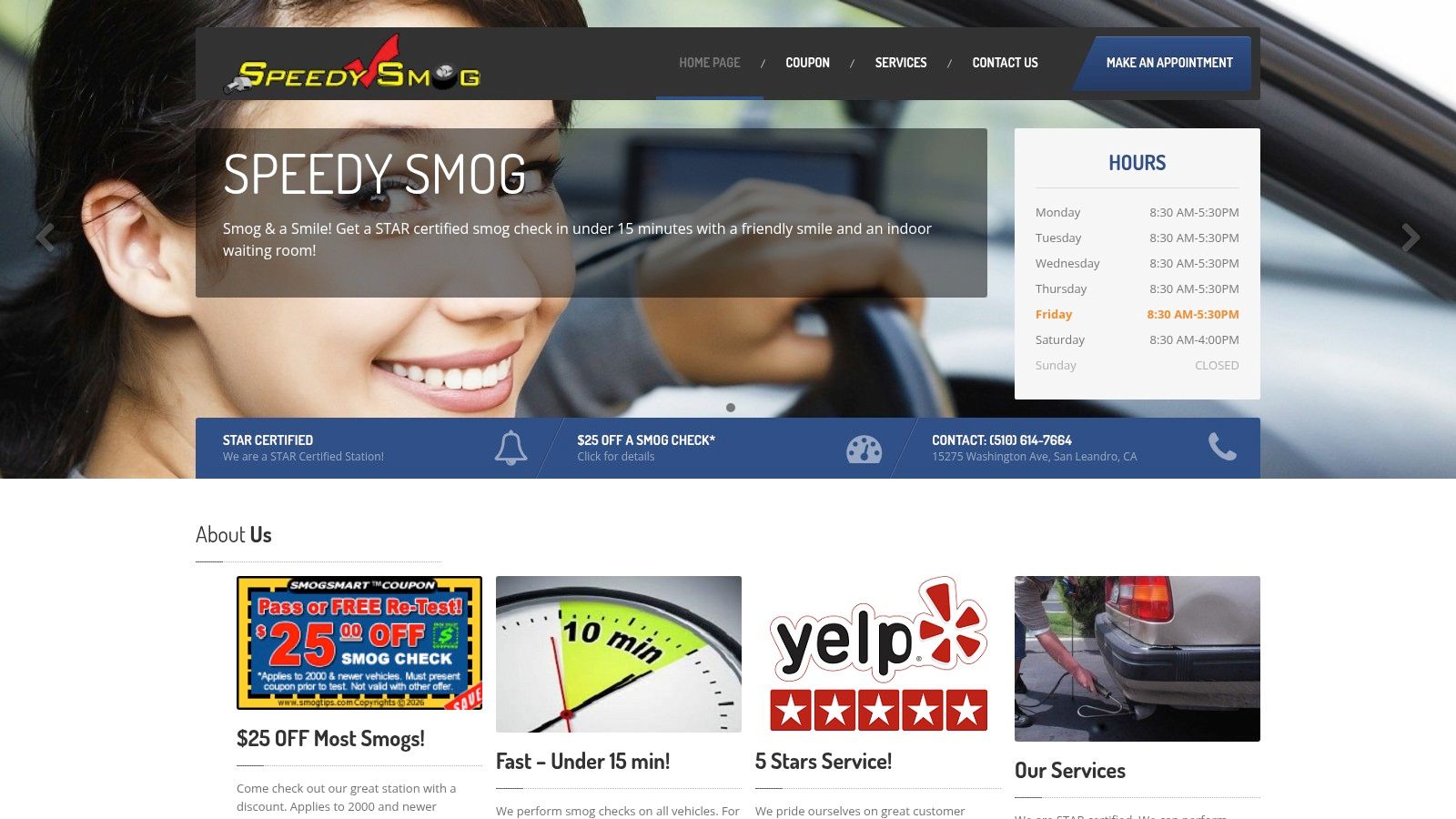
A shop like Speedy Smog stands out because the value is in the full visit, not just the headline price. You want fast service, a clean process, clear answers, and no surprise add-ons at the counter. That is what saves money in real life, because it saves you from repeat trips, checkout arguments, and last-minute DMV stress.
Good value means a correct test, a fair out-the-door price, and no nonsense at checkout.
FAQ Your Next Steps for DMV Compliance
A few questions always come up right before a smog check. Here are the ones that matter most.
What if my car fails
If your car fails, don't start authorizing random repairs. Get a clear diagnosis first. Smog failures can come from several different issues, and the smart move is to fix the actual cause, not guess.
Failure can get expensive. California cost references note repair costs can range widely depending on the issue, and that wide range is exactly why you want a straightforward explanation before any work starts.
One more thing. Don't assume waivers are easy or automatic just because you've heard that from a friend. A New York waiver explanation from SSDGNY says a vehicle can qualify for an emissions waiver there only after at least $450 of emissions-specific repairs have been made and the car still fails. Different states handle waivers differently, but the lesson is universal. Always ask about the actual rules before you count on a waiver saving you.
Do I need a smog check right now
Check your DMV renewal notice first. That's the document that tells you whether your registration cycle requires a smog inspection and whether you need a STAR station.
California also has special rules for newer vehicles. A California smog overview from SuperStation Concord notes that vehicles six or fewer years old may pay an annual $20 abatement fee instead of getting the biennial smog check, though that exemption doesn't apply to certain diesel and special-built vehicles.
If you want the California rules in one place, this page on California smog check rules is a useful starting point.
Your next move
Keep it simple:
- Read your DMV notice carefully. Check whether the vehicle needs a smog this cycle and whether STAR is required.
- Call one local station with your vehicle details. Ask for the total out-the-door price.
- Get it done before the deadline. Smog is annoying when you delay it. It's manageable when you handle it early.
The process isn't nearly as bad as people make it out to be. Most of the frustration comes from unclear pricing and poor communication. Fix those two things, and the whole errand gets easier.
If you want a fast, straightforward smog check in San Leandro, Speedy Smog is a solid local option. They're a STAR Certified station, they work on most vehicle types, and they're known for clear pricing, quick service, and a comfortable waiting area, which is exactly what most East Bay drivers want when DMV time rolls around.

Don't Overpay: Your Guide to East Bay Smog Check Deals
That DMV renewal notice has arrived, and the hunt for a good smog check deal begins. In the East Bay, that usually means opening a few tabs, spotting one low coupon price, and then realizing the total may look different once certificate fees, STAR requirements, or vehicle surcharges show up.
California's smog program has been part of the registration cycle since AAA's overview of the California Smog Check Program notes the state adopted it in 1984, and checks typically come up during registration renewal or vehicle transfer. That's why smart drivers don't just want a cheap headline. They want a station that gets the paperwork right, honors the coupon, and doesn't waste a Saturday.
This guide focuses on East Bay smog check deals that are usable. Some are best for speed. Some are better if you need a STAR station. Others stand out because they're unusually clear about fees, retests, or coupon terms. The goal is simple. Spend less, avoid surprises, and get your certificate handled in one trip.
Table of Contents
- 1. Speedy Smog
- 2. EZ Star Smog Oakland
- 3. Xpress Star Smog
- 4. KS Smog (Test-Only, STAR)
- 5. Smog Express (Richmond)
- 6. Official Smog Check Test Only
- 7. Smog Car Care and Lube (Smog Check Oakland)
- Smog Check Deals: 7-Shop Comparison
- From Coupon to Certificate A Smarter Smog Check Strategy
1. Speedy Smog
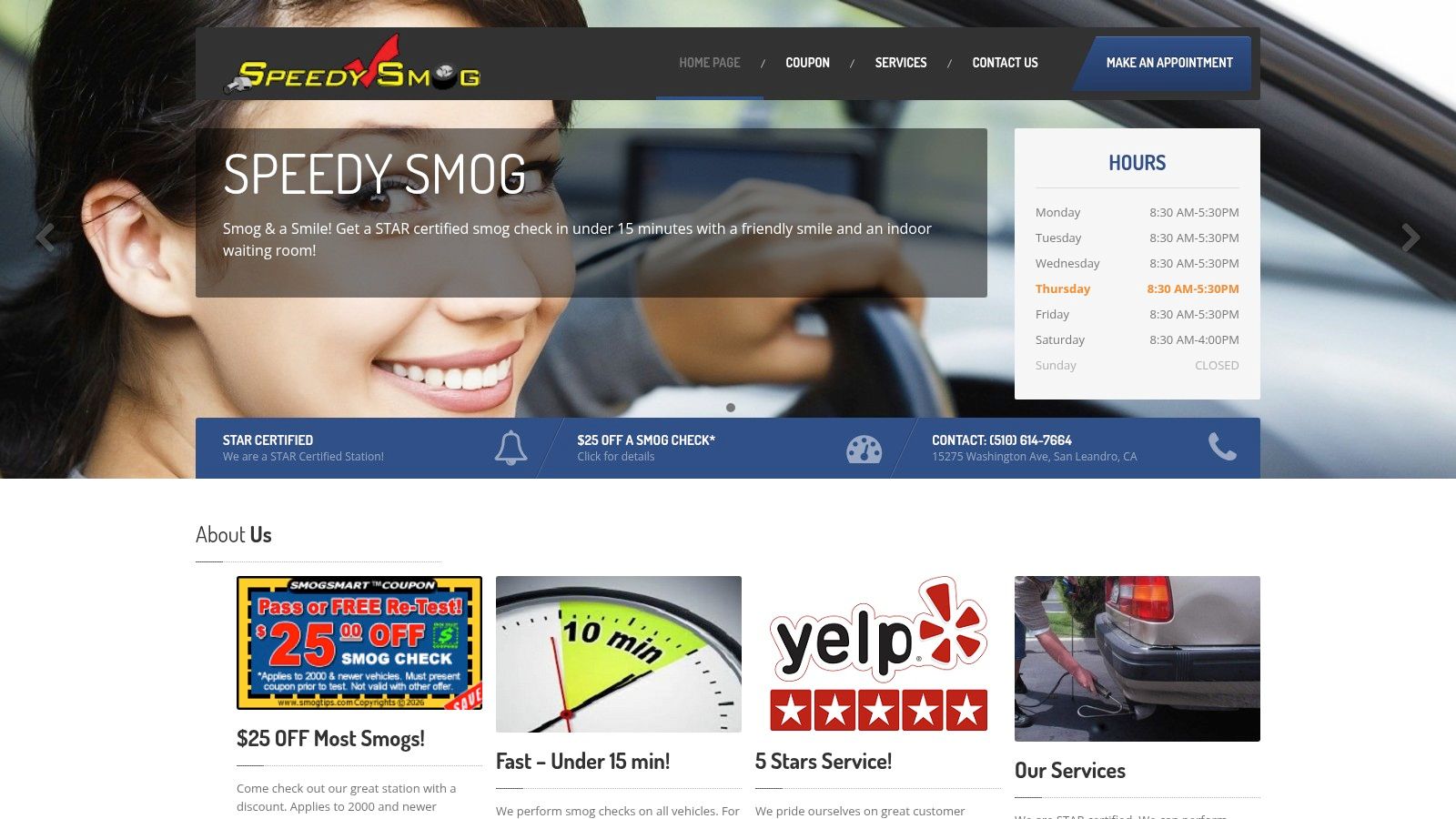
A common East Bay mistake is grabbing the first smog coupon you see, then finding out at the counter that the station is not the right fit for your DMV notice or vehicle type. Speedy Smog in San Leandro is one local option that is useful to keep on the shortlist for that reason. It is a STAR-certified station, and it serves a wider range of vehicles than many coupon-first shops.
The practical value here is fit, not hype. The Washington Ave location is convenient for drivers coming from San Leandro, Oakland, Hayward, and nearby freeway routes. It also handles vehicle categories that often get left out of headline deals, including older vehicles, diesels, hybrids, and many 2000-and-newer cars.
That matters because the cheapest advertised smog check is not always the lowest final cost. If a shop cannot test your vehicle, is not STAR-certified when your renewal requires it, or adds fees after you arrive, the coupon stops being a deal.
Why It Stands Out
Speedy Smog is worth comparing if your main goal is to avoid mismatch problems. The shop is set up for quick inspections on standard vehicles, but the more useful point is that you can screen it against the basics that affect cost. Confirm STAR status. Confirm your vehicle category. Ask whether the posted coupon applies before the work order is written.
That three-step check saves more money than chasing the biggest discount banner.
Best Fit
Speedy Smog makes sense for drivers who want a straightforward option to compare against the rest of this list, especially if they need:
- STAR certification: Important if your DMV notice sends you to a STAR station.
- Broad vehicle coverage: Helpful for hybrids, diesels, and older cars that do not always qualify for simple coupon offers.
- A convenient San Leandro location: Useful if you want to keep the stop close to home or along a commute route.
The trade-off is simple. You should still call ahead to verify current pricing, coupon terms, and hours before you go. That extra minute is part of a smart smog check strategy, because the best deal is the one that gets your certificate done correctly on the first visit.
2. EZ Star Smog Oakland
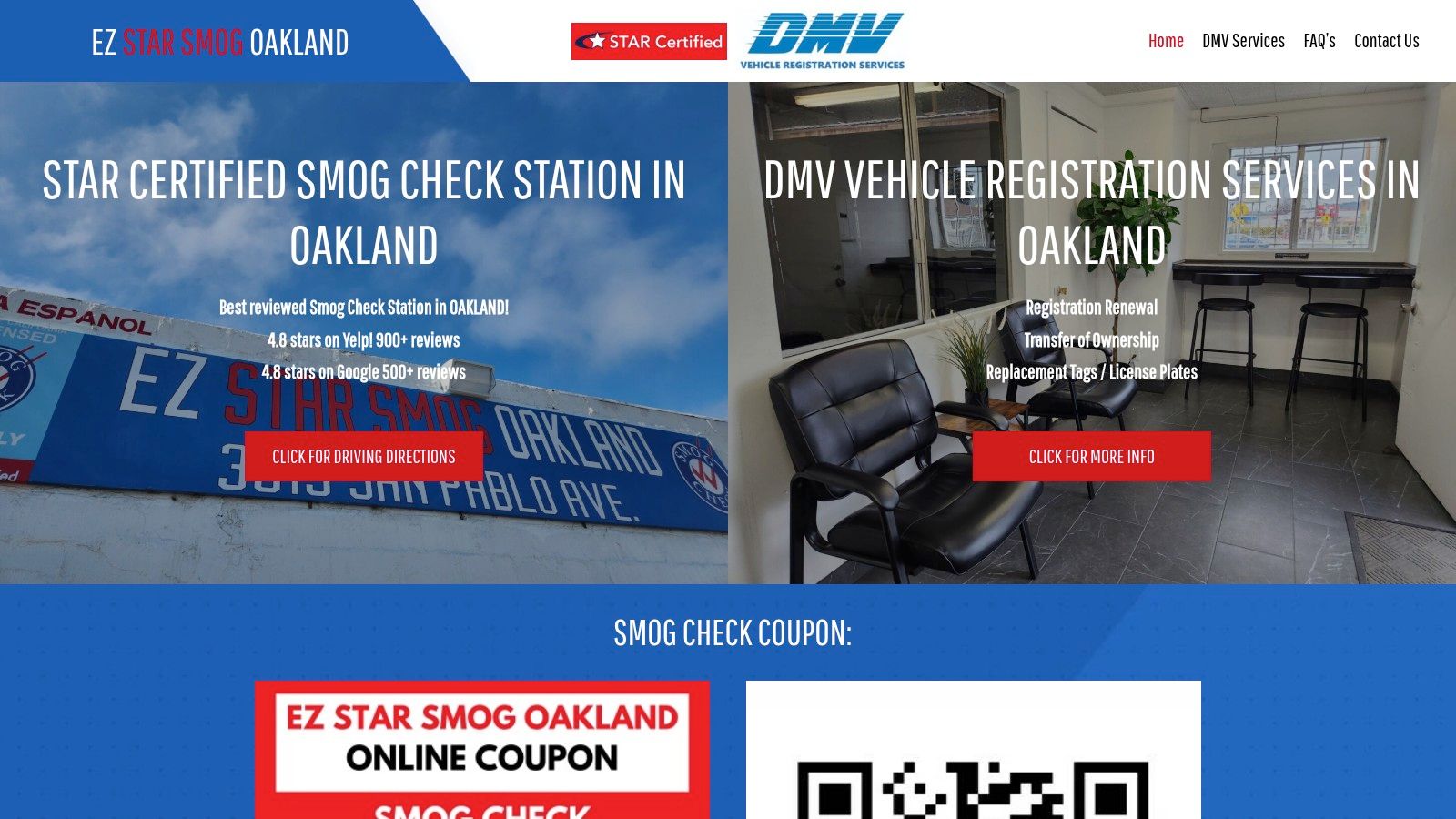
EZ Star Smog Oakland is a good example of a station that understands what drivers want from smog check deals. Not just a price teaser, but fewer errands and less friction. It's a STAR-certified test-only station, accepts walk-ins, and posts a coupon you can pull up on-site through a QR code.
That QR setup matters more than it sounds. A lot of coupon pages look fine at home and become annoying in the parking lot when you're zooming in on tiny text or trying to figure out whether the offer applies to your car. EZ Star Smog makes redemption relatively simple.
Why Drivers Like It
The biggest practical advantage here is the combination of smog testing and DMV registration services in the same shop. If your renewal is already eating into your day, cutting out an extra stop is often worth more than squeezing out a slightly better headline discount elsewhere.
Some of the best smog check deals aren't the absolute cheapest. They're the ones that eliminate a second errand.
This station also makes sense for STAR-directed drivers who don't want to gamble on whether a general repair shop can process the inspection correctly. The downside is that the coupon specifics are shown as an image, so you still need to read the terms carefully when you arrive. It's also closed Sundays, which may rule it out if you're doing all your car tasks on one weekend day.
3. Xpress Star Smog
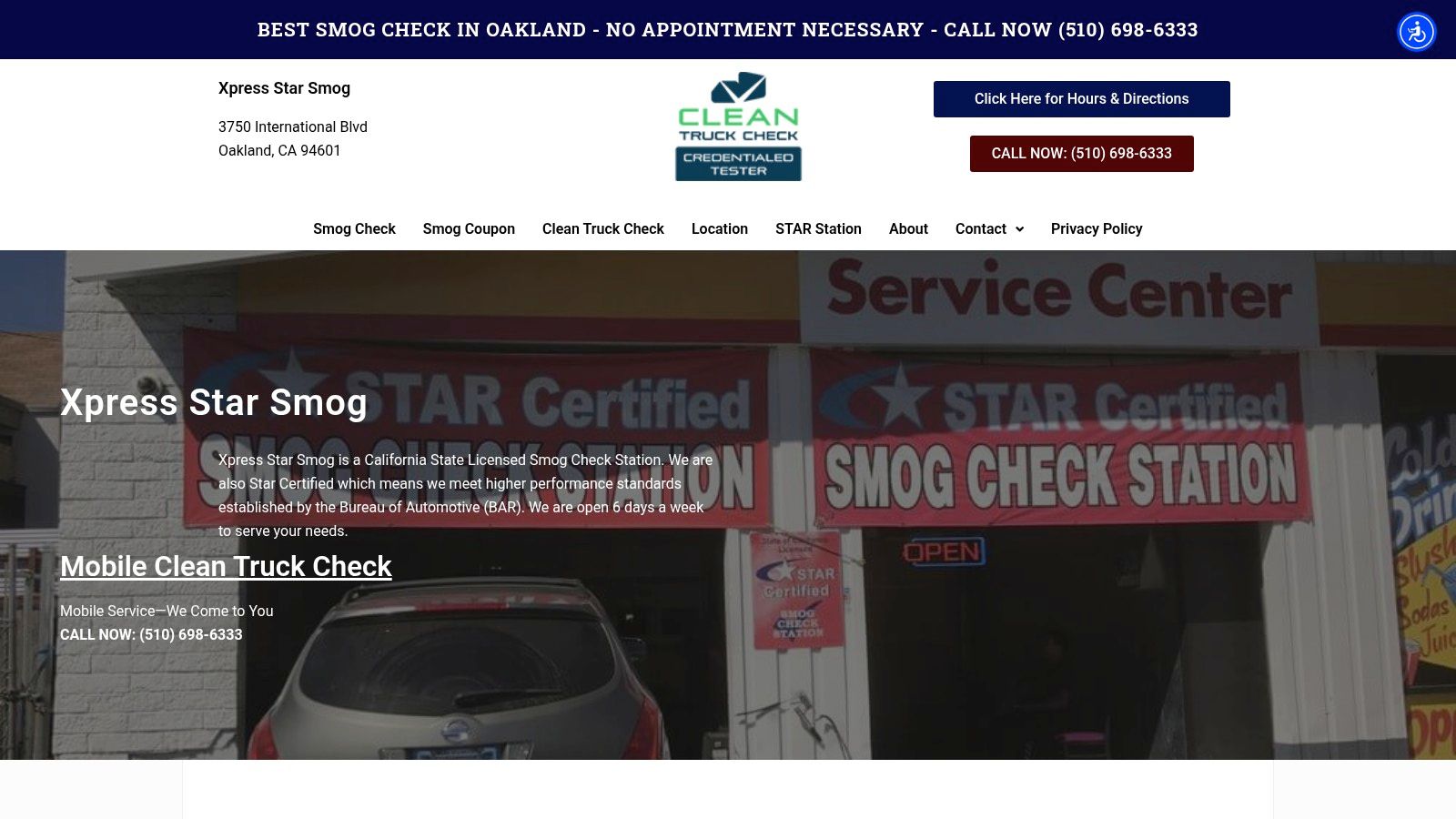
A station being open when you need it is half the battle. Xpress Star Smog earns its place mostly because it's open seven days a week, including Sunday, and that makes it unusually useful for drivers with packed weekday schedules.
The online coupon presentation is also refreshingly direct. You can find the offer quickly, see the discount without digging through clutter, and decide whether it's worth the trip. For a lot of Oakland drivers, that simplicity is enough to make the shortlist.
Where It Wins
This is the kind of station I'd pick when the main requirement is timing. If your registration deadline is close, or you've put this off until the weekend, Sunday availability is a real advantage. Many local shops lose business because they're dark when people finally have time to deal with DMV-related tasks.
Xpress Star Smog is also STAR-certified, which gives it broader usefulness than a generic low-price station. The main caution is the same one that applies to many coupon offers. Confirm that the deal matches your vehicle type before they start the test. The coupon page is easy to find, but it doesn't clearly spell out a free retest policy there, and that can matter if your vehicle is borderline.
4. KS Smog (Test-Only, STAR)
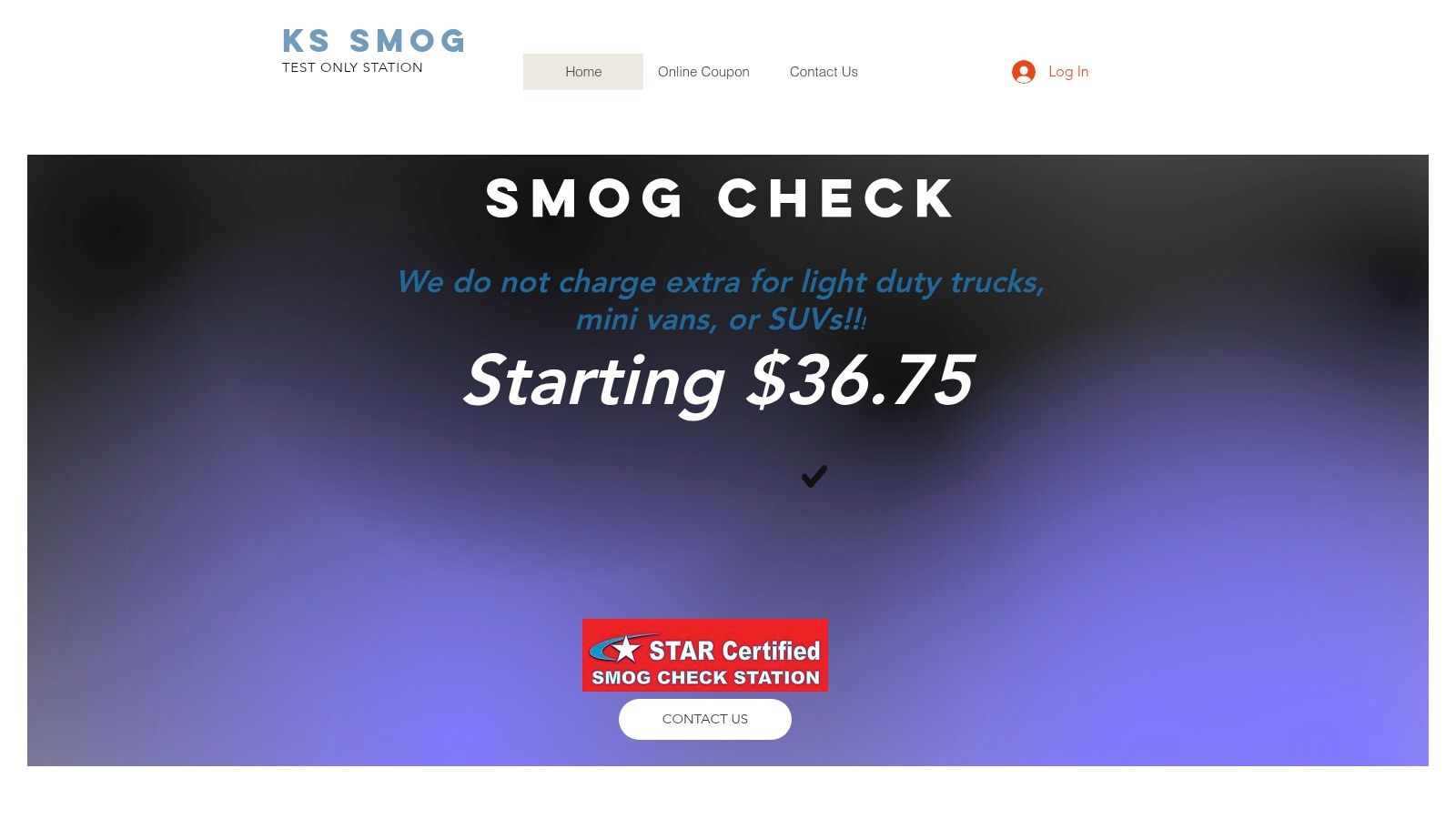
KS Smog is one of the better picks for drivers who hate checkout surprises. Plenty of smog check deals look low until you realize the station adds extra charges for STAR, light-duty trucks, SUVs, or minivans. KS Smog stands out because its coupon page is unusually explicit about what's included and what isn't.
That clarity is valuable in a market where pricing varies a lot. California BAR's 2025 executive summary lists an average Initial Test price of $78.13, with Non-STAR Test-Only averages shown around $62.99 and $62.04 in sampled categories. In other words, station type affects what people pay, so a transparent posted structure matters.
What Makes The Coupon Useful
KS Smog lays out pricing by vehicle year and clearly states no extra fee for STAR, light-duty trucks, minivans, or SUVs. That's exactly the kind of fine print I want to see before showing up. You're not left guessing whether a low advertised number only applies to the easiest possible vehicle profile.
- Transparent year-based pricing: Helpful if your car falls outside the most common 2000+ category.
- No-extra-fee language for common vehicle classes: Useful for SUV and minivan owners who often get hit with add-ons.
- Certificate shown separately: Easier to calculate your out-the-door number before you go.
The limitations are equally clear. Heavy-duty vehicles, RVs, commercial vehicles, and exotics are excluded. It's also closed Sundays. But for ordinary passenger vehicles and common family cars, KS Smog has one of the more honest deal pages in the East Bay.
5. Smog Express (Richmond)
Smog Express in Richmond gets my attention for one reason that many deal pages barely address. It pairs its coupon with a free retest. If your vehicle is likely to pass, any decent coupon can work. If there's even a small chance it won't, retest policy becomes part of the actual price.
That's where Smog Express has an edge over stations that advertise a low first test and say very little after that. It also helps that the shop is open seven days and advertises a price-match policy, which gives budget-conscious drivers another angle to work with.
Why The Retest Policy Matters
Many “cheap” smog check deals cease to be smart deals. Existing coupon pages often advertise a discount up front while hiding extra charges or restrictions in the fine print. One example highlighted by Encinitas Smog Check's coupon page shows an advertised discount paired with separate certificate fees and added charges for trucks, SUVs, or minivans. That's exactly why I put so much weight on the total cost and retest terms, not just the banner price.
When a station includes a free retest, the offer is easier to trust because the shop is telling you what happens after a failed first visit.
Smog Express also notes broad applicability to any smog and any year on its coupon. That's helpful, but verify the specific location and hours before heading out, since different sites may operate differently. The one-per-vehicle coupon limit is standard enough, but still worth noticing.
6. Official Smog Check Test Only
Official Smog Check Test Only is the kind of shop I'd recommend to drivers with less common testing needs. If you have a diesel, an out-of-state registration situation, a change-of-ownership test, or a STAR requirement, broader service compatibility matters more than chasing the flashiest coupon online.
The offer page is also refreshingly plain about fees. It discloses the mandatory California certificate fee of $8.25 right on the page, which is exactly what more stations should do.
Who Should Shortlist It
Consumer pricing examples across California commonly use a base-test-plus-certificate structure, and some offers are built around low advertised test prices before that certificate charge is added, as discussed in California smog check cost reporting and market examples. That's why Official Smog Check's clear fee disclosure gives it more credibility than a lot of louder coupon pages.
This station is especially practical for drivers who need:
- Diesel testing: Not every discount-focused shop wants these jobs.
- Out-of-state or change-of-ownership smogs: Good when your situation isn't routine.
- Clear terms before arrival: The certificate fee is disclosed instead of buried.
The drawback is old-school but important. You have to print the coupon and bring it in. They won't print it for you. If you're comparing local smog check deals on your phone while running errands, that requirement can be inconvenient enough to change your choice.
7. Smog Car Care and Lube (Smog Check Oakland)
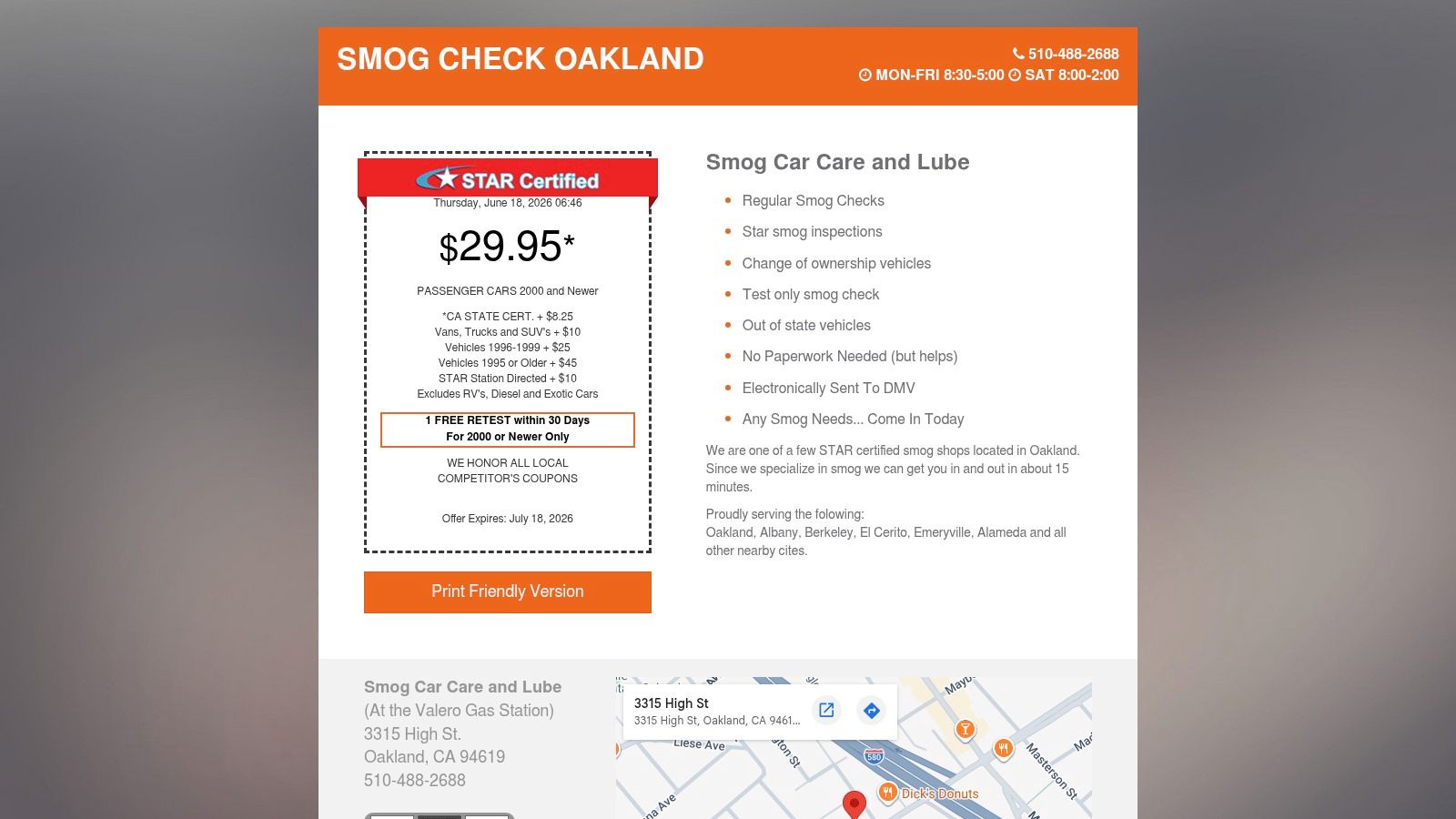
If your main goal is the lowest posted starting price for a newer passenger car, Smog Car Care and Lube deserves a look. The headline offer is aggressive for Oakland, and the page does something many stations still avoid. It itemizes the surcharges instead of pretending every vehicle costs the same.
That makes it easier to tell whether the deal is suitable for you or just technically available under narrow conditions. For comparison, BAR's March 2022 executive summary showed an average smog-check inspection cost of $56.72 across 106,626 reported inspections, so low posted prices are most noticeable when the fee structure is visible.
Best Use Case
This is the best fit for owners of 2000+ passenger cars who want a low starting price and appreciate clear add-on rules. The station also offers one free retest within 30 days for qualifying newer cars and accepts competitor coupons, which gives deal hunters room to compare.
There are some catches, but they're at least disclosed. Diesels and RVs are excluded. STAR-directed testing adds a surcharge. Older vehicles and trucks or SUVs cost more than the headline number suggests, and the offer shows an expiration date, so check current availability before making the trip.
Cheap smog check deals are only cheap for the vehicles that actually qualify. The itemized page here helps you figure that out before you leave home.
Smog Check Deals: 7-Shop Comparison
| Station | 🔄 Process Complexity | ⚡ Speed & Availability | ⭐ Expected Outcomes | 📊 Key Advantages | 💡 Ideal Use Cases |
|---|---|---|---|---|---|
| Speedy Smog (San Leandro) | STAR-certified station; standard, low-complexity smog workflow; Mon–Sat, walk-ins common | Very fast, ~10–15 min for most 2000+ vehicles; periodic $25 coupons | DMV-recognized, accurate STAR inspections; high customer satisfaction | Fast service, friendly staff, wide vehicle coverage (hybrids/diesels/older models) | Busy drivers needing quick, DMV-compliant smogs and short waits |
| EZ Star Smog (Oakland) | Test-only STAR station; walk-ins accepted; on-site DMV registration | Quick renewals; mobile QR coupon redemption; closed Sundays | Consistent STAR compliance; high review scores reported | QR coupon, combined smog + DMV service to reduce errands | STAR-directed vehicles or drivers who want same-visit registration |
| Xpress Star Smog (Oakland) | STAR-certified, walk-in friendly, open daily (including Sunday) | Flexible weekend availability; central location | STAR-compliant tests; coupon values may vary by vehicle | 7-day hours and clear online coupon presentation | Drivers needing weekend/sunday smogs or last-minute checks |
| KS Smog (San Leandro) | Test-only STAR center; transparent, itemized pricing by vehicle year | Walk-in friendly with posted hours; closed Sundays | STAR certification with clear pricing to avoid surprises | Explicit price list; "NO EXTRA FEE" for many vehicle types | Cost-conscious customers and STAR-directed owners seeking price clarity |
| Smog Express (Richmond) | Test-only shop open daily; printable coupon with no-expiration claim | Open 7 days; $20 off + FREE RETEST included on coupon | Free retest reduces financial risk if initial fail; broad applicability | Free retest, price-match policy, long-established local shop | Vehicles of any year and customers wanting a guaranteed retest |
| Official Smog Check Test Only (Oakland) | Test-only center handling STAR, diesel, out-of-state, C-of-O; printed coupon required | Standard turnaround; $10 internet coupon (must print) | Broad service compatibility including diesel and change-of-ownership | Handles diesel/out-of-state/C-of-O tests; discloses $8.25 certificate fee | Owners with diesel, out-of-state, or transfer-of-ownership needs |
| Smog Car Care and Lube (Oakland) | Full-service shop with smog offers; itemized surcharges and competitor matching | Competitive headline price ($29.95 for 2000+); free retest within 30 days for qualifying cars | Low starting cost for newer passenger cars; retest protection | Aggressive low price, competitor coupon matching, free 30-day retest | Newer 2000+ passenger cars seeking lowest out-the-door price and retest coverage |
From Coupon to Certificate A Smarter Smog Check Strategy
A cheap smog check stops being cheap fast when the coupon excludes your vehicle, the station cannot handle your test type, or the retest terms are weak. A true deal is the one that gets you from inspection to certificate with the fewest surprises.
Start with fit, not price. If your DMV notice requires STAR, confirm that first through BAR before you leave home. Then check the parts of the bill that usually cause friction: whether the certificate fee is separate, whether your vehicle class changes the price, and whether the posted coupon applies to your model year. A low headline rate can still turn into a higher total if the shop adds fees for SUVs, minivans, older cars, or STAR-directed tests.
Retest policy matters more than many drivers expect. If a vehicle has had a recent check-engine light, rough idle, or any emissions-related repair, a station with a free or discounted retest can save more than the shop with the lowest first-test price. California drivers may also want to review repair assistance information if a vehicle fails at a test-only station, since that can affect which shop makes the most sense before registration deadlines tighten. Some state-related guidance on assistance options is discussed here: repair assistance information.
Call before you go. Ask four direct questions. Is this coupon valid for my exact vehicle year and type? Is the certificate fee included? Are there extra charges for STAR, trucks, vans, or hybrids? What happens if the car does not pass the first time?
Timing helps too. Midweek and midday visits are usually easier at walk-in stations, and bringing up the coupon before the work order is written avoids the awkward back-and-forth at checkout.
If you want a fast local option with STAR capability and straightforward process, Speedy Smog is one practical place to start, as noted earlier. It makes sense for East Bay drivers who want a quick inspection, a decent waiting setup, and a coupon that helps when it is mentioned before the order is opened.
Your registration renewal shows up in the mail, you flip it over, and there it is: smog certification required. If your car is older, that one line can raise a bunch of questions fast. Does your model year still need testing? Is it the quick computer scan, or the longer tailpipe test? What happens if the check engine light came on last week, then went back off?
A lot of East Bay drivers run into this with cars from the 1990s, older diesels, or well-kept daily drivers that still run fine but don't fit the “new car” rules anymore. The confusing part is that California doesn't treat all older vehicles the same. A 1975 gasoline classic, a 1998 sedan, and a 2003 commuter car each fall into different testing logic.
The good news is that the rules make more sense once you group them by era and by fuel type. After that, passing the test becomes much less mysterious. You mostly need to know where your car fits, what the technician is checking, and how to avoid the common mistakes that trigger a fail.
Table of Contents
- Your DMV Smog Notice Arrived What Now
- The Three Eras of California Smog Checks
- Exemptions and Special Cases for Older Cars
- What Happens During the Smog Test
- Common Failure Points and How to Prepare Your Car
- Understanding Costs Timelines and Failure Options
- How to Find a STAR Station in the East Bay
Your DMV Smog Notice Arrived What Now
Many drivers don't start learning about a smog check for older cars because they're curious. They learn because the DMV gives them a deadline.
A common East Bay scenario goes like this. You've got an older Toyota, Honda, Ford, or Chevy that still gets you to work just fine. Then the renewal notice arrives, and suddenly you're wondering whether your car counts as “old enough to be exempt” or “old enough to be a problem.”
That confusion is normal. California's system isn't based on your car just being old. It's based on model year, fuel type, and testing method. Two cars parked next to each other can follow different rules even if they look about the same age.
Practical rule: Start with your model year, not with the car's condition, mileage, or collector status.
If your car is a gasoline model, the first cutoff people need to know is whether it falls before or after the mid-1970s exemption line. If it's newer than that, the next question is whether it belongs to the older tailpipe-testing group or the newer computer-testing group. Diesel owners have their own timeline, which trips up plenty of people because it doesn't match the gasoline rules.
Here's what usually helps drivers calm down and move forward:
- Check the notice carefully. If the DMV says smog certification is required, treat that as your starting point.
- Confirm the model year and fuel type. Those two details decide most of the process.
- Don't ignore warning signs. A rough idle, fuel smell, or check engine light can matter more than a recent oil change.
- Give yourself time before the deadline. Older cars sometimes need one repair, one recheck, or one extra drive cycle before they're ready.
The rest of the process gets much easier once you place your car into the right era.
The Three Eras of California Smog Checks
California's rules are easiest to understand when you stop thinking of them as one giant program and instead see three different eras of vehicles. That's the cleanest way to understand why an older sedan gets tested differently than a newer crossover.
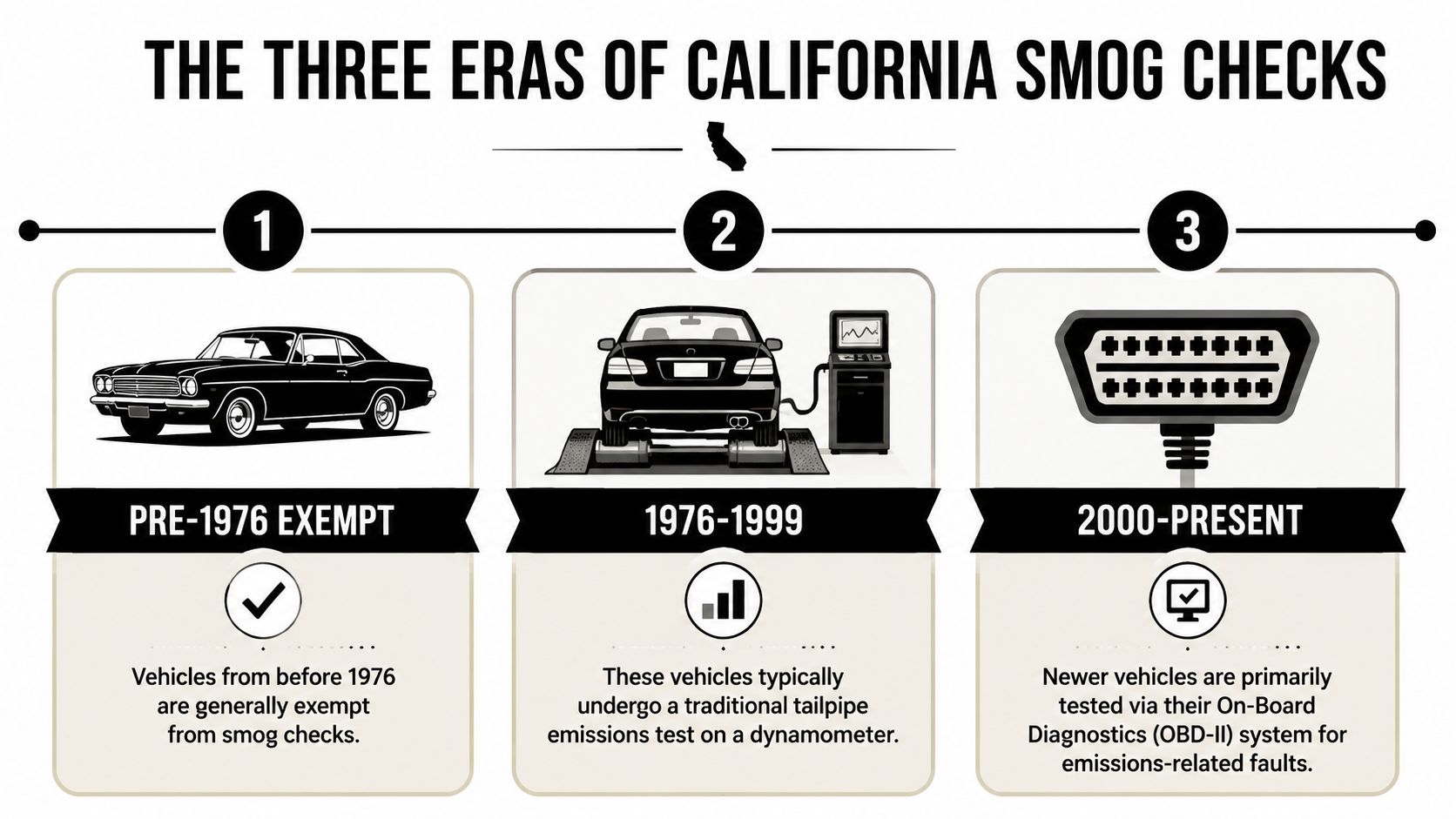
According to the California BAR Smog Check program, gasoline-powered vehicles model year 1976 and newer are subject to smog inspection, while 1975 and older are exempt; diesel vehicles are subject to inspection from 1998 and newer, with 1997 and older exempt.
Era one pre 1976 gasoline cars
This is the clean break a lot of classic car owners care about. If your gasoline vehicle is model year 1975 or older, it sits on the exempt side of the line.
That means no regular smog inspection requirement under the standard program. People often assume there's a rolling exemption based on age, but California doesn't work that way. A car doesn't become exempt just because it gets older.
For owners, the practical takeaway is simple. Don't ask, “My car is old, so is it exempt now?” Ask, “What model year is it?”
Era two 1976 through 1999
This is the group that catches many older daily drivers. These cars are old enough to have aging emissions components, but not old enough to be exempt.
Many vehicles in this range go through the more traditional style of emissions inspection associated with older testing systems. That's why a 1998 Honda or 1991 pickup may need more than a quick plug-in scan. The car may be evaluated through an older pathway that puts more weight on actual measured exhaust output and visible emissions equipment.
A lot of frustration comes from owners saying, “But the car runs fine.” Running fine and burning clean enough to pass are not always the same thing.
Era three 2000 and newer
This is the modern group. These vehicles are usually checked through their OBD-II system, which is the onboard computer that tracks emissions-related faults and readiness status.
If you've heard someone say, “They just plugged into my car and it was done,” they're usually talking about a vehicle in this era. That doesn't mean newer cars never fail. It means the test often depends more on what the computer sees than on the older style tailpipe procedure.
Here's the quick comparison drivers remember best:
| Vehicle era | Main idea for the owner |
|---|---|
| Pre-1976 gasoline | Generally exempt from routine smog checks |
| 1976-1999 gasoline | Older testing pathway is often more involved |
| 2000+ gasoline | Computer-based OBD-II testing is common |
If your older car needs a smog check, the model year usually tells you what kind of appointment you're walking into.
Exemptions and Special Cases for Older Cars
The basic timeline handles most vehicles, but some cars don't fit neatly into the usual conversation. That's where people get tripped up. They hear “classic car,” “diesel,” or “engine swap,” and assume those words create an automatic exemption. Often they don't.
The classic car cutoff that never moved
For gasoline vehicles, California uses a fixed historical cutoff. Vehicles manufactured before model year 1976 are entirely exempt from smog testing requirements, and that policy has remained unchanged since the early days of the program, according to this California smog exemption overview.
That fixed line matters because many owners expect a rolling rule. They think a car becomes exempt once it reaches a certain birthday. California did not set it up that way. The exemption is tied to a model-year boundary, not a moving age threshold.
The reason this causes confusion is easy to understand. A 1975 gasoline car is exempt, but a 1976 gasoline car is not, even though those vehicles may be close in age and design. One lands on the exempt side of the legal line, the other doesn't.
A few special-case reminders help:
- Collector status doesn't control the rule. A car can be loved, restored, and shown on weekends and still need testing if it falls on the required side of the model-year line.
- Condition doesn't create an exemption. A beautifully maintained older car still follows the same rule as a rough one from the same year.
- Low use doesn't automatically change the requirement. Owners often drive older cars sparingly, but that alone doesn't place them outside the standard rule.
Diesels swaps and out of state surprises
Diesel owners need to pause and check fuel type before they assume gasoline rules apply. Under the BAR framework already noted above, diesel vehicles from 1998 and newer are subject to inspection, while 1997 and older are exempt. That timeline is different from gasoline, and that difference catches people every year.
Engine-swapped or modified vehicles create a different kind of issue. The question usually isn't “Is it older?” The question is whether the emissions equipment and configuration still line up with what California expects. If a technician sees missing, altered, or noncompliant emissions parts, that can become a significant problem.
Cars coming in from another state can also surprise owners. A vehicle that was easy to register elsewhere may face a California emissions requirement before registration can move forward. That doesn't mean the car is bad. It means California wants the vehicle to fit California's compliance path.
A simple way to think about special cases is this:
| Vehicle situation | What to verify first |
|---|---|
| Older gasoline classic | Exact model year |
| Older diesel | Whether it falls before or after the diesel cutoff |
| Modified or swapped vehicle | Emissions equipment and legal configuration |
| Out-of-state vehicle | California registration and smog requirement status |
Bring the registration paperwork and know your fuel type before you show up. Half of smog-check confusion starts there.
If you're unsure, don't guess based on what a friend's car needed. Small details matter with older vehicles.
What Happens During the Smog Test
For many drivers, the test feels stressful because they can't see what the technician is evaluating. Once you know the basic flow, it becomes much less mysterious.
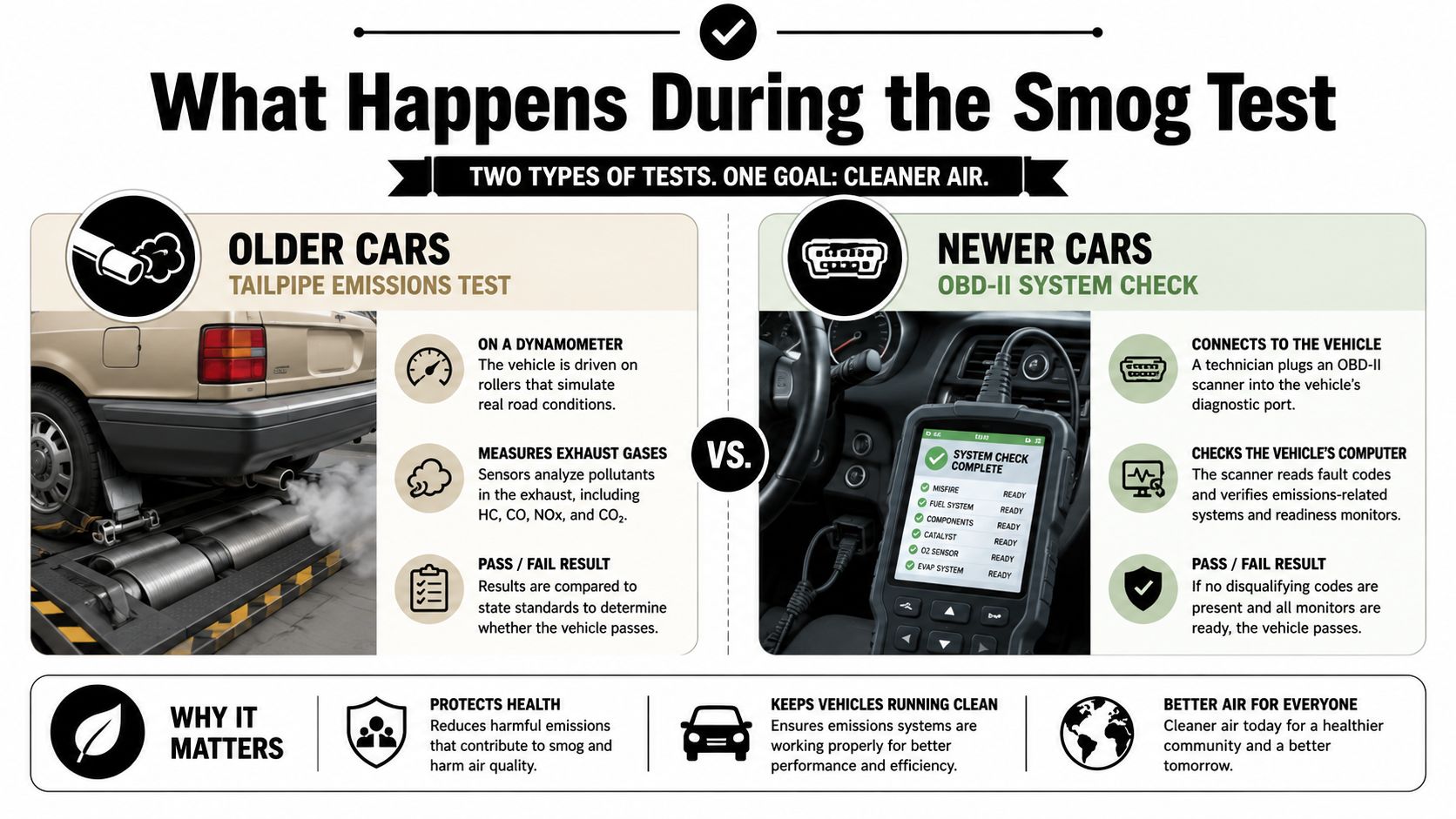
What the technician checks first
Before anybody talks about pass or fail, the inspection starts with the vehicle itself. The technician is looking for a car that is testable, presentable, and equipped as expected for its emissions system.
That usually means checking items such as the check engine light status, obvious emissions-related components, and signs of tampering or missing equipment. If something looks clearly altered or disconnected, that can matter before the deeper testing even starts.
For older cars, visual issues matter more than many owners expect. A missing hose, a loose gas cap, an unplugged sensor, or a noncompliant part can start the appointment off badly even if the engine sounds normal.
Tailpipe test versus computer test
The main split is between the older tailpipe-style test and the newer OBD-II system check.
For many older gasoline vehicles, especially those in the 1976 through 1999 group, the station may use the traditional style of test associated with a dynamometer. The car is run under controlled conditions while emissions from the exhaust are measured. That gives the state a picture of what the vehicle is putting out.
For newer vehicles, the process is usually different. The technician plugs into the onboard diagnostics system and checks whether the car's emissions monitors are ready and whether any emissions-related fault codes are present.
Here's the practical comparison:
- Older vehicle pathway: More focused on measured tailpipe output and equipment condition.
- Newer vehicle pathway: More focused on the vehicle computer, fault codes, and monitor readiness.
- Both pathways: Still care about whether the emissions system appears intact and functioning.
A recent battery disconnect can matter on newer cars because the computer may not be ready yet, even if the car feels perfectly fine.
If you've got an older car, don't assume the test is only about what comes out of the exhaust. If you've got a newer one, don't assume a smooth-running engine means the computer is ready. Smog inspections look at compliance, not just drivability.
Common Failure Points and How to Prepare Your Car
Your registration notice shows up, the car seems to run fine, and it is easy to assume the test will be routine. Then an older hose, a tired sensor, or a converter that has slowly lost efficiency turns a normal visit into a failed inspection. That is the hard part with older vehicles. They often drift out of spec little by little, long before they leave you stranded.
That pattern shows up in statewide research too. California data highlighted in the Cleaner Cars, Cleaner Air report shows that 20-year-old gasoline vehicles fail the required Smog Check twice as often as 10-year-old vehicles, with failure rates for 15 to 20 year old cars reaching 18 to 22 percent.
For East Bay drivers, the useful question is not only what fails. It is why those parts fail, what warning signs show up first, and what you can check before you spend time and money on a test.
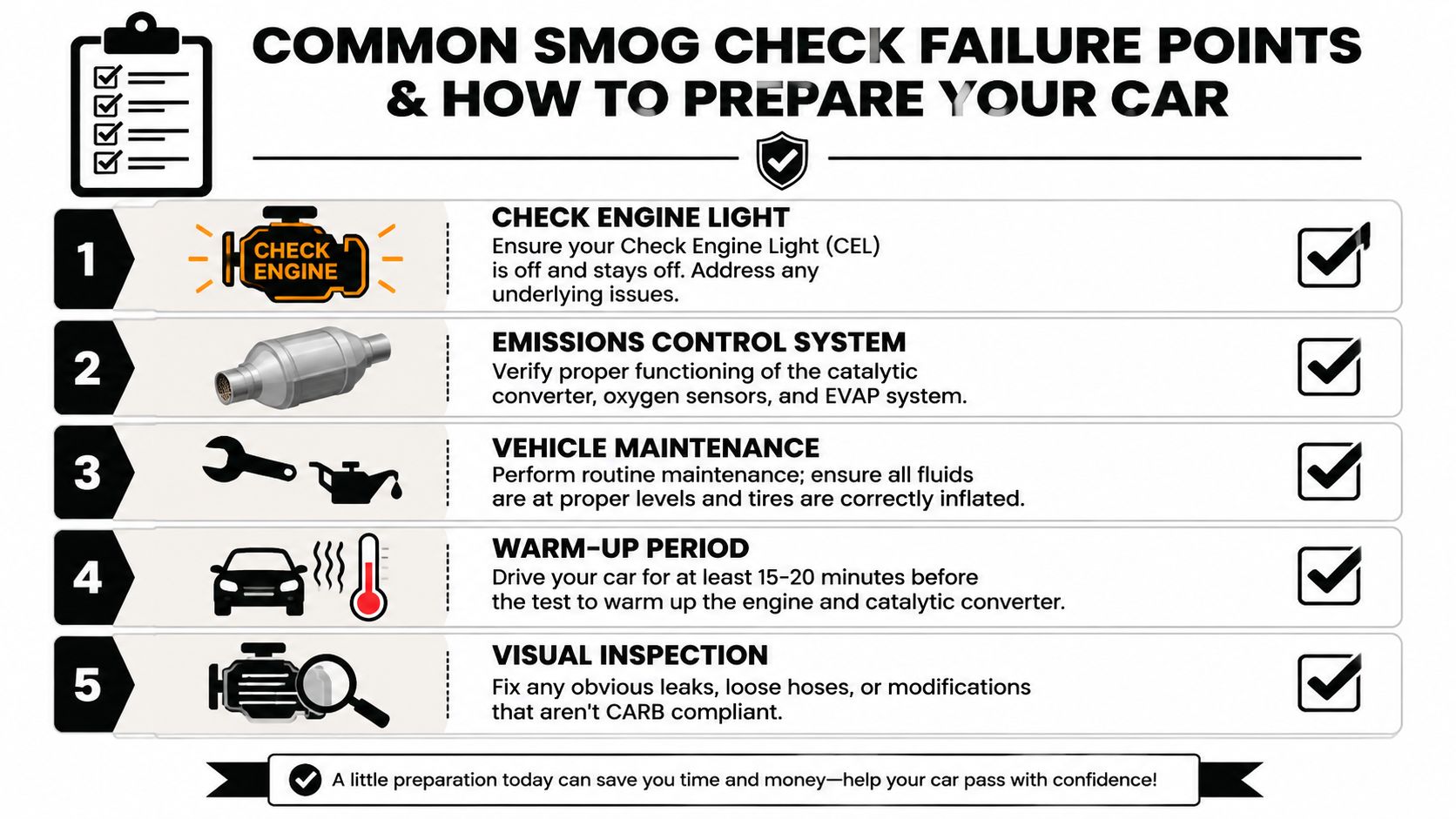
Why older cars get tripped up
An older emissions system works a lot like an old home heating system. It may still run every day, but if one sensor reads a little off, one hose leaks, or one key part loses efficiency, the whole system starts working dirtier than it should.
The usual trouble spots are familiar. Catalytic converters wear down over time. Oxygen sensors can get lazy and stop giving accurate feedback. Vacuum leaks let in air the engine computer is not expecting. Evaporative system faults can let fuel vapors escape even if the car still starts and drives normally.
Some problems are loud. A rough idle, stalling, hard starts, or an exhaust leak usually get your attention.
Others are quiet. Slightly worse fuel economy, a faint fuel smell, or a check engine light that comes and goes can still be enough to cause a failure.
The failure points that catch owners off guard
The check engine light is the biggest one. If that light is on, the car needs diagnosis before the test. Clearing the code without fixing the cause is a little like taking the battery out of a smoke alarm. The warning stops for the moment, but the underlying problem is still there, and the car may also show up as not ready for inspection.
Catalytic converter problems are another common issue on older cars. A converter can weaken slowly. The car may still feel normal on the road, but emissions rise because the converter is no longer cleaning up the exhaust the way it should.
Fuel control problems matter too. If the engine is running rich or lean because of a bad sensor, vacuum leak, injector issue, or air intake problem, tailpipe numbers can climb fast.
Then there are visible problems. Missing hoses, disconnected emissions equipment, patched wiring, and obvious exhaust leaks can all create trouble before the test result even gets to the numbers.
A pre-test routine that gives you a better shot
If a neighbor asked me how to get an older car ready, I would keep it simple:
- Make sure the check engine light is off and has stayed off. If it was recently cleared, find out why.
- Drive the car long enough to get fully warm before the appointment. A warmed-up engine and catalytic converter usually perform better than a cold one.
- Do a quick under-hood look. Check for cracked vacuum lines, loose air intake parts, disconnected hoses, or anything that looks recently disturbed.
- Listen and smell. A loud exhaust, a ticking leak, or raw fuel smell can point to an emissions problem.
- Pay attention to how it has been driving lately. Rough idle, hesitation, stalling, or weaker fuel economy are clues, not quirks.
If any of those signs are present, a pre-test inspection from a repair shop can save you a wasted trip.
| Symptom | Why it matters |
|---|---|
| Check engine light | The vehicle may not pass the inspection |
| Poor idle or stalling | Fuel or sensor issues may affect emissions |
| Fuel smell | Evaporative or combustion problems may be present |
| Recent battery disconnect | Readiness issues may delay a valid test |
| Noticeable power loss | The engine may not be burning fuel cleanly |
One more practical point for older cars. Do not let the smog station be the first place you learn the car has a problem. Use the inspection as the confirmation step after the vehicle is running cleanly and consistently. That approach usually saves money, reduces repeat visits, and lowers the chance of registration delays or late-stage DMV stress.
Understanding Costs Timelines and Failure Options
Most drivers want three practical answers before they go in. How much time should they block out, what happens after the test, and what do they do if the car doesn't pass?
How long it usually takes
Testing time depends a lot on the vehicle type. According to the publisher information provided for this article, typical tests for 2000 and newer vehicles are completed in about 10 to 15 minutes at Speedy Smog. Older vehicles can take longer because the inspection path is often more involved.
That's why it helps to avoid arriving at the last possible minute before a registration deadline. Older cars sometimes need a little more shop time, and sometimes the next step is a repair visit rather than an instant certificate.
A good rule is to leave yourself enough cushion to handle one extra trip if needed.
If your car fails
A failed test isn't the end of the road. It means the vehicle did not meet the required standard on that inspection day.
When that happens, read the Vehicle Inspection Report carefully. It points you toward the system or condition that needs attention. Some failures come from a clear mechanical issue. Others come from readiness, warning lights, or visible equipment problems.
After repairs, the next move is usually a re-test. The important part is fixing the cause, not only clearing a light or swapping parts blindly. For older cars, guessing gets expensive fast.
If money is tight, ask about official repair-assistance pathways and whether you may qualify for help through state programs. Eligibility depends on your situation, so it's worth checking before you approve major work.
How to Find a STAR Station in the East Bay
Your renewal notice shows up, you book the nearest smog appointment, and then the technician says the test has to be done at a STAR station. That moment confuses a lot of East Bay drivers, especially owners of older cars who are already trying to keep an aging vehicle legal and reliable.
A STAR station is a shop approved to perform inspections for vehicles the DMV has flagged for that program. The rule is about oversight and test accuracy, not about making life harder for you. California uses STAR requirements to keep the testing system consistent, and that matters even more with older vehicles, where emissions equipment, past repairs, or missing parts can make the inspection less straightforward.
Why STAR matters for some vehicles
Older cars are a lot like older homes. Two houses may look similar from the street, but one has updated wiring and the other still has original components hidden behind the walls. Smog checks can work the same way. Two cars from the same era may follow different inspection paths depending on their engine family, emissions label, fuel type, or prior test history.
That is why experience matters.
A station that regularly checks older gasoline cars, diesels, hybrids, and DMV-directed STAR vehicles is usually better at spotting basic issues before the test starts, such as wrong paperwork, confusion about model-year rules, or equipment questions. The station cannot bend the rules, but it can make the process clearer and help you avoid wasting a trip.
If your car has failed before, has modified or hard-to-identify emissions parts, or has been in the family long enough that records are patchy, choosing the right station can save time and frustration.
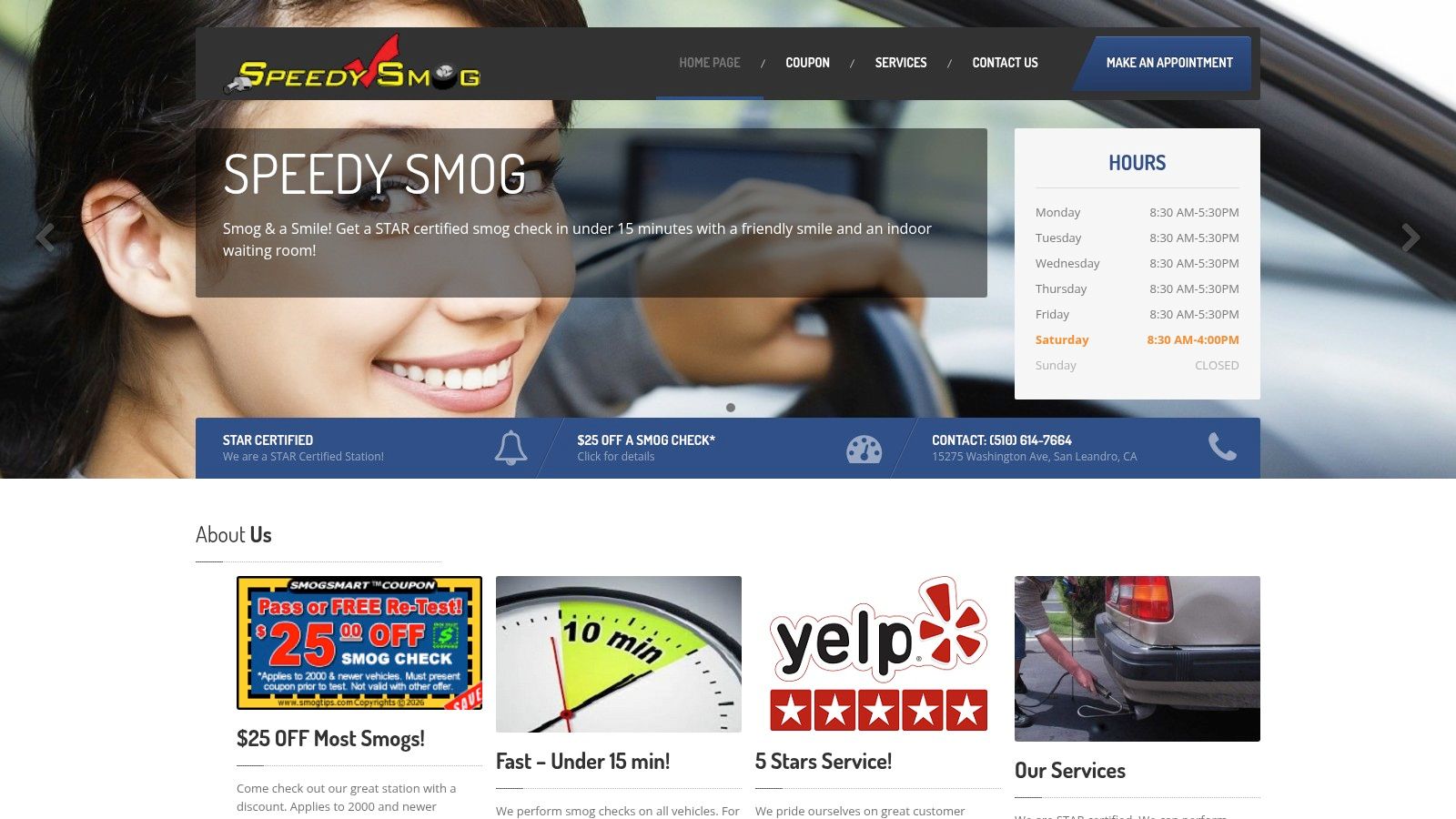
What to check before you choose a station
Use a short, practical checklist before you pull in:
- Confirm the station is STAR-certified if your DMV notice requires it.
- Ask whether they test your exact vehicle type. Older gasoline cars, diesels, and hybrids can follow different procedures.
- Check whether they handle older vehicles during all business hours. Some shops limit certain test types to specific times.
- Bring your registration or DMV notice so the station can match the vehicle and inspection requirement correctly.
- Pick a location that is easy to return to if your car needs repairs and a re-test.
For East Bay drivers, local fit matters too. A station that regularly sees older commuter cars, small work trucks, and long-kept family vehicles will usually understand the kinds of questions older-car owners ask, and why they ask them.
If you need a STAR-certified inspection in the East Bay, Speedy Smog is one local option for gasoline vehicles, older cars, diesels, hybrids, and many DMV renewal smog checks.
You open your renewal notice, scan for the amount due, and then see the line that stops everything: Smog Certification Required. For a lot of East Bay drivers, that's the moment the simple job of renewing registration turns into a string of questions. Does your car need it? Do you need a STAR station? What if the check engine light came on last week? How long is this going to take?
California smog check rules aren't impossible, but they are layered. The DMV, the Bureau of Automotive Repair, vehicle age, fuel type, ownership changes, and station type all matter. If you just want a straight answer and a short path to compliance, the good news is that the rules get much easier once you sort them by situation instead of reading them like DMV text.
Table of Contents
- Why Your DMV Notice Demands a Smog Check
- When Is a California Smog Check Required
- Rules for Your Specific Vehicle Type
- What Happens During a Smog Inspection
- The Importance of STAR Certified Stations
- If Your Vehicle Fails the Smog Check
- Your East Bay Smog Check Action Plan
Why Your DMV Notice Demands a Smog Check
That DMV notice isn't random. California built smog compliance into the registration process, so when your renewal says a certification is required, the test becomes part of finishing the renewal itself.
It often feels like bureaucracy first and clean air second. But the program has a practical purpose. The California Air Resources Board says the Smog Check program removes about 400 tons of smog-forming pollutants every day from California's air, as summarized in the California Smog Check Program overview. In the Bay Area, where people commute, idle in traffic, and keep older vehicles on the road, that's not an abstract policy goal.
Practical rule: If your DMV notice says a smog certification is required, treat it like a registration task, not an optional maintenance item.
I've found that drivers usually get tripped up in one of three ways. They assume a newer car is always exempt, they think a recent repair automatically means the car will pass, or they wait until the last minute and then discover they were supposed to visit a specific kind of station.
The better way to think about California smog check rules is simple. The state uses registration renewal as the checkpoint. Your job is to figure out whether your vehicle falls into the test group, then get the inspection done at the right type of station before the renewal deadline catches up with you.
Once you look at it that way, the process gets a lot less intimidating.
When Is a California Smog Check Required
A common East Bay scenario goes like this. Your registration renewal shows up, you skim it, and then one line stops you: Smog Certification Required. At that point, the practical question is not whether the car seems to run clean. It is whether the state needs a passing inspection before DMV will finish your renewal.
For many drivers, the basic rule is a biennial smog check. That means every 2 years for many vehicles during registration renewal, according to the California Bureau of Automotive Repair Smog Check page. In the shop, this is the pattern we see most often with East Bay commuters who are renewing registration on a car that has aged out of the newer-vehicle exemption.
Newer gasoline vehicles get a break. Gasoline-powered vehicles that are 8 model years old or newer usually do not need a Smog Check for registration renewal. The owner pays a smog abatement fee instead. The detail that trips people up is the timing. The exemption is tied to the vehicle's model year, not how recently you bought it or how little you drive it.
The state also sets part of the cost structure. The inspection itself usually takes about 30 minutes, and there is a mandatory $8.25 Smog Check certificate fee added to the station's inspection price. So if one East Bay shop quotes a different total than another, part of that difference is the shop's labor and pricing, while the certificate fee stays fixed.
Here are the situations that usually trigger confusion:
- Your renewal notice says certification is required. That is the clearest answer you will get. DMV is telling you a passing smog check is part of renewing registration.
- Your car just aged out of the exemption window. A vehicle that did not need a check last cycle can need one this cycle.
- You are handling a special transaction. Ownership transfers and first-time California registration can follow different rules than a standard renewal, so the paperwork for that transaction matters more than a general rule you heard from someone else.
Practical rule: Trust the notice in your hand, then confirm the model year and fuel type before you head to a station.
2026 California Smog Check Requirements at a Glance
| Vehicle Type / Situation | Smog Check Required? | Notes |
|---|---|---|
| Gasoline vehicle, 8 model years old or newer, registration renewal | No | Pays smog abatement fee instead of biennial inspection |
| Gasoline vehicle beyond the exemption window, registration renewal | Usually yes | Many vehicles fall into the every-2-years cycle |
| DMV renewal notice says “Smog Certification Required” | Yes | Complete it before renewal can be finalized |
| Vehicle at a station for inspection | Sometimes | Typical inspection time is about 30 minutes |
| Any completed Smog Check certification | Yes, fee applies | Includes the mandatory $8.25 certificate fee plus station inspection price |
A lot of DMV stress comes from assuming every renewal works the same way. They do not. The shortest path is to check three things before you leave home: the exact wording on the renewal notice, the vehicle's model year, and whether DMV says you need a STAR station. In the East Bay, that simple checklist saves drivers more time than guessing ever does.
Rules for Your Specific Vehicle Type
Vehicle type changes the rule fast. In the East Bay, I see the same problem every week. A driver hears one smog rule from a friend, applies it to the wrong vehicle category, and loses a day chasing the wrong answer.
The clean way to sort it out is to start with three facts: fuel type, model year, and for some diesels, weight. Once those match your registration situation, the rule usually gets a lot simpler.
Gasoline vehicles
Gasoline vehicles cause the most confusion because the broad rule is easy to oversimplify. Older gasoline cars may fall outside the usual testing system, while many later-model vehicles eventually age into regular smog requirements.
For a typical East Bay driver, the practical question is not whether the car feels fine on the road. The practical question is whether your gasoline vehicle is still in its exemption window or already subject to testing based on its age and DMV transaction.
A few mistakes come up again and again:
- “It drives perfectly, so it should pass.” A smooth-running car can still have an emissions problem.
- “The check engine light went away.” A light that turned off does not always mean the system is ready.
- “I just bought the car.” A recent purchase does not automatically remove a smog requirement tied to registration or transfer paperwork.
If you drive a gasoline car in the East Bay and the paperwork points toward testing, treat that as your answer and get the inspection scheduled.
Diesel vehicles
Diesel rules are narrower, but they still trip people up. Some diesel vehicles are exempt. Others are not, and the deciding factors are usually model year and gross vehicle weight rating.
That weight piece matters more than many drivers expect.
A diesel badge alone does not tell you whether a smog check applies. Lighter-duty diesels can fall under the rules, while older or heavier diesel vehicles may be handled differently. The safest move is to check the registration details against the vehicle information on the door label or manufacturer sticker before you book an appointment.
If you are not sure how your diesel is classified, ask the station to confirm what category you are dealing with before the inspection starts. That saves time and avoids a lot of bad assumptions.
Hybrid vehicles
Hybrid owners often assume battery power means exemption. That is where confusion starts. A hybrid is not treated like a fully electric vehicle for smog purposes.
In practice, many hybrids are handled much more like gasoline vehicles than drivers expect. If your DMV paperwork requires a smog certification, do not let the word "hybrid" talk you into skipping it.
The trade-off is simple. Hybrid systems can make the vehicle feel cleaner and more efficient, but the state still looks at emissions compliance rules, not just fuel economy.
For East Bay drivers, the quickest path is to identify the vehicle correctly before you head to a station. Gasoline, diesel, and hybrid vehicles do not all follow the same logic, and most smog headaches start with using the wrong rule for the car in the driveway.
What Happens During a Smog Inspection
A smog inspection feels mysterious until you break it into parts. It's really a compliance check that looks at the car's emissions system, its warning and monitoring functions, and the actual output the vehicle produces.
This visual guide matches what technicians are looking for during the process:
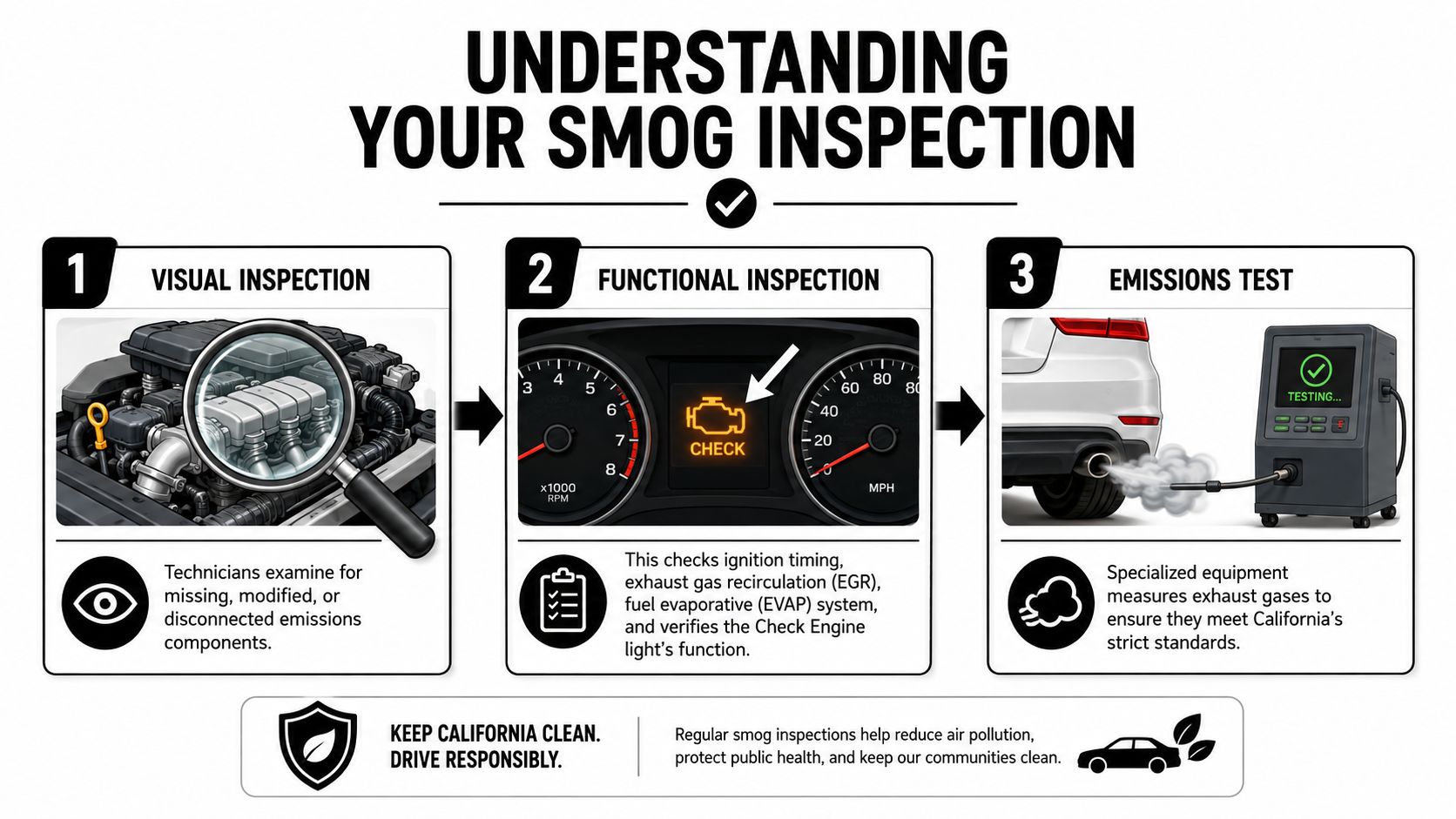
The three parts of the inspection
Most drivers can understand the inspection as a car version of a medical checkup.
Visual inspection
The technician looks for missing, disconnected, or obviously modified emissions-related components. If the vehicle has parts that don't belong there, or parts that should be there but aren't, that can create trouble before any machine is plugged in.Functional inspection
During this inspection, warning lights and system behavior matter. The check engine light, ignition-related functions, and emissions-control system operation all come into play. A dashboard light you've been ignoring can turn into the main reason the vehicle doesn't pass.Emissions test
This is the measured part. The vehicle's emissions performance is checked using state-approved equipment and procedures matched to the vehicle's setup.
A smog test isn't just a tailpipe sniff anymore. For many vehicles, it's also a check of what the car's own computer says about its emissions health.
A lot of failed inspections start before the test begins. Battery disconnects, recent repairs, and aftermarket modifications can all create readiness or equipment issues that don't show up as obvious driving problems.
How the actual test differs by vehicle
For newer vehicles, the process often works like a computer scan. The technician connects to the vehicle's onboard diagnostics system and checks for emissions-related faults and monitor status. For older vehicles, the process may involve a more traditional loaded test. Many drivers think of that older style as the “rolling” test.
The easiest comparison is this:
| Test style | What it's like | Who usually sees it |
|---|---|---|
| OBD-based inspection | A scan of the car's emissions computer | Common on newer vehicles |
| Dynamometer-style emissions test | A treadmill-style check under controlled load | More common on older vehicles |
If you want to see the process in motion, this walkthrough gives a helpful visual reference:
The main thing to know before you arrive is that the technician isn't improvising. The inspection follows a state process, and the vehicle either meets that process on test day or it doesn't.
The Importance of STAR Certified Stations
You open your registration notice, see the word STAR, and wonder whether it changes anything. It does. If the DMV requires a STAR inspection, going to a regular smog station can cost you a trip, a delay, and sometimes another day off work.
What STAR means in practice
A STAR Certified station is approved to perform inspections under a higher level of state program oversight. For drivers, the practical point is simple. The station is set up to handle STAR-required inspections, and the result is recognized for the transactions that call for it.
That matters in the East Bay, where plenty of drivers are trying to get a smog check done between work, school pickup, and a registration deadline. The first question is not just "Do I need a smog check?" It is "Do I need the right kind of station?" A quick check of the DMV notice answers that.
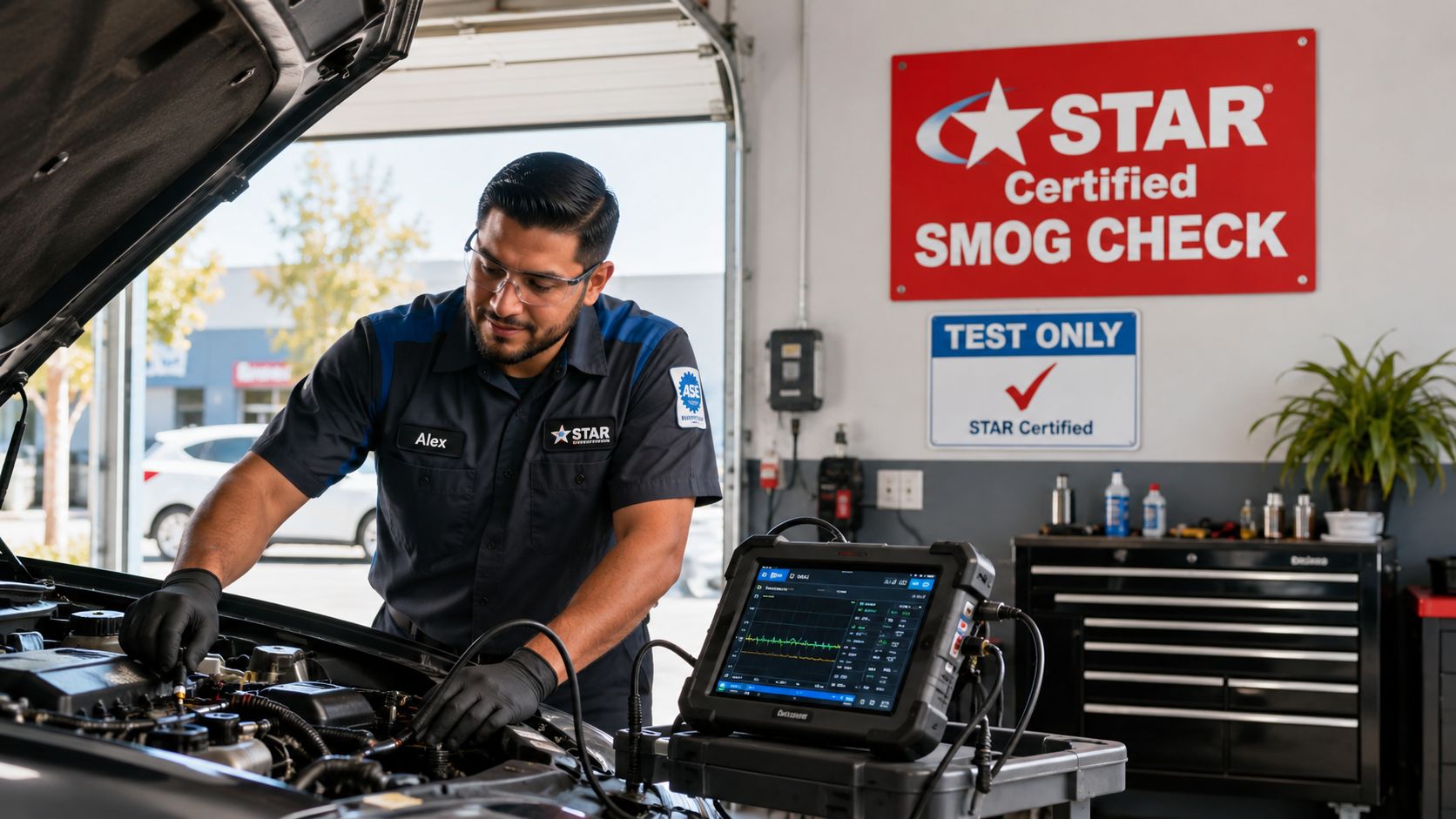
A STAR station also tends to reduce confusion at the counter. If your notice calls for STAR, the shop already knows the requirement and can process the inspection under the correct program. This provides a distinct advantage: fewer surprises, fewer wasted trips, and less guessing about whether the DMV will accept the certificate.
Why some DMV notices require STAR
When a DMV notice says STAR, treat it as a requirement. The vehicle has to be inspected at a STAR-certified location for that registration step.
Drivers in San Leandro, Hayward, Oakland, and the rest of the East Bay ask this all the time. Why this car? Why this year? The short answer is that California uses the STAR program as part of its inspection quality controls for certain vehicles and situations. The notice tells you what your vehicle needs. The smart move is to follow it exactly.
Even when STAR is not required, some drivers still choose a STAR station because it keeps the process straightforward. Speedy Smog in San Leandro is one local example of a STAR-certified station that handles these inspections.
Here is the simplest checklist. Read the DMV notice. If it says STAR, book a STAR station. If it does not, you still have options, but choosing STAR can make the process easier if you want the least amount of back-and-forth.
If Your Vehicle Fails the Smog Check
A failed smog check feels worse than it usually is. In most cases, it's not the end of the registration process. It's a signal that something in the emissions system, readiness status, or equipment setup needs attention before the vehicle can be certified.
Read the paperwork first
The first thing to look at is the Vehicle Inspection Report, often called the VIR. Don't jump straight to parts replacement based on a guess. The report tells you where the vehicle fell short, and that shapes what the next repair step should be.
A calm approach usually works better than a rushed one:
- Read the failure reason carefully: A warning-light issue is different from a component issue.
- Bring the VIR to the repair shop: It gives the technician a starting point.
- Fix the actual cause: Smog-related symptoms can overlap, so random part swapping gets expensive fast.
- Schedule the re-test after repair: Don't assume the repair alone completes the process.
Most expensive smog failures become more manageable once someone diagnoses the actual emissions problem instead of chasing the loudest symptom.
If the car recently had its battery disconnected or major work done, ask whether the system is fully ready before you head back for reinspection. That's a common place where drivers lose time.
What usually helps and what usually doesn't
Some choices improve your odds of getting through the re-test with less drama. Others just waste money.
What tends to help:
- Targeted diagnosis: Find the emissions-related fault, not just a general performance complaint.
- Qualified repair work: Use a shop that understands smog-related repair logic.
- Keeping your paperwork: The inspection report and repair records matter.
What usually doesn't help:
- Clearing codes right before the test: That can leave monitors unready.
- Assuming premium fuel or additives will solve it: Sometimes drivers try shortcuts when the issue is mechanical or electrical.
- Ignoring the check engine light because the car drives fine: Smog compliance and drivability aren't the same thing.
California also has a Consumer Assistance Program (CAP) that may help eligible motorists with emissions-related repairs or vehicle retirement. If repair costs are the biggest obstacle, it's worth checking whether you qualify through the state program before giving up on the vehicle.
Your East Bay Smog Check Action Plan
If you're in San Leandro, Oakland, Hayward, Castro Valley, or nearby, the simplest approach is to stop treating smog as a giant state puzzle and handle it like a short local errand with a checklist.
A simple local checklist
Start with the piece of paper that caused the stress in the first place.
Read the DMV notice carefully
Look for two phrases in particular: whether a smog certification is required, and whether the notice says STAR.Match the rule to your vehicle
Check the model year, fuel type, and whether your vehicle falls into a category that follows a different path.Don't wait until the deadline week
Waiting removes your options. If the car needs repair work, you want time to deal with it without registration pressure.Choose a station that fits the requirement
If the notice says STAR, go only to a STAR-certified station. If it doesn't, you still may prefer one for a cleaner process.
What to bring and what to expect
For most East Bay drivers, showing up prepared makes the appointment easy.
Bring:
- Your DMV renewal notice: It helps confirm the requirement.
- The vehicle itself: Obvious, but it matters if a family member usually handles registration and someone else drives the car.
- Payment: Inspection pricing varies by station, and the state certificate fee is part of the total.
- Any recent repair paperwork if the car previously failed: That can help if questions come up.
This gives you a sense of what a local station setup looks like before you go:
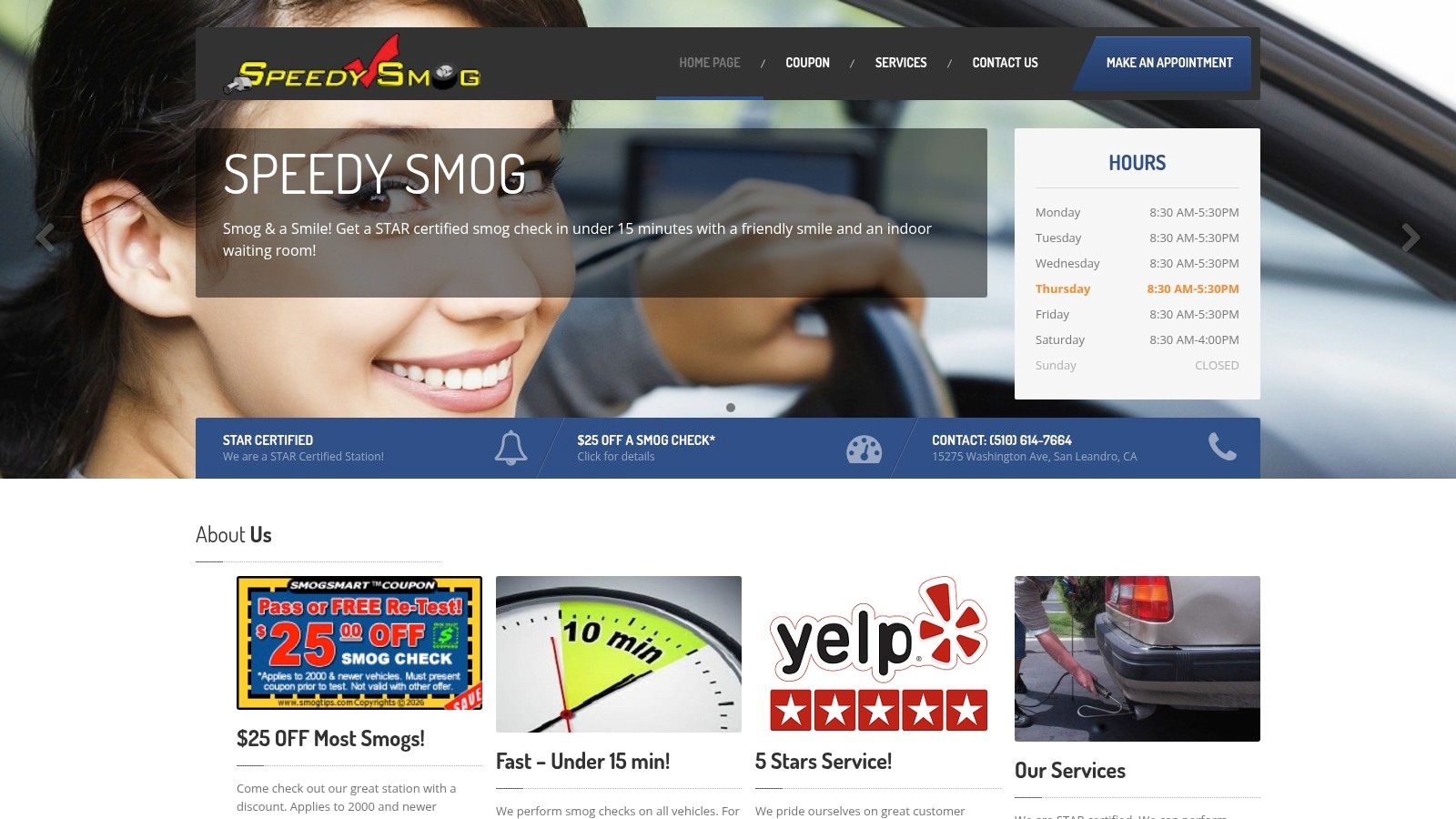
For drivers in the East Bay, a local option is available at 15275 Washington Ave, San Leandro, CA 94579. According to the publisher information provided for this article, that shop handles most vehicle categories commonly seen for smog certification, including newer vehicles, older vehicles, diesels, and hybrids. The same business information notes that many 2000 and newer vehicles are typically completed in 10 to 15 minutes.
That last point matters because the state process may be formal, but your local experience doesn't have to be slow or confusing. Read the notice, identify the vehicle category, bring the car to the right station, and let the inspection answer the question.
If your DMV notice says a smog certification is due, Speedy Smog gives East Bay drivers a straightforward local option for completing the inspection and getting the paperwork handled for registration.
Your DMV renewal notice shows up, and somewhere in the fine print you see that your diesel truck needs attention. That's usually when the questions start. Do I need a regular smog check? Does this fall under Clean Truck Check? Is my pickup treated like a commercial rig? What if the truck is modified, or the check engine light just came on?
That confusion is normal. California diesel rules trip people up because owners often hear one phrase, “smog check for diesel trucks,” when the state treats diesel vehicles under two different systems. If you own a diesel pickup, van, or work truck, the right answer depends less on the word diesel and more on the truck's weight rating and registration class.
Table of Contents
- Why California Diesel Smog Checks Are So Confusing
- Smog Check or Clean Truck Check What Your Diesel Needs
- The Light-Duty Diesel Smog Check Process Step by Step
- Common Reasons Why Diesel Trucks Fail Smog Checks
- How to Prepare Your Diesel Truck for a Flawless Test
- Find a Fast STAR Certified Diesel Smog Check in the East Bay
- Frequently Asked Questions About Diesel Smog Checks
Why California Diesel Smog Checks Are So Confusing
A lot of owners walk in expecting one simple answer. They've got a diesel truck, so they assume there's one diesel inspection rule for everybody. That's where the stress starts.
California doesn't group every diesel truck together. A light-duty diesel pickup can fall under the BAR Smog Check system, while a heavier diesel truck can fall under CARB's Clean Truck Check framework. Those are not the same program, and they don't follow the same inspection rhythm or the same compliance process.
That difference matters most when the truck sits near the line between personal pickup and work truck. A diesel owner might drive a truck that looks like a normal pickup, uses it for daily life, and still wonder whether the state treats it like a passenger vehicle or a heavier commercial unit. The answer usually comes down to the vehicle's listed weight rating, not what it looks like in the driveway.
Practical rule: If you start by checking your truck's GVWR and registration details, you'll avoid most of the confusion that sends owners down the wrong path.
Another reason people get mixed up is that rules have changed over time. California's diesel enforcement has become more specific, especially as onboard diagnostics and modern emissions hardware became standard. That means advice from a friend, an old forum post, or a mechanic who mainly works on older gas vehicles can be incomplete.
Here's the reassuring part. Once you know which side of the line your truck falls on, the process gets much easier to understand. You're no longer guessing whether your diesel pickup needs a station visit for a BAR inspection or whether your heavier truck belongs in CARB's compliance system.
Smog Check or Clean Truck Check What Your Diesel Needs
The biggest mistake owners make is asking, “Is there a smog check for diesel trucks?” as if every diesel is handled the same way. California doesn't work that way. Much like weight classes, the rule changes when the truck crosses a specific threshold.
According to BAR and CARB program guidance discussed in this overview, BAR's diesel smog program covers light-duty diesel vehicles 14,000 pounds GVWR and under, while CARB's heavy-duty program applies to diesel vehicles over 14,000 pounds GVWR. That's the dividing line most owners need to know first.
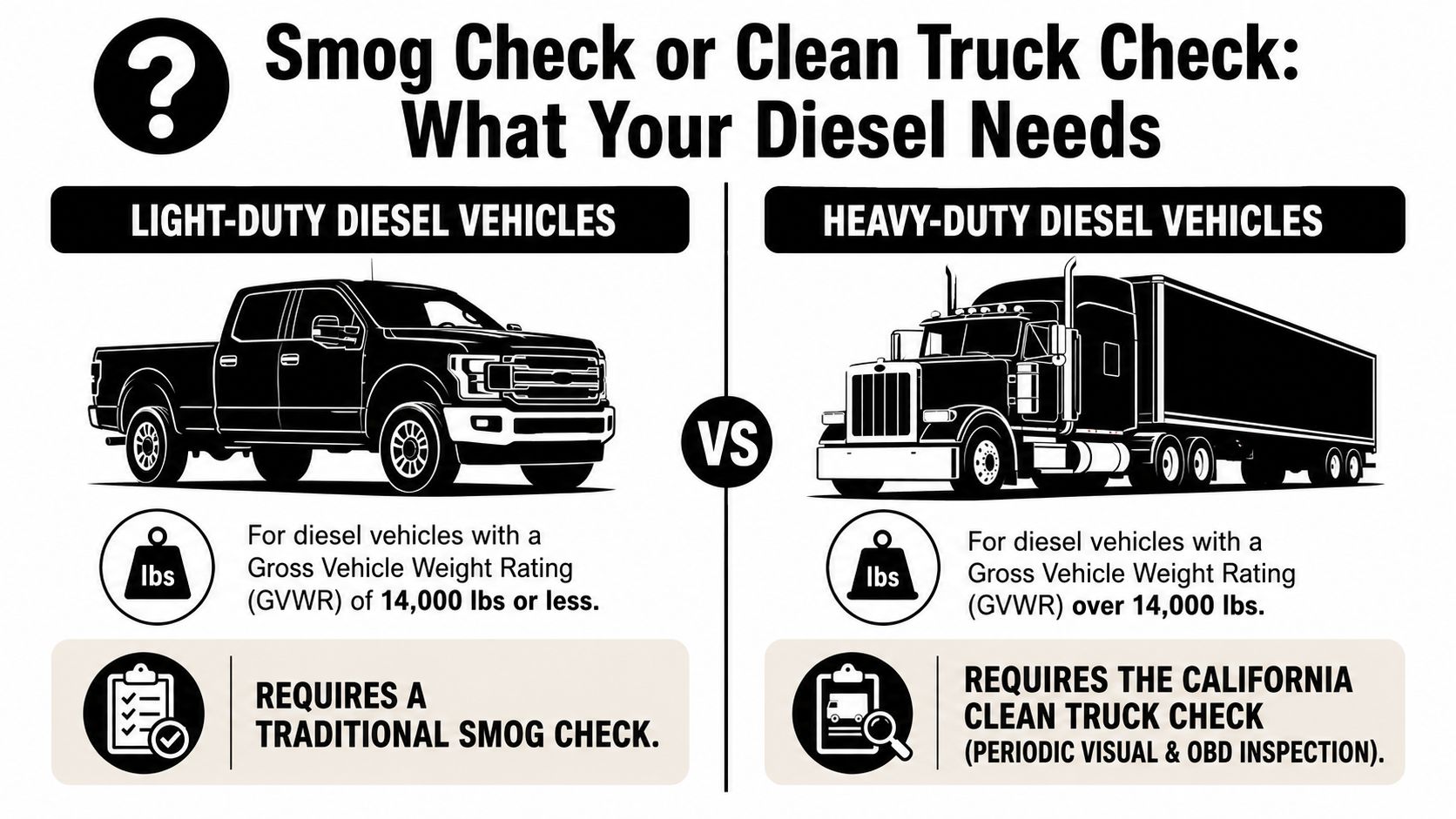
Light-duty diesel vehicles
If your diesel truck is 14,000 pounds GVWR or less, it typically fits into the light-duty side. That's where owners of many diesel pickups, smaller diesel SUVs, and similar vehicles usually land.
For these vehicles, the phrase smog check for diesel trucks usually means a traditional BAR-regulated inspection at a smog station. The technician is looking at emissions-related equipment, onboard diagnostic information, and visible smoke.
Typical clues your truck may fall into this category include:
- Pickup-style use: You drive it like a personal vehicle or light work truck.
- Passenger vehicle process: Your DMV renewal points you toward a smog inspection at a station.
- Modern diesel hardware: The truck has OBD-based emissions monitoring and factory aftertreatment equipment.
Heavy-duty diesel vehicles
If the truck is over 14,000 pounds GVWR, California generally moves it into the heavy-duty compliance world. That's where CARB's Clean Truck Check comes in rather than the ordinary light-duty BAR lane.
That system has a different structure and inspection cadence. It's aimed at medium-duty and heavy-duty diesel vehicles, not just passenger-oriented pickups. For owners, that's important because searching for “diesel smog” can send you to advice that doesn't apply to your truck.
The same fuel type doesn't mean the same inspection system. Diesel is only part of the story. Weight class changes everything.
Where to find your GVWR
If you're unsure which side you're on, check the driver's door jamb label or your registration paperwork. Look specifically for GVWR, which stands for Gross Vehicle Weight Rating. That label tells you the class the truck was built into.
A quick side-by-side view helps:
| Truck category | General California program |
|---|---|
| 14,000 pounds GVWR and under | BAR light-duty diesel smog check |
| Over 14,000 pounds GVWR | CARB heavy-duty Clean Truck Check |
If you remember only one thing, remember this: the right answer starts with GVWR, not guesswork.
The Light-Duty Diesel Smog Check Process Step by Step
If your truck falls into the light-duty lane, the inspection is usually more straightforward than people expect. California expanded diesel smog-check rules in 2010 to include model year 1998 and newer diesel vehicles under 14,001 pounds GVWR, and BAR announced that beginning in July 2023, readiness rules tightened for model year 2007 and newer light-duty diesels by allowing only the Diesel Particulate Filter and Non-Methane Hydrocarbon Catalyst monitors to be unset, as explained in BAR's diesel requirements update.
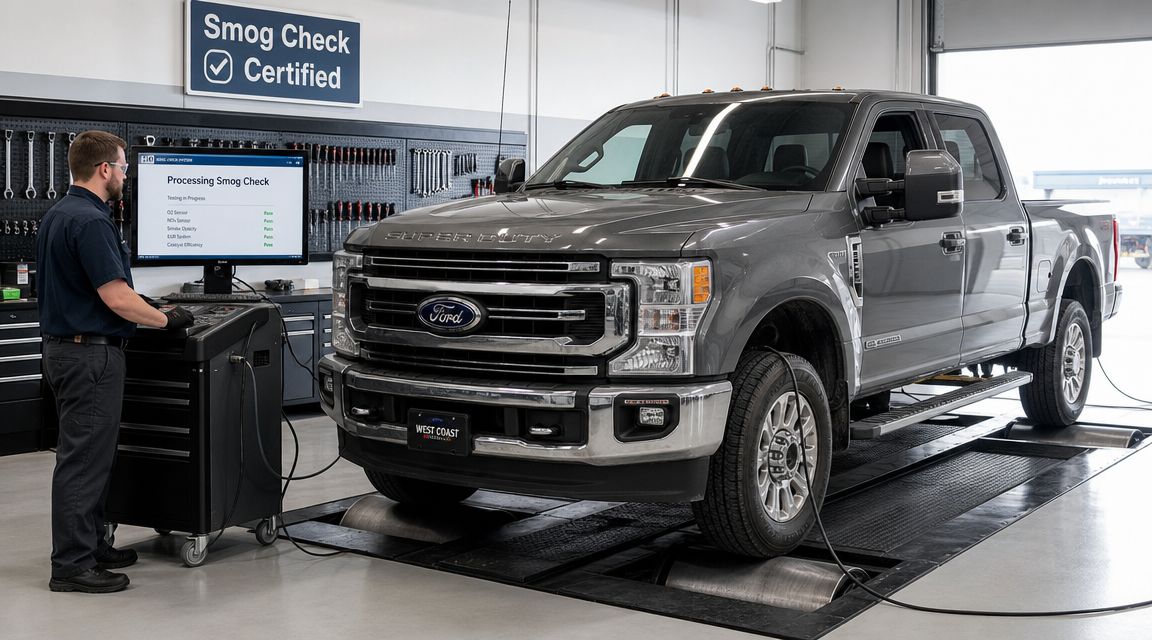
The vehicles in this lane
This process usually applies to diesel pickups and similar light-duty diesel vehicles that fit the weight limit above. If your truck belongs here, the inspection is not the same as the heavy-duty Clean Truck Check process discussed earlier.
Owners often worry that the station is going to tear into the truck. That's not what happens. A light-duty diesel smog inspection is a focused emissions compliance check.
What the technician actually checks
The test usually has three practical parts.
- Visual inspection: The technician checks that required emissions components appear to be present and not obviously tampered with. If a truck has missing emissions hardware or obvious non-compliant modifications, that creates trouble right away.
- OBD inspection: The scanner communicates with the truck's onboard computer. The technician looks for stored trouble codes, command status, and readiness information.
- Visible smoke inspection: The truck can't be producing excessive visible smoke from the tailpipe during the test.
That's the part many drivers find reassuring. No mystery. No hidden trick. It's mostly a matter of whether the emissions system is intact, whether the truck's computer reports healthy status, and whether the exhaust is visibly clean enough to pass.
For a visual walkthrough, this short clip helps show what an emissions inspection environment looks like:
Why readiness trips people up
Readiness monitors confuse even careful owners. A truck can run perfectly and still not be ready for inspection if the computer hasn't completed its internal emissions self-checks. This often happens after recent battery disconnects, code clearing, or certain repairs.
For model year 2007 and newer light-duty diesels, BAR's July 2023 change made things stricter. Only the Diesel Particulate Filter and Non-Methane Hydrocarbon Catalyst monitors may be unset under that rule change, as described in the BAR update cited above. In plain language, the truck's computer has less room to say “not ready” and still pass.
If you recently cleared codes or replaced parts, drive the truck normally for a while before testing. A clean dashboard doesn't always mean the readiness status is complete.
That's why some owners fail after repairs even though the original problem is gone. The system may be fixed, but the OBD data isn't ready yet.
Common Reasons Why Diesel Trucks Fail Smog Checks
Most diesel failures fall into a handful of patterns. Some are obvious the moment the truck rolls in. Others catch owners off guard because the truck seems to drive fine.
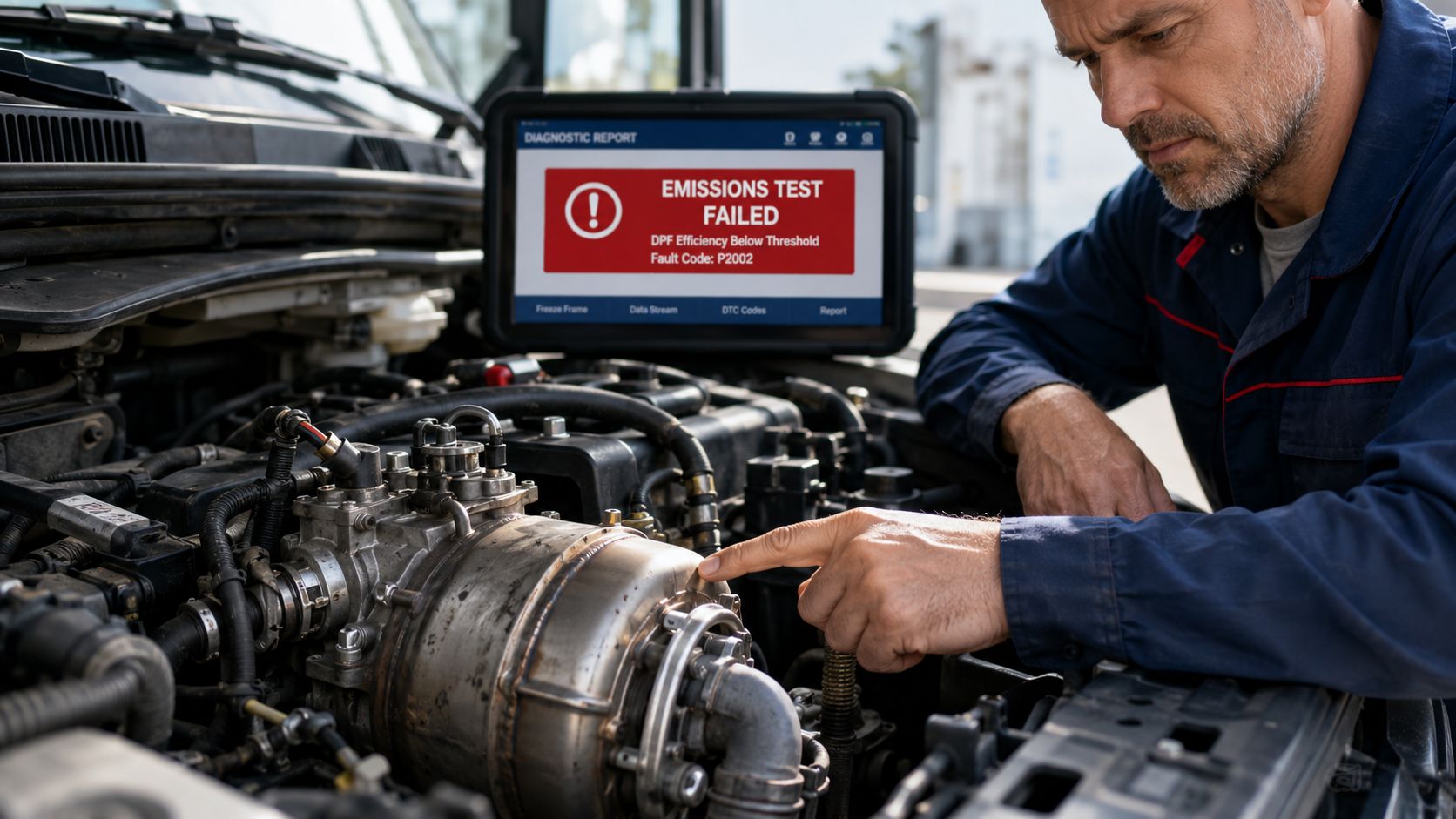
Illegal emissions changes
The fastest way to create a smog problem is to remove or alter emissions equipment. On modern diesels, that can include deleted aftertreatment parts, missing sensors, modified exhaust routing, or engine tuning that changes how emissions systems operate.
A truck owner may call it “bulletproofing,” “tuning,” or “cleaning up the engine bay.” The inspection doesn't see it that way if required emissions components are missing or obviously altered.
Common examples include:
- Deleted DPF systems: If the Diesel Particulate Filter is removed, that's a direct problem.
- Tampered EGR or catalyst equipment: Missing or altered parts can trigger a visual failure.
- Aftermarket tuning that affects emissions controls: Even if the truck feels stronger, emissions compliance may be gone.
Computer and warning light problems
The second big category is electronic. If the truck's computer reports an emissions-related fault, the smog result usually won't go your way.
Owners frequently get frustrated. The truck might start well, idle smoothly, and pull hard on the road. But if the check engine light is on, if diagnostic trouble codes are present, or if readiness monitors haven't completed, the computer is telling the station the system isn't ready to certify.
A diesel can feel healthy and still fail. Smog compliance depends on what the emissions system reports, not just how the truck drives.
Smoke and drivability issues
Visible smoke still matters. Excess smoke points to a system that isn't controlling combustion or aftertreatment correctly, and that raises a red flag during inspection.
Smoke problems often show up alongside drivability complaints, such as rough running, injector issues, turbo problems, or sensor faults. Even if the root cause seems mechanical rather than regulatory, it can still lead to a failed smog check because the truck is visibly not operating cleanly.
If you're trying to avoid a failed visit, look at the truck the way a technician would. Is anything missing under the hood or under the truck? Is there a warning light on? Does it smoke when started, revved, or driven warm? Those three questions catch a lot.
How to Prepare Your Diesel Truck for a Flawless Test
A little prep goes a long way. Most diesel smog headaches come from arriving with a truck that had warning signs the owner didn't realize mattered.
A simple pre-test checklist
Run through this before your appointment:
- Fix the check engine light first: If the light is on, don't test yet. Diagnose the fault and repair it.
- Don't clear codes right before the test: That can reset readiness monitors and leave the truck not ready.
- Drive the truck fully warm: A normal drive before the appointment helps the emissions system operate the way it should.
- Look for obvious modification issues: If the truck has deleted or tampered emissions parts, deal with that before testing.
- Bring your DMV paperwork: It helps the station confirm what inspection is needed.
That warm-up drive matters more than many people think. A cold diesel can behave differently than one at operating temperature. Sensors, exhaust treatment, and self-check routines all work better when the truck has been driven normally.
What to expect on test day
Most owners do best when they treat the visit like a routine maintenance stop, not a courtroom appearance. Bring the truck in after a normal drive, make sure the dashboard isn't hiding a warning light, and let the technician know if the battery was recently disconnected or emissions repairs were just completed.
If you've had recent work done, tell the shop what was repaired. That doesn't change the standards, but it helps the technician understand why a monitor may still be incomplete.
A good rule of thumb is simple:
- Repair first
- Drive normally
- Test once the truck is ready
That order saves time, repeat visits, and a lot of aggravation.
Find a Fast STAR Certified Diesel Smog Check in the East Bay
You pull into a smog station with a diesel pickup, and the first question is the one that causes trouble for a lot of owners: is your truck getting a BAR smog check, or does it belong under the CARB Clean Truck Check system? That distinction matters because the right shop can save you from a wasted trip, a wrong appointment, or an answer that applies to a different class of diesel vehicle.
In the East Bay, speed starts with choosing a station that understands that split clearly. A light-duty diesel pickup that needs DMV certification belongs in a very different lane than a heavier commercial truck dealing with CARB compliance. Many online articles blur those together. A good local station should sort that out in a few minutes.
What to look for in a shop
A helpful station usually has three traits.
- STAR certification: If your notice requires a STAR station, that part is simple. The shop needs the proper certification to perform the inspection.
- Regular experience with diesel pickups: Diesel testing has its own check-in questions, equipment, and failure patterns. A station that sees these vehicles often is less likely to treat your truck like a gas SUV or a heavy fleet unit.
- Clear screening before the test: The staff should be able to ask a few basic questions, such as vehicle type and registration use, and point you toward the correct program without guesswork.
If you are in the East Bay, one local option is Speedy Smog in San Leandro. The station is STAR Certified and offers diesel smog testing for passenger diesel vehicles.
A local option in San Leandro
That kind of shop helps for a practical reason. It reduces confusion at the counter. If your diesel pickup needs a BAR inspection, you want a station that can confirm that quickly, process the test correctly, and explain any problem in plain English.
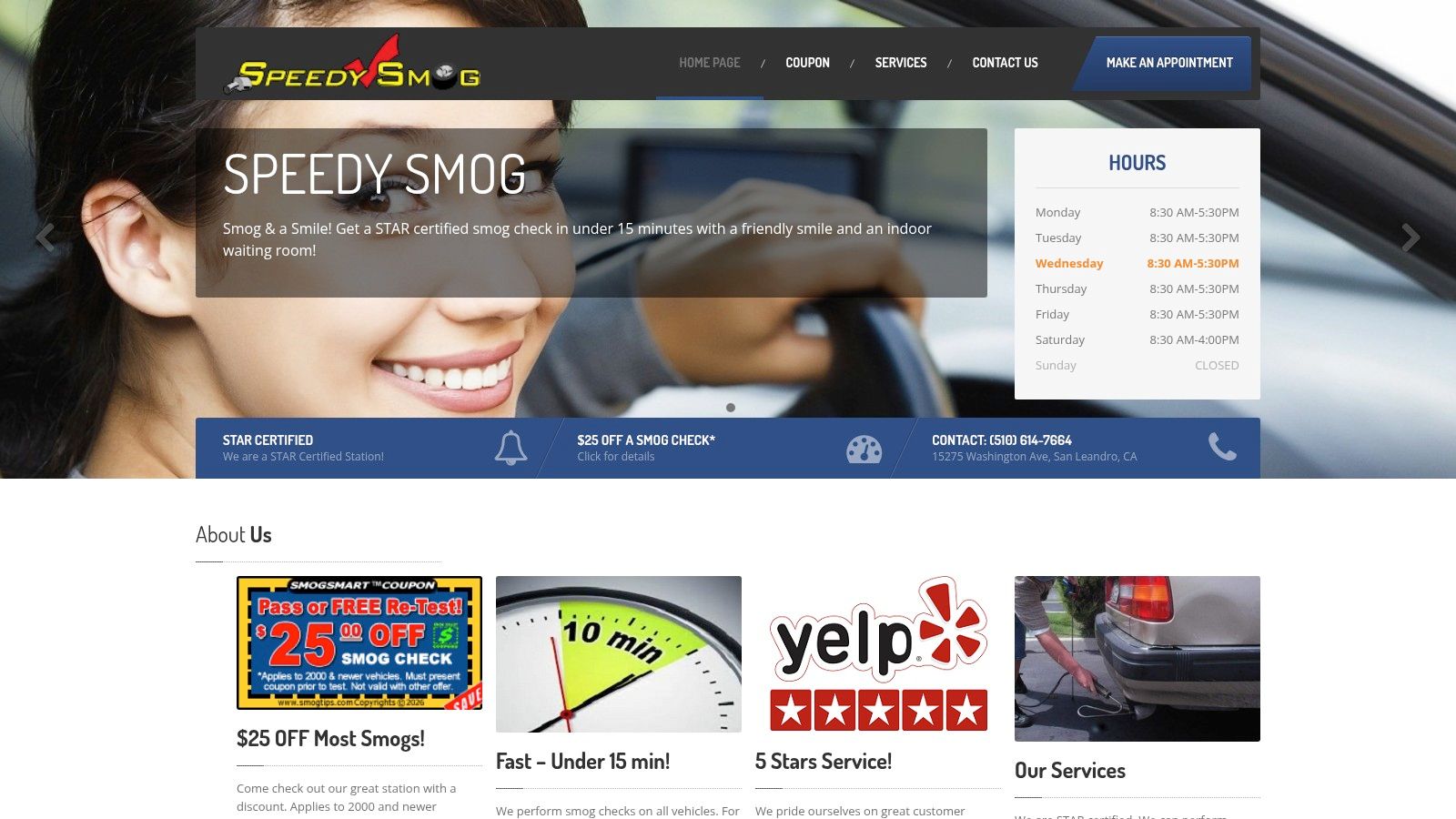
For East Bay owners, that clarity is often a major time-saver. A knowledgeable technician does more than run the machine. They help you avoid mixing up the BAR light-duty smog check with the CARB heavy-duty Clean Truck Check, which is the mistake that sends many truck owners down the wrong path.
Frequently Asked Questions About Diesel Smog Checks
A few questions come up over and over, especially from diesel pickup owners who are trying to sort out renewal notices and repair decisions.
Are new diesel trucks exempt
Some newer vehicles may have temporary model-year-based exemptions at purchase, but owners shouldn't assume every new diesel truck is automatically outside the system. Exemption rules depend on the vehicle and registration situation. The safest move is to check your DMV renewal notice and verify what's required for your specific truck.
If you're unsure, don't rely on a forum answer that treats every diesel the same. The state's diesel categories are too specific for that.
Are any diesel trucks completely exempt
Some older diesels fall outside the light-duty program discussed earlier. On the heavy side, the vehicle may not be in the BAR passenger smog lane at all because it belongs under the separate heavy-duty framework.
For heavy trucks, California approved a rule requiring twice-yearly smog inspections for medium- and heavy-duty trucks and buses, with older heavy-duty vehicles without onboard diagnostics still subject to opacity testing plus a visual inspection twice each year. The same policy also sets a future stage for trucks with onboard diagnostics to be tested four times per year, with data potentially submitted remotely rather than at a station, as reported in this summary of the CARB heavy-duty inspection rule.
That's why “diesel truck exemption” can be a misleading phrase. Some trucks aren't exempt. They're regulated under a different program.
What happens if my truck fails
You'll get a failure result showing the area that didn't meet requirements. From there, the practical path is:
- Read the failure reason carefully: Don't guess whether it was a code issue, readiness issue, visual issue, or smoke issue.
- Repair the actual cause: Clearing lights without fixing the fault usually just delays the problem.
- Drive the truck enough after repairs: If monitors need time to reset, a retest immediately after repairs may still not work.
- Return for a retest when the truck is ready: A good shop can tell you what to verify before you come back.
Failure doesn't mean your truck is doomed. Most failed diesel inspections trace back to a specific repair or compliance issue that can be identified and corrected.
If you're in the East Bay and need a clear answer on a light-duty diesel pickup or passenger diesel vehicle, Speedy Smog is a STAR Certified San Leandro station that performs diesel smog testing and can help you determine whether your truck belongs in the regular BAR process or whether you need to follow a different compliance path.