
You've got the DMV renewal notice on the counter, a registration deadline getting closer, and one practical question. Do you need a Smog Check in Oakland, CA, what kind of station can test your vehicle, and is the car ready to pass when you get there? Answer those three questions in order and the visit stops feeling like a gamble. It becomes a short workflow you can control.
Table of Contents
- Start With Your Oakland Smog Check Decision
- Determine Whether Your Vehicle Needs Testing
- Choose the Right Smog Station in Oakland
- Prepare Documents and Your Vehicle
- What Happens During a Typical Smog Check
- Understand Common Smog Check Failures
- Choose Your Next Step After a Failure
- Use a Smog Check Visit Checklist
Start With Your Oakland Smog Check Decision
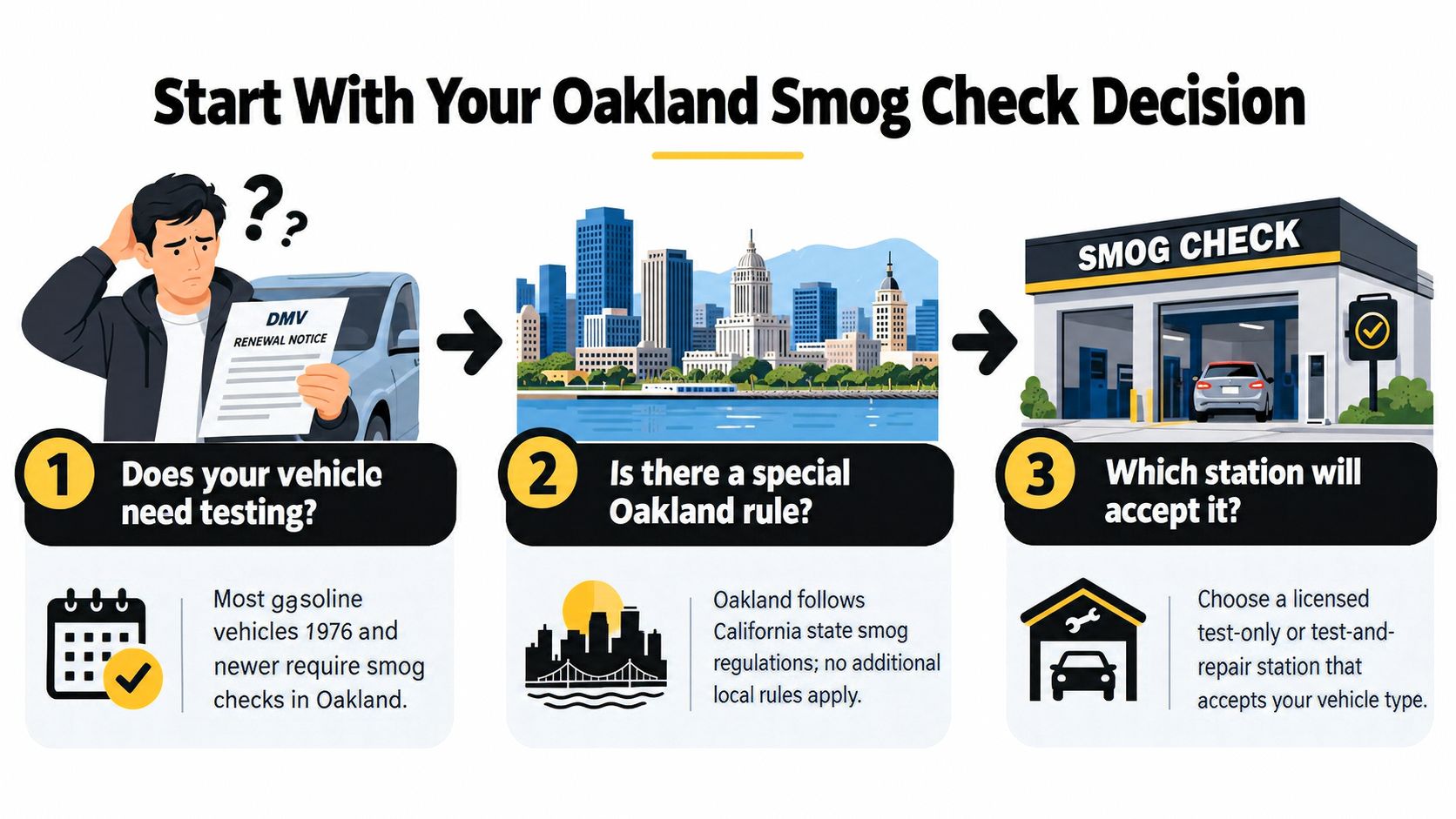
An Oakland driver finishing a commute opens that renewal envelope and sees smog certification requested. The car runs fine, so the first instinct is to search for the closest station and drive over. That's the wrong order. You need to decide whether a test is required, where your vehicle must be tested, and whether it's ready before you pick a shop.
Boarding a flight is a useful comparison. The destination doesn't matter if you've brought the wrong document or your bag can't clear the scanner. Your DMV notice is the boarding pass here. It controls the route for this transaction, and it tells you more than a generic search result can.
Why Oakland Follows a State System
Oakland doesn't run its own separate smog program. California established its Smog Check program as a statewide emissions-control system in the 1980s, and in its first year approximately 4 million vehicles were inspected under the mandatory biennial law, with about 70% passing without repairs. Vehicles that failed and were repaired showed an average 17% reduction in hydrocarbon and carbon-monoxide emissions right after repair, per that same early reporting.
That history explains the present workflow. A test isn't an optional maintenance add-on you can skip because the car feels fine. It's tied to specific registration transactions, and the result has to match the vehicle and transaction the DMV has on file.
There's also a difference between a routine renewal and other triggers. A biennial renewal is the familiar case, but a first California registration or a change of ownership can also put you in line for certification. Don't assume the rules from your last car carry over to this one.
Practical rule: Start with the paper in your hand, not the station map. If the notice, model year, and fuel type don't line up with your assumptions, resolve that first.
Expect the visit itself to vary. A newer gasoline car with complete diagnostic monitors is a different appointment from an older vehicle, a diesel, or a hybrid that follows another inspection path. Getting the decision right up front saves you a second trip, which is where most wasted time goes.
Determine Whether Your Vehicle Needs Testing
Don't classify your vehicle by age alone. That's the most common mistake East Bay drivers make, and it leads to the false idea that anything old is exempt. Age matters, but so do fuel type, model year, weight, and the type of registration transaction you're completing.
Match Model Year to Fuel Type First
Start with the broad categories, then check exemptions against them. Official California guidance places gasoline, hybrid, and alternative-fuel vehicles from model year 1976 onward generally within the program, while diesel vehicles from model year 1998 onward generally require testing. That same guidance identifies gasoline vehicles from 1975 or earlier, diesel vehicles from 1997 or earlier, electric vehicles, and certain heavy vehicles as exempt.
Read those two sentences together and the logic becomes clear. A 1999 diesel isn't exempt just because it feels old. A hybrid isn't automatically out of the program because it uses less gasoline. The category comes first, and the exemption, if one applies, has to override it clearly.
- Gasoline, hybrid, and alternative-fuel vehicles: Generally covered from 1976 onward, so a recently purchased older car in this group usually still needs attention.
- Diesel vehicles: Generally covered from 1998 onward, which catches many older trucks owners assume are grandfathered out.
- Electric vehicles: Listed as exempt, so don't book a test you don't need.
- Certain heavy vehicles: Treated as exempt under the DMV categories, but weight details matter, so don't guess from vehicle size alone.
Check the Transaction, Not Just the Calendar
Your vehicle can need certification even when it's not renewal time. Certification is also generally required when an affected vehicle is first registered in California or changes ownership. That covers a driver moving into Oakland with an out-of-state car, and it covers a private sale in San Leandro or Oakland where the buyer assumes the car is ready to register because the tags look current.
Imported and recently purchased vehicles trip people up. The relevant question isn't whether the previous owner tested it recently for their own renewal. It's whether your transaction triggers a requirement now. Those are different events, and the DMV treats them on their own terms.
If you're working through the broader rules before you call a station, the California smog check rules overview is a useful place to confirm how these categories fit together. Use it as a cross-check, not a replacement for your notice.
Let the Notice Resolve Conflicts
When your memory of the rules conflicts with the notice, the notice wins. Match the vehicle information on it to your actual model year and fuel type, then look for any instruction about station type. Some vehicles may use any licensed station, while others are directed to a STAR station.
If anything still doesn't add up, call the station before you travel and describe the vehicle and transaction. A two-minute verification beats arriving with the wrong expectation and being turned away. Bring the notice with you either way, so the station can transmit the correct vehicle information for your record.
Choose the Right Smog Station in Oakland
A STAR station isn't mandatory for everyone, and a regular station isn't a lesser choice if your notice doesn't direct you otherwise. What matters is matching the station to three things. Your DMV instructions, your vehicle type, and the transaction you're completing determine the right fit, in that order.
STAR certification is a performance distinction set through the Bureau of Automotive Repair. Some DMV notices direct specific vehicles to a STAR station, and when yours does, that instruction isn't optional. When it doesn't, you have more flexibility, and convenience, pricing clarity, and vehicle capability can carry more weight.
Compare the Two Routes Side by Side
| Consideration | Regular Station | STAR-Certified Station | Reader Action |
|---|---|---|---|
| DMV direction | Works when your notice doesn't specify STAR | Required when your notice directs you there | Read the notice before calling anyone |
| Certification recognition | Valid for transactions that accept any licensed station | Recognized for directed vehicles and general testing | Confirm the result will be transmitted for your transaction |
| Vehicle capability | Varies by station and equipment | Varies too, so don't assume every vehicle is accepted | Ask about your fuel type and model year in advance |
| Convenience trade-off | May be the closest option in Oakland | May mean a short drive elsewhere in the East Bay | Weigh travel time against a possible second trip |
| Pricing clarity | Ask for the full amount up front | Same standard applies | Don't compare stations on a partial quote |
That last trade-off deserves emphasis. The closest station to your house is only convenient if it can inspect your vehicle and its result counts for your transaction. A slightly longer drive to a station that handles your vehicle class correctly is faster than two short drives.
For a clearer explanation of what the designation means in practice, review the STAR certified smog station details before you decide. Then ask any station you're considering the same short set of questions. Can you test my fuel type and model year, does my notice require STAR, and will you transmit the certification electronically?
As one transparent East Bay example, Speedy Smog operates as a STAR Certified station at 15275 Washington Ave in San Leandro, 94579, not in Oakland itself. It serves Oakland-area drivers, handles 2000 and newer models, 1999 and older vehicles, diesels, and hybrids, and states that typical inspections for 2000-and-newer vehicles take about 10 to 15 minutes. Treat those specifics as a checklist for evaluating any station, not just this one. A good station should be able to state its status, its supported vehicle categories, and a realistic time window just as plainly.
Don't shop for a smog station the way you'd shop for a car wash. Proximity helps, but recognition for your specific transaction comes first.
Prepare Documents and Your Vehicle
Most avoidable failures and repeat trips happen before the technician touches your car. Preparation splits into two jobs. You need the right document in hand, and you need the vehicle's computer ready to report complete information.
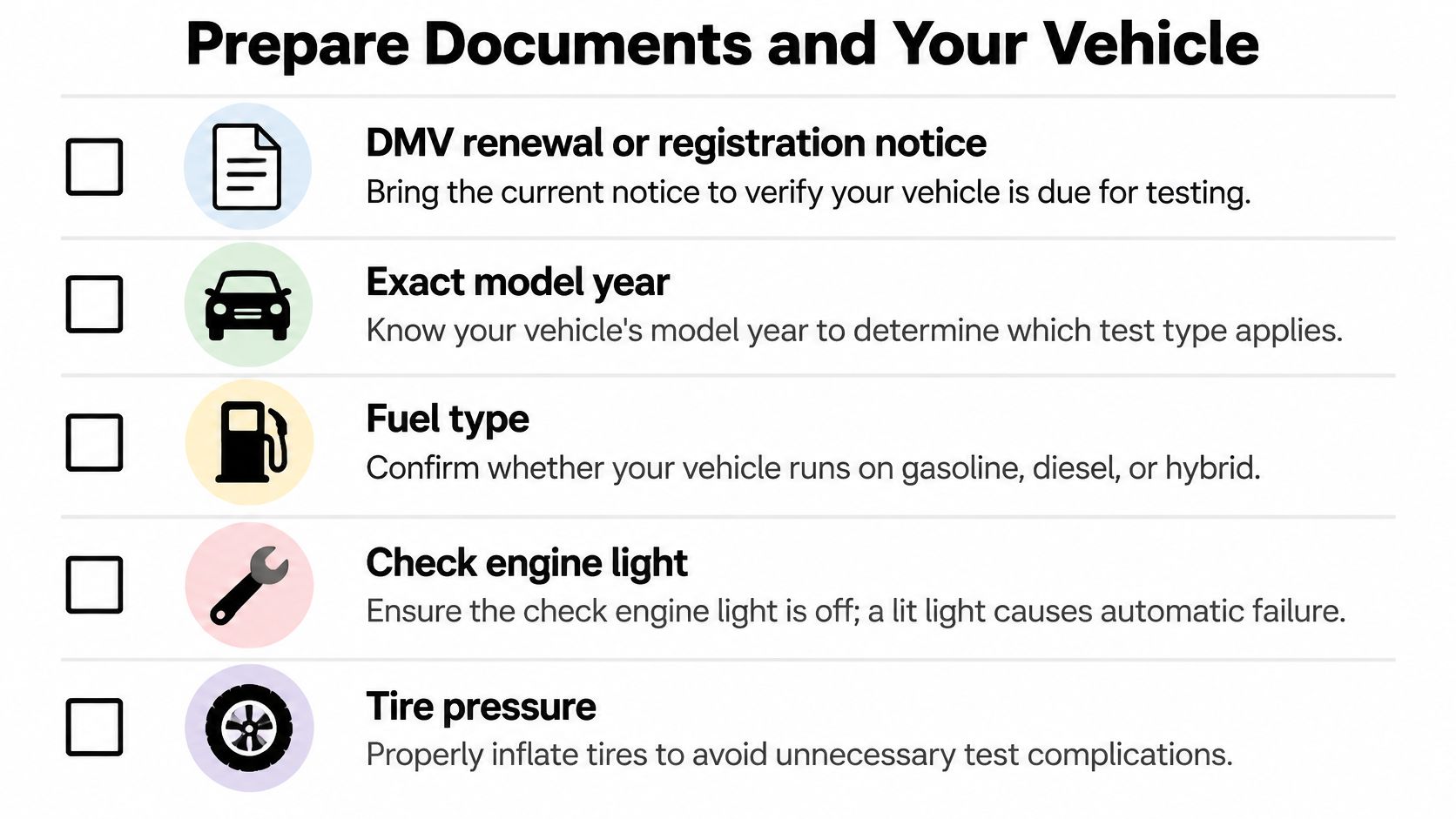
Bring this checklist image to mind as you work through the steps below.
Assemble the Paperwork and Vehicle Facts
- DMV renewal or registration notice: Bring the current notice, since it's the document that defines your transaction and any STAR direction.
- Exact model year: Know it precisely, because a one-year difference can change which rule applies.
- Fuel type: Confirm gasoline, diesel, hybrid, or alternative fuel before you call, so the station can confirm it can test you.
- Registration status: Be ready to explain whether this is a renewal, a first California registration, or an ownership change.
For a fuller walkthrough of pretest steps, the guide on what to do before a smog check covers the preparation sequence in more detail. Read it before you schedule, not in the parking lot.
Get the Onboard Computer Ready
For gasoline vehicles from model year 1996 onward and diesel vehicles from model year 1998 onward, the inspection relies heavily on the On-Board Diagnostics system. That check verifies the malfunction indicator lamp works correctly, looks for diagnostic trouble codes, and evaluates whether required emissions monitors are complete. It's closer to a computer health report than a simple tailpipe sniff.
Don't clear codes or disconnect the battery right before your appointment hoping to erase a warning. That resets the readiness monitors and leaves the computer without enough operating data. You're trading a known fault for an incomplete report, and both can stop you from passing. Repair the underlying problem instead, then complete the manufacturer-specific drive cycle so the monitors rebuild their data through normal driving.
This short video walkthrough shows what readiness preparation looks like in practice.
If your check engine light is on, treat that as a stop sign. Get the fault diagnosed before you test, because showing up hoping it won't matter wastes the trip. Also allow time for the vehicle to cool after driving, and confirm the station can inspect your vehicle class before you head out. None of this guarantees a pass, and any station promising one in advance isn't being straight with you. That removes the preventable reasons for failure.
What Happens During a Typical Smog Check
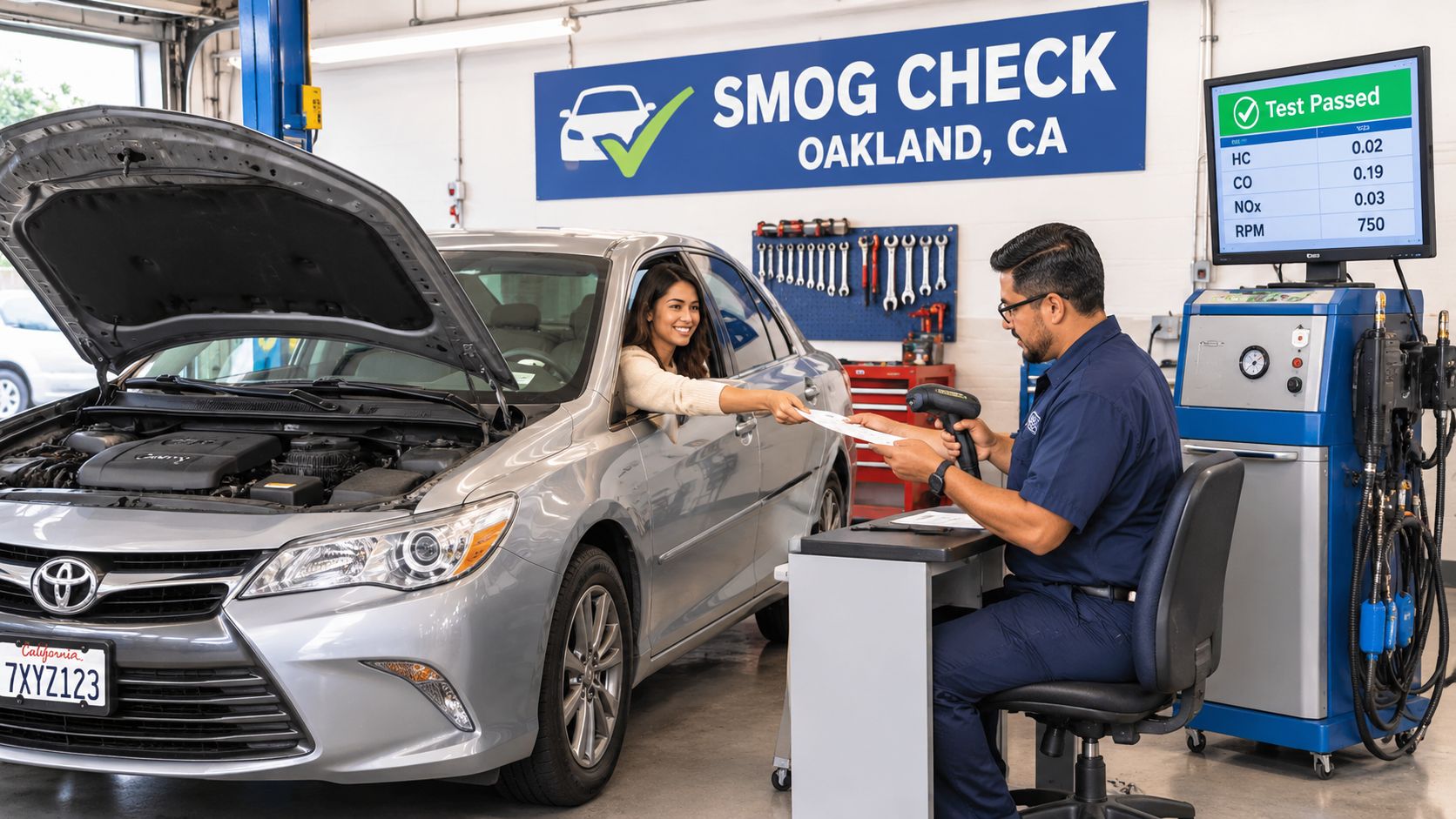
Follow a representative 2000-and-newer sedan through a visit and the whole process looks manageable. The driver arrives with the renewal notice, the station verifies the vehicle record against that document, and only then does the inspection begin. That record check isn't bureaucracy for its own sake. It's what ensures the result attaches to the right vehicle and transaction.
From Check-In to Result
Here's the sequence most drivers of newer vehicles experience.
- Arrival and verification: You hand over the notice, the station confirms model year, fuel type, and any STAR requirement.
- Inspection: The technician runs the test path appropriate to your vehicle, which for a newer model centers on the diagnostics described in the section above.
- Result handling: On a pass, the certification is transmitted electronically, so you aren't carrying a paper certificate to the DMV yourself.
For planning purposes, a typical inspection for 2000-and-newer vehicles takes about 10 to 15 minutes at the East Bay example mentioned earlier. Read that as a typical window, not a guarantee. A station can be busy, a vehicle can need extra attention, and your own arrival paperwork can add time. Budget a buffer around the test itself rather than scheduling something tight immediately after.
Where the Experience Changes
Older gasoline vehicles, 1999-and-older vehicles, diesels, and hybrids may follow different inspection paths. If yours falls into one of those groups, don't assume the newer-car timeline applies to you. Ask the station when you book how your category is handled and how long you should allow.
The surroundings matter less than the process, but they aren't irrelevant on a workday. A clean indoor waiting room makes a short wait easier, and transparent pricing stated before the test starts prevents an awkward surprise at the counter. Limited promotional offers exist at some stations, but don't let a discount distract you from the basic questions. Is this station right for my vehicle, and will its result count for my transaction? Those answers matter more than a few dollars saved on a test you'd have to redo.
Before you leave after a pass, confirm the result has been sent. That's your final step at the station, and it closes the loop between the inspection and your registration.
Understand Common Smog Check Failures
A failure doesn't automatically mean your engine is falling apart. On a modern vehicle, it often means the computer reported a problem, or hadn't collected enough data to report at all. Reading the result correctly is the difference between a targeted repair and throwing parts at the car.
Read the Result Like a Traffic Light
Use a simple comparison. The dashboard warning light is the signal you can see. Stored diagnostic trouble codes are the reason the signal changed. Readiness monitors are whether the system has run long enough to trust its own report. You need all three pieces before you can interpret a failure, not just the light.
That structure also explains why a vehicle can fail even when its tailpipe emissions look acceptable. If the OBD system reports an emissions-related fault or shows insufficient monitor readiness, the inspection can't certify the vehicle on tailpipe behavior alone. The computer's evidence and the exhaust evidence are separate checks, and either one can stop a pass.
The scale here is worth knowing. In statewide 2024 to 2025 data, approximately 19 million model-year-2000-and-newer vehicles were tested and about 1.3 million, roughly 7%, failed, with OBD-related failures at approximately 6.8% of OBD inspections. You're not dealing with a rare edge case when diagnostics cause a failure. It's the central failure path for newer vehicles.
Know the Usual Technical Causes
Four causes come up repeatedly in diagnostic failures.
- Catalytic-converter inefficiency: The converter isn't cleaning exhaust to the expected level.
- Evaporative-emissions leaks: Fuel vapor escapes where it should stay contained.
- Oxygen-sensor faults: The sensor feeding the computer bad data throws off the whole emissions picture.
- Misfire detection: The engine isn't firing consistently, and the computer catches it.
These range from relatively contained repairs to expensive ones, which is exactly why you shouldn't guess. The failure information narrows the diagnosis, and a proper diagnosis narrows the parts list.
After a failure: Keep the inspection details, don't reset anything, and diagnose from the codes before you buy a single part.
Clearing codes on the drive home undoes that advantage. You erase evidence and reset monitors at the same time, leaving the next technician and the next test with less to work from. Preserve the data and let it guide the next step.
Choose Your Next Step After a Failure
Repair immediately is bad default advice. Sometimes it's right. Sometimes you're about to spend real money on a vehicle where repair isn't the sensible path, and California runs a program specifically because that situation is common. Lay out your three actual options before you commit.
Compare Repair, Assistance, and Retirement
Diagnose and repair on your own suits a vehicle you intend to keep, with a contained fault and no history of repeated failures. Program-supported repair suits an income-eligible driver whose needed work qualifies. Vehicle retirement suits an older vehicle where repair costs and repeat failures have started to outweigh the car's remaining value to you.
The financial structure is specific. California's Consumer Assistance Program can provide income-eligible drivers up to $1,450 toward emissions-related repairs, while qualifying owners may receive up to $2,000 to retire a vehicle. The retirement option generally requires household income at or below 225% of the federal poverty level and, for the higher incentive, a failed Smog Check. A vehicle that passes may still qualify under a separate retirement pathway if the inspection occurred within the required 180-day window.
Those numbers change the math for a lower-income East Bay driver. A repair that looks unavoidable on your own budget may be partly covered, or retiring the vehicle may return more value than one more repair cycle on a car that keeps failing.
Respect the Eligibility Limits
Don't assume every mechanic's bill qualifies. Assistance is limited to eligible emissions-related work, requires program approval, and depends on income rules and documentation. Apply and get approved through the proper channel before you authorize work expecting reimbursement. Work done outside those conditions is your expense, whatever the total comes to.
There's a reason older vehicles deserve extra scrutiny in this decision. Lawrence Berkeley National Laboratory research using 1999 data estimated that one inspection-and-repair cycle reduced daily emissions by approximately 97 tons of hydrocarbons, 1,690 tons of carbon monoxide, and 81 tons of nitrogen oxides, with automobiles more than 10 years old accounting for over 90% of the hydrocarbon and carbon-monoxide benefits despite being only about half of vehicles tested. Older vehicles carry the greatest emissions-control deterioration risk. That doesn't make yours unsalvageable, but it does mean a single repair may not be the last one.
Sequence your decision this way. Get the diagnosis, check whether you qualify for assistance, compare the realistic repair path against retirement, and watch your registration timing throughout. A failed test doesn't force the cheapest-looking choice. It forces an informed one.
Use a Smog Check Visit Checklist
Run this sequence once and you've covered the article's decisions in order.
- Confirm the trigger: Renewal, first California registration, or ownership change, and check whether your notice specifies STAR.
- Verify vehicle fit: Make sure your station handles your fuel type and age group.
- Assemble information: Bring the notice, exact model year, fuel type, and registration status.
- Protect readiness: Repair known faults, complete the drive cycle, and don't clear codes or disconnect the battery.
- Budget time: Allow extra room around the test, especially for older, diesel, or hybrid vehicles.
After a pass, confirm the result was transmitted electronically before you leave. After a failure, keep the details and don't commit to a quick repair until diagnosis and assistance options are clear. Verify anything specific to your vehicle with your chosen station before you travel.
If your notice calls for a STAR inspection or you're testing a diesel, hybrid, older vehicle, or 2000-and-newer model, Speedy Smog can confirm your vehicle fit, explain the process in plain language, and complete the inspection for your DMV transaction. Bring your renewal notice, verify your vehicle is diagnostically ready, and visit to get tested and back on the road without a second trip.
If your DMV renewal notice says “Smog Certification Required at a STAR station,” only an inspection at a STAR-certified location will satisfy the requirement. An ordinary licensed smog shop won't count.
You're probably holding that notice, checking your calendar, and wondering whether the shop around the corner can handle it. Before you drive over, check something just as important as STAR certification: does the station only test vehicles, or can it also diagnose and repair them? That distinction won't matter much if your car passes, but it matters a lot if it doesn't.
Table of Contents
- What a STAR Smog Check Actually Means for Oakland Drivers
- Why STAR Stations Exist and How Big the Program Is
- Which Vehicles and Renewals Get Routed to STAR
- Inside STAR Certification, Equipment and Performance Controls
- STAR Test-Only Versus STAR Test-and-Repair in Oakland
- How to Prepare Your Vehicle Before the Inspection
- Choosing a STAR Station and Planning Your Next Move
What a STAR Smog Check Actually Means for Oakland Drivers
STAR is a station certification, not just another name for a smog check. It tells you that the business participates in California's higher-performance inspection framework. For your renewal, the important question is whether the station has the authorization your notice requires.
California's Bureau of Automotive Repair, or BAR, established the voluntary, performance-based STAR program in 2013, replacing the former Gold Shield and Test Only structure, as described in the DMV's smog inspection guidance. Don't confuse that historical program change with today's station categories. A STAR-certified business can still operate as a test-only station.
Translate the wording before choosing a shop
A directed vehicle is a vehicle the state routes to a STAR station, typically after risk-based screening identifies a need for additional oversight. Treat that direction as a requirement about where the inspection happens, not as a diagnosis of what's wrong with your car.
My recommendation is straightforward: start with the renewal notice, not a coupon or a search result. When you're comparing results for STAR smog check Oakland CA, confirm the station's certification before asking about price or availability.
- Read the inspection wording. Find the smog requirement on your renewal notice rather than relying on what you remember from your last renewal.
- Confirm the location's status. Ask whether the specific location you'll visit is currently STAR-certified.
- Explain what you need. Tell the shop you have a STAR-directed renewal and identify your vehicle before heading over.
The notice is the starting point for the decision.
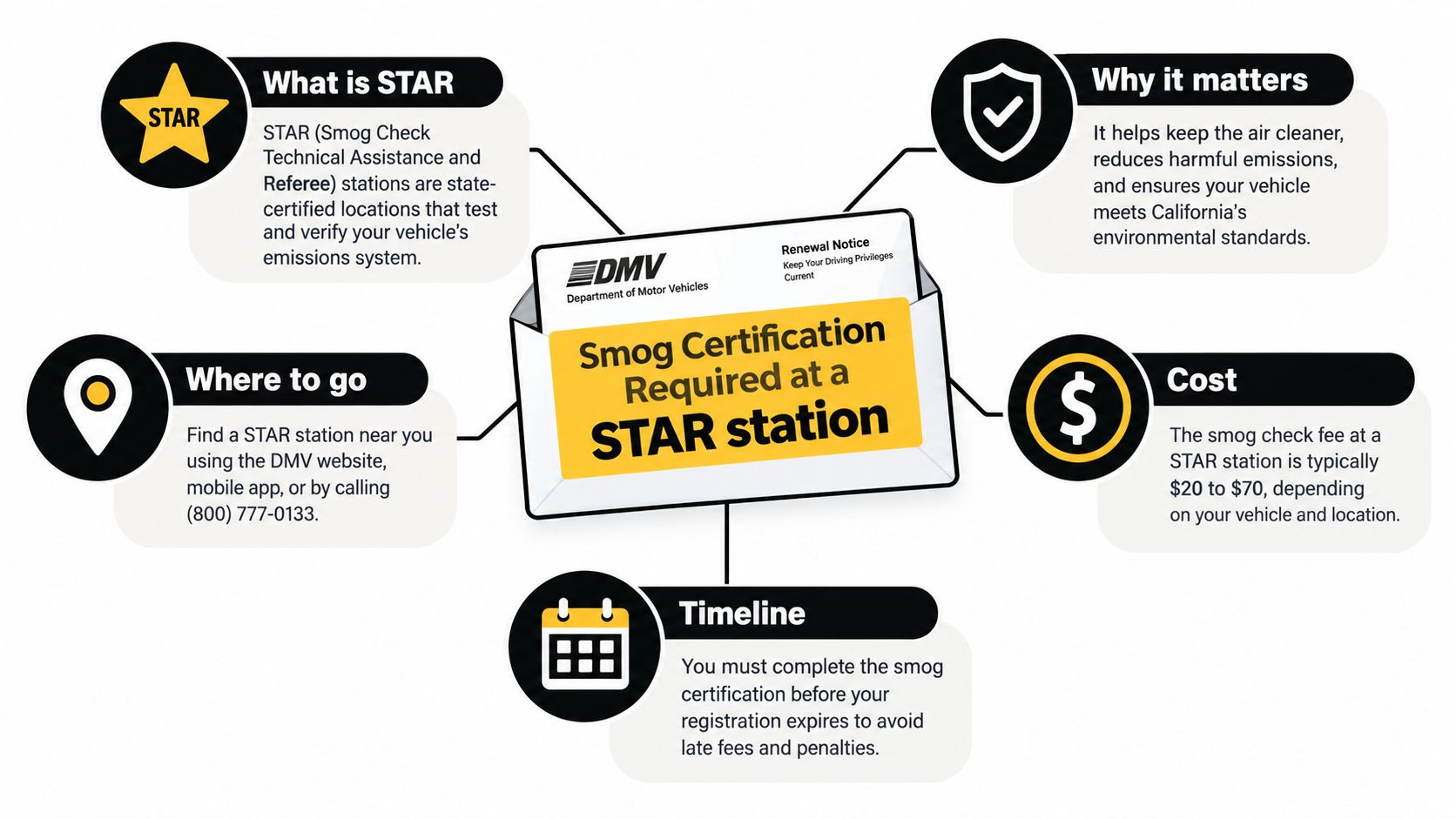
Don't read STAR as a promise that your car will pass. It describes the station's qualifications and authorization, not your vehicle's condition. A proper inspection gives you a result you can act on, even when that result isn't the one you wanted.
Why STAR Stations Exist and How Big the Program Is
STAR isn't a boutique designation used by a small corner of California's inspection industry. The program has handled a substantial share of statewide testing, which helps explain why the name appears so often in East Bay smog searches.
By December 2019, California had 7,902 licensed Smog Check stations, including 3,882 STAR-certified stations, or 49%; those STAR stations performed about 8.4 million of roughly 10.3 million initial inspections, approximately 82% of the statewide total, according to BAR's Smog Check performance report.
What that historical snapshot tells you
Fewer than half of the licensed stations handled more than four-fifths of the initial inspections in that reporting year. My reading is that STAR was already a central part of California's inspection infrastructure, not an unusual service drivers rarely needed.
That doesn't establish why every customer chose a particular station. The figures don't separate drivers following a DMV direction from drivers choosing STAR voluntarily. They also don't tell you how busy an Oakland shop is today or how long you'll wait.
Practical perspective: Use statewide figures to understand the program's importance, not to predict the queue at your neighborhood station.
The graphic provides a visual overview of the program. Use the dated BAR figures above, rather than illustrative totals in the graphic, for numerical comparisons.
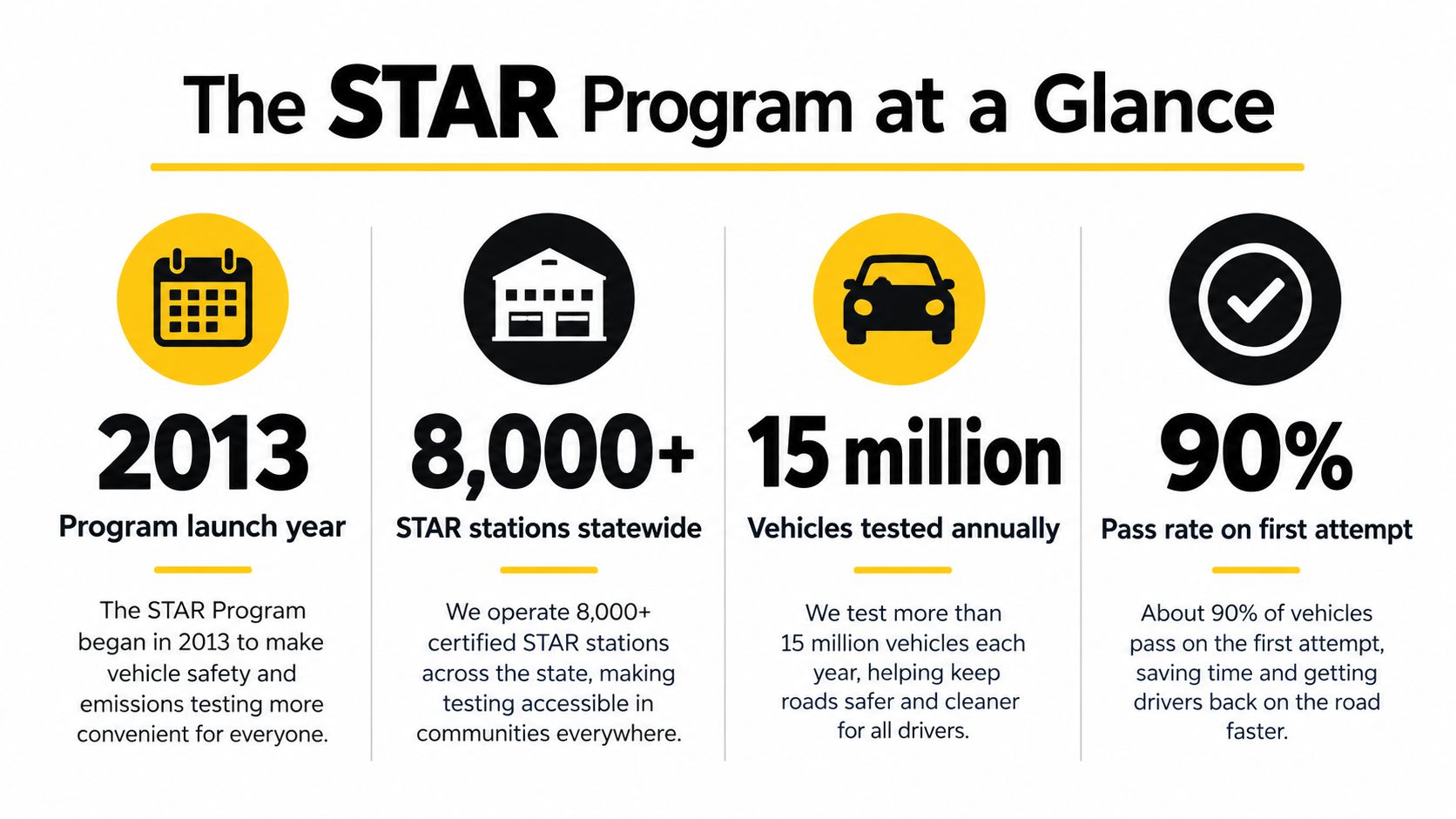
For an Oakland driver, the useful distinction is ordinary licensing versus additional performance monitoring. BAR uses STAR to identify stations within that monitored framework and authorize them to inspect directed vehicles.
Don't turn inspection volume into a claim that every STAR business offers the same experience. Certification doesn't answer whether a shop performs repairs, publishes a clear price, or has an appointment available when you need it. Those are separate questions, and you should ask them directly.
Which Vehicles and Renewals Get Routed to STAR
Your neighbor's renewal isn't a reliable guide to yours. Neither is the fact that your vehicle is older, newer, diesel-powered, or a hybrid. Read your own notice before deciding what inspection to book.
The state's directed-vehicle screening explains why some renewals carry a STAR instruction, but you shouldn't try to reconstruct that decision from your car's age alone. A direction to STAR tells you where to go. It doesn't tell you which component will fail or whether a repair is necessary.
Check the notice, then identify the vehicle
Use this pre-booking checklist to keep the conversation with the shop specific:
- Find the smog requirement. Read the actual renewal wording, including the area around the barcode. Don't substitute a generic reminder email for the notice.
- Separate STAR from other wording. If your paperwork doesn't specify STAR, don't assume the extra requirement applies. If the instructions are missing or unclear, confirm them with DMV before buying an inspection.
- Describe the vehicle accurately. Give the station the model year, make, and fuel type so it can confirm that it handles the appropriate inspection.
- Flag uncertainty early. Tell the shop if you're unsure which notice belongs to the vehicle or whether you're handling a renewal rather than another registration situation.
For broader context, review these California smog check rules, then use your vehicle-specific paperwork to make the booking decision.
Bring the notice and keep the report
During the inspection workflow, the inspector scans the renewal-notice barcode so the correct vehicle identification and inspection data are transmitted to DMV. You receive a Vehicle Inspection Report, commonly called a VIR, for your records.
Keep that report where you can find it. It's useful documentation whether you're finishing the renewal process or discussing an unsuccessful inspection with another provider.
Don't leave with only a verbal explanation. Keep the written inspection result.
For owners of older cars, the sensible approach is to discuss existing problems before testing. For diesel and hybrid owners, confirm the station handles the vehicle rather than assuming every shop has the same capabilities. Newer-vehicle owners should still follow their own paperwork, not a blanket statement that newer cars never need inspection.
Inside STAR Certification, Equipment and Performance Controls
A STAR badge reflects technical requirements, not just a business's decision to advertise emissions testing. BAR evaluates equipment readiness and inspection-performance measures, which is why the designation deserves more attention than a storefront sticker.
Under BAR's STAR certification requirements, a certified station must maintain at least one operational BAR-certified BAR-97 emissions inspection system and BAR On-Board Diagnostic Inspection System, or BAR-OIS, and equipment requiring calibration must pass calibration at least once every 10 calendar days. The performance thresholds in the table are part of those same requirements.
STAR Certification Performance Thresholds
| Metric | Required Threshold | What It Means |
|---|---|---|
| Similar Vehicle Failure Rate | At least 50% of the industry-wide failure rate for comparable vehicles | BAR compares the station's failure results with a comparable-vehicle baseline. |
| Gear-shift incidents | No more than 2% | The station must stay within the permitted incident limit. |
| Excessive Test Deviation Rate | No greater than one | BAR limits excessive deviations in testing performance. |
| Follow-up Pass Rate | At least 0.40 for the station or each applicable inspector | Follow-up inspection performance contributes to STAR eligibility. |
Don't mistake the Similar Vehicle Failure Rate for a quota requiring an inspector to fail your car. It's a comparative station-performance measure, not a prediction about an individual vehicle. Likewise, the Follow-up Pass Rate isn't your personal probability of passing.
What the controls mean for a customer
The equipment requirement matters because a station needs the appropriate operational systems, not an inspector willing to take the job. Calibration matters because applicable equipment must remain within BAR's required checks. Performance monitoring adds another layer beyond the fact that a business holds an ordinary license.
My advice is to judge STAR as evidence of regulated inspection controls, not as a guarantee of flawless customer service. You still need clear communication about the inspection price, the vehicle types accepted, and what the station will do if the result is unsuccessful.
- Ask about your vehicle. Confirm the station can inspect its model year and fuel type.
- Ask about its service category. Equipment and certification don't establish whether repairs are offered.
- Expect a documented result. The inspection should leave you with something concrete to review, not just reassurance.
You don't need to audit a shop's performance calculations yourself. You do need to understand that STAR is technical, and that choosing the right station involves more than spotting the word on a sign.
STAR Test-Only Versus STAR Test-and-Repair in Oakland
A STAR station is not automatically a repair facility. This is the distinction I'd settle before making an appointment, especially if the vehicle already has a warning light, a previous unsuccessful inspection, or an unresolved concern.
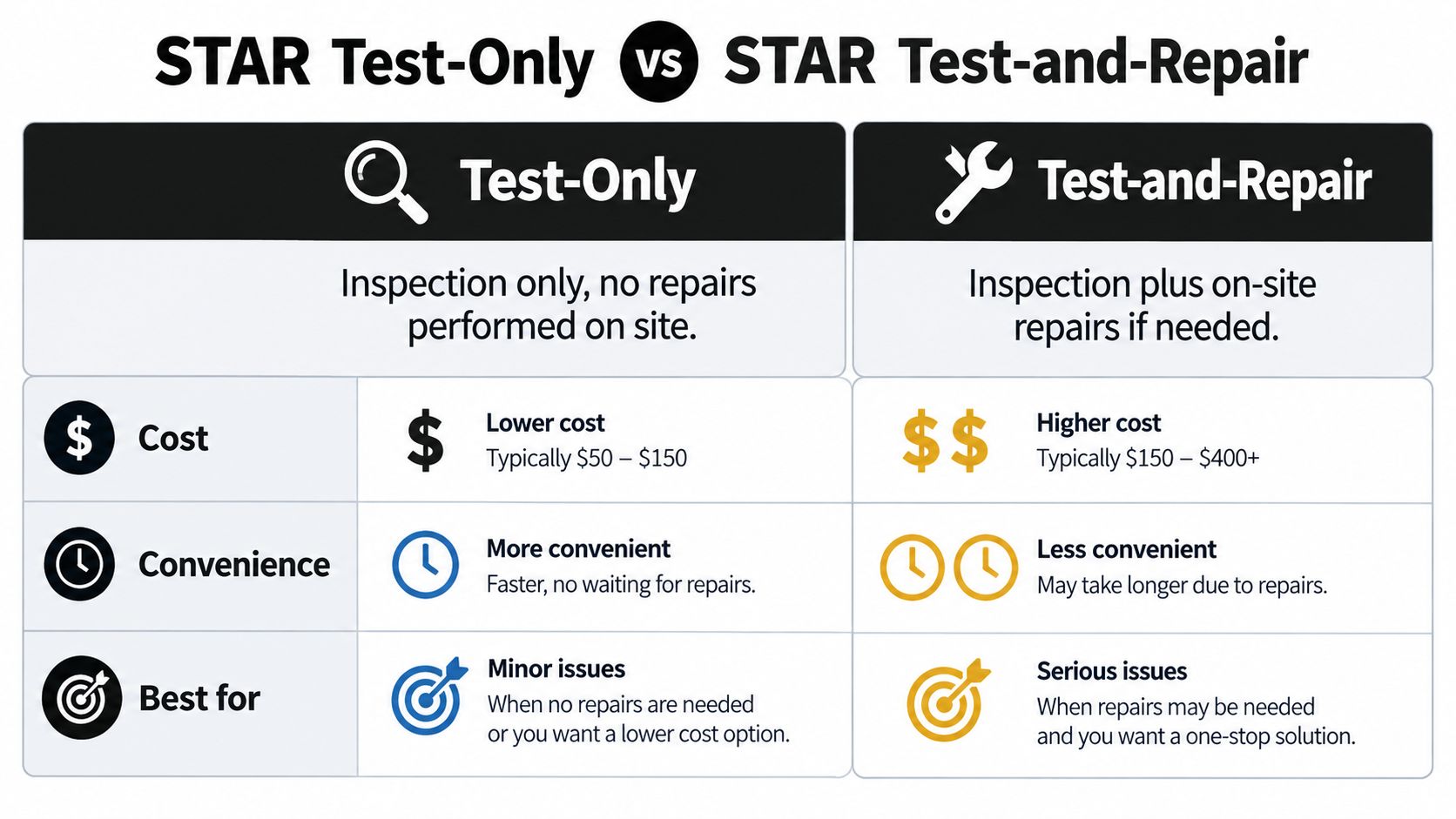
BAR distinguishes STAR test-only stations from STAR test-and-repair stations. Both categories can inspect directed vehicles, but test-only stations don't perform repairs, while test-and-repair stations combine inspection with repair services, as explained in BAR's Smog Check program guidance.
The practical difference is what happens after the result.
Choose based on the service you want
A test-only station makes sense when you want the inspection as a separate service and already have a repair provider you trust. If the vehicle fails, you'll need a separate repair plan. Don't expect the inspector to turn the visit into an on-site repair appointment.
A test-and-repair station makes sense when you want the possibility of diagnosis and repair at the same business. That can simplify coordination, but it doesn't mean you should authorize work without an explanation. Ask what diagnostic work is proposed, what it costs, and what the estimate includes.
| Your priority | Category to consider | Question to ask |
|---|---|---|
| Keep inspection separate from repairs | STAR test-only | What happens if the vehicle doesn't pass? |
| Seek inspection and repair at the same business | STAR test-and-repair | Can you diagnose this vehicle, and when is repair service available? |
| Avoid an unclear bill | Either category | What's included, and what would be charged separately? |
For a more focused comparison, use this explanation of STAR stations versus test-only stations. Don't choose by category alone, then forget to confirm the actual services available.
An unsuccessful test needs a plan
The equipment controls already discussed aren't optional. BAR warns that using the wrong inspection equipment can trigger a citation and order of abatement. A station shouldn't improvise a process just to accommodate the vehicle.
An unsuccessful result also doesn't mean the station can waive it or automatically repair the cause. Ask for an explanation tied to the written report before approving work.
Before authorizing repairs: Separate the inspection finding, the proposed diagnosis, and the repair estimate. They aren't interchangeable.
DMV identifies the BAR Referee Program as a next-step resource for failed-test customers and notes that eligible owners may receive repair help through the Consumer Assistance Program. Investigate those options when appropriate rather than assuming every unsuccessful inspection requires an immediate, open-ended repair authorization.
How to Prepare Your Vehicle Before the Inspection
Preparation starts with knowing whether you're bringing a vehicle for an inspection or bringing an unresolved problem that needs diagnosis first. Don't expect a quick visit to answer every maintenance question.
California recorded more than 11.2 million initial tests in 2025, with 959,667 initial failures, an 8.51% failure rate; STAR test-only stations performed 5,916,245 initial tests, with 481,639 failures, an 8.14% rate, according to BAR's statewide executive summary. Those figures establish that unsuccessful inspections occur, not that any particular preparation trick guarantees a pass.
A basic vehicle check is a sensible starting point.
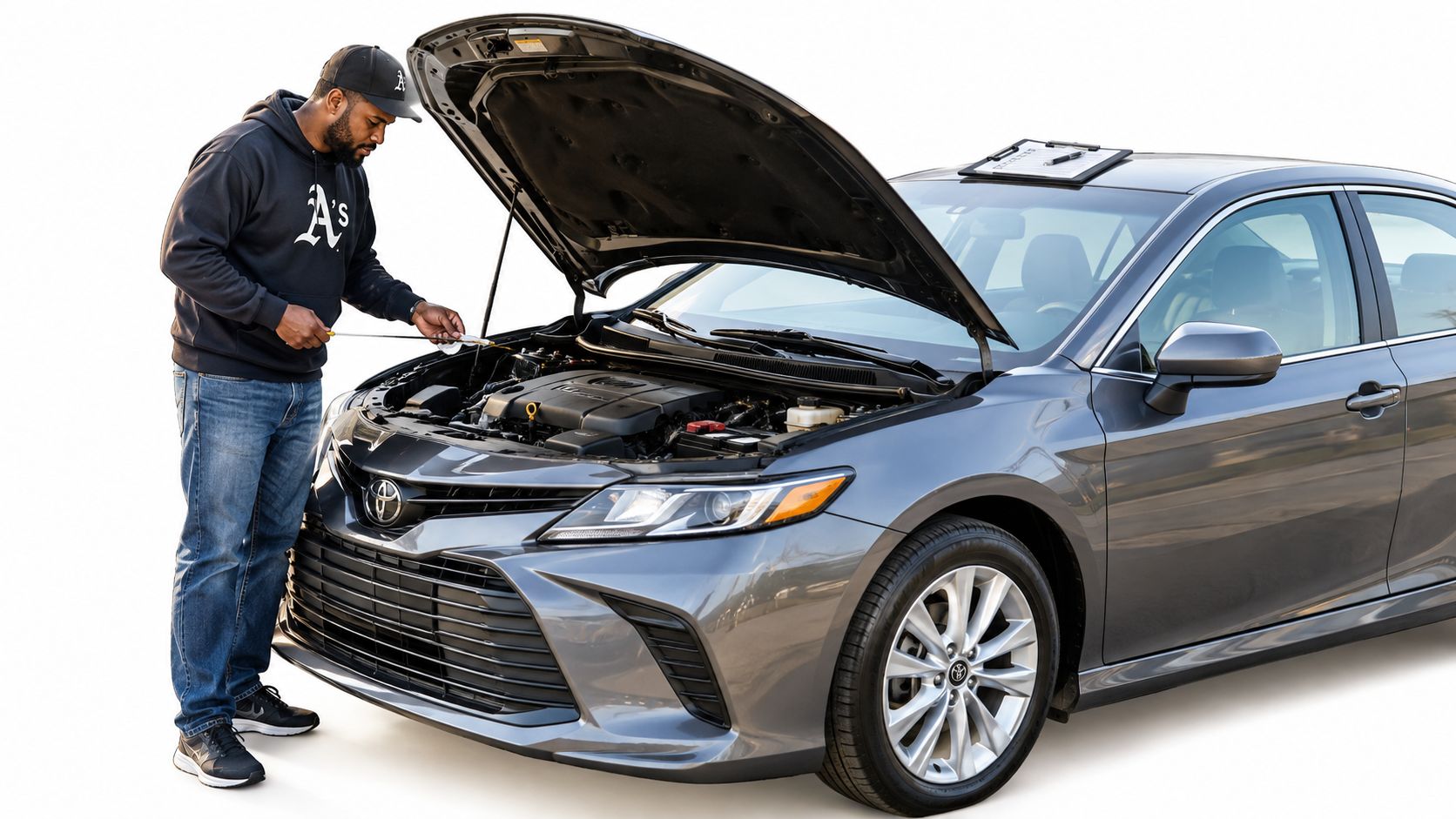
The day before your visit
- Discuss warning lights. If a dashboard warning is illuminated, tell the shop before booking. Ask whether diagnosis should come first rather than trying to hide the symptom.
- Review obvious maintenance concerns. Check for visible tire problems and, where applicable, a missing or damaged gas cap. Treat these as maintenance observations, not guaranteed explanations for a smog failure.
- Ask about arrival preparation. Get vehicle-specific advice on whether a normal drive before arrival is appropriate. Don't follow a universal warm-up routine copied from another vehicle.
- Gather your paperwork. Put the renewal notice somewhere you won't forget it, and bring relevant previous inspection or repair records.
For additional preparation guidance, consult this STAR smog test preparation guide before the appointment.
Use the video below as supplementary viewing, not a substitute for instructions specific to your car.
On the morning of the visit, ask about the current queue and total time you should allow. Inspection time and time at the shop aren't the same thing. Leave room in your schedule to hear the result and ask questions without rushing.
Choosing a STAR Station and Planning Your Next Move
Choose the station around the whole visit, not just the advertised inspection price. You need the correct authorization, the service category you want, and a clear explanation of what happens afterward.
An Oakland location may be convenient, while a nearby San Leandro station may fit your route better. Compare actual availability and services rather than assuming the closest search result is the right match.
Settle the practical details before driving over
- Get the complete price. Ask what's included, what's separate, and whether any advertised offer applies to your vehicle.
- Check the schedule. Confirm current weekday or Saturday availability and whether you need an appointment.
- Ask about waiting arrangements. If an indoor waiting area matters to you, verify it rather than relying on an old photograph.
- Establish the repair boundary. Know whether the business provides inspection only or can offer diagnosis and repairs.
After a passing result, keep your paperwork and confirm the remaining renewal steps. After an unsuccessful result, review the report and choose the next action deliberately: diagnosis, repair, or an appropriate state assistance resource.
A convenient inspection is useful. A clear plan for either result is better.
Don't leave this until the last moment if you can avoid it. Give yourself room to address a problem without making rushed decisions about repairs. The goal is a compliant renewal and a result you understand, not merely the shortest stop on your errands.
For Oakland drivers considering nearby San Leandro, Speedy Smog offers STAR-certified emissions testing with an indoor waiting area and service for older and newer vehicles, diesels, and hybrids. Visit its website to check current pricing and availability, then confirm your vehicle's inspection needs and the station's service scope before heading over with your DMV renewal notice.
The DMV envelope arrives, and the whole week suddenly has one extra errand attached to it. If you live in Oakland, that usually means figuring out whether your car needs a Smog Check, where to take it, and whether the notice is pointing you to a regular station or a STAR station. The easiest way to handle it is to treat the test like a small DMV project, not a mystery chore.
Table of Contents
- What Oakland Drivers Should Know Before Booking a Smog Check
- How California's Smog Check Program Works
- DMV Compliance and What Your Renewal Notice Means
- Vehicle Eligibility and How Model Year Changes the Test
- Preparing Your Vehicle the Week Before the Test
- What the Appointment Itself Looks Like
- Turnaround, Results, and What Happens If You Fail
- Putting It All Together for Oakland Drivers
What Oakland Drivers Should Know Before Booking a Smog Check
A smog check Oakland CA search usually starts the same way, with a renewal notice in hand and a deadline in front of you. That notice matters more than the shop sign outside, because it tells you what kind of inspection your vehicle needs and whether the state wants a higher-oversight station.
The fastest way to avoid a wasted trip is to answer five questions before you book. First, is the vehicle due for a Smog Check under California rules. Second, does the renewal notice call for a STAR station. Third, is your vehicle older, newer, diesel, or a hybrid, because that changes the test. Fourth, have you done the basic prep work in the days before the appointment. Fifth, do you know what the visit itself will look like.
Practical rule: the renewal notice is the real starting point, not the first shop result you find online.
That framing saves time because the state treats this as a registration step, not an optional maintenance add-on. For Oakland and East Bay drivers, the whole process is tied to DMV renewal, so the cleanest path is usually to read the notice, match the station type, and then book the right kind of inspection the first time.
How California's Smog Check Program Works
A smog check in California is part of the state's registration system, not a separate errand you handle on its own. The Bureau of Automotive Repair sets the rules for qualifying vehicles, and the inspection usually happens as part of renewal, so the DMV and the test move together. California Smog Check performance report
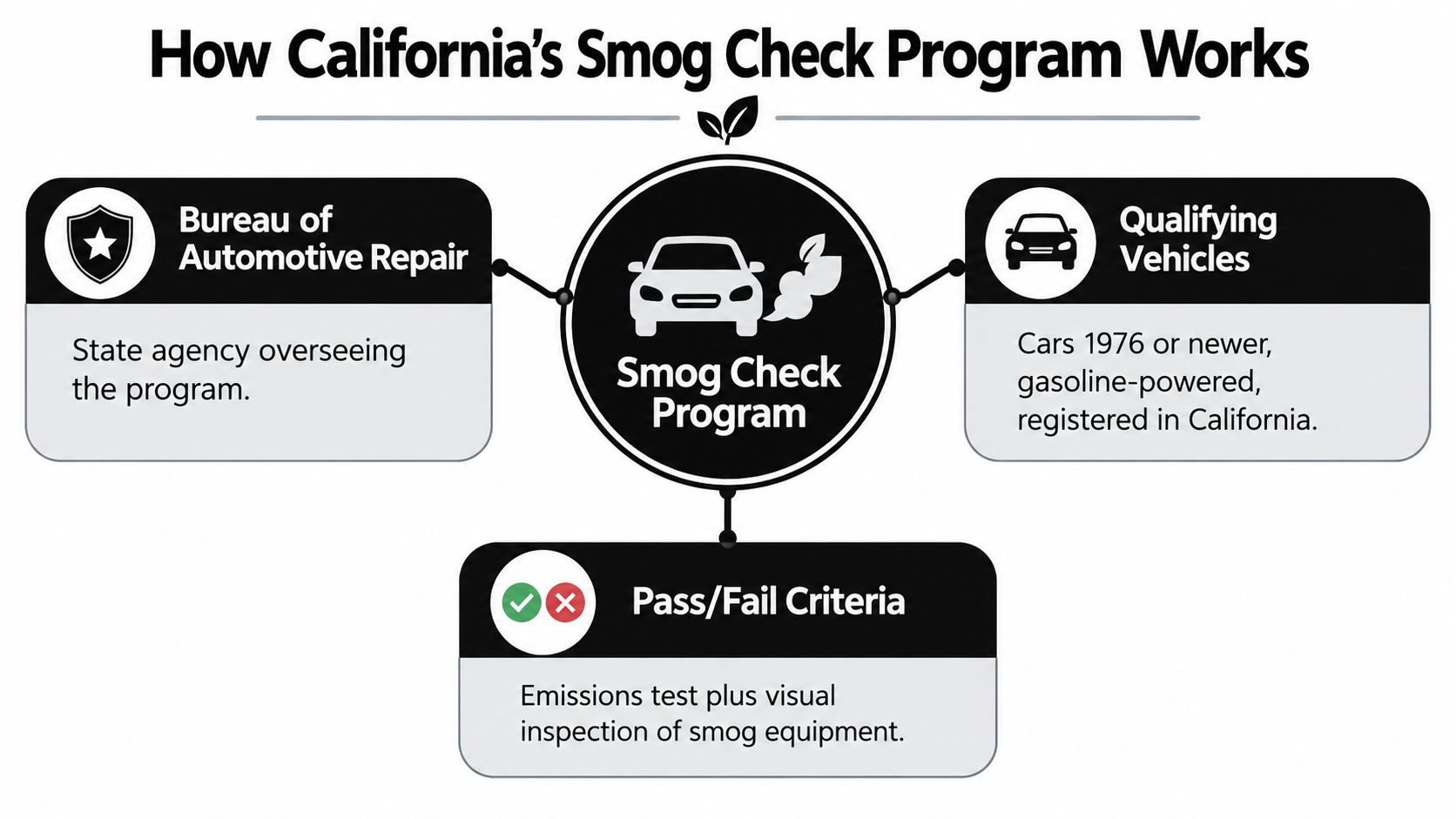
Why STAR exists
STAR certification creates a higher-oversight network for vehicles that need closer review. STAR stations are part of the state's testing framework, not just a marketing label, and California reported that by December 2019 there were 7,902 licensed Smog Check stations statewide, including 3,882 STAR stations, or 49% of the total. During calendar year 2019, roughly 10.3 million initial Smog Check tests were performed statewide, and about 8.4 million, or 82%, were completed by STAR stations, as reported in the same BAR performance report.
For an Oakland driver, the key point is simple. The rules do not change by neighborhood. Whether the car is tested in Oakland, San Leandro, or somewhere else in California, the result feeds into the same state reporting system and is sent to the DMV electronically. If the renewal notice calls for STAR service, the station must be authorized for that category or it cannot finish the certification.
DMV Compliance and What Your Renewal Notice Means
The renewal notice is where the DMV turns a general rule into a specific instruction. If it flags the vehicle for a Smog Check, the notice is telling you that registration renewal depends on a passing certificate, and if it identifies the car as directed or otherwise STAR-required, the wrong station can't complete the certification.
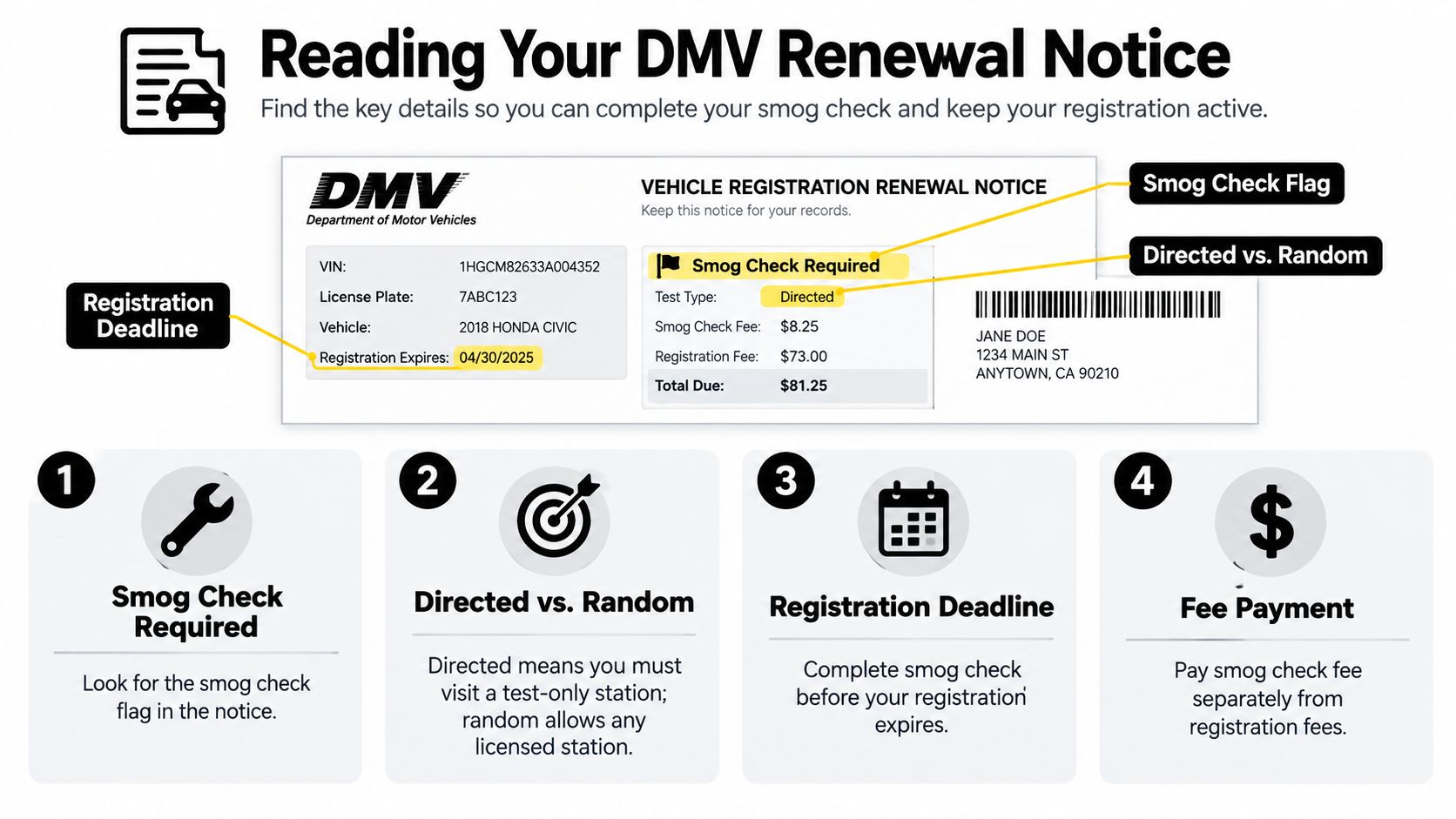
Regular station or STAR station
A STAR station is the one the state authorizes for vehicles that need enhanced oversight, much as a referral sends a patient to a specialist. A regular licensed station can handle many inspections, but STAR programs require these facilities to maintain compliant licenses, required inspection equipment, adequate inspection volume for statistical review, and specific performance measures, including a Similar Vehicle Failure Rate of at least 50% of the industry-wide failure rate for comparable vehicles and a gear-shift incident rate no higher than 2% of certified vehicles. STAR certification requirements
If your notice requires STAR service and you go to a station that isn't STAR-certified, you can lose time without moving the registration forward. That's why the notice deserves a close read before you book. If the wording is confusing, compare it with your registration status and, if needed, ask the station to confirm that the vehicle type on the notice matches its current authorization.
For Oakland-area drivers who want a plain-English walkthrough of renewal timing and station selection, this guide to registration renewal and smog check steps is a useful companion.
Practical rule: the renewal notice decides the station category first, and the appointment time second.
Payment usually follows the test result through DMV's electronic system, so the important thing is not to collect paperwork for its own sake. The important thing is to get the right certificate into the state system so registration can move ahead.
Vehicle Eligibility and How Model Year Changes the Test
Vehicle age changes the inspection path more than most drivers expect. California BAR says most 2000-and-newer gasoline and alternative-fuel vehicles get an OBD-based inspection, while pre-2000 vehicles generally receive a tailpipe emissions test instead. That's why two cars with the same renewal notice can end up going through very different checks.
What the model year tells the inspector
The state's 2025 executive summary shows why age matters. A 2024 vehicle recorded 100,305 initial tests and 4,538 failures, for an 4.52% overall failure rate. A 2010 vehicle recorded 314,125 initial tests and 28,718 failures, for 9.14%. A 2008 vehicle recorded 367,600 initial tests and 34,834 failures, for 9.48%. A 1998 vehicle had 100,885 initial tests and 19,185 failures, for 19.02%. 2025 Smog Check executive summary
| Model Year | Initial Tests | Overall Failures | Overall Failure Rate |
|---|---|---|---|
| 2024 | 100,305 | 4,538 | 4.52% |
| 2010 | 314,125 | 28,718 | 9.14% |
| 2008 | 367,600 | 34,834 | 9.48% |
| 1998 | 100,885 | 19,185 | 19.02% |
That table doesn't mean every older car will fail. It does show the pattern: as vehicles age, inspection risk rises. For drivers who want a practical breakdown of which cars fall into which testing path, this California smog check vehicle guide is a useful reference.
Why OBD readiness matters
For 2000-and-newer vehicles, the test isn't just a quick visual look. The inspector checks diagnostic trouble codes, emissions-system operation, and readiness monitors. BAR advises delaying the test after a battery disconnect or replacement because the monitors may still be incomplete, and it recommends driving the vehicle for roughly one to two weeks under varied conditions before retesting. California Smog Check guidance
A newer car can look fine and still be too early for the test if the monitors haven't set yet.
Preparing Your Vehicle the Week Before the Test
A passing result is often decided before the appointment day arrives. If the check-engine light is on, that's not a paperwork problem, it's a vehicle problem, and clearing the code right before the test doesn't fix the underlying fault. The car may still show incomplete monitors, which can still lead to failure.
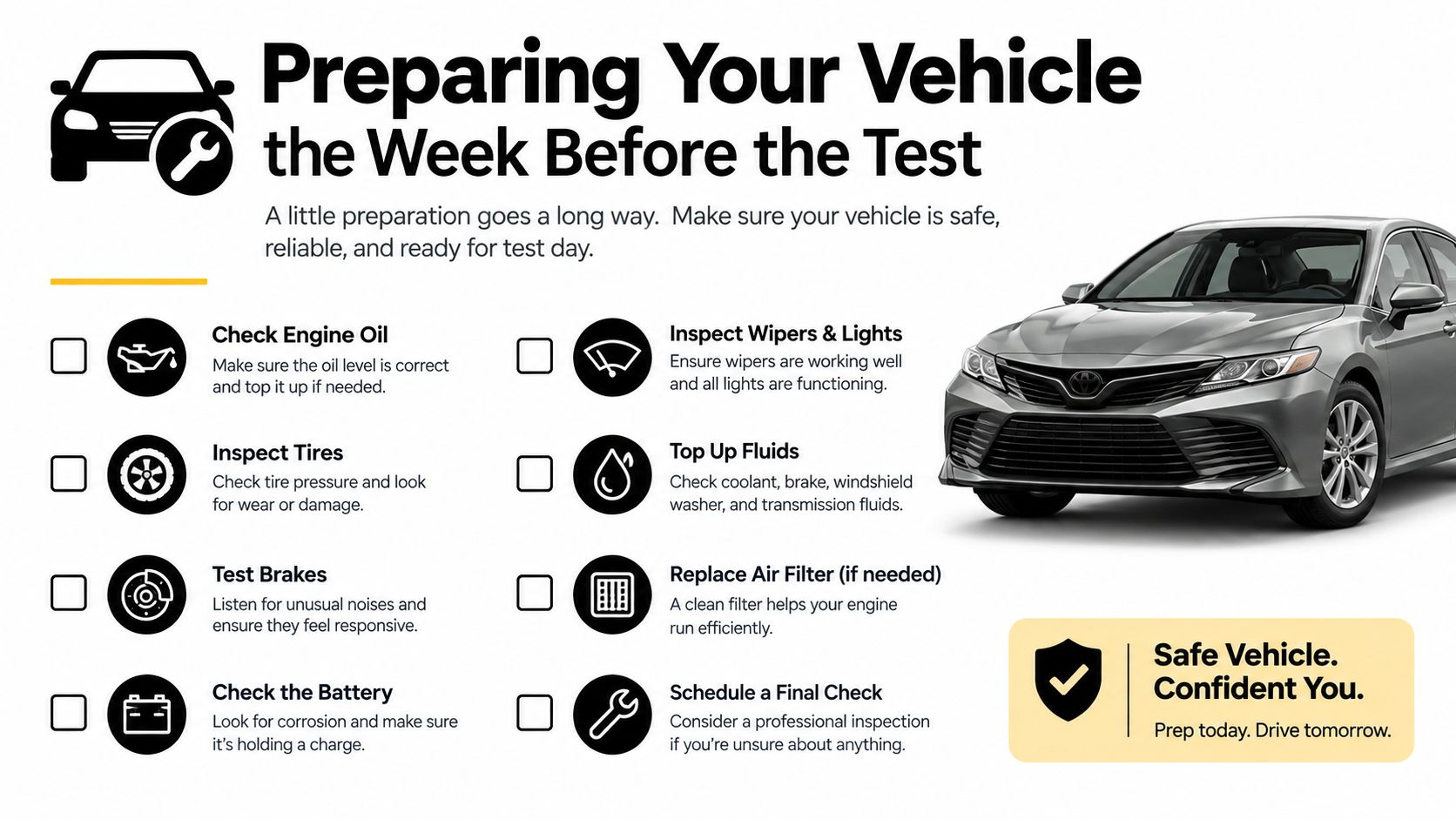
A simple prep routine
Think of readiness monitors like homework the car has to finish. You can't cram them into place five minutes before the test, and a battery disconnect is like erasing the assignment halfway through. The best preparation is boring in the right way.
- Watch the warning lights: If the check-engine light comes on during normal driving, fix the cause before you book the test.
- Drive normally: Mix city streets and steady-speed driving so the monitors can complete.
- Avoid last-minute battery work: A recent disconnect or replacement can leave the monitors incomplete.
- Warm the vehicle up: Arrive with the car at normal operating temperature, not just started a minute before.
- Bring the notice: Have the renewal notice and a payment method ready so nothing slows the check-in.
One more detail matters for Oakland drivers with older cars and diesels. If you've just had repairs, give the car enough time to settle into normal operation before the appointment. A clean run on paper doesn't help if the vehicle's diagnostic system hasn't had time to confirm that everything is working again.
Practical rule: repair first, drive second, test third.
What the Appointment Itself Looks Like
A typical visit feels more like a quick medical intake than a long repair appointment. You arrive, the station confirms the vehicle and paperwork, the inspector takes the car through the required test, and the result gets sent electronically to DMV. For 2000-and-newer vehicles, the test portion is commonly completed in about 10 to 15 minutes, which is why these visits often move faster than drivers expect.
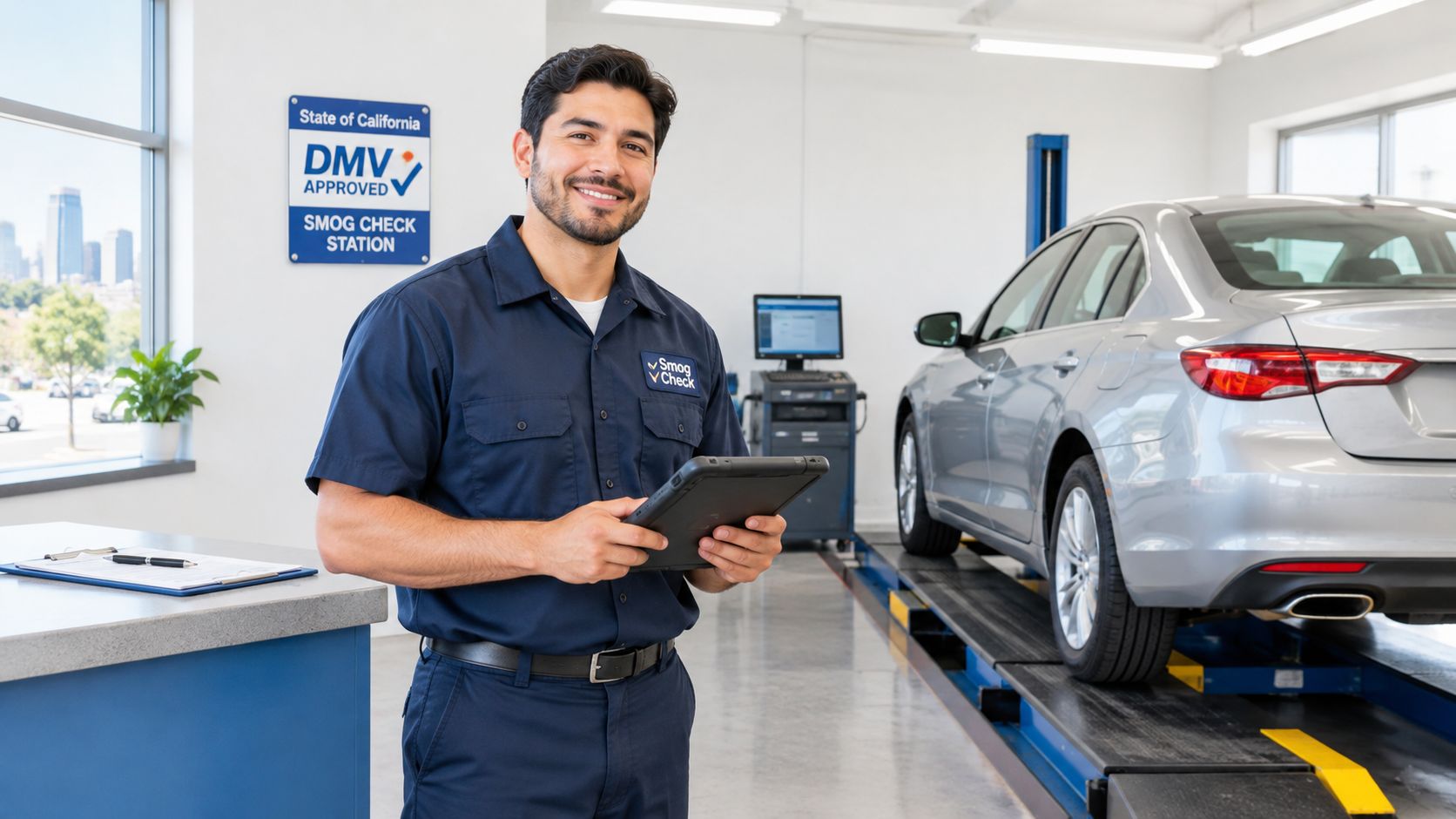
What changes from one vehicle to another
The basic flow is the same, but the inspection time can stretch if the vehicle is older, if the test uses a tailpipe procedure, or if the station is busy. STAR status usually matters to the driver mainly in paperwork and eligibility, not in some dramatic visible difference at the counter. A STAR-certified shop such as Speedy Smog in San Leandro can handle the higher-oversight categories the state requires, including vehicles that need STAR authorization, while still testing many routine Oakland-area vehicles as part of the same DMV process.
The key point is that the station is not handing you a paper certificate to carry around. It's sending the result electronically, which is why the visit can feel short even though the compliance step is important. If the vehicle passes, you're done with the inspection piece. If it doesn't, the station should tell you what blocked approval so you can decide on repairs.
Turnaround, Results, and What Happens If You Fail
A passing result is useful because it clears the DMV hurdle right away. The station transmits the certificate electronically, and that certificate, not a paper receipt, is what helps unblock registration renewal. The old-style handoff of paperwork has mostly been replaced by instant digital reporting.
If the car fails
A failure doesn't end the registration process, it just means the car needs work before it can be certified. The inspection report is the starting point for diagnosis, and the next step is usually repair, then a retest once the vehicle is ready.
If you're trying to keep costs predictable after a repair visit, some stations offer discounts or coupons toward a return visit. One concrete example is the periodic $25-off coupons for newer vehicles mentioned by East Bay shops, which can soften the cost of a second trip after the underlying issue has been fixed. For a closer look at how stations present results and follow-up steps, see this smog test results guide.
The important thing is not to confuse a receipt with a certificate. The receipt shows you paid for the visit. The certificate is what the DMV cares about.
Putting It All Together for Oakland Drivers
The smartest move is to treat the renewal as three small jobs. First, read the DMV notice closely and confirm whether STAR service is required. Second, get the car ready by handling any warning lights, driving enough for monitors to set, and avoiding last-minute battery interruptions. Third, book a station that can legally handle your vehicle type and finish the certificate correctly.
That approach takes the uncertainty out of the process. The state rules decide the test type, the vehicle decides the inspection path, and the renewal notice decides the station category.
If you want a San Leandro station that handles Oakland-area renewals for routine inspections, STAR-required vehicles, diesels, hybrids, and older cars, Speedy Smog is set up for that workflow. Bring the notice, bring the car ready to test, and turn the smog check into one clean DMV task instead of a week of guesswork.
If you need a straightforward East Bay smog check with clear station guidance, Speedy Smog handles the inspection and electronic certificate process in one visit. Their team works with Oakland drivers, STAR-required renewals, and a range of vehicle types, so you can get the DMV step finished without extra back-and-forth.
You open the DMV renewal notice expecting the usual reminder, then you see the line that changes the whole errand, STAR certification required. If you're in Oakland, that usually means your regular neighborhood shop might not be the right stop, and now you're trying to figure out whether this is a simple smog check or a special lane with different rules, different timing, and a different bill.
The confusing part is that STAR sounds like a separate emissions test, but it isn't. It's a higher-performance compliance tier inside California's smog system, which means the station has to meet tighter state standards for inspection quality, while the vehicle is still being checked against the same emissions rules it would face anywhere else in the program. If you've never booked one before, the practical question isn't “What does STAR mean?” It's “Which Oakland shop can handle my vehicle, and what will I really pay when I get there?”
Table of Contents
- Why Oakland Drivers Keep Seeing STAR on Their Renewal Notice
- What STAR Certification Actually Means
- Which Oakland Vehicles Get Routed to a STAR Station
- What Happens During the Test at an Oakland STAR Station
- How to Prepare Your Vehicle and Avoid a Failed Visit
- Oakland STAR Stations, Pricing, and Hours Compared
- Speedy Smog as a Convenient Option for Oakland Drivers
Why Oakland Drivers Keep Seeing STAR on Their Renewal Notice
A lot of Oakland drivers first meet STAR the same way. The renewal notice arrives, they glance at the form, and the line about STAR turns a quick DMV errand into a search for a station they've never used. A car that passed at a regular shop last time can still be routed to STAR this cycle, because the decision is coming from California's compliance system, not from the neighborhood around your house.
California's STAR smog program is built around higher-performing stations, and the Bureau of Automotive Repair treats STAR as a higher-performance compliance tier rather than a different emissions standard for the vehicle itself. That distinction matters. Your car isn't being asked to meet a stricter tailpipe target just because it landed at STAR, but the station doing the inspection is expected to operate with tighter quality control and consistency.
For an Oakland driver, that means one simple thing. If the DMV notice says STAR, the usual corner shop can't just step in and substitute. The problem isn't that the other shop is “bad,” it's that the vehicle has been routed into a specific state-managed lane, and the lane choice is already made before you book.
Use this registration-renewal guide if you want to see how the notice connects to the booking step without guessing.
Practical rule: read the renewal notice first, then book the station that matches it. STAR is a compliance designation, not a local marketing label.
The other source of confusion is timing. Many drivers assume STAR means a more complicated test, but the difference is where the car is sent and how closely the station is held to state standards. Once you understand that, the notice stops feeling like a surprise and starts looking like a routing instruction.
What STAR Certification Actually Means
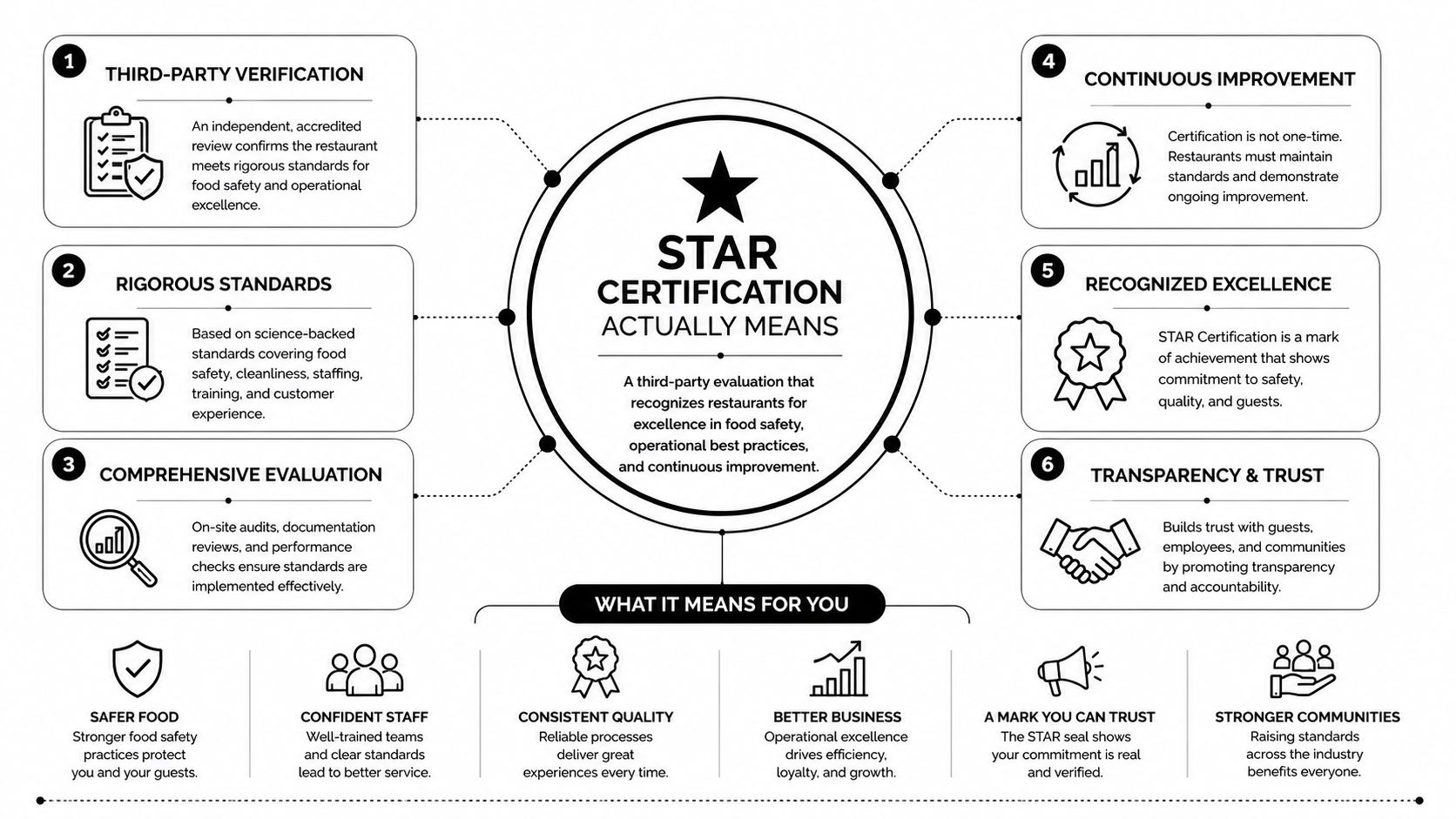
STAR certification is easiest to understand if you forget the acronym and think in service-counter terms. A STAR station is a shop the state trusts to handle inspections with a higher level of oversight, which is why it shows up for vehicles that need extra compliance confidence. It's not a different emissions law for the car, it's a different control level for the station.
That's also why STAR doesn't mean every part of the visit feels the same as every other shop. Some stations are test only, some are test-and-repair, and STAR is the state's way of deciding which stations belong in the stricter lane. For a driver, the useful takeaway is simple. If the DMV notice calls for STAR, you need the certified station type the notice asks for, not just any place with a smog sign out front.
The Bureau of Automotive Repair says the inspection usually takes about 30 minutes and that the station must charge a fixed $8.25 Smog Check certificate fee, while the inspection price itself is not regulated. That's the practical reason Oakland prices can look all over the map even when the certificate part is the same everywhere. A station can quote different labor pricing, but it still has to follow the same state certificate process.
The fee structure is split on purpose. The certificate fee is fixed, but the inspection labor price is set by the station.
See the STAR-station overview if you want the station type explained in plain language before you call around.
For a first-time customer, the confusing part is usually repairs. A regular smog shop may also do repair work, but STAR is about compliance control, not a promise that the car will be fixed there. If your vehicle fails, the next step is usually diagnosis and repair planning, not assuming the test station can be both the tester and the repair solution for every case.
Which Oakland Vehicles Get Routed to a STAR Station
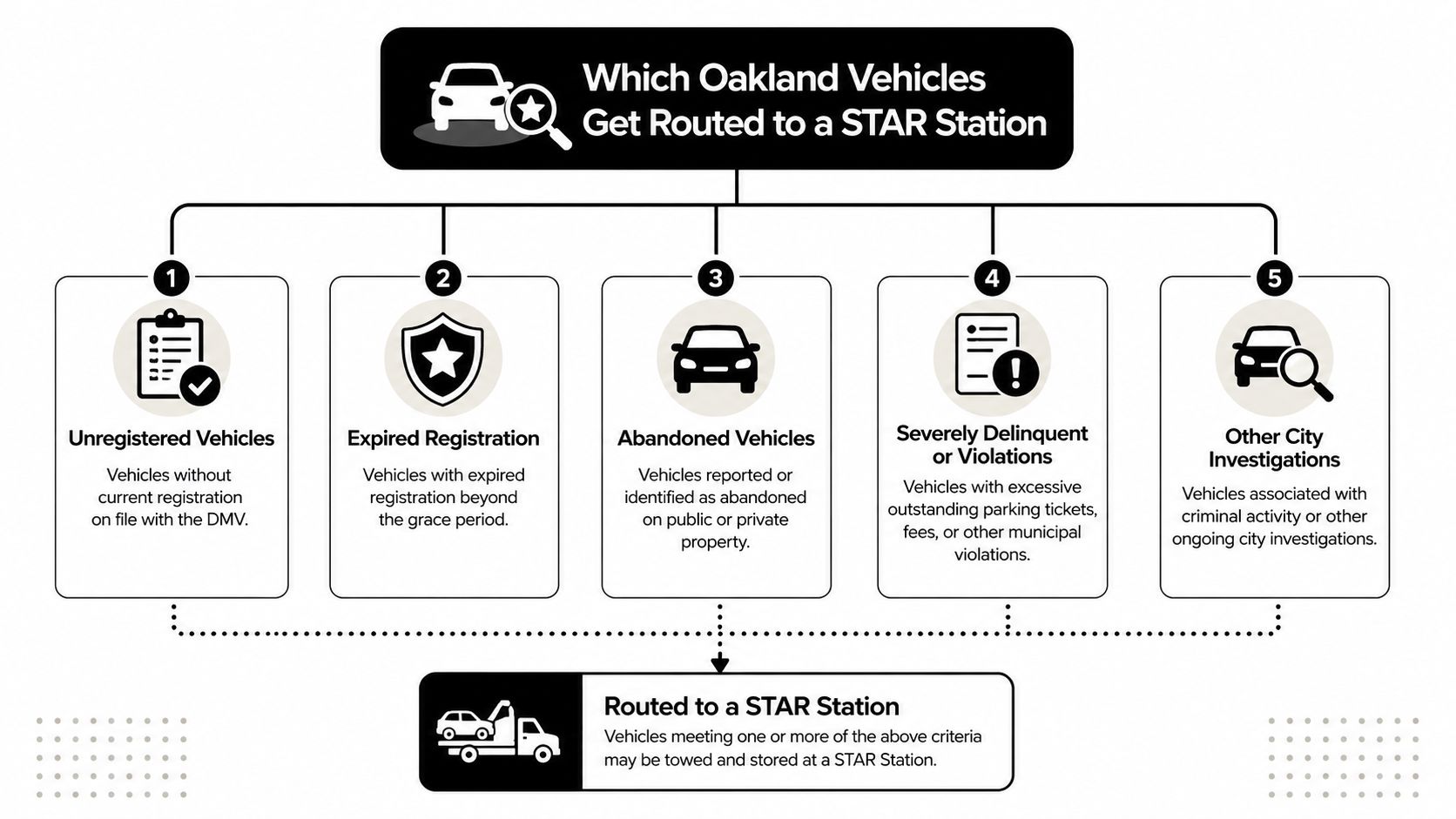
The cleanest way to think about STAR routing is this. The DMV notice tells you whether your car has been selected for the higher-compliance lane, and that notice wins over whatever your last station told you. California's smog manual also notes that some out-of-state 1976 model-year and newer vehicles registering in California for the first time need a Smog Check as part of initial registration, which is one of the situations where Oakland drivers can suddenly find themselves shopping for a compliant station instead of a convenient one. The same manual explains that STAR is about station performance, not a different emissions standard on the car itself.
For the test method, the split is straightforward. 2000-and-newer vehicles are typically checked through OBD-II readiness and MIL status, while 1999-and-older vehicles still require a tailpipe emissions test. BAR also states that a lit check-engine light is a fail condition, so if that lamp is on, the visit is already at risk before the technician plugs anything in.
The practical difference by vehicle age
If you drive a newer car, the test is often more about whether the onboard monitors are ready than about how dirty the exhaust looks at that exact moment. If you drive an older car, the inspection is more hands-on and the tailpipe portion matters directly. That's why a 1999 model and a 2000 model can feel like two different appointments even though they're both called a smog check.
Useful shortcut: if the check-engine light is on, don't treat the appointment as a coin flip. Get the fault read first.
Hybrids and diesels can add another layer of confusion, mostly because drivers hear those words and assume there must be a special STAR-only rule. The safer way to think about it is vehicle-specific routing plus the test method your car falls into. The notice decides the lane, and the vehicle's model year decides how the inspection is performed.
What Happens During the Test at an Oakland STAR Station
Most Oakland drivers want the same answer first, how long does this take, and what do I need in my hand when I walk in. Local Oakland listings show one station advertising service for 2000-and-newer vehicles at $69.75 plus the $8.25 certificate fee, while another Oakland STAR listing shows 895 Yelp reviews and a 4.8-star rating, which tells you the market is built around quick, repeatable visits rather than a long repair-day experience. One local provider also says STAR-certified inspections can be completed in about 15 minutes, which lines up with the short-visit model many drivers expect for newer cars.
The actual visit usually starts with paperwork and a quick confirmation that your vehicle matches the notice. After that, the technician checks the emissions-related items that apply to your model year, then performs the appropriate test path. For a newer vehicle, that often means the OBD-II connection and a check of readiness status. For an older vehicle, the tailpipe portion is still part of the process.
What to bring and what not to expect
Bring the DMV renewal notice, a valid ID, and a way to pay. Don't assume the station can ignore the vehicle class or model year just because you're in a hurry, because the test path is determined by the car, not by the line at the counter.
A STAR station is there to inspect the vehicle against state requirements, not to turn the appointment into a broad repair consultation. If the car fails, the next step is usually figuring out why, then deciding whether a repair visit makes sense before a retest.
Read the pass-the-test checklist if you want a practical pre-visit review without guessing at the obvious problems.
Oakland drivers usually save time by showing up with the car already warm, the notice ready, and the payment method sorted out.
That's also why local convenience matters so much. A fast station is useful only if it handles your vehicle type and the appointment doesn't turn into a second trip. The best-looking price on a website stops being cheap if the car isn't ready or the shop can't inspect it that day.
How to Prepare Your Vehicle and Avoid a Failed Visit
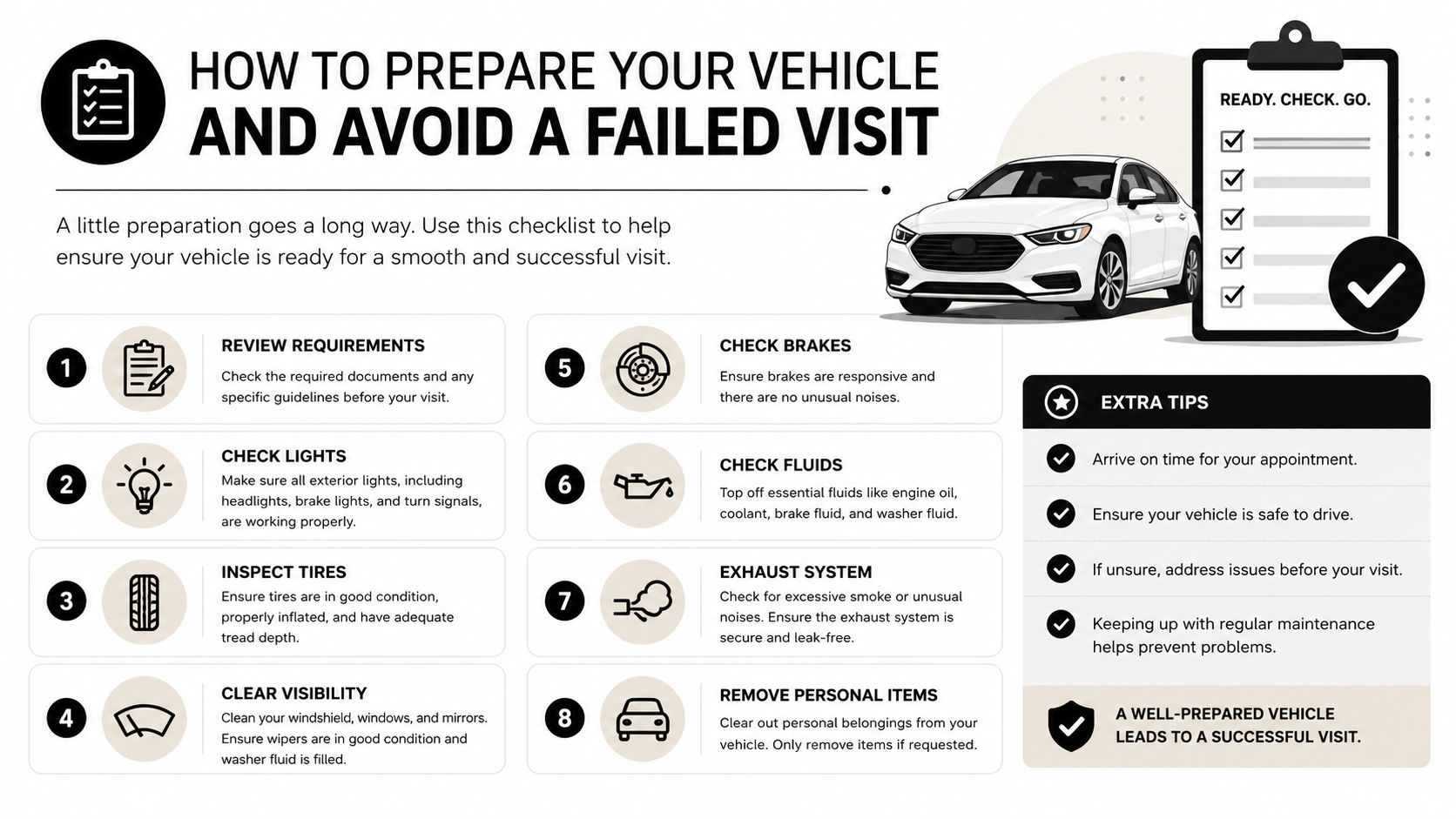
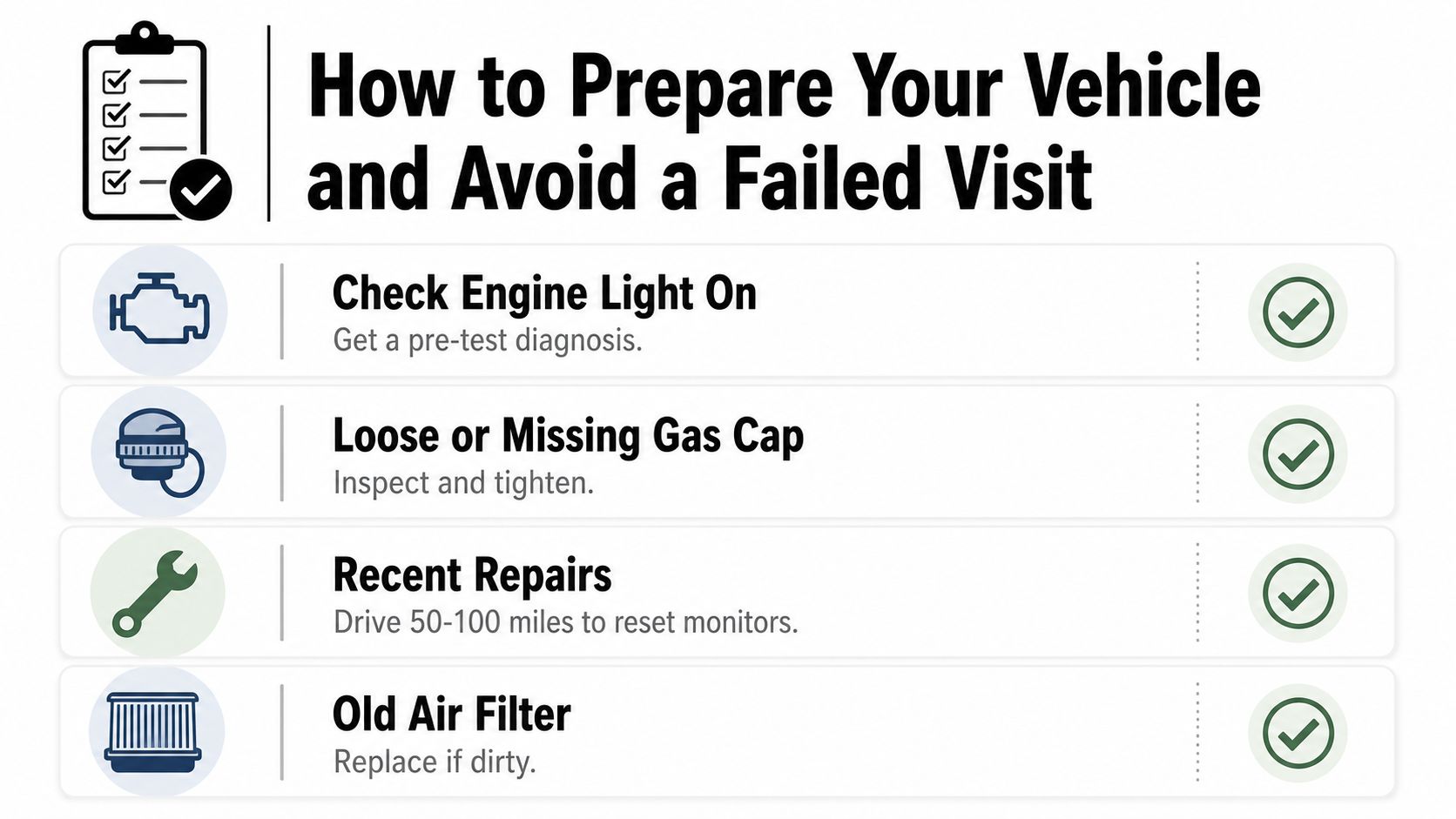
A failed STAR visit usually isn't a mystery when you look at the basics. BAR notes that after battery disconnects or repairs, readiness monitors may need one to two weeks of driving to reset, which is why a pre-test scan for readiness and diagnostic trouble codes is the most efficient way to avoid a wasted trip. If the car was recently serviced, that alone can explain a “not ready” result even when the engine feels fine on the road.
The easy thing to miss is that a car can run normally and still fail the inspection path. A loose gas cap, an unresolved check-engine issue, or incomplete readiness status can send you home without the certificate. That's why a quick under-the-hood check before the appointment matters more than a last-minute wash or vacuum.
Night-before checklist for Oakland drivers
- Check the dash: if the check-engine light is on, get a diagnosis first.
- Tighten the gas cap: a cap that doesn't seal properly can create a fault condition.
- Confirm the notice: make sure the DMV paperwork really calls for STAR.
- Think about recent repairs: if the battery was disconnected, the monitors may still need driving time.
- Warm the vehicle up: don't arrive with a cold engine and expect the best reading.
- Match the car to the test type: older cars, newer cars, diesels, and hybrids don't all go through the same exact path.
A five-minute check the night before can save you from paying for a repeat visit.
When Oakland drivers skip the prep step, they usually discover the problem at the station, not at home. That's the expensive version of learning the process. The smarter version is to treat the appointment like a compliance check, then use the car's own warning signs to decide whether it's ready.
Oakland STAR Stations, Pricing, and Hours Compared
Oakland's smog market is competitive, but the comparison only makes sense if you separate the fixed state fee from the shop's own price. The $8.25 certificate fee is the baseline everywhere, while the inspection price is what changes from one station to the next. That's why one Oakland listing can advertise $69.75 plus the certificate fee, while another shop leans on speed, convenience, or customer ratings instead of a single posted number.
| Station | Advertised Inspection Price | BAR Certificate Fee | Typical Turnaround | Oakland Access |
|---|---|---|---|---|
| Oakland STAR station with a large review base | Not stated in the verified data | $8.25 | Not stated in the verified data | Oakland-based |
| Oakland provider near San Pablo Avenue and 34th Street | $69.75 for 2000-and-newer vehicles | $8.25 | Not stated in the verified data | Near San Pablo Avenue and 34th Street, with access from I-580, I-880, and I-980 |
| Oakland shop advertising fast STAR inspections | Not stated in the verified data | $8.25 | About 15 minutes | Oakland-based |
The practical lesson is that price, speed, and access don't always point to the same station. A shop near the freeway might be better for an after-work run, while a different station may have stronger reviews or easier booking. If your renewal notice is STAR-specific, the right choice is the one that matches both the notice and your schedule.
Local hours matter more than most drivers expect, because some shops are closed on certain days and others are built around same-day traffic. That's why Oakland searches often end up being less about “the cheapest smog check” and more about “the shop that can handle my car today without a second appointment.”
Speedy Smog as a Convenient Option for Oakland Drivers
For Oakland drivers who want a nearby STAR-certified option without adding another long errand, Speedy Smog in San Leandro is set up around quick DMV-style visits. It's a STAR Certified station, it handles 2000-and-newer vehicles in about 10 to 15 minutes, and it also serves 1999-and-older vehicles, diesels, and hybrids, which makes it useful when the renewal notice and the vehicle type don't fit a one-size-fits-all shop. That matters in the East Bay, where the closest station isn't always the station that can process the car you brought.
The convenience piece is more than just speed. The shop is open Monday through Saturday, has a clean indoor waiting room, and emphasizes transparent pricing with periodic $25-off coupons for most newer-vehicle smogs. For a driver coming from Oakland, that can be the difference between a smooth lunch-break stop and a second trip after learning the wrong place couldn't complete the test path.
Why that combination matters
If your notice calls for STAR, the decision isn't only about the posted price. It's about whether the station can handle the right vehicle class, whether the hours fit your day, and whether you can get the certificate without wasting time on a shop that's closed or the wrong test type. Nearby, compliant, and fast is a better combination than “cheap on paper” if the appointment ends with a rebook.
Visit Speedy Smog if you want to book a STAR-certified smog check that lines up with an Oakland renewal notice, the right vehicle type, and a schedule that doesn't leave you stuck making a second trip.