
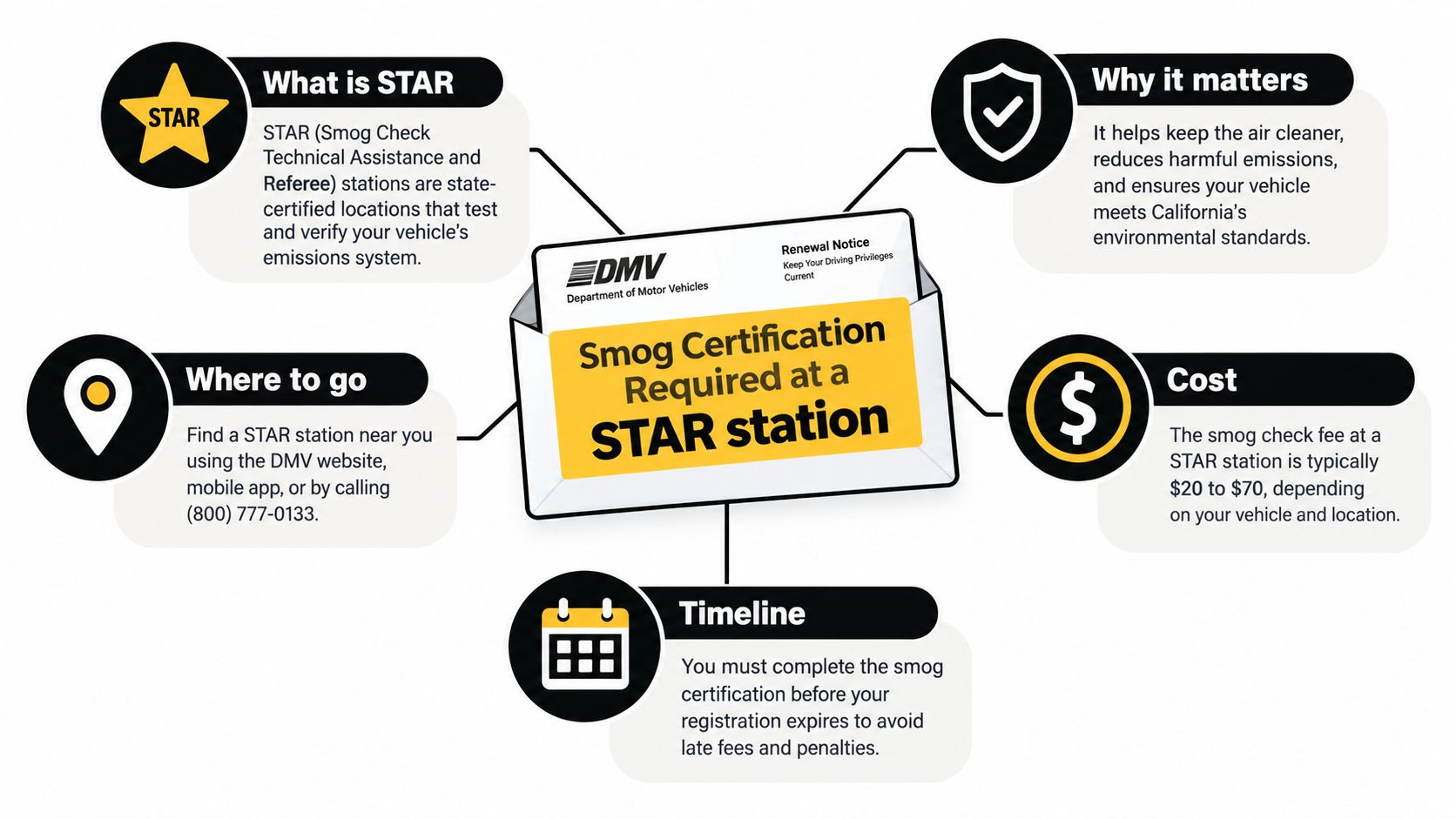
If your DMV renewal notice says “Smog Certification Required at a STAR station,” only an inspection at a STAR-certified location will satisfy the requirement. An ordinary licensed smog shop won't count.
You're probably holding that notice, checking your calendar, and wondering whether the shop around the corner can handle it. Before you drive over, check something just as important as STAR certification: does the station only test vehicles, or can it also diagnose and repair them? That distinction won't matter much if your car passes, but it matters a lot if it doesn't.
Table of Contents
- What a STAR Smog Check Actually Means for Oakland Drivers
- Why STAR Stations Exist and How Big the Program Is
- Which Vehicles and Renewals Get Routed to STAR
- Inside STAR Certification, Equipment and Performance Controls
- STAR Test-Only Versus STAR Test-and-Repair in Oakland
- How to Prepare Your Vehicle Before the Inspection
- Choosing a STAR Station and Planning Your Next Move
What a STAR Smog Check Actually Means for Oakland Drivers
STAR is a station certification, not just another name for a smog check. It tells you that the business participates in California's higher-performance inspection framework. For your renewal, the important question is whether the station has the authorization your notice requires.
California's Bureau of Automotive Repair, or BAR, established the voluntary, performance-based STAR program in 2013, replacing the former Gold Shield and Test Only structure, as described in the DMV's smog inspection guidance. Don't confuse that historical program change with today's station categories. A STAR-certified business can still operate as a test-only station.
Translate the wording before choosing a shop
A directed vehicle is a vehicle the state routes to a STAR station, typically after risk-based screening identifies a need for additional oversight. Treat that direction as a requirement about where the inspection happens, not as a diagnosis of what's wrong with your car.
My recommendation is straightforward: start with the renewal notice, not a coupon or a search result. When you're comparing results for STAR smog check Oakland CA, confirm the station's certification before asking about price or availability.
- Read the inspection wording. Find the smog requirement on your renewal notice rather than relying on what you remember from your last renewal.
- Confirm the location's status. Ask whether the specific location you'll visit is currently STAR-certified.
- Explain what you need. Tell the shop you have a STAR-directed renewal and identify your vehicle before heading over.
The notice is the starting point for the decision.
Don't read STAR as a promise that your car will pass. It describes the station's qualifications and authorization, not your vehicle's condition. A proper inspection gives you a result you can act on, even when that result isn't the one you wanted.
Why STAR Stations Exist and How Big the Program Is
STAR isn't a boutique designation used by a small corner of California's inspection industry. The program has handled a substantial share of statewide testing, which helps explain why the name appears so often in East Bay smog searches.
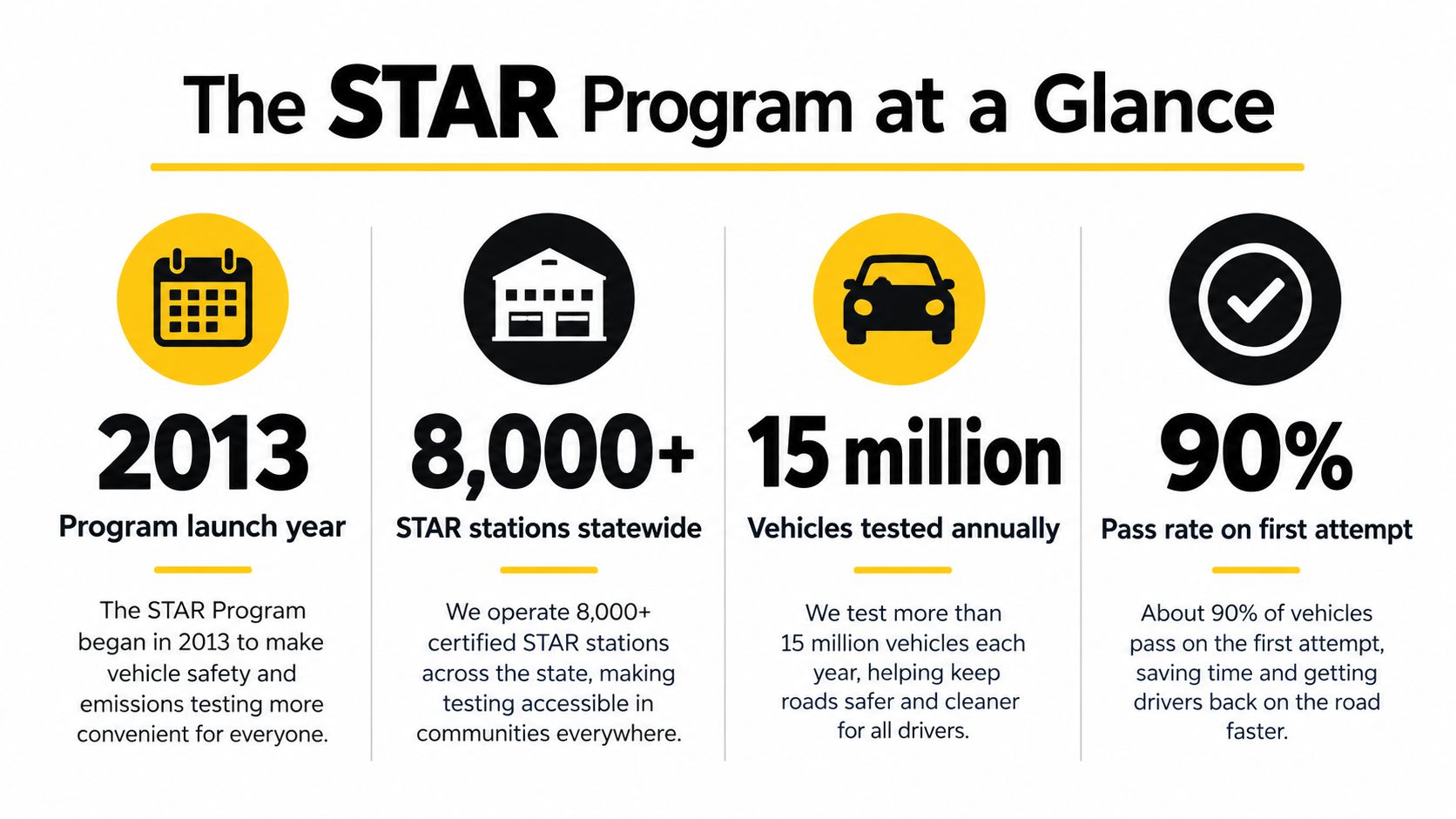
By December 2019, California had 7,902 licensed Smog Check stations, including 3,882 STAR-certified stations, or 49%; those STAR stations performed about 8.4 million of roughly 10.3 million initial inspections, approximately 82% of the statewide total, according to BAR's Smog Check performance report.
What that historical snapshot tells you
Fewer than half of the licensed stations handled more than four-fifths of the initial inspections in that reporting year. My reading is that STAR was already a central part of California's inspection infrastructure, not an unusual service drivers rarely needed.
That doesn't establish why every customer chose a particular station. The figures don't separate drivers following a DMV direction from drivers choosing STAR voluntarily. They also don't tell you how busy an Oakland shop is today or how long you'll wait.
Practical perspective: Use statewide figures to understand the program's importance, not to predict the queue at your neighborhood station.
The graphic provides a visual overview of the program. Use the dated BAR figures above, rather than illustrative totals in the graphic, for numerical comparisons.
For an Oakland driver, the useful distinction is ordinary licensing versus additional performance monitoring. BAR uses STAR to identify stations within that monitored framework and authorize them to inspect directed vehicles.
Don't turn inspection volume into a claim that every STAR business offers the same experience. Certification doesn't answer whether a shop performs repairs, publishes a clear price, or has an appointment available when you need it. Those are separate questions, and you should ask them directly.
Which Vehicles and Renewals Get Routed to STAR
Your neighbor's renewal isn't a reliable guide to yours. Neither is the fact that your vehicle is older, newer, diesel-powered, or a hybrid. Read your own notice before deciding what inspection to book.
The state's directed-vehicle screening explains why some renewals carry a STAR instruction, but you shouldn't try to reconstruct that decision from your car's age alone. A direction to STAR tells you where to go. It doesn't tell you which component will fail or whether a repair is necessary.
Check the notice, then identify the vehicle
Use this pre-booking checklist to keep the conversation with the shop specific:
- Find the smog requirement. Read the actual renewal wording, including the area around the barcode. Don't substitute a generic reminder email for the notice.
- Separate STAR from other wording. If your paperwork doesn't specify STAR, don't assume the extra requirement applies. If the instructions are missing or unclear, confirm them with DMV before buying an inspection.
- Describe the vehicle accurately. Give the station the model year, make, and fuel type so it can confirm that it handles the appropriate inspection.
- Flag uncertainty early. Tell the shop if you're unsure which notice belongs to the vehicle or whether you're handling a renewal rather than another registration situation.
For broader context, review these California smog check rules, then use your vehicle-specific paperwork to make the booking decision.
Bring the notice and keep the report
During the inspection workflow, the inspector scans the renewal-notice barcode so the correct vehicle identification and inspection data are transmitted to DMV. You receive a Vehicle Inspection Report, commonly called a VIR, for your records.
Keep that report where you can find it. It's useful documentation whether you're finishing the renewal process or discussing an unsuccessful inspection with another provider.
Don't leave with only a verbal explanation. Keep the written inspection result.
For owners of older cars, the sensible approach is to discuss existing problems before testing. For diesel and hybrid owners, confirm the station handles the vehicle rather than assuming every shop has the same capabilities. Newer-vehicle owners should still follow their own paperwork, not a blanket statement that newer cars never need inspection.
Inside STAR Certification, Equipment and Performance Controls
A STAR badge reflects technical requirements, not just a business's decision to advertise emissions testing. BAR evaluates equipment readiness and inspection-performance measures, which is why the designation deserves more attention than a storefront sticker.
Under BAR's STAR certification requirements, a certified station must maintain at least one operational BAR-certified BAR-97 emissions inspection system and BAR On-Board Diagnostic Inspection System, or BAR-OIS, and equipment requiring calibration must pass calibration at least once every 10 calendar days. The performance thresholds in the table are part of those same requirements.
STAR Certification Performance Thresholds
| Metric | Required Threshold | What It Means |
|---|---|---|
| Similar Vehicle Failure Rate | At least 50% of the industry-wide failure rate for comparable vehicles | BAR compares the station's failure results with a comparable-vehicle baseline. |
| Gear-shift incidents | No more than 2% | The station must stay within the permitted incident limit. |
| Excessive Test Deviation Rate | No greater than one | BAR limits excessive deviations in testing performance. |
| Follow-up Pass Rate | At least 0.40 for the station or each applicable inspector | Follow-up inspection performance contributes to STAR eligibility. |
Don't mistake the Similar Vehicle Failure Rate for a quota requiring an inspector to fail your car. It's a comparative station-performance measure, not a prediction about an individual vehicle. Likewise, the Follow-up Pass Rate isn't your personal probability of passing.
What the controls mean for a customer
The equipment requirement matters because a station needs the appropriate operational systems, not an inspector willing to take the job. Calibration matters because applicable equipment must remain within BAR's required checks. Performance monitoring adds another layer beyond the fact that a business holds an ordinary license.
My advice is to judge STAR as evidence of regulated inspection controls, not as a guarantee of flawless customer service. You still need clear communication about the inspection price, the vehicle types accepted, and what the station will do if the result is unsuccessful.
- Ask about your vehicle. Confirm the station can inspect its model year and fuel type.
- Ask about its service category. Equipment and certification don't establish whether repairs are offered.
- Expect a documented result. The inspection should leave you with something concrete to review, not just reassurance.
You don't need to audit a shop's performance calculations yourself. You do need to understand that STAR is technical, and that choosing the right station involves more than spotting the word on a sign.
STAR Test-Only Versus STAR Test-and-Repair in Oakland
A STAR station is not automatically a repair facility. This is the distinction I'd settle before making an appointment, especially if the vehicle already has a warning light, a previous unsuccessful inspection, or an unresolved concern.
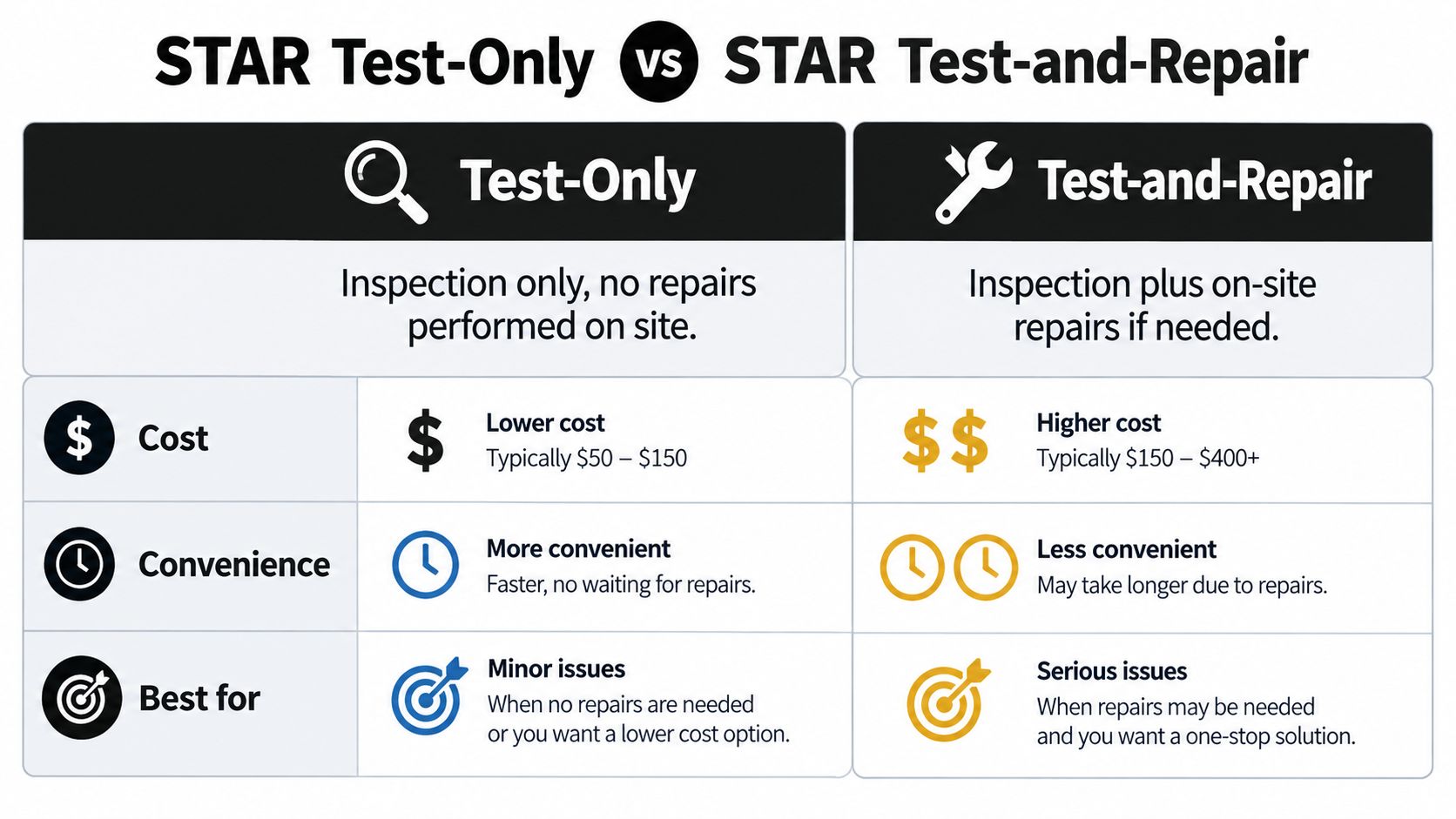
BAR distinguishes STAR test-only stations from STAR test-and-repair stations. Both categories can inspect directed vehicles, but test-only stations don't perform repairs, while test-and-repair stations combine inspection with repair services, as explained in BAR's Smog Check program guidance.
The practical difference is what happens after the result.
Choose based on the service you want
A test-only station makes sense when you want the inspection as a separate service and already have a repair provider you trust. If the vehicle fails, you'll need a separate repair plan. Don't expect the inspector to turn the visit into an on-site repair appointment.
A test-and-repair station makes sense when you want the possibility of diagnosis and repair at the same business. That can simplify coordination, but it doesn't mean you should authorize work without an explanation. Ask what diagnostic work is proposed, what it costs, and what the estimate includes.
| Your priority | Category to consider | Question to ask |
|---|---|---|
| Keep inspection separate from repairs | STAR test-only | What happens if the vehicle doesn't pass? |
| Seek inspection and repair at the same business | STAR test-and-repair | Can you diagnose this vehicle, and when is repair service available? |
| Avoid an unclear bill | Either category | What's included, and what would be charged separately? |
For a more focused comparison, use this explanation of STAR stations versus test-only stations. Don't choose by category alone, then forget to confirm the actual services available.
An unsuccessful test needs a plan
The equipment controls already discussed aren't optional. BAR warns that using the wrong inspection equipment can trigger a citation and order of abatement. A station shouldn't improvise a process just to accommodate the vehicle.
An unsuccessful result also doesn't mean the station can waive it or automatically repair the cause. Ask for an explanation tied to the written report before approving work.
Before authorizing repairs: Separate the inspection finding, the proposed diagnosis, and the repair estimate. They aren't interchangeable.
DMV identifies the BAR Referee Program as a next-step resource for failed-test customers and notes that eligible owners may receive repair help through the Consumer Assistance Program. Investigate those options when appropriate rather than assuming every unsuccessful inspection requires an immediate, open-ended repair authorization.
How to Prepare Your Vehicle Before the Inspection
Preparation starts with knowing whether you're bringing a vehicle for an inspection or bringing an unresolved problem that needs diagnosis first. Don't expect a quick visit to answer every maintenance question.
California recorded more than 11.2 million initial tests in 2025, with 959,667 initial failures, an 8.51% failure rate; STAR test-only stations performed 5,916,245 initial tests, with 481,639 failures, an 8.14% rate, according to BAR's statewide executive summary. Those figures establish that unsuccessful inspections occur, not that any particular preparation trick guarantees a pass.
A basic vehicle check is a sensible starting point.
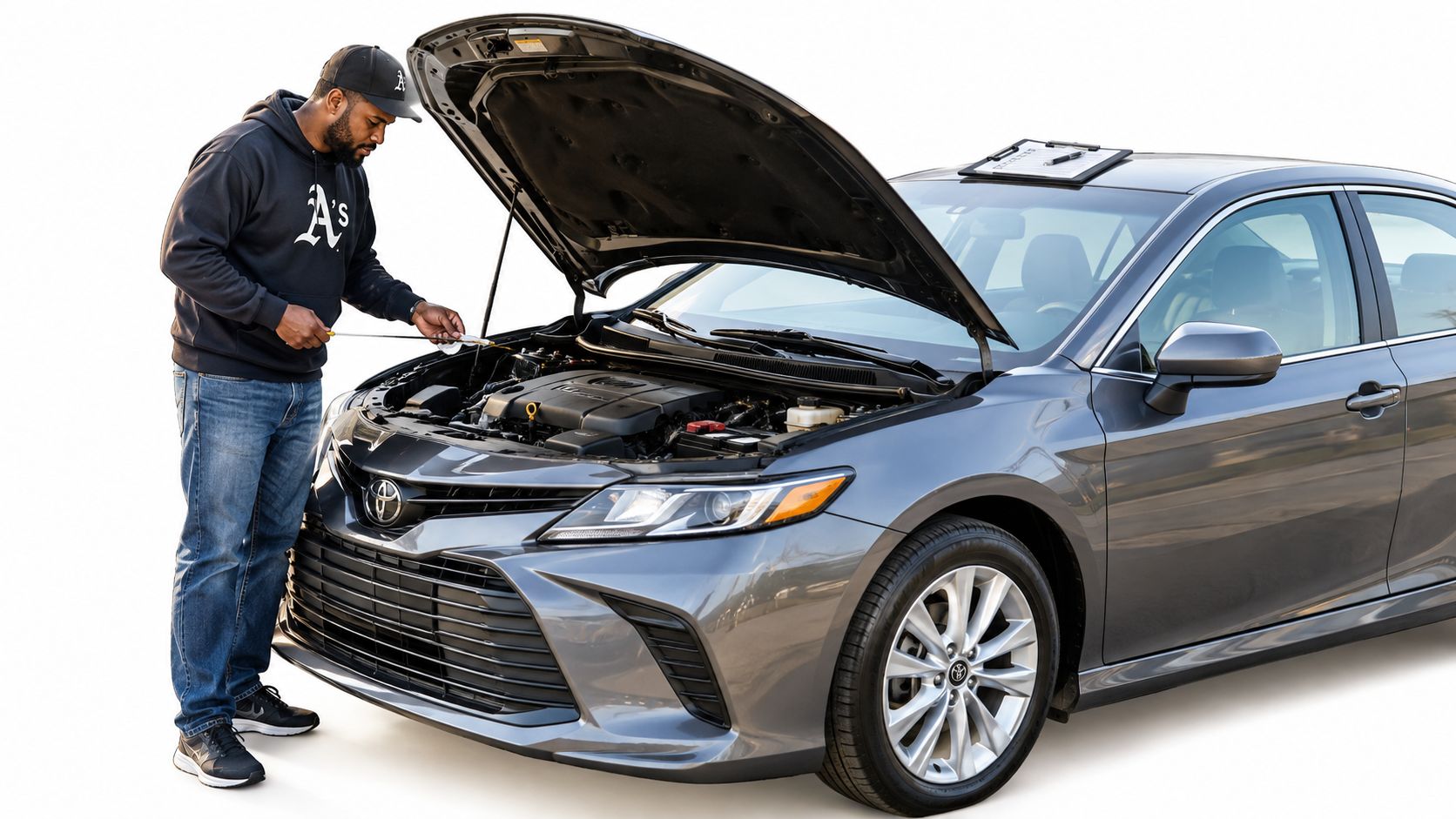
The day before your visit
- Discuss warning lights. If a dashboard warning is illuminated, tell the shop before booking. Ask whether diagnosis should come first rather than trying to hide the symptom.
- Review obvious maintenance concerns. Check for visible tire problems and, where applicable, a missing or damaged gas cap. Treat these as maintenance observations, not guaranteed explanations for a smog failure.
- Ask about arrival preparation. Get vehicle-specific advice on whether a normal drive before arrival is appropriate. Don't follow a universal warm-up routine copied from another vehicle.
- Gather your paperwork. Put the renewal notice somewhere you won't forget it, and bring relevant previous inspection or repair records.
For additional preparation guidance, consult this STAR smog test preparation guide before the appointment.
Use the video below as supplementary viewing, not a substitute for instructions specific to your car.
On the morning of the visit, ask about the current queue and total time you should allow. Inspection time and time at the shop aren't the same thing. Leave room in your schedule to hear the result and ask questions without rushing.
Choosing a STAR Station and Planning Your Next Move
Choose the station around the whole visit, not just the advertised inspection price. You need the correct authorization, the service category you want, and a clear explanation of what happens afterward.
An Oakland location may be convenient, while a nearby San Leandro station may fit your route better. Compare actual availability and services rather than assuming the closest search result is the right match.
Settle the practical details before driving over
- Get the complete price. Ask what's included, what's separate, and whether any advertised offer applies to your vehicle.
- Check the schedule. Confirm current weekday or Saturday availability and whether you need an appointment.
- Ask about waiting arrangements. If an indoor waiting area matters to you, verify it rather than relying on an old photograph.
- Establish the repair boundary. Know whether the business provides inspection only or can offer diagnosis and repairs.
After a passing result, keep your paperwork and confirm the remaining renewal steps. After an unsuccessful result, review the report and choose the next action deliberately: diagnosis, repair, or an appropriate state assistance resource.
A convenient inspection is useful. A clear plan for either result is better.
Don't leave this until the last moment if you can avoid it. Give yourself room to address a problem without making rushed decisions about repairs. The goal is a compliant renewal and a result you understand, not merely the shortest stop on your errands.
For Oakland drivers considering nearby San Leandro, Speedy Smog offers STAR-certified emissions testing with an indoor waiting area and service for older and newer vehicles, diesels, and hybrids. Visit its website to check current pricing and availability, then confirm your vehicle's inspection needs and the station's service scope before heading over with your DMV renewal notice.