A STAR certified smog check in California typically runs $50 to $90 total at the counter. The $8.25 certificate fee is fixed by the state, while the rest of the bill is set by the station.
You're probably asking because a registration notice, DMV renewal, or vehicle sale has put a deadline in front of you. You call one shop and hear a low advertised price. Another shop quotes more. Then someone mentions that your vehicle must visit a STAR station, and the whole process starts sounding more expensive than it should.
As a San Leandro shop owner, I've seen the same confusion for years. Drivers often treat STAR as a premium brand or assume the state controls the entire bill. It doesn't. The certificate fee is regulated. The inspection price is not. Your vehicle's year, fuel type, inspection category, and the station's own pricing policy determine the rest.
Table of Contents
- What You Actually Pay at the Counter
- Why STAR Certification Exists and How It Shapes the Inspection
- The Three Factors That Drive STAR Pricing Up or Down
- San Leandro and East Bay Pricing in Real Situations
- Hidden and Surprise Charges Worth Watching For
- Discounts, Coupons, and Smart Ways to Lower the Final Bill
What You Actually Pay at the Counter
Standing at the counter, ask for one number: the total amount due if the vehicle passes. Don't settle for an advertised starting price until the employee explains what that price includes.
The California Bureau of Automotive Repair states that the Smog Check certificate fee is fixed at $8.25, and a station must charge it when the vehicle passes inspection. BAR also says inspection prices themselves aren't regulated, so each station can set its own charge. That distinction is the foundation of the California smog check price guide.
The station's charge pays for the actual inspection service. Depending on the vehicle, that can include the visual emissions inspection, an OBD system check, required emissions testing, technician labor, and electronic reporting. The $8.25 certificate fee doesn't pay for the technician's time or the equipment used to inspect your car. It pays for the state certificate attached to a passing result.
BAR's statewide reporting shows why the final bill usually sits far above the certificate fee. In one 2026 reporting period, STAR Test-and-Repair inspections averaged $77.93, while STAR Test Only inspections averaged $66.70. BAR's 2025 summary listed a STAR Test-and-Repair inspection-only average of $75.79 and an overall average of $69.22 when transactions were combined. Those figures cover the market-driven inspection portion and demonstrate how much more the station charge can be than the certificate itself. (California BAR Smog Check information)
| Cost Component | Amount | Who Sets It | What It Covers |
|---|---|---|---|
| State certificate fee | $8.25 | California BAR | The certificate issued after a passing inspection |
| Station inspection charge | Varies by station and vehicle | The station | Inspection labor, equipment, and required testing |
| Optional transaction charges | Varies | The station, subject to applicable rules | Possible electronic transmission or related service charges |
| Final customer bill | Commonly falls in the $50 to $90 range | The combined pricing structure | The complete amount paid at the counter |
Practical rule: Ask, “What is my total price, including the certificate fee and every required charge, if the car passes?”
A reputable shop should answer before starting the inspection. If the employee only repeats “starting at” pricing, ask what changes the price for your exact vehicle. That question usually tells you more than the STAR label on the sign.
Why STAR Certification Exists and How It Shapes the Inspection
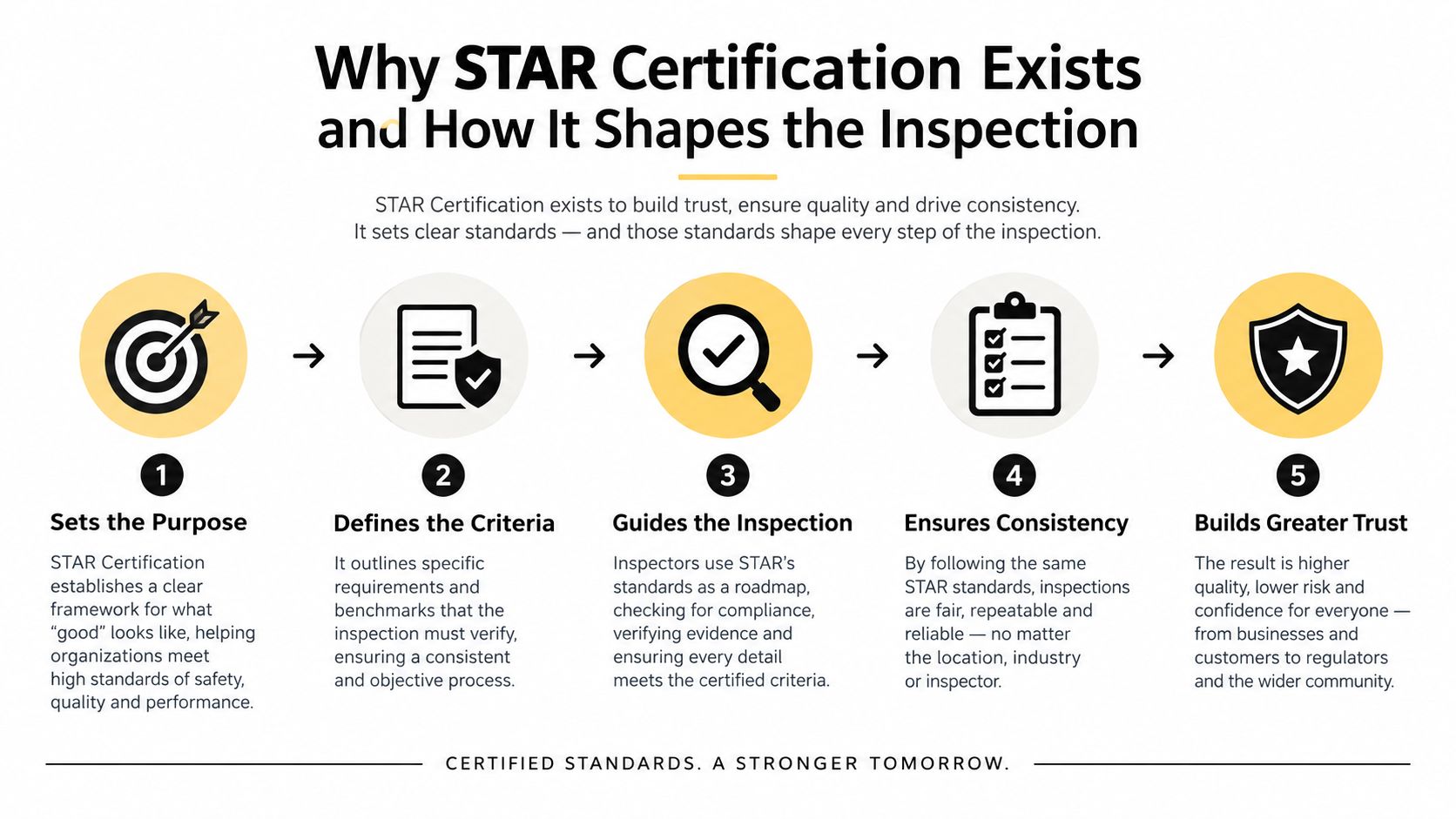
STAR certification isn't a premium inspection brand. It's a performance-based designation created by the California Bureau of Automotive Repair for qualifying Test Only and Test-and-Repair stations.
BAR ties the designation to measurable performance requirements. A station seeking STAR certification must meet thresholds that include a Similar Vehicle Failure Rate of at least 50% of the industry-wide failure rate for similar vehicles, a Gear Shift Incident rate no greater than 2%, and an Excessive Test Deviation Rate of no more than one. BAR also requires a Follow-up Pass Rate score of at least 0.40 before a station becomes eligible. (BAR STAR certification requirements)
Those figures matter because they show what STAR is designed to control. The program evaluates whether a station performs inspections consistently and identifies vehicles that need attention. It doesn't create a separate retail price schedule, and it doesn't mean every STAR station charges the same amount.
Some vehicles are directed to STAR stations by the DMV or BAR because they need a compliance-sensitive inspection. In that situation, STAR isn't optional. The station must be approved for the required inspection category, and the driver should follow the instructions on the notice rather than choosing a cheaper station that can't issue the needed certificate.
What changes for the driver
The core testing steps will look familiar. A technician still checks the vehicle's emissions equipment and runs the required computerized or emissions test. STAR adds a stricter oversight framework around the station's work, not a mysterious new type of engine test.
That's why I tell customers to separate inspection quality from retail price. A STAR station can charge a reasonable market price, but the designation itself doesn't guarantee a discount. Before booking, confirm that the station accepts your vehicle's inspection requirement and ask for the out-the-door price.
For a plain-language explanation of the designation, see what a STAR smog station does. The most useful question isn't “Is STAR more expensive?” It's “What does this station charge for my vehicle and inspection type?”
The Three Factors That Drive STAR Pricing Up or Down
A STAR badge does not set one flat price. At the counter, the total usually comes from three separate factors: vehicle age, vehicle type, and station classification. The state certificate fee is regulated, while the station's inspection charge is not. Your vehicle and the required test determine whether the STAR premium is justified or mostly a marketing label.
Vehicle year affects the work involved
Newer gasoline vehicles commonly receive an OBD-based inspection. Older vehicles may require a more involved process, with different equipment, procedures, and technician time. Those differences can raise the station's charge even when the required certificate is the same.
For newer vehicles, independent listings show some stations advertising $40 to $70. The advertised amount may include the certificate fee, or it may leave that state charge out. Ask for the complete total before booking, including the $8.25 certificate fee. Example STAR station pricing information
A low advertised price is useful only when you know what it covers.
Fuel type changes the quote
Diesel vehicles should not be priced from a gasoline-car advertisement. Diesel inspection requirements and equipment can differ, so call with the fuel type, model year, and vehicle classification before driving to the station. A gasoline promotion may exclude diesel testing.
The same rule applies to hybrids. A hybrid may use an OBD-based inspection, but the station must confirm that it can perform the required test for that vehicle. Ask whether the quoted price covers the exact vehicle and inspection category rather than assuming a standard gasoline offer applies.
Station classification matters
BAR reporting separates STAR Test Only stations from STAR Test-and-Repair stations. In the cited 2026 report, STAR Test Only averaged $62.36, with a $50.86 25th percentile and a $58.06 median. BAR cautions that reported customer-paid costs may include discounts and may not represent the full inspection cost, so a coupon can change the final bill. (BAR March 2026 executive summary)
| Cost Driver | Low-End Price | High-End Price | Why It Changes |
|---|---|---|---|
| Newer gasoline vehicle | Advertised listings commonly $40 to $70 | Station-specific; confirm whether the $8.25 certificate fee is included | OBD-based testing can be priced differently from older testing |
| Older gasoline vehicle | Varies | Varies | Equipment, labor, and inspection procedure can differ |
| Diesel vehicle | Quote required | Quote required | Fuel type and inspection requirements affect station workload |
| STAR Test Only | BAR-reported median of $58.06 | BAR-reported average of $62.36 | Test Only stations perform inspections without repair work |
| STAR Test-and-Repair | BAR-reported statewide averages above Test Only in the cited periods | Varies by station | Station category and transaction mix affect pricing |
Give the station the full vehicle details first. That means fuel type, model year, vehicle classification, and whether the DMV directed the inspection. A firm quote that ignores those details is incomplete. Ask for the out-the-door price and confirm that the regulated certificate fee is included.
San Leandro and East Bay Pricing in Real Situations
Customers often want a city-by-city price map. The East Bay doesn't work that neatly. San Leandro, Oakland, Hayward, Fremont, and nearby communities have independent stations with different equipment, workloads, coupons, and inspection categories. A station a few miles away may charge more or less for reasons unrelated to the city name.
Consider two appointment types without pretending that either has a guaranteed price.
A newer gasoline hybrid arriving with a routine renewal usually belongs in the more straightforward OBD-based conversation. The driver should ask whether the station's advertised price includes the $8.25 certificate fee, whether any discount applies, and whether the vehicle has a special DMV direction. A STAR requirement may come from the vehicle's registration situation, not from the car being costly to inspect.
A much older diesel truck is a different appointment. The driver should provide the model year, fuel type, and vehicle classification before arriving. The station may need different equipment or procedures, and a gasoline-car promotion may not apply. The correct price is the one quoted for that exact truck, not the price printed for a standard newer vehicle.
| Vehicle Type | San Leandro | Oakland or Hayward | Fremont | Walnut Creek |
|---|---|---|---|---|
| Newer gasoline vehicle | Ask for a total including the certificate fee | Compare the complete quote | Compare the complete quote | Compare the complete quote |
| Hybrid | Confirm STAR eligibility and applicable offer | Confirm vehicle-specific pricing | Confirm vehicle-specific pricing | Confirm vehicle-specific pricing |
| Older gasoline vehicle | Expect a vehicle-specific quote | Expect a vehicle-specific quote | Expect a vehicle-specific quote | Expect a vehicle-specific quote |
| Diesel vehicle or truck | Call before arrival | Call before arrival | Call before arrival | Call before arrival |
The BAR data gives a better anchor than neighborhood folklore. STAR Test Only pricing in the March 2026 report ranged from the reported 25th percentile of $50.86 to the statewide average of $62.36, with discounts potentially affecting the customer-paid amount. That spread exists inside the STAR category itself.
A cheap advertised price is useful only when you know whether it includes the certificate fee and applies to your vehicle.
Map your own situation using three facts: vehicle year, fuel type, and inspection category. Then request the full total from two or three stations. That process is more reliable than assuming every East Bay location follows the same price sheet.
Hidden and Surprise Charges Worth Watching For
The most common misunderstanding starts with the certificate fee. Some drivers see a low inspection price and assume the state charge is included. Others see $8.25 added at the bottom and think the station invented it. BAR says the certificate fee is fixed and must be charged when the vehicle passes. The station's inspection price is separate and unregulated.
Electronic transmission or transaction charges may also appear. BAR's pricing information notes that additional electronic transmission fees can affect the final bill, but the amount isn't a statewide fixed figure in the verified data. Ask whether the quoted total includes every required electronic reporting charge.
Ask about these items before authorization
- Certificate fee: Ask, “Is the $8.25 state certificate fee already included in the quoted total?”
- Electronic transmission charge: Ask whether the station adds a separate fee for submitting the result electronically.
- Retest policy: Ask whether a failed first inspection qualifies for a reduced retest price and what conditions apply.
- VIN verification: Ask whether incomplete paperwork, an unreadable VIN, or a separate verification request creates another charge.
- Pre-inspection or diagnostic work: Ask whether the shop will charge you for checking the vehicle before performing the official inspection.
- Vehicle-specific pricing: Confirm that the price applies to your year, fuel type, hybrid system, or truck classification.
- Coupon restrictions: Ask whether the discount includes the certificate fee, applies to STAR inspections, and covers a directed vehicle.
A station can set its inspection price, but that doesn't mean every fee deserves a vague explanation. The quote should distinguish the state certificate from station services and optional work. If an employee says, “We'll know after we start,” ask what could change the price and whether you can decline additional work.

A failed inspection is another point where customers lose control of the bill. The official test result and any later repair or diagnostic work are separate decisions. Don't authorize repairs just because the vehicle failed. Ask for the failure details, the retest price, and a written repair estimate before approving anything.
The practical standard is simple: no surprise line items. If the station can't explain the charge before the inspection, choose another station.
Discounts, Coupons, and Smart Ways to Lower the Final Bill
The easiest way to cut a STAR certified smog check price is to reduce the station charge, while keeping the required inspection intact. Coupons can help, and BAR notes that reported customer-paid prices may include discounts, so the number you see in a report is not always the number you will pay. Compare the final total, not the headline price.
Start with the station's own website, then check local deal pages, email offers, and direct mailers. Read every restriction before you go. Some coupons apply only to certain vehicle years or inspection types, and some separate the station charge from the certificate fee.

Use this pre-payment checklist
- Certificate fee: Is the fixed state certificate charge included?
- Transmission fee: Is electronic submission billed separately?
- Retest policy: What happens if the vehicle fails the first test?
- VIN verification: What condition triggers an extra verification charge?
- Payment timing: Do you pay before the result, or after the station completes the test?
- Failed inspection rules: Is any portion refundable if the vehicle does not pass?
- Additional diagnosis: Does the original quote stay valid if the shop recommends diagnostic work?
Compare Test Only stations with Test-and-Repair stations too. The statewide averages are different, but the cheapest category is not automatically the right choice if your DMV notice directs you to a specific STAR inspection type.
For local offers and current terms, review STAR certified smog check coupons. Bring the coupon up before the technician starts, and ask for the final total out loud. That avoids the usual billing argument, where the customer and the station are working from different definitions of “price.”
The rule is simple. Confirm the inspection category, ask for the total including $8.25, and compare two complete quotes. STAR certification can be required and worth paying for, but it is no reason to accept an unexplained premium.
Most California vehicles more than five model years old need a smog inspection every two years for registration renewal, while newer vehicles from the 2000 model year onward generally use an OBD test that takes about 10 to 15 minutes at a certified station such as Speedy Smog in San Leandro. The exact requirement depends on your vehicle, fuel type, model year, and the wording on your DMV renewal notice.
You may be looking at that notice right now, wondering whether you need a regular smog station or a STAR station, whether your hybrid is exempt, or what will happen when you arrive. A vehicle smog inspection sounds technical, but the basic idea is simple. California checks whether your vehicle's emissions-control system is working well enough for registration compliance.
The easiest way to understand the process is to follow the same path your vehicle takes, from the DMV notice to the inspection lane, test result, and possible repair.
Table of Contents
- What Is a Vehicle Smog Inspection in California
- Types of Smog Tests and What Applies to Your Vehicle
- Understanding STAR Certification and Why It Matters
- What to Expect at Your Smog Check Appointment
- Smog Failure Rates by Vehicle Age and What They Reveal
- Exemptions, Preparation Tips, and Steps After a Failure
What Is a Vehicle Smog Inspection in California
A San Leandro driver might receive a registration renewal notice, see “Smog Certification Required,” and assume every inspection works the same way. Another driver may see “Smog Certification Required at a STAR station” and wonder whether STAR is a special repair shop, a more expensive test, or just another name for a regular station.
It's none of those things. A smog inspection is an emissions compliance test, and the station checks your vehicle according to its model year and the requirements attached to your registration record. The result is sent through the state's inspection system so the DMV can confirm that the emissions requirement has been met.
California's Smog Check program has operated since 1984 and the state credits it with greatly reducing air pollution from millions of vehicles. Today, the system handles more than 10 million vehicle tests each year at thousands of independently owned stations statewide, as described in the California Bureau of Automotive Repair Smog Check FAQ.
Why California requires the inspection
The inspection connects vehicle ownership with air-quality rules. For most vehicles more than five model years old, a passing result supports biennial registration compliance, meaning the requirement commonly appears every two years during renewal. The state has updated the program as vehicles changed. Older inspections relied more heavily on measured exhaust, while newer vehicles can report emissions-system problems through onboard diagnostics.
That shift makes the test less mysterious. Your car isn't being judged by a mechanic's personal opinion. The technician follows a state procedure designed for the vehicle's model year and equipment.
Who usually needs a test
Most gasoline vehicles eventually enter the regular inspection cycle, but exemptions and special rules apply. Newer gasoline, hybrid, and alternative-fuel vehicles may be exempt from the biennial test for eight model years, while the DMV notice remains the most useful starting point for your specific renewal.
If you want a local overview before booking, this guide to smog checks in California explains the registration connection and common vehicle categories. Bring the renewal notice if you have it. Its wording can tell you not only whether certification is required, but also what type of station you must use.
Types of Smog Tests and What Applies to Your Vehicle
The model year usually determines the inspection pathway. Think of a newer vehicle as having a built-in health monitor, while an older vehicle must demonstrate its emissions performance more directly through the exhaust.
Vehicles from 2000 onward
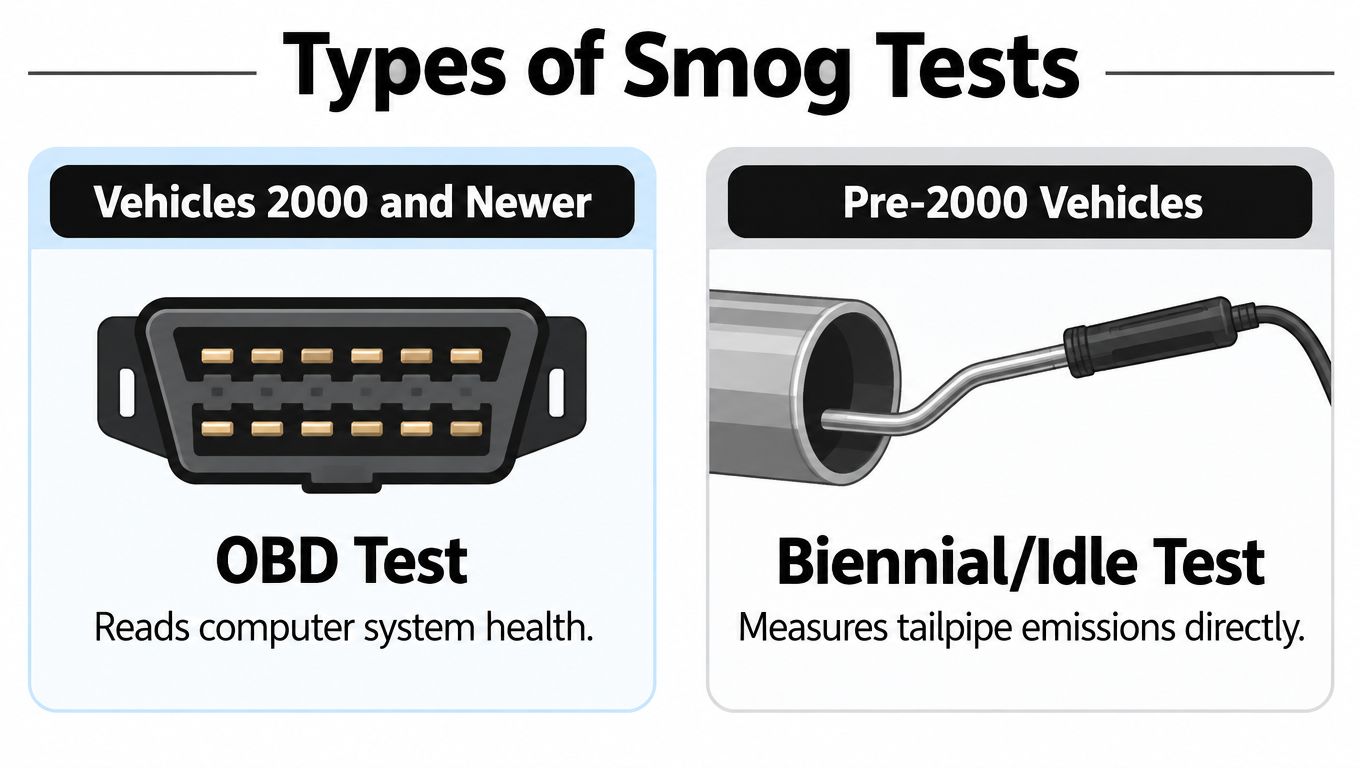
For 2000-and-newer gasoline vehicles, the standard route is generally an onboard diagnostic, or OBD, test. A technician connects equipment to the vehicle's diagnostic port and checks whether the emissions-control computer has detected faults, whether warning indicators are behaving correctly, and whether the required system monitors are ready.
That's similar to plugging a scan tool into the car's brain. The technician isn't just asking whether the engine runs. The test checks whether the systems responsible for controlling emissions have completed their self-checks and whether the computer has stored a relevant fault.
The state's Smog Check testing overview explains that 2000-and-newer gasoline vehicles are generally inspected through OBD, while older vehicles use a different method.
Vehicles from 1999 and earlier
Vehicles from 1999 and earlier are generally routed to tailpipe-based testing. The station uses the BAR-97 emissions inspection system to measure exhaust emissions directly, rather than relying primarily on the vehicle's onboard computer.
The analogy is straightforward:
| Vehicle group | Main inspection approach | What the technician evaluates |
|---|---|---|
| 2000 and newer gasoline vehicles | OBD test | Emissions-system computer information |
| 1999 and older vehicles | Tailpipe testing with BAR-97 | Measured exhaust emissions |
A tailpipe test can feel more physical because equipment measures what comes out of the exhaust. That doesn't mean the process is automatically more difficult. It means the state uses a testing method suited to an older vehicle fleet.
Hybrids, diesels, and alternative-fuel vehicles
A hybrid isn't automatically exempt just because it can drive on electric power. Its eligibility depends on the vehicle's model year and the applicable California rules. Newer hybrids may fall within the eight-model-year exemption, but an older hybrid can still require inspection.
Diesel vehicles also need to be classified correctly. The required procedure can differ from a gasoline vehicle, so the safest approach is to check the DMV notice and confirm the station handles your vehicle type before arriving. Fuel system, model year, and registration circumstances matter more than a simple label such as “car,” “truck,” or “hybrid.”
Practical rule: Use the renewal notice and the vehicle identification details to determine the inspection path. Don't guess based only on the dashboard, fuel door, or the fact that the vehicle is newer than another car.
Understanding STAR Certification and Why It Matters
The STAR question usually has a simple answer: follow the exact wording on your DMV renewal notice. If it says “Smog Certification Required,” you can generally choose an authorized station that performs the required inspection. If it says “Smog Certification Required at a STAR station,” the inspection must happen at a STAR station.
That distinction matters because a non-STAR station can't substitute for a required STAR inspection. A STAR station isn't merely a shop that chose a particular marketing label. It holds a designation controlled by the California Bureau of Automotive Repair.
What STAR means
BAR evaluates STAR stations using inspection-volume and quality measures. The requirements include a Similar Vehicle Failure Rate of at least 50 percent of the industry-wide failure rate for similar vehicles and a Follow-up Pass Rate threshold of 0.40, according to BAR's STAR certification requirements.
Those measures are intended to make station performance accountable. A station shouldn't fail vehicles indiscriminately, and it shouldn't pass vehicles that need emissions-related attention. BAR uses the metrics to evaluate whether a station consistently identifies vehicles that genuinely require repair.
A simple decision tree
Use this order:
- Read the DMV renewal notice. Look for the exact smog wording.
- Check whether STAR is specified. If it is, choose a STAR-certified station.
- Confirm the station handles your vehicle. Ask about model year, fuel type, and test method.
- Bring the vehicle and notice. The technician can verify the required inspection in the state system.
The difference between a regular authorized station and a STAR station isn't necessarily the test technology. Both follow state procedures, and the appropriate method still depends on the vehicle. The difference is whether the station meets the performance controls attached to STAR certification and whether your notice requires that designation.
For a more detailed explanation of the designation, see this guide to what a STAR smog station is. Choosing the correct station first prevents one of the most frustrating outcomes, completing an inspection that doesn't satisfy the DMV requirement.
What to Expect at Your Smog Check Appointment
A first appointment is usually less dramatic than drivers expect. You pull into the station, provide the vehicle information and renewal notice, and let the technician follow the correct procedure for your car.
Start with check-in
Have your DMV renewal notice, current registration information, and the vehicle available for inspection. The notice helps the technician confirm whether you need a standard inspection or a STAR inspection. If you recently moved, bought the vehicle, or are dealing with an out-of-state registration issue, mention that at check-in.
The technician will identify the vehicle and select the applicable inspection procedure. You don't need to know the technical test code yourself. Your job is to provide accurate information and explain any recent dashboard warning lights or emissions repairs.
The technician checks more than the exhaust
The inspection can include a visual review of emissions-related components, a check of warning indicators, and the prescribed electronic or tailpipe test. For a newer gasoline vehicle, the technician connects to the OBD port and reviews the computer's emissions information. For an older vehicle, the BAR-97 equipment measures exhaust output through the tailpipe.
A warning light deserves attention before the appointment. If the check-engine light is on, the vehicle may fail because the computer is reporting an emissions-related problem. Clearing the light immediately before testing isn't a reliable fix, because the system may need to complete its monitors before the vehicle can be evaluated properly.
Before you arrive: Tell the technician about recent battery replacement, computer resets, warning lights, or emissions repairs. Those details can affect the vehicle's readiness information.
For many 2000-and-newer vehicles, a typical OBD inspection at Speedy Smog in San Leandro takes about 10 to 15 minutes, although the actual time can vary with the vehicle and station workload. The shop describes a clean indoor waiting area and a process intended to keep the visit straightforward.
Once the inspection is complete, the station records the result. A pass supports the DMV registration process. A failure should come with information about the reason for failure, so you can decide whether to repair the issue at the station, visit a repair shop, or obtain a second diagnostic opinion.
Here's what the basic flow looks like in practice:
- Check in: Provide the renewal notice and vehicle details.
- Identify the procedure: The technician confirms STAR status and test type.
- Inspect the vehicle: The station checks the applicable emissions components and equipment.
- Run the test: The vehicle receives an OBD or tailpipe-based inspection.
- Receive the result: The station records a pass or provides failure information.
A comfortable waiting room can make the appointment easier, but the important part is procedural accuracy. The result needs to match the vehicle, the registration requirement, and the state's inspection rules.
Smog Failure Rates by Vehicle Age and What They Reveal
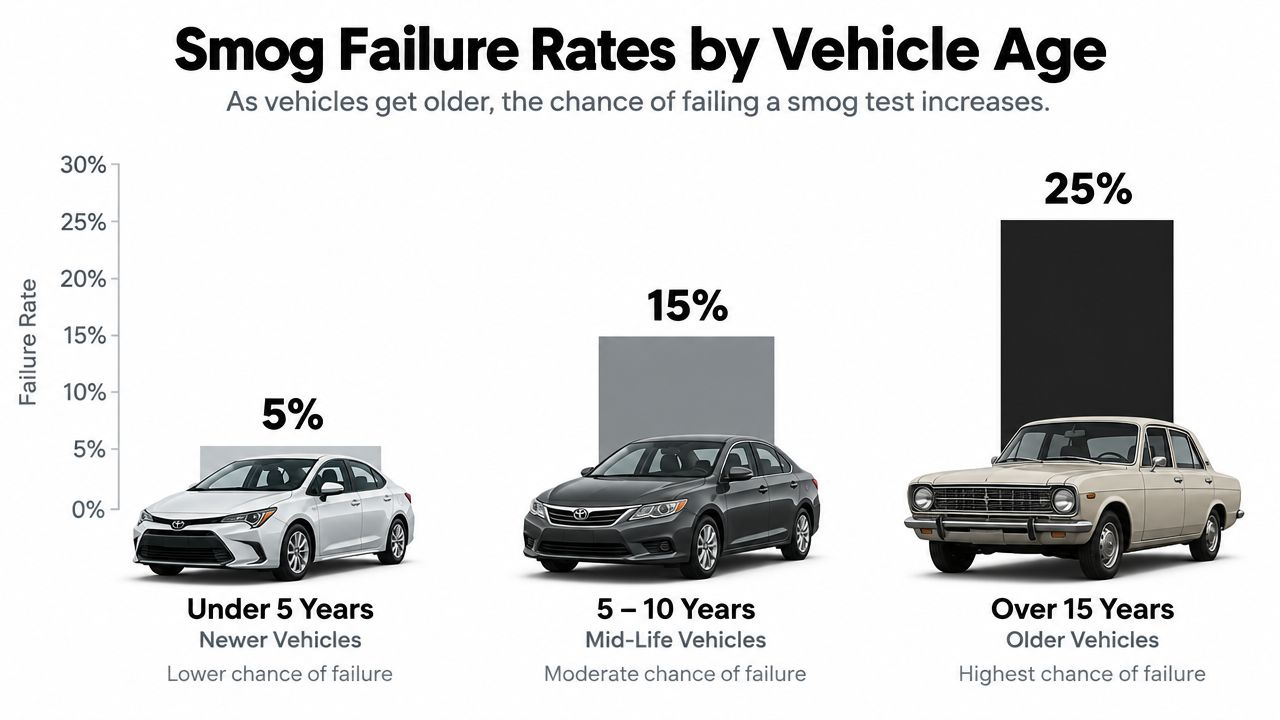
Drivers often treat a failed smog test as random bad luck. California's recent inspection data point to a more predictable pattern. Vehicle age has a strong relationship with failure outcomes, although maintenance history, emissions-system condition, and the specific fault still matter.
In the January 2026 executive summary, 2025 model-year vehicles had an overall failure rate of 0.23 percent, while 2024 model-year vehicles failed at 4.52 percent and 2023 model-year vehicles failed at 4.36 percent. The same report recorded a 22.18 percent failure rate for 1976 model-year vehicles, showing the much steeper challenge faced by older vehicles. These figures come from the California BAR Smog Check executive summary for 2025.
Why age changes the odds
Older vehicles have had more time for sensors, vacuum lines, catalytic converters, ignition parts, and other emissions components to wear out. They may also have accumulated years of incomplete maintenance or modifications that affect the original emissions system.
Newer vehicles aren't guaranteed to pass, but their failure rates in the reported data are much lower than those of older model years. That doesn't make preparation unnecessary. It means preparation should focus on known warning signs rather than assuming every inspection is a crisis.
The statewide picture
California recorded 11,275,981 initial tests in 2025, including 959,667 failures, for an 8.51 percent initial-test failure rate, according to the same BAR report. Those figures show that failures are a normal part of a large inspection system, not evidence that every failed vehicle has a catastrophic engine problem.
| Reported group | Initial failure rate |
|---|---|
| 2025 model year | 0.23% |
| 2024 model year | 4.52% |
| 2023 model year | 4.36% |
| 1976 model year | 22.18% |
| All initial tests in 2025 | 8.51% |
The useful lesson is practical. An older vehicle with an illuminated warning light, rough running, or a history of emissions repairs deserves diagnosis before the appointment. A newer vehicle with no warning signs may need little more than a correctly completed inspection.
Exemptions, Preparation Tips, and Steps After a Failure
The DMV notice should guide your decision, but a few rules explain why neighbors with similar-looking vehicles may receive different requirements. Newer gasoline, hybrid, and alternative-fuel vehicles may qualify for an eight-model-year exemption from the biennial test. Once that exemption ends, the vehicle can enter the regular renewal cycle.
The notice can also specify the station type. “Smog Certification Required” and “Smog Certification Required at a STAR station” aren't interchangeable instructions. Read the line carefully before booking.
Prepare without trying to trick the test
Good preparation means making sure the vehicle is in ordinary, documented operating condition:
- Resolve warning lights: Diagnose an illuminated check-engine light instead of clearing it without root cause analysis.
- Complete normal driving: If the battery was recently disconnected or the computer was reset, drive the vehicle normally so its emissions monitors can complete.
- Check basic condition: Address obvious rough running, misfires, exhaust leaks, or unusual smells before inspection.
- Bring records: Keep repair invoices and maintenance information available for the technician or repair shop.
- Confirm the station: Verify STAR status and vehicle coverage before you arrive.
A drive cycle isn't a shortcut around a problem. It gives the vehicle's onboard system time to perform its own checks after a reset. If the monitors remain incomplete, the technician may not be able to complete the inspection even if the car feels normal.
If the vehicle fails
A failure report identifies the area that prevented certification. The right response depends on the finding. A repair shop may need to diagnose a sensor, catalytic converter, evaporative-emissions leak, ignition issue, or another emissions-related fault. Don't replace expensive parts based only on a guess.
After repairs, the vehicle needs a retest. Keep the failure report and repair documentation because they help the next technician avoid repeating the same diagnostic work. Drivers who need guidance with the repair process can review smog check repair assistance before choosing their next step.
A failed test is a diagnosis starting point, not a final verdict. Ask what failed, why it failed, and which repair can confirm the cause before authorizing parts.
If the vehicle's age, fuel type, registration status, or station requirement is unclear, ask the inspection station or consult the DMV information tied to your renewal. A few minutes of verification can prevent the wrong test, an incomplete inspection, or a return visit.
Speedy Smog provides vehicle smog inspections and STAR smog checks in San Leandro for newer and older vehicles, including applicable diesel and hybrid inspections. Review your DMV notice, bring the vehicle and registration information, and visit Speedy Smog to arrange a compliant inspection.
A San Leandro driver usually reaches for the renewal envelope at the worst possible time, somewhere between dinner, work, and the moment the registration deadline starts feeling real. Inside that envelope is the line that decides the rest of the errand, and if you read it wrong, you can end up at the wrong kind of station, lose time, and still need a second visit.
That's why san leandro smog test only isn't just a search phrase. For most drivers, it's a choice between a normal test-only station and a STAR-certified station, and the DMV notice tells you which one applies. If you understand the notice, your model year, and your vehicle's readiness status before you pull in, the whole visit gets simpler.
Table of Contents
- The DMV Envelope Moment for San Leandro Drivers
- What a Test-Only Station Is (and Isn't)
- Who in San Leandro Needs a Smog Test
- What to Bring and How to Prepare Your Car
- STAR Certified vs Regular Smog Stations
- What a San Leandro Smog Test Visit Looks Like
- Smog Test Pricing and What Affects the Final Cost
- Speedy Smog in San Leandro and Your Next Steps
The DMV Envelope Moment for San Leandro Drivers
A lot of first-time visitors open the renewal notice, skim one line, and assume any smog shop will do. That's where the trouble starts, because the DMV uses specific wording, and that wording controls where you're allowed to go. The California DMV says the notice will explicitly read either “Smog Certification Required” or “Smog Certification Required at a STAR station”. DMV smog inspection notices
If your notice says only Smog Certification Required, you can go to a licensed smog station. If it says at a STAR station, you need a STAR-certified facility, not just any test-only shop. In other words, the paper in your hand matters more than the assumptions you make about the car. The station type is driven by the notice, then matched to the vehicle.
A San Leandro driver often learns this the hard way. They call the closest shop, hear “we do smogs,” and show up with a notice that demands STAR. That's avoidable if you read the exact line before leaving home.
Practical rule: look at the renewal notice first, then choose the station. Don't reverse that order.
The other reason this matters is that California's inspection system now funnels a lot of tests through STAR stations. By CY-2025, 49% of licensed stations were STAR certified, and 83% of all smog tests were performed by STAR-certified stations. BAR STAR FAQ That doesn't mean every driver needs STAR, it means the system depends on it heavily.
What a Test-Only Station Is (and Isn't)
A test-only station performs the inspection and reports the result. It can run the emissions test, submit the outcome, and issue the certificate when the vehicle passes. It does not repair that vehicle after a failure. The inspection and repair roles stay separate, like a referee making the call without coaching either team.
That boundary protects the purpose of the test. If a shop could fail a car and immediately sell the repair, the result could become part of a sales conversation. At a test-only station, you receive a pass or fail decision and, if repairs are needed, take the vehicle to a different shop.
Test only also defines what your visit covers. You pay for the inspection, state submission, and certificate process. Diagnostic labor and repairs are outside that service. A failed vehicle therefore needs a separate repair appointment before it can be retested.
A test-only station can explain the result in plain language, but it cannot repair the same vehicle it inspected.
For a first visit, arrive with the car ready for inspection and allow time for the test and paperwork. Do not expect the inspection bay to become a repair bay. The DVM smog check test only service page offers a station-specific overview, while your DMV notice determines whether this station type fits your requirement.
Who in San Leandro Needs a Smog Test
A DMV renewal notice can answer the first question before you book a station. Read its exact wording, then compare it with your vehicle's model year, fuel type, and reason for testing. California's exemption rules vary between registration renewal and change-of-ownership testing. Gasoline, hybrid, and alternative-fuel vehicles eight model years old and newer are exempt from renewal Smog Checks, while vehicles four model years old and newer are exempt from change-of-ownership testing. California Smog Check program
The vehicles that usually need testing
After a vehicle moves beyond the applicable exemption window, a test is more likely. California also exempts gasoline vehicles 1975 and older, diesel vehicles 1997 and older, and diesel vehicles with a gross vehicle weight over 14,000 pounds. That leaves many newer gasoline cars, hybrids that have aged into the testing window, and diesel vehicles still covered by the inspection rules.
Short version: the renewal notice is the driver. If it requests a Smog Check, treat that instruction as the starting point, then confirm that your vehicle details match.
Age alone does not settle every case. A vehicle may qualify for an exemption during registration renewal but still require an inspection during an ownership transfer. The notice provides the immediate instruction, while the vehicle's age, fuel type, and transaction explain why that instruction applies.
| Vehicle Type | Model Year / Age | Smog Check Required? |
|---|---|---|
| Gasoline | 8 model years old and newer | No for renewal |
| Gasoline | Older than 8 model years | Usually yes for renewal |
| Hybrid or alternative-fuel | 8 model years old and newer | No for renewal |
| Hybrid or alternative-fuel | Older than 8 model years | Usually yes for renewal |
| Gasoline | 4 model years old and newer, transfer of ownership | No |
| Diesel | 1997 and older | No |
| Diesel | 1998 and newer, under 14,000 lbs | Usually yes |
If the notice names a STAR station or another specific station type, follow that wording rather than choosing based only on the vehicle's age. That distinction prevents a common mistake: treating STAR certification and test-only service as interchangeable when the DMV instruction may require one and not the other.
What to Bring and How to Prepare Your Car
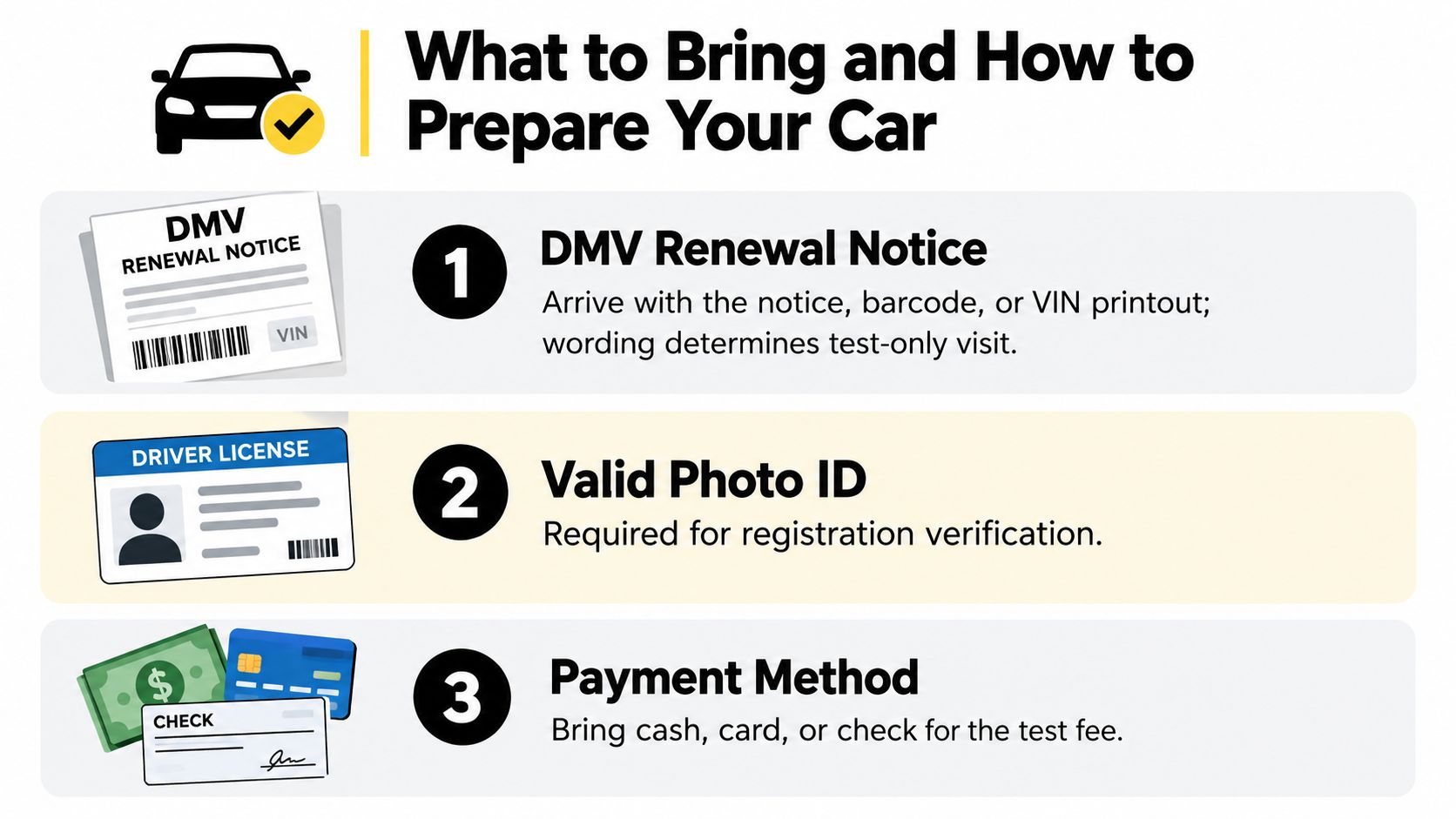
Bring the DMV renewal notice, a valid photo ID, and a payment method before you leave home. The notice is the most important item because it tells the technician whether you're headed to a regular station or a STAR station, and it often contains the barcode or vehicle information needed to match the test to your record. If you're about to throw the envelope away, photograph both sides first.
Before the test, make sure the check-engine light is off. The inspection for most modern vehicles is data-driven, and a lit warning light can send you home without a certificate. If you recently disconnected the battery, replaced it, or cleared codes, give the car time to complete its drive cycle before you arrive.
The fuel level matters too. Keep the tank somewhere between quarter-full and three-quarters full so the evaporative system can be tested under normal conditions. A tank that's nearly empty or completely topped off can create avoidable complications.
Warm the car up with normal driving before you pull in. A cold engine rarely gives the cleanest inspection conditions.
For many drivers, the other key issue is readiness status. California's updated guidance says that effective October 1, 2025, all readiness monitors must be set for a vehicle to pass. BAR readiness monitor guidance That's why a car can feel fine on the road and still fail the scan.
If you want a simple prep checklist, use the what to do before a smog check guidance before you head out. The goal is to arrive scan-ready, not to discover a readiness issue at the window.
STAR Certified vs Regular Smog Stations
The wording on your DMV renewal notice determines whether you need a STAR station. STAR certification is a state performance tier for smog inspection stations, while test-only describes the service the station provides. A station may carry both labels, so read the notice before choosing where to go.
How to choose the right one
If the notice says STAR station, choose a STAR-certified location. The station assignment is part of the renewal instruction, much like being sent to the correct counter for a specific permit. If the notice does not require STAR, a regular licensed test-only station can generally perform the inspection. The BAR STAR FAQ explains the program and its station requirements.
For a newer gasoline vehicle with no special direction on the notice, a regular test-only station is often the straightforward choice. It inspects the vehicle without repairing the same vehicle, which keeps the service focused on the smog check. San Leandro drivers seeking a STAR location can review this San Leandro STAR-certified smog station information before arriving.
| Feature | STAR Certified | Regular Test-Only |
|---|---|---|
| Can inspect vehicles | Yes | Yes |
| Can repair the same vehicle it tests | No | No |
| May be required by DMV notice | Yes | No, unless directed |
| Meets the STAR performance tier | Yes | No |
| Suitable for directed cases | Yes | Only when the notice permits it |
The practical rule is simple: test-only tells you that the station performs inspections rather than repairs, while STAR identifies its state performance category. Check the DMV notice first, then match its wording to the station type. That step prevents an avoidable visit to a station that cannot complete your renewal inspection.
What a San Leandro Smog Test Visit Looks Like
The inspection path depends on the vehicle's model year and fuel type, not its appearance. The technician first reads the DMV renewal notice and confirms that the station can complete the required inspection. That check connects the notice's wording with the correct test procedure, helping prevent a return visit.
For 2000 and newer gasoline vehicles
The technician connects a scan tool to the OBD-II port beneath the dashboard. The system checks diagnostic trouble codes, readiness monitors, and the warning-light status. California generally uses an OBD Inspection System for 2000 and newer gasoline vehicles, 1998 and newer diesel vehicles, and all hybrid vehicles. The BAR reference guide outlines these inspection categories.
The OBD test works like a dashboard conversation with the car's emissions computer. It asks whether the required self-checks have finished and whether the system has recorded an emissions-related fault. A vehicle may drive normally and still fail if a monitor is incomplete or an active code remains.
Readiness can also be affected by a recently disconnected or replaced battery, because clearing power may erase the computer's completed checks. Ask the technician before testing if the battery was disconnected or the vehicle recently underwent emissions-related work.
For older gasoline vehicles and many diesels
Vehicles outside the OBD path use a different approved procedure. Depending on model year and fuel type, the station may use a BAR-97 setup or another state-approved method. California separates 1976 to 1999 vehicles from newer OBD-based vehicles, so an older car should be matched to the procedure listed for its year and fuel type.
The technician records the result electronically for DMV. You leave with a pass confirmation or a failure result identifying the next repair question. A clear notice, the right station type, and a car ready for its applicable test procedure can keep the San Leandro visit to one trip.
Smog Test Pricing and What Affects the Final Cost
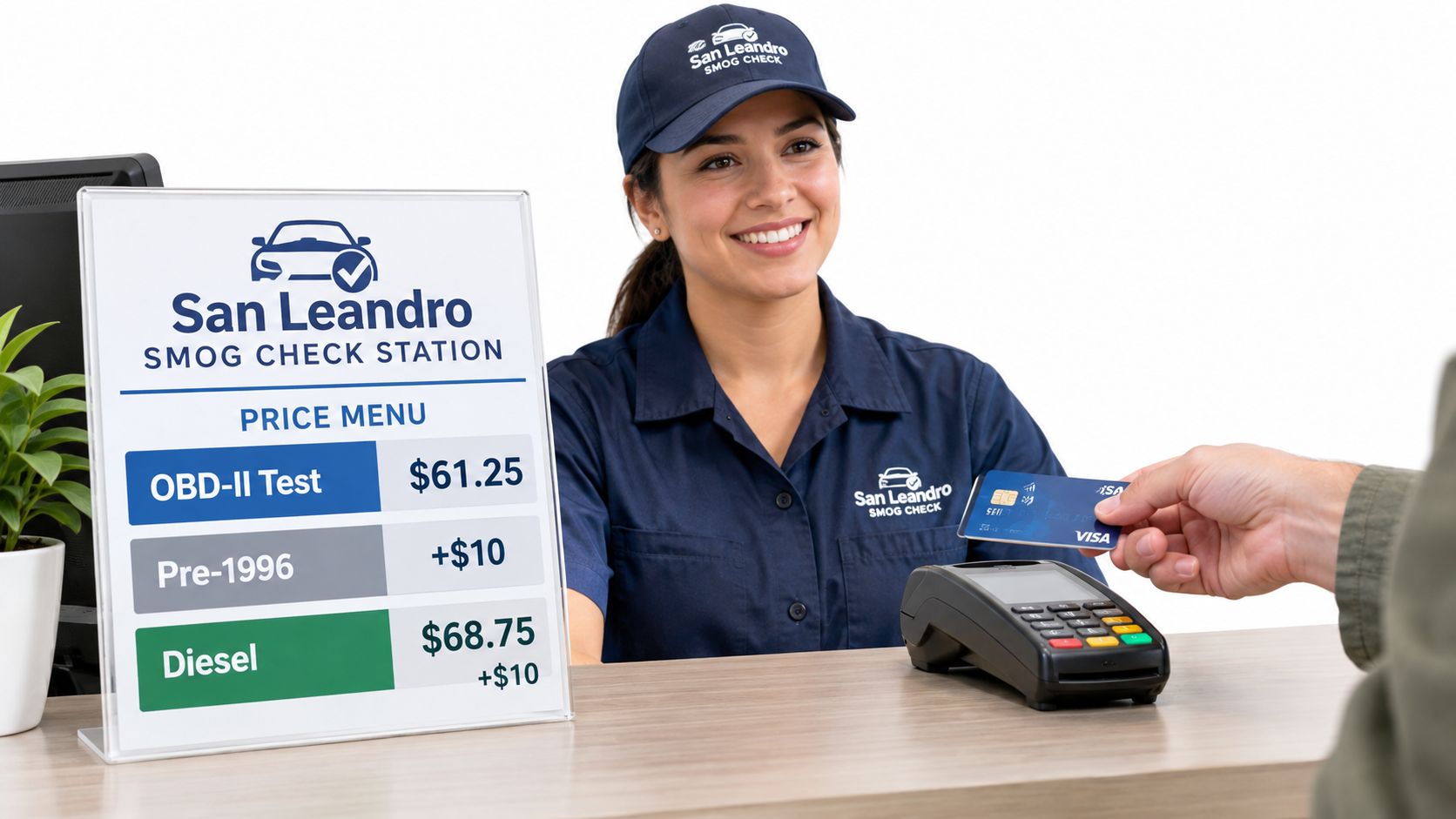
California keeps smog pricing inside a narrow range, so the final bill shouldn't feel random. The Bureau of Automotive Repair sets caps that stations must stay within, and the main driver of cost is the vehicle type being tested. For a standard 1996-and-newer OBD-II test, the cap is $61.25. For pre-1996 vehicles, it's $61.25 plus $10, and for diesels, it's $68.75 plus $10.
Coupons do exist, but they work inside those caps, not outside them. A shop can discount within the legal range, yet it can't turn the inspection into an unregulated price. That's why a posted menu matters, and why the price you see at the counter should line up with the state cap for your vehicle type.
What the invoice usually separates
The smog certificate fee covers the inspection and electronic submission to DMV. If the vehicle passes, that's usually the only smog charge you see for that visit. If it fails, any repair bill comes from a different shop, because a test-only station doesn't do the repair work it just inspected.
If your renewal notice requires STAR, expect that directed vehicles can carry an additional $7.50 STAR fee. That only applies when the notice sends you to that station type. The fee structure makes more sense once you realize the inspection, the certificate, and any repair work are three separate things.
Speedy Smog in San Leandro and Your Next Steps
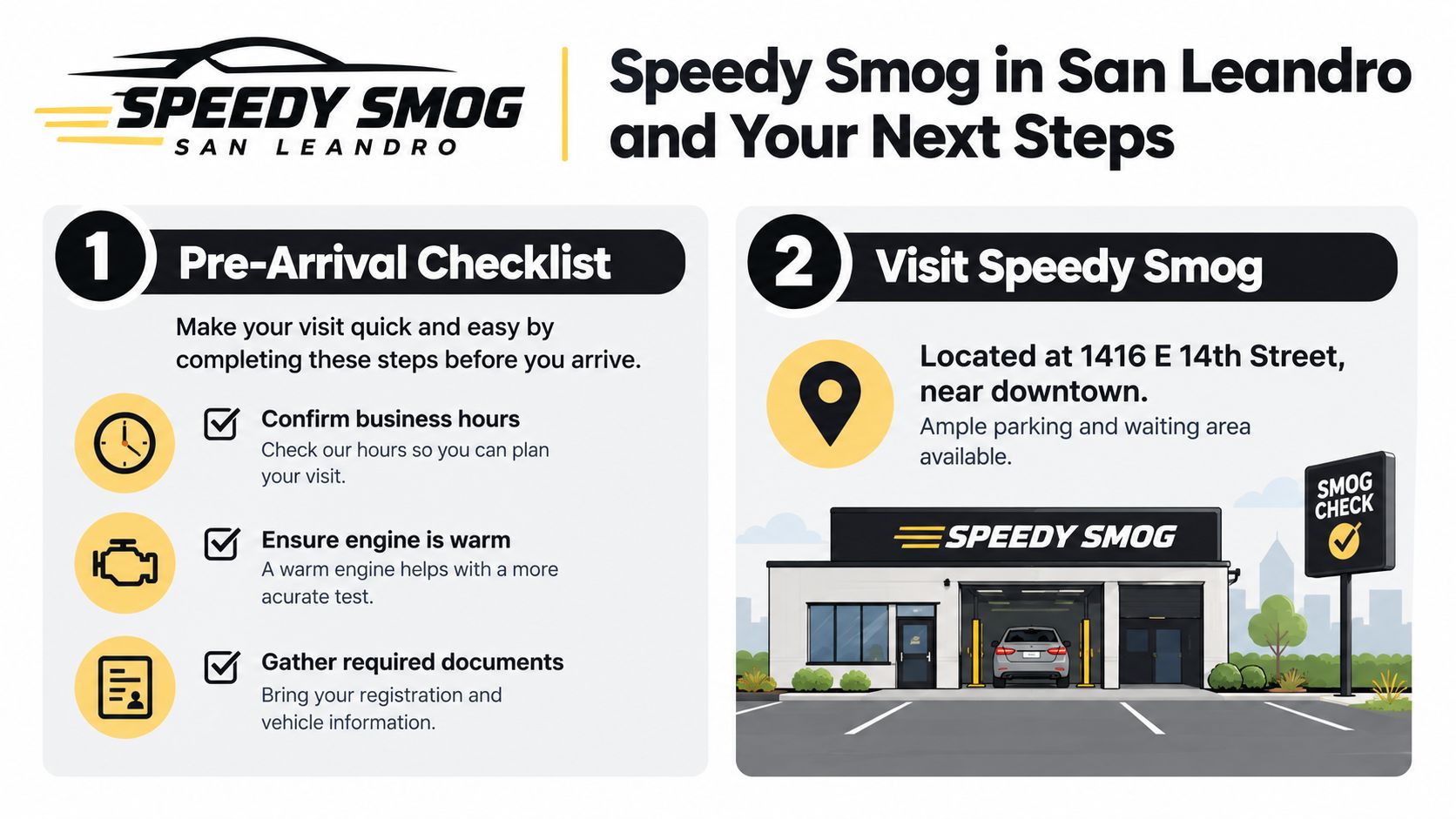
If your notice says you need a regular inspection or a STAR visit, the last step is simple, show up prepared and let the station match the paperwork to the vehicle. Speedy Smog serves San Leandro at 1416 E 14th Street, near downtown, with parking and a waiting area for drivers who don't want to circle the block before a test. Their phone line and current hours are listed on the shop site, which is the fastest way to confirm same-day availability before you head over.
A quick pre-arrival checklist
- Renewal notice in hand: Make sure you can read the exact smog wording before you leave.
- Engine warmed up: Drive a bit before arrival so the car is ready for inspection.
- No warning lights: A check-engine light can stop the visit before it starts.
- Ready to pay: Bring the payment method you plan to use at the counter.
For a typical OBD-II vehicle, the visit is usually the shortest part of the day. You hand over the keys, the technician confirms the station type, and the result is sent to DMV electronically after the test is complete. If the car fails, keep the printout, take it to a repair shop, and return only after the issue is fixed and the readiness status makes sense again.
If you need a San Leandro smog test, bring your renewal notice, read the wording carefully, and choose the right station type the first time. Speedy Smog handles inspection-only and STAR-directed smog visits for East Bay drivers, so you can get the paperwork done, understand the result, and move on with your renewal without extra back-and-forth.
Your DMV renewal notice is on the kitchen counter, your San Leandro smog appointment is booked, and you're expecting a simple pass-or-fail result. You pay for the test, receive a certificate, and assume the paperwork is finished. Then a question comes up: what did the shop's smog check license authorize it to do?
That credential matters because a California smog inspection isn't just a machine reading. The station must hold the right active authorization, the inspector must be properly credentialed, and certain vehicles require the additional STAR certification layer. The license system behind the test helps determine whether the certificate can be accepted for your DMV registration process.
Table of Contents
- What a Smog Check License Means for California Drivers
- The Two Layers of a Smog Check License in California
- How California Smog Licensing Evolved Since 1994
- Test-Only, Test-and-Repair, and STAR License Categories
- Applying For and Renewing a Smog Check License
- Compliance Failures and Penalties Under BAR
- Matching Your Vehicle Type to the Right License Class
- Choosing a Licensed Station That Fits Your Vehicle
What a Smog Check License Means for California Drivers
A smog check license is the authorization that allows a California business and qualified personnel to perform regulated emissions inspections. The Bureau of Automotive Repair, commonly called BAR, oversees this system. BAR's role is to set inspection requirements, license stations and technicians, monitor performance, and enforce the rules that protect the integrity of the certificate you receive.
Think of the certificate as the final receipt from a regulated service. A vehicle can pass its emissions inspection, but the result still depends on the station using the correct equipment, following the required procedure, and having current credentials. A passing reading from an improperly authorized inspection isn't the same as a valid BAR-recognized inspection.
Practical rule: A passing result is only useful when the station, inspector, equipment, and inspection method all match California's requirements.
The license category also tells you something about the service being performed. A test-only station can inspect but cannot repair. A test-and-repair station can inspect, diagnose, and repair vehicles. A STAR station has an additional certification layered over its underlying station license and can handle vehicles that BAR or DMV directs into the STAR program.
California's network operates at meaningful scale. As of March 31, 2026, BAR listed 3,982 Smog Check test-and-repair stations and 3,494 STAR stations in the state, according to BAR's spring 2026 licensing data. The same report says STAR-certified stations performed 83% of all Smog Check tests in calendar year 2025, even though 49% of licensed stations were STAR certified. That difference shows why STAR status isn't a decorative badge. It identifies facilities carrying a disproportionate share of inspection activity.
The system has two basic credential layers, followed by the STAR overlay. The station license belongs to the business location. The technician license belongs to the person performing the inspection. STAR certification belongs to an eligible station, not merely to any individual who has worked around smog equipment.
The Two Layers of a Smog Check License in California
You arrive at a San Leandro shop expecting a quick inspection. Two credentials determine whether that inspection is authorized: one belongs to the business, and the other belongs to the person testing your vehicle. STAR adds a second qualification to the station's license.
The station license belongs to a specific location. It covers the shop's approved equipment, testing area, operating setup, signage, and authorized services. The business also needs an Automotive Repair Dealer registration and must meet BAR requirements for its facility and inspection process.
The technician license belongs to the individual performing the inspection. That person must have the BAR training and certification required for the work. A licensed shop cannot let an unqualified employee connect your vehicle to the equipment and issue a certificate.
The station is the workplace
A station license follows the physical shop, not just the company name. BAR's application process addresses the business information, Automotive Repair Dealer registration, equipment, signage, testing area, and other operating requirements. The station category determines whether the location can perform testing only, test and repair work, or STAR-qualified inspections. The BAR's station application guidance outlines these station-level requirements.
That is why a technician's credentials do not give a shop permission to perform every inspection. The location must be licensed for the service, with the required equipment and setup in place.
The technician is the person doing the inspection
The technician's credential is separate from the station license. It shows that the person operating the inspection equipment and submitting the result has the required training and authorization. Credentials are personal. If a technician changes shops, that move does not transfer the station license or the shop's STAR status.
STAR is an added qualification for an eligible station, not a substitute for either credential. The station must first hold the appropriate Smog Check station license and Automotive Repair Dealer registration before STAR certification can apply. If that underlying registration or license expires or becomes delinquent, STAR eligibility may be lost or suspended.
Both layers affect the inspection behind your certificate. The station provides the authorized workplace, while the technician performs the authorized test. Drivers can use BAR's public license lookup to check a station's status and confirm that it is listed for the service they need. For a specific inspection, ask which credential covers the station and which covers the inspector.
How California Smog Licensing Evolved Since 1994
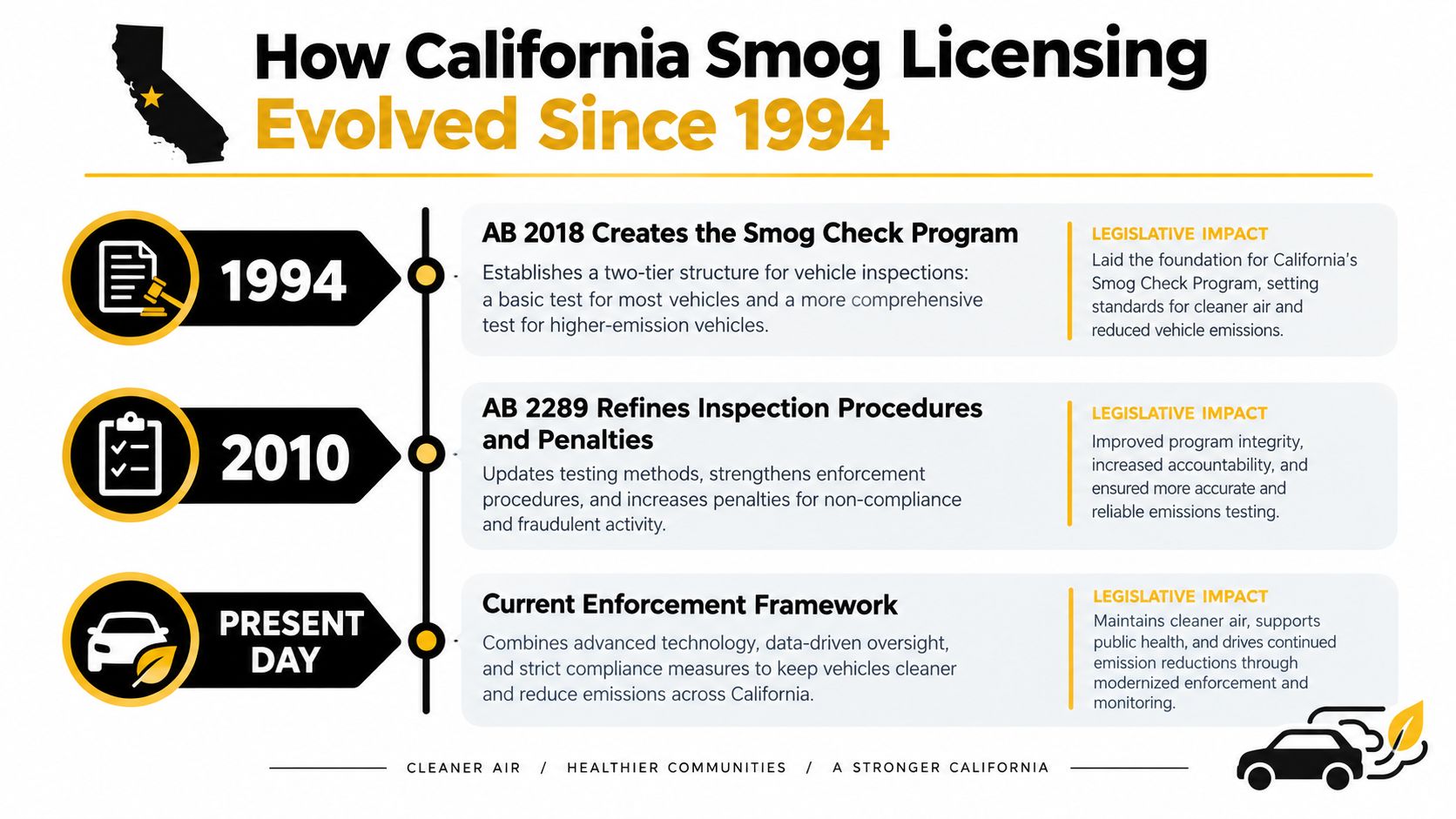
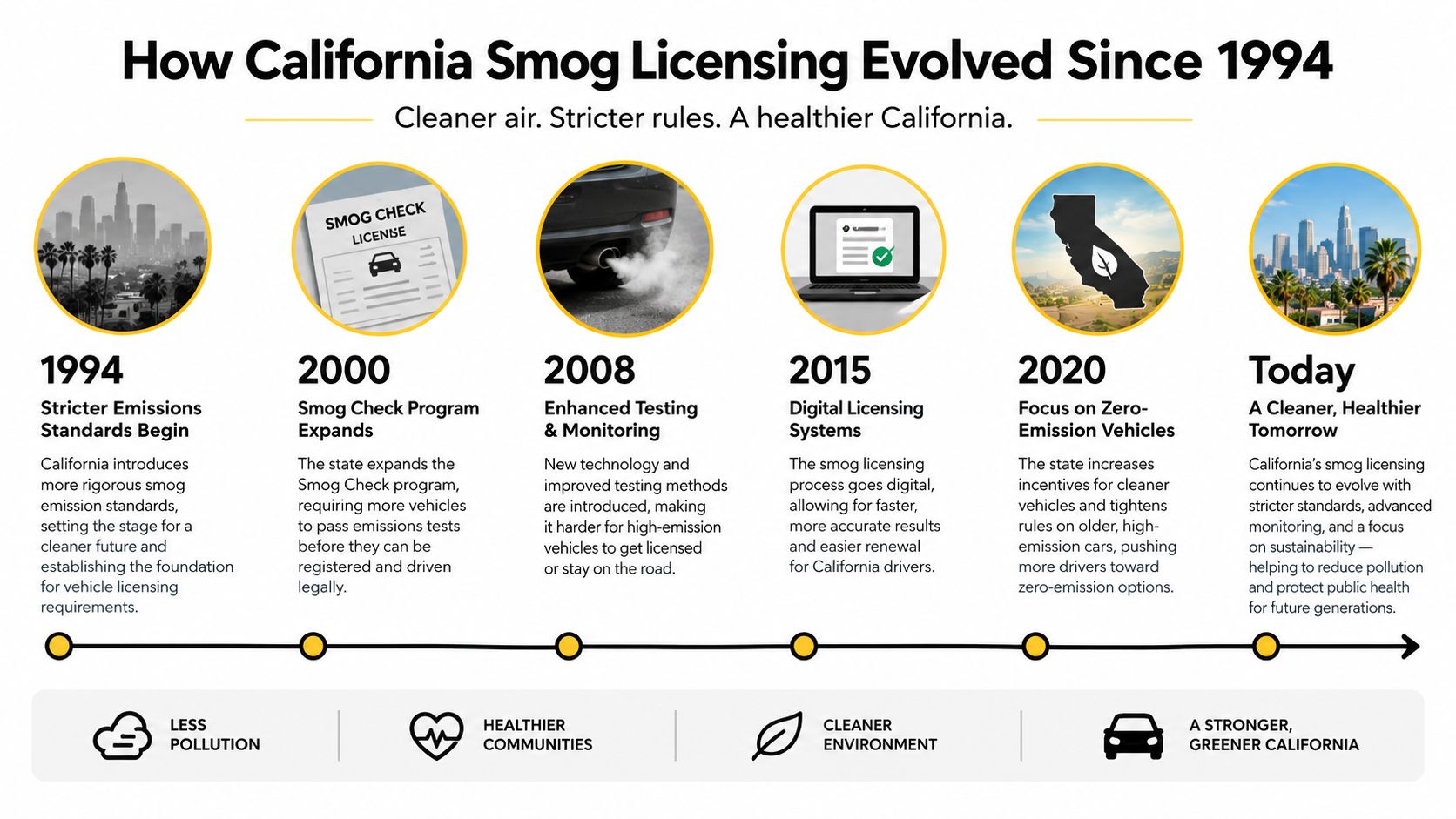
California's current smog licensing structure came from successive changes to the inspection program, not from a single rule written all at once. The first major milestone in the modern framework came with Assembly Bill 2018 in 1994. BAR's Smog Check Reference Guide explains that the law responded to amendments to the federal Clean Air Act and required loaded-mode emissions testing in areas that hadn't met federal air quality standards. Less-polluted areas continued using a two-speed idle test.
That change made the inspection method depend more directly on air-quality conditions and vehicle circumstances. The program became a structured inspection and maintenance system, with licensing and equipment requirements designed around the test being performed.
The shift from Gold Shield to STAR
The next major overhaul arrived with Assembly Bill 2289 in 2010. It modernized the program around OBD II inspections for 2000 model-year and newer vehicles and created the STAR program. STAR began on January 1, 2013, after the Gold Shield Program sunsetted on December 31, 2012, according to the BAR licensing history referenced in the department's licensing data.
The important practical change was the role of the higher tier. Gold Shield had functioned as a designation for certain stations. STAR became a continuing certification connected to inspection performance and eligibility to inspect directed vehicles and gross polluters. BAR requires STAR stations to meet and maintain higher inspection-based standards, rather than treating the designation as a one-time achievement.
Why the history matters at the counter
For a driver, the legislative history explains why a station can be fully licensed yet still be unable to handle a particular vehicle assignment. California built a layered structure with:
- Station authorization, which governs the business location and services.
- Technician authorization, which governs the person conducting the inspection.
- STAR certification, which adds performance and eligibility requirements for certain inspections.
That structure may feel complicated when you're trying to renew registration, but each layer answers a different question. Is the location authorized? Is the inspector qualified? Is the station approved for a vehicle that requires STAR handling? You can find broader background on the state's air-quality framework through this California air resources overview.
Test-Only, Test-and-Repair, and STAR License Categories
The three categories are easier to compare than to memorize. Start with what you need at the counter.
| License Type | Can Inspect? | Can Repair? | Can Serve Directed Vehicles? |
|---|---|---|---|
| Test-only | Yes | No | Only if the station also holds the required STAR certification |
| Test-and-repair | Yes | Yes | Only if the station also holds the required STAR certification |
| STAR certification | Yes, for eligible STAR work | Depends on the underlying station license | Yes, subject to BAR requirements |
A test-only station can perform the inspection, record the result, and issue the appropriate compliance or noncompliance documentation. It can't repair your vehicle as part of that license category. If your car fails, you'll need to take it elsewhere for repairs or choose a test-and-repair facility from the beginning.
A test-and-repair station can inspect the vehicle and work on the causes of a failure. That can be convenient if you want diagnosis and repairs under one roof. It still doesn't automatically make the shop a STAR facility.
STAR is an added layer
STAR isn't just a more advanced name for test-and-repair. It's a separate certification placed on top of an eligible station license. A STAR station must maintain higher performance standards and remain in good standing under BAR's rules.
This is why a basic test-and-repair shop may legally decline to inspect a directed vehicle. The shop might be fully authorized to conduct ordinary inspections and repairs, but the vehicle's assignment calls for a STAR-certified facility. BAR's program uses this additional layer to route certain higher-risk inspections to stations subject to enhanced oversight. Drivers can learn more about that distinction through this guide to a STAR-certified smog station.
At the counter: Ask whether your DMV notice requires a STAR inspection before you pay for a test. The answer can save you a second appointment.
The certificate doesn't change into a different kind of document because a station is test-only or test-and-repair. What changes is the station's legal authority and, for directed vehicles, whether its STAR certification satisfies the assignment. The right choice depends on your vehicle and the instruction attached to your registration or inspection record.
Applying For and Renewing a Smog Check License
A San Leandro shop owner preparing to open a smog station is assembling more than an application. BAR expects the business, location, equipment, facility, Automotive Repair Dealer registration, and qualified personnel to work together as one compliant operation.
A typical application file includes:
- Station information, including the business address and requested license category.
- Automotive Repair Dealer registration, linking the repair business to the station.
- Technician credentials, confirming that qualified personnel are available to perform inspections.
- Facility details, such as required signs, posted fees, testing space, and equipment that meets BAR specifications.
BAR reviews those details before approving the station. Once approved, the station appears in public records, allowing drivers and other businesses to confirm that the location is authorized before an inspection. That public listing is the practical checkpoint behind the license.
Renewal is part of daily operations
Issuance is only the starting point. The owner must keep the station license, Automotive Repair Dealer registration, technician records, inspection activity, and, where applicable, STAR standing current. These pieces fit together like links in a chain. A problem with one can affect the station's ability to operate lawfully.
If the underlying station registration or license expires or becomes delinquent, STAR eligibility may be suspended or lost. BAR also reviews whether the station has enough inspections in the most recently completed calendar quarter to calculate STAR performance measures, along with citations, suspensions, and other disqualifying events. The application rules describe these requirements, and this smog check registration renewal overview summarizes the renewal issues owners commonly need to track.
For owners: Place license dates, technician records, and quarterly inspection activity on one compliance calendar. Separate reminders make it easier to miss one item that affects the whole operation.
Drivers do not have to manage this paperwork, but they experience the result when a station's authorization lapses. Working equipment cannot make an expired station legally able to issue a certificate. Before booking, check the station's current listing, especially if you have visited it before and your vehicle now falls under a different inspection category.
Compliance Failures and Penalties Under BAR
BAR enforcement protects the difference between a legitimate inspection and a certificate produced without the required process. The agency can inspect stations, investigate consumer complaints, review inspection records, and examine whether technicians and equipment were used correctly.
Violations can range from recordkeeping problems to conduct that directly undermines the inspection. Examples include fraudulent certificates, accepting tampered vehicles as compliant, allowing an unlicensed technician to perform an inspection, or handling a directed vehicle outside the STAR framework.
What enforcement can look like
BAR's response depends on the violation and its seriousness. Possible outcomes include:
- Citations, which can require corrective action, payment of a penalty, or retraining.
- Probation, which places the license under additional conditions and monitoring.
- Suspension, which stops the station's inspection authority for the applicable period.
- Revocation, which removes the station's authority and can trigger related licensing consequences for involved technicians.
The key point is that enforcement doesn't stop at the shop's front door. If BAR determines that an inspection was invalid or improperly issued, the driver may face a rejected certificate, a required retest, or an interruption in the registration process.
A vehicle owner also has a practical role. Keep the inspection report, certificate information, invoices, and repair records. If something seems wrong, ask the station to explain the result and use BAR's consumer channels rather than relying on an informal promise that the DMV will accept the paperwork.
The licensing framework is designed to make responsibility traceable. The station is accountable for its facility and business authorization. The technician is accountable for the inspection work. STAR certification adds another performance screen for stations serving directed vehicles.
Matching Your Vehicle Type to the Right License Class
The right station depends on more than whether your car is old or new. Model year, fuel type, onboard diagnostic system, and any DMV or BAR direction can change the inspection method.
BAR states that most 2000 and newer vehicles use the OBD inspection system, while 1999 and older vehicles use the BAR-97 emissions system. The general requirement covers gasoline, hybrid, and alternative-fuel vehicles from model year 1976 and newer, plus diesel vehicles from model year 1998 and newer, according to BAR's smog check guidance.
| Vehicle Type | Inspection Method | Minimum License Class Needed |
|---|---|---|
| 2000 and newer OBD vehicle | OBD system inspection, with the required visual and functional checks | Licensed station with qualified technician |
| 1999 and older vehicle | BAR-97 tailpipe emissions inspection | Licensed station equipped and authorized for the applicable test |
| Diesel vehicle subject to inspection | Method depends on the vehicle's model year, fuel system, and applicable BAR requirements | Station equipped and staffed for diesel inspections |
| Hybrid or alternative-fuel vehicle | Method depends on vehicle design, model year, and BAR inspection rules | Licensed station that handles the specific vehicle type |
| Directed vehicle or gross polluter | Enhanced inspection under the applicable STAR process | STAR-certified station |
The phrase “any licensed station” can cause confusion. A station may hold a valid license but not have the equipment, training, or operational experience for every vehicle class. A pre-OBD vehicle needs a different testing setup from a newer vehicle. A diesel inspection can involve requirements that a gasoline-focused shop doesn't offer.
Before booking: Give the shop the vehicle's year, fuel type, and any wording from your DMV notice. Those details let the station confirm the correct inspection path before you arrive.
Hybrids also deserve a direct question rather than an assumption. The general category of vehicle doesn't tell you every inspection detail. Ask whether the station handles your specific hybrid model and model year, especially if the vehicle has unusual access or inspection requirements.
Choosing a Licensed Station That Fits Your Vehicle
Before handing over your keys, make three checks. They're simple, but they address the three ways a smog appointment can go wrong: an inactive license, a missing STAR designation, or a station that can't perform your vehicle's inspection method.
Check the station first
Look up the business in BAR's license records. Confirm that the station is active and that its listed services match what you need. A familiar sign outside the building isn't enough because licensing status can change.
If your DMV paperwork directs you to a STAR station, verify the STAR designation specifically. A test-and-repair license alone doesn't answer that question.
Match the equipment and technician
Tell the shop whether your vehicle is a newer OBD model, an older tailpipe-test vehicle, a diesel, or a hybrid. Ask whether the inspector is currently authorized for the work and whether the station has the required equipment. A straightforward answer is a good sign. Reluctance to explain the station's credentials deserves caution.
The same applies to the inspection result. A professional shop should be willing to explain what was tested, identify a failure clearly, and provide the relevant paperwork without pressuring you into repairs before the test produces a result.
Watch for avoidable warning signs
Unusually low advertising can leave out required services or create pressure for add-ons. Be cautious if a technician recommends repairs before performing the inspection, refuses to show licensing information, or can't explain whether the station is STAR certified when your notice requires it.
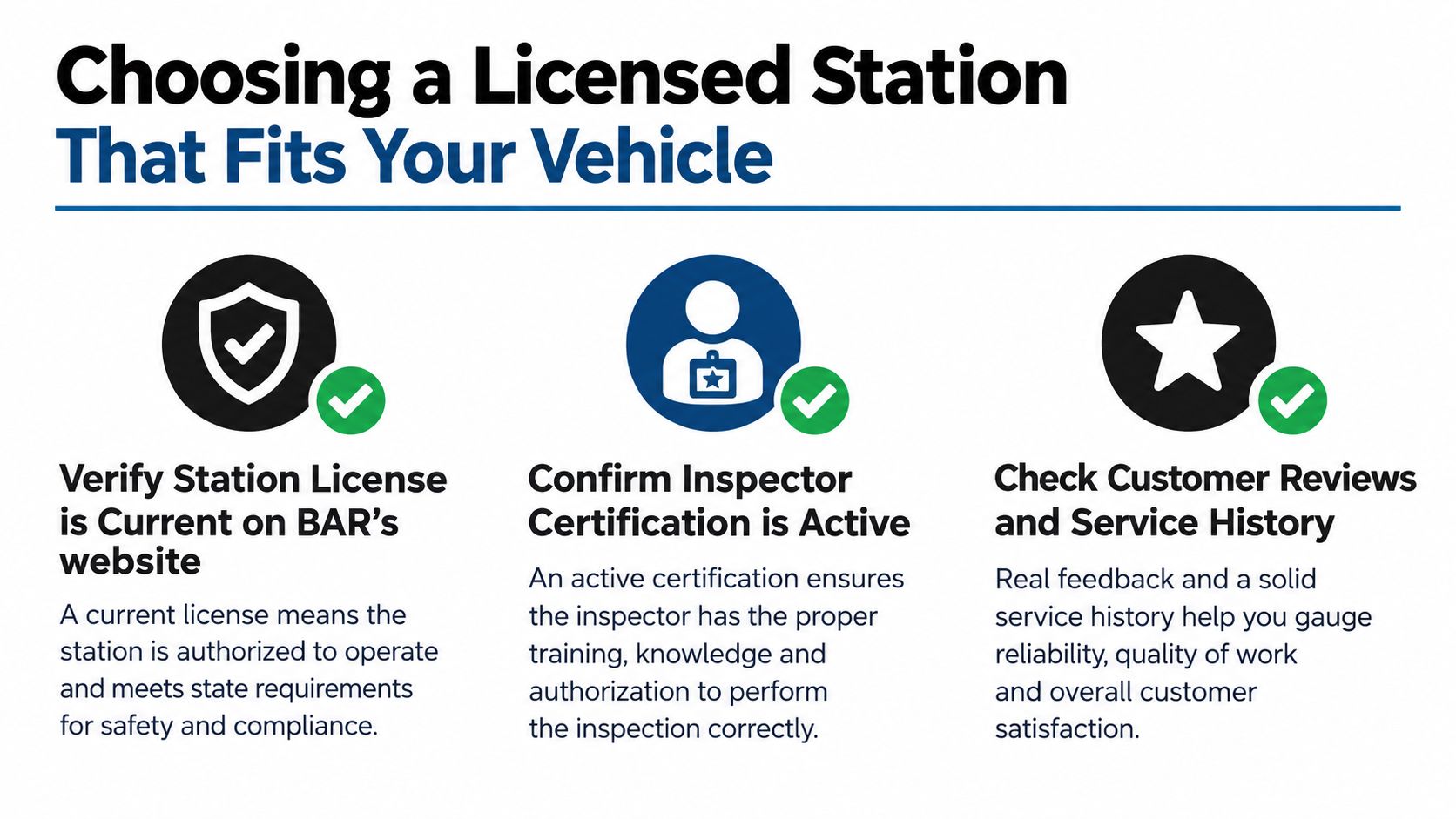
Customer reviews can provide useful context about communication and service, but they don't replace BAR verification. Reviews also may not tell you whether a location handles older vehicles, diesels, or directed inspections.
For San Leandro drivers, Speedy Smog is one local option that identifies itself as a STAR-certified station and offers inspections for newer vehicles, older vehicles, diesels, and hybrids. You should still confirm that the station's current status and your vehicle's specific requirements match before booking.
The certificate in your hand represents more than a test result. It represents a licensed location, a qualified inspector, the correct inspection method, and, where required, active STAR certification. Check those pieces first, then schedule with confidence.
If you're in San Leandro and need a DMV smog inspection, visit Speedy Smog with your registration notice and vehicle details. The station handles STAR-certified inspections and can help confirm the right testing path for newer vehicles, older vehicles, diesels, and hybrids.
A failed Smog Check can turn an ordinary registration renewal into a financial decision. An East Bay driver may leave a station with a failure report, a repair estimate, and no clear idea whether fixing the car, applying for help, or retiring it makes more sense.
California's Consumer Assistance Program, usually called CAP, can provide a path forward for eligible owners. But CAP isn't a single check that covers every repair. The right option depends on the vehicle's model year, the reason it failed, the owner's income, the repair cost, and whether the car is worth keeping.
Table of Contents
- When a Failed Smog Check Hits Your Wallet
- The Agencies Behind California's Smog Assistance
- Repair Help, Retirement Money, and the Repair Waiver
- How to Apply for the CAP Step by Step
- STAR Stations Versus Regular Smog Check Shops
- Edge Cases for Older Cars Diesels and Hybrids
- Your Action Plan for Getting Back on the Road
When a Failed Smog Check Hits Your Wallet
Consider a Hayward commuter with a 2003 Toyota Camry. She takes the car to a San Leandro station, fails the inspection, and receives a repair estimate for a catalytic converter and oxygen sensor. Her registration renewal is due in 30 days, so the estimate feels less like a maintenance suggestion and more like a deadline.
She has three realistic choices. She can pay for the emissions repair herself, investigate CAP repair assistance, or decide that the vehicle's remaining value doesn't justify another major repair and pursue retirement assistance instead. A failed certificate doesn't automatically tell her which choice is financially sound. It only identifies the emissions problem that must be addressed before the registration issue can be resolved.
The first step is to keep the failure report and ask the technician to explain the exact failure codes. A catalytic converter diagnosis, an evaporative emissions problem, and a visible smoke failure can lead to different decisions. Don't approve expensive work based only on a verbal estimate, especially if another qualified shop can provide a second diagnosis.
Practical rule: Treat the failed inspection as the starting point for a decision, not as permission to authorize every repair on the estimate.
California's inspection network operates at a significant scale. More than 10 million vehicles are tested each year at more than 7,000 independently owned Smog Check stations, and the program removes about 400 tons of smog-forming pollutants every day, according to a California Senate Smog Check fact sheet/index.pdf). That scale also means the paperwork and station choice matter.
Drivers often worry that a failed test immediately means towing, impoundment, or an unmanageable penalty. The practical concern is registration compliance. Before spending money, confirm what the DMV requires, whether the vehicle qualifies for CAP, and whether a waiver or retirement route is more sensible. Owners of older, high-emitting vehicles can face more expensive repairs and tighter practical deadlines, so a quick eligibility check can prevent wasted money.
The Agencies Behind California's Smog Assistance
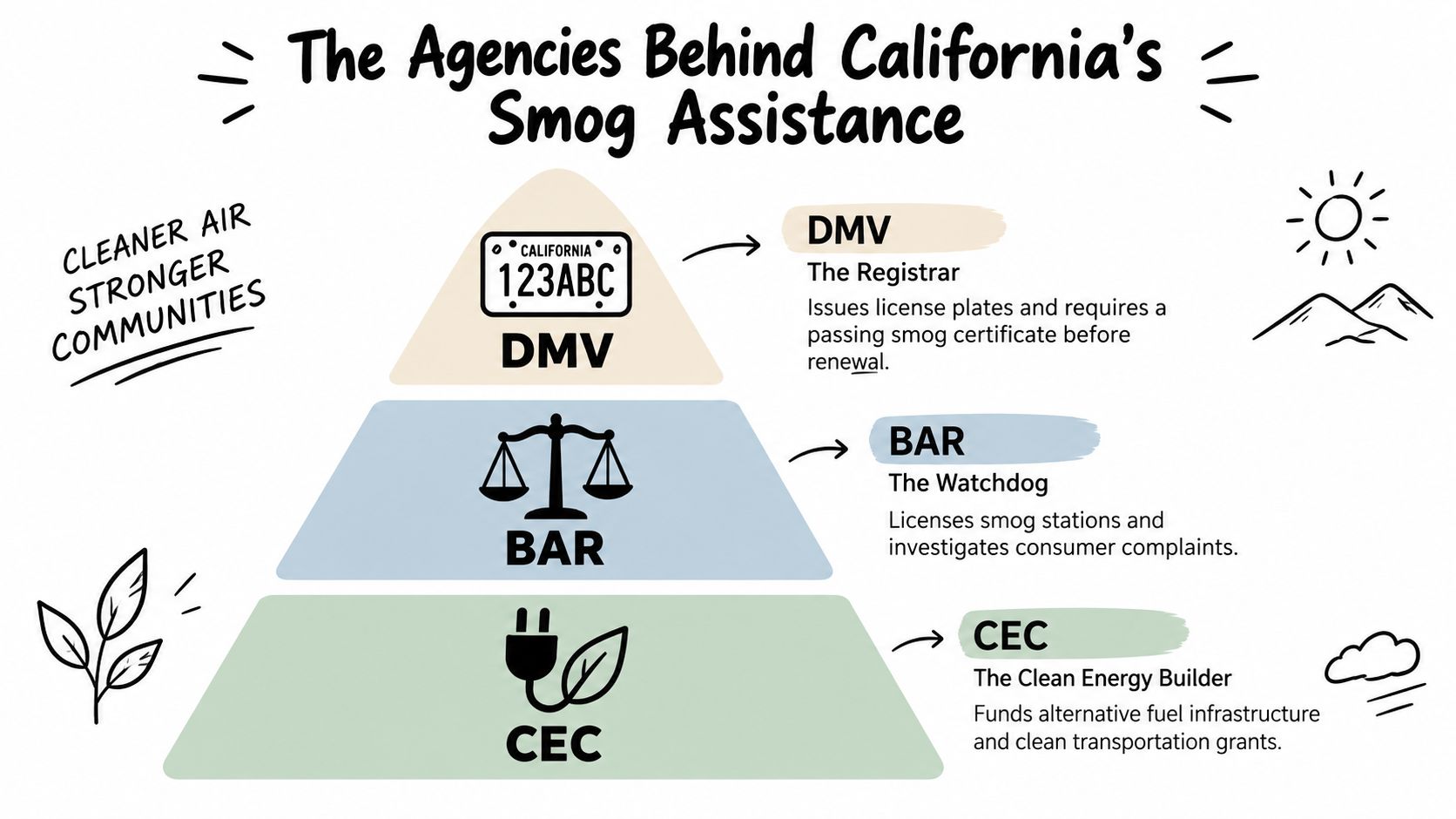
A failed Smog Check creates two separate questions for an East Bay driver: who controls registration, and who can help with the emissions problem? The DMV handles the first. The Bureau of Automotive Repair, or BAR, handles the second. Knowing that split prevents a common mistake, applying to the wrong agency after an older car, diesel, hybrid, or other vehicle fails inspection.
The DMV records vehicle registration and uses the Smog Check result during renewal. The station transmits a passing result electronically or provides the paperwork required for the transaction. The DMV does not diagnose the vehicle, approve repair funding, or decide whether a catalytic converter is needed.
The DMV is the office that records whether the vehicle is legally ready for renewal; the mechanical repair itself is handled elsewhere. If the emissions requirement remains unsatisfied, registration may stop even while a repair shop investigates the cause.
BAR manages the emissions side
BAR licenses Smog Check stations, sets testing rules, oversees the inspection program, handles consumer complaints, and administers the Consumer Assistance Program, or CAP. BAR's CAP overview describes assistance for eligible owners whose vehicles failed a qualifying inspection.
CAP sits under BAR, not the DMV. Drivers often search for a “DMV smog assistance program” because registration is the immediate concern, but BAR determines whether an assistance path is available and how an approved repair or retirement transaction proceeds.
That distinction matters after a failure. A driver deciding whether to repair an older vehicle, seek a waiver, or consider retirement begins with the Smog Check result and CAP rules, while the DMV remains responsible for the registration record.
BAR's consumer protection role also gives drivers a place to raise concerns about an improper repair or charges for work that did not address the emissions problem. Keep invoices, test results, and written estimates if the diagnosis or repair becomes disputed.
STAR stations add another layer
A STAR station is a Smog Check station that meets BAR's additional performance and testing requirements. Some vehicles are directed to STAR stations, and vehicles identified as gross polluters may need a STAR inspection or referral. A regular station cannot always complete the test required for that vehicle, so check the inspection notice before booking an appointment.
The California Energy Commission, or CEC, is a separate state agency connected with energy and clean transportation programs. It does not approve a CAP repair application. That distinction helps prevent a search for a clean-vehicle grant or charging-infrastructure program from delaying the registration problem in front of you.
Repair Help, Retirement Money, and the Repair Waiver
A failed Smog Check does not point every East Bay driver toward the same solution. A newer car with a manageable emissions fault may justify repair. An older vehicle that has failed repeatedly may be worth retiring instead. A waiver can preserve registration in a limited situation, but it is not a blanket pass for unfinished repairs.
Repair assistance
CAP can provide up to $1,450 for emissions-related repairs on model year 1996 and newer vehicles, as set out in BAR's repair assistance rules. For vehicles from model years 1976 through 1995, the maximum is $1,100. The program covers 80% of eligible diagnostic and repair costs, while the consumer pays at least a 20% co-payment.
The vehicle must first fail a biennial Smog Check. CAP therefore works like targeted cost sharing, not a maintenance budget. Tires, brakes, routine service, and unrelated engine work generally do not solve the emissions failure and are outside this path. Eligible work must address the failed test and follow the program's approved process.
A driver deciding whether to repair should compare the likely approved repair cost with the vehicle's age, condition, and practical value. That comparison matters more for an older car with repeated failures than for a newer vehicle with one identifiable emissions problem.
Retirement assistance
Retirement may make better financial sense when repairs approach the car's real-world value. Retirement payments of up to $1,450 for low-income applicants and up to $1,350 for other eligible applicants are set out in BAR's vehicle retirement guidance.
The vehicle may not have to fail a Smog Check in every retirement situation. That option can matter to an owner of a high-mileage or low-value car who wants to stop paying for recurring repairs. Confirm the current conditions before arranging a transaction with a dismantler, because eligibility and required steps still apply.
Repair cost waiver
A repair cost waiver follows a narrower route. California law allows a registration path after the owner has spent at least $450 on eligible repairs, subject to the failure type and income status. A visible smoke test failure generally does not qualify unless the owner meets the low-income rules, and income-based requirements can use a lower repair-cost limit. The California Health and Safety Code provision on repair cost waivers provides the legal framework.
| Program | Maximum benefit | Income boost | Best for |
|---|---|---|---|
| Repair assistance | Up to $1,450 for model year 1996 and newer vehicles, or up to $1,100 for model years 1976 through 1995 | Program rules determine the eligible contribution and co-payment | Owners who want to keep a qualifying vehicle |
| Vehicle retirement | Up to $1,450 for low-income eligible applicants, or up to $1,350 for other eligible applicants | Low-income applicants may receive the higher amount | Owners whose repair cost outweighs the car's value |
| Repair cost waiver | Registration relief after at least $450 in eligible repairs, subject to restrictions | Income status can change the applicable threshold | Owners who meet the legal repair and failure requirements |
For a local explanation of the repair route, review this smog check repair assistance guide. Verify CAP approval, covered work, your required contribution, and the participating facility before authorizing repairs. Paying first does not guarantee reimbursement.
How to Apply for the CAP Step by Step
Start with the documents from the station that failed the vehicle. The failure report identifies the inspection result and gives BAR a factual basis for evaluating the application. If the vehicle is directed or classified as a gross polluter, that status can affect where the next test or repair must occur.
Gather the right paperwork
Collect the failed Smog Check report, the vehicle registration information, ownership documents, and any income documentation required for the assistance category. If you're applying for repair help, keep prior Smog Check results and repair records available because BAR may need to confirm the vehicle's history and eligibility.
Check every form before submitting it. A missing signature, inconsistent vehicle identification number, or incomplete income section can delay review. Use the current forms and instructions on BAR's CAP pages rather than an old form saved from a previous application.
Submit before authorizing work
Complete the application online or by mail, following BAR's current submission instructions. Don't assume that a repair shop can approve the application on its own. The station can help explain the repair process, but BAR controls the assistance decision.
Once BAR approves the application, choose a participating repair facility that can perform the eligible diagnosis and repairs. Ask what the program covers, what your co-payment will be, and whether the proposed repair addresses the failure code rather than a separate maintenance issue.
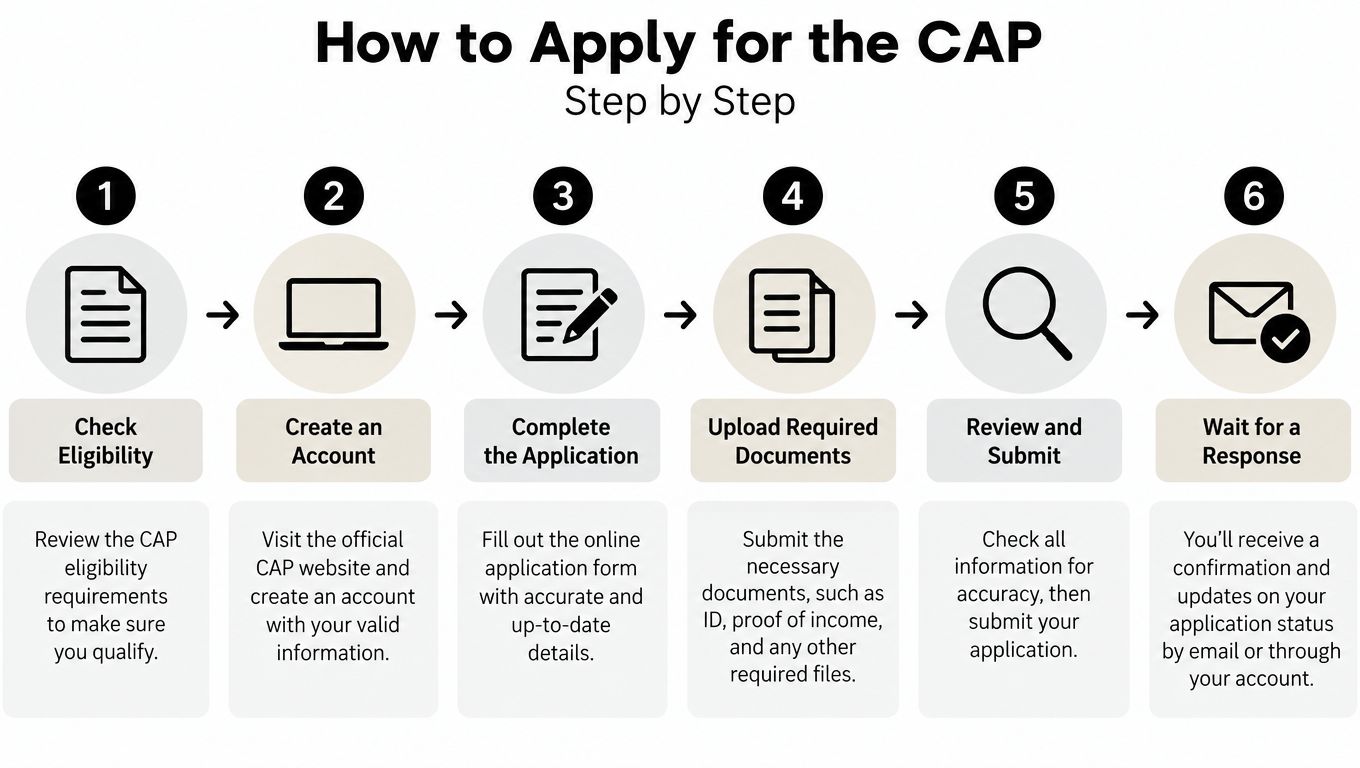
Expect verification after repair
The repair shop documents the work, verifies the emissions result, and completes the required program paperwork. Funds aren't handed directly to the driver as unrestricted cash. The program uses documentation and participating providers to connect the approved assistance to eligible emissions work.
Complete applications are commonly handled over several weeks, so a driver with an approaching renewal date shouldn't wait until the last day. Keep copies of the application, approval notice, diagnostic report, invoices, and final Smog Check result.
The application process is also explained visually in this CAP application video. Watch it before submitting forms, then compare each requirement with the paperwork in your own file.
STAR Stations Versus Regular Smog Check Shops
The difference between a STAR and non-STAR station isn't just a sign on the building. It determines what kind of inspection the shop can perform and whether the result will satisfy a directed testing requirement.
A regular licensed station may be suitable for an ordinary Smog Check. A STAR station is authorized for vehicles that BAR directs into the STAR network and is evaluated under additional performance standards. If the renewal notice or inspection result directs you to STAR, choosing a non-STAR shop can send you back to the beginning.
Match the station to the vehicle
A STAR Test Only station performs inspections but doesn't complete repairs. A STAR Test and Repair station can inspect the vehicle and, where appropriate, perform qualifying repairs. A driver applying for CAP should ask whether the facility participates in the specific CAP repair process, not merely whether it displays a STAR designation.
| Feature | STAR station | Non-STAR station |
|---|---|---|
| Directed vehicle testing | Can handle inspections when BAR directs the vehicle to STAR | May not be authorized for the directed inspection |
| Testing role | STAR Test Only or STAR Test and Repair options | Standard testing or repair services, depending on license |
| CAP planning | May support the required inspection and approved repair workflow | May not satisfy a STAR or CAP-specific requirement |
| Best question to ask | “Can you complete the STAR and CAP steps for this vehicle?” | “Can you perform the inspection required on my notice?” |
A station shouldn't promise a pass before testing. It should explain the result, provide the report, and identify what the vehicle needs next. Ask for a written estimate before approving work, especially when a failed test involves a catalytic converter, oxygen sensor, evaporative system, or diesel emissions component.
Read this STAR station explainer for California drivers before booking. It helps clarify whether you need Test Only, Test and Repair, or a standard inspection.
A STAR label solves a station-authorization problem. It doesn't guarantee that the vehicle will pass.
Follow-up testing should be arranged with the shop that knows the repair history. Keep the first report and every invoice. If the vehicle fails again, those records show what was tested, what was repaired, and whether the next step should be another diagnosis, a waiver review, or retirement.
Edge Cases for Older Cars Diesels and Hybrids
A failed test can lead to different decisions for a 1999 gasoline car, a 2003 diesel pickup, a hybrid with an emissions warning, or a newer vehicle paying an abatement fee. Fuel type, model year, vehicle weight, ownership status, and the failure itself determine which CAP path makes sense.
Older gasoline vehicles
An older car may need a repair that costs more than the vehicle is worth. BAR's repair assistance structure separates model years 1976 through 1995 from 1996 and newer, with different maximum repair amounts. The program details are summarized in BAR's CAP repair guidance.
Eligibility is not automatic, and assistance does not cover every possible repair. Bring the failed report, verify the model year, and compare repair assistance with retirement. A car with rust, transmission trouble, and repeated emissions failures may be a poor repair candidate even if one component can be replaced.
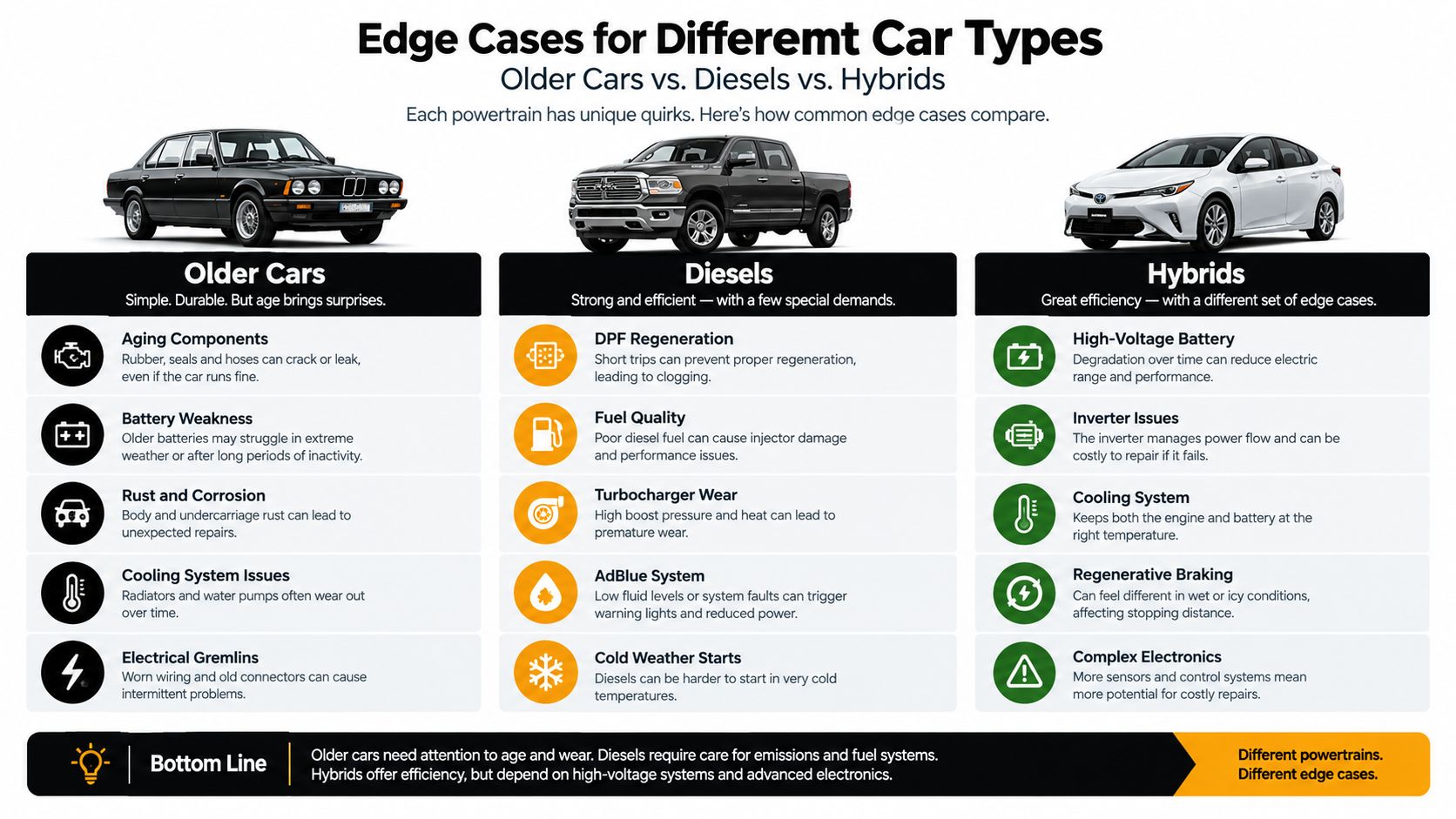
Diesels need careful identification
Diesel classification gives you a practical first checkpoint. Diesels with a gross vehicle weight rating under 14,000 pounds and a model year of 1998 or newer generally fall under the Smog Check program. Older or heavier trucks can follow different requirements, so confirm the vehicle's category before booking a test or approving repairs.
A diesel is not exempt because it uses a different fuel. Ask the station whether the truck belongs in the standard Smog Check process and whether the shop has the equipment and experience to test its emissions system. A diesel failure may involve fuel-system work, sensors, exhaust after-treatment components, or visible smoke. Those diagnoses can lead to different repair costs and different CAP decisions.
If a notice directs the vehicle to a particular station type, follow that instruction before paying for repairs. An accurate classification prevents spending money on work before you know which inspection and assistance rules apply.
Hybrids aren't automatically exempt
The electric motor does not remove a hybrid's gasoline emissions systems. An older hybrid can fail because of emissions components, warning lights, or a fault requiring specialized diagnosis. Battery condition may affect whether keeping the car makes financial sense, but it does not by itself determine CAP eligibility.
Ask the technician to separate the Smog Check failure from unrelated battery maintenance. A replacement hybrid battery will not necessarily correct an emissions failure unless the diagnosis connects the battery problem to the failed result. That distinction helps you compare repair, waiver review, and retirement without treating every expensive hybrid repair as one problem.
Newer vehicles and unusual ownership
Vehicles under four model years old can pay a smog abatement fee instead of completing an inspection during the initial period, according to the California DMV Smog Inspections page. That process differs from CAP. A newer vehicle in this category generally has not entered the same inspection path as a car seeking repair assistance after a failure.
Leased vehicles require coordination with the registered owner or leasing company before retirement or major repairs. An inherited car may need its ownership and registration records corrected before an application can proceed. An out-of-state vehicle entering California may need California registration steps and a qualifying inspection before its owner can use state assistance.
For preparation details, use this guide to smog checks for older cars. Before giving a final answer, the station should confirm the fuel type, model year, registration status, vehicle weight when relevant, and test category.
Your Action Plan for Getting Back on the Road
A failed Smog Check can leave an East Bay driver choosing among repairs, a waiver, or retirement. Start with the failed result and the vehicle's history, then match the paperwork and funding to that choice.
Make the first call useful
Keep the complete inspection report beside you when calling a STAR station. Give the staff the model year, fuel type, failure result, whether the notice requires a STAR station, and which path you are considering. This helps the technician address the actual problem instead of offering a generic application answer.
Gather these records before applying:
- Failed test report: Keep the full printout, including failure codes and station information.
- Registration records: Have the DMV registration card or renewal information ready.
- Repair history: Save previous passing results, diagnostic notes, invoices, and receipts.
- Income documents: Collect the records BAR requests for an income-based application.
- Ownership paperwork: Resolve lease, inheritance, title, or registration issues before beginning a retirement transaction.
BAR's CAP contact options are the right place to confirm current rules. Eligibility may depend on the inspection history, registration details, and the specific assistance path, so a general search can leave out a requirement.
Use the diagnosis to choose the path
Ask the technician three direct questions:
- What specifically caused the failure?
- Is the proposed repair emissions-related and eligible for the program?
- Considering the vehicle's condition and value, does repair or retirement make more sense?
A repair may preserve a useful vehicle, while retirement may fit an older car whose repair cost exceeds its practical value. A waiver review follows its own requirements, so do not assume an expensive repair automatically qualifies.
Do not buy parts before confirming the program rules. Keep every receipt, but remember that documentation alone does not guarantee reimbursement if the work was not approved or eligible.
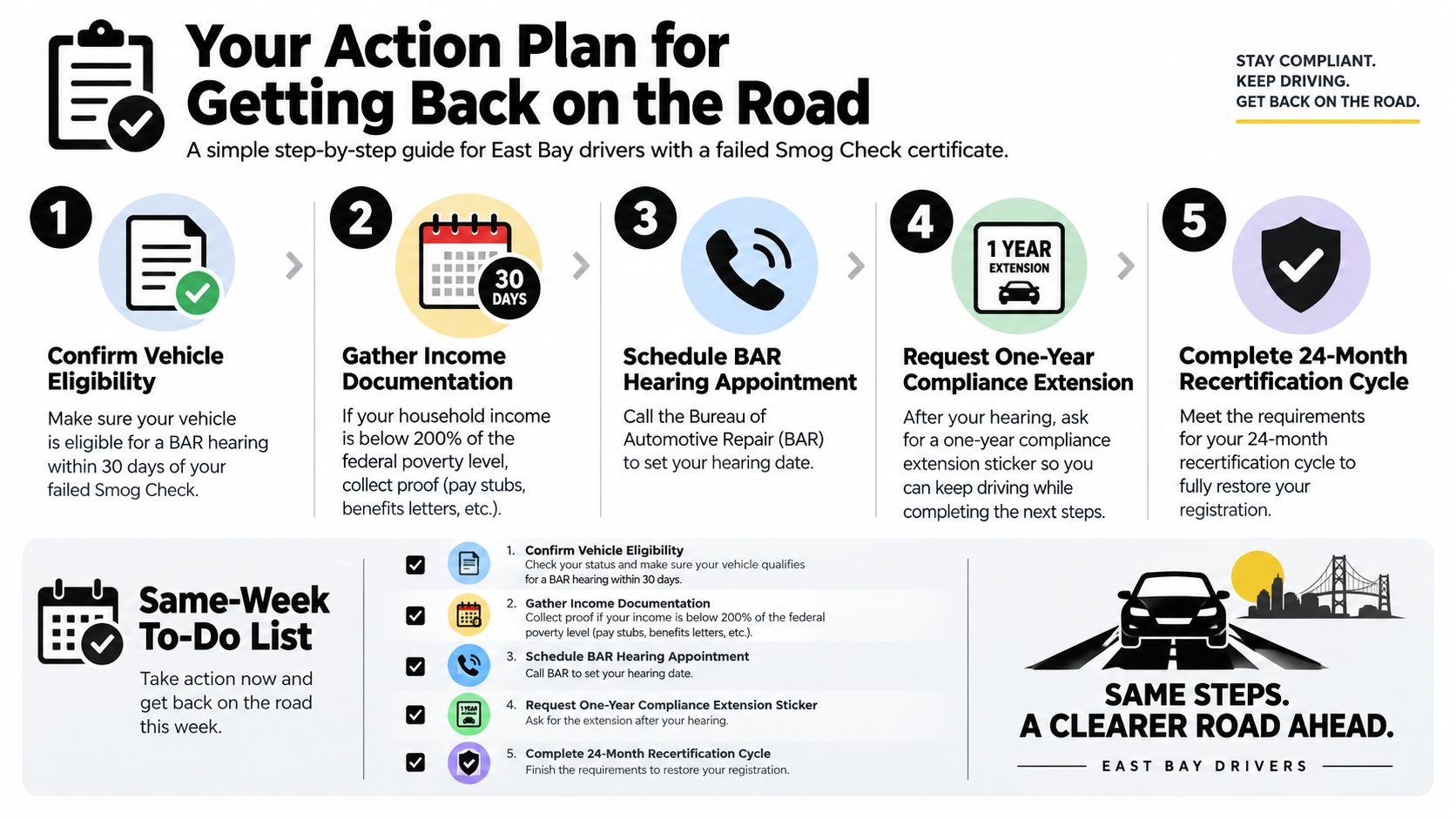
If the paperwork is unclear, use BAR's CAP contact options rather than guessing from a renewal deadline. Processing can take several weeks. Arrange legal transportation and avoid driving with an unresolved registration issue.
Speedy Smog in San Leandro is a STAR Certified station that can run the inspection establishing your next step. Visit Speedy Smog to schedule it.
You've booked a California smog check, the registration deadline is close, and someone has told you to “take the diesel on the freeway and clear the light.” That advice can help in a narrow situation, but it can also waste your time or guarantee a failure if the vehicle's OBD monitors aren't ready or a real emissions fault remains active.
Passing a diesel emissions test starts with identifying which inspection rules apply to your vehicle. From there, the priorities are straightforward: confirm eligibility, check readiness, control smoke and opacity, avoid resetting the computer before testing, and diagnose persistent faults instead of trying to drive them away.
Table of Contents
- Knowing If Your Diesel Needs a Smog Check
- Understanding Opacity Limits and OBD Readiness Rules
- Executing the Pre-Test Drive Cycle Checklist
- Avoiding the Code Clearing Trap
- Deciding Between a Long Drive and Diagnostic Repair
- Managing Test Day Logistics and STAR Certification
Knowing If Your Diesel Needs a Smog Check
The first mistake many owners make is preparing for a test their vehicle may not need, or assuming every diesel follows the same procedure. California separates diesel vehicles by model year and gross vehicle weight rating, so check those details before spending money on additives, repairs, or a pre-test inspection.
According to the California Bureau of Automotive Repair Smog Check reference, diesel vehicles built from model year 1998 onward are generally included in the program. Diesel vehicles from 1997 and earlier are exempt, and vehicles with a GVWR above 14,000 pounds are outside the standard program described for these light-duty inspections.
Check the two eligibility details
Start with the vehicle's model year. Don't rely on the year you bought it, the registration date, or the date of a major repair. The relevant detail is the vehicle's model year as identified in its records and emissions equipment documentation.
Next, check the gross vehicle weight rating, not the vehicle's current weight. GVWR is the manufacturer's rated maximum weight for the vehicle, including occupants and cargo. A diesel that looks like a normal pickup may fall under different requirements if its rating places it above the light-duty threshold.
California's diesel inspection rules also reflect a historical change that matters to owners of newer passenger vehicles and pickups. The 2010 expansion brought post-1997 diesel passenger cars and trucks up to 14,000 pounds into the Smog Check system, making modern diesel eligibility more common than many older guides suggest.
Confirm the inspection type before your appointment
Eligibility doesn't tell you every detail of the test. A qualifying diesel may be evaluated through a combination of OBD communication, visual inspection, and smoke or opacity checks, depending on its category and the applicable procedure. It isn't just the older gasoline-style tailpipe dyno test that many drivers remember.
Before you schedule, compare your vehicle's year and GVWR with the diesel Smog Check requirements. If the vehicle is subject to inspection, ask the station what information it needs and whether it handles the relevant diesel procedure.
Understanding Opacity Limits and OBD Readiness Rules
California diesel testing revolves around two different questions. How much smoke is the vehicle producing, and has the emissions computer completed the required self-tests? A diesel can look clean at idle and still fail because its monitors report “Not Ready.” It can also have a ready OBD system and fail because visible smoke or measured opacity exceeds the applicable limit.
For heavy-duty diesel fleets covered by California's Periodic Smoke Inspection Program, the BAR Smog Check Manual identifies opacity limits of 55% for pre-1991 engines and 40% for engines from 1991 onward. Those limits apply to the heavy-duty program, so don't automatically transfer them to every light-duty diesel.
For light-duty diesels, OBD readiness becomes especially important. Model year 2007 and newer light-duty diesels may have two unset readiness monitors, but the allowance is limited to the Diesel Particulate Filter and Non-Methane Hydrocarbon Catalyst monitors. If other required monitors remain incomplete, the vehicle may not qualify for a pass.
California diesel inspection thresholds
| Vehicle category | Opacity limit | OBD monitor allowance |
|---|---|---|
| Heavy-duty diesel, pre-1991 engine | 55% | Requirements vary by applicable heavy-duty procedure |
| Heavy-duty diesel, 1991 and newer engine | 40% | Requirements vary by applicable heavy-duty procedure |
| Light-duty diesel, model year 2007 and newer | Tested under the applicable diesel procedure | Two unset monitors may be allowed, limited to the Diesel Particulate Filter and Non-Methane Hydrocarbon Catalyst monitors |
The practical lesson is that smoke and readiness are separate gates. A highway drive may help a diesel complete a regeneration-related monitor, but it won't repair a failed sensor, restore damaged wiring, or correct an emissions system that has been deliberately removed or reprogrammed.
Check readiness before you pay for the test
Use a capable OBD scanner to view monitor status, not just stored trouble codes. Look for a result showing the required systems as Ready, and check whether the malfunction indicator lamp is illuminated.
The equipment used by a compliant station matters because the inspection must communicate with the vehicle and evaluate the systems required for that vehicle. If you want to understand the role of the inspection hardware, review the diesel emissions testing equipment used for this type of evaluation.
Executing the Pre-Test Drive Cycle Checklist
A drive cycle isn't the same as commuting to the inspection station. The vehicle's computer needs the right combination of cold-start conditions, warm-up, speed, load, and uninterrupted operation to complete its self-tests. The exact sequence varies by manufacturer, so the owner's service information remains the authority, but a controlled routine is more useful than random short trips.
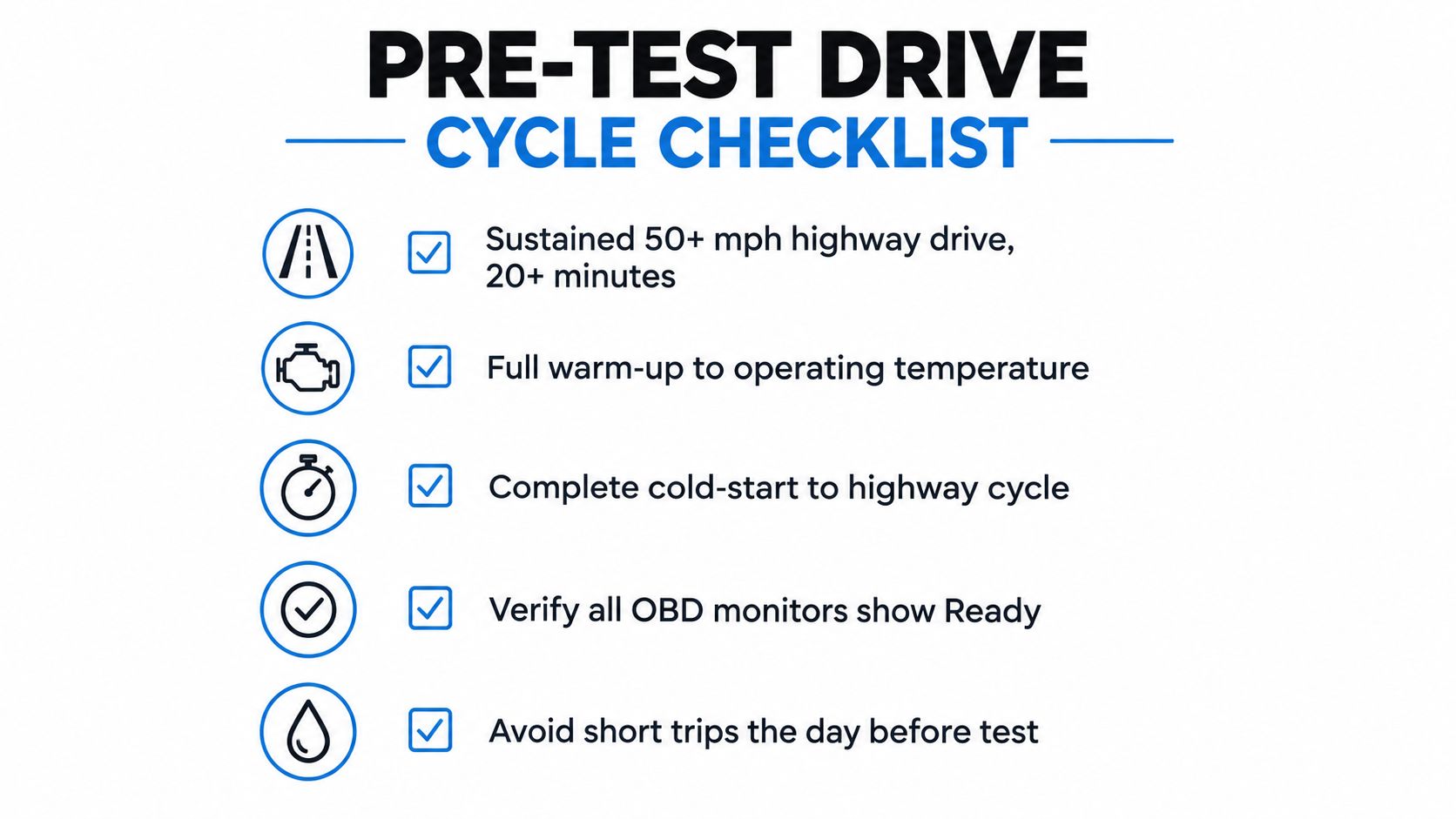
Use a deliberate sequence
Begin with a genuine cold start. Let the vehicle complete its normal startup process, then drive gently while the engine and emissions system warm up. Avoid turning the first few minutes into a hard acceleration run, because the aim is stable operating conditions, not punishment.
Once the engine reaches normal operating temperature, use a sustained highway drive. The infographic's practical checklist calls for a 50-plus-mph highway drive lasting 20-plus minutes, but treat that as a preparation pattern rather than a universal manufacturer-specific procedure. Obey the speed limit, keep a safe following distance, and don't force the engine beyond its normal operating range.
A useful preparation sequence looks like this:
- Start cold: Begin after the vehicle has been sitting long enough for the engine to cool naturally.
- Warm gradually: Drive smoothly until the engine reaches its normal operating temperature.
- Hold steady conditions: Maintain a sustained highway segment rather than repeatedly stopping and restarting.
- Avoid unnecessary short trips: Don't spend the day before the test making several brief journeys that leave the diesel cold.
- Scan afterward: Check monitor status before the appointment, especially if the vehicle recently had electrical work or codes cleared.
The goal is to let the computer perform its tests under the conditions it expects. It isn't to create smoke, force a regeneration manually, or drive aggressively.
Why the routine can change the result
EPA best-practice data shows that a less strict monitor allowance reduced the overall medium-duty diesel vehicle initial “not ready” rate from 7% to 3%, as reported in its diesel OBD inspection best-practices document. Among light-duty diesel make and model groups, initial not-ready rates ranged from 0–9% under a two-monitor criterion, compared with 0–13% under a one-monitor criterion, using the same EPA source.
Those figures don't promise that a particular vehicle will pass after one drive. They do show why monitor preparation deserves attention. A vehicle may have no obvious drivability complaint while its computer still needs the correct conditions to finish testing.
Practical rule: Drive to complete the vehicle's diagnostic routine, then verify “Ready” with a scanner. Don't assume the trip happened just because the odometer moved.
If monitors remain incomplete after a proper warm drive, stop repeating the same route blindly. Look for a stored fault, an operating-temperature problem, a battery or charging issue, or a manufacturer-specific condition that the generic routine didn't satisfy.
Avoiding the Code Clearing Trap
Clearing a check engine light immediately before a smog check is one of the fastest ways to create an inspection problem. Disconnecting the battery, using a basic scan tool to erase codes, or allowing a repair shop to reset the computer can also erase the monitor history that the inspection machine needs to see.
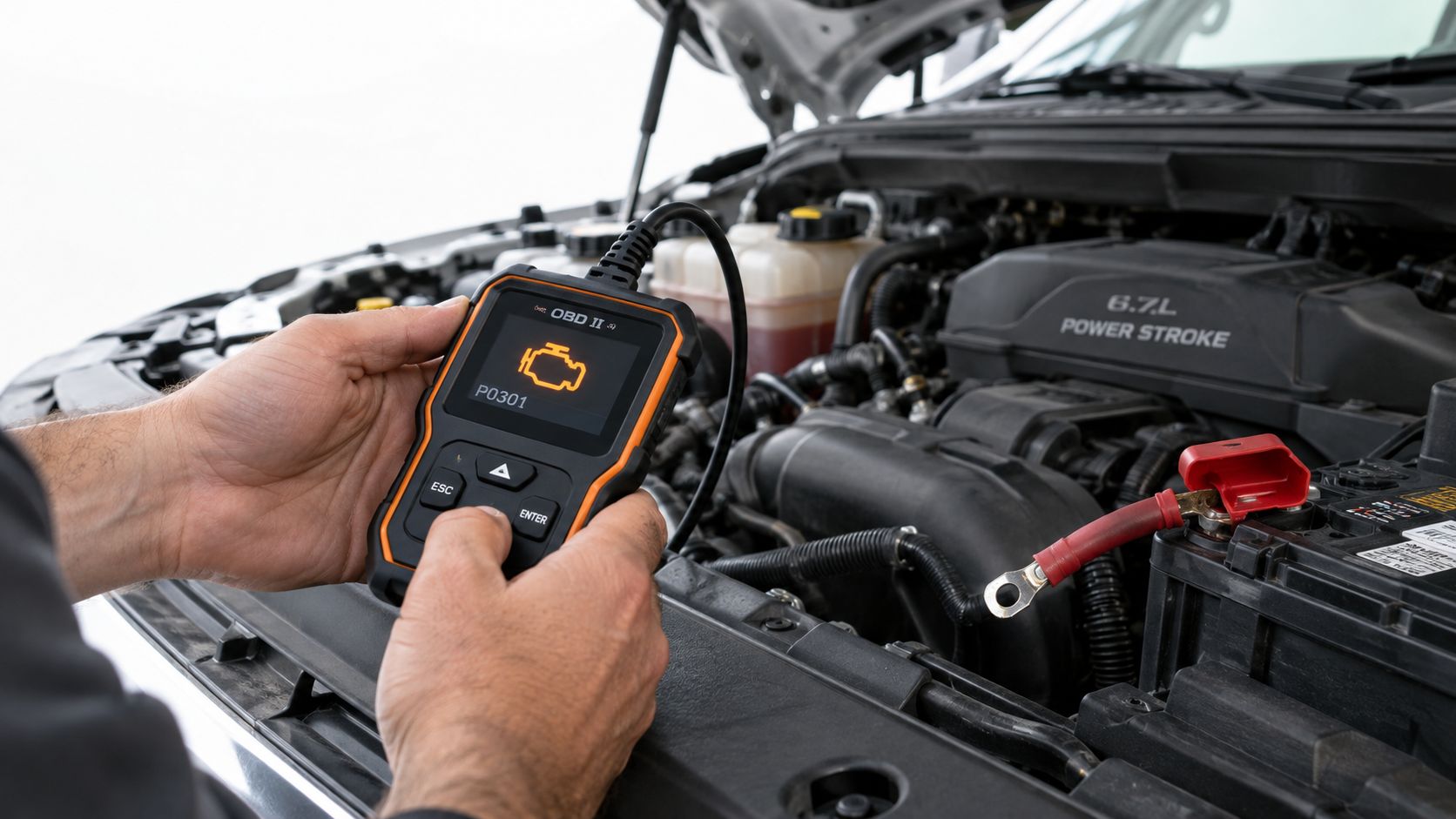
Why a reset produces a “Not Ready” result
The monitors are not simple lights that switch back on as soon as you start the engine. They run self-tests during specific operating conditions. After a reset, the computer needs time and the correct drive conditions to complete them again.
The Missouri inspection guidance on readiness monitors explains that diesel vehicles can fail when required monitors haven't completed their self-tests. Battery disconnection, code clearing, a repair-shop reset, power or ground problems, and unmet temperature conditions can all leave monitors incomplete.
The same principle applies even if the original fault has been repaired. A reset may remove the warning light, but it also removes evidence that the emissions systems have completed their checks. The inspection station sees the incomplete state, not your intention.
Use a scan tool to diagnose the code rather than erase it. Record the code, freeze-frame information, and monitor status before making repairs. If the problem is repaired, follow the vehicle's specified drive cycle and confirm that the monitors have returned to Ready before booking the inspection.
The guide to clearing a check engine light can help explain the difference between resetting a warning and resolving the fault, but clearing codes alone isn't a pass strategy.
Treat electrical problems as emissions problems
A weak battery, poor ground, damaged connector, or charging fault can interrupt monitor testing. The diesel may start and drive normally while the computer loses the stable power or communication it needs to complete diagnostics.
Watch for these warning signs:
- Recent battery work: The monitors may have been reset during replacement or service.
- Intermittent warning lights: A power or ground fault can cause inconsistent computer behavior.
- Scan-tool communication failure: The inspection can't proceed normally if the vehicle's diagnostic connector doesn't communicate.
- Repeated “Not Ready” status: A drive cycle won't solve a monitor that cannot run because an enabling condition or circuit fault remains.
The correct order is diagnosis, repair, drive cycle, and verification. Don't erase the evidence before you know what caused the warning.
Deciding Between a Long Drive and Diagnostic Repair
A long highway drive is a reasonable first step when the diesel's main problem is its operating pattern. Short trips can prevent the vehicle from reaching the conditions needed for effective emissions-system operation, and a sustained warm drive may help the vehicle complete its routine.
It's not a universal repair. A drive can't restore a damaged sensor, repair an exhaust leak, reconnect a diagnostic circuit, or undo emissions-control software changes.
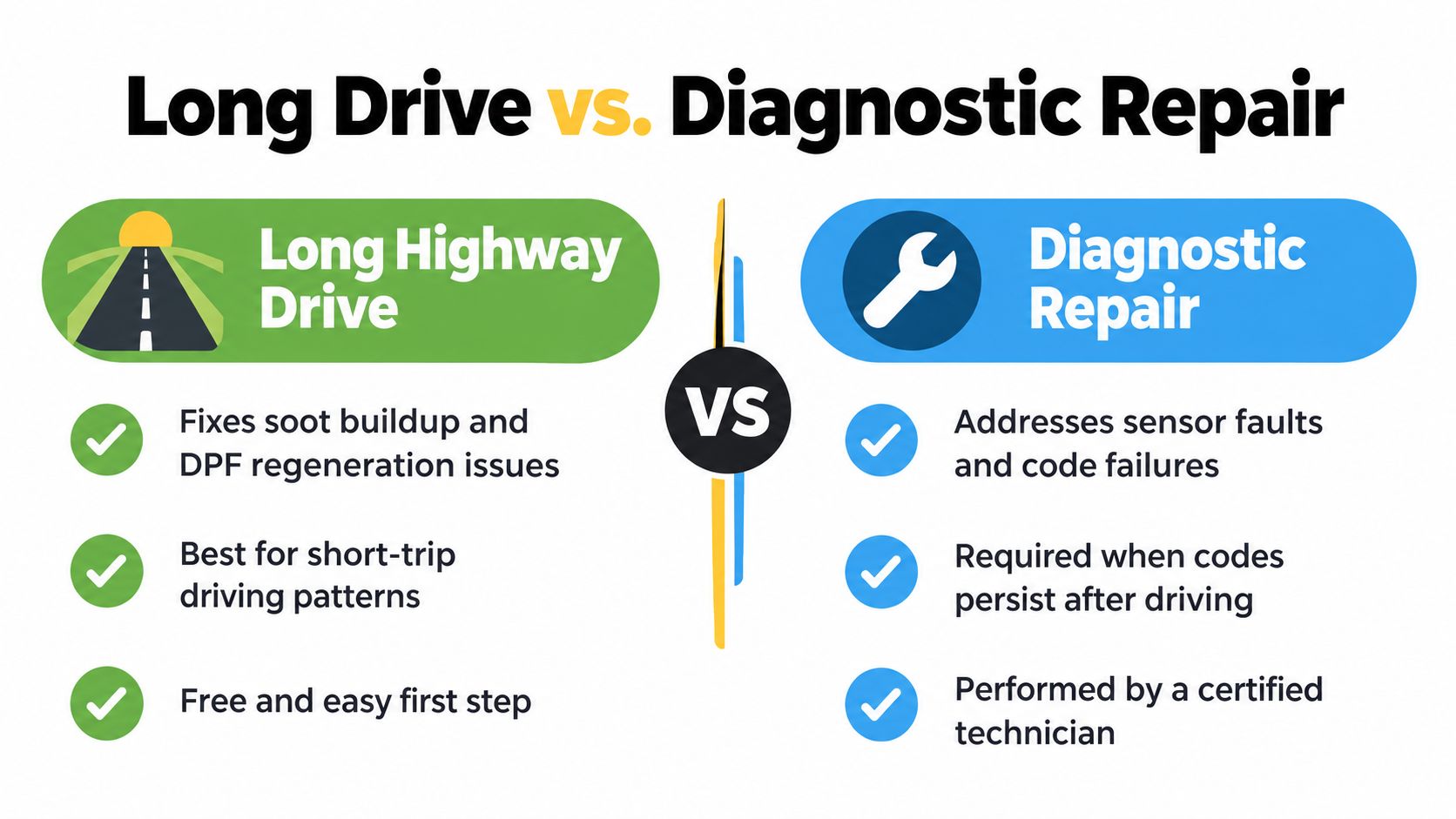
When a highway drive makes sense
Choose the low-cost preparation route when the vehicle has no active warning light, communicates normally with the scanner, and the issue appears related to repeated short-trip use. Give the engine a complete warm-up, drive steadily on the highway, and scan the vehicle afterward.
A fuel top-up and correct engine oil may be sensible maintenance steps if the vehicle is due for them, but neither should be treated as a guaranteed emissions repair. Use only fluids and specifications approved for the vehicle, particularly where a diesel particulate filter requires low-ash oil.
The test is simple: did the monitors become Ready, and did the warning condition stay away? If yes, the preparation may have addressed a readiness issue. If not, more driving is unlikely to provide a different result.
When diagnosis comes first
Persistent codes deserve repair before testing. Common failure signatures include DPF-related codes such as P2002, P244A, and P246C, along with visible exhaust leaks and communication problems at the diagnostic connector, according to this diesel emissions failure guide.
A technician should investigate rather than repeatedly clear these codes. Possible causes include damaged pressure or temperature sensors, wiring faults, an exhaust leak that affects readings, inactive regeneration logic, or deleted DPF software. These conditions can keep returning after every reset and can prevent the required monitors from completing.
| Long highway drive may help | Diagnostic repair is the better choice |
|---|---|
| The vehicle has no active warning light | A warning light returns after clearing |
| The issue follows repeated short trips | DPF codes remain stored or return |
| The scan tool communicates normally | The connector won't communicate reliably |
| Monitors are incomplete but no fault is present | Sensors, wiring, software, or exhaust components show faults |
| The engine reaches normal temperature | The engine or emissions system can't meet enabling conditions |
A clean-looking exhaust doesn't prove that the emissions system is healthy. The scanner and the physical inspection need to agree.
Don't drive aggressively to hide smoke. Excessive load, unsafe speeds, or improvised regeneration attempts can add risk without fixing the underlying fault. If the scan shows a persistent problem, pay for diagnosis before paying for another test.
Managing Test Day Logistics and STAR Certification
A prepared vehicle can still have an avoidable problem on test day. Bring the vehicle's registration information and any documents connected with the inspection request or recent emissions repair. If a prior failure report identifies a specific monitor or emissions component, give it to the technician instead of relying on memory.
Arrive with the engine fully warmed through normal driving, but don't turn the trip into an aggressive “tune-up.” A warm engine allows the inspection to occur under normal operating conditions, while careful driving protects you, other road users, and the vehicle.
Confirm the station and procedure
Choose a station that handles the diesel category and test method your vehicle requires. California diesel inspections may involve OBD checks, visual review, and opacity testing depending on the vehicle and applicable rules. Ask before arrival if you're uncertain about model year, GVWR, or the required equipment.
A STAR Certified station meets the Bureau of Automotive Repair's performance standards for participating inspections. That designation doesn't replace vehicle maintenance, but it gives you a compliant testing location for transactions that require a STAR inspection.
Before the technician begins, mention recent battery replacement, code clearing, electrical repairs, or a check engine light. These details help explain why monitors may be incomplete and can prevent you from treating a readiness problem as a mechanical mystery.
Use the result intelligently
If the vehicle passes, keep the paperwork for your records and complete the registration process as required. If it fails, read the failure result carefully. The next repair should target the listed cause, whether that's monitor readiness, a DPF-related code, smoke, visible emissions equipment, or communication.
Don't approve unrelated parts replacement before the diagnostic evidence supports it. A proper pre-test scan can tell you whether the vehicle needs more drive-cycle time or a repair appointment, which is often the difference between a useful visit and paying for a repeat inspection.
For East Bay owners, Speedy Smog performs diesel Smog Checks in San Leandro for applicable vehicles, with OBD, visual, or opacity procedures selected according to the vehicle and inspection requirements. Visit the station with your monitors verified and any recent repair information available so the technician can complete the inspection accurately.
You're probably looking at a registration renewal notice, checking the calendar, and wondering whether your car can make it through the test without drama. The mistake I see most often is treating a smog check as nothing more than a quick warm-up and a tailpipe measurement. In California, your vehicle has to pass two separate tests: its computer must report that the emissions self-checks are complete, and the emissions hardware must perform properly when the vehicle is inspected.
That first part is the silent failure. Since October 1, 2025, California's Bureau of Automotive Repair says all readiness monitors must be set for a vehicle to pass Smog Check (BAR's readiness monitor guidance). A car can feel fine, show no warning light, and still fail before the emissions portion starts if someone recently disconnected the battery or cleared a code.
Table of Contents
- How a Smog Check Actually Works
- Your Week-Before and Day-Of Prep Timeline
- Why Readiness Monitors Are the Silent Failure
- The Right Way to Warm Up Before You Drive In
- Paperwork, Coupons, and What to Bring
- If You Do Not Pass on the First Try
- Quick Checklist and Common Questions
How a Smog Check Actually Works
When you pull into the bay, the technician starts with the basics. They verify the vehicle information, look at the dashboard warning lights, check the gas cap, and inspect visible emissions equipment for damage, removal, or tampering. If the check engine light stays on while the engine is running, the inspection can stop there because the vehicle is reporting an emissions-related fault.
Next comes the OBD-II scan. The technician connects to the diagnostic port and checks stored trouble codes, permanent codes where applicable, and readiness monitor status. Readiness monitors are internal self-tests for systems such as the catalyst, oxygen sensors, and evaporative emissions controls. If required monitors show “Not Ready,” the vehicle may fail without the technician needing to measure tailpipe output.
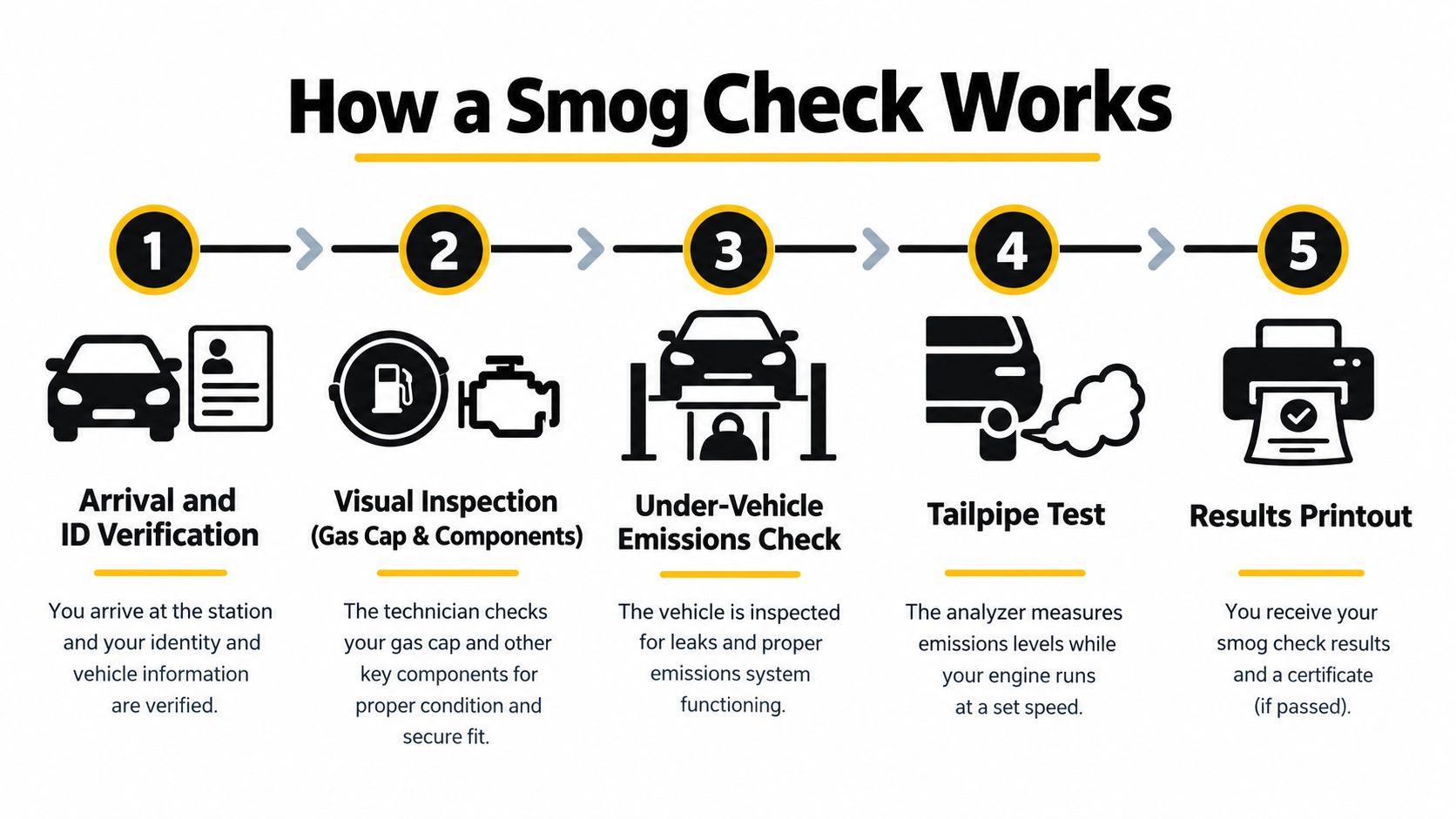
The inspection has two failure paths
For most 1999-and-newer vehicles, the station uses California's OIS process. The scan evaluates the vehicle's computer data, while the inspection also checks the vehicle's condition and emissions-related components. Older vehicles may receive a different inspection, including a dynamometer test for applicable trucks and cars.
The tailpipe side looks at pollutants including hydrocarbons, carbon monoxide, and nitrogen oxides. A warm catalytic converter, correct fuel control, and a healthy engine help with this part. A proper smog check machine combines the computer inspection with the required emissions measurements.
Practical rule: A warm engine helps the tailpipe test. A completed drive cycle helps the computer test. You need both.
The final result prints after the technician completes the required checks. That printout tells you whether the issue was readiness, a warning light, visible equipment, or measured emissions. Your preparation should target the correct failure path rather than relying on one quick idle in the driveway.
Your Week-Before and Day-Of Prep Timeline
A car can run smoothly and still fail at the station entrance if its computer has not finished the required checks. Prepare for both sides of the inspection, readiness monitors and tailpipe emissions, with a short plan instead of a last-minute fix.
About a week before
Start with the check engine light. Turn the key without starting the engine and confirm the light comes on for its bulb check. Start the vehicle and verify that it turns off. If it stays on or flashes, diagnose the cause before scheduling the inspection.
Inspect the gas cap. Look for a cracked or flattened seal, then reinstall it until it clicks. A damaged cap can cause an EVAP fault, and tightening it after the warning light appears may not immediately complete the related monitor.
Check for an open safety or emissions recall and contact the manufacturer's dealer if a repair is required. Check tire pressure before completing the driving needed for monitor readiness. Correct pressure makes that preparation drive safer and prevents an avoidable problem.
Two or three days before
Drive normally across mixed conditions. Use stop-and-go streets, steady surface-road cruising, and freeway operation instead of taking only short trips. If recent repairs or a cleared code reset the computer, allow 50–100 miles after major work or a reset before testing, as recommended in Diamond Certified's smog preparation guide.
Do not disconnect the battery, clear codes, or erase a warning with a scanner before the appointment. Those steps can return monitors to Not Ready and leave the computer without enough completed self-test results. Check the oil level and take care of an overdue oil service before the inspection.
The day before and the morning of
Keep the fuel level moderate. One industry guide recommends roughly one-quarter to three-quarters full, since an extremely low or completely full tank can interfere with EVAP testing on some vehicles (Foxwell's readiness guidance).
On test day, drive for 15–20 minutes before arriving. Use mixed city and freeway conditions rather than idling in the driveway, following California smog check preparation guidance. Bring your renewal notice, payment, and any coupon you plan to use. Leave removable roof racks and unusual accessories at home if they could interfere with inspection access.
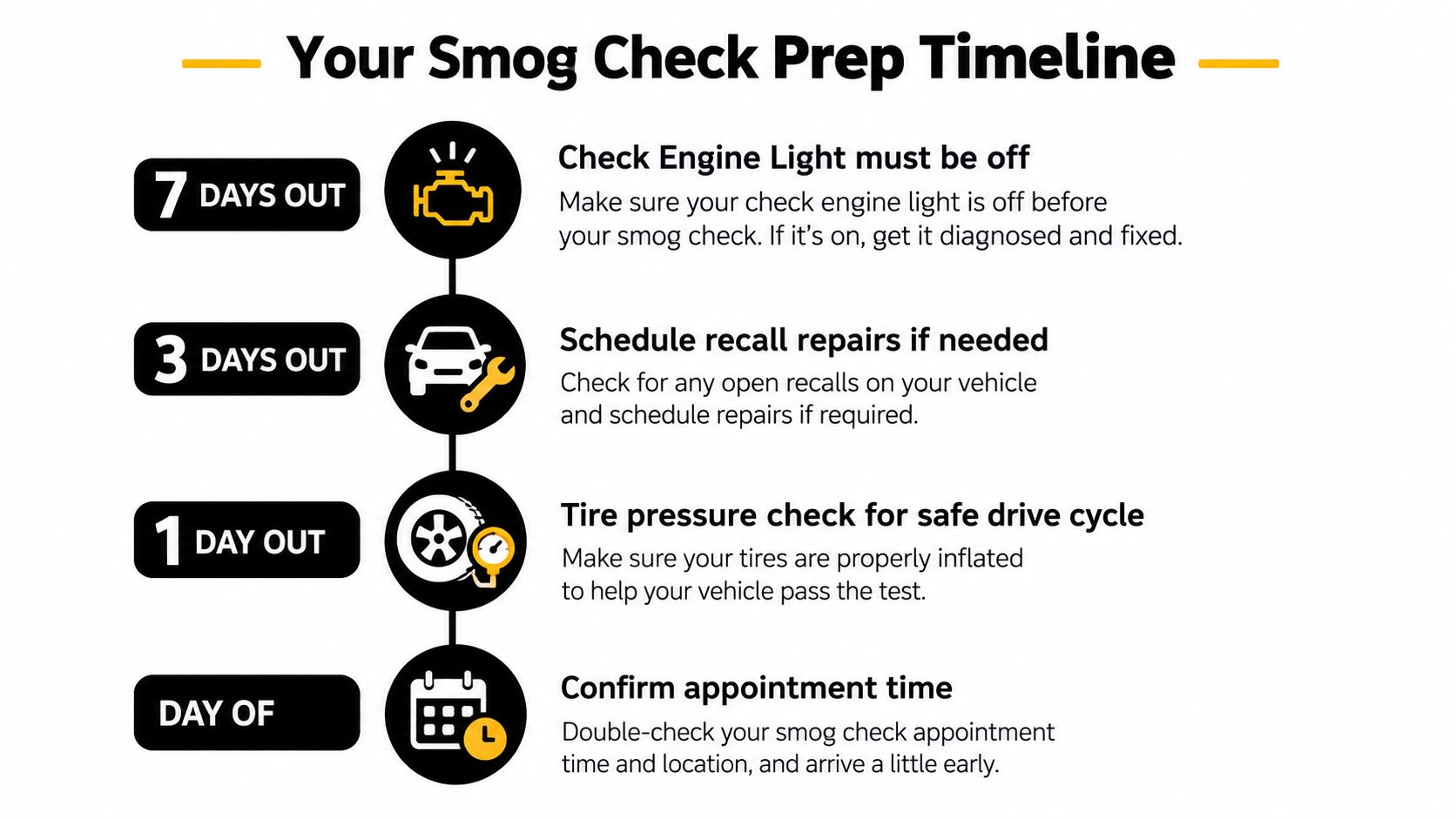
Why Readiness Monitors Are the Silent Failure
Your car can feel fine, show no warning light, and still fail before the tailpipe portion even matters. The hidden issue is often an incomplete readiness monitor, a self-test running inside the engine computer that checks an emissions system under specific conditions.
Common monitors cover the catalytic converter, EVAP system, oxygen sensors, and EGR system. Each result is either Ready or Not Ready. Smooth driving does not earn partial credit, and checking one related component does not complete the entire monitor.
What each monitor needs
Vehicles use different monitor sets and drive-cycle requirements, so the conditions below are practical examples rather than a replacement for the manufacturer's procedure.
| Monitor | What It Tests | Typical Set Conditions |
|---|---|---|
| Catalyst | Catalytic converter efficiency | Fully warm engine, steady cruise, and controlled deceleration |
| EVAP | Fuel-vapor leaks and purge operation | Appropriate fuel level, normal temperature, and specific parked or driving conditions |
| Oxygen sensor | Sensor response and fuel-control feedback | Engine at operating temperature with changing load |
| EGR | Exhaust-gas recirculation operation | Warm engine, light-to-moderate load, and controlled acceleration |
| Misfire | Combustion irregularities | Normal driving across different engine speeds and loads |
Battery replacement, battery disconnection, code clearing, and some emissions repairs can reset monitors to Not Ready. Electrical work or an aftermarket alarm installation can do the same if power is interrupted. A missing check engine light does not prove the computer is ready.
California's October 2025 rule change makes the status more important. BAR's guidance says all readiness monitors must be set for a vehicle to pass Smog Check (BAR's explanation of the new OBD readiness regulations). An incomplete monitor is now a disqualifying problem, not a minor detail.
I'd check the status before paying for an inspection. A basic OBD-II reader paired with an app such as Torque or OBD Fusion can display the results, although the station's equipment has final authority. For a technician-focused explanation, review this guide to car emissions test readiness monitors.
The Right Way to Warm Up Before You Drive In
Idling in the parking lot is a poor substitute for driving. It may raise coolant temperature, but it doesn't reproduce the changing speed, load, airflow, and deceleration that emissions monitors need. It also doesn't heat the catalytic converter as effectively as a real drive.
I'd leave early and use a controlled mixed route. Start with residential streets for 10–15 minutes, accelerate gently, and let the vehicle shift through its normal gears. Move onto surface roads around 35–45 mph, then include freeway operation where traffic allows. Vary the throttle lightly instead of holding one speed the entire time.
What the drive accomplishes
The first phase gives the engine time to reach normal operating temperature and enter closed-loop fuel control. Surface-road driving creates changes in load that help the oxygen-sensor and fuel-trim systems evaluate operation. A freeway stretch adds sustained exhaust flow and load, which helps the catalytic converter reach effective operating temperature.
Industry guidance commonly recommends 15–20 minutes of driving before inspection, while other consumer guidance recommends at least 20 miles, or 100–200 miles after maintenance when a recent repair may have reset the system (Edmunds' smog check preparation guide). Those are different jobs. The short drive warms the vehicle for the appointment. The longer post-repair driving gives the computer time to complete its monitors.
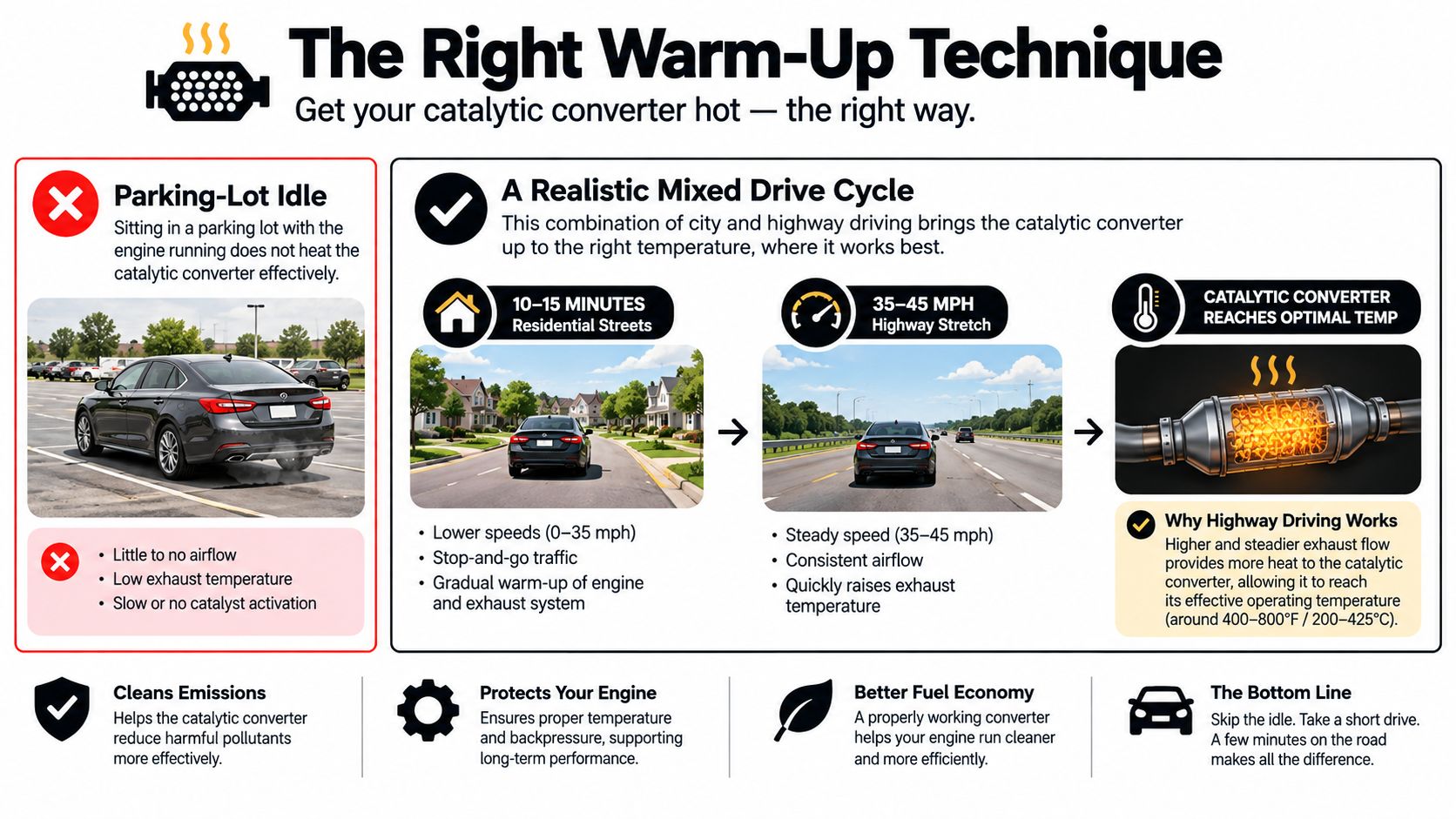
Finish driving shortly before you arrive, so the vehicle is already warm. Don't shut it off for a long wait if the station's process allows you to keep it running safely. Leave the A/C and rear defroster off during the inspection unless you need them for safety, because extra electrical and engine load can change test conditions.
Hybrids need a little more planning because the gasoline engine may shut off during portions of the route. Diesel vehicles also follow different emissions logic. If you drive either type, use normal operation and ask the station whether your vehicle needs a particular inspection procedure.
Paperwork, Coupons, and What to Bring
Most appointment problems are boring and preventable. Bring the renewal notice or current registration, a payment method the station accepts, and any repair or diagnostic paperwork that might help explain recent work. If your state or service provider sends an electronic certificate, have access to the email account or phone number used for delivery.
California drivers should check for available smog coupons before arriving. The state's Consumer Assistance Program may provide a $50 state assistance voucher, with eligibility rules and limits applying to the vehicle and applicant (California's official consumer assistance information). Don't assume every coupon works at every station. Read the terms, confirm the vehicle eligibility, and ask whether the discount applies to the inspection or only to a particular service.
Choose the correct station
A standard licensed station, a STAR station, and a test-only station don't serve exactly the same purpose.
| Station Type | Can Perform Repairs? | Use When |
|---|---|---|
| Regular licensed station | Often, depending on the business | You want inspection and possible repair support in one place |
| STAR-certified station | Varies by station | Your renewal notice directs you to STAR or you need a recognized follow-up inspection |
| Test-only station | No repair work | You want an independent inspection without repair sales |
Check your renewal notice before choosing. Some vehicles are directed to STAR-certified stations, and a retest path may have specific station requirements. A test-only location can inspect and report, but it won't repair the problem if the vehicle fails.
The technician needs clear access to the dashboard, engine compartment, gas cap, and diagnostic port. Wear shoes you can safely drive in and remove clutter from the cabin. At Speedy Smog, a STAR Certified smog check station in San Leandro handles emissions testing for many cars, older vehicles, diesels, and hybrids, with the exact inspection determined by the vehicle and California requirements.
If You Do Not Pass on the First Try
A failed result gives you information. Don't approve a catalytic converter or oxygen sensor just because the word “emissions” appears on the report. Start with the Vehicle Inspection Report, or VIR, and identify exactly what failed.
The VIR should tell you whether the issue involved readiness, a diagnostic code, visible equipment, or measured emissions. If the tailpipe portion failed, the pollutant readings and limits guide the diagnosis. If the computer portion failed, find out which monitor remains incomplete or which code prevents certification.
Follow the evidence
Ask for a scan-data diagnosis before authorizing parts. A technician can check fuel-trim behavior, oxygen-sensor response, misfire data, EVAP operation, and catalyst performance instead of guessing. A loose gas cap, EVAP leak, oxygen-sensor problem, misfire, or weak catalyst can produce very different repair paths.
Keep every estimate, invoice, receipt, and parts record. California assistance and waiver programs use documentation and eligibility requirements, so paperwork can matter as much as the repair itself. Ask the station whether the appropriate next step is a repair and retest or a state Referee appointment.
The cheapest repair is the one supported by test data, not the one that sounds most familiar.
A STAR station may handle a qualifying retest after repairs. A Referee can address unusual cases, disputed results, emissions equipment questions, or vehicles that need state-level review. The Referee process has its own appointment and documentation requirements, so contact the program rather than showing up at a regular station expecting the same service.
For a straightforward follow-up, ask about the station's free smog retest policy before authorizing work. Retest rules vary, and the renewal deadline doesn't pause while you search for a part.
Repair in stages. Fix obvious maintenance and sealing problems first, then retest or rescan before moving to expensive components. If the report points to a serious emissions failure, schedule diagnosis immediately rather than waiting until the registration deadline is close.
Quick Checklist and Common Questions
Use this checklist on your phone before you leave. A smog check has two separate failure points: the computer must show completed readiness monitors, and the vehicle must meet the tailpipe emissions limits. A warm engine only handles the second part.
One week out
- Check the warning light: Confirm the check engine light appears during the bulb check, then turns off after startup.
- Inspect the gas cap: Tighten it until it clicks. Replace a cracked or missing cap.
- Review vehicle history: Note recent battery work, code clearing, repairs, or electrical changes. Any of these can leave monitors incomplete.
- Plan the route: Build in mixed city and freeway driving before the appointment.
Since California's October 2025 rule change, an incomplete required monitor can disqualify the vehicle. Check monitor status before you pay for the inspection.
The day before
- Drive normally: Recently repaired systems need time and the right conditions to complete their self-tests.
- Check fuel level: Keep the tank in a moderate range, not extremely low or completely full.
- Check fluids and tires: Confirm the oil level and tire pressure are suitable for the drive.
- Gather documents: Put the renewal notice, registration, payment, and coupon together.
The morning of the appointment
- Avoid a cold arrival: Drive for 15–20 minutes before the inspection, using mixed driving so the engine and catalyst are fully warm (California smog check preparation guidance).
- Skip last-minute resets: Do not disconnect the battery or clear codes.
- Remove distractions: Leave unnecessary roof racks and accessories off the vehicle.
- Bring useful information: Tell the technician about recent repairs, battery replacement, or warning-light history.
Common questions
Does a new battery reset readiness monitors?
It can. Battery replacement or disconnection may return monitors to “Not Ready.” Drive normally and verify their status before testing.
How long does a drive cycle take?
The warm-up drive commonly takes 15–20 minutes, but monitors reset after repairs may need substantially more mixed driving. A short warm-up does not complete every self-test.
Does premium fuel help?
Use the fuel grade listed in your owner's manual. Premium fuel cannot repair an emissions fault, seal an EVAP leak, or complete readiness monitors.
What counts as a gross polluter?
The vehicle produces emissions far above the applicable limit. The test report and measured results determine that status, not how the car sounds or feels.
Can the check engine light clear itself?
It may turn off after the computer confirms that a fault is no longer present. The issue still needs diagnosis, and a dark warning light does not prove that monitors are complete.
How long does the certificate stay valid?
Validity depends on the transaction and California DMV requirements. Follow the paperwork and renewal instructions tied to your vehicle.
The practical target is simple: complete readiness monitors and a properly warm emissions system. If either part is uncertain, have the monitor status checked before paying for the inspection.
Speedy Smog provides STAR Certified smog inspections in San Leandro for many cars, diesels, older vehicles, and hybrids. Bring your renewal notice, ask about current coupons, and visit Speedy Smog to schedule or confirm your inspection.
You're checking your mailbox, see a DMV renewal notice, and realize your car needs a smog check before you can finish the registration process. The station's equipment may look like a computer, a hose, and a few cables, but that setup is doing far more than sniffing the exhaust. It's identifying the vehicle, checking emissions data, measuring gases when required, and sending a regulated result into California's inspection system.
A smog check machine is best understood as a recurring compliance tool. California's Smog Check Program is biennial, so most covered vehicles are inspected every two years, rather than only when a car is sold or repaired (California Bureau of Automotive Repair). The equipment must therefore produce consistent, defensible results each time a driver returns for renewal.
The confusing part is that California doesn't use one universal machine for every car. A newer vehicle generally receives a computer-focused inspection through BAR-OIS, while an older vehicle may need the exhaust analyzer and dynamometer used by BAR-97. The sensors, software, calibration routines, and technician workflow all change with the vehicle.
This guide breaks down those systems in practical terms. You'll learn what the machine measures, how it determines pass or fail, what a technician does during the inspection, what STAR standards add, and where the equipment has limits.
Table of Contents
- Introduction to Smog Check Machines and Why They Matter
- What a Smog Check Machine Actually Is
- Two Types of Smog Check Machines in California
- What the Machine Measures and How It Decides Pass or Fail
- How Technicians Use the Machine During Your Inspection
- STAR Standards Calibration and Why Machine Quality Matters
- Getting Ready for Your Smog Check and Choosing the Right Station
Introduction to Smog Check Machines and Why They Matter
A DMV renewal notice creates a simple question: can you renew now, or does the vehicle need a passing emissions inspection first? If your car falls under California's Smog Check requirements, the answer depends on obtaining a valid inspection result from an authorized station.
The smog check machine sits at the center of that process. It doesn't decide whether a vehicle is generally “healthy,” and it isn't a substitute for a complete mechanical diagnosis. Instead, it performs the specific emissions checks California requires for the vehicle's model year and configuration, then records the outcome through the state's inspection process.
Practical rule: Treat a smog check as a compliance appointment, not as a complete vehicle health exam.
California built its program around two major inspection paths. The BAR On-Board Diagnostic Inspection System, commonly called BAR-OIS, serves 2000 and newer vehicles. The BAR-97 Emissions Inspection System, or BAR-97, serves 1999 and older vehicles (California Bureau of Automotive Repair). That model-year split explains why one driver may sit in the bay while a technician connects a cable, while another sees the car's drive wheels placed on rollers and a probe inserted into the tailpipe.
The program also has a quality-focused branch called STAR. California created STAR through Assembly Bill 2289 in 2010 to improve inspection quality and help achieve required emissions reductions. STAR stations must maintain equipment capable of testing all vehicles subject to the Smog Check Program (California Bureau of Automotive Repair).
Before arriving, gather the renewal information if you have it and tell the station about warning lights, recent emissions repairs, or a disconnected battery. Those details can affect what the technician sees, especially when the vehicle's onboard diagnostic system hasn't completed its self-checks.
Understanding the machine removes much of the mystery. You'll know which inspection system applies, why the technician follows a particular sequence, and why a reliable result depends on more than the final printed word, “pass.”
What a Smog Check Machine Actually Is
A smog check machine isn't one box with one sensor. It's an integrated inspection system that combines vehicle identification, electronic communication, physical checks, gas measurement where required, software logic, and state reporting.
A useful analogy is a medical checkup. A blood-pressure cuff measures one condition, a blood test measures another, and the clinician combines those observations with your history. The equipment doesn't diagnose every possible illness. It gathers the specific information needed for the appointment.
A smog inspection works in much the same way:
- The technician identifies the vehicle and enters the required information.
- The system communicates with the vehicle's emissions computer when an OBD inspection applies.
- The technician checks emissions-related hardware and signs of tampering.
- The equipment measures tailpipe gases for vehicles requiring that test.
- The software compares the collected information with California's requirements and records the result.
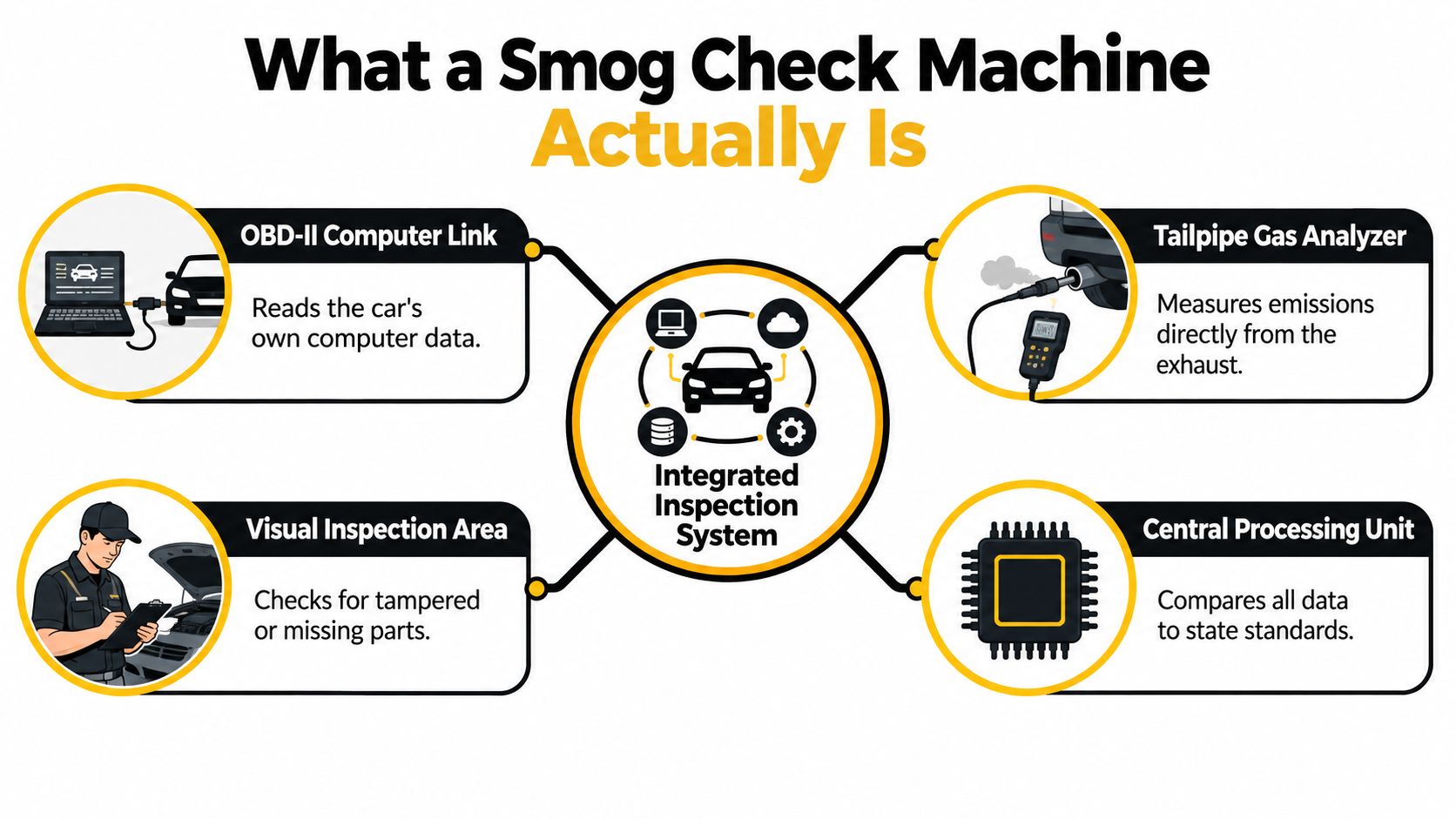
The parts work as one system
The OBD-II connection reads information stored by the vehicle's own emissions-control computer. That computer monitors emissions-related systems and can store diagnostic trouble codes when it detects a problem. The scan gives the inspection system access to data that a tailpipe probe alone can't provide.
A tailpipe analyzer measures gases directly from the exhaust. This is central to the BAR-97 process, where the equipment evaluates pollutants produced while the vehicle operates under specified conditions.
A visual inspection adds another layer. The technician may identify missing, modified, or tampered emissions components that electronic data alone wouldn't prove. The central processing and reporting system then brings the observations together.
The complete platform must be calibrated and operated according to California's rules. That's why the state regulates approved equipment and station procedures, rather than treating any generic exhaust sensor as an acceptable smog check machine.
Two Types of Smog Check Machines in California
A 2001 sedan and a 1998 pickup do not follow the same inspection path. California generally matches the machine to the vehicle's model year and emissions technology. Newer vehicles report much of their emissions information through the onboard computer, while older vehicles are tested by sampling exhaust during operation.
| Feature | BAR-OIS for 2000 and Newer | BAR-97 for 1999 and Older |
|---|---|---|
| Main approach | OBD-focused inspection | Tailpipe emissions inspection |
| Vehicle connection | Electronic link to the vehicle's diagnostic system | Exhaust probe, plus vehicle setup for loaded-mode testing where required |
| Key equipment | BAR On-Board Diagnostic Inspection System | Gas analyzer and chassis dynamometer |
| What it evaluates | Emissions-related computer information and required inspection checks | Direct gas readings under specified operating conditions |
| Typical driver experience | Technician connects to the diagnostic port | Technician positions the vehicle on test equipment and samples exhaust |
BAR-OIS uses the car's own diagnostic information
For a 2000 or newer vehicle, the technician usually connects BAR-OIS equipment to the OBD system. The machine reads emissions-related data, checks stored faults and required monitor status, and combines those results with the rest of the inspection.
The car's computer works like a built-in record keeper. If its sensors detect an emissions problem during driving, the system can store a fault even when the exhaust appears normal while the car sits at idle. An illuminated emissions warning or incomplete diagnostic check can therefore affect the result.
The inspection still includes required vehicle identification and physical checks. BAR-OIS changes where the main emissions evidence comes from. Instead of relying primarily on a universal tailpipe sample, it evaluates information produced by the vehicle's own control systems.
BAR-97 directly measures older vehicle exhaust
For a 1999 or older vehicle, BAR-97 uses a calibrated gas analyzer and a chassis dynamometer for loaded-mode testing. The dynamometer supports the drive wheels on rollers and applies a controlled load, allowing the machine to sample emissions while the vehicle operates under test conditions.
The technician positions an exhaust probe, connects the analyzer, and places the vehicle on the rollers when the procedure requires it. The equipment then records specified gas readings and compares them with the limits assigned to that vehicle. A stationary idle reading alone would not show how the exhaust behaves under the same load.
Diesel vehicles follow a separate inspection path that can rely on smoke opacity testing rather than the BAR-97 gasoline gas analyzer. Confirm that the station is equipped and authorized for the vehicle before booking. This guide to diesel emissions testing equipment explains why diesel inspections require different tools.
The machine's condition also matters. Calibration keeps its measurements within the required operating range, while approved station procedures help ensure the result comes from the correct equipment and test process. That is why two stations may offer different levels of testing capability, especially for older or diesel vehicles.
What the Machine Measures and How It Decides Pass or Fail
The machine's readings are easier to understand when you treat each pollutant as a clue about combustion and emissions control. Hydrocarbons, or HC, point to unburned fuel. Carbon monoxide, or CO, can indicate incomplete combustion. Carbon dioxide, or CO2, is a combustion product used as part of the measurement picture, while oxygen shows what remains in the exhaust. Nitrogen oxides, or NOx, form under combustion conditions that the emissions system is designed to control.
A BAR-97 system combines several technologies. Its analyzer uses non-dispersive infrared measurement for HC, CO, and CO2, an electrochemical oxygen sensor for O2, and a chassis dynamometer for loaded-mode testing. California regulations require the measured HC, CO, CO2, and NOx values to be compared with table-based cutpoints, and the vehicle passes only when every measured pollutant is at or below the applicable limit (EPA roadside emissions inspection guidance).
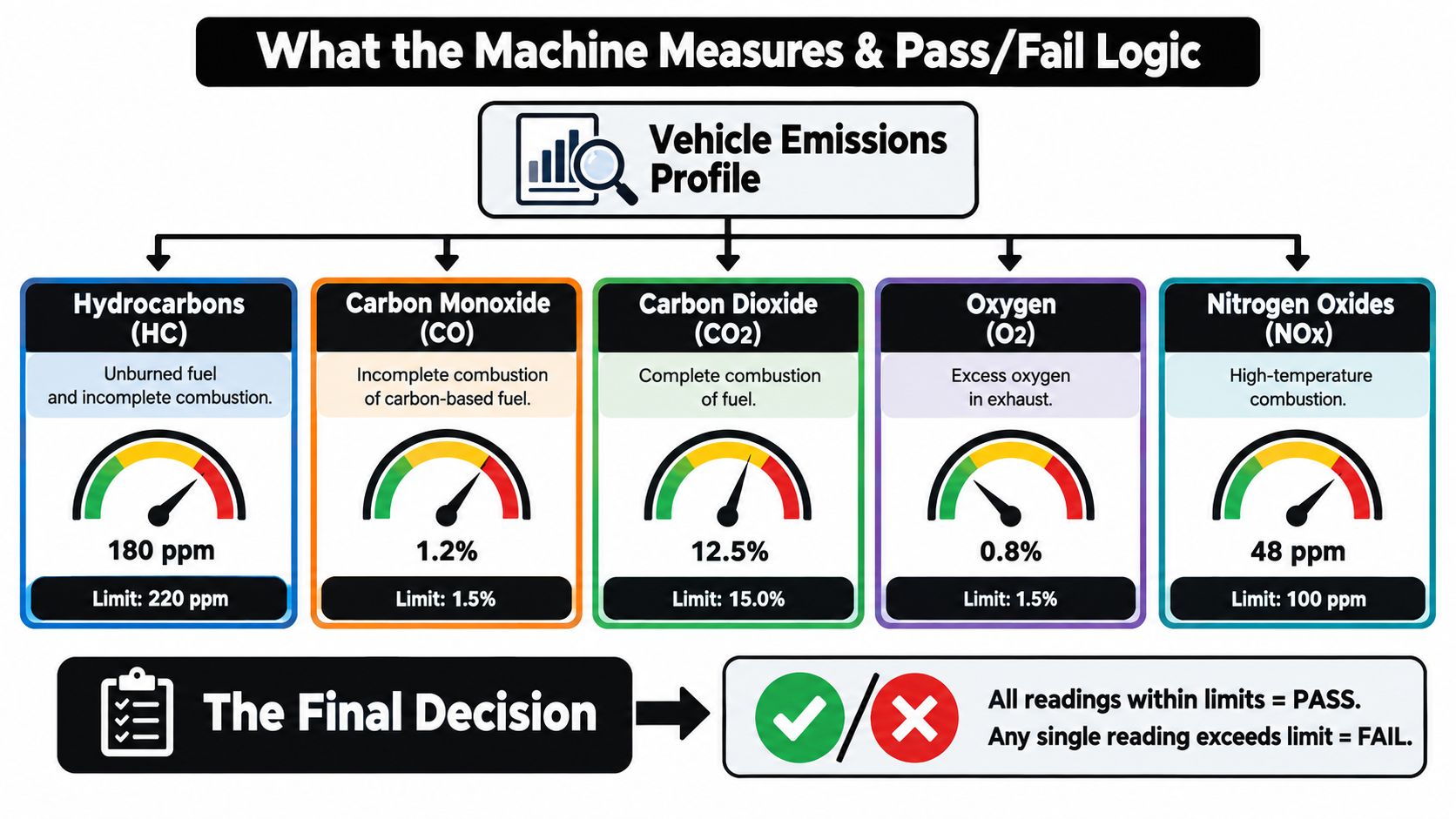
Why one pollutant can cause a failure
Suppose an older truck records acceptable CO but excessive HC. That pattern may point toward incomplete combustion, ignition trouble, fuel delivery problems, or an emissions-control issue. A different vehicle could show high NOx while other readings remain within limits, directing the diagnostic conversation toward combustion temperature and NOx-control components.
The machine isn't saying, “replace this exact part.” It's reporting that a measured pollutant exceeded the limit assigned to that vehicle and test condition. A repair technician must then investigate the underlying cause.
The dynamometer matters because loaded-mode testing places the vehicle under controlled demand. Some problems don't appear clearly during an unloaded idle. A vehicle can sound smooth in the bay while producing excess emissions when its engine works harder.
What the report is telling you
A result sheet isn't a general grade for the entire car. It reflects whether the vehicle met the required inspection criteria during the regulated test. For help interpreting the information recorded after testing, use this explanation of smog test results.
The pass logic is strict in a simple way: all applicable readings must remain within their limits. One excessive measurement can produce a failure even when the other gases look acceptable, because the program evaluates each required pollutant rather than averaging the readings into one forgiving score.
How Technicians Use the Machine During Your Inspection
A technician begins by confirming the vehicle information and preparing the inspection record. That step matters because the applicable test depends on the vehicle's identity, model year, fuel type, and required inspection path.
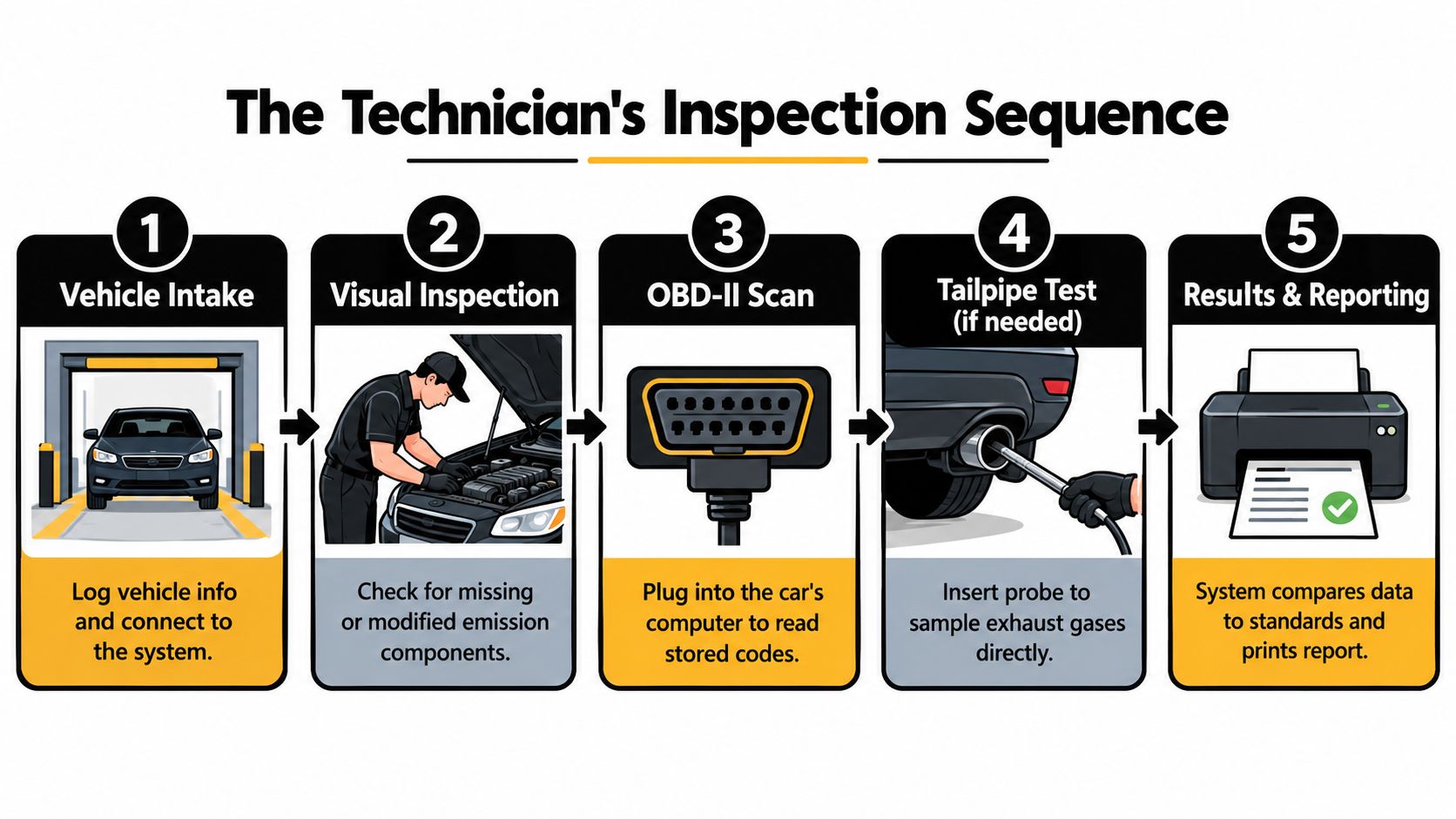
The inspection follows a controlled sequence
First comes the vehicle intake. The technician brings the car into the bay, records the required information, and prepares the machine. Next, the technician performs the visual portion, looking for missing or modified emissions equipment and other conditions that could affect the inspection.
A 2015 sedan will usually follow the BAR-OIS path. The technician connects the approved interface to the diagnostic port, allows the system to read the vehicle's emissions information, and completes the required checks. The machine and technician work together, because the software can read data but can't replace a physical inspection of the car.
A 1995 pickup follows a different path. The technician may position its drive wheels on the dynamometer, place the exhaust probe correctly, and run the required loaded-mode procedure. The analyzer samples the exhaust while the vehicle operates under the test conditions.
The machine provides repeatable measurements, but the technician still controls vehicle setup, connections, safety checks, and correct procedure.
Vehicle design changes the workflow
A hybrid may require special handling because its gasoline engine can stop and restart during the visit. The technician must use the approved procedure for that vehicle rather than treating it like a conventional sedan. A diesel vehicle also needs a station with the appropriate capability and process.
After the electronic scan or gas measurement, the system compares the results with the applicable requirements. The technician reviews the outcome and completes the electronic reporting process.
The visit can feel quick because the software handles much of the data processing, but speed doesn't mean the inspection is casual. Correct vehicle information, a secure connection, stable equipment, and proper test setup all affect the integrity of the result.
For drivers, the practical expectation is straightforward. Keep the vehicle accessible, answer questions about recent repairs, and don't disconnect the battery or clear warning codes immediately before the appointment without understanding how that may affect the vehicle's diagnostic status.
STAR Standards Calibration and Why Machine Quality Matters
A car can be mechanically ready for inspection and still face a problem if the station's equipment is poorly maintained. An analyzer that is out of calibration may report unreliable readings, while a failed data connection can delay a test that otherwise proceeds normally. The machine is one part of the result, and its condition matters.
California's STAR program, created by Assembly Bill 2289 in 2010, was designed to improve inspection quality and support required emissions reductions. STAR stations must maintain the equipment needed for the vehicles covered by the Smog Check Program. Drivers can use the California STAR station certification information to confirm a station's authorization and capabilities.
A station that maintains both BAR-OIS and BAR-97 equipment can inspect any model year, while a station with only OBD equipment must turn away pre-2000 vehicles. That directly affects where those drivers can get tested.
Calibration protects measurement accuracy
BAR-97 equipment requires BAR-approved calibration gases from a BAR-certified gas blender. The gas gives the analyzer a known reference. Technicians use it to check whether the instrument responds correctly before trusting its exhaust readings.
Calibration works like checking a kitchen scale with a known weight. If the scale is wrong, every ingredient measured with it is suspect. An emissions analyzer has the same basic problem. A faulty reference check can undermine confidence in the final inspection result.
The station also needs approved analyzers, OBD interfaces, dynamometers where applicable, and data-reporting equipment. Each component supports a different part of the test. A missing or malfunctioning component can stop the process, even if the vehicle itself is ready.
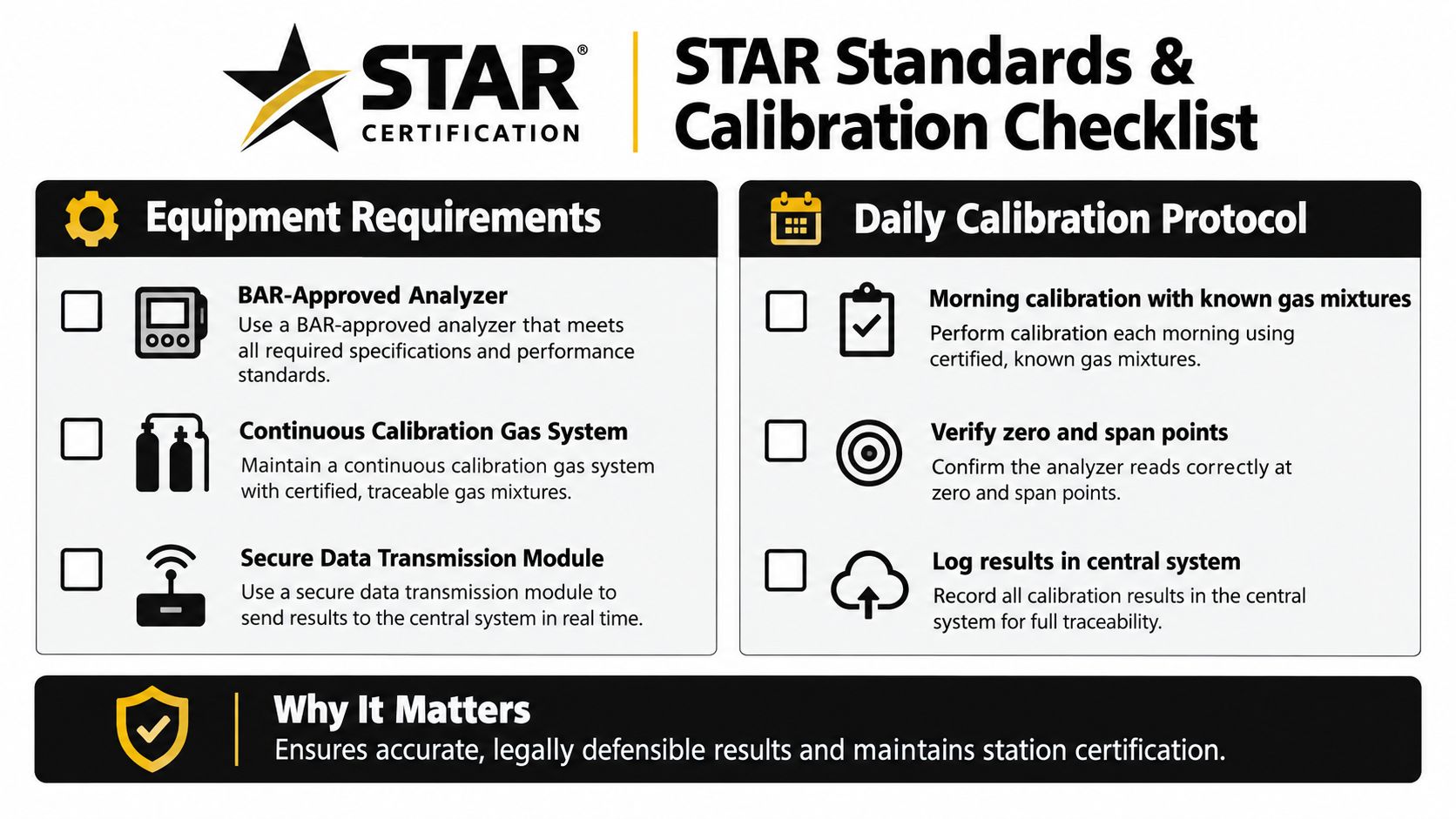
What station quality means for drivers
Before booking, ask whether the station can test the vehicle's model year and configuration. A STAR station should be able to explain whether BAR-OIS or BAR-97 applies and whether its equipment supports the car, truck, hybrid, or diesel being presented.
The machine's quality also defines the meaning of the result. Proper calibration helps ensure that a measured gas value reflects the vehicle rather than an instrument error. It cannot detect every emissions problem, but it can produce a dependable result within the inspection method it is built to perform.
California has maintained formal equipment standards for decades. A 1974 California Bureau of Automotive Repair publication set minimum instrument specifications for participating garages, while federal inspection and maintenance policy later advanced dynamometer-based procedures and other testing methods (EPA inspection and maintenance history).
For a practical explanation of certification, read what a STAR station is.
Getting Ready for Your Smog Check and Choosing the Right Station
Preparation starts with identifying the inspection path. A 2000 or newer vehicle generally uses BAR-OIS, which relies on the vehicle's emissions computer. A 1999 or older vehicle generally uses BAR-97, which measures exhaust gases and may use a dynamometer for loaded-mode testing.
The machine can detect important problems, but it has boundaries. OBD equipment can flag emissions-related faults without directly measuring every real-world driving condition. EPA and California materials describe both false passes and false failures in OBD checks, while California's review found that OBD and tailpipe testing have similar failure rates, with OBD slightly more sensitive at detecting failures (EPA OBD inspection evaluation).
That limitation matters for intermittent, software-related, and aftertreatment problems. A fault that appears only during a particular temperature, load, or driving pattern may not show up during a short inspection. Newer onboard-data models may improve screening for high-NOx vehicles, but today's inspection remains a defined compliance test, not a complete real-world emissions profile.
A short preparation checklist
- Check warning lights: Resolve an illuminated emissions warning before the appointment instead of hoping the machine won't notice it.
- Bring renewal information: Have the DMV notice or vehicle details available so intake can proceed accurately.
- Mention recent repairs: Tell the technician if the battery was disconnected or emissions components were recently serviced.
- Choose compatible equipment: Confirm that the station handles your model year, fuel type, hybrid system, or diesel configuration.
- Ask about STAR authorization: If your notice requires a STAR inspection, verify the station's status before you arrive.
A station's equipment and calibration discipline affect the consistency of the test, while your vehicle's maintenance and diagnostic history affect what the machine finds. Speedy Smog in San Leandro offers STAR Certified inspections for newer and older vehicles, as well as diesel and hybrid vehicles, so East Bay drivers can confirm the appropriate testing path before booking.
Use the machine as a source of evidence, not a mysterious verdict. If the car passes, keep the inspection record for your registration process. If it fails, use the listed result as a starting point for diagnosis, then repair the underlying issue and arrange a retest through an appropriately equipped station.
Visit Speedy Smog in San Leandro for a STAR Certified smog check, with equipment and procedures matched to your vehicle's inspection requirements. Contact the station before your visit to confirm service for your model year, diesel, or hybrid and arrive prepared for a clear, compliant result.
You've got a DMV renewal notice on the counter, your diesel truck is parked outside, and you're searching “diesel emissions inspection near me” from San Leandro, Oakland, or Hayward. The closest listing may not be the right one. Before you book a lane, confirm that your vehicle belongs in California's standard Smog Check program, find out whether the station handles diesel visual and diagnostic checks, and prepare for the conditions that determine a pass.
A diesel inspection isn't a gasoline test with a different fuel. Model year, gross vehicle weight rating, onboard diagnostic readiness, emissions hardware, and smoke opacity can all affect the result. The right process starts with eligibility, then moves through station selection, vehicle preparation, testing, and DMV follow-through.
Table of Contents
- Finding a Diesel Emissions Inspection Near You in the East Bay
- Do You Actually Need a Diesel Smog Check in California
- How Diesel Emissions Inspections Really Work
- What to Bring and How to Prep Your Diesel to Pass
- Where to Go Pricing Timing and Why STAR Certification Matters
- After the Test DMV Registration and Next Steps If You Fail
Finding a Diesel Emissions Inspection Near You in the East Bay
A nearby station can still waste your time if it doesn't handle your diesel category or if it isn't approved for the type of certification your registration requires. California's diesel program has evolved from visible-smoke enforcement into a process that can include equipment verification and OBD checks, so a station needs more than a generic “smog test” listing.
Start with the station, not just the map
When comparing East Bay results, check whether the shop identifies itself as a STAR Certified station, accepts diesel vehicles, and can explain what the inspection includes. STAR status matters when the DMV directs your vehicle to a STAR station, and a diesel-capable shop should be comfortable discussing opacity, readiness monitors, and emissions components before you arrive.
Call ahead with the vehicle's model year, fuel type, and approximate GVWR. A diesel pickup and a heavier work truck may fall under different compliance programs, and the shop should be able to tell you whether it performs the inspection you need or whether you should contact a heavy-duty compliance provider.
Practical rule: A useful phone call should answer three questions: Does the station test this diesel, does it handle the required certification, and what should you bring if the vehicle fails?
For drivers comparing local options, this East Bay guide to vehicle emissions testing can help narrow the search before you drive across town. Look for clear hours, transparent service details, and a realistic explanation of turnaround time rather than relying only on the lowest advertised price.
A good nearby choice gives you a direct path from inspection to registration. If the technician identifies a code, readiness issue, smoke problem, or missing emissions component, you should leave with a specific explanation of what needs attention, not a vague recommendation to “try again later.”
Do You Actually Need a Diesel Smog Check in California
The first question isn't “Where can I test?” It's “Is my diesel subject to a standard California Smog Check?” California generally includes model year 1998 and newer diesel cars and trucks with a GVWR of 14,000 pounds or less in the biennial Smog Check program. Diesel vehicles above that weight are handled under a separate heavy-duty framework. California BAR guidance explains the diesel Smog Check requirements and their scope.
Use three checks before scheduling:
Read the registration notice. A DMV renewal notice usually tells you whether a smog certification is required. Don't assume every diesel receives the same renewal instruction.
Confirm the model year. The California light-duty diesel rule generally applies to 1998 and newer vehicles. Older vehicles can follow different exemption rules, so use your registration information and the vehicle's identification details rather than relying on an online listing.
Find the GVWR. Look at the driver-side door-jamb label or vehicle documentation. The important dividing point for the standard light-duty program is 14,000 pounds GVWR. Trucks and work vans often create confusion because their size and use can make them feel “commercial,” while the state classification depends on the applicable vehicle rules and weight rating.
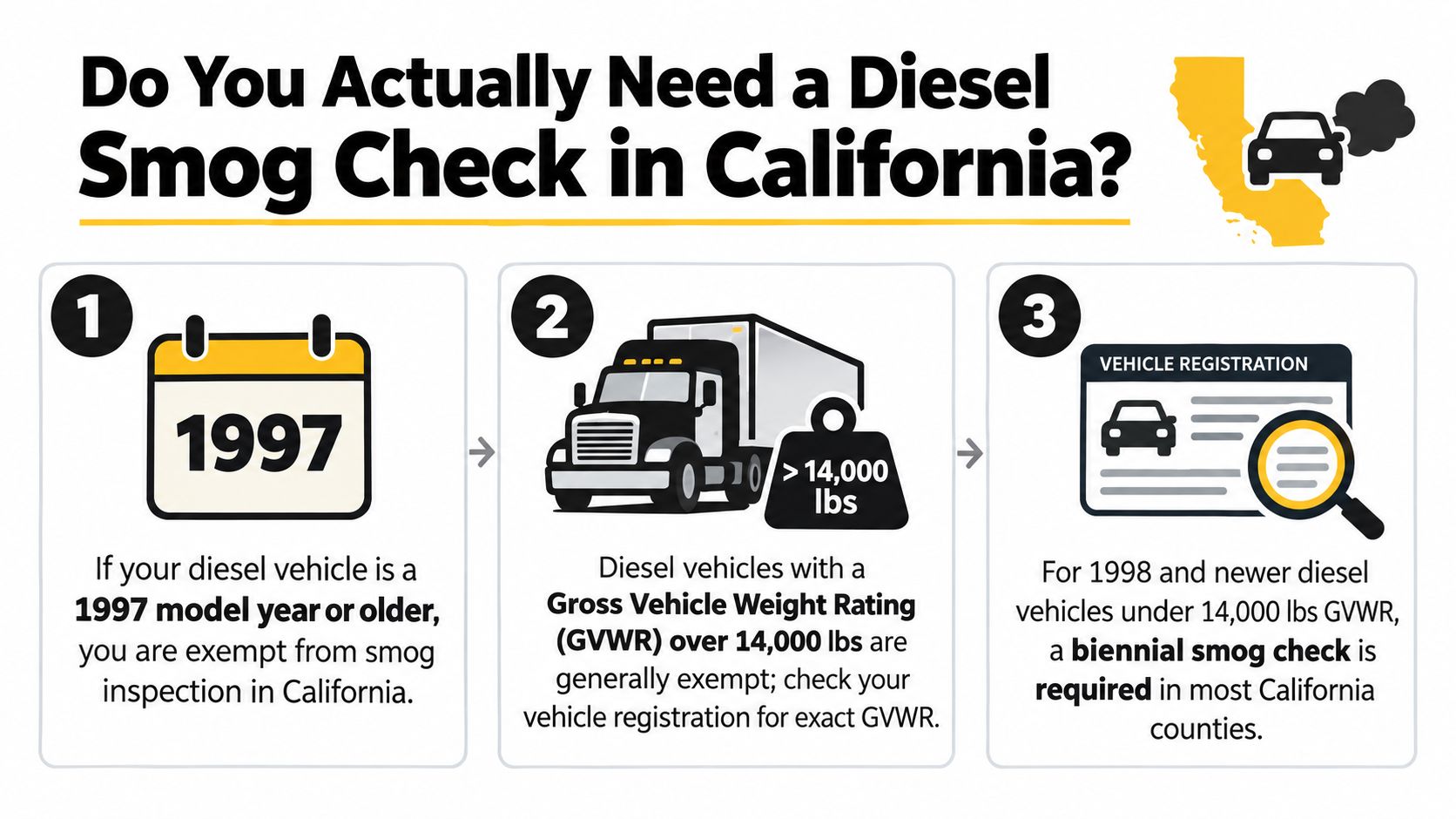
Separate light-duty testing from heavy-duty compliance
A diesel under the applicable GVWR threshold generally belongs at a standard Smog Check station that's equipped and certified for diesel testing. A heavier vehicle may need a different inspection cycle, testing procedure, or compliance program, so taking it to a regular passenger-vehicle lane can lead to a referral instead of a completed certification.
The practical distinction is simple. If your registration requests a normal Smog Check and the vehicle falls within the light-duty diesel category, book a qualified station. If the vehicle exceeds the threshold or your paperwork points to a heavy-duty requirement, verify the correct program first through the diesel Smog Check requirements for California vehicles.
Eligibility also changes the preparation strategy. Owners of qualifying 2007 and newer light-duty diesels need to pay close attention to readiness monitors, not just visible smoke. California expanded the monitor requirements in 2023, and the state's BAR materials state that, effective October 1, 2025, all readiness monitors must be set for a vehicle to pass Smog Check. The California Smog Check Manual provides the current readiness guidance.
How Diesel Emissions Inspections Really Work
A diesel can run smoothly and still fail its inspection. The technician usually combines a visual inspection, an OBD-II scan where applicable, and a smoke-opacity evaluation. Those checks target different failure points: missing emissions hardware, incomplete monitors, stored diagnostic trouble codes, and excessive exhaust smoke. The equipment and process used at a station are described in this guide to diesel emissions testing equipment.
The visual and diagnostic checks come first
The inspector confirms the vehicle category and model year, then checks emissions-control hardware, tampering, exhaust leaks, and obvious defects. On newer light-duty diesels, the scan reads diagnostic trouble codes and readiness monitors. Clearing a code shortly before testing can turn off the malfunction light while leaving the monitors incomplete.
For 2007 and newer light-duty diesels, California's 2023 rule change allowed only the Diesel Particulate Filter and Non-Methane Hydrocarbon Catalyst monitors to remain unset at that point in the program. Later BAR guidance makes monitor status more restrictive under the updated requirements. A vehicle that has not completed its required drive cycle may fail even after a repair.
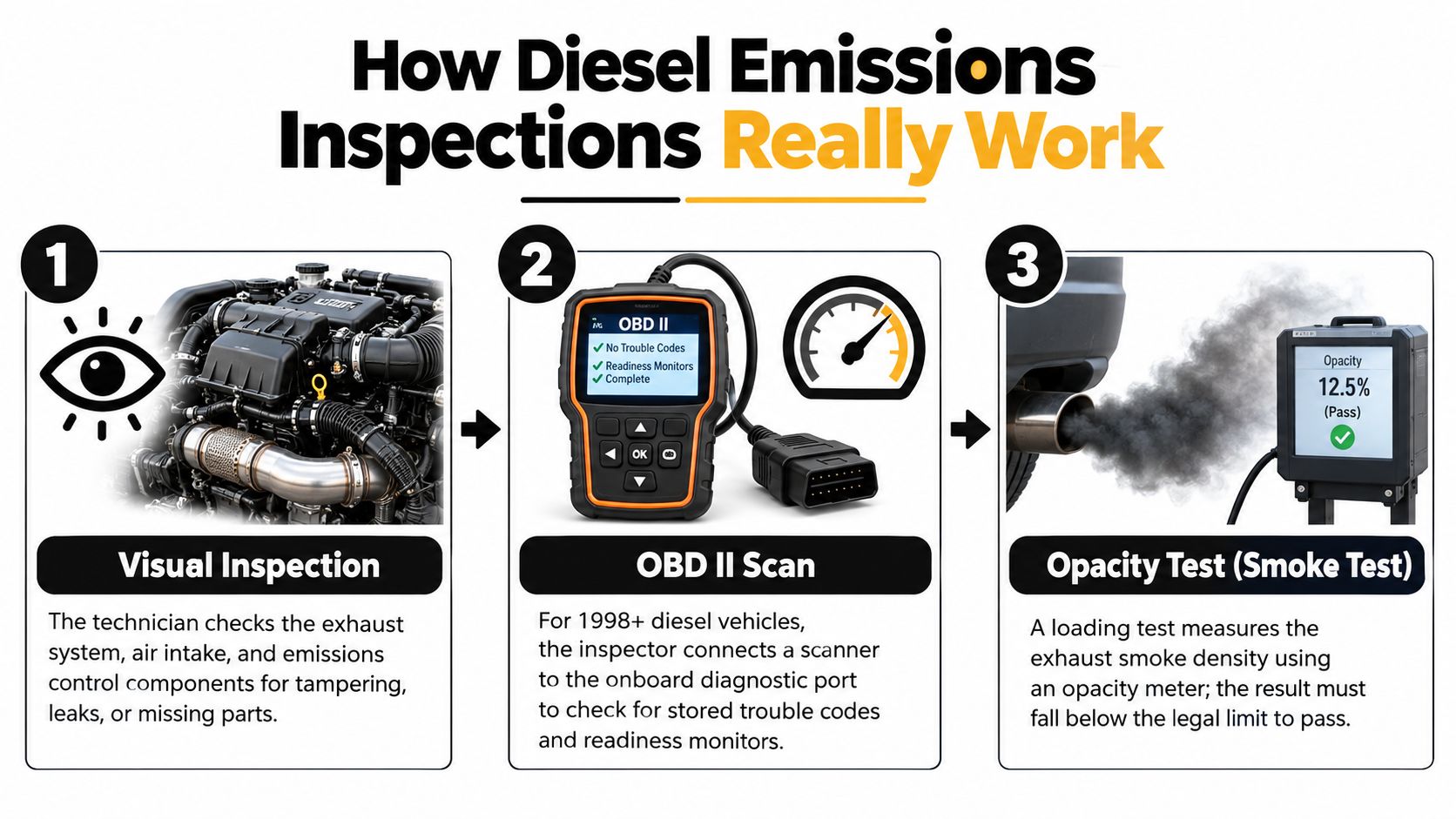
Opacity measures smoke density, not drivability
The engine must reach normal operating temperature before the smoke portion. The inspector may perform a standardized snap-acceleration procedure, such as SAE J1667, or another test required by the applicable program. Illinois requirements connect diesel testing with SAE J1667 and EPA smoke-opacity cutpoints, as described in Illinois diesel testing requirements.
The pass limit depends on the vehicle class, model year, and jurisdiction. California-referenced light-duty standards have historically used a 20% opacity limit at idle for some diesel classes. Other programs use older heavy-diesel cutpoints ranging from 40% to 55%. The applicable program determines which limit and procedure apply, so a result from another jurisdiction cannot predict a San Leandro inspection.
California's Air Resources Board announced a roadside anti-soot program for big-rig diesels in 1991. European diesel limits also tightened through EU Directive 94/12/EC, adopted in March 1994, followed by later implementation milestones. The Air Resources Board's historical announcement shows how anti-soot enforcement shaped modern diesel inspection programs.
What to Bring and How to Prep Your Diesel to Pass
A diesel can look clean outside and still fail because its monitors are not ready, its warning light is active, or its emissions hardware is missing. Before booking a diesel emissions inspection near you, verify the paperwork, diagnostic status, exhaust system, and engine condition.
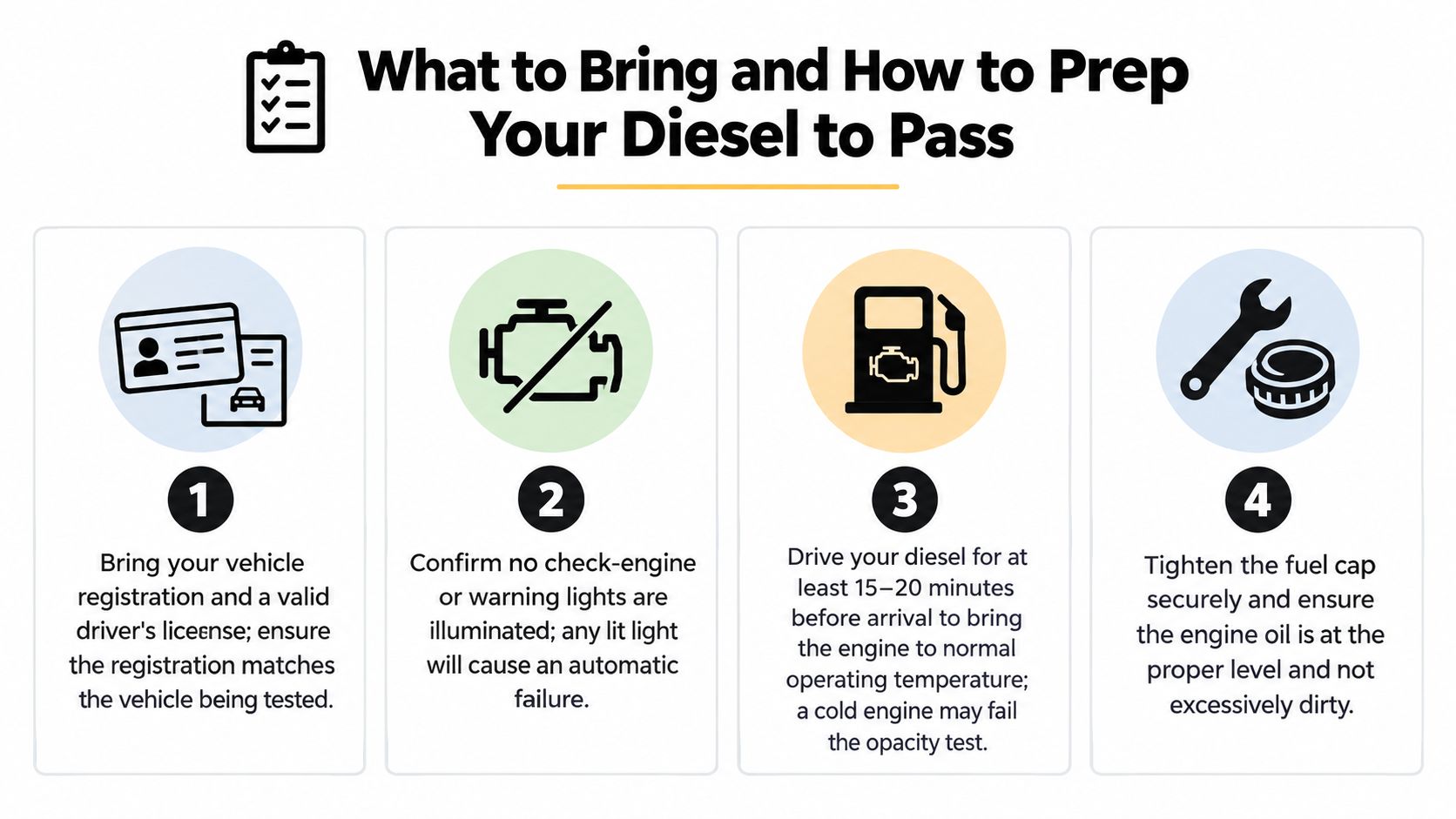
Bring the information the station needs
Have your vehicle registration, DMV notice, and driver's license ready. If repairs were completed recently, bring the repair order or diagnostic notes. The technician can then determine whether a fault was repaired, merely cleared, or still requires a drive cycle before the monitor becomes ready.
Check the dashboard before leaving:
- Warning lights: An illuminated check-engine or emissions warning light needs diagnosis before the inspection.
- Diagnostic codes: Request a full-code scan rather than a quick light reset. Clearing codes can remove useful clues and leave readiness monitors incomplete.
- Aftertreatment hardware: Confirm that the DPF, EGR system, catalysts, sensors, and related exhaust components are installed and connected. Deleted or altered emissions software can cause visual and diagnostic failures.
- Operating condition: Do not test a truck in limp mode, derated operation, or an active regeneration fault. Diagnose the cause first.
Fix the causes that create smoke
Common failure categories include a blocked DPF, EGR faults, worn injectors, turbocharger problems, and exhaust leaks. Cleaning the exhaust tip changes appearance, not the measured opacity, when the underlying fault remains.
The engine should arrive warmed up according to the station's instructions. Avoid aggressive driving intended to hide a problem. Heavy smoke during acceleration points to an air, fuel, turbocharger, or aftertreatment issue that needs inspection before testing.
EPA-cited research found lower average opacity among passing vehicles than failed vehicles, while repaired vehicles showed substantial smoke reductions after corrective work. The maintenance and opacity analysis details those measured differences and the fault categories technicians should investigate.
Bring repair documentation, but do not assume a cleared code means the vehicle is ready. The inspection result depends on the vehicle's actual emissions condition, monitor status, and smoke output.
Where to Go Pricing Timing and Why STAR Certification Matters
A STAR Certified station is different from a regular Smog Check station because STAR stations meet performance standards set by the California Bureau of Automotive Repair. If the DMV directs your vehicle to STAR, you need that certification rather than choosing the closest general station.
| Feature | What to Look For | Why It Matters |
|---|---|---|
| Diesel capability | The station explicitly accepts qualifying diesel vehicles | Diesel inspections can include visual, OBD, and opacity procedures |
| STAR certification | Current STAR designation when your notice requires it | The result matches the certification pathway assigned by the DMV |
| Testing equipment | Diesel-capable opacity equipment and diagnostic scanning | The technician can evaluate the systems that determine diesel compliance |
| Timing | A stated estimate for the inspection, with extra time for diagnosis | A quick test is useful only when the vehicle is ready |
| Pricing | Clear pricing, diesel surcharges if applicable, and current coupons | You can compare the complete service instead of an incomplete advertised rate |
| Convenience | Posted hours, waiting area, and clear registration follow-up | You avoid a second trip caused by missing paperwork or unclear results |
Speedy Smog at 15275 Washington Ave in San Leandro is one local option that lists diesel inspections among its services and handles qualifying vehicles across the listed model-year range. Its publisher-provided service information describes typical tests for 2000 and newer vehicles as taking about 10 to 15 minutes, with coverage for older vehicles, diesels, and hybrids. Confirm the exact price and eligibility before arrival because inspection cost can depend on vehicle type and current offers.
The shop is open Monday through Saturday and provides an indoor waiting room. It also advertises transparent pricing and periodic $25-off coupons for most smogs on newer vehicles. Those details can make a nearby appointment convenient, but the important selection criteria remain certification, diesel equipment, and the ability to explain a failure accurately.
For a broader technical overview of the equipment and procedures involved, review this diesel emissions testing equipment resource. A station that can clearly describe its process is easier to evaluate than one that only promises a fast result.
After the Test DMV Registration and Next Steps If You Fail
After a passing inspection, the station submits the result through the California Smog Check system so the DMV can use it for registration. Keep the receipt and inspection paperwork until your renewal is complete, especially if you're renewing online or need to prove that the certification was completed.
A failure should give you a repair direction, not just a disappointing result. Read the report carefully and separate a readiness issue from an opacity failure or a visual equipment problem. A DPF restriction, EGR fault, injector issue, turbo problem, exhaust leak, stored code, or missing component requires a different repair path.
Don't clear the code and return. Clearing diagnostic trouble codes can leave monitors unset, and the updated California requirements make readiness status increasingly important. Have a technician perform a complete scan, confirm the repair, verify that the vehicle isn't derated, and allow the required drive conditions to establish monitor readiness before scheduling the retest.
If smoke opacity caused the failure, ask for an inspection of the air intake, turbocharging system, fuel delivery, exhaust system, and aftertreatment. The measured result can respond to proper maintenance, which is why repairs should address the root cause rather than the visible symptom.
If you're in San Leandro, Oakland, or Hayward and need a qualifying diesel inspection, visit Speedy Smog for a STAR Certified emissions test with diesel-capable service and a clear explanation of the next step. Call ahead with your model year and GVWR so the station can confirm eligibility before you arrive.
In California, Smog Check is the official state program, and smog test is the common name for the inspection itself. For most drivers, they point to the same DMV-required event, but the actual inspection method changes by model year, with 2000 and newer vehicles generally checked through OBD II and 1999 and older vehicles tested with BAR-97 tailpipe equipment.
That's why the wording gets confusing. Your DMV renewal notice may say Smog Check, while a local shop sign says smog test, and both are talking about the same trip you need to make before registration can move forward.
Table of Contents
- Introduction Why Drivers See Two Terms for One Requirement
- What Smog Check and Smog Test Actually Mean in California
- How California Smog Inspections Work Today
- Which Test Your Vehicle Needs Based on Year and Type
- DMV Rules STAR Certification and What Counts for Renewal
- How to Prepare Your Vehicle and Pass the First Time
- Choosing the Right Smog Station in the East Bay
Introduction Why Drivers See Two Terms for One Requirement
A lot of East Bay drivers hit the same moment. You open your renewal notice, see that California wants a smog check, then search online and find shops advertising smog tests. It's easy to wonder whether those are two different services, two different prices, or two separate legal steps.
Usually, they aren't separate at all. The confusion comes from the fact that California uses one term for the regulated system and everyday drivers use another term for the inspection procedure.
A common real-world example
Say you drive a 2008 sedan in San Leandro. Your renewal reminder tells you to complete a smog requirement before DMV can process registration. Then you call a station and the person on the phone says, “Yes, we do smog tests.” That doesn't mean they're offering something different from what the DMV asked for. They're using the common shop-floor phrase for the inspection that satisfies the state program.
The same thing happens with older vehicles. Someone with a 1995 pickup may hear “smog test” and assume it's the same process their neighbor's 2016 hybrid gets. It isn't. Both fall under California's Smog Check system, but the way the vehicle is inspected can be very different.
Practical rule: If your paperwork says you need a Smog Check, you usually don't need to buy one thing from DMV and another thing from a shop. You need the inspection that fits your vehicle and counts for registration.
The fast way to think about it
Use this simple distinction:
| Term | What it usually means | Why it matters |
|---|---|---|
| Smog Check | California's official compliance program | It's tied to DMV registration, station licensing, and state rules |
| Smog test | The actual inspection performed on the vehicle | It's the procedure that generates the pass or fail result |
That difference sounds semantic until you're trying to book the right station. Once you understand the compliance mechanics, the next questions get easier. What kind of test does your car get? Do you need a STAR station? Will your result count automatically for DMV? Those are the questions that save time.
What Smog Check and Smog Test Actually Mean in California
A first-time driver usually hears both terms in the same week. The DMV notice says you need a Smog Check for registration. The shop says they perform smog tests. In California, those phrases point to the same requirement, but they do not do the same job.
Smog Check is the state program. Smog test is the inspection work done on your vehicle inside that program. The practical difference shows up after the car is inspected. A test result by itself does not satisfy registration. What counts is a result recorded through California's Smog Check system so BAR can issue the electronic record DMV recognizes, as described in the BAR Smog Check Reference Guide.
Why both terms stayed in use
The split in language makes sense once you look at who is using the words.
State agencies use Smog Check because they are talking about rules, station licensing, certificate records, and whether a vehicle has met a registration condition. Shops and drivers often say smog test because they are talking about the appointment in the service bay, the machine hookup, and the pass or fail result for that specific car.
That sounds small, but it answers a common point of confusion. If a shop advertises smog testing, that does not automatically tell you every result will work for your renewal. The result has to be produced under the state program, by a properly licensed station, and transmitted in the way DMV accepts.
What the distinction changes for you
The wording becomes practical instead of academic.
If you ask, “Do I need a smog test?” you are asking about the procedure performed on the vehicle. If you ask, “Do I need a Smog Check?” you are really asking a compliance question: Does my registration require an inspection, what kind of inspection applies to my vehicle, and does this station have authority to submit a result that counts?
A simple way to picture it is a school exam. The test is what the student takes at the desk. The program is the school system that decides who can give the exam, how the score is recorded, and whether the result satisfies the graduation rule. California works the same way. Your car can be inspected, but DMV only cares about the inspection result that enters the Smog Check system correctly.
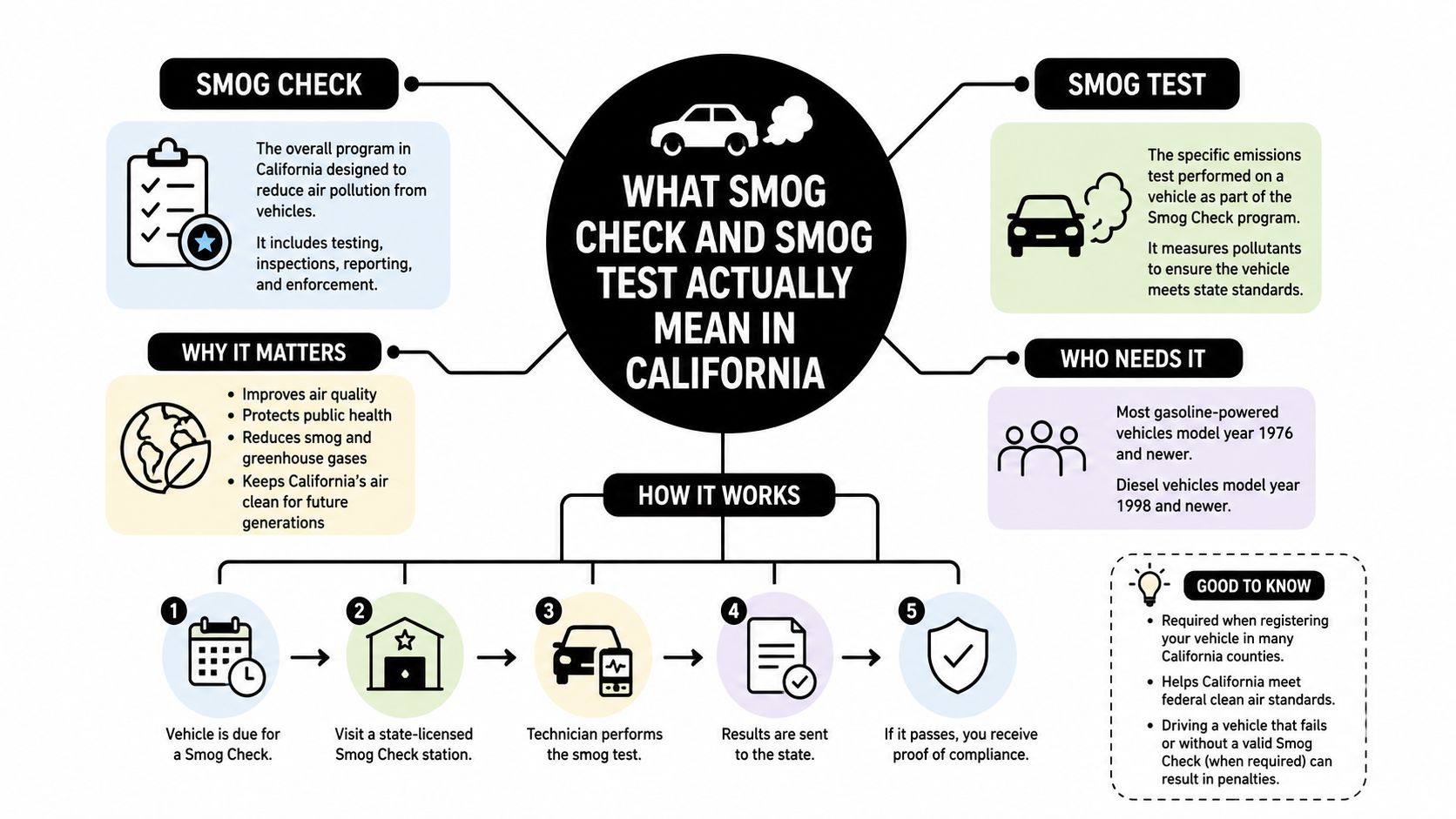
Plain-language takeaway
Use smog test for the procedure at the station. Use Smog Check for the legal program tied to DMV.
That distinction helps with three decisions drivers make all the time:
- Test type: your vehicle may get a different inspection method depending on year and configuration
- Station choice: some vehicles or notices require a station with specific authorization, such as STAR
- DMV outcome: registration depends on the official transmitted result, not just the fact that your car was looked at
So the question is not which phrase is more correct. The useful question is whether the inspection you book will produce the right record for California compliance.
How California Smog Inspections Work Today
A first-time driver often expects one standard smog appointment. At the station, the process changes once the technician enters the vehicle information. California does not run one single inspection routine for every car. The Smog Check program uses different inspection methods based on the vehicle's model year and emissions setup.
That is the practical difference between the system and the procedure. Smog Check is the state program that sets the rules. The smog test is the specific inspection your car receives under those rules.
According to BAR's current smog inspection overview, newer vehicles are usually inspected through the BAR On-Board Diagnostic Inspection System, while older vehicles may still go through the BAR-97 Emissions Inspection System with direct tailpipe measurement.
California Smog Inspection Methods Compared
| Inspection Type | Vehicles Covered | What Is Measured | Equipment Used |
|---|---|---|---|
| OBD inspection | 2000 and newer vehicles | Electronic diagnostic data related to emissions performance | BAR On-Board Diagnostic Inspection System |
| BAR-97 tailpipe test | 1999 and older vehicles | Direct exhaust emissions at the tailpipe | BAR-97 Emissions Inspection System |
| Visual and functional checks | Applies as part of the inspection process where required | Emissions-related components and system operation | Technician inspection tools and station equipment |
What the technician is actually doing
For a newer vehicle, the inspection usually works like a report-card check from the car's own computer. The technician connects to the onboard diagnostic system and verifies whether the emissions monitors, fault information, and related data meet program requirements. The car can drive normally and still fail if that electronic record shows an emissions problem.
For an older vehicle, the inspection is more like measuring what comes out of the tailpipe in real time. The station uses BAR-97 equipment to sample exhaust emissions directly, along with any required visual or functional checks. The workflow is different because the test is measuring output, not mainly reading stored diagnostic information.
That distinction matters at the counter and at DMV. Two drivers can both ask for a "smog test" and receive different procedures because the Smog Check program assigns the inspection path by vehicle category.
Why one appointment is faster than another
Drivers often compare appointment times and get confused. The reason is usually mechanical, not random.
An OBD-based inspection is often more direct because the system is reading emissions-related data already stored by the vehicle. A BAR-97 inspection takes more setup because the station must perform tailpipe measurement with different equipment and procedures.
So if one car is finished quickly and another takes longer, the station is not changing the rules on the fly. The program is applying a different test method to a different kind of vehicle.
What counts in the end
The key outcome is not that your car was inspected. The key outcome is that the correct inspection method was performed and the result was transmitted in a way California accepts for Smog Check compliance.
That is why the wording matters less than drivers think, and the mechanics matter more. The phrase "smog test" describes the procedure in the bay. "Smog Check" describes the larger compliance system that decides which procedure applies and whether DMV will accept the result.
Which Test Your Vehicle Needs Based on Year and Type
You get a renewal notice, book what sounds like a routine smog appointment, and then the station asks a question that changes everything: what year is the vehicle, and what fuel does it use?
That question matters because California does not sort inspections by the words drivers use. It sorts them by vehicle category. "Smog Check" is the compliance system. The "smog test" is the inspection procedure that system assigns to your car.
For many drivers, the first decision starts with model year and fuel type. A newer gasoline car usually follows one inspection path. An older gasoline car may follow another. Diesel vehicles can fall under different rules, and some registrations also require a STAR station, which affects where the result will count.
If you want a practical year-by-year reference before you book, this guide on what smog check you need helps match the vehicle to the likely inspection path.
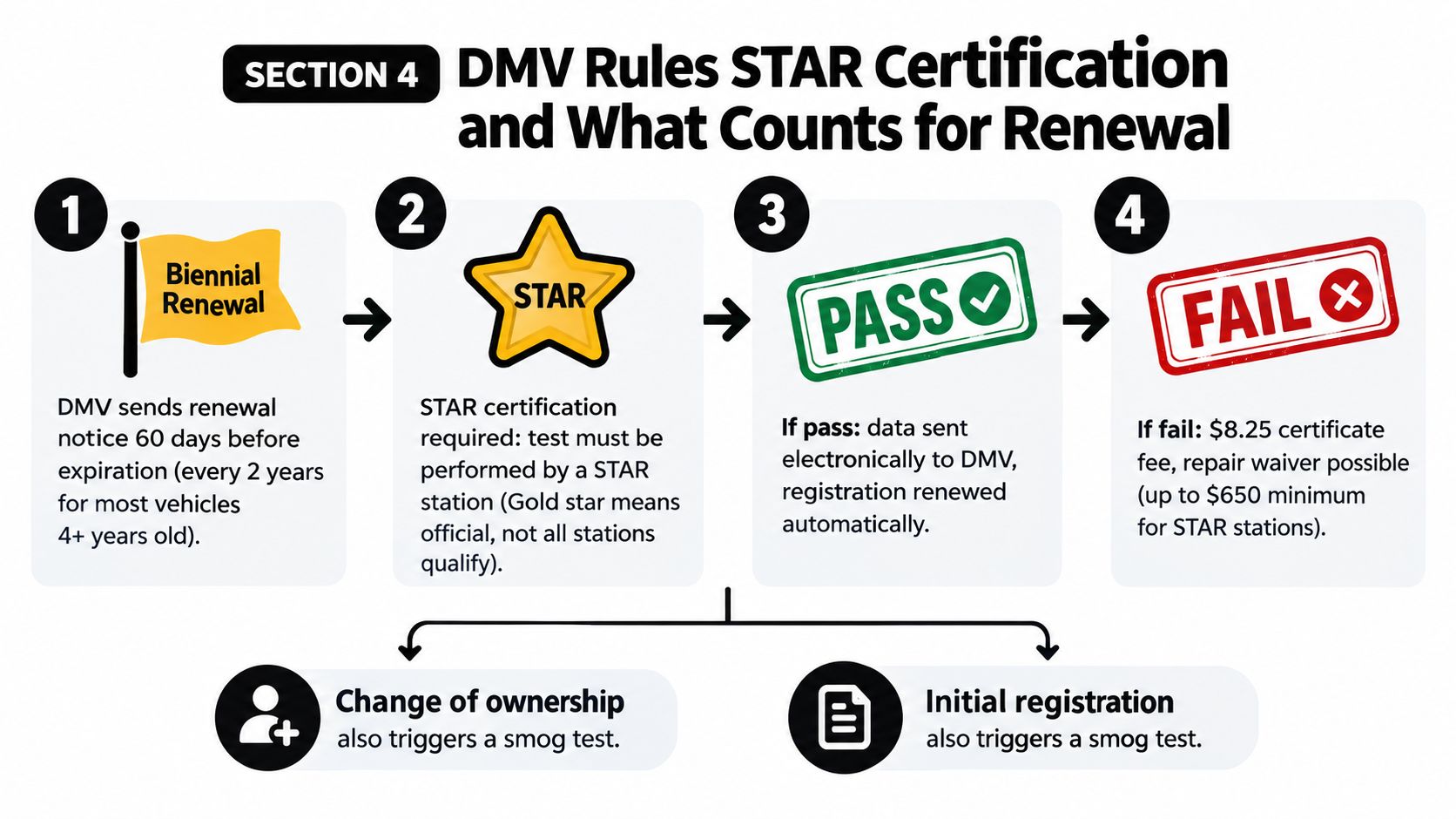
Start with the vehicle category
A simple way to sort it is like checking which line you belong in at the airport. Everyone is traveling, but not everyone goes through the same lane.
- 2000 and newer gasoline vehicles: these are usually inspected through an OBD-centered process.
- Pre-2000 gasoline vehicles: these often need a tailpipe-based procedure.
- Diesel vehicles: these can have different program rules, so the station must handle that vehicle type correctly.
- Vehicles marked for STAR: the inspection result must come from the right kind of station, not just any nearby shop.
The practical point is simple. Your vehicle category decides the test method, and sometimes it also decides the station.
Four common examples
A 2005 sedan usually goes down the newer-vehicle path. In plain terms, the inspection often focuses on what the vehicle's onboard system reports. If the check engine light is on or the monitors are not ready, that can affect the outcome even if the car feels fine to drive.
A 1995 truck is a different case. Older gasoline vehicles are more likely to need direct emissions measurement, so the appointment may involve different equipment and a different setup at the station.
A diesel pickup deserves a quick phone call before booking. Some drivers assume every smog location handles diesel the same way. They do not. The right question is whether the station performs the inspection your diesel vehicle needs.
A hybrid can confuse first-time drivers too. Hybrid does not automatically mean exempt or simplified. The category still depends on how California classifies that vehicle for the registration event in front of you.
Why two drivers can have different appointments
Friends often compare notes and wonder why one visit took fifteen minutes and another took much longer. The reason is usually built into the rules, not the shop.
Two people can ask for a "smog test" and receive different procedures because their vehicles fall into different Smog Check categories. One car may be routed through an OBD-based inspection. Another may need a tailpipe procedure. A third may need the same inspection result, but from a STAR-certified station for DMV to accept it.
Simple booking rule: check your model year, fuel type, and any STAR requirement on your DMV notice before choosing a station.
That is where the wording clears up. The debate is not really smog check versus smog test. The issue is which inspection path California assigns, and whether that result will satisfy your registration requirement.
DMV Rules STAR Certification and What Counts for Renewal
You finish the inspection, the technician hands you a passing result, and you assume the DMV part is done. Then the renewal notice still shows a smog requirement. For first-time drivers, that feels confusing, but the reason is usually simple. California does not just need a vehicle to be tested. California needs the inspection to be completed in the right compliance channel so DMV can accept it for registration.
California treats Smog Check as the full regulatory system tied to registration, station licensing, and eligibility. A smog test is the procedure performed on the vehicle inside that system. That difference matters at renewal time because DMV is checking more than whether your car passed. DMV is checking whether the result came from the right kind of inspection, at the right kind of station, for your vehicle's requirement.
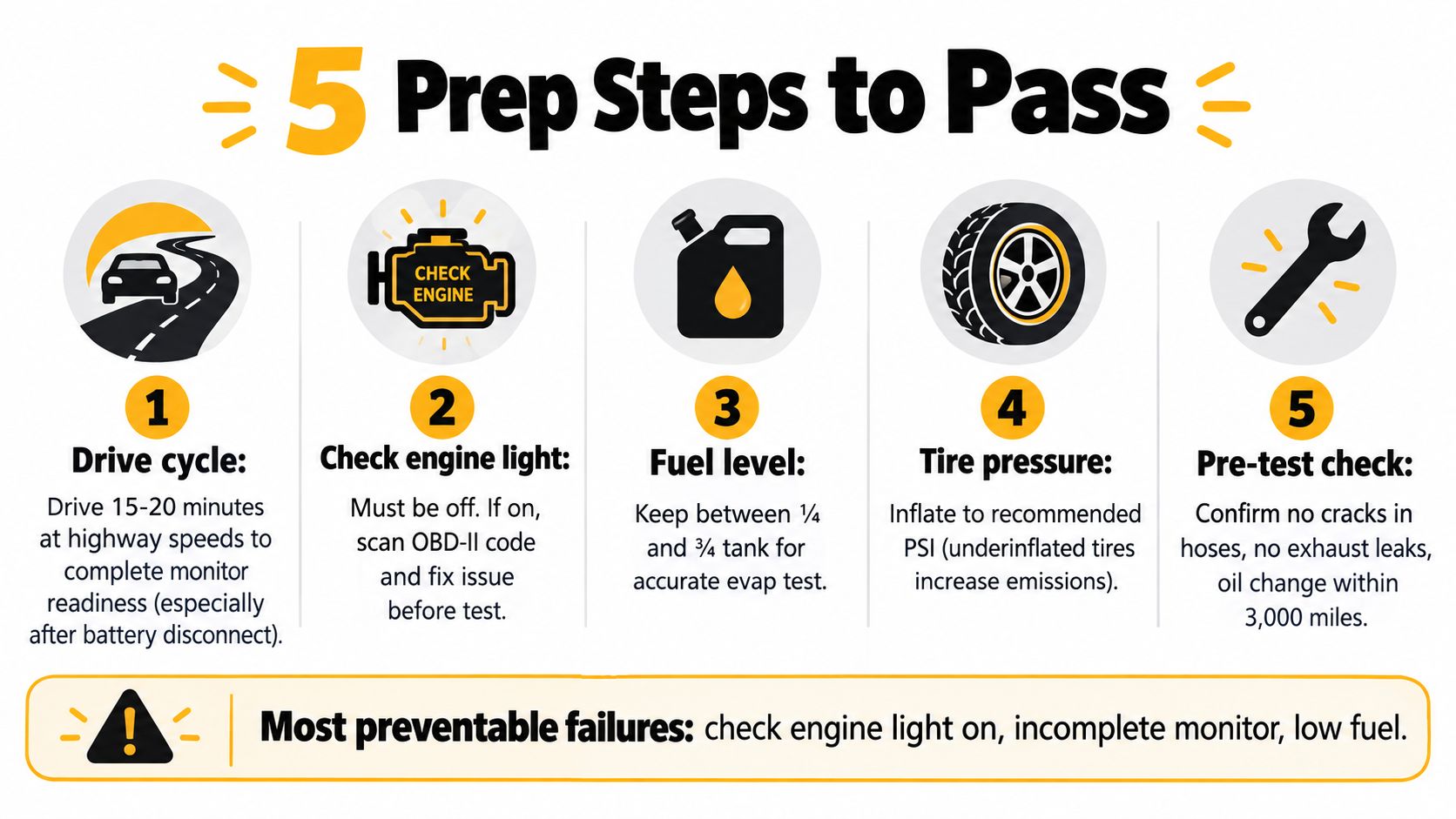
When the result affects your registration
For many California drivers, Smog Check works like a checkpoint built into the registration process. The state may require it for a renewal cycle and for some other registration-related events. In plain terms, the test result only helps you if it is attached to the registration requirement you have.
That is why wording alone does not decide anything. A driver can call it a smog test, an inspection, or a smog check. DMV still looks at the compliance record behind that visit.
Why STAR stations matter
STAR is part of that compliance record. If your DMV notice says a STAR inspection is required, the state is not making a suggestion about where to shop. It is telling you which station category can produce a result that counts for your renewal.
A simple way to picture it is this. Passing at the wrong station can be like bringing the right form to the wrong office. The paperwork may be real, but it does not satisfy the step DMV asked for.
Research discussing California's STAR program explains that STAR stations handle a large share of inspections and play a central role in the state system, especially for vehicles directed into that channel through program rules and DMV requirements, according to this University of Chicago analysis of California STAR station performance. If you want a plain-language explanation before you book, this guide on what a smog STAR station is explains what the designation means in practical terms.
A short explainer can also help if you want to see the process discussed visually.
Test-only versus test-and-repair
Station type can matter too. Some stations only perform inspections. Others can inspect and also repair a vehicle if it does not pass.
That distinction does not usually change whether DMV accepts a valid result. It changes what happens next if the car fails. A test-only station documents the outcome. A test-and-repair station may be able to diagnose and fix the problem before you return for another inspection.
How to Prepare Your Vehicle and Pass the First Time
Preparation depends on the inspection method your vehicle gets. A newer car and an older car can both be due for the same registration event, but the smartest pre-test routine isn't identical.
For newer vehicles with OBD-focused inspections
If your vehicle is in the newer category, think about computer readiness first. If the battery was recently disconnected or repairs were just completed, the onboard system may not yet be ready to report a complete picture.
Check the dashboard before you go. If the check engine light is on, that's a sign to pause and diagnose the issue rather than hoping the station visit will sort it out.
For older vehicles with tailpipe measurement
Older vehicles benefit from basic mechanical awareness before the appointment. If the engine is running rough, there's an exhaust leak, or visible emissions components appear tampered with or damaged, the inspection is more likely to uncover a problem.
A warm vehicle is usually better than a cold one. Drivers often get smoother results when the car has been driven normally beforehand rather than brought in after sitting for a long time.
Preparation is not one generic trick. For newer vehicles, focus on diagnostic readiness. For older vehicles, focus on engine condition, exhaust integrity, and obvious emissions-related issues.
A simple pre-appointment checklist
- Check warning lights: If the check engine light is on, treat that as a repair issue first.
- Drive the vehicle normally beforehand: A vehicle that has been sitting may not be in the best condition for inspection.
- Look for obvious problems: Loose caps, unusual exhaust smell, rough idle, or visible component damage are worth addressing.
- Don't book blindly after recent repairs: Give the vehicle enough normal operation to settle after emissions-related work.
- Match the station to the vehicle: Confirm the shop handles your model year and fuel type.
If you want a practical driver-focused checklist, this page on how to get a car to pass smog gives a straightforward prep rundown.
A failed inspection isn't always about major repairs. Sometimes the problem is simply showing up before the vehicle is ready for the kind of inspection it actually receives.
Choosing the Right Smog Station in the East Bay
The right station depends less on slogans and more on fit. Start with the vehicle, then match the station to the compliance requirement.
If you drive a 2000 or newer vehicle, convenience and workflow matter. These inspections are often straightforward, so many drivers care most about whether the station handles modern OBD-based testing efficiently and sends results properly for DMV use.
If you own a 1999 or older vehicle, experience with BAR-97 testing matters more. The process is more equipment-dependent, so you want a shop that regularly handles older vehicles and doesn't treat them like an exception.
What to look for before you book
A solid East Bay station should make a few things clear:
- Vehicle coverage: confirm they inspect your year and fuel type.
- STAR status: check whether the station can handle your requirement if DMV directs you to STAR.
- Process clarity: the staff should explain whether your vehicle is likely getting an OBD inspection or a tailpipe test.
- DMV compliance handling: ask how the result is processed for registration purposes.
- Waiting experience: this matters more than people think, especially for commuters booking around work.
A practical local example
In San Leandro, Speedy Smog is one example of a STAR-certified station that handles newer vehicles, older vehicles, diesels, and hybrids, which makes it relevant for drivers who need one location capable of matching different Smog Check paths. That matters most when a household has more than one vehicle type and the inspection process isn't the same across them.
The bigger lesson is simple. Don't choose a station just because it uses the phrase “smog test” or “smog check” on a sign. Choose it because it can perform the right inspection, under the right certification rules, for the vehicle and DMV situation you have.
If you need a California-compliant inspection in the East Bay, Speedy Smog provides STAR-certified smog testing for newer vehicles, older vehicles, diesels, and hybrids in San Leandro. If this article helped you sort out the difference between the Smog Check program and the test your car needs, visit Speedy Smog to find a station option that matches your vehicle and registration requirement.