
For most 2000-and-newer vehicles in the Bay Area, a smog check takes about 10 to 15 minutes and costs roughly $30 to $75, depending on the station and vehicle type. The key is showing up at a qualified station with your vehicle's emissions monitors ready, especially if you've recently had battery or engine work.
You may be looking at a DMV renewal reminder on the kitchen counter, wondering whether you can drive to the nearest test station and be done with it. Usually, yes, but a fast visit depends on your vehicle's model year, fuel type, warning lights, and recent repair history.
The old advice, “Just find the cheapest place,” isn't good enough anymore. California's readiness-monitor requirements and exemption rules have changed in ways that can turn a routine test into a failure or an unexpected registration question. This guide gives East Bay drivers the practical answer, without the usual price-and-wait-time sales pitch.
Table of Contents
- What Is a Smog Check in the Bay Area
- Understanding STAR Certification
- What to Expect During Your Smog Check
- How to Prepare and Avoid Common Failures
- Where to Get a Smog Check in the Bay Area
- Speedy Smog as a Local Example
- Making It Through Smog Season Confidently
What Is a Smog Check in the Bay Area
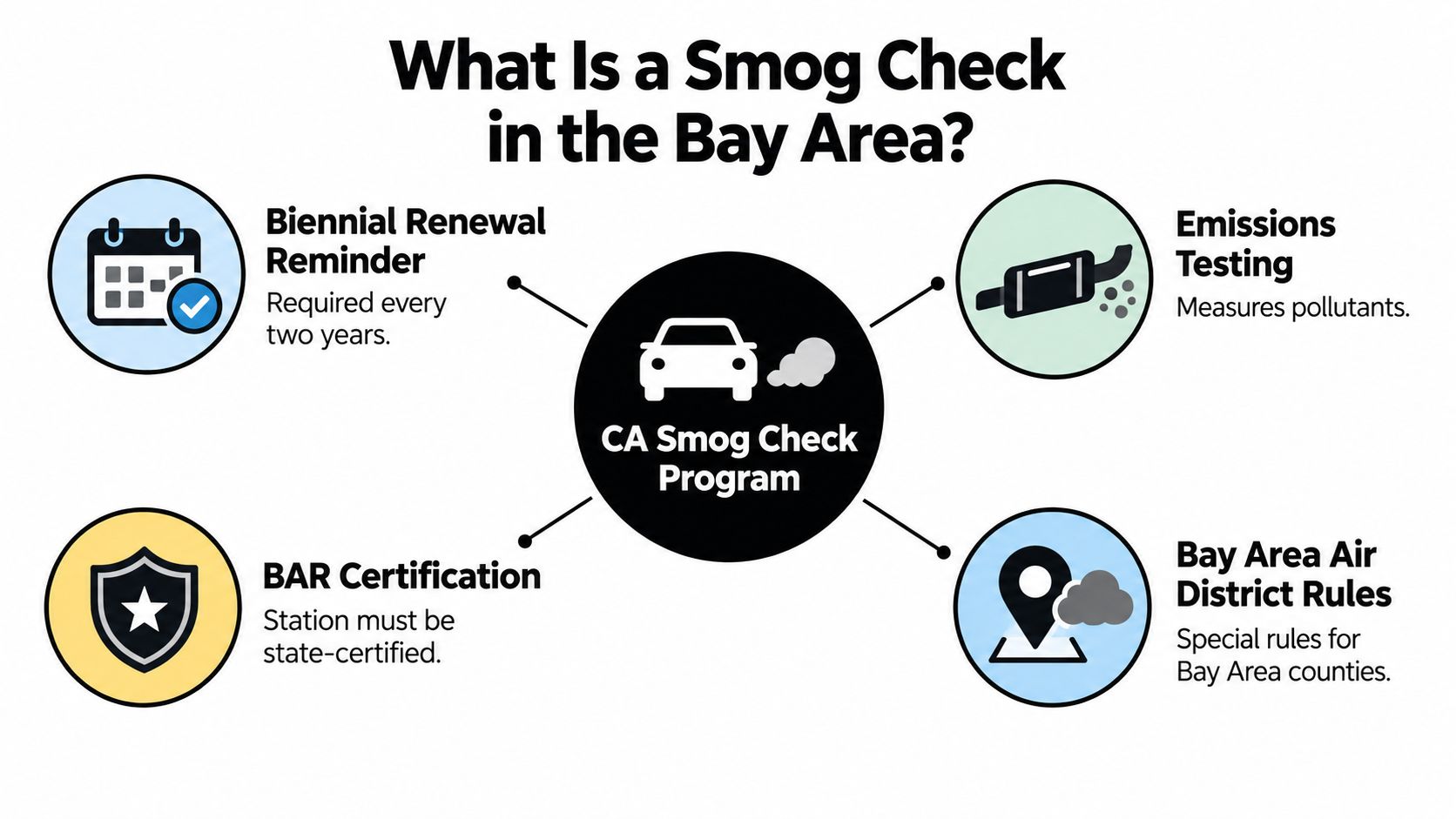
A DMV renewal notice that asks for a smog check means California wants an approved station to verify that your vehicle's emissions system meets state requirements before registration continues. For most gasoline and diesel-powered vehicles registered in the Bay Area, testing commonly comes up during a registration renewal or ownership transfer, with the standard renewal cycle generally occurring every two years.
The core rules come from California, not from an individual city. The Bay Area doesn't have a completely separate smog program, but local drivers still need to pay attention to station certification, vehicle category, and current rules because the wrong location or assumption can create a second trip.
California's modern Smog Check framework dates to 1984, when the state adopted the program in response to vehicle emissions as a major source of smog. The state later created the STAR program under Assembly Bill 2289. STAR began on January 1, 2013, replacing the Gold Shield Program, which ended on December 31, 2012. The Bureau of Automotive Repair's STAR FAQ explains that STAR certification applies to test-and-repair and test-only stations and supports higher inspection quality and performance monitoring.
Start with the renewal notice
Read the DMV notice before booking anything. It tells you whether a smog check is required, and it may identify a specific registration action you need to complete. If you're transferring a vehicle, registering one from outside California, or dealing with an older collector vehicle, don't rely on a neighbor's experience with a different car.
Use this simple order:
- Confirm the requirement: Check the DMV notice and your vehicle's registration situation.
- Identify the vehicle type: Note the model year, fuel type, and whether it is a hybrid or another special category.
- Choose the right station: Look for a station equipped and licensed for your vehicle, with STAR certification when your transaction requires it.
- Prepare before testing: Make sure the check-engine light is off and the computer's readiness monitors are complete.
The important distinction is simple. A Smog Check is the legal inspection. STAR is the performance standard attached to certain stations and testing situations. Choosing a qualified STAR station gives you a better chance of receiving an accurate test that the DMV can use for registration.
Understanding STAR Certification
A regular business license doesn't tell you enough about a smog station. STAR certification is a measured performance standard, not just a sign on the wall or a general authorization to operate.
The BAR requires a STAR station to hold the necessary licenses and equipment and to perform enough inspections for quarterly performance measurement. That matters because a station can't demonstrate consistent testing performance without sufficient inspection activity. The certification system also evaluates results against comparable vehicles rather than treating every make, model, and emissions profile as identical.
What BAR measures
The BAR STAR certification requirements include several concrete standards:
- Similar Vehicle Failure Rate: The station must maintain a failure rate at least 50% of the industry-wide failure rate for similar vehicles.
- Gear Shift Incidents: The station must keep these incidents below 2% of certified vehicles.
- Follow-up Pass Rate: Inspectors or the station must meet a follow-up pass rate of at least 0.40.
- Equipment calibration: Calibration-sensitive equipment must pass calibration at least once every 10 calendar days.
These rules don't mean every vehicle at a STAR station will pass. A car with a real emissions problem should fail, and a proper test shouldn't be adjusted to produce a convenient result. The point is that BAR uses performance data and equipment controls to identify stations that test accurately and consistently.
For a driver, the practical recommendation is straightforward: treat STAR status as your baseline when your DMV transaction calls for it. Verify the station's current status instead of assuming every location offering “smog testing” has the same certification.
You can use a STAR-certified San Leandro smog station when you want a local option that meets the higher certification standard. Ask whether the station can test your exact vehicle type before you arrive, particularly if you drive a diesel, an older gasoline vehicle, or a hybrid.
Why the certification affects your decision
The station's equipment and procedures affect the result that gets reported to the DMV. A technically correct inspection protects you from paying for an unnecessary retest, while a careless process can leave you confused about whether the problem belongs to the vehicle or the test.
Don't choose solely on a coupon. Compare certification, vehicle coverage, transparent pricing, and the station's ability to explain a failure. A few minutes spent checking those details can save much more time after an avoidable return visit.
What to Expect During Your Smog Check
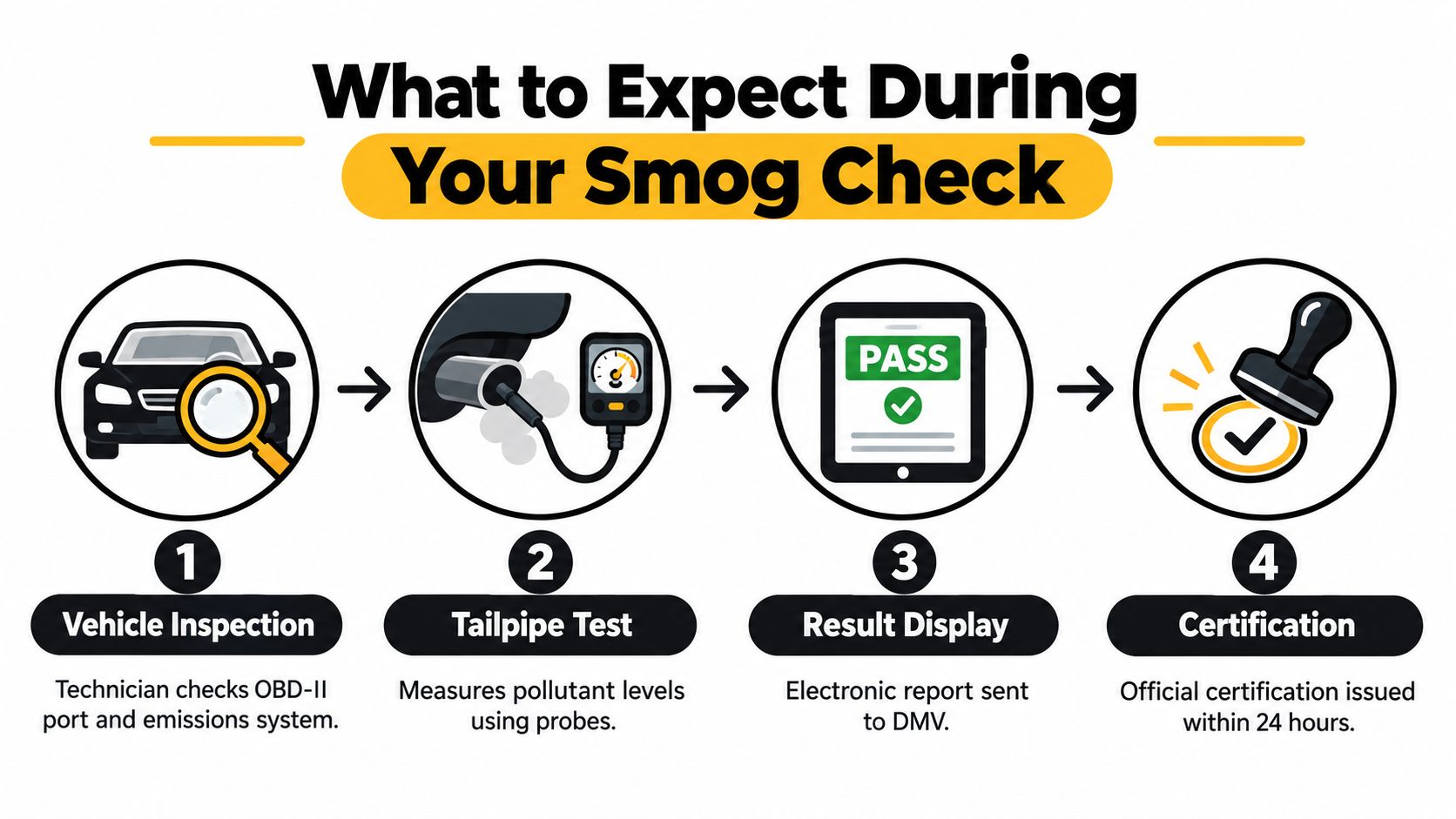
For most 2000-and-newer gasoline vehicles, the smog check is primarily an OBD II inspection. The technician connects a scan tool to the vehicle's diagnostic port and checks emissions information stored by the car's computer.
The malfunction indicator lamp, commonly called the check-engine light, must be off while the engine is running. The computer also needs to show that its required readiness monitors have completed. The BAR Smog Check Reference Guide explains that California modernized the program around OBD II testing for 2000 model-year and newer vehicles and advises drivers who recently disconnected or replaced a battery to drive for a week or two so the monitors can reset.
The inspection varies by vehicle
A newer gasoline car often gets a quick electronic inspection because its computer continuously evaluates key emissions systems. That doesn't make the test automatic. The vehicle still has to meet the required electronic conditions when the technician connects the scanner.
Older gasoline vehicles commonly involve more visual inspection and may require tailpipe sampling. Diesel vehicles can follow different testing procedures, with equipment and inspection requirements that depend on the vehicle's age and configuration. Hybrid vehicles still need to meet applicable California emissions requirements, even though their engines may cycle on and off during normal driving.
| Vehicle category | What commonly matters |
|---|---|
| 2000-and-newer gasoline | OBD II communication, warning-light status, and completed readiness monitors |
| Older gasoline | Visual emissions equipment checks and, where required, tailpipe measurements |
| Diesel | Vehicle-specific diesel inspection procedures and emissions equipment |
| Hybrid | Correct handling of the hybrid system alongside applicable emissions checks |
The technician may inspect the vehicle's identification information, connect the test equipment, check emissions-related components, and submit the result electronically. If the vehicle passes, the certification record supports the DMV registration process. If it fails, ask for the exact failure reason and the monitor or component that caused it.
The test itself is only one part of the experience. A station that explains the result clearly is more useful than one that hands you a pass or fail printout and sends you away.
How to Prepare and Avoid Common Failures
The most preventable mistake is arriving before the vehicle's computer has finished its readiness checks. This often happens after a battery replacement, battery disconnection, emissions repair, or repeated short trips that don't let the car complete its drive cycles.
Get the computer ready
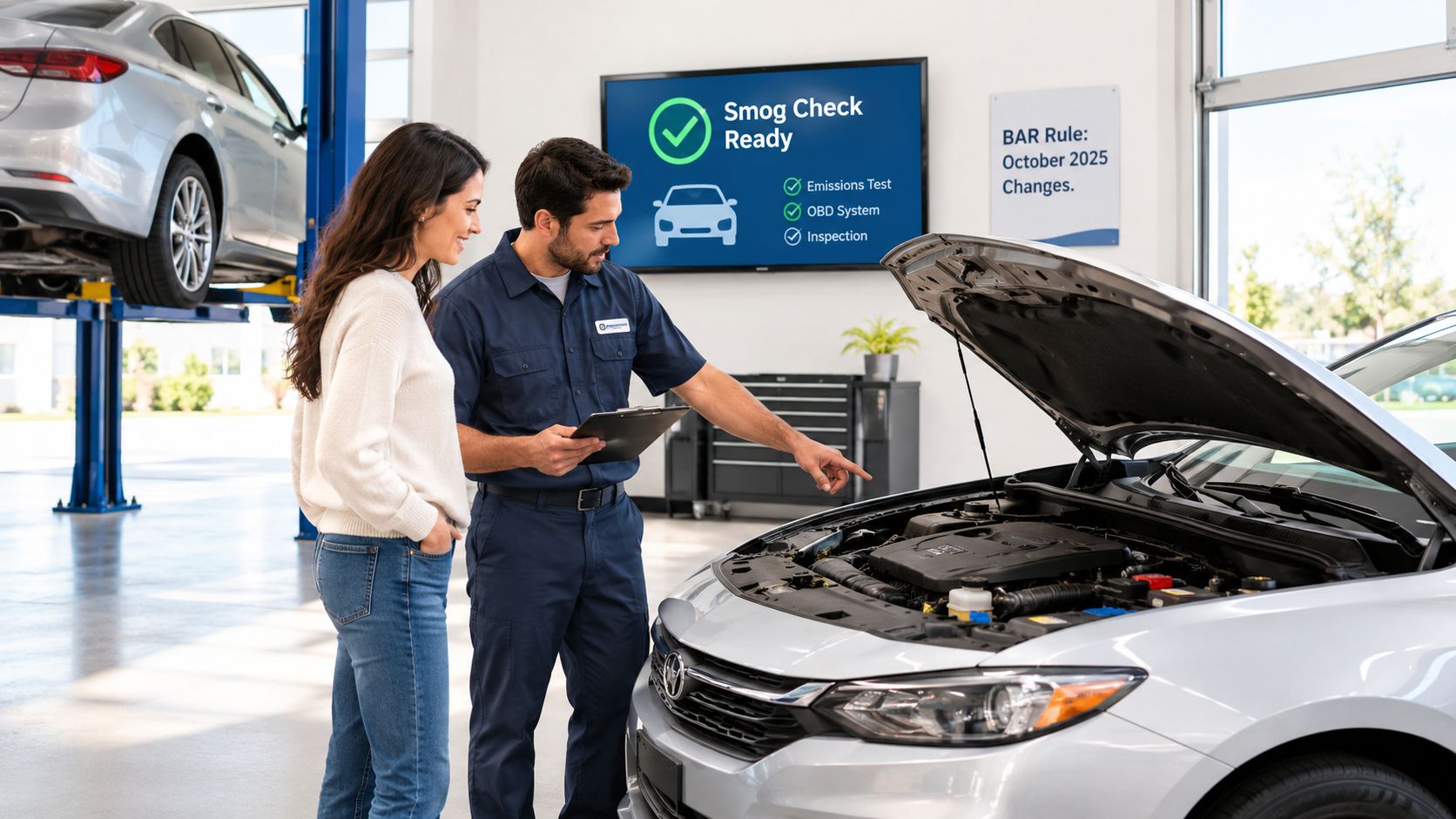
BAR's fall 2025 update says that, effective October 1, 2025, all readiness monitors must be set for a vehicle to pass. The change is especially important for newer OBD-II vehicles because a car can feel perfectly normal while its computer still reports incomplete self-tests.
Use this preparation routine:
- Check the warning light: If the malfunction indicator lamp is on, diagnose the underlying problem before testing. Clearing the light without fixing the cause doesn't solve the emissions issue.
- Avoid a last-minute battery disconnect: Battery work can erase monitor information and force the computer to begin its self-tests again.
- Drive normally after repairs: Give the vehicle enough varied driving, including highway operation, for the monitors to complete. BAR specifically advises driving for a week or two after a battery disconnect or replacement.
- Don't book immediately after engine work: Ask the repair shop whether the emissions monitors are ready before scheduling the inspection.
- Arrive with the vehicle warmed up: Normal driving before arrival is sensible. Excessive idling isn't a substitute for completing the computer's drive checks.
You can also review this pre-smog-check preparation guide before making an appointment. It helps you focus on the items that can affect the inspection instead of buying an unproven additive or trying to reset the system.
The numbers justify taking preparation seriously
The program handles a very large fleet. BAR reported 11,275,981 initial tests in 2025, with an 8.51% failure rate, and 12,200,718 total tests with a 9.04% failure rate during the same reporting period, as shown in the 2025 Smog Check Executive Summary.
In the 2024 to 2025 cycle, about 1.3 million of 19 million 2000-and-newer vehicles failed, or roughly 7%. Most newer vehicles passed, but “newer” doesn't mean “guaranteed.” Incomplete monitors remain a common hidden obstacle because they can prevent a passing result even when the engine seems to run normally.
Use this video as a practical visual guide before you go:
If your car fails, don't authorize random parts replacement. Get the failure code, monitor status, and technician's explanation in writing. Then repair the cause, allow the computer to complete its checks, and arrange a retest.
Where to Get a Smog Check in the Bay Area
Choose a station based on certification and vehicle coverage first, then compare price and convenience. A low advertised price doesn't help if the station can't handle your vehicle or if the result leaves you unsure what to do next.
Start by checking whether the station is STAR certified. If your DMV notice or registration transaction requires STAR testing, a non-STAR location isn't a bargain. It may just be the wrong place for the job.
Use this decision filter
Vehicle coverage comes next. Ask whether the station tests your model year and fuel type. A station that routinely handles 2000-and-newer gasoline cars may not be the right choice for an older vehicle, diesel truck, or hybrid. Confirm before you drive across the East Bay.
Demand an upfront price. Ask whether the quoted amount includes the certificate and any required reporting. Prices can vary by station and vehicle, and vague answers are a warning sign. A transparent station should explain the price before it begins testing.
Check the practical setup. A clean waiting area, clear business hours, and a process for walk-ins or appointments can matter when registration deadlines are close. Convenience isn't the main quality measure, but it can prevent a missed workday or an unnecessary return trip.
Ask what happens after a failure. Some stations only perform the inspection. Others can explain the diagnostic result or direct you to a repair provider. You don't need to buy repairs on the spot, but you do need a clear next step.
A useful local starting point is this guide to where to get a car emissions test in the Bay Area. Use it as a comparison point, then verify current certification, vehicle eligibility, price, and hours directly with the station.
Don't let a discount outweigh the basics. The right station is the one that can legally test your vehicle, uses properly maintained equipment, gives you a clear result, and communicates plainly if something goes wrong.
Speedy Smog as a Local Example
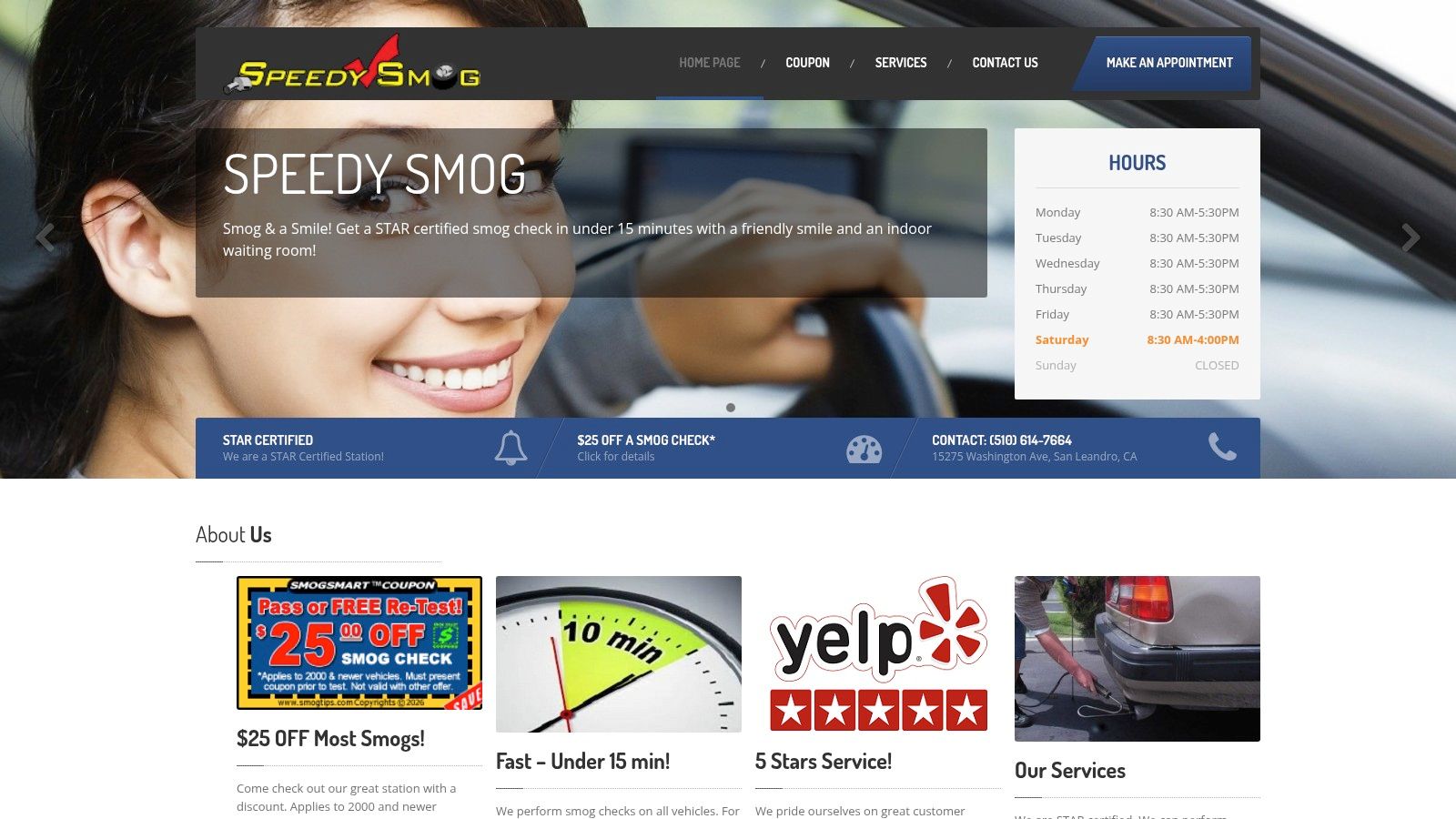
A practical example of that decision standard is Speedy Smog in San Leandro, located at 15275 Washington Avenue. The station is STAR certified and handles a range of vehicles, including 2000-and-newer cars, 1999-and-older vehicles, diesels, and hybrids.
For a typical newer vehicle, the stated testing time is about 10 to 15 minutes. That timeline makes sense when the car is ready for an OBD II inspection, has no active malfunction indicator lamp, and doesn't require additional diagnosis. It shouldn't be treated as a promise that every vehicle will take the same amount of time.
What a prepared visit looks like
A driver with a routine renewal can arrive with the DMV notice, vehicle information, and enough time for the inspection. The station offers an indoor waiting room, transparent pricing, and periodic $25-off coupons for most smogs on newer vehicles. Check the current offer before relying on a coupon because promotions can change.
The location is open Monday through Saturday and focuses on emissions testing rather than making the process feel mysterious. Friendly service matters here for a practical reason. If a readiness monitor is incomplete or the vehicle fails, you need someone who can explain the result in understandable terms.
The station's range of vehicle coverage also illustrates an important point: “smog check” isn't one identical test for every car. A newer gasoline vehicle, an older model, a diesel, and a hybrid may require different handling. Confirming coverage before arrival is still smart, even when a station advertises broad service.
I'd use this example as a checklist, not as a reason to ignore other qualified stations. Look for STAR certification, accurate vehicle coverage, clear pricing, convenient hours, and a technician who will tell you what the result means. Those standards matter whether you're in San Leandro, Oakland, Hayward, Fremont, or another East Bay community.
Making It Through Smog Season Confidently
A smooth smog check comes down to three decisions. Use a properly certified station, prepare the vehicle's computer, and verify the rules that apply to your specific vehicle. Price and speed matter, but they come after those basics.
Readiness monitors deserve special attention because the rules now make incomplete monitors a direct problem for newer OBD-II vehicles. BAR's 2026 performance report discusses roadside failures within the modern inspection system, while its fall 2025 update states that all readiness monitors must be set for a vehicle to pass, effective October 1, 2025. You can review the BAR performance report if you want the official technical context.
Don't rely on old exemption advice
The standard biennial requirement still applies broadly, but 2026 materials also address changing treatment for older collector vehicles, initial-registration situations, and vehicles connected to changing air-quality zones. The BAR spring 2026 legislation and regulations update is the right place to check unusual cases.
That matters for older cars, imported vehicles, and vehicles whose registration circumstances have changed. A car that seemed exempt under older guidance may not receive the same treatment under the current rule set.
Before you book, check your DMV notice, identify your vehicle category, and ask the station whether it can perform the required test. If the battery was recently disconnected, give the monitors time to reset. If the check-engine light is on, diagnose it instead of hoping the inspection will overlook it.
East Bay drivers don't need to make smog season complicated. Prepare the car, choose a qualified station, and insist on a clear explanation of the result. That approach prevents the most common surprise, a quick appointment that turns into a second visit because the vehicle wasn't ready.
For a STAR-certified inspection, Speedy Smog offers emissions testing for newer and older vehicles, diesels, and hybrids at its San Leandro location, with transparent pricing and convenient Monday-through-Saturday service. Prepare your vehicle first, then visit Speedy Smog to arrange a straightforward Bay Area smog check.
You're probably looking at a registration renewal notice, checking the calendar, and wondering whether your car can make it through the test without drama. The mistake I see most often is treating a smog check as nothing more than a quick warm-up and a tailpipe measurement. In California, your vehicle has to pass two separate tests: its computer must report that the emissions self-checks are complete, and the emissions hardware must perform properly when the vehicle is inspected.
That first part is the silent failure. Since October 1, 2025, California's Bureau of Automotive Repair says all readiness monitors must be set for a vehicle to pass Smog Check (BAR's readiness monitor guidance). A car can feel fine, show no warning light, and still fail before the emissions portion starts if someone recently disconnected the battery or cleared a code.
Table of Contents
- How a Smog Check Actually Works
- Your Week-Before and Day-Of Prep Timeline
- Why Readiness Monitors Are the Silent Failure
- The Right Way to Warm Up Before You Drive In
- Paperwork, Coupons, and What to Bring
- If You Do Not Pass on the First Try
- Quick Checklist and Common Questions
How a Smog Check Actually Works
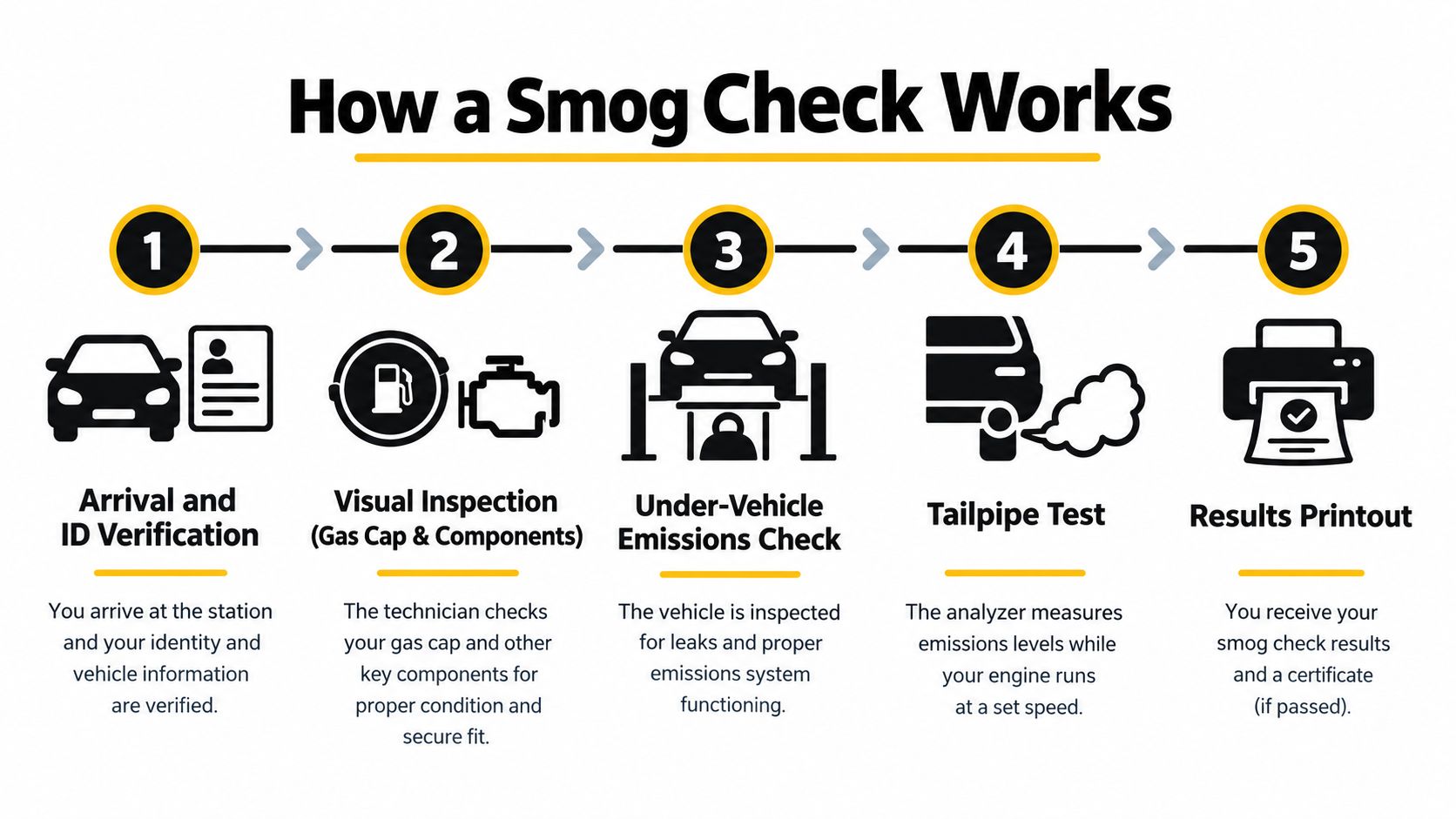
When you pull into the bay, the technician starts with the basics. They verify the vehicle information, look at the dashboard warning lights, check the gas cap, and inspect visible emissions equipment for damage, removal, or tampering. If the check engine light stays on while the engine is running, the inspection can stop there because the vehicle is reporting an emissions-related fault.
Next comes the OBD-II scan. The technician connects to the diagnostic port and checks stored trouble codes, permanent codes where applicable, and readiness monitor status. Readiness monitors are internal self-tests for systems such as the catalyst, oxygen sensors, and evaporative emissions controls. If required monitors show “Not Ready,” the vehicle may fail without the technician needing to measure tailpipe output.
The inspection has two failure paths
For most 1999-and-newer vehicles, the station uses California's OIS process. The scan evaluates the vehicle's computer data, while the inspection also checks the vehicle's condition and emissions-related components. Older vehicles may receive a different inspection, including a dynamometer test for applicable trucks and cars.
The tailpipe side looks at pollutants including hydrocarbons, carbon monoxide, and nitrogen oxides. A warm catalytic converter, correct fuel control, and a healthy engine help with this part. A proper smog check machine combines the computer inspection with the required emissions measurements.
Practical rule: A warm engine helps the tailpipe test. A completed drive cycle helps the computer test. You need both.
The final result prints after the technician completes the required checks. That printout tells you whether the issue was readiness, a warning light, visible equipment, or measured emissions. Your preparation should target the correct failure path rather than relying on one quick idle in the driveway.
Your Week-Before and Day-Of Prep Timeline
A car can run smoothly and still fail at the station entrance if its computer has not finished the required checks. Prepare for both sides of the inspection, readiness monitors and tailpipe emissions, with a short plan instead of a last-minute fix.
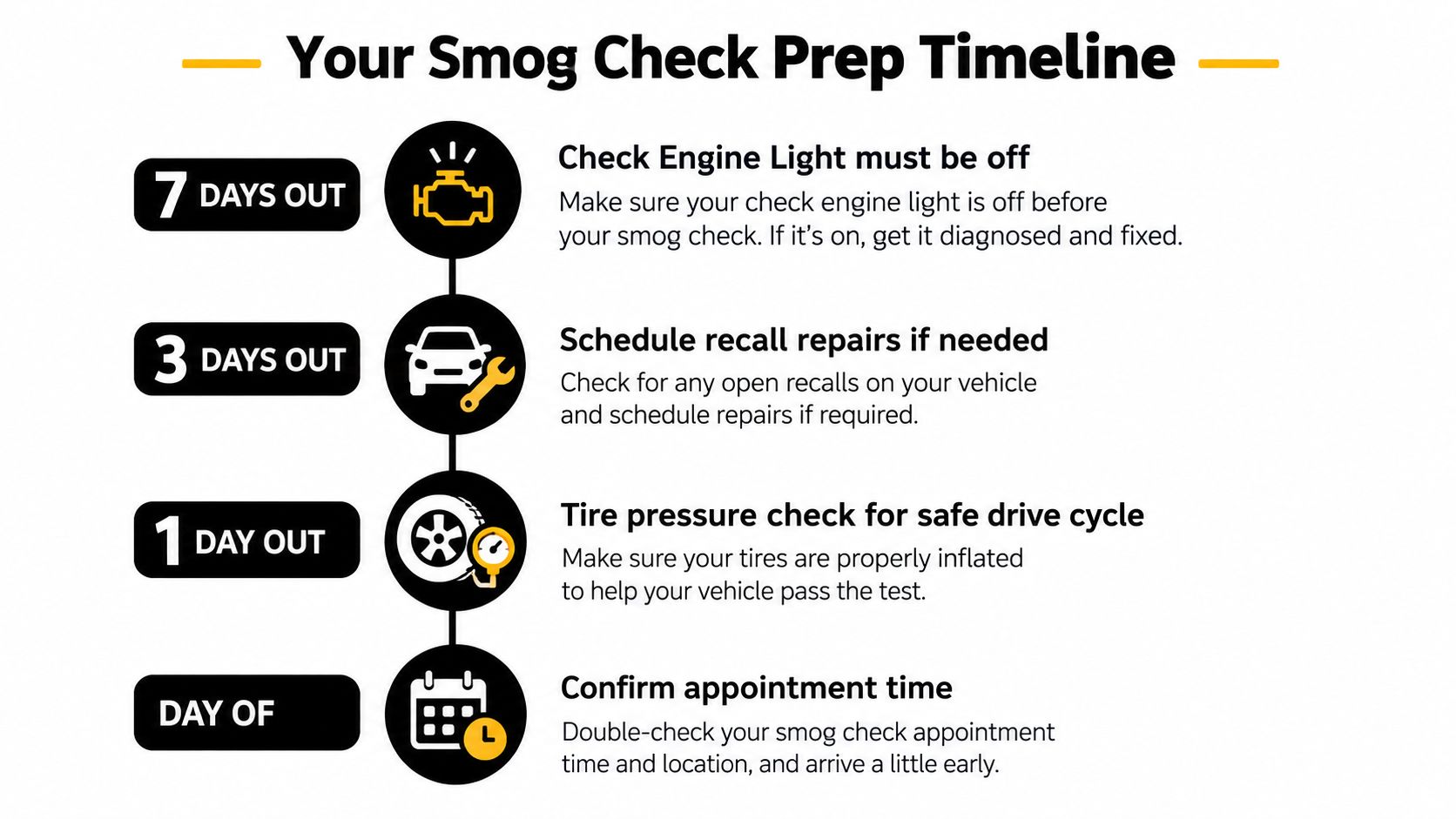
About a week before
Start with the check engine light. Turn the key without starting the engine and confirm the light comes on for its bulb check. Start the vehicle and verify that it turns off. If it stays on or flashes, diagnose the cause before scheduling the inspection.
Inspect the gas cap. Look for a cracked or flattened seal, then reinstall it until it clicks. A damaged cap can cause an EVAP fault, and tightening it after the warning light appears may not immediately complete the related monitor.
Check for an open safety or emissions recall and contact the manufacturer's dealer if a repair is required. Check tire pressure before completing the driving needed for monitor readiness. Correct pressure makes that preparation drive safer and prevents an avoidable problem.
Two or three days before
Drive normally across mixed conditions. Use stop-and-go streets, steady surface-road cruising, and freeway operation instead of taking only short trips. If recent repairs or a cleared code reset the computer, allow 50–100 miles after major work or a reset before testing, as recommended in Diamond Certified's smog preparation guide.
Do not disconnect the battery, clear codes, or erase a warning with a scanner before the appointment. Those steps can return monitors to Not Ready and leave the computer without enough completed self-test results. Check the oil level and take care of an overdue oil service before the inspection.
The day before and the morning of
Keep the fuel level moderate. One industry guide recommends roughly one-quarter to three-quarters full, since an extremely low or completely full tank can interfere with EVAP testing on some vehicles (Foxwell's readiness guidance).
On test day, drive for 15–20 minutes before arriving. Use mixed city and freeway conditions rather than idling in the driveway, following California smog check preparation guidance. Bring your renewal notice, payment, and any coupon you plan to use. Leave removable roof racks and unusual accessories at home if they could interfere with inspection access.
Why Readiness Monitors Are the Silent Failure
Your car can feel fine, show no warning light, and still fail before the tailpipe portion even matters. The hidden issue is often an incomplete readiness monitor, a self-test running inside the engine computer that checks an emissions system under specific conditions.
Common monitors cover the catalytic converter, EVAP system, oxygen sensors, and EGR system. Each result is either Ready or Not Ready. Smooth driving does not earn partial credit, and checking one related component does not complete the entire monitor.
What each monitor needs
Vehicles use different monitor sets and drive-cycle requirements, so the conditions below are practical examples rather than a replacement for the manufacturer's procedure.
| Monitor | What It Tests | Typical Set Conditions |
|---|---|---|
| Catalyst | Catalytic converter efficiency | Fully warm engine, steady cruise, and controlled deceleration |
| EVAP | Fuel-vapor leaks and purge operation | Appropriate fuel level, normal temperature, and specific parked or driving conditions |
| Oxygen sensor | Sensor response and fuel-control feedback | Engine at operating temperature with changing load |
| EGR | Exhaust-gas recirculation operation | Warm engine, light-to-moderate load, and controlled acceleration |
| Misfire | Combustion irregularities | Normal driving across different engine speeds and loads |
Battery replacement, battery disconnection, code clearing, and some emissions repairs can reset monitors to Not Ready. Electrical work or an aftermarket alarm installation can do the same if power is interrupted. A missing check engine light does not prove the computer is ready.
California's October 2025 rule change makes the status more important. BAR's guidance says all readiness monitors must be set for a vehicle to pass Smog Check (BAR's explanation of the new OBD readiness regulations). An incomplete monitor is now a disqualifying problem, not a minor detail.
I'd check the status before paying for an inspection. A basic OBD-II reader paired with an app such as Torque or OBD Fusion can display the results, although the station's equipment has final authority. For a technician-focused explanation, review this guide to car emissions test readiness monitors.
The Right Way to Warm Up Before You Drive In
Idling in the parking lot is a poor substitute for driving. It may raise coolant temperature, but it doesn't reproduce the changing speed, load, airflow, and deceleration that emissions monitors need. It also doesn't heat the catalytic converter as effectively as a real drive.
I'd leave early and use a controlled mixed route. Start with residential streets for 10–15 minutes, accelerate gently, and let the vehicle shift through its normal gears. Move onto surface roads around 35–45 mph, then include freeway operation where traffic allows. Vary the throttle lightly instead of holding one speed the entire time.
What the drive accomplishes
The first phase gives the engine time to reach normal operating temperature and enter closed-loop fuel control. Surface-road driving creates changes in load that help the oxygen-sensor and fuel-trim systems evaluate operation. A freeway stretch adds sustained exhaust flow and load, which helps the catalytic converter reach effective operating temperature.
Industry guidance commonly recommends 15–20 minutes of driving before inspection, while other consumer guidance recommends at least 20 miles, or 100–200 miles after maintenance when a recent repair may have reset the system (Edmunds' smog check preparation guide). Those are different jobs. The short drive warms the vehicle for the appointment. The longer post-repair driving gives the computer time to complete its monitors.
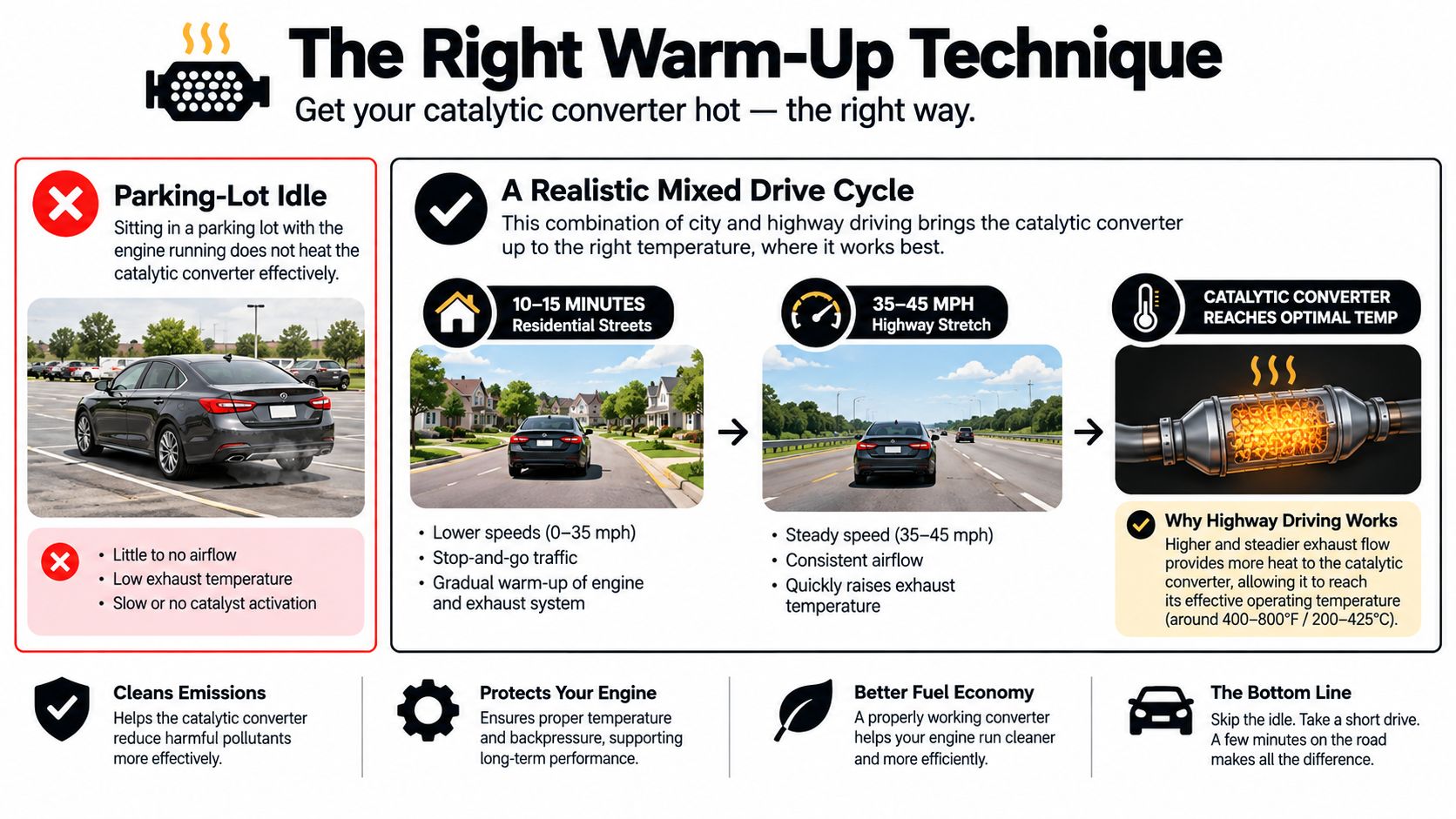
Finish driving shortly before you arrive, so the vehicle is already warm. Don't shut it off for a long wait if the station's process allows you to keep it running safely. Leave the A/C and rear defroster off during the inspection unless you need them for safety, because extra electrical and engine load can change test conditions.
Hybrids need a little more planning because the gasoline engine may shut off during portions of the route. Diesel vehicles also follow different emissions logic. If you drive either type, use normal operation and ask the station whether your vehicle needs a particular inspection procedure.
Paperwork, Coupons, and What to Bring
Most appointment problems are boring and preventable. Bring the renewal notice or current registration, a payment method the station accepts, and any repair or diagnostic paperwork that might help explain recent work. If your state or service provider sends an electronic certificate, have access to the email account or phone number used for delivery.
California drivers should check for available smog coupons before arriving. The state's Consumer Assistance Program may provide a $50 state assistance voucher, with eligibility rules and limits applying to the vehicle and applicant (California's official consumer assistance information). Don't assume every coupon works at every station. Read the terms, confirm the vehicle eligibility, and ask whether the discount applies to the inspection or only to a particular service.
Choose the correct station
A standard licensed station, a STAR station, and a test-only station don't serve exactly the same purpose.
| Station Type | Can Perform Repairs? | Use When |
|---|---|---|
| Regular licensed station | Often, depending on the business | You want inspection and possible repair support in one place |
| STAR-certified station | Varies by station | Your renewal notice directs you to STAR or you need a recognized follow-up inspection |
| Test-only station | No repair work | You want an independent inspection without repair sales |
Check your renewal notice before choosing. Some vehicles are directed to STAR-certified stations, and a retest path may have specific station requirements. A test-only location can inspect and report, but it won't repair the problem if the vehicle fails.
The technician needs clear access to the dashboard, engine compartment, gas cap, and diagnostic port. Wear shoes you can safely drive in and remove clutter from the cabin. At Speedy Smog, a STAR Certified smog check station in San Leandro handles emissions testing for many cars, older vehicles, diesels, and hybrids, with the exact inspection determined by the vehicle and California requirements.
If You Do Not Pass on the First Try
A failed result gives you information. Don't approve a catalytic converter or oxygen sensor just because the word “emissions” appears on the report. Start with the Vehicle Inspection Report, or VIR, and identify exactly what failed.
The VIR should tell you whether the issue involved readiness, a diagnostic code, visible equipment, or measured emissions. If the tailpipe portion failed, the pollutant readings and limits guide the diagnosis. If the computer portion failed, find out which monitor remains incomplete or which code prevents certification.
Follow the evidence
Ask for a scan-data diagnosis before authorizing parts. A technician can check fuel-trim behavior, oxygen-sensor response, misfire data, EVAP operation, and catalyst performance instead of guessing. A loose gas cap, EVAP leak, oxygen-sensor problem, misfire, or weak catalyst can produce very different repair paths.
Keep every estimate, invoice, receipt, and parts record. California assistance and waiver programs use documentation and eligibility requirements, so paperwork can matter as much as the repair itself. Ask the station whether the appropriate next step is a repair and retest or a state Referee appointment.
The cheapest repair is the one supported by test data, not the one that sounds most familiar.
A STAR station may handle a qualifying retest after repairs. A Referee can address unusual cases, disputed results, emissions equipment questions, or vehicles that need state-level review. The Referee process has its own appointment and documentation requirements, so contact the program rather than showing up at a regular station expecting the same service.
For a straightforward follow-up, ask about the station's free smog retest policy before authorizing work. Retest rules vary, and the renewal deadline doesn't pause while you search for a part.
Repair in stages. Fix obvious maintenance and sealing problems first, then retest or rescan before moving to expensive components. If the report points to a serious emissions failure, schedule diagnosis immediately rather than waiting until the registration deadline is close.
Quick Checklist and Common Questions
Use this checklist on your phone before you leave. A smog check has two separate failure points: the computer must show completed readiness monitors, and the vehicle must meet the tailpipe emissions limits. A warm engine only handles the second part.
One week out
- Check the warning light: Confirm the check engine light appears during the bulb check, then turns off after startup.
- Inspect the gas cap: Tighten it until it clicks. Replace a cracked or missing cap.
- Review vehicle history: Note recent battery work, code clearing, repairs, or electrical changes. Any of these can leave monitors incomplete.
- Plan the route: Build in mixed city and freeway driving before the appointment.
Since California's October 2025 rule change, an incomplete required monitor can disqualify the vehicle. Check monitor status before you pay for the inspection.
The day before
- Drive normally: Recently repaired systems need time and the right conditions to complete their self-tests.
- Check fuel level: Keep the tank in a moderate range, not extremely low or completely full.
- Check fluids and tires: Confirm the oil level and tire pressure are suitable for the drive.
- Gather documents: Put the renewal notice, registration, payment, and coupon together.
The morning of the appointment
- Avoid a cold arrival: Drive for 15–20 minutes before the inspection, using mixed driving so the engine and catalyst are fully warm (California smog check preparation guidance).
- Skip last-minute resets: Do not disconnect the battery or clear codes.
- Remove distractions: Leave unnecessary roof racks and accessories off the vehicle.
- Bring useful information: Tell the technician about recent repairs, battery replacement, or warning-light history.
Common questions
Does a new battery reset readiness monitors?
It can. Battery replacement or disconnection may return monitors to “Not Ready.” Drive normally and verify their status before testing.
How long does a drive cycle take?
The warm-up drive commonly takes 15–20 minutes, but monitors reset after repairs may need substantially more mixed driving. A short warm-up does not complete every self-test.
Does premium fuel help?
Use the fuel grade listed in your owner's manual. Premium fuel cannot repair an emissions fault, seal an EVAP leak, or complete readiness monitors.
What counts as a gross polluter?
The vehicle produces emissions far above the applicable limit. The test report and measured results determine that status, not how the car sounds or feels.
Can the check engine light clear itself?
It may turn off after the computer confirms that a fault is no longer present. The issue still needs diagnosis, and a dark warning light does not prove that monitors are complete.
How long does the certificate stay valid?
Validity depends on the transaction and California DMV requirements. Follow the paperwork and renewal instructions tied to your vehicle.
The practical target is simple: complete readiness monitors and a properly warm emissions system. If either part is uncertain, have the monitor status checked before paying for the inspection.
Speedy Smog provides STAR Certified smog inspections in San Leandro for many cars, diesels, older vehicles, and hybrids. Bring your renewal notice, ask about current coupons, and visit Speedy Smog to schedule or confirm your inspection.