
Smog Check Free Retest: Your 2026 California Guide
You walk into a smog shop expecting a quick pass, and instead you leave holding a failed Vehicle Inspection Report and wondering how much this is about to cost. That's usually the moment people start hearing mixed advice. One person says the retest is always free. Another says you have to pay again. Both can be wrong.
The practical answer is that a smog check free retest in California depends on shop policy, your vehicle year, and how fast you handle repairs. The hidden rules matter more than the headline offer. Miss the deadline, go to the wrong station, or assume diagnosis is included, and the “free” part disappears fast.
Table of Contents
- Your Car Failed Its Smog Check Now What
- Understanding Eligibility for a Free Smog Retest
- Your Step-by-Step Guide to Claiming a Free Retest
- How STAR Stations Like Speedy Smog Handle Retests
- Actionable Tips to Pass Your Smog Retest
- What to Do If a Free Retest Is Denied or You Fail Again
Your Car Failed Its Smog Check Now What
You leave the station expecting to finish your registration, then the report comes back with a fail. That moment throws a lot of drivers off, especially when they assume the next step is expensive repairs and another full test fee.
Start with the report, not guesses.
California requires many vehicles from model year 1976 and newer to pass smog as part of registration, so a failed test has to be resolved before the renewal process is complete. The good news is that a failure report usually points you in the right direction. It tells you whether the problem is an OBD trouble code, an incomplete monitor, a visual failure, or tailpipe emissions. Those are not the same problem, and they should not be treated the same way.
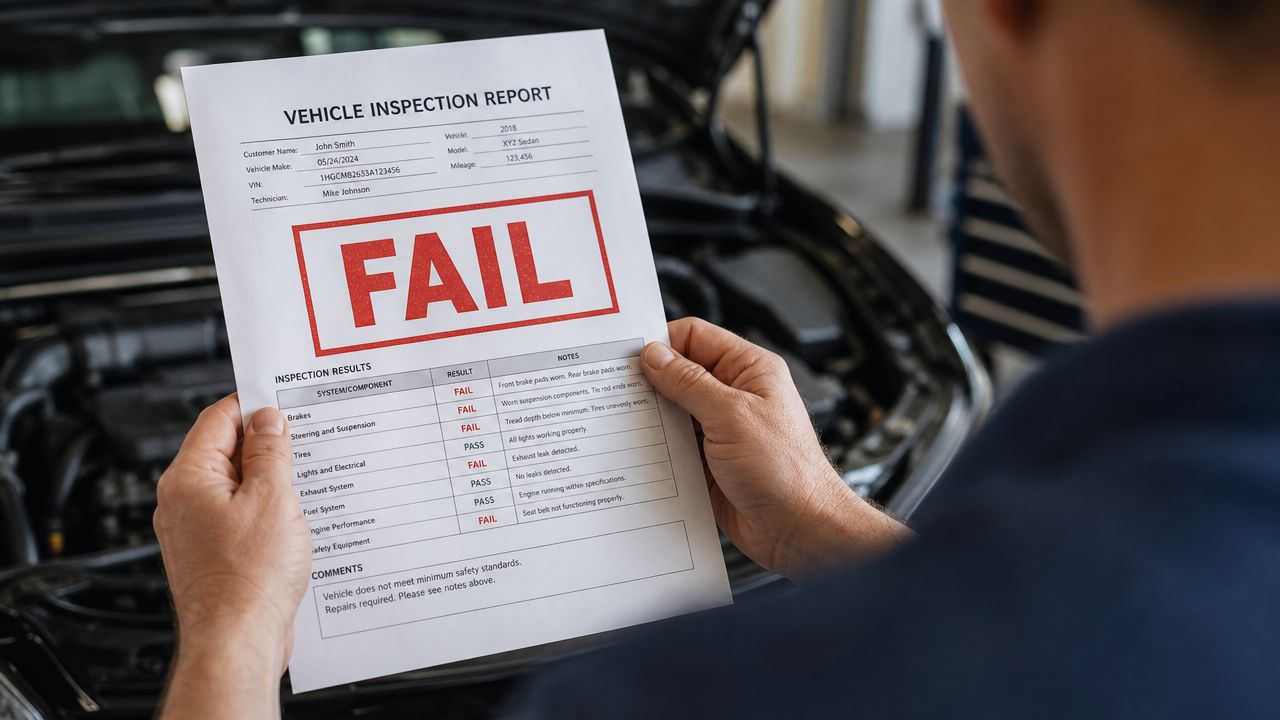
One of the biggest mistakes I see is drivers clearing codes, driving around for a day, and coming back too soon. Then the car fails again for incomplete readiness monitors. Another common mistake is paying for repairs before anyone matches the repair plan to the actual failure on the Vehicle Inspection Report.
If you need help reading the paperwork, this guide on understanding smog test results breaks down what the report is showing.
What matters right away
These three items usually decide whether this turns into a quick fix or a drawn-out headache:
- The exact failure type: Check engine light issues, monitor status problems, visual failures, and high emissions each require a different response.
- Your registration timeline: The DMV due date keeps coming even if the car is still being diagnosed.
- The station's retest terms: Free retest offers often come with limits on time, vehicle year, and what kind of failure qualifies.
Keep the failure report with you and show it to any repair shop. That saves diagnostic time and cuts down on random parts swapping.
The practical approach is simple. Fix the reason the car failed, keep an eye on your registration deadline, and ask about the retest policy before you leave the station. The hidden rules matter. A free retest may only apply within a short window, and some vehicles do not qualify at all.
Understanding Eligibility for a Free Smog Retest
A free retest isn't a California entitlement. It's a shop offer. That single point clears up most of the confusion.
The rule most drivers get wrong
Practical rule: The station decides whether a retest is free. State law doesn't.
That's the key takeaway from Xtreet's explanation of failed smog checks in California. The same source notes that most stations offer one free retest for 2000 and newer vehicles within a 30-day window, while 1999 and older vehicles virtually never get a free retest because those cars usually need more involved testing.
Why the split? It comes down to test type and shop time. Newer vehicles generally use the OBD-II process, which is faster and easier for a station to rerun. Older vehicles often require a more involved procedure, and many shops won't absorb that extra labor for free.
That's why “Do you offer a free retest?” isn't enough. The better question is, “Do you offer a free retest for my model year, and what's the deadline?”
Typical Free Retest Policies by Vehicle Year
| Vehicle Model Year | Common Retest Policy | Reason |
|---|---|---|
| 2000 and newer | Often one free retest within a limited window | These vehicles typically use the easier OBD-II test |
| 1999 and older | Usually no free retest, sometimes a partial discount | These vehicles often require more complex testing such as dyno and tailpipe procedures |
There's another consumer trap here. Shops can advertise “free retest,” but that usually means the retest only. It doesn't mean free diagnosis, free parts, or free repair labor.
Questions worth asking before the first test
Ask these at the counter before authorizing the inspection:
- Is my vehicle year eligible: Don't assume because your neighbor got a free retest that your car qualifies too.
- How long is the retest window: Some stations use a short deadline. Miss it, and you'll likely pay again.
- Do I need to return to the same location: Many policies only apply at the original shop.
- What paperwork do you require: Most stations want the original VIR and the same vehicle back.
A little clarity upfront saves the worst kind of return visit, the one where the car is fixed but the free retest has already expired.
Your Step-by-Step Guide to Claiming a Free Retest
You pick up your failed VIR, get the repair done, come back a few days later, and expect a quick free retest. Then the counter person says the offer expired, or it only applied to certain vehicles, or they need the original paperwork. That is the part drivers do not see coming.
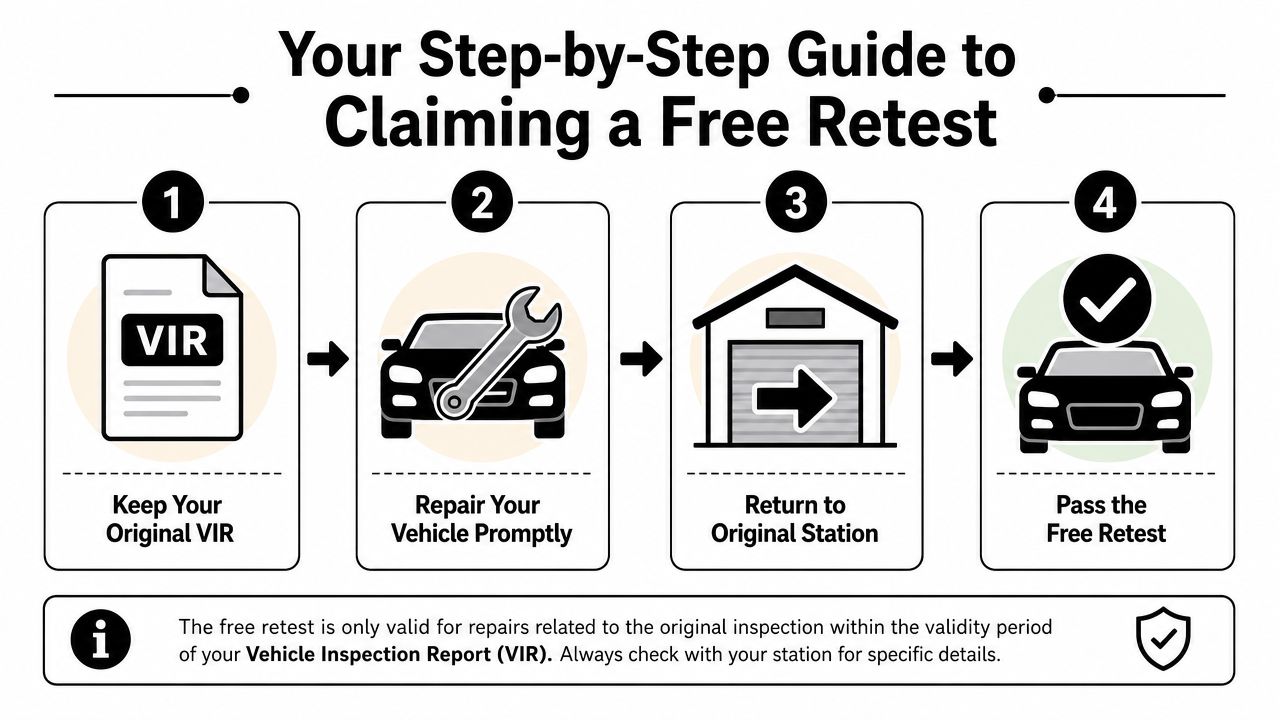
A free retest is usually simple to claim if you follow the shop's rules exactly. The hidden part is that every station sets its own policy, and the clock starts running right after the failed test. As noted earlier, California gives you a limited registration compliance window, and shops are not required to give unlimited retests. That is why I tell customers to treat the retest like a same-paperwork, same-car, same-location transaction.
If you are not sure why station type affects how clearly this process gets handled, read our guide on what a smog STAR station is. A disciplined station usually explains the retest rules before confusion starts.
What to bring back to the station
Bring everything that ties the retest to the original failure.
Your original VIR
This is the record the station uses to pull up the failed inspection. If you show up without it, the visit slows down fast.The same vehicle that failed
The retest is connected to that VIN. If the shop cannot match the car to the original test, the free retest offer can fall apart.Repair invoice or repair notes
Some stations ask for them, some do not. They help clear up what was fixed, especially if the failure involved more than one issue.A clear understanding of the deadline
Some free retest offers are short. Miss that window and you may be paying for another inspection even if the repair itself was done correctly.
What to say at the counter
Keep it direct and get the important answer before the test starts.
Use wording like:
- “I'm back for the free retest. Here's my original failed VIR.”
- “This is the same vehicle, and the repair is complete.”
- “Can you confirm I still qualify under your retest policy before you pull it in?”
That last question saves people money.
At the counter, the two problems I see most often are expired retest windows and missing paperwork. The car may be fixed, but if the shop cannot verify the original failed test under its own policy, the free retest is gone.
How the visit usually goes
A straightforward retest visit follows a predictable order:
- Check in and hand over the VIR
- Station confirms the vehicle and prior failed test
- Technician performs the retest
- If the vehicle passes, the certificate is sent electronically
The process gets messy when the owner waits too long, returns to a different station, or assumes “free retest” also includes diagnosis or repair work. It does not. The retest itself may be free. Everything that got the car ready for that retest usually is not.
How STAR Stations Like Speedy Smog Handle Retests
The station you choose affects more than convenience. It affects how clearly the process is explained, how consistently the test is run, and whether the retest conversation starts with facts or confusion.
Why the station type matters
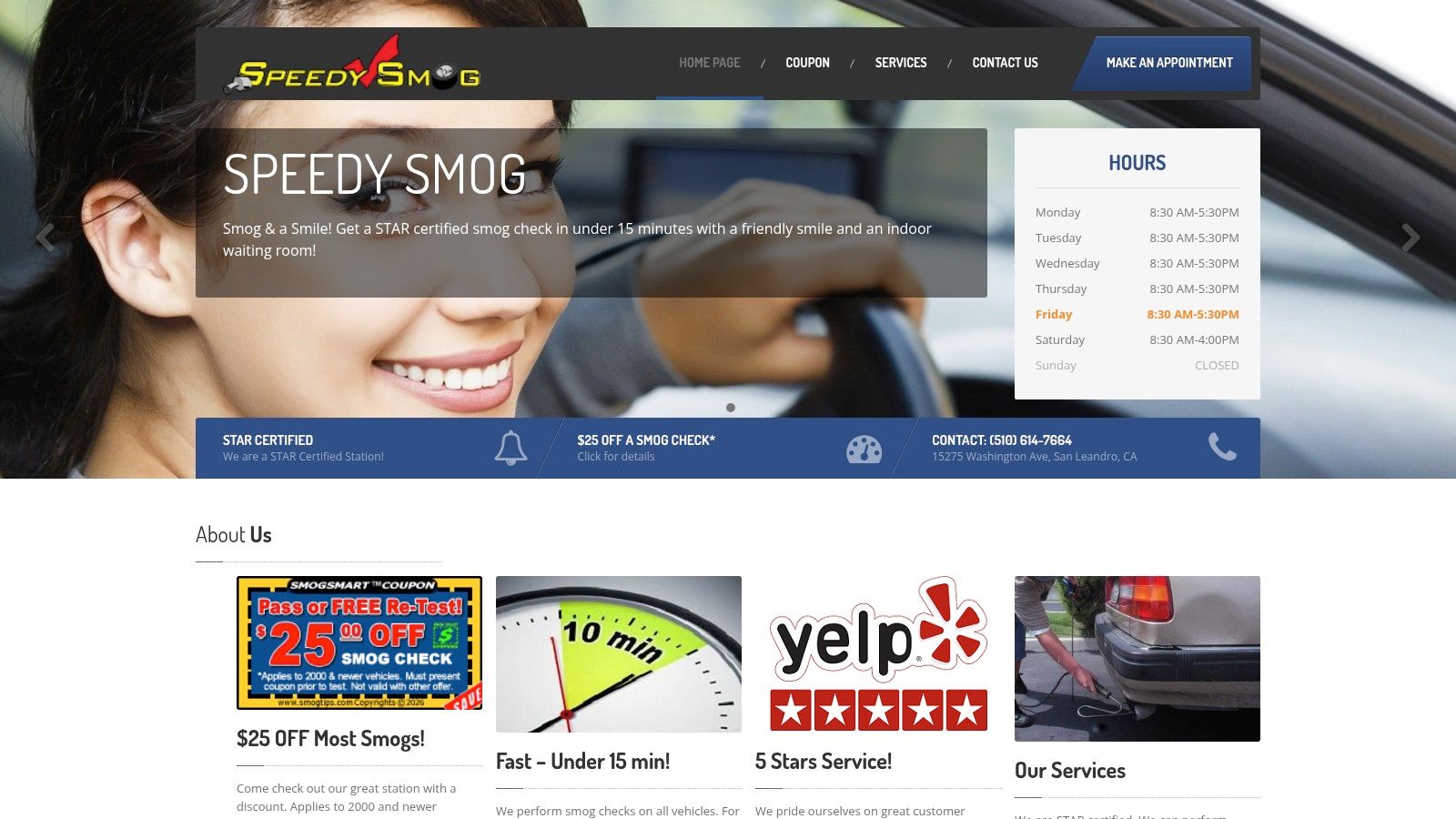
A STAR station operates under higher performance standards. For drivers, that matters because a careful initial inspection reduces the chance of wasted time and unclear answers. If you want a quick primer on what that means, this page on what a smog STAR station is breaks it down well.
The other reason STAR stations matter is process discipline. Good stations are clear about eligibility, paperwork, and deadlines. That's especially important because the smog certificate is valid for 90 days from issuance, according to STAR Smog Center's California smog FAQ. If a car needs repairs and retesting, timing affects whether registration gets delayed.
What good retest handling looks like
A well-run station doesn't just say “free retest” and leave the rest fuzzy. It should be able to answer these points without hesitation:
- Which vehicles qualify
- How long the retest offer lasts
- Whether the original VIR is required
- What happens if the vehicle still fails
That transparency matters more than marketing language. The best experience is one where the customer knows the rule before the first test, not after the second trip.
Some stations are more customer-friendly with newer vehicles because retesting them is simpler on the equipment side. Older vehicles are a different story. Shops have to balance labor, bay time, and test complexity, which is why free retests are much less common there.
Actionable Tips to Pass Your Smog Retest
A free retest only saves money if the car passes. The smartest move is to treat the failed report like a repair checklist, not a guessing game.
Do the repairs that actually match the failure
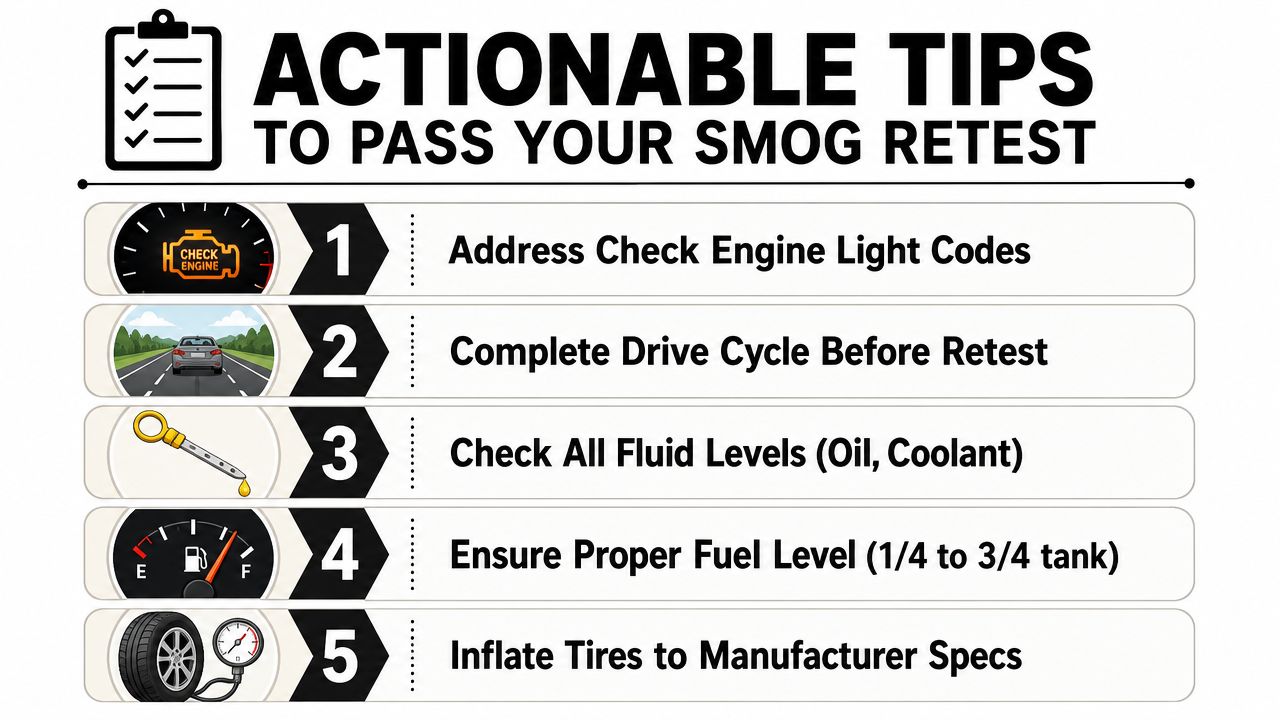
Start with the exact failure item on the VIR. If the problem is a check engine light or stored code, the fix is not “clear the code and hope.” The fix is repairing the cause, then making sure the vehicle is ready to test again.
A good quick read before you spend money is this breakdown of common smog check fail reasons. It helps drivers separate likely repair issues from simple readiness or preparation mistakes.
For vehicles that still fail after repairs, the Bureau of Automotive Repair offers the Consumer Assistance Program with up to $1,450 for 1996 and newer models and up to $1,100 for 1976 to 1995 models, with an approval letter and STAR station co-payment required before repairs, as described in this discussion of CAP repair assistance details.
Simple prep that helps on retest day
These are practical driver-level steps that can improve your chances:
- Fix the actual fault first: If the check engine light was involved, don't retest until the underlying problem has been addressed.
- Tighten the gas cap: A loose or poorly sealing cap can create avoidable trouble.
- Drive the car before the retest: Get the engine fully warm before you arrive so the emissions system is operating normally.
- Avoid an immediate retest after battery disconnect or code clearing: The vehicle may not be ready yet.
- Use normal fuel and normal driving: Don't try gimmicks. A properly repaired car is what passes.
For older vehicles, there's one extra point worth knowing. Some stations report better results when pre-1999 vehicles are driven 40 to 100 miles after an engine reset before retesting, based on the technical discussion in the earlier linked CAP source. That helps reduce false failures tied to incomplete readiness.
This video gives a useful visual walkthrough of general retest prep:
Don't spend your free retest on a car that isn't ready. Use the first failure report to verify the fix, then return.
What to Do If a Free Retest Is Denied or You Fail Again
You come back with receipts, the repair is done, and the station says the free retest no longer applies. That usually comes down to one of three things. The shop's time limit expired, the vehicle never qualified under that station's policy, or the retest is being requested after work that took too long to finish.
At a STAR station, drivers often get tripped up. “Free retest” is usually just the test portion. It does not cover diagnosis, parts, labor, or extra time spent chasing an intermittent fault. If the car sat at a repair shop waiting for an oxygen sensor, catalyst, or EVAP part, the retest window may have closed before the car was ready. As noted by Smog N Go's discussion of retest restrictions, if repairs run past the station's 90-day free-retest window, the consumer pays the standard retest fee.
That deadline is a shop policy issue, not a statewide guarantee.
If a station denies the retest, ask for the exact reason and keep it specific. “You're outside the time window” is different from “your vehicle was never included in our free retest offer.” Get the answer in plain language before you spend time arguing. In my experience, clear paperwork solves more of these disputes than frustration does.
If the car fails again, slow the process down and compare both VIRs side by side. Look for whether the same monitor, pollutant, or system failed twice, or whether a new problem showed up after the repair. A repeat failure usually points to an incomplete diagnosis. A different failure can mean the original issue was fixed, but the car still has another emissions problem that was hidden the first time.
Here's the practical next move:
- Match the failure to the repair invoice: If the invoice says the EVAP issue was repaired, but the VIR still shows an EVAP failure, take both documents back to the repair shop.
- Ask what was tested, not just what was replaced: Parts-swapping gets expensive fast. Good shops can explain the diagnostic steps.
- Check whether the car is a referee case: Modified emissions equipment, engine swaps, label problems, and unusual test conflicts often belong with the Smog Check Referee.
- Look into BAR assistance if cost is the problem: CAP may help qualified drivers who are stuck between a failed test and repair bills they cannot absorb.
The expensive mistake is repeating the same loop. Same vague diagnosis, same retest, same failure, same bill.
A second failure is usually a signal to change something. Change the repair approach, change who diagnoses it, or confirm whether the car belongs in the referee system before you pay for another inspection.
If you need a fast, straightforward inspection from a STAR-certified team that explains the retest rules clearly before you start, Speedy Smog is a practical place to book your next smog check in San Leandro.