
Vehicle Smog Inspection in California: What You Need to Know
Most California vehicles more than five model years old need a smog inspection every two years for registration renewal, while newer vehicles from the 2000 model year onward generally use an OBD test that takes about 10 to 15 minutes at a certified station such as Speedy Smog in San Leandro. The exact requirement depends on your vehicle, fuel type, model year, and the wording on your DMV renewal notice.
You may be looking at that notice right now, wondering whether you need a regular smog station or a STAR station, whether your hybrid is exempt, or what will happen when you arrive. A vehicle smog inspection sounds technical, but the basic idea is simple. California checks whether your vehicle's emissions-control system is working well enough for registration compliance.
The easiest way to understand the process is to follow the same path your vehicle takes, from the DMV notice to the inspection lane, test result, and possible repair.
Table of Contents
- What Is a Vehicle Smog Inspection in California
- Types of Smog Tests and What Applies to Your Vehicle
- Understanding STAR Certification and Why It Matters
- What to Expect at Your Smog Check Appointment
- Smog Failure Rates by Vehicle Age and What They Reveal
- Exemptions, Preparation Tips, and Steps After a Failure
What Is a Vehicle Smog Inspection in California
A San Leandro driver might receive a registration renewal notice, see “Smog Certification Required,” and assume every inspection works the same way. Another driver may see “Smog Certification Required at a STAR station” and wonder whether STAR is a special repair shop, a more expensive test, or just another name for a regular station.
It's none of those things. A smog inspection is an emissions compliance test, and the station checks your vehicle according to its model year and the requirements attached to your registration record. The result is sent through the state's inspection system so the DMV can confirm that the emissions requirement has been met.
California's Smog Check program has operated since 1984 and the state credits it with greatly reducing air pollution from millions of vehicles. Today, the system handles more than 10 million vehicle tests each year at thousands of independently owned stations statewide, as described in the California Bureau of Automotive Repair Smog Check FAQ.
Why California requires the inspection
The inspection connects vehicle ownership with air-quality rules. For most vehicles more than five model years old, a passing result supports biennial registration compliance, meaning the requirement commonly appears every two years during renewal. The state has updated the program as vehicles changed. Older inspections relied more heavily on measured exhaust, while newer vehicles can report emissions-system problems through onboard diagnostics.
That shift makes the test less mysterious. Your car isn't being judged by a mechanic's personal opinion. The technician follows a state procedure designed for the vehicle's model year and equipment.
Who usually needs a test
Most gasoline vehicles eventually enter the regular inspection cycle, but exemptions and special rules apply. Newer gasoline, hybrid, and alternative-fuel vehicles may be exempt from the biennial test for eight model years, while the DMV notice remains the most useful starting point for your specific renewal.
If you want a local overview before booking, this guide to smog checks in California explains the registration connection and common vehicle categories. Bring the renewal notice if you have it. Its wording can tell you not only whether certification is required, but also what type of station you must use.
Types of Smog Tests and What Applies to Your Vehicle
The model year usually determines the inspection pathway. Think of a newer vehicle as having a built-in health monitor, while an older vehicle must demonstrate its emissions performance more directly through the exhaust.
Vehicles from 2000 onward
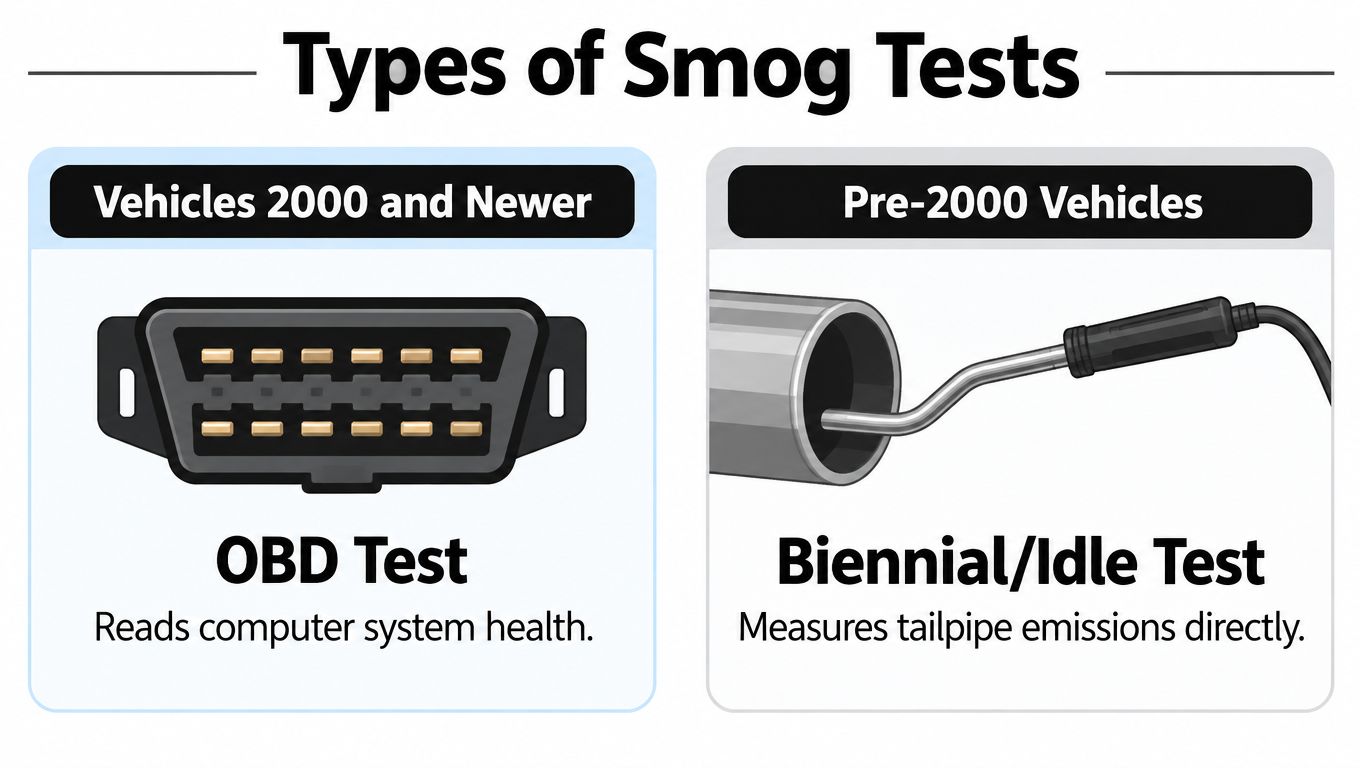
For 2000-and-newer gasoline vehicles, the standard route is generally an onboard diagnostic, or OBD, test. A technician connects equipment to the vehicle's diagnostic port and checks whether the emissions-control computer has detected faults, whether warning indicators are behaving correctly, and whether the required system monitors are ready.
That's similar to plugging a scan tool into the car's brain. The technician isn't just asking whether the engine runs. The test checks whether the systems responsible for controlling emissions have completed their self-checks and whether the computer has stored a relevant fault.
The state's Smog Check testing overview explains that 2000-and-newer gasoline vehicles are generally inspected through OBD, while older vehicles use a different method.
Vehicles from 1999 and earlier
Vehicles from 1999 and earlier are generally routed to tailpipe-based testing. The station uses the BAR-97 emissions inspection system to measure exhaust emissions directly, rather than relying primarily on the vehicle's onboard computer.
The analogy is straightforward:
| Vehicle group | Main inspection approach | What the technician evaluates |
|---|---|---|
| 2000 and newer gasoline vehicles | OBD test | Emissions-system computer information |
| 1999 and older vehicles | Tailpipe testing with BAR-97 | Measured exhaust emissions |
A tailpipe test can feel more physical because equipment measures what comes out of the exhaust. That doesn't mean the process is automatically more difficult. It means the state uses a testing method suited to an older vehicle fleet.
Hybrids, diesels, and alternative-fuel vehicles
A hybrid isn't automatically exempt just because it can drive on electric power. Its eligibility depends on the vehicle's model year and the applicable California rules. Newer hybrids may fall within the eight-model-year exemption, but an older hybrid can still require inspection.
Diesel vehicles also need to be classified correctly. The required procedure can differ from a gasoline vehicle, so the safest approach is to check the DMV notice and confirm the station handles your vehicle type before arriving. Fuel system, model year, and registration circumstances matter more than a simple label such as “car,” “truck,” or “hybrid.”
Practical rule: Use the renewal notice and the vehicle identification details to determine the inspection path. Don't guess based only on the dashboard, fuel door, or the fact that the vehicle is newer than another car.
Understanding STAR Certification and Why It Matters
The STAR question usually has a simple answer: follow the exact wording on your DMV renewal notice. If it says “Smog Certification Required,” you can generally choose an authorized station that performs the required inspection. If it says “Smog Certification Required at a STAR station,” the inspection must happen at a STAR station.
That distinction matters because a non-STAR station can't substitute for a required STAR inspection. A STAR station isn't merely a shop that chose a particular marketing label. It holds a designation controlled by the California Bureau of Automotive Repair.
What STAR means
BAR evaluates STAR stations using inspection-volume and quality measures. The requirements include a Similar Vehicle Failure Rate of at least 50 percent of the industry-wide failure rate for similar vehicles and a Follow-up Pass Rate threshold of 0.40, according to BAR's STAR certification requirements.
Those measures are intended to make station performance accountable. A station shouldn't fail vehicles indiscriminately, and it shouldn't pass vehicles that need emissions-related attention. BAR uses the metrics to evaluate whether a station consistently identifies vehicles that genuinely require repair.
A simple decision tree
Use this order:
- Read the DMV renewal notice. Look for the exact smog wording.
- Check whether STAR is specified. If it is, choose a STAR-certified station.
- Confirm the station handles your vehicle. Ask about model year, fuel type, and test method.
- Bring the vehicle and notice. The technician can verify the required inspection in the state system.
The difference between a regular authorized station and a STAR station isn't necessarily the test technology. Both follow state procedures, and the appropriate method still depends on the vehicle. The difference is whether the station meets the performance controls attached to STAR certification and whether your notice requires that designation.
For a more detailed explanation of the designation, see this guide to what a STAR smog station is. Choosing the correct station first prevents one of the most frustrating outcomes, completing an inspection that doesn't satisfy the DMV requirement.
What to Expect at Your Smog Check Appointment
A first appointment is usually less dramatic than drivers expect. You pull into the station, provide the vehicle information and renewal notice, and let the technician follow the correct procedure for your car.
Start with check-in
Have your DMV renewal notice, current registration information, and the vehicle available for inspection. The notice helps the technician confirm whether you need a standard inspection or a STAR inspection. If you recently moved, bought the vehicle, or are dealing with an out-of-state registration issue, mention that at check-in.
The technician will identify the vehicle and select the applicable inspection procedure. You don't need to know the technical test code yourself. Your job is to provide accurate information and explain any recent dashboard warning lights or emissions repairs.
The technician checks more than the exhaust
The inspection can include a visual review of emissions-related components, a check of warning indicators, and the prescribed electronic or tailpipe test. For a newer gasoline vehicle, the technician connects to the OBD port and reviews the computer's emissions information. For an older vehicle, the BAR-97 equipment measures exhaust output through the tailpipe.
A warning light deserves attention before the appointment. If the check-engine light is on, the vehicle may fail because the computer is reporting an emissions-related problem. Clearing the light immediately before testing isn't a reliable fix, because the system may need to complete its monitors before the vehicle can be evaluated properly.
Before you arrive: Tell the technician about recent battery replacement, computer resets, warning lights, or emissions repairs. Those details can affect the vehicle's readiness information.
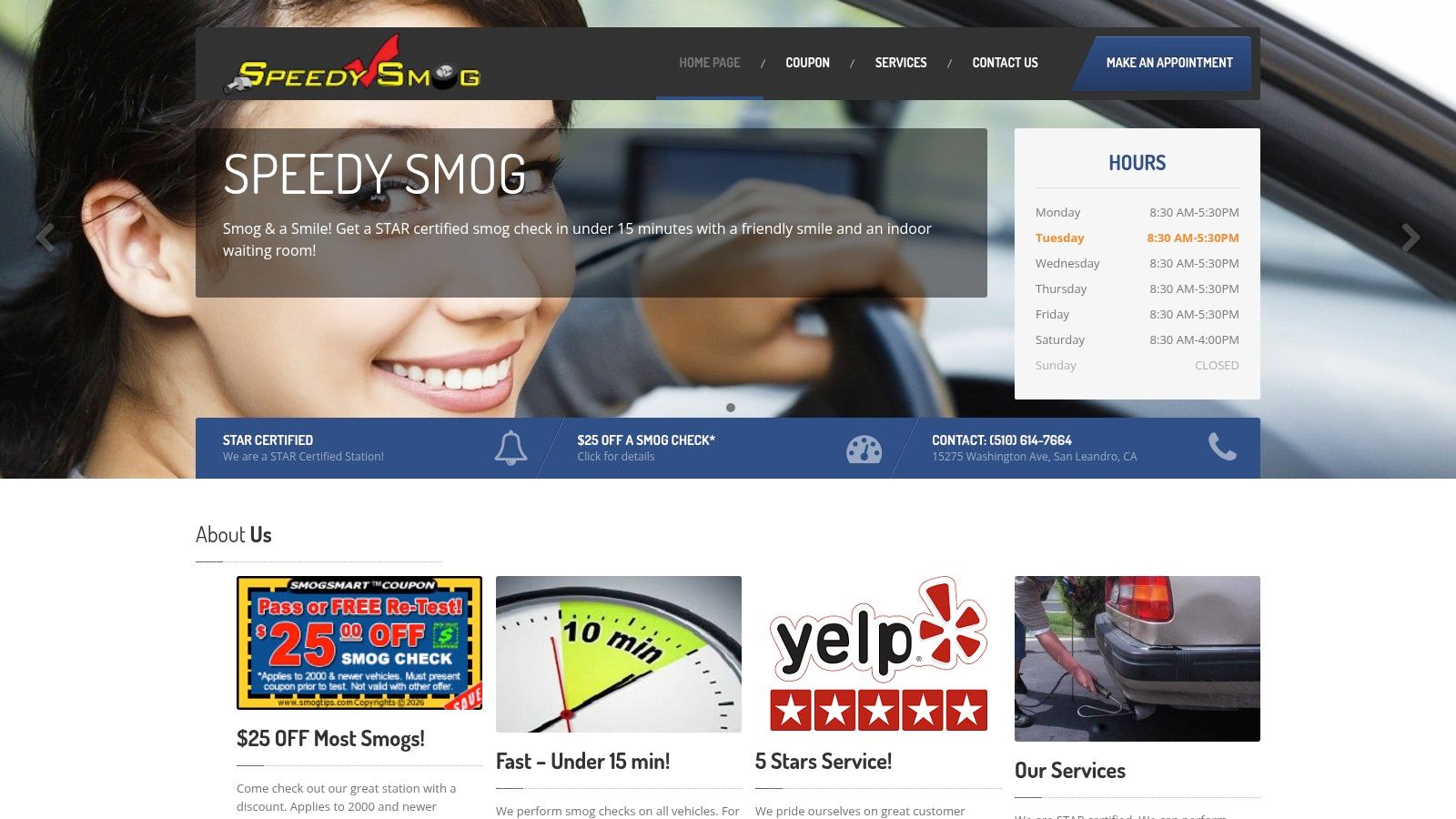
For many 2000-and-newer vehicles, a typical OBD inspection at Speedy Smog in San Leandro takes about 10 to 15 minutes, although the actual time can vary with the vehicle and station workload. The shop describes a clean indoor waiting area and a process intended to keep the visit straightforward.
Once the inspection is complete, the station records the result. A pass supports the DMV registration process. A failure should come with information about the reason for failure, so you can decide whether to repair the issue at the station, visit a repair shop, or obtain a second diagnostic opinion.
Here's what the basic flow looks like in practice:
- Check in: Provide the renewal notice and vehicle details.
- Identify the procedure: The technician confirms STAR status and test type.
- Inspect the vehicle: The station checks the applicable emissions components and equipment.
- Run the test: The vehicle receives an OBD or tailpipe-based inspection.
- Receive the result: The station records a pass or provides failure information.
A comfortable waiting room can make the appointment easier, but the important part is procedural accuracy. The result needs to match the vehicle, the registration requirement, and the state's inspection rules.
Smog Failure Rates by Vehicle Age and What They Reveal
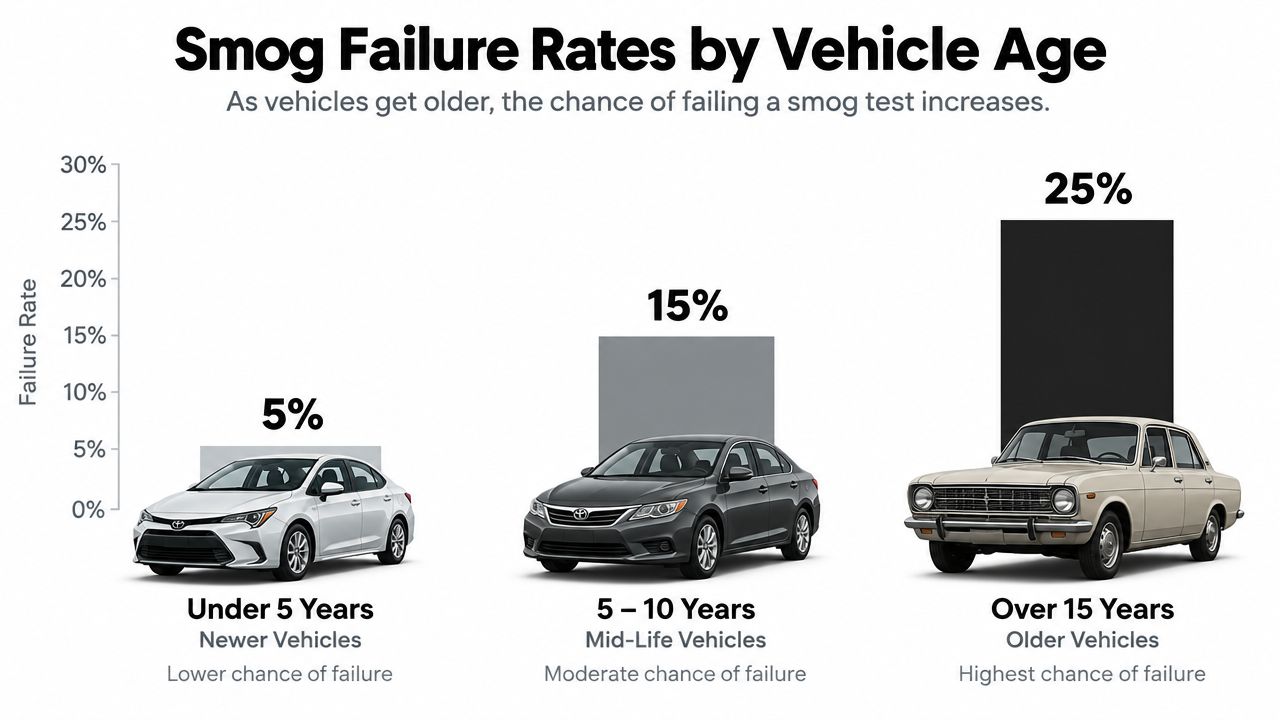
Drivers often treat a failed smog test as random bad luck. California's recent inspection data point to a more predictable pattern. Vehicle age has a strong relationship with failure outcomes, although maintenance history, emissions-system condition, and the specific fault still matter.
In the January 2026 executive summary, 2025 model-year vehicles had an overall failure rate of 0.23 percent, while 2024 model-year vehicles failed at 4.52 percent and 2023 model-year vehicles failed at 4.36 percent. The same report recorded a 22.18 percent failure rate for 1976 model-year vehicles, showing the much steeper challenge faced by older vehicles. These figures come from the California BAR Smog Check executive summary for 2025.
Why age changes the odds
Older vehicles have had more time for sensors, vacuum lines, catalytic converters, ignition parts, and other emissions components to wear out. They may also have accumulated years of incomplete maintenance or modifications that affect the original emissions system.
Newer vehicles aren't guaranteed to pass, but their failure rates in the reported data are much lower than those of older model years. That doesn't make preparation unnecessary. It means preparation should focus on known warning signs rather than assuming every inspection is a crisis.
The statewide picture
California recorded 11,275,981 initial tests in 2025, including 959,667 failures, for an 8.51 percent initial-test failure rate, according to the same BAR report. Those figures show that failures are a normal part of a large inspection system, not evidence that every failed vehicle has a catastrophic engine problem.
| Reported group | Initial failure rate |
|---|---|
| 2025 model year | 0.23% |
| 2024 model year | 4.52% |
| 2023 model year | 4.36% |
| 1976 model year | 22.18% |
| All initial tests in 2025 | 8.51% |
The useful lesson is practical. An older vehicle with an illuminated warning light, rough running, or a history of emissions repairs deserves diagnosis before the appointment. A newer vehicle with no warning signs may need little more than a correctly completed inspection.
Exemptions, Preparation Tips, and Steps After a Failure
The DMV notice should guide your decision, but a few rules explain why neighbors with similar-looking vehicles may receive different requirements. Newer gasoline, hybrid, and alternative-fuel vehicles may qualify for an eight-model-year exemption from the biennial test. Once that exemption ends, the vehicle can enter the regular renewal cycle.
The notice can also specify the station type. “Smog Certification Required” and “Smog Certification Required at a STAR station” aren't interchangeable instructions. Read the line carefully before booking.
Prepare without trying to trick the test
Good preparation means making sure the vehicle is in ordinary, documented operating condition:
- Resolve warning lights: Diagnose an illuminated check-engine light instead of clearing it without root cause analysis.
- Complete normal driving: If the battery was recently disconnected or the computer was reset, drive the vehicle normally so its emissions monitors can complete.
- Check basic condition: Address obvious rough running, misfires, exhaust leaks, or unusual smells before inspection.
- Bring records: Keep repair invoices and maintenance information available for the technician or repair shop.
- Confirm the station: Verify STAR status and vehicle coverage before you arrive.
A drive cycle isn't a shortcut around a problem. It gives the vehicle's onboard system time to perform its own checks after a reset. If the monitors remain incomplete, the technician may not be able to complete the inspection even if the car feels normal.
If the vehicle fails
A failure report identifies the area that prevented certification. The right response depends on the finding. A repair shop may need to diagnose a sensor, catalytic converter, evaporative-emissions leak, ignition issue, or another emissions-related fault. Don't replace expensive parts based only on a guess.
After repairs, the vehicle needs a retest. Keep the failure report and repair documentation because they help the next technician avoid repeating the same diagnostic work. Drivers who need guidance with the repair process can review smog check repair assistance before choosing their next step.
A failed test is a diagnosis starting point, not a final verdict. Ask what failed, why it failed, and which repair can confirm the cause before authorizing parts.
If the vehicle's age, fuel type, registration status, or station requirement is unclear, ask the inspection station or consult the DMV information tied to your renewal. A few minutes of verification can prevent the wrong test, an incomplete inspection, or a return visit.
Speedy Smog provides vehicle smog inspections and STAR smog checks in San Leandro for newer and older vehicles, including applicable diesel and hybrid inspections. Review your DMV notice, bring the vehicle and registration information, and visit Speedy Smog to arrange a compliant inspection.