Smog Check in California: Your 2026 Ultimate Guide
You open your renewal notice, scan down the page, and there it is: smog certification required. For a lot of California drivers, that line lands somewhere between annoying and confusing. You might be wondering if you need the test, whether your car is exempt, what a STAR station is, or what happens if your check engine light came on last week and then disappeared.
That confusion is normal. Smog rules in California aren't hard once someone translates them into plain English, but the official language can feel like it was written for agencies instead of drivers. From the shop side, most problems come from a few predictable misunderstandings: the 8-year exemption, readiness monitors, and what to do after a failed test.
A smog check in California isn't just paperwork. The California Smog Check Program removes about 400 tons of smog-forming pollutants from the state's air every day, according to the California Smog Check Program overview. That doesn't make the errand fun, but it does explain why the state takes it seriously.
If you're trying to get this done with the least stress possible, the goal is simple. Know whether you need a test, prepare your car the right way, and avoid the common mistakes that cause avoidable failures.
Table of Contents
- Your DMV Notice Arrived Now What
- Understanding Your Smog Check Obligations
- Does Your Vehicle Qualify for an Exemption
- Simple Steps to Help Your Vehicle Pass
- Inside the Smog Check Process
- What to Do If Your Car Fails the Smog Check
- Get Your STAR Smog Check at Speedy Smog
Your DMV Notice Arrived Now What
The usual first reaction is a sigh. You were just trying to renew your registration, and now you have one more thing on the list. Maybe your tags are coming due soon. Maybe you're selling a car and the buyer asked about a smog certificate. Maybe you moved recently and the notice showed up with a line you weren't expecting.
The first thing to know is that this is manageable. In most cases, a smog check is just a routine inspection. Drivers get into trouble when they wait too long, show up right after disconnecting the battery, or assume their newer car still needs testing when it doesn't.
Here's the practical move. Pull out the DMV notice and confirm whether it says a smog certification is required for this renewal cycle. Then book the test early enough that you still have time if the car needs follow-up. If you want to lock in a time before your schedule gets packed, you can schedule a smog check appointment online.
Practical rule: Treat the notice as the start of a short to-do list, not a crisis.
A lot of first-timers assume the station will handle every registration issue for them. The station handles the inspection and certificate reporting. Your job is to bring the right vehicle, show up with enough time before your deadline, and avoid creating an automatic failure with last-minute resets or repairs.
If your car has been running normally, no warning lights are on, and you haven't recently cleared codes, you're already in decent shape. Most of the stress around a smog check in California comes from uncertainty, not the test itself.
Understanding Your Smog Check Obligations
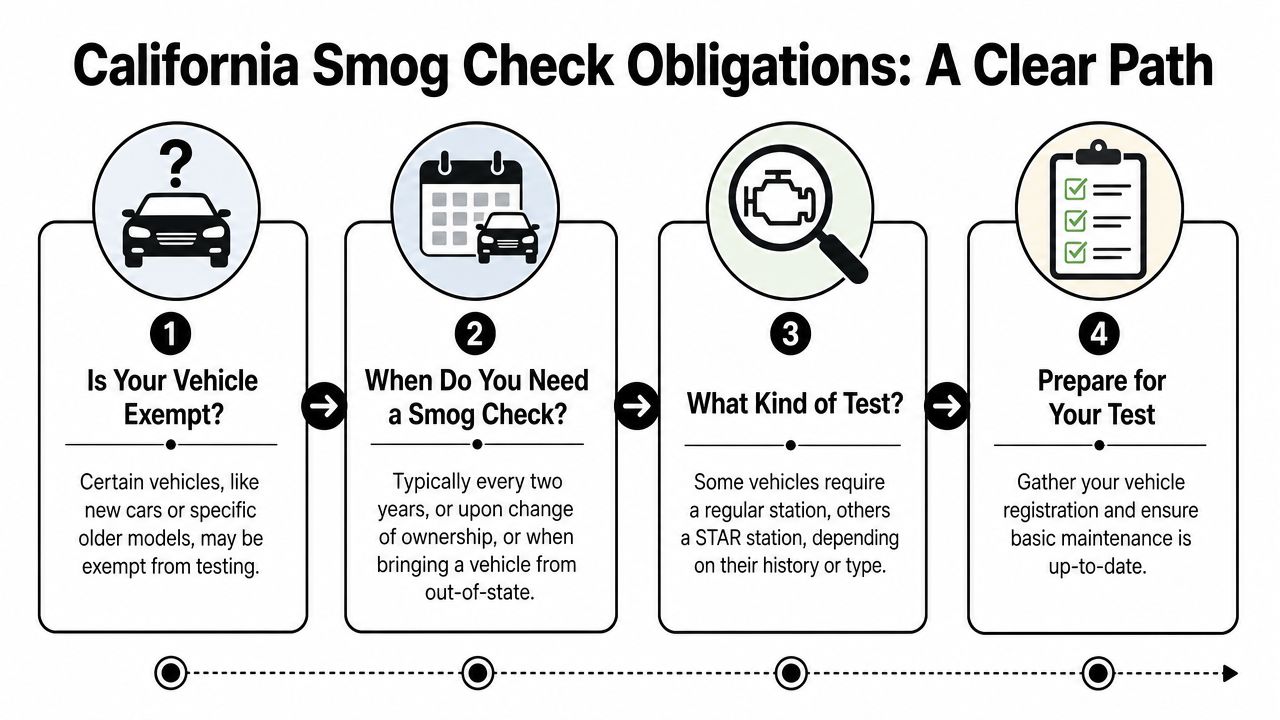
A lot of confusion starts here. Drivers hear "smog check required" and assume the rule is the same in every situation. It is not. California uses different triggers, and the easiest way to stay out of trouble is to sort your case into the right bucket.
The rule most drivers actually need
For many drivers, the practical rule is simple. If your vehicle is past the newer-vehicle exemption window, it will usually come up for a smog check on a two-year registration cycle. A sale can also trigger a certificate requirement, even if you were not expecting a regular renewal test at that moment.
The part that catches first-timers is that these are separate triggers. Registration renewal and change of ownership are not the same thing. A car can be fine for one purpose and still need a valid smog certificate for the other.
If you want a plain-English breakdown of edge cases, local exceptions, and DMV-triggered situations, this summary of California smog check rules helps sort them out without the state-agency wording.
Three common situations
At a STAR station, we see the same three points of confusion over and over. The test itself is usually the easy part. Figuring out why the car needs a test, and when, is what trips people up.
| Situation | What usually applies |
|---|---|
| Registration renewal | Many non-exempt vehicles are checked on a two-year cycle |
| Private-party sale | The seller often needs to provide a current smog certificate if the vehicle falls within the rule |
| Recently passed | A prior pass only helps if the certificate is still within its valid period |
Here is the plain-language version. Renewal is tied to your DMV cycle. Sale is tied to transfer of ownership. A past certificate has a shelf life, so "the car passed before" is only helpful if the paperwork is still current.
That last point causes more headaches than people expect.
A buyer may hear, "It just passed smog," and assume the paperwork will cover the transfer. Sometimes it does. Sometimes the certificate is too old to satisfy the next step. From the shop side, the fix is simple. Ask to see the actual certificate date, not just a verbal promise.
The DMV notice can add to the confusion because it feels like a general reminder, but it is really a specific instruction for that vehicle and that registration cycle. Do not rely on what happened two years ago, or on what a different car in your household needed. Read the current notice, then match it to your situation.
That is the inside-track way to look at smog obligations. Treat the rule like a checklist, not a mystery. Once you know which trigger applies, the rest gets much easier.
Does Your Vehicle Qualify for an Exemption
Your registration notice shows up, you see the word "smog," and the first question is usually simple: Do I need to go to a station this time?
Sometimes the answer is no.
From the shop side, this is one of the easiest ways to save people an unnecessary visit. The confusion usually comes from one idea. An exemption from testing does not always mean an exemption from every smog-related fee or rule.
The exemption list in plain language
California exempts some vehicles from the routine biennial smog check. Under the program overview, the exemption picture generally includes:
- Electric vehicles
- Gasoline-powered vehicles less than 8 model-years old
- Diesel vehicles made before 1998 or with a gross vehicle weight over 14,000 pounds
- Motorcycles
- Gasoline-powered vehicles made before 1976
A quick caution here. Exempt usually means exempt from the routine inspection requirement. It does not mean emissions parts can be removed or ignored on vehicles that were built with them.
Why the 8-year rule trips people up
The part that causes the most head-scratching is the newer-car exemption. Drivers hear about the smog abatement fee on registration and assume they still need to book a test. For many newer gasoline and hybrid vehicles, that is not how it works.
The California DMV smog inspections page explains that gasoline and hybrid vehicles less than eight model-years old are generally exempt from the biennial inspection, even though an abatement fee may still be collected with registration.
Here is the practical version a STAR station would give you:
- Inspection exemption means you likely do not need a smog test for that renewal cycle
- Abatement fee means you may still see a smog-related charge on your registration
- Those two items are separate
It helps to treat the fee like a placeholder on the registration side, not proof that a test is due.
A newer-vehicle owner may walk into a station worried about an overdue smog, when the answer is simpler: check the model year first.
This also matters during a sale. People often assume every vehicle transfer automatically calls for a fresh certificate. Sometimes it does. Sometimes the vehicle's age changes the answer. If you want to avoid guesswork, check the model year and registration paperwork before spending money on a test you may not need.
Simple Steps to Help Your Vehicle Pass
A lot of "failed smog" stories start before the car even reaches the station. The good news is that many avoidable failures come from a short list of fixable habits.
Start with the obvious checks. If the check engine light is on, don't go in expecting a pass. If the battery was recently replaced, if someone cleared trouble codes, or if an emissions repair was done recently, your car may not be ready yet.
What to check before you leave home
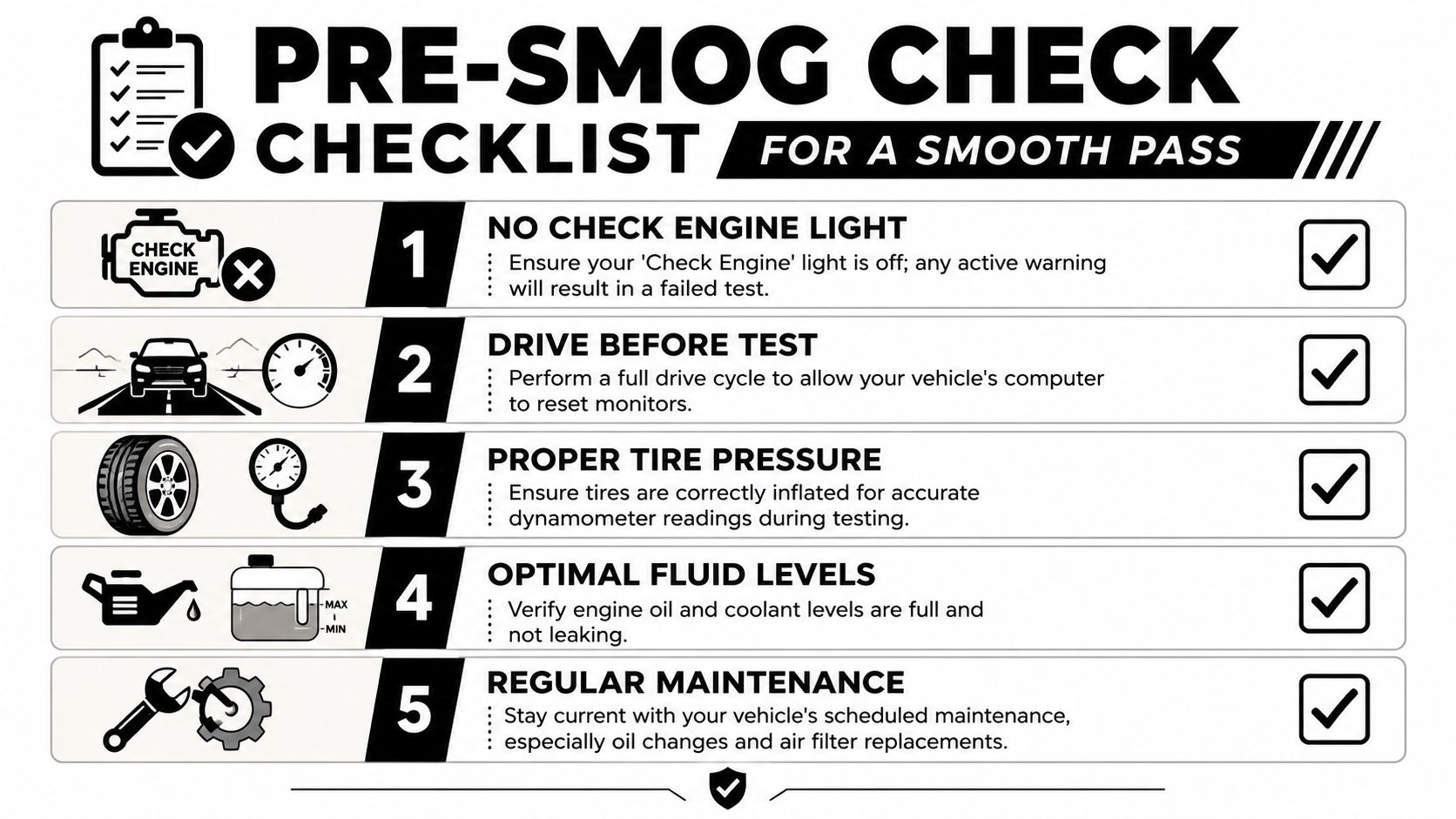
Use this quick pre-test checklist:
- Look at the dash: No active check engine light.
- Think about recent work: Battery disconnects and code clearing can reset emissions data.
- Drive the car normally before testing: A short errand from a cold start isn't always enough.
- Don't use the smog station as your first diagnostic step: If the car is misfiring, idling rough, or clearly running poorly, repair comes first.
- Bring the car in after it's been used, not parked for days: A fully warmed-up vehicle is generally a better candidate than one that has been sitting.
The section below is worth extra attention because the rule changed.
Why readiness monitors matter now
As of late 2025, BAR regulations require all OBD-II readiness monitors to be "complete" to pass. A recent battery change or cleared code requires a proper drive cycle to reset these monitors, preventing an automatic failure, according to this BAR readiness monitor explanation video.
In shop terms, that means this: your car's computer needs time to rerun its self-checks. If you disconnect the battery on Monday and test the car right away, the system may still show not complete. Under the updated rule, that's a problem.
This short video helps illustrate the inspection context:
A practical example helps. Say your battery died, you installed a new one, and the car now feels fine. You might think you're ready. But the emissions monitors may still be unset. The car needs a proper drive cycle before the official test.
Don't clear codes to "hide" a problem before a smog. In many cases, that only swaps one failure for another.
If you're unsure whether the monitors have reset, ask a qualified shop to check readiness status before the official inspection. That small step can save you a failed visit.
Inside the Smog Check Process
You pull into the station, hand over your registration, and wonder if this is going to turn into a long, confusing appointment. In practice, the visit is usually straightforward. Once you know the order of events, the process feels a lot more like a standard vehicle check and a lot less like a DMV mystery.
What happens when you arrive
The technician starts by confirming your vehicle information and checking what type of inspection the state requires for that car. That matters because a 2018 sedan, a 1999 SUV, and a diesel truck may each follow a slightly different test path.
For many newer vehicles, the main job is reading the onboard diagnostic system, often called OBD-II. That system works like your car's report card. It stores emissions-related trouble codes, monitor status, and other data the state wants reviewed. Older vehicles may need added inspection steps, including equipment checks and other approved test methods.
There is also a visual side to the inspection. A technician checks that required emissions parts are present and appear intact. In plain language, the station is not only asking, "Is the computer happy?" It is also checking, "Is the car set up the way it is supposed to be?"
Then the test equipment and the vehicle have to communicate properly. If the system cannot connect, that creates a problem even if the car seems to run fine on the road.
What a STAR station changes for the driver
If your DMV notice says STAR, you need a STAR station. A regular station cannot complete a STAR-required inspection for that notice.
A STAR-certified smog station is approved to perform these inspections and held to added state performance standards. From the driver's side, the big benefit is clarity. A STAR station sees these cases every day, so the staff can usually tell you quickly whether your issue is a simple testing requirement, a communication problem, or a true emissions failure.
That inside-track perspective helps first-timers. Many drivers come in expecting the shop to "fix" the result during the inspection. The smog check does not work that way. The station follows the state procedure, records what the vehicle shows, and sends the result electronically if it passes.
The process, step by step
Here is the usual flow:
- Check-in: The station verifies your vehicle details and confirms the required test type.
- Inspection: The technician performs the emissions inspection that applies to your vehicle.
- Computer and equipment check: For applicable vehicles, the car's emissions data is read and reviewed.
- Results: A passing result is transmitted to the state. If the vehicle fails, you receive a Vehicle Inspection Report showing why.
The visit is often quicker and more routine than drivers expect.
Cost can vary by vehicle type, location, and whether the station is STAR-certified. The certificate fee is separate from the inspection charge, so ask for the full out-the-door price when you schedule. That avoids surprises at the counter.
If your vehicle passes, you are done. The station submits the certificate electronically for DMV purposes, and you keep your paperwork for your records.
If it fails, do not panic. The failure report is the roadmap. A good technician will explain whether the problem points to missing readiness, a fault in the emissions system, or another issue that needs repair before a retest.
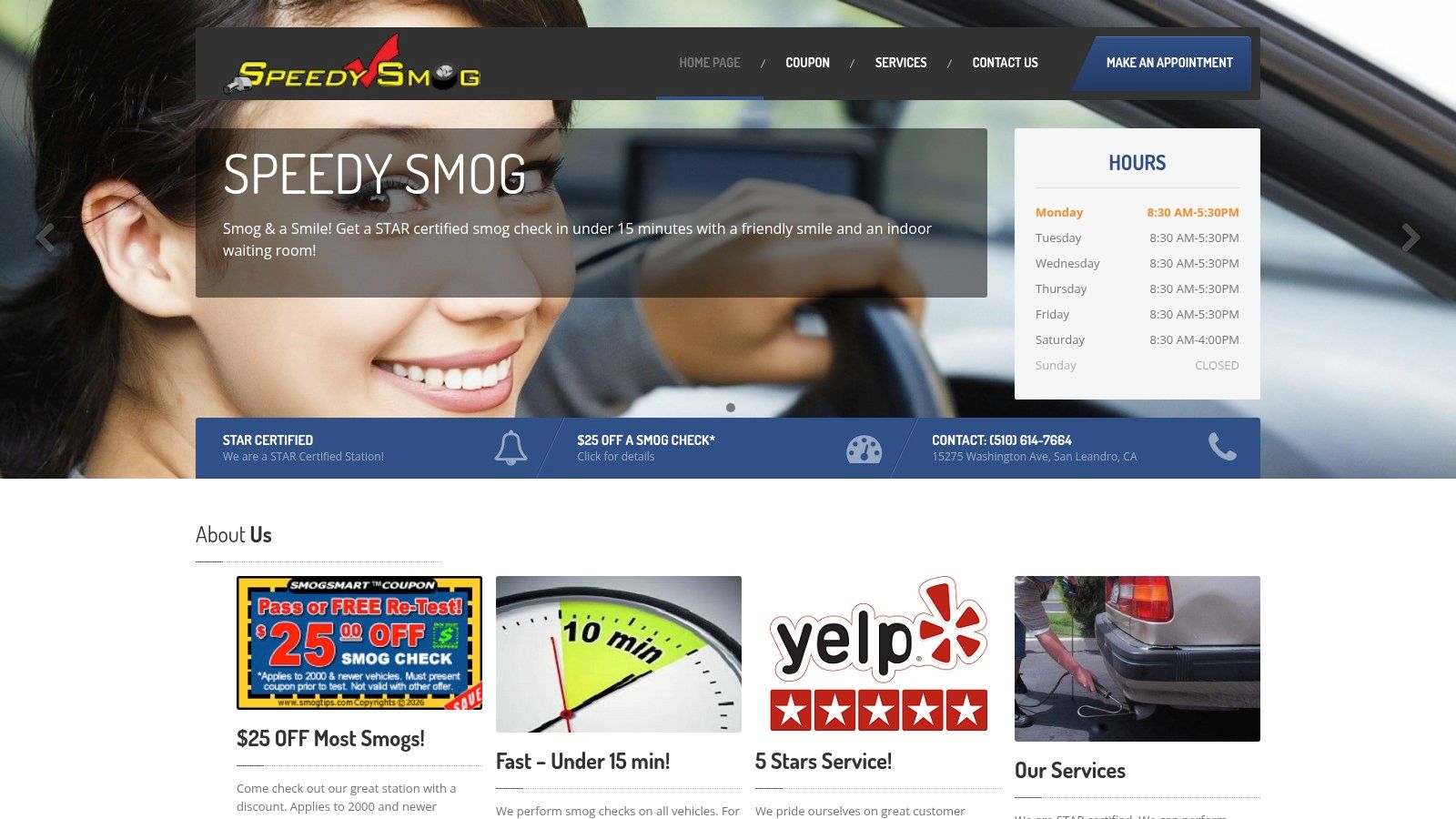
For East Bay drivers looking for a STAR inspection option, Speedy Smog is a STAR Certified station in San Leandro that handles testing for a wide range of vehicle types, including newer cars, older vehicles, diesels, and hybrids.
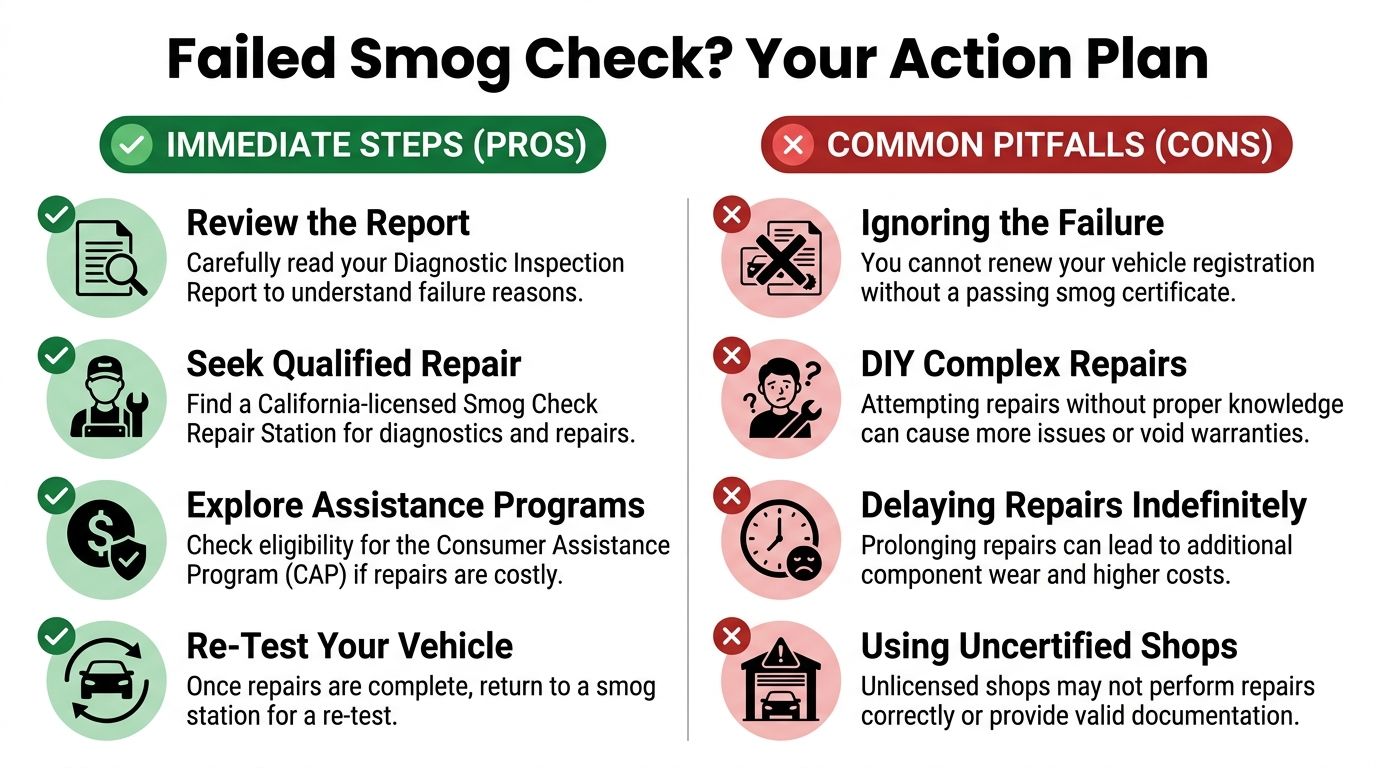
What to Do If Your Car Fails the Smog Check
A failed smog check feels expensive before you even know what's wrong. Don't guess. Start with the paperwork.
Read the failure before you spend money
Your first job is to read the Vehicle Inspection Report carefully. A failure can come from very different causes. Some are repair-related. Some are procedural. Some come down to readiness status after a battery disconnect or recent code clearing.
That distinction matters because the next step changes depending on the reason. If the report points to a system malfunction, you need diagnosis and repair. If it points to incomplete readiness monitors, the answer may be more driving, not parts replacement.
Use this sequence:
- Read the exact failure item: Don't rely on memory from the front counter conversation.
- Ask whether the issue is a monitor problem or a component problem: Those lead to different fixes.
- Choose a licensed repair path if needed: Especially for emissions-system faults.
- Retest only after the issue is addressed: Retesting too soon often wastes time.
When to use the Referee Program
California gives drivers a backup option that many people never hear about. If your vehicle fails, the Bureau of Automotive Repair offers a free Smog Check Referee Program to verify the test's accuracy. Drivers often fail due to simple issues like unreset readiness monitors after a battery disconnect, which this program can help diagnose, according to the BAR Smog Check information page.
That matters if:
- You think the result may be wrong
- You've hit a confusing edge case
- A repair path doesn't seem to match the actual failure
- You want an independent review before spending more money
The verified guidance also notes a 90-day window to challenge a failed inspection result through this process, and that some readiness issues may take 1 to 2 weeks of driving to reset properly, as referenced in the same BAR resource context.
If the failure happened right after a battery disconnect, pause before authorizing major repairs. Verify whether the problem is readiness, not hardware.
A failed smog check in California doesn't always mean a major repair bill. Sometimes it means the car wasn't ready for the test. Sometimes it means the original result deserves a second look. The smartest move is to separate those possibilities before you spend money.
Get Your STAR Smog Check at Speedy Smog
By the time most drivers reach the station, they don't need more legal language. They need a clean process, accurate inspection, and a technician who can explain the result without talking in circles.
That is where a STAR station can make the whole experience easier to handle. If the DMV directs you to STAR, the requirement isn't optional. It makes sense to choose a shop that handles these inspections every day and knows how to spot common issues like monitor resets, recent battery work, and paperwork timing.
If you're still fuzzy on what STAR means, this overview of what a smog STAR station is gives the short version in plain language.
A practical checklist for choosing where to go looks like this:
- Confirm STAR status if your notice requires it
- Ask whether the shop handles your vehicle type, especially if you have a diesel, hybrid, or older model
- Choose a station that explains failed results clearly
- Go before your deadline gets tight, so you still have options if something needs attention
For drivers in San Leandro, Oakland, and nearby East Bay communities, convenience matters too. A station with a straightforward process, a comfortable waiting area, and experience across common California vehicle types can turn this from a chore into a short errand.
If you need a California smog inspection from a STAR Certified station, Speedy Smog in San Leandro offers test-only smog checks for many vehicle types, including newer cars, older vehicles, diesels, and hybrids. If your DMV notice is due or you want help figuring out your next step after a failed test, contact the shop and get clear answers before your registration deadline.