
You're halfway through your morning in San Leandro when the DMV renewal notice arrives. It says your registration renewal requires a smog check, and suddenly a routine errand has a deadline attached to it. The good news is that most problems happen before the vehicle reaches the bay, not because the inspection itself is mysterious.
A little preparation helps you choose the right California smog check station, understand what the technician is checking, and avoid an unnecessary second visit. This guide is written for East Bay drivers who want a clear explanation of the rules, the newer OBD readiness requirements, and the practical steps that make the appointment easier.
Table of Contents
- Why That DMV Notice Just Arrived in Your Mailbox
- Decoding the California Smog Check Program
- What Happens During Your Smog Inspection
- Your Pre-Smog Check Preparation Checklist
- How to Choose the Right Station in the East Bay
- Your Path to a Quick and Easy Smog Certificate
Why That DMV Notice Just Arrived in Your Mailbox
California's Smog Check program is part of the state's vehicle-registration process and air-quality strategy. The modern program began after lawmakers approved a decentralized inspection system in 1982, with the first extensive version implemented in March 1984. California later expanded it into an enhanced model on June 8, 1998, to address areas with more severe air-quality problems, as documented in the California Air Resources Board program history.
For a driver, the practical meaning is simpler. If your DMV notice says a smog check is required, you need a passing result transmitted to the state before you can complete registration renewal. In many cases, California requires the inspection every other year, so the station network becomes a recurring part of vehicle ownership rather than a one-time event.
Read the notice before choosing a shop
Your renewal notice can tell you more than the due date. Look for language indicating whether the vehicle must visit a STAR station. That detail affects which locations can complete the inspection for your registration.
Before leaving home, confirm:
- The registration deadline: Give yourself time for a diagnostic visit or repair if the vehicle doesn't pass.
- The station requirement: A STAR designation may be mandatory for directed vehicles.
- The vehicle information: Make sure the year, make, and model on your paperwork match the vehicle you're bringing.
- Your ownership details: A change of ownership or a new California registration can trigger a different testing situation.
You can also review the California registration renewal process if you're unsure how the smog result connects to DMV requirements.
Practical rule: Treat the DMV notice as an instruction sheet. Check the station type before you drive across the East Bay.
A smog inspection doesn't guarantee that a vehicle has no mechanical problems. It checks whether the vehicle's emissions controls meet the applicable California requirements at the time of testing. That makes the visit both a compliance step and a useful warning if the vehicle's emissions system needs attention.
Decoding the California Smog Check Program
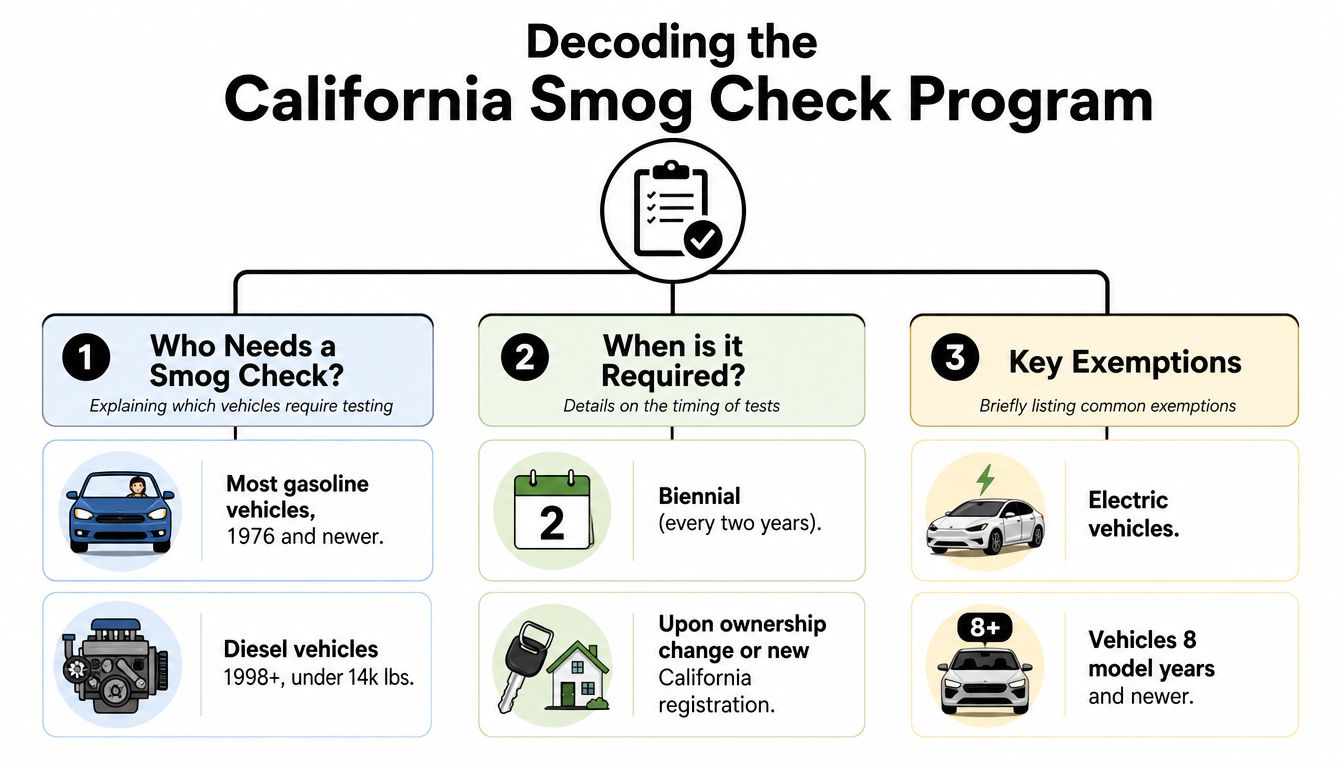
The rules depend on the vehicle, its model year, fuel type, and the reason for testing. Most gasoline-powered vehicles from 1976 onward fall within the program, while diesel vehicles from 1998 onward and under 14,000 pounds are handled under applicable diesel testing rules. Electric vehicles don't produce tailpipe emissions and are generally exempt from Smog Check.
When the test is usually required
For ordinary registration renewal, the inspection is generally biennial, meaning every other year. A vehicle may also need a test when ownership changes or when it receives a new California registration, depending on the circumstances and the vehicle's existing record.
Common exemptions include:
- Electric vehicles: Fully electric vehicles don't use an exhaust system that requires this type of emissions test.
- Newer vehicles: Vehicles within the applicable newer-model exemption period may not need a biennial inspection.
- Certain special vehicles: Some vehicles fall under separate state rules based on fuel, weight, age, or registration status.
Don't rely on a general online list if your situation is unusual. Imported vehicles, diesel trucks, hybrids, modified vehicles, and vehicles being registered after an out-of-state move can require more careful review.
Standard stations and STAR stations
A regular test-only or test-and-repair station performs authorized inspections, but a STAR station must meet higher performance standards established by the Bureau of Automotive Repair. STAR certification isn't based only on having the right equipment. BAR evaluates inspection-quality measures such as Similar Vehicle Failure Rate, Follow-up Pass Rate, gear-shift incidents, and excessive test deviation.
BAR says STAR applicants must meet measurable thresholds, including an SVFR of at least half the industry-wide failure rate for comparable vehicles and gear-shift incidents on no more than 2% of certified vehicles. The applicable Follow-up Pass Rate threshold depends on the reporting period. You can review the BAR explanation of STAR station requirements for the current certification framework.
A STAR station can inspect directed vehicles, including high-polluting vehicles. Your DMV renewal notice should indicate when that certification is required. For a broader explanation of applicable California smog check rules, check the station requirement before booking or driving in.
The simplest decision is this: if the notice requires STAR, choose STAR. If it doesn't, compare location, repair capability, availability, and pricing based on what your vehicle may need.
What Happens During Your Smog Inspection
You pull into the bay, provide the registration information, and answer basic questions about the vehicle. A technician confirms the vehicle identity, checks its condition for testing, and begins the inspection procedure that matches the vehicle's equipment and model year.
The technician first performs a visual inspection of emissions-related components. Missing, disconnected, or visibly altered equipment can create a problem even if the engine feels smooth. If you've installed aftermarket emissions parts, keep any California approval documentation with the vehicle and ask the station about compatibility before testing.
The vehicle's computer is part of the inspection
For many modern vehicles, the technician connects the BAR-approved inspection equipment to the vehicle's diagnostic connector. California's Smog Check Manual describes an OBD-II inspection that includes checking the malfunction indicator lamp, reviewing readiness monitors, and retrieving diagnostic trouble codes.
That means a vehicle can feel perfectly normal and still fail. The computer may record an emissions fault, or one or more monitors may remain incomplete after a battery disconnect, computer reset, recent repair, or failed drive cycle.
Older vehicles without an OBD-II system don't receive an OBD-II functional test. Their procedures use the equipment and test method appropriate to the vehicle, which can involve a tailpipe measurement and, for some vehicles, a dynamometer. The station follows the BAR test prompt rather than allowing the driver to choose the procedure.
A typical inspection for a newer car may be completed quickly, but the exact time depends on the vehicle, station workload, test type, and whether the technician finds an issue that needs clarification.
You can watch a visual overview of the process here:
Once the inspection is complete, the station submits the result electronically. If the vehicle passes, the result supports the registration process. If it fails, the report should identify the reason, such as a diagnostic code, incomplete readiness monitor, emissions reading, or visual equipment concern. Ask the technician to explain the result in plain language before deciding what to repair.
For drivers comparing station types, this guide to what a STAR station is can help you understand why the designation matters.
Your Pre-Smog Check Preparation Checklist
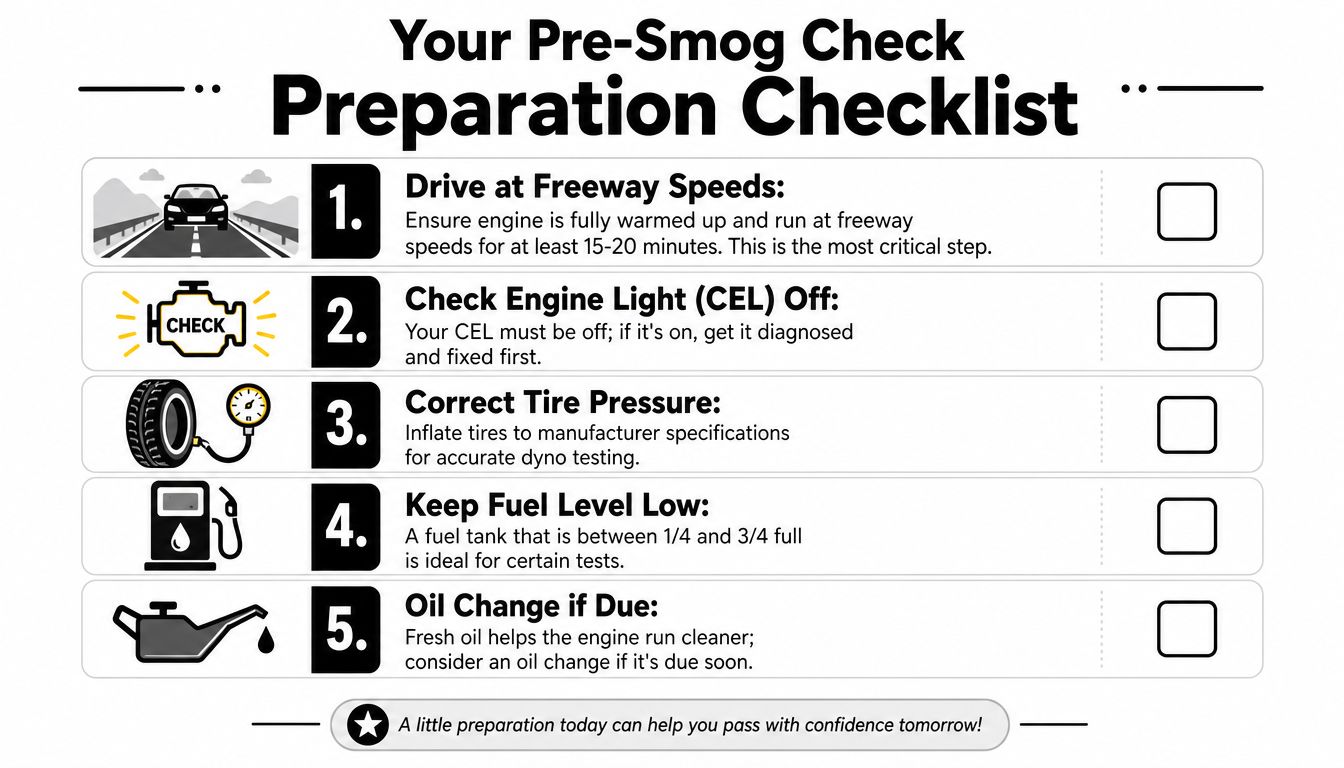
The best preparation starts before you make the trip. A station can test the vehicle, but it can't turn off a genuine emissions fault or complete a repair that hasn't been diagnosed. Your job is to arrive with the vehicle warmed up, the dashboard information understood, and recent repair work properly verified.
A practical inspection-day check
- Look at the malfunction indicator lamp: If the Check Engine light is on, don't erase the code and hope for a pass. Have the cause diagnosed first. Clearing the light can also reset the readiness monitors.
- Warm the vehicle normally: A drive that brings the engine and emissions system to operating temperature can help the vehicle complete its normal self-checks. Follow the vehicle manufacturer's operating guidance rather than aggressively revving a cold engine.
- Confirm tire condition: If the vehicle will use a dynamometer, properly inflated tires help the technician perform the test safely and consistently. Use the manufacturer's specified pressure.
- Bring useful paperwork: Take the DMV notice, registration information, and documentation for any emissions-related replacement part or recent repair.
- Ask before testing if something changed: Tell the technician about a recent battery replacement, computer reset, engine repair, hybrid-system warning, or aftermarket emissions component.
The readiness rule that changed the conversation
Effective October 1, 2025, all readiness monitors must be set for a vehicle to pass, except when BAR grants an exception for a unique design issue in consultation with CARB. The current BAR explanation of the OBD readiness monitor regulations is especially important for hybrid and diesel owners because their testing matrix follows vehicle-specific rules.
A readiness monitor is an internal self-test. It checks systems such as fuel control, oxygen sensors, catalytic-converter performance, or other emissions functions. A dashboard without a warning light doesn't prove that every monitor has completed.
Before you retest: Ask whether the incomplete monitor can finish through the manufacturer's normal drive cycle or whether a diagnostic problem is preventing completion.
“Just drive it more” is no longer a complete answer. Driving may help only when the vehicle is operating correctly and the monitor conditions are being met. If the monitor remains incomplete, a technician needs to determine whether the cause is a repair issue, a recent reset, an unusual design limitation, or a situation that may qualify for a documented exception. Don't pay for repeated tests until you understand why the monitor hasn't completed.
How to Choose the Right Station in the East Bay
Choosing a station is more than finding the closest sign. Start with the DMV notice, then match the station to the vehicle and the likely service you need. A driver with a straightforward newer vehicle may prioritize a short visit, while someone with an older car, diesel, hybrid, or failed test may prefer a location that can explain diagnostic results and perform repairs.
| Your situation | What to prioritize |
|---|---|
| The notice requires STAR | A current STAR-certified station |
| You suspect a failure | Test-and-repair capability and clear explanations |
| You need a certificate quickly | Appointment or walk-in availability and an appropriate test lane |
| The vehicle is older, diesel, or hybrid | Experience with the vehicle's testing procedure |
| You're trying to control the cost | Posted pricing, current coupons, and whether repairs are separate |
BAR's 2026 performance report records about 1,500 inspections per station in calendar year 2025, compared with 1,100 in 2020, indicating that individual locations may handle more workload. The same report describes a statewide network that includes roughly 4,057 test-and-repair stations and 1,991 test-only stations in spring 2025 licensing data. See the BAR 2026 Smog Check Performance Report for those program benchmarks.
Convenience isn't the only consideration
A test-only station may suit a vehicle you expect to pass and can keep the transaction focused on inspection. A test-and-repair station may be more useful when you want one location to diagnose an emissions fault, although you should still ask for the inspection result and repair recommendation separately.
STAR status can matter even when your vehicle seems ordinary. If DMV directs you to STAR, visiting a non-STAR shop first won't satisfy that requirement. Confirm the certification before you leave home, especially when nearby stations have different capabilities.
For East Bay drivers, Speedy Smog in San Leandro offers STAR inspections for newer and older vehicles, diesels, and hybrids. The shop lists typical testing for 2000-and-newer vehicles at about 10 to 15 minutes, along with transparent pricing, a waiting room, and occasional coupons. Verify current availability and pricing before visiting.
Call ahead if your vehicle has four-wheel drive, a modified emissions system, a recent computer reset, or an unresolved warning. That short conversation can tell you whether the station can perform the correct inspection and whether you should schedule diagnosis before the certification test.
Your Path to a Quick and Easy Smog Certificate
A smooth smog visit follows three decisions. First, read the DMV notice so you know whether you need a regular station or a STAR-certified location. Second, prepare the vehicle by checking the warning light, allowing normal warm-up, gathering paperwork, and confirming that readiness monitors have completed under the current rules.
Third, choose a station that fits the vehicle rather than selecting only by distance. Older vehicles can need a different inspection workflow, while hybrids and diesels may require careful attention to their applicable OBD rules. If your car recently had its battery disconnected or its emissions system repaired, explain that before the technician starts.
California's statewide program handled 12,200,718 total tests in its 2025 Executive Summary Report, with an overall failure rate of 9.04%, according to BAR's 2025 statewide report. Older vehicles can present a greater preparation challenge, with 1994 model-year vehicles showing a 20.73% initial failure rate in that report. Those figures don't predict your individual result, but they do reinforce a useful habit: diagnose warning lights and incomplete monitors before paying for a formal inspection.
Don't reset the computer solely to make the dashboard look clear. Don't assume a normal-feeling car is ready. And don't wait until the registration deadline to discover that your notice requires STAR or that a recent repair reset the monitors.
For East Bay drivers, Speedy Smog offers STAR-certified smog inspections in San Leandro for newer and older vehicles, diesels, and hybrids. Bring your DMV notice and vehicle information, confirm that your readiness monitors are set, and visit the shop for a clear, efficient inspection that helps you complete registration with less uncertainty.
You're staring at a DMV notice, and the line that matters is the one you can't ignore, Smog Check Required. If you drive in Vacaville, that letter usually means one simple thing, your registration renewal or ownership transfer is tied to a California emissions inspection, and the cleanest path is to handle it before the deadline turns into a headache.
A California smog check Vacaville appointment doesn't have to be a gamble. If you know whether your vehicle needs testing, how to pick the right station, and what causes a fast failure, the process becomes routine. The trick is to treat it like a checklist, not a mystery.
Table of Contents
- Navigating Your Vacaville Smog Check Notice
- Understanding California Smog Requirements
- How to Find the Right Smog Station in Vacaville
- Your Pre-Test Checklist to Pass the First Time
- The Smog Check Process Costs and Timelines
- What to Do If Your Vehicle Fails
- FAQs About Vacaville Smog Checks
Navigating Your Vacaville Smog Check Notice
A DMV notice usually means it is time to handle paperwork, not that your car has a hidden problem. California's Smog Check program is tied to registration and ownership records, so Vacaville drivers run into the same statewide process for initial registration, change of ownership, and biennial testing for most covered vehicles California smog check program overview.
For Vacaville drivers, timing matters. If your renewal depends on a passing certificate, you want the station to transmit that result to DMV without any delay, and DMV says the certificate stays valid for 90 days after it is issued. If you are sorting out where to go first, a local directory like smog check stations in San Leandro shows how station listings are typically organized, which can help when you compare options and hours before you book.
What the notice is really asking for
The notice is asking one direct question, does your vehicle meet California emissions rules right now? If the answer is yes, the inspection is usually simple. If the answer is no, find the exact problem before you pay for another test.
Practical rule: treat the notice as a paperwork deadline first, and a repair problem only if your car fails.
Vacaville drivers sometimes assume a local station can bend the rules. It cannot. The station checks the vehicle, then submits the certificate if it passes. If your car is exempt, confirm that before you spend time making an appointment.
A good California smog check Vacaville plan starts with the notice, then moves to eligibility, station selection, and pre-test readiness. That order saves time because it keeps you from paying for a test your vehicle did not need, or showing up with a warning light that will force a failure.
Understanding California Smog Requirements
Vacaville drivers should start with the basics, because a lot of wasted time comes from bringing in a vehicle that was never required to test in the first place. California exempts gasoline vehicles from 1975 and older, diesel vehicles from 1997 and older, natural-gas vehicles over 14,000 lbs. GVWR, electric vehicles, plus motorcycles and trailers in the statewide framework used for Vacaville drivers.
The newer-vehicle rule also catches owners off guard. Vehicles that are less than four model years old can pay a smog abatement fee instead of going through an inspection for the first 8 years of registration, and the current abatement fee for vehicles six model years or newer is $20. If your car falls into that age range, the notice can look like it is asking for a test when the vehicle is handled under a different rule.
Key exemptions to scan first
- Older gasoline cars: 1975 and older are exempt.
- Older diesel vehicles: 1997 and older are exempt.
- Heavy natural-gas vehicles: over 14,000 lbs. GVWR are exempt.
- Electric vehicles: exempt from smog inspection.
- Very new vehicles: less than four model years old may qualify for the abatement fee path instead of testing.
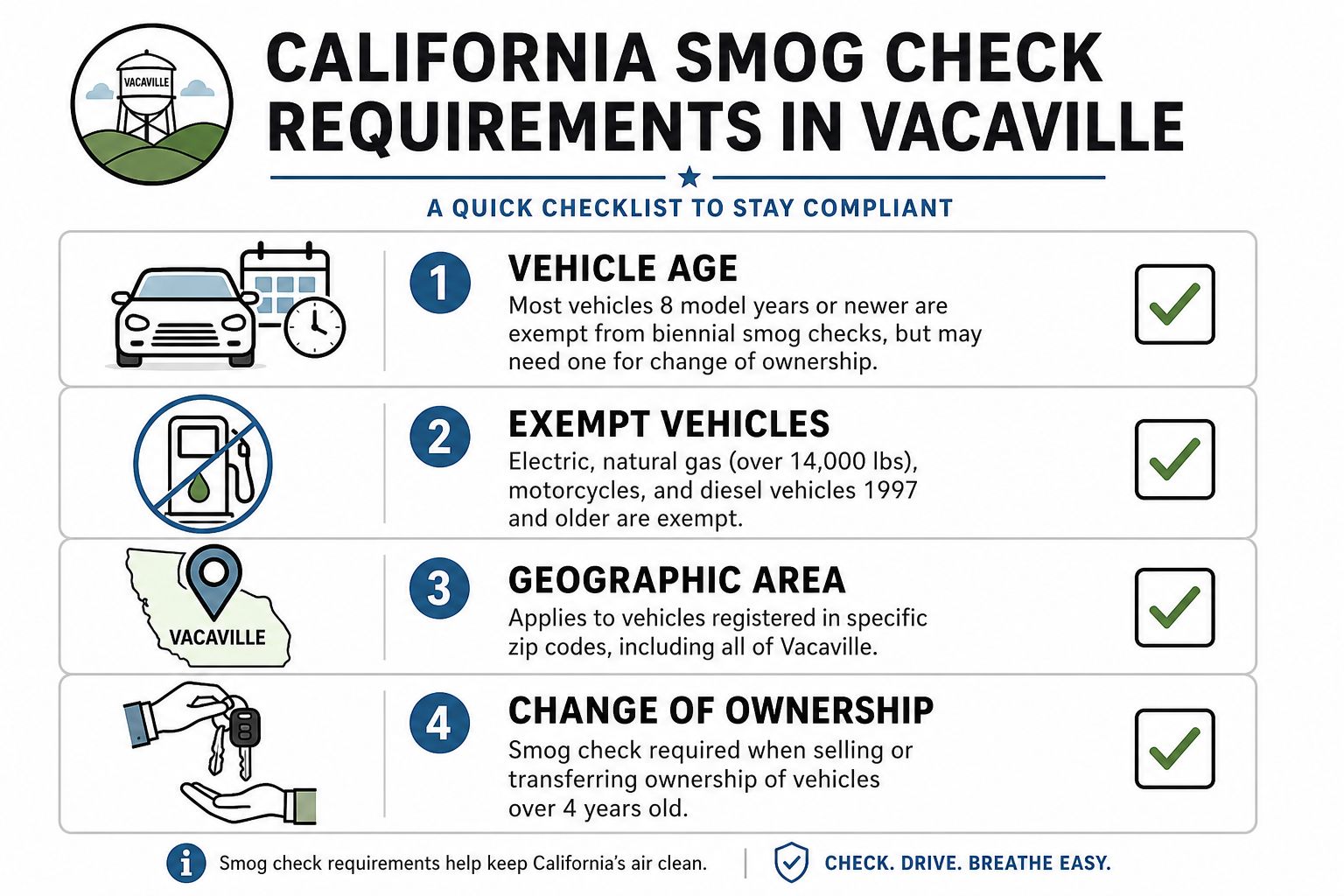
The practical triggers are straightforward. A vehicle can need a smog check at initial registration, at change of ownership, or at the normal biennial renewal interval for most affected vehicles. That is why a car that passed recently can still come back into the program if the title changes hands or the registration cycle calls for it again.
A clean way to check your situation is to compare your notice with the exemption list, then confirm the rules that apply to your vehicle class. If you want a plain-language refresher on the state framework, this guide to California Smog Check rules covers the basics clearly. For Vacaville, the key move is simple, check the notice, check the exemption status, and only book if your vehicle belongs in the program.
How to Find the Right Smog Station in Vacaville
A Vacaville driver can waste a lot of time at the wrong shop. If your DMV paperwork calls for a STAR station, that detail decides where you go, because a regular test-only station cannot satisfy a STAR requirement.
Start with the station type
A standard test station handles many routine inspections. A STAR station is the safer pick when the notice or the vehicle's history points that way. Read the notice first, then use the BAR station locator and match the station type to the requirement before you book.
The other thing I watch is how the shop handles fees and explanations. Inspection prices are set by the station, while the certificate fee is standardized at $8.25. If a place dodges basic pricing questions, that usually means more friction later. For the official rule set, the BAR Smog Check Reference Guide lays out the state basics.
What to ask before you book
- Station type: confirm whether the shop is STAR certified if your notice calls for it.
- Testing scope: ask whether they handle your vehicle type before you drive over.
- Retest policy: ask what happens if the vehicle fails and needs a follow-up visit.
- Communication style: choose a place that can explain the failure code or monitor issue without jargon.
Vacaville drivers should also think about time and location. A shop that understands your notice, answers clearly, and can tell you whether they are the right fit saves a return trip across town. If you want a quick comparison point for how a station presents its services, review Speedy Smog's station page and use it as a model for the kind of clarity you should expect.
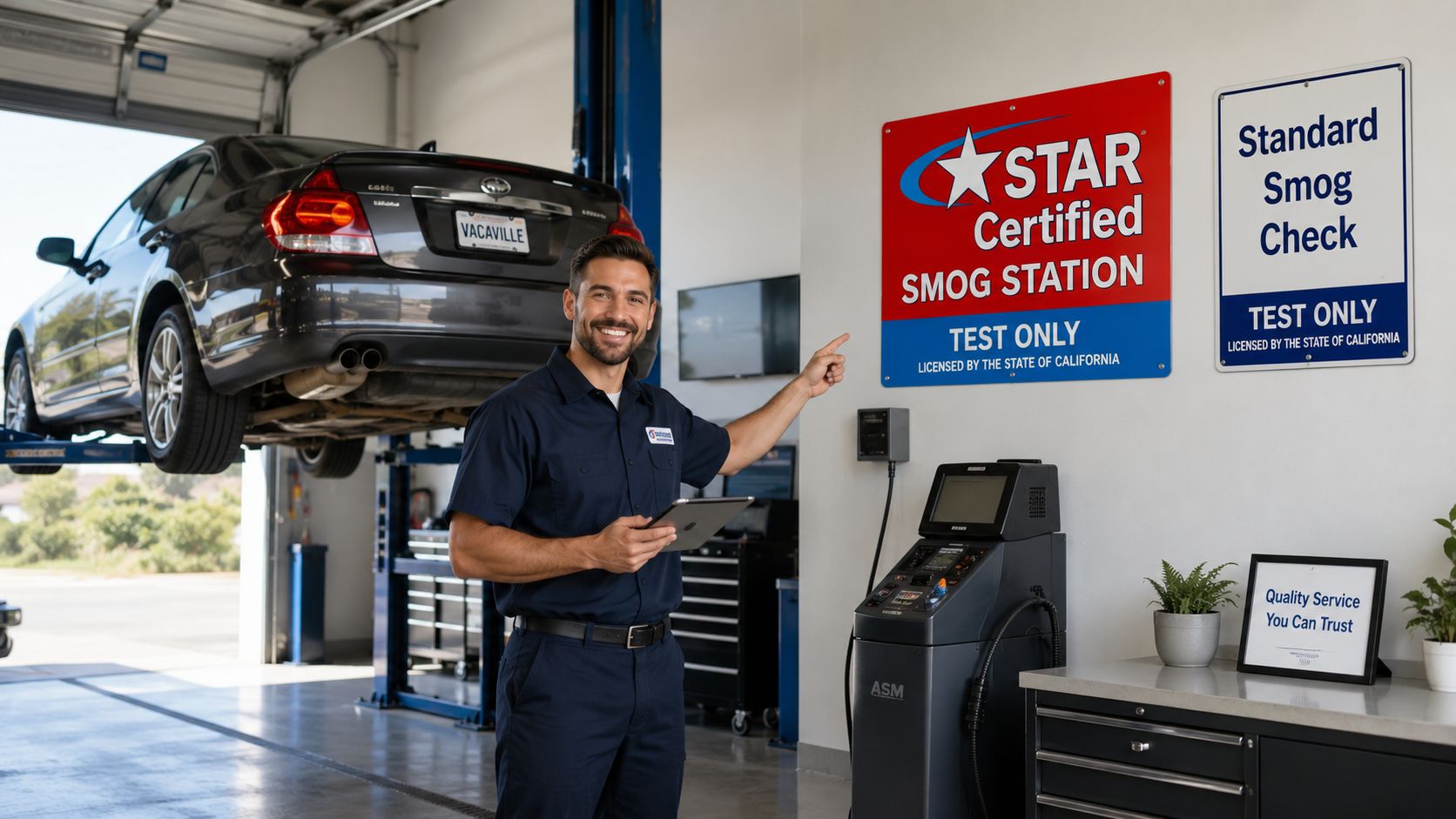
A good station feels organized before you hand over the keys. The best shops are direct about what they can inspect, what they cannot, and what your notice requires. That keeps you from the common mistake of showing up at a clean, professional shop that still is not the right match for your paperwork.
Your Pre-Test Checklist to Pass the First Time
The fastest way to fail is to show up unprepared. BAR says a vehicle will not pass with the check-engine light on, and if the battery was recently disconnected, the car may need a week or two of regular driving for readiness monitors to reset BAR smog check guidance. That's not a minor detail, it's the difference between a certificate and a retest.
Do these checks before you leave home
Start with the dashboard. If the warning lamp is lit, fix the issue before testing. Then make sure the car has had enough normal driving after any battery swap, major repair, or software reset so the internal monitors are ready.
Your smog test is usually won't fail because of the tailpipe first. It fails because the car isn't ready to be tested.
A short warm-up drive helps too. Get the engine fully up to operating temperature so the station isn't testing a cold car that just rolled out of a driveway. That's especially useful if you've only made short local trips around Vacaville.
Before you head out, use this practical checklist:
- Check the dashboard: no illuminated check-engine light.
- Confirm readiness: recent battery disconnects need time and normal driving.
- Bring your DMV notice: the station can use it to verify the exact requirement.
- Look over visible maintenance issues: broken gas caps, loose hoses, or obvious under-hood problems should be handled first.
- Plan the drive: arrive after a normal run, not right after a cold start.
For a deeper step-by-step walkthrough of common failure causes, this how to pass a STAR smog test guide is worth reading before you book. The same logic applies whether you're in Vacaville or anywhere else in California, readiness beats luck every time.
A pretest mindset helps even more than repairs in many cases. If you know the car is clean on the dashboard and fully driven, you're already ahead of most failed appointments. That keeps the test simple instead of turning it into a diagnosis session.
The Smog Check Process Costs and Timelines
A normal inspection usually moves fast. The BAR reference guide says a typical smog inspection takes about 30 minutes, though the exact time depends on the station and the vehicle. If you arrive with a warmed-up car and your paperwork ready, the visit is easy to fit into a lunch break or a short errand run.
What the Technician Checks
The test is more than a tailpipe reading. The technician checks emissions components, reviews onboard diagnostics, and confirms whether the vehicle is reporting correctly. Older vehicles may go through tailpipe measurement, while newer ones rely more on the diagnostic system.
Good habit: if the station offers a pre-inspection, use it when you are unsure about readiness or compliance. It can keep a small issue from turning into a logged failure.
The cost setup is straightforward. Stations set their own inspection prices, and every passing vehicle also pays the standardized $8.25 Smog Check certificate fee. California also limits required emissions-related repairs to $650 for a vehicle to pass a biennial Smog Check, which helps keep repair requests from turning into an open-ended bill.
That cap matters if the inspection turns up a problem. It gives you a clear ceiling to plan around, which is one reason the process feels more structured than ad hoc emissions testing in other places. For Vacaville drivers, that means you can budget the visit with more confidence and less guesswork.
What to Do If Your Vehicle Fails
A failed smog test is frustrating, but it does not end the process. The station should hand you a Vehicle Inspection Report, and that report tells you exactly what did not meet the standard. Read it line by line. A monitor problem, a check-engine light, and a true emissions fault all lead to different repair decisions, and treating them the same wastes time.
Start with the report, not the guesswork
Bring the report back to the technician and ask for a plain-English walkthrough of the failure points. If the issue is mechanical or emissions-related, get it repaired by a qualified professional before you return for a retest. If the failure came from readiness monitors or an illuminated check-engine light, fix the root cause first so you are not paying for a second inspection too soon.
The inspection paperwork also gives you a practical next step if the repair estimate starts climbing. California's repair-cost limit for a biennial pass can keep a stubborn failure from turning into an open-ended bill, as noted earlier. If you think you may qualify for state consumer assistance, ask before you authorize work you may not need.
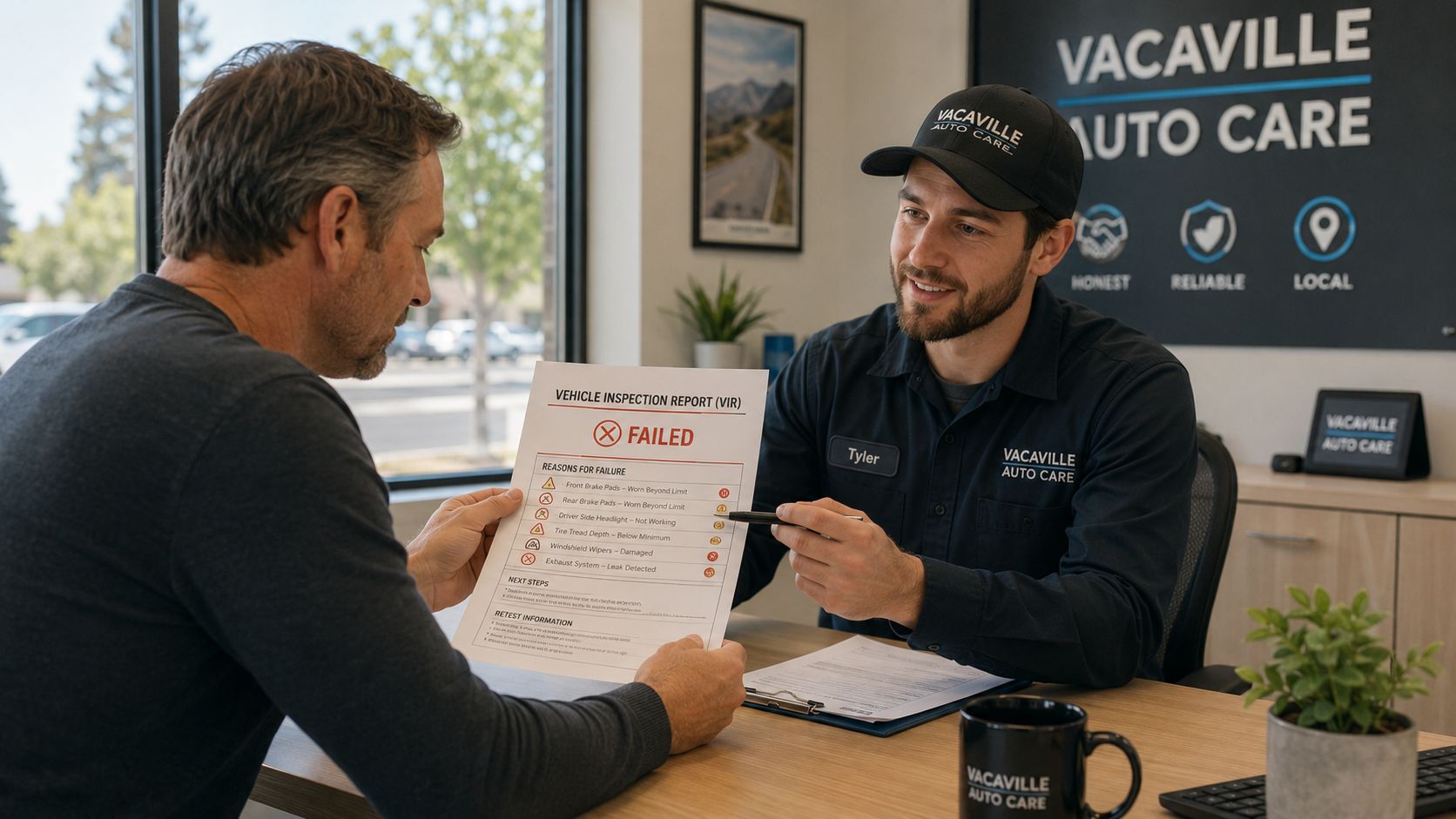
If the repair path looks expensive, keep every document together. Save the inspection report, the repair invoice, and the retest result in one folder. That record makes it easier to track what changed, and it helps another shop review the vehicle without starting from scratch.
FAQs About Vacaville Smog Checks
| Question | Answer |
|---|---|
| Do I need a smog check when I sell my car? | Often yes, because change of ownership is one of the main triggers in California's program. |
| How long is a passing certificate good for? | The DMV says the electronic certificate is valid for 90 days. |
| Can I test first just to see where my car stands? | Yes, and that is a smart move if you are unsure about readiness. A pre-inspection can help you avoid a logged failure before you are ready for the official test. |
Vacaville drivers usually save time by keeping the process simple. Check the notice, confirm your vehicle's status, and choose a station that fits the paperwork instead of assuming every shop can handle every car.
If you are still unsure whether your vehicle qualifies, needs STAR testing, or should wait until the readiness monitors settle, book with a shop that can explain the result before you hand over the keys. For local help and a smooth compliance process, contact Speedy Smog and get your registration moving again.
That DMV renewal notice lands in the mail, you tear it open, and your eyes go straight to the line that matters: Smog Certification Required. For a lot of Union City drivers, that one line creates the same chain of thoughts. Where should I go, how much is this going to cost, and what happens if my car fails?
The good news is that a smog check in California is routine. The hard part isn't usually the inspection itself. It's the small details that trip people up before they even pull into the bay. In Union City, the biggest headaches tend to be practical ones: showing up with a check engine light on, testing too soon after a battery disconnect, or picking a test-only station without realizing it can't fix anything if the car fails.
For smog check Union City CA, this is the local, plain-English version of what matters.
Table of Contents
- Your Guide to a Hassle-Free Smog Check
- How to Prepare Your Vehicle to Pass the First Time
- Finding the Right Smog Station in Union City
- A Smart Alternative Speedy Smog in San Leandro
- What Happens During the Smog Inspection
- What to Do If Your Vehicle Fails the Smog Check
Your Guide to a Hassle-Free Smog Check
The registration notice shows up, the due date is closer than you thought, and now the job is getting a smog check done without losing half a day or paying for a retest.
In Union City, the test itself is usually quick. The frustrating part is everything around it. Drivers book the wrong type of station, show up right after a battery change, or pay for a test before checking whether the DMV is even asking for one. Those are the mistakes that turn a routine errand into two or three trips.
California requires smog checks for many registration renewals and some ownership transfers. The exact requirement depends on the vehicle and the transaction. Newer gasoline vehicles may not need a physical inspection for renewal, while others do, and the DMV notice is the first thing to verify before you schedule anything.
Practical rule: Read the renewal notice line by line before you book. If the DMV is not asking for a smog inspection, skip the extra errand.
If a test is required, treat it like a timing problem as much as a vehicle problem. A car can run fine and still fail because the monitors are not ready yet, especially after the battery was disconnected or codes were recently cleared. I see that catch people more often than obvious mechanical issues.
Another point that confuses Union City drivers is station type. A Test-Only station is not the same as a shop that can both test and repair, and a STAR requirement on your notice matters. Picking the wrong place first can cost you time even if your car is otherwise ready.
If you want a quick overview of the problems that trip people up before they even get to the bay, this guide to common smog check fail reasons in California is a useful starting point.
The smooth approach is simple. Confirm you need the inspection, make sure the car is ready, and choose a station that matches what your DMV notice requires.
How to Prepare Your Vehicle to Pass the First Time
The easiest smog check is the one you only do once. Most avoidable failures happen before the technician touches the car.
Start with the dashboard
If your Check Engine light is on, stop there and deal with that first. A California smog check includes an OBD-II scan, and vehicles with an active check engine light automatically fail that part of the inspection. One industry guide notes that a California smog check includes a visual inspection, a functional OBD-II scan, and an emissions measurement, and that active check engine lights are a major reason vehicles get rejected during initial testing in Bay Area data, according to this California smog check process guide from Geotab.
A lot of drivers try to outsmart this by clearing the light right before the test. That usually doesn't help. It often creates a second problem, which is the one that catches people in Union City all the time.
The battery disconnect mistake that catches people
If you recently replaced your battery, disconnected it, or had a repair that reset the car's computer, your readiness monitors may not be ready yet. The car can feel perfectly normal and still fail.
BAR guidance cited by a local Union City repair shop says the vehicle must be driven for one to two weeks after a battery replacement or disconnect before testing so the readiness monitors can reset. That's laid out on this Union City smog check preparation page.
This is one of those issues that feels unfair until you understand it. The smog machine isn't only checking whether the engine runs. It's checking whether the onboard system has completed enough self-tests to prove the emissions equipment is working properly.
If you cleared a code yesterday and your dashboard is clean today, that doesn't mean the car is ready for a smog inspection.
For a deeper breakdown of common causes, this guide to why cars fail a smog check is worth reviewing before you book.
A simple pre-test routine
Do these checks the day before your appointment:
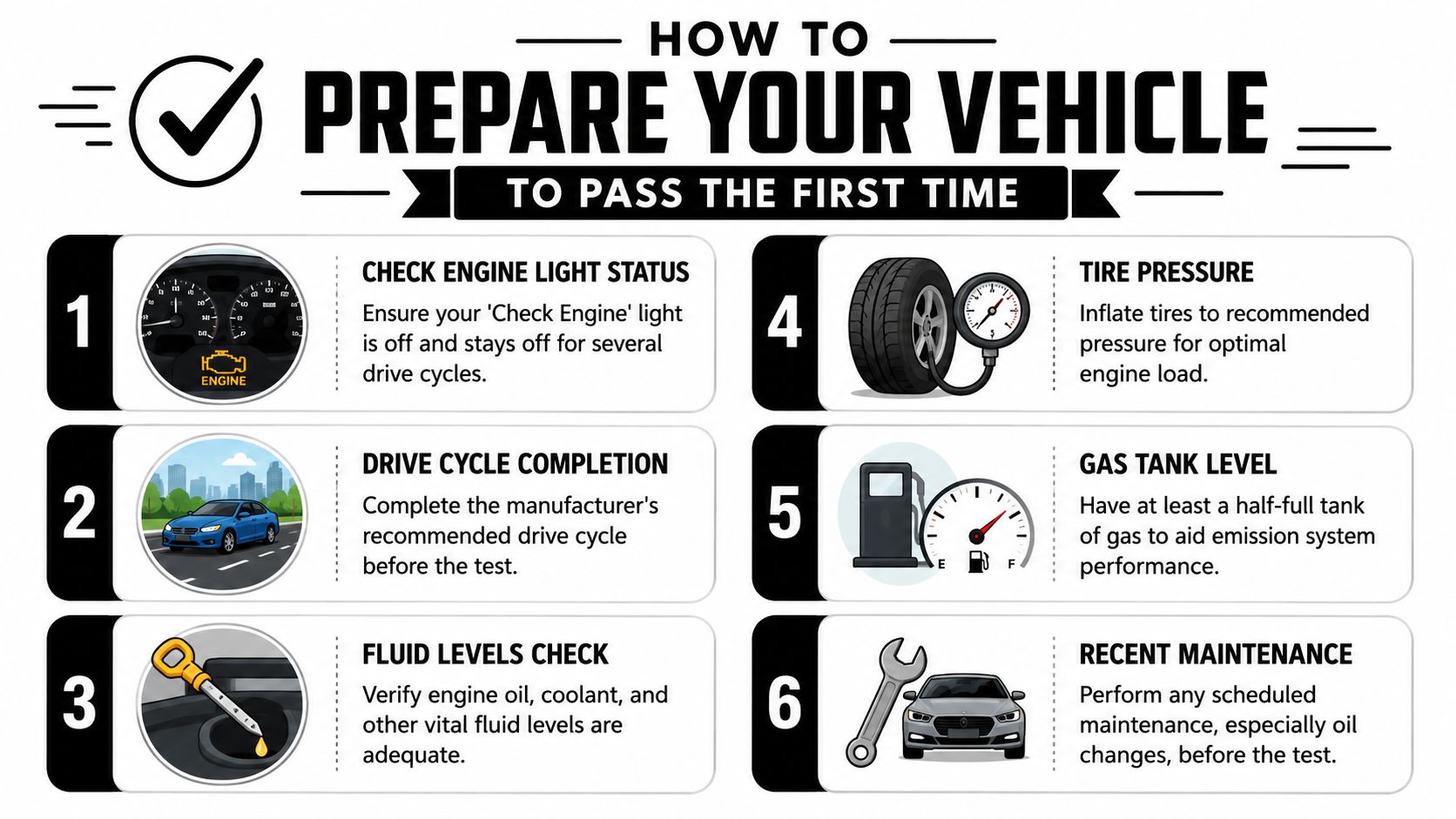
- Check the dash first: No check engine light, no warning you were planning to ignore, and no recent code clearing.
- Think about recent battery work: If the battery was disconnected, wait until the car has had enough regular driving time to complete its monitors.
- Make sure the fuel cap is secure: Loose or damaged caps can lead to emissions-related trouble codes.
- Don't test with unfinished repairs: If a shop told you to come back after driving it a bit, listen to that advice.
- Skip the appointment if the car is acting up: Rough idle, stalling, or poor running usually means something should be diagnosed first.
What works is boring, steady preparation. What doesn't work is rushing in right after a repair, right after a battery swap, or right after turning off a warning light.
Finding the Right Smog Station in Union City
The station you choose matters more than commonly assumed. In Union City, the biggest decision isn't only price or location. It's whether you're walking into a STAR-certified station or a Test-Only station.
STAR stations and test-only stations are not the same
A test-only station does exactly what the name says. It tests. If your vehicle fails, that station can't fix it.
One local listing explains the issue clearly: a Test-Only station like QUIK SMOG UNION CITY cannot repair a failed vehicle, which means the driver has to find a separate BAR-certified repair facility. That extra handoff is a common source of confusion and delay for East Bay drivers, as noted on this Union City Test-Only station explainer.
That distinction matters most if you already suspect your car might not pass. If the vehicle has been running rough, recently had emissions work, or has had codes cleared, the wrong station choice can turn one errand into two.
| Station Type | Can Test Your Vehicle? | Can Repair a Failed Vehicle? |
|---|---|---|
| STAR-certified station | Yes | Some can, depending on the business |
| Test-Only station | Yes | No |
If you're not sure what STAR means, this quick guide on what a STAR station is gives the practical version.
Local details that help you choose faster
Union City does have multiple STAR-certified options. One example is Union City Smog Check at 33365 Mission Blvd, listed as open Monday through Friday from 9:30 AM to 5:00 PM and Saturday from 9:30 AM to 3:00 PM on the Union City smog station directory. The same directory also shows that local smog prices in Union City have been reported in a range from $50.00 to $83.00, which makes shopping around worth the effort because BAR doesn't regulate the inspection price itself.
That directory also highlights a few failure triggers drivers should take seriously before booking. Vehicles with a check engine light on, modified software, or a recently disconnected battery need those issues resolved first because they can fail the inspection.
Local shortcut: If you're comparing stations, ask two questions before you leave home. Are you STAR-certified, and if my car fails, can you repair it here?
That one phone call can save a lot of backtracking.
A Smart Alternative Speedy Smog in San Leandro
Some Union City drivers stay local because it's close. Others care more about getting in, getting tested, and getting out without losing half a day. That's where nearby San Leandro can make sense.
Why some Union City drivers leave town for a smog check
A short drive is often worth it when the station is built for efficiency. For East Bay drivers with newer vehicles, that usually means a cleaner workflow, quicker turnaround, and fewer surprises at the counter.
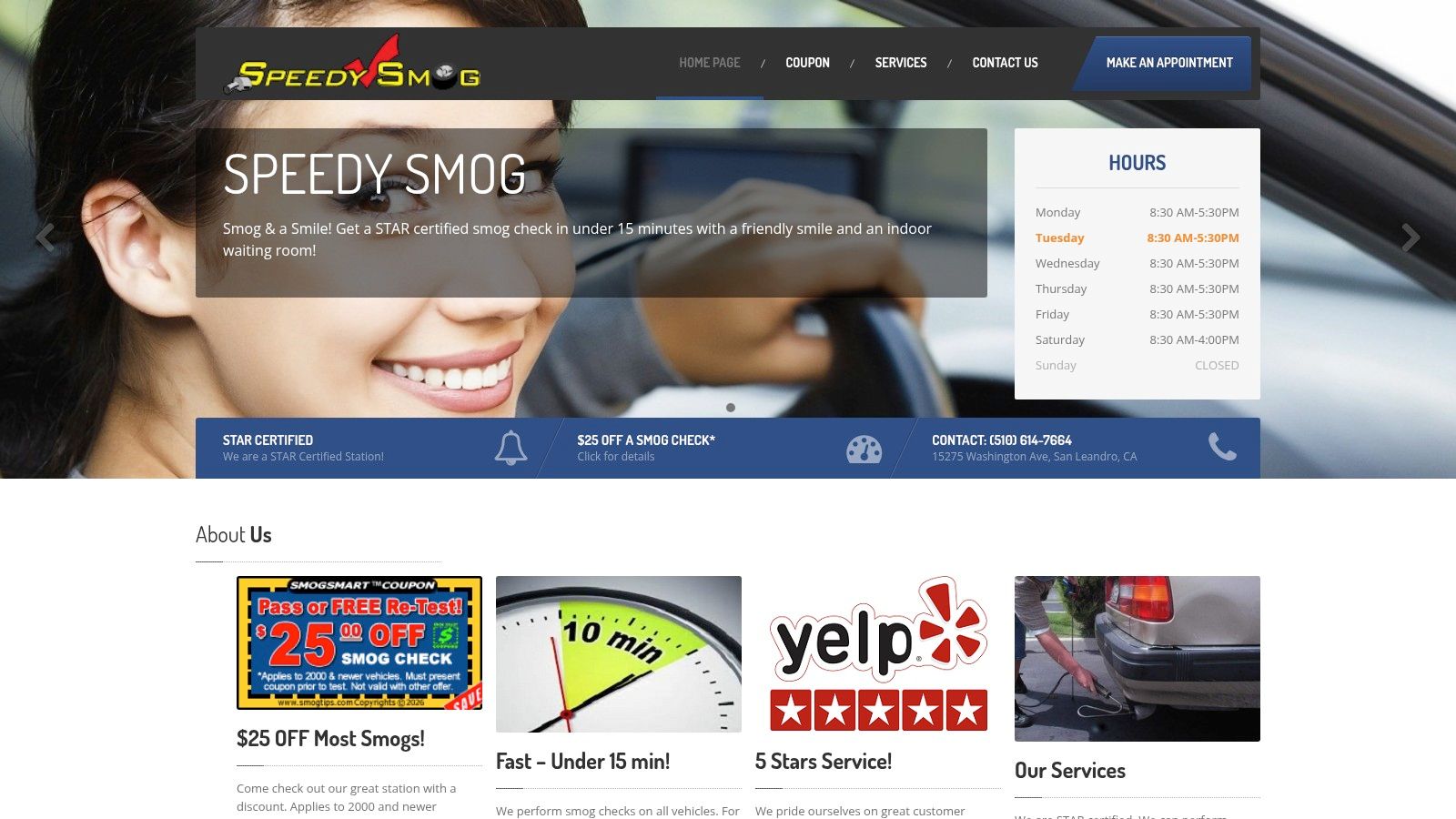
Speedy Smog in San Leandro is a STAR Certified station, and for many drivers that's the draw. It handles the inspection side with the consistency people want when the deadline is a DMV deadline, not a flexible one.
When the short drive makes sense
This option is especially practical if you value a few things:
- Faster routine testing: Most tests on 2000+ vehicles are typically completed in about 10 to 15 minutes, based on the publisher information provided for Speedy Smog.
- A straightforward setup: The shop handles a wide mix of vehicles, including newer models, older vehicles, diesels, and hybrids.
- Less waiting stress: A clean indoor waiting room matters more than people think when you're fitting this into a workday.
- Visible pricing: Transparent pricing and periodic coupons are easier to plan around than vague phone estimates.
There isn't one perfect answer for everyone searching smog check Union City CA. But if your priority is speed, reliability, and a predictable experience, expanding the search radius a bit can be the smarter move.
What Happens During the Smog Inspection
Pull into a Union City smog station with a recently disconnected battery, and the visit can go sideways before the probe or scan tool does much of anything. I see that confusion all the time. Drivers assume the car is "running fine," but the inspection is checking for more than drivability.
California smog checks follow a set process. The technician is looking for missing or altered emissions equipment, trouble codes, and monitor status. On some vehicles, the station also measures tailpipe emissions or smoke opacity, depending on the test method your vehicle falls under.
The three parts of the inspection
Here is what usually happens once the car is checked in:
Visual inspection
The technician checks emissions-related parts that are supposed to be present and properly connected. That can include the catalytic converter, emissions hoses, intake components, fuel cap, and other equipment that matches the vehicle's configuration. If a part is missing, obviously modified, or not legal for street use in California, that alone can cause a failure.OBD-II scan
The shop plugs into the OBD-II port and reads the car's computer. A common issue for many Union City drivers arises after a battery replacement or recently cleared codes. If the readiness monitors are not set, the car may fail even with no check engine light on. That is one of the least understood smog problems, and it wastes a lot of repeat visits.Emissions measurement, when required
Some vehicles are tested through the onboard system, while others may still need an exhaust or smoke test under the applicable procedure. The station uses the method required for that vehicle, not whatever seems quickest.
Most inspections are fairly routine if the car is ready for testing. The part that surprises drivers is that "no symptoms" does not mean "ready to pass."
If you want a clearer read on the paperwork you get afterward, this guide to how smog test results work is useful.
What tends to slow the process down
The inspection itself is standardized. The delays usually come from preventable issues at check-in or during the scan.
A few common ones:
- Readiness monitors not set: Common after a dead battery, battery replacement, or recently cleared codes.
- Wrong station for the situation: Some drivers show up at a Test-Only station expecting repairs or diagnostic help on the spot. Test-Only means inspection only.
- Aftermarket parts with no proper approval: Modified intakes, exhaust components, or catalytic converters can create problems during the visual inspection.
- VIN or paperwork mismatches: Registration details need to line up with the vehicle being tested.
What to bring on test day
Keep it simple and bring the documents that make check-in easier.
- Your DMV renewal notice
- Your vehicle registration
- Your driver's license or photo ID, if the station asks for it
If you are handling a sale or transfer, bring the related paperwork too. Ownership-transfer smog situations can create extra confusion, and having the documents in hand saves time at the counter.
What to Do If Your Vehicle Fails the Smog Check
You leave the station expecting a certificate and walk out with a failed Vehicle Inspection Report instead. That moment frustrates a lot of Union City drivers, especially if the car seems to run fine. A failed test is still useful. It points to a specific problem, and the fastest path is to treat that report like a diagnosis, not a random setback.
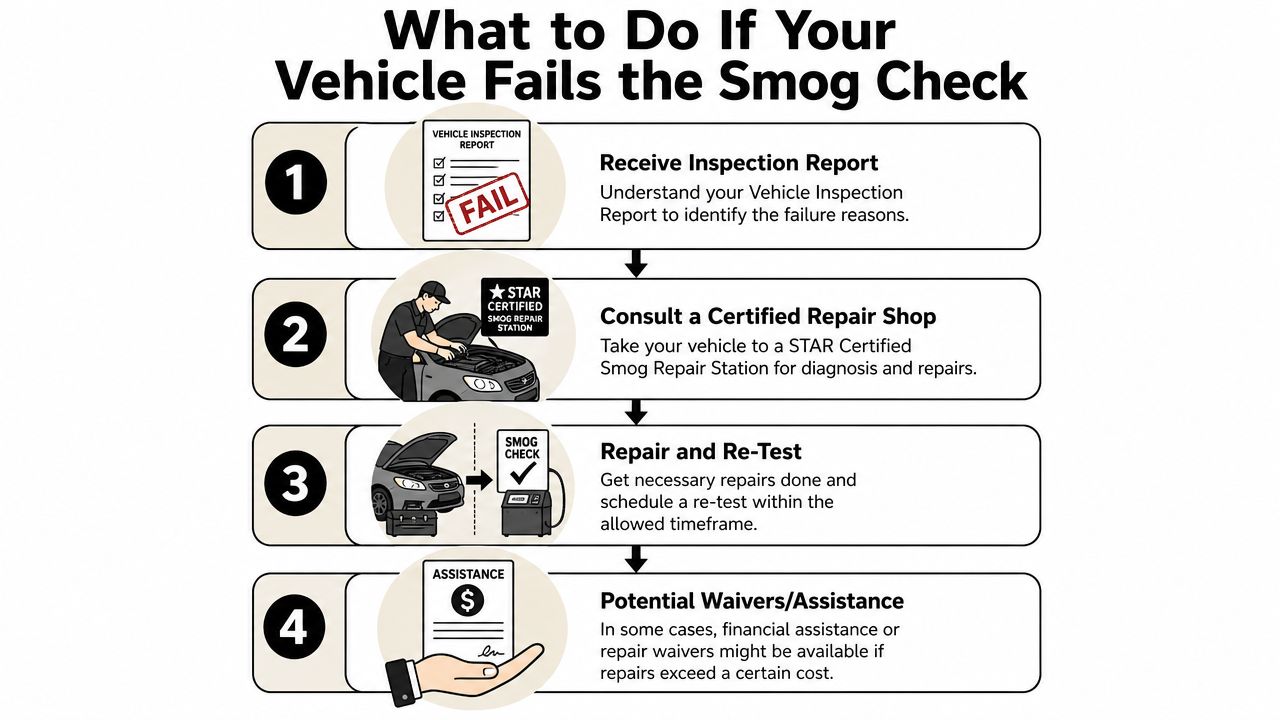
Read the report before you do anything else
Start with the exact reason for the failure. The report usually makes it clear whether you have an active trouble code, incomplete readiness monitors, a visual inspection problem, or tailpipe-related emissions issues on an older vehicle.
Those failures do not lead to the same repair path.
Readiness monitors are one of the most commonly missed issues after a dead battery, battery replacement, or recently cleared check engine light. Drivers fix the original problem, head straight back for a retest, and fail again because the car has not completed the right drive cycle. That is a Union City-area time waster I see all the time.
Choose the right repair path for the station type
Station type matters after a failure.
If you tested at a shop that also performs repairs, you can usually move straight into diagnosis. If you failed at a Test-Only station, that shop is there to inspect, not troubleshoot or repair. A lot of drivers do not realize that until they are standing at the counter with a fail report in hand.
That distinction affects both time and cost. Test-Only can be a good fit if you just need a clean inspection, but it is less convenient if your car has a check engine light history, recent battery work, or emissions-related modifications.
Keep the fee side simple too. Inspection pricing varies by shop. The certificate fee is added only when the vehicle passes, and some newer gasoline vehicles are exempt from the inspection and pay an abatement fee instead, as noted earlier.
Handle the retest carefully
The worst move after a failure is rushing back the same day without confirming the repair solved the problem.
Use a short checklist:
- Bring the failed report to the repair shop: It saves diagnostic time and keeps the technician focused on the actual failure point.
- Ask whether codes were cleared: If they were, confirm which readiness monitors still need to run before a retest.
- Do not assume a smooth-running car is ready: A car can drive normally and still fail because monitors are incomplete.
- Check modified parts: Aftermarket intake, exhaust, or catalytic converter issues can trigger a second failure even if the original code is gone.
- Keep all paperwork together: It makes retesting and registration deadlines easier to manage.
A quick visual walkthrough can help if this is your first failed test.
Most failed smog checks are fixable. The extra cost usually comes from guessing, clearing codes too early, or retesting before the monitors are ready.
If you'd rather skip the guesswork and use a fast, STAR-certified station nearby, Speedy Smog in San Leandro is a practical option for East Bay drivers. It's built for quick, compliant testing, especially for many 2000 and newer vehicles, and it's a solid choice when you want a clean process, clear pricing, and a smog check that fits into a normal day instead of taking it over.
You open your renewal notice, scan down the page, and there it is: smog certification required. For a lot of California drivers, that line lands somewhere between annoying and confusing. You might be wondering if you need the test, whether your car is exempt, what a STAR station is, or what happens if your check engine light came on last week and then disappeared.
That confusion is normal. Smog rules in California aren't hard once someone translates them into plain English, but the official language can feel like it was written for agencies instead of drivers. From the shop side, most problems come from a few predictable misunderstandings: the 8-year exemption, readiness monitors, and what to do after a failed test.
A smog check in California isn't just paperwork. The California Smog Check Program removes about 400 tons of smog-forming pollutants from the state's air every day, according to the California Smog Check Program overview. That doesn't make the errand fun, but it does explain why the state takes it seriously.
If you're trying to get this done with the least stress possible, the goal is simple. Know whether you need a test, prepare your car the right way, and avoid the common mistakes that cause avoidable failures.
Table of Contents
- Your DMV Notice Arrived Now What
- Understanding Your Smog Check Obligations
- Does Your Vehicle Qualify for an Exemption
- Simple Steps to Help Your Vehicle Pass
- Inside the Smog Check Process
- What to Do If Your Car Fails the Smog Check
- Get Your STAR Smog Check at Speedy Smog
Your DMV Notice Arrived Now What
The usual first reaction is a sigh. You were just trying to renew your registration, and now you have one more thing on the list. Maybe your tags are coming due soon. Maybe you're selling a car and the buyer asked about a smog certificate. Maybe you moved recently and the notice showed up with a line you weren't expecting.
The first thing to know is that this is manageable. In most cases, a smog check is just a routine inspection. Drivers get into trouble when they wait too long, show up right after disconnecting the battery, or assume their newer car still needs testing when it doesn't.
Here's the practical move. Pull out the DMV notice and confirm whether it says a smog certification is required for this renewal cycle. Then book the test early enough that you still have time if the car needs follow-up. If you want to lock in a time before your schedule gets packed, you can schedule a smog check appointment online.
Practical rule: Treat the notice as the start of a short to-do list, not a crisis.
A lot of first-timers assume the station will handle every registration issue for them. The station handles the inspection and certificate reporting. Your job is to bring the right vehicle, show up with enough time before your deadline, and avoid creating an automatic failure with last-minute resets or repairs.
If your car has been running normally, no warning lights are on, and you haven't recently cleared codes, you're already in decent shape. Most of the stress around a smog check in California comes from uncertainty, not the test itself.
Understanding Your Smog Check Obligations
A lot of confusion starts here. Drivers hear "smog check required" and assume the rule is the same in every situation. It is not. California uses different triggers, and the easiest way to stay out of trouble is to sort your case into the right bucket.
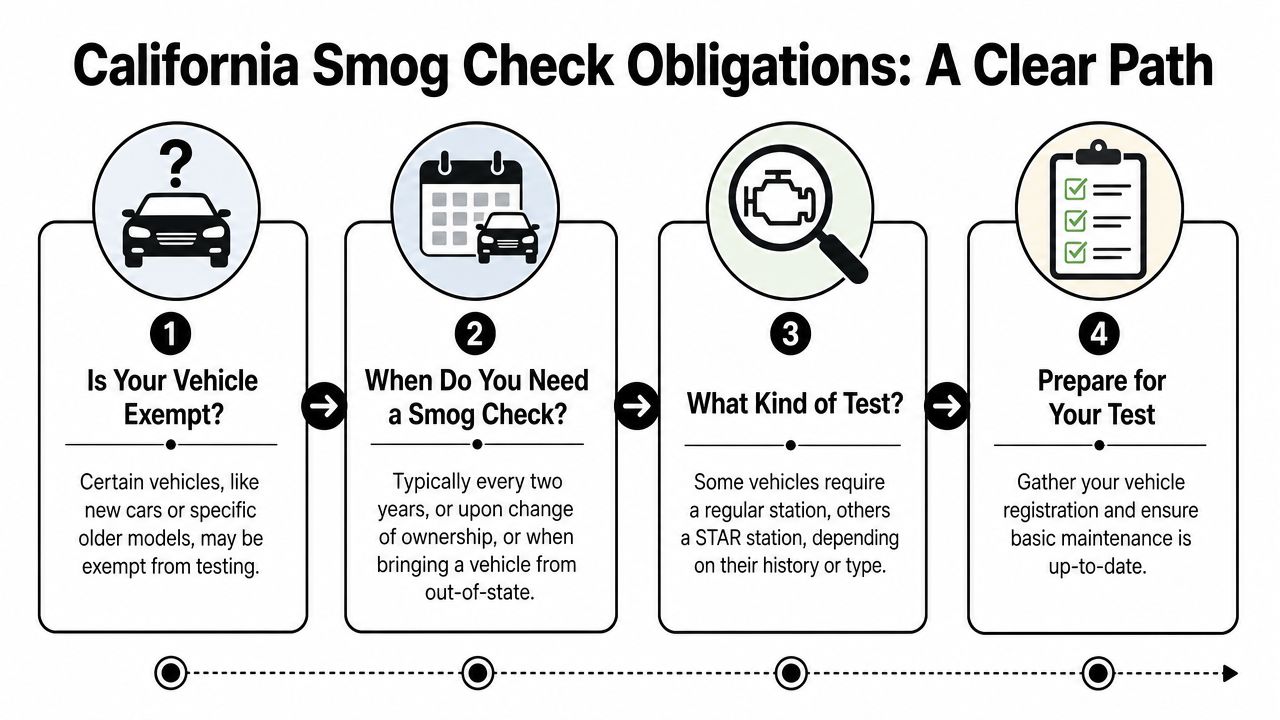
The rule most drivers actually need
For many drivers, the practical rule is simple. If your vehicle is past the newer-vehicle exemption window, it will usually come up for a smog check on a two-year registration cycle. A sale can also trigger a certificate requirement, even if you were not expecting a regular renewal test at that moment.
The part that catches first-timers is that these are separate triggers. Registration renewal and change of ownership are not the same thing. A car can be fine for one purpose and still need a valid smog certificate for the other.
If you want a plain-English breakdown of edge cases, local exceptions, and DMV-triggered situations, this summary of California smog check rules helps sort them out without the state-agency wording.
Three common situations
At a STAR station, we see the same three points of confusion over and over. The test itself is usually the easy part. Figuring out why the car needs a test, and when, is what trips people up.
| Situation | What usually applies |
|---|---|
| Registration renewal | Many non-exempt vehicles are checked on a two-year cycle |
| Private-party sale | The seller often needs to provide a current smog certificate if the vehicle falls within the rule |
| Recently passed | A prior pass only helps if the certificate is still within its valid period |
Here is the plain-language version. Renewal is tied to your DMV cycle. Sale is tied to transfer of ownership. A past certificate has a shelf life, so "the car passed before" is only helpful if the paperwork is still current.
That last point causes more headaches than people expect.
A buyer may hear, "It just passed smog," and assume the paperwork will cover the transfer. Sometimes it does. Sometimes the certificate is too old to satisfy the next step. From the shop side, the fix is simple. Ask to see the actual certificate date, not just a verbal promise.
The DMV notice can add to the confusion because it feels like a general reminder, but it is really a specific instruction for that vehicle and that registration cycle. Do not rely on what happened two years ago, or on what a different car in your household needed. Read the current notice, then match it to your situation.
That is the inside-track way to look at smog obligations. Treat the rule like a checklist, not a mystery. Once you know which trigger applies, the rest gets much easier.
Does Your Vehicle Qualify for an Exemption
Your registration notice shows up, you see the word "smog," and the first question is usually simple: Do I need to go to a station this time?
Sometimes the answer is no.
From the shop side, this is one of the easiest ways to save people an unnecessary visit. The confusion usually comes from one idea. An exemption from testing does not always mean an exemption from every smog-related fee or rule.
The exemption list in plain language
California exempts some vehicles from the routine biennial smog check. Under the program overview, the exemption picture generally includes:
- Electric vehicles
- Gasoline-powered vehicles less than 8 model-years old
- Diesel vehicles made before 1998 or with a gross vehicle weight over 14,000 pounds
- Motorcycles
- Gasoline-powered vehicles made before 1976
A quick caution here. Exempt usually means exempt from the routine inspection requirement. It does not mean emissions parts can be removed or ignored on vehicles that were built with them.
Why the 8-year rule trips people up
The part that causes the most head-scratching is the newer-car exemption. Drivers hear about the smog abatement fee on registration and assume they still need to book a test. For many newer gasoline and hybrid vehicles, that is not how it works.
The California DMV smog inspections page explains that gasoline and hybrid vehicles less than eight model-years old are generally exempt from the biennial inspection, even though an abatement fee may still be collected with registration.
Here is the practical version a STAR station would give you:
- Inspection exemption means you likely do not need a smog test for that renewal cycle
- Abatement fee means you may still see a smog-related charge on your registration
- Those two items are separate
It helps to treat the fee like a placeholder on the registration side, not proof that a test is due.
A newer-vehicle owner may walk into a station worried about an overdue smog, when the answer is simpler: check the model year first.
This also matters during a sale. People often assume every vehicle transfer automatically calls for a fresh certificate. Sometimes it does. Sometimes the vehicle's age changes the answer. If you want to avoid guesswork, check the model year and registration paperwork before spending money on a test you may not need.
Simple Steps to Help Your Vehicle Pass
A lot of "failed smog" stories start before the car even reaches the station. The good news is that many avoidable failures come from a short list of fixable habits.
Start with the obvious checks. If the check engine light is on, don't go in expecting a pass. If the battery was recently replaced, if someone cleared trouble codes, or if an emissions repair was done recently, your car may not be ready yet.
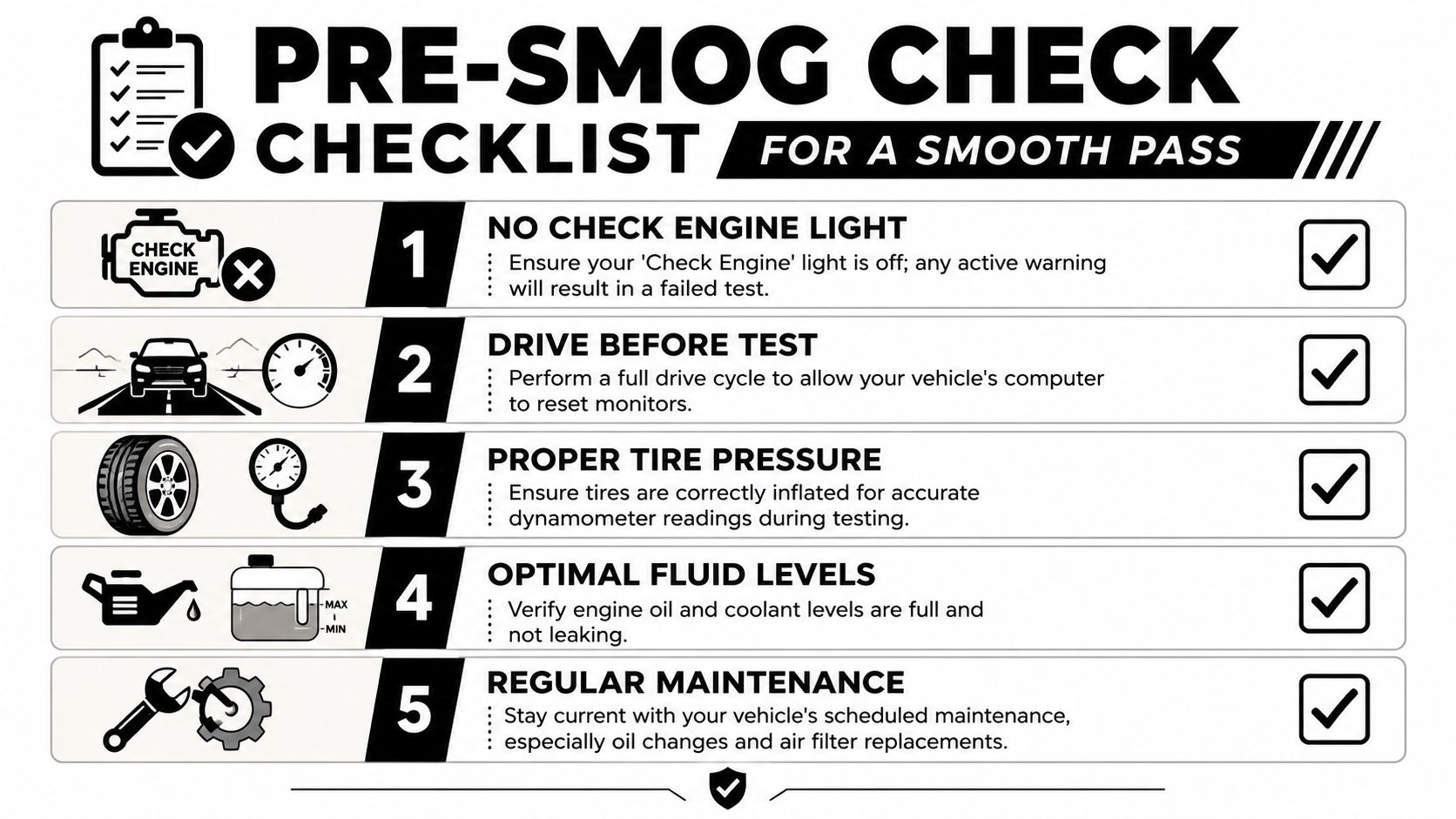
What to check before you leave home
Use this quick pre-test checklist:
- Look at the dash: No active check engine light.
- Think about recent work: Battery disconnects and code clearing can reset emissions data.
- Drive the car normally before testing: A short errand from a cold start isn't always enough.
- Don't use the smog station as your first diagnostic step: If the car is misfiring, idling rough, or clearly running poorly, repair comes first.
- Bring the car in after it's been used, not parked for days: A fully warmed-up vehicle is generally a better candidate than one that has been sitting.
The section below is worth extra attention because the rule changed.
Why readiness monitors matter now
As of late 2025, BAR regulations require all OBD-II readiness monitors to be "complete" to pass. A recent battery change or cleared code requires a proper drive cycle to reset these monitors, preventing an automatic failure, according to this BAR readiness monitor explanation video.
In shop terms, that means this: your car's computer needs time to rerun its self-checks. If you disconnect the battery on Monday and test the car right away, the system may still show not complete. Under the updated rule, that's a problem.
This short video helps illustrate the inspection context:
A practical example helps. Say your battery died, you installed a new one, and the car now feels fine. You might think you're ready. But the emissions monitors may still be unset. The car needs a proper drive cycle before the official test.
Don't clear codes to "hide" a problem before a smog. In many cases, that only swaps one failure for another.
If you're unsure whether the monitors have reset, ask a qualified shop to check readiness status before the official inspection. That small step can save you a failed visit.
Inside the Smog Check Process
You pull into the station, hand over your registration, and wonder if this is going to turn into a long, confusing appointment. In practice, the visit is usually straightforward. Once you know the order of events, the process feels a lot more like a standard vehicle check and a lot less like a DMV mystery.
What happens when you arrive
The technician starts by confirming your vehicle information and checking what type of inspection the state requires for that car. That matters because a 2018 sedan, a 1999 SUV, and a diesel truck may each follow a slightly different test path.
For many newer vehicles, the main job is reading the onboard diagnostic system, often called OBD-II. That system works like your car's report card. It stores emissions-related trouble codes, monitor status, and other data the state wants reviewed. Older vehicles may need added inspection steps, including equipment checks and other approved test methods.
There is also a visual side to the inspection. A technician checks that required emissions parts are present and appear intact. In plain language, the station is not only asking, "Is the computer happy?" It is also checking, "Is the car set up the way it is supposed to be?"
Then the test equipment and the vehicle have to communicate properly. If the system cannot connect, that creates a problem even if the car seems to run fine on the road.
What a STAR station changes for the driver
If your DMV notice says STAR, you need a STAR station. A regular station cannot complete a STAR-required inspection for that notice.
A STAR-certified smog station is approved to perform these inspections and held to added state performance standards. From the driver's side, the big benefit is clarity. A STAR station sees these cases every day, so the staff can usually tell you quickly whether your issue is a simple testing requirement, a communication problem, or a true emissions failure.
That inside-track perspective helps first-timers. Many drivers come in expecting the shop to "fix" the result during the inspection. The smog check does not work that way. The station follows the state procedure, records what the vehicle shows, and sends the result electronically if it passes.
The process, step by step
Here is the usual flow:
- Check-in: The station verifies your vehicle details and confirms the required test type.
- Inspection: The technician performs the emissions inspection that applies to your vehicle.
- Computer and equipment check: For applicable vehicles, the car's emissions data is read and reviewed.
- Results: A passing result is transmitted to the state. If the vehicle fails, you receive a Vehicle Inspection Report showing why.
The visit is often quicker and more routine than drivers expect.
Cost can vary by vehicle type, location, and whether the station is STAR-certified. The certificate fee is separate from the inspection charge, so ask for the full out-the-door price when you schedule. That avoids surprises at the counter.
If your vehicle passes, you are done. The station submits the certificate electronically for DMV purposes, and you keep your paperwork for your records.
If it fails, do not panic. The failure report is the roadmap. A good technician will explain whether the problem points to missing readiness, a fault in the emissions system, or another issue that needs repair before a retest.
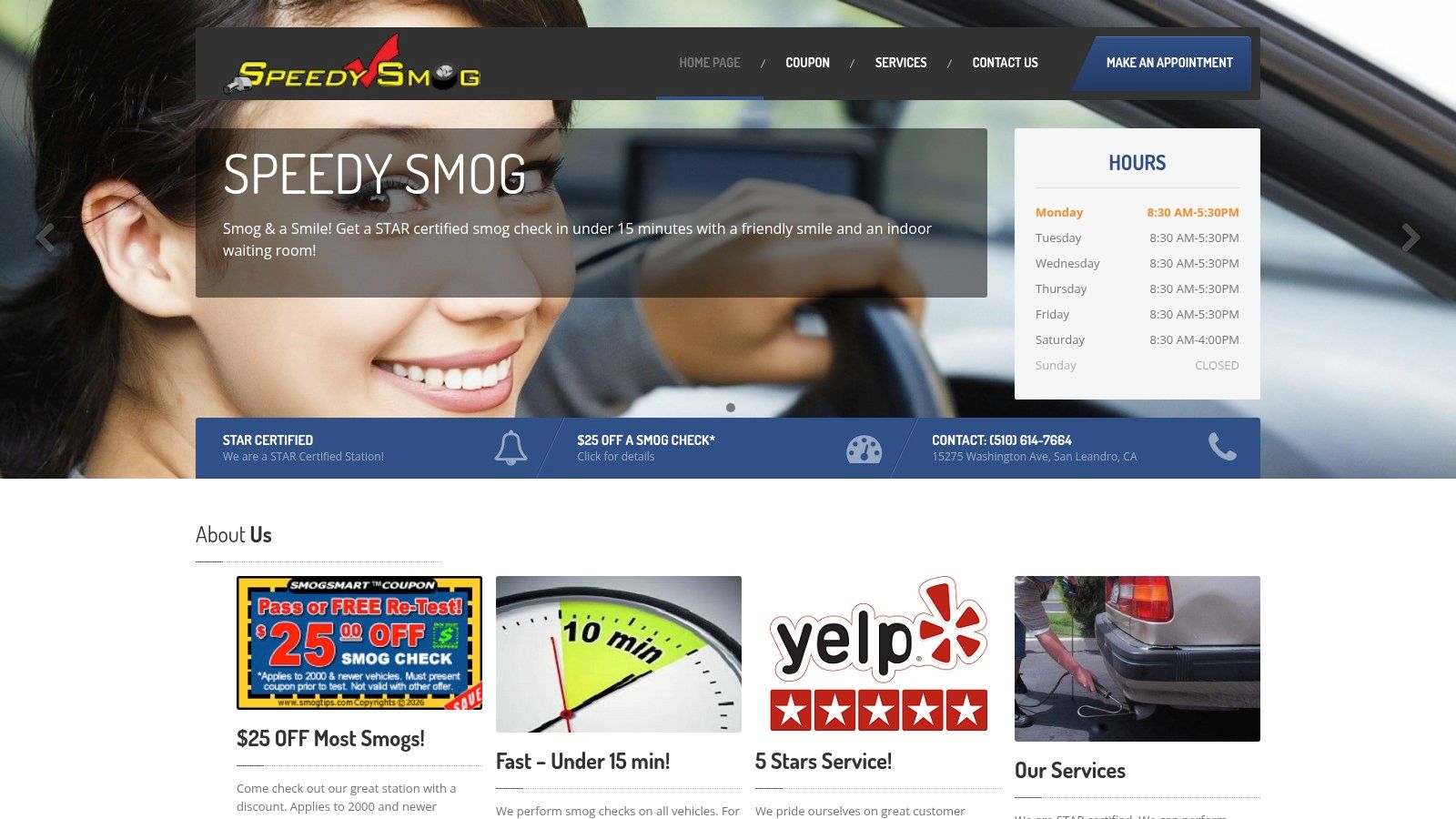
For East Bay drivers looking for a STAR inspection option, Speedy Smog is a STAR Certified station in San Leandro that handles testing for a wide range of vehicle types, including newer cars, older vehicles, diesels, and hybrids.
What to Do If Your Car Fails the Smog Check
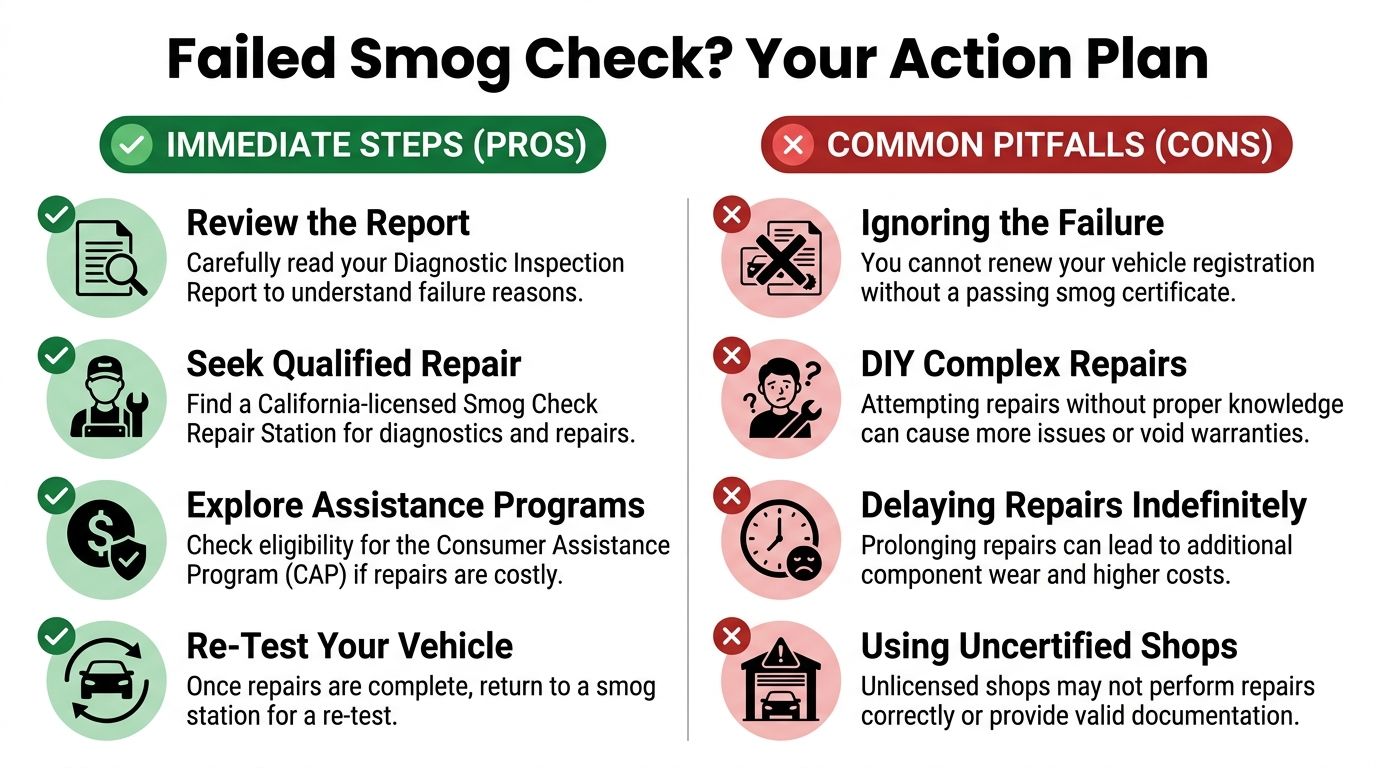
A failed smog check feels expensive before you even know what's wrong. Don't guess. Start with the paperwork.
Read the failure before you spend money
Your first job is to read the Vehicle Inspection Report carefully. A failure can come from very different causes. Some are repair-related. Some are procedural. Some come down to readiness status after a battery disconnect or recent code clearing.
That distinction matters because the next step changes depending on the reason. If the report points to a system malfunction, you need diagnosis and repair. If it points to incomplete readiness monitors, the answer may be more driving, not parts replacement.
Use this sequence:
- Read the exact failure item: Don't rely on memory from the front counter conversation.
- Ask whether the issue is a monitor problem or a component problem: Those lead to different fixes.
- Choose a licensed repair path if needed: Especially for emissions-system faults.
- Retest only after the issue is addressed: Retesting too soon often wastes time.
When to use the Referee Program
California gives drivers a backup option that many people never hear about. If your vehicle fails, the Bureau of Automotive Repair offers a free Smog Check Referee Program to verify the test's accuracy. Drivers often fail due to simple issues like unreset readiness monitors after a battery disconnect, which this program can help diagnose, according to the BAR Smog Check information page.
That matters if:
- You think the result may be wrong
- You've hit a confusing edge case
- A repair path doesn't seem to match the actual failure
- You want an independent review before spending more money
The verified guidance also notes a 90-day window to challenge a failed inspection result through this process, and that some readiness issues may take 1 to 2 weeks of driving to reset properly, as referenced in the same BAR resource context.
If the failure happened right after a battery disconnect, pause before authorizing major repairs. Verify whether the problem is readiness, not hardware.
A failed smog check in California doesn't always mean a major repair bill. Sometimes it means the car wasn't ready for the test. Sometimes it means the original result deserves a second look. The smartest move is to separate those possibilities before you spend money.
Get Your STAR Smog Check at Speedy Smog
By the time most drivers reach the station, they don't need more legal language. They need a clean process, accurate inspection, and a technician who can explain the result without talking in circles.
That is where a STAR station can make the whole experience easier to handle. If the DMV directs you to STAR, the requirement isn't optional. It makes sense to choose a shop that handles these inspections every day and knows how to spot common issues like monitor resets, recent battery work, and paperwork timing.
If you're still fuzzy on what STAR means, this overview of what a smog STAR station is gives the short version in plain language.
A practical checklist for choosing where to go looks like this:
- Confirm STAR status if your notice requires it
- Ask whether the shop handles your vehicle type, especially if you have a diesel, hybrid, or older model
- Choose a station that explains failed results clearly
- Go before your deadline gets tight, so you still have options if something needs attention
For drivers in San Leandro, Oakland, and nearby East Bay communities, convenience matters too. A station with a straightforward process, a comfortable waiting area, and experience across common California vehicle types can turn this from a chore into a short errand.
If you need a California smog inspection from a STAR Certified station, Speedy Smog in San Leandro offers test-only smog checks for many vehicle types, including newer cars, older vehicles, diesels, and hybrids. If your DMV notice is due or you want help figuring out your next step after a failed test, contact the shop and get clear answers before your registration deadline.
A STAR station is a smog check station that meets higher performance standards, and if your DMV renewal notice says STAR is required, you must use one. In California's Enhanced Areas, exactly two percent of vehicles are directed by DMV to STAR-certified stations, so if that language appears on your renewal, it's a normal requirement, not a mistake.
You open your registration notice, skim for the due date, and then see the line that throws everything off: smog check required at a STAR station. A lot of drivers read that and immediately wonder if there's something wrong with the car, if the test is different, or if the whole process is going to take longer and cost more.
Usually, the answer is much simpler than people expect. The notice is mainly telling you where your inspection must be done. If you understand that one point first, the rest gets a lot less stressful.
Table of Contents
- Your DMV Notice Says STAR Station Required Now What
- What Is a STAR Certified Smog Station
- STAR Station vs Regular Smog Check What Is the Difference
- What to Expect During Your Smog Check at Speedy Smog
- How to Prepare Your Vehicle for a Smog Check
- Speedy Smog Hours Pricing and Location in San Leandro
- Frequently Asked Questions About Smog Checks
Your DMV Notice Says STAR Station Required Now What
You open your renewal notice, spot the words “STAR station required,” and the whole thing suddenly feels more complicated than it should. In practice, the message is simple. DMV is telling you where the inspection must be done, not telling you your car is in trouble.
That distinction saves a lot of stress. A STAR requirement is a routing instruction. It works a lot like a specialist referral on the medical side. You still need the same basic service, but you need to get it from the type of shop the state named on your notice.
What that line on the notice actually means
Start with the one question that matters. Does your renewal paperwork say STAR is required?
If the answer is yes, use a STAR-certified station. A regular smog shop may not be able to complete the inspection DMV is asking for, which can waste a trip and put you closer to your registration deadline.
Here is the practical version:
- Go to a STAR-certified shop: Follow the notice exactly.
- Bring the DMV notice if you have it handy: It helps the station confirm the request quickly.
- Leave yourself a little time: If your car needs repairs or a retest, you will not be scrambling at the end.
Simple rule: “STAR required” tells you where to go for the test.
The wording on DMV paperwork can make this sound more serious than it is. Terms like “directed vehicle,” “certified station,” and “Enhanced Area” are just program labels. For the driver, the takeaway is straightforward. Your vehicle needs its smog check done at the right kind of station so the result can be accepted for registration.
If you want a plain-English refresher before you book, this guide to California smog check rules breaks down the state terms without the DMV wording.
The fastest path from notice to certificate
At Speedy Smog, the goal is to make this easy from the moment you get that letter to the moment you drive away. Read the notice, confirm it says STAR, bring the car in, and let the station handle the inspection and electronic certificate if your vehicle passes.
A few small choices can make the visit faster. Bring your paperwork, avoid waiting until the registration due date, and drive the car long enough to warm it up before you arrive. That last step matters because a cold engine is a little like trying to grade a student before the test starts. The car needs to be at normal operating temperature for the system checks to behave the way they should.
The process is usually simpler than drivers expect. The notice tells you the lane to get in. Your job is mostly to show up at the right shop, prepared, and let the test move forward.
What Is a STAR Certified Smog Station
A STAR-certified smog station is a smog check shop that has approval to inspect and certify certain vehicles under tighter state performance standards. A simple way to read that label is this: the state trusts these stations to deliver consistently accurate inspections for cars that are directed into the STAR program.
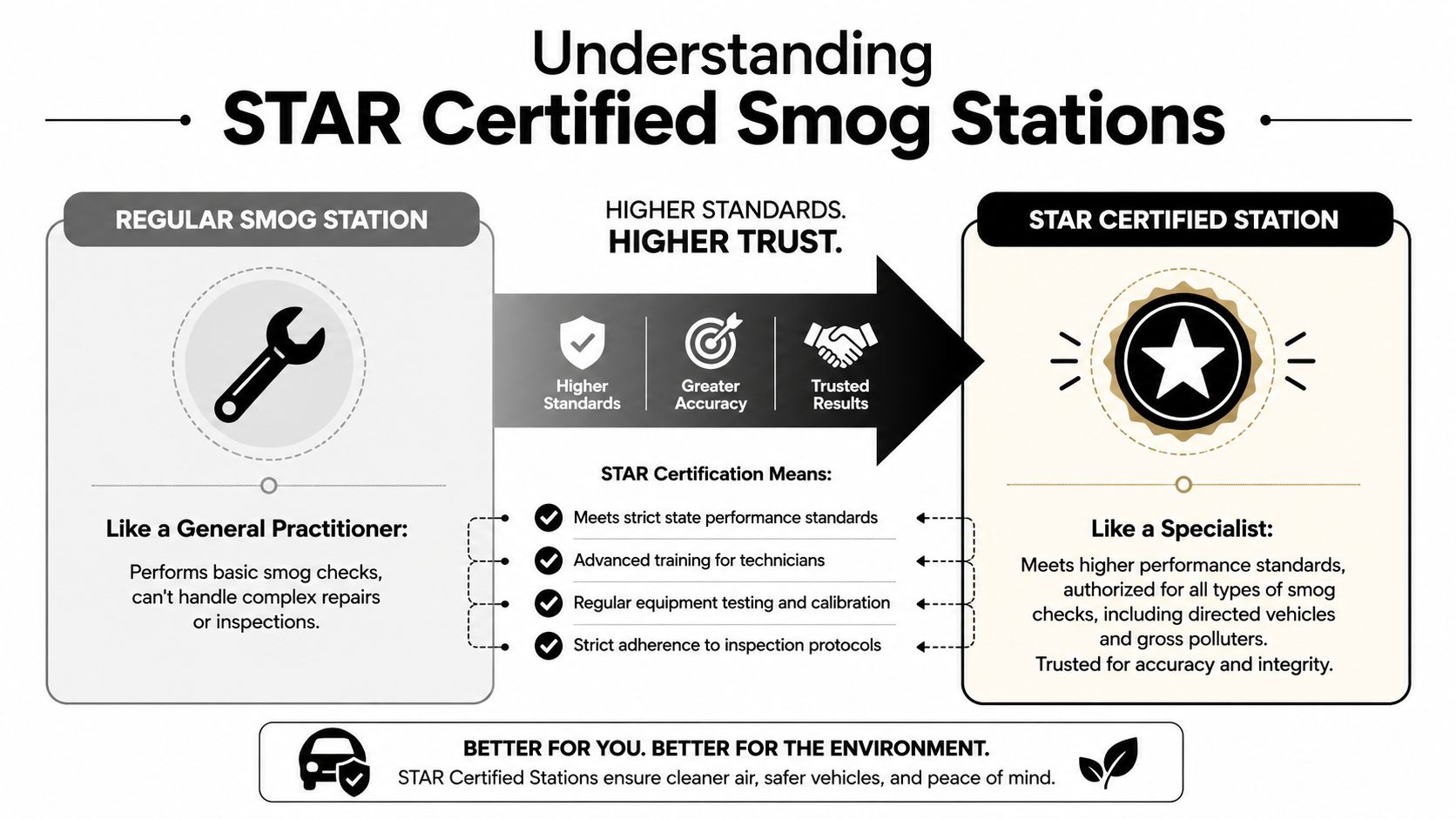
For a driver, the key point is practical. STAR describes the station's approval status, not a different kind of smog test. Many customers hear the word and expect a harsher inspection, special equipment, or a long extra procedure. What usually changes first is the specific testing location required for DMV acceptance.
That can feel confusing because the DMV notice focuses on program labels, not plain language. A better translation is: your car needs to be checked at a shop with current STAR approval. The shop has to qualify for that status and keep meeting the state's standards over time.
What the STAR label means during a real visit
At Speedy Smog, this matters in a very customer-facing way. If your renewal notice says STAR, the shop must be authorized to complete that inspection and send the certificate electronically if your vehicle passes. If you stop at the wrong type of station first, you can lose time, make an extra trip, and still need the same test done again at a STAR location.
Choosing the right station first makes the whole process faster.
Drivers searching for an action smog check STAR station are usually trying to solve three problems at once:
- Meet the DMV requirement without guesswork
- Get in and out quickly
- Leave knowing exactly what happened, whether the car passed or needs follow-up
That is why the customer experience matters as much as the label. A good STAR station does more than run the inspection. It helps you confirm the requirement, explains what the technician is checking in plain English, and keeps the visit moving so you can get back on the road.
For a closer local explanation of the certification itself, see this guide on what a Smog STAR station is.
STAR Station vs Regular Smog Check What Is the Difference
Here's the part most drivers want settled quickly. The physical smog inspection is technically identical at a regular station and a STAR station. The difference is the station's approval status, its performance requirements, and whether it can certify a STAR-directed vehicle.
According to the Sunnyvale STAR facts page, STAR-certified smog stations operate under more stringent BAR standards, the physical test is identical, the station must maintain a high state score to certify STAR-designated vehicles, and some failing vehicle owners may qualify for up to $500 in state-funded repair assistance.
The side by side comparison
| Feature | Regular Smog Station | STAR Certified Station |
|---|---|---|
| Physical inspection procedure | Same basic smog inspection steps | Same basic smog inspection steps |
| BAR performance standard | Standard licensing requirements | More stringent BAR standards |
| Can certify STAR-directed vehicles | Not always | Yes, if the station holds current STAR approval |
| State score requirement | Not the same STAR approval standard | Must maintain a high state score |
| Best use case | Routine vehicles not directed to STAR | Vehicles specifically told by DMV to use STAR |
What this means for you as a customer
If your car was directed to a STAR station, the test itself isn't automatically harsher. The main issue is authorization. You need a shop that can submit the right certification for your renewal requirement.
That's why a regular station and a STAR station may both look similar from the lobby, the bay, and the equipment side. What changes behind the scenes is the station's compliance status with BAR and whether DMV accepts that shop for directed vehicles.
If your notice says STAR, going to a regular station can waste a trip even if the staff is helpful and the shop is fully licensed.
Common misunderstandings
Drivers often mix up three different questions:
- Is my car in trouble? Not necessarily.
- Is the inspection different? The test procedure itself is not the key difference.
- Will I automatically fail at a STAR station? No. A STAR requirement does not equal an automatic failure.
The cleaner way to think about it is this: STAR is a filter on who can certify the test, not proof that your vehicle has already failed something.
If a vehicle doesn't pass, that result can feel frustrating, but the process is still structured. The same Sunnyvale reference notes that some owners may qualify for up to $500 in state-funded repair assistance after a failure, which can help when repairs are needed before retesting.
What to Expect During Your Smog Check at Speedy Smog
For most drivers, the biggest relief comes from knowing what will happen once they pull in. The visit is usually much more routine than people expect, especially if the vehicle is already running normally and there are no warning lights on.
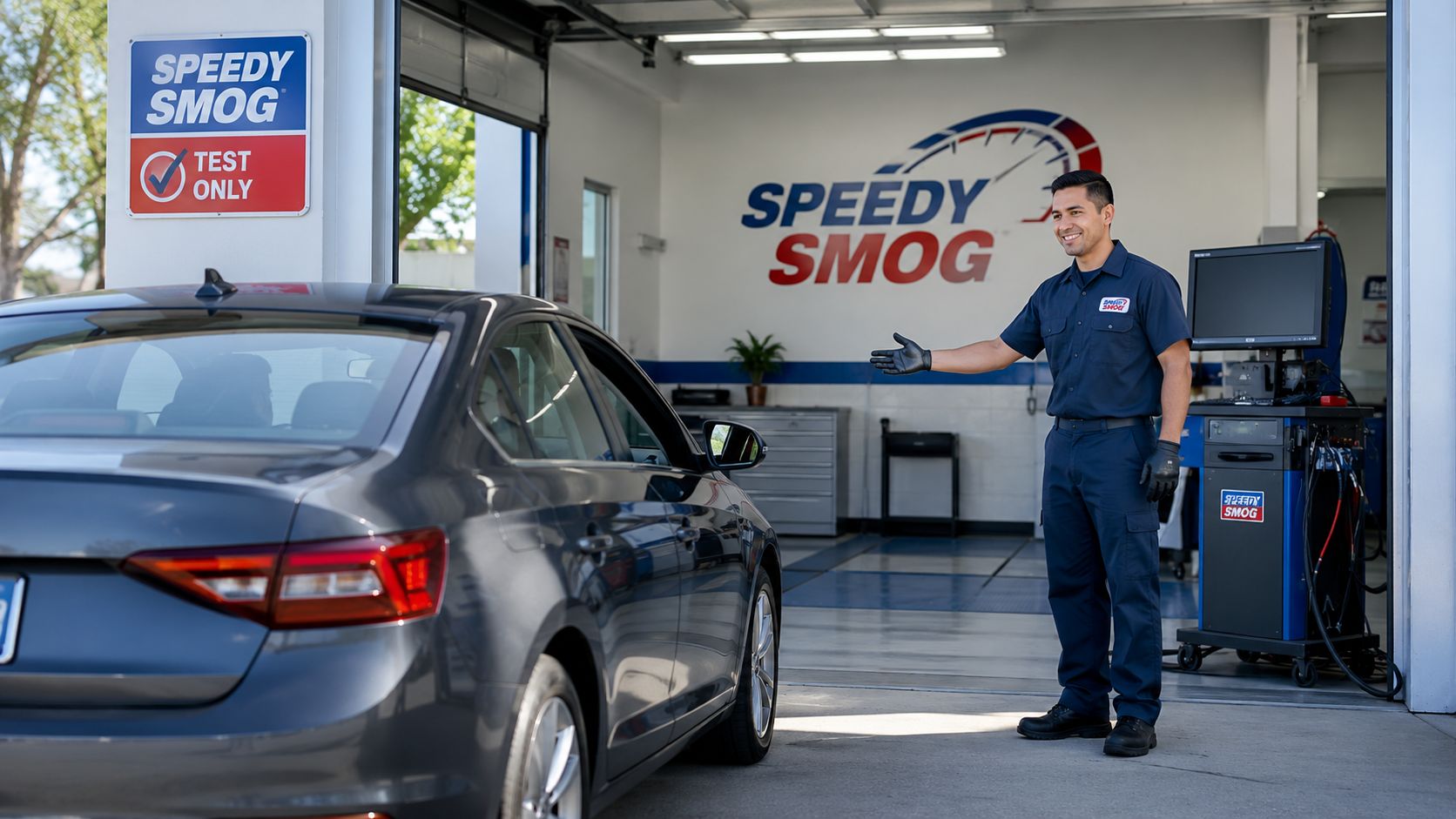
For many 2000 and newer vehicles, the inspection is typically completed in about 10 to 15 minutes, based on the business details provided by the publisher. That quick turnaround is one reason many East Bay drivers look for an action smog check STAR station that keeps the process simple.
When you arrive
Check-in usually starts with the basics. Bring your renewal notice if you have it, and let the staff know whether the DMV specified a STAR station. The technician will confirm the vehicle information and get the inspection started.
While the car is being checked, many customers wait in the indoor lobby. A clean waiting room, straightforward paperwork, and clear communication make a big difference because customers do not want a technical lecture. They just want to know what's happening and whether anything is holding up the certificate.
What the technician checks
A smog inspection isn't one single action. It's a series of checks that work together.
Typical items include:
- Visual inspection: The technician looks for required emissions-related components and obvious issues.
- Functional checks: Items like the gas cap and warning light behavior may be reviewed.
- Computer scan for newer vehicles: On many newer cars, the inspection includes reading the vehicle's onboard diagnostic information.
If you've never seen the process up close, this short video gives a helpful look at what a smog inspection visit can feel like in real life.
How you get your result
If the vehicle passes, the certificate is handled electronically for DMV purposes, and you can move on with registration. That's the outcome everyone wants because it keeps the trip short and uneventful.
If the vehicle doesn't pass, the next step is usually a plain-language explanation of what needs attention. In practice, customers appreciate a station that tells them the issue directly instead of burying it in jargon.
A good smog visit feels organized. You check in, the technician tests the car, you get a clear result, and you know what to do next.
How to Prepare Your Vehicle for a Smog Check
The best prep is simple, and most of it takes only a few minutes. You don't need to be a mechanic to improve your odds of a smooth visit. A little preparation helps the inspection start with the car in normal operating condition.
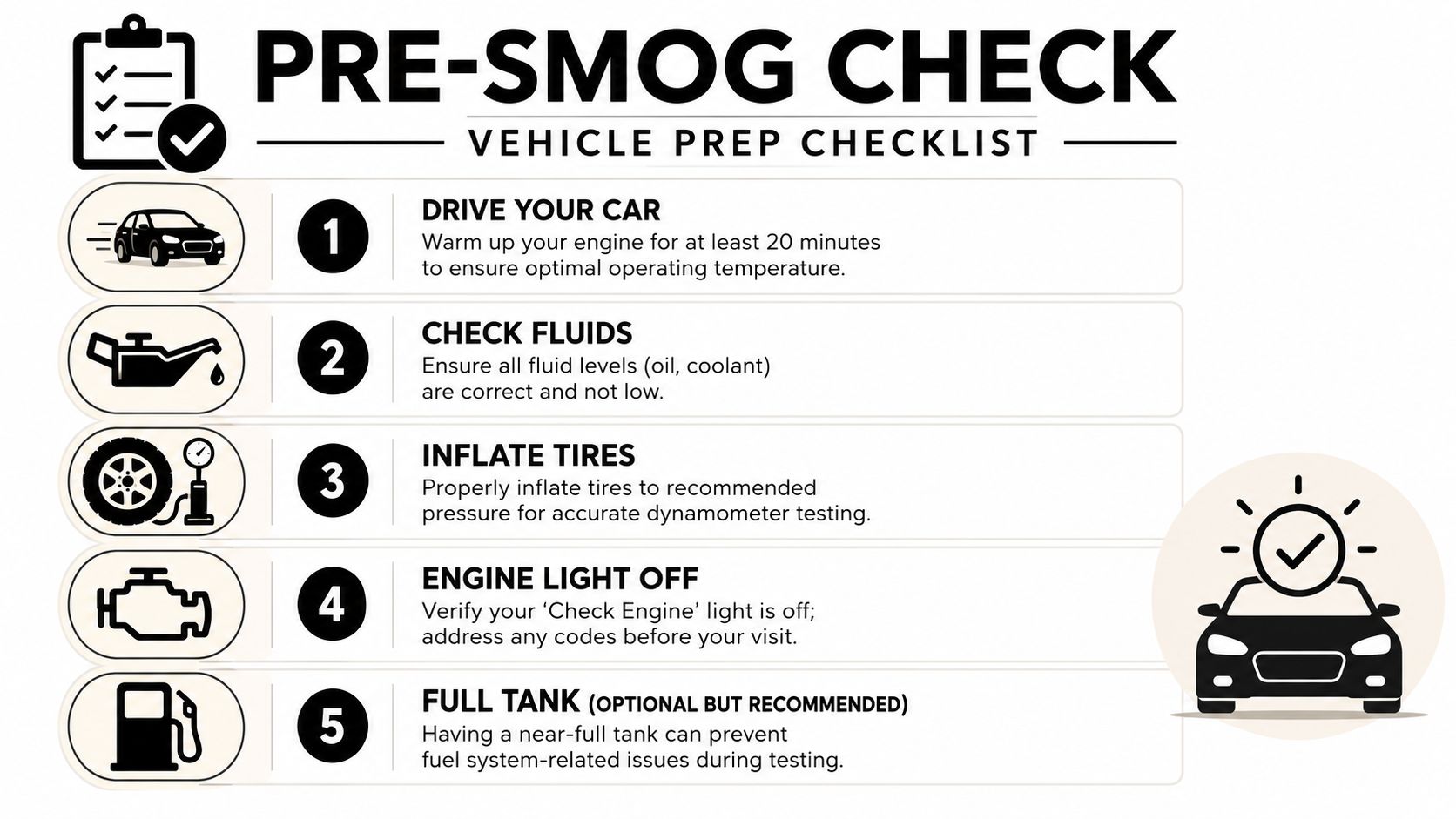
Easy checks before you leave home
Start with the obvious stuff people overlook when they're rushing out the door.
- Drive the car first: Don't bring it in stone cold if you can avoid it. A normal drive before the test helps the vehicle reach operating temperature.
- Make sure the Check Engine light is off: If it's on, don't hope for the best. Get the problem diagnosed first.
- Tighten the gas cap: A loose or damaged cap can create avoidable trouble.
- Look at the tires: Proper inflation helps if the vehicle type requires testing conditions where that matters.
- Avoid a dead battery situation: If the battery was recently disconnected, the car may need normal driving before it's ready for inspection.
What to bring with you
Customers sometimes prepare the vehicle and then forget the paperwork. Keep it easy:
- DMV renewal notice
- Driver's license
- Payment method
That small checklist prevents the most common front-counter delays.
One easy habit: Put your renewal notice in the passenger seat the night before. That way you won't leave it on the kitchen counter.
If you're worried your car has a specific issue, reviewing common smog check fail reasons can help you catch problems before the visit.
Older vehicles, diesels, hybrids, and newer gasoline cars don't all go through the exact same path, but these preparation habits are useful across the board. Warm the car up. Bring the documents. Don't ignore warning lights.
Speedy Smog Hours Pricing and Location in San Leandro
If you're ready to stop searching for an action smog check STAR station and just get it done, the practical details matter most. Speedy Smog is a STAR Certified station located at 15275 Washington Ave, San Leandro, CA 94579.
The shop is open Monday through Saturday, offers transparent pricing, and regularly features a $25-off coupon for most newer vehicle smogs, based on the publisher information provided for this article. For many drivers, that combination of location, straightforward pricing, and quicker service is what makes the trip feel manageable.
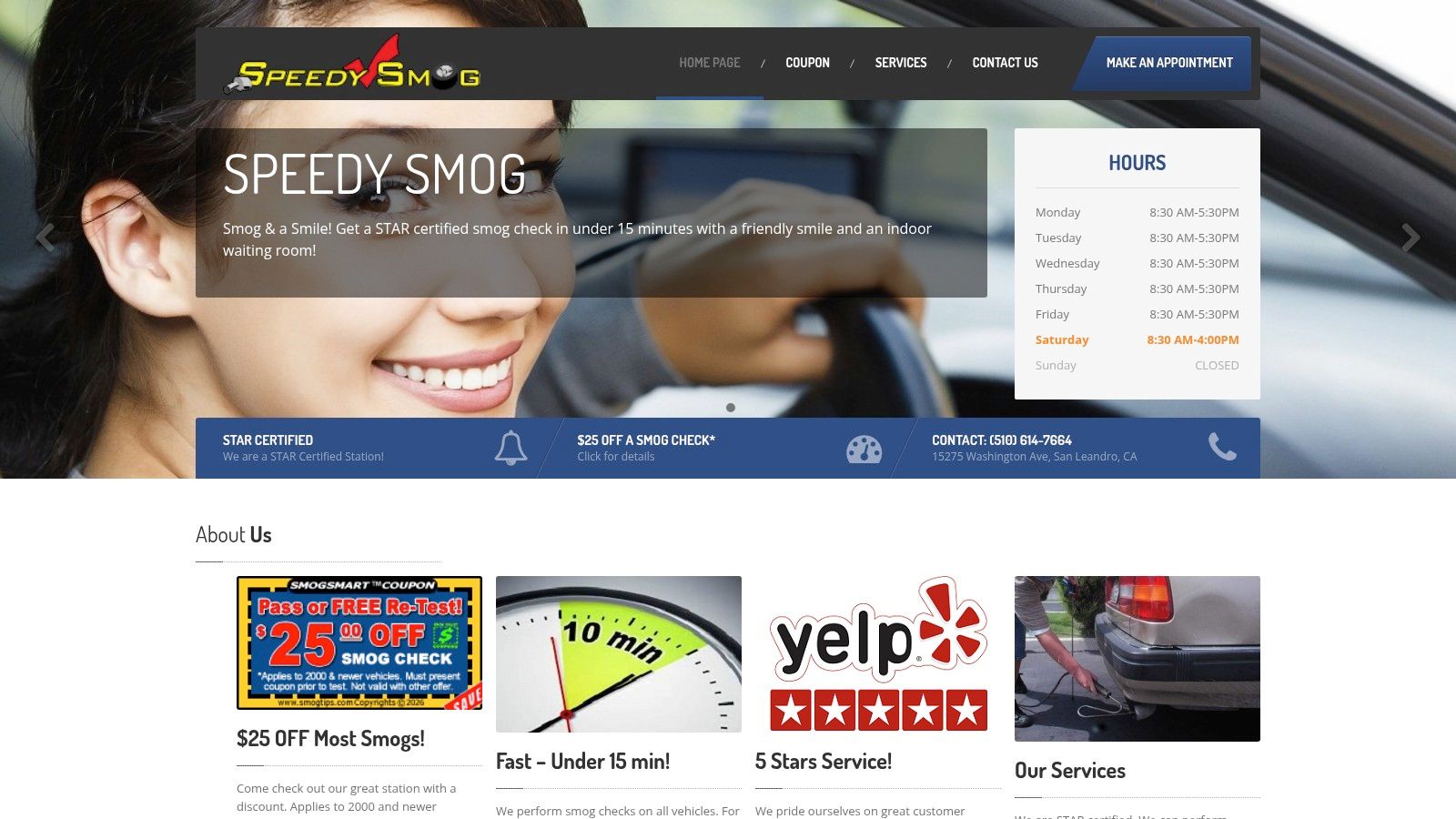
Before you go, it's still smart to call ahead or check the business website for current hours, coupon details, and any vehicle-specific questions.
Frequently Asked Questions About Smog Checks
What happens if my car fails the smog check
You'll be told what part of the inspection caused the failure, and then the car will need repairs before it can pass. Some California motorists may qualify for up to $500 in state-funded financial assistance for repairs, as noted in the earlier STAR comparison section's cited source.
How long is my smog certificate valid
A smog certificate for DMV purposes is generally used within your registration window. If you're close to your deadline, don't wait around after passing. Finish the renewal while everything is current.
Do I need a smog check every year
Many California drivers are used to periodic renewal-related smog requirements, but the exact timing depends on the vehicle and registration situation. Your DMV renewal notice is the document to trust because it tells you whether a smog inspection is required for that cycle.
If my notice says STAR, can I still go to any smog shop
No. If the notice specifically says STAR is required, use a STAR-certified station. That requirement is about using a shop authorized to certify your inspection for DMV under the STAR program.
If you need a fast, straightforward visit in San Leandro, Speedy Smog is a STAR Certified station that helps drivers handle DMV smog requirements without the usual confusion. Bring your renewal notice, arrive with the car warmed up, and the team can help you get tested, certified, and back on the road with less hassle.
Most vehicles in California need a smog check every two years for registration renewal, and Fremont prices commonly range from $55 to $90. If your DMV notice says smog certification is required, the fastest way to avoid a wasted trip is to confirm whether your car needs a regular station, a STAR station, or no test at all before you go.
That's usually the problem. Not finding a shop. Finding the right shop for your vehicle, your DMV notice, and your test type.
In Fremont, you'll see plenty of stations advertising fast service, coupons, and “all vehicles.” That sounds helpful until you show up with a title transfer, an older gasoline car, a diesel, or a renewal notice that specifically requires STAR. Then speed matters less than eligibility. The good news is that the process is simple once you sort those basics out.
Table of Contents
- Your Fremont Smog Check Roadmap for 2026
- Do You Actually Need a Smog Check in Fremont
- STAR Station vs Regular Smog Check What Is the Difference
- The Smog Check Process From Arrival to DMV Certificate
- Fremont Smog Check Costs and Tips to Pass the First Time
- What to Do If Your Vehicle Fails the Smog Check
Your Fremont Smog Check Roadmap for 2026
Your registration notice lands in the mailbox, you spot “smog certification required,” and the first real question is not price. It is whether you need a STAR station or a regular smog station. Get that wrong, and you waste a trip before anyone even plugs into the car.
In Fremont, the process goes smoothly when you sort out three things first. Confirm that your vehicle needs a test, confirm whether DMV requires a STAR inspection, and confirm what kind of testing your vehicle is likely to get based on its age and type. That last part matters more than many local guides admit. A late-model gasoline car is usually straightforward. An older vehicle, diesel, hybrid, out-of-state registration, or transfer-related test can change what the station needs to do.
Start with the paperwork, not the coupon.
What matters most before you leave
Use this order so you do not lose time:
- Read the DMV notice carefully. If it calls for STAR, go to a STAR-certified station.
- Match the shop to the vehicle. Some Fremont stations are set up for quick routine tests. Others are better for older or less common cases.
- Budget time based on the car you have. Newer cars are often faster to process. Older cars and special cases can take longer.
Practical rule: A low advertised price does not help if the station cannot perform the test your registration requires.
California runs smog checks through a statewide system of licensed stations and technicians. The Bureau of Automotive Repair's smog program reporting shows how closely the state tracks inspections, outcomes, and station activity. For Fremont drivers, the useful takeaway is simple. There are plenty of shops, but they do not all handle the same mix of vehicles or DMV requirements.
That is the part many drivers miss.
A regular station may be fine for one car and wrong for the next. A STAR station can handle vehicles that DMV has flagged for STAR, and some drivers only find that out after showing up at a non-STAR shop. If you remember one thing before booking a Fremont smog check, remember this: the right station depends on your notice and your vehicle, not just the closest sign on Fremont Boulevard.
Do You Actually Need a Smog Check in Fremont
You buy the tag, head to a smog shop, and then find out your car was exempt or your DMV notice required a different kind of station. That is a common Fremont mistake, and it is easy to avoid if you check the paperwork first.
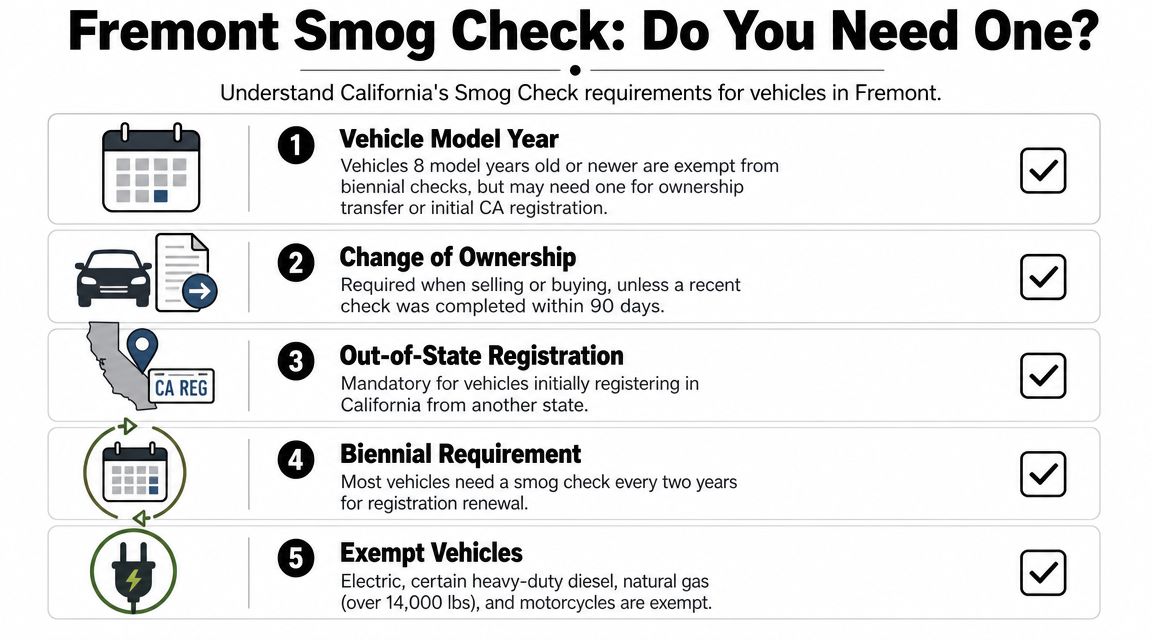
The fastest way to decide
Start with your DMV renewal notice. If it says a smog inspection is required, treat that as your answer. If it says STAR, that detail matters just as much as the test itself because a regular station will not meet the requirement.
Smog checks in Fremont usually come up in a few predictable situations:
- Registration renewal: The most common reason.
- Change of ownership: Many vehicle sales require a current smog certificate.
- First-time California registration: Out-of-state vehicles often need testing before registration can be completed.
- Certain vehicle categories: Diesel, hybrid, RV, and other special cases need closer review.
- Older vehicles with exemption questions: Drivers often guess incorrectly.
A lot of local guides stop at "check if you need a smog." The more useful question is whether your vehicle needs a smog check, and if so, whether the DMV is sending you to a STAR station or allowing a regular one.
Vehicle types that are often exempt
Exemptions depend on the vehicle, fuel type, and model year. According to this Fremont smog eligibility guide, gasoline vehicles from 1975 and older, diesel vehicles from 1997 and older, and all-electric vehicles are exempt from standard smog testing.
That breakdown matters in real life. A 1975 gas vehicle and a 2005 hybrid do not belong in the same bucket, and treating them the same is how people waste an afternoon.
| Vehicle situation | Likely next step |
|---|---|
| Typical DMV renewal vehicle | Check the notice for smog and STAR requirement |
| Gasoline vehicle 1975 or older | Often exempt |
| Diesel vehicle 1997 or older | Often exempt |
| All-electric vehicle | Exempt |
| Motorcycle or trailer | Usually not part of the standard smog program |
If you drive a hybrid, diesel, RV, or an older gasoline vehicle, call ahead before you go. Ask two direct questions. Does this vehicle need a smog check, and if it does, can this station perform the exact test listed on my notice?
That two-minute check can save you the trip, the line, and the repeat visit.
STAR Station vs Regular Smog Check What Is the Difference
A lot of Fremont drivers lose time on smog day for one simple reason. They go to a station that cannot perform the test their DMV notice requires.
A STAR station is a smog station that meets California's higher performance standards. The practical difference is straightforward. If your renewal notice says STAR, you need a STAR-certified station. A regular station cannot complete that requirement, even if it is cheaper or closer.
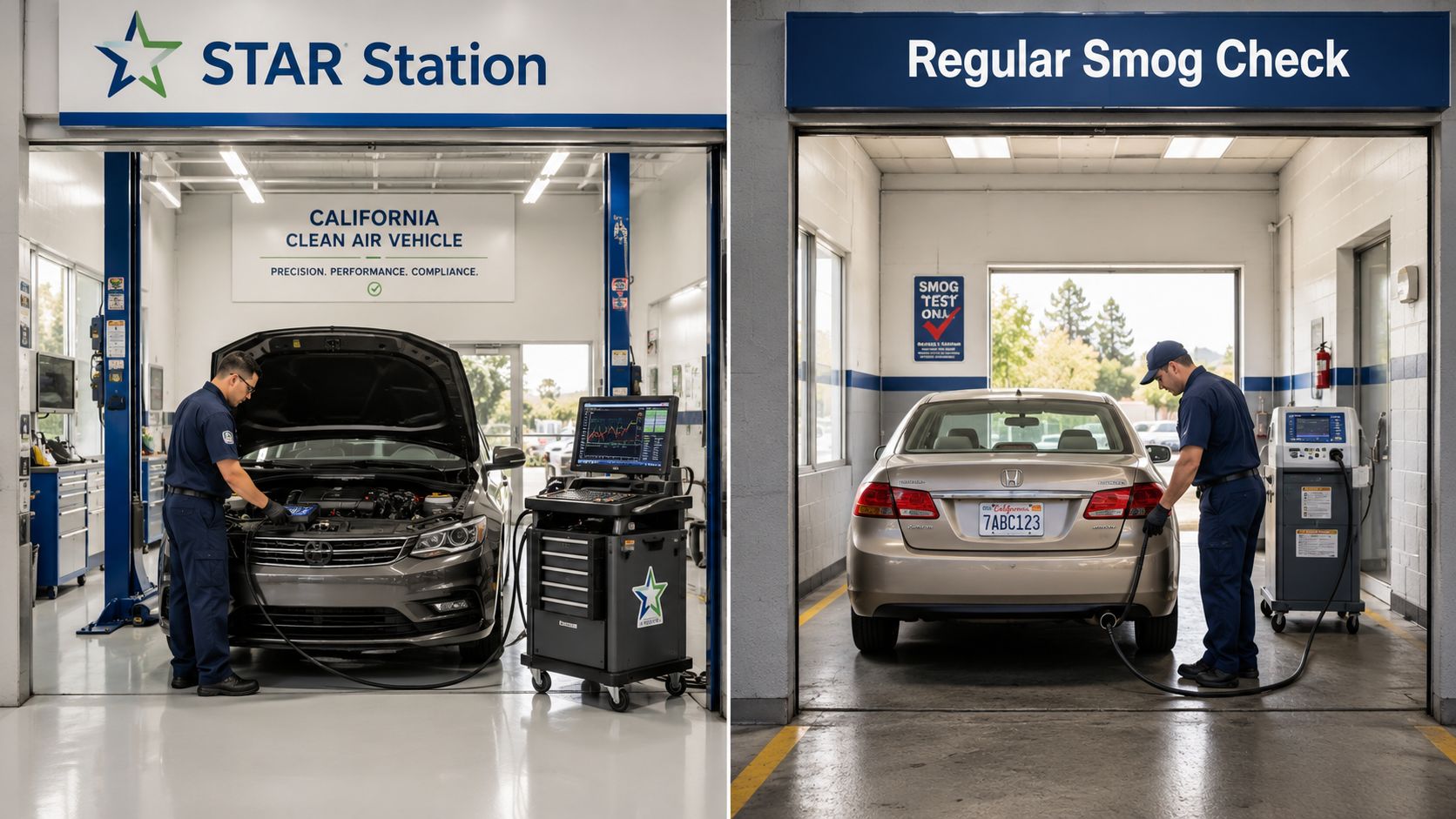
What STAR means
Treat STAR as a DMV routing instruction, not a quality label.
That one detail decides where you can go. It also affects how much time you spend solving the problem. Drivers who miss it often make two trips. First to the wrong shop, then to a STAR station after finding out the hard way.
For many 2000-and-newer vehicles, the test is often faster because it relies on the car's onboard diagnostics system, as explained in this OBD smog testing overview. Older vehicles and less standard cases can take more technician time, especially when the DMV notice requires STAR or the vehicle falls outside the typical commuter-car pattern.
Here's the trade-off:
- Regular station: Works if your paperwork does not require STAR.
- STAR station: Required if the DMV notice says STAR.
- Older, diesel, hybrid, or unusual registration case: Call first and confirm the station handles that exact test type.
Which vehicles and situations should be checked twice
The biggest time-wasters are not always problem cars. They are cars with paperwork or test-type details that drivers assume are standard.
Double-check before leaving home if you have:
- A DMV renewal notice that says STAR
- An older gasoline vehicle
- A diesel
- A hybrid
- An out-of-state registration
- A title transfer situation
If you are in Fremont but open to a nearby East Bay option, one station some drivers use is Speedy Smog in San Leandro, a STAR-certified shop that handles newer vehicles, older vehicles, diesels, and hybrids.
The smart move is simple. Read the notice, confirm whether STAR is required, then call the station and ask if they perform your vehicle's exact test. That two-minute call usually saves more time than price shopping first.
The Smog Check Process From Arrival to DMV Certificate
You pull into a Fremont smog station, hand over your renewal notice, and then find out the shop cannot run your required test. That is the avoidable mistake. Once you are at a station that matches your vehicle and DMV notice, the rest is usually straightforward.
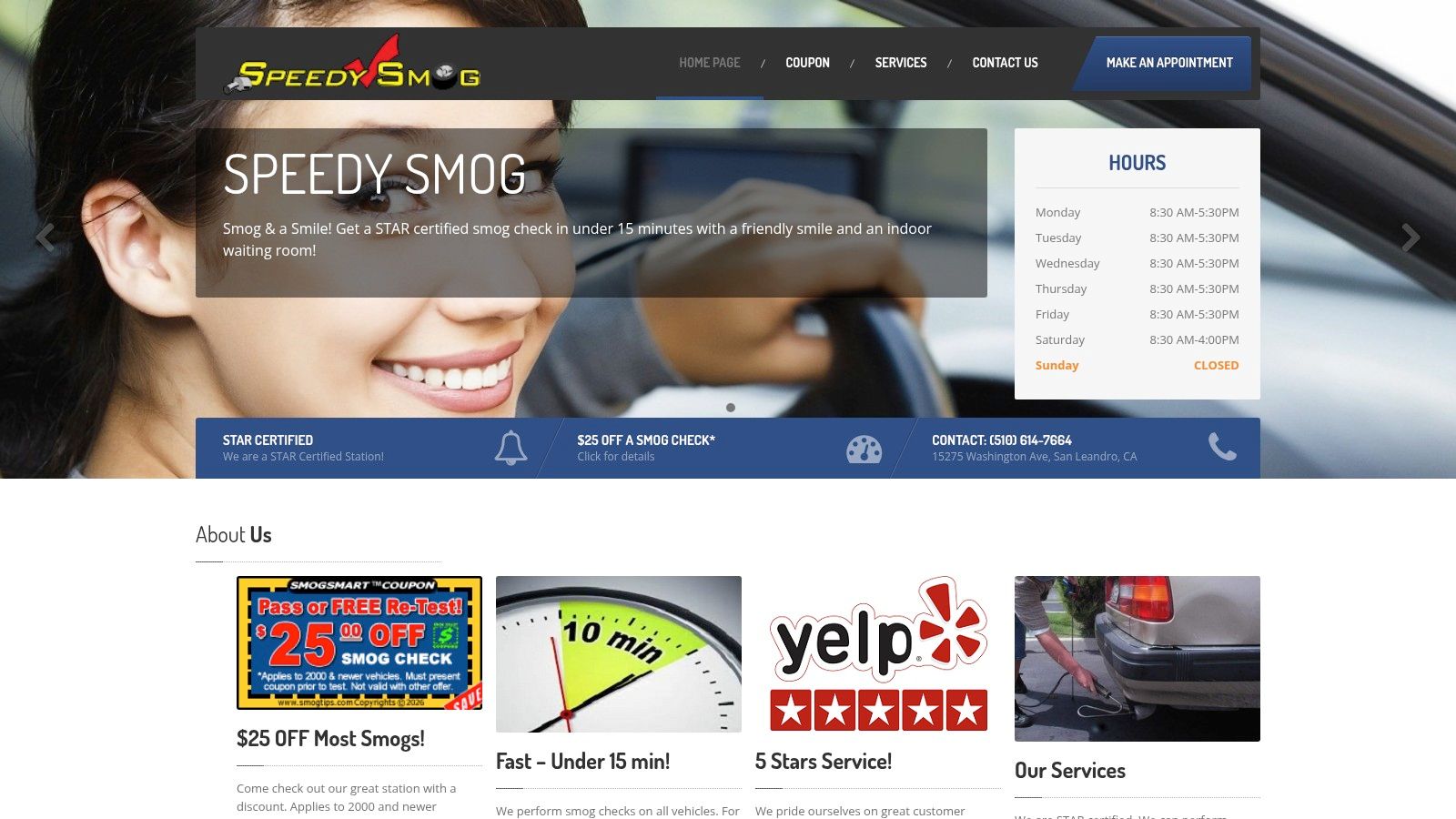
What to bring and what happens first
Bring the documents that help the technician identify the correct test the first time:
- Your DMV renewal notice, especially if it shows a STAR requirement
- Current registration, to confirm the vehicle record
- Driver's license, if the station asks for identification
- Title transfer or out-of-state paperwork, if this is not a routine renewal
At check-in, the station verifies the VIN, plate, model year, and the reason for the inspection. This is the point where STAR versus regular station capability matters in real life. A standard renewal for a newer gasoline car usually moves quickly. A transfer, out-of-state case, diesel, or older vehicle may follow a different inspection path and take longer.
What the technician actually does
For many newer vehicles, the test centers on the onboard diagnostics system. The technician connects the equipment, checks required monitors, confirms the emissions-related systems report correctly, and makes sure there is no disqualifying issue such as an active check engine light.
Older vehicles and less common cases can involve more manual verification and a longer bay time. That is why two drivers can arrive at the same shop at the same time and leave far apart.
A good question at the counter is simple: “Are you set up for my exact vehicle and test type today?”
Here is the usual flow:
Check-in and vehicle verification
The station confirms your paperwork, vehicle details, and the correct inspection category.Smog inspection and testing
The technician runs the test required for that vehicle, not just the test a typical commuter car gets.Results submission
If the vehicle passes, the station submits the result electronically to the state system.
Later in the visit, it helps to know what the electronic side looks like:
What happens after you pass
If the car passes, you usually do not need to carry a paper certificate to DMV. The result is typically transmitted electronically, and that is what clears the way for registration or transfer processing.
Keep your receipt anyway. If there is ever a delay in DMV records updating, the receipt gives you the test date, station information, and vehicle details in one place. That small habit can save a second trip or a long phone call later.
Fremont Smog Check Costs and Tips to Pass the First Time
You save the most money before you pull into the bay.
In Fremont, the posted smog price is only part of the cost. The bigger money saver is choosing a station that can perform your exact test the first time. If your DMV notice requires STAR and you show up at a regular station, the cheap coupon stops being cheap once you add another drive, another wait, and a second appointment.
What Fremont drivers are paying
Fremont shops commonly advertise prices across a fairly wide range, from lower-cost basic tests to higher fees for stations that handle more inspection types or charge extra for certain vehicles. Local listings often show routine inspections for many eligible cars finishing quickly, but that only applies when the vehicle is a straightforward match for that station.
The useful takeaway is simple. Compare price, but verify fit first.
A low advertised rate makes sense for a standard gasoline vehicle that only needs a regular smog check. It is less useful for a STAR-directed renewal, an older vehicle, a diesel, or paperwork situations like a title transfer where the wrong station choice can waste half your afternoon.
How to avoid paying twice
Ask one question before you go: “Can you do my exact vehicle and required test type today?”
That question filters out a lot of bad trips. It matters more than shaving a few dollars off the test fee.
A few habits also improve your odds of passing on the first visit:
- Drive the car long enough to fully warm it up before testing.
- Fix any active check engine light before you book the inspection.
- Do not rush in right after clearing codes or disconnecting the battery.
- Match the shop to the job, especially for STAR notices, diesels, older vehicles, and transfer-related tests.
- Take care of rough running, hard starts, or obvious maintenance problems before your registration deadline gets close.
One practical trade-off comes up all the time. A bargain station can be the right choice for a newer car with a normal renewal and no warning lights. For anything less routine, paying a little more for the right station is often cheaper than repeating the process.
The best first-time pass strategy is boring but effective: bring a warmed-up car, show up with no warning lights, and confirm the station can perform your required test before you leave home.
That STAR versus regular station distinction is where Fremont drivers lose the most time. Get that part right, and the rest of the visit is usually straightforward.
What to Do If Your Vehicle Fails the Smog Check
A failed test is frustrating, but it's not unusual, and it doesn't mean you're stuck. The worst move is guessing at the repair.
Read the failure paperwork first
Start with the inspection report. It tells you why the vehicle didn't pass and gives the repair shop a place to begin. Don't treat it like a generic rejection slip. It's your roadmap.
If the failure reason isn't obvious to you, ask a licensed repair technician to explain it in plain English. You want the cause, not just the symptom.
Fix the cause, then retest
After a failure, the normal path is straightforward:
- Get the issue diagnosed
- Have the emissions-related problem repaired
- Return for a retest
What doesn't work is chasing random parts, clearing codes to try again, or bouncing from shop to shop without a diagnosis. That usually burns more money than a proper repair plan.
If repair cost is the main concern, check whether California's Consumer Assistance Program (CAP) can help with emissions-related repairs for eligible vehicle owners. The key word is eligible, so verify current program requirements before making assumptions.
If your registration deadline is close, move quickly but don't rush into the wrong repair. A focused diagnosis is almost always cheaper than replacing parts based on hunches.
If your DMV notice requires STAR, or your vehicle falls into an older, diesel, hybrid, title-transfer, or out-of-state category, Speedy Smog is one East Bay option for a compliant inspection without the guesswork about station type.
You open the DMV renewal notice, see Smog Check Required, and your first thought usually isn't about clean air. It's about time, cost, and whether that coupon you found online is real once you pull into the lot.
That's the part most Dublin drivers get stuck on. Not the idea of a smog test itself, but the two practical questions nobody answers clearly enough. What will I really pay out the door? And does my specific vehicle even need a test right now? If you drive a hybrid, diesel, newer gas car, or a vehicle the DMV flagged for STAR, the answer isn't always obvious from a shop ad.
A good Dublin smog check experience comes down to knowing your status before you go, preparing the car so you don't fail for something avoidable, and calling the station with the right questions. That saves more frustration than chasing the lowest advertised price.
Table of Contents
- Why Your DMV Renewal Says Smog Check Required
- Do You Actually Need a Smog Check in Dublin
- How to Prepare Your Car to Pass the First Time
- What Happens During the Smog Inspection
- Finding a Good Smog Station and Understanding Real Costs
- What to Do If Your Vehicle Fails the Smog Test
Why Your DMV Renewal Says Smog Check Required
You open the renewal notice, see “smog certification required,” and the first question is usually whether the DMV made a mistake. In Dublin, that flag usually means your registration hit one of California's regular emissions checkpoints. It is part of the registration process, not a suggestion and not a coupon-driven upsell from a test station.
California has tied emissions testing to registration for decades. As All Star Smog's review of the California smog testing program explains, the program began in 1966 and later expanded to biennial testing for many 1976-and-newer vehicles. That background helps explain the notice. The DMV is checking whether your vehicle still meets the state's emissions rules before it renews the registration.
It's tied to registration for a reason
From the shop side, this part is straightforward. A car can run normally, show no obvious drivability problem, and still have an emissions issue that matters at renewal time. Oxygen sensors get lazy. Catalytic converters lose efficiency. Readiness monitors stay incomplete after a battery disconnect. None of that is visible from the DMV letter, but the registration hold is what gets the issue into the system.
Practical rule: If the renewal notice says a smog check is required, treat it like a deadline item attached to your tags.
That matters because delay costs money and time in ways drivers do not expect. The advertised coupon price is only useful if you need the test being advertised, and many drivers do not confirm that until they are already at the counter. The smarter move is to start with the DMV notice, then confirm the vehicle class and test requirement before chasing the cheapest ad.
Why careful maintenance does not exempt you
A well-maintained car can still be selected for testing because the requirement is based on the vehicle's registration cycle and classification, not on how carefully the current owner has driven it. What matters is the car's model year, fuel type, prior records, and the DMV transaction in front of you.
That is why the notice can feel inconsistent from one renewal to the next, especially in households with a hybrid, a newer gasoline car, or a diesel. The rule set is not intuitive, and the exemptions are where drivers get tripped up most often. Getting that part right first saves an unnecessary trip, and it keeps you from paying for the wrong inspection or assuming a coupon applies when your vehicle falls into a different category.
Do You Actually Need a Smog Check in Dublin
Confusion often arises from conflicting information. Drivers hear one rule from a friend, another from a coupon page, and a third from the DMV notice itself. The cleanest way to handle a Dublin smog check is to sort your vehicle into the right bucket first.
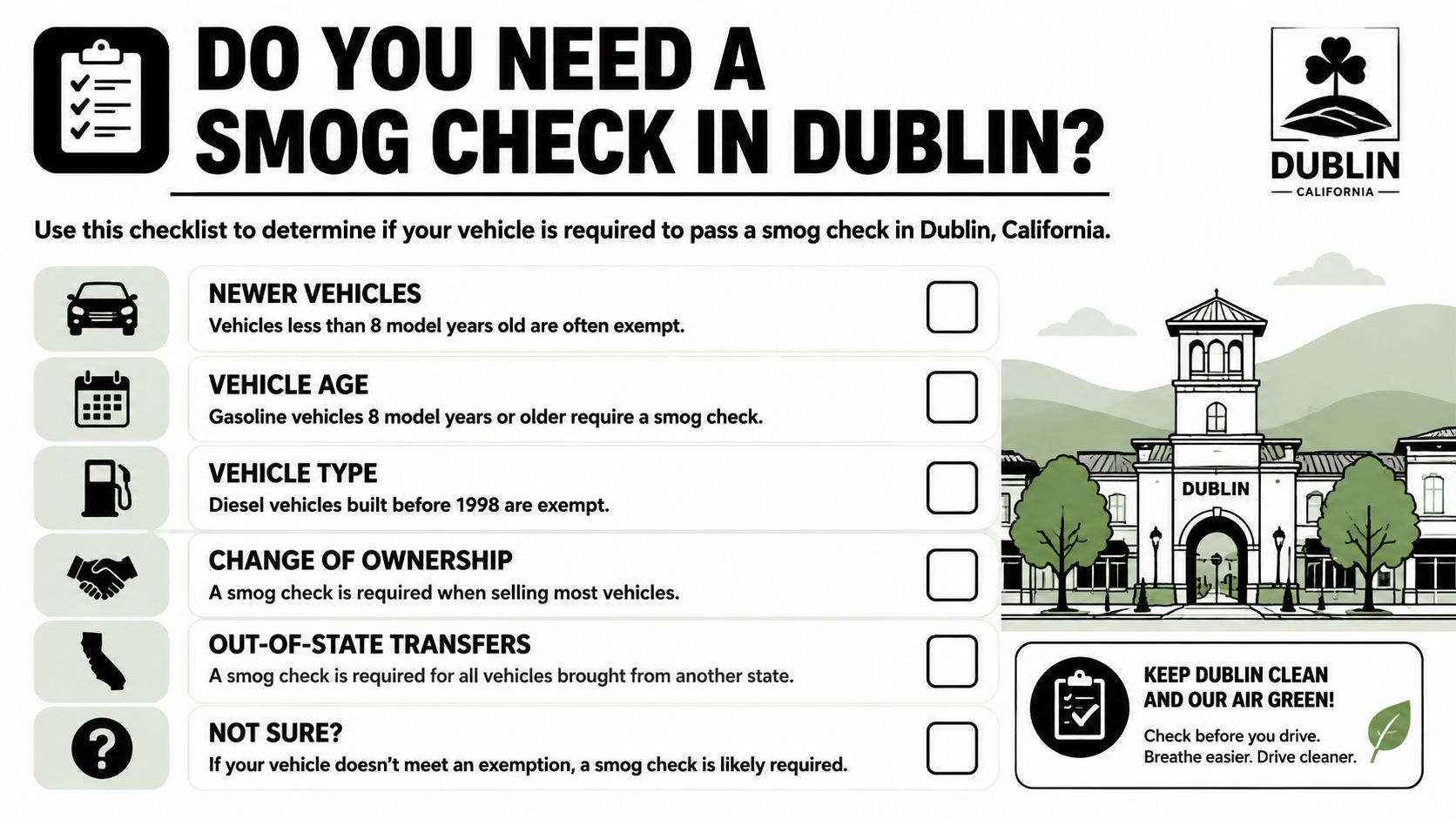
The simple decision rule
Many vehicles manufactured in 1976 and newer need inspection, but there are important exceptions. According to Kahler's overview of smog check rules in Dublin, most vehicles in that group need a test, while key exemptions can apply to certain hybrids, electric vehicles, motorcycles, and some diesels. The same source also notes that many newer gasoline vehicles are exempt for their first six years on the road.
That means “new car” and “smog exempt” are not always the same thing. A lot depends on model year, fuel type, and how the DMV classifies the vehicle for the registration event in front of you.
Here's the practical breakdown:
- Most gasoline vehicles: If they fall into the inspection pool and aren't in the early exemption window, they'll usually need testing.
- Newer gasoline vehicles: Many are exempt for the first six years, which is why some owners don't deal with smog right away.
- Electric vehicles: These are commonly assumed out of the smog process, and that's usually the first easy category to rule out.
- Hybrids: These confuse people because “efficient” doesn't always mean “excluded.” Some are exceptions, some still require scrutiny depending on the rule set that applies.
- Diesels: These need special attention because diesel rules don't line up neatly with gas-car assumptions.
- Motorcycles: Often treated separately from what drivers expect when they hear “vehicle smog.”
Where drivers get tripped up
The mistake isn't just misunderstanding exemptions. It's assuming a vehicle category tells the whole story.
A hybrid owner may assume the car is automatically exempt because the vehicle is partially electric. A diesel owner may think all diesels are treated the same. Someone with a newer vehicle may assume the age alone settles it. It doesn't. The DMV notice, the registration event, and the exact vehicle type all matter.
If you're not sure, don't search for the cheapest test first. Confirm whether your vehicle needs a standard station or a STAR station, and whether it needs testing at all.
A second source of confusion is change of ownership or other registration-related triggers. Even drivers who don't normally think about smog can run into it when paperwork changes hands. If your registration situation changed recently, don't rely on what happened at your last renewal cycle.
How to Prepare Your Car to Pass the First Time
Most first-time failures aren't mysterious. They come from things the owner could have caught the day before, or from bringing in a car that hasn't been driven in a way that lets the emissions system settle properly.
A little prep won't fix a bad catalytic converter or a dead sensor. It will prevent the easy mistakes that waste a trip.
The checks worth doing before you leave home
Use this as a short pre-smog routine, especially if the car hasn't been driven much lately.
| Check | Action | Why It Matters |
|---|---|---|
| Check engine light | Make sure it is not illuminated | An active warning light can trigger an automatic problem before the test gets far |
| Recent driving | Drive the car long enough to fully warm it up, including steady road driving if possible | A warmed-up engine and emissions system generally test more consistently than a cold car |
| Battery history | If the battery was recently disconnected or replaced, drive the vehicle enough for monitors to reset | Freshly cleared systems can leave readiness status incomplete |
| Fuel cap | Tighten it and inspect for an obvious sealing problem | A loose or damaged cap can create emissions-related issues |
| Tires | Inflate to proper pressure | If the vehicle needs running inspection steps, basic readiness helps everything go more smoothly |
| Oil and basic maintenance | If service is overdue, handle the basics first | Neglected maintenance can contribute to rough running and emissions trouble |
Easy mistakes that cause avoidable failures
Some drivers clear a check engine light right before the appointment and assume they've solved the problem. Usually they've just hidden it temporarily. The underlying fault is still there, and the car may show incomplete readiness when the station connects to it.
Another common issue is bringing in a car that's been sitting. A vehicle that's only been driven on short hops can behave differently from one that's been fully warmed up. If the car is due for a Dublin smog check this week, don't make the test the first real drive it has seen in days.
A smog appointment is not the time to find out your battery reset the monitors, your gas cap is loose, or your dashboard warning light came back on halfway there.
If the car runs rough, stalls, smells strongly of fuel, or idles oddly, don't talk yourself into “maybe it'll pass anyway.” It's better to sort that out first than pay for a test result that only confirms what the car was already telling you.
What Happens During the Smog Inspection
You've done the prep, driven over with the engine warm, and now you want to know one thing. What are they going to do to the car?
For Dublin drivers, the visit itself is usually the simplest part. The station checks your paperwork, confirms what test type your DMV notice calls for, and matches that to the vehicle. That first step matters more than people expect, especially with cars that fall into exemption gray areas or need a STAR station instead of a standard test-only shop.
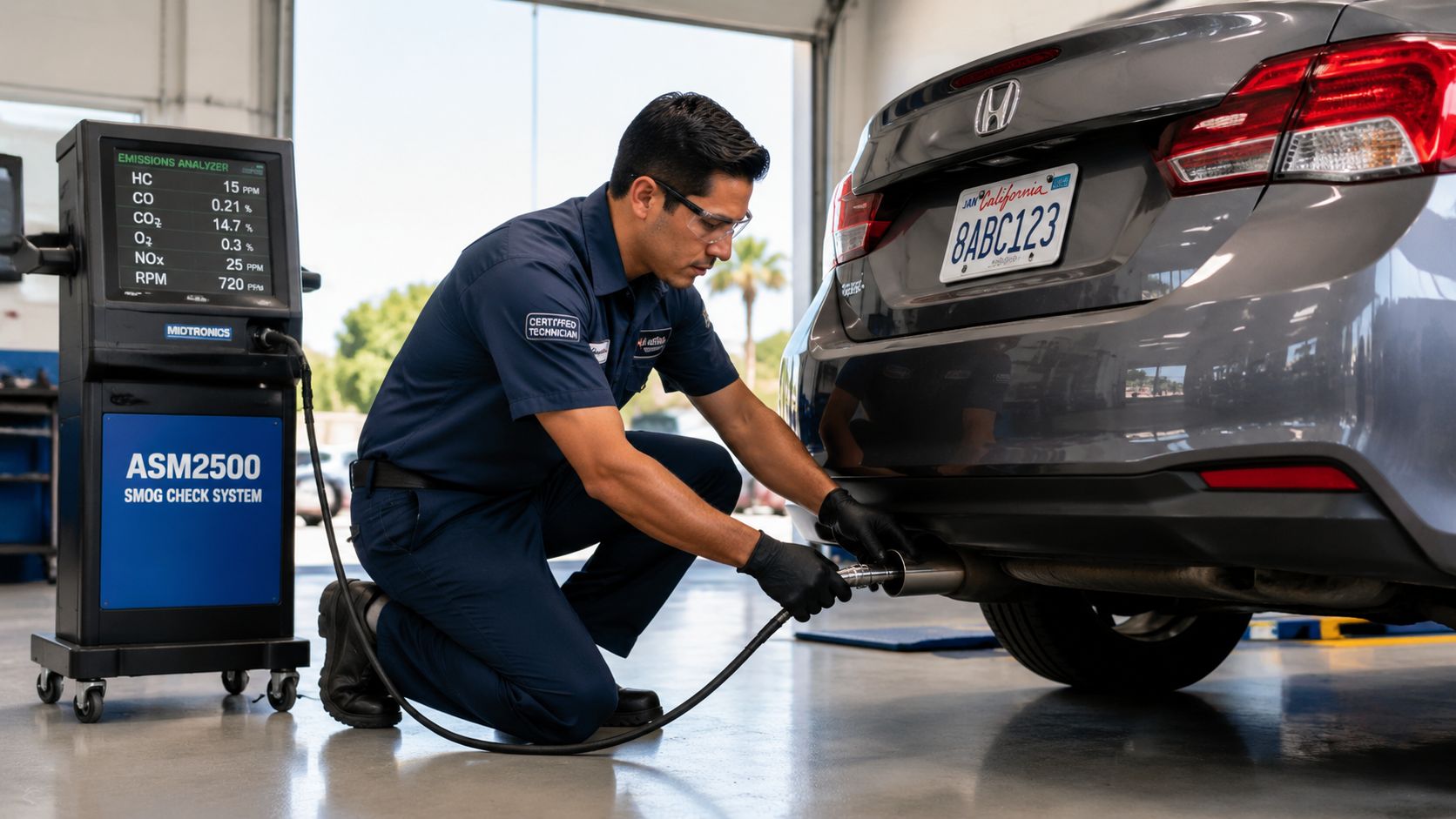
What the visit looks like from start to finish
Once the car is checked in, the technician usually starts with a basic inspection of emissions-related items and the dashboard warning lights. If the check engine light is on, that is usually the first hard stop. A decent shop will tell you that quickly instead of running you through the rest of the process just to hand you a failure.
After that, the test method depends on the vehicle.
Many newer cars go through an onboard diagnostics check. The station connects to the car's computer and looks for stored trouble codes, readiness status, and other emissions-related data. Older vehicles can involve different procedures, so the sequence is not identical for every car that pulls into the bay.
That difference is where drivers get confused. Hybrids, diesels, and newer gasoline cars do not always follow the same path, and some owners assume a “smog check” means one universal test. It doesn't. The station is confirming that your specific vehicle meets the requirement tied to its model year, fuel type, and DMV record.
Here's a short explainer if you want to see the process in action:
What you leave with
If the vehicle passes, the result is sent electronically to the DMV, and you should keep your receipt for your own records. That electronic filing is one reason I tell drivers not to wait until the last day. If anything needs to be corrected at the counter, you want time to fix it without turning registration into a rush job.
If the vehicle fails, you'll get a report showing why. Keep that sheet. It gives a repair shop something concrete to work from, which is a lot better than authorizing parts based on a guess or a vague “smog issue” description.
One practical tip. Before you leave the station, ask the staff to confirm whether the test result and vehicle information were entered exactly as shown on your registration. Small data-entry mistakes are rare, but they are easier to catch on the spot than after you get home.
The appointment is usually short. The primary value is knowing what kind of test your car is getting, and why. That helps you avoid wasting money on the wrong appointment, the wrong station, or a last-minute retest you could have prevented.
Finding a Good Smog Station and Understanding Real Costs
Dublin drivers will find their greatest opportunity to save themselves aggravation. The advertised coupon is often the least useful number in the whole transaction.
One public Dublin listing cited an “out the door” regular smog price of $61.66 and noted that STAR certification adds $20, according to a review on Yelp's Dublin Automotive and Smog page. That's the clearest example of the pricing gap drivers run into. A low headline price doesn't tell you what happens once certificate fees, STAR requirements, and vehicle-specific surcharges enter the picture.
Advertised price versus actual price
A coupon can still help. The problem is that many ads answer the wrong question.
Drivers usually don't want to know the lowest possible starting number. They want to know:
- Whether the shop can perform the test their DMV notice requires
- Whether STAR status changes the total
- Whether the posted deal excludes certain vehicle types
- Whether the quote already includes mandatory fees
- Whether the final total is the same price they'll hear at the counter
That's why “How much is your smog?” is too broad. Ask for the out-the-door total for your specific vehicle and your specific requirement.
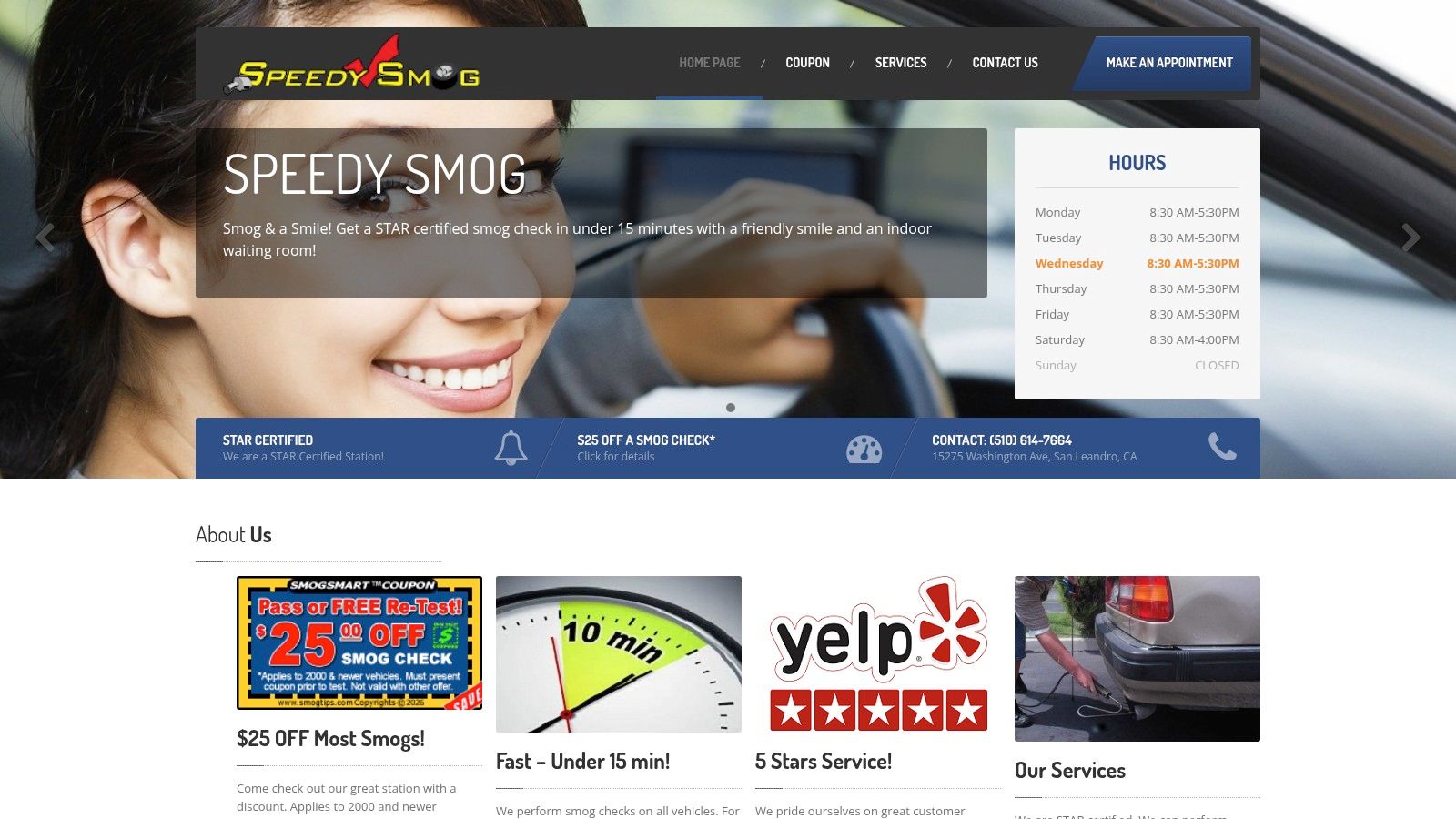
What to ask before you drive over
Call the station and keep it simple. A good front desk should be able to answer quickly.
- Tell them your DMV status: Say whether your notice calls for STAR or standard testing.
- Give the vehicle basics: Model year, fuel type, and whether it's hybrid or diesel.
- Ask for the total, not the teaser rate: Use the phrase out-the-door price.
- Ask what the coupon excludes: Some discounts sound broad until the exclusions appear.
- Confirm turnaround: If you're trying to handle registration the same day, timing matters.
What doesn't work is choosing a station only because the ad looks cheapest. If the shop can't do the required test, or if the final bill shifts once fees are added, you haven't saved anything. You've just added another stop to your day.
What to Do If Your Vehicle Fails the Smog Test
A failed test feels worse than it usually is. Most failures come down to a small group of emissions-related issues, and the paperwork points you in the right direction if you read it carefully.
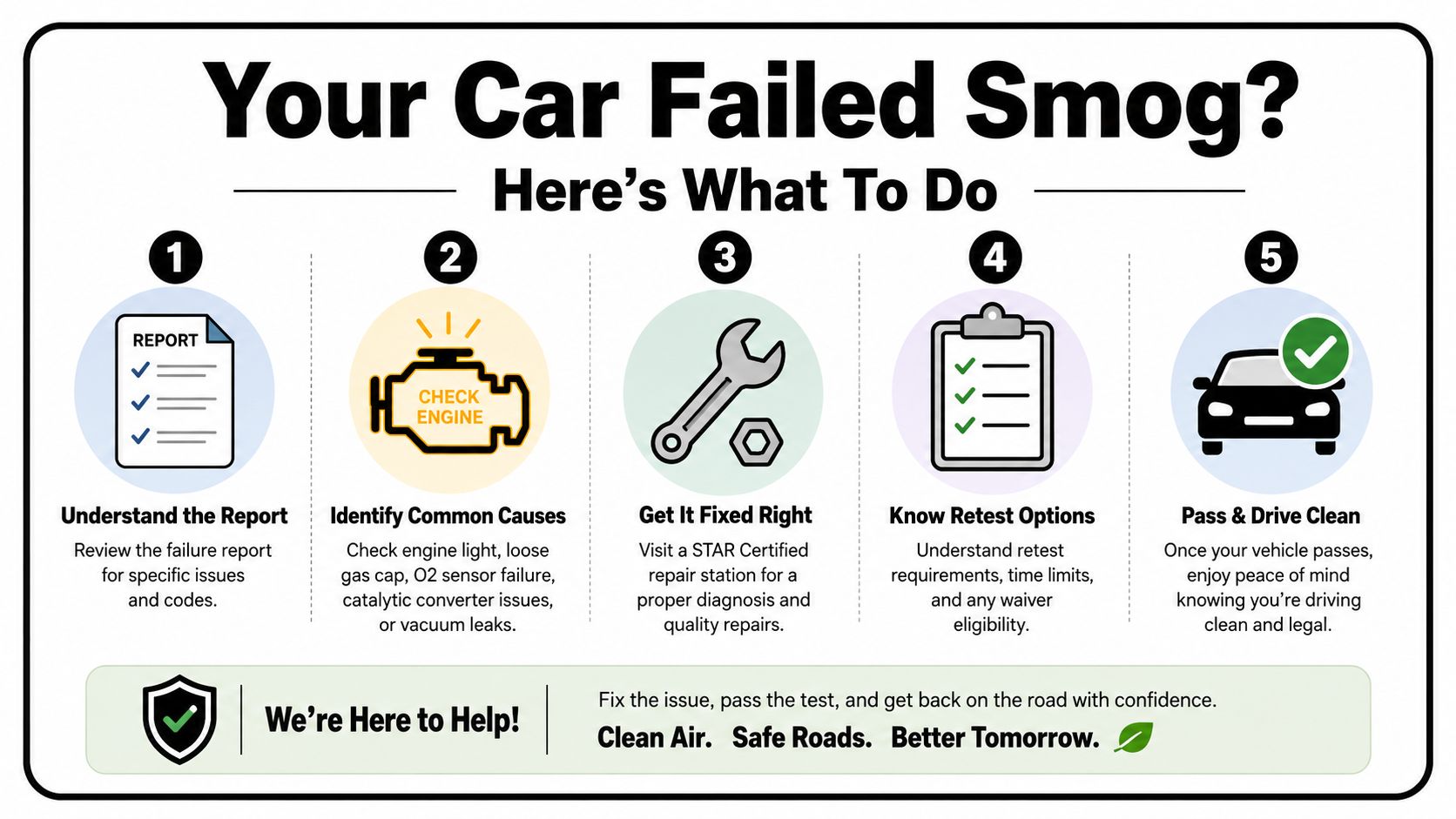
Read the report before approving repairs
Start with the Vehicle Inspection Report. Don't skip straight to “fix whatever it needs.” The report is there to narrow the problem.
Common trouble spots include:
- Check engine related faults: If the light is on, the car is already telling you something is wrong.
- Loose or failing gas cap: Simple, but worth checking first.
- Oxygen sensor issues: These can throw off emissions readings even when the car still drives normally.
- Catalytic converter problems: A frequent reason older vehicles struggle to pass.
- Readiness problems after battery disconnects or recent repairs: The repair may be done, but the system may not be ready for testing yet.
Fix the cause, not the symptom
Take the report to a licensed repair technician and ask them to diagnose the failure reason, not just erase codes. Clearing a warning and rushing back for a retest usually wastes time.
If repair costs are a concern, California also has a Consumer Assistance Program, often referred to as CAP, for some eligible vehicle owners needing emissions-related help. Check the state program details before assuming you're on your own.
Bring the failure report with you. It gives the repair shop a starting point and keeps the conversation focused on the actual emissions issue.
After repairs, make sure the car is fully ready for retesting. If a technician fixed the problem but the vehicle still needs drive time for its systems to complete their checks, going back too soon can set you up for another failure.
If you want a STAR-certified option nearby with straightforward service, Speedy Smog is worth a look for East Bay drivers who care about fast turnaround, clear pricing, and getting the inspection handled without the usual runaround.

Your DMV renewal notice shows up, you glance at it, and there it is. Smog check required. Now you're wondering where to go in Fairfield, what it'll cost, how long it'll take, and whether your car is about to fail over something stupid.
Good news. A smog check in Fairfield, CA usually isn't a big ordeal if you handle it the smart way. Common pitfalls that waste time include showing up at the wrong station, bringing in a car with a fresh battery disconnect, or assuming every shop prices the test the same. That's how a simple errand turns into a half-day headache.
This guide is the practical version. No legalese. No fluff. Just what matters if you want to get your certificate, protect your registration, and get back on the road without burning extra money.
Table of Contents
- First Steps Your Fairfield Smog Check Requirements
- How to Choose the Best Smog Station in Fairfield
- Preparing Your Vehicle for a Guaranteed Pass
- What Happens During the Smog Inspection
- Navigating Your Smog Test Results
- Fairfield Smog Check Common Questions
First Steps Your Fairfield Smog Check Requirements
You open your registration notice, see “smog required,” and wonder if this is going to be a quick stop or a half-day headache. Here's the straight answer. In Fairfield, it's usually simple if you check the right things first.
Start with the DMV notice. If it says your vehicle needs a smog check, treat that as your marching orders unless your car clearly falls under an exemption. That one move saves people a lot of wasted time, because the confusion usually comes from guessing based on something a friend said, not from reading the paperwork in front of them.
A smog check commonly comes up in three situations:
- Registration renewal
- Transfer of ownership
- First-time California registration for an out-of-state vehicle
Timing matters too. Smog certifications do not sit around forever. If you test too early and then drag your feet on the DMV side, you can end up paying for another test. My advice is simple. Get the smog done close enough to your renewal or transfer date that you can finish the paperwork right away.
Start with the exemption check
Before you book anything, confirm whether your vehicle is subject to testing.
The common exemptions include:
- Gasoline vehicles from 1975 and older
- Older diesel vehicles that fall outside current testing rules
- Diesel vehicles over 14,000 pounds GVWR
- Electric vehicles
- Motorcycles
- Some newer vehicles or hybrids that fall under limited exemption rules
If your vehicle does not fit one of those categories and the DMV notice says smog required, stop debating it and plan the test.
Shop-floor advice: Match three things before you do anything else. Your DMV notice, your model year, and your fuel type. That gets you to the right answer fast.
What Fairfield drivers should do first
Do not start by hunting for the cheapest coupon. First, confirm whether you need a regular station, a STAR station, or no test at all. That decision affects where you go, what you pay, and whether you waste a trip.
California's smog program is there to make sure the emissions system is still working the way it should. For you, the practical takeaway is this: a car with no warning lights, a fully warmed-up engine, and no obvious running issues usually has a much easier path.
Use this quick check before you schedule anything:
| Situation | Likely need a smog check |
|---|---|
| DMV renewal notice says smog required | Yes |
| You're selling or transferring a vehicle | Often yes |
| You're bringing a car in from another state | Usually yes |
| Electric vehicle or motorcycle | No |
| Clearly exempt older vehicle | No |
If you are unsure, do not bounce around random forum threads looking for a loophole. Verify the requirement against your notice and your vehicle details, then move fast. That's the easiest way to keep this cheap, quick, and out of your way.
How to Choose the Best Smog Station in Fairfield
You're due for a smog, you pull out your phone, and five minutes later every shop looks the same. That is how Fairfield drivers end up burning half a day on a bad pick.
Pick the right station the first time. That saves more money than chasing the flashiest coupon.
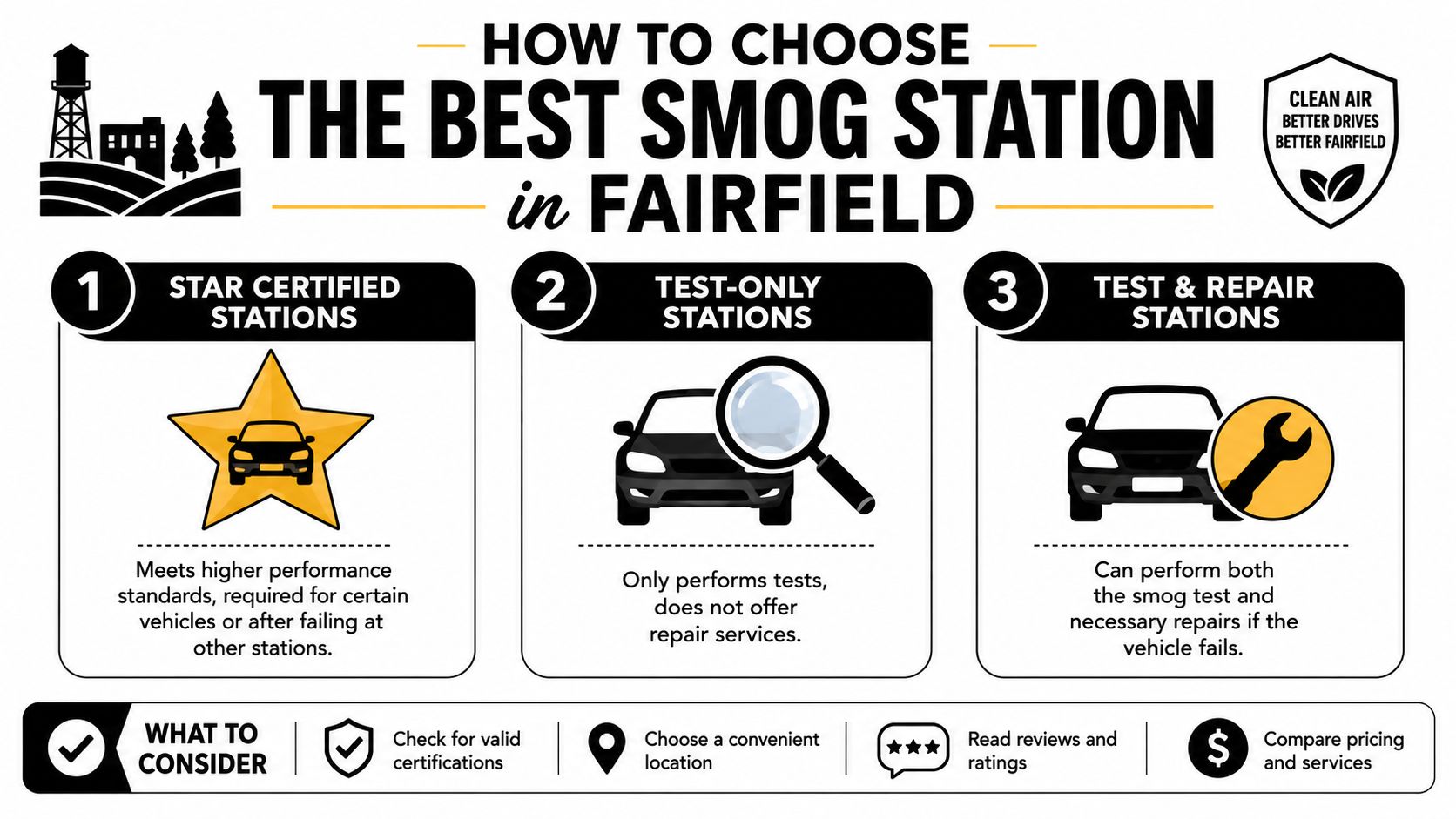
Know which station type fits your car
Start with station type, not price. If you choose the wrong kind of shop, the rest does not matter.
| Station type | Best for | Watch out for |
|---|---|---|
| STAR Certified | Vehicles directed to a STAR station or cars that need a station meeting stricter BAR performance standards | Many drivers assume every shop is STAR. It is not. |
| Test-only | Drivers who want the inspection done at a shop that does not also sell repairs | If you fail, you will need a separate repair shop |
| Test and repair | Older vehicles or cars with a history of emissions problems | Convenience is nice, but get clear pricing before they touch anything |
If your DMV notice says STAR, go to a STAR station. Do not waste time trying a regular shop first.
For a newer car that runs well, a clean and efficient test-only shop is usually the easiest play. For an older car, or one that has been finicky, I prefer a well-organized test-and-repair shop because they can explain the next step right away if the car fails. You do not have to approve repairs there. You just want a shop that knows what it is doing.
Judge the shop like a local, not like a shopper
Here's the practical filter I'd use in Fairfield.
First, call. A two-minute phone call tells you more than ten glossy ads. Ask for the full smog price, whether the certificate fee is included or separate, whether they test your vehicle type, and whether you need an appointment. If the person answering sounds confused, rushed, or slippery about price, cross that shop off the list.
Then check reviews for patterns, not drama. One angry review means nothing. Repeated complaints about surprise charges, long waits, or rude front-desk service usually mean the shop has a workflow problem.
Use the BAR station locator first. Then compare the few shops that fit your vehicle and your schedule.
Ask better questions and avoid dumb delays
A good call sounds like this:
“I've got a gasoline car. What's the total out-the-door smog price, is the certificate included, how long does it usually take, and do I need an appointment?”
That question does three things fast. It exposes hidden fees, tells you whether they are organized, and helps you avoid showing up to a backed-up shop.
A few more things to confirm before you head over:
- Certificate fee: Ask if it is included in the quote.
- Vehicle fit: Confirm they handle your model year, fuel type, and any special cases.
- Wait time: Ask whether they do walk-ins all day or if certain hours move faster.
- Retest policy: If something minor goes wrong, ask whether they offer a discounted retest.
The best smog station is usually the one that gives straight answers, moves cars through efficiently, and does not play pricing games. In Fairfield, that is what saves you time, money, and aggravation.
Preparing Your Vehicle for a Guaranteed Pass
You book a smog check on your lunch break, pull into the shop, and ten minutes later you find out the car was never ready to be tested. That is the kind of mistake that wastes money in Fairfield. A little prep usually saves you a failed test, a retest fee, and another trip across town.
Most vehicles do pass on the first try. The California Bureau of Automotive Repair shows strong first-pass rates in its BAR smog check reports and statistics. Your job is to avoid the few predictable problems that trip people up.
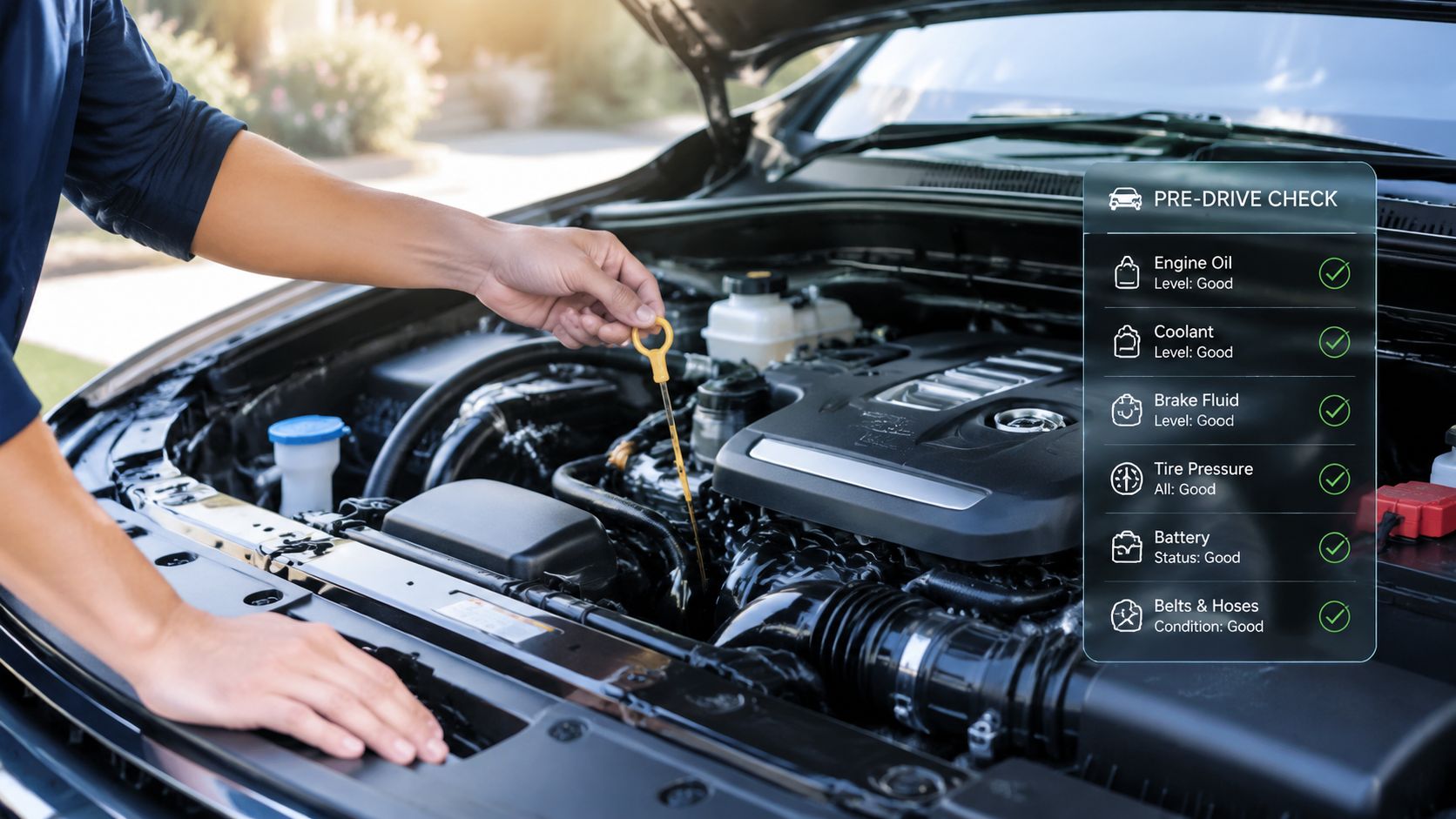
Do the prep that actually matters
Forget cosmetic stuff. Smog prep is about readiness, temperature, and warning signs.
Start with the dashboard. If the check-engine light is on, skip the test and fix the problem first. Paying for a smog check with an active warning light is just donating money.
Then drive the car long enough to get it fully warmed up. A short freeway run usually helps more than a two-minute putter around the neighborhood. Cars that have been sitting for days, or cars that only do short trips, are more likely to show up unprepared.
The other big one is battery history. If you recently replaced the battery, disconnected it, or cleared codes, your readiness monitors may not be set yet. The car can feel perfectly fine and still fail or get rejected because the system has not completed its self-checks.
The Fairfield money-saving checklist
Use this before you leave home:
- Check the dash. No check-engine light, no fresh warning lights.
- Warm up the car. Drive it enough so it reaches normal operating temperature.
- Leave the battery alone. Do not disconnect it right before the test.
- Be honest about recent repairs. If codes were cleared or emissions work was just done, give the car time to complete its drive cycles.
- Bring your paperwork. Registration info and your renewal notice make check-in faster.
That list handles a lot of avoidable failures.
What people do wrong right before a smog check
The worst move is trying to outsmart the system. Clearing codes the night before does not fix anything. It usually resets the monitors and creates a different problem.
Questionable aftermarket parts can also cost you. If emissions equipment is missing, altered, or obviously not right, expect trouble. Same goes for a car that has been idling rough, stalling, or acting strange all week. Do the repair first. Test second.
If you recently had work done, put some normal miles on the car before your appointment. That one habit saves a lot of Fairfield drivers from paying twice.
If you want a quick visual refresher on emissions readiness and common test prep issues, this short walkthrough helps:
My blunt advice. If the car has any active warning light, recent battery disconnect, or obvious drivability issue, do not gamble on the smog lane. Spend the money on diagnosis first. That is usually the cheaper move.
What Happens During the Smog Inspection
You pull into a Fairfield smog station on your lunch break, hoping to be in and out. That usually happens if the car is ready. The inspection itself is pretty straightforward, and once you know the order, the whole thing feels a lot less stressful.
Most smog checks follow the same flow. The tech checks in the vehicle, verifies the car and paperwork, inspects the emissions system, plugs into the computer, and finishes the required test steps. For a lot of Fairfield drivers, the whole visit is done in about half an hour. Busy shops, older vehicles, or cars with obvious issues can take longer.
What check-in looks like
The first few minutes are simple. The station confirms the VIN, plate, and basic vehicle information, then gets the car into position for the inspection.
Bring your registration or DMV notice so nobody wastes time hunting for details. If the car has anything unusual about it, say it up front. A recently replaced battery, fresh emissions repair, or aftermarket part can change how the test goes, and it is better to bring that up early than have the tech discover it halfway through.
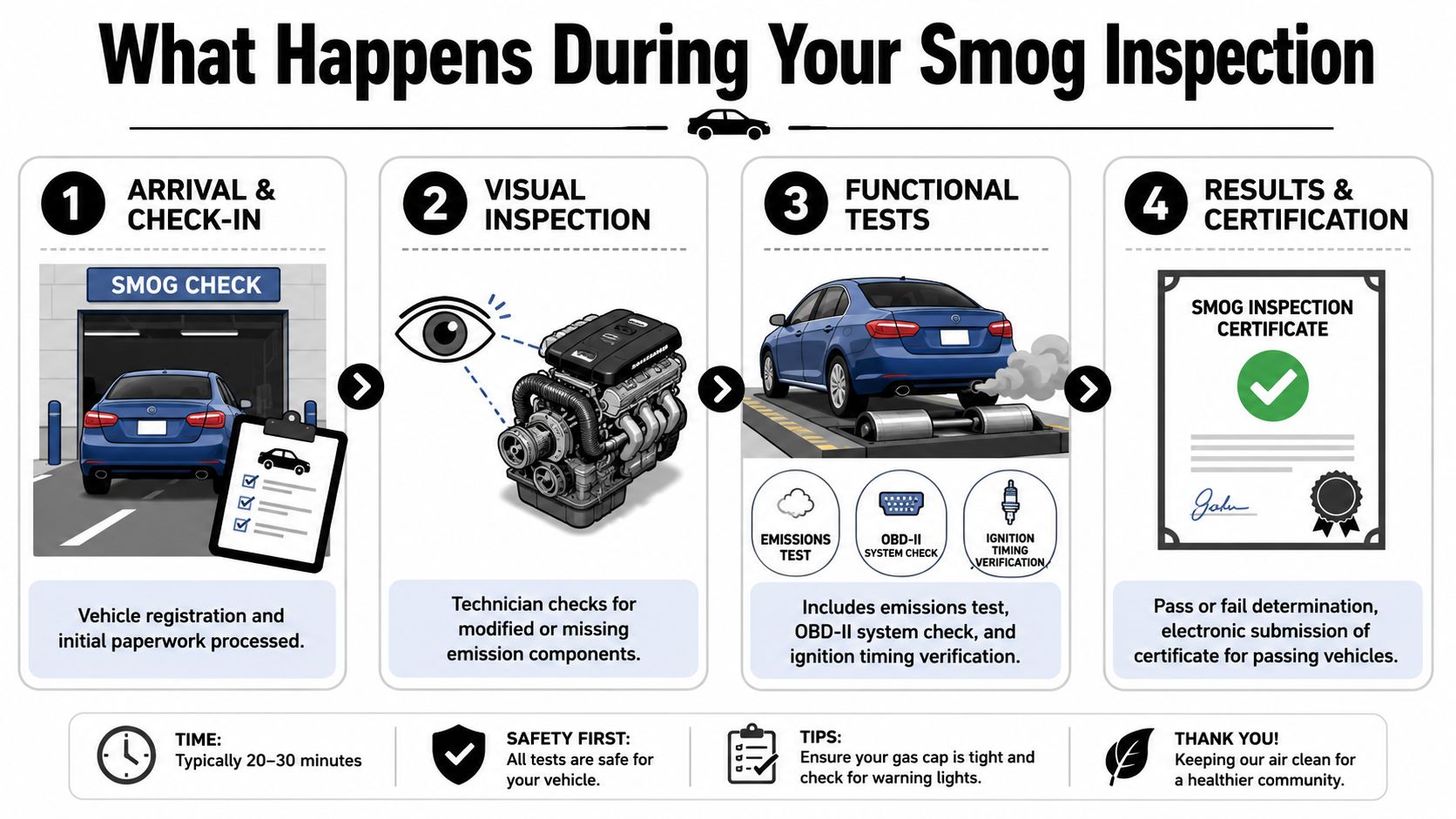
What the technician is actually checking
Here is what is happening behind the scenes.
Visual inspection
The tech looks for required emissions parts and checks that nothing obvious is missing, disconnected, or illegally modified.Computer and functional checks
The scanner reads trouble codes, monitor status, and other readiness information from the car's onboard system. If the system is not ready, that usually stops the process right there.Tailpipe or applicable emissions testing
Depending on the vehicle, the station confirms whether it meets the emissions standard for that model and year.
This is why smog checks catch cars that seem "fine" to the owner. A vehicle can drive normally and still fail because the monitors are not ready, a component is missing, or the system has stored a problem the dash light is not showing at that moment.
At the end, you get a Vehicle Inspection Report, usually called a VIR. Read it before you leave. If the car passes, great. If it does not, that report is your roadmap, and it can save you from wasting money on the wrong repair.
My advice. Do not book a smog appointment as if it is a five-minute errand. Give yourself a little cushion, especially at a busy Fairfield shop. That small bit of planning saves a lot more aggravation than trying to squeeze the test between two other appointments.
Navigating Your Smog Test Results
You finish the test, walk back to the counter, and the next five minutes decide whether you're done for the year or spending more money. This is the part where Fairfield drivers either save themselves a headache or get talked into the wrong repair.
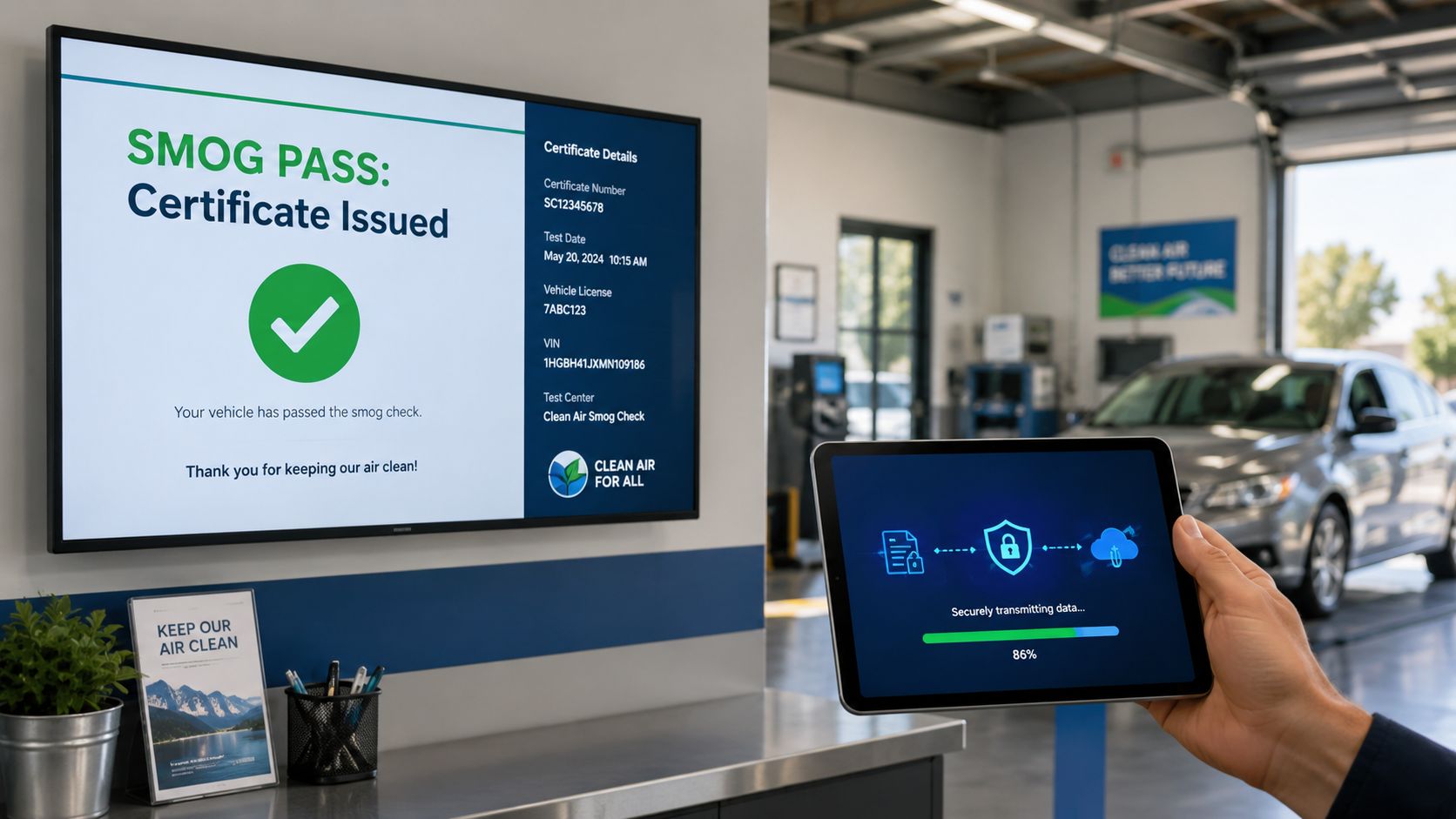
If your car passes
Good. The station sends the certification to DMV electronically, but don't walk out empty-handed. Keep the VIR and any receipt until your registration is fully updated.
Your smog certificate does not last forever. As noted earlier, you have a limited window to use it for renewal or a transfer, so handle the DMV side soon and cross it off your list.
After a pass, do these four things:
- Finish your DMV renewal right away
- Keep the printed VIR in the glove box or your records
- Check that the registration went through
- Stay on top of maintenance if the car barely passed
That last point matters. A pass only means the car met the standard on test day. If it has a lazy oxygen sensor, an aging battery, or a problem that has not triggered a warning light yet, you can still end up back in the shop later.
If your car fails
Start with the VIR. That paper is the closest thing you have to a money-saving playbook, because it points you toward the actual problem instead of guesswork.
Some failures are cheap and fast to fix. Others are expensive because people waste cash on the wrong parts first. In Fairfield, that usually happens when a driver clears a code, replaces something random, then pays for a retest without confirming the car is ready.
Here's the smart order of operations:
Read the failure reason carefully
Look for the category of failure. Trouble code, monitor not ready, or emissions component issue.Ask for a plain-English explanation
A good shop should tell you what failed, what caused it, and what repair will address it.Fix the root problem
Code clearing by itself rarely saves money. It usually leads to another failed test and more waiting.Confirm the car is ready before the retest
If monitors are still incomplete, you are paying again for a predictable result.Ask about repair assistance if the estimate is rough
Some drivers may qualify for California repair assistance programs, and it is worth asking before you approve a big bill.
Don't approve repairs you don't understand. A clear diagnosis beats a parts-swapping guess every time.
Here's my Bay Area mechanic advice. If a shop gets vague after a failed smog, slow down. You want specifics, not a speech. Ask one direct question: “What failed, and what do I need to repair before this car will pass?” If they can't answer that cleanly, get a second opinion before you spend another dollar.
Fairfield Smog Check Common Questions
I'm out of state when my smog is due. What should I do
Handle it through the DMV process as early as possible. Don't wait until penalties pile up. If you know you won't be in California, contact DMV and find out what they'll require for your situation.
I bought a brand-new car. Do I need a smog check
Not always. Many newer gasoline vehicles fall under California's early-year exemption. Check your registration notice and your model year before booking anything.
Are smog coupons legit
Sometimes yes. Sometimes they're bait. The smart move is to ask one direct question before you go: “What is the total price, and is the certificate fee included?” If they won't answer cleanly, skip the deal.
What about a hybrid
Some hybrids are exempt, some are not depending on age and classification. Don't guess because the car is fuel-efficient. Verify the exact status for your vehicle.
How early should I get my smog done
Close enough to your registration timing that you can use the certificate within its valid window. Too early creates unnecessary risk if paperwork gets delayed.
What's the fastest way to get through a smog check in Fairfield
Go on a weekday if you can, drive the car beforehand, confirm the full price on the phone, and make sure your check-engine light is off before you leave the house.
If you want a fast, straightforward smog experience in the East Bay, Speedy Smog is worth a look. They're a STAR Certified station in San Leandro with a reputation for quick service, transparent pricing, and a clean waiting area, which matters more than people admit when you're trying to knock out a smog check without wasting your day.
You open your renewal notice, scan for the amount due, and then see the line that stops everything: Smog Certification Required. For a lot of East Bay drivers, that's the moment the simple job of renewing registration turns into a string of questions. Does your car need it? Do you need a STAR station? What if the check engine light came on last week? How long is this going to take?
California smog check rules aren't impossible, but they are layered. The DMV, the Bureau of Automotive Repair, vehicle age, fuel type, ownership changes, and station type all matter. If you just want a straight answer and a short path to compliance, the good news is that the rules get much easier once you sort them by situation instead of reading them like DMV text.
Table of Contents
- Why Your DMV Notice Demands a Smog Check
- When Is a California Smog Check Required
- Rules for Your Specific Vehicle Type
- What Happens During a Smog Inspection
- The Importance of STAR Certified Stations
- If Your Vehicle Fails the Smog Check
- Your East Bay Smog Check Action Plan
Why Your DMV Notice Demands a Smog Check
That DMV notice isn't random. California built smog compliance into the registration process, so when your renewal says a certification is required, the test becomes part of finishing the renewal itself.
It often feels like bureaucracy first and clean air second. But the program has a practical purpose. The California Air Resources Board says the Smog Check program removes about 400 tons of smog-forming pollutants every day from California's air, as summarized in the California Smog Check Program overview. In the Bay Area, where people commute, idle in traffic, and keep older vehicles on the road, that's not an abstract policy goal.
Practical rule: If your DMV notice says a smog certification is required, treat it like a registration task, not an optional maintenance item.
I've found that drivers usually get tripped up in one of three ways. They assume a newer car is always exempt, they think a recent repair automatically means the car will pass, or they wait until the last minute and then discover they were supposed to visit a specific kind of station.
The better way to think about California smog check rules is simple. The state uses registration renewal as the checkpoint. Your job is to figure out whether your vehicle falls into the test group, then get the inspection done at the right type of station before the renewal deadline catches up with you.
Once you look at it that way, the process gets a lot less intimidating.
When Is a California Smog Check Required
A common East Bay scenario goes like this. Your registration renewal shows up, you skim it, and then one line stops you: Smog Certification Required. At that point, the practical question is not whether the car seems to run clean. It is whether the state needs a passing inspection before DMV will finish your renewal.
For many drivers, the basic rule is a biennial smog check. That means every 2 years for many vehicles during registration renewal, according to the California Bureau of Automotive Repair Smog Check page. In the shop, this is the pattern we see most often with East Bay commuters who are renewing registration on a car that has aged out of the newer-vehicle exemption.
Newer gasoline vehicles get a break. Gasoline-powered vehicles that are 8 model years old or newer usually do not need a Smog Check for registration renewal. The owner pays a smog abatement fee instead. The detail that trips people up is the timing. The exemption is tied to the vehicle's model year, not how recently you bought it or how little you drive it.
The state also sets part of the cost structure. The inspection itself usually takes about 30 minutes, and there is a mandatory $8.25 Smog Check certificate fee added to the station's inspection price. So if one East Bay shop quotes a different total than another, part of that difference is the shop's labor and pricing, while the certificate fee stays fixed.
Here are the situations that usually trigger confusion:
- Your renewal notice says certification is required. That is the clearest answer you will get. DMV is telling you a passing smog check is part of renewing registration.
- Your car just aged out of the exemption window. A vehicle that did not need a check last cycle can need one this cycle.
- You are handling a special transaction. Ownership transfers and first-time California registration can follow different rules than a standard renewal, so the paperwork for that transaction matters more than a general rule you heard from someone else.
Practical rule: Trust the notice in your hand, then confirm the model year and fuel type before you head to a station.
2026 California Smog Check Requirements at a Glance
| Vehicle Type / Situation | Smog Check Required? | Notes |
|---|---|---|
| Gasoline vehicle, 8 model years old or newer, registration renewal | No | Pays smog abatement fee instead of biennial inspection |
| Gasoline vehicle beyond the exemption window, registration renewal | Usually yes | Many vehicles fall into the every-2-years cycle |
| DMV renewal notice says “Smog Certification Required” | Yes | Complete it before renewal can be finalized |
| Vehicle at a station for inspection | Sometimes | Typical inspection time is about 30 minutes |
| Any completed Smog Check certification | Yes, fee applies | Includes the mandatory $8.25 certificate fee plus station inspection price |
A lot of DMV stress comes from assuming every renewal works the same way. They do not. The shortest path is to check three things before you leave home: the exact wording on the renewal notice, the vehicle's model year, and whether DMV says you need a STAR station. In the East Bay, that simple checklist saves drivers more time than guessing ever does.
Rules for Your Specific Vehicle Type
Vehicle type changes the rule fast. In the East Bay, I see the same problem every week. A driver hears one smog rule from a friend, applies it to the wrong vehicle category, and loses a day chasing the wrong answer.
The clean way to sort it out is to start with three facts: fuel type, model year, and for some diesels, weight. Once those match your registration situation, the rule usually gets a lot simpler.
Gasoline vehicles
Gasoline vehicles cause the most confusion because the broad rule is easy to oversimplify. Older gasoline cars may fall outside the usual testing system, while many later-model vehicles eventually age into regular smog requirements.
For a typical East Bay driver, the practical question is not whether the car feels fine on the road. The practical question is whether your gasoline vehicle is still in its exemption window or already subject to testing based on its age and DMV transaction.
A few mistakes come up again and again:
- “It drives perfectly, so it should pass.” A smooth-running car can still have an emissions problem.
- “The check engine light went away.” A light that turned off does not always mean the system is ready.
- “I just bought the car.” A recent purchase does not automatically remove a smog requirement tied to registration or transfer paperwork.
If you drive a gasoline car in the East Bay and the paperwork points toward testing, treat that as your answer and get the inspection scheduled.
Diesel vehicles
Diesel rules are narrower, but they still trip people up. Some diesel vehicles are exempt. Others are not, and the deciding factors are usually model year and gross vehicle weight rating.
That weight piece matters more than many drivers expect.
A diesel badge alone does not tell you whether a smog check applies. Lighter-duty diesels can fall under the rules, while older or heavier diesel vehicles may be handled differently. The safest move is to check the registration details against the vehicle information on the door label or manufacturer sticker before you book an appointment.
If you are not sure how your diesel is classified, ask the station to confirm what category you are dealing with before the inspection starts. That saves time and avoids a lot of bad assumptions.
Hybrid vehicles
Hybrid owners often assume battery power means exemption. That is where confusion starts. A hybrid is not treated like a fully electric vehicle for smog purposes.
In practice, many hybrids are handled much more like gasoline vehicles than drivers expect. If your DMV paperwork requires a smog certification, do not let the word "hybrid" talk you into skipping it.
The trade-off is simple. Hybrid systems can make the vehicle feel cleaner and more efficient, but the state still looks at emissions compliance rules, not just fuel economy.
For East Bay drivers, the quickest path is to identify the vehicle correctly before you head to a station. Gasoline, diesel, and hybrid vehicles do not all follow the same logic, and most smog headaches start with using the wrong rule for the car in the driveway.
What Happens During a Smog Inspection
A smog inspection feels mysterious until you break it into parts. It's really a compliance check that looks at the car's emissions system, its warning and monitoring functions, and the actual output the vehicle produces.
This visual guide matches what technicians are looking for during the process:
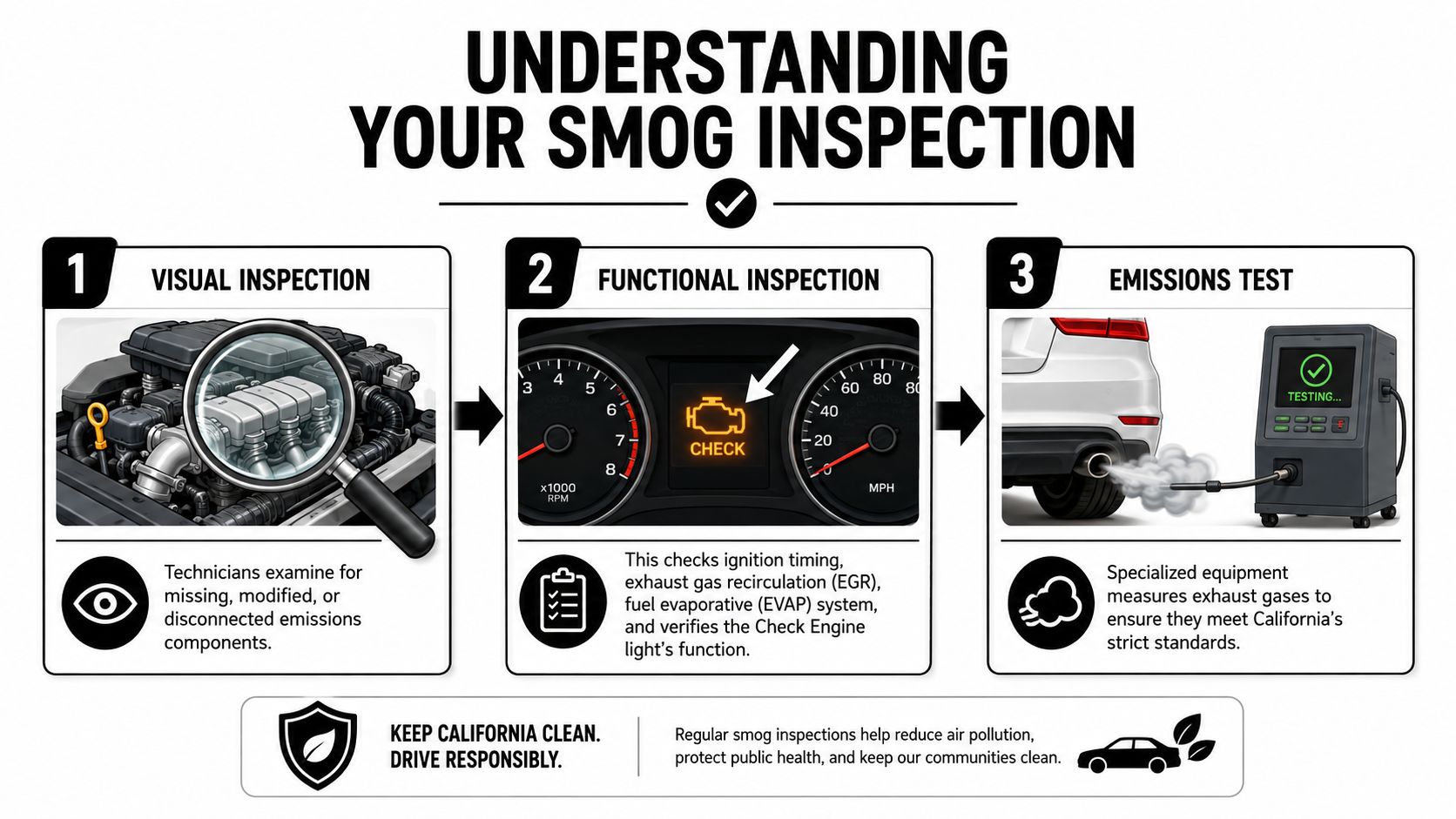
The three parts of the inspection
Most drivers can understand the inspection as a car version of a medical checkup.
Visual inspection
The technician looks for missing, disconnected, or obviously modified emissions-related components. If the vehicle has parts that don't belong there, or parts that should be there but aren't, that can create trouble before any machine is plugged in.Functional inspection
During this inspection, warning lights and system behavior matter. The check engine light, ignition-related functions, and emissions-control system operation all come into play. A dashboard light you've been ignoring can turn into the main reason the vehicle doesn't pass.Emissions test
This is the measured part. The vehicle's emissions performance is checked using state-approved equipment and procedures matched to the vehicle's setup.
A smog test isn't just a tailpipe sniff anymore. For many vehicles, it's also a check of what the car's own computer says about its emissions health.
A lot of failed inspections start before the test begins. Battery disconnects, recent repairs, and aftermarket modifications can all create readiness or equipment issues that don't show up as obvious driving problems.
How the actual test differs by vehicle
For newer vehicles, the process often works like a computer scan. The technician connects to the vehicle's onboard diagnostics system and checks for emissions-related faults and monitor status. For older vehicles, the process may involve a more traditional loaded test. Many drivers think of that older style as the “rolling” test.
The easiest comparison is this:
| Test style | What it's like | Who usually sees it |
|---|---|---|
| OBD-based inspection | A scan of the car's emissions computer | Common on newer vehicles |
| Dynamometer-style emissions test | A treadmill-style check under controlled load | More common on older vehicles |
If you want to see the process in motion, this walkthrough gives a helpful visual reference:
The main thing to know before you arrive is that the technician isn't improvising. The inspection follows a state process, and the vehicle either meets that process on test day or it doesn't.
The Importance of STAR Certified Stations
You open your registration notice, see the word STAR, and wonder whether it changes anything. It does. If the DMV requires a STAR inspection, going to a regular smog station can cost you a trip, a delay, and sometimes another day off work.
What STAR means in practice
A STAR Certified station is approved to perform inspections under a higher level of state program oversight. For drivers, the practical point is simple. The station is set up to handle STAR-required inspections, and the result is recognized for the transactions that call for it.
That matters in the East Bay, where plenty of drivers are trying to get a smog check done between work, school pickup, and a registration deadline. The first question is not just "Do I need a smog check?" It is "Do I need the right kind of station?" A quick check of the DMV notice answers that.
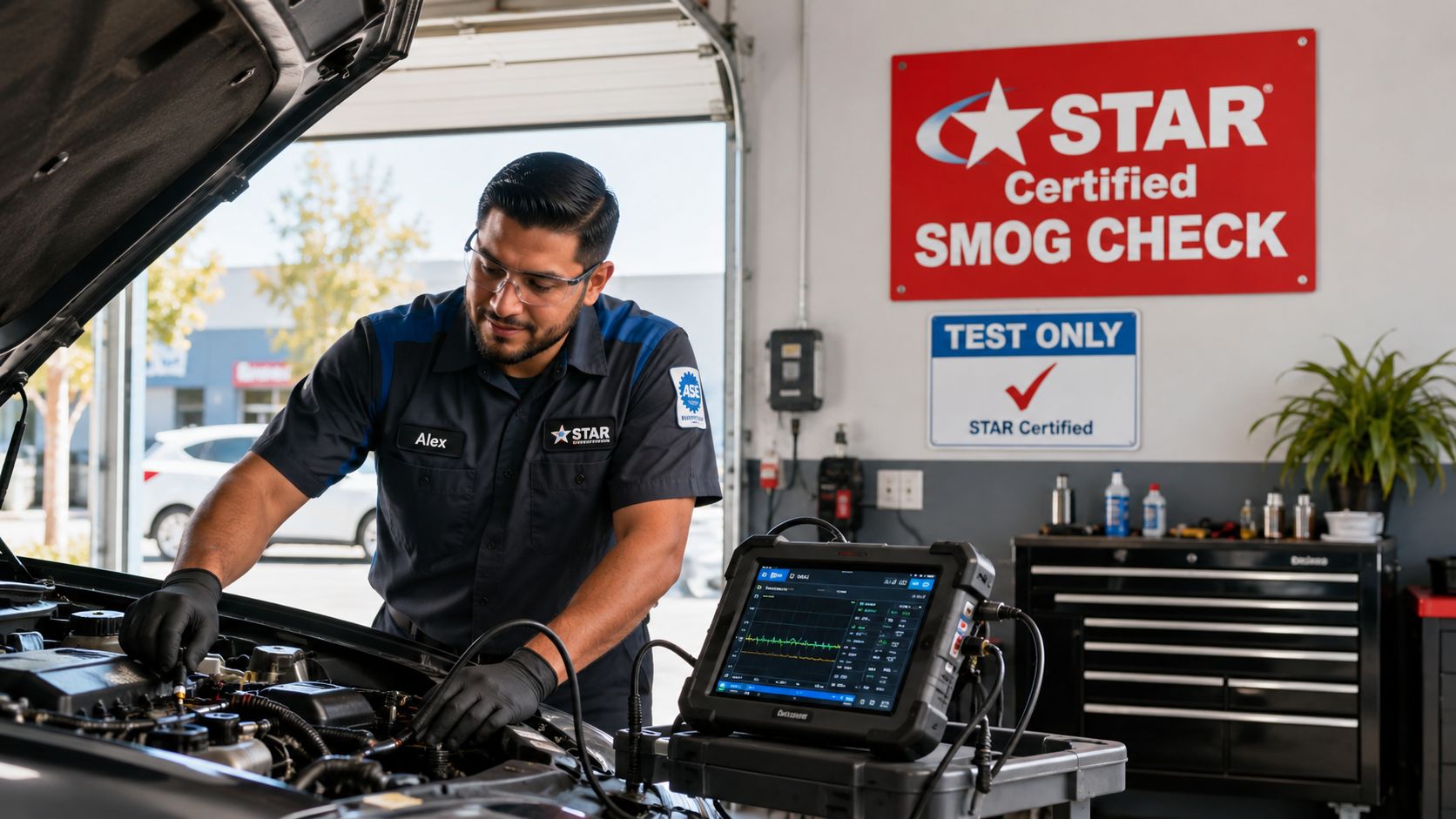
A STAR station also tends to reduce confusion at the counter. If your notice calls for STAR, the shop already knows the requirement and can process the inspection under the correct program. This provides a distinct advantage: fewer surprises, fewer wasted trips, and less guessing about whether the DMV will accept the certificate.
Why some DMV notices require STAR
When a DMV notice says STAR, treat it as a requirement. The vehicle has to be inspected at a STAR-certified location for that registration step.
Drivers in San Leandro, Hayward, Oakland, and the rest of the East Bay ask this all the time. Why this car? Why this year? The short answer is that California uses the STAR program as part of its inspection quality controls for certain vehicles and situations. The notice tells you what your vehicle needs. The smart move is to follow it exactly.
Even when STAR is not required, some drivers still choose a STAR station because it keeps the process straightforward. Speedy Smog in San Leandro is one local example of a STAR-certified station that handles these inspections.
Here is the simplest checklist. Read the DMV notice. If it says STAR, book a STAR station. If it does not, you still have options, but choosing STAR can make the process easier if you want the least amount of back-and-forth.
If Your Vehicle Fails the Smog Check
A failed smog check feels worse than it usually is. In most cases, it's not the end of the registration process. It's a signal that something in the emissions system, readiness status, or equipment setup needs attention before the vehicle can be certified.
Read the paperwork first
The first thing to look at is the Vehicle Inspection Report, often called the VIR. Don't jump straight to parts replacement based on a guess. The report tells you where the vehicle fell short, and that shapes what the next repair step should be.
A calm approach usually works better than a rushed one:
- Read the failure reason carefully: A warning-light issue is different from a component issue.
- Bring the VIR to the repair shop: It gives the technician a starting point.
- Fix the actual cause: Smog-related symptoms can overlap, so random part swapping gets expensive fast.
- Schedule the re-test after repair: Don't assume the repair alone completes the process.
Most expensive smog failures become more manageable once someone diagnoses the actual emissions problem instead of chasing the loudest symptom.
If the car recently had its battery disconnected or major work done, ask whether the system is fully ready before you head back for reinspection. That's a common place where drivers lose time.
What usually helps and what usually doesn't
Some choices improve your odds of getting through the re-test with less drama. Others just waste money.
What tends to help:
- Targeted diagnosis: Find the emissions-related fault, not just a general performance complaint.
- Qualified repair work: Use a shop that understands smog-related repair logic.
- Keeping your paperwork: The inspection report and repair records matter.
What usually doesn't help:
- Clearing codes right before the test: That can leave monitors unready.
- Assuming premium fuel or additives will solve it: Sometimes drivers try shortcuts when the issue is mechanical or electrical.
- Ignoring the check engine light because the car drives fine: Smog compliance and drivability aren't the same thing.
California also has a Consumer Assistance Program (CAP) that may help eligible motorists with emissions-related repairs or vehicle retirement. If repair costs are the biggest obstacle, it's worth checking whether you qualify through the state program before giving up on the vehicle.
Your East Bay Smog Check Action Plan
If you're in San Leandro, Oakland, Hayward, Castro Valley, or nearby, the simplest approach is to stop treating smog as a giant state puzzle and handle it like a short local errand with a checklist.
A simple local checklist
Start with the piece of paper that caused the stress in the first place.
Read the DMV notice carefully
Look for two phrases in particular: whether a smog certification is required, and whether the notice says STAR.Match the rule to your vehicle
Check the model year, fuel type, and whether your vehicle falls into a category that follows a different path.Don't wait until the deadline week
Waiting removes your options. If the car needs repair work, you want time to deal with it without registration pressure.Choose a station that fits the requirement
If the notice says STAR, go only to a STAR-certified station. If it doesn't, you still may prefer one for a cleaner process.
What to bring and what to expect
For most East Bay drivers, showing up prepared makes the appointment easy.
Bring:
- Your DMV renewal notice: It helps confirm the requirement.
- The vehicle itself: Obvious, but it matters if a family member usually handles registration and someone else drives the car.
- Payment: Inspection pricing varies by station, and the state certificate fee is part of the total.
- Any recent repair paperwork if the car previously failed: That can help if questions come up.
This gives you a sense of what a local station setup looks like before you go:
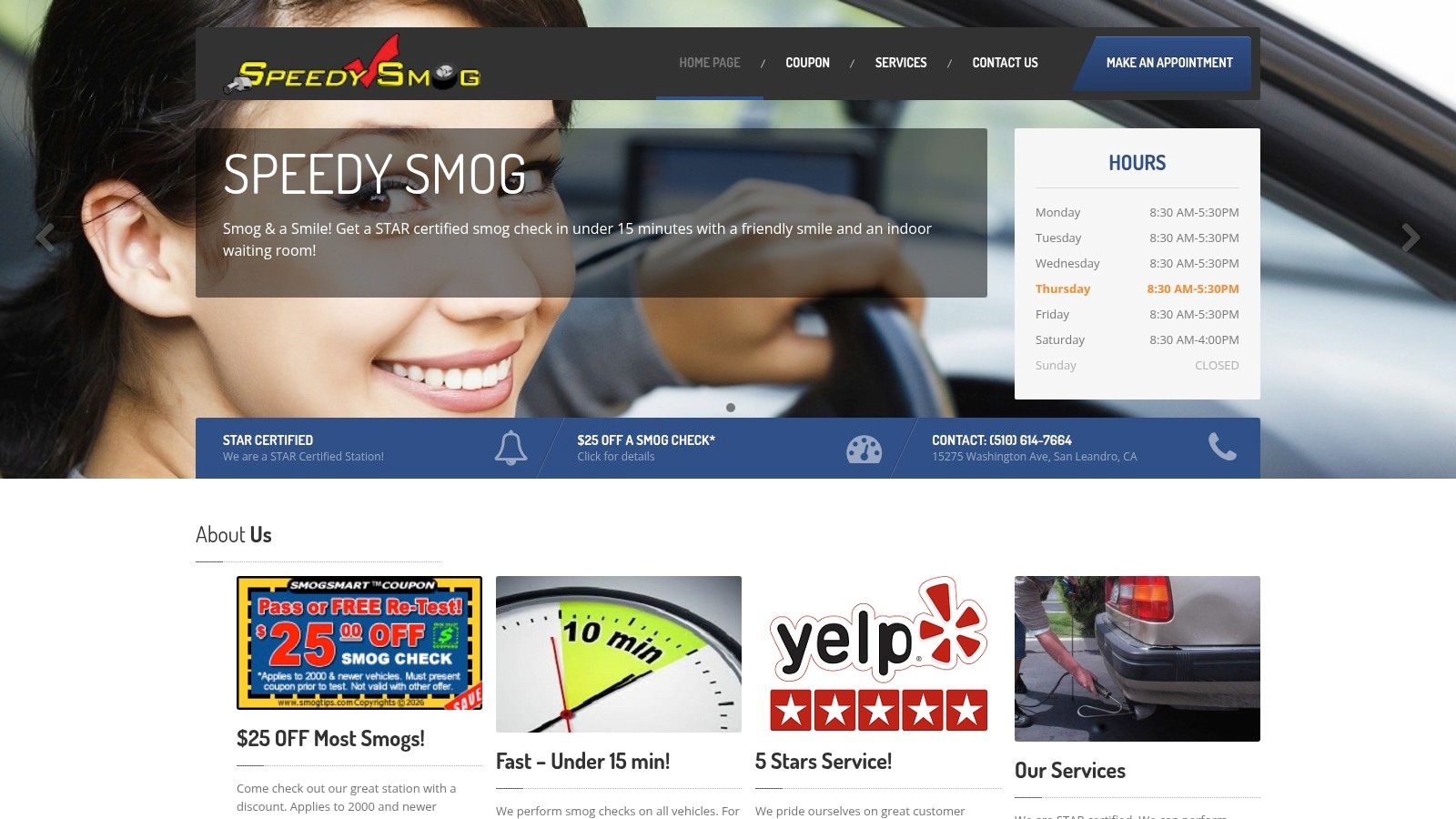
For drivers in the East Bay, a local option is available at 15275 Washington Ave, San Leandro, CA 94579. According to the publisher information provided for this article, that shop handles most vehicle categories commonly seen for smog certification, including newer vehicles, older vehicles, diesels, and hybrids. The same business information notes that many 2000 and newer vehicles are typically completed in 10 to 15 minutes.
That last point matters because the state process may be formal, but your local experience doesn't have to be slow or confusing. Read the notice, identify the vehicle category, bring the car to the right station, and let the inspection answer the question.
If your DMV notice says a smog certification is due, Speedy Smog gives East Bay drivers a straightforward local option for completing the inspection and getting the paperwork handled for registration.
Most vehicles in California need a smog check every two years for registration renewal, and Fremont prices commonly range from $55 to $90. If your DMV notice says smog certification is required, the fastest way to avoid a wasted trip is to confirm whether your car needs a regular station, a STAR station, or no test at all before you go.
That's usually the problem. Not finding a shop. Finding the right shop for your vehicle, your DMV notice, and your test type.
In Fremont, you'll see plenty of stations advertising fast service, coupons, and “all vehicles.” That sounds helpful until you show up with a title transfer, an older gasoline car, a diesel, or a renewal notice that specifically requires STAR. Then speed matters less than eligibility. The good news is that the process is simple once you sort those basics out.
Table of Contents
- Your Fremont Smog Check Roadmap for 2026
- Do You Actually Need a Smog Check in Fremont
- STAR Station vs Regular Smog Check What Is the Difference
- The Smog Check Process From Arrival to DMV Certificate
- Fremont Smog Check Costs and Tips to Pass the First Time
- What to Do If Your Vehicle Fails the Smog Check
Your Fremont Smog Check Roadmap for 2026
Your registration notice lands in the mailbox, you spot “smog certification required,” and the first real question is not price. It is whether you need a STAR station or a regular smog station. Get that wrong, and you waste a trip before anyone even plugs into the car.
In Fremont, the process goes smoothly when you sort out three things first. Confirm that your vehicle needs a test, confirm whether DMV requires a STAR inspection, and confirm what kind of testing your vehicle is likely to get based on its age and type. That last part matters more than many local guides admit. A late-model gasoline car is usually straightforward. An older vehicle, diesel, hybrid, out-of-state registration, or transfer-related test can change what the station needs to do.
Start with the paperwork, not the coupon.
What matters most before you leave
Use this order so you do not lose time:
- Read the DMV notice carefully. If it calls for STAR, go to a STAR-certified station.
- Match the shop to the vehicle. Some Fremont stations are set up for quick routine tests. Others are better for older or less common cases.
- Budget time based on the car you have. Newer cars are often faster to process. Older cars and special cases can take longer.
Practical rule: A low advertised price does not help if the station cannot perform the test your registration requires.
California runs smog checks through a statewide system of licensed stations and technicians. The Bureau of Automotive Repair's smog program reporting shows how closely the state tracks inspections, outcomes, and station activity. For Fremont drivers, the useful takeaway is simple. There are plenty of shops, but they do not all handle the same mix of vehicles or DMV requirements.
That is the part many drivers miss.
A regular station may be fine for one car and wrong for the next. A STAR station can handle vehicles that DMV has flagged for STAR, and some drivers only find that out after showing up at a non-STAR shop. If you remember one thing before booking a Fremont smog check, remember this: the right station depends on your notice and your vehicle, not just the closest sign on Fremont Boulevard.
Do You Actually Need a Smog Check in Fremont
You buy the tag, head to a smog shop, and then find out your car was exempt or your DMV notice required a different kind of station. That is a common Fremont mistake, and it is easy to avoid if you check the paperwork first.
The fastest way to decide
Start with your DMV renewal notice. If it says a smog inspection is required, treat that as your answer. If it says STAR, that detail matters just as much as the test itself because a regular station will not meet the requirement.
Smog checks in Fremont usually come up in a few predictable situations:
- Registration renewal: The most common reason.
- Change of ownership: Many vehicle sales require a current smog certificate.
- First-time California registration: Out-of-state vehicles often need testing before registration can be completed.
- Certain vehicle categories: Diesel, hybrid, RV, and other special cases need closer review.
- Older vehicles with exemption questions: Drivers often guess incorrectly.
A lot of local guides stop at "check if you need a smog." The more useful question is whether your vehicle needs a smog check, and if so, whether the DMV is sending you to a STAR station or allowing a regular one.
Vehicle types that are often exempt
Exemptions depend on the vehicle, fuel type, and model year. According to this Fremont smog eligibility guide, gasoline vehicles from 1975 and older, diesel vehicles from 1997 and older, and all-electric vehicles are exempt from standard smog testing.
That breakdown matters in real life. A 1975 gas vehicle and a 2005 hybrid do not belong in the same bucket, and treating them the same is how people waste an afternoon.
| Vehicle situation | Likely next step |
|---|---|
| Typical DMV renewal vehicle | Check the notice for smog and STAR requirement |
| Gasoline vehicle 1975 or older | Often exempt |
| Diesel vehicle 1997 or older | Often exempt |
| All-electric vehicle | Exempt |
| Motorcycle or trailer | Usually not part of the standard smog program |
If you drive a hybrid, diesel, RV, or an older gasoline vehicle, call ahead before you go. Ask two direct questions. Does this vehicle need a smog check, and if it does, can this station perform the exact test listed on my notice?
That two-minute check can save you the trip, the line, and the repeat visit.
STAR Station vs Regular Smog Check What Is the Difference
A lot of Fremont drivers lose time on smog day for one simple reason. They go to a station that cannot perform the test their DMV notice requires.
A STAR station is a smog station that meets California's higher performance standards. The practical difference is straightforward. If your renewal notice says STAR, you need a STAR-certified station. A regular station cannot complete that requirement, even if it is cheaper or closer.
What STAR means
Treat STAR as a DMV routing instruction, not a quality label.
That one detail decides where you can go. It also affects how much time you spend solving the problem. Drivers who miss it often make two trips. First to the wrong shop, then to a STAR station after finding out the hard way.
For many 2000-and-newer vehicles, the test is often faster because it relies on the car's onboard diagnostics system, as explained in this OBD smog testing overview. Older vehicles and less standard cases can take more technician time, especially when the DMV notice requires STAR or the vehicle falls outside the typical commuter-car pattern.
Here's the trade-off:
- Regular station: Works if your paperwork does not require STAR.
- STAR station: Required if the DMV notice says STAR.
- Older, diesel, hybrid, or unusual registration case: Call first and confirm the station handles that exact test type.
Which vehicles and situations should be checked twice
The biggest time-wasters are not always problem cars. They are cars with paperwork or test-type details that drivers assume are standard.
Double-check before leaving home if you have:
- A DMV renewal notice that says STAR
- An older gasoline vehicle
- A diesel
- A hybrid
- An out-of-state registration
- A title transfer situation
If you are in Fremont but open to a nearby East Bay option, one station some drivers use is Speedy Smog in San Leandro, a STAR-certified shop that handles newer vehicles, older vehicles, diesels, and hybrids.
The smart move is simple. Read the notice, confirm whether STAR is required, then call the station and ask if they perform your vehicle's exact test. That two-minute call usually saves more time than price shopping first.
The Smog Check Process From Arrival to DMV Certificate
You pull into a Fremont smog station, hand over your renewal notice, and then find out the shop cannot run your required test. That is the avoidable mistake. Once you are at a station that matches your vehicle and DMV notice, the rest is usually straightforward.
What to bring and what happens first
Bring the documents that help the technician identify the correct test the first time:
- Your DMV renewal notice, especially if it shows a STAR requirement
- Current registration, to confirm the vehicle record
- Driver's license, if the station asks for identification
- Title transfer or out-of-state paperwork, if this is not a routine renewal
At check-in, the station verifies the VIN, plate, model year, and the reason for the inspection. This is the point where STAR versus regular station capability matters in real life. A standard renewal for a newer gasoline car usually moves quickly. A transfer, out-of-state case, diesel, or older vehicle may follow a different inspection path and take longer.
What the technician actually does
For many newer vehicles, the test centers on the onboard diagnostics system. The technician connects the equipment, checks required monitors, confirms the emissions-related systems report correctly, and makes sure there is no disqualifying issue such as an active check engine light.
Older vehicles and less common cases can involve more manual verification and a longer bay time. That is why two drivers can arrive at the same shop at the same time and leave far apart.
A good question at the counter is simple: “Are you set up for my exact vehicle and test type today?”
Here is the usual flow:
Check-in and vehicle verification
The station confirms your paperwork, vehicle details, and the correct inspection category.Smog inspection and testing
The technician runs the test required for that vehicle, not just the test a typical commuter car gets.Results submission
If the vehicle passes, the station submits the result electronically to the state system.
Later in the visit, it helps to know what the electronic side looks like:
What happens after you pass
If the car passes, you usually do not need to carry a paper certificate to DMV. The result is typically transmitted electronically, and that is what clears the way for registration or transfer processing.
Keep your receipt anyway. If there is ever a delay in DMV records updating, the receipt gives you the test date, station information, and vehicle details in one place. That small habit can save a second trip or a long phone call later.
Fremont Smog Check Costs and Tips to Pass the First Time
You save the most money before you pull into the bay.
In Fremont, the posted smog price is only part of the cost. The bigger money saver is choosing a station that can perform your exact test the first time. If your DMV notice requires STAR and you show up at a regular station, the cheap coupon stops being cheap once you add another drive, another wait, and a second appointment.
What Fremont drivers are paying
Fremont shops commonly advertise prices across a fairly wide range, from lower-cost basic tests to higher fees for stations that handle more inspection types or charge extra for certain vehicles. Local listings often show routine inspections for many eligible cars finishing quickly, but that only applies when the vehicle is a straightforward match for that station.
The useful takeaway is simple. Compare price, but verify fit first.
A low advertised rate makes sense for a standard gasoline vehicle that only needs a regular smog check. It is less useful for a STAR-directed renewal, an older vehicle, a diesel, or paperwork situations like a title transfer where the wrong station choice can waste half your afternoon.
How to avoid paying twice
Ask one question before you go: “Can you do my exact vehicle and required test type today?”
That question filters out a lot of bad trips. It matters more than shaving a few dollars off the test fee.
A few habits also improve your odds of passing on the first visit:
- Drive the car long enough to fully warm it up before testing.
- Fix any active check engine light before you book the inspection.
- Do not rush in right after clearing codes or disconnecting the battery.
- Match the shop to the job, especially for STAR notices, diesels, older vehicles, and transfer-related tests.
- Take care of rough running, hard starts, or obvious maintenance problems before your registration deadline gets close.
One practical trade-off comes up all the time. A bargain station can be the right choice for a newer car with a normal renewal and no warning lights. For anything less routine, paying a little more for the right station is often cheaper than repeating the process.
The best first-time pass strategy is boring but effective: bring a warmed-up car, show up with no warning lights, and confirm the station can perform your required test before you leave home.
That STAR versus regular station distinction is where Fremont drivers lose the most time. Get that part right, and the rest of the visit is usually straightforward.
What to Do If Your Vehicle Fails the Smog Check
A failed test is frustrating, but it's not unusual, and it doesn't mean you're stuck. The worst move is guessing at the repair.
Read the failure paperwork first
Start with the inspection report. It tells you why the vehicle didn't pass and gives the repair shop a place to begin. Don't treat it like a generic rejection slip. It's your roadmap.
If the failure reason isn't obvious to you, ask a licensed repair technician to explain it in plain English. You want the cause, not just the symptom.
Fix the cause, then retest
After a failure, the normal path is straightforward:
- Get the issue diagnosed
- Have the emissions-related problem repaired
- Return for a retest
What doesn't work is chasing random parts, clearing codes to try again, or bouncing from shop to shop without a diagnosis. That usually burns more money than a proper repair plan.
If repair cost is the main concern, check whether California's Consumer Assistance Program (CAP) can help with emissions-related repairs for eligible vehicle owners. The key word is eligible, so verify current program requirements before making assumptions.
If your registration deadline is close, move quickly but don't rush into the wrong repair. A focused diagnosis is almost always cheaper than replacing parts based on hunches.
If your DMV notice requires STAR, or your vehicle falls into an older, diesel, hybrid, title-transfer, or out-of-state category, Speedy Smog is one East Bay option for a compliant inspection without the guesswork about station type.