

That DMV renewal notice lands in the mail, you tear it open, and your eyes go straight to the line that matters: Smog Certification Required. For a lot of Union City drivers, that one line creates the same chain of thoughts. Where should I go, how much is this going to cost, and what happens if my car fails?
The good news is that a smog check in California is routine. The hard part isn't usually the inspection itself. It's the small details that trip people up before they even pull into the bay. In Union City, the biggest headaches tend to be practical ones: showing up with a check engine light on, testing too soon after a battery disconnect, or picking a test-only station without realizing it can't fix anything if the car fails.
For smog check Union City CA, this is the local, plain-English version of what matters.
Table of Contents
- Your Guide to a Hassle-Free Smog Check
- How to Prepare Your Vehicle to Pass the First Time
- Finding the Right Smog Station in Union City
- A Smart Alternative Speedy Smog in San Leandro
- What Happens During the Smog Inspection
- What to Do If Your Vehicle Fails the Smog Check
Your Guide to a Hassle-Free Smog Check
The registration notice shows up, the due date is closer than you thought, and now the job is getting a smog check done without losing half a day or paying for a retest.
In Union City, the test itself is usually quick. The frustrating part is everything around it. Drivers book the wrong type of station, show up right after a battery change, or pay for a test before checking whether the DMV is even asking for one. Those are the mistakes that turn a routine errand into two or three trips.
California requires smog checks for many registration renewals and some ownership transfers. The exact requirement depends on the vehicle and the transaction. Newer gasoline vehicles may not need a physical inspection for renewal, while others do, and the DMV notice is the first thing to verify before you schedule anything.
Practical rule: Read the renewal notice line by line before you book. If the DMV is not asking for a smog inspection, skip the extra errand.
If a test is required, treat it like a timing problem as much as a vehicle problem. A car can run fine and still fail because the monitors are not ready yet, especially after the battery was disconnected or codes were recently cleared. I see that catch people more often than obvious mechanical issues.
Another point that confuses Union City drivers is station type. A Test-Only station is not the same as a shop that can both test and repair, and a STAR requirement on your notice matters. Picking the wrong place first can cost you time even if your car is otherwise ready.
If you want a quick overview of the problems that trip people up before they even get to the bay, this guide to common smog check fail reasons in California is a useful starting point.
The smooth approach is simple. Confirm you need the inspection, make sure the car is ready, and choose a station that matches what your DMV notice requires.
How to Prepare Your Vehicle to Pass the First Time
The easiest smog check is the one you only do once. Most avoidable failures happen before the technician touches the car.
Start with the dashboard
If your Check Engine light is on, stop there and deal with that first. A California smog check includes an OBD-II scan, and vehicles with an active check engine light automatically fail that part of the inspection. One industry guide notes that a California smog check includes a visual inspection, a functional OBD-II scan, and an emissions measurement, and that active check engine lights are a major reason vehicles get rejected during initial testing in Bay Area data, according to this California smog check process guide from Geotab.
A lot of drivers try to outsmart this by clearing the light right before the test. That usually doesn't help. It often creates a second problem, which is the one that catches people in Union City all the time.
The battery disconnect mistake that catches people
If you recently replaced your battery, disconnected it, or had a repair that reset the car's computer, your readiness monitors may not be ready yet. The car can feel perfectly normal and still fail.
BAR guidance cited by a local Union City repair shop says the vehicle must be driven for one to two weeks after a battery replacement or disconnect before testing so the readiness monitors can reset. That's laid out on this Union City smog check preparation page.
This is one of those issues that feels unfair until you understand it. The smog machine isn't only checking whether the engine runs. It's checking whether the onboard system has completed enough self-tests to prove the emissions equipment is working properly.
If you cleared a code yesterday and your dashboard is clean today, that doesn't mean the car is ready for a smog inspection.
For a deeper breakdown of common causes, this guide to why cars fail a smog check is worth reviewing before you book.
A simple pre-test routine
Do these checks the day before your appointment:
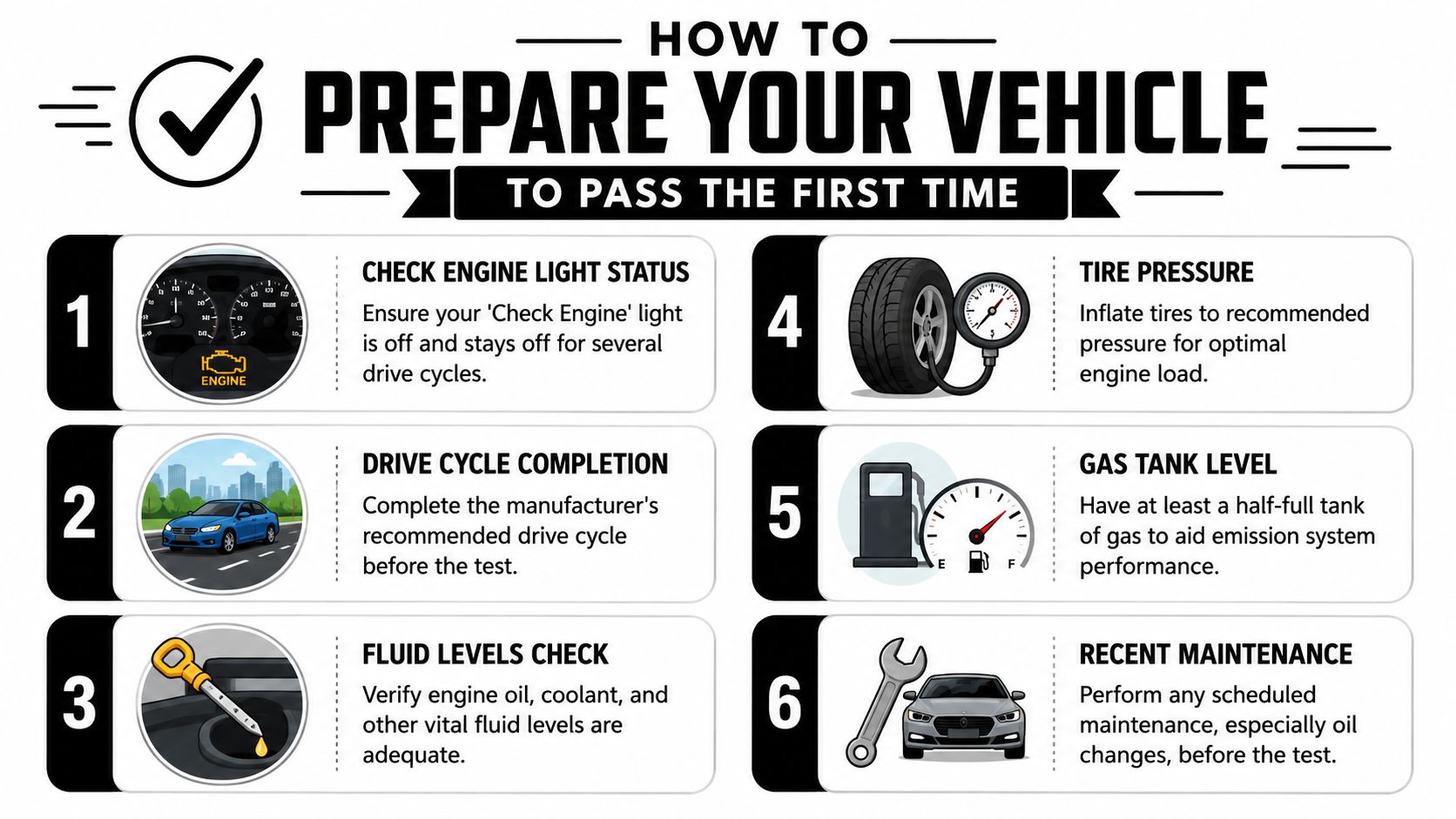
- Check the dash first: No check engine light, no warning you were planning to ignore, and no recent code clearing.
- Think about recent battery work: If the battery was disconnected, wait until the car has had enough regular driving time to complete its monitors.
- Make sure the fuel cap is secure: Loose or damaged caps can lead to emissions-related trouble codes.
- Don't test with unfinished repairs: If a shop told you to come back after driving it a bit, listen to that advice.
- Skip the appointment if the car is acting up: Rough idle, stalling, or poor running usually means something should be diagnosed first.
What works is boring, steady preparation. What doesn't work is rushing in right after a repair, right after a battery swap, or right after turning off a warning light.
Finding the Right Smog Station in Union City
The station you choose matters more than commonly assumed. In Union City, the biggest decision isn't only price or location. It's whether you're walking into a STAR-certified station or a Test-Only station.
STAR stations and test-only stations are not the same
A test-only station does exactly what the name says. It tests. If your vehicle fails, that station can't fix it.
One local listing explains the issue clearly: a Test-Only station like QUIK SMOG UNION CITY cannot repair a failed vehicle, which means the driver has to find a separate BAR-certified repair facility. That extra handoff is a common source of confusion and delay for East Bay drivers, as noted on this Union City Test-Only station explainer.
That distinction matters most if you already suspect your car might not pass. If the vehicle has been running rough, recently had emissions work, or has had codes cleared, the wrong station choice can turn one errand into two.
| Station Type | Can Test Your Vehicle? | Can Repair a Failed Vehicle? |
|---|---|---|
| STAR-certified station | Yes | Some can, depending on the business |
| Test-Only station | Yes | No |
If you're not sure what STAR means, this quick guide on what a STAR station is gives the practical version.
Local details that help you choose faster
Union City does have multiple STAR-certified options. One example is Union City Smog Check at 33365 Mission Blvd, listed as open Monday through Friday from 9:30 AM to 5:00 PM and Saturday from 9:30 AM to 3:00 PM on the Union City smog station directory. The same directory also shows that local smog prices in Union City have been reported in a range from $50.00 to $83.00, which makes shopping around worth the effort because BAR doesn't regulate the inspection price itself.
That directory also highlights a few failure triggers drivers should take seriously before booking. Vehicles with a check engine light on, modified software, or a recently disconnected battery need those issues resolved first because they can fail the inspection.
Local shortcut: If you're comparing stations, ask two questions before you leave home. Are you STAR-certified, and if my car fails, can you repair it here?
That one phone call can save a lot of backtracking.
A Smart Alternative Speedy Smog in San Leandro
Some Union City drivers stay local because it's close. Others care more about getting in, getting tested, and getting out without losing half a day. That's where nearby San Leandro can make sense.
Why some Union City drivers leave town for a smog check
A short drive is often worth it when the station is built for efficiency. For East Bay drivers with newer vehicles, that usually means a cleaner workflow, quicker turnaround, and fewer surprises at the counter.
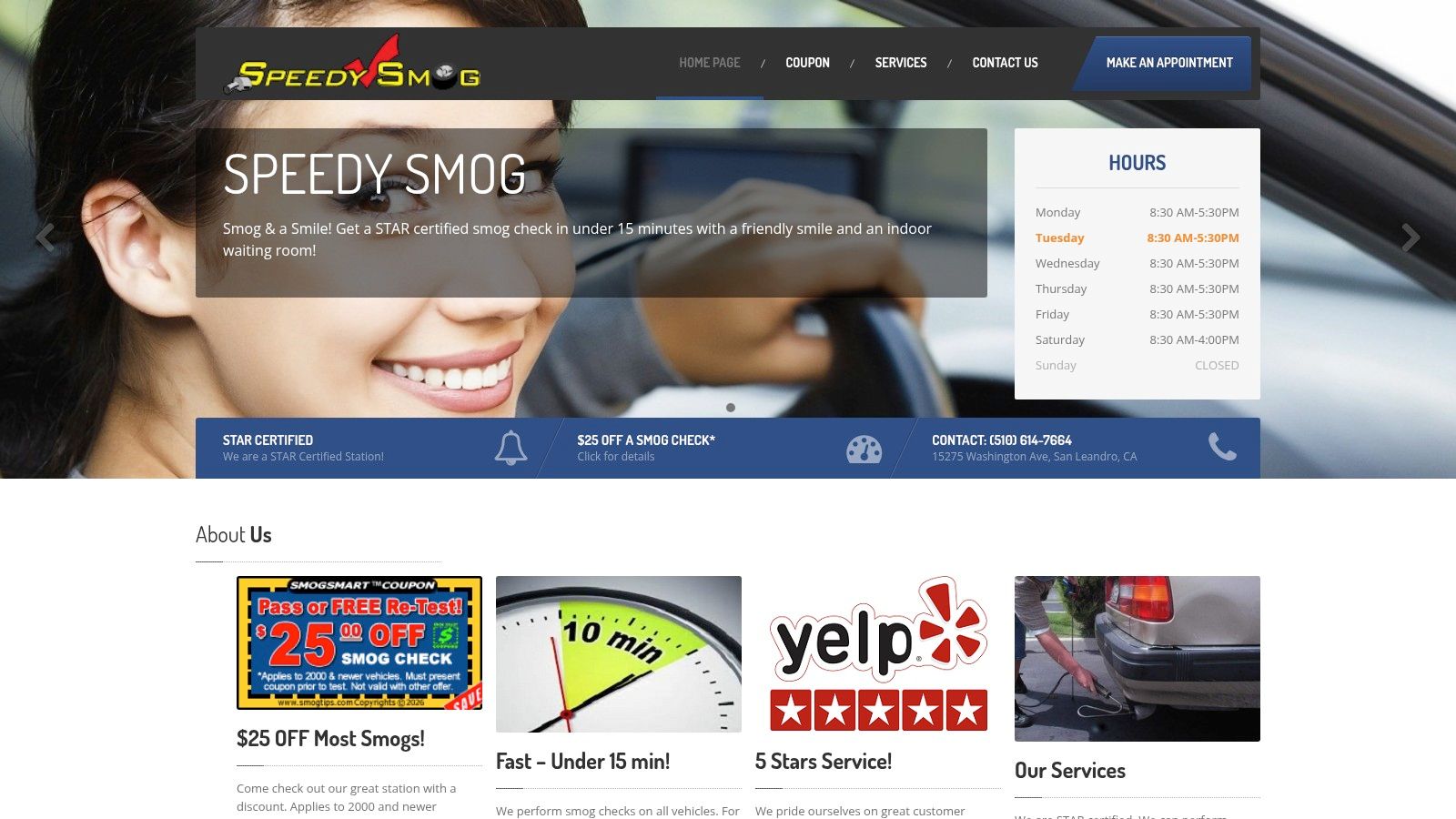
Speedy Smog in San Leandro is a STAR Certified station, and for many drivers that's the draw. It handles the inspection side with the consistency people want when the deadline is a DMV deadline, not a flexible one.
When the short drive makes sense
This option is especially practical if you value a few things:
- Faster routine testing: Most tests on 2000+ vehicles are typically completed in about 10 to 15 minutes, based on the publisher information provided for Speedy Smog.
- A straightforward setup: The shop handles a wide mix of vehicles, including newer models, older vehicles, diesels, and hybrids.
- Less waiting stress: A clean indoor waiting room matters more than people think when you're fitting this into a workday.
- Visible pricing: Transparent pricing and periodic coupons are easier to plan around than vague phone estimates.
There isn't one perfect answer for everyone searching smog check Union City CA. But if your priority is speed, reliability, and a predictable experience, expanding the search radius a bit can be the smarter move.
What Happens During the Smog Inspection
Pull into a Union City smog station with a recently disconnected battery, and the visit can go sideways before the probe or scan tool does much of anything. I see that confusion all the time. Drivers assume the car is "running fine," but the inspection is checking for more than drivability.
California smog checks follow a set process. The technician is looking for missing or altered emissions equipment, trouble codes, and monitor status. On some vehicles, the station also measures tailpipe emissions or smoke opacity, depending on the test method your vehicle falls under.
The three parts of the inspection
Here is what usually happens once the car is checked in:
Visual inspection
The technician checks emissions-related parts that are supposed to be present and properly connected. That can include the catalytic converter, emissions hoses, intake components, fuel cap, and other equipment that matches the vehicle's configuration. If a part is missing, obviously modified, or not legal for street use in California, that alone can cause a failure.OBD-II scan
The shop plugs into the OBD-II port and reads the car's computer. A common issue for many Union City drivers arises after a battery replacement or recently cleared codes. If the readiness monitors are not set, the car may fail even with no check engine light on. That is one of the least understood smog problems, and it wastes a lot of repeat visits.Emissions measurement, when required
Some vehicles are tested through the onboard system, while others may still need an exhaust or smoke test under the applicable procedure. The station uses the method required for that vehicle, not whatever seems quickest.
Most inspections are fairly routine if the car is ready for testing. The part that surprises drivers is that "no symptoms" does not mean "ready to pass."
If you want a clearer read on the paperwork you get afterward, this guide to how smog test results work is useful.
What tends to slow the process down
The inspection itself is standardized. The delays usually come from preventable issues at check-in or during the scan.
A few common ones:
- Readiness monitors not set: Common after a dead battery, battery replacement, or recently cleared codes.
- Wrong station for the situation: Some drivers show up at a Test-Only station expecting repairs or diagnostic help on the spot. Test-Only means inspection only.
- Aftermarket parts with no proper approval: Modified intakes, exhaust components, or catalytic converters can create problems during the visual inspection.
- VIN or paperwork mismatches: Registration details need to line up with the vehicle being tested.
What to bring on test day
Keep it simple and bring the documents that make check-in easier.
- Your DMV renewal notice
- Your vehicle registration
- Your driver's license or photo ID, if the station asks for it
If you are handling a sale or transfer, bring the related paperwork too. Ownership-transfer smog situations can create extra confusion, and having the documents in hand saves time at the counter.
What to Do If Your Vehicle Fails the Smog Check
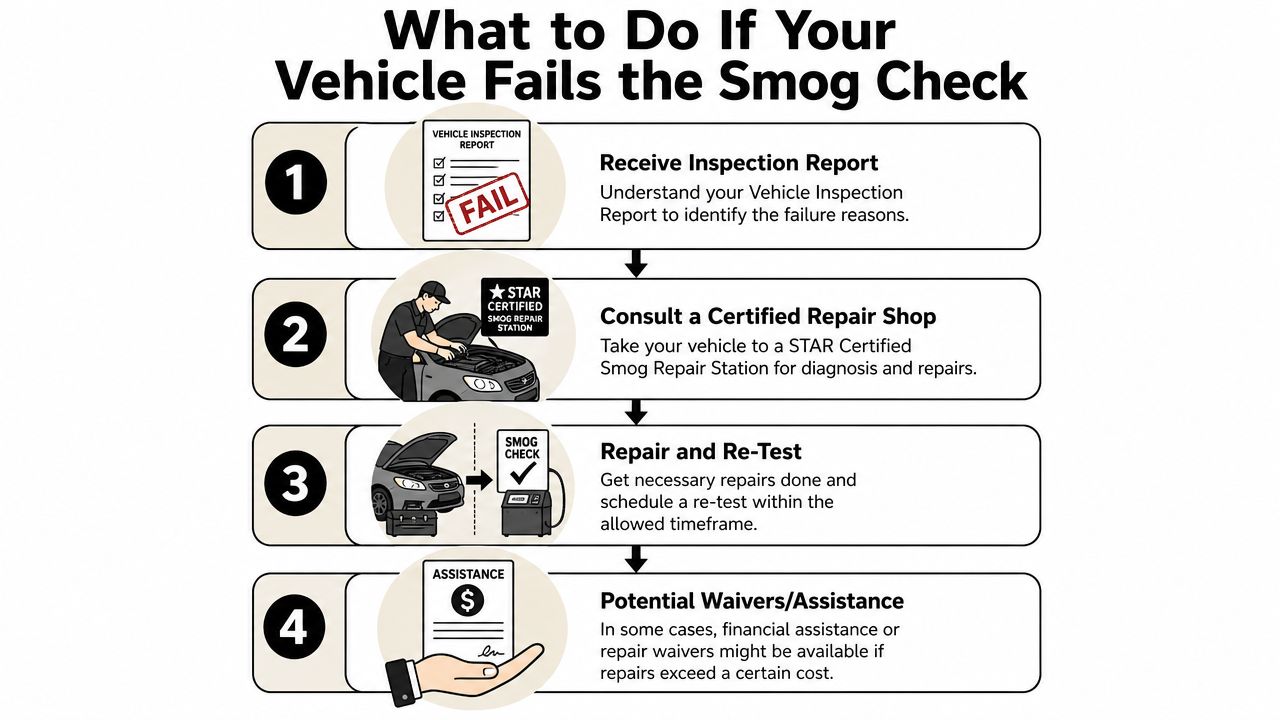
You leave the station expecting a certificate and walk out with a failed Vehicle Inspection Report instead. That moment frustrates a lot of Union City drivers, especially if the car seems to run fine. A failed test is still useful. It points to a specific problem, and the fastest path is to treat that report like a diagnosis, not a random setback.
Read the report before you do anything else
Start with the exact reason for the failure. The report usually makes it clear whether you have an active trouble code, incomplete readiness monitors, a visual inspection problem, or tailpipe-related emissions issues on an older vehicle.
Those failures do not lead to the same repair path.
Readiness monitors are one of the most commonly missed issues after a dead battery, battery replacement, or recently cleared check engine light. Drivers fix the original problem, head straight back for a retest, and fail again because the car has not completed the right drive cycle. That is a Union City-area time waster I see all the time.
Choose the right repair path for the station type
Station type matters after a failure.
If you tested at a shop that also performs repairs, you can usually move straight into diagnosis. If you failed at a Test-Only station, that shop is there to inspect, not troubleshoot or repair. A lot of drivers do not realize that until they are standing at the counter with a fail report in hand.
That distinction affects both time and cost. Test-Only can be a good fit if you just need a clean inspection, but it is less convenient if your car has a check engine light history, recent battery work, or emissions-related modifications.
Keep the fee side simple too. Inspection pricing varies by shop. The certificate fee is added only when the vehicle passes, and some newer gasoline vehicles are exempt from the inspection and pay an abatement fee instead, as noted earlier.
Handle the retest carefully
The worst move after a failure is rushing back the same day without confirming the repair solved the problem.
Use a short checklist:
- Bring the failed report to the repair shop: It saves diagnostic time and keeps the technician focused on the actual failure point.
- Ask whether codes were cleared: If they were, confirm which readiness monitors still need to run before a retest.
- Do not assume a smooth-running car is ready: A car can drive normally and still fail because monitors are incomplete.
- Check modified parts: Aftermarket intake, exhaust, or catalytic converter issues can trigger a second failure even if the original code is gone.
- Keep all paperwork together: It makes retesting and registration deadlines easier to manage.
A quick visual walkthrough can help if this is your first failed test.
Most failed smog checks are fixable. The extra cost usually comes from guessing, clearing codes too early, or retesting before the monitors are ready.
If you'd rather skip the guesswork and use a fast, STAR-certified station nearby, Speedy Smog in San Leandro is a practical option for East Bay drivers. It's built for quick, compliant testing, especially for many 2000 and newer vehicles, and it's a solid choice when you want a clean process, clear pricing, and a smog check that fits into a normal day instead of taking it over.
If your check engine light is on, your car will automatically fail a California smog test. The fix usually isn't just turning the light off. The goal is getting the repair done and making sure the car's OBD-II system is ready before you test.
If you're reading this with a DMV renewal notice on the counter and an amber engine icon glowing on the dash, you're in the same spot a lot of drivers end up in. The stressful part is not knowing whether you need a major repair, whether you should just clear the code, or whether you can still sneak through a smog check if the car seems to run fine.
Here's the practical answer from the shop side. A successful check engine light smog test situation comes down to two things: the light has to be off, and the car's emissions monitors have to be ready. That second part is what catches people. They fix the issue, disconnect the battery, clear the code, head straight to the station, and then find out the vehicle still isn't prepared for inspection.
That's avoidable. If you know what the light means, how to read the code, and how readiness monitors work, you can save yourself a wasted trip, a second test, and a lot of frustration.
Table of Contents
- That Sinking Feeling Your Check Engine Light and the DMV Notice
- Why the Check Engine Light Is an Automatic Smog Fail
- How to Diagnose the Problem Behind the Light
- The Critical Step Most Drivers Miss OBD Readiness Monitors
- Completing a Drive Cycle for a Successful Retest
- Your Smog Test at Speedy Smog in San Leandro
- Smog Test and Check Engine Light FAQs
That Sinking Feeling Your Check Engine Light and the DMV Notice
You open the registration notice, glance at the deadline, and then see the dashboard light that wasn't there last week. The car starts. It drives normally. Nothing feels obviously wrong. But now you're wondering whether you can just get the smog done and deal with the light later.
In California, that warning light changes the whole picture. Under the state's Smog Check Program, an illuminated malfunction indicator lamp, or MIL, is treated as an immediate failure condition. The California Bureau of Automotive Repair's 2023 Smog Check performance report also shows a statewide fleet-weighted roadside failure rate of about 14% in 2023, which is roughly 1 in 7 inspected vehicles. That tells you something important. Emissions compliance is not a formality. The system is built to catch vehicles with active emissions faults.
Most customers don't walk in upset because they dislike the test itself. They're worried about time, cost, and uncertainty. They want to know whether they're dealing with a loose gas cap, a sensor issue, or a bigger repair. They also want to know whether there's any shortcut.
Practical rule: If the check engine light is on, don't spend money on an official smog test yet. Spend that effort on diagnosis first.
That's the part that usually calms people down. This is common. It's also workable. The light doesn't automatically mean a catastrophic repair. What matters is following the right order: identify the fault, fix the cause, confirm the light stays off, and then make sure the computer has finished its self-checks.
A lot of frustration comes from treating the dashboard light as the whole problem. It isn't. It's the car's way of telling you the emissions system has something unresolved. Once you approach it that way, the process gets much more straightforward.
Why the Check Engine Light Is an Automatic Smog Fail
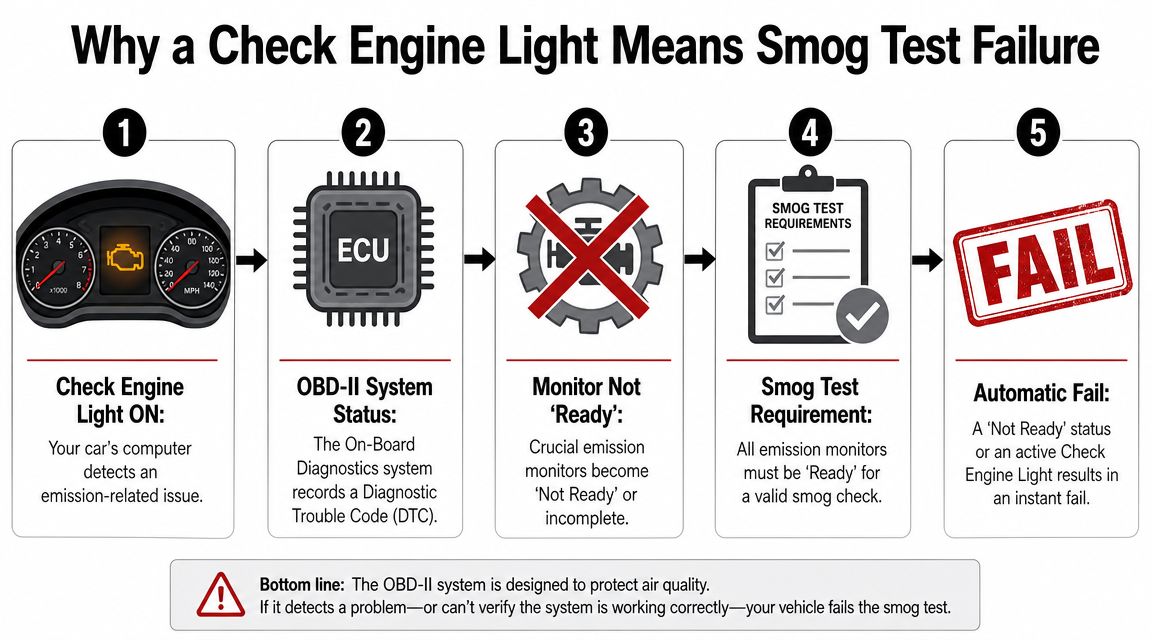
You can drive in with the car running fine and still fail before the inspection gets very far. If the check engine light is on, the state treats that as an active emissions problem, not a minor warning you can explain away at the counter.
What the light is actually telling you
That light means the car's OBD-II system has detected a fault and stored a diagnostic trouble code, or DTC. The code identifies the system that failed a self-check. It does not automatically identify the exact part you need to replace, which is why guessing gets expensive fast.
A few common causes show up again and again:
- Fuel vapor leaks: A loose gas cap can do it, but so can a cracked hose or a bad purge valve.
- Sensor faults: Oxygen sensor problems can throw off fuel mixture and emissions control.
- Catalyst efficiency issues: A converter code may point to the catalyst, or to an engine problem that damaged converter performance.
- Misfire or fuel control problems: The car may still drive, but emissions can rise enough to trigger a fault.
Why the state fails it right away
A smog inspection is checking whether the emissions system is functioning as designed and whether the vehicle is reporting healthy status through onboard diagnostics. An illuminated MIL means the vehicle is already reporting that something emissions-related is wrong. That is enough to fail the test.
This catches a lot of drivers off guard because they focus only on whether the light is on. However, the smog-test standard is stricter than that. The light must be off, and the car's computer must also be ready to prove the repair held.
An off light is only the first checkpoint. Passing smog usually depends on the system being fault-free and fully ready.
That distinction matters in the shop every week. A driver gets the repair done, clears the code, sees the light stay off, and assumes the car is ready. Then the vehicle fails because the onboard self-checks have not finished running yet. The light is the obvious problem. Readiness is the hidden one.
So yes, the check engine light is an automatic fail. But getting the light off is only part of getting through smog on the first try.
How to Diagnose the Problem Behind the Light
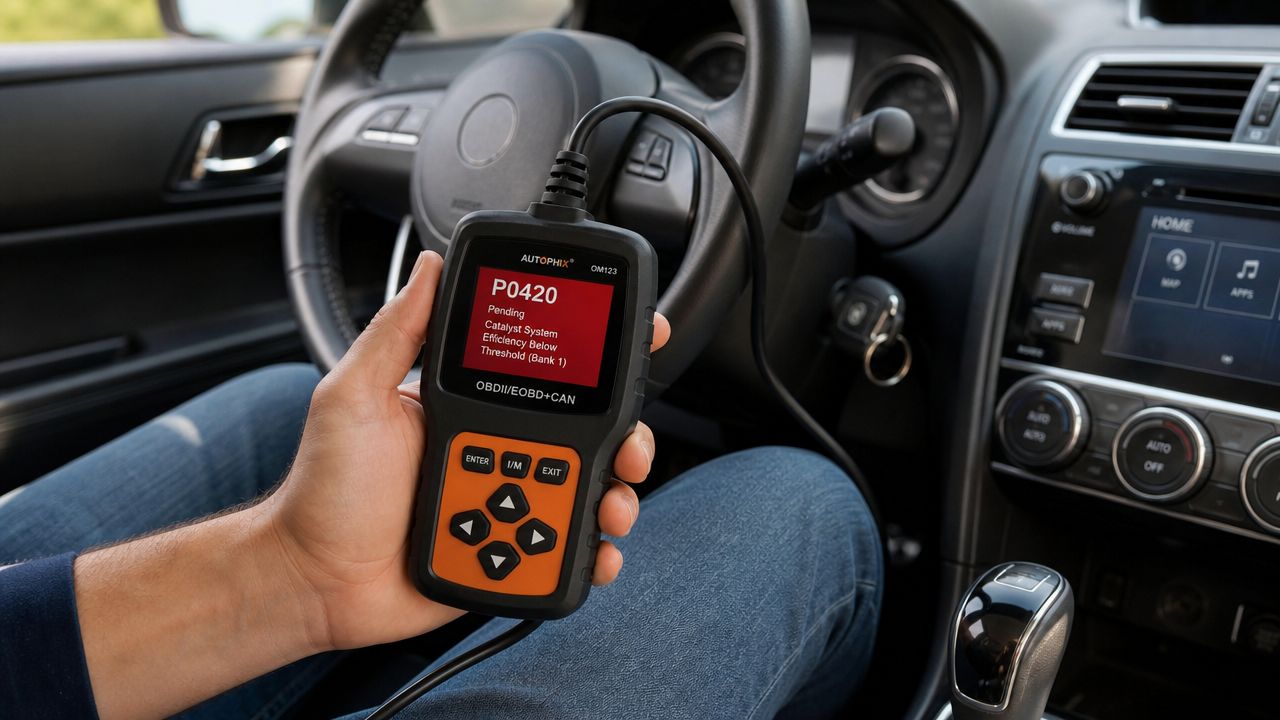
Start by pulling the actual code. That saves time, avoids parts-swapping, and gives you a better shot at fixing the problem once instead of paying for the same issue twice.
Three practical ways to read the code
Use an OBD-II scanner at home.
If you do your own basic car care, this is the fastest route. Plug into the OBD port, read the code, and write it down exactly as it appears. The code matters. P0420, P0440, P0301, and similar codes each point you in a different direction.
Visit an auto parts store for a code read.
This works well if you want a quick answer before talking to a repair shop. You will usually get a printout with the code and a short description. That helps, but it is still a starting point, not a confirmed diagnosis.
Ask a repair shop or smog station to check it.
This is often the better choice if the car was repaired recently, the battery was disconnected, or someone already cleared the code. A technician can usually tell whether you are dealing with an active fault, an intermittent problem, or a car that is not ready to be tested yet. If you are local, Speedy Smog in San Leandro can check whether the vehicle looks ready for a smog inspection or whether repair work should come first.
What a trouble code actually tells you
A code points to a system that needs attention. It does not automatically condemn one part.
That is where many drivers lose money. They read a code description online, replace the named part, and then find out the underlying cause was somewhere else in the same system.
| Code result | What it helps with | What it doesn't do |
|---|---|---|
| EVAP-related code | Narrows the problem to the fuel vapor system, including the gas cap, lines, purge valve, or leak checks | It does not tell you the exact leak location |
| Oxygen sensor code | Shows the computer is seeing a signal or fuel-control problem in that circuit | It does not always mean the sensor itself is bad |
| Catalyst efficiency code | Tells you the catalytic converter system is not passing its self-check | It does not prove the converter is the only problem |
In the shop, I see this a lot with catalyst and oxygen sensor codes. A vehicle may set a catalyst code because the converter is worn out, but it can also happen after a misfire, an exhaust leak, or a fuel-control issue. The code gets you into the right area. Testing confirms the fix.
This short walkthrough helps if you've never scanned a car before:
Bring the exact code with you when you talk to a technician. “The light is on” is vague. “It has a P0420” or “it has an EVAP code” gives the shop something useful to work from.
One more point matters here. Getting the code repaired and getting the light to stay off are only part of the job. For smog, the car also has to show that its onboard tests have run and completed. That is the step many drivers miss after a recent repair or code clear.
The Critical Step Most Drivers Miss OBD Readiness Monitors
A dark dashboard is good news. It is not the same thing as a ready car.
This is the biggest misunderstanding in any check engine light smog test situation. A driver fixes the problem, clears the code, sees the light go out, and heads straight to the station. Then the car comes up Not Ready. That usually means the onboard system hasn't finished its emissions self-checks yet.
What readiness monitors are
Your OBD-II system runs a series of self-tests called readiness monitors. These monitors check different emissions-related systems after the car has been driven under the right conditions.
A simple way to think about it is this: clearing the code is like erasing a test score before the car has taken the test again. The warning light may be off, but the computer still hasn't confirmed that everything now works correctly.
The California Bureau of Automotive Repair explains on its Smog Check guidance page that clearing codes right before a test can leave monitors “Not Ready,” and after a battery disconnect you should drive for a week or two so the monitors can reset before inspection.
What resets the monitors
Several common events can knock a vehicle back to not-ready status:
- Code clearing with a scan tool: This turns the light off but also wipes out monitor history.
- Battery replacement or disconnection: The computer loses stored readiness data.
- Recent repair work: Even after a correct repair, the system needs time and driving conditions to verify itself.
Why this costs drivers time
A lot of people assume smog is about whether the light is on that day. In practice, the inspection also cares whether the car has completed its internal emissions checks.
If you cleared the code yesterday, you probably solved one problem and created another. The lamp may be off, but the computer may still have nothing valid to report.
That's why a proper pre-check matters. Before you schedule the official inspection, use an OBD-II scanner and look at monitor status. If the monitors still show incomplete, keep driving and recheck later.
The key idea is simple. Off means the fault may no longer be active. Ready means the vehicle has proven that repair through completed self-tests. Ready is what gets you closer to a first-pass result.
Completing a Drive Cycle for a Successful Retest
A lot of failed retests happen after the repair was done right.
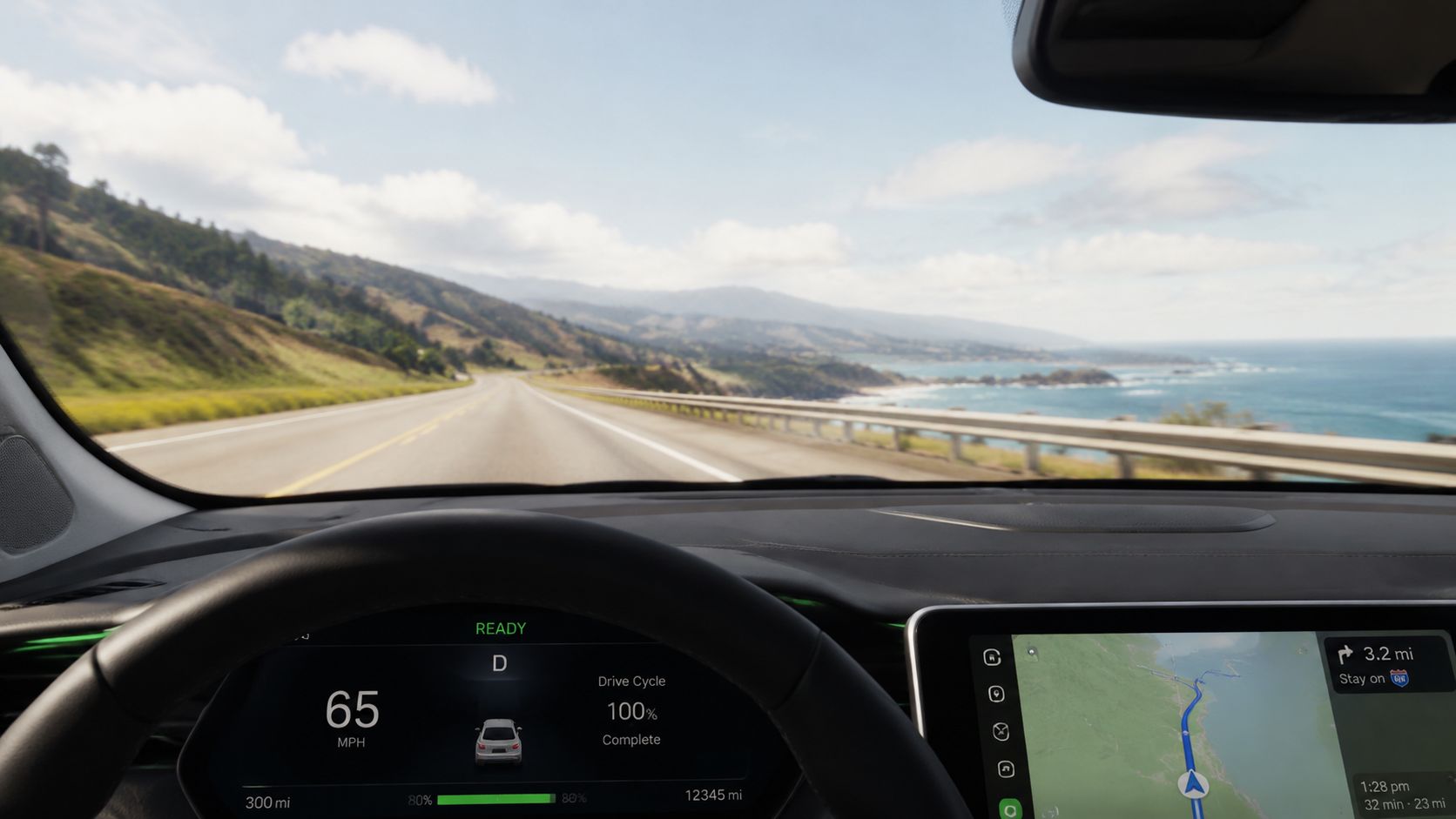
The problem is timing. The check engine light can be off, but the car still may not be ready for a smog inspection because the onboard system has not finished its emissions self-checks under normal driving conditions. That is what a drive cycle is for. It gives the vehicle enough cold starts, warm-up time, steady cruising, and stop-and-go operation to confirm the repair.
What a drive cycle usually looks like in real life
For many vehicles, the fastest path is not a special trick. It is a few days of normal mixed driving with enough variety for the monitors to run.
That usually means:
- A true cold start: Let the car sit long enough to cool down fully before one of your trips.
- City driving: Stop signs and lower-speed traffic help some systems run their checks.
- Steady highway cruising: A consistent speed helps other monitors complete.
- A full warm-up: Drive long enough for the engine and catalyst to reach normal operating temperature.
- Smooth inputs: Moderate acceleration and braking are better than aggressive driving.
Some cars are quick to set readiness. Others are picky and need more than one trip pattern before every monitor completes. I tell customers to avoid guessing. If you have access to a scan tool, check the monitor status after a couple of regular driving days and see what is still incomplete.
How to avoid wasting a retest fee
Drivers often focus on mileage alone, but mileage is only part of it. Twenty miles of short errands is different from twenty miles that include a cold start, a warm-up, and a steady cruise. The car needs the right conditions, not just more time on the odometer.
A simple pre-retest routine helps:
- Make sure the MIL stays off during normal use: If it comes back, the repair still needs attention.
- Check monitor status before heading in: Look for ready monitors, not just an off light.
- Drive the car shortly before the test: A warmed-up engine and catalyst generally put the vehicle in a better position for inspection.
- Do not let it sit and cool for a long time before the appointment: Try to arrive without a long cold wait.
Independent California guidance also recommends a short warm-up drive before inspection and a brief idle period at the station, as described in this California smog warmup guidance video.
Shortcuts that cause repeat failures
These are the patterns that cost people extra time:
| Shortcut | What usually happens |
|---|---|
| Clearing codes and testing right away | The light may be off, but monitors often show not ready |
| Taking only a quick neighborhood loop | The vehicle may never see the conditions needed to run all checks |
| Arriving with a cold engine | The emissions system may not be fully up to temperature |
The practical order is simple. Fix the fault, drive the car through normal mixed conditions, confirm readiness with a scanner, then schedule the test.
That approach gives you the best shot at passing on the first return visit.
Your Smog Test at Speedy Smog in San Leandro
When the vehicle is ready, the actual inspection should feel routine. That's what you want at this point. No surprises. No rushed guesswork at the bay door. Just a clean check of a vehicle that has already been repaired and verified.
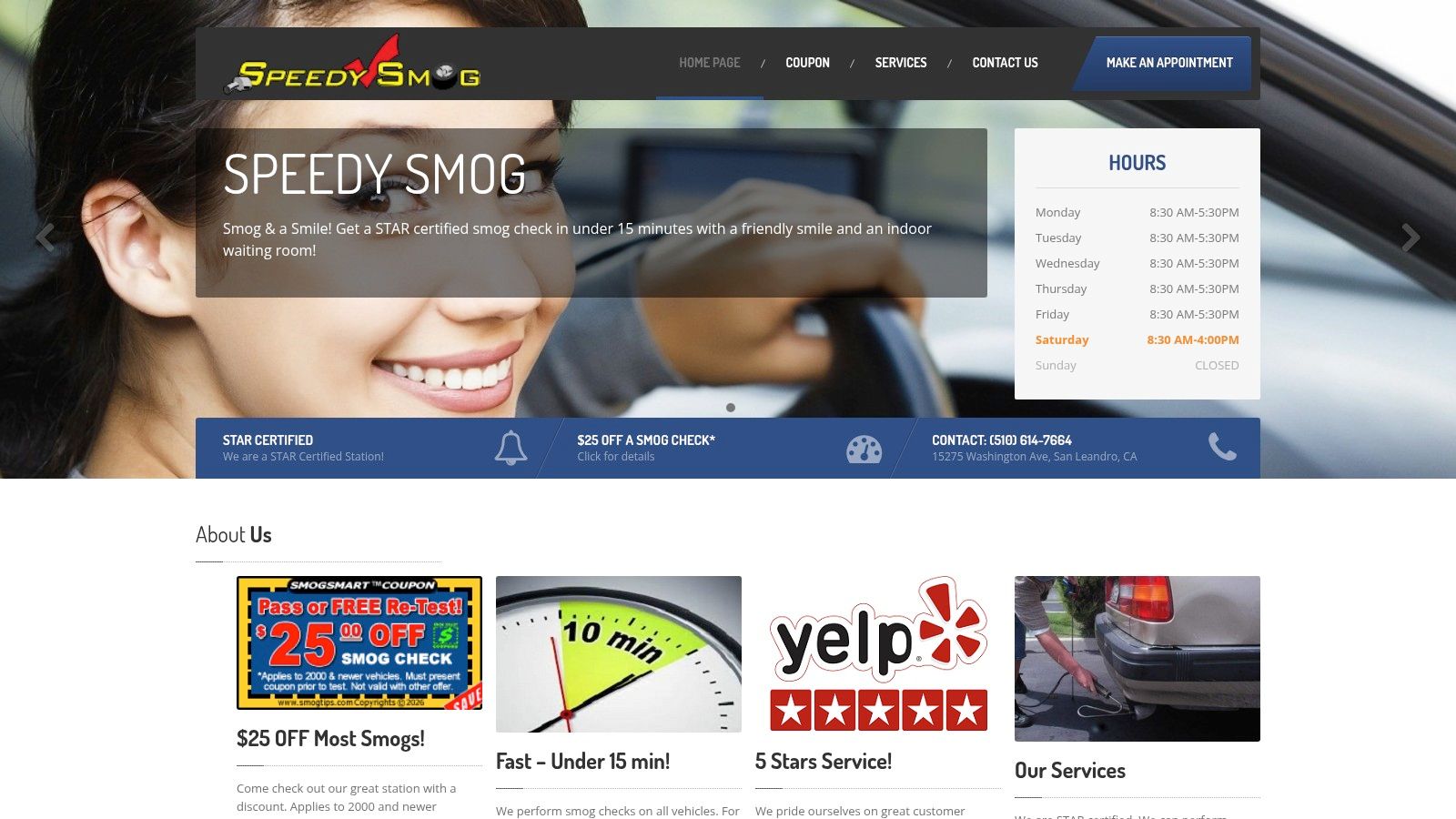
For East Bay drivers, the practical advantage is convenience. Speedy Smog is a STAR Certified smog check station in San Leandro, and for many 2000 and newer vehicles, tests are typically completed in about 10 to 15 minutes, based on the shop information provided by the business. That kind of turnaround matters when you've already spent time dealing with repairs and readiness.
What helps a test go smoothly
A prepared customer usually has three things handled before arrival:
- The warning light is off: Not temporarily cleared, but permanently resolved.
- The car is warmed up: It didn't arrive cold after sitting all morning.
- Readiness has been checked: The vehicle's onboard system is prepared for inspection.
Why STAR certification matters to drivers
From a customer perspective, STAR certification means the station meets higher state-required performance standards. That gives you confidence that the inspection will be handled according to California requirements and recognized for DMV registration.
The rest is simple shop experience. A clean waiting room, straightforward pricing, and a station that handles newer vehicles, older vehicles, diesels, and hybrids can make the process less annoying than generally anticipated.
If you've done the repair and verified monitor status first, the smog check itself becomes the easy part.
Smog Test and Check Engine Light FAQs
Can I pass if I just clear the check engine light first
Usually, no. Clearing the code can turn the light off, but it also often resets the OBD-II readiness monitors. That leaves the car showing Not Ready, and a vehicle with monitors not set can still fail or be rejected for testing even though the dash light is off.
That's the part many drivers miss. The light being off and the system being ready are two different things.
Why did my car fail after the battery was replaced
A battery replacement or disconnect can wipe out the monitor history your car needs for a smog check. The repair may be done correctly, but the onboard computer still has to run its self-checks again before the vehicle is ready for inspection.
I see this one a lot after DIY battery swaps. The customer fixed nothing wrong, but the car still needs some normal driving before the monitors come back.
How long should I drive after a repair before retesting
There is no single mileage that fits every car. Some vehicles reset quickly with a normal mix of city and freeway driving. Others need more time, especially if monitors like EVAP have not completed yet.
The smart move is to check monitor status with a scan tool before you pay for another test. Guessing based on miles alone is what costs drivers an extra trip.
Is a newer car always exempt from smog
No. Some newer gasoline vehicles may be exempt for a period of time, but that does not mean every newer car skips testing every year. Registration status, model year, transfer of ownership, and California rules all affect whether a smog inspection is required.
If you are not sure, look at the DMV renewal notice first. That paperwork usually answers the question faster than guessing.
Does every vehicle get tested the same way
No. For 1996 and newer vehicles, the inspection usually relies on the OBD system, and the Nevada DMV's explanation of OBD emissions testing gives a clear overview of how that works. Older vehicles can follow different procedures, so the test process depends a lot on the model year and vehicle type.
That is why two customers can both say they need a smog, but their visits look different once the test starts.
What's the smartest thing to do before I go in
Check both items before the visit. Make sure the check engine light is off, and make sure the readiness monitors are set. If the light is off but one or more monitors still show incomplete, the car may still not be ready for a first-pass test.
At the shop, this is the difference that saves time and money. Drivers who verify monitor status before coming in usually avoid the frustrating fail that happens after a perfectly good repair.
If your registration is due and you want a straightforward inspection once your vehicle is ready, Speedy Smog is a practical option for San Leandro and East Bay drivers. Get the repair handled, confirm the monitors are set, then come in for the smog check.

If you're looking up a smog check in Alameda, CA, you're probably in one of two situations. Your DMV renewal notice just showed up, or you're trying to register a vehicle and don't want a simple requirement to turn into a half-day errand.
The good news is that the process is usually straightforward when you know three things up front. First, whether your vehicle needs a test. Second, what kind of station can handle your car correctly. Third, how to avoid the preventable failures that send people back for a second visit.
Table of Contents
- California Smog Check Rules for Alameda Drivers
- How to Find the Right Smog Station
- Preparing Your Vehicle to Pass the First Time
- What to Expect During the Smog Inspection
- Why Alameda Drivers Choose Speedy Smog in San Leandro
- After the Test Next Steps for Passing or Failing
California Smog Check Rules for Alameda Drivers
Why Alameda requires smog checks
Alameda drivers aren't dealing with a random local rule. California's smog-check framework started in 1966, and biennial inspections are now required for vehicles manufactured in 1976 or later as part of a statewide emissions system that has been refined for nearly 60 years. One source citing CARB data says smog-forming emissions have dropped by more than 80% since the 1960s, which helps explain why the program is still a core part of registration compliance in counties like Alameda (history of California's smog testing program).
That history matters because it clears up a common misunderstanding. A smog check in Alameda, CA isn't a county-specific extra. It's your local part of a long-running California program tied to registration and air-quality enforcement.
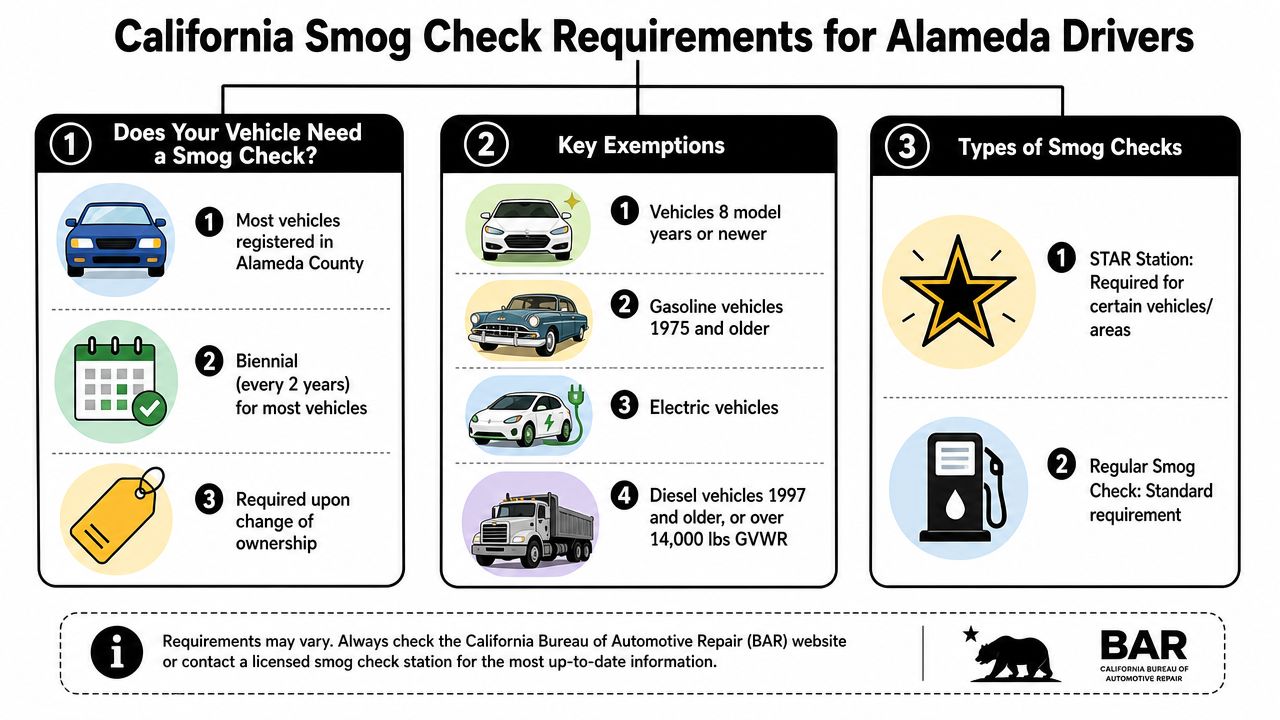
Practical rule: Check your eligibility before you pick a station. A lot of wasted trips happen because drivers assume every vehicle needs the same test.
Who needs a test and who doesn't
Generally, the rule is simple. California DMV requires a smog inspection for registration renewal in Alameda County (California DMV smog inspection requirements).
The key exceptions are where people get tripped up:
- Older gasoline vehicles: Gasoline vehicles 1975 and older are exempt.
- Older diesel vehicles: Diesel vehicles 1997 and older are exempt.
- Heavy diesel vehicles: Diesel vehicles over 14,000 pounds GVW are exempt.
- Electric vehicles: Electric vehicles are exempt.
- Newer vehicles: Starting January 1, 2019, vehicles less than 4 model years old can pay a smog abatement fee instead of getting an inspection for the first 8 model years of registration.
Hybrid owners often assume they fall into some separate category. Usually, the issue isn't that hybrids follow a totally different process. It's that fuel type, model year, and program designation determine what kind of inspection applies.
A clean way to think about it is this:
- Look at the vehicle's fuel type.
- Check the model year.
- Read your DMV notice for any station designation requirement.
If you're dealing with an older car, a diesel, or a hybrid, don't rely on a generic promise that a shop "does all smogs." Confirm that the station handles your exact vehicle type and program requirement before you drive over.
How to Find the Right Smog Station
You pull up to a shop five minutes before closing, hand over your renewal notice, and then find out the station cannot test your car under the program listed on that notice. That is the kind of avoidable hassle drivers run into when they choose based on price alone.
The right station saves time before the test starts. It confirms the station type, checks that your vehicle fits the program, and keeps you from paying for a trip that does not move your registration forward.
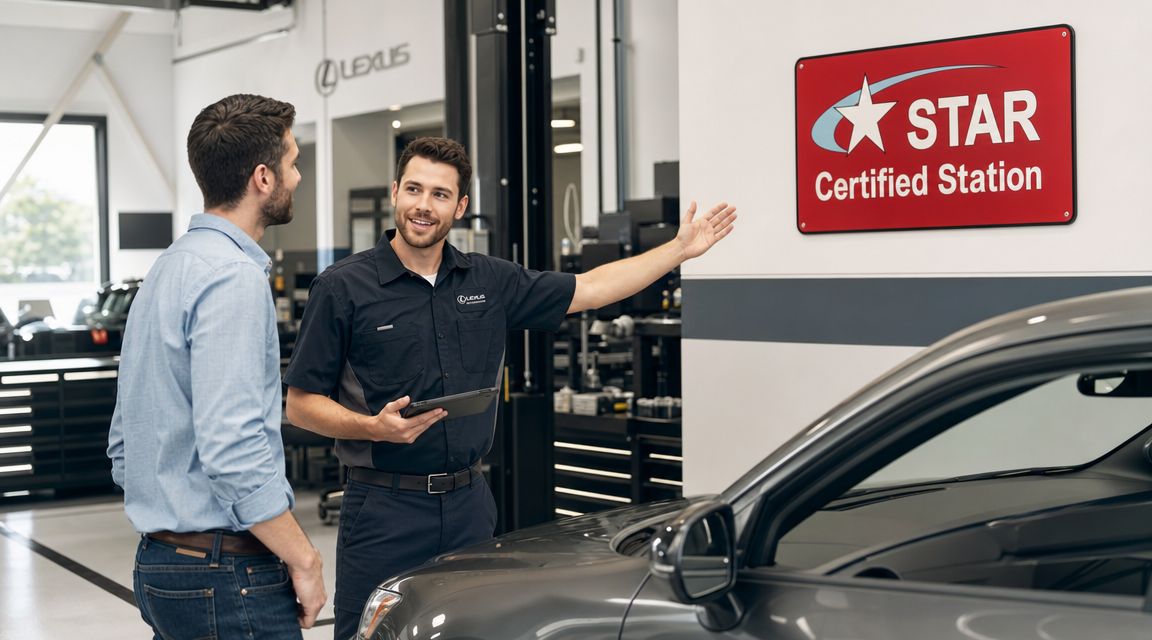
What STAR means
STAR is a California Bureau of Automotive Repair station designation. If your DMV notice says STAR, go to a STAR station. BAR's station locator lets you verify that before you leave home (BAR Smog Check station locator).
That sounds simple, but drivers lose time here. They see “smog check” on a sign, assume every shop can handle every case, and end up making a second trip.
A good station also knows its lane. Some shops are set up for high-volume, straightforward tests. Others are better with older vehicles, hybrids, or cars that tend to raise questions during the inspection process. If your vehicle falls into one of those categories, ask the station what they see every day, not just whether they can test it.
How to narrow your options
Use a short filter. It works better than scrolling reviews for half an hour.
- Check the DMV notice first: If it says STAR, only call STAR stations.
- Confirm your vehicle type: Ask whether they regularly test your model year, fuel type, and any special case such as diesel or hybrid.
- Ask how they handle wait times: Some shops take walk-ins only. Others move much faster with appointments.
- Ask what to bring: A station with a clean process should tell you right away whether you need your renewal notice, registration, or both.
- Listen to how they answer: Clear, specific answers usually mean the front desk and the techs have their process under control.
Price still matters. So does speed. But the cheapest coupon is not a bargain if you wait an hour, get turned away for the wrong station type, or have to come back because nobody asked the basic questions up front.
That is one reason Alameda drivers often head to Speedy Smog in nearby San Leandro. The value is not just the posted price. It is getting in, getting the correct inspection, and getting back on the road without unnecessary back-and-forth.
A well-run smog station helps you avoid three common problems: the wrong station type, the wrong timing, and the wrong expectations.
Preparing Your Vehicle to Pass the First Time
You pull up for a smog check on your lunch break, expecting a quick in-and-out visit. Then the test stops before it really starts because the Check Engine light is on, or the battery was replaced two days ago and the monitors are still not ready. That kind of fail is frustrating because it was usually preventable.
The goal is simple. Show up with a car that is properly ready to be tested, not just running well enough for daily driving.
Start with warning signs and recent repairs
Check the dashboard first. If the Check Engine light is on, fix that problem before you test. A smog technician cannot pass a vehicle with an active check-engine light, so paying for a test at that point usually just buys you a known result.
Recent battery work causes a different kind of trouble. If the battery was disconnected, replaced, or the codes were cleared, the car may need time and normal driving to reset its readiness monitors. I see this all the time. The owner says the car feels fine, but the computer has not finished its self-checks yet.
That is why a car can drive normally and still be unready for inspection.
A practical pre-test checklist
Before you head to the station, run through these basics:
- Make sure the Check Engine light is off: If it is on now, handle the cause first.
- Avoid testing right after a battery disconnect: Give the vehicle enough normal driving time to complete its readiness checks.
- Do not clear codes just to get the light off: That often resets monitors and creates a second problem.
- Bring your DMV notice if you have it: It helps the front desk process the test correctly.
- Warm up the car with a normal drive: A vehicle that has been sitting can benefit from being fully warmed up first.
- Look at recent repairs: Battery replacement, computer resets, and some emissions repairs can leave monitors incomplete.
- Confirm aftermarket parts are legal for California: Modified intake, exhaust, or engine components can create trouble if they are not CARB-approved.
A small timing decision can save you a repeat visit. If you just finished repairs, do not rush straight from the repair shop to the smog station unless the shop specifically confirmed the monitors are ready.
What actually helps, and what does not
Drivers sometimes focus on coupons and speed before they confirm readiness. The smarter move is to handle the simple failure points first. Five minutes under the hood and one honest look at the dashboard can matter more than the lowest advertised price.
It also helps to leave a little room before your registration deadline. If the car needs one more drive cycle, a sensor repair, or a follow-up diagnosis, you still have options instead of turning the renewal into a last-minute problem.
A good shop makes this easier by telling you upfront if your car sounds unready. That is part of the value Alameda drivers look for at places like Speedy Smog in nearby San Leandro. Fast service matters, but fast only helps when the vehicle is prepared to pass.
What to Expect During the Smog Inspection
For a lot of drivers, the stressful part is not knowing what happens once the car goes into the bay. The actual flow is more routine than commonly believed.
What happens from check-in to results
You pull in, hand over your information, and the technician confirms the vehicle details. BAR says the inspection is a three-part compliance test consisting of a visual inspection of emissions-control hardware, an OBD or functional readiness check, and direct emissions measurement on applicable gasoline vehicles. BAR also says the inspection usually takes about 30 minutes (California BAR Smog Check overview).
This is what that looks like from the driver's side.
First, the tech checks that the required emissions equipment appears present and properly configured. Then the onboard system is checked for readiness and fault status. On vehicles where it applies, the inspection also includes emissions measurement.
If the Check Engine light is on, the result is immediate. That's an automatic fail.
The test isn't trying to trick you. It's checking whether the car's emissions system is present, functioning, and reporting ready.
Smog Check at a Glance
| Item | Details |
|---|---|
| What the tech checks first | Vehicle information and required inspection type |
| Part 1 | Visual inspection of emissions hardware |
| Part 2 | OBD or functional readiness check |
| Part 3 | Emissions measurement where applicable |
| Common instant problem | Lit Check Engine lamp |
| Typical duration | About 30 minutes |
What should you bring? Your DMV renewal notice is the safest document to have with you. It's also smart to keep your registration handy in case the station needs to verify vehicle details.
Newer cars often move through the process with very little drama. Older vehicles, modified vehicles, or cars with unresolved warning lights usually take more attention.
Why Alameda Drivers Choose Speedy Smog in San Leandro
A common Alameda scenario goes like this. A driver wants the smog done fast, shows up at the nearest option, then finds out the station is not the right fit for the vehicle or the inspection type. That is how a simple errand turns into a second trip.
A short drive off the island often solves that problem. The better question is which station handles your vehicle type every day, keeps the process organized, and gets the result sent to DMV without confusion.
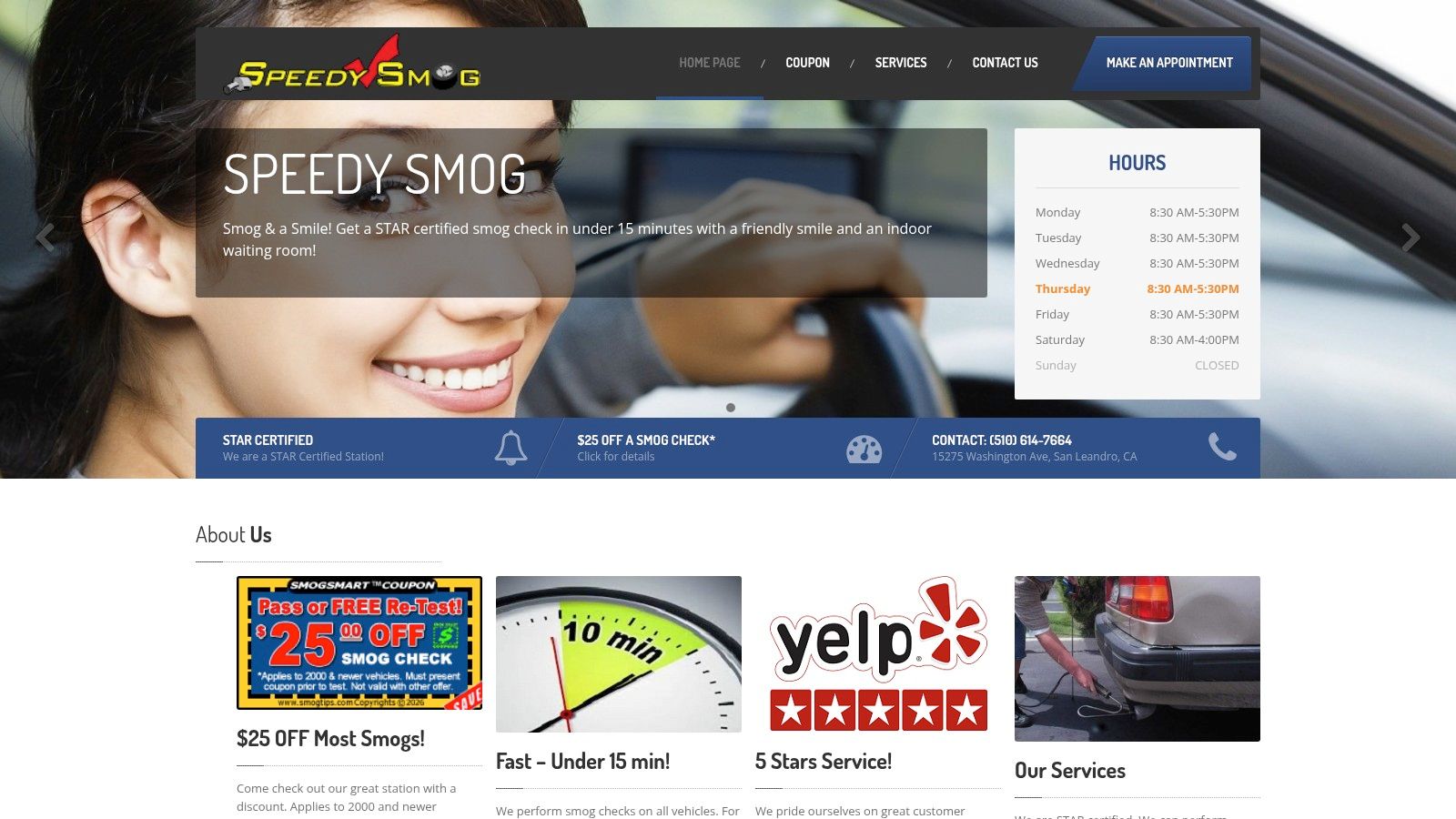
That matters more with older cars, diesels, and hybrids. As noted by Central Auto Service's discussion of Alameda smog-check questions, many online guides stay too general, even though the inspection path changes based on model year and fuel type. Drivers usually do better with a station that works through those differences every day than with a long directory of nearby listings.
For Alameda drivers who want a dependable nearby option, Speedy Smog in San Leandro is a STAR Certified station that handles newer vehicles, older vehicles, diesels, and hybrids. According to business information provided by the publisher, many newer vehicles can be processed quickly, and the shop offers a waiting room plus periodic coupon offers for qualifying smog checks.
Here is why that tends to matter in real life:
- STAR certification: If your renewal notice calls for a STAR station, you need the right shop from the start.
- Experience across vehicle types: Older vehicles and alternative fuel setups often benefit from a station that sees them regularly.
- Convenient off-island location: For many Alameda drivers, San Leandro is an easy hop that saves time compared with calling around or making a return visit.
- Clear, efficient workflow: A smoother check-in and electronic reporting help keep the appointment simple.
From a practical standpoint, that is the essential value. This guide is not just about finding any smog station near Alameda. It is about choosing one that can handle the legal requirement correctly, move you through the test without wasted time, and give you a clear path if the car passes or needs repairs.
After the Test Next Steps for Passing or Failing
Once the inspection is done, the next step depends entirely on the result. This part is often simpler than one might expect.
If your vehicle passes
If the car passes, you're basically finishing paperwork. The station submits the result electronically to the DMV, and that allows you to move ahead with registration renewal without chasing a paper certificate.
Keep your receipt and inspection record for your own files. Even when everything is transmitted properly, it's smart to save proof of service until your registration is complete.
A passing result also gives you a useful baseline. If the car barely made it through after recent repairs, don't ignore recurring warning lights or drivability issues later.
If your vehicle fails
A failed test is frustrating, but it isn't the end of the road. It means the vehicle has an emissions-related issue that needs to be corrected before it can pass a valid retest.
Handle it in this order:
- Read the failure report carefully.
- Ask what category of issue caused the failure.
- Choose a repair shop you're comfortable with.
- Complete the needed repairs.
- Return for retesting after the vehicle is ready.
You are not locked into one repair location just because one station performed the inspection. The important thing is getting the actual cause fixed, not just clearing codes or trying to slip through on a second attempt.
If the failure involved recent battery disconnects or incomplete readiness monitors, the answer may be timing and proper drive-cycle completion rather than a major repair. If it involved a lit malfunction indicator lamp, missing emissions equipment, or an actual emissions fault, the car needs diagnosis and repair before the next test.
Don't guess after a fail. Use the report, fix the cause, and retest only when the vehicle is ready.
If you want a nearby STAR station that serves Alameda drivers, Speedy Smog in San Leandro is a straightforward option for newer cars, older vehicles, diesels, and hybrids. Check your DMV notice, bring your paperwork, and if your car is ready, the visit can be quick and uncomplicated.
Refined using Outrank tool