
Dublin Smog Check: A 2026 Guide to Passing Fast
You open the DMV renewal notice, see Smog Check Required, and your first thought usually isn't about clean air. It's about time, cost, and whether that coupon you found online is real once you pull into the lot.
That's the part most Dublin drivers get stuck on. Not the idea of a smog test itself, but the two practical questions nobody answers clearly enough. What will I really pay out the door? And does my specific vehicle even need a test right now? If you drive a hybrid, diesel, newer gas car, or a vehicle the DMV flagged for STAR, the answer isn't always obvious from a shop ad.
A good Dublin smog check experience comes down to knowing your status before you go, preparing the car so you don't fail for something avoidable, and calling the station with the right questions. That saves more frustration than chasing the lowest advertised price.
Table of Contents
- Why Your DMV Renewal Says Smog Check Required
- Do You Actually Need a Smog Check in Dublin
- How to Prepare Your Car to Pass the First Time
- What Happens During the Smog Inspection
- Finding a Good Smog Station and Understanding Real Costs
- What to Do If Your Vehicle Fails the Smog Test
Why Your DMV Renewal Says Smog Check Required
You open the renewal notice, see “smog certification required,” and the first question is usually whether the DMV made a mistake. In Dublin, that flag usually means your registration hit one of California's regular emissions checkpoints. It is part of the registration process, not a suggestion and not a coupon-driven upsell from a test station.
California has tied emissions testing to registration for decades. As All Star Smog's review of the California smog testing program explains, the program began in 1966 and later expanded to biennial testing for many 1976-and-newer vehicles. That background helps explain the notice. The DMV is checking whether your vehicle still meets the state's emissions rules before it renews the registration.
It's tied to registration for a reason
From the shop side, this part is straightforward. A car can run normally, show no obvious drivability problem, and still have an emissions issue that matters at renewal time. Oxygen sensors get lazy. Catalytic converters lose efficiency. Readiness monitors stay incomplete after a battery disconnect. None of that is visible from the DMV letter, but the registration hold is what gets the issue into the system.
Practical rule: If the renewal notice says a smog check is required, treat it like a deadline item attached to your tags.
That matters because delay costs money and time in ways drivers do not expect. The advertised coupon price is only useful if you need the test being advertised, and many drivers do not confirm that until they are already at the counter. The smarter move is to start with the DMV notice, then confirm the vehicle class and test requirement before chasing the cheapest ad.
Why careful maintenance does not exempt you
A well-maintained car can still be selected for testing because the requirement is based on the vehicle's registration cycle and classification, not on how carefully the current owner has driven it. What matters is the car's model year, fuel type, prior records, and the DMV transaction in front of you.
That is why the notice can feel inconsistent from one renewal to the next, especially in households with a hybrid, a newer gasoline car, or a diesel. The rule set is not intuitive, and the exemptions are where drivers get tripped up most often. Getting that part right first saves an unnecessary trip, and it keeps you from paying for the wrong inspection or assuming a coupon applies when your vehicle falls into a different category.
Do You Actually Need a Smog Check in Dublin
Confusion often arises from conflicting information. Drivers hear one rule from a friend, another from a coupon page, and a third from the DMV notice itself. The cleanest way to handle a Dublin smog check is to sort your vehicle into the right bucket first.
The simple decision rule
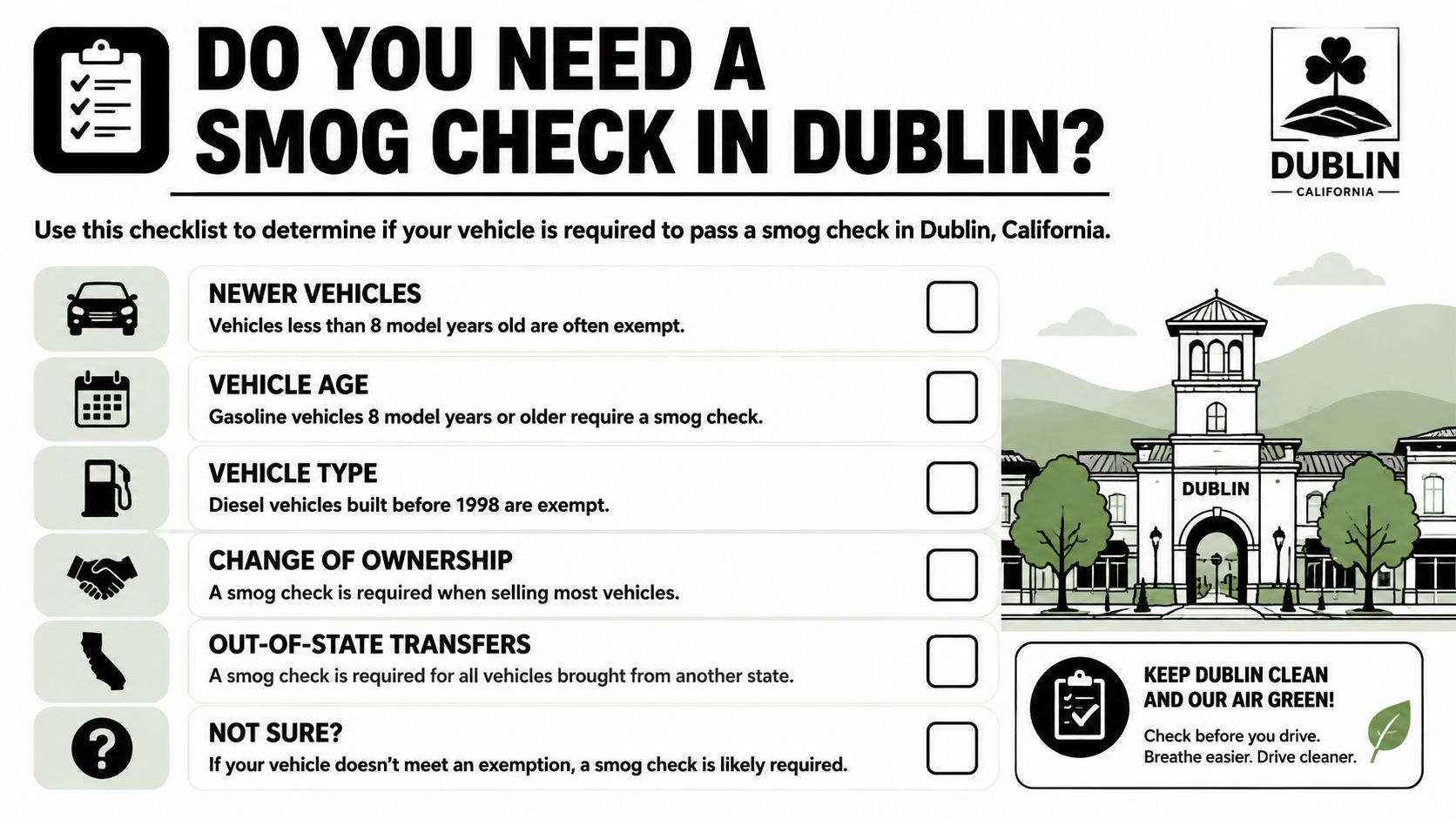
Many vehicles manufactured in 1976 and newer need inspection, but there are important exceptions. According to Kahler's overview of smog check rules in Dublin, most vehicles in that group need a test, while key exemptions can apply to certain hybrids, electric vehicles, motorcycles, and some diesels. The same source also notes that many newer gasoline vehicles are exempt for their first six years on the road.
That means “new car” and “smog exempt” are not always the same thing. A lot depends on model year, fuel type, and how the DMV classifies the vehicle for the registration event in front of you.
Here's the practical breakdown:
- Most gasoline vehicles: If they fall into the inspection pool and aren't in the early exemption window, they'll usually need testing.
- Newer gasoline vehicles: Many are exempt for the first six years, which is why some owners don't deal with smog right away.
- Electric vehicles: These are commonly assumed out of the smog process, and that's usually the first easy category to rule out.
- Hybrids: These confuse people because “efficient” doesn't always mean “excluded.” Some are exceptions, some still require scrutiny depending on the rule set that applies.
- Diesels: These need special attention because diesel rules don't line up neatly with gas-car assumptions.
- Motorcycles: Often treated separately from what drivers expect when they hear “vehicle smog.”
Where drivers get tripped up
The mistake isn't just misunderstanding exemptions. It's assuming a vehicle category tells the whole story.
A hybrid owner may assume the car is automatically exempt because the vehicle is partially electric. A diesel owner may think all diesels are treated the same. Someone with a newer vehicle may assume the age alone settles it. It doesn't. The DMV notice, the registration event, and the exact vehicle type all matter.
If you're not sure, don't search for the cheapest test first. Confirm whether your vehicle needs a standard station or a STAR station, and whether it needs testing at all.
A second source of confusion is change of ownership or other registration-related triggers. Even drivers who don't normally think about smog can run into it when paperwork changes hands. If your registration situation changed recently, don't rely on what happened at your last renewal cycle.
How to Prepare Your Car to Pass the First Time
Most first-time failures aren't mysterious. They come from things the owner could have caught the day before, or from bringing in a car that hasn't been driven in a way that lets the emissions system settle properly.
A little prep won't fix a bad catalytic converter or a dead sensor. It will prevent the easy mistakes that waste a trip.
The checks worth doing before you leave home
Use this as a short pre-smog routine, especially if the car hasn't been driven much lately.
| Check | Action | Why It Matters |
|---|---|---|
| Check engine light | Make sure it is not illuminated | An active warning light can trigger an automatic problem before the test gets far |
| Recent driving | Drive the car long enough to fully warm it up, including steady road driving if possible | A warmed-up engine and emissions system generally test more consistently than a cold car |
| Battery history | If the battery was recently disconnected or replaced, drive the vehicle enough for monitors to reset | Freshly cleared systems can leave readiness status incomplete |
| Fuel cap | Tighten it and inspect for an obvious sealing problem | A loose or damaged cap can create emissions-related issues |
| Tires | Inflate to proper pressure | If the vehicle needs running inspection steps, basic readiness helps everything go more smoothly |
| Oil and basic maintenance | If service is overdue, handle the basics first | Neglected maintenance can contribute to rough running and emissions trouble |
Easy mistakes that cause avoidable failures
Some drivers clear a check engine light right before the appointment and assume they've solved the problem. Usually they've just hidden it temporarily. The underlying fault is still there, and the car may show incomplete readiness when the station connects to it.
Another common issue is bringing in a car that's been sitting. A vehicle that's only been driven on short hops can behave differently from one that's been fully warmed up. If the car is due for a Dublin smog check this week, don't make the test the first real drive it has seen in days.
A smog appointment is not the time to find out your battery reset the monitors, your gas cap is loose, or your dashboard warning light came back on halfway there.
If the car runs rough, stalls, smells strongly of fuel, or idles oddly, don't talk yourself into “maybe it'll pass anyway.” It's better to sort that out first than pay for a test result that only confirms what the car was already telling you.
What Happens During the Smog Inspection
You've done the prep, driven over with the engine warm, and now you want to know one thing. What are they going to do to the car?
For Dublin drivers, the visit itself is usually the simplest part. The station checks your paperwork, confirms what test type your DMV notice calls for, and matches that to the vehicle. That first step matters more than people expect, especially with cars that fall into exemption gray areas or need a STAR station instead of a standard test-only shop.
What the visit looks like from start to finish
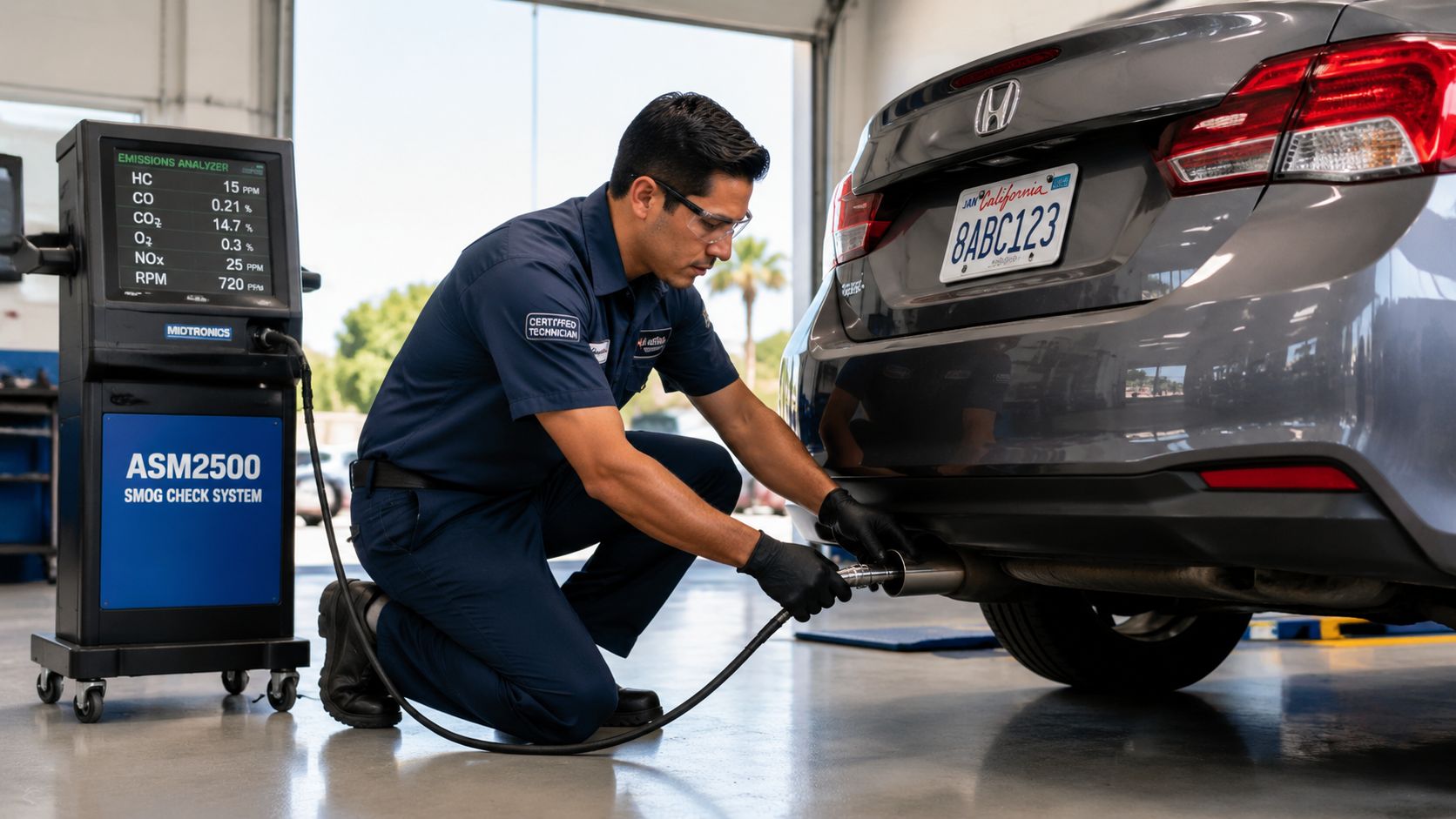
Once the car is checked in, the technician usually starts with a basic inspection of emissions-related items and the dashboard warning lights. If the check engine light is on, that is usually the first hard stop. A decent shop will tell you that quickly instead of running you through the rest of the process just to hand you a failure.
After that, the test method depends on the vehicle.
Many newer cars go through an onboard diagnostics check. The station connects to the car's computer and looks for stored trouble codes, readiness status, and other emissions-related data. Older vehicles can involve different procedures, so the sequence is not identical for every car that pulls into the bay.
That difference is where drivers get confused. Hybrids, diesels, and newer gasoline cars do not always follow the same path, and some owners assume a “smog check” means one universal test. It doesn't. The station is confirming that your specific vehicle meets the requirement tied to its model year, fuel type, and DMV record.
Here's a short explainer if you want to see the process in action:
What you leave with
If the vehicle passes, the result is sent electronically to the DMV, and you should keep your receipt for your own records. That electronic filing is one reason I tell drivers not to wait until the last day. If anything needs to be corrected at the counter, you want time to fix it without turning registration into a rush job.
If the vehicle fails, you'll get a report showing why. Keep that sheet. It gives a repair shop something concrete to work from, which is a lot better than authorizing parts based on a guess or a vague “smog issue” description.
One practical tip. Before you leave the station, ask the staff to confirm whether the test result and vehicle information were entered exactly as shown on your registration. Small data-entry mistakes are rare, but they are easier to catch on the spot than after you get home.
The appointment is usually short. The primary value is knowing what kind of test your car is getting, and why. That helps you avoid wasting money on the wrong appointment, the wrong station, or a last-minute retest you could have prevented.
Finding a Good Smog Station and Understanding Real Costs
Dublin drivers will find their greatest opportunity to save themselves aggravation. The advertised coupon is often the least useful number in the whole transaction.
One public Dublin listing cited an “out the door” regular smog price of $61.66 and noted that STAR certification adds $20, according to a review on Yelp's Dublin Automotive and Smog page. That's the clearest example of the pricing gap drivers run into. A low headline price doesn't tell you what happens once certificate fees, STAR requirements, and vehicle-specific surcharges enter the picture.
Advertised price versus actual price
A coupon can still help. The problem is that many ads answer the wrong question.
Drivers usually don't want to know the lowest possible starting number. They want to know:
- Whether the shop can perform the test their DMV notice requires
- Whether STAR status changes the total
- Whether the posted deal excludes certain vehicle types
- Whether the quote already includes mandatory fees
- Whether the final total is the same price they'll hear at the counter
That's why “How much is your smog?” is too broad. Ask for the out-the-door total for your specific vehicle and your specific requirement.
What to ask before you drive over
Call the station and keep it simple. A good front desk should be able to answer quickly.
- Tell them your DMV status: Say whether your notice calls for STAR or standard testing.
- Give the vehicle basics: Model year, fuel type, and whether it's hybrid or diesel.
- Ask for the total, not the teaser rate: Use the phrase out-the-door price.
- Ask what the coupon excludes: Some discounts sound broad until the exclusions appear.
- Confirm turnaround: If you're trying to handle registration the same day, timing matters.
What doesn't work is choosing a station only because the ad looks cheapest. If the shop can't do the required test, or if the final bill shifts once fees are added, you haven't saved anything. You've just added another stop to your day.
What to Do If Your Vehicle Fails the Smog Test
A failed test feels worse than it usually is. Most failures come down to a small group of emissions-related issues, and the paperwork points you in the right direction if you read it carefully.
Read the report before approving repairs
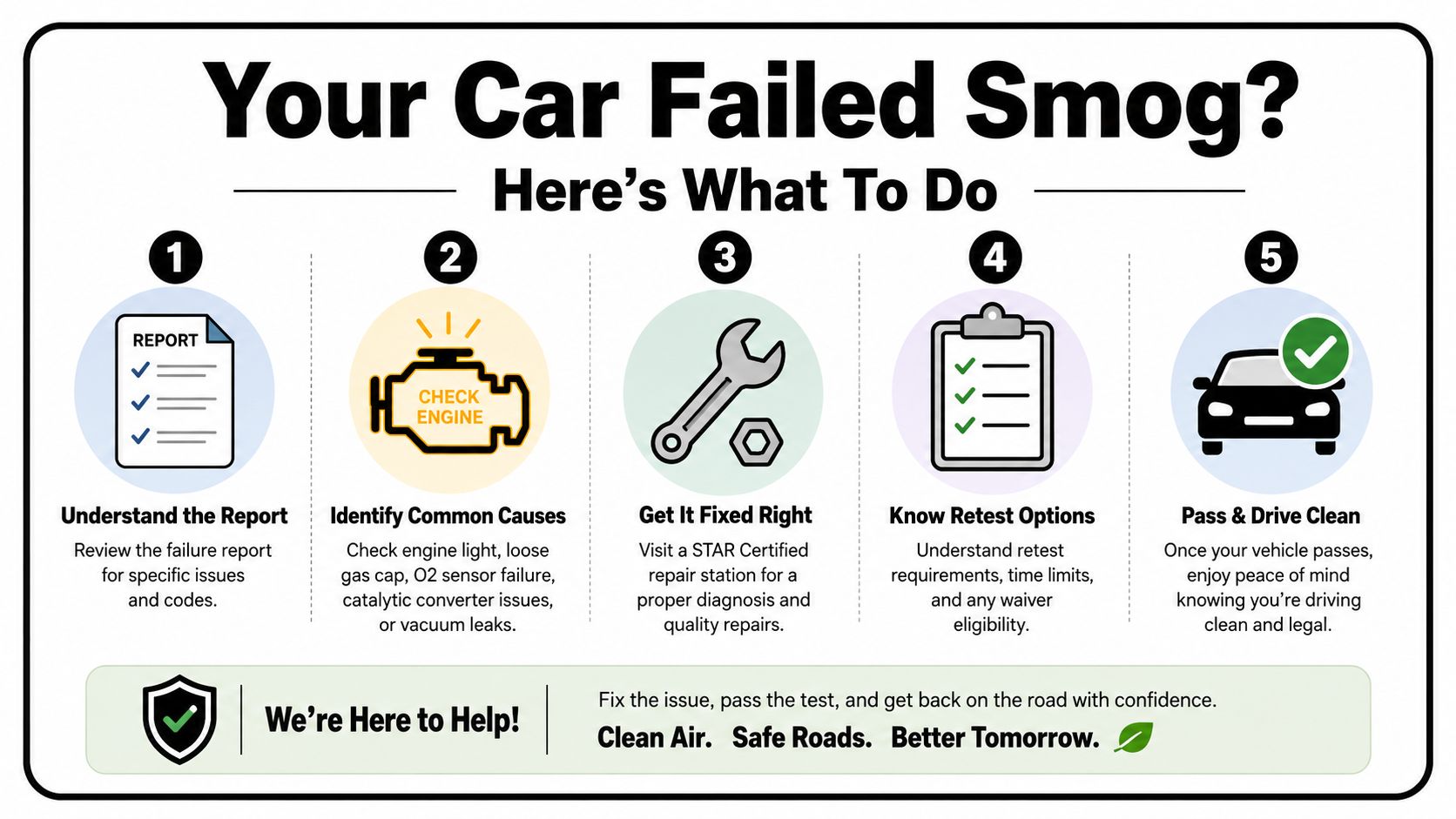
Start with the Vehicle Inspection Report. Don't skip straight to “fix whatever it needs.” The report is there to narrow the problem.
Common trouble spots include:
- Check engine related faults: If the light is on, the car is already telling you something is wrong.
- Loose or failing gas cap: Simple, but worth checking first.
- Oxygen sensor issues: These can throw off emissions readings even when the car still drives normally.
- Catalytic converter problems: A frequent reason older vehicles struggle to pass.
- Readiness problems after battery disconnects or recent repairs: The repair may be done, but the system may not be ready for testing yet.
Fix the cause, not the symptom
Take the report to a licensed repair technician and ask them to diagnose the failure reason, not just erase codes. Clearing a warning and rushing back for a retest usually wastes time.
If repair costs are a concern, California also has a Consumer Assistance Program, often referred to as CAP, for some eligible vehicle owners needing emissions-related help. Check the state program details before assuming you're on your own.
Bring the failure report with you. It gives the repair shop a starting point and keeps the conversation focused on the actual emissions issue.
After repairs, make sure the car is fully ready for retesting. If a technician fixed the problem but the vehicle still needs drive time for its systems to complete their checks, going back too soon can set you up for another failure.
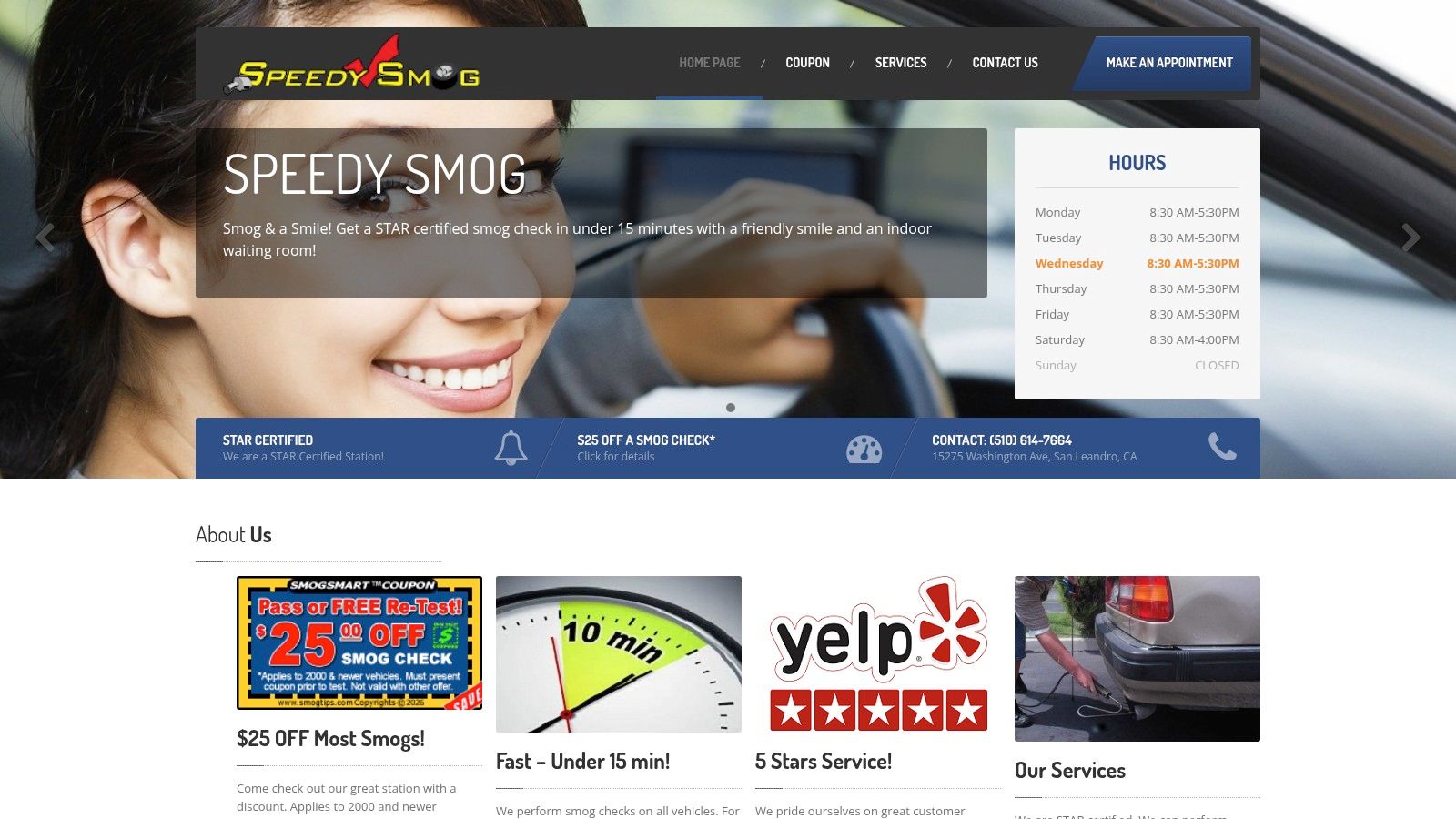
If you want a STAR-certified option nearby with straightforward service, Speedy Smog is worth a look for East Bay drivers who care about fast turnaround, clear pricing, and getting the inspection handled without the usual runaround.