
Fremont Smog Check: Your 2026 Guide to Passing Fast
Most vehicles in California need a smog check every two years for registration renewal, and Fremont prices commonly range from $55 to $90. If your DMV notice says smog certification is required, the fastest way to avoid a wasted trip is to confirm whether your car needs a regular station, a STAR station, or no test at all before you go.
That's usually the problem. Not finding a shop. Finding the right shop for your vehicle, your DMV notice, and your test type.
In Fremont, you'll see plenty of stations advertising fast service, coupons, and “all vehicles.” That sounds helpful until you show up with a title transfer, an older gasoline car, a diesel, or a renewal notice that specifically requires STAR. Then speed matters less than eligibility. The good news is that the process is simple once you sort those basics out.
Table of Contents
- Your Fremont Smog Check Roadmap for 2026
- Do You Actually Need a Smog Check in Fremont
- STAR Station vs Regular Smog Check What Is the Difference
- The Smog Check Process From Arrival to DMV Certificate
- Fremont Smog Check Costs and Tips to Pass the First Time
- What to Do If Your Vehicle Fails the Smog Check
Your Fremont Smog Check Roadmap for 2026
Your registration notice lands in the mailbox, you spot “smog certification required,” and the first real question is not price. It is whether you need a STAR station or a regular smog station. Get that wrong, and you waste a trip before anyone even plugs into the car.
In Fremont, the process goes smoothly when you sort out three things first. Confirm that your vehicle needs a test, confirm whether DMV requires a STAR inspection, and confirm what kind of testing your vehicle is likely to get based on its age and type. That last part matters more than many local guides admit. A late-model gasoline car is usually straightforward. An older vehicle, diesel, hybrid, out-of-state registration, or transfer-related test can change what the station needs to do.
Start with the paperwork, not the coupon.
What matters most before you leave
Use this order so you do not lose time:
- Read the DMV notice carefully. If it calls for STAR, go to a STAR-certified station.
- Match the shop to the vehicle. Some Fremont stations are set up for quick routine tests. Others are better for older or less common cases.
- Budget time based on the car you have. Newer cars are often faster to process. Older cars and special cases can take longer.
Practical rule: A low advertised price does not help if the station cannot perform the test your registration requires.
California runs smog checks through a statewide system of licensed stations and technicians. The Bureau of Automotive Repair's smog program reporting shows how closely the state tracks inspections, outcomes, and station activity. For Fremont drivers, the useful takeaway is simple. There are plenty of shops, but they do not all handle the same mix of vehicles or DMV requirements.
That is the part many drivers miss.
A regular station may be fine for one car and wrong for the next. A STAR station can handle vehicles that DMV has flagged for STAR, and some drivers only find that out after showing up at a non-STAR shop. If you remember one thing before booking a Fremont smog check, remember this: the right station depends on your notice and your vehicle, not just the closest sign on Fremont Boulevard.
Do You Actually Need a Smog Check in Fremont
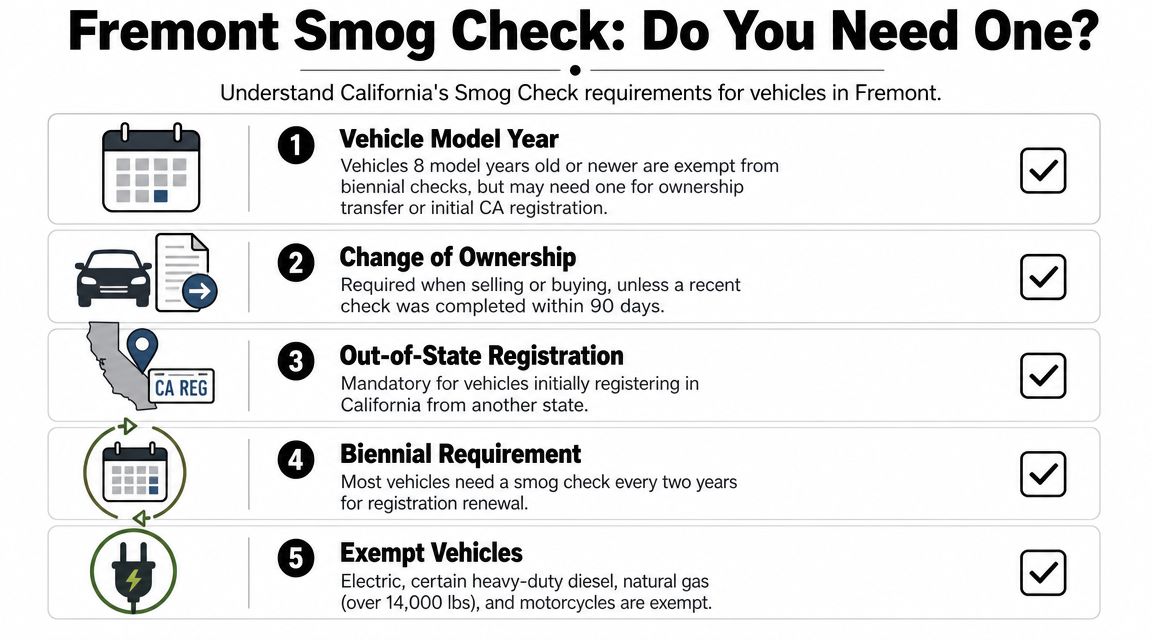
You buy the tag, head to a smog shop, and then find out your car was exempt or your DMV notice required a different kind of station. That is a common Fremont mistake, and it is easy to avoid if you check the paperwork first.
The fastest way to decide
Start with your DMV renewal notice. If it says a smog inspection is required, treat that as your answer. If it says STAR, that detail matters just as much as the test itself because a regular station will not meet the requirement.
Smog checks in Fremont usually come up in a few predictable situations:
- Registration renewal: The most common reason.
- Change of ownership: Many vehicle sales require a current smog certificate.
- First-time California registration: Out-of-state vehicles often need testing before registration can be completed.
- Certain vehicle categories: Diesel, hybrid, RV, and other special cases need closer review.
- Older vehicles with exemption questions: Drivers often guess incorrectly.
A lot of local guides stop at "check if you need a smog." The more useful question is whether your vehicle needs a smog check, and if so, whether the DMV is sending you to a STAR station or allowing a regular one.
Vehicle types that are often exempt
Exemptions depend on the vehicle, fuel type, and model year. According to this Fremont smog eligibility guide, gasoline vehicles from 1975 and older, diesel vehicles from 1997 and older, and all-electric vehicles are exempt from standard smog testing.
That breakdown matters in real life. A 1975 gas vehicle and a 2005 hybrid do not belong in the same bucket, and treating them the same is how people waste an afternoon.
| Vehicle situation | Likely next step |
|---|---|
| Typical DMV renewal vehicle | Check the notice for smog and STAR requirement |
| Gasoline vehicle 1975 or older | Often exempt |
| Diesel vehicle 1997 or older | Often exempt |
| All-electric vehicle | Exempt |
| Motorcycle or trailer | Usually not part of the standard smog program |
If you drive a hybrid, diesel, RV, or an older gasoline vehicle, call ahead before you go. Ask two direct questions. Does this vehicle need a smog check, and if it does, can this station perform the exact test listed on my notice?
That two-minute check can save you the trip, the line, and the repeat visit.
STAR Station vs Regular Smog Check What Is the Difference
A lot of Fremont drivers lose time on smog day for one simple reason. They go to a station that cannot perform the test their DMV notice requires.
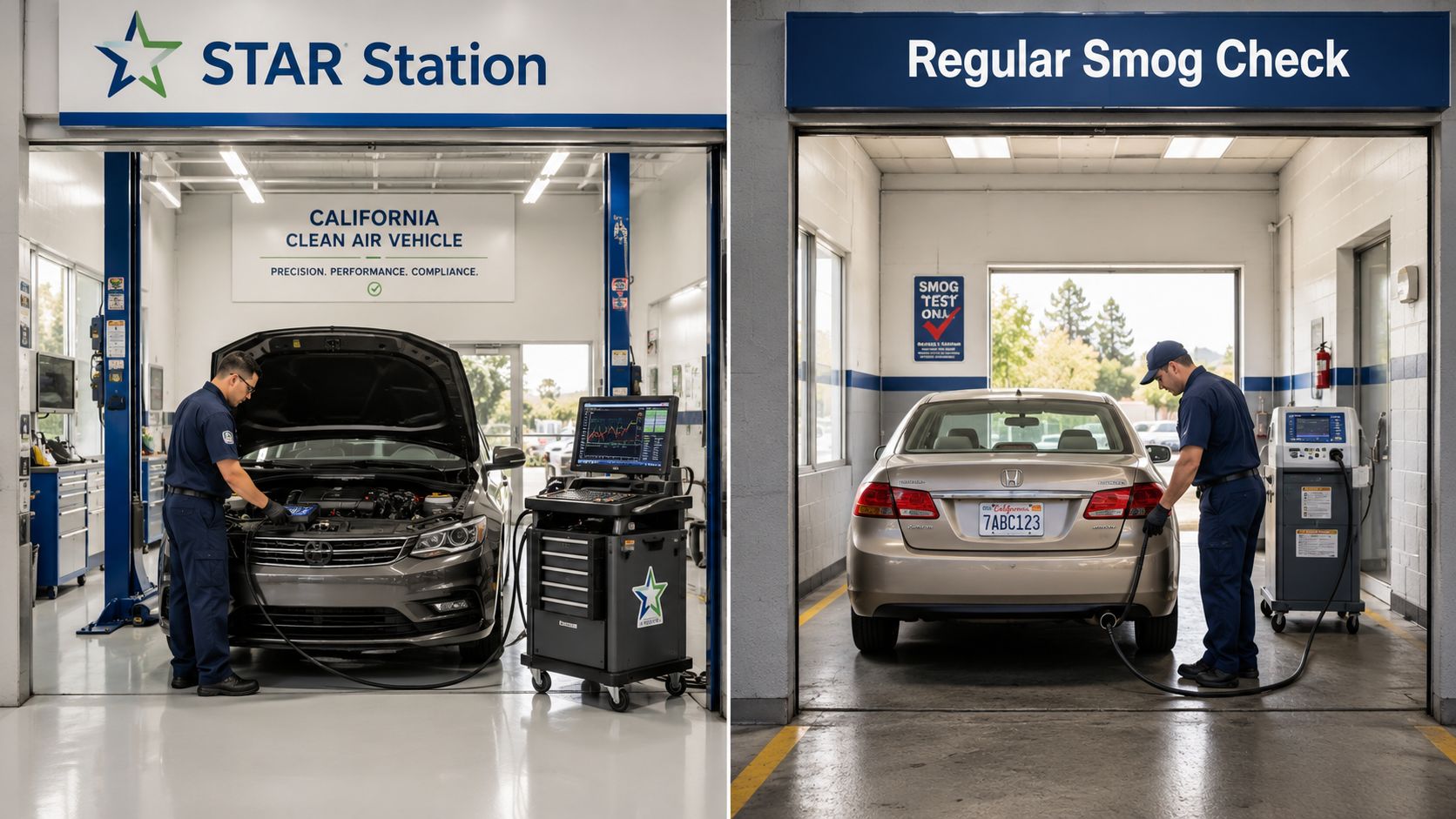
A STAR station is a smog station that meets California's higher performance standards. The practical difference is straightforward. If your renewal notice says STAR, you need a STAR-certified station. A regular station cannot complete that requirement, even if it is cheaper or closer.
What STAR means
Treat STAR as a DMV routing instruction, not a quality label.
That one detail decides where you can go. It also affects how much time you spend solving the problem. Drivers who miss it often make two trips. First to the wrong shop, then to a STAR station after finding out the hard way.
For many 2000-and-newer vehicles, the test is often faster because it relies on the car's onboard diagnostics system, as explained in this OBD smog testing overview. Older vehicles and less standard cases can take more technician time, especially when the DMV notice requires STAR or the vehicle falls outside the typical commuter-car pattern.
Here's the trade-off:
- Regular station: Works if your paperwork does not require STAR.
- STAR station: Required if the DMV notice says STAR.
- Older, diesel, hybrid, or unusual registration case: Call first and confirm the station handles that exact test type.
Which vehicles and situations should be checked twice
The biggest time-wasters are not always problem cars. They are cars with paperwork or test-type details that drivers assume are standard.
Double-check before leaving home if you have:
- A DMV renewal notice that says STAR
- An older gasoline vehicle
- A diesel
- A hybrid
- An out-of-state registration
- A title transfer situation
If you are in Fremont but open to a nearby East Bay option, one station some drivers use is Speedy Smog in San Leandro, a STAR-certified shop that handles newer vehicles, older vehicles, diesels, and hybrids.
The smart move is simple. Read the notice, confirm whether STAR is required, then call the station and ask if they perform your vehicle's exact test. That two-minute call usually saves more time than price shopping first.
The Smog Check Process From Arrival to DMV Certificate
You pull into a Fremont smog station, hand over your renewal notice, and then find out the shop cannot run your required test. That is the avoidable mistake. Once you are at a station that matches your vehicle and DMV notice, the rest is usually straightforward.
What to bring and what happens first
Bring the documents that help the technician identify the correct test the first time:
- Your DMV renewal notice, especially if it shows a STAR requirement
- Current registration, to confirm the vehicle record
- Driver's license, if the station asks for identification
- Title transfer or out-of-state paperwork, if this is not a routine renewal
At check-in, the station verifies the VIN, plate, model year, and the reason for the inspection. This is the point where STAR versus regular station capability matters in real life. A standard renewal for a newer gasoline car usually moves quickly. A transfer, out-of-state case, diesel, or older vehicle may follow a different inspection path and take longer.
What the technician actually does
For many newer vehicles, the test centers on the onboard diagnostics system. The technician connects the equipment, checks required monitors, confirms the emissions-related systems report correctly, and makes sure there is no disqualifying issue such as an active check engine light.
Older vehicles and less common cases can involve more manual verification and a longer bay time. That is why two drivers can arrive at the same shop at the same time and leave far apart.
A good question at the counter is simple: “Are you set up for my exact vehicle and test type today?”
Here is the usual flow:
Check-in and vehicle verification
The station confirms your paperwork, vehicle details, and the correct inspection category.Smog inspection and testing
The technician runs the test required for that vehicle, not just the test a typical commuter car gets.Results submission
If the vehicle passes, the station submits the result electronically to the state system.
Later in the visit, it helps to know what the electronic side looks like:
What happens after you pass
If the car passes, you usually do not need to carry a paper certificate to DMV. The result is typically transmitted electronically, and that is what clears the way for registration or transfer processing.
Keep your receipt anyway. If there is ever a delay in DMV records updating, the receipt gives you the test date, station information, and vehicle details in one place. That small habit can save a second trip or a long phone call later.
Fremont Smog Check Costs and Tips to Pass the First Time
You save the most money before you pull into the bay.
In Fremont, the posted smog price is only part of the cost. The bigger money saver is choosing a station that can perform your exact test the first time. If your DMV notice requires STAR and you show up at a regular station, the cheap coupon stops being cheap once you add another drive, another wait, and a second appointment.
What Fremont drivers are paying
Fremont shops commonly advertise prices across a fairly wide range, from lower-cost basic tests to higher fees for stations that handle more inspection types or charge extra for certain vehicles. Local listings often show routine inspections for many eligible cars finishing quickly, but that only applies when the vehicle is a straightforward match for that station.
The useful takeaway is simple. Compare price, but verify fit first.
A low advertised rate makes sense for a standard gasoline vehicle that only needs a regular smog check. It is less useful for a STAR-directed renewal, an older vehicle, a diesel, or paperwork situations like a title transfer where the wrong station choice can waste half your afternoon.
How to avoid paying twice
Ask one question before you go: “Can you do my exact vehicle and required test type today?”
That question filters out a lot of bad trips. It matters more than shaving a few dollars off the test fee.
A few habits also improve your odds of passing on the first visit:
- Drive the car long enough to fully warm it up before testing.
- Fix any active check engine light before you book the inspection.
- Do not rush in right after clearing codes or disconnecting the battery.
- Match the shop to the job, especially for STAR notices, diesels, older vehicles, and transfer-related tests.
- Take care of rough running, hard starts, or obvious maintenance problems before your registration deadline gets close.
One practical trade-off comes up all the time. A bargain station can be the right choice for a newer car with a normal renewal and no warning lights. For anything less routine, paying a little more for the right station is often cheaper than repeating the process.
The best first-time pass strategy is boring but effective: bring a warmed-up car, show up with no warning lights, and confirm the station can perform your required test before you leave home.
That STAR versus regular station distinction is where Fremont drivers lose the most time. Get that part right, and the rest of the visit is usually straightforward.
What to Do If Your Vehicle Fails the Smog Check
A failed test is frustrating, but it's not unusual, and it doesn't mean you're stuck. The worst move is guessing at the repair.
Read the failure paperwork first
Start with the inspection report. It tells you why the vehicle didn't pass and gives the repair shop a place to begin. Don't treat it like a generic rejection slip. It's your roadmap.
If the failure reason isn't obvious to you, ask a licensed repair technician to explain it in plain English. You want the cause, not just the symptom.
Fix the cause, then retest
After a failure, the normal path is straightforward:
- Get the issue diagnosed
- Have the emissions-related problem repaired
- Return for a retest
What doesn't work is chasing random parts, clearing codes to try again, or bouncing from shop to shop without a diagnosis. That usually burns more money than a proper repair plan.
If repair cost is the main concern, check whether California's Consumer Assistance Program (CAP) can help with emissions-related repairs for eligible vehicle owners. The key word is eligible, so verify current program requirements before making assumptions.
If your registration deadline is close, move quickly but don't rush into the wrong repair. A focused diagnosis is almost always cheaper than replacing parts based on hunches.
If your DMV notice requires STAR, or your vehicle falls into an older, diesel, hybrid, title-transfer, or out-of-state category, Speedy Smog is one East Bay option for a compliant inspection without the guesswork about station type.