
Car registration renewal in California isn't complete until the required smog certification is filed, and the DMV won't finalize the sticker just because you paid the fee. If your smog result is still missing, the renewal can stay stuck even after payment.
That's the part most drivers miss, especially when the notice looks simple and the online form seems to accept the payment. In practice, car registration renewal California is a compliance workflow, not just a checkout page, and the order matters if you want the renewal to clear on time.
Table of Contents
- The Two Parts of California Vehicle Renewal
- Do You Need a Smog Check
- Renewal Options and Timelines
- Finding a Reliable STAR Station
- Smog Check Failure Rates and Planning
- Common Issues and Final Steps
The Two Parts of California Vehicle Renewal
A common failure pattern goes like this. The driver pays online, assumes the job is done, then discovers the renewal is still blocked because the smog record never cleared, a citation is open, or insurance isn't verified.
Payment is not the same as completion
California's DMV says renewal is not finalized until required smog certification is completed, and it also says there's no grace period for annual registration fees, so the payment has to land on or before the expiration date or penalties apply. That makes timing important, but sequencing matters just as much. The right order is simple, confirm the notice calls for smog, finish the inspection, make sure the result is transmitted, then pay the renewal before the deadline. DMV registration fees and renewal processing
Practical rule: If the smog result hasn't cleared, the payment is only half the job.
What usually stalls a renewal
The DMV lists smog certification, unpaid citations, and insurance gaps as barriers to renewal. That means you should treat the notice as a checklist, not an invoice.
The workflow that avoids surprises is straightforward:
- Check the renewal notice first. If it calls for smog, don't pay and hope for the best.
- Complete the test at an authorized station. A passed inspection is what gives DMV the clearance it needs.
- Verify transmission or retention. The record has to be available for DMV processing, not sitting in your glove box.
- Pay before the expiration date. Missing the deadline creates avoidable penalties.
Drivers who handle the steps in that order usually avoid the worst bottleneck, the false sense that a receipt equals a finished renewal.
Do You Need a Smog Check
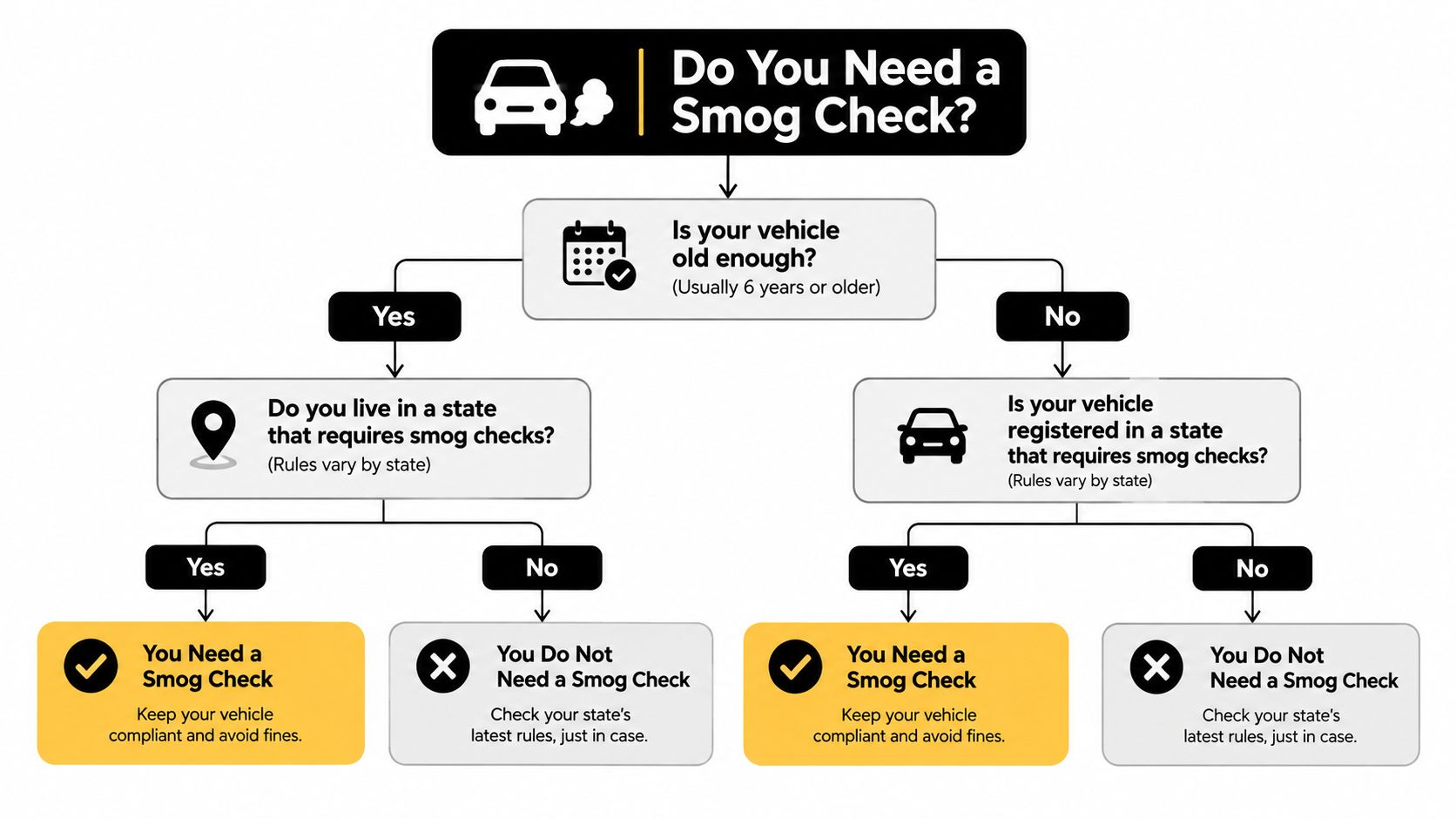
Not every vehicle sits in the same lane. California uses age-based rules, fuel-type rules, and registration timing to decide whether a car needs an inspection, so the fastest way to waste time is to assume everyone gets treated the same.
The exemption paths that matter
Gasoline-powered vehicles that are 1975 model year or older are exempt. Diesel vehicles that are 1997 and older are exempt, and electric vehicles are exempt as well. California also says gasoline-powered vehicles that are less than eight model years old do not need a smog inspection. California DMV smog inspections
That means a lot of newer drivers never need to book a test, while a lot of older daily drivers do. The middle of the fleet is where the compliance burden sits.
Where very new cars fit
California also notes that for vehicles less than four model years old, owners may pay a smog abatement fee instead of getting an inspection for the first 8 years the vehicle is registered. That's a niche path, but it matters if you bought a newer car and are trying to understand why your renewal notice doesn't look like your neighbor's.
If you're not sure which category you fall into, read the registration notice before booking anything. A clear notice saves a trip, and a wrong assumption can cost you a day.
For drivers comparing options, the key distinction is simple. Exempt vehicles can move toward renewal more directly, while inspection-required vehicles need the smog step cleared first. If you're checking a San Leandro or Oakland car, a local station that handles renewal-linked tests can remove some friction, including the process explained at Speedy Smog's registration renewal guide.
Renewal Options and Timelines
Once you know whether the smog requirement applies, choose the renewal method based on your deadline and the condition of your DMV record. Paying the fee starts the transaction, but it does not finish registration if a smog result, hold, or other requirement remains unresolved.
The channel you choose changes the clock
The DMV states that online and phone renewals take about one week, while mail takes about two weeks. A DMV kiosk can process the transaction instantly when every requirement is already satisfied. That timing makes the kiosk the fastest option, while online and phone renewal offer convenience with a short processing wait. California DMV vehicle registration renewal
Online renewal is practical when the record is clear and the expiration date is not pressing. It becomes a poor choice when you are still waiting for a smog result to post or for a hold to clear. The payment may go through while the registration remains incomplete.
The fastest path is the one that matches your actual renewal status.
How to pick the right method
Use the channel that fits both your record and your remaining time:
- Kiosk: Choose this when all requirements are satisfied and you need immediate processing.
- Online: Use it for a clean renewal when a short wait is acceptable.
- Phone: Expect timing similar to online renewal, with no office visit.
- Mail: Use it when convenience matters more than speed. It is a poor fit near expiration.
Check the renewal notice before submitting payment. If it indicates a smog requirement, confirm that the inspection has been completed and transmitted. If the account shows a hold, resolve that issue first. A kiosk cannot bypass a missing smog record or another unresolved requirement.
One practical East Bay habit
East Bay drivers often lose time by paying first and investigating the record afterward. The more reliable sequence is simple: read the notice, confirm the smog status, clear any hold, then submit through the method that fits the deadline.
For the inspection side of that workflow, Speedy Smog's STAR station overview explains how station selection connects with renewal planning. The practical point is to treat registration as a compliance workflow, not just an online payment.
Finding a Reliable STAR Station
A smog station is not just where a test gets plugged in. For renewal work, the station has to do more than inspect the car. The result must be valid, transmitted, and accepted without extra follow-up, or you can still end up stuck even after paying the fees.
Why STAR certification changes the experience
California's BAR sets higher performance standards for STAR Certified stations, which makes them the safer choice when a renewal cannot afford a bad inspection. In San Leandro, Speedy Smog operates as a STAR Certified station at 15275 Washington Ave, and it handles inspections for most vehicles, including 2000 and newer models, 1999 and older vehicles, diesels, and hybrids. Typical tests for newer vehicles are completed in about 10 to 15 minutes. Speedy Smog station information
That speed helps, but predictability matters more. A clean test and proper transmission keep the renewal moving instead of leaving you in DMV limbo with a paid fee and an unfinished record.
What to look for before you drive over
A reliable station should make the process boring in the best way. Clear intake, a clean waiting area, and staff who know which vehicles need which inspection path save time and avoid rework.
Before you go, check a few basics:
- Confirm STAR status. Use it if your renewal notice requires a STAR station.
- Ask about electronic transmission. The result should go to DMV without extra handling.
- Check vehicle fit. Diesel, hybrid, older, and newer cars can have different testing needs.
- Ask about pricing up front. You want the cost explained before the test starts.
The East Bay advantage is simple. You do not need a statewide scavenger hunt for a valid inspection. A nearby station that understands renewal timing can reduce the friction that turns a normal renewal into a delay.
For drivers who want to understand how station type affects the process, what a smog STAR station is gives the practical context.
Why nearby beats “good enough”
A station can be technically valid and still be the wrong choice if it adds delay. If you are trying to beat an expiration deadline, the key question is whether the station gets you through the compliance step fast enough to keep the renewal moving. A clean inspection, prompt transmission, and a simple checkout beat a longer drive to a place that complicates the process.
Smog Check Failure Rates and Planning
Older cars are not just more likely to need a smog check, they are more likely to slow down renewal. That is why planning before the inspection matters. A failed test can stall the whole compliance chain, and the risk rises as the vehicle ages. BAR smog check performance report
What the failure pattern tells you
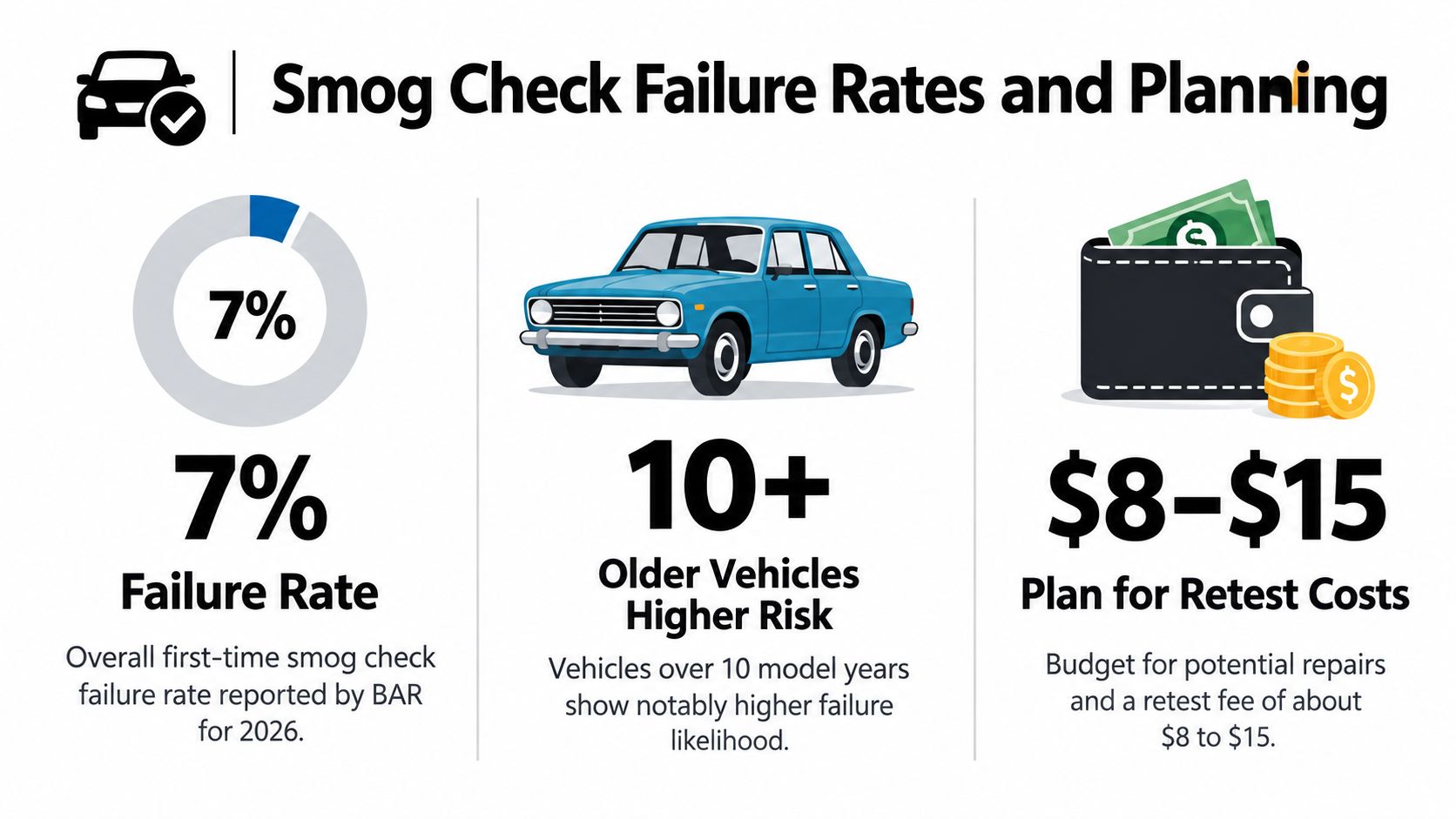
BAR's 2026 performance report says about 1.3 million of 19 million 2000-and-newer vehicles tested in CY 2024-2025 failed Smog Check, roughly 7%, while roadside inspection failure averaged about 14% statewide in 2024-2025. Its 2024 report also shows failure rates rising sharply with age, from about 4% for 8-year-old vehicles to 15% for 23-year-old vehicles.
That age pattern matters. If your car is older, the odds of a delay go up, and your renewal plan should reflect that.
What to do before the test
Preparation will not fix a real emissions problem, but it can keep you from failing for avoidable reasons. Warm the vehicle before inspection, and treat a check engine light as a real fault until diagnostics prove otherwise. If you suspect a problem, verify the repair before you pay for the official test.
A practical pre-test checklist looks like this:
- Warm the car up properly. A cold car can give you a bad read.
- Inspect the dash. A check engine light usually means diagnostics first.
- Verify recent repairs. Do not assume a cleared code means the issue is gone.
- Use the right station. A station that understands your vehicle type reduces avoidable confusion.
For a local breakdown of common failure causes, Speedy Smog's smog fail guide is a useful starting point.
Planning beats panic
Older vehicles should be treated as a project, not a gamble. If you go in expecting a clean pass without checking the basics, you are betting your renewal on luck. If you confirm the obvious issues first, you give yourself a much better shot at getting through the compliance step in one visit.
Common Issues and Final Steps
A renewal can still stall after the smog step is done. The usual blockers are operational. An unpaid citation, an insurance gap, or a missing clearance can keep the file from moving even after you think everything is complete.
What to verify before you submit
If your renewal notice shows a smog requirement but you believe you qualify for an exception, check the vehicle's model year, fuel type, and registration status against the California DMV vehicle registration renewal page before you assume the notice is wrong.
Use this checklist before you submit:
- Smog status is correct. If a test is required, it has been completed and transmitted.
- Citations are clear. Any open violation can stop renewal.
- Insurance is active. A coverage gap can hold the file.
- Payment is on time. California does not give a fee grace period.
- The channel matches the deadline. If time is tight, do not choose a slow method.
California also allows a temporary operating permit for failed-smog cases for a $50 fee, which gives drivers a way to keep the vehicle legally usable while repairs are finished. It is not a free pass. It only buys time to complete the compliance work.
What a finished renewal actually looks like
A finished renewal means the record is clear, not just paid. The notice is satisfied, the smog result is accepted if required, and the DMV can complete the transaction without a hold. That is the standard to use before you assume the sticker is on the way.
For East Bay drivers, the practical move is to separate the payment step from the compliance step. If the account has a hold, or the smog data has not posted yet, paying online does not finish the job. Handle the missing piece first, then confirm the record has cleared.
If you want the inspection side handled without extra friction, Speedy Smog can handle official smog certification for renewal-linked cases and move the result through the process quickly. Visit Speedy Smog to get the smog step handled and keep your car registration renewal on track.
You're staring at a DMV renewal notice, and one line jumps out: smog check required. Maybe your car runs fine, maybe you just bought it, or maybe you're already worried because the repair bill from last year still stings. In California, that little notice can feel like a bureaucratic trap, especially when you're trying to keep costs down and just get the registration done.
The good news is that the process is usually more straightforward than it looks. If you know what type of vehicle you have, whether the state wants a routine test or a change-of-ownership test, and what the technician is checking, you can walk in prepared and avoid most surprises. California's high poverty rate in 2024, 17.7%, makes clear, plain guidance even more important, because cost-sensitive drivers are more likely to delay compliance or rely on incomplete information, and that can turn a routine renewal into a headache (California Budget & Policy Center).
Table of Contents
- Decoding Your CA DMV Smog Notice
- Who Needs a Smog Check in California
- The Importance of a STAR Certified Station
- Your Smog Check Step by Step
- How to Prepare Your Car to Pass the First Time
- Finding a Fast and Reliable Test at Speedy Smog
- Smog Check Common Questions Answered
Decoding Your CA DMV Smog Notice
A lot of drivers open the renewal packet, see a smog requirement, and immediately assume the car must be failing something. That's not what the notice means. In most cases, it just means the state wants proof that your vehicle still meets California's emissions rules before the registration can move forward.
That matters because California treats emissions control as part of the registration process, not as an optional maintenance suggestion. The state also has an unusually large economic footprint, so the rules reach a huge number of drivers and vehicles. California's economy reached $4.25 trillion in nominal GDP by 2025, according to the Governor's Office, and it represented about 14% of U.S. GDP in recent PPIC analysis (Governor's Office). When a state operates at that scale, its air-quality rules have to be broad, consistent, and enforceable.
Practical rule: A smog notice is usually a paperwork checkpoint, not a judgment on how well your car drives.
If your renewal letter says you need emissions verification, don't guess. Check the notice, check your vehicle type, and confirm whether you're dealing with a routine renewal, a title transfer, or an exemption situation. If you're unsure where to start, a quick status check can save you a wasted trip, and this smog status guide is a useful place to verify the basics before you leave home.
Who Needs a Smog Check in California
A California smog check usually becomes clear once you separate two questions, what kind of vehicle you have and why you are at the DMV counter. Some drivers need emissions verification at renewal, some only during a sale or transfer, and some vehicles fall into an exemption category. The confusion starts when people assume every car follows the same path, but California sorts vehicles by class, model year, and transaction type.
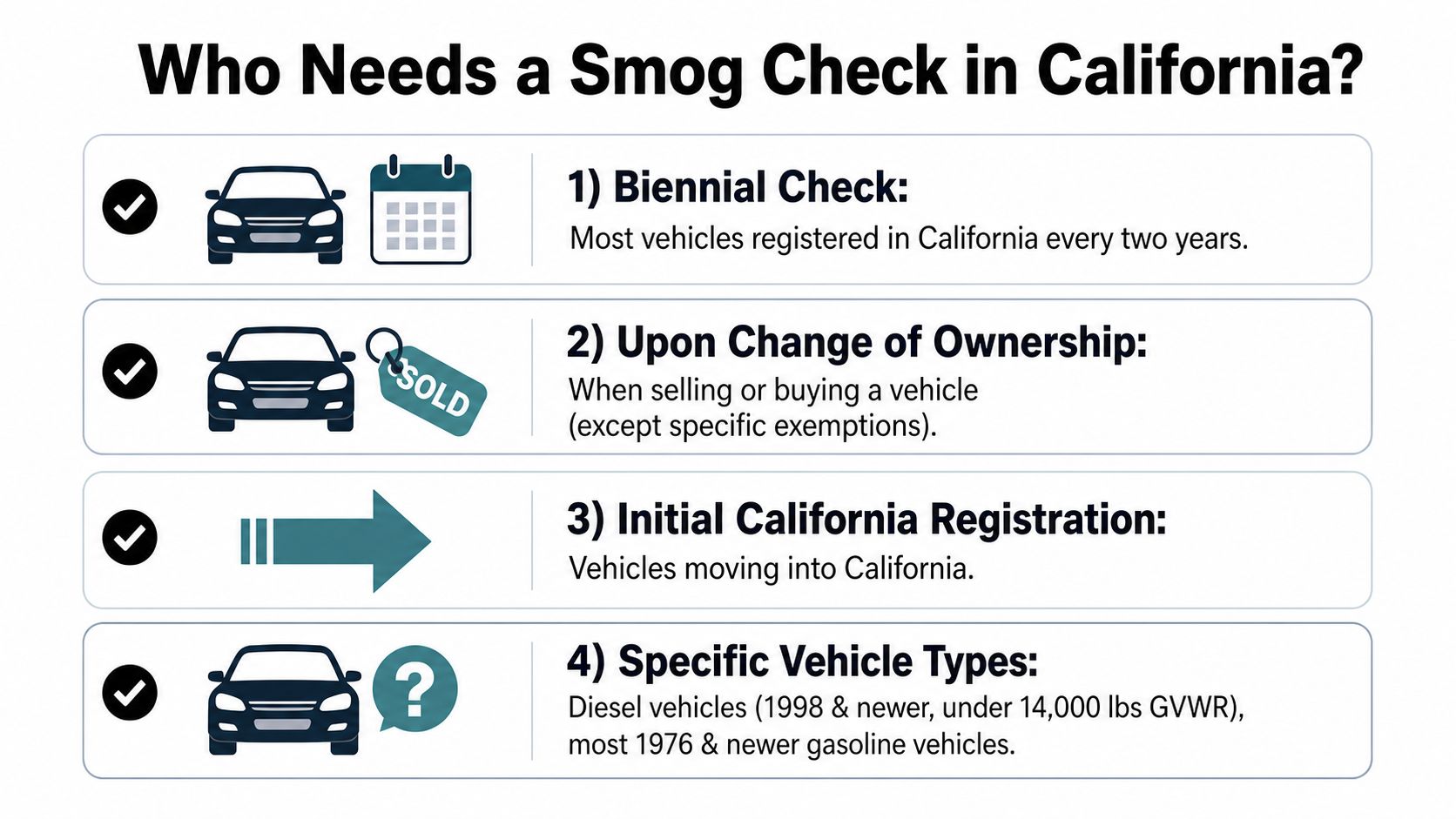
Gasoline Vehicles
Most gasoline vehicles fit into the standard California emissions system. For a first-time driver, the simplest way to read the rules is to ask whether the car is due for a renewal test, changing owners, or coming into the state from somewhere else. That is usually where the answer starts.
A clean way to sort it out is this:
- Routine registration: Many California vehicles need a smog check tied to registration renewal.
- Ownership change: A smog check is commonly needed when a car is sold or transferred, unless an exemption applies.
- Out-of-state move: A car brought into California may need emissions verification before full registration.
- Older gasoline vehicles: Model year matters, especially for cars near exemption lines or vehicles that follow different test procedures.
Diesel Vehicles
Diesels create extra confusion because they do not always follow the same path as gasoline cars. A driver with a diesel can easily assume the paperwork works the same way, then find out the inspection rules are different.
The state's underserved-community guidance calls out exactly this kind of confusion, especially for drivers asking what changes for 1999-and-older vehicles, diesels, and hybrids (California underserved communities report).
If you drive a diesel, use the notice and the vehicle category, not a neighbor's gas-car experience. Older diesels, work vehicles, and secondhand purchases deserve extra attention because the test path can change based on what the car is and how it is being registered.
Hybrids and Special Cases
Hybrid owners often assume the electric motor means the car skips emissions testing. That is not a safe shortcut. Hybrids can still fall under California's emissions-check system depending on the vehicle and the transaction.
Older cars and unusual ownership situations deserve the same careful check. If your vehicle does not fit the usual commuter-car pattern, confirm the rule before the registration deadline gets close. Drivers who are already watching every dollar can feel the cost of a repeat visit more sharply, so it helps to verify the requirement first instead of paying for a test you did not need.
If you want a practical way to sort out the details before you leave home, this smog status guide explains the basic checks in plain language. A few minutes at home is usually easier than a second trip across town.
If your car is unusual, older, or newly purchased, confirm the rule before you pay for a test. Guessing is what gets people stuck with repeat visits.
The Importance of a STAR Certified Station
When your renewal notice says STAR Station Required, that's not a warning that your car is bad. It means the state wants the test done at a station that meets stricter performance standards. In California, STAR certification is about station quality and oversight, so the results are more tightly controlled than at a basic test-only shop.
The reason a driver gets sent to STAR usually falls into one of two buckets. The vehicle itself may be considered more likely to produce emissions issues, or the driver may have been selected through a quality-control process. Either way, the notice is telling you where to go, not trying to make the process harder.
For a driver, the practical takeaway is simple. A STAR-certified station is a safe choice whether you were required to use one or not, because it can test the full range of vehicle types that show up for compliance work. If you want a deeper look at what helps on a STAR visit, this STAR smog guide is a useful reference.
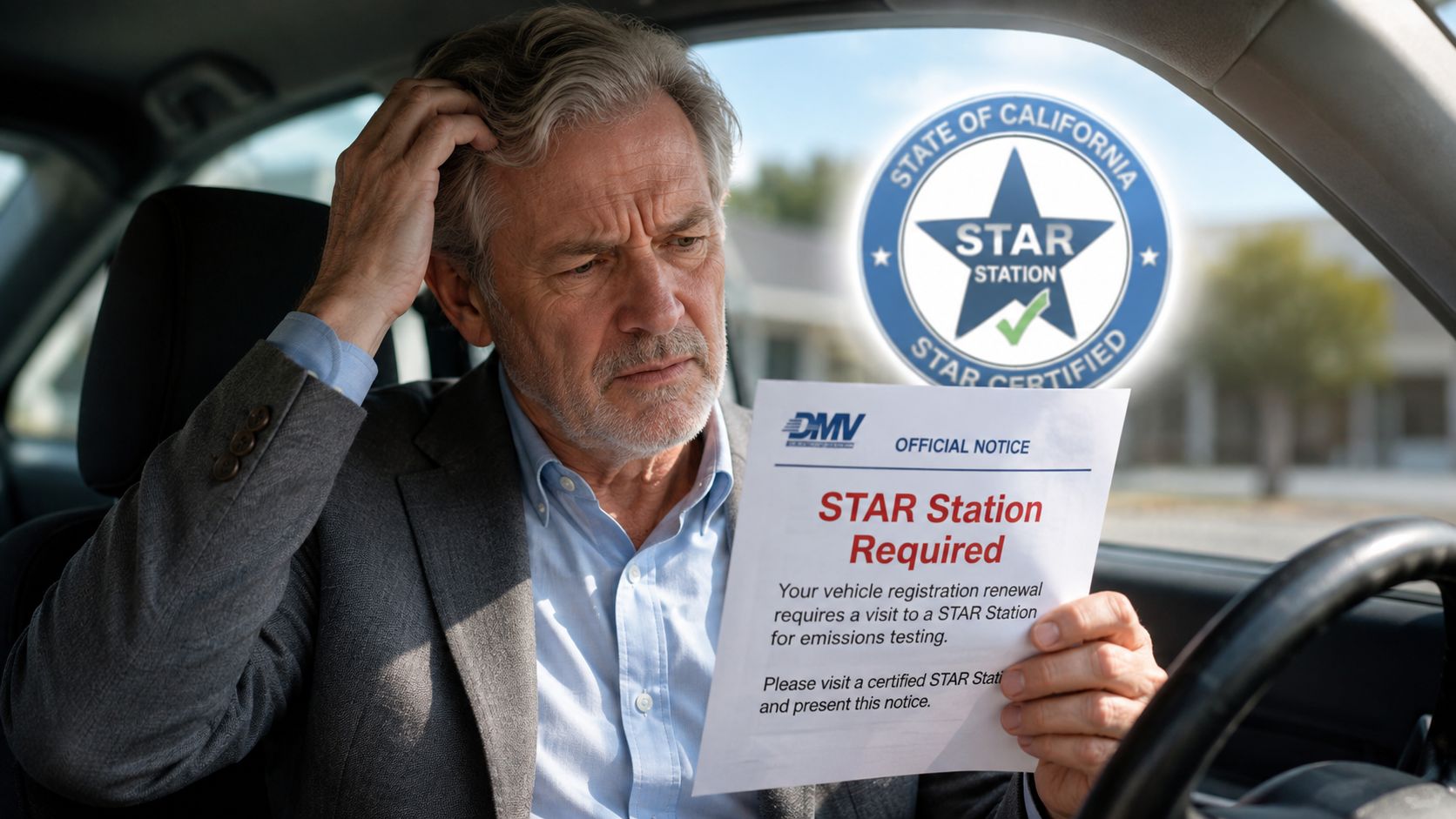
Practical rule: If the notice says STAR, go to a STAR station. Don't try to save time by guessing, because the wrong shop can waste your day.
A lot of first-time drivers worry they'll need to understand the state's technical certification system before they can get tested. You don't. Just read the notice, choose a certified station, and bring the vehicle in as required. The station handles the technical side, and you handle the paperwork and timing.
Your Smog Check Step by Step
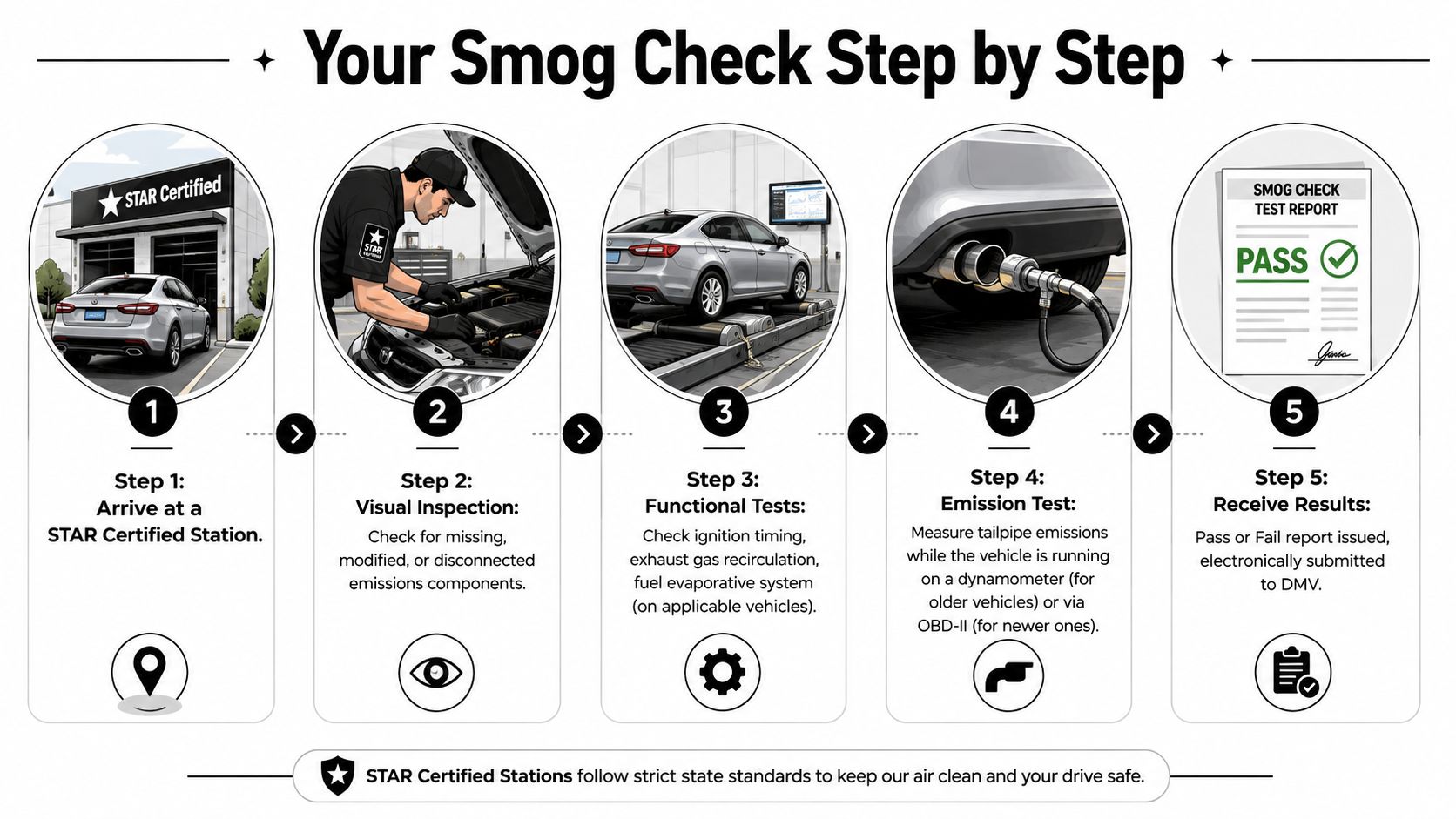
The test feels mysterious until you watch it unfold once. From the driver's side, it's usually a quick sequence, and the technician is looking for specific signs that the emissions system is present, functional, and reporting correctly.
What the technician checks first
The first part is usually a visual inspection. The technician looks under the hood and around the emissions system to make sure the required parts are there and haven't been removed, modified, or disconnected. That matters because California's quality-measure framework shows how much denominator and definition consistency affects reported results in regulated systems, and emissions testing depends on the same kind of consistency in how vehicles are evaluated (DHCS CaTS framework).
If something obvious is missing, the vehicle can fail before the more detailed checks even begin. That's why a car that “runs fine” can still come back with a failed result.
What happens during the functional check
Next comes the functional side of the test. On newer vehicles, the station usually uses onboard diagnostics, while older vehicles may go through additional equipment-based inspection. The point is to confirm that the emissions system is working, not just installed.
Older vehicles can involve more physical testing because the car's computer system may not carry all the needed information. Newer vehicles usually make the process faster because the onboard diagnostics communicate directly with the tester.
How the result gets handled
At the end, the station issues a pass or fail result and transmits it electronically to the DMV. Speed matters here because most newer-vehicle inspections can be completed in about 10 to 15 minutes at an efficient shop, according to the publisher's service information. That doesn't mean every car finishes that fast, but it does mean the process is usually much shorter than people expect.
How to Prepare Your Car to Pass the First Time
You can't control every outcome, but you can avoid the mistakes that trip up a lot of first-time drivers. The best prep is simple, mechanical, and boring, which is exactly what you want before an emissions test.
Start with the warning lights and recent repairs
If the Check Engine light is on, fix that before the test. A lit warning light often points to a problem the station can see right away, and it's one of the most common reasons people leave with a failed result. If you're trying to understand the usual failure triggers, this smog fail reasons guide is a helpful place to compare symptoms before you book the test.
Also think about recent battery work. If the battery was disconnected recently, the car may need time to relearn or repopulate diagnostic readiness information. That's the kind of detail that can turn a seemingly healthy car into a problem at the inspection lane.
Warm the car up before you arrive
Drive the car for a bit before the appointment. A warm engine and catalytic converter are usually more representative of normal operation than a cold start, and the vehicle is more likely to behave consistently during testing. This is one of those small, practical moves that helps the technician get a clean read instead of a borderline one.
Good habit: Arrive after a normal drive, not straight from a cold start in the driveway.
Don't overlook the small stuff
Tire pressure sounds unrelated, but it affects how the car behaves during the inspection process, especially if the vehicle needs more involved testing. Keep the car clean enough for the technician to inspect the emissions equipment easily, and bring the paperwork the DMV notice asks for.
A simple pre-test checklist looks like this:
- Fix the warning lights first.
- Drive the car long enough to warm it up.
- Avoid disconnecting the battery right before the visit.
- Make sure the car is easy to inspect and the paperwork is ready.
Finding a Fast and Reliable Test at Speedy Smog
If you want the process handled without a lot of back-and-forth, a STAR-certified station in San Leandro can take care of the inspection for most vehicle types, including newer cars, older vehicles, diesels, and hybrids. Speedy Smog is located at 15275 Washington Ave, San Leandro, CA 94579, and it's open Monday through Saturday.
The practical value is speed and simplicity. Most newer-vehicle tests are completed in about 10 to 15 minutes, the waiting area is indoors and clean, and the shop offers a $25-off coupon for many newer-vehicle smogs, according to the publisher's service information. The station also transmits results electronically to the DMV, which helps cut down on extra steps.
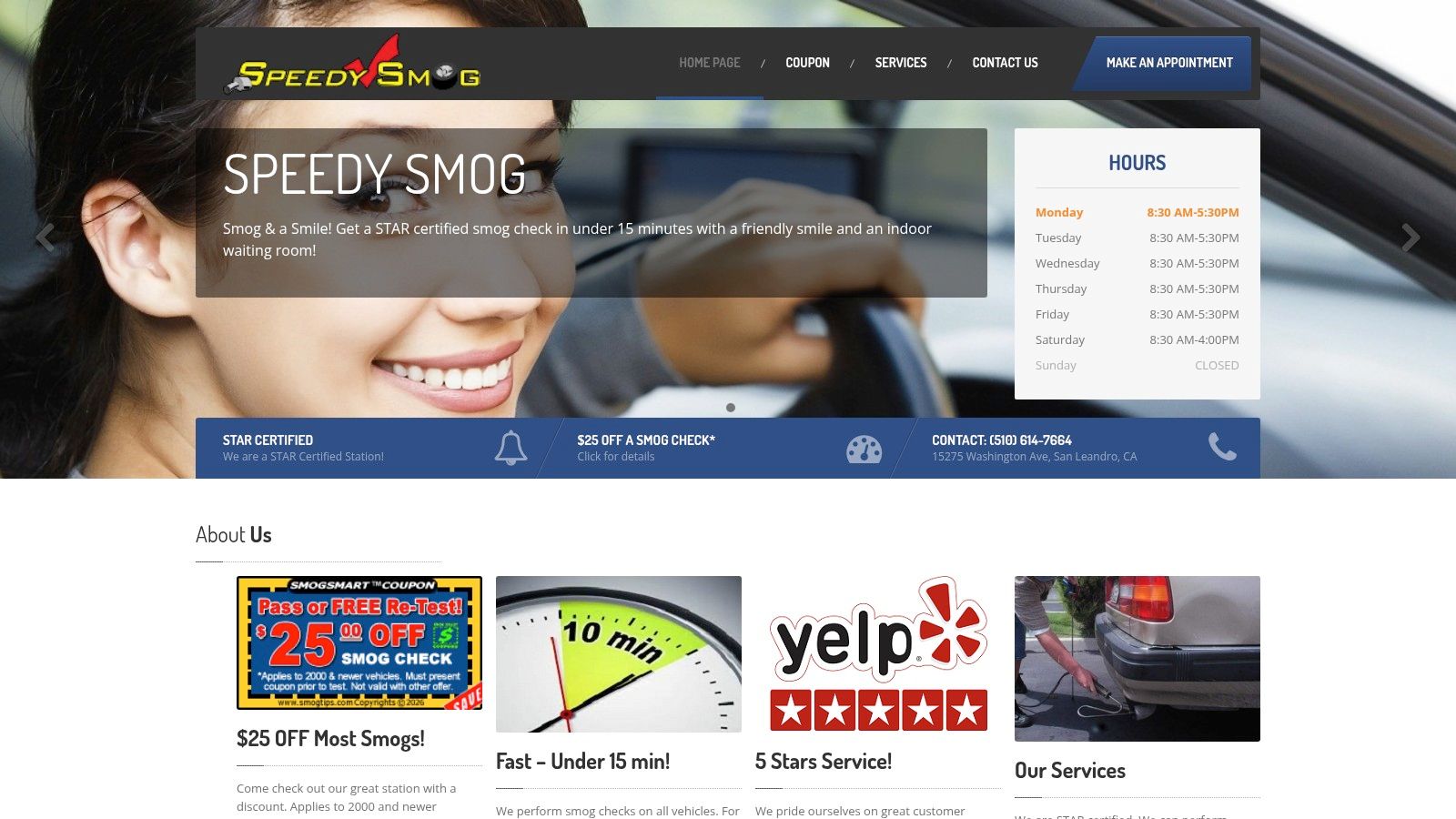
For drivers who just want to get the test done, the primary benefit is predictable service. You show up, the car gets inspected, and the paperwork goes where it needs to go without you having to manage complex state language on your own.
Smog Check Common Questions Answered
What happens if my car fails the smog check?
You'll need to repair the issue and retest before the registration process can move forward. The useful move is to ask for the reason code or failure explanation, then fix the specific problem instead of guessing.
Can I get a smog check if I'm selling my car?
Usually yes, and in many cases you should, because buyers often want the transfer handled cleanly. If ownership is changing, that's one of the situations where emissions verification commonly comes into play.
Do hybrids need smog checks?
Some do, depending on the vehicle and the transaction. Don't assume the hybrid badge means an exemption, because California's rules are more specific than that.
What if I'm out of state right now?
Check your renewal situation carefully and confirm whether the DMV allows a delay or other handling for your case. Don't wait until the deadline has passed, because that's when a manageable paperwork issue becomes a registration problem.
If you want a straightforward inspection from a STAR Certified station that handles most vehicle types and sends results to the DMV, visit Speedy Smog and book your smog check in San Leandro. Bring the notice, bring the car, and let the station handle the testing so you can get your registration back on track without extra hassle.
Most vehicles in California need a smog check every two years for registration renewal, and Fremont prices commonly range from $55 to $90. If your DMV notice says smog certification is required, the fastest way to avoid a wasted trip is to confirm whether your car needs a regular station, a STAR station, or no test at all before you go.
That's usually the problem. Not finding a shop. Finding the right shop for your vehicle, your DMV notice, and your test type.
In Fremont, you'll see plenty of stations advertising fast service, coupons, and “all vehicles.” That sounds helpful until you show up with a title transfer, an older gasoline car, a diesel, or a renewal notice that specifically requires STAR. Then speed matters less than eligibility. The good news is that the process is simple once you sort those basics out.
Table of Contents
- Your Fremont Smog Check Roadmap for 2026
- Do You Actually Need a Smog Check in Fremont
- STAR Station vs Regular Smog Check What Is the Difference
- The Smog Check Process From Arrival to DMV Certificate
- Fremont Smog Check Costs and Tips to Pass the First Time
- What to Do If Your Vehicle Fails the Smog Check
Your Fremont Smog Check Roadmap for 2026
Your registration notice lands in the mailbox, you spot “smog certification required,” and the first real question is not price. It is whether you need a STAR station or a regular smog station. Get that wrong, and you waste a trip before anyone even plugs into the car.
In Fremont, the process goes smoothly when you sort out three things first. Confirm that your vehicle needs a test, confirm whether DMV requires a STAR inspection, and confirm what kind of testing your vehicle is likely to get based on its age and type. That last part matters more than many local guides admit. A late-model gasoline car is usually straightforward. An older vehicle, diesel, hybrid, out-of-state registration, or transfer-related test can change what the station needs to do.
Start with the paperwork, not the coupon.
What matters most before you leave
Use this order so you do not lose time:
- Read the DMV notice carefully. If it calls for STAR, go to a STAR-certified station.
- Match the shop to the vehicle. Some Fremont stations are set up for quick routine tests. Others are better for older or less common cases.
- Budget time based on the car you have. Newer cars are often faster to process. Older cars and special cases can take longer.
Practical rule: A low advertised price does not help if the station cannot perform the test your registration requires.
California runs smog checks through a statewide system of licensed stations and technicians. The Bureau of Automotive Repair's smog program reporting shows how closely the state tracks inspections, outcomes, and station activity. For Fremont drivers, the useful takeaway is simple. There are plenty of shops, but they do not all handle the same mix of vehicles or DMV requirements.
That is the part many drivers miss.
A regular station may be fine for one car and wrong for the next. A STAR station can handle vehicles that DMV has flagged for STAR, and some drivers only find that out after showing up at a non-STAR shop. If you remember one thing before booking a Fremont smog check, remember this: the right station depends on your notice and your vehicle, not just the closest sign on Fremont Boulevard.
Do You Actually Need a Smog Check in Fremont
You buy the tag, head to a smog shop, and then find out your car was exempt or your DMV notice required a different kind of station. That is a common Fremont mistake, and it is easy to avoid if you check the paperwork first.
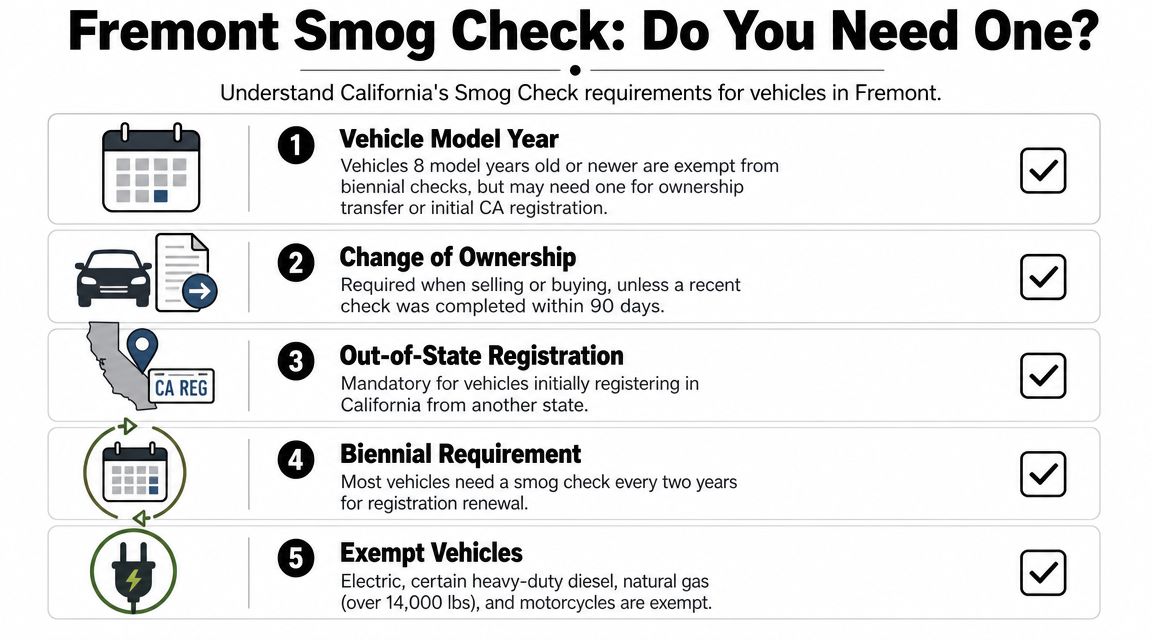
The fastest way to decide
Start with your DMV renewal notice. If it says a smog inspection is required, treat that as your answer. If it says STAR, that detail matters just as much as the test itself because a regular station will not meet the requirement.
Smog checks in Fremont usually come up in a few predictable situations:
- Registration renewal: The most common reason.
- Change of ownership: Many vehicle sales require a current smog certificate.
- First-time California registration: Out-of-state vehicles often need testing before registration can be completed.
- Certain vehicle categories: Diesel, hybrid, RV, and other special cases need closer review.
- Older vehicles with exemption questions: Drivers often guess incorrectly.
A lot of local guides stop at "check if you need a smog." The more useful question is whether your vehicle needs a smog check, and if so, whether the DMV is sending you to a STAR station or allowing a regular one.
Vehicle types that are often exempt
Exemptions depend on the vehicle, fuel type, and model year. According to this Fremont smog eligibility guide, gasoline vehicles from 1975 and older, diesel vehicles from 1997 and older, and all-electric vehicles are exempt from standard smog testing.
That breakdown matters in real life. A 1975 gas vehicle and a 2005 hybrid do not belong in the same bucket, and treating them the same is how people waste an afternoon.
| Vehicle situation | Likely next step |
|---|---|
| Typical DMV renewal vehicle | Check the notice for smog and STAR requirement |
| Gasoline vehicle 1975 or older | Often exempt |
| Diesel vehicle 1997 or older | Often exempt |
| All-electric vehicle | Exempt |
| Motorcycle or trailer | Usually not part of the standard smog program |
If you drive a hybrid, diesel, RV, or an older gasoline vehicle, call ahead before you go. Ask two direct questions. Does this vehicle need a smog check, and if it does, can this station perform the exact test listed on my notice?
That two-minute check can save you the trip, the line, and the repeat visit.
STAR Station vs Regular Smog Check What Is the Difference
A lot of Fremont drivers lose time on smog day for one simple reason. They go to a station that cannot perform the test their DMV notice requires.
A STAR station is a smog station that meets California's higher performance standards. The practical difference is straightforward. If your renewal notice says STAR, you need a STAR-certified station. A regular station cannot complete that requirement, even if it is cheaper or closer.
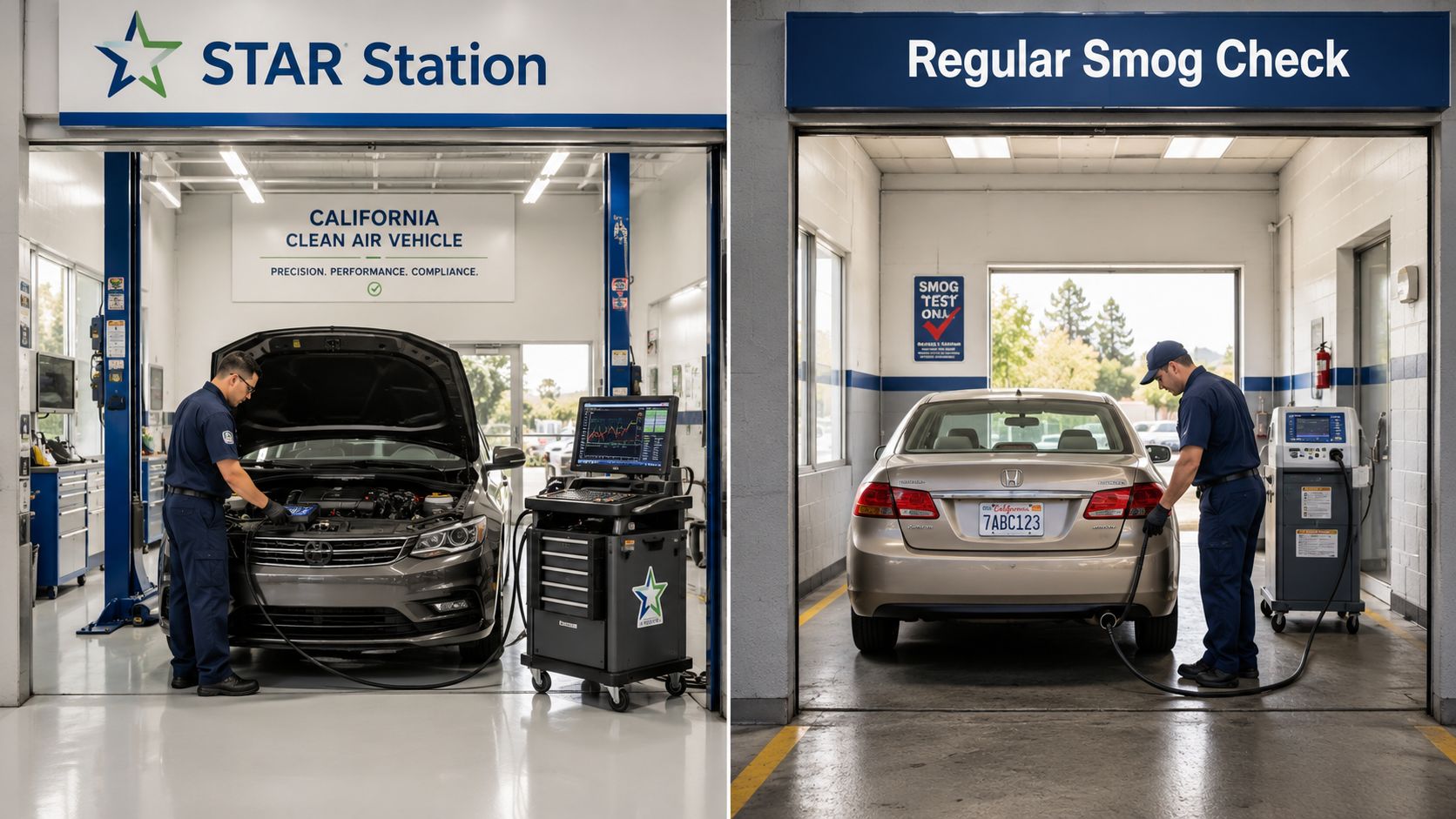
What STAR means
Treat STAR as a DMV routing instruction, not a quality label.
That one detail decides where you can go. It also affects how much time you spend solving the problem. Drivers who miss it often make two trips. First to the wrong shop, then to a STAR station after finding out the hard way.
For many 2000-and-newer vehicles, the test is often faster because it relies on the car's onboard diagnostics system, as explained in this OBD smog testing overview. Older vehicles and less standard cases can take more technician time, especially when the DMV notice requires STAR or the vehicle falls outside the typical commuter-car pattern.
Here's the trade-off:
- Regular station: Works if your paperwork does not require STAR.
- STAR station: Required if the DMV notice says STAR.
- Older, diesel, hybrid, or unusual registration case: Call first and confirm the station handles that exact test type.
Which vehicles and situations should be checked twice
The biggest time-wasters are not always problem cars. They are cars with paperwork or test-type details that drivers assume are standard.
Double-check before leaving home if you have:
- A DMV renewal notice that says STAR
- An older gasoline vehicle
- A diesel
- A hybrid
- An out-of-state registration
- A title transfer situation
If you are in Fremont but open to a nearby East Bay option, one station some drivers use is Speedy Smog in San Leandro, a STAR-certified shop that handles newer vehicles, older vehicles, diesels, and hybrids.
The smart move is simple. Read the notice, confirm whether STAR is required, then call the station and ask if they perform your vehicle's exact test. That two-minute call usually saves more time than price shopping first.
The Smog Check Process From Arrival to DMV Certificate
You pull into a Fremont smog station, hand over your renewal notice, and then find out the shop cannot run your required test. That is the avoidable mistake. Once you are at a station that matches your vehicle and DMV notice, the rest is usually straightforward.
What to bring and what happens first
Bring the documents that help the technician identify the correct test the first time:
- Your DMV renewal notice, especially if it shows a STAR requirement
- Current registration, to confirm the vehicle record
- Driver's license, if the station asks for identification
- Title transfer or out-of-state paperwork, if this is not a routine renewal
At check-in, the station verifies the VIN, plate, model year, and the reason for the inspection. This is the point where STAR versus regular station capability matters in real life. A standard renewal for a newer gasoline car usually moves quickly. A transfer, out-of-state case, diesel, or older vehicle may follow a different inspection path and take longer.
What the technician actually does
For many newer vehicles, the test centers on the onboard diagnostics system. The technician connects the equipment, checks required monitors, confirms the emissions-related systems report correctly, and makes sure there is no disqualifying issue such as an active check engine light.
Older vehicles and less common cases can involve more manual verification and a longer bay time. That is why two drivers can arrive at the same shop at the same time and leave far apart.
A good question at the counter is simple: “Are you set up for my exact vehicle and test type today?”
Here is the usual flow:
Check-in and vehicle verification
The station confirms your paperwork, vehicle details, and the correct inspection category.Smog inspection and testing
The technician runs the test required for that vehicle, not just the test a typical commuter car gets.Results submission
If the vehicle passes, the station submits the result electronically to the state system.
Later in the visit, it helps to know what the electronic side looks like:
What happens after you pass
If the car passes, you usually do not need to carry a paper certificate to DMV. The result is typically transmitted electronically, and that is what clears the way for registration or transfer processing.
Keep your receipt anyway. If there is ever a delay in DMV records updating, the receipt gives you the test date, station information, and vehicle details in one place. That small habit can save a second trip or a long phone call later.
Fremont Smog Check Costs and Tips to Pass the First Time
You save the most money before you pull into the bay.
In Fremont, the posted smog price is only part of the cost. The bigger money saver is choosing a station that can perform your exact test the first time. If your DMV notice requires STAR and you show up at a regular station, the cheap coupon stops being cheap once you add another drive, another wait, and a second appointment.
What Fremont drivers are paying
Fremont shops commonly advertise prices across a fairly wide range, from lower-cost basic tests to higher fees for stations that handle more inspection types or charge extra for certain vehicles. Local listings often show routine inspections for many eligible cars finishing quickly, but that only applies when the vehicle is a straightforward match for that station.
The useful takeaway is simple. Compare price, but verify fit first.
A low advertised rate makes sense for a standard gasoline vehicle that only needs a regular smog check. It is less useful for a STAR-directed renewal, an older vehicle, a diesel, or paperwork situations like a title transfer where the wrong station choice can waste half your afternoon.
How to avoid paying twice
Ask one question before you go: “Can you do my exact vehicle and required test type today?”
That question filters out a lot of bad trips. It matters more than shaving a few dollars off the test fee.
A few habits also improve your odds of passing on the first visit:
- Drive the car long enough to fully warm it up before testing.
- Fix any active check engine light before you book the inspection.
- Do not rush in right after clearing codes or disconnecting the battery.
- Match the shop to the job, especially for STAR notices, diesels, older vehicles, and transfer-related tests.
- Take care of rough running, hard starts, or obvious maintenance problems before your registration deadline gets close.
One practical trade-off comes up all the time. A bargain station can be the right choice for a newer car with a normal renewal and no warning lights. For anything less routine, paying a little more for the right station is often cheaper than repeating the process.
The best first-time pass strategy is boring but effective: bring a warmed-up car, show up with no warning lights, and confirm the station can perform your required test before you leave home.
That STAR versus regular station distinction is where Fremont drivers lose the most time. Get that part right, and the rest of the visit is usually straightforward.
What to Do If Your Vehicle Fails the Smog Check
A failed test is frustrating, but it's not unusual, and it doesn't mean you're stuck. The worst move is guessing at the repair.
Read the failure paperwork first
Start with the inspection report. It tells you why the vehicle didn't pass and gives the repair shop a place to begin. Don't treat it like a generic rejection slip. It's your roadmap.
If the failure reason isn't obvious to you, ask a licensed repair technician to explain it in plain English. You want the cause, not just the symptom.
Fix the cause, then retest
After a failure, the normal path is straightforward:
- Get the issue diagnosed
- Have the emissions-related problem repaired
- Return for a retest
What doesn't work is chasing random parts, clearing codes to try again, or bouncing from shop to shop without a diagnosis. That usually burns more money than a proper repair plan.
If repair cost is the main concern, check whether California's Consumer Assistance Program (CAP) can help with emissions-related repairs for eligible vehicle owners. The key word is eligible, so verify current program requirements before making assumptions.
If your registration deadline is close, move quickly but don't rush into the wrong repair. A focused diagnosis is almost always cheaper than replacing parts based on hunches.
If your DMV notice requires STAR, or your vehicle falls into an older, diesel, hybrid, title-transfer, or out-of-state category, Speedy Smog is one East Bay option for a compliant inspection without the guesswork about station type.
Most vehicles in California need a smog check every two years for registration renewal, and Fremont prices commonly range from $55 to $90. If your DMV notice says smog certification is required, the fastest way to avoid a wasted trip is to confirm whether your car needs a regular station, a STAR station, or no test at all before you go.
That's usually the problem. Not finding a shop. Finding the right shop for your vehicle, your DMV notice, and your test type.
In Fremont, you'll see plenty of stations advertising fast service, coupons, and “all vehicles.” That sounds helpful until you show up with a title transfer, an older gasoline car, a diesel, or a renewal notice that specifically requires STAR. Then speed matters less than eligibility. The good news is that the process is simple once you sort those basics out.
Table of Contents
- Your Fremont Smog Check Roadmap for 2026
- Do You Actually Need a Smog Check in Fremont
- STAR Station vs Regular Smog Check What Is the Difference
- The Smog Check Process From Arrival to DMV Certificate
- Fremont Smog Check Costs and Tips to Pass the First Time
- What to Do If Your Vehicle Fails the Smog Check
Your Fremont Smog Check Roadmap for 2026
Your registration notice lands in the mailbox, you spot “smog certification required,” and the first real question is not price. It is whether you need a STAR station or a regular smog station. Get that wrong, and you waste a trip before anyone even plugs into the car.
In Fremont, the process goes smoothly when you sort out three things first. Confirm that your vehicle needs a test, confirm whether DMV requires a STAR inspection, and confirm what kind of testing your vehicle is likely to get based on its age and type. That last part matters more than many local guides admit. A late-model gasoline car is usually straightforward. An older vehicle, diesel, hybrid, out-of-state registration, or transfer-related test can change what the station needs to do.
Start with the paperwork, not the coupon.
What matters most before you leave
Use this order so you do not lose time:
- Read the DMV notice carefully. If it calls for STAR, go to a STAR-certified station.
- Match the shop to the vehicle. Some Fremont stations are set up for quick routine tests. Others are better for older or less common cases.
- Budget time based on the car you have. Newer cars are often faster to process. Older cars and special cases can take longer.
Practical rule: A low advertised price does not help if the station cannot perform the test your registration requires.
California runs smog checks through a statewide system of licensed stations and technicians. The Bureau of Automotive Repair's smog program reporting shows how closely the state tracks inspections, outcomes, and station activity. For Fremont drivers, the useful takeaway is simple. There are plenty of shops, but they do not all handle the same mix of vehicles or DMV requirements.
That is the part many drivers miss.
A regular station may be fine for one car and wrong for the next. A STAR station can handle vehicles that DMV has flagged for STAR, and some drivers only find that out after showing up at a non-STAR shop. If you remember one thing before booking a Fremont smog check, remember this: the right station depends on your notice and your vehicle, not just the closest sign on Fremont Boulevard.
Do You Actually Need a Smog Check in Fremont
You buy the tag, head to a smog shop, and then find out your car was exempt or your DMV notice required a different kind of station. That is a common Fremont mistake, and it is easy to avoid if you check the paperwork first.
The fastest way to decide
Start with your DMV renewal notice. If it says a smog inspection is required, treat that as your answer. If it says STAR, that detail matters just as much as the test itself because a regular station will not meet the requirement.
Smog checks in Fremont usually come up in a few predictable situations:
- Registration renewal: The most common reason.
- Change of ownership: Many vehicle sales require a current smog certificate.
- First-time California registration: Out-of-state vehicles often need testing before registration can be completed.
- Certain vehicle categories: Diesel, hybrid, RV, and other special cases need closer review.
- Older vehicles with exemption questions: Drivers often guess incorrectly.
A lot of local guides stop at "check if you need a smog." The more useful question is whether your vehicle needs a smog check, and if so, whether the DMV is sending you to a STAR station or allowing a regular one.
Vehicle types that are often exempt
Exemptions depend on the vehicle, fuel type, and model year. According to this Fremont smog eligibility guide, gasoline vehicles from 1975 and older, diesel vehicles from 1997 and older, and all-electric vehicles are exempt from standard smog testing.
That breakdown matters in real life. A 1975 gas vehicle and a 2005 hybrid do not belong in the same bucket, and treating them the same is how people waste an afternoon.
| Vehicle situation | Likely next step |
|---|---|
| Typical DMV renewal vehicle | Check the notice for smog and STAR requirement |
| Gasoline vehicle 1975 or older | Often exempt |
| Diesel vehicle 1997 or older | Often exempt |
| All-electric vehicle | Exempt |
| Motorcycle or trailer | Usually not part of the standard smog program |
If you drive a hybrid, diesel, RV, or an older gasoline vehicle, call ahead before you go. Ask two direct questions. Does this vehicle need a smog check, and if it does, can this station perform the exact test listed on my notice?
That two-minute check can save you the trip, the line, and the repeat visit.
STAR Station vs Regular Smog Check What Is the Difference
A lot of Fremont drivers lose time on smog day for one simple reason. They go to a station that cannot perform the test their DMV notice requires.
A STAR station is a smog station that meets California's higher performance standards. The practical difference is straightforward. If your renewal notice says STAR, you need a STAR-certified station. A regular station cannot complete that requirement, even if it is cheaper or closer.
What STAR means
Treat STAR as a DMV routing instruction, not a quality label.
That one detail decides where you can go. It also affects how much time you spend solving the problem. Drivers who miss it often make two trips. First to the wrong shop, then to a STAR station after finding out the hard way.
For many 2000-and-newer vehicles, the test is often faster because it relies on the car's onboard diagnostics system, as explained in this OBD smog testing overview. Older vehicles and less standard cases can take more technician time, especially when the DMV notice requires STAR or the vehicle falls outside the typical commuter-car pattern.
Here's the trade-off:
- Regular station: Works if your paperwork does not require STAR.
- STAR station: Required if the DMV notice says STAR.
- Older, diesel, hybrid, or unusual registration case: Call first and confirm the station handles that exact test type.
Which vehicles and situations should be checked twice
The biggest time-wasters are not always problem cars. They are cars with paperwork or test-type details that drivers assume are standard.
Double-check before leaving home if you have:
- A DMV renewal notice that says STAR
- An older gasoline vehicle
- A diesel
- A hybrid
- An out-of-state registration
- A title transfer situation
If you are in Fremont but open to a nearby East Bay option, one station some drivers use is Speedy Smog in San Leandro, a STAR-certified shop that handles newer vehicles, older vehicles, diesels, and hybrids.
The smart move is simple. Read the notice, confirm whether STAR is required, then call the station and ask if they perform your vehicle's exact test. That two-minute call usually saves more time than price shopping first.
The Smog Check Process From Arrival to DMV Certificate
You pull into a Fremont smog station, hand over your renewal notice, and then find out the shop cannot run your required test. That is the avoidable mistake. Once you are at a station that matches your vehicle and DMV notice, the rest is usually straightforward.
What to bring and what happens first
Bring the documents that help the technician identify the correct test the first time:
- Your DMV renewal notice, especially if it shows a STAR requirement
- Current registration, to confirm the vehicle record
- Driver's license, if the station asks for identification
- Title transfer or out-of-state paperwork, if this is not a routine renewal
At check-in, the station verifies the VIN, plate, model year, and the reason for the inspection. This is the point where STAR versus regular station capability matters in real life. A standard renewal for a newer gasoline car usually moves quickly. A transfer, out-of-state case, diesel, or older vehicle may follow a different inspection path and take longer.
What the technician actually does
For many newer vehicles, the test centers on the onboard diagnostics system. The technician connects the equipment, checks required monitors, confirms the emissions-related systems report correctly, and makes sure there is no disqualifying issue such as an active check engine light.
Older vehicles and less common cases can involve more manual verification and a longer bay time. That is why two drivers can arrive at the same shop at the same time and leave far apart.
A good question at the counter is simple: “Are you set up for my exact vehicle and test type today?”
Here is the usual flow:
Check-in and vehicle verification
The station confirms your paperwork, vehicle details, and the correct inspection category.Smog inspection and testing
The technician runs the test required for that vehicle, not just the test a typical commuter car gets.Results submission
If the vehicle passes, the station submits the result electronically to the state system.
Later in the visit, it helps to know what the electronic side looks like:
What happens after you pass
If the car passes, you usually do not need to carry a paper certificate to DMV. The result is typically transmitted electronically, and that is what clears the way for registration or transfer processing.
Keep your receipt anyway. If there is ever a delay in DMV records updating, the receipt gives you the test date, station information, and vehicle details in one place. That small habit can save a second trip or a long phone call later.
Fremont Smog Check Costs and Tips to Pass the First Time
You save the most money before you pull into the bay.
In Fremont, the posted smog price is only part of the cost. The bigger money saver is choosing a station that can perform your exact test the first time. If your DMV notice requires STAR and you show up at a regular station, the cheap coupon stops being cheap once you add another drive, another wait, and a second appointment.
What Fremont drivers are paying
Fremont shops commonly advertise prices across a fairly wide range, from lower-cost basic tests to higher fees for stations that handle more inspection types or charge extra for certain vehicles. Local listings often show routine inspections for many eligible cars finishing quickly, but that only applies when the vehicle is a straightforward match for that station.
The useful takeaway is simple. Compare price, but verify fit first.
A low advertised rate makes sense for a standard gasoline vehicle that only needs a regular smog check. It is less useful for a STAR-directed renewal, an older vehicle, a diesel, or paperwork situations like a title transfer where the wrong station choice can waste half your afternoon.
How to avoid paying twice
Ask one question before you go: “Can you do my exact vehicle and required test type today?”
That question filters out a lot of bad trips. It matters more than shaving a few dollars off the test fee.
A few habits also improve your odds of passing on the first visit:
- Drive the car long enough to fully warm it up before testing.
- Fix any active check engine light before you book the inspection.
- Do not rush in right after clearing codes or disconnecting the battery.
- Match the shop to the job, especially for STAR notices, diesels, older vehicles, and transfer-related tests.
- Take care of rough running, hard starts, or obvious maintenance problems before your registration deadline gets close.
One practical trade-off comes up all the time. A bargain station can be the right choice for a newer car with a normal renewal and no warning lights. For anything less routine, paying a little more for the right station is often cheaper than repeating the process.
The best first-time pass strategy is boring but effective: bring a warmed-up car, show up with no warning lights, and confirm the station can perform your required test before you leave home.
That STAR versus regular station distinction is where Fremont drivers lose the most time. Get that part right, and the rest of the visit is usually straightforward.
What to Do If Your Vehicle Fails the Smog Check
A failed test is frustrating, but it's not unusual, and it doesn't mean you're stuck. The worst move is guessing at the repair.
Read the failure paperwork first
Start with the inspection report. It tells you why the vehicle didn't pass and gives the repair shop a place to begin. Don't treat it like a generic rejection slip. It's your roadmap.
If the failure reason isn't obvious to you, ask a licensed repair technician to explain it in plain English. You want the cause, not just the symptom.
Fix the cause, then retest
After a failure, the normal path is straightforward:
- Get the issue diagnosed
- Have the emissions-related problem repaired
- Return for a retest
What doesn't work is chasing random parts, clearing codes to try again, or bouncing from shop to shop without a diagnosis. That usually burns more money than a proper repair plan.
If repair cost is the main concern, check whether California's Consumer Assistance Program (CAP) can help with emissions-related repairs for eligible vehicle owners. The key word is eligible, so verify current program requirements before making assumptions.
If your registration deadline is close, move quickly but don't rush into the wrong repair. A focused diagnosis is almost always cheaper than replacing parts based on hunches.
If your DMV notice requires STAR, or your vehicle falls into an older, diesel, hybrid, title-transfer, or out-of-state category, Speedy Smog is one East Bay option for a compliant inspection without the guesswork about station type.

Your registration renewal is coming up, the DMV notice is sitting on the kitchen counter, and one line jumps out immediately: smog certification required. Most Dublin drivers don't mind the test itself. What causes stress is not knowing whether the car is ready, whether the notice means you need a STAR station, and whether this is going to turn into an afternoon of waiting around for something that should've been simple.
A smog check in Dublin, CA usually goes smoothly when you handle it in the right order. Check the notice, make sure your car is ready for inspection, pick the right station, and avoid the common mistakes that trigger a preventable fail. That's it. The rules are statewide, but the practical reality is local. Dublin drivers are dealing with Bay Area traffic, short errand trips, and busy schedules, so the smartest approach is to keep the process efficient.
Table of Contents
- That DMV Notice Just Arrived What Now
- Understanding California Smog Check Rules in Dublin
- Your Smog Inspection Visit Step by Step
- STAR Stations and Finding a Fast East Bay Option
- Tips to Pass Your Smog Check the First Time
- What to Do If Your Vehicle Fails the Smog Check
That DMV Notice Just Arrived What Now
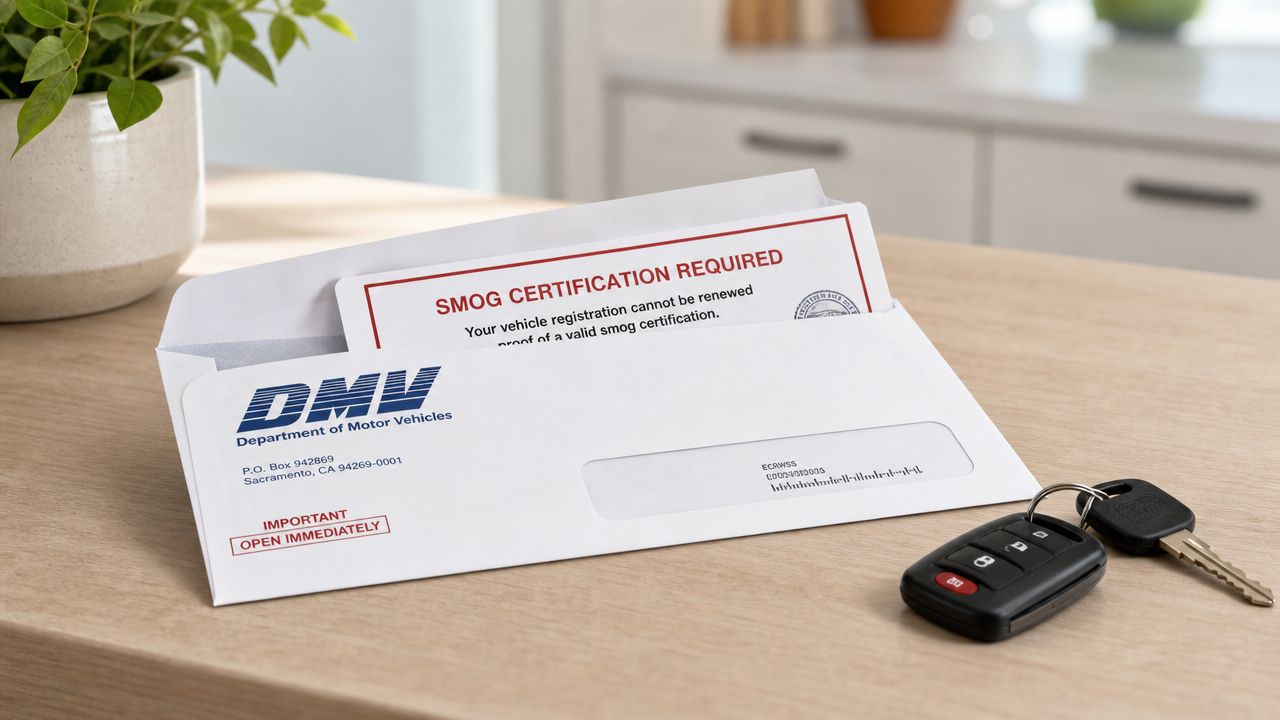
The first thing to do is slow down and read the notice closely. If the DMV is asking for a smog certification, you don't need to guess what happens next. You need to confirm the vehicle listed, the registration timing, and whether the notice says a standard test is fine or a STAR station is required.
Most drivers make this harder than it needs to be. They either wait until the last minute, or they rush in right after a battery replacement or check-engine light issue and end up failing for a reason that could've been avoided. If your goal is to get through a smog check in Dublin, CA with the least hassle, treat it like a short checklist, not a mystery.
What to do first
- Read the DMV notice carefully. Look for whether the vehicle needs certification now and whether a STAR station is specified.
- Think about the car's recent history. If the battery was disconnected, the check-engine light came on recently, or repairs were just completed, the car may not be ready yet.
- Pick the station based on your notice and schedule. For many drivers, speed and convenience matter as much as location.
- Drive the car normally before the test. A cold car that only does short neighborhood trips often isn't the easiest candidate for same-day testing.
Practical rule: If your check-engine light is on, don't test first and hope for the best. Diagnose that problem first.
A lot of the frustration around smog comes from mixing up DMV paperwork with the inspection itself. The shop handles the inspection. If your vehicle passes, the station sends the certificate electronically. Your job is to arrive with the car in test-ready condition.
That's the main difference between an easy visit and an expensive, annoying one.
Understanding California Smog Check Rules in Dublin
A Dublin driver usually learns the rules the same way. The renewal notice shows up, the car seems to run fine, and the first question is whether a smog check is required this time.
California's program is statewide, but Dublin sits inside the Bay Area air basin, so local drivers feel those rules regularly. The Bay Area Air District history traces regional air pollution control work back to 1955 and notes that California's Smog Check Program began in 1984. That history explains why smog testing is routine here. It has been part of Bay Area vehicle ownership for decades, not a Dublin-only rule.
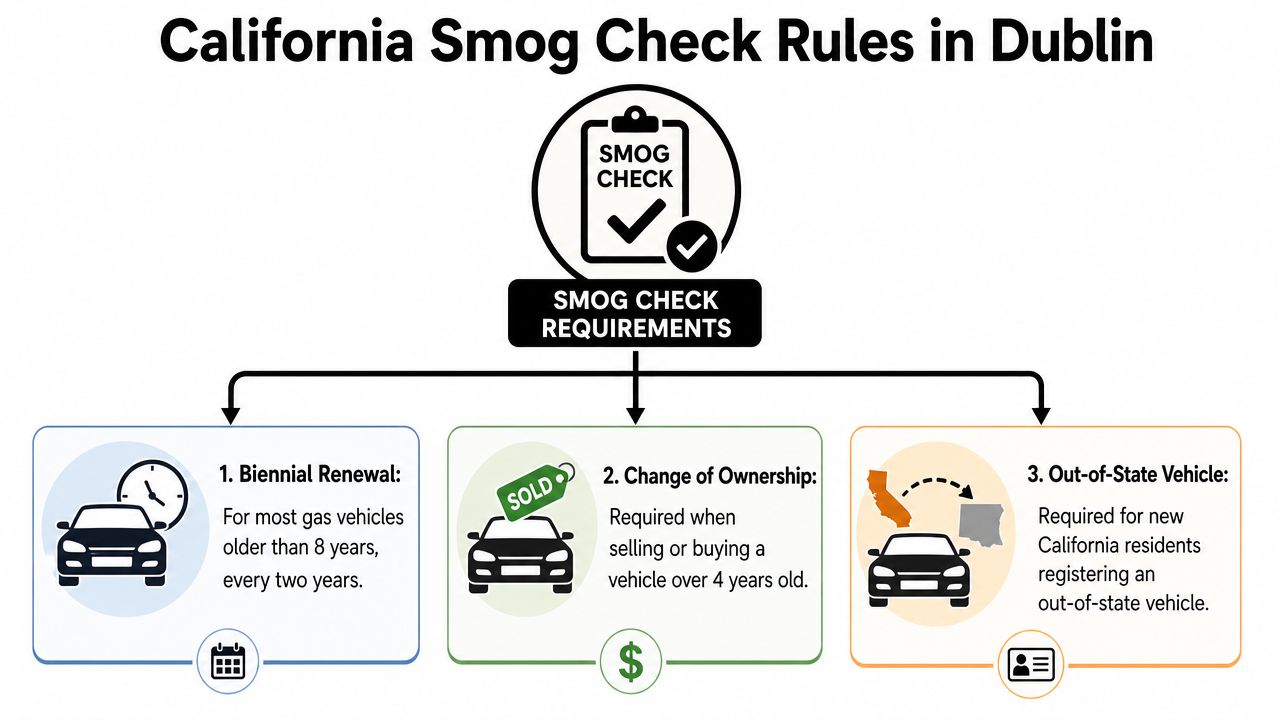
The basic rule is simple. Many gasoline-powered vehicles from model year 1976 and newer need periodic smog certification, while some vehicles are exempt or handled differently. The California Bureau of Automotive Repair Smog Check program page explains the program and the vehicle categories it covers. Electric vehicles do not get smog checks. Motorcycles do not get smog checks. Some newer vehicles may be outside the inspection cycle for a period of time, and diesel vehicles follow their own set of rules under the state program.
For Dublin drivers, smog usually comes up in three situations:
- Registration renewal when the DMV says certification is due
- Vehicle sales or transfers when California requires current certification
- First-time California registration for a vehicle coming from out of state
The key point is local, not theoretical. You do not need to guess based on what a neighbor's car needed last year. The DMV notice and the vehicle record decide whether your car needs testing now, and whether you need a regular station or a STAR station.
That local detail matters because Dublin drivers usually care about time as much as rules. A car owner in West Dublin heading to work, a parent trying to fit this in after school pickup, and a commuter coming off I-580 all need the same thing. Clear requirements and a fast test at the right station. That is why nearby options such as Speedy Smog stand out. The state rules are the same everywhere, but convenience is not.
One trade-off catches people off guard. A car can drive normally and still fail if it is not test-ready under California's inspection standards. I see that after battery disconnects, recent repairs, or a check-engine light that was cleared without fixing the underlying fault. The rules are straightforward once you separate two issues. First, does the DMV require a test now. Second, is the vehicle ready to be inspected.
Your Smog Inspection Visit Step by Step
A good smog visit feels boring in the best way. You arrive, hand over your paperwork, the technician runs the inspection, and if the vehicle passes, the certificate goes to the DMV electronically. The California Bureau of Automotive Repair smog check page says a typical inspection includes a visual check, an OBD or diagnostic evaluation, and a functional analysis. BAR also notes the process usually takes about 30 minutes, and the station transmits the certificate electronically to DMV if the vehicle passes.
What to bring before you leave home
Bring the basics. If you've got them together before you pull out of the driveway, the visit stays quick.
| Item | Why It's Needed |
|---|---|
| DMV renewal notice | Helps confirm that smog certification is being requested for your registration |
| Current vehicle registration | Verifies the vehicle information the station will inspect |
| Valid driver's license | Helps confirm the registered customer or driver information |
| Payment method | Keeps checkout simple once the test is complete |
If you can't find the DMV notice, don't panic. A station can often still test the vehicle with the registration information, but having the notice makes the process smoother and reduces avoidable confusion.
What happens during the inspection
The inspection itself isn't just a tailpipe sniff test. On modern vehicles, the technician typically checks emissions-related components visually, looks at the onboard diagnostic system, and performs a functional review of required systems.
Here's how that usually plays out in real life:
- Check-in at the counter: The station confirms the vehicle, paperwork, and test type.
- Vehicle setup in the bay: The technician begins the inspection procedure and verifies the required identification details.
- Visual inspection: Emissions-related equipment is checked for obvious issues, missing components, or tampering.
- Diagnostic review: The onboard system is scanned for readiness and stored problems.
- Functional checks: The technician verifies required systems as part of the state inspection procedure.
- Pass or fail result: If the vehicle passes, the certificate is sent electronically to DMV.
A lot of people expect the test to focus only on exhaust output. On many vehicles, readiness status and emissions-system integrity matter just as much.
For a driver in Dublin, the practical takeaway is simple. Don't show up assuming a smooth idle means a guaranteed pass. If the car recently had electrical work, battery service, or a warning light problem, that history matters during the inspection.
The easiest visits happen when the car has been driven normally, no warning lights are on, and nothing has recently reset the system monitors.
STAR Stations and Finding a Fast East Bay Option
A STAR notice usually catches Dublin drivers off guard because the wording makes it sound like there is a problem with the car. In practice, it usually means the state wants the inspection done at a station that meets STAR performance standards. If your DMV paperwork says STAR, go to a STAR station the first time and save yourself the repeat trip.
That is the part that matters most. The station type has to match the notice.
For local drivers, the easiest mistake to avoid is choosing based only on distance. A nearby shop is only useful if it can legally perform the test your notice requires and regularly handles your kind of vehicle. That matters more if you drive an older car, a diesel, or a hybrid. Some stations do those every day. Some do not. A quick phone call before you leave Dublin can save an hour.
I tell people to make the choice in this order:
- Read the DMV notice carefully
- Confirm whether STAR is required
- Ask if the station handles your vehicle type
- Then compare wait time, location, and hours
For Dublin drivers willing to head west, Speedy Smog in San Leandro is one practical STAR-certified option the usual local roundups often skip. The publisher's shop information says it handles a broad mix of vehicles, including diesels and hybrids, and it is set up for fast turnaround on many newer vehicles.
That will not be the best fit for every driver. If you are squeezing in a test between school pickup and work, staying in Dublin may still be the better call. But if your priority is getting in and out quickly at a station that deals with DMV smog inspections all day, a short East Bay drive can be the smarter move.
Use this filter before you book:
- STAR listed on the notice: The station must be STAR-certified.
- Diesel or hybrid: Confirm the shop tests that vehicle category.
- Tight schedule: Ask about same-day availability and normal wait times.
- Need fewer surprises: Choose a station that submits certificates electronically and handles inspection volume regularly.
The right shop is the one that matches your DMV notice, your vehicle, and your day, not just the one closest to your driveway.
Tips to Pass Your Smog Check the First Time
Your renewal deadline is close, the car seems to run fine, and you want this done in one trip. That usually comes down to preparation, not luck. The failures I see most often around Dublin are preventable. The car was driven only on short local errands, the check-engine light was ignored, or the battery was disconnected right before the test and the monitors never reset properly.
For local drivers, the practical goal is simple. Show up with a fully warmed-up vehicle, no warning lights, and enough normal driving on the car for the onboard system to complete its self-checks. Do that, and the odds of a smooth pass go up.
What helps right before the test
Start with the basics that affect the result.
- Drive the car 15 to 20 minutes before the appointment: A warmed-up engine and catalytic converter give the system the conditions it expects during inspection.
- Check the dashboard before you leave: If the check-engine light is on, deal with that first. A car can feel normal and still fail immediately on an emissions fault.
- Make sure the gas cap is tight: On some vehicles, an EVAP-related issue starts with something this simple.
- Avoid last-minute resets: Clearing codes or disconnecting the battery right before a smog check usually creates a readiness problem instead of solving anything.
Shop-floor advice: If someone tells you, “The light is off now, so you're good,” verify that the monitors have actually reset. For smog, that part matters just as much as the warning light itself.
A recent battery replacement can cause the same issue. The repair may be done correctly, but the car still needs normal driving time before the computer is ready for test day.
What hurts your chances
Some patterns lead to repeat failures, especially for drivers who wait until the last week on the DMV notice.
- Testing right after repairs: The fix may be complete, but the vehicle may still show incomplete readiness monitors.
- Ignoring an intermittent warning light: If it comes on and goes off, the fault is still there until proven otherwise.
- Only doing short Dublin trips: Quick drives around town do not always give the system enough time to run its emissions checks.
- Waiting until the deadline: That leaves no room for diagnosis, repair, or a retest if the first visit does not go your way.
One local trade-off is convenience versus readiness. If you use your car mostly for short city driving, it can help to plan the smog check after a longer freeway run rather than after a week of school drop-offs and grocery stops. And if your notice requires STAR, pick a station that can process you quickly so the car stays warm and the visit stays simple. Some Dublin drivers also choose nearby East Bay options such as Speedy Smog when fast scheduling matters more than staying close to home.
The cheapest smog check is still the one you only pay for once.
What to Do If Your Vehicle Fails the Smog Check
A failed result is frustrating, but it's not the end of the road. The technician will give you paperwork showing why the vehicle failed. Read that report carefully before you spend money on parts or repairs. The reason matters. A warning-light issue, a readiness problem, and a component failure are not the same thing.
Read the failure report first
Don't guess. Use the inspection report as your starting point and ask the shop to explain the failure category in plain language if anything is unclear.
A good next move is usually:
- Take the report with you
- Have the vehicle diagnosed properly
- Fix the actual cause, not the symptom
- Return for a retest once the car is ready
If the battery was recently reset or monitors were incomplete, the solution may be more driving and verification, not major parts replacement.
Repair then retest
Choose a qualified repair facility that understands emissions-related diagnosis. If the issue is straightforward, the fix can be simple. If it isn't, the report helps prevent random trial-and-error spending.
California also has a Consumer Assistance Program, often called CAP, that may help eligible vehicle owners with emissions-related repair situations. If cost is a concern, it's worth checking whether you qualify before authorizing bigger repair work.
Once the repair is done, make sure the vehicle is ready for retest. That means no active warning lights and no rushed trip back to the station before the onboard system has completed its checks.
If you want a nearby East Bay option for DMV emissions testing, Speedy Smog offers STAR-certified smog checks in San Leandro for many common vehicle types, including newer models, older vehicles, diesels, and hybrids. For Dublin drivers who care about a quick in-and-out visit and electronic DMV certificate handling, it's a practical choice to keep on your list.
Authored using Outrank tool