
You're staring at a DMV renewal notice, and the first question isn't where to go, it's whether your vehicle even needs a test. That's the part most drivers in Tracy get stuck on, because the answer depends on the model year, the fuel type, and whether you're dealing with a renewal, an ownership transfer, or a new California registration.
Table of Contents
- Do You Actually Need a Smog Check in Tracy
- How California Smog Rules Apply to Tracy Vehicles
- Preparing Your Car Before the Test
- Why STAR Certification Matters in Tracy
- Typical Costs and Time for a Tracy Smog Check
- What Happens During the Inspection
- What to Do After a Failed Smog Test
- Your Tracy Smog Check Action Plan
Do You Actually Need a Smog Check in Tracy
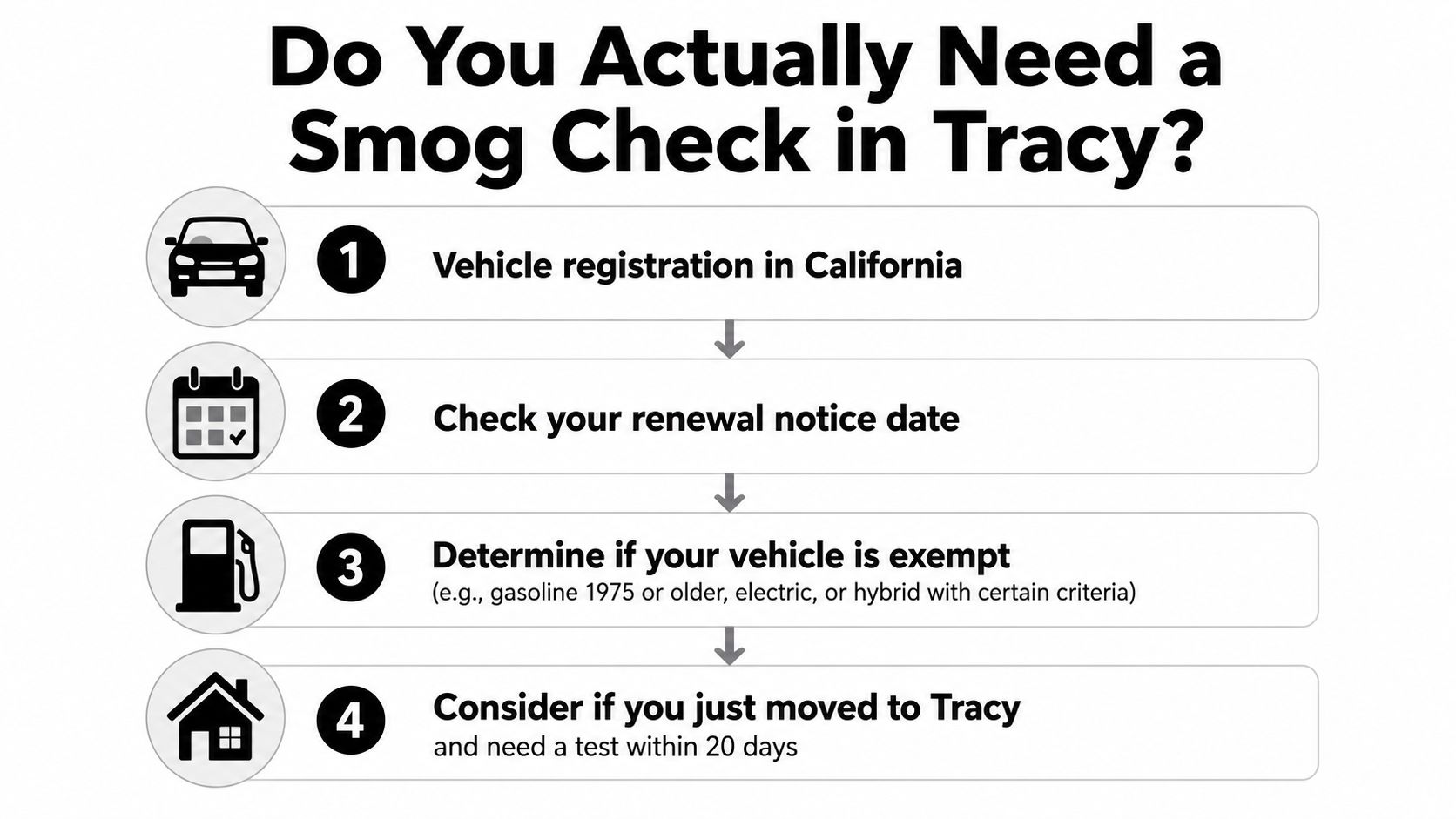
A lot of people type smog check Tracy CA into search because they assume they need to book immediately. Often, they don't. The first step is checking whether your car is exempt, because California's rules are driven by vehicle details, not by the city name on the map, and the DMV says gasoline vehicles under eight model years old are generally exempt from the biennial smog requirement, with some vehicles also paying a smog abatement fee during the first 8 years if the vehicle is less than 4 model years old. California DMV smog inspection guidance
Start with three quick checks
Use this order, because it cuts through the confusion fast.
- Model year. If your gasoline car is under the DMV's exemption age, you may not need a test for renewal.
- Fuel type. Electric vehicles are exempt, and BAR also notes exemptions for some hybrids, diesel vehicles, trailers, motorcycles, and certain older gasoline cars.
- Registration event. A smog check can still be required when a vehicle changes ownership or is first registered in California, even if the driver wasn't thinking about a test before the paperwork started.
That last point is where many first-time Tracy drivers get surprised. A renewal notice, a title transfer, or an out-of-state move can trigger the test even when the driver thought the car was due for normal yearly paperwork. The registration event matters because California's program is tied to compliance at the DMV, not just a calendar reminder.
Know what the city changes, and what it doesn't
Tracy itself doesn't create a separate smog rulebook. California's statewide system does the regulating, and Tracy sits inside that framework because the state program has been in place since March 1984, when the first Smog Check program started after SB 33 passed in 1982. California Smog Check Program background
Practical rule: if you're unsure, look at your registration trigger first, then your model year and fuel type. That order usually answers the question before you spend money on a test you didn't need.
That's the cleanest way to avoid wasted time. If your vehicle is exempt, you're done. If it isn't, the next step is figuring out which inspection path your car falls into.
How California Smog Rules Apply to Tracy Vehicles
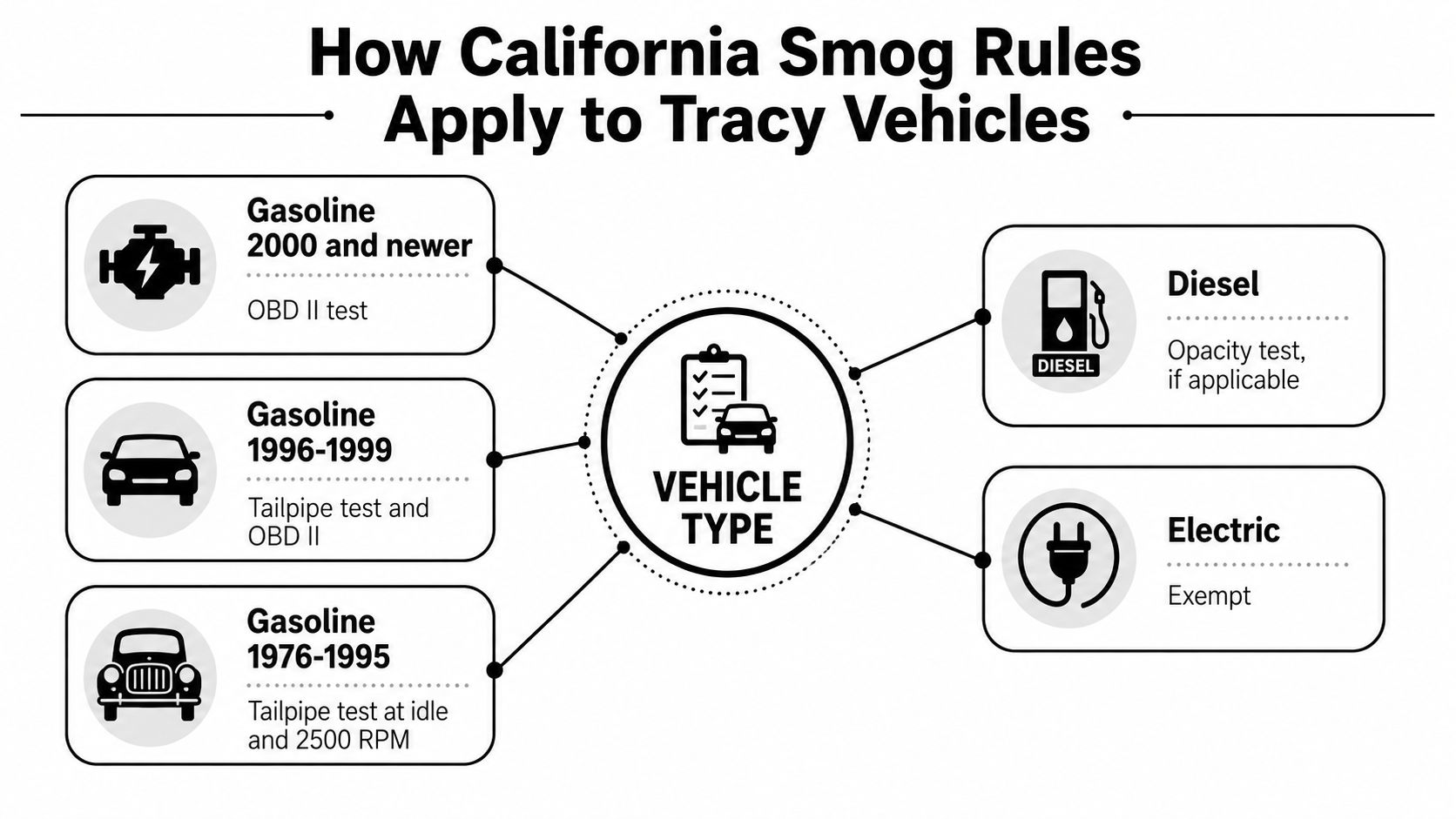
A Tracy driver usually asks the exemption question first, and that is the right place to start. Once that is clear, the next step is figuring out what kind of test the vehicle falls under. In California, that depends more on model year and fuel class than on Tracy geography. BAR says gasoline, hybrid, and alternative-fuel vehicles are generally subject to Smog Check from model year 1976 onward, while diesel vehicles are subject from model year 1998 onward. For the state's basic rule summary, see the BAR Smog Check rules.
Vehicle category shapes the test path
A 2019 gasoline sedan in Tracy usually goes through the modern OBD-based path. A 1999 gasoline truck may still be sent through a more hands-on inspection flow if its setup calls for it. A 2003 diesel pickup is handled under diesel rules, not the same process as a typical gas car. A 1995 classic gasoline car sits in a different lane because older gasoline vehicles can be treated differently from newer cars.
That is why two neighbors can both need a “smog check” and still face different inspections. The shop is not guessing. The model year, fuel type, and compliance equipment on the vehicle decide the route, much like different keys opening different doors in the same building.
A few plain-English examples
- 2021 hybrid. Usually fits the modern compliance pathway and is commonly checked through the vehicle's onboard system.
- 2004 diesel. Subject to diesel-side rules and may need a station that is set up for that work.
- 1995 gasoline car. Falls outside the newer OBD-only pattern and may require a different inspection method.
- Older gasoline vehicle with missing OBDII equipment. BAR notes that certain edge cases can still require a BAR-97 tailpipe test if the vehicle lacks OBD-II or has a problematic OBDII system.
That distinction matters because the test method changes the failure points. With an OBD-based test, readiness monitors and the malfunction indicator light matter most. With a tailpipe test, exhaust measurement becomes the center of the decision.
If you want a broader rule summary alongside the state guidance, this California smog check rules overview helps match your car type to the right inspection lane.
Preparing Your Car Before the Test
The easiest smog failures are the ones you can avoid before you ever pull into the bay. A car that's mechanically healthy can still stumble if it's cold, the monitors haven't run, or the dashboard light is on. That's why a little prep often matters more than the appointment itself.
Do the basics before you leave home
Start with a 10 to 15 minute warm-up drive right before the test. A warmed engine gives the inspection equipment a more accurate picture of how the car is operating, especially on vehicles that will be checked through the OBD path. Then look at the dashboard. If the check-engine light is on, the vehicle is very likely to fail the OBD side of the inspection until the fault is addressed.
If you clear codes right before a test, you can create a different problem. The monitors may not be ready yet, and the car can fail for incomplete readiness even if the light stays off.
Bring the paperwork too. The station will want the registration information, and if you're doing a renewal or transfer, having the notice and payment ready saves time at check-in. Don't forget the gas cap. A loose or damaged seal can create problems during the visual and functional parts of the inspection.
Don't skip the condition check
Tire condition matters more on some older test paths, especially if the vehicle is going onto equipment that requires safe movement or a dyno-style setup. If a tire is visibly damaged or severely underinflated, fix that before the appointment. It's a simple safety issue, but it can also slow the inspection down.
For a deeper maintenance habit that pairs well with the pre-test routine, this oil change before smog check guide is a useful reference.
Avoid the false fix
A cheap scan tool can erase a light, but it can't repair the reason it turned on. That's why the smartest approach is to prepare the car, not to trick the system. If a warning light was recently on, make sure you've driven enough for the vehicle to complete its self-checks before heading in.
Why STAR Certification Matters in Tracy
A lot of drivers ask the exemption question first, because that answer decides whether they need to shop around at all. If your vehicle is exempt, a STAR label does not change that. If your DMV notice points you to a test, STAR certification can matter a great deal, because it tells you the station is set up for more demanding inspection cases and the licensing rules that go with them.
STAR certification is a station capability standard. BAR requires STAR stations to have the inspection equipment needed to inspect all vehicle types, including directed vehicles, and to have the appropriate licensed inspector or repair technician present during all hours of operation. BAR Smog Check manual
What STAR stations can do that basic stations may not
A basic test-only shop can be fine for a straightforward, eligible vehicle. A STAR-certified station is the safer choice when your vehicle is more complicated, when a DMV notice directs you there, or when you want a station that is set up for a wider range of inspection needs. BAR also says STAR stations must maintain work areas that are approved, clean, orderly, and generally enclosed within a building, which helps keep the inspection environment controlled.
That matters for Tracy drivers because the wrong station can turn a routine visit into a wasted trip. If your vehicle is a directed case, a heavy-duty exception, or another special category, a station without the right equipment may have to turn you away. In the same way a mechanic needs the right lift for the right vehicle, the station type has to match the test type.
Basic test-only versus STAR
| Station type | What it usually means | Best fit |
|---|---|---|
| Basic test-only station | Handles standard inspections for common vehicles | Straightforward renewals on eligible vehicles |
| STAR-certified station | Meets higher equipment and staffing standards | Directed vehicles, broader inspection needs, and more complex compliance cases |
A STAR station is not automatically the right answer for every driver. If your car is a normal, eligible vehicle and your DMV notice does not direct you elsewhere, a basic station may be enough. If you are unsure, choose the station that can complete your exact inspection type instead of the one that just has the lowest sign out front.
For a clearer breakdown of the credential itself, this what is a smog STAR station guide explains the difference without the sales pitch.
Typical Costs and Time for a Tracy Smog Check
People usually want two numbers before they book, how long it'll take and what it'll cost. Those answers depend on the vehicle class, the shop type, and whether the quote is for the test alone or for the test plus certificate.
Quick reference by vehicle type
| Vehicle category | Typical test method | Approximate time | Typical price range |
|---|---|---|---|
| 2000 and newer gasoline or hybrid | OBD-based inspection | Fastest route, often a short visit | Lower advertised pricing at many shops |
| 1999 and older gasoline | Tailpipe-based or mixed inspection path | Longer than a simple plug-in test | Usually higher than newer OBD-only vehicles |
| 1998 and newer diesel | Specialized diesel inspection | Varies by station setup | Mid-range compared with standard gas tests |
| Directed re-test at STAR station | Required compliance path for directed vehicles | Depends on the vehicle and findings | Often the highest tier because the station must meet stricter requirements |
Why quotes can look different
One shop may quote a certificate-only fee, while another bundles the inspection and certificate together. That's why two ads for the “same” smog check can look different at first glance. Coupons can also change the math, but they usually apply only to the standard smog fee on eligible newer vehicles, not to every special case.
A short wait doesn't always mean a rushed inspection, either. For a standard modern vehicle, the process can be quick because the station is checking scan data rather than spending time on a more involved test path. Older cars, diesels, and directed vehicles tend to take longer because the inspection itself is more detailed.
Good buyer habit: ask whether the quoted price includes the certificate, and ask whether your vehicle category changes the price before you arrive.
That one question prevents most awkward counter surprises.
What Happens During the Inspection
A lot of drivers in Tracy worry about the same first question before they even book a visit, do I need a smog check, or am I one of the vehicles that qualifies for an exemption. That question matters because it decides whether you should be planning for a standard test, a directed test, or no test at all. Once that part is clear, the inspection itself feels much easier to follow.
At a local station, the process is usually straightforward. You arrive, hand over the paperwork, and the technician confirms the vehicle information before any testing starts. For a late-model car, the visit can feel closer to a careful health check than a major repair event.
The usual sequence at the station
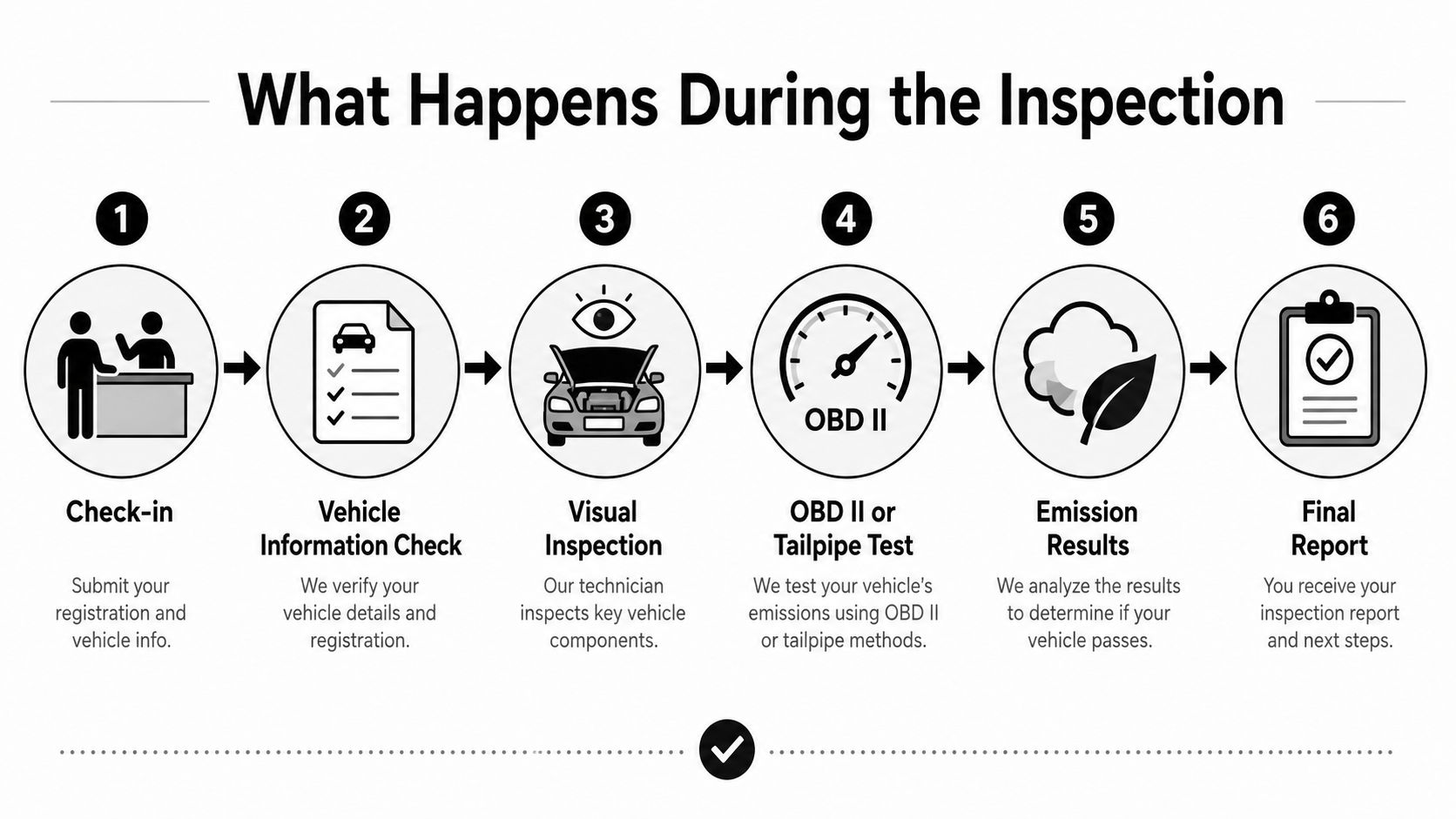
The first step is check-in. The technician verifies the VIN, registration, and the type of inspection required so the right procedure is used from the start. That matters in Tracy because some vehicles are tested under a standard path, while others need a directed process tied to their DMV status.
Then the car moves into the inspection lane and the technician begins the required checks. For a 2000 and newer vehicle, the technician connects an OBD-II scanner and reviews readiness monitors, malfunction indicator light status, and stored trouble codes. If the system still shows unresolved issues, the vehicle can fail even when it drives normally.
Older gasoline vehicles or directed cases may follow a different path. The station may use a BAR-97 tailpipe test, which measures exhaust gases under the proper test conditions. While that happens, the technician also performs the visual and functional inspection of emissions equipment, because the computer side and the hardware side both have to line up.
What they're looking at
- Catalytic converter.
- Gas cap.
- EGR valve.
- Air injection system.
Each part matters because emissions compliance has two sides. The vehicle has to report correctly through its onboard system, and the required equipment has to be present and working. A car can show acceptable tailpipe numbers and still fail if a required emissions part is missing or not operating. The reverse can happen too, which is why the inspection uses more than one method instead of relying on a single sign.
At the end, the station issues the result and transmits the certificate electronically to DMV when the vehicle passes. If your car is part of a STAR or directed case, the result also tells you how to handle the next step, whether that means keeping the paperwork for your records or taking the car to the right follow-up station. The image below shows the process in the same order most drivers experience it. A six-step infographic illustrating the smog inspection process for vehicles, from initial check-in to final report.
What to Do After a Failed Smog Test
A failed test feels expensive in the moment, but the next move matters more than the fail itself. The technician should tell you which part failed, whether it was OBD readiness, a visual inspection, a functional inspection, or tailpipe emissions. Once you know that, you can stop guessing and start fixing the exact issue.
Use the failure reason to choose the repair path
Take a simple example. A 2007 SUV fails because two readiness monitors are incomplete. That is a different problem from a broken catalytic converter or a missing vacuum line. If the failure is just incomplete readiness, the fix may be as simple as driving the car enough for the monitors to finish their checks after the underlying code issue is resolved.
If the car is a STAR-directed vehicle, the repair path gets stricter. Directed cases need the right station setup for the retest certificate, so that affects where you bring the car after the failure. For a standard vehicle, you can choose between the same station and a trusted independent mechanic, depending on what failed.
Be careful with upsells
Ask for the actual diagnostic trouble codes in writing. Don't approve parts just because someone says they “might help.” If a hose passed inspection and the problem was electrical, replacing random emissions parts is money gone without solving the fail.
A few drivers also qualify for repair help or a waiver path if the repair cost hits the applicable cap in California's rules. You should ask the station or DMV what applies to your exact case before you pay for unnecessary work. The key is to document everything, because proof of repair is often part of the retest process.
Retest timing matters
Most drivers aim to return within the retest window so they don't end up paying a full fee again. Keep the old report, keep the repair invoice, and don't rush back until the car is ready. A clean retest is cheaper than repeated guessing.
Your Tracy Smog Check Action Plan
Start with the exemption question. If your vehicle is exempt, stop there and save the trip. If it isn't, match your vehicle to the right station type, then make sure your car is warmed up, your paperwork is ready, and your warning lights are dealt with before you arrive.
Quick checklist
- Confirm the trigger. Renewal, ownership transfer, or first California registration can all matter.
- Match the vehicle. Model year and fuel type decide the inspection path.
- Choose the right station. Use a STAR station when your vehicle category or DMV notice calls for it.
- Prep before leaving. Warm the car, check the dashboard, and bring registration paperwork.
- If you fail, diagnose first. Fix the exact problem, then retest with the correct documents.
Tracy drivers save the most time when they treat smog testing like a compliance step, not a mystery. Once you know whether you need the test, what kind of inspection your vehicle gets, and how to respond if it fails, the whole process gets a lot less stressful.
If you want a station that can handle California smog compliance with clear communication and a straightforward inspection process, visit Speedy Smog. Their STAR-certified setup is built for emissions testing on a wide range of vehicles, so you can book with more confidence and get your DMV paperwork moving without the guesswork.
You open your renewal notice, scan for the amount due, and then see the line that stops everything: Smog Certification Required. For a lot of East Bay drivers, that's the moment the simple job of renewing registration turns into a string of questions. Does your car need it? Do you need a STAR station? What if the check engine light came on last week? How long is this going to take?
California smog check rules aren't impossible, but they are layered. The DMV, the Bureau of Automotive Repair, vehicle age, fuel type, ownership changes, and station type all matter. If you just want a straight answer and a short path to compliance, the good news is that the rules get much easier once you sort them by situation instead of reading them like DMV text.
Table of Contents
- Why Your DMV Notice Demands a Smog Check
- When Is a California Smog Check Required
- Rules for Your Specific Vehicle Type
- What Happens During a Smog Inspection
- The Importance of STAR Certified Stations
- If Your Vehicle Fails the Smog Check
- Your East Bay Smog Check Action Plan
Why Your DMV Notice Demands a Smog Check
That DMV notice isn't random. California built smog compliance into the registration process, so when your renewal says a certification is required, the test becomes part of finishing the renewal itself.
It often feels like bureaucracy first and clean air second. But the program has a practical purpose. The California Air Resources Board says the Smog Check program removes about 400 tons of smog-forming pollutants every day from California's air, as summarized in the California Smog Check Program overview. In the Bay Area, where people commute, idle in traffic, and keep older vehicles on the road, that's not an abstract policy goal.
Practical rule: If your DMV notice says a smog certification is required, treat it like a registration task, not an optional maintenance item.
I've found that drivers usually get tripped up in one of three ways. They assume a newer car is always exempt, they think a recent repair automatically means the car will pass, or they wait until the last minute and then discover they were supposed to visit a specific kind of station.
The better way to think about California smog check rules is simple. The state uses registration renewal as the checkpoint. Your job is to figure out whether your vehicle falls into the test group, then get the inspection done at the right type of station before the renewal deadline catches up with you.
Once you look at it that way, the process gets a lot less intimidating.
When Is a California Smog Check Required
A common East Bay scenario goes like this. Your registration renewal shows up, you skim it, and then one line stops you: Smog Certification Required. At that point, the practical question is not whether the car seems to run clean. It is whether the state needs a passing inspection before DMV will finish your renewal.
For many drivers, the basic rule is a biennial smog check. That means every 2 years for many vehicles during registration renewal, according to the California Bureau of Automotive Repair Smog Check page. In the shop, this is the pattern we see most often with East Bay commuters who are renewing registration on a car that has aged out of the newer-vehicle exemption.
Newer gasoline vehicles get a break. Gasoline-powered vehicles that are 8 model years old or newer usually do not need a Smog Check for registration renewal. The owner pays a smog abatement fee instead. The detail that trips people up is the timing. The exemption is tied to the vehicle's model year, not how recently you bought it or how little you drive it.
The state also sets part of the cost structure. The inspection itself usually takes about 30 minutes, and there is a mandatory $8.25 Smog Check certificate fee added to the station's inspection price. So if one East Bay shop quotes a different total than another, part of that difference is the shop's labor and pricing, while the certificate fee stays fixed.
Here are the situations that usually trigger confusion:
- Your renewal notice says certification is required. That is the clearest answer you will get. DMV is telling you a passing smog check is part of renewing registration.
- Your car just aged out of the exemption window. A vehicle that did not need a check last cycle can need one this cycle.
- You are handling a special transaction. Ownership transfers and first-time California registration can follow different rules than a standard renewal, so the paperwork for that transaction matters more than a general rule you heard from someone else.
Practical rule: Trust the notice in your hand, then confirm the model year and fuel type before you head to a station.
2026 California Smog Check Requirements at a Glance
| Vehicle Type / Situation | Smog Check Required? | Notes |
|---|---|---|
| Gasoline vehicle, 8 model years old or newer, registration renewal | No | Pays smog abatement fee instead of biennial inspection |
| Gasoline vehicle beyond the exemption window, registration renewal | Usually yes | Many vehicles fall into the every-2-years cycle |
| DMV renewal notice says “Smog Certification Required” | Yes | Complete it before renewal can be finalized |
| Vehicle at a station for inspection | Sometimes | Typical inspection time is about 30 minutes |
| Any completed Smog Check certification | Yes, fee applies | Includes the mandatory $8.25 certificate fee plus station inspection price |
A lot of DMV stress comes from assuming every renewal works the same way. They do not. The shortest path is to check three things before you leave home: the exact wording on the renewal notice, the vehicle's model year, and whether DMV says you need a STAR station. In the East Bay, that simple checklist saves drivers more time than guessing ever does.
Rules for Your Specific Vehicle Type
Vehicle type changes the rule fast. In the East Bay, I see the same problem every week. A driver hears one smog rule from a friend, applies it to the wrong vehicle category, and loses a day chasing the wrong answer.
The clean way to sort it out is to start with three facts: fuel type, model year, and for some diesels, weight. Once those match your registration situation, the rule usually gets a lot simpler.
Gasoline vehicles
Gasoline vehicles cause the most confusion because the broad rule is easy to oversimplify. Older gasoline cars may fall outside the usual testing system, while many later-model vehicles eventually age into regular smog requirements.
For a typical East Bay driver, the practical question is not whether the car feels fine on the road. The practical question is whether your gasoline vehicle is still in its exemption window or already subject to testing based on its age and DMV transaction.
A few mistakes come up again and again:
- “It drives perfectly, so it should pass.” A smooth-running car can still have an emissions problem.
- “The check engine light went away.” A light that turned off does not always mean the system is ready.
- “I just bought the car.” A recent purchase does not automatically remove a smog requirement tied to registration or transfer paperwork.
If you drive a gasoline car in the East Bay and the paperwork points toward testing, treat that as your answer and get the inspection scheduled.
Diesel vehicles
Diesel rules are narrower, but they still trip people up. Some diesel vehicles are exempt. Others are not, and the deciding factors are usually model year and gross vehicle weight rating.
That weight piece matters more than many drivers expect.
A diesel badge alone does not tell you whether a smog check applies. Lighter-duty diesels can fall under the rules, while older or heavier diesel vehicles may be handled differently. The safest move is to check the registration details against the vehicle information on the door label or manufacturer sticker before you book an appointment.
If you are not sure how your diesel is classified, ask the station to confirm what category you are dealing with before the inspection starts. That saves time and avoids a lot of bad assumptions.
Hybrid vehicles
Hybrid owners often assume battery power means exemption. That is where confusion starts. A hybrid is not treated like a fully electric vehicle for smog purposes.
In practice, many hybrids are handled much more like gasoline vehicles than drivers expect. If your DMV paperwork requires a smog certification, do not let the word "hybrid" talk you into skipping it.
The trade-off is simple. Hybrid systems can make the vehicle feel cleaner and more efficient, but the state still looks at emissions compliance rules, not just fuel economy.
For East Bay drivers, the quickest path is to identify the vehicle correctly before you head to a station. Gasoline, diesel, and hybrid vehicles do not all follow the same logic, and most smog headaches start with using the wrong rule for the car in the driveway.
What Happens During a Smog Inspection
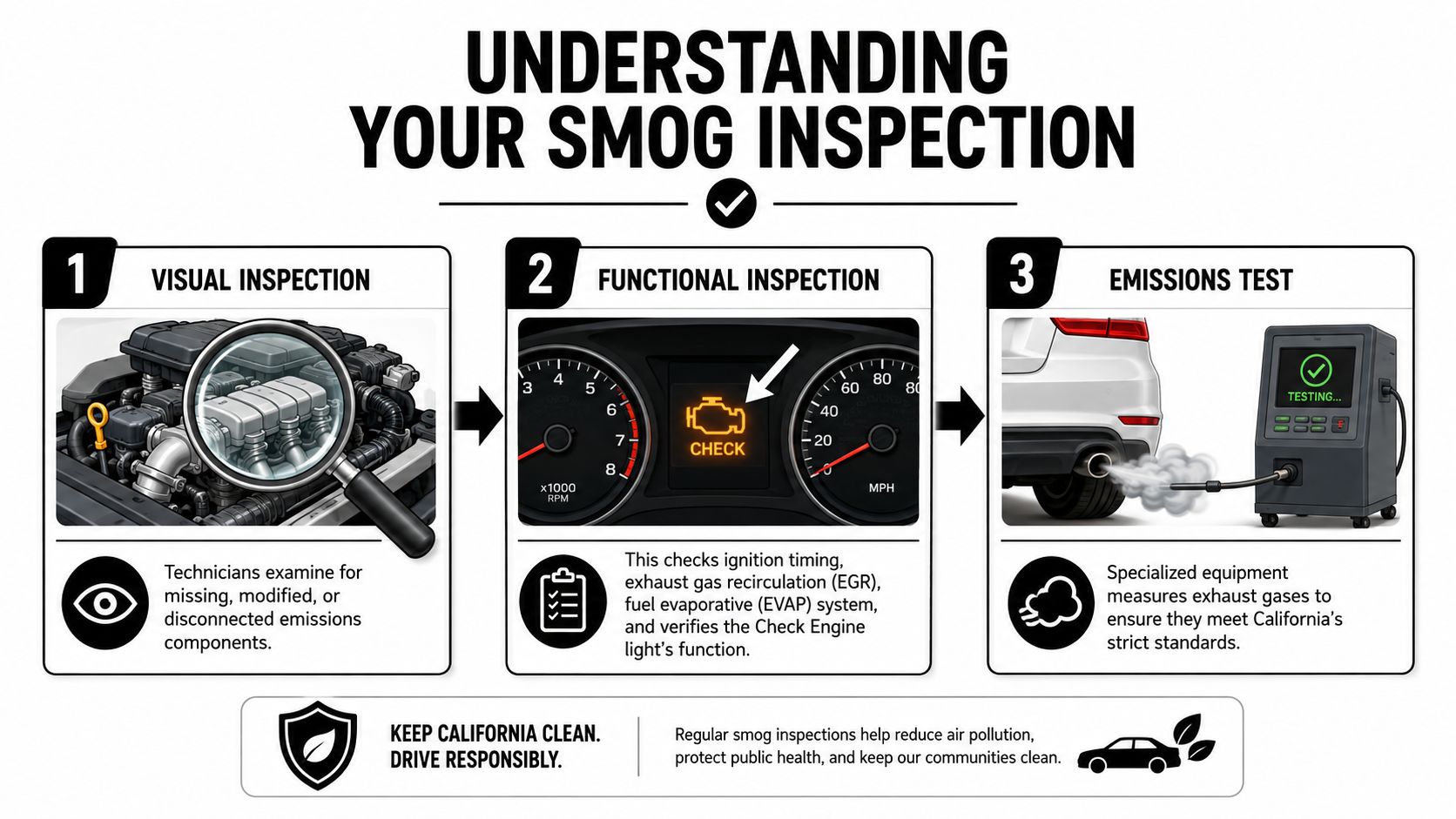
A smog inspection feels mysterious until you break it into parts. It's really a compliance check that looks at the car's emissions system, its warning and monitoring functions, and the actual output the vehicle produces.
This visual guide matches what technicians are looking for during the process:
The three parts of the inspection
Most drivers can understand the inspection as a car version of a medical checkup.
Visual inspection
The technician looks for missing, disconnected, or obviously modified emissions-related components. If the vehicle has parts that don't belong there, or parts that should be there but aren't, that can create trouble before any machine is plugged in.Functional inspection
During this inspection, warning lights and system behavior matter. The check engine light, ignition-related functions, and emissions-control system operation all come into play. A dashboard light you've been ignoring can turn into the main reason the vehicle doesn't pass.Emissions test
This is the measured part. The vehicle's emissions performance is checked using state-approved equipment and procedures matched to the vehicle's setup.
A smog test isn't just a tailpipe sniff anymore. For many vehicles, it's also a check of what the car's own computer says about its emissions health.
A lot of failed inspections start before the test begins. Battery disconnects, recent repairs, and aftermarket modifications can all create readiness or equipment issues that don't show up as obvious driving problems.
How the actual test differs by vehicle
For newer vehicles, the process often works like a computer scan. The technician connects to the vehicle's onboard diagnostics system and checks for emissions-related faults and monitor status. For older vehicles, the process may involve a more traditional loaded test. Many drivers think of that older style as the “rolling” test.
The easiest comparison is this:
| Test style | What it's like | Who usually sees it |
|---|---|---|
| OBD-based inspection | A scan of the car's emissions computer | Common on newer vehicles |
| Dynamometer-style emissions test | A treadmill-style check under controlled load | More common on older vehicles |
If you want to see the process in motion, this walkthrough gives a helpful visual reference:
The main thing to know before you arrive is that the technician isn't improvising. The inspection follows a state process, and the vehicle either meets that process on test day or it doesn't.
The Importance of STAR Certified Stations
You open your registration notice, see the word STAR, and wonder whether it changes anything. It does. If the DMV requires a STAR inspection, going to a regular smog station can cost you a trip, a delay, and sometimes another day off work.
What STAR means in practice
A STAR Certified station is approved to perform inspections under a higher level of state program oversight. For drivers, the practical point is simple. The station is set up to handle STAR-required inspections, and the result is recognized for the transactions that call for it.
That matters in the East Bay, where plenty of drivers are trying to get a smog check done between work, school pickup, and a registration deadline. The first question is not just "Do I need a smog check?" It is "Do I need the right kind of station?" A quick check of the DMV notice answers that.
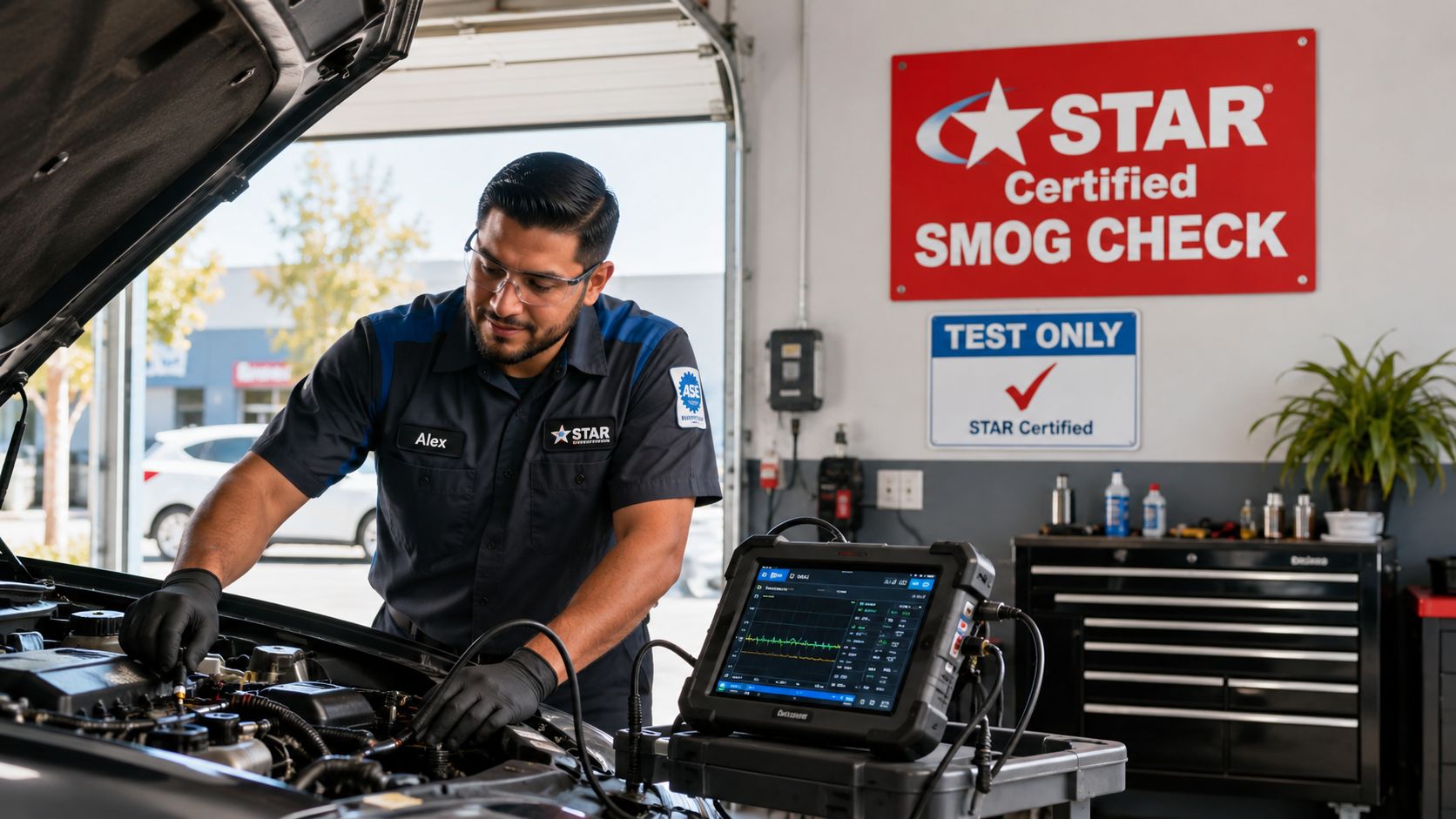
A STAR station also tends to reduce confusion at the counter. If your notice calls for STAR, the shop already knows the requirement and can process the inspection under the correct program. This provides a distinct advantage: fewer surprises, fewer wasted trips, and less guessing about whether the DMV will accept the certificate.
Why some DMV notices require STAR
When a DMV notice says STAR, treat it as a requirement. The vehicle has to be inspected at a STAR-certified location for that registration step.
Drivers in San Leandro, Hayward, Oakland, and the rest of the East Bay ask this all the time. Why this car? Why this year? The short answer is that California uses the STAR program as part of its inspection quality controls for certain vehicles and situations. The notice tells you what your vehicle needs. The smart move is to follow it exactly.
Even when STAR is not required, some drivers still choose a STAR station because it keeps the process straightforward. Speedy Smog in San Leandro is one local example of a STAR-certified station that handles these inspections.
Here is the simplest checklist. Read the DMV notice. If it says STAR, book a STAR station. If it does not, you still have options, but choosing STAR can make the process easier if you want the least amount of back-and-forth.
If Your Vehicle Fails the Smog Check
A failed smog check feels worse than it usually is. In most cases, it's not the end of the registration process. It's a signal that something in the emissions system, readiness status, or equipment setup needs attention before the vehicle can be certified.
Read the paperwork first
The first thing to look at is the Vehicle Inspection Report, often called the VIR. Don't jump straight to parts replacement based on a guess. The report tells you where the vehicle fell short, and that shapes what the next repair step should be.
A calm approach usually works better than a rushed one:
- Read the failure reason carefully: A warning-light issue is different from a component issue.
- Bring the VIR to the repair shop: It gives the technician a starting point.
- Fix the actual cause: Smog-related symptoms can overlap, so random part swapping gets expensive fast.
- Schedule the re-test after repair: Don't assume the repair alone completes the process.
Most expensive smog failures become more manageable once someone diagnoses the actual emissions problem instead of chasing the loudest symptom.
If the car recently had its battery disconnected or major work done, ask whether the system is fully ready before you head back for reinspection. That's a common place where drivers lose time.
What usually helps and what usually doesn't
Some choices improve your odds of getting through the re-test with less drama. Others just waste money.
What tends to help:
- Targeted diagnosis: Find the emissions-related fault, not just a general performance complaint.
- Qualified repair work: Use a shop that understands smog-related repair logic.
- Keeping your paperwork: The inspection report and repair records matter.
What usually doesn't help:
- Clearing codes right before the test: That can leave monitors unready.
- Assuming premium fuel or additives will solve it: Sometimes drivers try shortcuts when the issue is mechanical or electrical.
- Ignoring the check engine light because the car drives fine: Smog compliance and drivability aren't the same thing.
California also has a Consumer Assistance Program (CAP) that may help eligible motorists with emissions-related repairs or vehicle retirement. If repair costs are the biggest obstacle, it's worth checking whether you qualify through the state program before giving up on the vehicle.
Your East Bay Smog Check Action Plan
If you're in San Leandro, Oakland, Hayward, Castro Valley, or nearby, the simplest approach is to stop treating smog as a giant state puzzle and handle it like a short local errand with a checklist.
A simple local checklist
Start with the piece of paper that caused the stress in the first place.
Read the DMV notice carefully
Look for two phrases in particular: whether a smog certification is required, and whether the notice says STAR.Match the rule to your vehicle
Check the model year, fuel type, and whether your vehicle falls into a category that follows a different path.Don't wait until the deadline week
Waiting removes your options. If the car needs repair work, you want time to deal with it without registration pressure.Choose a station that fits the requirement
If the notice says STAR, go only to a STAR-certified station. If it doesn't, you still may prefer one for a cleaner process.
What to bring and what to expect
For most East Bay drivers, showing up prepared makes the appointment easy.
Bring:
- Your DMV renewal notice: It helps confirm the requirement.
- The vehicle itself: Obvious, but it matters if a family member usually handles registration and someone else drives the car.
- Payment: Inspection pricing varies by station, and the state certificate fee is part of the total.
- Any recent repair paperwork if the car previously failed: That can help if questions come up.
This gives you a sense of what a local station setup looks like before you go:
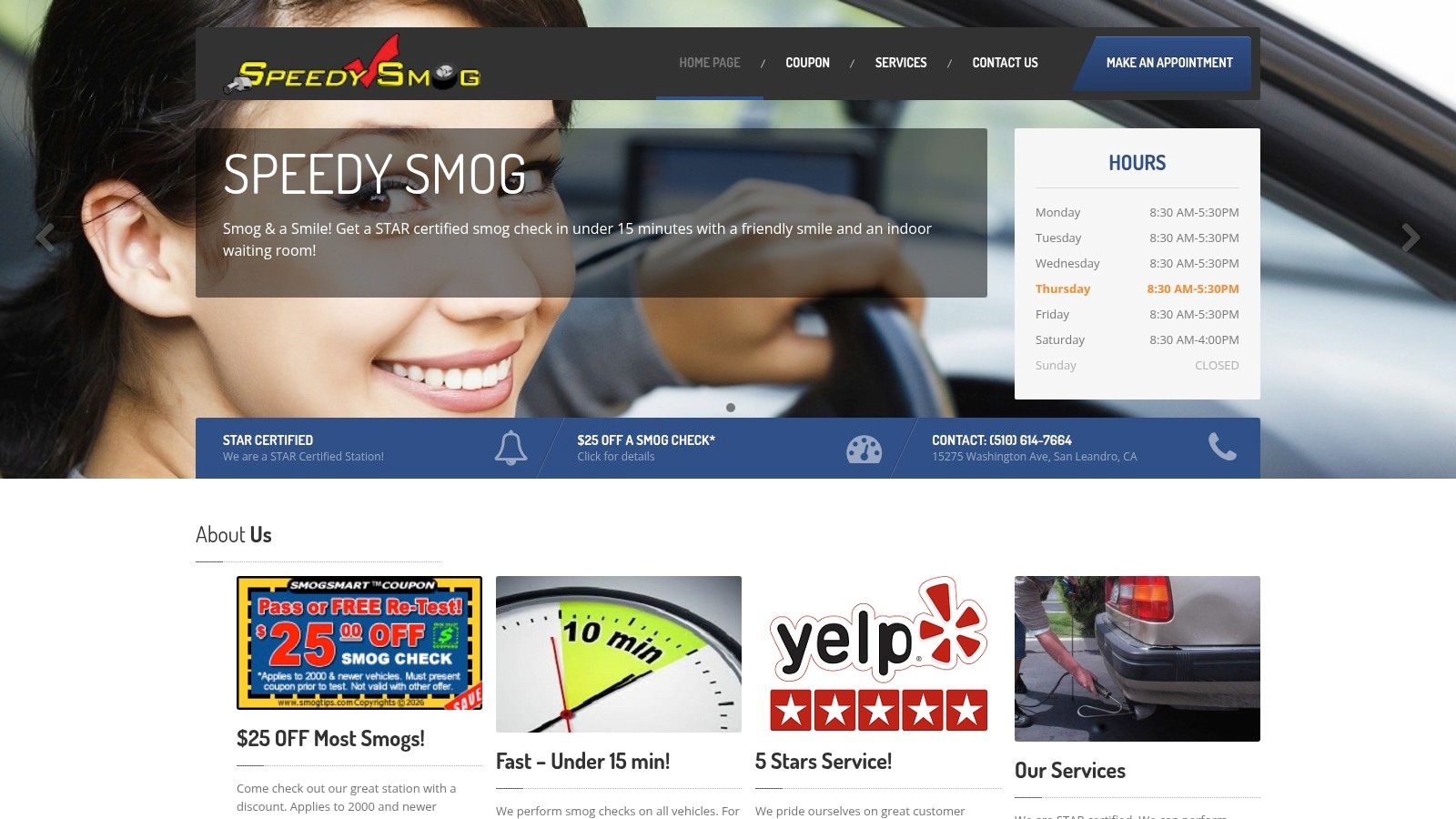
For drivers in the East Bay, a local option is available at 15275 Washington Ave, San Leandro, CA 94579. According to the publisher information provided for this article, that shop handles most vehicle categories commonly seen for smog certification, including newer vehicles, older vehicles, diesels, and hybrids. The same business information notes that many 2000 and newer vehicles are typically completed in 10 to 15 minutes.
That last point matters because the state process may be formal, but your local experience doesn't have to be slow or confusing. Read the notice, identify the vehicle category, bring the car to the right station, and let the inspection answer the question.
If your DMV notice says a smog certification is due, Speedy Smog gives East Bay drivers a straightforward local option for completing the inspection and getting the paperwork handled for registration.