Smog Check Codes: What They Mean and How to Pass
You pull into a smog station, the technician plugs into the OBD-II port, and a string like P0420 or P0442 shows up on the screen. Most drivers have the same reaction: what does that code mean, and does it mean an automatic fail?
That's the gap that trips people up. A raw code list tells you what system complained. It usually doesn't tell you how California's smog inspection will treat that complaint. And in California, that distinction matters because the state's smog program doesn't just sniff the exhaust and make a judgment call. It uses standardized electronic checks, regulated inspection logic, and readiness rules that can fail a vehicle even after a repair if the car hasn't finished its self-tests.
If you understand how smog check codes fit into California BAR logic, you stop guessing. You can tell the difference between a code that points to a loose gas cap, a code that suggests catalyst trouble, and a car that has no active fault but still isn't ready for inspection.
Table of Contents
- What Smog Check Codes Are and Why They Matter
- How California Smog Inspections Actually Work
- Major OBD-II Code Categories Explained
- The Most Common Smog-Failing Codes and Their Causes
- Readiness Monitors and BAR Pass/Fail Logic
- Troubleshooting Codes Before Your Re-Test
- When You Need a STAR Certified Station
- Quick-Reference Checklist for Passing Smog Check
What Smog Check Codes Are and Why They Matter
Your registration is due, the car feels normal, and then the smog station scanner shows P0420 or P0442. At that moment, the question is not just “What does this code mean?” The question is “How will California treat it during the inspection?”
That distinction is the whole point of smog check codes.
In practice, drivers are usually talking about Diagnostic Trouble Codes, or DTCs. These are the fault codes your car stores when its emissions system sees something outside the expected range. The code is the computer's shorthand. It tells you which system raised its hand, but it does not tell you the full inspection outcome by itself.
A code works a lot like a symptom on a medical chart. “Fever” tells you something is wrong. It does not tell you whether the patient is cleared to leave, needs more testing, or failed a required screening. California smog inspections work the same way. The code matters, but the state also looks at whether the Check Engine Light, also called the MIL, behaves correctly and whether the car's self-tests are complete.
That is where many drivers get tripped up. They read a raw OBD-II code list and assume every code means the same thing for smog. California does not grade them that way. One vehicle may fail because an active emissions code is present. Another may have no current code at all and still fail because the readiness monitors are not set. That gap between the code list and the actual BAR pass or fail logic is what you need to understand before a test, especially with the October 2025 readiness rule affecting how incomplete monitors are treated.
The two code layers drivers often mix together
There are really two different buckets to keep straight:
- Vehicle DTCs: These are the OBD-II fault codes stored by the car, such as P0300, P0420, or P0455.
- Inspection results: These are the things the smog inspection checks and scores, including MIL operation, readiness status, and other inspection items.
The first bucket tells you what the car reported. The second bucket tells you whether California will pass the car.
That difference explains why two people can both say, “I failed for a code,” while the actual reasons are different. One may have an active catalyst-efficiency code. The other may have recently cleared codes, which turned off the light for the moment but reset the readiness monitors. To a driver, both feel like “smog code problems.” To the inspection system, they are different failure paths.
Why the MIL matters as much as the code itself
The MIL is not just a dashboard warning. For smog, it is part of the inspection decision.
BAR explains that modern smog inspections include an onboard diagnostic check for applicable vehicles, and the process uses information reported by the vehicle's own system through the California Smog Check program page. That means the technician is not guessing based on how the engine sounds or whether the car seems to drive well. The inspection is checking what the vehicle reports about its own emissions controls.
Here is the simple version. If the car says an emissions fault is active, that matters. If the Check Engine Light does not behave correctly during the bulb check, that matters too. If monitors have not completed after repairs or after battery power was disconnected, that matters as well.
So when you see a code, do not treat it as a random repair hint. Treat it as a clue that may affect three things at once: the stored fault history, the warning light, and the readiness status. That is why understanding smog check codes saves time. It helps you tell the difference between a repair issue, a testing-timing issue, and a direct fail condition.
How California Smog Inspections Actually Work
You pull into a smog station with no warning lights on, and the car seems to run fine. A few minutes later, the result is still a fail. That surprises a lot of drivers because California smog inspections are not just a quick sniff test anymore. For many vehicles, the inspection is really a conversation between the station's equipment and your car's onboard emissions system.
California's program has changed over time. Older test methods put more weight on tailpipe measurement equipment. Newer inspection paths rely heavily on onboard diagnostics, especially for modern gasoline vehicles. That shift is the gap many drivers miss. Reading a code list tells you what the car noticed. Understanding California BAR logic tells you whether that issue blocks a pass today.
What BAR controls, and what the station checks
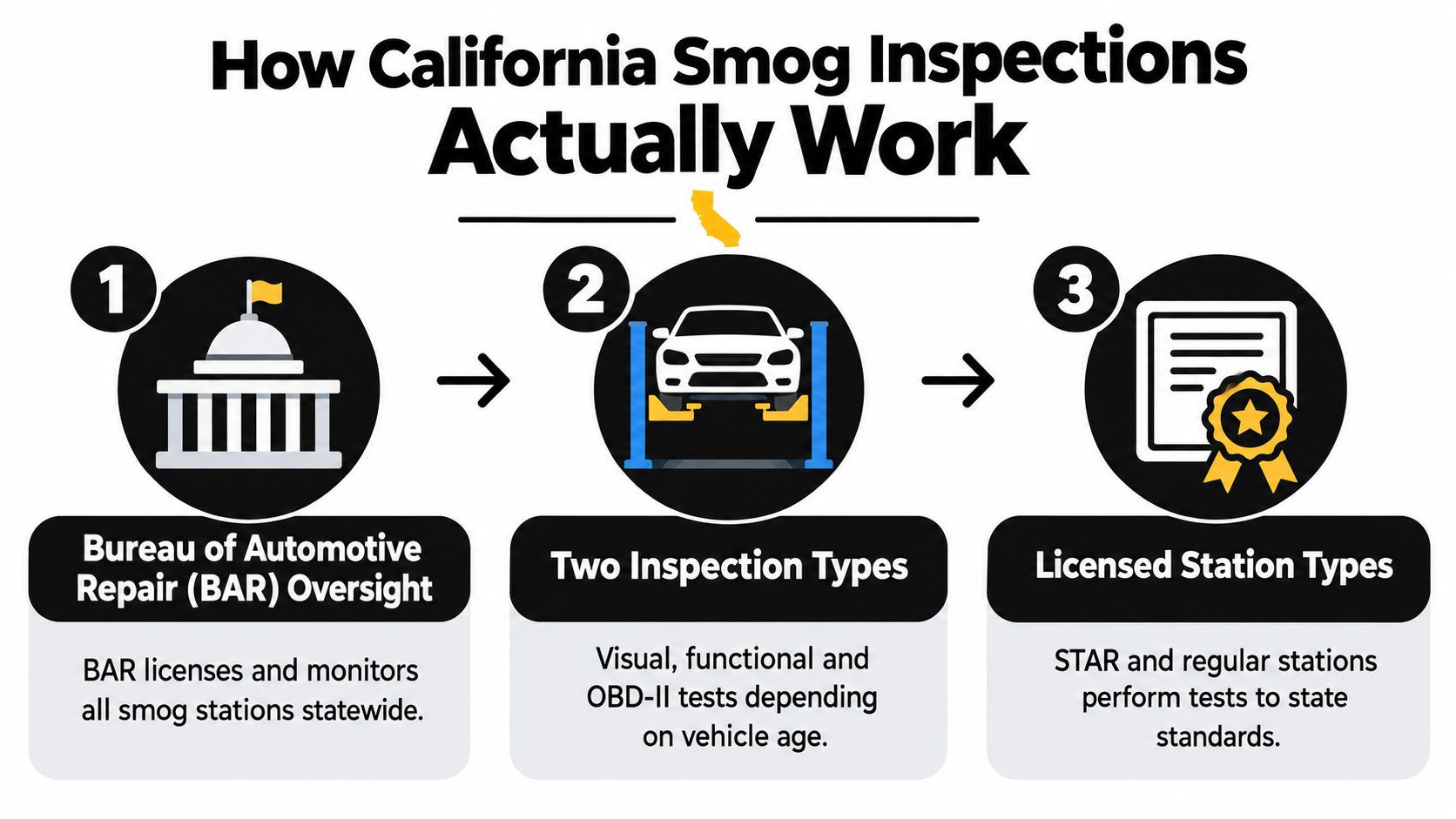
The Bureau of Automotive Repair sets the inspection rules, licenses stations, and defines the pass or fail process. The technician does not get to "use judgment" on an emissions fault the same way a general repair shop might. If the system reports a condition that fails under BAR rules, the station has to record that result.
That matters because drivers often expect a smog check to work like a road test. It does not. A smog inspection is closer to an audit. The station verifies what the car reports about its emissions systems, checks whether required equipment is present, and follows the inspection path assigned to that vehicle.
Why some cars get tested differently
California does not send every vehicle through the same hardware or procedure.
Older vehicles may still follow a BAR-97 style path that can include tailpipe testing procedures. Many newer gasoline vehicles go through an OIS-based inspection that focuses on OBD data. In plain terms, newer cars are usually graded by the health of the emissions control system as reported by the car itself.
For a 2000-and-newer gasoline vehicle, the technician will usually connect to the OBD system and look at three big things first. Is the Malfunction Indicator Lamp working as required. Are any emissions-related faults active or stored in a way that triggers failure. Have the readiness monitors completed.
That last point is where many failed retests happen. A car can have no active repair problem and still be rejected if the monitors are not ready. Starting in October 2025, California readiness rules become even more important to understand because monitor status can change whether the car is testable and whether it can pass under BAR logic.
After that overview, it helps to see the process in motion.
What happens at the station
A California smog inspection can include several parts, depending on the vehicle and its assigned test path:
- OBD system check for codes, MIL status, and readiness monitor completion.
- Visual inspection of required emissions components and signs of tampering.
- Functional checks for systems that must operate during inspection.
- Tailpipe testing for vehicles that still require it under their inspection method.
Here is the practical takeaway. Passing is not just about whether the exhaust seems clean at that moment. For many modern vehicles, the onboard system is the scorekeeper. If the car reports an emissions fault, if the MIL does not behave correctly, or if the monitors are incomplete, the inspection result can be decided before tailpipe numbers become the main issue.
That is why a raw code list only tells part of the story. The smog question is how that code, that warning light status, and that readiness state fit into California's pass or fail rules.
Major OBD-II Code Categories Explained
A code may look random, but it isn't. OBD-II codes follow a structure, and once you know that structure, you can read the category before you understand the exact fault.
The first letter tells you the system family:
- P means Powertrain
- B means Body
- C means Chassis
- U means Network or communication
For smog purposes, the codes that usually matter most are P-codes because they relate to engine, fuel, ignition, air metering, catalyst, and emissions control operation.
How to read the family before the exact number
A code like P0420 tells you something very different from a body or network code. It points you toward an emissions-related powertrain fault. That's why P-codes get most of the attention during smog prep.
If you want a basic walkthrough on scanner terminology and code formatting, this guide on how to read OBD codes is a useful companion before you start interpreting specific failures.
The code groups that usually affect smog results
Some code families show up again and again in smog-related diagnosis:
| Code Prefix | Category | Example Code | Smog Inspection Impact |
|---|---|---|---|
| P03xx | Misfire and combustion faults | P0300 | Can trigger the MIL and point to emissions problems caused by incomplete combustion |
| P04xx | Auxiliary emissions controls | P0411 | Often tied to systems like secondary air injection that affect cold-start emissions control |
| P042x to P043x | Catalyst efficiency | P0420 | Often suggests the catalytic converter isn't performing as expected |
| P044x to P045x | EVAP system faults | P0442 | Points to fuel vapor leak detection issues that can block a pass |
| P013x to P015x | Oxygen sensor circuit and response faults | P0136 | Affects fuel control feedback and catalyst monitoring |
| P0171 or P0172 family | Fuel trim lean or rich conditions | P0171 | Can indicate the engine is running outside the air-fuel balance the computer expects |
Why category matters more than memorizing every code
You don't need to memorize the entire code book. You need to recognize patterns.
A catalyst code, an EVAP leak code, and a misfire code can all fail the same inspection for different reasons. The code points to the system. The inspection decides whether that system status is acceptable.
That's the practical value of categories. A code isn't only a repair clue. It also hints at which smog checkpoint is likely to become a problem, whether that's MIL status, monitor completion, or the performance of an emissions control system.
The Most Common Smog-Failing Codes and Their Causes
Some codes show up so often that technicians can almost predict the symptom before they scan the car. The reason isn't mystery. Modern emissions systems watch a handful of problem-prone areas closely, and when one of those systems drifts out of range, the computer stores a fault.
Catalyst efficiency codes
P0420 and P0430 are the codes drivers fear because they often raise the question nobody wants to hear: is the catalytic converter worn out, or is something upstream making it look bad?
These codes usually mean the computer compared upstream and downstream oxygen sensor behavior and decided the converter isn't cleaning exhaust the way it expects. Sometimes the converter is the actual failure. Sometimes the root cause is a long-running rich condition, a misfire history, or sensor data that's no longer reliable.
Typical symptoms can include:
- Check Engine Light on: Often the only obvious warning
- Fuel economy changes: Sometimes subtle, sometimes noticeable
- Sulfur or exhaust odor: Not always present, but worth noting
Lean, rich, and fuel control faults
Codes like P0171 and P0174 point to lean conditions. Their rich-side counterparts indicate the opposite problem. On the ground, that often translates to vacuum leaks, air metering issues, intake leaks, contaminated mass airflow sensors, or fuel delivery problems.
A lean code doesn't tell you “replace this one part.” It tells you the engine control module had to correct fuel delivery beyond what it considers normal. That's why good diagnosis matters.
| Code | Category | Typical Symptoms | Common Causes |
|---|---|---|---|
| P0420 | Catalyst efficiency | Check Engine Light, reduced fuel economy, possible exhaust odor | Worn catalytic converter, aging sensor feedback, unresolved fuel control issues |
| P0430 | Catalyst efficiency | Similar symptoms to P0420 | Same pattern on the opposite bank of the engine |
| P0171 | Lean condition | Rough idle, hesitation, light pinging, Check Engine Light | Vacuum leaks, intake leaks, dirty MAF sensor, fuel delivery issues |
| P0174 | Lean condition | Similar to P0171 on multi-bank engines | Same fault pattern affecting the other bank |
| P0300 | Random misfire | Rough running, shaking at idle, flashing or steady Check Engine Light | Ignition faults, fuel issues, compression problems |
| P0301 to P0308 | Cylinder-specific misfire | Rough idle, stumble under load | Spark plugs, coils, injectors, wiring, engine mechanical faults |
| P0440 | EVAP system fault | Usually no drivability symptom, Check Engine Light | Gas cap sealing issue, purge or vent fault, leak in EVAP plumbing |
| P0442 | Small EVAP leak | Usually no obvious symptom | Loose gas cap, minor leak in hoses or EVAP components |
| P0455 | Large EVAP leak | Fuel vapor smell possible, Check Engine Light | Missing gas cap, disconnected hose, larger EVAP leak |
| P0136 | O2 sensor circuit fault | Check Engine Light, fuel trim irregularity | Sensor failure, wiring issue, connector problem |
| P0156 | O2 sensor response fault | Check Engine Light, possible drivability change | Sluggish or failed sensor, wiring or connector trouble |
Misfires and EVAP faults
Misfire codes from P0300 through P0308 usually get attention quickly because drivers often feel them. Rough idle, shaking, and stumble on acceleration are common. The cause may be ignition related, fuel related, or mechanical.
EVAP codes such as P0440, P0442, and P0455 are different. The car may drive almost normally, but the emissions system still sees a leak or control problem. That's why a driver can say, “It runs perfect,” and still fail inspection.
If the code is EVAP-related, don't assume the repair is always expensive. A sealing issue at the gas cap is much different from smoke-testing an intermittent vapor leak deep in the system.
Readiness Monitors and BAR Pass/Fail Logic
You repair the car, clear the code, drive straight to the smog station, and the car still fails. That result confuses a lot of drivers because the fault may be fixed, but the car has not finished proving it.
That proof happens through readiness monitors. Each monitor is a self-test for one emissions system. The computer waits for specific conditions before it marks that test complete, such as a cold start, steady cruising, deceleration, idle time, or a certain fuel level. Until that happens, the monitor stays incomplete.
Why a repaired car can still fail
A trouble code and a readiness monitor are connected, but they are not the same thing.
A code says the computer saw a fault. A monitor says the computer has finished checking that system. Clearing codes often resets one or more monitors to incomplete, so a car can leave the repair shop with no active warning light and still be unready for inspection.
California's OBD inspection looks at three things together: MIL status, diagnostic trouble codes, and monitor readiness, as explained in BAR's OBD Test Reference. That is the part many raw code lists miss. A code list tells you what failed. BAR logic decides whether the current combination of lamp status, codes, and monitor completion is enough to pass.
Common monitors include:
- Catalyst
- Evaporative system
- Oxygen sensor
- Oxygen sensor heater
- Secondary air
- EGR or variable valve timing related emissions monitoring
Some monitors run quickly after a normal drive. EVAP is a common holdout because it often needs a narrower set of conditions, including fuel level and soak time.
How BAR monitor allowances work in practice
Before October 1, 2025, California allows a limited number of incomplete monitors for some vehicles. The easiest way to read that rule is to ask one question: if every code were gone today, how many monitors could still say "not ready" and let the car pass?
| Vehicle Year | Fuel Type | Max Incomplete Monitors | Practical meaning |
|---|---|---|---|
| 1996 to 1999 | Gasoline | Any one | One incomplete monitor is allowed |
| 2000 and newer | Gasoline | EVAP only | Only the EVAP monitor may remain incomplete |
| 1998 to 2006 | Diesel | Zero | All supported monitors must be complete |
| 2007 and newer | Diesel | Particulate filter and NMHC monitors only | Only those specific monitors may remain incomplete |
That table is where BAR pass or fail logic becomes more useful than a generic scanner screen. For example, a 2003 gasoline car with catalyst ready and oxygen sensor ready, but EVAP still incomplete, may still pass. A 2012 gasoline car with the exact same monitor pattern may also pass, because EVAP is the one allowed exception under the current rule. If that same 2012 car has catalyst incomplete instead, it fails even with no Check Engine Light.
If you are sorting out how the warning light side of the test interacts with monitor status, this guide to Check Engine Light and smog test results helps connect those two pieces.
The October 2025 change
Effective October 1, 2025, California tightens that standard. All readiness monitors must be complete for a vehicle to pass Smog Check, according to BAR's readiness monitor regulation update.
That change matters because it closes the gap many drivers have relied on after clearing codes or disconnecting a battery. Under the current rule, one allowed incomplete monitor can sometimes still produce a pass. After that date, "close enough" stops working. The car has to finish every supported self-test.
The practical takeaway is simple. A successful repair is only half the job. The second half is completing the drive conditions that let the car verify that repair to its own computer.
Troubleshooting Codes Before Your Re-Test
After a failed smog, the smartest move is to slow down and separate fault diagnosis from inspection timing. Many repeat failures happen because the repair was incomplete, or because the repair was finished but the car wasn't ready yet.
Start with the code list, not a guess
Read and record every code before doing anything else. That includes stored codes and, if your scan tool shows them, pending codes. If you don't own a scanner, some drivers use an auto parts store code pull as a starting point.
Then sort the result into one of two buckets:
- Simple checks first: gas cap fit, visible cracked intake hoses, obvious loose connectors, weak battery terminals, or recent battery disconnect history
- Professional diagnosis likely needed: persistent misfires, catalyst efficiency faults, EVAP leak tracing, sensor circuit faults, or anything that returns quickly after being cleared
If you're trying to understand whether code clearing helped or hurt your test prep, this guide on how to clear a Check Engine Light is useful because the issue usually isn't the act of clearing. It's what happens to readiness afterward.
What you can check yourself
A few items are realistic for a careful driver:
- Confirm the gas cap seals and clicks properly.
- Look for split or disconnected vacuum hoses.
- Check battery connections if the car recently lost power.
- Scan again after any simple fix and drive the car before retesting.
What usually isn't a driveway diagnosis is an EVAP leak that needs a smoke machine, a converter decision on a modern car, or a misfire that stayed after basic ignition parts were addressed.
Drive cycle matters after repairs
Cars don't set monitors because you drove around the block once. They usually need a mix of operating conditions such as city driving, steady cruising, warm-up cycles, and deceleration events with the engine fully warmed.
A practical retest routine usually includes:
- Cold start and warm-up: Let the car reach normal operating temperature
- Mixed city driving: Stop-and-go operation helps some monitors run
- Steady highway cruise: Useful for catalyst and oxygen sensor checks on many vehicles
- Normal deceleration: Letting off the throttle without harsh braking can help certain self-tests complete
If the DMV notice directs you to a STAR station, or if the car has already failed and the situation is getting more complicated, a station such as Speedy Smog can perform the inspection side while you confirm the vehicle is ready rather than guessing from a recently cleared code.
When You Need a STAR Certified Station
Not every California driver needs the same station type. That part gets confusing because people use older shop labels and newer BAR terms interchangeably.
The practical question is simpler: what does your DMV notice require, and what stage of the process are you in?
Standard station versus STAR station
A regular licensed smog station can handle many routine inspections. A STAR Certified station is different because it meets BAR performance standards and can inspect vehicles that are specifically directed into the STAR program.
That matters in situations like DMV-directed testing, more scrutinized vehicles, or cases where the state requires a particular station type for registration purposes.
How to think about the tiers
| Station Type | Can Perform Repairs? | Required For | Waiver Authority |
|---|---|---|---|
| Test Only | Usually no repair role in the testing lane | Routine testing when DMV notice allows a non-STAR option | Not typically the path drivers look to for directed waiver handling |
| Repair-capable smog station | Sometimes, depending on station license and setup | Drivers handling diagnosis and repair before retest | Depends on station authorization and BAR process involvement |
| STAR Certified station | May be test-only or may operate with repair-related roles depending on its license | DMV notices that specify STAR, state-directed cases, and more sensitive inspection routing | Relevant when the case involves BAR-directed processes and station eligibility |
Check the renewal notice before booking
The easiest mistake is booking the closest shop without reading the DMV notice. If the notice says the vehicle must go to a STAR station, a standard booking doesn't solve the problem.
If a vehicle has already failed, or if you're dealing with a directed situation, choosing the right station type early saves time. The code itself may tell you what needs repair, but the registration notice tells you where the state will accept the inspection.
Quick-Reference Checklist for Passing Smog Check
Most smog failures aren't caused by one mysterious rule. They come from a short list of preventable mistakes. Drivers test with the MIL on, clear codes too late, skip the drive cycle, or show up at the wrong station type.
This checklist keeps the process practical.
Save this before test day
Pre-test order that makes sense
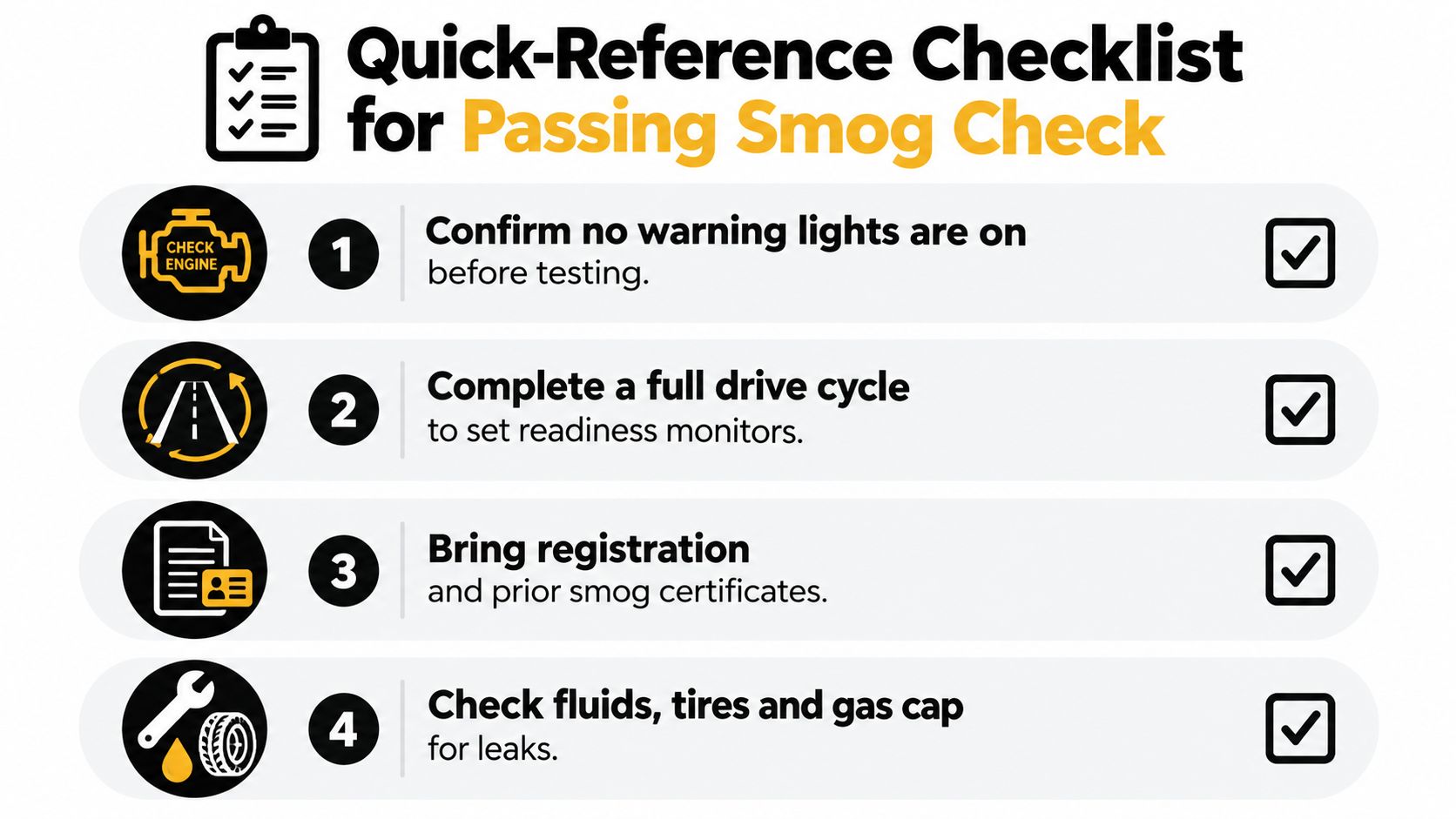
- Read the DMV notice first: Make sure you know whether a standard licensed station is fine or whether the state requires a STAR station.
- Check for warning lights early: Don't wait until the registration deadline week to notice the Check Engine Light.
- Repair the cause, not just the symptom: Clearing codes without fixing the fault usually creates a readiness problem on top of the original one.
- Complete a real drive cycle: Use mixed city and highway driving after repair so the car can set its monitors naturally.
- Warm the engine before the appointment: A fully warmed vehicle is in a better state for the inspection process than one driven a few blocks from cold start.
- Bring your paperwork: Registration-related documents and prior records are easier to manage if they're already in the car.
- If it fails, read the report carefully: The report usually points you toward code issues, readiness status, or another inspection item that needs attention.
The one thing to remember
A single code doesn't always mean disaster. It means the car found something specific enough to report. The key is understanding whether that issue is still active, whether the MIL is affected, and whether the readiness monitors are complete enough for the current California rules.
Don't treat the scanner like a verdict. Treat it like a map. The code tells you where to look, and the BAR rules tell you whether the car is ready to pass.
If you want a clean, compliant inspection without guessing at the rules, Speedy Smog provides STAR-certified smog checks for East Bay drivers and works with the California inspection process these code and readiness rules come from. If you already know your code status or need to confirm whether your vehicle is ready for certification, book your visit before your DMV deadline gets tight.