
Smog Test California Cost Explained and How to Save
Most California drivers pay roughly $70 to $85 total for a passing smog test. That total usually comes from a station inspection fee in the low $60s plus the fixed $8.25 state certificate fee, and the exact amount changes by station type and by vehicle.
If you're staring at a registration notice and trying to figure out why one shop advertises one price and another shop sounds completely different on the phone, you're not alone. This is one of the most confusing parts of California car ownership for first-time drivers. A smog check sounds like one purchase, but in real life it behaves more like a grocery receipt. You see the shelf price first, then the required add-on, and sometimes a separate cost shows up only if something goes wrong.
That's why the easiest way to understand Smog Test California cost is to split it into three buckets:
- The station fee for the inspection itself
- The state certificate fee of $8.25 when the car passes
- Possible retest or repair costs if the car doesn't pass the first time
A lot of frustration comes from mixing those buckets together. A driver sees an ad for a smog price, assumes that's the whole bill, then feels blindsided at the counter. In many cases, the station didn't invent a surprise charge. The customer just wasn't told clearly what part was the shop's price and what part was the state-required certificate.
That's also why out-the-door totals vary so much. A newer gasoline car might not even need a test yet. An older vehicle may need the full inspection. A STAR station quote can look different from a non-STAR station quote. If the vehicle fails, the test fee can become the smallest part of the whole problem.
If you want a simple reference before you start calling around, this California smog check price guide gives a useful local starting point. But first, let's make the pricing system easy enough that any quote you hear will make sense.
Table of Contents
- Introduction What You Will Actually Pay for a Smog Test
- How California Smog Test Pricing Really Works
- Regional Price Ranges and Why Station Type Matters
- Vehicle Age and Type and How They Change Your Cost
- Coupons Discounts and Smart Ways to Avoid Surprise Charges
- If You Fail Retest Fees and the Repair Cost Cap Explained
- Conclusion Your Quick Plan for an Affordable Compliant Smog Test
Introduction What You Will Actually Pay for a Smog Test
Your registration notice shows up, you head to a smog station, and you see an ad with a low price on the window. Then the total at the counter sounds different from what you expected. For first-time drivers, that is where the confusion starts.
The main reason is simple. A smog check bill is usually made up of three separate buckets, and ads or phone quotes do not always mention all three at once.
Why the price feels confusing
The first bucket is the station fee. That is the shop's charge to inspect the car.
The second bucket is the state certificate fee. That fee applies when the vehicle passes.
The third bucket is the one drivers hope to avoid. If the car does not pass, you may need to pay for a retest, repairs, or both.
That is why one shop may sound cheaper at first, but the out-the-door total can end up looking different. One quote may cover only the inspection. Another may include the passing total. Another shop may pause and ask about your car's year, fuel type, or whether it needs a STAR station, because those details affect which bucket matters most.
Practical rule: Ask for the out-the-door total for a passing smog check, and ask what happens if the vehicle needs a retest.
What catches first-time drivers off guard
Drivers new to California smog rules often assume the state sets the full price from top to bottom. It does not. The state requires part of the bill, while the station sets its own inspection fee. That is why two shops a few miles apart can quote different totals without either one doing anything unusual.
Vehicle age changes the picture too. Some cars are not due for a smog test yet, while older vehicles are more likely to need the full inspection and, in some cases, a station type that limits where you can go. So the question is not just, "What does a smog test cost?" It is, "Which kind of smog check does my car need, and what will all three buckets add up to?"
If you want a local reference point before calling around, this California smog check price guide for San Leandro drivers can help you compare quotes with the right questions in mind.
How California Smog Test Pricing Really Works
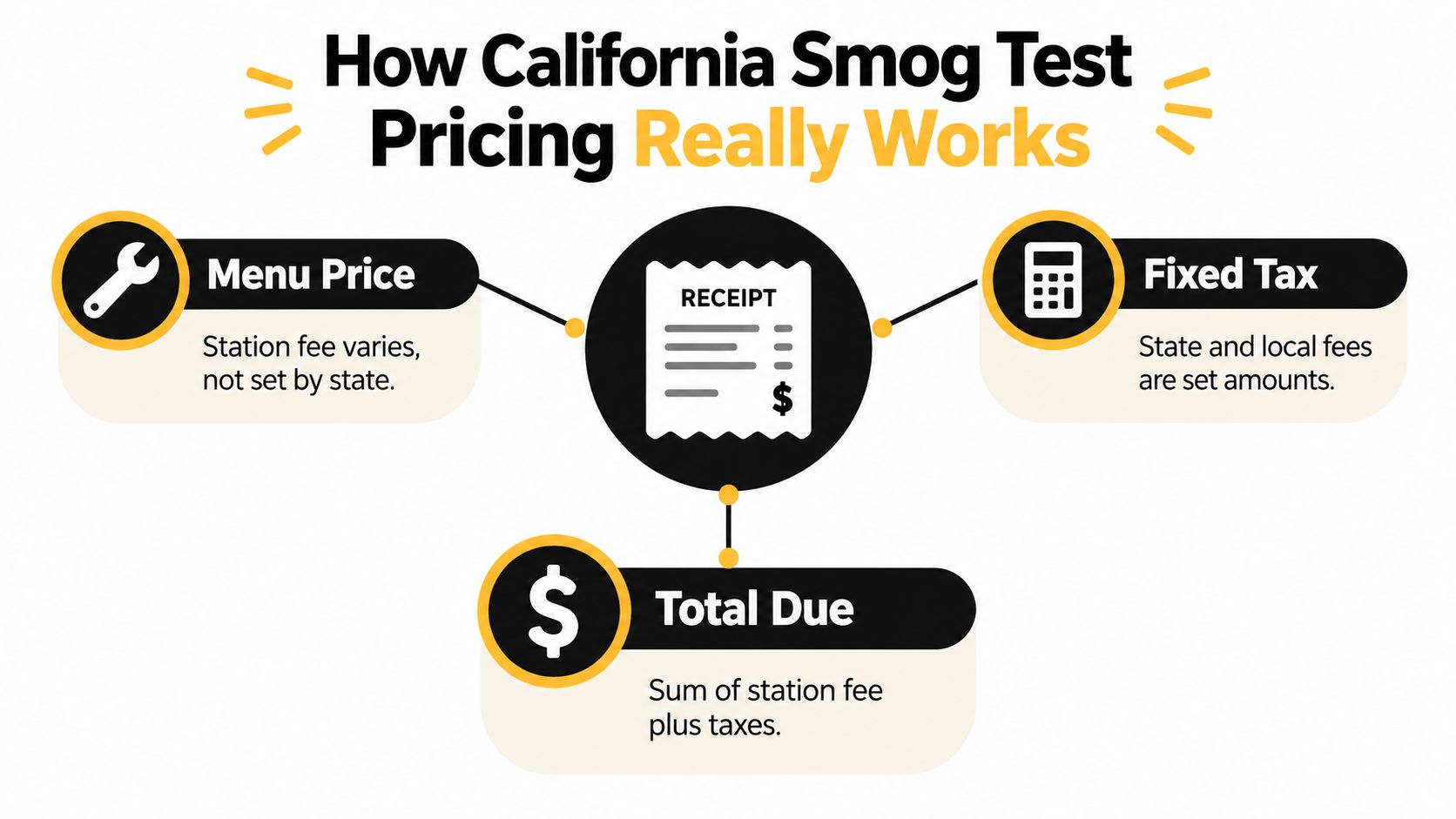
A smog quote works a lot like a restaurant menu. The posted number may be one part of the bill, while the final total depends on what applies to your car that day.
In California, the station chooses its own inspection price. The state also requires an $8.25 Smog Check certificate fee on a passing test, according to the California Bureau of Automotive Repair. That certificate is sent electronically to the DMV, so you usually do not need to carry in a paper copy after a pass.
What changes the number you hear on the phone
The biggest moving part is the station fee. That is the shop's charge for the inspection itself. It covers the test equipment, the technician's time, and the cost of running the station.
The state does not set that part of the price, so two nearby shops can quote different inspection fees and both be normal.
A pass adds the fixed certificate fee. A fail usually does not. If the car does not pass, the station has no passing certificate to send, so the extra cost usually shows up later as a retest fee, repair bill, or both.
Why advertised prices can feel confusing
A low ad is often real, but it may only describe the inspection line. Another station may quote the likely passing total instead. Both shops can sound like they are giving the full price when they are really talking about different parts of the same receipt.
That is why one question clears up a lot: "Is that your inspection fee only, or my total if the car passes?"
If you want to be even more specific, ask two short follow-ups:
- "Does your quote include the $8.25 certificate fee?"
- "If my car fails, what do you charge for a retest?"
What first-time drivers should listen for
If the person at the counter asks for your car's year, fuel type, or whether your registration notice says STAR, they are usually trying to quote the right inspection category, not make the price sound slippery.
That matters because the inspection fee is the flexible part of the bill. The certificate fee is fixed. The wildcard is what happens if the car does not pass the first time.
So the useful way to compare shops is simple. Ask for the out-the-door total on a pass, then ask what the retest policy is on a fail. That gives you the price range, not just the headline number.
Regional Price Ranges and Why Station Type Matters
A first-time driver in Oakland might call two STAR stations and hear two different numbers that both sound right. One shop quotes the inspection fee. Another quotes the likely pass total. The only way to make sense of local pricing is to separate the bill into buckets, then compare the same bucket at each station.
The California Bureau of Automotive Repair explains the statewide baseline well. Inspection prices are not regulated, but the certificate fee on a passing test is fixed at $8.25. In the same report, BAR lists an average initial inspection fee of about $62.58 at STAR Test-and-Repair stations and $60.85 at STAR Test-Only stations, according to BAR's Smog Check Executive Summary Report for July 2025.
A quick comparison table
| Station Type | Average Inspection Fee | Certificate Fee | Typical Total on Pass |
|---|---|---|---|
| STAR Test-and-Repair | $62.58 | $8.25 | about $70.83 |
| STAR Test-Only | $60.85 | $8.25 | about $69.10 |
Those statewide figures are a baseline, not a promise. In the East Bay, a driver calling STAR stations in San Leandro or Oakland will often hear quoted pass totals a little above those averages once local overhead, appointment timing, and station pricing are factored in. That is why a local quote can be higher than the table without being unusual.
Station type also matters for a practical reason. A test-only shop is set up to inspect. A test-and-repair shop can inspect and fix problems under one roof. That difference can change labor costs, scheduling, and how a shop sets its inspection price.
BAR also notes that station categories post different average prices, and that non-STAR test-and-repair locations are consistently the highest-cost category in the available 2026 data, as noted in BAR's March 2026 executive summary.
What this means in the East Bay
For San Leandro, Oakland, and nearby cities, use the statewide averages like a measuring stick. Then compare local quotes by asking for the pass total, not just the ad price. If you want to start with nearby options, this list of East Bay smog check stations is a useful place to compare shops before you call.
A simple way to read the market is this: the station fee is the part that moves around, the certificate fee is fixed, and the third bucket only shows up if you need a retest or repairs. Once you sort quotes that way, the price differences stop feeling random.
The simplest way to compare quotes
Use this short checklist when you call:
- Ask for the total on a pass: Include the inspection fee and certificate fee.
- Ask what type of station it is: Test-only, test-and-repair, STAR, and non-STAR can price differently.
- Give your vehicle details: Year, fuel type, and any STAR requirement help the shop quote the right category.
That gives you a true side-by-side comparison instead of three different pieces of the bill.
Vehicle Age and Type and How They Change Your Cost
Two drivers can walk into smog stations on the same day and pay very different amounts, even before either shop sets its price. The reason is simple. Vehicle age and vehicle type decide whether you need the test at all, and that changes which cost bucket you are paying.
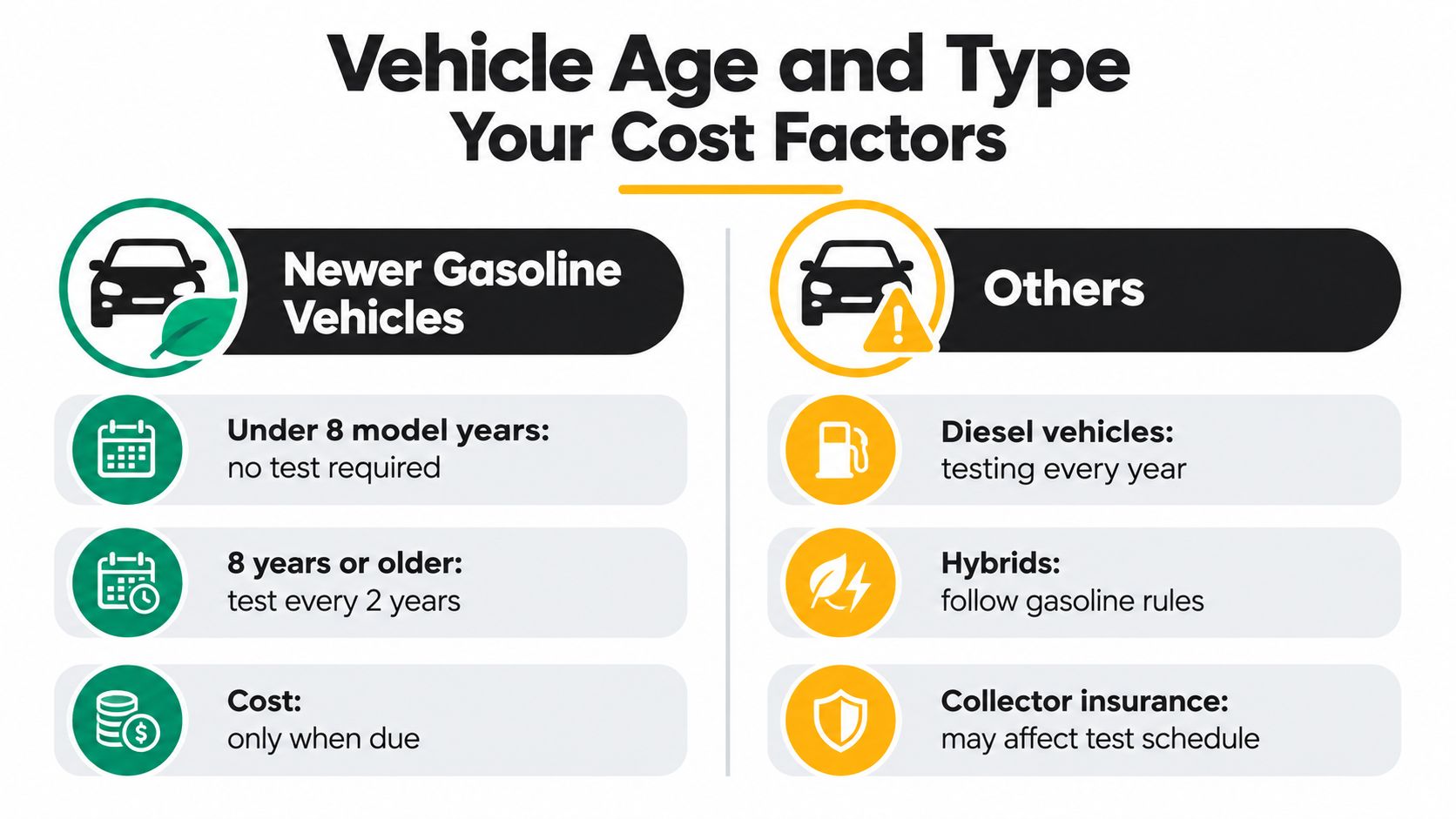
For some newer vehicles, the smog cost shows up at registration instead of at the station. California DMV explains that certain newer gasoline-powered vehicles pay a $20 smog abatement fee during registration for the first several model years, rather than getting a biennial smog inspection right away, on its smog inspections page.
A quick real-world example makes this easier.
Say your neighbor has a newer gas sedan. That driver may handle the smog requirement through the registration abatement fee, so there is no station fee, no certificate fee, and no retest question that year.
Now look at an older gas SUV parked next to it. That owner is more likely paying the first two buckets discussed earlier, the station inspection fee plus the state certificate fee. If the vehicle has a problem, the third bucket can appear too, which means a retest or repairs.
That is why advertised prices can confuse first-time drivers. One car is buying a registration-related requirement. Another car is buying an actual inspection.
Vehicle type adds another layer. Gasoline, diesel, hybrid, and special registration situations do not always follow the same path. A title transfer can also change the timing, so a driver who did not need a test last renewal may need one for a sale or ownership change.
The easiest way to sort it out is to ask one question first: am I paying DMV this cycle, or am I paying a smog station?
Here is the simple version:
- Newer gasoline vehicle: You may be in the abatement phase, where the cost is tied to registration instead of a shop visit.
- Older gasoline vehicle: You are more likely paying for the inspection and certificate at a smog station.
- Diesel, hybrid, or transfer situation: Requirements can differ, so check your renewal notice carefully before comparing shop prices.
A good rule of thumb is this. Vehicle age decides whether you are even shopping for a smog test. Vehicle type helps decide what kind of test rules apply. Once you know those two pieces, the total cost stops feeling random and starts falling neatly into the right bucket.
Coupons Discounts and Smart Ways to Avoid Surprise Charges
Once you know whether your vehicle needs a test, the next step is trimming the station portion of the bill without creating new headaches.
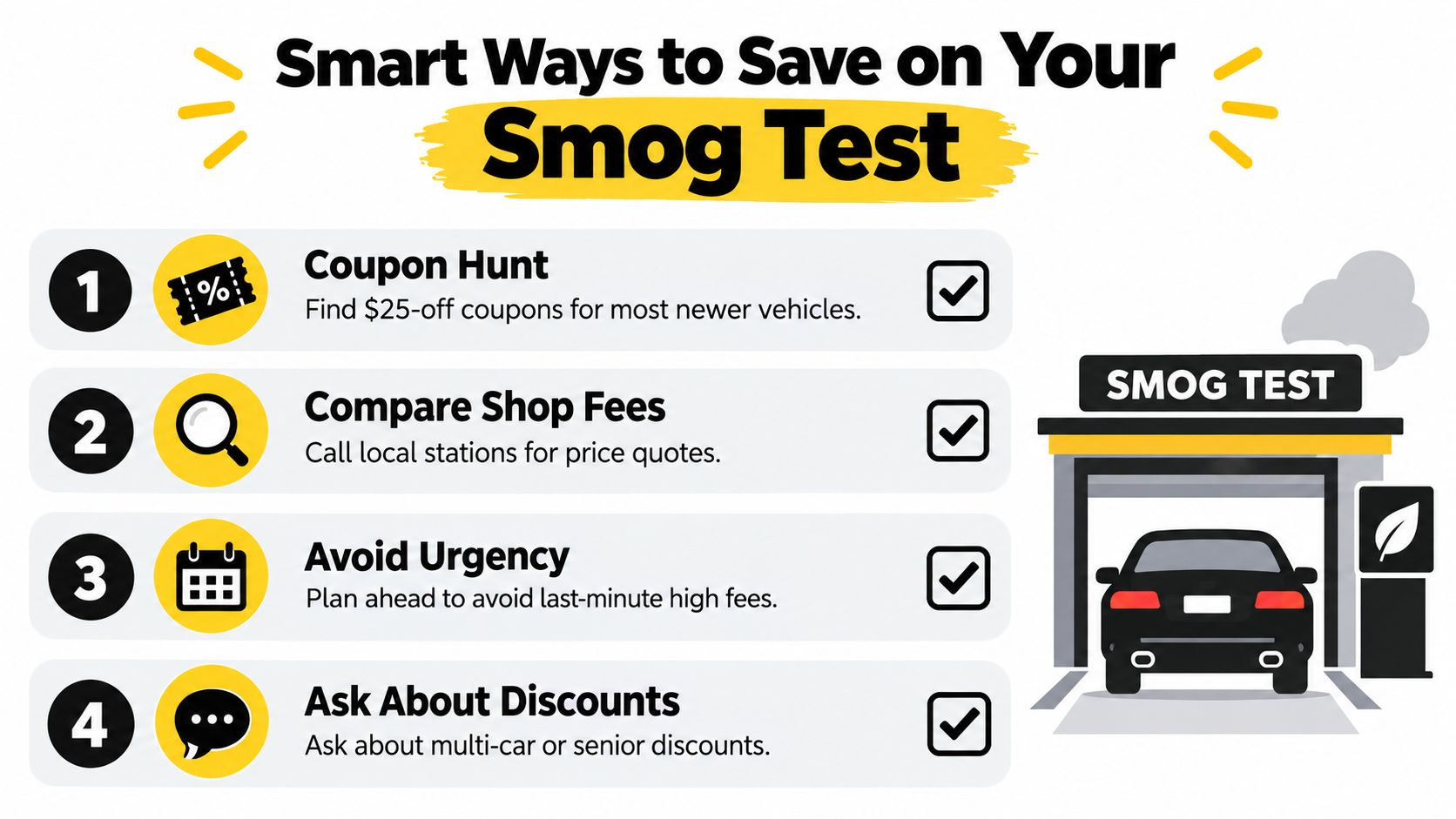
Some shops run coupons on certain vehicles, especially newer ones. Speedy Smog, for example, lists smog test coupons on its site, including a $25-off offer for most newer-vehicle smogs. That kind of discount affects the station fee, not the fixed state certificate.
What to check before you use a coupon
A coupon can absolutely help, but don't look at the discount in isolation. Look at how it fits into the final total.
Here are the smart questions to ask:
- Does the coupon apply to my vehicle year? Some offers are limited to certain model years or common passenger vehicles.
- Is the certificate fee included in the quoted total? A coupon may reduce the inspection price while the state fee remains separate.
- What happens if the car doesn't pass? Ask about retest policy before the test starts.
- Do I need an appointment or printed coupon? Shops vary on how they process discounts.
Timing saves money too
The easiest way to overpay is to wait until the last minute. When drivers are up against a registration deadline, they often stop comparing quotes and just grab the first available appointment.
A little lead time gives you room to:
- Call more than one station
- Confirm the complete passing total
- Check whether a coupon lowers your real bill
- Handle minor maintenance first if the car has been acting up
Here's a short walkthrough that helps many first-time drivers:
Small details that prevent big annoyance
The station fee isn't the only thing worth comparing. Convenience matters too. If a shop handles common vehicles quickly, that can save time off work or shorten a weekend errand list.
For example, Speedy Smog states that typical tests for 2000 and newer vehicles are often completed in about 10 to 15 minutes, which matters when you're balancing school pickup, work, and DMV deadlines. Fast service doesn't replace transparent pricing, but it does make the whole errand less painful.
Ask for the total, ask about coupon eligibility, and ask about retest policy. Those three questions catch most surprise charges before they happen.
If You Fail Retest Fees and the Repair Cost Cap Explained
A failed smog test changes the math fast.
Before the failure, you are mostly looking at the first bucket, the station fee. After the failure, two other buckets can start to matter a lot more. You may face a retest fee, and you may need repairs before the car can pass. That is why the cheapest advertised test price does not always lead to the lowest total bill.
What usually happens after a fail
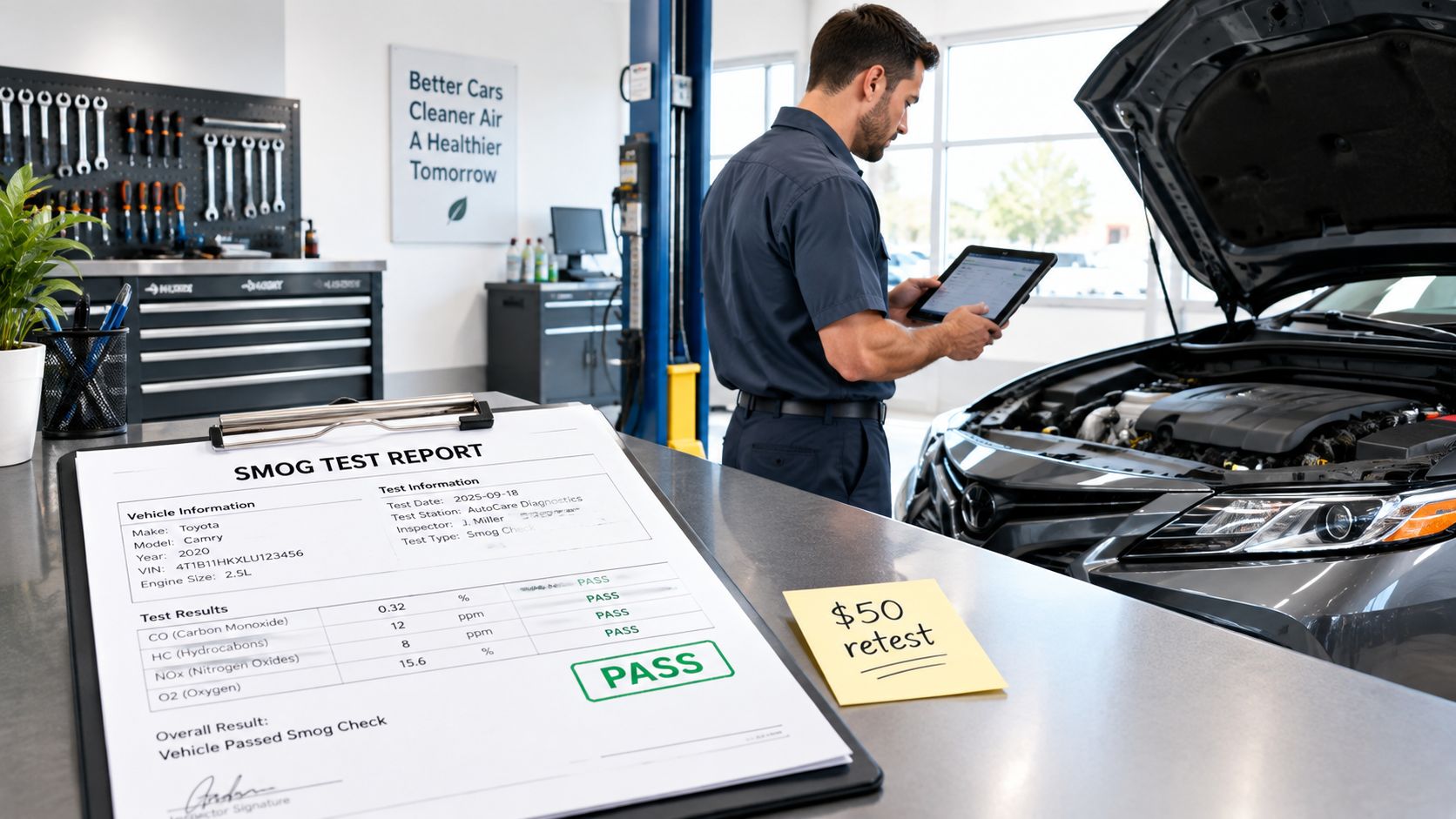
Here is the plain-English version. The first test tells you whether the car passed that day. If it fails, the next question is not just "How much was the test?" It becomes "What will it take to get this car ready for a passing retest?"
That second part can include a few separate charges:
- Retest fee: Some stations charge less for a return visit. Some do not.
- Diagnostic work: A fail result may point to a problem, but it does not always tell you the full repair answer by itself.
- Repair cost: The actual fix can be minor or more involved, depending on why the vehicle failed.
- Certificate fee later: The state certificate still gets added when the vehicle finally passes.
That is the cost split many first-time drivers miss. The first receipt is only one piece of the total.
What the repair cost cap means, in simple terms
California has a repair cost cap rule for certain biennial smog situations, as noted earlier in the article. Drivers often hear that and assume it puts a lid on everything connected to a failed test. It does not work that broadly.
A better way to read it is this: the rule can help in a specific smog-check context, but it is not a promise that every expense tied to a failure stops at that number. Extra diagnostics, additional testing, or work outside that covered situation can still add cost.
So if your car fails, use the cap as one part of the picture, not the whole picture.
Why some failures stay inexpensive and others do not
Two cars can fail on the same day and end up with very different bills.
One driver may need a small fix and a straightforward retest. Another may be dealing with an older vehicle, an intermittent warning light, or a problem that takes time to pin down. That is why failure costs are hard to quote over the phone. Until the shop knows why the car failed, any number is only a rough guess.
It helps to treat a failed smog like a doctor visit that leads to lab work. The first visit identifies a concern. The next step is figuring out exactly what is causing it.
How to reduce the chance of a bigger bill
If the car already has symptoms, budget beyond the test itself.
Common red flags include a check engine light, rough idle, poor fuel economy, or a car that has been sitting for a long time without regular driving. In those cases, the inspection fee may end up being the smallest part of what you pay.
A few simple habits can lower the odds of surprise costs:
- Do not test with the check engine light on: That is asking for trouble.
- Take care of obvious drivability issues first: If the car is running rough, smog day is probably not the right first stop.
- Ask about retest policy before you pay: Some stations are clearer and fairer about return charges than others.
- Keep your paperwork: If you need repairs and come back, having the first test result handy saves time.
The practical takeaway is simple. If your car is healthy, your smog cost usually stays in the first two buckets. If it fails, the third bucket, retest and repair costs, can become the one that matters most.
Conclusion Your Quick Plan for an Affordable Compliant Smog Test
You call one station and hear one price. Then you show up and the total is higher than you expected. That usually happens because the smog bill is not one number. It is a few separate charges stacked together.
A clear way to read Smog Test California cost is to sort it into three buckets. First is the station fee for the inspection. Second is the state certificate fee that gets added on a pass. Third is the bucket many drivers hope to avoid, a retest or repairs if the car does not pass. Once you separate the bill that way, the price difference between stations starts to make sense.
The best last step is simple. Do not ask, "How much is a smog?" Ask, "What would I pay out the door if my car passes today?" That one sentence cuts through a lot of confusion because it pushes the shop to give you the number that matters, not just the headline price.
A quick plan before you book
Use this 30-second phone script:
- "Hi, I have a [year, make, model]. What is the full out-the-door price if it passes today?"
- "Does that total include the certificate fee?"
- "Is my vehicle the kind that needs your station type, including STAR if required?"
- "If it does not pass, what is your retest policy?"
That short call does two useful things. It helps you compare stations on the same basis, and it tells you which shop explains fees clearly without dancing around the question.
The practical East Bay takeaway
A good smog visit should feel more like checking out at a grocery store than getting surprised at the register. You should know what is in the cart before the total shows up.
If you are in the East Bay, a STAR Certified station may be the right fit if your DMV notice calls for it. If you want a straightforward local option, Speedy Smog offers STAR Certified testing in San Leandro with transparent pricing, a waiting room, and quick service for many common vehicles.
Keep it simple. Confirm you need the test now, call for the full passing total, and choose the shop that answers plainly. That is the easiest way to keep your smog cost compliant, predictable, and easier on your wallet.