
How to Book a DMV Appointment Without the Wait
“Book a DMV appointment first” is bad advice for a routine California registration renewal. Before you reserve a slot, find out whether you need a field office, a smog station, or online renewal. Those are different stops, and booking the wrong one can waste your morning without getting your registration finished.
For East Bay drivers, the better approach is simple: identify the unfinished requirement, use the channel that can resolve it, and save a field-office visit for work that belongs there.
Table of Contents
- When a DMV Appointment Is Actually Required
- Failed Smog and Driving While You Fix It
- Documents to Bring by Transaction Type
- How to Book Online or by Phone
- Timing Habits That Shorten the Wait
- Cancel or Reschedule Before the Slot Is Gone
When a DMV Appointment Is Actually Required
| Task | Right channel | Book a field office? | What finishes the job |
|---|---|---|---|
| Routine registration renewal | Online, mail, or phone | No | Complete the notice's requirements and payment |
| Renewal that requires a Smog Check | Licensed or STAR station, then online | Usually no | Electronic pass, plate number, required VIN digits, insurance, and payment |
| Driver license or REAL ID | Field-office appointment for work requiring an appearance | Yes, for the in-person transaction | Accepted identity and residency documents, plus any required testing |
| Title or ownership problem | Field office if it won't clear online | Yes, when DMV requires an appearance | Properly signed title and resolution of the specific record problem |
| Out-of-state vehicle | Required VIN verification and smog, then the office | Yes, for the in-person registration transaction | Out-of-state title, verification, and smog when required |
| Missing documents or a DMV letter | The channel named on the letter | Only if the letter says to appear | Exactly the items the notice requests |
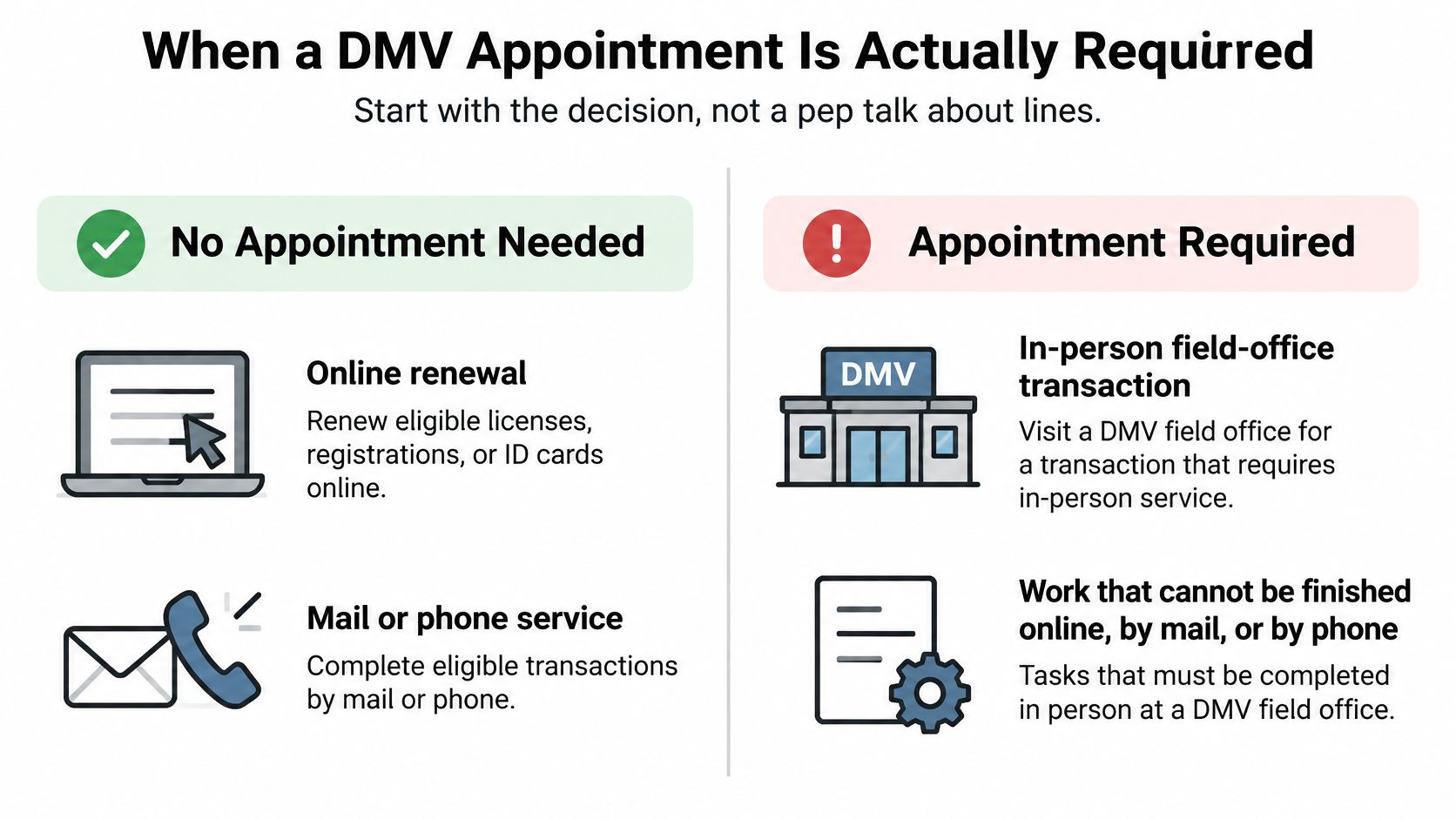
A renewal notice isn't an instruction to book a counter visit. The California DMV appointment system says most registration matters can be handled online or by mail and identifies routine registration-renewal notices as mail-, online-, or telephone-only items for which customers shouldn't make field-office appointments.
That distinction matters when you search for a DMV appointment. You might need a test, a document correction, or a payment, but those needs don't automatically belong in the same booking category. Choose the transaction before choosing the office.
Separate the inspection from the government transaction
A smog inspection happens at a licensed testing station, not at the DMV counter. If your renewal requires that inspection, reserving a field-office slot doesn't arrange the test or satisfy the emissions requirement.
At Speedy Smog, no appointment is necessary for a smog check, and walk-ins are welcome. We electronically transmit results directly to DMV. We're not a DMV branch, although we're licensed to perform a limited number of DMV registration services.
For Oakland-area drivers choosing between a government office and an inspection stop, our Oakland DMV guidance helps distinguish those errands. Don't assume a private registration provider can resolve every hold or document problem that a government clerk can.
Counter rule: Book the service you need, not the service whose name looks closest on the calendar.
Finish an eligible renewal online
Read the renewal notice before heading anywhere. If it calls for a STAR inspection, choose a station with that certification, complete the inspection, and let the electronic passing result reach DMV.
The California DMV registration-renewal guide describes online renewal using the plate number, the last five VIN digits, applicable insurance requirements, and payment; the accompanying smog guidance states that a passed certificate remains valid for 90 days.
Keep the renewal notice beside you while entering the vehicle information. Match the plate and VIN carefully, then review the transaction outcome instead of treating a payment receipt as proof that every requirement cleared.
Do you need a DMV appointment after a smog test? Usually, no. For an otherwise eligible renewal, finish online after DMV has the certification. Reserve a field-office visit when DMV directs you to appear or when the unresolved transaction requires in-person handling.
Failed Smog and Driving While You Fix It
Paying registration fees and having permission to drive are different things. A failed smog inspection leaves you with a deadline to manage and a vehicle problem to resolve, not an automatic reason to book a routine DMV appointment.
Keep the failure report. It identifies the problem you need to discuss with the repair provider.
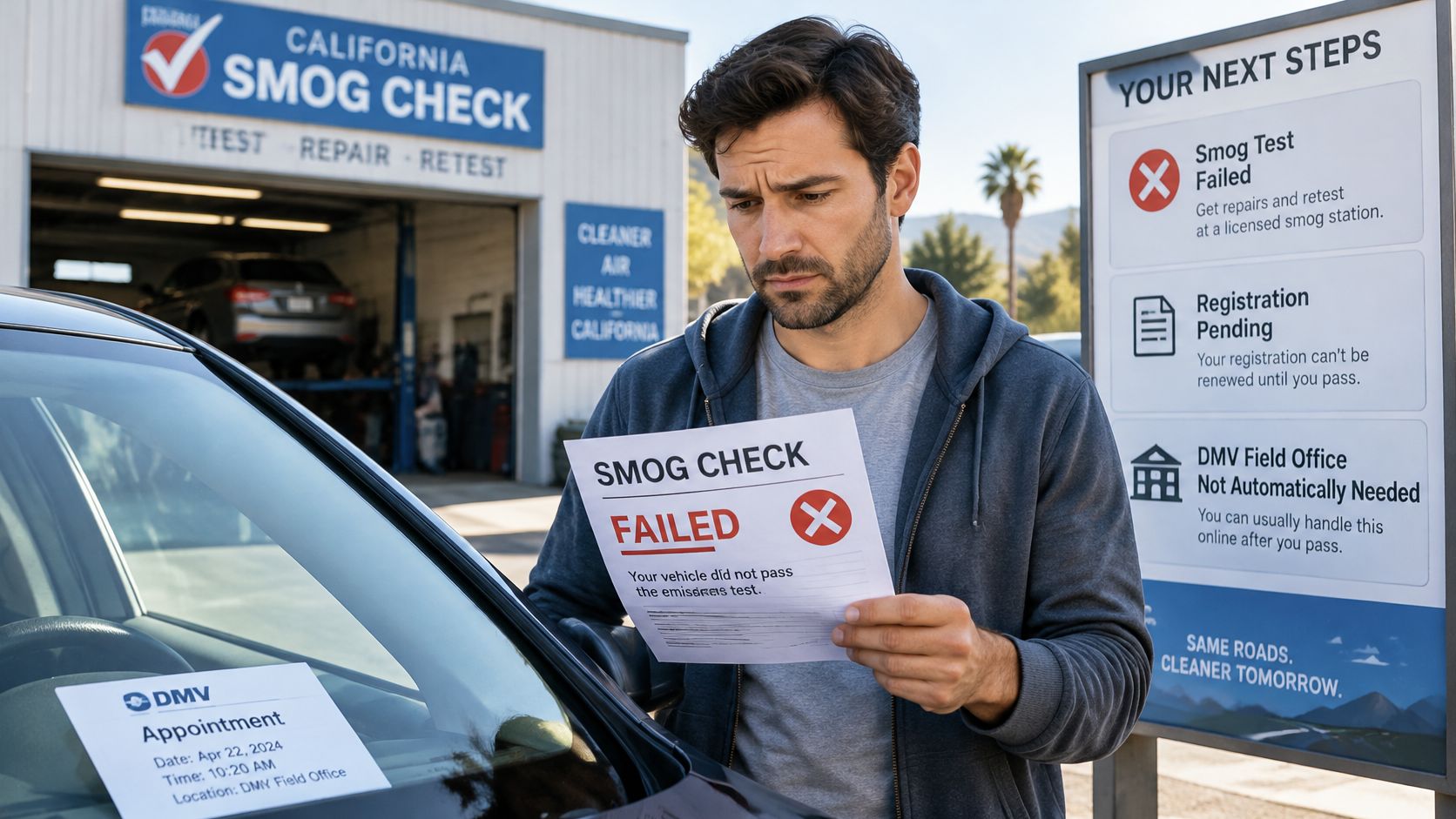
The DMV important vehicle information guide says renewal fees remain due even without the required smog certification; its failed-biennial-inspection Temporary Operating Permit route requires the failed report, insurance, paid registration fees, and a $50 nonrefundable fee, with validity for 60 days from registration expiration or the date the vehicle leaves planned nonoperation.
| Action | When | What it does and does not do |
|---|---|---|
| Pay registration fees by the due date | The smog certificate isn't ready | Avoids penalties; doesn't authorize driving |
| Repair and retest | The inspection failed | Addresses the failed inspection; renewal remains unfinished until the smog requirement is resolved |
| Confirm the electronic certificate | After a pass | Establishes that DMV has the result needed to continue processing |
| Request a Temporary Operating Permit | Lawful driving is essential during repairs | Requires the failed report, insurance, paid fees, and the permit charge; authorization follows the permit's dates and conditions |
Fix the failure, not the appointment category
If a vehicle fails at Speedy Smog, we provide a printout showing the area that needs work. The vehicle must be repaired and pass its retest before registration can be completed. After a pass, the customer receives a smog certificate and can proceed with renewal.
Don't replace diagnosis with repeated inspections. Give the repair provider the failure printout, explain any recent work, and ask what needs to be corrected before returning for the retest.
Paying is not the same as being legal to drive. A receipt isn't a temporary operating permit.
If you need the vehicle during repairs, review the California Temporary Operating Permit process and confirm the applicable authorization with DMV. Don't assume the permit period begins whenever you happen to request it.
This video provides additional context for the smog-related errand.
An ownership problem, an out-of-state registration issue, or a document request may still require a field-office visit. A routine inspection failure calls for repairs and retesting, not a different appointment label.
Documents to Bring by Transaction Type
| Transaction | Bring | Do this first |
|---|---|---|
| REAL ID or driver license | Accepted identity document, California residency proofs, Social Security evidence as required, and current card if any | Check the accepted-document list for your exact application |
| In-office registration, only if required | Renewal notice, insurance proof, payment method | Confirm the required smog result is on the DMV record |
| Smog Check before renewal | The vehicle and renewal notice if you have it | Match a STAR station when the notice requires STAR |
| Title transfer | Signed title, ID, smog certification when required, payment | Check signatures and transaction-specific requirements |
| Out-of-state registration | Out-of-state title, VIN verification, ID, smog if required | Arrange required verification before the field-office slot |
Read the STAR instruction before choosing a station
Say your East Bay renewal notice requires a STAR inspection. You find a convenient testing station, but you haven't checked its certification. That's the point to stop and verify, not after you've paid for an inspection that doesn't satisfy the notice.
A regular test-only or test-and-repair station doesn't necessarily meet a STAR requirement. The station type must match the instruction on your renewal notice. Bring the notice so the technician can check the vehicle information against the renewal requirement.
At Speedy Smog, bring your vehicle and the registration renewal notice if you have it. Our technicians are licensed by the Bureau of Automotive Repair.
The Bureau of Automotive Repair Smog Check guide says renewal inspections are generally required every other year, vehicles eight model years old or newer are generally inspection-exempt but subject to a smog-abatement fee, and the required $8.25 certificate fee is additional to the station's inspection charge.
Those are general rules, not a substitute for reading your own notice. Don't decide that your vehicle needs an inspection based only on what a neighbor paid or what happened at your last renewal.
Keep inspection charges separate from renewal charges
Ask what the inspection quote includes before testing begins. The station's charge, the certificate charge, and DMV registration fees aren't interchangeable. Paying one doesn't necessarily pay the others.
For a practical registration-renewal process, organize the paperwork by purpose rather than putting everything into an unsorted envelope:
- Inspection paperwork: Keep the renewal notice with the vehicle information the station needs.
- Government transaction paperwork: Keep DMV letters, ownership documents, and insurance evidence together.
- Completion records: Save the inspection report and renewal confirmation so you can identify what was completed.
For a STAR-required renewal, the useful sequence is notice verification, the correct inspection, electronic submission, and renewal processing. A clerk can't turn the wrong station type into the right certification merely because you've brought the receipt.
The same principle applies to title paperwork. An unsigned title isn't ready just because the appointment is confirmed. Check the document itself before leaving, and follow any transaction-specific instructions rather than relying on a general checklist alone.
How to Book Online or by Phone
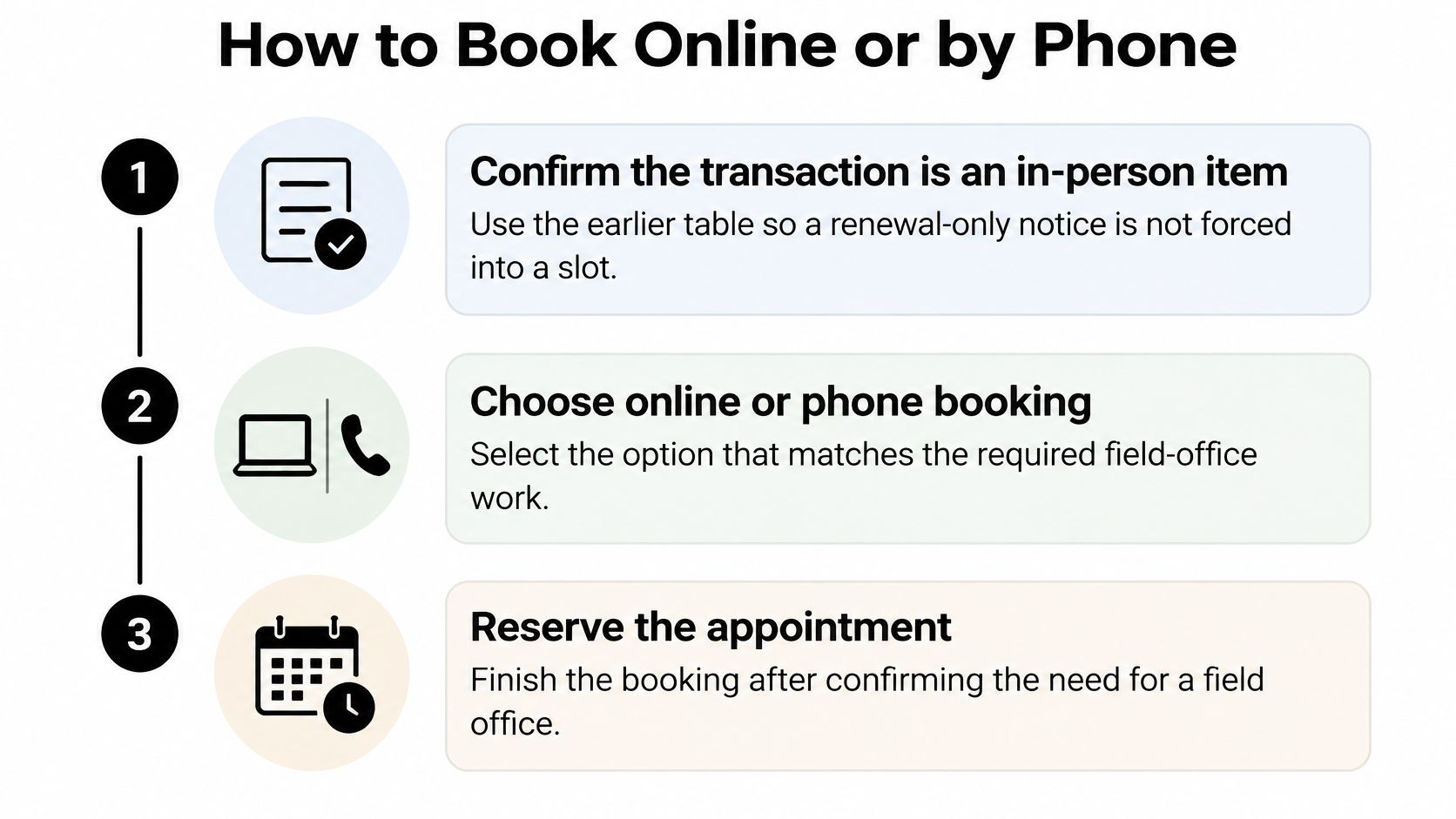
Once you've established that the work belongs at a field office, book deliberately. The goal isn't to grab any opening. It's to reserve an appointment that matches your transaction and that you can attend with the required preparation finished.
Use this outline to choose the booking channel.
Follow the booking path without changing the errand
Confirm that the transaction requires an appearance. Read the DMV instruction or letter that sent you to the office. If the matter is a routine renewal, don't select an unrelated category just to get a time. The common slip is confusing an unfinished renewal with an in-person requirement.
Gather the identifiers before opening the scheduler. Have the relevant plate or driver-license information, vehicle identification details, and a phone number or email address you can access. Use the information the system requests. The common slip is completing the booking with an inbox you no longer check.
Choose the office and the matching service. Start from the official California DMV website and enter its appointment system. Select the category that describes the actual work, such as an in-person license transaction or a registration exception. The common slip is choosing a familiar office before checking whether it handles the service.
Choose a date that fits your preparation. Leave enough time to obtain documents, complete required inspections, and resolve anything that must happen before the visit. An earlier appointment isn't useful if you arrive unable to proceed. The common slip is booking around your lunch break while ignoring an outstanding requirement.
Save the confirmation immediately. Record the confirmation number, office address, service, date, time, and arrival instructions. Add a calendar reminder with the document checklist attached. The common slip is saving the date but losing the information needed to retrieve the booking.
Check another suitable office if the calendar is full. Compare locations you can reasonably reach, and check availability again when your schedule permits. Cancellations can change what appears, but don't count on a particular release time. The common slip is treating an unavailable calendar as an instruction to walk in.
Use the phone when the website is the obstacle
If the scheduler won't work or you can't use it, use the official DMV phone contact shown on its website or your correspondence. Have the same identifiers ready and explain the transaction itself, not just that you want an appointment.
Ask the representative to confirm the service and office before finalizing the booking. Write down the confirmation before ending the call, and ask how to retrieve or cancel it if you haven't received an electronic message.
A useful confirmation answers where, when, for what service, and how to manage the booking. Check all of those details while there's still time to correct an error. Don't book another slot for the same task because you're unsure whether the first reservation worked; retrieve and verify it instead.
Timing Habits That Shorten the Wait
A DMV appointment is often the wrong first move for California registration. First identify the task: a field office handles some transactions, a smog station handles emissions tests, and eligible renewals may be completed online.
For field-office visits, use the arrival instructions on your confirmation and leave time for travel and parking. Historical DMV reporting set queue targets of no more than 15 minutes for appointment customers versus 45 minutes without appointments, with arrival-to-ticket targets of 3 and 15 minutes, respectively, according to the California DMV wait-time status report. These are targets, not guarantees. A queue ticket is not the same as reaching the counter, and neither tells you how long the transaction will take.
Wait-Time Targets
| Measure | Historical target |
|---|---|
| Queue time without appointment | 45 minutes |
| Queue time with appointment | 15 minutes |
| Arrival to ticket, walk-in | 15 minutes |
| Arrival to ticket, appointment | 3 minutes |
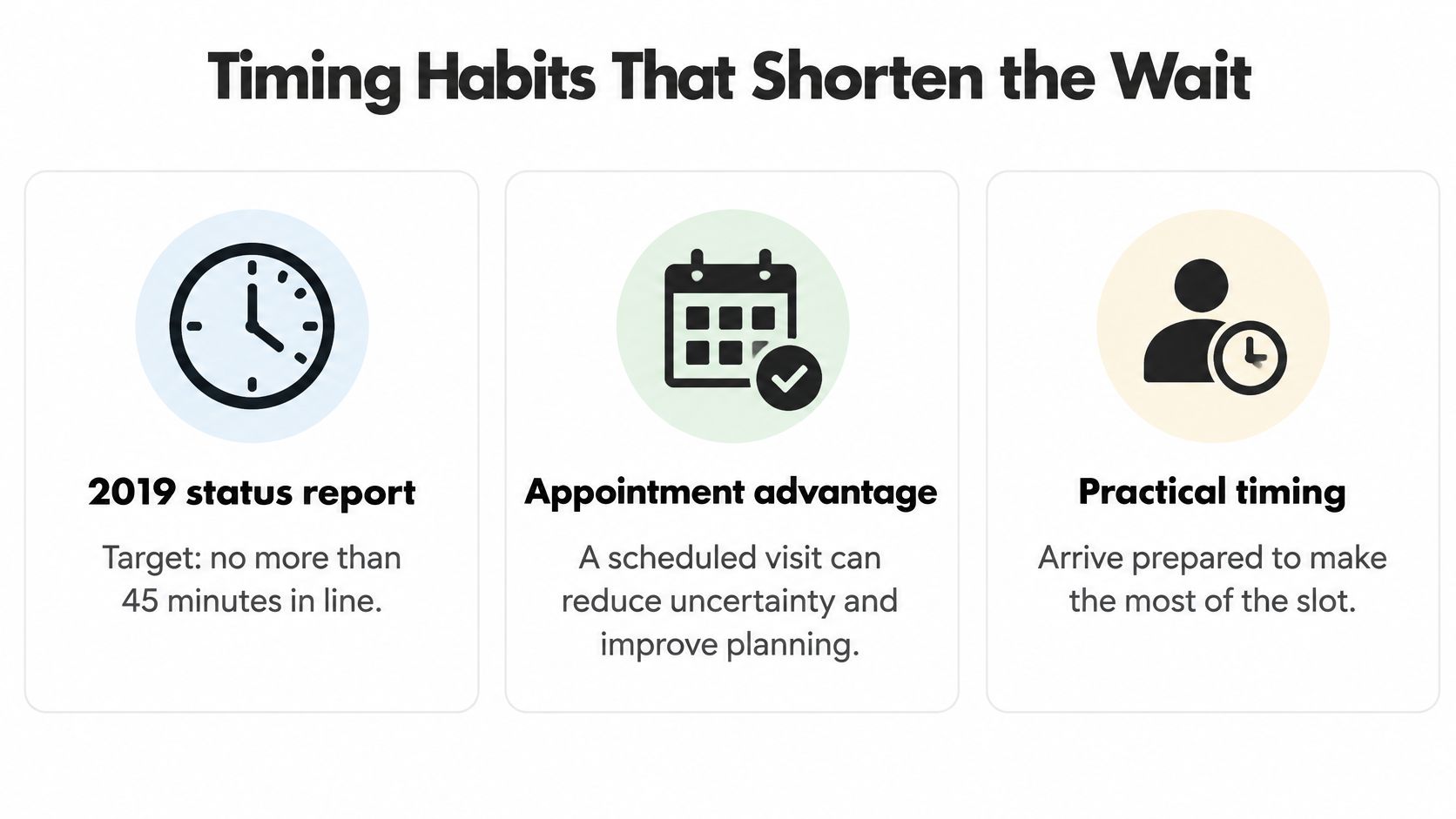
Control your arrival, paperwork, and office choice
- Follow the confirmation's arrival window. Arriving much earlier does not guarantee earlier service. Plan for travel and parking instead.
- Finish prerequisites before check-in. Bring the documents and completed forms your transaction requires. An appointment cannot make a missing inspection result, signature, or document unnecessary.
- Choose an office that handles your transaction. Check the service before booking, then consider appointment availability, travel, and parking. A large office is not automatically the right office.
An appointment helps you join the appointment queue. It does not guarantee a quick visit, especially when the office is busy or your transaction needs extra review.
Allow time after check-in for the clerk to examine your record and identify any issue. The scheduled time is when you are due to attend, not a promise that the transaction will be completed by a particular time. Keep the confirmation accessible and state the transaction clearly when staff ask why you are there.
Cancel or Reschedule Before the Slot Is Gone
Your confirmation number is the key to managing the booking. Store it somewhere you can retrieve without searching through unrelated messages, and keep any updated confirmation with the same calendar entry.
Don't leave an appointment active after the errand has been resolved through another channel. Release it when you know you won't need it.
Cancel when the visit has no purpose
Return to the appointment system you used to book and follow its view-or-cancel instructions. Enter the requested confirmation details, check that you've retrieved the correct transaction, and complete the cancellation.
Save the cancellation result. Closing a browser tab or deleting a calendar event doesn't cancel a DMV appointment.
Illness is a reason to cancel even when it happens on the day of the visit. Notify DMV through the available booking-management channel rather than staying home and leaving the reservation untouched.
Reschedule when you won't be ready
Change the visit when a required document won't arrive, an inspection prerequisite remains unresolved, or the confirmation names an office that doesn't handle the service. An appointment you can't use isn't worth preserving merely because it was hard to find.
Follow any change option the system provides. If changing the appointment requires a separate cancellation and booking, release the old reservation before creating the replacement rather than holding duplicate appointments.
If the website won't load, use the official phone contact on the confirmation or DMV correspondence. Ask the representative to verify the status of the old appointment and record the new confirmation before ending the call.
Keep a workable appointment
Don't cancel a usable slot solely because the drive is inconvenient. Compare the replacement options first without reserving another appointment, and weigh the travel against your deadline and document readiness.
Before closing the booking page, check:
- One active confirmation: No duplicate reservation for the same errand.
- Correct calendar entry: The date, office, service, and arrival instructions match the confirmation.
- No duplicate walk-in plan: You're not keeping a slot while planning to attempt the identical transaction elsewhere.
The practical rule is one errand, one active confirmation. Keep the record clear enough that you, DMV, and anyone helping with the vehicle know which visit is happening.
Speedy Smog provides smog inspections and electronically sends results to DMV, helping you complete the inspection step without mistaking it for a field-office appointment. Bring your vehicle and renewal notice to Speedy Smog, where smog-check walk-ins are welcome, and handle the requirement holding up your renewal.