Diesel Emissions Inspection Near Me East Bay Guide
You've got a DMV renewal notice on the counter, your diesel truck is parked outside, and you're searching “diesel emissions inspection near me” from San Leandro, Oakland, or Hayward. The closest listing may not be the right one. Before you book a lane, confirm that your vehicle belongs in California's standard Smog Check program, find out whether the station handles diesel visual and diagnostic checks, and prepare for the conditions that determine a pass.
A diesel inspection isn't a gasoline test with a different fuel. Model year, gross vehicle weight rating, onboard diagnostic readiness, emissions hardware, and smoke opacity can all affect the result. The right process starts with eligibility, then moves through station selection, vehicle preparation, testing, and DMV follow-through.
Table of Contents
- Finding a Diesel Emissions Inspection Near You in the East Bay
- Do You Actually Need a Diesel Smog Check in California
- How Diesel Emissions Inspections Really Work
- What to Bring and How to Prep Your Diesel to Pass
- Where to Go Pricing Timing and Why STAR Certification Matters
- After the Test DMV Registration and Next Steps If You Fail
Finding a Diesel Emissions Inspection Near You in the East Bay
A nearby station can still waste your time if it doesn't handle your diesel category or if it isn't approved for the type of certification your registration requires. California's diesel program has evolved from visible-smoke enforcement into a process that can include equipment verification and OBD checks, so a station needs more than a generic “smog test” listing.
Start with the station, not just the map
When comparing East Bay results, check whether the shop identifies itself as a STAR Certified station, accepts diesel vehicles, and can explain what the inspection includes. STAR status matters when the DMV directs your vehicle to a STAR station, and a diesel-capable shop should be comfortable discussing opacity, readiness monitors, and emissions components before you arrive.
Call ahead with the vehicle's model year, fuel type, and approximate GVWR. A diesel pickup and a heavier work truck may fall under different compliance programs, and the shop should be able to tell you whether it performs the inspection you need or whether you should contact a heavy-duty compliance provider.
Practical rule: A useful phone call should answer three questions: Does the station test this diesel, does it handle the required certification, and what should you bring if the vehicle fails?
For drivers comparing local options, this East Bay guide to vehicle emissions testing can help narrow the search before you drive across town. Look for clear hours, transparent service details, and a realistic explanation of turnaround time rather than relying only on the lowest advertised price.
A good nearby choice gives you a direct path from inspection to registration. If the technician identifies a code, readiness issue, smoke problem, or missing emissions component, you should leave with a specific explanation of what needs attention, not a vague recommendation to “try again later.”
Do You Actually Need a Diesel Smog Check in California
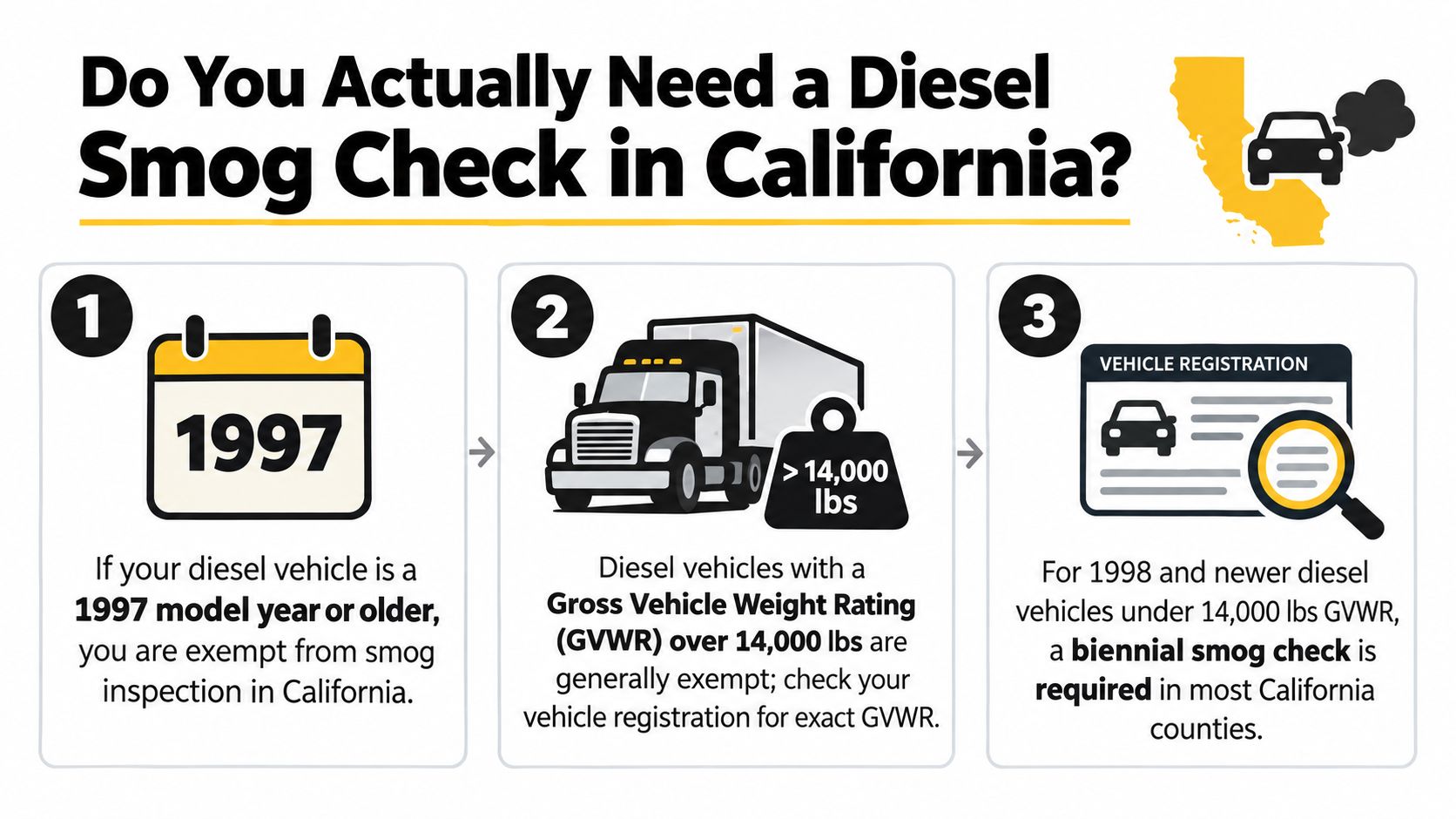
The first question isn't “Where can I test?” It's “Is my diesel subject to a standard California Smog Check?” California generally includes model year 1998 and newer diesel cars and trucks with a GVWR of 14,000 pounds or less in the biennial Smog Check program. Diesel vehicles above that weight are handled under a separate heavy-duty framework. California BAR guidance explains the diesel Smog Check requirements and their scope.
Use three checks before scheduling:
Read the registration notice. A DMV renewal notice usually tells you whether a smog certification is required. Don't assume every diesel receives the same renewal instruction.
Confirm the model year. The California light-duty diesel rule generally applies to 1998 and newer vehicles. Older vehicles can follow different exemption rules, so use your registration information and the vehicle's identification details rather than relying on an online listing.
Find the GVWR. Look at the driver-side door-jamb label or vehicle documentation. The important dividing point for the standard light-duty program is 14,000 pounds GVWR. Trucks and work vans often create confusion because their size and use can make them feel “commercial,” while the state classification depends on the applicable vehicle rules and weight rating.
Separate light-duty testing from heavy-duty compliance
A diesel under the applicable GVWR threshold generally belongs at a standard Smog Check station that's equipped and certified for diesel testing. A heavier vehicle may need a different inspection cycle, testing procedure, or compliance program, so taking it to a regular passenger-vehicle lane can lead to a referral instead of a completed certification.
The practical distinction is simple. If your registration requests a normal Smog Check and the vehicle falls within the light-duty diesel category, book a qualified station. If the vehicle exceeds the threshold or your paperwork points to a heavy-duty requirement, verify the correct program first through the diesel Smog Check requirements for California vehicles.
Eligibility also changes the preparation strategy. Owners of qualifying 2007 and newer light-duty diesels need to pay close attention to readiness monitors, not just visible smoke. California expanded the monitor requirements in 2023, and the state's BAR materials state that, effective October 1, 2025, all readiness monitors must be set for a vehicle to pass Smog Check. The California Smog Check Manual provides the current readiness guidance.
How Diesel Emissions Inspections Really Work
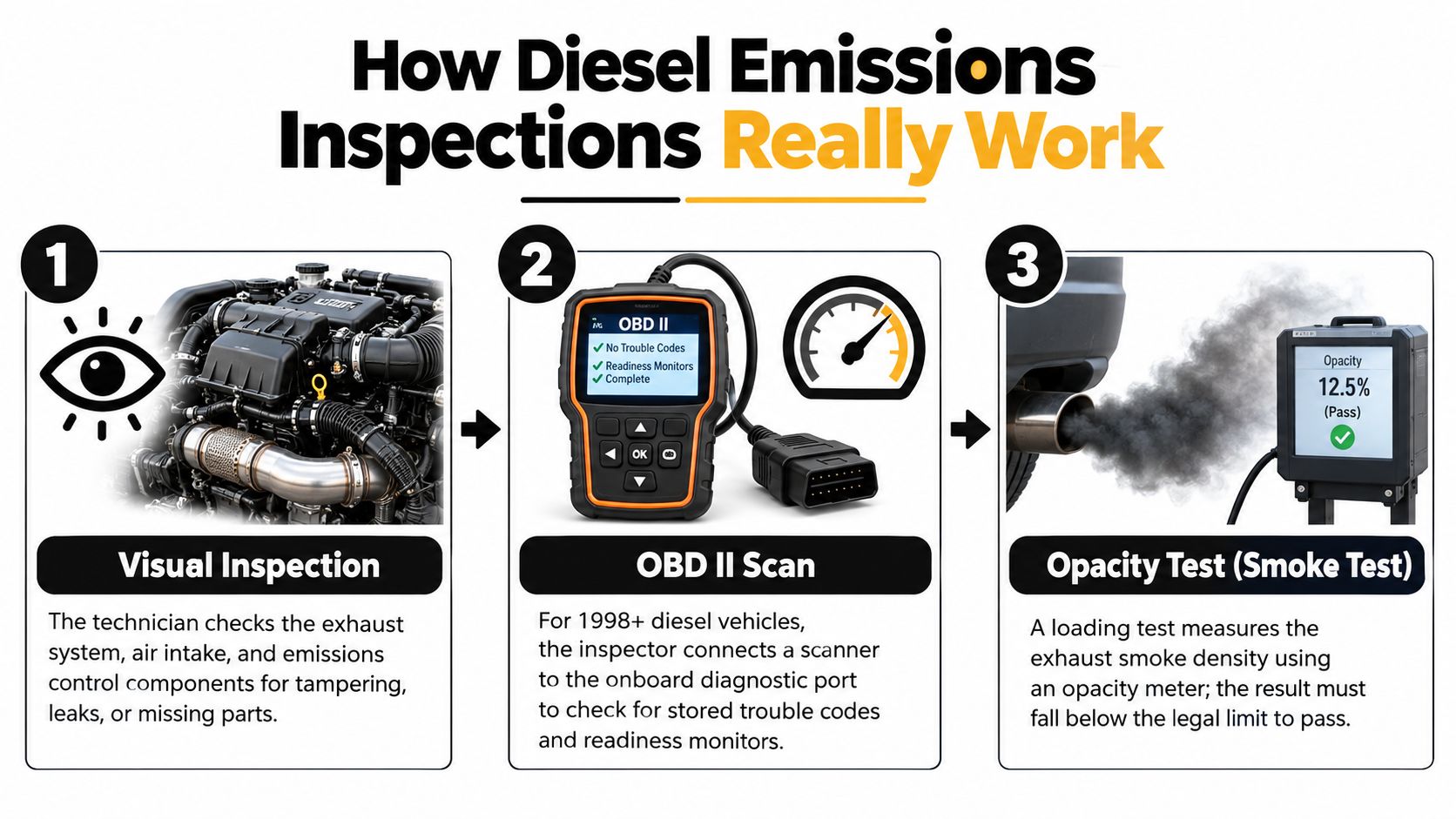
A diesel can run smoothly and still fail its inspection. The technician usually combines a visual inspection, an OBD-II scan where applicable, and a smoke-opacity evaluation. Those checks target different failure points: missing emissions hardware, incomplete monitors, stored diagnostic trouble codes, and excessive exhaust smoke. The equipment and process used at a station are described in this guide to diesel emissions testing equipment.
The visual and diagnostic checks come first
The inspector confirms the vehicle category and model year, then checks emissions-control hardware, tampering, exhaust leaks, and obvious defects. On newer light-duty diesels, the scan reads diagnostic trouble codes and readiness monitors. Clearing a code shortly before testing can turn off the malfunction light while leaving the monitors incomplete.
For 2007 and newer light-duty diesels, California's 2023 rule change allowed only the Diesel Particulate Filter and Non-Methane Hydrocarbon Catalyst monitors to remain unset at that point in the program. Later BAR guidance makes monitor status more restrictive under the updated requirements. A vehicle that has not completed its required drive cycle may fail even after a repair.
Opacity measures smoke density, not drivability
The engine must reach normal operating temperature before the smoke portion. The inspector may perform a standardized snap-acceleration procedure, such as SAE J1667, or another test required by the applicable program. Illinois requirements connect diesel testing with SAE J1667 and EPA smoke-opacity cutpoints, as described in Illinois diesel testing requirements.
The pass limit depends on the vehicle class, model year, and jurisdiction. California-referenced light-duty standards have historically used a 20% opacity limit at idle for some diesel classes. Other programs use older heavy-diesel cutpoints ranging from 40% to 55%. The applicable program determines which limit and procedure apply, so a result from another jurisdiction cannot predict a San Leandro inspection.
California's Air Resources Board announced a roadside anti-soot program for big-rig diesels in 1991. European diesel limits also tightened through EU Directive 94/12/EC, adopted in March 1994, followed by later implementation milestones. The Air Resources Board's historical announcement shows how anti-soot enforcement shaped modern diesel inspection programs.
What to Bring and How to Prep Your Diesel to Pass
A diesel can look clean outside and still fail because its monitors are not ready, its warning light is active, or its emissions hardware is missing. Before booking a diesel emissions inspection near you, verify the paperwork, diagnostic status, exhaust system, and engine condition.
Bring the information the station needs
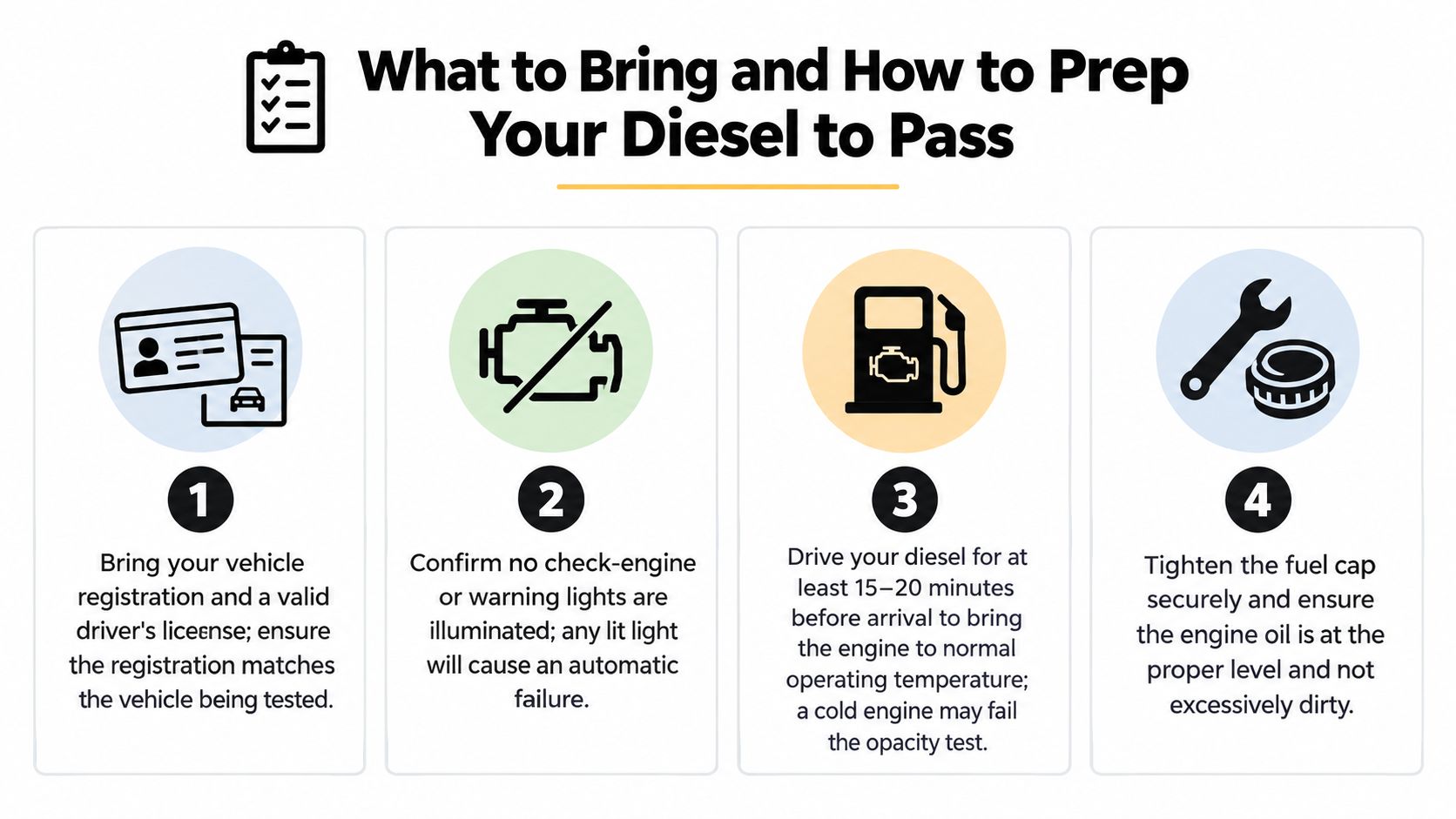
Have your vehicle registration, DMV notice, and driver's license ready. If repairs were completed recently, bring the repair order or diagnostic notes. The technician can then determine whether a fault was repaired, merely cleared, or still requires a drive cycle before the monitor becomes ready.
Check the dashboard before leaving:
- Warning lights: An illuminated check-engine or emissions warning light needs diagnosis before the inspection.
- Diagnostic codes: Request a full-code scan rather than a quick light reset. Clearing codes can remove useful clues and leave readiness monitors incomplete.
- Aftertreatment hardware: Confirm that the DPF, EGR system, catalysts, sensors, and related exhaust components are installed and connected. Deleted or altered emissions software can cause visual and diagnostic failures.
- Operating condition: Do not test a truck in limp mode, derated operation, or an active regeneration fault. Diagnose the cause first.
Fix the causes that create smoke
Common failure categories include a blocked DPF, EGR faults, worn injectors, turbocharger problems, and exhaust leaks. Cleaning the exhaust tip changes appearance, not the measured opacity, when the underlying fault remains.
The engine should arrive warmed up according to the station's instructions. Avoid aggressive driving intended to hide a problem. Heavy smoke during acceleration points to an air, fuel, turbocharger, or aftertreatment issue that needs inspection before testing.
EPA-cited research found lower average opacity among passing vehicles than failed vehicles, while repaired vehicles showed substantial smoke reductions after corrective work. The maintenance and opacity analysis details those measured differences and the fault categories technicians should investigate.
Bring repair documentation, but do not assume a cleared code means the vehicle is ready. The inspection result depends on the vehicle's actual emissions condition, monitor status, and smoke output.
Where to Go Pricing Timing and Why STAR Certification Matters
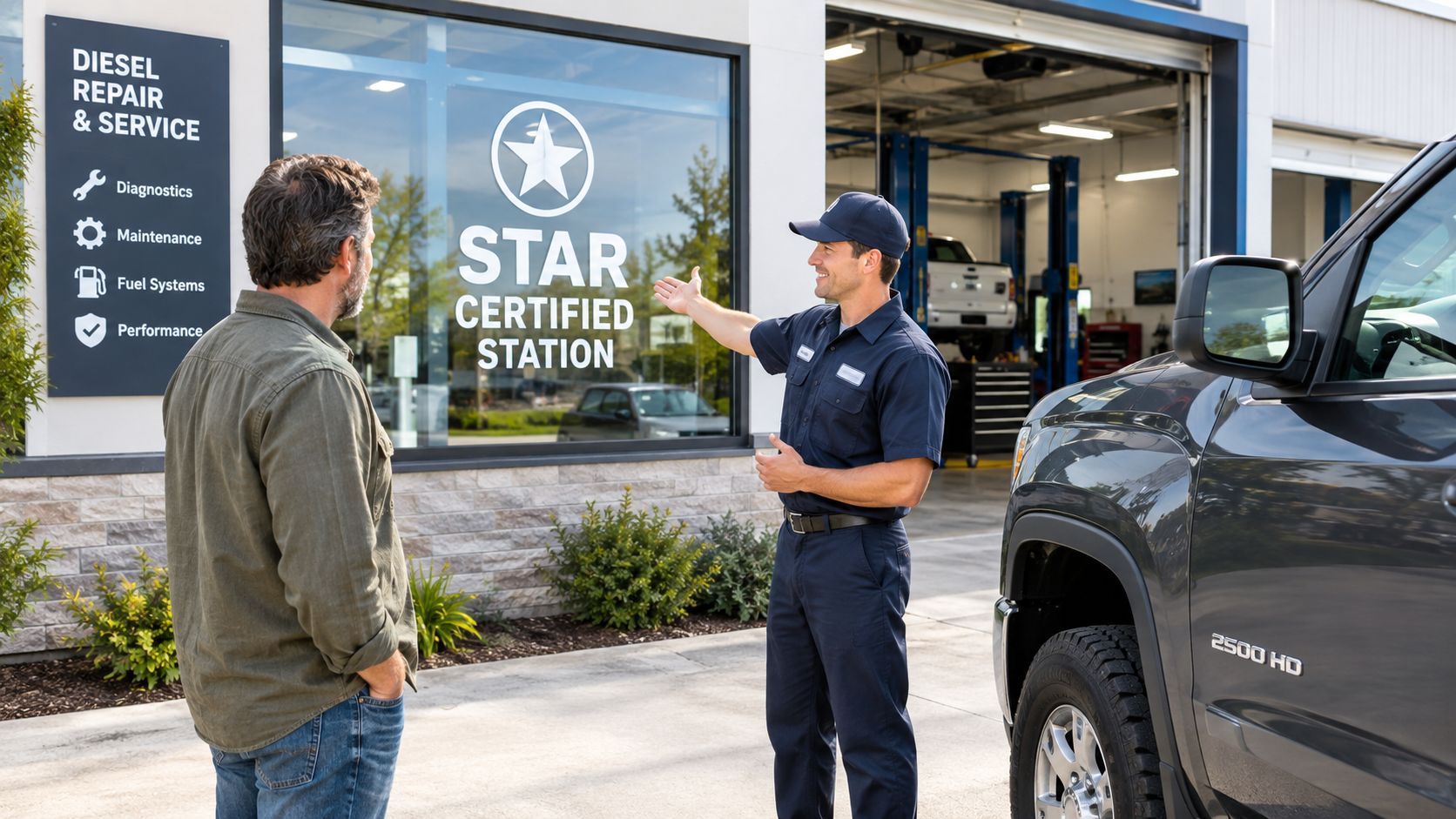
A STAR Certified station is different from a regular Smog Check station because STAR stations meet performance standards set by the California Bureau of Automotive Repair. If the DMV directs your vehicle to STAR, you need that certification rather than choosing the closest general station.
| Feature | What to Look For | Why It Matters |
|---|---|---|
| Diesel capability | The station explicitly accepts qualifying diesel vehicles | Diesel inspections can include visual, OBD, and opacity procedures |
| STAR certification | Current STAR designation when your notice requires it | The result matches the certification pathway assigned by the DMV |
| Testing equipment | Diesel-capable opacity equipment and diagnostic scanning | The technician can evaluate the systems that determine diesel compliance |
| Timing | A stated estimate for the inspection, with extra time for diagnosis | A quick test is useful only when the vehicle is ready |
| Pricing | Clear pricing, diesel surcharges if applicable, and current coupons | You can compare the complete service instead of an incomplete advertised rate |
| Convenience | Posted hours, waiting area, and clear registration follow-up | You avoid a second trip caused by missing paperwork or unclear results |
Speedy Smog at 15275 Washington Ave in San Leandro is one local option that lists diesel inspections among its services and handles qualifying vehicles across the listed model-year range. Its publisher-provided service information describes typical tests for 2000 and newer vehicles as taking about 10 to 15 minutes, with coverage for older vehicles, diesels, and hybrids. Confirm the exact price and eligibility before arrival because inspection cost can depend on vehicle type and current offers.
The shop is open Monday through Saturday and provides an indoor waiting room. It also advertises transparent pricing and periodic $25-off coupons for most smogs on newer vehicles. Those details can make a nearby appointment convenient, but the important selection criteria remain certification, diesel equipment, and the ability to explain a failure accurately.
For a broader technical overview of the equipment and procedures involved, review this diesel emissions testing equipment resource. A station that can clearly describe its process is easier to evaluate than one that only promises a fast result.
After the Test DMV Registration and Next Steps If You Fail
After a passing inspection, the station submits the result through the California Smog Check system so the DMV can use it for registration. Keep the receipt and inspection paperwork until your renewal is complete, especially if you're renewing online or need to prove that the certification was completed.
A failure should give you a repair direction, not just a disappointing result. Read the report carefully and separate a readiness issue from an opacity failure or a visual equipment problem. A DPF restriction, EGR fault, injector issue, turbo problem, exhaust leak, stored code, or missing component requires a different repair path.
Don't clear the code and return. Clearing diagnostic trouble codes can leave monitors unset, and the updated California requirements make readiness status increasingly important. Have a technician perform a complete scan, confirm the repair, verify that the vehicle isn't derated, and allow the required drive conditions to establish monitor readiness before scheduling the retest.
If smoke opacity caused the failure, ask for an inspection of the air intake, turbocharging system, fuel delivery, exhaust system, and aftertreatment. The measured result can respond to proper maintenance, which is why repairs should address the root cause rather than the visible symptom.
If you're in San Leandro, Oakland, or Hayward and need a qualifying diesel inspection, visit Speedy Smog for a STAR Certified emissions test with diesel-capable service and a clear explanation of the next step. Call ahead with your model year and GVWR so the station can confirm eligibility before you arrive.