
Diesel Smog Check Requirements: A California Guide
Your DMV renewal notice shows up, and there it is: Smog Certification Required. If you drive a diesel truck, van, or SUV in the East Bay, that line usually leads to the same questions. Does my diesel even need testing? What do they check? Why did my friend's truck fail when it “ran fine”?
That confusion is normal. California's diesel smog check requirements aren't simple, and a lot of bad advice gets passed around in parking lots, online forums, and job sites. Owners hear half a rule, apply it to the wrong vehicle, and end up wasting a trip or getting stuck before registration.
A good diesel smog visit shouldn't feel like guesswork. It helps to know which vehicles are tested, what a technician looks for, and what problems usually cause a failure. Once you know those pieces, the process gets much easier to manage.
Table of Contents
- Your Diesel Smog Check Guide
- Does Your Diesel Need a Smog Check
- What Happens During a Diesel Smog Inspection
- Understanding Diesel Smog Check Exemptions
- Top Reasons Diesel Vehicles Fail Smog Checks
- Your Pre-Test Checklist for a First-Time Pass
- Get Your Diesel Certified at Speedy Smog
Your Diesel Smog Check Guide
Diesel owners usually don't struggle because they ignore the rules. They struggle because the rules are technical, and the details matter. A truck can drive well, start every morning, and still fail a smog inspection because the monitors aren't ready, the software isn't approved, or smoke hangs in the exhaust a little too long.
That's why the smartest approach is practical, not theoretical. Start with three questions:
- Does my diesel fall into the California testing program?
- What does the inspection include?
- Is there anything on my vehicle likely to trigger a failure?
If you answer those before your appointment, you avoid most of the usual headaches.
Practical rule: A diesel smog check is easier when you treat it like a compliance inspection, not just a quick errand.
Owners often focus only on the dashboard. If there's no warning light, they assume they're good. That works sometimes, but not often enough. Diesel testing also looks at emissions equipment, computer readiness, and visible smoke. A truck that “feels fine” can still have a problem where it counts for inspection.
This is especially true in the East Bay, where many diesel vehicles are work trucks, cargo vans, and daily drivers that rack up miles under real conditions. Short trips, recent repairs, battery disconnects, and aftermarket tuning all show up at smog time.
The good news is that most failures follow familiar patterns. Once you know the rules and the common trouble spots, you can usually spot problems before the test does.
Does Your Diesel Need a Smog Check
A lot of East Bay diesel owners call us after the DMV renewal notice shows up and catches them off guard. The fastest way to sort it out is to check two things on the vehicle first: the model year and the Gross Vehicle Weight Rating, or GVWR, on the driver-side door jamb.
For most light-duty diesel owners, the rule is straightforward. In California, diesel vehicles with a 1998 or newer model year and a GVWR under 14,500 pounds are generally part of the biennial Smog Check program. 1997 and older diesel vehicles are generally exempt, according to the California Bureau of Automotive Repair Smog Check program.
That covers many pickups, diesel SUVs, and Sprinter-style vans we see at the shop.
A few situations still catch owners by surprise:
- Registration renewal: If your DMV paperwork asks for a smog certificate, your diesel likely falls into the program.
- First California registration: An out-of-state diesel brought into California may need a smog inspection before it can be registered here.
- Change of ownership: A sale or transfer can trigger a smog requirement, depending on the transaction.
If you want the bigger picture on state testing rules, our guide to California smog check rules for vehicle owners explains where diesel fits in.
California diesel smog check requirements at a glance
| Vehicle Model Year | Gross Vehicle Weight Rating (GVWR) | Smog Check Required? |
|---|---|---|
| 1997 and older | Under 14,500 lbs | No |
| 1998 and newer | Under 14,500 lbs | Yes, every two years for registration renewal |
| 1997 and older | 14,500 lbs and above | Check program status carefully |
| 1998 and newer | 14,500 lbs and above | May fall outside the standard biennial program. Verify exact requirement before assuming exemption |
Where owners get tripped up
The biggest mix-up is using the wrong weight number. Curb weight is not the number that matters here. GVWR is. We see this with work trucks all the time. The truck may not look heavy, but the manufacturer-rated weight on the door label is what determines whether it falls into the standard program.
Another common problem is assuming diesel follows the same pattern as gasoline. Diesel owners often expect a grace period or assume age alone settles the question. That leads to last-minute appointments, registration delays, and avoidable stress.
If you're unsure, check the door jamb label and your registration paperwork before you book the test.
Five minutes spent verifying the model year and GVWR can save you a wasted trip, especially if you drive a diesel work vehicle and cannot afford downtime.
What Happens During a Diesel Smog Inspection
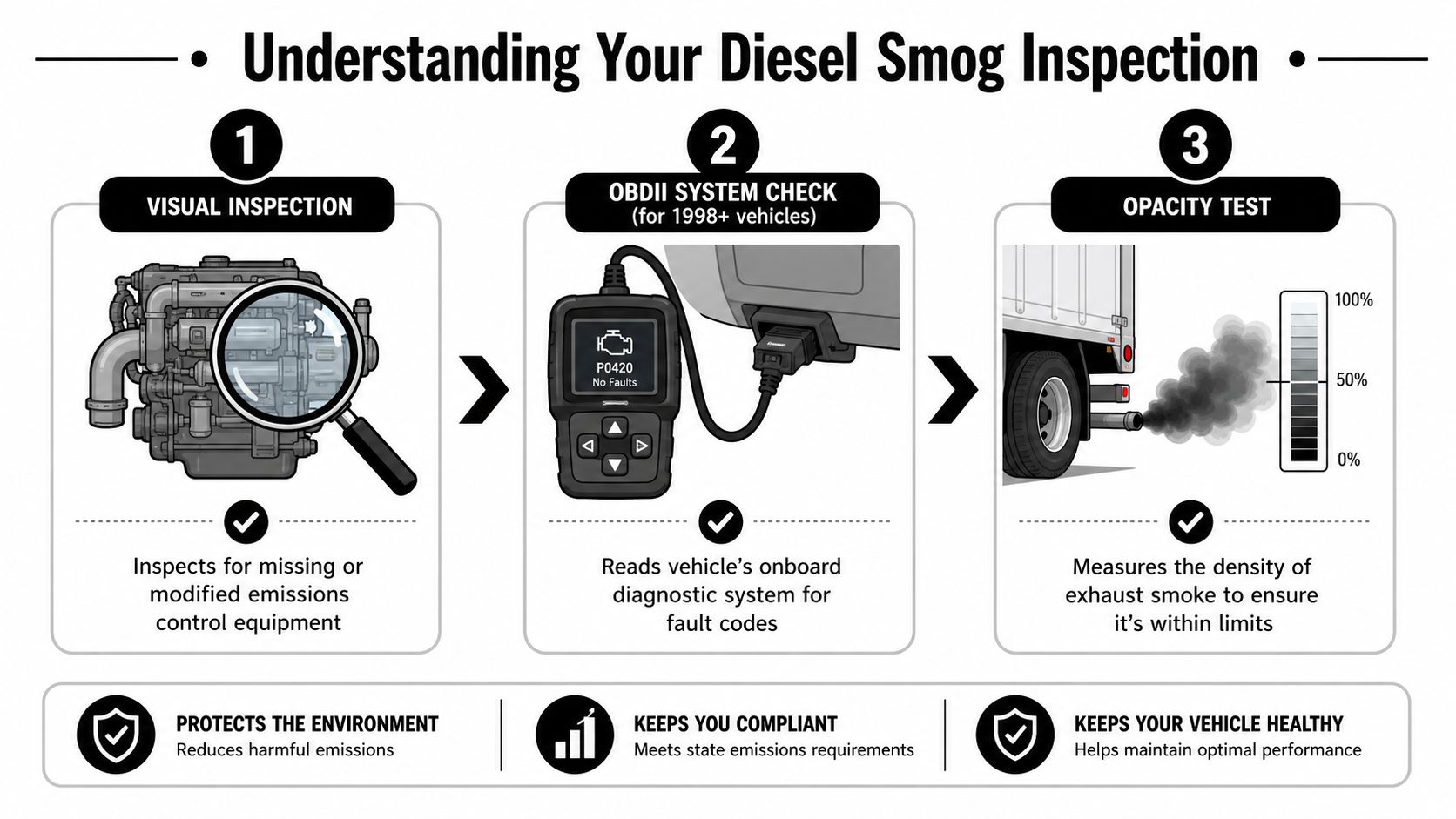
A lot of diesel owners walk in expecting one quick machine test. The actual inspection is more hands-on than that. At the shop, we verify three things: the emissions parts that should be on the vehicle are still there, the onboard computer shows the system is working properly, and the exhaust does not produce excessive visible smoke during the required procedure.
If you want a better sense of what the shop is using during the test, this page on diesel emissions testing equipment and inspection hardware shows the tools behind the process.
Step one is a visual inspection
This is often where problem trucks get flagged first.
The technician checks for missing, modified, or clearly non-compliant emissions components. On diesel vehicles, that usually means looking closely at the DPF, related emissions hardware, and signs that a system has been removed, bypassed, or altered.
We see this with work trucks fairly often. The owner may be focused on how the truck runs, but a visual failure can happen even if the engine feels strong on the road. If the setup does not match what the vehicle is supposed to have, that issue usually shows up right away.
Step two is the computer check
Next comes the onboard diagnostic check. The technician connects to the vehicle, reads fault information, and checks whether the emissions monitors are ready.
This part trips up owners who recently cleared codes, replaced a battery, or disconnected power during repairs. The warning light may be off, but the system can still show incomplete readiness. If the monitors have not finished their self-checks, the vehicle may not pass that day.
For newer light-duty diesels, the readiness rules are tighter than many owners expect. That is why a truck that seems fixed after a repair still needs enough normal driving time before it is ready for inspection.
Step three is the smoke test
The last part is the smoke inspection. In this stage, real-world diesel problems tend to show themselves.
The technician observes the exhaust and performs the required snap acceleration procedure to see whether visible smoke clears within the allowed limit. A diesel that feels acceptable in daily driving can still fail here if it has injector problems, heavy soot buildup, poor maintenance history, or an emissions issue that only shows up when the engine is revved.
From a shop perspective, this is one of the biggest surprises for owners. “It drives fine” does not always mean “it will pass smog.” If your truck has been smoking on cold starts, under throttle, or after long idle time, it is smart to address that before you come in.
Understanding Diesel Smog Check Exemptions
Many owners experience issues when they hear that some diesels are exempt, then stretch that idea farther than the rules allow. A quick assumption can turn into a DMV problem later.
Older diesels are the clearest exemption
The simplest exemption is age. If your diesel is model year 1997 or older, it falls outside the biennial light-duty diesel smog requirement covered earlier.
That's the cleanest exemption because it's based on model year. There's not much interpretation involved. If the vehicle is old enough, it's outside that part of the program.
Weight alone doesn't tell the whole story
The more confusing issue is weight. Many diesel owners believe anything over 14,000 lbs is automatically exempt, but that's not a safe shortcut. As noted in this guide to California diesel smog exemptions and GVWR checks, the right approach is a two-step verification process: confirm the vehicle's GVWR on the manufacturer's door jamb, then cross-reference that with the applicable CARB program requirements.
That matters because not every vehicle outside the standard light-duty smog lane is “free and clear.” Some heavier diesels fall under different compliance programs instead of the familiar biennial test. Owners who assume exemption without checking the exact program can end up with registration issues or compliance confusion.
A practical way to handle this is:
- Check the label first. Use the manufacturer's GVWR, not a guess.
- Match the vehicle's use. Personal, commercial, and specialized use can affect what program applies.
- Verify before renewal time. Waiting until your registration deadline is the worst time to sort this out.
Don't build your plan around “my buddy said heavy diesels are exempt.” Verify the door sticker, then verify the rule that applies to that specific vehicle.
The owners who stay out of trouble are usually the ones who document the vehicle correctly before they ever pull into a test bay.
Top Reasons Diesel Vehicles Fail Smog Checks
A diesel can run strong on the road and still fail in the bay. At Speedy Smog, the repeat problems are pretty consistent. The onboard system is not ready, emissions parts or software do not match California rules, or the vehicle produces visible smoke during inspection.
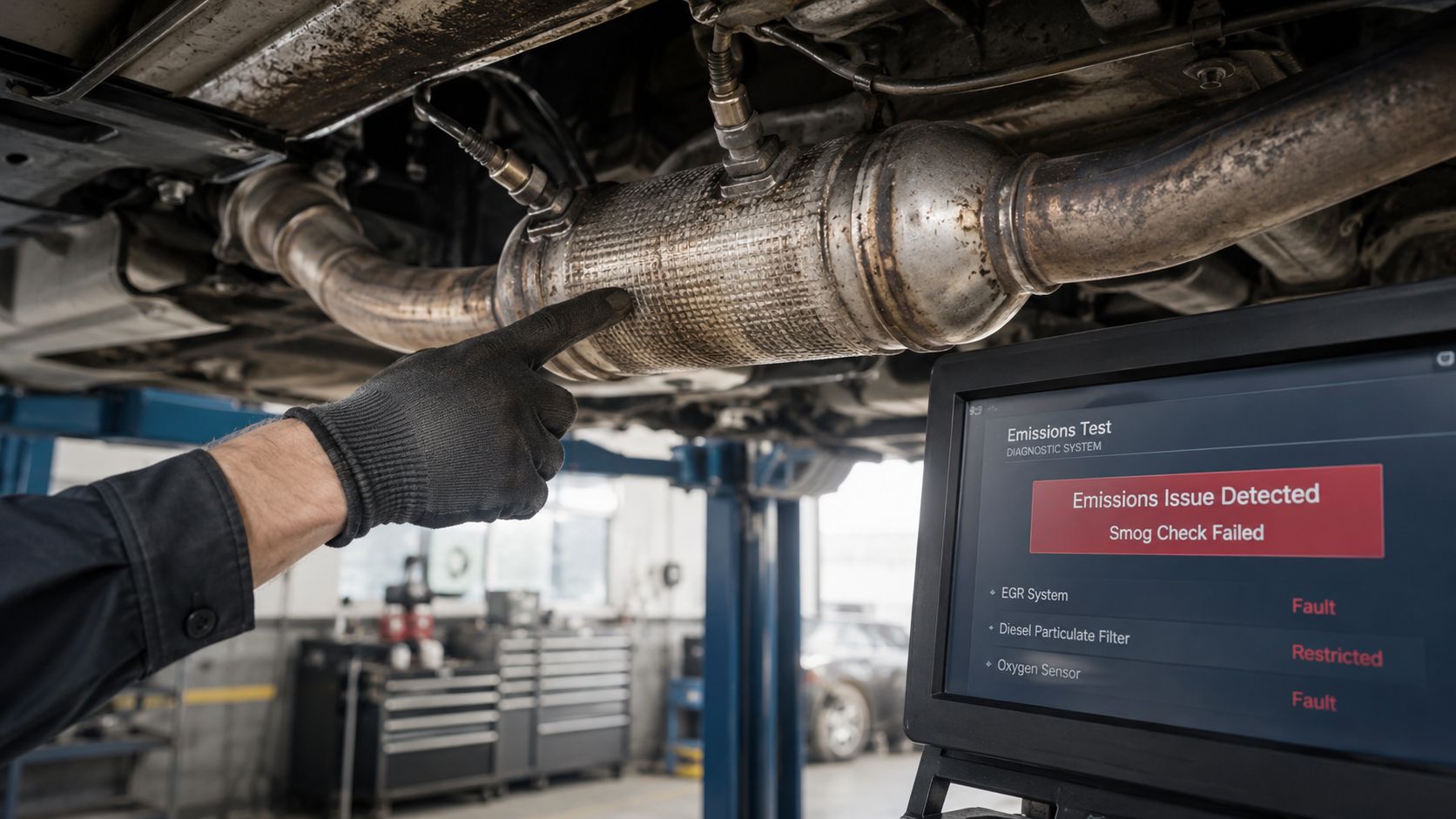
I hear the same comment all the time: “It passed last time.” That history helps, but it does not guarantee the next result. Batteries get disconnected. Repairs interrupt monitor completion. Used trucks show up with tuning or missing hardware that the current owner did not know about. A smog check looks at the vehicle as it sits that day.
Readiness monitors not set
This is one of the easiest failures to prevent, and one of the most common on newer diesels. If codes were recently cleared, the battery was disconnected, or a repair changed how the system operates, the computer may still show monitors as incomplete. In that condition, the inspection may stop before it really starts.
For newer light-duty diesels, the monitor rules are tighter than many owners expect. As noted earlier, model year 2007 and newer light-duty diesel vehicles have very limited allowance for unset monitors. If the wrong monitor is still not ready, the vehicle can fail even with no warning light on.
A quick pre-scan saves a wasted trip. Our diesel smog inspection checklist for California drivers is a good place to start if you want to catch that issue before you head to the shop.
What helps:
- Drive the vehicle normally after repairs. Give the computer time to complete its self-checks.
- Scan for readiness status before the appointment. “No codes” does not mean “ready.”
- Repair the actual fault first. Clearing codes without fixing the cause usually leads right back to the same problem.
What causes trouble:
- Disconnecting the battery right before test day
- Clearing the check engine light and coming straight in
- Assuming the truck is ready because it feels fine
Modified parts and software
Performance work is a big failure point. Owners add a tuner for towing, buy a used diesel with unknown upgrades, or replace parts with something that fits physically but does not meet California requirements. Then the visual inspection or system check catches it.
Diesel software changes are a common example. A tune may improve throttle response or pulling power, but if it is not approved for California use, that benefit does not matter at smog time. The same problem shows up with deleted emissions equipment, altered intake or exhaust components, and replacement parts that are not legal for that application.
A truck can be mechanically healthy and still fail because the emissions configuration is wrong.
This is a good place to pause and see the issue from the owner side:
The practical fix is to return the vehicle to a compliant setup. That is not always cheap, and that is the trade-off. A tune or delete may have made the truck more enjoyable to drive, but it can turn a routine smog visit into a repair project. On used diesels, check for signs of non-stock programming or missing emissions hardware before registration deadlines sneak up on you.
Visible smoke and underlying engine issues
Smoke failures frustrate owners because the truck may still seem usable day to day. It starts, pulls, and drives, but under snap acceleration it hazes enough to create a problem in the test lane.
Visible smoke usually points to a real mechanical issue. Common causes include injector problems, poor combustion, air-path faults, soot buildup, or a DPF-related problem that has not fully triggered a dash warning yet. Deferred maintenance also shows up here.
The smart move is diagnosis. Guessing gets expensive fast on diesel repairs. Check fuel delivery, air intake, boost behavior, engine condition, and emissions components in an orderly way. That approach costs less than replacing parts at random and coming back for a second test.
Your Pre-Test Checklist for a First-Time Pass
The best pre-test routine is boring. That's a good thing. Diesel smog appointments usually go more smoothly when the vehicle arrives warm, complete, and untouched by last-minute resets.

One point catches diesel owners off guard. For light-duty diesel vehicles with a GVWR of 14,000 pounds or less, California requires biennial smog inspections starting with model year 1998, and there is no eight-year model year exemption like the one many gasoline vehicles receive, as summarized in this discussion of California diesel inspection timing and diesel-specific exemptions. In other words, don't assume a newer diesel gets a pass just because it's relatively new.
For a shop-day prep list, this diesel smog inspection checklist for California drivers is a practical reference.
What to do before you leave home
- Drive it long enough to fully warm up. A short freeway run or normal steady driving helps more than idling in the driveway.
- Make sure the battery hasn't been recently disconnected. If it has, the monitors may not be ready yet.
- Use the vehicle normally before the test. Last-minute code clearing is one of the easiest ways to create a “not ready” problem.
- Pay attention to smoke. If you can see unusual exhaust behavior during acceleration, deal with that first.
What to bring and what to avoid
Bring the paperwork that makes the visit simpler. Your DMV notice, registration information, and any recent repair records can help if there's a question about prior work or timing.
Avoid two bad habits. First, don't show up with the fuel level extremely low and hope for the best. Second, don't schedule a smog check immediately after major repairs unless you already know the system is ready.
The easiest diesel smog pass is the one you prepare for the day before, not the one you try to rescue in the parking lot.
Get Your Diesel Certified at Speedy Smog
Diesel smog check requirements feel complicated until you break them into the parts that matter. First, confirm whether your vehicle falls into the testing program. Then make sure the truck is fully ready for inspection, not just driving well. Finally, look hard at the common failure points: readiness monitors, smoke, and non-compliant modifications.
That approach saves time because it deals with the actual reasons diesels fail. It also keeps the process calmer. When owners know what the station is checking, they don't have to treat smog day like a surprise exam.
If you want a smooth visit, choose a shop that understands diesel-specific testing, current California rules, and the details that trip people up. A STAR-certified station with experienced technicians can spot issues clearly, explain what's happening in plain language, and help you get through the inspection without the usual confusion.
If your diesel needs certification in the East Bay, Speedy Smog is a practical place to get it done. The shop is STAR Certified, experienced with diesel inspections, and focused on quick, friendly service for San Leandro, Oakland, and nearby drivers. If you want a straightforward smog visit with people who know California diesel rules, book your test with Speedy Smog.