
You've booked a California smog check, the registration deadline is close, and someone has told you to “take the diesel on the freeway and clear the light.” That advice can help in a narrow situation, but it can also waste your time or guarantee a failure if the vehicle's OBD monitors aren't ready or a real emissions fault remains active.
Passing a diesel emissions test starts with identifying which inspection rules apply to your vehicle. From there, the priorities are straightforward: confirm eligibility, check readiness, control smoke and opacity, avoid resetting the computer before testing, and diagnose persistent faults instead of trying to drive them away.
Table of Contents
- Knowing If Your Diesel Needs a Smog Check
- Understanding Opacity Limits and OBD Readiness Rules
- Executing the Pre-Test Drive Cycle Checklist
- Avoiding the Code Clearing Trap
- Deciding Between a Long Drive and Diagnostic Repair
- Managing Test Day Logistics and STAR Certification
Knowing If Your Diesel Needs a Smog Check
The first mistake many owners make is preparing for a test their vehicle may not need, or assuming every diesel follows the same procedure. California separates diesel vehicles by model year and gross vehicle weight rating, so check those details before spending money on additives, repairs, or a pre-test inspection.
According to the California Bureau of Automotive Repair Smog Check reference, diesel vehicles built from model year 1998 onward are generally included in the program. Diesel vehicles from 1997 and earlier are exempt, and vehicles with a GVWR above 14,000 pounds are outside the standard program described for these light-duty inspections.
Check the two eligibility details
Start with the vehicle's model year. Don't rely on the year you bought it, the registration date, or the date of a major repair. The relevant detail is the vehicle's model year as identified in its records and emissions equipment documentation.
Next, check the gross vehicle weight rating, not the vehicle's current weight. GVWR is the manufacturer's rated maximum weight for the vehicle, including occupants and cargo. A diesel that looks like a normal pickup may fall under different requirements if its rating places it above the light-duty threshold.
California's diesel inspection rules also reflect a historical change that matters to owners of newer passenger vehicles and pickups. The 2010 expansion brought post-1997 diesel passenger cars and trucks up to 14,000 pounds into the Smog Check system, making modern diesel eligibility more common than many older guides suggest.
Confirm the inspection type before your appointment
Eligibility doesn't tell you every detail of the test. A qualifying diesel may be evaluated through a combination of OBD communication, visual inspection, and smoke or opacity checks, depending on its category and the applicable procedure. It isn't just the older gasoline-style tailpipe dyno test that many drivers remember.
Before you schedule, compare your vehicle's year and GVWR with the diesel Smog Check requirements. If the vehicle is subject to inspection, ask the station what information it needs and whether it handles the relevant diesel procedure.
Understanding Opacity Limits and OBD Readiness Rules
California diesel testing revolves around two different questions. How much smoke is the vehicle producing, and has the emissions computer completed the required self-tests? A diesel can look clean at idle and still fail because its monitors report “Not Ready.” It can also have a ready OBD system and fail because visible smoke or measured opacity exceeds the applicable limit.
For heavy-duty diesel fleets covered by California's Periodic Smoke Inspection Program, the BAR Smog Check Manual identifies opacity limits of 55% for pre-1991 engines and 40% for engines from 1991 onward. Those limits apply to the heavy-duty program, so don't automatically transfer them to every light-duty diesel.
For light-duty diesels, OBD readiness becomes especially important. Model year 2007 and newer light-duty diesels may have two unset readiness monitors, but the allowance is limited to the Diesel Particulate Filter and Non-Methane Hydrocarbon Catalyst monitors. If other required monitors remain incomplete, the vehicle may not qualify for a pass.
California diesel inspection thresholds
| Vehicle category | Opacity limit | OBD monitor allowance |
|---|---|---|
| Heavy-duty diesel, pre-1991 engine | 55% | Requirements vary by applicable heavy-duty procedure |
| Heavy-duty diesel, 1991 and newer engine | 40% | Requirements vary by applicable heavy-duty procedure |
| Light-duty diesel, model year 2007 and newer | Tested under the applicable diesel procedure | Two unset monitors may be allowed, limited to the Diesel Particulate Filter and Non-Methane Hydrocarbon Catalyst monitors |
The practical lesson is that smoke and readiness are separate gates. A highway drive may help a diesel complete a regeneration-related monitor, but it won't repair a failed sensor, restore damaged wiring, or correct an emissions system that has been deliberately removed or reprogrammed.
Check readiness before you pay for the test
Use a capable OBD scanner to view monitor status, not just stored trouble codes. Look for a result showing the required systems as Ready, and check whether the malfunction indicator lamp is illuminated.
The equipment used by a compliant station matters because the inspection must communicate with the vehicle and evaluate the systems required for that vehicle. If you want to understand the role of the inspection hardware, review the diesel emissions testing equipment used for this type of evaluation.
Executing the Pre-Test Drive Cycle Checklist
A drive cycle isn't the same as commuting to the inspection station. The vehicle's computer needs the right combination of cold-start conditions, warm-up, speed, load, and uninterrupted operation to complete its self-tests. The exact sequence varies by manufacturer, so the owner's service information remains the authority, but a controlled routine is more useful than random short trips.
Use a deliberate sequence
Begin with a genuine cold start. Let the vehicle complete its normal startup process, then drive gently while the engine and emissions system warm up. Avoid turning the first few minutes into a hard acceleration run, because the aim is stable operating conditions, not punishment.
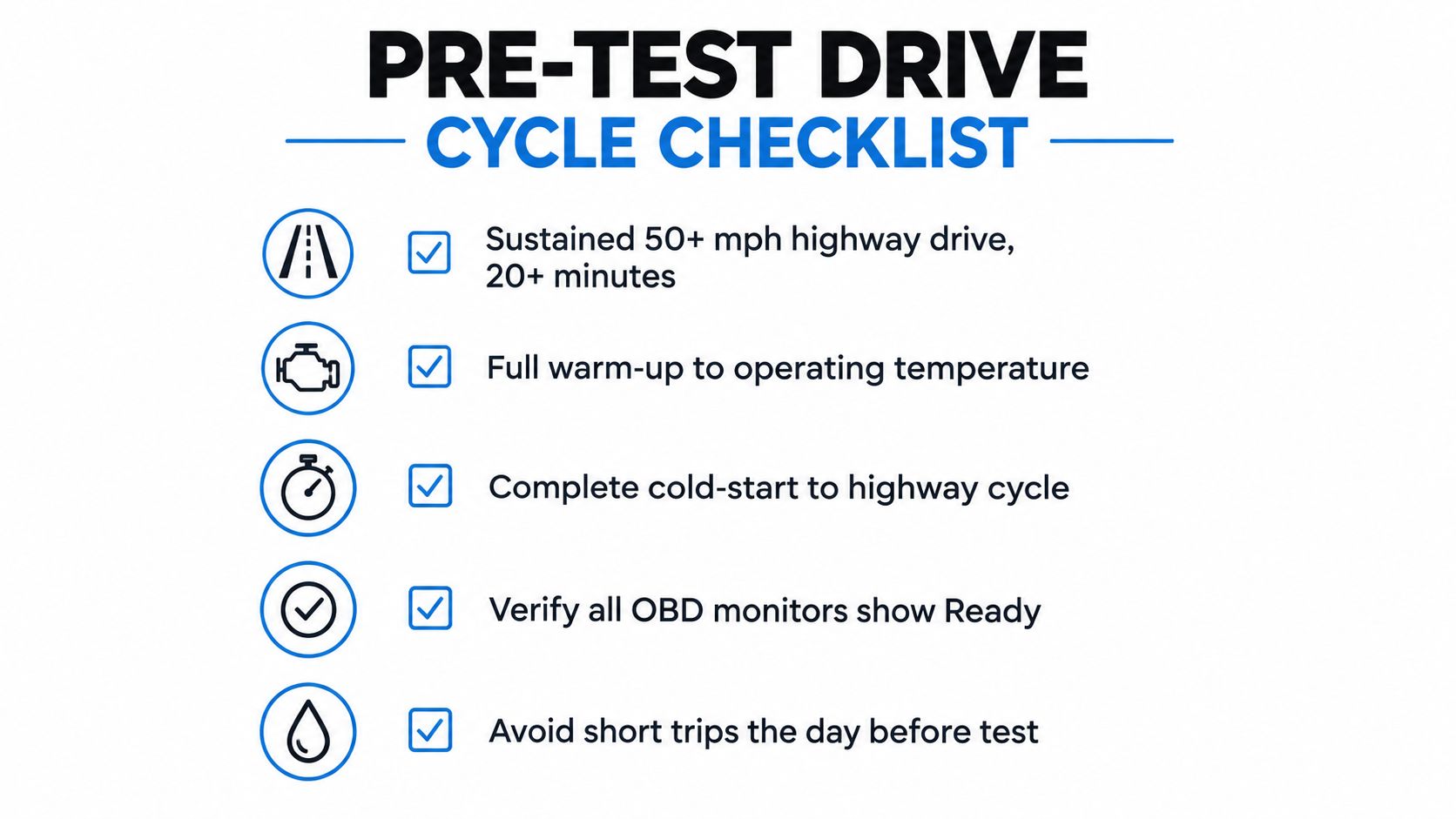
Once the engine reaches normal operating temperature, use a sustained highway drive. The infographic's practical checklist calls for a 50-plus-mph highway drive lasting 20-plus minutes, but treat that as a preparation pattern rather than a universal manufacturer-specific procedure. Obey the speed limit, keep a safe following distance, and don't force the engine beyond its normal operating range.
A useful preparation sequence looks like this:
- Start cold: Begin after the vehicle has been sitting long enough for the engine to cool naturally.
- Warm gradually: Drive smoothly until the engine reaches its normal operating temperature.
- Hold steady conditions: Maintain a sustained highway segment rather than repeatedly stopping and restarting.
- Avoid unnecessary short trips: Don't spend the day before the test making several brief journeys that leave the diesel cold.
- Scan afterward: Check monitor status before the appointment, especially if the vehicle recently had electrical work or codes cleared.
The goal is to let the computer perform its tests under the conditions it expects. It isn't to create smoke, force a regeneration manually, or drive aggressively.
Why the routine can change the result
EPA best-practice data shows that a less strict monitor allowance reduced the overall medium-duty diesel vehicle initial “not ready” rate from 7% to 3%, as reported in its diesel OBD inspection best-practices document. Among light-duty diesel make and model groups, initial not-ready rates ranged from 0–9% under a two-monitor criterion, compared with 0–13% under a one-monitor criterion, using the same EPA source.
Those figures don't promise that a particular vehicle will pass after one drive. They do show why monitor preparation deserves attention. A vehicle may have no obvious drivability complaint while its computer still needs the correct conditions to finish testing.
Practical rule: Drive to complete the vehicle's diagnostic routine, then verify “Ready” with a scanner. Don't assume the trip happened just because the odometer moved.
If monitors remain incomplete after a proper warm drive, stop repeating the same route blindly. Look for a stored fault, an operating-temperature problem, a battery or charging issue, or a manufacturer-specific condition that the generic routine didn't satisfy.
Avoiding the Code Clearing Trap
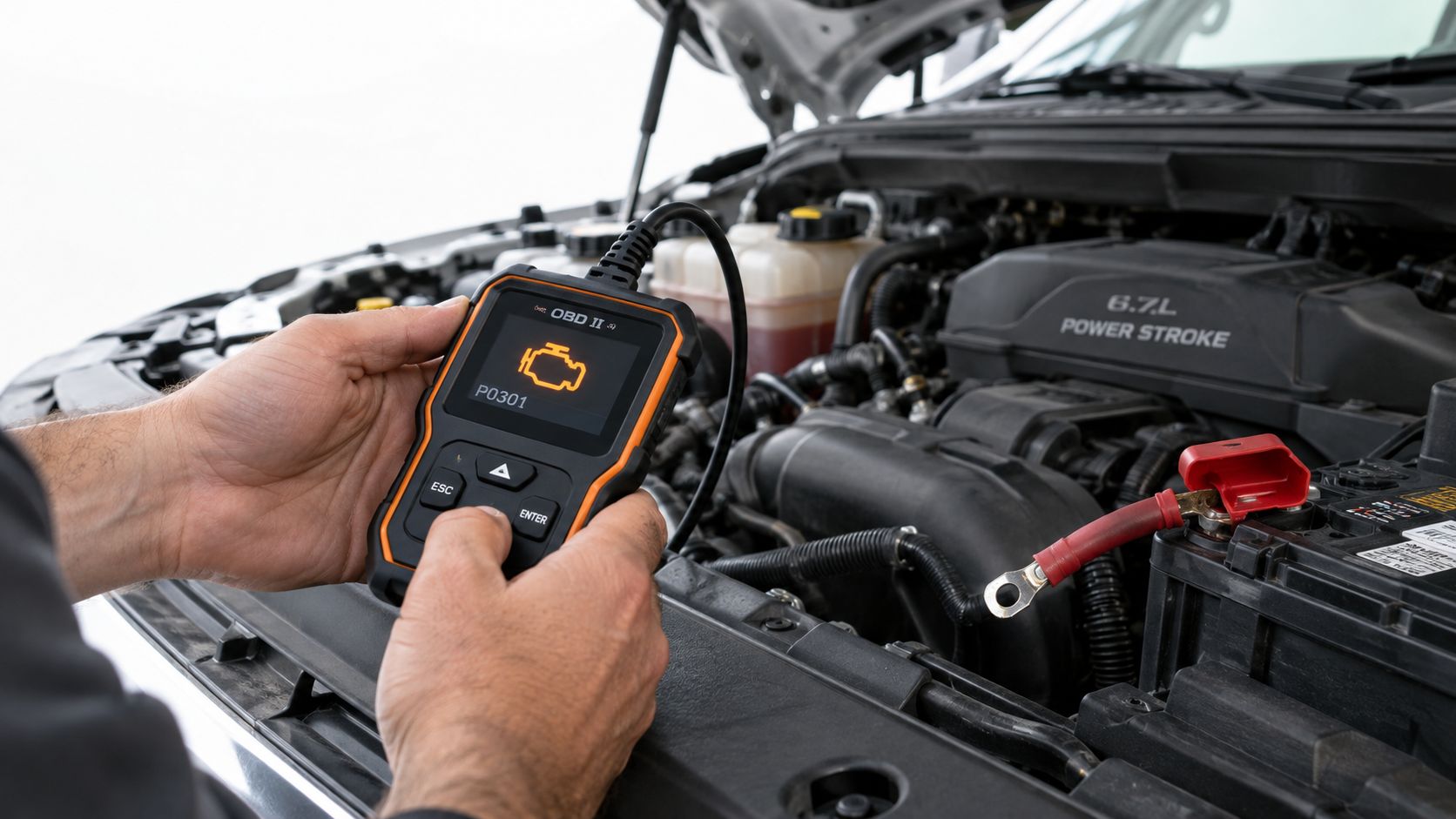
Clearing a check engine light immediately before a smog check is one of the fastest ways to create an inspection problem. Disconnecting the battery, using a basic scan tool to erase codes, or allowing a repair shop to reset the computer can also erase the monitor history that the inspection machine needs to see.
Why a reset produces a “Not Ready” result
The monitors are not simple lights that switch back on as soon as you start the engine. They run self-tests during specific operating conditions. After a reset, the computer needs time and the correct drive conditions to complete them again.
The Missouri inspection guidance on readiness monitors explains that diesel vehicles can fail when required monitors haven't completed their self-tests. Battery disconnection, code clearing, a repair-shop reset, power or ground problems, and unmet temperature conditions can all leave monitors incomplete.
The same principle applies even if the original fault has been repaired. A reset may remove the warning light, but it also removes evidence that the emissions systems have completed their checks. The inspection station sees the incomplete state, not your intention.
Use a scan tool to diagnose the code rather than erase it. Record the code, freeze-frame information, and monitor status before making repairs. If the problem is repaired, follow the vehicle's specified drive cycle and confirm that the monitors have returned to Ready before booking the inspection.
The guide to clearing a check engine light can help explain the difference between resetting a warning and resolving the fault, but clearing codes alone isn't a pass strategy.
Treat electrical problems as emissions problems
A weak battery, poor ground, damaged connector, or charging fault can interrupt monitor testing. The diesel may start and drive normally while the computer loses the stable power or communication it needs to complete diagnostics.
Watch for these warning signs:
- Recent battery work: The monitors may have been reset during replacement or service.
- Intermittent warning lights: A power or ground fault can cause inconsistent computer behavior.
- Scan-tool communication failure: The inspection can't proceed normally if the vehicle's diagnostic connector doesn't communicate.
- Repeated “Not Ready” status: A drive cycle won't solve a monitor that cannot run because an enabling condition or circuit fault remains.
The correct order is diagnosis, repair, drive cycle, and verification. Don't erase the evidence before you know what caused the warning.
Deciding Between a Long Drive and Diagnostic Repair
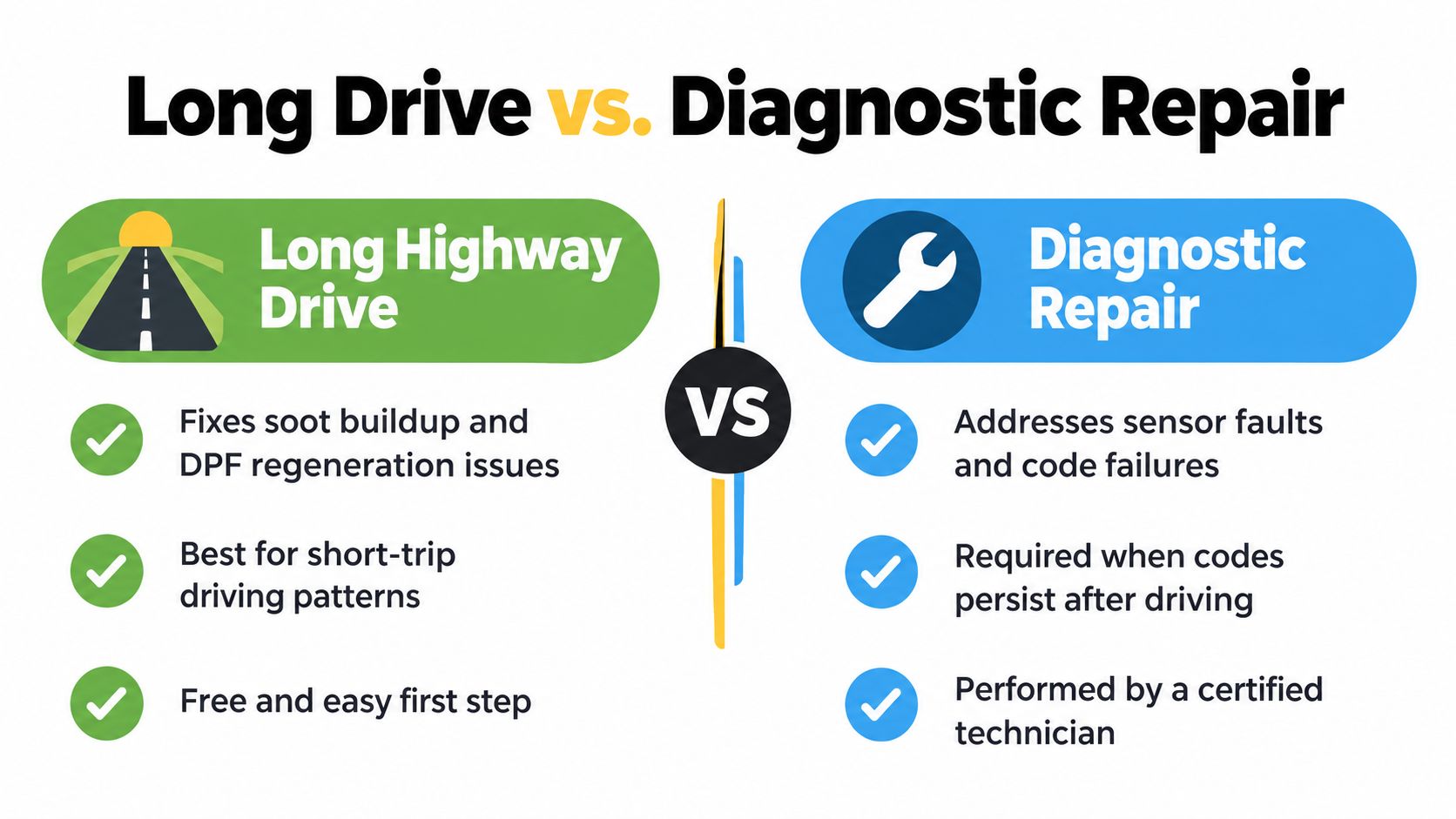
A long highway drive is a reasonable first step when the diesel's main problem is its operating pattern. Short trips can prevent the vehicle from reaching the conditions needed for effective emissions-system operation, and a sustained warm drive may help the vehicle complete its routine.
It's not a universal repair. A drive can't restore a damaged sensor, repair an exhaust leak, reconnect a diagnostic circuit, or undo emissions-control software changes.
When a highway drive makes sense
Choose the low-cost preparation route when the vehicle has no active warning light, communicates normally with the scanner, and the issue appears related to repeated short-trip use. Give the engine a complete warm-up, drive steadily on the highway, and scan the vehicle afterward.
A fuel top-up and correct engine oil may be sensible maintenance steps if the vehicle is due for them, but neither should be treated as a guaranteed emissions repair. Use only fluids and specifications approved for the vehicle, particularly where a diesel particulate filter requires low-ash oil.
The test is simple: did the monitors become Ready, and did the warning condition stay away? If yes, the preparation may have addressed a readiness issue. If not, more driving is unlikely to provide a different result.
When diagnosis comes first
Persistent codes deserve repair before testing. Common failure signatures include DPF-related codes such as P2002, P244A, and P246C, along with visible exhaust leaks and communication problems at the diagnostic connector, according to this diesel emissions failure guide.
A technician should investigate rather than repeatedly clear these codes. Possible causes include damaged pressure or temperature sensors, wiring faults, an exhaust leak that affects readings, inactive regeneration logic, or deleted DPF software. These conditions can keep returning after every reset and can prevent the required monitors from completing.
| Long highway drive may help | Diagnostic repair is the better choice |
|---|---|
| The vehicle has no active warning light | A warning light returns after clearing |
| The issue follows repeated short trips | DPF codes remain stored or return |
| The scan tool communicates normally | The connector won't communicate reliably |
| Monitors are incomplete but no fault is present | Sensors, wiring, software, or exhaust components show faults |
| The engine reaches normal temperature | The engine or emissions system can't meet enabling conditions |
A clean-looking exhaust doesn't prove that the emissions system is healthy. The scanner and the physical inspection need to agree.
Don't drive aggressively to hide smoke. Excessive load, unsafe speeds, or improvised regeneration attempts can add risk without fixing the underlying fault. If the scan shows a persistent problem, pay for diagnosis before paying for another test.
Managing Test Day Logistics and STAR Certification
A prepared vehicle can still have an avoidable problem on test day. Bring the vehicle's registration information and any documents connected with the inspection request or recent emissions repair. If a prior failure report identifies a specific monitor or emissions component, give it to the technician instead of relying on memory.
Arrive with the engine fully warmed through normal driving, but don't turn the trip into an aggressive “tune-up.” A warm engine allows the inspection to occur under normal operating conditions, while careful driving protects you, other road users, and the vehicle.
Confirm the station and procedure
Choose a station that handles the diesel category and test method your vehicle requires. California diesel inspections may involve OBD checks, visual review, and opacity testing depending on the vehicle and applicable rules. Ask before arrival if you're uncertain about model year, GVWR, or the required equipment.
A STAR Certified station meets the Bureau of Automotive Repair's performance standards for participating inspections. That designation doesn't replace vehicle maintenance, but it gives you a compliant testing location for transactions that require a STAR inspection.
Before the technician begins, mention recent battery replacement, code clearing, electrical repairs, or a check engine light. These details help explain why monitors may be incomplete and can prevent you from treating a readiness problem as a mechanical mystery.
Use the result intelligently
If the vehicle passes, keep the paperwork for your records and complete the registration process as required. If it fails, read the failure result carefully. The next repair should target the listed cause, whether that's monitor readiness, a DPF-related code, smoke, visible emissions equipment, or communication.
Don't approve unrelated parts replacement before the diagnostic evidence supports it. A proper pre-test scan can tell you whether the vehicle needs more drive-cycle time or a repair appointment, which is often the difference between a useful visit and paying for a repeat inspection.
For East Bay owners, Speedy Smog performs diesel Smog Checks in San Leandro for applicable vehicles, with OBD, visual, or opacity procedures selected according to the vehicle and inspection requirements. Visit the station with your monitors verified and any recent repair information available so the technician can complete the inspection accurately.
Most diesel cars and light-duty diesel trucks in California from model year 1998 and newer do need a smog check every two years for registration renewal. The test is different from a traditional gasoline tailpipe test, and diesel vehicles from 1997 and older are generally exempt from that standard program.
You may be asking this while looking at a DMV renewal notice, standing beside a diesel pickup, or trying to decide whether a trip to a San Leandro smog station is necessary. The confusion is understandable. California doesn't decide the answer by fuel type alone. Model year, gross vehicle weight rating, registration category, and the inspection program that applies to the vehicle all matter.
A newer diesel may need an emissions-related inspection even though the technician doesn't place the familiar gasoline-style probe into the tailpipe. A heavier truck may avoid the ordinary biennial smog program yet still face separate California Air Resources Board compliance requirements. The useful question isn't, “Is it diesel?” It's, “Which California testing pathway applies to this vehicle?”
Table of Contents
- The Short Answer on Diesel Emissions Testing
- Which Diesel Vehicles Need a Smog Check
- How a Diesel Test Differs From a Gasoline Smog Check
- What Happens During a Diesel Smog Inspection
- The Heavy-Diesel Rule Most Owners Overlook
- How to Prepare Your Diesel Before the Appointment
- Common Reasons Diesels Fail and How to Fix Them
- What East Bay Drivers Can Expect at Speedy Smog
The Short Answer on Diesel Emissions Testing
A diesel owner in California can reach the registration-renewal counter expecting a routine answer, then discover that the result depends on the vehicle's age, size, and inspection pathway. For most diesel cars and light-duty trucks, a 1998 or newer model with a gross vehicle weight rating of 14,000 pounds or less generally falls under the state Smog Check program when renewal requires an inspection. The California Bureau of Automotive Repair Smog Check program explains why diesel vehicles in this group are not automatically exempt.
The inspection can look different from the gasoline test many drivers know. Instead of relying on the familiar gasoline dynamometer and tailpipe measurement, California's diesel process may use on-board diagnostics, visual verification of emissions equipment, and smoke-related compliance. The technician checks for emissions faults reported by the vehicle computer, confirms that required components are still installed, and looks for an unacceptable smoke condition.
The key point is:
A diesel can need a smog check without receiving a traditional gasoline tailpipe test.
Model year helps determine which technology the station uses. Newer qualifying vehicles generally follow OBD inspection procedures, while older vehicles use another inspection path. The rules also include specific readiness-monitor requirements for 2007-and-newer light-duty diesel vehicles, with updated requirements beginning in July 2023. Drivers should review the California Bureau of Automotive Repair Smog Check program before scheduling an appointment.
Why the answer isn't just yes or no
A 2005 diesel passenger car and a 1996 diesel sedan can receive different results. A light-duty diesel pickup also may follow a different route from a commercial truck above the heavy-vehicle threshold. Fuel type starts the conversation, but it does not finish the decision.
Your DMV renewal notice provides a useful clue. Confirm the vehicle's model year and GVWR as well, because those details determine whether the ordinary biennial program applies. If the vehicle qualifies, the station electronically reports the outcome so registration can proceed. If it falls outside that program, another emissions rule may still apply, particularly for commercial use or heavy-duty operation.
Which Diesel Vehicles Need a Smog Check
Two figures usually settle the first part of the question: model year and GVWR. GVWR means gross vehicle weight rating, the maximum loaded weight assigned by the manufacturer. It isn't the vehicle's current scale weight, and it isn't the same as curb weight.
A qualifying 1998-and-newer diesel car or light-duty truck at 14,000 pounds GVWR or less generally needs a biennial California Smog Check for registration renewal. A 2005 diesel pickup used as a personal vehicle is the familiar example. Its diesel engine doesn't create an automatic exemption.
A 1997-and-older diesel vehicle is exempt from the standard biennial diesel Smog Check program described by California BAR. A 1996 diesel sedan may therefore fall outside that ordinary renewal inspection, even though it remains subject to other vehicle-maintenance and emissions laws.
Vehicles above the light-duty GVWR boundary need more careful handling. They generally don't follow the ordinary passenger-car Smog Check route, but “not subject to the standard smog inspection” doesn't mean “free from emissions compliance.” Heavy-duty vehicles can fall under CARB's separate Clean Truck Check system, discussed later.
| Vehicle Category | Model Year | GVWR | Smog Check Required? | Notes |
|---|---|---|---|---|
| Diesel passenger car or light-duty truck | 1998 and newer | 14,000 pounds or less | Generally yes | Biennial inspection for registration renewal, using diesel-specific procedures |
| Diesel passenger car or light-duty truck | 1997 and older | 14,000 pounds or less | Generally no | Exempt from the standard biennial diesel Smog Check program |
| Diesel vehicle above the light-duty threshold | Any applicable model year | Over 14,000 pounds | Not through the ordinary light-duty program | Separate heavy-duty compliance rules may apply |
| Diesel vehicle with a special registration or operating role | Varies | Varies | Depends | Commercial, fleet, agricultural, and government classifications can change the pathway |
For a vehicle-specific explanation, compare the state's rule with the diesel smog check requirements for California vehicles. Check the door-jamb label or registration paperwork for GVWR rather than guessing from the truck's appearance.
The practical decision sequence
Use this order:
- Read the model year. If the diesel is 1997 or older, it generally falls outside the standard biennial diesel program.
- Find the GVWR. Use the manufacturer's label, not the vehicle's present load.
- Identify the vehicle's use. Personal-use and commercial operation can lead to different obligations.
- Read the DMV notice. It often tells you whether a smog certificate is needed for renewal.
- Ask which program applies. A heavy-duty exemption from one inspection doesn't rule out another compliance system.
This approach prevents the common mistake of treating every diesel as either automatically tested or automatically exempt.
How a Diesel Test Differs From a Gasoline Smog Check
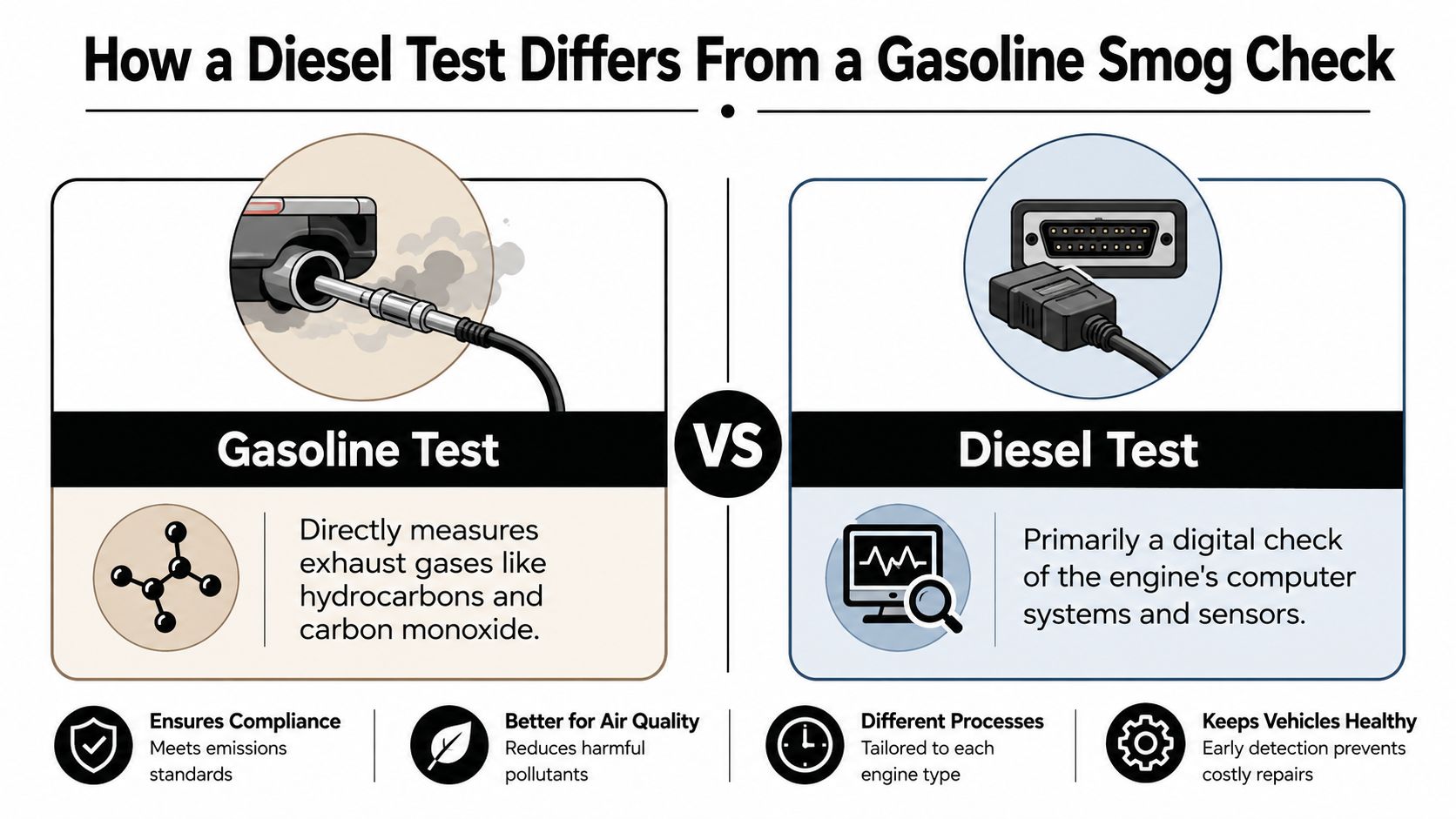
A gasoline inspection often makes the process visible. The technician may place a probe in the tailpipe and measure exhaust gases during an idle or dynamometer procedure. The familiar pollutants include hydrocarbons, carbon monoxide, and oxides of nitrogen.
A qualifying diesel inspection follows a different logic. Instead of relying primarily on a tailpipe gas sample, the technician connects to the vehicle's diagnostic system, checks readiness information and emissions-related fault data, inspects required hardware, and evaluates smoke-related compliance. The California diesel and gasoline smog comparison shows why a diesel test can look less dramatic while still being a formal emissions inspection.
What the technician is checking
OBD readiness tells the inspector whether the vehicle's emissions monitors have completed their self-tests. A recently disconnected battery or cleared diagnostic codes can leave those monitors incomplete.
The malfunction indicator lamp matters because the engine computer may identify an emissions fault even when the vehicle drives normally. A diesel doesn't need to produce obvious smoke to have a computer-detected problem.
The visual inspection confirms that emissions-control equipment remains present and connected. Depending on the vehicle, that may include exhaust-gas recirculation hardware, particulate-filter equipment, sensors, and related components.
Smoke compliance addresses visible exhaust. Diesel testing has historically focused more on opacity and visible particulate output than on the gasoline-style measurement of several tailpipe gases. California's current approach therefore combines digital information with physical inspection rather than depending on one reading alone.
The result is a test designed around how a diesel controls emissions. Don't assume that no tailpipe probe means no emissions test.
What Happens During a Diesel Smog Inspection
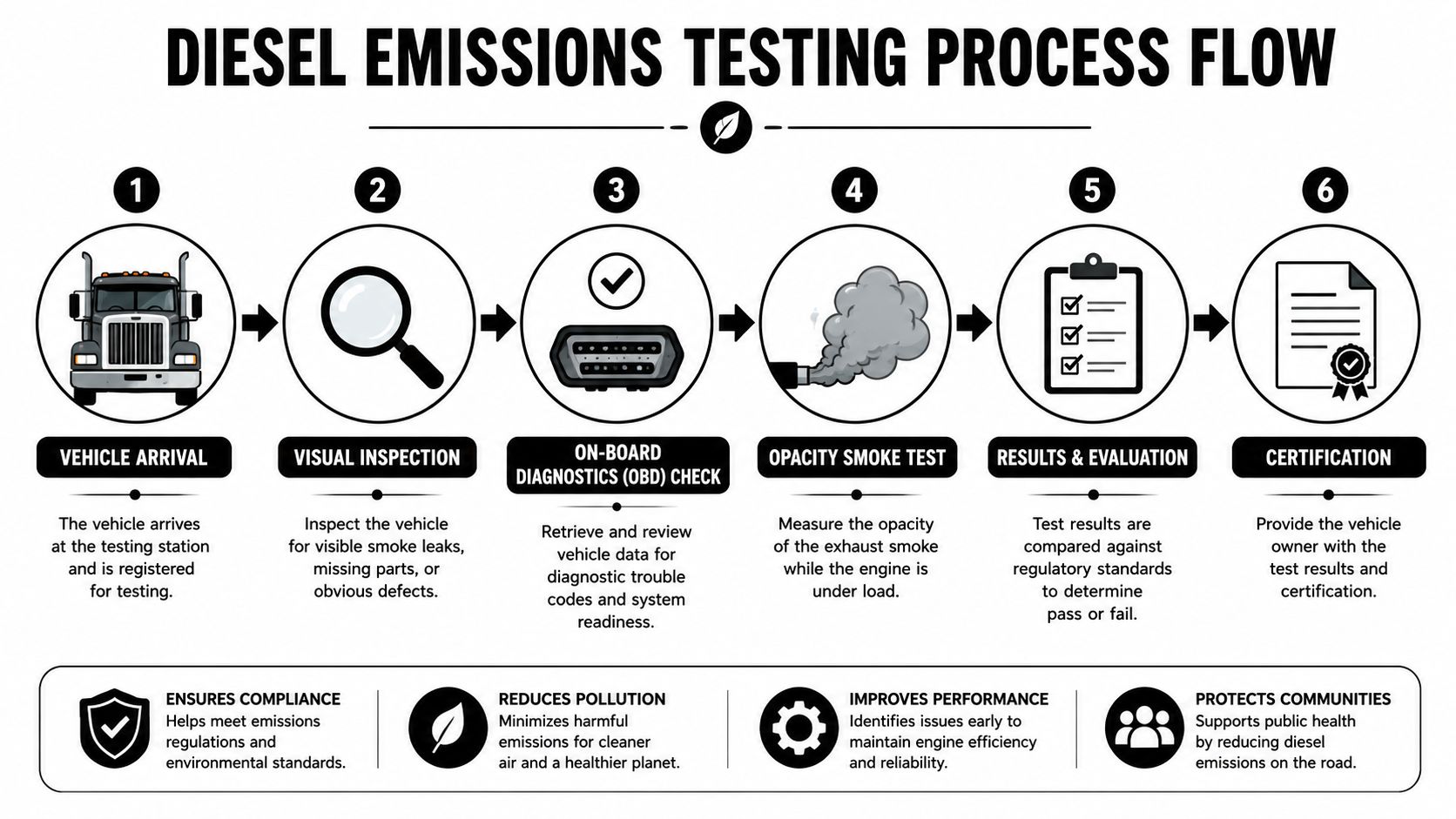
At a STAR station, the visit begins with identification and paperwork. Bring the DMV renewal notice if you have it, along with current registration and any repair records that could help explain recent emissions work.
The technician then confirms the vehicle information and looks over the emissions system. The inspection isn't a search for cosmetic flaws. It focuses on whether required diesel equipment is installed, connected, and unaltered. Missing sensors, disconnected wiring, or removed aftertreatment parts can create a problem before the scan is complete.
The inspection sequence
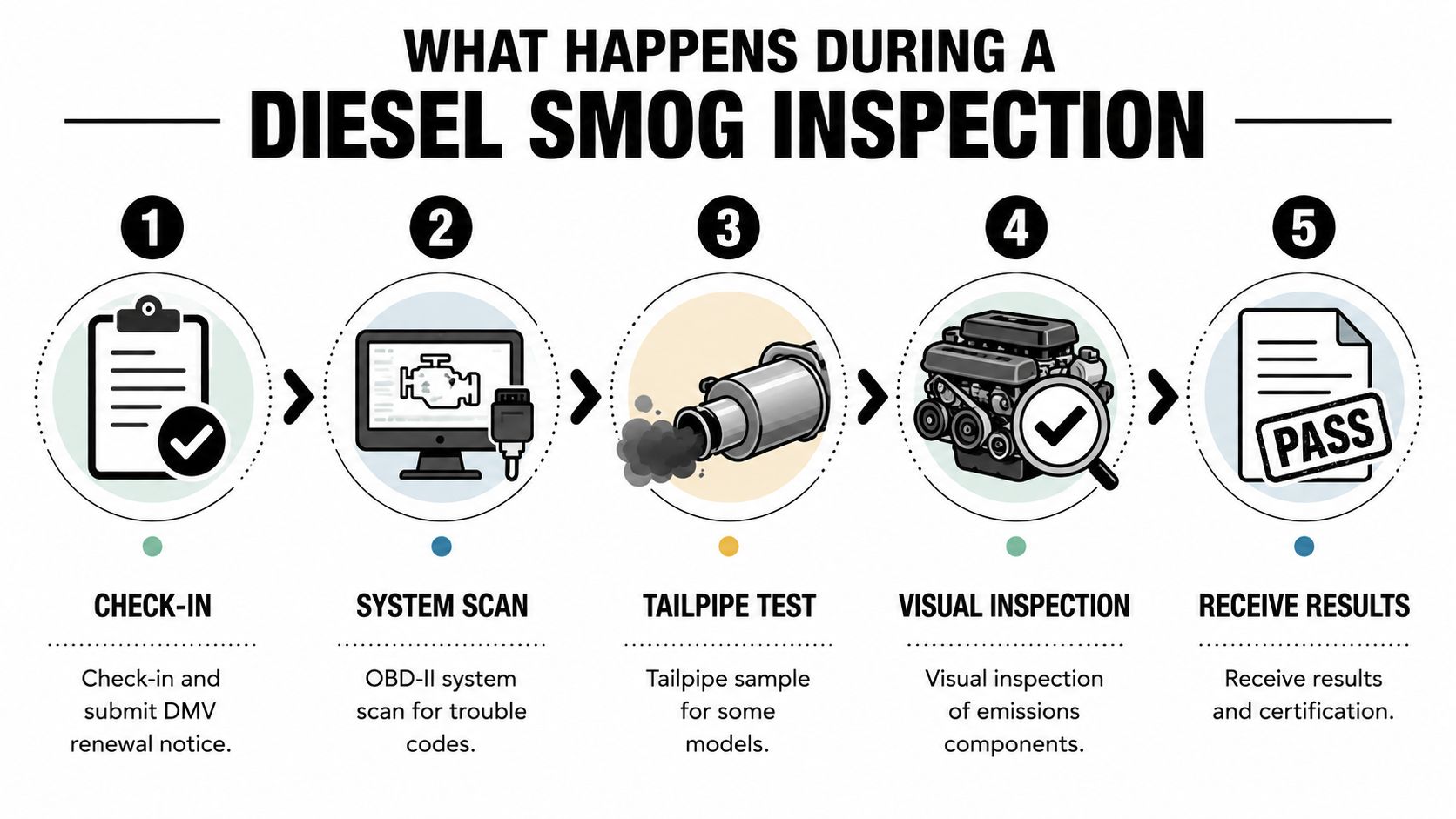
- Check-in and vehicle review. The station records the vehicle details and confirms why the certificate is needed.
- Visual emissions inspection. The technician checks components such as EGR equipment, turbo-related plumbing, and aftertreatment hardware for presence and apparent tampering.
- OBD connection. A scan tool connects to the standard diagnostic connector to read readiness monitors, the MIL status, and emissions-related trouble information.
- Smoke-related evaluation. The applicable procedure may include an opacity or acceleration-related check. Most qualifying newer diesels don't receive the gasoline-style tailpipe sniffer test.
- Electronic reporting. The station submits the result electronically for the registration process and provides the customer with the inspection outcome.
The exact procedure depends on the vehicle's model year and the applicable California inspection rules. The diesel emissions testing equipment used during inspection is intended to gather the information required by that procedure, not to force every diesel through the same gasoline test.
A vehicle with completed monitors and no active emissions fault usually moves through the process more smoothly than one with recently cleared codes. Allow enough time for the station to check the vehicle and complete the electronic paperwork, and ask about the expected appointment length when scheduling.
For a visual walkthrough of the process, the following video provides additional context:
The Heavy-Diesel Rule Most Owners Overlook
A heavy diesel truck isn't automatically outside California emissions oversight. It may be outside the ordinary light-duty biennial Smog Check program while still being covered by Clean Truck Check, CARB's separate heavy-duty compliance system.
CARB says nearly all diesel and alternative-fuel heavy-duty vehicles operating on California roads above 14,000 pounds GVWR must report into the Vehicle Inspection System, pay an annual compliance fee, and pass periodic emissions compliance testing. OBD-equipped vehicles are scanned electronically. Non-OBD diesels use smoke-opacity testing and a visual emissions-control inspection under the applicable procedure. See the CARB Clean Truck Check requirements before assuming a weight-based exemption ends every obligation.
The pathway depends on more than weight
Fleet owners and owner-operators commonly encounter this system, but the operating category matters too. Agricultural, government, and other vehicles may have limited exemptions or special treatment, so the owner needs to verify the exact classification rather than rely on a general rule.
| GVWR Class | Biennial Smog Check | Clean Truck Check Required | Reporting System |
|---|---|---|---|
| 14,000 pounds or less | Generally applies when the vehicle qualifies by model year and registration | Usually not the ordinary pathway | Standard California registration and Smog Check reporting |
| Over 14,000 pounds, heavy-duty diesel | Not the ordinary light-duty pathway | Generally applies to covered vehicles operating on California roads | CARB Vehicle Inspection System |
| Covered fleet or commercial vehicle | Depends on vehicle details | May apply even when the owner doesn't expect a passenger-car test | CARB compliance reporting |
| Vehicle with a specific exemption | May be exempt from one program | Must be verified against the separate rule | Applicable CARB or registration system |
The testing schedule is also distinct. CARB describes testing as semiannual for most covered vehicles, with testing increasing to quarterly for many OBD-equipped vehicles in October 2027. The future cadence is a scheduled rule, not a reason to wait. A truck can fail because its emissions hardware or OBD data shows a fault even when the driver sees little or no smoke.
For an East Bay commercial driver, the key question is whether the truck needs a light-duty smog certificate, Clean Truck Check compliance, or both under the vehicle's actual use and classification.
How to Prepare Your Diesel Before the Appointment
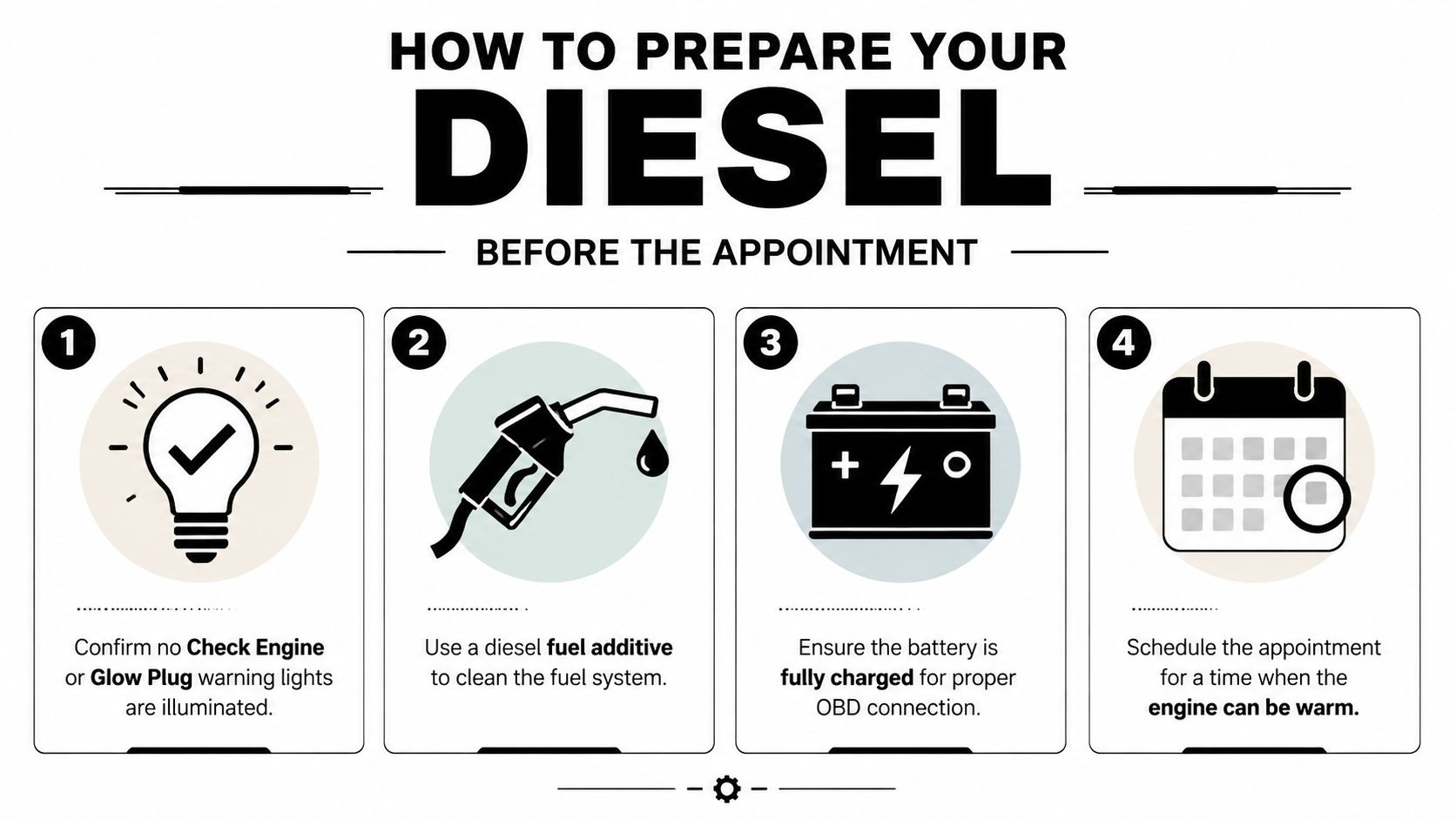
Preparation starts with the dashboard. An illuminated check-engine or emissions warning light signals that the vehicle's computer has identified a problem. A glow-plug light may indicate a diesel-system issue, although its meaning varies by vehicle, so don't ignore it because the engine still starts.
Don't clear codes just before the appointment. Disconnecting the battery or erasing diagnostic information can reset readiness monitors, leaving the vehicle unable to demonstrate that its emissions systems have completed their self-checks.
A practical pre-appointment checklist
- Scan before scheduling: Use a compatible OBD scanner to check for stored codes and monitor status. A parts store scan can identify clues, but a diesel technician may need manufacturer-level equipment for deeper diagnosis.
- Drive normally after repairs: A mixed city-and-highway drive helps the vehicle complete its required self-tests. The exact drive cycle depends on the make, engine, and emissions system.
- Inspect visible hardware: Look for loose sensor wiring, disconnected hoses, damaged intake plumbing, and missing EGR or aftertreatment components. Don't modify or remove emissions equipment.
- Check basic condition: Confirm that the fuel cap seals, the battery is charged, and the tires are in usable condition. These simple details can prevent avoidable delays.
- Bring paperwork: Take the DMV renewal notice, registration, prior certificates, and repair invoices if available.
- Arrive with the engine warm: A normal drive before the appointment can help the vehicle reach operating temperature, but don't use aggressive driving as a substitute for diagnosis.
A warning light that returns after clearing is useful information, not a minor nuisance. Have the underlying fault repaired first, then allow the monitors to complete before paying for another inspection.
Common Reasons Diesels Fail and How to Fix Them
Diesel failures often point to a specific system rather than a mysterious overall problem. The inspection result and diagnostic code should guide the repair. Guessing, repeatedly clearing codes, or replacing unrelated parts can make the process longer and more expensive.
Readiness monitors remain incomplete
A battery disconnect or code-clearing event can reset the monitors. The driver may notice no change in performance, yet the inspection computer still sees incomplete self-tests. The next step is to identify which monitor remains incomplete, repair any underlying problem, and complete the vehicle-specific drive cycle.
An emissions warning light is active
A check-engine or aftertreatment warning can result from a sensor fault, DPF issue, EGR problem, or another emissions-system condition. Read the code with a suitable scanner before replacing parts. If a regeneration is required, a qualified technician should determine whether the vehicle can complete a normal regeneration or needs a service procedure.
Smoke is visibly excessive
Heavy black or blue smoke can direct attention toward air delivery, fuel injection, turbocharger seals, or related engine faults. The repair may involve testing injectors, checking boost plumbing, or inspecting turbo components. Don't treat smoke as something an additive alone will solve.
Hardware is missing or tampered with
A deleted DPF, disconnected sensor, altered exhaust, or removed EGR component can create a visual or compliance failure. Restoring the original emissions configuration is the proper remedy, followed by code checks and monitor completion.
A fuel-system fault appears
Worn injectors and fuel-control problems can affect combustion and trigger emissions-related codes. A diesel specialist can test the fuel system and match the repair to the stored fault rather than relying on a general tune-up.
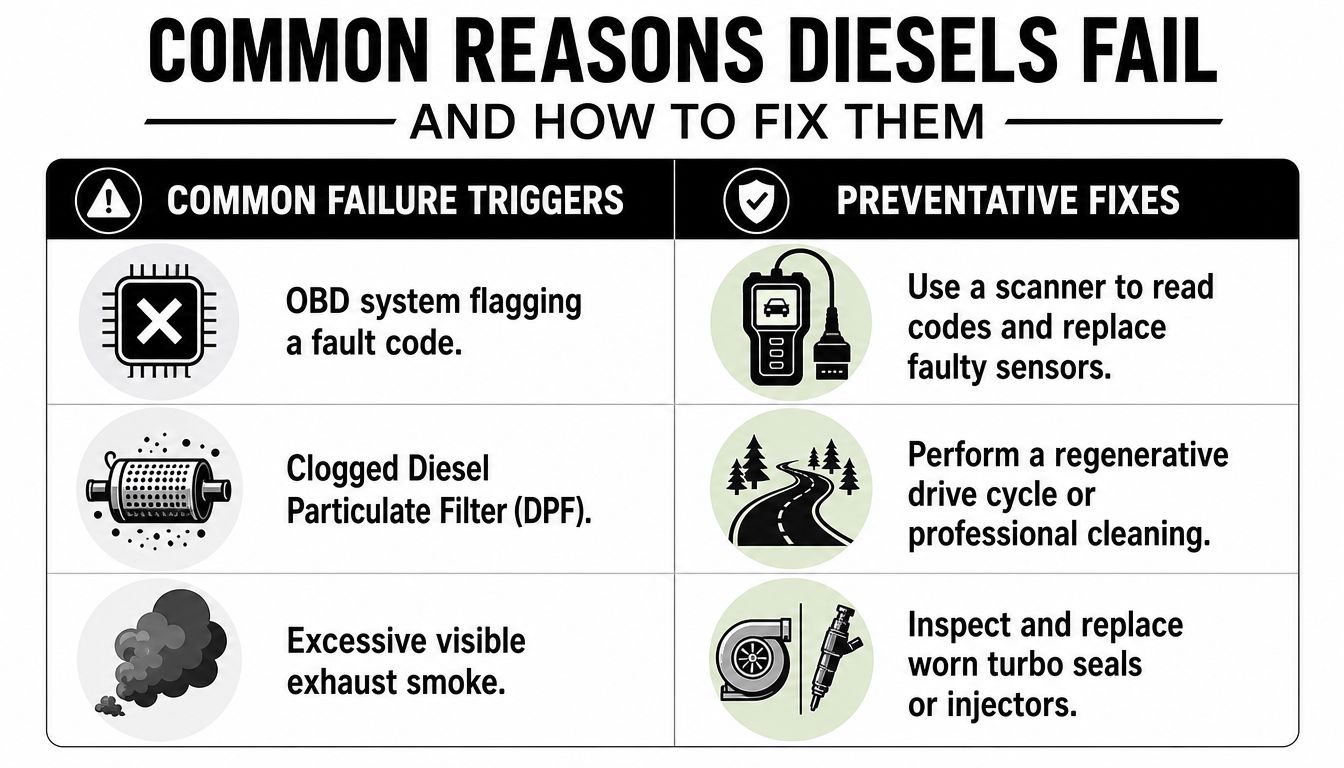
Keep the inspection failure report and repair invoice. Those documents help the technician understand what failed originally and whether the repair addressed the same condition.
What East Bay Drivers Can Expect at Speedy Smog
An East Bay diesel owner should arrive with the DMV renewal notice, current registration, payment, and any paperwork from recent emissions repairs. If the vehicle is a newer light-duty diesel, the technician will generally focus on the applicable OBD information, visual emissions equipment, and smoke-related requirements rather than treating it like a gasoline car.
A STAR-certified station is important when the DMV directs you to a station with that certification. The station's role is to perform the approved inspection and transmit the result through California's reporting system. Ask about diesel capability when booking, especially if the vehicle has unusual equipment or a higher GVWR.
Make the visit easier
Call before arriving if the vehicle is a diesel pickup, commercial truck, modified work vehicle, or anything near the GVWR boundary. Ask which location and inspection pathway fit the vehicle, whether appointments are available, and what documents the technician wants to see.
Speedy Smog in San Leandro states that it performs diesel smog checks for qualifying diesel vehicles from 1998 to the present and serves drivers who need California registration certification. The station is located at 15275 Washington Avenue in San Leandro, and its service information describes support for newer vehicles, older vehicles, diesels, and hybrids. Confirm current availability and pricing directly with the station before visiting.
The clearest answer to “do diesel cars need emissions test” is therefore conditional but manageable. Check the model year, read the GVWR label, identify personal or commercial use, and ask whether the vehicle belongs in the regular Smog Check program or a separate heavy-duty system. That four-part check prevents most surprises at the counter.
Bring your DMV renewal notice and vehicle details to Speedy Smog in San Leandro for help identifying the correct diesel inspection pathway. Call ahead if you're bringing a heavier truck or a vehicle with recent emissions repairs, so the team can confirm the appropriate service before you arrive.
You're probably dealing with the same annoying problem most diesel owners face right before registration or a fleet deadline, the truck runs fine, but the paperwork says it still needs an emissions test for diesel trucks. The lane looks simple from the waiting room, then the technician starts talking about smoke opacity, OBD readiness, aftertreatment, and whether the vehicle is eligible for the specific test path it needs. That's where owners get tripped up, because diesel inspections aren't just a bigger version of a gasoline smog check.
Table of Contents
- What Makes Diesel Truck Emissions Testing Different
- Types of Emissions Tests Used for Diesel Trucks
- Which Diesel Trucks Are Required to Test
- How to Prepare Your Diesel Truck for Testing Day
- Common Failure Causes and How to Fix Them
- The Shift Toward Real-World Emissions Monitoring
- Costs, Paperwork, and Where to Get Tested in the East Bay
What Makes Diesel Truck Emissions Testing Different
A customer rolls in with a clean-looking diesel pickup, expecting the same routine he's used to with a gas car. Instead, the conversation goes straight to the truck's model year, weight class, and emissions hardware, because diesel testing starts with a different rulebook. In California, the inspection lane isn't just looking for a tailpipe number. It's checking whether the truck fits the state's diesel-specific compliance path, and that's why the experience feels more technical than a typical passenger-vehicle smog check.
Diesel testing measures different pollutants
Gasoline smog checks usually revolve around hydrocarbon and carbon monoxide control. Diesel inspections care much more about particulate matter and nitrogen oxides, or NOx, because those are the pollutants diesel engines are known for controlling through combustion strategy and aftertreatment. Europe's heavy-duty limits show how far that focus has shifted, Euro III allowed 5.0 g/kWh NOx and 0.16 g/kWh PM in 2000, while Euro VI tightened the rules to 0.46 g/kWh NOx, 0.01 g/kWh PM, and a particle-number limit of 6.0×10^11 per kWh when it became effective in 2013, according to DieselNet's European heavy-duty standards summary. That's a good reminder that modern diesel compliance isn't just about visible smoke anymore.
The California side works the same way in practice, even if the exact lane procedure differs by vehicle type. The technician is looking for whether the truck is clean under load, whether the emissions system is intact, and whether the engine is behaving the way the calibration says it should. That's why diesel checks often feel more like a mechanical diagnosis than a simple emissions measurement.
Practical rule: if a diesel truck has an emissions complaint, assume the inspection will care about both the hardware and the engine behavior, not just whether the exhaust looks dark.
Why the smog lane looks different for a diesel
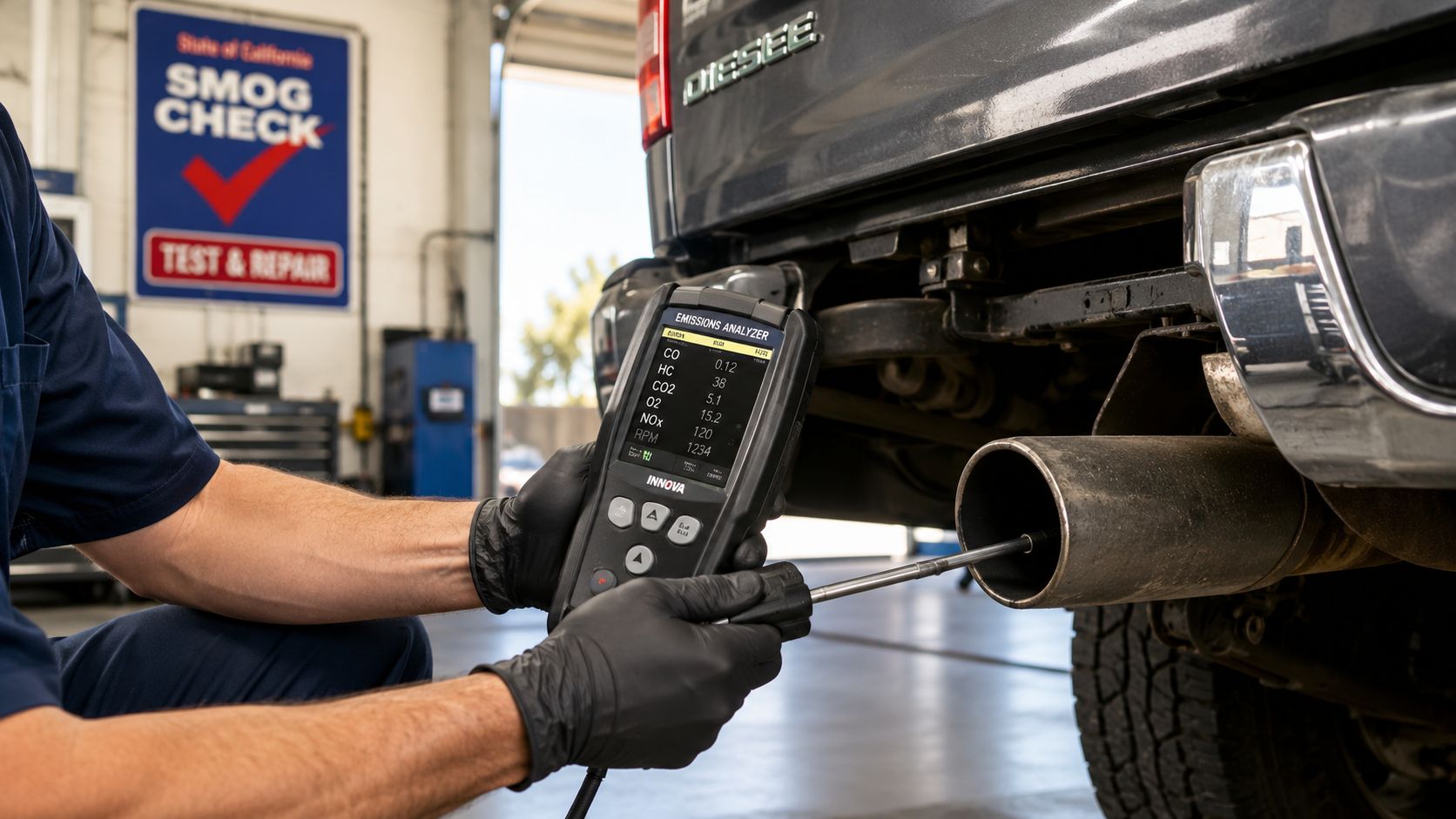
In California, diesel testing is handled in a more specialized way than a basic gas-car inspection, and the Bureau of Automotive Repair framework is built around that difference. Diesel trucks may need equipment that can evaluate exhaust smoke, onboard diagnostics, and in some cases the condition of aftertreatment systems. That's why the station has to match the test to the truck instead of running a one-size-fits-all process.
A diesel owner usually notices the difference right away. The technician may inspect the vehicle more closely, ask about recent repairs, or verify whether the emissions system has been modified. If the truck has the wrong equipment, a bad tune, or a malfunction that doesn't show up at idle, the test can still fail even if the engine sounds fine in the parking lot.
Types of Emissions Tests Used for Diesel Trucks
The safest way to think about a diesel inspection is as a set of gates. The truck has to clear the right gate for its class and model year, and not every truck faces the same test. For many owners, the first surprise is that the technician may use a smoke opacity test, an OBD check, or both, depending on what the vehicle is and how it's certified.
Smoke opacity testing is the fast visual screen
Opacity testing is the most familiar diesel-specific lane check. The technician uses an opacity meter to see how much light the exhaust blocks during snap-acceleration events, which is a quick way to catch gross particulate-control problems. Ontario's diesel inspection procedure requires three to nine snaps and uses the average opacity of the three official snaps, while Colorado's standard sets a 20% opacity limit for 5 seconds for naturally aspirated diesel vehicles, according to Ontario's emissions directive. Higher opacity usually points to incomplete combustion, injector trouble, turbo problems, EGR or airpath issues, or a loaded or failed DPF.
That's why smoke testing matters even when the truck drives normally. A diesel can feel strong on the road and still haze hard during a snap test. In the lane, that haze tells the technician the engine isn't burning or filtering fuel the way it should.
If the truck rolls out of the yard clean but smokes hard on throttle, the problem usually isn't cosmetic. It's mechanical.
OBD checks catch what the eye can't
Newer diesel models also go through onboard diagnostics checks. That means the scanner looks for fault codes, readiness issues, and emissions-system problems that a quick tailpipe glance would never catch. Under U.S. heavy-duty rules, modern engines are certified on standardized engine dynamometer cycles such as the FTP, while in-use compliance can be checked with moving-average-window portable emissions measurements. CARB uses a 3-bin MAW method and EPA uses a 2-bin MAW method for off-cycle testing, as summarized by DieselNet's U.S. heavy-duty standards page.
That difference matters because a diesel might pass a short idle-style lookover and still fail when it's worked harder. The MAW approach is designed to expose emissions that show up under real driving, not just in a calm test bay. If your truck has active warning lights, unresolved codes, or a recent emissions repair that hasn't completed its monitor cycle, that's where the lane usually stops you.
For a look at the kind of equipment a diesel-focused station uses, the shop's diesel emissions testing equipment overview is a useful reference point.
The procedure changes with the truck
The important part is this, the test method depends on the truck's vehicle class and model year. Older diesels may be screened differently from modern heavy-duty engines, and a truck that lives under one rule in the lab can face another rule in the field. The inspection lane reflects that split.
Which Diesel Trucks Are Required to Test
The confusion usually starts at the counter with a simple question, “Do I need this?” The answer depends on how California classifies the truck, not just whether it's diesel. Model year, weight rating, and whether the vehicle is a personal-use pickup or a heavier-duty unit all matter, and the rules don't read the same for every owner.
Weight class is the first filter
For heavy-duty diesel compliance, the key divider is whether the vehicle falls into the class of trucks that California treats as subject to diesel emissions inspection. That's why one owner may need a test every renewal cycle while another diesel driver never sees the same requirement. Personal-use pickups can still fall into emissions oversight depending on how they're registered and used, while heavier commercial units are much more likely to face regular testing duties.
A lot of missed deadlines happen because owners assume “pickup” means exempt. That's not a safe assumption. The actual requirement follows the vehicle's compliance category, and that's where the registration record matters more than the badge on the tailgate.
Registration status changes the answer
Out-of-state vehicles can't ignore California rules just because they carry another plate. If the truck operates on California roads and falls into the regulated diesel category, it can still face testing obligations. That's the part owners miss when they're just passing through or running a regional route.
For a direct station-level breakdown of eligibility questions, see the diesel smog check requirements guide. The practical takeaway is simple, the question isn't “Is it a diesel?” It's “Does this specific diesel fall into the testing class the state is enforcing?”
Biennial timing is not the whole story
Many owners think in terms of an every-other-year appointment because that's how they've handled smog in the past. Diesel compliance can be more complicated than that, especially once the vehicle is part of a broader in-use monitoring system. The inspection lane may be the visible checkpoint, but the registration record and current enforcement scheme decide whether the truck needs to show up.
Counter rule: if you're unsure, check the truck's registration category and emissions status before you schedule anything. Guessing wrong wastes time, and in some cases it creates a registration problem you could've avoided.
How to Prepare Your Diesel Truck for Testing Day
A diesel truck usually fails for reasons the owner could've seen coming. The fix isn't magic, it's giving the emissions system enough time, heat, and clean operating conditions to do its job before the truck reaches the station. That's why prep starts before test day, not at the curb.
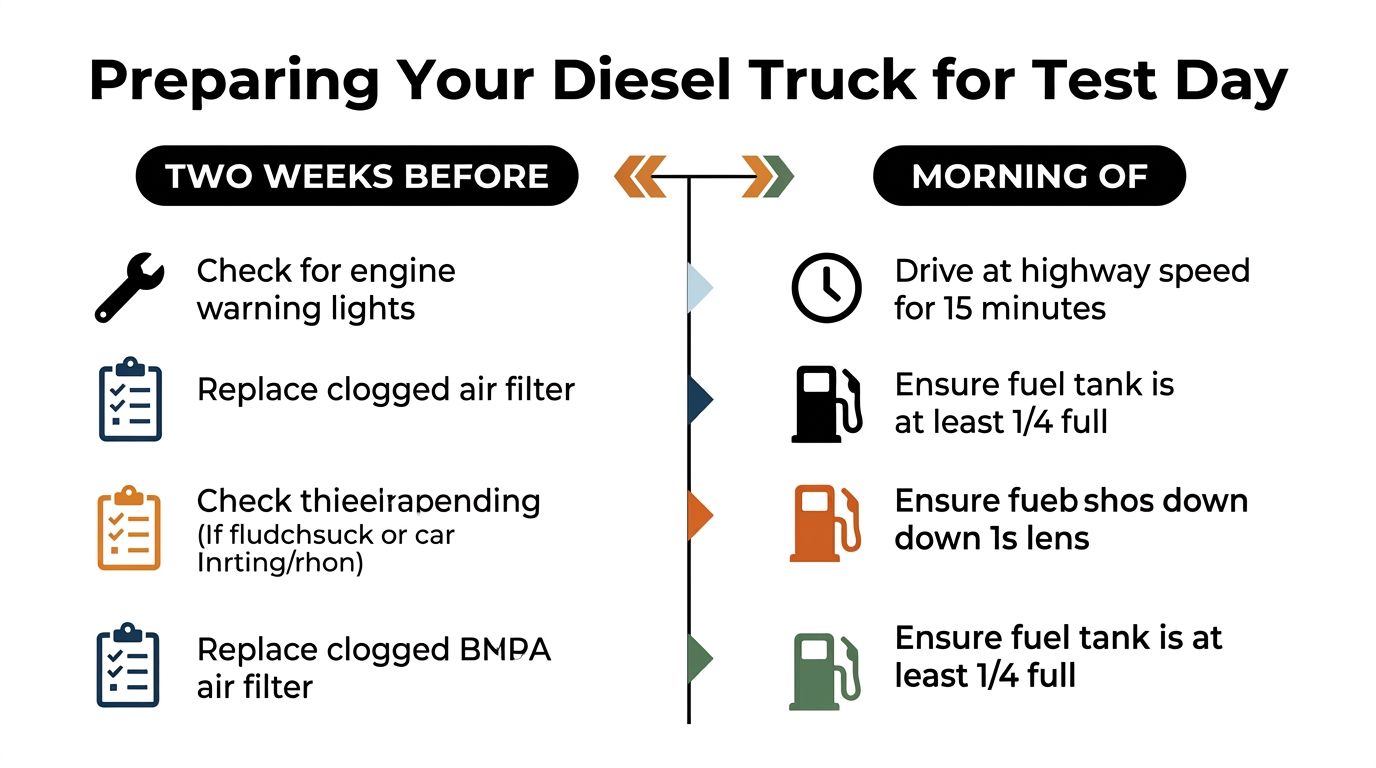
Two weeks out, fix the obvious stuff
If the check engine light is on, don't roll the truck in and hope the station overlooks it. Emissions-related warning lights and stored faults are common reasons a diesel gets sent away, especially if the issue points to aftertreatment or sensor problems. That's also the point to verify that the truck is still stock where it matters, because deleted or tampered emissions hardware is a fast route to failure.
The other job at this stage is maintenance. Replace a clogged air filter, inspect for boost leaks, and make sure the exhaust and intake tract aren't introducing obvious airpath problems. If the truck has been running rough, smoking, or regenerating poorly, it's better to diagnose that now than to discover it in the lane.
The week before should be about readiness, not luck
Give the DPF a chance to complete a healthy regeneration cycle before the appointment. If the truck has been idled a lot or used only for short hops, the aftertreatment system may not be hot enough to work correctly. A long highway drive can help clear that up, and it's a lot cheaper than paying for a failed test and a second visit.
Good habit: don't schedule a diesel inspection right after days of stop-and-go work. Take the truck on a decent run first, then come in while the emissions system is hot and stable.
Morning of the appointment
Drive the truck at highway speed for at least 20 minutes before you arrive. That helps bring the engine and aftertreatment system up to temperature, which is exactly where you want them for an opacity check or OBD evaluation. Keep the fuel tank from running near empty, and don't arrive right after a cold start if you can avoid it.
If you want the truck to present well, keep the morning simple. No last-minute tuning changes, no unplugging sensors, and no “let's clear the codes and see what happens” gamble. The lane sees what's real, not what was erased five minutes ago.
Common Failure Causes and How to Fix Them
Diesel failures usually sort into three buckets, visible smoke, diagnostic faults, and tampered hardware. If you know which bucket you're in, the fix becomes easier to plan and a lot less expensive to guess at. The order below reflects what usually deserves attention first in the shop.
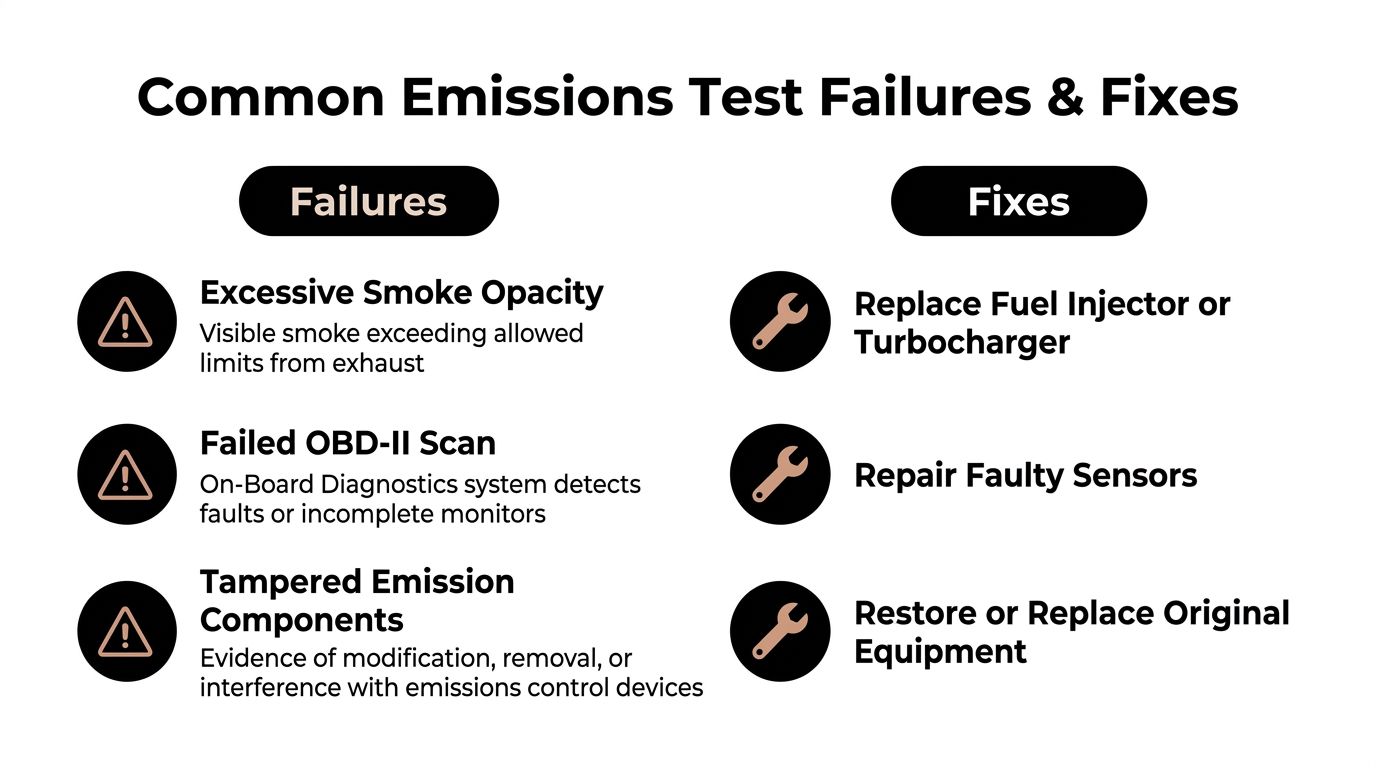
Excessive smoke opacity
If the truck puffs hard during snap acceleration, start with combustion and air management. Higher opacity usually means injector problems, turbo faults, EGR issues, airpath leaks, or a DPF that's loaded or failing. That's where a smoke test becomes useful, because it gives the technician a quick picture of whether the engine is physically controlling particulate output.
The repair path depends on what's wrong. A dirty air filter is a cheap fix, but it won't save a truck with weak injection, damaged boost plumbing, or a plugged aftertreatment system. If the DPF has reached the point where regen won't recover it, it needs proper service, not wishful thinking.
OBD faults and unresolved monitors
A second common fail comes from the computer, not the tailpipe. NOx sensor issues, EGR faults, and incomplete readiness monitors can stop the truck even if the engine sounds decent. The scanner doesn't care how the truck feels to drive, it cares whether the emissions system can prove it's working.
That's why clearing codes and immediately heading to the station rarely works. If the truck hasn't completed its drive cycle after a repair, the monitors may still be incomplete. Fix the fault, drive it the way the system needs to see it, then bring it back once the computer has had time to relearn.
Tampered or deleted equipment
This is the fastest way to turn a routine inspection into a bigger problem. Missing sensors, deleted exhaust treatment, or obviously altered hardware tell the technician the truck isn't configured the way it should be. Restoring original equipment is the fix, not patching over the symptom.
For a diesel owner, the cheapest path is usually prevention. Keep the hardware intact, repair faults before they cascade, and don't assume a tune that makes the truck “run better” will survive an inspection. In the lane, it usually doesn't.
The Shift Toward Real-World Emissions Monitoring
The biggest change in diesel compliance is that the test doesn't end at the station door anymore. Real-world measurements have shown that diesel trucks can emit much more NOx on the road than certification numbers suggest. In one California Energy Commission study of on-road diesel goods-movement trucks, cycle-averaged NOx emissions for all 18 diesel heavy-duty vehicles measured 0.686 g/bhp-hr, and route-averaged emissions for the 0.2 g diesel goods-movement trucks ranged from 0.38 to 0.53 g/bhp-hr and averaged 0.58 g/bhp-hr. The same report found daily average PEMS NOx emissions as high as 3.616 g/bhp-hr in the broader dataset, according to the California Energy Commission report.
Why a snapshot test can miss field problems
That gap explains why a truck can pass a smoke check and still attract attention later. The lane gives you a moment in time, while road use shows what the engine and aftertreatment are doing across real loads, traffic, idling, and heat cycles. If the truck's calibration, sensors, or exhaust treatment only behave well in one narrow situation, the field data can tell a different story.
That's also why the newest U.S. heavy-duty rules are paying more attention to idling and in-use behavior. EPA has proposed a manufacturer-run in-use emissions testing program for heavy-duty diesel trucks, and diesel engine standards now include idling NOx limits of 10 g/hr for 2024–2026 and 5 g/hr for 2027 and later model years. Those limits matter because a truck can look fine during a quick inspection and still face scrutiny if it spends time idling or operating in ways that raise emissions in service, according to EPA's proposed rule page.
What owners should take from that shift
The compliance mindset has changed. A passing result at the smog station still matters, but it's no longer the whole compliance story, especially for trucks that work hard, idle often, or depend on aftertreatment that can drift out of spec under real use. The smartest owners treat the inspection lane as one checkpoint in a longer emissions record, not as the finish line.
That's the part most consumer advice skips. The truck doesn't just need to pass today, it needs to stay clean enough that later monitoring doesn't tell a different story.
Costs, Paperwork, and Where to Get Tested in the East Bay
Bring the truck's registration paperwork, be ready to explain any recent emissions repairs, and don't show up assuming the station can guess your test path. If the vehicle fails, you'll need to correct the issue and retest, which is why it helps to know whether your shop handles diesel-specific work before you arrive. California also recognizes STAR-certified stations that meet higher Bureau of Automotive Repair performance standards, which gives owners another layer of confidence in the result.
What to expect on timing and service
For newer vehicles, inspections are often quick once the truck is hot and ready, and a diesel-focused station can usually keep the lane moving if the paperwork is in order. One East Bay option is Speedy Smog's station list, where the shop in San Leandro handles diesel inspections at 15275 Washington Ave. The business also states that typical tests for 2000+ vehicles are completed in about 10 to 15 minutes, which is helpful if you're trying to get in, get certified, and get back to work.
What to do if the truck fails
Don't leave the station guessing about the repair. Ask for the failure reason, then fix the actual cause before returning for a retest. If the problem is a smoke issue, focus on combustion and aftertreatment. If it's a code or readiness issue, repair the sensor or emission-control fault and give the truck time to complete the proper drive cycle.
A clean retest is usually faster than a messy first attempt. Bring the same documents back, keep the truck in the right temperature range on the drive over, and avoid making new changes between visits.
If you want a diesel inspection handled by a station that knows the difference between a smoke screen and a real emissions issue, schedule with Speedy Smog in San Leandro. They test diesel vehicles, work with STAR certification standards, and can help East Bay drivers get the compliance result they need without wasting a whole day at the counter.
Your DMV renewal notice shows up, and there it is: Smog Certification Required. If you drive a diesel truck, van, or SUV in the East Bay, that line usually leads to the same questions. Does my diesel even need testing? What do they check? Why did my friend's truck fail when it “ran fine”?
That confusion is normal. California's diesel smog check requirements aren't simple, and a lot of bad advice gets passed around in parking lots, online forums, and job sites. Owners hear half a rule, apply it to the wrong vehicle, and end up wasting a trip or getting stuck before registration.
A good diesel smog visit shouldn't feel like guesswork. It helps to know which vehicles are tested, what a technician looks for, and what problems usually cause a failure. Once you know those pieces, the process gets much easier to manage.
Table of Contents
- Your Diesel Smog Check Guide
- Does Your Diesel Need a Smog Check
- What Happens During a Diesel Smog Inspection
- Understanding Diesel Smog Check Exemptions
- Top Reasons Diesel Vehicles Fail Smog Checks
- Your Pre-Test Checklist for a First-Time Pass
- Get Your Diesel Certified at Speedy Smog
Your Diesel Smog Check Guide
Diesel owners usually don't struggle because they ignore the rules. They struggle because the rules are technical, and the details matter. A truck can drive well, start every morning, and still fail a smog inspection because the monitors aren't ready, the software isn't approved, or smoke hangs in the exhaust a little too long.
That's why the smartest approach is practical, not theoretical. Start with three questions:
- Does my diesel fall into the California testing program?
- What does the inspection include?
- Is there anything on my vehicle likely to trigger a failure?
If you answer those before your appointment, you avoid most of the usual headaches.
Practical rule: A diesel smog check is easier when you treat it like a compliance inspection, not just a quick errand.
Owners often focus only on the dashboard. If there's no warning light, they assume they're good. That works sometimes, but not often enough. Diesel testing also looks at emissions equipment, computer readiness, and visible smoke. A truck that “feels fine” can still have a problem where it counts for inspection.
This is especially true in the East Bay, where many diesel vehicles are work trucks, cargo vans, and daily drivers that rack up miles under real conditions. Short trips, recent repairs, battery disconnects, and aftermarket tuning all show up at smog time.
The good news is that most failures follow familiar patterns. Once you know the rules and the common trouble spots, you can usually spot problems before the test does.
Does Your Diesel Need a Smog Check
A lot of East Bay diesel owners call us after the DMV renewal notice shows up and catches them off guard. The fastest way to sort it out is to check two things on the vehicle first: the model year and the Gross Vehicle Weight Rating, or GVWR, on the driver-side door jamb.
For most light-duty diesel owners, the rule is straightforward. In California, diesel vehicles with a 1998 or newer model year and a GVWR under 14,500 pounds are generally part of the biennial Smog Check program. 1997 and older diesel vehicles are generally exempt, according to the California Bureau of Automotive Repair Smog Check program.
That covers many pickups, diesel SUVs, and Sprinter-style vans we see at the shop.
A few situations still catch owners by surprise:
- Registration renewal: If your DMV paperwork asks for a smog certificate, your diesel likely falls into the program.
- First California registration: An out-of-state diesel brought into California may need a smog inspection before it can be registered here.
- Change of ownership: A sale or transfer can trigger a smog requirement, depending on the transaction.
If you want the bigger picture on state testing rules, our guide to California smog check rules for vehicle owners explains where diesel fits in.
California diesel smog check requirements at a glance
| Vehicle Model Year | Gross Vehicle Weight Rating (GVWR) | Smog Check Required? |
|---|---|---|
| 1997 and older | Under 14,500 lbs | No |
| 1998 and newer | Under 14,500 lbs | Yes, every two years for registration renewal |
| 1997 and older | 14,500 lbs and above | Check program status carefully |
| 1998 and newer | 14,500 lbs and above | May fall outside the standard biennial program. Verify exact requirement before assuming exemption |
Where owners get tripped up
The biggest mix-up is using the wrong weight number. Curb weight is not the number that matters here. GVWR is. We see this with work trucks all the time. The truck may not look heavy, but the manufacturer-rated weight on the door label is what determines whether it falls into the standard program.
Another common problem is assuming diesel follows the same pattern as gasoline. Diesel owners often expect a grace period or assume age alone settles the question. That leads to last-minute appointments, registration delays, and avoidable stress.
If you're unsure, check the door jamb label and your registration paperwork before you book the test.
Five minutes spent verifying the model year and GVWR can save you a wasted trip, especially if you drive a diesel work vehicle and cannot afford downtime.
What Happens During a Diesel Smog Inspection
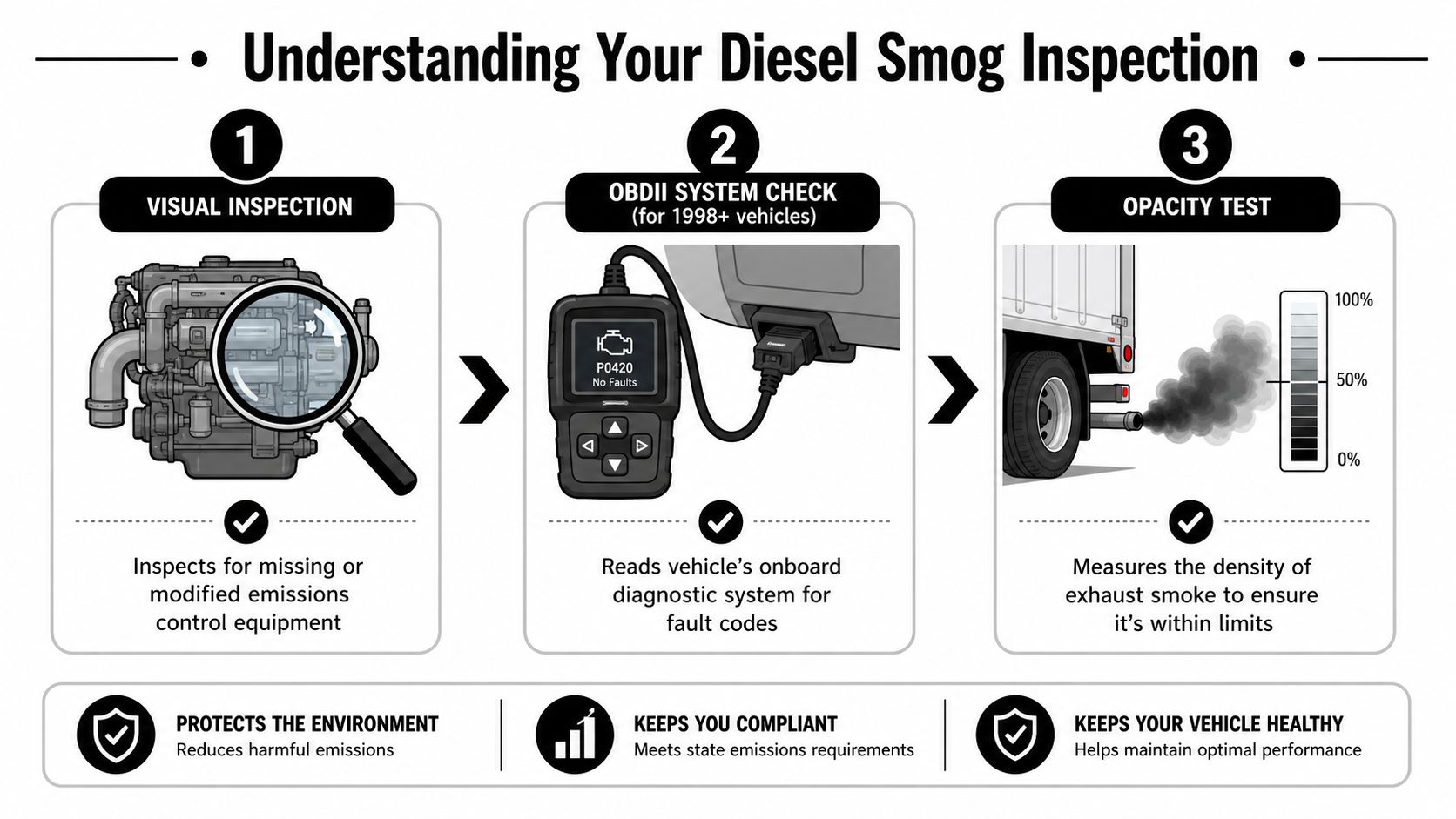
A lot of diesel owners walk in expecting one quick machine test. The actual inspection is more hands-on than that. At the shop, we verify three things: the emissions parts that should be on the vehicle are still there, the onboard computer shows the system is working properly, and the exhaust does not produce excessive visible smoke during the required procedure.
If you want a better sense of what the shop is using during the test, this page on diesel emissions testing equipment and inspection hardware shows the tools behind the process.
Step one is a visual inspection
This is often where problem trucks get flagged first.
The technician checks for missing, modified, or clearly non-compliant emissions components. On diesel vehicles, that usually means looking closely at the DPF, related emissions hardware, and signs that a system has been removed, bypassed, or altered.
We see this with work trucks fairly often. The owner may be focused on how the truck runs, but a visual failure can happen even if the engine feels strong on the road. If the setup does not match what the vehicle is supposed to have, that issue usually shows up right away.
Step two is the computer check
Next comes the onboard diagnostic check. The technician connects to the vehicle, reads fault information, and checks whether the emissions monitors are ready.
This part trips up owners who recently cleared codes, replaced a battery, or disconnected power during repairs. The warning light may be off, but the system can still show incomplete readiness. If the monitors have not finished their self-checks, the vehicle may not pass that day.
For newer light-duty diesels, the readiness rules are tighter than many owners expect. That is why a truck that seems fixed after a repair still needs enough normal driving time before it is ready for inspection.
Step three is the smoke test
The last part is the smoke inspection. In this stage, real-world diesel problems tend to show themselves.
The technician observes the exhaust and performs the required snap acceleration procedure to see whether visible smoke clears within the allowed limit. A diesel that feels acceptable in daily driving can still fail here if it has injector problems, heavy soot buildup, poor maintenance history, or an emissions issue that only shows up when the engine is revved.
From a shop perspective, this is one of the biggest surprises for owners. “It drives fine” does not always mean “it will pass smog.” If your truck has been smoking on cold starts, under throttle, or after long idle time, it is smart to address that before you come in.
Understanding Diesel Smog Check Exemptions
Many owners experience issues when they hear that some diesels are exempt, then stretch that idea farther than the rules allow. A quick assumption can turn into a DMV problem later.
Older diesels are the clearest exemption
The simplest exemption is age. If your diesel is model year 1997 or older, it falls outside the biennial light-duty diesel smog requirement covered earlier.
That's the cleanest exemption because it's based on model year. There's not much interpretation involved. If the vehicle is old enough, it's outside that part of the program.
Weight alone doesn't tell the whole story
The more confusing issue is weight. Many diesel owners believe anything over 14,000 lbs is automatically exempt, but that's not a safe shortcut. As noted in this guide to California diesel smog exemptions and GVWR checks, the right approach is a two-step verification process: confirm the vehicle's GVWR on the manufacturer's door jamb, then cross-reference that with the applicable CARB program requirements.
That matters because not every vehicle outside the standard light-duty smog lane is “free and clear.” Some heavier diesels fall under different compliance programs instead of the familiar biennial test. Owners who assume exemption without checking the exact program can end up with registration issues or compliance confusion.
A practical way to handle this is:
- Check the label first. Use the manufacturer's GVWR, not a guess.
- Match the vehicle's use. Personal, commercial, and specialized use can affect what program applies.
- Verify before renewal time. Waiting until your registration deadline is the worst time to sort this out.
Don't build your plan around “my buddy said heavy diesels are exempt.” Verify the door sticker, then verify the rule that applies to that specific vehicle.
The owners who stay out of trouble are usually the ones who document the vehicle correctly before they ever pull into a test bay.
Top Reasons Diesel Vehicles Fail Smog Checks
A diesel can run strong on the road and still fail in the bay. At Speedy Smog, the repeat problems are pretty consistent. The onboard system is not ready, emissions parts or software do not match California rules, or the vehicle produces visible smoke during inspection.
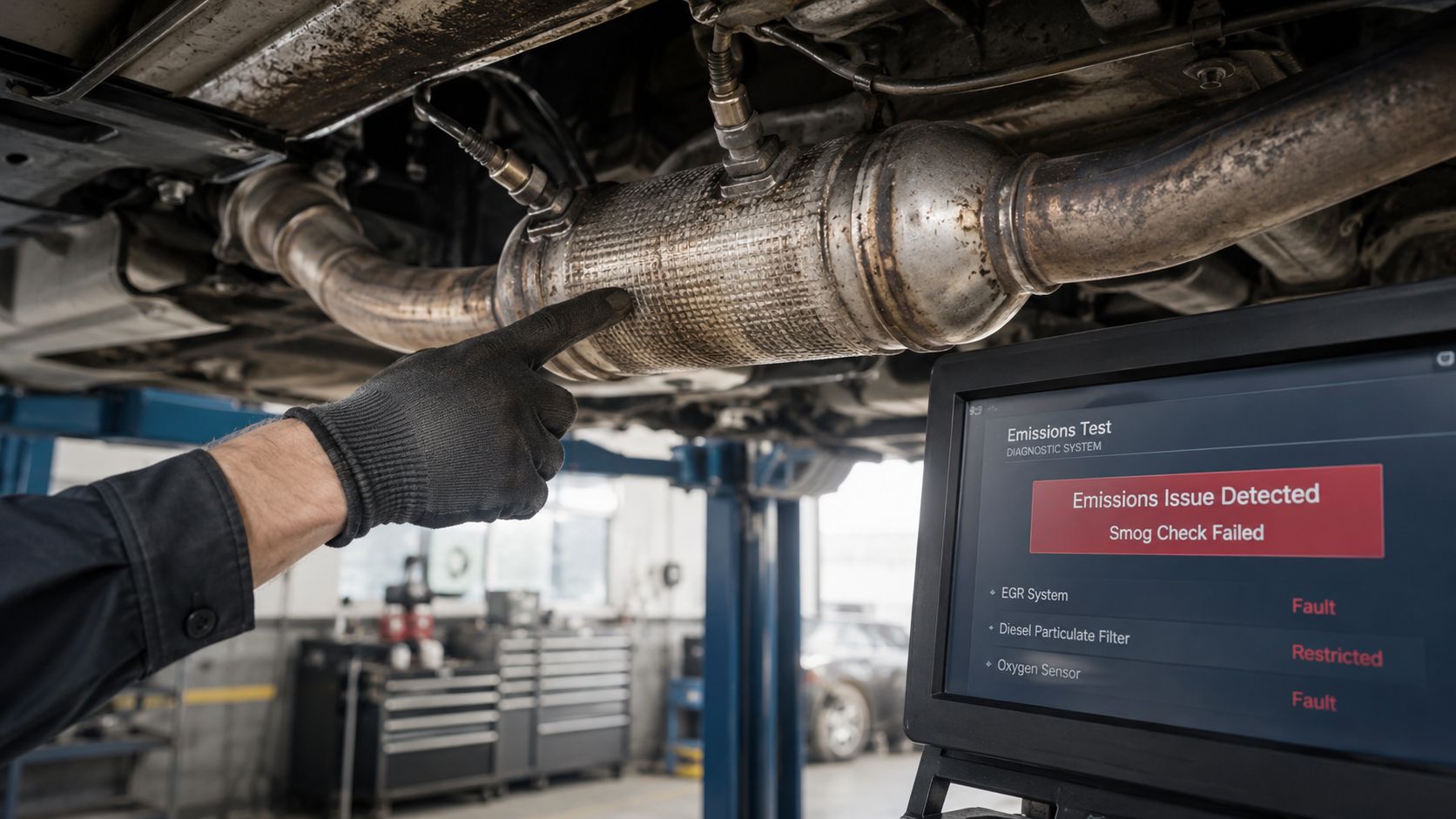
I hear the same comment all the time: “It passed last time.” That history helps, but it does not guarantee the next result. Batteries get disconnected. Repairs interrupt monitor completion. Used trucks show up with tuning or missing hardware that the current owner did not know about. A smog check looks at the vehicle as it sits that day.
Readiness monitors not set
This is one of the easiest failures to prevent, and one of the most common on newer diesels. If codes were recently cleared, the battery was disconnected, or a repair changed how the system operates, the computer may still show monitors as incomplete. In that condition, the inspection may stop before it really starts.
For newer light-duty diesels, the monitor rules are tighter than many owners expect. As noted earlier, model year 2007 and newer light-duty diesel vehicles have very limited allowance for unset monitors. If the wrong monitor is still not ready, the vehicle can fail even with no warning light on.
A quick pre-scan saves a wasted trip. Our diesel smog inspection checklist for California drivers is a good place to start if you want to catch that issue before you head to the shop.
What helps:
- Drive the vehicle normally after repairs. Give the computer time to complete its self-checks.
- Scan for readiness status before the appointment. “No codes” does not mean “ready.”
- Repair the actual fault first. Clearing codes without fixing the cause usually leads right back to the same problem.
What causes trouble:
- Disconnecting the battery right before test day
- Clearing the check engine light and coming straight in
- Assuming the truck is ready because it feels fine
Modified parts and software
Performance work is a big failure point. Owners add a tuner for towing, buy a used diesel with unknown upgrades, or replace parts with something that fits physically but does not meet California requirements. Then the visual inspection or system check catches it.
Diesel software changes are a common example. A tune may improve throttle response or pulling power, but if it is not approved for California use, that benefit does not matter at smog time. The same problem shows up with deleted emissions equipment, altered intake or exhaust components, and replacement parts that are not legal for that application.
A truck can be mechanically healthy and still fail because the emissions configuration is wrong.
This is a good place to pause and see the issue from the owner side:
The practical fix is to return the vehicle to a compliant setup. That is not always cheap, and that is the trade-off. A tune or delete may have made the truck more enjoyable to drive, but it can turn a routine smog visit into a repair project. On used diesels, check for signs of non-stock programming or missing emissions hardware before registration deadlines sneak up on you.
Visible smoke and underlying engine issues
Smoke failures frustrate owners because the truck may still seem usable day to day. It starts, pulls, and drives, but under snap acceleration it hazes enough to create a problem in the test lane.
Visible smoke usually points to a real mechanical issue. Common causes include injector problems, poor combustion, air-path faults, soot buildup, or a DPF-related problem that has not fully triggered a dash warning yet. Deferred maintenance also shows up here.
The smart move is diagnosis. Guessing gets expensive fast on diesel repairs. Check fuel delivery, air intake, boost behavior, engine condition, and emissions components in an orderly way. That approach costs less than replacing parts at random and coming back for a second test.
Your Pre-Test Checklist for a First-Time Pass
The best pre-test routine is boring. That's a good thing. Diesel smog appointments usually go more smoothly when the vehicle arrives warm, complete, and untouched by last-minute resets.
One point catches diesel owners off guard. For light-duty diesel vehicles with a GVWR of 14,000 pounds or less, California requires biennial smog inspections starting with model year 1998, and there is no eight-year model year exemption like the one many gasoline vehicles receive, as summarized in this discussion of California diesel inspection timing and diesel-specific exemptions. In other words, don't assume a newer diesel gets a pass just because it's relatively new.
For a shop-day prep list, this diesel smog inspection checklist for California drivers is a practical reference.
What to do before you leave home
- Drive it long enough to fully warm up. A short freeway run or normal steady driving helps more than idling in the driveway.
- Make sure the battery hasn't been recently disconnected. If it has, the monitors may not be ready yet.
- Use the vehicle normally before the test. Last-minute code clearing is one of the easiest ways to create a “not ready” problem.
- Pay attention to smoke. If you can see unusual exhaust behavior during acceleration, deal with that first.
What to bring and what to avoid
Bring the paperwork that makes the visit simpler. Your DMV notice, registration information, and any recent repair records can help if there's a question about prior work or timing.
Avoid two bad habits. First, don't show up with the fuel level extremely low and hope for the best. Second, don't schedule a smog check immediately after major repairs unless you already know the system is ready.
The easiest diesel smog pass is the one you prepare for the day before, not the one you try to rescue in the parking lot.
Get Your Diesel Certified at Speedy Smog
Diesel smog check requirements feel complicated until you break them into the parts that matter. First, confirm whether your vehicle falls into the testing program. Then make sure the truck is fully ready for inspection, not just driving well. Finally, look hard at the common failure points: readiness monitors, smoke, and non-compliant modifications.
That approach saves time because it deals with the actual reasons diesels fail. It also keeps the process calmer. When owners know what the station is checking, they don't have to treat smog day like a surprise exam.
If you want a smooth visit, choose a shop that understands diesel-specific testing, current California rules, and the details that trip people up. A STAR-certified station with experienced technicians can spot issues clearly, explain what's happening in plain language, and help you get through the inspection without the usual confusion.
If your diesel needs certification in the East Bay, Speedy Smog is a practical place to get it done. The shop is STAR Certified, experienced with diesel inspections, and focused on quick, friendly service for San Leandro, Oakland, and nearby drivers. If you want a straightforward smog visit with people who know California diesel rules, book your test with Speedy Smog.
Your registration notice is on the counter, and you're staring at the word smog wondering whether your diesel truck, SUV, or car needs special treatment in California. That's a common spot to be in, especially if you've owned gasoline vehicles before and assume the process works the same way.
It doesn't.
A California diesel smog check is its own thing. The rules turn on model year, weight, and whether your truck's emissions systems are intact and ready. If you live in the East Bay, that confusion gets even more practical because you're not just asking what the law says. You're asking where to go, what to expect, and how to avoid a wasted trip.
Table of Contents
- Understanding California's Diesel Smog Check Rules
- How a Diesel Smog Check Differs from a Gasoline Test
- How to Prepare Your Diesel for a Smog Check
- Common Diesel Smog Failures and What to Do Next
- Costs Time and Finding a Certified STAR Station
- Frequently Asked Questions About Diesel Smog Checks
- I just moved to California with a diesel vehicle
- Are aftermarket parts an automatic fail
- My truck is deleted. Can I make it legal again
- Do I need a smog check to sell my diesel vehicle
- Why did I fail when the truck runs fine
- Should I clear codes before the test
- What if I only use the truck occasionally
- How do I choose a good smog station
Understanding California's Diesel Smog Check Rules
You buy a used diesel truck in the East Bay, the registration renewal shows up, and the first question is simple: “Do I need a smog check?” California's rules get much easier once you sort them the same way a technician does. Start with three things: model year, gross vehicle weight rating, and whether the vehicle is registered in California.
For many drivers, that clears up the confusion fast.
The California DMV says diesel-powered vehicles model year 1998 and newer generally need inspection, while diesel vehicles model year 1997 and older or with a GVWR over 14,000 pounds are exempt from the standard smog requirement, according to the California DMV smog inspection guidance.
A simple way to read that rule is this: lighter diesel vehicles usually fall into the regular smog system, while heavier commercial-type vehicles are handled under different requirements. So if you drive a diesel sedan, SUV, or light-duty pickup around places like Oakland, Hayward, Fremont, or Concord, you are usually in the group that needs to pay attention to smog deadlines.
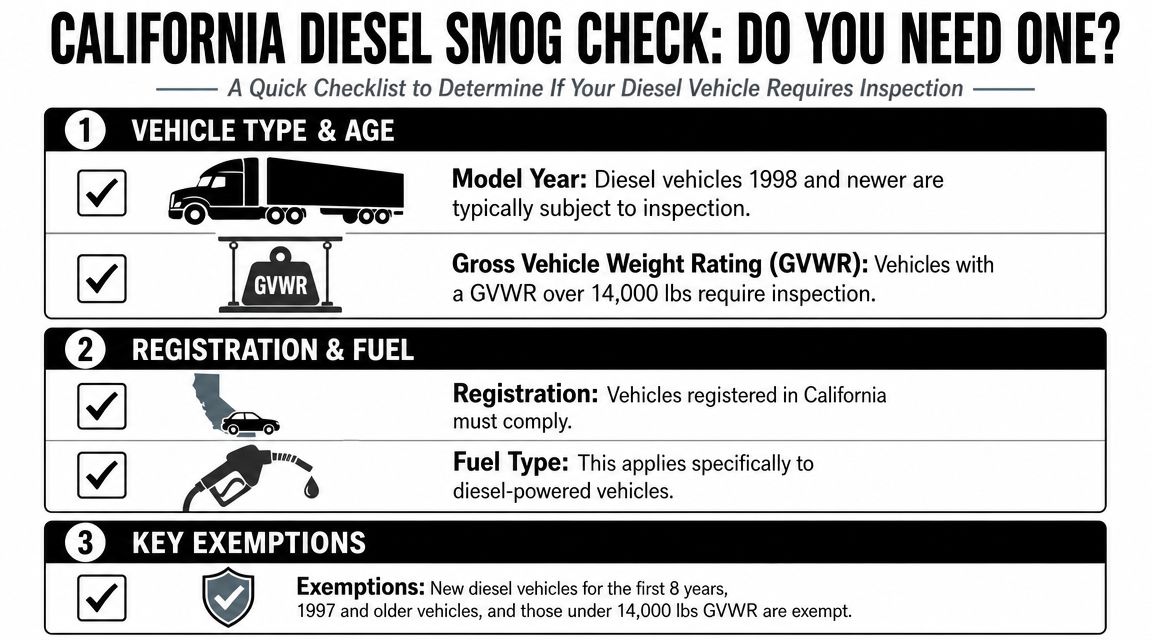
A good shortcut is to treat your truck like it has two labels that matter. One label is the model year on the registration. The other is the GVWR on the door jamb sticker. That weight label is where many owners get surprised, especially with diesel pickups that look similar but fall into different classes on paper.
Practical rule: If your diesel is California-registered, light-duty, and from the covered model years, check your smog status early instead of waiting until the registration deadline gets close.
Readiness is the other rule that catches people off guard. For 2007 and newer light-duty diesels, the DMV notes that only the Diesel Particulate Filter and Non-Methane Hydrocarbon Catalyst monitors may remain unset. If the battery was disconnected, codes were recently cleared, or repairs were just completed, the vehicle may drive normally and still not be ready for inspection.
That is one reason a careful station matters. In the East Bay, a STAR station should be able to explain your diesel's category in plain English before testing starts. If you call a shop like Speedy Smog, a useful question is: “Can you confirm whether my diesel falls under the standard California smog program based on model year and GVWR?” A clear answer there usually saves time and frustration later.
Quick reference table
| Vehicle Model Year | GVWR | Smog Check Required? |
|---|---|---|
| 1997 and older diesel | Any | Generally no under the standard diesel smog requirement |
| 1998 and newer diesel | 14,000 lbs GVWR and under | Generally yes |
| 1998 and newer diesel | Over 14,000 lbs GVWR | Generally exempt from the standard smog requirement |
Where people get tripped up
Weight is the first trouble spot. Diesel pickup owners often assume all trucks follow the same smog lane and the same rules. California does not sort them that way. The state looks at vehicle class, and GVWR is a big part of that classification.
Timing is the next point of confusion. Covered vehicles are commonly tested on a registration cycle, but some newer vehicles may be handled differently at first through an abatement-fee setup instead of immediate testing. That is why two diesel owners can have different registration experiences even if both vehicles are street driven.
Older assumptions also cause problems. California changed its diesel smog program years ago, so advice from a friend who owned a diesel truck a long time ago may no longer match the current rules. If you are unsure, check the DMV guidance first and confirm the vehicle details with a certified station before your due date.
How a Diesel Smog Check Differs from a Gasoline Test
You pull into a smog station expecting the same routine you had with your last gas car. Then the technician starts checking emissions parts, connects to the vehicle computer, and watches the exhaust instead of focusing on a tailpipe reading alone. That change catches a lot of diesel owners off guard.
A diesel smog check is more like a health check for the whole emissions system. A gasoline test also checks the computer and emissions equipment, but diesel inspections put more weight on three things: whether the required parts are installed, whether the computer shows the systems are working properly, and whether the truck produces excessive visible smoke.
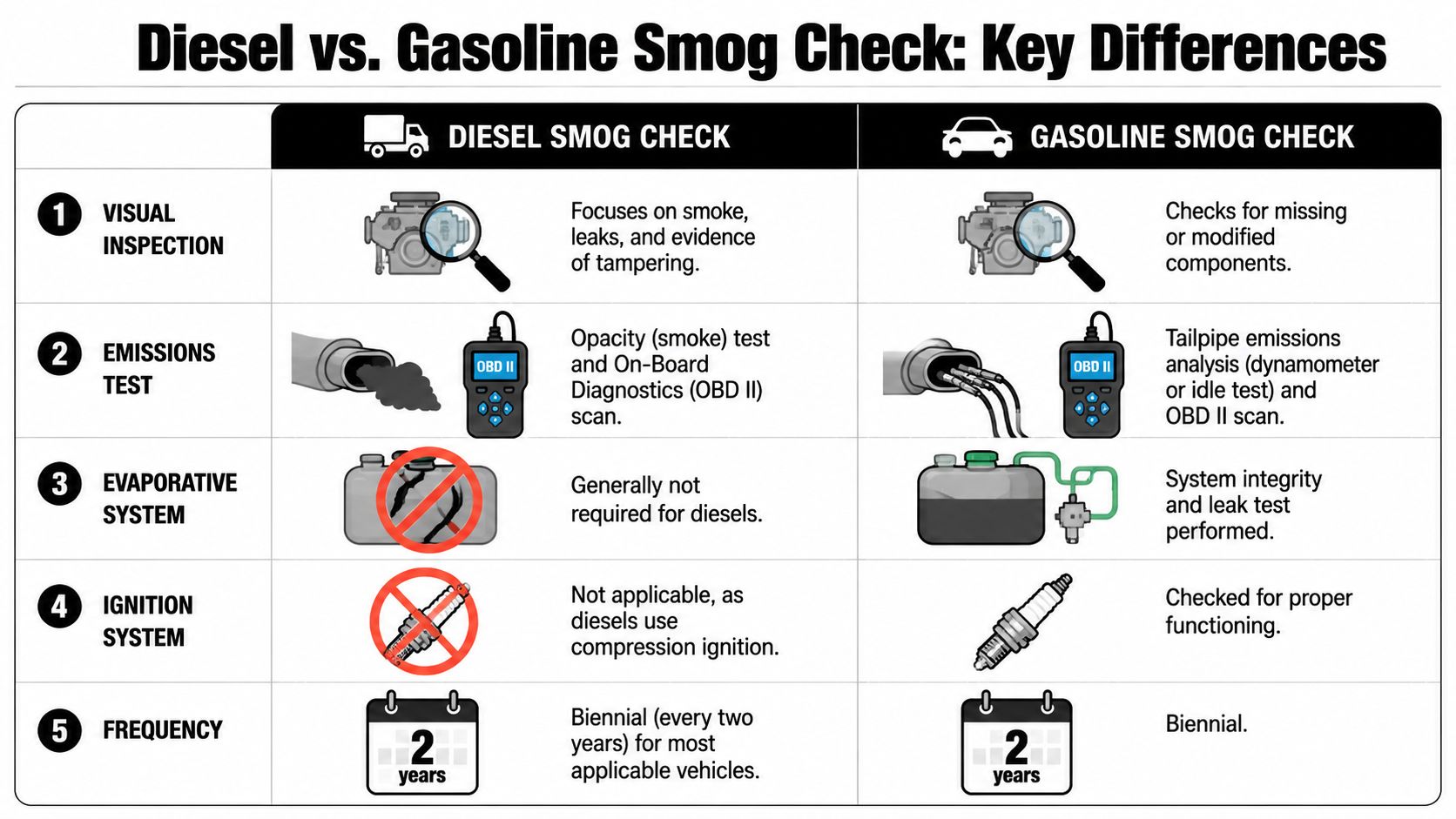
Here is the practical difference.
- Visual inspection: The technician checks for required emissions components and looks for missing, disconnected, or altered parts.
- OBD check: The vehicle's computer is scanned for trouble codes and monitor status.
- Visible-smoke check: The technician watches for smoke that stays visible longer than the allowed limit.
For diesel owners, the visual part matters more than many people expect. If emissions equipment has been removed, modified, or replaced with the wrong parts, the vehicle can fail even if it starts easily and drives fine on the freeway.
The smoke portion also worries people because it feels less familiar than a gasoline test. BAR technician training shows an idle observation for visible exhaust, followed by a BAR SNAP procedure using quick accelerator inputs while the vehicle is stationary, as shown in the BAR diesel smoke test training video. The point is simple. The technician is checking whether smoke clears normally or hangs around long enough to count as a failure.
That helps explain a common source of confusion. A diesel can fail without a check-engine light. Problems such as injector issues, turbo seal leaks, EGR faults, oil getting into the intake, or DPF trouble may show up first as smoke or as a problem with the emissions hardware itself.
If you are in the East Bay, this is one reason to choose a station that works with diesel vehicles regularly and can explain what they are seeing in plain language. At a local STAR station such as Speedy Smog, a good sign is a technician who can tell you whether they are checking readiness, missing components, or smoke behavior, instead of giving you a vague “it didn't pass.” That kind of explanation saves time because you know what to fix, not just that something went wrong.
How to Prepare Your Diesel for a Smog Check
You can't guarantee a pass by “warming it up” and hoping for the best. You can, however, avoid a lot of preventable failures by handling the basics before you book the appointment.
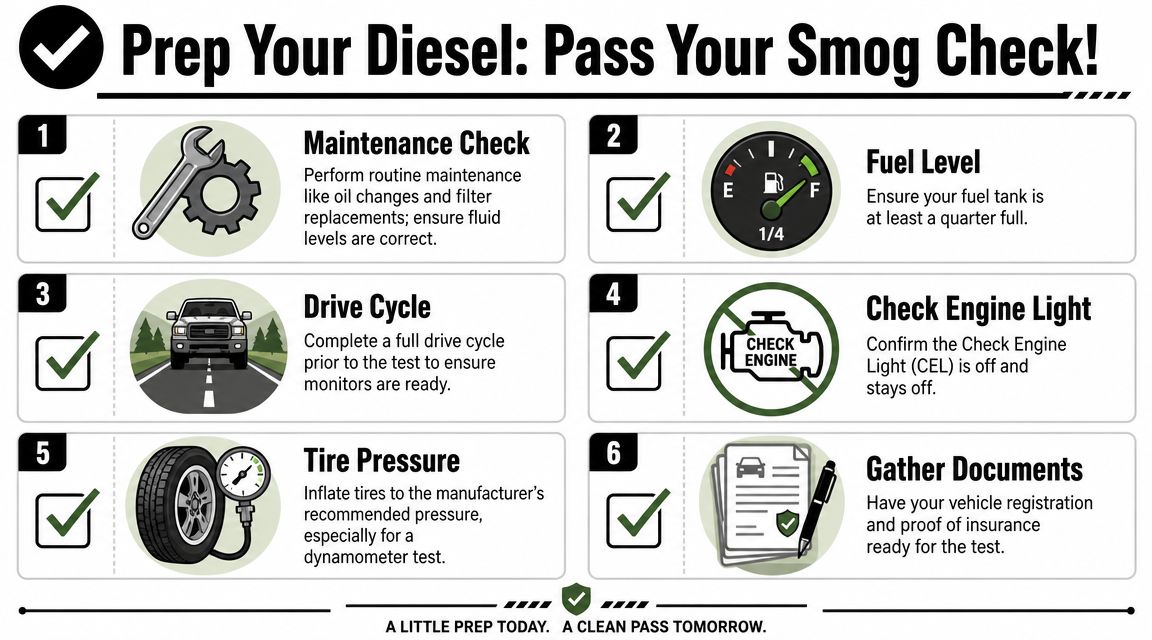
Start with the easy fail items
Begin with what you can confirm from the driver's seat and your recent repair history.
- Check the malfunction light: If the check-engine light is on, don't go in expecting a miracle.
- Think about recent battery work: If the battery was disconnected, replaced, or the codes were cleared, your monitors may not be ready yet.
- Don't test right after major repair work: Give the vehicle enough normal driving time to complete its self-checks.
For diesel owners, readiness matters more than people realize. A truck can feel normal, idle smoothly, and still not be electronically ready for inspection.
Do a real pre-test walkaround
Most customers don't need to be mechanics to catch obvious problems. You're just looking for signs that something is off before the state test does.
- Look for smoke: Have someone briefly observe the exhaust after startup and after the engine is warm.
- Check for leaks: Oil leaks, fuel leaks, and heavy grime around turbo plumbing can hint at a bigger issue.
- Notice missing hardware: If the truck has been modified in the past, verify that emissions components are still installed.
- Listen for unusual sounds: A whistle, hiss, or rough idle can point to intake, boost, or injector issues that may affect the smoke test.
After that, basic maintenance helps. Fresh oil, the right filters, and routine service won't hide an emissions defect, but they do remove avoidable variables.
Here's a useful walk-through if you want a visual checklist before your appointment:
Bring the basics and give yourself a buffer
Bring your registration paperwork and show up with enough time that you're not rushing. A rushed customer often misses the important detail, like mentioning a recent repair, a dead battery last week, or a tuner that was removed but not properly returned to stock.
If you've cleared codes recently, wait until the vehicle has completed a proper drive cycle and all applicable systems have had time to report ready. Guessing usually leads to a retest.
If your diesel is your daily work vehicle, it's smart to schedule the check before the last minute. That leaves room for repairs if the test uncovers something you didn't know was there.
Common Diesel Smog Failures and What to Do Next
You pull into a station, the truck sounds normal, and ten minutes later you're holding a failed smog report. That moment feels bigger than it is. In practice, diesel smog failures usually fall into three categories, and each one points you toward a different fix.
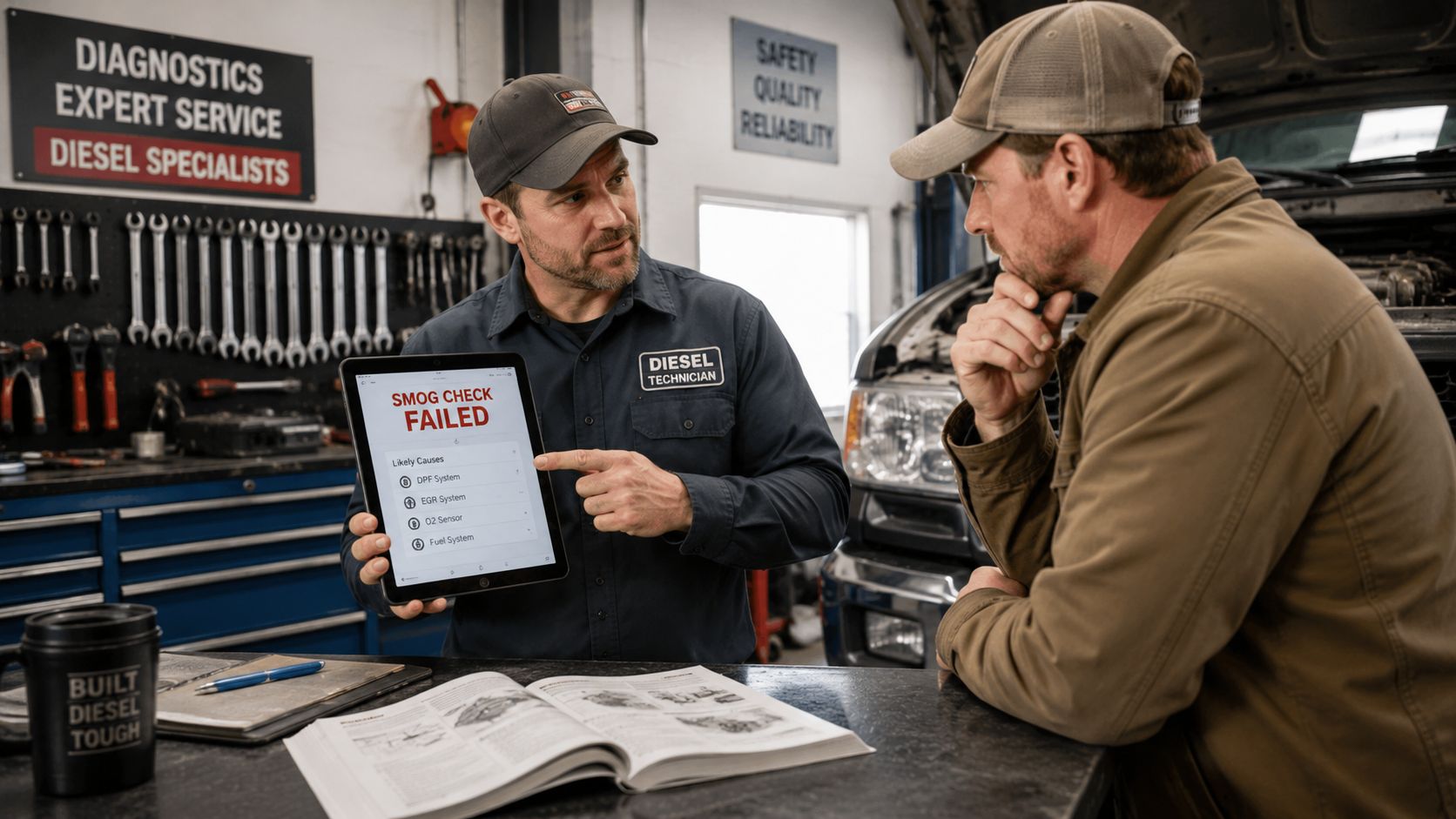
The helpful question is not just “Did it fail?” It's “Why did it fail?” Once you know that, the path gets much clearer.
Visual failures
A visual failure means the inspector found something missing, altered, or not approved for that vehicle's emissions setup. You can think of this as a parts-and-configuration problem. The truck might run well, pull hard, and still fail because the required emissions hardware is no longer there or no longer matches what the vehicle was certified with.
Common examples include deleted emissions equipment, straight-pipe replacements, or aftermarket parts that are not legal for that diesel application in California. This is one of the most frustrating results for owners because the issue is often obvious to the inspector but not obvious to the driver.
The next step is straightforward. Have a diesel repair shop compare the vehicle to the correct factory emissions configuration and identify what needs to be restored or replaced. If you're in the East Bay, this is also where station choice matters. A STAR station that sees diesel trucks regularly, such as Speedy Smog, should be able to explain the failure clearly so you know whether you need a repair shop, replacement parts, or documentation for a compliant component.
OBD failures
An OBD failure means the vehicle's computer system is not ready to certify. The check engine light may be on. There may be stored trouble codes. Or the monitors may be incomplete because the battery was disconnected, codes were recently cleared, or repairs were just made.
This confuses a lot of diesel owners because the truck can feel completely normal on the road. The smog machine is looking for proof that the onboard system has checked itself and found no active emissions problem. If that proof is missing, the vehicle cannot pass.
Your best move is diagnosis first, retest second. A good shop will figure out whether you have an active fault, a wiring or sensor issue, or a readiness problem that requires the correct drive cycle after repairs. Repeatedly going back for another test without fixing the root cause usually costs more time than it saves.
Smoke failures
Smoke failures are the most visible, and they usually point to a mechanical problem or an emissions control problem that shows up under load. Excessive smoke can come from injector faults, turbo seal issues, oil getting into the intake or exhaust, EGR problems, DPF trouble, or poor combustion.
Smoke works like a symptom, not a full diagnosis. It tells the technician where to start looking. Black smoke often suggests too much fuel or not enough air. Blue smoke can point to oil burning. White smoke can raise questions about incomplete combustion or other engine issues.
If your diesel fails for smoke, ask for the printed test results before you leave. Bring that paperwork to a diesel repair technician. It gives the shop a starting point and can shorten the diagnostic process. After repairs, return to a station that handles diesel testing regularly and can tell you, in plain language, whether the truck is ready to be retested.
Costs Time and Finding a Certified STAR Station
You open your renewal notice during lunch, see that a smog check is due, and the first questions are practical ones. How long will this take? Do you need a STAR station? And if you live in Oakland, San Leandro, Hayward, or nearby, where can you go without turning a simple test into half a day of extra driving?
For most drivers, the appointment itself is fairly quick if the vehicle is ready and the station handles diesel tests regularly. The easier way to plan is to allow extra cushion for check-in, paperwork, and any wait ahead of you. A smog visit works a lot like an airport security line. The actual screening may be short, but the total time depends on how organized the process is when you arrive.
The timing question also trips people up at registration. As noted earlier, diesel smog checks usually follow the state renewal cycle for covered vehicles, but not every renewal notice triggers the same requirement. Some owners will need a test this cycle. Others may see a fee in place of testing, especially on newer vehicles. The safest move is simple. Read the DMV notice closely and treat that document as your instructions for this round.
Why station choice matters in the East Bay
Station choice matters more with diesel than many drivers expect.
A diesel inspection is not just a quick plug-in and printout. The shop needs to know the rules, confirm whether your paperwork calls for a STAR station, and explain the result clearly if something blocks certification. That matters even more in the East Bay, where many drivers are fitting the appointment between work, school pickup, or a commute across town.
A STAR Certified station has met higher state performance standards. If your notice says STAR is required, go straight to a STAR location first. Starting at the wrong shop usually means a second appointment, more waiting, and more frustration.
For a concrete local example, Speedy Smog in San Leandro is a STAR Certified station that performs diesel smog checks along with tests for other vehicle types. That is a useful model for East Bay drivers. Look for a shop that is clearly certified, familiar with DMV paperwork, and used to seeing diesel vehicles often enough to answer questions in plain English.
Choose a station that can verify your STAR requirement, test diesel vehicles regularly, and explain the result without burying you in jargon.
What to look for before you book
A short phone call can save a long afternoon. Ask these questions before you head over:
- Do you currently have STAR certification? Ask this first if your DMV notice mentions STAR.
- How often do you test diesel vehicles? Regular diesel experience usually means fewer surprises.
- Do you take appointments, walk-ins, or both? That helps you judge your real time window.
- What should I bring? Your registration information and DMV notice are usually the starting point.
- Can you explain a failure report on-site? If the vehicle does not pass, you want clear next steps, not vague answers.
If your diesel recently had emissions-related repairs, mention that when you book. The station cannot promise a pass over the phone, but an experienced technician can tell you whether it makes sense to confirm readiness and paperwork before you come in.
Frequently Asked Questions About Diesel Smog Checks
I just moved to California with a diesel vehicle
You unpack the boxes, update your address, and then the registration paperwork reminds you that California plays by its own emissions rules. That catches a lot of new residents off guard.
Start with the same two checkpoints covered earlier: model year and weight. Those are the gates that determine whether your diesel falls into California's smog program. An inspection from another state usually does not transfer the way drivers hope, so plan on meeting California's requirements before registration is finalized.
Bring your registration paperwork, make sure the truck or car is running properly, and confirm the emissions equipment is still in place.
Are aftermarket parts an automatic fail
Aftermarket parts only become a smog problem when they affect emissions or replace required factory equipment with something that is not compliant.
Cosmetic parts and unrelated upgrades usually are not the issue. The trouble spots are the parts tied to how the engine breathes and controls pollution, such as intake components, exhaust parts, tuning, and emissions hardware. If you are unsure whether a modification crosses the line, ask a diesel-savvy smog technician before test day. It is much easier to sort that out in advance than to discover it during the inspection.
My truck is deleted. Can I make it legal again
Usually, yes, but the fix is restoration. A deleted diesel generally has to be returned to a compliant setup with the required emissions parts installed and working, along with software that matches that configuration.
That can take more than bolting parts back on. Many vehicles also need proper calibration and enough driving time afterward for readiness checks to complete. A diesel repair shop that handles emissions restoration can tell you what is missing and what has to be corrected before a retest.
Do I need a smog check to sell my diesel vehicle
That depends on the sale and the vehicle, so confirm the current DMV rules for your situation. Waiting until a buyer is ready to sign papers is how this turns into a last-minute headache.
Handling the smog question early gives you time to fix problems if something comes up. It also gives the buyer more confidence, which can make the sale easier to finish.
Why did I fail when the truck runs fine
Because drivability and emissions compliance are not the same test.
A diesel can feel strong on the road and still fail for incomplete monitors, missing emissions equipment, or excessive visible smoke. A good way to think about it is this: the truck may be doing the job you feel from the driver's seat while still missing the checks the state requires under the hood and through the exhaust.
The good news is that a failure report points to a category. Once you know the category, the next step is usually much clearer.
Should I clear codes before the test
No.
Clearing codes right before inspection often resets the system monitors. Then the warning light may be off, but the vehicle is still not ready to pass because the self-checks have not finished running. If a code appears, fix the cause first, then drive the vehicle enough for the monitors to set.
What if I only use the truck occasionally
Occasional-use diesels can be harder to pass on the first try. They sit longer, batteries weaken, and recent repairs may not have been followed by enough normal driving for the system to complete its checks.
If your truck is mainly for weekends, hauling, or towing, do not wait until the registration deadline. Drive it ahead of time, watch for warning lights, and pay attention to startup smoke or a sluggish battery.
How do I choose a good smog station
Choose a station the way you would choose a mechanic for a problem you do not want explained in riddles. You want clear answers, diesel experience, and staff who can tell you what to bring before you show up.
For East Bay drivers, a local STAR station such as Speedy Smog in San Leandro is the kind of example to look for. The name matters less than the traits behind it. The shop should handle diesel inspections regularly, understand California paperwork, and explain a pass or failure in plain English. If a station is vague on the phone, that is often a preview of how the visit will go in person.
If you are in San Leandro, Oakland, Hayward, or another nearby East Bay city, use that checklist before you book. A good station helps you get through the process with fewer surprises and a much better idea of what your diesel needs.
Created with the Outrank app