
Diesel Smog Check California: 2026 Guide to Passing
Your registration notice is on the counter, and you're staring at the word smog wondering whether your diesel truck, SUV, or car needs special treatment in California. That's a common spot to be in, especially if you've owned gasoline vehicles before and assume the process works the same way.
It doesn't.
A California diesel smog check is its own thing. The rules turn on model year, weight, and whether your truck's emissions systems are intact and ready. If you live in the East Bay, that confusion gets even more practical because you're not just asking what the law says. You're asking where to go, what to expect, and how to avoid a wasted trip.
Table of Contents
- Understanding California's Diesel Smog Check Rules
- How a Diesel Smog Check Differs from a Gasoline Test
- How to Prepare Your Diesel for a Smog Check
- Common Diesel Smog Failures and What to Do Next
- Costs Time and Finding a Certified STAR Station
- Frequently Asked Questions About Diesel Smog Checks
- I just moved to California with a diesel vehicle
- Are aftermarket parts an automatic fail
- My truck is deleted. Can I make it legal again
- Do I need a smog check to sell my diesel vehicle
- Why did I fail when the truck runs fine
- Should I clear codes before the test
- What if I only use the truck occasionally
- How do I choose a good smog station
Understanding California's Diesel Smog Check Rules
You buy a used diesel truck in the East Bay, the registration renewal shows up, and the first question is simple: “Do I need a smog check?” California's rules get much easier once you sort them the same way a technician does. Start with three things: model year, gross vehicle weight rating, and whether the vehicle is registered in California.
For many drivers, that clears up the confusion fast.
The California DMV says diesel-powered vehicles model year 1998 and newer generally need inspection, while diesel vehicles model year 1997 and older or with a GVWR over 14,000 pounds are exempt from the standard smog requirement, according to the California DMV smog inspection guidance.
A simple way to read that rule is this: lighter diesel vehicles usually fall into the regular smog system, while heavier commercial-type vehicles are handled under different requirements. So if you drive a diesel sedan, SUV, or light-duty pickup around places like Oakland, Hayward, Fremont, or Concord, you are usually in the group that needs to pay attention to smog deadlines.
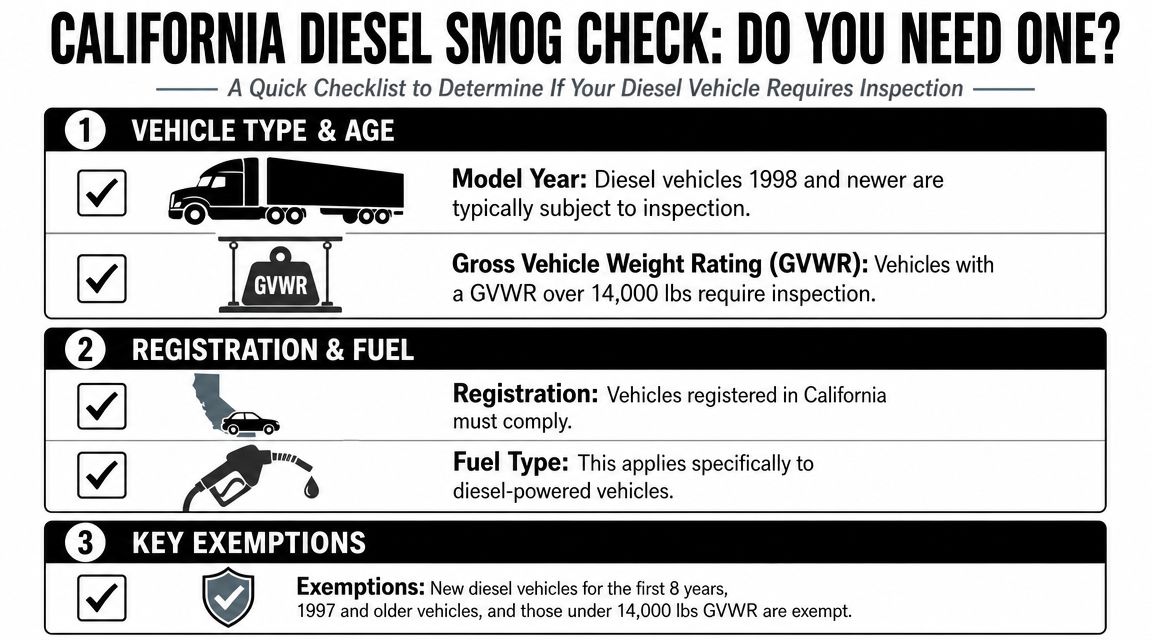
A good shortcut is to treat your truck like it has two labels that matter. One label is the model year on the registration. The other is the GVWR on the door jamb sticker. That weight label is where many owners get surprised, especially with diesel pickups that look similar but fall into different classes on paper.
Practical rule: If your diesel is California-registered, light-duty, and from the covered model years, check your smog status early instead of waiting until the registration deadline gets close.
Readiness is the other rule that catches people off guard. For 2007 and newer light-duty diesels, the DMV notes that only the Diesel Particulate Filter and Non-Methane Hydrocarbon Catalyst monitors may remain unset. If the battery was disconnected, codes were recently cleared, or repairs were just completed, the vehicle may drive normally and still not be ready for inspection.
That is one reason a careful station matters. In the East Bay, a STAR station should be able to explain your diesel's category in plain English before testing starts. If you call a shop like Speedy Smog, a useful question is: “Can you confirm whether my diesel falls under the standard California smog program based on model year and GVWR?” A clear answer there usually saves time and frustration later.
Quick reference table
| Vehicle Model Year | GVWR | Smog Check Required? |
|---|---|---|
| 1997 and older diesel | Any | Generally no under the standard diesel smog requirement |
| 1998 and newer diesel | 14,000 lbs GVWR and under | Generally yes |
| 1998 and newer diesel | Over 14,000 lbs GVWR | Generally exempt from the standard smog requirement |
Where people get tripped up
Weight is the first trouble spot. Diesel pickup owners often assume all trucks follow the same smog lane and the same rules. California does not sort them that way. The state looks at vehicle class, and GVWR is a big part of that classification.
Timing is the next point of confusion. Covered vehicles are commonly tested on a registration cycle, but some newer vehicles may be handled differently at first through an abatement-fee setup instead of immediate testing. That is why two diesel owners can have different registration experiences even if both vehicles are street driven.
Older assumptions also cause problems. California changed its diesel smog program years ago, so advice from a friend who owned a diesel truck a long time ago may no longer match the current rules. If you are unsure, check the DMV guidance first and confirm the vehicle details with a certified station before your due date.
How a Diesel Smog Check Differs from a Gasoline Test
You pull into a smog station expecting the same routine you had with your last gas car. Then the technician starts checking emissions parts, connects to the vehicle computer, and watches the exhaust instead of focusing on a tailpipe reading alone. That change catches a lot of diesel owners off guard.
A diesel smog check is more like a health check for the whole emissions system. A gasoline test also checks the computer and emissions equipment, but diesel inspections put more weight on three things: whether the required parts are installed, whether the computer shows the systems are working properly, and whether the truck produces excessive visible smoke.
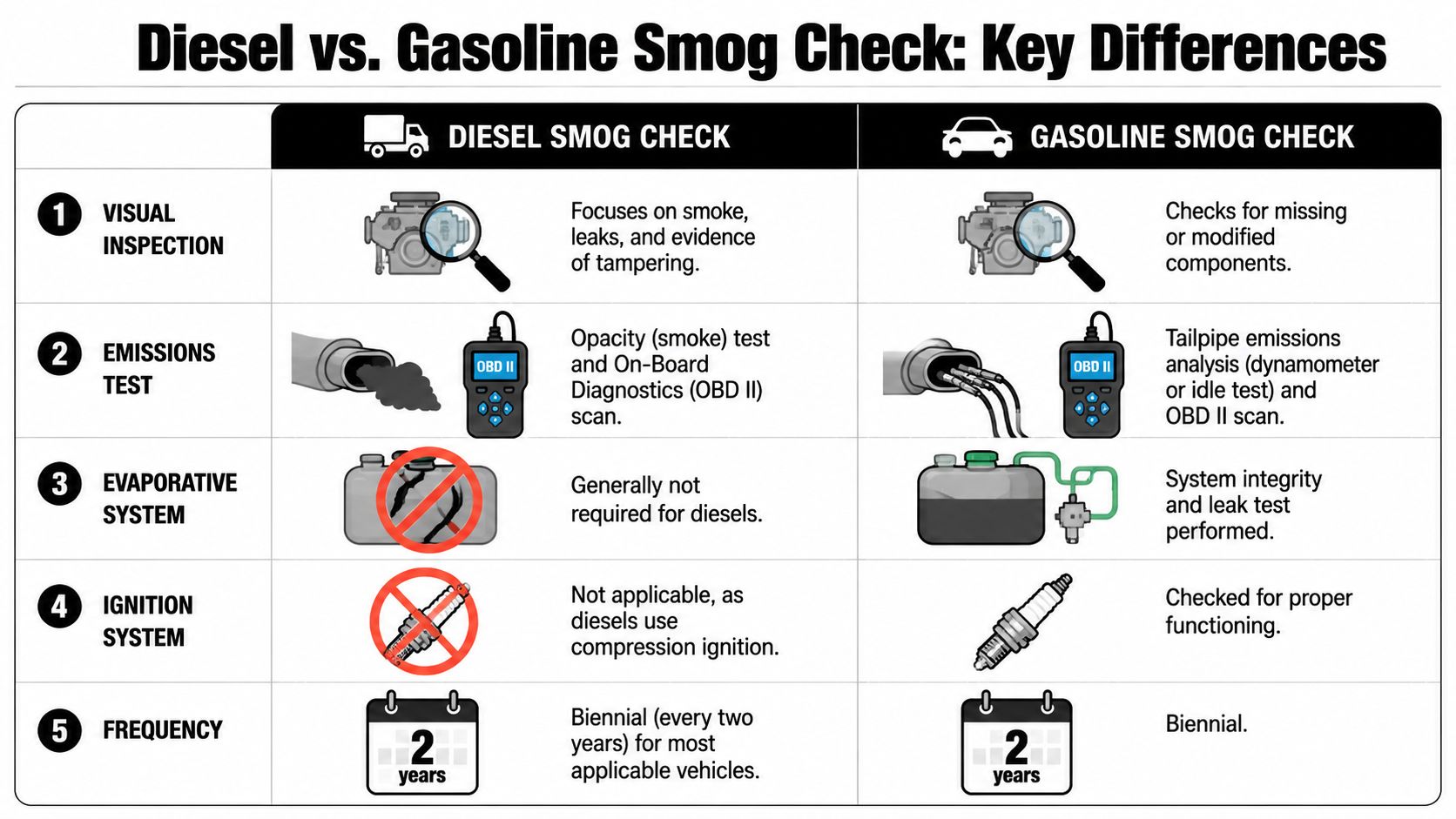
Here is the practical difference.
- Visual inspection: The technician checks for required emissions components and looks for missing, disconnected, or altered parts.
- OBD check: The vehicle's computer is scanned for trouble codes and monitor status.
- Visible-smoke check: The technician watches for smoke that stays visible longer than the allowed limit.
For diesel owners, the visual part matters more than many people expect. If emissions equipment has been removed, modified, or replaced with the wrong parts, the vehicle can fail even if it starts easily and drives fine on the freeway.
The smoke portion also worries people because it feels less familiar than a gasoline test. BAR technician training shows an idle observation for visible exhaust, followed by a BAR SNAP procedure using quick accelerator inputs while the vehicle is stationary, as shown in the BAR diesel smoke test training video. The point is simple. The technician is checking whether smoke clears normally or hangs around long enough to count as a failure.
That helps explain a common source of confusion. A diesel can fail without a check-engine light. Problems such as injector issues, turbo seal leaks, EGR faults, oil getting into the intake, or DPF trouble may show up first as smoke or as a problem with the emissions hardware itself.
If you are in the East Bay, this is one reason to choose a station that works with diesel vehicles regularly and can explain what they are seeing in plain language. At a local STAR station such as Speedy Smog, a good sign is a technician who can tell you whether they are checking readiness, missing components, or smoke behavior, instead of giving you a vague “it didn't pass.” That kind of explanation saves time because you know what to fix, not just that something went wrong.
How to Prepare Your Diesel for a Smog Check
You can't guarantee a pass by “warming it up” and hoping for the best. You can, however, avoid a lot of preventable failures by handling the basics before you book the appointment.
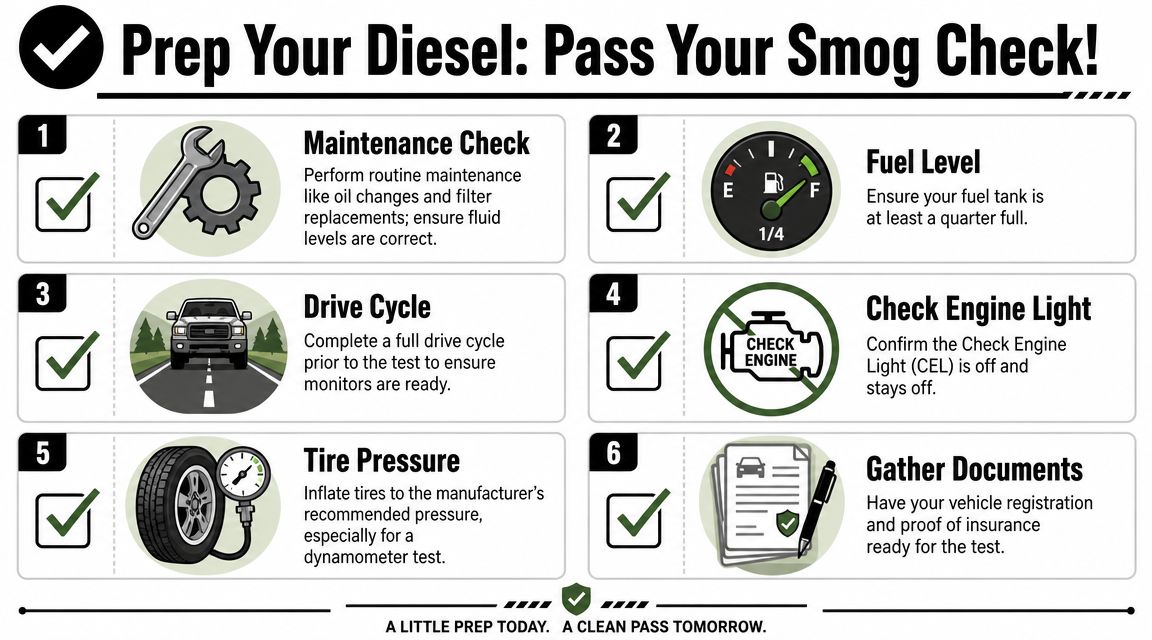
Start with the easy fail items
Begin with what you can confirm from the driver's seat and your recent repair history.
- Check the malfunction light: If the check-engine light is on, don't go in expecting a miracle.
- Think about recent battery work: If the battery was disconnected, replaced, or the codes were cleared, your monitors may not be ready yet.
- Don't test right after major repair work: Give the vehicle enough normal driving time to complete its self-checks.
For diesel owners, readiness matters more than people realize. A truck can feel normal, idle smoothly, and still not be electronically ready for inspection.
Do a real pre-test walkaround
Most customers don't need to be mechanics to catch obvious problems. You're just looking for signs that something is off before the state test does.
- Look for smoke: Have someone briefly observe the exhaust after startup and after the engine is warm.
- Check for leaks: Oil leaks, fuel leaks, and heavy grime around turbo plumbing can hint at a bigger issue.
- Notice missing hardware: If the truck has been modified in the past, verify that emissions components are still installed.
- Listen for unusual sounds: A whistle, hiss, or rough idle can point to intake, boost, or injector issues that may affect the smoke test.
After that, basic maintenance helps. Fresh oil, the right filters, and routine service won't hide an emissions defect, but they do remove avoidable variables.
Here's a useful walk-through if you want a visual checklist before your appointment:
Bring the basics and give yourself a buffer
Bring your registration paperwork and show up with enough time that you're not rushing. A rushed customer often misses the important detail, like mentioning a recent repair, a dead battery last week, or a tuner that was removed but not properly returned to stock.
If you've cleared codes recently, wait until the vehicle has completed a proper drive cycle and all applicable systems have had time to report ready. Guessing usually leads to a retest.
If your diesel is your daily work vehicle, it's smart to schedule the check before the last minute. That leaves room for repairs if the test uncovers something you didn't know was there.
Common Diesel Smog Failures and What to Do Next
You pull into a station, the truck sounds normal, and ten minutes later you're holding a failed smog report. That moment feels bigger than it is. In practice, diesel smog failures usually fall into three categories, and each one points you toward a different fix.
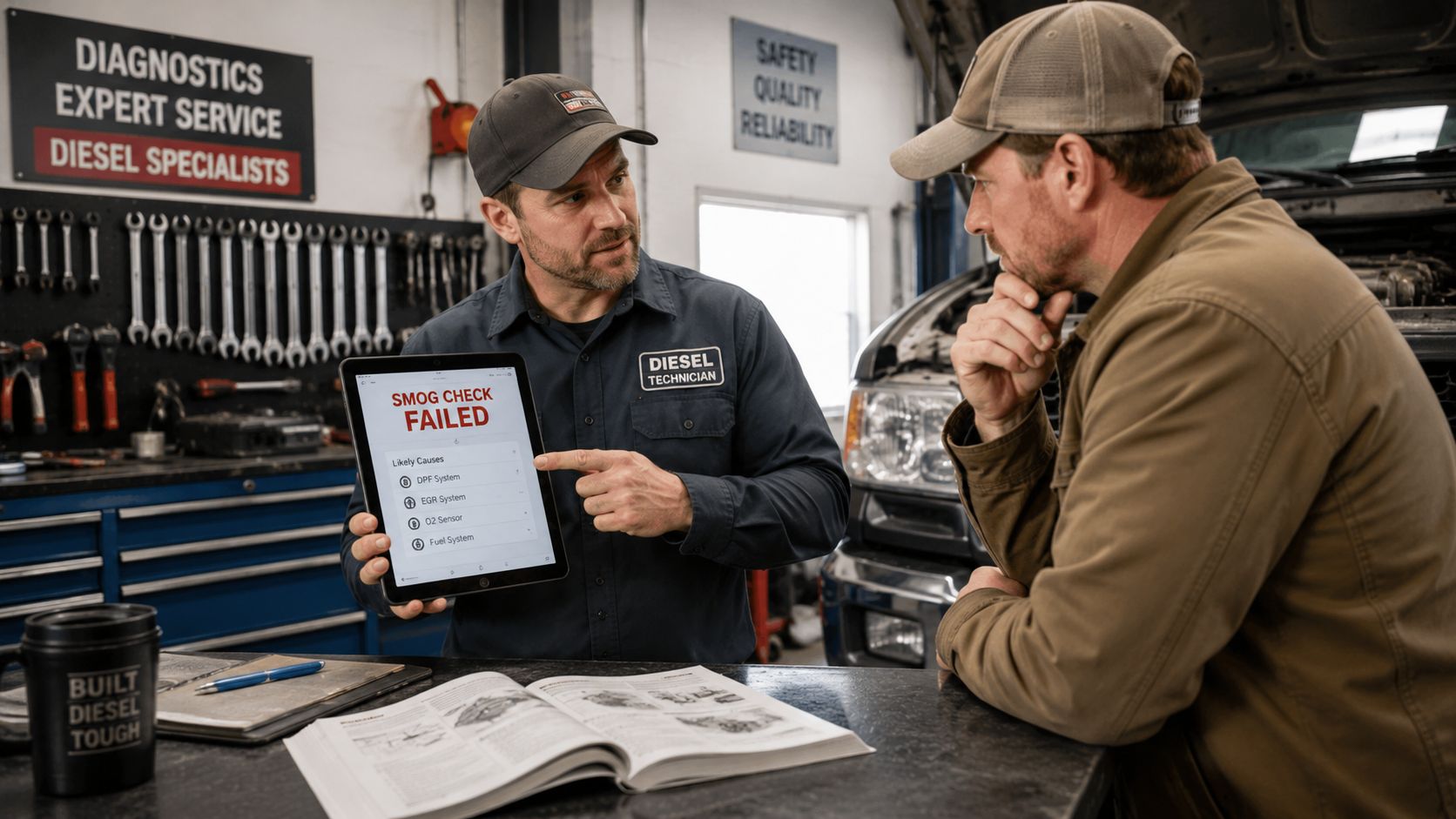
The helpful question is not just “Did it fail?” It's “Why did it fail?” Once you know that, the path gets much clearer.
Visual failures
A visual failure means the inspector found something missing, altered, or not approved for that vehicle's emissions setup. You can think of this as a parts-and-configuration problem. The truck might run well, pull hard, and still fail because the required emissions hardware is no longer there or no longer matches what the vehicle was certified with.
Common examples include deleted emissions equipment, straight-pipe replacements, or aftermarket parts that are not legal for that diesel application in California. This is one of the most frustrating results for owners because the issue is often obvious to the inspector but not obvious to the driver.
The next step is straightforward. Have a diesel repair shop compare the vehicle to the correct factory emissions configuration and identify what needs to be restored or replaced. If you're in the East Bay, this is also where station choice matters. A STAR station that sees diesel trucks regularly, such as Speedy Smog, should be able to explain the failure clearly so you know whether you need a repair shop, replacement parts, or documentation for a compliant component.
OBD failures
An OBD failure means the vehicle's computer system is not ready to certify. The check engine light may be on. There may be stored trouble codes. Or the monitors may be incomplete because the battery was disconnected, codes were recently cleared, or repairs were just made.
This confuses a lot of diesel owners because the truck can feel completely normal on the road. The smog machine is looking for proof that the onboard system has checked itself and found no active emissions problem. If that proof is missing, the vehicle cannot pass.
Your best move is diagnosis first, retest second. A good shop will figure out whether you have an active fault, a wiring or sensor issue, or a readiness problem that requires the correct drive cycle after repairs. Repeatedly going back for another test without fixing the root cause usually costs more time than it saves.
Smoke failures
Smoke failures are the most visible, and they usually point to a mechanical problem or an emissions control problem that shows up under load. Excessive smoke can come from injector faults, turbo seal issues, oil getting into the intake or exhaust, EGR problems, DPF trouble, or poor combustion.
Smoke works like a symptom, not a full diagnosis. It tells the technician where to start looking. Black smoke often suggests too much fuel or not enough air. Blue smoke can point to oil burning. White smoke can raise questions about incomplete combustion or other engine issues.
If your diesel fails for smoke, ask for the printed test results before you leave. Bring that paperwork to a diesel repair technician. It gives the shop a starting point and can shorten the diagnostic process. After repairs, return to a station that handles diesel testing regularly and can tell you, in plain language, whether the truck is ready to be retested.
Costs Time and Finding a Certified STAR Station
You open your renewal notice during lunch, see that a smog check is due, and the first questions are practical ones. How long will this take? Do you need a STAR station? And if you live in Oakland, San Leandro, Hayward, or nearby, where can you go without turning a simple test into half a day of extra driving?
For most drivers, the appointment itself is fairly quick if the vehicle is ready and the station handles diesel tests regularly. The easier way to plan is to allow extra cushion for check-in, paperwork, and any wait ahead of you. A smog visit works a lot like an airport security line. The actual screening may be short, but the total time depends on how organized the process is when you arrive.
The timing question also trips people up at registration. As noted earlier, diesel smog checks usually follow the state renewal cycle for covered vehicles, but not every renewal notice triggers the same requirement. Some owners will need a test this cycle. Others may see a fee in place of testing, especially on newer vehicles. The safest move is simple. Read the DMV notice closely and treat that document as your instructions for this round.
Why station choice matters in the East Bay
Station choice matters more with diesel than many drivers expect.
A diesel inspection is not just a quick plug-in and printout. The shop needs to know the rules, confirm whether your paperwork calls for a STAR station, and explain the result clearly if something blocks certification. That matters even more in the East Bay, where many drivers are fitting the appointment between work, school pickup, or a commute across town.
A STAR Certified station has met higher state performance standards. If your notice says STAR is required, go straight to a STAR location first. Starting at the wrong shop usually means a second appointment, more waiting, and more frustration.
For a concrete local example, Speedy Smog in San Leandro is a STAR Certified station that performs diesel smog checks along with tests for other vehicle types. That is a useful model for East Bay drivers. Look for a shop that is clearly certified, familiar with DMV paperwork, and used to seeing diesel vehicles often enough to answer questions in plain English.
Choose a station that can verify your STAR requirement, test diesel vehicles regularly, and explain the result without burying you in jargon.
What to look for before you book
A short phone call can save a long afternoon. Ask these questions before you head over:
- Do you currently have STAR certification? Ask this first if your DMV notice mentions STAR.
- How often do you test diesel vehicles? Regular diesel experience usually means fewer surprises.
- Do you take appointments, walk-ins, or both? That helps you judge your real time window.
- What should I bring? Your registration information and DMV notice are usually the starting point.
- Can you explain a failure report on-site? If the vehicle does not pass, you want clear next steps, not vague answers.
If your diesel recently had emissions-related repairs, mention that when you book. The station cannot promise a pass over the phone, but an experienced technician can tell you whether it makes sense to confirm readiness and paperwork before you come in.
Frequently Asked Questions About Diesel Smog Checks
I just moved to California with a diesel vehicle
You unpack the boxes, update your address, and then the registration paperwork reminds you that California plays by its own emissions rules. That catches a lot of new residents off guard.
Start with the same two checkpoints covered earlier: model year and weight. Those are the gates that determine whether your diesel falls into California's smog program. An inspection from another state usually does not transfer the way drivers hope, so plan on meeting California's requirements before registration is finalized.
Bring your registration paperwork, make sure the truck or car is running properly, and confirm the emissions equipment is still in place.
Are aftermarket parts an automatic fail
Aftermarket parts only become a smog problem when they affect emissions or replace required factory equipment with something that is not compliant.
Cosmetic parts and unrelated upgrades usually are not the issue. The trouble spots are the parts tied to how the engine breathes and controls pollution, such as intake components, exhaust parts, tuning, and emissions hardware. If you are unsure whether a modification crosses the line, ask a diesel-savvy smog technician before test day. It is much easier to sort that out in advance than to discover it during the inspection.
My truck is deleted. Can I make it legal again
Usually, yes, but the fix is restoration. A deleted diesel generally has to be returned to a compliant setup with the required emissions parts installed and working, along with software that matches that configuration.
That can take more than bolting parts back on. Many vehicles also need proper calibration and enough driving time afterward for readiness checks to complete. A diesel repair shop that handles emissions restoration can tell you what is missing and what has to be corrected before a retest.
Do I need a smog check to sell my diesel vehicle
That depends on the sale and the vehicle, so confirm the current DMV rules for your situation. Waiting until a buyer is ready to sign papers is how this turns into a last-minute headache.
Handling the smog question early gives you time to fix problems if something comes up. It also gives the buyer more confidence, which can make the sale easier to finish.
Why did I fail when the truck runs fine
Because drivability and emissions compliance are not the same test.
A diesel can feel strong on the road and still fail for incomplete monitors, missing emissions equipment, or excessive visible smoke. A good way to think about it is this: the truck may be doing the job you feel from the driver's seat while still missing the checks the state requires under the hood and through the exhaust.
The good news is that a failure report points to a category. Once you know the category, the next step is usually much clearer.
Should I clear codes before the test
No.
Clearing codes right before inspection often resets the system monitors. Then the warning light may be off, but the vehicle is still not ready to pass because the self-checks have not finished running. If a code appears, fix the cause first, then drive the vehicle enough for the monitors to set.
What if I only use the truck occasionally
Occasional-use diesels can be harder to pass on the first try. They sit longer, batteries weaken, and recent repairs may not have been followed by enough normal driving for the system to complete its checks.
If your truck is mainly for weekends, hauling, or towing, do not wait until the registration deadline. Drive it ahead of time, watch for warning lights, and pay attention to startup smoke or a sluggish battery.
How do I choose a good smog station
Choose a station the way you would choose a mechanic for a problem you do not want explained in riddles. You want clear answers, diesel experience, and staff who can tell you what to bring before you show up.
For East Bay drivers, a local STAR station such as Speedy Smog in San Leandro is the kind of example to look for. The name matters less than the traits behind it. The shop should handle diesel inspections regularly, understand California paperwork, and explain a pass or failure in plain English. If a station is vague on the phone, that is often a preview of how the visit will go in person.
If you are in San Leandro, Oakland, Hayward, or another nearby East Bay city, use that checklist before you book. A good station helps you get through the process with fewer surprises and a much better idea of what your diesel needs.
Created with the Outrank app