
You've booked a California smog check, the registration deadline is close, and someone has told you to “take the diesel on the freeway and clear the light.” That advice can help in a narrow situation, but it can also waste your time or guarantee a failure if the vehicle's OBD monitors aren't ready or a real emissions fault remains active.
Passing a diesel emissions test starts with identifying which inspection rules apply to your vehicle. From there, the priorities are straightforward: confirm eligibility, check readiness, control smoke and opacity, avoid resetting the computer before testing, and diagnose persistent faults instead of trying to drive them away.
Table of Contents
- Knowing If Your Diesel Needs a Smog Check
- Understanding Opacity Limits and OBD Readiness Rules
- Executing the Pre-Test Drive Cycle Checklist
- Avoiding the Code Clearing Trap
- Deciding Between a Long Drive and Diagnostic Repair
- Managing Test Day Logistics and STAR Certification
Knowing If Your Diesel Needs a Smog Check
The first mistake many owners make is preparing for a test their vehicle may not need, or assuming every diesel follows the same procedure. California separates diesel vehicles by model year and gross vehicle weight rating, so check those details before spending money on additives, repairs, or a pre-test inspection.
According to the California Bureau of Automotive Repair Smog Check reference, diesel vehicles built from model year 1998 onward are generally included in the program. Diesel vehicles from 1997 and earlier are exempt, and vehicles with a GVWR above 14,000 pounds are outside the standard program described for these light-duty inspections.
Check the two eligibility details
Start with the vehicle's model year. Don't rely on the year you bought it, the registration date, or the date of a major repair. The relevant detail is the vehicle's model year as identified in its records and emissions equipment documentation.
Next, check the gross vehicle weight rating, not the vehicle's current weight. GVWR is the manufacturer's rated maximum weight for the vehicle, including occupants and cargo. A diesel that looks like a normal pickup may fall under different requirements if its rating places it above the light-duty threshold.
California's diesel inspection rules also reflect a historical change that matters to owners of newer passenger vehicles and pickups. The 2010 expansion brought post-1997 diesel passenger cars and trucks up to 14,000 pounds into the Smog Check system, making modern diesel eligibility more common than many older guides suggest.
Confirm the inspection type before your appointment
Eligibility doesn't tell you every detail of the test. A qualifying diesel may be evaluated through a combination of OBD communication, visual inspection, and smoke or opacity checks, depending on its category and the applicable procedure. It isn't just the older gasoline-style tailpipe dyno test that many drivers remember.
Before you schedule, compare your vehicle's year and GVWR with the diesel Smog Check requirements. If the vehicle is subject to inspection, ask the station what information it needs and whether it handles the relevant diesel procedure.
Understanding Opacity Limits and OBD Readiness Rules
California diesel testing revolves around two different questions. How much smoke is the vehicle producing, and has the emissions computer completed the required self-tests? A diesel can look clean at idle and still fail because its monitors report “Not Ready.” It can also have a ready OBD system and fail because visible smoke or measured opacity exceeds the applicable limit.
For heavy-duty diesel fleets covered by California's Periodic Smoke Inspection Program, the BAR Smog Check Manual identifies opacity limits of 55% for pre-1991 engines and 40% for engines from 1991 onward. Those limits apply to the heavy-duty program, so don't automatically transfer them to every light-duty diesel.
For light-duty diesels, OBD readiness becomes especially important. Model year 2007 and newer light-duty diesels may have two unset readiness monitors, but the allowance is limited to the Diesel Particulate Filter and Non-Methane Hydrocarbon Catalyst monitors. If other required monitors remain incomplete, the vehicle may not qualify for a pass.
California diesel inspection thresholds
| Vehicle category | Opacity limit | OBD monitor allowance |
|---|---|---|
| Heavy-duty diesel, pre-1991 engine | 55% | Requirements vary by applicable heavy-duty procedure |
| Heavy-duty diesel, 1991 and newer engine | 40% | Requirements vary by applicable heavy-duty procedure |
| Light-duty diesel, model year 2007 and newer | Tested under the applicable diesel procedure | Two unset monitors may be allowed, limited to the Diesel Particulate Filter and Non-Methane Hydrocarbon Catalyst monitors |
The practical lesson is that smoke and readiness are separate gates. A highway drive may help a diesel complete a regeneration-related monitor, but it won't repair a failed sensor, restore damaged wiring, or correct an emissions system that has been deliberately removed or reprogrammed.
Check readiness before you pay for the test
Use a capable OBD scanner to view monitor status, not just stored trouble codes. Look for a result showing the required systems as Ready, and check whether the malfunction indicator lamp is illuminated.
The equipment used by a compliant station matters because the inspection must communicate with the vehicle and evaluate the systems required for that vehicle. If you want to understand the role of the inspection hardware, review the diesel emissions testing equipment used for this type of evaluation.
Executing the Pre-Test Drive Cycle Checklist
A drive cycle isn't the same as commuting to the inspection station. The vehicle's computer needs the right combination of cold-start conditions, warm-up, speed, load, and uninterrupted operation to complete its self-tests. The exact sequence varies by manufacturer, so the owner's service information remains the authority, but a controlled routine is more useful than random short trips.
Use a deliberate sequence
Begin with a genuine cold start. Let the vehicle complete its normal startup process, then drive gently while the engine and emissions system warm up. Avoid turning the first few minutes into a hard acceleration run, because the aim is stable operating conditions, not punishment.
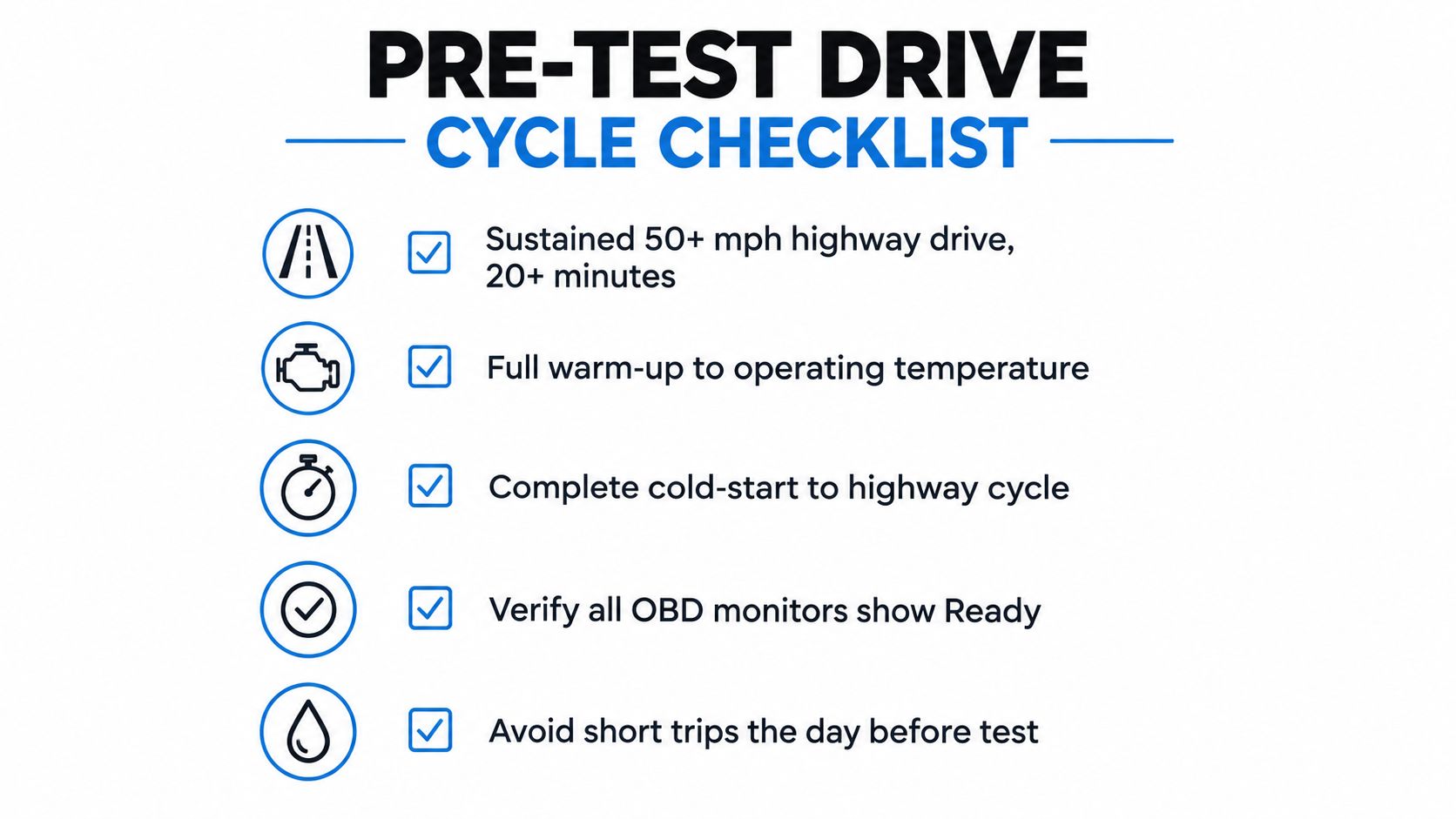
Once the engine reaches normal operating temperature, use a sustained highway drive. The infographic's practical checklist calls for a 50-plus-mph highway drive lasting 20-plus minutes, but treat that as a preparation pattern rather than a universal manufacturer-specific procedure. Obey the speed limit, keep a safe following distance, and don't force the engine beyond its normal operating range.
A useful preparation sequence looks like this:
- Start cold: Begin after the vehicle has been sitting long enough for the engine to cool naturally.
- Warm gradually: Drive smoothly until the engine reaches its normal operating temperature.
- Hold steady conditions: Maintain a sustained highway segment rather than repeatedly stopping and restarting.
- Avoid unnecessary short trips: Don't spend the day before the test making several brief journeys that leave the diesel cold.
- Scan afterward: Check monitor status before the appointment, especially if the vehicle recently had electrical work or codes cleared.
The goal is to let the computer perform its tests under the conditions it expects. It isn't to create smoke, force a regeneration manually, or drive aggressively.
Why the routine can change the result
EPA best-practice data shows that a less strict monitor allowance reduced the overall medium-duty diesel vehicle initial “not ready” rate from 7% to 3%, as reported in its diesel OBD inspection best-practices document. Among light-duty diesel make and model groups, initial not-ready rates ranged from 0–9% under a two-monitor criterion, compared with 0–13% under a one-monitor criterion, using the same EPA source.
Those figures don't promise that a particular vehicle will pass after one drive. They do show why monitor preparation deserves attention. A vehicle may have no obvious drivability complaint while its computer still needs the correct conditions to finish testing.
Practical rule: Drive to complete the vehicle's diagnostic routine, then verify “Ready” with a scanner. Don't assume the trip happened just because the odometer moved.
If monitors remain incomplete after a proper warm drive, stop repeating the same route blindly. Look for a stored fault, an operating-temperature problem, a battery or charging issue, or a manufacturer-specific condition that the generic routine didn't satisfy.
Avoiding the Code Clearing Trap
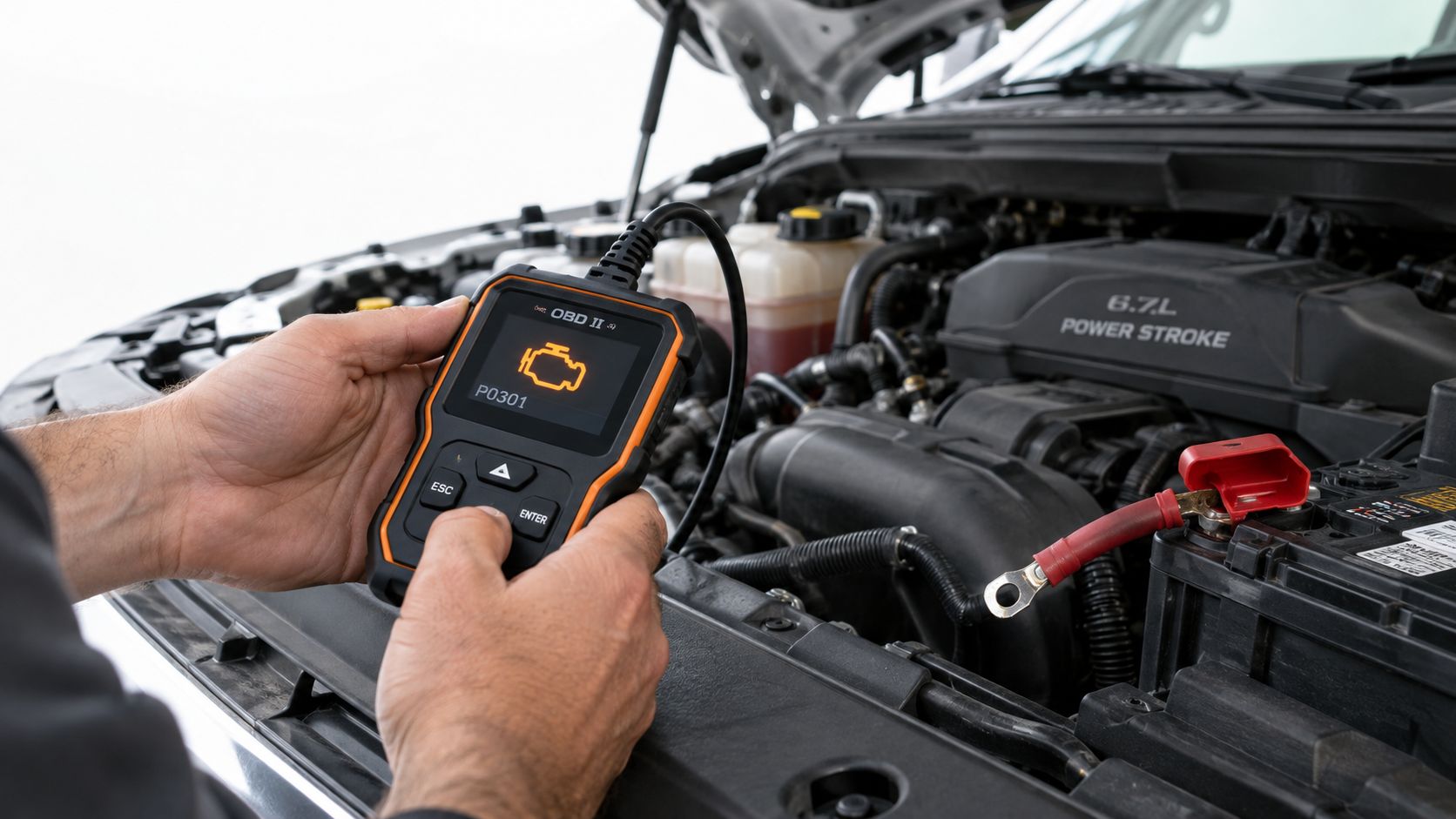
Clearing a check engine light immediately before a smog check is one of the fastest ways to create an inspection problem. Disconnecting the battery, using a basic scan tool to erase codes, or allowing a repair shop to reset the computer can also erase the monitor history that the inspection machine needs to see.
Why a reset produces a “Not Ready” result
The monitors are not simple lights that switch back on as soon as you start the engine. They run self-tests during specific operating conditions. After a reset, the computer needs time and the correct drive conditions to complete them again.
The Missouri inspection guidance on readiness monitors explains that diesel vehicles can fail when required monitors haven't completed their self-tests. Battery disconnection, code clearing, a repair-shop reset, power or ground problems, and unmet temperature conditions can all leave monitors incomplete.
The same principle applies even if the original fault has been repaired. A reset may remove the warning light, but it also removes evidence that the emissions systems have completed their checks. The inspection station sees the incomplete state, not your intention.
Use a scan tool to diagnose the code rather than erase it. Record the code, freeze-frame information, and monitor status before making repairs. If the problem is repaired, follow the vehicle's specified drive cycle and confirm that the monitors have returned to Ready before booking the inspection.
The guide to clearing a check engine light can help explain the difference between resetting a warning and resolving the fault, but clearing codes alone isn't a pass strategy.
Treat electrical problems as emissions problems
A weak battery, poor ground, damaged connector, or charging fault can interrupt monitor testing. The diesel may start and drive normally while the computer loses the stable power or communication it needs to complete diagnostics.
Watch for these warning signs:
- Recent battery work: The monitors may have been reset during replacement or service.
- Intermittent warning lights: A power or ground fault can cause inconsistent computer behavior.
- Scan-tool communication failure: The inspection can't proceed normally if the vehicle's diagnostic connector doesn't communicate.
- Repeated “Not Ready” status: A drive cycle won't solve a monitor that cannot run because an enabling condition or circuit fault remains.
The correct order is diagnosis, repair, drive cycle, and verification. Don't erase the evidence before you know what caused the warning.
Deciding Between a Long Drive and Diagnostic Repair
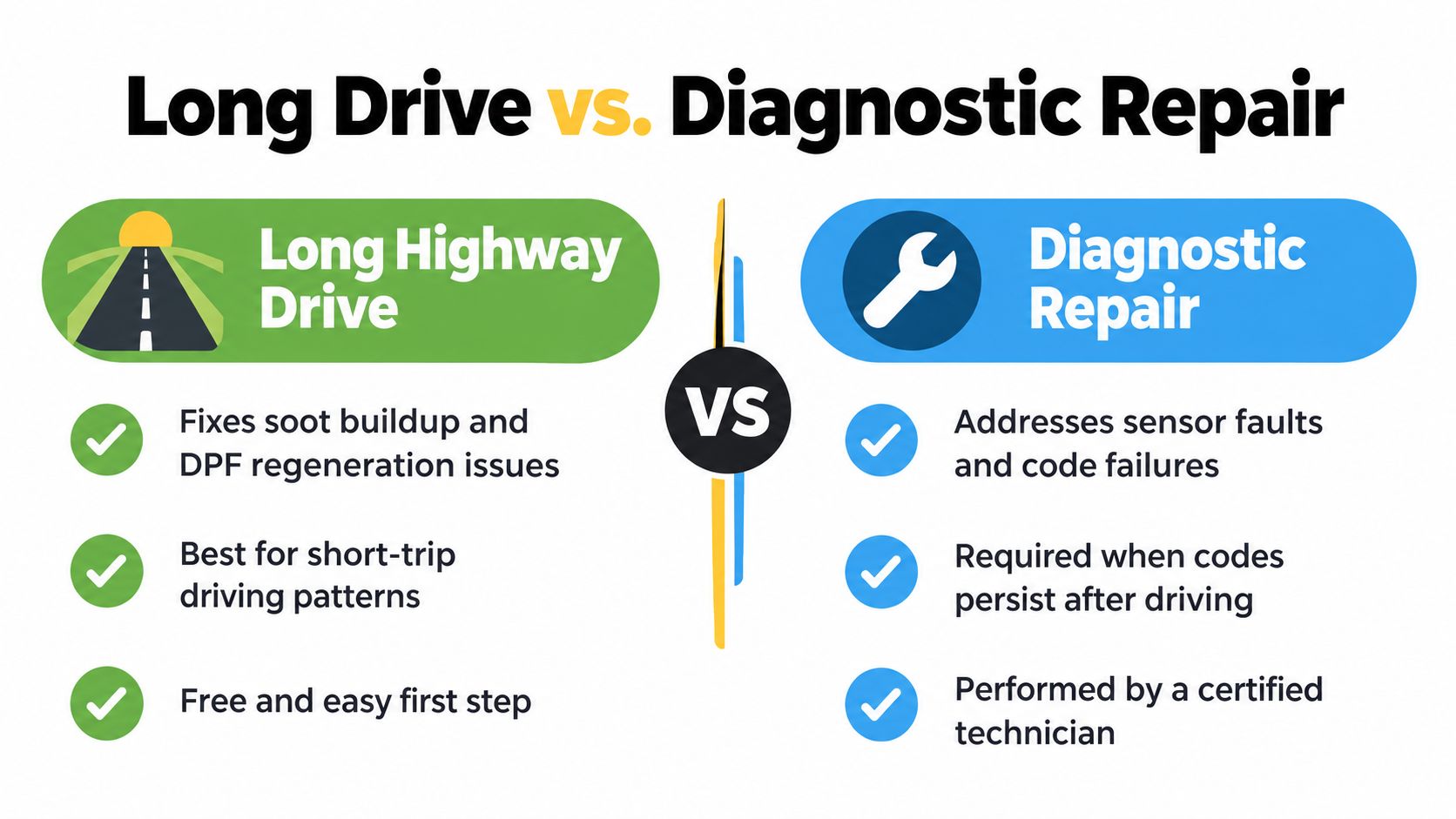
A long highway drive is a reasonable first step when the diesel's main problem is its operating pattern. Short trips can prevent the vehicle from reaching the conditions needed for effective emissions-system operation, and a sustained warm drive may help the vehicle complete its routine.
It's not a universal repair. A drive can't restore a damaged sensor, repair an exhaust leak, reconnect a diagnostic circuit, or undo emissions-control software changes.
When a highway drive makes sense
Choose the low-cost preparation route when the vehicle has no active warning light, communicates normally with the scanner, and the issue appears related to repeated short-trip use. Give the engine a complete warm-up, drive steadily on the highway, and scan the vehicle afterward.
A fuel top-up and correct engine oil may be sensible maintenance steps if the vehicle is due for them, but neither should be treated as a guaranteed emissions repair. Use only fluids and specifications approved for the vehicle, particularly where a diesel particulate filter requires low-ash oil.
The test is simple: did the monitors become Ready, and did the warning condition stay away? If yes, the preparation may have addressed a readiness issue. If not, more driving is unlikely to provide a different result.
When diagnosis comes first
Persistent codes deserve repair before testing. Common failure signatures include DPF-related codes such as P2002, P244A, and P246C, along with visible exhaust leaks and communication problems at the diagnostic connector, according to this diesel emissions failure guide.
A technician should investigate rather than repeatedly clear these codes. Possible causes include damaged pressure or temperature sensors, wiring faults, an exhaust leak that affects readings, inactive regeneration logic, or deleted DPF software. These conditions can keep returning after every reset and can prevent the required monitors from completing.
| Long highway drive may help | Diagnostic repair is the better choice |
|---|---|
| The vehicle has no active warning light | A warning light returns after clearing |
| The issue follows repeated short trips | DPF codes remain stored or return |
| The scan tool communicates normally | The connector won't communicate reliably |
| Monitors are incomplete but no fault is present | Sensors, wiring, software, or exhaust components show faults |
| The engine reaches normal temperature | The engine or emissions system can't meet enabling conditions |
A clean-looking exhaust doesn't prove that the emissions system is healthy. The scanner and the physical inspection need to agree.
Don't drive aggressively to hide smoke. Excessive load, unsafe speeds, or improvised regeneration attempts can add risk without fixing the underlying fault. If the scan shows a persistent problem, pay for diagnosis before paying for another test.
Managing Test Day Logistics and STAR Certification
A prepared vehicle can still have an avoidable problem on test day. Bring the vehicle's registration information and any documents connected with the inspection request or recent emissions repair. If a prior failure report identifies a specific monitor or emissions component, give it to the technician instead of relying on memory.
Arrive with the engine fully warmed through normal driving, but don't turn the trip into an aggressive “tune-up.” A warm engine allows the inspection to occur under normal operating conditions, while careful driving protects you, other road users, and the vehicle.
Confirm the station and procedure
Choose a station that handles the diesel category and test method your vehicle requires. California diesel inspections may involve OBD checks, visual review, and opacity testing depending on the vehicle and applicable rules. Ask before arrival if you're uncertain about model year, GVWR, or the required equipment.
A STAR Certified station meets the Bureau of Automotive Repair's performance standards for participating inspections. That designation doesn't replace vehicle maintenance, but it gives you a compliant testing location for transactions that require a STAR inspection.
Before the technician begins, mention recent battery replacement, code clearing, electrical repairs, or a check engine light. These details help explain why monitors may be incomplete and can prevent you from treating a readiness problem as a mechanical mystery.
Use the result intelligently
If the vehicle passes, keep the paperwork for your records and complete the registration process as required. If it fails, read the failure result carefully. The next repair should target the listed cause, whether that's monitor readiness, a DPF-related code, smoke, visible emissions equipment, or communication.
Don't approve unrelated parts replacement before the diagnostic evidence supports it. A proper pre-test scan can tell you whether the vehicle needs more drive-cycle time or a repair appointment, which is often the difference between a useful visit and paying for a repeat inspection.
For East Bay owners, Speedy Smog performs diesel Smog Checks in San Leandro for applicable vehicles, with OBD, visual, or opacity procedures selected according to the vehicle and inspection requirements. Visit the station with your monitors verified and any recent repair information available so the technician can complete the inspection accurately.

You've just replaced the battery, cleared an old check-engine code, or finished a repair. The car starts easily, idles smoothly, and feels normal on the road, so you drive straight to the smog station expecting a quick pass. Instead, the inspection fails because the vehicle's onboard tests haven't finished running.
That situation is frustrating because the mechanical repair may have been correct. Learning how to get a car to pass smog starts with a less obvious question: is the vehicle ready for the inspection computer to evaluate it? California drivers need to think about readiness monitors, diagnostic trouble codes, emissions equipment, and inspection timing, not just whether the car drives well.
Table of Contents
- Why a Car That Runs Fine Can Still Fail Smog
- Your Pre-Test Checklist the Week Before the Inspection
- OBD Readiness Monitors: How to Get Them Set Before Smog
- The Most Common Things That Fail a Smog Test
- DIY Fixes Versus When to Bring It to a Shop
- California Drivers and Why a STAR Station Matters
- Test Day Routine and Quick Answers to Common Questions
Why a Car That Runs Fine Can Still Fail Smog
The car starts easily, idles smoothly, and drives normally, yet the inspection computer can still reject it. A battery replacement, cleared code, ECU reflash, or repair that required disconnecting power may erase the diagnostic history, including readiness monitors for the catalytic converter, oxygen sensors, evaporative system, misfire detection, and other emissions controls.
A mechanically sound vehicle can therefore arrive at the station with an incomplete OBD record. California's October 1, 2025 rule requires all supported readiness monitors to be set for a pass. Refer to the California BAR's updated readiness-monitor regulations and the dedicated readiness section for the testing details.
The practical lesson: A smooth-running car isn't automatically a smog-ready car.
California's OBD-II inspection checks whether the vehicle has completed its required self-diagnostics. The scanner may show “not ready” even with no warning light on the dash. A pending fault can interrupt a drive cycle, leaving one or more monitors incomplete.
Clearing the check-engine light right before an appointment usually creates another problem. It hides the visible warning while resetting the evidence the inspection computer needs. Some monitors take specific operating conditions to complete, and one short trip after a repair may not finish them. Check readiness status with a scan tool before scheduling the test.
A vehicle can also fail because the underlying emissions fault remains, even if the engine feels normal. Evaporative leaks, sensor problems, and intermittent misfires may not affect drivability enough for a driver to notice.
New Jersey's 2024 inspection report offers broader maintenance context. It recorded 2,083,621 initial overall emissions inspections, with 1,937,882 passing and 145,739 failing at least one emissions component, according to the New Jersey 2024 annual inspection report. States use different rules, but the practical point holds: intact emissions equipment and a completed diagnostic record give a properly running vehicle a better chance than unresolved faults or a freshly reset computer.
Your Pre-Test Checklist the Week Before the Inspection
A car can feel normal on the drive to the station and still arrive with a preventable problem. Use the week before the appointment to catch basic faults, confirm recent work, and avoid changes that reset the vehicle's diagnostic history.
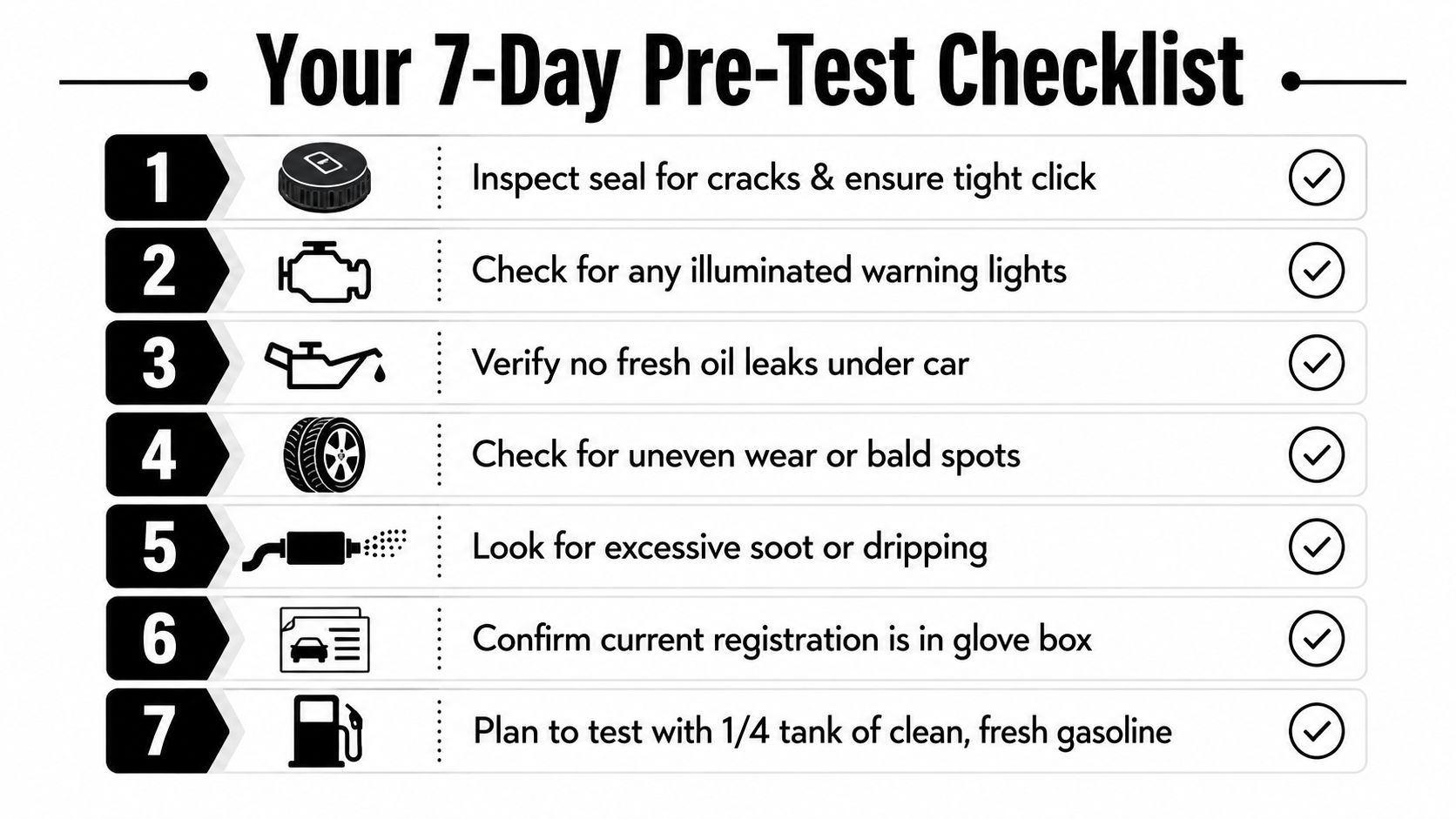
Begin with the dashboard and the basics
Use this walkaround as a practical screening routine:
- Check warning lights: The check-engine light should be off. Investigate any recently extinguished light before booking the inspection.
- Review recent work: Battery replacement, code clearing, ECU programming, or an emissions-sensor replacement can leave readiness status incomplete. Scan the vehicle before scheduling.
- Inspect visible equipment: Look for a missing catalytic converter, disconnected oxygen-sensor wiring, loose intake tubing, or altered emissions components.
- Check tires: Set tire pressure to the manufacturer's specification. Correct inflation helps the vehicle operate under a normal load during applicable dynamometer testing.
- Inspect the fuel level: Keep enough fuel for normal driving without filling the tank to the brim. A moderate level supports evaporative-system checks.
- Look underneath: Address fresh oil leaks, damaged exhaust components, and loose wiring before the appointment.
- Review service timing: If maintenance is due, read whether an oil change before a smog check makes sense for the vehicle's condition and schedule.
Skip fuel additives and premium gasoline as pass strategies. They cannot repair a leaking hose, failed oxygen sensor, weak ignition system, or inefficient catalytic converter. A scan and targeted repair provide more useful information than a product marketed as a quick solution.
Warm the vehicle without trying to outsmart the test
Drive normally during the week and include a sustained highway trip. The engine and exhaust system must reach operating temperature for emissions controls to function as designed, but warming the car does not replace completed monitors or a necessary repair.
A short fifteen-minute highway loop before the appointment can bring the exhaust system up to temperature. It cannot erase an active fault or finish every diagnostic test. Avoid clearing codes, disconnecting the battery, or making last-minute repairs unless you have time to verify the resulting readiness status before the inspection.
OBD Readiness Monitors: How to Get Them Set Before Smog
A mechanically sound car can still fail a California smog inspection when its readiness monitors are incomplete. These software tests run through the vehicle's OBD-II system and evaluate emissions functions such as the catalytic converter, oxygen sensors, evaporative system, exhaust-gas recirculation system, and misfire control. Each monitor needs specific operating conditions before it can report a result.
A monitor does not confirm that a component is installed. It checks whether the vehicle has driven through the temperature, speed, load, and fuel-system conditions required for that diagnostic. California BAR's 2025 to 2026 explanation of new OBD readiness regulations explains how supported monitors must be complete under applicable California rules.
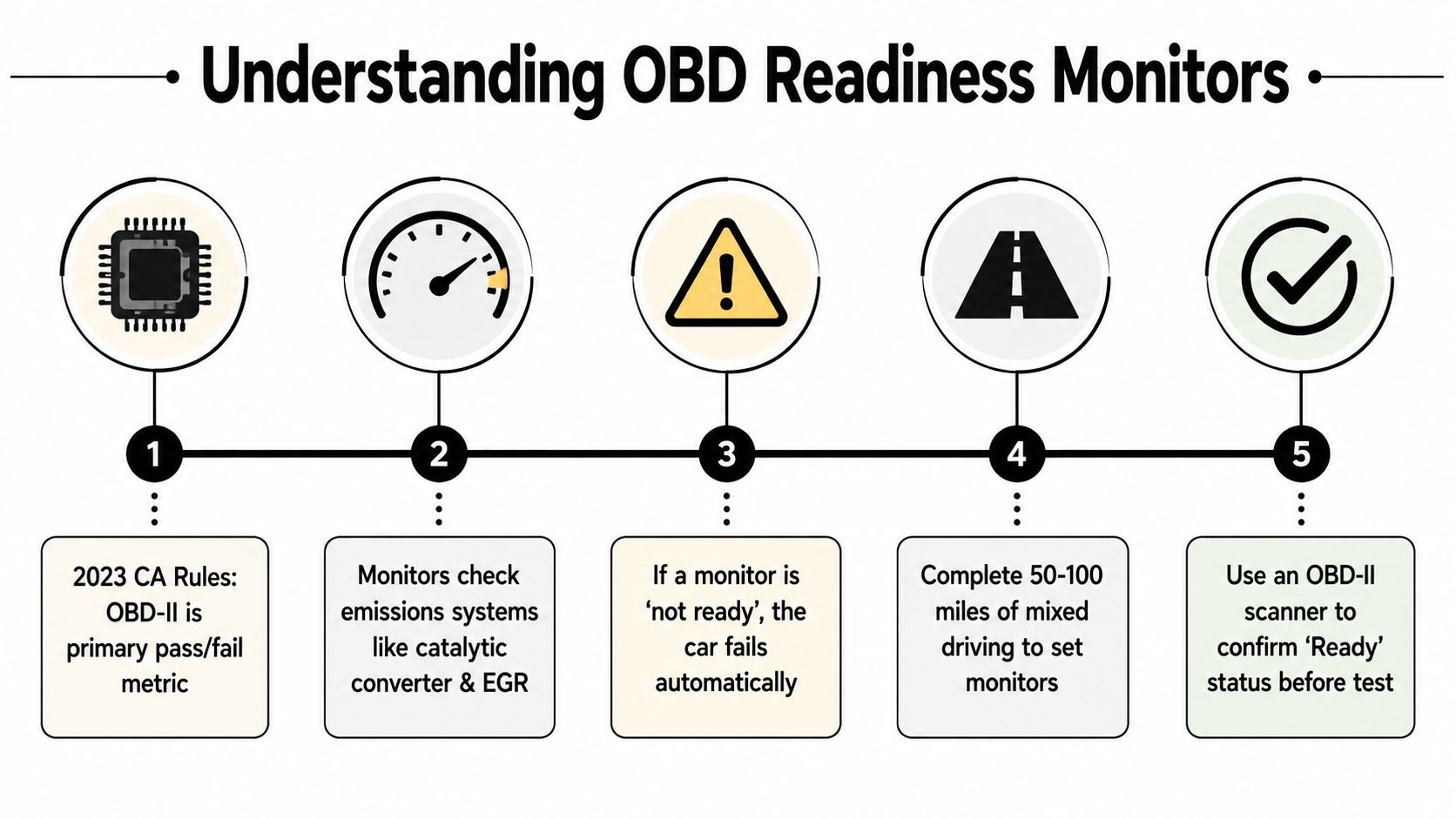
Use mixed driving, not driveway idling
A useful drive cycle combines a cold start, city driving, steady cruising, and controlled deceleration. Start with a cold engine, drive through stop-and-go traffic, then add a sustained highway stretch at a steady speed with gentle throttle and at least one natural slowdown.
A 2004 to 2010 Toyota Camry may need more than one type of trip for the EVAP monitor. City driving helps create the temperature and fuel-system changes it checks, while highway cruising can provide the steady operating conditions needed for other monitors. The exact sequence varies by engine, transmission, ambient temperature, and the monitor that remains incomplete, so use the manufacturer's procedure when available.
Repeat the drive pattern over separate trips. Extended driveway idling cannot reproduce the changing speed, load, and fuel-tank conditions many tests require. Some monitors also need the cycle repeated before they show ready.
Scan before paying for the official test
Check readiness status before arriving at the station. Depending on the vehicle, you may access diagnostic information through its service menu, use a Bluetooth OBD-II adapter with a compatible app, or request a pre-scan from an auto-parts store. The scan should show which monitors are ready, whether stored or pending codes exist, and whether the computer is commanding the check-engine light on.
For a practical guide, see how to read OBD codes. Do not erase codes just to make the dashboard look clear. Clearing codes also resets monitor progress, and a returning fault can prevent the vehicle from passing even after the light initially stays off.
The Most Common Things That Fail a Smog Test
A car can run smoothly and still fail because one emissions system is outside its permitted range. Start with the failure evidence before buying parts. A catalytic converter may be involved, but ignition faults, fuel-control problems, exhaust leaks, sensor wiring, and unauthorized visual changes can produce similar symptoms.
| Failure Cause | Symptom | Quick Check | Typical Repair |
|---|---|---|---|
| Catalytic-converter inefficiency | Emissions stay high after warm-up, or a catalyst-efficiency code appears | Review scan data and test exhaust performance after checking upstream faults | Correct the cause, then replace the converter only when diagnosis supports it |
| Check-engine light or emissions code | Warning light remains on or returns during driving | Scan stored and pending codes without erasing them | Repair the fault, verify the result, and complete required monitors |
| Loose or cracked gas cap | Fuel odor, EVAP code, or no noticeable drivability problem | Inspect the seal and tighten the cap until it clicks | Replace the cap if its seal or locking mechanism is damaged |
| Worn spark plugs or ignition faults | Rough idle, hesitation, misfire, or poor fuel economy | Inspect plugs and review misfire data | Replace worn components and diagnose the underlying cause |
| Dirty MAF sensor or vacuum leak | Lean-running symptoms, unstable idle, or intake noise | Check intake tubing and vacuum hoses, then review live data | Repair the leak or service the sensor using the correct procedure |
| Faulty oxygen sensor | Poor fuel economy, fuel-trim problems, or a recurring sensor code | Compare scan data with wiring condition | Confirm the circuit and mixture issue before replacing the correct sensor |
| EVAP-system fault | Fuel odor, difficult refueling, or an evaporative leak code | Inspect the cap and hoses; use a smoke test for hidden leaks | Repair the leaking hose, purge valve, vent valve, or related component |
These systems affect one another. A misfire can send unburned fuel into the exhaust, while a fuel-control fault can overheat the converter. A small EVAP leak can turn on the warning light even when the engine feels normal. Diagnosis should therefore follow the code, live data, and physical inspection rather than the most expensive suspected part.
Visual inspection can also matter. Missing or visibly altered emissions equipment, disconnected hoses, damaged wiring, or an intake and exhaust configuration that does not match the vehicle's approved setup can create a failure even when drivability is good. Check those items before the appointment, especially after aftermarket work.
Cold-start behavior deserves attention. The catalytic converter and oxygen sensors need heat before they can control and clean exhaust effectively. A normal warm-up drive is preferable to leaving a cold car idling briefly and then entering the station, but warming the vehicle cannot repair a failed component. If the light returns, the monitor stays incomplete, or the exhaust readings remain high, identify the fault before paying for another inspection.
DIY Fixes Versus When to Bring It to a Shop
Use a simple rule: handle inspection and replacement tasks at home when the fault is obvious, accessible, and unlikely to create a new emissions problem. Bring the vehicle to a shop when the repair requires scan-data interpretation, smoke testing, exhaust measurement, programming, lifting equipment, or emissions-component verification.
Reasonable driveway work
A gas-cap replacement is the clearest example. It takes little time, requires no special equipment, and addresses a common EVAP failure point. An air-filter replacement, correct spark-plug service, and inspection of loose intake tubing can also be sensible DIY work when you follow the manufacturer's specifications.
A basic OBD-II scanner is useful for checking codes and monitor status, but it doesn't turn every code into a diagnosis. A code identifies a system or condition that needs investigation. It doesn't always identify the exact failed part.
- Gas cap: Low complexity, low risk, provided you install the correct cap for the vehicle.
- Air filter: Straightforward, but confirm the housing seals correctly so unmetered air doesn't enter.
- Spark plugs: Manageable for an experienced owner, but incorrect gap, torque, or plug type can create a misfire.
- Readiness reset: Don't deliberately disconnect the battery to clear a code. That action can make the inspection less likely to pass by resetting monitors.
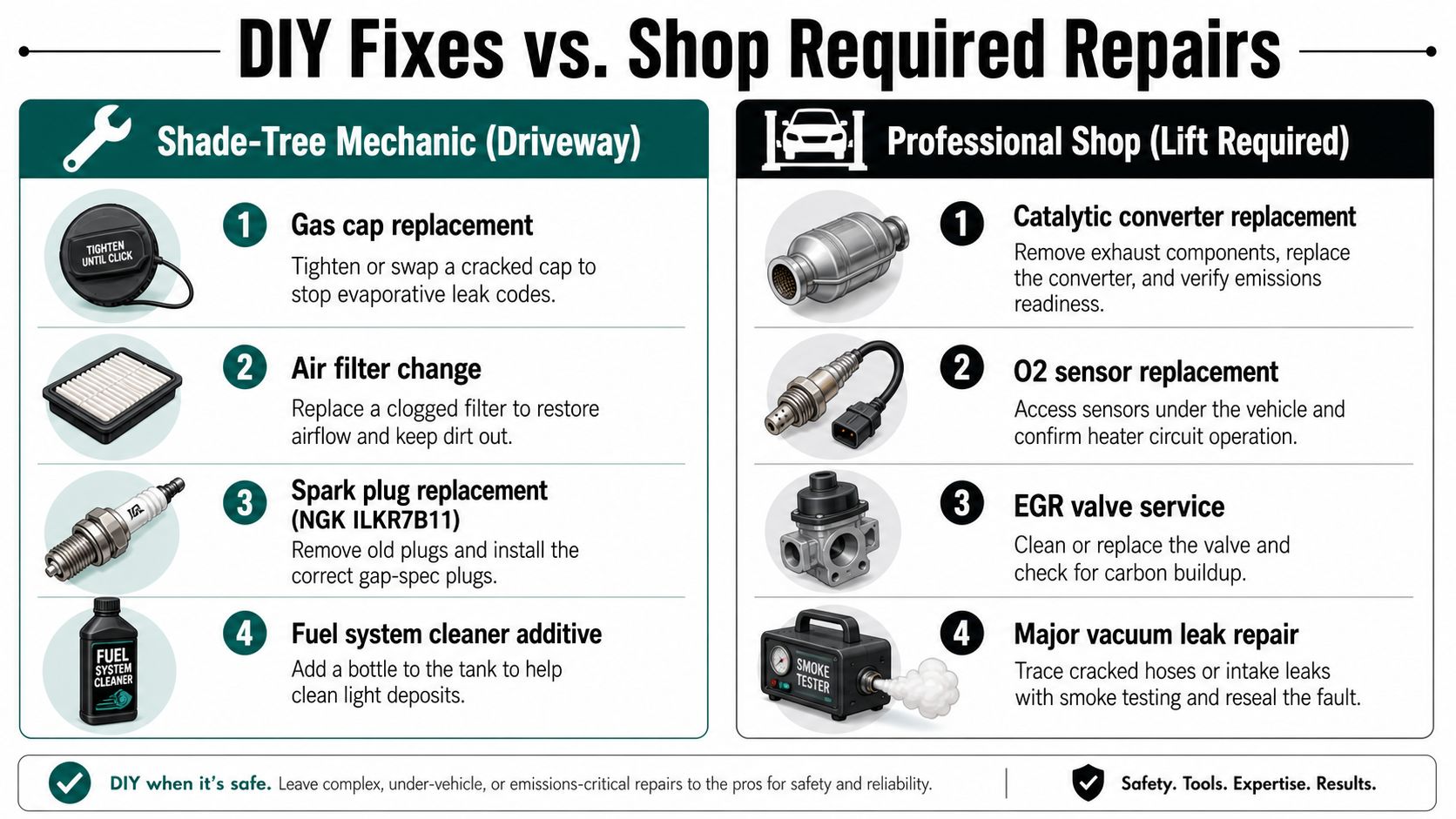
Repairs that need proper equipment
Catalytic-converter replacement, oxygen-sensor diagnosis, timing problems, and EVAP leaks belong in a shop when you don't have the necessary tools and service information. A smoke machine can reveal leaks that visual inspection misses. A scan tool can compare fuel trims, sensor response, misfire counts, and monitor behavior while the engine operates.
A STAR station can also be appropriate when the vehicle needs a directed repair or a referee-related inspection. The cost difference between parts-only work and professional service varies by vehicle and fault, so a technician should confirm the failed system before you authorize an expensive component.
A failed smog result is diagnostic information. Read the failure category and repair the cause instead of replacing parts in the order they appear on a search page.
California Drivers and Why a STAR Station Matters
A STAR Certified station operates under California Bureau of Automotive Repair oversight and follows the state's requirements for testing and applicable directed repairs. That matters when the vehicle has an unusual failure, a prior inspection issue, a visual-compliance concern, or a problem that requires more than a basic pass-or-fail scan.
Not every station handles the same work. Before booking, ask whether the location can test your vehicle's model year, fuel type, hybrid system, diesel configuration, or inspection category. Confirm whether it performs test-and-repair work, whether it can handle a directed repair, and whether a referee appointment is required instead of another ordinary inspection.
California BAR reporting separates inspection outcomes into categories that include overall, emissions, functional, visual, and OBDII failures, as shown in the BAR executive summary and performance report. A car can drive normally and still fail because emissions equipment is missing, a modification isn't approved, or the software state isn't acceptable.
What to ask before you arrive
- Vehicle eligibility: Can the station inspect your specific vehicle type and model year?
- Readiness status: Can the technician check monitors before beginning the official inspection?
- Repair capability: If the car fails, can the station diagnose the failure or must you use another facility?
- Special inspection needs: Does your situation require a directed repair or state referee?
- Documentation: What registration or prior inspection paperwork should you bring?
For East Bay drivers, Speedy Smog's explanation of STAR stations provides a practical overview of the certification and inspection process. The San Leandro shop handles emissions testing for common passenger vehicles as well as older vehicles, diesels, and hybrids, so drivers can confirm suitability before making the trip.
Test Day Routine and Quick Answers to Common Questions
On the day of the appointment, drive the car through fifteen to twenty minutes of mixed operation, including highway driving when practical. Check the dashboard before leaving, confirm the fuel level is within the station's recommended range, and bring registration plus the previous smog certificate if you have it. Turn off unnecessary accessories, remove chargers, and follow the technician's instructions when you arrive.
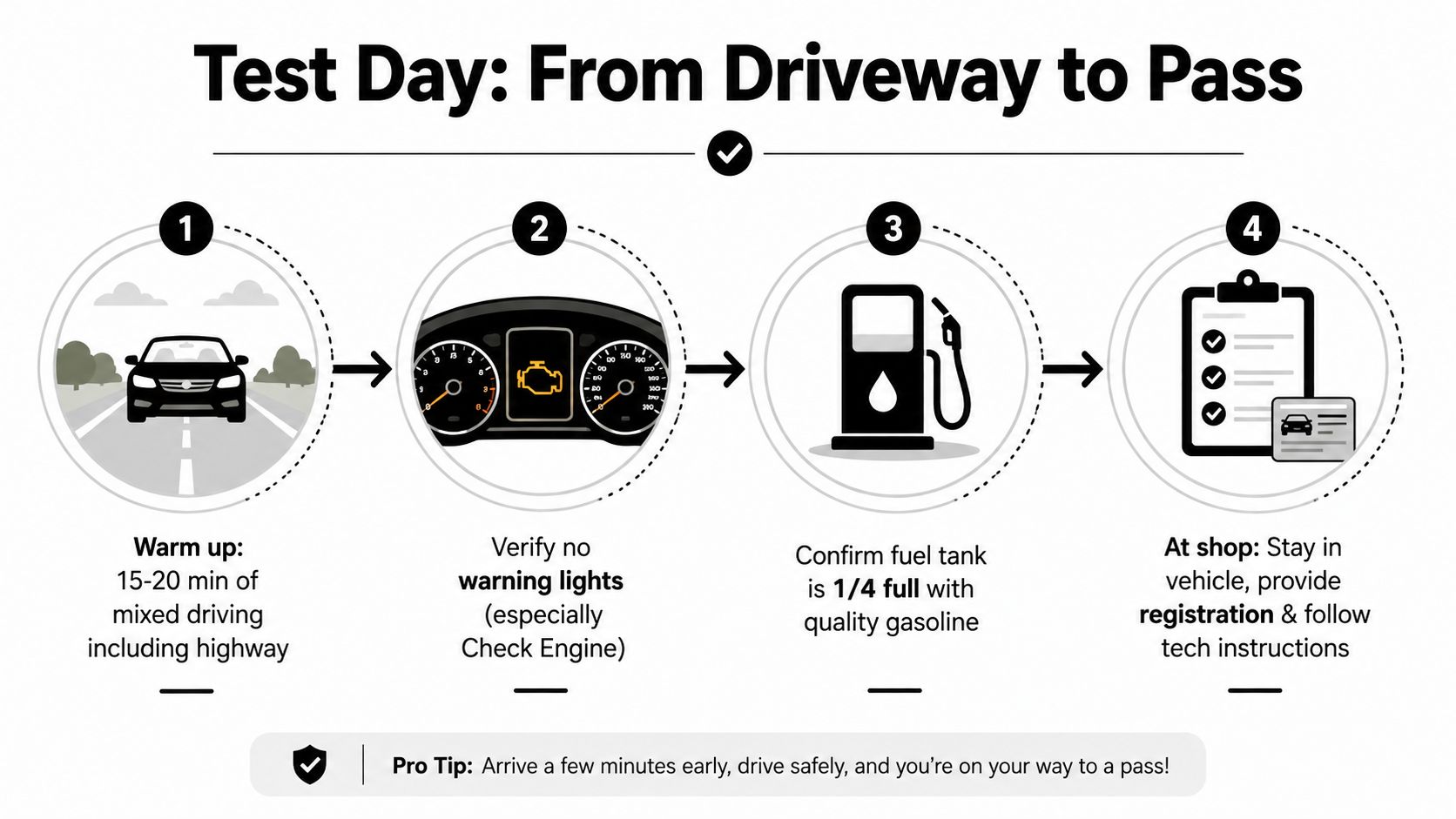
A recent battery disconnect doesn't automatically mean the car will fail forever, but it can reset the monitors. Drive until a scanner confirms the supported monitors are ready. The time required varies by vehicle and monitor, so mileage alone isn't proof of readiness.
Idling in the driveway usually isn't enough because monitors need changing speed, load, temperature, and operating conditions. A directed inspection means the vehicle must follow specific repair or inspection instructions, while a referee may be needed when the vehicle's emissions configuration or prior result requires state review.
For a final reminder, use the California BAR readiness guidance as the controlling reference for applicable monitor requirements rather than relying on generic advice from a parts store or online forum.
If your car has recently had a battery replacement, code clear, repair, or failed inspection, visit Speedy Smog for a California smog inspection and readiness-focused pre-test conversation. Bring the vehicle's failure paperwork or scan information so the technician can help you address the actual compliance issue before you pay for another test.

You pull into the smog station confident. The car starts easily, idles smoothly, gets decent fuel economy, and hasn't shown any obvious warning signs. Then the technician plugs in the scanner, checks the inspection results, and hands you a failure report. You're left wondering what makes a car fail smog when it seems to run perfectly.
The answer is usually hidden in the emissions-control system, not the parts you feel from the driver's seat. Modern inspections check diagnostic data, monitor status, warning-lamp behavior, emissions equipment, and sometimes tailpipe output. A vehicle can drive normally while its computer reports that an emissions system hasn't completed testing or isn't operating within required limits.
Table of Contents
- Why Perfectly Running Cars Still Fail Smog Checks
- The Real Numbers Behind California Smog Failures
- The Most Common Reasons Cars Fail Smog Inspections
- How Smog Test Requirements Differ by Vehicle Type
- Pre-Test Diagnostics You Can Do Before Your Smog Check
- Repair Options Costs and What to Expect at a STAR Station
- Your Action Plan for Passing Your Next Smog Check
Why Perfectly Running Cars Still Fail Smog Checks
A smooth-running engine only proves that the car can move, idle, accelerate, and start. It doesn't prove that the emissions system is complete, functional, and compliant. That distinction catches drivers off guard because many emissions problems don't create rough running, hard starts, poor mileage, or unusual exhaust odor.
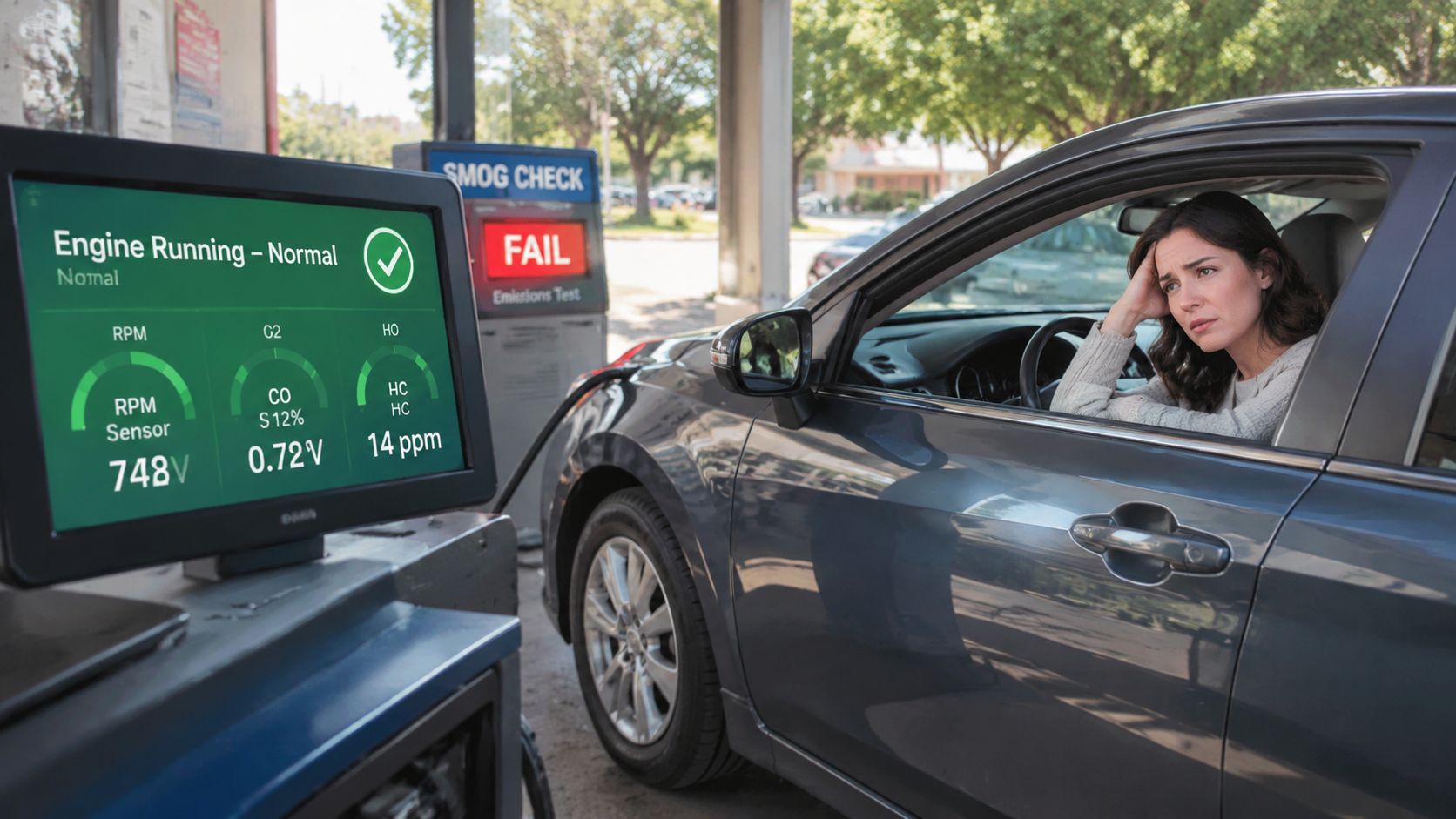
A modern car constantly checks systems such as the catalytic converter, oxygen sensors, fuel control, misfire detection, and evaporative emissions equipment. Those checks run through software called the onboard diagnostics system, or OBD. If the computer detects an emissions-related fault, stores a trouble code, or hasn't completed the required checks, the car may fail even though you'd never notice a problem during an ordinary commute.
Drivability and compliance are different tests
Drivers often make the same mistake after a battery replacement or repair. The check engine light goes off, the car feels fine, and they schedule a smog check immediately. That repair may have erased the vehicle's stored diagnostic information, leaving the readiness monitors incomplete. The car hasn't necessarily become worse, but it also hasn't finished proving that its emissions equipment works.
A malfunction indicator lamp that stays on or flashes can cause failure, as can an inoperative warning lamp, a missing or unusable diagnostic connector, or emissions-related diagnostic trouble codes. Some inspection programs also check the fuel cap system. A gas cap that can't maintain pressure can expose an evaporative emissions leak even when the engine runs normally, as described in this OBD-II smog inspection guide.
Technician's rule: A car that feels fine can still fail. The computer doesn't grade the drive. It grades the emissions evidence.
The causes generally fall into two groups. Hardware failures include a weak catalytic converter, faulty oxygen sensor, leaking EVAP component, damaged exhaust, or missing emissions equipment. Diagnostic and software-related failures include incomplete monitors, active codes, incorrect warning-lamp behavior, and non-approved or modified software calibration.
Most failures are diagnosable. Don't guess at expensive parts based only on the failure label. Start with the Vehicle Inspection Report, scan the car properly, and identify whether the problem is a real component failure or a system that hasn't completed its checks.
The Real Numbers Behind California Smog Failures
California's statewide results show that failed smog checks are common enough to deserve a methodical response, not panic. The state's 2026 Smog Check Performance Report says about 19 million 2000-and-newer vehicles were tested during calendar years 2024 and 2025, and roughly 1.3 million failed, producing an overall failure rate of about 7%. The same report shows roadside failures at about 14%, which indicates that real-world emissions performance can be worse than test-station results suggest. See the California Smog Check Performance Report.
| Metric | Rate | What It Means |
|---|---|---|
| 2000-and-newer vehicles tested in California during CY 2024-2025 | About 19 million vehicles | The inspection program covers a very large modern-vehicle population. |
| Those vehicles that failed | Roughly 1.3 million vehicles | A failed result is a routine emissions-compliance outcome, not proof that an engine is about to stop running. |
| Overall test-station failure rate | About 7% | Most tested vehicles passed, but a meaningful group did not. |
| Roadside failure rate | About 14% | Vehicles may perform worse under real-world conditions than at a test station. |
The numbers also explain why a clean-running car can fail. Historical EPA analysis found that 33% of vehicles had inconsistent tailpipe results when a screening facility's result was compared with the first Smog Check station. The analysis identified inaccurate underhood inspection results as the principal reason for many discrepancies. It also found that about 84.6% of vehicles passing both Smog Check stations still had at least one visual or functional defect at the laboratory level, showing how easily hidden problems can escape ordinary driving observation. The underlying EPA inspection analysis is useful background for understanding why inspection programs look beyond drivability.
What the data means for your diagnosis
These figures don't tell you which part failed on your car. They do tell you that smog compliance has never depended only on whether the engine feels healthy. Inspection methods are built to identify faults that a driver may not feel, including underhood defects, control-system faults, and inconsistent emissions behavior.
California reporting also describes a growing role for diagnostic and functional outcomes, including software and OBD-related issues. Modified or non-approved software can affect compliance, so replacing a sensor isn't always the correct answer. A technician needs to determine whether the car has excessive emissions, a missing or altered component, an incomplete monitor, or a computer-calibration problem.
The Most Common Reasons Cars Fail Smog Inspections
The fastest way to waste money after a failed inspection is to replace parts without reading the failure details. Start with the Vehicle Inspection Report, then match the result to the system that controls the failure.
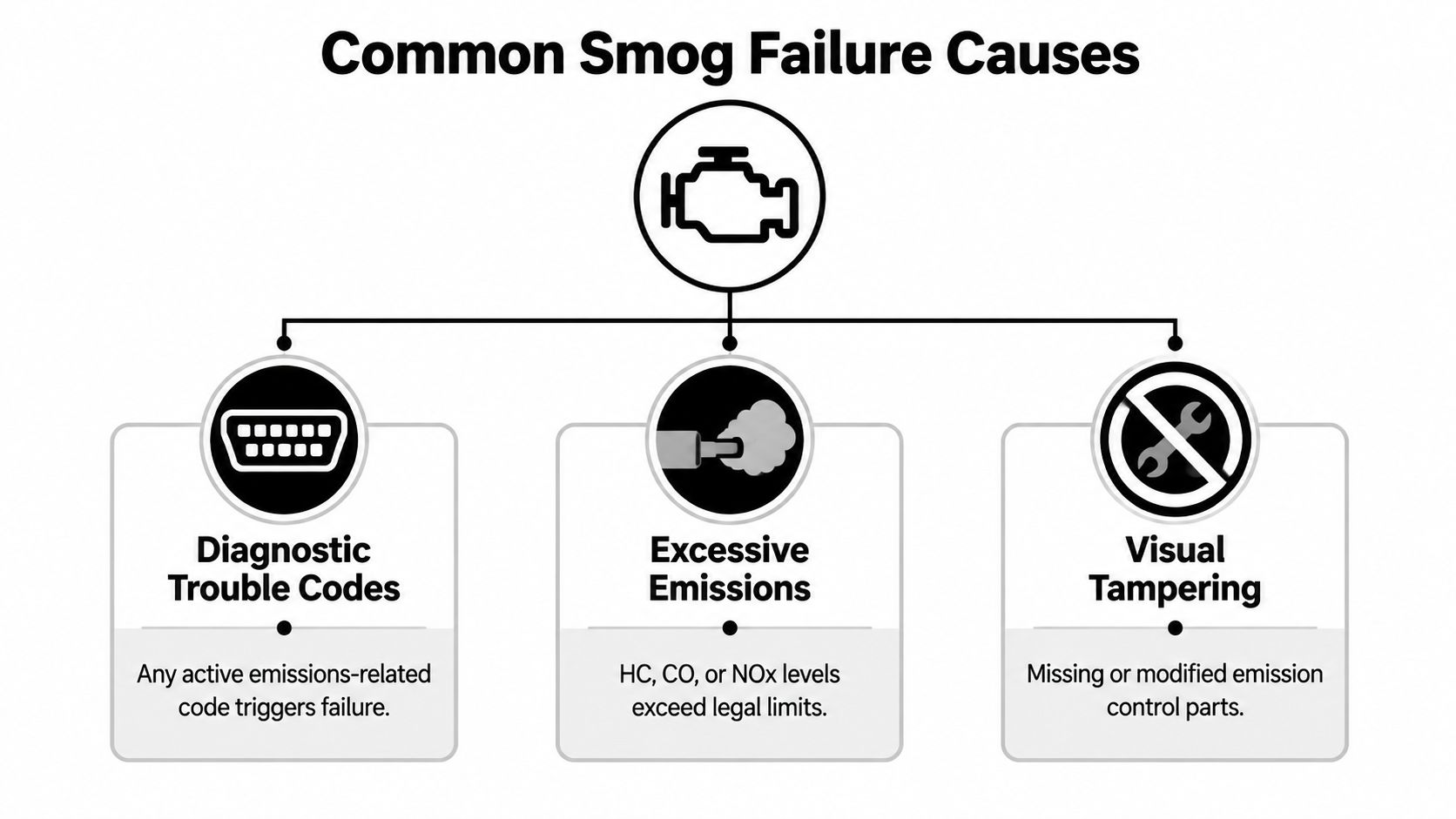
Active warning lights and diagnostic trouble codes
An illuminated check engine light is the clearest warning that the emissions computer has found a problem. The light may relate to an oxygen sensor, catalyst efficiency, fuel mixture, misfire, evaporative leak, exhaust leak, or another emissions-controlled function. The light itself is only the symptom. The stored code tells the technician where to begin.
A flashing light deserves immediate attention because it can indicate an active misfire that may damage the catalytic converter. A steady light still needs diagnosis before testing. Clearing the code without repairing the cause is not a fix, and it can create a second failure if the readiness monitors haven't returned to ready status.
Incomplete readiness monitors
Readiness monitors are self-tests that verify systems under specific operating conditions. Battery disconnection, code clearing, module replacement, or recent repairs can erase their status. The car may have no current warning light and still fail because the computer hasn't completed the required checks.
The EPA testing requirements identify monitors that can include misfire, fuel trim, evaporative emissions, oxygen sensor, and catalyst efficiency. Catalyst and EVAP checks often need particular temperature, speed, and load conditions, so random short trips may not complete them.
Catalytic converter and oxygen sensor problems
The catalytic converter changes pollutants in the exhaust into less harmful compounds. A worn, contaminated, physically damaged, or inefficient converter may not clean the exhaust sufficiently. The car can still accelerate normally, but the inspection computer or tailpipe test can detect the difference.
Oxygen sensors help the engine control fuel mixture and monitor catalyst performance. A sensor can become slow or inaccurate without making the vehicle feel obviously defective. Replacing a sensor without confirming the code, wiring, exhaust leaks, fuel-trim data, and sensor behavior is poor diagnosis. A converter problem may be the result of an unresolved misfire or fuel-control fault, so repair the cause rather than repeatedly installing expensive parts.
Don't condemn the converter from one code alone. Check the sensor signals, exhaust condition, fuel control, ignition performance, and wiring before approving a major repair.
EVAP leaks and gas cap faults
The evaporative emissions system keeps fuel vapors from escaping. It includes the fuel cap, vapor lines, charcoal canister, purge valve, vent valve, and tank-side components. A loose, cracked, or poorly sealing gas cap can trigger a leak code. Deeper leaks may require a smoke test to locate.
Tighten the cap until it clicks if the design requires it, then inspect the seal for damage. If the warning light remains on, don't assume the cap was the only problem. A leak in a hose or valve can be too small to see and still large enough for the vehicle's pressure test to detect.
Fuel, ignition, exhaust, and visual defects
A rich or lean fuel mixture can raise emissions without producing dramatic drivability symptoms. Worn ignition components, intake leaks, fuel-pressure problems, incorrect air measurement, or a thermostat that prevents normal operating temperature can all affect emissions behavior. An exhaust leak ahead of an oxygen sensor can also distort readings and lead the computer toward the wrong diagnosis.
Visual inspection matters too. Missing, modified, disconnected, or non-approved emissions equipment can cause failure even if the tailpipe output appears acceptable. That includes altered software calibration on vehicles where the inspection system can identify non-approved programming. If the car has aftermarket intake, exhaust, programming, or emissions-related modifications, confirm compliance before testing.
A helpful visual explanation of these failure categories appears in this guide to smog check failure reasons.
Here's a practical video overview of common inspection problems:
How Smog Test Requirements Differ by Vehicle Type
Your vehicle's age and fuel type determine what the inspector can test and which failures matter most. Don't prepare a diesel truck the same way you prepare a late-model gasoline car, and don't assume a hybrid behaves exactly like a conventional vehicle.
2000-and-newer OBD vehicles
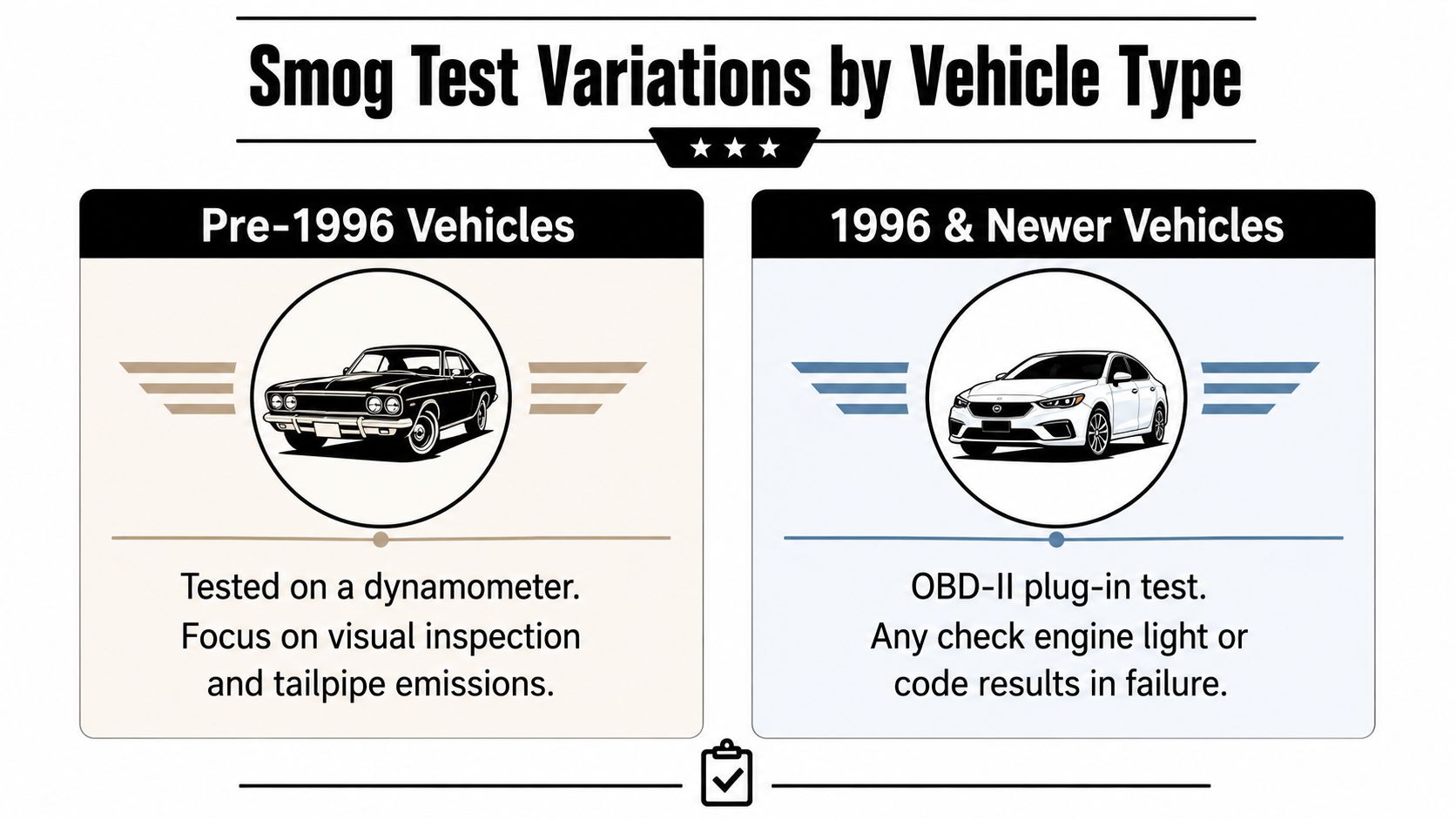
Modern gasoline vehicles generally rely heavily on the OBD inspection. The technician connects to the diagnostic link connector and checks warning-lamp behavior, stored emissions-related codes, and readiness status. The inspection is therefore a computer compliance check as much as a mechanical one.
Prioritize the check engine light, monitor status, software modifications, and the condition of emissions components. A recent battery replacement is especially relevant because it can erase monitor history. A scan before the appointment is more useful than a quick visual glance under the hood.
Older gasoline vehicles
Older vehicles may rely more heavily on visual inspection and tailpipe emissions testing. The inspector can evaluate emissions equipment, exhaust condition, and measured pollutants rather than relying only on computer data. Vehicles with older fuel systems, vacuum controls, exhaust gas recirculation components, or carburetion-related equipment need a different diagnostic approach.
For these cars, visible tampering and missing equipment can matter as much as the measured exhaust. Poor tune, vacuum leaks, ignition faults, oil consumption, and a weak converter can also push tailpipe readings beyond the allowable limits.
Diesels and hybrids
Diesel vehicles have their own inspection considerations, including diesel-specific emissions controls and particulate-related concerns. Smoke, altered emissions equipment, incorrect software, and faults in electronic controls deserve attention before testing. A diesel that has been modified for performance may have a compliance issue even if it drives strongly.
Hybrids can be deceptive because the gasoline engine may shut off during portions of the inspection or operate under a different load pattern. Their emissions systems still depend on working sensors, catalyst monitoring, EVAP control, and completed diagnostic checks. Hybrid owners should use a scan tool that can communicate correctly with the vehicle's systems rather than relying on a basic reader that shows limited information.
Match the diagnosis to the vehicle. The same failure label can point to different tests and different repair paths on an older gasoline car, a diesel, a hybrid, or a modern OBD-equipped vehicle.
Pre-Test Diagnostics You Can Do Before Your Smog Check
A short inspection before the appointment can prevent an avoidable failure. It won't diagnose every fault, but it can reveal the problems most likely to waste a trip.
Start with the dashboard
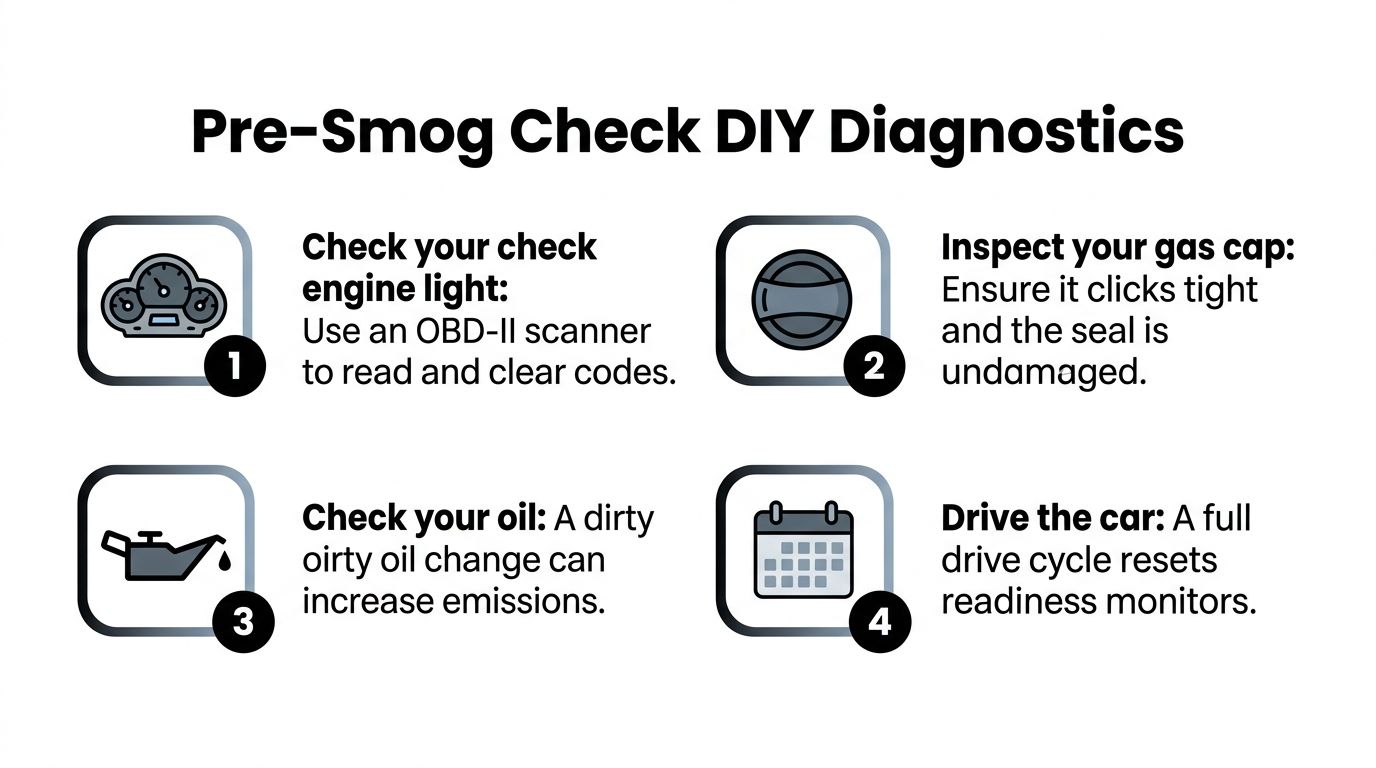
Turn the ignition on without starting the engine and confirm that the malfunction indicator lamp illuminates as part of the normal bulb check. Start the engine and verify that it goes out. If it stays on or flashes, scan the vehicle before scheduling the inspection.
Use a compatible OBD-II scanner to read stored and pending codes. Don't clear codes just to make the dashboard look clean. Code clearing can erase readiness information and leave the vehicle unprepared for the test. A useful OBD code reading guide can help you understand what the scanner is showing, but code interpretation still requires proper diagnosis.
Confirm readiness before you test
Many parts stores and repair shops can check readiness status with a scan tool. Ask specifically whether the required monitors are ready, not merely whether the car has codes. If the battery was disconnected or a repair cleared the computer, the vehicle may need a complete drive cycle.
Drive normally through varied conditions, including a cold start, steady cruising, moderate acceleration, and periods of deceleration. Catalyst and EVAP monitors may require specific temperature, speed, and load conditions, so repeated short errands may not be enough. Follow the manufacturer's drive-cycle guidance when available.
Inspect the simple items
Check the gas cap for a damaged seal, cracked plastic, or a cap that won't tighten correctly. Look under the hood for disconnected vacuum hoses, loose electrical connectors, obvious air leaks, and missing emissions components. Listen for an exhaust leak, especially near the engine and oxygen sensors.
An overdue oil change won't explain every failure, but maintaining the engine before testing is sensible. If the engine runs poorly, consumes oil, overheats, or never reaches normal operating temperature, get those symptoms diagnosed rather than trying to mask them with a last-minute tune-up.
Repair Options Costs and What to Expect at a STAR Station
A car can run smoothly and still fail because its emissions software has not completed required checks. Repair cost depends on the failed system. Correcting a loose gas cap or allowing an incomplete monitor to finish may cost little, while a damaged catalytic converter, wiring fault, failed control module, or major EVAP leak requires diagnosis and more extensive work.
Do not approve a converter, oxygen sensor, or computer replacement just because a generic code points there. Ask which tests confirmed the fault, whether another problem caused it, and whether the repair will restore the readiness monitors. A reputable shop should explain the Vehicle Inspection Report in plain language and connect its repair recommendation to evidence.
A STAR station meets California's additional program requirements and may be required for vehicles directed to STAR testing. Learn more about what a STAR station is and why it matters. Check your registration renewal notice before choosing a location. If it requires STAR certification, a non-STAR station may not meet the testing requirement.
At a station such as Speedy Smog, the inspection documents the vehicle's compliance result. For many 2000-and-newer vehicles, the test is typically completed in about 10 to 15 minutes, according to the publisher's service information. The station also tests older vehicles, diesels, and hybrids, though the procedure varies by vehicle.
Bring your registration paperwork and any previous Vehicle Inspection Report. If another station failed the car, show that report instead of starting over. It gives the technician useful evidence and can prevent duplicate testing. Ask about current coupons before authorizing the inspection, then keep the result paperwork for the repair shop or retest.
Your Action Plan for Passing Your Next Smog Check
Use this order before booking the appointment:
- Check the warning lamp. If it stays on or flashes, scan the car first.
- Read the diagnostic codes. Don't clear them without fixing the cause.
- Verify readiness monitors. Pay particular attention after a battery disconnect or repair.
- Inspect the gas cap and emissions hardware. Look for leaks, missing parts, and obvious modifications.
- Complete the correct drive cycle. Random short trips may not finish catalyst or EVAP checks.
- Bring the Vehicle Inspection Report to a qualified repair shop if the car has already failed.
- Confirm whether your registration notice requires a STAR station before scheduling the retest.
The biggest warning signs are an illuminated check engine light, incomplete monitors, recent code clearing, visible emissions tampering, poor operating temperature, and unexplained exhaust or fuel-system symptoms. Fix the evidence-backed problem first. Don't buy parts based on guesswork.
For a clear inspection result and practical guidance after a failure, visit Speedy Smog in San Leandro. The STAR Certified station tests newer and older vehicles, diesels, and hybrids, and can identify the failed area on the inspection report so you know what to address next.