
You pull into the smog station confident. The car starts easily, idles smoothly, gets decent fuel economy, and hasn't shown any obvious warning signs. Then the technician plugs in the scanner, checks the inspection results, and hands you a failure report. You're left wondering what makes a car fail smog when it seems to run perfectly.
The answer is usually hidden in the emissions-control system, not the parts you feel from the driver's seat. Modern inspections check diagnostic data, monitor status, warning-lamp behavior, emissions equipment, and sometimes tailpipe output. A vehicle can drive normally while its computer reports that an emissions system hasn't completed testing or isn't operating within required limits.
Table of Contents
- Why Perfectly Running Cars Still Fail Smog Checks
- The Real Numbers Behind California Smog Failures
- The Most Common Reasons Cars Fail Smog Inspections
- How Smog Test Requirements Differ by Vehicle Type
- Pre-Test Diagnostics You Can Do Before Your Smog Check
- Repair Options Costs and What to Expect at a STAR Station
- Your Action Plan for Passing Your Next Smog Check
Why Perfectly Running Cars Still Fail Smog Checks
A smooth-running engine only proves that the car can move, idle, accelerate, and start. It doesn't prove that the emissions system is complete, functional, and compliant. That distinction catches drivers off guard because many emissions problems don't create rough running, hard starts, poor mileage, or unusual exhaust odor.
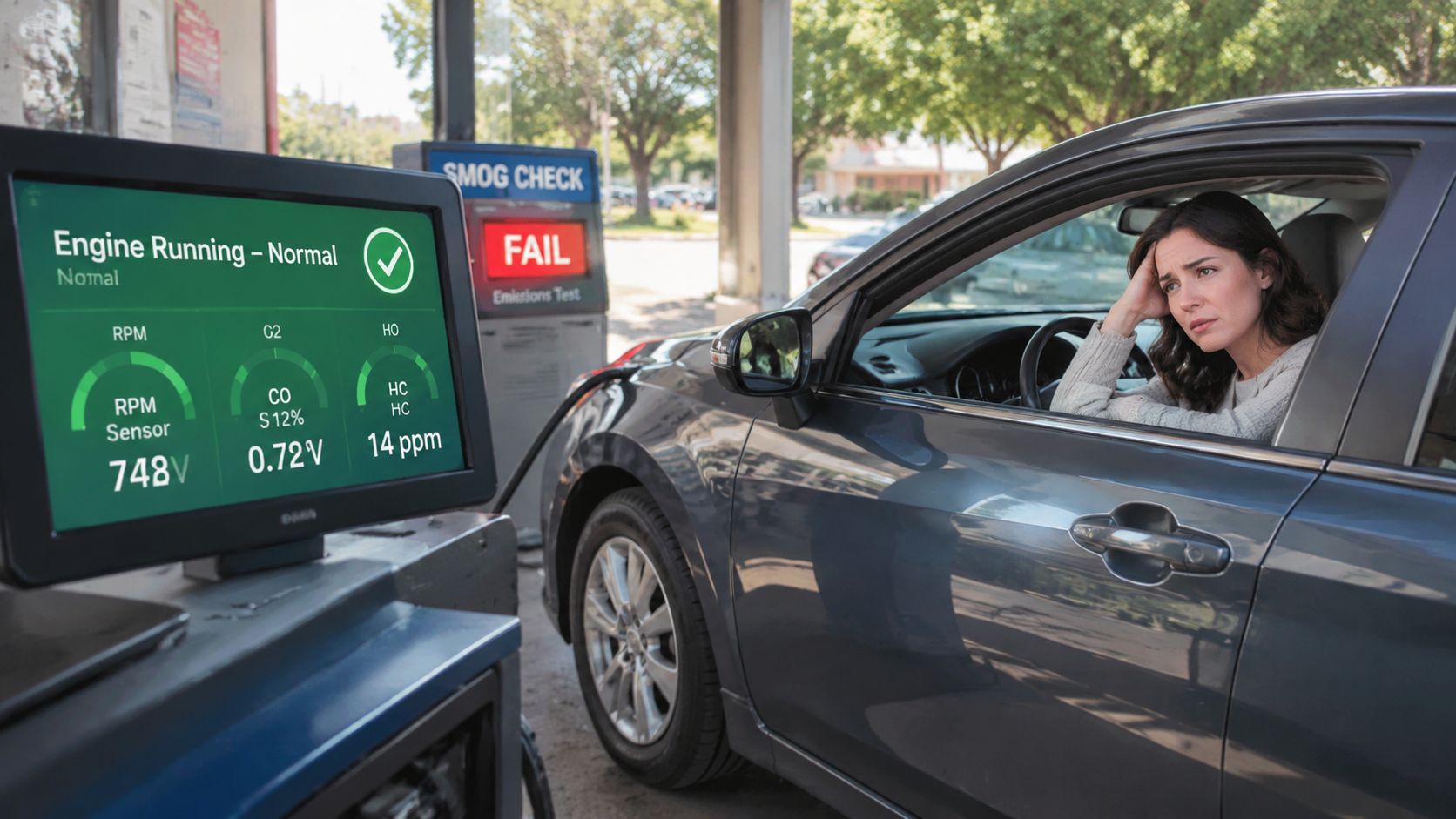
A modern car constantly checks systems such as the catalytic converter, oxygen sensors, fuel control, misfire detection, and evaporative emissions equipment. Those checks run through software called the onboard diagnostics system, or OBD. If the computer detects an emissions-related fault, stores a trouble code, or hasn't completed the required checks, the car may fail even though you'd never notice a problem during an ordinary commute.
Drivability and compliance are different tests
Drivers often make the same mistake after a battery replacement or repair. The check engine light goes off, the car feels fine, and they schedule a smog check immediately. That repair may have erased the vehicle's stored diagnostic information, leaving the readiness monitors incomplete. The car hasn't necessarily become worse, but it also hasn't finished proving that its emissions equipment works.
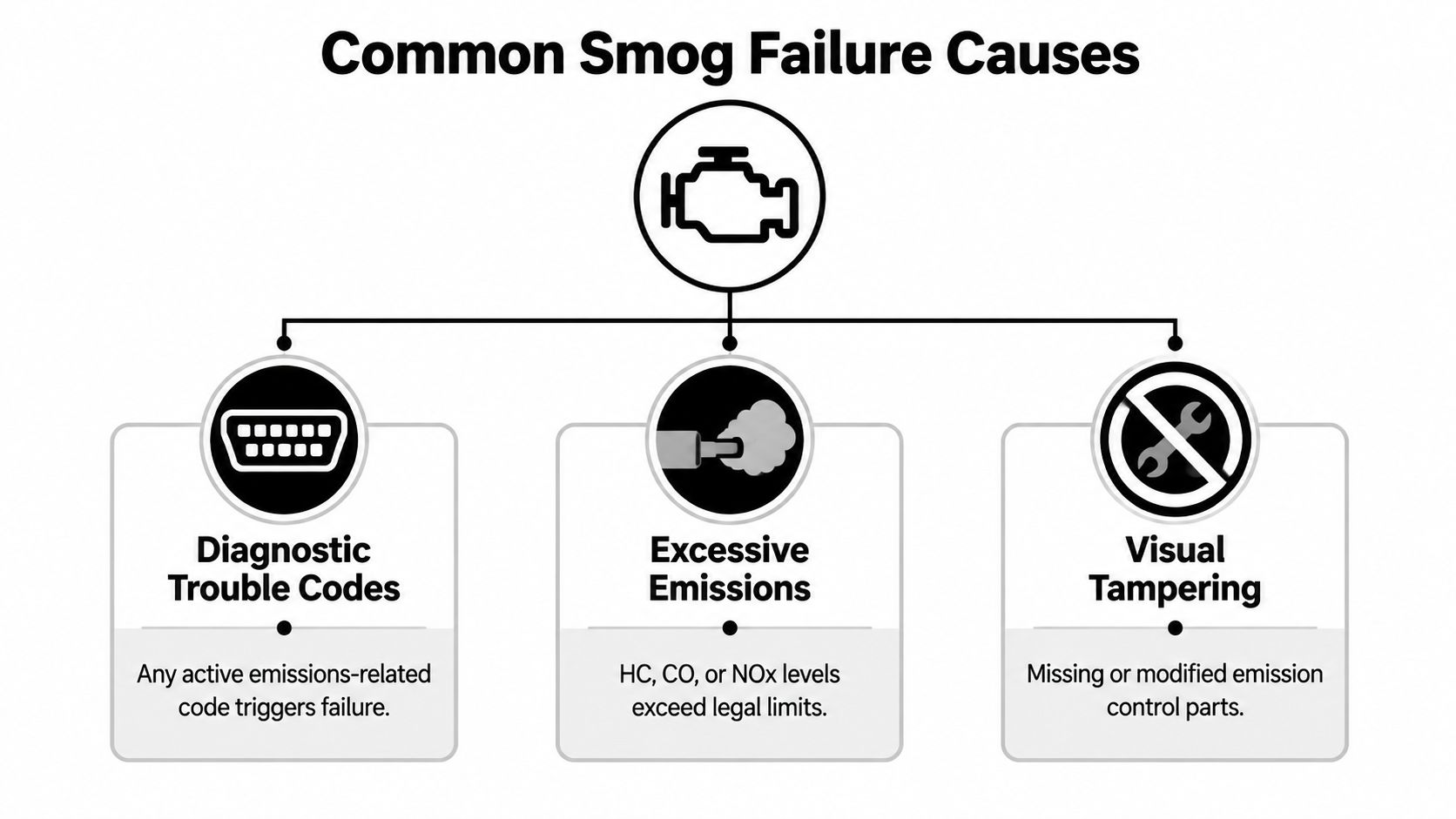
A malfunction indicator lamp that stays on or flashes can cause failure, as can an inoperative warning lamp, a missing or unusable diagnostic connector, or emissions-related diagnostic trouble codes. Some inspection programs also check the fuel cap system. A gas cap that can't maintain pressure can expose an evaporative emissions leak even when the engine runs normally, as described in this OBD-II smog inspection guide.
Technician's rule: A car that feels fine can still fail. The computer doesn't grade the drive. It grades the emissions evidence.
The causes generally fall into two groups. Hardware failures include a weak catalytic converter, faulty oxygen sensor, leaking EVAP component, damaged exhaust, or missing emissions equipment. Diagnostic and software-related failures include incomplete monitors, active codes, incorrect warning-lamp behavior, and non-approved or modified software calibration.
Most failures are diagnosable. Don't guess at expensive parts based only on the failure label. Start with the Vehicle Inspection Report, scan the car properly, and identify whether the problem is a real component failure or a system that hasn't completed its checks.
The Real Numbers Behind California Smog Failures
California's statewide results show that failed smog checks are common enough to deserve a methodical response, not panic. The state's 2026 Smog Check Performance Report says about 19 million 2000-and-newer vehicles were tested during calendar years 2024 and 2025, and roughly 1.3 million failed, producing an overall failure rate of about 7%. The same report shows roadside failures at about 14%, which indicates that real-world emissions performance can be worse than test-station results suggest. See the California Smog Check Performance Report.
| Metric | Rate | What It Means |
|---|---|---|
| 2000-and-newer vehicles tested in California during CY 2024-2025 | About 19 million vehicles | The inspection program covers a very large modern-vehicle population. |
| Those vehicles that failed | Roughly 1.3 million vehicles | A failed result is a routine emissions-compliance outcome, not proof that an engine is about to stop running. |
| Overall test-station failure rate | About 7% | Most tested vehicles passed, but a meaningful group did not. |
| Roadside failure rate | About 14% | Vehicles may perform worse under real-world conditions than at a test station. |
The numbers also explain why a clean-running car can fail. Historical EPA analysis found that 33% of vehicles had inconsistent tailpipe results when a screening facility's result was compared with the first Smog Check station. The analysis identified inaccurate underhood inspection results as the principal reason for many discrepancies. It also found that about 84.6% of vehicles passing both Smog Check stations still had at least one visual or functional defect at the laboratory level, showing how easily hidden problems can escape ordinary driving observation. The underlying EPA inspection analysis is useful background for understanding why inspection programs look beyond drivability.
What the data means for your diagnosis
These figures don't tell you which part failed on your car. They do tell you that smog compliance has never depended only on whether the engine feels healthy. Inspection methods are built to identify faults that a driver may not feel, including underhood defects, control-system faults, and inconsistent emissions behavior.
California reporting also describes a growing role for diagnostic and functional outcomes, including software and OBD-related issues. Modified or non-approved software can affect compliance, so replacing a sensor isn't always the correct answer. A technician needs to determine whether the car has excessive emissions, a missing or altered component, an incomplete monitor, or a computer-calibration problem.
The Most Common Reasons Cars Fail Smog Inspections
The fastest way to waste money after a failed inspection is to replace parts without reading the failure details. Start with the Vehicle Inspection Report, then match the result to the system that controls the failure.
Active warning lights and diagnostic trouble codes
An illuminated check engine light is the clearest warning that the emissions computer has found a problem. The light may relate to an oxygen sensor, catalyst efficiency, fuel mixture, misfire, evaporative leak, exhaust leak, or another emissions-controlled function. The light itself is only the symptom. The stored code tells the technician where to begin.
A flashing light deserves immediate attention because it can indicate an active misfire that may damage the catalytic converter. A steady light still needs diagnosis before testing. Clearing the code without repairing the cause is not a fix, and it can create a second failure if the readiness monitors haven't returned to ready status.
Incomplete readiness monitors
Readiness monitors are self-tests that verify systems under specific operating conditions. Battery disconnection, code clearing, module replacement, or recent repairs can erase their status. The car may have no current warning light and still fail because the computer hasn't completed the required checks.
The EPA testing requirements identify monitors that can include misfire, fuel trim, evaporative emissions, oxygen sensor, and catalyst efficiency. Catalyst and EVAP checks often need particular temperature, speed, and load conditions, so random short trips may not complete them.
Catalytic converter and oxygen sensor problems
The catalytic converter changes pollutants in the exhaust into less harmful compounds. A worn, contaminated, physically damaged, or inefficient converter may not clean the exhaust sufficiently. The car can still accelerate normally, but the inspection computer or tailpipe test can detect the difference.
Oxygen sensors help the engine control fuel mixture and monitor catalyst performance. A sensor can become slow or inaccurate without making the vehicle feel obviously defective. Replacing a sensor without confirming the code, wiring, exhaust leaks, fuel-trim data, and sensor behavior is poor diagnosis. A converter problem may be the result of an unresolved misfire or fuel-control fault, so repair the cause rather than repeatedly installing expensive parts.
Don't condemn the converter from one code alone. Check the sensor signals, exhaust condition, fuel control, ignition performance, and wiring before approving a major repair.
EVAP leaks and gas cap faults
The evaporative emissions system keeps fuel vapors from escaping. It includes the fuel cap, vapor lines, charcoal canister, purge valve, vent valve, and tank-side components. A loose, cracked, or poorly sealing gas cap can trigger a leak code. Deeper leaks may require a smoke test to locate.
Tighten the cap until it clicks if the design requires it, then inspect the seal for damage. If the warning light remains on, don't assume the cap was the only problem. A leak in a hose or valve can be too small to see and still large enough for the vehicle's pressure test to detect.
Fuel, ignition, exhaust, and visual defects
A rich or lean fuel mixture can raise emissions without producing dramatic drivability symptoms. Worn ignition components, intake leaks, fuel-pressure problems, incorrect air measurement, or a thermostat that prevents normal operating temperature can all affect emissions behavior. An exhaust leak ahead of an oxygen sensor can also distort readings and lead the computer toward the wrong diagnosis.
Visual inspection matters too. Missing, modified, disconnected, or non-approved emissions equipment can cause failure even if the tailpipe output appears acceptable. That includes altered software calibration on vehicles where the inspection system can identify non-approved programming. If the car has aftermarket intake, exhaust, programming, or emissions-related modifications, confirm compliance before testing.
A helpful visual explanation of these failure categories appears in this guide to smog check failure reasons.
Here's a practical video overview of common inspection problems:
How Smog Test Requirements Differ by Vehicle Type
Your vehicle's age and fuel type determine what the inspector can test and which failures matter most. Don't prepare a diesel truck the same way you prepare a late-model gasoline car, and don't assume a hybrid behaves exactly like a conventional vehicle.
2000-and-newer OBD vehicles
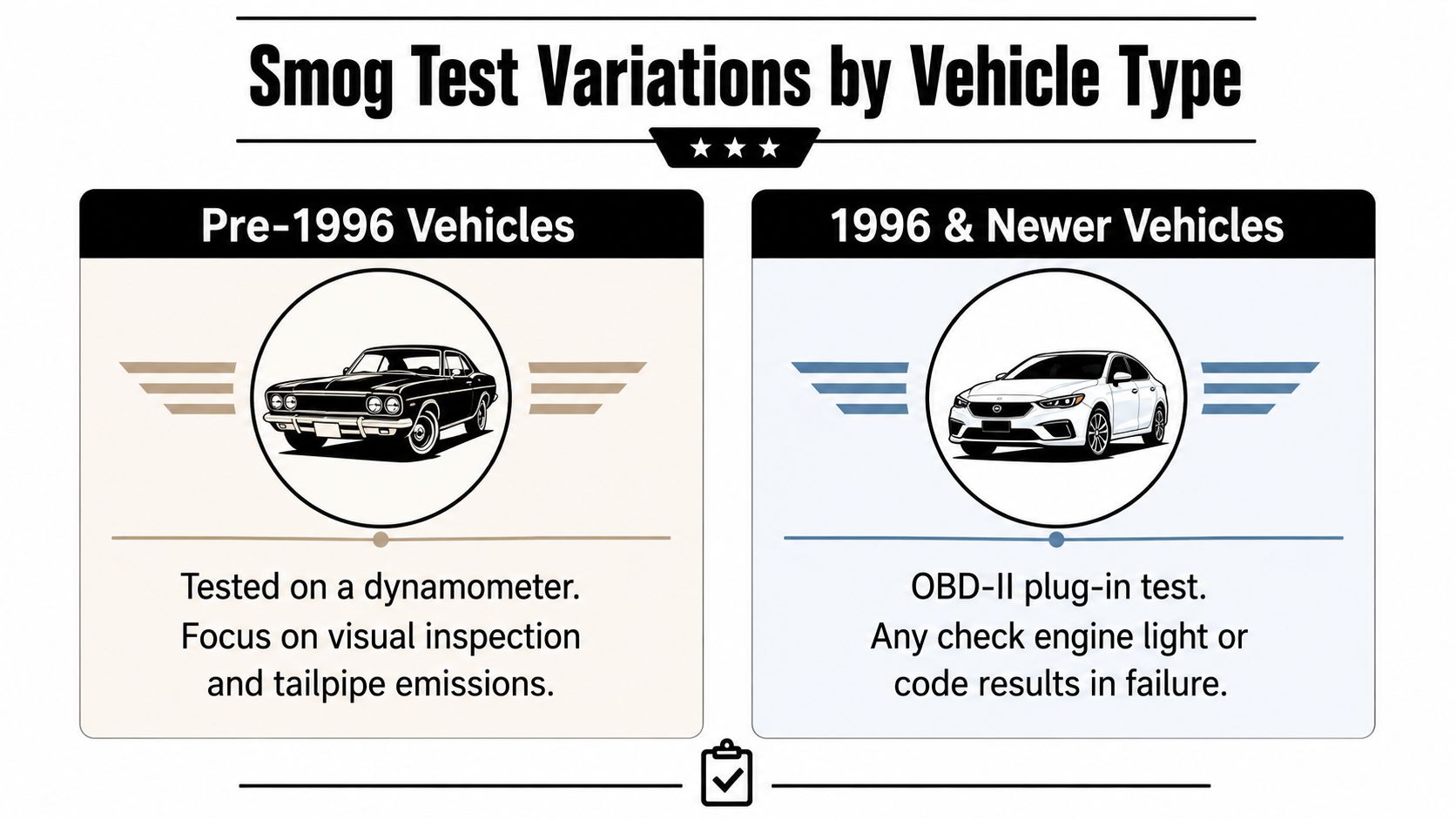
Modern gasoline vehicles generally rely heavily on the OBD inspection. The technician connects to the diagnostic link connector and checks warning-lamp behavior, stored emissions-related codes, and readiness status. The inspection is therefore a computer compliance check as much as a mechanical one.
Prioritize the check engine light, monitor status, software modifications, and the condition of emissions components. A recent battery replacement is especially relevant because it can erase monitor history. A scan before the appointment is more useful than a quick visual glance under the hood.
Older gasoline vehicles
Older vehicles may rely more heavily on visual inspection and tailpipe emissions testing. The inspector can evaluate emissions equipment, exhaust condition, and measured pollutants rather than relying only on computer data. Vehicles with older fuel systems, vacuum controls, exhaust gas recirculation components, or carburetion-related equipment need a different diagnostic approach.
For these cars, visible tampering and missing equipment can matter as much as the measured exhaust. Poor tune, vacuum leaks, ignition faults, oil consumption, and a weak converter can also push tailpipe readings beyond the allowable limits.
Diesels and hybrids
Diesel vehicles have their own inspection considerations, including diesel-specific emissions controls and particulate-related concerns. Smoke, altered emissions equipment, incorrect software, and faults in electronic controls deserve attention before testing. A diesel that has been modified for performance may have a compliance issue even if it drives strongly.
Hybrids can be deceptive because the gasoline engine may shut off during portions of the inspection or operate under a different load pattern. Their emissions systems still depend on working sensors, catalyst monitoring, EVAP control, and completed diagnostic checks. Hybrid owners should use a scan tool that can communicate correctly with the vehicle's systems rather than relying on a basic reader that shows limited information.
Match the diagnosis to the vehicle. The same failure label can point to different tests and different repair paths on an older gasoline car, a diesel, a hybrid, or a modern OBD-equipped vehicle.
Pre-Test Diagnostics You Can Do Before Your Smog Check
A short inspection before the appointment can prevent an avoidable failure. It won't diagnose every fault, but it can reveal the problems most likely to waste a trip.
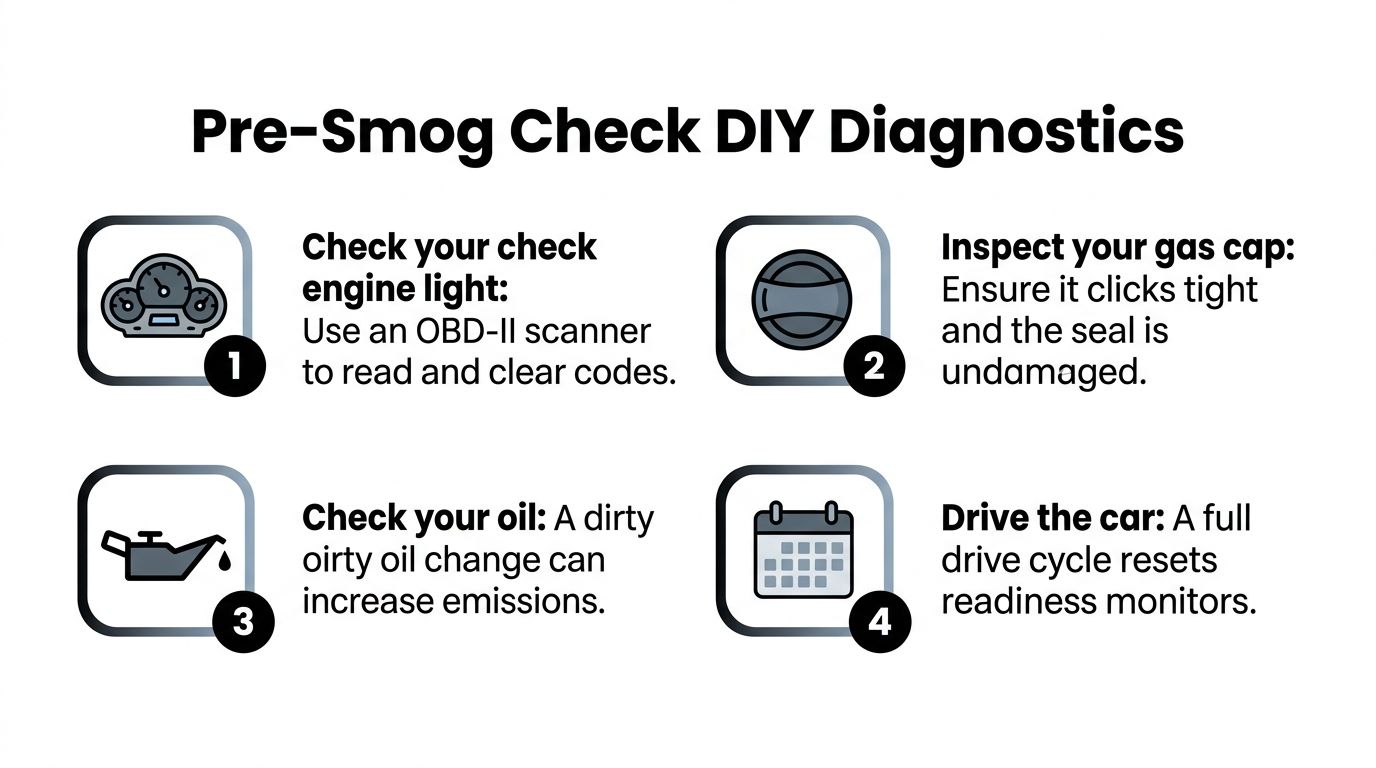
Start with the dashboard
Turn the ignition on without starting the engine and confirm that the malfunction indicator lamp illuminates as part of the normal bulb check. Start the engine and verify that it goes out. If it stays on or flashes, scan the vehicle before scheduling the inspection.
Use a compatible OBD-II scanner to read stored and pending codes. Don't clear codes just to make the dashboard look clean. Code clearing can erase readiness information and leave the vehicle unprepared for the test. A useful OBD code reading guide can help you understand what the scanner is showing, but code interpretation still requires proper diagnosis.
Confirm readiness before you test
Many parts stores and repair shops can check readiness status with a scan tool. Ask specifically whether the required monitors are ready, not merely whether the car has codes. If the battery was disconnected or a repair cleared the computer, the vehicle may need a complete drive cycle.
Drive normally through varied conditions, including a cold start, steady cruising, moderate acceleration, and periods of deceleration. Catalyst and EVAP monitors may require specific temperature, speed, and load conditions, so repeated short errands may not be enough. Follow the manufacturer's drive-cycle guidance when available.
Inspect the simple items
Check the gas cap for a damaged seal, cracked plastic, or a cap that won't tighten correctly. Look under the hood for disconnected vacuum hoses, loose electrical connectors, obvious air leaks, and missing emissions components. Listen for an exhaust leak, especially near the engine and oxygen sensors.
An overdue oil change won't explain every failure, but maintaining the engine before testing is sensible. If the engine runs poorly, consumes oil, overheats, or never reaches normal operating temperature, get those symptoms diagnosed rather than trying to mask them with a last-minute tune-up.
Repair Options Costs and What to Expect at a STAR Station
A car can run smoothly and still fail because its emissions software has not completed required checks. Repair cost depends on the failed system. Correcting a loose gas cap or allowing an incomplete monitor to finish may cost little, while a damaged catalytic converter, wiring fault, failed control module, or major EVAP leak requires diagnosis and more extensive work.
Do not approve a converter, oxygen sensor, or computer replacement just because a generic code points there. Ask which tests confirmed the fault, whether another problem caused it, and whether the repair will restore the readiness monitors. A reputable shop should explain the Vehicle Inspection Report in plain language and connect its repair recommendation to evidence.
A STAR station meets California's additional program requirements and may be required for vehicles directed to STAR testing. Learn more about what a STAR station is and why it matters. Check your registration renewal notice before choosing a location. If it requires STAR certification, a non-STAR station may not meet the testing requirement.
At a station such as Speedy Smog, the inspection documents the vehicle's compliance result. For many 2000-and-newer vehicles, the test is typically completed in about 10 to 15 minutes, according to the publisher's service information. The station also tests older vehicles, diesels, and hybrids, though the procedure varies by vehicle.
Bring your registration paperwork and any previous Vehicle Inspection Report. If another station failed the car, show that report instead of starting over. It gives the technician useful evidence and can prevent duplicate testing. Ask about current coupons before authorizing the inspection, then keep the result paperwork for the repair shop or retest.
Your Action Plan for Passing Your Next Smog Check
Use this order before booking the appointment:
- Check the warning lamp. If it stays on or flashes, scan the car first.
- Read the diagnostic codes. Don't clear them without fixing the cause.
- Verify readiness monitors. Pay particular attention after a battery disconnect or repair.
- Inspect the gas cap and emissions hardware. Look for leaks, missing parts, and obvious modifications.
- Complete the correct drive cycle. Random short trips may not finish catalyst or EVAP checks.
- Bring the Vehicle Inspection Report to a qualified repair shop if the car has already failed.
- Confirm whether your registration notice requires a STAR station before scheduling the retest.
The biggest warning signs are an illuminated check engine light, incomplete monitors, recent code clearing, visible emissions tampering, poor operating temperature, and unexplained exhaust or fuel-system symptoms. Fix the evidence-backed problem first. Don't buy parts based on guesswork.
For a clear inspection result and practical guidance after a failure, visit Speedy Smog in San Leandro. The STAR Certified station tests newer and older vehicles, diesels, and hybrids, and can identify the failed area on the inspection report so you know what to address next.