Your DMV renewal notice is on the kitchen counter, the deadline is getting close, and the obvious plan seems simple: drive to a smog station, pass the test, and renew your registration. That plan can fail before the technician even checks the exhaust, especially if your car recently had a battery replaced, diagnostic codes cleared, or repairs completed.
California vehicle inspection rules depend on why you're dealing with the DMV, not just how old your vehicle is. Renewal, a private-party sale, a dealer purchase, and first registration after moving to California can trigger different requirements. Your fuel type, model year, weight rating, and onboard computer also determine what happens at the station.
Table of Contents
- Deciding If You Need a Smog Check
- Understanding the Testing Protocols
- The Readiness Monitor Trap
- Why STAR Certification Matters
- Recovering From a Failed Inspection
- What to Expect at the Station
- Your Pre-Inspection Compliance Checklist
Deciding If You Need a Smog Check
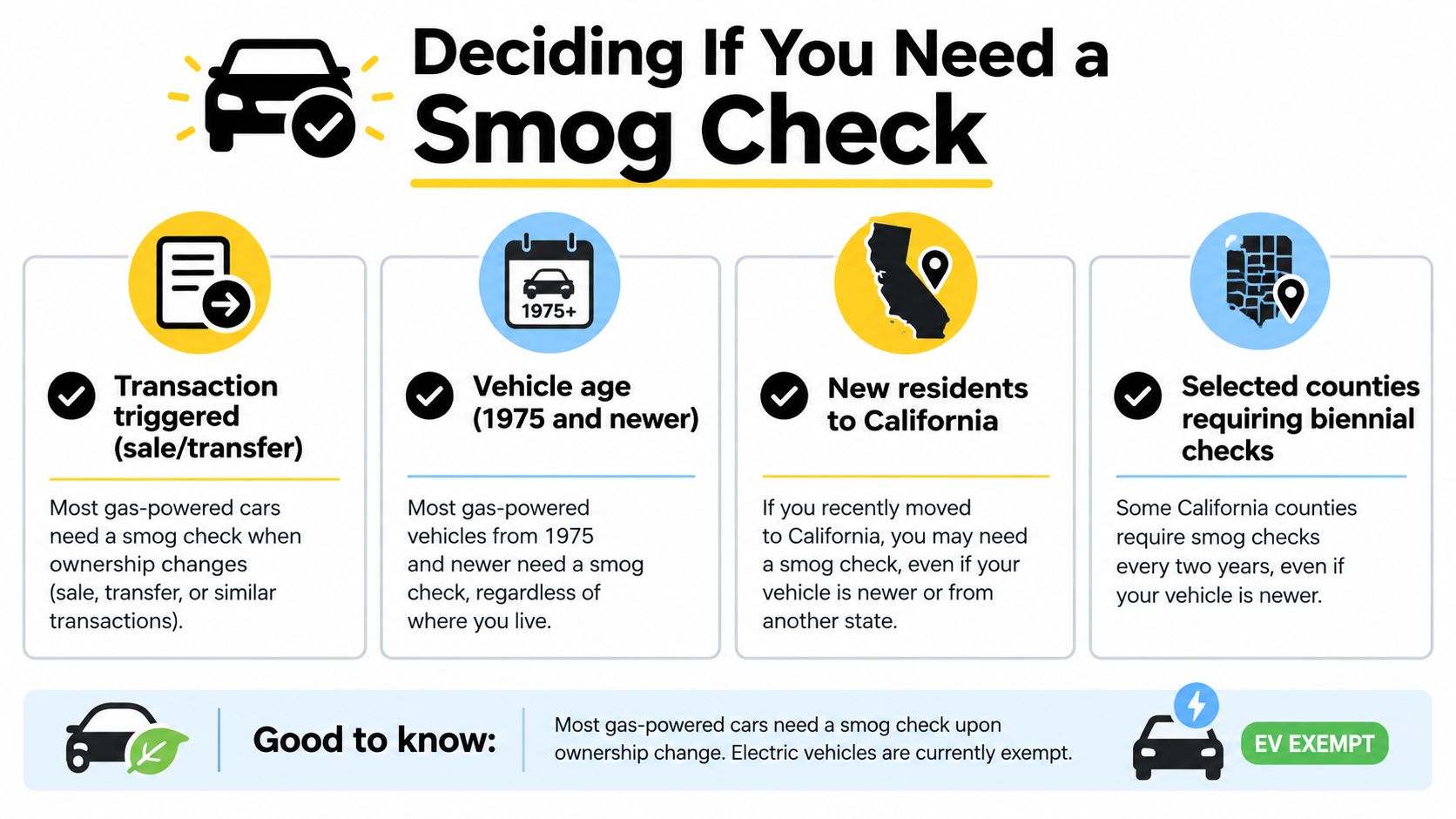
Start with the transaction. If you're renewing registration, California generally requires a smog inspection every two years, unless your vehicle qualifies for an exemption or the newer-vehicle abatement option. Owners of vehicles less than eight model-years old can generally pay a smog-abatement fee instead of obtaining an inspection, as explained by the California Bureau of Automotive Repair's smog check guidance.
Use the transaction first
For registration renewal: Read the DMV notice carefully. If it calls for certification, book the appropriate inspection. If your vehicle is within the newer-vehicle window, check whether paying the abatement fee is the available alternative.
For a private-party sale or transfer: Don't assume the buyer can handle everything later. Most gasoline-powered vehicles that are subject to California's program need current certification when ownership changes. The seller and buyer should confirm the DMV requirements for the specific transaction before signing over the title.
For a dealer purchase: Dealer transactions can follow different certification responsibilities depending on the vehicle's age and recent certification history. Ask the dealer who is responsible for the inspection and whether the certification is already recorded before you make a separate appointment.
For a first California registration: An out-of-state vehicle from model year 1976 or newer generally needs a California inspection when registered in the state for the first time. This catches many new residents off guard because an inspection from another state usually doesn't answer California's certification requirement.
Check the vehicle before booking
Electric vehicles are exempt from the standard smog check because they don't produce tailpipe emissions from an internal combustion engine. Other exemptions include gasoline vehicles from model year 1975 or earlier, diesel vehicles from model year 1997 or earlier, diesel vehicles above 14,000 pounds GVWR, and some natural-gas vehicles.
A gasoline car, hybrid, diesel, or imported vehicle may fall into a less obvious category. If you're unsure, use the vehicle identification information on your registration and confirm the requirement with the DMV or BAR before paying for a test.
Practical rule: Decide whether the transaction requires certification before you decide which station to visit. A renewal appointment and a first California registration aren't interchangeable situations.
Understanding the Testing Protocols
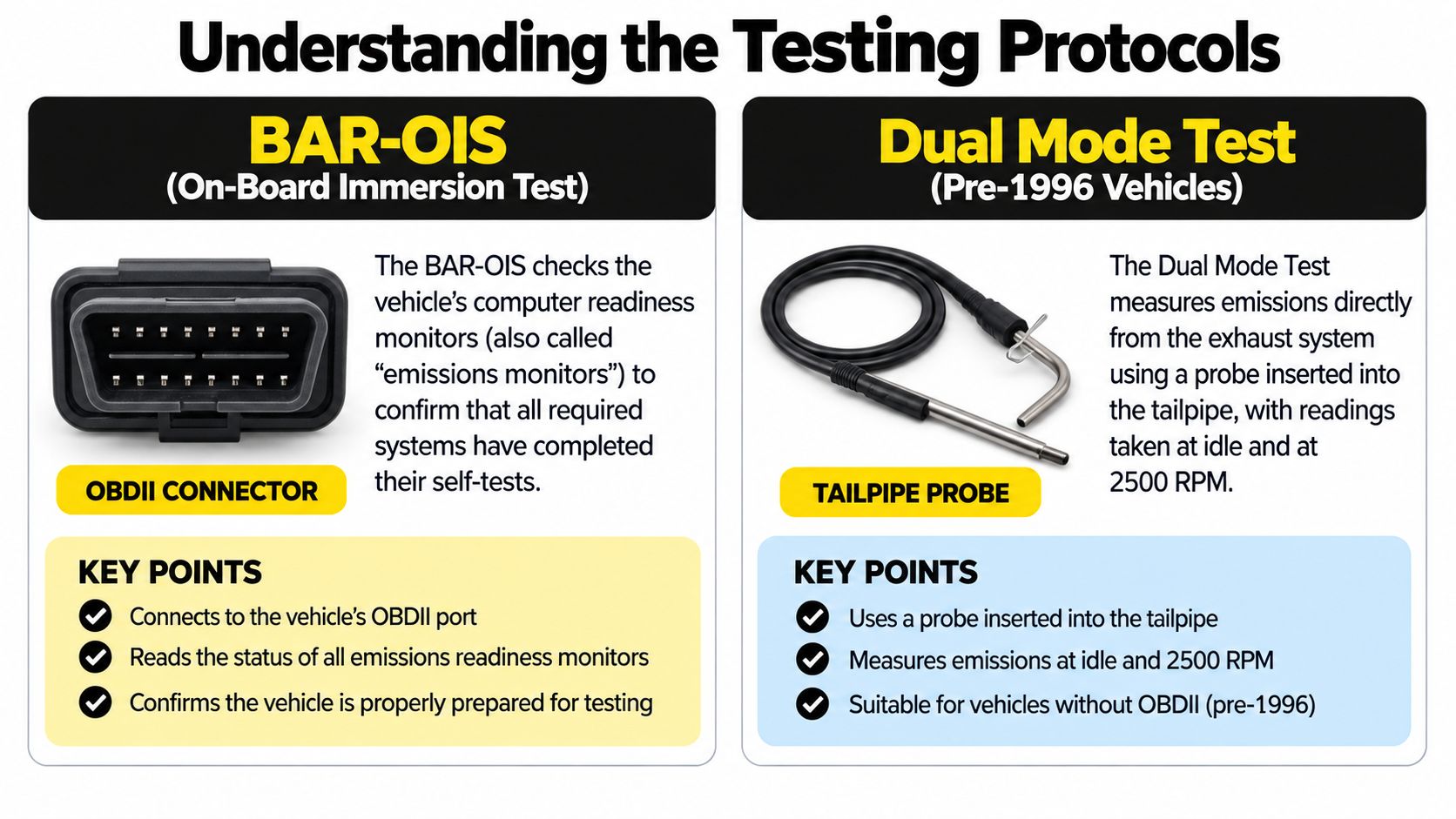
The inspection machine depends on the vehicle's technology. Most gasoline-powered vehicles from model year 2000 onward and hybrids with a GVWR of 14,000 pounds or less are tested through the BAR-OIS, which reads the vehicle's OBD-II system. Vehicles without a compatible OBD-II system, vehicles above 14,000 pounds GVWR, and certain vehicles identified by the Bureau of Automotive Repair require a BAR-97 inspection that can include tailpipe emissions measurement, according to the California Smog Check manual.
BAR-OIS reads the vehicle's computer
Think of BAR-OIS as an electronic health check. The technician connects to the diagnostic port and verifies that the malfunction-indicator lamp behaves correctly, then checks whether the computer reports emissions faults that disqualify the vehicle.
The inspection isn't just asking whether the check-engine light is currently illuminated. The computer also tracks whether its emissions self-tests have completed and whether stored fault information points to a problem. That's why a vehicle can look and drive normally yet still fail.
A newer vehicle isn't automatically an OBD-only case. The station must confirm the vehicle's certification configuration, model year, fuel type, and identifying information before selecting the protocol. A wrong entry or wrong test path can create unnecessary trouble, particularly with hybrids, imported vehicles, specialty configurations, and heavier trucks.
BAR-97 measures the exhaust
BAR-97 works more like taking a sample directly from the tailpipe. Depending on the vehicle, the equipment measures exhaust emissions while the engine operates under the required testing conditions.
This protocol matters to owners of older vehicles and vehicles without compatible OBD-II systems. It also matters to owners of heavy-duty vehicles because gross vehicle weight can change the inspection path even when the vehicle uses modern engine controls.
| Vehicle situation | Likely inspection approach |
|---|---|
| Gasoline vehicle from model year 2000 onward | BAR-OIS using OBD-II |
| Hybrid within the applicable weight limit | BAR-OIS using OBD-II |
| No compatible OBD-II system | BAR-97 |
| Above 14,000 pounds GVWR | BAR-97 |
| Certain vehicles designated by BAR | Confirm the required protocol with the station |
Bring accurate registration and vehicle information. If the car has an aftermarket exhaust, engine swap, or other modification, mention it before testing. The technician needs to know what vehicle configuration is being presented, not guess from appearance.
The Readiness Monitor Trap
A cleared check-engine light doesn't mean the vehicle is ready for inspection. In fact, clearing codes immediately before a test can create a predictable failure because the vehicle's emissions monitors reset to incomplete.
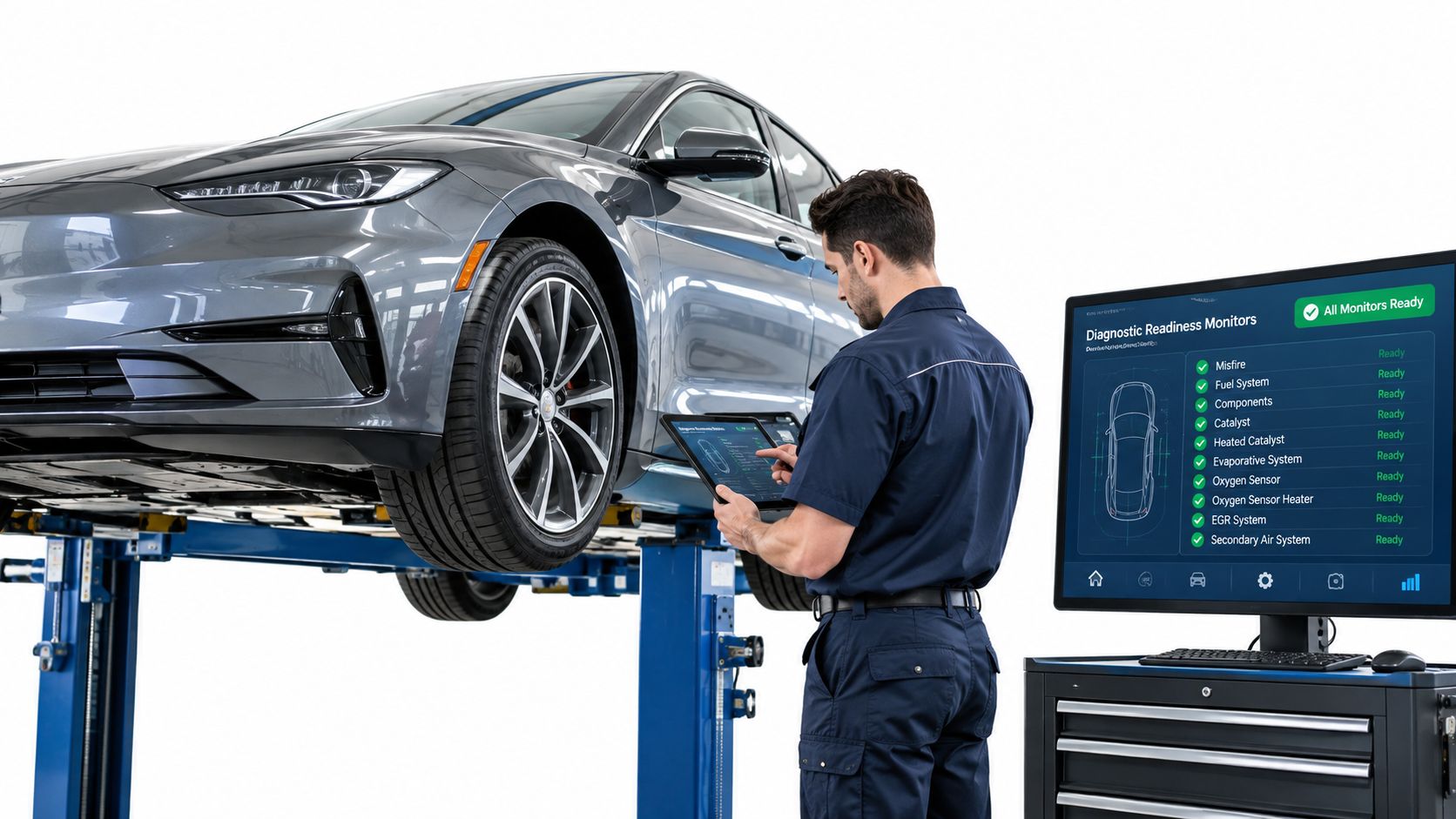
Readiness monitors are self-tests inside the OBD-II system. They evaluate systems such as the catalyst, oxygen sensors, evaporative emissions controls, and EGR-related components. The computer marks each monitor complete only after the car experiences the right operating conditions, which can include cold starts, steady cruising, acceleration, deceleration, and normal stop-and-go driving.
Disconnecting the battery or using a scan tool to erase diagnostic trouble codes wipes out that completion history. The dashboard may show no active warning light, but the inspection computer can still see that required tests haven't finished.
Why the timing matters
Beginning October 1, 2025, California rules require all applicable readiness monitors to be set for a vehicle to pass, according to BAR's explanation of the new OBD readiness monitor regulations. That makes a pre-test scan a smart move after battery work, code clearing, engine repairs, or emissions-system service.
Don't erase a code just to make the dashboard look clean. Diagnose the cause, repair it properly, and then drive the vehicle through an appropriate mixed-use cycle so the monitors can complete. Depending on the repair and the vehicle, allow roughly a week or two when necessary for the monitors to set.
Clearing the light is not a repair. It only removes information, and it can leave the vehicle unready for testing.
A better pre-test sequence
- Scan before the appointment. Check active codes, stored codes, and monitor status with a suitable diagnostic scanner.
- Repair the cause. A warning light connected to an EVAP leak, oxygen-sensor problem, catalyst fault, or another emissions issue needs diagnosis rather than cosmetic code clearing.
- Drive normally after repair. Use a mixed-use cycle that gives the vehicle's monitors the conditions they need.
- Scan again. Confirm the applicable monitors are ready before paying for the inspection.
- Test only when the vehicle is prepared. This avoids wasting an appointment on a car that was never eligible to pass.
For drivers who want help understanding what the test measures, an OBD-II car emissions test can provide useful context before the appointment.
Why STAR Certification Matters
A STAR requirement on your DMV notice isn't a suggestion to shop around casually. It means you need a station authorized to perform the required STAR inspection for that vehicle and transaction.
STAR stations operate under Bureau of Automotive Repair performance requirements that address equipment, testing procedures, and station performance. The practical benefit is straightforward: the station uses approved equipment and follows a monitored process when testing vehicles that need that level of certification.
Older vehicles deserve careful testing
California's statewide program records substantial inspection activity. The 2025 BAR executive summary recorded 11,275,981 initial tests and 12,200,718 total tests, including retests. Initial failures totaled 959,667, an 8.51% initial failure rate, while all-test failures totaled 1,102,337, a 9.04% overall failure rate.
Age changes the risk. In the cited reporting, model-year 1998 vehicles had a 20.42% failure rate, while model-year 2024 vehicles had a 4.39% failure rate, as reported in the BAR inspection summary. Older cars bring more accumulated wear, more repair history, and a greater chance of emissions-system faults. Accurate equipment and correct data entry matter more when the vehicle is already close to the line.
Choose the station based on the notice
A STAR station can be the right choice when:
- The DMV directs you to STAR: Follow the notice instead of booking a standard station.
- The vehicle has failed before: Accurate retesting helps separate a real repair issue from a process or data-entry problem.
- The vehicle is older or unusual: Confirm that the station handles older vehicles, hybrids, diesels, or the relevant inspection protocol.
- The transaction has special requirements: Ask whether the station can electronically transmit the result for the DMV purpose you need.
Read the notice first, then ask the station a direct question: “Is this vehicle and transaction eligible for the STAR test I need?” For a plain-language explanation of the program, review what a STAR smog station is.
Don't select a station only because it advertises a low price. The correct certification and protocol are more important than saving a small amount on a test that won't satisfy the DMV.
Recovering From a Failed Inspection
A failed inspection gives you information. It doesn't authorize random parts replacement, and it doesn't mean the vehicle is permanently barred from registration. Start by keeping every document from the appointment, including the failed inspection report and any diagnostic information the station provides.
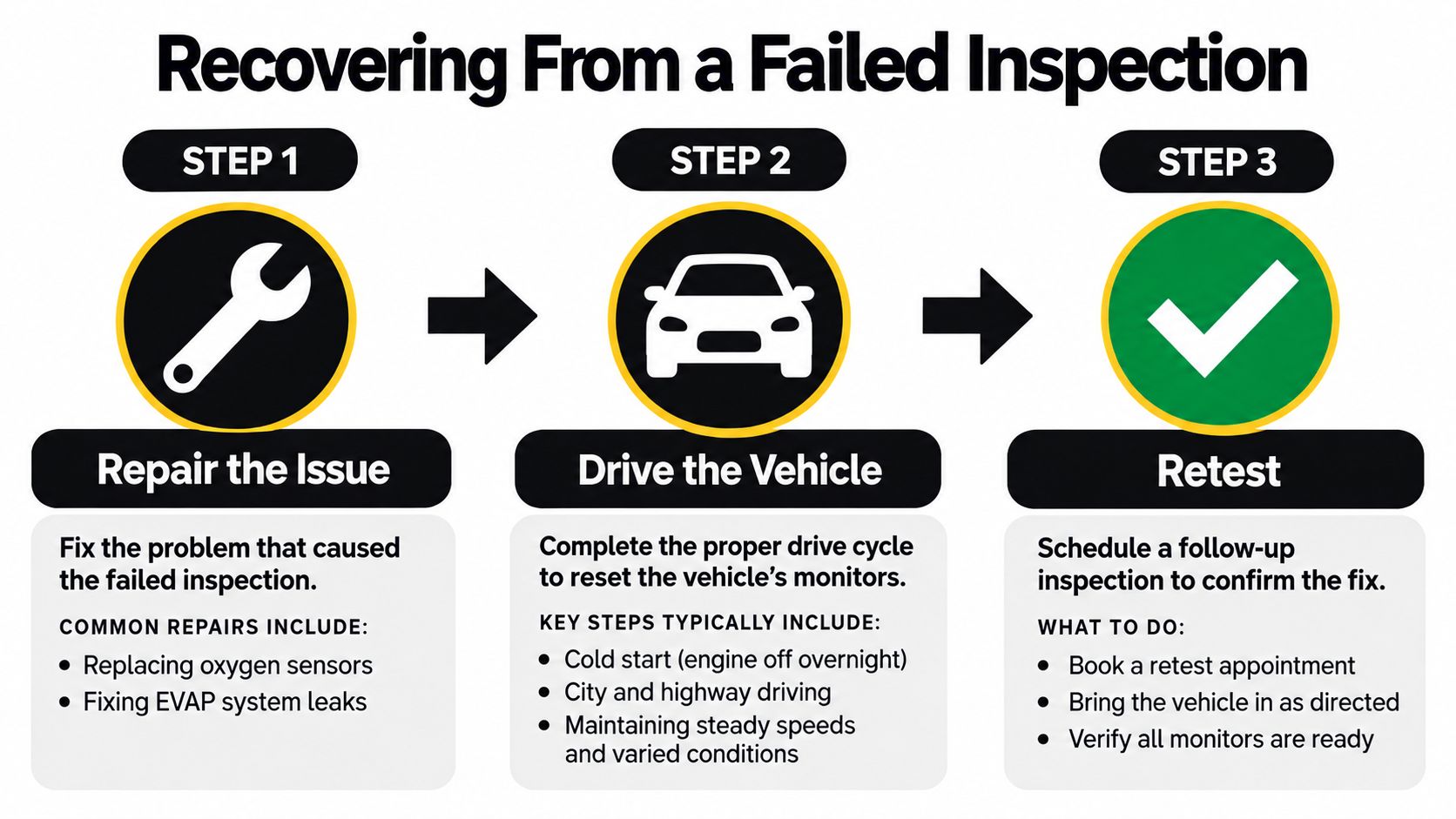
Follow the repair sequence
First, identify the failure category. The report should show whether the problem involved a malfunction indicator, emissions readings, readiness monitors, missing equipment, or another compliance issue. Don't approve repairs based only on a vague statement that the car “needs a tune-up.”
Second, diagnose before replacing parts. A check-engine code identifies a monitored fault, not automatically the failed component. A technician should test the wiring, vacuum system, fuel control, exhaust system, and related components before installing expensive parts.
Third, complete the drive cycle. If repairs or battery disconnection reset monitors, the vehicle may need mixed-use driving before retesting. Returning immediately can produce another failure even after the mechanical issue has been fixed.
Protect your legal driving options
California DMV guidance allows owners whose vehicles fail a biennial smog inspection to seek a Temporary Operating Permit, or TOP. The permit is valid for 60 days and requires registration renewal fees, the failed inspection report, proof of insurance, and a nonrefundable $50 fee, according to the California vehicle inspection information published by BAR.
The TOP matters because a failed inspection can block renewal while you still need to drive to a repair shop, retest location, or referee appointment. Confirm the permit's terms with the DMV and carry the required paperwork rather than assuming the failed report alone gives you unrestricted driving authority.
Keep the failed report, receipts, repair orders, scan results, and retest paperwork together. The paper trail makes the next conversation with a station, DMV office, or referee much easier.
Escalate when the result doesn't make sense
If you believe the inspection process was incorrect, or the vehicle has unusual equipment or modification issues, contact the Bureau of Automotive Repair Referee Program for direction. Don't pay for repeated tests without understanding the failure.
For a practical explanation of repair, permit, and retest steps, review this guide to a failed smog check in California. The right response is controlled diagnosis, not repeated guessing.
What to Expect at the Station
You pull into the bay, hand over the registration information, and answer a few basic questions about the vehicle. The technician confirms the identifying details, checks which inspection protocol applies, and connects the approved equipment if the vehicle uses OBD-II.
At a local East Bay station such as Speedy Smog, the experience is built around a short, focused inspection rather than a general mechanical service appointment. Speedy Smog is located at 15275 Washington Ave in San Leandro and handles newer vehicles, older vehicles, diesels, hybrids, and DMV-directed inspections. The shop also electronically transmits results to the DMV for registration purposes.
Bring the information that prevents delays
Have your DMV renewal notice available if you're renewing registration. Bring the vehicle, its current registration information, and any paperwork connected to a prior failure or special DMV direction.
Tell the technician about recent battery replacement, diagnostic-code clearing, emissions repairs, engine changes, or unusual fuel and weight classifications. Hiding recent work doesn't help. It can lead to a failed readiness check or an incorrect assumption about the test the vehicle needs.
The visit is an inspection, not a repair estimate
For most 2000 and newer vehicles, Speedy Smog states that typical testing is completed in about 10 to 15 minutes, though the actual time depends on the vehicle and inspection requirements. A station may need more time for an older vehicle, a diesel, a heavy vehicle, a DMV-directed test, or a problem with the vehicle's identification or computer connection.
Ask for the total price before the test begins. Transparent stations should explain whether the appointment is a standard inspection, STAR inspection, diesel inspection, or another required service. A clean waiting area and clear communication matter, but the central question remains whether the test is valid for your DMV transaction.
Don't confuse a smog inspection with a complete vehicle safety inspection. The smog test focuses on emissions compliance. If you also need brake, tire, suspension, or general reliability work, arrange that separately so you know exactly what you're paying for.
Your Pre-Inspection Compliance Checklist
The best time to prevent a failed test is before you arrive. Use this checklist based on the transaction, vehicle, and computer status.
Confirm the administrative requirement
- Read the DMV notice: Determine whether you need renewal certification, STAR certification, a transfer-related inspection, or first-registration certification.
- Confirm the vehicle category: Check model year, fuel type, hybrid status, and GVWR.
- Check exemptions and fee options: Electric vehicles and other qualifying vehicles may be exempt, while newer vehicles may qualify for the smog-abatement fee instead of testing.
- Bring supporting paperwork: Keep the renewal notice, registration information, prior failed report, repair records, and proof of insurance available when relevant.
Check the vehicle's readiness
- Look at the dashboard: A check-engine light that stays on needs diagnosis before testing.
- Avoid recent code clearing: Clearing codes can reset readiness monitors and leave the vehicle unable to pass.
- Scan monitor status: Confirm applicable monitors are complete after repairs or battery work.
- Complete normal mixed-use driving: Give the computer enough time and operating conditions to finish its self-tests.
- Check visible basics: Make sure the gas cap is secure and report obvious exhaust or emissions-system damage before the test.
Choose the correct station
- Follow STAR instructions: If the DMV requires STAR, use a station authorized for that requirement.
- Confirm capability: Ask whether the station handles your vehicle's age, fuel type, inspection protocol, and transaction.
- Explain recent work: Battery replacement, code clearing, emissions repairs, and modifications can change the advice you need.
- Plan for failure intelligently: If the vehicle fails, retain the report, diagnose the cause, complete repairs, reset monitors correctly, and retest.
California vehicle inspection is easier when you treat it as a compliance process instead of a quick lottery ticket. Identify the transaction first, verify the inspection path second, and check readiness before you spend money on the test.
Speedy Smog provides STAR Certified smog checks in San Leandro for newer and older vehicles, including hybrids and eligible diesel vehicles, with DMV electronic result transmission. If you're preparing for renewal, a transfer, or first California registration, visit Speedy Smog and confirm the correct inspection before you arrive.
Since January 1, 2013, California has required vehicles directed to STAR inspection or identified as gross polluters to use a STAR station; for ordinary renewals, either a STAR station or a regular Test-Only station can be acceptable. The important detail is that STAR is a certification tier, not a promise that the shop performs repairs.
You're standing in line at the DMV, checking your renewal notice, or searching “smog check near me” when two labels create unnecessary confusion: STAR station and Test-Only station. A driver may assume STAR means a full-service repair shop, or that Test-Only means an inferior facility. Neither assumption is reliable.
The practical question is simpler: Can this station legally certify your vehicle for the inspection your DMV notice requires? If your vehicle is directed to STAR, taking it to a regular Test-Only station is the wrong move, even if that station performs legitimate emissions inspections. If your renewal doesn't require STAR, a regular Test-Only station may be sufficient, provided it's authorized for your vehicle.
Table of Contents
- Understanding Your Smog Station Options
- The Regulatory Differences Between STAR and Test Only
- Vehicle Eligibility and Inspection Capabilities
- The High Cost of Choosing the Wrong Station
- How to Verify Your Smog Station Needs
- Why Speedy Smog is the Smart Choice for East Bay Drivers
Understanding Your Smog Station Options
An East Bay driver usually discovers the distinction at the worst possible time. The registration renewal is due, the DMV notice mentions a smog certification, and the driver wants the quickest appointment available. A search produces several nearby businesses, but the listings use different labels. One says STAR, another says Test-Only, and a third says Test-and-Repair.
The right choice depends on the vehicle's inspection status, not on which label sounds more complete.
California's STAR program began on January 1, 2013, replacing the former Gold Shield and Test Only system. The DMV says the program was created to improve Smog Check quality and support the state's emissions-reduction goals. California DMV's Smog Inspections guidance also explains that STAR stations are held to higher performance standards and are used for vehicles directed to STAR inspection.
The label that matters on your notice
Start with the DMV renewal notice. If it says your vehicle must receive a STAR certification, book a STAR station. Don't assume a non-STAR Test-Only facility can complete the requirement just because it performs emissions tests.
If the notice calls for an ordinary Smog Check and doesn't direct the vehicle to STAR, a regular Test-Only station may be appropriate. A STAR station can also handle many ordinary inspections, so choosing STAR is often the simpler way to avoid guessing, especially when you're unsure how the notice applies to your vehicle.
| Your situation | Station to choose | Why |
|---|---|---|
| DMV notice requires STAR | STAR station | The vehicle needs certification from a STAR-authorized facility |
| Vehicle is directed for inspection | STAR station | A regular Test-Only station may not certify it |
| Vehicle is a gross polluter | STAR station | STAR stations can inspect and certify this category |
| Ordinary Smog Check with no STAR direction | Regular Test-Only or STAR station | Both may be suitable, depending on the station's authorization |
| Vehicle fails and needs emissions repairs | Repair-capable shop, followed by the correct testing station | Testing authority and repair authority are separate |
STAR doesn't automatically mean repairs
This is the mistake I see most often. STAR doesn't necessarily mean Test-and-Repair. A STAR station may be licensed to perform tests only, or it may be licensed to perform both tests and repairs.
That means you need to ask two separate questions before booking:
- Is the station STAR-certified for my vehicle's required inspection?
- Can the station repair emissions problems if the vehicle fails?
If you only need a certification and the car passes, the first question is the critical one. If the vehicle has a history of emissions problems, the second question can save you a separate trip.
Practical rule: Match the station to the DMV requirement first. Treat repair capability as a separate convenience question.
The Regulatory Differences Between STAR and Test Only
The difference in STAR station vs Test Only isn't just a matter of reputation or shop quality. It comes from two different layers of California's regulatory framework.
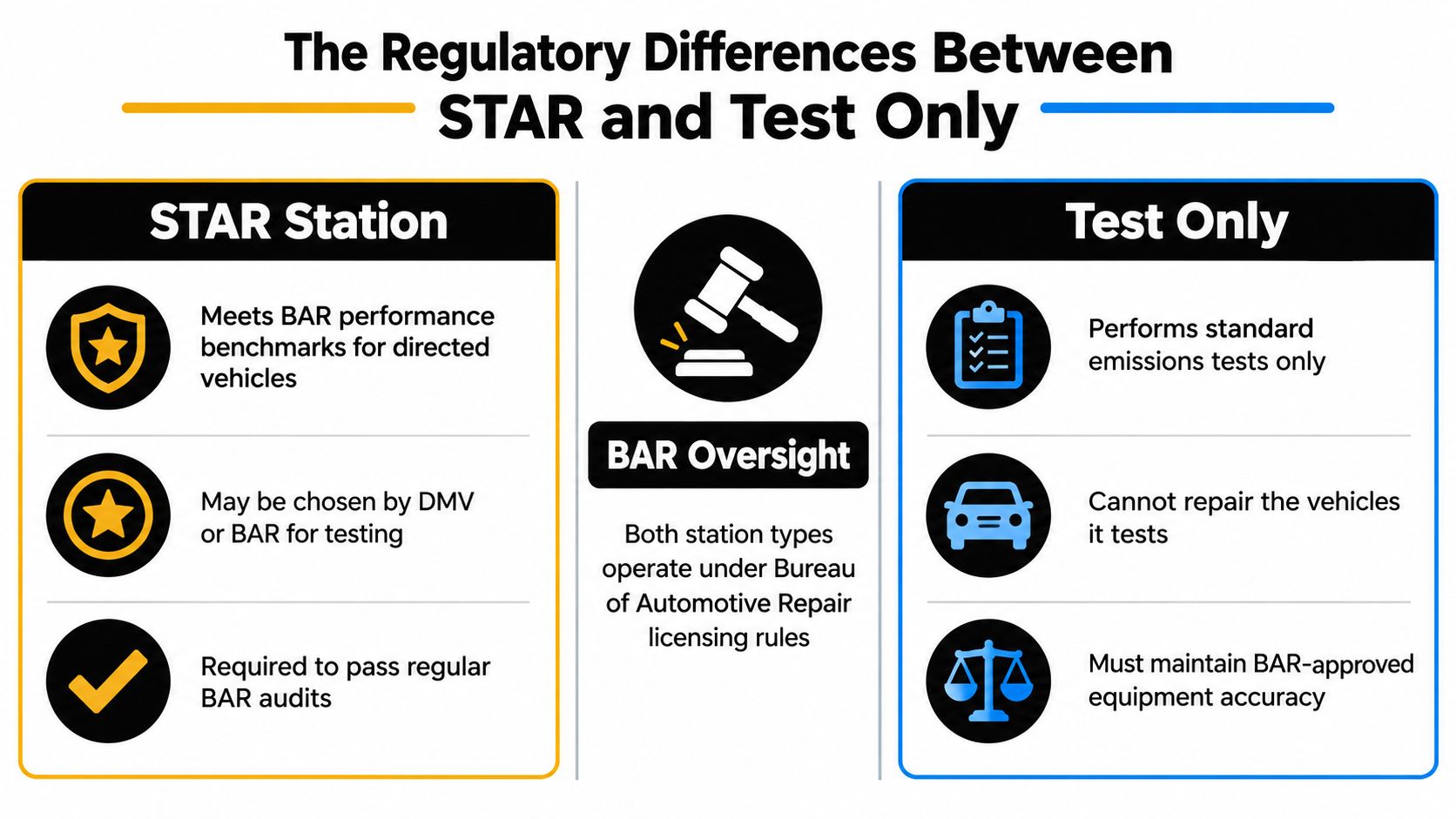
A standard Test-Only station is licensed to perform Smog Check inspections. It can test the vehicle, record the results, and transmit the certification outcome when the vehicle passes. It can't repair the vehicle it tests under that license.
A STAR station must meet higher inspection-based performance standards established through the Bureau of Automotive Repair. STAR is therefore a compliance and quality tier attached to the station's testing operation. It doesn't, by itself, tell you whether the business has technicians and licensing for repairs.
Licensing scope and performance standards
The Bureau of Automotive Repair's Smog Check explanation distinguishes between stations that test vehicles and stations that also perform repairs. BAR states that STAR stations can be either Test-Only or Test-and-Repair, while meeting the higher standards associated with STAR participation.
That creates an overlap that many quick online explainers miss:
- A regular Test-Only station can inspect vehicles but can't perform emissions repairs.
- A STAR Test-Only station can inspect vehicles under STAR standards but still can't perform repairs.
- A STAR Test-and-Repair station can inspect vehicles under STAR standards and repair emissions-related problems within its licensed scope.
- A regular Test-and-Repair station may perform repairs, but it isn't automatically authorized for every STAR-directed inspection.
The words “STAR” and “Test-Only” aren't opposites. One identifies a performance certification tier. The other identifies whether the station's license permits testing without repairs.
Why the distinction affects your appointment
BAR's STAR certification information explains that STAR stations must meet higher inspection-based performance standards and can inspect all vehicles subject to Smog Check, including gross polluters and directed vehicles. BAR also states that directed vehicles can receive certification only from STAR Test-Only or STAR Test-and-Repair stations.
That's why a STAR Test-Only station can be exactly the right choice. If your vehicle requires STAR and you only need a test, you don't need a repair shop. You need a station that holds the correct STAR authority.
For drivers who want a deeper explanation of the overlapping labels, this guide to what a Smog STAR station is breaks down the terminology without treating STAR and Test-Only as competing categories.
Vehicle Eligibility and Inspection Capabilities
The vehicle category determines how strict your station choice needs to be. A regular vehicle undergoing an ordinary renewal may be eligible for a standard Test-Only inspection. A directed vehicle or a gross polluter needs a STAR-capable station.
The word “directed” matters because it describes a vehicle that California requires to receive its inspection at a STAR station. The direction may appear on the DMV renewal notice or arise from the vehicle's inspection history and program requirements. Don't rely on a map listing or a low advertised price to determine eligibility.
The capability comparison
| Station Type | Standard Vehicles | Directed Vehicles | Gross Polluters |
|---|---|---|---|
| Regular Test-Only | Can inspect when the vehicle's requirements allow a standard test | Cannot provide the required STAR certification | Not the correct certification path |
| STAR Test-Only | Can inspect standard vehicles and vehicles subject to STAR requirements | Can inspect and certify directed vehicles | Can inspect and certify gross polluters |
| Regular Test-and-Repair | Can test and repair within its license scope | Not automatically authorized for STAR-directed certification | Not automatically the correct certification path |
| STAR Test-and-Repair | Can test and repair within its license scope | Can inspect, repair, and certify directed vehicles | Can inspect, repair, and certify gross polluters |
The table shows why “Test-Only” doesn't always mean the same thing. Regular Test-Only and STAR Test-Only both lack repair authority, but only the STAR version can handle directed vehicles and gross polluters under the applicable STAR requirements.
Three categories drivers need to recognize
Standard vehicles are the least complicated. If the DMV notice calls for a normal Smog Check and doesn't direct the vehicle to STAR, an authorized regular Test-Only station may be enough. A STAR station can also perform the inspection, but STAR may not be mandatory for that particular vehicle.
Directed vehicles must go to a STAR station. A regular Test-Only station can conduct an inspection within its authority, but it can't provide the STAR certification required for a directed vehicle. Booking the wrong station can turn a routine renewal into an avoidable second appointment.
Gross polluters require STAR capability as well. A vehicle in this category may need more attention after a failure, but the first step remains choosing a station authorized to perform the required inspection. Don't confuse the ability to test with the ability to repair.
A station can be legitimate, licensed, and perfectly capable of ordinary inspections while still being the wrong station for a directed vehicle.
The High Cost of Choosing the Wrong Station
Most drivers compare smog stations by the advertised test price. That's understandable, but it's incomplete. The financial risk appears when the station lacks the authority or repair capability your vehicle needs.
Suppose an East Bay driver takes a directed vehicle to a regular Test-Only station. The station may perform an inspection, but it can't provide the STAR certification required for that vehicle. The driver has paid for activity that doesn't complete the DMV requirement, then has to locate a STAR station and arrange another visit.
That's not just an inconvenience. It can mean another test charge, more fuel, time away from work, and a delayed registration renewal. The initial low price stops looking low once the driver adds the cost of correcting the decision.
A failure creates a separate decision
A regular Test-Only station can document a failed emissions inspection, but it can't repair the emissions problem. The vehicle may need to go to a separate repair shop for diagnosis and corrective work.
After repairs, the driver still needs the right station for the next certification attempt:
- If the vehicle is directed, the return inspection must be handled by a STAR Test-Only or STAR Test-and-Repair station.
- If the vehicle is a gross polluter, the driver needs a STAR-capable facility for the applicable certification.
- If the vehicle has no STAR requirement, the driver may have more flexibility, but the station still needs the proper authorization for the follow-up inspection.
- If the first station is also Test-and-Repair, the driver may be able to keep diagnosis and repair in one place, depending on the problem and the shop's licensed services.
The important point is that test authority and repair authority are different. A station that can test your car may not be able to fix it. A repair shop that can fix emissions components may not be authorized to complete the STAR certification your DMV notice requires.
The cheapest test can become the expensive route
Drivers often focus on the first transaction instead of the entire path to certification. That approach is risky when the vehicle has warning lights, a previous failure, or a STAR direction.
A better calculation includes:
- The first inspection.
- Diagnosis and emissions repairs if the vehicle fails.
- The follow-up inspection.
- Travel between separate businesses.
- Time spent scheduling and waiting.
- The risk of choosing another facility that also lacks the correct certification authority.
You can't know in advance whether a vehicle will pass, but you can avoid a preventable station mismatch. If STAR is mandatory, start with STAR. If repair work may be needed, ask whether the station is Test-Only or Test-and-Repair before you arrive.
The smart budget isn't the lowest first price. It's the lowest realistic cost from inspection to valid DMV certification.
How to Verify Your Smog Station Needs
You don't need to decode California's entire emissions program before making an appointment. You need to verify three things in the right order: the DMV instruction, the vehicle's status, and the station's current authorization.
Start with the DMV renewal notice
Read the notice carefully instead of searching by vehicle age or neighborhood alone. Look for language indicating that the vehicle must go to a STAR station, or that it has been directed for a specific type of inspection.
If the notice requires STAR, treat that instruction as decisive. Don't book a regular Test-Only station and hope the result will transfer. The station must be able to issue the certification your vehicle requires.
If the notice only requests a standard Smog Check, you may have a choice between a regular Test-Only station and a STAR station. When the notice is unclear, contact the station before driving over and describe the exact wording.
Ask the station direct questions
Use this short checklist when you call or book online:
- “Is your station currently STAR-certified?”
- “Are you STAR Test-Only or STAR Test-and-Repair?”
- “Can you certify a vehicle directed to STAR?”
- “Can you inspect gross polluters?”
- “If the vehicle fails, do you perform emissions repairs here?”
The first three questions establish whether the station can complete the required certification. The last two help you plan for a failure without assuming the shop offers repairs.
Confirm before you leave home
Station listings can be incomplete or outdated. Confirm the location, appointment availability, and station type directly. Keep the DMV notice with you, along with any prior inspection information that may explain a failure or direction.
For additional preparation, use this guide on how to check your smog status before booking. The goal is simple: arrive at a facility that can legally complete the inspection, not merely one that advertises smog checks.
Why Speedy Smog is the Smart Choice for East Bay Drivers
For an East Bay driver who wants to avoid station-label confusion, a STAR-certified Test-Only station offers a straightforward path when the vehicle requires STAR certification. It can handle the inspection without pretending that STAR automatically includes repairs. If the vehicle passes, the certification process stays focused. If it fails, the driver knows that repair work may need to happen elsewhere unless the chosen station also holds Test-and-Repair authority.
Speedy Smog in San Leandro is a STAR Certified station that provides STAR-certified Test-Only smog inspections and electronically transmits results for DMV registration needs. That makes it relevant for drivers whose vehicles need STAR testing, including directed vehicles and other vehicles that fall under STAR inspection requirements.
What to confirm before your appointment
A good appointment starts with accurate information. Bring the renewal notice and ask the station to confirm that its current license and STAR status fit your vehicle's requirement.
Speedy Smog's service is designed around emissions testing rather than assuming every customer needs repairs on-site. Drivers with older vehicles, diesels, hybrids, or cars with a previous failure should still explain the vehicle's situation before the inspection so the station can clarify the correct next step.
The broader lesson is more important than any individual shop: choose certification authority first, convenience second, and price third. A nearby regular Test-Only station may be perfectly suitable for an ordinary renewal. It's the wrong choice when the DMV requires STAR.
The practical recommendation
If your notice requires STAR, book a STAR station and verify whether it's Test-Only or Test-and-Repair. If your vehicle has already failed or you expect emissions repairs, ask about the repair pathway before the test.
For an ordinary renewal with no STAR direction, either an authorized regular Test-Only station or a STAR station may work. Drivers who want to reduce uncertainty can review this guide to the best smog check options and then call the station with the exact wording from the DMV notice.
Speedy Smog offers STAR-certified Test-Only inspections in San Leandro for East Bay drivers who need a compliant DMV smog certification. Visit Speedy Smog with your renewal notice, confirm your vehicle's requirement, and book the correct inspection before you make an unnecessary trip.
You pull into the smog station confident. The car starts easily, idles smoothly, gets decent fuel economy, and hasn't shown any obvious warning signs. Then the technician plugs in the scanner, checks the inspection results, and hands you a failure report. You're left wondering what makes a car fail smog when it seems to run perfectly.
The answer is usually hidden in the emissions-control system, not the parts you feel from the driver's seat. Modern inspections check diagnostic data, monitor status, warning-lamp behavior, emissions equipment, and sometimes tailpipe output. A vehicle can drive normally while its computer reports that an emissions system hasn't completed testing or isn't operating within required limits.
Table of Contents
- Why Perfectly Running Cars Still Fail Smog Checks
- The Real Numbers Behind California Smog Failures
- The Most Common Reasons Cars Fail Smog Inspections
- How Smog Test Requirements Differ by Vehicle Type
- Pre-Test Diagnostics You Can Do Before Your Smog Check
- Repair Options Costs and What to Expect at a STAR Station
- Your Action Plan for Passing Your Next Smog Check
Why Perfectly Running Cars Still Fail Smog Checks
A smooth-running engine only proves that the car can move, idle, accelerate, and start. It doesn't prove that the emissions system is complete, functional, and compliant. That distinction catches drivers off guard because many emissions problems don't create rough running, hard starts, poor mileage, or unusual exhaust odor.
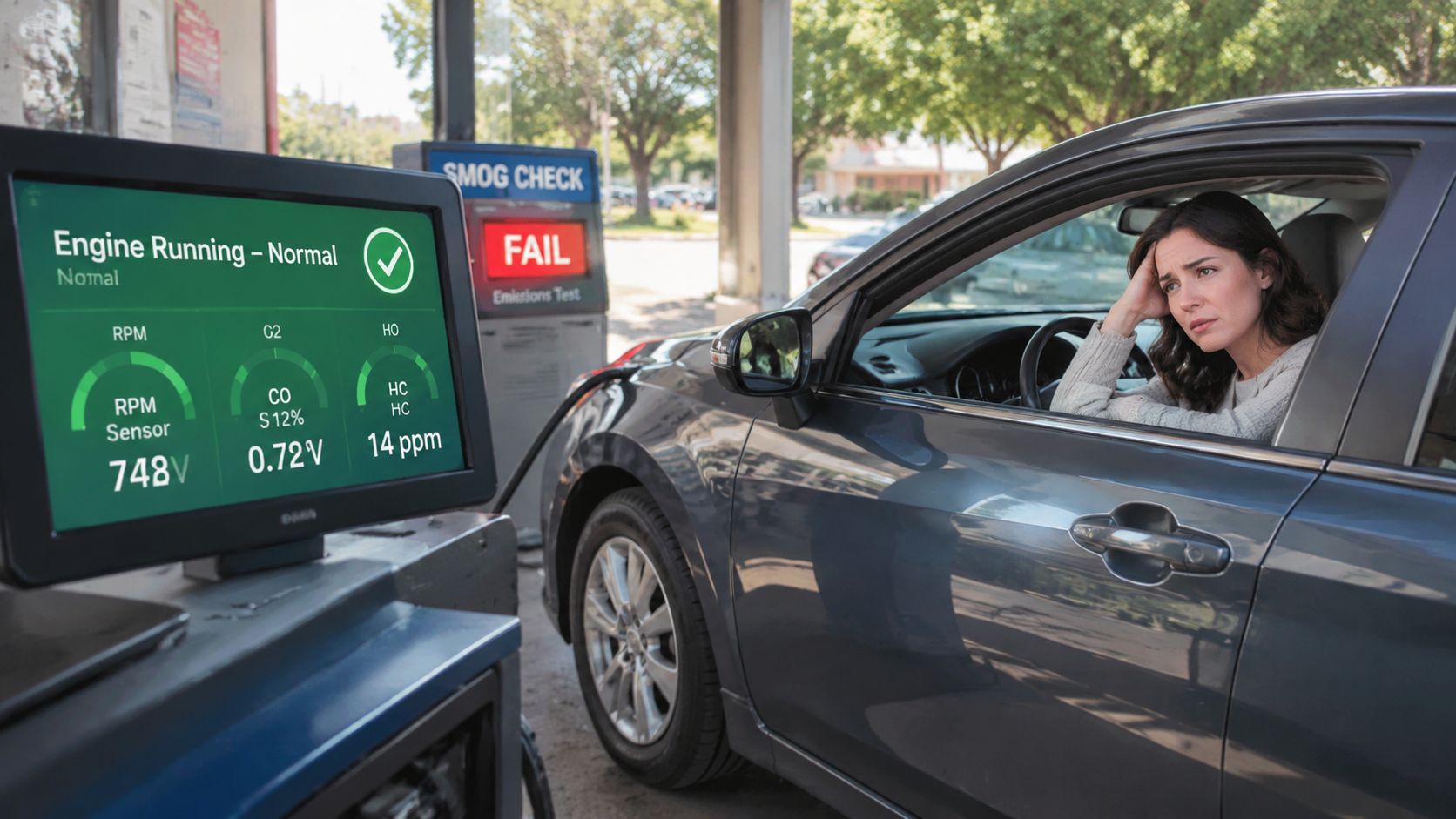
A modern car constantly checks systems such as the catalytic converter, oxygen sensors, fuel control, misfire detection, and evaporative emissions equipment. Those checks run through software called the onboard diagnostics system, or OBD. If the computer detects an emissions-related fault, stores a trouble code, or hasn't completed the required checks, the car may fail even though you'd never notice a problem during an ordinary commute.
Drivability and compliance are different tests
Drivers often make the same mistake after a battery replacement or repair. The check engine light goes off, the car feels fine, and they schedule a smog check immediately. That repair may have erased the vehicle's stored diagnostic information, leaving the readiness monitors incomplete. The car hasn't necessarily become worse, but it also hasn't finished proving that its emissions equipment works.
A malfunction indicator lamp that stays on or flashes can cause failure, as can an inoperative warning lamp, a missing or unusable diagnostic connector, or emissions-related diagnostic trouble codes. Some inspection programs also check the fuel cap system. A gas cap that can't maintain pressure can expose an evaporative emissions leak even when the engine runs normally, as described in this OBD-II smog inspection guide.
Technician's rule: A car that feels fine can still fail. The computer doesn't grade the drive. It grades the emissions evidence.
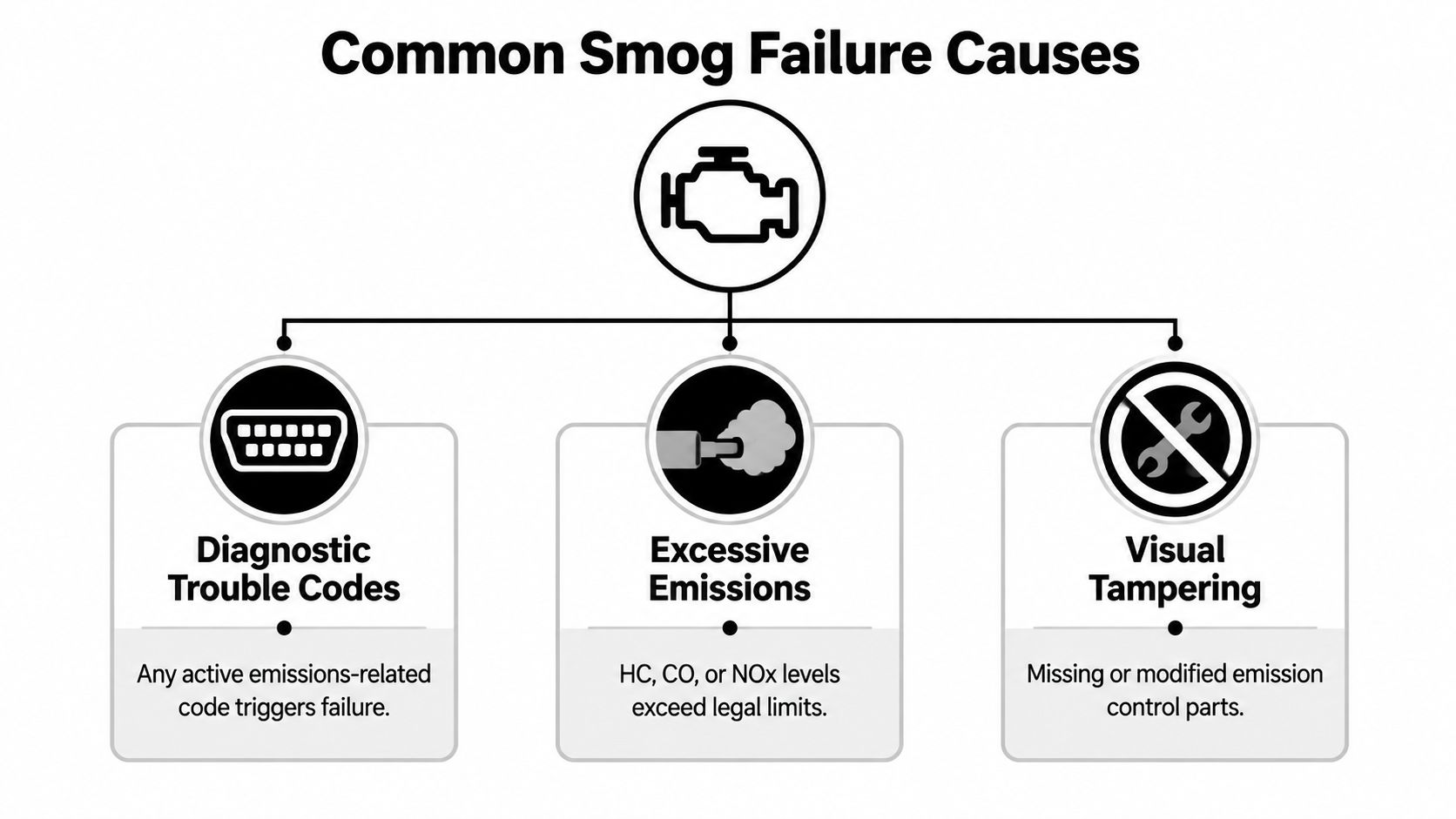
The causes generally fall into two groups. Hardware failures include a weak catalytic converter, faulty oxygen sensor, leaking EVAP component, damaged exhaust, or missing emissions equipment. Diagnostic and software-related failures include incomplete monitors, active codes, incorrect warning-lamp behavior, and non-approved or modified software calibration.
Most failures are diagnosable. Don't guess at expensive parts based only on the failure label. Start with the Vehicle Inspection Report, scan the car properly, and identify whether the problem is a real component failure or a system that hasn't completed its checks.
The Real Numbers Behind California Smog Failures
California's statewide results show that failed smog checks are common enough to deserve a methodical response, not panic. The state's 2026 Smog Check Performance Report says about 19 million 2000-and-newer vehicles were tested during calendar years 2024 and 2025, and roughly 1.3 million failed, producing an overall failure rate of about 7%. The same report shows roadside failures at about 14%, which indicates that real-world emissions performance can be worse than test-station results suggest. See the California Smog Check Performance Report.
| Metric | Rate | What It Means |
|---|---|---|
| 2000-and-newer vehicles tested in California during CY 2024-2025 | About 19 million vehicles | The inspection program covers a very large modern-vehicle population. |
| Those vehicles that failed | Roughly 1.3 million vehicles | A failed result is a routine emissions-compliance outcome, not proof that an engine is about to stop running. |
| Overall test-station failure rate | About 7% | Most tested vehicles passed, but a meaningful group did not. |
| Roadside failure rate | About 14% | Vehicles may perform worse under real-world conditions than at a test station. |
The numbers also explain why a clean-running car can fail. Historical EPA analysis found that 33% of vehicles had inconsistent tailpipe results when a screening facility's result was compared with the first Smog Check station. The analysis identified inaccurate underhood inspection results as the principal reason for many discrepancies. It also found that about 84.6% of vehicles passing both Smog Check stations still had at least one visual or functional defect at the laboratory level, showing how easily hidden problems can escape ordinary driving observation. The underlying EPA inspection analysis is useful background for understanding why inspection programs look beyond drivability.
What the data means for your diagnosis
These figures don't tell you which part failed on your car. They do tell you that smog compliance has never depended only on whether the engine feels healthy. Inspection methods are built to identify faults that a driver may not feel, including underhood defects, control-system faults, and inconsistent emissions behavior.
California reporting also describes a growing role for diagnostic and functional outcomes, including software and OBD-related issues. Modified or non-approved software can affect compliance, so replacing a sensor isn't always the correct answer. A technician needs to determine whether the car has excessive emissions, a missing or altered component, an incomplete monitor, or a computer-calibration problem.
The Most Common Reasons Cars Fail Smog Inspections
The fastest way to waste money after a failed inspection is to replace parts without reading the failure details. Start with the Vehicle Inspection Report, then match the result to the system that controls the failure.
Active warning lights and diagnostic trouble codes
An illuminated check engine light is the clearest warning that the emissions computer has found a problem. The light may relate to an oxygen sensor, catalyst efficiency, fuel mixture, misfire, evaporative leak, exhaust leak, or another emissions-controlled function. The light itself is only the symptom. The stored code tells the technician where to begin.
A flashing light deserves immediate attention because it can indicate an active misfire that may damage the catalytic converter. A steady light still needs diagnosis before testing. Clearing the code without repairing the cause is not a fix, and it can create a second failure if the readiness monitors haven't returned to ready status.
Incomplete readiness monitors
Readiness monitors are self-tests that verify systems under specific operating conditions. Battery disconnection, code clearing, module replacement, or recent repairs can erase their status. The car may have no current warning light and still fail because the computer hasn't completed the required checks.
The EPA testing requirements identify monitors that can include misfire, fuel trim, evaporative emissions, oxygen sensor, and catalyst efficiency. Catalyst and EVAP checks often need particular temperature, speed, and load conditions, so random short trips may not complete them.
Catalytic converter and oxygen sensor problems
The catalytic converter changes pollutants in the exhaust into less harmful compounds. A worn, contaminated, physically damaged, or inefficient converter may not clean the exhaust sufficiently. The car can still accelerate normally, but the inspection computer or tailpipe test can detect the difference.
Oxygen sensors help the engine control fuel mixture and monitor catalyst performance. A sensor can become slow or inaccurate without making the vehicle feel obviously defective. Replacing a sensor without confirming the code, wiring, exhaust leaks, fuel-trim data, and sensor behavior is poor diagnosis. A converter problem may be the result of an unresolved misfire or fuel-control fault, so repair the cause rather than repeatedly installing expensive parts.
Don't condemn the converter from one code alone. Check the sensor signals, exhaust condition, fuel control, ignition performance, and wiring before approving a major repair.
EVAP leaks and gas cap faults
The evaporative emissions system keeps fuel vapors from escaping. It includes the fuel cap, vapor lines, charcoal canister, purge valve, vent valve, and tank-side components. A loose, cracked, or poorly sealing gas cap can trigger a leak code. Deeper leaks may require a smoke test to locate.
Tighten the cap until it clicks if the design requires it, then inspect the seal for damage. If the warning light remains on, don't assume the cap was the only problem. A leak in a hose or valve can be too small to see and still large enough for the vehicle's pressure test to detect.
Fuel, ignition, exhaust, and visual defects
A rich or lean fuel mixture can raise emissions without producing dramatic drivability symptoms. Worn ignition components, intake leaks, fuel-pressure problems, incorrect air measurement, or a thermostat that prevents normal operating temperature can all affect emissions behavior. An exhaust leak ahead of an oxygen sensor can also distort readings and lead the computer toward the wrong diagnosis.
Visual inspection matters too. Missing, modified, disconnected, or non-approved emissions equipment can cause failure even if the tailpipe output appears acceptable. That includes altered software calibration on vehicles where the inspection system can identify non-approved programming. If the car has aftermarket intake, exhaust, programming, or emissions-related modifications, confirm compliance before testing.
A helpful visual explanation of these failure categories appears in this guide to smog check failure reasons.
Here's a practical video overview of common inspection problems:
How Smog Test Requirements Differ by Vehicle Type
Your vehicle's age and fuel type determine what the inspector can test and which failures matter most. Don't prepare a diesel truck the same way you prepare a late-model gasoline car, and don't assume a hybrid behaves exactly like a conventional vehicle.
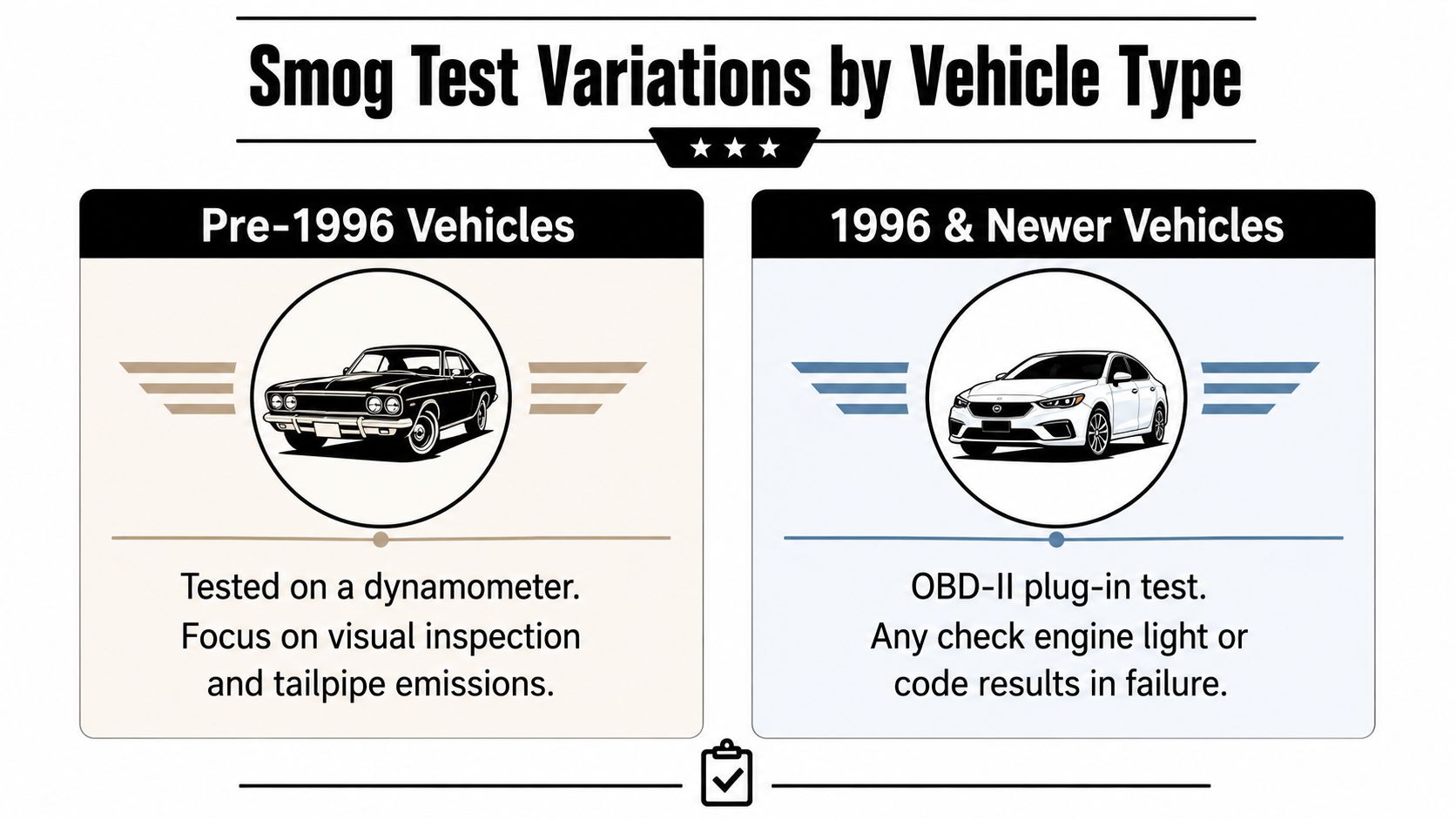
2000-and-newer OBD vehicles
Modern gasoline vehicles generally rely heavily on the OBD inspection. The technician connects to the diagnostic link connector and checks warning-lamp behavior, stored emissions-related codes, and readiness status. The inspection is therefore a computer compliance check as much as a mechanical one.
Prioritize the check engine light, monitor status, software modifications, and the condition of emissions components. A recent battery replacement is especially relevant because it can erase monitor history. A scan before the appointment is more useful than a quick visual glance under the hood.
Older gasoline vehicles
Older vehicles may rely more heavily on visual inspection and tailpipe emissions testing. The inspector can evaluate emissions equipment, exhaust condition, and measured pollutants rather than relying only on computer data. Vehicles with older fuel systems, vacuum controls, exhaust gas recirculation components, or carburetion-related equipment need a different diagnostic approach.
For these cars, visible tampering and missing equipment can matter as much as the measured exhaust. Poor tune, vacuum leaks, ignition faults, oil consumption, and a weak converter can also push tailpipe readings beyond the allowable limits.
Diesels and hybrids
Diesel vehicles have their own inspection considerations, including diesel-specific emissions controls and particulate-related concerns. Smoke, altered emissions equipment, incorrect software, and faults in electronic controls deserve attention before testing. A diesel that has been modified for performance may have a compliance issue even if it drives strongly.
Hybrids can be deceptive because the gasoline engine may shut off during portions of the inspection or operate under a different load pattern. Their emissions systems still depend on working sensors, catalyst monitoring, EVAP control, and completed diagnostic checks. Hybrid owners should use a scan tool that can communicate correctly with the vehicle's systems rather than relying on a basic reader that shows limited information.
Match the diagnosis to the vehicle. The same failure label can point to different tests and different repair paths on an older gasoline car, a diesel, a hybrid, or a modern OBD-equipped vehicle.
Pre-Test Diagnostics You Can Do Before Your Smog Check
A short inspection before the appointment can prevent an avoidable failure. It won't diagnose every fault, but it can reveal the problems most likely to waste a trip.
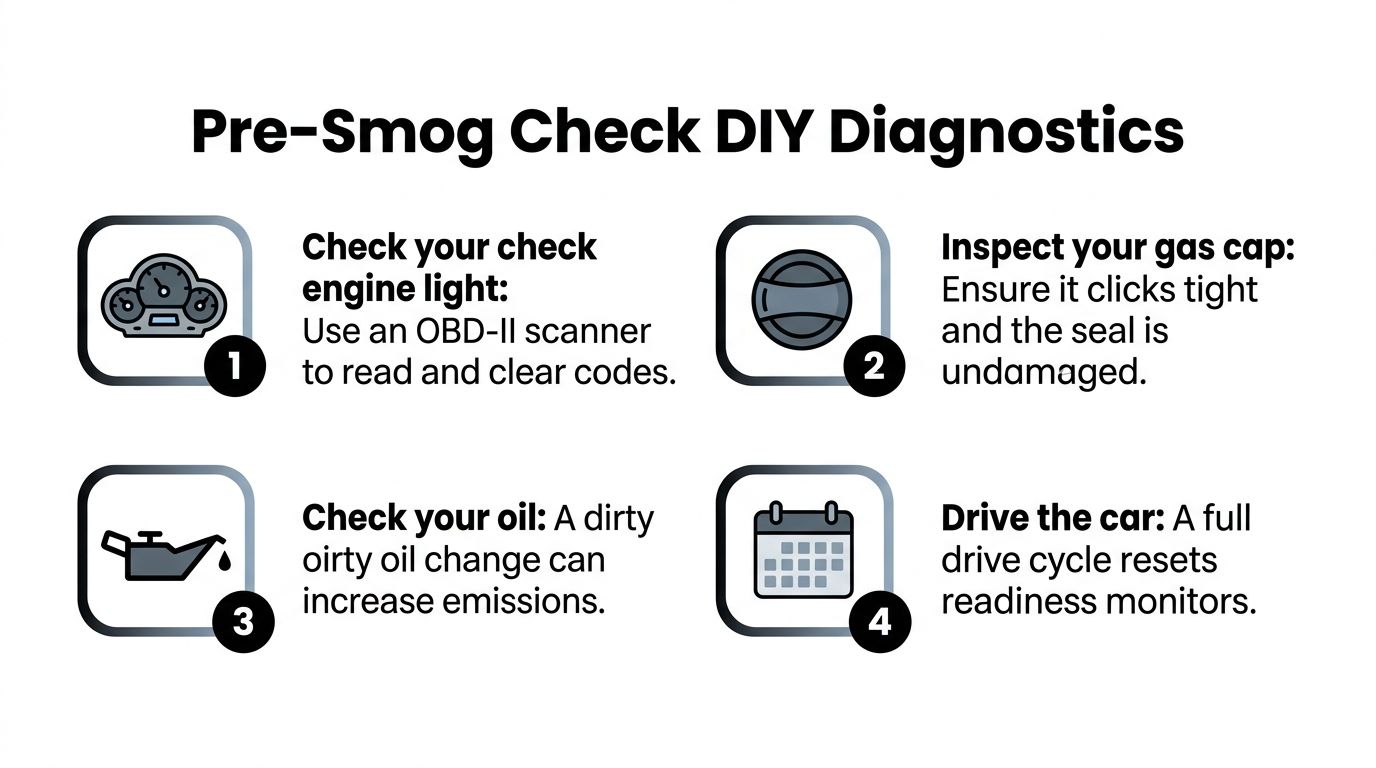
Start with the dashboard
Turn the ignition on without starting the engine and confirm that the malfunction indicator lamp illuminates as part of the normal bulb check. Start the engine and verify that it goes out. If it stays on or flashes, scan the vehicle before scheduling the inspection.
Use a compatible OBD-II scanner to read stored and pending codes. Don't clear codes just to make the dashboard look clean. Code clearing can erase readiness information and leave the vehicle unprepared for the test. A useful OBD code reading guide can help you understand what the scanner is showing, but code interpretation still requires proper diagnosis.
Confirm readiness before you test
Many parts stores and repair shops can check readiness status with a scan tool. Ask specifically whether the required monitors are ready, not merely whether the car has codes. If the battery was disconnected or a repair cleared the computer, the vehicle may need a complete drive cycle.
Drive normally through varied conditions, including a cold start, steady cruising, moderate acceleration, and periods of deceleration. Catalyst and EVAP monitors may require specific temperature, speed, and load conditions, so repeated short errands may not be enough. Follow the manufacturer's drive-cycle guidance when available.
Inspect the simple items
Check the gas cap for a damaged seal, cracked plastic, or a cap that won't tighten correctly. Look under the hood for disconnected vacuum hoses, loose electrical connectors, obvious air leaks, and missing emissions components. Listen for an exhaust leak, especially near the engine and oxygen sensors.
An overdue oil change won't explain every failure, but maintaining the engine before testing is sensible. If the engine runs poorly, consumes oil, overheats, or never reaches normal operating temperature, get those symptoms diagnosed rather than trying to mask them with a last-minute tune-up.
Repair Options Costs and What to Expect at a STAR Station
A car can run smoothly and still fail because its emissions software has not completed required checks. Repair cost depends on the failed system. Correcting a loose gas cap or allowing an incomplete monitor to finish may cost little, while a damaged catalytic converter, wiring fault, failed control module, or major EVAP leak requires diagnosis and more extensive work.
Do not approve a converter, oxygen sensor, or computer replacement just because a generic code points there. Ask which tests confirmed the fault, whether another problem caused it, and whether the repair will restore the readiness monitors. A reputable shop should explain the Vehicle Inspection Report in plain language and connect its repair recommendation to evidence.
A STAR station meets California's additional program requirements and may be required for vehicles directed to STAR testing. Learn more about what a STAR station is and why it matters. Check your registration renewal notice before choosing a location. If it requires STAR certification, a non-STAR station may not meet the testing requirement.
At a station such as Speedy Smog, the inspection documents the vehicle's compliance result. For many 2000-and-newer vehicles, the test is typically completed in about 10 to 15 minutes, according to the publisher's service information. The station also tests older vehicles, diesels, and hybrids, though the procedure varies by vehicle.
Bring your registration paperwork and any previous Vehicle Inspection Report. If another station failed the car, show that report instead of starting over. It gives the technician useful evidence and can prevent duplicate testing. Ask about current coupons before authorizing the inspection, then keep the result paperwork for the repair shop or retest.
Your Action Plan for Passing Your Next Smog Check
Use this order before booking the appointment:
- Check the warning lamp. If it stays on or flashes, scan the car first.
- Read the diagnostic codes. Don't clear them without fixing the cause.
- Verify readiness monitors. Pay particular attention after a battery disconnect or repair.
- Inspect the gas cap and emissions hardware. Look for leaks, missing parts, and obvious modifications.
- Complete the correct drive cycle. Random short trips may not finish catalyst or EVAP checks.
- Bring the Vehicle Inspection Report to a qualified repair shop if the car has already failed.
- Confirm whether your registration notice requires a STAR station before scheduling the retest.
The biggest warning signs are an illuminated check engine light, incomplete monitors, recent code clearing, visible emissions tampering, poor operating temperature, and unexplained exhaust or fuel-system symptoms. Fix the evidence-backed problem first. Don't buy parts based on guesswork.
For a clear inspection result and practical guidance after a failure, visit Speedy Smog in San Leandro. The STAR Certified station tests newer and older vehicles, diesels, and hybrids, and can identify the failed area on the inspection report so you know what to address next.
You're already at the point where the smog appointment is on the calendar, the renewal deadline is creeping closer, and you're trying to figure out whether one more drive around the block will save the day. Most failures I see don't start at the station, they start in the driveway, with a cold engine, a hidden warning light, or a monitor that never finished setting. The good news is that passing an emissions test in California is usually about preparation, not luck.
California's rules are strict for a reason. The EPA says today's vehicles are up to 99% cleaner than those on the road in the early 1970s, which shows how far emissions control has come, but it also means modern inspections are built around whether the vehicle's systems are doing their job. For many drivers, the difference between a pass and a fail comes down to OBD-II readiness, a clean visual inspection, and showing up with the car in the right condition for the test.
Table of Contents
- Pre-Test Checklist Before You Arrive at the Station
- Completing the Drive Cycle and OBD Readiness Monitors
- Visual and Mechanical Items Inspectors Check
- What to Expect on Test Day at a STAR Station
- Common Failure Causes and Realistic Fixes
- What to Do If Your Vehicle Fails the Smog Check
Pre-Test Checklist Before You Arrive at the Station
The most common bad appointment I see is the one where the driver rolls in with the engine still cold, the check engine light glowing, and a look that says, “Maybe they won't notice.” They will notice. A lit check engine light is not a detail you can talk your way around, and if the engine computer hasn't finished its emissions checks, the vehicle may not be ready to pass even if it drives fine.
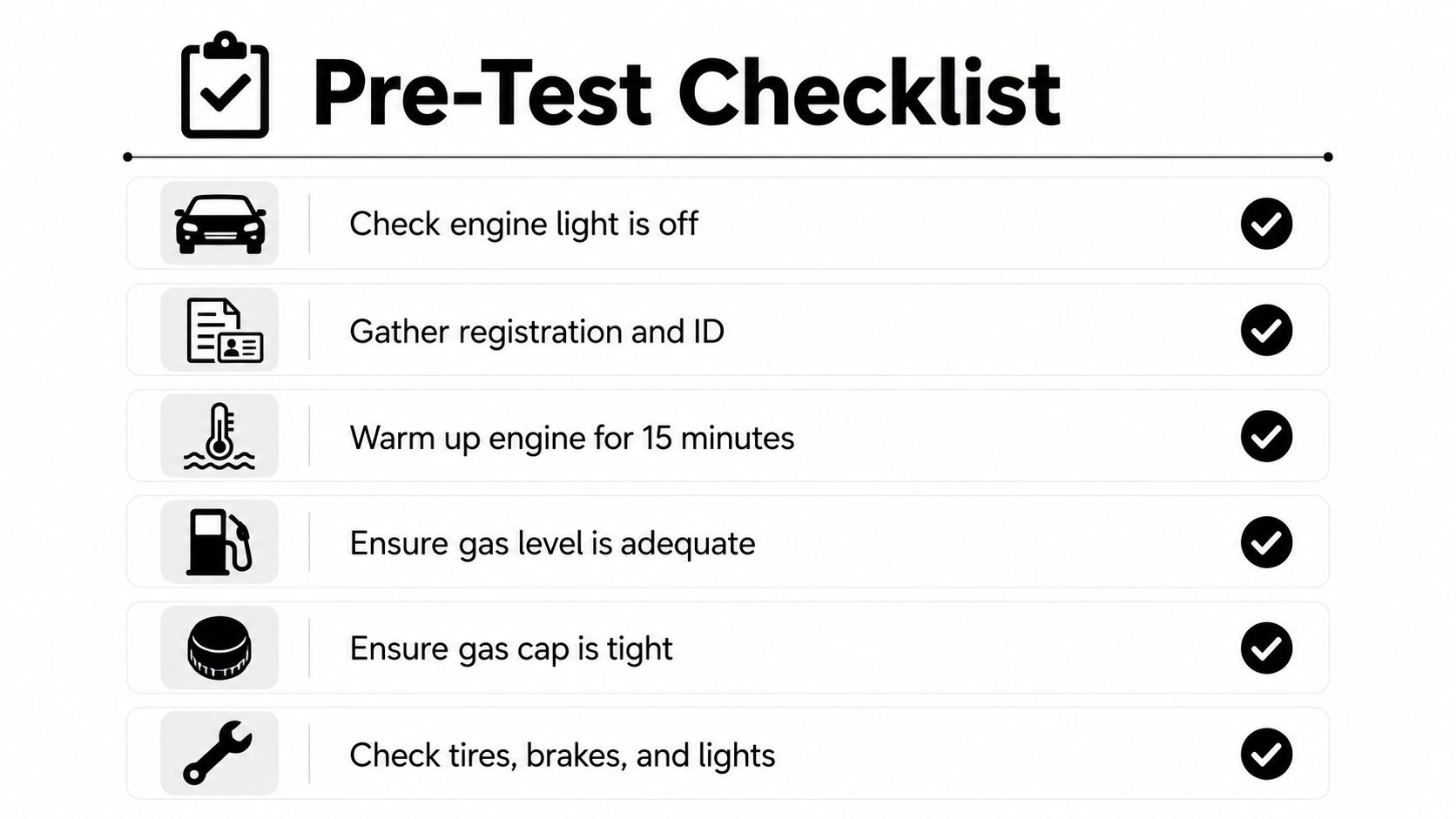
Start with the obvious things
Before you leave home, look at the dashboard with the key on and the engine running. If the check engine light is on, don't assume it'll magically disappear on the way to the station. In OBD-era vehicles, a car can still pass when the light is operating normally but off and all but one monitor is completed under most conditions, but that only helps if the rest of the system is in good shape too.
Practical rule: if the car is alerting you on the dash, treat that as a repair problem first, not a testing problem.
Then check the simple visual items that cause wasted trips. Open the hood and look for loose hoses, wet spots, obvious leaks, or anything that looks disconnected. On California inspections, a car can fail for visual issues even when it runs normally, especially under the state's more detailed Smog Check process, which looks beyond just tailpipe behavior and routine drivability, as the California Smog Check Manual makes clear.
Don't skip paperwork and basic condition checks
Bring what the station needs for DMV processing, and make sure the car is reasonably presentable. A loose gas cap, missing under-hood label, or obvious mechanical issue can slow the inspection or end it early. If the car recently had service, keep a mental note of what changed, because a fresh repair sometimes explains a pending code or a monitor that hasn't reset yet.
If you're the type who likes to prep everything in one shot, it helps to review an oil-change and service checklist before the smog visit, since neglected maintenance often shows up as emissions trouble later. One useful reference is this guide on oil change timing before a smog check.
The short version is simple. No warning lights, no obvious leaks, no missing parts, and a warm, healthy car gives you the best shot at a clean first visit. If any of those pieces are off, fix them before you burn time in the waiting room.
Completing the Drive Cycle and OBD Readiness Monitors
Modern California smog checks lean heavily on what your car's computer says about itself. That's the whole point of OBD-II readiness, the system's way of confirming that emissions monitors have run and passed. For many 2000-and-newer vehicles, the inspection is less about a dramatic tailpipe reading and more about whether the vehicle has completed the checks that prove the emissions system is functioning under real driving conditions.
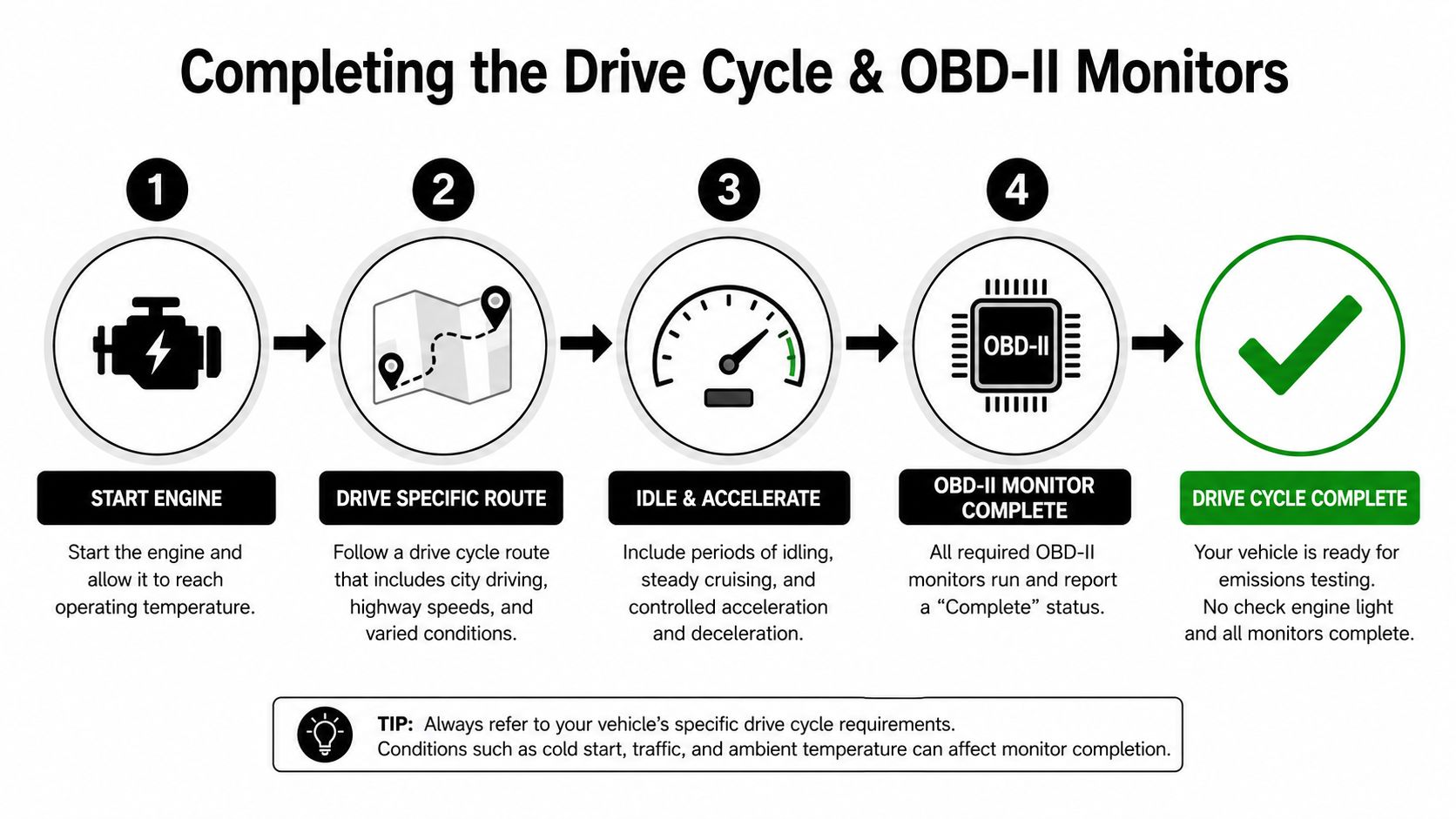
What the drive cycle is really doing
The typical advice is to complete a full drive cycle of about 30–60 miles (50–100 km) with mixed conditions, because the computer needs enough varied driving to run its emissions monitors. That means some city-style stops, some steady cruising, and enough time for the car to settle into normal operating behavior. Current guidance also points to warming the engine to about 70–105°C (160–220°F), since colder engines can produce more pollutants and may keep monitors from setting. See the practical drive-cycle guidance in the OBD readiness preparation guide.
That's why a short hop to the gas station doesn't count. A monitor that hasn't completed isn't the same thing as a broken car, but it can still stop you from passing.
Fuel level matters more than most drivers think
Keep the fuel tank roughly 25% to 75% full before the test. That range matters because evaporative-emissions checks are sensitive to fuel level, and showing up near empty or completely full can interfere with readiness. The car can be mechanically fine and still fail to set the right monitor if the tank level is off.
Drive it like a real trip, not like a test lap. The computer wants varied conditions, normal temperature, and enough time to finish its checks.
If you've had codes cleared recently, especially after a battery disconnect or repair, give the car time to relearn everything before the appointment. That reset wipes the readiness status, which is one of the fastest ways to turn a potentially easy pass into an automatic delay.
For drivers who want to understand the codes themselves before heading in, a solid starting point is a guide on reading OBD codes. The value there isn't in guessing a fix, it's in knowing whether you're dealing with a simple readiness issue or an actual fault that needs repair.
The practical move is to schedule your drive cycle a few days before the appointment, not the morning of. If the monitors don't finish, you'll know in time to correct course instead of discovering it at the counter.
Visual and Mechanical Items Inspectors Check
A clean dashboard doesn't guarantee a clean result. California inspectors also look at visual and mechanical condition, and that's where a lot of “but the car drives fine” stories fall apart. A vehicle can run smoothly and still fail if the inspector sees missing equipment, leaks, overheating signs, or a modified setup that doesn't match what the car is supposed to have.
The stuff that gets missed in the driveway
One of the first things an inspector pays attention to is whether the emissions hardware is all there. That includes the catalytic converter, related hoses, and any parts that look tampered with, missing, or out of place. If a previous repair shop used a shortcut, or an owner removed something during a modification, the station may flag it even if the car seems happy on the road.
California's inspection manual also makes it clear that inspectors look for obvious safety hazards and visual issues like leaks or overheating. That means a fresh oil film, coolant seepage, or a hose that's hanging by a thread can become a failure point even before anyone digs into the computer data.
Gas caps, exhaust, and aftermarket parts
The gas cap still matters because it affects the evaporative system. A bad seal, missing cap, or cap that doesn't tighten properly can trigger trouble during the inspection process. Exhaust leaks, loose clamps, and cracked hoses are just as annoying, because they can point to a deeper problem or make the emissions system behave unpredictably.
Aftermarket modifications are another trap. A part that looks cleaner or newer isn't automatically compliant. If the car has been altered in a way that changes the emissions equipment layout, the inspector may treat it as a missing-component issue rather than a cosmetic upgrade.
If you hear a rattle, smell fuel, or see a fluid trail, don't gamble on the test. Fix the mechanical issue first, then come back ready.
Older vehicles and modified cars deserve extra attention here because the visual portion matters more when the car has a longer history of repairs, swaps, or nonstandard parts. What fails people most often is not a dramatic breakdown. It's a small oversight, like a cracked hose, a loose clamp, or an evaporative component that never got reinstalled after service.
What to Expect on Test Day at a STAR Station
At a well-run station, test day should feel organized, not mysterious. You bring the documents, hand over the keys, and the technician starts with the required checks for your vehicle type. If your car is one of the vehicles required to use a STAR-certified location, that matters because STAR stations meet higher performance standards set by the Bureau of Automotive Repair.
What the station actually does
For a 2000-and-newer car, the process usually centers on the OBD system, readiness monitors, and visual confirmation that the emissions equipment is in order. Older models, diesels, and hybrids can follow different testing paths, which is why assuming every smog appointment is the same is a mistake. The vehicle may be inspected, plugged in, and checked for compliance items that don't show up on a generic “my car runs fine” readout.
A clean station should also tell you what it needs up front, so you aren't guessing about paperwork or waiting around with an unprepared car. If you're trying to understand why one station is required over another, the basics of what a STAR station is matter more than most drivers realize, especially if registration renewal is on the line.
Time, waiting, and choosing the right place
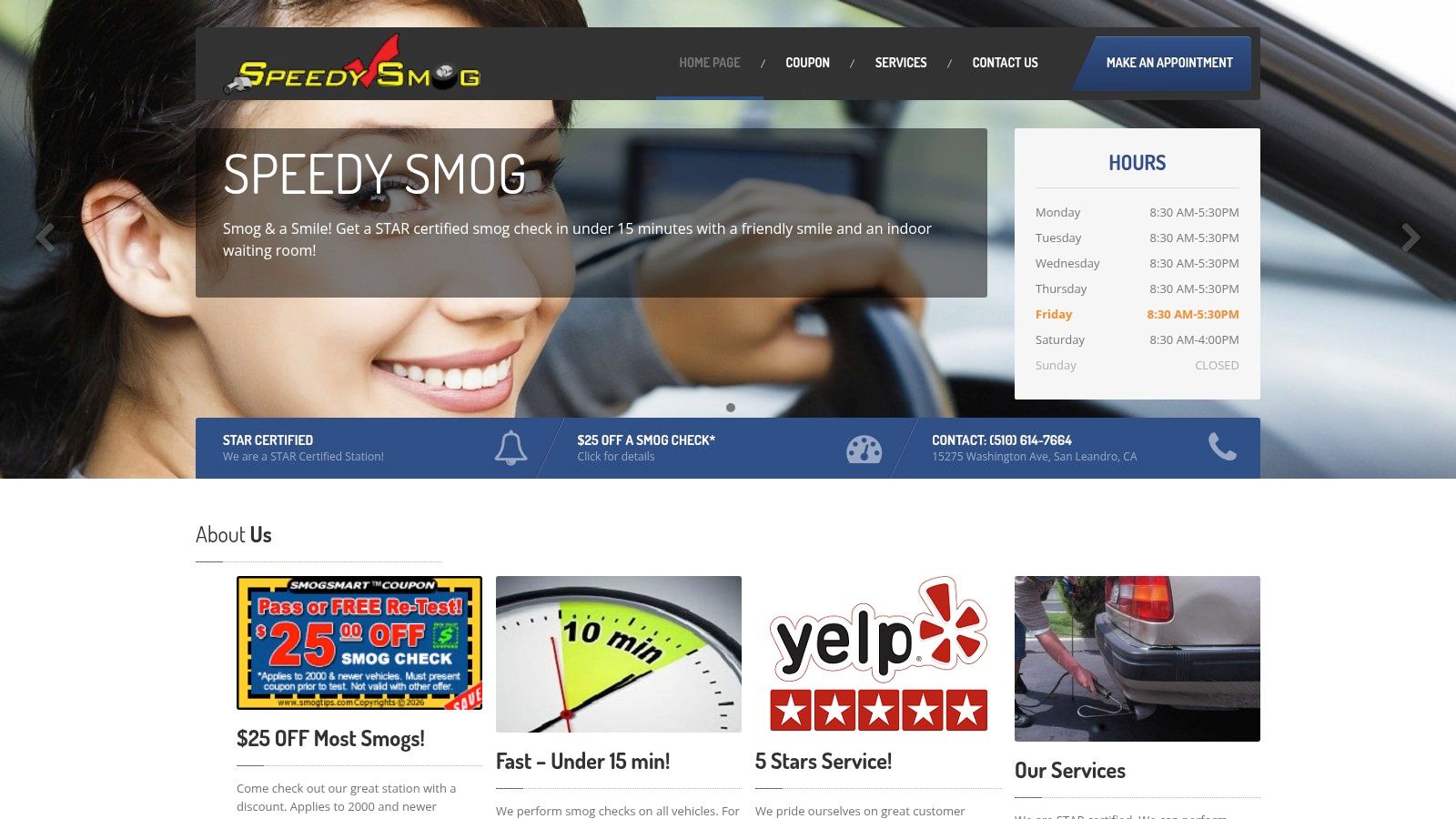
A good smog shop respects your time. Speedy Smog in San Leandro, for example, completes most tests for 2000-and-newer vehicles in about 10 to 15 minutes, and that kind of turnaround is exactly what you want when the goal is to get in, get certified, and get back on the road. The indoor waiting area also matters more than people admit, especially when you're dealing with a second visit or a busy weekday schedule.
One thing I tell drivers is to treat the station choice as part of the test preparation. A place that knows California compliance, handles different vehicle types correctly, and doesn't waste your time makes the whole process easier. You don't need a sales pitch, you need accurate testing and clean paperwork.
If your vehicle is one of the newer models, the practical advantage is speed. If it's older, diesel, or a hybrid, the advantage is finding a station that already knows how to handle those protocols without improvising.
Common Failure Causes and Realistic Fixes
Most failed smog checks come from a handful of repeat offenders. The frustrating part is that many of them look small from the driver's seat, but they're enough to stop the test cold. I see a lot of people hoping for a shortcut, then learning the hard way that emissions systems don't care about last-minute additives, battery tricks, or a dash of optimism.
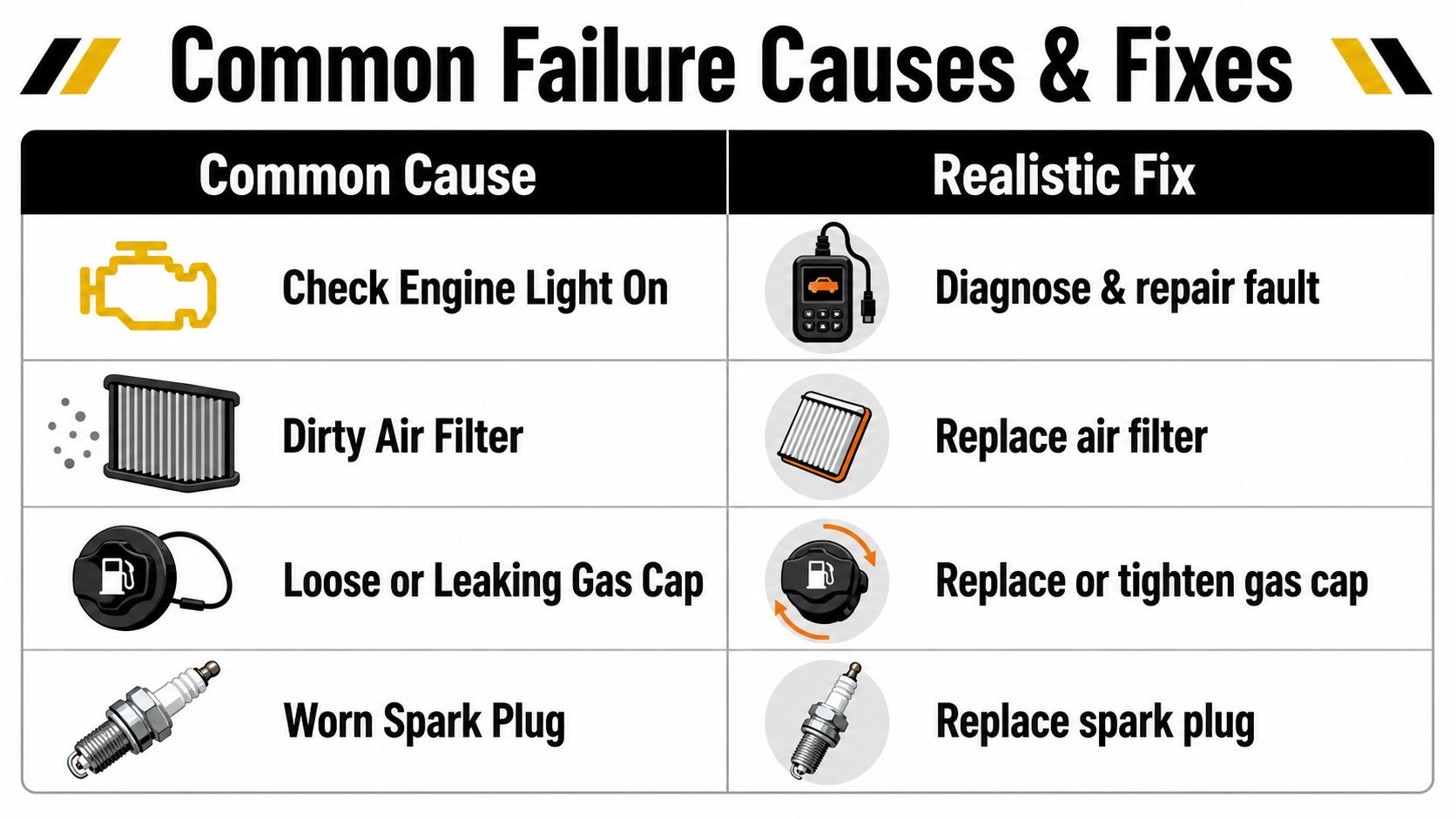
What usually breaks the pass
A loose or failing gas cap is an easy one to miss, and it's often one of the first things worth checking because it affects the evaporative system. Worn oxygen sensors and degrading catalytic converters are more serious, because they point to actual emissions-control problems that need diagnosis and repair rather than a quick reset. Vacuum leaks are another classic issue, especially on older vehicles or cars that have had recent work.
Pending diagnostic trouble codes are the sneaky ones. The check engine light might still be off, but the car has already logged a problem that can keep it from passing. That's why a scan tool matters more than a guess.
Disconnecting the battery is not a fix. It clears memory, resets readiness, and often sets you back instead of moving you forward.
What actually works
The honest answer is to repair the fault that triggered the code, then drive the car long enough for the monitors to reset. If the gas cap is bad, replace it. If a sensor is lazy, diagnose it properly instead of throwing parts at the problem. If the catalytic converter is degraded, don't expect a fuel additive to rescue it.
For some drivers, a trusted smog station that also understands the repair path can save a round trip. Speedy Smog is one option that offers smog checks and free retests, which can help when you're working through a repair and need to come back after the vehicle is ready.
The trade-off is time versus guessing. Guessing is cheap for about five minutes, then it becomes expensive.
What to Do If Your Vehicle Fails the Smog Check
A failed result isn't the end of the road, it's a repair roadmap. Start with the Vehicle Inspection Report, because that's the document that tells you whether the problem is readiness, a code, a visual issue, or something deeper. Fixing the wrong item first is how people waste money and miss registration deadlines.
Prioritize the failure, not the noise
If the report points to one clear fault, handle that first. A weak gas cap, a sensor issue, or a vacuum leak should be addressed before you think about anything else. If there are multiple items, a good mechanic will sort them in order of what blocks the pass fastest and what might be secondary damage from the main fault.
California also has a repair cost waiver program for some situations, and the state's rules are the place to look if repairs start to spiral. The key is not to assume a waiver applies automatically. You need to check eligibility against the official requirements and follow the process carefully.
Know your retest and timing options
Many stations offer a free retest policy, which matters if you've already fixed the underlying issue and just need the car checked again. That saves you from starting over at a random shop when the same station can verify the repair. It also helps to retest before the registration deadline gets tight, because waiting too long turns one fix into a paperwork problem.
Get the repair done, drive the car enough to restore readiness, and go back before you start cutting it close on registration.
Special protocols still apply for diesel vehicles, hybrids, and 1999-and-older models, so don't assume the same repair strategy fits every car. Some vehicles need a different inspection path, and some need more patience before they're ready to pass again.
If you want the cleanest route, schedule the repair, confirm the readiness status, and return with a car that's prepared, not just recently reset. That's how you turn a failure into a pass without chasing your tail.
If you want a station that understands California smog rules, handles different vehicle types, and keeps the process moving, visit Speedy Smog in San Leandro. They offer smog checks, free retests, and DMV submission after a passing result, which makes them a practical stop when you need the car certified and the paperwork handled the right way.
East Bay drivers can get their car emissions tested at a California BAR-certified smog check station, and the DMV renewal notice will tell you if a STAR-certified station is required. If you've got that notice in your hand right now, don't guess, use the station type the state tells you to use and save yourself a wasted trip.
That's the answer to where can I get my car emissions tested, and in California the details matter. Go to the wrong shop, show up without the right paperwork, or bring a vehicle that isn't ready, and you'll burn time and money for nothing. I've seen plenty of East Bay drivers come in frustrated because they picked a convenient place instead of the correct one.
Table of Contents
- Who Needs a Smog Check in California
- Understanding STAR Certified vs Standard Smog Stations
- How to Prepare Your Vehicle Before the Test
- What to Expect During Your Smog Check Visit
- Why East Bay Drivers Choose Speedy Smog in San Leandro
- Your Complete Smog Check Action Plan
Who Needs a Smog Check in California
Your DMV renewal notice is the first thing to read, before you check a shop website or head to the nearest station. California requires biennial smog checks for most vehicles in participating counties, plus a smog check at change of ownership and when a vehicle is first registered in California from out of state, as outlined in the official DMV smog check requirements. That puts a lot of East Bay drivers on a deadline sooner than they expect.
Start with the renewal notice
If your notice says you need a smog check, follow it exactly. The notice can also tell you whether a STAR station is required, and that matters because STAR is a compliance tier, not a convenience label. If the notice calls for STAR and you go to a regular station, you can waste an entire trip and still have the same problem.
Practical rule: the DMV notice wins. If it points you to STAR, use STAR. If it doesn't, a certified station that can legally test your vehicle is the right move.
Some drivers do not need a test at all, but only if their vehicle fits an exemption under California's rules. Newer vehicles, electric cars, and motorcycles are commonly handled differently from the standard smog-check crowd, so do not assume every registration renewal means a test. Read the notice, check the vehicle class, and confirm whether you need to do anything before you drive across town.
If you want the state rule summary in one place, use the local guide here: California smog check rules.
Understanding STAR Certified vs Standard Smog Stations
East Bay drivers waste time when they guess at the wrong shop type. California uses test-only, test-and-repair, and STAR-certified stations, and the right choice depends on your vehicle and the DMV notice. If you show up at the wrong category, you still have the same registration problem and you've burned a trip for nothing.
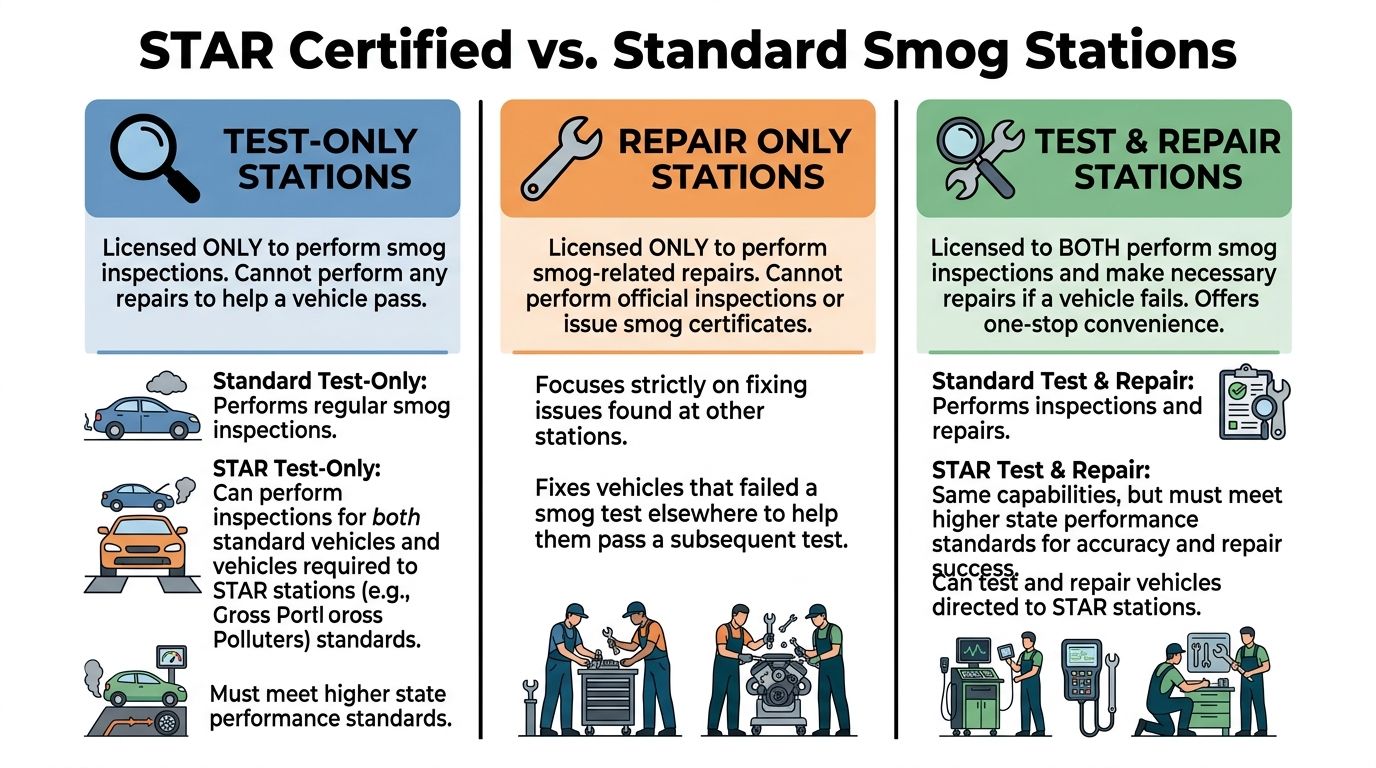
Station Types Explained
A test-only station inspects the vehicle and sends you out with the result. A test-and-repair station can inspect the car and handle repairs, which is useful if the vehicle needs work before it can pass. A STAR-certified station operates under a stricter program inside California's smog system, and the BAR locator shows whether a site is test-only, test-and-repair, or STAR-certified.
The point of STAR is accountability. California puts that tier under tighter oversight, so some vehicles get sent there by rule instead of preference. That is why the DMV notice matters so much. If it calls for STAR, a standard station is the wrong stop.
For a plain-English breakdown of how STAR fits into the local testing setup, use what is a smog STAR station.
Why This Matters in the East Bay
Drivers around the East Bay lose time when they assume every smog shop can handle every case. A shop can be close, fast, and easy to reach, but if it does not match the requirement on your renewal notice, it does not solve the problem. Match the station type before you leave home, and you avoid a second trip, a second wait, and a second fee.
Keep the station category straight, and the rest gets simpler. If your notice points to STAR, go to a STAR station. If it does not, use a certified station that is allowed to test your vehicle, and bring the paperwork the station asks for so the visit stays on track.
How to Prepare Your Vehicle Before the Test
A smog failure is expensive in the dumbest possible way, because many failures start with something small and fixable. Show up with a warm engine, a clean dash, and basic maintenance handled, and you give yourself a much better shot at clearing the test on the first visit. That's the job, not hoping the station will make up for neglect.
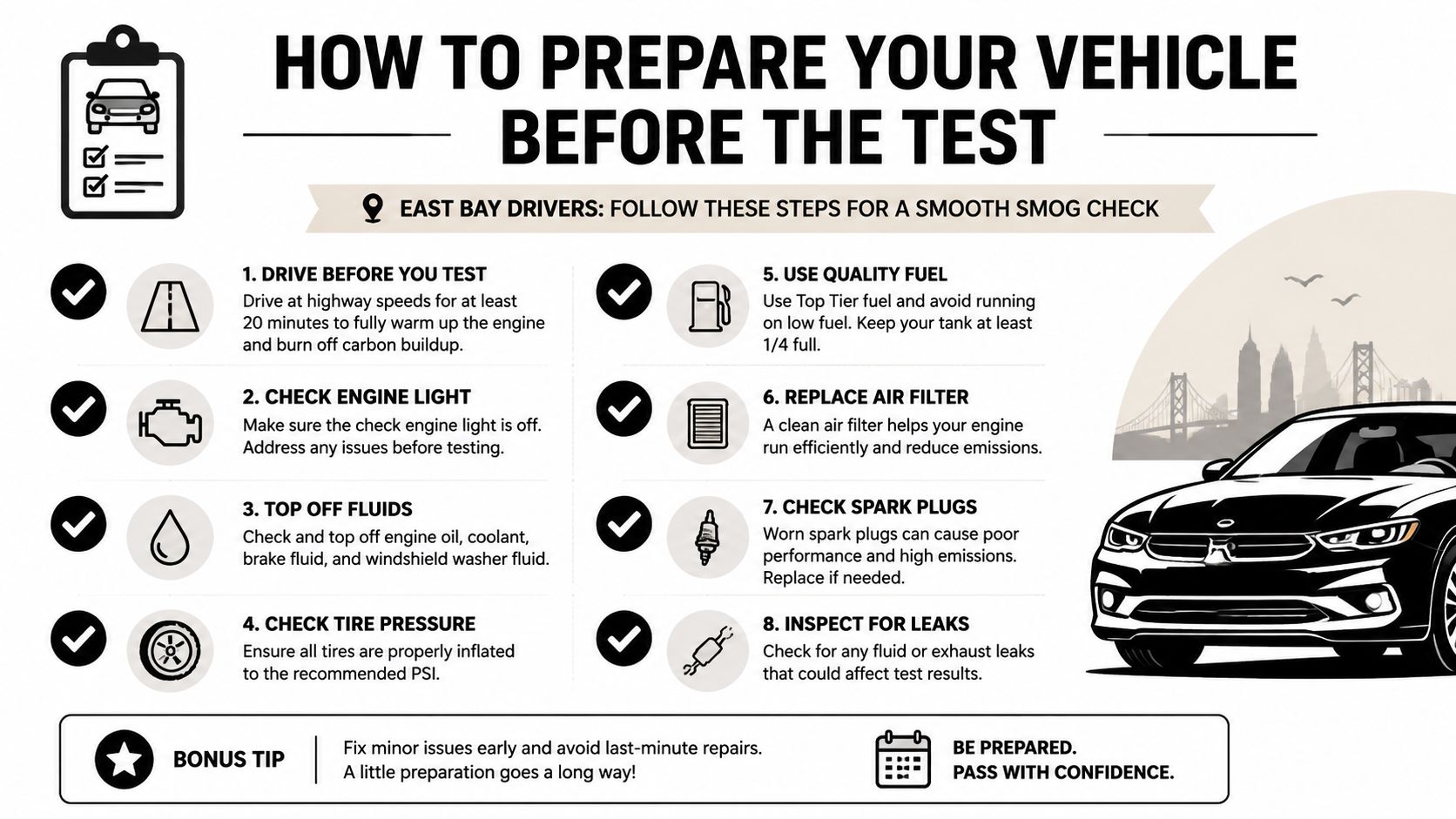
Do the simple stuff first
Drive the car long enough to get it fully warmed up before you arrive. A warm drivetrain and catalytic converter are part of a clean test run, and a vehicle that's been sitting cold all morning is not doing you any favors. If the car has been parked for a while, fresh fuel and a proper warm-up beat rushing straight to the station.
The check engine light has to be off before you walk in. If it's on, fix the underlying issue before you waste a test fee, and if the battery was recently disconnected, give the vehicle time to reset its readiness monitors. A lot of drivers skip that step and then act surprised when the car isn't ready.
Keep the car predictable. Fresh oil, a tight gas cap, and properly inflated tires don't guarantee a pass, but they remove avoidable reasons to fail.
Use this checklist before you leave
- Warm the engine: Drive the car before the test so it's not cold when inspection starts.
- Check the dash: Make sure the check engine light is off.
- Seal the gas cap: A loose cap is a classic avoidable problem.
- Review recent work: If the battery was disconnected, confirm the monitors are ready.
- Top off fluids: Basic maintenance keeps the car from acting up during inspection.
- Inspect tire pressure: Proper inflation helps the vehicle stay stable during the test process.
- Bring fresh fuel if needed: A car that's been sitting benefits from a normal drive cycle first.
If you need help clearing the warning light before you waste a trip, use this local resource: how to clear check engine light.
Here's a quick video walkthrough if you like to see the process before you go.
What to Expect During Your Smog Check Visit
A good smog visit is simple. You arrive with the right paperwork, the technician checks the car, and you leave with the result the DMV needs for registration. If you show up unprepared, you waste time at the counter answering basic questions and risk making a second trip.
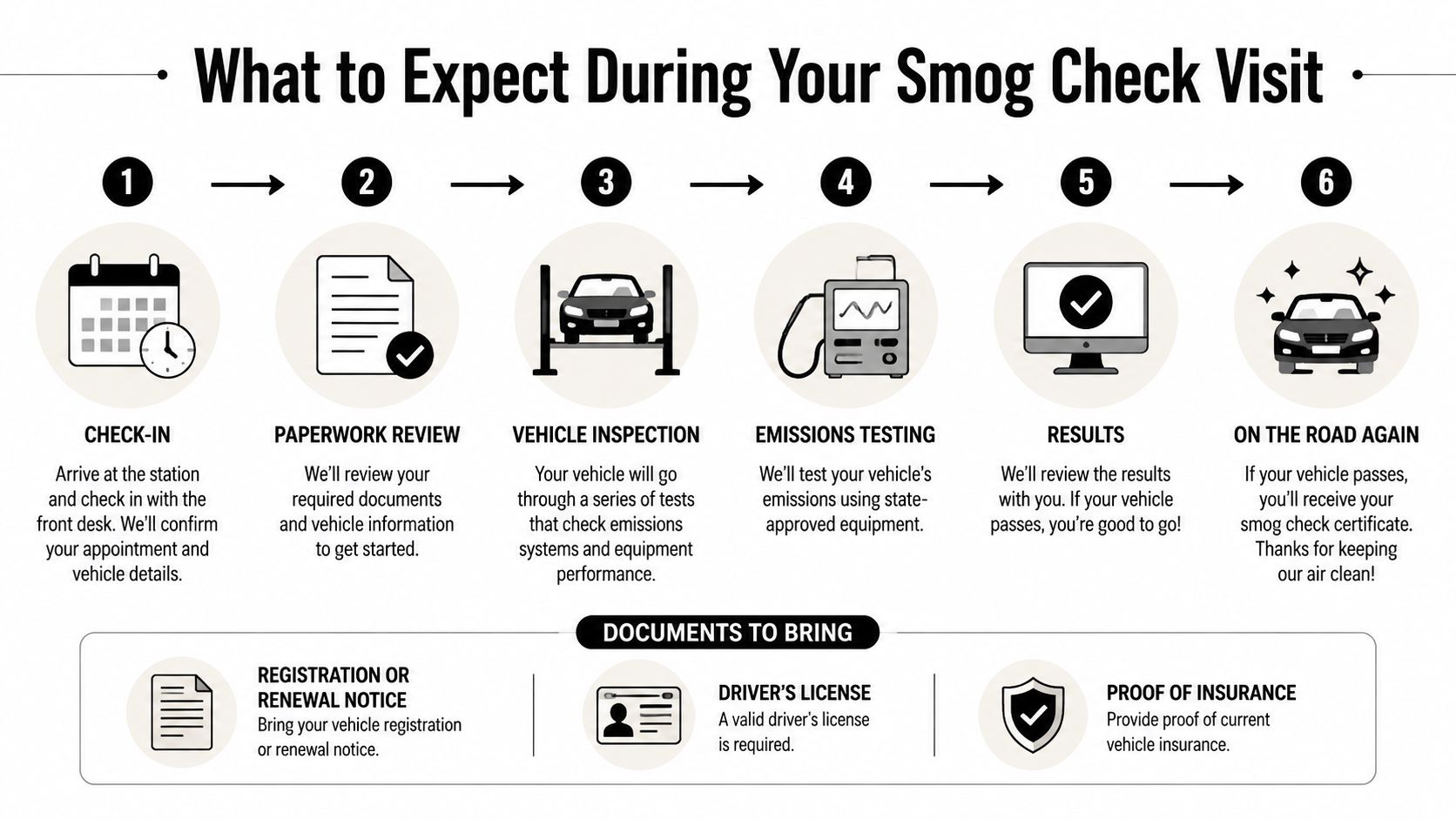
What to bring and why it matters
Bring your registration or renewal notice, driver's license, proof of insurance, and payment. Some stations do not take every payment method, so confirm what the shop accepts before you leave. DMV emissions test guidance That small detail is enough to turn a quick stop into a wasted trip.
The test itself depends on the vehicle. Newer cars usually get an OBD-II scan, while older vehicles may go through a different inspection path. Either way, the station is checking whether the car meets the requirement for registration, not whether it looks clean on the outside.
The visit should feel efficient
The right station keeps the line moving and the instructions clear. In California, use the BAR station locator to find a licensed smog station near you, then call ahead if you want to confirm hours and testing style before you drive over. state station-locator guidance In the East Bay, that matters because the wrong station costs you time, gas, and another errand.
If the counter line is long but the test lane moves fast, that is normal. The real question is whether the station is certified and whether it can issue the result your DMV needs.
After the test, you leave with the result tied to your registration renewal. If the car passes, keep the paperwork until the DMV side is finished. If it fails, the station should tell you what went wrong so you can fix it before retesting.
Why East Bay Drivers Choose Speedy Smog in San Leandro
Speed matters when you're trying to keep a registration from going sideways. A local station that already understands California's requirements is easier to trust than a random place that treats smog checks like an afterthought. Speedy Smog in San Leandro is one of the East Bay options that fits that job because it's a STAR Certified station, it handles a wide range of vehicles, and it's built around fast inspections.
The shop is located at 15275 Washington Ave, San Leandro, 94579, and it works with 2000 and newer vehicles, 1999 and older vehicles, diesels, and hybrids. That matters because a lot of drivers want one place that can handle the car they own, not a station that only likes the newest sedans. For newer vehicles, typical tests are completed in about 10 to 15 minutes, which is exactly the kind of turnaround busy East Bay drivers care about.
Speedy Smog also gives drivers the practical things that reduce friction. The shop is open Monday through Saturday, has a clean indoor waiting room, and offers periodic $25-off coupons for most smogs on newer vehicles. Those details don't change the law, but they do change how painful the day feels.
If you want a station that's focused on speed, certification, and a simple visit, this is the kind of place to put on your list. It's not about hype, it's about getting a legal test done without turning it into a half-day project.
Your Complete Smog Check Action Plan
Your DMV renewal notice tells you what to do first. If it calls for STAR, go straight to a STAR Certified station. If it does not, use the state station locator and choose a certified place that can legally test your vehicle type and fit your schedule. That is the cleanest way to answer where can I get my car emissions tested without wasting time on the wrong shop California BAR station locator.
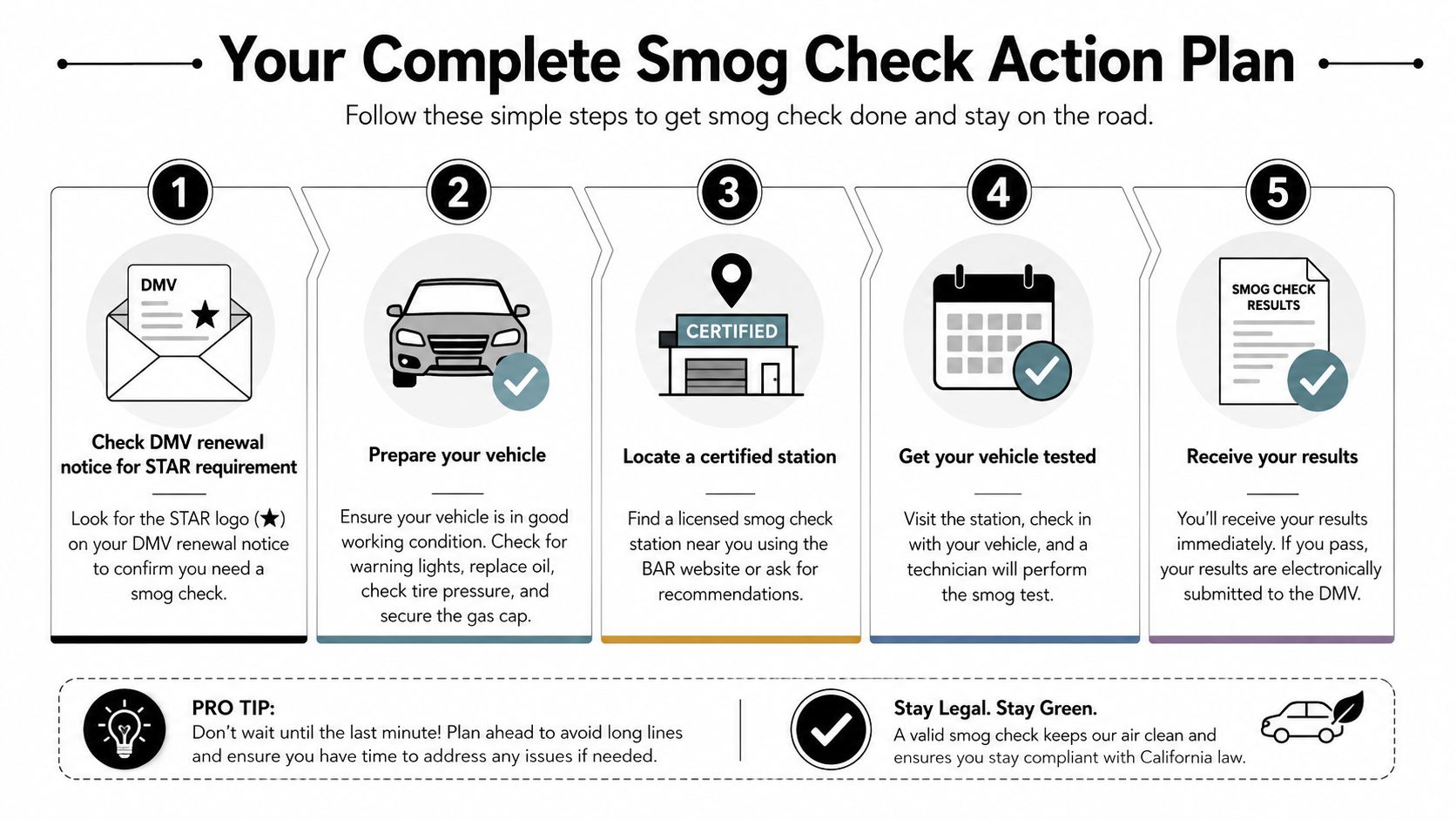
Use this order every time
- Check the notice. Confirm whether your DMV renewal requires a standard smog check or a STAR station.
- Prep the car. Warm it up, check the light on the dash, and deal with obvious maintenance issues before you go.
- Gather documents. Bring your registration or renewal notice, driver's license, proof of insurance, and payment.
- Choose the right station. Pick a certified location that can legally test your vehicle type.
- Get the result. Hold onto the paperwork until your registration issue is closed.
If you want a local station that handles the process efficiently, keep Speedy Smog in San Leandro on your short list. For East Bay drivers, a certified shop that moves quickly and knows the state requirements saves time and avoids extra trips.
Set a reminder for your next smog cycle now, not later. Drivers who avoid registration headaches plan ahead, keep the car ready, and do not wait until the last week to find a station.