Best Smog Check in San Leandro: Your 2026 Guide
You're staring at a California DMV renewal notice, wondering whether the station down the street will get you certified before your Saturday disappears. The cheapest coupon may look attractive, but it won't help if the shop can't handle your vehicle's test type, your registration requires a STAR inspection, or a battery reset leaves the emissions monitors incomplete.
The best smog check is the right combination of certification, accurate testing, honest pricing, manageable wait time, clear communication, and equipment suited to your car. California's program remains a major compliance system. The Bureau of Automotive Repair recorded 11,275,981 initial tests and 959,667 failures in 2025, an overall initial-test failure rate of 8.51% in its statewide report (California BAR 2025 Smog Check Executive Summary). Picking carefully matters.
Table of Contents
- What Makes a Smog Check the Best Choice
- The Five Criteria That Define Quality
- What Happens During Your Smog Test
- How to Prepare Before You Drive In
- Matching the Station to Your Vehicle Type
- Common Failure Causes and How to Fix Them
- Why Speedy Smog Stands Out in San Leandro
- Your Pre-Test Checklist and Final Answers
What Makes a Smog Check the Best Choice
A good station does more than plug in a scanner and print a certificate. It routes your vehicle through the correct California inspection process, tells you what the quoted fee includes, and handles a failure without turning it into a confusing sales pitch.
I judge a station on five dimensions:
- Certification: Is it STAR certified, and can it handle a directed vehicle if BAR sends you there?
- Actual turnaround: How long does the full visit take, from pulling in to receiving the certificate?
- Transparent pricing: Does the posted price include the certificate transmission fee, or will extra charges appear after the test?
- Customer service: Will someone explain a refusal clearly and tell you what needs attention?
- Vehicle coverage: Does the shop test your year, fuel type, weight class, and required inspection track?
The certificate itself is legally the same DMV product wherever you obtain it. The meaningful differences are speed, accuracy, communication, and problem handling. A low advertised price isn't a bargain if you need a second trip because the shop doesn't support your vehicle or failed to explain that the monitors weren't ready.
California's Smog Check program also has a long air-quality legacy. Research summarized in the state's performance material describes earlier reductions associated with enhanced testing in 1999, including about 97 tons per day of hydrocarbons, 1,690 tons per day of carbon monoxide, and 81 tons per day of nitrogen oxides (California BAR Smog Check Performance Report). That scale is why the inspection is more than a paperwork obstacle.
Practical rule: Choose the station that matches your vehicle first. Compare coupons only after you know the shop can perform the required test.
Carry that rule into any Bay Area station. The right shop for a newer OBD vehicle may not be the right shop for an older gasoline car, diesel truck, or hybrid.
The Five Criteria That Define Quality
Certification comes first
Look for STAR certification when your DMV or BAR notice requires it. STAR stations participate in California's higher-oversight testing program and are the appropriate choice for many directed vehicles. A Gold Shield designation can also matter when you need a station authorized for specific referee-related or test-and-repair functions. Ask the station to verify your requirement instead of guessing from a coupon.
Speed means the complete visit
A shop's advertised test time usually describes the inspection itself, not the time you spend waiting, completing paperwork, or dealing with an unexpected refusal. Ask about the typical pull-in-to-certificate experience, whether walk-ins are accepted, and whether the station has a clear process for transmitting results to the DMV.
Price should be readable
A clean quote answers four questions:
- Posted fee: What is the standard inspection charge?
- Certification charge: Is the electronic certificate transmission fee included?
- Additional diagnosis: Will the shop ask permission before charging for troubleshooting?
- Retest policy: Is a retest included, discounted, or billed separately?
A station that avoids direct answers about price is giving you useful information. Keep looking.
Service shows up during a refusal
A pass is easy for everyone. The test is what happens when the vehicle fails. A responsible technician should provide the refusal information, identify the relevant diagnostic trouble codes or inspection issue, and separate the test result from any optional repair recommendation.
Coverage prevents the wasted trip
Confirm the station handles your vehicle's class. California BAR guidance says 2000-and-newer gasoline and flex-fuel vehicles up to 14,000 pounds generally use OBD-based testing, while many older gasoline vehicles use BAR-97 equipment. Out-of-state vehicles from 1976 and newer may need a Smog Check when first registered in California (California BAR vehicle guidance).
| Criterion | What to Verify | Why It Matters |
|---|---|---|
| STAR certification | Whether your registration requires STAR testing | Prevents an invalid station choice |
| Speed | Full visit time, not only test time | Cuts avoidable waiting |
| Price | Posted fee, certificate charge, diagnosis, retest | Prevents surprise charges |
| Customer service | Clear refusal explanation and paperwork | Helps you repair the actual issue |
| Vehicle coverage | Year, fuel type, weight, and test track | Avoids a wasted appointment |
My scoring order is simple: STAR status first, speed second, vehicle coverage third, followed by price and service. A cheap station that can't perform the required test is no choice at all.
What Happens During Your Smog Test
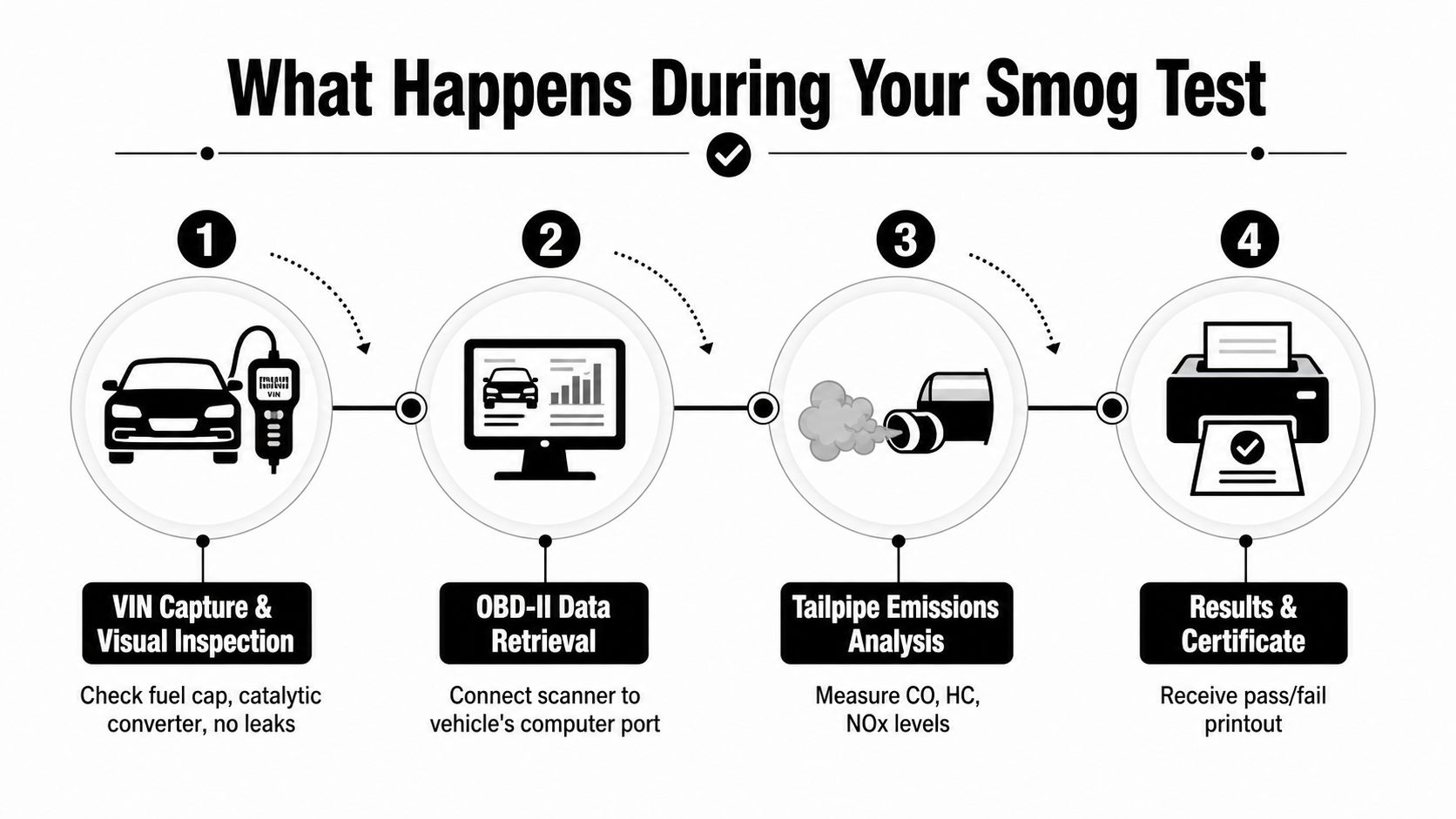
A professional inspection follows a predictable sequence. You provide the registration information, the technician records the vehicle identification number, and the shop checks basic visual and safety items such as the fuel cap, catalytic converter presence, and obvious fluid leaks.
The vehicle determines the route
Newer gasoline vehicles generally follow the OBD-II path. The technician connects the scan tool, checks the malfunction indicator lamp command status, reviews diagnostic information, and verifies that the required emissions monitors have completed.
Older gasoline vehicles may require BAR-97 testing, which uses tailpipe measurements and a dynamometer procedure. Diesels and hybrids need the technician to follow the applicable equipment and procedure for that vehicle, rather than treating every car as a standard OBD scan.
Readiness monitors matter because they show whether the vehicle's onboard emissions self-tests have completed. EPA guidance identifies OBD inspection and maintenance programs as an emissions-inspection method, and California BAR includes readiness review in Smog Check procedures (EPA vehicle emissions inspection and maintenance information).
The result is pass, fail, or a refusal
A passing result is transmitted electronically through the DMV system and the certificate is issued. If the vehicle fails, the station should give you the refusal information and explain what the system found, whether that involves a warning light, trouble code, emissions result, equipment issue, or incomplete monitor.
For a straightforward gasoline vehicle, the inspection itself can be quick, but your total visit depends on the queue, paperwork, vehicle condition, and whether the car follows the OBD or tailpipe route. Before booking, ask the station for its current door-to-door expectation rather than relying on a headline test time.
For a practical breakdown of the appointment timeline, review this guide to how long a smog check takes. The useful question isn't “How fast is your test?” It's “When will I have the result in hand?”
How to Prepare Before You Drive In
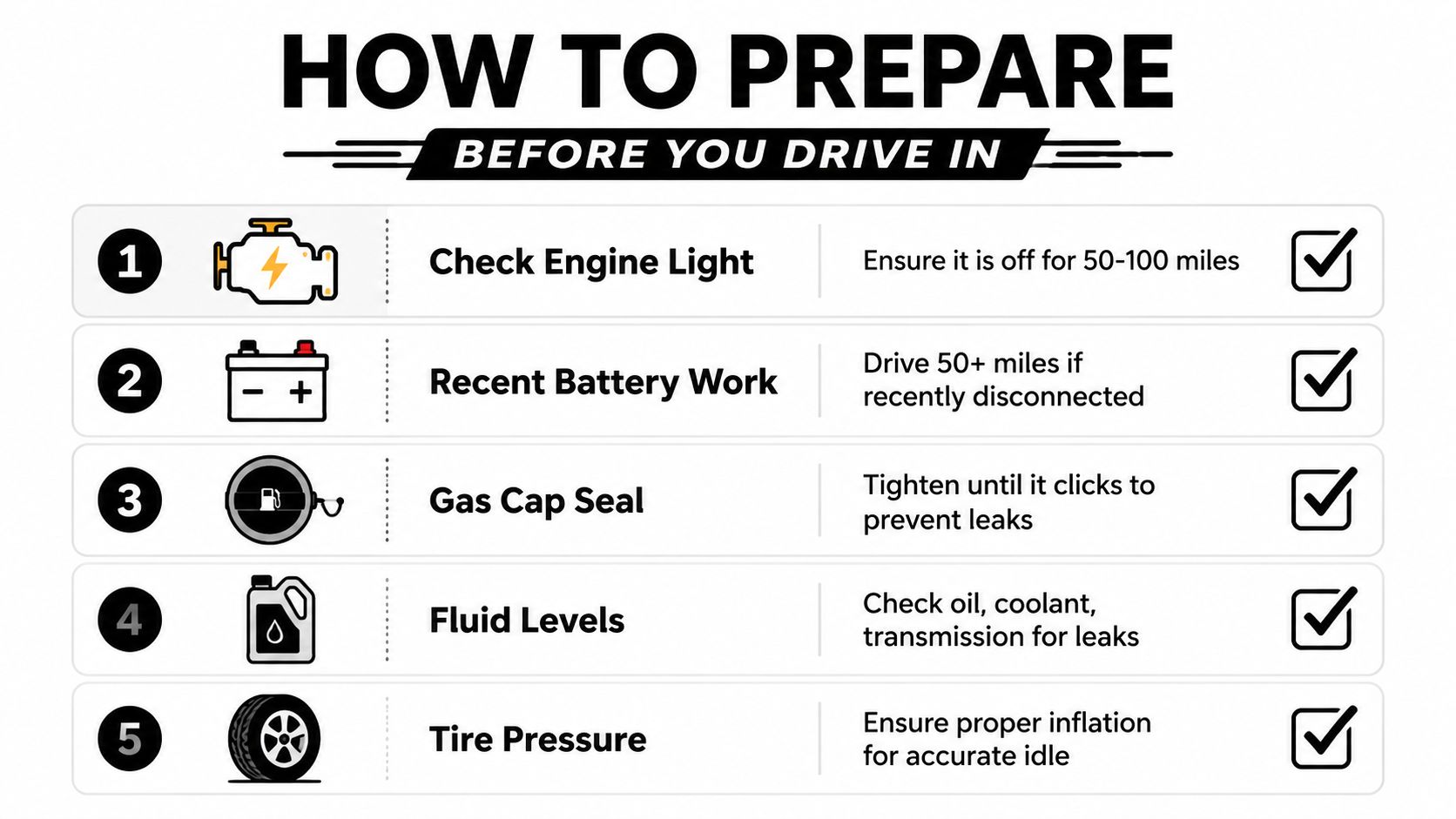
Most avoidable delays begin before the car reaches the station. Check the dashboard first. If the check-engine light is on, flashing, or accompanied by rough running, diagnose the fault before paying for an inspection.
Don't disconnect the battery or clear diagnostic codes just before testing. That action can erase readiness information and leave monitors incomplete, even if the warning light stays off. California BAR guidance explains that newer gasoline vehicles generally have specific monitor allowances, while diesel requirements are stricter, so the safest approach is to complete the drive cycle and scan readiness before arriving.
Use this driveway checklist:
- Warm the engine: Drive long enough for the engine and emissions system to reach normal operating temperature. Don't arrive immediately after a cold start.
- Inspect the gas cap: Tighten it until it clicks. Replace a missing, cracked, or damaged cap before testing.
- Look for obvious problems: Check for exhaust leaks, cracked vacuum hoses, fluid leaks, and poor running.
- Review recent work: If the battery was disconnected or codes were cleared, complete the vehicle's normal drive cycle before visiting.
- Bring paperwork: Take the renewal notice, registration, identification, payment, and repair receipts if the car was recently serviced.
Refuel before the appointment if the tank is low, but don't top off immediately beforehand. Excessively filling the tank can complicate evaporative-emissions checks.
If repairs are needed, ask about California repair-assistance eligibility before authorizing expensive work. A station can tell you what the test identified, but you should understand whether the business is recommending diagnosis, repair, or both.
Matching the Station to Your Vehicle Type
The right station depends on the vehicle's emissions path. A generic “all vehicles welcome” claim isn't enough. Call with the VIN, registration, model year, fuel type, and any DMV instruction so the shop can confirm the appointment before you drive over.
| Vehicle type | Usual test track | What to confirm |
|---|---|---|
| 2000-and-newer gasoline or flex-fuel | OBD-based inspection | STAR requirement, vehicle weight, monitor readiness |
| 1999-and-older gasoline | Often BAR-97 equipment and tailpipe testing | Dynamometer availability and exact year eligibility |
| Diesel | Vehicle-specific OBD, smoke, or other applicable procedure | Diesel equipment, weight class, and current rules |
| Hybrid | Emissions test based on its gasoline engine and system requirements | Hybrid experience, warm-up procedure, and high-voltage safety |
Newer gasoline vehicles
Most 2000-and-newer gasoline vehicles use an OBD inspection. The station checks the emissions monitors and diagnostic data through the vehicle's computer. If your registration directs you to a STAR station, a basic test-only location without the required designation won't solve the problem.
Older gasoline vehicles
Many 1999-and-older gasoline vehicles use BAR-97 testing, which is different from a simple scan. Confirm that the station has the equipment, test lane, and authorization for the vehicle before booking.
Diesels and hybrids
Diesel inspections can involve different procedures and equipment. Hybrids still require emissions compliance testing, and the technician needs to understand both the vehicle's engine controls and appropriate high-voltage safety practices.
Vehicle age, fuel type, gross vehicle weight, registration details, and DMV instructions can all change the correct route. Read this explanation of what a STAR smog station is before you compare prices. The phone call is faster than discovering at the counter that the coupon doesn't apply.
Common Failure Causes and How to Fix Them
A failed smog test usually points to a specific emissions or readiness problem. The check-engine light is the clearest warning, but a vehicle can also fail when the light is off if the monitors haven't completed or the measured emissions exceed the applicable limits.
| Failure cause | What it may mean | Practical next step |
|---|---|---|
| Check-engine light | Stored emissions fault, misfire, sensor issue, or converter problem | Scan codes and diagnose the root cause |
| Loose or damaged gas cap | Evaporative-emissions leak | Inspect and replace the cap if needed |
| Incomplete readiness monitors | Battery reset, recent repair, or cleared codes | Complete the required drive cycle and rescan |
| Vacuum leak or cracked hose | Unmetered air, rough running, or abnormal emissions | Inspect hoses and repair the leak |
| Catalytic converter or oxygen-sensor fault | Emissions-control failure or efficiency problem | Test the system before replacing expensive parts |
| Exhaust leak or temperature issue | Air entering the exhaust or engine not reaching normal temperature | Inspect the exhaust and cooling system |
Don't clear the codes before the appointment. That may turn a visible fault into an incomplete-monitor problem, leaving you with another delay instead of a clean result.
If the vehicle runs poorly, has a flashing warning light, or has a known misfire, fix the operating problem first. A loose gas cap or cracked hose may be a straightforward repair, but a catalytic converter or sensor diagnosis should come from test results rather than guesswork.
A cheap part is only cheap if it fixes the cause. Scan first, repair second, retest third.
Keep the refusal printout and every repair receipt. Ask whether the station provides a retest option and whether you may qualify for California assistance. Before returning, confirm that the repair is complete and that the monitors have had time to run again. This guide to common smog check failure reasons can help you interpret the technician's explanation without replacing a proper diagnosis.
Why Speedy Smog Stands Out in San Leandro
For San Leandro drivers, Speedy Smog is a practical option when the station's capabilities match the vehicle and DMV requirement. The business identifies itself as a STAR Certified smog check station and serves common California vehicle categories, including newer OBD vehicles, older gasoline vehicles, diesels, and hybrids.
The shop is located at 15275 Washington Ave, San Leandro, California 94579, with weekday and Saturday availability, which fits the common renewal problem of needing certification outside a standard workday. It's also near I-880 and offers free parking, useful details when you're trying to avoid circling a busy commercial area with a vehicle that may already have a warning light.
Speedy Smog describes a drive-through process and a typical inspection window of about 10 to 15 minutes for many 2000-and-newer vehicles, according to the publisher information provided for this article. That's a test-time claim, not a promise about the entire visit. Queue length, paperwork, vehicle class, and readiness status still affect the appointment.
The shop also presents posted standard and STAR fees, English-speaking service, online pre-check intake, electronic DMV transmission, and emailed certificates as part of its customer process. Those features address the practical quality tests that matter most: knowing the cost, sending the result correctly, and reducing paperwork after a pass.
I'd still call ahead with your registration or VIN, especially for an older vehicle, diesel, hybrid, directed inspection, or out-of-state registration. A station can be a good local fit only when it has the correct authorization and equipment for your specific test.
Your Pre-Test Checklist and Final Answers
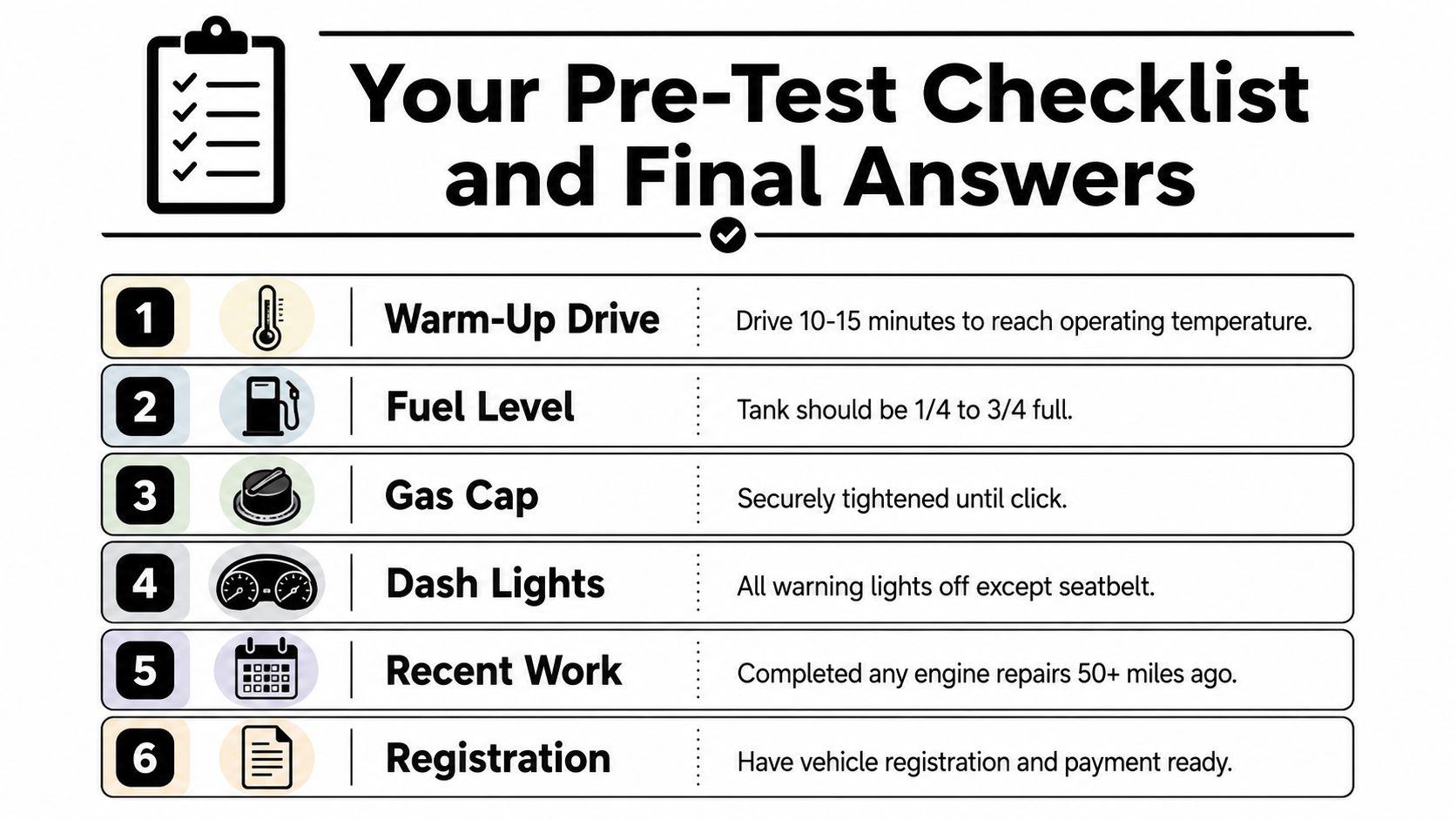
Use this list before leaving home:
- Warm-up drive: Bring the vehicle to normal operating temperature.
- Fuel level: Don't arrive nearly empty, and don't top off immediately before testing.
- Gas cap: Tighten it securely and replace it if it's cracked or missing.
- Dash lights: Resolve an illuminated or flashing check-engine light before testing.
- Battery history: Don't test immediately after disconnecting the battery or clearing codes.
- Documents and payment: Bring the renewal notice, registration, identification, repair records, and a card or other accepted payment.
What if I'm transferring an out-of-state vehicle?
California may require a Smog Check for an out-of-state vehicle from 1976 or newer when you first register it in California. Confirm the requirement with the DMV and bring the out-of-state title, registration documents, and any requested ownership paperwork.
What if I lost my certificate?
Ask BAR about its electronic certificate search or contact the station that performed the inspection. The DMV may be able to verify an electronically transmitted result, so don't assume you need to repeat the test before checking the record.
What do I bring after I pass?
Take the renewal notice, current registration information, identification, payment, and any DMV documents tied to the transaction. If the station transmitted the result electronically, tell the DMV that the Smog Check has already been completed.
A STAR-certified station matched to your vehicle class, combined with this checklist, gives you the clearest path to a correct same-day result. Verify the requirement before you leave home, especially if your vehicle is older, diesel, hybrid, or newly arriving from another state.
Speedy Smog handles STAR inspections and common California vehicle classes in San Leandro, with walk-in service, electronic DMV transmission, and a process built around getting the correct test completed efficiently. Check your vehicle details first, then visit Speedy Smog to arrange your inspection.