
You're staring at a California DMV renewal notice, wondering whether the station down the street will get you certified before your Saturday disappears. The cheapest coupon may look attractive, but it won't help if the shop can't handle your vehicle's test type, your registration requires a STAR inspection, or a battery reset leaves the emissions monitors incomplete.
The best smog check is the right combination of certification, accurate testing, honest pricing, manageable wait time, clear communication, and equipment suited to your car. California's program remains a major compliance system. The Bureau of Automotive Repair recorded 11,275,981 initial tests and 959,667 failures in 2025, an overall initial-test failure rate of 8.51% in its statewide report (California BAR 2025 Smog Check Executive Summary). Picking carefully matters.
Table of Contents
- What Makes a Smog Check the Best Choice
- The Five Criteria That Define Quality
- What Happens During Your Smog Test
- How to Prepare Before You Drive In
- Matching the Station to Your Vehicle Type
- Common Failure Causes and How to Fix Them
- Why Speedy Smog Stands Out in San Leandro
- Your Pre-Test Checklist and Final Answers
What Makes a Smog Check the Best Choice
A good station does more than plug in a scanner and print a certificate. It routes your vehicle through the correct California inspection process, tells you what the quoted fee includes, and handles a failure without turning it into a confusing sales pitch.
I judge a station on five dimensions:
- Certification: Is it STAR certified, and can it handle a directed vehicle if BAR sends you there?
- Actual turnaround: How long does the full visit take, from pulling in to receiving the certificate?
- Transparent pricing: Does the posted price include the certificate transmission fee, or will extra charges appear after the test?
- Customer service: Will someone explain a refusal clearly and tell you what needs attention?
- Vehicle coverage: Does the shop test your year, fuel type, weight class, and required inspection track?
The certificate itself is legally the same DMV product wherever you obtain it. The meaningful differences are speed, accuracy, communication, and problem handling. A low advertised price isn't a bargain if you need a second trip because the shop doesn't support your vehicle or failed to explain that the monitors weren't ready.
California's Smog Check program also has a long air-quality legacy. Research summarized in the state's performance material describes earlier reductions associated with enhanced testing in 1999, including about 97 tons per day of hydrocarbons, 1,690 tons per day of carbon monoxide, and 81 tons per day of nitrogen oxides (California BAR Smog Check Performance Report). That scale is why the inspection is more than a paperwork obstacle.
Practical rule: Choose the station that matches your vehicle first. Compare coupons only after you know the shop can perform the required test.
Carry that rule into any Bay Area station. The right shop for a newer OBD vehicle may not be the right shop for an older gasoline car, diesel truck, or hybrid.
The Five Criteria That Define Quality
Certification comes first
Look for STAR certification when your DMV or BAR notice requires it. STAR stations participate in California's higher-oversight testing program and are the appropriate choice for many directed vehicles. A Gold Shield designation can also matter when you need a station authorized for specific referee-related or test-and-repair functions. Ask the station to verify your requirement instead of guessing from a coupon.
Speed means the complete visit
A shop's advertised test time usually describes the inspection itself, not the time you spend waiting, completing paperwork, or dealing with an unexpected refusal. Ask about the typical pull-in-to-certificate experience, whether walk-ins are accepted, and whether the station has a clear process for transmitting results to the DMV.
Price should be readable
A clean quote answers four questions:
- Posted fee: What is the standard inspection charge?
- Certification charge: Is the electronic certificate transmission fee included?
- Additional diagnosis: Will the shop ask permission before charging for troubleshooting?
- Retest policy: Is a retest included, discounted, or billed separately?
A station that avoids direct answers about price is giving you useful information. Keep looking.
Service shows up during a refusal
A pass is easy for everyone. The test is what happens when the vehicle fails. A responsible technician should provide the refusal information, identify the relevant diagnostic trouble codes or inspection issue, and separate the test result from any optional repair recommendation.
Coverage prevents the wasted trip
Confirm the station handles your vehicle's class. California BAR guidance says 2000-and-newer gasoline and flex-fuel vehicles up to 14,000 pounds generally use OBD-based testing, while many older gasoline vehicles use BAR-97 equipment. Out-of-state vehicles from 1976 and newer may need a Smog Check when first registered in California (California BAR vehicle guidance).
| Criterion | What to Verify | Why It Matters |
|---|---|---|
| STAR certification | Whether your registration requires STAR testing | Prevents an invalid station choice |
| Speed | Full visit time, not only test time | Cuts avoidable waiting |
| Price | Posted fee, certificate charge, diagnosis, retest | Prevents surprise charges |
| Customer service | Clear refusal explanation and paperwork | Helps you repair the actual issue |
| Vehicle coverage | Year, fuel type, weight, and test track | Avoids a wasted appointment |
My scoring order is simple: STAR status first, speed second, vehicle coverage third, followed by price and service. A cheap station that can't perform the required test is no choice at all.
What Happens During Your Smog Test
A professional inspection follows a predictable sequence. You provide the registration information, the technician records the vehicle identification number, and the shop checks basic visual and safety items such as the fuel cap, catalytic converter presence, and obvious fluid leaks.
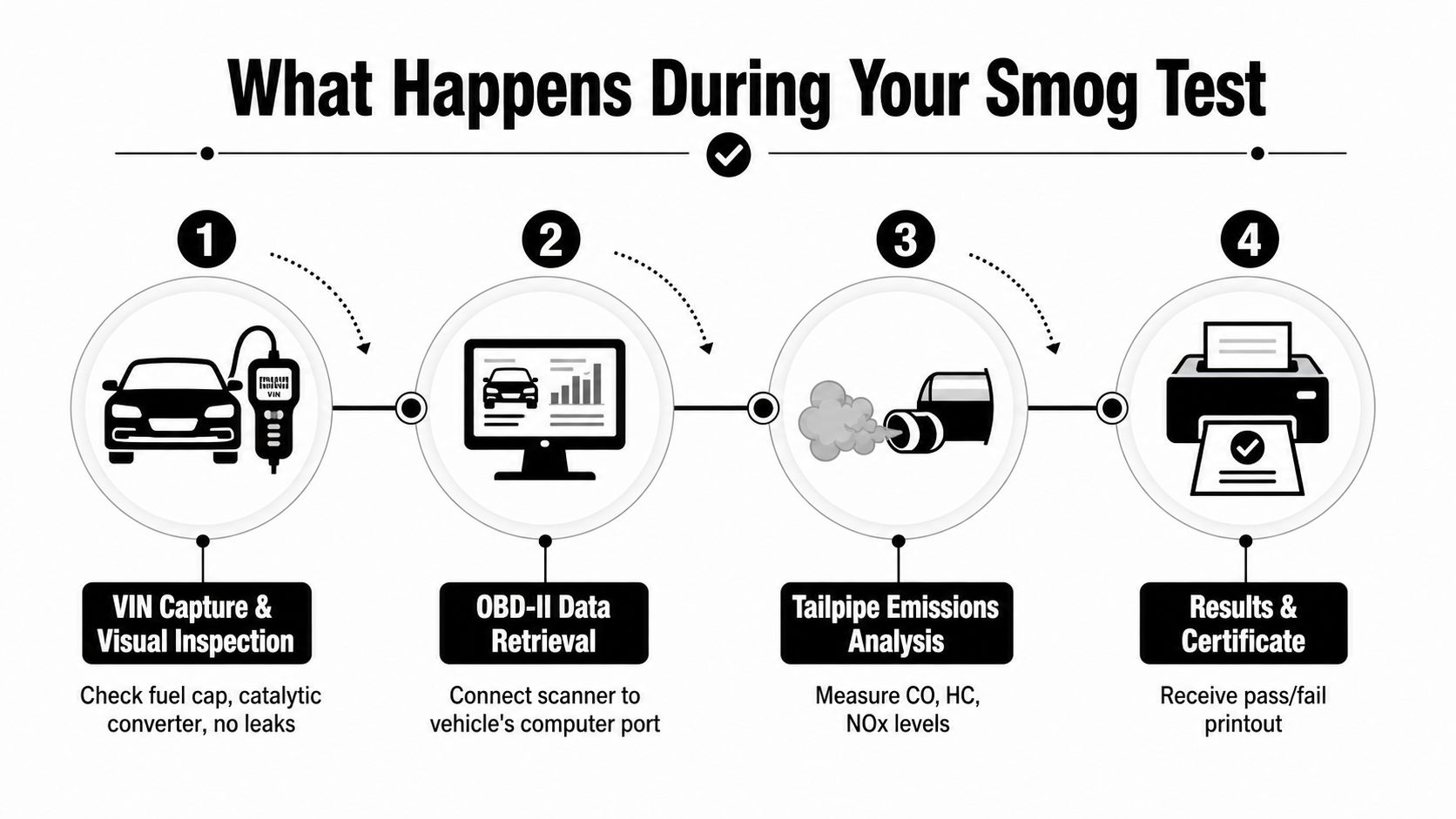
The vehicle determines the route
Newer gasoline vehicles generally follow the OBD-II path. The technician connects the scan tool, checks the malfunction indicator lamp command status, reviews diagnostic information, and verifies that the required emissions monitors have completed.
Older gasoline vehicles may require BAR-97 testing, which uses tailpipe measurements and a dynamometer procedure. Diesels and hybrids need the technician to follow the applicable equipment and procedure for that vehicle, rather than treating every car as a standard OBD scan.
Readiness monitors matter because they show whether the vehicle's onboard emissions self-tests have completed. EPA guidance identifies OBD inspection and maintenance programs as an emissions-inspection method, and California BAR includes readiness review in Smog Check procedures (EPA vehicle emissions inspection and maintenance information).
The result is pass, fail, or a refusal
A passing result is transmitted electronically through the DMV system and the certificate is issued. If the vehicle fails, the station should give you the refusal information and explain what the system found, whether that involves a warning light, trouble code, emissions result, equipment issue, or incomplete monitor.
For a straightforward gasoline vehicle, the inspection itself can be quick, but your total visit depends on the queue, paperwork, vehicle condition, and whether the car follows the OBD or tailpipe route. Before booking, ask the station for its current door-to-door expectation rather than relying on a headline test time.
For a practical breakdown of the appointment timeline, review this guide to how long a smog check takes. The useful question isn't “How fast is your test?” It's “When will I have the result in hand?”
How to Prepare Before You Drive In
Most avoidable delays begin before the car reaches the station. Check the dashboard first. If the check-engine light is on, flashing, or accompanied by rough running, diagnose the fault before paying for an inspection.
Don't disconnect the battery or clear diagnostic codes just before testing. That action can erase readiness information and leave monitors incomplete, even if the warning light stays off. California BAR guidance explains that newer gasoline vehicles generally have specific monitor allowances, while diesel requirements are stricter, so the safest approach is to complete the drive cycle and scan readiness before arriving.
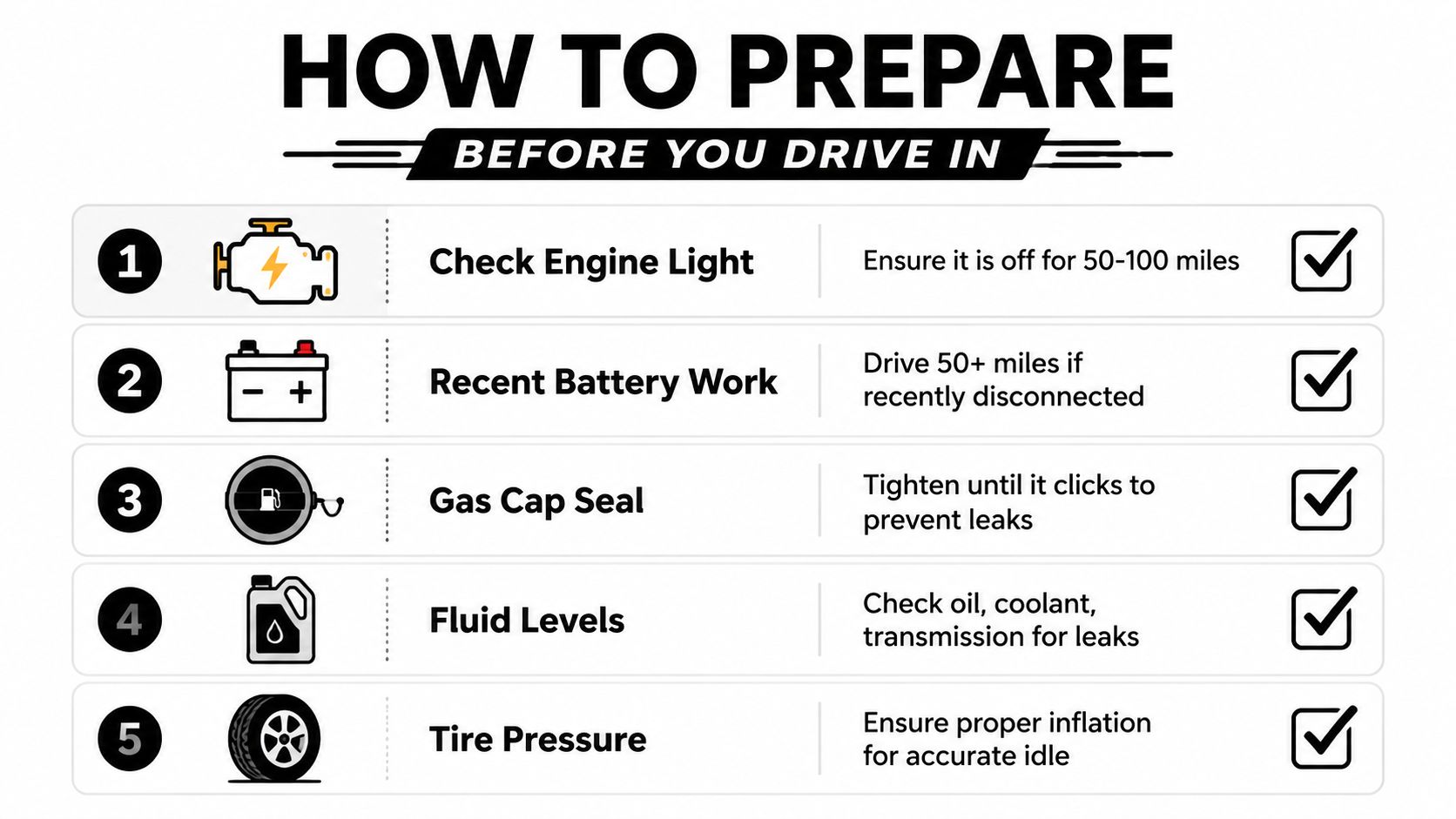
Use this driveway checklist:
- Warm the engine: Drive long enough for the engine and emissions system to reach normal operating temperature. Don't arrive immediately after a cold start.
- Inspect the gas cap: Tighten it until it clicks. Replace a missing, cracked, or damaged cap before testing.
- Look for obvious problems: Check for exhaust leaks, cracked vacuum hoses, fluid leaks, and poor running.
- Review recent work: If the battery was disconnected or codes were cleared, complete the vehicle's normal drive cycle before visiting.
- Bring paperwork: Take the renewal notice, registration, identification, payment, and repair receipts if the car was recently serviced.
Refuel before the appointment if the tank is low, but don't top off immediately beforehand. Excessively filling the tank can complicate evaporative-emissions checks.
If repairs are needed, ask about California repair-assistance eligibility before authorizing expensive work. A station can tell you what the test identified, but you should understand whether the business is recommending diagnosis, repair, or both.
Matching the Station to Your Vehicle Type
The right station depends on the vehicle's emissions path. A generic “all vehicles welcome” claim isn't enough. Call with the VIN, registration, model year, fuel type, and any DMV instruction so the shop can confirm the appointment before you drive over.
| Vehicle type | Usual test track | What to confirm |
|---|---|---|
| 2000-and-newer gasoline or flex-fuel | OBD-based inspection | STAR requirement, vehicle weight, monitor readiness |
| 1999-and-older gasoline | Often BAR-97 equipment and tailpipe testing | Dynamometer availability and exact year eligibility |
| Diesel | Vehicle-specific OBD, smoke, or other applicable procedure | Diesel equipment, weight class, and current rules |
| Hybrid | Emissions test based on its gasoline engine and system requirements | Hybrid experience, warm-up procedure, and high-voltage safety |
Newer gasoline vehicles
Most 2000-and-newer gasoline vehicles use an OBD inspection. The station checks the emissions monitors and diagnostic data through the vehicle's computer. If your registration directs you to a STAR station, a basic test-only location without the required designation won't solve the problem.
Older gasoline vehicles
Many 1999-and-older gasoline vehicles use BAR-97 testing, which is different from a simple scan. Confirm that the station has the equipment, test lane, and authorization for the vehicle before booking.
Diesels and hybrids
Diesel inspections can involve different procedures and equipment. Hybrids still require emissions compliance testing, and the technician needs to understand both the vehicle's engine controls and appropriate high-voltage safety practices.
Vehicle age, fuel type, gross vehicle weight, registration details, and DMV instructions can all change the correct route. Read this explanation of what a STAR smog station is before you compare prices. The phone call is faster than discovering at the counter that the coupon doesn't apply.
Common Failure Causes and How to Fix Them
A failed smog test usually points to a specific emissions or readiness problem. The check-engine light is the clearest warning, but a vehicle can also fail when the light is off if the monitors haven't completed or the measured emissions exceed the applicable limits.
| Failure cause | What it may mean | Practical next step |
|---|---|---|
| Check-engine light | Stored emissions fault, misfire, sensor issue, or converter problem | Scan codes and diagnose the root cause |
| Loose or damaged gas cap | Evaporative-emissions leak | Inspect and replace the cap if needed |
| Incomplete readiness monitors | Battery reset, recent repair, or cleared codes | Complete the required drive cycle and rescan |
| Vacuum leak or cracked hose | Unmetered air, rough running, or abnormal emissions | Inspect hoses and repair the leak |
| Catalytic converter or oxygen-sensor fault | Emissions-control failure or efficiency problem | Test the system before replacing expensive parts |
| Exhaust leak or temperature issue | Air entering the exhaust or engine not reaching normal temperature | Inspect the exhaust and cooling system |
Don't clear the codes before the appointment. That may turn a visible fault into an incomplete-monitor problem, leaving you with another delay instead of a clean result.
If the vehicle runs poorly, has a flashing warning light, or has a known misfire, fix the operating problem first. A loose gas cap or cracked hose may be a straightforward repair, but a catalytic converter or sensor diagnosis should come from test results rather than guesswork.
A cheap part is only cheap if it fixes the cause. Scan first, repair second, retest third.
Keep the refusal printout and every repair receipt. Ask whether the station provides a retest option and whether you may qualify for California assistance. Before returning, confirm that the repair is complete and that the monitors have had time to run again. This guide to common smog check failure reasons can help you interpret the technician's explanation without replacing a proper diagnosis.
Why Speedy Smog Stands Out in San Leandro
For San Leandro drivers, Speedy Smog is a practical option when the station's capabilities match the vehicle and DMV requirement. The business identifies itself as a STAR Certified smog check station and serves common California vehicle categories, including newer OBD vehicles, older gasoline vehicles, diesels, and hybrids.
The shop is located at 15275 Washington Ave, San Leandro, California 94579, with weekday and Saturday availability, which fits the common renewal problem of needing certification outside a standard workday. It's also near I-880 and offers free parking, useful details when you're trying to avoid circling a busy commercial area with a vehicle that may already have a warning light.
Speedy Smog describes a drive-through process and a typical inspection window of about 10 to 15 minutes for many 2000-and-newer vehicles, according to the publisher information provided for this article. That's a test-time claim, not a promise about the entire visit. Queue length, paperwork, vehicle class, and readiness status still affect the appointment.
The shop also presents posted standard and STAR fees, English-speaking service, online pre-check intake, electronic DMV transmission, and emailed certificates as part of its customer process. Those features address the practical quality tests that matter most: knowing the cost, sending the result correctly, and reducing paperwork after a pass.
I'd still call ahead with your registration or VIN, especially for an older vehicle, diesel, hybrid, directed inspection, or out-of-state registration. A station can be a good local fit only when it has the correct authorization and equipment for your specific test.
Your Pre-Test Checklist and Final Answers
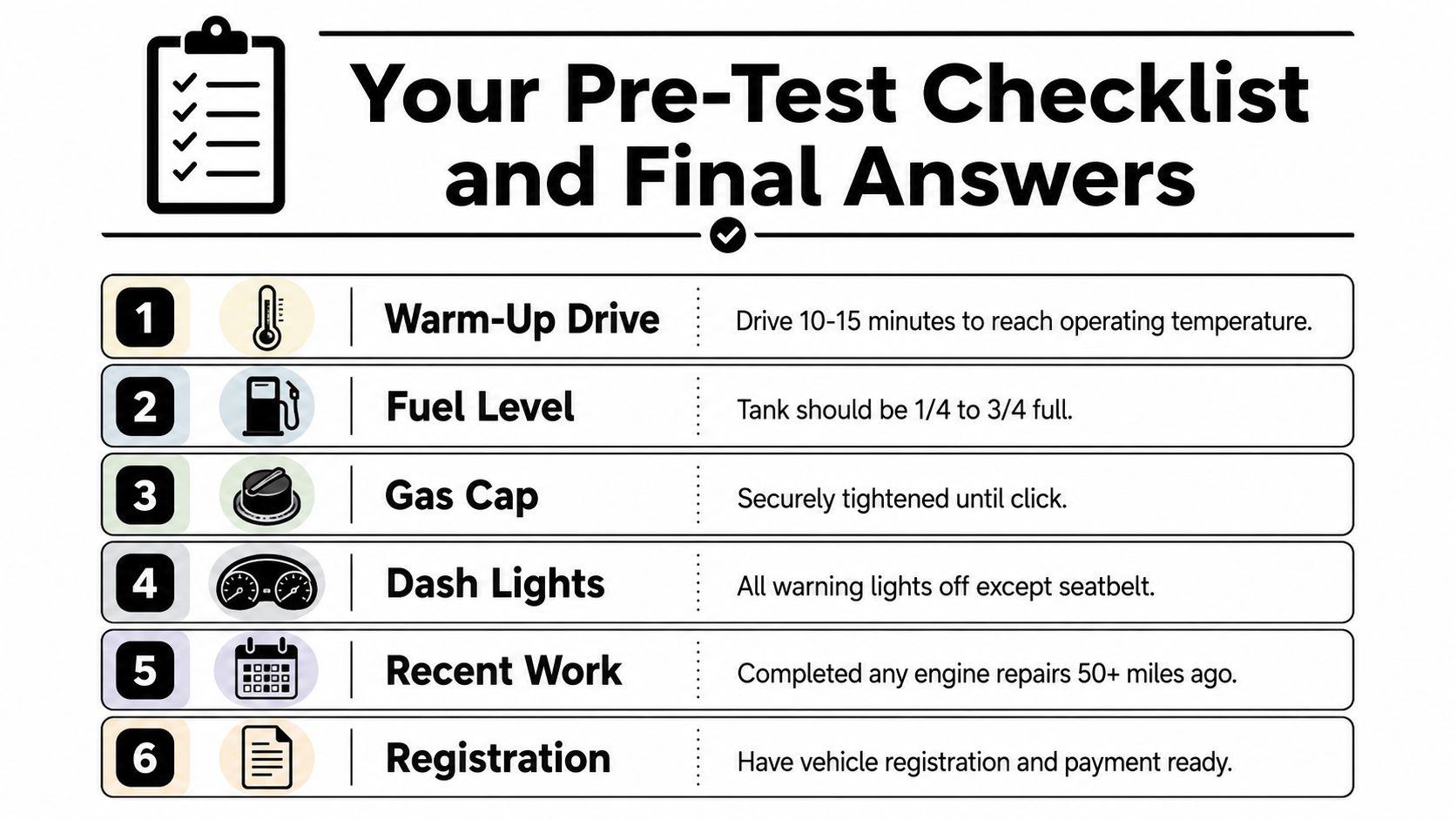
Use this list before leaving home:
- Warm-up drive: Bring the vehicle to normal operating temperature.
- Fuel level: Don't arrive nearly empty, and don't top off immediately before testing.
- Gas cap: Tighten it securely and replace it if it's cracked or missing.
- Dash lights: Resolve an illuminated or flashing check-engine light before testing.
- Battery history: Don't test immediately after disconnecting the battery or clearing codes.
- Documents and payment: Bring the renewal notice, registration, identification, repair records, and a card or other accepted payment.
What if I'm transferring an out-of-state vehicle?
California may require a Smog Check for an out-of-state vehicle from 1976 or newer when you first register it in California. Confirm the requirement with the DMV and bring the out-of-state title, registration documents, and any requested ownership paperwork.
What if I lost my certificate?
Ask BAR about its electronic certificate search or contact the station that performed the inspection. The DMV may be able to verify an electronically transmitted result, so don't assume you need to repeat the test before checking the record.
What do I bring after I pass?
Take the renewal notice, current registration information, identification, payment, and any DMV documents tied to the transaction. If the station transmitted the result electronically, tell the DMV that the Smog Check has already been completed.
A STAR-certified station matched to your vehicle class, combined with this checklist, gives you the clearest path to a correct same-day result. Verify the requirement before you leave home, especially if your vehicle is older, diesel, hybrid, or newly arriving from another state.
Speedy Smog handles STAR inspections and common California vehicle classes in San Leandro, with walk-in service, electronic DMV transmission, and a process built around getting the correct test completed efficiently. Check your vehicle details first, then visit Speedy Smog to arrange your inspection.
Maria in Hayward has a renewal notice in hand, but registration can't move forward until she visits a test-only smog check station. If you're in the same position, the phrase can sound more complicated than it is. You need an official emissions inspection, but the station you've been directed to may be allowed to test your vehicle and nothing more.
The important part is knowing what happens before, during, and after the inspection. California's system connects smog certification with registration compliance, and the right next step after a failure depends on the result, your DMV instructions, and whether the vehicle must return to a STAR-certified station.
Table of Contents
- What a Test Only Smog Check Actually Means
- Test Only vs Repair Stations vs Star Certified
- What Happens During a Test Only Visit
- How to Prepare Before You Go
- Fees and Timelines You Can Expect
- Common Failure Reasons and What to Do Next
- Choosing a Fast Star Certified Station in San Leandro
- Key Takeaways for a Smooth Smog Check
What a Test Only Smog Check Actually Means
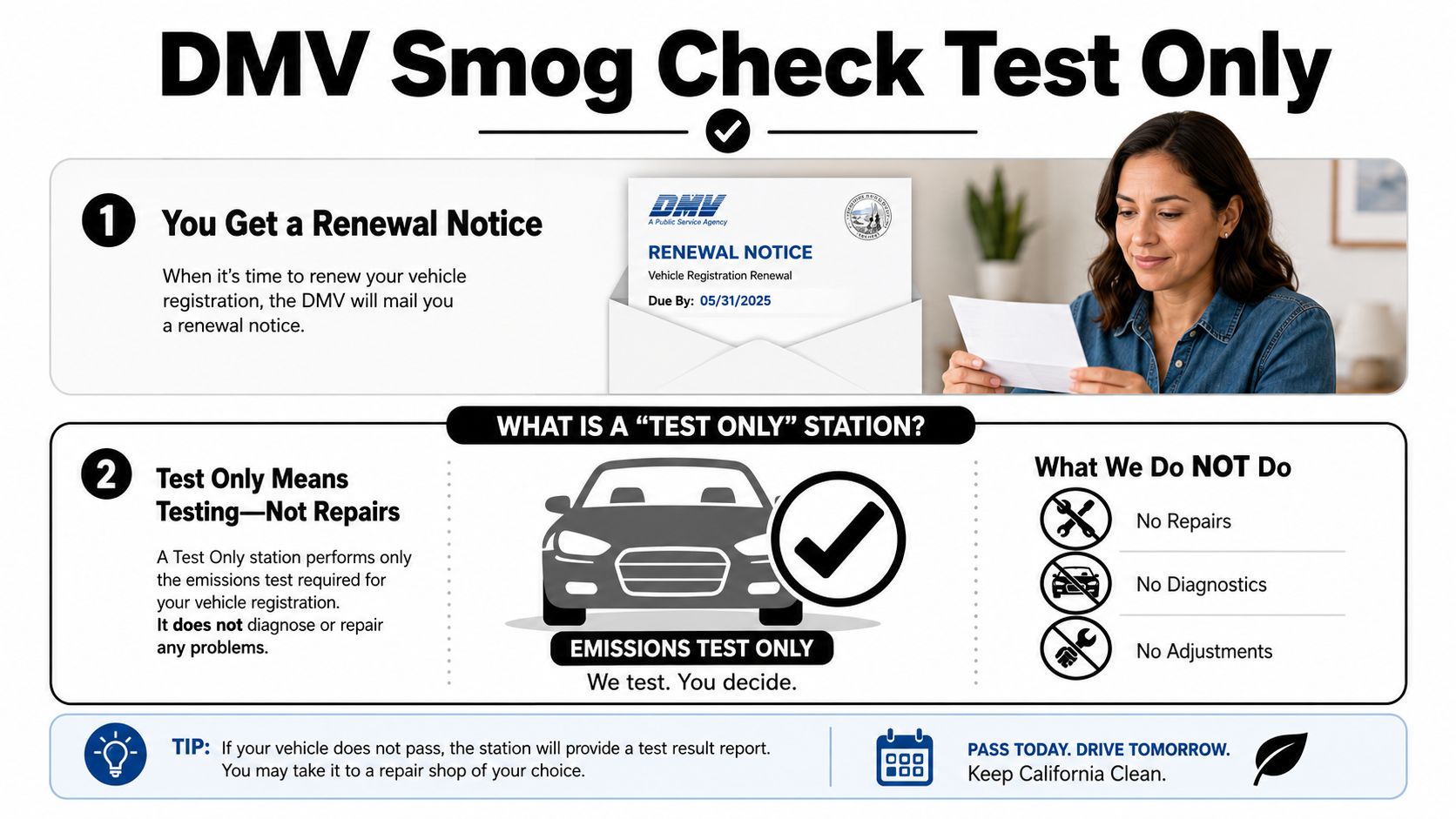
A DMV smog check test only visit is an emissions inspection performed by a licensed California smog station authorized by the Bureau of Automotive Repair, or BAR. The technician measures whether your vehicle meets the applicable emissions requirements, records the result, and sends the certification information electronically for DMV processing. The station's job is to inspect, not repair.
That division is intentional. Think of a test-only station as an examination room. A doctor checks your condition and records the findings, while a separate operating room handles treatment. In the same way, a test-only technician evaluates the emissions system, while a repair facility diagnoses and fixes problems.
California's modern statewide inspection and maintenance program began as a major policy milestone in 1982, when California became the 20th state to adopt a vehicle emissions inspection and maintenance program. BAR began administering the system in 1984, the same year the first Smog Check program was implemented. You can review the DMV's description of the program and its registration connection on the California DMV smog inspection page.
What the technician actually does
For a newer vehicle, the technician generally connects equipment to the vehicle's OBD-II diagnostic port. The inspection also includes visual and functional checks, such as looking for emissions-system tampering and confirming that required warning indicators and components meet the applicable standard.
Older vehicles use a different inspection method. California uses the BAR On-Board Diagnostic Inspection System for 2000-and-newer vehicles, while the BAR-97 Emissions Inspection System measures tailpipe emissions for 1999-and-older vehicles. That technology split affects whether a station can properly serve your vehicle. BAR outlines these inspection systems on its Smog Check program page.
The result is then recorded as a pass or fail. If you pass, the certification can be transmitted to the DMV, allowing the registration process to continue. If you fail, the station should provide documentation showing the inspection result and the information needed for the next step.
Practical rule: A test-only station can tell you whether the vehicle passed. It isn't the place to diagnose the cause or perform the emissions repair.
Test Only vs Repair Stations vs Star Certified
A regular repair station can inspect the vehicle and repair emissions problems, so it may suit a driver who already suspects a fault and wants one business to handle both jobs. A test-only station performs the official inspection but does not repair the vehicle. That separation gives you a test result before you approve any repair work.
STAR certification is a state designation for qualifying test-only and repair stations. It covers added program requirements for equipment, maintenance, and inspection performance. STAR stations must keep BAR-certified equipment in working order and complete required calibrations at least once every 10 calendar days, as specified in California regulation 16 CCR 3392.1.
Match the station to your DMV instruction
| Station type | Can perform the test | Can diagnose or repair emissions problems | May be required for a directed vehicle |
|---|---|---|---|
| Regular repair station | Yes, if properly authorized | Yes | Sometimes, if it has STAR certification |
| Test-only station | Yes | No | Yes, when it is STAR certified and your notice requires it |
| STAR-certified test-only station | Yes | No | Yes, for vehicles directed to a STAR test-only inspection |
The practical decision is simple: follow the station category named on your DMV notice. If the notice directs you to a STAR station, an ordinary station may not satisfy the requirement, even if it is closer.
STAR certification also involves inspection performance. The regulation uses quarterly measures such as Similar Vehicle Failure Rate and requires performance at or above 50% of the industry-wide failure rate for similar vehicles. This standard evaluates the station against program criteria. It does not predict whether your individual vehicle will pass or fail.
Some drivers choose test-only because the DMV sends them there. Others want an independent result before paying for diagnosis or repairs. For a notice requiring a STAR test-only inspection, a location such as this STAR-certified smog check test-only center can match that instruction.
After a failed test, the station type matters. A test-only station documents the failure, but you generally take the vehicle to a repair facility for diagnosis and emissions work. Then check the paperwork and DMV direction before selecting the return station. If STAR certification is required, schedule the re-test at a qualifying STAR location rather than assuming any repair station can complete it.
What Happens During a Test Only Visit
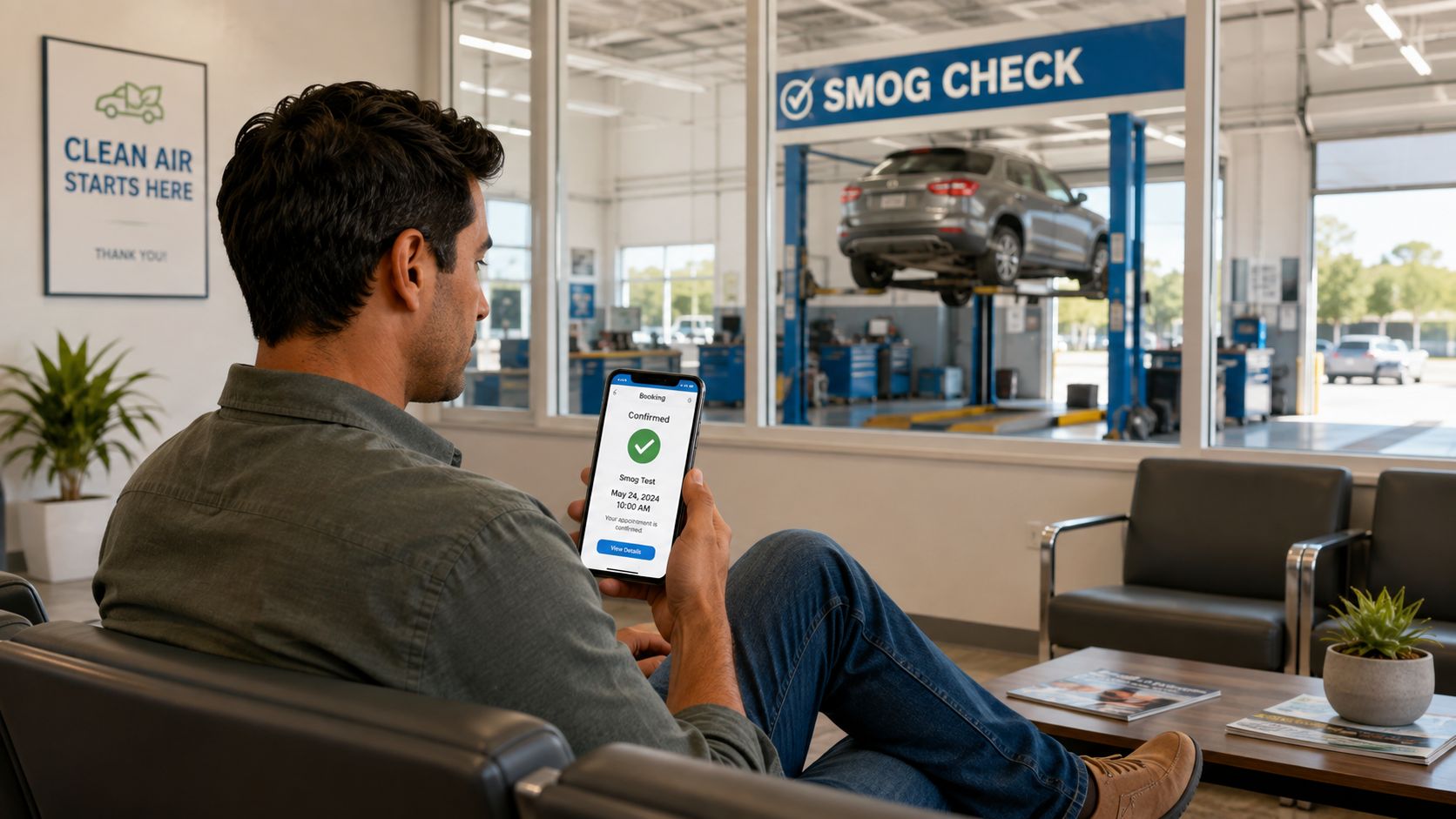
The visit usually feels straightforward when you know the order of events. Start by checking whether the station accepts walk-ins, but calling or booking online can reduce waiting, especially if the shop schedules inspections tightly.
Before the vehicle enters the lane
Bring the document that sent you to the station, such as a renewal notice or DMV letter. Have your registration information available, along with identification and a payment method. If you're returning after repairs, bring the paperwork from the previous inspection or repair visit.
At intake, the technician confirms the vehicle identity, including the VIN, and checks the vehicle's basic inspection condition. They'll look for signs of emissions tampering and review the dashboard. A lit check-engine light is an important warning because it can indicate an emissions-related malfunction that prevents a passing result.
During the inspection
For a qualifying newer vehicle, the technician connects the inspection equipment to the OBD-II port and checks the vehicle's electronic emissions information. The system can show diagnostic trouble codes, communication problems, and readiness information.
For older vehicles, the station uses the BAR-97 equipment to measure tailpipe emissions. The technician may also perform the applicable visual and functional checks, so the inspection isn't just a single reading from the exhaust.
The technician is gathering evidence, not guessing at a repair. A test-only result tells you what the inspection found, but it doesn't replace a diagnosis.
Receiving the result
The technician explains whether the vehicle passed or failed and provides the inspection paperwork. A passing result is transmitted electronically to the DMV, but you should still keep your records until the registration matter is fully resolved.
A failed result should identify the inspection outcome and give you a basis for speaking with a qualified repair shop. Don't approve parts based only on a general failure label. Ask the repair technician to identify the underlying fault and explain what must be corrected before the vehicle returns for another inspection.
How to Prepare Before You Go
A short pre-visit check can prevent a needless trip. You're not trying to repair the emissions system in your driveway. You're making sure the vehicle arrives in a normal operating condition and that you have the documents needed for the inspection.
Use this arrival checklist
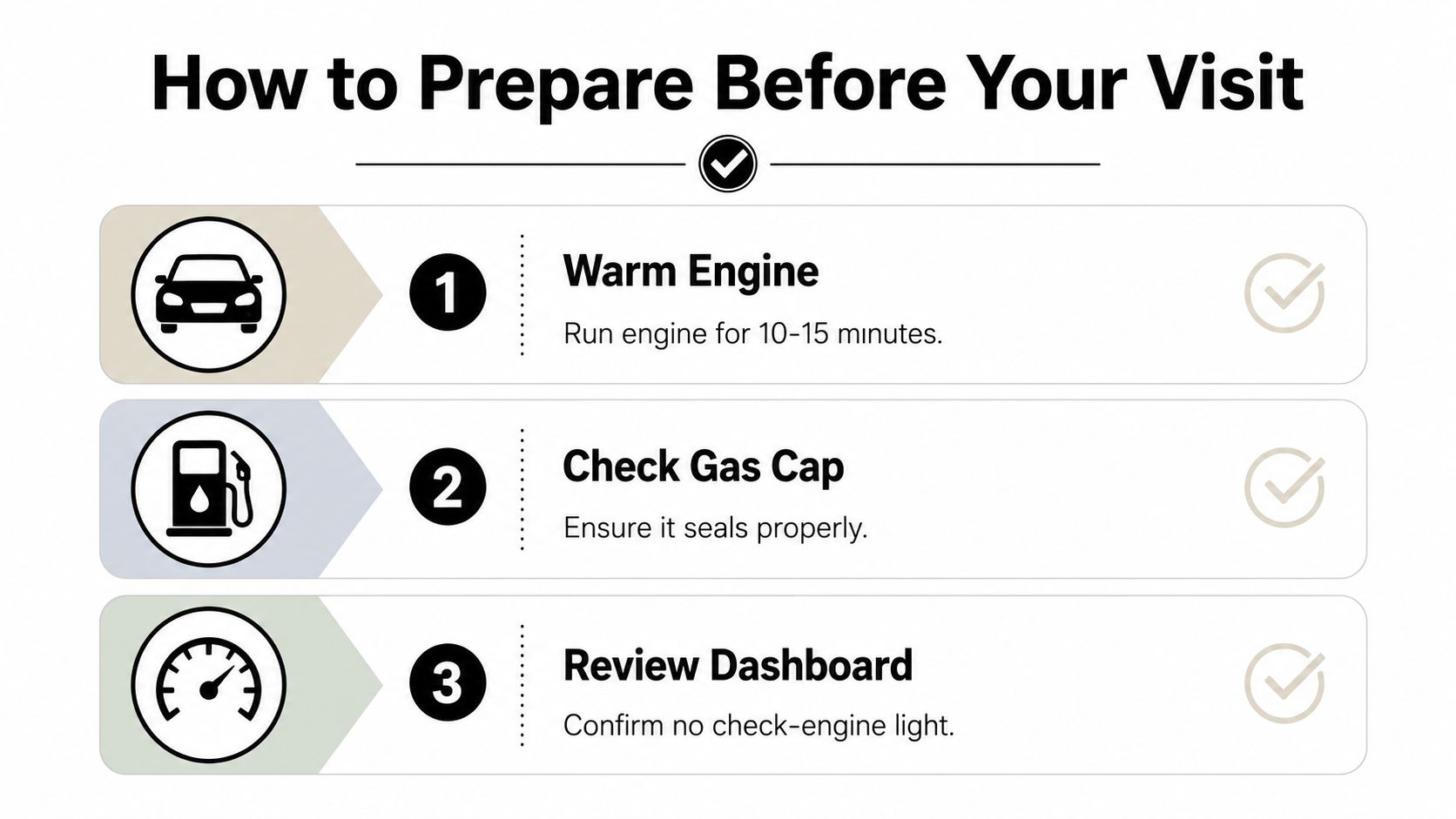
- Warm the engine: Drive normally before the appointment so the engine and emissions components reach operating temperature. Don't arrive with a cold vehicle if you can avoid it.
- Inspect the gas cap: Remove and reinstall it firmly. A cap that doesn't seal can contribute to an evaporative-emissions problem.
- Review the dashboard: The check-engine light should be off. If it's illuminated, don't assume clearing the light will solve the issue.
- Avoid last-minute code clearing: Disconnecting the battery or erasing diagnostic codes can leave the vehicle's readiness monitors incomplete. The vehicle may need normal driving before the system can complete its checks.
- Gather paperwork: Bring the renewal notice or DMV letter, registration information, identification, payment, and any earlier smog or repair documents.
The OBD system doesn't only look for a light on the dashboard. It also checks whether the vehicle's emissions self-tests have completed. After repairs or a battery disconnect, those monitors may show as “not ready,” so a repair shop should tell you what driving process is needed before the re-test.
Use the video below as a visual reminder of the basic preparation process.
Fees and Timelines You Can Expect
California doesn't use one universal retail price for every station and vehicle. Your total can include the station's inspection charge and state-related charges, while a directed inspection or a vehicle requiring a specialized procedure may be priced differently. Ask for the complete amount before authorizing the test.
The most useful budgeting step is to separate inspection costs from repair costs. A test-only station's charge covers the inspection. If the car fails, diagnosis, parts, labor, and any later inspection are separate decisions. The station shouldn't blur those categories by presenting an inspection as though it includes repair work.
Plan your time realistically
The test itself may be quick when the vehicle is ready and the station has the correct equipment. Waiting time depends on appointments, walk-in traffic, paperwork, and whether the vehicle needs an inspection method for an older model.
Electronic transmission can make the DMV side easier because the certificate information doesn't depend on you carrying a paper certificate to a DMV counter. Still, a successful transmission doesn't always mean every registration issue disappears instantly. If your renewal includes another requirement, you'll need to satisfy that requirement too.
For a closer look at the sequence and timing of a California inspection, review this guide to how long a smog check takes. Before booking, ask three direct questions: What is the full inspection price, how long should I expect to wait, and will the result be transmitted electronically?
Ask before you arrive: Confirm the station can inspect your exact vehicle type and can handle the station designation printed on your DMV notice.
Common Failure Reasons and What to Do Next
A failed test is not a repair diagnosis. It's a signal that the vehicle didn't meet one or more inspection requirements. The next step is to read the Vehicle Inspection Report, identify the failure category, and take that information to a qualified repair facility.
Common causes include:
- Check-engine light: A malfunction indicator can point to an emissions-related diagnostic code. The repair shop needs to retrieve and interpret the code rather than just switch off the light.
- Catalytic converter performance: The converter may not be processing exhaust gases as required, but other faults can sometimes affect related readings.
- Evaporative-emissions leaks: The fuel system may not hold vapors correctly. A gas cap, hose, valve, or other component can be involved.
- Oxygen-sensor problems: Sensor faults can affect the engine computer's emissions controls and trigger diagnostic codes.
- Loose or worn gas cap: A small sealing problem can create a larger inspection issue, particularly when the evaporative system detects a leak.
You can find a broader explanation of common smog check failure reasons before deciding what to authorize.
Follow the decision tree
First, check the paperwork. If the report shows a failed inspection, ask whether the original station offers a qualifying re-test arrangement and what conditions apply. California's consumer guidance explains the limits on what test-only stations may do and addresses the process in its Smog Check consumer FAQ.
Next, determine whether repairs are needed. Take the report to a licensed repair shop that can diagnose emissions faults. Don't replace a catalytic converter, oxygen sensor, or other expensive component solely because its name appears near the failure. Proper testing can identify whether the component itself failed or whether another fault caused the result.
Then, verify the return station. If the DMV directed the vehicle to a STAR station, the follow-up inspection must use the required STAR pathway. A repair shop may perform the repairs, but it won't automatically satisfy a STAR testing requirement unless it has the appropriate certification and authorization.
Finally, ask about special assistance. If reasonable repair efforts don't bring the vehicle into compliance, ask the repairer or BAR about the Smog Check Referee process. The Referee can help address unusual testing problems and cases where the standard process doesn't resolve the inspection issue.
After a failure, don't erase the evidence. Keep the report, diagnostic information, invoices, and repair records. They help the next technician understand what has already been tested.
Choosing a Fast Star Certified Station in San Leandro
A DMV-directed inspection calls for more than choosing the nearest sign that says “smog.” Confirm the station's current STAR certification before you book, particularly if your notice names STAR or directs you to a test-only location.
Ask whether the technicians are licensed through BAR, whether the shop handles your vehicle's inspection technology, and whether results are transmitted electronically. This matters for owners of older vehicles, diesels, hybrids, and vehicles with special DMV instructions because the equipment and process may differ.
Questions worth asking by phone
- Certification: Is the station currently STAR certified, and does that certification apply to the inspection I need?
- Vehicle coverage: Can the station inspect my model, fuel type, and emissions system?
- Turnaround: Is an appointment available, and how long should I plan to wait?
- Paperwork: Will the result be submitted electronically to the DMV?
- Payment: What's included in the quoted inspection price, and are additional charges possible?
- Follow-up: If the vehicle fails, can the staff explain the report and identify the correct re-test path?
A fast appointment shouldn't mean a rushed inspection. STAR requirements include equipment maintenance, calibration, and performance evaluation, so accuracy and speed should work together rather than compete. The station should also explain what it can and can't do. A test-only business that promises to repair the failure on the same visit may not be describing its role clearly.
San Leandro drivers can compare local availability, location, vehicle coverage, and appointment options before choosing a station. The right choice is the one that matches the DMV instruction, has the required certification, uses suitable equipment, and gives you a clear answer about what happens if the result isn't a pass.
Key Takeaways for a Smooth Smog Check
A successful test-only visit starts with the paperwork, not the waiting room. Read the renewal notice or DMV letter carefully and identify whether it requires a standard inspection, a test-only station, or a STAR-certified location. The DMV's registration process depends on receiving the correct certification, so a pass at the wrong station may not solve the original problem.
Prepare the vehicle without trying to disguise a fault. Warm it through ordinary driving, confirm the gas cap seals, and check that the dashboard has no active check-engine warning. If the battery was recently disconnected or diagnostic codes were erased, ask a repair professional whether the readiness monitors have completed before booking the inspection.
Bring your renewal notice, registration information, identification, payment, and any earlier inspection or repair records. Keep the Vehicle Inspection Report if the vehicle fails. It gives the repair shop the starting information it needs and helps you avoid paying for an uninformed parts swap.
The most important post-failure question is simple: Where must the vehicle go next? Some drivers need repairs before returning. Others must return to a STAR-certified station because the DMV directed the vehicle there. Ask the inspecting station to explain the report and confirm the retest conditions before leaving.
For East Bay drivers, Speedy Smog is a STAR-certified station at 15275 Washington Ave, San Leandro, California 94579. It handles emissions inspections for many newer and older vehicles, including diesels and hybrids, and offers Monday-through-Saturday service with electronic DMV submission described by the business.
Speedy Smog provides STAR-certified test-only smog inspections in San Leandro, including electronic transmission of results for DMV registration needs. Check vehicle eligibility, appointment options, and current pricing, then visit Speedy Smog to arrange the inspection.
You just got the renewal notice, and now the clock's running. If your car needs a smog check, the wrong station can waste your afternoon, trigger a second trip, or leave you stuck wondering why a car that “runs fine” still won't clear DMV.
The fix is to treat dmv smog check stations like a decision system, not a random shop visit. The right station has the right certification, the right equipment, the right testing path for your vehicle, and the right process to get your result into the DMV workflow without drama.
Table of Contents
- Why DMV Smog Check Stations Matter to California Drivers
- What a DMV Smog Check Station Does
- STAR Certification and Why It Changes the Outcome
- How the Test Changes by Model Year and Fuel Type
- Step-by-Step From Booking to DMV Confirmation
- Preparing Your Car to Avoid a Surprising Failure
- How to Choose the Right Station Near You
- Speedy Smog in San Leandro and What to Expect
Why DMV Smog Check Stations Matter to California Drivers
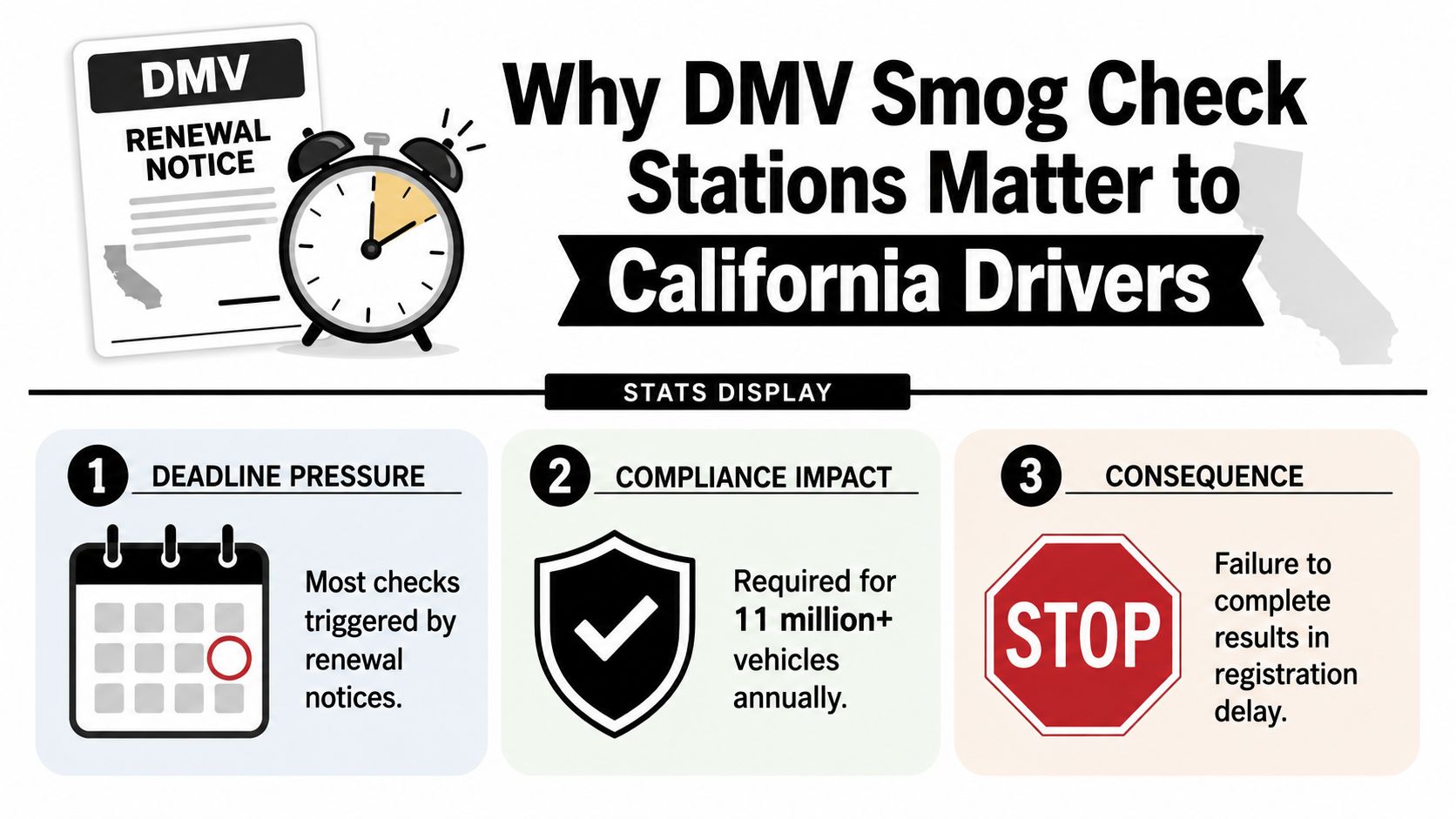
A driver pulls into the DMV with a renewal notice in hand and asks the same question I hear all the time, where do I go, and does it matter which shop I pick? It matters because the smog check is a compliance step tied directly to registration renewal and to the state's emissions program.
California runs a large, statewide Smog Check system that performs more than 10 million inspections each year at more than 5,000 independently owned stations, and state materials say it removes about 400 tons of smog-forming pollutants every day. That scale tells you exactly what these stations are, part of the state's enforcement and air-quality infrastructure, not just repair shops with a scanner on the counter. California Smog Check program overview
What that means at the counter
The station you choose affects both paperwork and time. If the result does not satisfy the DMV requirement for your vehicle, you are still not done, even if the car drove perfectly into the bay.
Practical rule: Do not ask only, “Can this shop test my car?” Ask, “Will this result actually clear my renewal?”
Drivers frequently get tripped up when they treat the smog check like a repair estimate. The test is a regulated pass-fail workflow, and the station has to feed the result into the state system correctly. That is why the right shop is not just about convenience. It is about whether your renewal moves forward cleanly or gets held up at the worst possible time.
What a DMV Smog Check Station Does
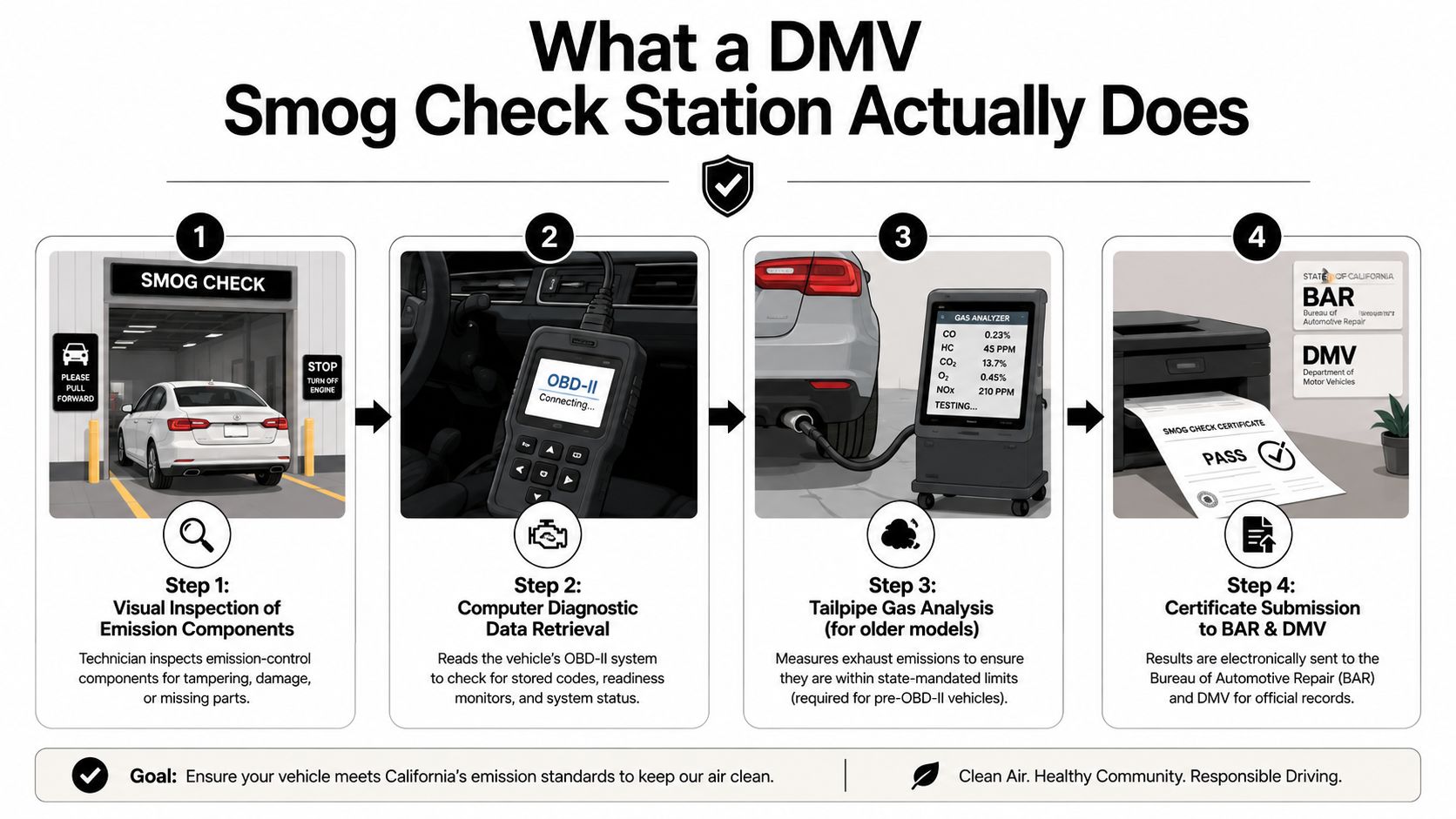
A licensed dmv smog check station keeps BAR-approved inspection equipment, a continuous internet connection, and a Windows-based system that BAR has tested and approved so results can go into the state workflow. BAR smog checklist requirements
What happens when your car pulls in
Your car rolls into the bay, and the tech follows the inspection path the state requires. The station then runs the test through the correct equipment and software for that vehicle class, so the result reflects regulated emissions data, not a quick guess from somebody leaning over the fender.
If you want a station that is set up to handle STAR-directed work too, a good place to start is this overview of a STAR certified smog station in San Leandro. That matters because the test method and the station's authorization both shape what happens next.
The station has to keep its equipment and software in compliance. If the hardware drifts, the internet connection fails, or the approved system is not working right, the record can turn into a headache even when the driver brought in a clean car.
Why this matters for drivers
A smog station earns its value by doing three things correctly, testing, documenting, and transmitting the result. A repair bay can have good mechanics and still miss the mark if it cannot complete the state process the right way.
That is the part drivers trip over. They show up with a renewal notice, assume any shop with a smog sign can finish the job, and then lose time when the result does not move through the system cleanly.
A clean pass only helps if the station gets it into the state system without friction.
STAR Certification and Why It Changes the Outcome
Pull into the wrong station and you burn time. Pull into the right one, and the DMV process moves the way it should. STAR certified stations sit in a higher performance tier, and that tier affects which vehicles they can inspect and how much confidence you should put in the result. If you want a practical local reference, start with this plain-English explanation of a STAR certified smog station in San Leandro.
California's Bureau of Automotive Repair reported 11,275,981 initial tests with an 8.51% initial failure rate in 2025, and said shifting all inspections to high-performing stations could reduce ROG and NOx emissions by 44 tons per day. BAR Smog Check Executive Summary Report 2025
Licensed station versus STAR station
A licensed station can handle standard testing. A STAR certified station has to meet stricter performance standards, and that difference matters the moment the DMV routes a vehicle to STAR. If your renewal notice calls for STAR, a regular shop will not clear that step.
Drivers need to read the notice first and pick the station second. If STAR is required, the wrong bay costs you a second trip. If STAR is not required, you still want a shop with disciplined procedures, because the station tier reflects how well it handles compliance work, paperwork, and transmission into the state system.
Why the data matters
The BAR's 2026 performance reporting also says vehicles certified by high performing stations failed at a lower rate at roadside than those certified by low performing stations. That is the point of the tiering. The state uses station performance as a practical measure of how well a shop's work holds up after the car leaves the bay.
The result is simple for a driver. STAR is the station class that can keep up with DMV-directed work, and it tells you the shop has to stay sharp on process, not just on repairs. If you want the station to be accepted without drama, the performance tier matters as much as the pass or fail itself.
A pass is only useful when the station handles the documentation and transmission correctly. If the DMV wants STAR, the station has to be STAR. If the DMV does not require it, STAR still gives you a cleaner bet that the result will hold inside the state's compliance system.
How the Test Changes by Model Year and Fuel Type
Don't assume every smog check looks the same. A 2015 gasoline sedan and a 1995 pickup do not go through the same workflow, and that difference shapes what you'll see in the bay.
OBD testing versus tailpipe testing
California's rules route 2000-and-newer gasoline vehicles and 1998-and-newer diesel vehicles into an OBD-focused inspection. Older vehicles can require loaded-mode or two-speed idle testing, and in enhanced areas loaded-mode testing uses ASM equipment with a chassis dynamometer. California Smog Check test methods
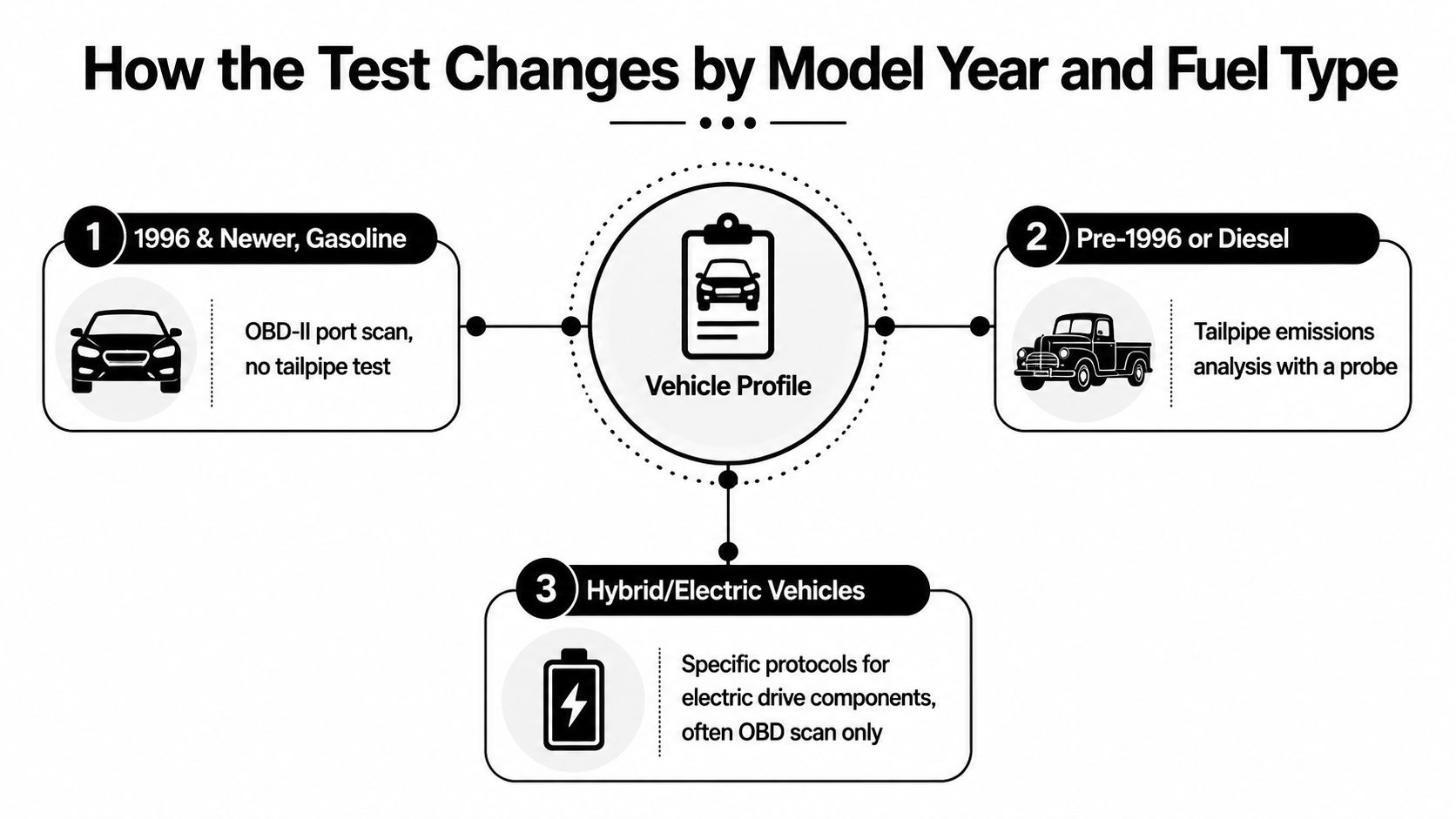
A newer gasoline car usually means a quick scan at the diagnostic port. Older cars can mean a probe in the tailpipe, rollers under the tires, and more time spent measuring emissions behavior under load. Diesel and hybrid paths follow their own compliance logic, so the station has to be ready for more than one kind of vehicle profile.
What you should expect physically
If your car is newer, the visit often feels simple, because the tech is mostly verifying electronic data. If your car is older, the inspection can look more old-school and mechanical, with more equipment involved around the exhaust and drivetrain.
That's why the best stations are built for range, not just speed. They need the equipment mix, the staffing, and the workflow discipline to handle very different vehicles without slowing the line.
If a shop only talks about “plugging in,” it's probably not thinking about the full vehicle range it's supposed to serve.
Step-by-Step From Booking to DMV Confirmation
A driver rolls in with a renewal notice in hand, the station checks the paperwork, and the first decision is already made. If the notice says STAR, choose a STAR station first. If it does not, make sure the shop can handle your exact vehicle type before you head over.
The actual sequence
- Check the DMV notice. Read the renewal paperwork for STAR language and any special instruction tied to your registration.
- Book the station. A scheduled visit cuts the wait and lets the shop set up the right bay. For local scheduling, use the Smog Check Appointment page.
- Bring the basics. Have your registration paperwork and a payment method ready.
- Watch the test run. The station performs the inspection in the bay and sends the result electronically.
- Wait for DMV confirmation. Once the result posts, the renewal process can continue without paper shuffling.
A standard emissions test usually takes 10 to 20 minutes once the car is in the bay, which is why station speed and bay setup matter as much as the inspection itself.
Where people lose time
The delay usually comes from the wrong station, a car that is not ready, or missing the STAR requirement already printed on the notice.
If the test passes, the station transmits the result and the DMV side moves. If it fails, you fix the cause before paying for another visit.
Preparing Your Car to Avoid a Surprising Failure
A lot of drivers fail smog because they assume “the car drives fine” means “the car is ready.” That's the wrong assumption.
Battery resets and readiness monitors
If your battery was recently disconnected or replaced, BAR advises driving the car for a week or two so the readiness monitors can reset. A car with a check-engine light on will not pass. BAR smog check guidance
That's the part people miss. The engine can feel normal, but the emissions system may still be incomplete in the state's eyes. Recent repairs can create the same problem if the readiness status hasn't settled yet.
Simple pre-test discipline
- Don't disconnect the battery right before the visit.
- Drive the car normally after recent battery work so monitors can reset.
- Fix the check-engine light first if it's on.
- Use a station that can explain the failure reason clearly if the car doesn't pass.
For a deeper look at failure causes, this local guide is useful: Smog Check Fail Reasons
The smart move is to treat the pre-test period like a readiness window, not a gamble. If the car just had work done, give it time. If the light is on, don't assume the scanner will be kind to you. It won't.
How to Choose the Right Station Near You
Stop choosing the nearest station automatically. That's how drivers waste time. Choose the station that matches the vehicle and the DMV requirement.
Your checklist should be short
- Confirm STAR status if the renewal notice requires it.
- Ask whether your vehicle type is covered, especially for older gasoline, diesel, or hybrid inspections.
- Check the posted turnaround time for your class of vehicle.
- Look for current pricing and any coupon offers before you leave home.
- Confirm hours and waiting setup so you're not stuck outside or missing a same-day window.
Practical rule: The cheapest station on the map isn't a deal if it can't accept your renewal paperwork.
If you're comparing shops, focus on three things, eligibility, turnaround, and result transmission. Everything else is secondary. A clean waiting room is nice, but a station that can't handle the DMV requirement is still the wrong stop.
Speedy Smog in San Leandro and What to Expect
Speedy Smog in San Leandro is a STAR Certified station at 15275 Washington Ave, with Monday through Saturday hours, an indoor waiting room, and service for drivers coming from San Leandro, Oakland, and nearby East Bay neighborhoods. It handles the vehicle mix you see around here, including newer cars, older vehicles, diesels, and hybrids.
For 2000-and-newer vehicles, the shop says inspections are usually completed in about 10 to 15 minutes, and it offers periodic $25-off coupons for most smog tests on newer vehicles. That lines up with what matters most in a real DMV visit, fast turnaround, clear pricing, and a station that can satisfy a STAR-required renewal when the notice calls for it.
If you want one example of how the whole system should feel in practice, this is it. The car goes in, the paperwork gets handled, and you leave with a result that's built for DMV acceptance, not just a quick look under the hood.
If you need a STAR certified smog check in the East Bay, visit Speedy Smog and book a visit that fits your renewal notice, your vehicle type, and your schedule. You'll get a station that understands DMV requirements, keeps the process moving, and helps you get back on the road without extra trips.
A California STAR smog test is the same emissions inspection, but it's done at a STAR Certified station that the Bureau of Automotive Repair routes certain vehicles to under higher-performance controls. In California's STAR framework, stations have to meet measurable thresholds, including a Similar Vehicle Failure Rate of at least 50% of the industry-wide rate for similar vehicles, an Excessive Test Deviation Rate no greater than one, and each inspector must maintain a Follow-up Pass Rate of at least 0.40.
You're usually looking at that sticker on the station door because a renewal notice, a registration hold, or a previous test result pointed you there. That's where the confusion starts for a lot of drivers, because the test itself often feels familiar, but the routing rule behind it is what changes.
Table of Contents
- What a STAR Smog Test Really Is
- How STAR Fits Inside the California Smog Check Program
- Which Vehicles Get Routed to a STAR Station
- What Happens During a STAR Smog Test
- How to Prepare Before You Arrive
- Common Reasons Vehicles Fail and How to Recover
- Cost, Timing, and the DMV Renewal Connection
- Choosing a STAR Station in the East Bay
What a STAR Smog Test Really Is
A lot of drivers first see the word STAR when a DMV renewal notice says the vehicle needs a smog check. The next stop is usually a station window with a STAR sticker, and the immediate question is simple, “Is this a different kind of emissions test?”
The short answer is no. A California STAR smog test is the regular smog inspection performed at a station that has been selected for stronger performance controls, not a separate emissions standard for the car itself. California's STAR designation is built on measurable compliance and quality checks, not branding or convenience, and the state uses it to steer higher-risk inspections to stations that can handle them reliably California STAR certification rules.
Practical rule: the car isn't “STAR-approved,” the station is.
A regular smog station can inspect many vehicles, but a STAR station has to keep proving it can do the job with tighter oversight. California's BAR also says STAR stations must keep certified inspection equipment and stay within a 10-calendar-day calibration window for calibration-capable equipment, which helps reduce measurement drift BAR STAR certification.
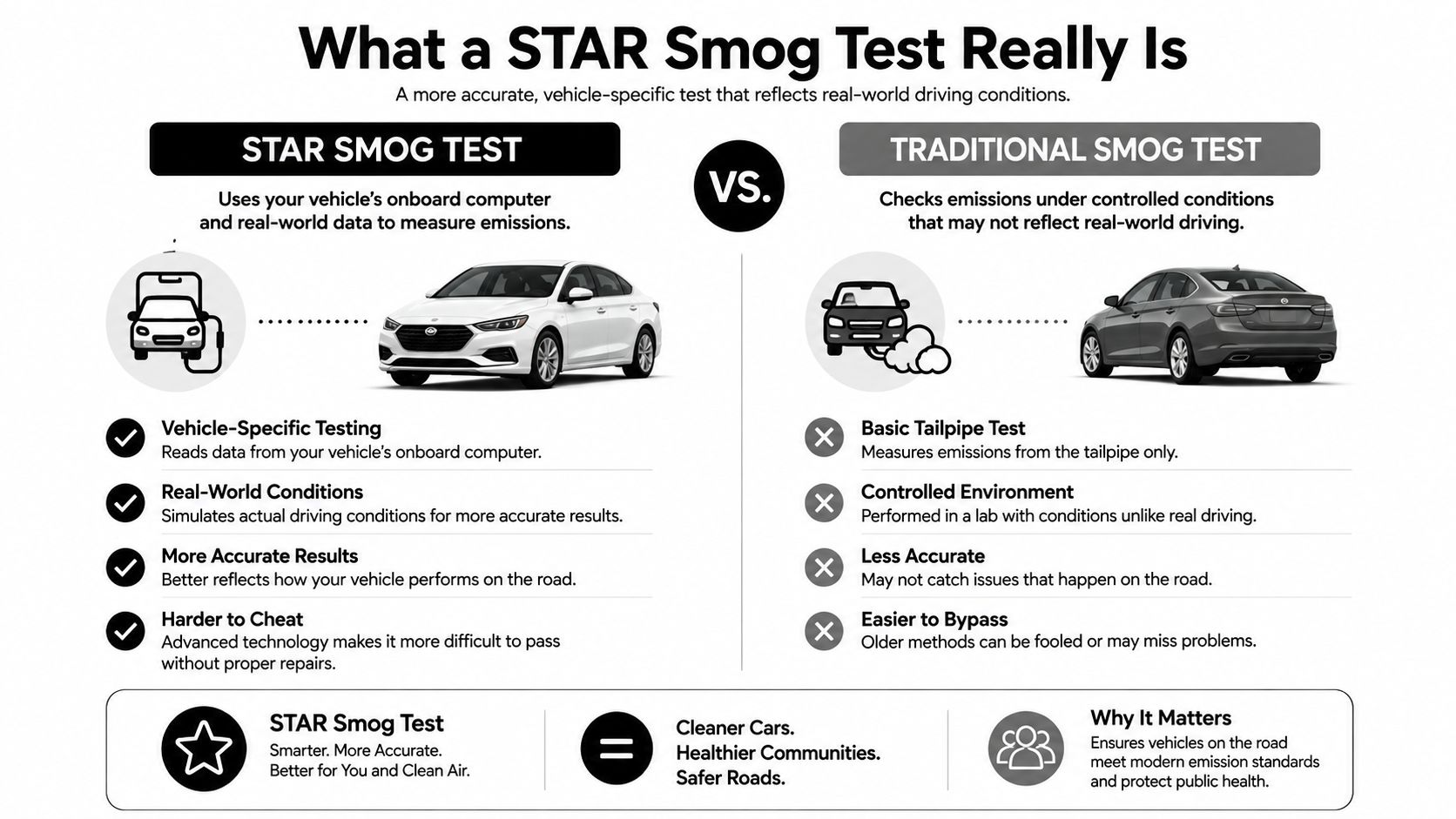
| Requirement | STAR Station | Regular Smog Station |
|---|---|---|
| Program role | Handles vehicles BAR routes for higher-performance oversight | Handles standard smog inspections |
| Station selection | Chosen through measurable compliance and quality controls | Approved as a smog station, but not held to STAR routing metrics |
| Equipment control | Certified equipment and calibration controls are closely monitored | Standard inspection equipment requirements apply |
| Driver experience | Same basic inspection, but at a station with tighter program oversight | Same basic inspection at a normal station |
For a plain-language explainer, see this STAR station overview.
If you need one sentence to keep in your head, use this: a STAR smog test is a California smog check performed at a higher-performance station that the state uses for targeted enforcement and quality control.
How STAR Fits Inside the California Smog Check Program
California's Smog Check program is broad, and the STAR layer sits inside it as a quality filter. State and federal materials describe a network of more than 5,000 independently owned stations and more than 10 million vehicles tested each year, while an OECD/ITF presentation summarizing the program described about 22 million vehicles, roughly 11 million initial inspections per year, about 7,000 smog check stations, and 21,000 inspectors/technicians California Smog Check program summary.
That scale matters because California is not running a small inspection lane. It is running a statewide system that has to separate ordinary, low-risk inspections from the ones where fraud, weak technique, or uneven quality control would cause more damage.
Why the state uses tiers
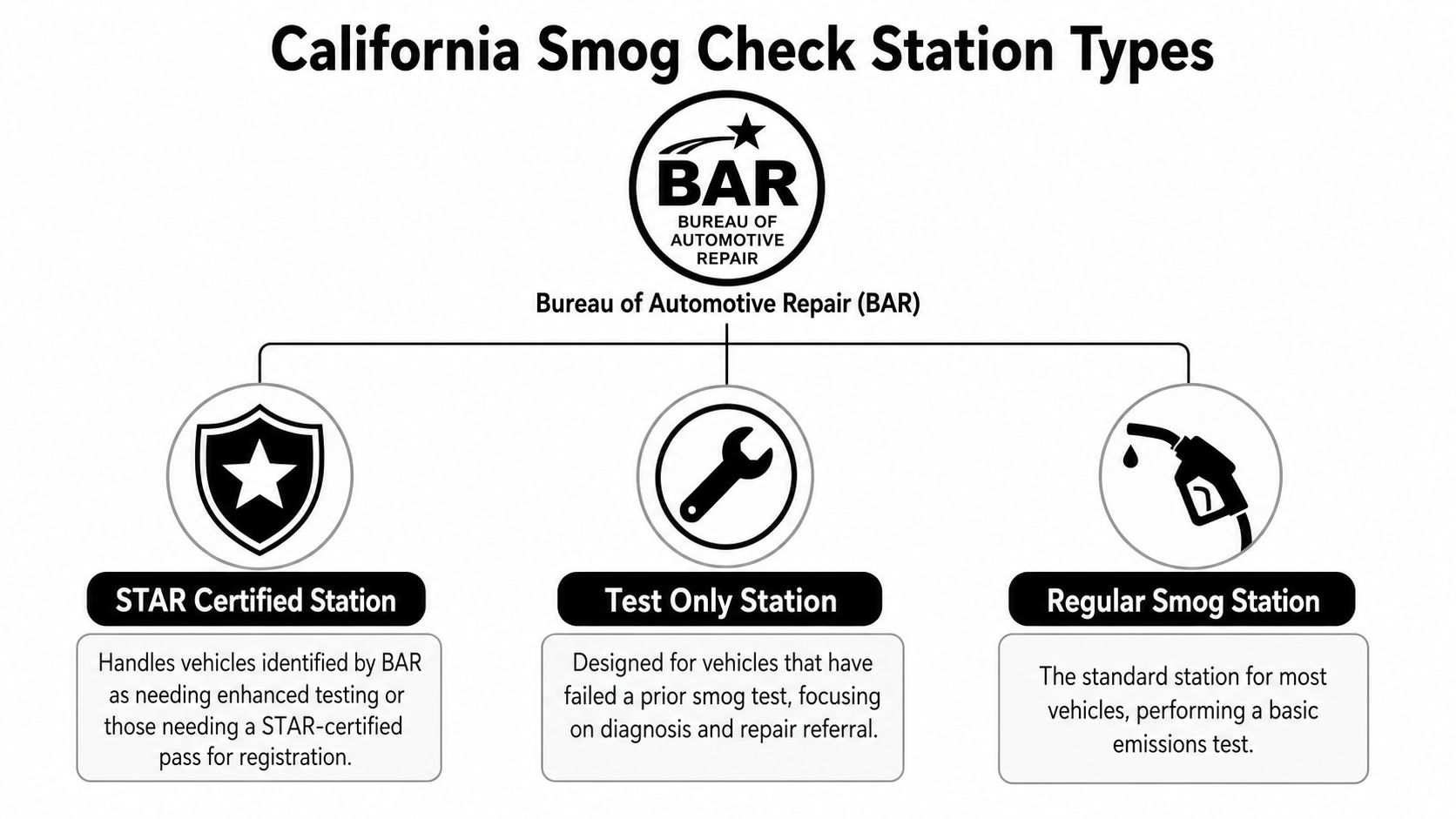
The structure works like a school system with different levels of oversight. Regular smog stations handle the general flow of inspections, Test Only stations handle vehicles that need a more focused inspection path, and STAR stations sit at the top of the oversight stack for the vehicles the state wants watched most closely. BAR's STAR framework is performance-based, so a station earns the designation by meeting measurable standards rather than by buying a badge BAR STAR certification.
The policy logic is straightforward. California wants the vehicles and inspection situations with the highest compliance risk to go through stations that show stronger consistency. BAR's FAQ also makes clear that STAR routing is tied to vehicle profile, not just owner preference, and that STAR is about program targeting rather than a separate vehicle emissions class BAR STAR FAQ.
Why calibration and fraud control matter
The STAR layer also works as a fraud-control tool. California's BAR materials point to schemes like clean plugging on 2000+ vehicles, which means the state has reason to scrutinize OBD-based inspections more closely BAR STAR FAQ. That is why the program looks at station performance over time, not just whether a shop can display a certificate on the wall.
For most drivers, the takeaway is simple. The STAR label means the station is part of a tighter enforcement layer inside the larger Smog Check program, and that layer exists to protect program integrity, not to make the car itself subject to a different pollution rule.
Which Vehicles Get Routed to a STAR Station
Most drivers don't choose STAR on purpose. BAR routes certain vehicles there because the system is trying to place more oversight where the program sees more risk. That means the question isn't “Is my car suspicious?” It's “Does my vehicle profile trigger a STAR designation?”
The important part is that routing is risk-based, not a judgment about whether your car is about to fail. A STAR requirement can show up because of the vehicle's profile, past compliance signals, or other program logic, and BAR says the vehicle can be directed to STAR based on profile rather than owner preference BAR STAR FAQ.
Common reasons a vehicle gets sent there
The state doesn't publish a simple one-size-fits-all consumer formula, but the practical triggers usually fit a few buckets:
- Vehicle profile signals. BAR can route a vehicle based on the profile it sees in the program, not just because it's old or because the driver assumes it looks problematic BAR STAR FAQ.
- History in the program. Vehicles with prior compliance issues, repeat testing friction, or other directed notices are more likely to be handled through the tighter lane.
- Testing risk factors. The state pays closer attention where cheating has historically been more common, especially around OBD-based inspections on newer vehicles BAR STAR FAQ.
- Owner-directed or renewal-driven routing. Sometimes the DMV notice itself is what tells you the vehicle must go to a STAR station.
A STAR requirement doesn't automatically mean the car is a high emitter. It can mean the state wants a stronger inspection path for that vehicle category.
That's the part many drivers miss. A STAR notice is not a diagnosis. It's a routing decision.
If your renewal notice mentions STAR, don't treat it like an optional upgrade or a shop recommendation. Treat it like a lane assignment. Choosing a non-STAR station when STAR is required can waste the trip, and the station may not be able to complete the certification you need for DMV processing.
What Happens During a STAR Smog Test
The STAR label changes the station tier, not the basic inspection logic. Once you pull in, the technician is still checking the vehicle's emissions-related systems, but the method depends on the model year and fuel type.
For most 2000 model-year and newer gasoline vehicles and 1998 model-year and newer diesel vehicles, California uses an OBD-focused test rather than a tailpipe dynamometer test California inspection method rules. For 1976 to 1999 vehicles, the inspection generally uses loaded-mode or two-speed idle methods that directly measure exhaust pollutants such as HC, CO, CO2, and NOx.
What the technician touches
For a newer vehicle, the technician usually plugs into the diagnostic port and checks the onboard computer. BAR's readiness-monitor guidance explains that OBD II stores diagnostic trouble codes, tracks emissions self-tests, and shows whether the monitors are ready BAR readiness monitor guidance. The test often works more like a computer health check than a tailpipe sniff.
For older vehicles, the process shifts back toward direct exhaust measurement. That is where the tailpipe probe comes in, and where mechanical condition can show up in the results more plainly.
A visual inspection still happens either way. The technician checks that required emissions parts are present, that nothing obvious has been tampered with, and that the vehicle can be evaluated safely and correctly. If the vehicle passes, the result is electronically reported for DMV registration processing. If you want a plain-language walkthrough before your visit, this STAR smog test prep guide helps explain the same sequence from a driver's point of view.
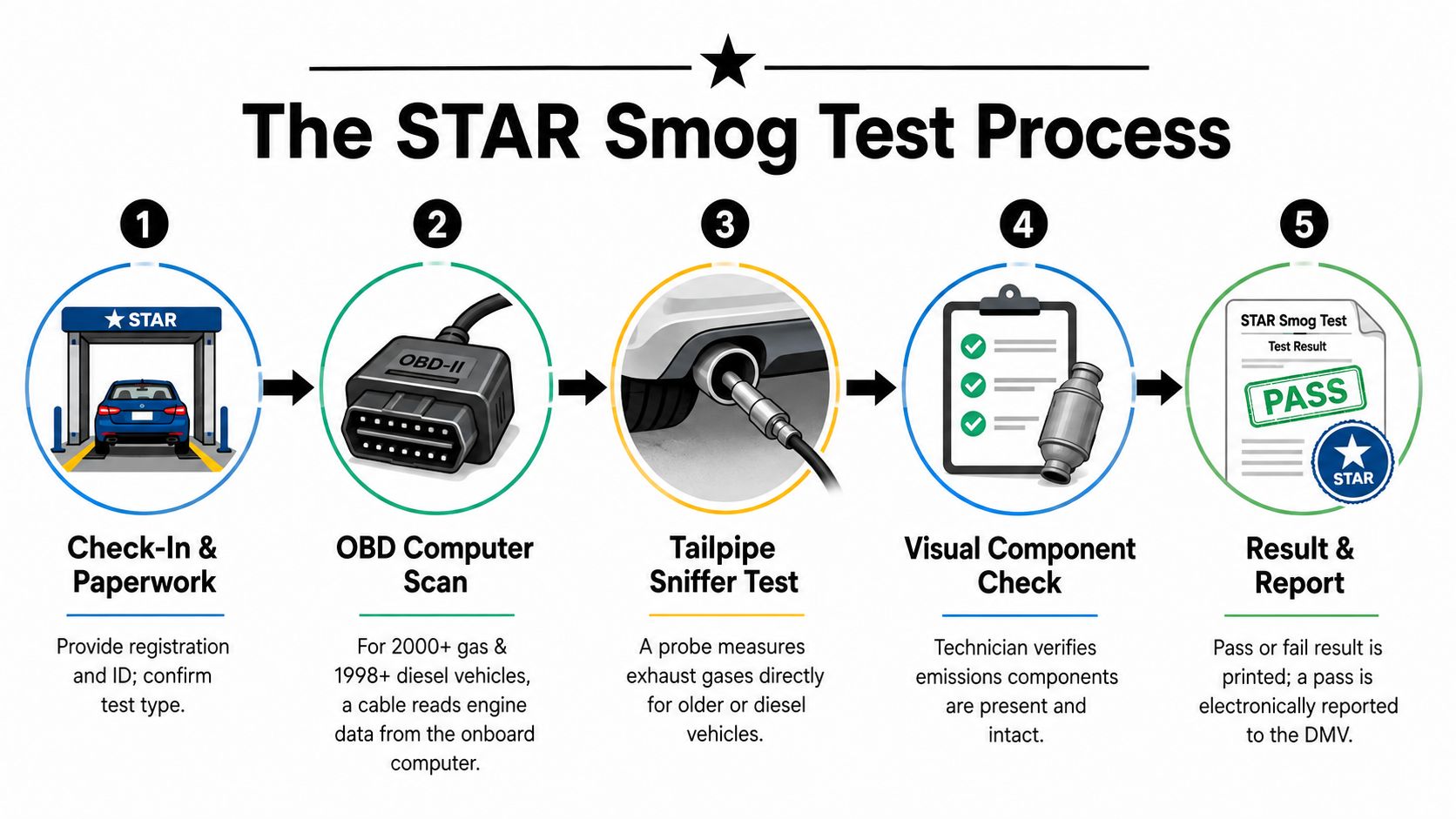
A normal visit usually does not take long. BAR says the inspection usually takes about 30 minutes BAR smog check page, though the exact time depends on the vehicle and whether the technician finds a problem that needs more checking.
How to Prepare Before You Arrive
The easiest smog failures are the ones a driver could've avoided the day before. That usually means the vehicle wasn't physically broken, but it wasn't ready for the inspection logic the state uses.
Start with the check engine light and readiness
BAR says a vehicle can fail if the check engine light is on, and readiness monitors may need time after a battery change or repair before they're set BAR smog check page. Think of those monitors like a pre-flight checklist. If the computer hasn't finished its checks, the inspector can't treat the vehicle as ready.
A few practical habits help:
- Drive normally for a while first. Mixed city and highway driving gives the monitors a chance to complete their self-tests.
- Avoid battery disconnects right before the test. BAR notes that recently disconnected or replaced batteries may need one to two weeks of driving for readiness monitors to reset BAR smog check page.
- Don't test with a warning light on. If the MIL is lit, schedule the inspection later, after the cause is fixed and the system stays off.
- Bring the paperwork. Renewal notice, registration, and payment are the basic items you'll want ready.
Practical rule: if you've had battery work, engine work, or a software update, wait until the car has gone through enough normal driving for the monitors to settle.
Use a simple readiness checklist
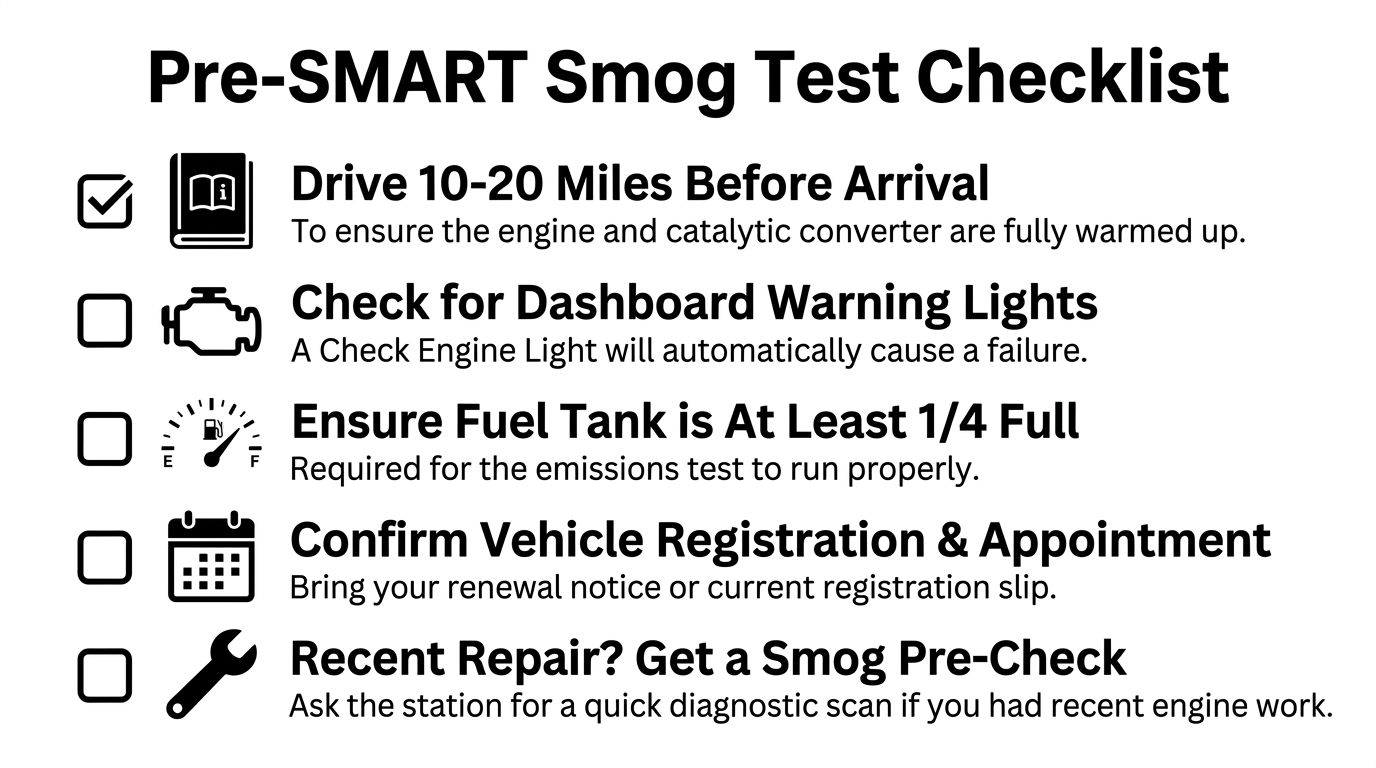
Fuel level matters too. A tank that's not too low or too full helps the test run smoothly, and many drivers prefer to keep it in the middle range. If you've recently had repairs, a quick pre-check at the station can save a wasted trip, especially for vehicles with OBD-based inspections.
For a practical checklist and prep flow, see this STAR test prep guide.
The best preparation is boring preparation. No warning lights, no last-minute battery swap, no surprise software change, and enough normal driving time for the monitors to say the car is ready.
Common Reasons Vehicles Fail and How to Recover
A failed STAR test usually points to one of three problems. The car's computer may not be ready, the emissions numbers may be out of range, or the vehicle may miss a visual or procedure requirement.
OBD failures are the most common headache on newer cars
For 2000-and-newer gasoline vehicles and 1998-and-newer diesels, the inspection relies heavily on the onboard computer, so a problem there can stop the test quickly California inspection method rules. A check engine light that is on, readiness monitors that have not finished, or stored diagnostic trouble codes are the usual causes.
The fix is usually mechanical, not administrative. A technician or repair shop needs to identify the code, correct the cause, and let the monitors complete their drive cycle again. If a battery was recently disconnected, the answer may be more normal driving time, but do not guess if the light stays on.
Tailpipe failures point to real engine or exhaust trouble
Older vehicles that are tested by tailpipe measurement can fail because their emissions readings are too high. That often points to ignition problems, fuel mixture issues, vacuum leaks, worn spark plugs, or a catalytic converter that is not doing its job. These failures are useful because they tell you the car has a real condition that needs attention, not just a paperwork issue.
Visual and procedural problems can stop a pass too
A missing gas cap, tampered emissions equipment, or an identification mismatch can create a fail even if the car runs fine. The STAR program also looks closely at fraud risk, including clean plugging concerns on newer vehicles, which is one reason visual and electronic checks matter so much BAR STAR FAQ.
A fail is a diagnosis, not a verdict.
Most drivers should ask the station what kind of fail it was. That tells you whether you need repair, more drive time, or a simple retest. If a shop offers a reduced-cost retest window, use it only after the underlying issue is addressed. For a sense of how shops may price the inspection itself, this California smog check price guide can help you compare before you go.
Cost, Timing, and the DMV Renewal Connection
A smog check usually answers three practical questions for a driver, how much it costs, how long it takes, and whether the result will clear the DMV renewal step without extra paperwork. The process is straightforward once you know how the pieces fit together.
California's historical program summary noted an average inspection cost of $48 in the baseline material California Smog Check program summary. STAR stations can price the inspection differently because they operate under a stricter certification layer, but the certificate still serves the same DMV registration purpose.
What happens after the test
For most renewals, the inspection result is sent electronically to the DMV. That means you usually do not mail in a paper certificate yourself, because the shop's report becomes part of the registration workflow. The BAR says the inspection usually takes about 30 minutes BAR smog check page, although an OBD check can feel much quicker when the vehicle is already ready.
California smog checks are tied to the registration cycle, and many vehicles need the test on a repeating schedule. For a lot of drivers, the smog fee is only one part of the DMV bill, so it helps to separate the inspection cost from registration fees before you arrive.
If you want a plain comparison point before you book, this California smog check pricing overview can help frame the conversation.
The practical move is to test early enough that a repair, retest, or extra drive cycle does not slow down your renewal. That keeps the smog certificate and the DMV deadline working together instead of getting in each other's way.
Choosing a STAR Station in the East Bay
A good STAR station should feel orderly before the car ever enters the bay. Look for posted STAR certification, clear pricing, a clean waiting area, and a staff that can explain whether your vehicle is being tested as an OBD car, an older tailpipe car, or a diesel with different requirements.
For East Bay drivers, one practical option is Speedy Smog at 15275 Washington Ave in San Leandro. It's a STAR Certified station, it handles a wide range of vehicle types, and it's set up for quick turnarounds on newer vehicles, with typical tests for 2000+ models completed in about 10 to 15 minutes, according to the shop's published service information.
The right station isn't just about speed. It's about not wasting a trip when your vehicle has readiness issues, a warning light, or a routing requirement that needs a STAR-certified result. If you're in San Leandro, Oakland, Alameda, or Hayward, a station that works cleanly and explains the process plainly can save a lot of back-and-forth.
If your renewal notice points you to a STAR smog test, bring the paperwork, make sure the car is ready, and choose a station that can complete the inspection you need. If you're in the East Bay and want a straightforward visit, Speedy Smog can help with STAR inspections, newer OBD-based vehicles, and older or diesel models, so you can get certified and move on with your day.
You're holding a DMV renewal notice and trying to answer one simple question before the deadline sneaks up on you, do you need any smog shop, or do you need a STAR certified smog check test only center? That confusion is common because California uses a few labels that sound similar but mean very different things in practice, and the wrong choice can send you back for another visit. The good news is that the answer usually lives in the notice itself, plus a handful of BAR rules that are easier to understand once you strip away the jargon.
Table of Contents
- Reading Your DMV Renewal Notice Without the Confusion
- What STAR Certification Actually Means in California
- STAR, Test-Only, and Test-and-Repair Explained Side by Side
- Why STAR Test-Only Stations Lead the Market
- What Happens During a Test-Only Smog Visit
- Vehicles That Change the Outcome
- Choosing Speedy Smog in San Leandro
- Common Questions About STAR Test-Only Smog Checks
Reading Your DMV Renewal Notice Without the Confusion
A San Leandro driver opens the mailbox, sees a renewal notice, and immediately hits the same wall a lot of people do. The letter says the vehicle needs a smog check, and maybe it says STAR, maybe it says nothing at all, and now the next question is whether any station will work or whether the car has to go somewhere special.
That's where the language gets slippery. A STAR certified smog check test only center is not just “a smog shop with a fancier sign,” it's a station that meets BAR's higher performance standards and is licensed only to test, not repair. BAR also says the DMV renewal notice tells drivers if they must go to a STAR station, so the notice itself is the first thing to read carefully. DMV renewal and registration help
Practical rule: if the renewal notice says STAR is required, treat that as a routing instruction, not a suggestion.
The four questions most drivers need answered are simple. What does STAR mean, what does test-only mean, do you need both, and what happens if the vehicle doesn't cooperate on test day? Once those pieces click, the rest of the process gets much less stressful.
What STAR Certification Actually Means in California
A regular smog station works like a general clinic. A STAR station is a station that has passed extra audits, uses approved equipment, and is reviewed against performance standards on a regular basis. California's Bureau of Automotive Repair launched the STAR program in January 2013 as part of statewide smog-check reform, and BAR says STAR certification goes to stations that meet specific performance standards and are reviewed on a quarterly basis. California STAR smog-check reform background
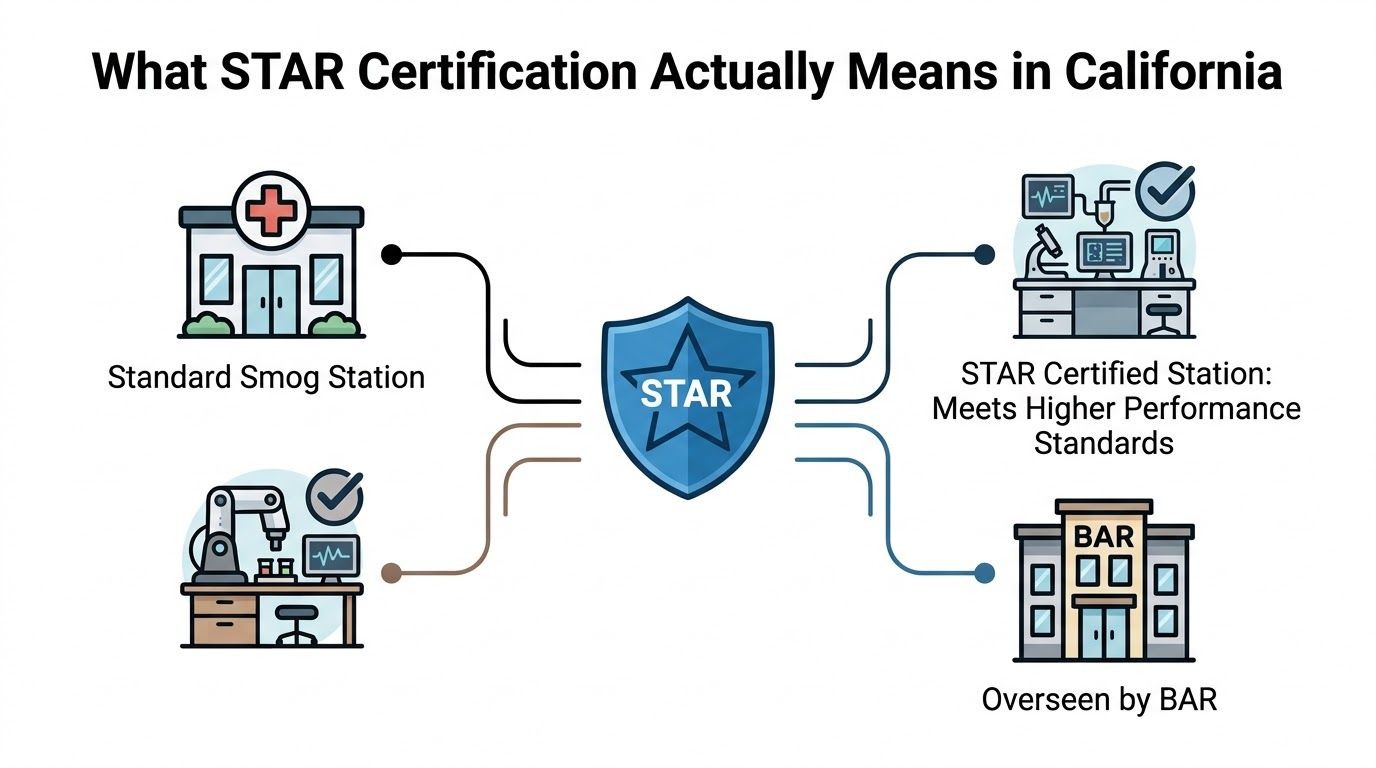
The phrase sounds like a brand name, but it points to a quality tier BAR can measure. BAR says more than two-thirds of California smog check stations are STAR certified, so STAR is not a rare specialty label. It is a common part of the state's inspection network, especially for drivers who need a recognized inspection to finish registration requirements.
The equipment side of the rule
STAR is not only about paperwork and pass rates. BAR's manual says a STAR-certified test-only center has to keep the required inspection equipment for all Smog Check vehicles, including BAR-certified gear like the BAR-97 Emissions Inspection System and the Low Pressure Fuel Evaporative Tester, or LPFET. The same manual says any equipment that needs calibration must pass calibration at least once every 10 calendar days. BAR Smog Check manual
A station cannot reliably inspect vehicles if its tools are not checked and calibrated on a tight schedule.
That detail matters because STAR is about repeatability. If a station uses approved hardware, keeps to a calibration cadence, and stays under BAR review, the inspection result is less likely to depend on guesswork or weak equipment. In plain English, STAR is BAR's way of saying this station has to prove its inspections are consistent.
If you want a plain-language breakdown of how that certification affects your visit, our guide to a STAR smog station walks through the basics without the jargon.
STAR, Test-Only, and Test-and-Repair Explained Side by Side
Drivers often search for “STAR certified smog check test only center” as if that phrase names one single thing. In reality, it combines two separate ideas, and the combination is what solves the actual problem. STAR describes the station's performance status, while test-only describes what the station is allowed to do once your car is on the property.
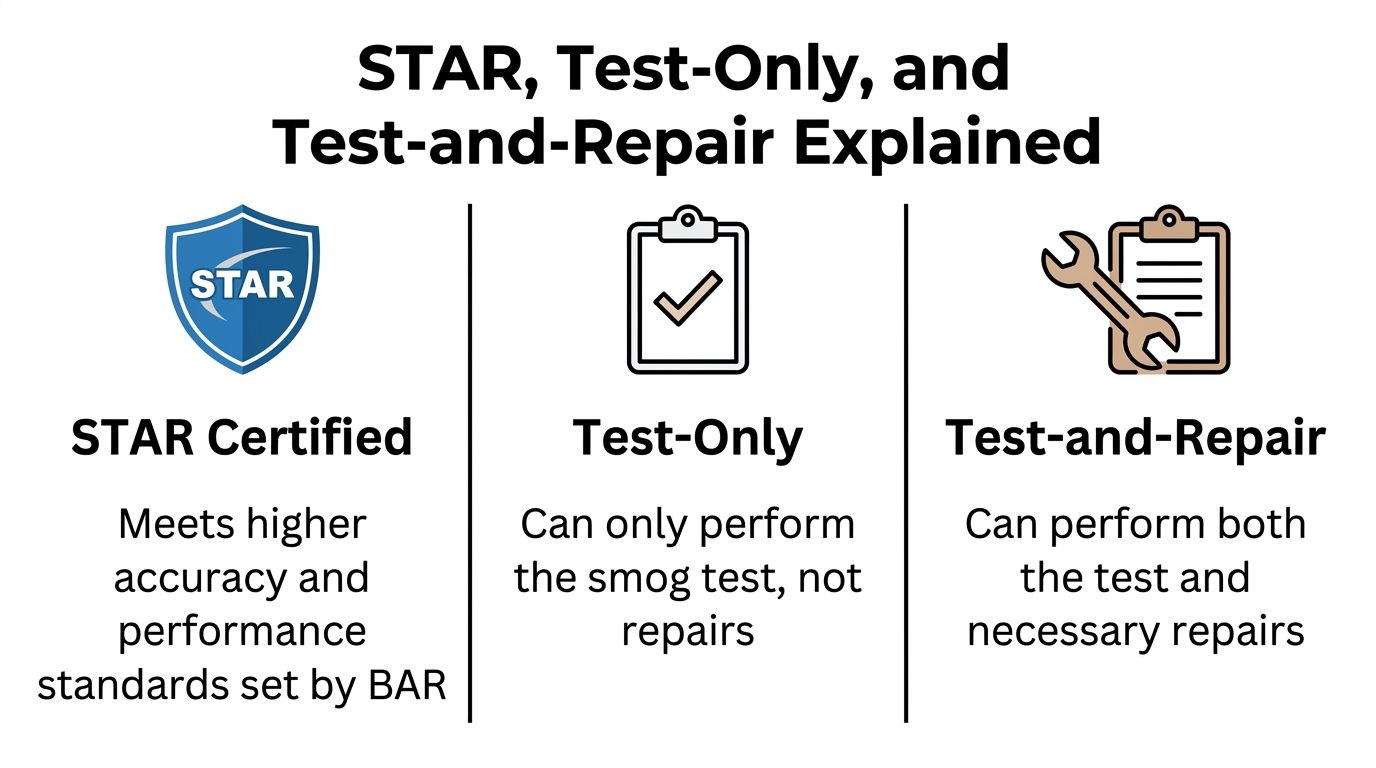
A STAR station meets BAR's higher performance standards and can inspect all vehicles, including vehicles that are directed to a STAR facility because of age, emissions profile, or selection rules. A test-only station is licensed to perform the inspection but not the repair. A test-and-repair station can do both, which sounds convenient until you realize that a test-only site helps keep the inspection and repair decisions separate. BAR STAR overview
Which one do you actually need
That depends on the DMV notice. BAR says the renewal notice tells drivers if they must go to a STAR station, and that's the part people should trust instead of guessing based on a shop sign. If the notice just calls for a regular smog check, a licensed station may be enough. If it calls for STAR, then you need a station that meets that higher standard.
This distinction is the biggest source of confusion because local marketing often blurs the terms. A shop can be test-only without being STAR, and it can be STAR without doing repairs, and those aren't the same thing. Once you separate the labels, the wording on the renewal notice becomes much easier to decode.
Quick mental model: STAR tells you the quality tier, test-only tells you the station's job description.
Why STAR Test-Only Stations Lead the Market
A driver gets the renewal notice, sees “STAR” and “test-only,” and the two labels can feel like they belong to different systems. BAR's reporting shows they often point to the same place in the driver's path. In BAR's 2025 Smog Check Executive Summary Report, STAR Test-Only stations performed 5,916,245 initial OIS tests with an 8.14% failure rate, while STAR Test-and-Repair stations performed 2,766,051 initial OIS tests with an 8.21% failure rate. Across all California smog checks, initial tests totaled 11,275,981 with 959,667 failures, for an 8.51% failure rate, and all tests combined reached 12,200,718 with 1,102,337 failures, for a 9.04% failure rate. BAR 2025 Smog Check Executive Summary Report
That is one reason test-only stations lead so much of the market. They do not sit on the side of the program. They handle a large share of the inspections and issue the certificates drivers need to complete registration compliance. BAR's report says test-only stations issued 5,822,635 certificates, compared with 2,710,210 certificates from test-and-repair stations. For a first-time visitor, that means the place doing only the inspection is often the place that gets the paperwork finished.
What makes STAR meaningful
BAR's STAR rules are built around measurable performance, not shop slogans. The Follow-up Pass Rate score has to be at least 0.40, and the Similar Vehicle Failure Rate must be at least 50% of the industry-wide failure rate for similar vehicles. In the 2021 STAR regulatory text, BAR also required a Fail-to-Pass Rate benchmark of at least 0.40 for licensed technicians in the relevant reporting period. Those are concrete thresholds, the kind a station either meets or does not meet.
That screening is why STAR test-only stations carry extra weight. They have to keep the right equipment, stay within BAR's oversight framework, and maintain performance targets while they test, not repair. For a driver, that means the renewal notice is pointing to a station that has already cleared a higher bar before the car even rolls onto the lot.
What Happens During a Test-Only Smog Visit
The visit usually starts with paperwork, not tools. You pull in, hand over your registration or renewal notice, and the technician checks what kind of vehicle you brought in and what inspection it needs. For a straightforward 2000-and-newer car, the rest often moves quickly because the station connects the diagnostic equipment, reads the vehicle's onboard data, and finishes the inspection workflow without a repair conversation.
For older vehicles, the process can look a little different. BAR says smog checks can include OBD checks for most 2000-and-newer vehicles and tailpipe tests for pre-2000 vehicles, so the test method follows the vehicle, not the other way around. That's one reason a test-only center has to be ready for multiple types of inspections instead of assuming every car behaves the same.
What to bring and what to expect
A clean visit usually means bringing the vehicle, the renewal paperwork, and a payment method. If the car is ready for testing, the visit can stay short, but the bottleneck is often the vehicle's condition, not the counter process. A simple inspection might take about 10 to 15 minutes for a 2000-plus vehicle, but that timing only applies when the car is already prepared for the test workflow.
| Documents and Timing for a Typical Test-Only Visit | What to Bring or Expect | Typical Outcome |
|---|---|---|
| DMV renewal notice or registration | Bring the paper or digital notice so the station can confirm the correct requirement | Helps the technician confirm whether STAR is required |
| Vehicle | The car, truck, diesel, or hybrid that needs the inspection | The test is performed on the actual vehicle |
| Payment | Be ready to pay at the counter | The certificate can be issued after a pass |
| Straightforward 2000-plus vehicle | Expect a short inspection window when the car is ready | Often stays close to the usual 10 to 15 minute workflow |
The key thing people miss is that a quick visit isn't the same as an easy pass. A test-only station can move efficiently, but it still has to check the vehicle thoroughly. If the car isn't ready, the certificate doesn't happen just because the bay is open.
Vehicles That Change the Outcome
A lot of the frustration around smog checks comes from assuming every vehicle is judged the same way. It isn't. BAR says gasoline, hybrid, and alternative-fuel vehicles from model year 1976 and newer are subject to Smog Check requirements, but the actual test path depends on the vehicle's age, engine setup, and readiness status. BAR Smog Check program overview
The vehicle itself can change the test
A 1999 and older vehicle may need a tailpipe-style inspection rather than an onboard diagnostics check. A diesel has its own inspection profile. A hybrid can still need a compliant smog test. Those differences are why a station that sees a wide range of vehicles needs both the right equipment and the right training.
The check-engine light is the biggest red flag. BAR says a vehicle will not pass with the check-engine light on, so that light should be treated as a real test blocker, not a nuisance warning. If the battery was recently disconnected, BAR also says drivers should wait a week or two so readiness monitors can reset before testing. That rule catches a lot of people off guard because the car may drive fine while still being unready for inspection.
If the car got a battery reset, don't assume it's inspection-ready just because it runs normally.
A short pre-visit checklist
- Check the dashboard first: If the check-engine light is on, the vehicle is not ready for a pass.
- Think about the last repair: A recent battery disconnect can leave readiness monitors incomplete.
- Match the vehicle to the right test type: Older models and diesels may not follow the same workflow as newer gas cars.
- Don't rush the visit after a warning light clears: The car may need normal driving time before the inspection makes sense.
The “10-minute smog” pitch can mislead people. The test itself might be quick, but the vehicle can create delays, repeat visits, or repair decisions that stretch the process out. Knowing that before you go saves time, money, and a lot of back-and-forth.
Choosing Speedy Smog in San Leandro
For East Bay drivers who want a local option, Speedy Smog is a STAR Certified station at 15275 Washington Ave, San Leandro, CA 94579. It inspects most vehicles, including 2000 and newer models, 1999 and older vehicles, diesels, and hybrids, and it typically completes tests for 2000-plus vehicles in about 10 to 15 minutes. The shop also lists a clean indoor waiting room, transparent pricing, Monday-through-Saturday hours, and periodic $25-off coupons for most smogs on newer vehicles.
That mix fits the needs of drivers who want one place that handles the common vehicle types without turning the visit into a bigger project than it needs to be. As BAR's rules make clear, a STAR-certified test-only center exists to keep the inspection accurate, recognized, and separate from repair work. Speedy Smog is one local example of that setup in practice. What is a STAR station
If your renewal notice points you toward STAR, the value is mostly in convenience and compliance. You get a station that's set up for the required inspection path, a location that understands the common vehicle categories, and a process that stays focused on getting the certificate issued correctly.
Common Questions About STAR Test-Only Smog Checks
How much does a STAR smog check cost? Pricing varies by vehicle type and station policies, so there isn't one universal number to memorize. The better question is whether the station can inspect your exact vehicle and issue the certificate you need.
How long does the whole visit take? For a ready 2000-plus vehicle, the inspection itself can be quick, but paperwork, diagnostics, and certificate handling still take time. If the car arrives with a check-engine light, incomplete readiness, or an older test type, the visit can stretch.
Can I go to a regular shop instead of a STAR station? If the DMV renewal notice requires STAR, use a STAR station. BAR says the notice tells you when that routing applies, and that instruction matters more than guessing based on convenience.
What if the vehicle fails? A fail usually means the vehicle needs directed repairs or more preparation before retesting. If you're looking for a practical next move after a failed inspection, the guidance in this BAR-focused smog preparation resource can help you think through the common causes without wasting another trip.
Speedy Smog handles STAR Certified smog checks in San Leandro for drivers who need a clear answer, a fast inspection, and a certificate that matches BAR rules. If your renewal notice calls for STAR or you want a test-only station that understands older vehicles, diesels, and hybrids, visit Speedy Smog and book the visit that fits your car.
For most East Bay drivers, a required DMV smog check can be finished in about 10 to 15 minutes at a certified station like Speedy Smog if you're driving a model-year 2000 or newer vehicle. If your car falls into the regular California renewal cycle, that visit usually comes around every 2 years once a gas-powered vehicle is 8 model years old or older.
That's why so many people end up searching for DMV smog check near me at the exact same moment. The registration notice shows up, the deadline feels closer than it should, and suddenly you need a nearby shop that can handle the inspection without turning a simple errand into half your day.
In the East Bay, the easiest path is usually not finding the cheapest listing or the closest pin on a map. It's finding a certified station that can handle the right type of inspection, tell you whether your car is ready, and get the result to the DMV without extra back-and-forth. That's where a little preparation saves a lot of annoyance.
Table of Contents
- That DMV Smog Notice Is Here What Now
- Is a STAR Certified Station Required for You
- How to Prepare Your Car for a Fast Pass
- The Speedy Smog Experience in San Leandro
- Decoding Your Smog Check Results
- Frequently Asked Smog Check Questions
That DMV Smog Notice Is Here What Now
When that renewal notice lands in your hand, the first move is simple. Check whether smog certification is required, then handle it before the registration deadline starts crowding everything else on your calendar.
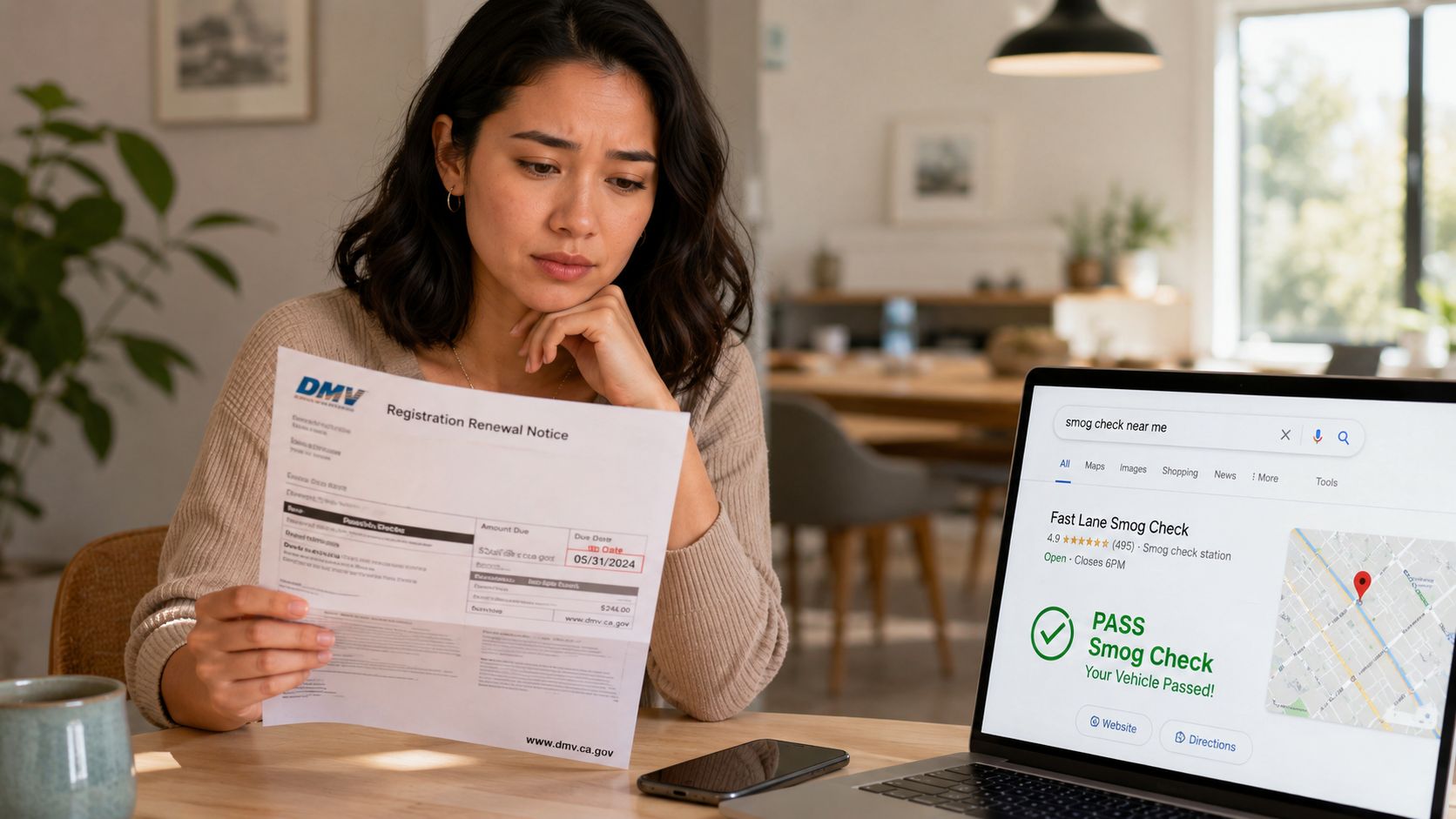
Why this keeps coming up
California ties the Smog Check program directly to registration. According to California's overview of state services and smog program access, gas-powered vehicles that are 8 model years old or older and 1976 or newer generally need a Smog Check every 2 years. That repeating cycle is the reason this search shows up again and again for East Bay drivers.
That matters because individuals seeking a DMV smog check near me aren't shopping for an optional maintenance item. They're clearing a registration requirement. Once you look at it that way, the job becomes more straightforward. You need the right station, the right timing, and a car that's ready for the test.
Practical rule: Treat the smog check like part of registration paperwork, not like a separate repair visit.
What to do first
A clean, low-stress smog visit usually starts with three checks:
- Read the notice carefully: Look for whether smog is required at renewal and whether the notice says STAR.
- Think about your car's recent history: If the battery was disconnected, the check engine light came on recently, or repairs were just done, timing matters.
- Choose a nearby certified station: In the East Bay, convenience matters because this is usually a quick compliance stop, not an all-day appointment.
The biggest mistake is waiting until the last minute, then rushing into the first station you see online. A little planning turns this from “another DMV headache” into a short stop on the way home or during a lunch break.
Is a STAR Certified Station Required for You
Not every smog check is the same. One detail changes where you should go, and whether a regular station will work at all. That detail is STAR certification.
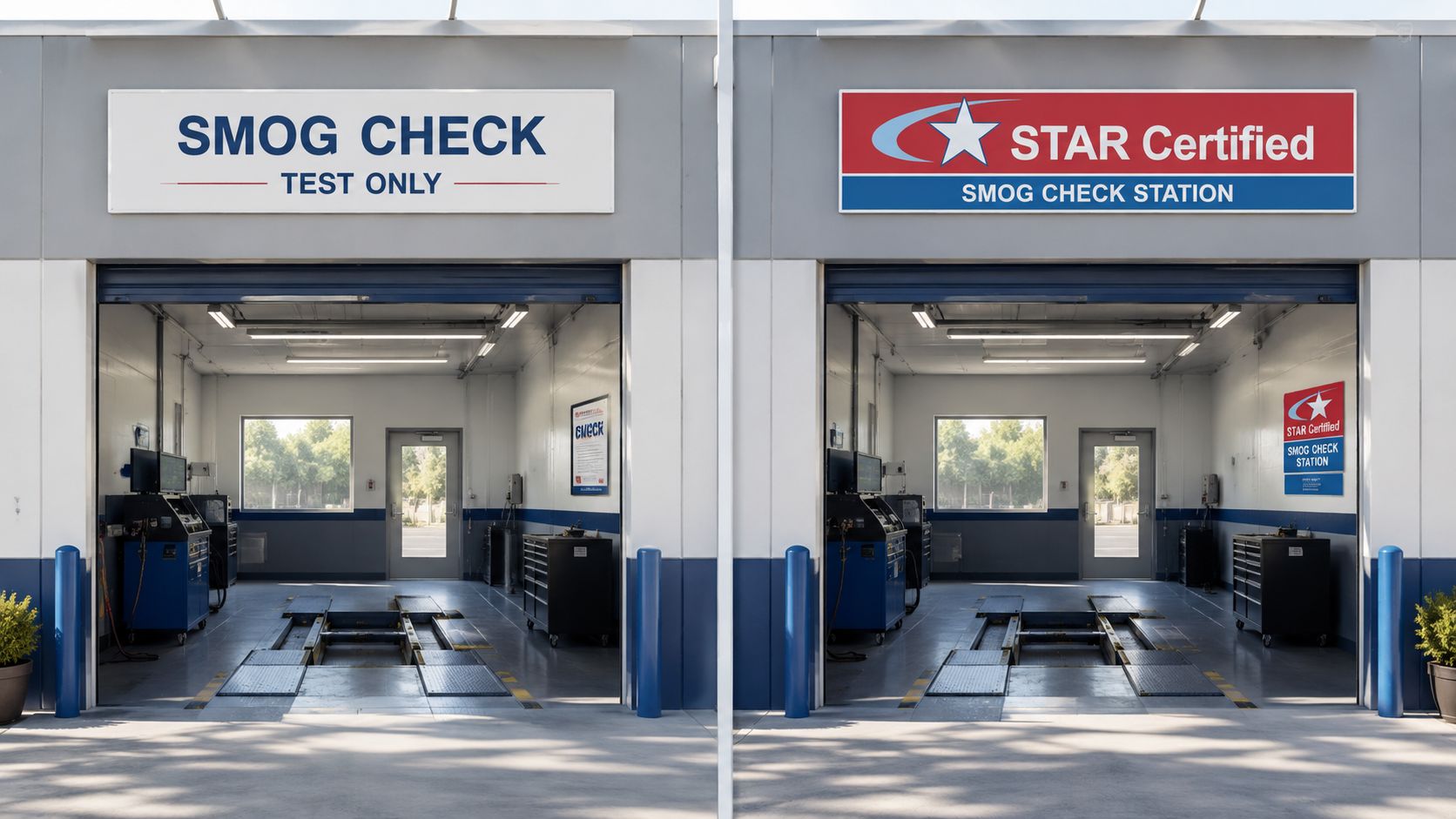
Where to look on your renewal notice
If your DMV paperwork says STAR is required, don't ignore it. A standard station won't help if the notice directs you to a STAR location.
California's smog framework relies on licensed stations as part of the compliance path, and STAR stations matter because they meet additional performance standards within that system. If you want a plain-language breakdown of what that means in practice, this explanation of what a Smog STAR station is is useful.
Why drivers get tripped up here
A lot of people search for DMV smog check near me and assume the nearest result can handle any inspection. Sometimes that's true. Sometimes it wastes a trip.
Here's the decision test that works:
| Notice says | What you need |
|---|---|
| Smog required | A licensed smog check station |
| STAR required | A STAR Certified station |
| You're unsure | Call first and read the notice exactly as written |
This is one of those trade-offs that matters more than price shopping. Saving a few minutes on the drive doesn't help if you show up at the wrong kind of facility and still need to go somewhere else.
If your renewal notice says STAR, believe the notice and choose accordingly.
Why local matters in the East Bay
A nearby STAR station is useful for a simple reason. Smog checks are often a same-day errand squeezed between work, school pickup, or another stop. Drivers in San Leandro, Oakland, Hayward, and the surrounding East Bay usually want one visit, one inspection, and no guesswork.
When you're choosing a station, ask practical questions instead of marketing questions:
- Can they handle the exact inspection listed on your notice?
- Do they work on the vehicle type you're bringing in?
- Can you get in and out without turning this into a half-day task?
That's what separates a useful local option from a random search result.
How to Prepare Your Car for a Fast Pass
A smog check usually goes quickly when the car is ready for inspection. The drivers who lose time are usually dealing with one of two problems. A check engine light is on, or the vehicle computer was recently reset and has not finished its self-checks.
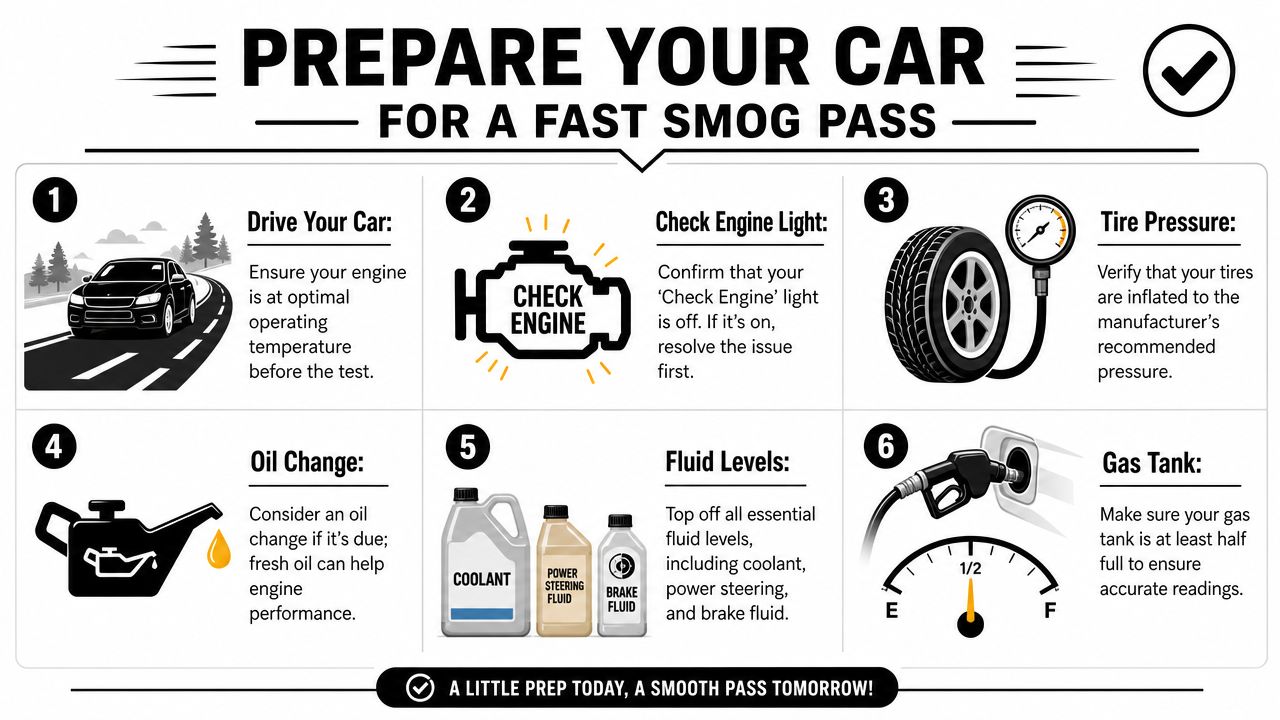
The two issues that cause avoidable trouble
In the shop, this is what catches East Bay drivers most often. The car seems fine, it starts, it drives normally, and there is no obvious symptom. But if the check engine light is on, or if codes were just cleared after a repair or battery disconnect, the inspection can still fail or come back as not ready.
That second issue frustrates people because it does not always feel like a real problem. It is still a real smog problem.
A quick warm-up helps too. Bring the car in after normal driving, not after it has been sitting cold in the driveway all morning. If you want a realistic sense of timing once you arrive, this guide on how long a smog check usually takes in San Leandro sets expectations well.
What works before you arrive
- Look at the dash before you leave: If the check engine light is on, deal with that first.
- Drive the car long enough to fully warm it up: A short errand with a cold engine is not the ideal setup.
- Do not clear codes right before testing: Turning the light off is not the same as making the car ready.
- Wait after battery replacement or disconnect: Many vehicles need regular driving before the monitors reset and report properly.
- Bring the car after everyday use: Highway and city driving are usually better prep than idling for a few minutes.
A car can drive perfectly and still be unready for an OBD-based smog inspection.
That is why the cheapest option is often waiting one more day and testing once, instead of rushing in and paying again.
To see the basic process visually, this walkthrough helps:
How to avoid paying twice
The practical sequence is simple:
- Fix the warning-light issue first.
- Drive the vehicle enough for readiness monitors to complete.
- Test the car only after it is ready.
I have seen plenty of drivers clear a code, see the light disappear, and head straight to a station. That move saves nothing. It often leads to a second trip, another fee, and more irritation than the original repair.
If you want the fastest visit at a place like Speedy Smog, show up with a warmed-up car, no warning lights, and no recent reset unless you know the monitors are ready. That is the closest thing to a first-time pass formula.
The Speedy Smog Experience in San Leandro
A good local smog visit feels boring in the best way. You pull in, the technician confirms what your vehicle needs, the inspection happens, and you're on your way.
What the visit usually looks like
At a San Leandro station like Speedy Smog, the process is built around fast DMV compliance for local drivers. The shop is located at 15275 Washington Ave, San Leandro, CA 94579, and it handles inspections for many common vehicle types, including newer cars, older vehicles, diesels, and hybrids.
For timing expectations, this page on how long a smog check takes matches what many drivers want to know before they leave the house. For many 2000 and newer vehicles, the visit is commonly a short stop rather than a drawn-out appointment.
Cost, comfort, and trade-offs
In California markets, this California smog FAQ says smog checks for model-year 2000 and newer vehicles typically cost between $45 and $70, inclusive of the certificate. That's why speed, location, and getting it done correctly matter more than turning the search into an hour of comparison shopping.
The practical trade-off is simple:
- Cheaper isn't always faster
- Closer isn't always the right certification
- A quick, clean visit usually depends on showing up prepared
A nearby station with a comfortable indoor waiting area also changes the experience more than people expect. If you're handling this between errands, comfort matters.
Estimated test times by vehicle type
Here's a practical way to think about turnaround:
| Vehicle Type | Estimated Test Time | Notes |
|---|---|---|
| 2000 and newer | About 10 to 15 minutes | Common quick-turn inspection for many everyday vehicles |
| 1996 to 1999 | About 25 minutes | Often takes longer than newer OBD-focused tests |
| 1995 and older | About 35 minutes | Older vehicles usually need more time |
| Diesel or hybrid | Varies | Call ahead to confirm the exact process for your vehicle |
That range helps set expectations. If you drive a newer car and it's ready, this can be one of the easier tasks on your registration list.
Decoding Your Smog Check Results
Once the inspection is done, you only have two outcomes that matter. You passed, or you didn't. Either way, the next step is straightforward when the station explains it clearly.
If your vehicle passes
When a car passes, the useful part is convenience. The station handles the certification process electronically, so you don't need to turn a successful inspection into another paperwork chase.
That's one reason drivers prefer established DMV-focused stations. The pass result moves directly into the registration workflow instead of leaving you wondering what to upload, print, or mail.
A passing smog check should feel like a box checked, not the start of another task.
If you want a clearer breakdown of what the paperwork and status usually mean, this explanation of smog test results gives a simple reference point.
If your vehicle doesn't pass
A failed inspection is annoying, but it isn't mysterious. You'll typically get a Vehicle Inspection Report, often called a VIR, that shows why the car didn't pass.
From there, focus on the reason listed on the report. Don't guess. Don't approve random parts replacement without diagnosis. If the issue is a warning light, unresolved code, or readiness problem, the fix path is different from an actual emissions hardware problem.
A calm next-step checklist looks like this:
- Read the VIR carefully
- Repair the actual cause
- Make sure the vehicle is ready before returning
- Retest after the underlying issue is addressed
California also offers repair-assistance pathways in some cases through its Consumer Assistance Program, which can be worth checking if the repair burden is larger than expected.
Frequently Asked Smog Check Questions
What should I bring to a smog check
Bring the car, and bring your renewal notice if you have it. That notice helps the station confirm whether DMV is asking for a regular test or a STAR inspection. If you have current registration paperwork in the glove box, keep that handy too. It can speed up check-in and clear up name, plate, or VIN questions fast.
Do I need an appointment
Not always.
A lot of East Bay drivers want a walk-in because smog checks usually land in the middle of a workweek, right when you are already juggling enough. Calling first is still smart, especially if the vehicle is older, diesel, hybrid, or tied to an unusual registration issue. A quick phone check can save you a wasted trip.
What if my car recently had the battery disconnected
Wait until the car is ready to test. A recent battery disconnect or code clear can reset the vehicle's emissions monitors, and that can stop a pass even if the car feels fine.
This catches people all the time. The car runs normally, no obvious problem shows up, then the test gets delayed because the system has not finished its self-checks. If that happened recently, say so before the inspection starts.
What if my car fails
Start with the VIR. That report tells you what failed.
Do not guess, and do not approve random parts replacement just because someone says it is probably a sensor. A check engine light, an incomplete monitor, and an actual emissions component failure all point to different repair paths. Fix the specific problem, then return once the car is ready for retest.
Are some vehicles exempt from smog inspection
Yes. Some vehicles are exempt based on age, fuel type, weight, or model year rules. Electric vehicles are generally exempt, and older specialty categories may be exempt as well. If you want the current California rule set for your exact vehicle, check the California DMV smog inspections page.
How do I make this as fast as possible
The fastest smog check usually starts before you leave home:
- Confirm you need the test
- Check whether your notice says STAR
- Make sure no warning lights are on
- Do not show up right after a battery reset or code clear
- Drive the car long enough to get fully warmed up
That routine saves time, cuts down on repeat visits, and gives you the best shot at getting it done right the first time.
If you want a local station that handles California smog compliance without a lot of hassle, Speedy Smog is a practical East Bay option for drivers who want a certified inspection, a short visit, and a straightforward path to getting registration moving again.