You're holding a DMV renewal notice and trying to answer one simple question before the deadline sneaks up on you, do you need any smog shop, or do you need a STAR certified smog check test only center? That confusion is common because California uses a few labels that sound similar but mean very different things in practice, and the wrong choice can send you back for another visit. The good news is that the answer usually lives in the notice itself, plus a handful of BAR rules that are easier to understand once you strip away the jargon.
Table of Contents
- Reading Your DMV Renewal Notice Without the Confusion
- What STAR Certification Actually Means in California
- STAR, Test-Only, and Test-and-Repair Explained Side by Side
- Why STAR Test-Only Stations Lead the Market
- What Happens During a Test-Only Smog Visit
- Vehicles That Change the Outcome
- Choosing Speedy Smog in San Leandro
- Common Questions About STAR Test-Only Smog Checks
Reading Your DMV Renewal Notice Without the Confusion
A San Leandro driver opens the mailbox, sees a renewal notice, and immediately hits the same wall a lot of people do. The letter says the vehicle needs a smog check, and maybe it says STAR, maybe it says nothing at all, and now the next question is whether any station will work or whether the car has to go somewhere special.
That's where the language gets slippery. A STAR certified smog check test only center is not just “a smog shop with a fancier sign,” it's a station that meets BAR's higher performance standards and is licensed only to test, not repair. BAR also says the DMV renewal notice tells drivers if they must go to a STAR station, so the notice itself is the first thing to read carefully. DMV renewal and registration help
Practical rule: if the renewal notice says STAR is required, treat that as a routing instruction, not a suggestion.
The four questions most drivers need answered are simple. What does STAR mean, what does test-only mean, do you need both, and what happens if the vehicle doesn't cooperate on test day? Once those pieces click, the rest of the process gets much less stressful.
What STAR Certification Actually Means in California
A regular smog station works like a general clinic. A STAR station is a station that has passed extra audits, uses approved equipment, and is reviewed against performance standards on a regular basis. California's Bureau of Automotive Repair launched the STAR program in January 2013 as part of statewide smog-check reform, and BAR says STAR certification goes to stations that meet specific performance standards and are reviewed on a quarterly basis. California STAR smog-check reform background
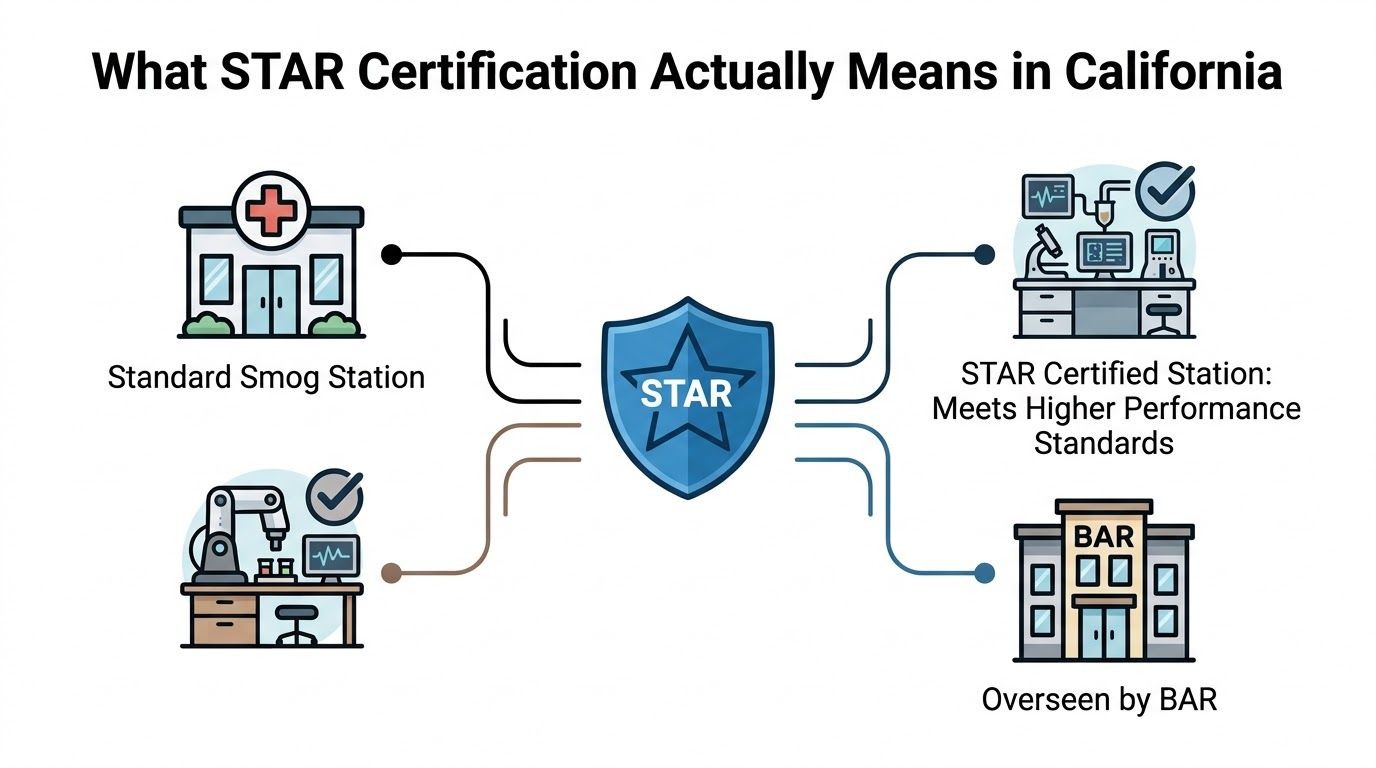
The phrase sounds like a brand name, but it points to a quality tier BAR can measure. BAR says more than two-thirds of California smog check stations are STAR certified, so STAR is not a rare specialty label. It is a common part of the state's inspection network, especially for drivers who need a recognized inspection to finish registration requirements.
The equipment side of the rule
STAR is not only about paperwork and pass rates. BAR's manual says a STAR-certified test-only center has to keep the required inspection equipment for all Smog Check vehicles, including BAR-certified gear like the BAR-97 Emissions Inspection System and the Low Pressure Fuel Evaporative Tester, or LPFET. The same manual says any equipment that needs calibration must pass calibration at least once every 10 calendar days. BAR Smog Check manual
A station cannot reliably inspect vehicles if its tools are not checked and calibrated on a tight schedule.
That detail matters because STAR is about repeatability. If a station uses approved hardware, keeps to a calibration cadence, and stays under BAR review, the inspection result is less likely to depend on guesswork or weak equipment. In plain English, STAR is BAR's way of saying this station has to prove its inspections are consistent.
If you want a plain-language breakdown of how that certification affects your visit, our guide to a STAR smog station walks through the basics without the jargon.
STAR, Test-Only, and Test-and-Repair Explained Side by Side
Drivers often search for “STAR certified smog check test only center” as if that phrase names one single thing. In reality, it combines two separate ideas, and the combination is what solves the actual problem. STAR describes the station's performance status, while test-only describes what the station is allowed to do once your car is on the property.
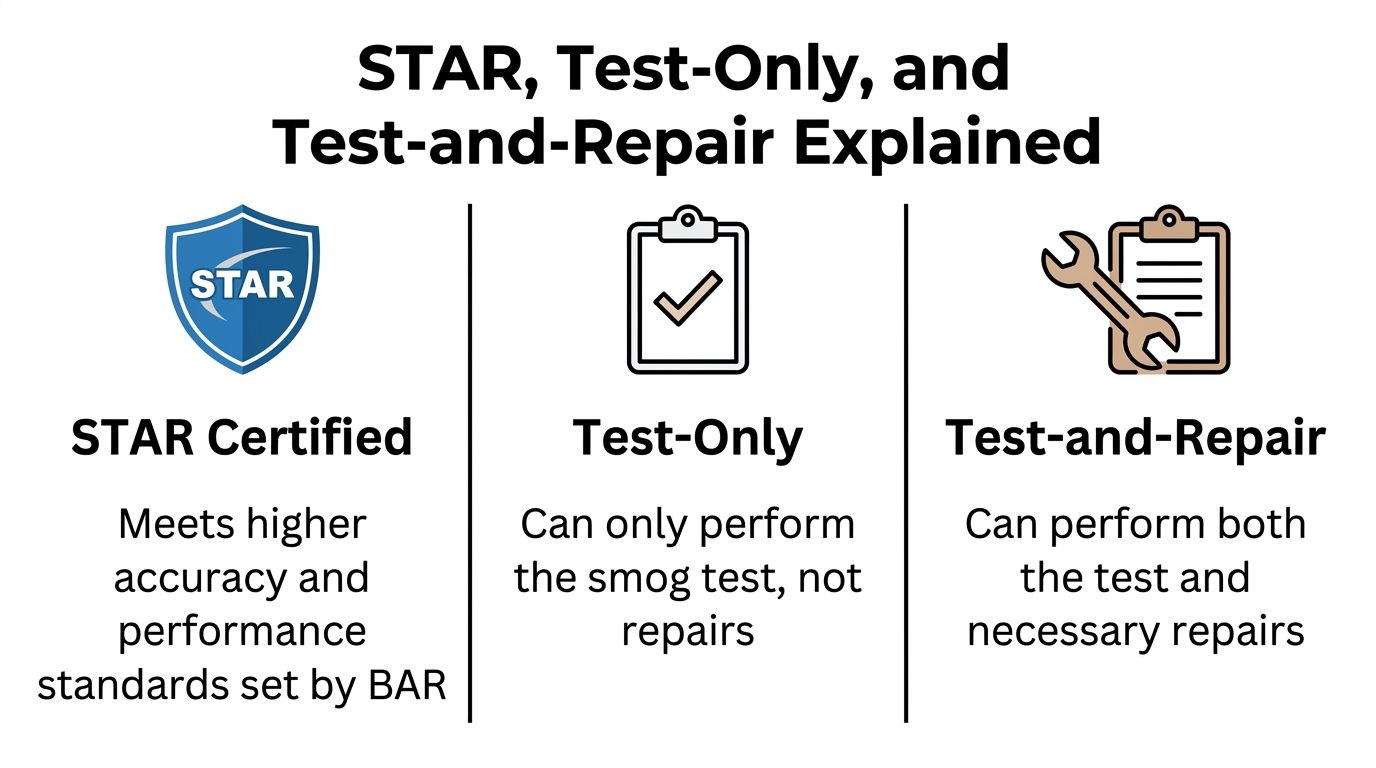
A STAR station meets BAR's higher performance standards and can inspect all vehicles, including vehicles that are directed to a STAR facility because of age, emissions profile, or selection rules. A test-only station is licensed to perform the inspection but not the repair. A test-and-repair station can do both, which sounds convenient until you realize that a test-only site helps keep the inspection and repair decisions separate. BAR STAR overview
Which one do you actually need
That depends on the DMV notice. BAR says the renewal notice tells drivers if they must go to a STAR station, and that's the part people should trust instead of guessing based on a shop sign. If the notice just calls for a regular smog check, a licensed station may be enough. If it calls for STAR, then you need a station that meets that higher standard.
This distinction is the biggest source of confusion because local marketing often blurs the terms. A shop can be test-only without being STAR, and it can be STAR without doing repairs, and those aren't the same thing. Once you separate the labels, the wording on the renewal notice becomes much easier to decode.
Quick mental model: STAR tells you the quality tier, test-only tells you the station's job description.
Why STAR Test-Only Stations Lead the Market
A driver gets the renewal notice, sees “STAR” and “test-only,” and the two labels can feel like they belong to different systems. BAR's reporting shows they often point to the same place in the driver's path. In BAR's 2025 Smog Check Executive Summary Report, STAR Test-Only stations performed 5,916,245 initial OIS tests with an 8.14% failure rate, while STAR Test-and-Repair stations performed 2,766,051 initial OIS tests with an 8.21% failure rate. Across all California smog checks, initial tests totaled 11,275,981 with 959,667 failures, for an 8.51% failure rate, and all tests combined reached 12,200,718 with 1,102,337 failures, for a 9.04% failure rate. BAR 2025 Smog Check Executive Summary Report
That is one reason test-only stations lead so much of the market. They do not sit on the side of the program. They handle a large share of the inspections and issue the certificates drivers need to complete registration compliance. BAR's report says test-only stations issued 5,822,635 certificates, compared with 2,710,210 certificates from test-and-repair stations. For a first-time visitor, that means the place doing only the inspection is often the place that gets the paperwork finished.
What makes STAR meaningful
BAR's STAR rules are built around measurable performance, not shop slogans. The Follow-up Pass Rate score has to be at least 0.40, and the Similar Vehicle Failure Rate must be at least 50% of the industry-wide failure rate for similar vehicles. In the 2021 STAR regulatory text, BAR also required a Fail-to-Pass Rate benchmark of at least 0.40 for licensed technicians in the relevant reporting period. Those are concrete thresholds, the kind a station either meets or does not meet.
That screening is why STAR test-only stations carry extra weight. They have to keep the right equipment, stay within BAR's oversight framework, and maintain performance targets while they test, not repair. For a driver, that means the renewal notice is pointing to a station that has already cleared a higher bar before the car even rolls onto the lot.
What Happens During a Test-Only Smog Visit
The visit usually starts with paperwork, not tools. You pull in, hand over your registration or renewal notice, and the technician checks what kind of vehicle you brought in and what inspection it needs. For a straightforward 2000-and-newer car, the rest often moves quickly because the station connects the diagnostic equipment, reads the vehicle's onboard data, and finishes the inspection workflow without a repair conversation.
For older vehicles, the process can look a little different. BAR says smog checks can include OBD checks for most 2000-and-newer vehicles and tailpipe tests for pre-2000 vehicles, so the test method follows the vehicle, not the other way around. That's one reason a test-only center has to be ready for multiple types of inspections instead of assuming every car behaves the same.
What to bring and what to expect
A clean visit usually means bringing the vehicle, the renewal paperwork, and a payment method. If the car is ready for testing, the visit can stay short, but the bottleneck is often the vehicle's condition, not the counter process. A simple inspection might take about 10 to 15 minutes for a 2000-plus vehicle, but that timing only applies when the car is already prepared for the test workflow.
| Documents and Timing for a Typical Test-Only Visit | What to Bring or Expect | Typical Outcome |
|---|---|---|
| DMV renewal notice or registration | Bring the paper or digital notice so the station can confirm the correct requirement | Helps the technician confirm whether STAR is required |
| Vehicle | The car, truck, diesel, or hybrid that needs the inspection | The test is performed on the actual vehicle |
| Payment | Be ready to pay at the counter | The certificate can be issued after a pass |
| Straightforward 2000-plus vehicle | Expect a short inspection window when the car is ready | Often stays close to the usual 10 to 15 minute workflow |
The key thing people miss is that a quick visit isn't the same as an easy pass. A test-only station can move efficiently, but it still has to check the vehicle thoroughly. If the car isn't ready, the certificate doesn't happen just because the bay is open.
Vehicles That Change the Outcome
A lot of the frustration around smog checks comes from assuming every vehicle is judged the same way. It isn't. BAR says gasoline, hybrid, and alternative-fuel vehicles from model year 1976 and newer are subject to Smog Check requirements, but the actual test path depends on the vehicle's age, engine setup, and readiness status. BAR Smog Check program overview
The vehicle itself can change the test
A 1999 and older vehicle may need a tailpipe-style inspection rather than an onboard diagnostics check. A diesel has its own inspection profile. A hybrid can still need a compliant smog test. Those differences are why a station that sees a wide range of vehicles needs both the right equipment and the right training.
The check-engine light is the biggest red flag. BAR says a vehicle will not pass with the check-engine light on, so that light should be treated as a real test blocker, not a nuisance warning. If the battery was recently disconnected, BAR also says drivers should wait a week or two so readiness monitors can reset before testing. That rule catches a lot of people off guard because the car may drive fine while still being unready for inspection.
If the car got a battery reset, don't assume it's inspection-ready just because it runs normally.
A short pre-visit checklist
- Check the dashboard first: If the check-engine light is on, the vehicle is not ready for a pass.
- Think about the last repair: A recent battery disconnect can leave readiness monitors incomplete.
- Match the vehicle to the right test type: Older models and diesels may not follow the same workflow as newer gas cars.
- Don't rush the visit after a warning light clears: The car may need normal driving time before the inspection makes sense.
The “10-minute smog” pitch can mislead people. The test itself might be quick, but the vehicle can create delays, repeat visits, or repair decisions that stretch the process out. Knowing that before you go saves time, money, and a lot of back-and-forth.
Choosing Speedy Smog in San Leandro
For East Bay drivers who want a local option, Speedy Smog is a STAR Certified station at 15275 Washington Ave, San Leandro, CA 94579. It inspects most vehicles, including 2000 and newer models, 1999 and older vehicles, diesels, and hybrids, and it typically completes tests for 2000-plus vehicles in about 10 to 15 minutes. The shop also lists a clean indoor waiting room, transparent pricing, Monday-through-Saturday hours, and periodic $25-off coupons for most smogs on newer vehicles.
That mix fits the needs of drivers who want one place that handles the common vehicle types without turning the visit into a bigger project than it needs to be. As BAR's rules make clear, a STAR-certified test-only center exists to keep the inspection accurate, recognized, and separate from repair work. Speedy Smog is one local example of that setup in practice. What is a STAR station
If your renewal notice points you toward STAR, the value is mostly in convenience and compliance. You get a station that's set up for the required inspection path, a location that understands the common vehicle categories, and a process that stays focused on getting the certificate issued correctly.
Common Questions About STAR Test-Only Smog Checks
How much does a STAR smog check cost? Pricing varies by vehicle type and station policies, so there isn't one universal number to memorize. The better question is whether the station can inspect your exact vehicle and issue the certificate you need.
How long does the whole visit take? For a ready 2000-plus vehicle, the inspection itself can be quick, but paperwork, diagnostics, and certificate handling still take time. If the car arrives with a check-engine light, incomplete readiness, or an older test type, the visit can stretch.
Can I go to a regular shop instead of a STAR station? If the DMV renewal notice requires STAR, use a STAR station. BAR says the notice tells you when that routing applies, and that instruction matters more than guessing based on convenience.
What if the vehicle fails? A fail usually means the vehicle needs directed repairs or more preparation before retesting. If you're looking for a practical next move after a failed inspection, the guidance in this BAR-focused smog preparation resource can help you think through the common causes without wasting another trip.
Speedy Smog handles STAR Certified smog checks in San Leandro for drivers who need a clear answer, a fast inspection, and a certificate that matches BAR rules. If your renewal notice calls for STAR or you want a test-only station that understands older vehicles, diesels, and hybrids, visit Speedy Smog and book the visit that fits your car.