You just got the renewal notice, and now the clock's running. If your car needs a smog check, the wrong station can waste your afternoon, trigger a second trip, or leave you stuck wondering why a car that “runs fine” still won't clear DMV.
The fix is to treat dmv smog check stations like a decision system, not a random shop visit. The right station has the right certification, the right equipment, the right testing path for your vehicle, and the right process to get your result into the DMV workflow without drama.
Table of Contents
- Why DMV Smog Check Stations Matter to California Drivers
- What a DMV Smog Check Station Does
- STAR Certification and Why It Changes the Outcome
- How the Test Changes by Model Year and Fuel Type
- Step-by-Step From Booking to DMV Confirmation
- Preparing Your Car to Avoid a Surprising Failure
- How to Choose the Right Station Near You
- Speedy Smog in San Leandro and What to Expect
Why DMV Smog Check Stations Matter to California Drivers
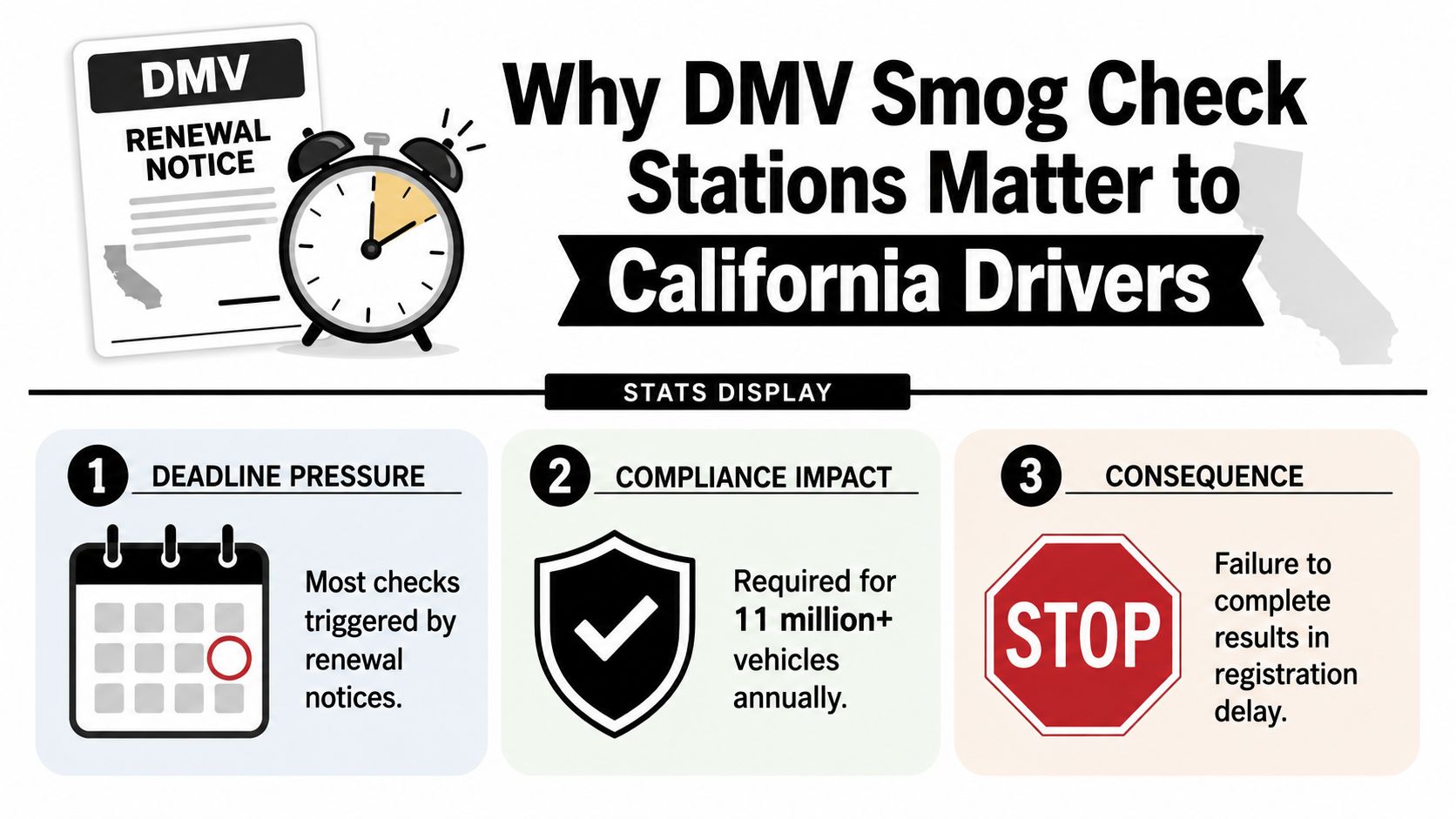
A driver pulls into the DMV with a renewal notice in hand and asks the same question I hear all the time, where do I go, and does it matter which shop I pick? It matters because the smog check is a compliance step tied directly to registration renewal and to the state's emissions program.
California runs a large, statewide Smog Check system that performs more than 10 million inspections each year at more than 5,000 independently owned stations, and state materials say it removes about 400 tons of smog-forming pollutants every day. That scale tells you exactly what these stations are, part of the state's enforcement and air-quality infrastructure, not just repair shops with a scanner on the counter. California Smog Check program overview
What that means at the counter
The station you choose affects both paperwork and time. If the result does not satisfy the DMV requirement for your vehicle, you are still not done, even if the car drove perfectly into the bay.
Practical rule: Do not ask only, “Can this shop test my car?” Ask, “Will this result actually clear my renewal?”
Drivers frequently get tripped up when they treat the smog check like a repair estimate. The test is a regulated pass-fail workflow, and the station has to feed the result into the state system correctly. That is why the right shop is not just about convenience. It is about whether your renewal moves forward cleanly or gets held up at the worst possible time.
What a DMV Smog Check Station Does
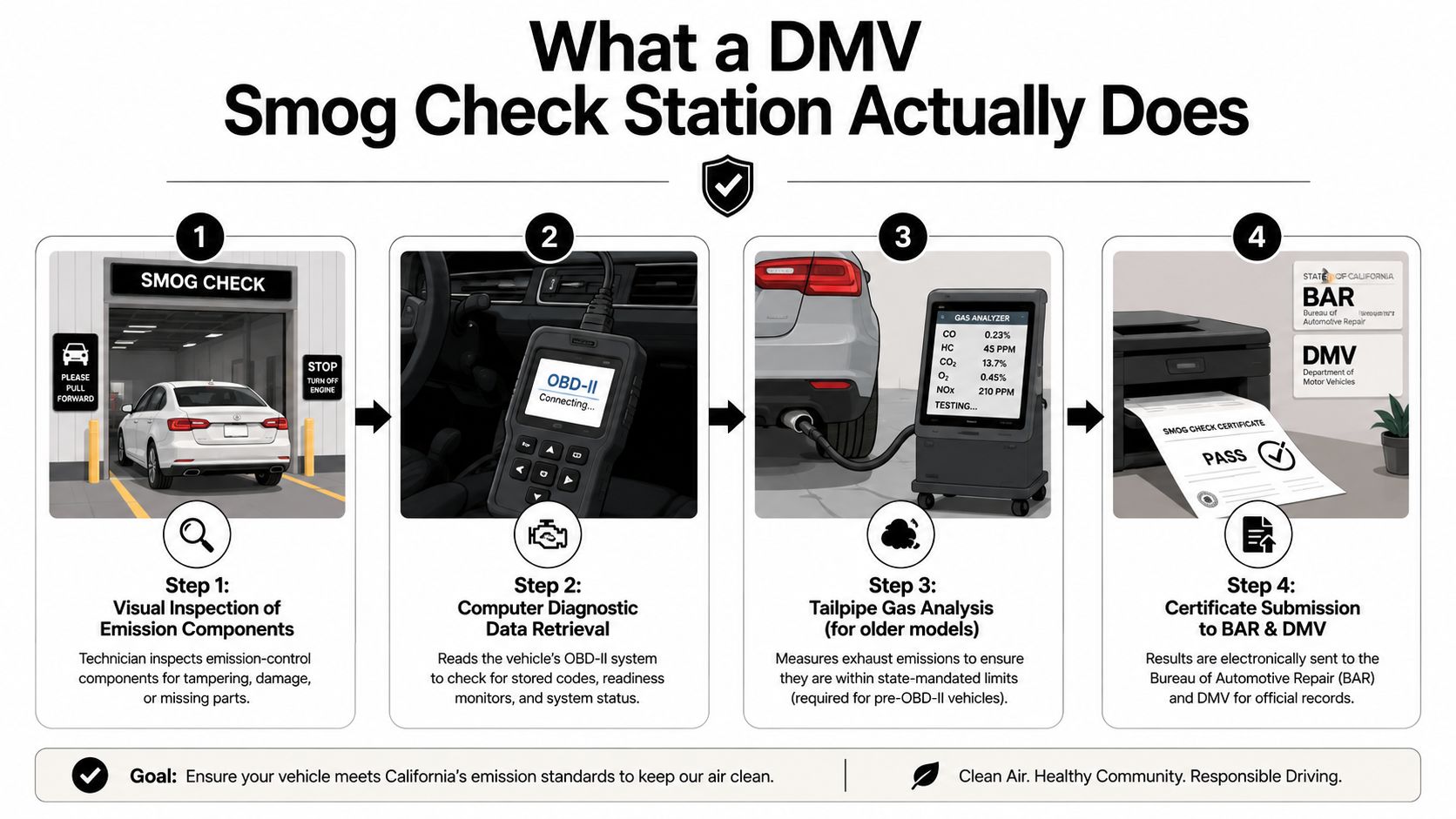
A licensed dmv smog check station keeps BAR-approved inspection equipment, a continuous internet connection, and a Windows-based system that BAR has tested and approved so results can go into the state workflow. BAR smog checklist requirements
What happens when your car pulls in
Your car rolls into the bay, and the tech follows the inspection path the state requires. The station then runs the test through the correct equipment and software for that vehicle class, so the result reflects regulated emissions data, not a quick guess from somebody leaning over the fender.
If you want a station that is set up to handle STAR-directed work too, a good place to start is this overview of a STAR certified smog station in San Leandro. That matters because the test method and the station's authorization both shape what happens next.
The station has to keep its equipment and software in compliance. If the hardware drifts, the internet connection fails, or the approved system is not working right, the record can turn into a headache even when the driver brought in a clean car.
Why this matters for drivers
A smog station earns its value by doing three things correctly, testing, documenting, and transmitting the result. A repair bay can have good mechanics and still miss the mark if it cannot complete the state process the right way.
That is the part drivers trip over. They show up with a renewal notice, assume any shop with a smog sign can finish the job, and then lose time when the result does not move through the system cleanly.
A clean pass only helps if the station gets it into the state system without friction.
STAR Certification and Why It Changes the Outcome
Pull into the wrong station and you burn time. Pull into the right one, and the DMV process moves the way it should. STAR certified stations sit in a higher performance tier, and that tier affects which vehicles they can inspect and how much confidence you should put in the result. If you want a practical local reference, start with this plain-English explanation of a STAR certified smog station in San Leandro.
California's Bureau of Automotive Repair reported 11,275,981 initial tests with an 8.51% initial failure rate in 2025, and said shifting all inspections to high-performing stations could reduce ROG and NOx emissions by 44 tons per day. BAR Smog Check Executive Summary Report 2025
Licensed station versus STAR station
A licensed station can handle standard testing. A STAR certified station has to meet stricter performance standards, and that difference matters the moment the DMV routes a vehicle to STAR. If your renewal notice calls for STAR, a regular shop will not clear that step.
Drivers need to read the notice first and pick the station second. If STAR is required, the wrong bay costs you a second trip. If STAR is not required, you still want a shop with disciplined procedures, because the station tier reflects how well it handles compliance work, paperwork, and transmission into the state system.
Why the data matters
The BAR's 2026 performance reporting also says vehicles certified by high performing stations failed at a lower rate at roadside than those certified by low performing stations. That is the point of the tiering. The state uses station performance as a practical measure of how well a shop's work holds up after the car leaves the bay.
The result is simple for a driver. STAR is the station class that can keep up with DMV-directed work, and it tells you the shop has to stay sharp on process, not just on repairs. If you want the station to be accepted without drama, the performance tier matters as much as the pass or fail itself.
A pass is only useful when the station handles the documentation and transmission correctly. If the DMV wants STAR, the station has to be STAR. If the DMV does not require it, STAR still gives you a cleaner bet that the result will hold inside the state's compliance system.
How the Test Changes by Model Year and Fuel Type
Don't assume every smog check looks the same. A 2015 gasoline sedan and a 1995 pickup do not go through the same workflow, and that difference shapes what you'll see in the bay.
OBD testing versus tailpipe testing
California's rules route 2000-and-newer gasoline vehicles and 1998-and-newer diesel vehicles into an OBD-focused inspection. Older vehicles can require loaded-mode or two-speed idle testing, and in enhanced areas loaded-mode testing uses ASM equipment with a chassis dynamometer. California Smog Check test methods
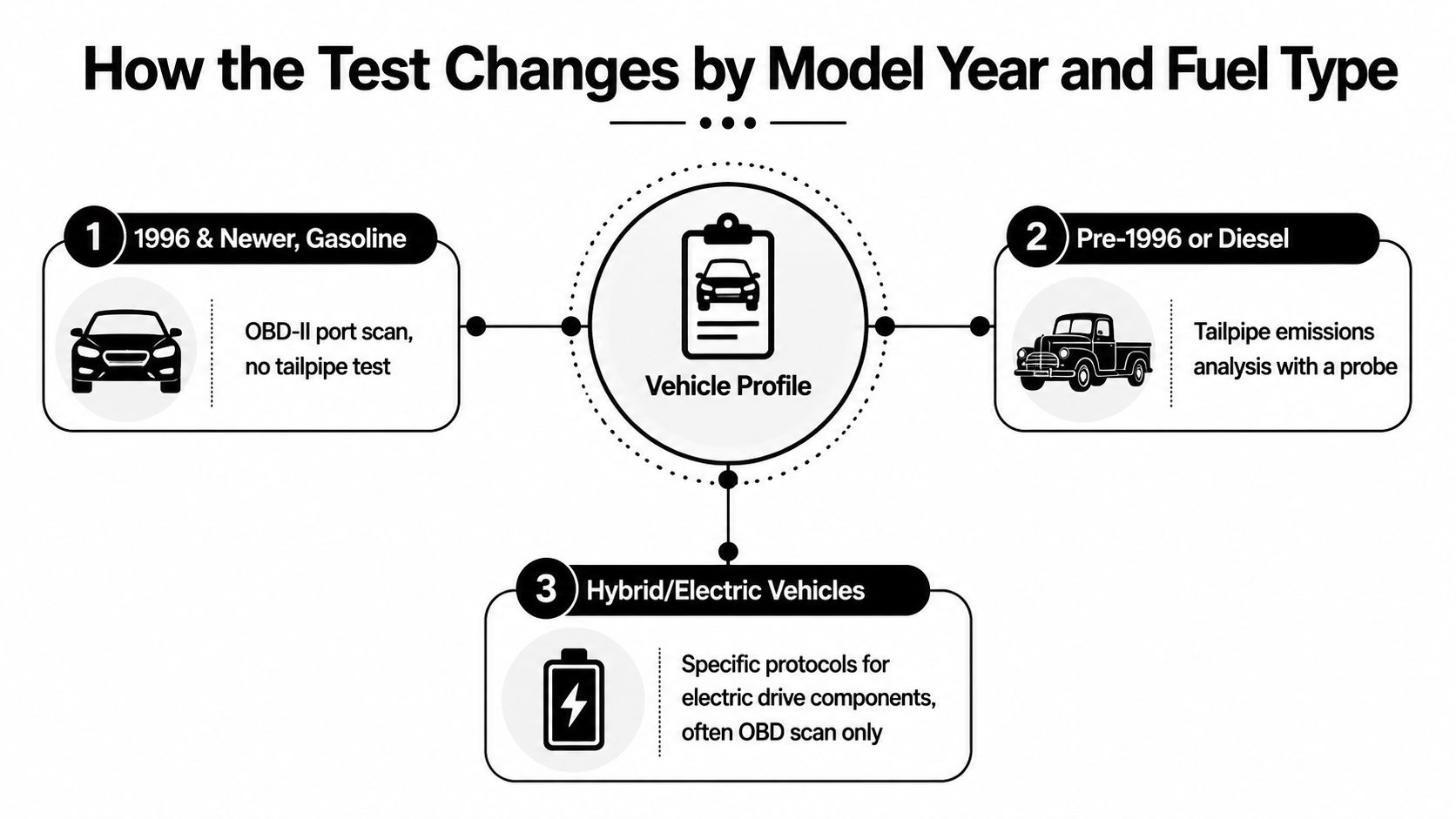
A newer gasoline car usually means a quick scan at the diagnostic port. Older cars can mean a probe in the tailpipe, rollers under the tires, and more time spent measuring emissions behavior under load. Diesel and hybrid paths follow their own compliance logic, so the station has to be ready for more than one kind of vehicle profile.
What you should expect physically
If your car is newer, the visit often feels simple, because the tech is mostly verifying electronic data. If your car is older, the inspection can look more old-school and mechanical, with more equipment involved around the exhaust and drivetrain.
That's why the best stations are built for range, not just speed. They need the equipment mix, the staffing, and the workflow discipline to handle very different vehicles without slowing the line.
If a shop only talks about “plugging in,” it's probably not thinking about the full vehicle range it's supposed to serve.
Step-by-Step From Booking to DMV Confirmation
A driver rolls in with a renewal notice in hand, the station checks the paperwork, and the first decision is already made. If the notice says STAR, choose a STAR station first. If it does not, make sure the shop can handle your exact vehicle type before you head over.
The actual sequence
- Check the DMV notice. Read the renewal paperwork for STAR language and any special instruction tied to your registration.
- Book the station. A scheduled visit cuts the wait and lets the shop set up the right bay. For local scheduling, use the Smog Check Appointment page.
- Bring the basics. Have your registration paperwork and a payment method ready.
- Watch the test run. The station performs the inspection in the bay and sends the result electronically.
- Wait for DMV confirmation. Once the result posts, the renewal process can continue without paper shuffling.
A standard emissions test usually takes 10 to 20 minutes once the car is in the bay, which is why station speed and bay setup matter as much as the inspection itself.
Where people lose time
The delay usually comes from the wrong station, a car that is not ready, or missing the STAR requirement already printed on the notice.
If the test passes, the station transmits the result and the DMV side moves. If it fails, you fix the cause before paying for another visit.
Preparing Your Car to Avoid a Surprising Failure
A lot of drivers fail smog because they assume “the car drives fine” means “the car is ready.” That's the wrong assumption.
Battery resets and readiness monitors
If your battery was recently disconnected or replaced, BAR advises driving the car for a week or two so the readiness monitors can reset. A car with a check-engine light on will not pass. BAR smog check guidance
That's the part people miss. The engine can feel normal, but the emissions system may still be incomplete in the state's eyes. Recent repairs can create the same problem if the readiness status hasn't settled yet.
Simple pre-test discipline
- Don't disconnect the battery right before the visit.
- Drive the car normally after recent battery work so monitors can reset.
- Fix the check-engine light first if it's on.
- Use a station that can explain the failure reason clearly if the car doesn't pass.
For a deeper look at failure causes, this local guide is useful: Smog Check Fail Reasons
The smart move is to treat the pre-test period like a readiness window, not a gamble. If the car just had work done, give it time. If the light is on, don't assume the scanner will be kind to you. It won't.
How to Choose the Right Station Near You
Stop choosing the nearest station automatically. That's how drivers waste time. Choose the station that matches the vehicle and the DMV requirement.
Your checklist should be short
- Confirm STAR status if the renewal notice requires it.
- Ask whether your vehicle type is covered, especially for older gasoline, diesel, or hybrid inspections.
- Check the posted turnaround time for your class of vehicle.
- Look for current pricing and any coupon offers before you leave home.
- Confirm hours and waiting setup so you're not stuck outside or missing a same-day window.
Practical rule: The cheapest station on the map isn't a deal if it can't accept your renewal paperwork.
If you're comparing shops, focus on three things, eligibility, turnaround, and result transmission. Everything else is secondary. A clean waiting room is nice, but a station that can't handle the DMV requirement is still the wrong stop.
Speedy Smog in San Leandro and What to Expect
Speedy Smog in San Leandro is a STAR Certified station at 15275 Washington Ave, with Monday through Saturday hours, an indoor waiting room, and service for drivers coming from San Leandro, Oakland, and nearby East Bay neighborhoods. It handles the vehicle mix you see around here, including newer cars, older vehicles, diesels, and hybrids.
For 2000-and-newer vehicles, the shop says inspections are usually completed in about 10 to 15 minutes, and it offers periodic $25-off coupons for most smog tests on newer vehicles. That lines up with what matters most in a real DMV visit, fast turnaround, clear pricing, and a station that can satisfy a STAR-required renewal when the notice calls for it.
If you want one example of how the whole system should feel in practice, this is it. The car goes in, the paperwork gets handled, and you leave with a result that's built for DMV acceptance, not just a quick look under the hood.
If you need a STAR certified smog check in the East Bay, visit Speedy Smog and book a visit that fits your renewal notice, your vehicle type, and your schedule. You'll get a station that understands DMV requirements, keeps the process moving, and helps you get back on the road without extra trips.