A California STAR smog test is the same emissions inspection, but it's done at a STAR Certified station that the Bureau of Automotive Repair routes certain vehicles to under higher-performance controls. In California's STAR framework, stations have to meet measurable thresholds, including a Similar Vehicle Failure Rate of at least 50% of the industry-wide rate for similar vehicles, an Excessive Test Deviation Rate no greater than one, and each inspector must maintain a Follow-up Pass Rate of at least 0.40.
You're usually looking at that sticker on the station door because a renewal notice, a registration hold, or a previous test result pointed you there. That's where the confusion starts for a lot of drivers, because the test itself often feels familiar, but the routing rule behind it is what changes.
Table of Contents
- What a STAR Smog Test Really Is
- How STAR Fits Inside the California Smog Check Program
- Which Vehicles Get Routed to a STAR Station
- What Happens During a STAR Smog Test
- How to Prepare Before You Arrive
- Common Reasons Vehicles Fail and How to Recover
- Cost, Timing, and the DMV Renewal Connection
- Choosing a STAR Station in the East Bay
What a STAR Smog Test Really Is
A lot of drivers first see the word STAR when a DMV renewal notice says the vehicle needs a smog check. The next stop is usually a station window with a STAR sticker, and the immediate question is simple, “Is this a different kind of emissions test?”
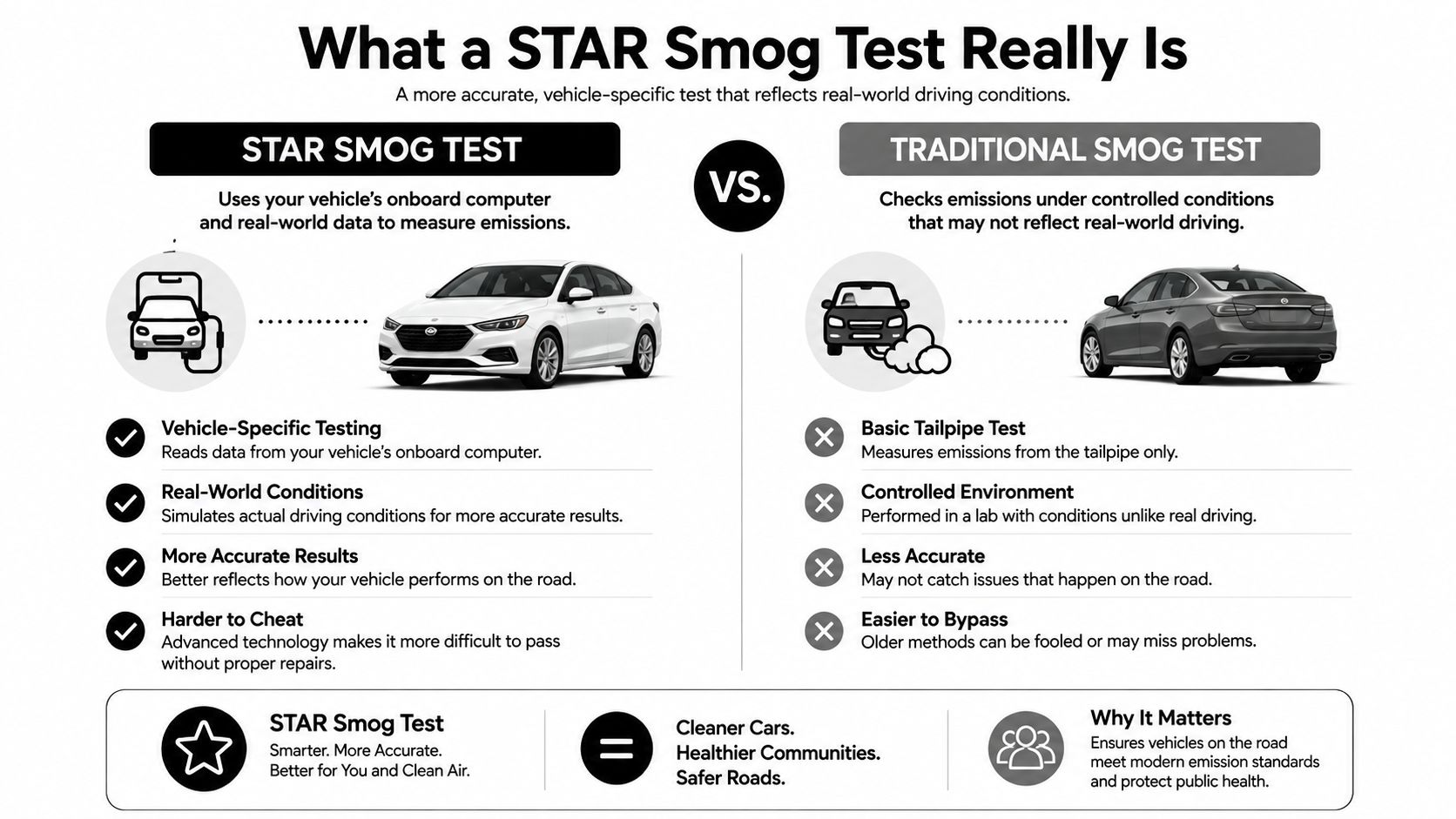
The short answer is no. A California STAR smog test is the regular smog inspection performed at a station that has been selected for stronger performance controls, not a separate emissions standard for the car itself. California's STAR designation is built on measurable compliance and quality checks, not branding or convenience, and the state uses it to steer higher-risk inspections to stations that can handle them reliably California STAR certification rules.
Practical rule: the car isn't “STAR-approved,” the station is.
A regular smog station can inspect many vehicles, but a STAR station has to keep proving it can do the job with tighter oversight. California's BAR also says STAR stations must keep certified inspection equipment and stay within a 10-calendar-day calibration window for calibration-capable equipment, which helps reduce measurement drift BAR STAR certification.
| Requirement | STAR Station | Regular Smog Station |
|---|---|---|
| Program role | Handles vehicles BAR routes for higher-performance oversight | Handles standard smog inspections |
| Station selection | Chosen through measurable compliance and quality controls | Approved as a smog station, but not held to STAR routing metrics |
| Equipment control | Certified equipment and calibration controls are closely monitored | Standard inspection equipment requirements apply |
| Driver experience | Same basic inspection, but at a station with tighter program oversight | Same basic inspection at a normal station |
For a plain-language explainer, see this STAR station overview.
If you need one sentence to keep in your head, use this: a STAR smog test is a California smog check performed at a higher-performance station that the state uses for targeted enforcement and quality control.
How STAR Fits Inside the California Smog Check Program
California's Smog Check program is broad, and the STAR layer sits inside it as a quality filter. State and federal materials describe a network of more than 5,000 independently owned stations and more than 10 million vehicles tested each year, while an OECD/ITF presentation summarizing the program described about 22 million vehicles, roughly 11 million initial inspections per year, about 7,000 smog check stations, and 21,000 inspectors/technicians California Smog Check program summary.
That scale matters because California is not running a small inspection lane. It is running a statewide system that has to separate ordinary, low-risk inspections from the ones where fraud, weak technique, or uneven quality control would cause more damage.
Why the state uses tiers
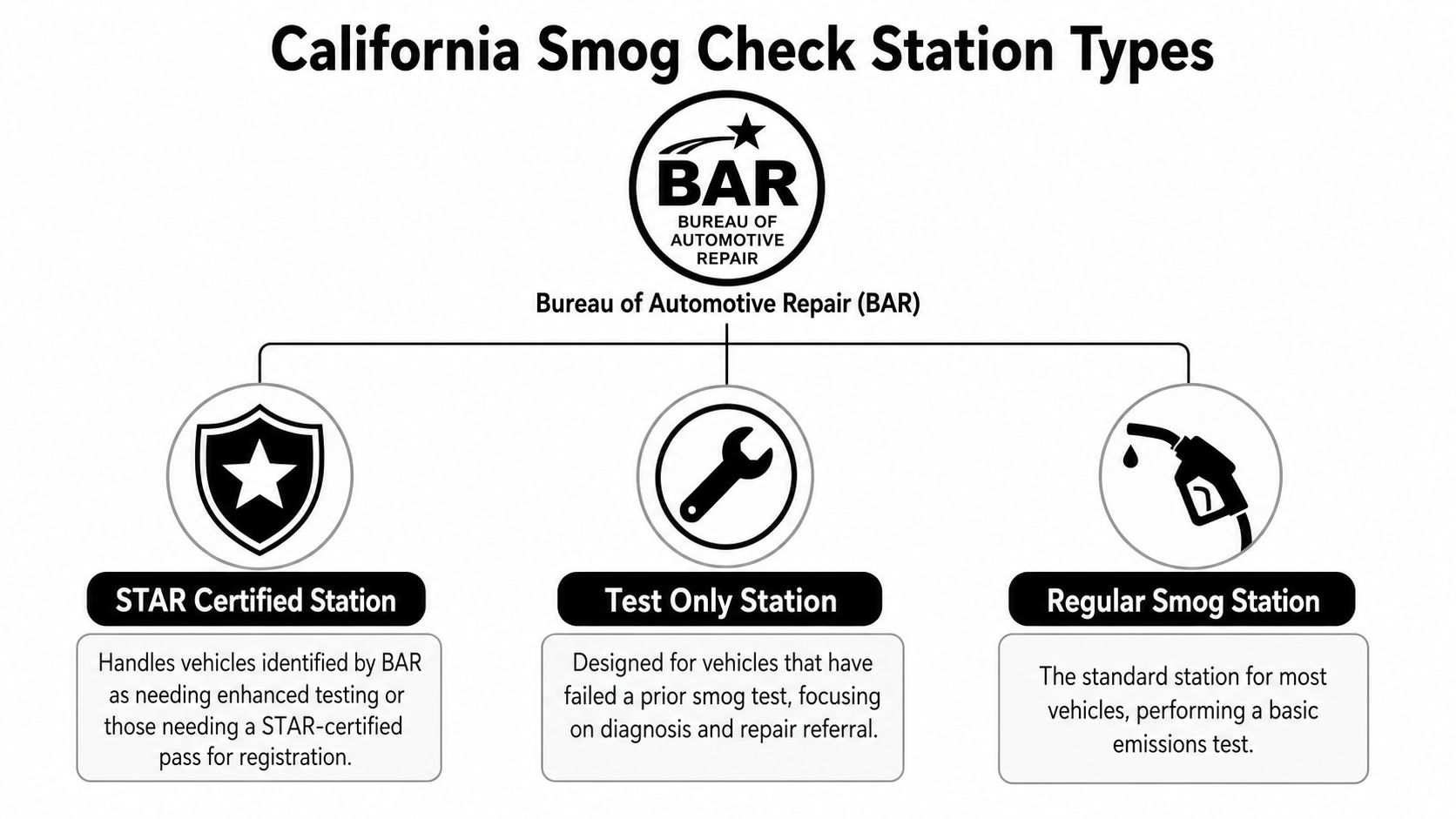
The structure works like a school system with different levels of oversight. Regular smog stations handle the general flow of inspections, Test Only stations handle vehicles that need a more focused inspection path, and STAR stations sit at the top of the oversight stack for the vehicles the state wants watched most closely. BAR's STAR framework is performance-based, so a station earns the designation by meeting measurable standards rather than by buying a badge BAR STAR certification.
The policy logic is straightforward. California wants the vehicles and inspection situations with the highest compliance risk to go through stations that show stronger consistency. BAR's FAQ also makes clear that STAR routing is tied to vehicle profile, not just owner preference, and that STAR is about program targeting rather than a separate vehicle emissions class BAR STAR FAQ.
Why calibration and fraud control matter
The STAR layer also works as a fraud-control tool. California's BAR materials point to schemes like clean plugging on 2000+ vehicles, which means the state has reason to scrutinize OBD-based inspections more closely BAR STAR FAQ. That is why the program looks at station performance over time, not just whether a shop can display a certificate on the wall.
For most drivers, the takeaway is simple. The STAR label means the station is part of a tighter enforcement layer inside the larger Smog Check program, and that layer exists to protect program integrity, not to make the car itself subject to a different pollution rule.
Which Vehicles Get Routed to a STAR Station
Most drivers don't choose STAR on purpose. BAR routes certain vehicles there because the system is trying to place more oversight where the program sees more risk. That means the question isn't “Is my car suspicious?” It's “Does my vehicle profile trigger a STAR designation?”
The important part is that routing is risk-based, not a judgment about whether your car is about to fail. A STAR requirement can show up because of the vehicle's profile, past compliance signals, or other program logic, and BAR says the vehicle can be directed to STAR based on profile rather than owner preference BAR STAR FAQ.
Common reasons a vehicle gets sent there
The state doesn't publish a simple one-size-fits-all consumer formula, but the practical triggers usually fit a few buckets:
- Vehicle profile signals. BAR can route a vehicle based on the profile it sees in the program, not just because it's old or because the driver assumes it looks problematic BAR STAR FAQ.
- History in the program. Vehicles with prior compliance issues, repeat testing friction, or other directed notices are more likely to be handled through the tighter lane.
- Testing risk factors. The state pays closer attention where cheating has historically been more common, especially around OBD-based inspections on newer vehicles BAR STAR FAQ.
- Owner-directed or renewal-driven routing. Sometimes the DMV notice itself is what tells you the vehicle must go to a STAR station.
A STAR requirement doesn't automatically mean the car is a high emitter. It can mean the state wants a stronger inspection path for that vehicle category.
That's the part many drivers miss. A STAR notice is not a diagnosis. It's a routing decision.
If your renewal notice mentions STAR, don't treat it like an optional upgrade or a shop recommendation. Treat it like a lane assignment. Choosing a non-STAR station when STAR is required can waste the trip, and the station may not be able to complete the certification you need for DMV processing.
What Happens During a STAR Smog Test
The STAR label changes the station tier, not the basic inspection logic. Once you pull in, the technician is still checking the vehicle's emissions-related systems, but the method depends on the model year and fuel type.
For most 2000 model-year and newer gasoline vehicles and 1998 model-year and newer diesel vehicles, California uses an OBD-focused test rather than a tailpipe dynamometer test California inspection method rules. For 1976 to 1999 vehicles, the inspection generally uses loaded-mode or two-speed idle methods that directly measure exhaust pollutants such as HC, CO, CO2, and NOx.
What the technician touches
For a newer vehicle, the technician usually plugs into the diagnostic port and checks the onboard computer. BAR's readiness-monitor guidance explains that OBD II stores diagnostic trouble codes, tracks emissions self-tests, and shows whether the monitors are ready BAR readiness monitor guidance. The test often works more like a computer health check than a tailpipe sniff.
For older vehicles, the process shifts back toward direct exhaust measurement. That is where the tailpipe probe comes in, and where mechanical condition can show up in the results more plainly.
A visual inspection still happens either way. The technician checks that required emissions parts are present, that nothing obvious has been tampered with, and that the vehicle can be evaluated safely and correctly. If the vehicle passes, the result is electronically reported for DMV registration processing. If you want a plain-language walkthrough before your visit, this STAR smog test prep guide helps explain the same sequence from a driver's point of view.
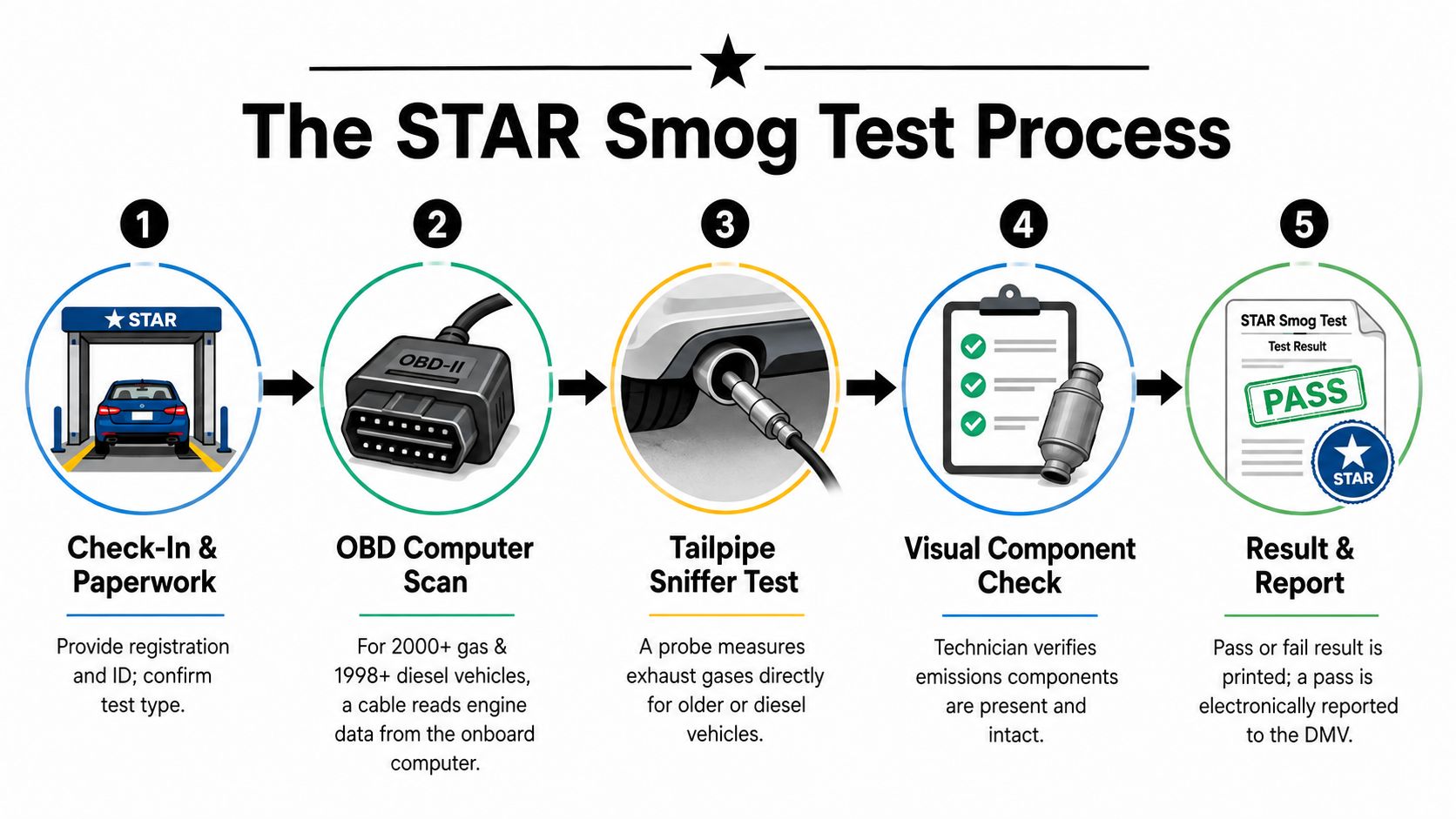
A normal visit usually does not take long. BAR says the inspection usually takes about 30 minutes BAR smog check page, though the exact time depends on the vehicle and whether the technician finds a problem that needs more checking.
How to Prepare Before You Arrive
The easiest smog failures are the ones a driver could've avoided the day before. That usually means the vehicle wasn't physically broken, but it wasn't ready for the inspection logic the state uses.
Start with the check engine light and readiness
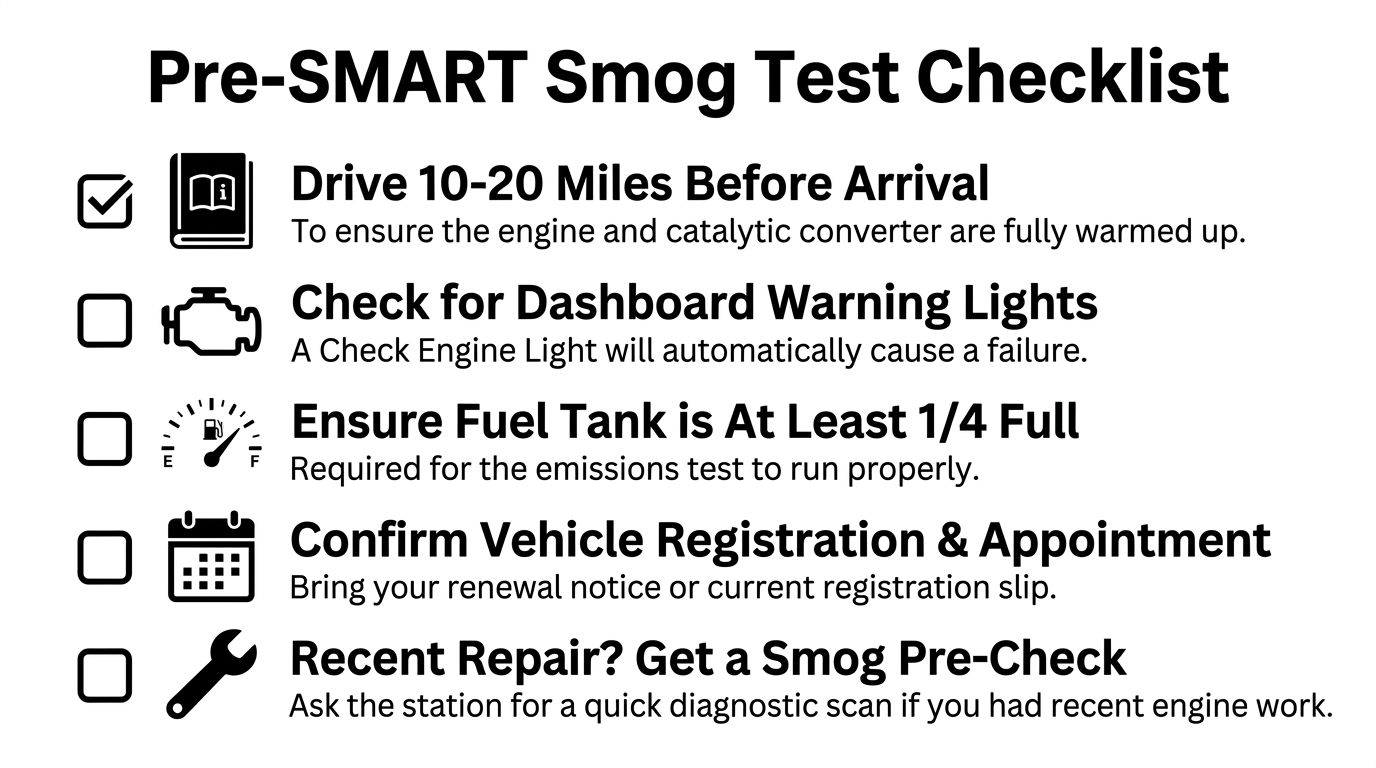
BAR says a vehicle can fail if the check engine light is on, and readiness monitors may need time after a battery change or repair before they're set BAR smog check page. Think of those monitors like a pre-flight checklist. If the computer hasn't finished its checks, the inspector can't treat the vehicle as ready.
A few practical habits help:
- Drive normally for a while first. Mixed city and highway driving gives the monitors a chance to complete their self-tests.
- Avoid battery disconnects right before the test. BAR notes that recently disconnected or replaced batteries may need one to two weeks of driving for readiness monitors to reset BAR smog check page.
- Don't test with a warning light on. If the MIL is lit, schedule the inspection later, after the cause is fixed and the system stays off.
- Bring the paperwork. Renewal notice, registration, and payment are the basic items you'll want ready.
Practical rule: if you've had battery work, engine work, or a software update, wait until the car has gone through enough normal driving for the monitors to settle.
Use a simple readiness checklist
Fuel level matters too. A tank that's not too low or too full helps the test run smoothly, and many drivers prefer to keep it in the middle range. If you've recently had repairs, a quick pre-check at the station can save a wasted trip, especially for vehicles with OBD-based inspections.
For a practical checklist and prep flow, see this STAR test prep guide.
The best preparation is boring preparation. No warning lights, no last-minute battery swap, no surprise software change, and enough normal driving time for the monitors to say the car is ready.
Common Reasons Vehicles Fail and How to Recover
A failed STAR test usually points to one of three problems. The car's computer may not be ready, the emissions numbers may be out of range, or the vehicle may miss a visual or procedure requirement.
OBD failures are the most common headache on newer cars
For 2000-and-newer gasoline vehicles and 1998-and-newer diesels, the inspection relies heavily on the onboard computer, so a problem there can stop the test quickly California inspection method rules. A check engine light that is on, readiness monitors that have not finished, or stored diagnostic trouble codes are the usual causes.
The fix is usually mechanical, not administrative. A technician or repair shop needs to identify the code, correct the cause, and let the monitors complete their drive cycle again. If a battery was recently disconnected, the answer may be more normal driving time, but do not guess if the light stays on.
Tailpipe failures point to real engine or exhaust trouble
Older vehicles that are tested by tailpipe measurement can fail because their emissions readings are too high. That often points to ignition problems, fuel mixture issues, vacuum leaks, worn spark plugs, or a catalytic converter that is not doing its job. These failures are useful because they tell you the car has a real condition that needs attention, not just a paperwork issue.
Visual and procedural problems can stop a pass too
A missing gas cap, tampered emissions equipment, or an identification mismatch can create a fail even if the car runs fine. The STAR program also looks closely at fraud risk, including clean plugging concerns on newer vehicles, which is one reason visual and electronic checks matter so much BAR STAR FAQ.
A fail is a diagnosis, not a verdict.
Most drivers should ask the station what kind of fail it was. That tells you whether you need repair, more drive time, or a simple retest. If a shop offers a reduced-cost retest window, use it only after the underlying issue is addressed. For a sense of how shops may price the inspection itself, this California smog check price guide can help you compare before you go.
Cost, Timing, and the DMV Renewal Connection
A smog check usually answers three practical questions for a driver, how much it costs, how long it takes, and whether the result will clear the DMV renewal step without extra paperwork. The process is straightforward once you know how the pieces fit together.
California's historical program summary noted an average inspection cost of $48 in the baseline material California Smog Check program summary. STAR stations can price the inspection differently because they operate under a stricter certification layer, but the certificate still serves the same DMV registration purpose.
What happens after the test
For most renewals, the inspection result is sent electronically to the DMV. That means you usually do not mail in a paper certificate yourself, because the shop's report becomes part of the registration workflow. The BAR says the inspection usually takes about 30 minutes BAR smog check page, although an OBD check can feel much quicker when the vehicle is already ready.
California smog checks are tied to the registration cycle, and many vehicles need the test on a repeating schedule. For a lot of drivers, the smog fee is only one part of the DMV bill, so it helps to separate the inspection cost from registration fees before you arrive.
If you want a plain comparison point before you book, this California smog check pricing overview can help frame the conversation.
The practical move is to test early enough that a repair, retest, or extra drive cycle does not slow down your renewal. That keeps the smog certificate and the DMV deadline working together instead of getting in each other's way.
Choosing a STAR Station in the East Bay
A good STAR station should feel orderly before the car ever enters the bay. Look for posted STAR certification, clear pricing, a clean waiting area, and a staff that can explain whether your vehicle is being tested as an OBD car, an older tailpipe car, or a diesel with different requirements.
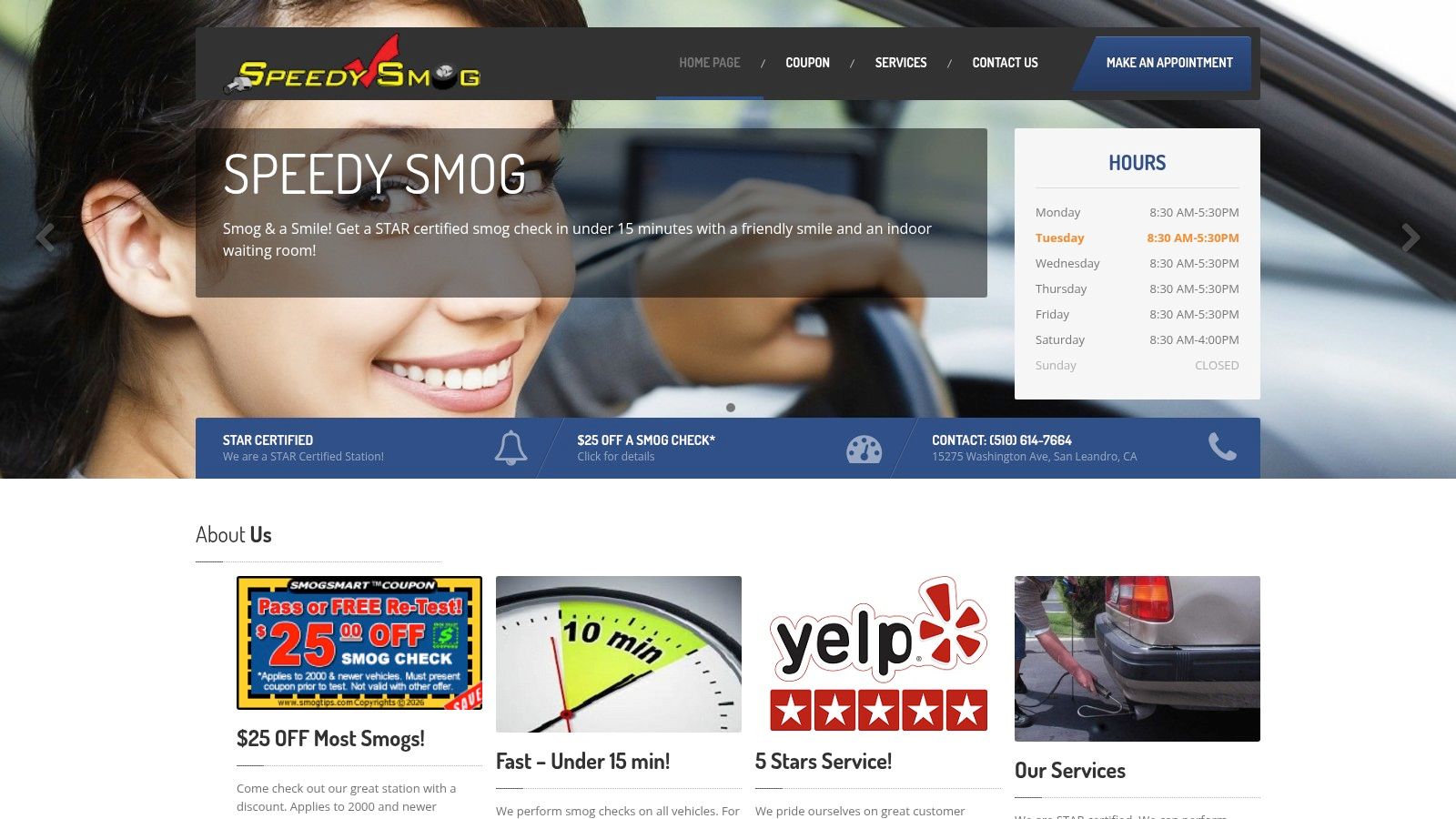
For East Bay drivers, one practical option is Speedy Smog at 15275 Washington Ave in San Leandro. It's a STAR Certified station, it handles a wide range of vehicle types, and it's set up for quick turnarounds on newer vehicles, with typical tests for 2000+ models completed in about 10 to 15 minutes, according to the shop's published service information.
The right station isn't just about speed. It's about not wasting a trip when your vehicle has readiness issues, a warning light, or a routing requirement that needs a STAR-certified result. If you're in San Leandro, Oakland, Alameda, or Hayward, a station that works cleanly and explains the process plainly can save a lot of back-and-forth.
If your renewal notice points you to a STAR smog test, bring the paperwork, make sure the car is ready, and choose a station that can complete the inspection you need. If you're in the East Bay and want a straightforward visit, Speedy Smog can help with STAR inspections, newer OBD-based vehicles, and older or diesel models, so you can get certified and move on with your day.

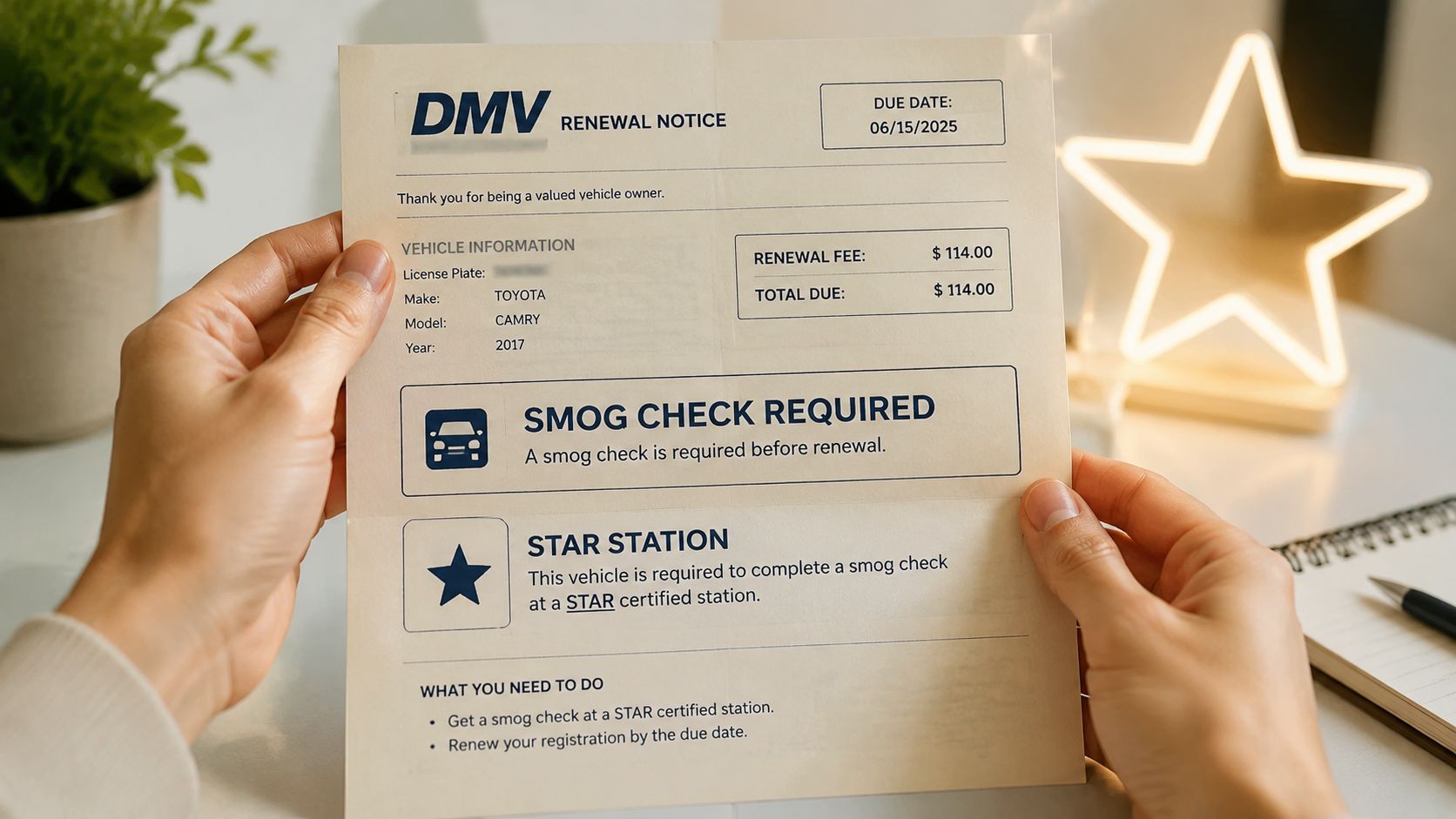
Your renewal notice shows up, you open it, and there it is: smog check required at a STAR station. Most drivers immediately do what you'd expect. They search for a STAR station smog check coupon near me, click a few coupon pages, and assume any place with “STAR” in the name or ad will work.
That's where people waste time.
The key rule is simple: STAR isn't a brand you shop for like a chain restaurant coupon. It's a certification tied to station performance, and your vehicle's requirement matters more than the ad headline. If you understand that one point before you leave home, you can avoid the classic bad trip: driving across town with a coupon that doesn't apply to your car, your model year, or your STAR requirement.
Table of Contents
- Your DMV Notice Arrived Decoding the STAR Smog Check Requirement
- Finding and Vetting Smog Check Coupons for STAR Stations
- Reading the Fine Print Is Your Vehicle Eligible for a Coupon
- Your Pre-Test Checklist for a First-Time Pass
- Redeeming Your Coupon and What to Expect at the Smog Station
Your DMV Notice Arrived Decoding the STAR Smog Check Requirement
A lot of confusion starts with the DMV wording. Drivers see “STAR station required” and think they need to find some special national brand that offers a matching discount. That isn't how California's system works.
According to California service information on BAR-related services, STAR certification is a Bureau of Automotive Repair assignment based on station performance, not a permanent retail brand you can search for to guarantee a coupon. That one detail explains why so many coupon searches go sideways.
What STAR actually means
A STAR station is a station that meets higher performance standards. California uses the program to direct some vehicles to stations that have stronger testing accuracy and lower failure rates than non-STAR stations. So if your notice says STAR, the safe move is to confirm the station is currently STAR certified and that it can test your specific vehicle type.
If you want a plain-English explanation of the designation itself, this overview of what a smog STAR station is lays it out clearly.
Practical rule: Read your DMV notice first, then look for a coupon. Don't do it in reverse.
Why the misunderstanding costs money
Here's the usual problem. A driver finds a “STAR smog coupon,” assumes that label alone is enough, and heads out. Then one of three things happens:
- The station isn't the right fit for the vehicle on the notice.
- The coupon applies only to certain model years.
- The advertised price leaves out vehicle-type exclusions.
That's why the search phrase STAR station smog check coupon near me is only useful if you treat “near me” as the second filter, not the first. The first filter is whether your notice requires a STAR station and whether the station can process your vehicle without any surprise conditions.
Finding and Vetting Smog Check Coupons for STAR Stations
The fastest way to find a usable coupon is to skip the broad coupon clutter and start with the shop itself. Third-party listing sites can be useful, but they often lead with the headline price and hide the limitations.
One useful fact to keep in mind: approximately 1.9% of vehicles in California are randomly selected for a STAR-certified smog check, and STAR stations are reserved for stronger testing accuracy and lower failure rates, according to this discussion summarizing the California STAR requirement. That means you're not looking at a marketing label. You're dealing with a compliance requirement.
Where to look first
Start with sources in this order:
The station's official website
You're most likely to see current terms, model-year limits, and whether the coupon is tied to STAR service there.The station's business listing pages
Yelp or map listings can help confirm location, hours, and whether the station still handles your vehicle type.Local mailers or neighborhood ads
These can work, but read every condition before you leave.
One local option drivers often check is Speedy Smog's San Francisco area coupon page. The point isn't to assume any one station is automatically right. It's to look for current terms on the station's own pages instead of relying on scraped coupon directories.
How to vet a coupon before you drive over
Use a short checklist:
- Confirm STAR status: If your DMV notice says STAR, the station must be STAR certified.
- Confirm vehicle fit: Ask whether they test your model year, diesel, hybrid, or truck.
- Confirm coupon limits: Look for phrases like “most vehicles,” “2000 and newer,” or “plus certificate fee.”
- Confirm what you need to bring: Some places accept a phone screen. Others may want the actual coupon shown at check-in.
A good coupon isn't the one with the biggest headline. It's the one that still applies when your keys are on the counter.
A quick video can also help if you want to see how a local shop presents the process:
What usually does not work
The least reliable move is searching for the cheapest advertised number and stopping there. Drivers do this all the time with the phrase STAR station smog check coupon near me, then show up and learn the deal was written for a narrower category of cars than the ad suggested.
That's why the smartest savings move isn't just “find a coupon.” It's find a coupon that survives contact with your actual vehicle.
Reading the Fine Print Is Your Vehicle Eligible for a Coupon
A common scenario for coupon frustration unfolds. The ad looks simple. The car in your driveway is not.
According to this STAR station coupon overview, many STAR coupon offers exclude older vehicles, diesels, or hybrids, and common advertised pricing often applies to 2000 and newer vehicles at $39.75 to $46.75 with coupons, while 1996 to 1999 models can jump to $76.75+. The same source notes that some listings mention $10 to $30 higher fees for certain vehicle types. If you drive an older car or a non-standard vehicle, that fine print matters more than the headline.
The three details to check first
The biggest pricing differences usually come from these factors:
| Vehicle Type | Typical Price w/ Coupon | Common Exclusions / Extra Fees |
|---|---|---|
| 2000 and newer | $39.75 to $46.75 | Often the main category targeted by advertised coupons |
| 1996 to 1999 | $76.75+ | Older vehicles often excluded from low headline pricing |
| Diesel, hybrid, some trucks | Varies | May have extra fees or require a station that handles that vehicle type |
Why coupon headlines can mislead
A coupon ad can be technically true and still be unhelpful. “Smog check coupon” sounds broad, but it may only apply to a narrow set of gas vehicles in a certain model-year range. If you drive a diesel or older car, the lowest advertised number may never have been available to you in the first place.
That doesn't mean the station is doing anything unusual. It means you need to treat smog coupons like airline fares. The first number you see is the starting point, not the guaranteed total.
Watch for this wording: “Most cars,” “test only,” “plus fees,” and any model-year cutoff.
A better way to read an offer
When you're comparing shops, ask these questions in plain language:
- Does this coupon apply to my exact model year?
- Do you test diesels, hybrids, or older vehicles?
- Are there extra charges not shown in the ad?
- Does this work for STAR-required vehicles?
That two-minute call saves more hassle than any broad coupon search. It also keeps you from making a pointless trip with a discount that disappears at the counter.
Your Pre-Test Checklist for a First-Time Pass
Saving money on the coupon is only half the job. The bigger savings often come from avoiding an avoidable fail.
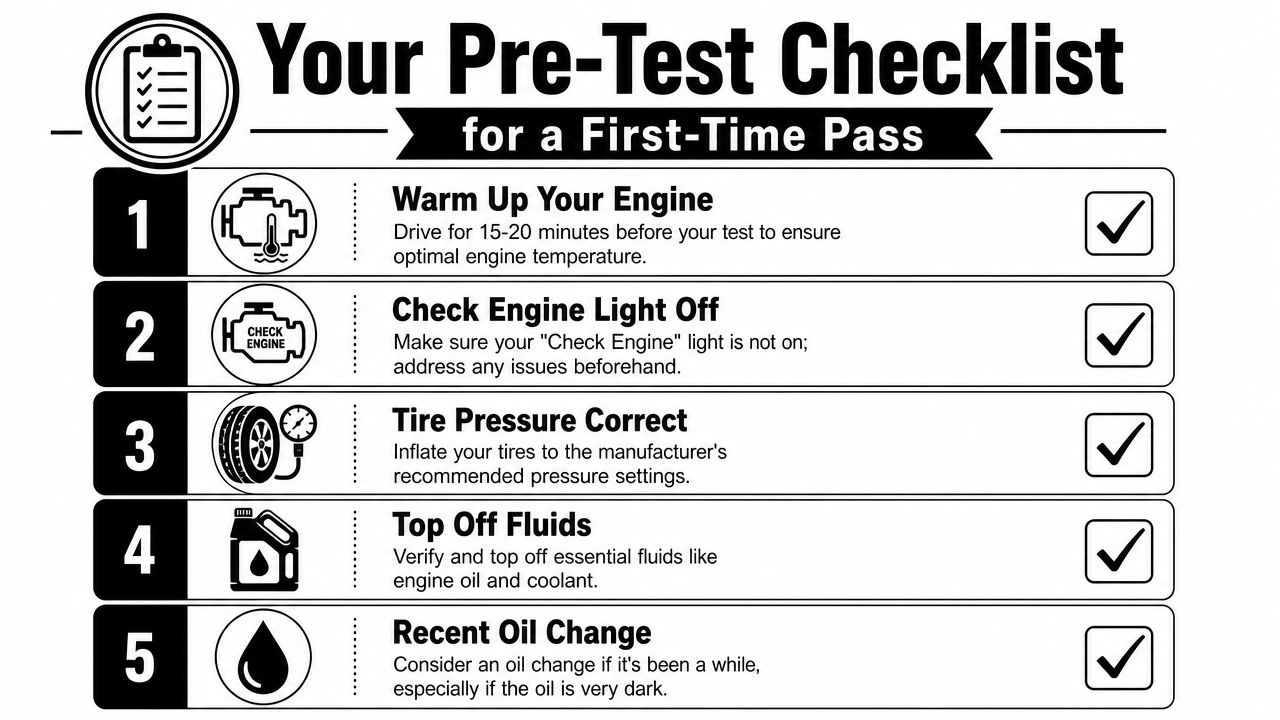
A few basic checks make a real difference before you head to the station. According to the STAR Smog Center FAQ, an illuminated Check Engine or Service Engine Soon light causes an immediate failure, and a loose or damaged fuel cap can also cause failure because of evaporative emissions leaks. The same source recommends driving the car for 15 to 20 minutes before the test so the engine reaches proper operating temperature.
The short checklist that actually matters
Before leaving home, look at these first:
- Check the dashboard: If the Check Engine light is on, deal with that before paying for a test.
- Tighten the gas cap: If it's loose, cracked, or damaged, fix that first.
- Drive the car before the appointment: A short freeway or city drive helps bring the engine up to temperature.
- Open the hood and do a quick visual check: Look for anything obviously disconnected or damaged.
If you want a station-specific prep guide, this page on how to pass a STAR smog test is a useful reference.
Why a warm engine helps
A cold car can give you a rough start to the test process. When the engine reaches normal operating temperature, the emissions system is working under the conditions it was designed for. That's why a quick drive before the test is one of the easiest habits to adopt.
This isn't about gaming the system. It's about showing up with the vehicle in normal running condition instead of rolling in after a short cold start from your driveway.
If you live close to the station, don't leave the house and go straight into the bay. Give the car a real drive first.
Things drivers overlook
Some failures have nothing to do with dramatic engine trouble. People forget the simple stuff.
- A warning light they planned to “deal with later”
- A gas cap that clicks loosely
- A car that's been sitting and hasn't fully warmed up
- Visible under-hood issues they never noticed
A pre-test routine doesn't need to be technical. It just needs to be consistent. If the light is off, the gas cap is tight, and the engine is warm, you've already avoided several common reasons a routine smog visit turns into a repeat visit.
Redeeming Your Coupon and What to Expect at the Smog Station
Once you've found a valid offer and confirmed your vehicle qualifies, the visit itself is usually straightforward. The mistake drivers make here is overcomplicating the final step.
Bring the basics. Have your DMV notice, know whether the coupon is on your phone or printed, and be ready to tell the staff your vehicle year and fuel type if they ask. If the coupon has terms, show it before the test starts, not after the paperwork is already in motion.
What check-in usually looks like
At the counter, the station will typically verify your vehicle information and confirm the type of test required. If your notice says STAR, that's the first thing they need to know. If your car is older, diesel, or hybrid, mention that up front so there's no mismatch between the quoted offer and the actual test.
Some drivers prefer appointments because they want the trip done in one shot. Others are fine with a walk-in if the station handles volume well. Either way, the smoother experience usually comes from calling ahead and confirming two things: your coupon applies and your vehicle type is accepted.
What happens during the visit
A normal smog appointment is mostly a waiting game from the customer side. The station handles the inspection, and you wait in the lobby or designated area until the test is complete. If anything was unclear in the coupon, this is exactly when surprise charges or exclusions tend to show up, which is why the earlier verification matters.
Bring the coupon, mention it early, and say your model year out loud before the inspection begins.
If your vehicle passes, the station sends the certificate electronically to the DMV. That's the end result most drivers care about. You want the inspection completed, recorded properly, and accepted for registration without needing a second trip.
What works better than chasing the absolute lowest ad
The practical goal isn't finding the cheapest-looking number online. It's finding the lowest hassle total cost. That usually means:
- A station that handles your exact vehicle
- A coupon that clearly matches your model year
- A smooth check-in with no argument about the offer
- A vehicle that was prepared before arrival
That's how you turn a search for a STAR station smog check coupon near me into an actual time-saving, money-saving errand instead of a half-day problem.
If you need a local STAR-certified option in San Leandro, Speedy Smog handles DMV smog checks for a range of vehicle types and posts coupon information online. Before you go, confirm your vehicle category, bring your DMV notice, and make sure the coupon terms match your car so the visit stays simple.
You open your registration notice, skim past the usual DMV language, and then see the line that makes a lot of California drivers stop cold: Smog Certification Required at a STAR Station.
If you're new to this, that wording feels more confusing than helpful. You might be wondering if your car has a problem, whether a regular smog shop can still help, or why the state suddenly cares which station you use.
The good news is that this is manageable once the jargon gets translated into normal language. A STAR station is a smog shop that meets a higher BAR standard for certain vehicles. What matters to you is knowing whether your car needs one, what the visit will look like, what you'll pay for, and how to avoid wasting a trip.
Table of Contents
- That DMV Notice Just Arrived What Now
- What Is a STAR Certified Smog Station
- STAR Station vs Regular Smog Check What Is Different
- Do You Need a STAR Smog Check in 2026
- The Process at a STAR Station Time Price and Tips
- Your Local STAR Station Speedy Smog in San Leandro
- How to Prepare Your Vehicle for a Smog Check
- STAR Smog Checks and the DMV Your Questions Answered
That DMV Notice Just Arrived What Now
Start with the exact wording on your notice. If it says your vehicle needs a STAR station, follow that instruction exactly. A regular smog station may not be able to complete the certification the DMV wants for that vehicle.
This doesn't automatically mean your car is failing or that something is seriously wrong. California sends some vehicles to STAR stations because the state wants a more closely controlled inspection for cars that are directed, higher-emission, or considered higher risk.
Practical rule: If your DMV paperwork says STAR, don't guess. Book with a STAR-certified shop and bring the vehicle in warm and ready.
A lot of first-time drivers get tripped up because they think “smog check” is one single category. It isn't. There's the general smog requirement, and then there's the separate question of which kind of station the DMV will accept for your vehicle.
Once you separate those two ideas, the process gets much easier.
What Is a STAR Certified Smog Station
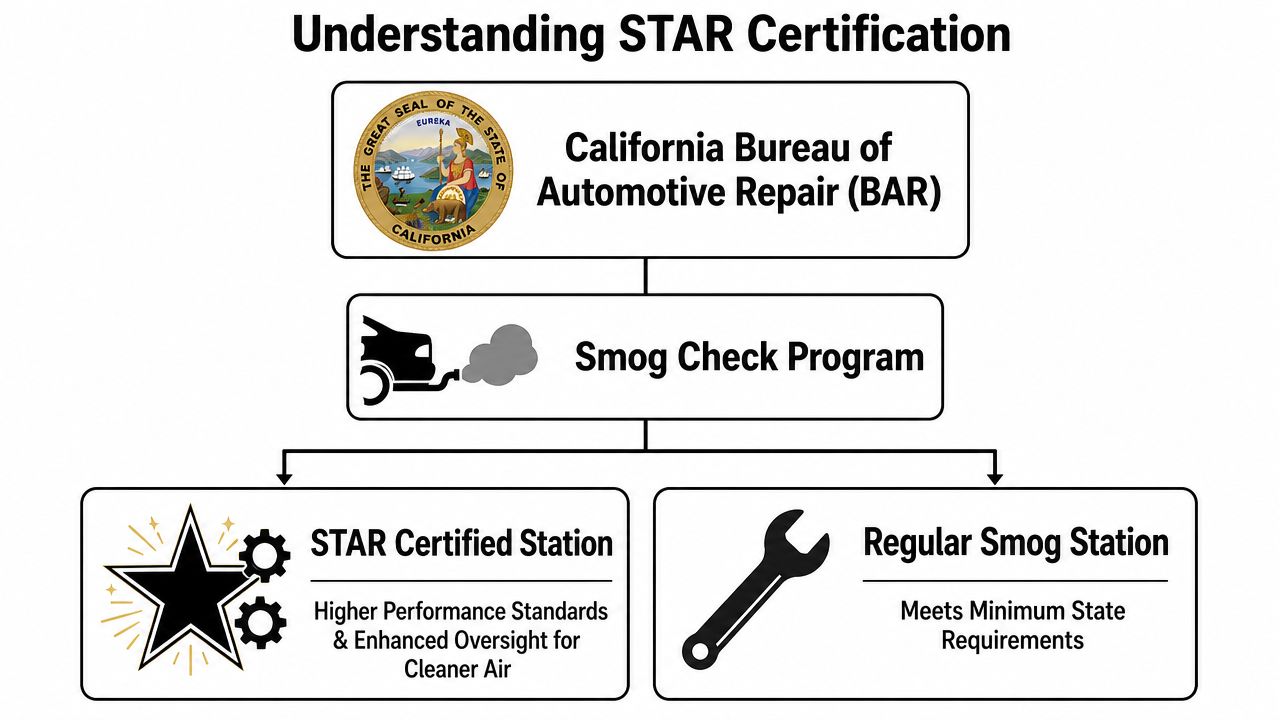
A STAR-certified smog station is a smog shop that has to meet stricter performance standards set by California's Bureau of Automotive Repair. The easiest way to understand it is to picture two licensed shops doing the same kind of test, but one is held to tighter accuracy rules and closer monitoring.
A regular station can handle many routine smog checks. A STAR station is the type the state relies on for certain vehicles that need a more closely controlled inspection.
Why California uses STAR stations
California uses STAR stations to improve inspection accuracy for directed vehicles and other cars the state considers higher risk in the smog check system. The STAR label means the shop is being measured against higher BAR performance standards, not just that it offers smog checks.
That part confuses a lot of drivers. They see the word "certified" and assume every smog shop is basically the same with different branding. In practice, STAR is a separate classification. If your DMV notice asks for STAR, the state is asking for the inspection to come from that higher-standard category of station.
What this means when you walk into a shop
For you, the practical issue is acceptance. The DMV wants the result from the right kind of station, submitted the right way, so your registration can move forward without extra hassle.
The cost also has two parts, and DMV sites do not always explain that clearly. There is the shop's testing charge, which can vary by location, vehicle type, and whether your car is unusually difficult to test. Then there is the state certificate fee on a passing test, which is a fixed pass-through amount. A local STAR shop like Speedy Smog can explain that split up front, which helps you compare prices without mixing the shop fee and the state fee together.
Here is the plain-English version:
- STAR is a station classification: It tells you the shop meets stricter BAR performance requirements.
- Your DMV notice controls what you need: If it says STAR, use a STAR-certified station.
- The total price is not one single number: Part is the shop's fee, and part is the state's certificate charge on a passing inspection.
A good way to look at it is this. The smog check is the test, and the STAR label is the state's way of approving who can give that test for certain vehicles. That is why choosing the right station matters before anyone even plugs into your car.
STAR Station vs Regular Smog Check What Is Different
Drivers often ask the most important question in the bluntest possible way: “Isn't it just the same smog test?” In day-to-day experience, some parts feel similar. But the state treats STAR stations differently because of the added controls around accuracy and fraud prevention.
Side by side comparison
| Feature | STAR Certified Station | Regular Smog Station |
|---|---|---|
| Certification level | Meets higher BAR performance standards | Meets standard state requirements |
| Who it can test | Can inspect vehicles directed to STAR and other eligible vehicles | Can test non-directed vehicles |
| DMV-directed vehicles | Accepted when the notice specifically requires STAR | Often not accepted for STAR-directed vehicles |
| Oversight focus | Higher-performance inspection program | Standard program requirements |
| Fraud prevention | Includes added verification steps | Does not include the same added anti-fraud layer |
The anti-fraud difference matters
One of the biggest practical differences is behind the scenes. STAR inspections include anti-fraud measures such as photographing the vehicle and verifying the Engine Control Unit VIN against the paperwork. The referenced discussion also notes BAR enforcement data from 2025 showing 12% of flagged emission fraud cases involved spoofed vehicles at non-STAR stations, which supports why the state leans on STAR inspections for stronger fraud prevention, as described in this California smog discussion.
That may sound technical, but the reason is simple. The state wants to make sure the car being tested is the same car tied to the registration and emissions data.
What drivers usually notice
You may not see a dramatic difference while you wait. The shop still checks the vehicle, runs the required inspection steps, and submits the result. But if your vehicle has been singled out by the DMV, the STAR station is the one built for that level of verification.
That's why a regular station and a STAR-certified smog station are not interchangeable for every driver.
Do You Need a STAR Smog Check in 2026
Your renewal notice shows up, you open it at the kitchen counter, and one question jumps out right away. Do you need a regular smog check, or does the DMV want a STAR station?
Start with the notice in your hand. That is usually the fastest and most reliable answer.
If your DMV renewal paperwork says STAR, go to a STAR-certified station. Treat that line like a prescription on a work order. If the paperwork calls for a specific type of inspection, using the wrong shop first usually just costs you time.
A lot of California drivers get hung up on two separate questions that sound similar:
- Do I need a smog check at all?
- If I do, does it have to be done at a STAR station?
Those are connected, but they are not the same thing.
The quickest way to tell
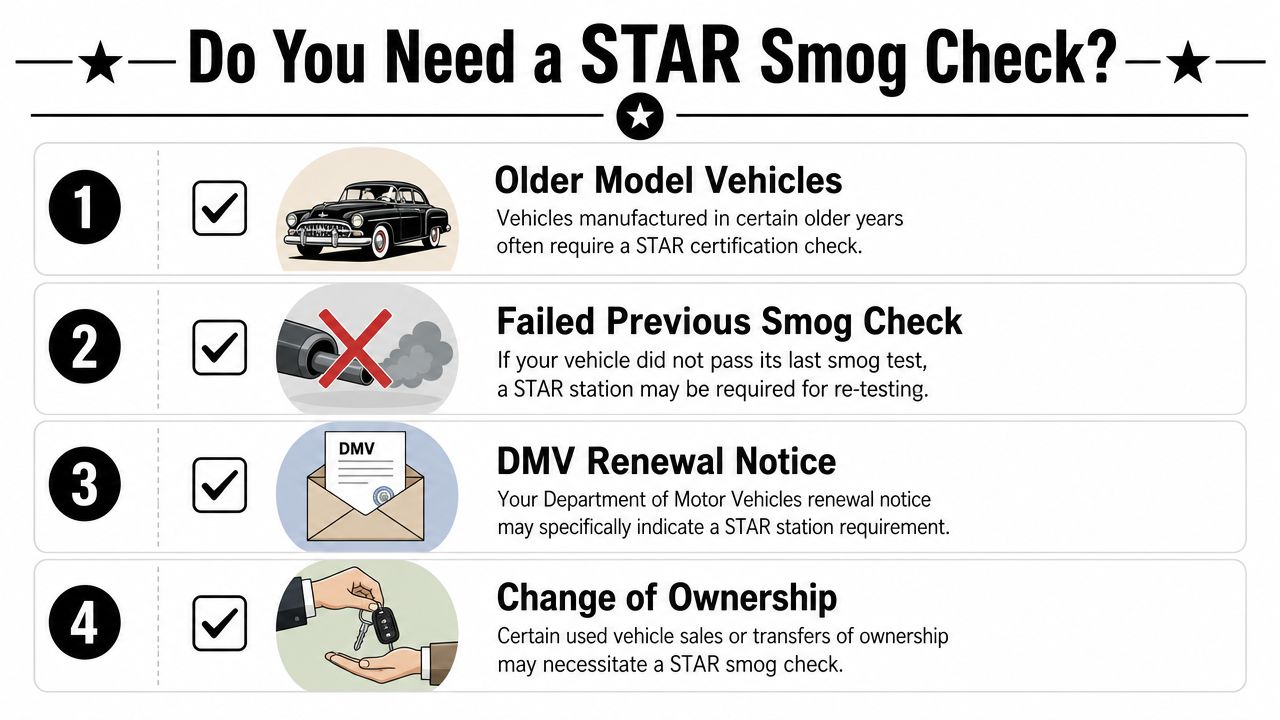
You likely need a STAR smog check in 2026 if one of these applies:
- Your DMV notice specifically says STAR. This is the clearest sign.
- Your vehicle was directed into the STAR program. The state does this for some vehicles it wants inspected under tighter program rules.
- You had trouble on a previous smog inspection. A past failure can lead to a STAR requirement on a later test cycle.
- You want to avoid a registration holdup. If the DMV asked for STAR, a regular station may not be able to give you the result your renewal needs.
Here is the practical version. If your notice is silent about STAR, a regular licensed smog station may be fine if your vehicle otherwise needs testing. If your notice calls out STAR, do not guess.
The part the DMV notice does not explain well
Many drivers assume STAR means their car is in terrible shape. That is not always true. Sometimes it means the vehicle was selected for a stricter inspection path.
It works a lot like being sent to a specialist instead of a general shop. The car may be perfectly fine. The state just wants that inspection handled at a station that meets STAR program standards.
That distinction helps calm a lot of unnecessary worry.
General smog rules still matter
Separate from the STAR question, California has regular smog-check timing rules based on the vehicle and the situation. Renewal, ownership transfer, and some registration changes can all trigger testing requirements. If you want a plain-English breakdown of those basics, Speedy Smog's guide to California smog check rules is easier to read than most DMV paperwork.
That is where San Leandro drivers often save themselves a second trip. At a local station like Speedy Smog, the staff can usually tell from your notice whether you need a standard test or a STAR inspection before they get too far into the process. They can also flag simple issues, like bringing the wrong paperwork or showing up right after disconnecting the battery, that DMV sites rarely spell out clearly.
A couple of common mix-ups
Ownership transfers catch drivers off guard all the time. You may not be due for your usual renewal smog yet, but a sale or transfer can still require one.
Another common mistake is assuming every smog shop can handle every DMV instruction. They cannot. If your paperwork says STAR, trust the notice and book with a STAR-certified station the first time.
The Process at a STAR Station Time Price and Tips
You pull into a STAR station with your DMV notice in hand, and the main question is usually simple: how long is this going to take, and what will they do?
For many newer vehicles, the visit is fairly quick if the car is ready and there are no problems to sort out. A STAR inspection still follows a set process, though, so it helps to know what happens before you get to the counter.
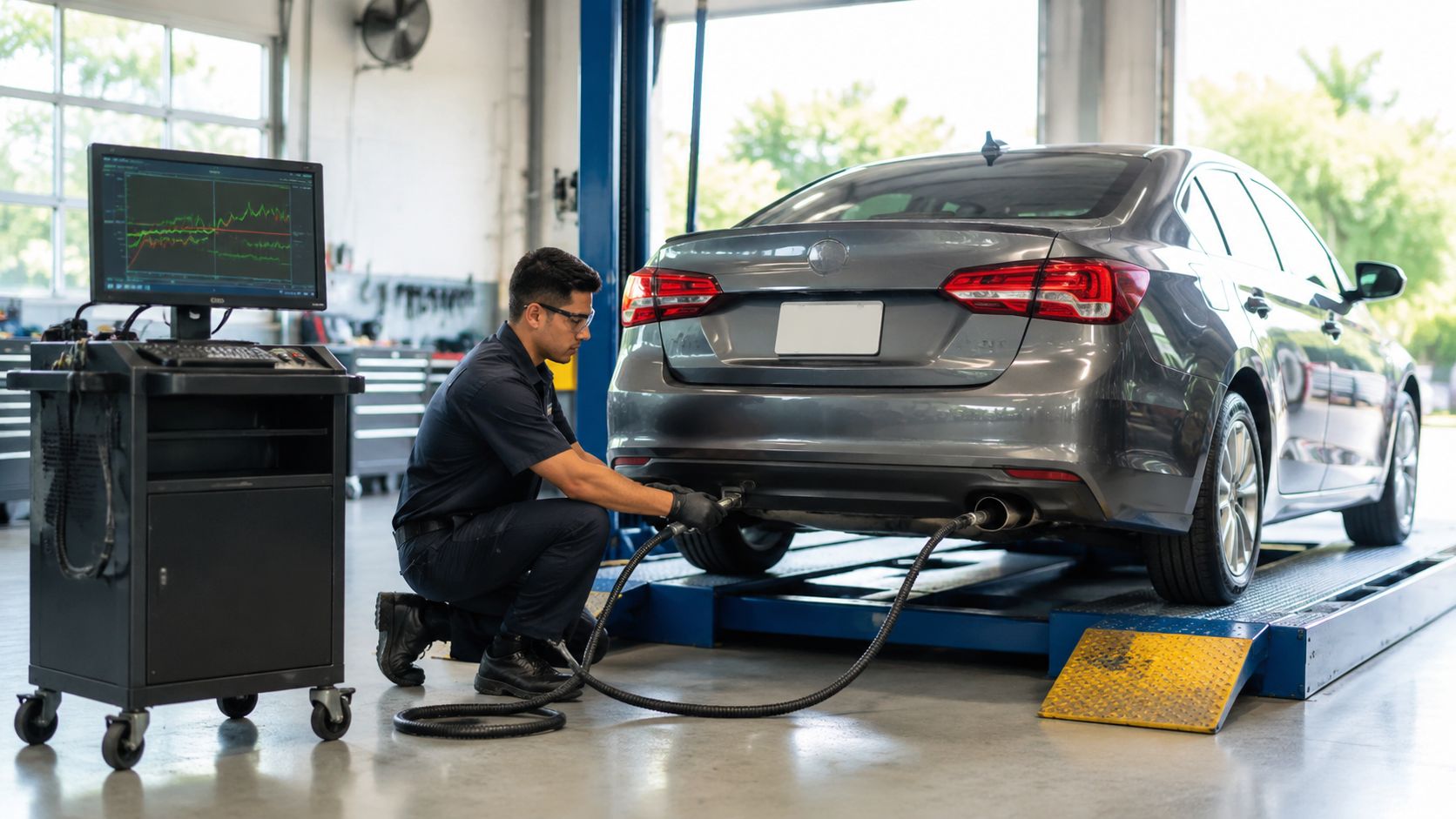
A smog check works a lot like a routine checkpoint. The technician is not guessing. They are confirming that your car's emissions system is present, working as expected, and reporting properly for that vehicle's year and type. At a local STAR station such as Speedy Smog, that usually means a check-in, a review of the vehicle information, the inspection itself, and electronic submission if the vehicle passes.
What happens during the visit
The exact steps depend on the car, but the driver's side of the process is usually straightforward:
- Check in with your registration or DMV notice if you have it: That helps the station pull up the right vehicle record faster.
- Make sure the vehicle information matches: Plate, VIN, and vehicle record all need to line up.
- Let the technician complete the required inspection steps: That can include a visual check of emissions components and a system check based on the vehicle category.
- Wait for the result to be submitted if you pass: In many cases, the station sends it to the state electronically, so you do not have to carry paperwork back to the DMV.
One practical tip catches new drivers by surprise. Try not to show up with a stone-cold engine right after the car has been sitting all night. A warmed-up car often makes for a smoother visit, the same way a phone works better after it has fully booted up instead of freezing during startup.
If you want a realistic sense of wait time for different vehicle types, how long a smog check usually takes is worth checking before you plan the stop between work, school pickup, or errands.
How pricing usually works
This is the part DMV instructions rarely explain in plain English.
Your total usually has two parts. First is the station's testing fee. Second is the certificate fee that gets added if the vehicle passes. Shops set their own testing prices, so one STAR station may quote a different amount than another even for the same type of car.
That matters because drivers sometimes assume STAR automatically means one fixed statewide price. It does not. In day-to-day practice, a local shop may price differently based on the vehicle year, fuel type, or whether the test is a regular smog check or a STAR-directed visit. Speedy Smog's local pricing and coupon offers can make a noticeable difference, which is why it helps to ask for the full out-the-door amount before the test starts.
A good question at the counter is: “What will I pay if the car passes, including the certificate?”
That wording clears up confusion fast. It also helps you compare shops fairly instead of comparing only the base test fee and getting surprised later.
Tips that save time and headaches
A few small steps can prevent the most common repeat-trip problems:
- Bring the car listed on the notice: It sounds basic, but the wrong vehicle record stops the process quickly.
- Do not disconnect the battery right before the test: That can reset monitors and cause delays.
- If your check engine light is on, deal with that first: A STAR station can test the car, but a known problem light usually means the visit will not end the way you want.
- Ask about price before they begin: Local stations vary more than DMV pages suggest.
- Go when you have a small buffer in your schedule: Even a quick visit feels stressful if you are trying to squeeze it into the last ten minutes of lunch.
Before you book, this quick walkthrough is worth a look:
Your Local STAR Station Speedy Smog in San Leandro
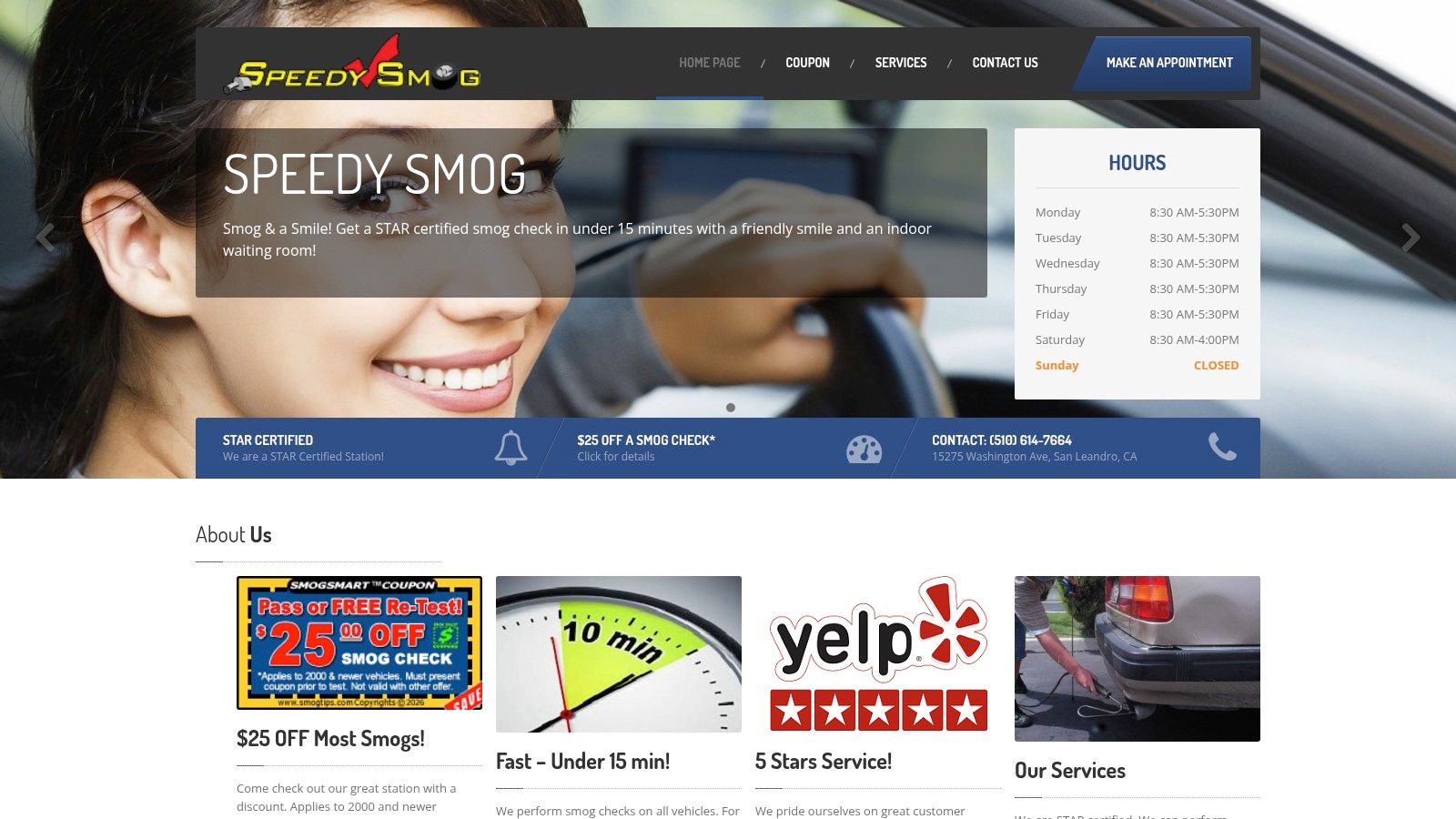
If you're in the East Bay and need a local option, Speedy Smog's hours and availability are useful to check before you head over. The shop is located at 15275 Washington Ave, San Leandro, CA 94579, and the publisher information states it's open Monday through Saturday.
What local drivers usually care about most
Most drivers aren't looking for a history lesson when registration is due. They want to know four things:
- Can the shop handle my vehicle type: The publisher information says the station works with many vehicle categories, including 2000 and newer models, 1999 and older vehicles, diesels, and hybrids.
- Will the visit take all day: Typical tests for 2000+ vehicles are described by the publisher as taking about 10–15 minutes.
- Is there somewhere decent to wait: The shop notes a clean indoor waiting room.
- Will the pricing be explained clearly: The publisher information mentions transparent pricing and periodic $25-off coupons for many newer-vehicle smogs.
For a driver who has just learned what a STAR-certified smog station is, that combination is what makes a local shop practical. You need the certification, but you also need a place that runs the process efficiently and explains the cost plainly.
A good smog visit feels organized. You check in, the car gets tested, and you leave knowing exactly what happened.
How to Prepare Your Vehicle for a Smog Check
A little prep can make the visit smoother and lower the chance of a failed trip.
Start with the basics. Drive the car long enough beforehand to get it fully warmed up. A short freeway or city drive helps more than starting the engine and idling for a minute in the parking lot.
Then check the obvious warning signs:
- Make sure the Check Engine light isn't on: If it's lit, don't ignore it and hope for the best.
- Look for recent battery disconnects: If the battery was just disconnected or replaced, the vehicle may not be ready for testing yet.
- Confirm the car runs normally: Rough idle, stalling, or obvious exhaust issues are signs to handle repairs first.
- Bring the paperwork you were told to bring: That avoids a useless second trip.
If you're selling the car or handling a registration deadline, don't wait until the final day. Give yourself enough time to test, deal with any problem, and return if needed.
STAR Smog Checks and the DMV Your Questions Answered
What if the vehicle fails
A failed smog check doesn't mean your car is permanently stuck. It means the vehicle didn't meet the emissions requirements on that visit. The next step is usually repair, then a retest based on what the station tells you.
Is the passing certificate sent to the DMV automatically
In normal practice, passing results are submitted electronically. That means you usually don't need to carry a paper certificate over to the DMV counter yourself. Still, keep your receipt and any test paperwork until your registration is fully processed.
Is a STAR inspection valid statewide
Yes. If the vehicle is tested properly at a California STAR station and the result is accepted, it isn't limited to one city. The important part is that the inspection was done at the correct kind of station for your vehicle.
Can I shop around on price
Yes, and you should. Just make sure you're comparing the same kind of test. Ask whether the quote changes for a STAR-directed vehicle and whether the certificate fee is included in the number you're hearing.
What if I'm still unsure whether my notice requires STAR
Call the station before you leave home and read the wording directly from your DMV notice. That's the fastest way to avoid guessing.
If you need a STAR inspection in the East Bay, Speedy Smog is a practical place to start. Check the shop hours, confirm your vehicle type, ask for the total out-the-door price for a STAR-directed or non-directed test, and bring the car in warmed up so the visit goes as smoothly as possible.