
How to Get a Car to Pass Smog on the First Try
You've just replaced the battery, cleared an old check-engine code, or finished a repair. The car starts easily, idles smoothly, and feels normal on the road, so you drive straight to the smog station expecting a quick pass. Instead, the inspection fails because the vehicle's onboard tests haven't finished running.
That situation is frustrating because the mechanical repair may have been correct. Learning how to get a car to pass smog starts with a less obvious question: is the vehicle ready for the inspection computer to evaluate it? California drivers need to think about readiness monitors, diagnostic trouble codes, emissions equipment, and inspection timing, not just whether the car drives well.
Table of Contents
- Why a Car That Runs Fine Can Still Fail Smog
- Your Pre-Test Checklist the Week Before the Inspection
- OBD Readiness Monitors: How to Get Them Set Before Smog
- The Most Common Things That Fail a Smog Test
- DIY Fixes Versus When to Bring It to a Shop
- California Drivers and Why a STAR Station Matters
- Test Day Routine and Quick Answers to Common Questions
Why a Car That Runs Fine Can Still Fail Smog
The car starts easily, idles smoothly, and drives normally, yet the inspection computer can still reject it. A battery replacement, cleared code, ECU reflash, or repair that required disconnecting power may erase the diagnostic history, including readiness monitors for the catalytic converter, oxygen sensors, evaporative system, misfire detection, and other emissions controls.
A mechanically sound vehicle can therefore arrive at the station with an incomplete OBD record. California's October 1, 2025 rule requires all supported readiness monitors to be set for a pass. Refer to the California BAR's updated readiness-monitor regulations and the dedicated readiness section for the testing details.
The practical lesson: A smooth-running car isn't automatically a smog-ready car.
California's OBD-II inspection checks whether the vehicle has completed its required self-diagnostics. The scanner may show “not ready” even with no warning light on the dash. A pending fault can interrupt a drive cycle, leaving one or more monitors incomplete.
Clearing the check-engine light right before an appointment usually creates another problem. It hides the visible warning while resetting the evidence the inspection computer needs. Some monitors take specific operating conditions to complete, and one short trip after a repair may not finish them. Check readiness status with a scan tool before scheduling the test.
A vehicle can also fail because the underlying emissions fault remains, even if the engine feels normal. Evaporative leaks, sensor problems, and intermittent misfires may not affect drivability enough for a driver to notice.
New Jersey's 2024 inspection report offers broader maintenance context. It recorded 2,083,621 initial overall emissions inspections, with 1,937,882 passing and 145,739 failing at least one emissions component, according to the New Jersey 2024 annual inspection report. States use different rules, but the practical point holds: intact emissions equipment and a completed diagnostic record give a properly running vehicle a better chance than unresolved faults or a freshly reset computer.
Your Pre-Test Checklist the Week Before the Inspection
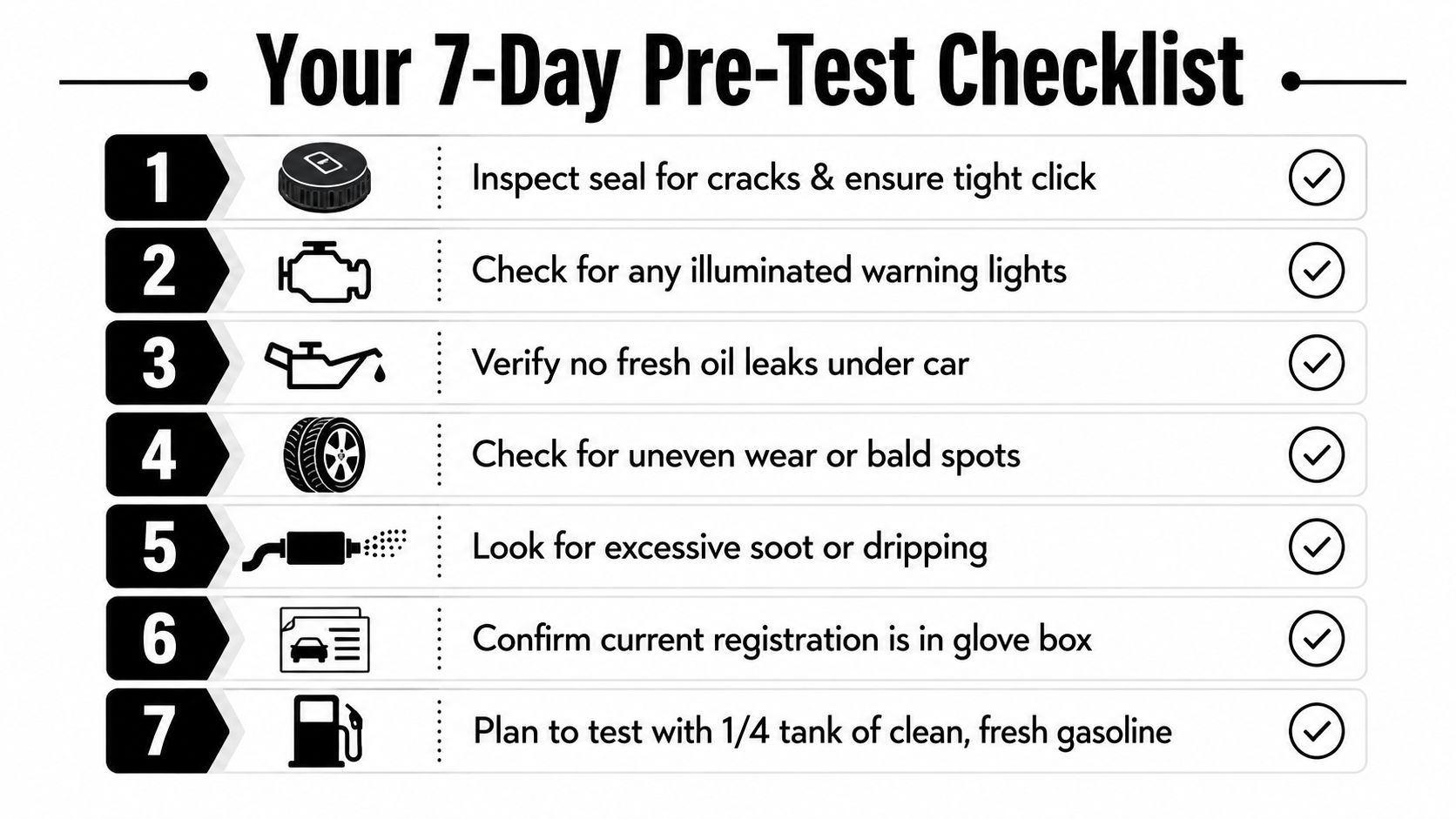
A car can feel normal on the drive to the station and still arrive with a preventable problem. Use the week before the appointment to catch basic faults, confirm recent work, and avoid changes that reset the vehicle's diagnostic history.
Begin with the dashboard and the basics
Use this walkaround as a practical screening routine:
- Check warning lights: The check-engine light should be off. Investigate any recently extinguished light before booking the inspection.
- Review recent work: Battery replacement, code clearing, ECU programming, or an emissions-sensor replacement can leave readiness status incomplete. Scan the vehicle before scheduling.
- Inspect visible equipment: Look for a missing catalytic converter, disconnected oxygen-sensor wiring, loose intake tubing, or altered emissions components.
- Check tires: Set tire pressure to the manufacturer's specification. Correct inflation helps the vehicle operate under a normal load during applicable dynamometer testing.
- Inspect the fuel level: Keep enough fuel for normal driving without filling the tank to the brim. A moderate level supports evaporative-system checks.
- Look underneath: Address fresh oil leaks, damaged exhaust components, and loose wiring before the appointment.
- Review service timing: If maintenance is due, read whether an oil change before a smog check makes sense for the vehicle's condition and schedule.
Skip fuel additives and premium gasoline as pass strategies. They cannot repair a leaking hose, failed oxygen sensor, weak ignition system, or inefficient catalytic converter. A scan and targeted repair provide more useful information than a product marketed as a quick solution.
Warm the vehicle without trying to outsmart the test
Drive normally during the week and include a sustained highway trip. The engine and exhaust system must reach operating temperature for emissions controls to function as designed, but warming the car does not replace completed monitors or a necessary repair.
A short fifteen-minute highway loop before the appointment can bring the exhaust system up to temperature. It cannot erase an active fault or finish every diagnostic test. Avoid clearing codes, disconnecting the battery, or making last-minute repairs unless you have time to verify the resulting readiness status before the inspection.
OBD Readiness Monitors: How to Get Them Set Before Smog
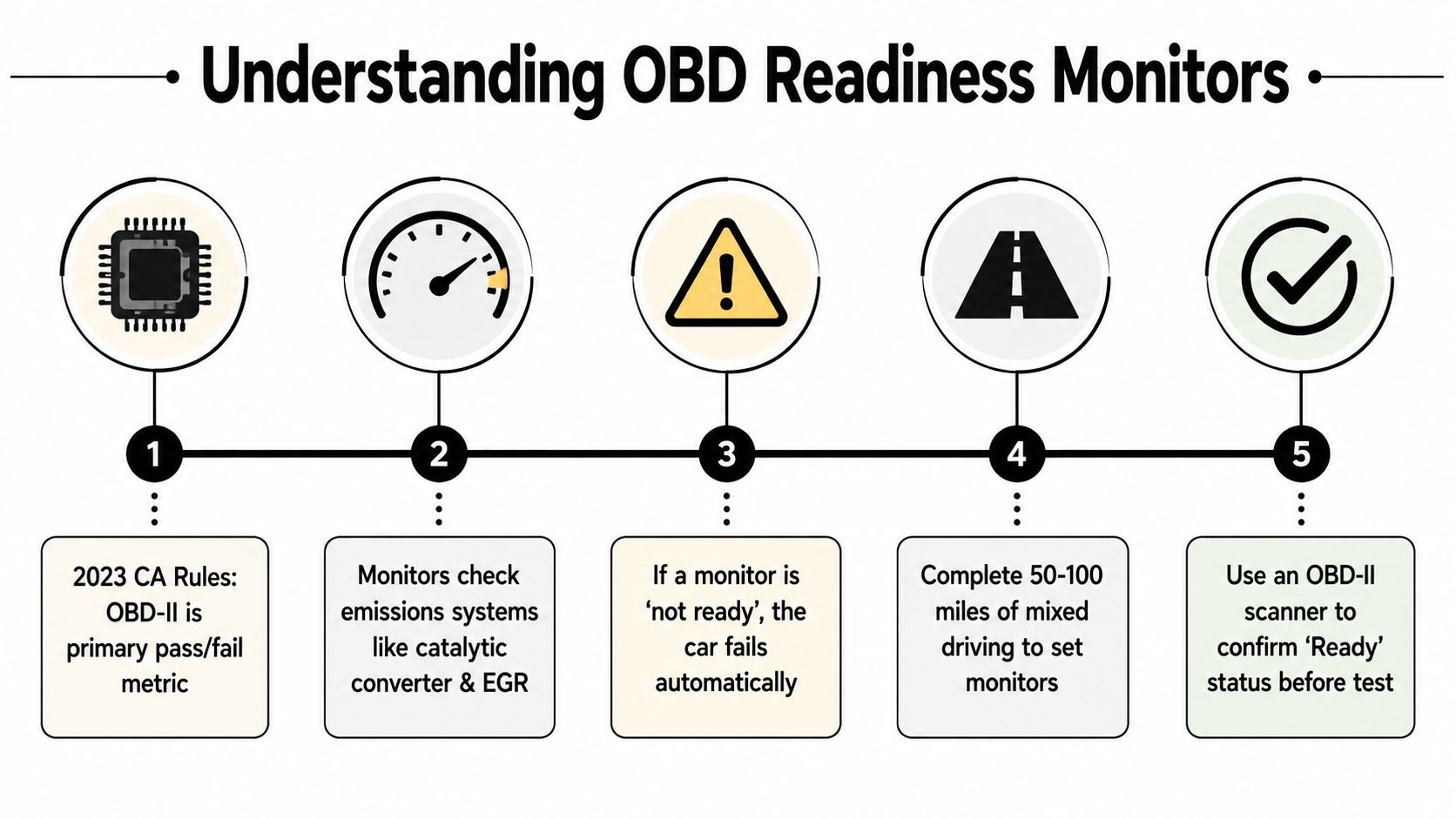
A mechanically sound car can still fail a California smog inspection when its readiness monitors are incomplete. These software tests run through the vehicle's OBD-II system and evaluate emissions functions such as the catalytic converter, oxygen sensors, evaporative system, exhaust-gas recirculation system, and misfire control. Each monitor needs specific operating conditions before it can report a result.
A monitor does not confirm that a component is installed. It checks whether the vehicle has driven through the temperature, speed, load, and fuel-system conditions required for that diagnostic. California BAR's 2025 to 2026 explanation of new OBD readiness regulations explains how supported monitors must be complete under applicable California rules.
Use mixed driving, not driveway idling
A useful drive cycle combines a cold start, city driving, steady cruising, and controlled deceleration. Start with a cold engine, drive through stop-and-go traffic, then add a sustained highway stretch at a steady speed with gentle throttle and at least one natural slowdown.
A 2004 to 2010 Toyota Camry may need more than one type of trip for the EVAP monitor. City driving helps create the temperature and fuel-system changes it checks, while highway cruising can provide the steady operating conditions needed for other monitors. The exact sequence varies by engine, transmission, ambient temperature, and the monitor that remains incomplete, so use the manufacturer's procedure when available.
Repeat the drive pattern over separate trips. Extended driveway idling cannot reproduce the changing speed, load, and fuel-tank conditions many tests require. Some monitors also need the cycle repeated before they show ready.
Scan before paying for the official test
Check readiness status before arriving at the station. Depending on the vehicle, you may access diagnostic information through its service menu, use a Bluetooth OBD-II adapter with a compatible app, or request a pre-scan from an auto-parts store. The scan should show which monitors are ready, whether stored or pending codes exist, and whether the computer is commanding the check-engine light on.
For a practical guide, see how to read OBD codes. Do not erase codes just to make the dashboard look clear. Clearing codes also resets monitor progress, and a returning fault can prevent the vehicle from passing even after the light initially stays off.
The Most Common Things That Fail a Smog Test
A car can run smoothly and still fail because one emissions system is outside its permitted range. Start with the failure evidence before buying parts. A catalytic converter may be involved, but ignition faults, fuel-control problems, exhaust leaks, sensor wiring, and unauthorized visual changes can produce similar symptoms.
| Failure Cause | Symptom | Quick Check | Typical Repair |
|---|---|---|---|
| Catalytic-converter inefficiency | Emissions stay high after warm-up, or a catalyst-efficiency code appears | Review scan data and test exhaust performance after checking upstream faults | Correct the cause, then replace the converter only when diagnosis supports it |
| Check-engine light or emissions code | Warning light remains on or returns during driving | Scan stored and pending codes without erasing them | Repair the fault, verify the result, and complete required monitors |
| Loose or cracked gas cap | Fuel odor, EVAP code, or no noticeable drivability problem | Inspect the seal and tighten the cap until it clicks | Replace the cap if its seal or locking mechanism is damaged |
| Worn spark plugs or ignition faults | Rough idle, hesitation, misfire, or poor fuel economy | Inspect plugs and review misfire data | Replace worn components and diagnose the underlying cause |
| Dirty MAF sensor or vacuum leak | Lean-running symptoms, unstable idle, or intake noise | Check intake tubing and vacuum hoses, then review live data | Repair the leak or service the sensor using the correct procedure |
| Faulty oxygen sensor | Poor fuel economy, fuel-trim problems, or a recurring sensor code | Compare scan data with wiring condition | Confirm the circuit and mixture issue before replacing the correct sensor |
| EVAP-system fault | Fuel odor, difficult refueling, or an evaporative leak code | Inspect the cap and hoses; use a smoke test for hidden leaks | Repair the leaking hose, purge valve, vent valve, or related component |
These systems affect one another. A misfire can send unburned fuel into the exhaust, while a fuel-control fault can overheat the converter. A small EVAP leak can turn on the warning light even when the engine feels normal. Diagnosis should therefore follow the code, live data, and physical inspection rather than the most expensive suspected part.
Visual inspection can also matter. Missing or visibly altered emissions equipment, disconnected hoses, damaged wiring, or an intake and exhaust configuration that does not match the vehicle's approved setup can create a failure even when drivability is good. Check those items before the appointment, especially after aftermarket work.
Cold-start behavior deserves attention. The catalytic converter and oxygen sensors need heat before they can control and clean exhaust effectively. A normal warm-up drive is preferable to leaving a cold car idling briefly and then entering the station, but warming the vehicle cannot repair a failed component. If the light returns, the monitor stays incomplete, or the exhaust readings remain high, identify the fault before paying for another inspection.
DIY Fixes Versus When to Bring It to a Shop
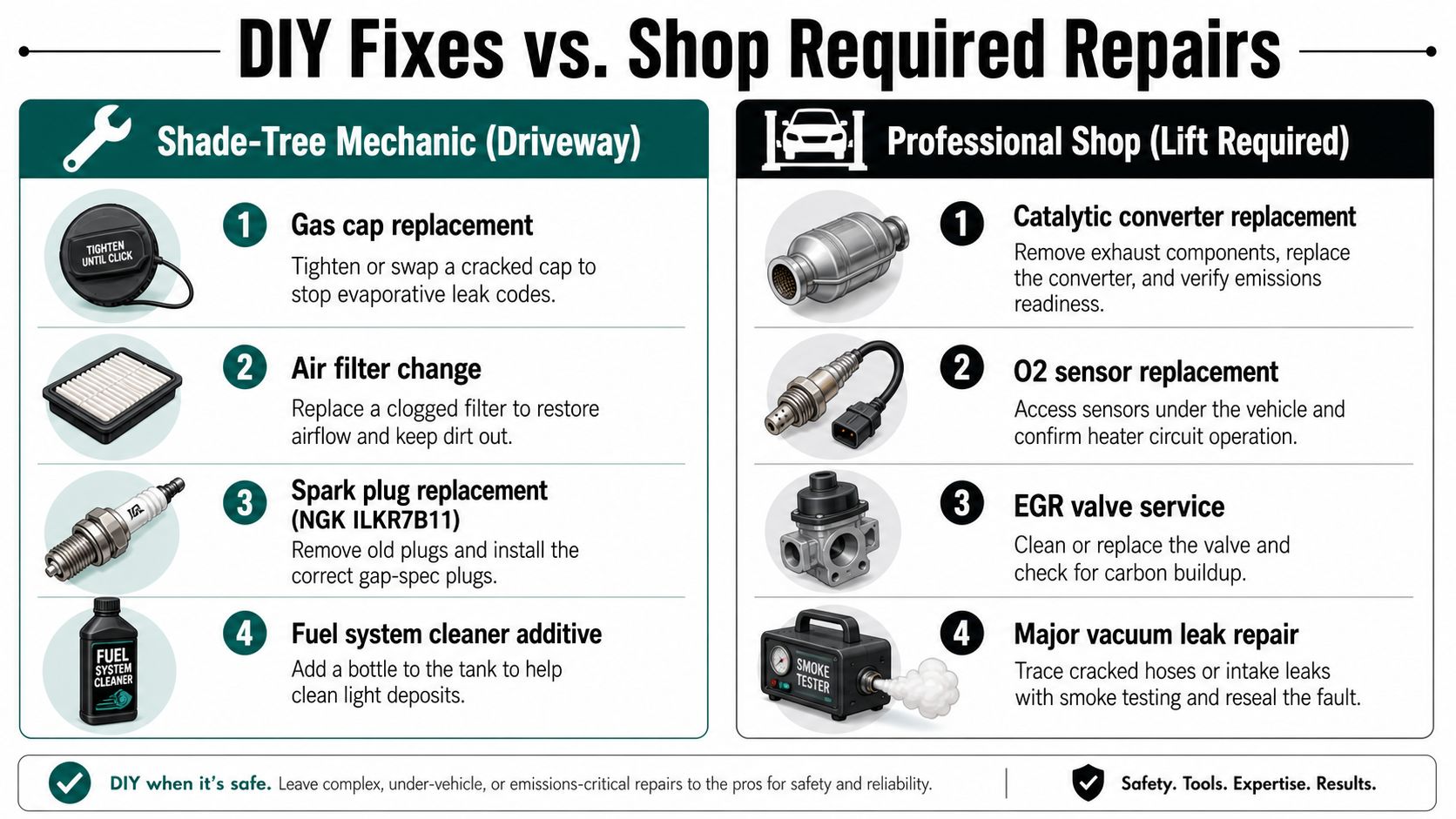
Use a simple rule: handle inspection and replacement tasks at home when the fault is obvious, accessible, and unlikely to create a new emissions problem. Bring the vehicle to a shop when the repair requires scan-data interpretation, smoke testing, exhaust measurement, programming, lifting equipment, or emissions-component verification.
Reasonable driveway work
A gas-cap replacement is the clearest example. It takes little time, requires no special equipment, and addresses a common EVAP failure point. An air-filter replacement, correct spark-plug service, and inspection of loose intake tubing can also be sensible DIY work when you follow the manufacturer's specifications.
A basic OBD-II scanner is useful for checking codes and monitor status, but it doesn't turn every code into a diagnosis. A code identifies a system or condition that needs investigation. It doesn't always identify the exact failed part.
- Gas cap: Low complexity, low risk, provided you install the correct cap for the vehicle.
- Air filter: Straightforward, but confirm the housing seals correctly so unmetered air doesn't enter.
- Spark plugs: Manageable for an experienced owner, but incorrect gap, torque, or plug type can create a misfire.
- Readiness reset: Don't deliberately disconnect the battery to clear a code. That action can make the inspection less likely to pass by resetting monitors.
Repairs that need proper equipment
Catalytic-converter replacement, oxygen-sensor diagnosis, timing problems, and EVAP leaks belong in a shop when you don't have the necessary tools and service information. A smoke machine can reveal leaks that visual inspection misses. A scan tool can compare fuel trims, sensor response, misfire counts, and monitor behavior while the engine operates.
A STAR station can also be appropriate when the vehicle needs a directed repair or a referee-related inspection. The cost difference between parts-only work and professional service varies by vehicle and fault, so a technician should confirm the failed system before you authorize an expensive component.
A failed smog result is diagnostic information. Read the failure category and repair the cause instead of replacing parts in the order they appear on a search page.
California Drivers and Why a STAR Station Matters
A STAR Certified station operates under California Bureau of Automotive Repair oversight and follows the state's requirements for testing and applicable directed repairs. That matters when the vehicle has an unusual failure, a prior inspection issue, a visual-compliance concern, or a problem that requires more than a basic pass-or-fail scan.
Not every station handles the same work. Before booking, ask whether the location can test your vehicle's model year, fuel type, hybrid system, diesel configuration, or inspection category. Confirm whether it performs test-and-repair work, whether it can handle a directed repair, and whether a referee appointment is required instead of another ordinary inspection.
California BAR reporting separates inspection outcomes into categories that include overall, emissions, functional, visual, and OBDII failures, as shown in the BAR executive summary and performance report. A car can drive normally and still fail because emissions equipment is missing, a modification isn't approved, or the software state isn't acceptable.
What to ask before you arrive
- Vehicle eligibility: Can the station inspect your specific vehicle type and model year?
- Readiness status: Can the technician check monitors before beginning the official inspection?
- Repair capability: If the car fails, can the station diagnose the failure or must you use another facility?
- Special inspection needs: Does your situation require a directed repair or state referee?
- Documentation: What registration or prior inspection paperwork should you bring?
For East Bay drivers, Speedy Smog's explanation of STAR stations provides a practical overview of the certification and inspection process. The San Leandro shop handles emissions testing for common passenger vehicles as well as older vehicles, diesels, and hybrids, so drivers can confirm suitability before making the trip.
Test Day Routine and Quick Answers to Common Questions
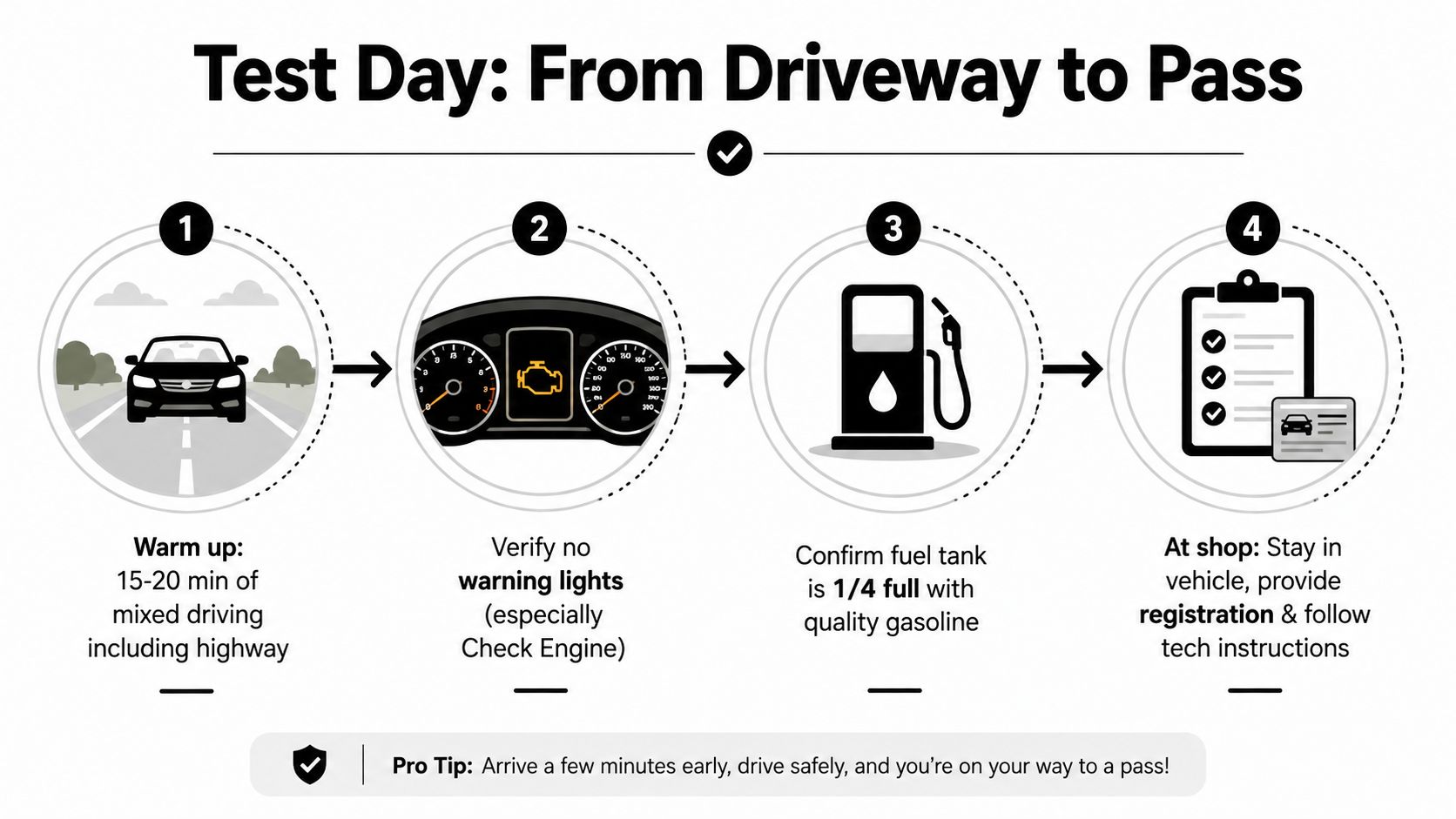
On the day of the appointment, drive the car through fifteen to twenty minutes of mixed operation, including highway driving when practical. Check the dashboard before leaving, confirm the fuel level is within the station's recommended range, and bring registration plus the previous smog certificate if you have it. Turn off unnecessary accessories, remove chargers, and follow the technician's instructions when you arrive.
A recent battery disconnect doesn't automatically mean the car will fail forever, but it can reset the monitors. Drive until a scanner confirms the supported monitors are ready. The time required varies by vehicle and monitor, so mileage alone isn't proof of readiness.
Idling in the driveway usually isn't enough because monitors need changing speed, load, temperature, and operating conditions. A directed inspection means the vehicle must follow specific repair or inspection instructions, while a referee may be needed when the vehicle's emissions configuration or prior result requires state review.
For a final reminder, use the California BAR readiness guidance as the controlling reference for applicable monitor requirements rather than relying on generic advice from a parts store or online forum.
If your car has recently had a battery replacement, code clear, repair, or failed inspection, visit Speedy Smog for a California smog inspection and readiness-focused pre-test conversation. Bring the vehicle's failure paperwork or scan information so the technician can help you address the actual compliance issue before you pay for another test.