
You're probably dealing with the same annoying problem most diesel owners face right before registration or a fleet deadline, the truck runs fine, but the paperwork says it still needs an emissions test for diesel trucks. The lane looks simple from the waiting room, then the technician starts talking about smoke opacity, OBD readiness, aftertreatment, and whether the vehicle is eligible for the specific test path it needs. That's where owners get tripped up, because diesel inspections aren't just a bigger version of a gasoline smog check.
Table of Contents
- What Makes Diesel Truck Emissions Testing Different
- Types of Emissions Tests Used for Diesel Trucks
- Which Diesel Trucks Are Required to Test
- How to Prepare Your Diesel Truck for Testing Day
- Common Failure Causes and How to Fix Them
- The Shift Toward Real-World Emissions Monitoring
- Costs, Paperwork, and Where to Get Tested in the East Bay
What Makes Diesel Truck Emissions Testing Different
A customer rolls in with a clean-looking diesel pickup, expecting the same routine he's used to with a gas car. Instead, the conversation goes straight to the truck's model year, weight class, and emissions hardware, because diesel testing starts with a different rulebook. In California, the inspection lane isn't just looking for a tailpipe number. It's checking whether the truck fits the state's diesel-specific compliance path, and that's why the experience feels more technical than a typical passenger-vehicle smog check.
Diesel testing measures different pollutants
Gasoline smog checks usually revolve around hydrocarbon and carbon monoxide control. Diesel inspections care much more about particulate matter and nitrogen oxides, or NOx, because those are the pollutants diesel engines are known for controlling through combustion strategy and aftertreatment. Europe's heavy-duty limits show how far that focus has shifted, Euro III allowed 5.0 g/kWh NOx and 0.16 g/kWh PM in 2000, while Euro VI tightened the rules to 0.46 g/kWh NOx, 0.01 g/kWh PM, and a particle-number limit of 6.0×10^11 per kWh when it became effective in 2013, according to DieselNet's European heavy-duty standards summary. That's a good reminder that modern diesel compliance isn't just about visible smoke anymore.
The California side works the same way in practice, even if the exact lane procedure differs by vehicle type. The technician is looking for whether the truck is clean under load, whether the emissions system is intact, and whether the engine is behaving the way the calibration says it should. That's why diesel checks often feel more like a mechanical diagnosis than a simple emissions measurement.
Practical rule: if a diesel truck has an emissions complaint, assume the inspection will care about both the hardware and the engine behavior, not just whether the exhaust looks dark.
Why the smog lane looks different for a diesel
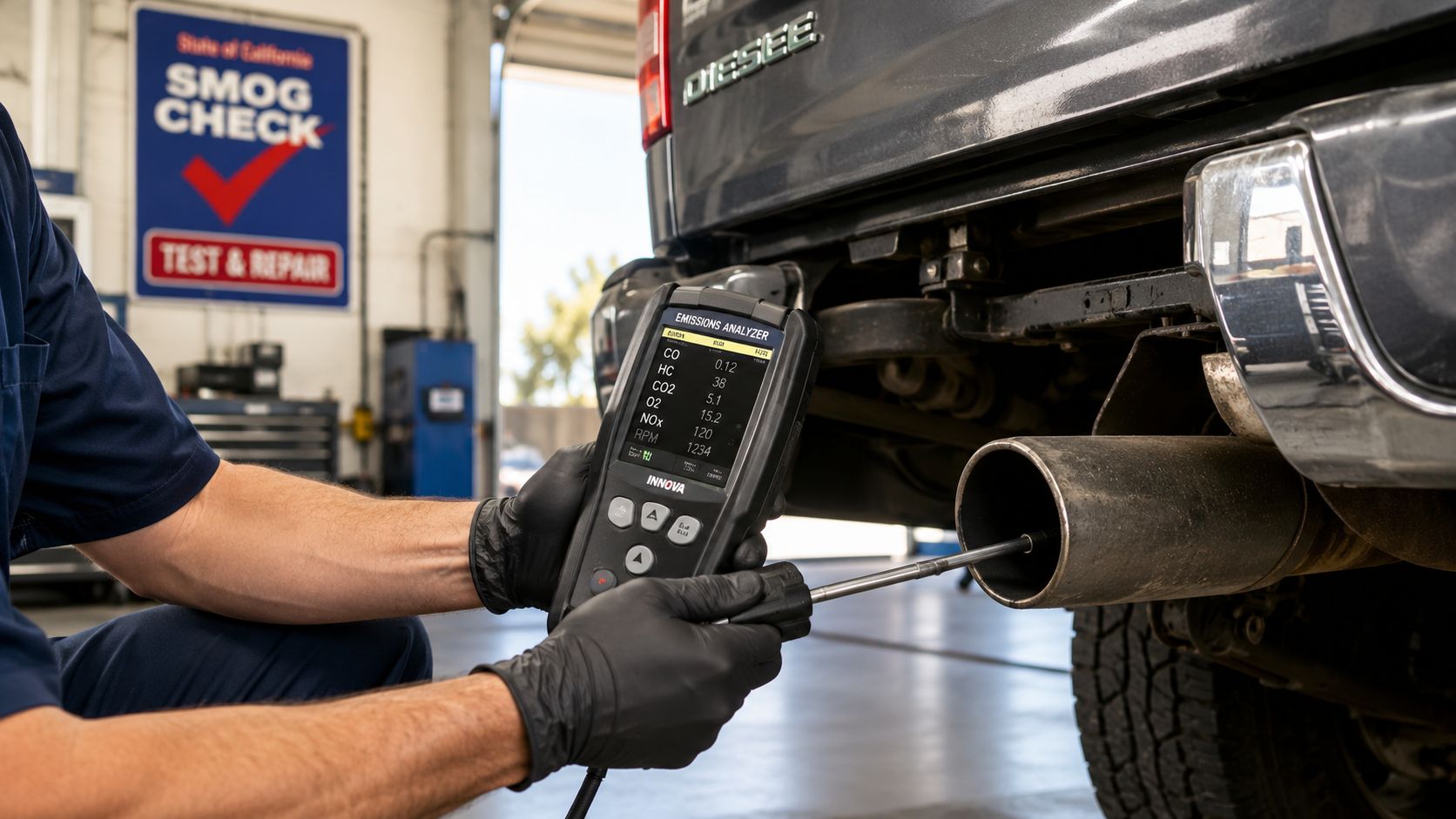
In California, diesel testing is handled in a more specialized way than a basic gas-car inspection, and the Bureau of Automotive Repair framework is built around that difference. Diesel trucks may need equipment that can evaluate exhaust smoke, onboard diagnostics, and in some cases the condition of aftertreatment systems. That's why the station has to match the test to the truck instead of running a one-size-fits-all process.
A diesel owner usually notices the difference right away. The technician may inspect the vehicle more closely, ask about recent repairs, or verify whether the emissions system has been modified. If the truck has the wrong equipment, a bad tune, or a malfunction that doesn't show up at idle, the test can still fail even if the engine sounds fine in the parking lot.
Types of Emissions Tests Used for Diesel Trucks
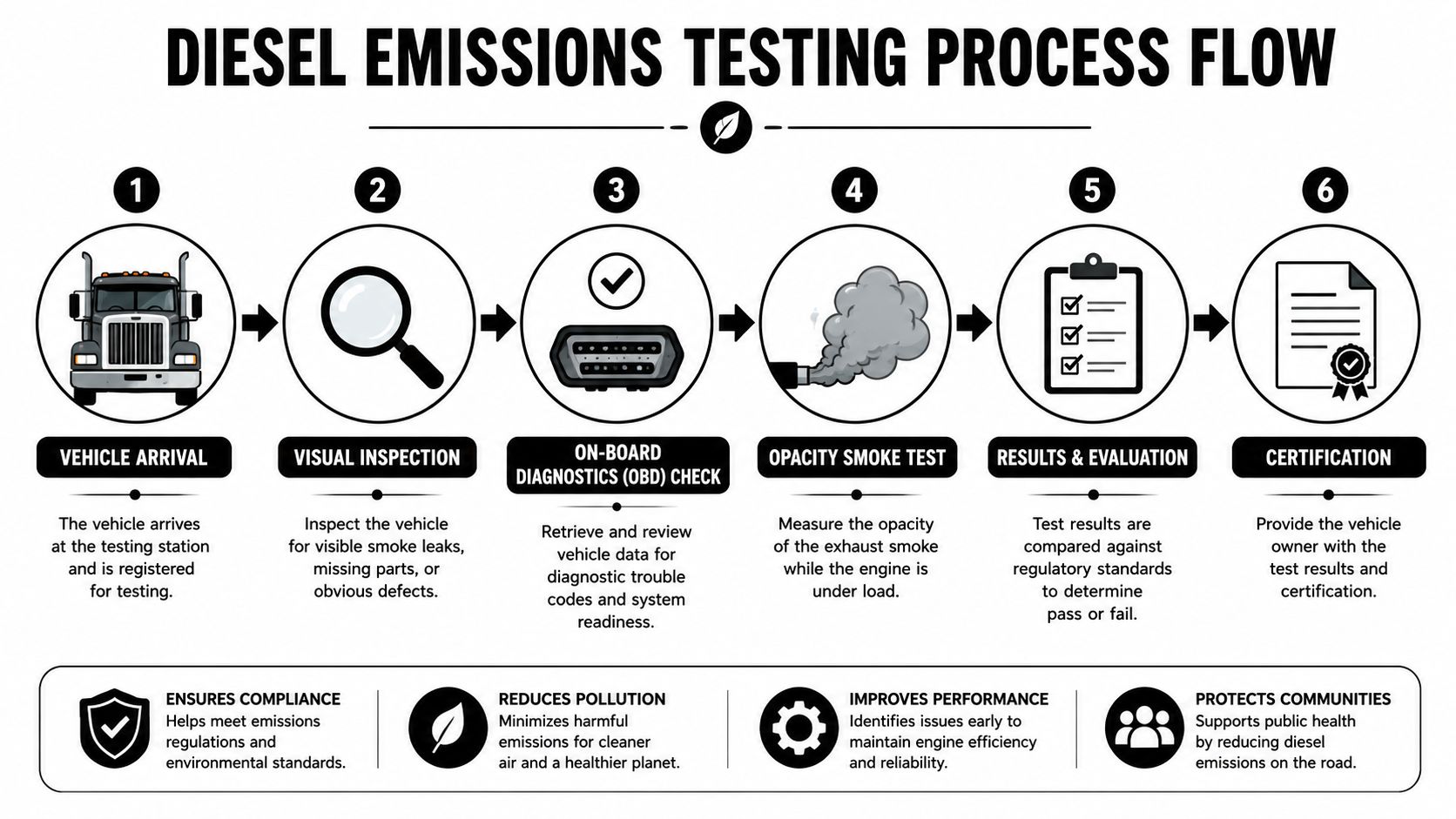
The safest way to think about a diesel inspection is as a set of gates. The truck has to clear the right gate for its class and model year, and not every truck faces the same test. For many owners, the first surprise is that the technician may use a smoke opacity test, an OBD check, or both, depending on what the vehicle is and how it's certified.
Smoke opacity testing is the fast visual screen
Opacity testing is the most familiar diesel-specific lane check. The technician uses an opacity meter to see how much light the exhaust blocks during snap-acceleration events, which is a quick way to catch gross particulate-control problems. Ontario's diesel inspection procedure requires three to nine snaps and uses the average opacity of the three official snaps, while Colorado's standard sets a 20% opacity limit for 5 seconds for naturally aspirated diesel vehicles, according to Ontario's emissions directive. Higher opacity usually points to incomplete combustion, injector trouble, turbo problems, EGR or airpath issues, or a loaded or failed DPF.
That's why smoke testing matters even when the truck drives normally. A diesel can feel strong on the road and still haze hard during a snap test. In the lane, that haze tells the technician the engine isn't burning or filtering fuel the way it should.
If the truck rolls out of the yard clean but smokes hard on throttle, the problem usually isn't cosmetic. It's mechanical.
OBD checks catch what the eye can't
Newer diesel models also go through onboard diagnostics checks. That means the scanner looks for fault codes, readiness issues, and emissions-system problems that a quick tailpipe glance would never catch. Under U.S. heavy-duty rules, modern engines are certified on standardized engine dynamometer cycles such as the FTP, while in-use compliance can be checked with moving-average-window portable emissions measurements. CARB uses a 3-bin MAW method and EPA uses a 2-bin MAW method for off-cycle testing, as summarized by DieselNet's U.S. heavy-duty standards page.
That difference matters because a diesel might pass a short idle-style lookover and still fail when it's worked harder. The MAW approach is designed to expose emissions that show up under real driving, not just in a calm test bay. If your truck has active warning lights, unresolved codes, or a recent emissions repair that hasn't completed its monitor cycle, that's where the lane usually stops you.
For a look at the kind of equipment a diesel-focused station uses, the shop's diesel emissions testing equipment overview is a useful reference point.
The procedure changes with the truck
The important part is this, the test method depends on the truck's vehicle class and model year. Older diesels may be screened differently from modern heavy-duty engines, and a truck that lives under one rule in the lab can face another rule in the field. The inspection lane reflects that split.
Which Diesel Trucks Are Required to Test
The confusion usually starts at the counter with a simple question, “Do I need this?” The answer depends on how California classifies the truck, not just whether it's diesel. Model year, weight rating, and whether the vehicle is a personal-use pickup or a heavier-duty unit all matter, and the rules don't read the same for every owner.
Weight class is the first filter
For heavy-duty diesel compliance, the key divider is whether the vehicle falls into the class of trucks that California treats as subject to diesel emissions inspection. That's why one owner may need a test every renewal cycle while another diesel driver never sees the same requirement. Personal-use pickups can still fall into emissions oversight depending on how they're registered and used, while heavier commercial units are much more likely to face regular testing duties.
A lot of missed deadlines happen because owners assume “pickup” means exempt. That's not a safe assumption. The actual requirement follows the vehicle's compliance category, and that's where the registration record matters more than the badge on the tailgate.
Registration status changes the answer
Out-of-state vehicles can't ignore California rules just because they carry another plate. If the truck operates on California roads and falls into the regulated diesel category, it can still face testing obligations. That's the part owners miss when they're just passing through or running a regional route.
For a direct station-level breakdown of eligibility questions, see the diesel smog check requirements guide. The practical takeaway is simple, the question isn't “Is it a diesel?” It's “Does this specific diesel fall into the testing class the state is enforcing?”
Biennial timing is not the whole story
Many owners think in terms of an every-other-year appointment because that's how they've handled smog in the past. Diesel compliance can be more complicated than that, especially once the vehicle is part of a broader in-use monitoring system. The inspection lane may be the visible checkpoint, but the registration record and current enforcement scheme decide whether the truck needs to show up.
Counter rule: if you're unsure, check the truck's registration category and emissions status before you schedule anything. Guessing wrong wastes time, and in some cases it creates a registration problem you could've avoided.
How to Prepare Your Diesel Truck for Testing Day
A diesel truck usually fails for reasons the owner could've seen coming. The fix isn't magic, it's giving the emissions system enough time, heat, and clean operating conditions to do its job before the truck reaches the station. That's why prep starts before test day, not at the curb.
Two weeks out, fix the obvious stuff
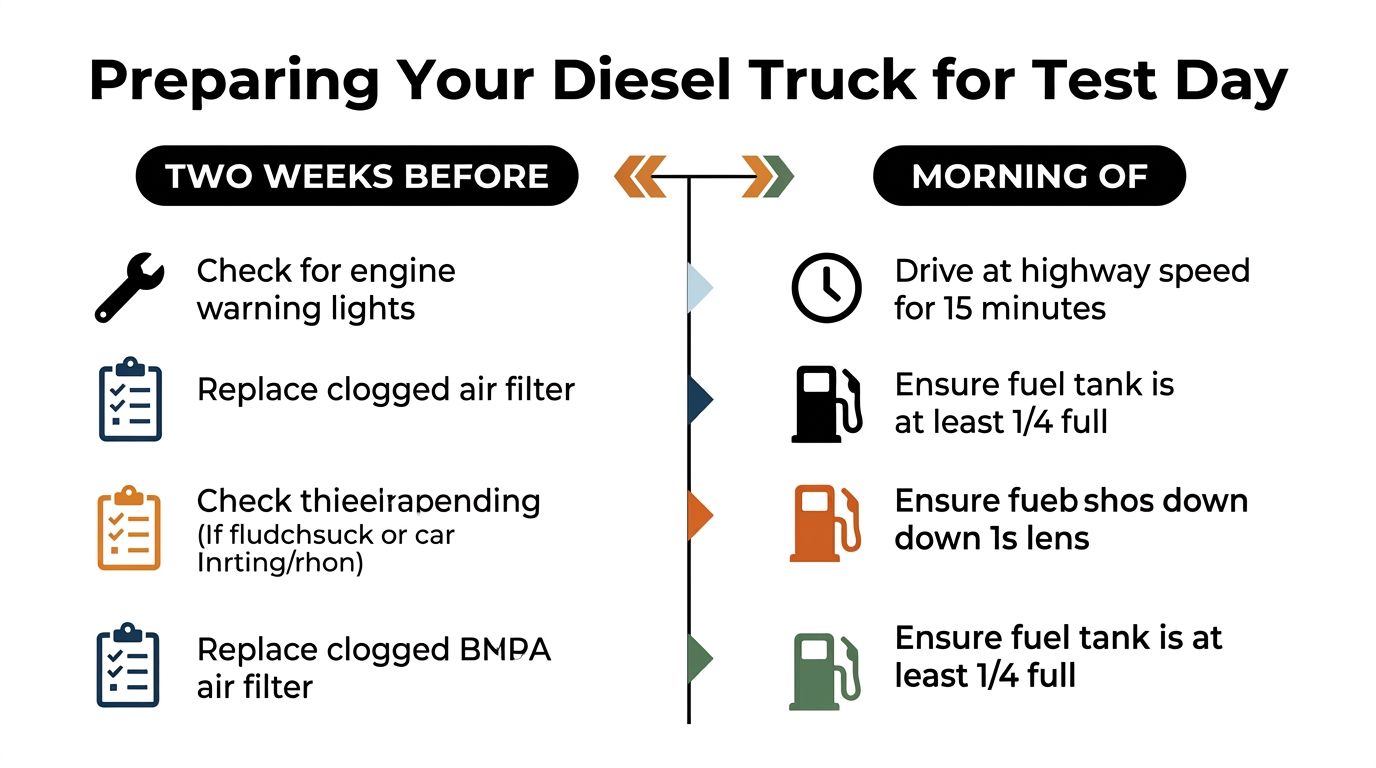
If the check engine light is on, don't roll the truck in and hope the station overlooks it. Emissions-related warning lights and stored faults are common reasons a diesel gets sent away, especially if the issue points to aftertreatment or sensor problems. That's also the point to verify that the truck is still stock where it matters, because deleted or tampered emissions hardware is a fast route to failure.
The other job at this stage is maintenance. Replace a clogged air filter, inspect for boost leaks, and make sure the exhaust and intake tract aren't introducing obvious airpath problems. If the truck has been running rough, smoking, or regenerating poorly, it's better to diagnose that now than to discover it in the lane.
The week before should be about readiness, not luck
Give the DPF a chance to complete a healthy regeneration cycle before the appointment. If the truck has been idled a lot or used only for short hops, the aftertreatment system may not be hot enough to work correctly. A long highway drive can help clear that up, and it's a lot cheaper than paying for a failed test and a second visit.
Good habit: don't schedule a diesel inspection right after days of stop-and-go work. Take the truck on a decent run first, then come in while the emissions system is hot and stable.
Morning of the appointment
Drive the truck at highway speed for at least 20 minutes before you arrive. That helps bring the engine and aftertreatment system up to temperature, which is exactly where you want them for an opacity check or OBD evaluation. Keep the fuel tank from running near empty, and don't arrive right after a cold start if you can avoid it.
If you want the truck to present well, keep the morning simple. No last-minute tuning changes, no unplugging sensors, and no “let's clear the codes and see what happens” gamble. The lane sees what's real, not what was erased five minutes ago.
Common Failure Causes and How to Fix Them
Diesel failures usually sort into three buckets, visible smoke, diagnostic faults, and tampered hardware. If you know which bucket you're in, the fix becomes easier to plan and a lot less expensive to guess at. The order below reflects what usually deserves attention first in the shop.
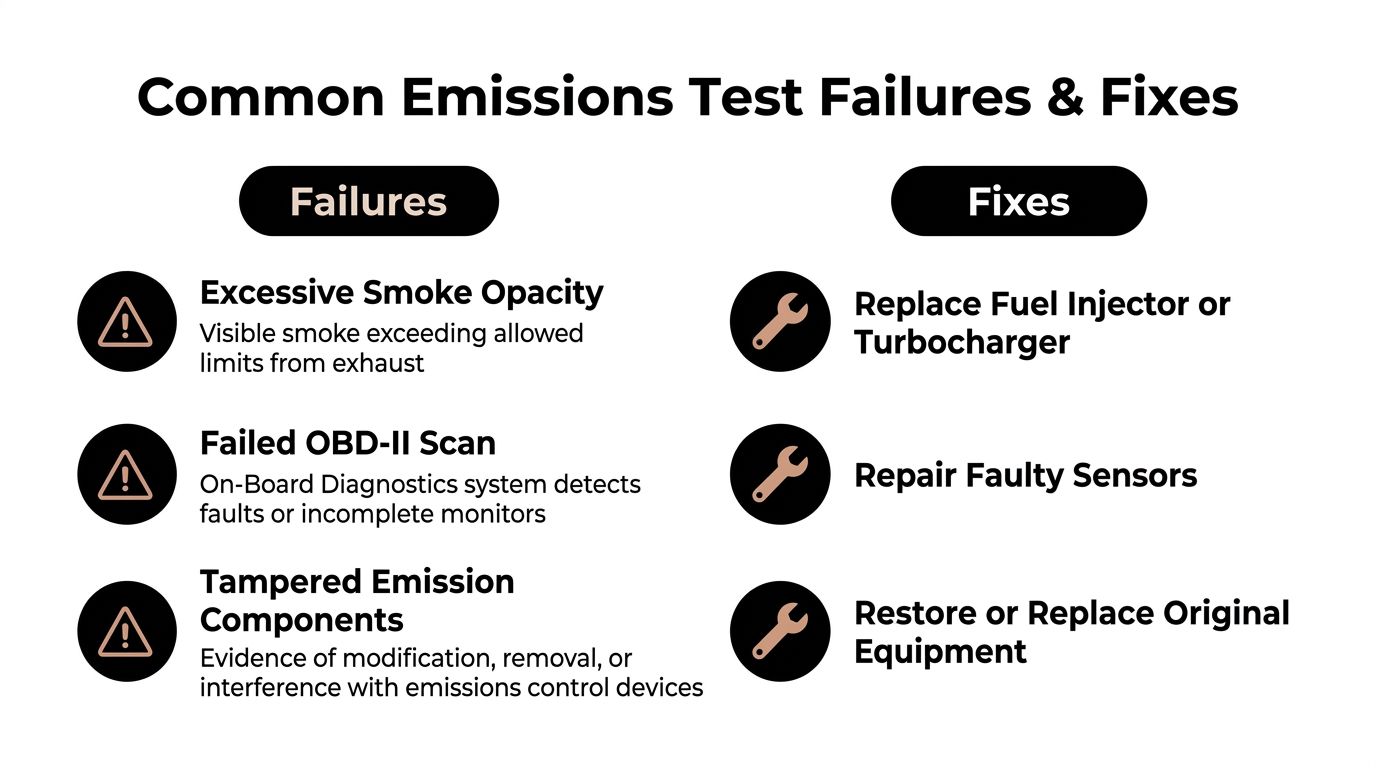
Excessive smoke opacity
If the truck puffs hard during snap acceleration, start with combustion and air management. Higher opacity usually means injector problems, turbo faults, EGR issues, airpath leaks, or a DPF that's loaded or failing. That's where a smoke test becomes useful, because it gives the technician a quick picture of whether the engine is physically controlling particulate output.
The repair path depends on what's wrong. A dirty air filter is a cheap fix, but it won't save a truck with weak injection, damaged boost plumbing, or a plugged aftertreatment system. If the DPF has reached the point where regen won't recover it, it needs proper service, not wishful thinking.
OBD faults and unresolved monitors
A second common fail comes from the computer, not the tailpipe. NOx sensor issues, EGR faults, and incomplete readiness monitors can stop the truck even if the engine sounds decent. The scanner doesn't care how the truck feels to drive, it cares whether the emissions system can prove it's working.
That's why clearing codes and immediately heading to the station rarely works. If the truck hasn't completed its drive cycle after a repair, the monitors may still be incomplete. Fix the fault, drive it the way the system needs to see it, then bring it back once the computer has had time to relearn.
Tampered or deleted equipment
This is the fastest way to turn a routine inspection into a bigger problem. Missing sensors, deleted exhaust treatment, or obviously altered hardware tell the technician the truck isn't configured the way it should be. Restoring original equipment is the fix, not patching over the symptom.
For a diesel owner, the cheapest path is usually prevention. Keep the hardware intact, repair faults before they cascade, and don't assume a tune that makes the truck “run better” will survive an inspection. In the lane, it usually doesn't.
The Shift Toward Real-World Emissions Monitoring
The biggest change in diesel compliance is that the test doesn't end at the station door anymore. Real-world measurements have shown that diesel trucks can emit much more NOx on the road than certification numbers suggest. In one California Energy Commission study of on-road diesel goods-movement trucks, cycle-averaged NOx emissions for all 18 diesel heavy-duty vehicles measured 0.686 g/bhp-hr, and route-averaged emissions for the 0.2 g diesel goods-movement trucks ranged from 0.38 to 0.53 g/bhp-hr and averaged 0.58 g/bhp-hr. The same report found daily average PEMS NOx emissions as high as 3.616 g/bhp-hr in the broader dataset, according to the California Energy Commission report.
Why a snapshot test can miss field problems
That gap explains why a truck can pass a smoke check and still attract attention later. The lane gives you a moment in time, while road use shows what the engine and aftertreatment are doing across real loads, traffic, idling, and heat cycles. If the truck's calibration, sensors, or exhaust treatment only behave well in one narrow situation, the field data can tell a different story.
That's also why the newest U.S. heavy-duty rules are paying more attention to idling and in-use behavior. EPA has proposed a manufacturer-run in-use emissions testing program for heavy-duty diesel trucks, and diesel engine standards now include idling NOx limits of 10 g/hr for 2024–2026 and 5 g/hr for 2027 and later model years. Those limits matter because a truck can look fine during a quick inspection and still face scrutiny if it spends time idling or operating in ways that raise emissions in service, according to EPA's proposed rule page.
What owners should take from that shift
The compliance mindset has changed. A passing result at the smog station still matters, but it's no longer the whole compliance story, especially for trucks that work hard, idle often, or depend on aftertreatment that can drift out of spec under real use. The smartest owners treat the inspection lane as one checkpoint in a longer emissions record, not as the finish line.
That's the part most consumer advice skips. The truck doesn't just need to pass today, it needs to stay clean enough that later monitoring doesn't tell a different story.
Costs, Paperwork, and Where to Get Tested in the East Bay
Bring the truck's registration paperwork, be ready to explain any recent emissions repairs, and don't show up assuming the station can guess your test path. If the vehicle fails, you'll need to correct the issue and retest, which is why it helps to know whether your shop handles diesel-specific work before you arrive. California also recognizes STAR-certified stations that meet higher Bureau of Automotive Repair performance standards, which gives owners another layer of confidence in the result.
What to expect on timing and service
For newer vehicles, inspections are often quick once the truck is hot and ready, and a diesel-focused station can usually keep the lane moving if the paperwork is in order. One East Bay option is Speedy Smog's station list, where the shop in San Leandro handles diesel inspections at 15275 Washington Ave. The business also states that typical tests for 2000+ vehicles are completed in about 10 to 15 minutes, which is helpful if you're trying to get in, get certified, and get back to work.
What to do if the truck fails
Don't leave the station guessing about the repair. Ask for the failure reason, then fix the actual cause before returning for a retest. If the problem is a smoke issue, focus on combustion and aftertreatment. If it's a code or readiness issue, repair the sensor or emission-control fault and give the truck time to complete the proper drive cycle.
A clean retest is usually faster than a messy first attempt. Bring the same documents back, keep the truck in the right temperature range on the drive over, and avoid making new changes between visits.
If you want a diesel inspection handled by a station that knows the difference between a smoke screen and a real emissions issue, schedule with Speedy Smog in San Leandro. They test diesel vehicles, work with STAR certification standards, and can help East Bay drivers get the compliance result they need without wasting a whole day at the counter.