Smog Check License in California: What Drivers And
Your DMV renewal notice is on the kitchen counter, your San Leandro smog appointment is booked, and you're expecting a simple pass-or-fail result. You pay for the test, receive a certificate, and assume the paperwork is finished. Then a question comes up: what did the shop's smog check license authorize it to do?
That credential matters because a California smog inspection isn't just a machine reading. The station must hold the right active authorization, the inspector must be properly credentialed, and certain vehicles require the additional STAR certification layer. The license system behind the test helps determine whether the certificate can be accepted for your DMV registration process.
Table of Contents
- What a Smog Check License Means for California Drivers
- The Two Layers of a Smog Check License in California
- How California Smog Licensing Evolved Since 1994
- Test-Only, Test-and-Repair, and STAR License Categories
- Applying For and Renewing a Smog Check License
- Compliance Failures and Penalties Under BAR
- Matching Your Vehicle Type to the Right License Class
- Choosing a Licensed Station That Fits Your Vehicle
What a Smog Check License Means for California Drivers
A smog check license is the authorization that allows a California business and qualified personnel to perform regulated emissions inspections. The Bureau of Automotive Repair, commonly called BAR, oversees this system. BAR's role is to set inspection requirements, license stations and technicians, monitor performance, and enforce the rules that protect the integrity of the certificate you receive.
Think of the certificate as the final receipt from a regulated service. A vehicle can pass its emissions inspection, but the result still depends on the station using the correct equipment, following the required procedure, and having current credentials. A passing reading from an improperly authorized inspection isn't the same as a valid BAR-recognized inspection.
Practical rule: A passing result is only useful when the station, inspector, equipment, and inspection method all match California's requirements.
The license category also tells you something about the service being performed. A test-only station can inspect but cannot repair. A test-and-repair station can inspect, diagnose, and repair vehicles. A STAR station has an additional certification layered over its underlying station license and can handle vehicles that BAR or DMV directs into the STAR program.
California's network operates at meaningful scale. As of March 31, 2026, BAR listed 3,982 Smog Check test-and-repair stations and 3,494 STAR stations in the state, according to BAR's spring 2026 licensing data. The same report says STAR-certified stations performed 83% of all Smog Check tests in calendar year 2025, even though 49% of licensed stations were STAR certified. That difference shows why STAR status isn't a decorative badge. It identifies facilities carrying a disproportionate share of inspection activity.
The system has two basic credential layers, followed by the STAR overlay. The station license belongs to the business location. The technician license belongs to the person performing the inspection. STAR certification belongs to an eligible station, not merely to any individual who has worked around smog equipment.
The Two Layers of a Smog Check License in California
You arrive at a San Leandro shop expecting a quick inspection. Two credentials determine whether that inspection is authorized: one belongs to the business, and the other belongs to the person testing your vehicle. STAR adds a second qualification to the station's license.
The station license belongs to a specific location. It covers the shop's approved equipment, testing area, operating setup, signage, and authorized services. The business also needs an Automotive Repair Dealer registration and must meet BAR requirements for its facility and inspection process.
The technician license belongs to the individual performing the inspection. That person must have the BAR training and certification required for the work. A licensed shop cannot let an unqualified employee connect your vehicle to the equipment and issue a certificate.
The station is the workplace
A station license follows the physical shop, not just the company name. BAR's application process addresses the business information, Automotive Repair Dealer registration, equipment, signage, testing area, and other operating requirements. The station category determines whether the location can perform testing only, test and repair work, or STAR-qualified inspections. The BAR's station application guidance outlines these station-level requirements.
That is why a technician's credentials do not give a shop permission to perform every inspection. The location must be licensed for the service, with the required equipment and setup in place.
The technician is the person doing the inspection
The technician's credential is separate from the station license. It shows that the person operating the inspection equipment and submitting the result has the required training and authorization. Credentials are personal. If a technician changes shops, that move does not transfer the station license or the shop's STAR status.
STAR is an added qualification for an eligible station, not a substitute for either credential. The station must first hold the appropriate Smog Check station license and Automotive Repair Dealer registration before STAR certification can apply. If that underlying registration or license expires or becomes delinquent, STAR eligibility may be lost or suspended.
Both layers affect the inspection behind your certificate. The station provides the authorized workplace, while the technician performs the authorized test. Drivers can use BAR's public license lookup to check a station's status and confirm that it is listed for the service they need. For a specific inspection, ask which credential covers the station and which covers the inspector.
How California Smog Licensing Evolved Since 1994
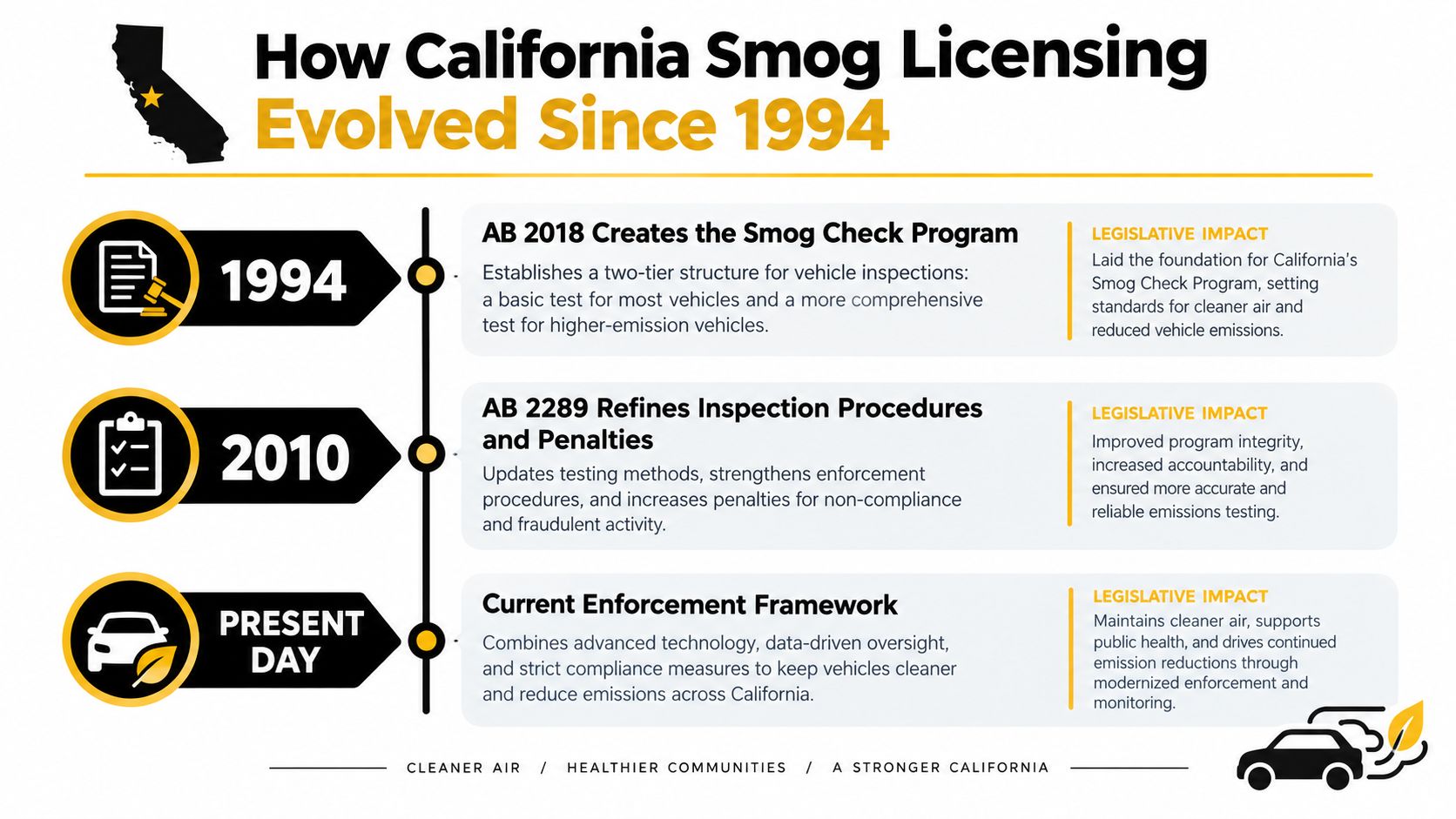
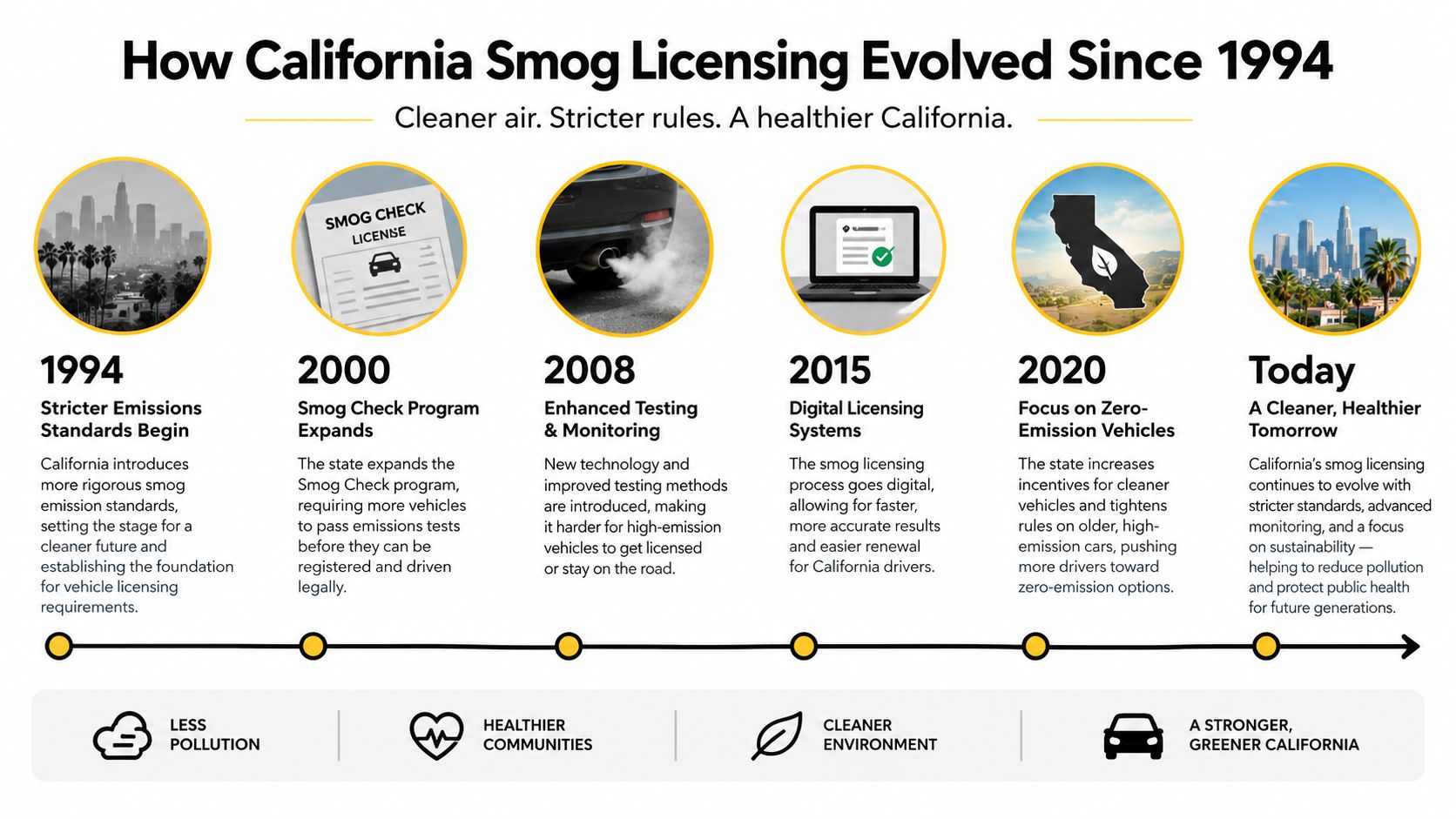
California's current smog licensing structure came from successive changes to the inspection program, not from a single rule written all at once. The first major milestone in the modern framework came with Assembly Bill 2018 in 1994. BAR's Smog Check Reference Guide explains that the law responded to amendments to the federal Clean Air Act and required loaded-mode emissions testing in areas that hadn't met federal air quality standards. Less-polluted areas continued using a two-speed idle test.
That change made the inspection method depend more directly on air-quality conditions and vehicle circumstances. The program became a structured inspection and maintenance system, with licensing and equipment requirements designed around the test being performed.
The shift from Gold Shield to STAR
The next major overhaul arrived with Assembly Bill 2289 in 2010. It modernized the program around OBD II inspections for 2000 model-year and newer vehicles and created the STAR program. STAR began on January 1, 2013, after the Gold Shield Program sunsetted on December 31, 2012, according to the BAR licensing history referenced in the department's licensing data.
The important practical change was the role of the higher tier. Gold Shield had functioned as a designation for certain stations. STAR became a continuing certification connected to inspection performance and eligibility to inspect directed vehicles and gross polluters. BAR requires STAR stations to meet and maintain higher inspection-based standards, rather than treating the designation as a one-time achievement.
Why the history matters at the counter
For a driver, the legislative history explains why a station can be fully licensed yet still be unable to handle a particular vehicle assignment. California built a layered structure with:
- Station authorization, which governs the business location and services.
- Technician authorization, which governs the person conducting the inspection.
- STAR certification, which adds performance and eligibility requirements for certain inspections.
That structure may feel complicated when you're trying to renew registration, but each layer answers a different question. Is the location authorized? Is the inspector qualified? Is the station approved for a vehicle that requires STAR handling? You can find broader background on the state's air-quality framework through this California air resources overview.
Test-Only, Test-and-Repair, and STAR License Categories
The three categories are easier to compare than to memorize. Start with what you need at the counter.
| License Type | Can Inspect? | Can Repair? | Can Serve Directed Vehicles? |
|---|---|---|---|
| Test-only | Yes | No | Only if the station also holds the required STAR certification |
| Test-and-repair | Yes | Yes | Only if the station also holds the required STAR certification |
| STAR certification | Yes, for eligible STAR work | Depends on the underlying station license | Yes, subject to BAR requirements |
A test-only station can perform the inspection, record the result, and issue the appropriate compliance or noncompliance documentation. It can't repair your vehicle as part of that license category. If your car fails, you'll need to take it elsewhere for repairs or choose a test-and-repair facility from the beginning.
A test-and-repair station can inspect the vehicle and work on the causes of a failure. That can be convenient if you want diagnosis and repairs under one roof. It still doesn't automatically make the shop a STAR facility.
STAR is an added layer
STAR isn't just a more advanced name for test-and-repair. It's a separate certification placed on top of an eligible station license. A STAR station must maintain higher performance standards and remain in good standing under BAR's rules.
This is why a basic test-and-repair shop may legally decline to inspect a directed vehicle. The shop might be fully authorized to conduct ordinary inspections and repairs, but the vehicle's assignment calls for a STAR-certified facility. BAR's program uses this additional layer to route certain higher-risk inspections to stations subject to enhanced oversight. Drivers can learn more about that distinction through this guide to a STAR-certified smog station.
At the counter: Ask whether your DMV notice requires a STAR inspection before you pay for a test. The answer can save you a second appointment.
The certificate doesn't change into a different kind of document because a station is test-only or test-and-repair. What changes is the station's legal authority and, for directed vehicles, whether its STAR certification satisfies the assignment. The right choice depends on your vehicle and the instruction attached to your registration or inspection record.
Applying For and Renewing a Smog Check License
A San Leandro shop owner preparing to open a smog station is assembling more than an application. BAR expects the business, location, equipment, facility, Automotive Repair Dealer registration, and qualified personnel to work together as one compliant operation.
A typical application file includes:
- Station information, including the business address and requested license category.
- Automotive Repair Dealer registration, linking the repair business to the station.
- Technician credentials, confirming that qualified personnel are available to perform inspections.
- Facility details, such as required signs, posted fees, testing space, and equipment that meets BAR specifications.
BAR reviews those details before approving the station. Once approved, the station appears in public records, allowing drivers and other businesses to confirm that the location is authorized before an inspection. That public listing is the practical checkpoint behind the license.
Renewal is part of daily operations
Issuance is only the starting point. The owner must keep the station license, Automotive Repair Dealer registration, technician records, inspection activity, and, where applicable, STAR standing current. These pieces fit together like links in a chain. A problem with one can affect the station's ability to operate lawfully.
If the underlying station registration or license expires or becomes delinquent, STAR eligibility may be suspended or lost. BAR also reviews whether the station has enough inspections in the most recently completed calendar quarter to calculate STAR performance measures, along with citations, suspensions, and other disqualifying events. The application rules describe these requirements, and this smog check registration renewal overview summarizes the renewal issues owners commonly need to track.
For owners: Place license dates, technician records, and quarterly inspection activity on one compliance calendar. Separate reminders make it easier to miss one item that affects the whole operation.
Drivers do not have to manage this paperwork, but they experience the result when a station's authorization lapses. Working equipment cannot make an expired station legally able to issue a certificate. Before booking, check the station's current listing, especially if you have visited it before and your vehicle now falls under a different inspection category.
Compliance Failures and Penalties Under BAR
BAR enforcement protects the difference between a legitimate inspection and a certificate produced without the required process. The agency can inspect stations, investigate consumer complaints, review inspection records, and examine whether technicians and equipment were used correctly.
Violations can range from recordkeeping problems to conduct that directly undermines the inspection. Examples include fraudulent certificates, accepting tampered vehicles as compliant, allowing an unlicensed technician to perform an inspection, or handling a directed vehicle outside the STAR framework.
What enforcement can look like
BAR's response depends on the violation and its seriousness. Possible outcomes include:
- Citations, which can require corrective action, payment of a penalty, or retraining.
- Probation, which places the license under additional conditions and monitoring.
- Suspension, which stops the station's inspection authority for the applicable period.
- Revocation, which removes the station's authority and can trigger related licensing consequences for involved technicians.
The key point is that enforcement doesn't stop at the shop's front door. If BAR determines that an inspection was invalid or improperly issued, the driver may face a rejected certificate, a required retest, or an interruption in the registration process.
A vehicle owner also has a practical role. Keep the inspection report, certificate information, invoices, and repair records. If something seems wrong, ask the station to explain the result and use BAR's consumer channels rather than relying on an informal promise that the DMV will accept the paperwork.
The licensing framework is designed to make responsibility traceable. The station is accountable for its facility and business authorization. The technician is accountable for the inspection work. STAR certification adds another performance screen for stations serving directed vehicles.
Matching Your Vehicle Type to the Right License Class
The right station depends on more than whether your car is old or new. Model year, fuel type, onboard diagnostic system, and any DMV or BAR direction can change the inspection method.
BAR states that most 2000 and newer vehicles use the OBD inspection system, while 1999 and older vehicles use the BAR-97 emissions system. The general requirement covers gasoline, hybrid, and alternative-fuel vehicles from model year 1976 and newer, plus diesel vehicles from model year 1998 and newer, according to BAR's smog check guidance.
| Vehicle Type | Inspection Method | Minimum License Class Needed |
|---|---|---|
| 2000 and newer OBD vehicle | OBD system inspection, with the required visual and functional checks | Licensed station with qualified technician |
| 1999 and older vehicle | BAR-97 tailpipe emissions inspection | Licensed station equipped and authorized for the applicable test |
| Diesel vehicle subject to inspection | Method depends on the vehicle's model year, fuel system, and applicable BAR requirements | Station equipped and staffed for diesel inspections |
| Hybrid or alternative-fuel vehicle | Method depends on vehicle design, model year, and BAR inspection rules | Licensed station that handles the specific vehicle type |
| Directed vehicle or gross polluter | Enhanced inspection under the applicable STAR process | STAR-certified station |
The phrase “any licensed station” can cause confusion. A station may hold a valid license but not have the equipment, training, or operational experience for every vehicle class. A pre-OBD vehicle needs a different testing setup from a newer vehicle. A diesel inspection can involve requirements that a gasoline-focused shop doesn't offer.
Before booking: Give the shop the vehicle's year, fuel type, and any wording from your DMV notice. Those details let the station confirm the correct inspection path before you arrive.
Hybrids also deserve a direct question rather than an assumption. The general category of vehicle doesn't tell you every inspection detail. Ask whether the station handles your specific hybrid model and model year, especially if the vehicle has unusual access or inspection requirements.
Choosing a Licensed Station That Fits Your Vehicle
Before handing over your keys, make three checks. They're simple, but they address the three ways a smog appointment can go wrong: an inactive license, a missing STAR designation, or a station that can't perform your vehicle's inspection method.
Check the station first
Look up the business in BAR's license records. Confirm that the station is active and that its listed services match what you need. A familiar sign outside the building isn't enough because licensing status can change.
If your DMV paperwork directs you to a STAR station, verify the STAR designation specifically. A test-and-repair license alone doesn't answer that question.
Match the equipment and technician
Tell the shop whether your vehicle is a newer OBD model, an older tailpipe-test vehicle, a diesel, or a hybrid. Ask whether the inspector is currently authorized for the work and whether the station has the required equipment. A straightforward answer is a good sign. Reluctance to explain the station's credentials deserves caution.
The same applies to the inspection result. A professional shop should be willing to explain what was tested, identify a failure clearly, and provide the relevant paperwork without pressuring you into repairs before the test produces a result.
Watch for avoidable warning signs
Unusually low advertising can leave out required services or create pressure for add-ons. Be cautious if a technician recommends repairs before performing the inspection, refuses to show licensing information, or can't explain whether the station is STAR certified when your notice requires it.
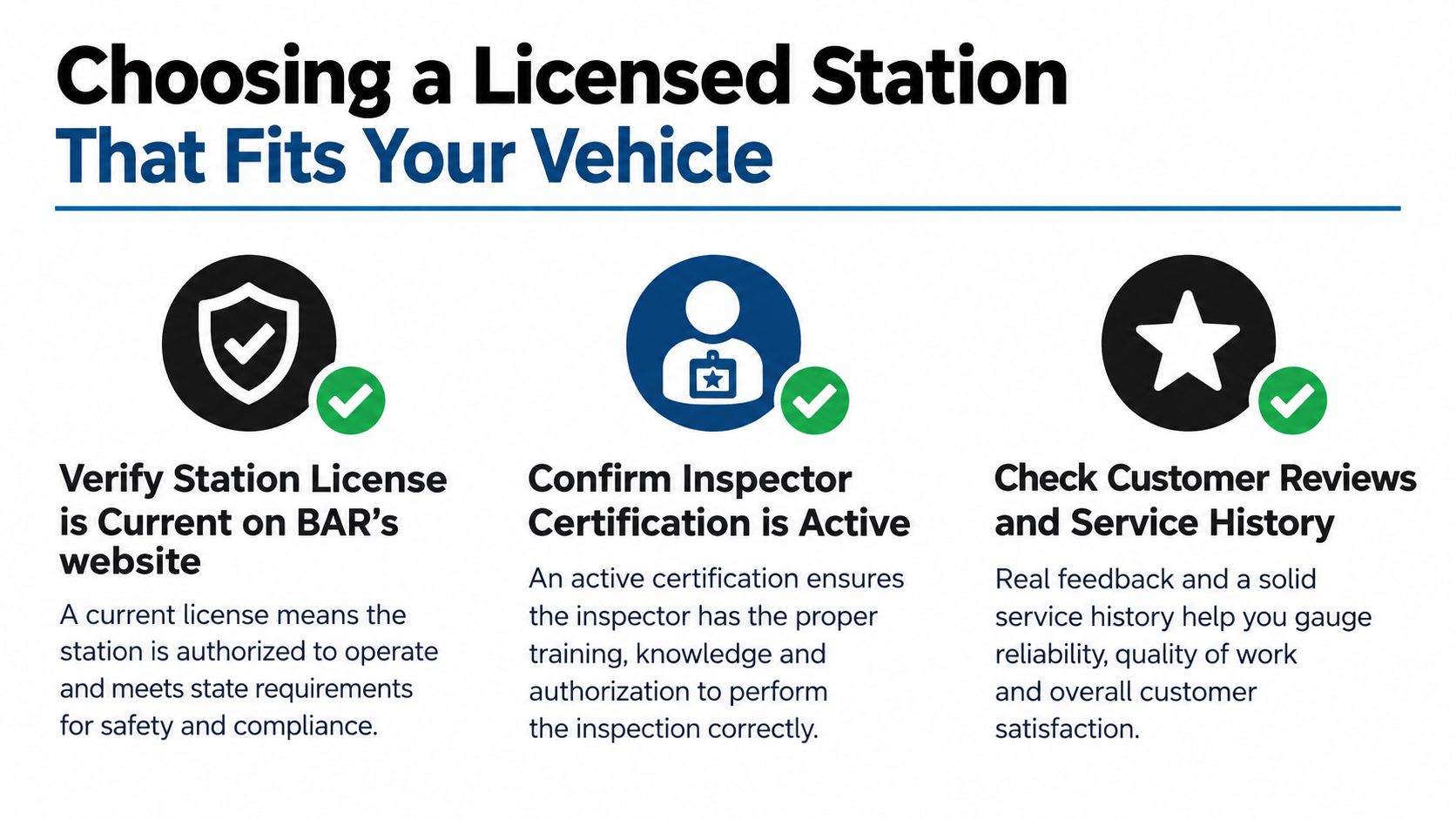
Customer reviews can provide useful context about communication and service, but they don't replace BAR verification. Reviews also may not tell you whether a location handles older vehicles, diesels, or directed inspections.
For San Leandro drivers, Speedy Smog is one local option that identifies itself as a STAR-certified station and offers inspections for newer vehicles, older vehicles, diesels, and hybrids. You should still confirm that the station's current status and your vehicle's specific requirements match before booking.
The certificate in your hand represents more than a test result. It represents a licensed location, a qualified inspector, the correct inspection method, and, where required, active STAR certification. Check those pieces first, then schedule with confidence.
If you're in San Leandro and need a DMV smog inspection, visit Speedy Smog with your registration notice and vehicle details. The station handles STAR-certified inspections and can help confirm the right testing path for newer vehicles, older vehicles, diesels, and hybrids.