
A failed Smog Check can turn an ordinary registration renewal into a financial decision. An East Bay driver may leave a station with a failure report, a repair estimate, and no clear idea whether fixing the car, applying for help, or retiring it makes more sense.
California's Consumer Assistance Program, usually called CAP, can provide a path forward for eligible owners. But CAP isn't a single check that covers every repair. The right option depends on the vehicle's model year, the reason it failed, the owner's income, the repair cost, and whether the car is worth keeping.
Table of Contents
- When a Failed Smog Check Hits Your Wallet
- The Agencies Behind California's Smog Assistance
- Repair Help, Retirement Money, and the Repair Waiver
- How to Apply for the CAP Step by Step
- STAR Stations Versus Regular Smog Check Shops
- Edge Cases for Older Cars Diesels and Hybrids
- Your Action Plan for Getting Back on the Road
When a Failed Smog Check Hits Your Wallet
Consider a Hayward commuter with a 2003 Toyota Camry. She takes the car to a San Leandro station, fails the inspection, and receives a repair estimate for a catalytic converter and oxygen sensor. Her registration renewal is due in 30 days, so the estimate feels less like a maintenance suggestion and more like a deadline.
She has three realistic choices. She can pay for the emissions repair herself, investigate CAP repair assistance, or decide that the vehicle's remaining value doesn't justify another major repair and pursue retirement assistance instead. A failed certificate doesn't automatically tell her which choice is financially sound. It only identifies the emissions problem that must be addressed before the registration issue can be resolved.
The first step is to keep the failure report and ask the technician to explain the exact failure codes. A catalytic converter diagnosis, an evaporative emissions problem, and a visible smoke failure can lead to different decisions. Don't approve expensive work based only on a verbal estimate, especially if another qualified shop can provide a second diagnosis.
Practical rule: Treat the failed inspection as the starting point for a decision, not as permission to authorize every repair on the estimate.
California's inspection network operates at a significant scale. More than 10 million vehicles are tested each year at more than 7,000 independently owned Smog Check stations, and the program removes about 400 tons of smog-forming pollutants every day, according to a California Senate Smog Check fact sheet/index.pdf). That scale also means the paperwork and station choice matter.
Drivers often worry that a failed test immediately means towing, impoundment, or an unmanageable penalty. The practical concern is registration compliance. Before spending money, confirm what the DMV requires, whether the vehicle qualifies for CAP, and whether a waiver or retirement route is more sensible. Owners of older, high-emitting vehicles can face more expensive repairs and tighter practical deadlines, so a quick eligibility check can prevent wasted money.
The Agencies Behind California's Smog Assistance
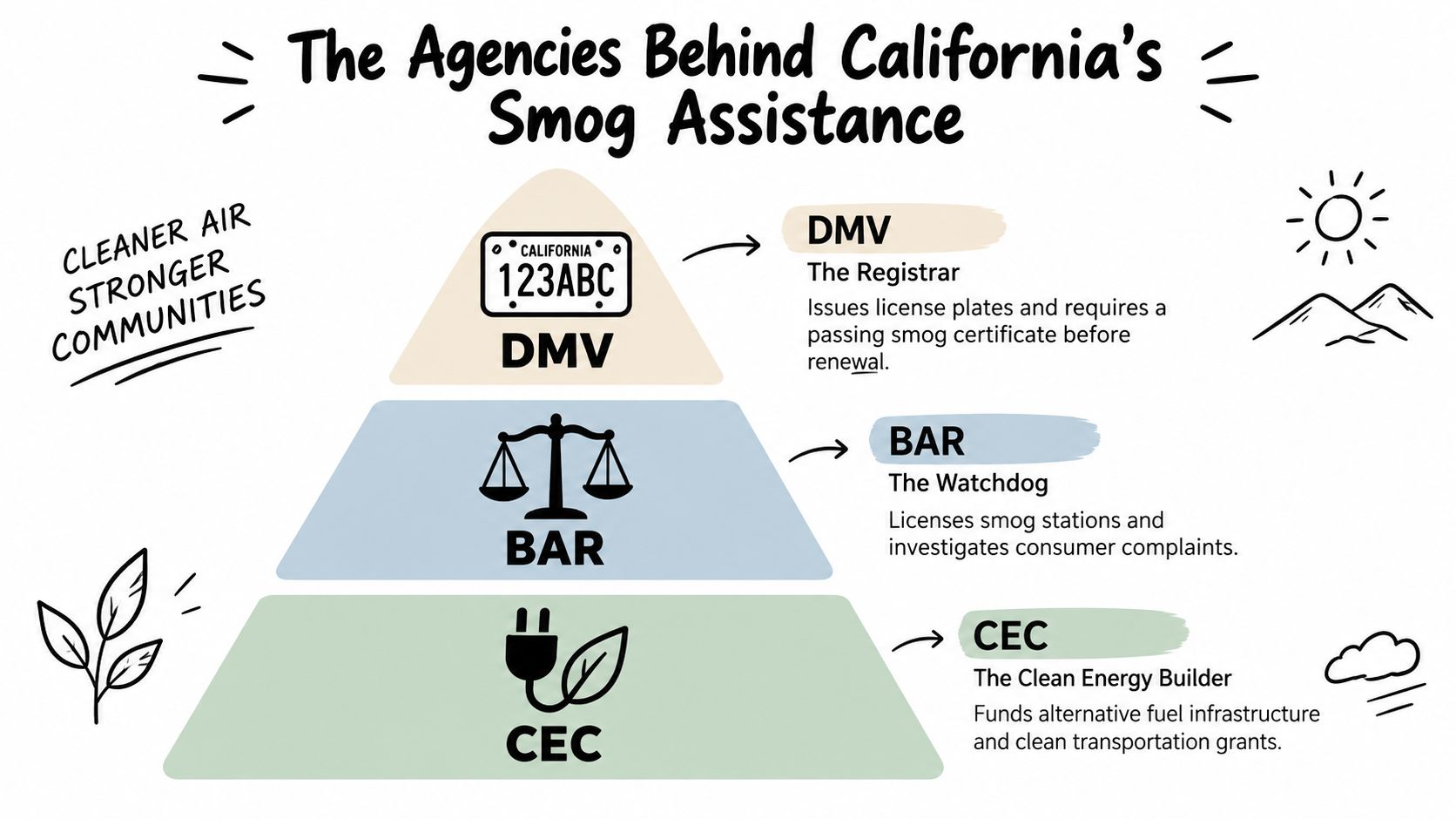
A failed Smog Check creates two separate questions for an East Bay driver: who controls registration, and who can help with the emissions problem? The DMV handles the first. The Bureau of Automotive Repair, or BAR, handles the second. Knowing that split prevents a common mistake, applying to the wrong agency after an older car, diesel, hybrid, or other vehicle fails inspection.
The DMV records vehicle registration and uses the Smog Check result during renewal. The station transmits a passing result electronically or provides the paperwork required for the transaction. The DMV does not diagnose the vehicle, approve repair funding, or decide whether a catalytic converter is needed.
The DMV is the office that records whether the vehicle is legally ready for renewal; the mechanical repair itself is handled elsewhere. If the emissions requirement remains unsatisfied, registration may stop even while a repair shop investigates the cause.
BAR manages the emissions side
BAR licenses Smog Check stations, sets testing rules, oversees the inspection program, handles consumer complaints, and administers the Consumer Assistance Program, or CAP. BAR's CAP overview describes assistance for eligible owners whose vehicles failed a qualifying inspection.
CAP sits under BAR, not the DMV. Drivers often search for a “DMV smog assistance program” because registration is the immediate concern, but BAR determines whether an assistance path is available and how an approved repair or retirement transaction proceeds.
That distinction matters after a failure. A driver deciding whether to repair an older vehicle, seek a waiver, or consider retirement begins with the Smog Check result and CAP rules, while the DMV remains responsible for the registration record.
BAR's consumer protection role also gives drivers a place to raise concerns about an improper repair or charges for work that did not address the emissions problem. Keep invoices, test results, and written estimates if the diagnosis or repair becomes disputed.
STAR stations add another layer
A STAR station is a Smog Check station that meets BAR's additional performance and testing requirements. Some vehicles are directed to STAR stations, and vehicles identified as gross polluters may need a STAR inspection or referral. A regular station cannot always complete the test required for that vehicle, so check the inspection notice before booking an appointment.
The California Energy Commission, or CEC, is a separate state agency connected with energy and clean transportation programs. It does not approve a CAP repair application. That distinction helps prevent a search for a clean-vehicle grant or charging-infrastructure program from delaying the registration problem in front of you.
Repair Help, Retirement Money, and the Repair Waiver
A failed Smog Check does not point every East Bay driver toward the same solution. A newer car with a manageable emissions fault may justify repair. An older vehicle that has failed repeatedly may be worth retiring instead. A waiver can preserve registration in a limited situation, but it is not a blanket pass for unfinished repairs.
Repair assistance
CAP can provide up to $1,450 for emissions-related repairs on model year 1996 and newer vehicles, as set out in BAR's repair assistance rules. For vehicles from model years 1976 through 1995, the maximum is $1,100. The program covers 80% of eligible diagnostic and repair costs, while the consumer pays at least a 20% co-payment.
The vehicle must first fail a biennial Smog Check. CAP therefore works like targeted cost sharing, not a maintenance budget. Tires, brakes, routine service, and unrelated engine work generally do not solve the emissions failure and are outside this path. Eligible work must address the failed test and follow the program's approved process.
A driver deciding whether to repair should compare the likely approved repair cost with the vehicle's age, condition, and practical value. That comparison matters more for an older car with repeated failures than for a newer vehicle with one identifiable emissions problem.
Retirement assistance
Retirement may make better financial sense when repairs approach the car's real-world value. Retirement payments of up to $1,450 for low-income applicants and up to $1,350 for other eligible applicants are set out in BAR's vehicle retirement guidance.
The vehicle may not have to fail a Smog Check in every retirement situation. That option can matter to an owner of a high-mileage or low-value car who wants to stop paying for recurring repairs. Confirm the current conditions before arranging a transaction with a dismantler, because eligibility and required steps still apply.
Repair cost waiver
A repair cost waiver follows a narrower route. California law allows a registration path after the owner has spent at least $450 on eligible repairs, subject to the failure type and income status. A visible smoke test failure generally does not qualify unless the owner meets the low-income rules, and income-based requirements can use a lower repair-cost limit. The California Health and Safety Code provision on repair cost waivers provides the legal framework.
| Program | Maximum benefit | Income boost | Best for |
|---|---|---|---|
| Repair assistance | Up to $1,450 for model year 1996 and newer vehicles, or up to $1,100 for model years 1976 through 1995 | Program rules determine the eligible contribution and co-payment | Owners who want to keep a qualifying vehicle |
| Vehicle retirement | Up to $1,450 for low-income eligible applicants, or up to $1,350 for other eligible applicants | Low-income applicants may receive the higher amount | Owners whose repair cost outweighs the car's value |
| Repair cost waiver | Registration relief after at least $450 in eligible repairs, subject to restrictions | Income status can change the applicable threshold | Owners who meet the legal repair and failure requirements |
For a local explanation of the repair route, review this smog check repair assistance guide. Verify CAP approval, covered work, your required contribution, and the participating facility before authorizing repairs. Paying first does not guarantee reimbursement.
How to Apply for the CAP Step by Step
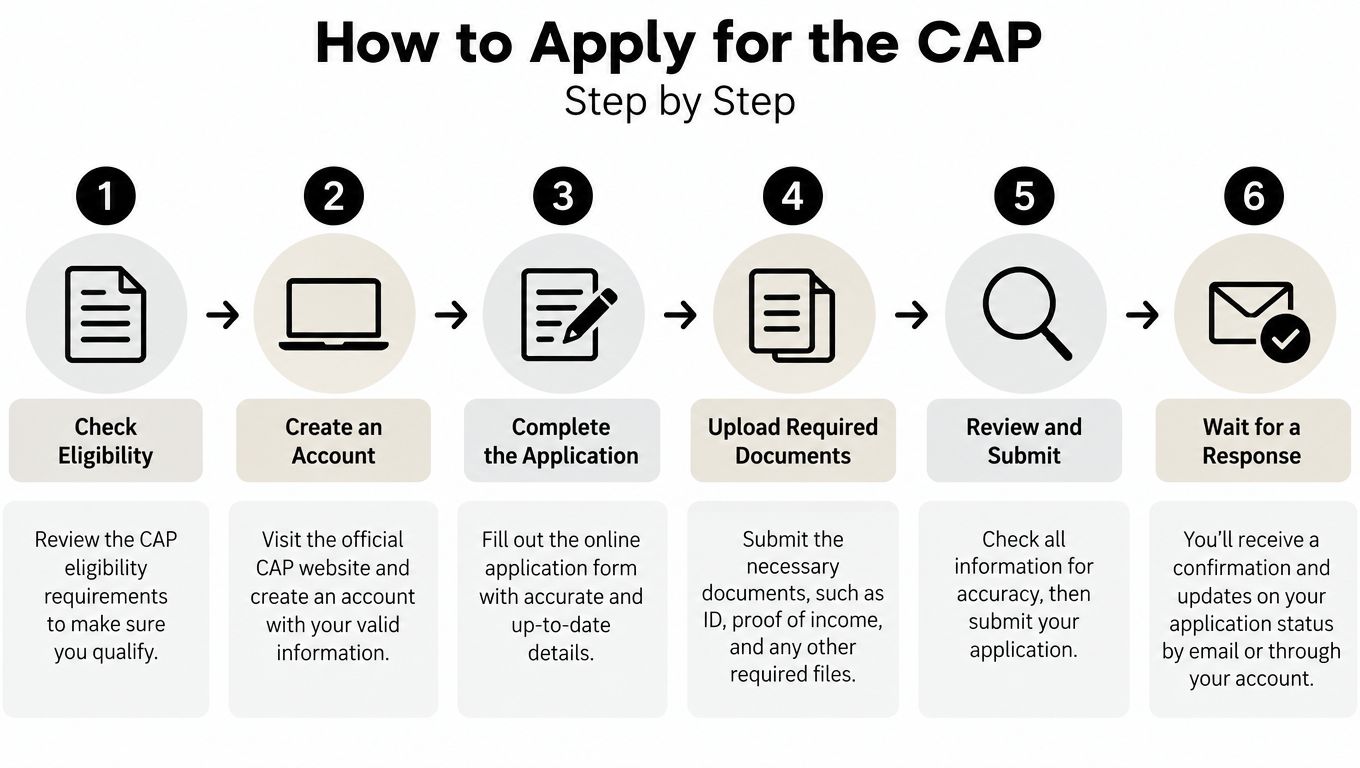
Start with the documents from the station that failed the vehicle. The failure report identifies the inspection result and gives BAR a factual basis for evaluating the application. If the vehicle is directed or classified as a gross polluter, that status can affect where the next test or repair must occur.
Gather the right paperwork
Collect the failed Smog Check report, the vehicle registration information, ownership documents, and any income documentation required for the assistance category. If you're applying for repair help, keep prior Smog Check results and repair records available because BAR may need to confirm the vehicle's history and eligibility.
Check every form before submitting it. A missing signature, inconsistent vehicle identification number, or incomplete income section can delay review. Use the current forms and instructions on BAR's CAP pages rather than an old form saved from a previous application.
Submit before authorizing work
Complete the application online or by mail, following BAR's current submission instructions. Don't assume that a repair shop can approve the application on its own. The station can help explain the repair process, but BAR controls the assistance decision.
Once BAR approves the application, choose a participating repair facility that can perform the eligible diagnosis and repairs. Ask what the program covers, what your co-payment will be, and whether the proposed repair addresses the failure code rather than a separate maintenance issue.
Expect verification after repair
The repair shop documents the work, verifies the emissions result, and completes the required program paperwork. Funds aren't handed directly to the driver as unrestricted cash. The program uses documentation and participating providers to connect the approved assistance to eligible emissions work.
Complete applications are commonly handled over several weeks, so a driver with an approaching renewal date shouldn't wait until the last day. Keep copies of the application, approval notice, diagnostic report, invoices, and final Smog Check result.
The application process is also explained visually in this CAP application video. Watch it before submitting forms, then compare each requirement with the paperwork in your own file.
STAR Stations Versus Regular Smog Check Shops
The difference between a STAR and non-STAR station isn't just a sign on the building. It determines what kind of inspection the shop can perform and whether the result will satisfy a directed testing requirement.
A regular licensed station may be suitable for an ordinary Smog Check. A STAR station is authorized for vehicles that BAR directs into the STAR network and is evaluated under additional performance standards. If the renewal notice or inspection result directs you to STAR, choosing a non-STAR shop can send you back to the beginning.
Match the station to the vehicle
A STAR Test Only station performs inspections but doesn't complete repairs. A STAR Test and Repair station can inspect the vehicle and, where appropriate, perform qualifying repairs. A driver applying for CAP should ask whether the facility participates in the specific CAP repair process, not merely whether it displays a STAR designation.
| Feature | STAR station | Non-STAR station |
|---|---|---|
| Directed vehicle testing | Can handle inspections when BAR directs the vehicle to STAR | May not be authorized for the directed inspection |
| Testing role | STAR Test Only or STAR Test and Repair options | Standard testing or repair services, depending on license |
| CAP planning | May support the required inspection and approved repair workflow | May not satisfy a STAR or CAP-specific requirement |
| Best question to ask | “Can you complete the STAR and CAP steps for this vehicle?” | “Can you perform the inspection required on my notice?” |
A station shouldn't promise a pass before testing. It should explain the result, provide the report, and identify what the vehicle needs next. Ask for a written estimate before approving work, especially when a failed test involves a catalytic converter, oxygen sensor, evaporative system, or diesel emissions component.
Read this STAR station explainer for California drivers before booking. It helps clarify whether you need Test Only, Test and Repair, or a standard inspection.
A STAR label solves a station-authorization problem. It doesn't guarantee that the vehicle will pass.
Follow-up testing should be arranged with the shop that knows the repair history. Keep the first report and every invoice. If the vehicle fails again, those records show what was tested, what was repaired, and whether the next step should be another diagnosis, a waiver review, or retirement.
Edge Cases for Older Cars Diesels and Hybrids
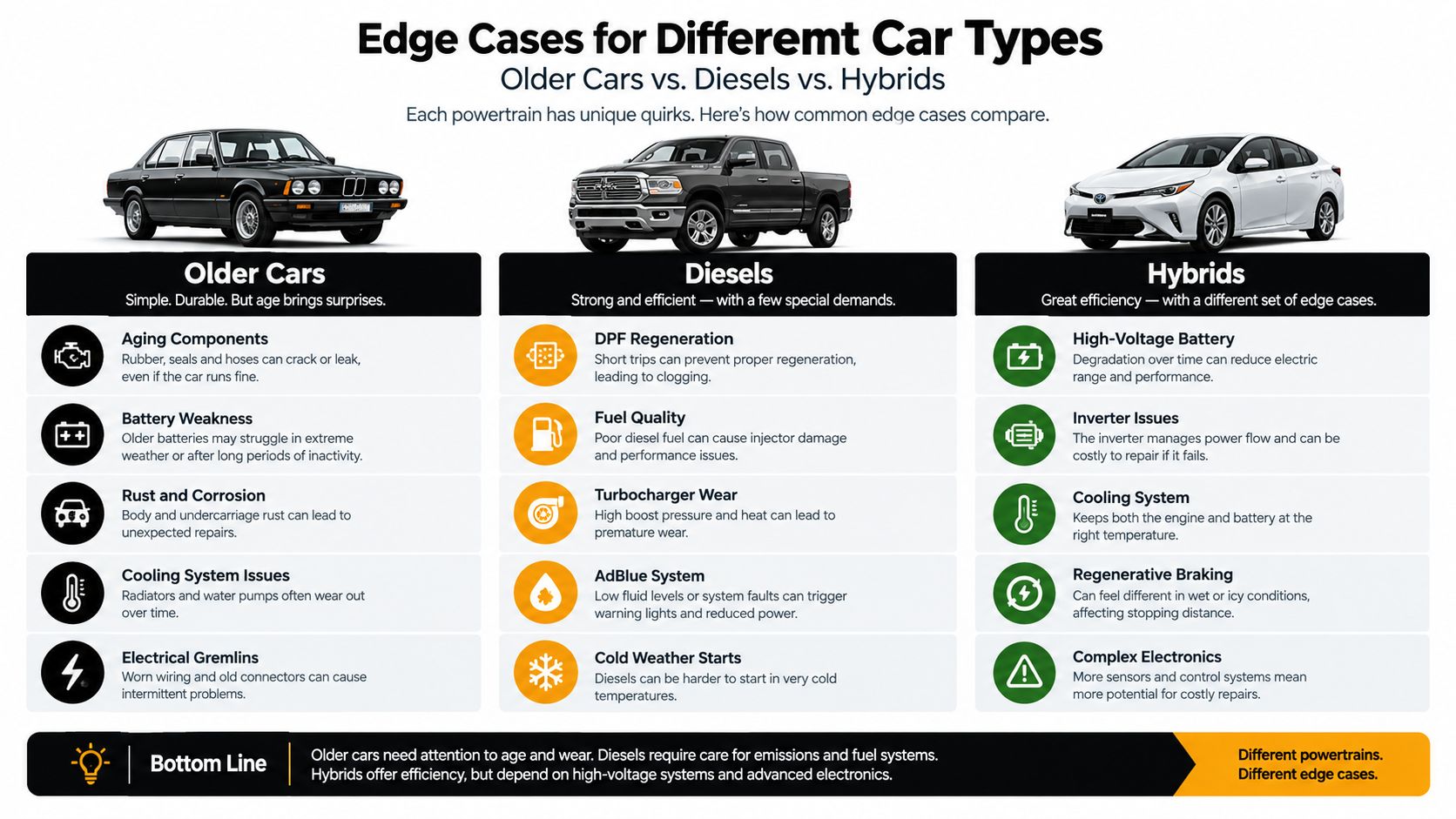
A failed test can lead to different decisions for a 1999 gasoline car, a 2003 diesel pickup, a hybrid with an emissions warning, or a newer vehicle paying an abatement fee. Fuel type, model year, vehicle weight, ownership status, and the failure itself determine which CAP path makes sense.
Older gasoline vehicles
An older car may need a repair that costs more than the vehicle is worth. BAR's repair assistance structure separates model years 1976 through 1995 from 1996 and newer, with different maximum repair amounts. The program details are summarized in BAR's CAP repair guidance.
Eligibility is not automatic, and assistance does not cover every possible repair. Bring the failed report, verify the model year, and compare repair assistance with retirement. A car with rust, transmission trouble, and repeated emissions failures may be a poor repair candidate even if one component can be replaced.
Diesels need careful identification
Diesel classification gives you a practical first checkpoint. Diesels with a gross vehicle weight rating under 14,000 pounds and a model year of 1998 or newer generally fall under the Smog Check program. Older or heavier trucks can follow different requirements, so confirm the vehicle's category before booking a test or approving repairs.
A diesel is not exempt because it uses a different fuel. Ask the station whether the truck belongs in the standard Smog Check process and whether the shop has the equipment and experience to test its emissions system. A diesel failure may involve fuel-system work, sensors, exhaust after-treatment components, or visible smoke. Those diagnoses can lead to different repair costs and different CAP decisions.
If a notice directs the vehicle to a particular station type, follow that instruction before paying for repairs. An accurate classification prevents spending money on work before you know which inspection and assistance rules apply.
Hybrids aren't automatically exempt
The electric motor does not remove a hybrid's gasoline emissions systems. An older hybrid can fail because of emissions components, warning lights, or a fault requiring specialized diagnosis. Battery condition may affect whether keeping the car makes financial sense, but it does not by itself determine CAP eligibility.
Ask the technician to separate the Smog Check failure from unrelated battery maintenance. A replacement hybrid battery will not necessarily correct an emissions failure unless the diagnosis connects the battery problem to the failed result. That distinction helps you compare repair, waiver review, and retirement without treating every expensive hybrid repair as one problem.
Newer vehicles and unusual ownership
Vehicles under four model years old can pay a smog abatement fee instead of completing an inspection during the initial period, according to the California DMV Smog Inspections page. That process differs from CAP. A newer vehicle in this category generally has not entered the same inspection path as a car seeking repair assistance after a failure.
Leased vehicles require coordination with the registered owner or leasing company before retirement or major repairs. An inherited car may need its ownership and registration records corrected before an application can proceed. An out-of-state vehicle entering California may need California registration steps and a qualifying inspection before its owner can use state assistance.
For preparation details, use this guide to smog checks for older cars. Before giving a final answer, the station should confirm the fuel type, model year, registration status, vehicle weight when relevant, and test category.
Your Action Plan for Getting Back on the Road
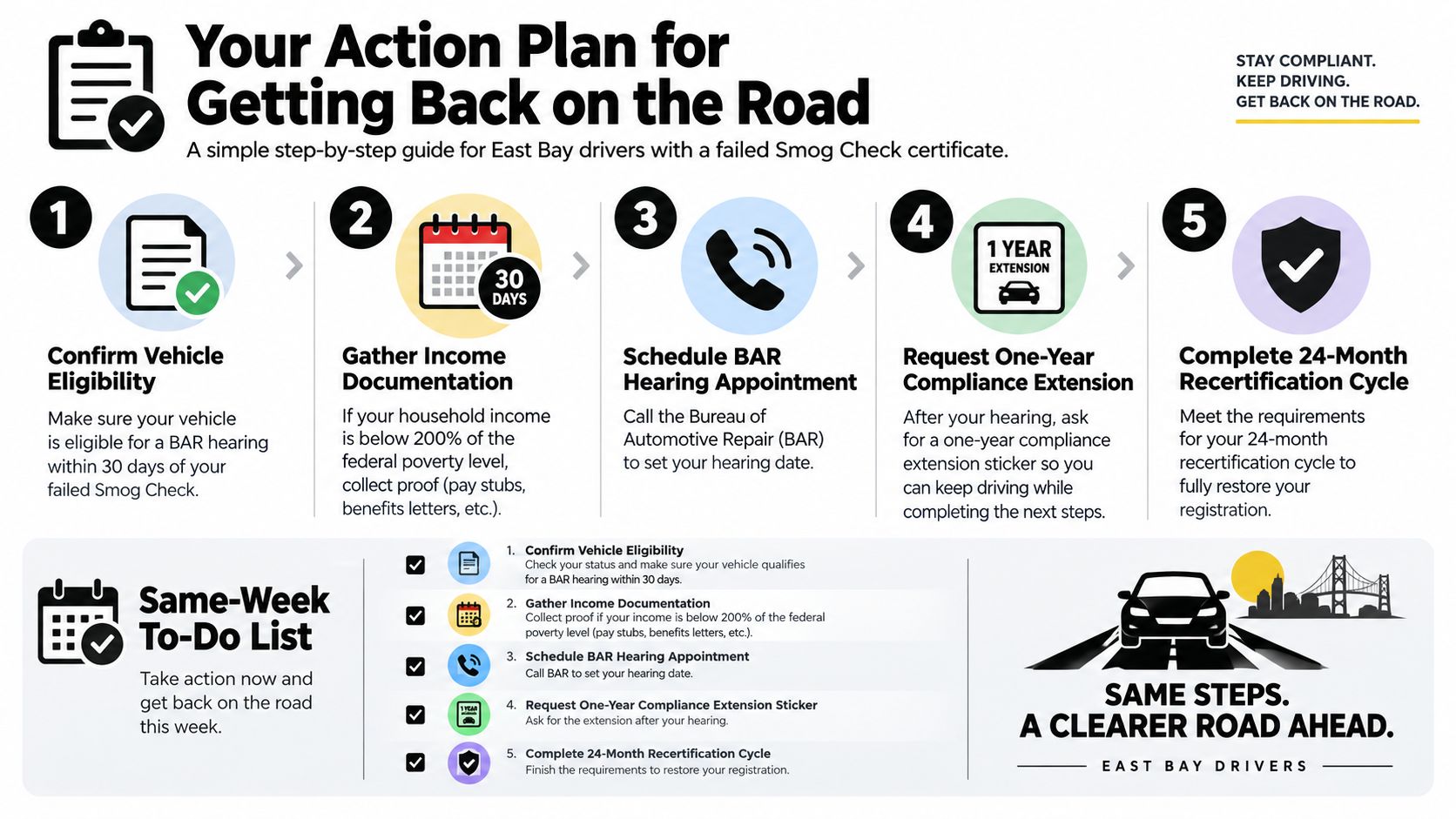
A failed Smog Check can leave an East Bay driver choosing among repairs, a waiver, or retirement. Start with the failed result and the vehicle's history, then match the paperwork and funding to that choice.
Make the first call useful
Keep the complete inspection report beside you when calling a STAR station. Give the staff the model year, fuel type, failure result, whether the notice requires a STAR station, and which path you are considering. This helps the technician address the actual problem instead of offering a generic application answer.
Gather these records before applying:
- Failed test report: Keep the full printout, including failure codes and station information.
- Registration records: Have the DMV registration card or renewal information ready.
- Repair history: Save previous passing results, diagnostic notes, invoices, and receipts.
- Income documents: Collect the records BAR requests for an income-based application.
- Ownership paperwork: Resolve lease, inheritance, title, or registration issues before beginning a retirement transaction.
BAR's CAP contact options are the right place to confirm current rules. Eligibility may depend on the inspection history, registration details, and the specific assistance path, so a general search can leave out a requirement.
Use the diagnosis to choose the path
Ask the technician three direct questions:
- What specifically caused the failure?
- Is the proposed repair emissions-related and eligible for the program?
- Considering the vehicle's condition and value, does repair or retirement make more sense?
A repair may preserve a useful vehicle, while retirement may fit an older car whose repair cost exceeds its practical value. A waiver review follows its own requirements, so do not assume an expensive repair automatically qualifies.
Do not buy parts before confirming the program rules. Keep every receipt, but remember that documentation alone does not guarantee reimbursement if the work was not approved or eligible.
If the paperwork is unclear, use BAR's CAP contact options rather than guessing from a renewal deadline. Processing can take several weeks. Arrange legal transportation and avoid driving with an unresolved registration issue.
Speedy Smog in San Leandro is a STAR Certified station that can run the inspection establishing your next step. Visit Speedy Smog to schedule it.