Your registration renewal is approaching, and you're trying to fit a smog inspection around work, errands, and the drive across Oakland. Before you choose a station, it helps to answer a more important question: what does your particular vehicle need to complete the inspection without an avoidable return trip?
Table of Contents
- Plan Your Oakland Smog Check Visit
- Understand California's Smog Certification System
- Determine Which Vehicles Require Testing
- Prepare Your Vehicle Before the Test
- Choose a STAR Certified Station Nearby
- Compare Prices Without Hidden Assumptions
- Prepare for a Possible Failed Inspection
- Explore Repair Assistance and Retirement Options
Plan Your Oakland Smog Check Visit
A search for a smog check in Oakland, California, can turn into a comparison of nearby addresses and advertised prices. But the closest station isn't necessarily the right starting point. Start with your renewal notice and your vehicle's information, then decide where to go.
Think of an Oakland driver whose car seems to run normally but recently had a battery disconnected. Another driver has a hybrid and isn't sure whether it needs testing at all. Neither should assume that a convenient appointment settles the underlying inspection questions.
Smog certification is a compliance requirement, not a routine tune-up. A maintenance visit addresses the car's service needs. A certification inspection determines whether it satisfies the applicable emissions inspection requirements.
Make the decisions in a useful order
Before committing to a visit, work through this sequence:
- Confirm the requirement. Read your renewal notice and verify your vehicle's current eligibility through state guidance.
- Identify the inspection. Have the model year, fuel type, and any special testing instructions available.
- Check preparation. Tell the station about recent emissions repairs or electrical work.
- Compare suitable stations. Confirm certification status, vehicle acceptance, and the complete price.
- Leave room for a problem. Understand what you'll do if the vehicle doesn't receive certification.
This approach doesn't replace DMV instructions or state eligibility tools. It helps you ask better questions before spending time and money.
Practical rule: Choose the inspection your vehicle requires before choosing the appointment that fits your calendar.
You don't need to become an emissions technician. You need enough information to distinguish a paperwork question, a readiness issue, and a repair decision.
Understand California's Smog Certification System
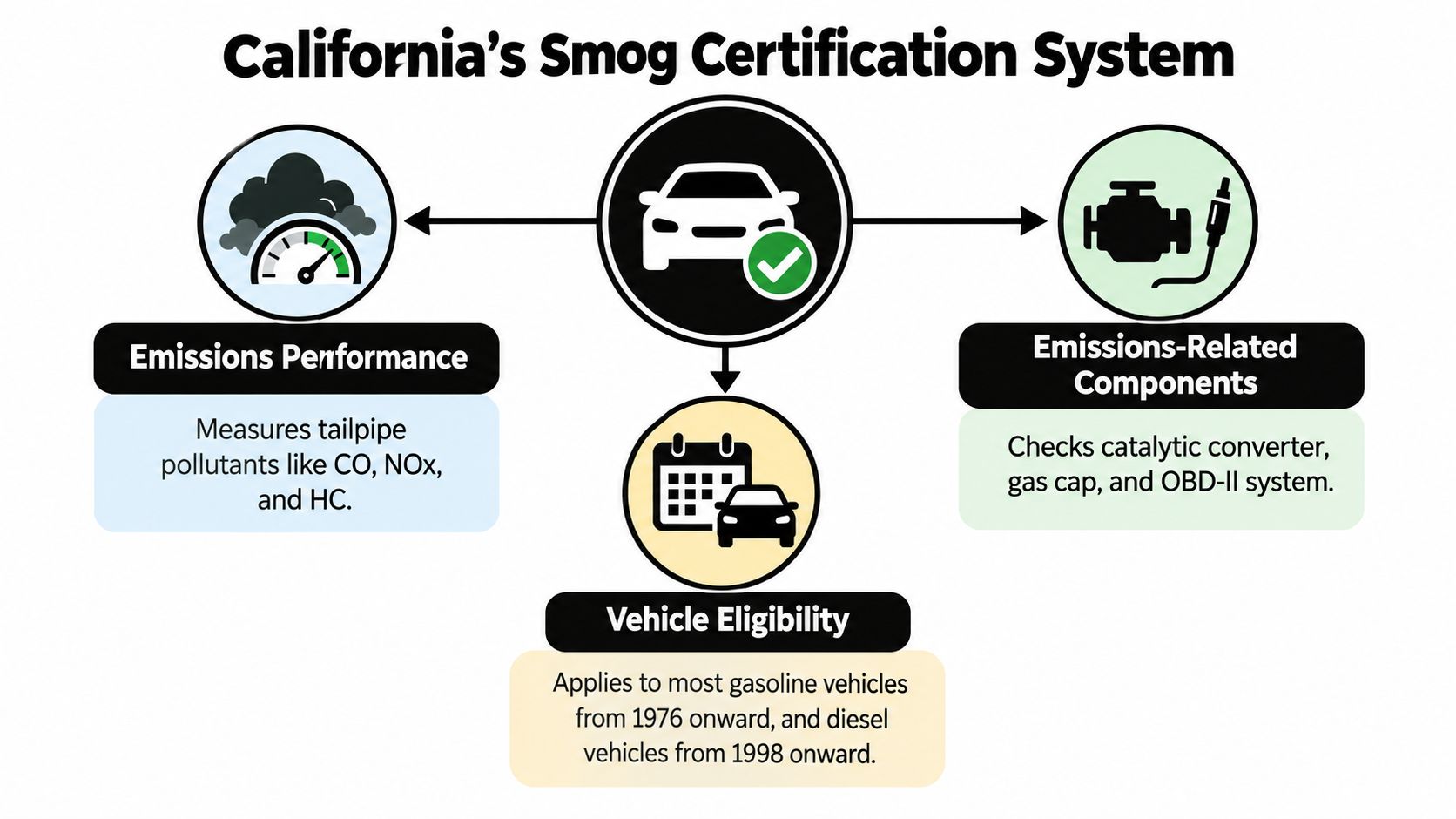
California's Smog Check program evaluates emissions performance and the condition of emissions-related components, requiring many vehicles to undergo inspection every other year. The state established the STAR program in January 2013 to identify stations meeting higher performance standards and authorize eligible locations to inspect vehicles with additional testing requirements, as explained in the Bureau of Automotive Repair's Smog Check performance report.
That structure explains why a smog appointment deserves different preparation from an oil change. The technician isn't deciding whether the engine sounds healthy or whether the exhaust looks clean. The vehicle must satisfy the inspection procedures that apply to it.
The diagram separates the main parts of the certification system.
Separate certification from registration
The Bureau of Automotive Repair, usually called BAR, oversees the inspection program described above. Your DMV registration transaction is the surrounding administrative task. Treating those as separate responsibilities helps prevent a common misunderstanding: completing an inspection isn't a substitute for checking the rest of your renewal instructions.
Ask the station what documentation you'll receive and how you can confirm the certification outcome. Separately, review what DMV still requires from you. Don't assume that a successful station visit answers every registration question.
| Question | Where to focus |
|---|---|
| Does my vehicle need an inspection for this transaction? | Current state eligibility guidance and DMV instructions |
| What inspection applies to my vehicle? | Vehicle details and the station's authorized testing capabilities |
| Did the vehicle receive certification? | The inspection result and station explanation |
| Is my registration transaction complete? | DMV renewal requirements |
A standardized inspection also means the technician needs to follow the applicable procedure rather than substitute an informal opinion. A car that feels dependable on the freeway may still need attention to an emissions-related condition.
The useful mindset is verification rather than reassurance. Ask what the inspection established, what remains unresolved, and which organization can answer the next question. That keeps a technical result from turning into confusion about your registration.
Determine Which Vehicles Require Testing
Model year and fuel type belong together. Knowing only that a vehicle is a sedan, pickup, or hybrid doesn't establish its inspection category.
According to BAR's vehicle coverage and inspection guidance, the program covers gasoline and hybrid vehicles from model year 1976 onward and diesel vehicles from 1998 onward; most gasoline, hybrid, and alternative-fuel vehicles from 2000 onward receive an OBD-II inspection, and BAR identifies hybrids in that newer group as subject to BAR-OIS testing. These broad categories are a starting point, not a substitute for checking the requirement for your exact vehicle and transaction.
Smog Inspection Categories at a Glance
| Vehicle group | Coverage stated in the brief | Inspection focus |
|---|---|---|
| Gasoline vehicles | Model-year coverage summarized above | Confirm the applicable method rather than assuming every gasoline vehicle receives the same test |
| Hybrids | Included in the program's stated coverage | Electric propulsion doesn't remove the need to verify inspection obligations |
| Alternative-fuel vehicles | Most vehicles in the newer diagnostic group described above | Confirm whether the OBD-II inspection applies |
| Diesel vehicles | Covered from the threshold identified above | Verify the vehicle's eligibility and the station's ability to inspect it |
Understand what OBD-II evaluates
On-board diagnostics, abbreviated OBD-II, concerns the vehicle's electronic monitoring of emissions-related operation. BAR's guidance describes an inspection that evaluates the malfunction-indicator lamp, stored diagnostic trouble codes, readiness monitors, and emissions-control functionality.
Those terms answer different questions:
- Warning-lamp status: Is the vehicle indicating an emissions-related malfunction?
- Diagnostic trouble codes: Has the computer recorded information about a detected problem?
- Readiness monitors: Has the vehicle completed the relevant self-checks?
- System functionality: Are emissions controls operating within the vehicle's certified design limits?
A dashboard without an illuminated warning lamp doesn't, by itself, answer all those questions. That distinction matters when a car has recently been repaired or had its diagnostic memory reset.
For a hybrid owner, the practical example is straightforward. Quiet electric operation on part of a trip doesn't establish that the combustion engine's emissions systems are outside the inspection program. Describe the vehicle accurately when calling, including that it's a hybrid.
For an older-vehicle owner, avoid requesting a particular testing method based on what a newer family car received. Give the station the actual vehicle details and ask which procedure applies. Vehicle classification comes before assumptions about testing equipment.
Prepare Your Vehicle Before the Test
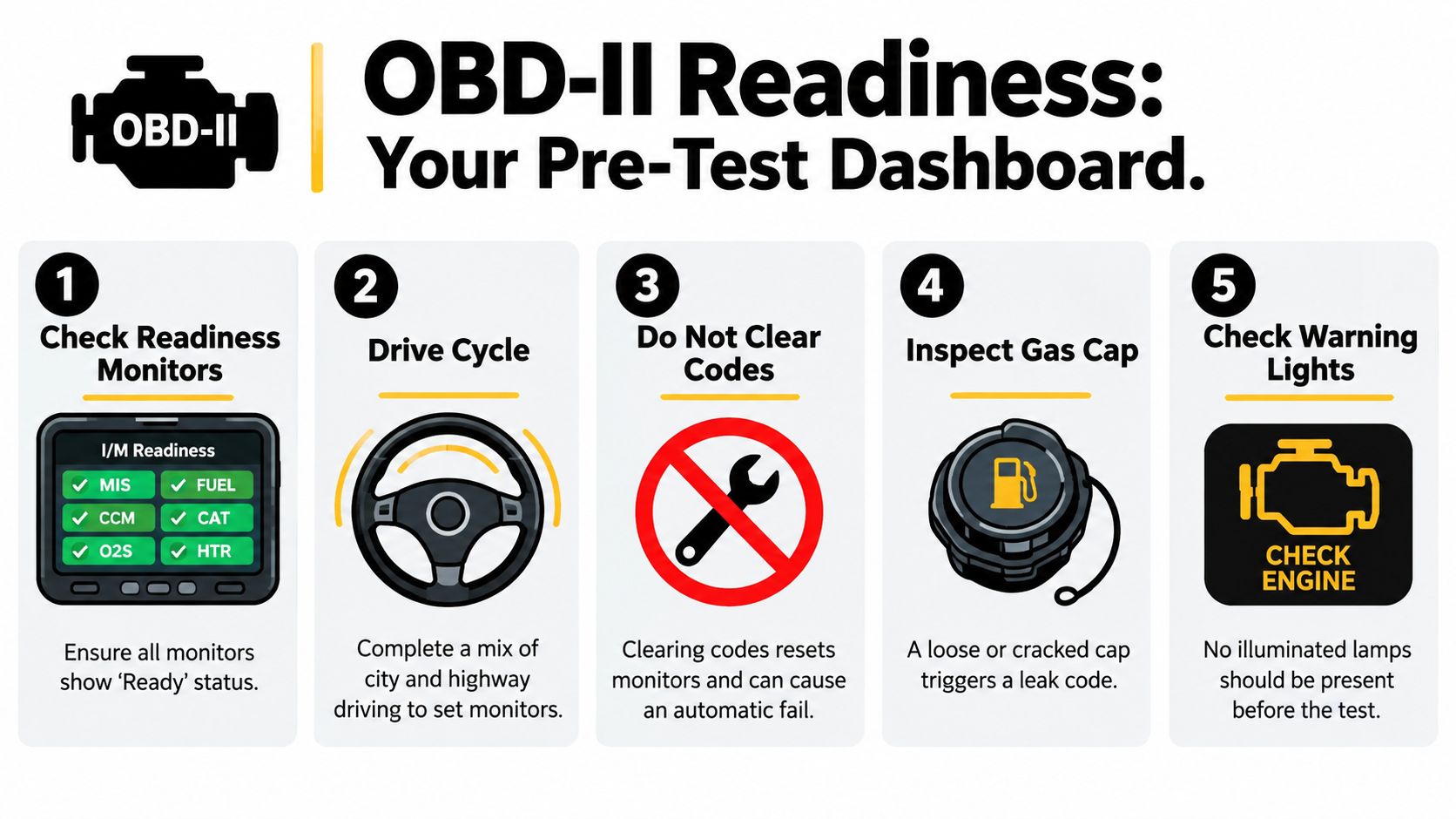
A recently repaired car can be mechanically improved without yet being ready to demonstrate that improvement during an inspection. Readiness is evidence that the vehicle has completed its required self-checks, not an absence of dashboard warnings.
Under the BAR guidance cited above, clearing diagnostic codes or disconnecting the battery can leave readiness monitors incomplete. That can create a readiness-related failure even when the warning lamp is off. Trying to erase a problem immediately before testing can therefore create another obstacle instead of solving the original one.
Use a readiness-focused checklist
- Discuss recent work. Tell your technician about repairs, code clearing, or a battery disconnection before booking the inspection.
- Address an active warning lamp. Ask for diagnosis of the underlying condition rather than a temporary reset.
- Follow the manufacturer's drive cycle. After repairs, use the prescribed procedure so the vehicle can complete its checks.
- Verify readiness. Ask whether monitor status has been checked, rather than assuming that ordinary driving has completed everything.
- Keep repair records. Bring enough information to explain what was repaired and whether the computer was reset.
The visual checklist is a useful reminder, but the manufacturer's procedure and the applicable inspection rules should guide your vehicle-specific preparation.
Don't substitute a driving guess for verification
A drive cycle isn't a universal instruction to take a quick freeway trip. Follow the procedure prescribed for your vehicle rather than relying on someone else's experience with a different model.
An extinguished warning lamp and completed readiness checks answer different questions. Ask about both.
No preparation checklist guarantees certification. The purpose is to avoid arriving with a known warning condition or unresolved readiness question that could have been discussed beforehand.
If you're uncertain, explain the situation when you call. “The repair is complete, but I don't know whether readiness was verified” gives the station a more useful starting point than “The car seems fine.”
Choose a STAR Certified Station Nearby
A suitable station should match the requirement on your paperwork and the vehicle you're bringing. If your renewal notice calls for a STAR inspection, make current STAR status a selection requirement rather than assuming that every smog business qualifies.
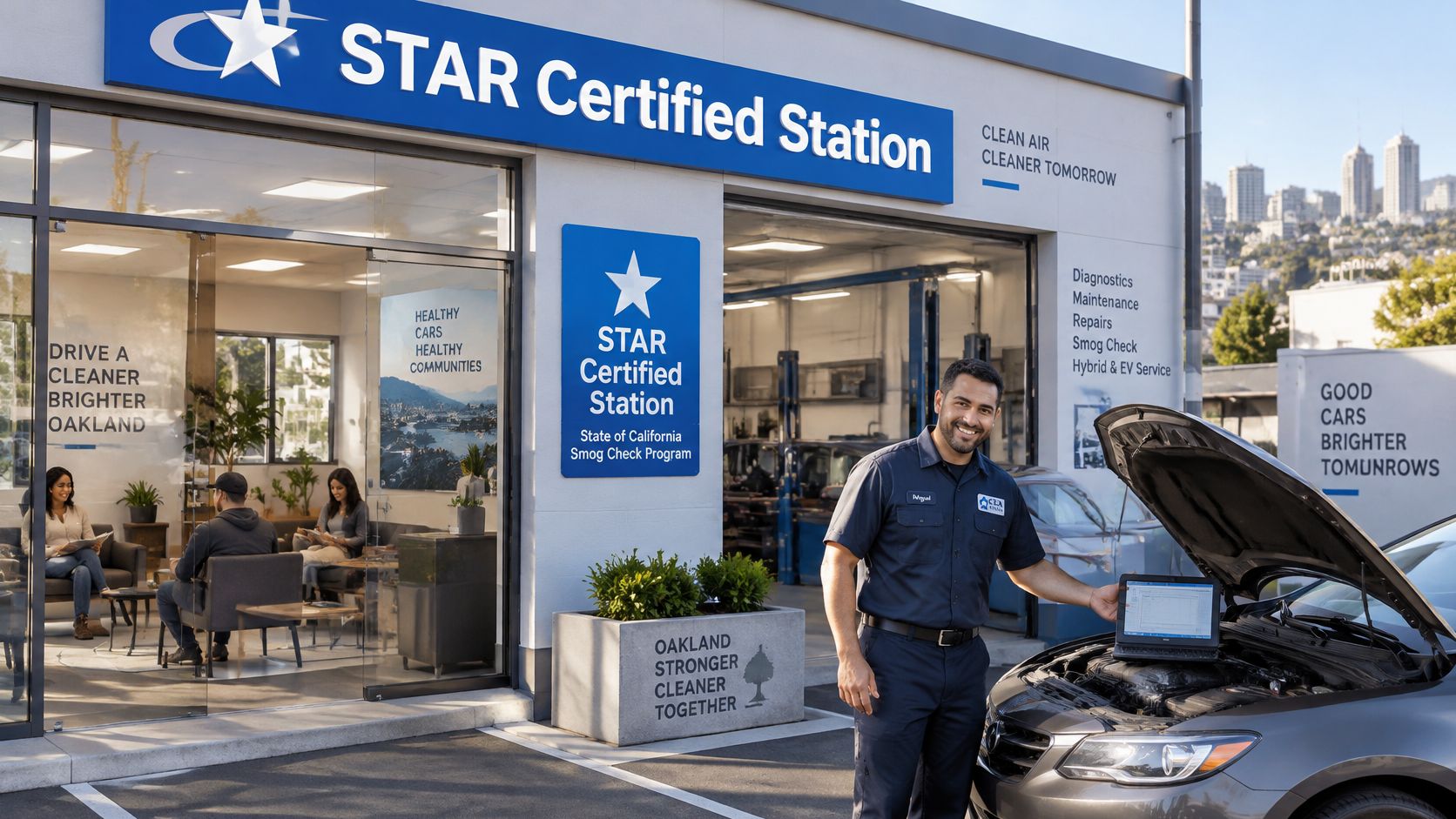
A technician's inspection involves more than a quick look under the hood.
Compare the service you actually need
Test-only and test-and-repair describe different service arrangements. Ask whether you're booking inspection alone or whether the facility can also provide diagnosis and repairs if needed. Don't infer that a particular location offers every service because it displays a smog sign.
| Selection question | Why it belongs in your comparison |
|---|---|
| Is the station currently STAR certified? | Your notice may specify that station category |
| Can it inspect this vehicle? | Fuel type and model year affect the appointment |
| Is the visit testing only? | You should know whether repair capability is available |
| What requires separate authorization? | Diagnosis and repairs shouldn't be confused with the inspection |
| What happens after the result? | You need a clear explanation of certification and documentation |
For a nearby business example, Speedy Smog identifies its San Leandro facility as a STAR-certified smog station serving East Bay drivers. Treat it as an option to compare with other suitable facilities, and confirm acceptance of your vehicle and the services you need before traveling.
This video provides another point of reference while you prepare questions for a station.
Ask about the complete visit
- Scheduling: Request an estimated completion time and ask whether waiting time is separate.
- Certification handling: Ask the station to explain its electronic certification process and the records you'll receive.
- Repair boundaries: Establish whether any additional work requires your approval.
- Result explanation: Confirm that someone can walk you through the report if certification isn't issued.
An Oakland address isn't the only practical option, and a nearby San Leandro location may fit your route. Still, convenience should follow suitability. A short drive to the wrong inspection appointment isn't a time saving.
Compare Prices Without Hidden Assumptions
An advertised inspection price doesn't answer every cost question. Before comparing offers, ask each station to describe the same service for the same vehicle, including any separately listed charges and the conditions attached to a discount.
No verified local fee schedule is established here, so assigning an Oakland-wide price range would be misleading. Use the local emissions-testing pricing information as a starting point for a direct quote, not as a substitute for confirming today's total.
Smog Price Questions to Confirm Before Testing
| Cost item | What the supplied information establishes | What the driver should confirm |
|---|---|---|
| Inspection price | No universal Oakland total is established | The complete quote for the exact vehicle |
| Certification-related charges | No amount is established here | Whether the quoted total includes applicable charges |
| Coupon | Availability must be checked directly | Current terms, vehicle restrictions, and exclusions |
| Diagnostic work | It shouldn't be assumed to be part of testing | Whether diagnosis is available and separately charged |
| Repairs | No repair estimate can be established before the problem is assessed | The proposed work and authorization process |
| Another inspection | No station-specific policy is established | Any conditions or charges for returning |
Use a precise pre-arrival request
Try this wording when you call:
Please quote the complete inspection cost for my vehicle, explain any separate charges, and tell me whether a current coupon applies. If it doesn't pass, what would I be paying for next?
Then provide the model year, fuel type, and any STAR instruction on your notice. If you've already received a quote elsewhere, compare inclusions rather than comparing headline amounts alone.
Time and price are separate questions. A station's estimate for performing the test doesn't necessarily describe your total visit, and a discount doesn't establish the final bill. Confirm payment timing and keep the quoted scope clear before testing begins.
Prepare for a Possible Failed Inspection
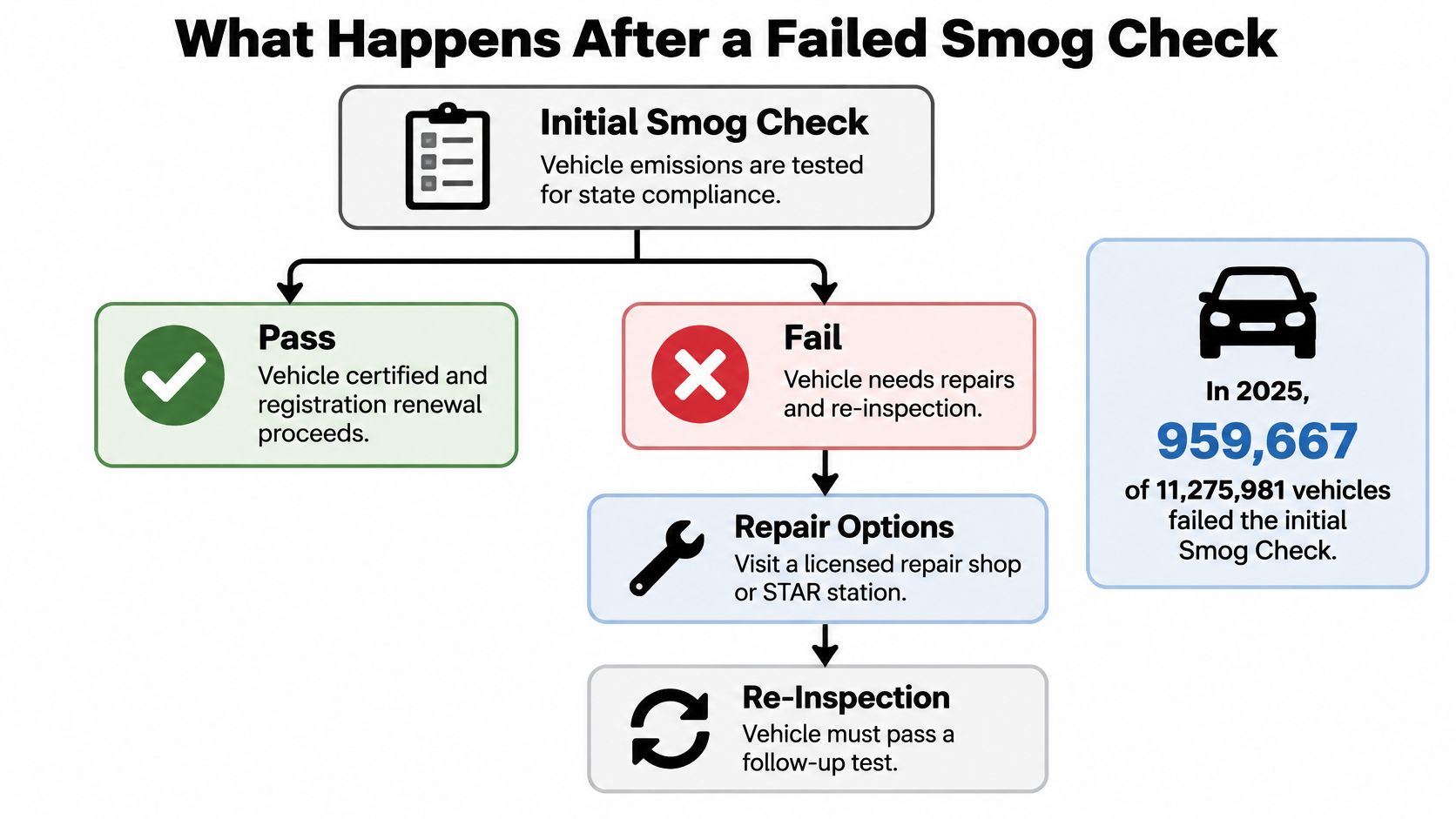
A failed inspection is a result to interpret, not an instruction to authorize unspecified repairs. In the 2025 reporting period, BAR recorded 959,667 failures among 11,275,981 initial tests, an 8.51% initial failure rate; including repeat and other testing activity, the overall failure rate was 9.04%, according to the statewide Smog Check executive summary.
Those statewide figures aren't a prediction for your particular car. They establish that failure is a real possibility worth planning for, while most initial tests didn't fail. The report also shows that vehicle age affected outcomes, which gives owners of aging vehicles a reason to budget time for diagnosis rather than assume immediate certification.
Read the result before buying a repair
Start by asking the station to identify the reported reason certification wasn't issued. A readiness issue calls for a different conversation from a diagnosed malfunction or an emissions-component concern.
- Keep the report. Preserve the inspection result alongside existing repair records.
- Ask for a plain-language explanation. Understand what the inspection found and what still needs diagnosis.
- Request a written estimate. Separate proposed diagnostic work from a repair recommendation.
- Check the next inspection step. Ask what must be resolved before returning.
The flowchart shows the conventional repair-and-reinspection route.
Pause when the financial decision changes
For an owner facing substantial repair costs, the next question isn't always “Which repair should I approve?” It may be “Should I check assistance eligibility before committing more money?”
Don't assume that a failure automatically qualifies you for help, either. Preserve the documentation and compare your options before treating any program as a guaranteed payment.
If the inspection result appears inconsistent or you don't understand the explanation, ask for clarification first. For an unresolved dispute, contact BAR or ask whether a Referee review is appropriate rather than paying for repeated tests without understanding the issue.
A clear explanation is part of making an informed decision. You should understand the reason for failure, the proposed next step, and the financial commitment before authorizing work.
Explore Repair Assistance and Retirement Options
For a financially constrained household, keeping an older vehicle on the road can involve a difficult trade-off. A repair may be worthwhile, but it shouldn't be treated as the only possible response to an expensive emissions problem.
California offers vehicle-retirement incentives of $1,500 or $2,000 in qualifying cases, while income-qualified applicants for broader Consumer Assistance Program options generally must be at or below 225% of the federal poverty level; published annual examples include $35,910 for a single-person household, $48,690 for a household of two, and $74,250 for a household of four, according to BAR's vehicle-retirement eligibility information. That guidance distinguishes pathways requiring a failed inspection from another requiring a completed inspection within 180 days before application, so the relevant route must be verified before you rely on it.
Compare eligibility before committing funds
Income is only part of the decision. BAR also distinguishes programs by vehicle operational status and inspection history. Don't read an income threshold as an approval, and don't assume that every assistance option follows the same application rules.
Use this compact decision sequence:
- Preserve documentation first. Keep the test report, repair estimate, and records that explain the vehicle's condition.
- Identify the relevant program. Ask whether your circumstances fit repair assistance, retirement, or neither.
- Verify current requirements. Confirm application timing and vehicle conditions directly with BAR.
- Compare your alternatives. Consider the repair quote alongside your transportation needs and any verified program eligibility.
- Resolve disputed questions. Ask BAR which office or Referee resource is appropriate for the issue.
Local smog-check repair-assistance guidance can help you organize questions, but BAR should confirm program requirements and eligibility.
Make the decision fit your household
Retirement assistance isn't automatically the better financial choice. You still need to consider how you'll travel after giving up the vehicle. Conversely, repeated repair spending isn't automatically sensible just because you've already invested money in the car.
Your most useful next step is the one supported by documentation: a verified inspection requirement, an appropriate station, an understood price, or a clearly assessed assistance application. You don't have to solve every uncertainty at the counter.
Speedy Smog offers STAR-certified emissions testing in San Leandro for Oakland and other East Bay drivers. Visit Speedy Smog to confirm your vehicle's inspection needs, ask for the complete price, and plan your visit before your registration deadline.
A California smog check usually looks at four layers, an OBD II scan, a visual equipment check, a functional inspection, and, where applicable, a tailpipe or opacity measurement. In plain English, the technician is checking the car's computer, its emissions parts, how those parts behave, and, on some vehicles, what comes out of the exhaust.
You're probably here because the registration notice showed up, the check engine light came on and went off again, or a friend told you to “just clear the code” before you go. That advice can backfire, because the inspection is built to catch more than one kind of problem, and California's numbers show those layers matter. In calendar years 2024–2025, about 19 million model year 2000-and-newer vehicles were tested, and about 1.3 million, roughly 7%, failed, which tells you the system is catching real issues, not just paperwork mistakes (California Smog Check Performance Report).
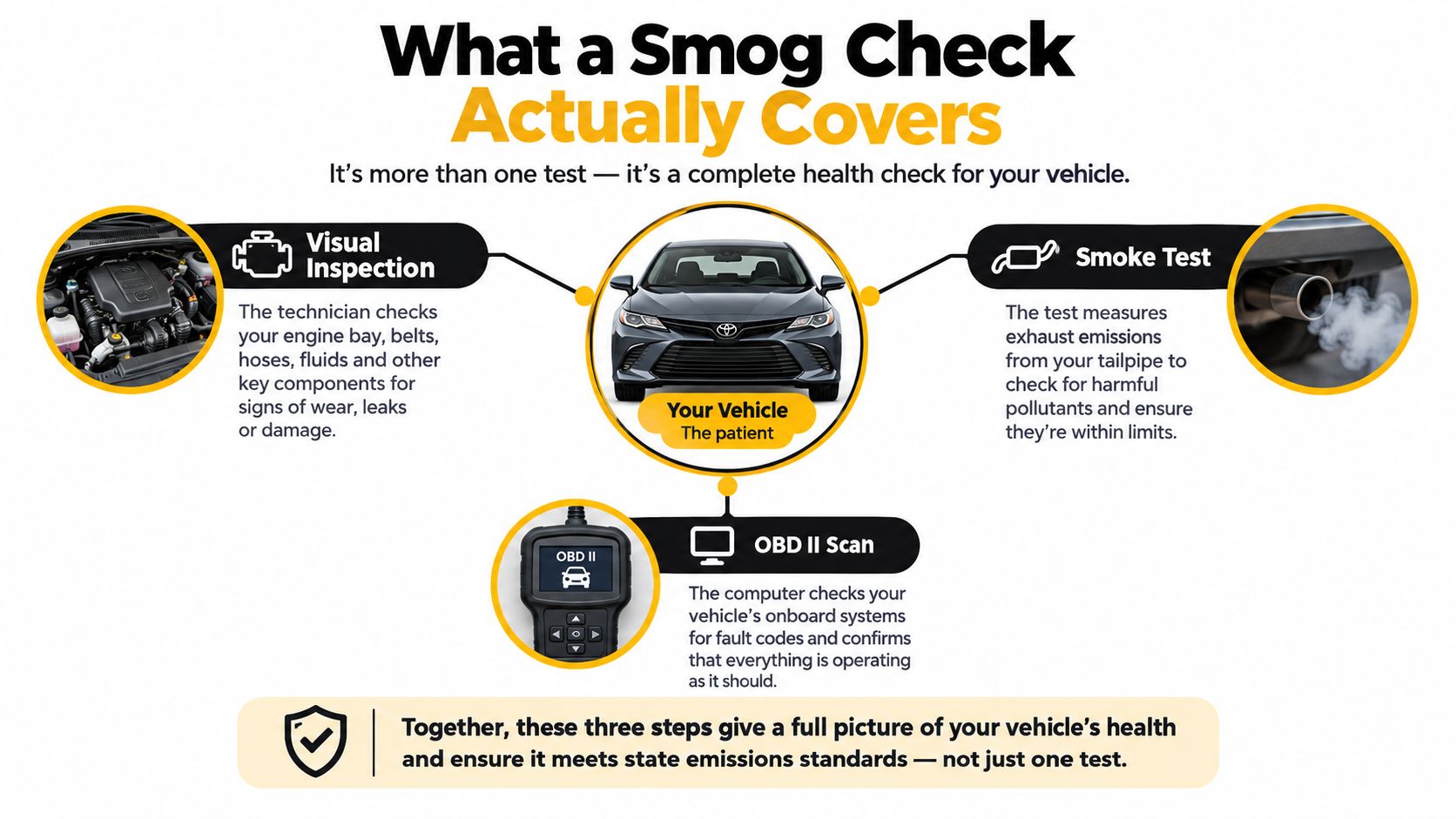
Table of Contents
- What a Smog Check Actually Covers
- The Four Layers of a Modern Smog Inspection
- OBD II Scans Readiness Monitors and the Check Engine Light
- Tailpipe Tests Opacity Checks and Older Vehicles
- What Causes Cars to Fail the Inspection
- Clearing Codes Before a Smog Check and Other Myths
- How to Prepare Your Car Before the Appointment
What a Smog Check Actually Covers
A smog check is more like a layered health check than a single measurement. When you pull into the bay, the technician isn't just looking for one bad number at the tailpipe, they're checking whether the vehicle's emissions system is functioning as a whole, the same way a doctor checks blood pressure, pulse, and breathing instead of one vital sign alone.
The first pass is about the vehicle's own evidence
For many California vehicles, the inspection starts with the car's onboard diagnostics. The computer reports whether emissions-related systems have run their self-tests, whether any faults are stored, and whether the warning lamp is behaving properly. At the same time, the technician looks under the hood and around the vehicle for required emissions parts and signs that something has been removed, damaged, or tampered with (BAR smog overview).
That's why the answer to “smog check what do they check” is broader than most drivers expect. The inspector is not only asking, “Does the car look clean?” They're also asking, “Does the car prove it can control emissions the way it should?”
Why the state uses more than one test
Different vehicles need different checks. Newer gasoline vehicles are usually handled through the computer-based inspection, while older vehicles may be measured at the tailpipe, and diesel vehicles can be tested with opacity equipment that looks at exhaust smoke density (BAR executive summary). California uses those layers because a car can look fine, sound fine, and still fail once the inspection reaches the part the driver can't see.
Practical rule: if a test looks at the computer, the hardware, and the exhaust itself, a car has three different chances to show a problem.
That matters in California because registration often depends on passing the smog check, and the state's testing program is overseen by the Bureau of Automotive Repair. Some stations are also STAR Certified, which means they meet higher performance standards set by the state, so the inspection result carries extra confidence for DMV use.
The Four Layers of a Modern Smog Inspection
A modern inspection moves in layers, and each one can surface a different problem. A car may pass the computer scan and still fail if a required emissions part is missing, damaged, or if the exhaust reading does not meet the standard.
The computer scan checks the car's memory
For a newer vehicle, the technician connects to the OBD II system, the car's self-monitoring network. The scan shows stored trouble codes, monitor status, and warning-lamp behavior, so the inspector can see whether the emissions system has been doing its job (BAR smog). This is closer to reading the vehicle's report card than a quick glance.
The visual inspection checks what's physically present
The next layer is the under-hood and under-car review. The technician confirms that required emissions equipment is present and appears correctly installed, including parts such as the catalytic converter, evaporative-emissions components, and exhaust-gas recirculation equipment when applicable (BAR executive summary report). If a part has been removed, bypassed, or clearly tampered with, the car can fail even if the engine sounds fine.
The functional and measured-emissions checks catch what the eye can't
Some inspections also include a functional review, which checks whether the emissions controls respond properly, not just whether they are installed. On older vehicles, there may also be a measured exhaust test or opacity test, depending on fuel type and model year (BAR-97 manual). That separates a part that is merely there from one that still does its job.
The three layers work together. The computer shows the system's history, the visual check confirms the hardware, and the tailpipe or smoke measurement checks the result. A car can clear one layer and still fail another.
Model year decides the path
California's rules split vehicles by age and engine type. Vehicles with 2013-and-newer model-year engines are required to undergo OBD testing, while vehicles with 2012-and-older model-year engines may need an opacity test and emissions-control-equipment inspection (BAR executive summary report). That is why two cars that look similar on the street can face different inspection lanes at the station.
OBD II Scans Readiness Monitors and the Check Engine Light
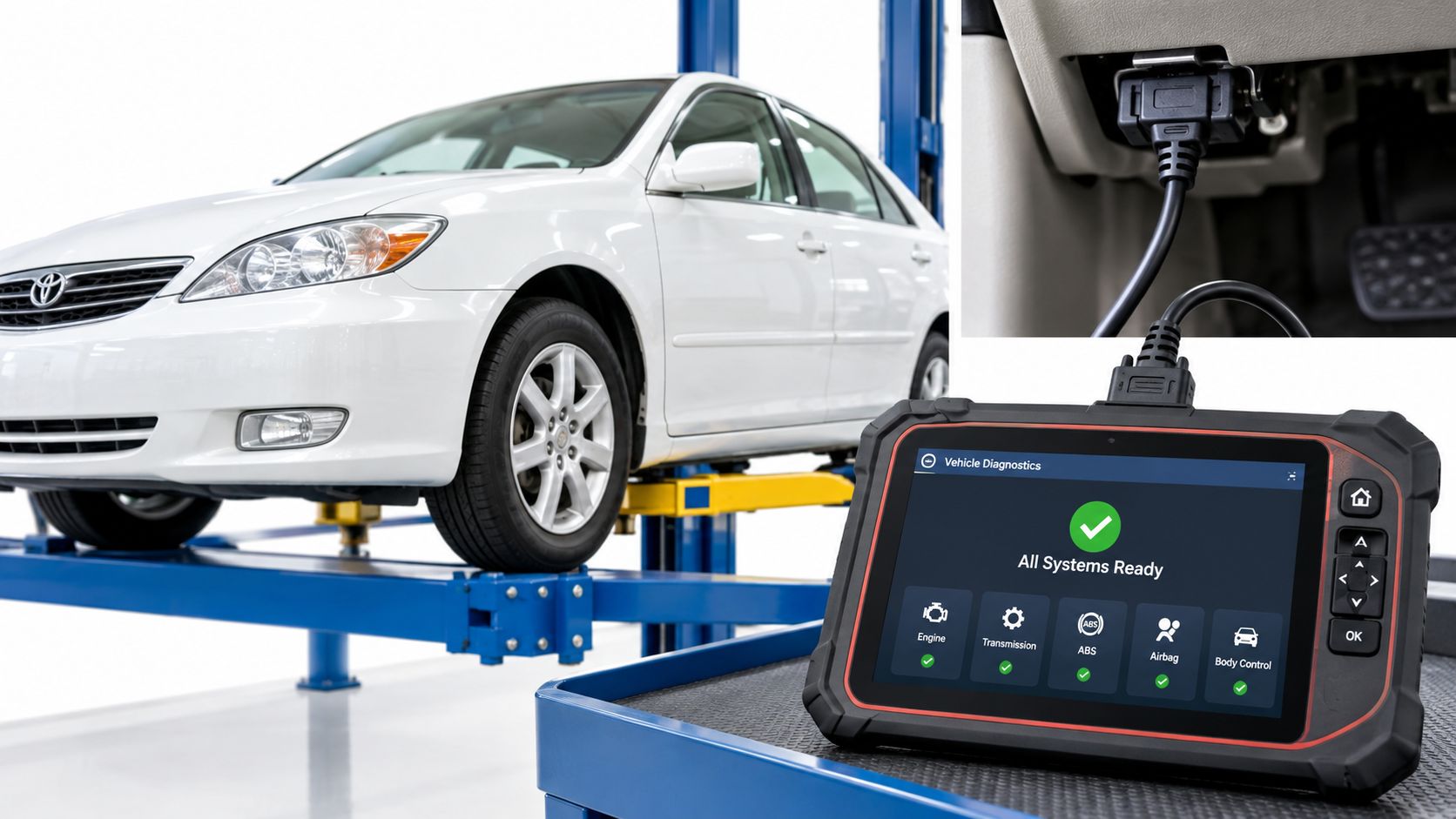
For a 2000-and-newer California vehicle, the OBD II scan is often the heart of the inspection. Think of it as the car's own self-diagnostic report card, it tells the inspector whether the emissions systems have checked themselves, whether faults are stored, and whether the warning lamp is behaving the way it should (BAR smog).
Ready is not the same as no light
Many drivers get tripped up here. A dashboard with no active check engine light does not automatically mean the car is ready to pass. The car also has to finish its readiness monitors, which are self-tests for systems such as oxygen sensors, the catalytic converter, evaporative-emissions controls, and misfire detection (BAR readiness guidance). If the monitors are still “not ready,” the vehicle may fail even though the light is off.
That's why disconnecting the battery, clearing codes, or doing a repair right before the appointment can cause trouble. Those actions can reset the monitors, and the car may need normal driving before the self-tests complete. In plain terms, you can make the warning go dark faster than you can make the car prove it's healthy.
Practical rule: a smog station cares about both the absence of an active fault and the presence of completed self-tests.
What the inspector actually looks for
The technician verifies that the malfunction indicator lamp comes on with the ignition and turns off after startup, then checks for diagnostic trouble codes and monitor status through certified equipment (BAR smog). CARB describes the inspection as both a visual and functional OBD II check, so the computer side is never just a “plug it in and hope” process.
How OBD codes help you understand a smog result
A simple example helps. If someone disconnects the battery to replace a stereo, the clock resets, the monitor history clears, and the car may look fine on the dash but still be unready for inspection. That's why the week before the test matters more than the hour before it.
The OBD side is also why code clearing can be a trap. The problem doesn't disappear just because the light disappears. The inspector is checking whether the emissions system has completed its own checks and can demonstrate normal operation.
Tailpipe Tests Opacity Checks and Older Vehicles
Older cars follow a different path because they don't all speak the same diagnostic language. California's BAR-97 procedure measures exhaust pollutants from 1999-and-older vehicles at the tailpipe, while applicable 1996–1999 gasoline vehicles receive both OBD inspection and tailpipe testing (BAR-97 manual).
Gasoline vehicles get measured, not guessed
A tailpipe test asks a direct question, what is the vehicle putting out under test conditions? If the readings are high, the issue may be an inefficient catalytic converter, an air-fuel imbalance, ignition misfire, or worn oxygen-control hardware. That's different from a computer fault, because the exhaust numbers show the result of the engine's behavior, not just the stored record of it.
Visual compliance still matters on these cars. Inspectors check that emissions equipment is present, that visible smoke isn't excessive, and that there aren't obvious liquid fuel leaks or fuel-cap problems where the test applies (BAR-97 manual). A loose or damaged cap can surprise drivers because it looks small, but it affects whether the system seals properly.
Diesels are judged by smoke opacity
Diesel vehicles may face an opacity test, which measures how much light is blocked by exhaust smoke. That gives the inspector a practical way to see whether the vehicle is producing too much visible soot, even when there isn't a gasoline-style tailpipe measurement in play (BAR executive summary).
A 1999 Civic and a 2018 Civic can therefore live in different worlds at inspection time. The older car may face a more physical emissions test, while the newer one is mainly judged by its onboard diagnostics and emissions-system behavior. Same brand, different rulebook.
What Causes Cars to Fail the Inspection
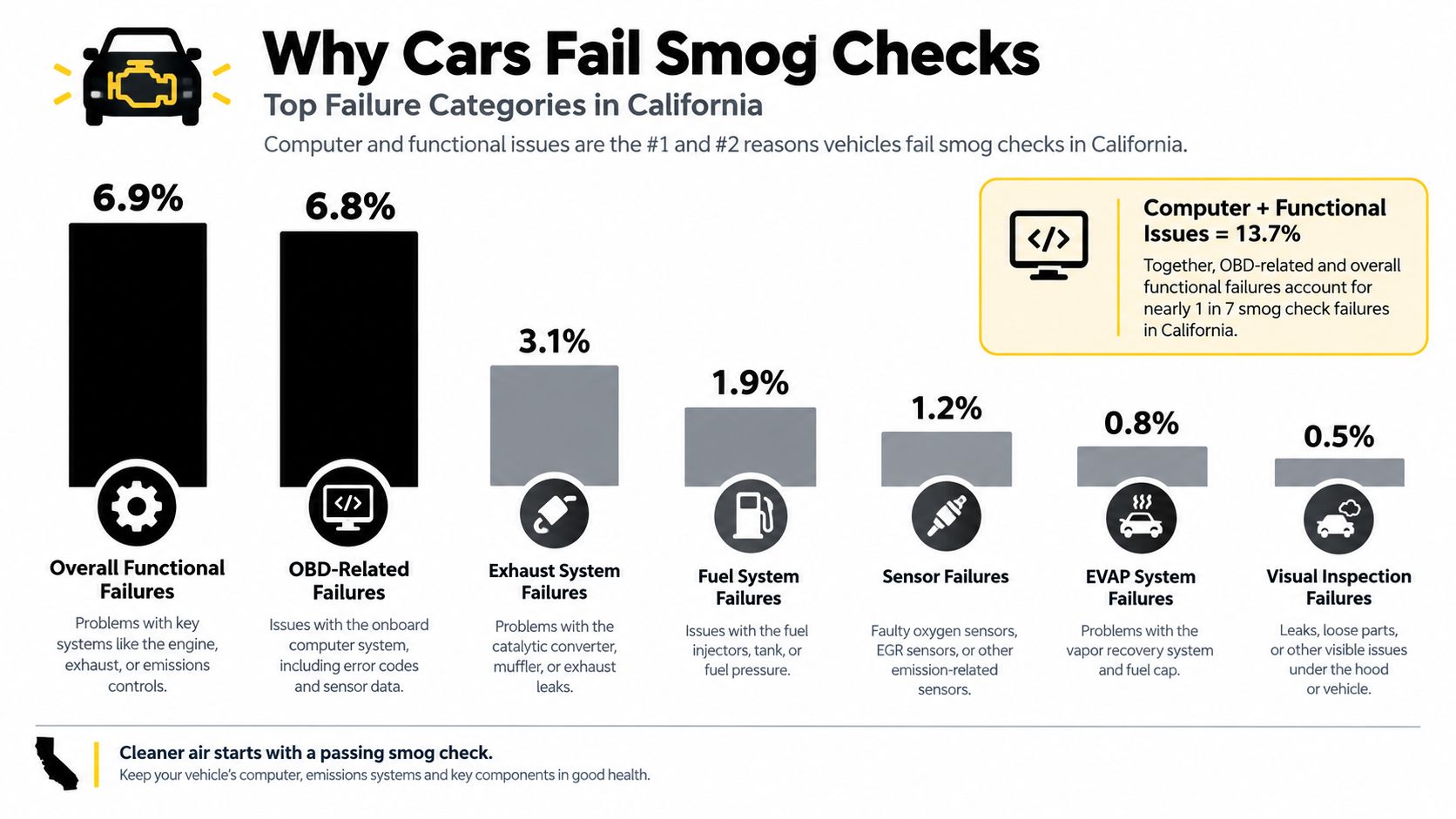
A smog check failure usually comes from one of three places. The car's onboard computer is unhappy, the required equipment does not function the way it should, or something visible is missing or tampered with. The California Smog Check Performance Report shows that OBD-related failures accounted for 6.84% of initial tests, while overall functional failures were 6.92%. Visual failures were lower, at 1.28%.
The table that matches what inspectors see
| Failure Category | Initial Failures | Share of Initial Tests |
|---|---|---|
| OBD-related failures | 714,956 | 6.84% |
| Overall functional failures | 724,477 | 6.92% |
| Visual failures | 134,222 | 1.28% |
The numbers are not separate boxes on every car. A single vehicle can trigger more than one problem during the same visit. The useful takeaway is simpler. If the check engine light is on, if a readiness monitor has not finished, or if a code is stored, that is usually the first thing to fix before the appointment.
A car that feels fine on the road may still have monitor issues that the inspection will catch.
Most failures fall into familiar patterns. A check engine light, a catalytic converter-related code, an evaporative emissions leak, a missing gas cap, or tampered emissions equipment can stop a pass. Those are the parts worth checking before you start guessing at more complicated causes.
Common smog failure reasons explained simply
The smartest pre-test question is not whether the car runs well. It is whether the emissions system can show, right now, that it is working as required. A loose cap can fail like a bad seal on a water bottle, small on the outside, but enough to break the system's pressure check. A missing monitor works the same way. The car may drive normally, but the inspection still sees the gap.
Clearing Codes Before a Smog Check and Other Myths
The most expensive myth is simple, clear the code, the light goes off, and the car should pass. The problem is that clearing codes can reset readiness monitors, which puts the car back into “not ready” status until the self-tests complete. That can turn a temporary dashboard fix into a failed appointment.
Three common myths that waste time
“Idling it for a few minutes warms it up enough.” Not always. Warm engine oil helps, but the car still needs the right drive conditions for monitors to finish their checks. A short idle can't replace a proper drive cycle.
“Disconnecting the battery resets everything in a good way.” It resets the memory, yes, but that includes stored codes and monitor history. If the inspection depends on ready monitors, you've just created more work for the car.
“Aftermarket parts automatically fail the test.” Not by themselves. What matters is whether the required emissions controls are present, correctly installed, and functioning the way the inspection requires.
What to do instead
If the check engine light is on, fix the cause rather than hiding it. If the light was recently cleared, drive the car normally until the readiness monitors have had a chance to complete. If the gas cap looks old or damaged, replace it before the appointment because a simple seal problem can become a simple failure.
A lot of drivers want a shortcut. Smog testing usually rewards the opposite, steady repairs and a normal drive pattern.
How to Prepare Your Car Before the Appointment
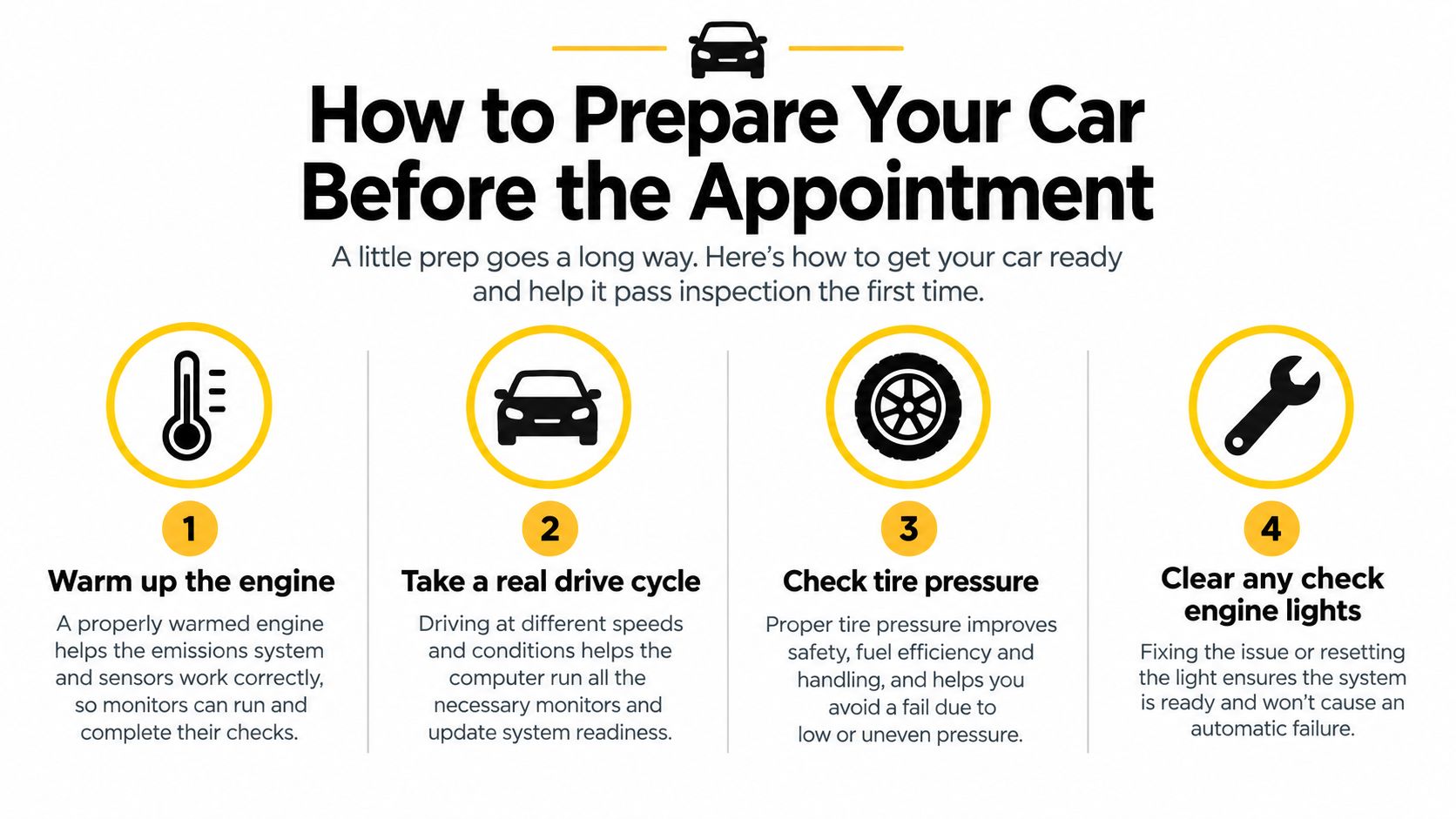
Start with a real drive, not a quick shuffle around the block. A properly warmed engine and catalytic converter give the emissions system a fair chance to operate the way it does in normal use, and that matters before any inspection that depends on operating temperature. If you've recently repaired something or disconnected the battery, give the car enough normal driving to finish its self-checks.
Check the light, then check the cause
If the check engine light is on, don't erase it and hope. Have the fault diagnosed and repaired, because the inspection is built to look past the dashboard glow and into the stored data. If the light recently turned off on its own, make sure the underlying issue is fully resolved before you head in.
Replace obvious wear items
A tired gas cap is cheap to fix and easy to overlook. If the seal is cracked, loose, or missing its grip, replace it before the appointment. That one part can save you a retest, especially on vehicles where the evap system is part of the evaluation.
Give the car a normal mix of driving
A commute with stops and highway speeds is better than a mile of idling in the driveway. Mixed driving helps the monitors run through the tests they need, and it gives the engine a chance to settle into the same conditions the inspection assumes. If you've only driven the car short distances lately, don't assume it's ready just because the dash looks calm.
Bring the paperwork with you
Have your registration or renewal notice ready so the station can process the inspection without delay. If you want a station that handles California-required testing for many vehicle types, including newer models and older or diesel vehicles, a STAR Certified shop like Speedy Smog is one option to consider alongside other licensed stations.
What to do before a smog check
Most vehicles pass on the first try. The prep above isn't about fear, it's about protecting the small share of drivers whose car is hiding a monitor issue, a seal problem, or a fault the dash didn't make obvious.
If you want a straightforward smog check with clear guidance on what the inspector is looking for, Speedy Smog handles California emissions testing for a wide range of vehicles in San Leandro. Visit Speedy Smog to schedule a visit and get your inspection done by a STAR Certified station that understands the layers behind a passing result.
A typical California smog check total lands in the low-to-mid $70s after the $8.25 state certificate fee is added to the station's inspection charge. Statewide averages are about $70.00 for BAR-97 tests and $62.04 for OIS tests, before that certificate fee is included.
Your DMV renewal notice is probably sitting on the counter, and the deadline is getting close. You call a station, hear an advertised price, and assume that number is the whole bill. In California, it often isn't.
The CA smog check price has two parts. The station chooses the inspection fee, while the state adds its certificate charge only when the vehicle passes. Vehicle age, test method, station designation, and whether the station performs repairs can all change the amount you pay. The California Bureau of Automotive Repair's smog check guidance confirms that inspection prices vary by station, while the certificate fee is the universal state add-on.
Table of Contents
- What a California Smog Check Actually Costs
- Breaking Down the Two-Part Price Structure
- STAR vs Non-STAR Station Pricing Compared
- How Your Vehicle Type Changes the Price
- Why a STAR Station Is Often the Smarter Choice
- Practical Ways to Lower Your Smog Check Bill
- Your Pre-Visit Smog Check Checklist
What a California Smog Check Actually Costs
A San Leandro driver renewing registration might see a station advertise a low inspection price, then discover that the final receipt is higher after certification. That doesn't automatically mean the station added an improper charge. It usually means the advertised price covered the station's inspection only.
For a normal compliant vehicle, plan on a final bill in the low-to-mid $70s, depending on the inspection method and the station's posted fee. BAR's 2025 Executive Summary lists statewide average inspection costs of $70.00 for BAR-97 tests and $62.04 for OIS tests (California BAR 2025 Executive Summary Report). Adding the $8.25 certificate fee brings those averages into roughly the low-to-upper $70s for a passing vehicle.
What the advertised price leaves out
The inspection fee pays the station for the test itself. It can reflect the vehicle's emissions system, the equipment required, labor, and the station's operating costs. California doesn't set one statewide retail inspection price, so two licensed stations in the East Bay can post different prices for what appears to be the same service.
The state certificate fee is separate and applies only after a pass. If the vehicle fails, the certificate isn't issued, so that fee isn't charged at that stage. Repairs and a later retest are separate costs.
Practical rule: When you call, ask for the total price for your exact vehicle, including the certificate fee if it passes.
Have the station confirm the model year, fuel type, and whether your DMV notice requires STAR. For a more detailed explanation of the smog inspection cost, compare the inspection charge with the final out-the-door amount, not just the number on a coupon.
Breaking Down the Two-Part Price Structure
Most confusion starts with the phrase “smog check price.” Drivers use it to mean the inspection, certification, repairs, and retest together. The invoice is simpler than that, but only if you separate the charges.
The first line is the station inspection fee. That amount is set by the business and can vary according to location, station category, equipment, and vehicle. A station may quote one price for a newer OBD-based inspection and another for an older BAR-97 test.
The second line is the $8.25 California smog certificate fee. It's mandatory when the vehicle passes, and the amount is statewide rather than negotiated between the customer and the station. The California DMV's smog certification fee guidance explains the state fee and related certification rules.
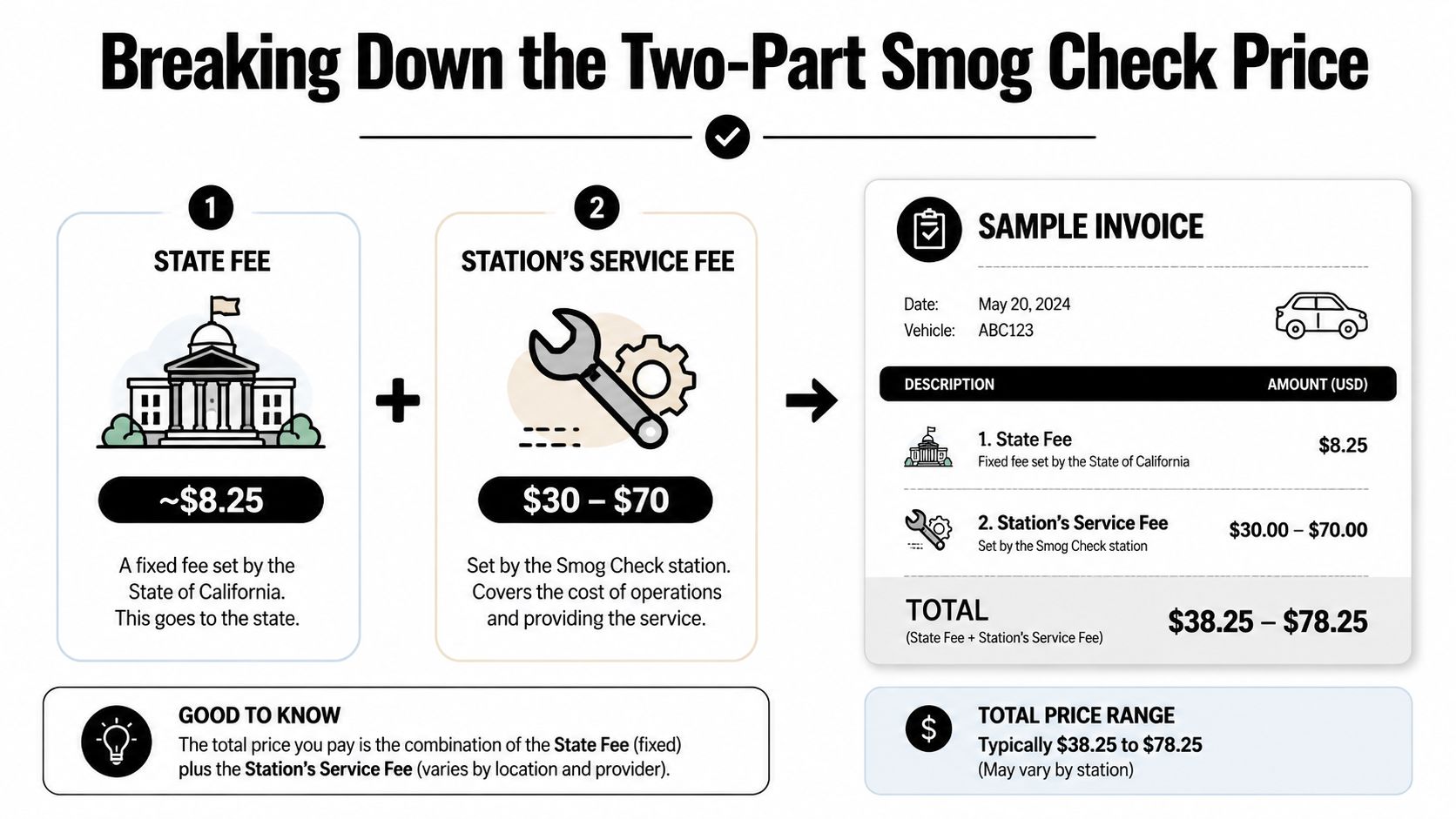
What happens after a pass or failure
A passing test creates the certification transaction needed for the DMV process, and the state certificate fee appears on the bill. A failed test doesn't create that certificate, so the certificate charge isn't the part that drives the next bill.
The expensive surprise usually comes afterward. Diagnosis, emissions repairs, parts, labor, and a retest aren't automatically included in the original inspection fee. Ask whether the quoted amount covers only the initial test or also includes a retest policy.
| Invoice component | Who sets it | When it applies |
|---|---|---|
| Station inspection fee | The smog station | For the inspection |
| State certificate fee | California | Only when the vehicle passes |
| Repairs and diagnosis | The repair provider | When the vehicle needs corrective work |
| Retest charge | The station's policy | After repairs, if another test is required |
Before booking, use the station's smog check station information to find a licensed location, then ask one direct question: “What will I pay if the vehicle passes today?” That answer is more useful than a low headline price with no explanation.
STAR vs Non-STAR Station Pricing Compared
A STAR station is not automatically the expensive option. STAR is a Bureau of Automotive Repair performance designation. The station's business model still matters: it may be Test-Only or Test-and-Repair, and each sets its own inspection price.
The inspection fee is only one part of your out-the-door cost. Add the state certificate fee when the vehicle passes. Compare the complete total, not a coupon headline or a station label.
Average inspection costs by station type
| Station type | Average inspection cost |
|---|---|
| STAR Test-and-Repair | $66.90 |
| STAR Test-Only | $58.90 |
| Non-STAR Test-and-Repair | $70.77 |
| Non-STAR Test-Only | $56.40 |
The BAR 2024 Smog Check Executive Summary Report lists these as inspection averages, not final passing totals. The state certificate fee remains separate. The figures also show that STAR Test-Only averaged less than STAR Test-and-Repair, while Non-STAR Test-Only averaged less than Non-STAR Test-and-Repair. STAR status alone does not determine the bill.
The equipment path changes the quote too. STAR Test-and-Repair stations averaged $72.87 for BAR-97 inspections and $60.99 for OIS inspections. STAR Test-Only stations averaged $52.44 for OIS inspections. Ask which test method applies to your vehicle before accepting a price.
Choose based on the DMV requirement
Read the registration notice first. If the DMV requires a STAR inspection, a cheaper non-STAR quote will not complete the job. You may pay once, then pay again at an approved station.
Test-Only stations perform inspections. Test-and-Repair stations can diagnose and repair emissions problems, which can save a second trip if the vehicle fails. Review this guide to what a STAR station is before choosing from a coupon alone.
Call with one question: “What is the full price, including the certificate fee if I pass?” Confirm the test method and whether a retest has a separate charge. Choose STAR or non-STAR based on the DMV requirement, vehicle, and complete quoted total.
How Your Vehicle Type Changes the Price
Your vehicle determines the test path, and the test path affects the inspection charge. A newer gasoline car with a functioning diagnostic system generally follows a different process from an older vehicle that requires more involved emissions equipment.
California commonly uses OIS testing for many 2000-and-newer vehicles, while older vehicles may require BAR-97 testing. The BAR averages above show that OIS inspections generally carry a lower average than BAR-97 inspections, but the exact charge still belongs to the station.
Start with the model year
Check the model year before calling. The DMV states that most vehicles need certification every two years after the initial smog-abatement period, while newer vehicles may qualify for an abatement fee instead of an immediate inspection. The California DMV vehicle registration guidance is the right place to confirm your vehicle's requirement.
A newer vehicle can often communicate emissions information through its onboard diagnostic system. Older vehicles may need a more labor-intensive inspection using BAR-97 equipment. That difference can explain why one vehicle receives a lower quote than another at the same station.
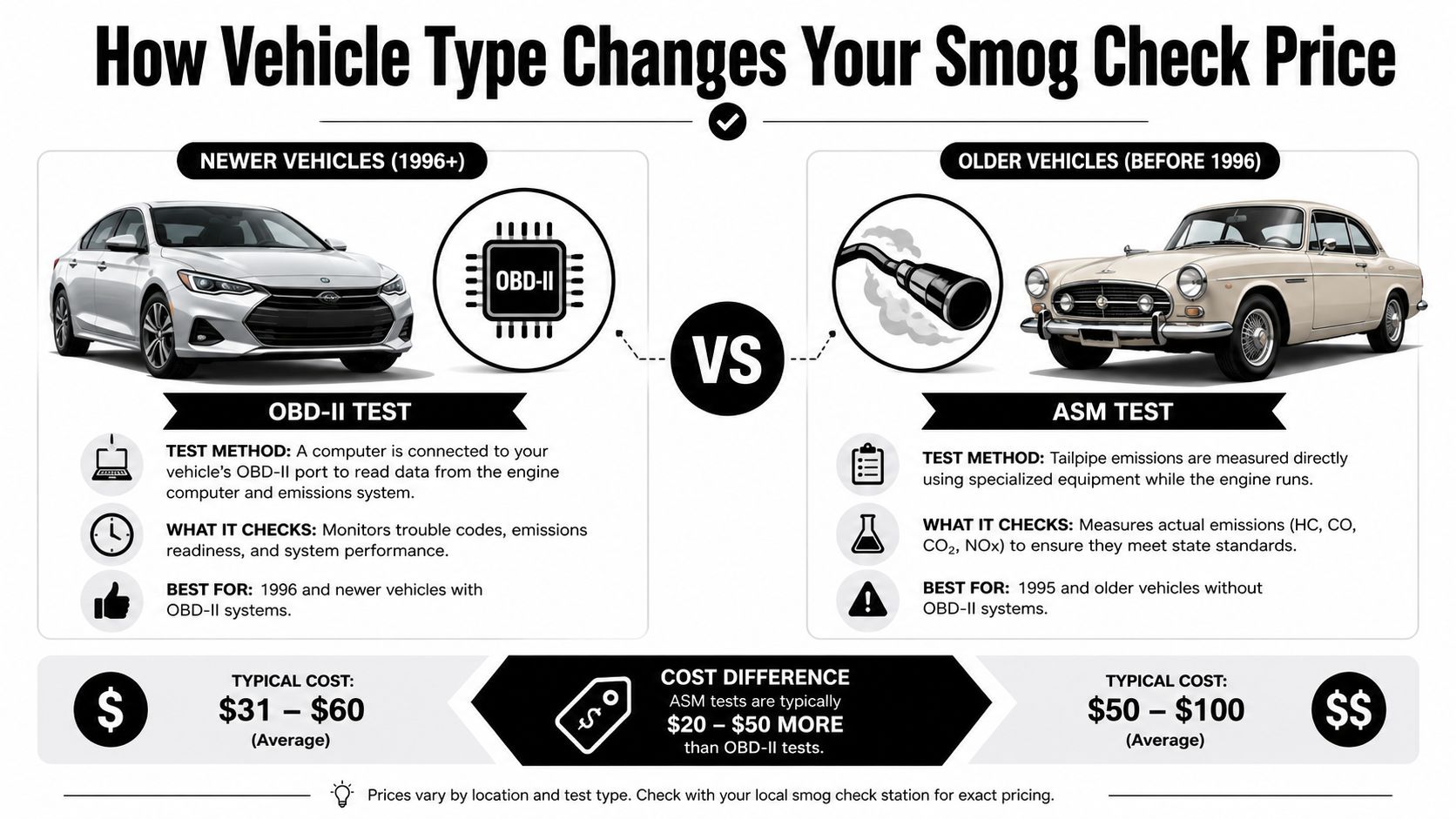
Fuel type and drivetrain still matter
Diesel vehicles don't follow the same pricing assumptions as ordinary gasoline cars. Older diesels, commercial vehicles, and vehicles with specialized emissions systems may require different equipment or procedures, so give the station the exact fuel type before accepting a quote.
Hybrids can also require certification once they are no longer within the applicable exemption period. Electric vehicles don't use the same tailpipe emissions process, but registration rules still depend on the vehicle category and DMV instructions.
Bring the vehicle identification details when you call:
- Model year: This helps the technician identify the likely test method.
- Fuel type: Gasoline, diesel, hybrid, and electric vehicles can follow different rules.
- Registration notice: The notice may identify whether STAR certification is required.
- Modification history: Emissions-related modifications can change what the station needs to inspect.
Don't guess based on the car's appearance or age alone. A precise quote requires the vehicle information and the registration requirement.
Why a STAR Station Is Often the Smarter Choice
Drivers often assume STAR means higher cost. The BAR averages show that assumption doesn't hold consistently, because STAR Test-Only inspection averages can be lower than STAR Test-and-Repair averages and can also compare favorably with non-STAR categories.
STAR is a performance designation, not a luxury service tier. The station has to meet the program's standards, but its retail inspection fee remains its own business decision. Your first question should be whether STAR is required, not whether STAR sounds expensive.
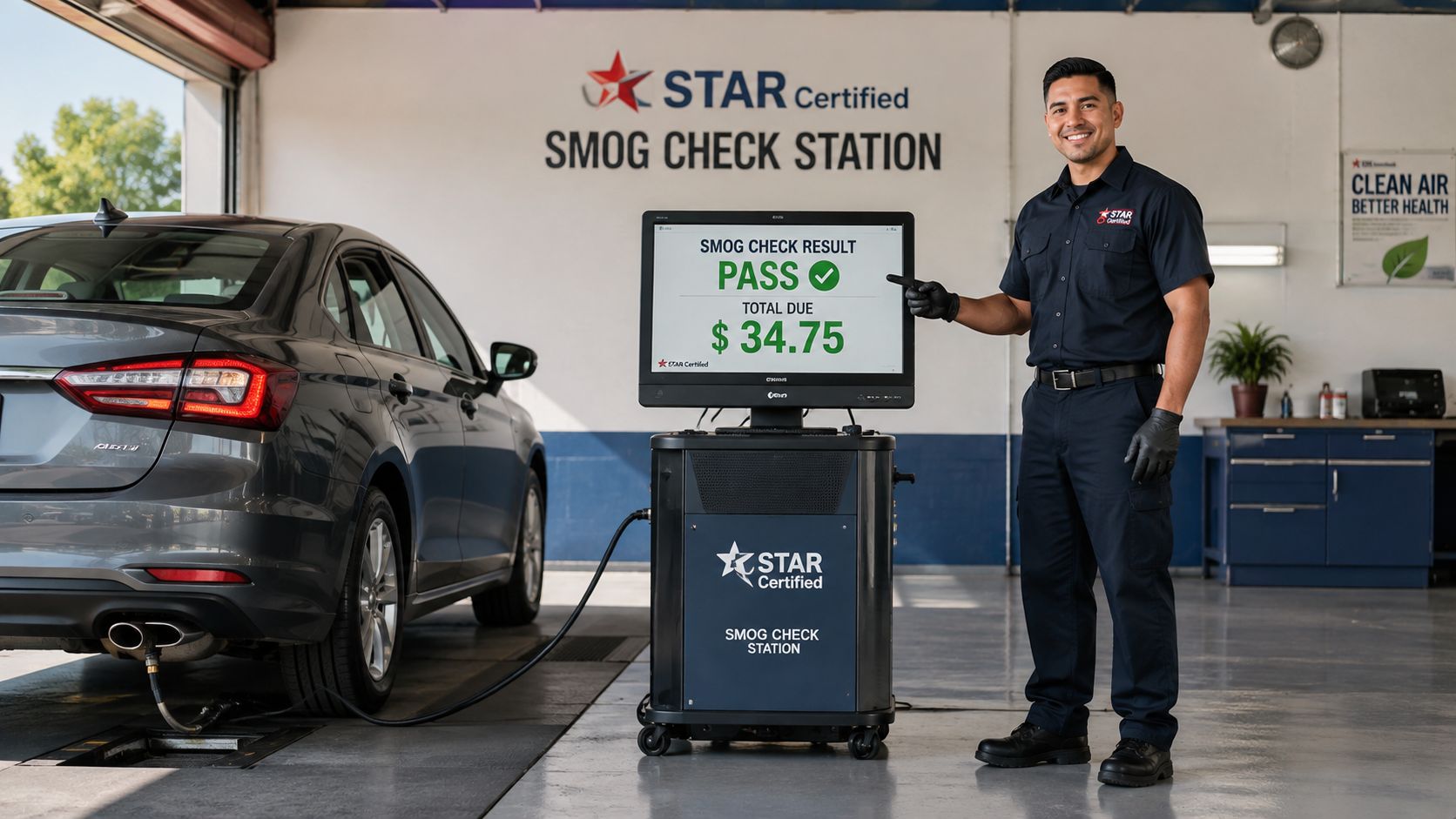
Avoid the wrong-station expense
If your DMV notice calls for a STAR inspection, going elsewhere can create a compliance problem. You may leave with a test result but still need a STAR certification before the registration process is complete. That means another appointment, another inspection charge, and more lost time.
A STAR Test-Only station makes sense when the vehicle is straightforward and you only need the inspection. A STAR Test-and-Repair station is more practical when the vehicle has an emissions warning light, previous failure, or an uncertain repair history. The ability to diagnose the issue at the same location can reduce unnecessary handoffs.
Choose the station that matches the DMV instruction and the vehicle's risk, then compare its complete passing price.
For East Bay drivers, Speedy Smog is one local option. It operates as a STAR Certified station in San Leandro and handles inspections for newer vehicles, older vehicles, diesels, and hybrids. The right choice still depends on your registration notice and the quote you receive.
Practical Ways to Lower Your Smog Check Bill
The cleanest way to reduce the bill is to avoid paying for the wrong service. Confirm the DMV requirement, identify the likely test method, and ask for the passing total before you authorize the inspection.
Use discounts carefully
Coupons can lower the station's inspection portion, but read the fine print. A discount may apply only to certain model years or standard inspections, and it may not remove the separate state certificate fee after a pass. Ask whether the coupon changes the inspection fee only or the final amount.
Speedy Smog publishes a $25-off offer for most smogs on newer vehicles, so East Bay drivers should check the current terms before relying on it. Treat any coupon as a price tool, not proof that the station's final total is lowest.
Time the appointment instead of rushing
Last-minute registration pressure limits your choices. Schedule early enough to call several stations, compare the passing total, and confirm whether STAR is required. If the vehicle fails, early scheduling also leaves room for diagnosis and repair without turning the renewal deadline into an emergency.
A basic pre-visit check can prevent avoidable complications:
- Inspect warning lights: An illuminated emissions warning light can lead to a failed inspection.
- Check the registration notice: Confirm the due date and station designation requirement.
- Ask about retests: Learn whether the station offers a retest policy and what conditions apply.
- Bring recent repair information: Service records can help the technician understand prior emissions work.
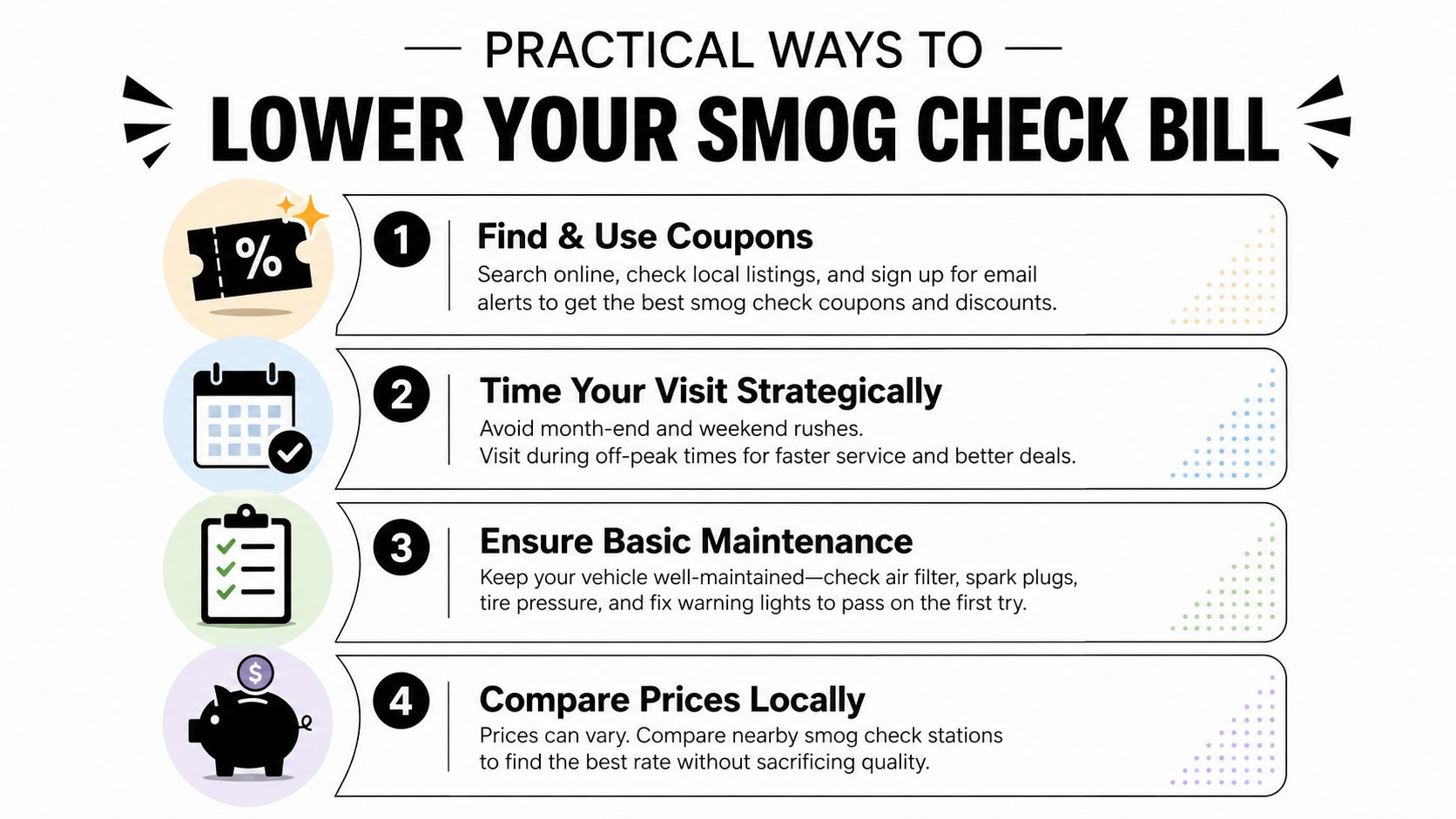
Check whether testing is required
Some newer vehicles may use a smog abatement fee during registration instead of receiving a smog inspection. Don't pay for a test because the renewal process mentions emissions. Verify the requirement through the DMV notice or the DMV's official guidance first.
If the vehicle fails, don't approve every repair offered without understanding the failure reason. Ask for the failure report, separate diagnosis from repairs, and check whether you qualify for assistance through California's Consumer Assistance Program. The cheapest legitimate repair is the one that addresses the documented emissions problem, not a parts swap based on guesswork.
Your Pre-Visit Smog Check Checklist
Before driving to the station, run through this short list:
- Read the DMV notice: Confirm whether certification is required and whether STAR is specified.
- Identify the vehicle: Have the model year, fuel type, and vehicle details ready.
- Ask for the passing total: Confirm the station inspection fee plus the $8.25 certificate fee if the vehicle passes.
- Clarify the test method: Ask whether the vehicle receives OIS or BAR-97 testing.
- Check the failure policy: Find out what a retest costs and whether repairs must be completed at that station.
- Verify discounts: Make sure a coupon applies to your vehicle and understand which charge it reduces.
- Bring documents: Take the registration notice and any relevant repair records.
The number that matters is the out-the-door passing price, not the largest discount in the window. A clear quote, the correct station designation, and the right test method will prevent most billing surprises.
For a transparent quote and California-compliant testing in San Leandro, visit Speedy Smog with your DMV notice and vehicle details ready. Ask the team to confirm the inspection method, STAR requirement, certificate fee, and any applicable discount before the test begins.
You're standing at the inspection station with a Vehicle Inspection Report in your hand. The top of the page says FAIL, but that word doesn't tell you whether the problem is a loose gas cap, an emissions component, an incomplete computer check, or a repair that needs deeper diagnosis. Before authorizing parts or paying for another test, read the report as a diagnostic document.
A California smog check report, formally called the Vehicle Inspection Report, or VIR, records what the technician inspected, what the vehicle's onboard system reported, and why the final result was issued. Once you know where to look, the report can help you speak clearly with a repair shop and choose the right next step.
Table of Contents
- What a Smog Check Report Actually Tells You
- Reading the Key Fields on Your Vehicle Inspection Report
- Understanding California Smog Check Failure Rates
- Most Common Reasons Vehicles Fail Smog Checks
- Why STAR Certification Matters for Your Smog Check
- What to Do After Receiving Your Smog Check Results
- How Speedy Smog Helps East Bay Drivers Get Certified Fast
What a Smog Check Report Actually Tells You
Most drivers look at the final result first. If the report says “PASS,” they put it in the glove box. If it says “FAIL,” they start searching for a repair shop. That reaction is understandable, but the result line is only the summary. The useful details appear in the fields underneath it.
The VIR identifies the vehicle, documents the inspection, and records special circumstances or failure notes. California's Bureau of Automotive Repair says the station must provide the customer with a copy of the VIR, while the smog certificate is sent electronically to the DMV. You therefore receive a paper or electronic report for your records, but the DMV receives the certificate through the state's electronic system. Read the BAR Smog Check FAQ if you need clarification about the report or certificate process.
The report is more than proof of payment
Suppose your vehicle fails because the OBD system shows an emissions fault. That result points toward diagnosis and repair. A visual failure, such as an emissions component that appears missing or modified, leads to a different conversation. A readiness failure may mean the vehicle's computer hasn't completed its checks, especially after a battery replacement, code clearing, or recent repair.
The report helps separate those possibilities. It can show whether the issue involved:
- Vehicle identification, confirming that the inspection belongs to your car.
- Inspection type, showing which testing method applied.
- OBD or emissions results, recording the system's response.
- Readiness monitors, showing whether required self-tests were complete.
- Visual and functional checks, identifying equipment or warning-light problems.
- Failure notes, documenting the condition that prevented a pass.
- Final status, stating whether the vehicle passed or failed.
Keep the VIR with your repair invoices and diagnostic paperwork. If you return for a retest, the document gives the repair technician a starting point and helps you verify that the retest addresses the original failure rather than creating a new guess-and-replace cycle.
Reading the Key Fields on Your Vehicle Inspection Report
Start at the top and work downward. Don't begin with the repair estimate. First confirm that the report describes the vehicle you brought in and the inspection that was performed.
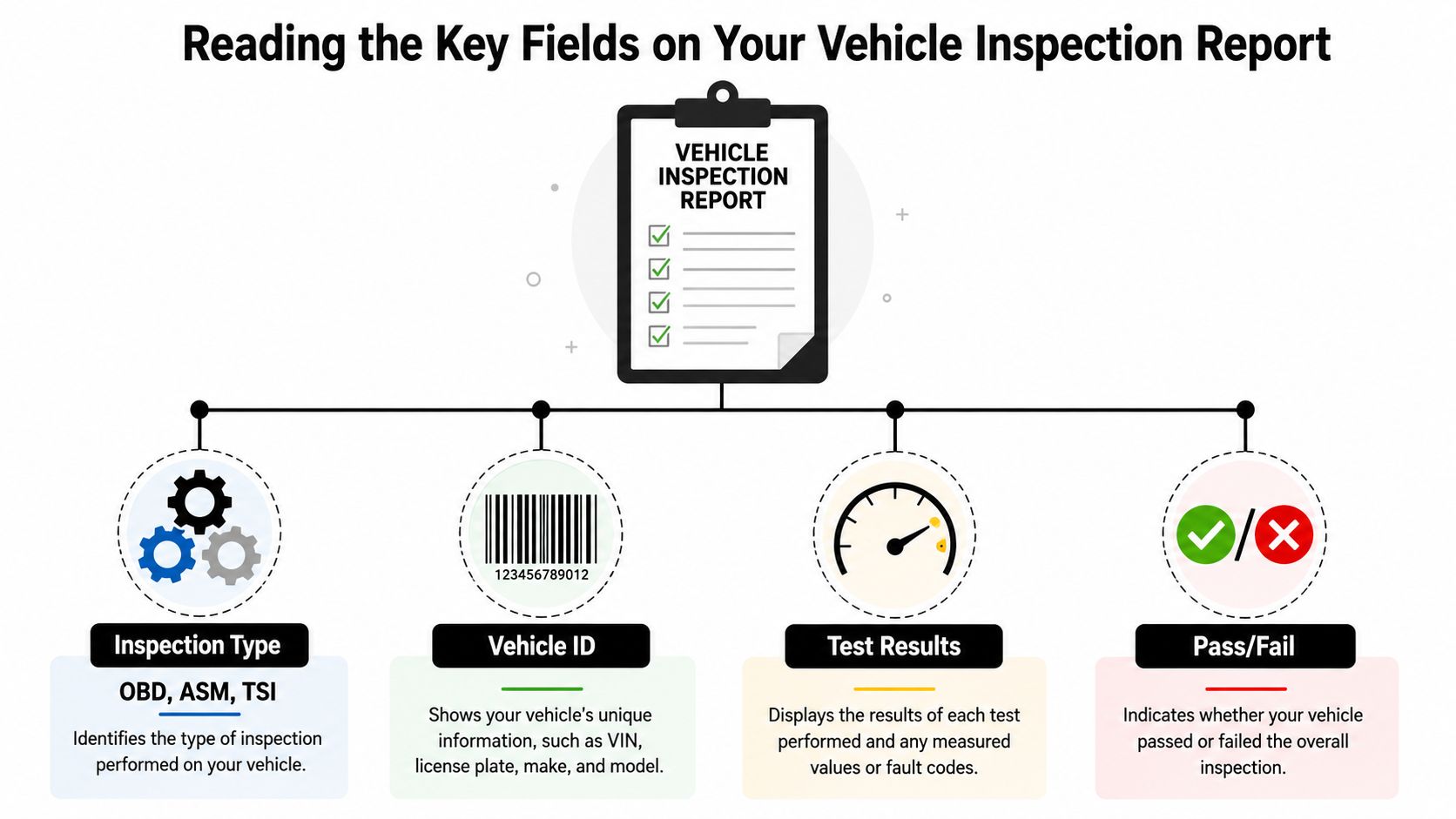
1. Confirm the vehicle information
Check the VIN, license plate information, model year, make, and other identifying details. A mismatch can create registration problems even if the mechanical inspection itself was completed correctly. Ask the station to correct an error before you leave, rather than assuming the DMV will fix it automatically.
The model year also helps explain the test method. BAR's OBD inspection data covers 2000-and-newer vehicles, making the 2000 model year an important technical breakpoint in California's modern inspection system. Older vehicles may be evaluated through a different procedure, depending on the vehicle and applicable requirements.
2. Identify the inspection type
Look for references to OBD, ASM, or TSI. An OBD inspection communicates with the vehicle's onboard diagnostic computer. ASM and TSI refer to testing approaches associated with emissions measurement and vehicle operation. The method matters because a report showing a computer fault should be interpreted differently from one showing measured emissions above an applicable limit.
If the report includes a diagnostic trouble code, don't treat the code as a complete diagnosis. A code identifies a monitored system or condition, but a technician still needs to test the underlying cause. This guide to reading OBD codes can help you understand why a code is a starting point, not automatically a parts order.
3. Read the result fields
Look for monitor status, warning-light information, emissions readings where applicable, and visual or functional inspection notes. A failed visual item means the technician observed a problem with required emissions equipment or configuration. A functional failure means a system did not operate as required. An emissions failure means the vehicle exceeded the applicable test standard or its OBD system detected a qualifying emissions issue.
The final pass or fail line combines those findings. Read the reason immediately above or beside it. That line usually tells you whether to seek diagnosis, restore equipment or approved software, complete the required drive conditions, or ask about a Referee review.
Practical rule: A diagnostic trouble code, an incomplete monitor, and a failed emissions measurement are different findings. Your repair plan should match the finding printed on the VIR.
Understanding California Smog Check Failure Rates
A failed result can feel unusual when you're the only driver in the waiting room dealing with one. Statewide data shows that failures are a normal part of the program, even though most inspected vehicles pass.
BAR reported that about 19 million 2000-and-newer vehicles were tested during calendar years 2024 to 2025, and about 1.3 million failed, an overall failure rate of roughly 7%. The same report says roadside inspection sampling found an overall fleet-weighted failure rate of about 14%, which indicates that real-world emissions problems can be higher than the rate observed during routine station testing. These figures come from the BAR Smog Check Performance Report.
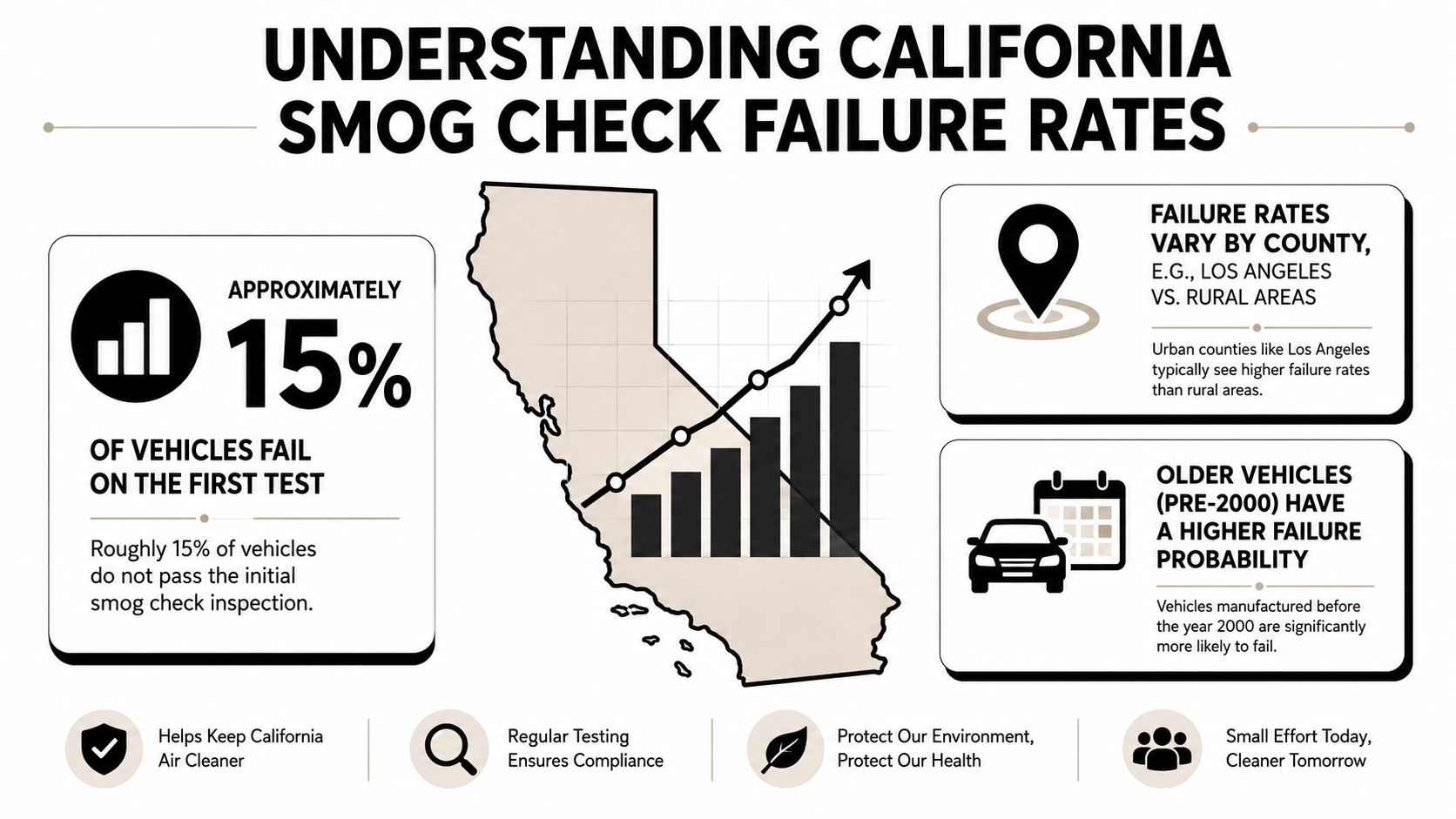
BAR's 2025 executive summary lists 11,275,981 initial tests and 959,667 failures, producing an initial-test failure rate of 8.51%. That report also tracks testing volume, failure rates, station data, and repair costs. The 2025 BAR Executive Summary Report places an individual failed inspection within the larger operation of California's compliance system.
Why the numbers differ
Station testing and roadside sampling answer different questions. A station inspection evaluates vehicles presented for testing under the applicable procedure. Roadside sampling examines vehicles in normal use, where maintenance condition, driving patterns, load, and operating temperature can vary.
The difference doesn't prove that a particular vehicle will fail at roadside or that a station test missed a defect. It shows why California uses more than a simple annual pass-or-fail event. OBD-era inspections collect information from vehicles at scale, allowing BAR to monitor fleet performance and identify compliance patterns.
For a driver, the practical lesson is straightforward. A failed report isn't a random administrative inconvenience. It identifies a condition that California's inspection process considers relevant to emissions compliance, and the repair should address the recorded cause rather than only erase the warning.
Most Common Reasons Vehicles Fail Smog Checks
The failure section of the VIR should answer the first question, “What prevented the pass?” It may not provide a complete mechanical diagnosis, but it narrows the problem into a category.
Incomplete readiness monitors
Readiness monitors are self-checks performed by the vehicle's OBD system. After a battery disconnect, computer reset, code clearing, or some repairs, the monitors may show “not ready.” The vehicle can run normally and still fail because the computer hasn't completed the required emissions checks.
California's rules set different limits by model year. For 1996 through 2000 vehicles, more than two incomplete emissions-related monitors causes a failure. For 2001-and-newer vehicles, more than one incomplete monitor causes a failure. BAR says that, effective October 1, 2025, all readiness monitors must be set for a vehicle to pass, as explained in its readiness-monitor regulation guidance.
Don't ask a technician to just clear the monitors again. That generally removes useful information and can leave the vehicle unready at the next inspection. Ask what drive conditions the manufacturer requires and whether the underlying fault has been repaired.
Warning-light and OBD faults
A commanded check-engine light, stored emissions fault, or failed OBD communication check can produce a failure. The repair could involve a sensor, wiring, an intake or exhaust leak, fuel control, catalytic-converter performance, or another monitored system. The code alone doesn't identify which component should be replaced.
Emissions readings above the limit
For test procedures that measure tailpipe output, the VIR can show readings that exceed the applicable standard. The technician may then need to evaluate combustion, fuel delivery, ignition, exhaust treatment, or other emissions-related systems. Avoid approving an expensive repair solely from the number on the report. A qualified repair shop should confirm the cause.
Visual and functional problems
A missing, disconnected, modified, or improperly configured emissions component can cause a visual failure even when the engine feels fine. Functional tests may identify a warning-light problem, a gas-cap issue, or another system that doesn't perform as required. Restoration to original equipment or approved software may be the correct path, rather than replacing unrelated parts.
Before authorizing work: Show the complete VIR to the repair shop and ask the technician to identify the exact failed field, the proposed diagnostic test, and the condition that will be verified before retesting.
For a category-by-category explanation, use this guide to common smog check failure reasons.
Why STAR Certification Matters for Your Smog Check
A STAR station is not a shop with a different sign. STAR certification is part of California's program for stations that meet specified performance and equipment requirements. Some vehicles are directed by the DMV to receive an inspection at a STAR station, so the first question is whether your registration notice or vehicle record includes that direction.
A non-STAR station may be appropriate when your vehicle isn't directed to STAR and the station performs the required test. A STAR station, however, may be the necessary choice for a directed inspection. The station's status should be confirmed before testing, because using the wrong station can mean paying for an inspection that doesn't satisfy the registration requirement.
Compare the practical differences
| Question | Non-STAR station | STAR station |
|---|---|---|
| Can it perform a required inspection? | Only when its license and your vehicle's requirements match | Designed for inspections covered by STAR requirements |
| Does the designation matter for every vehicle? | Not necessarily | It matters when DMV directs the vehicle to STAR |
| What should you verify first? | Test type and licensing | STAR status, test type, and DMV direction |
| What does the report still provide? | Inspection findings and final result | Inspection findings and final result under STAR procedures |
STAR status doesn't guarantee that a vehicle will pass. No station can legitimately promise a pass before inspecting the car. The value is procedural: when STAR is required, the station has the certification needed for that inspection, and drivers can avoid choosing a location that cannot complete the required transaction.
Ask the station to confirm its status before the test, especially if your renewal notice directs you to a STAR inspection. You can also review what a smog STAR station is before deciding where to go.
What to Do After Receiving Your Smog Check Results
Your next step depends on the final line and the notes that support it. Treat a pass and a fail as separate administrative paths.
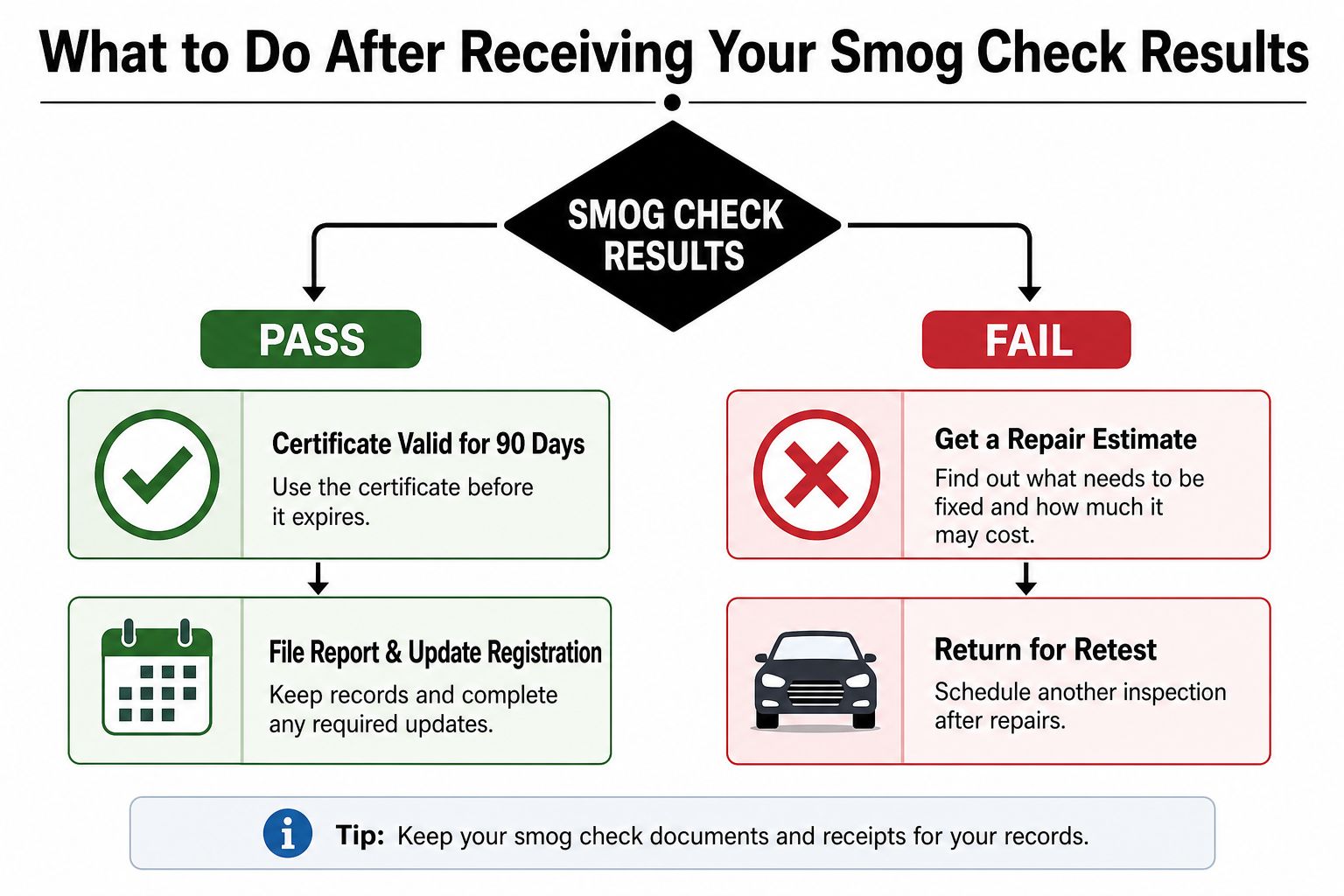
If the report says pass
Confirm that the vehicle information is correct and keep the VIR with your registration records. The station electronically sends the smog certificate to the DMV, so you generally shouldn't need to carry a paper certificate to the DMV for the electronic submission itself. Keep your copy anyway. It documents what was inspected and can help if a registration record needs review.
Complete your registration process promptly and follow any instructions on your renewal notice. If the vehicle is changing ownership or being registered in California for the first time after coming from another state, check the applicable DMV requirement before assuming an older inspection will satisfy the transaction. BAR states that a smog check is required for all out-of-state 1976 model-year and newer vehicles registering in California for the first time, along with other initial registration events.
If the report says fail
Use the failure notes to choose a repair path:
- Save the report and supporting records. Keep diagnostic printouts, invoices, and parts information.
- Ask for diagnosis before repairs. The repairer should connect the symptom or code to a confirmed cause.
- Address the listed failure. Do not rely on clearing codes or disconnecting the battery.
- Verify readiness and repairs. The vehicle must be ready for the applicable inspection procedure.
- Return for a retest. Bring the original VIR and repair documentation.
Some cases call for a licensed repair station. Others may require a Referee review, particularly when the report involves unusual equipment, configuration, or an unresolved dispute about compliance. If the likely repair cost creates financial difficulty, ask the appropriate California program office or repair professional about current waiver or assistance rules. Eligibility depends on the vehicle, failure, documentation, and applicable program requirements, so don't assume a waiver is automatic.
How Speedy Smog Helps East Bay Drivers Get Certified Fast
For San Leandro and nearby East Bay drivers, Speedy Smog offers smog inspections at its STAR-certified station at 15275 Washington Ave, San Leandro, California 94579. The shop handles many vehicle categories, including 2000-and-newer vehicles, 1999-and-older vehicles, diesels, and hybrids, so drivers can confirm the appropriate test before arriving.
Typical tests for 2000-and-newer vehicles take about 10 to 15 minutes, according to the supplied business information. Speedy Smog also provides electronic DMV submission after a passing inspection, explains the result fields, and offers an indoor waiting area, transparent pricing, and periodic coupons. It operates Monday through Saturday.
Bring your vehicle information and any renewal notice, and tell the technician if you've recently cleared a code, disconnected the battery, or completed emissions repairs. That context helps the station interpret readiness status correctly and keeps the report focused on what your vehicle needs.
If you want a clear explanation of your smog check report before handling DMV registration, visit Speedy Smog in San Leandro. Their STAR-certified team can inspect eligible vehicles, explain the VIR findings, and electronically submit passing results to the DMV.
You open the DMV renewal notice expecting the usual reminder, then you see the line that changes the whole errand, STAR certification required. If you're in Oakland, that usually means your regular neighborhood shop might not be the right stop, and now you're trying to figure out whether this is a simple smog check or a special lane with different rules, different timing, and a different bill.
The confusing part is that STAR sounds like a separate emissions test, but it isn't. It's a higher-performance compliance tier inside California's smog system, which means the station has to meet tighter state standards for inspection quality, while the vehicle is still being checked against the same emissions rules it would face anywhere else in the program. If you've never booked one before, the practical question isn't “What does STAR mean?” It's “Which Oakland shop can handle my vehicle, and what will I really pay when I get there?”
Table of Contents
- Why Oakland Drivers Keep Seeing STAR on Their Renewal Notice
- What STAR Certification Actually Means
- Which Oakland Vehicles Get Routed to a STAR Station
- What Happens During the Test at an Oakland STAR Station
- How to Prepare Your Vehicle and Avoid a Failed Visit
- Oakland STAR Stations, Pricing, and Hours Compared
- Speedy Smog as a Convenient Option for Oakland Drivers
Why Oakland Drivers Keep Seeing STAR on Their Renewal Notice
A lot of Oakland drivers first meet STAR the same way. The renewal notice arrives, they glance at the form, and the line about STAR turns a quick DMV errand into a search for a station they've never used. A car that passed at a regular shop last time can still be routed to STAR this cycle, because the decision is coming from California's compliance system, not from the neighborhood around your house.
California's STAR smog program is built around higher-performing stations, and the Bureau of Automotive Repair treats STAR as a higher-performance compliance tier rather than a different emissions standard for the vehicle itself. That distinction matters. Your car isn't being asked to meet a stricter tailpipe target just because it landed at STAR, but the station doing the inspection is expected to operate with tighter quality control and consistency.
For an Oakland driver, that means one simple thing. If the DMV notice says STAR, the usual corner shop can't just step in and substitute. The problem isn't that the other shop is “bad,” it's that the vehicle has been routed into a specific state-managed lane, and the lane choice is already made before you book.
Use this registration-renewal guide if you want to see how the notice connects to the booking step without guessing.
Practical rule: read the renewal notice first, then book the station that matches it. STAR is a compliance designation, not a local marketing label.
The other source of confusion is timing. Many drivers assume STAR means a more complicated test, but the difference is where the car is sent and how closely the station is held to state standards. Once you understand that, the notice stops feeling like a surprise and starts looking like a routing instruction.
What STAR Certification Actually Means
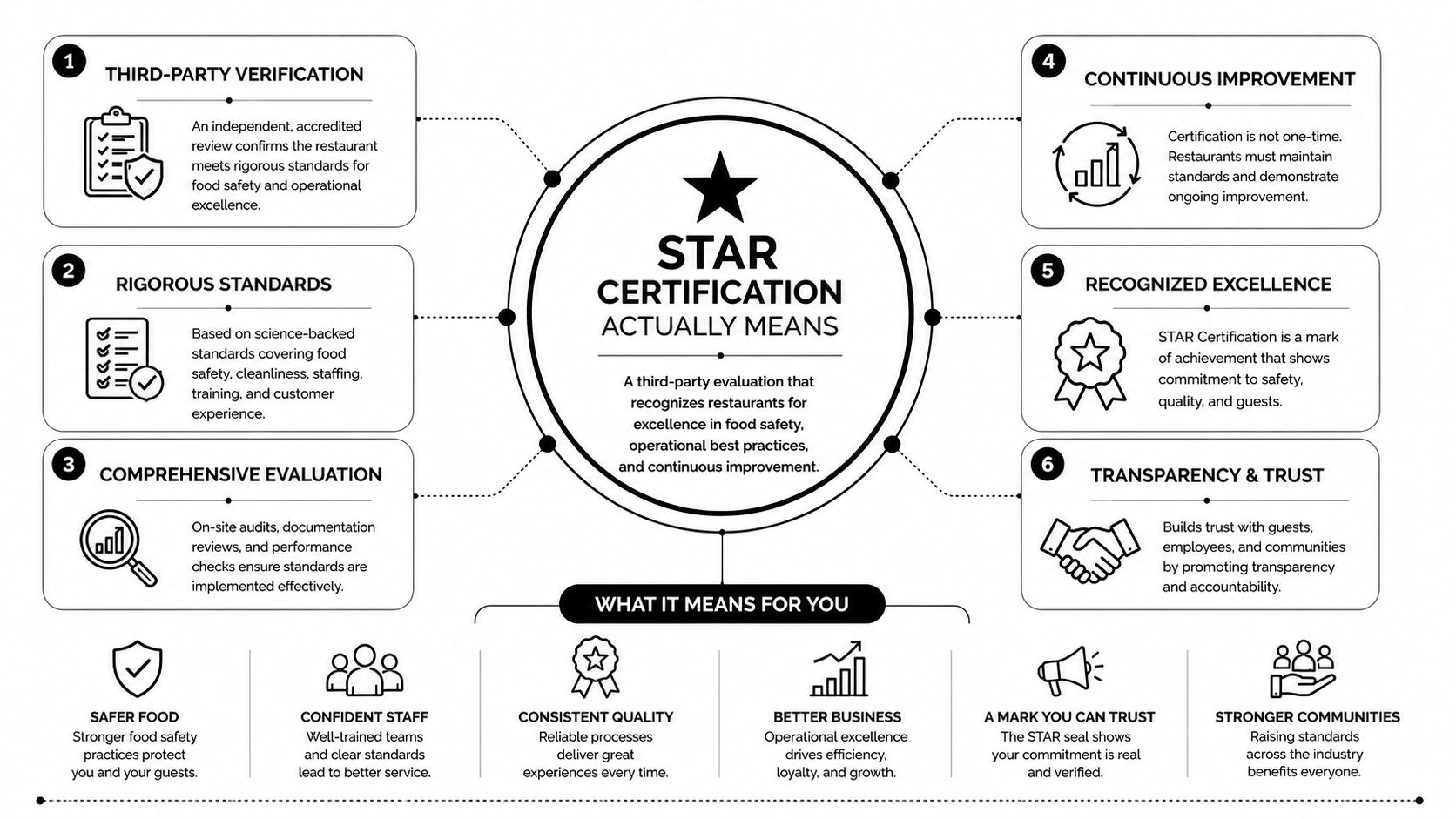
STAR certification is easiest to understand if you forget the acronym and think in service-counter terms. A STAR station is a shop the state trusts to handle inspections with a higher level of oversight, which is why it shows up for vehicles that need extra compliance confidence. It's not a different emissions law for the car, it's a different control level for the station.
That's also why STAR doesn't mean every part of the visit feels the same as every other shop. Some stations are test only, some are test-and-repair, and STAR is the state's way of deciding which stations belong in the stricter lane. For a driver, the useful takeaway is simple. If the DMV notice calls for STAR, you need the certified station type the notice asks for, not just any place with a smog sign out front.
The Bureau of Automotive Repair says the inspection usually takes about 30 minutes and that the station must charge a fixed $8.25 Smog Check certificate fee, while the inspection price itself is not regulated. That's the practical reason Oakland prices can look all over the map even when the certificate part is the same everywhere. A station can quote different labor pricing, but it still has to follow the same state certificate process.
The fee structure is split on purpose. The certificate fee is fixed, but the inspection labor price is set by the station.
See the STAR-station overview if you want the station type explained in plain language before you call around.
For a first-time customer, the confusing part is usually repairs. A regular smog shop may also do repair work, but STAR is about compliance control, not a promise that the car will be fixed there. If your vehicle fails, the next step is usually diagnosis and repair planning, not assuming the test station can be both the tester and the repair solution for every case.
Which Oakland Vehicles Get Routed to a STAR Station
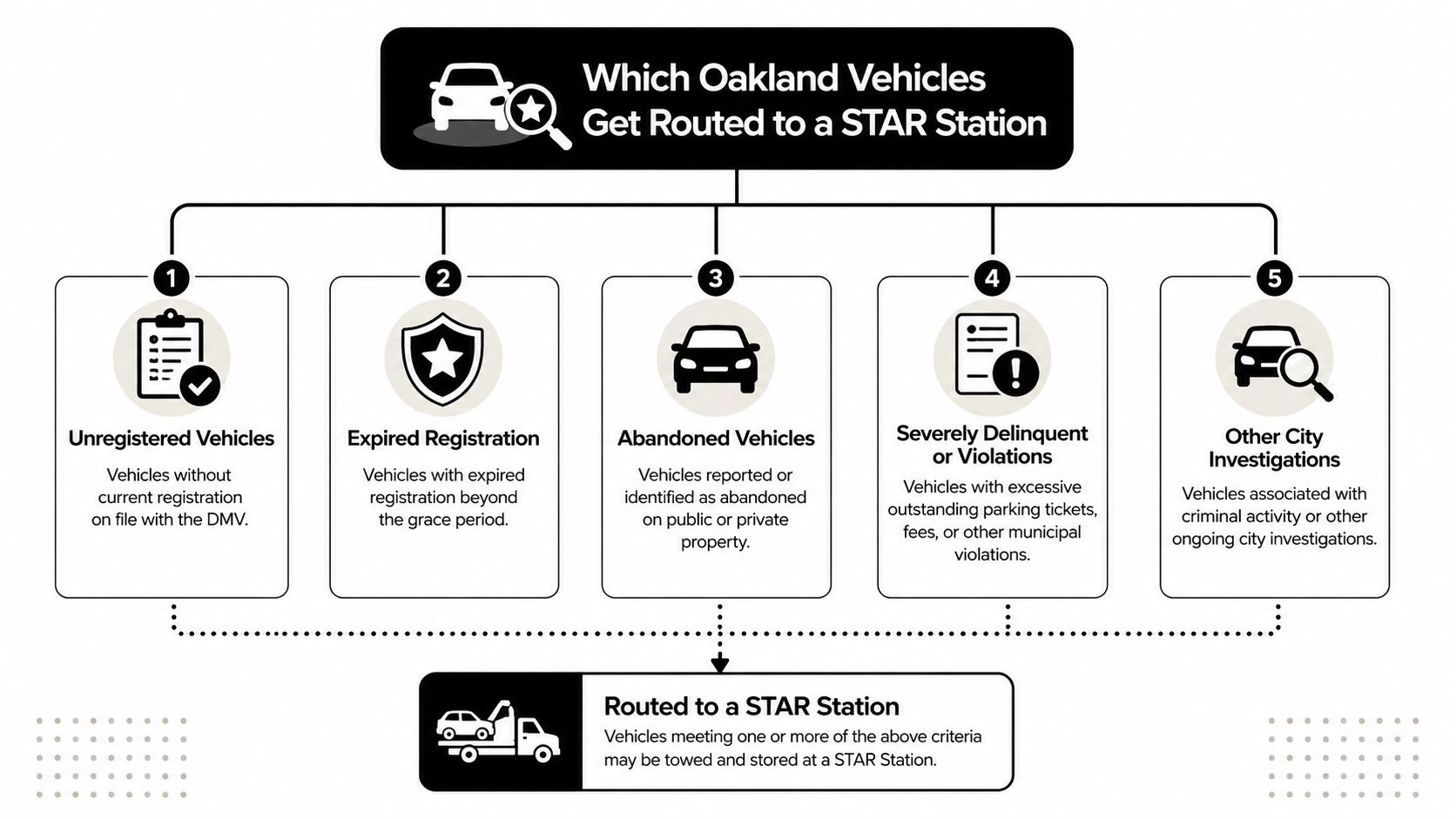
The cleanest way to think about STAR routing is this. The DMV notice tells you whether your car has been selected for the higher-compliance lane, and that notice wins over whatever your last station told you. California's smog manual also notes that some out-of-state 1976 model-year and newer vehicles registering in California for the first time need a Smog Check as part of initial registration, which is one of the situations where Oakland drivers can suddenly find themselves shopping for a compliant station instead of a convenient one. The same manual explains that STAR is about station performance, not a different emissions standard on the car itself.
For the test method, the split is straightforward. 2000-and-newer vehicles are typically checked through OBD-II readiness and MIL status, while 1999-and-older vehicles still require a tailpipe emissions test. BAR also states that a lit check-engine light is a fail condition, so if that lamp is on, the visit is already at risk before the technician plugs anything in.
The practical difference by vehicle age
If you drive a newer car, the test is often more about whether the onboard monitors are ready than about how dirty the exhaust looks at that exact moment. If you drive an older car, the inspection is more hands-on and the tailpipe portion matters directly. That's why a 1999 model and a 2000 model can feel like two different appointments even though they're both called a smog check.
Useful shortcut: if the check-engine light is on, don't treat the appointment as a coin flip. Get the fault read first.
Hybrids and diesels can add another layer of confusion, mostly because drivers hear those words and assume there must be a special STAR-only rule. The safer way to think about it is vehicle-specific routing plus the test method your car falls into. The notice decides the lane, and the vehicle's model year decides how the inspection is performed.
What Happens During the Test at an Oakland STAR Station
Most Oakland drivers want the same answer first, how long does this take, and what do I need in my hand when I walk in. Local Oakland listings show one station advertising service for 2000-and-newer vehicles at $69.75 plus the $8.25 certificate fee, while another Oakland STAR listing shows 895 Yelp reviews and a 4.8-star rating, which tells you the market is built around quick, repeatable visits rather than a long repair-day experience. One local provider also says STAR-certified inspections can be completed in about 15 minutes, which lines up with the short-visit model many drivers expect for newer cars.
The actual visit usually starts with paperwork and a quick confirmation that your vehicle matches the notice. After that, the technician checks the emissions-related items that apply to your model year, then performs the appropriate test path. For a newer vehicle, that often means the OBD-II connection and a check of readiness status. For an older vehicle, the tailpipe portion is still part of the process.
What to bring and what not to expect
Bring the DMV renewal notice, a valid ID, and a way to pay. Don't assume the station can ignore the vehicle class or model year just because you're in a hurry, because the test path is determined by the car, not by the line at the counter.
A STAR station is there to inspect the vehicle against state requirements, not to turn the appointment into a broad repair consultation. If the car fails, the next step is usually figuring out why, then deciding whether a repair visit makes sense before a retest.
Read the pass-the-test checklist if you want a practical pre-visit review without guessing at the obvious problems.
Oakland drivers usually save time by showing up with the car already warm, the notice ready, and the payment method sorted out.
That's also why local convenience matters so much. A fast station is useful only if it handles your vehicle type and the appointment doesn't turn into a second trip. The best-looking price on a website stops being cheap if the car isn't ready or the shop can't inspect it that day.
How to Prepare Your Vehicle and Avoid a Failed Visit
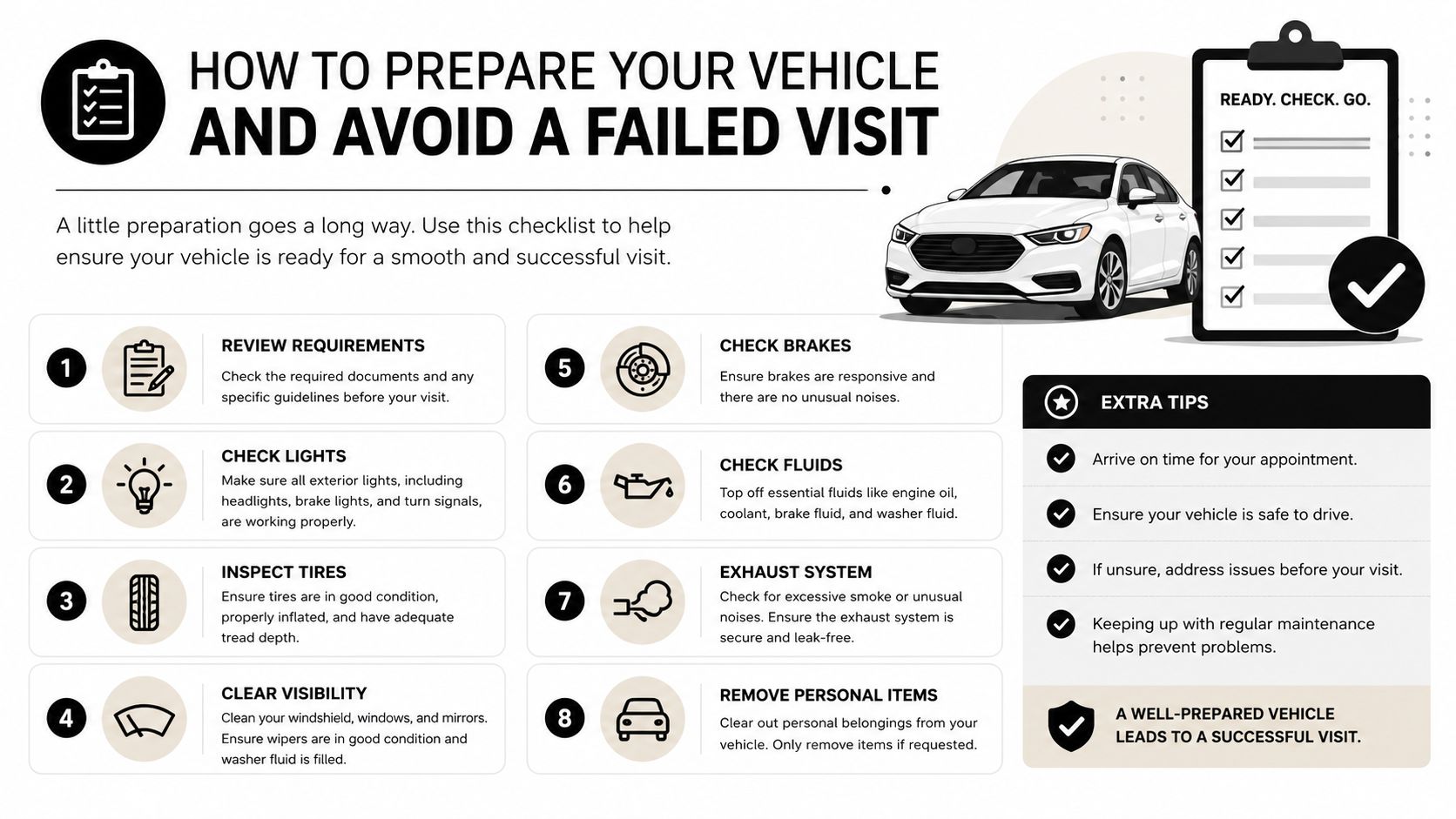
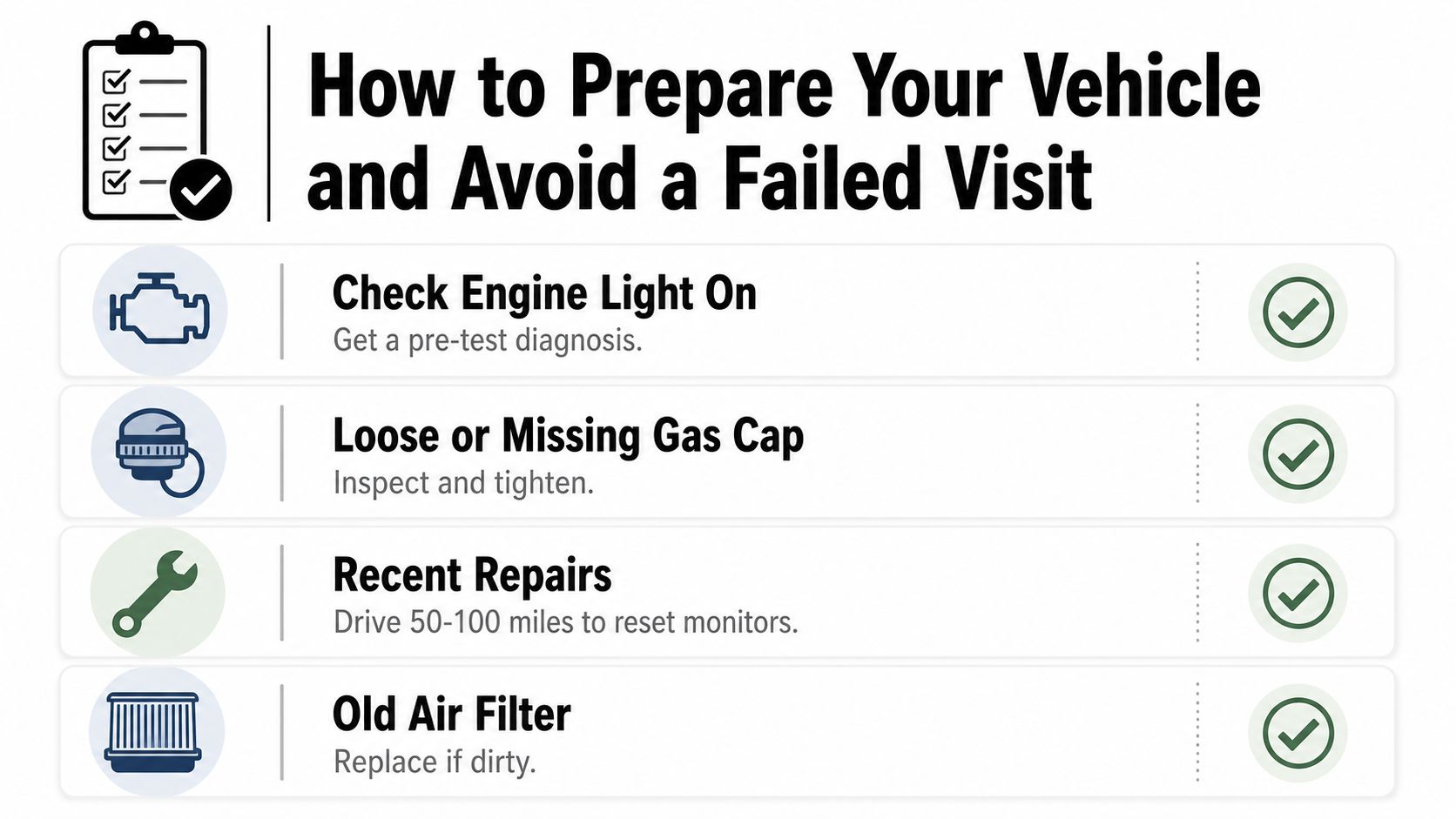
A failed STAR visit usually isn't a mystery when you look at the basics. BAR notes that after battery disconnects or repairs, readiness monitors may need one to two weeks of driving to reset, which is why a pre-test scan for readiness and diagnostic trouble codes is the most efficient way to avoid a wasted trip. If the car was recently serviced, that alone can explain a “not ready” result even when the engine feels fine on the road.
The easy thing to miss is that a car can run normally and still fail the inspection path. A loose gas cap, an unresolved check-engine issue, or incomplete readiness status can send you home without the certificate. That's why a quick under-the-hood check before the appointment matters more than a last-minute wash or vacuum.
Night-before checklist for Oakland drivers
- Check the dash: if the check-engine light is on, get a diagnosis first.
- Tighten the gas cap: a cap that doesn't seal properly can create a fault condition.
- Confirm the notice: make sure the DMV paperwork really calls for STAR.
- Think about recent repairs: if the battery was disconnected, the monitors may still need driving time.
- Warm the vehicle up: don't arrive with a cold engine and expect the best reading.
- Match the car to the test type: older cars, newer cars, diesels, and hybrids don't all go through the same exact path.
A five-minute check the night before can save you from paying for a repeat visit.
When Oakland drivers skip the prep step, they usually discover the problem at the station, not at home. That's the expensive version of learning the process. The smarter version is to treat the appointment like a compliance check, then use the car's own warning signs to decide whether it's ready.
Oakland STAR Stations, Pricing, and Hours Compared
Oakland's smog market is competitive, but the comparison only makes sense if you separate the fixed state fee from the shop's own price. The $8.25 certificate fee is the baseline everywhere, while the inspection price is what changes from one station to the next. That's why one Oakland listing can advertise $69.75 plus the certificate fee, while another shop leans on speed, convenience, or customer ratings instead of a single posted number.
| Station | Advertised Inspection Price | BAR Certificate Fee | Typical Turnaround | Oakland Access |
|---|---|---|---|---|
| Oakland STAR station with a large review base | Not stated in the verified data | $8.25 | Not stated in the verified data | Oakland-based |
| Oakland provider near San Pablo Avenue and 34th Street | $69.75 for 2000-and-newer vehicles | $8.25 | Not stated in the verified data | Near San Pablo Avenue and 34th Street, with access from I-580, I-880, and I-980 |
| Oakland shop advertising fast STAR inspections | Not stated in the verified data | $8.25 | About 15 minutes | Oakland-based |
The practical lesson is that price, speed, and access don't always point to the same station. A shop near the freeway might be better for an after-work run, while a different station may have stronger reviews or easier booking. If your renewal notice is STAR-specific, the right choice is the one that matches both the notice and your schedule.
Local hours matter more than most drivers expect, because some shops are closed on certain days and others are built around same-day traffic. That's why Oakland searches often end up being less about “the cheapest smog check” and more about “the shop that can handle my car today without a second appointment.”
Speedy Smog as a Convenient Option for Oakland Drivers
For Oakland drivers who want a nearby STAR-certified option without adding another long errand, Speedy Smog in San Leandro is set up around quick DMV-style visits. It's a STAR Certified station, it handles 2000-and-newer vehicles in about 10 to 15 minutes, and it also serves 1999-and-older vehicles, diesels, and hybrids, which makes it useful when the renewal notice and the vehicle type don't fit a one-size-fits-all shop. That matters in the East Bay, where the closest station isn't always the station that can process the car you brought.
The convenience piece is more than just speed. The shop is open Monday through Saturday, has a clean indoor waiting room, and emphasizes transparent pricing with periodic $25-off coupons for most newer-vehicle smogs. For a driver coming from Oakland, that can be the difference between a smooth lunch-break stop and a second trip after learning the wrong place couldn't complete the test path.
Why that combination matters
If your notice calls for STAR, the decision isn't only about the posted price. It's about whether the station can handle the right vehicle class, whether the hours fit your day, and whether you can get the certificate without wasting time on a shop that's closed or the wrong test type. Nearby, compliant, and fast is a better combination than “cheap on paper” if the appointment ends with a rebook.
Visit Speedy Smog if you want to book a STAR-certified smog check that lines up with an Oakland renewal notice, the right vehicle type, and a schedule that doesn't leave you stuck making a second trip.
You open your DMV renewal notice, glance down, and there it is. Smog certification required. If you drive a hybrid, that line can stop you cold because a lot of owners still assume hybrids are treated like fully electric cars.
They aren't.
That mix-up causes more registration delays than it should. The good news is that a smog check for hybrid vehicles is usually simpler than people expect, faster than a gas-car test, and much less intimidating once you know what the station is checking.
Table of Contents
- Do Hybrids Even Need a Smog Check in California?
- California's Hybrid Smog Check Rules Explained
- The Hybrid Smog Test Process What to Expect
- Common Hybrid Smog Check Failures and How to Pass
- Understanding STAR Certification and Finding a Local Smog Station
- Hybrid Smog Check FAQs
Do Hybrids Even Need a Smog Check in California?
Yes. Most hybrids do need a smog check in California.
The biggest point of confusion is that people lump hybrids in with EVs. That's the mistake. A fully electric vehicle has no gasoline engine to test. A hybrid still has an internal combustion engine, so California treats it as an emissions-regulated vehicle even though the testing method is different.
According to Diamond Certified's California smog check FAQ guide, many owners wrongly believe hybrids are exempt like EVs, but hybrids are required to undergo biennial inspections unless they are 8 model-years or newer. That misunderstanding is exactly why some drivers get surprised by a DMV notice.
Practical rule: If your hybrid burns gasoline, assume you may need a smog check unless your registration paperwork says you're still in an exempt window.
The easiest first step is to trust the DMV notice in your hand. If it says a smog certification is due, treat that as your answer and get it handled before registration turns into a deadline problem.
If you want the broader framework behind that notice, California's rules are easier to follow when they're laid out plainly. A quick read through these California smog check rules helps clear up who's exempt, who isn't, and why hybrids sit in their own category.
A lot of guides stop at “yes” or “no.” That's where owners get stuck. The answer is yes, hybrids are in the program, but the test is more efficient than a conventional gasoline vehicle inspection. That difference matters because many hybrid owners walk in expecting a long, old-school tailpipe test when that's not what happens.
California's Hybrid Smog Check Rules Explained
California didn't always test hybrids this way. According to the California Smog Check Program overview, hybrid vehicles officially became subject to smog check requirements in April 2015. That was the point where hybrids were folded into emissions compliance in a formal way.
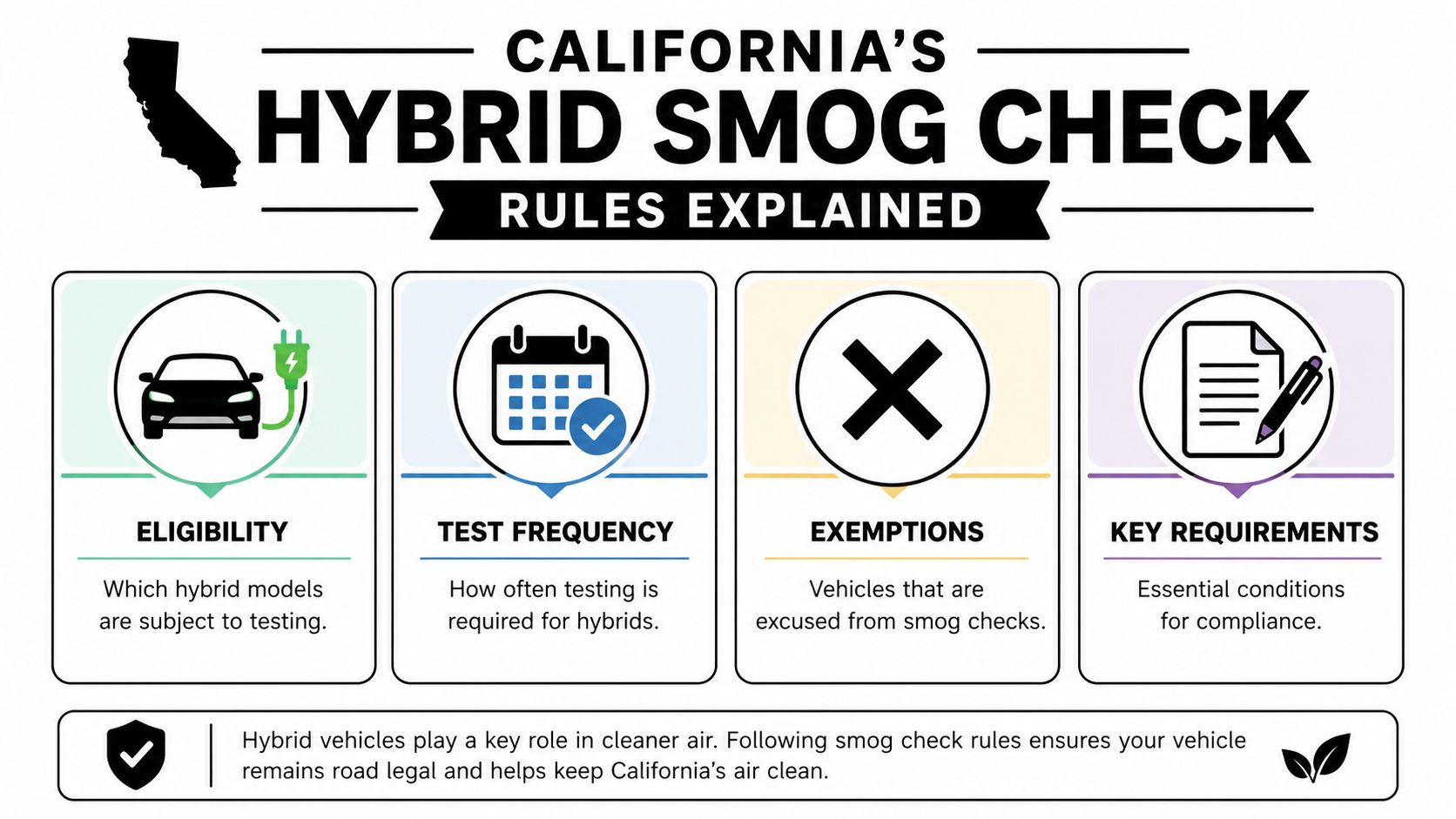
Which hybrids need testing
Here's the plain-English version:
| Hybrid situation | What usually applies |
|---|---|
| Biennial registration | Hybrids 8 model-years or newer are exempt from the biennial smog check. |
| Newer vehicle registration | Hybrids that are six model-years and newer remain exempt from the biennial requirement and pay a smog abatement fee instead. |
| Change of ownership | Hybrids four model-years or newer are exempt from the smog check at title transfer. Older vehicles need testing for transfer. |
Owners often get tripped up. They hear one exemption and assume it applies to every situation. It doesn't. Registration renewal and vehicle transfer are separate triggers, and the age cutoffs aren't identical in every summary you'll see online.
What matters most for owners
When I explain this at the counter, I keep it simple:
- Renewal notice in hand: Follow what the DMV is asking for.
- Selling or buying a hybrid: Check whether the vehicle is old enough that a transfer smog is required.
- Newer hybrid: Don't assume “new enough” means exempt forever. It just means the exemption window is still open.
If you're unsure which rule applies, look at the reason for the smog requirement first. Is it registration renewal, title transfer, or another DMV action? That usually clears up the confusion fast.
Why the rules feel confusing
Hybrids sit between two worlds. They aren't gas-only cars, and they aren't EVs. California's rules reflect that. The state recognizes the hybrid's design, but it still expects emissions compliance because the gasoline side of the powertrain is still part of the vehicle.
That's why the right question isn't “Are hybrids exempt?” The right question is, “Is my hybrid currently in an exempt category for this specific DMV transaction?”
Once you frame it that way, the rules start making sense.
The Hybrid Smog Test Process What to Expect
You pull into the station expecting a long test, a tailpipe probe, and a lot of waiting. For most hybrids, that is not how it goes.
California's hybrid inspection is usually a short, diagnostics-based visit. As noted earlier from AAA, the process is generally quicker than an older-style gasoline smog test because the inspection centers on the vehicle's onboard systems and emissions equipment rather than a traditional tailpipe procedure.
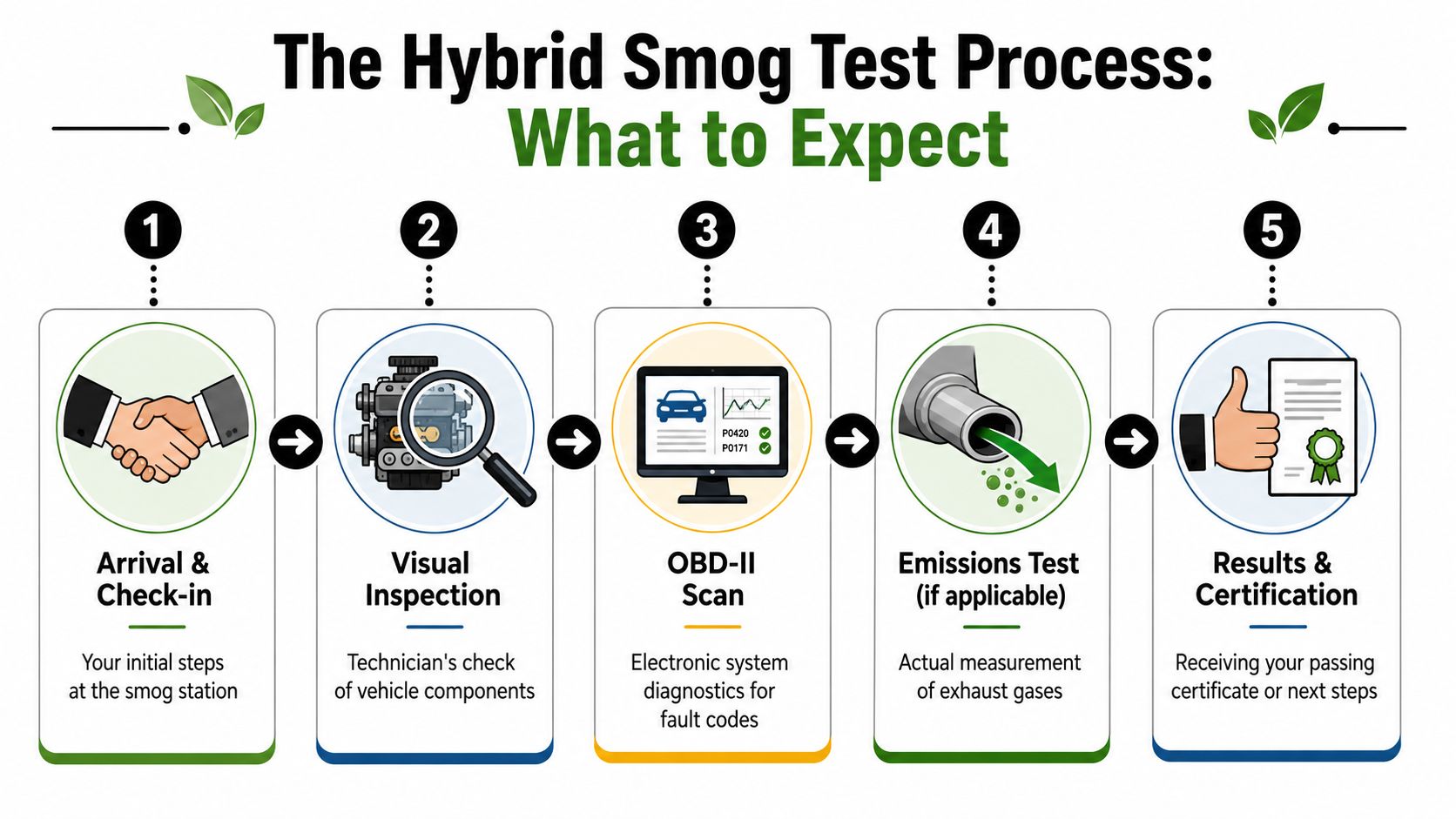
What happens during the appointment
At the shop, the process is straightforward:
Check-in and vehicle verification
The technician confirms the VIN, plate, and basic vehicle information, then starts the inspection in the state system.Visual inspection of emissions equipment
The car is checked for required emissions-related components and obvious tampering. This is one place hybrid owners get surprised, especially if the vehicle has aftermarket parts that were installed without much thought about California compliance.OBD scan and readiness check
The technician connects to the vehicle's onboard diagnostics system to look for stored trouble codes, command status, and readiness monitors. On hybrids, this is the core of the test.Result submission
If the vehicle passes, the certificate is transmitted electronically to the DMV. If it does not, the technician should tell you what stopped the certification so you are not left guessing.
That last part matters. A good station does not just hand over a fail sheet. It explains whether the issue is a warning light, incomplete monitors, or an emissions-related part problem. If you want a clearer picture of the problems that commonly stop certification, review these common smog check fail reasons before your visit.
How the hybrid test differs in practice
Hybrid owners often ask me the same question at the counter: “Are you going to run it like a regular gas car?” In most cases, the answer is no.
The inspection usually focuses on two things. First, whether the required emissions components are present and properly installed. Second, whether the car's computer shows any emissions faults or incomplete self-checks. That is why the appointment often feels simpler than people expect.
The confusion usually comes from hearing mixed advice online. Some drivers assume hybrids are treated like full EVs. Others assume every hybrid gets the same old tailpipe routine as a gas-only car. Neither assumption helps much at the station. What matters is whether the emissions equipment checks out and whether the OBD system is ready to report cleanly.
What to bring and how to avoid a wasted trip
Bring your registration paperwork if you have it, and show up with the car in normal driving condition.
A few practical tips make a difference. Do not disconnect the battery right before the test. Do not clear codes to shut off a warning light and then drive straight to the station. That often leaves the monitors incomplete, which can stop the inspection even if the car seems to be driving fine.
If your hybrid has recent modifications, mention them up front. That saves time, and it can keep you from paying for a test when an emissions-related part is obviously going to be a problem. This is one area where a local smog technician can save you a lot of frustration, because we see the same preventable issues over and over and can usually spot them before they turn into a failed visit.
Common Hybrid Smog Check Failures and How to Pass
A driver comes in with a hybrid that runs fine, no strange noises, no obvious drivability problem, and still fails the smog check. In my experience, the cause is usually simple. The car either has an active fault, the monitors are not ready, or an aftermarket part creates a compliance problem.
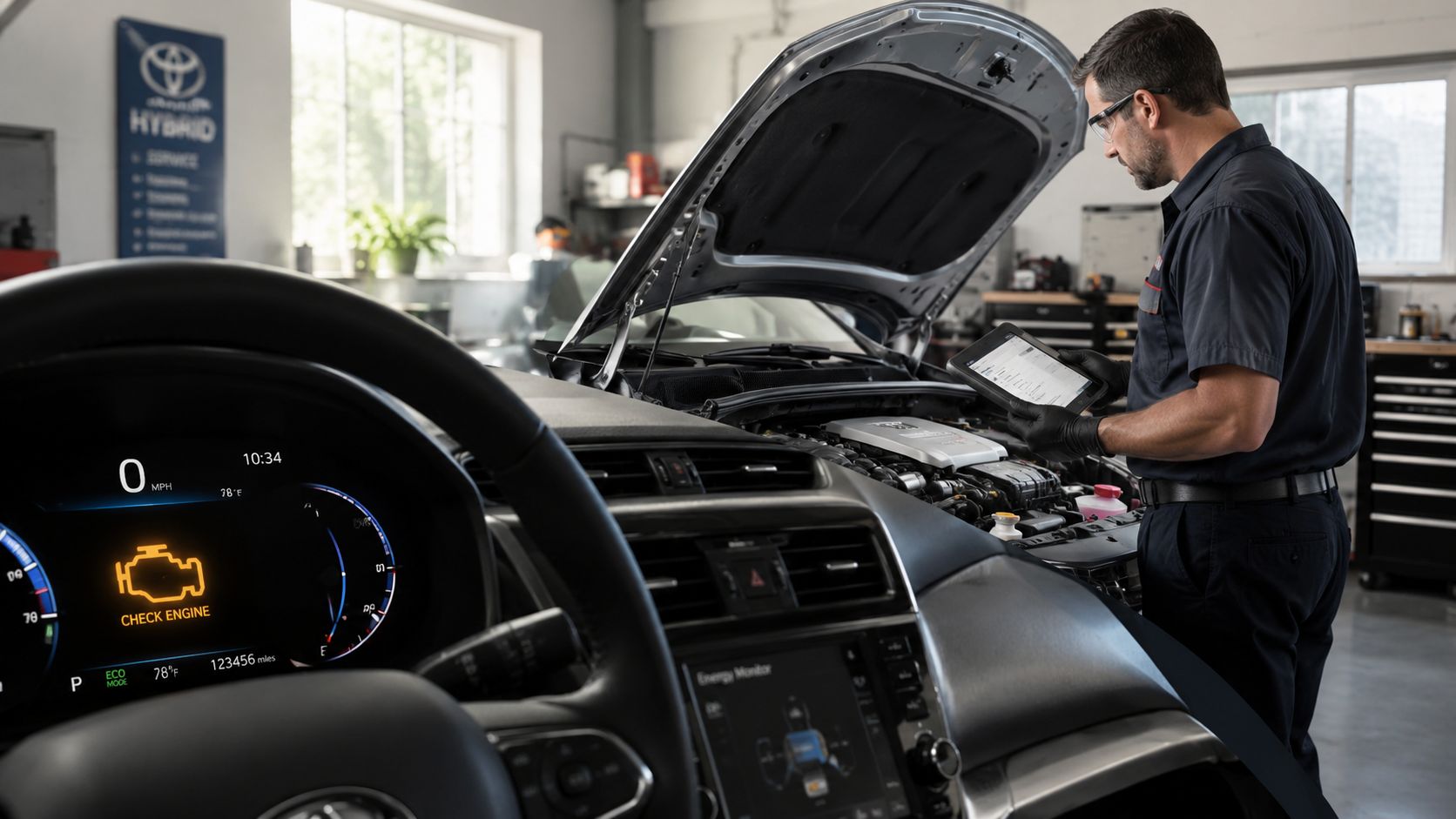
The biggest point of confusion is modifications. A hybrid does not fail just because it has aftermarket parts. It fails when an emissions-related part is missing, installed incorrectly, triggers a fault, or lacks the right California approval. That distinction saves people a lot of wasted trips.
What usually causes trouble
The Check Engine light is still the first thing I look at. If that light is on, the inspection usually stops there because the OBD system is reporting an emissions problem.
Readiness monitors cause a lot of repeat visits. If the 12-volt battery was disconnected, codes were cleared, or recent repair work reset the system, the car may show incomplete monitors. The hybrid can feel perfectly normal and still not be ready for testing.
Aftermarket parts are another common problem, especially intakes, catalytic converters, engine software changes, and other emissions-related components. Some hybrid owners also assume any battery upgrade or plug-in conversion automatically means failure. The issue is whether the change affects emissions compliance or creates a fault in the system. If the part needs CARB approval, it needs to be approved and properly documented.
I also see failures after do-it-yourself repairs. A loose connector, an unplugged sensor, or a cover left off after service can create a problem that the owner never notices until test day.
For a broader look at the issues that stop vehicles from passing, this guide to common smog check fail reasons covers the patterns we see at the station every week.
Hybrid smog failures are usually straightforward. The car is telling you something is wrong, or the emissions setup no longer matches what California requires.
A simple pre-test checklist
Before you schedule a smog check for a hybrid, check these items first:
- Check the dash: Handle any Check Engine light before testing.
- Give the monitors time to reset: If power was disconnected or codes were cleared, drive the vehicle through normal use before coming in.
- Review any modifications: Confirm that emissions-related aftermarket parts are legal for California and installed correctly.
- Look over recent repair work: Make sure hoses, connectors, and covers are back in place.
- Ask before you test: If you are unsure about a modified part, call a local smog station and ask. A quick answer can save you the cost and hassle of a failed visit.
A quick visual check at home helps more than people expect. You are not trying to diagnose the whole car. You are looking for obvious signs that something was recently changed, removed, or left unfinished.
Here's a helpful visual walkthrough of the kind of inspection mindset that matters before test day:
What works and what doesn't
What works is simple. Fix the warning light problem, drive the car enough to complete its self-checks, and verify that any emissions-related parts are California-compliant before you book the test.
What does not work is clearing codes right before the appointment and hoping the system stays quiet long enough to pass. Hybrids are checked through their onboard reporting, so incomplete or inconsistent data gets flagged fast.
If you are unsure whether your hybrid needs a repair, more drive time, or a closer look at an aftermarket part, a local technician who sees California smog failures every day can usually sort that out quickly. That clarity is what a lot of online guides miss. The failure is rarely mysterious. The cause is usually right in front of you.
Understanding STAR Certification and Finding a Local Smog Station
Not every station operates under the same expectations. If your DMV paperwork says you need a STAR station, you need to pay attention to that wording and not just show up anywhere.
When STAR matters
A STAR Certified station meets higher performance standards set by the Bureau of Automotive Repair. For drivers, that mostly means confidence that the inspection process is being handled in a way the state recognizes for the situations where STAR is required.
That doesn't make non-STAR stations “bad.” It just means STAR designation matters when the DMV specifically calls for it, or when you want the extra reassurance that the station is operating at that higher benchmark.
For a straightforward explanation of what that designation means, this guide on what a Smog STAR station is lays it out in simple terms.
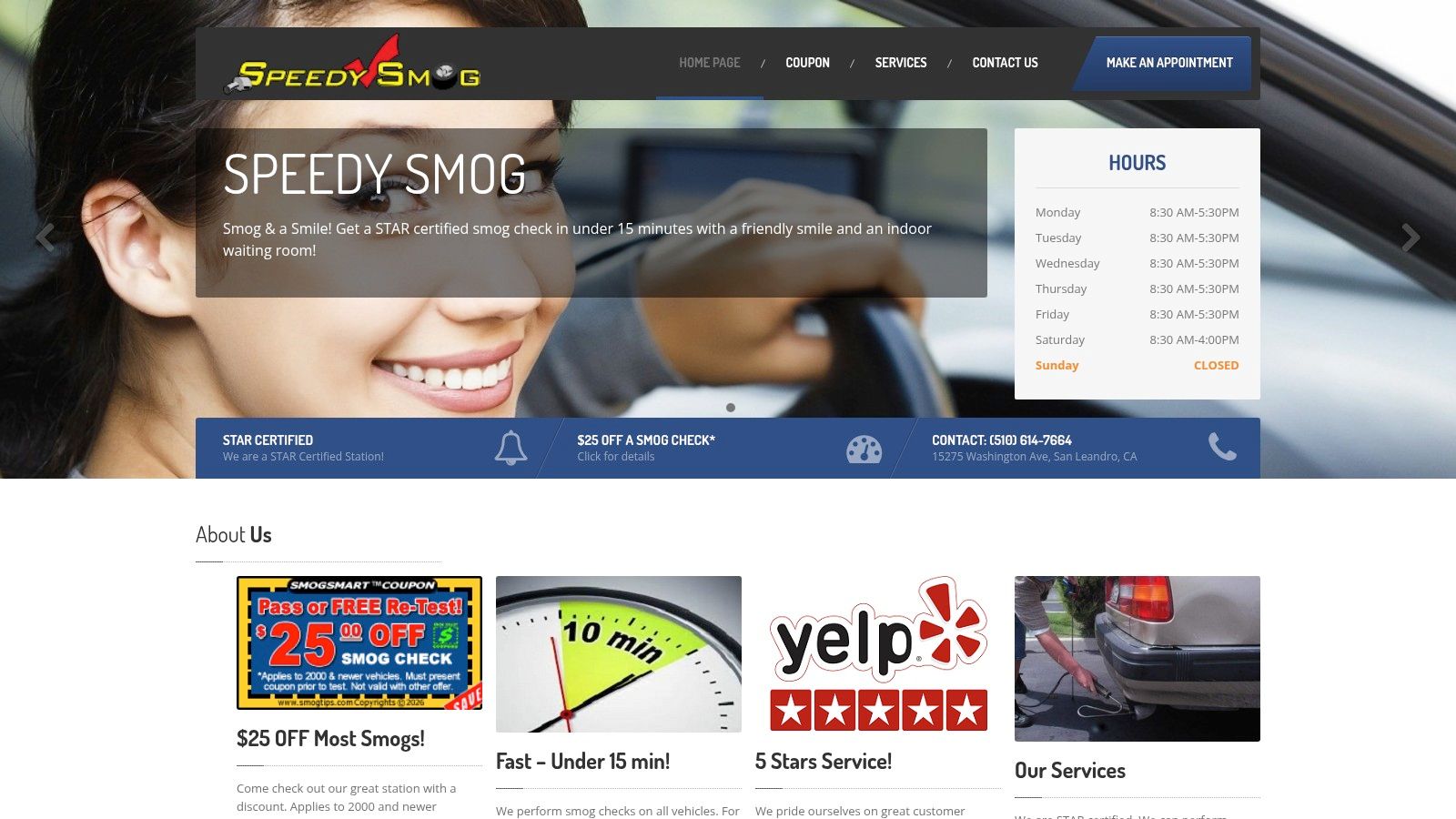
What to look for in a station
If you drive a hybrid, I'd focus less on flashy marketing and more on whether the shop feels organized and comfortable handling OBD-based testing cleanly. A good station should be able to answer simple questions without making the process sound mysterious.
A few signs you're in the right place:
- Clear communication: They can explain the hybrid test in plain language.
- Efficient workflow: Check-in, inspection, and certification move without confusion.
- Comfort and convenience: A decent waiting area matters more than people admit.
- No drama about hybrids: The staff should treat your vehicle type as routine, not unusual.
A reliable smog station doesn't just run the test. It helps you understand what the result means and what to do next if there's a problem.
For East Bay drivers, that local factor matters. You want a shop that knows how California compliance works, handles DMV-facing inspections every day, and respects your time.
Hybrid Smog Check FAQs
Do I need to warm up a hybrid before the test
Usually, no. Hybrid smog checks are generally based on the vehicle's onboard diagnostics, so there is no special warm-up routine like people remember from older tailpipe tests.
What matters more is that the car has been driven normally and hasn't had the battery disconnected or codes cleared right before the inspection. If the system monitors are set and no warning lights are on, you're in good shape.
Will a battery upgrade or plug-in charger kit fail smog
A hybrid does not fail just because it has been modified. The question is whether the part affects emissions compliance, triggers a fault, or lacks approval where approval is required.
Owners frequently face challenges. Factory-style replacement parts are usually straightforward. Aftermarket electronics, charger kits, intake parts, and other add-ons can create problems if they interfere with the car's emissions systems or set diagnostic trouble codes. I see more failures tied to the side effects of modifications than to the idea of a hybrid itself.
What happens if my hybrid fails
Start with the reason for the failure. That sounds obvious, but many drivers leave with a printout and still are not sure whether the problem is a check engine fault, incomplete readiness monitors, or an issue related to a recent repair.
Do not clear codes and hope for the best. That often resets the monitors and creates a second problem. A better move is to have the fault diagnosed, complete the repair, and then return for a retest under the station's policy.
How long does the result stay valid
If your hybrid passes, the electronic smog certificate is valid for 90 days. That is usually enough time to finish your DMV registration or title transfer without rushing.
Are hybrids easier to test than gas cars
In many cases, yes. The process is often quicker because the inspection usually centers on the onboard system instead of an older-style tailpipe procedure.
Still, “easier” does not mean automatic. Hybrids fail for real reasons, and the common ones are usually preventable. Check engine lights, unset monitors, and emissions-related aftermarket parts cause far more trouble than the hybrid powertrain itself.
If you need a hybrid smog check in the East Bay, Speedy Smog in San Leandro is a STAR Certified station that makes the process easy. Drivers choose it for fast inspections, a comfortable waiting room, clear pricing, and friendly service that keeps the visit simple from check-in to DMV certification.