
Your registration renewal is approaching, and you're trying to fit a smog inspection around work, errands, and the drive across Oakland. Before you choose a station, it helps to answer a more important question: what does your particular vehicle need to complete the inspection without an avoidable return trip?
Table of Contents
- Plan Your Oakland Smog Check Visit
- Understand California's Smog Certification System
- Determine Which Vehicles Require Testing
- Prepare Your Vehicle Before the Test
- Choose a STAR Certified Station Nearby
- Compare Prices Without Hidden Assumptions
- Prepare for a Possible Failed Inspection
- Explore Repair Assistance and Retirement Options
Plan Your Oakland Smog Check Visit
A search for a smog check in Oakland, California, can turn into a comparison of nearby addresses and advertised prices. But the closest station isn't necessarily the right starting point. Start with your renewal notice and your vehicle's information, then decide where to go.
Think of an Oakland driver whose car seems to run normally but recently had a battery disconnected. Another driver has a hybrid and isn't sure whether it needs testing at all. Neither should assume that a convenient appointment settles the underlying inspection questions.
Smog certification is a compliance requirement, not a routine tune-up. A maintenance visit addresses the car's service needs. A certification inspection determines whether it satisfies the applicable emissions inspection requirements.
Make the decisions in a useful order
Before committing to a visit, work through this sequence:
- Confirm the requirement. Read your renewal notice and verify your vehicle's current eligibility through state guidance.
- Identify the inspection. Have the model year, fuel type, and any special testing instructions available.
- Check preparation. Tell the station about recent emissions repairs or electrical work.
- Compare suitable stations. Confirm certification status, vehicle acceptance, and the complete price.
- Leave room for a problem. Understand what you'll do if the vehicle doesn't receive certification.
This approach doesn't replace DMV instructions or state eligibility tools. It helps you ask better questions before spending time and money.
Practical rule: Choose the inspection your vehicle requires before choosing the appointment that fits your calendar.
You don't need to become an emissions technician. You need enough information to distinguish a paperwork question, a readiness issue, and a repair decision.
Understand California's Smog Certification System
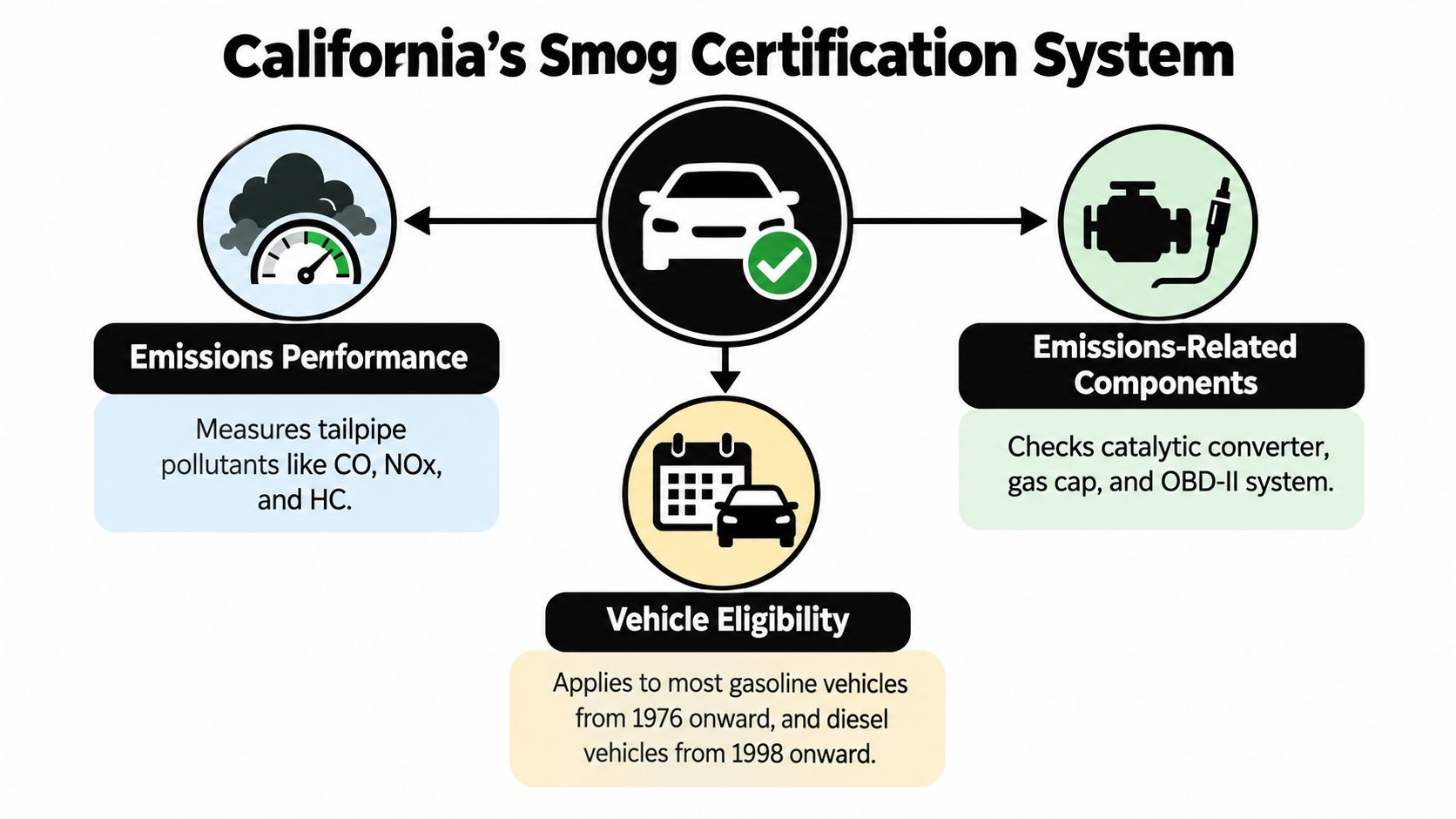
California's Smog Check program evaluates emissions performance and the condition of emissions-related components, requiring many vehicles to undergo inspection every other year. The state established the STAR program in January 2013 to identify stations meeting higher performance standards and authorize eligible locations to inspect vehicles with additional testing requirements, as explained in the Bureau of Automotive Repair's Smog Check performance report.
That structure explains why a smog appointment deserves different preparation from an oil change. The technician isn't deciding whether the engine sounds healthy or whether the exhaust looks clean. The vehicle must satisfy the inspection procedures that apply to it.
The diagram separates the main parts of the certification system.
Separate certification from registration
The Bureau of Automotive Repair, usually called BAR, oversees the inspection program described above. Your DMV registration transaction is the surrounding administrative task. Treating those as separate responsibilities helps prevent a common misunderstanding: completing an inspection isn't a substitute for checking the rest of your renewal instructions.
Ask the station what documentation you'll receive and how you can confirm the certification outcome. Separately, review what DMV still requires from you. Don't assume that a successful station visit answers every registration question.
| Question | Where to focus |
|---|---|
| Does my vehicle need an inspection for this transaction? | Current state eligibility guidance and DMV instructions |
| What inspection applies to my vehicle? | Vehicle details and the station's authorized testing capabilities |
| Did the vehicle receive certification? | The inspection result and station explanation |
| Is my registration transaction complete? | DMV renewal requirements |
A standardized inspection also means the technician needs to follow the applicable procedure rather than substitute an informal opinion. A car that feels dependable on the freeway may still need attention to an emissions-related condition.
The useful mindset is verification rather than reassurance. Ask what the inspection established, what remains unresolved, and which organization can answer the next question. That keeps a technical result from turning into confusion about your registration.
Determine Which Vehicles Require Testing
Model year and fuel type belong together. Knowing only that a vehicle is a sedan, pickup, or hybrid doesn't establish its inspection category.
According to BAR's vehicle coverage and inspection guidance, the program covers gasoline and hybrid vehicles from model year 1976 onward and diesel vehicles from 1998 onward; most gasoline, hybrid, and alternative-fuel vehicles from 2000 onward receive an OBD-II inspection, and BAR identifies hybrids in that newer group as subject to BAR-OIS testing. These broad categories are a starting point, not a substitute for checking the requirement for your exact vehicle and transaction.
Smog Inspection Categories at a Glance
| Vehicle group | Coverage stated in the brief | Inspection focus |
|---|---|---|
| Gasoline vehicles | Model-year coverage summarized above | Confirm the applicable method rather than assuming every gasoline vehicle receives the same test |
| Hybrids | Included in the program's stated coverage | Electric propulsion doesn't remove the need to verify inspection obligations |
| Alternative-fuel vehicles | Most vehicles in the newer diagnostic group described above | Confirm whether the OBD-II inspection applies |
| Diesel vehicles | Covered from the threshold identified above | Verify the vehicle's eligibility and the station's ability to inspect it |
Understand what OBD-II evaluates
On-board diagnostics, abbreviated OBD-II, concerns the vehicle's electronic monitoring of emissions-related operation. BAR's guidance describes an inspection that evaluates the malfunction-indicator lamp, stored diagnostic trouble codes, readiness monitors, and emissions-control functionality.
Those terms answer different questions:
- Warning-lamp status: Is the vehicle indicating an emissions-related malfunction?
- Diagnostic trouble codes: Has the computer recorded information about a detected problem?
- Readiness monitors: Has the vehicle completed the relevant self-checks?
- System functionality: Are emissions controls operating within the vehicle's certified design limits?
A dashboard without an illuminated warning lamp doesn't, by itself, answer all those questions. That distinction matters when a car has recently been repaired or had its diagnostic memory reset.
For a hybrid owner, the practical example is straightforward. Quiet electric operation on part of a trip doesn't establish that the combustion engine's emissions systems are outside the inspection program. Describe the vehicle accurately when calling, including that it's a hybrid.
For an older-vehicle owner, avoid requesting a particular testing method based on what a newer family car received. Give the station the actual vehicle details and ask which procedure applies. Vehicle classification comes before assumptions about testing equipment.
Prepare Your Vehicle Before the Test
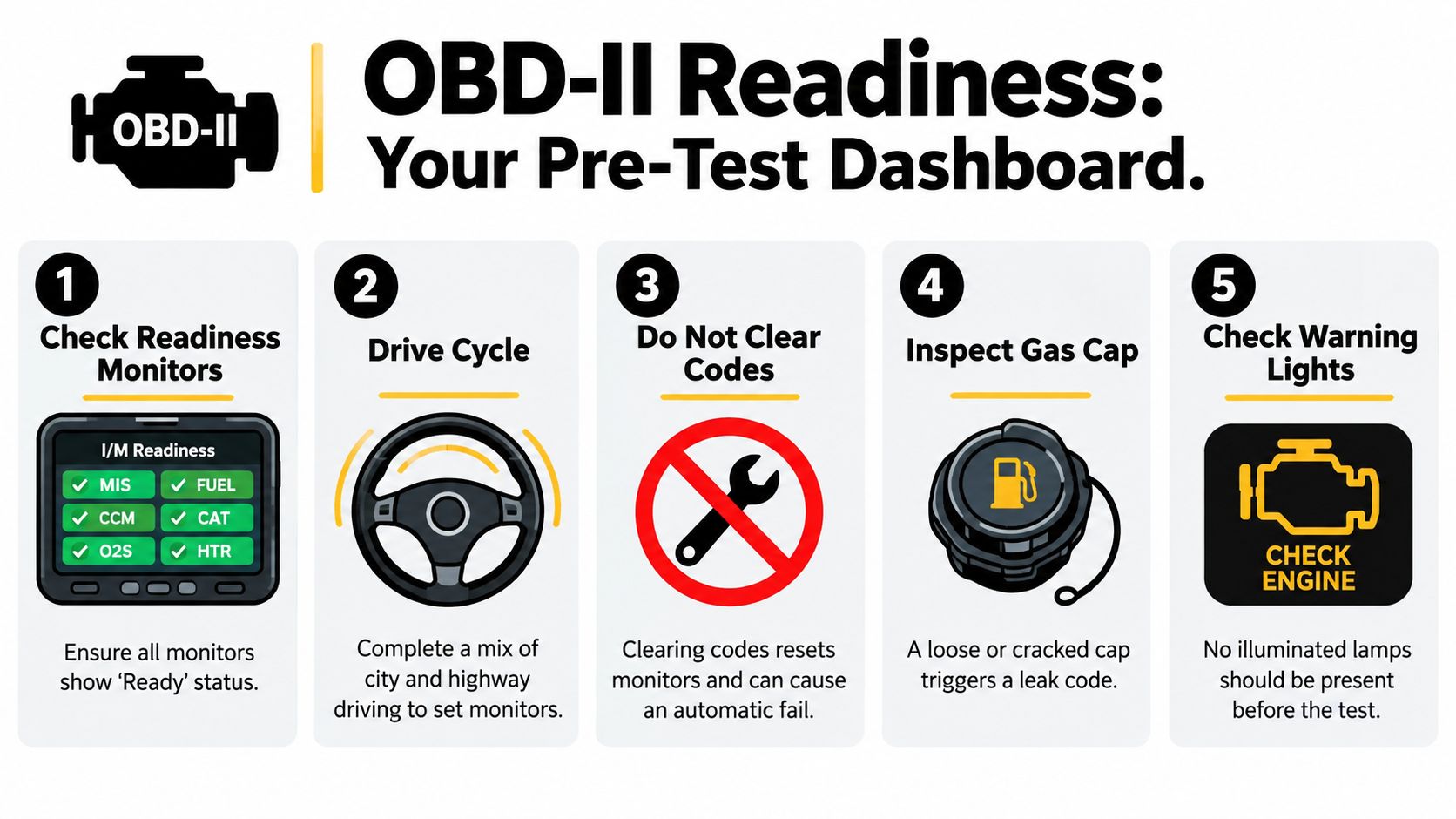
A recently repaired car can be mechanically improved without yet being ready to demonstrate that improvement during an inspection. Readiness is evidence that the vehicle has completed its required self-checks, not an absence of dashboard warnings.
Under the BAR guidance cited above, clearing diagnostic codes or disconnecting the battery can leave readiness monitors incomplete. That can create a readiness-related failure even when the warning lamp is off. Trying to erase a problem immediately before testing can therefore create another obstacle instead of solving the original one.
Use a readiness-focused checklist
- Discuss recent work. Tell your technician about repairs, code clearing, or a battery disconnection before booking the inspection.
- Address an active warning lamp. Ask for diagnosis of the underlying condition rather than a temporary reset.
- Follow the manufacturer's drive cycle. After repairs, use the prescribed procedure so the vehicle can complete its checks.
- Verify readiness. Ask whether monitor status has been checked, rather than assuming that ordinary driving has completed everything.
- Keep repair records. Bring enough information to explain what was repaired and whether the computer was reset.
The visual checklist is a useful reminder, but the manufacturer's procedure and the applicable inspection rules should guide your vehicle-specific preparation.
Don't substitute a driving guess for verification
A drive cycle isn't a universal instruction to take a quick freeway trip. Follow the procedure prescribed for your vehicle rather than relying on someone else's experience with a different model.
An extinguished warning lamp and completed readiness checks answer different questions. Ask about both.
No preparation checklist guarantees certification. The purpose is to avoid arriving with a known warning condition or unresolved readiness question that could have been discussed beforehand.
If you're uncertain, explain the situation when you call. “The repair is complete, but I don't know whether readiness was verified” gives the station a more useful starting point than “The car seems fine.”
Choose a STAR Certified Station Nearby
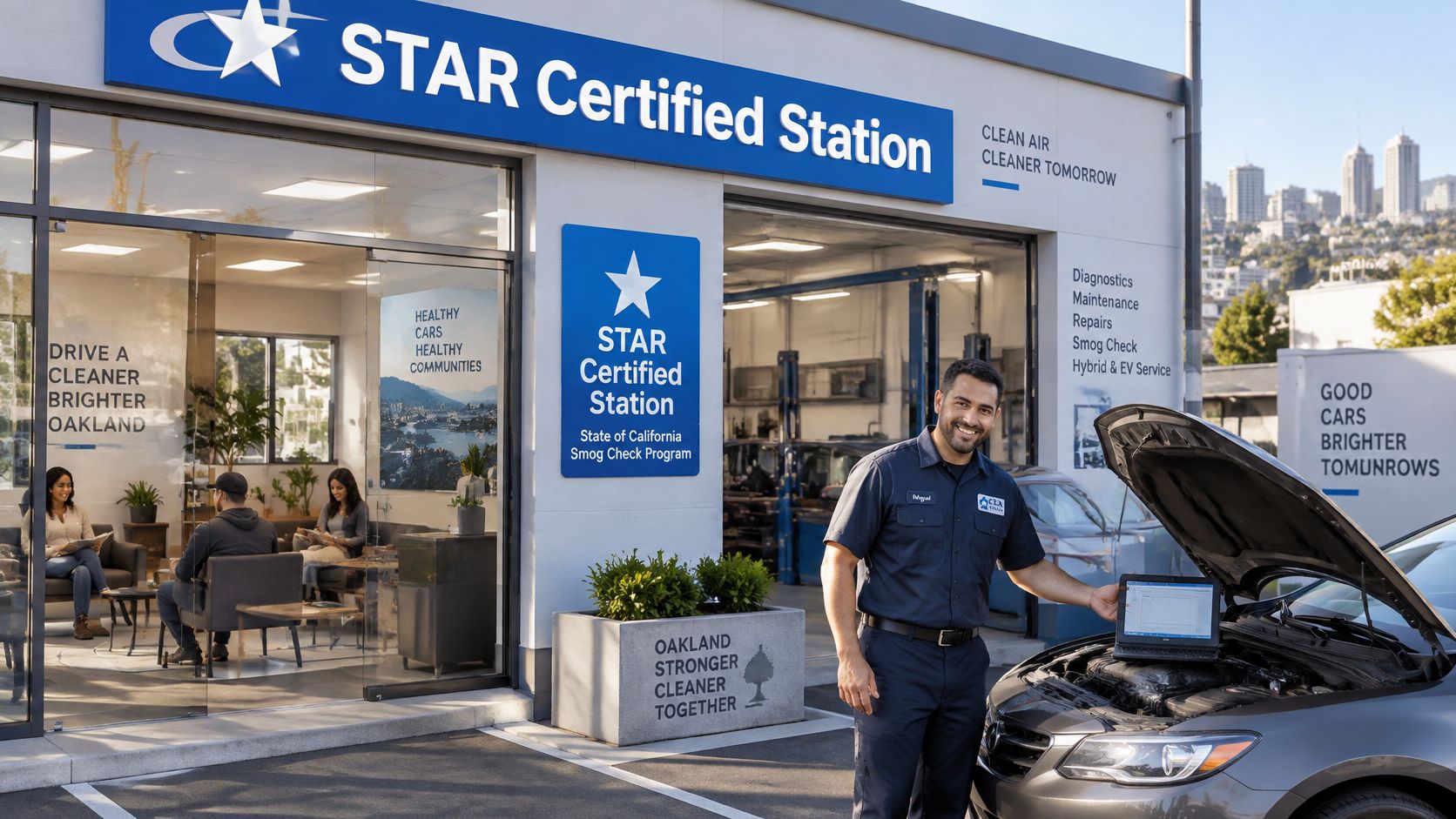
A suitable station should match the requirement on your paperwork and the vehicle you're bringing. If your renewal notice calls for a STAR inspection, make current STAR status a selection requirement rather than assuming that every smog business qualifies.
A technician's inspection involves more than a quick look under the hood.
Compare the service you actually need
Test-only and test-and-repair describe different service arrangements. Ask whether you're booking inspection alone or whether the facility can also provide diagnosis and repairs if needed. Don't infer that a particular location offers every service because it displays a smog sign.
| Selection question | Why it belongs in your comparison |
|---|---|
| Is the station currently STAR certified? | Your notice may specify that station category |
| Can it inspect this vehicle? | Fuel type and model year affect the appointment |
| Is the visit testing only? | You should know whether repair capability is available |
| What requires separate authorization? | Diagnosis and repairs shouldn't be confused with the inspection |
| What happens after the result? | You need a clear explanation of certification and documentation |
For a nearby business example, Speedy Smog identifies its San Leandro facility as a STAR-certified smog station serving East Bay drivers. Treat it as an option to compare with other suitable facilities, and confirm acceptance of your vehicle and the services you need before traveling.
This video provides another point of reference while you prepare questions for a station.
Ask about the complete visit
- Scheduling: Request an estimated completion time and ask whether waiting time is separate.
- Certification handling: Ask the station to explain its electronic certification process and the records you'll receive.
- Repair boundaries: Establish whether any additional work requires your approval.
- Result explanation: Confirm that someone can walk you through the report if certification isn't issued.
An Oakland address isn't the only practical option, and a nearby San Leandro location may fit your route. Still, convenience should follow suitability. A short drive to the wrong inspection appointment isn't a time saving.
Compare Prices Without Hidden Assumptions
An advertised inspection price doesn't answer every cost question. Before comparing offers, ask each station to describe the same service for the same vehicle, including any separately listed charges and the conditions attached to a discount.
No verified local fee schedule is established here, so assigning an Oakland-wide price range would be misleading. Use the local emissions-testing pricing information as a starting point for a direct quote, not as a substitute for confirming today's total.
Smog Price Questions to Confirm Before Testing
| Cost item | What the supplied information establishes | What the driver should confirm |
|---|---|---|
| Inspection price | No universal Oakland total is established | The complete quote for the exact vehicle |
| Certification-related charges | No amount is established here | Whether the quoted total includes applicable charges |
| Coupon | Availability must be checked directly | Current terms, vehicle restrictions, and exclusions |
| Diagnostic work | It shouldn't be assumed to be part of testing | Whether diagnosis is available and separately charged |
| Repairs | No repair estimate can be established before the problem is assessed | The proposed work and authorization process |
| Another inspection | No station-specific policy is established | Any conditions or charges for returning |
Use a precise pre-arrival request
Try this wording when you call:
Please quote the complete inspection cost for my vehicle, explain any separate charges, and tell me whether a current coupon applies. If it doesn't pass, what would I be paying for next?
Then provide the model year, fuel type, and any STAR instruction on your notice. If you've already received a quote elsewhere, compare inclusions rather than comparing headline amounts alone.
Time and price are separate questions. A station's estimate for performing the test doesn't necessarily describe your total visit, and a discount doesn't establish the final bill. Confirm payment timing and keep the quoted scope clear before testing begins.
Prepare for a Possible Failed Inspection
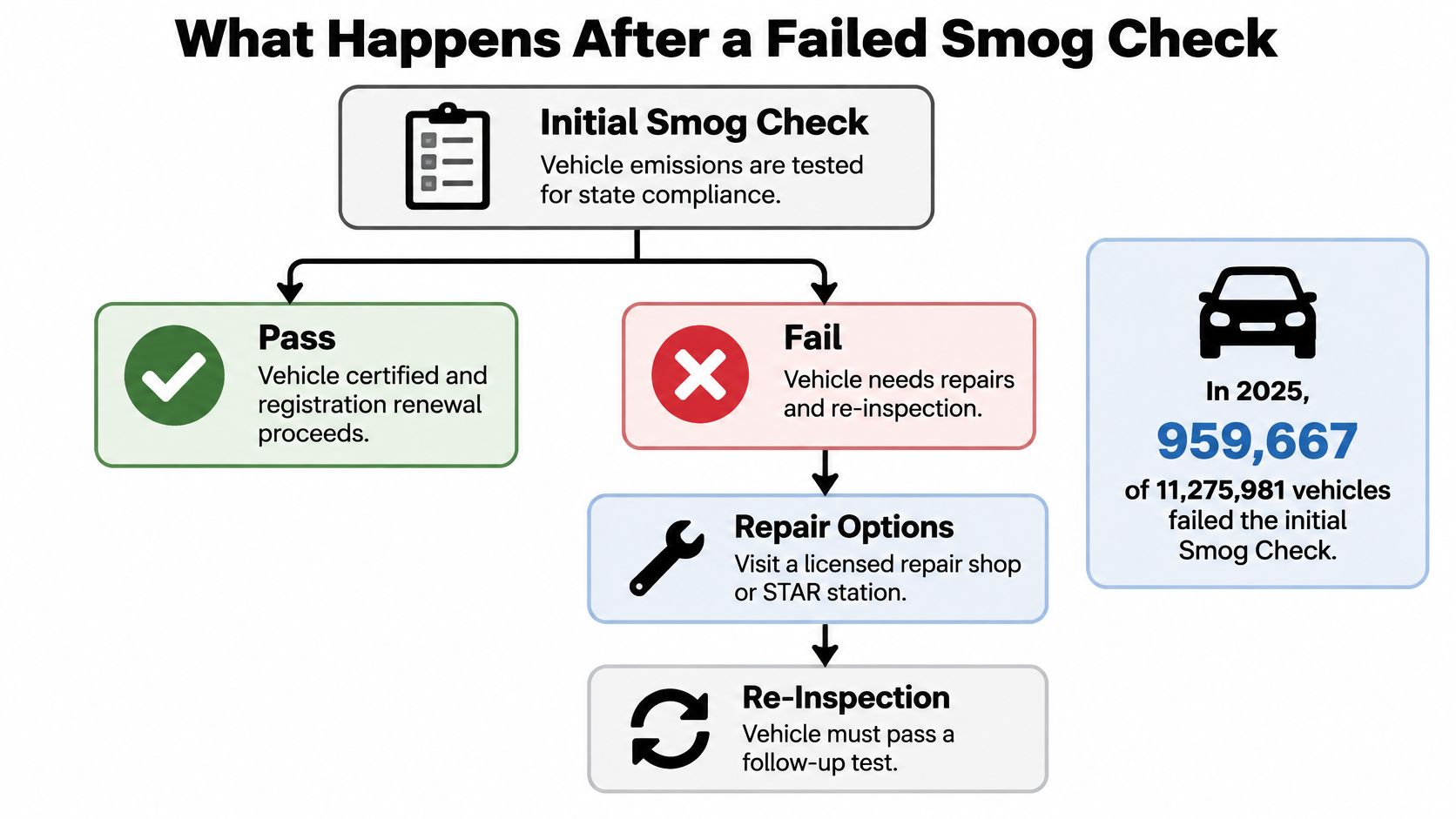
A failed inspection is a result to interpret, not an instruction to authorize unspecified repairs. In the 2025 reporting period, BAR recorded 959,667 failures among 11,275,981 initial tests, an 8.51% initial failure rate; including repeat and other testing activity, the overall failure rate was 9.04%, according to the statewide Smog Check executive summary.
Those statewide figures aren't a prediction for your particular car. They establish that failure is a real possibility worth planning for, while most initial tests didn't fail. The report also shows that vehicle age affected outcomes, which gives owners of aging vehicles a reason to budget time for diagnosis rather than assume immediate certification.
Read the result before buying a repair
Start by asking the station to identify the reported reason certification wasn't issued. A readiness issue calls for a different conversation from a diagnosed malfunction or an emissions-component concern.
- Keep the report. Preserve the inspection result alongside existing repair records.
- Ask for a plain-language explanation. Understand what the inspection found and what still needs diagnosis.
- Request a written estimate. Separate proposed diagnostic work from a repair recommendation.
- Check the next inspection step. Ask what must be resolved before returning.
The flowchart shows the conventional repair-and-reinspection route.
Pause when the financial decision changes
For an owner facing substantial repair costs, the next question isn't always “Which repair should I approve?” It may be “Should I check assistance eligibility before committing more money?”
Don't assume that a failure automatically qualifies you for help, either. Preserve the documentation and compare your options before treating any program as a guaranteed payment.
If the inspection result appears inconsistent or you don't understand the explanation, ask for clarification first. For an unresolved dispute, contact BAR or ask whether a Referee review is appropriate rather than paying for repeated tests without understanding the issue.
A clear explanation is part of making an informed decision. You should understand the reason for failure, the proposed next step, and the financial commitment before authorizing work.
Explore Repair Assistance and Retirement Options
For a financially constrained household, keeping an older vehicle on the road can involve a difficult trade-off. A repair may be worthwhile, but it shouldn't be treated as the only possible response to an expensive emissions problem.
California offers vehicle-retirement incentives of $1,500 or $2,000 in qualifying cases, while income-qualified applicants for broader Consumer Assistance Program options generally must be at or below 225% of the federal poverty level; published annual examples include $35,910 for a single-person household, $48,690 for a household of two, and $74,250 for a household of four, according to BAR's vehicle-retirement eligibility information. That guidance distinguishes pathways requiring a failed inspection from another requiring a completed inspection within 180 days before application, so the relevant route must be verified before you rely on it.
Compare eligibility before committing funds
Income is only part of the decision. BAR also distinguishes programs by vehicle operational status and inspection history. Don't read an income threshold as an approval, and don't assume that every assistance option follows the same application rules.
Use this compact decision sequence:
- Preserve documentation first. Keep the test report, repair estimate, and records that explain the vehicle's condition.
- Identify the relevant program. Ask whether your circumstances fit repair assistance, retirement, or neither.
- Verify current requirements. Confirm application timing and vehicle conditions directly with BAR.
- Compare your alternatives. Consider the repair quote alongside your transportation needs and any verified program eligibility.
- Resolve disputed questions. Ask BAR which office or Referee resource is appropriate for the issue.
Local smog-check repair-assistance guidance can help you organize questions, but BAR should confirm program requirements and eligibility.
Make the decision fit your household
Retirement assistance isn't automatically the better financial choice. You still need to consider how you'll travel after giving up the vehicle. Conversely, repeated repair spending isn't automatically sensible just because you've already invested money in the car.
Your most useful next step is the one supported by documentation: a verified inspection requirement, an appropriate station, an understood price, or a clearly assessed assistance application. You don't have to solve every uncertainty at the counter.
Speedy Smog offers STAR-certified emissions testing in San Leandro for Oakland and other East Bay drivers. Visit Speedy Smog to confirm your vehicle's inspection needs, ask for the complete price, and plan your visit before your registration deadline.